Preface. Ever since I read that women were the pack mules in Alexander the Greats army, carrying all the food and camp gear while their men only carried a sword, I’ve wondered about the role of women in armies. Very little has been written about this because not much is known. Records such as memoirs or legal proceedings do not exist until modern times, when the number of women accompanying armies dropped precipitously. Women weren’t paid, so they don’t show up in military budgets. And you can’t trust fiction – the public always enjoyed reading about cross-dressing women who secretly enlisted as men, but there were very few women who did this.
As billions of people feel peak prosperity declining and worry about their future, they are turning to authoritarian governance all over the world, and probably did in the past too. We are returning to resource wars, when “growth” came from raiding other regions and pillaging their people for slaves and resources. In dictatorships, leaders tend to be grifting and corrupt, impoverishing people until the only jobs available are joining wars for plunder, wine, and food.
A shame we can’t strive for a steady state economy as proposed by Herman Daly and other economists who take energy and resources into account.
If you are wondering what you may be doing postcarbon, perhaps “mercenary” needs to be added to the list of potential skills. In the U.S., there are over 400 million guns, 22 million military veterans, 900,000 sworn police officers, 1.1 million security guards, 46,000 border patrol guards, and countless others with jobs carrying arms. Perhaps these positions are already spoken for.
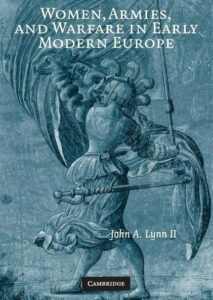
The blurb describing this book at Amazon says: “Women, Armies, and Warfare in Early Modern Europe examines the important roles of women who campaigned with armies from 1500 to 1815. This included those notable female individuals who assumed male identities to serve in the ranks, but far more numerous and essential were the formidable women who, as women, marched in the train of armies. While some worked as full-time or part-time prostitutes, they more generally performed a variety of necessary gendered tasks, including laundering, sewing, cooking, and nursing. Early modern armies were always accompanied by women and regarded them as essential to the well-being of the troops. Lynn argues that, before 1650, women were also fundamental to armies because they were integral to the pillage economy that maintained troops in the field”.
Alice Friedemann www.energyskeptic.com Author of Life After Fossil Fuels: A Reality Check on Alternative Energy; When Trucks Stop Running: Energy and the Future of Transportation”, Barriers to Making Algal Biofuels, & “Crunch! Whole Grain Artisan Chips and Crackers”. Women in ecology Podcasts: WGBH, UCSC, Financial Sense, Jore, Planet: Critical, Crazy Town, Collapse Chronicles, Derrick Jensen, Practical Prepping, Kunstler 253 &278, Peak Prosperity, Index of best energyskeptic posts
***
Lynn II JA (2008) Women, Armies, and Warfare in Early Modern Europe. Cambridge University Press.
Before 1650, armies were like huge cities moving across the landscape. When Charles the VIII of France invaded Italy in 1494, there were roughly 50,000 non-combatants who supported 20,000 soldiers. There were always larger numbers of camp followers than soldiers. In some armies, boys came along as servants, with as many as one per two soldiers.
In addition to women, support came from bakers, carpenters, blacksmiths, and all the other professions needed to provision an army. To survive, these huge moving armies preyed on the farms and towns they passed through, including their own people. They pillaged, raped, and took what food and provisions they needed. Also, tens of thousands of horses fed on the lands they crossed, and the land owners were rarely compensated.
Plunder was the “lottery” of its time, a way for the poor to escape miserable jobs and come home wealthy. Some men and women formed temporary plunder partnerships. Women helped in the plunder and helped carry the booty. They also cooked, and if the couple had a business, often kept the books and helped sell the product, plus did men’s work, digging trenches and other hard labor. But men never did women’s work – women had a hard life in the army.
Many couples weren’t married, and single women earned so little doing laundry and other menial chores they often had to prostitute themselves to get by. The most desperately poor women earned their livings as prostitutes in the army.
In the 15th century, Erasmus wrote a colloquy called “of a soldier’s life”. In this, he argues that “The wicked Life of Soldiers is shewn to be very miserable: That War is Confusion, and a Sink of all manner of Vices”. In this colloquy, a solder is told “it is not love of country, but love of booty that made you a solder” and the solder replies “I confess so, and I believe very few go into the army with any better design.”
Pillaging was a free-for-all, sometimes the soldier got to keep what he took, but often the booty was piled up and distributed based on agreements between officers and men.
But very few soldiers returned with plunder, because they spent the booty on whoring, wine, gambling, food, and other necessities.
Plunder was a necessity, because although the armies from 1450 to 1650 were mainly mercenaries, hired as needed, they often didn’t get paid — the deal makers kept the money. Some armies went on strike just before a battle, demanding pay. At times the lack of pay led to mutiny, but usually it resulted in the pillage of towns and farms.
Since the people armies preyed on were from the same lower social classes as the soldiers, they tried to see peasants as inferior. This contempt made it easier for them to prey on those so like themselves. The hatred was mutual – farmers and towns people favored art and literature where peasants wreaked revenge on marauding soldiers.
Quartering armies was so onerous that Louis the XIV of France tried to compel Protestants to convert to Catholicism by forcing them to quarter the infamously badly behaved Dragonnades.
Americans detested quartering British troops so much that the 3rd amendment of the U.S. Constitution forbids quartering in peacetime without the owner’s consent.
These small moving cities of soldiers and their supporting non-combatants flouted the morality of the settled farmers and townspeople. The soldiers wore uniforms that were a parody of upper-class clothing and in violation of the sumptuary laws. Women wore flamboyant costumes that defied civilian morals. As author John Lynn puts it “these sons of peasants transformed themselves from sparrows into assertive peacocks.” Many soldiers spent their pay and booty to finely adorn their prostitutes.
This all changed when state armies arose after 1650 and troops became more disciplined, were better paid, had health care, and there were far fewer mercenaries. Eventually their mission was to protect civilians, and became welcome rather than feared.
John Lynn also covers the status of women, the roles of wives, unmarried partners, and prostitutes, how women in armies appeared in cultural works of art and literature, the work they performed, biographies of the few women who did cross-dress as men, and much more.
Women must have fought in battles that turned against them, and townswomen must have fought to defend their homes and honor. But so little is known, much will always remain a mystery.
|
|