
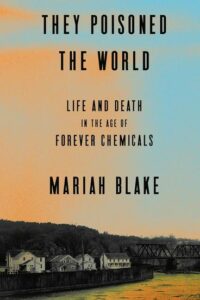
Preface. This is a book review of Blake’s 2025 They Poisoned the World: Life & Death in the Age of Forever Chemicals.
This is a history of how the existential threat of PFAs and other forever chemicals came to be. How the U.S. government collaborated with Dupont since the 1820s and more recently helped the government hide the damage they did to people’s health and the environment so that both Dupont and U.S. government could avoid the financial consequences.
No wonder people don’t trust the government and voted for extremist politicians who will only make their lives even worse as institutions that protect Americans are being dismantled, such as the EPA, CDC and other health institutions, and the Consumer Financial Protection Bureau and many others. It is up to you to protect yourself now, a good reason to buy this book, and for those of you concerned about overshoot and where to be, another consideration to research. Hopefully far from DuPont/DOW and other chemical manufacturers…
What really got me was when whistleblowers in small towns were shunned by Dupont workers, who say their lawsuit as having the potential to take away their jobs, if Dupont might move their factory elsewhere. When you consider how much damage manufacturing does to surrounding communities, it seems crazy to try to bring manufacturing back, especially since with peak oil in 2018 they won’t be in business more than a decade or so, and most of the jobs too low-paying and miserable for people to take them. Indeed, there are almost half a million manufacturing jobs open that people are not applying for.
I was also struck by how it was DuPont that taught the Tobacco industry how to cast doubt and hide findings of their own scientists that smoking was deadly. So this book will never be out of date because it has the history of how companies that made forever chemicals kept it secret for so long
For those of you who voted for Trump, the author has this to say that might interest you:
“After many years of negotiation, in 2016, our famously gridlocked Congress voted overwhelmingly to reform the Toxic Substances Control Act, ushering in the most significant environmental legislation in decades. The revised law required the EPA to screen all new chemicals coming onto the market and—more importantly—mandated vetting for existing chemicals. No more grandfathering. The bill owed its success partly to backing from the chemical industry. Facing intense public anxiety over ever-present chemicals like PFAS and phthalates, manufacturers saw federal regulation as the best way to preserve faith in their products and to avoid a cumbersome patchwork of state regulation. In return for their support, industry lobbyists insisted on provisions that would make the process slow and ponderous.
What they hadn’t reckoned on was a Donald Trump presidency. Almost as soon as the new administration took office, it began working to gut the legislation entirely. Just weeks before the EPA was due to finalize its rules for implementing the law in June 2017, a former American Chemistry Council lobbyist named Nancy Beck was appointed to the number two spot in the agency’s Office of Chemical Safety and Pollution Prevention. Beck pressed agency staff to rewrite the rules along industry-friendly lines. One of her chief demands involved guidelines for picking which chemicals to prioritize for safety testing and possible regulation. The draft called for factoring in various ways people are exposed, since heavier, more widespread exposure can translate into a greater risk. Beck wanted to overhaul the language for “legacy” chemicals like PFOA that had theoretically been phased out. Specifically, she wanted to bar the EPA from considering key routes of exposure—including drinking water.
Beck’s colleagues warned that this approach would drastically underestimate the hazards since these chemicals were still ubiquitous in the environment despite dwindling U.S. production. Beck ignored their concerns and took charge of rewriting the rules herself, a highly unusual move at an agency where guidelines are usually drafted by career civil servants with specialized expertise.
President Trump, meanwhile, tapped a former Saint-Gobain (another forever chemical maker) lobbyist to head the EPA office that oversees the federal Superfund, one of the programs Hoosick Falls was counting on to compel polluters to pay for cleanup.
In July, the president announced his nominee to head the EPA’s Office of Chemical Safety. It was none other than Michael Dourson, the industry-funded toxicologist who helped set the dangerously lax standard for PFOA in West Virginia. If confirmed, Dourson would not only oversee implementation of the new chemical-safety law but would also be in charge of vetting some of the very substances whose dangers his group had downplayed while taking money from their manufacturers.”
But Obama and Biden also appointed industry insiders who kept regulation and awareness back. The EPA ignored evidence. There is a lot of blame to be found for how this existential threat came to be so ubiquitous. We all have PFAS and other unregulated chemicals in our bodies. So do the most distant seals and polar bears. They cause cancer, liver and kidney disease and a long list of other maladies.
Here are a few paragraphs from the conclusion:
“Almost every month brings bleak new revelations about how thoroughly forever chemicals have polluted the earth. One 2022 study of rainwater around the globe found that the levels of PFOA and PFOS alone had reached concentrations that endanger the health of people and ecosystems everywhere. Based on these facts, the authors concluded that the entire planet is now “outside the safe operating space” for humanity (Cousins). Surveys of rivers, lakes, drinking water, and food supplies around the world have yielded equally troubling findings. Cousins IT et al (2022) Operating Space of a New Planetary Boundary for Per- and Polyfluoroalkyl Substances (PFAS). Environmental Science & Technology doi:10.1021/?acs.est.2c02765
Organic foods often contain harmful levels of PFAS for the same reason that animals in the wild do; they absorb these chemicals through ambient contamination of our soil and water.
The methods used to clean up PFAS pollution often end up returning the chemicals to the environment instead. The landfills where we bury forever-chemical waste simply belch them back into the air.
Trying to incinerate these substances, as many companies do, often just spreads them farther afield. Scientists once believed that our oceans might be our saving grace—that forever chemicals would wash out into the seas and be gradually diluted almost to the vanishing point. Unfortunately, the opposite is true. The chemicals latch on to tiny air bubbles that rise from ocean depths, eventually accumulating on the surface as a highly concentrated stew. When waves crash ashore, the bubbles burst, releasing immense quantities of PFAS into the atmosphere. As a result scientists estimate the oceans now emit more PFAS into the air than all of the world’s industrial polluters combined.
As disturbing as all these findings are, they encompass only a tiny fraction of the PFAS in the environment. To date, the scientific research on these chemicals has focused almost exclusively on two broad categories: legacy substances like PFOA, which contain eight or more carbon atoms and have been phased out in many countries; and short-chain molecules, like GenX, which contain between four and seven consecutive carbon atoms and are still widely used in manufacturing. In the past few years, researchers have realized that a third, barely studied category of forever chemicals might pose an even greater threat.
It all began in the early 2020s, when a group of European researchers developed a technique to detect an elusive subset of forever chemicals that evaded other methods—specifically, those with three or fewer carbon atoms. After applying this technique to drinking water across Germany, they made a breathtaking discovery: All but 2 percent of PFAS detected were ultra-short chain substances, which up until then had hardly registered on scientists’ radar.
One molecule turned out to be particularly abundant—trifluoroacetic acid, or TFA, which is used to make pesticides, pharmaceuticals, and working fluids for heating and cooling systems. It is also a common breakdown product of other PFAS. The researchers found that this chemical alone accounted for 90% of forever chemicals detected in German tap water. Since then, TFA has been detected at alarming levels in beer, bottled water, tea, and baby food in a variety of countries.
When researchers from Emory University measured the levels of various PFAS in tap water from homes in Indiana, they found that TFA accounted for 85% of the total. The average concentration was orders of magnitude above the EPA’s safety limit for PFOA. Industry has long insisted that shorter-chain chemicals are safer because they don’t build up in people’s bodies. But the Emory team found that the TFA levels in homeowners’ blood were even higher than the national average for PFOA at its peak. This wasn’t because the chemical had built up over time but because people were being exposed to such huge quantities.
Since TFA has only recently attracted scientific scrutiny, data on its health effects are scarce, though animal studies have already linked it to familiar problems like liver damage and birth defects.[9] In other respects, ultra-short-chain chemicals like TFA are more worrisome than their better-studied cousins. They’re even more mobile than short-chain chemicals like GenX. They build up faster in crops, leading to enormous concentrations in the few foods that have been tested. And they’re virtually impossible to get out of drinking water. Not only do they pass right through the type of carbon filters used to remove legacy chemicals but they also foil newer treatment technologies that are meant to remove a broad range of PFAS.
What’s more, researchers warn that TFA “may only be the tip of the iceberg.” As detection methods improve, they are discovering more and more previously unknown PFAS. By the time they figure out where these substances come from or how they are affecting us, it will be too late: The planet may already be saturated with them. Meanwhile, manufacturers will have moved on to other unknown molecules.
So far, manufacturers like DuPont, Chemours, and 3M have been hit with roughly 15,000 legal claims, the lion’s share from municipalities, water districts, and residents of polluted communities, though more than thirty U.S. states have also brought cases. And the numbers are expected to rise steeply in the coming months and years. During an early 2024 plastic-industry conference, a prominent corporate lawyer warned executives to prepare for a tsunami of litigation that would dwarf anything having to do with asbestos, one of the biggest and most costly legal fights in U.S. history.”
The good news is that protests can make change: In 2023, the European Commission introduced a wholesale ban on the production and sale of PFAS and products containing them, the most sweeping chemical regulation in EU history.
But don’t look for that to happen in the United States! The Trump administration plants to cut the EPA budget by 55%. Their scientific division, the Office of Research & Development (ORD) is being shut down entirely. ORD conducts critical research to “safeguard human health and ecosystems from environmental pollutants,” according to its website. The ORD’s research touches on a range of issues from PFAS, often referred to as “forever chemicals,” to water-bourne diseases, soot in the air, and environmental factors that contribute to childhood asthma, Orme-Zavaleta said.
It is made up of six major research program offices, per its website, that include Air, Climate, and Energy, Chemical Safety for Sustainability, Health and Environmental Risk Assessment, Homeland Security, Safe and Sustainable Water Resources and Sustainable and Healthy Communities.
Today’s cuts dismantle one of the world’s most respected environmental health research organizations,” said Jennifer Orme-Zavaleta, former EPA principal deputy assistant administrator for science, in a statement. “EPA’s science office has long been recognized internationally for advancing public health protections through rigorous science. Reducing its workforce under the guise of cost savings is both misleading and dangerous. This does not save taxpayers money; it simply shifts costs to hospitals, families and communities left to bear the health and economic consequences of increased pollution and weakened oversight. The people of this country are not well served by these actions. They are left more vulnerable.”
Alice Friedemann www.energyskeptic.com Author of Life After Fossil Fuels: A Reality Check on Alternative Energy; When Trucks Stop Running: Energy and the Future of Transportation”, Barriers to Making Algal Biofuels, & “Crunch! Whole Grain Artisan Chips and Crackers”. Women in ecology Podcasts: WGBH, Financial Sense, Jore, Planet: Critical, Crazy Town, Collapse Chronicles, Derrick Jensen, Practical Prepping, Kunstler 253 &278, Peak Prosperity, Index of best energyskeptic posts
***
Blake M (2025) They Poisoned the World: Life and Death in the Age of Forever Chemicals
From their very first moments of life, every American newborn carries a slew of synthetic chemicals in their body. To my astonishment, I also learned that many of these substances have never been tested for safety. Of those that have, a substantial share are known to be damaging. Some can cause cancer or retard fetal development. Others alter the levels of hormones in the womb, causing subtle changes to a baby’s brain and organs. Though these changes may not be apparent at birth, they can lead to a staggering variety of problems, including cancer, heart disease, infertility, early puberty, reduced IQ, and neurological disorders like ADHD. The evidence is so overwhelming that major medical organizations now warn that widespread exposure to hormone-disrupting substances may be a key factor behind alarming health trends, from plummeting sperm counts to rising rates of obesity and diabetes.
The authors had analyzed hundreds of “BPA-free” plastic food containers and packages and found that “almost all” of them leach chemicals with the very same properties that made BPA so harmful: They alter the levels of the hormone estrogen in our bodies. Strikingly, a leading U.S. plastic manufacturer whose BPA-free products had become a staple for health-conscious brands like Nalgene and Whole Foods had sued to block the researchers from publicizing their findings.
My interest was piqued. Delving into the court record, I unearthed something even more sinister. It turned out the plastics industry was well aware that many products marketed as safe BPA-free alternatives actually release other damaging chemicals. For years, corporate scientists had been studying the problem and burying their own damning findings. At the same time, the industry had worked to cast doubt on research from outside scientists—often employing the same methods and consultants that the tobacco industry had used so successfully to discredit the science on smoking.
These early forays led to several eye-opening realizations. First, the American chemical industry and the man-made materials that pervade our lives owe their existence largely to the U.S. government, particularly the centuries-long partnership between the government and the chemical giant DuPont. Second, chemical interests had not merely borrowed tactics from cigarette makers. On the contrary, they had invented many of the methods that Big Tobacco and other industries would later deploy to pick apart the science tying lucrative products to disease. It was a DuPont-funded scientist who first articulated the principle that now forms the bedrock of our system for regulating potentially toxic substances—namely, that they should be presumed safe until proven otherwise.
The best studied of these chemicals have been linked to obesity, infertility, testicular cancer, thyroid disease, neurological problems, immune suppression, and life-threatening pregnancy complications, among numerous other maladies.[8]
As the crisis spread, first to neighboring towns and then to hundreds of municipalities across the country, I saw them band together with people from other affected communities, eventually taking their fight all the way to Capitol Hill. In the process, they touched off a spectacular chain reaction that would lead to dozens of congressional hearings, an avalanche of media coverage, and hundreds of bipartisan bills cropping up in Washington and statehouses nationwide. We can’t count on our leaders to protect us from these threats without intense, sustained public pressure. The companies advocating inaction are too powerful, the systems favoring it too entrenched.
Dodge Fibers produced a mind-boggling variety of Teflon-based products—wiring for rockets, insulating tape for electrical work, thread sealant for plumbing, upholstery for cars, and the Teflon-coated aluminum “Slip-foil” that was applied to the bottom of household irons for smoother ironing. Inspired by Dodge’s success, other local entrepreneurs got into the Teflon business, too. In 1968, Warren Wire’s founder formed the ChemFab Corporation in nearby North Bennington, Vermont. Its specialties included Teflon-infused fabric for use on NASA space missions. Another former Warren employee launched Taconic Plastics, which was based twelve miles south of Hoosick Falls in Petersburgh, New York, and made Teflon-lined conveyor belts for fast-food restaurants, including the wildly popular new chain, McDonald’s.
Sometimes called Lucifer’s gas, fluorine bursts into flames in the presence of water and burns through virtually every other material—glass, wood, concrete, even steel. Most of the scientists who had dared to work with it over the past two centuries had wound up injured or dead. But one scientist managed to transform the pale-yellow gas into the refrigerant Freon, produced exclusively for Frigidaire.
Plunkett’s charge was to develop a similar product that could be marketed more widely. As a first step, he’d chosen to make a substance called tetrafluoroethylene, or TFE. He suspected that the TFE had polymerized—that its molecules had arranged themselves into long, repeating chains typical of synthetic plastics. But the material had peculiar properties that other plastics didn’t. It was extremely slippery. It refused to melt, even when he zapped it with a soldering iron and an electric arc. Plunkett tried dissolving the stuff in acetone, ether, alcohol, hot water, pyridine, nitrobenzene, sodium hydroxide, and concentrated sulfuric acid. Nothing broke it down. “It didn’t react with anything,
Plunkett’s accidental invention—which is now known by its brand name, Teflon—would become revolutionary both for DuPont, which parlayed it into a billion-dollar-a-year business, and for American industry. But the discovery would have gone nowhere without the U.S. government, which spent huge sums transforming Teflon from a laboratory oddity into a viable product. The investment was part of a centuries-long partnership between the government and DuPont—a relationship that was crucial to the rise of the U.S. chemical industry and the synthetic materials that are now so integral to our daily lives.
That alliance stretched all the way back to one of the nation’s founders. When Thomas Jefferson was serving as a diplomat in France in the late 1700s, he befriended the French nobleman and philosopher Pierre Samuel du Pont de Nemours. The pair struck up a lively correspondence, which continued after Jefferson’s return to America.
After the French Revolution, du Pont de Nemours, who had helped to physically defend Marie Antoinette and King Louis XVI from a marauding mob, was forced into hiding. He later fled with his family to the United States, but storms slowed their ship’s crossing. During the three months they spent at sea, the family survived on a stew made of boiled rats.
In 1803, Pierre helped his old friend Jefferson—who by then was president of the United States—negotiate the Louisiana Purchase. Meanwhile, Pierre’s son built a gunpowder mill along Delaware’s Brandywine River. In a letter to Jefferson, the younger du Pont de Nemours expressed his hope that the president would “look favorably” on the factory and grant it munitions contracts.
By the late 1800s, DuPont was also the country’s largest supplier of nonmilitary munitions. And it even held sway over the powder mills it didn’t own outright, thanks to the Gunpowder Trade Association, a cartel of ostensibly rival companies that carved up markets and fixed prices.
Although the U.S. Navy had invented the material, DuPont had exclusive rights to produce it.
A shrewd, gawky MIT-educated chemist named Pierre S. DuPont—was convinced the company could become even more profitable. In 1902, he and two cousins bought out the rest of the family. The DuPont company then proceeded to gobble up most of its competitors, including former cartel members, and organize the hodgepodge of factories and products into a centrally managed corporation. Pierre’s team also revamped the financial operations, developing a groundbreaking formula that combined earnings, working capital, and other assets into a single measure: return on investment.
A former DuPont sales manager named Robert S. Waddell, who had formed his own powder company, began bombarding Congress with letters and testimony. In them, he accused DuPont of using “every vicious and disreputable act known in the catalog of trust warfare,” from price-fixing to corporate espionage. Such tactics, Waddell argued, had given the company a near-total monopoly on the powder business, allowing it to bilk the government out of millions of dollars each year.
DuPont fought back with a lobbying offensive targeting lawmakers and DuPont’s allies inside the military. It also took a step that would have seismic implications for American industry as a whole: launching its own scientific research operation. At the time, very few U.S. firms had their own R&D labs; most groundbreaking innovations came from independent inventors. But DuPont was determined to monopolize scientific understanding of nitrocellulose, the main ingredient in smokeless powder.
When the court delivered its verdict in 1912, it found that both DuPont and Pierre personally had violated antitrust laws and ordered the company to spin off part of its dynamite and gunpowder business. On the surface, this looked like a win for the trustbusters, but in reality DuPont surrendered only about a quarter of its assets. And it got to hold on to its entire smokeless powder operation—the ostensible reason the case was brought in the first place.
Two years later, when World War I engulfed Europe, demand for munitions skyrocketed. Thanks largely to its lock on the smokeless powder market, DuPont’s annual profits soared to more than ten times their average in the decade before the war.
The Allied blockade of Germany drastically reduced America’s supply of the chemical ingredients for gunpowder and caused nationwide shortages of synthetic materials. So DuPont hired a team of chemists to reverse-engineer substances like toluene that it needed for its production lines. Soon, it was churning out tens of thousands of pounds of these chemicals each month. More important, it had begun to grasp what one internal memo described as the “common scientific basis” underlying these seemingly diverse compounds, all of them derived from a few fossil-fuel-based industrial by-products, such as coal tar.
It recruited U.S.-based employees of German chemical makers and lobbied the American government to hand over the patents seized from the German firms’ U.S. operations. The Office of Alien Property Custodian, which oversaw seized German assets, eventually gave DuPont and another firm access to the German documents. Lawyers for the companies worked in shifts around the clock, creating lists of patents to be transferred to U.S. industry. After the war, 4500 patents worth tens of millions of dollars were sold to the Chemical Foundation Institute, a new nonprofit underwritten primarily by DuPont, for a mere $250,000.
Flush with wartime profits, DuPont began a major expansion based largely on the mass production of German innovations. The firm also staged a hostile takeover of the upstart automaker General Motors, aiming to become the sole supplier of synthetic materials like paints and plastics for GM’s assembly lines. Between 1917 and 1919, DuPont, and Pierre personally, invested about $50 million in GM, making them the largest stockholders.
Dupont was assigned to develop a fuel additive that would eliminate the knocking then common in car engines to improve horsepower and fuel efficiency—a major selling point at a time when the domestic oil supply was believed to be on the brink of depletion. Midgley worked his way through thousands of substances, from aluminum chloride to melted butter. Most of them had no effect. But he eventually found two that solved the problem. One was ethanol, or grain alcohol, which is primarily made from corn. The other was a toxic compound called tetraethyl lead. In a 1922 letter to his brother, Pierre DuPont described the substance as “very poisonous if absorbed through the skin, resulting in lead poisoning almost immediately.” But unlike ethanol, the tetraethyl blend could be patented—meaning GM and DuPont would profit on every gallon. GM opted for the leaded formula.
By the summer of 1924, DuPont was manufacturing the additive at its new tetraethyl blending plant in Deepwater, New Jersey, part of an exclusive deal with GM. And plant workers were being hauled away to a hospital, twitching, thrashing, and howling at imaginary phantoms—the physical and psychiatric symptoms that often accompany acute lead poisoning. At least eight died, some of them in straitjackets. DuPont, which owned some of the region’s largest newspapers, managed to keep the deaths quiet.
But that August, GM and Standard Oil began testing a new method for blending leaded gasoline at a Standard plant near Elizabeth, New Jersey. Soon after, one of the workers began tearing around the plant in terror, screaming, “Three coming at me at once!” Another man hurled himself out of a second-floor window. A third worker went home sick and woke up the next morning raving and violent
By late October, five of the plant’s forty-nine employees were dead; 35 more had been hospitalized. This time the carnage was national news. (“Many Near Death as Result of Inhaling ‘Looney Gas’ Fumes,” read a headline in one Nebraska paper.) New York City, Philadelphia, and parts of New Jersey halted the sale of leaded gasoline, which was already being pumped at about 20,000 stations around the country. Scientists called for a nationwide ban until its effects could be studied. “This is probably the greatest single question in the field of public health,” one prominent Yale physiologist told a gathering of engineers. “It is the question whether scientific experts are to be consulted, and the action of the government guided by their advice, or whether, on the contrary, commercial interests are to be allowed to subordinate every other consideration to that of profit.”
Desperate to contain the damage, in late 1924 executives from DuPont, Standard, and GM paid a private visit to the U.S. surgeon general. Seeking to dissuade him from ordering government studies on leaded gasoline, they urged him to convene a conference where industry, scientists, and public health officials could determine the best path forward. DuPont and GM also hired scientists to help them frame the debate on leaded gasoline.
The surgeon general eventually convened the conference the industry had requested. Some of the prominent scientists in attendance raised concerns that the public could be gradually poisoned by lead fumes over time. Although Kehoe’s lone short-term study couldn’t rule this out, he brushed aside their concerns with his usual swagger, arguing there was no point in banning useful products unless there was hard proof of “actual danger to the public.” In the end, Kehoe prevailed. The surgeon general appointed a committee to conduct a brief investigation, which found “no good grounds” for banning leaded gasoline. The group also recommended publicly funded studies to assess its long-term health effects. But Kehoe and industry leaders persuaded health officials to let them handle this work, arguing that companies, not taxpayers, should shoulder the considerable expense.
This established the bedrock principles that have governed our system for regulating potentially harmful substances ever since: first, that industry can be trusted to serve as an unbiased arbiter of science, and second, that products are to be presumed safe until proven otherwise—a premise now known in public health circles as the Kehoe Principle. This approach created a powerful incentive for corporations to create doubt about research linking their products to disease. Because as long as questions remained about the “actual danger to the public,” there would be no regulation.
Kehoe himself would emerge as the chief purveyor of scientific doubt. In 1929, DuPont, GM, and their subsidiaries gave the University of Cincinnati medical school a generous sum to create a toxicology research program directed by Kehoe. This entity became a leading source of information on the health effects of industrial pollution and consumer goods. Because virtually all its funding flowed from corporations—and contracts specified that it couldn’t publish data without funders’ approval—manufacturers had enormous power to shape the science and public perceptions about the safety of their products.
After arriving at DuPont in early 1928, Carothers threw himself into researching polymers, small molecules linked together in long, repeating chains to form much larger molecules. Scientists had long known that certain natural materials—including silk, wood, and DNA, the basic building block of life—were structured this way. In a few cases, researchers had stumbled on synthetic polymers with fabulous properties. Bakelite, for instance, resisted electrical currents and could be molded into thousands of objects, from jewelry and toys to machine parts. But scientists were divided over how to produce these materials, commonly known as plastics.
The first signs of success came on April 17, 1930, when one of Carothers’s lab assistants found a clear solid mass in a test tube he had left sitting on his research bench. It turned out to be a new and miraculously versatile form of synthetic rubber. By 1935 Carothers’s lab had developed a substance that had all the strength and elasticity of his original creation but could withstand heat and moisture well enough to be used in clothing: Nylon.
In 1934, a journalist and historian had co-published a blockbuster book about the U.S. arms industry with the incendiary title Merchants of Death. It argued that DuPont had unduly influenced America’s decision to enter World War I, then reaped exorbitant profits by supplying America’s enemies as well as Allied forces. Congressional investigators spent three days grilling Pierre and another company executive about the accusations. A separate congressional probe uncovered a bizarre plot—allegedly funded by DuPont and other companies that opposed the New Deal—to overthrow the U.S. government and install a Mussolini-style dictatorship. Almost overnight, DuPont became a national pariah, and Congress threatened to cancel its munitions contracts. So DuPont introduced a new slogan: “Better Things for Better Living…Through Chemistry.
In 1938, Charles Stine personally unveiled the first of these revolutionary materials at the site of the upcoming New York World’s Fair. The fabric was called nylon, he declared. Made from “coal, water and air,” it could be fashioned into fibers “as strong as steel, as fine as the spider’s web. DuPont later opened a wildly popular fair exhibit called Wonder World of Chemistry, which featured a shapely Miss Chemistry rising out of a test tube in a nylon evening gown and stockings, alongside a hundred-foot tower that resembled a laboratory apparatus.
In 1938 Roy Plunkett accidentally invented Teflon. DuPont immediately recognized its enormous potential. Besides its uncanny strength and heat resistance, it repelled water and grease and stood up to chemicals that ate through most other substances. One of DuPont’s first tests involved a dye plant using chemicals so corrosive that the pumps reportedly had to be replaced almost weekly. When the pumps were packed with Teflon, they could operate for months.
But transforming this promise into actual products proved remarkably difficult. DuPont’s polymer chemistry division, by then the most advanced in the world, couldn’t find a way to manufacture Teflon at scale. And the same qualities that made the material so potentially useful also made it incredibly challenging to work with. It was extremely slippery. It didn’t melt or dissolve in other chemicals, so it couldn’t be molded using the usual methods.
URANIUM
The Roosevelt administration began secretly funding research by a team of physicists at Columbia University. The goal was to isolate a rare class of uranium atoms that were capable of producing nuclear chain reactions—the only process that could yield enough energy for an atom bomb. Separating the minuscule particles from the rest of the uranium ore presented mind-bending technical challenges. But the physicists devised several possible methods. The most promising—gaseous diffusion—involved converting uranium into a gas called uranium hexafluoride, or hex, and pumping it through a maze of porous barriers. Since the desired isotope, uranium-235, passed through the tiny pores more easily, the rest of the atoms would gradually be filtered out, leaving only the prized nuclear fuel. However, because hex also contained fluorine, the infamous Lucifer’s gas, the compound was dangerous to work with and fiercely corrosive, making it extremely difficult to contain. The physicists needed materials that could stand up to both fluorine and hex in some of the harshest conditions imaginable.
The Nobel Prize–winning scientist overseeing the uranium program, Harold Urey, suspected that only other compounds containing fluorine would work—specifically those containing fluorine and carbon, which together form the strongest bond in chemistry. Such materials were extremely rare, but Urey managed to track down a few drops of a fluorocarbon liquid, the result of a laboratory accident at Pennsylvania State University. Sure enough, when mixed with the hex, it produced no reaction. Making enough uranium for a bomb would require mind-boggling quantities of hex-resistant equipment. Urey’s team would need an assortment of fluorocarbons suited to various purposes. Among the most urgent was a fluorocarbon plastic that could be fashioned into seals and gaskets to keep the enrichment system airtight. As luck would have it, DuPont had already developed one that seemed to fit the bill: Teflon.
DuPont was expected to break ground on a plant that manufactured a million-plus pounds of Teflon per year. DuPont agreed to launch a government-funded crash program to figure out how to produce Teflon at scale. A team of chemists and engineers at Renfrew’s lab in Kearny, New Jersey, worked around the clock building a pilot plant. Almost as soon as construction was finished, the plant exploded.
By late 1941, the government was recruiting chemists from institutions like Purdue and Cornell to cultivate other types of fluorocarbons—among them refrigerants, sealants, and lubricants—and overcome the daunting technical barriers to large-scale production. A team from Johns Hopkins worked with DuPont to develop industrial methods for isolating fluorine and manufacturing other previously scarce substances essential for fluorocarbon production.
Groves determined that the plutonium process was most likely to succeed. To produce the necessary volume on a breakneck timeline, though, he needed a contractor that could tackle engineering, construction, and manufacturing on a mammoth scale. “Only one firm was capable of handling all three phases of the job,” Groves concluded. “That firm was DuPont.” Groves emphasized that the project was of the “utmost national urgency,” that the Germans were likely working on an atom bomb, and that “there was no known defense against the military use of nuclear weapons except the fear of their counter-employment.”
DuPont was still struggling to shed its reputation as a “merchant of death.” Just a few months earlier, Congress had learned that a GM joint venture had cut a deal in the late 1930s to supply the Germans with the secret for making leaded gasoline, without which Hitler could not have gone to war. Lawmakers were livid.
When the committee delivered its report five days later, the authors reiterated their doubts about the plutonium process. They recommended pursuing all the approaches but devoting the lion’s share of resources to producing uranium fuel via gaseous diffusion, which they argued had the “best over-all chance of success.” Notably, this was the option that top bomb-project officials had previously considered the lowest priority. It was also the one that required large quantities of Teflon, making it potentially lucrative for DuPont. The government body overseeing bomb research endorsed the Lewis Committee’s road map in a letter to President Roosevelt. And on December 8, 1942, the president authorized formation of the Manhattan Project, which gathered the various entities working on the bomb into a sprawling complex that would cost billions of dollars and employ more than a hundred thousand people—all in total secrecy. Meanwhile, DuPont signed on as the bomb project’s main plutonium producer, provoking a near rebellion among the Chicago scientists; one Nobel Prize–winning physicist threatened to quit. To avoid being seen as a war profiteer, the firm agreed to limit its fee for the plutonium project to one dollar above costs and to turn all plutonium patents over to the U.S. government. But it held on to its patent for Teflon, expecting the material would be key to the Columbia method for enriching uranium.
While most of the fuel programs were relegated to the pilot-plant phase, work immediately began on a full-scale gaseous diffusion plant. The scope of the operation was breathtaking. Composed of 51 interconnected buildings spread over 40-plus acres in rural Tennessee, it housed an elaborate mechanical labyrinth involving hundreds of miles of pipe and tens of thousands of filters, seals, gaskets, and pumps—virtually all of which needed to be hex resistant.
Faced with shortages of natural materials like steel and rubber, in 1941 the board overseeing U.S. military provisions had called for substituting plastics whenever possible. The government had since spent huge sums developing synthetic materials and expanding the assembly lines of DuPont and other companies so they could produce the quantities needed for global warfare. As a result, onetime laboratory curiosities like synthetic rubber and polyethylene were suddenly being produced in massive quantities and fashioned into everything from bazooka barrels and parachutes to fighter-plane windshields.
The farmers’ complaints alarmed Manhattan Project officials, who feared they would sue and that the government would be forced to cover damages under its contract with DuPont. But Groves had a plan to contain this threat. That spring, he launched a secret division to study the health effects of “special” bomb-project materials, including radioactive fuels, to “strengthen the Government’s interests” by producing data to defend against “medical legal” challenges,
The chemist’s helper—who had been coughing up what DuPont documents described as a “thick, white, tenacious” mucus—eventually died, as did another victim. The Manhattan Project’s medical division requested Teflon samples so it could investigate the cause of death, but DuPont refused to supply them.
“DuPont is reluctant to release samples of their own commercially produced material since several of the components thus far identified give good promise for commercial uses.”
Because Teflon warped under pressure, the modest quantities DuPont did produce weren’t suited to uranium enrichment. But the material found other wartime uses, including as linings for liquid fuel tanks and nose cones for “proximity bombs.
The government keeps the harms of Teflon secret
Across southeastern New Jersey, crops shriveled, animals foundered, and farmhands fell ill. Desperate, a group of peach growers hired a lawyer named William Gotshalk to investigate. Both he and the farmers suspected the problem was fumes from the East Area of Chambers Works, where—unknown to them—DuPont was manufacturing fluorocarbons. So Gotshalk, a former prosecutor from Camden, New Jersey, requested information on the chemicals used there. When DuPont stonewalled, saying they belonged to a secret military program, the lawyer turned to a renowned analytical chemist named Philip Sadtler for help.
At a grade school near the plant, he noticed that something had eaten away the surface of the windows. A cow in the neighboring field was so crippled it couldn’t stand. Other pastures in the area were littered with dead chickens and horses. Sadtler also met farmers who were struggling with strange symptoms, including bouts of vomiting and muscle weakness. The chemist began analyzing fruits and foliage from more than two dozen orchards at varying distances from the plant site, along with the blood of animals and farm workers. Many of the samples turned out to contain astronomical levels of fluorine. The closer produce was grown to DuPont’s plant, the higher the fluorine levels.
The New Jersey peach growers had avoided litigating during the conflict out of patriotism, but now they immediately brought suit against DuPont—the first legal action stemming from the bomb project. Once again, Gotshalk demanded information on the chemical used in the East Area. This time, Manhattan Project officials blocked the release, citing the “nation’s military security.”
The lawyer never managed to pry loose the data, but Sadtler did inform the Food and Drug Administration about the tainted produce. After performing its own analysis, the agency moved to bar the sale of fruits and vegetables from the region. Fearing this would cause a PR crisis, not to mention more lawsuits, DuPont pressed Manhattan Project brass to intervene. In early 1946, two members of General Groves’s staff met with the chief of the FDA’s food division, alerting him to “the substantial interest which the Government had in [any legal] claims which might arise” from the FDA’s actions. After that, the agency shelved its planned embargo. Groves saw the peach crop litigation as a grave threat to America’s expanding nuclear weapons program and was thus eager to mollify the growers.
The general promised to investigate the blight and compensate farmers for any portion caused by the bomb project. Kille responded with an effusive letter of thanks.
Behind the scenes, meanwhile, Groves was quietly marshaling the vast resources of the federal government to crush the growers’ legal case. One of Groves’s deputies was dispatched to Chambers Works, along with Harold Hodge, the chief toxicologist for the bomb project’s secret medical division. By then, the division was operating under the auspices of the Atomic Energy Commission and had hundreds of employees, many of them engaged in ethically dubious research. (One of Hodge’s chief projects involved injecting unknowing cancer patients with plutonium and would later be the subject of a major federal investigation.)
During the New Jersey trip, Hodge, the deputy, and several DuPont officials toured the plaintiffs’ orchards and debated strategies for derailing the farmers’ claims. Drawing on the delegation’s ideas, in the spring of 1946 Groves launched an elaborate research program. According to declassified government records, various agencies were enlisted to help deflect blame from Chambers Works, with the goal of protecting “the interests of the Government at the trial of the suits brought by owners of peach orchards.” The Department of Agriculture and the Chemical Warfare Service were charged with analyzing the region’s air and soil in the hopes of sowing “doubt as to the origin” of the pollution and possibly pinning blame on other factories.
Hodge and the Public Health Service began an ambitious campaign to persuade communities across the entire country to put fluoride in drinking water, touting the benefits for dental health. Their real goal, though, was to convince the public that fluorine compounds were safe, since they played a crucial role in America’s expanding nuclear weapons program.
There is little public record of the team’s findings. In the late 1940s, the Atomic Energy Commission declassified virtually all Manhattan Project papers with no direct bearing on national security. But it held back those that dealt with medical research or pollution near project sites, arguing they could tarnish “the public prestige” of the U.S. government and “encourage claims against the Atomic Energy Commission and its contractors.”
In the past, virtually all man-made materials (and many natural ones) had been composed primarily of two elements: carbon and hydrogen. This simple combination had spawned thousands of compounds, which had been fashioned into a plethora of consumer goods, from appliances to denture cream. Adding fluorine to the mix could lead to a whole new universe of even more transformative substances, thanks to the properties conferred by the tenacious carbon-fluorine bond.
Over the next few years, the team turned out countless novel compounds, most of them belonging to the same previously scarce class of chemicals that had been the focus of Manhattan Project chemists. “Almost every day, we made a new molecule which had never been on the face of the earth before,
When Teflon particles were mixed with a PFOA solution, they yielded a substance that could be more easily molded or applied as a coating. The same year, DuPont began mass-producing Teflon at its sprawling new plastics plant near Parkersburg, West Virginia. 3M, meanwhile, introduced its revolutionary fabric protector, Scotchgard, which contained ingredients that broke down into a close cousin of PFOA, known as PFOS. The product gave ordinary textiles uncanny resistance to grease and stains and soon found its way into thousands of household items.
The push by companies like 3M to turn wartime innovations into peacetime profits would transform American life. After the conflict, manufacturers began marketing these materials for every imaginable purpose. Poison gases found new life as pesticides. Explosives like ammonium nitrate were repackaged as chemical fertilizer, revolutionizing entire food systems. And plastics once reserved for military use were transformed into a cornucopia of goods. Polyethylene, which had been used to coat radar cables, was turned into Tupperware, Hula-Hoops, and grocery bags. Vinyl, or PVC, became shower curtains, flooring, medical equipment, and a popular new household item called Saran wrap. Nylon, which had been used to make parachutes, flak jackets, and aircraft fuel tanks, returned to store shelves in the form of previously scarce run-proof stockings.
With the world suddenly awash in synthetics, the horizons of human possibility were no longer limited by a finite supply of natural materials. Man-made substances were so versatile and could be produced in such large quantities that people now had access to a huge variety of low-cost goods. And this abundance reshaped American society, ushering in an era of disposability and rapid technological progress. It also fueled the postwar economic boom. As author Susan Freinkel observed in her book Plastic: A Toxic Love Story, America became a nation of consumers “increasingly democratized by our shared ability to enjoy the conveniences and comforts of modern life. Not just a chicken in every pot, but a TV and stereo in every living room, a car in every driveway.”
The synthetics revolution also brought thousands of new chemicals into American homes. Most people didn’t give much thought to the implications, but manufacturers flocked to Kehoe’s lab to sponsor research on the substances they were using. His files brimmed with unpublished reports on the hazards of materials like vinyl and DDT, which would become omnipresent in the postwar years. Kehoe believed the secrecy was justified. Synthetic materials, he argued in a 1963 essay, would be desperately needed to “feed, clothe and house those who will populate [this] land in succeeding generations.” Given that the science was still developing, it was “neither wise nor kind” to focus the public’s attention on their toxicity.
By the 1940s, other scientists had begun investigating the health effects of man-made chemicals. One of the most influential was a German-born pathologist named Wilhelm Hueper, who had served in the military regiment that unleashed the world’s first mass poison gas attack, killing more than a thousand Allied soldiers during World War I. After emigrating to the United States in 1923, he conducted research on environmental triggers for disease at various institutions before being recruited by DuPont’s new industrial toxicology lab in the 1930s. There, he documented links between a number of commonly used chemicals and cancer, and sparred viciously with his supervisors over whether to make the findings public. Hueper went on to publish a landmark book making the case that man-made chemicals “were the most important and frequent causes of human cancers.” This work, which drew on a wide range of evidence, would help give rise to the fields of occupational and environmental medicine. By 1948, it had also propelled him into a job as founding director of the National Cancer Institute’s Environmental Cancer Section, where he continued his research.
In one study, he reported that inserting slivers of various plastics—including Teflon—under the skin of rats caused them to sprout tumors, which he attributed to the “slow release of very small amounts of chemicals.” Hueper’s work did not please his former employer. DuPont sent a letter to the FBI accusing the German émigré of belonging to the Nazi Party, and another to the Cancer Institute claiming he had “communistic tendencies.” In the age of McCarthyism, these were ruinous accusations. The federal loyalty commission began investigating Hueper for treason; his superiors at the Cancer Institute canceled his planned promotion and began censoring his papers and speeches.
By the 1950s, however, other scientists were confirming Hueper’s findings in published, peer-reviewed papers. The emerging consensus was that many man-made chemicals had unusual biological potency, making them harmful at lower doses than ordinary poisons. At the same time, chemists wielding powerful new detection tools were discovering that these substances were widespread in the environment. And a small but vocal group of activists began raising concerns about the lack of testing for chemicals in the food supply.
They found an advocate in James Delaney, a Democratic congressman from New York, who publicly decried the food-safety law passed in 1938 as “a tragic legal joker that permits us to become a nation of 150,000,000 guinea pigs guilelessly testing out chemicals that should have been tested adequately before they reached our kitchen shelves.”
Some of his colleagues had found that only “four-tenths of a thousandth of a milligram” of a certain chemical could increase the incidence of cancer in mice. And because the effects were cumulative, Hueper argued, no level of exposure could be presumed safe. He advised the lawmakers to require that chemicals in food be “tested for toxic and possibly carcinogenic properties,” and to ban those that cause cancer. Other prominent scientists echoed his plea.
But the titans of American industry had other ideas. Aided by Hill & Knowlton, the PR firm that would later pioneer Big Tobacco’s campaign to discredit the science on the harms of smoking, chemical interests launched a major offensive to fend off testing requirements. They lobbied lawmakers, hosted all-expense-paid conferences for journalists, and put pro-industry science materials in thousands of public school classrooms.[46] The industry also planted news stories asserting that chemicals would lead to tastier food and a safer, more bountiful food supply, all but eliminating global hunger.
These efforts paid off. In 1958, Congress passed a law requiring safety testing for chemicals that wound up in food, including residue from packaging and cookware. Those that were linked to cancer would be banned outright. But at industry’s urging, the thousands of substances already in use, including Teflon and PFOA, were presumed to be safe and grandfathered in.
Cookware rarely reached the kind of temperature used in these studies, but Kehoe suspected that similarly toxic chemicals could still leach out of Teflon pans during cooking. When a lawyer approached DuPont about marketing Tefal pans in the United States. DuPont referred him to Kehoe. Anticipating strict new regulations, Kehoe discouraged him from proceeding. Many fluorocarbons had proven “exquisitely toxic,” the scientist cautioned. Thus, “elaborate” and “very expensive” testing would be necessary to prove these chemicals could be safely used in cookware. But by the time Hardie made his pitch, the food additives bill had passed Congress. Because Teflon’s ingredients had been grandfathered in, no elaborate testing was needed.
On DuPont’s advice, Hardie approached Kehoe for guidance on safety testing. In stark contrast to his warnings just one year earlier, Kehoe replied that he could “see very little reason for concern about any public hazard.” He discouraged Hardie from pursuing toxicology testing with the same ardor that he had recommended it in the past. “I am in considerable doubt that such investigations are necessary or will serve a useful purpose,” he counseled. “Unless it is necessary to provide evidence to a government agency, such as the Food and Drug Administration, it may be both possible and wise to avoid such an attempt (which will not be very satisfying) and the expense associated with it.”
DuPont also took steps to keep PFOA from tainting drinking water around its plants, including dumping its Teflon waste at sea. But in the mid-1960s, after a fishing trawler dredged up a barrel, resulting in some embarrassing publicity, DuPont began secretly dumping Teflon sludge into unlined pits around its Parkersburg plant—and directly into the nearby Ohio River.
Even as warning signs were piling up in corporate labs and offices, demand for fluorochemicals was skyrocketing. This was largely thanks to two players. One was the U.S. Navy, which during the 1960s collaborated with 3M to develop a highly effective firefighting foam that contained PFOA and precursors to PFOS. It would be deployed at tens of thousands of airports, fire stations, and military bases across the country.
Gore-Tex was soon being fashioned into space suits, guitar strings, artificial ligaments, baby shoes, dental floss, and computer cables that could carry signals at nearly the speed of light—far faster than any other material in existence.
Then in 1962, the naturalist Rachel Carson published Silent Spring. This lyrical and sharply reasoned book focused largely on the devastation that the widespread use of pesticides had wrought on nature. But it also introduced the public to the disquieting idea that man-made chemicals were inundating people’s bodies.
“For the first time in the history of the world, every human being is now subjected to contact with dangerous chemicals, from the moment of conception until death,” Carson wrote. What set these new chemicals apart from their naturally derived predecessors, she argued, was their “immense power not merely to poison but to enter into the most vital processes of the body and change them in sinister and often deadly ways.” They destroyed the enzymes that protected the body from harm, disrupted the normal functioning of organs, and caused slow but irreversible change to our cells, a process that, over time, could lead to cancer. Carson was the first to pull it together for the general public and lay out such bleak, far-reaching conclusions.
With nearly unanimous public support, the Nixon administration enacted a series of sweeping federal initiatives, culminating in 1970 with the formation of the EPA. The following year, Congress drafted legislation giving the new agency the power to assess the safety of chemicals and restrict those that were found harmful. The Manufacturing Chemists’ Association, as the industry lobby was then known, managed to block its passage. Hoping to avoid the impasse that had doomed earlier legislation, Eckhardt compromised. Under the Toxic Substances Control Act, which passed Congress in October 1976, existing chemicals were again grandfathered in. Manufacturers had to inform the EPA when they introduced a new chemical and hand over any internal data finding that it posed a “significant risk.” But they weren’t required to proactively test it for safety, which is why the vast majority of 80,000-plus chemicals circulating in the U.S. today have never undergone any form of safety testing.
Over the next decade, Teflon became ubiquitous, gradually infiltrating everything from body lotion and carpeting to that most American of icons, the Statue of Liberty. (In the mid-1980s, a layer of Teflon was placed between its steel frame and copper skin to prevent corrosion.)
By the following month, Guy and his colleagues had concluded that the mystery molecule was most likely PFOA causing health problems in employees. At this point, 3M began monitoring PFOA and PFOS in the blood of its workers and found their levels were up to 1000 times higher than the average person. This disparity suggested that the chemicals built up in people’s bodies over time, possibly amplifying any damaging effects. To get a better handle on the implications, in 1978 3M hired an outside lab to test the effects of the two chemicals on monkeys, which are biologically more similar to people than lab rats. To the alarm of company insiders, one of the PFOS studies had to be aborted two months early because all the monkeys had died. Necropsies showed that both chemicals caused liver problems and digestive tract damage. Monkeys exposed to PFOA also developed blood and kidney abnormalities. And even those fed the lowest doses had lesions in their bone marrow, lymph nodes, and spleen—evidence that the chemical was attacking their immune systems. 3M didn’t disclose these findings to regulators.
PFOA causes abnormal children. The results were stark. Two of the seven pregnant workers exposed to the chemical had given birth to babies with eye and nostril deformities similar to those found in rats.
The researchers concluded that this was a “statistically significant excess” over the birth-defects rate in the general population, which was only two in a thousand.]
This was exactly the kind of “significant risk” data that DuPont was supposed to share with the EPA under the Toxic Substances Control Act. Instead, it simply abandoned the pregnancy study. 3M collected new data refuting its own earlier research. In 1982, the company sent the EPA a paper purportedly finding no link between PFOA and deformities in rats. In a meeting with agency officials, DuPont and 3M claimed that the problems 3M had previously reported were caused by researchers mangling fetal eye tissue during dissection. Meeting records show that some of the EPA officials were skeptical that “highly positive findings” could “subsequently turn out to be negative,” but, as is often the case, they were reliant on industry data. The DuPont executives made no mention of the birth defects in the babies of its workers. Around the time of the meeting, the company moved women of childbearing age back into areas where they were exposed to PFOA.
Although Hodge had suggested several other studies, neither 3M nor DuPont pursued them. Philippe Grandjean, an expert in environmental medicine who teaches at Harvard’s T. H. Chan School of Public Health and has investigated 3M’s research program, found this was part of a broader pattern: The company often avoided or slow-walked studies that might find lucrative products harmful.
“They would rather not know than have evidence of toxicity on their hands,” Grandjean explained. However, both companies continued investigating what happened to PFOA and PFOS once the chemicals left their factories. In 1984, DuPont dispatched employees to secretly fill jugs of water at gas stations and general stores around Parkersburg and bring them in for testing. Sure enough, PFOA was polluting the water supplies of two nearby towns—Lubeck, West Virginia, and Little Hocking, Ohio, just across the river from the plant.
Alarmed, Karrh urged company leadership to take “all available practical steps” to reduce the public’s exposure. But the medical director’s pleas went unheeded. That May, a group of executives gathered at company headquarters. Meeting minutes show that they weighed a proposal for cutting emissions, including adding scrubbers to vents that released PFOA into the air, but they decided not to adopt it. The additional expense was not “justified,” the group concluded, since the company was already legally liable for harms caused by the PFOA it had spread over the past 32 years.
While attempting to study how PFOA broke down in the environment, 3M company scientists wound up discovering that it didn’t break down at all—meaning every molecule of the chemical that it produced would linger on the planet for millennia.
On their walks around the farm, the family began finding dead deer tangled in the brambles. Their cattle started going blind, sprouting tumors, vomiting blood. One day, Jim and Della saw a cow staggering down the road in pure agony. “It was bellowing, the awfullest bellow you ever heard,” Della recalled. “And every time it would bellow, blood would gush from its mouth and its nose. It just bellowed and bellowed, and blood just kept flying, and then it would fall down, and it would try to get up. Soon the cow carcasses were piling up faster than the Tennants could bury them, and family members were being hospitalized with breathing problems and mysterious chemical burns. Convinced that the landfill was to blame, the Tennants begged regulatory agencies to investigate.
In 1996 Dupont was fined $250,000, and state regulators would take no further action against the landfill, regardless of the damage to neighboring properties. But the Tennants’ animals kept dying, and by the late 1990s, the EPA was asking questions. In response, DuPont proposed a collaborative investigation involving six veterinarians, half of them appointed by the company. After inspecting the family’s cattle, the team concluded that the problems were caused by “deficiencies in herd management”—meaning the Tennants were to blame. Furious, the family resolved to sue DuPont. They couldn’t find a local lawyer willing to go up against the company that powered so much of the region’s economy, but in 1999 eventually found a lawyer who brought suit in a West Virginia federal court and was on the hunt for evidence.
As news of the Tennants’ lawsuit spread, other locals began treating them like lepers. Friends avoided them on the streets. Local pharmacists refused to fill their prescriptions. Sometimes, when they walked into a restaurant, all the other diners would get up and leave.
Dozens of cardboard boxes full of studies detailed a bewildering array of maladies. Cancer. Immune problems. Infertility. Shrunken sexual organs. Some birds were being born with twisted beaks, missing eyes, or organs on the outside of their bodies. Others suffered from a bizarre syndrome that caused seemingly healthy chicks to waste away and die. The sheer number and diversity of symptoms had baffled other scientists, but there were two things in common: The young were hardest hit. And in one way or another, all the animals’ symptoms were linked to the endocrine system, a network of glands that controls growth, metabolism, and brain function, using hormones as its chemical messengers. This system also plays a key role in fetal development.
Colborn eventually concluded that hormone-altering chemicals from everyday products like plastics and pesticides were permeating the water and causing subtle changes to developing animals’ brains and organs, which could lead to grave problems later in life. Colborn was not the first to observe that such chemicals had unusual biological potency: Rachel Carson and Wilhelm Hueper had done so decades earlier. But it was Colborn who devised the theory of endocrine disruption, which held that these substances could affect virtually every bodily system, causing widely varied diseases and wreaking havoc on entire ecosystems.
These ideas were initially greeted with skepticism. Over the next decade, however, the zoologist built her case, collecting data and tissue samples from wildlife populations around the world and consulting ecologists studying a diverse range of habitats.
Scientists in other fields were connecting these substances to reproductive problems in people. In 1992, Danish pediatric endocrinologist Niels Skakkebaek published the first in a series of studies on the dramatic drop in sperm counts among men in Western countries. Subsequent research has found a nearly 60 percent average decline since the 1970s. Skakkebaek suspected this trend was tied to the rapidly rising rates of male infertility, as well as the sharp increases in testicular cancer and genital deformities that scientists had documented among young men. These disparate problems were part of a broader syndrome caused by widespread exposure to hormone-altering chemicals. Even minuscule doses introduced during sensitive phases of development could lead to dire health problems down the line. They could also alter the expression of genes, giving rise to diseases that were passed down over generations.
By 1996, when Colborn co-published Our Stolen Future, a best-selling book detailing her findings, her theory had gained widespread acceptance. That summer, Congress passed a law requiring the EPA to screen each of the roughly 80,000 thousand chemicals on the market for hormone-disrupting effects and begin regulating those that altered hormones.
Meanwhile, across the Atlantic, the newly formed European Union was embracing a novel regulatory model rooted in the so-called precautionary principle. This required all chemicals used in commerce—including those grandfathered in elsewhere—to be proactively tested for safety. Those that could cause cancer, disrupt hormones, or hamper fetal development were to be regulated even if the science wasn’t totally settled.
These policies were a major threat to the global chemical industry—many widely used chemicals had been linked to these very problems. In the case of PFOA, studies by DuPont and 3M had found that it caused tumors in the liver, pancreas, and testicles of rats. DuPont suspected the testicular growths were hormone driven, in which case PFOA might be akin to a biological sleeper agent, capable of causing wildly varied diseases that manifest years after exposure. In 1989, the company had conducted another study to test this theory on male rats. After just 14 days, the rats’ testicles shrank, their estrogen levels spiked, and their testosterone plunged—evidence that the chemical did, in fact, alter hormones.
DuPont’s routine monitoring of Parkersburg workers had found elevated rates of kidney cancer and leukemia. A 1990 study involving more than 3000 employees at a 3M plant in Minnesota found that workers who handled PFOA for at least a decade were three times more likely than the average employee to die of prostate cancer. Significantly, the author linked even “relatively low levels” of PFOA in workers’ blood to a drop in testosterone and a rise in estrogen. It also found signs that PFOA attacked the immune system, altered thyroid function, and magnified the damaging effects of alcohol and obesity on the liver.
Manufacturers collaborated to establish or fund ostensibly independent scientific organizations and free-market think tanks that would prove remarkably effective at sowing doubt about the science on climate change and hormone-disrupting chemicals. They also worked to undermine science-based regulation.
DuPont’s leadership, meanwhile, began convening clandestine meetings where executives from around the world debated how to deal with the PFOA problem. One draft white paper from these gatherings was considered so sensitive that recipients were ordered to return it “for destruction.” They eventually concluded that regulation was certain to emerge somewhere in the world within five years. They began gaming out options for dealing with this threat. The team ultimately settled on a hybrid approach intended to protect DuPont’s profits in almost any scenario. DuPont would move aggressively to develop PFOA replacements. At the same time, it would perform a “risk assessment”—a series of studies designed to prove that, given the right safeguards, the chemical could be used without harming human health or the environment.
If the alternative chemicals didn’t pan out, DuPont would use the data to stall regulators and dissuade competitors from introducing PFOA-free products. Meanwhile, DuPont’s secret meetings expanded to include 3M and about a half dozen other firms that produced generic Teflon equivalents, among them Fortune 500 companies like Hoechst of Germany. These firms agreed to help fund costly studies that DuPont needed for its assessment, believing this work might help them dodge EU rules requiring the labeling of carcinogens and limiting toxic chemicals in food packaging.
The goal was to prove that the mechanisms that caused cancer and other diseases in rats weren’t relevant to people. But the plan backfired spectacularly. Just 11 days in, all the monkeys in the highest-dose group were so gravely ill that they had to be pulled from the study. Treatment later resumed at a reduced dose. Still, two monkeys died, one from the lowest-dose group. Autopsies revealed signs of liver toxicity, hormone disruption, and thyroid changes at every level of exposure, which suggested no level of the chemical could be presumed safe. Even DuPont’s most promising candidate for replacing PFOA was less effective and equally toxic. Rather than attempt more research that could become ammunition for regulators, DuPont abandoned its risk assessment altogether.
But 3M, which faced greater potential liability because it was the main manufacturer of PFOA, pressed ahead with new studies. In 1998, the company finally did what Harold Hodge had advised two decades earlier: It began investigating just how widespread fluorochemicals were in people. First, it analyzed blood samples from 645 American Red Cross donors across the country. Every single one contained PFOA, PFOS, or both. 3M then tested archived samples from past medical studies in the United States, Sweden, and remote rural China. Virtually all of them were tainted.
The findings sent shock waves through 3M, and not just because its products were apparently polluting all of humanity. Up until then, company officials had believed it was mostly PFOA accumulating in human blood. But the recent studies, based on a powerful new technology, showed this wasn’t the case. The levels of PFOS, which was integral to 3M’s lucrative Scotchgard brand, were higher than the those of PFOA in most samples. 3M analyzed the blood of eagles living in remote wilderness. Every animal tested, including hatchlings who had never left the nest, carried potentially harmful levels of the chemical in their bodies.
This outcome troubled the study’s author, a longtime 3M ecotoxicologist named Rich Purdy. In memos to company leadership, he explained that the eagle study indicated “widespread environmental contamination and food chain transfer.” Substances with these properties had caused “tremendous concern within EPA, the country, and the world,” Purdy noted. And PFOS was probably more damaging than other infamous chemicals like PCBs that built up in the body and the food chain over time, he argued, because it didn’t break down. Also, rather than gravitating to soil and sediment, fluorochemicals gravitated to the blood and tissue of living beings, making them difficult to contain and remove from the environment. “I believe all this taken together constitutes a significant risk that should be reported to EPA,” Purdy concluded in December 1998.
3M didn’t take Purdy’s advice, but it did give the EPA some of its data on PFOS in people. The company claimed it was acting out of a sense of corporate responsibility, but there was another factor at play. By the 1990s, powerful new machines like the one 3M used for its blood studies were cropping up in university laboratories. It was just a matter of time before independent scientists began discovering PFOA and PFOS in people’s blood and tracing it back to 3M products. Next 3M-funded papers based on long-buried research began cropping up in scientific journals, with the data massaged to downplay the more troubling findings.
A late 1990s paper in the Journal of Occupational and Environmental Medicine falsely claimed that 3M had found “no significant hormonal changes associated with PFOA” among its workers. In fact, one of the unpublished underlying studies had tied even “low levels” of exposure to changes in estrogen, testosterone, and thyroid hormone levels. Other key 3M data—particularly research suggesting that fluorochemicals were toxic at low doses or that they attacked the immune system—were kept from the public entirely.
Meanwhile, 3M clamped down on internal research that didn’t fit its storyline. In 1999, Purdy, the ecotoxicologist, proposed following up on his findings in eagles with a more detailed investigation of how PFOS built up in the food chain. One of his superiors advised against this in an email, saying the research didn’t align with the company’s “formal plan for assessment of environmental exposure.” Purdy was outraged. “Plan! You continually ignore our plans and start new plans that slow the collection of data essential for our risk assessments. For 20 years the division has been stalling the collection of data needed for evaluating the environmental impact of fluorochemicals.”
That March, Purdy issued a scathing resignation email, which branded PFOS “the most insidious pollutant” since PCBs and lambasted 3M for continuing to market this family of chemicals despite his work showing a “better than 100% probability” that one of them was building up to toxic levels in the food chain. The message, which copied senior EPA officials, also accused the company of illegally withholding “very significant” data from regulators.
Although the release made no mention of PFOA, 3M quietly began phasing that out, too, meaning the supply stream that had sustained DuPont’s Teflon brand for the last half century was about to dry up. But as usual, the Delaware giant managed to overcome this hurdle. Around 2001, it began laying plans to produce its own PFOA at a plant near Fayetteville, North Carolina, on a verdant stretch of the Cape Fear River that supplied drinking water for a quarter million people.
After the court had ordered DuPont to turn everything over, Bilott spent hundreds of hours cross-legged on his office floor, plowing through boxes of letters, memos, and internal medical studies. Gradually, the entire horrifying story came into focus: DuPont and 3M had been studying the chemical for decades. They knew that it was toxic and that it was polluting drinking water and human blood thousands of miles away from its factories, but they had concealed most of these findings. The papers also showed that DuPont had used the landfill near the Tennants’ farm as part of an increasingly elaborate cover-up. In the late 1980s, after DuPont detected PFOA in the municipal water system serving the Parkersburg suburb of Lubeck. To keep Lubeck’s water from surging past this threshold, the company dredged up more than 14 million pounds of PFOA-soaked sludge from the unlined pits near the community’s public wells—and dumped the waste at the Dry Run landfill.
DuPont later paid to build a new well field to supply Lubeck’s drinking water and ordered employees to destroy all unanalyzed samples from the old one. It soon discovered that the new site was contaminated, too. But rather than inform regulators or the public, DuPont devised a testing method that grossly underestimated PFOA levels. Reilly, the DuPont lawyer, said in an email at the time that the accuracy was “very poor” as its readings were off by “a factor of 4 or even 5.”
Crucially for Bilott’s case, the papers also showed that DuPont had been keeping close tabs on Dry Run Creek, even as it stonewalled the Tennants. Company insiders had raised concerns about the PFOA’s effect on the family’s cows as early as 1991, yet DuPont had allowed ever-greater quantities to spill into Dry Run. By the mid-1990s, when the Tennants’ cows started dying in droves, the levels had soared to more than eighty times DuPont’s internal safety threshold. DuPont even dispatched employees to monitor the creek around the clock and dump anti-foaming agents into the water when black foam appeared. (In a bleak irony, the anti-foaming agents they used to hide the pollution were themselves toxic.)
Almost as soon as Bilott shared his findings with DuPont’s attorneys, they agreed to settle the case for an undisclosed sum. Internal memos touted the deal as a “Win for DuPont” and a “low cost $” solution that would keep the issue out of the press. But by then, Bilott couldn’t imagine walking away. This was about people everywhere. He spent the next several months drafting a letter about his findings to the EPA. With exhibits, it ran to 972 pages. He also volunteered to speak at an agency hearing on 3M’s PFOS phaseout. DuPont tried unsuccessfully to get a gag order against him, then scrambled to release information on the water pollution around Parkersburg before Bilott did. In late October 2000, a letter written by DuPont officials went out on Lubeck Public Service District letterhead. It informed residents that there was a chemical called C8, or PFOA, in the water, but claimed the levels were safe to drink.
Bilott decided to file a class-action suit on behalf of all Parkersburg-area residents whose drinking water was polluted with PFOA. In most states, this would not have been possible—the law required would-be litigants to wait until they were sick to bring cases. But West Virginia’s highest court had recently ruled that residents exposed to toxic chemicals could sue for the costs of medical monitoring to screen them for associated diseases, then seek damages retroactively if they later fell ill.
The lawyer asked Joe and Darlene Kiger to sign on as lead plaintiffs. Joe was willing; Darlene was wary. As a Parkersburg native, she knew how upset locals got at anyone who challenged the area’s main employer—especially in an era when other manufacturers were moving jobs overseas. Sure enough, after the couple filed suit in August 2001, they were shunned by much of the community. People threw water bottles with homemade C8 labels at their house or called to insult them. One caller berated Darlene at the top of his lungs: “You’re taking my job away! You’re going to have to feed my kids and pay my bills if DuPont packs up and leaves because of this.
After reading about Kiger’s case in the local paper, Griffin tried to get his town’s water tested. DuPont, which had first detected PFOA in Little Hocking’s water in 1984, refused to help. The only lab in the entire country with the capacity to test for the chemical initially declined, citing an agreement it had with DuPont. When Griffin finally managed to get the testing done, he discovered that all four of Little Hocking’s wells were heavily polluted.
COVERUP
DuPont ultimately settled on a toxicologist named Michael Dourson. Since 1995, Dourson had run an organization called Toxicology Excellence for Risk Assessment, or TERA, which specialized in chemical-safety research. It produced and peer-reviewed scientific studies, organized conferences, and assembled panels to perform ostensibly independent risk analyses—both for corporations and for government agencies, which used them to set safety standards. An investigation coauthored by the Center for Public Integrity would later find that TERA’s work had shaped “thousands of public health decisions around the country, including the setting of drinking water standards and air pollution guidelines.
This despite the fact that up to 60% of TERA’s annual funding came from industries with an interest in the group’s findings. Its risk assessments sometimes concluded that its funders’ products were safe at levels hundreds or even thousands of times higher than the standards set by independent scientists or regulatory agencies. Not surprisingly, TERA had become a go-to for corporations looking to evade liability or keep potentially dangerous products on the market.
In mid-2001, DuPont approached the West Virginia Department of Environmental Protection, or WVDEP, about working with TERA to set a drinking water standard for PFOA. The agency obliged, and TERA assembled a panel of scientists, half of them DuPont, 3M, or TERA employees. The panel announced that PFOA-tainted water was safe to drink at concentrations up to 150,000 parts per trillion. Bilott was so astonished that he nearly fell out of his chair. The toxicologists he’d hired for the Kigers’ class-action lawsuit had found that DuPont’s internal safety limit was already far too lax to protect human health. Now, TERA was proposing a standard that would allow PFOA levels in drinking water that were 150 times higher.
DuPont’s lead toxicologist for PFOA were systematically destroying records on the panel’s deliberations. Furious, Bilott appealed to the judge, who immediately ordered them to stop shredding and give Bilott any remaining papers, along with several department laptops.
Despite all this, West Virginia adopted the panel’s recommended safety limit. In some ways, the West Virginia saga is emblematic of problems that have hobbled regulation for decades. Many senior officials inside environmental agencies have spent their careers toggling between government and more lucrative corporate jobs, leading to cozy relationships between regulators and the industries they oversee. The agencies themselves often rely on industry research because they lack the resources to conduct their own.
This may explain why the EPA initially accepted TERA’s recommendation, too. But the information Bilott had unearthed was too damning for the agency to ignore entirely. Despite industry’s claims that people weren’t exposed through consumer goods, the agency wound up documenting high levels of PFOA in a wide variety of items, including food packaging, dental floss, and children’s clothing. It also found that PFOA and other forever chemicals released from these products were permeating dust in American homes and day-care centers, where people were breathing them in.
PFOA wasn’t just belching out of smokestacks and sullying the environment near factories that made or used the chemical. Huge quantities were leaching from landfills and wastewater treatment plants and polluting sewage sludge, which was then being spread over vast tracts of farmland, where it was absorbed by livestock and crops. The appalling implications weren’t lost on Bilott, who repeatedly warned the EPA that PFOA was probably in drinking water supplies all across America.
What had begun as a cover-up between two U.S. companies, DuPont and 3M, had morphed into a global conspiracy of silence involving dozens of major corporations. But their frantic maneuvering couldn’t erase the facts spelled out in DuPont’s internal documents, which journalists had begun to mine. In late 2003, ABC’s 20/20 opened with Barbara Walters alerting her nine million viewers to the “alarming new information” about Teflon, a material used not just in pots and pans, but also in “the carpet your baby crawls on…your winter jacket, your skin lotion, even your makeup.
Owing largely to concerns about Teflon, the company’s share price lost nearly a third of its value. Not since the furor over DuPont’s alleged war profiteering in the 1930s had a PR crisis taken such a toll on its business. But the company had a plan to contain the damage. In 2003, it had reached out to the Weinberg Group, a Washington, D.C., consulting firm. Weinberg was best known for helping Big Tobacco recruit scientists to publicly argue that secondhand smoke wasn’t harmful. Specific recommendations included hiring experts in relevant chemicals so that the plaintiffs couldn’t call them as witnesses, and “constructing a study to establish not only that PFOA is safe over a range of [blood] levels, but that it offers real health benefits.”
Dupont then recruited scientists to defend PFOA. Industry-sponsored scientists churned out studies supporting DuPont’s claims about the chemical’s safety. Dupont also took another step that would prove pivotal: it hired a lobbyist named Michael McCabe. A former aide to then-Senator Joe Biden, McCabe had been chief of the EPA region that includes West Virginia when the Tennants were struggling to get regulators’ attention in the 1990s. He had gone on to serve as the agency’s deputy national administrator. Drawing on his deep knowledge of the agency, McCabe presented a plan to help DuPont evade regulation. In return for certain concessions, the company would offer to voluntarily phase out PFOA.
DuPont’s lobbyist delivered. McCabe and Stalnecker arranged a private phone call between the company’s CEO Charles O. Holliday and EPA chief Stephen Johnson. According to deposition testimony from DuPont executives, Holliday pressed for another broad statement affirming the safety of goods made with PFOA. Almost immediately, the EPA issued one that echoed DuPont’s own press releases: “The use of PFOA in the manufacturing process does not mean that people using these products would be exposed. The agency does not believe that consumers need to stop using their cookware, clothing, or other stick-resistant, stain-resistant products.”
McCabe would later be tapped to sit on President Joe Biden’s EPA transition team, which shaped the Biden administration’s environmental policy.
The New Jersey Department of Environmental Protection, or NJDEP, began a statewide analysis of 23 public drinking water systems, some of them in areas with no manufacturing. To the astonishment of agency scientists, nearly 80% of them turned out to contain PFOA, PFOS, or both. New Jersy instituted stringent guidelines after finding that PFOA built up in people far more quickly than in lab rats. A study in West Virginia had found the levels in locals’ blood were about 100 times higher on average than in their drinking water, a worrying sign of how rapidly the chemical accumulated. If calculations like these were applied to binding regulation, it could translate into major cleanup costs and liability for DuPont.
McCabe and his team were determined to avoid this scenario. In talks with state officials, including the governor’s top economic-development aide, they stressed that DuPont was a major economic force in the Garden State.
Suddenly, the team of NJDEP scientists working on PFOA started losing support inside their own agency. In October 2008, a group of them submitted a paper for publication explaining the logic behind the safety guideline. The NJDEP commissioner, who had been meeting with DuPont, directed the team’s leader, Eileen Murphy, to pull the submission. Murphy refused. A few months later, she was demoted to a job with duties so negligible that she often filled her time by helping office assistants type letters.
Nevertheless, Murphy’s former team and the Drinking Water Quality Institute pressed on. By September 2010, they were wrapping up their proposal for a binding cap on PFOA. But before they could make it public, the administration of the new governor, Chris Christie, who had campaigned on promises to slash regulation, halted the process and disbanded the institute. NJDEP, meanwhile, created a new industry-heavy body to advise the agency on environmental issues. Tossing aside years of painstaking analysis by the state’s scientists, the group resolved to vet the safety of pollutants like PFOA using a prepackaged toxicology database – a system developed by DuPont.
The NJDEP commissioner, Lisa Jackson, would go on to serve as national EPA chief under President Barack Obama. She declined to be interviewed for this book.
The EPA wasn’t getting any closer to meaningful regulation, either. Under the outgoing Bush administration, in early 2009 the EPA had issued a lax provisional “health advisory” of 400 parts per trillion for PFOA in drinking water. Enforcement-wise, it carried almost no weight; water districts didn’t have to test for the chemical or inform customers if they found it, regardless of concentration. By this time, though, America was engulfed in a global financial crisis, and PFOA seemed to drop off the radar. Industry’s skirmishes with labor unions and environmental groups died down; the Justice Department dropped its investigation; the EPA risk assessment stalled.
Meanwhile, communities around the country continued drinking tainted water. Just after the EPA advisory, Hoosick Falls finished work on a $7 million drinking water plant next to the McCaffrey Street factory. Saint-Gobain knew enough by then to realize that the groundwater the plant drew on was probably polluted, but it didn’t inform the public, nor was it required to do so under the EPA’s guidelines.
The American Council on Science and Health, or ACSH,is an industry-sponsored outfit. Their report asserted that industry had found no evidence that PFOA made workers sick. Since the average person was exposed to lower levels than factory employees, it concluded, there was no reason to believe the chemical posed a risk at the levels of “exposure found in the general population.” DuPont’s PR department amplified this message with press conferences and full-page ads in newspapers across the country. ACSH and a cadre of industry-funded think tanks, meanwhile, published articles portraying any attempt to regulate PFOA as just another salvo in the war on free enterprise.
In the end, DuPont got everything it wanted. Under the EPA’s PFOA Stewardship Program, announced in January 2006, all major fluorochemical manufacturers would pledge to phase out PFOA by 2015. The deal wasn’t binding, and manufacturers weren’t required to disclose where the persistent chemical was being used or dumped, much less clean up the pollution. As DuPont had requested, the EPA issued a statement reassuring the public that the agency was “not aware” of any studies “relating current levels of PFOA exposure to human health effects.” The agency even praised the companies “for exemplifying global environmental leadership.
These assertions were wildly out of sync with the findings of the EPA’s own Science Advisory Board, or SAB, an influential panel of outside experts who peer review data the agency uses to make policy. On January 30, 2006, the group issued a report finding that PFOA was a “likely” human carcinogen.
In 2005, DuPont agreed to pay the EPA $16.5 million to settle the charges of suppressing data. This was the largest fine in the agency’s history but a pittance compared to DuPont’s billion-dollar-a-year Teflon profits. DuPont also reached a settlement in the Kigers’ class-action lawsuit. As part of the deal, the company agreed to pay $70 million in damages and install filtration systems in the area’s most contaminated water districts.
If the epidemiologists connected the chemical to specific diseases, locals with these ailments could bring personal injury suits against the company. DuPont would also be required to pay for a medical monitoring program to screen residents for these conditions. If the panel didn’t find links, DuPont wasn’t even obliged to keep paying for water filtration. Establishing such links required much larger pools of data than could normally be collected in a single small community like Parkersburg.
“I knew the reason DuPont settled the suit and agreed to assign this panel of epidemiologists was because they didn’t think they were ever in this lifetime going to find links,” Deitzler said. In the absence of proven associations, the plaintiffs would walk away with about $700 apiece and no further recourse. Deitzler didn’t think he could face his neighbors if that was the outcome. Then one night, the solution came to him. Rather than simply divvying up the damages among the plaintiffs—a group that included all residents of contaminated Parkersburg-area water districts—they could use part of the $70 million to pay people $400 each to take part in the study, thus ensuring high rates of participation.
Tens of thousands of people piled into pickups, church buses, and minivans for the pilgrimage to the trailers, where they had blood drawn and filled out a questionnaire. Roughly 80% of residents in affected water districts had taken part, and Brookmar had assembled one of the largest, most detailed pools of data ever collected during a single health study. This made it far more likely that epidemiologists would be able to correlate PFOA exposure with particular diseases.
Thanks to the information exposed through their case, hundreds of researchers around the world were now tracking these molecules’ spread through the environment. They found them virtually everywhere they looked: ringed seals in Greenland, ducks in Australia, dolphins in Brazil, household dust in China, apples in U.S. supermarkets, the breast milk of women around the globe. Environmental groups joined the hunt, too. So did unions to commission water testing near DuPont plants in North Carolina, Virginia, and Ohio. All the samples contained PFOA. Hoping to force a broader reckoning, United Steelworkers lobbied state officials to investigate the scale of the contamination. It also sent tens of thousands of letters to manufacturers, retailers, and fast-food chains cautioning that they had a “legal duty to warn” customers about the potentially harmful effects of PFOA in products or food packaging.
As a result of these efforts, by 2006, corporate giants like Walmart and McDonald’s were pledging to remove PFOA from their supply lines.
Hoping to find a sympathetic ear in the new Obama administration, Bilott pressed the EPA to regulate PFOA in drinking water. To underscore the urgency, he also sent officials new studies linking the substance to infertility, obesity, thyroid disease, immune suppression, and cancer.[19] But even under its more progressive leadership, the EPA maintained there wasn’t enough information to justify further action.
By October 2012, the group had released its full findings, which Michael Hickey would stumble on during his fateful Google search after his friend’s funeral. These showed “probable links” with five other conditions: kidney cancer, testicular cancer, thyroid disease, high cholesterol, and ulcerative colitis.
Hoping this would finally convince the EPA to act, Bilott reached out to the agency once again, urging it to set strict limits for PFOA in drinking water. This didn’t happen, but the agency did add PFOA, PFOS, and four other forever chemicals to a list of unregulated contaminants that public water supplies must test for if serving more than ten thousand people.
Once the science panel had produced its findings, the thousands of locals with linked diseases could finally seek compensation for their suffering. Over the next few years, more than 3500 of them sued DuPont. The lawsuits offered residents a way to seek a modicum of justice, but it was far from certain that they would ever see a penny in compensation. In July 2015, as the first of the personal injury cases were headed to trial, DuPont spun off its specialty-chemicals division—which made Teflon and other PFAS—into a separate firm called Chemours Company. The new enterprise assumed the liability for DuPont’s most polluted sites, including the Parkersburg plant, as well as its legacy of widespread PFAS contamination. But it generated only about one-fifth of DuPont’s revenue—not nearly enough to cover cleanup costs, as Chemours itself would later admit.
After the spin-off, DuPont would merge with its rival, Dow Chemical Company, forming the world’s largest chemical conglomerate. The combined company would then split into three separate firms, scattering DuPont’s assets and potentially making it harder for plaintiffs to hold DuPont to account.
DuPont appeared to be skirting liability in other ways, too. The science panel’s findings had triggered the provision requiring DuPont to pay for medical monitoring to screen locals for linked conditions. Bilott saw this as the heart of the whole settlement since it would allow illnesses to be caught early, when they were most treatable.
DuPont maneuvered to have it run by a lawyer named Michael Rozen, who had played a key role in administering the fund to settle claims from BP’s Deepwater Horizon oil spill. The firm he worked for at the time had been sued by multiple Gulf Coast residents, who accused it of delaying payment for as long as possible, then offering financially desperate claimants a fraction of the money they were entitled to.
DuPont had intentionally set up the program to fail. “They poisoned the world,” he said. “A successful medical monitoring program would give us much better data on the links between this chemical and various diseases.” In which case, Brooks noted, “DuPont would have so much liability that it couldn’t possibly compensate everyone.
FLINT MICHIGAN
In the run-up to the event, the contamination crisis in Flint, Michigan, exploded into the national headlines. The parallels with Hoosick Falls were striking. Officials at every level had known since 2014 that Flint’s water was tainted, but they had failed to do anything until citizens forced their hand.
About two hours into the proceedings, a redheaded organic farmer named Marianne Zwicklbauer stood up. “One of the things I think as I sit here, as I’m listening, is how unbelievably let down I feel by the EPA, specifically, the fact that you all knew about PFOA in the year 2000 and all of DuPont’s information about how it made people sick and how it caused birth defects,” she said. “Why weren’t [you] warning our community? Why did it take a concerned citizen?
Just after the forum, National Guard trucks rumbled into Flint to distribute bottled water. President Obama declared a state of emergency. Michigan’s attorney general launched a criminal investigation into the mishandling of the water crisis, and federal lawmakers began demanding the resignation of Governor Rick Snyder.
The spectacle stirred a panic in New York’s state capitol. In late January, Governor Andrew Cuomo—whose administration was suddenly under intense scrutiny for its handling of the Hoosick Falls crisis—summoned Borge for an emergency meeting with health and environmental officials. Afterward, visibly shaken Cuomo aides herded Borge onto the stage for a press conference and announced a series of steps to “restore the public’s confidence in Hoosick Falls.”
These included providing blood testing for residents and setting statewide standards for PFOA and PFOS in drinking water. The officials also declared Saint-Gobain’s McCaffrey Street plant a state Superfund site and announced an emergency order to classify PFOA as a hazardous substance—unprecedented moves that gave New York the power to investigate the breadth of the pollution and force those responsible to pay for the cleanup.
In late January, Erin Brockovich turned up at the Falls Diner wrapped in a long black coat and mingled with wide-eyed locals. Afterward, she hosted a forum with a team of personal injury lawyers to recruit plaintiffs for a class-action lawsuit. Soon attorneys from across the Eastern Seaboard were arriving in Hoosick Falls to sell their services. Reporters patrolled the downtown streets and squatted in the grocery store parking lot, waylaying residents as they lugged bottled water to their cars.
Not everyone was grateful for Michael’s efforts. With the town awash in rumors that his family had gotten a payout from Saint-Gobain (few realized it was a workers’ comp settlement), some locals figured he was hyping the issue just to enrich himself. People he’d known for years began avoiding his gaze when he ran into them at restaurants and Little League games. Things only got uglier when Michael began organizing another lawsuit—this one aimed at getting a medical monitoring program like the one in Parkersburg. This was no mean task; like many states, New York required plaintiffs to prove that they’d been injured before seeking damages. Michael had hoped to find another local to serve as lead plaintiff on the case, which also sought compensation for those harmed by contaminated private wells or the drop in property values. But none of the people he approached were willing to take on Saint-Gobain. So, that spring, he filed a class action on behalf of every Hoosick Falls resident against the French company and Honeywell International, a U.S. firm that had operated the McCaffrey Street plant and several other area factories in the 1980s and ’90s.
The blowback was swift and brutal. People muttered insults when they passed Michael on the street and blasted him on social media. “Come on Hickey really you money hungry fool,” read one
Sumner had been living in the maple-covered hills of North Bennington for about 25 years. But in the mid-1990s, when ChemFab ratcheted up production to meet the demand from Saudi Arabia for coated fabric, began coming down with migraines, sore throats, and nosebleeds. Sumner and his fellow residents sought help from the EPA, but nothing changed. Then, in the early aughts, the developer of their subdivision, who’d been frustrated by dropping sales, sent away for ChemFab’s permits. He discovered that one of the plant’s smokestacks was operating without a scrubber, in violation of Vermont law, and confronted the DEC.[1] The agency in turn confronted ChemFab, which had recently been acquired by Saint-Gobain. Instead of tightening emissions, in 2002 the French chemical giant simply shuttered the North Bennington plant and redeployed the equipment to its facility in Merrimack, New Hampshire, where there were looser regulations.
Unlike Michael, Emily couldn’t care less what other people thought of her advocacy. One day, a town official approached her and asked whether she was trying to lose hundreds of Taconic workers their jobs. “Are you trying to kill my two children?” she shot back.
By early 2016, when New York began testing private wells, the PFOA crisis had spread to dozens of communities across the Midwest and Northeast, leading to a steady stream of national headlines. Officials in affected states struggled to address the problem, given the lack of federal regulation and conflicting signals from the EPA, which was enforcing stricter standards in some communities than in others. So that March, a group of governors began pressing the agency to revisit the science and issue new guidelines, as Rob Bilott had been doing for years. At the same time, federal lawmakers began demanding an investigation into the mishandling of the crisis in Hoosick Falls.
Finally, in mid-May, the EPA unveiled a new “lifetime health advisory” of 70 parts per trillion for PFOA and PFOS combined in drinking water, meaning the agency only considered these chemicals safe at levels about six times lower than the guidelines it had issued during the final days of the Bush administration. Suddenly, more than five million Americans in 19 states and several U.S. territories were informed that their drinking water contained unsafe levels of these chemicals. But because PFOA remained unregulated, there was little or no federal funding available to help communities deal with this situation.
The most illuminating statements came from residents who described how the crisis had affected them. It wasn’t just the economic fallout or the health worries. All their lives, they had trusted that there were systems in place to protect them, and now that trust had been shattered. As Rob Allen put it, Hoosick Falls had “raised a generation of children…who don’t trust the government because it largely failed them.
Eventually, the terms were made public: Saint-Gobain and Honeywell had agreed to pay the village $850,000, largely to cover its past legal and public relations fees. In return for this pittance, the village would have to give up all future claims related to PFOA in its water system, regardless of how catastrophic the consequences turned out to be. Borge argued that this trade-off was worth it. The crisis had drained the village’s coffers. Without a rapid infusion of cash, Hoosick Falls would have to take on major debt, saddling residents with higher taxes and water bills. But locals were furious that the village government was still maneuvering in secret and trying to sell them short.
Borge and the village lawyers continued quietly negotiating with the companies. In mid-February, they released a new version of the agreement, which provided an additional $150,000 in compensation but still barred the village from filing future claims. More than two hundred angry residents turned out, many wielding protest signs. (“Stop the Madness!” “Dirty Water, Dirty Deal!”)
Regardless of the village’s financial situation, locals had lost too much to accept a deal that was wildly out of proportion with the harm the companies had caused. “We’ve lost family members, we’ve lost months and years to treatments,” he continued, fighting back tears. “So, I’m asking you guys to please have our back and vote this down.
By this time, PFOA had mostly been phased out in the United States as part of the voluntary deal between industry and the EPA. But the forever-chemical crisis was far from over. Most U.S. manufacturers that used PFOA had simply replaced it with lesser-known chemicals from the same family. Industry claimed these substitutes were safer because they passed more quickly through people’s bodies due to their shorter carbon chains. But the public had no way of knowing whether this was actually true.
And while manufacturers had to supply the EPA with data on the chemicals’ structures and properties, the companies could hide these details from the public—and even most EPA staff—by labeling them “confidential business information.” The identities of more than 10,000 chemicals are shielded under this provision, which is integral to the Toxic Substances Control Act. This meant that another generation of virtually indestructible chemicals was spreading through the environment before scientists even had the tools to detect them.
Using a groundbreaking method that combined computer modeling with highly sensitive mass spectrometry, they managed to map the structures of the new substances. The researchers eventually partnered with scientists from North Carolina institutions to publish a paper with the formulas for a dozen previously unidentified PFAS. This enabled scientists around the world to do their own sleuthing. What they uncovered was a horror story. It turned out the new generation of forever chemicals was already everywhere, from penguins in Tasmania to rain on the remote Tibetan plateau. A 2017 analysis by a group of Swedish scientists found that GenX was even more toxic than PFOA, a conclusion later confirmed by a formal EPA assessment. Research also showed that the supposedly safer short-chain PFAS spread more rapidly through the environment and accumulated faster in crops, leading to higher concentrations in food. It was also much harder to get these substances out of drinking water, since they didn’t bind as readily to the type of carbon filters used to remove PFOA. The upshot: After a relatively short period, the filters disgorged the chemicals into the treated water supply.
In early June 2017, a North Carolina paper broke the news that more than 200,000 people downstream of the Chemours plant were drinking water heavily polluted with GenX Lab tests that December found that GenX hadn’t yet reached the public wells, but another toxic forever chemical had. Worse, it was already breaking through the first stage of the filtration system installed ten months earlier.
Although New York State had made history by regulating PFOA, it had no authority over the thousands of other forever chemicals now in circulation. The only way to truly protect the village, Rob realized, was to heed Healthy Hoosick Water’s advice and tap into an entirely new water supply, something that no PFAS-polluted community had ever managed to do.
Many of these towns were in far tougher situations. Researchers would later find 89 forever chemicals, including GenX, blowing from the smokestacks of Saint-Gobain’s plant in Merrimack, New Hampshire. Another 250 were detected in Wilmington, North Carolina’s raw water supply. Similarly, aquifers near U.S. military bases around the country were found to contain more than 200 different PFAS, many of them previously unknown to scientists.
These mystery variants were also being detected in more-surprising places, including microscopic particles floating through the atmosphere and in the blood of Chinese newborns. All of which raised serious questions about the value of the PFOA phaseout.
When the hearing got underway, the committee’s ranking Democrat, Senator Tom Carper, warned that Dourson’s confirmation would make a mockery of the rare bipartisan victory that the committee had celebrated just one year earlier with the passage of the chemical-safety bill. Standing behind Carper, an aide hoisted a sign with the headline “Science for Sale.” It listed safety limits that regulatory agencies had set for various chemicals, alongside the much higher values Dourson’s group had picked for the same substances. When the committee met again later that month, the GOP majority voted unanimously to advance Dourson’s nomination.
But the surge of citizen activism was changing the political calculus. Senator Joe Manchin of West Virginia, a conservative Democrat who had supported most of Trump’s nominees, announced he would vote against Dourson, citing his state’s own troubles with PFOA. North Carolina Republicans Richard Burr and Thom Tillis followed suit, pointing to the pollution from Chemours’s plant near Wilmington.
Both PFOA and PFOS contain eight-carbon chains swaddled in fluorine, while their replacements have seven or fewer consecutive carbon atoms.
Tens of millions of Americans were learning their drinking water was polluted with PFAS. At least one-fifth of Michigan residents relied on drinking water that was sullied with PFAS. Other states began systematically testing their public water supplies, the results were strikingly similar. Roughly two-thirds of all Californians, 25.4 million people, rely on PFAS-tainted drinking water (*). So did about four-fifths of New Jersey residents. Worse, preliminary studies suggested that these substances were polluting nearly half of all water systems nationwide.
(*) https://www.nrdc.org/bio/anna-reade/new-analysis-shows-widespread-pfas-contamination-tap-water-ca
Behind the scenes, reforms were running into a wall of resistance from industry, which spent tens of millions of dollars lobbying against them. The biggest corporate player, 3M, also dumped huge sums into congressional races and political action committees. In addition, it cofounded a group called the Responsible Science Policy Coalition, which presented itself as an independent organization, though its briefing materials drew on the same skewed studies that 3M produced during its effort to “command the science” and create “defensive barriers to litigation.” The group dispatched lobbyists armed with these papers to persuade Congress and the EPA that there was no meaningful evidence that forever chemicals were harmful.
Because these substances were so integral to American industry and military operations, many other powerful interests fought to kill the legislation—among them the Pentagon and the fossil fuel industry, which relied on PFAS for fracking fluid.
The hazardous-substance provision also drew fierce opposition from lesser-known organizations, including the American Water Works Association, whose members had unknowingly spread PFAS through wastewater discharge and sewage sludge, and faced potentially massive liabilities as a result.
In a scene reminiscent of the infamous tobacco hearings of the 1990s, Democratic lawmakers grilled the corporate executives about their deceptive methods. An elaborate game of deflection followed. DuPont’s chief operations officer, Daryl Roberts, claimed he was completely unaware of this history; it belonged to the old DuPont, which had ceased to exist after the 2017 Dow merger. 3M’s representative, meanwhile, insisted her company had always been transparent, even as she made misleading claims about the health effects of PFAS.
Republicans didn’t challenge the executives’ misleading claims. Instead, some lawmakers used their time to tout the countless technologies and lifesaving medical devices made possible by forever chemicals. Others suggested that Bilott’s two-decade quest to call attention to the problem was driven by financial self-interest. As the deadline for finalizing the bill neared, Republicans began pushing back on the stricter provisions, arguing they would place an unfair burden on the military and private companies. At the last minute, these measures were stripped out of the bill entirely.
With Covid-19 spilling across borders, later that month the World Health Organization declared a global “health emergency.” Executives at DuPont quickly realized that the world was about to face a shortage of protective gear for health-care workers. So they assembled a crisis team to speed up production of DuPont’s protective suits, including coveralls made from its patented PFAS-coated Tyvek.
It took several months to ship the Tyvek to and from Vietnam, where it was sewn into suits. But in keeping with its long tradition, the company found a solution in the U.S. government. That April, as the virus was tearing through the United States, the White House agreed to fund chartered flights that could deliver nearly half a million suits every week, part of a pandemic supply effort called Project Airbridge. The program, which was dogged by logistical problems, did little to ease the dangerous shortages of protective garments in hospitals around the country. But it was a huge success for DuPont. Thanks to the sponsored flights, the company was able to dramatically ramp up production of its coveralls, millions of which were sold to the federal government at inflated prices.
In early 2019, he met with the CEO of Saint-Gobain North America, Tom Kinisky, and proposed analyzing drinking water near all the company plants that had used PFOA but hadn’t yet investigated the effect on nearby communities. The executive swiftly shut him down. “Don’t do that,” Kinisky warned, according to legal records. “If you look, you will find it. If you don’t, you can say you didn’t know.” Gross was floored. He believed that failing to investigate could open the company up to massive punitive damages—even criminal liability. It didn’t make sense to him that the company would ignore these risks for the sake of quarterly profits. So he continued to press the matter with his superiors. According to Gross, he also urged them to disclose how much PFOA their fabric-coating plants in places like Hoosick Falls had actually spread.[4] Once again, he ran into a brick wall.
“The mentality is, ‘Why should I deal with the expense and the ramifications of this pollution when I can leave it to my successor?’ ” he explained. “ ‘By then, I’ll be retired in the Hamptons.’ The lawyer’s tenacity eventually got him fired.[5] Under normal circumstances, this might have been the end of the story. Disputes between corporations and their lawyers rarely see the light of day, because of attorney-client privilege, not to mention the potential blowback for the lawyer’s career.
Claiming that he’d been fired for whistleblowing, the attorney laid out a raft of allegations that could have been disastrous for Saint-Gobain if aired in court. Then, in early May, Saint-Gobain, Honeywell, and 3M reached a settlement with Michael and other Hoosick Falls residents. The amount: a groundbreaking $65 million, far more per person than any class action in the history of forever-chemical litigation. — When Michael’s lawyer called to deliver the news, Michael felt like the wind had been knocked right out of him.
Many supposedly green products, like compostable food containers and “eco-friendly” children’s clothing, have been shown to contain high concentrations, too. Similarly, some of the places we think of as the most pristine are among the most heavily contaminated. Many small family-run farms throughout North America have levels of PFAS that rival the most polluted factory towns—the result of tainted sewage sludge being spread over their fields as fertilizer.
A 2022 study of locally caught freshwater fish across the United States found that their flesh is so saturated with these chemicals that consuming even a single portion can increase our blood levels as drinking polluted water for an entire month.
Manufacturers in practically every industry are being forced to investigate their supply chains and provide regulators with detailed information about how they’re using PFAS. For a growing number of companies, this information is such a mammoth PR liability that they are voluntarily migrating away from these substances. Dozens of major retailers with more than $700 billion in combined annual sales have already committed to eliminating forever chemicals from their packaging and products. These include Amazon, Starbucks, Apple, Target, McDonald’s, and Home Depot.
Even as the chemical industry cedes ground in some areas, it is fighting ferociously to protect the most lucrative types of PFAS: namely, fluoropolymers like Teflon and fluorinated gases, which together comprise the vast majority of the global PFAS market, with tens of billions of dollars in combined annual sales. Manufacturers argue that these substances—used in everything from rocket ships and air-conditioning to power lines—are indispensable to society and will only become more so, since they play a crucial role in green technologies like solar panels, heat pumps, and lithium-ion batteries.
Led by Chemours, manufacturers have mounted a massive lobbying campaign to get these materials and their ingredients exempted from regulations. One of their chief targets is TFA, which is both a key component and a breakdown product of fluorinated gases. Already, the EPA office charged with vetting PFAS under the new toxic substances law has adopted an industry-backed definition that only includes chemicals with two or more adjoining fluorinated carbon atoms. TFA has just one.
As a result, the agency’s analysis of the dangers posed by PFAS will completely ignore this substance, which is more abundant in the environment than all other forever chemicals combined. — In many ways, this situation is reminiscent of the global battle over another class of chemicals that consumed the world’s attention during the 1980s and ’90s: chlorofluorocarbons, or CFCs. CFCs first went on sale in the 1930s and quickly came to dominate the market for refrigerants. They later enabled innovations like home air-conditioning and played an integral role in the manufacturing of electronics. In the 1970s, however, University of California, Irvine, scientists discovered that as CFCs broke down in the atmosphere, they could deplete the ozone layer, which shields the earth from potentially lethal radiation.
When Congress started to debate restrictions, DuPont responded with its usual playbook, organizing hundreds of CFC producers to discredit the science on ozone depletion. Together, they funded studies ostensibly proving that the ozone layer was fully intact. Regulators, the media, and even the scientific community took these results at face value, and for a while, the issue faded from public view. Then, in 1985, a British research team discovered a massive hole in the ozone layer over Antarctica. Suddenly, it was clear that ozone depletion was real, and that it was happening much faster than anyone had anticipated.
Some of the applications that the industry is maneuvering to protect would undoubtedly pass this test—lithium-ion batteries, for example, are crucial tools in the fight against climate change and can only be produced with the aid of fluoropolymers.