
 Preface. This is the fifth part of my book review of: Graff, G.M. 2018. Raven Rock. The Story of the U.S. Governments Secret Plan to Save Itself–While the Rest of Us Die. There are many doomsday shelters listed in this book, plus many missing because they are Top Secret.
I’m interested in the government’s plans for a nuclear war because I have always assumed the government would have plans for the permanent emergency of declining fossil fuels. After reading this book, it is obvious there is no way to prepare for a permanent emergency of going back to a non-fossil fueled civilization mainly dependent on wood for energy, structures, and more. Although the aftermath of a nuclear war isn’t permanent, the nuclear winter will last up to 15 years, far too long to feed and house billions of people, especially since the UV radiation and ice age will drastically reduce crop production.
The only solution is for industry and government to ask for less consumption. But that can’t happen in a Ponzi capitalist economic system that depends on endless growth. And to do everything possible to prevent nuclear war. The way to go about this is explained in this July 16, 2025 scientists warning to humanity here: The Nobel Laureate Assembly Declaration for the Prevention of Nuclear War
Excerpts / summary of the book: Only top government officials, staff, and some private experts were to be saved after nuclear doomsday, deep underground. The public would be on their own, though theoretically we could all be saved — the National Speleological Society estimated the nation possessed enough caves to protect all Americans.
Underground shelters would help some, but the AEC concluded that even those who made it to a shelter would suffer a sorry fate. “When the survivors emerged from hiding, they would wander helplessly through a useless city.” Congressman Chet Holifield proposed publicly creating an alternate seat of government to ensure that the “nerve center of our nation” couldn’t be “paralyzed” by a Soviet atomic bomb.
In addition to the bunkers, a great deal of expense has also been spent on infrastructure such as massive communication systems, Marine helicopters, Air Force One, armored limousines, and screaming motorcades.
Many of those who were guaranteed a slot in a bunker refused, including all of the Presidents, the Supreme Court, House Speaker Tip O’Neill, National security advisor ZbigniewBrzezinski, countless people from all agencies since their families weren’t allowed to accompany them,
Many staff had no idea who would be evacuated, because having such a list was seen as a security risk, making it easier for an enemy to know who to target. And in fact, private sector workers often had priority over government workers
On top of that, in the annual drills, the pentagon or White House official playing the role of the president never pressed the button, not even after an enemy missile strike and watch the United States be obliterated. And this despite everyone knowing this was a drill and that nothing would happen.
In the real world I think it is even more likely this would happen. It only takes a submarine missile launched off of the Atlantic coast about 14 minutes to hit its target, not enough time for anyone to make a decision, especially since there have been an alarming number of false alarms in the past.
Here’s a partial list of bunkers. They’re well known to the soviets and Chinese, and most would not be able to survive a direct nuclear bomb hit, yet the government is still spending billions on them every year.
After 9-11, most of the bunkers got bigger and better, and communications and transportation to get government employees to shelters was improved as well.
Not all agencies were created equal, the USDA got to save 62 people, 3 from the forest service to work on fires in rural areas, 3 from Food and Nutrition Service to oversee distribution of USDA donated foods and emergency food stamps, and 2 from the Soil Conservation Service to work on the radiological contamination of water and soil.
Department of the Interior: grounds of a former college in Harpers Ferry.
Federal Reserve: Mount Pony, 70 miles south of Washington. Employees would be sharing their bunker with four billion dollars of cash to provide money, credit, and liquidity in the afterwards. The $2 bill introduced in 1976 was so unpopular that many of them also ended up in emergency bunkers. Each of the 12 regional Federal reserve branches also had a relocation facility. Gordon Grimwood, the Fed’s emergency planning officer said he couldn’t guarantee their plans would work, but after a nuclear war, everyone will take to the hill, and we’ll be back to tribal warfare and with no hope for national survival and recovery.
Intelligence Agencies: Peters Mountain, Charlottesville Virginia
Not all agencies were assigned to bunkers. A large facility was set up at a 6,000 acre USDA cattle research station with 58 buildings, 75 miles away from D.C. in Front Royal, Virginia. This was where 1,200 State Department employees would go, or nearby motels and apartments.
For a while bunker fever reigned, with at least 58 federal relocation sites for civilian agencies, and probably hundreds more that are still considered top secret.
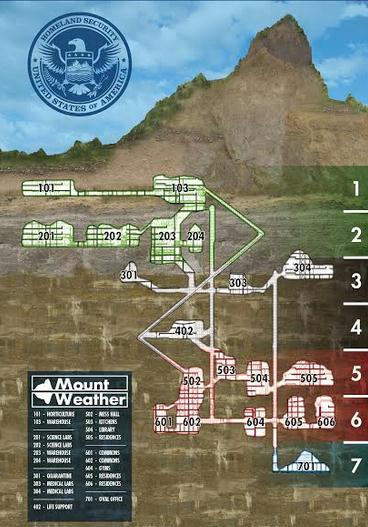
One of the best of the hundreds of retreat bunkers was Mount Weather, dug out of a mountain and protected by nearly a quarter mile of granite. This was where the top government officials at federal department s Agriculture, Commerce, HEW, HUD, Interior Labor, State, Transportation, and Treasury and federal agencies postal service, FCC, Federal Reserve, Selective Service, Federal Power Commission, Civil Service Commission, and Veterans administration would go. There were some tensions about which agency got to send how many people to survive. The Bureau of the Budget initially tried to lay claim to 400 of the 1,900 available spots at Mount Weather, but didn’t succeed in that.
Equally if not more impressive were two other mountain bunkers Raven Rock and Cheyenne mountain.
The irony is that none of these three massive under-mountain bunkers were likely to survive nuclear attack, and the Soviets certainly knew of their existence..
Even cities got in on the craze, Portland, Oregon, built a $670,000 bunker on top of Kelly Butte, about six and a half miles east of downtown, as well as some corporations, such as AT&T’s underground bunker in Netcong, New Jersey, Westinghouse Electric, based in Pittsburgh, kept its own relocation facility in an old limestone mine.
The Greenbrier luxury resort in White Sulphur Springs was where 1,000 congressional members and staff were slated to go. But telling all 535 members of Congress the evacuation’s location was an unnecessary security risk; the Greenbrier was not built to withstand a direct attack, so if its location became publicly known, its security would be ruined and its safety nullified. Thus, the Office of Defense Mobilization decided Congress simply wouldn’t be told in advance where to evacuate in an emergency. In later drills it was clear that few if any Congress members were likely to be told about their hidey-hole, and even less likely they’d be able to get there via a 6 hour train ride or in their autos.
Raven Rock parts 1, 2, 3, 4, 5, 6.
Alice Friedemann www.energyskeptic.com Author of Life After Fossil Fuels: A Reality Check on Alternative Energy; When Trucks Stop Running: Energy and the Future of Transportation”, Barriers to Making Algal Biofuels, & “Crunch! Whole Grain Artisan Chips and Crackers”. Women in ecology Podcasts: WGBH, Financial Sense, Jore, Planet: Critical, Crazy Town, Collapse Chronicles, Derrick Jensen, Practical Prepping, Kunstler 253 &278, Peak Prosperity, Index of best energyskeptic posts