How I stumbled on the energy (and ecological) crisis
Let me introduce myself: Alice Friedemann living in Oakland California. I have a B.S. in biology from the University of Illinois with a chemistry/physics minor. I’m 71, and since I was 21, have read 99% non-fiction across many subjects (see book lists here).
I switched majors eight times in college, and after graduation, decided that what I wanted to do with my life was to understand how the world worked to the best of my ability and to seek out the truth. Which for a while was like finding out Santa Claus didn’t exist, but I reached a point where instead of being sad or angry that what I had wanted to believe wasn’t so. Wasn’t it interesting that it was not what I thought? Which I learned in part from my geologist grandfather who chuckled that everyone had laughed at the guy who theorized about Plate Tectonics and how wonderful it was that this turned out to be true. The more I read, the better I could judge if the material I was reading was trustworthy. And peer-reviewed science. But things change. New evidence is found. A constant learning process.
So there, that is how I eventually came to write this website and books. Writing up what I’d read, where I’d read it, trying to make sense of it all.
And talk about finding out things you would rather not know though! Peak Everything, Limits to Growth! Not going to take the Starship Enterprise to distant galaxies and meet amazing aliens and planets!
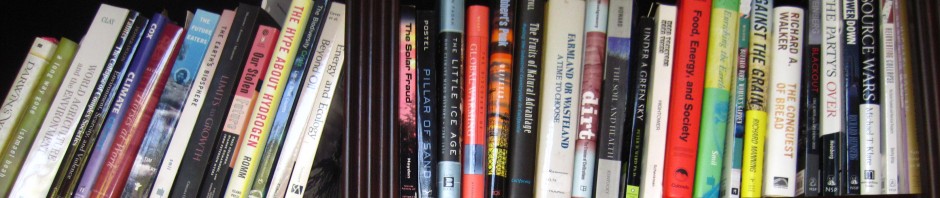
But back to books. The electric grid will come down some day, when and why is a good part of what this site is about (e.g. electric grid, energy storage, energy resources). So to preserve knowledge for future generations buy books. Printed. Textbooks. Fun books. Picture books. Kids books. Sheet music. Dictionaries. Encyclopedias. To amaze, inspire, help, and entertain for the days when cell phones, TV, and more are gone. Far too much knowledge is being stored electronically only.
I try to cite peer-reviewed journals, fact-checked newspapers, industry magazines and other high-quality references to back up what I’ve written and for the huge amount of other important information I had to leave out. For your curiosity to research a topic further. For the nuance, I have to condense ideas and the complexity can be lost. And hey! I get stuff wrong, misunderstand, misinterpret. But check my citations, look stuff up to see if it has changed.
I first realized this after reading the book Grain Brain. The Surprising Truth About Wheat, Carbs, and Sugar – Your Brain’s Silent Killers. The front blurb says that “carbs are destroying your brain. And not just unhealthy carbs, but even healthy ones like WHOLE GRAINS can cause dementia, ADHD, anxiety, chronic headaches, depression, and much more. There were hundreds of valid citations. The problem is, not one of them had anything to do with anything he’d written! Read all about it in my post “Book Review of Grain Brain: Extraordinary claim not backed up by evidence.” And my other website www.wholegrainalice.com, some of it is about making your own crackers from any kind of flour (whole wheat, corn, almond, lentil and more), handy in an energy crisis since they can last a year unrefrigerated. And much about nutrition and other related topics.
As far as cherry picking evidence goes, a lot of what I write is easy to check out, especially with AI search engines. So if I point out that hydrogen is the smallest element in the universe and have citations about how it can escape from anything you try to put it in, check out the citations by all means. Because if I’m right, that dooms the whole idea using hydrogen to make coal, steel, power trucks, provide energy storage to back up wind and solar. You need to find scientific evidence. Not internet hype for products or “breakthroughs.” This hype has been going on for a long time. In 2004, Joseph Romm wrote the book “The Hype About Hydrogen: Fact and Fiction in the Race to Save the Climate” and yet the hype continues
***
This is also a website about collapse for many, many reasons. New ones since Demandt, in Der Fall Roms (1984) listed 210 reasons for why the Roman Empire fell here. Our civilization is far more complex
My interest in energy and its role in the rise and fall of civilizations began in 2000, and when I saw how the decline of oil would crash civilization because so-called renewables could not possible replace them, I was extremely depressed.
Now I see the decline of fossil fuels is the only way to prevent the 6th extinction, reduce climate change, pollution, and dozens of other polycrises they created.
My interest in energy began in college during the first energy crisis struck in 1973. Growing up in the industrial city of Chicago, it was pretty obvious society ran on petroleum, from the trains that roared by to the endless lines of trucks and cars on freeways and streets. Chicago’s buildings were blackened with coal, I rub my eyes now in amazement when I go back now, they are so clean.
There was no nuclear, wind or solar to save the day. Everyone knew the world depended on fossil fuels, so when the energy crisis struck, 5 million people went back to the land or joined communes. I joined an alternate technology group in college and saw engineers build solar collectors, wind turbines, and get cars to run on batteries and methane. So I wasn’t worried, I had seen there was a better and cleaner way to generate energy and get away from fossil fuels. I even helped the engineering department build a solar collector by drinking beer and painting the cans black. Alternative energy was not only going to be good for the planet, it was going to be a party!
When the oil shocks came again in 1979, I was too busy with my new career as a programmer at Electronic Data Systems and searching for a single man in San Francisco to think about it much. Besides, maybe it would finally force the evil oil companies to stop preventing renewable energy from happening. Which they obviously were.
Sometimes my grandfather, Francis J Pettijohn, a well-known sedimentary geologist in the National Academy of Sciences, would try to educate me about the role of fossil fuels in civilization. I’d counter with my alternate technology experiences in college, especially the solar beer can collector story. He’d chuckle, say it might not be as easy as I thought, and change the subject.
when I read his “Memoirs of an Unrepentant Field Geologist” (Pettijohn) I found out why he felt that way. Grandpa was a friend and mentor of M. King Hubbert, and wrote: “One student had a profound effect on my thinking and on the course of events later in my life — M. King Hubbert. When I arrived at the University of Chicago in the fall of 1929, King was one of the first graduate students I met. I was struck immediately by his personality. He turned out to be something of the iconoclast, a sharp critic with an excellent analytical mind and skill in mathematical and physical analysis. Nothing seemed to delight him more than finding a fatal flaw in someone else’s analysis. Although he was a graduate student working for his Ph.D. under Rollin Chamberlin, I never could discover whether he took any courses, and I soon observed that, although Chamberlin was his adviser and supervisor, King neither needed nor accepted advice and supervision. He was a very independent individual–a student of nobody.
Perhaps King’s most dramatic achievement was his prediction of oil depletion. This paper dealt with the trend and future production of oil and gas in the United States. King clearly saw that at the time the discovery rate had peaked and production would soon culminate, and that it and our reserves would begin an irreversible decline. He predicted a peak production in 1970. His paper created a great deal of consternation in the oil world, and provoked heated controversy; he was roundly denounced. It was heresy indeed in a profession that is constitutionally optimistic and incapable of conceiving of its demise. It turned out, as we all now know, that King was right”.
Yikes! Had oil peaked? I did an idle internet search, and bang! Alarming articles at the Colorado School of Mines website about Hubbert’s Peak, (or what participants in the oil industry called the “reserve replacement problem”), which should be right about now. Although a bit frightening, there was far more bad news to contemplate at Jay Hanson’s dieoff.org. It wasn’t long before I joined several forums such as energyresources and runningonempty (also started by Jay Hanson), energybulletin, theoildrum and too many others to list to learn more. There were about 500 people back then following this issue, several of them well known professors like H. T. Odum at the University of Florida, and several graduate students of Charles A. S. Hall and other systems ecologists who posted the latest information on the forums.
So where were the beer solar collectors? How come there wasn’t much alternative energy thirty years later, even though everyone knows the oil won’t last forever? I spent hours at University of California (Berkeley) libraries reading technical journals about hydrogen, solar, wind, biofuels, soil science, nuclear, geothermal and other energy resources, as well as auditing classes, attending seminars, and lectures. Through the internet forums, I discovered many books and articles I would never have found otherwise.
Gradually it became clear why alternative energy couldn’t replace oil. But when I tried to explain why to family and friends, they thought I was nuts. This was happening to everyone else on the forums too (see “Telling Others“).
***
This about goes on and on, written in bits and pieces, has duplicate material, so I wouldn’t blame you if you stopped reading this stream of consciousness zig-zag of my history.
My interest in energy goes back further than the 1973 energy crisis. In grade school I became aware, almost certainly due to Grandpa, that cars, trucks, airplanes and trains ran on oil, and that oil wouldn’t last forever. At a holiday gathering Grandpa didn’t attend, I asked all of the assembled relatives how much longer the oil would last, and they very nervously twittered and said they didn’t know, and that made me a bit worried. On camping trips I kept track of the gas guage. Once we drove through Death Valley in 120 Fahrenheit heat (49 C), in a dark Blue Rambler with no air conditioning. The only beverage was Dad’s hot coffee, and my brother and I decided we’d rather die first than drink it. When I stuck my head out to cool down, it was like putting my face in a blast furnace. The water at the visitor center was so marvelous I still remember it, even approaching the drinking fountain.
My parents moved to Evanston where the schools were fantastic. The all-female teachers were brilliant — they’d be doctors and CEOs today. But back then, girls were told our ambitions were to find a husband, and if need be, work as a nurse, teacher, or secretary until we found a husband. I wanted more than that, but it looked hopeless. All the dads I knew worked, all the moms didn’t and were housewives. In history books, the TV news, and movies men were the doctors, presidents, detectives, and every other interesting well-paying work. Women hovered in the background with hair sprayed into a helmet, bustling into the kitchen to fetch dinner to the table.
I first became aware of my limited future in first grade, when Dick told Sally, as she swept the porch, how someday he would be an astronaut. I was crushed, sad, and furious. It was already obvious in first grade that girls were just as smart as boys. Smarter even it turns out, because we sit still and pay attention. Today 60% of bachelors, masters, and PhD degrees go to women.
I’ve been told that as soon as I could talk I pestered everyone, even strangers to teach me how to read. When I finally learned in first grade, there was no stopping me, reading became my passion in life since it gave me even more wonderment and joy in the natural world and for that matter, everything else. What an amazing world we live in. But I was never the smartest in school and at best above average. As Garrison Keillor’s used to say, “That’s the news from Lake Wobegon (Minnesota), where all the women are strong, all the men are good-looking, and all the children are above average,
Another huge influence on me was finding out Santa Claus didn’t exist in kindergarten. I sobbed for hours after my 8-year-old friend Craig told me. Not wanting to believe it, I stayed up late to watch for Santa. Sure enough, Dad came out in his underwear and put presents under the tree.
I was angry because I’d been lied to. It wasn’t long before I began to wonder what else was a lie. Santa kept a checklist of naughty and nice. So did God. Both were big fat men in the sky. But of course God had to be real, there were too many churches, no way would grownups go to that much trouble.
When I was nine I discovered a magic store two blocks away, and visited often to see the latest tricks, saving up enough allowance to find out how it was done and learn the trick myself to perform magic for family, friends and neighbors. And once again, saw that people could be tricked.
At the Riverview amusement park in Chicago I put quarter on a number I’d win a stuffed toy if the dial stopped on that number. But it never happened. Finally I leapt up to look over the counter and saw the carney controlling it with a foot pedal below. Dang, tricked again.
I was confused about what was truth and what was a lie, and above all, how to tell who was telling the truth. It wasn’t until my 30s that I realized peer-reviewed journals were the best source, at least for the material world, but it also helps to read a wide variety of books for a basic understand of the world to gauge new information against.
My third grade teacher, Mrs Abernathy got me interested in science. She had a big tank full of insects, and I spent a lot of time after school catching grasshoppers, butterflies, caterpillars, beetles and other critters to add to it. At the back of the room there was a huge easy to operate microscope. We had wonderful field trips to the narrow bands of forest preserves to collect murky decaying water full of microscopic creatures and plants. Whenever Mrs Abernathy had her head down grading papers, I snuck back there until she ordered me back to my desk.
Nine was the year I discovered Mad magazine. I just looked at Wikipedia are read it inspired comedians and comedy today, and raised a generation of skeptical kids like me (as did the Skeptical Inquirer, also near Mad magazine in the newsstand). Mad magazine showed how the world was full of deceptions in satirical cartoons about ads, TV shows, and more.
In case you’re thinking that by 5th grade I was an utterly cynical kid who could no longer be fooled, nothing could be further from the truth. I have always been gullible and still am. Most people are. As skeptic Michael Shermer explains in his book “The Science of Good and Evil: Why People Cheat, Gossip, Care, Share, and Follow the Golden Rule”, human beings are born with the same morality across time and cultures. For the 300,000 years of the paleolithic, we lived in tribes where we all depended on each other. Anyone who wasn’t honest, helpful, and attempted to boss others around might be banished or even killed, and we domesticated ourselves into a rare level of eusociality. Only insects have done this, like ants and bees. And naked mole rates. We are all born with morality, the drive to cooperate, trust, and help those around us.
Another key episode in how my world view evolved came when my parents let evangelists into the house every week. When my geologist grandfather Francis J. Pettijohn found out, he gave me a book called “The Scopes Monkey Trial” about the teacher accused of teaching evolution in Tennessee, also introducing me to the idea of evolution. The trials began all over again in our house. I used the same arguments Clarence Darrow did to question literal Bible stories. It wasn’t long before they fled.
I wasn’t an atheist though, because I was very much wired to believe in God. But I didn’t like, at all, that he was watching me every single second. Sometimes I’d ask him to please look away. When I was 14 I read the Bible and was dismayed that there was not a single joke. It was so grim, and women were treated like slaves, and often blamed for anything that went wrong. I betcha Adam ate the apple first. The bible stated that it was okay to slaughter everyone who didn’t believe in the Old Testament God, but it was okay to turn the women and children into slaves and wives.
I promptly began shopping around for a new God or Goddess. After all, there were hundreds religions, and 2500 Gods mentioned in the cross-word puzzle dictionary. What were the odds I had happened to be born into the right religion? And as I learned about other mythologies, biology, and female Gods and how it is women who give birth, I decided if there were a God she was a female. A Goddess. And angry Mary was not in the trinity. Replaced by a ghost called the Holy Spirit.
I also had my doubts in 4th grade when I learned about what the Nazis had done to the Jews. I had many Jewish friends in school, and some of them had parents who had been in concentration camps, with Nazi tattoos on their wrists. If God was all powerful, why hadn’t he stopped millions of them from being killed? And if he wasn’t all powerful, why worship him? And why a him?
But I still didn’t become an atheist,there had to be a God, or Something, because Life would be Meaningless otherwise. Or so we were all told. I turned to supernatural beliefs as a backup. My friends and I played with Ouija boards, Kreskin’s ESP game, and I read new age books. I was especially keen on one that promised I could leave my body and go wherever I wanted with a simple 6-step method. After months of trying I complained to Dad that it wasn’t working, and he laughed and told me that publishers want to make money, they don’t care if a book is true or not. Don’t believe everything you read.
That ended my New Age phase, and began my quest to try to figure out how to tell who was telling the truth, and who was telling lies. School wasn’t very good at teaching critical thinking skills, or why the scientific method was so successful and how it worked. I can only remember three times we learned critical thinking skills. The first time was in 6th grade, where I was asked to defend the position that 18 was a better age for teenagers to start driving than 16. I came up with three reasons and my opponent with four, so everyone voted for him. But the teacher said my 3 arguments were better, and that I had therefore won.
The second time was in seventh grade when we read articles about the Loch Ness monster and voted on whether or not the Loch Ness monster existed. Most of the class, including me, voted that the Loch Ness monster existed, but then the teacher took us through the evidence showing this was unlikely, and warned us not to believe in something because we wanted to.
And finally, in high school, the teacher asked how we could be sure the moon landing had actually happened. Photos didn’t prove anything, they could have been altered. Eventually the teacher got us to realize that thousands of people would have had to be in on the hoax, and surely one of them would have said something.
In 8th grade I learned about good and bad evidence when I gave a report for social studies from the National Enquirer about rats eating babies. Mr. Bilsky roared with laughter and said I could never trust anything that paper said, I needed to look at the New York Times or Time magazine. But it would take me another 25 years to learn that peer-reviewed scientific papers in top journals were the gold standard. Newspapers and TV have become infotainment, telling people what they want to hear. Politics, economics, celebrities, the weather, murders, and ending on kittens rescued from trees. My newspaper would be about energy, ecology, fisheries, infrastructure, pollution, pesticides, agriculture, topsoil erosion, aquifer depletion — any aspect of our world that keeps us alive and healthy. Ah well, I can see you’ve fallen asleep or switched channels.
In high school I really enjoyed learning about constitutional history, especially Hobbes who worried about the dark side of human nature and the need to have checks and balances, and Jefferson’s worries about corporations taking over the nation. Surely the point of a nation was to take care of the people, to prevent dictators from ruling however they pleased, and the rich from taking the lion’s share of the wealth. This still seems so clear and obvious to me, go ahead and call me a socialist, they’re the happiest people on earth. Socialist Scandinavian countries score the highest year after year on the Happiest Nation polls.
I also loved the muckraking books we were introduced to in high school, such as Upton Sinclair’s “The Jungle” about the Chicago stockyards. I didn’t eat hot dogs for years.
My junior year of high school I read Gibbon’s “Decline and fall of the Roman Empire”. Wow, empires could fall, that was really interesting, especially the hundreds of reasons that applied to Rome. I was very happy that I would never experience that, since the USA was the strongest, wealthiest nation that had ever existed. If we did fail, it would be thousands of years in the future. If I ran across books about collapse, I read them. And today this is the all encompassing umbrella of all I write about at energyskeptic. The thousand cuts of decline and fall we’re undergoing, with falling energy the great reaping scythe that ultimately brings on the end.
But my growing awareness also made me feel out of place, like an anthropologist from another country. I was anti-war, pro women’s rights, part of the counter culture, free of makeup and designer clothes, able to step outside the choking conformity of the day. Thank goodness that when I started in 1972 at the University of Illinois I lived in the experimental living-learning Unit 1 in Allen Hall, an experiment that continues today. Then and now, it’s a magnet for creative and brilliant people of all kinds, from artists and poets to pioneers in computing science, a place where musicians and other performers visiting campus stayed for free in an apartment in exchange for interacting with us. I had finally found a place I fit in! And this critical awareness boosted by the smarter and aware students in Unit 1 also led me to become an an ecologist. I volunteered at Planned Parenthood, since clearly too many humans was the source of all our problems, and Zero Population Growth, later on in the Sierra club sections of population and immigration. But when a donor gave the Sierra Club $100 million (and $150 million since then) to drop population and immigration as issues, I quit, as did thousands of others.
In college I had no time to take English, but in my free time and summers worked my way through the classics from A to Z, especially liking Mark Twain and Russian authors like Tolstoy and Dostoevsky. But mostly boring, and not helping me to understand people and human nature, or what it was like to live in the past, since most of the characters were in the nobility or very rich.
I went through the usual heart breaks in college, and I blamed fiction, fairy tales, TV shows, and fantasy books for giving me an unrealistic view of how the world worked. So I stopped wasting my time with fiction, except for books that had wonderful metaphors, beautiful language, and great story lines like Pynchon’s “Gravity’s Rainbow”, Marquez “A Hundred Years of Solitude”, and poetry, which speaks to the heart of an individuals human experience. I stopped watching TV for 20 years, and rarely watch now. I’ve been reading mostly non-fiction for almost 50 years now.
I was born gullible, still am to some extent, and knew early on that I was no good at telling truth tellers from liars, and no idea how to go about telling them apart. So after college, I devoured skeptical magazines to gain critical thinking skills to try to figure this out. I constantly roved the bookshelves at Cody’s and Moe’s in Berkeley, Green Apple in San Francisco, Powell’s in Portland, thumbing through books in science, natural history, cognitive psychology, anthropology, political science, biographies, history, and just about everything else. But that still didn’t get me any closer to figuring out who was telling the truth — but it did give me critical background knowledge that often helped me evaluate books on similar topics — I had some basis of comparison, some way to question what I read based on past reading, which is very important.
But I was in my thirties before I finally figured out the best way to tell truth from lies best when my husband became a science writer at Lawrence Berkeley Laboratory. In 1988, we joined the Northern California Science Writers Association, and the friends I made there steered me towards specialized books on evolution, the philosophy of science, and peer-reviewed science journals. I subscribed to Science, Nature, Scientific American, and other science magazines plus visited the U.C. Berkeley 22 libraries to pore through others.
I am not a naturally clear, critical thinker like my husband, who honed his skills over several decades of journalism and science writing, superb at asking the right questions and the most objective and fair person I’ve met. Both my parents believed in wacky supernatural ideas, took supplements, rejected western medicine, and drive me nuts since I worry they’ll be taken advantage of or have their health harmed by quacks. It’s been a long hard never-ending fight to triumph over my upbringing and genetics to get this far, and I have a long way to go still. Thank goodness I have such a great husband, who I can bounce ideas off of and I continue to learn from him to this day. Though he is a bit of a techno-optimist, but it makes him more delightful and fun to be around, and I’ve come to see this attitude as self-protective, I’m the oddball to be willing to look at such a depressing and disturbing reality.
And who can blame anyone for that? It’s not a sound bite easy to explain. Perhaps a semester of lectures might win someone over to the Limits to Growth, Malthusian, Renewables can’t replace fossil fuels and so on that I and many other biophysical researchers and others write about. But that’s not how conversations go. I’ve got a minute at most to make a point, and then it’s someone else’s turn to talk. And my friends know better than to even bring energy up. I am too depressing, sigh. So I pretty much stick to the various energy forums I’m in to keep up with and discuss the latest findings about these topics. Plus I’m tired of how angry people get if you say that solar, wind, nuclear, and other kinds of power can not replace oil. It would take a semester of information that people don’t want to hear. I’d be teaching to a mostly empty classroom…
I understand how easy it is to dismiss ideas you don’t want to believe in, especially if they’re scary. I could have dismissed the posts at energyresources and elsewhere on the internet if I hadn’t read most of the recommended books and did a hell of a lot of research at U.C. Berkeley and on the internet, where I had access to everything via my husband who worked at U.C. Berkeley and LBNL. I especially like books over articles, which have the time to really nail down a topic, close all the loopholes. The full complexity and interactions with related topics can be explored. Above all, there are references to pursue further. Twitter, what a joke!
Because I’d read so much non-fiction, reading Youngquist’s outstanding book “Geodestinies”, Gever’s “Beyond Oil: The Threat to Food and Fuel in the Coming Decades”, and so on (see my booklist), the awareness of the consequences hit me like a sucker punch. This would be the worst disaster to ever befall mankind, with up to 7.5 billion people dying by the time it was over and a wood-based civilization from now on. Fossil fuels were a unique, one-time only phase of our history. The puzzle pieces clanged together all at once, like a jail door in a prison. I was depressed for months. Violent scenes from films played unwilling clips. Armies marched, women wept over graves, Scarlett O’Hara dug up carrots.
So what is wrong with me, why couldn’t I just react like other people and dismiss ideas I didn’t like? I guess it was because I’d decided my life’s goal was trying to understand this amazing, marvelous, complicated world, it’s history, politics, anthropology, and more. How amazing that I could even read and went to school, since most women in all of history never had that chance. And it was so interesting!
I’ve been accumulating material since 2000 on the energy crisis, which encompasses many other areas – ecology, environment, climate change, carrying capacity, soil science, agriculture, transportation, infrastructure, global trade, the financial system, politics, cyber war, nuclear war, terrorism, natural disaster, and more.
Energyskeptic.com is my attempt to translate high-quality, preferably peer-reviewed scientific literature about these topics into information the average person can understand.
I learned when my husband was a science writer at Lawrence Berkeley Laboratory how often the scientists didn’t like what he wrote — it was too simple, they feared being criticized by other scientists because simplifying their research made it less nuanced, less “true” because maybe only one part was discussed, scientific terms weren’t used, and so on. So I’m sure experts will find fault with my understanding of a topic, or how I’ve phrased it, or what I’ve left out, especially most of the numbers and graphs, which my friends tell me makes their eyes glaze over.
Above all, my career as a systems analyst/engineer in health care, banking, and transportation has affected how I think and write. Often I was trying to take a workflow and computerize it, capture critical information for the sales department as soon as possible, create a unique manifest for a new country we were shipping to, and to do this you need to understand the process from the very beginning to the very end. Usually I could get 95% of the work done in 5% of the time, it was that last 5% that was the problem. Sometimes projects weren’t cost justifiable because it would cost too much to get the missing data, or take too many employees, or take too long.
It was my job to prevent expensive projects with a negative return from happening in the first place. Money returned on money invested. So discovering Charles Hall’s energy returned on energy invested made a lot of sense to me.
When I started looking at energy resources, I found that a lot of optimistic, positive articles in the news media were some kind of breakthrough in the laboratory that would not likely ever work out. Perhaps it depended on a really scarce rare earth metal, or the new and improved batter lasted longer — but you could only recharge it a few instead of hundreds of times. There is a financial incentive to blare these so-called breakthroughs — more investment or grant money.
The most important aspect of an energy resource is whether it takes more inputs of fossil fuel energy than the output energy returned, or Energy Returned on Energy Invested (EROEI). So for a windmill, you’d look at how much fossil fuel energy was used to mine the iron, aluminum, concrete, to fabricate all the components, and so on to the delivery of the windmill, and subtract out the fossil fuel energy required to operate and maintain it. Basically, you need to find out if more fossil fuels are used in the full energy life cycle than what’s going to be delivered by the windmill over its lifetime. Even though this is the most important aspect of looking at alternatives to replace fossil fuels, I find that most people don’t understand this concept, or don’t want to understand it.
But even if a windmill had a positive EROI? SO WHAT? Any contraption that generates electricity isn’t worth a fig newton, because tractors, harvesters, logging and mining trucks and equipment, construction and road trucks, cranes, forklifts, 18-wheelers all run on diesel fuel. Not electricity. The 8,000 parts of the windmill aren’t going to arrive at the factory without trucks. The wind mill isn’t going to be moved to its destination without trucks.
Even many scientists who should know better use far very narrow boundaries to come up with a positive result. Studies that found a positive EROEI for corn ethanol were often done by scientists funded by the National Corn Growers Association, weren’t peer-reviewed (data and methods open to all scientists), and kept the energy analysis to within the biorefinery. Important energy inputs like the energy to make fertilizer, the tractors to plant and harvest crops, trucks to deliver the crops to the biorefinery, and delivery of the ethanol by truck or train weren’t included.
Much as I like EROEI, and can’t resist mentioning it, there are just too many ways to cheat — cherry picking numbers from LCA that tilt the results the way you want them to come out, leaving out key energy inputs, and so on.
There are plenty of other factors that trip up alternative energy replacements. Biofuels are limited by nitrogen, the depth and quality of topsoil, water, and so on. Solar PV, windmills, computers, and much other technology now depends too heavily on limited supplies of rare earth and platinum metals. Peak uranium, peak phosphorous, peak everything basically. There are dozens of resources that are getting short that could also cause the collapse of civilization as we know it. Fossil fuels have hidden from us what a deep hole we’ve dug for ourselves — we’re still able to continue to mine less rich ores and get at difficult and remote resources. Oil is the mot important of all. It is the magic wand that can make anything happen, prevent water shortages by drilling 1,000 feet deep, and used to get all other resources, including other energy resources like coal and natural gas.
Running out of water? Build a very energy-intensive desalination plant. Food requires a tremendous amount of water, so import food instead, or grow food hydroponically. These all require fossil fuels.
Oil is the fuel burned by trillions of combustion engines doing the actual work of society by moving goods, food, and water. The easiest resources, the richest ores, have been used up, so declining oil at a time when all of the remaining resources depend on oil for their extraction while at the same time are remote, depleted, and difficult to get — including oil itself — ought to trouble everyone, but it’s been years since peak oil was in the mainstream news.
It’s also hard to believe energy resources are a big problem because newspapers focus on today’s news. Oil shocks in the future is not a story because it isn’t happening right now. Important issues are only covered when there is “news”. So the last time the New York Times wrote about nuclear winter was 1991 after Carl Sagan’s book “Nuclear Winter and the End of the Arms Race” came out. A more up-to-date paper on nuclear winter wasn’t reported — Robok’s 2007 “Climatic consequences of regional nuclear conflicts”. However, Scientific American did report on this in their January 2010 issue in “South Asian Threat? Local Nuclear War = Global Suffering. Worry has focused on the U.S. versus Russia, but a regional nuclear war between India and Pakistan could blot out the sun, starving much of the human race”. But how many people read Scientific American?
There has never been, and never will be again, a collapse of this magnitude. There are way too many factors to predict when, how, and how long the collapse will occur, and the suffering will vary greatly from place to place even within the same nation. But a collapse is inevitable because it’s hard science, every living being on earth depends on (food) energy, and humans have temporarily been able to jack up the carrying capacity of the earth by 6.5 billion people using the hundreds of millions of years of solar energy locked up in fossil fuels. It’s absolutely certain that there won’t be 7.5 billion people a century from now. But how long it will take to go back down to 1-2 billion is hard to predict, or what the exact series of catastrophes are that will cause systemic collapse.
Still, like in any murder mystery, we know who the suspects are. It’s the order of the dominoes that’s unknown. Any one domino can knocks others over — if Mr. Financial System crashes he’ll knock down Mr. Oil Production because new projects won’t get funded, and Mrs Global Trade will go home and supply chains will break down. If Mrs. Earthquake takes out Los Angeles or Tokyo, that will knock down Mr. Financial System. Or Miss Oil Shock could bring everything to a halt and bring down Mr. Financial System (one of the reasons peak oil is avoided is because several think tanks have stated that a general awareness of Peak Oil would bring stock markets and banking systems down, since it would be clear that loans couldn’t be paid back since the economy would start shrinking and stop growing like it has the past 200 years).
We’re leaving future generations a pretty crummy world. No one is thinking about the grand children, and I suspect that’s because we’re just not wired that way. Like other species, we live in the moment, from day to day. We have a hard time even imagining being hungry again after a big meal. So when you’re tempted to blame someone for our dilemma — oil companies, politicians, economists, scientists – remember that it’s really no one’s fault, we inherited our predicament from previous generations who turned to coal, oil, and natural gas when their trees ran out.
The best action to take now is to stay under the energy depletion curve by women having no or just one child. We also ought to reopen Yucca mountain and put nuclear waste in immediately while we still have the energy to do it, or our descendants will be stuck all over the country with nuclear waste that lasts millions of years. And also clean up mining waste, superfund sites, and other damage future generations won’t have the energy, and eventually know-how to clean up.
What we could do is try to preserve useful knowledge for the grandchildren. I encourage you to buy books in my book lists. Also hang on to undergraduate college level textbooks. Computers will not outlast the age of oil for long, and even if more simple transistors can be built, they won’t be able to access the information stored on today’s hardware, so these digital files will all be lost. Yet that’s increasingly where universities, libraries, and other institutions are putting information. So if you know any librarians, you might want to pass my “Peak Resources and the Preservation of Knowledge” article along to them.
Whole Grains – an Essential Post-peak Skill (http://wholegrainalice.com/ )
Each of us has something different to contribute. For me, it was clear the electric grid would grow increasingly unstable. Refrigeration will grow less reliable, leading to a need to get enough calories to survive from food that doesn’t need refrigeration. The way people have done that for the past 6,000 years is by eating grains, which can be stored and allowed civilization to survive several years of bad harvests in a row. Climate change will increase the number of bad harvests, but fortunately the technology to protect grain from pests and decay is much better now than it was in the past.
I’ve been baking with whole grains for many years. I see my own small contribution to the transition as helping people learn how to bake, mill, and store whole grains at home. I’ve set up another website to teach these skills (http://wholegrainalice.com/)
There’s a saying “we’re only 9 meals away from a revolution”. The longer hunger can be staved off, the less likely we are to experience a chaotic, violent tipping point when economic collapse, oil shortages, and other disasters increase in the future.
I wish I were more inclined to collect garden gnomes or porcelain ballerinas instead of gloom-and-doom articles, but this is where curiosity and the desire to know the truth have led me. How I got to be this way is reviewed further here.
The good news: Peak Oil means Peak Climate Change
Good grief, if you’ve read this far, I’d like to tell you why the end of oil is a GOOD THING. It took a long time for me to reach that conclusion. I was so depressed in 2000 when I first worked this out. No more long-distance travel, no more electronic or live music, movies, TV series, news and more. Far less variety of food. On and on. I’m sure you’ve thought of many things yourself, not to mention all the loved ones lost, including ourselves perhaps, as the bottleneck of carrying capacity relentlessly goes down as we return to the much simpler, non-industrial world as we lived in centuries ago.
Climate Change is a symptom of overshoot of planetary resources. It is just one of them, yet gets 99% of the attention. We are not going to stop burning fossil fuels because renewables depend on fossils to be built and can’t replace them in transportation, agriculture, mining, fertilizers, cement and steel manufacture and more.
Even if you still believe there are solutions, we are Running Out of Time. World peak crude oil production happened in 2018 and U.S. peak crude oil production will in 2027 (EIA) or from now to 2030 (oil industry experts). Oil makes coal, natural gas, and everything else for that matter available via road, mining, agriculture, and logging diesel vehicles and equipment.
But this is great! As Charles A.S. Hall says, “The only thing worse than running out of fossil fuels, is NOT running out of fossil fuels.”
I am no longer depressed about the end of the oil “age”. It is the only way we can stop all the polycrises below and global warming from getting worse. Though as far as CO2 goes, the last 20% will take 100,000 years or more to remove, but the first 30% in just a few decades and another 50% in a few centuries.
And more importantly, it will reduce and eventually end the other polycrises. Did I forget any? Let me know…
Air: Half of Americans exposed to dangerous air pollution levels (ALA 2025)
Running out of Farm land. As the world’s population has grown, more land on Earth has been converted to fields and pastures. It’s a cycle: More food production enables further population growth.
Forever chemicals may be polluting 20% of farmland, 70 million acres of land, or more, in the U.S. Microplastics too. Both cause a host of serious medical problems such as cancer and more.
And that’s just the start of the problem, there are nuclear wastes, chemical wastes and more. To see the hundreds of kinds, go to the U.S. Environmental Protection Agency page on “Defining Hazardous Waste: Listed, Characteristic and Mixed Radiological Wastes.” Categories include:
- Spent solvent waste categories: Electroplating and other metal finishing wastes, Dioxin-bearing wastes, Chlorinated aliphatic hydrocarbons production, etc
- Source specific waste in the manufacture of organic chemicals, pesticides, pharmaceuticals, inorganic pigments, explosives, iron and steel, aluminum, lead, wood preservation, and petroleum refining
And there are even more types of waste, if you’re a real glutton for punishment you can see the scary sounding chemicals that would be really hard to work into an anti-pollutant poem, such as 1,2,3,4,10,10-hexa-chloro-1,4,4a,5,8,8a,-hexahydro-
Health: pandemic, antibiotic resistance, food and water shortages, fertility
Financial: predatory corporations, downturn or collapse, cost of living, energy shortage, inflation,
Chaos: War, civil war, infrastructure and services collapse, Mass Migrations, looting of rail and trucks with coal, oil, food before their destination, blowing up of bridges, rail by regions to stop mass migrations to their area
Political: mafia totalitarian states (Russia, and soon the U.S.?)
Energy: blackouts, energy shortages, loss of heating and cooling in extreme environments
Biodiversity Loss: Land Use Change, Insect Apocalypse & Pollinator (bee) loss, Invasive Species, Antibiotic Resistance
(Rain)forest destruction, Amazon Tipping point
Water: Freshwater Depletion, Overfishing, Coral Reef Loss, Nitrogen & Phosphorus oxygen depletion (dead zones)
Nuclear Winter & War
Pollution: (Forever) Chemicals, Mining tailings, Plastic, Endocrine Disruptors, Stratospheric ozone pollution, Acid Range, PFAs, radioactive waste for 30,000 generations
Soil: Erosion, Degradation, Compaction, Salinization, Pesticide & Fertilizer pollution
Natural Disasters: Earthquakes, Tsunamis, Hurricanes & Tornadoes, Floods & Sea Level Rise, Drought & Dust Bowls, Heat Waves, Wildfires, Ocean Acidification, wet bulb temperatures exceed human habitation (NASA 2022), lightning,
References
ALA (2025) New report: Nearly half of people in U.S. exposed to dangerous air pollution levels. American Lung Association
Pingback: Anthropogenic Bookmarks – Noah Kruiper