
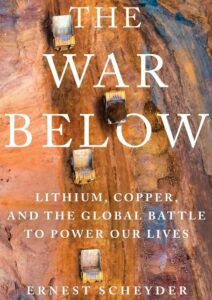
Preface. This post has excerpts from Scheyder’s 2024 “The War Below” about the metals and minerals renewables will need – over 6 times more than fossil fueled internal combustion vehicles, natural gas and coal plants, and nuclear power (IEA 2021). I’ve excerpted some of what Scheyder has to say about various metals and mining, so it’s a bit disjointed and much is left out. Do read the book.
Mining is already tremendously destructive, and now it is to be ramped up many-fold, which also will release even more CO2, affecting 38% of the Earth’s surface if carried out. The destruction will never end because “renewables” require fossil fuels for each step of their life cycle every 15 to 25 years. Recycling is mining and manufacturing, using a tremendous amount of fossil heat and chemicals, recovering only the most valuable metals, and much that could be recycled ends up in landfills instead. Fortunately mining will end as the concentrations of metals in ores keep getting lower, since getting them out requires more and more energy at a time when fossil fuel production is plateauing and about to decline. Meanwhile we have left yet another huge mess on the planet for future generations that “clean and green” renewable cheerleaders will only make worse.
IEA (2021) The role of critical minerals in clean energy transitions. International Energy Agency. https://www.iea.org/reports/the-role-of-critical-minerals-in-clean-energy-transitions
Alice Friedemann www.energyskeptic.com Author of Life After Fossil Fuels: A Reality Check on Alternative Energy; When Trucks Stop Running: Energy and the Future of Transportation”, Barriers to Making Algal Biofuels, & “Crunch! Whole Grain Artisan Chips and Crackers”. Women in ecology Podcasts: WGBH, Financial Sense, Jore, Planet: Critical, Crazy Town, Collapse Chronicles, Derrick Jensen, Practical Prepping, Kunstler 253 &278, Peak Prosperity, Index of best energyskeptic posts
***
Scheyder E (2024) The War Below: Lithium, Copper, and the Global Battle to Power Our Lives.
Throughout the world, supplies of metal sit atop land considered sacred, or too special, or too ecologically sensitive to disturb. Whether these lands should be dug up in an attempt to defuse climate change is one of the defining questions of our time.
To reach net-zero global emissions by 2050 would mean ending the era of fossil fuels and converting the global economy to run entirely on batteries powered by wind turbines, solar panels, and other devices that churned out renewable energy.
Indonesia holds the world’s largest supplies of nickel and has moved to block exports of the key metal to build its own EV industry. The only U.S. nickel mine will be depleted by 2025 and the United States does not have a nickel refinery.
The metal is key to boosting an EV battery’s energy density, and thus allowing an EV to drive farther on a single charge. An EV battery made with nickel uses 40 to 60 kilograms of the metal, whereas an internal combustion engine only uses 1 to 2 kilograms.
Democratic Republic of the Congo holds the world’s largest supplies of cobalt, which is used to prevent EV battery erosion. The United States in 2021 imported 14 times more cobalt than it mined.
The United States started the modern rare earths industry in the years after the Second World War, but slowly let the entire industry move to China, which now controls the mining and processing of the critical elements used to make magnets that translate power into motion. Without rare earths, there would be no wind turbines, no Teslas, and no F-35 fighter jets, among myriad other high-tech devices built using specialized magnets made from rare earths. China threatened in 2019 to block its export to the United States, which has one rare earths mine but no processing facilities.
No new mines for any of these metals have opened in the United States for decades, with the exception of a small Nevada copper facility in 2019. Yet multiple projects have been proposed that could produce enough copper to build more than 6 million EVs, enough lithium to build more than 2 million EVs, and enough nickel to build more than 60,000 EVs.
In 2021, China had either built or was building 148 of the world’s 200 lithium-ion battery gigafactories. Europe had 21. North America had 11. By 2029, 101 of the additional 136 lithium-ion battery plants planned for development will be in China. Despite that, auto industry executives had grown increasingly concerned that at least 90% of the battery supply chain—including mines—needed to meet aggressive EV transformation targets for the global transportation sector didn’t exist yet. By 2023, China had cemented its EV supply chain prowess and it cost about 10,000 euros less to build an EV in China than in Europe.
The United States wants to go green, but to do that, it will need to produce more metals, especially lithium, rare earths, and copper. That means more mines. And mines are very controversial in the United States. Who wants to live next to a giant hole in the ground? Mines are dusty, increase truck traffic, and use dynamite for blasting that can rattle windows and crack foundations. Many mines throughout history have polluted waterways and produced toxic waste that scarred landscapes for generations.
They also require astronomical amounts of water to operate. Stewart Udall, who ran the U.S. Interior Department under Presidents John. F. Kennedy and Lyndon B. Johnson, described mining as a “search-and-destroy mission.”
The process to produce these metals can vary widely by type and is vastly different than oil and natural gas production.
China has been scouring the world the past 20 years for cobalt, lithium, copper, and other metals. After the United States pulled out of Afghanistan in 2021, Chinese mining companies began negotiating with the Taliban to develop the Mes Aynak copper deposit, about two hours outside of Kabul. China’s mining companies spent billions of dollars buying cobalt mines in the Congo. In Argentina, China has invested in six major lithium projects. As 2023 dawned, India began scouring Argentina’s reserves of copper and lithium to sate its burgeoning EV industry.
Recycling alone cannot provide the materials needed to fuel the global green energy transition.
The United States is watching its petroleum dependence on the Organization of the Petroleum Exporting Countries transition into a dependence on China, Congo, and others for the building blocks of green energy devices. China has threatened to block exports to the United States of rare earths,
There’s no way around the fact that mines are gargantuan creations that maim the Earth’s surface. They are loud and they are intrusive. Going back to the dawn of time, mines have displaced thousands—perhaps millions—of people, polluted waterways, and produced trillions of ton of waste, some of it radioactive
In Chile, the world’s largest copper producer and second-largest lithium producer, 65% of the country’s water is used by its mining sector alone.
TAILINGS DAMS
Tailings dams store the detritus of the mining process. If every 100 pounds of dirt removed from the earth contain only one pound of copper, that means 99 pounds of waste in liquid or solid form that must be stored forever, usually behind tailings dam facilities.
Earthworks, an environmental advocacy organization that closely tracks the global mining industry and
the Church of England, which uses the clout of its pension fund, worth more than £3 billion by 2024, to sway corporations to boost safety practices. The church’s pension fund found late in 2019 that more than a third of the world’s tailings dams were at high risk of causing catastrophic damage to their neighboring communities if they collapsed. They also found that more tailings dams had been built in the past decade than during any previous decade. (Chinese and Indian miners did not participate in the Church’s study, which prompted more questions about mining safety practices in those two countries.)
In Brazil, a tailings dam collapsed and released a torrent of toxic sludge that quickly devastated much of the nearby countryside and killed almost 300 people. After that, Brazil’s government outlawed the type of tailings dam design that had collapsed, but the U.S. did not follow suit, fueling concern in Minnesota, Arizona, and other states that similar collapses could happen there if new mines were built.
Where exactly? “We’ll be looking up at a 500-foot dam containing 1.6 billion tonnes of toxic waste and wondering when it is going to collapse and bury the community,” an Arizonan said of Rio Tinto’s plans to build a large copper mine and tailings waste storage site.
Are risks—even tragedies—such as these to be tolerated on the road to a green energy future?
The 2021 satirical film Don’t Look Up depicts the global response to the Earth’s pending destruction from an inbound comet and the decision by U.S. policymakers not to blow it up because it contains highly valuable concentrations of rare earths to aid the climate fight.
Mine supporters frequently say the United States already has some of the strictest environmental standards for mining in the world. It takes as much as a decade (or longer) to obtain a federal mining permit, but in Canada the process routinely takes only a few years.
Companies do not have to pay royalties on minerals they extract from most federal lands, a quirk of the law that has governed mining in the western United States since 1872. That is one of the reasons mining is the most lucrative part of the EV supply chain, with returns in recent years above 10%.
Automakers, that same study showed, make returns of less than 2% when building an EV.
Hard-rock mines are for gold, iron ore, silver, and other metals generally considered “tough,” whereas soft-rock mines tend to be for coal and other fossil fuels, as well as chalk.
LITHIUM
To achieve the climate goals set out by the Paris Accords, global demand for lithium and graphite for EV batteries will need to increase more than 4,000 percent by 2040.
Tiehm’s buckwheat grows only in the lithium-rich soils of Nevada hills and nowhere else on Earth for reasons that rank among the many mysteries of the plant kingdom.
Lithium demand was projected to boom, with the International Energy Agency forecasting a 40% jump by 2040 in global demand for the white metal used to make EV batteries if the world is going to meet the goals set by the accords. Other metals would be needed in far greater quantities as well. The IEA found that between 2022 and 2030 the world needed to build 50 new lithium mines, 60 new nickel mines, and at least 17 cobalt mines.
The United States is expected to produce just 3 percent of the world’s annual lithium needs by 2030, even though it holds about 24% of the world’s lithium reserves.
The addition of cobalt to the battery’s composition was later found to be a way to mitigate explosions. Thanks to lithium’s electrochemical properties, they could be engineered to be lighter and smaller.
The invention helped personal electronics go mainstream. Soon, laptops, cell phones, and a range of other consumer electronics were everywhere, powered by the rechargeable batteries built with metals that can be reused thousands of times. Even still, most of the world’s consumers paid little attention to how much the Periodic Table of Elements affected their daily lives and, increasingly, their futures.
Over a quarter of Americans told a 2019 survey they had never heard of rare earths elements, the crucial materials used to build magnets that power electric vehicles.
Battery 4 main parts: an anode, cathode, electrolyte, and separator. An anode is typically made with graphite. A cathode is made with lithium and, depending on design, a mix of nickel, manganese, cobalt, or aluminum. Between the two is an electrolyte solution often made of lithium, with a separator composed of plastic in between. Inside an EV’s motor sits more than a mile of copper wiring that is used to help turn power from the battery into motion.
A lithium-ion battery’s power is directly related to its metal content, The larger the battery, the greater its electricity storage capacity. The standard Tesla Model 3—the most popular EV in the world in 2021—has a 55.4 kWh battery, meaning it can deliver 55.4 kilowatts of power for one hour.19 How fast that battery charges depends on the charger itself; a typical household plug charges at about 1 kW, meaning it would take about 55 hours to charge the Model 3 in this analogy. But most commercial or public chargers operate far faster, typically 50 kW, meaning it would take slightly more than an hour to recharge that car. Some superchargers operate at 250 kW or more.20
The bigger the battery, the more metals needed. The Model 3 uses 0.11 kilograms (kg)/2.2 lbs of lithium for every kWh. So Tesla’s 55.4 kWh battery was built with 6 kg of lithium, 42 kg of nickel, nearly 8 kg of cobalt, 8 kg of aluminum, nearly 55 kg of graphite, and about 17 kg of copper, with even more aluminum and copper elsewhere in the battery.
Chile and Australia by 2023 were the world’s largest lithium producers but relied on China to process much of that metal into a form usable for EV batteries. Two of the world’s largest lithium companies are Chinese, one of which also controls a quarter of its Chilean rival SQM, which produces much of the world’s lithium in the Atacama salt flats. The United States produces only small amounts of lithium at a facility first built in the 1960s and has no large-scale facilities to process it.
China has some lithium reserves locked in hard-to-extract deposits. China is the world’s largest copper consumer and aggressively buys the red metal, a major conductor of electricity, from Chile, Peru, and other nations. U.S. copper production dropped nearly 5 percent from 2017 through 2021
Power is an exponential of voltage; the higher the voltage, the more power you have. Because of lithium’s small size and light weight, its electrons can move inside a battery at surprisingly fast speeds. That makes it rare when compared with other metals on the Periodic Table of Elements and ideally suited for use in a battery.
The higher the voltage, the more power. Since lithium is so small and light, its electrons move at amazingly fast speeds in a battery. There aren’t any other elements that can substitute for these properties. There aren’t any immediately available substitutes that can mimic all of its properties.
Rhyolite Ridge sat atop an estimated 146 million tonnes of lithium—the second-largest known deposit in the country—and boron, a chemical that can be sold to make soaps and other consumer goods.
Less than 10 days after taking office, Donald J. Trump fulfilled a promise he made on the campaign trail to slash what he considered excessive government regulation of the environment, finance, and health care. For each new regulation proposed by career government staff, two existing ones would have to be cut. The White House would be the arbiter of which ones would go or stay, but career staff members were responsible for proposing them to 1600 Pennsylvania Avenue. The new president called his executive order “the largest ever cut by far in terms of regulation” that the country would experience.
Five days before he left office, and nine days after January 6, Donald Trump approved Lithium Americas’ plans to build the Thacker Pass lithium mine. The project had been hurtling through the permit review process, much to the chagrin of a group of hyper-focused environmentalists who decided that, despite the cold of the northern Nevada January, they would head to the site and camp out in protest.
This 5,694-acre project will need 308,666 ton of molten sulfur every year. Almost 300 million tons of tailings would be stored nearby in a 350-foot-tall mountain. The company would eventually need 5,200 acre-feet of water each year, though it had rights to only 15.5 acre-feet at the time. The immense amount of sulfur that Lithium Americas planned to import into northern Nevada would be used to leach the metal from the sedimentary clay rock, a novel approach that had not yet worked commercially.
“The green transition is just all about money. There’s no talks about the environment, or endangered species, or how damaging all this will be for the ecosystem,” said Gary McKinney, a member of the People of Red Mountain tribe.
While Greenpeace fights aggressively against fossil fuel companies with stunts that include shutting down waterways, airports, banks, and highways, it still sees itself firmly planted in the 21st century. Deep Green Resistance, by contrast, espouses a deeply ingrained belief that the world is at maximum peril from climate change and rather than end fossil fuel consumption, the only way to prevent the Earth from cooking itself to death is to tear down the industrial underpinnings of modern society and return to an agrarian way of life. In practice, that means that Wilbert and Deep Green Resistance espouse a phaseout of all vehicles, technologies, and farming practices that in their view contribute to the spewing of carbon into the globe’s atmosphere and thus contribute to climate change. Wilbert co-wrote a 2021 book called Bright Green Lies that unpacks the authors’ views that the modern environmental movement’s proposed solutions to climate change—including lithium-ion batteries—are “lies that allow us to maintain an unsustainable way of living while pretending that we are not killing the planet.” They argue that “wind and solar power will not stop the murder of the planet.” Wilbert drew a comparison that he saw as clear-cut between average Germans during the Second World War who did not question Hitler’s regime and environmentalists today who do not question how and where metals for green technologies are procured.
Eventually, Wilbert and others opposed to the mine were forced to leave the site by federal agencies that owned it. Huge chunks of the land were cordoned off with metal fencing and signs that blared: ACCESS RESTRICTED: ACTIVE MINE SITE, THACKER PASS PROJECT. Wilbert and Falk were fined nearly $50,000 for running the camp, an amount that essentially amounted to a charge for trespassing.
IN THE SUMMER of 2022, I headed northeast from Reno on Interstate 80 toward Nevada’s border with Oregon to see Thacker Pass for myself. While Wilbert’s initial protest camp had been disbanded, he still visited for several weeks at a time and set up a few miles away from the former camp, a one-man protest in the wilderness.
During what he described as a routine visit to Rhyolite Ridge in September 2020, Donnelly discovered the mass extirpation of thousands of Tiehm’s buckwheat. He and a colleague estimated that 18,646 had been destroyed. The flowers appeared to have been dug up by small shovels; in some cases, all that was left was a hole in the ground. Elsewhere part of the plant or its roots remained. A large number of footprints hinted that a sizable group of people had been at the site. “The lack of a large amount of uprooted biomass makes very clear that the perpetrators took the majority of the uprooted plants offsite,” he later told regulators, referring to it as a “poaching incident.”
Rodents, the university staff surmised, had likely gnawed away at the flowers’ roots to find moisture amid the state’s drought. State officials agreed, saying they found no evidence that humans were involved. The university staff’s theory was substantiated two months later by the U.S. Fish and Wildlife Service, which used DNA analysis to study the damaged Tiehm’s buckwheat roots and, based on that study as well as animal droppings nearby, agreed that ground squirrels were the most likely culprits. There already was a well-known scurry in the area of white-tailed antelope ground squirrels that liked to burrow into the ground and gnaw on roots.36 Rodents, not ioneer, murdered the Tiehm’s buckwheat, the government officially ruled.
More lithium would be needed to achieve Biden’s ambitious green energy goals, that much was clear. The new president vowed to convert the entire U.S. government fleet of about 640,000 vehicles to run on electricity, a plan that one think tank estimated would require a twelvefold jump in U.S. lithium output by 2030.
The Fish and Wildlife Service found that the mine and the damage caused by the rodents would destroy at least 70 percent of the flowers. Transplanting the flowers was also likely to fail, ironically because of the flowers’ love for the lithium-rich soil. It was a blow to the company, which had expected to begin construction on its mine by that year.
While one Biden-controlled agency was debating whether to declare Tiehm’s buckwheat endangered, another was considering whether to lend hundreds of millions of dollars to the company. In December 2021, ioneer said its application for a loan from a U.S. Department of Energy program that Tesla had famously used a decade prior was moving to the third of four review stages. It was a remarkable development given that another U.S. government agency was also considering a step that could kill the entire mine.
Donnelly, though, thought Ford was being too cavalier. He issued a statement that went right for ioneer’s jugular: “Ford just bought extinction along with ioneer’s lithium and needs to rethink this poor decision. There are many other lithium sources that won’t end up killing off a species. Electric vehicles don’t need to come at the cost of extinction.”
It was a shot across the bow that clearly hearkened back to Donnelly’s strong implication after the extirpation in 2020 that Calaway may have had something to do with the demise of thousands of plants. It irked Calaway and ioneer’s senior leadership. Why would they destroy a group of flowers when that could scuttle their chance to sell to Ford or other automakers? Even though Calaway and Donnelly had never met, or perhaps because they hadn’t, the animus festered. Calaway couldn’t understand why anyone would question his motives. He was trying to produce lithium to save the planet, he told himself. Publicly, he was promising the mine could safely operate and the flower could be saved. Donnelly in 2017 took a job at the Center for Biological Diversity, which had become widely known for its entrenched advocacy for rare parts of nature. Like a dog with a bone, the CBD had a reputation for finding niche causes and never giving up. Donnelly is something of an introvert, so any comments related to the buckwheat were the closest things to emotion that I could tease out of him during our several chats. After his first visit to the site, when he got the first glimpses of the flower that had captivated Jerry Tiehm so many years earlier, Donnelly decided then and there, he told me, to try to fight for this rare, odd flower, no matter the odds.
For Donnelly, and the Center for Biological Diversity, saving the planet from climate change would be meaningless if the planet lost even a small fraction of the biological diversity that they saw as making the Earth unique and livable. Increasingly, the scientific community saw biodiversity as a planetary challenge on the scale of climate change, a fact underscored in late 2022 at a United Nations nature conference in Montreal where member nations agreed on a global pact to safeguard ecosystems by limiting the use of pesticides, among other steps.
“Climate change presents a near-term threat to the future of human civilization. The biodiversity crisis presents a longer-term threat to the viability of the human species”.
A rare snail, an endangered owl, a small flower: all added something to the planet that made it, well, our planet. Are we really going to choose electric cars over nature itself?
A prominent mining industry investor, whose fund was backed in part by the U.S. government, in late summer 2022 started to say the quiet part out loud: Maybe the flower wasn’t worth saving after all.
Brian Menell, head of the mining investment firm Techmet, bluntly stated: We need government to say, “Sure, we love wildflowers, and we’re going to respect environmental and social governance standards, because that’s part of our culture.” But, at some point, we’ve got to say, “Mister wildflower group, you had your say, and now go and shut up. We are going to develop this mine, even if we destroy the habitat of a wildflower, which everybody would regret. It’s better than destroying the world with climate change.”
“What does Tiehm’s buckwheat say about those fights and other fights to come?” He mentioned he had been tracking ninety-eight proposed lithium mines across the U.S. West, including the Thacker Pass project. Only four had officially applied for permits as we talked. “I bet half of those 98 companies are looking to see what happens to Tiehm’s buckwheat. It’ll be open season if we lose.
Trucks would transport the lithium and boron away from the site and bring supplies to it, more than a hundred tractor-trailers each day, every single day of the year, up and down Cave Springs Road, which bisects the entire area of the mine.
Making sulfuric acid produces enormous amounts of steam, and ioneer plans to use that steam to make 35 megawatts of power each day. The facility would not be on Nevada’s electrical grid. More than 20 haulage trucks, each capable of carrying 136 tons of dirt from the mining pit, would work the site, as would drill rigs, a wheel dozer, a skid steer loader, two backhoe excavators, and three water trucks to keep dust to a minimum. All that equipment would guzzle 4.7 million gallons of diesel fuel each year. Twenty light towers would keep the site illuminated for nighttime operation. Five cell phone towers would be built. When the mine closed around 2050, a quarry of about 203 acres would slowly flood with rainwater. The mine would be crisscrossed by autonomous Caterpillar trucks, making it the first new mine in North America to use unstaffed machinery. It was part of a $100 million deal between ioneer and the manufacturer known for its iconic yellow paint scheme.
The entire project, ioneer told government regulators, would encapsulate 7,166 acres, with 2,426 acres physically changed for the mine project, either for the 960-foot-deep open-pit mine itself or chemical processing equipment to produce lithium, as well as boron. According to ioneer’s mine Plan of Operations, a storage facility for pellets of ammonia nitrate prill that would be used to crack open the earth with explosions and expose the lithium would be built near one of the patches of flowers.
The planned chemical plant on-site would use nearly 1,200 tonnes of sulfur each day, shipped from Canada’s oil sands facilities to produce sulfuric acid to strip lithium and boron from the rock dug out of Rhyolite Ridge. Making sulfuric acid produces enormous amounts of steam, and ioneer plans to use that steam to make 35 megawatts of power each day. The facility would not be on Nevada’s electrical grid.
Not all the rock that ioneer planned to take out of Rhyolite Ridge would contain lithium or boron. The rock that is left over after processing would be stored near the mine site, eventually growing to 250 feet tall and containing about 54 million tonnes of waste rock, from which water would be removed in order to prevent a mining disaster like the one that had occurred in Brazil in 2019.
Tesla called Piedmont Lithium. Founded by a group of investment bankers and Australian stock promoters, Piedmont hoped to build one of the largest lithium mines in the United States—including an open-air pit more than 500 feet deep—in the pastoral farming community of Gaston County. There, much of the land had been transferred from generation to generation, including the Hastings family homestead. Many of the region’s farmers knew that under their feet where rows of corn and other crops grew sat one of the largest lithium deposits on the continent, but for decades there was never a large need for the ultralight metal.
Fueled by the constant need for investors to fund mining projects, Piedmont’s executives spent more time wooing Wall Street than they did North Carolinians. For more than four years, the company methodically hired investment banks to find investors for its $840 million project, which would include facilities to produce battery chemicals.
At least one media outlet ran a glowing profile about Piedmont, describing it as a company at the “leading edge” of U.S. efforts to fight climate change and catch up to China’s green energy prowess. The White House touted Piedmont’s deal with Tesla as a sign its efforts to grow America’s use of electric vehicles were going mainstream. But Piedmont signed the Tesla agreement before it applied for a state mining permit or a zoning variance with county officials. The company moved its headquarters to the local county that contained the lithium before it presented its plans to the county’s board of commissioners. In that void, mistrust and misinformation grew. And that’s when Sonya and Warren, along with hundreds of their neighbors, started pushing back, saying they were determined not to let their bucolic paradise fall victim to the green energy transition.
“We don’t need to destroy the United States to address climate change,” Warren told me. “This mine would create an environmental issue in an attempt to address an environmental issue. If you destroy this land, it’s going to be destroyed not only for the people, but for the animals as well.
Piecing together what Piedmont told investors, the Snowdons and others began to realize just how big a mine Piedmont wanted to build. It would be gigantic, at more than 3,600 acres. (Three times larger than Charlotte’s downtown area of 1,200 acres.) The Snowdons’ property would butt up against an immense open hole in the ground, with only a 15-foot barrier in between. The water table was expected to drop as the mine gobbled up billions of gallons of water. Blasting could occur at random hours, scaring away wildlife. The idyllic way of life, the reason the couple bought the land, could disappear. So together with some neighbors, they formed Stop Piedmont Lithium, a grassroots organization with the sole purpose of living up to its name.
Not only could Piedmont’s mine “permanently scar the landscape and cause serious pollution,” it could “discourage other forms of economic development” because “many industries prefer to avoid areas near significant open-pit mines. The Snowdons and their fellow Piedmont opponents had perhaps inadvertently deployed the core of many NIMBY arguments: There’s a better place to do this.
If the company planned to produce 30,000 tonnes of the white metal each year, that would be only about 1 percent of the 3 million tonnes that the country would need to go fully electric.
When Piedmont started buying up land near her in 2017, she got anxious. Soon, Piedmont officials started to visit with offers to buy her land, stopping by at least five times. “He told us if we refused to sell, they would mine around us,” Nelson told me as we chatted in her kitchen. She started to mist up and turned toward the ceiling, hiding the tears. Nelson wasn’t even convinced more lithium would be a good thing for the planet’s health. “There’s so many other ways to save the environment without EVs,” she said.
Some neighbors had vowed to her they would never sell; by the time we met, more than 70 neighbors had broken those promises, lured by Piedmont’s financial offer and the fear of being the last one standing should the music stop. She’d be open to selling if Piedmont got its permits, but when we met, the company hadn’t even filed an application for them.
As an i-banker, Phillips served as a middleman, helping companies sell themselves to buyers and helping buyers find companies to sell. His specialty was companies in the so-called extractive industries, corporate jargon meaning companies that take oil, natural gas, gold, and other minerals out of the ground. It is a highly speculative space for many reasons, not the least of which is that it’s quite hard to find a deposit of any mineral large enough to extract using existing technologies that won’t bankrupt developers. Many so-called junior miners thrive on this kind of exploratory work and then typically hand off their discoveries to i-bankers such as Phillips, who then work to sell the newfound discovery—or the entire company behind it—to the highest bidder, or at least to investors to help develop it.
Phillips firmly believed that Piedmont could be a key source of the white metal. The company had geology going for it because its underground deposit was primarily filled with spodumene, which is mined and processed in a way not dissimilar to gold or silver. Giant excavators pull rocks out of the ground, then those rocks are crushed into smaller and smaller pieces, and a chemical process is then used to separate the lithium from other components in the rock.
The company had quietly bought or had the right to buy about 1,800 acres of land from about 35 landowners in the area, Phillips told me during our chat. They needed at least 3,000 acres, and it all had to be contiguous. “These are private land deals, and it requires talking to landowners, letting them know the opportunity for them to explore and discover lithium on their property. It’s a long process, with conversations that sometimes take years.”
“Why in the world would they make this deal with Tesla before they even have approval for the mine?” Tom Keigher, then chairman of the Gaston County Board of Commissioners, asked me.
Neither Phillips nor any other Piedmont official had made any presentation of the company’s plans to the county board, fueling an information vacuum that frustrated many. Just because Piedmont planned to produce lithium, and lithium was key to America’s green energy plans, didn’t guarantee success in this or any other county.
A few weeks after the tense county meeting, Piedmont’s contract with Tesla was indefinitely delayed. No specific reason was given. Four days later, the Gaston County commissioners temporarily banned mining in their jurisdiction, a step designed to let them craft the county’s first mining laws. Piedmont, commissioners said, could not “be trusted without adequate local controls to protect the health, safety, and welfare” of the community.
Piedmont formally applied for a state mining permit later that month. The county’s new mining laws, announced a couple of weeks later, included new stipulations for fencing, lighting, and noise mitigation, as well as rock blasting. The county thought it was a good first step, but its board vowed not to vote on a necessary zoning variance until the state approved Piedmont’s permit, a process that dragged on and as of late 2023 had not been resolved.
Elon Musk had announced plans in 2020 for Tesla to build a lithium processing plant in Nevada that would produce the metal from 10,000 acres of clay deposits it had secured in the state. Producing lithium from clay had never been done before at a commercial scale; Lithium Americas was trying to crack the code for its Thacker Pass project. Musk gave a rudimentary explanation of the process, saying the company would mix the clay with “table salt” and water, causing a reaction from which the lithium would leach out. Yet over the next three years, Tesla did nothing with those plans and seemed to shelve them completely when it announced in September 2022 that it wanted to build a lithium refinery in Texas, although it did not say where it would procure the lithium.
As lithium batteries grew in popularity, so did explosions. Only two U.S. facilities reported lithium-ion battery–related fires in 2013. By 2020, that had jumped to 65. The batteries were and are, by and large, safe, especially when contrasted with vehicles powered by internal combustion engines in which passengers literally sit atop a tank of explosive liquid fuel. But as lithium-ion battery usage grew, so did the rate of explosions.
The Houston incident sparked questions of not only logistics but also infrastructure. Why, exactly, was a large railcar filled with dozens of batteries headed from one U.S. coast to the other? Were there not enough adequate facilities nearby to break down those batteries into the metals that helped build them? The answer, simply, was no. In the years after the Houston incident, alarm grew about the potential damage that lithium-ion batteries could inflict. The electrolyte solution that sits between a battery’s anode and cathode is extremely flammable, made all the more so by the high energy density inherent to a battery’s core purpose. If a lithium-ion battery is damaged or overheats, the solution can ignite and fuel a fire that can be very difficult to extinguish. A cargo ship carrying more than four thousand luxury vehicles caught fire off the coast of Portugal in early 2022 and sank, with authorities suspecting thermal runaway caused by some EVs the ship was carrying.
COPPER
Copper, one of the best electricity-conducting metals, is easy to shape and form, is corrosion-resistant, and binds well with other metals. Only silver conducts electricity better, but silver is more expensive than copper.
The average 747 jetliner from Boeing has 135 miles of copper wiring, and every American household has an average of 400 pounds of copper wiring and piping. Freeport-McMoRan’s Morenci, the largest copper mine in North America, uses Caterpillar 797 trucks to haul ore; inside each of those trucks’ radiators is at least 400 pounds of the red metal.13
About 75% of the copper used throughout history has been mined since the Second World War.14 And the world’s lust for copper is set to only grow. In 2022, annual copper consumption was 25 million tonnes. By 2050, it’s projected to more than double to 53 million tonnes.
There is not expected to be enough copper to meet that 2050 target without more mines and more recycling. Without adequate copper supply in the 21st century, wars could very well be fought over copper, S&P Global has warned.17 The United States would have to boost its copper imports from about 44% of its supply in 2022 to as much as 67% by 2035, unless it produces more of its own.
The discovery of the Resolution Copper deposit in the 1990s took more than a decade for Rio Tinto and BHP to study. They bored more than 100 exploratory drills for $100 million dollars. They built the deepest mine shaft in the United States, a 7,000-foot-deep structure on a small sliver of adjoining land they controlled. They discovered that if they built the mine, it would supply a quarter of the copper consumed each year in the United States. Because the copper deposit is so deep, Rio and BHP also discovered it likely could not be extracted by digging from the surface but rather from below with a method known as block caving, whereby a large section of rock is undercut, creating an artificial cave that fills with its own rubble as it collapses under its own weight. That would cause a crater 2 miles wide and 1,000 feet deep, in what the mining industry terms a “glory hole.” (Yes, really.) Thus, to harvest the copper would require the destruction of a site considered as important to the San Carlos Apache as St. Peter’s Basilica is to Roman Catholics. The mine could use as much as 590,000 acre-feet of water over the course of its life, roughly 192 billion gallons. That is the equivalent of nearly 5 gallons of water for every pound of copper, an eye-popping number for a state that had been in a drought since 1994. The amount of water would be enough to supply 168,000 homes for forty years. The mine would also produce a pile of waste rock stored behind a tailings dam that would be 500 feet tall and cover an area of 6 square miles.
By 2013, Rio and BHP had started the U.S. federal permitting process, though as of this writing they have not obtained the permits. In 2004, it had taken a 55% stake in the Resolution Copper project to BHP’s 45%, giving it effective control over strategy, budget, and most important, outreach to the local communities, including Superior and the San Carlos Apache. Rio and BHP by 2021 had spent more than $2 billion on the project, without producing an ounce of copper. In its bid to win over local hearts and minds, Rio had promised to hire fourteen hundred workers—nearly half of the town’s population—with an average salary of $100,000, more than quadruple the 2020 average.
Who cares, Nosie was saying, if you have a high-paying job if the environment is destroyed? The proposed mine itself was a symptom of a way of life that cared only for money, he said. “That means everything here that is left, all water, all light, the beauty of environment, what brings people back here and then the holy and sacredness of this, is totally gone.
My journey to the bottom of Rio’s Number 10 mine shaft started with a long safety briefing and a change of clothes. Seven thousand feet deep, the company’s officials explained, finds the Earth with an entirely unique climate where temperatures average about 180 degrees Fahrenheit. Air-conditioning runs constantly to keep the air close to 80 degrees Fahrenheit. It had cost $350 million just to dig the Number 10 shaft.
Mines are giant behemoths carved into the Earth’s crust that belch dust and toxins.
Tiffany paid for a full-page ad in The Washington Post that was essentially a blown-up letter written from Kowalski to Dale Bosworth, the head at the time of the U.S. Forest Service. Topped by the Tiffany & Co. logo, the letter implored Bosworth not to approve the proposed Rock Creek Mine in eastern Montana, despite the immense amounts of copper and silver that it would produce. Kowalski wrote: This huge mine would discharge millions of gallons of wastewater per day conveying pollutants to the Clark Fork River and ultimately into Lake Pend Oreille in Idaho, a national treasure in its own right. Vast quantities of mine tailings—a polite term for toxic sludge—would be stored in a holding facility of questionable durability. Wildlife already struggling to survive would face new perils.10 It was a major broadside from one of the mining industry’s biggest customers. Mining companies were incensed.
As of early 2024, the Rock Creek mine had yet to win regulatory approval.
Opponents were alarmed Pebble Mine in Alaska would ravage pristine Alaskan wilderness that is home to the state’s extensive salmon fishing industry. The proposed mine site also sits near an active fault line, fueling fears random earthquakes could topple tailings dams and cause cave-ins. “There are certain places where mines should just never be built, and Bristol Bay in Alaska is just one of those places,” Kowalski said. “The thought that one could put an enormous gold mine with a tailings dam in a geologically active zone at the headwaters of one of the world’s greatest salmon fisheries was a devil’s bargain
By 2011, Tiffany had convinced fifty of its fellow jewelers to oppose the Pebble project. But Tiffany couldn’t simply fight all gold, silver, and platinum mines. Tiffany’s business depended on a consistent supply of metals. They had to come from somewhere.
“We don’t deny the reality of the green energy transition. But we would have to sacrifice everything we hold dear to have a mine here,” she told me. “There is only one place in America like the Boundary Waters, and it is so important because its waterways are so interconnected. It’s not rational to have a mine like this in this region. You can’t be the gateway to this pristine wilderness and have copper mining.”
A 2020 study by a Harvard University economist found that mining would have a “negative effect on the regional economy,” not only its employment but also the income of the area’s residents. Ominously for Twin Metals, Erzar, Rolando, and others supporting the mining, the study found that any attempt to create a regional economy based on copper mining would fall far short of an outdoors-based economy.
In 2012, with the leases to the site set to expire in two years, the owners at the time applied to the Obama administration to have them renewed for yet another ten years. Only this time, Washington took a different approach, finding that because no mining had actually taken place, the leases did not have to be renewed. And because the leases did not have to be renewed, Obama officials were free to reject the leases, which they did in December 2016, a month before Trump took office. Obama officials also launched a plan to block mining in the region for 20 years, in case someone else besides Antofagasta got control of the site and its copper. “The Boundary Waters is a natural treasure, special to the 150,000 who canoe, fish, and recreate there each year, and is the economic life blood to local businesses that depend on a pristine natural resource,” said Tom Vilsack, Obama’s secretary of agriculture. He asked government scientists to conduct “a careful environmental analysis and engage the public on whether future mining should be authorized on any federal land next door to the Boundary Waters.”24 That study was canceled by Trump when he took office the following year, with officials from the new administration starting work to end it only a few weeks into office. Antofagasta swapped emails with senior Trump advisors. A senior member of the family that controlled Antofagasta bought a $5.5 million mansion in Washington, D.C., and rented it out to Trump’s daughter Ivanka and her husband, Jared Kushner. At the same time, his administration had begun reconsidering the leases.
By June 2019, Trump’s administration had renewed the leases for Twin Metals, underscoring the dizzying tug-of-war that had engulfed the project. Trump’s Interior Department said it was rectifying “a flawed decision rushed out the door” by Obama officials.
The decision only further crystallized the zeal from Rom and her fellow mine opponents against Trump, who had narrowly lost Minnesota in 2016 and wanted to win it in 2020. After Trump lost, President Biden brought a familiar face back to the debate: Tom Vilsack, who was again named the secretary of agriculture. (Here’s where the bureaucracy of Washington gets even more tricky, so buckle up.) Vilsack’s Department of Agriculture oversees the U.S. Forest Service, which controls the surface land at the site. But the U.S. Bureau of Land Management, which is part of the Interior Department, controls the underground copper, cobalt, and nickel deposit and must approve plans to extract minerals. The White House can ban mining in the region for 20 years, but only Congress has the power to permanently ban it, and thus the Twin Metals drama spilled over to Capitol Hill.
When he was a presidential candidate in 2020, Biden’s campaign had quietly told Twin Metals and other U.S. mining projects that he would support boosting domestic production of metals used to make electric vehicles, solar panels, and other projects crucial to his climate plans. It seemed intended as a play to shore up support with labor unions in Minnesota, Arizona, and other swing states that happened to contain large reserves of copper and nickel.
Rather than focus on permitting more U.S. mines, Biden’s team grew more focused on creating jobs that process minerals. Such a plan would cut U.S. reliance on the industry leader, China, for EV materials while also enticing unions with manufacturing work.
That October, Vilsack blocked copper mining in the Boundary Waters for an initial two years, while requesting the Interior Department ban mining in the area for the next 20 years. The environmental study that Trump had canceled was revived. Breaking her silence on the mine the following January, Haaland canceled the Twin Metals leases for the Boundary Waters, handing a major win to Rom and other environmentalists. Saying the leases were “improperly renewed” by Trump, the secretary stressed that her department has a responsibility to “ensure that no lessee receives special treatment.
The saga presented a quandary for the United States. It had enough metals buried in its lands to build millions of its own electric vehicles.
Alaska, the largest state and one that holds buried beneath its soil huge reserves of oil, natural gas, copper, gold, and other minerals. It also is replete with wildlife that supports a diverse economy of subsistence fishers, many of whom belong to the region’s Inuit. Each year, more than 30 million adult sockeye salmon spawn in a region about 250 miles southwest of Anchorage, the state’s largest city. That region also contains one of the largest deposits of copper and gold in the world—the Pebble mining project—with more than 80 billion pounds of copper, 107 million ounces of gold, and other metals, including 5.6 billion pounds of molybdenum buried under wetlands and marshlands.
Unlike Perpetua’s project, though, Pebble is in a wilderness that has never been touched before. And plans to mine it have long drawn outcry from many throughout the state and region concerned that any chemical spills or leaks from the mine would destroy not only the state’s land, but the waters of Bristol Bay, a key area for fishers. The deposit was first discovered in 1987.
From the beginning the project faced strong opposition from Alaska’s powerful fishing industry, which undergirds much of the state’s GDP. Salmon fishing in 2019 contributed nearly $310 million to the state’s economy. “If there’s damage to the watershed and the fisheries, then it would be devastating to our identity as indigenous people,” said an official with United Tribes of Bristol Bay, a group representing fifteen of the area’s federally recognized Indigenous communities. The project divided the state in uneven ways.
Republicans were not uniformly for the mine. Indeed, Senator Ted Stevens, once a powerful senior Republican in the U.S. Senate, opposed the project, which aimed to dig an open pit that would be 2 miles wide and 1,700 feet deep. A natural gas pipeline and power plant would need to be built to operate the mine site. Sarah Palin, the state’s governor at the time, quietly supported it behind the scenes.
The U.S. Environmental Protection Agency found in 2012 that the Pebble project likely would destroy at least 55 miles of streams and 2,500 acres of wetlands in the region. Additionally, the agency worried about the project’s planned use of tailings dams in a state that often had earthquakes.50 What if one of the earthquakes damaged the tailings facility and caused some toxic metals to leach into Bristol Bay?
Trump officials took steps to reverse Obama in 2017. They settled several lawsuits that the EPA had filed against the mine and promised that the project would receive a fair hearing. In 2019, Trump officials said they would restart the regulatory review process for the project. By July 2020, as the coronavirus pandemic raged and the U.S. presidential election season was in full swing, Trump officials said they were on the verge of approving the project, calling it vital for the nation’s production of copper. The mine would certainly harm part of the state’s ecology, officials noted, but the company had tried to find the least damaging option.56 Trump also began looking for more minerals the United States could get its hands on, at one point proposing to buy the island of Greenland from Denmark.
The state’s two powerful Republican senators, Lisa Murkowski and Dan Sullivan, abandoned their support for the project. The company was shocked, not least because it had already spent $600 million on the project and thought it had made adequate concessions to protect Alaska’s ecology, including promising not to use cyanide in the watershed. Conservationists also began buying up land around the project site in a bid to stop the company from building a needed access road.
About 200 miles east of Phoenix sits the town of Morenci and its roughly 1,500 residents. Morenci has a copper mine that covers 100 square miles and is still growing. It is the largest mine for any metal on the North American continent, churning out 900 million pounds of copper in 2022. Every day a fleet of 154 mining trucks moves 815,000 tonnes (1.8 billion pounds) of rock, with each truck bed capable of carrying 236 tons (520,290 pounds) per load. Much of the copper at the Morenci deposit is considered low-grade, ranging somewhere between 0.23 and 0.5 percent. That means for every 100 pounds of rock those trucks move, about a quarter to half a pound is copper. A lot of rock needs to get moved, and a lot of waste rock needs to be stored somewhere.
The town of Morenci itself has had to morph around the whims of the mine; in the 1980s the entire community was relocated to make way for the mine’s expansion.15 U.S. Route 191 was moved—at the company’s expense—in 2015 to make way for Morenci.
A sign in the corner of the room displayed the target the twelve-hour shift workers were in the middle of achieving: moving 360,000 tonnes of rock.
Morenci was and remains one of Freeport’s crown jewels: At the end of 2021, the mine—despite being open for more than a century—had more than 15 billion pounds of copper left in the ground. The mine also paid no royalties to the state or federal governments—just like every other Freeport-owned mine in the United States.
“The world is becoming much more electric,” Freeport-McMoRan’s chief executive, Richard Adkerson, told me. “Electricity means copper.”
After drilling and blasting Morenci’s pits, Freeport then loaded rock onto trucks and hauled it to one of two basic types of processing. One method is to crush the rock in giant tumblers that turn 24/7, mill it into a fine powder, and then lightly process it into what’s known as copper concentrate, before sending it to a nearby smelter, where the concentrate is melted and then put into molds for various products, including pipes. Another method is to pile the rock onto leach pads, where an acid concoction is applied via drip irrigation to tease out the copper, after which the acid solution—known as a Pregnant Leach Solution, containing 2 grams of copper for every liter—is collected at the bottom of the pad and processed into flat sheets of the red metal known as copper cathode by using electrical currents.
A quarter of the nearly 100 square miles that compose the Morenci mine site holds tailings ponds that store the muddy detritus of the mining process. To prevent dust, Freeport applies magnesium chloride to the top of the gargantuan ponds, which look from the air like gigantic pyramids, wide and flat at the top with sides that angle and slope down gradually to the edge of a community of hundreds of homes.
Freeport aims to prevent water—whether from rainfall or another source—from leaving the site. (In 2012, the company paid $6.8 million to settle charges that sulfuric acid from its tailings facility leaked and harmed birds and other wildlife.) Much of the copper that Morenci produces finds its way to the Freeport-owned El Paso Rod Mill in El Paso, Texas, where it is turned into copper wiring used in millions of products, including electric vehicles, solar panels, and wind turbines.
The law formalized agreements and practices that had never been codified during the previous century and gave the San Carlos Apache control over more of the water that flowed on and through their 1.8-million-acre reservation. The law created a $41 million trust fund for the tribe and also granted them the right to sell their water. The San Carlos Apache now had the right to the groundwater on their reservation, as well as the surface water that flowed through their land to four rivers and tributaries.
With its newfound control over its own water, the tribe negotiated a fifty-year supply deal with the copper mining giant starting in 1999. The U.S. Department of the Interior—which controls the Bureau of Indian Affairs—called the deal a “landmark settlement” after hundreds of hours of negotiations. Phelps Dodge planned to use the water for the Morenci Mine. The agreement implicitly showed that the tribe was not opposed to all copper mining per se, and that perhaps there was more nuance to the tribe’s position. Indeed, there was.
I put the question to Terry Rambler, chairman of the San Carlos Apache, during one of our chats. “How,” I asked, “should we ask folks to square the tribe’s opposition to the Resolution Copper project while at the same time the tribe is selling water to a massive copper mine?” The answer drew on the issue of tribal sovereignty. Rambler rightly noted that tribes could do whatever they wanted with their land and their water, as a matter of choosing their own fate, and if they wanted to support one copper project and not another, that was their prerogative.
Freeport faced a new problem: Who would run those mines? A wave of retirements faced the company and many of its Western peers. More than half of Western miners in 2021 were over the age of 45. A fifth were over 60 and nearing retirement. The U.S. government went so far as to form a committee aimed at addressing that aging workforce, as well as “public perceptions about the nature of mining.” In China in 2020, just one mining school enrolled more mining students than were enrolled in all of the United States. Adkerson and other Freeport executives visited universities, trying to convince students to change their majors to mining engineering.
Despite copper’s role in the green energy transition, few young people in the West wanted to help procure it. By 2023, when Freeport’s copper production in the United States fell not because of weak commodity prices or weather or economic tensions, but because the company did not have enough workers. And Quirk and Adkerson warned the problem would only get worse. “Our work is hard work,” Adkerson said. “It’s harder to drive a big-haul truck than it is to drive an Amazon or UPS or FedEx truck.”
RARE EARTHS
Molycorp had grown to be one of the world’s largest miners and processors of rare earths. Broadly, rare earths are a group of 17 metals found on the Periodic Table of Elements that are expensive, difficult, and environmentally dangerous to produce: lanthanum, cerium, praseodymium, neodymium, promethium, samarium, europium, gadolinium, terbium, dysprosium, holmium, erbium, thulium, ytterbium, lutetium, scandium, and yttrium. There are no known substitutes. They are used in every single part of the economy and in a wide range of consumer electronics, typically in small amounts.
Electric vehicles, computers, and computer displays, among many other tech gadgets, require rare earths magnets to function. Each wind turbine uses at least two ton of magnets built with rare earths. The modern military uses them in laser-guided missiles, night-vision goggles, X-ray technologies, and other pieces of weaponry. The Lockheed Martin–produced F-35 fighter jet, for example, contains 417 kilograms of rare earths, all of which are sourced from China.
Apple uses Chinese rare earths for its iPhone’s haptic engine, which makes the phone vibrate. General Dynamics Corp. uses rare earths to build the Virginia-class submarine. And while their name implies they are found in very few places in the world, that is a misnomer, for the metals themselves are not particularly rare across the planet. (Cerium, for example, is as abundant as copper in the Earth’s crust.) What is rare is to find them in large quantities.
Rare earths then as now are most commonly derived from the minerals monazite and bastnaesite. Monazite is typically found in India, Madagascar, the U.S. Southeast, and Australia. Unfortunately, though, it’s commonly also found with thorium, which is radioactive and thus harder and more expensive to process. The United States and China have the largest bastnaesite reserves. And those reserves usually have only small levels of radiation.
Especially after the rise of electricity, new uses for rare earths were popping up. They could be used in electrodes to help brighten searchlights and movie projectors, which gobbled up roughly half the global supply by 1941.They could also be used in glass polishing.
Gold production typically involves mining ore and then putting that ore on a giant pad where an acid solution is applied. The gold leaches from the ore and is collected at the bottom of the pad and, after a few other processing steps, turned into an ingot.
Rare earths require a few more steps. At Mountain Pass, after mining, bastnaesite ore is crushed down to the size of small pebbles, then further crushed into a silt-like powder. That powder is mixed with hydrochloric acid and other chemicals and then placed in a liquid solution to initiate a process known as flotation to remove other minerals that might be in the rock. At Mountain Pass, roughly 8-10% of the rock contains rare earths. The bastnaesite floats to the top of the tank with the liquid solution in the form of a bubbly froth, which is then scraped off the surface and then further refined. Each of the seventeen rare earths has its own process, and they typically must be extracted in a precise order.
Getting neodymium, for instance, requires separating out cerium first. After all this, rare earths oxides are produced in the form of a powder that needs even more processing to be turned into rare earths metals that can be used to make magnets, alloys, and other materials. In all, it takes ten days from mining to the production of rare earths, a time-consuming and costly process.
In 1960, the United States consumed 1,600 tonnes of the specialized metals, a number that had jumped to 20,900 tonnes by 1980.
In 1980, Molycorp built a 14-mile pipeline from its mine site to the nearby Ivanpah Lake, a dry lake bed that straddles Interstate 15 on its way to Las Vegas. While the company’s wastewater disposal permit allowed saltwater to be sent through that pipeline to Ivanpah evaporation ponds, for the next 16 years Molycorp sent wastewater it knew was infused with radioactive particles and heavy metals from the rare earths production process onto the lake bed. Between 1984 and 1993, forty spills totaling 727,000 gallons were caused by Molycorp’s Mountain Pass facility.
Officials had thought the spillage was only saltwater, since that was all the company was allowed to dispose of and thus they asked only for sporadic tests. Efforts to clean the pipe in the summer of 1996 caused even more ruptures and officials discovered 11 more pipeline ruptures that had leaked 380,000 gallons of radioactive water into the Mojave Desert, some of it in parts of the desert that were home to rare tortoises. By July 1997, cleanup crews using hand tools had packed 1,840 steel drums of waste, more than half of which was radioactive, and sent it off to a landfill. Since 1984, nearly a million gallons of radioactive wastewater had leaked from the pipeline, imposing a stain on the company’s efforts to anchor the U.S. rare earths industry.
ANTIMONY
During the Second World War, both Stibnite and Yellow Pine thrived due in no small part to the insatiable demand from the Allied Powers for antimony, a metal used in hardening bullets, tanks, ball bearings, and other armaments, as well as in flame retardants. It was a growth sparked, indirectly, by China. Since the early twentieth century, China has been the world’s largest antimony producer
the rise in popularity of the internal combustion engine, and with it, the lead-acid battery made with antimony, saw a spike in demand for the metal during the 1930s. That pushed the rising global appetite for antimony into an acute hunger when Japan invaded China during the Second World War, stoking a perfect storm of supply-and-demand imbalance. Japan blocked exports of the strategic metal, sparking a hunt for alternate reserves. In 1939, Congress and President Franklin Roosevelt passed the Strategic and Critical Materials Stock Piling Act, which directed the U.S. military and Department of the Interior to craft a list of minerals and materials crucial for the national defense. Antimony was placed on the list, and the U.S. Bureau of Mines started scouring the country for supply.
While antimony helped make bullets, most importantly, it also was applied in liquid form to the wooden decks of aircraft carriers.
The Grenfell Tower fire in London in 2017 reinforced how important antimony could be as a fire retardant; parts of the building were not treated with the metal and seventy-two people died when a small fire spread to the building’s insulation and engulfed the entire structure.
That growth came in the years before U.S. environmental laws had been cemented. It also came amid the fever of war, the desire to win at any cost. A hundred-mile power line, for instance, was built quickly in 1943 to connect the mine to a steady, cheap supply of hydroelectric power, with little to no public comment or review of how the line could affect the rural state’s ecology. Such a rushed job is unimaginable in the twenty-first-century U.S. bureaucratic structure.
Much of the site had suffered environmental harm during the wartime efforts. More than 10 million tonnes of tailings had not been stored properly and had been leaching chemicals into waterways. Some of the waste rock actually was in streams, dumped there in the decades before the U.S. Environmental Protection Agency was created, and slowly discharging arsenic and other poisons into the Idaho wilderness.
Old mining equipment, including a smelter, was buried underground. Numerous wildfires had caused massive erosion that had pulled sediment down from higher elevations, blocking waterways that long had been used by salmon to spawn. Stibnite was designated a Superfund site, partly explaining why it was bounced between successive owners over the years even though large gold and antimony reserves remained.
Antimony can be harmful to human health, thus requiring special handling when mining and processing. World Health Organization guidelines, for example, consider concentrations of antimony over 20 parts per billion to be unhealthy.
In addition to its use in weapons, antimony was being used to make the glass used in solar panels and cell phones; to coat copper wiring in electric vehicles; and in semiconductors.
Perpetua had doubled down on this approach by agreeing to supply antimony to a Bill Gates–backed startup firm known as Ambri that had developed a liquid metal battery technology that required only antimony and salt. The appeal of Ambri’s technology is that it could store power from a solar panel or wind turbine far longer than lithium-ion batteries,
Many tribes were increasingly opposed to Perpetua’s plans. The Nez Perce tribe used to roam across thousands of acres in this part of the North American continent until the pioneers on the Oregon Trail started to come through in the nineteenth century, disturbing their ancestral homelands.
The Nez Perce, who refer to themselves as the Nimiipuu, place great value on salmon and have invested heavily since the Second World War on efforts to restore fish stocks in the area, as well as in hatcheries and trucks and other equipment to carry salmon over the region’s dams to help on the final leg of their 900-mile journey from the Pacific Ocean to the mountains of Idaho. The tribe speaks of the salmon in religious terms in oral histories passed down from generation to generation. “Salmon saved us. When he saved us, he also said that he would give himself to us, and when he gave himself to us, he would lose his voice. And so then we would have to be his voice,” said a Nez Perce tribal leader.
Even with Perpetua’s offer to clean up the legacy pollution, the Nez Perce are not convinced. Rather, they worry that the mine will cause even more damage over the next twenty years, an opinion buttressed in part by a U.S. Environmental Protection Agency finding that the mine itself would pollute streams and groundwater with mercury and other heavy metals.
Despite the Nez Perce’s opposition to Perpetua and even the San Carlos Apache’s opposition to Resolution, many Indigenous leaders across North America and, indeed, the world have slowly warmed to their communities’ role in the green energy transition. It’s a strategy that implicitly is centered on the power that comes from being at the table, from knowing that traditional tribal lands often contain reserves of copper, lithium, antimony, and other EV metals—and that by controlling how they are produced tribes can reap not only the financial rewards but safeguard their production.
“The challenge with the U.S. is permitting. It’s an antiquated process with no timeline to it.”
It was a frustrating roadblock for Kim, Paulson, and their team, the inability to even feel their way through the dark of the U.S. permitting process. Despite the money already invested, Perpetua had no clue when it would receive approval (or rejection) for its mining permit application. Trump’s Bureau of Land Management had promised an answer within two years of application. Yet Biden took a more open-ended approach once he took office.
COBALT
“China, Inc., has realized how important cobalt is,” said Ivan Glasenberg, who ran the rival global mining giant Glencore at the time. Cobalt is a metal with a blue to green tint that for thousands of years has been used in pottery, glass, and other arts.
Cobalt is used prominently in EV batteries to ensure they do not overheat and catch fire and also helps extend the life of an EV battery.
A long-range Tesla is made using 10 pounds of cobalt, about 400 times more of the metal than is found in a cell phone. Elon Musk and Tesla have been trying for years to wean their operations off cobalt, but the sheer rise in the number of EVs that will be built in coming years means more cobalt will flood the global market—much of it from Congo. That had not gone unnoticed in Washington.
The optics of Washington supporting mines in a region where China had already heavily invested, where an American company had to sell its prized assets, and where some children were active parts of the mining chain, grew to be too much for prominent U.S. politicians, especially those who wanted more mining in the United States. “America needs to develop our vast mineral wealth, right here at home, with high-wage, union-protected jobs instead of continuing to send American taxpayer dollars to countries like the Congo that use child slave labor. The only winner here is China,” said Representative Pete Stauber. His district in northern Minnesota contains some of the largest deposits of copper, cobalt, and nickel found in the country, specifically the Boundary Waters area near where Twin Metals wants to mine.65 Stauber’s furor was shared by none other than Pope Francis, spiritual head of the world’s 1 billion Roman Catholics. “Hands off the Democratic Republic of the Congo. Hands off Africa. Stop choking Africa: it is not a mine to be stripped or a terrain to be plundered,” the pontiff said.
RECYCLING
The United Nations estimated that of the 53.6 million tonnes of electronic waste generated globally in 2019, only 17.4% was collected for recycling. That left copper and other metals worth more than $57 billion by the wayside, unused and essentially wasted.
Breaking apart a battery purposefully inflicts damage on battery cells, thus causing the very conditions that could lead to explosions. Facilities that purported to recycle such batteries would need to be prepared for this potentiality. The risk of explosion in a battery-recycling facility is far greater than just bringing an iPhone on an airplane.
For the most part, mining companies agree that recycling may pose a challenge to their business model, just not anytime soon. “There’s a limited period of time, in geological terms, of 30-50 years to develop these mineral resources.
The recycling industry, though, was not growing as fast as the green energy revolution, a fact underscored not only by the rising popularity of EVs, but also the dearth of recycling centers across the United States and the world.
Without some intervention, by 2050 the number will jump to 120 million tonnes each year. In 2019, all the EVs put on the road generated about 500,000 tonnes of battery waste, a figure that could hit 8 million tonnes by 2040.24
Manufacturers, especially EV manufacturers, by 2020 had only begun to think about how to design products that could easily be recycled. For EVs especially this was challenging because of differences in battery chemistry designs. Some automakers may prefer nickel-rich EV batteries to boost range; other automakers may opt to design an EV with an iron-heavy battery known as an LFP, which tends to be cheaper. And for parts of electronics that are not in batteries, recycling isn’t always clear-cut and easy, but it’s economically essential. Recycling rare earths, for example, uses as much as 88% less energy compared to mining and producing the metals.
As EVs and other green energy devices go mainstream, there is no widespread financial incentive to recycle their batteries or broad prohibition against dumping them in landfills.
China has led the world on battery recycling research as well, far eclipsing Japan, South Korea, and the United States, the three closest countries by research. Battery chemistries change over time, but many of the old lithium-ion batteries that will come due for recycling by 2030 have high volumes of cobalt, the metal most commonly extracted from the Democratic Republic of the Congo and under safety and labor standards opposed by many manufacturers.
While the greenhouse gas emissions to produce an EV are higher than those to produce an internal combustion engine, an EV’s battery can be recycled over and over—a plus for the environment.
Redwood and Li-Cycle differed in how they thought about recycling. Both start with batteries that have been crushed down to what’s known as black mass—essentially shredded battery cells containing nickel, lithium, and cobalt. Yet Redwood and several other large recyclers in China use a process known as pyrometallurgical recycling, which requires large amounts of energy in order to heat and leach materials from the black mass at 1,482 degrees Celsius (2,700 Fahrenheit). That heating leaves a metal powder that is treated further with chemicals to get forms of cobalt and other metals.49 Conversely, the hydrometallurgical recycling techniques favored by Li-Cycle use far less energy but rely on large volumes of acids and other chemicals.50
Li-Cycle also makes its black mass differently, using a liquid solution to break down the batteries to avoid the kind of fire that shook Garcia’s home in Houston back in 2017. The acids and other chemicals, via a series of complex steps, were then used to leach out nickel sulfate, cobalt sulfate, and lithium carbonate.51 Li-Cycle recovered as much as 95 percent of the nickel, cobalt, and lithium inside old batteries.52
Glencore also agreed to supply a steady stream of sulfuric acid to process more batteries.
Depending on the recycling process and other factors, the cost of transporting lithium-ion batteries for recycling can be as much as 70% of the entire recycling process (Baum 2022),
Baum Z et al (2022) Lithium-ion battery recycling– Overview of Techniques and Trends. American Chemical Society. https://doi.org/10.1021/acsenergylett.1c02602
And just as the United States and other nations are having to grapple with the need to mine more of their own metals for the green energy transition, so, too, are they having to contend with the need to recycle more of their own batteries. That reality had been underscored by late 2020 when China—which had long accepted the world’s junk—tightened its standards to stop taking recyclable materials, including e-waste, from the European Union and United States.
Several miles down the road, Li-Cycle had recently opened another location where those batteries would be turned into black mass. (U.S. safety regulations require battery collection and battery processing facilities to be separate.) That second facility was even bigger, at 140,000 square feet. Inside, a relatively narrow contraption stood in a gargantuan warehouse. Two stories in height and several hundred feet long, the device tore old batteries apart in three stages. The first stage carried batteries up a 6-foot-wide conveyer belt to a vat filled with a proprietary liquid where the battery was shredded and plastic casings were removed.
Copper is removed in a second stage, with a third stage coughing out black mass. Bags of all three wait at the end. It was the first time I had ever seen black mass in person. It looked like a finely powdered charcoal. The day I visited, that crushing machine was processing about 1,100 kilograms of old batteries each hour.
Biden signed an executive order in August 2021 that set a goal for half of all new passenger cars and light trucks sold in 2030 to be electric, a goal that had the backing of Ford, General Motors, and Stellantis, the biggest Detroit-based automakers. But very few of those automakers, or their new rivals, including Rivian and Lordstown Motors, had said where they wanted to procure minerals to build those electric cars by the time Biden signed his order.
SALTON SEA & South American lithium brines
Superhot brines teeming with lithium, calcium, and other metals swirl a mile beneath the Salton Sea at temperatures around 371 degrees Celsius (700 Fahrenheit)—more than three times the boiling point of water.
In theory it wouldn’t require large open-pit mines (which no one wants in their communities) or large evaporation ponds (which waste millions of gallons of water and take months to produce lithium). While open-pit mines are anathema to many, lithium projects can harm watersheds and other ecosystems, so-called direct lithium extraction (DLE) technologies offered the promise of filtering out lithium from salty brine reservoirs efficiently and with minimal impact on landscapes. “While all [lithium] extraction methods have the potential for some environmental impact, DLE has the potential to have a smaller environmental impact than either surface mining or evaporative extraction,
So the tantalizing question was this: Did one or more types of DLE technology exist that could filter out that lithium from Southern California’s hot brines, or even cooler brines in places such as Utah’s Great Salt Lake and old oilfields in Arkansas? Laboratory tests for years showed that metals could be filtered from some brines, but those DLE processes had never worked where it matters most—out in the real world.
DLE technologies are comparable to common household water softeners, which remove metals from drinking water. By contrast, traditional evaporation ponds can be hundreds of acres in size, permanently drain nearby aquifers, and take several years to produce lithium. However, most DLE technologies are more expensive to operate than evaporation ponds, which use sunlight.
Berkshire had received $6 million from the California Energy Commission, a state agency, to study whether lithium could even be removed from the Salton Sea brines at such high temperatures. Cooling the brine down would be expensive, since it would require more energy that would boost the project’s cost. The science wasn’t quite there,
Knapp failed to tell the president that the company was facing tremendous technical challenges in the Salton Sea as the region’s superhot brines corroded equipment and clogged pipes. One metallurgy professor described the region’s brines as a “nasty, hot soup that’s sometimes acidic,” pointing to the potent challenge facing Berkshire.
Given that mixed track record, lithium production was far from a surefire situation for the Salton Sea. But it was not for lack of trying. Going back to the late 1970s, scientists had tried to develop technologies that could commercially filter lithium from brine formations across the United States and the world.
If Dow could produce bromine from brine, then it stood to reason the company could also produce lithium from brine. Its scientists went to work for over a decade. And largely, those years were not successful. Lithium, Dow Chemical discovered, was a social creature among its friends on the Periodic Table of Elements, one that did not want to be alone. After spending gobs of money and more than a decade, Dow shelved the lithium research in the late 1960s.
But Bauman kept an interest in the white metal, “We’re going to figure out how to get lithium,” he told his team. And they went to work. By the late 1970s, Bauman and another Dow scientist named John Lee had combined a metal salt containing aluminum with an ion exchange resin, a kind of filter for removing certain metals. After many tests, they found the right ratio of the two that could extract lithium from brine, but they did not know how it worked. However, Bauman and Lee found that they could wash off the lithium from the resin, and, voila—a supply of the metal. Which were not entirely understood by the Dow team. If they didn’t know what was actually happening at the molecular level, that meant it would be nearly impossible to get the process to work at a commercial scale.
Bromine also teemed with lithium-rich brine, so Dow put a test facility there, too. It ran about nine months, and it worked, but it was expensive and had kinks to work out.
Dow decided to sell its brine chemical business—including all the lithium research into which Bauman, Burba, Lee, and others had poured their blood, sweat, and tears—in 1987 to a company that would eventually be known as Albemarle Corporation.
Burba heard his wife yell up that he had a phone call, so he climbed down. It was Bauman. “I’m bored as hell. We need to come up with a better way to produce lithium.” Bauman and Burba developed two new methods for lithium extraction after multiple experiments that featured kitchen utensils borrowed from Bauman’s wife.
FMC had little experience producing lithium from brine, so it planned to mimic what a competitor had been doing at a similar facility in Nevada. Foote Mineral, which would one day be owned by Albemarle, had installed a series of evaporation ponds, each hundreds of acres in size and each evaporating out a different chemical, leaving lithium in the end. In theory, it made sense to use the same process in Argentina. But FMC found itself in trouble almost right away. The brine in Argentina had much higher concentrations of magnesium, as well as sulfur and boron, than Foote’s Nevada operations. That meant, due to a chemical process known as the Common Ion Effect, using a series of evaporation ponds wouldn’t work. The magnesium, for starters, wouldn’t separate out—it would stick with the lithium. Ideas being bandied about to solve the problem by injecting lime into the ponds would only produce a gelatinous substance akin to Jell-o.
Within six months, Burba had proven his technology could work in the Argentine mountains and produce lithium. FMC pushed forward, approving a plan to meld Burba’s DLE technology with evaporation ponds at the site, A company named EnergySource had, in 2012, opened a $400 million geothermal power plant in the Salton Sea, the first such plant to be built in the area in twenty years. Simbol’s plan was basically to bolt its technology onto the Featherstone plant and extract lithium from the water that EnergySource was pulling from deep underground, at depths of more than 10,000 feet.
The Salton Sea’s brines were chock full of lithium, a tantalizing prospect for any company that could figure out how to separate the white metal from those superhot liquids. One of the main problems was silica, a naturally occurring chemical that is one of the main components of sand. The brine needed to be cooled to extract the lithium, but when that step was taken, the silica would form glass that would clog pipes and other equipment, a major impediment.
Working with Burba and other scientists, Simbol was able to devise technology to deal with the silica. Given that development, and the subsequent performance of the company’s test facility, it was time to start hunting for an investor that could help fund the construction of a commercial facility or, perhaps, buy the entire company. Burba thought that Elon Musk, might be interested. The proposal stipulated that Simbol would receive shares in Tesla worth $325 million, Then things started to get interesting. MDV, the investment firm that was a major Simbol investor, had taken stakes in several large tech companies in the 1980s and 1990s. It was used to large returns, and $325 million just wasn’t going to work if this technology, indeed, could help shift the globe’s economy away from fossil fuels. (Never mind that a commercial Simbol plant would alone likely cost $600 million or more and take at least three years to build.34) So Burba approached Musk, who openly mused how to move the deal forward without a formal counteroffer. “How will we do this?” Musk asked Burba. “Well, we could ask Jefferies to value the project,” Burba replied, referencing the New York–based investment bank. Jefferies said that Simbol was likely worth about $2.5 billion, “Someone,” Musk said to the room, “told me that John Burba is a liar.” Burba was stunned. “Someone,” Musk went on, “told me that I can buy lithium for a decade at 600 dollars a tonne.” “That’s not true,” Burba interjected, pointing out the bank’s lithium hydroxide price estimates. Six hundred dollars per tonne, he told Musk, wouldn’t even cover the cost to make the metal, let alone turn any profit. “You can’t do that. It can’t be done.” But Musk’s mind was made up, influenced by this unknown person that Burba was already cursing in his head. Tesla would now cut its offer to $125 million, Musk said. “I can’t do that,” Burba returned. “But would you at least invest in Simbol?” “No,” Musk retorted. Burba got up and walked out. He never talked to Musk again, and he never learned who had poisoned the deal. Tesla would go on to ink deals with most of Simbol’s entrenched rivals. Simbol’s technology and its patents—including the important technology to remove silica from superhot brines—were eventually bought by a startup company led by the country music singer Clay Walker. As of this writing, that company and its partner Occidental Petroleum have done little to use them to produce lithium.
Could a portable lithium plant be the future? Burba thought so. And so rather than take umbrage at Musk’s irascible negotiating tactics—tactics that had doomed Simbol—Burba decided to start a new company, one that would succeed where so many others had failed.
At one point in the early seventeenth century, the city’s population eclipsed that of London. Today, it has about 176,000 residents, a bit smaller than Little Rock, Arkansas. While the Spanish never found El Dorado, Potosí proved an enviable consolation prize. It built exquisite architecture throughout the city that, while now timeworn, has nevertheless been preserved and honored as a UNESCO heritage site. But slowly the city took stock of the high costs to its people of the extraction of silver. The author Eduardo Galeano tells of the 8 million who died extracting Potosí’s silver in his wildly popular Las venas abiertas de América Latina, or Open Veins of Latin America, a copy of which Hugo Chávez gifted to Barack Obama in 2009. Apocryphal or not, the number is seared into the minds of Bolivians as evidence of the high cost of natural-resource extraction.
Cerro Rico, the mountain with the silver deposits, is slowly collapsing. Artisanal miners scour the more than four thousand dilapidated mine shafts within the mountain looking for scraps of silver to sell to put food on their tables.
BOLIVIA: lithium fueled the undoing of a sitting president here in the Plurinational State of Bolivia, which holds more of the white metal used to make electric vehicle batteries than any other place on Earth. Road signs warned of llama and ostrich crossings.
the Salar de Uyuni, the world’s largest salt flat at more than 3,860 square miles, nearly the same size as Hawaii’s Big Island. rainwaters that wash down from nearby mountains have nowhere to go. Those waters carry with them loads of minerals from the snow-crested peaks and saturate the salar with several inches of water, forming one of the world’s largest mirrors. As one of the flattest places on Earth—the salar’s height deviates by only one meter across the entire expanse—satellites often use it to calibrate their sensors. Flamingoes flock to the salar from November to March to soak in the water and breed before migrating onward. As the year marches on and the dry season approaches, the water evaporates, leaving behind hexagonal salt patterns that coat the entire surface of the salar and evoke ornate household tiles. Fortunately
for Bolivia, that evaporative process has led to enormous mineral wealth. Resting underneath the hard salt floor of the salar is brine containing magnesium, the fertilizer potash, and a large share of the world’s lithium. There is enough lithium in Bolivia to power billions of electronic devices. While neighboring Chile and Argentina also have lithium reserves and together the three countries are known as the “Lithium Triangle,” Bolivia has the lion’s share, with an estimated 19 million tonnes of lithium resources waiting to be tapped,
But because little production had been undertaken, Bolivia’s lithium is considered a resource, a technical definition that essentially means the specific amount that can be extracted has yet to be determined. It differs from a reserve, which is based on geological analysis, required by mining financiers, of the amount of a metal that can be technically recovered.
The brines that flow roughly 32 feet beneath the salar are teeming with more lithium than any other place on Earth. Its lithium has high concentrations of magnesium and other minerals, unlike the brines found in neighboring Chile, boosting the cost of extracting lithium and the use of water, a problem in the arid country.
Evo advocated for nationalization of important industries and did just that by taking control of telecommunications and energy companies.29 As lithium’s potential crystallized, Evo grew visibly keen not to be seen as repeating the mistakes of his predecessors. “The state will never lose sovereignty when it comes to lithium,” he said.30 As Evo was nearing the end of his first term in 2009, the government in La Paz announced it would spend as much as $400 million to build a state-run and state-controlled plant near the salt flat that would produce lithium. The goal was to be producing by 2014, and indeed the plant opened in 2013. The government made a point of going it alone. A senior official in Evo’s Mining Ministry told Reuters that the government was not seeking partners because it sought “total control over the resource.”32 But producing lithium is far more complicated than farming coca. That $400 million largely proved a fruitless endeavor: The site on which the pilot plant was built now holds an empty shell of a building. The lack of lithium know-how, the remote location, and the high magnesium content of the brine all complicated Evo’s vision.
When the go-it-alone plan fizzled, Evo and his government in La Paz were begrudgingly forced to acknowledge outside help was needed. They launched a search in 2017 for a business partner to help Yacimientos de Litio Bolivianos, the state-run lithium firm known as YLB, exploit the Salar de Uyuni’s vast treasures. In the last days of 2018, they picked Germany’s ACI Systems, a family-run company that had never produced lithium before
DLE technologies had advanced since Bauman, Lee, and Burba’s initial experiments, with several different types aiming to extract lithium from brine using filters, membranes, ceramic beads, or other equipment that could be housed in small warehouses. But none at that point had worked independently at commercial scale. Bolivia would be making a consequential bet that DLE could work, although it wouldn’t be alone: Global automakers, mining companies, and investors such as Bill Gates and Jeff Bezos were pouring millions of dollars into DLE companies, betting they could supply the bulk of the lithium needed to power the electric vehicle revolution.39
In late 2021, eager to get its lithium plans finally in motion, Bolivia invited eight companies to conduct pilot tests on brine from the Salar de Uyuni. It was a bake-off in the truest sense of the word: If these companies thought their DLE technology could jump-start global lithium production, then there would be no better place to start than the country with the world’s largest lithium resource.
The list included China’s giant battery maker CATL, which had never produced any lithium before; Argentina’s Tecpetrol; Russia’s Uranium One, a subsidiary of Russia’s state-owned nuclear power company; and three other Chinese companies, including Fusion Enertech, TBEA Co. Ltd., and CITIC Guoan Group Co. Two U.S. startups also made the cut: Lilac Solutions—backed by the German carmaker BMW—and a small firm based in Puerto Rico with a growing laboratory in Austin, Texas: Energy Exploration Technologies, known as EnergyX.40 Each of their technologies had advantages and drawbacks. With Bolivia eager for lithium riches, the question facing officials in La Paz was not merely who should help produce it, but whether the ecological costs of sucking lithium-rich brine from underneath the Salar de Uyuni—a major tourist draw—were worth it.41
The crust of the salar was only 4 to 8 inches deep in some areas. Beneath that sat the brine of potash, lithium, and other minerals. the floor of the salar changed from a flat white to the consistency of cottage cheese. Amit suddenly shouted: “There’s water right there!” We had stumbled upon a thinner part of the salar in an SUV that weighed more than 2.3 tonnes (2,300 kilograms). That centered the mind. The cottage cheese, Amit explained, was formed because this part of the salar has yet to fully evaporate from the summer rains; the curdling was an early stage of crystallization. But the water levels didn’t subside Rather, they seemed to increase, leaving our 4Runner no choice but to drive through. Khalil started reciting the rosary. We drove slowly and dodged pools of deep water.
The brine had a high concentration of magnesium, which is very difficult to separate from lithium with evaporation ponds. YLB had already spent nearly $1 billion failing to produce lithium
LiTAS was, effectively, EnergyX. It is the device powered by the technology that Egan licensed to help filter lithium from the brine using thirty membranes. What LiTAS actually makes is lithium chloride, which can be converted into the two types of lithium used to make EV batteries: lithium carbonate and lithium hydroxide.
La Paz quietly announced on the Facebook page of the Energy Ministry that EnergyX and Argentina’s Ecopetrol had been disqualified from the DLE race to produce Bolivia’s vast lithium reserves. No reason was given. Bolivian officials chose a consortium led by the Chinese battery producer CATL to help them produce lithium from the Salar de Uyuni. Partnering with a U.S. firm had little appeal, as the Inflation Reduction Act would extend EV tax credits only to lithium produced in countries with U.S. Free Trade Agreements, and Bolivia had no such deal.
Meanwhile, a small company based in Vancouver, British Columbia, was promising to supply copper and nickel for the green energy transition without ever digging a hole in the ground. The Metals Co. aimed to vacuum mineral-rich, potato-sized nodules off the floor of the Pacific Ocean and process them into battery parts. Not surprisingly, the plan drew the ire of Greenpeace and other environmental groups who warned the practice would permanently harm whales and other aquatic species. “The sounds produced from mining operations, including from remotely operated vehicles on the seafloor, overlap with the frequencies at which cetaceans communicate,” according to a peer-reviewed study.26
Despite attempts to find alternate ways to produce metals for the green energy transition, there was no way around the fact that mining is loud, dangerous, and disruptive and will remain so for the foreseeable future,
“I agree with those who say we must take no options off the table in our quest to mitigate the climate crisis already unfolding,” Marco Lambertini, international director general of the World Wildlife Fund, said. “I share that grave sense of urgency. But we must not, once again, try to solve a problem while ignoring predicted consequences that could make the original problem even bigger. It is the very gravity of our current circumstances that requires us to act with utmost care for our planet’s life-support system: nature.”
One Response to Book review of 2024 Scheyder “The War Below”