Preface. Trump was elected not only by the Christian evangelicals, but also by a large number of Hate Groups, who briefly came together at a “Unite the Right” (UTR) rally. Many are one or more of racist, white nationalist, misogynist, and other hate groups you probably have never heard of. Some were at each other’s’ throats over disagreements on Who To Hate. Such as Nick Fuentes Groyper’s wars against Charlie Kirk, who was recently shot in September 2025.
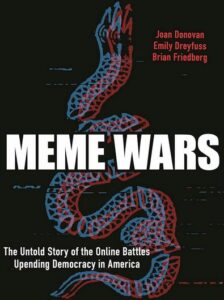
Below are the first pages of my kindle notes from the book “Meme Wars: The Untold Story of the Online Battles Upending Democracy in America” by Joan Donovan, Emily Dreyfuss, and Brian Friedberg. I’ve also added sections about Fuentes groyper wars against Kirk.
To understand how people could possibly vote for a corrupt grifter like Trump and other extremist politicians, and will continue to support authoritarians no matter what they do, it is important to understand how social media played a key role — and continues to. Never forget how Cambridge Analytica tipped the vote towards Trump in 2016.
Even more data has been stolen since then, especially after Elon Musk’s DOGE took a chainsaw to the government. Among the agency databases looted that could someday be used against you (Harvard 2025) are the Treasury Department’s payment system that contains Social Security numbers, federal tax returns, home addresses, and birth dates; the Office of Personnel Management’s (OPM) system, which stores background checks, medical and bank account information, and biometric data of federal employees; along with the systems of the Social Security Administration (SSA), the Education Department, the Labor Department, and the Department of Health and Human Services (Brookings 2025, Wired 2025) and National Labor Relations board (NPR 2025).
I am not optimistic that the “solution” offered by the authors to fix this will happen:
“…it will take the will of the people pushing their governments to introduce protocols for a public-interest internet—an internet designed not to divide but to bring together, a pro-social internet.”
I ascribe this unrest to the unfair distribution of wealth, corruption, plastic, PFAs, other pollution, processed food and so on affecting people’s health (and brains), inflation, and ultimately, the decline of the ecosystem resources and cheap energy that keep us alive. And now climate change, especially drought. The southwest has been in the worst drought in 1200 years since 2020, but survives thank to ancient aquifers (California, Ogallala) that grow half of America’s food, parts of which are likely to be drained from now until 2100 and refreshed after the next ice age.
Other Factors
Fox News has and is playing a key role, separate from the meme wars, but equally important: Fox news estranges millions of families and instills hate and fear in its cult members
The lack of critical thinking skills in the U.S. is astounding. Which means there is no way to stop red-pilling: What percent of Americans are rational?
And finally the right-wing evangelical / Pentecostal / fundamentalist churches play a huge role in brainwashing children from birth with goals to put women back in their place: barefoot, pregnant, uneducated, and doing the most boring tasks, unpaid and not much different from being a slave. This book reveals that many of these right-wing meme groups are extremely misogynist. Women are already slaves in vast regions, especially the Middle East, but also India and other nations with right-wing religious groups in power. Learn all about it in the religious category here.
Alice Friedemann www.energyskeptic.com Author of Life After Fossil Fuels: A Reality Check on Alternative Energy; When Trucks Stop Running: Energy and the Future of Transportation”, Barriers to Making Algal Biofuels, & “Crunch! Whole Grain Artisan Chips and Crackers”. Women in ecology Podcasts: WGBH, Financial Sense, Jore, Planet: Critical, Crazy Town, Collapse Chronicles, Derrick Jensen, Practical Prepping, Kunstler 253 &278, Peak Prosperity, Index of best energyskeptic posts
***
Parts of the Introduction
Memes played a significant role in mobilizing January 6th followers who incited the violence. The central idea animating the insurrection—that Trump had been denied his rightful victory in the election—was a memetic slogan, #StopTheSteal, a phrase hashtagged, printed on T-shirts, and adopted by politicians and millions of voters.
They came because they were summoned. And the person summoning them was himself a living, breathing meme: President Donald Trump. He embodied insurgency with every aspect of his behavior. He had embraced these communities during his first run. He retweeted them with gusto despite the press calling him out for it. He refused to disavow them. He said they were very nice people. He embodied their grievances even as he actually belonged to the wealthy elite. His face was already a popular meme on their message boards. He spoke their language and treated them with respect. Trump told these far-right fringe factions over and over, in tweets and speeches, to come to the Capitol that day to “fight like hell.” It was a fight they had already been engaged in online, attacking Trump’s enemies, spreading his lies, amplifying conspiracies that would help him reach his goal, believing theories like QAnon that existed solely to make him look all-powerful. When their meme general asked them to bring that war to Washington, D.C., they took buses, drove caravans, chartered private jets, and showed up.
They were not a homogeneous group of extremists but rather a collection of far-right and conspiratorial factions united by three things: extreme dissatisfaction with the status quo in America and their place in it; an aversion to or hatred of mainstream news and a corresponding preference for media that consisted of social networks and partisan outlets; and a loyalty to Trump. Aside from that, they disagreed on a lot. Some hated Jews, while others hated Jews a little but hated Black people more. Some hated women, some hated an imaginary evil cabal of baby eaters. Some believed the Constitution gave them the right to be sovereign over themselves, some were anarchists, and some were even monarchists.
We are a team of three researchers from the Harvard Shorenstein Center on Media, Politics and Public Policy, and by January 6 we had spent the past year together on the Technology and Social Change team monitoring these groups, and many previous years researching them. Together, the three authors will be your guide down the rabbit hole, as Virgil once guided Dante down to a figurative hell. All three of us share a core belief that when people talk about politics, they are really talking about media about politics. And you can’t talk about media without social media and the internet, which changed the way media is created, disseminated, and absorbed.
A red pill is anything that suddenly changes your mind about something fundamental to your worldview. For many in the past few years, COVID has become a red pill, for example, leading them to question their assumptions and beliefs about government or health care. In the book, we use the umbrella term “the red-pilled right” to refer to the collection of factions united by their opposition to the establishment. It is a label that encompasses the different groups of right-wing people online These are people with varying different political ideologies, all of which are reactionary, most of whose politics can be broadly categorized as libertarian, paleoconservative, or ethnonationalist.
Subfactions of the red-pilled right include such groups as the alt-right, white nationalists, fascists, incels, men in the manosphere, trolls, red-pilled gamers, New World Order conspiracists, and militias.
Once you take a red pill, there is no going back. You’ve been “red-pilled.” And now that you have awakened to the truth, you have a duty to red-pill others. In the Matrix films, once a character is red-pilled, they are actively at war with the powers that be, who view their knowledge as dangerous in and of itself, since it could awaken all the humans who are living in ignorance and lead to a total uprising.
The many factions of the red-pilled right have different names for the liberal institutions they are opposed to: Zionist Occupied Government, white genocide, the deep state, cultural Marxism, the New World Order, the cabal, the Cathedral, Many—possibly most—of the people who stormed the Capitol on January 6 had been red-pilled in some way or another. As we go through this book, we outline several meme wars that used red-pilled memes as a way to advance sexist, racist, and antisemitic agendas. Red pills often play on people’s most deeply held beliefs and seek to draw out contradictions,
For example, young men’s unemployment is explained by immigrants taking “American jobs.” The “cancer” called feminism is to blame for lacking a girlfriend; genetic determinism is responsible for racial inequity. To be red-pilled is synonymous with being insurgent against the mainstream media, as the news is controlled by special—and often, in the red-pilleds’ minds, Jewish—interests.
This book is concerned with the insurgent use of meme wars to fight against the establishment and institutions. As you will see, many groups participate in meme wars. Governments use cyber troops to influence foreign affairs, corporations wage PR battles to sell products, activists launch memetic campaigns to change public opinion, extremists recruit using ironic memes,
Trump’s election was the first social media candidacy that fully adopted meme wars as a campaign messaging strategy. With this strategy came red pills and rabbit holes, the pathway toward insurgency. Memes can convene armies and disarm enemies; they can also mobilize large groups of people when they are fed a steady stream of violence, aggression, and replacement anxiety.
It was a meme war that spilled into the streets of Washington, D.C., that day in January 2021. It was a decade of meme wars that radicalized people, that helped them forge their identities and find their communities, and it was a president and his political operatives who understand the power of meme wars who were able to send a tweet that drafted thousands into a battle against democracy itself. This book tells that story.
What are memes?
Memes seem to many to be inherently facile, dumb pictures of cats, jokes for jokesters. They are meant to alienate outsiders with their in-jokeyness and preach to the (dumb) choir with their humor. Yet memes, more than Hillary Clinton’s emails, appeared to be deciding the fate of America. In these wars, the weapons were memes, slogans, ideas; the tactics were internet-enabled threats like swarms, doxes, brigades, disinformation, and media-manipulation campaigns; and the strategy of the warriors was to move their influence from the wires (the internet) to the weeds (the real world) by trading fringe ideas up the partisan media ecosystem and into mainstream culture.
Their ideas, carried into the bloodstream of our society through memes, persist: Learn to code. It’s about ethics in journalism. Race is real. It’s OK to be white. Critical race theory. Let’s go, Brandon. Blue Lives Matter. A deep state operates extralegally inside the U.S. government. Meme wars are culture wars, accelerated and intensified because of the infrastructure and incentives of the internet, which trades outrage and extremity as currency, rewards speed and scale,
Pat Buchanan, who co-opted the phrase back in 1992 in a speech he delivered to the Republican National Committee. He shocked the room with his claims that there was a “religious war” raging in America, one as important as the Cold War itself, and that this spiritual enemy was liberalism. This idea was embraced and built upon by media operative and publisher Andrew Breitbart, who evangelized that politics was “downstream of culture,” by which he meant that if you can shape the culture, you can shape the politics.
Before social media, culture wars were spearheaded by evangelicals or radio personalities like Rush Limbaugh on the right, with progressive social movements like secularism and feminism positioned as their opponents on the left. They were amplified by TV pundits, and argued over on web forums and email chains and in mailers sent to your house. Social media did to the culture wars what spinach did to Popeye—it juiced them up.
Suddenly you didn’t need a radio show to get your idea to millions of people. The advancements of the internet in the 21st century and the advent of social media enabled culture warriors from across the country and globe to find each other and to gather together in communal spaces where their ideas could grow. No longer would an Ayn Rand–obsessed teenager in a small liberal town be isolated from other libertarians; now they could just log on and find their people.
This lack of trust in the establishment necessitates the creation of an alternative ecosystem for media and for experts, since even anti-establishmentarians need news and information. Thus the necessity for a far-right media landscape to inform these communities, along with the elevation of far-right influencers on social media, who are positioned as outside the mainstream liberal culture and whose cultural cachet is therefore not a liability but an asset to the communities they cater to. Folks like Alex Jones.
We start our book with the story of Occupy and the ways it inspired the far-right fringe, teaching people like Breitbart and Steve Bannon, his friend and predecessor at far-right alternative news site Breitbart News Network, how to use the participatory nature of the web and the free speech free-for-all of early social media companies to launch culture wars that drew blood. These people learned how to put their audience to work fighting their wars, urging them to share hashtags, pile on to comment sections, retweet, donate, and show up in the street, empowering them to help fight the ultimate battle against the establishment and demanding that they conscript others into this battle.
As the meme wars wore on, they became about replacement anxiety—white Americans’ anxiety that immigrants and people of other races would displace their position at the top of the social hierarchy, and men’s anxiety that women would displace them. Racists, sexists, and anarchists fought for what they thought was the best way to solve the perceived wrongs of the status quo. Often this status quo, their enemy, could be boiled down to the idea of neoliberal consensus, aka the mainstream culture, of which both the Republican and Democratic parties were a part, along with all major media outlets, Hollywood, the music industry, universities, and even the public school system.
The internet did not cause the insurrection. But it enabled it. As digital marketing grew as an industry, there was an unmarked shift from social networking into social media. These sound the same, but they are different. The business model of social networking was to connect people to people and litter those pages with ads, but social media connected people to people and to ad-laden “content”—information, pictures, videos, articles, and entertainment—all in one place. The change resulted in a digital economy built on engagement, where content farms and clickbait mimicked the tone and style of news websites, but whose real intention was to make money off advertising.
Clickbait ushered in an era of “fake news,” which led us to the disinformation age of the 2020s, where it’s so hard to tell truth from fact online that bad actors have figured out how to get what they want—be that money or power or something else—by spreading intentionally false information. No longer did everyone on the internet see the same information; algorithmic echo chambers shaped individual news feeds and timelines.
Political polarization was embedded into the back end of every tool we used to express ourselves, and into the ways we get our news. But it’s not simply that social media delivered content to users. It wasn’t just some natural evolution of radio or television, or a means of independent broadcasting. It also became an opportunity for everyone to make money.
In 2007 YouTube introduced a profit-sharing model that made average users into content producers. Over the next decade this created an influencer culture, where entrepreneurial creators cultivated networks of followers and subscribers and then monetized them through donations, subscriptions, or sponsored content. It was the perfect terrain to draft people into a meme war. As you go about your day, reading the news, checking your feeds, googling around for businesses, and reading reviews, you might not realize you are walking through a minefield, but you are. Everywhere you traverse, a hole may be hiding—in the form of a hashtag, maybe, or a recommended video—into which you can fall, until you reach the lesser-known corners of the internet, the ones that are still fringe, the ones from which, if the memes are powerful and resonant enough, you may never emerge.
One of the key ways that meme warriors suck people down into these rabbit holes is through the artful use of red pills, which they scatter across the open internet, waiting for you. In this way, red pills are provocative ideas that challenge the status quo, and which meme warriors might send out in tweets, or drop into a comment section, or call in to a radio show to plug. The hope is that you might be driving your car and hear one of these ideas—which often take the form of memes—and your mind will be instantly changed, or at least you’ll be curious enough about what you just heard to look into it, following the path into the rabbit hole that your research will lead you down.
Rabbit holes are ultimately just a series of links clicked in succession, and are built into the design of social media. This design confers incredible power on people able to harness what we call the four Rs of media manipulation: repetition, redundancy, responsiveness, and reinforcement. These four Rs are integral to successful memes. Repetition is simply the act of posting, reposting, retweeting, linking, or sharing to circulate content to the widest possible audience instantaneously. Repeating something ad nauseam plays into our cognitive biases and gives the impression that the thing being repeated is important and legitimate, especially if the viewer sees the same or similar content with lots of engagement over the course of a few days. Redundancy occurs when content is shared across multiple platforms. Repetition and redundancy online can produce “connective action,” which refers to the ability of a loosely affiliated group to take action together without knowing one another,
As the scholar Whitney Phillips explains, the collective resonance of memes takes hold when “something about a given image or phrase or video or whatever lines up with an already-established set of linguistic and cultural norms.
Where the red-pilled seek “information”
Normies are on Instagram and Twitter, not the 4chan message boards where many of the events of this book took place. There may be no better example of the way the internet accelerates and enables the creation of subcultures, and the feeling of fun and chaos and creativity that this entails, than the community on 4chan called Politically Incorrect, or /pol/ for short. The site began in 2003 and has remained largely unchanged, a repository of internet history and a breeding ground for ideas, offenses, and counterculture.
Political fringe ideas expressed online move from the internet into public space; and conversely, public events shape online coordination. We describe this as “going from the wires to the weeds,” where interactions online (in the wires) impact behavior in the real world (the weeds). Here is how it works: someone makes an appeal online (wires) that leads to a real-life event (weeds), and at this event violence, conflict, or spectacle breaks out, which leads to media attention, which leads to conversation and action online (wires), which leads to a new event in the real world (weeds), which causes violence or spectacle, which leads to media attention, which leads to online discussion or planning (wires), which leads to another event in real life (weeds). This recursive cycle is a meme war.
Memetic warfare was an inevitable outcome of mixing propaganda with the velocity, novelty, and great rabbit hole of the internet. Before the internet, information control was considered one of the most important powers of any government. The 2016 election raised the alarm that social media had upended the government’s ability to guard against informational attacks, as evidenced by the attention to Russia’s memetic meddling in U.S. politics. But, perhaps much worse, the 2020 election illustrated that social media could be turned against U.S. democracy when wielded by domestic political actors.
To get from memes to meme wars requires political mobilization through community organizing, innovative uses of platforms to scale participation, and the ability to create immersive and subversive content. Meme wars are accelerated by the design of communication infrastructure that favors popularity over quality, a fractured media environment that thrives on sensationalism, and a low barrier to entry and few sanctions for participating.
Occupy
In the one minute and nine seconds of the video, a collage of protest and conflict footage flashed across the screen, overlaid with an illustrated mask modeled after British insurrectionist Guy Fawkes, whose failed plot to bomb the House of Lords in 1605, and his subsequent trial and execution, made him a folk legend. The mask became an icon in American pop culture when Guy Fawkes figured prominently in the 2006 blockbuster anarchist revolutionary drama V for Vendetta, itself an adaption of a 1982 graphic novel by Alan Moore. In the late 2000s this Guy Fawkes mask became the symbol of revolution, and was adopted as something of an unofficial logo by hacker activist collective Anonymous.
“We are Anonymous. On September 17th, Anonymous will flood into lower Manhattan, set up tents, kitchens, peaceful barricades, and Occupy Wall Street for a few months. Once there, we shall incessantly repeat one simple demand in a plurality of voices. We want freedom. This is a nonviolent protest. We do not encourage violence in any way. The abuse and corruption of corporations, banks, and governments ends here. Join us. We are anonymous. We are legion. The thing Anonymous wanted to be free from was “the system,” the interlocking network of corporate greed and government corruption that screwed the normal people they claimed to be representing.
Occupiers were motivated by the economic crises of the Bush and early Obama eras, and inspired by recent revolutionary movements in Northern Africa and Europe. From Tunisia to Egypt to Spain, social media was being used in unprecedented ways to organize mass social movements. These uprisings sought human rights and economic security and were emboldened by the promise posed by technology to create social change.
The Great Recession, the longest global market decline since the Great Depression of the 1930s, had been declared officially “over” in 2009 after newly elected Obama had signed a huge relief package into law, and many of the banks and insurance companies that had preyed on people’s hopes and dreams for profit had been bailed out with taxpayer money. The money didn’t go into the pockets of the people whose homes were lost. It went into the vaults of the banks that had sold the homes under false pretenses and then confiscated them when people couldn’t pay their bills. The median household income in the country had declined for the fourth year in a row, to $50,054,2 and the average housing price in the country was $219,000. Wages were stagnating, and now, a decade into the twenty-first century, it appeared to many that America had gotten derailed somewhere along the way to greatness.
The Tea Party
In real life, 2009 did not mark the end of the pain for people who lost their jobs, their homes, and their futures. What it did do was create a popular and powerful conservative movement to stymie Obama’s planned tax hikes to pay for his stimulus proposal: the Tea Party—a movement born on television and operationalized by Republican professionals who saw in it the chance to create an alternate and powerful narrative about who was to blame for the problems in the country.
A week later, conservative groups around the country organized forty simultaneous Tea Party protests. This was big news, and the attention it got built momentum for a grassroots conservative movement from the edges of the right. Rush Limbaugh delivered a speech at the annual Conservative Political Action Conference, where Republicans iron out their agenda for the year. Limbaugh praised the Tea Party, saying of the bailouts, “After a while the people paying for it5 [will say] screw this. We’re not putting up with it. And you’re going to see—you’re already starting to see evidence of these. All the tea parties that are starting to bubble up out there. Those are great. Fabulous.” The GOP establishment knew a winning strategy when it saw one, and the Tea Party quickly went from scrappy to institutional.
Tea Party operatives who taught boomers how to drown out their liberal peers on Facebook through relentless posting, and by leaving negative reviews on liberal and left-wing materials on shopping and movie review sites. Online organizing was becoming more important to the American right wing than ever before, and as older Americans moved online, the web became an important terrain for the insurgent Tea Party Conservatives to occupy and finance.
On the left, progressives spoke out against Obama’s bailouts, drone strikes, and moderate social policy in progressive publications like the Nation and In These Times, but those articles, op-eds, and occasional TV appearances didn’t really move the needle. Obama continued to cater to the middle, hoping for a compromise even after the Tea Party elections had delivered him a Congress prepared to obstruct his every step. By 2011 nothing like the Tea Party had emerged on the left because, well, the left was technically in power. But it wasn’t successfully using that power to keep the middle or working class employed. It was clear that the economy wasn’t working for a great many people—the financial crisis led to the start of a long decline in the wealth of American families,
As discontent rose across the American political spectrum, only a small percentage of the population saw any relief, benefit, or profit after the financial crises. All of these problems, all of this pain and suffering, all of these banking systems preying on people’s vulnerability and politicians making promises they couldn’t keep, all of this was happening to the vast majority of Americans, the ones whose lives were not enriched when the stock market rallied.
In August, an amorphous coalition of left-wing activists created a blog called We Are the 99 Percent on the microblogging site Tumblr asking people to share photos of who they were and why they were part of the 99 percent. The Tumblr admins reposted pictures submitted by real people who identified with the growing movement. It was in this process of remixing and sharing that We Are the 99 Percent became a meme. It detached from its origin and got amplified by those who saw themselves in the new collective identity it represented. Activists remixed the selfie and turned the meme into a political tool. Authorless by design, the format was sticky and spreadable; individuals could share the blog’s domain address. Now that these activists had content to distribute, they needed more attention from the media to build a movement. “I sent [the Tumblr blog] on Twitter to different social media editors, to mainstream magazines. And the social media editor to the Times loved it and re-tweeted it
The Adbusters poster contained no contact information or logo, making it seem authorless and allowing people to define participation on their terms. The only specifics were a date and a hashtag: #OccupyWallStreet. If you wanted to learn what the hell #OccupyWallStreet was, well, you needed to look up the hashtag. The newspaper the Guardian coined the term “hashtag activism” to refer to Occupy and other Twitter-based revolutionary movements, noting that the hashtag was used to organize, evangelize, support, and track such movements.
The hashtag had been a part of Twitter since 2007, but Occupy activists were trendsetters in using it to build a movement. Hashtags were easy, and they were free. They moved information faster and further than traditional media or advertising, allowing new ideas to reach far bigger audiences quickly and without a ton of legwork. Eventually press outlets, politicians, and influencers would use hashtags, too,
Citizen journalists from both the left and right went down to the Occupy encampment and livestreamed what they saw. For many who showed up to the camps, their cell phones quickly turned into political tools. All of this surviving footage—media artifacts, testimony, documentaries, indie media accounts, and on-the-ground reporting—tells the story of an unlikely coalition of people fed up with the status quo. Soon there were over 1500 groups organizing under the #Occupy hashtag across the globe.
Encampments sprouted in every continent except Antarctica, from London to Athens, Buenos Aires to Manila, from red states to blue, small towns to big cities. But in terms of a policy position? It didn’t do much. When Occupiers chanted “We are the ninety-nine percent,” it wasn’t at all clear what they hoped anyone would do about that. This pretty much summed up the overwhelming critique of Occupy, which was that the protesters’ grievances were clear, but their demands were unspecific.
The media struggled to cover the Occupy movement because of this vagueness, as well as its vast network of participants and leaderless design. Everyone’s voice was just as valid as anyone else’s, which left Occupy open to co-option and misrepresentation, both purposefully and accidentally. By the end of December, mayors across the United States coordinated a massive crackdown on the encampments, with nearly 8,000 arrests. Protesters couldn’t get reorganized in city parks. Instead, they retreated back online, using Tumblr and the #Occupy hashtag on Twitter and Facebook to try to make sense of what had just happened and figure out what should happen next.
Supporters wrote the slogan “Google Ron Paul” in chalk on college campuses, printed it on signs, and even flew it on an enormous blimp. This was meant to be an entrance to a rabbit hole. Before folks could support Ron Paul, they’d need to learn who he was, right? Well, googling “Ron Paul” would lead you to thousands of websites devoted to the presidential hopeful, dwarfing the web presence of any other Republican in the race. These sites were made by passionate acolytes and not associated with the Paul campaign. “The community of websites that was created by the Ron Paul movement is like its own world,” one supporter said of the vast network of blogs, websites, forums, Myspace pages, YouTube videos, and the communities on Reddit, Digg, and online gaming spaces that helped spread the campaign’s message. Young antiestablishment folks loved him.
Along with making their own media, Paulites also turned to alternative media far outside the mainstream. Paul had a strong ally in one of alternative media’s most entrenched and infamous broadcasters: Alex Jones. Jones and his Infowarriors praised Paul’s commitment to a free and uncensored internet, but Paul’s support from the online fringe went well beyond Jones. He was also beloved by some of the internet’s most unsavory communities, such as 4chan.
No website at the time better embodied a truly unrestrained vision of online speech than 4chan. Founded in 2003 by a 15-year-old named Christopher Poole, screen name Moot, 4chan mimicked a Japanese imageboard that allowed users to post controversial or copyrighted images accompanied by text on topical boards that would then auto-delete. On 4chan, every user was named Anonymous. In fact, it was on 4chan that the hacktivist collective Anonymous first took shape. The structure of the site was simple but specific: post threads tied together on boards devoted to specific topics, with new threads always beginning with an image post. The site was moderated for illegal content, but was still littered with pornography, gore, torture, defamation, bombastic screeds. The intentional lack of consistent content moderation attracted many trolls and white nationalists to the site.
As with Trump, Paul’s ascent troubled the conservative establishment. In early January 2008, reporter James Kirchick published an exposé titled “Angry White Man” in the New Republic, resurfacing Paul newsletters that contained bigotry and conspiracism, which despite not being written by Paul himself, were nonetheless published under Paul’s brand. Paul didn’t shy away from the controversy. As Trump would a few years later, Paul saw cable news interviews as a political opportunity and went on CNN to defend his name.
But right-wing operatives like Alex Jones and Andrew Breitbart didn’t buy into this nihilism. Jones has said that two events served as red pills in his own life: the disastrous siege of the Branch Davidian compound in Waco, Texas, by federal agencies in April 1993, which left 82 Davidians and four federal agents dead, and Timothy McVeigh’s bombing of a federal building in Oklahoma City, which he said was revenge for Waco. To Jones, and the hundreds of years of American conspiratorial thought he represented, the 1 percent were composed of ancient bloodlines and cabalistic groups that used global capitalism to hide their “true” agenda—mass psychological and spiritual control carried out through occult rituals and genocidal social programs.
When Occupy ended, Fox News gloated that it had achieved nothing politically—no elected officials, no policy changes. But the movement did make income inequality a top priority for many Democrats. It also taught a new generation of activists how to organize using social media, outside of the confines of political parties and media gatekeepers.
Breitbart was hardly on the fringe of society, as a longtime collaborator on the extremely popular Drudge Report, cofounder of the Huffington Post, and founder of Breitbart News. But he was antiestablishment and a huge advocate for new media, which he saw as a way to move culture and set political agendas. In an interview with the Associated Press in 2010, he said he was “committed to the destruction of the old media guard,” and in 2011 he told GQ, “My goal is to take down the institutional left.” His targets were Democratic politics, lefty activism, mainstream journalism, and Hollywood, and his tactics seemed to be any means necessary. Destroying the legacy of Occupy would be a great way to hurt them all. He spent the last months of his life doing just that, creating a film called Occupy Unmasked
Reviewing the film for the Nation, journalist Michael Tracey called it a “documentary” in name only, “just total fantasy: a deranged hodge-podge of bizarre memes, wild dot-connecting and unadulterated fury. Its central thesis holds that the movement was founded as—and remains—an elaborate front for the Obama reelection effort, having been surreptitiously organized by actors ranging from the SEIU, Rachel Maddow and ‘professional anarchists’ to Amy Goodman, Hamas, Russia Today, Matt Taibbi and the Anonymous hacktivist collective.” With images of upside-down flags and hypodermic needles, hippies on unicycles and banging in drum circles, Breitbart painted the picture of an absurd and dangerous carnival of radicals who defecated on the streets and wanted to burn the system down and dance on its grave.
Footage of protesters inside Occupy camps was interspersed with images of snake charmers appearing to hypnotize dancing cobras, casting the young protesters as the snakes, being mesmerized by some greater power. That greater power, the film argued, was the union-organized left. “Community organizers are radicals, anarchists, public sector unions who are hell-bent on a nihilistic destruction of everything this country stands for. These people hate this country. Every trope and deranged meme, as Tracey had put it, lobbed at Occupy activists in the film would later be redeployed by Bannon and the Breitbart media empire to fight culture and meme wars in the decade to come.
When Dylann Storm Roof entered a South Carolina AME church in 2015 and killed nine Black parishioners, he had found his way there via the internet. As Roof detailed in his manifesto, “The Last Rhodesian,” a horrific case study in how the rabbit hole works, his descent into white supremacy began in 2012. It started when Roof wanted, he said, to learn more about Trayvon Martin’s death. The media was covering the case, celebrities were posting about it, athletes were wearing hoodies to raise awareness, but Roof didn’t think any of them were convincingly explaining why George Zimmerman had done anything wrong when he killed Martin one February day in 2012. There were pages upon pages of these brutal black on White murders. I was in disbelief. At this moment I realized that something was very wrong. How could the news be blowing up the Trayvon Martin case while hundreds of these black on White murders got ignored?
The death of Trayvon Martin was a flash point for race relations in the United States, red-pilling a swath of extremist, far-right, and center-right conservatives that would later be lumped together by the press, and by influencers with an agenda, under the term alt-right
Conclusion
When someone gets red-pilled, a reasonable emotional response is anger: they’ve been lied to. And that anger leads to the natural question: What else have I been lied to about? The further they go down the red-pilled rabbit hole, the more angry they likely become. You would be pissed, too, if you sincerely thought the story you’d been told about the world was a lie. This anger is a driving force behind any meme war.
Like the best memes, Trump resonated with his audience. He reflected their anger back to them; he became the symbol they wanted him to be—both a strong patriarch and a political outsider. His political playbook has been to tap into and amplify people’s fears—fears of economic insecurity, of others surpassing them in the class hierarchy, of falling behind. To the white men who felt that the twenty-first century was moving away from them, prioritizing the rights and needs of everyone but them and at their expense, Trump said: I am one of you.
Social media is no longer an emerging technology imbued with the possibility of fostering social change by giving voice to small groups; it has instead become a tool of the powerful, used to dominate, harass, and coerce vulnerable groups.
It has taken a decade for social media to be co-opted by political operatives after social movement activists proved its usefulness and seeded it with purpose. It should go without saying that there is an unfathomable amount of money and power at stake, and it’s the rich and powerful who now see how much they have to lose. While it took decades to regulate print, radio, telephone, and television, it will take the will of the people pushing their governments to introduce protocols for a public-interest internet—an internet designed not to divide but to bring together, a pro-social internet. It’s easy for us to forget that underneath the hood of the digital insurgency will continue, drafting soldiers to fight another meme war, exploiting grievances to distract from the real work of governance.
January 6 was the rattle of the snake’s tail: a warning of how fragile a multiracial democracy in America truly is. What happens now is not exactly clear, but as the next era of meme wars begins, at least now you understand the playbook.
FUENTES GROYPER WAR AGAINST KIRK
“Wow—what an incredible rally here in Charlottesville,” he wrote. “A tidal wave of white identity is coming.” He ended his note with a quote (“The fire rises!”) from a Batman film that was a popular 4chan meme. Like his heroes, Fuentes used memes as a lingua franca to reach people with similar ideas. His presence at the rally would cost him, after a former friend leaked a screenshot of his Facebook post. The uproar at his college, and from the CEO of the network where his show was broadcast, was intense. When he returned to campus, he received “death threats,” he told the AP in a video interview, and so he retreated to his parents’ home in suburban Chicago.
There was a decidedly misogynistic streak to this new subcommunity. The sexism of the Groypers appealed to Fuentes, and when they tuned in to his stream, he celebrated them. This turned him into the highest-profile Groyper, and therefore their de facto leader. Like them, Fuentes hated women and prided himself on his hyper-traditional sexual values, his virginity, and his essentialist views on gender.
This differentiated him from the mainstream views of the anons on /pol/ or even 8chan, who were antifeminist but low-key still wanted to have sex with women.
By 2017 with a growing fan base of young right-wing men, Fuentes’s popularity scored him invites to livestreamed debates about race realism, gender essentialism, and the Jewish question, which he dominated. These debates were so depraved that the troll Jim named them “Internet Bloodsports – the Jerry Springer of YouTube content.” Nothing was off the table. People pushed the idea that the white race was experiencing a genocide caused by immigration, and they embraced the meme “White Sharia,” the idea, rooted in dark irony and Islamophobia, that white men should invoke laws to control white women—a concept first promoted by neo-Nazi hacker weev. Fuentes used these debates to further a “thot war” against women of the alit-lite and alt-right, which he and the Groypers waged by attacking female and trans content creators. Thot was an acronym for “that ho over there,” popular rap slag referring to a woman with many partners. To the Groypers, all women were thots, and thots had no place in politics at all.
As he got more and more attention, however, the doubts about whether Fuentes was white enough to be a white nationalist also got louder. After all, his last name was Spanish, and he had admitted to some Mexican ancestry. The established white nationalists in the far right demanded that he take a DNA test. He was skeptical of DNA tests, believing that Jews could be messing with the test results to “deracinate” the white population. To his relief and pride, his results showed no Jewish ancestry. The white nationalists were happy with tat.
Fuentes just got stronger, and on his YouTube show took direct shots at the millennial alt-right leadership, like Spencer, whom he called a “pedophile CIA LARPer” based on passing comments Spencer made about the merits of using child pornography to reduce sex offences. This was the same basic allegation that had gotten Yiannopoulos canceled.
Perhaps the biggest lesson from UTR was the necessity of controlling public perception of contemporary American white nationalism, and the importance of good optics for recruiting. Apparently, just because Trump was in the White House, that didn’t mean people could wear their racism on their sleeve—the mainstream culture could still destroy you when overt racism, antisemitism, and misogyny went from the privacy of the wires to the scrutiny of the weeds. And so throughout the months that the Internet Bloodsports were taking place and Fuentes was becoming the leader of the Groyper army, all across the extremely online far right—from /pol/ to Reddit to 8chan—people debated what constituted good optics.
What was the best way to red-pill normies and exist in the world? Should they hide their beliefs, and not say explicitly racist things, or should they put it all out there?
Journalist Luke O’Brien described this divide between “the real-world extremists who want to continue holding rallies and mixing it up in the streets, and the ‘optics cucks’ who think the best approach to the mainstream is to keep pushing alt-right ideas through better propaganda. He advised his followers to be smart, not explicitly using antisemitic or anti-Black slurs on Twitter, for example.
Fuentes endorsed one of the “America First” candidates for Congress named Paul Nehlen and drawn approval from Bannon and Trump. But Nehlen kept making openly racist comments on Twitter, so the site banned him. Fuentes declared on an April show, dressed in a Trump flag, holding a knife to a Nehlen campaign sign and said, “Knife nation, raise your knives. We are declaring War. The America First coalition is here, we’re smart, we’re vindicated, we’re not going anywhere.” His menacing theatrics soon earned him the nickname Nick the Knife.
By this point, most of /pol/’s faith in the last generation of leadership had been permanently shaken. Within the greater movement, condemnation of street Nazis like Matthew Heimbach of the Traditionalist Worker Party intensified, their bumbling antics being blamed for setting back the greater good. /Pol/ and the zoomers under Fuentes began referring to these aggressively misguided and often uneducated white nationalists as “wigger nationalists,” or wignats—low-class neo-Nazis with no subtlety or sophistication. Just as Gen Z referred to everyone older as “boomer,” for Fuentes and the Groyper army, everyone they didn’t like was a wignat.
Later that year a man named Robert Bowers, who had been flash-radicalized on the far-right internet by memes about white genocide, carried out a lone-wolf attack that would further shake the remains of the alt-right. I his last post to the alt-right, Bowers wrote, “Screw your optics, I’m going in.” He then proceeded to attack the Tree of Life Synagogue in Pittsburgh, Pennsylvania, killing eleven Jewish worshipers. The event was widely covered by the press and condemned by public figures.
/Pol/ reacted with the expected celebration of violence and vicious antisemitism, though many visible far-right leaders distanced themselves from the killings, or found ways to avoid talking about it as either a positive or a negative event. Big Tech, the government, law enforcement, and media were paying closer attention to the scattered remains of the alt-right than ever before.
Brenton Tarrant was 28 years old on March 15, 2019, when he strapped a GoPro camera to his head and broadcast live on Facebook as he murdered fifty-one Muslims in a mosque in Christchurch, New Zealand. Right before he began shooting, he said, “Remember lads, subscribe to PewDiePie. This was a reference to a massively popular meme about Swedish YouTuber PewDiePie, who was defending his crown as most popular YouTuber of all time and had recently gained massive support from the far-right and more mainstream conservatives for his edgy humor and right-wing dog whistles.
The Groyper Wars
As many things were happening—an upcoming election, the haze of memes steeped in clowns and white genocide, rapid realignments, and accelerationist violence—Fuentes was commenting on it nightly on his show, guiding the Groypers through the disintegration of the alt-right. That fall, Fuentes and the Groyper army had a heyday trolling liberals who were outraged by Joawuin Phoenix’s film version of the DC Comics character Joker. There was a lot of hype and controversy about the nihilistic Joker who goes on a killing rampage because he feels society has betrayed him, some were worried that it would lead to other kinds of violence.
The Joker character from DC Comics’ Batman series had supplied fodder for memes since the mid 2000s, after the success of Batman Begins (2005 and The Dark Knight (2008), the latter with Heath Ledger playing a maniacal Joker who had been pushed over the edge by the absurdity and unfairness of the world. After Ledger died tragically in 2008, his version of the Joker became a sort of hero to the online set—a tragically disturbed white guy willing to destroy the world to make a point. The character’s recognizability became a way to make a statement about people—photoshop Joker makeup on someone, and you indicate that they are at heart a trickster, a nihilist, and a villain.
In the next few months, Fuentes would embody the Joker politics as the general in a meme war of his own: the Groyper wars to take down Conservative Inc. and the remaining alt-right leaders, who he felt had betrayed them all in some way. Fuentes set out to build a new right-wing coalition, but not a big tent. The first target of what would become the Groyper wars was Charlie Kirk, as the most visible and therefore most reachable face of the young conservative movement.
Kirk was about to embark on a national campus tour titled “Culture Wars,” where he was supposed to build a broad student coalition in support of Trump. A veteran of the college circuit, Kirk was poised to lead the young Republican wing of the party. He’d taken heat for his proximity to the alt-right at political and campus events in 2017 and 2018, so Kirk publicly denounced white supremacy after Unite the Right (a meeting to build a coalition of all the right-wing factions).
For Fuentes, Kirk embodied everything that was wrong with conservatives who upheld the liberal consensus by promoting Israel, gay rights, and softer immigration policies. Kirk had been in Fuentes’s sights over the years as he soured on campus conservatives. Getting to the top tier of Trumpworld was nearly impossible for someone as marginal as Fuentes, but opportunity struck in October 2019, when Kirk took TPUSA’s “Culture War” college tour on the road. Kirk brought Trump World to campuses across the nation with special guests like Senator Rand Paul, Donald Trump Jr., Kimberly Guilfoyle, Lara Trump, and congressman Dan Crenshaw. Like when Richard Spencer, Shapiro, or Yiannopoulos would book campus tours, Kirk’s events too often attracted protest from left-wing student groups. But this time, the attacks would come from their right.
Ever since Charlottesville, Kirk had been particularly careful to avoid association with the alt-right, and went so far as to fire any TPUSA representatives who were in close proximity to confirmed Groypers, especially Fuentes. Kirk started his speech in Reno with a countersignal to the alt-right, proclaiming, “The evil, wicked ideology of white supremacy has no place in our organization.”
Over the next few weeks, Groypers swarmed TPUSA events, waiting for the opportunity to ask Fuentes and his guests questions and grandstand for the livestream. Even though TPUSA was aware of the Groypers’ plan, they didn’t have a strategy for defending against them. The popular “debate me” style of conservatives online made any effort to shut down Q&A seem anti-free-speech. Kirk was caught in a trap of his own design, and the Groypers knew it. In October 2019 when a Groyper asked a question from “an America First perspective,” asking why the U.S. gave so much aid to Israel. Kirk shot back, “Do not peddle conspiracy theories at our event and went on to answer that Israel is the only place in the Middle East where people of “all three monotheistic religiions” are in the government and where gay people are not thrown off the top of buildings if found out, and the only partner in the fight against radical Islamic terrorists.
A few days later, Fuentes sent this message to his subscribers on Telegram: “Go to TPUSA events. Pack the line. Ask intelligent, well-rehearsed questions. Ensure the audience begins questioning TPUSA’s milquetoast conservatism. It’s clear that a growing body of young people want something more authentic than what Charlie Kirk has to offer.”
Fuentes partnered with the American Identity Movement to join the Groypers to confront Kirk at Politicon, a bipartisan conference dedicated to debate across the aisle October 26-27, 2019. A few hours after Fuentes showed up, he was physically stopped and asked to leave. The Q&A portion of the Kirk event was canceled too.
The Groyper wars reached a fever pitch on October 29, 2019 at Ohio State, when Kirk and Rob Smith, a Black gay conservative, were confronted by a long line of 14 Groypers, asking questions such as “Can you prove that our white European ideals will be maintained if the country is no longer made up of white European descendants?” Another encouraged the audience to look up “dancing Israelies,” which refers to a meme claiming Israel had orchestrated 9/11.
At a book talk by Donal Trump Jr, organized by Kir,, The Groypers came with a game plan to ask questions that exposed Kirk’s ‘never Trump’ past to show Don Jr that Kirk was a Fraud. But there was no Q and A because Trump Jr said that “people hijack it”. But this event attracted Yiannopoulis, who interviewed Fuentes about the Groyper wars, giving him even more attention in the right-wing and Gamergate communities.
The groyper wars mattered, not least because they cemented Fuentes’s position in the red-pilled right. It was clear that a new leader had been crowned king.
Fuentes may have hated the conservative establishment, but he still needed their attention. Just like his alt-right forebears, like Spencer, his only strategy was antagonizing conservatives until they acknowledged the Groypers and America First. The nihilism of Fuentes and Joker politics would go on to fuel right-wing Gen Z in the coming year on their mission to “Destroy the GOP.” Trump, and Trump alone, was all that was to be salvaged from the disappointing mess of the Republican Party.
The MAGA coalition understood the gravity of a Trump loss. It was willing to risk everything to prevent it, even uniting uncomfortable bedfellows like Kirk’s Turrning Point USA with Infowarriers and Fuentes Groypers to reach a common goal.
******
There is so much more in this book about the many groups, and the history of how it all began and led to the ongoing Trump Dictatorship that grows stronger every day in control over ever aspect of government.
If you wonder where this all may be going, I highly recommend the 2019 BBC/HBO miniseries “Years and Years”. In the last two episodes, events that have yet to transpire, the scariest outcomes of many authoritarian governments is shown, where people are “disappeared”. Spoiler alert: “13 Events From ‘Years And Years’ That Have Already Happened.” And in 2025 “All the eerie things Netflix’s dystopian hit Years and Years accurately predicted would happen.”
****
AI overview of Nick Fuentes beliefs:
. He rejects the term “white supremacist” as an “anti-white slur” but promotes themes central to white nationalist ideology. He heads the “America First” or “Groyper” movement, which aims to create a white nationalist alternative to the mainstream Republican Party.
- White and Christian nation: Fuentes advocates for America as a white, Christian nation and attributes the nation’s problems to a decline in Christian values. He has stated that white people should organize to preserve their culture and live among other white people.
- Christian nationalism: He promotes an authoritarian Christian nationalist vision for the U.S..
- Replacement theory: Fuentes frequently promotes the “Great Replacement” conspiracy theory, which claims that non-white immigration is replacing white populations and harming Western civilization.
- Antisemitism and Holocaust denial: Fuentes has a history of antisemitic rhetoric, including themes of Jewish influence and Holocaust denial. He has claimed Jewish people are highly influential in the U.S. government and that former President Trump is influenced by the “Israel lobby”. He has also spread conspiracy theories about events like the October 7, 2023, Hamas attack and promotes a view blaming Jews for the death of Christ. He has made offensive remarks about the Holocaust.
- Opposition to “liberal” values: He and his followers oppose values they consider “liberal,” such as feminism, LGBTQ+ rights, diversity, equity, inclusion policies, and race mixing.
- Rejection of the mainstream GOP: Fuentes criticizes mainstream conservatives for not adequately protecting white, Christian America and for accepting cultural changes. He has encouraged followers to “infiltrate” the GOP and groups like Turning Point USA. He has also expressed opposition to Donald Trump’s support for Israel and has vowed to oppose figures he sees as representing “Trumpism”.