
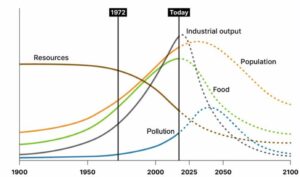
Projections of business as usual from Meadow’s et al “Limits to Growth”
Preface. Clearly infinite growth on a finite planet is impossible. Returning the world to ecological health requires humans to live within ecological boundaries in a steady state economy. But today systems cannot exist without growth as Trainer explains in this paper, which you can also find online. I wish it were more well known because I think it sums up well how our current economic system needs to be revised.
Although Herman Daly’s (2008) “Steady State Economy” is a model for many ecologists, Trainer explains that what Daly recommends has some pretty serious implications that will require a radical cultural and economic change.
I don’t see any way this can happen. It is not even going to after societies crash and reboot. Inequality and slavery are too hard-wired in the human system across time and cultures. Societies will have to live within ecological limits, but without equality and often slavery. Though Scott (2018) offers some hope for slaves, in the past they could escape to join other groups or nomadic tribes.
Books about slavery, prison, eviction
- A Reséndez. The Other Slavery: The Uncovered Story of Indian Enslavement in America
- Scott JC (2018) Against the Grain: A Deep History of the Earliest States. Yale University Press
- Wallance GJ (2023) Into Siberia: George Kennan’s epic journey through the brutal, frozen heart of Russia. St. Martin’s Press.
- NRC (2014) The Growth of Incarceration in the United States: Exploring Causes and Consequences. National Research Council, the National Academies Press.
- ZNH Barracoon. The story of the last “black cargo”
- W Warren. New England bound: Slavery and colonization in early America
- S Northup Twelve years a slave
- P Kerman. Orange Is the New Black: My Year in a Women’s Prison
- J Hogshire. You Are Going To Prison.
- RJ Miller. Halfway Home: Race, Punishment, and the Afterlife of Mass Incarceration
- M Desmond. Evicted: Poverty and Profit in the American City
- A Pang. Made in China: A Prisoner, an SOS Letter, & the Hidden Cost of America’s Cheap Goods
Alice Friedemann www.energyskeptic.com Author of Life After Fossil Fuels: A Reality Check on Alternative Energy; When Trucks Stop Running: Energy and the Future of Transportation”, Barriers to Making Algal Biofuels, & “Crunch! Whole Grain Artisan Chips and Crackers”. Women in ecology Podcasts: WGBH, Planet: Critical, Crazy Town, Collapse Chronicles, Derrick Jensen, Practical Prepping, Kunstler 253 &278, Peak Prosperity, Index of best energyskeptic posts
Ted Trainer: THE RADICAL IMPLICATIONS OF A ZERO GROWTH ECONOMY*
real-world economics review, issue no. 57
* This paper elaborates and extends a discussion of themes published in The International Journal of Inclusive Democracy, Fall, 2010; see Trainer 2010a.
For 50 years literature has been accumulating pointing out the contradiction between the pursuit of economic growth and ecological sustainability, although this has had negligible impact on economic theory or practice. A few, notably Herman Daly (2008), have continued to attempt to get the notion of a steady-state economy onto the agenda but it has only been in the last few years that discussion has begun to gain momentum. Jackson’s Prosperity Without Growth (200) has been widely recognised, there is now a substantial European ”De-growth” movement (Latouche, 2007), and CASSE (2010) has emerged.
The argument in this paper is that the implications of a steady-state economy have not been understood at all well, especially by its advocates. Most proceed as if we can and should eliminate the growth element of the present economy while leaving the rest more or less as it is. It will be argued firstly that this is not possible, because this is not an economy which has growth; it is a growth-economy, a system in which most of the core structures and processes involve growth. If growth is eliminated then radically different ways of carrying out many fundamental processes will have to be found. Secondly, the critics of growth typically proceed as if it is the only or the primary or the sufficient thing that has to be fixed, but it will be argued that the major global problems facing us cannot be solved unless several fundamental systems and structures within consumer-capitalist society are radically remade. What is required is much greater social change than Western society has undergone in several hundred years.
Before offering support for these claims, it is important to sketch the general “limits to growth” situation confronting us. The magnitude and seriousness of the global resource and environmental problem is not generally appreciated. Only when this is grasped is it possible to understand that the social changes required must be huge, radical and far reaching. The initial claim being argued here (and detailed in Trainer 2010b) is that consumer-capitalist society cannot be reformed or fixed; it has to be largely scrapped and remade along quite different lines.
The “limits to growth” case; An outline.
The planet is now racing into many massive problems, any one of which could bring about the collapse of civilization before long. The most serious are the destruction of the environment, the deprivation of the Third World, resource depletion, conflict and war, and the breakdown of social cohesion. The main cause of all these problems is over-production and over-consumption – people are trying to live at levels of affluence that are far too high to be sustained or for all to share.
Our society is grossly unsustainable – the levels of consumption, resource use and ecological impact we have in rich countries like Australia are far beyond levels that could be kept up for long or extended to all people. Yet almost everyone’s supreme goal is to increase material living standards and the GDP and production and consumption, investment, trade, etc., as fast as possible and without any limit in sight. There is no element in our suicidal condition that is more important than this mindless obsession with accelerating the main factor causing the condition.
The following points drive home the magnitude of the overshoot.
- If the 9 billion people we will have on earth within about 50 years were to use resources at the per capita rate of the rich countries, annual resource production would have to be about 8 times as great as it is now.
- If 9 billion people were to have a North American diet, we would need about 4.5 billion ha of cropland, but there are only 1.4 billion ha of cropland on the planet.
- Water resources are scarce and dwindling. What will the situation be if 9 billion people try to use water as we in rich countries do, while the greenhouse problem reduces water resources.
- The world’s fisheries are in serious trouble now, most of them overfished and in decline. What happens if 9 billion people try to eat fish at the rate Australian’s do now?
- Several mineral and other resources are likely to be very scarce soon, including gallium, indium, helium, and there are worries about copper, zinc, silver and phosphorous.
- Oil and gas are likely to be in decline soon, and largely unavailable in the second half of the century. If 9 billion were to consume oil at the Australian per capita rate, world demand would be about 5 times as great as it is now. The seriousness of this is extreme, given the heavy dependence of our society on liquid fuels.
- Recent “Footprint” analysis indicates that it takes 8 ha of productive land to provide water, energy, settlement area and food for one person living in Australia. (World Wildlife Fund, 2009.) So if 9 billion people were to live as we do about 72 billion ha of productive land would be needed. But that is about 10 times all the available productive land on the planet.
- The most disturbing argument is to do with the greenhouse problem. It is very likely that in order to stop the carbon content of the atmosphere rising to dangerous levels CO2 emissions will have to be totally eliminated by 2050 (Hansen says 2030), and probably by 2050. (Hansen, 2009, Meinschausen et al., 2009.) Geo-sequestration can’t enable this, if only because it can only capture about 85% of the 50% of emissions that come from stationary sources like power stations.
These kinds of figures make it abundantly clear that rich world material “living standards” are grossly unsustainable. We are living in ways that it is impossible for all to share. We are not just a little beyond sustainable levels of resource consumption — we have overshot by a factor of 5 to 10. Few seem to realise the magnitude of the overshoot, nor therefore about the enormous reductions that must be made.
Now add the implications of growth.
The above figures refer to the present situation, but that does not define the problem we face. The problem is what will the situation be in future given the determination to increase production and consumption continuously and without limit?
At least 3% p.a. economic growth is demanded and usually achieved in this society. If Australia had 3% p.a. increase in output to 2050 and by then all 9 billion people expected had risen to the material living standards Australians would have, the world would be producing almost 20 times as much as it does today. Yet the present level is alarmingly unsustainable.
“Technical advance will make it all possible.”
We come now to the crucial assumption most people make, i.e., that there is no need to even think about questioning growth, let alone reducing consumption or economic output, let alone cutting GDP by a factor of 5 to 10. The generally assumed view is, “We will all be able to go on buying lots of goods, living in gigantic houses, driving long distances, going away for holidays, jetting around the world, having elaborate wardrobes etc., and increasing our consumption of those things every year – because our wizard technologists will find ways of producing goods and running cars etc. without causing significant problems. Indeed, the technologies already exist; it’ is just that our dull-witted politicians have failed to implement them.”
However, the overshoot is far too great for any plausible technical advances to be able to reduce the problems to tolerable proportions. Perhaps the best known “technical fix” optimist, Amory Lovins, claims that we could at least double global output while halving the resource and environmental impacts, i.e., we could achieve a “Factor Four” reduction. (Von Weisacher and Lovins, 1997. More recently a Factor Five reduction is argued.) But this would be nowhere near enough to solve the problems.
Let us assume that present global resource and ecological impacts must be halved. It has been explained that if we in rich countries average 3% growth, and 9 billion rose to the living standards we would then have by 2050, total world output would be almost 20 times as great as it is today. It is highly implausible that technical advance will make it possible to multiply total world economic output by 20 while halving impacts, i.e., to enable a Factor 40 reduction.
“But what about renewable energy sources?’
No technical-fix assumption is more common nor more unexamined than that renewable energy sources can be substituted for fossil fuels, thereby enabling abundant energy affluence while eliminating the greenhouse and other problems. A case to the contrary is detailed in Renewable Energy Cannot Sustain A Consumer Society (Trainer 2007, and updated in Trainer, 2008. See also Trainer, 2009 and 2010.) For example, following is an indication of the reasons why there is no chance that all people could have vehicles fueled by biomass.
It will probably become possible to derive 7 tonnes of biomass per ha from very large-scale production, and 7 GJ of ethanol per tonne of biomass. Thus, it would take 2.6 ha to produce the 128 GJ each Australian uses each year as oil plus gas. If 9 billion people were to live as Australians do now 23 billion ha of forest would be needed…on a planet that has only 13 billion ha of land.
This does not mean we should forget about renewables. They are the sources we should be moving to full dependence on as soon as possible. But they can’t fuel a consumer society for all. They have to be part of The Simpler Way sketched below.
The failure of the Greens
Despite the overwhelming case against growth, and the argument that there is no possibility of solving the environment problem unless we shift to a zero-growth economy, green movements and political parties have almost totally ignored the issue. The original German Green Party saw the need for vast and radical system change away from consumer-capitalist society. However, now almost all green effort goes into merely trying to reform that society, so that its damage to the environment will be reduced somewhat, and virtually no green campaigning is directed at moving towards a kind of society that does not inevitably and increasingly destroy the environment. Almost none of their attention is given to the topic of growth. For instance Geoff Mosley’s recent book details the continued refusal over many years of the Australian Conservation Foundation to deal with it (Mosley, 2010) .
Similarly Green political parties will not discuss economic or population growth and instead focus on reforms which never challenge growth and affluence. Green people are among those who make the strongest claims that technology can solve the problems eliminating any need to face up to system change…and the politicians are at fault for not implementing the available solutions.
The reason for this failure/refusal is of course that if they spoke up against the pursuit of growth and affluence in a society that is fiercely obsessed with these goals, they would quickly lose their subscribers.
The wider context
The gross unsustainability of consumer-capitalist society is only the first of two crushing arguments against its acceptability. The other is to do with the extreme and brutal injustice built into the global economy, and without which we in rich countries could not have such high material living standards.
The global economy delivers most of the world’s resource wealth, e.g., oil, to the rich countries. It does this simply because it is a market system, and in a market most scarce and valuable things go to the rich, because they can pay most for resources and goods.
The same principle ensures that the development taking place in the Third World is little more than development that will enrich the corporations from the rich countries, Third World elites and the people who shop in rich world supermarkets.
The global economy totally ignores the needs and the rights of people and ecosystems. It allows, guarantees, that 850 million people starve while 600 million tonnes of grain are fed to animals in rich countries every year and most of the best land in many hungry countries is devoted to export crops. Conventional development, i.e., development determined by market forces and profit, is therefore clearly a form of plunder – it puts the productive capacity of the Third World into enriching us not them.
Conventional development theory and practice are based on the idea of “growth and trickle down”, i.e., the assumption that if we all enthusiastically pursue growth within the market place then this will be the best way to raise the Third World to satisfactory living standards. What a delight for the very rich! “No need to think about redistributing existing wealth, or producing what’s needed rather than what’s profitable…just produce whatever most enriches the already rich and wealth will trickle down to enrich all.” This is to say we should be content with an approach to development which delivers almost all of the Third World’s produced wealth to us in rich countries while a tiny fraction of it benefits Third World people.
The greatest blind spot in this conventional development theory and practice is that its goal is utterly impossible. The discussion above makes clear that there is no possibility of the Third World developing to be like the rich countries or to have rich world “living standards”; there are nowhere near enough resources for that.
“But look at China!” Yes, there are places in the global economy where some people are winning spectacularly, and where significant benefits are going to poorer people. There is strong evidence that the ‘living standards” of large numbers of people in the Third World are indeed rising significantly. (See for instance Rosling, 2009.) However, this does not mean the Trickle Down approach is acceptable or that it could solve the basic problems.
Firstly, the booming export markets the Chinese now enjoy have been taken from many in poor countries who once had them but now can’t earn from exporting the things they used to sell. Also, it is easy to overlook the fact that 800 million Chinese are not sharing in the new wealth (Hutton, 2007). Market based systems mostly benefit the middle class and the rich, and create limited opportunities for some to rise to the middle class. Ask 500 million in Africa, or most people in Haiti and Tuvalu about the miracles of growth and trickle down. Most of them are probably enjoying declining GDP per capita. (…which of course just means they need to work harder, cut their export prices, log more forest…) Very little ever trickles down to the poorest, and globalisation has increased the rate at which the resources of the very poorest are transferred to the rich. (For extensive documentation see Note 2.)
Even for those poor classes benefiting from the growth and trickle-down approach to development, the rates evident show that it would take hundreds of years for them to rise to rich world “living standards”. Meanwhile the rich countries would have risen to stratospheric levels…and the ecosystems of the planet would have collapsed long ago.
Even if the growth and trickle-down approach was solving the most serious problems it is obviously an extremely wasteful and unjust strategy. For every crumb it delivers to the poor majority great wealth is heaped on the already rich.
The rich countries go to a lot of trouble to keep the unjust global economy in place. They use aid, support for brutally dictatorial Third World regimes, World Bank Structural Adjustment Packages, and provision of arms, and they resort to military invasion, in order to maintain the governments and systems that ensure that our corporations and shoppers continue to get most of the world’s resource wealth and to take most of the markets. The rich countries deliberately prevent appropriate development, i.e., the application of the Third World’s productive capacity, its labour, land, skills and capital, to developing the simple things that would do most to quickly increase the welfare of its people. The conditions written into the World Bank’s Structural Adjustment Packages explicitly rule this out and decree that productive capacity must be free for market forces to determine what it will be put into–that is free for corporations to use in whatever way will maximise their global profits.
Our high material “living standards” cannot continue to be provided unless these appallingly unjust systems and processes remain. We could not live anywhere near as well as we do if you were not getting most of the available tin, coffee, oil etc. The problem of Third World deprivation cannot be solved unless the rich world reduces its consumption dramatically and lives on something like its fairs hare of world resource wealth. Yet its supreme goal is to increase its levels of production, consumption and GDP.
Thus growth is a major cause of global problems
This “limits to growth” analysis is crucial if one is to understand the nature of the environmental problem, the Third World problem, resource depletion and armed conflict in the world. Although there may also be other causal factors at work, all these problems are directly and primarily due to the fact that there is far too much producing and consuming going on.
For instance, we have an environment problem because far too many resources are being drawn out of nature and far too many wastes dumped back in, at rates technical advance cannot cut to sustainable levels. We have an impoverished and underdeveloped Third World because people in rich countries insist on taking most of the resources, including those in the Third World that should be being used by Third World people to meet their own needs. And how likely is it that we will ever have peace in the world if resources are very scarce and all cannot use them at the rate a few do now, yet all insist on getting richer and richer all the time without limit? If you insist on remaining affluent then you should arm yourselves heavily, you will need arms if you want to continue to take far more than your fair share.
The quality of life.
The ultimate paradox is that for decades it has been clear in the scientific literature that increasing the GDP of rich countries does not increase the quality of life. (Eckersley, 1997, Speth, 2001.) In fact we are now probably seeing a falling quality of life in the richest countries. What then is the point of striving for economic growth?
“But growth will make us so rich we will be able to afford to save the environment.”
This statement is characteristic of the conventional economic mind …just create more monetary wealth and we can solve all problems with it. The fatal mistake in the argument is transparent. If we don’t reduce “wealth” production dramatically and quickly the environmental consequences will soon eliminate our capacity to produce any wealth at all.
The conclusion?
To repeat, the point of the foregoing sketch has been to make clear the magnitude of the problem. The volumes of producing and consuming going on in the world are many times beyond levels that might be sustainable. It is not just a matter of getting to an economy that does not grow any further; the imperative is to reach a steady state economy in which production, consumption, investment, trade and GDP are very small fractions of their present quantities. The following discussion seeks to show that this means that most of the core structures and systems in this society will therefore need to be scrapped.
The far reaching and profoundly radical implications of zero-growth
The growth problem is not just that the economy has grown to be too big, now depleting resources and damaging ecosystems. The more central problem is that growth is integral to the system. Most of the systems basic structures and mechanism are driven by growth and cannot operate without it. Growth cannot be removed leaving the rest of the economy more or less as it is. Unfortunately, people in the current “De-growth” movement tend to think growth is like a faulty air conditioning unit in a house, which can be taken away and the rest of the house will function more or less as it did before.
- If you do away with growth then there can be no interest payments. If more has to be paid back than was lent or invested, then the total amount of capital to invest will inevitably grow over time. The present economy literally runs on interest payments of one form or another; an economy without interest payments would have to have totally different mechanisms for carrying out many processes.
- Therefore, almost the entire finance industry has to be scrapped, and replaced by arrangements whereby money is made available, lent, invested etc., without increasing the wealth of the lender. That is incomprehensible to most current economists, politicians and ordinary people.
- Among related problems is how to provide for old age, when this can’t be done via superannuation schemes relying on returns on invested savings?
- The present economy is literally driven by the quest to get richer; this motive is what ensures energetic search for options, taking of risks, construction, and development. The most obvious alternative is for these actions to be motivated by a collective effort to work out what society needs, and organise to produce and develop those things. This involves an utterly different world view and driving mechanism. Such a society would have to find another way to ensure innovation, entrepreneurial initiative and risk taking when people can’t look forward to getting richer from their efforts. (This is not necessarily a difficult problem; See Trainer 2010a, Ch. 5.)
- The problem of inequality would become acute and would demand attention. It could not be dealt with by assuming that “the rising tide will lift all boats“. In the present economy growth “legitimises” inequality and defuses the problem. Extreme inequality is not a source of significant discontent because it can be said that economic growth is raising everyone’s “living standards”. But if the pie remains at a constant size, and everyone is driven by a competitive struggle to get richer all the time, before long the most energetic/talented/ruthless few will have taken most of the pie. Thus, inequality would have to be addressed and dealt consciously and deliberately, involving social decisions regarding distribution and fair shares…which again would involve a very different kind of society.
- Above all, if there is to be no growth there can be no role for market forces. Many people who oppose growth do not seem to realise this. The market is about maximising; i.e., about producing, selling, and investing to make as much money as possible from the deal, and then seeking to invest, produce and sell more, in order to again make as much money as possible. In other words, there is an inseparable relation between growth, the market system and the accumulation imperative that defines capitalism. If we must cease growth we must scrap the market system.
- The above changes could not be made unless there was also a profound cultural change, involving nothing less than the abandonment of the desire to gain. For more than 200 years our Western society has been focussed on the quest to get richer, to accumulate wealth and property. (The point is focal in the writings of Polanyi, 1944, and Tawney 1922, in the emergence of capitalist society from Medieval society). This is what drives all economic activity, such as the innovative and development behavior of firms and the behavior of individuals and firms in the market, and it is at the core of national policy. People work to get as much money as possible. Firms strive to make as much profit as possible and to get as big as possible. People trade to end up richer than they were. Nations strive to become richer all the time.
- The logically inescapable point here is that in a zero-growth economy there could be no place whatsoever for this psychological motive or economic process. People would have to be concerned to produce and acquire only that stable quantity of goods and services that is sufficient for a satisfactory quality of life, and to seek no increase whatsoever in savings, wealth, possessions etc. It would be difficult to exaggerate the magnitude of this cultural transition. A zero-growth economy cannot exist unless there is enormous change from the mentality that is typical in consumer society and that has been the dominant driving force in Western culture for several hundred years.
Subsistence, gift, reciprocity…sufficiency
The alternative to a growth economy is in fact a subsistence economy, that is one in which people produce to meet stable needs and not to accumulate wealth. In tribal, peasant, ancient and Medieval societies and in many communes today items are not made to sell in order to gain, to accumulate money over time. (See Polanyi’s discussion, 1944.) They are produced to exchange for other needed items of equal “value”. Market day enables all to acquire the things they needed, in exchange for a contribution to meeting the needs of others. No one intends to gain from the exchange; they just intend to exchange items of a certain “value” for others of the same “value” (usually measured in labour time needed to produce them.) People do not go into the market to get rich. (Merchants visiting the town, usually with non-necessities, luxuries, to sell, did trade to gain, but in Medieval Europe were an almost irrelevant minority on the fringe of the mainstream economy, and were not respected.)
In these subsistence economies the basic operation was not getting, it was giving…knowing that others would give to you. In other words the key economic mechanism was gift and reciprocity. In tribes elaborate rules govern the giving and receiving, ensuring that all are provided for. (No one in tribal society is poor or hungry, unless times are difficult for all.)
These are the economic principles that must exist, whether we like it or not in a satisfactory, viable economy in the coming era of intense and irremediable scarcity, in which we must develop mostly small local cooperative stable economies focussed on meeting needs. The focal concerns must be organising local resources and productive capacities to provide well for all, without any notion of gain or getting richer over time. The basic mechanism must be giving to others and the community, knowing that you will be given what you need. (…for instance contributing to voluntary working bees that maintain the community orchards.)
History can be seen in terms of the damage that the drive to gain eventually does. Often a civilization emerges and for a while has considerable equity, but in time some become more wealthy and powerful, and develop into a class with increasing power and privileges and then dominate the rest. Their desire to gain drives a quest for more and more land, opulence, slaves…and foreign sources of wealth. An imperial phase begins. The wealth of other regions is plundered. Because there is no concept of enough, before long there is over-reach; it becomes impossible to maintain the empire, and the civilization self-destructs. At present the West is passing through the over-reach phase into decline, while China is rising past us, driven by the same old single-minded obsession with getting richer and more powerful. This sorry story will not cease until humans learn to be content with enough.
This is a core theme in The Simpler Way analysis — this society cannot be fixed; its major elements must be scrapped and replaced. (The case is detailed in Trainer 2010b.) Most obviously, you cannot reform a growth economy to be a zero-growth economy, and you cannot remove the growth element from the economy while leaving the rest of it as it was; you have to build a completely different economy. Above all, you will not solve the many problems the quest for growth is causing without scrapping core structures in our culture, that is until people in general come to be content with what is sufficient and design and run economies that are about subsistence, gift and reciprocity.
Thus most people calling for a stable economy seem not to grasp the implications of their campaign, nor the reasons for thinking that it has a negligible chance of success. Above all they do not seem to thought through the many and profound associated social changes that must be achieved if growth is to be eliminated.
Is capitalism compatible with a zero-growth economy?
It should now be obvious that a stable or zero-growth economy cannot be a capitalist economy. Capitalism is by definition about accumulation, making more money than was invested, in order to invest the surplus to have even more…to invest to get even richer. It would be possible in a stable economy for a few to still own most capital and factories, and live on the income from these investments, but they would be like rentiers or landlords who draw an income from their property. They could not be driven to accumulate, get richer, increase the amount of capital they possess and invest to get richer. If they did, a very few would quickly take almost all of the fixed amount of income and wealth available…and the system would soon self-destruct.
Some people, such as Herman Daly believe that “productivity” growth would enable capitalism to continue in a zero-growth economy. The counter-argument is that there would be a tendency for this to happen, but that the effect would be trivial and short lived. (Extracts from an argument against this view are given in the appendix below, taken from Trainer, 2010a.)
Many in the emerging “De-growth” movement do not wish to face up to the conclusion that if you get rid of growth then you will also have got rid of capitalism and you will inevitably have (some kind of) “socialism”. That is, the economy could not then be left to competition between people who own capital operating in free markets. At least the main economic decisions would have to be made by deliberate social discussion, debate and planning…because this is the only logical alternative to leaving them to “free markets” and the owners of capital competing to gain.
It is crucial to immediately stress that this does not have to mean we must accept a big authoritarian, bureaucratic state running everything…which no one is likely to prefer. The new economy of The Simpler Way is sketched below (and detailed in Chapter 4 of Trainer 2010a.) It has the main decisions made collectively, by all people within small community economies (but with most of the economy in the form of private firms.)
What is the alternative?
If we must abandon growth and greatly reduce production and consumption then there is no alternative but to develop an economy which is basically under social control, i.e., in which we discuss, decide, plan and organize to produce that stable quantity of the basic things we need to enable a high quality of life for all. In the coming conditions of intense resource scarcity viable communities will have to be mostly small, self-sufficient local economies using local resources to produce what local people need. Such economies can only work well if control is in the hands of all citizens, via participatory-democracy exercised through whole town assemblies. This vision would enable most of the firms and farms to be privately owned or community cooperatives, and would involve little role for councils, state or federal governments.
Although the case against the wisdom of pursuing growth and affluence has in my opinion been overwhelmingly convincing for decades, it has been almost totally ignored. Although it is now gaining more attention, on the fringes of the economics profession, unfortunately there is little recognition of just how profoundly radical the notion of zero-growth is. It logically entails the termination of several fundamental structures and processes, values and taken for granted ideas, which have developed over hundreds of years. If the limits analysis is valid we have only decades to make the enormous transitions. Given that the mainstream, resolutely led by the economics profession, shows no sign of ever attending to these issues, it is difficult to maintain belief that we have the wit or the will to save ourselves.
Appendix; Can productivity enable capitalism to survive de-growth?
(Extracts from “De-growth is not enough”, T. Trainer, International Journal of Inclusive Democracy, Jan., 2010.)
Some of the best known critics of growth believe that it is quite possible to continue a capitalist economy without growth. Herman Daly for instance argues that even though the throughput of resources in a steady state economy would be stable, productivity growth would still provide scope for increasing income, wealth, and investment, and therefore for the continuation of capitalism. Productivity gains would enable more and more “value” to be got out of that constant amount of inputs, and this could go on motivating initiative and investment and enabling the accumulation process which is essential to the concept of capitalism.
The following argument is that this claim is true but trivial, and would soon cease to be true. The first question here is what are the sources of productivity growth? It is commonly assumed that it derives from smarter technology, and that there are no limits to this. The relevant index for our purposes is not “Labour “Productivity” but “Multifactor Productivity”, which refers to that proportion of GDP growth that is left when the contribution of labour and capital inputs are subtracted. It is assumed to include the effects of efficiency gains and technological advance. Australian Bureau of Statistics (2007) and the Australian Productivity Commission (2007-8) figures show that over the past ten years MFP accounts or under 25% of GDP growth. This means that the scope for increases in investment of capital, incomes, GDP etc. in an economy with no increase in inputs could be no greater than one-quarter of what it is now.
However the situation is much more restricted than that figure suggests, due to the characteristic failure of conventional economists to attend to anything but dollars and prices. Several studies have pointed to the crucial role of energy in productivity and GDP growth, and this is completely ignored when productivity is assumed to be a function of capital, labour and technology. A strong case can be made that economic growth in general, and technical advance in particular, are primarily due to increasing inputs of energy, especially to the substitution of energy and energy-intensive machinery for labour. Several studies have discussed the considerable and at times overwhelming role of energy growth in economic and productivity growth. Ayres (2009, p. 54) presents detailed analyses of the role of energy in economic history and draws rather alarming conclusions regarding the close relationship. He finds that growth depends heavily on the availability and price of energy, and that in the likely near future of sharply increased energy scarcity and cost dire consequences for growth can be expected. “Economic growth depends on producing continuously greater quantities of useful work.” (2009, p. 297). Ayres actually concludes that because of coming energy problems, growth “…is more than likely to end within a few decades.” (2009, p. 306).
Berndt (1990) says that by the 1970s it was clear that at least 50% of apparent technology gains were due to increased energy use. He endorses the expectation that rising energy prices will cut productivity growth. US productivity has fallen following oil price shocks, as managers substitute other and less efficient factors for energy. Productivity has shown a long term decline since 1990, which is likely to be a consequence of energy problems. Finally, the “Productivity Paradox” seems to reinforce the significance of energy. If technical wizardry was the major determinant of productivity growth then how can we explain the fact that US productivity growth has slowed in the 1970 to 1990 period when computers have revolutionized just about all technologies?
Agriculture is a realm where technical advance has been predominantly a matter of increased energy use. Over the last half century productivity measured in terms of yields per ha or per worker have risen dramatically, but these have been mostly due to even more rapid increases in the amount of energy being poured into agriculture, on the farm, in the production of machinery, in the transport, pesticide, fertilizer, irrigation, packaging and marketing sectors, and in getting the food from the supermarket to the front door and then dealing with the waste packaging. The ”Green Revolution” has depended largely on ways that involve greater energy use. Less than 2% of the US workforce is now on farms, but agriculture accounts for around 17% of all energy used (not including several of the factors listed above.) Unconventional measures of agricultural productivity, such as food energy produced per unit of fossil fuel used, have actually plummeted. In an economy with no increase in resource use and therefore in energy use, this major source of productivity gain, i.e., using more energy, would not be available.
Thus we can see the inadequacy of conventional economic indicators of productivity as sheer “disembodied” or “angelised” technical progress. The above Multifactor Productivity figure, saying that all contributors to growth other than labour and capital only account for one-quarter of growth, fails to indicate the extent to which that small contribution is due to increased energy inputs.
The declines in conventional productivity measures after oil price rises and the general serious decline since 1990 indicate the possibility that any productivity gains due to pure technical advance are probably very low now, might indeed be negative, and probably soon will be overwhelmed by the effect of energy price rises (which is what Ayres, and Stern and Cleveland, 2004, are saying.)
It should not be assumed that in general rapid, large or continuous technical gains are being routinely made in areas such as energy efficiency.
Then there is the general issue of diminishing returns. In the short run the greater emphasis on for instance finding ways to save energy will probably yield significant results, after an era of fairly cheap and abundant energy when little effort to conserve was prompted. But before long the “low hanging fruit” will have been picked
Most decisive would seem to be the predictions by the Australian Bureau of Agricultural Economics (2009) that the energy efficiency of energy-intensive industries is likely to improve by only .5% p.a. in future, and of non-energy-intensive industries by .2% p.a. In other words we can expect it to take 140 years for the energy efficiency of the intensive industries to double the amount of value they derive from a unit of energy. This would seem to rule out any hope that getting more value out of energy inputs is likely to enable the owners of capital to go on doubling their invested capital every 7 years, i.e., making say 10% p.a. profits.
Perhaps the most meaningful indication would come from comparing the rate of GDP growth with the rate of growth of material inputs into the economy. In a normal/good year GDP increases 3% p.a. (For the last decade or so the Australian average has been closer go 2.2% p.a.) However Australian energy use has recently been increasing at around 2% p.a. In other words if national income is increasing not much faster than the rate of increase in use of energy then the productivity of energy can’t be increasing much, and whatever the other sources of growth are, including technical wizardry, they are likely to be overwhelmed in the near future if and when energy prices take off.
But isn’t the energy-intensity of the economy falling, and doesn’t this show that the significance of energy in productivity is falling? Crude measures of the amount of energy used per unit of GDP have shown long term falls in rich countries but there are a number of reasons for not accepting the common interpretation that it shows energy has been “decoupled” from economic growth, and that more product is being got out of each unit of energy. Firstly the rate of fall has been declining and might by now have ceased as the above crude indications suggest. Secondly the GDP figure includes vast amounts of dubious “output”, especially by the finance industry (so big now that it makes 40% of corporate profits) where hedge funds etc. shuffle ever-increasing quantities of electronic dollars, much of it “wealth” that does not exist (most obviously the mountains of debt) but the paper value of “sales” and the brokerage and consultation fees, are all accounted as increased business turnover and GDP. Also, as Daly stresses, GDP includes the expenditure required to remedy damage caused by the production of GDP, and in view of the falling indices of sustainable economic welfare in rich countries, energy inputs per unit of valuable or welfare-yielding GDP increase are surely falling.
In addition, the economies of the developed economies have shifted from energy-intensive production to services, significantly reducing the amount of energy used within their borders. [35] They have thereby greatly increased the amount of energy-intensive materials, agricultural products, manufactured and capital goods imported and consumed but these quantities do not show up on their books. The energy that goes into producing these things overseas should be added to the figure for energy used per unit of GDP, but it does not feed into the common measure of the energy-intensity of the economy. Of course on the opposite side of the ledger the energy content of exports should be taken into account, but the US mostly pays for its imports, not by exporting goods it uses energy to produce, but by accruing debt and selling assets. The economists are therefore keeping the books in ways that show much lower energy use than is actually going into producing what is consumed in rich countries.
Finally it has long been understood that gains in the energy intensity of the economy have been significantly due to “fuel switching”, i.e., moving to sources which are of “higher quality” and enable more work per unit of energy. (Stern and Cleveland, 2004, p. 33, Cleveland et al., 1984, Kaufmann, 2004, Office of Technology Assessments, 1990, Berndt, 1990, Schurr and Netschurt, 1960.) For instance a unit of energy in the form of gas enables more value to be created than a unit in the form of coal, because gas is more easily transported, switched on and off, or converted from one function to another, etc.
These are some of the reasons for not being overly impressed by apparently declining figures for energy intensity per unit of GDP. They certainly cannot be taken as showing that energy will not be a major negative factor determining future productivity trends, if only because the price of energy is likely to rise significantly in the near future.
To summarize, it seems that the gains in productivity that can be anticipated in an economy with constant inputs of energy would be very small and probably negligible, even assuming that future input costs are similar to present costs. This is very likely to be a quite invalid assumption as we are probably entering an era of scarcity, especially bringing dramatically higher energy prices. This will impact not just on energy used in production but on all other inputs such as machinery and indeed labour, because everything requires energy in its production and maintenance. Fossil fuel prices are likely to escalate in the near future as the cost of dealing with emissions is added, and the price of renewable energy forms will be significantly higher than current prices for fossil fuels. It is most likely, as Ayres warns, that energy price rises alone will overwhelm the productivity gains deriving from sheer technical wizardry and determine that the dollar output value per unit of energy will fall dramatically, i.e., that productivity gains in future will be negative.
So even if Daly is correct re the initial situation, what matters is the greatly reduced scope there will soon be as time goes by for increased output in terms of the dollar value of sales and the increased opportunities for investment. To summarise, a) that (probably very large) proportion of the present one-quarter of GDP growth that is due to increased use of energy will not be achievable, b) the scope for getting more out of energy due to improvements in efficiency of use is probably not large, c) the cost of energy inputs is very likely to rise significantly, adding to production costs and to the cost of technical advance and thus reducing productivity gains from non-energy related sources and quite probably outweighing them, d) diminishing returns will operate on new technologies. Even if these factors left a zero-input growth economy with some increasing scope for more production, sales and investment every year, these would clearly be tiny fractions of present amounts, and nothing like what would be needed to sustain a capitalist class of anything like the present scale.
But the overwhelmingly important factor here has yet to be taken into account and it is not recognised by Daly, Jackson or most of the anti-growth school. As has been made clear above the need is not just for zero-growth, it is for dramatic reduction in the amount of producing and consuming going on. These must be cut to probably less than one-fifth of the levels typical of a rich country today, because the planet cannot sustain anything like the present levels of producing and consuming, let alone the levels 9 billion people are going to generate. This means that most productive capacity in rich countries, most factories and mines, have to be shut down. Again, the de-growth school, let alone conventional economists, seem unable to grasp that this is what the limits to growth analysis has been telling them for at least 50 years. How much scope would there then be for capital accumulation?
———————
ABARE, (Australian Bureau of Agriculture and Resource Economics), (2009), Australian Energy Projections to 2029-30.
http://www.abare.gov.au/publications_html/energy/energy_10/energy_proj.pdf
ABS, (Australian Bureau of Statistics) (2007) Australian System National Accounts. 5206.0.Australian Productivity Commission, (2007-8), Annual Report 2007-2008. maps@pc.gov.au
Ayres, R. U., The economic Growth Engine, Cheltenham, Elgar.
Berndt, E. R. (1990), “Energy use, technical progress and productivity growth: a survey of economic issues”, The Journal of Productivity Analysis, 2.
CASSE, (2010), Centre for the Advancement of the Steady State Economy, http://steady.state.org
Cleveland, C. J., R. Costanza, C. A. S. Hall, and R. K. Kaufmann, (1984), “Energy and the U.S. economy: A biophysical perspective.” Science, 225.
Daly, H, (2008), “A steady state economy”, Sustainable Development Commission, UK, April 24.
Eckersley, R., 1997, Perspectives on Progress; Is Life Getting Better?, Canberra, CSIRO.
Hansen, J., et al., (2008), “Target atmospheric CO2; Where Should humanity aim?”, The Open Atmospheric Science Journal, 2, 217 – 231.
Hutton, W., (2007), The Writing on the Wall: China and the West in the 21st Century, Little, Brown.
Jackson, T., (2009), Prosperity Without Growth, Earthscan, London.
Kaufmann, R. K., (2004), “A biophysical analysis of the energy/real GDP ratio: implications for substitution and technical change”, Ecological Economics, 6: pp. 35-56.
Latouche, S., (2007), “Degrowth; An electoral stake?”, The International Journal of INCLUSIVE DEMOCRACY”, Vol 3, No. 1 Jan.
Meinshausen, M, N. Meinschausen, W. Hare, S. C. B. Raper, K. Frieler, R. Knuitti, D. J. Frame, and M. R. Allen, (2009), “Greenhouse gas emission targets for limiting global warming to 2 degrees C”, Nature, 458, 30th April, 1158 -1162.
Mosley, G., (2010), Steady State; Alternatives to Endless Growth, Envirobook, Sydney.
Office of Technology Assessment, (1990), Energy Use and the U.S. Economy, US
Congress, OTA-BP-E-57, U.S. Government Printing Office, Washington DC.
Polanyi, K (1944), The Great Transformation, Boston, Beacon Press.
Rosling, H., (2009) “The best statistics you have ever seen”, http://www.ted.com/talks/
Schurr, S., and B. Netschert, (1960), Energy and the American Economy, 1850-1975., Baltimore, Johns Hopkins University Press,
Speth, G., (2001), A Bridge At The End Of The World, New Haven, Connecticut, Yale University Press.
Stern D. I., and C. J. Cleveland, (2004), Energy and Economic Growth,
Tawney, R. H., (1922), Religion and the Rise of Capitalism; A Historical Study, Harmondsworth, Penguin.
Trainer, F. E. (T.), 2007, Renewable Energy Cannot Sustain A Consumer Society, Springer, Dordrecht.
Trainer, T., (2008), “Renewable energy – Cannot sustain an energy-intensive society”, http://ssis.arts.unsw.edu.au/tsw/RE.html
Trainer, T., (2010), “Can renewables etc. solve the greenhouse problem? The negative case”, Energy Policy, 38, 8, August, 4107 – 4114. http://dx.doi.org/10.1016/j.enpol.2010.03.037
Trainer, T., (2010a), The Transition to a Sustainable and Just World, Sydney, Envirobook.
Trainer, T., (2010b), ”De-growth is not enough’, International Journal of Inclusive Democracy”,
Von Weizacker, E. and A. B. Lovins, (1997), Factor Four : Doubling Wealth – Halving Resource Use : A New Report to the Club of Rome, St Leondards, Allen & Unwin.
World Wildlife Fund, (2010), Living Planet Report, 2010, http://wwf.panda.org/about_our_earth/all_publications/living_planet_report/
2 Responses to Ted Trainer: The radical implications of a zero growth economy