
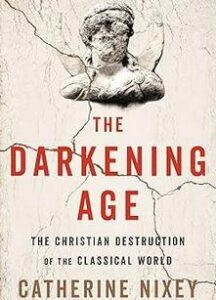
Preface. Ever since reading Gibbons “The Decline and Fall of the Roman Empire” I’ve been fascinated by the complexity of reasons for why the Roman Empire fell. But so many books and writings were lost that much remains unknown. Mainly due to Christians destroying and looting books, temples, art, statues, and anything deemed Pagan. It is estimated that less than 1% of ancient literature survived to the present day. Yet the role of Christian authorities in the active suppression and destruction of books in Late Antiquity has received surprisingly little sustained consideration by academics.
This is a book review of Nixey (2019) The darkening age: The Christian destruction of the Classical World, a book about how Christians destroyed most of the books of ancient philosophies, encyclopedias, and other writings. And much more. Other books on this topic include Rohmann (2016) Christianity, Book-Burning and Censorship in Late Antiquity, and Ovenden (2021) Burning the Books: A History of the Deliberate Destruction of Knowledge.
This is not only a fascinating, and horrifying book, but important now that American Christian Nationalist and other evangelist sects are trying to ban books (Rosen 2023 Banned in America! Christian Nationalists are demanding the removal of books from public and school libraries across the country in a growing wave of culture war battles, Baeta 2025 The Normalization of Book Banning, Randal 2022 Why Christian Nationalists want to ban books.
And rewrite textbooks and school curriculums (Laats 2023 The Right-Wing Textbooks Shaping What Many Americans Know About History, Clossen 2025 Inside a new bible-infused Texas English curriculum, Christian textbooks used in thousands of schools use an alternate version of history and make Christian nationalism more mainstream).
This is quit upsetting for me because I write about why the collapse of our fossil fueled civilization is likely to be triggered by diesel shortages, since there are no supply chains that don’t depend on transportation provided by heavy duty road and off-road trucks, ships, and locomotives. Consequently, the Preservation of Knowledge has been one of the overriding themes of my website energyskeptic.com. I would sure hate it if Christians triumph and create the fiction that God did it because we had danced, partied, and used scientific knowledge to give us joy and awe of the universe rather than Accepting Jesus As Our Savior.
This is a very real possibility, at least in America. Seriously — consider some of the passages from “The Darkening Age:”
Books—which were often stored in temples—suffered terribly. The remains of the greatest library in the ancient world, a library that had once held perhaps 700,000 volumes, were destroyed in this way by Christians. At a time in which parchment was scarce, many ancient writers were simply erased, scrubbed away so that their pages could be reused for more elevated themes. Only one percent of Latin literature survived the centuries.
Fervent Christians went into people’s houses and searched for books, statues and paintings that were considered demonic. This kind of obsessive attention was not cruelty. On the contrary: to restrain, to attack, to compel, even to beat a sinner was—if you turned them back to the path of righteousness—to save them.
In the third century, there had been 28 public libraries in Rome and many private ones. By the end of the fourth they were, as the historian Ammianus Marcellinus observed with sorrow, “like tombs, permanently shut.”
Christian historians took a different view. As the influential Christian writer Eusebius—the “father of Church history”—wrote, the job of the historian was not to record everything but instead only those things that would do a Christian good to read.
Alexandria, Antioch and Rome, bonfires of books blazed and Christian officials looked on in satisfaction. Book-burning was approved of, even recommended, by Church authorities. “Search out the books of the heretics . . . in every place,” advised the fifth-century Syrian bishop Rabbula, and “wherever you can, either bring them to us or burn them in the fire.”
To survive, manuscripts needed to be cared for, recopied. Classical ones were not. Medieval monks, at a time when parchment was expensive and classical learning held cheap, simply took pumice stones and scrubbed the last copies of classical works from the page. Rohmann has pointed out that there is even evidence to suggest that in some cases “whole groups of classical works were deliberately selected to be deleted and overwritten in around AD 700. Pliny, Plautus, Cicero, Seneca, Virgil, Ovid, Lucan, Livy and many, many more: all were scrubbed away by the hands of believers.
The texts that suffer in this period are the texts of the wicked and sinful pagans. From the entirety of the sixth century only “scraps” of two manuscripts by the satirical Roman poet Juvenal survive and mere “remnants” of two others, one by the Elder and one by the Younger Pliny. From the next century there survives nothing save a single fragment of the poet Lucan. From the start of the next century: nothing at all.
Far from mourning the loss, Christians delighted in it.
Augustine contentedly observed the rapid decline of the atomist philosophy in the first century of Christian rule. By his time, he recorded, Epicurean and Stoic philosophy had been “suppressed”—the word is his. The opinions of such philosophers “have been so completely eradicated and suppressed . . . that if any school of error now emerged against the truth, that is, against the Church of Christ, it would not dare to step forth for battle if it were not covered under the Christian name.”
Much was preserved. Much, much more was destroyed. It has been estimated that less than ten percent of all classical literature has survived into the modern era.
For Latin, the figure is even worse: it is estimated that only one hundredth of all Latin literature remains.
The Christian habit of book-burning went on to enjoy a long history. A millennium later, the Italian preacher Savonarola wanted the works of the Latin love poets Catullus, Tibullus and Ovid to be banned while another preacher said that all of these “shameful books” should be let go, “because if you are Christians you are obliged to burn them.”
Books had been burned under non-Christian emperors—the controlling Augustus alone had ordered the burning of over two thousand books of prophetic writings, and had exiled the misbehaving poet Ovid—but now it grew in scope and ambition. There is little evidence that Christians intentionally destroyed entire libraries; the damage that Christianity inflicted on books was achieved by subtler—but no less effective—means of censorship, intellectual hostility and pure fear.
The existence of a sacred text, it was argued, demanded this. Before, there had been competing philosophical schools, all equally valid, all equally arguable. Now, for the first time, there was right—and there was wrong. Now, there was what the Bible said—and there was everything else. And from now on any belief that was “wrong” could, in the right circumstances, put you in grave danger.
Atheism, science and philosophy were all targeted. The very idea that mankind could explain everything through science was, as Rohmann has shown, disparaged as folly.
An accusation of “magic” was frequently the prelude to a spate of burnings. In Beirut, at the turn of the sixth century, a bishop ordered Christians, in the company of civil servants, to examine the books of those suspected of this. Searches were made, books were seized from suspects and then brought to the center of the city and placed in a pyre. A crowd was ordered to come and watch as the Christians lit this bonfire in front of the church of the Virgin Mary. The demonic deceptions and “barbarous and atheistic arrogance” of these books were condemned as “everybody” watched “the magic books and the demonic signs burn.”
The life of the sixth-century saint Simeon Stylites the Younger records what happened when an important official named Amantius arrived in Antioch. His appearance was much anticipated: on his way, as proof of his Christian determination, he had searched out, tortured and executed large numbers of local “idolaters.” Once this alarming man was inside the city, St. Simeon then received a vision. “A decision,” Simeon reported, “has been made by God against the pagans and the heterodox that this chief shall search out the error concerning idolatry, to collect all their books and to burn these in the fire.” After hearing this, Amantius was overcome by zeal and promptly “conducted an inquisition [and] found that the majority of the first citizens of the city and many of its inhabitants had been involved in paganism, Manicheaism, astrology, [Epicureanism], and other gruesome heresies. These he had detained, thrown in prison, and having brought together all of their books, which were a great many, he had these burnt in the middle of the stadium.”
The list given in the life of St. Simeon clearly refers to the destruction of books of Epicureanism, the philosophy that advocated the theory of atomism. “Paganism” appears to have been a charge in itself—and while it could mean outlawed practices it could, at a stretch, refer to almost any antique text that contained the gods. Christians were rarely good chroniclers of what they burned.
Divination and prophecy were often used as pretexts to attack a city’s elite. One of the most infamous assaults on books and thinkers took place in Antioch. Here, at the end of the fourth century, an accusation of treasonous divination led to a full-scale purge that targeted the city’s intellectuals. By sheer chance, Ammianus Marcellinus, a non-Christian and one of the finest historians of the era, happened to be in the city, a wonderful piece of luck for later historians and wretched luck for the man himself, who was horrified. As Ammianus describes it, “the racks were set up, and leaden weights, cords, and scourges put in readiness. The air was filled with the appalling yells of savage voices mixed with the clanking of chains, as the torturers in the execution of their grim task shouted: ‘Hold, bind, tighten, more yet.’” A noble of “remarkable literary attainments” was one of the first to be arrested and tortured; he was followed by a clutch of philosophers who were variously tortured, burned alive and beheaded.16 Educated men in the city who had considered themselves fortunate now, Damocles-like, realized the fragility of their fortune.
Below are some more interesting excerpts from the book about the destruction wrought by Christians. It’s enough to make you become a Pagan…
Alice Friedemann www.energyskeptic.com Author of Life After Fossil Fuels: A Reality Check on Alternative Energy; When Trucks Stop Running: Energy and the Future of Transportation”, Barriers to Making Algal Biofuels, & “Crunch! Whole Grain Artisan Chips and Crackers”, The Preservation of Knowledge, Women in ecology Podcasts: WGBH, Financial Sense, Jore, Planet: Critical, Crazy Town, Collapse Chronicles, Derrick Jensen, Practical Prepping, Kunstler 253 &278, Peak Prosperity, Index of best energyskeptic posts
***
Nixey C (2019)The Darkening Age. The Christian Destruction of the Classical World
Before it preserved, the Church destroyed. In a spasm of destruction never seen before—and one that appalled many non-Christians watching it—during the 4th and 5th centuries, the Christian Church demolished, vandalized and melted down a simply staggering quantity of art. Classical statues were knocked from their plinths, defaced, defiled and torn limb from limb. Temples were razed to their foundations and mutilated. A temple widely considered to be the most magnificent in the entire empire was leveled. Many of the Parthenon sculptures were attacked, faces were mutilated, hands and limbs were hacked off, and gods were decapitated. Some of the finest statues on the whole building were almost certainly smashed off then ground into rubble that was then used to build churches.
The attacks didn’t stop at culture. Everything from the food on one’s plate (which should be plain and certainly not involve spices), through to what one got up to in bed (which should be likewise plain, and unspicy), began, for the first time, to come under the control of religion. Male homosexuality was outlawed; hair-plucking was despised, as too were makeup, music, suggestive dancing, rich food, purple bedsheets, silk clothes . . . The list went on.
Achieving this was not a simple matter. While the omniscient God had no trouble seeing not only into men’s hearts but into their homes, Christian priests had a little more difficulty in doing the same. A solution was found: St. John Chrysostom encouraged his congregations to spy on each other. Enter each other’s homes, he said. Pry into each other’s affairs. Then report all sinners to him and he would punish them accordingly. And if you didn’t report them then he would punish you too. “
This is a book about the Christian destruction of the classical world. The Christian assault was not the only one—fire, flood, invasion and time itself all played their part—but this book focuses on Christianity’s assault in particular. This is not to say that the Church didn’t also preserve things: it did. But the story of Christianity’s good works in this period has been told again and again; such books proliferate in libraries and bookshops. The history and the sufferings of those whom Christianity defeated have not been. This book concentrates on them.
It goes far into the deserts of Syria, where some of the strangest players in this story existed: monks who, for the love of God, lived out their entire lives standing on pillars, or in trees, or in cages.
Before Christianity’s ascendancy few people would have thought to describe themselves by their religion at all. After Christianity, the world became split, forevermore, along religious boundaries;
Many good people are impelled by their Christian faith to do many, many good things. I know because I am an almost daily beneficiary of such goodness myself. This book is not intended as an attack on these people and I hope they will not see it as such. But it is undeniable that there have been—that there still are—those who use monotheism and its weapons to terrible ends. Christianity is a greater and a stronger religion when it admits this—and challenges it.
The Pagan world
The Roman world of AD 270 was not one that usually celebrated the simple life. Bathhouses, taking with them countless rattling silver bottles of ointment. The behavior inside those steamy rooms was said to be wanton. Women stripped naked and allowed slaves, their fingers gleaming with oil, to rub every inch of their bodies. Men and women bathed together. In one changing room, above a shelf where bathers left their clothes, was a small painting of a man performing oral sex on a woman. Indeed, above each of the shelves in that room was a different image: a threesome above one, lesbian sex above another, and so on. A rather more memorable method, it has been speculated, of marking where you left your clothes than a locker number.
How Christianity conquered Rome – as told by Christians
Today, the story of how Christianity came to conquer Rome is told in reassuringly secular terms. It is a tale of weakened emperors and invading barbarian armies; of punitive taxation, gruesome plagues and a tired and weary populace. Where religion is mentioned in these narratives, it is often given a psychological role. This, runs the argument, was an age of anxiety. Disease, war, famine and death, not to mention the equally unavoidable horror of the tax collector, prowled the empire. Who, argue traditional narratives of Christianity, would not search for reassurance at such a time? Who would not be drawn to a religion that reassured its followers that, if not in this life then perhaps in the next, things would be a little more pleasant? Who would not long to be told that someone, somewhere, had a plan—and that this was all part of it?
Nor did the Greco-Roman religious system offer much guidance to the living. These cults did not provide a moral handbook for everyday life. They issued no commandments or catechisms or creeds to guide the souls of the uncertain between birth and death. There were broad rules and demands for sacrifice. Admittedly, where the ambit of religion petered out then philosophy might step in to provide some solace—but given that the grin-and-bear-it philosophy of Stoicism was one of the most popular of the age, this was a cold comfort at best.
Then, into this chilly, nihilistic world burst Christianity. Not only did the new religion offer comfort, companionship and purpose in this life, it also offered the promise of eternal bliss in the next. And as if all that wasn’t tempting enough, it wasn’t long before Christianity had even more to offer its converts. In AD 312 the emperor, Constantine, proclaimed himself a follower of Christ. Under his auspices, the Church was soon exempted from taxes and its hierarchy started to be richly rewarded. Bishops were paid five times as much as professors, six times as much as doctors—as much even as a local governor. Eternal delight in the next life, bureaucratic preferment in this. What more could one wish for? So runs the traditional argument. And indeed there is a great deal of truth in it.
But that is not what happened
But that was not how Christianity was sold in the fourth century. The Church was not marketed as a way to improve your tax bill, or as a balm for anxiety. This was a war. The struggle to convert the empire was nothing less than a battle between good and evil.
The world then still glimmered with miracles: the blind were still healed, the faithful still resurrected from the tomb, the holy still walked on water. It was a strange, ethereal place; a William Blakeish world where the doors of religious perception lay wide open;
The barbarian hordes that were beginning to nibble at the edges of the empire paled in comparison to the hideous army of demons that, according to Christian writers, was already swarming, slithering and loping across it. These demons may have been all but forgotten by modern historians, who tend to pass over demonologies with a silence that speaks eloquently of embarrassment, but such fiends obsessed, perhaps even possessed, some of the greatest minds of early Christianity.
Complex demonologies appeared that explained everything from how these creatures were created (a Miltonian fall from grace), to their stench (revolting), their geography (Rome was a favorite haunt), the feel of their skin (deathly cold) and even their sexual habits (varied, imaginative and persistent). Everything was considered, including the ways in which the demons planned to overcome the logistical and linguistic difficulties involved in world domination.
One consequence of the concept of demons was that wicked thoughts were the fault of the demon, not the man: an exculpatory quirk that meant even the most sinful thoughts could be—and were—freely admitted to. In writings of astonishing candor, the monkish id is laid bare as monks confess to being tormented by visions of naked women—not to mention other monks—“performing the obscene sin of fornication,” visions that left their soul in torment and their thighs aflame. Monks write about being so overwhelmed by thoughts of sex that they are forced to “jump up at once and to use our cell for frequent and brisk walks.” An erotic phantasmagoria danced—sometimes quite literally—before their eyes as the demon of fornication—a devious demon “that imitates the form of a beautiful naked woman, luxurious in her gait, her entire body obscenely dissipated”—turned on them.
But however alarming the demons of fornication may have been, the most fearsome demons of all were to be found, teeming like flies on a corpse, around the traditional gods of the empire. Jupiter, Aphrodite, Bacchus and Isis; all of them, in the eyes of these Christian writers, were demonic. In sermon after sermon, tract after tract, Christian preachers and writers reminded the faithful in violently disapproving language that the “error” of the pagan religions was demonically inspired. It was demons who first put the “delusion” of other religions into the minds of humans, these writers explained. It was demons who had foisted the gods upon “the seduced and ensnared minds of human beings.” Everything about the old religions was demonic.
The demons’ motivation in all of this was simple: if they had human followers, then they would have sacrifices and these sacrifices were their food. To this end, Christian writers explained, demons had created the entire Greco-Roman religious system so that “they may procure for themselves a proper diet of fumes and blood offered to their statues and images.” It wasn’t merely a question of nourishment, though: the demons also feasted on the very sight of people turning aside from the true Christian God.
Time and time again they insisted that Christians were not like other religions. Christians were saved; others were not. Christians were correct; other religions were wrong. More than that: they were sick, insane, evil, damned, inferior. A newly violent vocabulary of disgust started to be applied to all other religions and anything to do with them—which meant almost everything in Roman life. The worship of the old gods began to be represented as a terrifying pollution and, like a miasma in Greek tragedy, one that might drag you to catastrophe.
AUGUSTINE
Questions of religious contamination—practical to the point of bathetic—were asked, and answered, with great seriousness. At the close of the fourth century, a faithful Christian wrote an anxious letter to Augustine. May a Christian use baths which are used by pagans on a feast day, he asked, either while the pagans are there or after they have left?
If a Christian is starving and on the point of death, and they see food in an idol’s temple, may they eat it?
Augustine replied to his anxious correspondent with a letter that concluded on a note of uncompromising rigidity. If a Christian is starving and on the point of death, and the only food that they can see is food that has been contaminated by pagan sacrifice, “it is better to reject it with Christian fortitude.” In other words, if it is a choice between contamination with pagan objects and death, the Christian must unhesitatingly choose death.
Christian observers would look on the tolerance of their non-Christian neighbors with astonishment. Augustine later marveled at the fact that the pagans were able to worship many different gods without discord while the Christians, who worshipped just the one, splintered into countless warring factions. Indeed, many pagans like Celsus seemed to actively praise plurality. To the Christians, this was anathema. Christ was the way, the truth and the light, and everything else was not merely wrong but plunged the believer into a demonic darkness.
It needn’t have been this way
Many “pagans” happily added the worship of new Christian god and saints to their old polytheist gods and continued much as before.
There is a significant amount of evidence to suggest that while Christian preachers demanded complete purity, their congregations were much less enthusiastic. An Augustine or a Chrysostom might believe that worshipping the Christian God meant forsaking all others, but many of their congregants were much less convinced. What was even meant by “Christian” at this time? The habits of polytheism, in which each new god was merely added to the old, died hard. Many “Christians” might turn up at church one day, and then the next, when a jubilant, drunken Roman festival started to whirl through town, defect from the one true God and go and drink in celebration of pagan ones, dancing late into the night.
To oppose another man’s religion, to repress their worship—these were not, clerics told their congregations, wicked or intolerant acts. They were some of the most virtuous things a man might do. The Bible itself demanded it. As the uncompromising words of Deuteronomy instructed: “And ye shall overthrow their altars, and break their pillars, and burn their groves with fire; and ye shall hew down the graven images of their gods, and destroy the names of them out of that place. The Christians of the Roman Empire listened. And as the fourth century wore on, they began to obey.
Pagan Criticisms of Christianity
Surgery was a popular spectator sport. Educated citizens crowded round to watch an animal being vivisected with the same enthusiasm with which they might once have listened to the melodramatic declamations of a tragic poet. Those attending such performances needed inquiring minds, long attention spans (for demonstrations could go on for days) and strong stomachs. A favorite trick of Galen’s was to tie an animal to his board and lay bare its still-beating heart. Audience members were then invited to squeeze the throbbing muscle—albeit with care: the pulsing wet heart was apt to jump from between inexperienced fingers. Galen of Pergamum (129-c. 216 CE) was the most prominent Greek physician, surgeon, and philosopher in the Roman Empire
It would take centuries for many of Galen’s observations to be bettered. His understanding of neuroanatomy would not be superseded until the 17th century; his understanding of certain functions of the brain would not be surpassed until the nineteenth. It was Galen who proved that arteries contained blood and not, as had been thought, air or milk. It was Galen who proved that the spinal cord was an extension of the brain and that the higher it was severed, the more movement was lost.
There was, however, one group of people who even the great Galen found himself unable to convince. This was a group who did not form their beliefs by basing them on experiments or on observations, but on faith alone—and who, worse still, were actually proud of this fact. These peculiar people were for Galen the epitome of intellectual dogmatism. When he wished to adequately convey the blockheadedness of another group of physicians, Galen used these people as an analogy to express the depths of his irritation. They were the Christians.
Celsus, 2nd century Greek Platonist philosopher and critic of Christianity
Around AD 170, a Greek intellectual named Celsus launched a monumental and vitriolic attack against Christianity. It is clear that Celsus knew a lot about it. He knew about everything—from the Creation to the Virgin Birth to the doctrine of the Resurrection. It is equally clear that he loathes it all and in arch, sardonic and occasionally very earthy sentences, he vigorously rebuts it. The Virgin Birth? Nonsense, he writes; a Roman soldier had gotten Mary pregnant. The Creation is “absurd”; the books of Moses are garbage; while the idea of the resurrection of the body is “revolting” and, on a practical level, ridiculous: “simply the hope of worms. For what sort of human soul would have any further desire for a body that has rotted?” What is also clear is that Celsus is more than just disdainful. He is worried. Pervading his writing is a clear anxiety that this religion—a religion that he considers stupid, pernicious and vulgar—might spread even further and, in so doing, damage Rome.
It was clear to Celsus that a person’s religious affiliation was based less on any rational analysis of competing religious ideologies than on the geography of their birth. Every nation always, he points out, thinks its way of doing things is “by far the best.”
Over 1,500 years later, the eighteenth-century English historian Edward Gibbon would draw similar conclusions, laying part of the blame for the fall of the Roman Empire firmly at the door of the Christians. The Christians’ belief in their forthcoming heavenly realm made them dangerously indifferent to the needs of their earthly one. Christians shirked military service, the clergy actively preached cowardliness, and vast amounts of public money were spent not on protecting armies but squandered instead on the “useless multitudes” of the Church’s monks and nuns. They showed, Gibbon felt, an “indolent, or even criminal, disregard for the public welfare. Celsus did not soften his attack either. This first assault on Christianity was vicious, powerful and, like Gibbon, immensely readable. Yet unlike Gibbon, today almost no one has heard of Celsus
Judgment Day also came in for scorn. How precisely, asked Celsus, was this going to work? It is foolish of them also to suppose that, when God applies the fire (like a cook!), all the rest of mankind will be thoroughly roasted and that they alone will survive.
Celsus professes himself baffled by the extent to which Jesus’s teachings seem to contradict many of those laid down in the Old Testament. Have the rules of an allegedly omniscient god changed over time? If so, then “who is wrong? Moses or Jesus? Or when the Father sent Jesus had he forgotten what commands he gave to Moses?” Or maybe God knew he was changing his mind, and Jesus was a legal messenger, sent to give notice that God wished to “condemn his own laws and change his mind.” Celsus
cannot understand, either, why there was such a great gap between the creation of mankind and the sending of Jesus. If all who don’t believe are damned, why wait so long to enable them to be saved? “Is it only now after such a long age that God has remembered to judge the life of men? Did he not care before?” Moreover, why not send Jesus somewhere a bit more populous? If God “woke up out of his long slumber and wanted to deliver the human race from evils, why on earth did he send this spirit that you mention into one corner” of the world—and, Celsus implies, a backwater at that? He also queries why an omniscient, omnipotent God would need to send someone at all. “What is the purpose of such a descent on the part of God?” he asks. “Was it in order to learn what was going on among men? . . . Does not he know everything?
Jesus’s logistical abilities are, like God’s, called into question. Celsus attacks the tendency for some of his most miraculous moments to be witnessed by the fewest number of people. “When he was punished he was seen by all; but by only one person after he rose again; whereas the opposite ought to have happened.
It wasn’t just the fact that Christians were ignorant about philosophical theories that annoyed Celsus; it was that Christians actually reveled in their ignorance. Celsus accuses them of actively targeting idiocy in their recruitment. “Their injunctions are like this,” he wrote. “Let no one educated, no one wise, no one sensible draw near. For these abilities are thought by us to be evils.
Christians, Celsus wrote, “do not want to give or to receive a reason for what they believe, and use such expressions as ‘Do not ask questions; just believe,’ and ‘Thy faith will save thee.’” To men as educated as Celsus and Galen this was unfathomable: in Greek philosophy, faith was the lowest form of cognition.
The Christian belief that their religion was unique—and uniquely correct—frequently grated on others. An educated critic of Christianity could point not only to other flood stories but to numerous characters who had made similar claims to those made by Jesus and his followers. The empire was not lacking, Celsus observed, in charismatic preachers who claimed divinity, espoused poverty or announced that they were going to die for the sake of mankind.
Celsus, thought that if people were better educated they would be more resistant to such hucksters as Peregrinus—or indeed to Jesus, whom Celsus considered little more than a “sorcerer. Peregrinus lived in Greece, and desperate for fame, this pseudo-philosopher grew his hair long and traveled about the empire preaching platitudes. He lived off charity, gathered a reputation among the credulous, and eventually committed suicide by jumping into a fire. After Peregrinus was “carbonified” his stock only rose among his followers. Before his end, Peregrinus sent letters to all the great cities of the empire, bearing witness to his great life and encouraging and instructing his followers. He even “appointed a number of ambassadors for this purpose from among his comrades, styling them ‘messengers’”—the Greek word is angelos, the same word translated in Christianity as “angel”—“from the dead.” Rumors that Peregrinus had indeed risen from the dead began to spread: one disciple declares that “he had beheld him in white raiment a little while ago, and had just now left him walking about . . . wearing a garland of wild olive.
The “miracles” that Jesus performed were, he felt, no better than the sort of thing that was constantly being peddled by tricksters to the gullible across the Roman Empire. In a world in which medical provision was rare, many laid claim to magical powers. Travel in the east and you would come across any number of men who “for a few obols make known their sacred lore in the middle of the market-place and drive daemons out of men and blow away diseases,” and display “dining-tables and cakes and dishes which are non-existent.” Even Jesus himself, observes Celsus, admits the presence of such people when he talks about men who can perform similar wonders to his own. Modern scholarship supports Celsus’s accusations: ancient papyri tell of sorcerers who had the power to achieve such biblical-sounding feats as stilling storms and miraculously providing food.
Epicurean theory (341-270 BCE): the world is made of atoms
The world was created through the random collision and entanglement of atoms moving through an infinite void, completely independent of divine beings. Founded by Epicurus, this materialistic worldview holds that all physical objects are temporary, shifting, and accidental conglomerates of tiny, indivisible, and eternal bits of matter. These particles were invisible to the naked eye but they had their own structure and could not be cut into any smaller particles. Everything that you see or feel, these materialists argued, was made up of two things: atoms and space “in which these bodies are and through which they move this way and that.” Even living creatures were made from them: humans were not made by God but were instead nothing more than “a haphazard union of elements.” The distinct species of animals were explained by a form of proto-Darwinism. As the Roman poet and atomist Lucretius wrote, nature put forth many species. Those that had useful characteristics—the fox and its cunning, say, or the dog and its intelligence—survived, thrived and reproduced. Those creatures that lacked these “lay at the mercy of others for prey and profit until nature brought that race to destruction.”
The intellectual consequences of this powerful theory were summarized succinctly by the Christian apologist Minucius Felix. If everything in the universe has been “formed by a fortuitous concourse of atoms, what God is the architect?” The obvious answer is: no god at all. No god magicked up mankind out of nothing, no divinity breathed life into us; and, when we die, our atoms are simply reabsorbed into this great sea of stuff.
Atomic theory thus neatly did away with the need for and possibility of Creation, Resurrection, the Last Judgment, hell, heaven and the Creator God himself. As indeed was its intention. Thinkers in the classical world frequently lamented the mortal fear of divine beings. Superstition, wrote the Greek biographer Plutarch, was a terrible affliction that “humbles and crushes a man.” If there was no Creator—if lightning, earthquakes and storms were not the actions of irate deities but simply of moving particles of matter—then there was nothing to fear, nothing to propitiate and nothing to worship.
Augustine disliked atomism for precisely the same reason that atomists liked it: it weakened mankind’s terror of divine punishment and hell.
Today Democritus’s most famous theory is his atomism. What did the other theories state? We have no idea: every single one of his works was lost in the ensuing centuries. As the eminent physicist Carlo Rovelli recently wrote, after citing an even longer list of the philosopher’s titles: “the loss of the works of Democritus in their entirety is the greatest intellectual tragedy to ensue from the collapse of the old classical civilization.
If only Christians had read more books
If Christians had read a little more and believed a little less, they might be less likely to think themselves unique.
The lightest knowledge of Latin literature, for example, would have brought the interested reader into contact with Ovid’s Metamorphoses. This epic but tongue-in-cheek poem opened with a version of the Creation myth that was so similar to the biblical one that it could hardly fail to make an interested reader question the supposed unique truth of Genesis.
Even the most fervent Christian must notice the similarities between the two. Where the biblical Creation begins with an earth that is “without form,” Ovid’s poem begins with a “rough, unordered mass of things.” In Genesis, the Creator God then “created the heaven and the earth” and ordered “the waters under the heaven be gathered together unto one place, and let the dry land appear.” In Ovid’s version, a god appears and “rent asunder land from sky, and sea from land” before instructing the seas to form and the “plains to stretch out.” The God of Genesis ordered that “the waters bring forth abundantly the moving creature that hath life, and fowl that may fly above the earth in the open firmament of heaven,” while Ovid’s deity (“whichever of the gods it was,” he adds, somewhat vaguely) ensures that “the sea fell to the shining fishes for their home, earth received the beasts and the mobile air the birds.” Both Creation stories culminate in the creation of man, who in Ovid is “molded into the form of the all-controlling gods”; while in Genesis, “God created man in his own image.” In both, things then go wrong as mankind falls into wicked ways. The Ovidian god, at once grand and a trifle camp, looks down upon the world he has created, shakes his head in despair and groans. “I must,” he declares, not without some melodrama, “destroy the race of men.” The God of Genesis looks down at the world and its wickedness and says: “I will destroy man whom I have created from the face of the earth.” In both accounts, the rainwaters fall, and the oceans rise across the lands. In both, only two humans, a man and a woman, survive.
The greatly exaggerated stories of Christian Persecution
By the time of the Great Fire in AD 64, it seems that there were some Christians living in the capital. Certainly there were enough that when Nero was looking for scapegoats for the inferno, not only did they seem a plausible target but he was able to find a number of them (even if not quite the “huge multitude” that histories later said) to accuse. And to accuse, for Nero, was to convict; and to convict was to punish. The actual crime was not arson, oddly, but “hatred of humankind.” The Christians were sentenced to death. The mode of their execution showed, even by Nero’s standards, a lunatic creativity. Some were dressed in animal skins and then torn to pieces by wild dogs. Others, convicted of making fire, died by it. As dusk fell in Nero’s garden, Christians were nailed to crosses, then burned, serving as unusual nighttime illuminations. Nero threw open his gardens for the spectacle as a treat—or perhaps a warning—to others.
This, then, was where it began: the first imperial persecution of the Christians. According to Christian historians, it was very far from the last.
Christian literature would go on to portray Roman emperors and their officials as demonically possessed servants of Satan who hungered insatiably for Christian blood. It is a very potent picture. But it is not true. Although martyr stories have often made for arresting and compelling drama, very few, if any, of these tales are based on historical fact.
There were simply not that many years of imperially ordered persecution in the Roman Empire. Fewer than thirteen—in three whole centuries of Roman rule. These years may have loomed understandably large in Christian accounts but to allow them to dominate the narrative in the way that they have—and still do—is at best misleading and at worst a gross misrepresentation. During these first centuries of the new religion, local persecutions of Christians occurred. But we know of no government-led persecution for the first 250 years of Christianity with the exception of Nero’s—and Nero, with even-handed lunacy, persecuted everyone. The idea, therefore, of a line of satanically inspired emperors, panting for the blood of the faithful, is another Christian myth.
Martyr tales have been hugely influential, not least on Christianity’s image of itself. The academic Candida Moss has argued that in the years that followed the persecutions, Christianity came to see itself, with great pride, as a persecuted Church. Its greatest heroes were not those who did good deeds but those who died in the most painful way. If you were willing to die an excruciating end in the arena then, whatever your previous holiness or lack thereof, you went straight to heaven: martyrdom wiped out all sins on the point of death. As well as getting there faster, martyrs enjoyed preferential terms in paradise, getting to wear the much-desired martyr’s crown. Tempting celestial terms were offered: it was said that the scripture promised “multiplication, even to a hundred times, of brothers, children, parents, land and homes.
One was its egalitarian entry qualifications. As George Bernard Shaw acidly observed over a millennium later, martyrdom is the only way a man can become famous without ability. More than that, in a socially and sexually unequal era it was a way in which women and even slaves might shine. Unlike most positions of power in the highly socially stratified late Roman Empire, this was a glory that was open to all, regardless of rank, education, wealth or sex. The sociologist Rodney Stark has pointed out that—provided you believe in its promised rewards—martyrdom is a perfectly rational choice. A martyr could begin the day of their death as one of the lowliest people in the empire and end it as one of the most exalted in heaven. So tempting were these rewards that pious Christians born outside times of persecution were wont to express disappointment at being denied the opportunity of an agonizing death. When the later emperor Julian pointedly avoided executing Christians in his reign, one Christian writer, far from being grateful, sourly recorded that Julian had “begrudged the honor of martyrdom to our combatants.
It is now thought that fewer than 10 martyrdom tales from the early Church can be considered reliable.
It has been speculated that what was really upsetting to Romans was not theology but butchery. Local tradesmen were angry because this surge of Christian sentiment led to a drop in the sales of sacrificial meat and their profits were suffering: anti-Christian sentiment caused less by Satan than by a slow trade in sausage meat.
All over the empire, Romans are frustratingly unwilling to play their role as bloodthirsty martyr-makers. Many even refuse to execute Christians when they arrive in front of them. Arrius Antoninus was a Roman governor of Asia who in the late second century had executed a number of Christians in his province. He was perhaps unprepared for what came next. Instead of fleeing, local Christians suddenly turned up and, in one large mob, presented themselves before him. Antoninus did indeed dutifully kill a few (presumably there is only so much temptation a Roman can stand) but rather than dispatching the rest with pleasure, he turned to them with what, even with the passage of almost two millennia, sounds unmistakably like exasperation. “Oh you ghastly people,” he said. “If you want to die you have cliffs you can jump off and nooses to hang yourself with.
Other Christians were so eager to die that when they spontaneously turned up in front of officials they did so ready chained, much to the interest of bemused locals. As one Christian author excitedly said, “so far from dreading, we spontaneously call for tortures!” Often with disappointing results. In AD 311, St. Antony, hearing that a persecution was in full swing in nearby Alexandria, hurried from his desert dwelling to the city. There, he went out dressed in white “to catch the judge’s attention as he walked past, for Antony was burning with a desire for martyrdom.” Antony returned home, “saddened by the fact that despite his wish to suffer for the name of God, martyrdom was not granted him.” Once back in his cell, Antony consoled himself for his continuing existence by adding a hair shirt to his daily attire and never washing again.
Other Christians who were deprived of execution turned instead to suicide. The methods of suicide varied but drowning, setting oneself on fire and jumping off cliffs were among the most popular.
Look at the martyr stories without the distorting lens of Christianity and the Romans in them start to look very different. True, officials do indeed repeatedly ask Christians to sacrifice. But just for a moment disregard the Christian theory—that this is because of demonic possession—and look instead at the reasons given by the officials themselves and it becomes clear that the Romans in these tales want the Christians to sacrifice not because they want them to be damned in the next life but because they want them to be saved in this one. They simply do not want to execute. Officials in these tales go to extraordinary lengths to try to find a form of sacrifice that would be at once agreeable to the emperor and acceptable to the Christians. Realizing that Christians found full meat sacrifices repellent, officials also tried to tempt them with smaller acts of obedience. Just put out your fingers, Eulalia’s judge begs her, and just touch a little of that incense, and you will escape cruel suffering.
In one tale a prefect tells a Christian: “I will not tell you: ‘Sacrifice.’ You need not do any such thing. Simply take a little incense, some wine, and a branch and say: ‘Zeus all highest, protect this people.’ Maximus, having offered that bribe to the soldier and soon-to-be martyr Julius and been rebuffed, then thinks again and comes up with an almost Jesuitical solution to the problem. “If you think [sacrifice] is a sin,” he suggests, then “let me take the blame. I am the one who is forcing you, so that you may not give the impression of having consented voluntarily. Afterwards you can go home in peace, you will pick up your ten-year bonus and no one will ever trouble you again.” History supports this reading. In the Decian persecution, Christians who refused to sacrifice were given repeated opportunities to comply and pre-announced dates gave ample opportunities to flee.
It is likely that almost all Christians in times of persecution simply sacrificed and escaped death. In Africa, for example, no governor is known to have executed Christians until the year 180. The Christian martyrs number “hundreds, not thousands,” according to the scholar W.H.C. Frend.
For a long time, Romans struggled to understand why Christians couldn’t simply add the worship of this new Christian god to the old ones. It was known that Christianity had sprung from Judaism and that even the Jews had offered prayer and sacrifice to Augustus and later emperors in their temple. If they had done so—and theirs was the more ancient religion—then why couldn’t the Christians? Monotheism in the rigid Christian sense was all but unthinkable to polytheists. “If you have recognized Christ,” as one official put it, “then recognize our gods too.
Roman emperors wanted obedience, not martyrs. They had absolutely no wish to open windows into men’s souls or to control what went on there. That would be a Christian innovation.
Many Romans didn’t like the Christians
They found their reclusive behavior offensive, their teachings foolish, their fervor irritating and their refusal to sacrifice to the emperor insulting. But for the first 250 years after the birth of Christ, the imperial policy towards them was to ignore them.
One day, early in AD 392, a large crowd of Christians started to mass outside the temple, with Theophilus at its head. To the distress of watching Alexandrians, this crowd had surged up the steps, into the sacred precinct, and burst into the most beautiful building in the world and began to destroy it. Theophilus’s righteous followers began to tear at famous artworks, the lifelike statues and gold-plated walls. The watching Christians roared with delight and then, emboldened, surged round to complete the job. Christians took apart the temple’s very stones, toppling the immense marble columns, causing the walls themselves to collapse. The entire sanctuary was demolished with astonishing rapidity; the greatest building in the world was “scattered to the winds.
According to later Christian chronicles, this was a victory. According to a non-Christian account, it was a tragedy—and a farce. The Greek writer Eunapius felt the destruction was done less from reverence for the Lord than out of pure greed. In his account the Christians weren’t virtuous warriors: they were hoodlums and thieves. The only thing that they didn’t steal, he observed acidly, was the floor
The tens of thousands of books, the remnants of the greatest library in the world, were all lost, never to reappear. Perhaps they were burned. As the modern scholar Luciano Canfora observed: “the burning of books was part of the advent and imposition of Christianity.” A war against pagan temples was also a war against the books that had all too often been stored inside them for safekeeping—a concept that from now on could only be recalled with irony.
Christianity after Constantine converted
In the glory days of Rome, real men had scorned luxury in their dress. Constantine, by contrast, favored such a profusion of jewels, diadems and silk robes draped in gold. The Church, so recently persecuted, suddenly found itself the unexpected recipient of staggering amounts of money. One bishop was told that if he were to ask the emperor’s finance officer for “any sum, he is to arrange for its transfer to you without question.” Tax relief was given to Church lands, clerics were exempted from public duties, bishops were lavished with gifts and banquets; annual allowances were given to widows, virgins and nuns. The vast churches Constantine built were astonishing, full of gold and jewls and silk and marble.
The funds to build them had to be found somewhere, so he took statues from Pagan temples, and other sacred objects, a gross violation of cultural vandalism. Constantine was faced with a population who insisted on worshipping idols at the expense of the Christan God. To get them to convert, taking away their statues so there was nothing to sacrifice to might get them to convert. Indeed, in Deuteronomy, God commanded his chosen people should overthrow altars, burn sacred groves, and hew down graven images of the gods. So Constantine realized that if he attacked the temples, he was doing God’s good work. And so it began. The great Roman and Greek temples were broken open and statues removed and mutilated, melted down. Tempel doors removed, roofs stripped, demolished, and razed.
Constantine’s destruction emboldened other Christians and the attacks spread. In many cities, people “spontaneously, without any command of the emperor, destroyed the adjacent temples and statues, and erected houses of prayer.
A market in plundered art developed and Christians, braving demonic reprisals, took to levering out and selling statues that were particularly valuable. In their turn, polytheists, realizing that a good artistic pedigree might save a statue from mutilation, started chiseling false attributions into statues’ bases. Many an underwhelming statue suddenly found its pediment declaring, entirely untruthfully, that it was the work of one of the great Greek sculptors—Polyclitus or Praxiteles—to save it from Christian hammers.
Hands, feet, even whole limbs have gone—almost certainly smashed off by Christians trying to incapacitate the demons within. The vast majority of the gods have been decapitated—again, almost certainly the work of Christians. The great central figures of the Pediment, that would have shown the birth of Athena, were the most sacred—and thus to the Christians the most demonic. They therefore suffered most: it is likely that they were pushed off the Pediment and smashed on the ground below, their fragmented remains ground down and used for mortar for a Christian church.
Empires of tens of millions of people do not abandon religions that they have observed for over a millennium almost overnight without at least some disturbance. The Roman Empire was no different. Many did convert willingly and happily to Christianity (whatever “conversion” meant in this period). But many did not. At the moment when Constantine had supposedly seen that flaming cross, the vast majority of the empire was not Christian.It has been estimated they made up as little as 7-10% of the empire’s total population, 4 to 6 million of 60 million.
A recent book on the Christian destruction of statues focusing just on Egypt and the Near East runs to almost 300 pages, dense with pictures of mutilation. But while some evidence remains, much has gone entirely. The point of destruction is, after all, that it destroys. If effective, it more than merely defaces something. It obliterates all evidence that the object ever existed. We will never know quite how much was wiped out. Many statues were pulverized, shattered, scattered, burned and melted into absence. Tiny piles of charred ivory and gold are all that remain of some. Others were so well disposed of that they will probably not be found: they were thrown into rivers, sewers and wells, never to be seen again.
Certain sorts of musical instruments were censured and stopped: as one Christian preacher boasted, the Christians smashed the flutes of the “musicians of the demons” to pieces.
In AD 356, it became illegal—on pain of death—to worship images. The law adopted a tone of hitherto unseen aggression. “Pagans” began to be described as “madmen” whose beliefs must be “completely eradicated,” while sacrifice was a “sin” and anyone who performed such an evil would be “struck down with the avenging sword.
Decades before the laws of the land permitted them to, zealous Christians began to indulge in acts of violent vandalism against their “pagan” neighbors. The destruction in Syria was particularly savage.
Not only were the monks vulgar, stinking, ill-educated and violent; they were also, said their critics, phonies. They pretended to adopt lives of austere self-denial but actually they were no better than drunken thugs, a black-robed tribe “who eat more than elephants and, by the quantities of drink they consume, weary those that accompany their drinking with the singing of hymns.” After going on their rampage these men would then, he said, “hide these excesses under an artificially contrived pallor” and pretend to be holy, self-denying monks once again.
In 399, a new and more terrible law came. It was announced that “if there should be any temples in the country districts, they shall be torn down without disturbance or tumult. For when they are torn down and removed, the material basis for all superstition will be destroyed. Augustine evidently assumed his congregants would be taking part in the violence—and implied that they were right to do so: throwing down temples, idols and groves was, he said, no less than “clear proof of our not honoring, but rather abhorring, these things.” Such destruction, he reminded his flock, was the express commandment of God. In AD 401, Augustine told Christians in Carthage to smash pagan objects because, he said, that was what God wanted and commanded.
It is obvious that this violence was not only one’s Christian duty; it was also, for many, a thoroughly enjoyable way to spend an afternoon. Those carrying out the attacks sang as they smashed the ancient marble and roared with laughter as they destroyed statues.
In Alexandria, “idolatrous” images were taken from private houses and baths, then burned and mutilated in a jubilant public demonstration. Once the assault was complete, the Christians “all went off, praising God for the destruction of such error of demons and idolatry.
Chants appeared celebrating these attacks. Coptic pilgrims who visited the city of Hermopolis in Egypt could join with fellow faithful as they sang a local hymn to the destruction.
Erotically appealing statues suffered more than chastely clothed ones. We can still see the consequences of this rhetoric. Today, a once-handsome Apollo missing a nose stands in a museum; a statue of Venus that stood in a bathhouse has had her nipples chiseled, and a statue of Dionysus has had his nose mutilated and his genitalia removed. The destruction did not stop at public property. Later, bands of Christians began to enter houses and bathhouses, and remove suspect statues from them
People built themselves houses from the stones of the demolished temples.
While it might take months of effort, years of training and centuries of accumulated knowledge to build a Greek temple, it took little more than zeal and patience to destroy one.
Today, histories of this period, if they mention such destruction at all, hesitate to condemn it outright. The 1965 edition of The Penguin Dictionary of Saints records with little more than amused indulgence that Martin of Tours “was not averse to the forcible destruction of heathen shrines.” In modern histories those carrying out and encouraging the attacks are rarely described as violent, or vicious, or thuggish: they are merely “zealous,” “pious,” “enthusiastic” or, at worst, “over-zealous.” As the academic John Pollini puts it: “modern scholarship, influenced by a Judeo-Christian cultural bias,” has frequently overlooked or downplayed such attacks and even at times “sought to present Christian desecration in a positive light.” The attacks themselves are diminished in importance,
Alexandria, after the destruction of the temple of Serapis, many, “having condemned this error and realized its wickedness, embraced the faith of Christ and the true religion.” According to this Christian source, the Alexandrians converted merely because their eyes had been opened. It is easy to see another reading of their conversion: they were terrified.
Educated non-Christians balked at the violence. Libanius, who would go down in history as the last of the great “pagan” orators, protested vividly. The Church might declare that it was winning converts through these attacks but this, said Libanius, was bunk: “they speak of conversions apparent, not real. Their ‘converts’ have not really been changed—they only say they have. Christians disagreed and took pride in conversions made after a show of force.
At the end of the fourth century, the orator Libanius looked out and described in despair what he observed. He and other worshippers of the old gods saw, he said, their temples “in ruins, their ritual banned, their altars overturned, their sacrifices suppressed, their priests sent packing and their property divided up between a crew of rascals. In Christian histories, men like Libanius barely exist. The voices of the worshippers of the old gods are rarely, if ever, recorded.
If some of these millions who converted not out of love of Christ but out of fear was not a problem argued Christian preachers. Better to be scared in this life than burn in the next.
Rome’s ancient cults were collapsing. And yet though Symmachus lost—perhaps because he lost—his words still have a terrible power. “We request peace for the gods of our forefathers,” he had begged. “Whatever each person worships, it is reasonable to think of them as one. We see the same stars, the sky is shared by all, the same world surrounds us. What does it matter what wisdom a person uses to seek for the truth?
After razing Serapis the Christians had gone on a victorious rampage through the city and its 2,500 shrines, temples and religious sites. Busts of Serapis that had (much like the Virgin Mary in Italian villages today) previously stood in streets, wall niches and above doorways had been removed—“cleansed.” The Christians had “so cut and filed [them] away that not even a trace or mention of [Serapis] or any other demon remained anywhere. In their place everyone painted the sign of the Lord’s cross on doorposts, entrances, walls and columns.”
To make matters worse the city had a new bishop, Cyril. After the zealot Theophilus, many Alexandrians must have hoped that their next cleric would be more conciliatory. He was not. Within a few years of his coming to power his violence had begun. The Jews were among the first to suffer. The population of Jews in Alexandria was large and, according to the legend, had itself benefited from the city’s bibliomania. Ptolemy II—or so the charming story goes—had been desperate to find scholars who could translate the mysterious but highly respected Jewish writings for him so that they could be added to the library’s collection. However, no Greek could fathom the script in which they were written. So Ptolemy had asked the Jewish leaders for help. They had agreed to send him some elders as translators—but there were terms. In return, they wanted the 100,000 or so Jewish prisoners of war held in the city to be set free. It was a vast number. Ptolemy thought for a moment, then agreed.
At that moment in Alexandria, the smoldering Christian dislike of Jews burst into outright violence. A Christian attempt to regulate the dancing and theatrical displays—apparently much enjoyed by the city’s Jewish population—started a complicated chain of reprisals that climaxed in a Jewish attack on some Christians. Some were killed in the attack—and Cyril was provided with the pretext he needed. Mustering together a mob as well as some of the merely brutal and enthusiastic, Cyril set out and “marched in wrath to the synagogues of the Jews and took possession of them, and purified them and converted them into churches.” “Purified” in such texts is often a euphemism for stole, self-righteously. The Christians then completed their work by purifying the Jewish of their possessions: stripping them of all they owned, including their homes, they turned them out of the city into the desert.
The atmosphere in the city darkened; the numbers of Cyril’s militia swelled. Around 500 monks descended from their shacks and caves in the nearby hills, determined to fight for their bishop. Unwashed, uneducated, unbending in their faith, they were, as even the Christian writer Socrates admits, men of “a very fiery disposition.” One day, as Orestes rode in his chariot through the city, these monks in their dark and foul-smelling robes suddenly surrounded him. They began to insult him, accusing him of being a “pagan idolater.” He protested that, on the contrary, he was a baptized Christian. It made no difference. One of the monks threw a rock and it struck Orestes on his head. The wound started pouring with blood. Most of his guards, seeing what they were up against, scattered, plunging into the crowd to get away from the monks. Orestes was left almost entirely alone, his robes covered in blood. The monks drew closer, forming a black crowd around him. He was outnumbered, and almost certainly afraid; yet he refused to give in.
Everything about this episode would have been abhorrent to a cultured citizen like Orestes: cities should not be dictated to by the whims of bishops or terrorized by lynch mobs. They should be ruled by the law of the government that was administered by imperial officials. Anything less was the behavior of savages. Many of the city’s aristocrats, perhaps repelled by the Christians’ violence, supported him in his defiant stance towards Cyril. So too, crucially, did Hypatia.
And then the whispering began. It was Hypatia’s fault, said the Christians, that the governor was being so stubborn. It was she, they murmured, who was standing between Orestes and Cyril, preventing them from reconciling. Rumors started to catch, and flame. Hypatia was not merely a difficult woman, they said. Hadn’t everyone seen her use symbols in her work, and astrolabes? The illiterate “bestial men—truly abominable” as one philosopher would later call them, knew what these instruments were. They were not the tools of mathematics and philosophy, no: they were the work of the Devil. Hypatia was not a philosopher: she was a creature of hell. It was she who was turning the entire city against God with her trickery and her spells. She was “atheizing” Alexandria. Naturally, she seemed appealing enough—but that was how the Evil One worked. Hypatia, they said, had “beguiled many people through satanic wiles.” Worst of all, she had even beguiled Orestes. Hadn’t he stopped going to church? It was clear: she had “beguiled him through her magic.” This could not be allowed to continue. One day in March AD 415, Hypatia set out from her home to go for her daily ride through the city. Suddenly, she found her way blocked by a “multitude of believers in God.” They ordered her to get down from her chariot. Knowing what had recently happened to her friend Orestes, she must have realized as she climbed down that her situation was a serious one.
As soon as she stood on the street, the mob, under the guidance of a Church magistrate called Peter—“a perfect believer in all respects in Jesus Christ”—surged round and seized “the pagan woman.” They then dragged Alexandria’s greatest living mathematician through the streets to a church. Once inside, they ripped the clothes from her body and, using broken pieces of pottery as blades, flayed her skin from her flesh. Some say that, while she still gasped for breath, they gouged out her eyes. Once she was dead, they tore her body into pieces and threw what was left of the “luminous child of reason” onto a pyre and burned her.
In this new, ever-watchful Christian era, the tone of what was being written began to change. Polytheist literature had discussed and mocked anything and everything, from the question of whether mankind can have free will in an atomic universe, to the over-credulity of the Christians,
The writings of John Chrysostom provide a rich taste of the tone of this new literature. “Let there be no fornication,” he declared in one of his many fiery speeches on the topic of lust. A beautiful woman was, he warned, a terrible snare. A list of other snares that the work of this revered speaker warned against includes laughter (“often gives birth to foul discourse”); banter (“the root of subsequent evils”); dice (“introduces into our life an infinite host of miseries”); horse-racing (as above); and the theater, which could lead to a wide variety of evils including “fornication, intemperance, and every kind of impurity.”
This was a new literary world and a newly serious one. “The extent to which this new Christian story both displaced and substituted for all others is breathtaking,” writes the modern academic Brent D. Shaw. “The power of this Christian talk was produced by many things, among them a remorseless hortatory pedagogy, a hectoring moralizing of the individual, and a ceaseless management of the minutiae of everyday life. Above all, it was a form of speech marked by an absence of humor. It was a morose and a deadly serious world. The joke, the humorous kick, the hilarious satires, the funny cut-them-down-to-size jibe, have vanished.” And in the place of humor came fear. Christian congregations found themselves rained on by oratorical fire and brimstone. For their own good, of course.
Heretics were intellectual, therefore intellectuals were, if not heretical, then certainly suspect. So ran the syllogism. Intellectual simplicity or, to put a less flattering name on it, ignorance was widely celebrated. The biography of St. Antony records with approval that he “refused to learn to read and write or to join in the silly games of the other little children.”
No need to read: give up both books and bread and you will win God’s favor.
Out of all this exuberant illiteracy there arose a problem, however. While storming the gates of heaven might be achieved with no education at all, storming the gates of the elite villas of Rome required a little more sophistication. Educated Romans and Greeks such as Celsus and Porphyry had long looked at the literature of Christianity with the utmost disdain—and writers such as Augustine and Jerome knew it. Part of the problem was the Bible: not only what it said but the way in which it said it. Today, robed in the glowing English of the King James Version, it is hard to imagine the language of the Bible ever causing problems. In the fourth century it had no such antique grandeur.
The simplicity of Christian texts repelled many who might otherwise have considered converting, and shamed many who already had. To convert was, in the words of that telling Augustine phrase, to enter the intellectual world less of a Plato or a Pythagoras than of your concierge. The upper classes simply weren’t going to countenance that; and as long as they stood firm against Christianity then many below them would too. This disdainful elite was, Augustine said, the “ramparts of a city that does not believe, a city of denial.”
It was painfully obvious to educated Christians that the intellectual achievements of the “insane” pagans were vastly superior to their own. For all their declarations on the wickedness of pagan learning, few educated Christians could bring themselves to discard it completely.
Any philosophies that dabbled in predicting the future were cracked down on. Any theories that stated that the world was eternal—for that contradicted the idea of Creation—were, as the academic Dirk Rohmann has pointed out, also suppressed.
The stated aims of historians started to change too. When the Greek author Herodotus, the “father of history,” sat down to write the first history he declared that his aim was to make “inquiries” into the relations between the Greeks and the Persians. He did so with such even-handedness that he was accused of tipping over into treachery.
Had not the Lord commanded in Deuteronomy that “when a captive woman had had her head shaved, her eyebrows and all her hair cut off, and her nails pared, she might then be taken to wife?” Or that shaving off and cutting away all in her that is dead whether this be idolatry, pleasure, error, or lust, I take her to myself clean and pure and beget by her servants for the Lord of Sabaoth?”
A Christian might take the defeated prisoner, enjoy them, rape them—so long as they mutilated them first. Their ornaments were to be pared away, ostensibly to allow the prisoner to “mourn” for what they had lost, but it was a clear humiliation, too.
The Christan God didn’t want ritual observance or temples or stones; He wanted souls. He wanted—He demanded—the hearts and minds of every single person within the empire. And, these clerics threatened, He would know if He didn’t get them. As preachers in the fourth century started to warn their congregations, God’s all-seeing gaze followed you everywhere. He didn’t only see you in church; you were also watched by Him as you went out through the church doors; as you went out into the streets and as you walked round the marketplace or sat in the hippodrome or the theater. His gaze also followed you into your home and even into your bedroom—and you should be in no doubt that He watched what you did there, too. That was not the least of it. This new god saw into your very soul.
“Nothing, whether actually done or only intended, can escape the knowledge of God”—or His “everlasting punishment of fire.”
Many Roman and Greek intellectuals had shown profound distaste for such an involved deity. The idea that a divine being was watching every move of every human being was, to these observers, not a sign of great love but a “monstrous” absurdity. The Christian God in their writings was frequently described as a prurient busybody, a peculiar “nuisance” who was “restless, shamelessly curious, being present at man’s every moments. Even before Christianity, sophisticated Roman thinkers had poured scorn on such an idea. As Pliny the Elder had put it: “that [a] supreme being, whate’er it be, pays heed to man’s affairs is a ridiculous notion. Can we believe that it would not be defied by so gloomy and so multifarious a duty?” Didn’t a god have better things to do?
No, declared the Christian clerics. He did not. His attention was a sign of His great love for man. As too was His punishment. For make no mistake, God was not merely a disinterested observer of men’s souls; He would judge them—and He would punish them. Horribly. A very particular kind of fear starts to appear. As Peter Brown has pointed out, this is the perpetual anxiety of people who believed that not only their every deed, nor even their every word, but their every thought was now being watched.
In museums all over Europe, classical statues that had been harvested during so many Grand Tours were shut away. Lacking the confidence of their early Christian forebears, later museum curators did with editing and discreet storage what earlier centuries had done with chisels. The result was the same: sexually explicit objects vanished from view. Other statues found their sexual organs disappearing under a new lush canopy of fig leaves that were fashioned by chaste curators then applied to the shamefully naked classical statues. The vivid images on Greek pots were tamped down. An exuberant satyr who had balanced a cup on his huge erection found his phallus painted out by an appalled curator, leaving the cup balancing in mid-air.
Why not have sex? Life was short and one didn’t know what was coming next. Live now, proclaimed countless mosaics, paintings and poems in the old Roman world. For who knows what tomorrow might bring?
Paul reassured his readers, these sinners would have their comeuppance. “Or do you not know that wrongdoers will not inherit the kingdom of God? Do not be deceived: neither the sexually immoral nor idolaters nor adulterers nor men who have sex with men.” Later centuries would follow suit. In the sixth century, during the reign of the repressive emperor Justinian, laws started to outlaw homosexuality with a viciousness never seen before. The rewards of a virgin in heaven were said to be 60 times greater.
Augustine said that sex was permissible if children resulted from the union but even then the action itself was lustful, evil and “bestial,” while erections were “unseemly.” The West would reap a bitter harvest of sexual shame from the disgusted writings of these two men. In the earliest days of the religion, some Christians went further, arguing that there was no need for sex anymore at all. A new form of creation, in the form of a great conflagration and rebirth of the godly, was imminent. What need for awkward, messy, inexact human reproduction? Eternal life rendered reproduction redundant.
“Is it better,” he thundered at his congregation, “to go where there is weeping, lamentation, and groans, and anguish, and so much sadness, than where there is the dance, the cymbals, and laughter, and luxury, and full eating and drinking?”
The flames of damnation began to lick at Roman daily life. In literature of a newly sadistic strain, Christian writers outlined in graphic detail what awaited those who did not comply with the edicts of this all-seeing God. Blasphemers, for example, are found hanging suspended by their tongues, or “gnawing their lips.” Adulterers are hung by their “feet”—a punishment that doesn’t sound too bad until you realize that in these texts “feet” was a euphemism for “testicles.” Those who trusted in their riches are turned on a spit over a fire.
Even the Roman philosopher and orator Cicero, in one of his more man-of-the-people moments, had said that the noise of the gong that opened the baths was a sweeter sound than the voices of the philosophers in their schools. The buildings themselves were astonishing: the cathedrals of paganism as they have been called. It is not an excessive analogy. Often the most imposing buildings in any city, they were wonders of architectural genius, soaking up vast amounts of money and nudging innovation forwards to meet their demands. The citizens of the empire went to the baths as regularly as churchgoers—indeed far more so, as most went every day.
A trip to the baths was a sensuous delight: writers wax lyrical about the light that fell through the windows into the gleaming marble halls. As one famous proverb advised: “Bathing, wine and Venus wear out the body but are the real stuff of life.” On fortunate occasions, if the frescoes are to be believed, all the pleasures might be celebrated in one go. Bathhouses were crammed with art: jewel-bright mosaics, statues of nymphs and Nereids, and countless statues of Aphrodite, her cool marble skin perspiring slightly in the steam. These buildings were less like modern swimming pools—machines for exercising in as Iris Murdoch disparagingly called them—and more like town squares with water. Everything—business, pleasure, eating, drinking, pissing and, in the darker rooms, sex—went on in them.
In Seneca’s day, at the height of the empire, bathing was done naked and not usually segregated by sex. People went to the baths to see—and be seen—all over by men and women alike. The reliably smutty Martial describes how men would gather round and applaud whenever they saw one particularly well-endowed bather. Occasionally this caused embarrassment. Young men didn’t go to the baths with their fathers for fear of the unexpected erection; even for liberal Romans, it seems that seeing one’s son’s hard-on was felt to be a bit much.
Christians could, their preachers told them, wash for simple utility as long as they didn’t enjoy it too much. As one writer asked, what need did a Christian have to wash at all? Even if one’s skin becomes rough and scaly from lack of cleaning, he had no need, since “he that is once washed in Christ need not to wash again.”
The habits of these men were infamously ascetic. In Syria, St. Simeon Stylites (“of the pillar”) stood on a stone column for decades, until his feet burst open from the continual pressure. Other monks lived in caves, or holes, or hollows or shacks. In the 18th century, a traveler to Egypt looked up into the cliffs above the Nile and saw thousands of cells in the rock above. It was in these burrows, he realized, that monks had lived out lives of unimaginable austerity, surviving on almost no food and only able to drink by letting down buckets on ropes to draw water from the river when it was in flood.
Athletes of austerity, these men mortified their flesh in a hundred ways on a thousand days. One monk, it was said, had stood upright in thorn bushes for a fortnight. Another lived with a stone in his mouth for three years, to teach himself to be silent. Some, nostalgic for the tortures of past persecutions, draped themselves in chains and clanked round in them for years.
The affluent competed to lavish money on their towns, pave their roads, raise the stone stages of theaters and cover the heads of gods in ever-grander temples. “Philanthropy” is the term that later ages would give to such behavior. The Roman Empire was not so mealy-mouthed: as the plaques on such buildings frankly announced, their benefactors had paid for them because of their philotimia: their “love of honor.” The great stones of a theater or an aqueduct, engraved with your name, were a far more impressive monument than any tombstone—and frankly a far more socially useful one.
It is hardly surprising, therefore, that many of the empire’s urban, urbane men found this new breed of men who shunned the civilized life baffling to the point of repellent. To the Greek orator Libanius, monks were madmen, “that crew who pack themselves tight into the caves” and who then “claim to converse with the creator of the universe in the mountains.” Their fasts were fiction, he said. These men weren’t starving themselves: they ate; they just didn’t grow or buy their own food. When no one was looking, he said, they scuttled into the temples of the loathed pagans, stole those sinful sacrifices and ate them instead. Far from being ascetics they were “models of sobriety, only as far as their dress is concerned.” Their vicious and thuggish attacks on the temples weren’t done out of piety, said Libanius. They committed them out of pure greed. “They claim to be attacking the temples but these attacks are a source of income” because after raiding not only shrines but also local peasant homes, “the invaders depart with the loot from the places they have stormed.”
In the fourth century, St. Theodore appeared: a saint whose specialty was finding missing slaves. Sleep on St. Theodore’s tomb and, it was said, he would appear in your dream and show you where your recalcitrant slave was hiding.
One monk was said to have wept so continuously that his tears, like a stream, had worn a hollow in his chest. Proof of his virtue, said admiring fellow monks. The modern mind would tend towards a more clinical (albeit anachronistic) conclusion: many of these men must have been profoundly depressed.
There had been asceticism before—but this went further. Others, like ruminants, lived on all fours, browsing for their food like animals. In some ways hunger helped: a famished monk would be less beset by the demons of fornication or anger than one with a full belly. Thoughts of food became an obsession with these men. In their reading of the Fall, the apple that Eve gives to Adam is not seen as a symbolic representation of sex; it is seen as nothing more, nor less, than an apple.
Some monks lost their minds—if they had ever been in full possession of them. When Apollo of Scetis, a shepherd who later became a monk, spotted a pregnant woman in a field, he said to himself: “I should like to see how the child lies in her womb.” He ripped the woman open and saw the fetus. The child and the mother died.
Carpe diem, Horace had said. Eat, drink and be merry, for tomorrow you will be dead for eternity. The monks offered an alternative to this view: die today and you might live for eternity. This was a life lived in terror of its end. “Always keep your death in mind,” was a common piece of advice: do not forget the eternal judgment.
Civil officials now found themselves required to enforce laws about what went on in private homes. Church officials found themselves pressed into service as de facto spies. Roman emperors had always used informers. Now, they were put to the service of the Church. Men of all ranks were required to become informers. Any breach of the laws was to be reported. Bishops were required to become the emperor’s spies and report back on their fellow officials. If they refused or failed in their duties, then they themselves would be held accountable. Among those whom the clergy were tasked with reporting on were actors, actresses and, as one revealing little law added, prostitutes “who wore monastic habits.” The punishments could be terrible. If a nurse aided and abetted an affair of a young woman in her charge, she would be punished by having molten lead poured down her throat. Correction was paramount. Justinian, as the chronicler Procopius put it, was determined to “close all the roads which lead to error.”
Augustine and others might have been shocked by such acts—but to an extent the Church was reaping what had been sown. A few decades earlier, as the academic Brent D. Shaw has pointed out, Christian preachers had been glad of violence and cultivated it: in the attacks against the temples such freelance destroyers had been eminently useful and were drafted in to do the strong-arm work of pulling these buildings down. The “impious and wicked pagans” were to be allowed to continue in their “insane error” no longer. Anyone who refused salvation in the next life would, from now on, be all but damned in this one. A series of legal hammer blows fell: Anyone who offered sacrifice would be executed. Anyone who worshipped statues would be executed. Anyone who was baptized—but who then continued to sacrifice—they, too, would be executed.
Everyone now had to become Christian. Every single person in the empire who had not yet been baptized now had to come forward immediately, go to the holy churches and “entirely abandon the former error [and] receive saving baptism.” Those who refused would be stripped of all their property, movable and immovable, lose their civil rights, be left in penury.
In such an atmosphere, it took something for a law to stand out as particularly repressive. Yet one law did. Out of all the froth and fury that was being issued from the government at the time, one law would become infamous for the next 1,500 years, that forbid the teaching of any doctrine by those who labor under the insanity of paganism so that they might not “corrupt the souls of their disciples.
This was the law that forced Damascius and his followers to leave Athens. It was this law that caused the Academy to close. It was this law that led the English scholar Edward Gibbon to declare that the entirety of the barbarian invasions had been less damaging to Athenian philosophy than Christianity was. This law’s consequences were described more simply by later historians. It was from this moment, they said, that a Dark Age began to descend upon Europe.
There was one final loss, too. This loss is even more rarely remembered than all the others, but it is almost as important. The very memory that there was any opposition at all to Christianity faded. The idea that philosophers might have fought fiercely, with all they had, against Christianity was—is—passed over.
The memory that many were alarmed at the spread of this violently intolerant religion fades from view. The idea that many were not delighted but instead disgusted by the sight of burning and demolished temples was—is—brushed aside. The idea that intellectuals were appalled—and scared—by the sight of books burning on pyres is forgotten. Christianity told the generations that followed that their victory over the old world was celebrated by all, and the generations that followed believed it.
One Response to The staggering destruction of knowledge by Christians in the Roman Empire