
Preface. At some point of energy decline the electric grid will fail, and civilization will take a giant step downward (financial systems gone, knowledge stored gone, computers / phones inoperable) and so on. Vaclav Smil (2015) in his book Energy & Civilization wrote: “Reliance on this most flexible and most convenient form of energy has rapidly developed into an all-encompassing dependence. Without electricity, modern societies could not farm or eat the way they do: electricity powers compressors in both ammonia plants and domestic refrigerators. They could not prevent disease (now controlled with refrigerated vaccines) and take care of the sick (with diagnoses dependent on electricity-powered machines, from venerable x-ray machines to the latest MRI, and with extensive monitoring in intensive care units), control their transportation networks, or handle their enormous volume of information (with data centers becoming some of the largest point consumers of electricity) or urban sewage. operating the machines that make parts with amazing precision and exact tolerance for jet engines, medical diagnostic devices, and much more”.
Below is about malware, and also cyberweapons that generate EMPs. Just as likely perhaps is a very strong solar flare like the Carrington event of 1859, one of the most violent solar storms of the past 200 years. The telegraph network collapsed in large parts of northern Europe and North America. According to estimates, the associated flare released only a hundredth of the energy of a superflare. Today, in addition to the infrastructure on the Earth’s surface, especially satellites would be at risk.
It turns out that these flares may be far more common and much stronger. Stars similar to the Sun produce a gigantic outburst of radiation on average about once every 100 years per star. These superflares release more energy than a trillion hydrogen bombs and make all previously recorded solar flares pale in comparison. This estimate is based on an inventory of 56450 sun-like stars, which shows that previous studies have significantly underestimated the eruptive potential of these stars. In data from NASA’s space telescope Kepler, superflaring, sun-like stars can be found ten to a hundred times more frequently than previously assumed. The Sun, too, is likely capable of similarly violent eruptions. Vasilyev V et al (2024) Sun-like stars produce superflares roughly once per century. Science. DOI: 10.1126/science.adl5441
According to the Russian malware article blow, the outages would last a few hours and probably not more than a couple of days, because the U.S. electric industry has trained its operators to handle disruptions caused by large storms. They’re used to having to restore power with manual operations. On the other hand, an EMP would fry transformers that can take 1 to 5 years to replace (all made abroad) A 1-year blackout could kill 90% of Americans
Alice Friedemann www.energyskeptic.com Author of Life After Fossil Fuels: A Reality Check on Alternative Energy; When Trucks Stop Running: Energy and the Future of Transportation”, Barriers to Making Algal Biofuels, & “Crunch! Whole Grain Artisan Chips and Crackers”. Women in ecology Podcasts: WGBH, Jore, Planet: Critical, Crazy Town, Collapse Chronicles, Derrick Jensen, Practical Prepping, Kunstler 253 &278, Peak Prosperity, Index of best energyskeptic posts
***
Nakashima, E. June 12, 2017. Russia has developed a cyberweapon that can disrupt power grids, according to new research. Washington Post.
Hackers allied with the Russian government have devised a cyberweapon that has the potential to be the most disruptive yet against electric systems that Americans depend on for daily life.
The malware, dubbed CrashOverridebriefly shut down one-fifth of the electric power generated in Kiev and left 225,000 customers without power. With modifications, it could be deployed against U.S. electric transmission and distribution systems to devastating effect. And Russian government hackers have shown their interest in targeting U.S. energy and other utility systems, researchers said. It’s the culmination of over a decade of theory and attack scenarios. It’s a game changer.
The revelation comes as the U.S. government is investigating a wide-ranging, ambitious effort by the Russian government last year to disrupt the U.S. presidential election and influence its outcome. That campaign employed a variety of methods, including hacking hundreds of political and other organizations, and leveraging social media, U.S. officials said.
“The same Russian group that targeted U.S. [industrial control] systems in 2014 turned out the lights in Ukraine in 2015,” said John Hultquist, who analyzed both incidents while at iSight Partners, a cyber-intelligence firm now owned by FireEye, where he is director of intelligence analysis. “We believe this group is tied in some way to the Russian government…perhaps the security services.”
“U.S. utilities have been enhancing their cybersecurity, but attacker tools like this one pose a very real risk to reliable operation of power systems,” said Michael J. Assante, who worked at Idaho National Labs and is a former chief security officer of the North American Electric Reliability Corporation, where he oversaw the rollout of industry cybersecurity standards.
CrashOverride is only the second instance of malware specifically tailored to disrupt or destroy industrial control systems. Stuxnet, the worm created by the United States and Israel to disrupt Iran’s nuclear capability, was an advanced military-grade weapon designed to affect centrifuges that enrich uranium.
In 2015, the Russians used malware to gain access to the power supply network in western Ukraine, but it was hackers at the keyboards who remotely manipulated the control systems to cause the blackout — not the malware itself, Hultquist said.
With CrashOverride, “what is particularly alarming . . . is that it is all part of a larger framework,” said Dan Gunter, a senior threat hunter for Dragos.
The malware is like a Swiss Army knife, where you flip open the tool you need and where different tools can be added to achieve different effects, Gunter said.
Theoretically, the malware can be modified to attack different types of industrial control systems, such as water and gas. However, the adversary has not demonstrated that level of sophistication, Lee said.
Still, the attackers probably had experts and resources available not only to develop the framework but also to test it, Gunter said. “This speaks to a larger effort often associated with nation-state or highly funded team operations.”
One of the most insidious tools in CrashOverride manipulates the settings on electric power control systems. It scans for critical components that operate circuit breakers and opens the circuit breakers, which stops the flow of electricity. It continues to keep them open even if a grid operator tries to close them, creating a sustained power outage.
The malware also has a “wiper” component that erases the software on the computer system that controls the circuit breakers, forcing the grid operator to revert to manual operations, which means driving to the substation to restore power.
With this malware, the attacker can target multiple locations with a “time bomb” functionality and set the malware to trigger simultaneously, Lee said. That could create outages in different areas at the same time.
Bob Adelmann. May 6, 2015. EMP Threats Force NORAD Back Into Cheyenne Mountain. The New American.
NORAD (North American Aerospace Defense Command) is moving back into its previous Cheyenne Mountain underground bunker in Colorado Springs because it is EMP-hardened, and due to threats from enemies who now possess the capabilities to launch an EMP nuclear weapon from the south where NORAD is blind.
North Korea now has operational the KN-08, a nuclear-weapon-armed missile, that can be launched undetected and set off a nuclear explosion sufficient to shut down the entire North American electric grid.
NORAD is prepared to defend the country from attacks from North Korea and Iran (even if negotiations are successful), provided that those attacks come over the North Pole. But all eyes are facing north, with none facing south.
Peter Vincent Pry, executive director of the EMP Task Force, has written frequently in attempts to warn citizens of the danger. Back in August he and James Woolsey, former CIA director said in a Wall Street Journal that North Korea and Iran will soon match Russia and China in their ability to launch an EMP attack with 1) simple ballistic missiles such as Scuds launched from a freighter near our shores, 2) space-launched vehicles able to loft low-earth-orbit satellites, or 3) simple low-yield nuclear weapons that can generate gamma rays and fireballs.
Pry said it wouldn’t take much to melt the grid with an EMP strike, most likely from the detonation of a nuclear weapon in space, which would destroy unprotected military and civilian electronics worldwide, blacking out the electric grid and other critical infrastructure for months or years. Iran should be regarded as already having nuclear missiles capable of making an EMP attack against the U.S. Iran and North Korea have successfully orbited satellites on south-polar trajectories that appear to practice evading U.S. missile defenses, and at optimum altitudes to make a surprise EMP attack.
Such costs were spelled out in a dystopian novel that made it onto the New York Times best-sellers list back in 2011: One Second After, by William R. Forstchen. It’s the story of how one man struggles to deal with a world that no longer works, first evidenced when cars passing by on the highway come to an immediate and permanent halt thanks to internal computers that no longer work. In the afterword, Forstchen quotes a letter from Captain Bill Sanders of the U.S. Navy, who notes that One Second After is not so much a novel as it is a warning: “An Electronic Pulse (EPM) explosion over the continental United States would have devastating consequences for our country….A well-designed nuclear weapon detonated at a high altitude over Kansas could have damaging effects over virtually all of the continental United States. Our technologically oriented society and its heavy dependence on advanced electronics systems could be brought to its knees with cascading failures of our critical infrastructure. Our vulnerability increases daily as our use and dependence on electronics continues to accelerate.”
Joan Trossman. 21 Nov 2012. Fire in the Sky. Scientists warn of a solar flare large enough to paralyze our electrified world. Pasadena Weekly.
If you have never heard of an electromagnetic pulse, or EMP, then you have not spent any time worrying about an EMP causing the end of civilization as we know it. But scientists and some policymakers worry about such a thing happening, and for very good reason.
If an EMP were to occur over the United States, caused either by a particularly violent solar storm or by a small nuclear device detonated many miles above the ground, chances are high that the country’s entire electrical grid would fail, as a massive surge of electricity would fry the huge transformers that keep the grid humming. Satellites we rely on for navigation and communication would be damaged beyond repair, and society would crumble into a dysfunctional scramble for survival. The very necessities of life, such as clean water, food, medications, transportation, even government, would all either disappear or be in very short supply.
Given the fact that extreme solar events happen once or twice a decade, “It is just a question of not if, but when the Earth happens to be in the path of these kinds of [solar] storms,” according to Dan Baker, director of Laboratory for Atmospheric and Space Physics (LASP) at the University of Colorado.
Solar flares are not unusual. On March 13, 1989, one blew out power in Quebec, leaving 6 million people in the dark. In 1921, a solar storm hit, but didn’t cause much damage. Today, such an occurrence would have darkened half of North America.
Last summer, Baker said there was a very close call. “Just on July 22, there was a very ugly, mean-looking active region on the sun that had moved across the face of the sun. A satellite was watching it. A huge flare, and then a CME, came at the spacecraft and it was moving at the highest recorded speed that has been seen in the modern Space Age. It reached the satellite in 17 hours. That’s an hour faster than the Carrington Event, and it led to extremely intense magnetic fields in the interplanetary medium. For all intents and purposes, that was a Carrington Event that just missed us. We dodged the proverbial bullet there. Now we know there have been others like this.
Can it happen again? “Some people say that the Carrington Event is a moldy old event and these things happen only once in 1,000 years,” Baker said. “I think recent work has suggested quite the contrary. The probability of any of these occurring during one 11-year cycle of solar storms is like 10 percent, a pretty significant probability. It’s not a rare thing.
Ultimately, whether triggered by a rogue nation’s high-altitude detonation of a small nuclear weapon or set off by a rare but possible extremely strong solar flare, the result will be the same if we continue to do nothing.
Congressional committees have acknowledged the danger since 2001. There have been studies ordered, hearings held, admissions of lack of knowledge and lists of problems. Still, it remains in the talking stages and no action has been taken to lessen the danger. The Department of Homeland Security admitted as recently as this past September that it has no estimate of the costs associated with an EMP. But experts, including Baker, have placed the cost at $1 trillion to $2 trillion. Estimates of the cost of meaningful preparation are $150 million to $200 million.
On Sept. 12, the House Committee on Homeland Security, Subcommittee on Cyber security, Infrastructure Protection, and Security Technologies held a hearing on the electromagnetic pulse threat. Rep. Dan Lungren of California chaired the hearing.
Lundgren, a former California Attorney General, said in his opening statement that an EMP from either a geomagnetic storm or an attack would wipe out the entire country’s electrical grid. Referring to a 2010 computer simulation conducted at Oak Ridge National Laboratory, Lundgren said the power system collapse could take four to 10 years from which to fully recover.
“In 2004 and 2008, the EMP Commission testified before the Armed Services Committee that the US society and economy are so critically dependent upon the availability of electricity that a significant collapse of our grid…could result in catastrophic civilian casualties,” Franks said. “This conclusion is echoed by separate reports recently compiled by the DOD (Department of Defense), DHS (Department of Homeland Security), DOE (Department of Energy), NAS (National Academy of Sciences), along with various other agencies and independent researchers.
On Oct. 18, federal regulators took the first step toward mitigating the effects of an EMP. The Federal Energy Regulatory Commission (FERC) said present standards have “a reliability gap” and “do not adequately address vulnerabilities” from a destructive solar storm. FERC called for the agency that oversees the national grid to draft rules requiring power companies to assess their weaknesses and upgrade their grids to withstand the electrical onslaught.
Most power companies in the country are privately owned. As such, those companies have categorized the danger of an EMP as highly unlikely and have refused to officially assess their own vulnerabilities. In Baker’s opinion, that’s a big mistake.
“What would a Carrington Event look like in modern times? We need to be constantly vigilant, we need to keep our eye on our beautiful but dangerous partner here, the sun,” Baker said. “Knowing what’s coming at us is going to be very advantageous.”
Nov 22, 2012. Preventing Armageddon Would Cost Only $100 Million … But Congress Is Too Thick to Approve the Fix. WashingtonsBlog
Government Spends Tens of Trillions On Unnecessary, Harmful Projects … But Won’t Spend $100 Million to Prevent the Greatest Threat.
Newt Gingrich. 12 July 2012. Newt Gingrich: Preparing for the next outage. Washington Post.
Gingrich is a former speaker of the House and a Republican candidate for president.
Without power, the comforts of home become worthless. You sit in the sweltering heat, realizing you are living in a box that, without electricity, is a trap. You pray for the “juice” to return before your groceries go bad. You either make do in the heat or find refuge with friends who have electricity. I write this now because of my concern for national security and our power grid, which are susceptible to doomsday-level damage if hit by an electromagnetic pulse (EMP) strike or a major solar storm.
It is almost unthinkable, yet possible, that an enemy could detonate a nuclear weapon over the atmosphere over the continental United States, triggering an electromagnetic pulse. This would short-circuit our power grid, taking power offline for months, perhaps even years.
A similar crisis could be sparked by a solar storm like the Carrington Event of 1859, a type of geomagnetic disturbance that occurs about every 75 years. Statistically, we are long overdue for such a storm. There have been some recent examples of the potential impact, such as the millions in Quebec who lost power for several hours in 1989 as a result of a space storm.
Our nation’s communications infrastructure, modes of transportation and many fundamentals of survival all rely on a power grid that is vulnerable. The current system lacks safety features needed to prevent damage to critical electrical infrastructure.
In 2009, my friend — and sometimes co-author — William R. Forstchen published a truly frightening book, “One Second After.” The story is fiction but based on hard facts. It is a cautionary tale about the threat of EMP strikes and major solar storms, known as coronal mass ejections.
Suppose that, rather than being a temporary disruption in our lives, the power outage lasted weeks or months, or even years. Consider what state all of us, from the richest to the poorest, would be in if we were still literally in the dark. Millions could be trapped in houses or apartments that were never designed for this climate without air conditioning. No cool air; months with no food shipments and every pharmacy shut down — no refills for life-sustaining medications.
In a crisis, many in the Washington area could not even flee because the impact of an EMP attack would disable most cars and public transportation. The water supply would go dry without electricity to pump water from rivers and wells. Imagine if you could find a bottle of potable water for, say, your children. How much would you pay? What would you pay with if every bank and ATM were shut down? Public safety? Forget it. No power means no police cars, no communications and no 911 emergency service. For criminals, it would be time to run rampant.
An exploding high-altitude (25 to 250 miles) nuclear weapon can generate an Electromagnetic Pulse (EMP) that can zap electronic systems over a wide area — several could potentially take out electronic systems across the country.
Periodically there are also solar flares emitted from the sun that could also have this effect.
This could lead to a cascade of catastrophic failures of electric power, energy, telecommunications, satellite, transportation, financial, and other essential infrastructure. The result would be a very long, difficult recovery that would cascade into the financial system and our ability to produce goods and services and get food, water, medical care to citizens. Since all these systems all depend on one another, it will be very hard to recover. Potentially the mutually reinforcing outages will irreversibly affect the ability of the United States to support its population.
“The North American economy and the functioning of the society as a whole are critically dependent on the availability of electricity, as needed, where and when needed. The electric power system in the US and interconnected areas of Canada and Mexico is outstanding in terms of its ability to meet load demands with high quality and reliable electricity at reasonable cost. However, over the last decade or two, there has been relatively little large-capacity electric transmission constructed and the generation additions that have been made, while barely adequate, have been increasingly located considerable distances from load for environmental, political, and economic reasons. As a result, the existing National electrical system not infrequently operates at or very near local limits on its physical capacity to move power from generation to load. Therefore, the slightest insult or upset to the system can cause functional collapse affecting significant numbers of people, businesses, and manufacturing. It is not surprising that a single EMP attack may well encompass and degrade at least 70% of the Nation’s electrical service, all in one instant”.
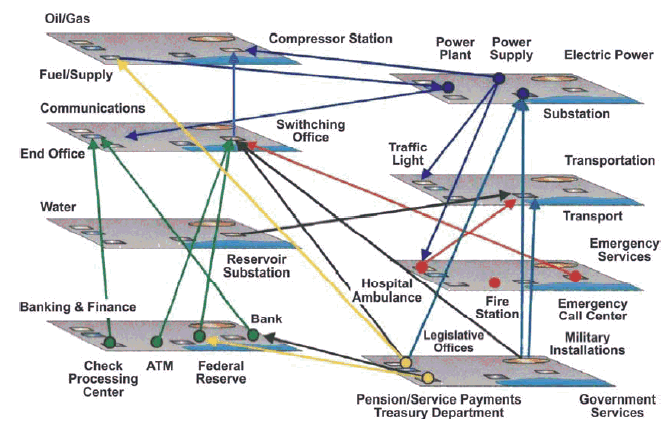
ELECTRIC POWER INFRASTRUCTURE After EMPs take out electric power systems, emergency power supplies will be limited by supplies of stored fuel, which are increasingly diminishing for fire safety and pollution reasons.
“The North American economy and the functioning of the society as a whole are critically dependent on the availability of electricity, as needed, where and when needed… over the last decade or two, there has been relatively little large-capacity electric transmission constructed and the generation additions that have been made, while barely adequate, have been increasingly located considerable distances from load for environmental, political, and economic reasons. As a result, the existing National electrical system not infrequently operates at or very near local limits on its physical capacity to move power from generation to load. Therefore, the slightest insult or upset to the system can cause functional collapse affecting significant numbers of people, businesses, and manufacturing. It is not surprising that a single EMP attack may well encompass and degrade at least 70% of the Nation’s electrical service, all in one instant. P 18-19.
TELECOMMUNICATIONS plays a key role in US society in terms of its direct effect on individuals and business and due to its impact on ..critical infrastructures, such as the financial industry.
BANKING AND FINANCE The financial services industry comprises a network of organizations and attendant systems that process instruments of monetary value in the form of deposits, loans, funds transfers, savings, and other financial transactions. It includes banks and other depository institutions, including the Federal Reserve System; investment-related companies such as underwriters, brokerages, and mutual funds; industry utilities such as the New York Stock Exchange, the Automated Clearing House, and the Society for Worldwide Interbank Financial Telecommunications; and third party processors that provide electronic processing services to financial institutions, including data and network management and check processing. Virtually all American economic activity depends upon the functioning of the financial services industry. Today, most financial transactions that express National wealth are performed and recorded electronically. Virtually all transactions involving banks and other financial institutions happen electronically. Essentially all record-keeping of financial transactions involves information stored electronically. The financial services industry has evolved to the point that it would be impossible to operate without the efficiencies, speeds, and processing and storage capabilities of electronic information technology.
FUEL/ENERGY INFRASTRUCTURE Process control systems are critical to the operation and control of petroleum refineries.
FOOD “Technology has made possible a dramatic revolution in US agricultural productivity. The transformation of the United States from a nation of farmers to a nation where less than 2 percent of the population is able to feed the other 98 percent and supply export markets is made possible only by technological advancements that, since 1900, have increased the productivity of the modern farmer by more than 50-fold. Technology, in the form of knowledge, machines, modern fertilizers and pesticides, high-yield crops and feeds, is the key to this revolution in food production. Much of the technology for food production directly or indirectly depends upon electricity, transportation, and other infrastructures. The distribution system is a chokepoint in the US food infrastructure. Supermarkets typically carry only enough food to provision the local population for 1 to 3 days. Supermarkets replenish their stocks on virtually a daily basis from regional warehouses that usually carry enough food to supply a multi-county area for about one month. The large quantities of food kept in regional warehouses will do little to alleviate a crisis if it cannot be distributed to the population in a timely manner. Distribution depends largely on a functioning transportation system”. (page 40).
TRANSPORTATION INFRASTRUCTURE Combustion engines are vulnerable to EMPs because they have a lot of electronics to make the engine more efficient, reduce pollution, and so on. “significant degradation of the transportation infrastructures are likely to occur in the immediate aftermath of an EMP attack. For example, municipal road traffic will likely be severely congested, possibly to the point of wide-area gridlock, as a result of traffic light malfunctions and the fraction of operating cars and trucks that will experience both temporary and in some cases unrecoverable engine shutdown. Railroad traffic will stop if communications with railroad control centers are lost or railway signals malfunction. Commercial air traffic will likely cease operations for safety and other traffic control reasons. Ports will stop loading and unloading ships until commercial power and cargo hauling infrastructures are restored.”
America’s transportation sector consists of several separate infrastructures. Rail includes the freight railroad and commuter rail infrastructures; road includes the trucking and automobile infrastructures; water includes the maritime shipping and inland waterway infrastructures; and air includes the commercial and general aviation infrastructures. “Increasing utilization of IT make large-scale, multimodal disruptions more likely in the future. As the infrastructure becomes more interconnected and interdependent, the transportation industry will increasingly rely on information technology to perform its most basic business functions. As this occurs, it becomes more likely that information system failures could result in large-scale disruptions of multiple modes of the transportation infrastructure
WATER SUPPLY INFRASTRUCTURE …
GOVERNMENT, MILITARY, …
SPACE SYSTEMS Satellites (and their ground control systems) are vulnerable. Commercial satellites support many significant services for the Federal government, including communications, remote sensing, weather forecasting, and imaging. The national security and homeland security communities use commercial satellites for critical activities, including direct and backup communications, emergency response services, and continuity of operations during emergencies. Satellite services are important for national security and emergency preparedness telecommunications because of their ubiquity and separation from other communications infrastructures (page 44)
History
Although we’ve known about EMPs for a long time, our infrastructure wasn’t built to withstand them because we have depended on MAD to deter an attack. But now there are terrorist groups as well as rogue nations such as North Korea and Iran.
“Another key difference from the past is that the US has developed more than most other nations as a modern society heavily dependent on electronics, telecommunications, energy, information networks, and a rich set of financial and transportation systems that leverage modern technology. This asymmetry is a source of substantial economic, industrial, and societal advantages, but it creates vulnerabilities and critical interdependencies that are potentially disastrous to the United States. Therefore, terrorists or state actors that possess relatively unsophisticated missiles armed with nuclear weapons may well calculate that, instead of destroying a city or military base, they may obtain the greatest political-military utility from one or a few such weapons by using them—or threatening their use—in an EMP attack. The current vulnerability of US 2 critical infrastructures can both invite and reward attack if not corrected.” (Foster)
The 1962 bomb exploded 250 miles above the Johnston Island affected the Hawaiian islands 870 miles away. Street light systems failed, burglar alarms were triggered, and a telecommunications relay facility was damaged.
In 1962 the Soviet Union also set off 300 kiloton detonations from 37 to 300 miles high that affected both overhead and underground buried cables up to 375 miles away, as well as surge arrestor burnout, spark-gap breakdown, blown fuses, and power supply breakdowns.
Implications of EMP’s to the Nuclear command and Control system (Rosenbaum)
Mutually assured destruction, or MAD, is at the basis of our nuclear deterrent system. If we’re attacked, we’ll counterattack. EMP’s from a high-altitude nuclear blast blow MAD apart. EMPs can fry the entire nation’s ground-based electronic nuclear command and control system. We couldn’t strike back. We wouldn’t even know it was coming. So our MAD strategy is hollow and virtually invites a surprise nuclear attack.
References
There are hundreds of articles on the web about this topic. The Foster article is the most comprehensive one that I found.
Foster, J., et al. 2004. Executive Report of the Commission to Assess the Threat to the United States from Electromagnetic Pulse (EMP).
Just found an even longer, better, and more up-to-date version of the above (2008) here:
http://www.empcommission.org/docs/A2473-EMP_Commission-7MB.pdf
Rosenbaum, Ron. 2011. “How the End Begins: The Road to a Nuclear World War III”. p 106
2 Responses to Electromagnetic Pulse weapons & cyberattacks can bring down the electric grid