Stock Market Bubbles and Rallies

I have a theory that the rich milk the middle class like cows by deliberately driving up the prices of stocks and skimming the cream off by selling before the market goes down, as described in Matt Taibbi’s The Great American Bubble Machine and books Lefèvre’s Reminiscences of a Stock Operator: With New Commentary and Insights on the Life and Times of Jesse Livermore and Bonner’s Mobs, Messiahs, & Markets: Surviving the Public Spectacle in Finance & Politics

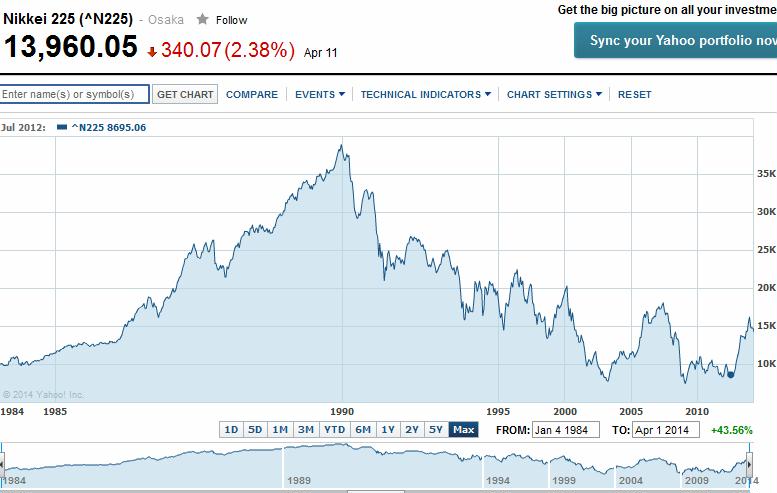
I predict that despite the stock market rally now that in the end we are destined for a far grimmer version of the Nikkei index, which is still 50% below the level peak despite 10 rallies the of over 30% gains since 1990.  During each of these bear market rallies, investors invariably believed that the worst was over and that recovery lay just ahead.

With world wide oil production having peaked in 2005, and every single aspect of material goods depending on energy at all points in its life cycle, there can’t possibly be any more growth to fuel stock markets back to the days of cheap oil.

nikkei 225 index 1984-2014

Japan’s Nikkei 225 Index grew over 30% ten times between 1990 and 2009

Start Date End Date Index Starting Level % Gain Duration in days
1-Oct-90 18-Mar-91 18,781 37.9 168
19-Aug-92 10-Sep-92 14,194 35.9 22
17-Nov-92 11-May-93 15,941 33.1 175
29-Nov-93 17-Jun-94 15,671 37.7 201
3-Jul-95 26-Jun-96 14,296 59.1 358
9-Oct-98 12-Apr-00 12,787 62.9 550
28-Apr-03 26-Apr-04 7,604 60.4 363
17-May-04 7-Apr-06 10,788 62.8 709
9-Mar-09 8-Jun-09 7,028 41.1 91

Every time you think Happy Days Are Here Again because your stocks have recovered so much since 2008, look at the chart above to remind yourself that these rallies are how the 1% skim your hard-earned dollars to buy private jets and yachts with.

My best friend’s mother, seeing everyone making enormous amounts of money in the dot.com bubble, put all of her retirement savings into dot-com stocks in January of 2000 and lost most of it in the crash a few months later.  My mom is proud of how well her stocks have recovered from 2008 right now.

But will she sell and take profits?  Heck no.  It must be time for another crash.


Posted in Scams | Tagged | Comments Off on Stock Market Bubbles and Rallies

Goldman Sachs has manipulated markets since the Great Depression and still is

The Great American Bubble Machine

From tech stocks to high gas prices, Goldman Sachs has engineered every major market manipulation since the Great Depression — and they’re about to do it again  

9 July 2009  Matt Taibbi

The first thing you need to know about Goldman Sachs is that it’s everywhere. The world’s most powerful investment bank is a great vampire squid wrapped around the face of humanity, relentlessly jamming its blood funnel into anything that smells like money. In fact, the history of the recent financial crisis, which doubles as a history of the rapid decline and fall of the suddenly swindled dry American empire, reads like a Who’s Who of Goldman Sachs graduates.

Invasion of the Home Snatchers

By now, most of us know the major players. As George Bush’s last Treasury secretary, former Goldman CEO Henry Paulson was the architect of the bailout, a suspiciously self-serving plan to funnel trillions of Your Dollars to a handful of his old friends on Wall Street. Robert Rubin, Bill Clinton’s former Treasury secretary, spent 26 years at Goldman before becoming chairman of Citigroup — which in turn got a $300 billion taxpayer bailout from Paulson. There’s John Thain, the asshole chief of Merrill Lynch who bought an $87,000 area rug for his office as his company was imploding; a former Goldman banker, Thain enjoyed a multi-billion-dollar handout from Paulson, who used billions in taxpayer funds to help Bank of America rescue Thain’s sorry company. And Robert Steel, the former Goldmanite head of Wachovia, scored himself and his fellow executives $225 million in golden-parachute payments as his bank was self-destructing. There’s Joshua Bolten, Bush’s chief of staff during the bailout, and Mark Patterson, the current Treasury chief of staff, who was a Goldman lobbyist just a year ago, and Ed Liddy, the former Goldman director whom Paulson put in charge of bailed-out insurance giant AIG, which forked over $13 billion to Goldman after Liddy came on board. The heads of the Canadian and Italian national banks are Goldman alums, as is the head of the World Bank, the head of the New York Stock Exchange, the last two heads of the Federal Reserve Bank of New York — which, incidentally, is now in charge of overseeing Goldman — not to mention …

But then, any attempt to construct a narrative around all the former Goldmanites in influential positions quickly becomes an absurd and pointless exercise, like trying to make a list of everything. What you need to know is the big picture: If America is circling the drain, Goldman Sachs has found a way to be that drain — an extremely unfortunate loophole in the system of Western democratic capitalism, which never foresaw that in a society governed passively by free markets and free elections, organized greed always defeats disorganized democracy.

The bank’s unprecedented reach and power have enabled it to turn all of America into a giant pump-and-dump scam, manipulating whole economic sectors for years at a time, moving the dice game as this or that market collapses, and all the time gorging itself on the unseen costs that are breaking families everywhere — high gas prices, rising consumer credit rates, half-eaten pension funds, mass layoffs, future taxes to pay off bailouts. All that money that you’re losing, it’s going somewhere, and in both a literal and a figurative sense, Goldman Sachs is where it’s going: The bank is a huge, highly sophisticated engine for converting the useful, deployed wealth of society into the least useful, most wasteful and insoluble substance on Earth — pure profit for rich individuals.

The Feds vs. Goldman

They achieve this using the same playbook over and over again. The formula is relatively simple: Goldman positions itself in the middle of a speculative bubble, selling investments they know are crap. Then they hoover up vast sums from the middle and lower floors of society with the aid of a crippled and corrupt state that allows it to rewrite the rules in exchange for the relative pennies the bank throws at political patronage. Finally, when it all goes bust, leaving millions of ordinary citizens broke and starving, they begin the entire process over again, riding in to rescue us all by lending us back our own money at interest, selling themselves as men above greed, just a bunch of really smart guys keeping the wheels greased. They’ve been pulling this same stunt over and over since the 1920s — and now they’re preparing to do it again, creating what may be the biggest and most audacious bubble yet.

If you want to understand how we got into this financial crisis, you have to first understand where all the money went — and in order to understand that, you need to understand what Goldman has already gotten away with. It is a history exactly five bubbles long — including last year’s strange and seemingly inexplicable spike in the price of oil. There were a lot of losers in each of those bubbles, and in the bailout that followed. But Goldman wasn’t one of them.

BUBBLE #1 The Great Depression

Goldman wasn’t always a too-big-to-fail Wall Street behemoth, the ruthless face of kill-or-be-killed capitalism on steroids —just almost always. The bank was actually founded in 1869 by a German immigrant named Marcus Goldman, who built it up with his son-in-law Samuel Sachs. They were pioneers in the use of commercial paper, which is just a fancy way of saying they made money lending out short-term IOUs to smalltime vendors in downtown Manhattan.

You can probably guess the basic plotline of Goldman’s first 100 years in business: plucky, immigrant-led investment bank beats the odds, pulls itself up by its bootstraps, makes shitloads of money. In that ancient history there’s really only one episode that bears scrutiny now, in light of more recent events: Goldman’s disastrous foray into the speculative mania of pre-crash Wall Street in the late 1920s.

Wall Street’s Big Win

This great Hindenburg of financial history has a few features that might sound familiar. Back then, the main financial tool used to bilk investors was called an “investment trust.” Similar to modern mutual funds, the trusts took the cash of investors large and small and (theoretically, at least) invested it in a smorgasbord of Wall Street securities, though the securities and amounts were often kept hidden from the public. So a regular guy could invest $10 or $100 in a trust and feel like he was a big player. Much as in the 1990s, when new vehicles like day trading and e-trading attracted reams of new suckers from the sticks who wanted to feel like big shots, investment trusts roped a new generation of regular-guy investors into the speculation game.

Beginning a pattern that would repeat itself over and over again, Goldman got into the investmenttrust game late, then jumped in with both feet and went hogwild. The first effort was the Goldman Sachs Trading Corporation; the bank issued a million shares at $100 apiece, bought all those shares with its own money and then sold 90 percent of them to the hungry public at $104. The trading corporation then relentlessly bought shares in itself, bidding the price up further and further. Eventually it dumped part of its holdings and sponsored a new trust, the Shenandoah Corporation, issuing millions more in shares in that fund — which in turn sponsored yet another trust called the Blue Ridge Corporation. In this way, each investment trust served as a front for an endless investment pyramid: Goldman hiding behind Goldman hiding behind Goldman. Of the 7,250,000 initial shares of Blue Ridge, 6,250,000 were actually owned by Shenandoah — which, of course, was in large part owned by Goldman Trading.

The end result (ask yourself if this sounds familiar) was a daisy chain of borrowed money, one exquisitely vulnerable to a decline in performance anywhere along the line. The basic idea isn’t hard to follow. You take a dollar and borrow nine against it; then you take that $10 fund and borrow $90; then you take your $100 fund and, so long as the public is still lending, borrow and invest $900. If the last fund in the line starts to lose value, you no longer have the money to pay back your investors, and everyone gets massacred.

In a chapter from The Great Crash, 1929 titled “In Goldman Sachs We Trust,” the famed economist John Kenneth Galbraith held up the Blue Ridge and Shenandoah trusts as classic examples of the insanity of leveragebased investment. The trusts, he wrote, were a major cause of the market’s historic crash; in today’s dollars, the losses the bank suffered totaled $475 billion. “It is difficult not to marvel at the imagination which was implicit in this gargantuan insanity,” Galbraith observed, sounding like Keith Olbermann in an ascot. “If there must be madness, something may be said for having it on a heroic scale.”

BUBBLE #2 Tech Stocks

Fast-forward about 65 years. Goldman not only survived the crash that wiped out so many of the investors it duped, it went on to become the chief underwriter to the country’s wealthiest and most powerful corporations. Thanks to Sidney Weinberg, who rose from the rank of janitor’s assistant to head the firm, Goldman became the pioneer of the initial public offering, one of the principal and most lucrative means by which companies raise money. During the 1970s and 1980s, Goldman may not have been the planet-eating Death Star of political influence it is today, but it was a top-drawer firm that had a reputation for attracting the very smartest talent on the Street.

It also, oddly enough, had a reputation for relatively solid ethics and a patient approach to investment that shunned the fast buck; its executives were trained to adopt the firm’s mantra, “long-term greedy.” One former Goldman banker who left the firm in the early Nineties recalls seeing his superiors give up a very profitable deal on the grounds that it was a long-term loser. “We gave back money to ‘grownup’ corporate clients who had made bad deals with us,” he says. “Everything we did was legal and fair — but ‘long-term greedy’ said we didn’t want to make such a profit at the clients’ collective expense that we spoiled the marketplace.”

But then, something happened. It’s hard to say what it was exactly; it might have been the fact that Goldman’s cochairman in the early Nineties, Robert Rubin, followed Bill Clinton to the White House, where he directed the National Economic Council and eventually became Treasury secretary. While the American media fell in love with the story line of a pair of baby-boomer, Sixties-child, Fleetwood Mac yuppies nesting in the White House, it also nursed an undisguised crush on Rubin, who was hyped as without a doubt the smartest person ever to walk the face of the Earth, with Newton, Einstein, Mozart and Kant running far behind.

Rubin was the prototypical Goldman banker. He was probably born in a $4,000 suit, he had a face that seemed permanently frozen just short of an apology for being so much smarter than you, and he exuded a Spock-like, emotion-neutral exterior; the only human feeling you could imagine him experiencing was a nightmare about being forced to fly coach. It became almost a national clichè that whatever Rubin thought was best for the economy — a phenomenon that reached its apex in 1999, when Rubin appeared on the cover of Time with his Treasury deputy, Larry Summers, and Fed chief Alan Greenspan under the headline The Committee To Save The World. And “what Rubin thought,” mostly, was that the American economy, and in particular the financial markets, were over-regulated and needed to be set free. During his tenure at Treasury, the Clinton White House made a series of moves that would have drastic consequences for the global economy — beginning with Rubin’s complete and total failure to regulate his
old firm during its first mad dash for obscene short-term profits.

The basic scam in the Internet Age is pretty easy even for the financially illiterate to grasp. Companies that weren’t much more than potfueled ideas scrawled on napkins by uptoolate bongsmokers were taken public via IPOs, hyped in the media and sold to the public for mega-millions. It was as if banks like Goldman were wrapping ribbons around watermelons, tossing them out 50-story windows and opening the phones for bids. In this game you were a winner only if you took your money out before the melon hit the pavement.

It sounds obvious now, but what the average investor didn’t know at the time was that the banks had changed the rules of the game, making the deals look better than they actually were. They did this by setting up what was, in reality, a two-tiered investment system — one for the insiders who knew the real numbers, and another for the lay investor who was invited to chase soaring prices the banks themselves knew were irrational. While Goldman’s later pattern would be to capitalize on changes in the regulatory environment, its key innovation in the Internet years was to abandon its own industry’s standards of quality control.

“Since the Depression, there were strict underwriting guidelines that Wall Street adhered to when taking a company public,” says one prominent hedge-fund manager. “The company had to be in business for a minimum of five years, and it had to show profitability for three consecutive years. But Wall Street took these guidelines and threw them in the trash.” Goldman completed the snow job by pumping up the sham stocks: “Their analysts were out there saying Bullshit.com is worth $100 a share.”

The problem was, nobody told investors that the rules had changed. “Everyone on the inside knew,” the manager says. “Bob Rubin sure as hell knew what the underwriting standards were. They’d been intact since the 1930s.”

Jay Ritter, a professor of finance at the University of Florida who specializes in IPOs, says banks like Goldman knew full well that many of the public offerings they were touting would never make a dime. “In the early Eighties, the major underwriters insisted on three years of profitability. Then it was one year, then it was a quarter. By the time of the Internet bubble, they were not even requiring profitability in the foreseeable future.”

Goldman has denied that it changed its underwriting standards during the Internet years, but its own statistics belie the claim. Just as it did with the investment trust in the 1920s, Goldman started slow and finished crazy in the Internet years. After it took a little-known company with weak financials called Yahoo! public in 1996, once the tech boom had already begun, Goldman quickly became the IPO king of the Internet era. Of the 24 companies it took public in 1997, a third were losing money at the time of the IPO. In 1999, at the height of the boom, it took 47 companies public, including stillborns like Webvan and eToys, investment offerings that were in many ways the modern equivalents of Blue Ridge and Shenandoah. The following year, it underwrote 18 companies in the first four months, 14 of which were money losers at the time. As a leading underwriter of Internet stocks during the boom, Goldman provided profits far more volatile than those of its competitors: In 1999, the average Goldman IPO leapt 281 percent above its offering price, compared to the Wall Street average of 181 percent.

How did Goldman achieve such extraordinary results? One answer is that they used a practice called “laddering,” which is just a fancy way of saying they manipulated the share price of new offerings. Here’s how it works: Say you’re Goldman Sachs, and Bullshit.com comes to you and asks you to take their company public. You agree on the usual terms: You’ll price the stock, determine how many shares should be released and take the Bullshit.com CEO on a “road show” to schmooze investors, all in exchange for a substantial fee (typically six to seven percent of the amount raised). You then promise your best clients the right to buy big chunks of the IPO at the low offering price — let’s say Bullshit.com’s starting share price is $15 — in exchange for a promise that they will buy more shares later on the open market. That seemingly simple demand gives you inside knowledge of the IPO’s future, knowledge that wasn’t disclosed to the day trader schmucks who only had the prospectus to go by: You know that certain of your clients who bought X amount of shares at $15 are also going to buy Y more shares at $20 or $25, virtually guaranteeing that the price is going to go to $25 and beyond. In this way, Goldman could artificially jack up the new company’s price, which of course was to the bank’s benefit — a six percent fee of a $500 million IPO is serious money.

Goldman was repeatedly sued by shareholders for engaging in laddering in a variety of Internet IPOs, including Webvan and NetZero. The deceptive practices also caught the attention of Nicholas Maier, the syndicate manager of Cramer & Co., the hedge fund run at the time by the now-famous chattering television asshole Jim Cramer, himself a Goldman alum. Maier told the SEC that while working for Cramer between 1996 and 1998, he was repeatedly forced to engage in laddering practices during IPO deals with Goldman.

“Goldman, from what I witnessed, they were the worst perpetrator,” Maier said. “They totally fueled the bubble. And it’s specifically that kind of behavior that has caused the market crash. They built these stocks upon an illegal foundation — manipulated up — and ultimately, it really was the small person who ended up buying in.” In 2005, Goldman agreed to pay $40 million for its laddering violations — a puny penalty relative to the enormous profits it made. (Goldman, which has denied wrongdoing in all of the cases it has settled, refused to respond to questions for this story.)

Another practice Goldman engaged in during the Internet boom was “spinning,” better known as bribery. Here the investment bank would offer the executives of the newly public company shares at extra-low prices, in exchange for future underwriting business. Banks that engaged in spinning would then undervalue the initial offering price — ensuring that those “hot” opening-price shares it had handed out to insiders would be more likely to rise quickly, supplying bigger first-day rewards for the chosen few. So instead of Bullshit.com opening at $20, the bank would approach the Bullshit.com CEO and offer him a million shares of his own company at $18 in exchange for future business — effectively robbing all of Bullshit’s new shareholders by diverting cash that should have gone to the company’s bottom line into the private bank account of the company’s CEO.

In one case, Goldman allegedly gave a multimillion-dollar special offering to eBay CEO Meg Whitman, who later joined Goldman’s board, in exchange for future i-banking business. According to a report by the House Financial Services Committee in 2002, Goldman gave special stock offerings to executives in 21 companies that it took public, including Yahoo! cofounder Jerry Yang and two of the great slithering villains of the financial-scandal age — Tyco’s Dennis Kozlowski and Enron’s Ken Lay. Goldman angrily denounced the report as “an egregious distortion of the facts” — shortly before paying $110 million to settle an investigation into spinning and other manipulations launched by New York state regulators. “The spinning of hot IPO shares was not a harmless corporate perk,” then-attorney general Eliot Spitzer said at the time. “Instead, it was an integral part of a fraudulent scheme to win new investment-banking business.”

Such practices conspired to turn the Internet bubble into one of the greatest financial disasters in world history: Some $5 trillion of wealth was wiped out on the NASDAQ alone. But the real problem wasn’t the money that was lost by shareholders, it was the money gained by investment bankers, who received hefty bonuses for tampering with the market. Instead of teaching Wall Street a lesson that bubbles always deflate, the Internet years demonstrated to bankers that in the age of freely flowing capital and publicly owned financial companies, bubbles are incredibly easy to inflate, and individual bonuses are actually bigger when the mania and the irrationality are greater.

Nowhere was this truer than at Goldman. Between 1999 and 2002, the firm paid out $28.5 billion in compensation and benefits — an average of roughly $350,000 a year per employee. Those numbers are important because the key legacy of the Internet boom is that the economy is now driven in large part by the pursuit of the enormous salaries and bonuses that such bubbles make possible. Goldman’s mantra of “long-term greedy” vanished into thin air as the game became about getting your check before the melon hit the pavement.

The market was no longer a rationally managed place to grow real, profitable businesses: It was a huge ocean of Someone Else’s Money where bankers hauled in vast sums through whatever means necessary and tried to convert that money into bonuses and payouts as quickly as possible. If you laddered and spun 50 Internet IPOs that went bust within a year, so what? By the time the Securities and Exchange Commission got around to fining your firm $110 million, the yacht you bought with your IPO bonuses was already six years old. Besides, you were probably out of Goldman by then, running the U.S. Treasury or maybe the state of New Jersey. (One of the truly comic moments in the history of America’s recent financial collapse came when Gov. Jon Corzine of New Jersey, who ran Goldman from 1994 to 1999 and left with $320 million in IPO-fattened stock, insisted in 2002 that “I’ve never even heard the term ‘laddering’ before.”)

For a bank that paid out $7 billion a year in salaries, $110 million fines issued half a decade late were something far less than a deterrent —they were a joke. Once the Internet bubble burst, Goldman had no incentive to reassess its new, profit-driven strategy; it just searched around for another bubble to inflate. As it turns out, it had one ready, thanks in large part to Rubin.

BUBBLE #3 The Housing Craze

Goldman’s role in the sweeping global disaster that was the housing bubble is not hard to trace. Here again, the basic trick was a decline in underwriting standards, although in this case the standards weren’t in IPOs but in mortgages. By now almost everyone knows that for decades mortgage dealers insisted that home buyers be able to produce a down payment of 10 percent or more, show a steady income and good credit rating, and possess a real first and last name. Then, at the dawn of the new millennium, they suddenly threw all that shit out the window and started writing mortgages on the backs of napkins to cocktail waitresses and ex-cons carrying five bucks and a Snickers bar.

None of that would have been possible without investment bankers like Goldman, who created vehicles to package those shitty mortgages and sell them en masse to unsuspecting insurance companies and pension funds. This created a mass market for toxic debt that would never have existed before; in the old days, no bank would have wanted to keep some addict ex-con’s mortgage on its books, knowing how likely it was to fail. You can’t write these mortgages, in other words, unless you can sell them to someone who doesn’t know what they are.

Goldman used two methods to hide the mess they were selling. First, they bundled hundreds of different mortgages into instruments called Collateralized Debt Obligations. Then they sold investors on the idea that, because a bunch of those mortgages would turn out to be OK, there was no reason to worry so much about the shitty ones: The CDO, as a whole, was sound. Thus, junk-rated mortgages were turned into AAA-rated investments. Second, to hedge its own bets, Goldman got companies like AIG to provide insurance — known as credit default swaps — on the CDOs. The swaps were essentially a racetrack bet between AIG and Goldman: Goldman is betting the ex-cons will default, AIG is betting they won’t.

There was only one problem with the deals: All of the wheeling and dealing represented exactly the kind of dangerous speculation that federal regulators are supposed to rein in. Derivatives like CDOs and credit swaps had already caused a series of serious financial calamities: Procter & Gamble and Gibson Greetings both lost fortunes, and Orange County, California, was forced to default in 1994. A report that year by the Government Accountability Office recommended that such financial instruments be tightly regulated — and in 1998, the head of the Commodity Futures Trading Commission, a woman named Brooksley Born, agreed. That May, she circulated a letter to business leaders and the Clinton administration suggesting that banks be required to provide greater disclosure in derivatives trades, and maintain reserves to cushion against losses.

More regulation wasn’t exactly what Goldman had in mind. “The banks go crazy — they want it stopped,” says Michael Greenberger, who worked for Born as director of trading and markets at the CFTC and is now a law professor at the University of Maryland. “Greenspan, Summers, Rubin and [SEC chief Arthur] Levitt want it stopped.”

Clinton’s reigning economic foursome — “especially Rubin,” according to Greenberger — called Born in for a meeting and pleaded their case. She refused to back down, however, and continued to push for more regulation of the derivatives. Then, in June 1998, Rubin went public to denounce her move, eventually recommending that Congress strip the CFTC of its regulatory authority. In 2000, on its last day in session, Congress passed the now-notorious Commodity Futures Modernization Act, which had been inserted into an 11,000-page spending bill at the last minute, with almost no debate on the floor of the Senate. Banks were now free to trade default swaps with impunity.

But the story didn’t end there. AIG, a major purveyor of default swaps, approached the New York State Insurance Department in 2000 and asked whether default swaps would be regulated as insurance. At the time, the office was run by one Neil Levin, a former Goldman vice president, who decided against regulating the swaps. Now freed to underwrite as many housing-based securities and buy as much credit-default protection as it wanted, Goldman went berserk with lending lust. By the peak of the housing boom in 2006, Goldman was underwriting $76.5 billion worth of mortgage-backed securities — a third of which were sub-prime — much of it to institutional investors like pensions and insurance companies. And in these massive issues of real estate were vast swamps of crap.

Take one $494 million issue that year, GSAMP Trust 2006S3. Many of the mortgages belonged to second-mortgage borrowers, and the average equity they had in their homes was 0.71 percent. Moreover, 58 percent of the loans included little or no documentation — no names of the borrowers, no addresses of the homes, just zip codes. Yet both of the major ratings agencies, Moody’s and Standard & Poor’s, rated 93 percent of the issue as investment grade. Moody’s projected that less than 10 percent of the loans would default. In reality, 18 percent of the mortgages were in default within 18 months.

Not that Goldman was personally at any risk. The bank might be taking all these hideous, completely irresponsible mortgages from beneath-gangster-status firms like Countrywide and selling them off to municipalities and pensioners — old people, for God’s sake — pretending the whole time that it wasn’t grade D horseshit. But even as it was doing so, it was taking short positions in the same market, in essence betting against the same crap it was selling. Even worse, Goldman bragged about it in public. “The mortgage sector continues to be challenged,” David Viniar, the bank’s chief financial officer, boasted in 2007. “As a result, we took significant markdowns on our long inventory positions … However, our risk bias in that market was to be short, and that net short position was profitable.” In other words, the mortgages it was selling were for chumps. The real money was in betting against those same mortgages.

“That’s how audacious these assholes are,” says one hedge fund manager. “At least with other banks, you could say that they were just dumb — they believed what they were selling, and it blew them up. Goldman knew what it was doing.”

I ask the manager how it could be that selling something to customers that you’re actually betting against — particularly when you know more about the weaknesses of those products than the customer — doesn’t amount to securities fraud.

“It’s exactly securities fraud,” he says. “It’s the heart of securities fraud.”

Eventually, lots of aggrieved investors agreed. In a virtual repeat of the Internet IPO craze, Goldman was hit with a wave of lawsuits after the collapse of the housing bubble, many of which accused the bank of withholding pertinent information about the quality of the mortgages it issued. New York state regulators are suing Goldman and 25 other underwriters for selling bundles of crappy Countrywide mortgages to city and state pension funds, which lost as much as $100 million in the investments. Massachusetts also investigated Goldman for similar misdeeds, acting on behalf of 714 mortgage holders who got stuck holding predatory loans. But once again, Goldman got off virtually scot-free, staving off prosecution by agreeing to pay a paltry $60 million — about what the bank’s CDO division made in a day and a half during the real estate boom.

The effects of the housing bubble are well known — it led more or less directly to the collapse of Bear Stearns, Lehman Brothers and AIG, whose toxic portfolio of credit swaps was in significant part composed of the insurance that banks like Goldman bought against their own housing portfolios. In fact, at least $13 billion of the taxpayer money given to AIG in the bailout ultimately went to Goldman, meaning that the bank made out on the housing bubble twice: It fucked the investors who bought their horseshit CDOs by betting against its own crappy product, then it turned around and fucked the taxpayer by making him pay off those same bets.

And once again, while the world was crashing down all around the bank, Goldman made sure it was doing just fine in the compensation department. In 2006, the firm’s payroll jumped to $16.5 billion — an average of $622,000 per employee. As a Goldman spokesman explained, “We work very hard here.”

But the best was yet to come. While the collapse of the housing bubble sent most of the financial world fleeing for the exits, or to jail, Goldman boldly doubled down — and almost single-handedly created yet another bubble, one the world still barely knows the firm had anything to do with.

BUBBLE #4 $4 a Gallon

By the beginning of 2008, the financial world was in turmoil. Wall Street had spent the past two and a half decades producing one scandal after another, which didn’t leave much to sell that wasn’t tainted. The terms junk bond, IPO, sub-prime mortgage and other once-hot financial fare were now firmly associated in the public’s mind with scams; the terms credit swaps and CDOs were about to join them. The credit markets were in crisis, and the mantra that had sustained the fantasy economy throughout the Bush years — the notion that housing prices never go down — was now a fully exploded myth, leaving the Street clamoring for a new bullshit paradigm to sling.

Where to go? With the public reluctant to put money in anything that felt like a paper investment, the Street quietly moved the casino to the physical-commodities market — stuff you could touch: corn, coffee, cocoa, wheat and, above all, energy commodities, especially oil. In conjunction with a decline in the dollar, the credit crunch and the housing crash caused a “flight to commodities.” Oil futures in particular skyrocketed, as the price of a single barrel went from around $60 in the middle of 2007 to a high of $147 in the summer of 2008.

That summer, as the presidential campaign heated up, the accepted explanation for why gasoline had hit $4.11 a gallon was that there was a problem with the world oil supply. In a classic example of how Republicans and Democrats respond to crises by engaging in fierce exchanges of moronic irrelevancies, John McCain insisted that ending the moratorium on offshore drilling would be “very helpful in the short term,” while Barack Obama in typical liberal-arts yuppie style argued that federal investment in hybrid cars was the way out.

But it was all a lie. While the global supply of oil will eventually dry up, the short-term flow has actually been increasing. In the six months before prices spiked, according to the U.S. Energy Information Administration, the world oil supply rose from 85.24 million barrels a day to 85.72 million. Over the same period, world oil demand dropped from 86.82 million barrels a day to 86.07 million. Not only was the short-term supply of oil rising, the demand for it was falling — which, in classic economic terms, should have brought prices at the pump down.

So what caused the huge spike in oil prices? Take a wild guess. Obviously Goldman had help — there were other players in the physical commodities market — but the root cause had almost everything to do with the behavior of a few powerful actors determined to turn the once-solid market into a speculative casino. Goldman did it by persuading pension funds and other large institutional investors to invest in oil futures — agreeing to buy oil at a certain price on a fixed date. The push transformed oil from a physical commodity, rigidly subject to supply and demand, into something to bet on, like a stock. Between 2003 and 2008, the amount of speculative money in commodities grew from $13 billion to $317 billion, an increase of 2,300 percent. By 2008, a barrel of oil was traded 27 times, on average, before it was actually delivered and consumed.

As is so often the case, there had been a Depression-era law in place designed specifically to prevent this sort of thing. The commodities market was designed in large part to help farmers: A grower concerned about future price drops could enter into a contract to sell his corn at a certain price for delivery later on, which made him worry less about building up stores of his crop. When no one was buying corn, the farmer could sell to a middleman known as a “traditional speculator,” who would store the grain and sell it later, when demand returned. That way, someone was always there to buy from the farmer, even when the market temporarily had no need for his crops.

In 1936, however, Congress recognized that there should never be more speculators in the market than real producers and consumers. If that happened, prices would be affected by something other than supply and demand, and price manipulations would ensue. A new law empowered the Commodity Futures Trading Commission — the very same body that would later try and fail to regulate credit swaps — to place limits on speculative trades in commodities. As a result of the CFTC’s oversight, peace and harmony reigned in the commodities markets for more than 50 years.

All that changed in 1991 when, unbeknownst to almost everyone in the world, a Goldman-owned commodities-trading subsidiary called J. Aron wrote to the CFTC and made an unusual argument. Farmers with big stores of corn, Goldman argued, weren’t the only ones who needed to hedge their risk against future price drops — Wall Street dealers who made big bets on oil prices also needed to hedge their risk, because, well, they stood to lose a lot too.

This was complete and utter crap — the 1936 law, remember, was specifically designed to maintain distinctions between people who were buying and selling real tangible stuff and people who were trading in paper alone. But the CFTC, amazingly, bought Goldman’s argument. It issued the bank a free pass, called the “Bona Fide Hedging” exemption, allowing Goldman’s subsidiary to call itself a physical hedger and escape virtually all limits placed on speculators. In the years that followed, the commission would quietly issue 14 similar exemptions to other companies.

Now Goldman and other banks were free to drive more investors into the commodities markets, enabling speculators to place increasingly big bets. That 1991 letter from Goldman more or less directly led to the oil bubble in 2008, when the number of speculators in the market — driven there by fear of the falling dollar and the housing crash — finally overwhelmed the real physical suppliers and consumers. By 2008, at least three quarters of the activity on the commodity exchanges was speculative, according to a congressional staffer who studied the numbers — and that’s likely a conservative estimate. By the middle of last summer, despite rising supply and a drop in demand, we were paying $4 a gallon every time we pulled up to the pump.

What is even more amazing is that the letter to Goldman, along with most of the other trading exemptions, was handed out more or less in secret. “I was the head of the division of trading and markets, and Brooksley Born was the chair of the CFTC,” says Greenberger, “and neither of us knew this letter was out there.” In fact, the letters only came to light by accident. Last year, a staffer for the House Energy and Commerce Committee just happened to be at a briefing when officials from the CFTC made an offhand reference to the exemptions.

“I had been invited to a briefing the commission was holding on energy,” the staffer recounts. “And suddenly in the middle of it, they start saying, ‘Yeah, we’ve been issuing these letters for years now.’ I raised my hand and said, ‘Really? You issued a letter? Can I see it?’ And they were like, ‘Duh, duh.’ So we went back and forth, and finally they said, ‘We have to clear it with Goldman Sachs.’ I’m like, ‘What do you mean, you have to clear it with Goldman Sachs?'”

The CFTC cited a rule that prohibited it from releasing any information about a company’s current position in the market. But the staffer’s request was about a letter that had been issued 17 years earlier. It no longer had anything to do with Goldman’s current position. What’s more, Section 7 of the 1936 commodities law gives Congress the right to any information it wants from the commission. Still, in a classic example of how complete Goldman’s capture of government is, the CFTC waited until it got clearance from the bank before it turned the letter over.

Armed with the semi-secret government exemption, Goldman had become the chief designer of a giant commodities betting parlor. Its Goldman Sachs Commodities Index — which tracks the prices of 24 major commodities but is overwhelmingly weighted toward oil — became the place where pension funds and insurance companies and other institutional investors could make massive long-term bets on commodity prices. Which was all well and good, except for a couple of things. One was that index speculators are mostly “long only” bettors, who seldom if ever take short positions — meaning they only bet on prices to rise. While this kind of behavior is good for a stock market, it’s terrible for commodities, because it continually forces prices upward. “If index speculators took short positions as well as long ones, you’d see them pushing prices both up and down,” says Michael Masters, a hedge fund manager who has helped expose the role of investment banks in the manipulation of oil prices. “But they only push prices in one direction: up.”

Complicating matters even further was the fact that Goldman itself was cheerleading with all its might for an increase in oil prices. In the beginning of 2008, Arjun Murti, a Goldman analyst, hailed as an “oracle of oil” by The New York Times, predicted a “super spike” in oil prices, forecasting a rise to $200 a barrel. At the time Goldman was heavily invested in oil through its commodities trading subsidiary, J. Aron; it also owned a stake in a major oil refinery in Kansas, where it warehoused the crude it bought and sold. Even though the supply of oil was keeping pace with demand, Murti continually warned of disruptions to the world oil supply, going so far as to broadcast the fact that he owned two hybrid cars. High prices, the bank insisted, were somehow the fault of the piggish American consumer; in 2005, Goldman analysts insisted that we wouldn’t know when oil prices would fall until we knew “when American consumers will stop buying gas-guzzling sport utility vehicles and instead seek fuel-efficient alternatives.”

But it wasn’t the consumption of real oil that was driving up prices — it was the trade in paper oil. By the summer of 2008, in fact, commodities speculators had bought and stockpiled enough oil futures to fill 1.1 billion barrels of crude, which meant that speculators owned more future oil on paper than there was real, physical oil stored in all of the country’s commercial storage tanks and the Strategic Petroleum Reserve combined. It was a repeat of both the Internet craze and the housing bubble, when Wall Street jacked up present-day profits by selling suckers shares of a fictional fantasy future of endlessly rising prices.

In what was by now a painfully familiar pattern, the oil-commodities melon hit the pavement hard in the summer of 2008, causing a massive loss of wealth; crude prices plunged from $147 to $33. Once again the big losers were ordinary people. The pensioners whose funds invested in this crap got massacred: CalPERS, the California Public Employees’ Retirement System, had $1.1 billion in commodities when the crash came. And the damage didn’t just come from oil. Soaring food prices driven by the commodities bubble led to catastrophes across the planet, forcing an estimated 100 million people into hunger and sparking food riots throughout the Third World.

Now oil prices are rising again: They shot up 20 percent in the month of May and have nearly doubled so far this year. Once again, the problem is not supply or demand. “The highest supply of oil in the last 20 years is now,” says Rep. Bart Stupak, a Democrat from Michigan who serves on the House energy committee. “Demand is at a 10-year low. And yet prices are up.”

Asked why politicians continue to harp on things like drilling or hybrid cars, when supply and demand have nothing to do with the high prices, Stupak shakes his head. “I think they just don’t understand the problem very well,” he says. “You can’t explain it in 30 seconds, so politicians ignore it.”

BUBBLE #5 Rigging the Bailout

After the oil bubble collapsed last fall, there was no new bubble to keep things humming — this time, the money seems to be really gone, like worldwide-depression gone. So the financial safari has moved elsewhere, and the big game in the hunt has become the only remaining pool of dumb, unguarded capital left to feed upon: taxpayer money. Here, in the biggest bailout in history, is where Goldman Sachs really started to flex its muscle.

It began in September of last year, when then-Treasury secretary Paulson made a momentous series of decisions. Although he had already engineered a rescue of Bear Stearns a few months before and helped bail out quasi-private lenders Fannie Mae and Freddie Mac, Paulson elected to let Lehman Brothers — one of Goldman’s last real competitors — collapse without intervention. (“Goldman’s superhero status was left intact,” says market analyst Eric Salzman, “and an investment banking competitor, Lehman, goes away.”) The very next day, Paulson green-lighted a massive, $85 billion bailout of AIG, which promptly turned around and repaid $13 billion it owed to Goldman. Thanks to the rescue effort, the bank ended up getting paid in full for its bad bets: By contrast, retired auto workers awaiting the Chrysler bailout will be lucky to receive 50 cents for every dollar they are owed.

Immediately after the AIG bailout, Paulson announced his federal bailout for the financial industry, a $700 billion plan called the Troubled Asset Relief Program, and put a heretofore unknown 35-year-old Goldman banker named Neel Kashkari in charge of administering the funds. In order to qualify for bailout monies, Goldman announced that it would convert from an investment bank to a bank holding company, a move that allows it access not only to $10 billion in TARP funds, but to a whole galaxy of less conspicuous, publicly backed funding — most notably, lending from the discount window of the Federal Reserve. By the end of March, the Fed will have lent or guaranteed at least $8.7 trillion under a series of new bailout programs — and thanks to an obscure law allowing the Fed to block most congressional audits, both the amounts and the recipients of the monies remain almost entirely secret.

Converting to a bank-holding company has other benefits as well: Goldman’s primary supervisor is now the New York Fed, whose chairman at the time of its announcement was Stephen Friedman, a former co-chairman of Goldman Sachs. Friedman was technically in violation of Federal Reserve policy by remaining on the board of Goldman even as he was supposedly regulating the bank; in order to rectify the problem, he applied for, and got, a conflict of interest waiver from the government. Friedman was also supposed to divest himself of his Goldman stock after Goldman became a bank holding company, but thanks to the waiver, he was allowed to go out and buy 52,000 additional shares in his old bank, leaving him $3 million richer. Friedman stepped down in May, but the man now in charge of supervising Goldman — New York Fed president William Dudley — is yet another former Goldmanite.

The collective message of all this — the AIG bailout, the swift approval for its bank holding conversion, the TARP funds — is that when it comes to Goldman Sachs, there isn’t a free market at all. The government might let other players on the market die, but it simply will not allow Goldman to fail under any circumstances. Its edge in the market has suddenly become an open declaration of supreme privilege. “In the past it was an implicit advantage,” says Simon Johnson, an economics professor at MIT and former official at the International Monetary Fund, who compares the bailout to the crony capitalism he has seen in Third World countries. “Now it’s more of an explicit advantage.”

Once the bailouts were in place, Goldman went right back to business as usual, dreaming up impossibly convoluted schemes to pick the American carcass clean of its loose capital. One of its first moves in the post-bailout era was to quietly push forward the calendar it uses to report its earnings, essentially wiping December 2008 — with its $1.3 billion in pretax losses — off the books. At the same time, the bank announced a highly suspicious $1.8 billion profit for the first quarter of 2009 — which apparently included a large chunk of money funneled to it by taxpayers via the AIG bailout. “They cooked those first quarter results six ways from Sunday,” says one hedge fund manager. “They hid the losses in the orphan month and called the bailout money profit.”

Two more numbers stand out from that stunning first-quarter turnaround. The bank paid out an astonishing $4.7 billion in bonuses and compensation in the first three months of this year, an 18 percent increase over the first quarter of 2008. It also raised $5 billion by issuing new shares almost immediately after releasing its first quarter results. Taken together, the numbers show that Goldman essentially borrowed a $5 billion salary payout for its executives in the middle of the global economic crisis it helped cause, using half-baked accounting to reel in investors, just months after receiving billions in a taxpayer bailout.

Even more amazing, Goldman did it all right before the government announced the results of its new “stress test” for banks seeking to repay TARP money — suggesting that Goldman knew exactly what was coming. The government was trying to carefully orchestrate the repayments in an effort to prevent further trouble at banks that couldn’t pay back the money right away. But Goldman blew off those concerns, brazenly flaunting its insider status. “They seemed to know everything that they needed to do before the stress test came out, unlike everyone else, who had to wait until after,” says Michael Hecht, a managing director of JMP Securities. “The government came out and said, ‘To pay back TARP, you have to issue debt of at least five years that is not insured by FDIC — which Goldman Sachs had already done, a week or two before.”

And here’s the real punch line. After playing an intimate role in four historic bubble catastrophes, after helping $5 trillion in wealth disappear from the NASDAQ, after pawning off thousands of toxic mortgages on pensioners and cities, after helping to drive the price of gas up to $4 a gallon and to push 100 million people around the world into hunger, after securing tens of billions of taxpayer dollars through a series of bailouts overseen by its former CEO, what did Goldman Sachs give back to the people of the United States in 2008?

Fourteen million dollars.

That is what the firm paid in taxes in 2008, an effective tax rate of exactly one, read it, one percent. The bank paid out $10 billion in compensation and benefits that same year and made a profit of more than $2 billion — yet it paid the Treasury less than a third of what it forked over to CEO Lloyd Blankfein, who made $42.9 million last year.

How is this possible? According to Goldman’s annual report, the low taxes are due in large part to changes in the bank’s “geographic earnings mix.” In other words, the bank moved its money around so that most of its earnings took place in foreign countries with low tax rates. Thanks to our completely fucked corporate tax system, companies like Goldman can ship their revenues offshore and defer taxes on those revenues indefinitely, even while they claim deductions upfront on that same untaxed income. This is why any corporation with an at least occasionally sober accountant can usually find a way to zero out its taxes. A GAO report, in fact, found that between 1998 and 2005, roughly two-thirds of all corporations operating in the U.S. paid no taxes at all.

This should be a pitchfork-level outrage — but somehow, when Goldman released its post-bailout tax profile, hardly anyone said a word. One of the few to remark on the obscenity was Rep. Lloyd Doggett, a Democrat from Texas who serves on the House Ways and Means Committee. “With the right hand out begging for bailout money,” he said, “the left is hiding it offshore.”

BUBBLE #6 Global Warming

Fast-forward to today. It’s early June in Washington, D.C. Barack Obama, a popular young politician whose leading private campaign donor was an investment bank called Goldman Sachs — its employees paid some $981,000 to his campaign — sits in the White House. Having seamlessly navigated the political minefield of the bailout era, Goldman is once again back to its old business, scouting out loopholes in a new government-created market with the aid of a new set of alumni occupying key government jobs.

Gone are Hank Paulson and Neel Kashkari; in their place are Treasury chief of staff Mark Patterson and CFTC chief Gary Gensler, both former Goldmanites. (Gensler was the firm’s co-head of finance.) And instead of credit derivatives or oil futures or mortgage-backed CDOs, the new game in town, the next bubble, is in carbon credits — a booming trillion dollar market that barely even exists yet, but will if the Democratic Party that it gave $4,452,585 to in the last election manages to push into existence a groundbreaking new commodities bubble, disguised as an “environmental plan,” called cap-and-trade.

The new carbon credit market is a virtual repeat of the commodities-market casino that’s been kind to Goldman, except it has one delicious new wrinkle: If the plan goes forward as expected, the rise in prices will be government-mandated. Goldman won’t even have to rig the game. It will be rigged in advance.

Here’s how it works: If the bill passes, there will be limits for coal plants, utilities, natural-gas distributors and numerous other industries on the amount of carbon emissions (a.k.a. greenhouse gases) they can produce per year. If the companies go over their allotment, they will be able to buy “allocations” or credits from other companies that have managed to produce fewer emissions. President Obama conservatively estimates that about $646 billion worth of carbon credits will be auctioned in the first seven years; one of his top economic aides speculates that the real number might be twice or even three times that amount.

The feature of this plan that has special appeal to speculators is that the “cap” on carbon will be continually lowered by the government, which means that carbon credits will become more and more scarce with each passing year. Which means that this is a brand new commodities market where the main commodity to be traded is guaranteed to rise in price over time. The volume of this new market will be upwards of a trillion dollars annually; for comparison’s sake, the annual combined revenues of all electricity suppliers in the U.S. total $320 billion.

Goldman wants this bill. The plan is (1) to get in on the ground floor of paradigm-shifting legislation, (2) make sure that they’re the profit-making slice of that paradigm and (3) make sure the slice is a big slice. Goldman started pushing hard for cap-and-trade long ago, but things really ramped up last year when the firm spent $3.5 million to lobby climate issues. (One of their lobbyists at the time was none other than Patterson, now Treasury chief of staff.) Back in 2005, when Hank Paulson was chief of Goldman, he personally helped author the bank’s environmental policy, a document that contains some surprising elements for a firm that in all other areas has been consistently opposed to any sort of government regulation. Paulson’s report argued that “voluntary action alone cannot solve the climate change problem.” A few years later, the bank’s carbon chief, Ken Newcombe, insisted that cap-and-trade alone won’t be enough to fix the climate problem and called for further public investments in research and development. Which is convenient, considering that Goldman made early investments in wind power (it bought a subsidiary called Horizon Wind Energy), renewable diesel (it is an investor in a firm called Changing World Technologies) and solar power (it partnered with BP Solar), exactly the kind of deals that will prosper if the government forces energy producers to use cleaner energy. As Paulson said at the time, “We’re not making those investments to lose money.”

The bank owns a 10 percent stake in the Chicago Climate Exchange, where the carbon credits will be traded. Moreover, Goldman owns a minority stake in Blue Source LLC, a Utah-based firm that sells carbon credits of the type that will be in great demand if the bill passes. Nobel Prize winner Al Gore, who is intimately involved with the planning of cap-and-trade, started up a company called Generation Investment Management with three former bigwigs from Goldman Sachs Asset Management, David Blood, Mark Ferguson and Peter Harris. Their business? Investing in carbon offsets. There’s also a $500 million Green Growth Fund set up by a Goldmanite to invest in green-tech … the list goes on and on. Goldman is ahead of the headlines again, just waiting for someone to make it rain in the right spot. Will this market be bigger than the energy futures market?

“Oh, it’ll dwarf it,” says a former staffer on the House energy committee.

Well, you might say, who cares? If cap-and-trade succeeds, won’t we all be saved from the catastrophe of global warming? Maybe — but cap-and-trade, as envisioned by Goldman, is really just a carbon tax structured so that private interests collect the revenues. Instead of simply imposing a fixed government levy on carbon pollution and forcing unclean energy producers to pay for the mess they make, cap-and-trade will allow a small tribe of greedy-as-hell Wall Street swine to turn yet another commodities market into a private tax collection scheme. This is worse than the bailout: It allows the bank to seize taxpayer money before it’s even collected.

“If it’s going to be a tax, I would prefer that Washington set the tax and collect it,” says Michael Masters, the hedge fund director who spoke out against oil futures speculation. “But we’re saying that Wall Street can set the tax, and Wall Street can collect the tax. That’s the last thing in the world I want. It’s just asinine.”

Cap-and-trade is going to happen. Or, if it doesn’t, something like it will. The moral is the same as for all the other bubbles that Goldman helped create, from 1929 to 2009. In almost every case, the very same bank that behaved recklessly for years, weighing down the system with toxic loans and predatory debt, and accomplishing nothing but massive bonuses for a few bosses, has been rewarded with mountains of virtually free money and government guarantees — while the actual victims in this mess, ordinary taxpayers, are the ones paying for it.

It’s not always easy to accept the reality of what we now routinely allow these people to get away with; there’s a kind of collective denial that kicks in when a country goes through what America has gone through lately, when a people lose as much prestige and status as we have in the past few years. You can’t really register the fact that you’re no longer a citizen of a thriving first-world democracy, that you’re no longer above getting robbed in broad daylight, because like an amputee, you can still sort of feel things that are no longer there.

But this is it. This is the world we live in now. And in this world, some of us have to play by the rules, while others get a note from the principal excusing them from homework till the end of time, plus 10 billion free dollars in a paper bag to buy lunch. It’s a gangster state, running on gangster economics, and even prices can’t be trusted anymore; there are hidden taxes in every buck you pay. And maybe we can’t stop it, but we should at least know where it’s all going.

Posted in Scams | Tagged | Comments Off on Goldman Sachs has manipulated markets since the Great Depression and still is

Pensions of millions of Americans Threatened

Thought Secure, Pooled Pensions Teeter and Fall

12 April 2014  Mary Williams Walsh  New York Times

The pensions of millions of Americans are being threatened because of trouble in a part of the retirement world long considered so safe that no one gave it a second thought.

The pensions belong to people in multiemployer plans — big pooled investment funds with many sponsoring companies and a union. Multiemployer pensions are not only backed by federal insurance, but they also were thought to be even more secure than single-company pensions because when one company in a multiemployer pool failed, the others were required to pick up its “orphaned” retirees.

Today, however, the aging of the work force, the decline of unions, deregulation and two big stock crashes have taken a grievous toll on multiemployer pensions, which cover 10 million Americans. Dozens of multiemployer plans have already failed, and some giant ones are teetering — including, notably, the Teamsters’ Central States pension plan, with more than 400,000 members.

In February, the Congressional Budget Office projected that the federal multiemployer insurer would run out of money in seven years, which would leave retirees in failed plans with nothing.

“Unless Congress acts — and acts very soon — many plans will fail, more than one million people will lose their pensions, and thousands of small businesses will be handed bills they can’t pay,” said Joshua Gotbaum, executive director of the Pension Benefit Guaranty Corporation, the federal insurer that pays benefits to people whose company pension plans fail.

Wall Street’s Secret Pension Swindle

By David Sirota, Salon  27 April 14

A lack of transparency is allowing financial firms to make high-risk investments with your retirement funds.

n the national debate over what to do about public pension shortfalls, here’s something you may not know: The texts of the agreements signed between those pension funds and financial firms are almost always secret. Although they are public pensions that taxpayers contribute to and  public officials oversee, the exact terms of the financial deals being engineered in the public’s name and with public money are typically not available to you, the taxpayer.

To understand why that should be cause for concern, ponder some possibilities as they relate to pension deals with hedge funds, private equity partnerships and other so-called “alternative investments.”

  1. It’s possible the secret terms of these agreements could allow private individuals in the same investments to negotiate preferential terms for themselves — public employees’ pension money would enrich private investors.
  2. Or these secret terms create the heads-Wall-Street-wins, tails-pensions-lose effect — the one whereby retirees’ money is subjected to huge risks, yet financial firms’ profits are guaranteed regardless of returns.

Wall Street also sucks off pension money with high fees — at a North Carolina pension fund “Fees have skyrocketed over 1,000 percent since 2000 and have almost doubled since (2008) from $217 million to $416 million. Annual fees and expenses will amount to approximately $1 billion in the near future.”

North Carolina is not an isolated incident. In state after state, the financial industry is citing modest public pension shortfalls to justify pushing those pensions to invest more money in riskier and riskier high-fee investments — and to do so in secret.

It is a story that isn’t some minor issue. On the contrary, the fight over that $3 trillion is fast becoming one of the most important economic, business and political stories of modern times. The only question is whether the story can even be told — or whether those profiting off secrecy can continue hiding their schemes from the public.

Posted in Ponzi Schemes | Comments Off on Pensions of millions of Americans Threatened

The most greedy, fraudulent banks continue to loot

Too Big to Fail banks continue to behave like they did before 2008 and are making the most money because they’re perceived as safer.

The Looting of America’s Coffers

March 10, 2009 David Leonhardt. New York Times

Sixteen years ago, two economists published a research paper with a delightfully simple title: “Looting.  The economists were George Akerlof, who would later win a Nobel Prize, and Paul Romer, the renowned expert on economic growth. In the paper, they argued that several financial crises in the 1980s, like the Texas real estate bust, had been the result of private investors taking advantage of the government. The investors had borrowed huge amounts of money, made big profits when times were good and then left the government holding the bag for their eventual (and predictable) losses.

In a word, the investors looted. Someone trying to make an honest profit, Professors Akerlof and Romer said, would have operated in a completely different manner. The investors displayed a “total disregard for even the most basic principles of lending,” failing to verify standard information about their borrowers or, in some cases, even to ask for that information. The paper’s message is that the promise of government bailouts isn’t merely one aspect of the problem. It is the core problem.

Ben Bernanke, the Federal Reserve chairman, gave a speech that read like a sad coda to the “Looting” paper. Because the government is unwilling to let big, interconnected financial firms fail — and because people at those firms knew it — they engaged in what Mr. Bernanke called “excessive risk-taking.” To prevent such problems in the future, he called for tougher regulation.

Now, it would have been nice if the Fed had shown some of this regulatory zeal before the worst financial crisis since the Great Depression. But that day has passed. So people are rightly starting to think about building a new, less vulnerable financial system.

Promised bailouts mean that anyone lending money to Wall Street — ranging from small-time savers like you and me to the Chinese government — doesn’t have to worry about losing that money. The United States Treasury (which, in the end, is also you and me) will cover the losses. In fact, it has to cover the losses, to prevent a cascade of worldwide losses and panic that would make today’s crisis look tame.

But the knowledge among lenders that their money will ultimately be returned, no matter what, clearly brings a terrible downside. It keeps the lenders from asking tough questions about how their money is being used. Looters — savings and loans and Texas developers in the 1980s; the American International Group, Citigroup, Fannie Mae and the rest in this decade — can then act as if their future losses are indeed somebody else’s problem.

Do you remember the mea culpa that Alan Greenspan, Mr. Bernanke’s predecessor, delivered on Capitol Hill last fall? He said that he was “in a state of shocked disbelief” that “the self-interest” of Wall Street bankers hadn’t prevented this mess.  He shouldn’t have been. The looting theory explains why his laissez-faire theory didn’t hold up. The bankers were acting in their self-interest, after all.

The term that’s used to describe this general problem, of course, is moral hazard. When people are protected from the consequences of risky behavior, they behave in a pretty risky fashion. Bankers can make long-shot investments, knowing that they will keep the profits if they succeed, while the taxpayers will cover the losses.

This form of moral hazard — when profits are privatized and losses are socialized — certainly played a role in creating the current mess. But when I spoke with Mr. Romer on Tuesday, he was careful to make a distinction between classic moral hazard and looting. It’s an important distinction.

With moral hazard, bankers are making real wagers. If those wagers pay off, the government has no role in the transaction. With looting, the government’s involvement is crucial to the whole enterprise.

Think about the so-called liars’ loans from recent years: like those Texas real estate loans from the 1980s, they never had a chance of paying off. Sure, they would deliver big profits for a while, so long as the bubble kept inflating. But when they inevitably imploded, the losses would overwhelm the gains. As Gretchen Morgenson has reported, Merrill Lynch’s losses from the last two years wiped out its profits from the previous decade.

What happened? Banks borrowed money from lenders around the world. The bankers then kept a big chunk of that money for themselves, calling it “management fees” or “performance bonuses.” Once the investments were exposed as hopeless, the lenders — ordinary savers, foreign countries, other banks, you name it — were repaid with government bailouts.

In effect, the bankers had siphoned off this bailout money in advance, years before the government had spent it.

I understand this chain of events sounds a bit like a conspiracy. And in some cases, it surely was. Some A.I.G. employees, to take one example, had to have understood what their credit derivative division in London was doing. But more innocent optimism probably played a role, too. The human mind has a tremendous ability to rationalize, and the possibility of making millions of dollars invites some hard-core rationalization.

Either way, the bottom line is the same: given an incentive to loot, Wall Street did so. “If you think of the financial system as a whole,” Mr. Romer said, “it actually has an incentive to trigger the rare occasions in which tens or hundreds of billions of dollars come flowing out of the Treasury.

Unfortunately, we can’t very well stop the flow of that money now. The bankers have already walked away with their profits (though many more of them deserve a subpoena to a Congressional hearing room). Allowing A.I.G. to collapse, out of spite, could cause a financial shock bigger than the one that followed the collapse of Lehman Brothers. Modern economies can’t function without credit, which means the financial system needs to be bailed out.

But the future also requires the kind of overhaul that Mr. Bernanke has begun to sketch out. Firms will have to be monitored much more seriously than they were during the Greenspan era. They can’t be allowed to shop around for the regulatory agency that least understands what they’re doing. The biggest Wall Street paydays should be held in escrow until it’s clear they weren’t based on fictional profits.

Above all, as Mr. Romer says, the federal government needs the power and the will to take over a firm as soon as its potential losses exceed its assets. Anything short of that is an invitation to loot.

At a time like this, when trust in financial markets is so scant, it may be hard to imagine that looting will ever be a problem again. But it will be. If we don’t get rid of the incentive to loot, the only question is what form the next round of looting will take.

Mr. Akerlof and Mr. Romer finished writing their paper in the early 1990s, when the economy was still suffering a hangover from the excesses of the 1980s. But Mr. Akerlof told Mr. Romer — a skeptical Mr. Romer, as he acknowledged with a laugh on Tuesday — that the next candidate for looting already seemed to be taking shape.

It was an obscure little market called credit derivatives.

Enough Is Enough: Fraud-ridden Banks Are Not L.A.’s Only Option

Posted on January 29, 2014 by Ellen Brown

“Epic in scale, unprecedented in world history. That is how William K. Black, professor of law and economics and former bank fraud investigator, describes the frauds in which JPMorgan Chase (JPM) has now been implicated. They involve more than a dozen felonies, including bid-rigging on municipal bond debt; colluding to rig interest rates on hundreds of trillions of dollars in mortgages, derivatives and other contracts; exposing investors to excessive risk; failing to disclose known risks, including those in the Bernie Madoff scandal; and engaging in multiple forms of mortgage fraud.

So why, asks Chicago Alderwoman Leslie Hairston, are we still doing business with them? She plans to introduce a city council ordinance deleting JPM from the city’s list of designated municipal depositories. As quoted in the January 14th Chicago Sun-Times:

The bank has violated the city code by making admissions of dishonesty and deceit in the way they dealt with their investors in the mortgage securities and Bernie Madoff Ponzi scandals. . . . We use this code against city contractors and all the small companies, why wouldn’t we use this against one of the largest banks in the world?

A similar move has been recommended for the City of Los Angeles by L.A. City Councilman Gil Cedillo. But in a January 19th editorial titled “There’s No Profit in L A. Bashing JPMorgan Chase,” the L.A. Times editorial board warned against pulling the city’s money out of JPM and other mega-banks – even though the city attorney is suing them for allegedly causing an epidemic of foreclosures in minority neighborhoods.

 “L.A. relies on these banks,” says The Times, “for long-term financing to build bridges and restore lakes, and for short-term financing to pay the bills.” The editorial noted that a similar proposal brought in the fall of 2011 by then-Councilman Richard Alarcon, backed by Occupy L.A., was abandoned because it would have resulted in termination fees and higher interest payments by the city.

Posted in Banking | Comments Off on The most greedy, fraudulent banks continue to loot

Oil Sands missed rosy production figures – AGAIN

Commentary: Canadian Oil Sands Misses Unrealistic Projection – Issues Another
December 14, 2009 Tom Standing ASPO USA Peak Oil Review

Canadian energy authorities have done it again. They missed their last rosy projection of future oil sands production, so they issued a new one: they merely pushed the big surge in production 5 years into the future.
On November 3 Canadian Energy Research Institute (CERI) released a study that shows Alberta oil sands production soaring to 4.5 million b/d by 2030 and growing toward a peak of 5.3 million b/d in 2041. Actual production in 2008 was 1.3 million b/d.
We’ve heard this song before. In 2005, the burr under ASPO-USA’s saddle, Cambridge Energy Research Associates (CERA), issued a similarly glowing projection that the productive capacity of Canadian oil sands (more descriptively, tar sands) would grow from 1.18 million b/d in 2005, to 2.3 million b/d in 2010, 2.7 million in 2012, and a phenomenal 4.8 million in 2020.
In April 2006 I wrote A ‘Sanity Check’ on Projections for Canadian Oil Sands Production as a Commentary in this newsletter. My conclusion was that the oil sands industry would do well to match the pace of growth they achieved during 1995-2005 when they added about 60,000 b/d of production each year. At that pace, product from Canadian oil sands would be about 1.5 million b/d in 2010. I anticipated that bottlenecks in the extremely resource-intensive train of processes would slow the growth of output to 1.6 million b/d in 2015.
CERA is fond of saying that growth of productive capacity is determined by “above-ground factors,” rather than geology (below-ground factors). For oil sands expansion, above-ground factors center on massive investments for processing and extraction infrastructure, mining equipment, and sufficient fuel to power this gigantic enterprise.

However, CERA misses the point that the industry often tailors their investments to match the physical resources that are available. Companies announce grand plans for new projects, CERA gets turned on, and issues its projections based on the sum total of all announced projects. But many projects are delayed, scaled down, or dropped. Companies usually point to financing arrangements as the bottleneck, whereas an unexplained resource-based factor often leads to the breakdown in financing.
The most energy-intensive processes of the oil sands industry are summarized here:
• King Kong-sized mining equipment gobbles prodigious volumes of diesel fuel to excavate cubic kilometers of overburden and tarry rock.
• Sprawling processing plants chemically extract tar from crushed rock in house-sized vats.
• Billions of gallons of water fill the vats to separate tar from the rock.
• Fuel heats all that water to near boiling to melt out the tar.
• Rock and water are dumped into lake-sized tailings ponds.
• Cities of steam generators transfer heat to injection wells that melt bitumen out of the subsurface.
• Special processing plants (upgraders) break up oversized bitumen and tar molecules to make synthetic crude oil.
Semi-solid bitumen or tar is diluted with light oil so that it can be pumped to distant upgraders. Diluent has been in short supply for years, which limits how far and how much raw oil can be pumped to upgraders. The industry is now trying to locate upgrading plants within the oil sands region, but such revisions slow down expansions.
The horse that pulls this wagon is fuel supply. Natural gas is the fuel of choice for tar and bitumen extraction and upgrading. Heat to extract tar or bitumen from the highest quality formations requires about 1,000 cubic feet of gas per barrel of product. Upgrading consumes another 1,000 cu ft/bbl. Thus, increasing tar sands production by 1 million b/d consumes at least 2 billion cu ft more per day, about 15% of Canada’s gas production. But Canadian gas production peaked in 2004; fell by 14% in 2005, and 2% or 3%/year since then. Evidently Canada’s shale gas formations are not as productive as the Barnett, Fayetteville, and Haynesville shale formations in the southern U.S.
Another point of caution: Canada’s multi-billion dollar project to build the Mackenzie Valley pipeline is on life support. The pipeline would transport gas from the frozen tundra of the Mackenzie River delta and the ice-choked waters of the Beaufort Sea to the lower provinces, not far from the oil sands. Gas is unlikely to flow before 2020.
But never fear, nuclear is here. In mid-2007, Energy Alberta Corp. applied for a license for site preparation near Peace River in the middle of tar sands country. Four deuterium/uranium reactors would yield enough heat to generate 2.2 GW of electricity. Operation could begin as early as 2017 to turn uranium into oil.
What’s a reasonable forecast for tar sands oil production? Under favorable economic conditions the industry could maintain the annual growth rate that they achieved during 1995-2005, about 65,000 b/d per year. But they’ll need a growing supply of natural gas for fuel. Eventually the rate-limiting bottlenecks of natural gas, water, and diluent will place a ceiling on synthetic oil production. My view is that the industry will have difficulty sustaining production much beyond 2 million b/d, and will not likely reach that lofty level until 2020.
CERI has issued a projection that cleverly remains within the realm of reality through 2015, long enough for them to look credible. But for 2020, they veer off the rails. By 2030 their projection is so far off the map that it borders on being irresponsible. Political leaders and financiers with insufficient background to evaluate potential bottlenecks might be taken in by the cornucopian projection, leading to unwise economic decisions.
CERI’s scenario acknowledges that the industry may have to pay billions of dollars annually for emitting increasing levels of carbon. They also recognize that tar sands gas consumption would increase by a factor of 3 or 4. A real kick is that their scenario calls for importing natural gas from the U.S.! Who among us believes that will ever happen?
Tom Standing is an engineer with 44 years of experience in the energy sector in both chemical and civil disciplines. He continues to use his background to assess many developments taki


Posted in Tar Sands (Oil Sands) | Comments Off on Oil Sands missed rosy production figures – AGAIN

A Flaw in the Hyperinflationary Argument

Dec 13, 2009 A Flaw in the Hyperinflationary Argument  intothegreyzone.com

People assuming hyperinflation are assuming that the cash injected into the system will be spread equally or nearly equally, resulting in competitive bidding with more dollars for the current pool of goods and services. I believe this assumption to be in error. It is my opinion that the cash being pumped into certain hands is being pumped deliberately into those hands in order to change the ratio of wealth in the country. In other words, it’s being used purely as a wealth redistribution mechanism.

Imagine for a moment if there are 10 people in a room and each has $100 and there are a fixed amount of goods in the room held by each person. Prices will balance out between people at some level. If I give each person another $100 then prices will rise to reflect the decrease in the value of the currency. But if I give $1000 to one person, prices are unlikely to rise much at all. If I raise prices on my goods, the other 8 people (aside from myself) won’t be able to afford them. And I can’t legally charge higher prices to the one person. That $1000 is inflationary but far far less inflationary than a roughly equal distribution of the same amount through the general population. Yet the person with the additional cash now can purchase more than the rest of us. In effect, he has become wealthier while we have become poorer.

This is what I believe is the intent of the current financial policies of the central banks today – to further entrench the wealthiest people at the top of the pyramid. This process can never be hyperinflationary unless the excess cash escapes into the general populace. And I doubt that it ever will. Instead it will be used to manipulate and buy the stocks and major resource flows of the world, placing the elite in even more control of our society. And of course, this leaves the door open to mistakes by the ruling elite that can lead to a deflationary collapse. Unless Helicopter Ben actually gets in a helicopter and starts dropping $100 bills around the country, there cannot be a hyperinflationary blowoff under the current credit/debt conditions.

P.S. Note also that Ben can also lose the devaluation war if Japan and Asia choose to devalue faster than he does. And Ben is bound by practicality in that if he devalues too fast, he destroys himself and those he is trying to protect due to the reserve currency status of the dollar.

Posted in Inflation or Deflation | Comments Off on A Flaw in the Hyperinflationary Argument

Why Deflation is Inevitable

Perhaps someday inflation, but not until the 1.2 quadrillion of outstanding debt are resolved first.

To understand deflation, you need to understand what money really is and how it’s created.

And you also need to read the other articles in the Inflation or Deflation category for this summary to make sense.

Boomers have to save for retirement due to losses in stock market — this will prevent a recovery because our system is based on consumer spending

Very important to understand: prices on ESSENTIAL things like oil and food can go UP in a deflation because people need to have them at any price.  This is NOT inflation.

There’s no way to get money to the 50% of Americans who need it the most short of dropping it with helicopters or drones over their homes (and even then the local gangs will probably come a calling to collect the cash they missed that fell from the sky).

The 1% prefer deflation over inflation.

  • If they lose 50% of their net worth but asset prices fall 80%, they’re up 30%! Buying back the country for cents on the dollar makes them even wealthier.
  • Hyperinflation carries more risk then deflation for the elite. Both pose risks to social stability and the possible collapse of society but in a deflationary collapse the elite would have more of an advantage.

If prices ever drop for any reason, it’s a self-fulfilling downward spiral as people hang on to cash and don’t spend because they know they can buy something even cheaper in the future

The unwillingness of foreigners to finance government deficits indefinitely as their balance sheets are constrained by declining export income (i.e. China, Japan, the Gulf oil nations)

You can only have (hyper)inflation when an economy is so isolated from the world that it prints a new currency rather than offers credit and too much of this money is printed

As demand falls, and with it prices, investment in the energy sector is likely to dry up. Many projects will be uneconomic at much lower prices, meaning that the projects which might have cushioned the downslope of Hubbert’s curve (and the much steeper net energy curve), are unlikely to be developed. In this way a demand collapse sets the stage for a supply collapse that could place a hard ceiling on any prospect of economic recovery. That is a recipe for extremely high energy prices in the future (Foss).

Secondly, our vulnerability to the consequences of debt is extremely high at the moment. The scale of that debt is staggeringly large. The global credit hyper-expansion has been decades in the making and is now significantly larger than notable events of the past such as the South Sea Bubble of the 1720s and the Tulip Bubble of the 1630s. It dwarfs the excesses that led to the Great Depression (Foss).

Inflation typically results from “too much money chasing too few goods.” Today, too much supply is chasing too little demand. That, coupled with consumers’ need to save money to rebuild their finances, raises the risk of deflation, not inflation. As workers compete for scarce jobs and companies underbid one another for sales, both wages and prices will remain under pressure. We began this crisis with household debt at its highest levels since the 1930s. Knowing that monthly mortgage payments don’t shrink even if your paycheck does, families are trying to deleverage and work down what they fear is their excessive debt.

Until employment grows enough to push wages, and income and production levels increase to more normal levels, the most pressing worry will be deflation, not inflation. inflation is easier to put right than deflation. The Federal Reserve can suppress inflation by raising interest rates as high as required to squelch those animal spirits, and the Fed can do that very rapidly. But there is a limit to the Fed’s ability to confront deflation, since it cannot cut nominal rates below zero in order to induce economic growth.

Unlike inflation, which divides the underlying real wealth pie into smaller and smaller pieces, credit expansion creates multiple and mutually exclusive claims to the same pieces of pie. Once a credit expansion reaches its maximum extent, and contraction begins, these excess claims begin to be extinguished. Unfortunately, the leverage is such that there are probably over a hundred claims to each piece of pie. While contraction begins slowly, as is the nature of positive feedback loops, it picks up momentum until a cascade point is reached, whereupon one can expect the excess claims to be extinguished in a rapid and chaotic process. This amounts to a rapid collapse in the supply of money and credit relative to available goods and services, which is the definition of deflation.

Banks hold extremely large amounts of illiquid ‘assets’ which are currently marked-to-make-believe. So long as large-scale price discovery events can be avoided, this fiction can continue. Unfortunately, a large-scale loss of confidence is exactly the kind of circumstance that is likely to result in a fire-sale of distressed assets. The structure of the credit default swap component of the derivatives market makes this very much more likely. The CDS market allowed large bets to be placed on certain prices falling, and by entities which did not have to own those assets. This creates a perverse incentive for some parties to cause others to fail for profit (akin to me being able to take out fire insurance on your house and thereby give me an incentive to burn it down). An added complication is the extreme degree of counterparty risk that resulted from a complete lack of capital adequacy regulation. Many parties with winning bets will not be able to collect, so they may cause financial mayhem for nothing. The CDS market is worth some $62 trillion, and a meltdown is very likely in my opinion.

The debt monetization that is going on has done nothing to increase the supply of money and credit relative to available goods and services, which is the definition of inflation.

Deregulation allowed the reckless to gamble away virtually everything, including bank deposits and pension funds. Globalized finance has created a giant Enron, which while appearing robust is actually almost completely hollowed out. Such structures implode, often without much notice.

Deflation is ultimately psychological. Without trust we will see hoarding of the cash which will be very scarce in the absence of the credit that currently comprises the vast majority of the effective money supply. The combination of scarce cash and a very low velocity of money will be toxic.  Money is the lubricant in the economic engine and without enough of it that engine will seize up as it did in the 1930s, when farmers dumped milk they couldn’t sell into ditches while others were starving for want of the money to buy food. There was plenty of everything except money, and without money, one cannot connect buyers and sellers.  Potential buyers will have no purchasing power as they will have lost access to credit and their ability to earn an income will be hit by spiking unemployment. Those who still have jobs will find that they have no bargaining power and there is therefore no wage support.  Sellers and producers will have no market and will themselves lose the means to purchase supplies or raw materials for the things they would like to produce.  If conditions remain frozen for any length of time, they will go out of business. The deeper the collapse, the more protracted the trough and the more difficult the eventual recovery.

Nicole Foss expects interest rates on private debt to rise before we see problems in the market for government debt, as the latter should benefit substantially in the shorter term from a flight to safety. The risk premium on private debt is already rising, which is a serious danger signal for such thoroughly indebted societies as we see in the developed world.

Some of the largest market rallies on record happened during the course of the Great Depression, as depressions are associated with very high volatility. Look for instance at the great sucker rally of 1930. There are always rallies of all different sizes in any bear market, just as there are pullbacks of all sizes in bull markets. No market ever moves in only one direction.

People tend to extrapolate recent trends forward, but this amounts to stepping on the gas while looking only in the rearview mirror. This is one reason why major trend changes are so rarely anticipated. Another is that the prevailing view of markets is fundamentally wrong. There is no perfect information, perfect competition, stabilizing negative feedback, rational utility maximization or efficient markets.

Markets are irrational, driven by swings of optimism and pessimism, or greed and fear, in an endless tug of war, and largely in an information vacuum. Investors chase momentum by jumping on passing bandwagons, hence demand for financial assets increases when prices are rising and falls when prices are falling, in classic positive feedback loops.

We have just lived through a period of several months when greed and complacency were in the ascendancy, but that trend is about to reverse in my opinion. Looking at markets as constructs of human herding behaviour allows them to be probabilistically predictable, permitting the forecasting of trend changes. For anyone who is interested in pursuing this idea further, I suggest looking into Bob Prechter’s socionomics – a fascinating subject which delves into the many effects of changes in collective mood.

For instance, as pessimism deepens, driving economic contraction, one would expect to see many manifestations of collective anger and mistrust. As this progresses it is likely to lead to xenophobia and a blame-game, with skillful manipulators (such as the fascist BNP leader Nick Griffin in the UK) poised to direct the anger of the herd towards their own chosen targets.

The potential for serious social fragmentation is very high when expectations have been dashed and there is not enough to go around. Having lived through a very long period of manic optimism and increasing inclusion, we in the developed world are not used to expressions of the dark side of human nature, except for entertainment purposes in popular television programmes. It will come as a considerable shock.

Nov 13, 2009 dailyreckoning predicts a Japan-like Slump that goes on for many years

So far, the US is doing almost exactly what the Japanese did…propping up zombie companies and stimulating the economy as best it can.  But if it does the same thing the Japanese did, won’t the US get the same results the Japanese got?

Here is where it gets interesting. Because the US economy is not exactly like the Japanese economy. Japan had high savings…and a positive trade balance. It could run up huge government debts and “owe it to itself.” It could finance its government debts with the savings of its own people, in other words. It never had to worry about foreigners refusing to buy its bonds…or selling them suddenly.

America’s government debt is different. The US doesn’t save enough to finance its own deficits. So it depends on the kindness of strangers. And if those strangers ever lose faith in America’s ability or willingness to repay its debts, they’ll drop the dollar like an annoying girlfriend. And when they do, the whole global monetary system will come crashing down.

But suppose savings rates go up in America – to, say, 10% of GDP, like they were before the bubble years. That would make $1.4 trillion of savings available to finance the feds’ deficits. And suppose the slump continues…as we think it will, with another big scare in the investment markets. People will seek safety in…yes, you guessed it…US bonds. This will take the pressure off the dollar and permit the US to finance its countercyclical spending without depending heavily on foreigners. The recession/depression will be annoying…but not insufferable. And Bernanke will figure het has more to lose by undermining the dollar than to gain from it. In that case, the Japan- like slump could go on for many years – just as it has in Japan!

Nov 11, 2009 Bubbles, Inflation and Overcapacity
http://www.oftwominds.com/blognov09/overcapacity11-09.html

here’s the dynamic which enabled low interest rates and low inflation even as credit exploded and bubbles rose in one asset class after another.

1. Massive expansion of credit was paralleled by a massive expansion of industrial capacity in China and indeed the entire world.

2. This expansion of capacity was matched by an expansion of supply in commodities. As the industrialization of China (one of the so-called BRIC nations–China, Russia, India and Brazil) and other developing nations drove demand for commodities, the incentives to exploit new sources drove up supply of almost everything: oil, iron ore, coffee, etc.

3. While prices have fluctuated in an upward bias, at no time did the cost of commodities rise to levels which threatened global growth except for the oil spike in 2008. Adjusted for inflation, oil is well within historical boundaries even at $80/barrel.

4. To feed the giant credit-dependent machine they’d fostered, central banks kept lowering interest rates and increasing liquidity/money supply. This drove the returns on savings and bonds down to absurdly low levels, forcing money managers to chase riskier assets to make a decent return on investments.

5. This need to earn higher returns drove vast floods of money into assets, inflating one bubble after another.

6. Though consumption also skyrocketed, the vast expansion of industrial capacity and commodity supplies actually outpaced rising consumption, keeping supply and demand more or less in balance and prices relatively stable.

In essence, the hot money was forced to chase assets for higher returns while China’s capacity to make goods matched and then exceeded global demand for goods.

The only way credit can drive inflation is if the supply of desired goods is limited. Many of us foresee a time when oil will be that commodity which is no longer able to match demand, but for now, the rise of production in Russia, Africa and elsewhere has kept pace with (now slackening) demand. Indeed, we might well see demand fall enough as the global recession takes hold that oil will fall to $30/barrel.

China’s capacity to produce goods now exceeds global demand. Add in the rest of the world’s enormous overcapacity and you get deflation, not inflation. In one industry after another, massive overcapacity is the stark reality. For example, the world can manufacture twice as many vehicles as there are customers for those vehicles.

The two key exceptions are grain and oil. If grain supply doesn’t match demand, and reserves have been drawn down, then prices could rise suddenly.

At some point oil supply will fall below demand, but when that point will occur is unknown.

Until either or both grain and oil fall into scarcity, then inflation in goods and services has no foundation. As long as interest rates remain near-zero, then the pressure to borrow money and chase asset prices higher remains in force.

No trend lasts forever. At some point interest rates will rise, risky assets will fall from favor and global scarcity in key resources will arise.

How long can the central banks inflate the exponentially-expanding credit bubble? No one knows, but we can say the end-point will arrive when no one wants to borrow more money even at zero interest rates.


Taipan Daily: Gold Stocks – Poised for an Epic Bull Run?
by Justice Litle, Editorial Director, Taipan Publishing Group

Major factors are pointing very much in a deflationary (falling price) direction:

* falling wages
* falling revenues
* brutal cost cuts
* imploding state budgets
* contracting credit lines
* rising unemployment
* rising credit defaults
* rising construction loan defaults
* rising government debt issuance
* rising consumer savings (long-term trend)

Hard assets aside, such factors are powerful bad juju when it comes to deflationary risks. If a “double dip” recession indeed takes hold – a possibility more likely than not in your humble editor’s estimation – the result could be a classic equity implosion, of the sort to send equities back to the general vicinity of the March 2009 lows (if not guaranteeing an actual test).

The grizzliest of deflationary bears argue loudly that the U.S. Federal Reserve (and various central bank counterparts around the globe) are helpless in the face of such headwinds, doomed to the prospect of “pushing on a string” – that is to say, flooding the economy with liquidity to no avail.

The classic liquidity trap is one in which all the excess liquidity created simply pools unused in bank vaults… like water in underground reservoirs that never gets distributed to an economy in drought.

Sources

Nov 2009 Forget Inflation, Deflation Is a Bigger Danger  Mortimer Zuckerman

October 30 2009: An interview with Stoneleigh – The case for deflation


Posted in Inflation or Deflation | Comments Off on Why Deflation is Inevitable

Debt relief scams

CFPB Files Suit Against Morgan Drexen for Charging Illegal Fees and Deceiving Consumers

Company Made Misleading Claims about its Debt-Relief Services to Consumers

CFPB Takes Action to Stop Florida Company From Engaging in Illegal Debt-Relief Practices

The Bureau Alleges Company’s Conduct is Abusive and Deceptive

CFPB Takes Action Against Two Companies for Charging Illegal Debt-Relief Fees

CFPB and State Partners Obtain Refunds for Consumers Charged Illegal Debt-Relief Fees

CFPB Announces First Joint-Enforcement Action with the States

Posted in Debt | Comments Off on Debt relief scams

Mortgage Scams: Kickbacks, Modification, etc

Nov 7 2013 CFPB Takes Action Against Castle & Cooke For Steering Consumers Into Costlier Mortgages. Company to Pay $9 Million in Restitution and $4 Million in Civil Penalties

Oct 24 2013 CFPB Files Suit Against Borders & Borders, PLC for Paying Illegal Real Estate Kickbacks. Company Funneled Kickbacks Through Network of Shell Companies

Nov 15 2013 The CFPB Takes Action Against Mortgage Insurer to End Illegal Kickbacks to Lenders. Republic Mortgage Insurance Corporation to Pay $100,000 Fine and Halt Illegal Activity

Jul 23 2013 CFPB Takes Action Against Castle & Cooke for Paying Employees to Steer Consumers into Expensive Mortgages. Employees Received Bonuses for Pushing Consumers into Loans with Higher Interest Rates

May 17 2013 The CFPB Takes Action Against Real Estate Kickbacks. Homebuilder Required to Turn Over Profits from Kickbacks Funneled Through Sham Mortgage Companies

Apr 4 2013 The CFPB Takes Action Against Mortgage Insurers to End Kickbacks to Lenders. Four Companies to Pay $15.4 Million in Penalties

Dec 11 2012 CFPB Halts Alleged Nationwide Mortgage Loan Modification Scams. Operations Targeted Financially Distressed Consumers in Danger of Losing Their Homes

Feb 18, 2009 Home loans in the US: the biggest racket since Al Capone? Financial Times.

The extreme fiscal largesse bestowed on residential housing, directly and indirectly through mortgage interest deductibility, has led to a massive misallocation of investment in the US.  There has been overinvestment in the private residential housing stock and underinvestment in just about every other form of fixed capital: infrastructure, public amenities of all kinds (sports facilities, public recreational facilities, parks etc.), commercial structures, plant and equipment.

Posted in Mortgages | Comments Off on Mortgage Scams: Kickbacks, Modification, etc

Discriminatory Mortgages $35 million fines

CFPB and DOJ Take Action Against National City Bank for Discriminatory Mortgage Pricing

Harmed African-American and Hispanic Borrowers Will Receive $35 Million in Restitution

WASHINGTON, D.C. – Today, the Consumer Financial Protection Bureau (CFPB) and the Department of Justice (DOJ) filed a joint complaint against National City Bank for charging higher prices on mortgage loans to African-American and Hispanic borrowers than similarly creditworthy white borrowers between the years 2002 and 2008. The agencies also filed a proposed order to settle the complaint that requires National City Bank, through its successor PNC Bank, to pay $35 million in restitution to harmed African-American and Hispanic borrowers.

“Borrowers should never have to pay more for a mortgage loan because of their race or national origin,” said CFPB Director Richard Cordray. “Today’s enforcement action puts money back in the pockets of harmed consumers and makes clear that we will hold lenders accountable for the effects of their discriminatory practices.”

“This settlement will provide deserved relief to thousands of African-American and Hispanic borrowers who suffered discrimination at the hands of National City Bank,” said Attorney General Eric Holder. “As alleged, the bank charged borrowers higher rates not based on their creditworthiness, but based on their race and national origin. This alleged conduct resulted in increased loan prices for minority borrowers. This case marks the Justice Department’s latest step to protect Americans from discriminatory lending practices, and shows we will always fight to hold accountable those who take advantage of consumers for financial gain.”

National City Bank originated mortgage loans directly to consumers in its retail offices, as well as through independent mortgage brokers. Between 2002 and 2008, National City made over 1 million mortgage loans through its retail channel and over 600,000 loans through independent brokers. PNC acquired National City at the end of 2008.

The Equal Credit Opportunity Act (ECOA) prohibits creditors from discriminating against loan applicants in credit transactions on the basis of characteristics such as race and national origin. In the complaint, the CFPB and DOJ allege that National City Bank violated the ECOA by charging African-American and Hispanic borrowers higher mortgage prices than similarly creditworthy white borrowers. The DOJ also alleges that National City violated the Fair Housing Act, which similarly prohibits discrimination in residential mortgage lending.

The CFPB and DOJ’s joint investigation began in 2011. The agencies allege that National City Bank’s discretionary pricing and compensation policies caused the discriminatory pricing differences. National City gave its loan officers and brokers the discretion to set borrowers’ rates and fees. National City then compensated the officers and brokers from extra costs paid by consumers. Over 76,000 African-American and Hispanic borrowers paid higher costs because of this discriminatory pricing and compensation scheme.

Today’s action marks the first joint lawsuit brought in federal court by the CFPB and the DOJ to enforce federal fair lending laws. On December 6, 2012, the CFPB and the DOJ signed an agreement that has facilitated strong coordination between the two agencies on fair lending enforcement, including the pursuit of joint investigations such as this one.

Enforcement Action

The Dodd-Frank Wall Street Reform and Consumer Protection Act (Dodd-Frank Act) and the ECOA authorize the CFPB to take action against creditors engaging in illegal discrimination. The consent order, which is subject to court approval, requires that PNC Bank, as the successor to National City Bank, pay restitution. Specifically, the order requires:

  • $35 million to be paid to a settlement fund. That settlement fund will go to allegedly affected African-American and Hispanic borrowers who obtained mortgage loans from National City between 2002 and 2008.
  • Funds to be distributed through a settlement administrator. The CFPB and the DOJ will identify victims by looking at loan data. A settlement administrator will contact consumers if necessary, distribute the funds, and ensure that impacted borrowers receive compensation.
  • The settlement administrator be accessible. The settlement administrator will set up various cost-free ways for consumers to contact it with any questions about potential payments. The CFPB will release a Consumer Advisory with contact information for the settlement administrator once that person is chosen.

The consent order terms take into account a number of factors, including the age of the loans, that National City Bank no longer exists, and that PNC does not employ National City’s mortgage origination policies.

The complaint and the proposed consent order resolving the complaint have been simultaneously filed with the United States District Court for the Western District of Pennsylvania. The complaint is not a finding or ruling that the defendants have actually violated the law. The proposed federal court order will have the full force of law only when signed by the presiding judge.

The full text of the CFPB’s Complaint is available at: http://files.consumerfinance.gov/f/201312_cfpb_complaint_national-city-bank.pdf

The full text of the CFPB’s Consent Order is available at: http://files.consumerfinance.gov/f/201312_cfpb_consent_national-city-bank.pdf

Posted in Mortgages | Comments Off on Discriminatory Mortgages $35 million fines