We’ll need more Farmers

Energy Descent and Agricultural Population

Jason Bradford on March 11, 2009

Some excerpts of this article below:

Among the cadre of folks who think about food systems and sustainability in the U.S., there’s a concern about the number of farmers and their age. Only about two percent (5,802,000 / 295,410,000 in 2004) of the U.S. population is part of a farm family, and the average age of principal operators of farms is nearing 60 years (See the recent release of the 2007 Ag Census for details). Since mechanization and the fuels that power machines are what enable such a small agricultural labor force, is it reasonable to assume that a decline in fossil fuels will require more farmers?

Others, such as peak oil educators Richard Heinberg and Sharon Astyk, have suggested this will indeed be the case, even going so far as to put a rough number on the future farmers of America. Their estimates are partly based on looking at the proportion of farmers in an early to pre-industrial economic system in the United States, when about a third of the population engaged in agriculture and at societal differences today. They then adjust for current population size to arrive at the admittedly tentative figure of 50 to 100 million farmers (or members of farming families) needed to feed a population of 300 million.

As these authors point out, not only is the absolute number very large compared to today, but given the age of the current crop of farmers it implies that a rapid education of youth will be required to keep bread on the table. Given the importance of this topic, I wanted to take a look myself. Just as we use multiple lines of evidence to understand the evolution of life, oil depletion, and climate change, we need to look for confirmation from as many angles as possible. Furthermore, better knowledge potentially gets us closer to grasping the scale and rate of change required to cope with the problem in the same way that depletion rates in existing fields and net exports analyses do in the oil situation, or the timing and consequences of melting ice sheets and release of methane from warming permafrost do in the climate system.

Perhaps we can validate or refute this scenario by further use of the comparative method–for example, we may compare a future scenario to a potentially analogous historic past. In the analysis presented here, I take as a given that the United States (and other high energy consuming industrial countries) will have less energy available in the future, at least of the type currently used in mechanized agriculture. The comparison I use is not historic, but contemporary. I know that today some nations have much less energy consumption than others and anecdotally I am aware that poorer countries tend to be more agrarian. If nations with less energy consumption have more farmers, it would support the notion that a reduction in energy consumption in the U.S. (and other industrialized countries) will lead to an increase in farmers.

Is there a discernable inverse relationship between energy consumption and agricultural populations among nations?

Let’s take a look. First, I had to find total population by nation and agricultural population (which I believe means farmers and their immediate dependents) by nation. These data can be downloaded from the United Nations Food and Agriculture Organization (FAO) (http://faostat.fao.org/site/550/default.aspx).

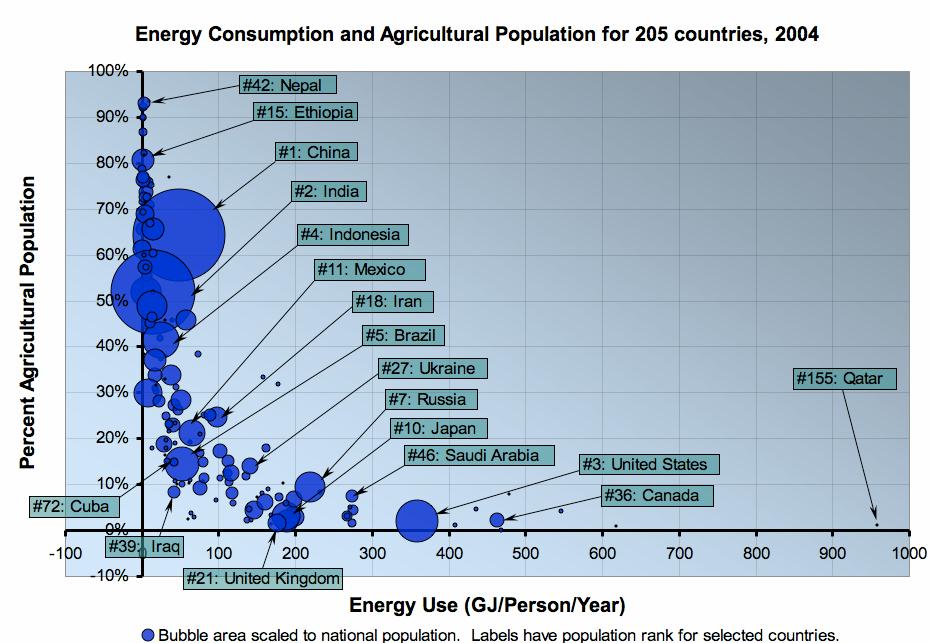
Simply dividing the agricultural population by the total population gives the percentage that live an agricultural life. The range of this figure is huge, from essentially zero for places like Singapore to over 90% for places like Bhutan. I really don’t know how accurate censuses data are from the 205 countries used (not all places are fully independent nations, e.g., Puerto Rico is separated from the U.S. in these data sets), but assume figures are in the ballpark. Certainly citizens of Bhutan and Singapore have vastly different livelihoods. According to 2004 FAO data, overall about 41% of the world’s people still live in families who work in agriculture (2.6 billion out of 6.4 billion).

Most nations (about 70%) have 40% or less of their population in agriculture. This means that the fewer countries with high percentages of agricultural workers have large populations, e.g., China and India are 64% and 52% respectively and equal about a third of the total world population. In all likelihood, large populations correlate with high population density. As a 1997 paper by Conforti and Giampietro showed, economic forces in poorer nations with dense populations tend to retain farmers.

Second, I had to find energy consumption data. It is difficult to locate data on use of wood, animal dung, etc., but for commercial energy such as oil, natural gas, coal, and electricity the Energy Information Administration (EIA) of the U.S. Department of Energy has available spreadsheets for download (see table E.1 at http://www.eia.doe.gov/iea/wecbtu.html). While this doesn’t include all forms of energy, it does cover the forms most readily usable in an industrial agricultural system.

As expected, nations with relatively little commercial energy consumption tend to have lots of farmers

To harmonize the two data sets I used 2004 data and limited the analysis to 205 nations—which I figure is fairly complete. The figure below shows the results, plotting the percent agricultural population as a potential response to per capita energy consumption.Ag Popu and energy consumption 205 countries


Though I may have just done so, I am mistrustful of studying this issue in isolation. Nagging at me is the question of whether the globalized industrial system is inherently unstable in the face of multiple challenges, including energy scarcity but also the converging crises spawned by the surging weight of humanity. Climate change, financial wobbles, violent conflicts and related spin-offs can unpredictably disrupt the vast system of trade that moves fertilizers, seeds and replacement parts that keep industrial agriculture humming. I think we are already seeing hints of this scenario in the U.S., as farmers run short of diesel fuel during harvest season and end up leaving crops in the ground.

Some of Jason’s replies in the COMMENTS section:

Having a farming system that includes long rotations in pasture or other deep rooted perennials is very important. Must go through cycles of fungal dominance to bring deep soil layers into the mix, add the minerals to the top soil, which basically get mined by the annuals. If I was head of the USDA I would have the U.S. make a strategic goal of LOWERING its grain production by 50% so that the feedlots go out of business, land is pastured, and meat is once again grass fed and local. Do this slowly and strategically and nobody needs to starve. In fact, it would likely prevent starvation by keeping the soils from being continually pushed beyond their limits.

————–

I was looking at the work ahead of me at my little farm and thinking…it would be so much easier if I was primarily just trying to grow for my family. I could readily cover most of our vegetable food needs by hand without a whole lot of aggravation. For grains and legumes a drill seeder and small combine or at least a quality stationary thresher and seed cleaner would certainly be a great tool set. But instead I am trying to grow for other people, and they don’t pay very much. At least in my situation I don’t pay property taxes because it is public property, but what if I did? There’s no way this would be worth it.

Posted in Farming and Ranching | Comments Off on We’ll need more Farmers

Softer landing if we can keep the Combines going

Save it for the Combine

August 24, 2010. Jason Bradford

Excerpts from this article:

The combine performs tasks that replace an enormous amount of labor in a reliable and timely fashion.  It cuts the stalks of seed crops, threshes the heads to dislodge the seeds, and then separates the seeds from the straw and chaff.  Without the combine (and a series of intermediate technologies), harvesting grains involves manually cutting stalks, bundling them, transporting the bundle to storage, threshing and winnowing.

The labor efficiency of the combine is extreme.  Over the course of a long and somewhat boring 12 hour day in his air conditioned cab (made a little better by listening to audio books on an iPod), Clint can harvest about 25 acres of wheat.  We visited while he was in a field with a hard red variety that yields about 2400 lbs per acre (soft white yields are 2-3 times higher).  In one day, Clint and his machine will collect 60,000 lbs of hard red wheat, or 1000 bushels.

Each pound of wheat contains about 1500 food calories (i.e., kilo calories), and a person needs about 2500 calories per day.  A year’s supply of calories for a person is in the neighborhood of 900,000, which in wheat units is 600 lbs.  In simple terms, during a day of work Clint can supply the annual food needs of 100 people.  Of course he and his dad Mike also spent days prepping and sowing the field, and there are hours planning, maintaining equipment, and marketing, etc., but in total the amount of time actually spent with machines on that 25 acres is probably only a week or so.  And since Clint and his family manage to farm several hundred acres it all works out to about 100 people fed by one guy like Clint, which is typical for the US food system.

I propose that the main enabler of a demographic shift away from rural-agrarian populations to an urban-industrial one is the combine.  The combine removes most labor from agriculture for the most critical crops:  edible grains, legumes and oil seeds.  Seeds are a highly portable, storable and versatile class of food, allowing civilizations to trade and buffer against shortages.  Most calories now consumed derive directly or indirectly from seeds.

It seems plausible that in the US we could do away with 3/4 of our per capita energy and, if we allocate smartly, keep the combines running and continue to feed everybody with little extra labor (and assuming climate change doesn’t bite too sharply into yields).

I  have mixed feelings about how the historical shift into cities and away from farms has impacted our culture.  On the one hand, surplus food has permitted our society to specialize greatly, developing technologies, arts and forms of entertainment that I truly enjoy.  Material abundance may also have led to cultural openness and flexibility, or what may be called liberalism, as opposed to the rigidity, isolation and xenophobia common to many pre-industrial societies.

On the other hand, I am certainly no fan of the over-consumptive lifestyles and the disconnection from nature endemic to highly industrialized cultures.  However, one possible future entails a larger agrarian population as industrialized countries lose access to abundant fossil fuels.  For example, even if we manage to save fuel for the combines, more labor will still be needed for plenty of other tasks.  While this is likely to be a painful process, what could emerge is greater ecological awareness—the understanding that our livelihoods are deeply connected and dependent upon natural processes.  Such a path is described in some detail by David Holmgren in Future Scenarios.

If energy descent is slow enough, our economy will have hybrid characteristics—leveraging the value of existing infrastructure and machinery as long as possible while learning how to adapt to natural rhythms.  Keeping such a transition as benign as feasible requires food supply stability. Maintaining social cohesion gives the population time to adjust to the new normal.  Combines, I would argue, are a fantastic tool for obtaining surplus food.  We should keep them running during any potential phase of “scarcity industrialism.”

Energy Returned

Obviously, combines are entirely reliant on barrels and barrels of liquid fuel.  Clint told me he uses about 50 gallons of fuel for every 8-9 hours harvesting wheat, which would cover about 17 acres.  This means it takes around three gallons of diesel fuel per acre, just for the harvest. In standard energy terms three gallons of diesel contains 0.44 Giga Joules (GJ).  For comparison, 2400 lbs of wheat contains just over 15 GJ of edible energy.  Ignoring all the other energy needed to deliver the fuel to the farm, and get the crop to maturity, the harvest-only EROI is a highly profitable 34:1.

Liquid fuels are absolutely essential for industrial farming systems.  I worry less about nitrogen fertilizer inputs, herbicides and pesticides, as these can be dramatically reduced using organic and agroecological methods.  It is much more difficult to substantially decrease liquid fuel usage.  Even with no-till methods, tractors make passes to sow seeds, and they make passes to harvest.

Unless you relish the idea of your descendants living a life akin to Little House on the Prairie, it may be prudent to cut back a bit on oil consumption today and extend the reserves of fossil fuels as long as possible.  Time is second to oil on my list of most precious resources.  A slowing down today, when we have so much excess, potentially buys a lot of time for tomorrow.  I don’t know if we will use this time to develop liquid fuel substitutes for fossil fuels to run combines, or manufacture millions of scythes and train a whole generation to use them.


Posted in Farming & Ranching | Comments Off on Softer landing if we can keep the Combines going

Energy in the Food System uses 19% of all energy consumed in the USA. Pimentel 2008

Pimentel David, et. al. 2008.  Reducing Energy Inputs in the US Food System.  Human Ecology 36:459–471

[ Here are some excerpts from this paper. I don’t list many of the ideas in the article on how to do this though, read it if you’d like to know more]

Abstract Petroleum and natural gas are the primary fuels in the US food system. Both fuels are now in short supply and significant quantities are being imported into the USA from various nations. An investigation documented that fossil energy use in the food system could be reduced by about 50% by appropriate technology changes in food production, processing, packaging, transportation, and consumption. The results suggest that overall, farmers benefit as well as consumers.

Introduction  Petroleum, natural gas, coal, and other mined fuels currently provide the USA with nearly all of its diverse energy needs at a cost $700 billion/year (USCB 2007). Given that more than 90% of US oil deposits have been depleted, the country now imports over 65% of its oil at an annual cost of $200 billion (USCB 2004–2005; Deffeyes 2001). These figures indicate the magnitude of the economic and energy challenges associated with supplying food for the US population.

Further, the usage of oil and natural gas has peaked at a time when oil and gas reserves are predicted to last only 40 to 50 more years (Duncan and Youngquist 1999; Deffeyes 2001). As oil and natural gas supplies decline, the USA will have to depend on coal and a variety of renewable energy technologies. Best estimates are that coal supplies are only capable of providing the USAwith 50 to 100 years of energy (USCB 2007). With the US population continuing to grow close to its current rate, it is projected to increase from 317 million to one billion in about 100 years, further exacerbating strains on coal and oil supplies (Abernethy 2006). However, it is unlikely that such a population could be sustained with the diminishing availability of fossil fuels. The American food supply is driven almost entirely by non-renewable energy sources. In total, each American requires approximately 2,000 l/year in oil equivalents to supply their food, which accounts for about 19% of the total energy use in the USA. Agricultural production, plus food processing and packaging, consumes 14%, while transportation and preparation use 5% of total energy in the USA (Pimentel et al. 2007).

Food Consumed by Americans The fossil energy required to produce the relatively high level of animal products consumed in the average American diet are estimated to be 50% of the total energy inputs, while to produce staple foods such as potatoes, rice, common fruits and vegetables, uses about 20% of the fossil energy inputs.  The average American consumes 1,000 kg (2,200 lb) of food per year containing an estimated 3,747 kcal per day (Table 1). A vegetarian diet of an equivalent 3,747 kcal per day requires 33% less fossil energy than the average American diet (Pimentel and Pimentel 1996). The Food and Drug Administration (FDA 2007) recommends an average daily consumption of 2,000 to 2,500 kcal a day, much less than provided by the typical American diet (Vaclavik et al. 2006). Reducing the calorie intake to a lower level would significantly reduce the energy used in food production.

Renewable Energy Supplies The production of 46 quads per year from renewable energy technologies would require at least 17% of total land area not counting cropland in the USA (Pimentel et al. 2002a).

The renewable energy systems that are projected to provide the most energy in the future are photovoltaics, biomass (thermal), and hydroelectric power (Pimentel et al. 2002a). None of these renewable energy sources produce liquid fuels [which is a big problem – tractors, trucks, cars, ships, trains, mass transit, and other essential agricultural and transportation machinery runs on liquid fuels 97% of them oil].

The decline of fossil energy reserves will force the USA to rely on various renewable energy technologies to maintain a viable food supply. These include: hydroelectric, biomass (wood), wind power, solar thermal systems, photovoltaics, passive energy systems, geothermal, biogas, and methanol (Hayden 2001; Pimentel et al. 2002a; Pimentel 2008). Ethanol is not included in this study because it fails to provide renewable energy (Pimentel and Patzek 2005). Together, these systems could provide the USA with an estimated 46 of the 103 quads (quad=1015 BTU) of energy currently used per year (Pimentel 2008; USCB 2004– 2005). The renewable energy systems that are projected to provide the most energy in the future are photovoltaics, biomass (thermal), and hydroelectric power (Pimentel et al. 2002a).

Hydroelectric power already supplies the USA with 269 billion kWh or 7% of the nation’s electricity at a cost of $0.02 per kWh (USCB 2007). One drawback to hydroelectric plants is the substantial land requirement for water reservoirs; 75,000 ha of reservoir land and 14 trillion liters of water are needed to produce 1 billion kWh per year (Pimentel et al. 2002a; Sims et al. 2003).

Land Availability Land is a major concern when attempting to modify fossil energy usage as land provides 99.9% of the human food supply (measured in calories; FAOSTAT 2004). As the population expands, more land is needed to meet nutritional needs, yet the per capita availability of world cropland has declined by 20% in the past decade (Worldwatch Institute 2001). This decrease is due in part to the loss of viable cropland caused by wind and water erosion at a rate of ten million hectares per year (Preiser 2005). In addition, another ten million hectares are abandoned annually worldwide due to severe salinization as a result of irrigation (FAO 2006).

Loss of soil is insidious; one rain or wind storm can remove 1 mm of topsoil and nearly 14 tons of total soil per hectare. This 1 mm of erosion can easily go unnoticed by farmers. Soil erosion occurs at rates ranging from 10 t ha-1 year-1 in the USA and Europe to 30 t ha-1 year-1 in Africa, South America and Asia. Approximately 75 billion tons of topsoil is lost each year worldwide (Pimentel 2006a; Wilkinson and McElroy 2007). Additionally, rapid deforestation (at a rate of 11.2 million ha/year) is occurring as more forest is claimed to replace lost and degraded cropland (Pimentel et al. 2005).

Cropland now occupies 17% of the total land area in the USA, but little additional land is available or even suitable for future agricultural expansion (USDA 2004).

At present, the global availability of land per capita is 0.23 ha for cropland and 0.5 ha for pastureland (Pimentel and Pimentel 2006). However, the USA and Europe have 0.5 ha of cropland and 0.81 ha of pasture available per capita, which is the minimum amount of land required to support their diverse food systems (Pimentel and Wilson 2004; USDA 2004).

As the US population increases to a projected 1 billion people (120 years), US fossil energy resources will run out and reduce per capita land area to only 0.17 ha of cropland and 0.3 ha of pasture land, both values below current global land availability.

There are several different conservation technologies that help control soil erosion, including: crop rotations, cover crops, contour planting, ridge till, mulch, terraces, grass strips, and no-till. Some investigators claim that no-till saves energy but this is usually only accounted for in tractor fuel reductions. These investigations seldom account for the added nitrogen, added corn seed, plus the added pesticides required in no-till production (Pimentel and Ali 1998; Williams et al. 2000; Parsch et al. 2001; Epplin et al. 2005).

In 100 years time, world population is projected to be more than twice as the number is today (6.5 billion)—about 13 billion. A World Health Organization report states that worldwide there are currently more than 3.7 billion malnourished humans, the largest number of malnourished people ever in the history of the Earth (WHO 2005). In light of this report, we should expect food shortage problems to continually worsen.

While the number of malnourished people increased worldwide over the past two decades, per capita grain production simultaneously declined (FAOSTAT 1961– 2005). There are many factors that contributed to this decline, including: a rapidly growing world population (PRB 2006), a 20% decline in cropland per capita in the last decade (Pimentel and Wilson 2004), a 10% decline in irrigated land per capita (Postel 1997) and a 17% decrease in per capita fertilizer use (Pimentel and Wilson 2004). It should be noted that cereal grains make up 80% of the world’s food supply.

Irrigation and Energy Provided there is ample of irrigation water, crop production can be increased significantly in arid regions. Approximately 80% of water used in the USA is solely for irrigation to increase crop production, particularly in arid regions (Pimentel et al. 2004). Plants consume about twothirds of this water while one-third is non-recoverable (Postel 1997). Irrigated corn requires about 14 million liters of water per hectare (500,000 gallons per acre) and uses about three times more energy than rain-fed corn to produce the same yield (Pimentel et al. 2004). Irrigation tends to be expensive both energetically and economically, costing more than $1,200 per hectare when pumping from a depth of only 100 m (Pimentel et al. 2004).

Reducing irrigation dependence in the USA would save significant amounts of energy, but probably require that crop production shift from the dry and arid western and southern regions to the more agriculturally suitable Midwest and Northeast. Also, as noted above, soil salinization due to irrigation causes the abandonment of ten million hectares each year worldwide (FAO 2006). The leaching of salts from the soil into rivers poses another major problem. For example, where the Colorado River flows through the Grand River Valley in Colorado, water returned to the river from irrigated cropland contains an estimated 18 t/ha of salts leached from the soil (EPA 1976), resulting in high salt concentrations in the river.

Conserving Essential Nutrients As fossil fuels become scarce, costs for the production of synthetic fertilizers will rise. This economic pressure will force farmers to seek alternative sources to meet their nitrogen, phosphorus, and potassium demands. Nitrogen is the most vital nutrient in agricultural production and is applied at a rate of 12 million tons of commercial or synthetic nitrogen per year in the USA (GAO 2003; USDA 2004). Although 18 million tons of nitrogen were applied in 1995 in the USA, a 300% increase in the price of nitrogen fertilizer over the past decade has resulted in fewer N applications, highlighting the need to explore alternative nutrient sources. It is of equal commercial importance to provide adequate amounts of phosphorus and potassium, the other essential macro-elements needed by plants to grow well and produce high yields. As will be shown below, leguminous cover crops, manure, and other organic inputs can meet the N, P, and K demands of food production in the USA (Funderberg 2001; Schmalshof 2005).

Cover Crops Conserving soil nutrients is a priority in agricultural production because it reduces the demand for fertilizers and produces high crop yields. A crucial aspect of soil nutrient conservation is the prevention of soil erosion. Cultivation practices that build soil organic matter (SOM) and prevent the exposure of bare soil are a key part of preventing soil erosion. Cover crops help protect the exposed soil from erosion after the main crop is harvested (Troeh et al. 2004). Compared with conventional farming systems, which traditionally leave the soil bare, the use of cover crops significantly reduces soil erosion. Leguminous cover crops also add nutrients to the soil (Drinkwater et al. 1998; Weinert et al. 2002). For example, vetch, a legume cover crop grown during the fall and spring months (non-growing season), can add about 70 kg/ha of nitrogen (Pimentel et al. 2005; Henao and Baanante 2006). Cover crops further aid in agriculture by collecting about 1.8 times more solar energy than conventional farming systems (Pimentel 2006b). Growing cover crops on land before and after a primary crop nearly doubles the amount of solar energy that is harvested per hectare per year. This increased solar energy capture provides extra organic matter which improves soil quality.

Soil Organic Matter Maintaining high levels of soil organic matter (SOM) is beneficial for all agriculture and crucial to improving soil quality. Carter (2002) has shown aggregated SOM to have “major implications for the functioning of soil in regulating air and water infiltration, conserving nutrients, and influencing soil permeability and erodibility” by improving the soil’s water infiltration, structure, and reducing erosion. Maintaining high levels of SOM is a primary focus of organic farming. On average, the amount of SOM is significantly higher in organic production systems than in conventional systems. Typical conventional farming systems with satisfactory soil generally have 3% to 4% SOM, whereas organic systems soil average from 5% to 5.5% SOM (Troeh et al. 2004). Soil carbon increased about 28% in organic animal systems and 15% in organic legume systems, but only 9% in conventional farming systems (Pimentel et al. 2005). This high level of SOM provides many advantages. Increased SOM also provides soil with an increased capacity to retain water. Sullivan (2002) reported that approximately 41% of the volume of organic matter in the organic systems consisted of water, compared with only 35% in conventional systems. The large amount of soil organic matter and water present in organic systems is the major factor in making these systems more drought resistant. Furthermore, 110,000 kg/ha of soil organic matter in an organic corn system could sequester 190,000 kg/ha of carbon dioxide. This is 67,000 kg/ha more carbon dioxide sequestered than in conventional corn systems, and equals the amount of carbon dioxide emitted by ten cars that averaged 20 miles per gallon and traveled 12,000 miles per year (USCB 2004–2005). The added carbon sequestration benefits of organic systems clearly have beneficial implications for reducing global warming.

Manure In 2005, the 100 million cattle, 60 million hogs, and nine billion chickens maintained in the USA produced an estimated 20.5 million metric tons of nitrogen. This nitrogen, most of which is produced by cattle, could potentially be used in crop production. The collection and management of this nitrogen requires special attention. Approximately 50% of the nitrogen is lost as ammonia within 24 to 48 h after defecation, if the animal waste is not immediately buried in the soil or placed in a lagoon under anaerobic conditions (Troeh et al. 2004). The liquid nutrient material in the lagoon must be buried in the soil immediately after it is applied to the land, or again the nitrogen will be lost to the atmosphere. We estimate 70% of cattle manure is dropped in pasture or rangeland and is not included in the total nitrogen estimate, reducing the amount of nitrogen theoretically collected for use per year to 18 million metric tons (Pimentel et al., unpublished data). Because cow manure is 80% water, this manure can only be transported a distance of about eight miles before the energy return is negative. Conserving nutrients will be crucial to farmers in a world of high fertilizer costs. In addition, practices that center on building and conserving soil integrity can greatly improve energy efficiency in food production systems. The use of manure, cover crops, composting, and conservation tillage can contribute to such energy reductions and allow farmers to produce food sustainably.

Reducing energy use in the farm system

Reduced Pesticide Use Currently, more than one billion pounds of pesticides are applied annually to US agriculture (USDA 2004). Certified organic farming systems do not apply synthetic pesticides. Weed control is, instead, achieved through crop rotations, cover crops, and mechanical cultivation (Pimentel et al. 2005). Avoiding the use of herbicides and insecticides improves energy efficiency in corn/soybean production systems. For example, in organic farming, one pass of a cultivator and one pass of a rotary hoe use approximately 300,000 kcal/ha of fossil energy. Herbicide weed control (including 6.2 kg of herbicide per hectare plus sprayer application) requires about 720,000 kcal/ha or about twice the amount of energy used for mechanical weed control in organic farming (Pimentel et al. 2005). In addition, there are a reported 300,000 non-fatal pesticide poisonings (EPA 1992) per year in the USA, and pesticides in the diet have been shown to increase the odds of developing cancer (Horrigan et al. 2002).

Moving Livestock Back to the Grain Farms Another factor in energy usage in farming is the recent proliferation of monocultures, or farms devoting large tracts of land to one crop. The movement of livestock frommixed farming systems was encouraged by the US Government as it began to provide price supports for farmers (NAS 1989). As a result, livestock were moved to concentrated animal feeding operations (CAFOs) where they could be raised in large numbers. This shift resulted in an increase in commercial fertilizer and pesticide use in crop production, plus a significant increase in soil erosion (NAS 1989). It has also raised concern that 76 million hospital cases and 5,000 human deaths may be attributable to pollution associated with CAFOs and poor waste management (CDC 2002).

Crop Rotations Crop rotations are beneficial to all agricultural production systems because they help control soil erosion (Troeh et al. 2004; Delgado et al. 2005). They also help control pests such as insects, plant pathogens and weeds (Pimentel et al. 1993; Troeh et al. 2004). In addition, when legume cover crops are used, essential nitrogen is added to the soil when they are plowed under. As mentioned above, in the Rodale study soil nitrogen levels in organic farming systems were 43% compared with only 17% in conventional systems (Pimentel et al. 2005). Regulatory actions and market-based incentives could encourage the movement of livestock manure away from pollution causing CAFOs and back to the mixed farms where it can be incorporated into the soil. They could also encourage the agricultural practice of crop rotation, the use of cover crops, and reduced pesticide applications, all of which would result in increased energy savings and reduced hazards to human health.

Labor and Mechanization

Raising corn and most other crops by hand requires about 1,200 h of labor per hectare (nearly 500 h per acre; Feeding the World 2002). Modern mechanization allows farmers to raise a hectare of corn with a time input of only 11 h, or 110 times less than required for hand-produced crops (Pimentel et al. 2007). Mechanization requires significant energy for both the production and repair of machinery (about 333,000 kcal/ha) and diesel and gasoline fuel (1.4 million kcal/ha; Table 4). About one-third of the energy required to produce a hectare of crops is invested in machine operation (Pimentel and Patzek 2005). Mechanization decreases labor significantly, but does not contribute to increased crop yields. Organic corn production requires mechanization. Economies of scale are still possible with more labor and the use of smaller tractors and other implements. Reports suggest that equipment quantity and size is often in excess of requirements for the tasks. Reducing the number and size of tractors will help increase efficiency and conserve energy (Grisso and Pitman 2001).

Return to Horses and Mules

A horse can contribute to the management of 10 ha (25 acres) per year (Morrison 1946). Each horse requires one acre of pasture and about 225 kg of corn grain. Another 1.5 acres of hayland is necessary to produce the roughly 800 lbs of hay needed to sustain each animal. In addition to the manpower required to care for the horses, labor is required to drive the horses during tilling and other farm operations. The farm labor required per hectare would probably increase from 11 hours to between 30 and 40 h per hectare using draft animal power. Nevertheless, an increase in human and animal labor as well as a decrease in fuel-powered machinery is necessary to decrease fossil fuel use in the US food system.

Energy Inputs in Meat, Poultry and Dairy Production

Each year an estimated 45 million tons of plant protein are fed to US livestock producing approximately 7.5 million tons of animal protein (meat, milk, and eggs) for human consumption (Pimentel 2004). The livestock feed is comprised of about 28 million tons of plant protein from grains and 17 million tons from forage. In the USA, the average protein yield of the five major grains (corn, rice, wheat, sorghum, and barley, plus soybeans) fed to livestock is about 700 kg/ha. For every kilogram of high quality animal protein produced, livestock are fed nearly 6 kg of plant protein (Pimentel 2004). Major differences exist in the inputs of feed and forage between animal products. For example, production of 1 kg of beef requires 13 kg of grain and 30 kg of forage (fossil energy input 40 kcal per 1 kcal beef protein), 1 kg of pork requires 5.9 kg of grain (14:1 kcal), and 1 kg of broiler chicken requires only 2.3 kg of grain (4:1 kcal). A kilogram of conventional milk produced in the USA requires 0.7 kg of grain and 1 kg of hay (14:1 kcal; Pimentel 2006b). In Norway, organic milk production was reported to be 43% more energy efficient (Refsgaar et al. 1998), since the cattle were grazed on pasture land.

When converting plant protein into animal protein, there are two principal categories of energy and economic costs:
(1) the direct production costs of the harvested animal including the grain and forage fed; and (2) the indirect costs of maintaining the breeding herd. Diverse combinations of grains, forages, and legumes (including soybeans) are fed to livestock to produce meat, milk, and eggs. The major fossil energy inputs required to produce grain and forage for animals includes fertilizers, farm machinery, fuel, irrigation, and pesticides. The energy inputs vary according to the particular grain or forage being grown and fed to livestock. On average producing one kcal of plant protein for livestock feed requires about 10 kcal of fossil energy (Pimentel 2004). Of the livestock systems evaluated, broiler-chicken production is the most energy efficient, with 1 kcal of broiler protein produced with an input of 4 kcal of fossil energy (Pimentel 2006b). Broilers are a grain-only livestock system. Turkey production is also a grain-only system and is next in efficiency with a 1:10 ratio. In addition, conventional milk production, based on a mixture of grain and forage feed, is also relatively efficient, with 1 kcal of milk protein requiring 14 kcal of fossil energy (Pimentel 2006b). Nearly all the feed protein consumed by broilers is from grain, while milk production uses about two-thirds grain and one-third forage. Of course, 100% of milk production could be achieved using hay and/or pasture as feed.

Food Processing and Packaging

In the USA, processed foods account for 82% to 92% of food sales (Murray 2005; Putman et al. 2002; SixWise 2006). Of the energy used for the total food system, 16% is used in processing and 7% is used in packaging.  [Pimentel then has a long list of how to use less energy]

Transport of Food

In the US food travels an average of 2,400 km (1,500 miles) before it is consumed, a practice which is obviously energy intensive.  A very energy intensive part of the American diet is the large quantity of fruits and vegetables that are transported by aircraft. The amount of energy required to ship 1 kg of food by aircraft is 6.63 kcal/km. On the other hand, shipping by rail is only 0.12 kcal/kg/km (Pimentel 1980).

Conclusion and References: see the original paper


Posted in Agriculture Infrastructure, Farming & Ranching | Tagged , | Comments Off on Energy in the Food System uses 19% of all energy consumed in the USA. Pimentel 2008

Energy in Food System. March 2010. USDA

Canning, P. 2010. Energy Use in the U.S. Food System.  USDA Economic Research Report Number 94

Another great review of this article is Beyond Food Miles by Michael Bomford, a research scientist and extension specialist at Kentucky State University, an adjunct faculty member in the University of Kentucky Department of Horticulture

Food system energy USDA 2002


In 2007 the U.S. The United States economy used 100 quadrillion Btu of energy: 85% from fossil fuels, 8% nuclear fuel, 6% hydroelectric, 1% biomass, geothermal, solar, and wind.

Pimentel et al., 2008, “Reducing Energy Inputs in the US Food System,” Human Ecology 36., reported that food used 19% of the  national energy budget.  Other researchers come up with different figures, because calculating energy use is complicated.  This report concluded 14.4% [my summary below makes it clear why every report comes up with a different number, it’s an insanely complex system with so many components and variables to include or exclude, that no report will have the same figure].

Energy is used throughout the U.S. food supply chain, from the manufacture and application of agricultural inputs, such as fertilizers and irrigation; through crop and livestock production, processing, and packaging; distribution services, such as shipping and cold storage; the running of refrigeration, preparation, and disposal equipment in food retailing and food service establishments; and in home kitchens.

In addition, life cycle analyses were also done on the energy

  • imported food (energy used by ships, barges, trains, trucks, fertilizers, etc)
  • municipal waste disposal
  • Water required: sewage systems and water services

The energy used to EXPORT food was NOT CONSIDERED IN THIS STUDY.

Energy used in a salad mix bought on the East Coast grown in California

The lettuce mix is just one of the 45,000 items sold in 140,000 supermarkets and 537,000 food and beverage service establishments in the USA in 2007. nationwide.  Each of these purchased,
stored, prepared, cleaned, and disposed of food items.

  1. The farm California used a precision seed planter months before attached to a gas-powered farm tractor.
  2. Fertilizers and pesticides were trucked to wholesalers by diesel powered trucks.
  3. Local farmers drove in gas-fueled trucks to buy these fertilizers and pesticides.
  4. A diesel-powered broadcast spreader applied fertilizers, pesticides, and herbicides to the lettuce
  5. These nitrogen-based fertilizers, pesticides, and herbicides, were all made with natural gas and electricity
  6. The farms used electric-powered irrigation equipment throughout much of the growing period
  7. At harvest, field workers packed harvested vegetables in boxes produced at a paper mill
  8. The boxes were in gas-powered trucks to ship to a regional processing plant, where specialized machinery cleaned, cut, mixed, and packaged the salad mixes.
  9. Utility services at the paper mill, plastic packaging manufacturers, and salad mix plants use energy to produce the boxes used at harvest and the packaging used at the processing plant, and for processing and packaging the fresh produce.
  10. The packaged salad mix was shipped in refrigerated containers by a combination of rail and truck to an East Coast grocery store
  11. The grocery store kept the lettuce under constant refrigeration.
  12. To purchase this packaged salad mix, a consumer probably got there by car or mass transit.
  13. At home, the consumer refrigerated the salad mix a while before eating it.
  14. Dishes and utensils used to eat the salad may be placed in a dishwasher for cleaning and reuse—adding to the electricity use of the consumer’s household.
  15. Leftover salad may be ground in a garbage disposal and washed away to a wastewater treatment facility, or disposed, collected, and hauled to a landfill

Household measurements

26.7%: Electricity for cooking, cleaning, and food storage, 6.6% cooking (i.e. electric range, oven, microwave, toaster oven, and coffee makers), 14% refrigeration,  3.6 freezers; 2.5% dishwashers,

3% (in 2001) Cooking heat other than electricity (natural gas and liquid petroleum gas (LPG)

2% roughly Auto fuel for food-related personal transportation

Embodied energy in purchases of food storage, preparation, and serving equipment

Part of the embodied energy in purchases of automobiles, parts, and auto services (insurance and accessories were not included)

Table 5: Freight industry 

Average miles 2007    Commodity

  • 374 Fresh produce, oilseeds, and other horticulture
  • 243 Meat, fish, and preparations
  • 262 Milled grain products and preparations, and bakery products
  • 230 Other prepared foodstuffs and fats and oils

Freight mode:
BTU’s 2007 Energy use by freight mode

23,260    Energy use per truck mile
14,990    Energy use per freight car rail mile
Sources: USDA, Economic Research Service using data from the U.S. Department of
Transportation (www.bts.gov), and U.S. Department of Energy (http://cta.ornl.gov/cta/).

Agriculture mechanization grew 10%, labor declined 30% between 1996 – 2006

With farm machinery use on the rise and use of agricultural chemicals roughly constant, energy services for the production of farm inputs may have increased steadily over the past decade.

References

Ayers, R.U., and A.V. Kneese. 1969. “Production, Consumption, and Externalities,” American Economic Review 59, No. 3, June, pp. 282-297.

Bullard, C., and R. Herendeen. 1975. “The Energy Costs of Goods and Services,” Energy Policy 1, No. 4 (Dec.), pp. 268-277.

Cawley, J. 2006. “Markets and Childhood Obesity Policy,” The Future of Children 16, No. 1, pp. 69-88.

Cutler, D.M., E.L. Glaeser, and J.M. Shaprio. 2003. “Why Have Americans Become More Obese?” Journal of Economic Perspectives 17, No. 3: pp. 93-118.
Heller, M.C., and G.A. Keoleian. 2000. Life Cycle-Based Sustainability Indicators for Assessment of the U.S. Food System, Center for Sustainable Systems Report No. CSS-0004, University of Michigan, December, http://css.snre.umich.edu/css_doc/CSS00-04.pdf
Hirst, E. 1974. “Food-Related Energy Requirements,” Science 184 (April 12), pp. 134-38.

Hoekstra, R., and J. Van Den Bergh. 2002. “Structural Decomposition
Analysis of Physical Flows in the Economy,” Environmental and Resource Economics 23, pp. 357-78.

Lane, J., Moss, P., Salzman, H., and Tilly, C. 2003. “Too Many Cooks? Tracking Internal Labor Market Dynamics in Food Service With Case Studies and Quantitative Data,” in Low-Wage America: How Employers Are Reshaping Opportunity in the Workplace, E. Appelbaum, A. Bernhardt,
and R.J. Murnane (eds.), Russell Sage Foundation, New York, NY.

Leontief, W. 1967. “An Alternative to Aggregation in Input-Output Analysis
and National Accounts,” Review of Economics and Statistics 49, No. 3, August, pp. 412-19.

Martinez, S. 2007. The U.S. Food Marketing System: Recent Developments, 1997-2006, Economic Research Report No. 42, USDA, Economic Research Service, May, www.ers.usda.gov/publications/err42/

Miller, R.E., and P.E. Blair. 1985. Input-Output Analysis: Foundations and Extensions, Prentice-Hall, Inc., Englewood Cliffs, NJ.

Oak Ridge National Laboratory, Center for Transportation Analysis. 2008. Transportation Energy Data Book: Edition 27, http://www-cta.ornl.gov/data/index.shtml

Pimentel, D., S. Williamson, C. Alexander, O. Gonzalez-Pagan, C. Kontak, and S. Mulkey. 2008. “Reducing Energy Inputs in the US Food System,” Human Ecology 36, pp. 459-471.

Rose. A., and S. Casler. 1996. “Input-Output Structural Decomposition Analysis: A Critical Appraisal,” Economic Systems Research 8, No. 1, pp. 33-62.

Stewart, H., N. Blisard, and D. Jolliffe. 2006. Let’s Eat Out: Americans Weigh Taste, Convenience, and Nutrition, Economic Information Bulletin No. 19, U.S. Department of Agriculture, Economic Research Service, October, www.ers.usda.gov/publications/eib19/

United Nations, European Commission, International Monetary Fund,
Organisation for Economic Co-operation and Development, and World
Bank. 2003. Handbook of National Accounting, Integrated Environmental
and Economic Accounting, Studies in Methods, Series F, No. 61, Rev. 1
(ST/ESA/STAT/SER.F/61/Rev.1).

U.S. Department of Commerce, U.S. Census Bureau. Annual Population
Estimates 2000 to 2008, www.census.gov/popest/states/NST-ann-est.html

U.S. Department of Commerce, U.S. Census Bureau. Historical National
Population Estimates: 1900 to 1999, www.census.gov/popest/
archives/1990s/

U.S. Department of Commerce, U.S. Census Bureau. Economic Census
2002, www.census.gov/econ/census02/

U.S. Department of Commerce, Bureau of Economic Analysis. NIPA Tables,
www.bea.gov/national/nipaweb/Index.asp

U.S. Department of Commerce, Bureau of Economic Analysis. Underlying
Detail – NIPA Tables, www.bea.gov/national/nipaweb/nipa_underlying/
SelectTable.asp

U.S. Department of Commerce, Bureau of Economic Analysis (BEA).
Benchmark Input-Output Accounts, www.bea.gov/industry/index.
htm#benchmark_io

U.S. Department of Energy, Energy Information Administration. 2008.
Annual Energy Review 2007, DOE/EIA-0384, June, www.eia.doe.gov/aer/

U.S. Department of Energy, Energy Information Administration. 2009.
Annual Energy Outlook, 2009, DOE/EIA-0383.

U.S. Department of Energy, Energy Information Administration. 2005 (and
previous years). Residential Energy Consumption Survey, http://www.eia.
doe.gov/emeu/recs/

U.S. Department of Labor, Bureau of Labor Statistics (BLS). Quarterly
Census of Employment and Wages (various years), www.bls.gov/cew/

U.S. Department of Labor, Bureau of Labor Statistics. Consumer
Expenditure Survey (various years), www.bls.gov/cex/

U.S. Department of Labor, Bureau of Labor Statistics. 2007. Women in the Labor Force: A Databook, Report 1002, September, www.bls.gov/cps/wlf-databook-2007.pdf

U.S. Department of Transportation, Federal Highway Administration.
Highway Statistics 2006, PB 2008, www.fhwa.dot.gov/policy/ohim/hs06/index.htm

U.S. Department of Transportation, Bureau of Transportation Statistics (USDOT). 2003. U.S. International Trade and Freight Transportation Trends, BTS03-02, www.bts.gov/publications/
us_international_trade_and_freight_transportation_trends

U.S. Department of Transportation, Bureau of Transportation Statistics (USDOT). 2008. 2007 Commodity Flow Survey: Preliminary, December, www.bts.gov/publications/commodity_flow_survey

U.S. Environmental Protection Agency (EPA). 2008. Municipal Solid Waste Generation, Recycling, and Disposal in the United States: Facts and Figures for 2007, EPA-530-F-08-018, November, www.epa.gov/osw

Posted in Agriculture Infrastructure | Comments Off on Energy in Food System. March 2010. USDA

Articles about the Stages of Collapse

Complexity, Problem Solving, and Sustainable Societies

1996. Joseph A. Tainter

from GETTING DOWN TO EARTH: Practical Applications of Ecological Economics, Island Press, 1996; ISBN 1-55963-503-7 http://www.amazon.com/exec/obidos/ASIN/1559635037

OVERVIEW   Historical knowledge is essential to practical applications of ecological economics. Systems of problem solving develop greater complexity and higher costs over long periods. In time such systems either require increasing energy subsidies or they collapse. Diminishing returns to complexity in problem solving limited the abilities of earlier societies to respond sustainably to challenges, and will shape contemporary responses to global change. To confront this dilemma we must understand both the role of energy in sustaining problem solving, and our historical position in systems of increasing complexity.

INTRODUCTION In our quest to understand sustainability we have rushed to comprehend such factors as energy transformations, biophysical constraints, and environmental deterioration, as well as the human characteristics that drive production and consumption, and the assumptions of neoclassical economics. As our knowledge of these matters increases, practical applications of ecological economics are emerging. Yet amidst these advances something important is missing. Any human problem is but a moment of reaction to prior events and processes. Historical patterns develop over generations or even centuries. Rarely will the experience of a lifetime disclose fully the origin of an event or a process. Employment levels in natural resource production, for example, may respond to a capital investment cycle with a lag time of several decades (Watt 1992). The factors that cause societies to collapse take centuries to develop (Tainter 1988). To design policies for today and the future we need to understand social and economic processes at all temporal scales, and comprehend where we are in historical patterns. Historical knowledge is essential to sustainability (Tainter 1995a). No program to enhance sustainability can be considered practical if it does not incorporate such fundamental knowledge.

In this era of global environmental change we face what may be humanity’s greatest crisis. The cluster of transformations labeled global change dwarfs all previous experiences in its speed. in the geographical scale of its consequences, and in the numbers of people who will be affected (Norgaard 1994). Yet many times past human populations faced extraordinary challenges, and the difference between their problems and ours is only one of degree. One might expect that in a rational, problem-solving society, we would eagerly seek to understand historical experiences. In actuality, our approaches to education and our impatience for innovation have made us averse to historical knowledge (Tainter 1995a). In ignorance, policy makers tend to look for the causes of events only in the recent past (Watt 1992). As a result, while we have a greater opportunity than the people of any previous era to understand the long-term reasons for our problems, that opportunity is largely ignored. Not only do we not know where we are in history, most of our citizens and policy makers are not aware that we ought to.

A recurring constraint faced by previous societies has been complexity in problem solving. It is a constraint that is usually unrecognized in contemporary economic analyses. For the past 12,000 years human societies have seemed almost inexorably to grow more complex. For the most part this has been successful: complexity confers advantages, and one of the reasons for our success as a species has been our ability to ‘Increase rapidly the complexity of our behavior (Tainter 1992, 1995b). Yet complexity can also be detrimental to sustainability. Since our approach to resolving our problems has been to develop the most complex society and economy of human history, it is important to understand how previous societies fared when they pursued analogous strategies. In this chapter I will discuss the factors that caused previous societies to collapse, the economics of complexity in problem solving, and some implications of historical patterns for our efforts at problem solving today. This discussion indicates that part of our response to global change must be to understand the long-term evolution of problem-solving systems.

To read the rest of the article, select the title or go to http://dieoff.org/page134.htm

Tainter’s law: where is the physics?

March 27, 2011. Ugo Bardi.  cassandralegacy.blogspot.com

Joseph Tainter has written a fascinating interpretation of the collapse of human civilisations in his book “The Collapse of Complex Societies” (1988) (see also his 1996 paper) Collapse is a common event: it is the stuff history books are made of. The mighty empires of the past; from Sumeria to the Soviet Union, have all collapsed at some point. Yet, we don’t seem to be able to understand the reasons why collapse is so common.

In his book, Tainter examines previous studies and lists at least eleven causes (or “concauses”) of collapse that have been proposed by historians. Resource depletion, catastrophes, intruders, social conflict, and others. But is there a single cause of collapse? Or are there several? Tainter looks for a single, common root of the problem and finds it in what he calls “the decreasing returns of complexity”.

Bardi proposes a model that can be viewed here: “Physics of Collapse

Posted in Stages of | Comments Off on Articles about the Stages of Collapse

What is “our” oil doing in their economy? — Saudi oil consumption trends

What is “our” oil doing in their economy? — Saudi oil consumption trends

April 8, 2011. Jonathan Callahan

Oil importing nations have long treated Saudi Arabia as an infinitely deep well of crude oil supplies. In 2005, Matt Simmon’s book Twilight in the Desert called attention to the possibility of diminishing production, recent cables released by Wikileaks reveal possible overstatement of Saudi oil reserves, as does this post on The Oil Drum.  Oil exports from Saudi Arabia depend on more than production – you also need to consider the energy consumption within Saudi Arabia .

[some excerpts from this article below]

Saudi net-exports of crude oil have entered terminal decline

Saudi Arabia’s rapid growth from a population of 5 million in 1965 to 25 million in 2010 and the population is still projected to reach 27 million in 2015 and 32 million in 2025.

This article makes the case that the Saudi economy will consume ever increasing quantities of the oil they are currently exporting. The hope that they will turn to solar or nuclear power is unlikely.  In the real world of existing infrastructure, existing know-how, existing finance and existing technology oil and natural gas will continue to fuel Saudi growth.  The Fukushima disaster in Japan makes the odds of nuclear power even less than before, and even if the Saudis decided to build a nuclear power plant, it takes 10 years to build one.

[My comment: Solar power is unlikely as well after Prieto and Hall’s book “Spain’s Photovoltaic Revolution. The Energy Return on Investment”.

Internal consumption in Saudi Arabia was 27% of total oil production in 2009, up 50% since 2000, due to strong economic and industrial growth and subsidized prices. Contributing to this growth is rising direct burn of crude oil for water desalinization and for power generation, which reaches 1 million bbl/d during summer months, and the use of natural gas liquids (NGLs) for petrochemical production. Khalid al-Falih, CEO of Saudi Aramco, warned that domestic liquids demand was on a pace to reach over 8 million bbl/d (oil equivalent) by 2030 if there were no improvements in energy efficiency and current trends continued.

With no infrastructure for import/export of natural gas, the Kingdom consumes 100% of its own production. In 2008, natural gas accounted for 44% of total energy consumption with oil making up the rest.

Water Desalination

Providing fresh water to Saudi’s millions is a very high priority in their desert environment. To date, 27 desalination plants operate throughout the country, which provide 70% of the nation’s potable water along with 28 thousand megawatts of electricity from Integrated Water and Power Plants (IWPP). Unfortunately, this currently requires burning approximately 1.5 million barrels per day of crude oil.

Large cars

The strength of the Saudi economy, reflected in a higher per capita income, led to the increasing popularity of luxury cars and premium automobiles. In addition, Saudis have always opted for large SUVs that can accommodate large families. The market for GMC Suburbans and similar sized SUVs has remained relatively unaffected by the fluctuations in the economy.

Other countries exporting less too

Both Indonesia and Egypt have seen relatively moderate declines in their ability to produce oil. Yet they have been eliminated from the ranks of oil exporting nations because of rising internal consumption. Indonesia’s net exports of oil have fallen steadily since their secondary peak production year in 1992. Egyptian net exports of oil have fallen steadily since their peak production year in 1993 [my comment: and many experts believe that this is what fueled unrest the past few years because the revenue to buy food for Egyptians was no longer available once they stopped exporting oil]. So far, Saudi annual net exports of oil have fallen steadily since their peak production year in 2005.

Reviewing the population growth in figure 1) and all the evidence presented above it seems safe to predict that Saudi net exports of crude oil have entered terminal decline.

Posted in Exports decline to ZERO | Comments Off on What is “our” oil doing in their economy? — Saudi oil consumption trends

Grow Nut Trees in your backyard

Woody Agriculture – On the Road to a New Paradigm

July 27, 2012.  Philip A. Rutter et. al.

[snipped and some paraphrasing – do read the whole long article at the link above if you are interested in planting nut trees.]

You may be familiar with the Land Institute’s work and hopes for a perennial agriculture based on future domestication of wild perennial prairie grasses.  But very few are familiar with Badgersett Research Corporation (BRC) which has been around as long as the Land Institute, but their research is based on woody plants,not grasses.   We could get most of our food from woody crop plants.

[Note: there are many other universities and institutions doing research on hazelnuts and other nut crop trees for just as long as Badgersett who may have better (hybrid) trees that would do better where you live than Badgersett, I.e. Oregon State University has been researching hazelnuts since the 1950s. Also the Universities of Michigan, Wisconsin, Nebraska, Rutgers, etc.]

Harvesting

Jeffery and I have never harvested our hazelnuts before the squirrels and scrub jays got them, now I know why:

One warning- the VAST MAJORITY of new hazel growers see their nuts developing, and ripening; and watch them very very carefully- until they are all gone off the bush.

Mice and bluejays jump on hazels the instant they show signs of ripeness (squirrels and chipmunks BEFORE then) – so you need to pick them before the critters; particularly on isolated bushes or plantings of just a few, where the animals can concentrate. This is a skill you can learn; we have hints here: http://weblogs.eos.net/WoodyAg/Stories/ there are 2 bits on “determining ripeness”. In general; there is a 2 week window where YOU can pick the nuts; before the critters do. But you have to jump before the bluejays- they will not forget.

Where do hazelnuts grow?

Be sure to research this before you buy any (zones, water requirements, fertilizer, etc). European varieties only produce in the Oregon area.  The do best in USDA zones 4-5, very well in 6, will grow but often not as well in zones 3, 7, 8, 9.

Badgersett

This company breeds hazelnuts, chestnuts, and hickory-pecan, for crops with wide adaptation and multiple uses, each with both food and biomass components. Both bush and tree forms are under development.

Hazels and hickories are “strictly” wind pollinated.

What we work on is distinct from the multiple versions of “Agroforestry”, which typically means growing timber with food crops, but no significant food from the trees themselves; and from “Tree crops”, the traditional practices described by J.Russell Smith in 1929, which do not include the potential for crop improvement using modern genetics. Agroecology and Permaculture are additional embodiments of progressive alternative agriculture; mainstream agronomists tend to feel both may deliver more ideologies than technologies, and so far can demonstrate few impacts on global problems. None of these alternatives have proven attractive to large scale farmers; and it is specifically large scale agriculture that has the most serious environmental impacts.

Long term inputs are dramatically smaller than for standard agriculture, and potential solar energy capture is very much greater; in the range of 3X more than single crop maize.

the US is in the grip of a broad and severe drought, already affecting crop prices and raising great concern. Our neohybrid hazels, growing under the same conditions which have destroyed neighboring corn fields, are nearly unaffected- except they are ripening their seed crop ahead of schedule. Experience in a similar drought in 1988 showed they could bear the crop, and also bear their crop in the next year.

Woody crops are also more tolerant than row crops to the other end of the weather spectrum; flood. Flood water that covers young annual plants will generally kill them; but woody plants, with their tops above water, are essentially unaffected.

One additional energy related advantage: woody agriculture can produce food; on the same scale as modern agriculture. But because of the 3X energy capture aspect the same crop can simultaneously produce a biomass fuel component. In the case of hazelnuts, our top recorded experimental yields, based on multiple single-bush data, indicates that food production exceeding soybean averages is attainable, with the nutshell component of the crop available for fuel, annually.

Dry neohybrid hazelnut shell is dense, with an energy content measured at 8,800 BTU/lb, at 1.8% ash. The wood component of the crop is harvested on a rotating basis, approximately once every 8-10 years. The entire energy picture for these crops is much more complex, and very importantly- flexible, within and between years, always with the potential to retain the food component.

For those with the interest, an hour-long video lecture is available on YouTube; the recorded introductory presentation from our annual 2 day Short Course. Be forewarned, this is an unhurried format, and starts out slow by internet standards; but the pace does pick up, and it is comprehensive.

Because woody perennial plants use energy stored from the previous year’s photosynthesis, they are able to deploy a full functional, deeply 3 dimensional solar collection array very rapidly, as soon as local average temperatures make physiological processes efficient. Annual row crops, of course, must build new collection capabilities out of current energy capture; and while perennial grasses also used stored energy to deploy collectors, they cannot achieve nearly the same depth or complexity.

Just a few reasons why tree nuts are so valuable:

•Non-perishable commodity foods (dry nuts are less perishable than grains.)
•Protein – avg 10%; nutritionally complete
•Oil
–Hazel kernel is 60% oil; the chemical twin of olive oil
–Hickory/pecan is 70% oil
–Biodiesel demonstrated
•Carbohydrate – chestnut 50%, comparable to maize
•High density nutshell (pelletize/gasify/burn, bioplastics feedstock, chemical extractives)
•Hardwood biomass (fuel, paper, OSB, lumber, etc.)

It’s a no-till crop

While these ultimate “no-till” crops are frequently cited by others as being suitable for “marginal” crop lands, we do not make that recommendation. Marginal soils are at best steep; making machine harvest and other management more expensive, and at worst dry with poor soils- meaning crop yields will also be poor. Woody crops are expensive to establish compared to annual crops; good returns are critical. The woody crops may eventually perform better than tilled crops on such soils, but marginal land is not a pathway to seriously improved food or biomass production.

No-till is a big deal, it causes far less erosion.  From my Peak Soil article:

  • Row crops like corn and soy cause 50 times more soil erosion than sod crops (Sullivan 2004) or more (Al-Kaisi 2000), because the soil between rows can wash or blow away. If corn is planted with last years corn stalks left on the ground (no-till), erosion is less of a problem, but only about 20% of corn is grown no-till.  Soy is usually grown no-till, but has insignificant residues to harvest for fuel.
  • Long before there was “Peak Oil”, there was “Peak Soil”. Iowa has some of the best topsoil in the world.  In the past century, half of it’s been lost, from an average of 18 to 10 inches deep (Pate 2004, Klee 1991).
  • Productivity drops off sharply when topsoil reaches 6 inches or less, the average crop root zone depth (Sundquist 2005).
  • Crop productivity continually declines as topsoil is lost and residues are removed.  (Al-Kaisi May 2001, Ball 2005, Blanco-Canqui 2006, BOA 1986, Calviño 2003, Franzleubbers 2006, Grandy 2006, Johnson 2004, Johnson 2005, Miranowski 1984, Power 1998, Sadras 2001, Troeh 2005, Wilhelm 2004).
  • On over half of America’s best crop land, the erosion rate is 27 times the natural rate, 11,000 pounds per acre (NCRS 2006). The natural, geological erosion rate is about 400 pounds of soil per acre per year (Troeh 2005).  Some is due to farmers not being paid enough to conserve their land, but most is due to investors who farm for profit.  Erosion control cuts into profits.
  • Erosion is happening ten to twenty times faster than the rate topsoil can be formed by natural processes (Pimentel 2006).  That might make the average person concerned.  But not the USDA — they’ve defined erosion as the average soil loss that could occur without causing a decline in long term productivity.
  • Troeh (2005) believes that the tolerable soil loss (T) value is set too high, because it’s based only on the upper layers — how long it takes subsoil to be converted into topsoil.  T ought to be based on deeper layers – the time for subsoil to develop from parent material or parent material from rock.  If he’s right, erosion is even worse than NCRS figures.
  • We’ve come a long way since the 1930′s in reducing erosion, but that only makes it more insidious.  Erosion is very hard to measure — very little soil might erode for years, and then tons per acre blown or washed away in an extreme storm just after harvest, before a cover crop has had a chance to protect the soil.  We need better ways of measuring and monitoring erosion, since estimates wildly differ (Trimble 2000).

Pest management: we have found that “ecosystem pest management”, the provision of diverse habitat for the maintenance of insect predators/diseases – works. We currently use no pesticides of any kind, and do not foresee a need. Besides habitat maintenance, genetic improvement of crop adaptations to pests is perpetual.

Fertilizer: yes, of course. The woody crops must establish large root systems and above-ground wood in order to function. Wild trees take decades to achieve maturity, partly because they must accumulate basic nutritional components in the very small increments normally available to unmanaged environments; a bird dropping here, nutrients from a dropped branch there. Establishing food producing crop plants in the human time frame requires considerable fertilizer inputs.

Our current belief is that providing fertilizer on the same order as that used for maize will be necessary for the first 10 years; following that, the necessary inputs decrease. Some ongoing inputs will prove necessary; to the extent nutrients are removed in harvested crops, they will inevitably have to be replaced.

Applied fertilizer does not escape into aquifers or drainages. The first infrastructure these woody crops build is a huge, permanent root system; according to actual experiment a 6 year old hazel field captures 100% of applied fertilizer.

Animals are being integrated, and we see this as a viable direction. We utilize horses, sheep, and poultry between the aisles of the crop plants, to “mow grass”, translate legumes to crop available nitrogen, and help in crop plant management. We are attempting to calculate animal inputs and costs, for direct comparison with machine alternatives, e.g. the use of diesel powered mowers to keep grass short enough to allow harvest and discourage rodents. This is very much a work in progress, but initial results are quite promising. Even large commercial vineyards/orchards may now hire sheep and goats to do careful work, replacing fossil fuel inputs with animals.

Periodic coppice, the practice of cutting the trees or bushes to the ground on a rotating basis, is the method used to manage the removal of old wood, or wood getting too tall for best management. Hazel rotations are approximately 8-12 years; chestnut coppice can be managed on a 20-30 rotation, depending on the wood products desired. On the longer rotation, harvest may yield poles for utilities or log cabin construction, both high value products, or small dimension lumber; the shorter rotation will yield fence post, vine props, charcoal and biochar. Rotations for hickory-pecan are not established, but first experiments show very strong coppice response.

Philip A. Rutter, B. L. Rutter-Daywater, and S. J. Wiegrefe. Phil Rutter is the Founding President of The American Chestnut Foundation; trained in ecology and evolution, he has been working in SE Minnesota for 35 years on domesticating several woody plant genera for commodity agriculture-style food production.

Comments of interest (PAR is the author commenting)

Wild and untended nut and fruit trees suffer from parasites much more frequently than tended ones. Here in California, the native hunter-gatherer population would burn the undergrowth in oak forests every few years to keep the pests down and acorn production high. (see “Tending the Wild” by M. Kat Anderson) In this way, they achieved one of the densest hunter-gatherer populations in the world, a population which was largely sedentary. And that was with wild species – and the huge variation in crop yield from year-to-year.

In France we rarely keep fresh chesnut for long time. Longer storage require caning freezing, making it into a paste that look like peanut butter (but is more sweet) or grinding it into a flour that can be used to make bread.

PAR: One of the primary reasons I started working with chestnuts is that they do NOT “mast” crop [i.e. don’t bear any acorns for a year or more], in the normal meaning of the word. Oaks do (temperate oaks; some tropical ones do not); and in oaks it is typical for wild acorn production to vary by as much as 2,000%, from on year to another. Wild chestnuts, by comparison, may vary only as much as 50% from year to year; orders of magnitude more stable. The neohybrid breeding path generates seedlings where “wild type” instruction sets are disrupted, allowing us to select for plants that bear every year; progress there with the hazels is quite advanced; initial variations in the hickory-pecans indicate it’s possible.

Posted in Farming & Ranching | Comments Off on Grow Nut Trees in your backyard

Oil Reserve Estimates are WAY too high

Old Math Casts Doubt on Accuracy of Oil Reserve Estimates

Asjylyn Loder. april 3, 2014. Bloomberg News

Jan Arps is the most influential oilman you’ve never heard of. In 1945, Arps, then a 33-year-old petroleum engineer for British-American Oil Producing Co., published a formula to predict how much crude a well will produce and when it will run dry. The Arps method has become one of the most widely used measures in the industry. Companies rely on it to predict the profitability of drilling, secure loans and report reserves to regulators.  The problem is the Arps equation has been twisted to apply to shale technology, which didn’t exist when Arps died in 1976. John Lee, a University of Houston engineering professor and an authority on estimating reserves, said billions of barrels of untapped shale oil in the U.S. are counted by companies relying on limited drilling history and tweaks to Arps’s formula that exaggerate future production. That casts doubt on how close the U.S. will get to energy independence, a goal that’s nearer than at any time since 1985, according to data from the U.S. Energy Information Administration.  “Things could turn out more pessimistic than people project,” said Lee. “The long-term production of some of those oil-rich wells may be overstated.”

Posted in Reserves Lower than stated | Comments Off on Oil Reserve Estimates are WAY too high

Charles Hall on EROEI

[ For a full understanding of EROI, which Hall invented in 1973 as a way of evaluating which energy resources could best replace fossil fuels, see Hall’s latest book: Hall, Charles A.S. 2017. Energy Return on Investment: A Unifying Principle for Biology, Economics, and Sustainability.  It’s a shame that EROI studies are still not funded well now that we’re on the edge of the Net energy cliff.

Here’s a quick overview of what Energy Returned On Invested means. What happens when the EROI gets too low? What’s achievable at different EROIs? (since this was published in 2008 Hall has estimated an EROI of up to 14 is required)

  • If you’ve got an EROI of 1.1:1, you can pump the oil out of the ground and look at it.
  • If you’ve got 1.2:1, you can refine it and look at it.
  • At 1.3:1, you can move it to where you want it and look at it.
  • We looked at the minimum EROI you need to drive a truck, and you need at least 3:1 at the wellhead.
  • Now, if you want to put anything in the truck, like grain, you need to have an EROI of 5:1. And that includes the depreciation for the truck.
  • But if you want to include the depreciation for the truck driver and the oil worker and the farmer, then you’ve got to support the families. And then you need an EROI of 7:1.
  • And if you want education, you need 8:1 or 9:1.
  • And if you want health care, you need 10:1 or 11:1.

Civilization requires a substantial energy return on investment. You can’t do it on some a low EROI fuel like corn-based ethanol, which has an EROI of around 1:1.

Alice Friedemann   www.energyskeptic.com  author of “When Trucks Stop Running: Energy and the Future of Transportation”, 2015, Springer and “Crunch! Whole Grain Artisan Chips and Crackers”. Podcasts: Practical Prepping, KunstlerCast 253, KunstlerCast278, Peak Prosperity , XX2 report ]

Charles A. S. Hall.  2012. Energy Return on Investment. Post Carbon Institute.

Source: Hall, C.A.S., R. Powers, W. Schoenberg. 2008. Peak oil, EROI, investments and the economy in an uncertain future. Pimentel, D. (ed). Renewable Energy Systems: Environmental and Energetic Issues. Elsevier London

A short excerpt from this 24 page paper:

Real fuels must have EROIs of 5 or 10 or more returned on invested to not be subsidized by petroleum or coal in many ways, such as the construction of the vehicles and roads that use them. the scale of the problem can be seen by the fact that we presently use more fossil energy in the US than is fixed by all green plant production, including all of our croplands and all of our forests (Pimentel, D. Personal communication).

Energy and money are not the only critical aspects of development of energy alternatives. Recent work by Hirsch et al. (2005) has focused on the investments in time that might be needed to generate some kind of replacement for oil, should that be possible and peak oil occur.

They examined what they thought might be the leading alternatives to provide the US with liquid fuel or lower liquid fuel use alternatives, including tar sands, oil shales, deep water petroleum, biodiesel, high MPG automobiles and trucks and so on. They assumed that these technologies would work (a bold assumption) and that an amount of investment capital equal to “many Manhattan projects” would be available.

They found that the critical resource was time — once we decided that we needed to make up for the decline in oil availability these projects would need to be started one or preferably two decades in advance of the peak for there not to be severe dislocations to the US economy.  Given our current petroleum dependence, the rather unattractive aspects of many of the available alternatives, and the long lead time required to change our energy strategy the investment options are not obvious.

This, we believe, may be the most important issue facing the United States at this time: where should we invest our remaining high quality petroleum (and coal) with an eye toward insuring that we can meet the energy needs of the future.  We do not believe that markets can solve this problem alone or perhaps at all. Research money for good energy analysis unconnected to this or that “solution” simply are not available.

Human history has been about the progressive development and use of ever higher quality fuels, from human muscle power to draft animals to water power to coal to petroleum. Nuclear at one time seemed to be a continuation of that trend, but that is a hard argument to make today. Perhaps our major question is whether petroleum represents but a step in this continuing process of higher quality fuel sources or rather is the highest quality fuel we will ever have on a large scale.

Will Fossil Fuels Be Able to Maintain Economic Growth? A Q&A with Charles Hall

The inventor of the energy return on investment (EROI) metric argues that economic growth could soon stop—and that we need to get smart about incorporating the true cost of fuel in energy policies

Mar 19, 2013  By Mason Inman  Scientific American

“Drill, baby, drill” has become a slogan of those who want to produce more oil and gas and who scoff at alternatives to petroleum. But rarely mentioned is the expense required to get that oil and gas—and still more rarely mentioned is the energy required to access those resources.

Charles Hall, an ecologist at the State University of New York College of Environmental Science and Forestry in Syracuse, has spent most of his long career trying to get fellow researchers and the public to take a serious look at the energy required to get the energy we use. He is given credit for creating a measure known as the energy return on investment, or EROI—the ratio of energy output over energy input. (With oil, for example, the energy output would be the crude oil produced, and the energy input would be all that required to find the oil reservoir, drill the well and pump the oil out of the ground.) EROI is a crucial metric, Hall argues, because it helps us see which energy sources are high quality and which are not.

Hall and his students did pioneering work in this area, including a 1984 paper on the cover of Science. For many years, however, interest in the topic languished. But recent soaring oil prices and increasing difficulty of accessing new supplies have helped create economic hardships, leading to resurgent interest in EROI. Scientific American asked Hall to explain the basis of the EROI and how it pertains to our economy.

[An edited transcript of the interview follows.]

You’re a self-described “nature boy” who became an ecologist. So how did you create the idea of energy return on investment (EROI)? I had this unbelievable doctoral advisor, H. T. Odum of the University of North Carolina in Chapel Hill. He said, “Well, Charlie, I don’t think anyone has thought about fish migration from a systems perspective.

I went down to the coast of North Carolina, looking for a place where I could do this research. And I found one: in this freshwater environment, where fish weren’t supposed to be migrating, they were migrating like crazy.

And you approached this migration mystery from an energy-use perspective. How did you do that? I measured the ecosystem productivity by the free-water oxygen technique. I measured it at five different places, upstream and downstream, and found some very clear patterns. The energy available to the fish was much more concentrated as you went upstream, and I developed this theory that the fish would migrate to capitalize on the abundance of energy for the first year or two of the life, and then the young fish would migrate downstream into a more stable but less productive environment.

The study found that fish populations that migrated would return at least four calories for every calorie they invested in the process of migration by being able to exploit different ecosystems of different productivity at different stages of their life cycles.

So from studying fish migration, was it a big leap to think about people and fossil fuels? No, probably because Howard Odum was evolving in his thought processes. He wrote a book Environment, Power and Society at about that time. An amazing thing working with Odum was, for him, there are just systems. It doesn’t matter if it’s a forested system or a stream system or an estuarine system, or whether people are there or not. It’s just a system—and systems have many similar patterns and many similar processes of consumption and production, and they often even have similar controls on them.

So, it was not difficult for me, because I was trained that way from Howard Odum. Also, when I was a graduate student there were a lot of very exciting things going on. Ecologists were much more involved—not just in biodiversity, which is where much of the focus is today, but in dealing with important issues of the relation of humans to resources. Paul Ehrlich [author of The Population Bomb (1968)], Garrett Hardin [known for his 1968 Science paper “The Tragedy of the Commons”], George Woodwell [founder of the Woods Hole Research Center], many other people—these were very influential to me as a graduate student.

For society’s energy sources, is it important to consider EROI? Is there a lot of oil left in the ground? Absolutely. The question is, how much oil can we get out of the ground, at a significantly high EROI? And the answer to that is, hmmm, not nearly as much. So that’s what we’re struggling with as we go further and further offshore and have to do this fracking and horizontal drilling and all of this kind of stuff, especially when you get away from the sweet spots of shale formations. It gets tougher and tougher to get the next barrel of oil, so the EROI goes down, down, down.

Is there some minimum EROI we need to have? Since everything we make depends on energy, you can’t simply pay more and more and get enough to run society. At some energy return on investment—I’m guessing 5:1 or 6:1—it doesn’t work anymore.

What happens when the EROI gets too low? What’s achievable at different EROIs? If you’ve got an EROI of 1.1:1, you can pump the oil out of the ground and look at it. If you’ve got 1.2:1, you can refine it and look at it. At 1.3:1, you can move it to where you want it and look at it. We looked at the minimum EROI you need to drive a truck, and you need at least 3:1 at the wellhead. Now, if you want to put anything in the truck, like grain, you need to have an EROI of 5:1. And that includes the depreciation for the truck. But if you want to include the depreciation for the truck driver and the oil worker and the farmer, then you’ve got to support the families. And then you need an EROI of 7:1. And if you want education, you need 8:1 or 9:1. And if you want health care, you need 10:1 or 11:1.

Civilization requires a substantial energy return on investment. You can’t do it on some kind of crummy fuel like corn-based ethanol [with an EROI of around 1:1].

A big problem we have facing the alternatives is they’re all so low EROI. We’d all like to go toward renewable fuels, but it’s not going to be easy at all. And it may be impossible. We may not be able to sustain our civilization on these alternative fuels. I hope we can, but we’ve got to deal with it realistically.

Do you think we’re facing limits to growth now? I think if you correct the U.S. GDP for debt—in other words, the debt is some kind of not-real growth—then I think the GDP hasn’t grown at all since 2005. It’s just grown through debt. I think clearly growth has declined; it’s possible that growth has either stopped or may soon stop.

We know that the middle class has not increased its income now for 20 years. Behind that—not always the immediate cause, but looking over the shoulder of the causes—I find the decline in the availability of energy.

It’s terrifying to people—politicians and economists—who base everything on growth. I think they won’t talk about it because the concept is terrifying.

Most economists think economic growth can continue indefinitely, right? It was easy to make economic theories that worked while we pumped more and more oil out of the ground, because whether you’re a capitalist or a communist or a this-ist or a that-ist, they’d work—because there was more oil to make them work. We could afford all the corruption and inefficiencies in the past and still have quite a lot trickle down.

But now the pie is not getting that much bigger. Now, it’s pretty clear that there’s a lot of economic theories that aren’t working very well.

How do these economic arguments relate to people’s day-to-day lives? Doesn’t it mean food on the table, a roof over your head, gas in your car—a car itself? So economics isn’t really about money. It’s about stuff. We’ve been toilet trained to think of economics as being about money, and to some degree it is. But fundamentally it’s about stuff. And if it’s about stuff, why are we studying it as a social science? Why are we not, at least equally, studying it as a biophysical science?

Hall recently co-authored a book on this biophysical perspective with economist Kent Klitgaard, Energy and the Wealth of Nations: Understanding the Biophysical Economy (Springer, 2011).


This is also a chapter in The Energy Reader: Overdevelopment and the Delusion of Endless Growth, Tom Butler, Daniel Lerch, and George Wuerthner, eds. (Healdsburg, CA: Watershed Media, 2012).

Posted in Charles A. S. Hall, EROEI Energy Returned on Energy Invested, EROEI remaining oil too low | Tagged , , | Comments Off on Charles Hall on EROEI

Economics 101: Liquidity is a Loan, Why prices can go UP in a Deflation, do not buy Gold, and Much More

December 29, 2007. Karl Denninger. The Year In Review And a Look Ahead for 2008. market-ticker

[I’ve snipped out a lot of this article, which is no longer available on the internet.  It was very prescient, and even though some of his predictions didn’t come to pass, they might in the next crash.  This is one of the best explanations I know of about what happened].

The residential real estate bubble – is real.   But the cause is not so simple.

The Federal Reserve does not set interest rates and don’t claim to.  Their official language is that The Fed sets the “Fed funds Target rate”, and you can not borrow at a target rate.

The target is a lending rate – their “intended” overnight lending rate between banks. They “defend” this target by either injecting liquidity (cash) into the banking system, or withdrawing it from the banking system. To inject “cash” they temporarily take in various debt securities (Treasuries and others) from banks, and issue them cash – much like you’d pawn your Rolex, diamond ring or handgun.

These “repos” have a relatively short term (typically from 1-30 days) and when they expire, you are required to give The Fed back the cash, with, of course, interest. These “TOMOs” (or “Temporary Open Market Operations”) are conducted daily in the normal course of operation of the banking system. If the actual “trading rate” of overnight money between banks is too low, The Fed will either refuse to “roll over” some of the expiring TOMOs (thereby reducing the amount of “sloshing”, or free cash, in the system) or, if necessary, will actually do a reverse TOMO, effectively “putting” some of its Treasuries (that it holds itself) out into the marketplace.

When the manipulations of this sort become overly burdensome to maintain the target rate, because the demand for overnight money has either fallen or risen too strongly to be defended, the target is changed.

There is also a second operation called a “POMO”, or Permanent Open Market Operation. These are far more rare; they are literally outright purchases (or sales, if a reverse) of these securities. Typically The Fed will do a handful of these per year to cover the increase in the actual demand for hard currency that accrues in the system over a year. These are very small, usually in the neighborhood of $10 or 20 billion in total in a given year, and really ARE “printing” of money, in that The Treasury is the source of the T-bills, and when they are “permanently” taken off the market and exchanged for dollars, those dollars are, effectively, “printed”. The Fed did not do the printing – Treasury did – The Fed was merely the conduit.

Let’s be absolutely clear here folks – “Liquidity” is not “printing money”. It is not “inflationary”. In addition, the actual monetary inflation conducted by injections of real, hard, CASH into the system has been miniscule all through 2007 (and prior years as well.)

Liquidity is a loan!

Here’s why: Let us say that you have some diamonds, a Rolex, and a couple of handguns and a job that pays $5,000 a month. You spend basically all of this, having only a few hundred dollars in the bank in cash. Now assume your car has no collision or comprehensive insurance, just the legally-required liability insurance.  Late one night Joe Thug ssteals your car. This is a disaster. You need to get to work, or you will soon not have that $5,000 a month in income.

You could go to the bank, but the bank is likely to look askance at your request for a loan. After all, you don’t have a house, and they’re not all that interested in your Rolex.

So you go down the street to the local pawn shop. Here you find “liquidity.” You execute the equivalent of a personal TOMO with the pawnshop owner. He gives you cash, and you give him your Rolex, your diamonds, and all but one of your handguns (you need the last one in case Joe Thug shows up again!)

Now you are actually in a worse financial situation than you were before! Yes, you’re “liquid”, but you have an interest payment to make.

When The Fed “injects liquidity” they have not created money; in fact, they have made the bank’s balance sheets more encumbered because the interest has to be paid too!

But of course, just like the bank, you use that $2,000 to buy yourself a car. This allows you to go to work and keep your job. A month passes, you tighten your belt, and the “TOMO” matures – you pay the Pawnshop owner back (with interest) and retrieve your Rolex, guns and diamonds.

When you hear that The Fed has injected “liquidity” into the system, this is what has happened. Further, what is almost always not reported in the media is that amount of maturing TOMOs on the same day or those bordering the action. So you will hear reported that “The Fed (or ECB) has injected a record amount of liquidity into the system” as if this is some “bullish” thing, but what they fail to mention is that the same – or even more, in many cases, TOMOs have matured on the same day, making the net injection zero!

Just remember folks – “liquidity” isn’t hard cash. It’s a loan, it carries interest, and it has to be paid back – on a short term basis.

Ok, so we’ve dispensed with this foolishness that “The Fed can save us. In fact, they cannot.   They want people to believe they can, however, because from that belief derives literally all of their power. Should people actually come to understand the above paragraphs – the fact that “liquidity” is just really a loan much like a pawnshop gives you, and that The Fed is powerless to impact what is going on in this fashion in the end, as loans always have to be paid back, they would lose the only real weapon they have: The power of the mouth.

You’ve seen it. Some Fed Governor speaks and the market moves, often dramatically. The public and investors believe that The Fed is omnipotent, and that results in the market moving when they talk. The power is, in fact, illusory, just like The Wizard of Oz.  Understand the above and you’re ahead of 99% of all investors on Wall Street – including so-called professionals.

Inflation and deflation

Inflation is always a monetary phenomenon, as is deflation. The effects of inflation or deflation are usually found in prices for goods and services, but they may show up in various items in different ways.

The monetary supply, to maintain balance, must grow at a rate which approximates the growth in productive output, otherwise the money system will eventually starve itself of liquidity. An example will make this clear.

Let’s assume the world has only two people in it, you and your neighbor, and $100 in total.

You have some farmland, and some corn. You plant the corn and it grows. You now have more corn than you started with; you began with some kernels as seeds, they grew through the input of your labor, rainfall and the sun’s radiation, and now you have more corn kernels than you started with.

You and your neighbor, however, have been eating some of the corn during the year. This “essential consumption” must be subtracted out from the whole. (Clearly, if you planted no corn, eventually you would eat it all and you’d both starve to death.)

So let’s say that at the end of the year there is 10% more “stuff” in the world than there was at the beginning, where the only “stuff” that we’re counting is, in fact, corn.

If the amount of cash (money) remained at $100, you would suffer deflation. The monetary base has not grown, but the amount of “stuff” has. Each dollar buys more “stuff”, but that’s an effect – not the cause. The cause is that the monetary base has not expanded.

To maintain parity you would have to issue $10 more in money. This money was “printed”, in that you just literally fired up your printing press and made it. But because it exactly matched the increase in “stuff”, there is no inflationary or deflationary change.

Price for corn would remain stable, all other things being equal.

But let’s say you printed another $100. Now the price for corn would likely rise, because the total amount of money has increased by more than the amount of “stuff”. Therefore, the balance on prices shifts to the right, and the price-per-kernel (or bushel) for that corn rises.

This is “how money and inflation really works”, but it’s not what you are taught.

In reality, of course, there are all sorts of different kinds of “stuff”. Oil, gasoline, diesel fuel, corn, wheat, pork, beef, houses, TVs, computers, cars, haircuts, lawn mowing services, electricity and more. The system is thus very complex, but it still works the same way – in total.

So when you hear that “inflation” is rampant because oil has gotten more expensive, that’s not necessarily true. Oil is more expensive, perhaps, because oil is scarce while people who wish to buy oil are not. That is, the supply and demand component on any particular item in the economy may change while the total monetary base compared to the increase in global output may or may not.

See, money isn’t just cash. We think of “money” as Federal Reserve Notes – or what I like to call “Dead Presidents”. In point of fact that’s true – hard money, or cash, is indeed these “FRN”s and deposits denoted in them. That is, if you have $2,000 in your bank, even though that $2,000 is just an entry in a book somewhere (electronic these days) you can show up at your bank and demand it, and they will give you $2,000 in dead presidents with which you can then walk around.

But what about that pawn shop up above?  Ah, now we’re getting to where the problem is.  See, The Pawn Shop doesn’t start with much, other than the building the owner is sitting in.

He is, however, in fact a debt merchant. That is, his job is to siphon off some of your productive output and keep it for himself. He does this by giving you FRNs – cash – for things that currently aren’t cash but represent some past productive output of yours. In your case these things are diamonds, handguns and your Rolex.

But in doing this he takes some of your hard-earned future output, because when you go to redeem those items you must pay him more than he gave you.  Is he “manufacturing money” when he does this?  No.

He in fact borrowed the actual money he gave you himself! He went to his bank (or someone else) and pledged his business assets in exchange for some money. They charged him interest!

So he must charge you more than he pays; if he manages to do this, he can pocket the difference and make a profit. If not, he eventually goes bust. But what happens if you can’t pay him?  He seizes your collateral and sells it.  Now what?

Well, if he manages to get more for the collateral than he gave you, he has turned a profit.

But what if he gets less?

Then money is effectively destroyed – and this, my friends, is deflation!

Let’s say that he gave you $1,000 for that Rolex. You spend it and can’t pay him back. He goes to sell the Rolex and discovers that either nobody will pay HIM $1,000 for it, or worse, it’s not a real Rolex! Let’s say he can get only $500 for the watch when he sells it.

What happened to the other $500? It has been destroyed, along with the interest that he paid to the bank to borrow the $1,000 in the first place when he loaned it to you!

To keep this sort of thing from getting out of control the banking regulators are supposed to enforce reserve requirements, and the markets are supposed to enforce margin requirements. This is done because although there are deflationary pressures in any market, if they ever get out of control asset prices will fall and quite rapidly this becomes a self-fulfilling spiral.

If you wish to buy a car (or house), but see that the prices for cars are going down rather than up or remaining stable, assuming you do not immediately need the car (your old one still runs) and you have the cash you are well ahead of the game to wait! After all, if cars will be cheaper in six months, why buy now? This destroys demand, which in turn means that the guy who makes cars can’t pay his suppliers because he hasn’t sold his stock of vehicles. That results in more defaults on debt which further deflates the money supply. This, in turn, causes prices to fall further, and on it goes!

So why are house prices deflating?  Well, the short version is “because they overly inflated in the first place.  The long version is a bit more complicated.

After 9/11 Greenspan not only followed the demand for credit down but he also “winked and nodded” at banks and others, especially those on Wall Street, who were in effect cheating the system.

Let’s say that you have 1,000 mortgages that you’ve written to all sorts of people. Their actual risk if defaulting on their mortgages is reasonably low, especially when you look at all 1,000 of them as a pool, instead of each individual mortgage. Let’s say for the sake of argument that the actual “risk premium” – that is, the reasonable cost of the money compared to a “risk free” investment such as US Treasury bonds, is 200 basis points – that is, a 2% higher interest rate “fairly” compensates for the risk you won’t pay.

So I have a pool of mortgages that was made when the 10 year Treasury bond was yielding 5%, and the “fair” return on that pool is 7%. All is good.   Or is it?

Well, no. See, everyone who touches that pool wants a piece of the action. If I’m an investment bank I can’t possibly do this work for free, so I want 25 basis points of that 200 for my profit in “putting all these together and managing them.

Then there is the company that services the loans. They take the payments from each homeowner and make sure that they’re correctly accounted for. This requires staff, phones, computers, etc. They too want to be paid – let’s call that another 25 basis points.

So now we have 150 basis points left of “margin” over the 10 year Treasury rate. If we sold “slices” of this debt off, at best we could “allow” a coupon that reflected that 150 basis points.

Unfortunately greed got into the equation.

The banks figured out that they could structure these 1,000 mortgages into different “tranches” with different characteristics. If you take all the money coming in and look at this as one big pool, that gives everyone only one thing to buy. But if we take that pool and split it up into a bunch of different levels of risk, we can now offer slices that have different levels of return.

For instance, we could draft some documents that say that if the total amount of money due isn’t paid (by everyone) that the first risk of people not paying would fall on a certain class of the buyers. These buyers would get a much higher coupon payment, but they’d take much higher risk, because no matter which “Joe” doesn’t pay their mortgage, these people would eat it preferentially, while those above them with a “lower” grade of risk would keep getting their payments.

This is the essence of the “Mortgage-backed security”, or MBS.

But remember – no matter how you slice this whole deal up only 200 basis points of profit is in there over treasuries to make. You can change who eats the losses and how much the various “fingers in the pie” get to siphon off, but you can’t change the total amount of profit available. OR CAN YOU?   Wall Street figured out that YOU CAN IF YOU ARE WILLING TO CHEAT.

All you have to do is find someone who will run your “deal” through a computer program and “grade” the quality of its debt. If you can find someone who will claim that the total risk of the deal is lower than it actually is, you make out like a bandit, because instead of 200 basis points of actual profit you suddenly “find” another 50 or 100!

The problem is that the real risk DID NOT CHANGE.

So how do you go about trying to “massage” the deal?

One of the ways is that you find someone who will write you what is called a “Credit Default Swap.” In its simplest form this is an insurance policy; you pay someone a small amount of money and they issue a contract that says that if the bond defaults you give them the bond and they give you the face value. They then have the defaulted bond and can try to recover whatever is still there (remember that the house that was pledged didn’t go to zero – it has some value, so the “defaulted” mortgage money is not entirely lost.) Now, with this “CDS”, the ratings agency “sees” that your risk of actually losing money has gone down, and they issue you a better grade – after all, if the bond does default, the swap-writer will pay you.

Didn’t we just find a free lunch?   NO – We found a scam!    Why?

Because nobody gives money away; everyone always expects to make a profit.

If the CDS writer has charged you an amount of money necessary to actually cover the risk of a default, plus their profit, the total amount of money available off that 200 basis points decreases. That is, the total profit available in the deal must decrease for each component that is added to the complexity of the transaction and for each person who has some “finger in the pie.

The common law of business balance prohibits it from being otherwise in fact, no matter what you are told.

THERE IS NEVER A FREE LUNCH!

But by intimating that there is, which can be as simple as finding someone who will “misprice” risk, either out of their own stupidity (in other words, greed) or outright intentional deception, we make money “cheap”, and suddenly, people can buy houses they could otherwise not afford.

Why?

Because the person who writes that swap at a lower-than-actual-risk premium has effectively “created” money. They have made a promise to pay they cannot keep at the actual price of risk; in effect, they have “grown” the monetary base via cheating!

A person who is a hairdresser and makes $8/hour ($16,000 a year @ 2,000 hours annually) cannot possibly afford a $500,000 house. But a lot of $8/hour hairdressers bought $500,000 houses! If those loans were properly priced to reflect the odds of default the interest rates on those loans would have been astronomical. But they were not, and in fact they were priced in many cases with “teaser” and “negative amortization” rates that were as low as 1 or 2%, with the rest of the interest and principal being “capitalized” – or put back into the loan balance!

This was all justified by the belief that house prices would never go down and so if the Hairdresser could not pay, the bondholder would not really take any loss. Yes, they’d default, but the recovery would be near perfect, since the house would be worth more than the mortgage outstanding.

The problem is that house prices cannot increase forever at a rate which exceeds the rate of productive output increase in the economy as a whole! Eventually you run out of suckers – and the scheme collapses.

So why did the banks do this if they knew that eventually they’d run out of suckers?  Primarily because their biggest source of income was the fees from making all these deals! That is, that 25 or 50 basis points that they extracted from passing the money through their hands.

Clearly, the original intent was not to keep any of this risk on their own books – they intended to pass it off to others just like the pumpers did in the 90s with the hundreds of Internet Companies who never had a prayer in Hell of turning a profit.

Unfortunately in their zeal they started to eat their own cooking, and kept some of these deals on their own balance sheets! Some of them got even more clever and set up “off balance sheet” conduits and “Special Investment Vehicles” to buy this paper, which allegedly were not “responsibilities” of the bank. But the “wink-wink-nod-nod” reality was that they were, because without that responsibility the ratings agencies would never give them the credit rating they NEEDED to be able to sell it.

Let’s take just one example of “eating your own cooking” – Washington Mutual (WaMu).

Back in April I noted that their first quarter 10Q showed that they had less cash income than their dividend payout. That is, they had less than their 50 cents/share dividend in actual cash earnings. The rest of their “earnings” were in fact “capitalized interest.” That is, these negative amortization loans which are increasing in outstanding balance were actually being booked as profit as the face values went up! The two obvious problems with this (although its legal under US accounting rules) are that (1) you can’t spend “capitalized interest” as it is not cash you have received and (2) if the “increased balance” is not paid because it results in a default you wind up taking a monstrous write-down and restatement in the future. And oh, by the way, this trend has continued in both the 2nd and 3rd quarters for WaMu.

The stock market thought this was great in the first, second and third quarters, and their stock price hovered around $30, making people like me who had bought PUTs very unhappy.

But eventually, “Mr. Market” figured it out, and now they trade at under $20 – a more than 30% “haircut” – as people have come to realize that you can’t spend negative amortization “income” and that collecting it might be doubtful as well!

What about the monoline insurers? They are at ground zero of this mess because they wrote “swaps” for which there is no prayer in hell of being able to actually pay.

All of this “credit” was in fact extremely inflationary. The monetary basis did not grow much in terms of actual cash, but the rub here is that cash, credit and debt are called “fungible” – that is, you can exchange one for the other, almost without limit. You can spend credit as if it was cash, essentially without limit!

When you go into a store and swipe your credit card you are in fact taking on debt. When you pay it off at the end of the month you swap cash for debt. If you pay it off at the end of the money there is no “discount” charged to you – that is, from your perspective, credit, debt and money (actual cash) are all the same thing. Of course the truth is that there was a discount charge – the merchant ate it in his “discount rate” for credit card purchases – but its invisible to you as a consumer to maintain the illusion that cash = credit = debt.

In reality they are not, because credit and debt have interest (either owed or paid) while cash does not, but in the economy they are essentially the same thing from a standpoint of purchasing power and the impact on prices that come with it.

Remember that bit above about “deflation” when you can’t pay the pawnbroker?

Well now we are seeing it on a global scale as people can’t pay their mortgages!

As this debt defaults, the money that it represents is destroyed.

As money is destroyed it becomes scarce while goods and services (especially the goods that were being bought with defaulted debt like houses) get much less expensive, because there are too many of them compared to the dollars available. This is the effect of deflation – prices on those items tend to go down.

How much money is going to be destroyed, in total?

It is not possible to know exactly how far down the rabbit hole this goes, but we do have some information to base a reasonable guess upon.

One of these facts is that about $6.5 trillion has been “withdrawn” from home equity over the last four years and spent. Most of that was spent not on home improvements (which at least have some residual value) but on things like computers, plasma TVs, cars and exotic vacations (directly or indirectly by paying off credit card debt accumulated purchasing those things.)

Of this $6.5 trillion perhaps one third of it is now “underwater”, in that it is represented by “Home Equity” loans (HELOCS) on houses that are now worth less than the total of the mortgage and HELOC outstanding. This debt will almost certainly eventually default in large part if not in total.

This is somewhere between $1 and $2 trillion dollars.

Nor is this stupidity limited to mortgages.  It reaches through essentially all of consumer finance; auto loans and credit cards are the other two biggies.

In auto finance dealers have, for years, allowed you to drive up in your “old” car which has a note on it, and roll the remaining balance of the loan (less the radically-depreciated “trade in” value) into the new car loan. This results in you being instantaneously “upside down” by thousands of dollars – plus the instant 10-20% hit on a new car when driven off the lot! This has been a tremendously profitable business for dealers, but remains one only until you can’t make the payments. Oh, and car loans have been securitized just like mortgages.

In the credit card space the flood of “0% balance transfer” deals has allowed consumers to stay just ahead of default by rolling balances from one company to another. The problem with all of these is that the fine print says that as soon as you charge $1 on that new card your payment goes first against your “0% transfer”, and the $1 charge accrues interest until the entirety of the transfer is paid off. Almost nobody sticks the card in the drawer, and this is how the card companies make money on you, the sheep. When the payments start to get tight you do it again.

Unfortunately there is a limit to this, and it happens when your creditworthiness is exceeded by the balance outstanding or worse, you lose your job. This is now occurring and the default rate is spiking north. Credit card deals have also been “syndicated” like mortgages and car loans; there are “asset-backed securities” for them as well, and even CDOs!

As the debt defaults deflationary pressure will build precipitously. We have seen only $100 billion or so thus far in actual write-downs by banks and other institutions worldwide. This is 10% or less of the actual damage that has been already suffered, and we haven’t even gotten to the knock-on effects that come from people waiting for cheaper prices – that is, the effect of deflation instead of the cause!

What’s worse is that I haven’t even begun to examine if, or to what degree, this has impacted lenders and the economies of other nations – like, for example, Spain, which is known to have a huge property bubble, or England, which has also seen insane residential price appreciation. Have the same games been played there? I would not take a bet that they haven’t!

Why has only $100 billion been recognized and written down when far more than that has already blown up?

Simple – these banks and others are keeping their “marks”, or present value, of their holdings at artificially high levels because they hold these CDS “insurance policies” which claim to insulate them from the effects of the damage.

But as noted above, there is no chance that these companies can actually PAY the face values of these polices.  These firms typically have 0.1% or less of the “face” value of these written policies in available cash to pay claims.

In short the CDS policies are WORTHLESS TOILET PAPER.

The proof of this is found in the balance sheets of ANY of these “monoline” companies. Look at them yourself. Look at their cash position and then the total amount of underwritten business (the “face value” of the bonds they have written policies on.) Now tell me how these firms can possibly pay more than a tiny fraction of one percent in claims against these notes.

They cannot.

Yet the “ratings agencies” have, for the most part, maintained these firms’ “AAA” ratings! It was just in the last week that ACA, which had been delisted from the NY Stock Exchange, was cut to “junk” status! The deterioration in the credit markets, including the CDOs and mortgage-backed paper, has been known since February, yet the ratings agencies SAT ON ACA’S RATING UNTIL THEY WERE DELISTED BY THE NYSE!

While the others have been threatened with downgrades, at this point those downgrades have not been made, even though these other firms are said by these agencies to be in violation of the capital requirements for their ratings!

This entire charade is one of regulatory failure after regulatory failure. The Federal Reserve, the SEC, prosecutors everywhere (both State and Federal) and the bank regulators, including the OTS and OCC, should have been all over this back in the first quarter of this year when it became apparent that the credit qualify claimed for these instruments was blatantly inflated.

WHEN (not if), in the fullness of time, this becomes apparent there will be massive restatements of earnings by the financials in the S&P 500 and beyond. We will find that the S&P didn’t have 10% profit growth over the last two years; they in fact had flat to negative profit growth. We will find that the S&P is not trading at “14 times trailing earnings” it is trading at 30 and has been! We will find that many of these firms are well below regulatory capital minimums and some may be outright bankrupt.

This damage has already reached into investment pools run by the states such as Florida and California. It will in fact be found to have polluted pension funds and other supposedly “safe” investments all over the world.

This is arguably the worst financial scandal of all time. It has reached into the American Household in ways that no scandal has before it. During the Tech Boom the pumpers were out there with their conflicts of interest telling you to buy tech stocks, ignoring the fact that the claimed “30% monthly expansion in the Internet” was a total fraud. Those who were actually in that space and could see the internals of the network – thousands of us – knew. A few (myself included) wrote about it. This does not mean that there were no viable businesses in the space – there most certainly were. But those who depended on “never-ending exponential growth” were doomed to failure, and fail they did, taking trillions of investor’s money with them.

This time it is far worse because these debt instruments were sold almost literally to every corner of the market. The underlying “assets” are American homes which have been inflated to twice their “true value”. As these values contract back to reality the damage this collapse will spawn will spare nobody who is exposed to this toxic waste, and our economy will contract to meet the new reality of actual earnings power, production, and shrinkage of the homeowner’s “house” line on his balance sheet by an average of 30-50% from 2005 values.

These indicators tend to lead what happens in the “consumer” economy, and trouble arrives when input price increase cannot be offset by productivity gains. This inevitably results in pass-through to the consumer in the form of increased prices yet at the same time applies increasing downward pressure on wages as companies struggle to remain profitable. This, of course, feeds into consumer sentiment.

Labor is weakening significantly. The issue is not the “headline” layoff number but continuing claims, which gives you a good handle on not just how many people are being laid off but how hard it is for them to find replacement jobs. This number is awfully close to “recession” territory, and what is particularly troubling about labor market indicators is that they lag the economic situation, so by the time you get a clean “recession” indication from this series you’re already in one!

In short, consumer spending is tracking consumer sentiment and the housing market, which is in the ditch. In addition the deterioration in the business environment has arrived quite sharply and markedly. Simply put, high energy and food prices, along with a shrinking consumer balance sheet as a consequence of the housing market downturn, are forcing people to stop spending beyond their means, while at the same time input price pressure from expanding demand in developing nations exerts fundamental pressures into the manufacturing space that tend to push affordability of finished products the wrong way.

Historically-speaking there is a very strong correlation with consumer sentiment and consumer behavior and, when both decline like this, recession.   During recessions equities typically lose 30% of their value.

Are some people “in the know” and preparing for this?  You bet your bottom dollar.

Chief among them are banks and The Federal Reserve itself. If you look at the Fed’s most recent balance sheet and the Fed’s most recent bank report you will find that The Fed has been de-leveraging its own balance sheet, and banks are hoarding “vault cash” (that is, actual MONEY!) while their regulatory reserve are below minimums.

Why?  THEY KNOW WHAT IS COMING.

Why has Goldman Sachs been shorting the very mortgage securities that another part of their firm packages and sells?

THEY KNOW WHAT IS COMING.

Why aren’t the folks on CNBS telling YOU what is coming, and giving you an honest appraisal of the effects of several trillion dollars worth of direct impact to the financial markets in the United States alone, along with the deflationary pressure that cannot be avoided or overcome?

That’s a damn good question.

Remember that back in 1999 and the first months of 2000, the news was overwhelmingly bullish, and people were buying stocks with both fists, in no small part because the “financial media” said that there would be no recession, there was no economic problem and stocks were “reasonably priced.

In fact stocks were, as we found out in the coming months, horribly overvalued, there was a recession, and those who listened to these “analysts” were crushed, with many investors losing EVERYTHING.

Does anyone remember Jim Cramer’s infamous rant on February 29th of 2000, in which he listed 10 stocks “you must buy today for his ‘New World'”? They were SNVX, ARBA, ISLD, EXDS, INSP, INKT, MERQ, SNRA, VRSN and VRTS.

Of those SNVX, ISLD, EXDS, INKT, SNRA and VRTS are no longer are listed under their original ticker symbols. Some were outright business failures, others were bought or merged in the collapse that followed – just a couple of months after Cramer’s “buy buy buy” call.

Of the “survivors”, ARBA traded for $800 back then. It now trades for $11. INSP traded for $1150. It now trades for $18.90. MERQ traded for about $90; it now is $51 (and has the ignobility of being the “best of the bad” on a total return basis!) VRSN traded for $238; it now sells for $37.88.

If you listened to Jim on 2/29/2000, you lost more than 90% of your money.

NINETY PERCENT!

Nor was he alone in his “less-than-correct” calls. In fact, the list of people who were calling for a meaningful decline in the markets in the major media could be counted on your fingers.

Yet almost without exception these people went unpunished for the hundreds of billions of dollars of investor losses that resulted DIRECTLY FROM THEIR SLANTED, BIASED, WILLFULLY-BLIND AND JUST PLAIN WRONG “ANALYSIS”!

Such it will be again, I’m sure.

Are these shows, newspapers, and others reporters on the financial markets, entertainers, or worse, puppets of those who know and who need someone – anyone – to unload their shares to before the markets take a huge plunge, lest they get stuck with them?

Now there’s something to think about.

Ok, so there’s the background, but I promised “A Look Ahead” too.

Here’s my view on what you can expect in 2008:

* The US will enter a recession, if it has not already done so. It will be consumer spending driven, with its genesis found in the Housing market. The slowdown will become evident once the “real” holiday sales data is posted, and accelerate into the first quarter.

* Unemployment will increase significantly, rising to north of 5% by the middle of next year. This will of course cascade back into consumer default rates (mortgages, credit cards, auto loans, etc) and cause yet more layoffs. The “virtuous cycle” will turn vicious. * Housing will not turn in 2008. The total damage to prices will exceed a cumulative 15% from 2005-2008, and it will not be over. At least one, and probably several, national home builders will be cut to the single digits on their stock price or go bankrupt and be reorganized. Residential Real Estate will NOT be a buy in 2008; you’re still at least one and probably two years too early.

* The story in the housing space in ’08 will be the defaults on “prime” mortgages – which in reality were nothing of the kind (e.g. “Option ARMs”), and on the piggyback seconds and HELOCs behind them. “Jingle Mail” will become common as homeowners that are deeply – 20% or more – underwater simply mail in the keys and say “screw the credit rating.” This will result in a near-total overhaul of the “FICO” system in the next couple of years, as these people will have defaulted on mortgages but nothing else, essentially forcing risk premiums higher for consumer credit and decoupling FICO from actual consumer credit (other than mortgage) behavior. I expect there will emerge a “shadow” FICO system which ignores mortgages but rates everything else.

* The stupidity in the rest of the consumer lending space (rollovers in auto loans and 0% balance transfer hell for plastic, primarily) will come crashing down on these companies and bring a crushing wave of defaults there as well, along with yet more downgrades in the asset-backed paper market.

* Recreational sectors (e.g. boats, RVs, etc) will get smashed. If you’re in the market for high-dollar recreational assets and have cash, late ’08 and into ’09 will present some incredible buying opportunities.

* Government will, as is usual, try to meddle in the market’s adjustment of risk and price. The depth of this meddling will be the determinant on whether this is a deep but sharp and reasonably-short recession or whether it morphs into something far more serious. With 08 being an election year the temptation to engage in SEVERE tampering will be significant, and if they do, the risks rise materially. There is a serious risk of an all-out deflationary depression, and if we get one, it will almost certainly be the government’s fault. Whoever wins the Presidency may wish they had lost come ’09 and ’10.

* Buffett just announced he is setting up a Municipal Bond insurance company. This will put a stake into the Monolines’ hearts, taking all their business away that is profitable, and leaving them with structured finance which has huge embedded – and unrecognized – losses. The announcement, which showed up on the 28th, didn’t send shockwaves through the market – but it should have. Effectively, Warren threw a grenade (minus pin) into the magazine of structured finance. This is the death knell for the few trillion in CDSs that are out there can’t be paid; there is no longer any reason to believe that the companies writing these things will be able to be recapitalized off “profitable” sides of their business! This is how fortunes are made (for Warren) and lost (for everyone who did imprudent things.) The “big story” in the financial markets for 2008, and the likely trigger for major turmoil, will be the implosion of the CDS marketplace and how Buffett profited from it. This will stabilize the municipal bond marketplace which has been positively hammered.

* Equity prices will be choppy in the first couple of months and will experience a peak to trough swing of at least 20% during the year in total. I expect the S&P 500 to at least touch 1220 in 2008 and my current downside target is 1070. Note that should we get a “parabolic” sort of move in the first quarter, which is possible, the potential for an even louder “boom” (collapse) goes up dramatically; in that case I would not be surprised to see a three-digit handle on the S&P 500 sometime during the 2008-2010 time period.

* Return OF capital will be far more important in 2008 than return ON capital.

* I do not expect the central banks to “hyperinflate” anything. Metals, in a protracted, serious deflationary selloff will get smashed. (If you’re a “Gold Bug”, read below for why I think you’re nutty to hold metals – there’s a better play if you believe in hyperinflation.)

* Debt will be paid down when possible and when not, defaulted. This, of course, prevents deploying capital towards consumption and production. Expect this to show up in the first quarter in ways that cannot be refuted, and for the market to “get it” some time before the end of the second quarter.

* Commercial Real Estate will collapse. The leverage in these deals has actually exceeded that in residential, if you can believe it. This will prove to have been totally insane and the losses taken there will be immense. It will also put a fork into the “this is contained” thesis, and validate the fact that generally, commercial R/E lags residential by 12-18 months. Guess what – time’s up!

* Business CapEx will slow precipitously and may go negative. This will be “spun” for the first quarter or so, but by the middle of the second quarter it won’t be able to be spun any more, and the truth will have to be faced. That “truth time” will likely mark the start of the second big leg down in the equity markets.

* The Dollar will bounce all over before starting to take off when it becomes apparently that the rest of the world is going to get it worse than we will.

* The “market callers” who are (almost to a man!) calling for big moves northward in 2008 will be coming to the public “hat in hand” as we get into the latter part of the year. These people will be roundly discredited and yet another wave of so-called “analysts” will disappear from the scene, along with all the money the chumps who listened to them lost.

So what CAN you do to make “Return OF Capital” your goal?

For 95% of long-term investors, this is a time to be in cash or close to it.

There is nothing wrong with insured CDs. Nothing at all. In fact, you can find them yielding close to 5% or even a little above. Six month CDs, with no more than $100,000 in any one bank, are not a bad idea.

Next up would be the short end of the US Treasury curve. Emphasis again – SHORT END! What’s “short”? 2 years or less. You can buy these through Treasury Direct. Yield is lower, but they’re even safer in that the US Federal Government would have to go under for them to be worthless. For an ETF that holds these, look at “SHY”.

Finally, quality municipals look interesting here. Note that municipal bond income is federal tax exempt and in many cases AMT-exempt as well (doesn’t count towards AMT income.) Be careful with municipals however as if this really gets bad defaults in the municipal sector are likely.

What do you stay away from?

* Equities, and especially momentum stocks! This means nothing in the tech space of any sort. No banks, no broker-dealers, no consumer discretionary. At all. If you must buy equities for some reason, utilities might be reasonably safe, but even there the losses may be significant.

* UNSECURED or UNSUBORDINATED debt of ANY KIND. Especially dangerous are “demand notes” from various institutions. These have been pushed hard to many seniors and others; don’t be a sucker! They have no insurance and if the company defaults, you just plain eat it.

* Any sort of corporate debt is dangerous, and the junkier it is, the more dangerous it is. EXCEPTION: If you’re really good at picking through the fundamentals of the issuing company, you can make some great buys in this space. For nearly everyone, however, you’re playing Roulette here. DON’T!

* Any bank account that has more than $100,000 in it. Don’t do it. Just don’t. Yes, I know there are exceptions (you can have $200k in a joint account.) If you’re absolutely certain you can keep an eye on this to the degree required to insure you’re covered by the exceptions, have at it. Just don’t cry if you’re wrong.

* Any money market which holds any sort of asset-backed commercial paper or SIV assets of any sort. These funds are extremely dangerous if there is a blowup in that your principal is potentially at risk

There will be many who say “oh, that’s way, way too conservative.”

To which I answer – “so what?” If there is no meltdown and no sign of one in six months, what have you missed out on? 5, maybe 10% appreciation?  But what if this really is as bad as it appears to me, and you miss out on 40% of decline instead?

There are also a number of people who believe, despite all the evidence above, that the government (or “The Fed”) will “hyperinflate” to “save the economy” (or at least try.) Typically these people also believe that the rest of the world will fare better than we will, and will come in to snap up assets in America that are “dirt cheap” as our dollar is debased.

This is the central thesis of the “Gold Bug” paradigm; these folks all believe Gold is going to go to $1500 (or more) in the next year, and they urge you to buy some as a result.

The problem is that if their thesis is correct they’re total idiots to buy Gold!

Here’s why.

Let’s say that the dollar is debased by 50% from here and Gold doubles in price (in dollars.) You make 100%, right? Wrong – you are subject to a 28% collectables tax on the appreciation, so you in fact lose compared to inflation. Congratulations – you lost real purchasing power!  That isn’t so good.

Well, what could you do if you believe that the government will “hyperinflate” that would stay ahead of it?

In a hyperinflation paradigm where the rest of the world “does better than we do” stock markets will do a moonshot as foreign money comes in to buy all the “cheap” assets. The Dow will likely double if the dollar gets cut in half. But let’s say it doesn’t double – it only goes up by 30%, to 20,000 by the end of the year in 2008.

Why would you not buy Index CALLs instead of Gold?  A LEAP January 2009 DIA $160 CALL was selling for $2.00 Friday (Bid x Ask at $1.94/$2.10).   Let’s say you buy 100 of those contracts for $20,000 (each contract is 100 shares, so 100 x 100 x $2.00 = $20,000, plus commission of course).  If the Dow goes to 20,000 by the end of next year, your CALLs are worth $40 each! That is a 20x profit on your original investment; that $20,000 turns into $400,000!  Further, if the DOW DID double (ala China’s Shanghai Market) your little $20,000 wager would turn into a staggering $1,400,000 in one year’s time!

So tell me again – if you believe in “hyperinflation” – why do you want to buy the clear LOSER of an asset that metals represent, when you can buy index CALLs and, if your thesis is correct, you will make an absolute stinking FORTUNE!

(Of course if you’re wrong and the DOW is under 16,000 by the end of the year, that $20,000 is totally flushed. That’s the price of poker – but again – just how sure are you that “The Fed” is going to “hyperinflate”? And by the way, no, I don’t think they are – in fact, I don’t think they CAN.)

Posted in Gold & Silver, Inflation or Deflation, Money | Comments Off on Economics 101: Liquidity is a Loan, Why prices can go UP in a Deflation, do not buy Gold, and Much More