
States should stockpile food like Alaksa

Bohrer, B. 29 Aug 2012. Remote Alaska to stockpile food, just in case. Business Week.

JUNEAU, Alaska (AP) — Alaska is known for pioneering, self-reliant residents who are accustomed to remote locations and harsh weather. Despite that, Gov. Sean Parnell worries a major earthquake or volcanic eruption could leave the state’s 720,000 residents stranded and cut off from food and supply lines. His answer: Build giant warehouses full of emergency food and supplies, just in case.

The state plans two food stockpiles in or near Fairbanks and Anchorage, two cities that also have military bases. Construction on the two storage facilities will begin this fall, and the first food deliveries are targeted for December. The goal is to have enough food to feed 40,000 people for up to a week, including 3 days of ready-to-eat meals and 4 days of bulk food that can be prepared and cooked for large groups. To put that number into perspective, Alaska’s largest city, Anchorage, has about 295,000 people, according to the U.S. Census Bureau, and Juneau, its third largest, about 31,000.

It’s not unusual for states that routinely experience hurricanes or other large-scale disasters to have supplies like water, ready-to-eat meals, cots and blankets. But Alaska is interested in stocking food with at least a five-year shelf life that meets the nutrition, health and cultural requirements of the state’s unique demographics.

An estimated 90% of commodities entering Alaska are delivered through the Port of Anchorage. Air service is also a critical link to the outside world and generally the only way to reach many rural communities. A volcanic blast emitting a large amount of smoke and ash could disrupt supply lines by air and water for an extended period, Madden said, and an earthquake could knock out airport runways or ports. Those are just some of the disasters that might require emergency supplies.

Parnell has made disaster readiness a priority of his administration. His spokeswoman said he has experienced firsthand the devastation of natural disasters, including heavy flooding that knocked some buildings off foundations in Eagle in 2009, when he was lieutenant governor, and the Joplin, Mo., tornado last year. Parnell and his wife visited Joplin with members of the relief organization Samaritan’s Purse.

Madden said Alaska’s readiness is better than it once was and it continues to improve.

State officials have been working to encourage individual responsibility, with talks at schools and public gatherings. Emergency management officials plan to have a booth at the Alaska State Fair. A statewide disaster drill is planned for October.

Over the past year, the state has acquired or purchased water purification units and generators designed to work in cold climates, including units that could power facilities like hospitals, Madden said. Officials also are determining what the state needs in terms of emergency medical supplies and shelter, he said.

Delivery of the food stockpiles would be staggered over three years. It would be replaced after it’s used or expired, and it’s entirely possible that much of the food will never be needed. It is not clear what the state will do with the expired, unused food.

The project has a budget of around $4 million and hasn’t generated any real controversy.

Posted in Farming & Ranching | Tagged , | Comments Off on States should stockpile food like Alaksa

Summary of Hirsch & Bezdek 2005 DOE Peak Oil study

A summary of: Hirsch, R. L., et al. February 2005. Peaking of World Oil Production: Impacts, mitigation, & risk management. Department of Energy.

The peaking of world oil production presents the U.S. and the world with an unprecedented risk management problem. As peaking is approached, liquid fuel prices and price volatility will increase dramatically, and, without timely mitigation, the economic, social, and political costs will be unprecedented. Viable mitigation options exist on both the supply and demand sides, but to have substantial impact, they must be initiated more than a decade in advance of peaking. Page 4

In summary, the problem of the peaking of world conventional oil production is unlike any yet faced by modern industrial society. The challenges and uncertainties need to be much better understood. Technologies exist to mitigate the problem. Timely, aggressive risk management will be essential.  Page 7

Oil is the lifeblood of modern civilization. It fuels the vast majority of the world’s mechanized transportation equipment – Automobiles, trucks, airplanes, trains, ships, farm equipment, the military, etc. Oil is also the primary feedstock for many of the chemicals that are essential to modern life. This study deals with the upcoming physical shortage of world conventional oil — an event that has the potential to inflict disruptions and hardships on the economies of every country. Page 8

Use of petroleum is pervasive throughout the U.S. economy. It is directly linked to all market sectors because all depend on oil-consuming capital stock. Oil price shocks and supply constraints can often be mitigated by temporary decreases in consumption; however, long term price increases resulting from oil peaking will cause more serious impacts. Page 20

Oil Peaking Presents a Unique Challenge

The world has never faced a problem like this. Without massive mitigation more than a decade before the fact, the problem will be pervasive and will not be temporary. Previous energy transitions (wood to coal and coal to oil) were gradual and evolutionary; oil peaking will be abrupt and revolutionary p 64

Even if efficient vehicles were mandated or a technology breakthrough occurred, it would take 10-15 years to replace the existing vehicle fleet.

In 2003, the world consumed just under 80 million barrels per day (MM bpd) of oil. U.S. consumption was almost 20 MM bpd, two-thirds of which was in the transportation sector. The U.S. has a fleet of about 210 million automobiles and light trucks (vans, pick-ups, and SUVs). The average age of U.S. automobiles is nine years. Under normal conditions, replacement of only half the automobile fleet will require 10-15 years. The average age of light trucks is seven years. Under normal conditions, replacement of one-half of the stock of light trucks will require 9-14 years. While significant improvements in fuel efficiency are possible in automobiles and light trucks, any affordable approach to upgrading will be inherently time-consuming, requiring more than a decade to achieve significant overall fuel efficiency improvement. Page 4

Any transition of liquid fueled, end-use equipment following oil peaking will be time consuming. The depreciated value of existing U.S. transportation capital stock is nearly $2 trillion and would normally require 25 – 30 years to replace. At that rate, significantly more energy efficient equipment will only be slowly phased into the marketplace as new capital stock gradually replaces existing stock. Oil peaking will likely accelerate replacement rates, but the transition will still require decades and cost trillions of dollars. Page 25

Peak Oil

Consider the world resource of conventional oil. In the past, higher prices led to increased estimates of conventional oil reserves worldwide. However, this price reserves relationship has its limits, because oil is found in discrete packages (reservoirs) as opposed to the varying concentrations characteristic of many minerals. Thus, at some price, world reserves of recoverable conventional oil will reach a maximum because of geological fundamentals. Beyond that point, insufficient additional conventional oil will be recoverable at any realistic price. This is a geological fact that is often misunderstood by people accustomed to dealing with hard minerals, whose geology is fundamentally different. This misunderstanding often clouds rational discussion of oil peaking.

Five main ways to solve our oil problems

Page 56: Hirsch believes that these 5 methods could produce 21 million barrels per day (we’re using 19-20 million barrels per day now) after 10 years of building equipment and facilities to produce heavy oil, GTL, Enhanced Oil Recovery, Efficient Vehicles, and Coal Liquids.

…………………………………….Barrels per day……..% of total solution

Heavy Oil                                            8                      38

GTL (Gas-to-Liquid from NG)                5                      24

Enhanced Oil Recovery                         3                      14

Efficient Vehicles                                  3                      14

Coal Liquids                                        2                      10

Besides further oil exploration, there are commercial options for increasing world oil supply and for the production of substitute liquid fuels:

  1. Improved Oil Recovery (IOR) can marginally increase production from existing reservoirs; one of the largest of the IOR opportunities is Enhanced Oil Recovery (EOR), which can help moderate oil production declines from reservoirs that are past their peak production:
  2. Heavy oil / oil sands are a large resource of lower grade oils, now primarily produced in Canada and Venezuela; those resources are capable of significant production increases.
  3. Coal liquefaction is a well established technique for producing clean substitute fuels from the world’s abundant coal reserves; and finally,
  4. Clean substitute fuels can be produced from remotely located natural gas, but exploitation must compete with the world’s growing demand for liquefied natural gas. However, world-scale contributions from these options will require 10-20 years of accelerated effort. Page 4
  5. Conservation

2) TAR SAND SOLUTION

The reasons why the production of unconventional oils has not been more extensive is as follows:

  1. Production costs for unconventional oils are typically much higher than for conventional oil
  2. Significant quantities of energy are required to recover and transport unconventional oils
  3. Unconventional oils are of lower quality and, therefore, are more expensive to refine into clean transportation fuels than conventional oils
  4. In addition to needing a substitute for natural gas for processing oil sands, there are a number of other major challenges facing the expansion of Canadian oil sands production, including water and diluent availability, financial capital, and environmental issues, such as SOX and NOX emissions, waste water cleanup, and brine, coke, and sulfur disposition. P 41

4) LNG SOLUTION

LNG –Delayed Salvation

A)    Gas production in the United States (excluding Alaska) now appears to be in permanent decline, and modest gains in Canadian supply will not overcome the US downturn. Page 34

B)    Because of NIMBYism and fear of terrorism at LNG facilities, a number of the proposed terminals have been rejected.  Page 35

Problem with implementing any of the above:

What used to be termed the “not-in-my-back-yard” (NIMBY) principle has evolved into the “build-absolutely-nothing-anywhere-near-anything” (BANANA) principle, which is increasingly being applied to facilities of any type, including low-income housing, cellular phone towers, prisons, sports stadiums, water treatment facilities, airports, hazardous waste facilities, and even new fire houses. Construction of even a single, relatively innocuous, urgently needed facility can easily take more than a decade. P 46

The implications for U.S. homeland-based mitigation of world oil peaking are troubling. To replace dwindling supplies of conventional oil, large numbers of expensive and environmentally intrusive substitute fuel production facilities will be required. Under current conditions, it could easily require more than a decade to construct a large coal liquefaction plant in the U.S. The prospects for constructing 25-50, with the first ones coming into operation within a three year time window are essentially nil. Absent change, the U.S. may end up on the path of least resistance, allowing only a few substitute fuels plants to be built on U.S. soil; in the process the U.S. would be adding substitute fuel imports to its increasing dependence on imports of conventional oil. P 47

VI. MITIGATION OPTIONS AND ISSUES A. Conservation Practical mitigation of the problems associated with world oil peaking must include fuel efficiency technologies that could impact on a large scale. P 37

How it will unfold

When oil prices increase associated with oil peaking, consumers and businesses will attempt to reduce their exposure by substitution or by decreases in consumption. In the short run, there may be interest in the substitution of natural gas for oil in some applications, but the current outlook for natural gas availability and price is cloudy for a decade or more. An increase in demand for electricity in rail transportation would increase the need for more electric power plants. In the short run, much of the burden of adjustment will likely be borne by decreases in consumption from discretionary decisions, since 67% of personal automobile travel and nearly 50% of airplane travel are discretionary. Page 24

For the U.S., each 50% sustained increase in the price of oil will lower real U.S. GDP by about 0.5 percent, and a doubling of oil prices would reduce GDP by a full percentage point. Depending on the U.S. economic growth rate at the time, this could be a sufficient negative impact to drive the country into recession. Thus, assuming an oil price in the $25 per barrel range — the 2002-2003 average, an increase of the price of oil to $50 per barrel would cost the economy a reduction in GDP of around $125 billion.

If the shortfall persisted or worsened (as is likely in the case of peaking), the economic impacts would be much greater. Oil supply disruptions over the past three decades have cost the U.S. economy about $4 trillion, so supply shortfalls associated with the approach of peaking could cost the U.S. as much as all of the oil supply disruptions since the early 1970s combined.

The effects of oil shortages on the U.S. are also likely to be asymmetric. Oil supply disruptions and oil price increases reduce economic activity, but oil price declines have a less beneficial impact. Oil shortfalls and price increases will cause larger responses in job destruction than job creation, and many more jobs may be lost in response to oil price increases than will be regained if oil prices were to decrease. These effects will be more pronounced when oil price volatility increases as peaking is approached. The repeated economic and job losses experienced during price spikes will not be replaced as prices decrease. As these cycles continue, the net economic and job losses will increase.

Sectoral shifts will likely be pronounced. Even moderate oil disruptions could cause shifts among sectors and industries of 10% or more of the labor force. Continuing oil shortages will likely have disruptive inter-sectoral, inter-industry, and inter-regional effects, and the sectors that are (both directly and indirectly) oil-dependant could be severely impacted. Monetary policy is more effective in controlling the inflationary effects of a supply disruption than in averting related recessionary effects.  Thus, while appropriate monetary policy may be successful in lessening the inflationary impacts of oil price increases, it may do so at the cost of recession and increased unemployment.

Monetary policies tend to be used to increase interest rates to control inflation, and it is the high interest rates that cause most of the economic damage. As peaking is approached, devising appropriate offsetting fiscal, monetary, and energy policies will become more difficult. Economically, the decade following peaking may resemble the 1970s, only worse, with dramatic increases in inflation, long-term recession, high unemployment, and declining living standards.

(1) Dr. Robert L. Hirsch is a Senior Energy Program Advisor at SAIC.

His past positions include Senior Energy Analyst at RAND; Executive Advisor to the President of Advanced Power Technologies, Inc.; Vice President, Washington Office, Electric Power Research Institute; Vice President and Manager of Research, ARCO Oil and Gas Company; Chief Executive Officer of ARCO Power Technologies, a company that he founded; Manager, Baytown Research and Development Division and General Manager, Exploratory Research, Exxon Research and Engineering Company; Assistant Administrator for Solar, Geothermal, and Advanced Energy Systems (Presidential Appointment), and Director, Division of Magnetic Fusion Energy Research, U.S. Energy Research and Development Administration. During the 1970s, he ran the US fusion energy program, including initiation of the Tokamak fusion test reactor. He has served on numerous advisory committees, including the DOE Energy Research Advisory Board. He has been a member of several National Research Council (NRC) committees, including Fuels To Drive Our Future and the 1979 and recent NRC hydrogen studies. He was chairman of the NRC Committee to Examine the Research Needs of the Advanced Extraction and Process Technology Program (Oil & gas). He is immediate past chairman of the Board on Energy and Environmental Systems and is a National Associate of the National Academies.

Other authors: Project Leader Roger Bezdek, MISI, Robert Wendling, MISI

Posted in Advice, An Overview, By People, Energy, Government study predictions, How Much Left, Robert Hirsch | Comments Off on Summary of Hirsch & Bezdek 2005 DOE Peak Oil study

Germany National Academy of Sciences report: Don’t use biofuels

Preface. This German study explains why biomass doesn’t scale up to make biofuels, whether from algae, cellulose, or plants, as well as why trying to do so would harm the environment.

Alice Friedemann  www.energyskeptic.com Women in ecology  author of 2021 Life After Fossil Fuels: A Reality Check on Alternative Energy best price here; 2015 When Trucks Stop Running: Energy and the Future of Transportation”, Barriers to Making Algal Biofuels, & “Crunch! Whole Grain Artisan Chips and Crackers”.  Podcasts: Crazy Town, Collapse Chronicles, Derrick Jensen, Practical Prepping, KunstlerCast 253, KunstlerCast278, Peak Prosperity

***

July 26, 2012.  Bioenergy — Chances and Limits. German National Academy of Science (Leopoldina Nationale Akademie der Wissenschaften). Page 30-56 English Version.

A major motivations for using bio-energy is to reduce climate change from carbon dioxide (CO2) emissions by substituting biomass for fossil fuels.

But biomass is NOT CO2 neutral because:

  1. Plants need more than carbon to survive.  They also need water, nitrogen, phosphorus, sulfur, and soil minerals.  When you remove plants, you have to put the soil nutrition back with fertilizer, which releases nitrogen-based greenhouse gases (GHGs) with a much higher global warming potential than CO2.
  2. Plowing and harvesting releases carbon dioxide, nitrous oxide, and methane (livestock husbandry).  Nitrous oxide is 300 times, and methane 25 times more potent in GHG than CO2.
  3. Forest biomass has carbon amassed over centuries and this CO2 is released when wood is harvested and burned at higher rates than it can be regrown.
  4. Using abandoned cropland in Eastern Europe might release more CO2 if it’s converted to growing biomass crops.

Other major problems with growing plants for biofuels are:

  1. Environmental damage from reduced soil quality, reduced biodiversity, soil salinization, contaminated groundwater, lakes and rivers from nitrates and phosphates.
  2. Limited phosphate reserves.  Intensive agriculture will not be able to continue and therefore crops produced will eventually decline, not increase to provide more biofuel
  3. High yielding crops use more water than others. In dry areas, this has to be done with irrigation, yet all over the world, groundwater levels are dropping.
  4. Desalinization of ocean water is not a solution (see p 36 for details).
  5. The idea that we can genetically modify plants to increase production can only go so far: all plants are limited by the laws of physics — there is an upper limit of production set by available photons (light conversion efficiency into biomass), nutrients, water, and plant structure that can’t be exceeded, no matter how much fertilizer, pesticide, or bioengineering is applied.

Use of Algae. 

Current life cycle analyses indicate that the energy return on investment (EROI) is less than one.

Use of Oceans to grow biofuels

Although the gross primary production of the oceans is similar to the magnitude on land, the difference between the amount of biomass in each is astounding.  Land plants have orders of magnitude more tonnes of Carbon bound up in biomass

  • Land: 650,000,000,000
  • Ocean:   3,000,000,000

This is because ocean phytoplankton die so fast from zooplankton consumption and other causes, which makes oceans unsuitable as a source of large-scale biofuel production.

There’s not enough biomass in Germany to make fuel with

There’s not enough biomass.  Germany is already using 75% of the productivity of forests, agriculture, grass, and pasture (the remaining land is infrastructure — cities, roads, factories, etc).  That leaves just 25% for all other creatures, hardly inline with Germany’s conservation of nature and biodiversity regulations.

The 14 million tonnes of wood harvested per year has the amount of energy contained in about 4% of the energy in current oil, coal, gas, nuclear, and renewable energy consumed per year.  40% of the wood is burned for energy, 60% wood products (that may end up getting burned later).  Not only would harvesting more wood increase CO2, it wouldn’t increase energy production and forests might not be sustainable any more.

90% of the 53 million tones of biomass harvested from crop and grasslands are used for human or animal food and industrial products.  The remaining 10% residue is less than 1.5% of Germany’s energy consumption.  Increasing crops means more fertilizer, pesticide, machinery, transportation, and so on that use fossil fuels, reducing further the net energy gain and increasing CO2.

Twenty million tonnes of straw are produced: 13 million tonnes are left on the fields and even so, 3% of the soil carbon is lost per year — more straw should remain on the fields, but an additional 4 million tonnes are used for animal bedding rather than soil enhancement.

Although 7% of Germany’s energy came from biofuels, most of this energy came from imported biofuels.  At most Germany could produce 3% of energy from sustainably grown biomass (mainly renewable wastes).

Importing biomass is simply taking it away from somewhere else, creating problems in other nations where the soil isn’t renewed sustainably, as well as potentially destroying forests and taking food away from people and animals in these nations.

The German population could theoretically get by on 9 million tonnes Carbon of biomass, but in reality more than 70 million tonnes of Carbon are eaten (40 million tons of Carbon for animal feed and 20 million tons of Carbon from grasses grazed by animals with 10 million tons Carbon of that lost via manure).

Humans can not digest up to 50% of plants due to the cellulose and lignin.  And somewhere between 30 to 50% of plant material is consumed by pests or discarded.

A better way than biofuels to reduce CO2 is to eat a more vegetarian diet — the biomass eaten by animals and the enormous amount of methane released by animals would contribute far more to climate change mitigation than the production of bioenergy.

Don’t bet on Second Generation Biofuels either

“Use of cellulose and lignocellulose constituents of plant material (wood, straw etc.) for bioethanol or biobutanol production is limited by the high stability of lignocelluloses. Mechanical and thermochemical treatment help to overcome this limitation, but these treatments in turn are highly energy-intensive.”

Biogas is best at small to medium scale in rural areas

It’s not a large-scale solution since centralization would take too much energy to transport the raw waste material.

Biofuels burned in combustion engines release toxic products

In the unlikely event biofuels are ever actually used on a substantial scale, new engine exhaust catalysts will be needed to filter out aldehydes, sulfur and nitrogen compounds, as well as unforseeable compounds because of the complex diversity of the biofuel derived from different plants (gasoline is much simpler, it’s just saturated hydrocarbons).

Biomass as a feedstock for chemicals as fossil fuels decline

Oil is used in 500,000 products.  Many scientists feel it’s crazy to be burning this precious substance to hurl 3,000 pound vehicles to the nearest fast food joint.  So really the main use of biomass should be to replace oil in chemicals, medicines, and so on, but it will be hard to do, because plants are much more complex than oil, so many new common chemical production processes will need to be adapted or fundamentally changed.

Conclusion

With the exception of the use of biogenic waste the larger scale use of biomass as energy source is not a real option for countries like Germany.
Posted in Algae, Biofuels, Biomass, Biomass EROI, Wood | Tagged , , , , | Comments Off on Germany National Academy of Sciences report: Don’t use biofuels

Solar Infrastructure: Materials, Land, and Energy required

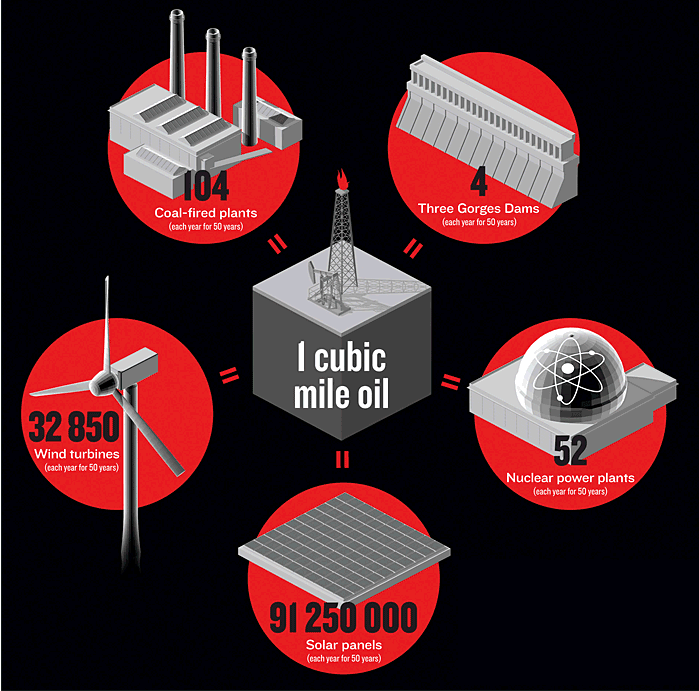
To replace just one year of world oil use (1 cubic mile) you’d need to mine, fabricate, deliver, and build 91,250,000 Solar panels every year for 50 years (Goldstein).

A PV plant that could produce 5.5 TWh of power (what the Glen Canyon dam produces) would displace an enormous ecosystem, about 20 square miles. It requires 177,788 MT (megatons) of aluminum, 2,222,356 MT cement, 480,029 MT copper, 7,556,010 MWh of electricity, and 4,600,276 MT of steel (Pacca).

Ted Trainer estimates that building a PV power plant would cost at least 48 times as much as building a coal power plant. 2003. Renewable Energy: What are the Limits?

Primary power consumption today is 12 TW, of which 85% is fossil-fueled. The electrical equivalent of 10 TW would require a PV array of 85,000 square miles, more than all the land in Kansas. Yet during the 16 years from 1982 to 1998, only 1.16 square miles of PV cells were producedAt that rate, it would take over a million years to produce enough PV cells. Existing grids could not manage the loads of this enlarged system since the current hub-and-spoke networks were designed for central power plants, close to cities (Hoffert).  85,000 square miles of land would be ruined for ranching, farming, and forests.  This would certainly have a huge environmental impact.  All of these 85,000 square miles needs to be constantly maintained and replaced as well.  Hail, lightning, tornadoes, hurricanes, floods and other natural disasters would further reduce their lifetime and increase the amount of energy required to keep them going.

Non-PV Solar Farms Can only be built in deserts

Deserts are usually far from cities, and require an enormous investment in electric grid infrastructure. Solar farms of any kind are vulnerable to high winds, hail, tornadoes, storms, hurricanes, and sand storms scouring the mirrors. Large amounts of water are needed to rinse off the mirrors. Howard Hayden estimates Solar Two would need to take up 127 square miles to produce as much energy as a 1000-MWe power plant does in one year (Hayden).

Source: Goldstein

Goldstein, H; Sweet, W. Jan 2007. Joules, BTUs, Quads-Let’s Call the Whole Thing Off. 2.1â”­kilowatt system made for home roofs are required.  IEEE spectrum.

Hoffert, M.I., et al. “Advanced Technology Paths to Global Climate Stability: Energy for a Greenhouse Planet.” Science 298 (November 1, 2002):981-987

Howard Hayden.  2005. The Solar Fraud: Why Solar Energy Won’t Run the World, Second Edition.  Vales Lake Publishing.

Pacca, S. 2002. Greenhouse Gas Emissions from Building & Operating Electric Power Plants in the Upper Colorado River Basin. Env Sci & Tech /Vol 36, # 14 3194-3200


Posted in Energy Infrastructure | Comments Off on Solar Infrastructure: Materials, Land, and Energy required

Oil Built Our Infrastructure Back When it was Cheap & Abundant

Most of our infrastructure was built many decades ago, when the energy returned on energy invested (EROEI) of oil was 100:1, and now it’s down to roughly 30:1 in the gulf, and much less elsewhere (at 10:1 civilization collapses).

What that means is that for every barrel, 100 more could be obtained.

The roads, bridges, energy pipelines, energy refineries, clean water pipelines, sewage treatment plants, harbors, railroads, power plants — you name it — are all falling apart.  The material to build them was mined, fabricated, and transported to the construction site when oil was extremely cheap and plentiful.

Additional oil is expended defending all of the infrastructure (and billions of combustion engines in cars, tractors, chainsaws) from pirates, terrorists, and other (potential) enemies with our vast navy, air force, and armies, which uses 2% of the United States fuel.

I don’t see any evidence that there’s enough oil to mine, fabricate, deliver, and maintain a combination of new energy resources such as an expanded electric grid, solar, wind, biofuel, or nuclear, and these resources certainly don’t have the enough energy to mine, fabricate, and deliver new materials to replace themselves.  (since all of these begin rusting the day they’re born, their lifetimes are typically 30 years or less).

Much of our infrastructure is a total waste, as Bent Flyvbjerg points out in “Mega delusional: The curse of the megaproject“.  Global spending on megaprojects such as the Olympic facilities in Brazil & Russia, defense, Information Systems, and so on is $6 to 9 trillion a year. What drives this enthusiasm in the face of repeated failure?

  • The rapture engineers and technologists get from building large and innovative projects that push the limits
  • Politicians love constructing monuments to themselves and their causes and these grand schemes are media magnets that give politicians more exposure.
  • Businesses make money, and lots of jobs are created for unions, contractors, engineers, architects, consultants, construction and transportation workers, bankers, investors, landowners, lawyers and developers
  • If it doesn’t work out, the taxpayer pays.
  • The public is tricked into approval by all the job creation, new services, and perhaps environmental benefits.  But this only happens if the project is done right.  Conventional megaprojects have terrible records in both cost and benefit.
  • Psychological factors keep the illusions flowing, such as uniqueness bias in terms of technology and design where managers to see their projects as firsts, so they don’t bother to learn from other projects.
  • Also there can be a lock-in at an early stage.   Former California State Assembly member Willie Brown described the cost overruns on the San Francisco Transbay Terminal as:  “The idea is to get going. Start digging a hole and make it so big there’s no alternative to coming up with the money to fill it in.”
  • A false sense of control is common and ignorance of potential “black swans” can bring on failure.
  • Last but far not least is the optimism bias which plagues cost estimates.
  • Reverse evolution: The projects that get chosen look the best on paper by underestimating costs and overestimating benefits.

The consequences are huge: they can damage a national economy.

The truly optimistic might even say that one day the word megaproject will no longer be synonymous with unexpected costs and questionable benefits.

Posted in Energy Infrastructure, Infrastructure & Collapse, Oil & Gas | Comments Off on Oil Built Our Infrastructure Back When it was Cheap & Abundant

Hurricane Vulnerable Gulf area Supplies Over Half our oil, One-third of our Natural Gas

Energy infrastructure is very vulnerable to hurricanes in the gulf region, which:

  • Produce or imports 60% of the country’s supply of crude oil
  • Supplies a third of U.S. natural gas supplies
  • Generates half of the United States refined products
  • supplies nearly all of the  the Gulf region, the East Coast, and most of the Midwest
  • The vast majority of the petroleum and natural gas products consumed in the eastern half of the country find their origin in markets, storage, processing, and pipeline capacity concentrated in Gulf states.
  • The sheer magnitude of fossil fuel operations in the Gulf make them the centerpiece of U.S. natural gas and refined petroleum product supply and pricing
  • Processes 75% of the dry natural gas in the USA at natural gas processing plants before injection into inter- and intra-state pipelines. Most of the natural gas processing capacity is located in the Gulf region.

Pipelines

The Midwest and East Coast are heavily dependent on deliveries of natural gas, crude oil and refined products via a few major pipelines emanating in the Gulf region. Loss of these pipelines meant the nearly full disruption of pipeline supply of gas, crude oil, and refined product to the consuming regions. Shut-in supply and refining/processing capacity, combined with the loss of electric power to key pipeline operation and support systems (such as compressor stations), dramatically reduced the flow of product out of the region.

Natural Gas

The hurricanes highlight a unique and timely infrastructure challenge relating to natural gas supply. This industry is on the brink of moving from a largely continental supply resource dominated by supplies from the Gulf, to one increasingly reliant upon imports of liquefied natural gas (LNG). On the one hand, this technology will provide flexibility and opportunities for diversification that do not exist with continental sources of gas. But unfortunately, existing proposals to site LNG imports are dominated by sites in the Gulf region. To some extent, this makes sense because the Gulf is a location of major natural gas processing, storage, and transportation infrastructure, as well as a region where domestic supply productivity is decreasing. The siting of LNG import capability in the Gulf can thus prolong the utilization of existing gas system infrastructure in that region. But if we end up siting most LNG regasification and storage capacity in the Gulf, we risk remaining in the kind of geographic dependency we have experienced for years.

Prices With the hurricanes coming on the heels of already tight oil and gas markets and refining capacity, prices shot up dramatically with the news of the storms in the Gulf. Prices stayed high, dropping gradually as capacity came back on line. More severe price impacts were avoided in part by lower-than-expected demand as the major gasconsuming regions experienced extraordinarily warm winter conditions.

PETROLEUM
Our dependence on the refined products of crude oil is pervasive – geographically, economically, socially, historically, culturally, and militarily. Oil goes into nearly everything we come into contact with in our daily lives – the production and distribution of food; the building, furnishing and heating of our homes; the wheels of commerce; the building and maintenance of roads and other public infrastructure and services; and work and leisure transportation. We are completely dependent on oil for work and play, health and security. The affordability of oil-based transportation fuels drives economic activity and provides the freedom of motion that is so important to Americans. This pervasive demand for oil – along with its relative inflexibility to price changes in the short run, and the lack of significant alternatives – remains our most important energy vulnerability.

Crude oil supply is only the first piece of the domestic oil infrastructure chain, which also includes critical refinery, storage, pipeline, and other transportation/delivery infrastructure. Each of these can have an important influence on delivered product supply and price conditions across U.S. regions.

Liquid Natural Gas (LNG)
While historically most of our supply of natural gas has come from domestic and Canadian sources, the productivity of this supply base is in decline, and the U.S. will become more and more dependent over time on the global market for gas to meet growing demand. But there are key differences in infrastructure vulnerabilities and challenges between oil and gas. Once gas is injected into the national or regional gas pipeline networks, it exits at the point of consumption. There is little or no opportunity for alternative transportation or delivery mechanisms in the event of major pipeline disruptions. This also means that as demand grows, pipeline infrastructure must also grow, and it must do so in a way that makes sense in the context of the sources of new demand and supply. Also, the level of reliance upon international markets for gas – through the addition of liquefied natural gas (LNG) import terminals in the U.S. – will be a new reality for our country. How (or where) infrastructure is developed to accommodate the needed increase in LNG to meet growing demand in the coming decades will significantly influence the vulnerability of natural gas consumers to supply disruptions and price spikes.

NATURAL GAS
In 2004 the U.S. consumed roughly 22.4 trillion cubic feet (TCF) of natural gas – 7.8 TCF (35 percent) in the residential and commercial sectors, 7.4 TCF (33 percent) in the industrial sector, and 5.4 TCF (24 percent) for electricity generation.13 U.S. production nearly matched that amount, totaling roughly 18.9 TCF – or 84% of U.S. demand – for the year. Most of the remainder needed to meet demand in 2004 was imported via pipeline from Canada.14 In recent years, the U.S. has met nearly all of its demand in this way via pipeline from continental sources of gas in the U.S. and Canada, with small (but important, particularly during winter peak seasons) contributions from existing LNG import facilities. For the future, EIA projects natural gas demand in the U.S. to grow to 26.9 TCF in 2030, with demand growth initially dominated by the electric generation sector, followed by a decline in the contribution of the electric sector towards the end of the forecast period. See Figure 14. This projected strong growth in demand for natural gas comes at a time of declining productivity for the conventional continental sources of natural gas supply. While recent drilling activity has increased substantially, the productivity of rigs drilled continues to decline on average. See Figure 15. EIA projects that in order to meet increasing demand for natural gas in the U.S., we will thus rely more and more upon non-conventional sources of gas, primarily from the Rocky Mountain region, and on imports of LNG.


Hibbard, Paul. March 2006. US Energy Infrastructure Vulnerability. Lessons From the Gulf Coast Hurricanes. Analysis Group.

Posted in Energy Infrastructure, Infrastructure & Collapse | Tagged , , , , , | Comments Off on Hurricane Vulnerable Gulf area Supplies Over Half our oil, One-third of our Natural Gas

Ozone Loss from Storms Increases Skin Cancer, Crop Damage

James G. Anderson, et al. 26 Jul 2012. UV Dosage Levels in Summer: Increased Risk of Ozone Loss from Convectively Injected Water Vapor. Science.

Climate change is increasing the number and severity of storms, which is depleting the ozone layer over the United States, allowing more ultraviolet (UV) radiation to reach the earth.

Impacts

Skin cancer has been increasing for some time now — there are 1,000,000 new cases of skin cancer in the USA every year, and it’s clear that some are due to ozone depletion.  Continued global warming and ozone depletion will  increase the amount of skin cancer even more.

UV damages the DNA of crops we depend on, like corn, wheat, rice, soybeans, and so on.

References – why and how this is happening:

26 Jul 2012. Climate Change Linked to Ozone Loss: May Result in More Skin Cancer. Science Daily.

Fountain, Henry. 26 Jul 2012.  Storms Threaten Ozone Layer Over U.S., Study Says. New York Times.


Posted in Ozone Loss | Tagged , , , , , | Comments Off on Ozone Loss from Storms Increases Skin Cancer, Crop Damage

How to Buy Homeowners Insurance #3 Is the Insurance Company Financially Strong?

After the 2008 financial crash, many insurance company ratings went down.  We’re far from the end of the financial crash, it’s been postponed by all the government spending and bank bailouts, but nothing has changed, much has grown worse.  So it’s more important than usual to see how financially sound the homeowners insurance companies sold in your state are.

www.ambest.com
A.M. Best Co.’s insurance company rating service rates 6,000 life, property/casualty and health companies according to their financial strength and ability to meet ongoing obligations to policyholders. Their opinions are derived from an evaluation of a company’s balance-sheet strength and operating performance as compared with Best’s quantitative and qualitative standards.

Weissratings.com Strongest Large Homeowner Insurers


Posted in Insurance What to do | Comments Off on How to Buy Homeowners Insurance #3 Is the Insurance Company Financially Strong?

How to Buy Homeowners Insurance #1 Determine the Value of Your Home

The odds are that your house is grossly under-insured. According to United Policyholders surveys, two-thirds of Californians who lose homes in wildfires are under-insured an average of more than $200,000. This is because the insurance companies don’t sell the necessary amount of coverage when you buy a policy.

Here’s how you can find out:

United Policyholders:

Why this is so important

Most homeowners now purchase replacement cost policies with “extended coverage” endorsements including inflation adjustments and code upgrade coverage.  These policies are far more expensive than Actual Cash Value policies, because they provide the insured the security of knowing they will have enough insurance proceeds to replace their home after a disaster.

If you don’t rebuild your home, the insurer will only pay the actual cash value, a lot less money than the replacement cost policy you paid for.

So it is in the interest of the insurance company to sell you too little insurance.  This is why United Policy Holders broght a case against the Association of California Insurance Companies — the court case is where the material in this post comes from.

Under insurance causes delays in the claims process, and often the homeowner can’t borrow an addition $200,000 to complete building a replacement house.

Calculating the cost to rebuild a home requires a complete review of the size, style, components and materials of the welling, as well as consideration of local market conditions.  The average homeowner has no idea what that cost would be, so they rely on insurance professionals to perform this estimate.  It’s absurd to suggest that every homeowner would hire a contractor every year to have his home value calculated. That’s way too expensive.  And even if a homeowner did this, it’s highly unlikely the insurance company would use a value determined by the insured.

Insurers use detailed software programs and other underwriting guidelines to determine how much insurance to provide.  They are in a much better position to come up with an accurate estimate of the needed amount of insurance than individual homeowners,who have no idea how to calculate construction costs or what the value of their possessions are in a total loss.

Very importantly, insurers must properly estimate the replacement cost or there will be too much of a temptation to lowball the amount of coverage needed, so they can pay the much lower actual cash value amount instead of the replacement cost coverage the insured paid higher premiums to receive.

It’s important for you to know that the cost to rebuild your home could be more than what it’s worth on the real estate market.

United Policy Holders won this court case.  So if you have insurance, you should ask for one of their employees to come over to give you a proper value for your home, as well as check out a new company with a higher financial rating (step #3) and most likely to actually pay you after a disaster (step #4).    And if you suffer a loss and are way underinsured, perhaps you could cite this case to show that there was a pattern of under insurance and that if the value of your home was calculated incorrectly, that’s the insurance companies fault.  But I don’t know if that’s a good idea, I’m not a lawyer (hiring a lawyer is the first step you should take after a large loss, (s)he’ll be able to tell you if that’s a good strategy).

Sources:

July United Policyholders What’s Up California. Association of California Insurance Companies V. Jones (2012) Court of Appeal of the State of California, Second Appellate District, Division One No. B239943

Posted in Insurance What to do | Comments Off on How to Buy Homeowners Insurance #1 Determine the Value of Your Home

How to Buy Homeowners Insurance – Introduction

After the final financial crash, insurance may not be available for a while.  Most if not all insurance companies will be broke.

But meanwhile, you can’t afford to have major debt.  In a deflation, being in debt is catastrophic, you could end up homeless, hungry, or not be able to get health care at the bottom.  At this point, you can’t afford to have a major disaster that’s uninsured.  If you lose your home, you still need to pay the mortgage, property taxes, PLUS rent.

It’s always a good idea to shop around for insurance every few years, it’s saved us thousands of dollars and we’ve gotten better coverage too.  Often the best deal is to get homeowners, auto, (earthquake) and an umbrella policy with the same insurer.

Here are the steps you need to go through to

#1 Determine the value of your home

#2 Which Companies are best?

It’s time to look at your insurance coverage again to see if the insurance company is A++ rated (has enough money to pay you after a major disaster), and whether they are likely to pay you at all even if they can.  See my review of the book “Delay Deny Defend” and the post “After Future Disasters, Less Recovery” for details.

I am going to give you some ideas and resources about how to choose good homeowner’s insurance, and you can apply many of these methods or ideas to health and other kinds of insurance.


Then you need to go to A. M. Best to see what their financial ratings are so you can know if they have the money to pay you as the financial crisis worsens.

Posted in Insurance What to do, What to do | Comments Off on How to Buy Homeowners Insurance – Introduction