Preface. This is a book review of Newman’s 2022 “Things are never so bad that they can’t get worse”. He lived in Venezuela from 2012 to 2016 as a correspondent for The New York Times. Venezuela and Canada have the largest remaining oil deposits in the world. But Venezuela’s oil infrastructure is so gutted, corroded, and falling apart estimates are it would take 100 to 200 billion USD to restore, hard to do in a corrupt violent environment.
Newman might say Venezuela hasn’t collapsed yet. The lights are on in the wealthiest parts of Caracas, Maduro is still in power, and there is money to be made from gold and other resources. When I read what the average person is going through, it sure seems like collapse to me — one meal a day of rice or lentils for most, little to no access to health care, and preyed on by gangs and death squads. Hell on earth.
Newman writes that from 2013 through 2019, nearly two-thirds of all economic activity disappeared. Almost 8 million Venezuelans have fled (roughly 29 million remain), more than the 7 million in Ukraine.
It’s hard to imagine how Venezuela could get worse, but since there are still people making money off the status quo, mafias fighting over the tiny pieces of the remaining pie, and high levels of corruption persist, Venezuela hasn’t hit rock bottom yet. The central government is made up of competing circles of power. At times some factions work together against other factions, but always for their own survival. That’s why when the electric grid crashed, fixing it was not the highest priority, the division of the spoils comes first. In 2022 Newman writes, Venezuela is still a giant piñata for those in a position to swing a stick at it.
I was constantly reminded of Trump. For example, Chavez was on television almost every day. From 1999 through 2012 he took over the airwaves 2,377 times to taunt and skewer opponents, delight supporters and infuriate enemies, making his fans love him even more. On one show he fired essential employees who worked for oil company PDVSA, reading off a long list of names. When he was done, Chávez picked up a whistle and blew a sharp blast. Offsides!” he said. “Get out!” Chávez’s fans loved it. They cheered. They clapped. Did you see what he did? He fired them on TV! He fired them with a whistle! He showed those elite sons of bitches who’s boss.
Chavez and Maduro hired many generals to positions they knew nothing about but for which there was a great deal of graft, weakening the oil, electric grid, and other institutions. This made them less likely to instigate a coup as well. So I have to wonder why Trump appointed four generals, more than anyone since Was he already anticipating a coup in 2016 and wanted to make sure the military would support him?
Alice Friedemann www.energyskeptic.com Author of Life After Fossil Fuels: A Reality Check on Alternative Energy; When Trucks Stop Running: Energy and the Future of Transportation”, Barriers to Making Algal Biofuels, & “Crunch! Whole Grain Artisan Chips and Crackers”. Women in ecology Podcasts: WGBH, Jore, Planet: Critical, Crazy Town, Collapse Chronicles, Derrick Jensen, Practical Prepping, Kunstler 253 &278, Peak Prosperity, Index of best energyskeptic posts
***
American policy during the Trump regime
American policy toward Venezuela and Cuba became intertwined. Cuba hard-liners believed that Venezuela had saved the Castro regime by offering it a lifeline of cheap oil. So the Cuban American lobby believed that if it could force a change of government in Venezuela, Cuba’s source of oil would dry up and Cuba and Nicaragua would fail too. The U.S. began taking actions to do that despite greatly harming the well-being of Venezuelans. And contributed to the 5.4 million of 30 million Venezuelans who fled.
Meawhile, Venezuela as buying weapons from Russia and given Russia generous and lucrative participation in its oil fields.
The only country with more refugees than Venezuela is Syria, a nation failing from both severe drought and civil war. The thread that linked both countries was Russia, which backed Venezuelan President Maduro and Syrian president Bashar al-Assad, bombing rebel areas in Syria’s civil war and catalyzing the Syrian refugee crisis. The flood of Syrian refugees into Europe heightened political stress there and energized the right-wing nationalist parties friendly to Russia. Likewise, millions of Venezuelan refugees destabilized neighboring countries and increased nationalism in Brazil, Colombia, Ecuador, Panama, Peru, and other countries.
So I can’t help but wonder if Russia doesn’t intend to further increase right-wing populism in Europe by forcing millions of Ukrainians to flee.
Sanctions also had a political dimension. Maduro had been saying for years that the country was under attack in an economic war waged by the United States. Playing the victim was always a Chavista fallback—the nation’s woes were always someone else’s fault. After 20 years in government, Chavismo still tried to pretend that it was the valiant outsider fighting the evil establishment. In this case, it was also a way of deflecting responsibility for bad economic policy. And it was a fantasy—until Trump made it a reality. What are sanctions if not economic warfare? Every day, on television, radio, social media, the government hammered away at the message: Venezuela was the victim of an economic war by the United States. And who are they putting the sanctions on? The people. Because the big shots, Maduro and Guaidó, they’ve got food to eat. So who do the sanctions hurt? The people.
Through negligence, corruption, and mismanagement, the Maduro government presided over the destruction of the oil industry. The Trump administration’s sanctions were the coup de grace.
Today Venezuela is a Republican Dream
Newman explains why Venezuela in 2019 fulfills the Republican dream: “Some call Venezuela a failed state. Others call it a mafia state. But it is neither. It is a state reduced to the absolute minimum. Maduro had started the process, and the Trump White House had helped him carry it to perfection. In the United States the Republican dream was to starve the beast, to cut government financing so deeply that most of the things that we expect a government to do become impossible. Then theoretically society and private initiative can flourish, unencumbered. This was Venezuela. There were almost no services, no fire trucks, no ambulances. Public hospitals and clinics barely functioned. People were on their own, left to fend for themselves, free to exercise personal responsibility.
The irony was that Republicans in the United States considered Maduro their enemy. They should have been applauding him. He was a fellow traveler.”
Venezuela in the news:
Reuters (2022) Cuba is struggling to cover a fuel deficit as imports from Venezuela and other countries decline and global prices boosted by Russia’s invasion of Ukraine make purchases almost unaffordable. Cuba is dependent on fuel imports from Venezuela to cover 75% of its demand, shortages have led to long lines at gas stations. And aging thermoelectric plants are failing more often as well. https://www.reuters.com/business/energy/cuba-struggles-buy-fuel-imports-venezuela-dwindle-data-2022-04-05/?mc_cid=7860bc0677&mc_eid=20e9bfe034
Stone R (2022) Healing Venezuela. Science 375: 1082-1085. Malaria cases rose 20-fold from 2001 to 2017. Hugo Chavez disdained science and railed against intellectuals. After Maduro took power in 2013 economic collapse soon followed and there’s been a brain drain as scientists fled. Those stuck in Venezuela have seen their labs stripped of anything of value. Criminals pillaged the Institute of Tropical Medicine over 20 times in 2016 alone. Now Venezuelans are in survival mode with most lacking access to water and sanitation, medicine is scarce, and in 2014 the government shut down all medical data collection, so the true scope of this ongoing disaster isn’t known fully. What little medical care exists is private near elite clientele who still have electricity and clean water. A September 2021 survey found 77% of Venezuelans are living in extreme poverty. High prices allow most families to buy only a few days’ of food every month.
Alice Friedemann www.energyskeptic.com Author of Life After Fossil Fuels: A Reality Check on Alternative Energy; When Trucks Stop Running: Energy and the Future of Transportation”, Barriers to Making Algal Biofuels, & “Crunch! Whole Grain Artisan Chips and Crackers”. Women in ecology Podcasts: WGBH, Jore, Planet: Critical, Crazy Town, Collapse Chronicles, Derrick Jensen, Practical Prepping, Kunstler 253 &278, Peak Prosperity, Index of best energyskeptic posts
***
Newman W (2022) Things Are Never So Bad That They Can’t Get Worse. St. Martin’s Press.
Venezuela’s first oil well was drilled near Lake Maracaibo, in the far western state of Zulia in 1914 and is still pumping oil in 2014. The first oil workers’ strike occurred here (and was put down here) in 1925. In 1976, during the country’s first petro-delirium, when oil prices quadrupled, President Carlos Andrés Pérez came to Mene Grande to declare the nationalization of the oil industry. Three decades later, in the midst of an even bigger boom, President Hugo Chávez came here to announce a second nationalization, changing the terms by which foreign oil companies operated in Venezuela and giving the government a controlling stake in everything that happened in the oil fields. The word mene, in the name of the town Mene Grande, comes from an indigenous word for oil seep, a place where oil bubbles up naturally from the earth. That is typical of Venezuela’s oil.
The oil surges up, and over time it congeals and becomes a mound of something like tar or asphalt. Behind the tricolor park with the first oil well was a barrio, tumbling down the back of the hill, where people lived in hovels. Wandering around the barrio, I came upon a woman who was probably in her thirties or forties, but she looked twice that age. Her bones showed under the skin of her arms. She wore a housedress so threadbare that it was almost sheer, and whatever color it once had was gone. She seemed faded too in the white-hot sun, bleached instead of burnt or tanned. She lived in one of the worst hovels I’d seen in Venezuela or anywhere else, a teetering collection of corrugated metal, cardboard, and wood. The most striking thing of all was that it had been assembled on top of a mene. Shiny slicks of oil stained the earth all around. To keep themselves out of the muck, the woman and her family had built up a kind of midden, maybe three feet high, from chunks of hardened oil residue and debris. It was like a big, broad pitcher’s mound with a shack on top. Using a rectangular metal can for a stool, she sat in front of her hovel, on top of this mound of oil in its various states of coagulation,
before the crisis, before the collapse, before hyperinflation, before the bottom dropped out from under the price of oil, there would have been three or four operators watching the computer screens in the central control room in Caracas that monitored the electrical grid for all of Venezuela. In March 2019 there was just one man in Venezuela in charge of making sure that there was a smooth flow of electricity to every city and town and millions of homes and businesses, with their air conditioners, refrigerators, televisions, and appliances, and all the airports and seaports, government offices, oil wells, refineries, and everything else in the country that used electrical power.
Venezuela has one national control room because the country is composed of a single integrated power grid. About three-quarters of Venezuela’s electrical generating capacity resides in three large hydroelectric plants in the far eastern part of the country, in what is known as the Guayana sector. Those generating plants provide virtually all the power used in Caracas and a large portion of the electricity used in Maracaibo, Venezuela’s second- largest city, all the way across the country, close to the western border with Colombia.
He’d watched his coworkers disappear. Your salary wasn’t enough even to buy food for your family. Some drifted off to find other work in Caracas. Others had taken jobs with electrical utilities in Chile or Colombia or Ecuador. But Darwin and a few colleagues had stayed. No one wanted to leave Venezuela. Your people were here—your family, your parents, your friends. It was the life you knew.
On any given day, all sorts of things could happen—a brush fire under a transmission line could cause a spike in current, a transformer could blow—and then you had to think and act fast. And if it occurred at peak consumption, you had to scramble to keep power flowing. It was like being the pilot of a jet plane when an engine goes out in flight. You had alarms going off and split-second decisions to make. These days the whole system was under strain, held together with chewing gum. Equipment was going longer without being replaced; less maintenance was being done.
On March 7, 2019, Darwin was less than halfway through his 24-four-hour shift when a series of alarms flashed on the screens in front of him. Power had gone out all across the country. From one moment to the next, as though someone had thrown a switch, all of Venezuela had no electricity. In some places it would stay out for five days. Millions of people would run short of food and water. Hospital operating rooms went dark. Banks and grocery stores couldn’t function. In a few days the looting would start. Two weeks later the lights would go out again. And then again less than a week after that. And again in early April. The system was falling apart.
Night had fallen, and the valley of Caracas lay before him, plunged in blackness. There was no twinkle of a thousand bare lightbulbs in the shantytowns climbing the hillsides, no lights from the giant housing blocks, no yellow glow from the wealthy enclaves to the south, no lights in the middle-class neighborhood that spread out below his window, no tangerine-tinged streetlamps. There was only darkness. The headlights of cars slashed white channels through the night, but that only seemed to accentuate the blackness all around.
In 1989, I was living in Mexico City, and I watched on television as Caracas was swept by riots and looting. Police and soldiers opened fire on the looters and hundreds of people were killed. My Mexican friends were stunned. For them, Venezuela was a place apart, a country touched by the blessing of wealth. Mexico had oil too, but nothing like Venezuela. La Venezuela Saudita, people called it: a Latin American Saudi Arabia. The chaos on television belied all that. It was like the crushing of a dream. The riots exposed Venezuela as a hollow fantasy—a pretty bauble on the outside, with rolls of money and shopping trips abroad, while inside, there was pulverizing poverty, a familiar tale of debt, mismanagement, pauperism, and corruption.
By the time I moved to Venezuela, as a foreign correspondent, in January 2012, the country was deeply divided. You could say that division is what defined it. Pro-Chávez versus anti-Chávez. Poor versus well-off. Red T-shirt versus any other color T-shirt. You were for or against. On one side or the other. The division was obvious everywhere I went and in nearly every conversation
People were talking across one another, over one another; they were full of anger and incomprehension; they’d given up trying to understand one another. They were frustrated and pissed off, and when they talked about it, the words often came out at top volume. The causes of the division were historical, but the rift deepened with Chávez. He had mined it and encouraged it until it became part of the landscape, something that people took as a given.
Each of them was shouting so loud, and with so much intensity, that they couldn’t hear what the people on the other side of the street were shouting. Meanwhile, the street itself was a ruin, full of potholes and debris and trash. And no one cared. All they wanted to do was keep shouting at one another.
Life in a collapsing nation
“Those days seemed like years,” Marlyn Rangel told me. “You didn’t know what day it was. To make things worse, without electricity you couldn’t charge your phone. So you didn’t know what time it was. Or the day of the week. You didn’t even know the date. You were isolated. There was no news. No TV. No radio. No cell phone signal. No data plan. No internet, no social media. No one from the government ever came to say what was going on. The government never sent water, never sent food or medicine. No police officers, no firemen, no rescue workers, no one to tell you what was happening and how long it would last. You were on your own. Alone, you and your family and your neighbors, every neighborhood an island surrounded by silence and darkness. The city an archipelago.
In Maracaibo, the country’s second-largest city, with nearly 2 million people, where Marlyn lived, the power stayed out for five days. And it didn’t come back on all at once. Some parts of the city were without power for longer periods of time, and in some areas it returned, only to go out again.
And as the days go by and there is no power and no news, you start to wonder: What if it doesn’t come back on at all? And then the food runs out. Or it spoils in the heat. And you have no cash (hardly anyone has cash anymore, because on top of the shortages of food and medicine, there’s a cash shortage). And without power the bank machines don’t work. And the stores can’t sell you food because the card readers don’t work. And it’s over 90 degrees. And there’s no air conditioning. And there’s no running water. And you can’t bathe.
In Maracaibo, the residents had been coping with blackouts and electrical rationing for more than a year before the big blackout hit, already desperate since 2017. Power would be shut off for about four hours a day, in different areas at different times, to ease the overall load on the grid.
Eventually rationing increased to about six hours a day. Over the next few months, it would fluctuate, sometimes longer, sometimes shorter. The schedule was erratic: you never knew when your turn would come. It was like a giant behavioral experiment to see how hundreds of thousands of people would react in an environment of increasing uncertainty and stress.
Maracaibo and the rest of Zulia state are at the far end of the nation’s power grid, almost as far as you can get from the big hydroelectric plants and still be in Venezuela. Yet they are reliant on those plants for most of the electricity they consume, which has created chronic problems. The state has several thermal generating stations, which operate on natural gas or diesel fuel. If they are operating at full capacity, they can provide nearly enough power to satisfy local demand. But most of those plants are either shut down or barely functioning.
During 2018, Nataly counted a total of 25 blackouts, some lasting just two or three hours, some more than a day. The longest blackout in 2018, in August, lasted three days. After that, the rationing became more intense: many people would go without electricity for up to half a day at a time. Toward the end of the year, it improved, and on some days there might be no rationing at all. Then it became worse again, and by February some areas of the city would be without power for up to sixteen hours a day.
You might think that the frequent absence of electricity would be conducive to better sleep—no lights to disturb you, no TV to watch, no bars or clubs to go to. But Maracuchos in general wear the irritable, beleaguered demeanor of the sleep-deprived. And it’s easy to see why. They spend nights in their cars, waiting in line to buy gasoline. They have to wake up in the middle of the night when the water suddenly comes on (often after weeks without running water), at which point they set to work filling tanks, washing clothes, bathing.
Without electricity there’s no air conditioning. Maracaibo, where the average high temperature every month of the year is over 90, and the nights are hot and full of mosquitoes. Most air conditioners sit like an outsize brick in the window because they burned out in one of the countless power surges. So people stay in their sweltering rooms with the windows closed against the bugs, tangled up in the clammy sheets, or lying outside in a hammock, sweating and slapping at mosquitoes.
Many refrigerators have been burned out by power spikes following the blackouts and brownouts, so people were caught unprovisioned. They had no food to last them till the power came back on. There was a day or two when the merchants were giving away perishables, like meat and dairy products, because they started to spoil. After that there was nothing at all.
On the fourth day of the blackout, Marlyn’s family ate the last of the food they had in the house: spaghetti with nothing on it. They had no dinner Sunday night and no breakfast Monday morning.
For a long time, people had been living day to day—money was short and food was so expensive that you couldn’t buy more than you needed for that day or maybe the next. I was in many houses in Venezuela in 2019 where you opened the kitchen cupboard and there was nothing inside, not a can or a crumb.
Venezuela used to be a land of plenty. People would say that to me all the time: We’re a rich country, we have oil. During the Chávez years, the country filled up with oil money—oil was over $100 a barrel—and these people who were going hungry now used to eat three meals a day and had enough money to take their kids to the movies or to the beach or to a fast-food restaurant. Now many people were eating just once or twice a day, and what they were eating was lentils. Maybe some rice or pasta. Tomorrow existed only as a doubt: What will we eat tomorrow?
People slept poorly or not at all; they didn’t bathe; they didn’t eat much, and what they did eat was mostly cheap calories: pasta, rice, lentils, with few fruits and vegetables and little protein.
They lived attenuated lives whose limits and constrictions were set by the irregular comings and goings of electricity, water, phone service, the internet, food, cooking gas, gasoline. It was all out of their control, a constant reminder of the power and the incompetence and the arbitrariness of the state. And of your own state of uncertainty. People became accustomed to just scraping by, putting up with what would have been unthinkable a few years or even a few months earlier. When power first started to go out, people were indignant. Now they hardly reacted. They used to have reliable running water. At first, when the water went away, people protested. Now they woke up in the middle of the night every few weeks when the water sputtered on and started washing clothes
The way Venezuelans talk about it, electricity is given and taken away. The government gives electricity just like it gives boxes of food or houses. And like gasoline, electricity is so cheap it might as well be free. With the devaluation and hyperinflation, the government electric company had essentially stopped charging customers. Whatever it might receive in payments wasn’t worth the cost of processing them.
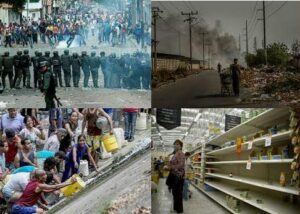
People would stand in line for hours to enter supermarkets where they would buy whatever was on the shelves. Outside a large supermarket in El Tigre, I came upon a line of hundreds of people. They stood pressed one against the other, front to back. Stranger against stranger. They said that it was to keep people from cutting in line. There was something horribly dehumanizing about it, the way every person was squeezed between the person behind and the person in front. The desperation of it.
The residents of Santa Teresita were angry and afraid. They were afraid of the police and they were more afraid that the police would send the colectivos—the armed motorcycle gangs that served as the government’s shock troops. They were afraid that the colectivos would come and that there would be violence. People crowded around me. They saw that I was an American, a journalist. “When are the Marines going to come and overthrow Maduro?” someone said, a voice in the darkness. “You tell Trump we’re waiting for him,” said another.
Invasions come with casualties, I said. They don’t always go as planned. People are dying anyway, a man said. That’s right! A woman jumped into the conversation and they talked over one another: People are dying from hunger, being shot in protests, dying for want of medical care.
A woman told me that she’d just returned from a trip to Colombia, and at the border, Venezuelan National Guard soldiers stole the medicine she was bringing home: antibiotics, and drugs for high blood pressure and diabetes.
People told me about the arbitrariness of electricity’s coming and going, of the uncertain water supply. It robbed you of your sleep. That was the worst. Normally you slept with the air conditioner on. But without power, in the heat of Maracaibo, you had to leave the windows open or sleep outside, and the mosquitoes wouldn’t leave you alone. You could wrap yourself up in a sheet, but then you felt like you were suffocating and still you couldn’t sleep. On top of all that, you were on edge all the time. You were worried about your family, your neighbors.
A man listening to us broke in: “We’re the walking dead here!” “They’re killing us slowly,” Alejandro said. “We’re like zombies!” said a short, wiry woman with thin bare arms. Her words came out in angry, repetitive bursts. “They’re killing us! No food! No electricity! We’re going to disappear! Any day now!
The people here took care of one another. One woman had a mastectomy last week. Another suffered a stroke. Their neighbors checked in to see how they were doing. One family had two children with special needs. The woman who’d had the medicine stolen was bringing some back for a neighbor. But the neighborhood was emptying out. “Those folks over there went to Ecuador. The ones next door went to Peru. We’ve gone backward, to before the Second World War. To 1910. We’ve gone so far backward.”
One man survived out in the country raising rabbits to eat and sell. Everything was difficult: getting food for the rabbits, transporting the rabbits. He’d be stopped at a checkpoint and the soldiers would steal the rabbits. He lived in a shack with a tin roof and a dirt floor, cooking on a wood fire.
Middle-class people were spending the savings they had in dollars and wondering what to do when they ran out.
The farther you went from Caracas, the worse things were. And the worst of all, everyone said, was Maracaibo. If in some parts of Caracas you could squint your eyes and pretend that the world was normal, in Maracaibo, you could open your eyes and imagine that you’d arrived in the zombie apocalypse. The city felt depopulated. At least half the stores and businesses we passed were shuttered. There was no traffic, but there were long lines of cars at the gas stations, perhaps more than driving on the streets. A line of people waited at a bank for their turn at the cash machine. The daily withdrawal limits hadn’t kept up with inflation, so you could take out only enough money for a single bus fare. You had to come back the next day to withdraw the return fare. Parts of the city had no electricity because of the power rationing. If there happened to be other cars at an intersection where the traffic signals were out, you’d play chicken to see who would go first. Some drivers would cruise right through. Others would ease into the intersection, hesitating, foot on the brake.
Gas shortages had been chronic for years, since before Chávez, but as was true with everything else, it was much worse now. Mostly these days, there was no gas to be had. Then, when the gas arrived, you had to wait in line for hours, perhaps all day, to buy a cylinder. That was at the government price. You could probably find a cylinder on the black market, but it would cost more than a month’s wages.
The author went to a firehouse to tell them about a pickup truck on fire, where just two firemen and no vehicles remained. Not even a car. At one time there’d been 6 ambulances and several fire trucks. Now there were no ambulances at all and just one fire truck for the entire city at another firehouse.
By the start of 2020, Venezuela’s healthcare system was barely functioning. Close to half of the country’s doctors, some 30,000 of them, had emigrated. Medicines were unavailable or in short supply. Hospitals frequently had no electricity or running water. Equipment was out-of-date or broken. People were leaving Venezuela, not going there. At first it seemed that there were few cases of Covid-19. But it was only a matter of time. People who live day to day and have no food at home can’t stay inside for weeks or months waiting for the pandemic to subside. They have to go out and make a few bolivars to buy food. And people who have no running water and no soap can’t wash their hands. So while Covid was slow to take off in Venezuela, its spread inevitably accelerated.
By now authoritarianism had become a vocation and the government criminalized infection. Venezuelan refugees returning from other parts of Latin America were labeled as bioterrorists, intentionally bringing infection back to the country. The government strictly controlled the number of returning refugees allowed to reenter the country, forcing hundreds to wait at the border on the Colombian side. Returnees were placed in quarantine facilities, in crowded conditions, without basic hygiene or adequate food or attention. The government acted aggressively to control information as well. It began arresting reporters and medical personnel who posted information on social media that questioned or contradicted the official data. Doctors and nurses who questioned the readiness of the healthcare system or the government’s low case counts were intimidated and harassed.
Without cooking gas, people built wood fires using scraps of wood in the street or going up hills with trees or underbrush.
Looting
The looting started in Maracaibo late on Sunday, the fourth day of the blackout. The looters broke into a pharmacy and then an upscale mall. People were going down the street carrying packages of corn flour, rice, and pasta. In Marlyn’s house they hadn’t eaten since the day before and now food was literally walking past their door. La Curva was always a busy place, but Marlyn had never seen so many people there. They’d broken through the metal pulldown gates in front of the shops. People would run in, desperate to get their hands on something, anything. There was a chemistry in the air, almost a smell, you could sense it: desperation, adrenaline, a fever. It scared her. Suddenly Marlyn heard gunshots and she ran.
A group of men with guns stood outside a variety store called Todo Regalado (Everything Cheap), and they’d fired into the air to keep the looters back. But this was the only store that was protected. All around, the other stores had been ripped open and people were swarming in and out. The crush was so bad at some of the stores that many people couldn’t get in. When that happened, the people outside would start to shout, “Guardia!”—pretending to warn the looters inside that the National Guard had arrived. Scared of being caught, the looters inside would rush out. And then the people waiting outside would run in to take their places.
“It was like a game,” Marlyn said. “‘Guardia!’ Run out. Run in. Out. In. Out. In.” But there were no police, no soldiers. “It was absolutely out of control. The stores were like dark caves. There was broken glass, jagged metal. People were bleeding. Marlyn was too scared to go inside. “I felt like I was about three feet tall, like a hobbit. Everyone else seemed like giants, and if I went inside, I’d be crushed. She found a safe spot from which she could watch the parade of looters. People were taking more than food: electric fans, tables, chairs, a bed, blenders, pressure cookers, shoes, clothing, and even the shelves from inside the stores.
Later in the day Marlyn and her family followed the crowds to a warehouse. Inside there was a bonanza: pallets of food stacked to the rafters. This time Marlyn was determined to go in. But Andrés pulled her back. He was afraid she would get hurt. The boys went inside and soon came out loaded with treasure. Sacks of pasta, a case of canned deviled ham, laundry detergent, toilet paper, catsup, and a box of caramel candy. The boys dropped their booty and went in for more. Marlyn sat on top of the pile like a robber princess. They came out again with more stuff and now decided to head home.
“Morality, your sense of right and wrong, everything you learned when you were little, everything they taught you when you were growing up, everything they teach you in school, all the way up to college, was completely lost,” Marlyn said. “Why? Because people got to a point where they couldn’t think past tomorrow. What are you going to eat tomorrow? That’s the only thing that they have in their head anymore. No one cared about anybody else. If you die from hunger, what do I care, as long as I’ve got food. There’s no more lending a helping hand. People here, we have a tradition of helping each other out. If you come to my house: ‘Here, have some coffee. Do you want something to eat?’ People don’t do that anymore. You wait for the person to leave before you sit down to eat because you haven’t even got enough for yourself.
I didn’t have food. What was I going to do? Of course, everyone has their own conscience, everyone has their own way of thinking, every head contains its own world, but at the end of the day that’s what it was: I had food on my table that night. But what did that do to me? What about my conscience? Where was I? Where was Marlyn Rangel at that moment? I didn’t know her anymore.
in Maracaibo thieves stole the telephone wires that provided landline and internet service. The wire was made of copper, and the thieves sold it to scrap dealers. As a result, there was no internet.
On Sunday, looters cleaned out the Pepsi warehouse. On Monday, they looted Makro. On Tuesday morning the first looters showed up at a hotel. They broke a hole through the cinder-block wall at the back, backed up a flatbed truck and started loading it up. They knew what they were doing. A crew of looters went to the roof and removed the hotel’s four large air-conditioning units. Each one weighed hundreds of pounds. Word started to get around: They’re looting the hotel! More and more people showed up. The few hotel employees who had been able to make it to work that day fled before the wave of looters.
People were swarming over the hotel building, the grounds, the outbuildings, the cabañas, like ants on an anthill. People were running every which way. It was bedlam. A man whacke an electrical transformer mounted on a concrete pad with an axe until he broke through the steel shell and oil spurted out. Windows exploded as people smashed them, and on upper stories, men shoved mattresses out the windows and let them fall to the ground. Cars drove out loaded with loot. Others drove in to take their place.
In the midst of all the mayhem, people were acting like everything was normal. Looters went in and out, as casually as guests. Cars drove by on the main road, not fast, not slow, as though this were just another day—cars, a road, people, a hotel, destruction. The cabañas were stripped down to the studs. The roofs were gone, the doors, the windows, every toilet and sink and plumbing fixture, every inch of pipe, all the furniture, the wiring, the light switches. Every piece of equipment was gone from the restaurant: freezers, refrigerators, stoves, ovens, a fryer, dishwashers. The granite countertops from the bar had been pried up, the tables and chairs carted off, not as much as a spoon was left. The furniture was taken from the lobby. The computers were stolen from the front desk and the office, and everything else too, down to the staplers and the paper clips. The carpets were pulled up and the ceilings pulled down. All the copper wiring and the copper pipe was stripped away, as well as anything made from aluminum. The floor was littered with chunks of plaster and broken ceiling tiles. Ductwork and conduits hung down through great gashes in the ceiling. The looters had taken the doors from the rooms and the closets and the bathrooms, and when they couldn’t open a room, they broke the door down with an axe. Inside the rooms, all the furniture was gone—beds, mattresses, tables, chairs, lamps. All the fixtures were missing—sinks, shower heads, even the toilets. What they couldn’t take, they broke: windows, mirrors. The tan wallpaper, painted with white dogwoods, was scarred with holes where they’d pulled out the electrical sockets and the light switches.
The Government & Oil
What’s distinctive about Venezuela is that its economy revolves entirely around oil. The government owns the oil in the ground and receives money from oil sales. The effect of that is to put the government at the center of economic life. And the government’s main function becomes the distribution of the oil money to its citizens. This accentuated an existing tendency toward a highly centralized government with a powerful executive. Because an extreme amount of power (both political and economic) was concentrated in the government, an outsize amount of power was put into the hands of the president. And because there was always money from oil flowing in, the government never developed a strong tax base outside the oil industry. Income taxes, value-added taxes, property taxes, sales taxes—all were either nonexistent or charged at lower rates and with lower rates of participation than in other countries in the region. The Venezuelan state came to be viewed primarily as an enormous distributive apparatus, a huge milk cow that benefited those who were able to suckle at her teats.
And since distributing oil money was the main function of the state, it developed a patron-client relationship with the citizenry, whereby each constituency lined up to get its slice of the pie. Labor unions got a big bureaucracy with a large workforce and state-owned companies that hired more workers than they needed. The business community got state contracts and subsidies, including low-interest loans and reductions or exemptions to the already low taxes. Old people got pensions. Poor people got housing. The middle class got access to cheap dollars that subsidized trips abroad. Everyone got cheap gasoline, sold at some of the lowest prices in the world. And while governments in every country offer some or all of these benefits and pork directed at preferred constituencies, Venezuelans came to view them as essential attributes of citizenship—regardless of whether oil prices were high or low. It was like belonging to a special club—you expected all the good stuff and being born was the only dues you had to pay.
Chávez
Chávez was deeply conservative in an essential way. His discourse was aimed at the past more than the future. It was about recapturing a golden age, returning to an imagined greatness that never really existed. Like no other politician, Chávez lived and governed on television, by television, for television, cutting out the middlemen of the press and speaking directly to his supporters, the ones he chose to call “the people.” This was true from the very first moment that he burst into the cognition of his fellow countrymen to the very last time they saw him, live on television, 20 years later,
Chávez visited farms and factories; he rode horses, took walks, drove tractors. He sang. He danced. There were musical acts. There were special guests (Fidel Castro, President Daniel Ortega of Nicaragua). It started every Sunday at eleven A.M. but you never knew when it would end. It might last four hours or eight. He was on television almost every day. He broadcast cabinet meetings and speeches and tours of public works projects and trips abroad. He frequently commandeered the airwaves, breaking in and preempting the programming on all broadcast television and radio stations. From 1999 through 2012 he took over the airwaves in this way 2,377 times, for a total of 1,695 hours on the air. The whole critical mass of Venezuelan society had to watch the program, whether you were for Chávez or against him. All the heads of institutions had to watch because you never knew if he was going to call you, you never knew what he was going to come up with, you didn’t know if he was going to give you a direct order.
He would taunt and mock and skewer his opponents, at home and abroad. He would make announcements that his supporters knew would enrage his enemies, and because of that, they loved him even more.
In April 2002, Chávez used an TV to carry out a shake-up at PDVSA. He’d been in a long-running battle to increase his control over the government-run oil company, and a few weeks earlier he’d named several new members to its board. Ever since, the company’s workers and executives had been in revolt, staging protests and reducing production at wells and refineries. It was a test of wills—a defense of PDVSA’s independence from politics and a challenge to Chávez’s authority as president. Chávez took to the air and announced that he had a list of PDVSA executives that he’d decided to fire. When he was done, Chávez picked up a whistle and blew a sharp blast. “Offsides!” he said. “Get out!” Chávez’s fans loved the whole thing. They ate it up. They cheered. They clapped, on screen and at home. Did you see what he did? He fired them on TV! He fired them with a whistle! He showed those elite sons of bitches who’s boss.
This was in 2002, two years before Donald Trump would make entertainment out of firing people on TV. Chávez beat him to it.
If Chávez was visiting a farm and there wasn’t any livestock, the producers would truck in cows and release them in a pasture behind the comandante. Idle factories would receive the materials or equipment they needed to produce. His TV show was a televised Potemkin village—a stage set created for Chávez and the viewers that showed a shinier, more prosperous Venezuela than the one that existed. Chávez generally wasn’t in on the deception.
Oil prices were high and the government ramped up spending. It built thousands of apartments and houses and broadcast weekly televised giveaways, like game shows, where Chávez presented grateful families with the keys to their new homes. It spent millions to import washers and dryers and televisions and cars, which it gave away or sold at subsidized prices.
Chávez was a populist. The point of government for was staying in government. The point of power was staying in power. It wasn’t using that power to improve lives or make the country better in a lasting way. To the extent that any of those things were attempted, the attempt was made with a different end in mind: Would it help him stay in power? The core claim of populism is this: only some of the people are really the people. There is no more succinct description of Chávez’s 14 years in power. Populism, according to Müller, a professor at Princeton University, incorporates a moral vision that pits the pure people against the corrupt elites.
Chávez’s ideology was Chavismo, which is another way of saying that he was the boss and he would make the decisions. It was the same caudillismo that ran like a hauling rope through the nation’s history. Chavismo wasn’t a movement in any massive sense, but a following. The Venezuelan system of government has always been heavily centralized and weighted toward the presidency. And that suited Chávez and his cult of personality. What Chávez understood intuitively was that the way to stay in power was to exploit the “us versus them” dynamic of populism.
Chávez’s tendency was always to polarize,” said Izarra, Chávez’s former information minister. “That was the only way a revolution like his could function. He would say, ‘Polarize! We are good! They are bad!’ … Class struggle. Social class warfare. There’s no way to do that without polarizing. It has to be a no-compromise thing. There was no other way to move forward.
His stagecraft was brilliant, all alone on the stage, a lone figure in dark clothing surrounded by and elevated above the adoring masses in red. He holds a wireless microphone. Sometimes he grips it in both hands like he’s praying. His voice booms across the center of Caracas through giant speakers. An enormous campaign banner declares “Together forever.” “Who is the candidate of life?” Chávez asks the crowd. “Chávez!” they answer. Chávez works the crowd like a master. They cheer, they wave flags. He sings to them and they sing along. Nothing less than the life of Venezuela is at stake, he tells them. They reach a kind of ecstasy together.
Chávez had turned the military into the Bolivarian Armed Forces, loyal to him and his party. He brought in Cubans to set up an intelligence operation within the military, efficient and brutal, to root out dissent. He promoted loyalists and built a system of political indoctrination.
Gangs
Petare is often called the biggest slum in Latin America. Some 400,000 people live there on a concatenation of hillsides, ridges, and arroyos rising like a wall at the eastern end of the valley of Caracas. After the dictatorship ended in 1958, the new democratic government lifted the restrictions on squatting. People from the countryside poured into the capital and built their shacks on any piece of empty earth they could find. They started at the bottom and worked their way up the hillsides. The higher they went, the steeper it got, and where the roads didn’t reach, they built narrow, zigzag concrete stairways. Petare is one of the most violent places in Caracas, a violent city on a violent continent. Gangs control the barrio and fight over territory, and if you stray across one of the invisible borders separating them, you might not return. When Hilda was 12, one of her uncles was shot dead, in front of his family. When she was 22, her 17-year-old brother was returning from a party when he was shot and killed in the street. A couple of years later another uncle was hit by a stray bullet and bled to death. Hilda’s fourth child Yara disappeared on the way to the grocery store, and the police did nothing. They didn’t care about a lost little girl from a poor family in Petare.
The family printed posters with Yara’s picture. They searched everywhere. Hilda sold an electric mixer to pay for the posters and the bus and cab fare. Days went by. They put up more posters. Some of the kids fell ill and had to go to the doctor. A man called asking for a ransom. They sold the refrigerator and their bed to raise the money. But the ransom was a hoax. The man didn’t know where Yara was. On January 6, Yara’s body was found in a garbage dump. She’d been tortured. Her fingers and ribs were broken. Her hair was pulled out. But now that there was a body, the cops got interested. They put Hilda in a room and asked her why she’d killed her daughter. Hilda was furious.
The part of Petare where Hilda lives is run by a gang boss named Wilexys. He is feared and revered. He is the law in a lawless place. He helps the needy. Some months after Yara disappeared, Hilda received a phone call. It was Wilexys. He told her that he had found two men who had kidnapped Yara and sold her to another man, who owned a bodega. When the bodega owner tried to molest Yara, she’d resisted, and the man had beaten her to death.
It’s easy to see why Hilda and so many others of her generation loved Chávez. Suddenly the country filled up with money. This was not because of anything that Chávez had done. Instead it was driven by events halfway around the world—because economic growth in China and other countries pushed the price of oil sky-high. But that’s not how people in Petare viewed it. They voted to reelect Chávez for the same reason that people vote to reelect presidents in the United States when the economy is strong. Chávez was president and their lives were better. And he delivered for Petare. The government built medical clinics, installed water lines, and rebuilt the decaying staircases on the hillsides. It’s not that previous governments hadn’t done some of the same things. But oil prices had never been so high, and Chávez had more money to spend.
Venezuelan Death Squads
The FAES, as it is known, is a police force that was created by Maduro in 2017. It was proposed as an elite anti-crime squad, but it became clear early on that it had a different purpose. The FAES is designed to intimidate. FAES agents dress in black, with black body armor, and they often wear black balaclavas to hide their faces. They drive black pickup trucks without license plates and carry assault weapons and automatic pistols. The symbol of the FAES is a death’s-head, which agents wear in patches on their uniforms. The FAES carried out sweeps in poor neighborhoods, often resulting in a high body count. The dead would be identified afterward as criminal suspects who were killed while resisting arrest. After the killings, the FAES would plant weapons or drugs on the bodies of their victims, according to the report. In some cases, the killings occurred after the victims had attended anti-government protests.
In 2018, the government recorded 5,287 cases of killings due to “resistance to authority. Venezuelan human rights groups had reported an even greater number. At least 15,045 people were arrested and held for political reasons between January 2014 and May 2019.
In “Enforced disappearances,” the whereabouts of detainees were not revealed to family members or lawyers until days or weeks after their arrests. In most cases, people were held for exercising basic rights of free speech or political activity, and the detentions “often had no legal basis.” It found that people were repeatedly denied the right to a fair trial. In most cases, detainees were subjected to torture and other forms of cruel or degrading treatment. These included beatings, suffocation, waterboarding, and sexual violence.
The authoritarian turn was Maduro’s. With Chávez, there was protest but also money and good times. There were political prisoners, but not many. In the transactional relationship between the Venezuelan state and society, he had fewer plums to dole out, so instead he doled out violence and repression.
A United Nations report, released in late 2020, said that investigators had reviewed nearly 3,000 allegations of human rights abuses. The report concluded that they were part of “a widespread and systematic attack directed against a civilian population” and that they constituted crimes against humanity. I’ve talked to dozens of people who were beaten or tortured by security forces. Many of them were ordinary people, rounded up during protests.
BLACKOUTS
Three hours after the lights went out all across Venezuela on March 7, 2019, Maduro tweeted: “The electrical war announced and directed by U.S. imperialism against our people will be defeated!” A few minutes later, the communications minister, Jorge Rodríguez, went on television and announced that a foreign enemy had carried out a “cybernetic attack” against the large hydroelectric complex at Guri, in southeastern Venezuela. On day three of the blackout, Maduro spoke at a rally in Caracas. Government technicians had been close to restoring power to the entire nation, Maduro said, when another cyberattack had occurred, which set the process back to the beginning. He also revealed a new type of aggression. He said that the country had been the victim of an electromagnetic attack aimed at its power transmission lines. Maduro was very angry. He said that the Venezuelan opposition and the U.S. government were behind the attack.
A 2nd nationwide blackout occurred on March 25. This time Jorge said that snipers had fired on a transformer at the Guri complex, causing the transformer to explode.
One electrical technician said that so much effort goes into covering over mistakes and pointing fingers at others—playing the victim—rather than fixing the problem. Casting blame on outside forces or internal double-dealers is one of the essential traits of populism. A shared sense of persecution helps build the us versus them identity.
Chávez indulged in this and Maduro excelled at it: the claims of coup plots, assassination attempts, and sabotage multiplied. While Maduro and Jorge were claiming sabotage and outside aggression, other people were pointing to what everyone knew to be true: for years Venezuela’s electrical system had been decaying, suffering from massive disinvestment and a failure to maintain its installations. Like virtually everything else in the country, it was falling apart.
One of the most likely causes of the initial blackout was a fire under the high-tension lines. All electric utilities make it a priority to cut the underbrush from beneath high voltage lines, in part because a fire can produce a spike in current that can disrupt the transmission system. For years all types of basic maintenance, including cutting brush, had been neglected by the electrical utility
How did the nation with the biggest estimated oil reserves in the world turn into a disintegrating country where millions of people were going hungry and one in six residents had fled? The short answer is that Venezuela ran out of money. From 1999, the year that Chávez took office, through 2013, the year he died, Venezuela’s total oil export income was $768 billion. In 2012 the value of Venezuela’s oil exports reached its highest one-year level ever, surpassing $93 billion. Then the price of oil started to drop. In 2015, the nation’s oil export income fell to $35 billion. In 2016, it was just $26 billion.
We drive along lightless streets. Families sit in front of their homes, on stoops, in chairs, at tables, talking, playing dominoes, passing the time. The white light from our headlights engulfs them for an instant, like a strobe, capturing scattered images—a hand raised to place a domino on the table, a mouth opened in laughter. The light washes over them and moves on, leaving them behind in darkness. This is life now, post-electricity, which is to say pre-electricity, rushing forward into the past.
Many issues to fix the electric grid remain unaddressed. At the offices of Corpoelec 25% of the people are at work and they leave at two o’clock to make some money on the side. The same thing is happening in the power plants. In Guayana City there were only two workers assigned to do maintenance on close to 20 electrical substations. There was one old pickup truck available, and when it broke down, the workers paid for the repairs on their own, which they did since they used the vehicle to do odd jobs on the side to make extra money. To do their job properly, these workers needed a vehicle with a bucket lift, but they’d all broken down and never been fixed. Throughout the company, routine maintenance schedules had been allowed to lapse. At its peak Corpoelec had about 50,000 employees, but needed only half that many, swollen by profligate patronage and corruption and incompetence.
Corruption
Corruption destroys the idea of being a citizen. Everyone becomes complicit. Anyone who didn’t drink from the overflowing cup before it was empty and cracked, anyone who didn’t grab his fistful of dollars while he could was just stupid and to be pitied—no, not pitied: scorned. And that’s how the corrupt want it.
In Venezuela there have been two primary areas of commerce or industry into which people could channel their energy. One, of course, was oil. The other was importing. Since oil exports boosted the value of the bolivar and created strong incentives against producing things locally (this was the Dutch Disease effect), it was natural that the import business should thrive in Venezuela. Importing was also one of the ways that people could share in the oil revenues. The dollars produced by selling oil were used to bring in all sorts of things that consumers wanted. Food. Alcohol. Cars. Television sets. Clothing. Medicine.
In 2003 Chávez created a fixed exchange rate and a government agency, to decide who got dollars and for what purpose. This had two important effects. First, it put the government in charge of handing out dollars—accentuating its permanent role as the distributor of oil money and creating new avenues for corruption. Second, it led to the creation of a black market for dollars. Not all applications for dollars were approved. So you might want to have a friend or a cousin in the government, who could grease the wheels for you, and you might want to pay bribes to this friend or cousin and their friends.
Next, tennis rackets are nice, but money is nicer. So instead of spending the entire $1 million on tennis rackets in China, you arrange with your Chinese supplier to ship just $450,000 worth of tennis rackets to Venezuela, with a phony invoice that says the tennis rackets are really worth the full amount. Even so, once the merchandise arrived in Venezuela, customs officials might raise objections, and you might need to bribe them as well. That leaves you with $500,000. You could then take that money and deposit it in a bank account in Miami or Switzerland. Or you could turn around and sell it to other Venezuelan businessmen who needed dollars. And you would sell it to them at the black-market rate, which was double the rate you’d paid for the dollars. You could now take that money and spend it, or you could apply to buy more dollars. Venezuelans called that “the bicycle”: using the profits of one currency transaction to finance the next one, and the next one, and the next one. The wheels kept turning. You were playing with the house’s money.
The more you exaggerated the value of your shipment, the more you stood to profit. The incentives and opportunities for corruption were enormous for both importers and government officials. The orgy of dollars and bogus shipments became extreme. You could throw the tennis rackets you’d imported into the ocean and what would it matter? There were cases where importers didn’t bother to bring in anything at all, or they shipped containers full of scrap metal. Importers abandoned containers of merchandise on the docks because they had already realized such an enormous profit that they couldn’t be bothered to collect the merchandise and sell it.
Oil dollars ceased to be primarily a means of importing needed goods at an affordable price and became instead an object of speculation and corruption.
Even before the oil price started to drop, recession had set in, and the economy in 2014 would shrink by nearly 4%. At the same time, inflation was increasing and so were shortages of basic goods and lines outside depleted supermarkets.
Maduro’s response to inflation was price controls. Intended to keep basic goods affordable, they had the opposite effect. Cheap goods, including corn flour and other food staples whose prices were set below market value, were siphoned away from stores and resold on the streets at higher prices. The result was even more acute shortages and more inflation. Many goods also disappeared into Colombia and Brazil. Anything subject to price controls or produced with government subsidies—corn flour, shampoo, cooking oil, and more—chased higher prices across the border.
But the biggest cross-border profits were to be had by selling gasoline. Venezuela had the cheapest gasoline in the world—you could fill up your tank for pennies. There had always been contraband traffic of gasoline into Colombia. But as the economic crisis set in, the incentive increased.
With oil revenues decreasing, the government had less money to spend. But Maduro, intent on shoring up his political position, wasn’t willing to reduce spending. To cover the shortfall, he printed more bolivars, which produced more fuel for inflation. His response was more price controls and stricter enforcement. Low prices discourage companies from producing the controlled products, so there are fewer of them in the market. People rush to buy up the cheap products and stores run out. Then because the price-controlled products tend to be staples, those people who weren’t quick enough to buy them in stores still need them—and so the people who bought them resell them on the black market at much higher prices.
To keep its hard currency reserves from disappearing, the government restricted the sale of dollars. As with any other good, Rodríguez said, high demand and low supply meant the price of black-market dollars soared. As that happened, a growing portion of the dollars that the government sold to importers never resulted in goods coming into the country. The profits to be had by playing the spread between the official and black-market exchange rates were so great that would-be importers simply covered their costs and pocketed the money. All that meant fewer imports and fewer products on store shelves, which meant higher prices. At the same time, the government’s costs were going up too—salaries, pensions, military uniforms—and the government was printing money to finance its operations. As oil revenues fell, the government printing machine worked harder.
Maduro doubled down on price controls. He sent soldiers into electronics stores to mark down the prices of TV sets and computers. He added to the list of products subject to controls. He deployed an army of inspectors to audit stores and fine violators. The effect was to push more and more products onto the black market (or across the border), and store shelves became emptier. Lines at stores became so long the government assigned shopping days to people based on the last digit of their national identification number, and it sent soldiers to patrol the lines to make sure people weren’t shopping on the wrong day. If you had dollars, you were rich. You could buy a bottle of twelve-year-old Scotch for the equivalent of ten bucks, using bolivars bought on the black market.
Over time, the airlines cut back more flights, and the country, which had always been so open to the world, became isolated.
Working with Maduro was a shock. “I found myself with a person who was like Jell-O. He moves this way and he moves that way and he doesn’t make a decision. And the country, I felt like it was a boat that was sinking, down, down, down. Over time, however, Ramírez concluded that Maduro was listening to a group of businessmen who had made a fortune through easy access to Venezuela’s cheap dollars. And they didn’t want the system to change. “Maduro decided in favor of an economic interest group that had been at his side and had supported him for years,” Ramírez said. “Every time he either made a decision or didn’t make a decision, it was to favor that group.
I asked when the breaking point in Venezuela would finally come. She gave me the kind of look that a teacher might give a pupil who hasn’t mastered a lesson. “Things are never so bad that they can’t get worse,” she said. “They can.” I met de Krivoy a second time several months later, and true to her prediction, as grim as things had appeared before, they were orders of magnitude worse now. I asked de Krivoy how the country had come to this. “You start by weakening institutions. Chávez reformed the law of the Central Bank and allowed the Central Bank to fund the government. That opened the door to printing money and hyperinflation … Chávez sacked 20,000 professionals in PDVSA, changed the law [governing] PDVSA, turned PDVSA into a petty cash [source] for the government—and production started coming down. The process at PDVSA was complete, she said, when Maduro named a general with no oil sector experience to run the company. This was part of a broader pattern involving the military. First Chávez politicized the armed forces by making them loyal to his party, and then Maduro handed out key government posts to generals.
“Then you have the judiciary. Chávez increased the number of judges in order to control the Supreme Court, and the rule of law disappeared. Then you destroy property rights and overregulate the economy. Then you change the constitution and you start having yearly elections in Venezuela. So what used to be a 5-year horizon for policy making ended up being a one-year horizon, because every election in Venezuela was a referendum on Chávez, so the quality of policy making also deteriorated.
Maduro appointed Motta Domínguez as president of Corpoelec and minister of electrical energy in 2015. He had no experience in the electrical sector; he was a former general in the national guard. Maduro needed to shore up his support in the military and he was handing out sinecures to generals, regardless of their qualifications. Motta Domínguez also checked another box: he was close to Tareck El Aissami, a powerful governor who controlled an important faction within Chavismo. Corpoelec, even in its reduced state, was a juicy plum: there were patronage jobs to hand out and millions of dollars in contracts to assign. And he was utterly incompetent, firing some of the most essential workers keeping the electric grid up.
Under his leadership the grid fell apart. The 12 generators at Caruachi had been leaking oil and were surrounded by a lake of oil that no one had bothered to clean up. Basic maintenance had been neglected. Spare parts were exhausted. Radios didn’t work. Burned-out lightbulbs hadn’t been replaced.
People had deserted the company because they could no longer afford to live on wages that had once guaranteed a middle-class lifestyle and now provided for a starvation existence. Many experienced workers had left the country.
Where did the money go?
It is commonplace to say that Hugo Chávez had charisma and that this was the key to his success as a politician. And he certainly did have an ability to connect with people, especially those who had felt shut out for so long, pushed to the margins of Venezuelan political and economic life, the slum dwellers and the ranch hands and those left behind in the small towns. But more than charisma, what Chávez really had was the steadily rising price of oil. Put another way: oil at $100 a barrel is a lot of charisma.
In 2000, the year after he took office, Chávez had announced a National Rail Plan, which later would be renamed the Socialist Railway Development Plan. It was also sometimes called the Simón Bolívar National Railway System. The plan called for tens of billions of dollars to build or rehabilitate 15 rail lines with about 5,300 miles of track. The only part of it that was ever finished was a short commuter line connecting Caracas to a town called Cúa. The line covered 25 miles and had four stations. When it was finished in 2006, the government said that it had cost $3 billion. What struck me about the rail line beside the highway is that it was out in plain sight, for everyone to see. And what you saw was waste. And futility. There was a shamelessness about it, as though merely beginning were enough. As though promising something was all that was needed, and actually delivering on the promise was not what counted.
Promising and not delivering wasn’t something invented by Chávez. Building a train to connect Caracas to the central cities of Maracay and, further west, Valencia, had been talked about for decades. The difference with Chávez was the scale of the waste. He had more money than any of his predecessors to squander on miles of concrete and steel, on trains to nowhere.
The fact is that Chavismo was born of what came before it. Chávez’s greatest talent wasn’t inventing something new. It was just repackaging the old and pretending that he’d come up with it himself. The democratic governments in the four decades before Chávez had had their share of corruption and their share of wasted money. The Chavistas had either the good luck or the great misfortune to have been in power when the spigot was turned on all the way. You think of what could have been accomplished with all that money—how the country could have taken a different road, arrived at a different place. That is perhaps the greatest tragedy of Chavismo.
The great advantage of not finishing things was that you could come back every few years and announce them again: New Hospital Coming Soon! It was like a person who knows only one joke and keeps telling it over and over. And laughing each time.
There were so many avenues for waste. A paper plant sucked in more than $800 million and never produced a single roll of paper. An aluminum rolling mill was announced with an initial investment of $210 million. A few years on, Chávez complained about delays in construction and announced that he had approved an additional $500 million. In 2019, Maduro dredged up the rolling mill project again—more than a decade after its first announcement—and said that he was installing a new manager. On television, he wagged a finger at the man and said, “Get it done!” Six months later, the construction site for the project was quietly shut down.
In 2006 Chávez announced plans to build the country’s third bridge across the Orinoco River. He said it was one of Venezuela’s biggest engineering projects ever. Pilings were built, approach roadways were constructed. In 2012, the government said that it had spent nearly $900 million. In 2013, the transportation minister said the budget had increased to $2.8 billion. In 2014, he said that the project would be completed in 2017. Today there still is no bridge
The landscape is littered with unfinished projects. If you were a giant striding across Venezuela, you would have to watch where you stepped. You would stub your toe on an unfinished hospital here; you would howl in pain when you stepped on the pilings of an unfinished bridge over there. The exposed and rusting rebar poking up from half-built factories would be like splinters in the soles of your feet.
In 2005, Chávez declared his intention to make Venezuela a socialist country. He said that the nation would create a new kind of socialism that he called 21st-century socialism. No one ever knew what that meant. It wasn’t an ideology—it was a brand. The one thing that everyone knew about socialism was that the workers should control the means of production. Talking about socialism, then, meant making a show of acquiring the means of production for the working class. So Chávez embarked on a campaign of nationalizations.
His pockets stuffed with oil money, Chávez started buying back the privatized companies and went on a spree of expropriations and nationalizations. The national telephone company, CANTV, had been privatized in the 1990s. In 2007, Chávez bought it back, paying $572 million to Verizon, the largest shareholder. He paid about $1 billion for several privately owned power companies in order to create the single electrical utility that he christened Corpoelec and insisted on charging low rates—to protect the buying power of the poor and to buy support from the middle class at election time. But he didn’t provide the financing that would allow the company to perform maintenance and invest and grow.
You can make an argument that certain industries or certain types of companies might be better under public control. Many countries have public utilities and banks. But if you’re going to go out and buy up private companies and put them under government control, you ought to make an effort to run them well—to invest in them and to hire competent administrators. Chávez didn’t do those things. He put loyalists in charge and did almost nothing to prevent corruption. He starved his newly acquired companies of investment. The steel mill wasn’t for making steel, it was for making Chávez look like a socialist.
It couldn’t last, and it didn’t. That became clear on March 7, 2019, when the lights went out.
When Chávez wasn’t able to negotiate the purchase of a company, he would expropriate it, deferring the payment until a price could be fixed by an international arbitration panel. But that process took years, and the bills came due when Venezuela could least afford to pay.
Chávez expropriated a large gold mining project from the Canadian mining company Crystallex International in 2011. In 2016, an arbitration panel ruled that Venezuela must pay the company $1.2 billion. Another Canadian company, Rusoro Mining, won a judgment of $1.2 billion for another gold mine. Chávez seized the Venezuelan assets of ConocoPhillips, the American oil company, in 2007. Arbitration panels ruled that Venezuela must pay the company more than $10 billion.
Once Chávez had the properties, what did he do with them? Nothing. The gold mines were never developed. The oil ventures languished without sufficient investment.
Chávez created a national development fund, called Fonden, in which he deposited billions of dollars in oil money. The fund was under his direct control—a slush fund, pure and simple. He spent the money on large industrial or infrastructure projects or anything else he felt like supporting. From 2005 through 2014, Fonden received $142 billion from PDVSA and the Central Bank. That equals a fifth of oil exports during that period—under the sole control of the president, with no independent oversight and no consistent follow-up.
Chávez (and Maduro after him) also borrowed heavily, often using future oil revenue as collateral. Chávez established a series of off-budget development accounts with loans from China and investment from PDVSA. Between 2007 and 2014, these so-called Chinese Funds received a total of $62 billion, including more than $50 billion from China. As with Fonden, this money was under the president’s control.
When Chávez nationalized Sidor, the company had 5,600 employees. The total payroll eventually grew to more than 14,000 workers. It kept adding employees even as production fell. At the same time, the union came under control of the government and was effectively neutered. To be a unionist meant being a revolutionary, and that meant supporting the government, which was now the boss. Under Maduro, union leaders who asserted independence were jailed. Management was chosen based on loyalty rather than expertise. Corruption was commonplace. Rincón and Shiera had been paying bribes to receive contracts that allowed them to sell items such as pipe or drilling equipment at hugely inflated prices. The high prices provided for outsize profits for the two businessmen and also covered the cost of the kickbacks.
Investigators estimated that over a period of five years, Rincón and Shiera received contracts worth more than $1 billion. Their scam went along smoothly until PDVSA experienced a cash crunch, which caused it to delay payments to its suppliers. But adversity breeds opportunity. A Venezuelan lawyer approached Rincón and Shiera with an offer. He said that he represented high-level officials at PDVSA who could decide which suppliers were paid and which were not. These officials would make sure that Rincón and Shiera were paid on time, the lawyer said, if the businessmen kicked back to them 10% of everything that PDVSA paid them.
Santilli had sold PDVSA a consignment of 55-gallon drums for $9.2 million. Nothing could be more mundane: selling oil barrels to an oil company. But investigators said that the drums were actually worth just $2 million. In other words, Santilli was charging a markup of 360%. According to court documents, that was typical of Santilli’s transactions with PDVSA. The barrel sale occurred in October 2015, when the price of oil was in free fall and PDVSA could hardly afford to pay a $7 million premium for metal barrels.
Failed Projects
Since 2008 about $440 million had been spent to build the Bolivarian Cable Train for 0.6 miles of track while a similar system of 3.2 miles at the Oakland airport cost $484 million. Chávez suddenly showed up on TV screens everywhere to test Bolivarian Cable Train. It wasn’t even close to working, but the staff had rigged a car and short stretch of wire to make it appear as if ready, and it never was.
Everywhere were empty, dead, and dying houses. And there were gigantic holes in the ground, a monument of the broken promises. One hole had been intended to be a civic center for Maracaibo, a project started by President Carlos Andrés Pérez during the 1970s oil boom. Vast in scale, a marriage of culture and commerce, it would have office towers, a concert hall, a library, a stadium, and more. Plans were drawn up and a hole was dug, where foundations and subbasements and utilities and parking garages would go. But dig the hole was all they ever did. The project stalled. Presidents and governors came and went. The pit remained. It’s still there. It had become a dump site. All along the lip of the crater, trash was piled up, spilling into the void. It was hard to say how far down the hole went, but it was an impressive distance. At the bottom, there was a jungle, with trees.
Guayana City also had its holes in the ground, although none were as big as the Coquivacoa Hole in Maracaibo. A giant hole had been dug for a regional office of the Central Bank; it was to have had underground vaults to hold the gold from the Guayana mines. It was never built. I saw two giant holes excavated for shopping malls that were never constructed and one for a hotel.
Venezuelan Oil
Venezuela was becoming an oil-producing country that could barely produce oil. There are many reasons that production fell. American sanctions cut off the country from oil markets and from financing. PDVSA was badly managed. It failed to make necessary investments and maintain its facilities. Maduro had installed a general with no oil experience to run the company. By 2018, PDVSA wasn’t an oil company anymore. It was a junkyard. Thousands of employees had stopped going to work or fled the country because the wages PDVSA paid had become worthless. All the installations I visited were in ruins. Thieves stole the motors from pumpjacks and tore transformers off poles to remove the copper inside. Workers had no tools. Vehicles were broken down.
A manager for one of the foreign oil companies that worked with PDVSA in the heavy oil belt told me that the looting of the oil fields was done by the workers themselves. They would steal copper wire or tools and sell them for a few bolivars to buy food. There were so many ways to steal. In 2017, Alejandro Andrade, a former national treasurer of Venezuela, pled guilty to bribery charges in federal court in Florida. Andrade had been Chávez’s bodyguard before being elevated to treasurer for the nation. His only qualification was loyalty. In court he admitted taking hundreds of millions of dollars from a Venezuelan businessman named Raúl Gorrín. The bribes included private jets, a yacht, show horses, fancy cars and watches, and real estate.
The whole country was corrupt. One of the first groups to take advantage was the middle class. In fact, the currency controls were Chávez’s way of buying off the middle class. Cheap dollars made it possible to take trips to Madrid, Rome, Miami, Houston, New York. That was perfectly legal. But then people started selling their travel quotas to operators who came up with ways that let them extract money from the system without ever leaving the country. It destroys your sense of right and wrong, Patricia said. It destroys your sense of belonging to a society, something that matters and has value.
Financial sanctions in August 2017 had a particularly strong impact on PDVSA. Venezuelan oil production had begun to fall in 2016, but it went off a cliff after the financial sanctions went into effect. There were many reasons for oil production to decline. There were years of corruption, mismanagement, and underinvestment. At the end of 2014, Maduro put his wife’s nephew in charge of PDVSA’s finances, and in late 2017 he installed a former general with no experience in the oil industry as head of the company. Under the guise of a corruption investigation that had the appearance of a political housecleaning, the government jailed dozens of PDVSA executives. Once the economic crisis started pushing Venezuelans to leave the country, the exodus included many experienced PDVSA managers and workers. The theft of equipment also affected operations—thieves even stole the motors from the pumps on oil wells. Rodríguez considered that, coming on top of those factors, the loss of access to financing due to sanctions was decisive.
Finally, in January 2019, after Guaidó’s swearing in as interim president, the White House enacted the sanction that barred U.S. companies from doing business with PDVSA, effectively banning Venezuelan oil sales to the United States. This was the sanction that the National Security Council under McMaster had placed at the far end of the road map, to be used only if it was clear that the Maduro government was about to crumble. But there was no win. Maduro endured. And the United States continued to add more sanctions which only made life more miserable for ordinary people.
Through negligence, corruption, and mismanagement, the Maduro government presided over the destruction of the oil industry. The Trump administration’s sanctions were the coup de grace.
Trump & Maduro
Maduro was not in absolute control, as was revealed when he was unable to release Holt, an American hostage. Power was fragmented. Maduro shared power with other important figures who had their own circles of influence. These included Diosdado Cabello, who was believed to control the Sebin intelligence police. Some of these figures were Maduro’s allies and some his rivals. He was being controlled at Sebin, and he was probably in the hands of the Cubans or Diosdado. But just as there were factions in Caracas that didn’t want improved relations with Washington, there were hard-liners in the United States who didn’t want a thaw with the Venezuelans. The Trump White House was in the midst of a maximum pressure campaign against Maduro—steered by National Security Advisor John Bolton and backed by hawkish legislators like Senator Marco Rubio of Florida. And hard-liners in the Trump administration were unwilling to negotiate with Maduro to free Holt.
Trumps appointees believe we were too soft and what’s needed is a crackdown, maximum pressure. It fits in with the Trump vision. Many who had years of diplomatic experience in Venezuela were fired by the Trump administration as well. New appointees didn’t understand the rooted nature of Chavismo in Venezuela. And they still don’t. And there’s this belief that grows with time, especially after Chávez takes ill and then dies, that Venezuela is run by a very small group of criminally oriented, ideologically driven politicians who are dependent on Cuban intelligence officers and security officials and Chinese and Russian money to stay in power. And that if these things were to be taken away from them, they would be swept out to sea immediately and Venezuela would become this tabula rasa for whatever political leadership would present itself. Which is not true and foolish, because Chavismo in Venezuela is like Peronism in Argentina, a lasting feature of the Venezuelan political landscape. It is a political movement and a party that has dominated Venezuela for 20 years–the state, the Venezuelan security services, the armed forces. Even if Juan Guaidó became President, what would he control?
Sanctions aren’t working. As one policymaker put it: “Sanctions by themselves often were a poor substitute for policy and bigger decision-making. It can often take a long time for the full effect of sanctions to be felt, and if you get results, it’s hard to know if it was because of the sanctions or other factors. Too often sanctions were something that policy makers did just so that they could say that they’d done something. And the National Security Council was under pressure from hard-liners like the Cuban Americans and the Rubio-ites to sanction everybody. The idea was to ratchet up the pressure little by little in the hope of forcing Maduro to engage in negotiations that could lead to an even playing field for the opposition in the presidential election scheduled for 2018. At the very end of the road map was a sort of doomsday sanction: an oil embargo to bar Venezuelan oil sales to the United States and restrict the country’s ability to sell its oil anywhere. Though there were concerns more harm would be done to the Venezuelan people than the government, pushing the country into even more chaos and misery for Venezuelan citizens.
Maduro was deeply unpopular. All over the map, spontaneous protests were breaking out. The opposition had the street—it could call a march and people would turn out. And it had international support. More than 40 countries had condemned Maduro’s bogus reelection. But these things were not enough to push Maduro from power.
The group around López concluded that the military was the key. They knew that there was discontent in the armed forces. A soldier’s wages were just as worthless as everyone else’s. Top officers sanctioned by the United States might be persuaded to come over in exchange for having the sanctions lifted. Mid-level officers and the rank and file might simply be waiting for the right opportunity to switch sides.
Mines expressed his frustration in notes that he wrote on January 2, 2019. “We are kind of stuck,” he wrote. “I haven’t heard a good new idea lately.” That changed a few days later when López and a small circle of allies began reaching out to State Department officials with a novel proposal: now that Guaidó was the leader of the National Assembly, he could invoke Article 233 of the constitution to become interim president. The United States and other countries would recognize Guaidó as Venezuela’s legitimate head of state. Secretary of State Pompeo warmed to the idea, but others were skeptical. “There was a fierce debate in the American government whether this was a good idea or not,” Mines said. “And there was a number of us that thought it was not a good idea because we just didn’t think it was going to work and we thought it was going to get Guaidó killed.
Guaidó told González that he planned to formally swear himself in as the interim and legitimate president of Venezuela at the opposition rally that was to take place later that day. González was stunned. This was not what the parties had agreed on. And it was being done without coordination or preparation. Guaidó reassured him: he’d talked to Mike Pence and the Americans were on board. Within minutes of swearing himself in, the White House issued a statement from President Trump, recognizing Guaidó as interim president.
Why hadn’t the swearing in been discussed and approved in advance by the full assembly? Why was it done on the fly, in the street instead of in the legislature? It showed a lack of respect to Canada, Colombia, and Brazil who were part of a group of countries that had been working for more than a year to seek a solution to the stalemate in Venezuela. They had condemned Maduro’s slide to authoritarianism and advocated for democratic change. It was hoped that, by leaving the United States out of the group, more progress could be made, without the irritant of the ill will between Washington and Caracas. Given that history, it might have made sense for the Lima Group countries to be the first to recognize Guaidó. But Washington wanted to be first. A South American diplomat told me that Washington’s insistence on going first put its Latin American allies in a bind, exposing them to criticism that they were doing the White House’s bidding when they recognized Guaidó
Maduro responded by breaking diplomatic relations with the U.S., giving its diplomats 72 hours to leave the country. “I am the only president of Venezuela,” Maduro said. “We do not want to return to the 20th century of gringo interventions and coups d’état.” The United States said that since Maduro wasn’t president, he couldn’t order its diplomats to leave.
The U.S. had made no preparations to safeguard embassy personnel—a noteworthy omission, given Pompeo’s history. As a member of the House of Representatives, he had been the driving force behind a lengthy investigation into security lapses at the U.S. diplomatic mission and a CIA compound in Benghazi, Libya, where four Americans were killed when Hillary Clinton was secretary of state.
The days after Guaidó’s swearing in were heady ones. The streets filled with people, by the tens of thousands, calling on Maduro to leave. His greatest assets were his anonymity and his youth. He stood for one thing only: getting rid of Maduro. Before long, more than 50 countries had recognized Guaidó as the legitimate president of Venezuela. Guaidó declared that his government would act on its own to bring humanitarian aid to the Venezuelan people.
He picked Cúcuta, a shapeless Colombian border city that sits across the Táchira River from Venezuela. Several bridges connect the two countries there, and, to counter Guaidó, Maduro had them blockaded with shipping containers and other barriers and had stationed troops and police on the Venezuelan side.
Guaidó predicted that 600,000 Venezuelans would show up to carry the supplies across the border. The next day hope was replaced by violence and chaos. The bridges were sealed and nothing crossed over. Venezuelan soldiers fired tear gas as demonstrators coming from the Colombian side tried to cross the bridges. There was no mass defection of soldiers. Some waded across the river, in ones or twos, to surrender on the Colombian side. Guaidó had called on the armed forces to back him up, to become the force that carried him to the presidential palace. But only a few dozen mostly low-ranking soldiers who handed their weapons over to their Colombian counterparts turned up in the hope of receiving something to eat. At the end of the day the Colombian government said that about 60 had come across. There was no avalanche of aid, just violence and disarray. There had been no break in the military. There had been no groundswell of hundreds of thousands of supporters.
Guaidó had three ideas about how to remove Maduro. One was a military coup, the second a massive popular upwelling of protest or rioting, and finally a foreign intervention.
The objective of the broad economic sanctions deployed by the Trump White House was to starve the Maduro government of the cash that kept it going assuming the government survived only because it could continue to dole out graft to top-level Chavistas and military officers. And if the graft dried up, then the people that propped up the government, especially in the military, would stop doing so.
At what point would people become so desperate—lacking food, medicine, hope—that they would rise up? At what point would military officers say the country can’t take it anymore and neither can we?
Bolton pressed for an oil sanction. One official described the Bolton approach as: “Just crash the economy and they’ll somehow cry uncle.” He called it “reverse rapture theology, where somehow you put pressure on the bad guys and they just leave and leave the good guys in charge. It was so much more complicated than that. It still is, and that was just never going to work.
Many had misgivings. Would the sanction put Guaidó in greater danger? Would Maduro target U.S. embassy personnel or seize the assets of American oil companies? How would the military react? Instead of getting officers to flip, would the sanction unite them behind Maduro? What would the humanitarian impact be and how would the loss of oil income affect food imports? What was the diplomatic strategy of the U.S. to dissuade other countries from buying Venezuelan crude? None of these questions had been adequately addressed.
When Mines told me that he and others in the government were aware that Guaidó’s approach was based on a chimera, I asked him why the U.S. government had poured its resources into supporting him. “We just all got behind trying to find some way to make it work,” Mines said. “None of us fell on our swords and said, ‘Oh, this is just going to be a disaster.’” The way he described it, the administration’s policy took on an institutional momentum. When it failed to produce results, there was always a fallback. “Whenever something was tried and failed, it was more sanctions,” Mines said. “The answer was always more sanctions.
The lights are still on in wealthy areas
While many families were struggling to eat, even once a day, in the wealthiest area, the restaurants were always full, the bars packed with stylish men and women, laughing, playing, flirting, doing business. In gyms, fit people took Spinning classes, sweating to keep the pounds off, even as a mile or two away, people were going hungry, agonizing over their malnourished children. A new kind of high-end store, called a bodegón, started to appear, selling imported goods with prices in dollars. They had fancy hams from Spain and extra big boxes of Frosted Flakes from Costco in Miami. Behind much of this traffic were mafias connected to the military and top echelons of the government, which made it possible to fly in all these goods without paying import duties and allowed the stores to operate with no government interference. In Caracas there was electricity and gasoline. The government worked to maintain a degree of normalcy in the capital.
Guayana City, Gold, and Gangs
In the early 1960s the leaders of Venezuela’s fledgling democracy hired a group of urban planners from Harvard and MIT and asked them to design a new city that would rise out of the country’s eastern wilderness. They called it Guayana City, and they placed it at the confluence of two great rivers: the Orinoco and the Caroní. They envisioned the city as a hub for industry and electrical power and planned immense dams, steel and aluminum. There was gold and diamonds in the hills. The gringos came and drew long, wide straight avenues for their imagined city. Workers came from all over Venezuela, South America, and Europe to build them.
When Chávez was elected, the city’s strength became its weakness. Chávez didn’t trust professionals. They weren’t his people. They didn’t owe him anything or want the old order turned upside down. They were bourgeois. If there is one unifying strand of the last 20 years of Chavismo, it was the conscious destruction of everything that was successful. In 2013 Guayana City was still intact, but by 2019 it was decayed, dirty, uncared for. The mills were stopped, but not as desolate as Maracaibo, mainly because gold was keeping it going. Guayana City was the jumping-off point for the enormous arc of licensed and illegal gold mines to the south. But the streets were mostly empty. The malls were deserted. Few restaurants were open. Long stretches of roadway were dark. Everything seemed covered in a layer of gray dust. Traffic signals were out.
At the Macro Centro, the young men stand around and sing: Oro. Oro. Oro. Oro. Oro. Gold. Gold. Gold. Gold. Gold. It sounds like this: Orororororororororororo. The Macro Centro is a shopping mall in the center of Guayana City, and the young men are the barkers for the gold buyers, who stand outside with their song of gold, drawing in the small-time miners fresh from the mines, who’ve come to sell. These are the gold panners, the guys who carry long steel bars up into the mountains to lever up boulders and look for gold nuggets underneath, grunts on a placer mine crew,
The sindicato has eyes everywhere. The gold mines and the towns here are controlled by criminal gangs who took their code of violence from Venezuelan prisons and applied it to society at large. The sindicatos were brutal, but they had established a kind of order in the interest of more efficiently carrying out the extraction and movement of gold.
Donis operated a placer mine. He had a crew of seven men, plus a woman who cooked. He needed only six men to work the mine, but at any given moment at least one of the men was sick with malaria and couldn’t work. They slept in hammocks slung side by side under tin-roofed ramadas and ate in an open-sided canteen. Donis’s mine was a big crater in the jungle. The men used a pressurized hose to wash the sediment from the yellow sides of the crater. It collected in a pond and they pumped it up onto an enormous sluice, a couple of stories tall at the top. It was covered with green Astroturf. The sediment ran down the incline, and bits of gold were trapped in the fibers of the carpet. Once a month they washed the gold bits off the carpet and used mercury to separate the mineral from the soil and other impurities. The take for the previous month, Donis told me, was 400 grams (14 ounces) of gold. This still wasn’t pure gold, but it was the form of gold used locally as currency. At the time that I was there, 400 grams was worth about $12,000.
Donis paid his crew (including the cook) 35% off the top, which worked out to $525 each. And he paid all the expenses of the operation, including food, fuel, and machinery. On top of that, he paid 10% to the indigenous community whose land the mine was on and another large percentage to the sindicato. He paid bribes to the National Guard for every drum of fuel and more bribes for each piece of equipment that he brought upriver. “The sindicato is really the government around here,” Donis said.
Out here, the government’s main function was to shake people down and extort money from them—such as in the bribes paid to the National Guard. The mob stepped in and, in its own brutal way, did some of the things that we expect a government to do—it collected taxes and enforced a kind of order. It was really a form of contracting out. The government found it more efficient to let the sindicatos keep order and keep the gold flowing than to go in and do the work itself. At the end of the day, the same people ended up lining their pockets.
Everyone knew their place in the great flow of riches. The dirt-poor miners at the bottom, the sindicato tough guys, the privates and the officers in the National Guard, the prans, and far away, where they didn’t have to get their boots dirty, the government officials who received their portion.
Néstor estimates that he has come down with malaria more than 40 times; and that last time was one of the worst. Néstor lived in Tumeremo, a town north of El Dorado, and he’d done a bit of everything that had to do with mining for gold. He’d panned for gold, he’d worked in a placer mine, he’d been lieutenant to a pran in a sindicato, and he’d run cantinas and bordellos in mining towns. Everyone in Néstor’s family has had malaria many times. His youngest daughter, Aurora, who was five years old when I met her, had, by the family’s count, come down with malaria 17 times.
The disease had once been so chronic and widespread that it seemed like a permanent feature of the country, like oil. In the 1940s, the country developed an innovative public health program that involved the spraying of DDT and the deployment of rural health workers to distribute antimalarial medicine. It was so effective that it became a model for other countries to follow. Now malaria is epidemic again. In 2019, there were 400,000 cases reported in Venezuela, according to the Pan American Health Organization. That was two and a half times more cases than in Brazil, which has almost eight times the population. The epicenter is in the gold mines, where mosquitoes breed in the jungle. There are still some government workers who provide antimalarial pills, but they often sell them to supplement their salaries. The miners, to save money, will take just enough pills for their symptoms to go away and then face a relapse later on.
The sindicato is cruel [here is one of the less awful examples]. A young man wanted to leave the sindicato. He told his boss, who told the pran. He wanted to go home. But the rule of the sindicato is that no one leaves the sindicato. The young man was beaten. Another young man was summoned. The second young man was a backhoe operator at a mine controlled by the sindicato. He was told to climb into his machine and dig a hole. Then the first young man, the one who wanted to go home, was led to the hole and pushed in. He was in bad shape, but he was conscious. The men from the sindicato ordered the backhoe operator to fill the hole. He did what he was told.
As the country’s economic situation grew worse and oil production went into free fall, the government became desperate for a new commodity that it could sell for the hard currency it needed to sustain a minimum level of imports and the flow of graft that bought the loyalty of groups within Chavismo. That’s when it turned its attention to the gold mines.
In the gold mines, the government had outsourced most state functions to the sindicatos. PDVSA had a specialized workforce, unions, labor safeguards, and environmental regulations. By turning to gold mining as a substitute, Maduro replaced a modern, highly technical industry with a lawless, unregulated enterprise where workers had no rights, no regular salary; where they were beaten or raped or killed; where they were exposed to an epidemic of malaria; where environmental devastation was the norm, with jungles stripped and rivers poisoned with mercury; where indigenous rights were violated.
Freedom of the Press: NOT
There is no paper mill in Venezuela that produces newsprint. If you want to print a newspaper, you must import paper. For years, under Chávez, the government used currency controls to make it harder for unfriendly newspapers to get the dollars they needed to buy and import newsprint. Then in 2014, Maduro created a government-run company to be the sole importer and distributor of newsprint.
Only one independent newspaper existed, though El Correo del Caroní lived a precarious existence online. There were two part-time reporters and a part-time editor. Despite immense obstacles, this paper managed to produce some of the best news coverage in the country, with exposés on the environmental impact of gold mining, on violence and disappearances in the mines, on the murder of Pemón Indians by the army, on the decline of the steel and aluminum mills.
History
For a brief time, this new land would be the scene of the first commodity boom-and-bust in the New World. The pearls that Columbus saw worn by the inhabitants of Paria came from a group of small islands off Venezuela’s Caribbean coast. From 1510 to about 1540, one of those islands, a tiny scrap of dry rock called Cubagua, became the center of a pearl fishery that brought immense wealth to the Spanish crown. Millions of oysters were harvested, yielding tons of pearls. Thousands of indigenous slaves, many taken from the mainland, were forced to work under brutal conditions as divers. It didn’t take long for Columbus’s Land of Grace to become a hell on earth. After twenty years, the oyster beds started to give out, and after another decade it was all over.
Venezuela declared independence from Spain on July 5, 1811. But Venezuela’s first spasm of independence was short-lived and Spain took control again. Bolívar and his fellow radicals wanted to fight on, but after defeat, fled to Curacao and then Colombia), where he raised an army, and returned to Venezuela. Sweeping through a series of decisive battles, he defeated the Spanish forces. When he entered Caracas in August 1813, he rode on a white horse and was dressed in a uniform of scarlet, blue, and gold. An adoring throng acclaimed him the Liberator of Venezuela, and he was declared dictator, with absolute power to govern. The euphoria didn’t last. The country soon tore itself apart in what amounted to an undeclared civil war along lines of race, caste, and class. The white elite had preached liberation from Spain. The darker-skinned lower classes and the black slaves heard this and decided that they would like freedom too—from the white elite. They saw the best chance of achieving that goal was by taking the side of the Spanish Crown against their local masters. The bloodletting on all sides was ferocious.
Venezuelans had followed Bolívar and fought and died across much of South America. But the war that took place on Venezuelan soil was the bloodiest of all. Towns, roads, and plantations were destroyed. Historians estimate that more than 30% of the population of Venezuela died during the war.
Venezuela was more a loose collection of regional fiefdoms, each headed by a caudillo, or strongman, than a coherent, unified country. The rest of the 19th century was the age of the caudillo: a series of civil wars and uprisings by local chieftains. The bloodiest of these, from 1859 to 1863, was known as the Federal War, with perhaps a fifth of the population being killed.
In his eventful 47 years Bolívar said enough, wrote enough, gave enough speeches, corresponded widely enough, and changed his thinking often enough, that today you can find material in the vast Bolivarian catalog to support virtually any ideology, position, or cause. Bolívar ruled as a dictator—so Venezuelan dictators held him up as an example of how the country needed to be ruled by a firm hand. Bolívar said that elections were essential—so democrats embraced him. Bolívar warned that elections would lead to anarchy—so conservatives revered him. Outside Venezuela, both Mussolini and Franco saw Bolívar as a fascist precursor. Marx called him “the dastardly, most miserable, and meanest of blackguards.” Cuban communists honored him. Chávez hailed Bolívar as a socialist. Chávez
In 2019, as the country slid deeper into dysfunction and collapse, the government erected billboards around Caracas, showing pictures of happy Venezuelan families. They seemed to be not so much persevering through the hard times as living in a different, idealized country. The billboards carried a slogan with an echo from the past: “Heroic Venezuela”.
In 1926, the value of oil exports, for the first time, exceeded the value of agricultural exports, including coffee, which for a century had been Venezuela’s main commodity. By 1928, Venezuela was the world’s top oil exporter and the second-biggest oil producer, after the United States. By 1935, nine out of every ten export dollars came from oil. Government revenue, from taxes on oil exports and concessions, soared. At the same time, exports of coffee and cacao, another staple crop, were falling. Oil hadn’t just taken over the economy. It was the economy.
In 1908 Juan Vicente Gómez became president, and except for the secret police, the government under Gómez was minimal. The country was mostly empty space. Epidemics of malaria and yellow fever helped keep the population in check. Gómez treated the country like his personal hacienda. He grew rich off the oil concessions, and he gave the foreign oil companies, mostly from the United States, value in return—he let them draft Venezuela’s 1922 petroleum law. It was low on regulation and taxes. Gómez died in December 1935, after 27 years as president. He left behind a country that was so backward that the historian Mariano Picón Salas would say that the twentieth century didn’t begin in Venezuela until 1936, after the death of the dictator.
Stumbling out of the roadless decades of insurrection and malaria and coffee bushes and testicle-hanging, Venezuela found itself blinking in the klieg lights of the 20th century. It was only then that it began to coalesce as a modern state and society. It’s not so much that Venezuela produced oil; it’s that oil produced Venezuela. The country that emerged from the depths of this underdevelopment was in almost every way shaped by the economics of oil and the social and political relations that oil imposed on it.
After Gómez, there was a succession of military governments and coups and then another strutting general as dictator. Marcos Pérez Jiménez fancied himself a builder and a modernizer. He took the oil money and built highways and cloverleafs and airports and housing blocks. Like Gómez, he threw his opponents in jail and tortured or killed them. He outlawed labor unions and censored the press. He decided that Venezuela’s problem was the color of its skin (too dark), and he encouraged Europeans to immigrate, to make the country whiter (like him).
Then there was another coup, this time by a group of officers committed to a transition to democracy. Pérez Jiménez was forced out on January 23, 1958 (the date was once celebrated in Venezuela with more fervor than Independence Day). Later that year, Rómulo Betancourt, the head of the center-left party, Democratic Action, which had led opposition to the dictator, was elected president. The young democracy fended off military coup attempts and a leftist guerrilla insurgency. The two main political parties, Democratic Action and COPEI (the Christian Democrats), signed a pact pledging to share power and to work together to preserve democracy. Oil prices were stable, the economy grew steadily, elections were held peacefully, and presidents passed the sash from one to another. And then the world tilted. In 1973, the Arab members of OPEC, the Organization of the Petroleum Exporting Countries, declared an oil embargo. The price of oil soared. Venezuelan oil was selling for almost $14 a barrel by the end of 1974, up from less than $3 a barrel in 1972.9 The result was a head-spinning windfall.
More money poured into the public treasury in the 1970s than in the previous seven decades combined. Pérez launched an ambitious campaign to supercharge development. As fast as they could, officials approved plans to build or expand steel mills and aluminum foundries and hydroelectric plants, oil refineries, ports. The bigger and faster, the better. The government shoveled money into its pet development projects. Huge amounts were spent by PDVSA, the government oil company, to modernize its facilities. And because policy makers were convinced that oil prices would stay high, the government chose to borrow money, in order to front-load the spending and make progress faster. Foreign banks rushed to write loans. The country’s foreign debt soared.
But there was little or no planning and no oversight. No one asked if there was a market for the steel and other products that the new mills and factories would produce (too often there wasn’t). No one checked the plans to see if the construction schedules and budgets could be met (they couldn’t). Contracts ballooned, millions of dollars disappeared, fortunes were made.
Consumers went on a spending spree of their own. The country was flooded with cheap imports: American cars, Japanese television sets, newfangled digital watches, VCRs, and other gadgets. Venezuela became one of the world’s leading consumers of Scotch whisky. Those who could afford to flew to Miami to do their shopping. This was the era of “It’s cheap, I’ll take two.” And then it all fell apart.
Inflation—always low before—had surged above 20% a year by 1979. Even with wage increases, many Venezuelans were having a hard time getting by. Shortages set in as basic goods disappeared from store shelves. The non-oil sectors of the economy, like farming and manufacturing, stagnated or declined. Unemployment increased. Calls to restrain government spending were cast aside as everyone clamored for a piece of the pie, and despite having the highest revenue levels in history, the government started running enormous deficits. News stories reported delays in big projects. Accusations of corruption were commonplace. Pérez, lionized as a national savior when he came into office, watched his popularity plummet.
By now there was a new president, Luis Herrera. He promised a course correction. But it was too late. In 1980 and 1981, with oil prices at record highs, the Venezuelan economy went into recession. Eventually the price of oil started to fall. But even as the government’s income declined, its spending continued to grow. Government spending under Pérez had more than tripled. Under Herrera, it doubled again.
The year 1983 was supposed to be a celebratory one, marking the two hundredth anniversary of Bolívar’s birth. Instead, Herrera stunned Venezuelans by devaluing the bolivar. Venezuelans called the day of the devaluation Black Friday. It came as a shock, showing Venezuelans that their heightened expectations based on the oil bonanza were an illusion.
The full reckoning came at last in 1989. Carlos Andrés Pérez had been elected president a second time, promising a return to prosperity. Instead, upon taking office, in February 1989, he announced a package of economic austerity measures. A hike in transit fares sparked the riots and looting known as the Caracazo. Security forces opened fire on unarmed citizens. The social fabric seemed to have unraveled. The oil genie showed a demon face.
It was an era of heavy-handed U.S. intervention in Latin America. In Chile, the CIA waged a covert campaign to destabilize the government of socialist president Salvador Allende, who was overthrown in a coup in 1973 that ushered in years of brutal dictatorship. In Nicaragua in 1979, the Sandinista guerrillas forced out the dictator Anastasio Somoza, only to come under attack by the U.S.-backed Contras. The U.S. supported brutal right-wing governments in El Salvador, Guatemala, Argentina, Uruguay, and other countries. In 1983, the United States invaded Grenada—barely a hundred miles off the Venezuelan coast. In 1989 the United States invaded Panama and arrested its dictator, Manuel Noriega, on drug trafficking charges.
Maduro becomes president
One of the things that everyone noticed about Madurowas that he seemed to hate to make decisions. The warning lights were flashing, the economy was deteriorating, but Maduro refused to change the policies that he’d inherited from Chávez. When Maduro came into office, the fixed exchange rate of the bolivar was causing unsustainable distortions in the economy, and the bolivar was rapidly losing value against the dollar on the black market. Nearly everyone was screaming for a change in policy, yet Maduro didn’t act.
The country was losing billions of dollars a year by virtually giving away gasoline to Venezuelan drivers; maybe that was fine when times were good, but now the country was running out of money. Maduro said publicly that it was time to raise the price at the pump—and yet he kept putting off the decision.
One reason perhaps why he did nothing was that he believed in predestination, in fate, what happens was already decided, perhaps because he and his wife were acolytes of Sathya Sai Baba, an Indian guru who died in 2011. They had traveled to India to visit the guru and kept an altar to him in their home. There’s not much you can do about anything since it’s already going to happen anyway. And he believes in signs. When Maduro was foreign minister, he was always in a good mood and there was no way to stress him out. He told me more than once that if something was going to turn out badly, he would know because he would have received a sign.
Maduro seemed to be gripped by a deep insecurity and the old guard that had spent years around Chávez looked at Maduro as the class clown who suddenly became the quarterback of the football team. But his keen political instincts helped him contain and manage the factions within Chávez’s movement. And he took advantage of the mistakes of his opponents. Everything was tactics. There was no strategy. There was no long-term planning. Every day was taken up dealing with the immediate obstacle. Inflation getting out of hand? Send in soldiers to mark down the prices in stores! Price controls causing shortages? Dispatch inspectors to enforce the controls! People can’t buy food? Create a system of subsidized food deliveries! It was never about root causes; it was always about reacting and treating symptoms.
Why did Chávez choose Maduro, a man who was guided by a belief in predestination, who believed in signs, who had distinguished himself more than anything as a yes-man, who was averse to making tough decisions? Among the opposition, the speculation has always been that Chávez’s Cuban advisors influenced him to pick Maduro. According to that theory, Cuba needed Venezuelan oil and Raúl Castro believed that he could control Maduro. Also, Chávez thought that he might be incapacitated for a while and unable to start his new term, and didn’t think he was going to die and would be able to guide Maduro. Others thought Chávez had picked Maduro because he had no other real choice. For years Chávez had governed as the lone caudillo, who slapped down anyone who might rival his popularity. That made Maduro the best of a limited set of options.
U.S. Sanctions
In 2017, Donald Trump became president and the United States cranked up sanctions. They landed with force on an economy that was already under stress, first cutting off Venezuela from international financial markets and then barring oil sales to the United States and greatly restricting the country’s ability to sell oil elsewhere. Oil production had started to decline sharply in 2016, and even when prices started to recover that year, the nation’s oil income did not—because it was pumping less and selling less. By 2019, with production dropping fast and U.S. sanctions biting deeply, oil exports were less than $23 billion, a quarter of what they were at their peak. During all those boom years, Venezuela saved nothing. All the oil money had been spent or stolen. There was a law that said the government had to put money in a rainy day fund. Chávez repealed it and spent the money that had been set aside. When he died, the fund contained just $3 million.
Two large transformers had exploded and started a fire that had impaired adjoining transformers and the cables that connected them. The disruption in power flow also caused damage to equipment inside the generating plant. American sanctions had cut off the country from financial and commercial markets, and as a result, the government couldn’t easily go out and buy new equipment. So they cannibalized what they had. They pulled backup transformers from other substations, allowing them to patch up Guri but creating new vulnerabilities in the system.
The price of oil crashed when Saudi Arabia and Russia started a price war. Venezuela’s already low oil revenues fell even further. The country’s decrepit refineries stopped producing gasoline. All the while the United States kept turning the screws, targeting sanctions at Russian and Iranian efforts to help Maduro sell oil. There were a few lonely voices calling for an easing of sanctions during the pandemic—but they were ignored.
The responsibility for the disaster in Venezuela lies with Maduro, and Chávez before him. Chavismo has been in power for more than two decades. They own the wreck of Venezuela. It is of their making. Maduro built a government that is brutal, cruel, and destructive.
Maduro cracked down on the left as well. The courts took over several leftist parties that had begun to voice criticism of the government, and leftist leaders were thrown in jail.
And the Americans? It was like watching the Venezuelanization of U.S. policy making. So much was improvised, done without thinking things through, without preparation, ignoring the facts, hoping that it would all work when your own experts said that there was little chance of success.
Venezuela had become a second Cuba, a cat’s-paw that could be used to swing an election in Florida. For more than fifty years the embargo against Cuba hadn’t changed things for the better on the island—but how many votes had you gotten in that time? And if the oil embargo on Venezuela had to last fifty years—why not? Trump’s Venezuela strategy paid off again in Florida. He won the state in 2020, helped by a large-scale misinformation campaign targeting Hispanic voters with the message that the Democrats were socialists and that Joe Biden, Trump’s opponent, was a pawn of Maduro.