Book review of Heinberg’s “Afterburn: society beyond fossil fuels”

Preface. This book has 15 essays Heinberg wrote from 2011 to 2014, many of them available for free online.  These are some of my Kindle notes of parts that interested me, so to you it will be disjointed and perhaps not what you would have chosen as important — but it gives you an idea of what a great writer Heinberg is and hopefully inspires you to buy his book.

Alice Friedemann  www.energyskeptic.com  Author of Life After Fossil Fuels: A Reality Check on Alternative Energy; When Trucks Stop Running: Energy and the Future of Transportation”, Barriers to Making Algal Biofuels, & “Crunch! Whole Grain Artisan Chips and Crackers”.  Women in ecology  Podcasts: WGBH, Jore, Planet: Critical, Crazy Town, Collapse Chronicles, Derrick Jensen, Practical Prepping, Kunstler 253 &278, Peak Prosperity,  Index of best energyskeptic posts

***

Heinberg, R. 2015. Afterburn: Society Beyond Fossil Fuels. New Society Publishers.

The most obvious criticism that could be leveled at the book “The Party’s Over”, which came out in 2005, is the simple observation that, as of 2014, world oil production is increasing, not declining. However, the following passage points to just how accurate the leading peakists were in forecasting trends: “Colin Campbell estimates that extraction of conventional oil will peak before 2010; however, because more unconventional oil—including oil sands, heavy oil, and oil shale—will be produced during the coming decade, the total production of fossil-fuel liquids (conventional plus unconventional) will peak several years later. According to Jean Laherrère, that may happen as late as 2015.”

In the “Party’s Over”, I also summarized Colin Campbell’s view that “the next decade will be a ‘plateau’ period, in which recurring economic recessions will result in lowered energy demand, which will in turn temporarily mask the underlying depletion trend.

Economics 101 tells us that supply of and demand for a commodity like oil (which happens to be our primary energy source) must converge at the current market price, but no economist can guarantee that the price will be affordable to society. High oil prices are sand in the gears of the economy. As the oil industry is forced to spend ever more money to access ever-lower-quality resources, the result is a general trend toward economic stagnation. None of the peak oil deniers warned us about this.

Peakists within the oil industry are usually technical staff (usually geologists, seldom economists, and never PR professionals) and are only free to speak out on the subject once they’ve retired. The industry has two big reasons to hate peak oil. First, company stock prices are tied to the value of booked oil reserves; if the public (and government regulators) were to become convinced that those reserves were problematic, the companies’ ability to raise money would be seriously compromised—and oil companies need to raise lots of money these days to find and produce ever-lower-quality resources. It’s thus in the interest of companies to maintain an impression of (at least potential) abundance.

The problem is hidden from view by gross oil and natural gas production numbers that look and feel just fine—good enough to crow about. President Obama did plenty of crowing in his 2014 State of the Union address, where he touted “More oil produced at home than we buy from the rest of the world—the first time that’s happened in nearly 20 years.” It’s true: US crude oil production increased from about 5 million barrels per day (mb/d) to nearly 7.75 mb/d from 2009 through 2013, with imports still over 7.5 mb/d. And American natural gas production has been at an all-time high. Energy problem? What energy problem?

We’ll never run out of any fossil fuel, in the sense of extracting every last molecule of coal, oil, or gas. Long before we get to that point, we will confront the dreaded double line in the diagram, labeled “energy in equals energy out.” At that stage, it will cost as much energy to find, pump, transport, and process a barrel of oil as the oil’s refined products will yield when burned in even the most perfectly efficient engine (I use oil merely as the most apt example; the same principle applies for coal, natural gas, or any other fossil fuel). As we approach the energy break-even point, we can expect the requirement for ever-higher levels of investment in exploration and production on the part of the petroleum industry; we can therefore anticipate higher prices for finished fuels. Incidentally, we can also expect more environmental risk and damage from the process of fuel “production” (i.e., extraction and processing), because we will be drilling deeper and going to the ends of the Earth to find the last remaining deposits, and we will be burning ever-dirtier fuels. Right now that’s exactly what is happening.

Unless oil prices remain at current stratospheric levels, significant expansion of tar sands operations may be uneconomic.

Lower energy profits from unconventional oil inevitably show up in the financials of oil companies. Between 1998 and 2005, the industry invested $1.5 trillion in exploration and production, and this investment yielded 8.6 million barrels per day in additional world oil production. Between 2005 and 2013, the industry spent $4 trillion on E&P, yet this more-than-doubled investment produced only 4 mb/d in added production.


It gets worse: all net new production during the 2005–13 period was from unconventional sources (primarily tight oil from the United States and tar sands from Canada); of the $4 trillion spent since 2005, it took $350 billion to achieve a bump in their production. Subtracting unconventionals from the total, world oil production actually fell by about a million barrels a day during these years. That means the oil industry spent more than $3.5 trillion to achieve a decline in overall conventional production.

Daniel L. Davis described the situation in a recent article in the Financial Times: The 2013 [World Energy Outlook, published by the International Energy Agency] has the oil industry’s upstream [capital expenditure] rising by nearly 180% since 2000, but the global oil supply (adjusted for energy content) by only 14%. The most straightforward interpretation of this data is that the economics of oil have become completely dislocated from historic norms since 2000 (and especially since 2005), with the industry investing at exponentially higher rates for increasingly small incremental yields of energy.

The costs of oil exploration and production are currently rising at about 10.9% per year, according to Steve Kopits of the energy analytics firm Douglas-Westwood.  This is squeezing the industry’s profit margins, since it’s getting ever harder to pass these costs on to consumers. In 2010, The Economist magazine discussed rising costs of energy production, musing that “the direction of change seems clear. If the world were a giant company, its return on capital would be falling.”

The critical relationship between energy production and the energy cost of extraction is now deteriorating so rapidly that the economy as we have known it for more than two centuries is beginning to unravel.

The average energy profit ratio (a.k.a. Energy Returned on Invested) for US oil production has fallen from 100:1 to 10:1, and the downward trend is accelerating as more and more oil comes from tight deposits (shale) and deepwater. Canada’s prospects are perhaps even more dismal than those of the United States: the tar sands of Alberta have an EROEI that ranges from 3.2 : 1 to 5 : 1.  A 5-to-1 profit ratio might be spectacular in the financial world, but in energy terms this is alarming. Everything we do in industrial societies—education, health care, research, manufacturing, transportation—uses energy. Unless our investment of energy in producing more energy yields an averaged profit ratio of roughly 10 : 1 or more, it may not be possible to maintain an industrial (as opposed to an agrarian) mode of societal organization over the long run.

Our economy runs on energy, and our energy prospects are gloomy, how is it that the economy is recovering? The simplest answer is, it’s not—except as measured by a few misleading gross statistics.

Unemployment statistics don’t include people who’ve given up looking for work. Labor force participation rates are at the lowest level in 35 years.

Claims of economic recovery fixate primarily on one number: gross domestic product, or GDP. Is any society able to expand its debt endlessly? If there were indeed limits to a country’s ability to perpetually grow GDP by increasing its total debt (government plus private), a warning sign would likely come in the form of a trend toward diminishing GDP returns on each new unit of credit created. Bingo: that’s exactly what we’ve been seeing in the United States in recent years. Back in the 1960s, each dollar of increase in total US debt was reflected in nearly a dollar of rise in GDP. By 2000, each new dollar of debt corresponded with only 20 cents of GDP growth. The trend line looked set to reach zero by about 2015.

We won’t quickly and easily switch to electric cars. For that to happen, the economy would have to keep growing, so that more and more people could afford to buy new (and more costly) automobiles. A more likely scenario: as fuel gets increasingly expensive the economy will falter, rendering the transition to electric cars too little, too late.

Most nations have concluded that nuclear power is too costly and risky, and supplies of uranium, the predominant fuel for nuclear power, are limited anyway. Thorium, breeder, fusion, and other nuclear alternatives may hold theoretical promise, but there is virtually no hope that we can resolve the remaining myriad practical challenges, commercialize the technologies, and deploy tens of thousands of new power plants within just a few decades.


Many economists and politicians don’t buy the assertion that energy is at the core of our species-wide survival challenge. They think the game of human success-or-failure revolves around money, military power, or technological advancement. If we toggle prices, taxes, and interest rates; maintain proper trade rules; invest in technology research and development (R&D); and discourage military challenges to the current international order, then growth can continue indefinitely and everything will be fine. Climate change and resource depletion are peripheral problems that can be dealt with through pricing mechanisms or regulations.

Some policy wonks buy “it’s all about energy” but are jittery about “renewables are the future” and won’t go anywhere near “growth is over.” A few of these folks like to think of themselves as environmentalists (sometimes calling themselves “bright green”)—including the Breakthrough Institute and writers like Stewart Brand and Mark Lynas. A majority of government officials are effectively in the same camp, viewing nuclear power, natural gas, carbon capture and storage (“clean coal”), and further technological innovation as pathways to solving the climate crisis without any need to curtail economic growth.

Other environment-friendly folks buy “it’s all about energy” and “renewables are the future” but still remain allergic to the notion that “growth is over.” They say we can transition to 100% renewable power with no sacrifice in terms of economic growth, comfort, or convenience. Stanford professor Mark Jacobson3 and Amory Lovins of Rocky Mountain Institute are leaders of this chorus. Theirs is a reassuring message, but if it doesn’t happen to be factually true (and there are many energy experts who argue persuasively that it isn’t), then it’s of limited helpfulness because it fails to recommend the kinds or degrees of change in energy usage that are essential to a successful transition.

The general public tends to listen to one or another of these groups, all of which agree that the climate and energy challenge of the 21st century can be met without sacrificing economic growth. This widespread aversion to the “growth is over” conclusion is entirely understandable: during the last century, the economies of industrial nations were engineered to require continual growth in order to produce jobs, returns on investments, and increasing tax revenues to fund government services.


Anyone who questions whether growth can continue is deeply subversive. Nearly everyone has an incentive to ignore or avoid it. It’s not only objectionable to economic conservatives; it is also abhorrent to many progressives who believe economies must continue to grow so that the working class can get a larger piece of the proverbial pie, and the “underdeveloped” world can improve standards of living. But ignoring uncomfortable facts seldom makes them go away. Often it just makes matters worse. Back in the 1970s, when environmental limits were first becoming apparent, catastrophe could have been averted with only a relatively small course correction—a gradual tapering of growth and a slow decline in fossil fuel reliance. Now, only a “cold turkey” approach will suffice. If a critical majority of people couldn’t be persuaded then of the need for a gentle course correction, can they now be talked into undertaking deliberate change on a scale and at a speed that might be nearly as traumatic as the climate collision we’re trying to avoid? To be sure, there are those who do accept the message that “growth is over”: most are hard-core environmentalists or energy experts. But this is a tiny and poorly organized demographic. If public relations consists of the management of information flowing from an organization to the public, then it surely helps to start with an organization wealthy enough to be able to afford to mount a serious public relations campaign.

All animals and plants deal with temporary energy subsidies in basically the same way: the pattern is easy to see in the behavior of songbirds visiting the feeder outside my office window. They eat all the seed I’ve put out for them until the feeder is empty. They don’t save some for later or discuss the possible impacts of their current rate of consumption. Yes, we humans have language and therefore the theoretical ability to comprehend the likely results of our current collective behavior and alter it accordingly. We exercise this ability in small ways, where the costs of behavior change are relatively trivial—enacting safety standards for new automobiles, for example. But where changing our behavior might entail a significant loss of competitive advantage or an end to economic growth, we tend to act like finches.


Some business-friendly folks with political connections soon became alarmed at both the policy implications of—and the likely short-term economic fallout from—the way climate science was developing, and decided to do everything they could to question, denigrate, and deny the climate change hypothesis. Their effort succeeded: Especially in the United States, belief in climate change now aligns fairly closely with political affiliation. Most elected Democrats agree that the issue is real and important, and most of their Republican counterparts are skeptical. Lacking bipartisan support, legislative climate policy has languished. From a policy standpoint, climate change is effectively an energy issue, since reducing carbon emissions will require a nearly complete revamping of our energy systems. Energy is, by definition, humanity’s most basic source of power, and since politics is a contest over power (albeit social power), it should not be surprising that energy is politically contested. A politician’s most basic tools are power and persuasion, and the ability to frame issues. And the tactics of political argument inevitably range well beyond logic and critical thinking. Therefore politicians can and often do make it harder for people to understand energy issues than would be the case if accurate, unbiased information were freely available. So here is the reason for the paradox stated in the first paragraph: As energy issues become more critically important to society’s economic and ecological survival, they become more politically contested; and as a result, they tend to become obscured by a fog of exaggeration, half-truth, omission, and outright prevarication.

Who is right? Well, this should be easy to determine. Just ignore the foaming rhetoric and focus on research findings. But in reality that’s not easy at all, because research is itself often politicized. Studies can be designed from the outset to give results that are friendly to the preconceptions and prejudices of one partisan group or another. For example, there are studies that appear to show that the oil and natural gas production technique known as hydraulic fracturing (or “fracking”) is safe for the environment. With research in hand, industry representatives calmly inform us that there have been no confirmed instances of fracking fluids contaminating water tables. The implication: environmentalists who complain about the dangers of fracking simply don’t know what they’re talking about.


Renewable energy is just as contentious. Mark Jacobson, professor of environmental engineering at Stanford University, has coauthored a series of reports and scientific papers arguing that solar, wind, and hydropower could provide 100% of world energy by 2030. Clearly, Jacobson’s work supports Politician B’s political narrative by showing that the climate problem can be solved with little or no economic sacrifice.

If Jacobson is right, then it is only the fossil fuel companies and their supporters that stand in the way of a solution to our environmental (and economic) problems. The Sierra Club and prominent Hollywood stars have latched onto Jacobson’s work and promote it enthusiastically. However, Jacobson’s publications have provoked thoughtful criticism, some of it from supporters of renewable energy, who argue that his “100 percent renewables by 2030” scenario ignores hidden costs, land use and environmental problems, and grid limits. Jacobson has replied to his critics, well, energetically.

Here’s a corollary to my thesis: Political prejudices tend to blind us to facts that fail to fit any conventional political agendas. All political narratives need a villain and a (potential) happy ending. While Politicians A and B might point to different villains (government bureaucrats and regulators on one hand, oil companies on the other), they both envision the same happy ending: economic growth, though it is to be achieved by contrasting means. If a fact doesn’t fit one of these two narratives, the offended politician tends to ignore it (or attempt to deny it). If it doesn’t fit either narrative, nearly everyone ignores it. Here’s a fact that apparently fails to comfortably fit into either political narrative: The energy and financial returns on fossil fuel extraction are declining—fast.

The top five oil majors (ExxonMobil, BP, Shell, Chevron, Total) have seen their aggregate production fall by more than 25% over the past 12 years—but it’s not for lack of effort. Drilling rates have doubled. Rates of capital investment in exploration and production have likewise doubled. Oil prices have quadrupled. Yet actual global rates of production for regular crude oil have flattened, and all new production has come from expensive unconventional sources such as tar sands, tight oil, and deepwater oil. The fossil fuel industry hates to admit to facts like this that investors find scary—especially now, as the industry needs investors to pony up ever-larger bets to pay for ever-more-extreme production projects.


The past few years, high oil prices have provided the incentive for small, highly leveraged, and risk-friendly companies to go after some of the last, worst oil and gas production prospects in North America—formations known to geologists as “source rocks,” which require operators to use horizontal drilling and fracking technology to free up trapped hydrocarbons. The ratio of energy returned to energy invested in producing shale gas and tight oil from these formations is minimal. While US oil and gas production rates have temporarily spiked, all signs indicate that this will be a brief boom.

During the 1930s, the US-based National Association of Manufacturers enlisted a team of advertisers, marketers, and psychologists to formulate a strategy to counter government efforts to plan and manage the economy in the wake of the Depression. They proposed a massive, ongoing ad campaign to equate consumerism with “The American Way.” Progress would henceforth be framed entirely in economic terms, as the fruit of manufacturers’ ingenuity. Americans were to be referred to in public discourse (newspapers, magazines, radio) as consumers, and were to be reminded at every opportunity of their duty to contribute to the economy by purchasing factory-made products, as directed by increasingly sophisticated and ubiquitous advertising cues.

Veblen asserted in his widely cited book The Theory of the Leisure Class that there exists a fundamental split in society between those who work and those who exploit the work of others; as societies evolve, the latter come to constitute a “leisure class” that engages in “conspicuous consumption.” Veblen saw mass production as a way to universalize the trappings of leisure so the owning class could engage workers in an endless pursuit of status symbols, thus deflecting workers’ attention from society’s increasingly unequal distribution of wealth and their own political impotence.

The critics have insisted all along, consumerism as a system cannot continue indefinitely; it contains the seeds of its own demise. And the natural constraints to consumerism—fossil fuel limits, environmental sink limits (leading to climate change, ocean acidification, and other pollution dilemmas), and debt limits—appear to be well within sight. While there may be short-term ways of pushing back against these limits (unconventional oil and gas, geoengineering, quantitative easing), there is no way around them.


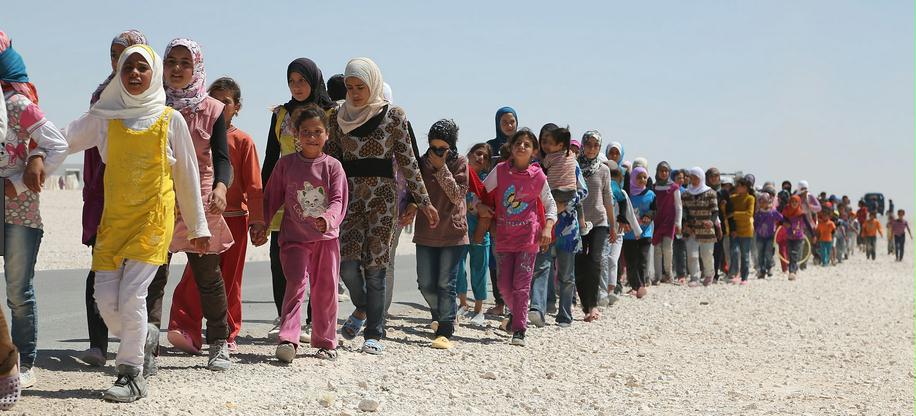
Consumerism is inherently doomed. But since consumerism now effectively is the economy (70% of US GDP comes from consumer spending), when it goes down the economy goes too. A train wreck is foreseeable. No one knows exactly when the impact will occur or precisely how bad it will be. But it is possible to say with some confidence that this wreck will manifest itself as an economic depression accompanied by a series of worsening environmental disasters and possibly wars and revolutions. This should be news to nobody by now, as recent government and UN reports spin out the scenarios in ever grimmer detail: rising sea levels, waves of environmental refugees, droughts, floods, famines, and collapsing economies. Indeed, looking at what’s happened since the start of the global economic crisis in 2007, it’s likely the impact has already commenced—though it is happening in agonizingly slow motion as the system fights to maintain itself.

World conventional crude oil production has been flat-to-declining since about 2005. Declines of output from the world’s supergiant oilfields will steepen in the years ahead. Petroleum is essential to the world economy and there is no ready and sufficient substitute. The potential consequences of peak oil include prolonged economic crisis and resource wars.

Other unconventionals, like extra-heavy oil in Venezuela and kerogen (also known as “oil shale,” and not to be confused with shale oil) in the American West, will be even slower and more expensive to produce.

Why no collapse yet? Governments and central banks have inserted fingers in financial levees. Most notably, the Federal Reserve rushed to keep crisis at bay by purchasing tens of billions of dollars in US Treasury bonds each month, year after year, using money created out of thin air at the moment of purchase.

Virtually all of the Fed’s money has stayed within financial circles; that’s a big reason why the richest Americans have gotten much richer in the past few years, while most regular folks are treading water at best.

What has the too-big-to-fail, too-greedy-not-to financial system done with the Fed’s trillions in free money? Blown another stock market bubble and piled up more leveraged bets. No one knows when the latest bubble will pop, but when it does the ensuing crisis may be much worse than that of 2008. Will central banks then be able to jam more fingers into the leaky levee? Will they have enough fingers?

ExxonMobil is inviting you to take your place in a fossil-fueled 21st century. But I would argue that Exxon’s vision of the future is actually just a forward projection from our collective rearview mirror. Despite its hi-tech gadgetry, the oil industry is a relic of the days of the Beverly Hillbillies. This fossil-fueled sitcom of a world that we all find ourselves trapped within may on the surface appear to be characterized by smiley-faced happy motoring, but at its core it is monstrous and grotesque. It is a zombie energy economy.


Oil and gas are finite resources, so it was clear from the start that, as we extracted and burned them, we were in effect stealing from the future. In the early days, the quantities of these fuels available seemed so enormous that depletion posed only a theoretical limit to consumption. We knew we would eventually empty the tanks of Earth’s hydrocarbon reserves, but that was a problem for our great-great-grandkids to worry about.

In a few years we will look back on late 20th-century America as a time and place of advertising-stoked consumption that was completely out of proportion to what Nature can sustainably provide. I suspect we will think of those times—with a combination of longing and regret—as a lost golden age of abundance, but also an era of foolishness and greed that put the entire world at risk.

Making the best of our new circumstances will mean finding happiness in designing higher-quality products that can be reused, repaired, and recycled almost endlessly and finding fulfillment in human relationships and cultural activities rather than mindless shopping. Fortunately, we know from recent cross-cultural psychological studies that there is little correlation between levels of consumption and levels of happiness. That tells us that life can in fact be better without fossil fuels. So whether we view these as hard times or as times of

Nations could, in principle, forestall social collapse by providing the bare essentials of existence (food, water, housing, medical care, family planning, education, employment for those able to work, and public safety) universally and in a way that could be sustained for some time, while paying for this by deliberately shrinking other features of society—starting with military and financial sectors—and by taxing the wealthy. The cost of covering the basics for everyone is still within the means of most nations. Providing human necessities would not remove all the fundamental problems now converging (climate change, resource depletion, and the need for fundamental economic reforms), but it would provide a platform of social stability and equity to give the world time to grapple with deeper, existential challenges. Unfortunately, many governments are averse to this course of action. And if they did provide universal safety nets, ongoing economic contraction might still result in conflict, though in this instance it might arise from groups opposed to the perceived failures of “big government.” Further, even in the best instance, safety nets can only buy time. The capacity of governments to maintain flows of money and goods will erode. Thus it will increasingly be up to households and communities to provide the basics for themselves while reducing their dependence upon, and vulnerability to, centralized systems of financial and governmental power. This will set up a fundamental contradiction. When the government tries to provide people the basics, power is centralized—but as the capacity of the government wanes, it can feel threatened by people trying to provide the basics for themselves and act to discourage or even criminalize them.

Theorists on both the far left and far right of the political spectrum have advocated for the decentralization of food, finance, education, and other basic societal support systems for decades. Some efforts toward decentralization (such as the local food movement) have led to the development of niche markets.

The decentralized provision of basic necessities is not likely to flow from a utopian vision of a perfect or even improved society (as have some social movements of the past). It will emerge instead from iterative human responses to a daunting and worsening set of environmental and economic problems, and it will in many instances be impeded and opposed by politicians, bankers, and industrialists. It is this contest between traditional power elites and growing masses of disenfranchised poor and formerly middle-class people attempting to provide the necessities of life for themselves in the context of a shrinking economy that is shaping up to be the fight of the century.

When Civilizations Decline

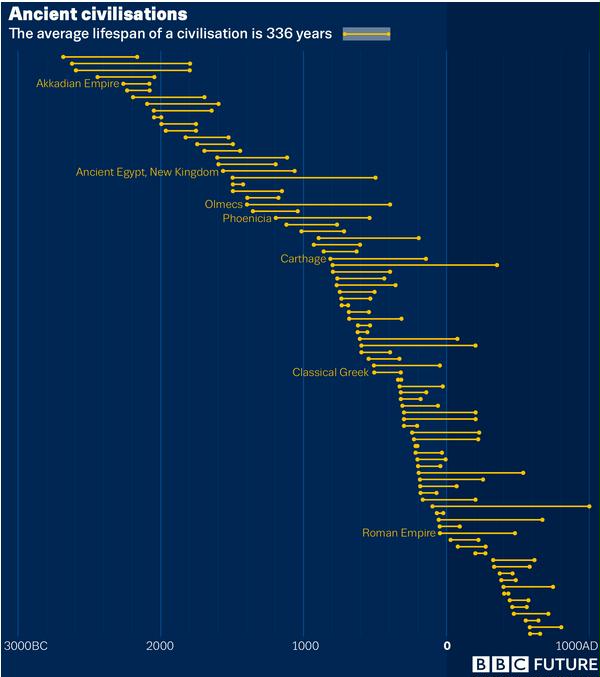
In his benchmark 1988 book The Collapse of Complex Societies, archaeologist Joseph Tainter explained the rise and demise of civilizations in terms of complexity. He used the word complexity to refer to “the size of a society, the number and distinctiveness of its parts, the variety of specialized social roles that it incorporates, the number of distinct social personalities present, and the variety of mechanisms for organizing these into a coherent, functioning whole.”


Civilizations are complex societies organized around cities; they obtain their food from agriculture (field crops), use writing and mathematics, and maintain full-time division of labor. They are centralized, with people and resources constantly flowing from the hinterlands toward urban hubs.

Thousands of cultures have flourished throughout the human past, but there have only been about 24 civilizations. And all—except our current global industrial civilization (so far)—have ultimately collapsed.

Tainter describes the growth of civilization as a process of investing societal resources in the development of ever-greater complexity in order to solve problems. For example, in village-based tribal societies an arms race between tribes can erupt, requiring each village to become more centralized and complexly organized in order to fend off attacks. But complexity costs energy. As Tainter puts it, “More complex societies are costlier to maintain than simpler ones and require higher support levels per capita.” Since available energy and resources are limited, a point therefore comes when increasing investments become too costly and yield declining marginal returns. Even the maintenance of existing levels of complexity costs too much (citizens may experience this as onerous levels of taxation), and a general simplification and decentralization of society ensues—a process colloquially referred to as collapse.

During such times societies typically see sharply declining population levels, and the survivors experience severe hardship. Elites lose their grip on power. Domestic revolutions and foreign wars erupt. People flee cities and establish new, smaller communities in the hinterlands. Governments fall and new sets of power relations emerge. It is frightening to think about what collapse would mean for our current global civilization.


Nevertheless, as we are about to see, there are good reasons for concluding that our civilization is reaching the limits of centralization and complexity, that marginal returns on investments in complexity are declining, and that simplification and decentralization are inevitable. Thinking in terms of simplification, contraction, and decentralization is more accurate and helpful, and probably less scary, than contemplating collapse. It also opens avenues for foreseeing, reshaping, and even harnessing inevitable social processes so as to minimize hardship and maximize possible benefits.

Some of the effects of declining energy will be nonlinear and unpredictable, and could lead to a general collapse of civilization. Economic contraction will not be as gradual and orderly as economic expansion has been. Such effects may include an uncontrollable and catastrophic unwinding of the global system of credit, finance, and trade, or the dramatic expansion of warfare as a result of heightened competition for energy resources or the protection of trade privileges.

Further stimulus spending would require another massive round of government borrowing, and that would face strong domestic political headwinds as well as resistance from the financial community (in the form of credit downgrades, which would make further borrowing more expensive).

Without increasing and affordable energy flows a genuine economic recovery (meaning a return to growth in manufacturing and trade) may not be possible.

The evidence for the efficacy of austerity as a path to increased economic health is spotty at best in “normal” economic times. Under current circumstances, there is overwhelming evidence that it leads to declining economic performance as well as social unraveling. In nations where the austerity prescription has been most vigorously applied (Ireland, Greece, Spain, Italy, and Portugal), contraction has continued or even accelerated, and popular protest is on the rise.

Austerity is having similar effects in states, counties, and cities in the United States. State and local governments cut roughly half a million jobs during 2009–10; had they kept hiring at their previous pace to keep up with population growth, they would instead have added a half-million jobs. Meanwhile, due to low tax revenues, local governments are allowing paved roads to turn to gravel, closing libraries and parks, and laying off public employees. It’s not hard to recognize a self-reinforcing feedback loop at work here. A shrinking economy means declining tax revenues, which make it harder for governments to repay debt. In order to avoid a credit downgrade, governments must cut spending. This shrinks the economy further, eventually resulting in credit downgrades anyway. That in turn raises the cost of borrowing. So government must cut spending even further to remain credit-worthy. The need for social spending explodes as unemployment, homelessness, and malnutrition increase, while the availability of social services declines. The only apparent way out of this death spiral is a revival of rapid economic growth. But if the premise above is correct, that is a mere pipedream.

Centralized provision of the basics. In this scenario, nations directly provide jobs and basic necessities to the general public while deliberately simplifying, downsizing, or eliminating expendable features of society such as the financial sector and the military, and taxing those who can afford it—wealthy individuals, banks, and larger businesses—at higher rates. This is the path outlined at the start of the essay; at this point it is appropriate to add a bit more detail. In many cases, centralized provision of basic necessities is relatively cheap and efficient. For example, since the beginning of the current financial crisis the US government has mainly gone about creating jobs by channeling tax breaks and stimulus spending to the private sector. But this has turned out to be an extremely costly and inefficient way of providing jobs, far more of which could be called into existence (per dollar spent) by direct government hiring. Similarly, the new US federal policy of increasing the public’s access to health care by requiring individuals to purchase private medical insurance is more costly than simply providing a universal government-run health insurance program, as every other industrial nation does. If Britain’s experience during and immediately after World War II is any guide, then better access to higher-quality food could be ensured with a government-run rationing program than through a fully privatized food system. And government banks could arguably provide a more reliable public service than private banks, which funnel enormous streams of unearned income to bankers and investors. If all this sounds like an argument for utopian socialism, read on—it’s not. But there are indeed real benefits to be reaped from government provision of necessities, and it would be foolish to ignore them. A parallel line of reasoning goes like this.


Immediately after natural disasters or huge industrial accidents, the people impacted typically turn to the state for aid. As the global climate chaotically changes, and as the hunt for ever-lower-grade fossil energy sources forces companies to drill deeper and in more sensitive areas, we will undoubtedly see worsening weather crises, environmental degradation and pollution, and industrial accidents such as oil spills. Inevitably, more and more families and communities will be relying upon state-provided aid for disaster relief. Many people would be tempted to view an expansion of state support services with alarm as the ballooning of the powers of an already bloated central government. There may well be substance to this fear, depending on how the strategy is pursued. But it is important to remember that the economy as a whole, in this scenario, would be contracting—and would continue to contract—due to resource limits.

In any case, it’s hard to say how long this strategy could be maintained in the face of declining energy supplies. Eventually, central authorities’ ability to operate and repair the infrastructure necessary to continue supporting

As central governments seek to maintain complexity at the expense of more dispersed governmental nodes (city, county, and state governments), then conflict between communities and sputtering national or global power hubs is likely. Communities may begin to withdraw streams of support from central authorities—and not only governmental authorities, but financial and corporate ones as well.

Communities that have to contend with declining tax revenues, competition from larger governments, and predatory mega-corporations and banks, then nonprofit organizations—which support tens of thousands of local charity efforts—face perhaps even greater challenges. The current philanthropic model rests entirely upon assumed economic growth: foundation grants come from returns on the foundation’s investments (in the stock market and elsewhere). As economic growth slows and reverses, the world of nonprofit organizations will shake and crumble, and the casualties will include tens of thousands of social services agencies, educational programs, and environmental protection organizations . . . as well as countless symphony orchestras, dance ensembles, museums, and on and on. If national government loses its grip, if local governments are pinched simultaneously from above and below, and if nonprofit organizations are starved for funding, from where will come the means to support local communities with the social and cultural services they need?

Local movements to support localization—however benign their motives—may be perceived by national authorities as a threat.

Complications

Scenarios are not forecasts; they are planning tools. As prophecies, they’re not much more reliable than dreams. What really happens in the years ahead will be shaped as much by “black swan” events as by trends in resource depletion or credit markets. We know that environmental impacts from climate change will intensify, but we don’t know exactly where, when, or how severely those impacts will manifest; meanwhile, there is always the possibility of a massive environmental disaster not caused by human activity (such as an earthquake or volcanic eruption) occurring in such a location or on such a scale as to substantially alter the course of world events. Wars are also impossible to predict in terms of intensity and outcome, yet we know that geopolitical tensions are building.

The success of governments in navigating the transitions ahead may depend on measurable qualities and characteristics of governance itself. In this regard, there could be useful clues to be gleaned from the World Governance Index, which assesses governments according to criteria of peace and security, rule of law, human rights and participation, sustainable development, and human development. For 2011, the United States ranked number 32 (and falling: it was number 28 in 2008)—behind Uruguay, Estonia, and Portugal but ahead of China (number 140) and Russia (number 148).

One wonders how many big-government centralists of the left, right, or center—who often see the stability of the state, the status of their own careers, and the ultimate good of the people as being virtually identical—are likely to embrace such a prescription.

History teaches us at least as much as scenario exercises can. The convergence of debt bubbles, economic contraction, and extreme inequality is hardly unique to our historical moment. A particularly instructive and fateful previous instance occurred in France in the late 18th century. The result then was the French Revolution, which rid the common people of the burden of supporting an arrogant, entrenched aristocracy, while giving birth to ideals of liberty, equality, and universal brotherhood. However, the revolution also brought with it war, despotism, mass executions—and an utter failure to address underlying economic problems. So often, as happened then, nations suffering under economic contraction double down on militarism rather than downsizing their armies so as to free up resources. They go to war, hoping thereby both to win spoils and to give mobs of angry young men a target for their frustrations other than their own government. The gambit seldom succeeds; Napoleon made it work for a while, but not long. France and (most of) its people did survive the tumult. But then, at the dawn of the 19th century, Europe was on the cusp of another revolution—the fossil-fueled Industrial Revolution—and decades of economic growth shimmered on the horizon. Today we are just starting our long slide down the decline side of the fossil fuel supply curve.

The world supply of uranium is limited, and shortages are likely by mid-century even with no major expansion of power plants. And, atomic power plants are tied to nuclear weapons proliferation.

None of this daunts Techno-Anthropocene proponents, who say new nuclear technology has the potential to fulfill the promises originally made for the current fleet of atomic power plants. The centerpiece of this new technology is the integral fast reactor (IFR). Unlike light water reactors (which comprise the vast majority of nuclear power plants in service today), IFRs would use sodium as a coolant. The IFR nuclear reaction features fast neutrons, and it more thoroughly consumes radioactive fuel, leaving less waste. Indeed, IFRs could use current radioactive waste as fuel. Also, they are alleged to offer greater operational safety and less risk of weapons proliferation.

Fast-reactor technology is highly problematic. Earlier versions of the fast breeder reactor (of which IFR is a version) were commercial failures and safety disasters. Proponents of the integral fast reactor, say the critics, overlook its exorbitant development and deployment costs and continued proliferation risks. IFR theoretically only “transmutes,” rather than eliminates, radioactive waste. Yet the technology is decades away from widespread implementation, and its use of liquid sodium as a coolant can lead to fires and explosions.

David Biello, writing in Scientific American, concludes that, “To date, fast neutron reactors have consumed six decades and $100 billion of global effort but remain ‘wishful thinking.’”

But we don’t have the luxury of limitless investment capital, and we don’t have decades in which to work out the bugs and build out this complex, unproven technology.

Degrading topsoil in order to produce enough grain to feed ten billion people? Just build millions of hydroponic greenhouses (that need lots of energy for their construction and operation). As we mine deeper deposits of metals and minerals and refine lower-grade ores, we’ll require more energy.

Governments are probably incapable of leading a strategic retreat in our war on nature, as they are systemically hooked on economic growth. But there may be another path forward. Perhaps citizens and communities can initiate a change of direction.

Wes Jackson of the Land Institute in Salina, Kansas, has spent the past four decades breeding perennial grain crops (he points out that our current annual grains are responsible for the vast bulk of soil erosion, to the tune of 25 billion tons per year).

Population Media Center is working to ensure we don’t get to ten billion humans by enlisting creative artists in countries with high population growth rates (which are usually also among the world’s poorest nations) to produce radio and television soap operas featuring strong female characters who successfully confront issues related to family planning. This strategy has been shown to be the most cost-effective and humane means of reducing high birth rates in these nations.

It’s hard to convince people to voluntarily reduce consumption and curb reproduction. That’s not because humans are unusually pushy, greedy creatures; all living organisms tend to maximize their population size and rate of collective energy use. Inject a colony of bacteria into a suitable growth medium in a petri dish and watch what happens. Hummingbirds, mice, leopards, oarfish, redwood trees, or giraffes: in each instance the principle remains inviolate—every species maximizes population and energy consumption within nature’s limits. Systems ecologist Howard T. Odum called this rule the Maximum Power Principle: throughout nature, “system designs develop and prevail that maximize power intake, energy transformation, and those uses that reinforce production and efficiency.”

In many countries, including the US, government efforts to forestall or head off uprisings appear to be taking the forms of criminalization of dissent, the militarization of police, and a massive expansion of surveillance using an array of new electronic spy technologies. At the same time, intelligence agencies are now able to employ up-to-date sociological and psychological research to infiltrate, co-opt, misdirect, and manipulate popular movements aimed at achieving economic redistribution. However, these military, police, public relations, and intelligence efforts require massive funding as well as functioning grid, fuel, and transport infrastructures. Further, their effectiveness is limited if and when the nation’s level of economic pain becomes too intense, widespread, or prolonged. A second source of conflict consists of increasing competition over access to depleting resources, including oil, water, and minerals. Among the wealthiest nations, oil is likely to be the object of the most intensive struggle, since oil is essential for nearly all transport and trade. The race for oil began in the early 20th century and has shaped the politics and geopolitics of the Middle East and Central Asia; now that race is expanding to include the Arctic and deep oceans, such as the South China Sea. Resource conflicts occur not just between nations but also within societies: witness the ongoing insurgencies in the Niger Delta, where oil revenue fuels rampant political corruption while drilling leads to environmental ravages felt primarily by the Ogoni ethnic group; see also the political infighting in fracking country here in the United States, where ecological impacts put ever-greater strains on the social fabric.

Lastly, climate change, water scarcity, high oil prices, vanishing credit, and the leveling off of per-hectare productivity and the amount of arable land are all combining to create the conditions for a historic food crisis, which will impact the poor first and most forcibly. High food prices breed social instability—whether in 18th-century France or 21st-century Egypt. As today’s high prices rise further, social instability could spread, leading to demonstrations, riots, insurgencies, and revolutions.

In the current context, a continuing source of concern must be the large number of nuclear weapons now scattered among nine nations. While these weapons primarily exist as a deterrent to military aggression, and while the end of the Cold War has arguably reduced the likelihood of a massive release of them in an apocalyptic fury, it is still possible to imagine several scenarios in which a nuclear detonation could occur as a result of accident, aggression, preemption, or retaliation. We are in a race—but it’s not just an arms race; indeed, it may end up being an arms race in reverse.

We can only hope that historical momentum can maintain the Great Peace until industrial nations are sufficiently bankrupt that they cannot afford to mount foreign wars on any substantial scale.


In his recent and important book Carbon Democracy: Political Power in the Age of Oil, Timothy Mitchell argues that modern democracy owes a lot to coal. Not only did coal fuel the railroads, which knitted large regions together, but striking coal miners were able to bring nations to a standstill, so their demands for unions, pensions, and better working conditions played a significant role in the creation of the modern welfare state. It was no mere whim that led Margaret Thatcher to crush the coal industry in Britain; she saw its demise as the indispensable precondition to neoliberalism’s triumph. Coal was replaced, as a primary energy source, by oil. Mitchell suggests that oil offered industrial countries a path to reducing internal political pressures. Its production relied less on working-class miners and more upon university-trained geologists and engineers. Also, oil is traded globally, so that its production is influenced more by geopolitics and less by local labor strikes. “Politicians saw the control of oil overseas as a means of weakening democratic forces at home,” according to Mitchell, and so it is no accident that by the late 20th century the welfare state was in retreat and oil wars in the Middle East had become almost routine. The problem of “excess democracy,” which reliance upon coal inevitably brought with it, has been successfully resolved, not surprisingly by still more teams of university-trained experts—economists, public relations professionals, war planners, political consultants, marketers, and pollsters. We have organized our political life around a new organism—“the economy”—which is expected to grow in perpetuity, or, more practically, as long as the supply of oil continues to increase.

Andrew Nikiforuk also explores the suppression of democratic urges under an energy regime dominated by oil in his brilliant book The Energy of Slaves: Oil and the New Servitude. The energy in oil effectively replaces human labor; as a result, each North American enjoys the services of roughly 150 “energy slaves.” But, according to Nikiforuk, that means that burning oil makes us slave masters—and slave masters all tend to mimic the same attitudes and behaviors, including contempt, arrogance, and impunity.

As power addicts, we become both less sociable and easier to manipulate. In the early 21st century, carbon democracy is still ebbing, but so is the global oil regime hatched in the late 20th century. Domestic US oil production based on hydraulic fracturing (“fracking”) reduces the relative dominance of the Middle East petro-states, but to the advantage of Wall Street—which supplies the creative financing for speculative and marginally profitable domestic drilling. America’s oil wars have largely failed to establish and maintain the kind of order in the Middle East and Central Asia that was sought. High oil prices send dollars cascading toward energy producers but starve the economy as a whole, and this eventually reduces petroleum demand.

Governance systems appear to be incapable of solving or even seriously addressing looming financial, environmental, and resource issues, and “democracy” persists primarily in a highly diluted solution whose primary constituents are money, hype, and expert-driven opinion management. In short, the 20th-century governance system is itself fracturing. So what comes next?

Posted in Energy Books, Peak Oil, Richard Heinberg | Tagged , , | 9 Comments

Why and how Jellyfish are taking over the world

This image has an empty alt attribute; its file name is jellyfish-hundreds.jpg

Preface.  The more climate change kicks in, the more we over-fish, pollute, acidify and warm the ocean, create vast dead zones, and trawl ocean bottoms, the better the jellyfish do. It is quite possible that the ocean ecosystem will shift to favor jellyfish over fish and other sea life.

We’ve already fished out 90% of all large fish in the ocean. Peak fish happened in 1996 (Pauly 2016). And it’s only a matter of time before we find the other 10% with sonar, radar, LORAN, GPS, and spotter aircraft.

The United Nations has predicted all commercial fish species will be extinct by 2048.  In 2002 we were fishing 72% of fish stocks faster than they could reproduce.  90 fish stocks around the world have had no recovery in population even 15 years after they collapsed.

Few small fish left, few big fish left – that opens up a lot of space for jellyfish to move in and take over.  We’re creating a feedback loop that favors jellyfish.

Even if we stopped overfishing, polluting, and so on, once we tip the ecosystem into one controlled by jellyfish, they will become the “new normal” and that will quite likely be impossible to change.

And they’re awfully hard to kill. Chemical repellents, biocides, nets, electric shocks, and introducing species that eat jellyfish won’t do it.  If you shoot, stab, slash, or chop off part of a jellyfish, it can regenerate lost body parts within two days.  Not even the past 5 major extinction events which killed up to 90% of all life on earth killed off the jellyfish.

More jellyfish articles:

Alice Friedemann  www.energyskeptic.com  Author of Life After Fossil Fuels: A Reality Check on Alternative Energy; When Trucks Stop Running: Energy and the Future of Transportation”, Barriers to Making Algal Biofuels, & “Crunch! Whole Grain Artisan Chips and Crackers”.  Women in ecology  Podcasts: WGBH, Planet: Critical, Crazy Town, Collapse Chronicles, Derrick Jensen, Practical Prepping, Kunstler 253 &278, Peak Prosperity,  Index of best energyskeptic posts

***

A book review of Lisa-ann Gershwin’s “Stung! On jellyfish blooms and the future of the ocean” by Alice Friedemann

Move aside Steven King, jellyfish are worse than any of your demons, worse than any Grade-B monster that’s graced the silver screen.  Unlike The Blob, which can be stopped by freezing, you can’t kill them.  Not with chemical repellents or biocides or nets or electric shocks or introducing species that eat jellyfish like the striped sea slug.  If you shoot, stab, slash, or chop off part of a jellyfish, it can regenerate lost body parts within two days.  Not even the past 5 major extinction events which killed up to 90% of all life on earth, killed off the jellyfish.

Meanwhile they’re on a rampage, doing millions of dollars in damage clogging intakes of nuclear, coal, and desalination plants, killing millions of farmed fish, and destroying fishing nets with their sticky icky bodies.

The more we over-fish, pollute, acidify and warm the ocean, create vast dead zones, and trawl ocean bottoms, the better the jellyfish do.

The oceans make the earth habitable for us.  They generate most of the oxygen we breathe, stabilize temperatures, drive climate and weather, and absorb a third of the CO2 we’re emitting.  Over 3 billion people depend on the oceans for their livelihoods; 2.6 billion depend on seafood as their main source of protein.

Most alarming of all, 40% of phytoplankton has died off globally since the 1950s – they’re not only at the base of the food chain, but they generate most of the oxygen we breathe, as well as absorb half of the carbon dioxide, and their increasing death rate will make the ocean get warmer even faster.

Why Jellyfish are taking over the world

Prolific, hard to kill, breed fast, and more – no wonder they’re so successful:

  • They’ve everywhere, spread around the world in ship ballast or sea currents.
  • Ubiquitous – from top to bottom of the ocean, from pole to pole, year-round.
  • Grow faster than other species to quickly take advantage of any food, and they’ll eat almost anything — copepods, fish eggs, larvae, flagellates. They eat past when they can keep consuming, spit food out, waste a great deal other creatures could have eaten.  Even when they’re full, their tentacles keep capturing prey.
  • If there’s no food, jellyfish can consume their own body mass and get smaller and smaller until they find food again, and rapidly return to normal.  Even when they grow smaller they can still reproduce.
  • Consume many times their body weight in high-value food but are of low-value themselves because they provide little energy, ounce for ounce, compared to the food they ate.  So they have few predators.
  • When 2 weeks old they can lay 10,000 eggs a day that hatch 12-20 hours later
  • They reproduce many ways: massive orgies, fission, fusion, cloning, hermaphroditism, external fertilization, self-fertilization, copulation.
  • If they lose a body part, they can regenerate it within 2 days.
  • They are the “Last Man Standing” in eutrophication zones because they need less oxygen
  • Many species can tolerate any salinity level, from fresh water to salt water
  • They’ve survived ice ages, hothouse climates, all five mass extinctions, predators, competitors, and us.
  • Jellyfish in the oceans have been known to live over 10 years
  • Many of them avoid predators by long vertical migrations from the deep sea to the surface at night and back down again by daylight

They can wait a long time for the right conditions to bloom

Just as plants have seeds which can endure many years waiting for optimum conditions to grow, jellyfish have a seed-like state called a polyp that waits for good conditions, and can clone themselves to create armies of ‘seeds’ waiting to burst into jellyfish blooms seemingly overnight. Polyps don’t “grow up” to become jellyfish.  They spawn what we think of as jellyfish – the medusa — which then mate sexually to produce polyps, which stick to rocks, shells, man-made structures, plastic, etc.  Both the polyps and the medusa could be considered “immortal” – when a polyp dies it’s clones live on, and there is one species of jellyfish, where after it dies, its pieces turn back into polyps (“Logically, it would seem that other species probably do it too, but we have yet to identify others,” according to Gershwin in a reply to this book review).

Jellyfish are at the top of the food chain

That seems so wrong– a primitive brainless blob?  But jellyfish eat much larger clams, crabs, starfish, snails, and fast, smarter fish and squid.

They’re also at the top because not much wants to eat them.

Worse yet, they outcompete other sea life by devouring the eggs and larvae of species that would have grown up to eat jellyfish larvae.  It’s a double whammy since these larvae never grow up, leaving a lot more food for jellyfish to consume. A jellyfish bloom can clear the water of all eggs, larvae, copepods, and small plankton in less than a day.  This makes it almost impossible for some overfished species to make a comeback.

We’re helping the jellyfish take over by overfishing

Many of the small fish that compete with jellyfish for the same food, such as anchovies and sardines, are being overfished and turned into farmed fish food, pet food, and fertilizer. We harvest a whopping 44% of these small fish at the base of the food chain, which are also what cod, snapper, tuna, and halibut feed on, which prevents the recovery of fish we’d much rather eat.

We’ve already fished out 90% of all large fish in the ocean.  And it’s only a matter of time before we find the other 10% with sonar, radar, LORAN, GPS, and spotter aircraft.

The United Nations has predicted all commercial fish species will be extinct by 2048.  In 2002 we were fishing 72% of fish stocks faster than they could reproduce.  90 fish stocks around the world have had no recovery in population even 15 years after they collapsed.

Few small fish left, few big fish left – that opens up a lot of space for jellyfish to move in and take over.  We’re creating a feedback loop that favors jellyfish.

Worse yet, overfishing can create trophic cascades when we remove keystone predators.  We’ve nearly driven 11 species of large sharks along the Atlantic coast into extinction.  They kept the ray population in check, but now that they’re gone, the ray population has exploded, and they’re devouring almost a million tons of scallops, clams, and oysters a year.  Fishermen only harvested 330 tons.  The Chesapeake used to famous for shellfish, now it’s best known for its jellyfish (p261-263).

You’ve probably heard of bycatch – all the unwanted and unintended dolphins, turtles, fish and so on that are discarded, most so mangle  they don’t survive when thrown back.  I was unaware that tropical shrimp are the worst of the worst because they’re obtained by bottom trawling and have a bycatch of 125 to 830% more than the shrimp captured.  In the Gulf of Mexico shrimp fishery 12,000,000 juvenile snappers and 6,000,000 pounds of sharks are discarded every year. Since most bycatch is unreported, these figures are probably too low.  Further destroying the fish are the thousands of miles of “ghost nets” – the nets lost from boats that drift aimlessly still catching fish.

Jellyfish even eat other jellyfish, so when we’ve caught most of the fish, or otherwise destroyed them by dredging, ocean warming and acidification, pollution, dead zones, etc., jellyfish will still survive.

Trawling and Sewage favor jellyfish

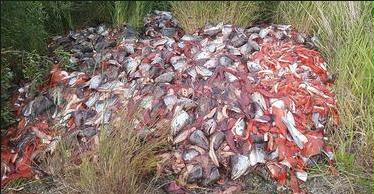
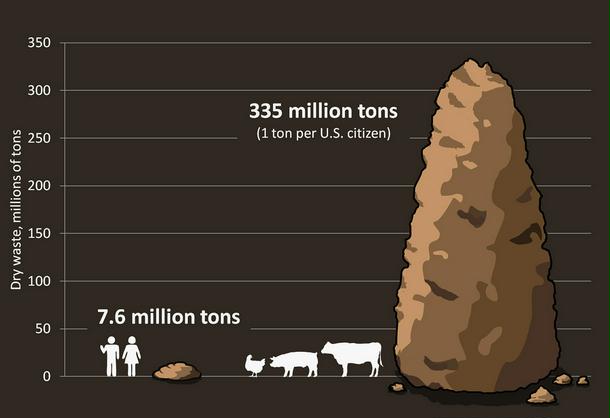
Sewage provides nourishment for jellyfish since they can get 10 to 40% of what they need by absorbing nutrients through their skin.  And there’s plenty of sewage for them. In just 7 days a 3,000 passenger cruise ship generates 210,000 gallons of sewage, a million gallons of gray water, 37,000 gallons of oil bilge water, 8 tons of solid waste.  In the USA, animal feedlots produce 500 million tons of manure a year, 3 times as much as humans.

Bottom-trawls weigh thousands of tons and rake the seafloor for sole, halibut, cod, haddock, plaice, rockfish, rays, skates, prawns and son on, destroying corals and sponges as trawls rake across miles of seafloor, crushing what isn’t scooped up.  The raking creates a fog of tiny particles. Fish can’t find their food in this dense fog of raked up particles or murky sewage, but guess who can….jellyfish, who just dangle their tentacles and it capture any food that drifts or swims into them.

Trawling dredges up toxic DDT, PCBs, hydrocarbons, mercury, radioactive particles, heavy metals, and plastics that add to eutrophication, destroy clams, scallops, bryozoans, tunicates, and other creatures.  These substances, which had been buried in the sediment and removed from the food chain are released back again, and incorporated into the muscle, bone, blood, and fat of sea organisms.

Jellyfish don’t have these tissues, so they’re not much affected.  Nor do they live long enough to store a high concentration of harmful toxins, or develop mutations or cancer.

Dredging creates many more areas for jellyfish polyps to attach to as pieces of plastic and other flotsam are dredged up, increasing the size of jellyfish blooms.

Jellyfish can take the heat

As climate change raises temperatures, the metabolic rate of all creatures rise, and they have to catch more food to stay alive.

The ocean has risen 1.8 F the past century, most of that the past 30 years, and may increase another 3.6 F over the next 100 years.  In the ocean heat is even harder on organisms because warmer water has less oxygen.  This means increased respiration which uses more energy and finding more food to eat.   A creature that can’t respire fast enough will suffocate.

Warmer oceans are a dream come true for jellyfish – they can grow fast very quickly while other species are struggling.  Phytoplankton blooms make even more food available.  Jellyfish rates of reproduction increases and they can reproduce longer too.

Climate change also means far more unpredictable weather, another advantage for jellyfish, since they respond quickly to change and bloom explosively to cope.  They’re the first to arrive and the last to leave.  And jellyfish can tolerate a wide range of temperatures.

Jellyfish can even increase CO2 levels because

  • Their goo and poo are preferred by bacteria that emit high amounts of CO2.
  • Jellyfish displace fish, whose fecal pellets would have sunk to the bottom and sequestered CO2

We’re tipping the ecosystem in their favor

The more we damage and stress the ocean, the more likely the sedentary polyps will feel compelled to produce the next generation, the getaway medusa jellyfish who can escape the eutrophication, warming temperatures, changes in salinity, pollution, acidification, oil spills, or whatever else we’ve thrown at them.  The medusa disperse to safer areas, and new areas, live to see another bloom, and eat and outcompete fish.

Dead zones, eutrophication, hypoxia favor jellyfish

Jellies can survive low oxygen conditions because they store oxygen in their tissues and breathe through their skin.  They can swim in the top layer of water above and form a wall of slime that keeps fish out.

They can cause eutrophication by eating so many copepods that phytoplankton blooms erupt, die, and tilt the balance towards flagellate-based organisms, which jellyfish eat but fish don’t.  And also their goo and poo favors microbes that respire a lot which generate CO2 and increase ocean acidification.  Jellyfish can survive low oxygen levels better than most creatures.

The more jellyfish, the more jellyfish

As we create conditions that favor larger jellyfish blooms, their concentrations grow more dense, so when they release sperm and eggs the odds of contact and fertilization are greater.

And the greater the density of jellyfish, the more likely prey will be unable to escape. Nor will the small predators of jellyfish larvae be able to do so – the dense numbers of parent medusae will eat the small predators before their own larva can be consumed.

Larger jellyfish blooms makes even larger jellyfish blooms more likely, ratcheting up their ascent to dominance in the oceans.

Farmed fish won’t keep fish around – jellyfish kill them too

Jellyfish harm salmon farms through their mucous, bacteria, and stinging.  The salmon waste and uneaten food also probably change the ocean to favor jellyfish and algal blooms.

Other jellyfish facts   

  • There are 1,500 known species of jellyfish, but probably quite a few more we haven’t identified yet
  • They have no heart, brains, ears, heads, feet, gills, or bones
  • They range from the size of a pea to 8 feet in diameter with tentacles that can be 200 feet long
  • Kinds of jellies: moon, comb, pink meanies, rainbow, box, fire, sea wasps, sea nettles, sea gooseberries,Venus’s girdles, lion’s manes, purple people eaters, blubbers, snotties, agua vivas, blue bottles, the long stingy stringy thingy, etc.
  • They’ve been here at least 565 million years practically unchanged, long before predators with shells or teeth evolved
  • The Box Jellyfish is the world’s most venomous animal that can kill within 2 minutes. There are other lethal jellyfish as well.

Conclusion – We’ve turned the tide in favor of Jellyfish

This is one of the best books you can read about the myriad ways we’re destroying the ocean, which Gershwin has to explain so that she can then explain how that relates to how those factors affect jellyfish.  Gershwin’s writing is witty and funny, making this grim topic easier to take.  The natural history of jellyfish is amazing and bizarre.  And despite this long book review, I’ve left out quite a bit, the story is far too complex to summarize — I hope you’ll read this book to learn more.

Even if we stopped overfishing, polluting, and so on, once we tip the ecosystem into one controlled by jellyfish, they will become the “new normal” and that will quite likely be impossible to change.

What a dismal future — an ocean of slimy, repulsive, stinging, sticky, lethal, spooky, scary, alien jellyfish.  Bye-bye fish, oysters, shrimp, scallops, lobsters, Beluga caviar, abalone, sharks, whales, seals, sea lions, penguins, dolphins, sea otters, polar bears.  Hello jelly-O.

The time when jellyfish rule is not far away, it could be in your lifetime, or your children’s lifetime.  The climate and chemistry of the ocean is becoming like the Ediacaran ocean 565 million years ago, when jellyfish ruled the oceans for over 100 million years as the top predators.

In the last chapter, Gershwin writes that in the end, jellyfish are “also outcompeting the human race, because we depend on the oceans’ fish for our own food.”

Gershwin wrote this book assuming she’d have advice at the end of actions you could take to bring back the fisheries and keep jellyfish from dominating the oceans, but she ends the book saying it’s too late to do anything.  Hold the presses — perhaps not, Lisa replied to this book review and said “I welcome thoughts that you or your readers may have toward saving the oceans and fixing the damage… the subject of my next book!”.

I like Gershwin’s honesty, and the willingness of the University of Chicago Press to publish her book, since most publishers won’t print a book that doesn’t have a happy ending (and also why our political and economic leaders deny or don’t talk about peak oil, climate change, and other insoluble problems.)

When will the fish, whales, dolphins, etc., return?

People have asked me when the fish would come back, since after all, they’re here now, they must have defeated the jellyfish in the past.  That’s why you need to read this 344 page book.  the ocean ecosystem is complex and Gershwin spends most of the book explaining how it works in order to then say how this relates to jellyfish.  I’ve only reported on jellyfish part of what she wrote.

One important concept I didn’t cover was on low versus high-energy food chains, since that’s a big part of why the ocean is tipping in favor of the jellyfish, who do better in a low-energy system like the Ediacaran oceans hundreds of millions of years ago (read pages 288-344).

We’re returning the oceans to an Ediacaran state — warm oceans favor jellyfish, low energy food chains favor jellyfish, low oxygen favors jellyfish, ocean acidification favors jellyfish, billions of jellyfish consuming most fish eggs, larva, and juveniles favors jellyfish, ability to catch food in murky water favors jellyfish, their ability to bloom and grow faster than any other creature, humans removing most of the jellyfish predators and competitors from overfishing, the amazing adaptability of jellyfish, their being at the top of the food chain, and the synergy of all of these and the dozens of other factors above.

When this becomes a stable state, how do you get back?

“The Earth without us” gave me great hope.  Because we’re at peak fossil fuels the climate change scenarios won’t be as bad as the worst forecasts (perhaps), without oil there will be only a billion people or less, who can’t do nearly as much harm without oil-powered vehicles and combustion engines.

A day will come when the earth cools, oceanic oxygen and pH levels go up, and fish and sea mammals will return.   If they’ve survived, that is.  The problem with an extinction like this 6th one we’re causing is that the hangover can last for millions of years before evolution refills the lost niches of extinct creatures, sigh.

Alice Friedemann

References

Pauly D, Zeller D (2016) Catch reconstructions reveal that global marine fisheries catches are higher than reported and declining. Nature communications.  Peak fish happened in 1996 at 130 million tonnes a year.

Miscellaneous notes, duplicate notes, too detailed notes, and random interesting facts of interest to me

San Francisco Bay

  • Has 234 invasive species with a new species introduced every 14 weeks for the past 50 years.  The Asian clam has affected the entire food web by filtering out such a huge number of phytoplankton.
  • “Jellyfish blooms are extremely common….it is clear something big is happening.”

Jellyfish blooms and outstanding wine years between 1900 and 2005 appear to be correlated due to warming temperatures on land and in the sea (pp 28-29).  Increasing jellyfish blooms along the French Riviera, Greek Isles, and other Mediterranean coasts will no doubt also start to correlate with decreasing tourism as more and more vacationers are stung by jellyfish (pp. 229-230)

CO2 stats (CO2now.org). 

  • 83% / 8.5 billion tons from burning fossil fuels 
  • 12% / 1.2 billion tons from deforestation
  •   5%  making cement
  • Where does it go?  47% atmosphere 27% plants 26% the oceans
  • China is building new coal power plants at up to 3 per week.

They’re replacing/competing with fish (anchovy, kilka, cod, sprat), shellfish, seals, and other seafood/creatures in many seas, such as: Black Sea, Sea of Azov, Mersin Bay in Turkey, Sea of Marmara, Aegean sea, Syria, Caspian, North Sea, Baltic, Mediterranean (esp Israel & Spain), Ligurian Sea, Tyrrhenian Sea, Ionian Sea (pp. 62-69)

Bering Sea: one-third of global & half of USA fish come from here

  • 800,000 square miles full of Alaskan king crab, salmon, walleye Pollock, cod, halibut, sole. Also whales, dolphins, seals, sea lions, walruses, polar bears, 80% of seabirds in the USA
  • By 1992 the Pollock fishery had collapsed in part of this region. At the same time and place, enormous blooms of jellyfish appeared
  • The walleye Pollock fishery is one of the biggest and most profitable, but it too is has been collapsing since 2007.
  • Overfishing and climate change led to killer whales so desperately hungry that they ate most of the sea otters in this area, which led to sea urchins devouring the kelp that millions of fish hid in, and with them the numbers of fish caught
  • Disappearing arctic ice has led to blooms of coccolithophores that blocked out the light for phytoplankton, diatoms, kelp, and other algae, reducing the zooplankton, killing off small fish and on up the food chain.  But jellyfish can eat anything, things fish don’t or can’t eat.

Jellyfish are sticky, like a thin piece of saran plastic wrap. They cause millions of dollars when they clog coal and nuclear power plants, desalination plants, and fishing nets:

  • In 1999 the equivalent of 50 trucks of jellyfish brought down a coal-fired station in the Phillipines that put 40 million people in the dark, that many initially feared was a coup.
  • The Diablo Canyon nuclear power plant was shut down in 2008 by invasions of sticky jellyfish (which the author points out even she was unable to do when she protested and was arrested in 1981 to try to shut this plant sitting on an earthquake fault down).
  • Table 1 in the appendix has 63 other incidents of jellyfish bringing down coal and nuclear power plants from Australia, Denmark, India, Germany, Gulf of Oman, Israel, Japan, Kuwait, Malaysia, New South Wales, Peru, Saudi Arabia, Scotland, South Korea, Sweden, United States (Florida, Maryland, San Luis Obispo.
  • Table 2 has 6 incidents of jellyfish clogging desalination plants in the unstable and war-prone Middle East from Saudi Arabia, Kuwait, Gulf of Oman, and Israel.
  • Table 3 has 22 incidents of jellyfish blooms interfering with fishing and trawling from  Norway, Blak Sea, Israel, Mediterranean sea, Bering Sea, Gulf of Mexico, Gulf of Oman, Persian gulf, Yangtze estuary China, japan, southern brazil, Northern Argentina, Namibian Benguela, UK & the Baltic, New South Wales Australia, Sweden Turkey, Texas & the Gulf of Maine, (USA)

Jellyfish harm salmon farms through their mucous, bacteria, and stinging.  The salmon waste and uneaten food also probably change the ocean to favor jellyfish and algal blooms.

  • New Zealand: 56,000 large salmon died when stinging jellyfish were pinned against netting and their stinging mucus was sucked into the vortex of circling salmon, blocking their ability to breathe, and the stinging further panicked the salmon, making them breathe and then suffocate even faster (p17)
  • Other  salmon killed by jellyfish: Australia: 25,000 salmon, Chile (120,000 & 45,000), Ireland (250,000), Scotland (many millions), Norway

Areas where jellyfish are taking over

  • Black sea (pp. 43-55) To give you an idea of the magnitude of the Mnemiopsis jellyfish invasion, the average biomass of the Aurelia jelly in the Black sea was 670,000 tons until 1962, then it rocketed to nearly 500 million tons by the late 1980s – jellyfish were consuming 62% of all copepods, fish eggs, fish larvae, invertebrate larvae – 62% of all available food.  Amazingly, this story has a happier ending than any other because another kind of jellyfish that preyed on the species clogging up the sea devoured virtually all of them. But it’s not likely the ecosystem will ever return to its past abundance.
  • Caspian Sea: this is the largest inland sea on the planet, 150,000 square miles, and overfishing, pollution, etc  has dramatically lowered the fisheries in Iran, Azerbaijan, and Russia.  Beluga Caviar is likely to be gone within this decade. Mnemiopsis jellyfish have spread across much of this sea.
  • Namibia Benguela fishery: 30,000 square nautical miles taken over by jellyfish (pp37-39)

People assume that if we stop fishing, or cut back on fishing quotas, that the fish will come back.  But they won’t.  Why not?

  • Warming oceans reduce oxygen levels, making it hard for fish to respire and survive
  • Heavy metals and pesticides accumulate in fish tissues and kill them
  • Vast dead zones don’t have enough oxygen for fish to breathe, and it kills them
  • Oceans are acidifying from carbon dioxide, leaching calcium carbonate out of coral and other marine life skeletons
  • Krill depend on sea ice, which is melting – krill abundance has declined 40% per decade since 1976. Many creatures depend on krill (i.e. penguins, Emperor’s are down 50% and Adelie’s 70% because of declining krill). 
  • Krill are also declining because we’re overharvesting them to make aquaculture feed
  • Krill are being replaced by copepods, which are mainly eaten by jellyfish since they’re too small for other sea life to survive on (120 times smaller than krill) 
  • Jellyfish thrive in all of the above conditions
  • Jellyfish eat the eggs of fish drifting in the water – fish that might have grown up and eaten them 
Posted in Books, Extinction Books, Fisheries, Jellyfish, Peak Food | Tagged , , | 4 Comments

Book review of Dirt: the erosion of civilization

Preface. On average civilizations collapsed after 800 to 2,000 years because they’d destroyed their topsoil, some of it caused by deforestation to grow more food, make metals, ceramics, glass and other objects requiring high heat, which fossils provide today.

Today, industrial agriculture is doing destroying and eroding soil far faster. Half the topsoil is gone already from the richest soils on the planet: Midwestern farmland.  This is because industrial farming techniques erode and compact the land much more than men and horses ever could in the past.  Monoculture crops of all kinds, especially corn and soy, have wide rows that enable soil to wash or blow away, and require more pesticides that kill the soil biota which could have provided natural immunity.  Above all, over half of farms are owned by clueless businessmen who lease the land to farmers who must make as much money as they can to earn a living.  Preserving the land for future generations is not a priority for them, this isn’t their land.

The bedrock of any civilization is food and water.  You’d think the top priority of nations would be ensuring farmers were taking good care of the land because this history of erosion is well-known and has been for centuries.

Related article: “Peak soil: Industrial agriculture destroys ecosystems and civilizations. Biofuels make it worse“.

Alice Friedemann  www.energyskeptic.com  Author of Life After Fossil Fuels: A Reality Check on Alternative Energy; When Trucks Stop Running: Energy and the Future of Transportation”, Barriers to Making Algal Biofuels, & “Crunch! Whole Grain Artisan Chips and Crackers”.  Women in ecology  Podcasts: WGBH, Jore, Planet: Critical, Crazy Town, Collapse Chronicles, Derrick Jensen, Practical Prepping, Kunstler 253 &278, Peak Prosperity,  Index of best energyskeptic posts

***

David R. Montgomery. 2007. Dirt: The Erosion of Civilizations.  University of California Press.

Both George Washington and Thomas Jefferson commented on how poorly American farmers treated their land.  Washington attributed it to ignorance, Jefferson to greed.  Since the principles of good land management were known for hundreds of years previously in Europe, Jefferson’s harsher view is no doubt the correct one.

Tobacco is partly to blame for the very early loss of topsoil in America.  It was a very lucrative crop, worth about 6 times more than any other crop, plus it could survive the long journey to Europe.  But tobacco crops expose the soil, which washes or blows away in storms.  If storms don’t ruin the soil, tobacco will — it uses 10 times more nitrogen and 30 times more phosphorous than the average food crop.

Tobacco exhausted the land after about five years, so to some extent it was responsible for the continual migration of settlers westward.   Slavery magnified this trend.  Running a farm with multiple, rotating crops requires a great deal of fine-tuned attention.  Slaves worked reluctantly, just hard enough to not get beaten, so it was easiest to train slaves to work in huge mono-culture tobacco (and soil-depleting cotton) fields.

Montgomery makes an interesting case for topsoil being the reason the South started the Civil War.   President Lincoln took the middle ground of allowing slavery where it already existed, rather than banning it as so many wanted, but would not allow slavery to expand to new states.  The largest slave owners made more money selling slaves than growing crops.  If Texas became a slave state, they could double their money, and so the wealthiest slave owners started the Civil war to protect as well as increase their wealth by fighting for the expansion of slavery into new states so they could sell slaves for more money.

To this day, much of the land in the South is still ruined.  Instead of the thick black topsoil described by early settlers, the soil is thin and clayey, and sometimes missing entirely.

Absentee ownership has played a large role in soil exhaustion from the Roman Empire to the present day.  Tenants being paid with a percentage of crops or money are far more concerned with maximizing the harvest than protecting soil fertility.

Mechanization worsens matters.  Like slavery, mechanization requires single crops.  When farms became mechanized, the need for profits to finance the machines becomes more important than the soil.  Increasing debt to pay for machines led to 4 out of 10 farms disappearing between 1933 and 1968.

Large corporate farms are a type of absentee ownership that is particularly likely to foster erosion.  Huge debts need to be paid off on large pieces of farm machinery. The financial pressure to produce as much as possible to earn money to pay off the debt trumps soil conservation.

Mechanized farms are less efficient and profitable than smaller traditional farms because they spend a lot more on equipment, fertilizer, and pesticides.  Larger farms do not bring economies of scale to food production.  Small farms grow 2 to 10 times as much per acre as do large farms.  And because small farms use far less agrichemicals, antibiotics, and fertilizer, they don’t pollute the air, water, and soil as much as large farms do.

Yet the trend continues toward large farms, we’ve gone from 7 million to 2 million farms, with 20% of farms producing almost 90% of food grown in America.

This is because the $10 billion a year in farm subsidies goes mainly go to the largest ten percent of farms, which receive two-thirds of the subsidies. Farm subsidies were meant to support struggling family farms, but now they’re used to actively encourage large farms.

Montgomery points out that “Good public policy would use public funds to encourage soil stewardship—and family farms—instead of encouraging large-scale monoculture”.

Half the fertilizer we dump on the soil is used to replace the soil nutrients lost from topsoil erosion.  “This puts us in the odd position of consuming fossil fuels—geologically one of the rarest and most useful resources ever discovered—to provide a substitute for dirt—the cheapest and most widely available agricultural input imaginable”.

“Enough American farms disappeared beneath concrete to cover Nebraska in the three decades from 1945 to 1975. Each year between 1967 and 1977, urbanization converted almost a million acres of U.S. farmland to nonagricultural uses”.

Within 200 years, America has lost one-third of its topsoil.  At the rate soil was being lost in the 1970’s, it would only take a century to lose the rest of the country’s remaining topsoil.  Yet despite congress being aware of this, the government cut support for agricultural conservation by over half in the 1970’s.  Congress doesn’t get it —they think “why spend taxpayer money to save soil when grain bins are bursting?”

It’s hard to imagine anything worse than allowing the land to lose its topsoil, but there is.  Montgomery writes about how eight major U. S. Companies sold industrial toxic wastes as fertilizer to make money and avoid spending millions to dispose of it properly.  Heavy metals stay in the soil for thousands of years, preventing or stunting plant growth.

In the last chapter, “Life Span of Civilizations”, Montgomery discusses what needs to be done to protect the remaining soil for future generations.  So do buy this book and use the last chapter as a basis for letters of what to do and write your local and national representatives.  Plus alert your favorite environmental groups – agriculture is the most ecologically destructive force on the planet.

Anyone who’s read this far is probably devoted to many causes, but unless your cause is to return to hunting and gathering, I urge you to make preservation of topsoil and reforming agriculture your main cause!

Posted in Agriculture, Peak Food, Soil | Tagged , , , , | 4 Comments

Why aren’t there battery powered airplanes or flying cars?

Preface.  Batteries are too heavy for airplanes to get off the ground. Though that hasn’t stopped people from trying: Norway’s new electric plane crashes during demo flight (Robitzski 2019)

The two articles below explain why.

Alice Friedemann   www.energyskeptic.com  author of “When Trucks Stop Running: Energy and the Future of Transportation”, 2015, Springer and “Crunch! Whole Grain Artisan Chips and Crackers”. Podcasts: Derrick Jensen, Practical Prepping, KunstlerCast 253, KunstlerCast278, Peak Prosperity , XX2 report

***

Viswanathan, V., et al. 2018. Why Aren’t There Electric Airplanes Yet? It Comes Down to Batteries. Batteries need to get lighter and more efficient before we use them to power energy-guzzling airplanes. Smithsonian.

“…for a given weight, jet fuel contains about 14 times more usable energy than a state-of-the-art lithium-ion battery….the best batteries store about 40 times less energy per unit of weight than jet fuel.  That makes batteries relatively heavy for aviation. Airline companies are already worried about weight – imposing fees on luggage in part to limit how much planes have to carry.”

So what about a flying car (e-VTOL)?  

We looked at how much energy a small battery-powered aircraft of 2,200 pounds (1,000 kilograms, including a passenger) capable of vertical takeoff and landing would need.  While actually flying, the air vehicle would need 400 to 500 watt-hours per mile, about what an electric pickup truck would need, which is twice as much energy used as an electric car.

But taking off and landing require a lot more power, at least 8,000 to 10,000 watt-hours per trip, or half the energy in a compact electric car such as the Nissan Leaf.

So for an entire flight of 20 miles you’d need 800 to 900 watt-hours per mile  — half as much energy as a fully loaded semi-truck.  Using that much energy means these aren’t likely to take off.

“Aircraft designers also need to closely examine the power – or how quickly the stored energy is available. This is important because ramping up to take off in a jet or pushing down against gravity in a helicopter takes much more power than turning the wheels of a car or truck.

Therefore, e-VTOL batteries must be able to discharge at rates roughly 10 times faster than the batteries in electric road vehicles. When batteries discharge more quickly, they get a lot hotter.  Road vehicles’ batteries don’t heat up nearly as much while driving, so they can be cooled by the air passing by or with simple coolants. But an e-VTOL would generate an enormous amount of heat on takeoff that would take a long time to cool – and on short trips might not even fully cool down before heating up again on landing.

This huge amount of heat will shorten an e-VTOL batteries’ life, make them more likely to catch fire, and require specialized cooling systems that add additional weight and energy demands on the battery.

Schrope, M. 6 Nov 2010. Fly Electric. New Scientist.

A 200-seat airplane weighs about 115 tons at take off.

About a third, or 38 tons of that weight is the kerosene fuel.

The other 77 tons are the passengers, their luggage, and the airplane itself.

An electric, battery-powered airplane would require nearly 3,000 tons of lithium-ion batteries – the batteries would weigh 39 times more than the plane, passengers, and their luggage.

Nor would fuel cells do much better.

References.

Robitzski, D. 2019. Norway’s new electric plane crashes during demo flight. futurism.com

Posted in Batteries, Energy | Tagged , , | 4 Comments

How United Nations scientists are preparing for the end of capitalism

Source: arabisouri, The Inevitable End of Capitalism, steemkr.com

Preface. The article below was written by Nafeez Ahmed, who wrote one of my favorite books  “Failing States, Collapsing Systems: BioPhysical Triggers of Political Violence“.

Ahmed writes: “Most observers have no idea of the current biophysical realities – that the driving force of the transition to post-capitalism is the end of the age that made endless growth capitalism possible in the first place: the age of abundant, cheap energy. We have moved into a new, unpredictable and unprecedented space in which the conventional economic toolbox has no answers.  Capitalist markets will not be capable of facilitating the required changes – governments will need to step up, and institutions will need to actively shape markets to fit the goals of human survival.

I seriously doubt that governments have any plans now, because I just finished the book Raven Rock.  If the U.S. government abandoned plans to build bomb shelters for the 160 million in cities to survive in for two weeks (and then the radiation would supposedly be low enough to emerge), they certainly aren’t preparing for the Permanent Emergency of the energy crisis.  But governments may be forced to step up the the plate at some level of social disorder, and the best possible action they could take is rationing, which really ought to be thought out ahead of time. Oh well..

The solutions proposed in this article may slow down the Great Simplification a little — such as the promotion of walking and biking, self-sufficient food production and fewer imports, more public transport, and electrification of transport (though natural gas and coal are also finite).  But the recommendation that wood structures rather than concrete and steel needs to be reconsidered, since mowing down forests at a time when people will be going back to depending on wood to heat and cook with may not be a great idea. And no mention of international family planning.  Basically there are no solutions, but that is still not acceptable to say.

Alice Friedemann   www.energyskeptic.com  author of “When Trucks Stop Running: Energy and the Future of Transportation”, 2015, Springer and “Crunch! Whole Grain Artisan Chips and Crackers”. Podcasts: Derrick Jensen, Practical Prepping, KunstlerCast 253, KunstlerCast278, Peak Prosperity , XX2 report

***

Nafeez Ahmed. 9-12-2018. This is how UN scientists are preparing for the end of capitalism. As the era of cheap energy comes to an end, capitalist thinking is struggling to solve the huge problems facing humanity. So how do we respond?  Independent.

Capitalism as we know it is over. So suggests a new report commissioned by a group of scientists appointed by the UN secretary general. The main reason? We’re transitioning rapidly to a radically different global economy, due to our increasingly unsustainable exploitation of the planet’s environmental resources and the shift to less efficient energy sources.

Climate change and species extinctions are accelerating even as societies are experiencing rising inequality, unemployment, slow economic growth, rising debt levels, and impotent governments. Contrary to the way policymakers usually think about these problems these are not really separate crises at all.

These crises are part of the same fundamental transition. The new era is characterized by inefficient fossil fuel production and escalating costs of climate change. Conventional capitalist economic thinking can no longer explain, predict or solve the workings of the global economy in this new age.

Energy shift

Those are the implications of a new background paper prepared by a team of Finnish biophysicists who were asked to provide research that would feed into the drafting of the UN Global Sustainable Development Report (GSDR), which will be released in 2019.

For the “first time in human history”, the paper says, capitalist economies are “shifting to energy sources that are less energy efficient.” Producing usable energy (“exergy”) to keep powering “both basic and non-basic human activities” in industrial civilization “will require more, not less, effort”.

At the same time, our hunger for energy is driving what the paper refers to as “sink costs.” The greater our energy and material use, the more waste we generate, and so the greater the environmental costs. Though they can be ignored for a while, eventually those environmental costs translate directly into economic costs as it becomes more and more difficult to ignore their impacts on our societies.

And the biggest “sink cost”, of course, is climate change: “Sink costs are also rising; economies have used up the capacity of planetary ecosystems to handle the waste generated by energy and material use. Climate change is the most pronounced sink cost.”

Overall, the amount of energy we can extract, compared to the energy we are using to extract it, is decreasing “across the spectrum – unconventional oils, nuclear and renewables return less energy in generation than conventional oils, whose production has peaked – and societies need to abandon fossil fuels because of their impact on the climate.”

The UN

A copy of the paper, available on the website of the BIOS Research Unit in Finland, was sent to me by lead author Dr Paavo Järvensivu, a ‘biophysical economist’ – a rare, but emerging breed of economist exploring the role of energy and materials in fuelling economic activity.

I met Dr Järvensivu last year when I spoke at the BIOS Research Unit about the findings of my own book, Failing States, Collapsing Systems: BioPhysical Triggers of Political Violence.

The UN’s GSDR is being drafted by an independent group of scientists (IGS) appointed by the UN Secretary general. The IGS is supported by a range of UN agencies including the UN Secretariat, the UN Educational, Scientific and Cultural Organization, the UN Environment Programme, the UN Development Programme, the UN Conference on Trade and Development and the World Bank.

The paper, co-authored by Dr Järvensivu with the rest of the BIOS team, was commissioned by the UN’s IGS specifically to feed into the chapter on ‘Transformation: the Economy’. Invited background documents are used as the basis of the GSDR, but what ends up in the final report will not be known until it is released next year.

The BIOS paper suggests that much of the political and economic volatility we have seen in recent years has a root cause in this creeping ecological crisis. As the ecological and economic costs of industrial overconsumption continue to rise, the constant economic growth we have become accustomed to is now in jeopardy. That, in turn, has exerted massive strain on our politics.

But the underlying issues are still unacknowledged and unrecognised by policymakers.

More in, less out

“We live in an era of turmoil and profound change in the energetic and material underpinnings of economies. The era of cheap energy is coming to an end,” says the paper.

Conventional economic models, the Finnish scientists note, “almost completely disregard the energetic and material dimensions of the economy.”

The scientists refer to the pioneering work of systems ecologist Professor Charles Hall of the State University of New York with economist Professor Kent Klitgaard from Wells College. This year, Hall and Klitgaard released an updated edition of their seminal book, Energy and the Wealth of Nations: An Introduction to BioPhysical Economics.

Hall and Klitgaard are highly critical of mainstream capitalist economic theory, which they say has become divorced from some of the most fundamental principles of science. They refer to the concept of “energy return on investment” (EROI) as a key indicator of the shift into a new age of difficult energy. EROI is a simple ratio that measures how much energy we use to extract more energy.

“For the last century, all we had to do was to pump more and more oil out of the ground,” say Hall and Klitgaard. Decades ago, fossil fuels had very high EROI values – a little bit of energy allowed us to extract large amounts of oil, gas and coal.

But as I’ve previously reported, this is no longer the case. Now we’re using more and more energy to extract smaller quantities of fossil fuels. Which means higher production costs to produce what we need to keep the economy rolling. The stuff is still there in the ground – billions of barrels worth to be sure, easily enough to fry the climate several times over.

But it’s harder and more expensive to get out. And the environmental costs of doing so are rising dramatically, as we’ve caught a glimpse of with this summer’s global heatwave.

Riding blind

These costs are not recognised by capitalist markets. They literally cannot be seen. Earlier in August, billionaire investor Jeremy Grantham – who has a track record of consistently calling financial bubbles – released an update to his April 2013 analysis, The Race of Our Lives.

The new paper provides a bruising indictment of contemporary capitalism’s complicity in the ecological crisis. Grantham’s verdict is that “capitalism and mainstream economics simply cannot deal with these problems” – namely, the systematic depletion of planetary ecosystems and environmental resources:

“The replacement cost of the copper, phosphate, oil, and soil – and so on – that we use is not even considered. If it were, it’s likely that the last 10 or 20 years (for the developed world, anyway) has seen no true profit at all, no increase in income, but the reverse.”

Efforts to account for these so-called ‘externalities’ by calculating their actual costs have been well-meaning, but have had negligible impact on the actual operation of capitalist markets.

In short, according to Grantham, “we face a form of capitalism that has hardened its focus to short-term profit maximization with little or no apparent interest in social good.”

Yet for all his prescience and critical insights, Grantham misses the most fundamental factor in the great unraveling in which we now find ourselves: the transition to a low EROI future in which we simply cannot extract the same levels of energy and material surplus that we did decades ago.

Grantham’s blind eye is mirrored by the British economics journalist Paul Mason in his book Postcapitalism: A Guide to Our Future, who theorizes that information technology is paving the way for the emancipation of labor by reducing the costs of knowledge production – and potentially other kinds of production that will be transformed by AI, blockchain, and so on – to zero. Thus, he says, will emerge a utopian ‘postcapitalist’ age of mass abundance, beyond the price system and rules of capitalism.

It sounds peachy, but Mason completely ignores the colossal, exponentially increasing physical infrastructure for the ‘internet-of-things’. His digital uprising is projected to consume evermore vast quantities of energy (as much as one-fifth of global electricity by 2025), producing 14% of global carbon emissions by 2040.

Toward a new economic operating system

Most observers, then, have no idea of the current biophysical realities – that the driving force of the transition to postcapitalism is the end of the age that made endless growth capitalism possible in the first place: the age of abundant, cheap energy.

And so we have moved into a new, unpredictable and unprecedented space in which the conventional economic toolbox has no answers. As slow economic growth simmers along, central banks have resorted to negative interest rates and buying up huge quantities of public debt to keep our economies rolling. But what happens after these measures are exhausted? Governments and bankers are running out of options.

“It can be safely said that no widely applicable economic models have been developed specifically for the upcoming era,” write the Finnish scientists for the UN drafting process.

Having identified the gap, they lay out the opportunities for transition. But capitalist markets will not be capable of facilitating the required changes – governments will need to step up, and institutions will need to actively shape markets to fit the goals of human survival.

“More expensive energy doesn’t necessarily lead to economic collapse,” lead author Paavo Järvensivu says. “Of course, people won’t have the same consumption opportunities, there’s not enough cheap energy available for that, but they are not automatically led to unemployment and misery either.”

In this low EROI future, we simply have to accept the hard fact that we will not be able to sustain current levels of economic growth. “Meeting current or growing levels of energy need in the next few decades with low-carbon solutions will be extremely difficult, if not impossible,” the paper finds. The economic transition must involve efforts “to lower total energy use.”

Key areas to achieve this include transport, food and construction. City planning needs to adapt to the promotion of walking and biking, a shift toward public transport, as well as the electrification of transport. Homes and workplaces will become more connected and localized. Meanwhile, international freight transport and aviation cannot continue to grow at current rates.

As with transport, the global food system will need to be overhauled. Climate change and oil-intensive agriculture have unearthed the dangers of countries becoming dependent on food imports from a few main production areas. A shift towards food self-sufficiency across both poorer and richer countries will be essential. And ultimately, dairy and meat should make way for largely plant-based diets.

The construction industry’s focus on energy-intensive manufacturing, dominated by concrete and steel, should be replaced by alternative materials. The BIOS paper recommends a return to the use of long-lasting wood buildings, which can help to store carbon, but other options such as biochar might be effective too.

But capitalist markets will not be capable of facilitating the required changes – governments will need to step up, and institutions will need to actively shape markets to fit the goals of human survival. Right now, the prospects for this look slim. But the new paper argues that either way, change is coming.

Whether or not this system still comprises a form of capitalism is ultimately a semantic question. It depends on how you define capitalism.

“Capitalism, in that situation, is not like ours now,” said Järvensivu. “Economic activity is driven by meaning – maintaining equal possibilities for the good life while lowering emissions dramatically – rather than profit, and the meaning is politically, collectively constructed. Well, I think this is the best conceivable case in terms of modern state and market institutions. It can’t happen without considerable reframing of economic-political thinking, however.”


Posted in Crash Coming Soon, Organizations | Tagged , , , , , | 3 Comments

Pedro Prieto: many solar panels won’t last 25-30 years, EROI may be negative

Preface. Pedro Prieto and Charles Hall wrote the definitive book on the EROI of solar power, “Spain’s Photovoltaic Revolution. The Energy Return on Investment” and has built many commercial facilities himself and witnessed the failure of solar panels long before the supposed 25-30 years they were guaranteed to last.

This is being seen in England where there’s been a loss of 25% of power in the UK due to imperfections known as hot spots on solar panels:

Photovoltaics hot spots are areas of elevated temperature which can affect only part of the solar panel. They are a result of a localised decrease in efficiency and the main cause of accelerated PV ageing, often causing permanent damage to the solar panel’s lifetime performance. Dr. Dhimish discovered that of the 2580 panels he looked at, those that had hot spots generated a power output notably less than those that didn’t. He also discovered that location was a primary contributor in the distribution of hot spots (Solar power – largest study to date discovers 25% power loss across UK October 29, 2018 https://phys.org/news/2018-10-solar-power-largest-date-loss.html).

You may want to read my review of “Spain’s Solar Revolution” for background on what this post discusses, since what Pedro Prieto wrote assumes you’re familiar with the book.

Alice Friedemann   www.energyskeptic.com  author of “When Trucks Stop Running: Energy and the Future of Transportation”, 2015, Springer and “Crunch! Whole Grain Artisan Chips and Crackers”. Podcasts: Practical Prepping, KunstlerCast 253, KunstlerCast278, Peak Prosperity , XX2 report

Pedro writes:

“Our study concluded that, when analyzed what we called “extended boundaries energy inputs”, about 2/3 of the total energy inputs were other than those of the modules+inverters+metallic infrastructure to tilt and orient the modules.

So even if the cost of solar PV modules (including inverters and metallic infrastructure) were ZERO, our resulting EROI (2.4:1) would increase about just 1/3.

Without including the financial energy inputs (you can easily calculate them if most of the credits/leasing, were requested in contracts at 10 years term with interests of between 2 and 6%, even if you consider as energy input derived from the financial costs, only the interests (returning the capital, in theory would only return, in my opinion, the previous PREEXISTING financial (and therefore, energy) surplus, minus amortization of the principal, if any (when principal is tied to a physical preexisting good, which is not the case, I understand in most of the circulating money of today, but you know much better than me about this).

We also excluded most of the labor energy inputs, to avoid duplications with factors that were included and could eventually have some labor embedded on it. And that was another big bunch of energy input excluded from our analysis.

As I mentioned before, if we added only these two factors that were intentionally excluded, not to open up old wounds and trying to be conservative, plus the fact that we include only a small, well-known portion of the energy inputs required to stabilize the electric networks, if modern renewables had a much higher or even a 100% penetration,  it is more than probable that the solar PV EROI would have resulted in <1:1.

And I do not believe any society can make solar modules even with 25 to 30 years lifetime. There are certainly working modules that have lasted 30 years+ and still work. Usually in well cared and maintained facilities in research labs or factories of the developed world. But this far away from expected results when generalized to a wide or global solar PV installed plant. Dreaming of having them 100 or 500 years is absolutely unthinkable.

Modules have, by definition, to be exposed more than any other thing, to solar rays (to be more efficient). You just look even at stones exposed to sun rays from sunrise to sunset and to wind, rain, moisture, corrosion, dust, animal dung (yes, animal dung, a lot of it from birds or bee or wasp nests on modules) and see how they erode. Now think in sophisticated modules  exposed to hail, with glass getting brittle, with their tedlar, EVA and/or other synthetic components sealing the junctures between glass and metallic frames eroding or degrading with UV rays and breaking the sealed package protecting the cells inside, back panels with connection boxes, subject to vibration with wind forces and disconnecting the joints and finally provoking the burning of the connectors; fans in the inverter housings with their gears or moving parts exhausted or tired, that if not maintained regularly, end failing and perhaps, if in summer, elevating the temperature of the inverter in the housing and provoking the fuse or blown of some vital components, etc.

I have seen many examples of different manufacturers of all types of modules (single/mono, multi/poli, amorphous, thin film high concentration with lenses, titanium dioxide, etc.) in the test chambers, after claims of the promoters to the manufacturers. I have attended to some test fields of auditing companies contracted by promoters, detecting hot spots in internal solderings just from the factory to the customs.

I have seen a whole plant of the so marketed as a promising first US brand specialized in thin film (confidentiality does not permit me to name, as yet) having to return it because it did not comply specs. Now, as I mentioned, I am in contact with a desperate promoter, seeking for more new modules to be paid (the manufacturer is broke and has disappeared) that will last a little bit more than those contracted (not Chinese) about 6 years ago and having failed about 2/7 of the total, without a sensible replacement, because present modules in the market have more nominal output power than those originally contracted for and with different voltage and currents that do not permit unitary replacements in arrays or strings, being forced to a complex and costly manipulation to reconfigure arrays in whole with old modules and creating new arrays with new modules and adapting inverters to the new currents and voltages delivered (Maximum Power Point Tracking or MPPT)

We mentioned many other examples of real life affecting functionality of solar PV systems in our book. The reality, 2 years after the publication of the book, proved us very optimistic. And we have many of the PBAs or circuits or connectors, etc. in our own country. Imagine when you install a solar village in a remote area of Morocco, or Nigeria or Atacama in Northern Chile and the nearest replacement of a single broken power thysristor or IGBT that is stopping a whole inverter and the plant behind (not manufactured in the country) and about 2,000 Km -or more- from the plant and need to pass customs like the one in Santos (Brazil), where tens of thousands of containers are blocked since more than one week (plus the usual 6 to 10 weeks custom procedures) for a fire in a refinery close to the only motorway leaving the Santos port to Sao Paulo.

I even contacted some German University (Saarland) designers of a very simple and superb device, and even they came to Spain to test it in my plant in a common attempt  to commercialize it in a joint venture. The device was a flat sensor kinetic platform of about 30×30 cm., able to measure the number of hits of hail, per square meter, the size and the speed of them.

The reason was double: in one side, it could help to prevent double axis tracking plants to order from the control room of the plant to move the towers to flag position against the prevailing wind and hail fall to avoid breaking of the module glasses. On the other hand, it would be a good device, for instance to fixed plants, to be used as hail measure pattern, a sort of standard accepted device by all interested parties, to help insurance companies and manufacturers to see if the damaged modules were caused by hail below or above manufacturer specifications.

It happened that we had to abandon the project, for lack of interest of both the insurance companies and manufacturers. The first, now have a good alibi, when a promoter raises a claim of its destroyed modules, to state that the hail was below size and speed of the the manufacturer specs and that should be responsibility of the manufacturer. The manufacturer, in its turn, when claimed by the promoter, would also claim that the hail was much higher in size and speed than the specified one. The promoter, with his modules destroyed and a fully fooled face, is so caught in the middle of nowhere, with the hail already melted and the plant destroyed. This is real life, ladies and gentlemen.

100 or 500 years lifetime? ha, ha, ha.”


Posted in Pedro Prieto, Photovoltaic Solar | Tagged , , , | 7 Comments

Richard Heinberg: Our bonus decade

Preface.  Because of the bonus oil and gas fracking brought us starting in 2005, Heinberg says “I’ve titled this essay “Our Bonus Decade” because the past ten years were an unexpected (by us peakists, anyway) extra—like a bonus added to a paycheck. But bonus is a borrowed Latin word meaning “good.” In retrospect, whatever good we humans derived from the last ten years of reprieve may ultimately be outweighed by the bad effects of our collective failure to change course. During those ten years we emitted more carbon into the atmosphere than in any previous decade. We depleted more of Earth’s resources than in any previous decade. And humanity did next-to-nothing to reconfigure its dominant economic and financial systems. In short, we (that is, the big We—though not all equally) used our extra time about as foolishly as could be imagined.  Our bonus round of economic growth and relative normalcy will assuredly end at some point due to the combined action of these factors (energy, environment, economy, and equity).”

Heinberg doesn’t venture a date when oil will peak in production globally since “one can imagine a scenario in which governments and central banks again print immense amounts of money in order to keep drillers and frackers busy”.

But Heinberg and many others can forsee an end to the fracking bubble as early as 2020 since drillers are running out of sweet spots, and fracked oil and gas declines 85% within 3 years after, so the decline will be fast indeed, and it is the one bright spot, the main reason, that oil production was elevated very slightly above the 2005 plateau.

Alice Friedemann   www.energyskeptic.com  author of “When Trucks Stop Running: Energy and the Future of Transportation”, 2015, Springer and “Crunch! Whole Grain Artisan Chips and Crackers”. Podcasts: Practical Prepping, KunstlerCast 253, KunstlerCast278, Peak Prosperity , XX2 report

Richard Heinberg. October 29, 2018. Our Bonus Decade (originally here)

“The sense of security more frequently springs from habit than from conviction, and for this reason it often subsists after such a change in the conditions as might have been expected to suggest alarm. The lapse of time during which a given event has not happened, is, in this logic of habit, constantly alleged as a reason why the event should never happen, even when the lapse of time is precisely the added condition which makes the event imminent.”

–George Eliot, Silas Marner

It’s been ten years since the Global Financial Crisis (GFC) of 2008. Print, online, and broadcast news media have dutifully featured articles and programs commemorating the crisis, wherein commentators mull why it happened, what we learned from it, and what we failed to learn. Nearly all of these articles and programs have adopted the perspective of conventional economic theory, in which the global economy is seen as an inherently stable system that experiences an occasional market crash as a result of greed, bad policies, or “irrational exuberance” (to use Alan Greenspan’s memorable phrase). From this perspective, recovery from the GFC was certainly to be expected, even though it could have been impeded by poor decisions.

Some of us have a different view. From our minority perspective, the global economy as currently configured is inherently not just unstable, but unsustainable. The economy depends on perpetual growth of GDP, whereas we live upon a finite planet on which the compounded growth of any material process or quantity inevitably leads to a crash. The economy requires ever-increasing energy supplies, mostly from fossil fuels, whereas coal, oil, and natural gas are nonrenewable, depleting, and climate-changing resources. And the economy, rather than being circular, like ecosystems (where waste from one component is food for another, so all elements are continually recycled), is instead linear (proceeding from resource extraction to waste disposal), even though our planet has limited resources and finite waste sinks.

In the minority view of those who understand that there are limits to growth, the GFC (or something like it) was entirely to be expected, since whatever cannot be sustained must, by definition, eventually stop. Indeed, the crash requires less of an explanation than the recovery that followed. Instead of skidding into a prolonged and deepening depression, the global economy—at least as measured conventionally—has, in the past years, scaled new heights. In the US, the stock market is up, unemployment is down, and GDP is humming along nicely. Most other nations have also seen a recovery, after a fashion at least. We have enjoyed ten years of reprieve from crisis and decline. How was this achieved? What does it mean?

Let’s take a look back, through the lens of the minority view, at this most unusual decade.

Where We Were

The years leading up to 2008 saw (among other things, of course) soaring interest in the notion of peak oil. Many peak oil analysts were industry experts who studied depletion rates, production decline rates in existing oil wells and oilfields, and rates of oil discovery. They reached their conclusions by analyzing the available data using charts, equations, and graphs; and by extrapolating future production rates for oilfields and countries. They generally agreed that the rate of world oil production would hit a maximum sometime between 2005 and 2020, and decline thereafter.

However, some peak oilers were ecologists (I was among this group). Informed by the 1972 computer scenario study The Limits to Growth (LTG), these observers and commentators understood that many of Earth’s resources (not just fossil fuels) are being used at unsustainable rates. The “standard run” LTG scenario featured peaks and declines in world industrial output, food production, and population, all in the first half of the twenty-first century. The peak oil ecologists therefore saw the imminent decline in world petroleum output as a likely trigger event in the larger process of society’s environmental overshoot and collapse.

The two groups shared an understanding that oil is the lifeblood of modern industrial civilization. Petroleum is central to transport and agriculture; without it, supply chains and most food production would quickly grind to a halt. Moreover, there is a close historic relationship between oil consumption and GDP growth. Thus, peakists reasoned, when world oil production starts its inevitable down-glide, the growth phase of industrial civilization will be over.

World Oil Chart

In the years leading up to 2005, the rate of increase in world conventional crude oil production slowed; then output growth stopped altogether and oil prices started rising. By July 2008 the West Texas Intermediate (WTI) crude benchmark oil price briefly hit an all-time, inflation-adjusted high of $147 per barrel. High oil prices starve the economy of consumer spending. And, due to subprime mortgages, collateralized debt obligations, and other factors, the economy was set for a spill in any case. Within weeks, the foundations of the financial industry were giving way. Stock prices were tumbling and companies were going bankrupt by the dozen. Most of the US auto industry teetered on the brink of insolvency. The news media were filled with commentary about the possible demise of capitalism itself.

In sum, the financial crash of 2008 looked to some of us like not just another stock market “correction,” but the end of a brief and blisteringly manic phase of civilized human existence. It was confirmation that our diagnosis (that fossil-fueled industrialism was unsustainable even over the short term) and prognosis (that the peak in world oil production would trigger the inevitable collapse of oil-based civilization) were both correct.

Our expectation at that point was that oil production would decline, energy prices would rise, and the economy would shrink in fits and starts. Living standards would crumble. It would then be up to world leaders to decide how to respond—either with resource wars, or with a near-complete redesign of systems and institutions to minimize reliance on fossil fuels and growth.

But we were wrong.

Back From Death’s Door

Instead there was a recovery, in both world oil output growth and in overall economic activity. How so?

It turned out that most peakists had been unaware of a so-called revolution waiting to be unleashed in the American oil and gas industry. Although world conventional crude oil production (subtracting natural gas liquids and bitumen) remained flatlined roughly at the 2005 level, new sources of unconventional oil began opening up in the United States, especially in North Dakota and south Texas. Small-to-medium-sized companies began drilling tens of thousands of twisty wells deep into source rock, fracturing that rock with millions of gallons of water and chemicals, and then propping open newly formed cracks with tons of fine sand. These techniques released oil trapped in the “tight” rocks. It was an expensive process that came with significant environmental, health, and social costs; but, by 2015, five million barrels per day of “light tight oil” (LTO) were supplementing world liquid fuel supplies.

This development profoundly shifted the entire global energy narrative. Pundits began touting the prospect of US energy independence. Peak oil suddenly seemed a mistaken and antiquated idea.

Moreover, while fracking was revolutionizing the oil and gas industry, debt was resuscitating the financial system. Viewing the deflationary GFC as a mortal threat, central banks in late 2008 began deploying extraordinary measures that included quantitative easing and near-zero interest rates. At the same time, governments dramatically increased their rates of deficit spending. The hope of both central bankers and government policy makers was to use the infusion of debt to revive an economy that was otherwise on the brink of dissolution. The gambit worked: by 2010, US and world GDP were once again growing.

It turned out that the fracking revolution and the central bank debt free-for-all were closely linked. Fracking was so expensive that only wells in the best locations had any chance of making money for operators, even with high oil prices. But companies had bought leases to a lot of inferior acreage. Their only realistic paths to success were to make slick (if misleading) presentations to gullible investors, and to borrow more and more money at low interest rates to fund operations and pay dividends. In fact, the fracking business resembled a pyramid scheme, with most companies seeing negative free cash flow year after year, even as they drilled their best prospective sites.

US LIght Tight Oil production

In 2013, we at Post Carbon Institute (PCI) began publishing a series of reports about shale gas and tight oil (authored by geoscientist David Hughes), based on proprietary well-level drilling information. These reports documented the high geographic variability of drilling prospects (with only relatively small “sweet spots” offering the possibility of profit); and rapid per-well production declines, necessitating very high rates of drilling in order to grow or even maintain overall production levels. Given the speed at which sweet spots were becoming crowded with wells, it appeared to us that the time window during which shale gas and tight oil could provide such high rates of fuel production would be relatively brief, and that an overall decline in US oil and gas production would likely resume with a vengeance in the decade starting in 2020. These conclusions flew in the face of official forecasts showing high rates of production through 2050. However, our confidence in our methodology was bolstered as individual shale gas and tight oil producing regions began, one by one, to tip over into decline.

In sum, without low-interest Federal Reserve policies the fracking boom might never have been possible. For the world as a whole, a steady decline in energy resource quality has been hidden by massive borrowing. Indeed, since the GFC, overall global debt has grown at over twice the rate of GDP growth. Humanity consumes now, with the promise of paying later. But in this instance “later” will likely never come: the massive public and private debt that has been run up over the past few decades, and especially since the GFC, is too vast ever to be repaid (it’s being called “the everything bubble”). Instead, as repayments fall behind, banks will eventually be forced to cease further lending, triggering a deflationary spiral of defaults. If the fracking bubble hasn’t burst by that time for purely geological reasons, lack of further low-interest financing will provide the coup-de-grace.

US debt

While low-interest debt managed to fund a brief energy reprieve and to forestall overall financial collapse, it couldn’t paper over a deepening sense of malaise among much of the public. Income growth for US wage earners had been stagnant since the early 1980s; then, during the 2008-2018 decade, wage earners in the lowest percentiles continued to coast or even lost ground while high-income households saw dramatic improvements. This was partly a result of the way governments and central banks had structured their bailouts, with most of the freshly minted cash going to investors and financial institutions. This lopsidedness in the economic rebound was mirrored in many other countries. A recent US tax cut that was targeted almost exclusively at high-income households (with another similar cut apparently on the way) is only exacerbating the trend toward higher inequality. And economic inequality is fomenting widespread dissatisfaction with both the economic system and the political system. None of the bankers who contributed to the GFC via shady investment schemes went to jail, and a lot of people are unhappy about that, too.

Further, there was no “recovery” at all for the global climate during the past decade; quite the opposite. As humanity burned more fossil fuels and spewed more carbon dioxide into the atmosphere, the scale of climate impacts grew. Hurricanes, typhoons, droughts, and wildfires fed deepening poverty and, in some instances (e.g., Syria), simmering conflicts. Growing tides of refugees began migrating away from areas of crisis and toward regions of relative safety.

At the same time, technological trends drove further wedges among social groups: while automation helped tamp down wage growth, the pervasive use of social media inflamed political polarization. An expanding far-right political fringe in turn fed anti-immigrant and anti-refugee populism, and sought to exploit the disgruntlement of left-behind wage earners. All of this culminated in the ascendancy of Donald Trump as US president, joining fellow authoritarians in Russia, China, the Philippines, Hungary, Poland, and elsewhere. Globally, political systems have been destabilized to a degree not seen in decades.

Altogether, this was a deceptive, uneven, and unsettling “recovery.”

How We Used Our Bonus Decade

As already mentioned, humanity didn’t get a bonus decade with regard to climate change. While building millions of solar panels and thousands of wind turbines, we also increased our burn rate for oil, natural gas, and coal (global coal consumption maxed out in 2014 and has fallen a little since then, though it’s still above the 2008 rate). That’s because, as George Monbiot puts it, “while economic growth continues we will never give up our fossil fuels habit.” And policy makers are not willing to give up growth.

Here’s a thought experiment: If there had been no recovery (that is, if GDP had continued to plummet as it was doing in 2009), and if, as a result, demand for fossil fuels had cratered, there would no doubt have been a lot of human misery (which there may be anyway ultimately, just delayed), but there also would have been less long-term impact on the global climate and on ecosystems. As it was, atmospheric greenhouse gas concentrations rose, as did the average global temperature, with devastating effect on oceans, forests, and biodiversity.

At PCI, we spent the past decade adapting our message to shifting realities. We gave a lot of thought to the transition to a post-growth economic regime, resulting in my book, The End of Growth. We also spent many hours pondering societal strategies for surviving overshoot, and came to much the same conclusion as some of our colleagues who’ve been working on these issues for decades (including Dennis Meadows, co-author of The Limits to Growth): that is, with impacts on the way, building societal resilience has to be a top priority. We determined that it’s at the community scale that resilience-building efforts are likely to be most successful and most readily undertaken. Determined to help build community resilience, we co-published a three-book series of Community Resilience Guides, as well as the Community Resilience Reader; we also produced the “Think Resilience” video series.

We analyzed the prospects for US shale gas and tight oil production via David Hughes’s series of reports mentioned above (also in my book Snake Oil), and we assessed the prospects for a transition to renewable energy in a book, Our Renewable Future, I coauthored with PCI Fellow David Fridley. In that book, we concluded that while an energy transition is necessary and inevitable, transformations in virtual every aspect of modern society will need to be undertaken and economic growth has to be curtailed in order for it to happen. We at PCI did other things as well (including producing additional videos, books, and reports), but these are some of the highlights.

I’m proud of what we were able to accomplish with the participation of our followers, fellows, staff, and funders. But, I’m sorry to say, our efforts had limited reach. Our books and reports got little mainstream media attention. And while some communities have adopted resilience as a planning goal, and Transition and other initiatives have promoted resilience thinking through grassroots citizen networks, most towns and cities are still woefully ill-prepared for what’s coming.

I’ve titled this essay “Our Bonus Decade” because the past ten years were an unexpected (by us peakists, anyway) extra—like a bonus added to a paycheck. But bonus is a borrowed Latin word meaning “good.” In retrospect, whatever good we humans derived from the last ten years of reprieve may ultimately be outweighed by the bad effects of our collective failure to change course. During those ten years we emitted more carbon into the atmosphere than in any previous decade. We depleted more of Earth’s resources than in any previous decade. And humanity did next-to-nothing to reconfigure its dominant economic and financial systems. In short, we (that is, the big We—though not all equally) used our extra time about as foolishly as could be imagined.

Where We Stand Now

As discussed above, US tight oil and shale gas output growth can’t be expected to continue much longer. LTO production in the rest of the world never really took off and is unlikely to do so because conditions in other countries are not as conducive as they are in US (where land owners often also own rights to minerals beneath the soil). At the same time, conventional crude oil, whose global production rate has been on a plateau for the past decade, may finally be set to decline due to a paucity of new discoveries.

At the same time, the burden of debt that was shouldered during the past decade is becoming unbearable. US federal government borrowing has soared despite “robust” economic conditions, and interest payments on debt will soon exceed military spending. China’s debts have quadrupled during the decade, its annual GDP growth rate is quickly slowing, its oil production rate is peaking, and the energy profitability of its energy sector as a whole is declining fast.

But that’s not all that’s happening. Let’s step back and summarize:

(1) We peak oil analysts had assumed that energy resource depletion would be the immediate trigger for societal collapse.

(2) However, climate change is turning out to be a far greater threat than we depletionists had thought fifteen or twenty years ago, when the peak oil discussion was just getting underway. The impacts of warming atmosphere and oceans are appearing at a frightening and furious pace, and climate feedbacks could make future warming non-linear and perhaps even unsurvivable. At this point one has to wonder whether the mythic image of hell is a collective-unconscious premonition of global climate change.

(3) Ten years ago we learned that debt cycles and debt bubbles are a significant related factor potentially leading to, or hastening, civilizational collapse.

(4) Now we are all getting a rapid education in the ways inequality can lead to political polarization and social instability.

As a shorthand way of speaking about these four related factors, we at PCI have begun speaking of the “E4 crisis” (energy, environment, economy, and equity). It’s no longer helpful to focus on one factor to the exclusion of the others; it’s far more informative to look for ways in which all four are interacting in real time.

Our bonus round of economic growth and relative normalcy will assuredly end at some point due to the combined action of these factors. I don’t know when the dam will burst. Nor do I know for certain whether there will be yet another fake “recovery” afterward—the next one perhaps being even weaker and more unequally experienced than the current one. And I’m not about to offer a definitive forecast for the timing of the global oil peak: one can imagine a scenario in which governments and central banks again print immense amounts of money in order to keep drillers and frackers busy. Only two things can I say with confidence: the big trends all add up to overshoot, crisis, and decline; and building personal and community resilience remains the best strategy in response.

Posted in Crash Coming Soon, Richard Heinberg | Tagged , , | 7 Comments

Saving fuel: making combat vehicles lighter

Preface. The military would like to lightweight equipment to save on fuel. Although Peak Oil isn’t mentioned, no other department of the U.S. government is more aware of future energy shortages, and the implications that has for their ability to wage wars (see posts here). Lightweighting vehicles would have the added advantage of enabling them to use roads rather than tracks, and I assume make better time to reach a battlefield.

Many of the workshop participants in this National Research council workshop were from companies such as Boeing, Lockheed, Alcoa, General Electric, touting materials the military might be interested in, and universities explaining their latest light weight materials research.

Several people commented on how long it takes to move from discovery to large-scale manufacturing, often 15 years or more. And once manufacturing starts, it is unlikely that new materials can or will be brought into the process.

Alice Friedemann   www.energyskeptic.com  author of “When Trucks Stop Running: Energy and the Future of Transportation”, 2015, Springer and “Crunch! Whole Grain Artisan Chips and Crackers”. Podcasts: Derrick Jensen, Practical Prepping, KunstlerCast 253, KunstlerCast278, Peak Prosperity , XX2 report

***

NRC. 2018. Combat vehicle weight reduction by materials substitution. Proceedings of a workshop. National Research council, national academies press. https://www.nap.edu/download/23562

Vehicle weight reduction is an effective strategy for reducing fuel consumption in civilian vehicles. For combat vehicles, it presents not only an important opportunity to reduce fuel use and associated logistics, but also important advantages in transport and mobility on the battlefield. Although there have been numerous efforts in the past to reduce the overall weight of combat vehicles, combat vehicle weight has continued to increase over time due to new threats and missions. For example, whereas early combat vehicles had limited armor protection (located primarily in the front of the vehicle), the emergence of all-aspect threats has resulted in armor that is distributed throughout the vehicle and thus has increased the vehicle’s weight.  This workshop focused on materials substitution as a means toward weight reduction, considering options in a variety of vehicle systems (such as power train, structure, and armor). It also explored the potential impact of materials substitution on system performance and life-cycle requirements.

In the 1980s, the primary threat to vehicles was from the front, but over time the threats became hemispherical and, increasingly, fully spherical. They said that this change has required increased armor protection for vehicles and has thus increased their weight. Additionally, Carter pointed out that soldiers use ground vehicles beyond their design requirements due to combat needs. He said this includes climbing hills, busting through walls, fording water, and knocking down trees, among other field activities. In addition, vehicles should operate and be sustained in all environments; they have to withstand heat, cold, thermal cycling, solar radiation, rain, humidity, salt fog, sand and dust, vibration, shock, and other forces and environments. He noted that threats to vehicles include kinetic energy from bullets (small arms, medium cannon, and large caliber rounds), chemical energy from shape charge jets and explosively formed projectiles, and underbody threats from mines and improvised explosive devices.

Despite intensive effort, the materials efficiencies have not kept up with the vehicle weight. This has had numerous impacts, particularly on transportation. For instance, Carter stated that only a single M1 Abrams tank can be carried by a C-17 transport aircraft due to its weight.

Combat vehicle design requires a balance among many competing requirements. This includes protection, mobility, automotive requirements, deployment and transportability, and a host of other considerations. However, he also noted that cost has been a direct or indirect driver in ending each of the previous efforts to reduce weight.

Heavier vehicles have to use tracks and are more restricted in what roads and bridges they can use. Weight also affects fuel economy as well as transportation.

The Army is currently undertaking a Lightweight Combat Vehicle Science and Technology Campaign, he explained. The objective is to develop a portfolio plan to realize a 30- to 35-ton vehicle by 2030 that meets the capabilities and mission of today’s 40- to 75-ton fleet, such as the M1 Abrams tank, which weighs more than 70 tons and is the heaviest vehicle in the U.S. Army. He said that this will involve technology advances in survivability, lethality, materials, power, and energy, among other supporting areas, and that the plan is to identify technologies, materials, and vehicle and component designs that can meet this objective.

A 75 ton Abrams tank has 40.7 tons of armor and structure, 12 tons of running gear, 11.6 tons of weapons (i.e. main gun and ammunition), and 10.7 tons of powertrain, auxiliary automotive, and crew equipment.  One idea was to reduce the armor to 13.5 tons, but it is questionable if that would provide as much protection as 40.7 tons of material.

The Bradley infantry fighting vehicle weighs 39.3 tons, with over half of that weight armor and structure. This vehicle too needs to be lighter.

The enemy is much faster at changing tactics than the military is at fielding new vehicles because modern communications make it possible for the enemy to communicate about tactics and adapt to new threats far more rapidly than in the past.

Making vehicles in the past hasn’t happened because lighter materials are too expensive, eventually reaching a point where political leaders would no longer fund them, and canceled, though cost wasn’t a factor five years ago when the military was in Iraq.  The extra cost to lightweight a vehicle would save money in the long run, since treating wounded soldiers the rest of their lives is very expensive.

Is the age of the tank over?  Several workshop participants thought the age of the tank might be over, since they are now defeatable in many ways.  The military speakers stressed they weren’t only interested in tanks, but artillery, armored fighting vehicles, the tankers that refuel vehicles, and the body armor that protects soldiers.

It’s very hard to see what happens when force is applied to a potential material, it happens in less than 100 microseconds or less, and without being able to observe how the material was impacted, it is hard to improve upon it.

Scaling up is also very difficult. A small amount of material scaled up to manufacturing on an industrial scale often has problems because no one has anticipated what might happen going from a small laboratory-scale sample to larger scales.  Sometimes scaling up doesn’t work due to thermal properties or chemical changes change the resulting material to something undesired and unexpected.

The complexity of armor systems makes them hard to design, none of them are just one material, but many, and anticipating or observing the interactions among these materials is crucial.

A speaker from Alcoa proposed various solutions such as a monolithic hull structure with fewer welds that could break.  He pointed out that a major part of a vehicle’s lifetime will be training, not combat. He said that aluminum corrodes and pits over time, a major consideration.

Some of the participants then discussed the view that the Army sometimes is a difficult customer and what the Army can do to be a better customer. A few participants believed that the Army changes requirements and can be very bureaucratic. In addition, the size of the market drives the technology, and the military is too small of a customer to really drive the development of new materials technology. Some participants at the workshop also noted that the military needs to be clearer about requirements. “How will we inspect it, certify, and qualify it?” one participant asked. This participant also said that, at the moment, the military is not clear about what it expects from the customer (i.e., materials producers) on these issues.

Bill Mullins, Office of Naval Research: “Lightweighting of military vehicles has long been a consideration for armies. He said that as early as 1500 BCE, advanced materials were incorporated into horse-drawn chariots and armies and navies have sought to reduce the mass of their vehicles throughout recorded history”.

Eric Nyberg, Pacific Northwest National Laboratory:  “Applying lightweight metals to defense applications has been common in the United States for nearly a century. For example, he noted that the B-36 bomber, which was first conceived in the closing years of World War II, had 19,000 pounds of magnesium sheet, forgings, and castings, covering 25 percent of its exterior. He said the M-116 amphibious carrier used 60 pounds of magnesium in its floor and that the German Luftwaffe also began using magnesium in its aircraft in the 1930s.

Nyberg discussed the possibility of a 30 to 50 % weight reduction in vehicles. Such weight reduction is unlikely to occur through optimization and trimming in existing designs or through material substitution in existing designs. Instead, it will require material-specific designs. He said it is also unlikely to occur using existing vehicle composition and will require advancements in multi-material technology.”

Coming up with new technology can take a long time.  It took 10 years and a billion dolars to develop a new commercial turbofan engine at General Electric.

SPACE SHUTTLE EXTERNAL TANK

The external tank provided the structural backbone for the launch vehicle and had to support the 2.9 million pounds of thrust exerted by each of the two solid rocket boosters, as well as the 1.1 million pounds of thrust exerted by the engines in the tail of the Space Shuttle Orbiter. He said that the tank consisted of three major subcomponents. At the top was the liquid oxygen tank, which held 145,138 gallons of oxidizer at −297°F. Below this was the intertank, which was an unpressurized structure. Below this was the liquid hydrogen tank, which held 309,139 gallons of fuel at −423°F. In addition, the tank had 38 miles of electrical wiring, more than half a mile of pressure vessel welds, and 4,000 pounds of thermal protection materials (spread over 16,750 square feet).  The space shuttle program existed for 38 years and 135 flights.

The Heavy Weight Tank weighed 76,000 pounds and was flown six times. The Light Weight Tank weighed 66,000 pounds and flew 86 times. The Super Light Weight Tank weighed 58,500 pounds and flew 43 times.

Posted in Military, Transportation | Tagged , , , | Comments Off on Saving fuel: making combat vehicles lighter

Book review of Underbug: an obsessive tale of termites and technology

Preface.  I read this book mainly to find out where “grassoline” stood. Scientists thought 10 years ago that we could recreate the termite biota system of digesting biomass to create biofuels.  But this appears to be far in the future — if ever — the termite biota system in their guts is simply too difficult, if not impossible, to scale up in a giant vat.

An unexpected pleasure was how very funny Margonelli is.  This is a delightful book, highly recommended.  As usual my notes below from the Kindle are what interested me, rather than the best parts of the book.  So read it!

Alice Friedemann   www.energyskeptic.com  author of “When Trucks Stop Running: Energy and the Future of Transportation”, 2015, Springer and “Crunch! Whole Grain Artisan Chips and Crackers”. Podcasts: Derrick Jensen, Practical Prepping, KunstlerCast 253, KunstlerCast278, Peak Prosperity , XX2 report

Lisa Margonelli. 2018. Underbug. An Obsessive Tale of Termites and Technology. Scientific American.

Meta levels of understanding of the termite superorganism

When early European naturalists looked into beehives and termite mounds, they saw the monarchies they came from—with workers, soldiers, and kings and queens. It was misleading, he said, and kept us from really understanding what was going on with termites at all. When I got home, I looked this up. Eugene was correct. Peering into beehives in the 1500s, naturalists literally saw Europe and its political structures in miniature. For two hundred years, they generally didn’t describe queen bees as “queens”—that is, females, because they believed only a male king could be head of such a magnificent insect state. It wasn’t until the 1670s that queens were females became known.

Consider the report that Henry Smeathman gave to the Royal Society in 1781 about the glories of termite civilization: The mound is England in miniature, with “laborers,” “soldiers,” and “the nobility or gentry.” He noted that bug nobility were worthless: they couldn’t feed themselves, work, or fight, but had to be supported by the others. He saw this as a justification for aristocracy—in insects as in humans—“and nature has so ordered it.


The great danger of seeing social insects anthropomorphically is that it obscures their true bugginess. In the 1970s and ’80s, when the ant scientist Deborah Gordon began studying massive ant colonies in the American Southwest, scientists described the ant colony as “a factory with assembly-line workers, each performing a single task over and over.” Gordon felt the factory model clouded what she actually saw in her colonies—a tremendous variation in the tasks that ants were doing. Rather than having intrinsic task assignments, she saw that ants changed their behavior based on clues they got from the environment and one another. Gordon suggested that we should stop thinking of ants as factory workers and instead think of them as “the firing patterns of neurons in the brain,” where simple environmental information gives cues that make the individuals work for the whole, without central regulation.

The role of joy in social organisms is not something we have a metric for, so it’s not anything that modern biology entertains seriously. Robots and virtual termites have rules, but the rules of socialness—these urges and possibly even intentions—are unknowable to us. Watching this party, we find it hard to separate the building imperative (that possible stigmergy) from the termites’ strange sticky social nature. Maybe they build the mound because it’s fun to do it together.  Maybe they transfer water because they’re thirsty and moving the stuff around feels fun and necessary. And on this feeling of fun, perhaps, entire ecosystems are organized.

The field of complex systems is still in the stage of gathering insights into biology while waiting for someone to appear with a unifying theory. Come up with a viable theory for the way termites build and it could change the way computer networks run, how wars are fought, and how disasters get responded to. The emergent equivalent of thermodynamics could upend the world.

Should we worry that we’re just modeling our own assumptions? Are the termites random, noisy, or something else? The very concept of the black box might be a kind of cognitive trap that was preventing the scientists from seeing that the termites were, at some level, doing.

If termites were actually factory workers, most of them would be fired. During one experiment, it was clear that only 5 of 25 termites were building. In another dish two termites did the building while four helped a little and the remaining 19 just ran around. Kirstin said that when she started tracking what each termite was doing—not just where it was going—she discovered that even though some ran around a lot, only a few made progress on the actual building. Termites seemed to do whatever they felt like: dig, take up soil and clean the dish, sit around.

Kirstin’s data revealed a world that was more intuitive—more gooey, more individual, and less robotic—than the more mechanistic views of termites that humans had been able to imagine. It was as if scientists had forced themselves to obey a set of rules about how to think about what termites do—their own internal algorithm of possibility—and that led them astray.

In one study, scientists expected termites to drop their dirt balls on old mound soil, but they also seemed to pick up balls from that soil. For Paul, this was a eureka moment. If the old mound soil contained a cement pheromone, then it should work like a key fitting into a lock, releasing exactly one behavior. But once you could see individual termites in the video, you could see that they did all sorts of things when they encountered the mound soil containing its possible pheromones. In fact, whatever they were doing, they changed it. If they were carrying, they dropped. If they were empty, they picked up. “It causes everything!” Paul explained. Technically, it appeared that the mound soil contained an arrestant that signaled the termites to finish up whatever they were doing. Paul called it a “Shalom” chemical, appropriate for any and all occasions, its meaning dependent on the context.

The cue for building—like the sound of running water for beavers—was digging itself. The concept of stigmergy, in other words, might be upside down: instead of being driven by dirt balls that inspired further dirt balls, it was driven by digging. When a few termite individuals started digging, others would join them, shoving in—as we’d seen—like pigs at a trough.

Paul figured out the termites’ rules for tunneling. If one termite was in a tunnel, it went straight. If so many termites were in the tunnel that they piled up, some would start digging a branch off to the side. So the pressure of termites in the tunnel influenced how much it branched.

Scott had come to think that the mounds themselves were a physical memory, with their mixture of shapes and smells and templates of gases, that allowed one generation of termites to pass their gains on to the next the way we hand down machines and books. This concept made them, in a sense, the architects of their own codes—in the balls of mud and spit of the mound—rather than robots who merely enacted the code written in their genes.

The symbiotic relationship between Macrotermes and the fungus is tight. Prejudiced by our human sense of a hierarchy of the animate termites over inanimate mushrooms, we’d be inclined to believe that the termites control the fungus. But the fungus is physically much larger than the termites in size and energy production: Scott estimates that its metabolism is about eight times bigger than that of the termites in the mound. “I like to tell people that this is not a termite-built structure; it’s a fungus-built structure,” he says, chuckling. It is possible that the fungus has kidnapped the termites. It’s even possible that the fungus has put out a template of chemical smells that stimulates the termites to build the mound itself.

Even though we assume the termite is in charge of the guts, it’s completely possible that the guts are in charge of the termite.  Perhaps, he added, the termite is just a delivery vehicle for the contents of the guts!  Maybe our gut microbes are in charge of us—demanding caffeine, say, or salt—fooling us into thinking we have free will and would like a cup of coffee.

Without the need to reproduce, or to venture far aboveground, both worker and soldier termites lost things they didn’t need: eyes, wings, and big, tough exoskeletons.  Most of the termites are eyeless and wingless, but the fertile termites who leave the mound on this night have eyes

Called “alates,” these male and female termites capable of reproduction are like fragile balsa wood glider planes: just sturdy enough to cruise briefly before crash-landing their payloads of genes. Alates are scrumptiously fatty, and reportedly have a nutty flavor, so what starts as a confetti shower of gametes turns into a scrum of birds, lizards, aardwolves, and sometimes humans trying to gobble them up, with the result that hardly any survive this nuptial flight. It’s possible that catching and eating these termites gave our australopithecine ancestors a booster shot of fat, proteins, and micronutrients that helped to feed their growing brains, leading eventually to our current human situation. This strange fact—that termites themselves may be partly responsible for the brains with which we try to study them—is typical of the weird dual vision of studying termites.

Termites suck water into their own bodies, sometimes taking up a quarter or even half of their body weight in water. They also grab soupy mud balls and move them to drier parts of the mound. For every pound of dirt the termites moved, they also carried nine pounds of water, meaning that in a year in just one mound termites were also moving thirty-three hundred pounds of water.

GRASSOHOL

Because termites are famously good at eating wood, the genes in their guts were attractive to government labs trying to turn wood and grass into fuel: “grassoline.

Termite guts are a molecular treasure chest: 90% of the organisms in them are found nowhere else on Earth.

The geneticists didn’t just want the microbes’ DNA, they also wanted the molecules of RNA, which could tell them which parts of the genetic code were in use at the precise moment the termites took their tumble into the thermos. Perhaps by seeing exactly how termites break down wood, we’d be able to do it, too.

The problem was that they regularly molted their intestines, which cleaned the microbes right out. Our evolving cockroaches started to exchange what entomologists politely call “woodshake”—a slurry of feces, microbes, and wood chips—among themselves, mouth to mouth and mouth to butt. After they pooled their digestion, it was a quick trip to constant communal living.

The termite itself is another shell company for a consortium of five hundred species of symbiotic microbes, all cooperating to digest wood for the mutual benefit of the Many.

Even better, some of these microbes are themselves conglomerations of several creatures acting as one.

Phil suspected the spirochetes in a termite’s guts had some kind of special enzyme capable of cutting the wall. If the lab could find these cutting enzymes and identify their genes, they might be helpful for the greater project of making grassoline.

When PHIL and thirty-eight other researchers first did genetic analysis of the Costa Rican termites’ guts in 2007, they found 71 million base pairs, or twinned molecules of DNA, which they sorted into approximately 80,000 genes, and among those—using computers—they identified 1,267 enzymes that might work to digest wood.

Press releases suggested that once the termite’s gut was decoded, we’d soon be inserting these codes into tame laboratory bacteria to produce enzymes and start digesting wood on a grand scale.

But the termite, it turned out, was a hard bug to crack…much more than an exceptionally elegant machine, a natural blueprint for a factory, or a source of code to “boot up” a bioreactor.

The details of how the termite’s crazy consortium of microbes accomplished wood eating are a mystery, difficult to re-create in the lab. “The joke is that by the time you’re done you’ll have a termite, and you might as well go and hook your car to a bunch of termites.

Here’s what will happen when termites finally get around to eating this book: one will use the clippers on the end of its mandibles to grab a mouthful about the size of a period. It’ll push that into its mouth, which resembles a grinder, with its hand-like palps. From there the shredded paper will make its way into the gut, which is about an eighth of an inch long and the width of a hair. The first stop in the gut is a gizzard, where the bite will be vigorously mashed with saliva containing enzymes to grab any free sugars, which are quickly absorbed by our termite. Next, this paper bite will journey through an alkaline tenderization chamber for a nice soak in the termite’s version of drain cleaner. After that, depending upon which kind of termite it is, the bit of papier-mâché will proceed through an elaborate enteric valve—a gorgeous gatekeeper made of many little fingers brushing the particle into the cavernous nightclub of the hindgut, named P3.

Microbially speaking, they’re a freak show. There are as many as 1400 different species of bacteria.

These microbes release enzymes that can unzip the cellulose and hemicellulose in our paper particle, producing sugars.

All around are masses of other microbes waiting to grab the sugars and process them into hydrogen and methane. Along the way they may synthesize some nitrogen compounds, too.

Microbes arrange themselves in neighborhoods where sympathetic creatures can eat one another’s garbage. Those who are the most friendly with oxygen sit on the edges of the gut, while those who can tolerate none hang out in the middle. All termites have bacteria; but some so-called higher termites, like the fungus-growing Macrotermes of Namibia, have only bacteria. By contrast, the guts of so-called lower termites host bacteria as well as exotic creatures called “protists”—single-celled organisms that are neither animal nor plant nor fungus. Protists are relatively huge and quite weird.

If you were a piece of paper the size of a bacterium, say, and just entering the termite’s third gut, you would be greeted by a giant swirling thing, 300 times your size, approaching like a cruise ship coming in to a dock, so big you wouldn’t have any idea how big it really was. That would be Trichonympha, the most common of the termite protists. It has a smooth, round cap, like the tip of a badminton birdie, and an enormous whirling hairball, made of thousands of flagella over its barrel-shaped body. Opposite the tip, buried under all the waving flagella, is a mouth, or maybe more accurately a portal, where Trichonympha draws in wood chips for digestion. That mouth, much like yours, is covered by little jujube-shaped bacteria—a nano-environment within a microenvironment. But you would have no time to think of these wondrous worlds within worlds because the Trichonympha’s great swirls would swirl you in, ever closer to that portal, where you would finally be ripped molecule from molecule in this gut within the gut.

Some of the “fringe” surrounding the protest is actually made of other symbiotic creatures.

For most of the history of microbiology, the vast majority of microbes have been untested and unknown because fewer than 1 % of them can be grown alone in a petri dish.

Ninety percent of the microbes were found nowhere else on Earth. Half of the genes in the gut were unknown.   “Any single one of those forty thousand unknown genes could be a whole PhD for someone.

“It’s a neat little system,” he enthused. “You’ve got all of these symbiotic microbes evolving with the termite hosts. It’s a simple enough system, but there’s an amazing complexity of hosts and dietary habits.

Did the termites get these microbes from eating dinosaur poo and coevolve with their passengers over the epochs? Or did they pick new microbes up whenever they ate a new food?

The termite’s gut is a black box for which we increasingly know the parts, and the results, but we don’t know exactly how they work. Freezing them fast preserves not only DNA—the stable strings of genetic material—but also the unstable RNA, which can reveal what genes were actually in play at the moment of death. Perhaps if we knew what termites were actually doing in their guts, rather than what they were capable of, we could understand the black box.

All termites use symbiotic collectives of bacteria and other microbes to digest cellulose for them, but Macrotermes outsource the major work to a fungus. In some senses the fungus functions as a stomach. Under the mound and around the nest sit hundreds of little rooms, each containing fungus comb. This comb is made of millions of mouthfuls of chewed dry grass, excreted as pseudofeces and carefully assembled into a maze.

Workers scour the landscape for dry grass, quickly run it through their guts, then place and inoculate each ball to suit the fungus’s picky temperament, tend the comb, and snarfle the fungus and its sugars before distributing the goodies to the rest of the family. Then the workers run off to gather more grass for the fungus.

It was clear that the termite was no longer in the running to provide genes for grassoline—the bug was just too complex—but it had become a sort of mascot, biological proof that those cellulose sugar chains could, in fact, be cracked.

For the biofuel project, the lab had turned its attention to wood-eating microbes in compost and in shipworms. But the termite remained a big shining example, an inspiration, and so Phil’s team continued to comb termite guts in search of ideas, microbial strategies, and systems.

In 2005 researchers at the Department of Energy had estimated that if the United States went totally termite we could harvest trees, crop residue (such as cornstalks), and high-energy grasses, and engineer microbes to turn them into sugars. Then those sugars could be fermented to make nearly 60 billion gallons of ethanol—a potential gasoline substitute—a year by 2030. In 2016 that estimate was updated to 100 billion gallons. Theoretically—and all of this was very theoretical—that would equal most of the petroleum we used for driving in 2015, while reducing greenhouse gas emissions from driving by as much as 86 %.

JBEI’s explicit goal was to brew biofuel at a price that could eventually compete with gasoline. To accomplish that, the lab needed to engineer biological processes so that they are predictable and can scale from the small flasks in lab experiments to vast industrial tank farms. Teams of researchers focused on understanding and manipulating the plants themselves, understanding and increasing the processes that can break down cellulose, and designing microbes that can synthesize fuels from the sugars.

When it was finally extracted, the protein—it was just a squidge of stuff now, barely visible—was sent off to the crew who worked with mass spectrometry. They would hit the proteins with an electron beam to determine the identity of the amino acids and then use that to make educated guesses about the likely shape and identity of the protein. The thought of this made John philosophical. “We really don’t understand how proteins work. We know that they’re made of amino acids but we don’t understand how they fold. They have a pocket here and a pocket there.” A protein may behave one way in acid and another in water.

The metagenomic view shows that termites have guts that do certain jobs—think of it as a spec sheet for eating wood: soften the cellulose, chop up the sugar chains, ferment the sugars, and so on. All of the microbe species who’ve evolved for the party in the termite’s gut end up playing along with this essential script. And in doing that, they lose genes that they’d have needed to survive independently outside the gut and gain genes that allow them to be more helpful inside the gut. Finally, they are capable only of living in this one termite gut environment.   [my comment: Huge problem to scale up ]

Phil got the group to flip between databases to get the genomic data from a single spirochete, which strangely lacked its usual kit of genes for mobility and tracking toward chemicals. “What’s going on? This is totally atypical for a spirochete!” said Phil. Moving and sniffing for chemicals are defining characteristics of spirochetes. What is a spirochete that can’t move or smell? It’s an absurdity, and yet it is right there, in the data. Shaomei wondered if the spirochete’s genome got smaller and lost its genes for defense and mobility as the spirochete spent more evolutionary time in the termite’s gut. Phil hunched inward in front of his computer and then looked up to announce that this particular spirochete is living inside a protist—like Trichonympha—which lived inside the termite.* Protected inside two different organisms, apparently it no longer needs to move or defend, and so has lost those genes. Once you go symbiotic, you can never go back. It’s here, in this stuffy room, that I can see for the first time what it means that the termite’s gut is another composite animal made of millions of bacteria, who, like their termite hosts, have traded away eyes and wings for the advantages of living in numbers.

While competition has been part of the evolutionary process, at the microbial level it increasingly appears that cells compete to cooperate in communities—fitting in and helping out is essential to their survival.

Contrary to the orthodox evolutionary view that altruism is exceptional and requires special explanation … the norm among organisms is a disposition to act for the benefit of other organisms or cells. To get ahead they’ve got to get along. Codependent forevermore. Our old friend the superorganism has shown up here too, though sometimes it’s called a meta-organism.

Termites’ guts generally contain lots of bacterial genes for fixing nitrogen. The biggest difference between the wood-eating Nasutitermes from Rudi’s shower stall and the Amitermes who lived in an Arizona cow pie was that the wood eaters have tons of genes for fixing nitrogen while the cow-pie eaters don’t. This isn’t surprising: wood is a nitrogen-poor food, so the wood eaters would need ways to fix it for themselves. Cow dung, on the other hand, is rich in the stuff (because the cow’s stomach microbes have already gone to the trouble of fixing the nitrogen). So somehow, termites’ food sources may influence the capabilities of their guts. But how?

If we only looked at genomes, he said, we wouldn’t know that crows can use tools. We might not even realize they can fly! But with microbes, genomes are especially misleading because they don’t reveal two important things: behavior and structure. Trichomonas termopsidis, for example, processes wood in termites’ guts, but in a vagina its close relative Trichomonas vaginalis is an STD, eating vaginal secretions. The genomes of the two are similar enough that it would be difficult for scientists to understand how differently they act in the world.

Termite gut microbes coevolved with their termite carriers over time, swapping functions among the different organisms. The termites didn’t pick up new organisms; the termite and the gut microbes changed together. When their diets changed, it appeared that the termites could rebalance their gut portfolios without changing the list of inhabitants, only their relative numbers.

So the answer to the Rosetta stone question was that termites and microbes lived in deep symbiosis over millions of years, becoming inseparable. The amazingly wide numbers of genes doing similar things in the gut seemed to allow the partners to adjust to whatever the world threw at them.

While it was interesting to know how the termites and their bugs evolved, it was still an open question whether a system so tightly bound together, so self-regulating, could be disassembled to reliably produce products such as biofuels. The ability to swap genes and change behaviors has been key to the survival of the termites and their symbiotic fellow travelers, but they remain more like superorganisms (with all their cultish connotations) than gene-based computers.

The idea of the termite as a model for biofuels was pretty much dead, at least at this lab. Still, I wondered how scientists working on biofuels imagined we’d get the capabilities of termites—not to mention unlimited growth and solutions—from clots of microbes in stainless steel tanks.

As fire is a violent chemical process, metabolism is life’s very low flame. “We’re all basically burning very slowly.” When I asked to see what he meant, he showed me a flowchart of how the termite’s gut breaks down wood that looked like a map of the Tokyo subway system. Near the center was a loop with hundreds of subsidiary reactions hanging off the sides like intersecting train lines on the Yamanote Line. Among those interconnecting lines were the two different nitrogen cycles Phil and his crew came across during their jazz sessions, but they were just two tiny nodes in a vast network.

When I asked him what he thought about termites, he said it would take 20 years to understand them, and for now he needed to work on just a single organism—a nice tame E. coli, say, or a yeast.

The second thing that struck me was something that seemed ironic at first: we once worked mightily to figure out how to use natural gas to make fertilizer to grow crops, and now we’re laboring to do the opposite—turn plants into replacements for fossil fuels.

Nested inside the Mastotermes gut, though, is another amazing thing—a legendary protist named Mixotricha paradoxa: “the paradoxical being with mixed-up hairs.” Under a low-power microscope, M. paradoxa looks like a grenade with a bad case of shag carpet, and it was discovered and named by a Jean L. Sutherland in 1933. Under interrogation, however, M. paradoxa turns out to be five entirely different creatures, with five separate genomes, collaborating as one, like a bunch of kids crowded into a donkey suit.

She’d already found 32 new protist chimeras—each with multiple genomes—in Australian termite guts. Like Trichonympha, some of these protists were 100 times bigger than the bacteria in the termite’s guts.

The peculiar environmental conditions of the termite gut supported the evolution of their structure, behavior, and symbiotic relationships, many times over, in both similar and strange ways. How did the little flagellate make itself a hundred times bigger, enabling it to eat really big wood chips? The answer seems to be that it repeated its structural elements along a line of symmetry, as if bolting one IKEA bookshelf to the next until it had something the size of a library.

These odd marriages of protist and bacteria, then, are probably not snapshots from a former time when symbiogenesis was common, but very peculiar products of the futuristic junkyard of Australian termites’ guts.

In 2050, as the population of the planet peaks, we’ll need 60 percent more food than we currently grow to feed increasingly affluent people. And if synthetic biologists do manage to make grassoline, we’ll need to increase the amount of green stuff we grow per acre between two and three times.


One such MFB was limonene—a lemon-scented solvent that is normally made by squeezing the skins left over from orange juice processing. It could be used as a fuel or an industrial ingredient. Pinene can be combined with another molecule to create JP-10, an advanced rocket fuel that goes for $25 a gallon. Producing very high-priced chemicals for the military was one way to keep the lab alive long enough to find other biofuels.

Genomatica’s 1,4 butanediol (BDO), used in making Spandex and plastics. It apparently moonlights as a psychedelic drug. The field’s legitimate blockbuster was DuPont’s 1,3 propanediol, used in creating polyester, paints, and glues. Produced by a genetically altered E. coli that lives on corn syrup, by 2021 it’s expected to have sales of more than half a billion dollars a year. Both appear to be significantly better for the environment than the petrochemicals they replace. And a neat trick of turning corn syrup—often blamed for making us fat—into Spandex

Why was progress so slow? When I first started reporting on JBEI, in 2008, scientists talked regularly about booting up yeast and bacteria with new DNA as if they were computers.

The complexity in the labs’ test tubes suggested that the cells themselves had an agenda. As Héctor put it, “What we’re doing is taking a bug [like E. coli] with no interest in producing biofuels and forcing it to produce them by inserting a pathway in there.” The bug’s “interest”—whatever it was—resisted manipulation. Eventually JBEI scientists learned to disrupt the cell’s internal communications, or at least jam them, to keep the cell off-kilter.

The multiple ways that biology resisted engineering reminded Héctor of Carl Woese, his biologist/physicist inspiration, who had observed that, unlike an electron, a cell has a history. The engineering teams recognized that cell metabolism has memories that do not reside in DNA, but in some other network or way of storing information within the cell. Their whimsical resistance to producing grassoline resembled—in a remote way—the quirky, idiosyncratic responses of the termites in the roboticists’ petri dishes.

By 2016, the team’s work increased the output of fatty acids that could be used as fuels from that strain of E. coli by 40 % using a systematic approach that could be applied to other problems. And the metabolic map tool combined with protein databases had increased production of pinene by 200% and limonene by 40%. They weren’t anywhere near Craig Venter’s dream of a million percent, but they were ramping up.

Yet the big question of how the termite’s gut was different from a 500-gallon steel tank was still out there, and it was standing in the way of getting the biofuel the scientists needed. Once the lab got one of their “bugs” producing a chemical, scaling up 1000-fold—from a flask the size of an orange juice glass to one the size of a kitchen garbage can—production would crater. How did the “bugs” change their behavior? And why? If there is a meaning in the scale and relationship of one organism to the whole—as Corina’s work showed in the fields—it wasn’t yet known in the bioreactor.

Fail to mix a bioreactor evenly and they’d end up with uneven streaks of oxygen and glucose that could create 400-fold changes in production—making it a black box within a black box.

DROUGHT, nutrients, robustness

Macrotermes in that part of Kenya build most of their mound underground, so they look less like the fingers I saw in Namibia than like land with a case of chicken pox, with each bump of a mound situated 20 to 40 yards from other bumps on all sides. The closer he was to the center of the mound, the more geckos Rob found. So then he looked at the bunchgrass and the acacia trees. A similar pattern. It was as though the termites had organized the entire landscape from below into a large checkerboard of fertility.

Some part of termites’ influence had to do with nutrients: a team of scientists found that the soils in the mounds were much richer in nitrogen and phosphorus than those off the mounds, and as a result the trees and grasses were not only more abundant there, but also had more nitrogen in their leaves, making them more nutritious—and possibly even more delicious—to everyone eating them. The termites also moved sand particles, so water behaved differently on the mounds.

Corina discovered that when grass was associated with a termite mound, it could survive on very little water, much less than expected. In the simplest terms, termite mounds made the landscape much more drought resistant.

Theoretical models from the mid-2000s predicted that when these dry land systems crashed, they wouldn’t gradually dry up but would instead progress from a labyrinth pattern of grass to spots, and then basically fall off a cliff (called a “critical transition”) to become desert.  But when Corina adjusted the rainfall in the model to produce the labyrinth of plants that might precede a crash, she found that when a landscape had termite mounds, the crash occurred very slowly—it was not a cliff but a staircase. What this meant was that places with termite mounds were much less likely to become desert, and if they did, they were likely to recover when rains reappeared.

Termites, then, appeared to increase the robustness of the whole place, in addition to providing homes for the geckos and food for the elephants. And with dry lands making up about 40 % of the world, and climate change redistributing rainfall, termites might actually be saving the planet. For real.

The idea that termites could be competing so strongly that they create patterns while making the ecosystem less likely to collapse? It’s a hard hump to get over.

Australia Aborigine view of the world

Paperbark can be boiled and used for colds, she said. I prepared myself for a mini lecture on ethnobotany but we were quickly into some kind of cosmology, with a cascade of identifications, each leading to some new point in time and space. There was the yellow acacia flower, and when it’s out the oysters in the bay are fat. The pandamus grass can be used to make a basket. And here, under the leaf litter, is a grass with bright red roots that can be used for dyeing pandamus for baskets. When a shrub with red waxy flowers blooms, the sharks are fat and ready to eat in a nearby bay. And when the stringybark eucalyptus flowers, the honey will be ready inside the trees.

Everything here is relational to everything else and then interconnected, until the forest is a giant Internet leading to stories, lore, law, medicine, and fat delicious sharks.

There were other associations: the honey is related in some ways to the sea in the songlines and to the character Wuyal the “honeybag man,” but she thinks I might be interested in it because the termites hollow out the trees where the honey is found.

The songlines, he said, start from the horizon of the ocean, with the clouds breaking and the sun rising and setting. They talk about individual trees and plants and animals both at sea and on land. They talk about the stringybark trees. “We see what’s been sung in the sea and on land and that becomes how we manage the land,” he said. “But these feral [invasive] weeds are not in the songlines. The crazy ants are not nor the buffalo pigs or the coastal gnats.

Some termite facts

  • The word superorganism is used 39 times in this book.
  • They’re related to roaches.
  • With the shipment of goods and munitions around the world after the war, the Formosan subterranean termite was transplanted from Asia to Louisiana and other southern U.S. states and began to spread in massive supercolonies.
  • 11 pounds of termites can move about 364 pounds of dirt in a year.
  • Namibian farmers estimate that every Macrotermes mound—which contains just 11 pounds of termites—eats as much dead grass as a 900-pound cow.
  • Only 28 out of 2800 termite species are invasive pests.
  • Darwin Australia: By 2070, more than 300 days a year are expected to be over 95 degrees, up from eleven days. In this area, 80 percent of the eucalyptus trees here in the north were hollow, eaten by termites. Once hollowed out, the trees burn differently. The tops fall off and flames shoot out the top, and the trees also produce different gases,
  • One possible way to use nanobots in war is giving them orders to execute combatants based on whether they have certain DNA.
  • In southern Florida the human process of urbanization has led to the spread of two invasive termites (Coptotermes formosans and C. gestroi). But climate change has made the timing of the two species’ nuptial flights sync up. Recently, males of one species started preferring females of the other species to those of their own. Now the two species have begun to hybridize, forming colonies that grow at twice the speed of either of the originals, with individuals that researchers describe as potential “super-termites.
  • Twelve of the thirteen most invasive termite species are likely to spread, meaning you’ll soon have new neighbors, too.
  • Termite mounds only need to stay whole 51% of the time to survive.


Posted in Agriculture, Wood | Tagged , , , | Comments Off on Book review of Underbug: an obsessive tale of termites and technology

Booklist: Natural history & Science, Evolution, Critical thinking, Health, Resource allocation, Climate change, Fire

Preface. My goal since college has been to read as much as I could across as many fields as possible for a Big Picture View and understand the world as it really is rather than how I’d like it to be.  At first it was a bit like learning Santa didn’t exist, but then I got used to the world not being how I wanted it to be, and delighted instead of  upset to find the world worked differently than I’d thought. All this reading has made my life richer and more interesting, as my wonder at the complexity of nature and the universe continues to grow.  And how did I read so many books?  I read as I walked 10 miles round-trip every day to work.   More booklists

Alice Friedemann  www.energyskeptic.com  Author of Life After Fossil Fuels: A Reality Check on Alternative Energy; When Trucks Stop Running: Energy and the Future of Transportation”, Barriers to Making Algal Biofuels, & “Crunch! Whole Grain Artisan Chips and Crackers”.  Women in ecology  Podcasts: WGBH, Jore, Planet: Critical, Crazy Town, Collapse Chronicles, Derrick Jensen, Practical Prepping, Kunstler 253 &278, Peak Prosperity,  Index of best energyskeptic posts

***

Flora & Fauna

  • RM Sapolsky. A Primate’s Memoir: A Neuroscientist’s Unconventional Life Among the Baboons
  • S Montgomery. The Soul of an Octopus: A Surprising Exploration into the Wonder of Consciousness 
  • L Braitman. Animal Madness: How Anxious Dogs, Compulsive Parrots, and Elephants in Recovery Help Us Understand Ourselves
  • L Margonelli. Underbug: an obsessive tale of termites and technology
  • T Winegard. The Mosquito: A Human History of Our Deadliest Predator
  • S Simard. Finding the Mother Tree
  • B Natterson-Horowitz. Wildhood: The Astounding Connections between Human and Animal Adolescents
  • L Cooke. The Truth About Animals Stoned Sloths, Lovelorn Hippos, and Other Tales from the Wild Side of Wildlife  
  • M Sheldrake. Entangled Life: How Fungi Make Our Worlds, Change Our Minds & Shape Our Futures
  • DA Sibley. What It’s Like to Be a Bird: From Flying to Nesting, Eating to Singing–What Birds Are Doing, and Why
  • J Sterba. Nature Wars: The Incredible Story of How Wildlife Comebacks Turned Backyards into Battlegrounds
  • S McCarthy. Becoming a Tiger: How baby animals learn to live in the wild
  • J Burger. The Parrot Who Owns Me: The Story of a Relationship
  • J Tresl. Who Ever Heard Of A Horse In The House
  • B Krause. Great Animal Orchestra: Finding the origins of music in the world’s wild places
  • C Foster. Being a beast. Adventures across the species divide.
  • J Sterba. Nature Wars: The Incredible Story of How Wildlife Comebacks Turned Backyards into Battlegrounds
  • T Grandin. Animals Make Us Human: Creating the Best Life for Animals  
  • C Safina. Beyond words: What animals think and feel.
  • DG Haskell. The forest unseen. A year’s watch in nature
  • C Safina. Eye of the Albatross. Views of the Endangered Sea
  • C Combes. The Art of Being a Parasite
  • J Vaillant. The golden spruce: A true story of myth, madness, and greed
  • B Kilham.  In the company of bears: what black bears have taught me about intelligence and intuition
  • D Wolfe. Tales from the Underground: A Natural History of Subterranean
  • C Tudge. The Bird: A natural history of who birds are, where they came from, & how they live
  • M Derr.  A Dog’s History of America
  • S Ellis. The Man who lives with wolves
  • C Zimmer. Parasite Rex. Inside the Bizarre World of Nature’s Most Dangerous Creatures
  • B Heinrich. Mind of the Raven. Investigations & adventures with Wolf-birds.
  • J Vaillant. The tiger: a true story of vengeance and survival
  • C Warren. What the Dog Knows: The Science and Wonder of Working Dogs 
  • N Jans. A Wolf Called Romeo

Science 

  • R Conniff.  The Natural History of the Rich: A Field Guide
  • B Bryson. The Body: A guide for occupants
  • B Bryson. A short history of nearly everything
  • EO Wilson. Consilience. The unity of knowledge. 
  • A Zadra. When Brains Dream: Exploring the Science and Mystery of Sleep
  • J McPhee. The Control of Nature.
  • DG Haskell. The Forest Unseen: A Year’s Watch in Nature    
  • A Weisman. Countdown: Our Last, Best Hope for a Future on Earth?
  • C Slobodchikoff. Chasing Doctor Dolittle: Learning the Language of Animals
  • D Bodanis. The Secret House.
  • A Wulf. The invention of nature: Alexander von Humboldt’s New World
  • EO Wilson. The meaning of human existence
  • J Hemming. Naturalists in Paradise: Wallace, Bates and Spruce in the Amazon
  • M Roach. Stiff. The Curious Lives of Human Cadavers.
  • M Roach. Gulp. Adventures on the Alimentary Canal.
  • M Roach.  Packing for Mars. The Curious Science of Life in the Void.
  • N Jablonski. Skin, A Natural History
  • J Smith. Nature Noir A Park Ranger’s Patrol in the Sierra
  • C Mooney. The Republican Brain. The Science of why they Deny Science–and Reality
  • J Gould. Animal Architects: Building and the Evolution of Intelligence
  • M Novacek. The biodiversity crisis: Losing what counts.
  • P Ward. A new history of life: the radical new discoveries about the origins & evolution of life
  • C Urbigkit. Shepherds of Coyote rocks: public lands, private herds & the natural world
  • E Bailey. The sound of a wild snail eating
  • R Conniff. The species seekers: heroes, fools, & the mad pursuit of life on earth
  • T Flannery. The Future Eaters: An ecological history of the Australian lands & People
  • OR Pagan. Drunk Flies and Stoned Dolphins: A Trip Through the World of Animal Intoxication
  • B Heinrich. The Snoring Bird: My Family’s Journey Through a Century of Biology     
  • M Williams. Deforesting the Earth: From Prehistory to Global Crisis   
  • JF Mount. California Rivers & Streams: The Conflict between Fluvial Process & Land Use.
  • R Carson. 1962. Silent Spring.  As relevant today as it was 60 years ago
  • JB Buhs. The Fire Ant Wars: Nature, Science, & Public Policy in 20th-Century America
  • A Zadra. When Brains Dream. Exploring the Science and Mystery of Sleep
  • S Hawking. A brief history of time.
  • GA Bradshaw. Carnivore Minds: Who These Fearsome Animals Really Are
  • V Smil. Growth: From Microorganisms to Megacities
  • V Smil. How the World Really Works: The Science Behind How We Got Here and Where We’re Going
  • M Altenried. The digital factory: the Human labor of Automation
  • J Waldman. Rust: The Longest War 

Evolution

Critical Thinking

  • K Andersen. Fantasyland. How America went haywire. A 500-year history
  • A Friedemann. Book Review of Grain Brain: Extraordinary claim not backed up by evidence
  • N Oreskes. Merchants of doubt. How a handful of scientists obscured the truth
  • C Sagan. The Demon-Haunted World:  Science as a Candle in the Dark
  • S Singh. Trick or treatment.  The undeniable facts about alternative medicine.
  • C Mooney.  The Republican Brain: The Science of Why They Deny Science- and Reality
  • S Woloshin. Know Your Chances: Understanding Health Statistics
  • D Levitan. Not a Scientist: How Politicians Mistake, Misrepresent, and Utterly Mangle Science
  • T Nichols. The Death of Expertise: The Campaign Against Established Knowledge and Why it Matters 
  • J Garvey. The Persuaders: the hidden industry that wants to change your mind
  • T Sharot. The Optimism Bias: A Tour of the Irrationally Positive Brain  
  • C Mooney. Unscientific America: How scientific illiteracy threatens our future
  • B Brotherton. Suspicious Minds: Why We Believe Conspiracy Theories
  • N Postman. Amusing Ourselves to Death
  • R Moynihan. Selling Sickness.
  • . Salerno. Sham: How the Self-Help Movement Made America Helpless
  • D Dorner. The Logic of Failure
  • D Levitan. Not a scientist: how politicians mistake, misrepresent, and utterly mangle science
  • N Capaldi. The Art of Deception: An Introduction to Critical Thinking.
  • R Cialdini. Influence: The Art of Persuasion
  • M Shermer. Why People Believe Weird Things. Pseudoscience, superstition
  • M Shermer. The Science of Good & Evil. Why People Cheat, Gossip, Care, Share, and follow the golden rule
  • T Nichols. The death of expertise: The campaign against established knowledge & why it matters
  • JJ Romm. Language intelligence: lessons on persuasion from Jesus, Shakespeare, Lincoln, and Lady Gaga
  • D Kahneman. Thinking, Fast and Slow
  •  

Health

  • J Barry. The Great Influenza: The Story of the Deadliest Pandemic in History
  • L Garrett. Betrayal of Trust. The collapse of global health
  • M Moss.  Salt, sugar, fat. How the food giants hooked us.
  • R George. Nine Pints: A Journey Through the Money, Medicine, and Mysteries of Blood
  • D Kessler. The end of overeating: Taking control of the insatiable American appetite
  • M Goozner. The $800 Million Pill. The Truth Behind the Cost of New Drugs
  • S. Glantz. Tobacco War.
  • J Bennett. Unhealthy Charities: Hazardous to Your Health and Wealth
  • M Nestle. How the Food Industry Influences Nutrition and Health
  • E Whitney, et al. Nutrition for Health and Health Care
  • G Reynolds. The first 20 minutes. Surprising science reveals how we can exercise better, train smarter, live longer
  • B Ehrenreich. Natural causes: An epidemic of wellness, the certainty of dying, and killing ourselves to live
  • R George. Nine pints: A journey through the money, medicine, and mysteries of blood
  • R Carson. Silent Spring.

Resource Allocation     

  • D. Landes. 1998. The Wealth and Poverty of Nations: Why Some Are So Rich and Some So Poor          
  • Jared Diamond. 2017. Guns, Germs, and Steel: The Fates of Human 
  • B. Ehrenreich. 2010. Nickeled and dimed: On (not) getting by in America
  • Susan George. 1994. Faith and Credit: The World Bank’s secular empire. 
  • M. Naim. 2016. Illicit.  How smugglers, traffickers, and copycats are hijacking the global economy

Climate Change    

  • S. R. Weart. 2004. The Discovery of Global Warming           
  • J. D. Cox. 2005. Climate Crash: Abrupt Climate Change And What It Means For Our Future      
  • Brian Fagan. 2000. The little ice age: how climate made history 1300 – 1850          
  • Brian Fagan. 2004. The long summer. How climate changed civilization     
  • J. Friedrichs. The future is not what it used to be. Climate change & energy scarcity
  • National Research council. 2002. Abrupt Climate Change: Inevitable Surprises

Fire

  • S. J. Pyne. 1997. Fire in America: A Cultural History of Wildland and Rural Fire      
  • S. J. Pyne. 1991. Burning Bush, A Fire History of Australia              
  • M. Taylor. 2001. Jumping Fire.  A Smoke Jumper’s memoir of fighting wildfire
  • G. L. Simon. Flame and fortune in the American west. Urban development, environmental change, and the great Oakland hills fire              
Posted in Book List | Tagged , , | 5 Comments