Richard Heinberg on why low oil prices do not mean there is plenty of oil, EROI, collapse

[ Yet another wise, thoughtful, and wide-ranging essay from my favorite writer of the many facets of a civilization about to decline as it is starved of the fossil fuels that feed it.  Although the topics are quite varied, Heinberg weaves them into a cloth that is more than the sum of the parts in explaining how the future may unfold.

Alice Friedemann   www.energyskeptic.com  author of “When Trucks Stop Running: Energy and the Future of Transportation”, 2015, Springer and “Crunch! Whole Grain Artisan Chips and Crackers”. Podcasts: Practical Prepping, KunstlerCast 253, KunstlerCast278, Peak Prosperity , XX2 report ]

Richard Heinberg. 2017-4-25. Juggling Live Hand Grenades. Post Carbon Institute.

Here are a few useful recent contributions to the global sustainability conversation, with relevant comments interspersed. Toward the end of this essay I offer some general thoughts about converging challenges to the civilizational system.

  1. “Oil Extraction, Economic Growth, and Oil Price Dynamics,” by Aude Illig and Ian Schiller. BioPhysical Economics and Resource Quality, March 2017, 2:1.

Once upon a time it was assumed that as world oil supplies were depleted and burned, prices would simply march upward until they either crashed the economy or incentivized both substitute fuels and changes to systems that use petroleum (mainly transportation). With a little hindsight—that is, in view of the past decade of extreme oil price volatility—it’s obvious that that assumption was simplistic and useless for planning purposes. Illig’s and Schiller’s paper is an effort to find a more realistic and rigorously supported (i.e., with lots of data and equations) explanation for the behavior of oil prices and the economy as the oil resource further depletes.

The authors find, in short, that before oil production begins to decline, high prices incentivize new production without affecting demand too much, while low prices incentivize rising demand without reducing production too much. The economy grows. It’s a self-balancing, self-regulating system that’s familiar territory to every trained economist.

However, because oil is a key factor of economic production, a depleting non-renewable resource, and is hard to replace, conventional economic theory does a lousy job describing the declining phase of extraction. It turns out that once depletion has proceeded to the point where extraction rates start to decline, the relationship between oil prices and the economy shifts significantly. Now high prices kill demand without doing much to incentivize new production that’s actually profitable), while low prices kill production without doing much to increase demand. The system becomes self-destabilizing, the economy stagnates or contracts, the oil industry invests less in future production capacity, and oil production rates begin to fall faster and faster.

The authors conclude:

Our analysis and empirical evidence are consistent with oil being a fundamental quantity in economic production. Our analysis indicates that once the contraction period for oil extraction begins, price dynamics will accelerate the decline in extraction rates: extraction rates decline because of a decrease in profitability of the extraction business. . . . We believe that the contraction period in oil extraction has begun and that policy makers should be making contingency plans.

As I was reading this paper, the following thoughts crossed my mind. Perhaps the real deficiency of the peak oil “movement” was not its inability to forecast the exact timing of the peak (at least one prominent contributor to the discussion, petroleum geologist Jean Laherrère, made in 2002 what could turn out to have been an astonishingly accurate estimate for the global conventional oil peak in 2010, and global unconventional oil peak in 2015). Rather, its shortcoming was twofold: 1) it didn’t appreciate the complexity of the likely (and, as noted above, poorly understood) price-economy dynamics that would accompany the peak, and 2) it lacked capacity to significantly influence policy makers. Of course, the purpose of the peak oil movement’s efforts was not to score points with forecasting precision but to change the trajectory of society so that the inevitable peak in world oil production, whenever it occurred, would not result in economic collapse. The Hirsch Report of 2005 showed that that change of trajectory would need to start at least a decade before the peak in order to achieve the goal of averting collapse. As it turned out, the peak oil movement did provide society with a decade of warning, but there was no trajectory change on the part of policy makers. Instead, many pundits clouded the issue by spending that crucial decade deriding the peak oil argument because of insufficient predictive accuracy on the part of some of its proponents. And now? See this article:

  1. “Saudi Aramco Chief Warns of Looming Oil Shortage,” by Anjli Raval and Ed Crooks, Financial Times, April 14, 2017.

The message itself should be no surprise. Everyone who’s been paying attention to the oil industry knows that investments in future production capacity have fallen dramatically in the past three years as prices have languished. It’s important to have some longer-term historical perspective, though: today’s price of $50 per barrel is actually a high price for the fuel in the post-WWII era, even taking inflation into account. The industry’s problem isn’t really that prices are too low; it’s that the costs of finding and producing the remaining oil are too high. In any case, with prices not high enough to generate profits, the industry has no choice but to cut back on investments, and that means production will soon start to lag. Again, anyone who’s paying attention knows this.

What’s remarkable is hearing the head of Saudi Arabia’s state energy company convey the news. Here’s an excerpt from the article:

Amin Nasser, chief executive of Saudi Aramco, the world’s largest oil producing company, said on Friday that 20 [million] barrels a day in future production capacity was required to meet demand growth and offset natural field declines in the coming years. “That is a lot of production capacity, and the investments we now see coming back—which are mostly smaller and shorter term—are not going to be enough to get us there,” he said at the Columbia University Energy Summit in New York. Mr. Nasser said that the oil market was getting closer to rebalancing supply and demand, but the short-term market still points to a surplus as U.S. drilling rig levels rise and growth in shale output returns. Even so, he said it was not enough to meet supplies required in the coming years, which were “falling behind substantially.” About $1 [trillion] in oil and gas investments had been deferred and cancelled since the oil downturn began in 2014.

Mr. Nasser went on to point out that conventional oil discoveries have more than halved during the past four years.

The Saudis have never promoted the notion of peak oil. Their mantra has always been, “supplies are sufficient.” Now their tune has changed—though Mr. Nasser’s statement does not mention peak oil by name. No doubt he would argue that resources are plentiful; the problem lies with prices and investment levels. Yes, of course. Never mention depletion; that would give away the game.

  1. “How Does Energy Resource Depletion Affect Prosperity? Mathematics of a Minimum Energy Return on Investment (EROI),” by Adam R. Brandt. BioPhysical Economics and Resource Quality, (2017) 2:2.

Adam Brandt’s latest paper follows on work by Charlie Hall and others, inquiring whether there is a minimum energy return on investment (EROI) required in order for industrial societies to function. Unfortunately EROI calculations tend to be slippery because they depend upon system boundaries. Draw a close boundary around an energy production system and you are likely to arrive at a higher EROI calculation; draw a wide boundary, and the EROI ratio will be lower. That’s why some EROI calculations for solar PV are in the range of 20:1 while others are closer to 2:1. That’s a very wide divergence, with enormous practical implications.

In his paper, Brandt largely avoids the boundary question and therefore doesn’t attempt to come up with a hard number for a minimum societal EROI. What he does is to validate the general notion of minimum EROI; he also notes that society’s overall EROI has been falling during the last decade. Brandt likewise offers support for the notion of an EROI “cliff”: that is, if EROI is greater than 10:1, the practical impact of an incremental rise or decline in the ratio is relatively small; however, if EROI is below 10:1, each increment becomes much more significant. This also supports Ugo Bardi’s idea of the “Seneca cliff,” according to which societal decline following a peak in energy production, consumption, and EROI may be far quicker than the build-up to the peak.

  1. “Burden of Proof: A Comprehensive Review of the Feasibility of 100% Renewable-Electricity Systems,” by B.P. Heard, B.W. Brook, T.M.L. Wigley, and C.J.A. Bradshaw. Renewable and Sustainable Energy Reviews, Volume 76, September 2017, Pages 1122–1133.

This study largely underscores what David Fridley and I wrote in our recent book Our Renewable Future. None of the plans reviewed here (including those by Mark Jacobson and co-authors) passes muster. Clearly, it is possible to reduce fossil fuels while partly replacing them with wind and solar, using current fossil generation capacity as a fallback (this is already happening in many countries). But getting to 100 percent renewables will be very difficult and expensive. It will ultimately require a dramatic reduction in energy usage, and a redesign of entire systems (food, transport, buildings, and manufacturing), as we detail in our book.

  1. “Social Instability Lies Ahead, Researcher Says,” by Peter Turchin. January 4, 2017, Phys.org.

Over a decade ago, ecologist Peter Turchin began developing a science he calls cliodynamics, which treats history using empirical methods including statistical analysis and modeling. He has applied the same methods to his home country, the United States, and arrives at startling conclusions.

My research showed that about 40 seemingly disparate (but, according to cliodynamics, related) social indicators experienced turning points during the 1970s. Historically, such developments have served as leading indicators of political turmoil. My model indicated that social instability and political violence would peak in the 2020s.

Turchin sees the recent U.S. presidential election as confirming his forecast: “We seem to be well on track for the 2020s instability peak. . . . If anything, the negative trends seem to be accelerating.” He regards Donald Trump as more of a symptom, rather than a driver, of these trends.

The author’s model tracks factors including “growing income and wealth inequality, stagnating and even declining well-being of most Americans, growing political fragmentation and governmental dysfunction.” Often social scientists focus on just one of these issues; but in Turchin’s view, “these developments are all interconnected. Our society is a system in which different parts affect each other, often in unexpected ways.

One issue he gives special weight is what he calls “elite overproduction,” where a society generates more elites than can practically participate in shaping policy. The result is increasing competition among the elites that wastes resources needlessly and drives overall social decline and disintegration. He sees plenty of historical antecedents where elite overproduction drove waves of political violence. In today’s America there are far more millionaires than was the case only a couple of decades ago, and rich people tend to be more politically active than poor ones. This causes increasing political polarization (millionaires funding extreme candidates), erodes cooperation, and results in a political class that is incapable of solving real problems.

I think Turchin’s method of identifying and tracking social variables, using history as a guide, is relevant and useful. And it certainly offers a sober warning about where America is headed during the next few years. However, I would argue that in the current instance his method actually misses several layers of threat. Historical societies were not subject to the same extraordinary boom-bust cycle driven by the use of fossil fuels as our civilization saw during the past century. Nor did they experience such rapid population growth as we’ve experienced in recent decades (Syria and Egypt saw 4 percent per annum growth in the years after 1960), nor were they subject to global anthropogenic climate change. Thus the case for near-term societal and ecosystem collapse is actually stronger than the one he makes.

Some Concluding Thoughts

Maintaining a civilization is always a delicate balancing act that is sooner or later destined to fail. Some combination of population pressure, resource depletion, economic inequality, pollution, and climate change has undermined every complex society since the beginnings of recorded history roughly seven thousand years ago. Urban centers managed to flourish for a while by importing resources from their peripheries, exporting wastes and disorder beyond their borders, and using social stratification to generate temporary surpluses of wealth. But these processes are all subject to the law of diminishing returns: eventually, every boom turns to bust. In some respects the cycles of civilizational advance and decline mirror the adaptive cycle in ecological systems, where the crash of one cycle clears the way for the start of a new one. Maybe civilization will have yet another chance, and possibly the next iteration will be better, built on mutual aid and balance with nature. We should be planting the seeds now.

Yet while modern civilization is subject to cyclical constraints, in our case the boom has been fueled to an unprecedented extreme by a one-time-only energy subsidy from tens of millions of years’ worth of bio-energy transformed into fossil fuels by agonizingly slow geological processes. One way or another, our locomotive of industrial progress is destined to run off the rails, and because we’ve chugged to such perilous heights of population size and consumption rates, we have a long way to fall—much further than any previous civilization.

Perhaps a few million people globally know enough of history, anthropology, environmental science, and ecological economics to have arrived at general understandings and expectations along these lines. For those who are paying attention, only the specific details of the inevitable processes of societal simplification and economic/population shrinkage remain unknown.

There’s a small cottage industry of websites and commenters keeping track of signs of imminent collapse and hypothesizing various possible future collapse trajectories. Efforts to this end may have practical usefulness for those who hope to escape the worst of the mayhem in the process—which is likely to be prolonged and uneven—and perhaps even improve lives by building community resilience. However, many collapsitarians are quite admittedly just indulging a morbid fascination with history’s greatest train wreck. In many of my writings I try my best to avoid morbid fascination and focus on practical usefulness. But every so often it’s helpful to step back and take it all in. It’s quite a show.

Posted in Oil, Peter Turchin, Richard Heinberg, Social Disorder | Tagged , , , , , , , | Comments Off on Richard Heinberg on why low oil prices do not mean there is plenty of oil, EROI, collapse

Oil theft around the world: Cartels and exploding donkeys

Preface. Oil thefts cost Nigerian oil producers at least $18 billion a year. In Mexico, cartels spend only $5-8,000 to tap into pipelines and withdraw “unlimited” amounts of gasoline, and did so 7,000 times in 2016, resulting in $1 billion losses to PEMEX a year.

I expect that after oil production peaks (which it appears to have done in 2018), and is declining at 8.5% exponentially a year, desperation will grow everywhere, and in oil producing nations, the temptation of tapping into pipes inevitable, and the ability of governments to prevent oil piracy to dwindle as their revenues decline and the never-ending depression grows worse.

It will be so easy to steal in the U.S. where there are thousands of miles of oil pipelines in remote areas, that can’t all be patrolled, as was seen in Iraq when pipelines were blown up hundreds of times.

Oh dear, it’s started to happen already: 2022-4-8 Gas Theft Rings Have Now Stolen More Than $140K Worth of Fuel Across U.S.

Alice Friedemann   www.energyskeptic.com  author of “When Trucks Stop Running: Energy and the Future of Transportation”, 2015, Springer and “Crunch! Whole Grain Artisan Chips and Crackers”. Podcasts: Practical Prepping, KunstlerCast 253, KunstlerCast278, Peak Prosperity , XX2 report ]

Calcuttawala, Z. May 31, 2017. Oil theft around the world: Cartels and exploding donkeys. oilprice.com

Thousands of miles of oil pipelines connect the world’s oil producing hubs to their key customers’ refineries and electrical grids. By replacing trucks, the advent of the pipeline has dramatically reduced the carbon emissions associated with transporting fuel from point A to point B, but their unattended nature makes them an attractive target for thieves who could refine and sell the products for rock-bottom prices on the black market or other illicit venues.

Oil theft has become incrementally more sophisticated over the past few decades as transnational gangs and separatist organizations steal fuel to fund their operations. Deepening geopolitical rivalries among states that share pipeline routes also encourage state-backed embezzlement of energy resources.

Nigeria

Nigeria notoriously suffers from oil theft perpetrated by pirates in the Gulf of Guinea, separatist groups in the Niger Delta, and private citizens looking to make a quick buck. In 2016, Michele Sison, the U.S. deputy ambassador for the United Nations at the time, said Africa’s largest producer lost $1.5 billion in revenues every month due to the extensiveness of the oil laundering game across the nation.

Illegal refineries near the Niger Delta allow stolen oil to be processed and used in the local economy, but a new initiative by Lagos would allow the facilities to become legal and secure oil from the government at a negotiated price. Nigeria’s oil minister Emmanuel Ibe Kachikwu advanced the plans last month in order to dissuade locals from attacking oil infrastructure.

A portion of the stolen crude leaves Nigerian borders for processing elsewhere. Evidence from 2014 suggests Nigerian crude had been smuggled into Ghana, mixed with Ghanaian crude before refining and export to Morocco and other European markets for sale on legal markets.

Mexico

Cartels active in the northern half of this Latin American country are ready to be free from their drug addiction. With a modest upfront capital investment of $5,000 – $8,000, cartels have realized they can tap directly into state-owned gas pipelines and withdraw seemingly unlimited supplies of gasoline, which they then sell along the highway at a discount to official government prices. It’s a win-win situation whereby the drug cartels make 100 percent profit margins and citizens get “cheap” fuel.

Last year’s numbers from state-run PEMEX said the nation’s pipeline had been tapped almost 7,000 times in order to supply these illegal markets, which grow in size every year due to heavy participation from ordinary citizens as demand catalysts. The more prolific the fuel thieves become, the more expensive gasoline becomes for legal customers, which only encourages them to become the cartels’ newest buyers. It’s a vicious cycle.

The thefts amount to about $1 billion in losses annually, says Luis Miguel Labardini, an energy consultant at Marcos y Asociados and senior adviser to Pemex’s chief financial officer in the 1990s. “If Pemex were a public company, they would be in financial trouble just because of the theft of fuel,” he said to Zero Hedge. “It’s that bad.”

Azerbaijan

Like Nigeria, groups aiming to steal fuel from this country target crude resources. The criminal organizations that specialize in the practice fill up trucks of the illegally obtained raw goods and transport them to neighboring countries in trucks and trains—which do not have to be searched by customs officers due to the terms of trade agreements with neighboring countries, according to a report by Forbes.

Global Risk Insights notes that almost 60% of the Azeri economy operates underground, with untaxed and unregulated oil activities representing a large chunk of the dark underbelly of the national GDP.

Morocco

The border between regional rivals Morocco and Algeria was closed for security reasons in 1994 following an attack on the Atlas Asni Hotel in Marrakesh. Still, thousands of barrels make it across the border on donkeys, according to a report by The Guardian in 2013. That summer, Algerian authorities became resolved to end petrol trafficking on the desert border, resorting to the execution of the animals from a distance. In two instances, donkeys had even been blown up.

Morocco imports the vast majority of its fuel needs, since it has virtually no fuel reserves of its own. The cheap illegal fuel from its neighbor saves Rabat hundreds of thousands of dollars in import costs, so law enforcement turns a blind eye to the smuggling, which occurs far from official checkpoints.

Thailand

The differential between oil and gas prices in Malaysia and Thailand spurs the unauthorized transfer of the former’s fuel via land and sea routes through the Gulf of Thailand. Even after Malay authorities lowered gasoline subsidies, prices remained lower than those in its northern neighbor.

Most of the fuel movement occurs on a small scale in this region. For example, in February, law enforcement near the Thai-Malay border caught three cars with modifications to hold 500 liters of fuel in the vehicle’s bodies.

Their modus operandi was to fill up petrol at stations near the Bukit Bunga bridge, Tanah Merah, using local vehicles before smuggling them into Thailand,” said the local chief of police. “We believe their activities had been going on for some time. Stern action will be taken against petrol stations found to be in cahoots with smugglers.”

Ships carrying refined oil and gas cargo have the options of selling their goods to other ships at sea. The carriers, most often disguised as fake fishing vessels, bring the remaining fuel to Thai shores, where the traffickers will find dozens of new costumers.

Posted in Peak Oil, Threats to oil supply | Tagged , , | Comments Off on Oil theft around the world: Cartels and exploding donkeys

How horses changed native cultures after 1492

[ This is a very brief overview of Peter Mitchel’s “Horse Nations”.  As oil and other fossils decline, will we will almost certainly return to using more horse “muscle power” as we did in the past.

Alice Friedemann   www.energyskeptic.com  author of “When Trucks Stop Running: Energy and the Future of Transportation”, 2015, Springer and “Crunch! Whole Grain Artisan Chips and Crackers”. Podcasts: Practical Prepping, KunstlerCast 253, KunstlerCast278, Peak Prosperity , XX2 report ]

Mitchel, Peter.  2015. Horse Nations. The worldwide impact of the horse on indigenous societies post-1492. Oxford University Press.

To remind you of how important horses were to past tribes and civilizations, consider their use in cavalry battle, plowing, transporting goods, pulling carts and wagons, and so on.

The latest archeological evidence shows that horses were probably first domesticated in the mid-fourth-millennium BC in northern Kazakhstan for milk and meat.  Before that horses were one of many hunted animals.  When people first began riding horses is less certain, but certainly by the mid- to late third millennium BC.

This book covers the impact of the horse on cultures all over the world, though I was mainly interested in Native American impacts.  This is such a brief history though, since it wasn’t long before the near extinction of bison and European settlement ended the horse culture of the Plains and other regions with lots of pastureland could sustain thousands of horses.

Horses could radically change a culture.  They determined when and where people camped since they had to have winter fodder and shelter.  For example, in the 1740s Europeans observed that Comanche’s’ large herds forced them to live apart in order to find enough pasture and water for their horses.  To accomplish this, groups split up seasonally.  Before horses, bison were the main decider of where to camp.  By the early 1800s there were an average of four horses per person, and the highest priority, since bison and other essentials couldn’t be procured without horses.

Natives had their horses and dogs transport goods on a travois that they pulled along the ground, and lasted about a year. They could also be used to dry meat or provide shade.  The heaviest cargo was the Tipi.  A Blackfoot home was typically made of 12 to 14 bison hides and altogether (with pegs and lining) weigh about 70-85 kg, and the 19 poles to support it another 180 kg, with total weight of 250-265 kg pulled by 3 horses. Wealthier natives hauling larger lodges needed even more horses.  An average family of 8 living in one tipi probably needed at least 12 horses: 3 to carry the tipi, 2 for packing personal possessions, 3 ridden by women and children plus 2 more for men, and 2 kept for hunting bison.  When families didn’t have enough horses, they overloaded those they had, borrowed horses and became beholden to them, or used more dogs.

It may appear that the unfair distribution of wealth with the 1% owning nearly as much as the bottom 99% is new to modern civilization, but centuries ago some native Americans amassed far more wealth than other tribal members.  For example, about one in twenty Blackfoot members owned 50 or more horses while 25% of families had less than 6, half the ideal number.  The wealthy individuals could now haul around more material possessions, trade horses for more wives, process more bison hides to sell or trade for guns.   This made poorer men who wanted to marry keen to raid other tribes and steal their horses, escalating tribal warfare.  A man could also gain much prestige by giving away some of the horses obtained in a raid.  Poorer men became their laborers, herding and processing hides for the wealthy which enriched them further.  Since horses were lent out far more often than given away, some families began to grow increasingly rich and their wealth hereditary, and less likely to starve.

“Horse wars” became more common, with the fiercest tribes those that lived in the most northern areas where horses were much harder to keep in these harsh environments.

There was an ecological price to pay for this though, repeated use of good winter campsites caused overgrazing, degrading the ability of the land to sustain large numbers of horses in good health.

Pack animals

Experiments show that dogs can drag loads of 60 lbs (27 kg) up to 16.8 miles (27 km) a day, though less than that if temperatures go above 68 F (20 C).  Historic observations recorded loads of 66-100 lbs (30-45 kg) up to 50 km.

Horses can carry 5 times as much further than dogs, as well as pull much harder, with an extra advantage of not competing with people or dogs for food.

You might expect that would be the end of dogs, but they have their advantages.  Horses can’t eat while working, but to maintain their heavy weight a horse must eat about 2% of its mass a day, which means grazing most of the time. Horses also need extra food to survive the harsh winters of the Plains.

And all the horse sweat means double or triple as much water, and even more if a mare is lactating to feed their colt milk that comprises 5% of their body mass every day.  Water is especially problematic in the winter, because the dry grass they eat doesn’t provide them any water.  Often nearby water is polluted by waterfowl, has too much algae, and other problems that sicken horses.  So their better ability to move a lot of weight long distances has a price.  Dogs on the other hand are less liable to be stolen, reproduce faster, grow quicker, withstand cold winters better, and can eat snow to gain enough water.  They can share human shelters, need less training, spend little time eating, and usually don’t stray far.

Packhorses could carry up to 705 lbs (320 kg) at a time, and carried thinks like pemmican made of bison meat, fat, and berries that could last for years.  Mules could do the work of 2 horses and valued that way.

Horses vastly expanded trade.  First because horses were very valuable. Between the Nez Perces and Northern Shoshones, a horse was worth 2 bearskins, or ten sheepskins, or 4 bags of salmon. More goods could be hauled to trade further distances. Before horses most trade routes were along rivers with canoes hauling the gods.

Not all Indians adopted horses in to their culture.  Great Basin bands rejected them because they depended on plants to survive, not animals.  The aridity of the environment meant few could be kept, and there was a risk that horses would eat some of the plants and grasses they depended on.  It was feared they’d harm the land, which turned out to be true, ecological studies show horses reduced grass and shrub cover, impoverished reptile, rodent, and ant populations and diminished soil organic matter, shade, and precipitation interception, causing more erosion.  Destruction which continues to this day, since Nevada has more feral horses than any other state, tens of thousands of them, which are minimally managed and can’t be hunted.


Posted in Agriculture, Farming & Ranching, Muscle Power | Tagged , , | Comments Off on How horses changed native cultures after 1492

Preventing economic shock wave: Securing the port of Houston from a terrorist attack

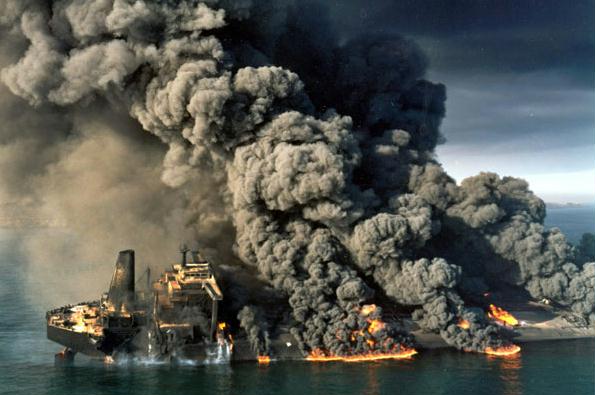
oil tanker on fire


[ An attack on (LNG) ships, oil tankers, or the Houston port facilities Houston would cause an oil shock, since a third of oil refining takes place there, and it’s also the second largest petrochemical center in the world.  An oil shock could lead to a financial shock since corrupt banking and Wall Street firms have prevented meaningful reforms. Plus we’re at the end of growth. How can a financial system designed for endless growth to pay back debt continue?  When peak oil is generally acknowledged, credit will dry up since no one will be able to grow in order to pay the debt back. Plus there’s over $200 trillion in unfunded liabilities.  All of this and more makes the global financial system very shaky.  Perhaps we’re only a terrorist attack, oil shock, hurricane, or earthquake away from another financial crash.

Alice Friedemann   www.energyskeptic.com  author of “When Trucks Stop Running: Energy and the Future of Transportation”, 2015, Springer and “Crunch! Whole Grain Artisan Chips and Crackers”. Podcasts: Practical Prepping, KunstlerCast 253, KunstlerCast278, Peak Prosperity , XX2 report ]

House 112-41. August 24, 2011. Preventing economic shock wave: Securing the port of Houston from a terrorist attack. House of Representatives. 62 pages.

Excerpts:

Mr. MCCAUL. Osama bin Laden’s ‘‘war of a thousand cuts’’ on the U.S. economy has always been a key facet of his strategy. His personal files found in his lair at Abbottabad, Pakistan, revealed a brazen idea to blow up oil tankers. By doing so, he hoped to damage not only the United States, but the world’s economy. The picture of an oil tanker ablaze, like this one off the coast of Yemen, would indeed add fuel to our financial crisis. Al-Qaeda and its affiliates have a history of attacking ships. In January 2000, there was an attack on the USS Sullivan. In October of 2000, a small boat with explosives blew a hole in the side of the USS Cole, killing 17 of our sailors. In October 2002, a French oil tanker was set ablaze, killing and injuring several crew members in the Straits of Hormuz. In 2005, there was an attack (1) against the USS Ashland. In July of 2010, there was a terrorist attack on a Japanese oil tanker.

The Government Accountability Office in its report on terrorist attacks targeting energy tankers states the supply chain faces three types of threats: Suicide attacks with explosive-laden boats similar to the one used against the USS Cole in the Gulf of Aden; standoff attacks with weapons launched from a distance, such as rocket- propelled grenades and; third, an armed assault used by pirates off the coast of Africa.

Not only would a successful attack result in the loss of life and have a detrimental effect on the economy, it would also be a psychological blow and would have environmental consequences.

The Port of Houston is the energy capital of the United States, and it is a target-rich environment. The port stretches from Galveston Bay, past Texas City, across the Gulf Intercoastal Waterway, past Bayport and the San Jacinto Monument, and deep into the City of Houston. The port includes a ship channel, a 52-mile highway for shipping. It has a wide range of businesses and is not just one of the physically largest ports in America, but also a leader in the movement of cargo.

Most importantly, roughly 25% of the oil imports for America flow through the Port of Houston. Each day, 25 to 30 oil and chemical tankers move along the Houston Ship Channel, and 31% of America’s crude oil refining capacity takes place right here in this harbor. If catastrophe struck the port, there is little spare capacity to import and refine crude oil elsewhere in the country. In short, an attack on the Houston port would be crippling.

A 2007 study by the Houston Port Authority estimated that the port directly leads to $285 billion in National economic activity, 1.5 million jobs, and $16.2 million in Nation-wide tax revenues. The U.S. Coast Guard estimates that if the Houston Ship Channel were closed, it would have a direct negative impact on the economy of approximately $406 million per day.

Americans are now paying nearly $4 for a gallon of gas. Even an attack causing little damage could raise prices at the pump by a dollar or more. The Port of Houston is integral to America’s economy. We must ensure there are no gaps in our security at this port and ensure that terrorists do not wound our economy or harm our citizens by successfully carrying out an attack in Houston.

The U.S. Coast Guard, Texas State and county officials, and industry stakeholders associated with the Port of Houston, have done a great deal to protect this port and its shipping from a terrorist attack. The U.S. Coast Guard, who is present here today, and local police, as the Sheriff is here today, have access to a real-time satellite tracking system that pinpoints the exact size and location of every ship in and around Houston. The Coast Guard has heavily armed vessels patrolling the channel along with the Harris County Sheriff boats. Equally important, Texas established the Houston Ship Channel Security District, a unique industry-Government partnership, to assist protecting the facilities surrounding the ship channel.

The GAO has made several recommendations to mitigate terrorist attacks at ports. It recommends that all participants should plan for meeting the growing security workload as liquefied natural gas shipments increase; that ports should plan for dealing with the economic consequences of an attack; that terrorism and oil spill response plans at the National and local level should be integrated; and that performance metrics should be developed for an emergency response.

I do want to point out another issue, and that is that once the Panama Canal project is complete in 2004 to deepen the Canal, they will be able to accommodate vessels with drafts up to 50 feet. Unfortunately, the Houston Ship Channel cannot accommodate such large ships because it only is dredged to 45 feet. Larger ships will not be able to enter the Houston Ship Channel. Additionally, it is notable that if a ship were sunk in the middle of the Channel, it would effectively cut off commercial traffic in the port until the ship could be refloated and moved. The cost of a shutdown would damage this economy extremely.

Mr. KEATING.  We are going to examine the Port of Houston which links the city of Houston with over 1,053 ports in 203 countries and is, therefore, an excellent location to determine exactly what the best practices are in maritime security. The Port of Houston is one of the largest ports in the world, and it is home to the world’s largest concentration of petroleum facilities and $15 billion in petrochemical complex, which is ranked second in the entire world. Although much attention is given to aviation security since 9/11, and rightly so, we cannot ignore the very real potential of threats that exist in the maritime sector and the steps that must be taken to protect our ports and waterways from the threat of terrorist activity.

My district is also near the Port of Boston, which is the oldest running port in the Western hemisphere. So I am no stranger to the maritime environment, and I look forward to examining the similarities and differences between security measures here in Houston and those in the Port of Boston which supplies 90 percent of the Massachusetts heating and fossil fuels.

Both the Port of Houston and Boston house tankers carrying liquefied natural gas, liquefied petroleum gas, and oil. If a terrorist attack occurred at a port like that and resulted in the explosion of any of these volatile materials, the result would truly be catastrophic. Unfortunately, terrorists overseas have demonstrated that they have the ability to carry out these type of attacks, and the fact that they haven’t occurred here in our country should mean nothing to us. We should be vigilant and ready.

The Chairman mentioned the very real possibility in terms of the suicide boat attacks of the tanker Limburg off the coast of Yemen that killed one person, injured 17, and spilled 90,000 barrels of oil. In 2010, the Coast Guard approved shipments of liquefied natural gas from Yemen to our home area within 50 feet of residential neighborhoods, despite concerns that the cargo was coming from a country that has been identified as a terrorist safe haven and has previously experienced terrorist attack of their own.

The economic impact of the Limburg attack included a short- term collapse in international shipping in the Gulf of Aden and, ultimately, cost Yemen $3.8 million a month. If that type of attack ever occurred here and caused a massive oil spill, even larger than the one that occurred in Yemen, we may, once again, experience the type of economic damage that occurred in the aftermath of Deepwater Horizon and its oil spill.

According to Dun and Bradstreet, Deepwater Horizon’s oil spill negatively impacted 7.3 million active businesses in 5 Gulf States, 85% of which were small businesses with less than 10 employees. So this just isn’t a big corporation or big business concern, economically it affects even our small businesspeople. It also affected 34 million jobs, $5.2 trillion in sales, and the price of oil went up.

Mr. GREEN. I represent most of the Port of Houston. I also share the Port of Houston with Congressman Ted Poe and Pete Olson to the east, but where you are standing or sitting today is in our district. As you know, it is the No. 1 foreign tonnage port in the country. It is the lifeblood of the economy in southeast Texas, but I think in the whole country, because of what we produce in refined products and other products in our community. We have five refineries and more chemical plants than I can count. I think if you compare our port security to every other port that I know of in the country, we have done so much more because, again, of the volatility of the products we produce.

Mr. Stephen L. Caldwell, Director of Maritime and Coast Guard Issues, Homeland Security and Justice Issues, Government Accountability Office.  The infrastructure utilized through these transportation resources includes the Colonial Pipeline system, which is the largest petroleum product pipeline system in the Nation and is vital to the demands of energy throughout the Southern part of our Nation and the East Coast. The Nation’s economy and security are heavily dependent on oil, natural gas, and other energy commodities. Bolstering port security in Houston and throughout the country is of paramount concern. The Port of Houston is a 25-mile-long complex of public and private facilities located just a few hours’ sailing time from the Gulf of Mexico.

More than 17 million people live within 300 miles of the city, and approximately 60 million live within 700 miles. The danger is very real that we may be escorting a weapon of mass destruction to its target. For every mile along the Houston Ship Channel that dangerous cargo passes, an additional 2,000 people are at risk. Clearly, once the cargo reaches the city, the risk is at its greatest.

Highlights of GAO–11–883T, Why GAO Did This Study.  The Nation’s economy and security are heavily dependent on oil, natural gas, and other energy commodities. Al-Qaeda and other groups with malevolent intent have targeted energy tankers and offshore energy infrastructure because of their importance to the Nation’s economy and National security.

The U.S. Coast Guard—a component of the Department of Homeland Security (DHS)—is the lead Federal agency for maritime security, including the security of energy tankers and offshore energy infrastructure. The Federal Bureau of Investigation (FBI) also has responsibilities for preventing and responding to terrorist incidents. This testimony discusses the extent to which: (1) The Coast Guard and the FBI have taken actions to address GAO’s prior recommendations to prevent and respond to a terrorist incident involving energy tankers, and (2) the Coast Guard has taken actions to assess the security risks to offshore energy infrastructure and related challenges. The Coast Guard and the FBI have not yet taken action on a fourth recommendation to develop an operational plan to integrate the National spill and terrorism response plans. The Coast Guard has taken actions to assess the security risks to offshore energy infrastructure, which includes Outer Continental Shelf (OCS) facilities (facilities that are involved in producing oil or natural gas) and deep water ports (facilities used to transfer oil and natural gas from tankers to shore), but improvements are needed.

The Nation’s economy and security are heavily dependent on oil, natural gas, and other energy commodities. Nearly half of the Nation’s oil is transported from overseas by tankers. For example, about 49 percent of the Nation’s crude oil supply— one of the main sources of gasoline, jet fuel, heating oil, and many other petroleum products—was transported by tanker into the United States in 2009. The remaining oil and natural gas used in the United States comes from Canada by pipeline or is produced from domestic sources in areas such as offshore facilities in the Gulf of Mexico. With regard to these domestic sources, the area of Federal jurisdiction— called the Outer Continental Shelf (OCS)—contains an estimated 85 million barrels of oil, more than all onshore resources and those in shallower State waters combined.13 In addition, the Louisiana Offshore Oil Port (LOOP), a deepwater port, is responsible for transporting about 10 percent of imported oil into the United States.

As the lead Federal agency for maritime security, the Coast Guard seeks to mitigate many kinds of security challenges in the maritime environment. Doing so is a key part of its overall security mission and a starting point for identifying security gaps and taking actions to address them. Carrying out these responsibilities is a difficult and challenging task because energy tankers often depart from foreign ports and are registered in countries other than the United States, which means the United States has limited authority to oversee the security of such vessels until they enter U.S. waters.

Offshore energy infrastructure also presents its own set of security challenges because some of this infrastructure is located many miles from shore.

Energy tankers face risks from various types of attack. We identified three primary types of attack methods against energy tankers in our 2007 report, including suicide attacks, armed assaults by terrorists or armed bands, and launching a ‘‘standoff’’ missile attack using a rocket or some other weapon fired from a distance. In recent years, we have issued reports that discussed risks energy tankers face from terrorist attacks and attacks from other criminals, such as pirates. Terrorists have attempted—and in some cases carried out—attacks on energy tankers since September 11, 2001. To date, these attacks have included attempts to damage tankers or their related infrastructure at overseas ports. For example, in 2002, terrorists conducted a suicide boat attack against the French supertanker Limburg off the coast of Yemen, and in 2010, an incident involving another supertanker, the M/V M. Star, in the Strait of Hormuz is suspected to have been a terrorist attack

Our work on energy tankers identified three main places in which tankers may be at risk of an attack: (1) At foreign ports; (2) in transit, especially at narrow channels, or chokepoints; and (3) at U.S. ports. For example, foreign ports, where commodities are loaded onto tankers, may vary in their levels of security, and the Coast Guard is limited in the degree to which it can bring about improvements abroad when security is substandard, in part because its activities are limited by conditions set by host nations. In addition, while tankers are in transit, they face risks because they travel on direct routes that are known in advance and, for part of their journey, they may have to travel through waters that do not allow them to maneuver away from possible attacks. According to the Energy Information Administration, chokepoints along a route make tankers susceptible to attacks.

Further, tankers remain at risk upon arrival in the United States because of the inherent risks to port facilities. For example, port facilities are generally accessible by land and sea and are sprawling installations often close to population centers. Our work on energy tankers identified three main places in which tankers may be at risk of an attack: (1) At foreign ports; (2) in transit, especially at narrow channels, or chokepoints; and (3) at U.S. ports. For example, foreign ports, where commodities are loaded onto tankers, may vary in their levels of security, and the Coast Guard is limited in the degree to which it can bring about improvements abroad when security is substandard, in part because its activities are limited by conditions set by host nations. In addition, while tankers are in transit, they face risks because they travel on direct routes that are known in advance and, for part of their journey, they may have to travel through waters that do not allow them to maneuver away from possible attacks. According to the Energy Information Administration, chokepoints along a route make tankers susceptible to attacks. Further, tankers remain at risk upon arrival in the United States because of the inherent risks to port facilities. For example, port facilities are generally accessible by land and sea and are sprawling installations often close to population centers.

We will continue our broader work looking at the security of offshore energy infrastructure, including Coast Guard security inspections and other challenges.  This figure is based on the most recently available data for a full year from the U.S. Energy Information Administration.  The OCS is a designation for all submerged lands of which the subsoil and seabed are outside the territorial jurisdiction of a U.S. State, but within U.S. jurisdiction and control.
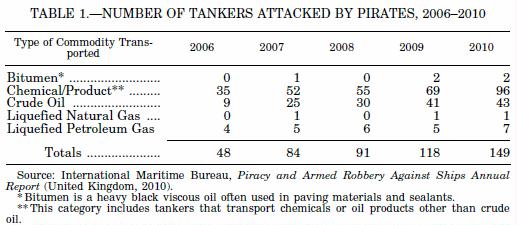
table 1 number of tankers attached by pirate 2006-2010


As shown in the table, pirate attacks against tankers have tripled in the last 5 years, and the incidence of piracy against tankers continues to rise. From January through June 2011, 100 tankers were attacked, an increase of 37% compared to tankers attacked from January through June 2010. Figure 1 shows one of the recent suspected pirate attacks. In addition, tankers are fetching increasing ransom demands from Somali pirates. Media reports indicate a steady increase in ransoms for tankers, from $3 million in January 2009 for the Saudi tanker Sirius Star, to $9.5 million in November 2010 for the South Korean tanker Samho Dream, to $12 million in June 2011 for the Kuwaiti tanker MV Zirku.

The U.S. Maritime Administration and the Coast Guard have issued guidance for commercial vessels to stay 200 miles away from the Somali coast. However, pirates have adapted and increased their capability to attack and hijack vessels to more than 1,000 miles from Somalia using mother ships, from which they launch smaller boats to conduct the attacks.

International Chamber of Commerce’s International Maritime Bureau operates a Piracy Reporting Center that collects data on pirate attacks worldwide. For more information on U.S. Government efforts to combat piracy, see GAO–10–856, which discusses the Coast Guard’s and other agencies’ progress in implementing efforts to prevent piracy attacks.

Risks to Offshore Energy Infrastructure.  Offshore energy infrastructure also faces risks from various types of attacks. For example, in 2004, a terrorist attacked an offshore oil terminal in Iraq using speedboats packed with explosives, killing two U.S. Navy sailors and a U.S. Coast Guardsman. Potential attack methods against offshore energy infrastructure identified by the Coast Guard or owners and operators include crashing an aircraft into it; using a submarine vessel, diver, or other means of attacking it underwater; ramming it with a vessel; and sabotage by an employee.

In addition to our work on energy tankers, we have recently completed work involving Coast Guard efforts to assess security risks and ensure the security of offshore energy infrastructure. Specifically, our work focused on two main types of offshore energy infrastructure that the Coast Guard oversees for security. The first type are facilities that operate on the OCS and are generally described as facilities temporarily or permanently attached to the subsoil or seabed of the OCS that engage in exploration, development, or production of oil, natural gas, or mineral resources.17 As of September 2010, there were about 3,900 such facilities

Based on Coast Guard records, we found that Coast Guard field units in several energy- related ports had been unable to accomplish many of the port security responsibilities called for in Coast Guard guidance. According to the data we obtained and our discussions with field unit officials, we determined that resource shortfalls were the primary reasons for not meeting these responsibilities. Furthermore, the Coast Guard had not yet developed a plan for addressing new liquefied natural gas (LNG) security resource demands.

According to Coast Guard officials, mobile offshore drilling units (MODUs), such as the Deepwater Horizon, do not generally pose a risk of a terrorist attack since there is little chance of an oil spill when these units are drilling and have not struck oil. However, the officials noted that there is a brief period of time when a drilling unit strikes a well, but the well has yet to be sealed prior to connecting it to a production facility. The Deepwater Horizon was in this stage when it resulted in such a large oil spill. During that period of time, MODUs could be at risk of a terrorist attack that could have significant consequences despite a facility not meeting the production or personnel thresholds. For example, such risks could involve the reliability of blowout preventer valves—specialized valves that prevent a well from spewing oil in the case of a blowout.

The 2009 National Infrastructure Protection Plan, 2010 DHS Quadrennial Review, and a National Research Council evaluation of DHS risk assessment efforts have determined that gaining a better understanding of network risks would help to understand multiplying consequences of a terrorist attack or simultaneous attacks on key facilities. Understanding ‘‘network’’ risks involves gaining a greater understanding of how a network is vulnerable to a diverse range of threats. Examining how such vulnerabilities create strategic opportunities for intelligent adversaries with malevolent intent is central to this understanding. For example, knowing what damage a malicious adversary could achieve by exploiting weaknesses in an oil-distribution network offers opportunities for improving the resiliency of the network within a given budget.

The findings of the National Commission on the BP Deepwater Horizon Oil Spill incident illustrate how examining networks or systems from a safety or engineering perspective can bring greater knowledge of how single facilities intersect with broader systems. The report noted that ‘‘complex systems almost always fail in complex ways’’ and cautioned that attempting to identify a single cause for the Deepwater Horizon incident would provide a dangerously incomplete picture of what happened. As a result, the report examined the Deepwater Horizon incident with an expansive view toward the role that industry and Government sectors played in assessing vulnerabilities and the impact the incident had on economic, social, and environmental systems

CAPTAIN JAMES H. WHITEHEAD III, SECTOR COMMANDER, SECTOR HOUSTON-GALVESTON, U.S. COAST GUARD. We also rely heavily on our port partners to be the ‘‘eyes on the water.’’ With an average of 350 daily tow movements in the Houston Ship Channel and more than 100 waterfront facilities with a vigilant security presence, marine industry stakeholders are well-positioned to recognize when things are out of the ordinary and serve as a valuable resource by diligently reporting breaches of security and suspicious activity.

Houston handles over 50 percent of all containerized cargo arriving at Gulf of Mexico ports. Additionally, more than 50 percent of the gasoline used in the United States is refined in this area. With more than 100 petrochemical waterfront facilities, Houston is the second-largest such complex in the world. Major corporations such as Exxon-Mobil, Shell, Saudi ARAMCO, Stolt Nielson, Odfjell USA Inc., Sea River and Kirby Marine have National or international headquarters in Houston.

The Port of Houston accommodates a large number of tankers carrying crude oil, refined products and chemical cargoes. With approximately 9,600 deep draft ship arrivals each year, the Coast Guard maintains a very extensive Port State Control program in the Houston-Galveston area. The Port State Control program ensures the safe carriage of hazardous materials in bulk. Because over 90 percent of cargo bound for the United States is carried by foreign-flagged ships, this National program prevents operation of substandard foreign ships in U.S. waters.

SHERIFF ADRIAN GARCIA, HARRIS COUNTY, TEXAS.  We have learned about Osama bin Laden, how he had some of the same information showing how important the ship channel is and the Port of Houston is. No doubt would-be terrorists in the United States and foreign countries know this, too. Next time they scheme to kill Americans and disrupt the energy supply of Planet Earth, they may think about targeting the very ground that we are on today.

We keep our electronic eyes trained on the ship channel 24/7 with camera sensors, radar, and other technology. Data from these high technology devices is fed into a monitoring center that we operate on the other side of town 24/7. We help the Coast Guard escort high-value asset vessels. We join the Coast Guard and CBP in boarding ships and scanning ship hulls, and although several operations are highly sensitive, I can tell you that our patrols on land and water have responded to calls for service such as suspicious persons in vehicles, security zone breaches by personal water craft, sunken boats, downed power lines, industrial accidents, security card violations at plant gates, and others.

We are also in touch with pipeline companies, railroads, and emergency planners.

In a very different kind of pioneering outreach, I have established what we call the Incidence Response Forum. We use it to engage the widespread Middle Eastern and South Asian communities in the Houston area. This is a two-way communication pathway for law enforcement to share information with key civic and religious leaders. The spirit in which we started this program several months ago was expressed very well in a Homeland Security memo issued by the Federal Government within the last 3 weeks. It is titled, ‘‘Empowering Local Partners To Prevent Violent Extremism In The U.S.’’ Here is a brief excerpt that refers to the attempts by terrorist groups to recruit American residents:

‘‘Countering radicalization to violence is frequently best achieved by engaging and empowering individuals and groups at the local level to build resilience against violent extremism. Law enforcement plays an essential role in keeping us safe, but so too does engagement and partnership with communities.’’

But our Incident Response Forum has other uses. By sharing information with these constituents, we help protect them against misguided attacks that may stem from terrorist acts anywhere in the world. These leaders can also report hate crimes, help calm tensions that may arise in ethnic communities and provide feedback about the effectiveness of law enforcement by the Harris County Sheriff’s Office. We are conducting crisis response exercises with this group.

JAMES T. EDMONDS, CHAIRMAN, PORT OF HOUSTON AUTHORITYThe country’s largest refinery, with a refining capacity of 567,000 barrels a day, is located on the channel. From Houston, refined energy products are delivered over the infrastructure that transports them to every market east of the Rocky Mountains through the networks of roads, rails, and pipelines originating in Houston. This includes the 5,519-mile Colonial Pipeline system, which is the largest petroleum product pipeline system in the Nation and is a vital energy artery for the South and East Coast.

CAPTAIN WILLIAM J. DIEHL (U.S. COAST GUARD, RET.), PRESIDENT, GREATER HOUSTON PORT BUREAU, INC.  The district’s infrastructure improvements include wireless and fiber optic wire communication systems with integrated analytical and intelligence video software, surveillance and detection cameras, night vision, motion detection technology, and additional technology components such as radar, sonar, and sensor packages. We have already added 112 cameras, 69 handheld radiation detectors, two marine side-scan sonar units, four patrol boats, seven patrol trucks, five radar sites, and an underwater remotely- operated vehicle to our regional security picture.

The only way we are going to get there is through our ports. To keep our ports vibrant we need trade agreements, reliable intermodal transportation (i.e., roads, rail, & barge infrastructure) and dredging. Of these three, dredging is the most pressing. We are choking our global competitiveness by not maintaining our ship channels. Currently 8 of our 10 largest ports are not at their authorized width or depths. We can talk today about securing our ports, but if we cannot get ships in or out, then that conversation will not mean much. Needless to say, at the Port Bureau, we are dedicated advocates for

Mr. CALDWELL. This is basically an illustration of the energy supply for the Nation, and when you look at this map, it really brings out the fact that the majority of the energy for the Nation comes right out of here. I know the ExxonMobil refinery refines about 31 percent of the Nation’s energy. If that was taken out by a small vessel like this one, you can imagine the long-term consequences, economic. It could cripple this Nation from an energy standpoint and an economic standpoint. Can both of you speak to that issue in terms of how important this port really is?

Mr. EDMONDS. Something in the neighborhood of 49% of the refined products used in this country every day come from the Houston Ship Channel industries and an eighth of the gasoline consumed every day. So it would be devastating to the economy of the country. The tragedy is you don’t even have to blow up an Exxon. You can just shut off access to the waterway and you shut down all that refining capability. There is something leaving this port 24 hours a day through a pipeline or railcar or truck. So there is all kinds of arteries of movement, and you damage any one of those and that has a devastating economic impact.

Captain DIEHL.  One-third of our economy is associated with global trade, and that trade comes and goes through our ports. Ninety- five to  99 percent of it by tonnage probably comes in and out of our ports by ships. So it is not only the Port of Houston, but it is all our major ports are key to our economy. You shut it down; we are going to start heading towards a recession. What makes us unique as Houston is these refineries. You can shut down a container port and move up the coast to the next container port to deliver those boxes. You can’t package up the refinery and move it. You can’t take those pipelines and pull them out of the ground and shift them over to New Orleans. That is what is unique.

Captain WHITEHEAD. In fact, 2 days from now we have a Yemeni  LNG tanker. We have one coming into the Port Arthur area. Although we don’t have any LNG tankers come into this area, the Houston Ship Channel, but we do have them come into both Freeport, Lake Charles, and Port Arthur. With those, we do take additional measures. We utilize our MSSTs. Our maritime security safety teams assist us in securing the—as well as we work with our port partners when they come in as well to secure the port, make sure that we board the vessel before it even comes in, do security sweep, escort the vessel in. So we take additional security measures with LNG tankers that come into port.

Mr. EDMONDS. Because of our geography and because of weather patterns, we are hurricane prone. So for many, many years we have had a very sophisticated hurricane plan. After 9/11, that was our baseline to begin to build off of to try to apply security issues to that plan because they are very much interrelated. I will say to you that in the most recent situation with Ike, the hurricane plan worked very well. There is a schedule that, as a storm begins to come, we begin to get ships out of the channel, begin to batten down everything until basically everything is secured, including container of wharf grains. Everything is secured and everything is gone or tied down, and it worked very well for us in Ike.

Additional reading

  • GAO, Maritime Security: Federal Efforts Needed to Address Challenges in Preventing and Responding to Terrorist Attacks on Energy Commodity Tankers, GAO–08–141 (Washington, DC: Dec. 10, 2007).
  • GAO, Maritime Security: Actions Needed to Assess and Update Plan and Enhance Collaboration Among Partners Involved in Countering Piracy off the Horn of Africa, GAO– 10–856 (Washington, DC: Sept. 24, 2010);
  • GAO, Maritime Security: Updating U.S. Counterpiracy Action Plan Gains Urgency as Piracy Escalates off the Horn of Africa, GAO–11–449T (Washington, DC: Mar. 15, 2011).
  • GAO, Maritime Security: DHS Progress and Challenges in Key Areas of Port Security, GAO– 10–940T (Washington, DC: July 21, 2010).
  • GAO, Standards for Internal Control in the Federal Government, GAO/AIMD–00–21.3.1 (Washington, DC: November 1999).



Posted in Disasters, Oil & Gas, Terrorism | Tagged , | Comments Off on Preventing economic shock wave: Securing the port of Houston from a terrorist attack

Wells Fargo created bogus bank accounts and credit cards without customer knowledge, billed them millions

[ I know this is “old news” from 2016, but the drawback of newspapers is that stories aren’t repeated.  What an insane level of corruption we’ve reached! Just look at the financial book list I haven’t yet posted at the bottom. Yet not one banker or wall street firm member went to jail after the mortgage bubble and other illegal actions after the financial crash in 2008.  Get your money out of the big banks before the Republicans shut down the Consumer Financial Protection Bureau (CFPB) and there’s no one to protect you.

Alice Friedemann   www.energyskeptic.com  author of “When Trucks Stop Running: Energy and the Future of Transportation”, 2015, Springer and “Crunch! Whole Grain Artisan Chips and Crackers”. Podcasts:  KunstlerCast 253, KunstlerCast278, Peak Prosperity]

Hongo, H. September 8, 2016. Wells Fargo Is in Trouble for Charging Customers Millions for Bogus Accounts. gizmodo.com

On Thursday, federal regulators announced that they were slapping Wells Fargo with a $100 million penalty after discovering employees created hundreds of thousands of bank accounts and credit cards in customers’ names without their knowledge, costing account holders an estimated $2.5 million in fees.

According to the Consumer Financial Protection Bureau, 5,300 Wells Fargo employees have been fired for using “improper sales practices,” which included transferring customers’ funds into newly created, unauthorized accounts to meet incentivized sales goals. In other cases, employees secretly applied for credit cards, signed up for online banking and activated debit cards in customers’ names.

In a 2013 L.A. Times story credited with first uncovering the scheme, former Wells Fargo employees claimed that managers coached workers on how to artificially raise sales numbers to meet the “relentless pressure” of sales quotas:

“They’d just tell the customers: ‘You’re getting a credit card,’” [former banker Erick] Estrada said. He admitted to opening unneeded accounts, though never without a customer’s knowledge, he said.

When customers complained about the unwanted credit cards, the branch manager would blame a computer glitch or say the card had been requested by someone with a similar name, Estrada said.

One former branch manager who worked in the Pacific Northwest described her dismay at discovering that employees had talked a homeless woman into opening six checking and savings accounts with fees totaling $39 a month.

“It’s all manipulation. We are taught exactly how to sell multiple accounts,” the former manager said. “It sounds good, but in reality it doesn’t benefit most customers.”

“This widespread practice gave the employees credit for opening the new accounts, allowing them to earn additional compensation and to meet the bank’s sales goals,” said the CFPB in a press release. “Consumers, in turn, were sometimes harmed because the bank charged them for insufficient funds or overdraft fees because the money was not in their original accounts.”

An analysis commissioned by Wells Fargo found that some 1,534,280 deposit accounts and 565,443 credit card applications may have been created without customers’ knowledge since 2011.

In addition to the $100 million fine—the largest handed out by the CFPB since it was created after the 2008 financial crisis—Wells Fargo has agreed to conduct a comprehensive, independent review of sales practices and pay refunds to all affected customers, who will not be required to take action. At least one former financial regulator, however, questioned whether the penalty was large enough for a bank worth over $250 billion.

“It sounds like a big number, but for a bank the size of Wells Fargo, it isn’t really,” David Vladeck, the former director of the Federal Trade Commission’s Bureau of Consumer Protection, told CNN.

In a statement on Thursday, Wells Fargo said it has set aside $5 million for refunds to customers, 100,000 of whom have already been repaid.

“Wells Fargo is committed to putting our customers’ interests first 100% of the time, and we regret and take responsibility for any instances where customers may have received a product that they did not request,” said the bank.

Financial corruption booklist (in progress)

Corporations

Financial cycles and the History of Stock Exchanges

  • The Coffee Trader. David Liss.
  • Reminiscences of a Stock Operator: With New Commentary and Insights on the Life and Times of Jesse Livermore. Edwin Lefèvre.
  • Mobs, Messiahs, & Markets: Surviving the Public Spectacle in Finance & Politics. William Bonner.
  • Devil Take the Hindmost: A History of Financial Speculation. Edward Chancellor

Fraud and Corruption on Wall Street

  • Liar’s Poker: Rising Through the Wreckage on Wall Street. Michael Lewis
  • Smells Like Dead Elephants: Dispatches from a Rotting Empire. Matt Taibbi
  • The Looting of America: How Wall Street’s Game of Fantasy Finance Destroyed Our Jobs, Pensions, & Prosperity—& What We Can Do about It. Les Leopold
  • Catching the Wolf of Wall Street: More Incredible True Stories of Fortunes, Schemes, Parties, and Prison. Jordan Belfort
  • Fiasco: The Inside Story of a Wall Street Trader. Frank Partnoy
  • Infectious Greed: How Deceit and Risk Corrupted the Financial Markets. Frank Partnoy
  • Den of Thieves. James B. Stewart
  • Young money. Inside the hidden world of Wall Street’s post-crash recruits. Kevin Roose
  • When Genius Failed: The Rise & Fall of Long-Term Capital Management. Roger Lowenstein
  • The Predators’ Ball: The Inside Story of Drexel Burnham and the Rise of the Junk Bond Raiders. Connie Bruck
  • A Fool and His Money: The Odyssey of an Average Investor . John Rothchild
  • Serpent on the Rock: Crime, Betrayal and the Terrible Secrets of Prudential Bache. Kurt Eichenwald

High Frequency Trading

  • Dark Pools: The Rise of the Machine Traders and the Rigging of the U.S. Stock Market. Scott Patterson.
  • Flash Boys: A Wall Street Revolt. Michael Lewis

Debt

  • The New Empire of Debt: The Rise & Fall of an Epic Financial Bubble. William Bonner
  • O.U.: Why Everyone Owes Everyone and No One Can Pay. John Lanchester

Accounting firm corruption

Final Accounting: Ambition, Greed and the Fall of Arthur Andersen. Barbara Ley Toffler

Insurance Deceit and Fraud

  • Delay, Deny, Defend: Why Insurance Companies Don’t Pay Claim and What You Can Do About It. Jay M. Feinman


The Banksters: Savings and Loan Crisis

  • Big Money Crime: Fraud & Politics in the Savings & Loan Crisis. Kitty Calavita

Real Estate Bubble

  • Reckless Endangerment
  • Housing Bubble Reckless Endangerment: How Outsized Ambition, Greed, and Corruption Led to Economic Armageddon by Gretchen Morgenson

Banking

  • All the Presidents’ Bankers: The Hidden Alliances that Drive American Power by Nomi Prins
  • The unauthorized biography. Felix Martin.
  • Too Big to Fail: The Inside Story of How Wall Street and Washington Fought to Save the Financial System—and Themselves by Andrew Ross Sorkin
  • Catching the Wolf of Wall Street: More Incredible True Stories of Fortunes, Schemes, Parties, and Prison by Jordan Belfort
  • Betrayal: The Life and Lies of Bernie Madoff by Andrew Kirtzman
  • Ponzi’s Scheme: The True Story of a Financial Legend by Mitchell Zuckoff
  • Stolen Without A Gun: Confessions from inside history’s biggest accounting fraud – the collapse of MCI Worldcom by Walter Pavlo
  • Unaccountable: How the Accounting Profession Forfeited a Public Trust by Mike Brewster
  • Blood on the Street: The Sensational Inside Story of How Wall Street Analysts Duped a Generation of Investors by Charles Gasparino
  • Wall Street Versus America: A Muckraking Look at the Thieves, Fakers, and Charlatans Who Are Ripping You Off by Gary Weiss
  • Traders, Guns & Money: Knowns and unknowns in the dazzling world of derivatives by Satyajit Das
  • Republic of Debtors: Bankruptcy in the Age of American Independence by Bruce H. Mann
  • Extreme Money: Masters of the Universe and the Cult of Risk by Satyajit Das
  • Reform of the financial system requires changing our political system Republic, Lost: How Money Corrupts Congress–and a Plan to Stop It by Lawrence Lessig
  • Predator Nation: Corporate Criminals, Political Corruption, and the Hijacking of America by Charles H. Ferguson
Posted in Banking | Comments Off on Wells Fargo created bogus bank accounts and credit cards without customer knowledge, billed them millions

We Must Preserve The Earth’s Dwindling Resources For My 5 Children

Brenda Milford. June 28, 2006. We Must Preserve The Earth’s Dwindling Resources For My 5 Children. The Onion. Vol 44 Issue 27

“As we move into the 21st century, it is our responsibility to think of the future of the earth—not for ourselves, but for those who will inherit what my husband and I leave behind when we’re gone. If we do not join together and do what’s best for this, our only planet, there may not be an environment left in which my five children, and their 25 children’s 125 children, can grow up and raise large upper-middle-class families of their own.

Nothing less than the preservation of my descendents’ lifestyle itself is at stake.

Imagine a world devoid of pristine wilderness for my progeny to explore on the weekends in the sport-utility-vehicles of the future, leaving my youngest son, Dylan, with nowhere to blow off steam on off-road adventures. Imagine a world in which my beautiful middle son, Connor, is denied his twice-daily half-hour hot showers because of water shortages. Picture what it would be like for my oldest boy Asher, preparing to start his first semester at Stanford, to have to go without basic amenities such as cable television, satellite radio, central air, or massage chairs, all because of the shortsighted squandering by his parents’ generation of our non-renewable energy sources today.

Though it seems like a far-off nightmare, this terrible vision is all too possible. Would you want to live in a world where my five children had to endure such horrible deprivations? I know I wouldn’t.

If we don’t take action now, my daughters Kimmy and Jenna may not be able to blow-dry their hair for 45 minutes to an hour each morning, nor may my future sons-in-law cut their grass atop enormous, diesel-powered riding mowers. In fact, they may not even have lawns—at least not the lush, verdant kind that requires constant watering and pesticide treatment. It’s conceivable that one day my five children’s spacious yards may be entirely composed of synthetic Astroturf, or—God forbid—those tacky wood chips my sister in Arizona uses.

In a cruel irony, those wood chippings will get more expensive as the world’s timber supply continues to shrink.

Encroaching urban sprawl has already begun to spoil the view from the porch of our beautiful new summer home on Lake Wakenaka. Sadly, the view from the bay windows of our first summer home, the one we built at our Woodland Acres property six years earlier, has already been ruined by such unchecked development. Must my children grow up in a world where only one of their parents’ summer homes is surrounded by the beauty of nature? It’s unthinkable, I know, but we must face facts.

This is to say nothing of the deleterious impact the destruction of our global ecosystems will have on the wildlife my family enjoys hunting. Biodiversity is crucial to another 100 years of deer-, quail-, duck-, bear-, moose-, bobcat-, and bison-shooting summer recreation for my descendants.

We must take steps immediately to devise safe, alternative energy sources that my future offspring can safely consume. If we don’t develop new fuels now, there will be none left for those who issue from my loins to burn and continue to burn for all time. I don’t want my 625-odd great-grandchildren to have to wait 20 or 30 precious seconds for their toilets to flush. I don’t want their 3,125 children to live in a hellish society where they cannot own their own snowmobiles. And I shudder to think that my 15,625 great-great-great-grandchildren may not be able to have TVs in every room that they can leave on all day and all night. Is it our right to deny my progeny of their gargantuan RVs and motorboats, as well? Of course not.

We cannot, in good conscience, lay such a burden on tomorrow’s generations of Melfords. My children are the future. And at the end of the day, isn’t it family—my family—that truly matters?”

Posted in Population | Tagged , | 4 Comments

Lab Girl by Hope Jahren (excerpts)

Preface. Here are some excerpts to give you a taste of how delightful and well written this book is, hope it inspires young women to go into science.  And something good to read when the grid goes down…

Warning: these are kindle notes meant to give you a sampling of her writing and how hard it is for a woman to succeed in science, plus interesting info about plants, trees, and other topics.

Alice Friedemann   www.energyskeptic.com  author of “When Trucks Stop Running: Energy and the Future of Transportation”, 2015, Springer and “Crunch! Whole Grain Artisan Chips and Crackers”. Podcasts: Practical Prepping, KunstlerCast 253, KunstlerCast278, Peak Prosperity , XX2 report

Hope Jahren. 2017. Lab Girl. Vintage.

PEOPLE LOVE THE OCEAN. People are always asking me why I don’t study the ocean, because, after all, I live in Hawaii. I tell them that it’s because the ocean is a lonely, empty place. There is six hundred times more life on land than there is in the ocean, and this fact mostly comes down to plants. The average ocean plant is one cell that lives for about twenty days. The average land plant is a two-ton tree that lives for more than one hundred years. The mass ratio of plants to animals in the ocean is close to four, while the ratio on land is closer to a thousand. Plant numbers are staggering: there are eighty billion trees just within the protected forests of the western United States. The ratio of trees to people in America is well over two hundred.

***

People don’t know how to make a leaf, but they know how to destroy one. In the last ten years, we’ve cut down more than fifty billion trees. One-third of the Earth’s land used to be covered in forest. Every ten years, we cut down about 1% of this total forest, never to be regrown. That’s a land area about the size of France. One France after another, for decades, has been wiped from the globe. That’s more than one trillion leaves that are ripped from their source of nourishment every single day. And it seems like nobody cares. But we should care.

***

The vast emotional distances between the individual members of a Scandinavian family are forged early and reinforced daily. Can you imagine growing up in a culture where you can never ask anyone anything about themselves? Where “How are you?” is considered a personal question that one is not obligated to answer? Where you are trained to always wait for others to first mention what is troubling them, even as you are trained to never mention what is troubling you? It must be a survival skill left over from the old Viking days, when long silences were required to prevent unnecessary homicides during the long, dark winters when quarters were close and supplies were dwindling.

***

When you go into a forest you probably tend to look up at the plants that have grown so much taller than you ever could. You probably don’t look down, where just beneath your single footprint sit hundreds of seeds, each one alive and waiting. They hope against hope for an opportunity that will probably never come.

When you are in the forest, for every tree that you see, there are at least a hundred more trees waiting in the soil, alive and fervently wishing to be.

The first real leaf is built using only a vague genetic pattern with nearly endless room for improvisation. Close your eyes and think of the points on a holly leaf, the star of a maple leaf, a heart-shaped ivy leaf, a triangular fern frond, the fingery leaves of a palm. Consider that there can easily be a hundred thousand lobed leaves on a single oak tree and that no two of them are exactly the same; in fact, some are easily twice as big as others. Every oak leaf on Earth is a unique embellishment of a single rough and incomplete blueprint.

Light equals life for a plant. As a tree grows, its lower branches become obsolete, too shaded by the newer ones above to be of any further use. A willow tree loads these used branches with reserves, fattens and strengthens them and then dehydrates their base such that they snap off cleanly and fall into the river. Carried away on the water, one out of millions of these sticks will wash up onto a bank and replant itself, and before long that very same tree is now growing elsewhere. What was once a twig will be forced to function as a trunk, stranded under conditions it had never considered. Every willow tree features more than ten thousand such snap-off points; it sheds 10 percent of its branches in this way every single year. Over the decades one—maybe two—of these will successfully take root downriver and grow into a genetically identical doppelgänger.

THE LIFE OF A DECIDUOUS TREE is ruled by its annual budget. Every year, during the short months from March to July, it must grow an entire new canopy of leaves. If it fails to meet its quota this year, some competitor will grow into a corner of its previous space and thus initiate the long, slow process by which the tree will eventually lose its foothold and die. If a tree expects to be alive ten years hence, it has no alternative but to succeed this year, and every year after.

Let’s consider a modest, unremarkable tree—the one living on your street, perhaps. A decorative maple tree, about the height of a streetlight—not a majestic maple reaching its full height in the forest—a demure neighborhood tree that’s only one-quarter the height of its regal counterpart. When the sun is directly overhead, the little maple in our example casts a shadow about the size of a parking space. However, if we pluck off all the leaves and lay them flat, side by side, they would cover three parking spaces. By suspending each leaf separately, the tree has stacked its surface area into a sort of ladder for light to fall down. Looking up, you notice that the leaves at the top of any tree are smaller, on average, than the leaves at the bottom. This allows sunlight to be caught near the base whenever the wind blows and parts the upper branches. Look again and you’ll notice that leaves low in the canopy are of a darker green; they contain more of the pigment that helps each leaf absorb sunshine, allowing them to harvest the weaker rays that penetrate shade. When building foliage, a tree must budget for each leaf individually and allocate for each position relative to the other leaves. A good business plan will allow our tree to triumph as the largest and longest-living being on your street. But it ain’t easy, and it ain’t cheap.

The leaves on our little maple, all taken together, weigh thirty-five pounds. Every ounce therein must be pulled from the air or mined from the soil—and quickly—over the course of a few short months. From the atmosphere, a plant gains carbon dioxide, which it will make into sugar and pith. Thirty-five pounds of maple leaves may not taste sweet to you and me, but they actually contain enough sucrose to make three pecan pies.

The pithy skeleton within the leaves contains enough cellulose to make almost 300 sheets of paper.

In order to accumulate all of the soil nutrients that 35 pounds of leaves require, our tree must first absorb and then evaporate at least eight thousand gallons of water from the soil. That’s enough to fill a tanker truck. That’s enough to keep 25 people alive for a year.

***

The NSF is a U.S. government agency, and the money that it provides for scientific research comes from tax dollars. In 2013, the budget of the NSF was $7.3 billion. For comparison, the federal budget allocation for the Department of Agriculture—the people responsible for supervising food imports and exports—was about three times that amount. Each year, the U.S. government spends twice as much on its space program as it does on all of its other scientists put together: NASA’s 2013 budget was more than $17 billion. And these discrepancies are nothing compared with the disparity between research and military spending. The Department of Homeland Security, created in response to the events of September 11, 2001, commands an annual budget that is fully five times larger than that of the entire NSF, while the Department of Defense’s mere “discretionary” budget comes to more than sixty times that sum.

***

One side effect of curiosity-driven research is the inspiring of young people. Researchers generally love their calling to excess, and delight in nothing better than teaching others to love it also; as with all creatures driven by love, we can’t help but breed. You may have heard that America doesn’t have enough scientists and is in danger of “falling behind” (whatever that means) because of it. Tell this to an academic scientist and watch her laugh. For the last thirty years, the amount of the U.S. annual budget that goes to non-defense-related research has been frozen. From a purely budgetary perspective, we don’t have too few scientists, we’ve got far too many, and we keep graduating more each year. America may say that it values science, but it sure as hell doesn’t want to pay for it. Within environmental science in particular, we see the crippling effects that come from having been resource-hobbled for decades: degrading farmland, species extinction, progressive deforestation…The list goes on and on.

$7.3 billion sounds like a lot of money. Remember that this figure must support all curiosity-driven science—not just biology, but also geology, chemistry, mathematics, physics, psychology, sociology, and the more esoteric forms of engineering and computer science as well. Because my work is about learning why plants have been so successful for so long, my research falls within the NSF’s paleobiology program. In 2013, the amount of funding that paleobiology gave out for research was $6 million. This is the entire annual budget for all of the paleontology research that happens in America, and the dinosaur-diggers predictably secure the lion’s share.


***

A vine that we know by the name “kudzu” arrived in Philadelphia as a gift from Japan to honor the 1876 centennial. Since that time kudzu has expanded to cover a total land area the size of Connecticut. Thick ribbons of kudzu embroider thousands of miles of highways in the American South. Kudzu thrives within the roadside ditches where we throw our beer cans and cigarette butts.

***

When I was separated from the lab, attending some seminar or conference, it was the series of twisted e-mails from Bill that held me fast to what I loved about my job, even while trapped with pasty middle-aged men who regarded me as they would a mangy stray that had slipped in through an open basement window. There’s a place somewhere where I am part of the in-group, I would remind myself as I stood alone with my buffet dish in some Marriott ballroom, apparently radiating cooties and so excluded from the back-slapping stories of building mass spectrometers during the good old days.

***

Each time I returned to Georgia Tech from traveling, I tried to throw myself into working even harder. I began to set aside one night a week as an all-nighter (Wednesdays) in order to complete the paperwork that went unattended while I served on committees tasked with documenting the potential obsolescence of chalkboards on campus. I learned that female professors and departmental secretaries are the natural enemies of the academic world, as I was privileged to overhear discussions of my sexual orientation and probable childhood traumas from ten to ten-thirty each morning through the paper-thin walls of the break room located adjacent to my office. By these means I learned that although I was in desperate need of a girdle, I was better off than one of the other female professors, who would never lose all that baby weight by working all of the time.

As hard as I worked, I just couldn’t get ahead. Showers became a biweekly ritual. My breakfast and lunch were reduced to a couple of cans of Ensure from the cases that I kept under my desk, and in desperation, I once threw one of Reba’s Milk-Bones in my purse so that I could gum it during a seminar, trying to keep peoples’ attention off of what I knew would be my growling stomach. The acne that I had never wrestled with as a teenager decided to make up for lost time with a magnificent debut, and I passed the workday biting my nails with ferocity. My brief forays into romance had convinced me that I would be relegated to love’s bargain bin; none of the single guys that I met could understand why I worked all of the time, and nobody wanted to listen to me talk about plants for hours, anyway. Everything about my life looked pretty well messed up compared with how adulthood had always been advertised to me.

***

Karen left us for the summer in order to accept a coveted internship at the Miami zoo, only to find that most of what zookeepers actually do amounts to pretty routine hygiene maintenance, and that the only thing worse than an animal that doesn’t appreciate this is one who does. Placed upon the lowest rung of the ladder, she was sent to work in the primate enclosure. Karen’s job was to apply anti-inflammatory cream to monkey genitalia, which were in need of daily soothing due to their constant and indiscriminate use. Once the monkeys had recognized her as their new vehicle of relief, they began mobbing her when she entered the room. Bill and I could hardly absorb this story when she told it to us, it was just too wonderful, but it got even better. It turns out that it is a hard-hearted monkey indeed that remains unmoved during a good slathering of bacitracin, and most monkeys proved considerably more responsive to her reluctant manipulations.

The zoo had fitted Karen with a protective plastic shell meant to discourage her charges from clutching on to her and wildly humping her frame, but it wasn’t 100 percent effective. On the upside, her many animal behavior classes had provided her with the intuition necessary to condition these monkeys to the concept of a glory hole; the downside was that seeing them lined up and “standing at attention” through a chain-link fence first thing in the morning was enough to make her rethink a career in veterinary medicine altogether. She returned to our lab after the internship having decided that maybe botany wasn’t so boring after all.

***

A CACTUS DOESN’T LIVE in the desert because it likes the desert; it lives there because the desert hasn’t killed it yet. Any plant that you find growing in the desert will grow a lot better if you take it out of the desert. The desert is like a lot of lousy neighborhoods: nobody living there can afford to move. Too little water, too much light, temperature too high: the desert has all of these inconveniences ratcheted up to their extremes. Biologists don’t much study the desert, since plants represent three things to human society: food, medicine, and wood. You’ll never get any of those things from the desert. Thus a desert botanist is a rare scientist indeed and eventually becomes inured to the misery of her subjects. Personally, I don’t have the stomach to deal with such suffering day in and day out.

In the desert, life-threatening stresses aren’t a crisis; they are a normal feature of the life cycle. Extreme stress is part of the very landscape, not something a plant can avoid or ameliorate. Survival depends on the cactus’s ability to tolerate deathly grim dry spells over and over again. If you meet a barrel cactus that’s tall enough to touch your knee, it is likely to be more than twenty-five years old. Cactuses grow slowly in the desert—during the years when they do grow, that is.

A barrel cactus has folds like an accordion, and deep within these folds are the pores that let air in and water evaporate out. When it becomes very dry, a cactus sheds its roots to prevent the parched soil from sucking all the water back out of it. A cactus can live for four days with no roots and still continue to grow. If there is still no rain, the cactus begins to contract, sometimes for months, or until all the folds have closed together. Its spines form a dense and dangerous fur protecting what is now a hard, rootless ball of plant. In this posture, the cactus can sit without growing and await rain for years, while continuously punished by the sun. When it finally rains, the cactus will either return to full functioning within twenty-four hours or show itself to be dead.

***

When we met Ed in front of the building that housed his laboratory, it was mid-morning on a Tuesday. He took us inside and introduced us all around, proudly telling people that he’d known me since I was a new student, that I was now a professor doing great things.

He told about how he had gone on a soils trip with me and I had slept in my car because I didn’t want to lose valuable daylight hours setting up a tent. He told them that I was the hardest-working student he’d ever seen and that he knew I was special from the first time that he met me.

After he finished, I looked up at Ed and said, “Thank you.” Then I cringed as, one by one, the people to whom I was being introduced sized me up and down, each of them wearing a look with which I was very familiar. It was the look that says, “Her? That can’t be right; there’s a mistake here somewhere.” Public and private organizations all over the world have studied the mechanics of sexism within science and have concluded that they are complex and multifactorial. In my own small experience, sexism has been something very simple: the cumulative weight of constantly being told that you can’t possibly be what you are.

***

Remaining stationary and naked outside in the below-freezing weather for three months is a death sentence for almost every living thing on Earth, except for the many species of trees that have been doing it for a hundred million years or more. Spruce, pine, birch, and the other species that blanket Alaska, Canada, Scandinavia, and Russia endure up to six months of frozen weather each year.

In order to prepare for their long winter journey, trees undergo a process known as “hardening.” First the permeability of the cell walls increases drastically, allowing pure water to flow out while concentrating the sugars, proteins, and acids left behind. These chemicals act as a potent antifreeze, such that the cell can now dip well below freezing and the fluid inside of it will still persist in a syrupy liquid form. The spaces between the cells are now filled with an ultra-pure distillate of cell water, so pure that there are no stray atoms upon which an ice crystal could nucleate and grow. Ice is a three-dimensional crystal of molecules, and freezing requires a nucleation spot—some chemical aberration upon which the pattern may start to build. Pure water devoid of any such site may be “super-cooled” to forty degrees below zero and still remain an ice-free liquid. It is in this “hardened” state, with some cells packed full of chemicals and others sectioned off for purity, that a tree embarks on its winter journey, standing unmoved through the frost, sleet, and blizzards of the season. These trees do not grow during winter.

The vast majority of northern trees prepare well for their wintertime journey, and death due to frost damage is extremely rare. A chilly autumn brings on the same hardening as a balmy one, because the trees do not take their cue from the changing temperature. It is the gradual shortening of the days, sensed as a steady decrease in light during each twenty-four-hour cycle, that triggers hardening.

AGRONOMISTS AND FORESTERS have charted the growth of hundreds of plant species, starting in 1879 when a German scientist noticed that the increasing weight of a corn plant, when graphed against the days of its development, resulted in a line with a curious lazy-S shape. These scientists had weighed their potted plants daily, and for the entire first month they saw very little growth. Then, during the second month, the plants’ weights shot up sharply; they doubled in size each week until they reached their maxima at three months of age. The scientists were then surprised to see the weights drop off again, and by the time they began to flower and produce seed, the plants weighed only about 80 percent of what they had been at their largest.

There are botany textbooks that contain pages and pages of growth curves, but it is always the lazy-S-shaped ones that confuse my students the most. Why would a plant decrease in mass just when it is nearing its plateau of maximum productivity? I remind them that this shrinking has proved to be a signal of reproduction. As the green plants reach maturity, some of their nutrients are pulled back and repurposed toward flowers and seeds. Production of the new generation comes at a significant cost to the parent, and you can see it in a cornfield, even from a great distance.

For our experiments, we exploit the most fundamental difference between plants and animals—namely, that most plant tissues are redundant and flexible: a root can become a stem if need be, and vice versa. The fragmentation of a single embryo can lead to several copies of that plant, each with an identical blueprint of genes. New propagation techniques allow us to answer questions like “Does a tree remember extreme malnutrition experienced during childhood?” by starving one seedling for years while lavishing nutrients upon its identical twin. Such experiments are the only way to find definitive answers; they are deeply repugnant and obviously unethical with human subjects. Plants, in contrast, are fair game.

***

Our world is falling apart quietly. Human civilization has reduced the plant, a four-hundred-million-year-old life form, into three things: food, medicine, and wood. In our relentless and ever-intensifying obsession with obtaining a higher volume, potency, and variety of these three things, we have devastated plant ecology to an extent that millions of years of natural disaster could not. Roads have grown like a manic fungus, and the endless miles of ditches that bracket these roads serve as hasty graves for perhaps millions of plant species extinguished in the name of progress. Planet Earth is nearly a Dr. Seuss book made real: every year since 1990 we have created more than eight billion new stumps. If we continue to fell healthy trees at this rate, less than six hundred years from now, every tree on the planet will have been reduced to a stump. My job is about making sure there will be some evidence that someone cared about the great tragedy that unfolded during our age.


Posted in (Auto)biography | Tagged , | 4 Comments

U.S. House 2013 “Exports and the Changing global energy landscape”

[ My excerpts from the house hearing below is another “let’s export Natural Gas to our allies now that we’re energy independent”.  The driving force is not making even better friends with Europe and keeping bully Russia away (though that’s what’s said). The real reason is higher profits for private oil and gas companies.  Too bad the U.S. never nationalized oil and gas like most nations, because this is a resource we all own.  The government may have conserved and stretched it out longer than the market, which wants its profits this quarter.  And for this giant orgy of excess the market is congratulated over and over again in congressional hearings, because the orgy can continue forever since according the The Market, there can never be a shortage of anything.  The cleverness of the market aided with additional money will simply come up with more of whatever or a replacement. Which sounds a whole like a biblical myth of loaves and fishes raining out of the sky. Yes, capitalism is the most successful way ever devised of plundering the planet for a very tiny fraction of the human population as fast as possible, but do we really want to leave nothing but smoking ruins for future generations ASAP?

Highlights of the testimony:

Former Army Captain Mike Breen says that until we develop alternatives to oil for transportation, the U.S. “has no choice but to do whatever it takes in order to obtain a sufficient supply of oil”.  That means there will be war in the Middle East as long as oil exists.  Breen argues that although the U.S. could save $90 billion a year by abandoning our role of keeping the oil flowing, it would open the door to our adversaries to play that role –a much worse option.  He concludes: No matter how much domestic production picks up, the negative consequences of our single-source oil dependence are likely to persist. Our single-source dependence on oil threatens our national security. Even dramatic increases in domestic oil production will not free us from the global dynamics of this market, or relieve us of our global responsibilities.

Score card (# of times said):

  • Energy Independence. Mike Halleck (3), Fred Upton, MI (3), J. Bennet Johnston (2), Amy Jaffe (1), Eliot L. Enger, NY (1)
  • Energy Abundance: Ed Whitfield, KY (4), Bill Johnson, Bill Johnson (1)
  • Energy Dependence. Mike Breen (3)

How long with energy independence last?

  • Mike Halleck. We have been told 200 to 250 years, some say as many as 500 years.
  • J Bennett Johnston. DOE says we have 100 years of Natural Gas
  • Joe Barton, TX: We think another 500 years (Barnett shale)
  • Michael R. Turner. The U.S. EIA says we have a nearly 100-year supply of natural gas
  • Scott Lincicome. U.S. EIA predicts oil and natural gas production to stay at relatively high levels for decades. The IEA says the U.S. could be a net exporter of natural gas by 2020 and “almost self-sufficient in energy, in net terms, by 2035”, and the world’s largest oil producer by 2020 leading to North America’s emergence as a net oil exporter by 2035.

Alice Friedemann   www.energyskeptic.com  author of “When Trucks Stop Running: Energy and the Future of Transportation”, 2015, Springer and “Crunch! Whole Grain Artisan Chips and Crackers”. Podcasts: Practical Prepping, KunstlerCast 253, KunstlerCast278, Peak Prosperity , XX2 report ]

House 113-38. May 7, 2013. Exports and the changing global energy landscape. U.S. House of Representatives. 141 pages.

Excerpts:

Mike Breen, Executive Director Truman National Security Project & Center for National Policy.  

As a former Army Captain and an Iraq & Afghanistan combat veteran, I am also proud to be one of the leaders of Operation Free. It is a non-partisan, nationwide coalition of more than five thousand veterans who believe that our dependence on oil poses a clear national security threat to the United States. To be clear, oil is immensely important to our economy and will remain so for the foreseeable future. Its value goes far beyond its utility as a liquid fuel. Petroleum is a key input in advanced manufacturing, pharmaceuticals, agricultural products, and a host of other applications. Unfortunately, however, our near-total dependence on oil as a fuel has eclipsed petroleum’s other contributions, threatening our prosperity and security.

Our dependence on oil as a single source of transportation fuel poses a clear national security threat.

As things now stand, our modern military cannot operate without access to vast quantities of it. Our economy is equally dependent, with more than 93% of our transportation sector reliant on oil.

Oil is a vital strategic commodity, a substance without which our national security and prosperity cannot be sustained. Until and unless we develop alternatives, the United States has no choice but to do whatever it takes in order to obtain a sufficient supply of oil.

Recent technological advancements, such as horizontal drilling and advanced hydraulic fracturing, are promising. They offer the chance to increase domestic production, allowing us to reach supplies of oil that were, until recently, too expensive or impossible to obtain. These advances have led some to claim that the United States is suddenly capable of producing enough oil domestically to meet our needs. They believe that this will solve our oil-related economic and national security problems.

Yet, even if U.S. oil imports dropped dramatically, geostrategic problems would persist. And though we do not always share the same oil sources as our international partners, our security is put at risk by their volatility. For instance, in December 2011, Iran threatened to close the Strait of Hormuz, a waterway that ships one-fifth of the world’s supply of oil. This resulted in global oil prices jumping 2%, exceeding $100 dollars a barrel. Words alone were able to drive up the cost of oil in markets from the Gulf to Asia.

Meanwhile, global demand for oil is rising at a breathtaking pace, with no sign of slowing down in the foreseeable future. While American demand has been very high but relatively static for some time, demand in China, India and the developing world is skyrocketing. According to the Energy Information Administration, America’s oil consumption is expected to grow by 11% over the next two decades. Meanwhile, in that same timespan, China’s oil consumption is expected to grow by 80%, and India’s by 96% (5). And by the end of the decade, China alone is expected to sell more than 30 million cars per year (6). To put that in perspective, last year about 76 million cars were sold worldwide. It is unrealistic at best to imagine that increasing production can somehow keep up with such dramatically rising demand.

Further, because the price of oil is set on a global market, it is subject to events outside of our control or influence. All of us agree that the United States should not be subjected to the whim of hostile or unstable regimes with nationalized oil assets. The U.S. currently patrols and secures the world’s most critical shipping routes. Some contend that, by producing more at home, we could relinquish many of those responsibilities. Indeed, a recent RAND study estimated that if the military were to stop defending oil supplies and sea routes from the Persian Gulf to the US , it would save between 12 to 15% of the entire defense budget–more than $90 billion dollars annually.

But imagine if we did disengage from this duty. A number of our adversaries would recognize this as an opportunity, and our allies would be faced with serious challenges. Look at the Asia-Pacific market where 85% of the oil shipped through the Strait of Hormuz today — which supplies one-fifth of all oil traded worldwide — goes toward Asia , not the United States. The oil then transits the Indian Ocean and enters the North Pacific through the Strait of Malacca, a razor-thin chokepoint constantly under threat of piracy, terrorist activity and hijacking. According to the EIA, if the Strait of Malacca was blocked, nearly half of the world’s shipping fleet would be required to reroute. Hostile actors have taken notice. According to documents seized during the raid that killed Osama bin Laden, al Qaeda was planning to highjack and destroy oil tankers in the Straits. The documents called for Al Qaeda operatives to practice running tankers aground in shipping chokepoints, severely disrupting global commerce.

But more than the security of oil flows is at stake. The Strait, together with the surrounding South China Sea, is at the center of a complex dispute between China and a number of smaller Asian nations.

Appropriately, the U.S. has taken a strong interest in this dispute, working to prevent China from bullying its smaller neighbors and putting freedom of navigation at risk. Indeed, in 2011, China and Vietnam came dangerously close to open conflict in the South China Sea. If the U.S. pulls out of the Pacific and Indian Ocean, who will step in to fill the void? China would likely be more than willing. Few others would be capable. India could develop into a true naval power given time, but has so far shown great reluctance to step forward as a provider of regional security. Our partners in Asia, including Japan and South Korea, would risk inflaming tensions with China if they chose to step forward to secure vital sea lanes themselves. In short, an American pull-back would tempt our rivals into even greater military activity while placing our allies at risk.

No matter how much domestic production picks up, the negative consequences of our single-source oil dependence are likely to persist. Today, the Syrian resistance movement is being gunned down with bullets supplied by Putin’s oil-rich Russia. American Soldiers and Marines are confronting terrorists in Afghanistan armed with Iranian weapons, purchased with oil money. Our forward operating bases are put in danger every time a fuel convoy is attacked. In every case just mentioned, American national security is significantly threatened.

Our single-source dependence on oil threatens our national security. Even dramatic increases in domestic oil production will not free us from the global dynamics of this market, or relieve us of our global responsibilities. 

[ In response to a question about global warmings effect on national security]: We have done quite a bit of [research], as has, much more importantly, the Pentagon and the intelligence services. The consensus is that this poses a serious national security threat. The Natural Security Advisor Tom Donilon just gave a speech to that effect a couple of weeks back, saying that national security is threatened by climate. Recently the commander of our forces in the Pacific was asked what his top national security concern was, which I think is an interesting question, given that he is responsible for China, North Korea and a whole host of other issues in the Pacific, and his answer was climate. If you look at the accelerants of instability and the threats that come from this, with regard to terrorism, but also with regard to mass population migrations, terrorist recruiting, all kinds of issues, it is pretty clear that we are going to be dealing with this. And, as General Zinni likes to say, we can pay down now, and the cost will be in treasure, or we can pay down later, and the cost will be treasure and blood.

ED WHITFIELD, KENTUCKY. Today’s hearing is on U.S. energy abundance, exports and changing global energy landscape. America’s growing energy production is a game changer, and today’s hearing explores the geopolitical benefits of the U.S. becoming a world leader in energy production and exports. As we have discussed in previous hearings, America’s energy abundance is creating employment opportunities and growth at a time when little else in the economy is going as well, and that alone is enough reason to support domestic energy production. But while this energy abundance is a source of jobs at home, it can also be a force for good and competition around the world, and it is this potential that we hope to address today.

Until a few years ago most of us assumed that the U.S. was well past its peak in terms of domestic energy production and that we would become increasingly dependent on imports, particularly oil imports from OPEC nations.  Many feared the same thing was happening with natural gas, and some even worried about an emerging OPEC-like natural gas cartel dominated by Russia and Iran.

This committee held many hearings discussing the grave geopolitical consequences of global energy markets dominated by nations that do not necessarily share our values and who are not shy about using energy exports to exert leverage over other countries. But now the tables are turning, thanks to American innovations in hydraulic fracking and directional drilling that is expanding the supply of domestic oil and natural gas. Instead of being beholden to energy exporting nations, we are fast becoming one ourselves.

Perhaps nowhere is the reversal more stark than with natural gas. Debates about natural gas used to center around whether to permit facilities to import supplies of liquid natural gas from abroad to help make up for dwindling domestic production. But now these would be import terminals are being reproposed as export terminals. The reason for this reversal is that domestic natural gas production is now rising so fast that there is more than enough to meet domestic demand affordably and export the surplus to nations that need it, such as Japan and Great Britain.

I might add that the benefits of energy exports also apply to coal.

Not only should we be focused of course on natural gas and oil and coal, but we need also to focus on pipelines, port facilities, and other infrastructure investments necessary to make full use of our energy abundance.

None of this can happen if we shut the door on domestic energy production. For this reason, we need to address the fact that the Obama administration continues to keep most federal lands off-limits to energy leasing and that regulatory efforts may be underway to crack down on hydraulic fracturing.

The Obama administration’s four-year delay in making a decision on the Keystone XL pipeline project is a warning sign that the infrastructure approval process is badly broken and needs to be fixed.

The benefits of being an energy-exporting nation could also be derailed if we place unnecessary restrictions on these exports. Some argue that exports of natural gas will create domestic shortages and serious price spikes in the U.S. But, with resource assessments continuing to be revised upward and studies from the Department of Energy and the Small Business & Entrepreneurship Council touting the net economic benefits that are strongly positive, these fears are becoming more and more unfounded.

BILL  JOHNSON, MISSOURI. You talk about energy abundance and job creation through domestic energy production, nowhere in the Nation is that happening any more prevalently than in eastern and southeastern Ohio. We sit on top of the Marcellus and the Utica shale, and so many, many opportunities are coming our way.

Mike Halleck, President of Columbiana County board of commissioners, Ohio.  Why not pursue exportation to countries that we have open trade with. It would seem to me that not only would this stabilize prices, but give the United States a different standing in the world and make a statement of energy independence. A recent report by Secretary Chu and the energy department seemed to suggest something along this same line of thinking. Several members of Congress seem to share this same school of thought in a recent letter to Secretary Chu. It was refreshing to see the non-partisan signatures on this letter. After all, energy independence is not and should not be a partisan issue.

If the estimates, and I am sure a lot of the reports have been maybe overly optimistic, but even if they are just optimistic, they are overwhelming in terms of the supply that we would have. In fact, Senator Johnston and I were talking earlier, in my humble opinion it would seem to me that if—we were talking about flaring—if we get to the point where natural gas is too cheap, then, for lack of a better term, they would turn off the spigot. I think it not only would stabilize prices, but certainly give us a sense of energy independence.

FRED UPTON, MICHIGAN. Today’s hearing continues the subcommittee’s look into what is becoming a welcome theme: how American energy abundance is rewriting the playbooks for all levels of energy policy. This new strategy is a reality, resulting from advancements in innovation and technology, has game-changing potential for America’s energy future with more jobs, lower prices, and, yes, less volatility, as we will hear today, has far-reaching implications abroad as well. As we learned at our February hearing, U.S. energy resources are vastly abundant and growing, with technology continuing to evolve and new areas of the country becoming centers for exploration and production.

It is not just Texas, Alaska, and Louisiana anymore, but places like Illinois, Ohio, Michigan, even California who are in the process of developing or considering developing new oil and gas resources from domestic shale. This diverse geographic abundance is helping to ease the volatility of the recent past, where prices were becoming increasingly vulnerable to hurricanes and geopolitical turmoil, to create a new North American gas market that is becoming the envy of the world.

America’s natural gas movement is creating competitive opportunities domestically for manufacturing and technology, as well as international opportunities to help our allies reduce their reliance on geopolitically unstable regions of the world. And I believe that our abundance means that we can have both new jobs from a renaissance in the energy and manufacturing sectors, along with new diplomatic strength from using these resources to reinforce our ties to important allies and trading partners. Our changing energy landscape will in fact produce both economic growth and real gains.  We are in the midst of a budding success story about American prosperity, jobs, and national power. We are continuing to produce valuable energy resources safely and responsibly around the country.

JOE BARTON, TEXAS.  I don’t think it is a secret that I am a supporter of free markets and a robust American energy policy. Currently our oil and gas sector is creating about 9 million jobs a year and sending in taxes more than $30 billion to the Federal Treasury every year. We have the blessing of the Lord on our side in the United States that the latest estimates, although it is difficult to estimate, we think over 2,000 trillion feet of natural gas resides beneath our lands in the United States, 2,000 trillion feet. Because of past laws, we give the Department of Energy the right to make a decision on exports and natural gas, if it is not to a country where we already have a free trade agreement. There are currently 19 of those applications pending, one has been approved. It would be my hope that several more are approved in the near future. If you believe in free markets this is a win-win. You only make an agreement if it benefits the seller and it benefits the buyer. In this case the seller is the American economy and the jobs that are created in America. And the winner overseas is the increased economic prosperity because they get natural gas from the United States that is orders of magnitude less expensive than it is from any other supplier.

BOBBY L. RUSH, ILLINOIS.  With the technological advances in the area of energy production and the prevalence of shale oil and gas due to hydraulic fracturing, or fracking, today’s hearing is both timely and very necessary. Not long ago experts predicted that the U.S. would be forced to rely on increased natural gas imports in order to meet our energy demands. However, today we are seeing a boom in domestic production of oil and natural gas due to fracking and horizontal drilling. And now we must consider whether the U.S. should become a net exporter of natural gas, and, if so, over what period of time.

Between 1990 and 2012, natural gas production in the U.S. increased by 34%, and the EIA projects that under existing policies natural gas production will rise by an additional 39% by the year 2040. In fact, in a National Journal article dated April 30th, 2013, entitled ‘‘The U.S. Has Much, Much More Gas and Oil Than We Thought,’’ it was noted that the U.S. has double the amount of oil and 3 times the amount of natural gas than previously thought stored deep under the States of North Dakota, South Dakota, and Montana. This was according to new data that was released by the Obama administration. The article went on to note that in just the Bakken and Three Forks plays alone the U.S. Geological Survey estimated that there are 7.4 billion barrels of recoverable oil and 6.7 trillion cubic feet of natural gas waiting to be tapped. While the EIA predicts that under existing policies U.S. Total natural gas consumption will increase from 24.4 trillion cubic feet in 2011 to 29.5 trillion cubic feet in 2040, the agency also notes that as domestic production outpaces consumption the U.S. could become a net exporter of natural gas by the year 2020. In fact, President Obama reiterated this fact personally this past weekend during the development forum in Costa Rica where he indicated that he may be close to making a decision on whether or not the U.S. should become a net exporter of natural gas.

BENNETT JOHNSTON, CHAIRMAN, JOHNSTON & ASSOCIATES.

I don’t really believe in energy scarcity. I think new supplies are pulled up all the time. They are based on technology like fracking. It wasn’t very many years ago that we had almost not heard of shale gas. George Mitchell, an old friend of mine went in with some DOE money and created that new technology, which has revolutionized America. Bakken oil and the Bakken shale has revolutionized my colleague’s home State. So I think there is not the scarcity that some talk about. I think we can be energy independent in this country, and I think it is a goal we should pursue.

I disagree with the EPA on some things, agree with them on others. Certainly we need the highest environmental standards, which I think we can, consistent with energy independence. One of the things that neither EPA nor any other agency can do is allocate resources, and that really is the heart of my point today, that government regulatory bodies just can’t allocate resources.

The Department of Energy says we have 100 years of natural gas. They say that by 2020 supply will go up by 40%, while demand will go up only 20%. The amount of natural gas seems to be growing every week. Just last week The Washington Post reported that Williston Basin has 3 times as much natural gas as they thought. They also said, by the way, that China has 50% more natural gas than the United States has. DOE commissioned a study from Cambridge Energy Research Associates, a definitive study, which indicates that we can safely export natural gas without any untoward effect on the price—no price spikes, no difficulty in terms of supply.  That  is argued against by some of the chemical companies, principally Dow Chemical, who says, if you have unfettered exports, then that is going to lead to supply disruptions, price spikes, and other difficulties. So the issue I would like to speak about today is the question of how to allocate this huge beneficence of natural gas in the United States. Is it by regulation or is it by the free market?  In my judgment, and my experience has been that the market is the best way to do that allocation.

It takes 5 to 7 years and $10 billion to $20 billion to have an [LNG] export terminal, with the trains and the ships and the gas facilities on the other end.

We had the Fuel Use Act of 1978 where they prevented natural gas from being burned under boilers, and that turned out to be a disaster, the Congress didn’t know how to allocate the highest and best use of natural gas. And just in case you think that since I left the Senate that the regulators are doing any better job, just look at electric cars. The President says we are going to have a million electric cars in a couple of years. We have got less than 100,000 now.  And how about ethanol? We are supposed to have 36 billion gallons of ethanol, over half of that cellulosic ethanol. Right now, according to their estimates, we should be having 500 million gallons of cellulosic ethanol. You know how many we have got? Less than a million gallons, less than 1/500, and the prospects are not any better.

BYRON DORGAN, Bipartisan Policy Center, former senator of North Dakota.

We add 200,000 people to the planet every single day. We added Dallas, Texas, net to the planet every week. We are headed towards 9 billion people. They are going to want to have refrigerators, washing machines, and air conditioners. They are going to want to drive cars as well that are going to need to stop at a fuel station once or twice a week—or let’s hope once every 2 weeks. My point is the growing demand as a result of increased population will continue.

JAMES BRADBURY, Senior Associate, Climate and Energy Program, World Resources Institute.

LNG exports will lead to an increase in domestic production of shale gas, which will have important environmental implications, including an increase in U.S. greenhouse gas emissions. One major emission source is leaks from natural gas infrastructure.  Methane is the primary component of natural gas and a potent greenhouse gas, with a warming effect that is at least 25 times greater than carbon dioxide. These fugitive emissions represent lost product and reduced revenue for companies and governments, with negative consequences for air quality, local environment, and the climate. In 2011 methane leaks from domestic natural gas infrastructure resulted in more greenhouse gas emissions than all of the direct and indirect emissions from U.S. iron and steel, cement and aluminum manufacturing combined. These upstream emissions, along with emissions associated with the liquefaction, transport, and regasification of LNG, significantly reduce the relevant advantage that exported natural gas would have over coal or oil from a climate perspective. The bottom line is that the projected expansion of domestic oil and gas production increases the risk of higher greenhouse gas emissions.

The U.S. EPA estimated that the scale of leaked methane from global natural gas and oil systems is projected to be 10 times greater than IEA’s estimated CO2 reductions resulting from a future with more abundant natural gas.

Mr. BARTON. Mr. Halleck, as s person who is living in the real world in Ohio, what is the long-term expectation to the local economy in your area because of the Marcellus drilling activity? Is it positive, negative, short term, or is the expectation that it is going to create a stable employment base for decades to come?

Mr. HALLECK. We have been told that it is certainly 20 to 25 years. There have been some who has told us it is as much as 50 [years], but I think conservatively 20 to 25 years.

Mr. BARTON. We have the Barnett shale down in my part of Texas, and we think another 50 years. And it is not nearly as big a reserve base as the Marcellus is.

Ms. JAFFE.  As you know, we have more than a dozen LNG import facilities that were built that are going to be empty for the foreseeable future, maybe for 20 to 30 years. And obviously if the industry could forecast correctly how many facilities we need for export or import, we wouldn’t have all these bankrupt facilities now that are sitting empty for importation.

I think the point that we really warrant to focus on is that the United States has this ability, which we have never had before, sort of like the opposite of Russia being able to cut people off, right? We might have the ability to supply our allies or to supply other countries. As we become more energy independent, and I really believe the combination of our improving efficiency of automobiles, combined with deep water and combined with the shale play. And when we get to that point, we are going to have a lot of opportunities. We are going to have the opportunity to step up to the plate and be the swing producer to the global market like the United States was in the 1960s. So we will have the opportunity if we have an ally that is having an energy problem, we will have the opportunity to offer energy aid through sales of exports. And indeed we might be able to use our Strategic Petroleum Reserve more flexibly if we have an ally that has a supply disruption. So if you think about it, during Hurricane Rita and Katrina, how we got past our terrible shortages in Houston and other cities was we were able to borrow gasoline from the emergency stockpile of Europe. And we, the United States, could wind up being in a position to be able to be a key supplier. We will be able to use our energy relationships to strengthen our national power. And when we have a better trade balance it will make us stronger in the global economy, we will be able to stand up to China in a different way because we are going to be an energy exporter when they are an energy importer. They are going to have the energy dependence that we have been talking about for 30 years and we are going to be a major energy supply source.

ELIOT L. ENGEL, NEW YORK.   Several years ago I founded the Oil and National Security Caucus, and one of the reasons I have an open mind about all of this is that I think that we cannot really be free with our policies as long as we rely on foreign oil. And so anything that can ramp up production of domestic resources for energy is something that I think we should look at, albeit there are some safety concerns, there are some environmental concerns. But I think it is something that we need to look at. So I have been focused on North American energy independence, and the increase in natural gas supplies obviously are a boon to this possibility.

Ms. JAFFE. I think the one thing you need to bear in mind, because of course markets change, and I know there is a concern, first people are telling us we don’t have enough resource and then suddenly we have this hugely abundant supply. I think the point is that nothing is irreversible. So we can allow LNG exports, they can bring a benefit to our trade balance and our international stature. And if some later date 30 years from now or 20 years from now we find that that policy no longer fits we might have different circumstances, we can revisit it. I don’t see that it is necessarily going to be a threat to our energy security.  There is a lot of opinion about how much resource we have. I do believe that the resource is so extensive that we probably could export a substantial amount from several terminals and have it actually not affect prices all that much except maybe occasionally seasonally.


Michael R. Turner.  Helping our allies diversify their energy resources is important to strengthening our strategic partnerships and bolstering security, That is why I authored H.R. 580, the Expedited LNG for American Allies Act, which seeks to help bolster our alliances, reduce the trade deficit and boost job growth right here at home. Specifically, the bill streamlines the regulatory process to export natural gas to NATO countries, Japan and possibly others.

Over the last several years, exploration and development of U.S. natural gas, particularly shale gas has increased significantly. The United States is one the largest producers of natural gas in the world, and according to the U.S. Energy Information Administration (EIA), has nearly a 100-year supply. In fact, last week, the Department of the Interior announced that there is three times the amount of shale gas in North Dakota, South Dakota and Montana than previously estimated.

Submitted to the record: Scott Lincicome, “License to Dril: the Case for modernizing America’s Crude oil and natural gas export licensing systems (Herbert A. Stiefel center for trade policy studies, Free Trade Bulletin #50, February 21, 2013

According to the U.S. Energy Information Administration, domestic production of crude oil and natural gas has skyrocketed in recent years and is projected to stay at relatively high levels for decades, even assuming existing state and federal restrictions on production and transport.   According to a November 2012 report by the International Energy Agency, the United States could become a net exporter of natural gas by 2020 and will be “almost self-sufficient in energy, in net terms, by 2035” (IEA a).  That same report estimates that the United States will become the world’s largest oil producer by around 2020, causing North America to emerge as a net oil exporter by 2035 (IEA b)

IEA a. November 12, 2012. North America Leads Shift in Global Energy Balance, IEA says in latest world energy outlook. Press release

IEA b. November 12. “World Energy Outlook 2012 Executive Summary”. International Energy Agency.

Posted in Military, U.S. Congress Energy Independence | Tagged , , | Comments Off on U.S. House 2013 “Exports and the Changing global energy landscape”

Promoting abstinence and fidelity does nothing to reduce teen pregnancies or HIV

Preface. One of the goals of Christian evangelists and fundamentalists is to get enough Supreme Court justices who will stop sex education and ban contraceptives. Bad timing, free birth control and abortion are desperately needed to get the human population down to a carrying capacity of a civilization without fossil fuels, roughly a billion or so people world-wide and 100 million or less in the United States.  That would greatly minimize the death toll and suffering on the other side of the net energy cliff.

Not only that, but spending money on programs to promote abstinence has now been shown to be totally ineffective and a waste of money.

Alice Friedemann   www.energyskeptic.com  author of “When Trucks Stop Running: Energy and the Future of Transportation”, 2015, Springer and “Crunch! Whole Grain Artisan Chips and Crackers”. Podcasts: Practical Prepping, KunstlerCast 253, KunstlerCast278, Peak Prosperity , XX2 report ]

Richter, R. May 2, 2016. Promoting abstinence, fidelity for HIV prevention is ineffective. Stanford University.

Since 2004, the U.S. President’s Emergency Fund for AIDS Relief, known as PEPFAR, has supported local initiatives that encourage men and women to limit their number of sexual partners and delay their first sexual experience and, in the process, help to reduce the number of teen pregnancies. However, in a study of nearly 500,000 individuals in 22 countries, the researchers could not find any evidence that these initiatives had an impact on changing individual behavior.

“Overall we were not able to detect any population-level benefit from this program,” said Nathan Lo, a Stanford MD/PhD student and lead author of the study. “We did not detect any effect of PEPFAR funding on the number of sexual partners or upon the age of sexual intercourse. And we did not detect any effect on the proportion of teen pregnancy.

“We believe funding should be considered for programs that have a stronger evidence basis,” he added.

PEPFAR was launched in 2004 by President George W. Bush with a 5-year, $15 billion investment in global AIDS treatment and prevention in 15 countries. However, the program’s initial requirement that one-third of the prevention funds be dedicated to abstinence and “be faithful” programs has been highly controversial. Critics questioned whether this approach could work and argued that focusing only on these methods would deprive people of information on other potentially lifesaving options.

Abstinence, faithfulness funding continues

In 2008, the one-third requirement was eliminated, but U.S. funds continued to flow to abstinence and “be faithful” programs, albeit at lower levels. In 2008, $260 million was committed to these programs, but by 2013 by that figure had fallen to $45 million.

“Spending money and having no effect is a pretty costly thing because the money could be used elsewhere to save lives.

Although PEPFAR continues to fund abstinence and faithfulness programs as part of its broader behavior-based prevention efforts, there is no routine evaluation of the success of these programs. “We hope our work will emphasize the difficulty in changing sexual behavior and the need to measure the impact of these programs if they are going to continue to be funded,” Lo said.

Teenage pregnancy rates among a total of 27,000 women in both PEPFAR-funded and nonfunded countries and found no difference in rates between the two.

Bendavid noted that, in any setting, it is difficult to change sexual behavior. For instance, a 2012 federal Centers for Disease Control analysis of U.S.-based abstinence programs found they had little impact in altering high-risk sexual practices in this country.

“Changing sexual behavior is not an easy thing,” Bendavid said. “These are very personal decisions. When individuals make decisions about sex, they are not typically thinking about the billboard they may have seen or the guy who came by the village and said they should wait until marriage. Behavioral change is much more complicated than that.

The one factor that the researchers found to be clearly related to sexual behavior, particularly in women, was education level. Women with at least a primary school education had much lower rates of high-risk sexual behavior than those with no formal education, they found.

“One would expect that women who are educated have more agency and the means to know what behaviors are high-risk,” Bendavid said. “We found a pretty strong association.

See the full press release here.


Posted in Population | Tagged , , | Comments Off on Promoting abstinence and fidelity does nothing to reduce teen pregnancies or HIV

The mega rich are escaping to New Zealand — the best place to survive collapse

Preface. China has the largest navy in the world now, at some point during collapse it would be easy to invade Australia, New Zealand, and other refuges. And anyone else who can sail.  In hard times, the property rights of rich foreigners are not likely to be respected. I doubt there’s a safe lifeboat out there unless you manage to store 20 years of food and live in a cave, and able to emerge and grow your own food.  One can only hope the uncontacted tribes in South America and Hazda in Tanzania make it through…

Other hidey-holes for the rich are islands: 2020 The Island Brokers Are Overwhelmed. “Construction on private islands takes far more time than on the mainland or even on typical, nonprivate islands. And brokers cannot guarantee that islands will be safe havens from civil unrest…Some cost less than $100,000, like the small, rock-strewn strips of land in Canadian lakes. Others reach eight- and nine-digit sums and offer airstrips and prebuilt resorts in turquoise waters in the Caribbean and the South Pacific.

There are 2 articles below, a recent one about the places most likely to survive collapse (that doesn’t mention peak energy, but the scientific paper itself sees peak oil as a major factor) and the second one is where the mega rich are fleeing to.

Alice Friedemann  www.energyskeptic.com Women in ecology  author of 2021 Life After Fossil Fuels: A Reality Check on Alternative Energy best price here; 2015 When Trucks Stop Running: Energy and the Future of Transportation”, Barriers to Making Algal Biofuels, & “Crunch! Whole Grain Artisan Chips and Crackers”.  Podcasts: Crazy Town, Collapse Chronicles, Derrick Jensen, Practical Prepping, KunstlerCast 253, KunstlerCast278, Peak Prosperity

***

Carrington D (2021) New Zealand rated best place to survive global societal collapse. The Guardian.

See the scientific study here: King N, Jones A (2021) An Analysis of the Potential for the Formation of ‘Nodes of Persisting Complexity’. Sustainability.  From the scientific paper (much better & far more detailed than The Guardian):

From worst to best: Singapore 4, Luxembourg 4, Switzerland 6, Austria 6, Korea 6, Netherlands 6, Finland 8, Denmark 8, Sweden 8, Germany 8, Japan 8, France 8, Norway 9, Canada 10, USA 10, Iceland 11, UK 11 Ireland 12, New Zealand 13, Australia 13 (see Tables 3 & 5 for details of score)

“The British Isles, Scandinavia, Patagonia, Tasmania and the South Island of New Zealand are identified as locations that migrants may seek to relocate to in this scenario. With the global average temperature increased by 4 °C, much of the land in the tropical and subtropical latitudes may become unproductive and depopulated, and inundated coastlines are common throughout the world with Scandinavia, the British Isles and New Zealand identified as potential lifeboats. Using the perspective of the Gaia Hypothesis, northern Canada, Russia, Scandinavia, New Zealand and the British Isles (along with mountainous regions at lower latitudes) may remain habitable through the persistence of agriculture and may therefore act as ‘lifeboats’ for populations of humans.

Alternatively, a protracted ‘energy descent’ following the passing of peak oil, combined with the effects of climate change, can also lead to different future scenarios including ‘Lifeboats’, which is a most pessimistic scenario, describing severe climatic changes combined with economic collapse leading to general decline in societal complexity, with isolated, localised pockets surviving as the indicated ‘lifeboats’, and is the most closely aligned with the scenario posited in this study.”

The researchers said human civilization was “in a perilous state” due to the highly interconnected and energy-intensive society that had developed. Collapse may come for many reasons, including peak oil, financial crises, pandemics, ongoing destruction of ecosystems, and climate change.

To assess which nations would be most resilient to such a collapse, countries were ranked according to their ability to grow food for their population, protect their borders from unwanted mass migration, and maintain an electrical grid and some manufacturing ability. Islands in temperate regions and mostly with low population densities came out on top.

They said that a globalized society that prized economic efficiency damaged resilience, and that spare capacity needed to exist in food and other vital sectors.

New Zealand was found to have the greatest potential to survive relatively unscathed due to its geothermal and hydroelectric energy, abundant agricultural land and low human population density.

Emma O’Brien. November 5 2016. The Mega rich have found an unlikely new refuge. Bloomberg.

When Hong Kong-based financier Michael Nock wanted a place to escape in the wake of the 2008 global financial crisis, he looked beyond the traditional havens of the rich to a land at the edge of the world, where cows outnumber people two-to-one.

Nock, the founder of hedge fund firm Doric Capital bought a retreat 9300 km away in New Zealand’s picturesque Queenstown. In the seven years since, terror threats in Europe and political uncertainty from Britain to the US have helped make the South Pacific nation – a day by air away from New York or London – a popular bolthole for the mega wealthy.

Isolation has long been considered New Zealand’s Achilles heel. That remoteness is turning into an advantage, however, with hedge-fund pioneer Julian Robertson to Russian steel titan Alexander Abramov and Hollywood director James Cameron establishing multi-million-dollar hideaways in the New Zealand countryside.

“The thing that was always working against New Zealand – the tyranny of distance – is the very thing that becomes its strength as the world becomes more uncertain,” Nock, 60, said by phone from Los Angeles during a recent business trip.

Nock’s estate is named “Giverny” after artist Claude Monet’s iconic home and garden in northern France, and the “funny old farmhouse” is surrounded by ponds and mature plants, he said. Nock is converting a barn into an art studio on the property, which overlooks Queenstown’s Shotover River – a fast-flowing, turquoise stretch of water that tourists speed down on jet boats and whitewater rafts.

Twice the size of England, but with less than a tenth of its people, New Zealand ranks high on international surveys of desirable places to live, placing among the top 10 for democracy, lack of corruption, peace and satisfaction. With its $NZ250 billion economy dominated by farming and tourism, the nation last week overtook Singapore as the best country in the world to do business and was rated second to the Southeast Asian nation as the top place to live for expatriates in a survey by HSBC Holdings in September.

House prices in New Zealand increased 12.7 per cent in the year through October, and the average price in largest city Auckland has almost doubled since 2007 to more than $1 million.

Chinese retirees

Jack Ma, founder of e-retailing behemoth Alibaba Group Holding and China’s richest man, told Prime Minister John Key in April that he’d like to buy a home in his country, according to the New Zealand Herald. At least 20 of Ma’s 40-something colleagues have retired there, the newspaper said.

Key, a former currency trader, once described New Zealand as “England without the attitude.” It’s changed leaders just twice in almost 17 years and the last hint of terrorism came a generation ago, when French spies bombed a Greenpeace campaigning ship docked in Auckland harbor in 1985.

It’s that kind of stability that’s attracting a wave of Brexit-inspired migration to the island nation that gained prominence as the otherworldly backdrop to the Lord of the Rings and The Hobbit films.

New Zealand received 998 registrations from UK nationals interested in moving to the country the day after the referendum on European Union membership, versus 109 the day before the vote, according to data from the immigration department. That grew to 10,647 registrations in the 49 days after June 23, more than double the same period a year earlier.

Escaping hell

“If the world is going to go to hell in a hand basket, they’re in the best place they could possibly be,” said David Cooper, director of client services at Malcolm Pacific Immigration in Auckland, the country’s biggest migration agency. “People want to get the hell out of where they are and they feel that New Zealand is safe.”

Cooper has seen an uptick in inquiries from US citizens over the past few months, he said, with the increasingly raucous presidential fight between Donald Trump and Hillary Clinton, as well as the recent spate of mass shootings, cited as reasons to flee.

Kim Dotcom

“The world is heading into a major crisis,” said internet entrepreneur Kim Dotcom in October. “I saw it coming and that’s why we moved to New Zealand. Far away & not on any nuclear target list.” The German-born founder of megaupload.com was granted residency in 2010, but is now fighting attempts to extradite him to the US.

Successful Kiwis who have worked in investment banking and other lucrative professions in New York and London are also returning home to raise their families, said Ollie Wall, a realtor with Auckland-based Graham Wall Real Estate. The firm helped broker New Zealand’s most expensive house sale in 2013, when a seven-bedroom mansion on the city’s Paritai Drive was sold to a China-born businessman for $39 million.

“The world has got smaller,” Wall said in an email. “You can run multinational corporations from paradise now. So why wouldn’t you?”

Fidelity National Financial Chairman Bill Foley owns a luxury homestead in the Wairarapa region north of Wellington, and Robertson, chair of Tiger Management LLC in New York, owns two of the nation’s most prestigious golf courses and a luxury lodge overlooking Queenstown’s Lake Wakatipu. He says New Zealand is “the most beautiful place on Earth”.

Billionaire Facebook backer Peter Thiel described New Zealand as a “utopia” in 2011 and is reported to have bought residential property in Auckland and Queenstown. Thiel and a spokesman for the PayPal co-founder didn’t respond to emailed requests for comment.

New Zealand has actively courted the wealthy. For an investment of $NZ10 million in local assets or funds over a three-year-period, migrants can qualify for residency provided they spent 44 days in New Zealand in each of the two latest years. These investors don’t have to speak English or live for a set amount of time in the country after the qualification period. They also don’t have to become tax residents.

Since the program started six years ago, 121 people have gained so-called Investor Plus visas, and more than 800 have secured a residency pass that requires a $1.5 million investment over four years, government data show.

“It provides a bolthole, a place for ‘just in case’,” said Willy Sussman, a partner at Auckland law firm Bell Gully, which has worked with wealthy migrants from all over the world.

The desire for a haven nestled among snow-capped alps close to an international airport helped house prices in Queenstown increase at more than twice the pace of Auckland in the year through October, reaching an average of $974,564.

Mark Harris, managing director of the town’s Sotheby’s Realty office, said he has sold properties for more than $20 million, including ones with private landing strips.

“We hedge fund people all love optionality,” said Nock, the part-time Queenstown resident from Hong Kong. “Will I live in New Zealand permanently? I’m not sure, but I want the optionality of being able to do that.”


Posted in Where are the rich going | Tagged , , , | 5 Comments