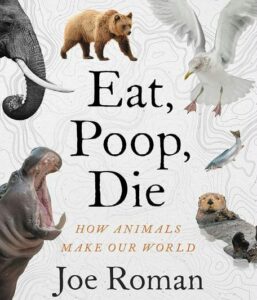
Preface. Here are some excerpts from “Eat, Poop, Die” about how animals affect the world. Whales, salmon, hippos, bison, wildebeest, birds and more play key roles. Whales and other sea creatures play a key role in carbon capture and sequestration. Read all about it in this book. The science of how animals affect the world is new, less than 20 years old, so there is much to discover.
Alice Friedemann www.energyskeptic.com Author of Life After Fossil Fuels: A Reality Check on Alternative Energy; When Trucks Stop Running: Energy and the Future of Transportation”, Barriers to Making Algal Biofuels, & “Crunch! Whole Grain Artisan Chips and Crackers”. Women in ecology Podcasts: WGBH, Financial Sense, UCSC, Jore, Planet: Critical, Crazy Town, Collapse Chronicles, Derrick Jensen, Practical Prepping, Kunstler 253 &278, Peak Prosperity, Index of best energyskeptic posts
***
Roman J (2023) Eat, Poop, Die. How animals make our world
It wasn’t that long ago that animals were dismissed by many scientists as bit players on the planet; plants and microbes took center stage. But in the past decade or so, there has been a radical shift in our understanding of how the world is shaped by predators and herbivores. Landmark studies of seabirds, whales, sea otters, salmon, wildebeests, bison, spiders, grasshoppers, cicadas, and other animals have shown that they can alter the landscapes and seascapes where they live, with major impacts on ecological function and the services these animals provide.
Animals are the beating heart of the planet. In the same way that trees work as the Earth’s lungs—inhaling carbon dioxide and exhaling oxygen—animals pump nitrogen and phosphorus from deep-sea gorges up to mountain peaks and across hemispheres from the poles to the tropics. Trillions of animals live the traveling life—they fly, run, swim, walk, even dig. Large and medium-size animals—whales, elephants, bison, salmon, and seabirds—can move nutrients hundreds and sometimes thousands of miles, across oceans, streams, mountains, valleys, prairies, and remote volcanic islands. These long-distance travelers are the world’s arteries. Cicadas, midges, krill, and other invertebrates, if we take this idea a step further, are the capillaries, delivering nutrients to Earth’s tissues.
It’s not just poop and carcasses. Animals change the world through their consumption too. They eat plants. They eat plant-eaters. They change the chemistry of the world just by instilling fear.
That plants, bacteria, fungi, animals, and other organisms play a role in the biogeochemical cycles is not in question. But the focus has often been on the small things. Hundreds, maybe thousands, of studies have examined phytoplankton’s role in the foundation of marine life, in climate regulation, even in cloud formation. These bottom-up studies might also look at upwelling, light, currents, or temperature. Top-down studies of animals—organisms that eat other things to survive—frequently focus on browsing, grazing, and predation. But the biogeochemical role of these animals has often been ignored.
The effects of rotting carcasses, deposited feces, and other unglamorous forces in dispersing, concentrating, recycling, and moving nutrients around local ecosystems, not to mention their impact on the global climate cycle, have been largely overlooked.
We live in a world where wild animals have largely disappeared from view, so it’s easy to overlook their historic roles. In the ocean, animals, many of them invertebrates, outweigh plants five to one. It’s easy to think that whales aren’t important when we’ve removed about two-thirds of them from the ocean. Before humans started hunting them, there were more than four million whales in the oceans. Now—after centuries of harvest and a few decades of protection—there are about one and a half million.
“Billions of animals are adapted to a traveling life,” Swedish biologists Thomas Alerstam and Johan Bäckman wrote in Current Biology, “making regular return migrations between more or less distant living stations on Earth by swimming, flying, running or walking.” The wildebeests and hippos of the Maasai Mara were just a small part of this circulatory system.
Cattle don’t use the landscape in the same way that bison in large numbers do. They tend to be thirstier, spending more time by the rivers and streams, enhancing erosion and runoff. Cows, pigs, sheep, and other animals we eat account for 60% of all the mammals on Earth by weight, about a hundred million tons. We humans make up 36%, or sixty million tons. And the total biomass of wild mammals? Just seven million tons, or 4%. When I first read this in the Proceedings of the National Academy of Sciences, I rubbed my eyes. Was it really possible that all the rhinos, hippos, elephants, moose, sea otters, bears, and even great whales were outweighed 25 to one by humans and our livestock? Yep.
***
Before we fenced out the wild and killed off more than 80% of the mammals, fish, and birds, there was a balance between the nitrogen and phosphorus that leached downstream and that which flew, swam, ran, or crawled around the globe via animals, distributing these nutrients in the form of feces, meat, and bones. Once we lost this balance, we had to look elsewhere for these nutrients.
Europe was desperate for these nutrients and had been for centuries. In medieval England, peasants could graze their sheep on the land of nobility, but they faced severe punishment if they were caught removing the droppings. When peasants moved to the city, their own urine and feces were unleashed in urban areas. The toll of infectious diseases became apparent, leading to the sanitation revolution, and sewage was moved out of the cities and released into lakes, rivers, and, eventually, oceans. The valuable nitrogen and phosphorus were shunted off with the sewage. Animal carcasses, once left in rural fields, were transported to urban butchers and larders. Rag-and-bone men roamed the city streets. The bones they gathered were carved, rendered into glue, ground into fertilizer, or used to refine sugar; the rags were mostly used to make paper.
In the nineteenth century, English tomb raiders and bone pickers traveled long distances and unearthed thousands of skeletons of soldiers and the horses they had ridden into the battles of Leipzig, Waterloo, Austerlitz, and elsewhere. England became the world’s greatest trafficker in human bones, its citizens carrying away generations of skeletons from the catacombs of Sicily and mummies from Egyptian tombs. Many were shipped to the port of Hull and ground in the bone mills of Yorkshire.
***
Major human impacts on global biogeochemical cycles stretch back to well before the dawn of agriculture, the rise of the guano trade, fossil-fuel extraction, and nuclear bombs. Doughty and colleagues noted that some aspects of the Anthropocene, like blocked nutrient arteries and phosphorus limitation in the Amazon, might have started with these Pleistocene extinctions.
About 50% of the phosphorus we consume now comes from phosphate mines. It cannot be manufactured or destroyed. In coming decades—estimates range from thirty to three hundred years—phosphorus scarcity could threaten food production as ore deposits are depleted. Even if we never run out, phosphates might become so expensive that farmers can no longer afford them.
More than twenty-four million tons of phosphorus flows from fresh water into the oceans each year, and more than fifteen million are lost to erodible soils. A renewable resource has become nonrenewable, dependent on ancient sources rather than recycled ones.
Across the world, we’ve pushed the cycles of nitrogen and phosphorus over the edge of planetary boundaries, when irreversible, large-scale changes occur. We have become a geological force. Humans have transcended our role as agents of biological change—shredding food webs, plowing ecosystems, and annihilating biodiversity—to agents of geological change, directly altering the carbon, phosphorus, and nitrogen cycles.
***
We mammals defecate about 1% of our body weight every day. When you add it all up, domestic animals—primarily cattle, chickens, and sheep—produce about eight trillion pounds of poop per year. Depending on how you stack it, that’s the weight of ten thousand Empire State Buildings or seven hundred Great Pyramids of Giza. We humans make about two trillion pounds each year.
We are animals too, of course, and there’s no reason we couldn’t play a more integral role in the nitrogen and phosphorus cycles instead of manufacturing and mining to replace the nutrients that we let leak away. Humans did this for millennia before we broke the loop; consider the simple outhouse, the arborloo (a movable pit that will later fertilize a tree), or composting toilets that use sawdust and air to enhance decomposition.