
Preface. The U.S. Department of energy has stated a renewable grid is not possible without long-duration energy storage (Colthorpe 2022). Another report explains why around-the-clock renewables and decarbonization will not be possible without it (McKinsey 2022).
This post explains why natural gas is the only energy storage that can keep the electric grid up if it mainly depends on wind and solar (most plans assume 70 to 90%). In China and India, with limited natural gas reserves, coal is being used instead. To see why other energy storage mediums will not be possible (compressed air, pumped hydro, hydrogen, batteries etc), see my energy storage posts here.
The bigger problem is that natural gas is finite, just like oil and coal. Yet more and more will be used to power EV, data centers, and the endless growth of population and GDP. Meanwhile, renewable energy is NOT replacing fossil fuels, which are still 80% of primary energy use, and have been for over 60 years, so we are likely to need even more natural gas (and coal) plants to balance wind and solar, seasonal hydropower (Thombs 2025)
Alice Friedemann www.energyskeptic.com Author of Life After Fossil Fuels: A Reality Check on Alternative Energy; When Trucks Stop Running: Energy and the Future of Transportation”, Barriers to Making Algal Biofuels, & “Crunch! Whole Grain Artisan Chips and Crackers”. Women in ecology Podcasts: WGBH, Planet: Critical, Crazy Town, Collapse Chronicles, Derrick Jensen, Practical Prepping, Kunstler 253 &278, Peak Prosperity, Index of best energyskeptic posts
***
Elliott RF (2025) Why a Plane-Size Machine Could Foil a Race to Build Gas Power Plants. New York Times.
Wait times for the hulking turbines needed to turn natural gas into electricity have doubled in the past year as companies scramble to build data centers for A.I. But turning natural gas into electricity requires giant metal turbines that are increasingly difficult to secure. Companies that haven’t already reserved this equipment, which can weigh as much as a large airplane and cost hundreds of millions of dollars, are facing waits of three or four years, about twice as long as just a year earlier.
The cost of building gas power plants has also soared, two to three times as much as just a few years ago.
A new NG plant started in 2025 would probably not be running before 2030 and face supply chain issues with transformers. My comment: which can take five years to order from abroad since they are not made here, nor the GOES steel that is essential in their construction.
Clemente, J. 2020. Germany proves how essential natural gas is. Forbes
No country ever has spent more money forcing the adoption of renewable energy than Germany. Passed in 2010, Germany’s Energiewende is an “energy transition” based on relentlessly installing as much wind and solar power capacity as possible, with little to no consideration to cost.
The Energiewende demanding the use of renewables could ultimately cost the country as much as $4 trillion by 2050. Already costing hundreds of billions of dollars, wind and solar now generate just ~18% and ~8% of Germany’s electricity, respectively, and still account for just a small fraction of total energy needs:
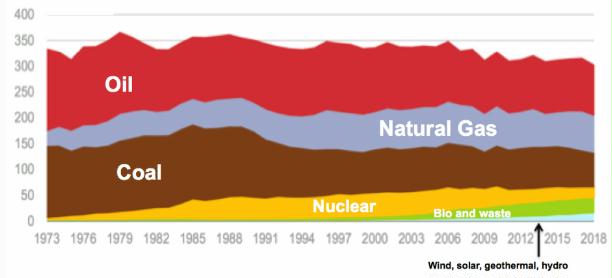
Despite spending hundreds of billions of dollars on renewables, wind and solar barely register, and Germany is still overwhelmingly fossil fuel-based.
The reality is that natural gas is also quickly becoming an even more important source of energy in Germany. Not just as a vital standalone energy source providing 25% of all energy consumed, gas is the backup fuel needed for intermittent wind and solar. As the energy policy advisor to the U.S., Germany, and the other 34 developed, rich OECD nations, the International Energy Agency (IEA) touts gas as the backbone of the electric power system, to have a flexible, reliable grid where gas supports renewables (Schulz 2020).
Germany wants to add three or four more Liquefied Natural Gas (LNG) terminals to help expand Europe’s total LNG import facilities to nearly 35, a “dash to gas” that is extremely telling for a continent that has deployed massive funding and policy support to force more wind and solar into the system.
Indeed, Germany offers a number of lessons for the U.S. and the world – a series of energy warnings that we must heed. Illustrated by Germany’s plan to eliminate both coal and nuclear, which effectively is happening here in the U.S., gas only becomes more essential.
Further, massive payouts to force more wind and solar power into the system can only last for so long, and there are physical and cost limitations that not even rich countries can ignore forever. To illustrate, as tax breaks run out, opposition grows, barriers to new power lines persist, and construction approvals slow, there is a major shortage of new wind projects: “Germans fall out of love with wind power.”
Many though probably see this slowdown in German wind as a positive, financially drained of the levies to pay for renewables subsidies. The “renewables only” tunnel vision has helped soar Germany’s electricity prices for families to being three to four times more expensive than they are here in the U.S.: “If Renewables Are So Cheap Why Is Germany’s Electricity So Expensive?”
After Denmark, Germany has had the highest electricity prices in the world. In fact, ridiculously high energy prices have sadly created a new term in Germany: energy poverty, “Renewable Energy Mandates Are Making Poor People Poorer.”
Just think about it: despite years of promises to effectively “get rid of them,” oil (33%) and gas (25%) still supply almost 60% of Germany’s primary energy needs (not all that surprising since wind and solar are strictly sources of electricity, a secondary energy source that accounts for just 20-30% of all energy demand).
If Germany cannot survive on just “wind and solar” how are the poor countries supposed to?
References
BW (2022) Advanced Clean Energy Storage Project Receives $500 Million Conditional Commitment from U.S. Department of Energy. Businesswire.com.
Colthorpe A. 2022. Long-duration energy storage ‘for everyone’ says US DoE as McKinsey publishes advice to corporates. Energy-storage.news https://www.energy-storage.news/long-duration-energy-storage-for-everyone-says-us-doe-as-mckinsey-publishes-advice-to-corporates/
Fitzpatrick T (2022) Plan to fill giant Utah caves with hydrogen gets $504M federal boost. Project under IPP plant near Delta — the first of its kind — would store enough green energy to power 30,000 homes for a year. The Salt Lake Tribune.
McKinsey (2022) A path towards full grid decarbonization with 24/7 clean Power Purchase Agreements. LDES council.
Schulz, F. 2020. German needs more LNG to complement renewables, IEA says. euractiv.com
Thombs RP (2025) Does renewable energy production displace fossil fuel production in the U.S.? A panel data study of fossil fuel–producing U.S. states, 1997–2020. Journal of Environmental Studies and Sciences
8 Responses to Natural Gas & Coal essential for energy storage