
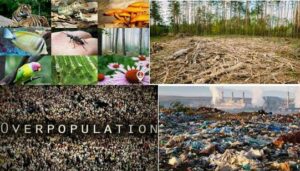
Preface. Almost all environmental stories in the media are about greenhouse gases. Yet there are dozens of others in the meta/polycrisis and existential boundaries (Rockström 2009). Overpopulation is the driver, but the severity and magnitude is made possible by fossil fuels — which also hide what deep trouble we are in: Fresh water can be pumped up from hundreds of feet below in droughts to grow food, homes and cities rebuilt after natural disasters, the last schools of fish caught at the ends of the earth by factory ships, industrial agriculture and food distribution. Before fossil fuels, human and animal muscle power could not do permanent harm.
Below is a list of polycrisis issues, many of them as harmful, if not more so, than greenhouse gases
Water and resources
- Freshwater and groundwater/aquifer depletion, decreasing river flows
- Freshwater and marine pollution, overfishing
- Critical mineral, metal, and fossil fuel depletion and declining quality
- Sand and aggregate depletion (for concrete, asphalt roads, railways, glass, drainage, etc.)
Pollution and “novel entities”
- Air pollution (PM, ozone, NOx, SO₂)
- Plastics and microplastics pollution, PFAS and other persistent organic pollutants
- Pesticides, herbicides, and fertilizer runoff
- Heavy metals (arsenic, cadmium, mercury, lead) that enter the food chain and harm health
- Pharmaceutical and hormone residues affect immunity, metabolism, reproduction
- Nuclear waste and radiological contamination
Food–agriculture–health
- Industrial agriculture dependency on agrochemicals made out of declining fossil fuels
- Loss of pollinators and Insect Apocalypse
- Livestock‑driven land use changes (loss of biodiversity) and methane emissions (climate change)
- Food insecurity and malnutrition
- New diseases and pandemics, chronic diseases
Economic–financial–technological
- Chronic inequality and poverty, increasingly unfair distribution of wealth
- Supply‑chain fragility and disruptions
- Credit market freeze, too much debt, financial instability, systemic banking risk
- Dependence on just‑in‑time global deliveries
- Unemployment/underemployment and insecurity
- Cyberattacks
- Infrastructure decay
Political–social–geopolitical
- Polarization, democratic backsliding into authoritarianism, failing and fragile states
- Wars, civil conflicts, terrorism
- Large‑scale migrations
- Resource conflicts over minerals, water, food, and land
Land use changes
- Biodiversity loss and mass extinction
- Soil erosion, degradation, salinization, and desertification
- Deforestation and forest degradation
- Land‑system change from wildlands to urban, agriculture, or other development
Climate & biosphere
- Climate change, extreme weather, wildfires, flooding, hurricanes, sea-level rise
- Ocean warming, acidification, dead zones
- Permafrost thaw release of CO2 and methane emissions
If the polycrisis continues get worse, Earth’s systems may go beyond planetary boundaries, causing irreversible environmental changes such as heatwaves, mass extinctions, and the ability of the planet to support life. Seven of the nine have already been exceeded: climate change, biodiversity loss, land‑system change, freshwater change, biogeochemical flows, ocean acidification, novel entities (eg PFAs, synthetic chemicals, plastics). Not exceeded yet: atmospheric aerosol loading, and stratospheric ozone depletion (Planetary Boundaries Science (2025) Planetary Health Check 2025. Potsdam Institute for Climate Impact Research, Potsdam, Germany)
| scholar. google. com | USA Today | Wall Street Journal | NYT | |
| 2,360,000 | 11,100 | 28,400 | 9,379 | “climate change” * |
| 74,800 | 260 | 255 | 47 | “soil erosion” (50,900) “soil degradation” (23,900) |
| 61,200 | 397 | 989 | 373 | deforestation |
| 43,000 | 7 | 10 | 3 | eutrophication * (a result of too much nitrogen & phosphorus applied to farmland) |
| 32,800 | 19 | 100 | 23 | “biodiversity loss” * |
| 24,000 | 342 | 215 | 94 | overpopulation |
| 22,800 | 63 | 38 | 44 | “ocean acidification” * |
| 11,800 | 23 | 17 | 15 | “chemical pollution” * |
| 8,743 | 58 | 5 | 2 | “groundwater depletion” (7100) “aquifer depletion” (1320) “freshwater depletion” (323) * |
| 8,030 | 17 | 736 | 9 | “peak oil” |
| 5,100 | 18 | 3 | 0 | “stratospheric ozone depletion” * |
| 4,400 | 0 | 0 | 0 | bioinvasion |
| 2,259 | 4 | 0 | 0 | “phosphorus depletion” and “phosphate depletion” |
| 2,210 | 34 | 207 | 25 | “Proven oil reserves” |
| 1,320 | 0 | 0 | 0 | “land system change” * |
| 971 | 0 | 0 | 0 | “atmospheric aerosol loading” * |
| 900 | 2 | 1 | 1 | “fishery collapse” (657) “fishery depletion” (89) “fishery decline” (154) |
| 47 | 0 | 0 | 0 | “net plant production” * NPP encompasses 5 of Rockstrom’s 9 boundaries: land-use change, freshwater use, biodiversity loss, global nitrogen and phosphorus cycles as well as affected by climate change and chemical pollution. Running, S. W. 2012. A Measurable Planetary Boundary for the Biosphere. Science. |
| 304,380 | 1,244 | 2,576 | 636 | Total of not climate change |
* Rockstrom J, et al (2009) Planetary Boundaries: Exploring Safe Operating Space for Humanity. Ecology and Society
Table 1 shows that in all of scholarly literature, NON-climate change issues comprise just 1.2% of publications, USA Today 11%, WSJ 9%, & NYT 6.8%.
Alice Friedemann www.energyskeptic.com Author of Life After Fossil Fuels: A Reality Check on Alternative Energy; When Trucks Stop Running: Energy and the Future of Transportation”, Barriers to Making Algal Biofuels, & “Crunch! Whole Grain Artisan Chips and Crackers”. Women in ecology Podcasts: WGBH, Jore, Planet: Critical, Crazy Town, Collapse Chronicles, Derrick Jensen, Practical Prepping, Kunstler 253 &278, Peak Prosperity, Index of best energyskeptic posts
17 Responses to Climate Change dominates news coverage at expense of other existential planetary boundaries