
Preface. These are happening mainly in Asia, and are yet another mess we are leaving for future generations after the fossil party ends, meanwhile, in some cases, harming the ecosystem and reducing phytoplankton and fish while increasing toxic cyanobacteria blooms and invasive biofouling mussels.
Alice Friedemann www.energyskeptic.com Author of Life After Fossil Fuels: A Reality Check on Alternative Energy; When Trucks Stop Running: Energy and the Future of Transportation”, Barriers to Making Algal Biofuels, & “Crunch! Whole Grain Artisan Chips and Crackers”, The Preservation of Knowledge, Women in ecology Podcasts: WGBH, Financial Sense, Jore, Planet: Critical, Crazy Town, Collapse Chronicles, Derrick Jensen, Practical Prepping, Kunstler 253 &278, Peak Prosperity, Index of best energyskeptic posts
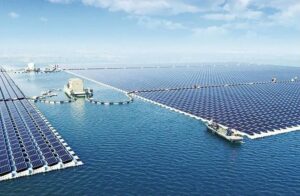
Floating photovoltaic farms (FPV) (Benjamins 2024, Carvalho 2025, Sandrini 2025, Yang 2024)
These are relatively new, the first FPV was built in 2008, and grew rapidly after 2016. The largest one yet, 30 square kilometers, is being built in South Korea for $4 billion USD to generate 2100 MW. And of course China, ahead in everything, with 60% of the capacity.
They have many good qualities, such as reducing water evaporation in water-stressed areas, increased PV production from the cooling effect of the water, and preserving valuable land. But their ecological impacts need to be studied more, especially FPV that cover more than 20% of the water body surface, where the greatest negative effects have been found.
One problem is that FPV block sunlight, reducing oxygen, phytoplankton, and the food web above of zooplankton and fish. The extent of vertical mixing of nutrients in the water column may be reduced, further decreasing plankton production, and in the ocean, seagrass, kelp, and corals. Reduced oxygen can favor cyanobacteria (blue-green algae) and biofouling mussels, both of them harming water quality.
Over time storms and floods can dislodge moorings and panels, short circuit them and cause fires, hail can shatter the panels, be covered in snow or damaged by ice. Over time they corrode and leak lead, silver and other metals, PFAS, plastic particles, and chemicals.
Many other issues have yet to be studied, such as the effect of polarized light which many species use to detect open water. Birds may be hurt trying to land or be unable to take off, insects lay eggs on top that dry out, anchors scour the bottom, biofouling effects on the ecosystem, and how much harm is caused by corrosion.
References
Benjamins S et al (2024) Potential environmental impacts of floating solar photovoltaic systems. Renewable and Sustainable energy reviews.
Carvalho AR et al (2025) Addressing chemical contamination from floating photovoltaic systems: the need for comprehensive analytical monitoring. Knowl. Manag. Aquat. Ecosyst.
Sandrini G (2025) Illuminating the Impact of a Floating Photovoltaic System on a Shallow Drinking Water Reservoir: The Emergence of Benthic Cyanobacteria. Water
Yang S et al (2024) Water-surface photovoltaic systems have affected water physical and chemical properties and biodiversity. Nature communications Earth and environment.