Natural Gas limits: 20-40% of recoverable resources are low EROI Sour Gas

SBC. October 2014. Factbook Natural Gas Factbook. SBC Energy Institute

Sour gas


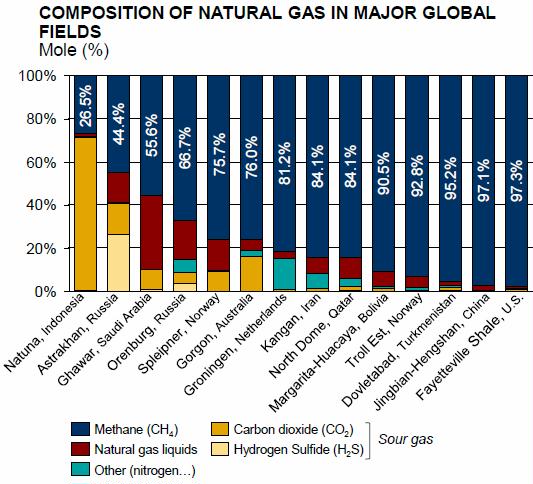
There are 855 trillion cubic meters (tcm) of technically recoverable resources, which means that regardless of cost we could get at them, and would last 240 years at the current rate of 3.5 tcm produced per year — but 20 to 40% are sour and very expensive and difficult to produce, reducing the resource to 145 to 195 years.

In some fields, contaminants can be found in very high concentrations. This increases investment needs and production costs to the extent that production may even be rendered uneconomic. Natural gas rich in hydrogen sulfide (H2S) or carbon dioxide (CO2) is called sour gas or acid gas. CO2 and H2S are both extremely corrosive and H2S is also toxic. When these gases are present, special equipment is needed (e.g. special alloys for tubing and piping) to ensure that the natural gas can be safely transported and processed, prior to being sold.

20-40% of global recoverable gas resources could be considered, to varying degrees, to be sour gas, especially in the Middle East and Central Asia, but also in North America, Australia and Russia. Even if sour gas fields have a long history of successful development in several places, lowering the costs of sour-gas operation is essential if its potential is to be fully tapped. This could be through innovation in gas-separation technologies used in processing plants or more advanced deployment of capture and re-injection, including enhanced oil recovery.

Posted in Natural Gas | Comments Off on Natural Gas limits: 20-40% of recoverable resources are low EROI Sour Gas

Coal or Biomass & Coal to Liquids: CTL, DCL, & CBTL technology

Gray, D., et al. August 1, 2012.  Topic Paper #8 Production of Alternative Liquid Hydrocarbon Transportation Fuels from Natural Gas, Coal, and Coal and Biomass (XTL). National Petroleum Council

CTL plant configuration

CTL plant configuration

Background

With national energy security still being a dominant concern because of increasing dependence on imported oil, there is interest in producing more of our oil from domestic sources. By far the largest single supplier of oil to the U.S. is Canada. But, we must be concerned that an equal amount of imports comes, in total, from four countries wracked by instability or with governments hostile to the U.S.: Algeria, Angola, Iraq, and Venezuela.

In addition, the global trade in oil means that, even though the U.S. imports no oil from Iran, and little from Libya, if further unrest in the Middle East should happen to take Iranian and/or Libyan crude off the world market for a time, global oil prices would skyrocket, directly impacting the American economy. Oil is truly the life blood of any industrialized society. Without it, continued and sustained economic growth and social stability would be impossible. Oil provides us with transportation fuels that give us the freedom of personal mobility. About two-thirds of petroleum consumption in the U.S. is in the transportation sector; from the other perspective, some 95-97% of transportation energy derives from petroleum. A second aspect of the vital importance of petroleum is that it provides key petrochemicals for plastics, urethanes, and synthetic fibers. This application accounts for an estimated 16% of petroleum used in the U.S., and over 25% of petroleum processed in the Gulf Coast region.

XTL is coal and/or biomass liquefactoin via Fischer Tropsch synthesis

XTL is the conversion of carbonaceous feedstocks to a mixture of hydrogen and carbon monoxide, called synthesis gas, followed by the separate step of producing liquid hydrocarbon fuels from the gas via Fischer-Tropsch synthesis. In principle, any carbonaceous feedstock could be used (given appropriate technology for its conversion to synthesis gas), including biomass, coal, coal/biomass blends, natural gas, municipal solid waste, natural bitumens and heavy oils, and waste tires. Synthesis gas conversion technologies also offer potential routes to hydrogen, substitute natural gas, and various solvents or intermediates such as alcohols and aldehydes.

How DCL differs from XTL

The principal alternative to XTL is direct coal liquefaction (DCL), which is the conversion of coal to liquids without the intervening step of producing synthesis gas. The primary DCL technology is hydroliquefaction, the reaction of coal with hydrogen and/or a hydrogen-donor solvent, usually in the presence of a catalyst. Liquids can also be obtained from coal by pyrolysis, and by solvent extraction with various solvents in the sub- or supercritical regimes. Some work has been done on the co-liquefaction of coal blended with materials such as scrap plastic, scrap rubber, or heavy oils. A second major difference between DCL and XTL is that usually XTL products are clean liquids that can be used as transportation fuels with minimal refining, whereas the primary liquids from DCL are usually aromatic with nitrogen, oxygen, and/or sulfur incorporated, so will require substantial downstream refining to meet performance and environmental requirements for transportation fuel usage.

The Shenhua Process The world’s only commercial-scale hydroliquefaction plant is the so-called Shenhua plant, built by the Shenhua Group Corporation in Majata, Inner Mongolia. The Shenhua process represents evolutionary development of earlier work beginning with the H-Coal process (Hydrocarbon Research, Inc.), with further improvements by Hydrocarbon Technology Inc. and Headwaters. Bituminous coal is slurried with recycle solvent and catalyst. The slurry is fed to a liquefaction reactor (the largest one ever built, with a 6000 ton/day capacity), followed by solid-liquid separation. The primary liquids are hydrotreated to produce primarily diesel fuel and naphtha, in amount of 24,000 barrels per day. On an annual basis, the Shenhua plant expects to utilize about 3.5 million metric tons of coal, producing 715,000 metric tons of diesel fuel, 250,000 metric tons of naphtha, 120,000 metric tons of LPG, and about 3,500 metric tons of phenols. On a dry, ash-free basis, about 57% of the coal is converted to liquids.

There are no Coal/Biomass CBTL plants

CBTL process

CBTL process

The concept of gasifying mixtures of coal and biomass together in the same plant to produce liquid fuels is novel and no such plant currently exists. There are many gasifiers that can gasify biomass but most of these are usually small scale, use air instead of oxygen, operate at lower temperatures thus producing tars, and operate at low or atmospheric pressure. All of those characteristics would make them unsuitable for producing FT liquid fuels.

CTL technology has a proven track record and is technically viable. However, although Sasol has successful commercial plants in operation, the integration of modern entrained-flow coal gasification with advanced FT synthesis has yet to be demonstrated commercially. There are no commercial or even small scale plants are currently in operation to convert mixtures of coal and biomass to liquid fuels.

If a CBTL plant did exist it would work like this

The plant would operate just like a CTL plant except that biomass is gasified in addition to the coal. Separate gasifiers could theoretically be used for the biomass and the coal; however it may be more efficient and less costly if the same gasifier could convert both feeds simultaneously. This would be similar to the situation at NUON where the Shell gasifier was able to gasify both wood and biomass. In this conceptual plant, high pressure, entrained-flow gasification with oxygen is used to convert the coal and biomass into synthesis gas. This synthesis gas is cleaned using conventional gas cleaning technology. Slurry-phase FT reactors are used to convert the clean synthesis gas into raw FT products. Hydrotreating and hydrocracking/hydroisomerization are used to convert the raw FT products into naphtha and diesel. All power required in the plants is generated on-site. Unfortunately, there is very little data in the literature for the gasification of biomass in entrained high pressure gasifiers. Because of the fibrous nature of most biomass sources, the material is very difficult to pretreat and feed into a high pressure gasifier. Typical problems include clumping and bridging. However, the successful demonstration at the NUON plant does indicate that co- gasification is technically feasible provided that the biomass receives the appropriate pretreatment and preparation.

Barriers to XTL plants being built

Although the United States still imports about 11 MMBPD of oil from the unstable Middle East and other potentially hostile countries and world oil prices are currently hovering around $90 to $100 per barrel, no commercial U.S. XTL plants are being built. This is because of the considerable number of barriers to deployment of XTL. These barriers can be classified as technical, economic, environmental, commercial, and social.

Under economic barriers, the uncertainties about future oil prices are a significant barrier. The high capital expenditures needed for large scale CTL plants is a major barrier. It is anticipated that the capital for large (greater than 50,000 BPD) CTL plants will be over $150,000 -$160,000 per daily barrel. Therefore, a 50,000 BPD FT CTL plant could cost over $8 billion. The investment risk for such a large sum is considerable. For GTL the capital cost is lower but a 50,000 BPD plant would still require an investment of over $3.5 billion. Also for CBTL the cost of delivered biomass is very high.

Water use in CTL plants is also an important environmental issue particularly in geographical areas of low rainfall.

Significant deployment of CTL facilities will require the use of large quantities of coal and this will mean an expansion of the coal mining industry. For example, a 50,000 BPD CTL plant will use approximately 7 million tons of coal per annum. There is considerable opposition to increased coal mining. Another issue concerns actual commercial deployment of CTL. Who would take the lead in commercial deployment of XTL technologies?

If many XTL plants were to be built worldwide at the same time then there will be competition for critical process equipment and engineering and labor skills. There is already evidence that this bottleneck is being encountered worldwide because of the large number of simultaneous construction projects. Finally, there are the issues of permitting and the usual public reluctance to accept the need for new facilities especially coal based plants. Particular barriers to deployment of CBTL technologies include the high cost of biomass feedstock, the availability of sustainable quantities of biomass feed stock, the GHG and energy penalties associated with the cultivation, harvesting, and preparation of the biomass feed, the high cost of biomass transport, and the technical problems with feeding biomass to high pressure gasification systems.

If water availability presents no problems and water cooling is used for all applications the expected use would be in the range 7-10 barrels of water per barrel of liquid fuel product for CTL and CBTL plants. On the other hand, if water is scarce, in Western locations for example, then maximum use of air cooling could be made.

Because no FT CTL plants have been built since Sasols II and III in South Africa in the early 1980s, it is very difficult to accurately estimate the capital costs of new FT CTL plants that would be built in the U.S. in today’s economic climate. The tight EPC market has resulted in large escalations of capital costs for major projects. For example, costs for new IGCC plants are estimated to be over $4,000/kW compared to estimates of around $2,500/kW just a few years ago. Likewise, the costs for new Oil Sands projects in Canada have experienced escalations of 70% or more.

DCL deployment faces many of the same barriers that have already been identified and discussed in the XTL section of this white paper. These include the significant technical risks (especially given only one commercial-scale DCL plant running in the world, and that only for about two years) with the attendant question of who would take the lead in building the first plant(s); the very high capital expense, at least for hydroliquefaction, and the related investment risk; questions of permitting, which will be made all the more complicated by the antipathy of the public and many NGOs to coal; likely shortages of process equipment and skilled labor; the need for substantial expansion of the mining industry; and a need to deal with CO2 and other environmental issues.

The primary liquid from hydroliquefaction, carbonization, or solvent extraction is likely to be highly aromatic, also containing various compounds of oxygen, nitrogen, and sulfur. It will require significant downstream refining to produce liquid fuels that meet market and environmental specifications. These additional downstream processes will add capital and operating costs. These processes, especially hydroliquefaction, will consume substantial amounts of hydrogen. The likely way of obtaining hydrogen is via coal gasification. Not only does this also add to capex and opex, it implies that all of the various operations of a gasification plant must be embedded inside a hydroliquefaction plant. If one needs to install gasifiers and ancillary equipment anyway, perhaps XTL would be a better choice. Especially with low-temperature carbonization, and somewhat will solvent extraction, inevitably there will be a solid product containing unreacted or partially reacted coal and ash. Unless a use exists for the solid, it will be a major cost to collect and dispose of in an environmentally acceptable manner.

Barriers to economically successful, commercial-scale direct liquefaction of coal include:

  • Selection of materials of construction for reactor vessels and ancillary equipment, to withstand high-temperature, high- pressure hydrogen environments and abrasive coal or mineral slurries.
  • Finding an inexpensive and convenient source of process heat.
  • Finding an inexpensive source of hydrogen, ideally one that does not contribute to the carbon footprint.. Separation of coal mineral matter and unreacted or partially reacted coal particles from the process stream.
  • Subsequent post-liquefaction upgrading and refining of the “synthetic crude oil” from liquefaction into commercial-quality, marketable liquid fuels. It has been presumed that the primary liquids would be treated in the standard unit operations of an oil refinery, but there seems to be little verification of this. A related issue is that the final, upgraded products of DCL have been assumed to be fungible with the comparable petroleum-derived products. This point does not seem to be fully demonstrated either.

Estimated Economics for DCL Plants It has been nearly twenty years since a detailed economic analysis was done for hydroliquefaction, and possibly much longer for solvent extraction or carbonization. A hydroliquefaction plant capital cost, for coal being converted to clean, specification-grade transportation fuels, is likely in the range of $120,000 per daily barrel of capacity. Estimated cost of the finished liquid products is $0.20 per gallon higher than from a CTL plant. It should be noted that the estimated cost of $120,000 per daily barrel is about double of the claimed cost of the Shenhua plant ($62,500). The figure for the Shenhua plant was based on 2008 dollars; the world has seen significant increases in capital equipment prices since then. In addition, it is not clear what basis was used for conversion of yuan to US dollars. Therefore, this is not to say that one figure or the other is grossly in error, but they probably can be taken as “bookends” for the cost of a plant.


Posted in Coal to Liquids (CTL) | Tagged , , , | Comments Off on Coal or Biomass & Coal to Liquids: CTL, DCL, & CBTL technology

Better truck fuel efficiency to delay the end of the oil age

NAS. 2010. Technologies and Approaches to Reducing the Fuel Consumption of Medium- and Heavy-Duty Vehicles (National Academy of Sciences Study)

This free, 251 page document is one of the best I’ve seen on the myriad ways trucks could double their miles-per-gallon.  Below are some of the main overview charts. If you don’t have the time to read this paper, the NPC Chapter 10 Heavy-duty Engines & Vehicles is just 26 pages long and explains some of the unfamiliar terms well (see their excellent chart of priorities and obstacles at the end of this post).

Figure 14-31. Energy Balance of a Fully Loaded Class 8 Tractor-Trailer on a Level Road at 65 mph

Figure 14-31. Energy Balance of a Fully Loaded Class 8 Tractor-Trailer on a Level Road at 65 mph

fuel eff consumption by class


The first thing to know about trucks is that they are custom built to perform specific duties. What’s  good for a long-haul truck might not do as much for an urban delivery truck as shown in Figure S-1.  For example, all trucks and buses benefit from better engines, but long-distance trucks and coach buses don’t stop enough to benefit as much from Hybrid batteries that store braking energy as delivery and refuse trucks do, but benefit more than other trucks from aerodynamic improvements.

fuel eff varies by truck type


FIGURE S-1 Comparison of 2015-2020 new-vehicle potential fuel-saving technologies for seven vehicle types: tractor trailer (TT), Class 3-6 box (box), Class 3-6 bucket (bucket), Class 8 refuse (refuse), transit bus (bus), motor coach (coach), and Class 2b pickups and vans (2b).  Optimal driver management and coaching would also help but this has never been quantified.

FIGURE 2-7 Energy “loss” range of vehicle attributes as impacted by duty cycle, on a level road

FIGURE 2-7 Energy “loss” range of vehicle attributes as impacted by duty cycle, on a level road


According to the Transportation Energy Data Book, trucks move over 8.7 billion tons of freight annually in the United States, accounting for more than two-thirds of national freight transport. There are over 8 million Class 3–8 trucks on the road, according to the American Trucking Association. A significant share of trucking companies are small businesses, with 96% operating fewer than 20 trucks and nearly 88% operating six trucks or less. Consequently, the trucking industry is a highly fragmented industry, resulting in intense competition and low profit margins.

Class 7 & 8 trucks account for over 4.5 million units. These trucks represent heavy working trucks consuming typically 6,000–8,000 gallons of fuel per year for Class 7 and 10,000–13,000 gallons of fuel per year for Class 8a. Class 8b trucks are typically long-haul trucks weighing more than 33,000 pounds that have one or more trailers for flatbed, van, refrigerated, and liquid bulk. Class 7 represents some 200,000 vehicles while Classes 8a and 8b consist of 430,000 and 1,720,000, respectively. These trucks consume typically 19,000–27,000 gallons of fuel per year and account for more than 50% of the total freight tonnage moved by trucks.

The Class 8 truck market is 98% controlled by 6 brands owned by 4 companies: Freightliner, International, Peterbilt, Kenworth, Volvo, and Mack. Many of them also make Class 3-6 trucks and buses. These companies either develop their own engine platforms or buy them from independent engine manufacturers, dominated by a small number of players: Cummins, Detroit Diesel, Navistar, and Volvo Powertrain, with GM holding a key position in the Class 3-6 truck space.

TABLE S-1 Fuel Consumption Reduction Potential for Power Train Technologies
Diesel engines:  15 to 21%
Gasoline engines: Up to 24%
Diesel over gasoline engines: 6 to 24%
Improved transmissions: 4 to 8%
Hybrid power trains: 5 to 50%

TABLE S-2 Fuel Consumption Reduction Potential for Vehicle Technologies
Aerodynamics: 3 to 15%
Auxiliary loads: 1 to 2.5%
Rolling resistance (tires): 4.5 to 9%
Mass (weight) reduction: 2 to 5%
Idle reduction: 5 to 9%
Intelligent vehicle: 8 to 15%

TABLE S-3 Overall Fuel Consumption Reduction Potential for Typical New Vehicles, 2015-2020
51% Tractor-trailer
47% Class 6 box truck
50% Class 6 bucket truck
45% Class 2b pickup
38%  Refuse truck
48%  Transit bus
32% Motor coach

fuel eff NPC technology pct by truck class


fuel eff NPC technology price by truck class

Class Applications Gross Wt Range (lb)
1c Cars only 3200-6000
1t Minivans, small SUVs, small pick-ups 4000-6000
2a Large SUVs, standard pick-ups 6001-8500
2b Large pick-ups, Utility Van, Multi-porpose, Mini-bus, Step Van 8501-10000
3 Utility Van, Multi-purpose, Minibus, Step Van 10001-14000
4 City Delivery, Parcel Delivery, Large Walk-in, Bucket, Landscaping 14001-16000
5 City Delivery, Parcel Delivery, Large Walk-in, Bucket 16001-19500
6 City Delivery, School Bus, Large Walk-in, Bucket 19501-26000
7 Furniture, refuse, concrete, tow, fire engine, tractor-trailer 26001-33000
8a Dump, refuse, concrete, furniture, tow, fire engine, city bus 33001-80000
8b Tractor-trailer, Bulk Tanker, Flat bed 33001-80000


The 6 miles per gallon (mpg) fuel economy of a line-haul truck seems paltry compared to the 40 mpg of a car. But when the fuel used to move cargo weight is considered, the big truck looks pretty good. A large class 8 truck carrying 42,000-pounds of goods at 6 mpg of fuel economy is carrying 126 tons of freight per mile, or 126 ton mpg. But a car with 500 pounds of people and luggage is only getting 10 ton mpg, less than 10% of the large truck.

So when diesel and gasoline are rationed, someone needs to figure out situations where it makes more sense to delivery food and other essential items to homes rather than having each household drive to stores.

Cl
Gross Weight Range (lb) Empty Weight Range (lb) Typical Payload (cargo) weight Payload capacity Max (% of Empty) 2006 Unit sales volume Typical mpg range 2007 Avg ton mpg
1c 3200-6000 2400-5000 250-1000 10-20 7,781,000 25-33 15
1t 4000-6000 3200-4500 250-1500 8-33 6,148,000 20-25 17
2a 6001-8500 4500-6000 250-2500 6-40 3,020,000 20-21 26
2b 8501-10000 5000-6300 3700 60 545,000 10-15 26
3 10001-14000 7650-8750 5250 60 137,000 8-13 30
4 14001-16000 7650-8750 7250 80 48,000 7-12 42
5 16001-19500 9500-10800 8700 80 41,000 6-12 39
6 19501-26000 11500-14500 11500 80 65,000 5-12 49
7 26001-33000 11500-14500 18500 125 82,411 4-8 55
8a 33001-80000 20000-34000 20000-50000 100-150 45,600 2.5-6 115
8b 33001-80000 23500-80000 40000-54000 125-200 182,395 4-7.5 155


FIGURE 3-7 Some aerodynamic technologies

FIGURE 3-7 Some aerodynamic technologies


FIGURE 4-15 Battery type versus specific power and energy. SOURCE: Kalhammer et al. (2007).

FIGURE 4-15 Battery type versus specific power and energy. SOURCE: Kalhammer et al. (2007).


It’s easy to see why lithium ion batteries are winning out over other battery technologies — they have both higher power (I want it NOW) and higher energy (long distance for hours) and weigh less. But li-ion perform poorly, and don’t achieve their optimal driving range under 32 F and over 95 F. Hot temperatures also shortens li-ion battery life.

% of weight lbs Major Description
24 4080 Powertrain Engine and cooling system, transmission, accessories
19 3230 Truck body structure Cab-in-white, sleeper unit, hood & fairings, Interior & glass
18 3060 Misc Accessories/systems Batteries, fuel system, exhaust hardware
17 2890 Drivetrain & Suspension Drive axles, steer axle, suspension system
12 2040 Chassis / Frame Frame rails & crossmembers, Fifth wheel and brackets
10 1700 Wheels and Tires Set of 10 aluminum wheel + tire

Figure 5-32 Weight distribution of major component categories in Class 8 tractors. SOURCE: Smith and Eberle (2003).

fuel eff weight of different parts class 8 trucks


Potential for Lightweighting Trucks

Class 8 trucks, per 1,000 pounds lighter, get up to 1% better fuel efficiency on level ground, 1.6% better in stop and go traffic, and up to 2.4% better going uphill (Table 5-16, not shown).

Trucks, trailers, and buses are benefiting from greater use of lightweight materials and structures. Components already making use of aluminum include the cab structure, wheels, fifth wheel, bellhousing, and more (see Table 5-17). Aluminum composite panels have been introduced on trailers, and the use of wood in trailers is diminishing. The barrier to additional use of aluminum or carbon composites is primarily cost effectiveness, with carbon fiber composites, for example, costing several times more per unit mass than aluminum. Some technical and cost-effectiveness issues with carbon composites and have been studied in DOE programs with industry (Rini, 2005).

While progress is being made in weight reduction through materials and design, certain weight-adding components have been necessary. Emissions control components are adding roughly 400 lb, and aerodynamic devices another 200 lb, but are deemed a positive tradeoff with aerodynamic drag reduction. Similarly, the weight addition from efficiency technologies such as waste heat recovery are projected to provide net benefits. In hybrid applications, batteries and other hybrid components add 300 to 1000 lb for trucks and even more in bus applications.

FIGURE 5-38 Weight reduction opportunities with aluminum.

FIGURE 5-38 Weight reduction opportunities with aluminum.


Technologies Class 8 Class 3-7 Refuse Truck
Trailer aerodynamics X
Cab aerodynamics X X
Tires and Wheels X X X
Weight reduction X X X
Transmission & driveline X X X
Accessory electrification X X
Overnight idle reduction X
Idle reduction X X
Engine efficiency X X X
Waste heat recapture X
Hybridization X X X
Dieselization (from gasoline) X
TABLE 6-1 Technologies and Vehicle Classes Likely to See Benefits
Fuel Consumption reduction %
Engine 20 11-14 14
Aerodynamics 11.5 6 0
Rolling Resistance 11 3 1.5
Transmission & driveline 7 4 4
Hybrids 10 30-40 35
Weight 1.25 4 1
TABLE 6-2 Fuel Consumption Reduction (percentage) by Application and Vehicle Type

fuel eff NPC technology pct tech improvement


fuel eff NPC technology pct cost improvement


fuel eff NPC cruise cntrl pct by truck class


fuel eff NPC cruise cntrl cost by truck class


fuel eff NPC obstacles


Tractors designed with aerodynamics in mind have been on the market for almost 30 years. A relatively wide range of aero-related improvements have been implemented on modern truck tractors, which has substantially improved their fuel economy. Figure 10-7 shows a summary of aerodynamic

More on aerodynamic design

[I think that this will be less of an issue as roads crumble and long-haul trucks can’t go fast, and hopefully railroads will be carrying a larger share of long-distance freight since they’ll have plenty of room once a great depression hits and less goods are traveling]

Some measures, such as roof fairings and deflectors, have been widely adopted throughout the trucking industry, while others are less prevalent. Improvements in fuel economy on the order of 10% have already been documented, owing to a combination of tractor aerodynamic measures.

The prospect of high fuel prices has renewed industry interest in active aerodynamics. Examples of active aerodynamic systems include the following: Grille shutters to close off the grille when active y engine cooling is not needed.

Active ride height control to lower the tractor and trailer at highway speeds. This technology lowers the total vehicle by 0.75 to 1.0 inch, which reduced overall form drag by reducing frontal area. Deployable mirrors or in-cabin vision systems to take over mirror functionality at highway speeds when the mirrors would be stowed for improved aerodynamics. Current safety regulations, which require fixed mirrors, prevent this technology from being deployed.

Trailer side skirts, mounted under the trailer and deflecting airflow from sweeping the trailer underside, have been shown to have a substantial aerodynamic effect. Fuel economy improvements of between 3.8 and 5.2% have been reported for such devices. However, while aerodynamically compelling, these features cause a wide variety of problems for fleet operators. Service, inspection, tire storage, and tire maintenance are all hindered by lack of easy access to the trailer underside. And skirts are prone to damage and breakage in the harsh environment where trailers must operate. These include the conditions at work sites, around fork trucks, in ice and snow, at steep loading docks, and similar conditions.

The rear of the trailer can be optimized for low drag using a “boat-tail” or similar device to reduce the massive separation bubble that follows the trailer back surface. Improvements in fuel economy ranging from 2.9 to 5.0% have been reported. As with side skirts, however, such devices have been resisted by the truck-buying fleets due to practical concerns.

Generally speaking, aerodynamic improvements to trailers have been slower and less noticeable than those on the tractor. This is largely due to the different ownership models of tractors versus trailers. Tractors are specified meticulously, and represent a major investment for their owners. A trailer costs much less, and is often seen as an interchangeable commodity with substantial cost pressure. Further, trailers are far more numerous than tractors, by a factor of 4:1 in a typical fleet. Many trailers are therefore sitting idle at any given time; the net result is a much longer payback time for investments in trailer efficiency. And finally, in some cases, the trailer is not owned by the same entity that owns the tractor and pays for the fuel. This misalignment of incentives is a hurdle to more aggressive implementation of trailer aerodynamic measures.

Tires

Rolling resistance accounts for roughly one-third of the power required to move a heavy truck over a level road at highway speeds. Rolling resistance comes primarily from inelastic deformation of the tire as it rotates. This deformation is a complex function of the load level, tire materials, tire and tread design, inflation levels, and the road surface itself. Generally speaking, the resistive force is proportional to the weight of the vehicle. In terms of energy consumption, the impact of rolling resistance is directly proportional to vehicle speed. Opportunities for reducing tire resistance are highly dependent on application as discussed below.

Wide-Base Single Tires. In Class 8 line-haul applications, operation is exclusively on-road and most time is spent at higher speeds, which provides several opportunities for optimization. The most significant development is the so-called “New-Generation Wide-Base Single” (NGWBS) tire, which employs a wider tread to replace two traditional truck tires with a single tire. Studies show fuel economy improvements in the range of 5 to 10% for the use of NGWBS tires in line-haul applications. These gains must be traded off against several downsides of such tires, including an added capital cost of around $3,600 per vehicle, and a perception of reduced safety.

NGWBS tires are not the only means to reduce tire rolling resistance. Proper inflation and alignment can also contribute to better fuel economy. Maintenance of proper inflation levels can be improved by tire pressure monitoring, and in some cases by the use of nitrogen gas in the place of air. The total effect of such changes is around 1.5 to 3%. However, with the exception of pressure monitoring, these modifications are very low-cost options, requiring only basic service and attention to the vehicle. The cost of such activity is estimated at only around $300 per vehicle, for both Class 3-6 vehicles and vocational Class 8 trucks. These improvements are particularly relevant for non-line-haul vehicles, where NGWBS tires are often not an option.

Vehicle Weight

Vehicle weight is a significant factor in fuel economy and puts stress on roads causing billions of dollars of needed repairs every year. It has an impact on the power required to accelerate, and the power dissipated in the form of braking.

Vehicle weight also impacts such factors as rolling resistance and transmission performance, so that weight is an ever-present factor in truck fuel economy. It is most prevalent for vehicles with frequent changes in speed, which tends to dissipate more energy braking than constant-speed

The benefit of lower weight has been studied for a wide class of vehicle types, with varying results.

For line-haul trucks over level terrain, a benefit of between 0.4 and 1.0% in fuel economy is reported per 1,000 pounds of weight reduction. The benefit improves to 1.5– 2.0% for uphill climbing routes, where more energy is invested in pulling the weight of the vehicle to higher elevation. Data on other types of vehicle are less consistent, with results generally in the low single-digits of fuel economy improvement, depending on vehicle class and duty cycle.

All-electric truck battery weight

The battery weight for a class 8 truck is roughly 55,000 lbs and the max cargo weight is 59,000 lbs, so clearly it is impossible to electrify class 7-8 trucks unless battery energy density increases at least 10-fold.

All-electric truck batteries weight about 22 kg per kwh, and a typical class 3-6 battery is 80 kWh, so 1760 kg or 3880 lbs, and that will not only lower the distance the truck can go, but the amount of cargo weight it can carry.

Idling. Line-haul truck engines spend many hours idling in a given 24-hour period. Engine idling is used for a variety of functions when the truck is stationary, such as powering air-conditioners, providing electrical power for TVs, laptops, kitchenettes, etc., providing cabin heat in cold temperatures, and maintaining engine temperature. Though an idling diesel engine is not efficient, it is a simple and easy way to provide these functions to the typical long-haul trucker.

Reducing a single truck’s idling time by 15 minutes per day can save hundreds of dollars per year in fuel costs.

Telematic systems provide information to fleet managers and truckers with the primary objective of improving fleet efficiencies and fuel economy. Idle reduction and route management are examples of telematic applications. Idle time can be reduced using telematics in multiple ways. For example, with real-time knowledge of truck location and route traffic, a fleet manager can direct drivers to nearby trucks stops with hotel-load capacity or similar idle-elimination capabilities. By using telematic technologies to keep trucks on-route, fewer loads are delayed through unplanned route changes, and more trucks arrive at their destination on-time without overnight stops. These advantages can have a sizeable impact on fleet fuel economy.

Telematic technologies are also instrumental in route management. This includes both planning of routes based on past history of truck routes and active real-time management of truck route following. A study conducted for a report by TIAX in 2009 found that route optimization software was able to reduce pick-up and delivery fleet mileage between 5 and 10% per year. For regional and line-haul fleets, which spend relatively less time in traffic, the fuel savings potential was approximately 1% per year according to the NRC.


fuel eff NPC obstacles 2


Posted in Transportation What To Do, Trucks | Tagged , , , , , , , | Comments Off on Better truck fuel efficiency to delay the end of the oil age

New land converted to cropland to grow biofuel crops equal to 34 coal-fired power plants

Summary of article below: Between 2008 and 2012 over 7 million acres new land, much of it grasslands, were converted to croplands, damaging native ecosystems, and mimics the extreme land-use change that led up to the Dust Bowl in the 1930s. Because most new cropland was planted to corn that may ultimately fill our gas tanks we could be, in a sense, plowing up prairies with each mile we drive. The researchers also found that most new croplands were on marginal lands not well suited for agriculture and often prone to heightened risks of erosion, flooding and drought.

Read the full paper at: Lark, T. L., et al. 2015. Cropland expansion outpaces agricultural and biofuel policies in the United States. Environ. Res. Lett. 10

Tyrrell, K. A. Apr 2, 2015. Plowing prairies for grains: Biofuel crops replace grasslands nationwide. Phys.org 

Clearing grasslands to make way for biofuels may seem counterproductive, but University of Wisconsin-Madison researchers show in a study today (April 2, 2015) that crops, including the corn and soy commonly used for biofuels, expanded onto 7 million acres of new land in the U.S. over a recent four-year period, replacing millions of acres of grasslands.

The study—from UW-Madison graduate student Tyler Lark, geography Professor Holly Gibbs, and postdoctoral researcher Meghan Salmon—is published in the journal Environmental Research Letters and addresses the debate over whether the recent boom in demand for common biofuel crops has led to the carbon-emitting conversion of natural areas. It also reveals loopholes in U.S. policies that may contribute to these unintended consequences.

“We realized there was remarkably limited information about how croplands have expanded across the United States in recent years,” says Lark, the lead author of the study. “Our results are surprising because they show large-scale conversion of new landscapes, which most people didn’t expect.”

The conversion to corn and soy alone, the researchers say, could have emitted as much carbon dioxide into the atmosphere as 34 coal-fired power plants operating for one year—the equivalent of 28 million more cars on the road.

The study is the first comprehensive analysis of land-use change across the U.S. between 2008 and 2012, in the “critical time period” following passage of the federal Renewable Fuel Standard (RFS), and during a “new era” of agriculture and biofuel demand, Lark and Gibbs say. The results may aid policymakers as Congress debates whether to reform or repeal parts of the RFS, which requires blending of gasoline with biofuels that are supposed to be grown only on pre-existing cropland, in order to minimize land-use change and its associated greenhouse gas emissions.

Lark recently visited Washington, D.C., to present the findings to the Environmental Protection Agency and the White House Office of Management and Budget, which share responsibility for rule-making and review of the RFS.

For instance, the study found that 3.5 million acres of corn and soy grown during this time period was produced on new, rather than pre-existing, cropland, rendering it potentially ineligible for renewable fuel production under the RFS. However, this went undetected due to limitations in current federal monitoring, which captures only national-level, aggregate land-use change rather than the high-resolution changes found in the study.

The study also showed that expanding the geographic scope of another policy, the Sodsaver provision of the 2014 Farm Bill, could better prevent widespread tilling of new soils. This policy reduces federal subsidies to farmers who grow on previously uncultivated land, but it applies in only six Northern Plains states. The researchers say the findings suggest a nationwide Sodsaver is needed to protect remaining native ecosystems, since roughly two-thirds of new cropland conversion occurred outside of these states.

Using high-resolution satellite imagery data collected over the last 40 years by the U.S. Department of Agriculture and the U.S. Geological Survey, the researchers identified where land had been converted to cropland, to what extent conversion had occurred, and the nature of the conversion—for instance, whether wetlands were converted for soy, or grasslands were turned into cornfields.

Grasslands are home to a diversity of species and store an abundance of carbon in their soils; yet, the researchers found nearly 80 percent of cropland expansion replaced grasslands, among them 1.6 million acres of undisturbed natural grassland equivalent in area to the state of Delaware.

Though not included in the study, the researchers estimate this conversion emitted as much carbon dioxide as 23 coal-fired power plants running for a year.

In fact, nearly a quarter of all land converted for crop production came from these long-standing prairies and ranges, much of it within the Central Plains from North Dakota to Texas. “It mimics the extreme land-use change that led up to the Dust Bowl in the 1930s,” Lark says.

Because most new cropland was planted to corn that may ultimately fill our gas tanks, he added, “we could be, in a sense, plowing up prairies with each mile we drive.”

The researchers also found that most new croplands were on marginal lands not well suited for agriculture and often prone to heightened risks of erosion, flooding and drought.

“There could be severe environmental consequences for bringing this land into crop production,” Lark says.

Gibbs, also a professor in the UW-Madison Nelson Institute Center for Sustainability and the Global Environment, believes the findings present an opportunity to address the shortcomings in existing U.S. policies while also facilitating a more climate-friendly approach to biofuels.

“The good news is that our existing policies could be refined to help improve conservation,” she says. “By closing the gaps in the existing Sodsaver and RFS, we could better protect our nation’s grasslands and prairies.”

Posted in Biofuels | Tagged , , , , , , | 1 Comment

Petroleum council urges Arctic oil to offset declining production in lower 48

The U.S. should immediately begin a push to exploit its enormous trove of oil in the Arctic waters off of Alaska, or risk a renewed reliance on imported oil in the future, an Energy Department advisory council says in a study submitted Friday.

The U.S. has drastically cut imports and transformed itself into the world’s biggest producer of oil and natural gas by tapping huge reserves in shale rock formations. But the government predicts that the shale boom won’t last much beyond the next decade.

In order for the U.S. to keep domestic production high and imports low, oil companies should start probing the Artic now because it will take decades of preparation and drilling to bring oil to market, according to a draft of the study’s executive summary.

The push to make the Arctic waters off of Alaska more accessible to drillers comes just as Royal Dutch Shell is poised to restart its troubled drilling program there. The company has little to show after spending years and more than $5 billion. After assuring regulators it was prepared for the harsh conditions, one of its drill ships ran aground in heavy seas near Kodiak Island in 2012.

Environmental advocates say the Arctic ecosystem is too fragile to risk a spill, and cleanup would be difficult or perhaps even impossible because of weather and ice.  “If there’s a worse place to look for oil, I don’t know what it is,” says Niel Lawrence, Alaska director for the Natural Resources Defense Council. “There aren’t any proven effective ways of cleaning up an oil spill in the Arctic.”

The analysis, conducted by the National Petroleum Council at the request of Energy Secretary Ernest Moniz, makes the case for the United States to aggressively develop Arctic oil and gas resources that can help supply the country with energy long after some onshore fields’ production starts tailing off.

A recent surge in domestic oil production is tied to the extraction of oil from dense rock formations in North Dakota, Texas and other parts of the contiguous United States, but “production profiles for these oil opportunities will eventually decline,” the NPC says. “Given the resource potential and long timelines required to bring Arctic resources to market, Arctic exploration today may provide a material impact to U.S. oil production in the future, potentially averting decline, improving U.S. energy security and benefiting the local and overall U.S. economy.”

But changes are needed to facilitate Arctic oil production, the advisory panel said, including an overhaul of the terms for U.S. oil and gas leases, which typically span just 10 years, and a collaboration between regulators and industry aimed at extending the drilling season that is now limited to about 80 days when Arctic waters are free of ice.

Related story: Shell conducts drills with Arctic oil spill response system

“Drilling an exploration well to target takes about 80 to 90 days, so this current practice requires multiple mobilizations to drill a single exploration well,” said Carol Lloyd, with ExxonMobil Corp., chair of the Arctic Research Coordinating Subcommittee.

The NPC urged regulators to allow companies to continue drilling even when ice has begun forming in fall — a change that would add an additional 30 to 45 days to the current drilling window, potentially to mid-December.

Right now, the Interior Department insists that companies leave enough time — while waters are still clear — to drill a relief well in case of an emergency.

Conservationists argued that companies need those conditions to effectively respond to blown-out wells and other emergencies.

“Responding to a blowout after the fall storms and ice moves in is virtually impossible,” said Marilyn Heiman, director of the U.S. Arctic Program for Pew Charitable Trusts. “We strongly advocate for limiting drilling to the open-water season to minimize the chance of a blowout extending through the winter and delaying response until the following summer.”

Heiman said that if a major spill lasted through the winter, it would be “devastating to the Arctic.”

The short drilling window was one of many factors that constrained the most recent exploration in the Chukchi and Beaufort seas north of Alaska, in 2012, when Shell Oil Co., finished drilling only the top part of two wells. Damage to critical emergency equipment necessary for the company to penetrate potential oil-bearing zones and the late retreat of sea ice that year, also narrowed Shell’s opportunity.

The company aims to return to the Chukchi Sea this summer, this time armed with two rigs and hopes of finding oil in its Burger Prospect about 70 miles from the Alaska coastline.

The NPC report was developed by more than 250 people, nearly half of whom work for oil and natural gas companies; others represented environmental organizations, state and federal agencies, research groups and academia. The Natural Petroleum Council itself is a 59-year-old, privately funded advisory group established to provide guidance to the federal government, with members appointed by the Secretary of Energy.

But the report has an undeniable industry tilt, environmentalists said Friday, noting that many of its recommendations have been on oil companies’ wish lists for years.

The U.S. Arctic is estimated to contain approximately 35 billion barrels of oil — but getting to it requires navigating cold, forbidding terrain, far from deep-water ports and the traditional infrastructure for supporting industrial energy development.

Arctic conditions are diverse, with some areas at the top of the globe marked by long periods of open water, and others — like the U.S. Chukchi and Beaufort seas — often covered by thick ice or broken ice all but two to four months a year.

“We see significant potential in the U.S. Arctic resource areas that are as attractive if not more attractive than Arctic resource potential in other nations,” Exxon Mobil CEO Rex Tillerson told reporters after an NPC meeting in Washington, D.C. But there are regulatory and technological “opportunities to enhance and support prudent development in the Arctic.”

Oil development in the region “requires securing public confidence,” the NPC says, noting industry must operate responsibly, government must maintain and upgrade “effective policies and regulation” to protect people and the environment and both sides must engage local communities.

Lois Epstein, the Arctic program director for The Wilderness Society, noted that a recent Interior Department analysis says there is a 75 percent chance of at least one large spill occurring in the Chukchi Sea and releasing more than 1,000 barrels of oil over the next six decades.

Those spill estimates make it hard to gain the public’s confidence, Epstein said. “The report’s authors seem to be (comfortable) with Arctic Ocean and coastal contamination since there haven’t been significant cleanup advances and there’s a projected 75 percent likelihood of a major spill, just in the Chukchi.”

Read more: Feds up Arctic oil estimates to satisfy court

The report itself says little about mishaps by Shell and its contractors in 2012 that undermined public confidence in the industry’s ability to safely operate in the forbidding Arctic frontier.

The NPC urges a shakeup in the the duration of offshore oil and gas leases — which generally require companies to be able to move into a commercial development phase by the end of 10 years, whether the target is in the temperate Gulf of Mexico or the ice-covered Beaufort Sea.

While that construct may work well in other parts of the United States, “in the case of the Arctic, where you can only work three months a year, it is particularly challenging given the number of wells that will be required,” Lloyd said.

Related: Feds weighing Shell bid for more time in Arctic

Other countries take a different approach, sometimes formally dividing the exploration phase from the development one that typically follows a commercial discovery. For instance, in Canada, oil companies can obtain 9-year exploration licenses with the option of extending them as long as they are diligently pursuing drilling. If a discovery is made, the oil company receives a new license, allowing it to hold the lease indefinitely until the field can be economically developed.

The recommendation dovetails with a separate move by at least three companies with drilling rights in U.S. Arctic waters — Shell, ConocoPhillips and Statoil — that have asked the Interior Department to extend their leases.

References

AP. March 27, 2015. U.S. urged to develop Arctic oil and gas. Associated Press.

Dlouhy, J.A. March 27, 2015. Arctic oil drilling needed now to sustain U.S. energy security. Arctic


Posted in Arctic | 1 Comment

All Electric Trucks. Probably not going to happen. Ever. Why not?

There are “forms of transport that cannot be electrified — heavy-duty trucks and planes… Even if the electricity problem can be solved, it won’t address the needs of planes, trucks, ships and some industrial heating that cannot be electrified” (Long).

The heavy-duty trucks that do the essential work of civilization, such as agricultural tractors and harvesters, Class 7 and 8 long-distance freight trucks, the trucks used in mining, logging,  and so on are too big and heavy to run on batteries.

The battery packs or fuel cells would take up so much space there would be little, if any, room for cargo. The batteries are so heavy that the truck would barely move, and it might take a day or more to charge the battery. Tractors and other off-road vehicles would be stranded if they ran out of power, and likely to be far from a power outlet.

FedEx is concerned that charging just 10 EVs during “off peak” hours will increase the “off peak” load to “peak” or higher level. That could result in additional infrastructure costs (Sondhi).

Medium-duty class 3-6 All-electric delivery vans

All of these vans run on lithium-ion batteries. That’s okay for the short and medium term, but long-term there isn’t enough lithium even with recycling.

Many companies bought medium-duty delivery trucks starting in 2011, such as Frito Lay and Staples, and the National Renewable Energy Lab has been testing their performance.

But just like electric cars, delivery trucks are being held back by poor performing, high cost batteries.  They need, far more than autos, a very powerful, revolutionary battery.  And I’m not holding my breath, since battery development has been very slow the past 200 years (see Who Killed the Electric Car? for details).

Price of an electric Van

These were the only prices I could find after a lot of searching:

  • Kansas City’s municipal government wanted a bucket truck. A diesel version cost $132,000. The city bought the Smith All-electric truck, which cost $330,000, almost $200,000 more, because a federal grant covered the difference (Lockridge)
  • $800 per kWh (Lyden, Calstart)
  • $175,000 for the e-truck. A diesel equivalent would cost $65,000. A 60 kWh battery is $54,000, an 80 kWh $70,000 (Calstart)
  • The basic electric van is $75,000, and the battery ranges from $25,000 to $75,000 (Motavalli).
  • Smith Electric trucks cost up to $90,000 each. Frito-lay has bought them at a reduced price with subsidies from both the federal government and New York state. A comparable diesel truck costs $60,000 (Vyas)
  • Each truck cost $100,000 to $150,000 with federal subsidies of about $57,000 and also many other additional grants and tax breaks
  • Mike O’Connell, senior director of fleet operations at Frito-Lay, which has a fleet of 280 Smith medium-duty electric trucks, said in an interview: “In the short term, buying electric trucks without subsidies is extremely challenging…” (Motavalli)
  • Calstart estimated that without the $40,000 HVIP incentive it would take 12 to 36 years to payback an electric truck. But the Smith electric battery warranty was a 5-year limited, full replacement within 3 years. With batteries costing $25-$75,000 one or more replacements means the price might never be paid back

The incentives are huge

Common EV incentives include tax credits, rebates, vouchers, grants and unrestricted access to high occupancy commuter lanes on major roadways. Here are some federal level incentives in the US:

  • Tax credit from $2500-$7500 (Qualified plug-in electric drive motor vehicle tax credit)
  • EPA DERA funds up to 25% of the total cost of the vehicle
  • Clean Cities: up to 50% total cost of the vehicle
  • Congestion Mitigation & Air Quality Funds (CMAQ): federal money dispersed to states where these funds are given to localities based on air quality and varies state to state

Each state also offers subsidies.

  • New York has 5 different programs, including one that pays up to $60,000 per vehicle.
  • The Oregon Department of Transportation is launching a $4 million new electric truck buyer incentive program. The Commercial Electric Truck Incentive Program will be offered in the form of $20,000 vouchers per eligible, all-electric vehicle over 10,000 pounds, regardless of manufacturer.

The battery and electric truck makers were heavily subsidized, but are bankrupt or in financial trouble

  • A123 made batteries for Smith Electric, but went bankrupt in March 2012 despite a $263 million dollar grant (Cohan).
  • Smith has never made a profit since despite a federal $32 million dollar grant that paid for 44 to 67% of each trucks’ cost. Smith went bankrupt late 2013. Net losses were $17.5 million 2009, $30.3 million 2010, $52.5 million 2011, and $27.3 million through June 30, 2012 with only 439 of 500 vehicles delivered and $29,150,672 government dollars reimbursed, a $66,402 taxpayer subsidy per vehicle (FS, Chesser)
  • Navistar Inc received $39.4 million for 950 electric delivery trucks but is in financial trouble and discontuned its eStar electric van in March 2013 (based on technology from bankrupt Modec)

Smith was already a failed company based in the United Kingdom within the Tanfield Group. Smith-U.S. established itself in Kansas City in January 2009, following a precipitous drop in Tanfield’s U.K. stock value in mid-2008. Financial analysts became troubled because claims the company made about matters such as vehicle orders could not be verified. The company was accused of exercising poor disclosure standards and weak financial controls, according to the London Telegraph. Tanfield’s cash evaporation led the company to lose 97 percent of its value in 2008, prompted inquiries by the London Stock Exchange and by the U.K. Accountancy and Actuarial Discipline Board.

Charging time

Typical charge duration for the FCCC MT E-Cell was measured between 12 and 14 hours to achieve the bulk of the charge and over 17 hours to achieve a full charge. Total charge duration for the Navistar eStar was estimated between 12 and 13 hours (calstart).

References

Calstart. 2013. Battery electric parcel delivery truck testing and demonstration. Prepared by California Hybrid for California Energy Commission.

Cassidy, W. B. Apr 16, 2014   Smith Electric Vehicles Halts Truck Production. www.joc.com

Chesser, P. July 8, 2013. Bottomless Subsidies Needed to Keep DOE Electric Truck Project Alive. National Legal and Policy Center.

Chesser, P. April 15, 2014. Energy Dept. Revives Stimulus Loans as Another Electric Vehicle Comany Stalls. Bankruptcy Law Review.

Cohan, P. June 12, 2012. Is A123 electric battery a waste of $263 million in government funds. Forbes.

FS. May 16, 2013. Fuel Smarts. Fuel Smarts Navistar Sells RV Business, Drops eStar Van as Part of Its Turnaround Plan. trucking.info

Lockridge, D.June 28, 2012. What’s up with electric trucks? Truckinginfo.com

Long, J. October 26, 2011. Piecemeal cuts won’t add up to radical reductions. Nature 478.

Lyden, S. 2014. The State of All-electric trucks in the U.S. medium-duty market. zerotruck.com

Motavalli, J. November 16, 2011. Smith Electric to build trucks in the Bronx. New York Times.

Sondhi, K.. Feb 20, 2013. Talking Freight Webinar. FedEx

Vyas, A. D., et al. February 2013. Potential for Energy Efficiency Improvement Beyond the Light-Duty-Vehicle Sector. Prepared for the U.S. Department of Energy by Argonne National Laboratory.

Posted in Batteries, Lithium-ion, Trucks | Tagged , , , , , , , | 5 Comments

GAO on why ethanol, and other non-drop in fuels, face pipeline & installation at service station challenges

[The challenges that ethanol faces in being put into new or modified pipelines and added to gas stations are issues faced by all alternative fuels (methanol, CNG, LNG, DME, diesohol, CTL, hydrogen, and so on) in a transition from gasoline and diesel to “Something Else”. 

Since natural gas, coal-to-liquids, and other fuels are nonrenewable and also at or near their peak, and biofuels don’t scale up (and have a negative EROI), it’s unlikely that these problems will need to be solved. But it’s still interesting to understand why E85 is in so few stations.  Alice Friedemann www.energyskeptic.com]

USGAO. June 2011. Challenges to the transportation, sale, and use of intermediate ethanol blends. United States Government Accountability Office. 57 pages

The U.S. transportation sector is almost entirely dependent on petroleum products refined from crude oil—primarily gasoline and diesel fuels. In 2009, this sector consumed the equivalent of about 14 million barrels of oil per day, or over 70% of total U.S. consumption of petroleum products. To meet the demand for crude oil and petroleum products, the nation imported, on a net basis, about 52 percent of the petroleum products consumed in 2009.

Ethanol is the most commonly produced biofuel in the United States. In 2010, the nation produced 13.2 billion gallons of ethanol, the vast majority of which came from corn. Most U.S. corn is grown in the Midwest, and ethanol is generally produced in relatively small biorefineries near corn producing areas. Unlike petroleum products, which are primarily transported to wholesale terminals by pipelines, ethanol is transported to wholesale terminals by a combination of rail, tanker truck, and barge. At the terminals, most ethanol is currently blended as an additive in gasoline to make fuel blends containing up to 10 percent ethanol (called E10). Finally, the blended fuel is transported via tanker truck to retail fueling outlets.

In a 2009 report, we identified fuel-blending limits as a challenge to expanded ethanol consumption.  We stated that the nation may soon reach a “blend wall”-the upper limit to the total amount of ethanol that can be blended into U.S. gasoline, given current constraints. At the time, the blend wall existed partly because under EPA’s implementation of the Clean Air Act, fuels containing more than 10% ethanol were prohibited from being introduced for use with the vast majority of U.S. automobiles.

One option to address the blend wall is to use “intermediate” ethanol blends such as E15 or E20 (generally 15% or 20% ethanol).

The EPA, in January 2011, allowed E15 for use in model years 2001 through 2006 automobiles. The EPA did not allow E15 for use in older automobiles or non-road engines (such as lawn mowers, chainsaws, and boats), motorcycles, or heavy-duty gasoline engines. EPA cited insufficient test data to support the use of E15 in these engines, as well as engineering concerns that older vehicles and non-road engines may not maintain compliance with emission standards if operated on E15.  In light of the potential use of intermediate ethanol blends, you asked us to review their potential effects. Our objectives were to (1) determine the challenges, if any, associated with transporting additional volumes of ethanol to wholesale markets to meet RFS requirements; (2) determine the challenges, if any, associated with selling intermediate ethanol blends at the retail level; and (3) examine research by federal agencies into the effects of intermediate ethanol blends on the nation’s automobiles and non-road engines.

As shown in figure 2, the infrastructure used to transport petroleum fuels from refineries to wholesale terminals in the United States is different from that used to transport ethanol. Petroleum-based fuel is primarily transported from refineries to terminals by pipeline.  In contrast, ethanol is transported to terminals via a combination of rail cars, tanker trucks, and barges.  According to DOE estimates, there are approximately 1,050 terminals in the United States that handle gasoline and other petroleum products. At the terminals, most ethanol is currently blended as an additive in gasoline to make E10 fuel blends. A relatively small volume is also blended into a blend of between 70% to 83% ethanol (E85) and the remainder gasoline. E85 has a more limited market, primarily in the upper Midwest, and can only be used in flexible-fuel vehicles, which are vehicles that have been manufactured or modified to accept it.  After blending, the fuel is moved to retail fueling locations in tanker trucks.

There are approximately 159,000 retail fueling outlets in the United States, according to 2010 industry data. This total included more than 115,000 convenience stores, which sold the vast majority of all the fuel purchased in the United States. Consumers in the United States use retail fueling locations to fuel hundreds of millions of automobiles and non-road products with gasoline engines. According to DOT data, Americans owned or operated almost 256 million automobiles, trucks, and other highway vehicles in 2008, while about 91% of all households owned at least 1 automobile the same year, according to U.S. Census data. Americans also owned and operated over 400 million products with non-road engines in 2009, according to one industry association estimate. According to EPA documentation, non-road engines are typically more basic in their engine design and control than engines and emissions control systems used in automobiles, and commonly have carbureted fuel systems  and air cooling, whereby extra fuel is used in combustion to help control combustion and exhaust temperatures. According to representatives from industry associations for non-road engines, most of the small non-road engines manufactured today rely on older technologies and designs to keep retail costs low, and all of the small non-road engines currently being produced are designed to perform successfully on fuel blends up to E10. According to industry representatives, while it is possible to design small non-road engines to run on a broad range of fuels, such designs would not be cost effective and could add hundreds of dollars to the price.

Fuel economy. According to DOE’s report for Project V1, ethanol has about 67 percent of the energy density of gasoline on a volumetric basis. As a result, automobiles running on intermediate ethanol blends exhibited a loss in fuel economy commensurate with the energy density of the fuel. When compared to using gasoline containing no ethanol, the average reduction in fuel economy was 3.7 percent using E10, 5.3 percent using E15, and 7.7 percent using E20.

Large investments in transportation infrastructure may be needed to meet 2022 projected consumption, according to EPA documentation. One option for doing so may be to construct a dedicated ethanol pipeline, but this option presents significant challenges.

Railroads hauled more than 220,000 rail carloads of ethanol in 2008 (the most recent year for which data are available)-which was about 0.7 percent of all the rail carloads and about 1% of the total rail tonnage transported that year in the United States, according to data from the Association of American Railroads. Similarly, knowledgeable DOT officials and industry representatives said there is sufficient capacity in the short term to transport additional volumes of corn ethanol via trucks, which transport about 29% of corn ethanol to wholesale markets, and barges, which transport roughly 5%, to meet RFS requirements.

If overall ethanol production increases enough to fully meet the RFS over the long term, one option to transport it to wholesale markets would be through a dedicated ethanol pipeline. Over many decades, the United States has established very efficient networks of pipelines that move large volumes of petroleum-based fuels from production or import centers on the Gulf Coast and in the Northeast to distribution terminals along the coasts. However, the existing networks of petroleum pipelines are not well suited for the transport of billions of gallons of ethanol. Specifically, as shown in figure 4, ethanol is generally produced in the Midwest and needs to be shipped to the coasts, flowing roughly in the opposite direction of petroleum-based fuels. The location of renewable fuel production plants (such as biorefineries) is often dictated by the need to be close to the source of the raw materials and not by proximity to centers of fuel demand or existing petroleum pipelines.

Existing petroleum pipelines can be used to ship ethanol in some areas of the country. For example, in December 2008, the U.S. pipeline operator Kinder Morgan began transporting commercial batches of ethanol along with gasoline shipments in its 110-mile Central Florida Pipeline from Tampa to Orlando. Kinder Morgan invested approximately $10 million to modify its Central Florida Pipeline for ethanol shipments, which included chemically cleaning the pipeline, replacing equipment that was incompatible with ethanol, and expanding storage capacity at its Orlando terminal.

However, pipeline owners would face the same technical challenges and costs that Kinder Morgan representatives reported facing, including the following:

  • Compatibility. Ethanol can dissolve dirt, rust, or hydrocarbon residues in a petroleum pipeline and degrade the quality of the fuel being shipped. It can also damage critical nonmetallic components, including gaskets and seals, which can cause leaks. In order for existing pipelines to transport ethanol, pipeline operators would need to chemically remove residues and replace any components that are not compatible with ethanol. According to DOT officials, the results from two research projects sponsored by that agency have identified specific actions that must be taken on a wide variety of nonmetallic components commonly utilized by the pipeline industry.
  • Stress corrosion cracking. Tensile stress and a corrosive environment can combine to crack steel. The presence of ethanol increases the likelihood of this in petroleum pipelines. Over the past 2 decades, approximately 24 failures due to stress corrosion cracking have occurred in ethanol tanks and in production-facility piping having steel grades similar to those of petroleum pipelines. According to DOT officials, the results from nine research projects sponsored by that agency have targeted these challenges and produced guidelines and procedures to prevent or mitigate stress corrosion cracking. As a result, pipelines can safely transport ethanol after implementing the identified measures, according to DOT officials.
  • Attraction of water. Ethanol attracts water. If even small amounts of water mix with gasoline-ethanol blends, the resulting mixture cannot be used as a fuel or easily separated into its constituents. The only options are additional refining or disposal.

Some groups have proposed the construction of a new pipeline dedicated to the transportation of ethanol. For example, in February 2008, Magellan Midstream Partners, L.P. (Magellan) and Buckeye Partners, L.P. (Buckeye) proposed building a new pipeline from the Midwest to the East Coast.

The federal government has studied the feasibility of building a pipeline similar to the one proposed by Magellan. The report identified a number of significant challenges to building a dedicated ethanol pipeline, including the following:

  • Construction costs. Using recent trends in and generally accepted industry estimates for pipeline construction costs, DOE estimated that an ethanol pipeline from the Midwest to the East Coast could cost about $4.5 million per mile. While DOE assumed that the construction of 1,700 miles of pipeline would cost more than $3 billion, it did not model total project costs beyond $4.25 billion in the report.
  • Higher transportation rates. Based on the assumed demand for ethanol in the East Coast service area and the estimated cost of construction, DOE estimated the ethanol pipeline would need to charge an average tariff of 28 cents per gallon, substantially more than the current average rate of 19 cents per gallon, for transporting ethanol using rail, barge, and truck along the same transportation corridor.
  • Lack of eminent domain authority. DOE estimated that siting a new ethanol pipeline of any significant length will likely require federal eminent domain authority, which currently does not exist for ethanol pipelines.

Non-Drop-in fuels face huge barriers in being added to service stations as shown by E85

According to several industry associations representing various groups, such as fuel retailers and refiners, many fuel retailers may face significant costs and risks in selling intermediate ethanol blends. According to these industry representatives, retailers make very little money selling fuel-for example, the national average profit from selling gasoline last year was 9 cents per gallon, according to industry data. Most retailers make most of their profit selling merchandise such as food, beverages, and tobacco products, according to these industry representatives, and gasoline is sold below cost in some markets to attract customers to buy more profitable goods. As a result, according to several industry representatives, most retailers do not upgrade their fuel-storage and -dispensing equipment without a significant market opportunity.

For these fuel retailers, the prospect of selling intermediate ethanol blends presents several potential challenges. The first is cost. Some fuel retailers may have to spend hundreds of thousands of dollars to upgrade their equipment to store and dispense intermediate ethanol blends, for the following reasons:

  • Under current OSHA regulations, most fuel retailers will need to replace at least one dispenser system to sell intermediate ethanol blends. According to estimates from EPA and several industry associations, installing a new dispenser system compatible with intermediate ethanol blends will cost over $20,000.40 According to some industry association representatives, a typical fuel retailer has four dispensers and, therefore, would face costs exceeding $80,000 to upgrade an entire retail facility.
  • According to EPA and industry estimates, the total cost of installing a new single-tank UST system compatible with intermediate ethanol blends is more than $100,000. In addition to the high costs, some industry association representatives stated that fuel retailers who have recently installed new UST systems may be particularly reluctant to replace them, especially since UST warranties can last for several decades, and the useful life of these systems can be even longer.

A second potential challenge consists of financial and logistical limitations on the types of fuel a retailer may be able to sell. According to representatives from several industry associations, most retail fueling locations have only two UST systems, and many fuel retailers cannot install additional UST systems due to space constraints, permitting obstacles, or cost.42 Currently, fuel retailers with two UST systems can sell 3 grades of gasoline: regular, midgrade, and premium. To accomplish this, they typically use one of their tanks to store regular gasoline and the other for premium, both of which are pre-blended with up to 10% ethanol. They then use their dispensing equipment to blend fuel from both tanks into midgrade gasoline. If fuel retailers with two UST systems want to sell intermediate ethanol blends, however, they may face certain limitations. For example, fuel retailers with two UST systems who want to sell regular, mid-grade, and premium gasoline could use the tanks to store regular and premium grades of an intermediate blend, such as E15. However, since EPA has only allowed E15 for use in model year 2001 and newer automobiles, these retailers would not be able to sell fuel to consumers for use in older automobiles and non-road engines.

Posted in Automobiles, Biofuels, Fuel Distribution, Pipeline | Tagged , , , , , | Comments Off on GAO on why ethanol, and other non-drop in fuels, face pipeline & installation at service station challenges

Biofuels do not scale up enough to power society

Richard, T. August 23, 2010. Challenges in scaling up biofuels infrastructure. Science. (329)  

Below are excerpts from this paper.  Look at the impossible scale of biomass required:

  • 150 EJ/year = 15 billion metric tons of plant biomass = 200 billion cubic meters of bales, wood chips, pellets, etc
  • Agricultural products: Rice, wheat, soy, corn, etc: 2 billion tons, 2.75 billion cubic meters
  • Coal: 6.2 billion cubic meters, Oil: 5.7 billion cubic meters
  • Therefore, the biofuel biomass required would be much larger than all energy and agricultural commodities now.

Rapid growth in demand for lignocellulosic bioenergy will require major changes in supply chain infrastructure. Even with densification and preprocessing, transport volumes by mid-century are likely to exceed the combined capacity of current agricultural and energy supply chains, including grain, petroleum, and coal.

The next few decades will require massive growth of the bioenergy industry to address societal demands to reduce net carbon emissions. This is particularly true for liquid transportation fuels, where other renewable alternatives to biofuels appear decades away, especially for truck, marine, and aviation fuels. But even for electricity and power, the growth potential of other renewables and nuclear power appears limited by high cost, technology barriers, and/or resource constraints.

With both agronomic and societal concerns about further increases in the use of grains and oilseeds for biofuels, almost all of this increased bioenergy will likely come from lignocellulosic feedstocks: dedicated energy crops, crop residues, forests and organic wastes. These materials have considerably lower bulk densities than grains, resulting in significant logistical challenges.

The transportation fraction of the energy required to grow and deliver energy crops to a biorefinery is only 3 to 5% for grains and oilseeds, but increases to 7 to 26% for lignocellulosic crops such as switchgrass, miscanthus, and other forages and crop residues (5–7).

To reach the IEA 2050 target of 150 EJ/year, primary energy from biomass would require 15 billion metric tonnes [i.e., megagrams (Mg)] of biomass annually, assuming 60% conversion efficiency (4, 7) and a biomass energy content of 17 MJ/kg dry matter (8). A typical dry bulk density of grasses and crop residues is about 70 kg/m3 when harvested, so without compaction the shipping volume of these 15 billion metric tonnes would require more than 200 billion cubic meters (bcm). At baled grass and woodchip densities of 150 and 225 kg/m3 (8–10), this transport volume would be 100 or 60 bcm, respectively (Fig. 1). Using reported energy densities of pellets, pyrolysis oil, and torrefied pellets these densified products would require 28, 17, and 15 bcm of transport capacity, respectively.

For agricultural commodities, the sum of rice, wheat, soybeans, maize, and other coarse grains and oilseeds will approach 2 billion tons in 2010, with a total volume of 2.75 bcm (11).

Current global volumes of energy commodities are somewhat larger, with 6.2 bcm of coal and 5.7 bcm of oil transported in 2008 (12).

The combination of expected growth in energy demand and the lower density of biomass imply that by 2050, biomass transport volumes will be greater than the current capacity of the entire energy and agricultural commodity infrastructure.

a major stress on the transportation infrastructure, especially in rural regions around the world. If managed poorly, this additional traffic could degrade rural roadways and increase safety concerns.

DELIVERY

The transportation and logistics at the back end of a biofuel refinery must also be addressed. Ethanol is incompatible with the current fuel pipeline distribution system due to its corrosivity and its azeotrope with water, which can lead to pipe or tank failure and fuel contamination, respectively. That 200 ML/year biofuel plant would require 16 to 20 tanker trucks or railcars per day to move the fuel to market, increasing both traffic and costs

These fuel distribution challenges are helping drive the interest in “drop-in” fuels that would be compatible with both the existing fuel distribution infrastructure as well as the vehicle fleet. Several such advanced biofuels are nearing commercialization, including butanol, Fischer-Tropsch fuels, and other bio-based gasoline and diesel equivalents. But regardless of the fuel product, massive investments in new pipe, rail, and highway infrastructure are needed to move those fuels from a new biorefinery network dispersed across the landscape.

Economic analysis of both preprocessing and conversion systems highlights the importance of year-round operations, as it is difficult to amortize capital costs for facilities that are only used for a few months of the year (6, 13). However, many biomass feedstocks have optimal harvest periods that may run for only a few weeks. There are likely other seasons during which harvesting should not occur due to weather or various ecosystem constraints. Livestock farmers have been facing a similar problem supplying forages to their 24/7/365 milk- and meat-producing animals for over a thousand years, and have developed effective wet (<70% dry matter) and dry 80% dry matter) storage systems for grasses and crop residues (Fig. 3). Dry biomass is preferred for pellets, torrefaction, and downstream thermochemical processing, where the presence of water would reduce overall energy efficiency

The size and efficiency of bioenergy conversion facilities will determine how far these huge volumes of biomass and biofuel will need to travel, and thus transportation’s contribution to the energy, economic, and environmental impacts of biomass use. At a community scale, biomass energy can be converted in combined heat and power (CHP) systems producing 1 to 30 MW at efficiencies of 80% or more (4). At 80% efficiency, 30 MW of useful energy would require 150 Mg/day of biomass, or rough overwhelm, the economies of scale associated with advanced conversion technologies.

In contrast, cellulosic biofuel refineries are expected to achieve economies of scale at 200 to 1000 megaliters (ML) per year (7, 13, 14). Above this size range, the marginal cost of biomass transport can become greater than the marginal savings of larger biorefinery equipment on a per-unit basis (13). At the lower end of this range, feedstock needs would be equivalent to those of a 300-MW power plant, and a single biorefinery would require 50 trucks to deliver the 1600 Mg of biomass consumed each day. At the high end of this range, with 250 trucks per day, one truck would be unloading every 5 min around the clock.

Both feedstock supply and fuel distribution logistics will influence the optimal size required for these biorefineries to achieve economies of scale

Brazilian sugar cane factories operate as a plantation system, with monocultures of sugar cane surrounding each refinery. Most sugar cane production is within 100 km of Sao Paulo, Brazil’s largest city and industrial base, so the markets for biofuels are relatively close. In the United States, by contrast, midwestern corn ethanol must travel by road and rail more than 1000 km to markets on the east and west coasts.

Although capital costs, oil stability, corrosivity, and deoxygenation remain challenges for pyrolysis (6), downstream conversion possibilities include gasification and blending with petroleum in conventional refineries. Pyrolysis also produces a biochar coproduct that can be used to improve soil quality, serving as a carrier for returning recovered nutrients to the soil. Interestingly, the economies of scale for most of these densification and preprocessing technologies plateau in the range of 20 to 80 MW thermal equivalent (6).

ENDNOTE: other scaling articles

CEC 2015. An assessment of biomass resources in California 2013. California Energy Commission, U.C. Davis. CEC-500-11-020

Total technical energy generation potential of California’s biomass is 34.5 TWh per year, 11.5% of California’s 300 TWh electrical energy demand.   Nowhere in this document is the energy return on invested, such as how much diesel fuel energy will be used by heavy-duty trucks to harvest, transport, build the low-efficiency biomass thermal plant (just  20%) or biogas refinery, the gasoline burned by truck drivers to and from work, and all the other fossil energy inputs over the life-cycle of this project.  Nor did the document mention how much biomass is already being used by the biofuel industry, for animal feed and bedding, mulch, compost, biochemicals, and other industries.

References and Notes

  1. E. M. W. Smeets,

  2. J. E. Campbell,,

  3. ↵A.E. Farrel. Ethanol can contribute to energy and environmental goals. Science 311, 506 (2006).doi:10.1126/science.1121416
  4. I thank C. Taylor, K. Ruamsook, E. Thomchick, and C. Hinrichs for providing helpful comments and sources.
Posted in Biofuels | Tagged , , , , , , | Comments Off on Biofuels do not scale up enough to power society

Oil shortages: Transportation needs to go back to high inventories, not just-in-time delivery

Huge amounts of fuel are wasted as trucks arrive half full with just the needed parts at factories and warehouses and return empty. As oil shocks strike, fuel will be less available.  Large inventories will help by cushioning businesses from long and unpredictable delays in deliveries.  Large inventories of food (nonperishable especially) will also help prevent social unrest and famine.

Let’s go back to “push” logistics and high inventories:

logistics push pull more inventory

Posted in Railroads, Ships and Barges, Transportation, Trucks | Comments Off on Oil shortages: Transportation needs to go back to high inventories, not just-in-time delivery

A third of Nuclear Reactors are going to die of old age in the next 10-20 years

Number of operating reactors by age (as of June 26, 2007). Age is determined by first grid connection. Source: IAEA power reactor information system

70% of reactors are over 25 years old, 23% are over 35 years old, so within 10 to 20 years about a third will have to be decommissioned, far more than the 63 under constructionSome are bound to fail as they age, making the future of nuclear power even less certain.

And where will the waste go?

The U.S. depends on nuclear power plants built with designs from the 1950s that have known flaws.

Worse yet, the U.S. has 23 reactors with the same design as those in Fukushima Japan that melted down after the 2011 earthquake and tsunami.

In both old and more recent plants, the components face a daily load of high temperatures, pressures, vibration and bombarding neutrons, which can render thick steel walls so brittle that cracks form at welds and joints (Biello).

Biello, D. Feb 7, 2015. Sorry State: U.S.’s Nuclear Reactor Fleet Dwindles. Scientific American.


Number of operating reactors by age (as of June 26, 2007). Age is determined by first grid connection. Source: IAEA power reactor information system

Posted in ! PEAK EVERYTHING, Nuclear Power Energy | Tagged , | 7 Comments