Miscellaneous predictions

Prediction: there will be more large and Megacities in the Future

[As fossil fuels decline, large and super-large “megacities”, with over 20 million people, will emerge as rural populations are forced to migrate to cities as gas stations close and farming isn’t an option as industrial farms continue to grow larger.  Most of these cities will be on navigable waterways since trucks will have fuel to deliver food and other essential products, and trains in America only have 95,000 route miles. This trend has been happening for decades, but will soon accelerate. Alice Friedemann www.energyskeptic.com] 

Packer, G. November 13, 2006. The Megacity. Decoding the chaos of Lagos. The New Yorker.

3 Aug 2014. David Stockman: The Collapse of the American Imperium A perfect storm of policy failures by Adam Taggart 

David Stockman, former director of the OMB under President Reagan, former US Representative, best-selling author of The Great Deformation, and veteran financier is an insider’s insider. Few people understand the ways in which Washington DC, The Fed, and Wall Street work and intersect better than he does.

He’s extremely concerned by the “perfect storm” he sees of concurrent failures in US policy across foreign, monetary, economic, and fiscal fronts:

If you look at the entire radar screen of things developing both domestically and internationally, we are plunging deep into a perfect storm of policy failure. The American Impirium is collapsing. There is blowback everywhere. The wreckage of prior policy mistakes of our intervention with foreign policy is coming home to roost, and the Ukraine is one area at ground zero for that.

But second, monetary central planning is now coming to a dead-end. It is inflating the third financial bubble of the century and the Fed is now clueless as to how it will manage to unwind the massive balance sheet expansion it has been undertaken.

And third, the fiscal doomsday machine continues to crank on. Washington is ignoring the fact that we are six years into a business cycle expansion and we are still running massive deficits and there is no cushion for the next upset that comes to the economy.

Now, why is all of this important? Because I think the foreign policy failures — the collapse of the American Impirium as I call it — is at the center of this, and it will push all of these things in the wrong direction.

We are now becoming much more aggressive in our foreign policy than ever before. We can’t afford it by any means. And the potential for this to create black swans to roil or dislocate these very fragile markets that have been created by this massive central bank balance sheet expansion — it all makes what is happening in the Ukraine, or in the Middle East in Gaza, or in the collapse of Iraq, even more dangerous in terms of what it could trigger. So we are in a real pickle here and I think it is compounding by the day.

At risk here is America’s capability to remain the world’s dominant superpower.

For example, in the current rush to demonize Russia, Stockman sees the military industrial complex (as warned by President Eisenhower) steamrolling over any of the necessary debate, diplomacy or consideration that should proceed such warmongering:

Basically, the war machine in Washington (I call it the Warfare State), couldn’t abide that. There are just too many people that operate in the devil’s workshop; which is to say we have all of this capacity, we have all this machinery of war-making and of intervention and of global empire that is obsolete and unnecessary — and yet it is manned by people who want something to do. Who need to justify budgets. Who need to pursue and prosecute missions. That is what I think is happening at the present time.

It’s just the warfare state machinery has gotten itself activated into motion and it is drastically simplifying the real facts that we face and creating a narrative that is really preposterous in terms of what our national security, the safety and security of the American people, really requires in this circumstance.

And on the domestic front, he foresees very difficult times ahead as we try to wean ourselves off of the dependency on massive thin-air stimulus our economy has developed over the past six years:

On the way up as they inflated this bubble, the smart money got on board and basically was front running everything the Fed was doing. Once they became confident that the $85 billion of bond buying was going to stabilize, if not enhance, the price of the bond and they could buy it on 98% repo leverage at $0 carry cost, they jumped in hammer and tong. And so the Fed then had this magnetic force working with it, which was the fast money and the market attempting to front run the direction of Fed policy.

But just think: What happens if they actually began to allow interest rates to rise or begin to attempt, through one mechanism or another, to shrink their balance sheet?

The fast money will get on the other side of the trade just as fast as it rode the bubble expansion to the top. And they will sell what they think the Fed is selling. And that will cause a massive unwind of the greatest overvalued market bubble in the world, which is the government bond market.

Redefining “Peak Oil” for the USA

Feb 9, 2009. Richard Vodra. ASPO NEWSLETTER

The US has long consumed about 25% of the world’s oil, and we act as if we can expect this pattern to continue. There are 2 reasons to question this assumption. First, the rest of the world wants to grow their usage quickly, and that will eventually increase their share of the total.

Second, the US has had to borrow extensively to finance its oil imports. When oil is $80 per barrel and we import 14 million barrels per day, that comes to $1.1 billion per day, or $400 billion per year. Some of that is paid for by our exports, but much has been made possible by foreign purchases of our debt securities. With the massive deficits America is creating to finance the bailouts and recovery packages, who will lend us money in the future? What interest rates, or other security, will they demand? It is reasonable to assume that at some point foreign investors will drastically reduce the investments that fund our imports.

One example of how all of this could play out: if total net world production falls from 80 mbd (out of 86 mbd gross production – assuming a 7% gross-to-net factor, probably low) to 75 (a 6% decline), and the American share drops from 24% to 19%, then American supplies will drop from 19 mbd to 14, a 25% cut, while the rest of the world would continue to share the 61 mbd balance. Our reliance on importing oil with borrowed money could place much of the burden of global Peak Oil on the United States.

When the amount of oil available to the US falls far short of the average historical supply, then some process other than price will be used to allocate it. We can be sure that the military will get whatever it needs, and emergency uses including police and ambulances will also get their supplies. Then someone will decide whether to set aside special allotments for agriculture and long-distance trucking (pending the expansion and electrification of our rail network), for school buses and mass transit, and other priorities. If the country decides to take seriously the transition to carbon reduction and a new energy system, oil will be required for the conversion process. These decisions will not be pretty, or easy. However, the “rest of us” will have to share whatever is left.

Posted in By People | Tagged , , , | Comments Off on Miscellaneous predictions

Thorium: the wonder fuel that wasn’t. Bulletin of the Atomic Scientists

Thorium: the wonder fuel that wasn’t

May 11, 2014. Robert Alvarez. Bulletin of the Atomic Scientists.

Thorium-Fueled Automobile Engine Needs Refueling Once a Century,” reads the headline of an October 2013 story in an online trade publication. This fantastic promise is just one part of a modern boomlet in enthusiasm about the energy potential of thorium, a radioactive element that is far more abundant than uranium. Thorium promoters consistently extol its supposed advantages over uranium. News outlets periodically foresee the possibility of “a cheaper, more efficient, and safer form of nuclear power that produces less nuclear waste than today’s uranium-based technology.”

The United States has tried to develop thorium as an energy source for some 50 years and is still struggling to deal with the legacy of those attempts.

In addition to the billions of dollars fruitlessly spent to develop thorium fuels, the US government will have to spend billions more, at numerous federal nuclear sites, to deal with the wastes produced by those efforts.

And America’s energy-from-thorium quest now faces an ignominious conclusion: The US Energy Department appears to have lost track of 96 kilograms of uranium 233, a fissile material made from thorium that can be fashioned into a bomb, and is battling the state of Nevada over the proposed dumping of nearly a ton of left-over fissile materials in a government landfill, in apparent violation of international standards.

For a terrorist, however, uranium 233 is a tempting theft target; it does not require advanced shaping and implosion technology to be fashioned into a workable nuclear device. The Energy Department recognizes this characteristic and requires any amount of more than two kilograms of uranium 233 to be maintained under its most stringent safeguards, to prevent “onsite assembly of an improvised nuclear device.” As for the claim that radiation levels from uranium 232 make uranium 233 proliferation resistant, Oak Ridge researchers note that “if a diverter was motivated by foreign nationalistic purposes, personnel exposure would be of no concern since exposure … would not result in immediate death.”

Early thorium optimism

The energy potential of the element thorium was discovered in 1940 at the University of California at Berkeley, during the very early days of the US nuclear weapons program. Although thorium atoms do not split, researchers found that they will absorb neutrons when irradiated. After that a small fraction of the thorium then transmutes into a fissionable material—uranium 233—that does undergo fission and can therefore be used in a reactor or bomb.

By the early 1960’s, the US Atomic Energy Commission (AEC) had established a major thorium fuel research and development program, spurring utilities to build thorium-fueled reactors. Back then, the AEC was projecting that some 1,000 nuclear power reactors would dot the American landscape by the end of the 20th century, with a similar nuclear capacity abroad. As a result, the official reasoning held, world uranium supplies would be rapidly exhausted, and reactors that ran on the more-plentiful thorium would be needed.

With the strong endorsement of a congressionally created body, the Joint Committee on Atomic Energy, the United States began a major effort in the early 1960s to fund a 2-track research and development effort for a new generation of reactors that would make any uranium shortage irrelevant by producing more fissile material fuel than they consumed.

The first track was development of plutonium-fueled “breeder” reactors, which held the promise of producing electricity and 30 percent more fuel than they consumed. This effort collapsed in the United States in the early 1980’s because of cost and proliferation concerns and technological problems.  (The plutonium “fast” reactor program has been able to stay alive and still receives hefty sums as part of the Energy Department’s nuclear research and development portfolio.)

The second track—now largely forgotten—was based on thorium-fueled reactors. This option was attractive because thorium is far more abundant than uranium and holds the potential for producing an even larger amount of uranium 233 in reactors designed specifically for that purpose. In pursuing this track, the government produced a large amount of uranium 233, mainly at weapons production reactors. Approximately two tons of uranium 233 was produced, at an estimated total cost of $5.5 to $11 billion (2012 dollars), including associated cleanup costs.

The federal government established research and development projects to demonstrate the viability of uranium 233 breeder reactors in Minnesota, Tennessee, and Pennsylvania. By 1977, however, the government abandoned pursuit of the thorium fuel cycle in favor of plutonium-fueled breeders, leading to dissent in the ranks of the AEC. Alvin Weinberg, the long-time director of the Oak Ridge National Laboratory, was, in large part, fired because of his support of thorium over plutonium fuel.

By the late 1980’s, after several failed attempts to use it commercially, the US nuclear power industry also walked away from thorium. The first commercial nuclear plant to use thorium was Indian Point Unit I, a pressurized water reactor near New York City that began operation in 1962. Attempts to recover uranium 233 from its irradiated thorium fuel were described, however, as a “financial disaster.” The last serious attempt to use thorium in a commercial reactor was at the Fort St. Vrain plant in Colorado, which closed in 1989 after 10 years and hundreds of equipment failures, leaks, and fuel failures. There were four failed commercial thorium ventures; prior agreement makes the US government responsible for their wastes.

Where is the missing uranium 233?

As it turned out, of course, the Atomic Energy Commission’s prediction of future nuclear capacity was off by an order of magnitude—the US nuclear fleet topped out at about 100, rather than 1,000 reactors—and the predicted uranium shortage never occurred. America’s experience with thorium fuels faded from public memory until 1996. Then, an Energy Department safety investigation found a national repository for uranium 233 in a building constructed in 1943 at the Oak Ridge National Laboratory. The repository was in dreadful condition; investigators reported an environmental release from a large fraction of the 1,100 containers “could be expected to occur within the next 5 years in that some of the packages are approaching 30 years of age and have not been regularly inspected.” The Energy Department later concluded that the building had “deteriorated beyond cost-effective repair. Significant annual costs would be incurred to satisfy current DOE storage standards, and to provide continued protection against potential nuclear criticality accidents or theft of the material.”

The neglect extended beyond the repository and storage containers; the government had also failed to keep proper track of its stores of uranium 233, officially classified as a Category I strategic special nuclear material that requires stringent security measures to prevent “an unauthorized opportunity to initiate or credibly threaten to initiate a nuclear dispersal or detonation.”

A 1996 audit by the Energy Department’s inspector general reported that the Oak Ridge National Laboratory, the Rocky Flats nuclear weapons facility, and the Idaho National Laboratory “had not performed all required physical inventories ... the longer complete physical inventories are delayed, the greater the risk that unauthorized movement of special nuclear materials could occur and go undetected.” The amounts of uranium 233 that the Oak Ridge and Idaho national labs have reported in their inventories has significantly varied. Based on a review of Energy Department data, there appears to be  an inventory discrepancy; 96 kilograms or 6 percent of the U-233 produced is not accounted for. The Energy Department has yet to address this discrepancy, which difference is enough to fuel at least a dozen nuclear weapons.

Uranium 233 compares favorably to plutonium in terms of weaponization; a critical mass of that isotope of uranium—about 6 kilograms, in its metal form—is about the same weight as a plutonium critical mass. Unlike plutonium, however, uranium 233 does not need implosion engineering to be used in a bomb. In fact, the US government produced uranium 233 in small quantities for weapons, and weapons designers conducted several nuclear weapons tests between 1955 and 1968 using uranium 233. Interest was renewed in the mid-1960s, but uranium 233 never gained wide use as a weapons material in the US military because of its high cost, associated with the radiation protection required to protect personnel from uranium 232, a highly radioactive contaminant co-produced with uranium 233.

The end of an unfortunate era

After its 1996 safety investigation at the Oak Ridge National Laboratory, the Energy Department spent millions to repackage about 450 kilograms of uranium 233 that is mixed with uranium 235 and sitting in the lab’s Building 3019, and to dispose of diluted uranium 233 fuel stored at the Idaho National Lab. The Energy Department’s nuclear weapons program managed to shift responsibility for the stockpile in Building 3019 from Oak Ridge to the Office of Nuclear Energy, which envisioned using the uranium 233 to make medical isotopes. This plan fell apart, and in 2005 Congress ordered the Energy Department to dispose of the uranium 233 stockpile as waste.
Since then, the Energy Department’s Office of Environmental Management has considered uranium 233 disposal to be an unfunded mandate, disconnected from other, higher-priority environmental cleanup compliance agreements. After several fits and starts, including a turnover of 4 project managers in less than 2 years, the Energy Department’s disposition project “had encountered a number of design delays, may exceed original cost estimates, and will likely not meet completion milestones,” the department’s inspector general reported in 2010. The cost of the project increased from $384 million to $473 million—or more than $1 million per kilogram for the disposal of uranium 233.

In an effort to reduce costs, the Energy Department developed a plan to ship nearly 75%t of the fissile materials in Building 3019, as is, to a landfill at the Nevada Nuclear Security Site by the end of 2014. Because such disposal would violate the agency’s formal safeguards and radioactive waste disposal requirements, the Energy Department changed those rules, which it can do without public notification or comment.  Never before has the agency or its predecessors taken steps to deliberately dump a large amount of highly concentrated fissile material in a landfill, an action that violates international standards and norms.

In June 2013, Nevada Gov. Brian Sandoval and members of the state’s congressional delegation announced their opposition to the landfill disposition planEnergy Secretary Ernest Moniz visited with Sandoval but did not back down from the landfill plan.  Even though the Oak Ridge material in its current form meets the legal definition for radioactive waste requiring geologic disposal, the Energy Department has taken the position that the sweeping authority granted to it under the Atomic Energy Act allows the department to dispose of the fissile material however it pleases, regardless of the state’s objection.

The United States has spent nearly $10 billion to discourage practices like landfill dumping of fissile materials in the former Soviet Union, only to have the Energy Department try it at home. Heedless of the discrepancy between overseas and domestic disposal policies, the department’s agenda—which focuses on saving money on guards who would be needed to secure the uranium 233—is placing the United States in an impossible position when it comes to criticizing the nuclear materials security of other countries. So ends America’s official experience with thorium, the wonder fuel.

Robert Alvarez. A senior scholar at the Institute for Policy Studies, Alvarez served as senior policy adviser to the Energy Department’s secretary and deputy assistant secretary for national security and the environment from 1993 to 1999. During this tenure, he led teams in North Korea to establish control of nuclear weapons materials. He also coordinated the Energy Department’s nuclear material strategic planning and established the department’s first asset management program. Before joining the Energy Department, Alvarez served for five years as a senior investigator for the US Senate Committee on Governmental Affairs, chaired by Sen. John Glenn, and as one of the Senate’s primary staff experts on the US nuclear weapons program. In 1975, Alvarez helped found and direct the Environmental Policy Institute, a respected national public interest organization. He also helped organize a successful lawsuit on behalf of the family of Karen Silkwood, a nuclear worker and active union member who was killed under mysterious circumstances in 1974. Alvarez has published articles in Science, the Bulletin of Atomic Scientists, Technology Review, and The Washington Post. He has been featured in television programs such as NOVA and 60 Minutes.

Posted in Thorium | Comments Off on Thorium: the wonder fuel that wasn’t. Bulletin of the Atomic Scientists

Cambridge Centre for the Study of Existential Risk

University of Cambridge: Cambridge Centre for the Study of Existential Risk

Some of Britain’s finest minds are drawing up a “doomsday list” of catastrophic events that could devastate the world, pose a threat to civilization and might even lead to the extinction of the human species.

Members include Stephen Hawking, the worlds’ most famous living scientist, Martin Rees. emeritus professor of cosmology and astrophysics at Cambridge, Huw Price professor of philosophy at Cambridge, Jaan Tallinn: co-founder of Skype, and Robert May, past president of the Royal Society.

Some of their concerns are:

  • Human technology may pose new, extinction-level risks to our species
  • Events could arise as unexpectedly as the 2008 financial crisis that might cause world-wide disruption
  • Our increasing reliance on technology and the formation of complex interconnected networks is making society more vulnerable, because if something goes wrong in one system, it can affect all the others (i.e. power, food supplies, financial system).
  • We import most of our fossil fuels from abroad, so a conflict over resources in the future is possible
  • In a modern, efficient world, we no longer stockpile food. If the supply is disrupted for any reason, it would take about 48-hours before it runs out and riots begin
  • Although some of these events have a low probability, if one occurs the consequences would be catastrophic. But politicians only focus on short-term problems, and the public is in denial about what we’re doing to the planet and the consequences to their grandchildren (i.e. climate change / the 9 boundaries we must not cross), and the vulnerability of an interconnected world to the actions of terrorism by a small group or one individual.

Cyber attacks: One of the biggest threats is some kind of attack on the computers controlling the electricity grids around the world. Loss of electrical power would have immediate and possibly severe consequences if it could not be restored quickly.

Systemic risk. Complex interactions between a rising global population, greater pressure being placed on natural resources, more complex supply chains, and an increasing reliance on both on interconnected technologies and interconnected markets. Our interconnected world depends on elaborate networks: electric power grids, air traffic control, international finance, just-in-time delivery to name just a few. Unless these are highly resilient, their manifest benefits could be outweighed by catastrophic (albeit rare) breakdowns cascading through the system.

Resource depletion or ecological destruction. The natural resources needed to sustain a high-tech civilization are being used up. If some other cataclysm destroys the technology we have, it may not be possible to climb back up to present levels if natural conditions are less favorable than they were for our ancestors, for example if the most easily exploitable coal, oil, and mineral resources have been depleted.

Bioterrorism:  Large infrastructure is required to build and deliver nuclear weapons, but genetically engineered harmful microbes or viruses could be developed in a relatively simple laboratory.

Food shortages: The modern food industry is based on “just in time” delivery with little or no stockpiling. Failure of the information networks controlling this could quickly lead to shortages and food riots.

Nuclear holocaust. Even if some humans survive the short-term effects of a nuclear war, it could lead to the collapse of civilization.

Genetically engineered biological agent. As genetic technology advances, it may become possible for a tyrant, terrorist, or lunatic to create a doomsday virus, an organism that combines long latency with high virulence and mortality

Pandemics:  Increasing mobility makes it more likely a new,  infection could quickly spread around the world via air travel before a vaccine is developed to combat it.

Agriculture. there has been a trend towards more widespread use of fewer genetic varieties of crop, potentially increasing the vulnerability of global food supplies to emerging pathogens.

Asteroid or comet strikes the earth. Not likely, but possible, happens every half million years or so.  Since Bostroms paper was published, it looks like many of the past large extinctions were from global warming rather than comets or asteroids.

Not likely (don’t worry): solar flares, supernovae, black hole explosions or mergers, gamma-ray bursts, galactic center outbursts, supervolcanoes, loss of biodiversity, buildup of air pollution, gradual loss of human fertility.

My opinion: Peak oil, coal, natural gas less the odds of runaway greenhouse

Runaway climate catastrophe:  Climatologists fear that, as the climate is polluted with increasing quantities of carbon dioxide, it may pass a tipping point after which feedback effects cause it to get warmer and warmer.

My opinion:  computer chips will be among the first technologies to fail.  This is a silly worry

Malign computers: Some experts fear that increasingly intelligent computers may one day turn “hostile” and not perform as they were designed.

The 4 levels of risk are: (Bostrom)

Bangs – Earth-originating intelligent life goes extinct in relatively sudden disaster resulting from either an accident or a deliberate act of destruction.

Crunches – The potential of humankind to develop into posthumanity[7] is permanently thwarted although human life continues in some form.

Shrieks – Some form of posthumanity is attained but it is an extremely narrow band of what is possible and desirable.

Whimpers – A posthuman civilization arises but evolves in a direction that leads gradually but irrevocably to either the complete disappearance of the things we value or to a state where those things are realized to only a minuscule degree of what could have been achieved.

I was so annoyed with the idea that malign computers could be a problem I wrote the following letter (and to the Global Catastrophic Risk Institute as well):

I think your worry about malign computers is highly unlikely.

Microchips are the pinnacle of civilization, the most complex product, and therefore the most vulnerable to supply chain failure, cascading failure, single-source failures, energy supply shocks, financial collapse, and all the other bangs, crunches, shrieks, and whimpers.

The Fragility of Microchips

Microchips and Fab Plants: a Detailed description

Motherboards in Computers – too complex to make in the future

High-Tech can’t last: Limited minerals & metals essential for wind, solar, microchips, cars, & other high-tech gadgets

The real threat to civilization is the exponential decline of all fossil fuels and other natural resources (topsoil, aquifers, fisheries, forests, etc).

The importance of fossil fuels to human civilization

The world depends on oil for transportation – agriculture and trucks can’t be electrified, but the only energy resource that could fuel the existing 1 billion combustion engines are biofuels. But that won’t happen for many reasons Peak Soil: Why Biofuels are Not Sustainable and a Threat to America’s National Security

In fact, there are no alternative energy resources which can replace fossil fuels:

No single or combination of alternative energy resources can replace fossil fuels

Martin Hoffert, et al 2002 Advanced Technology Paths to Global Climate Stability: Energy for a Greenhouse Planet, Science. Vol 298

David Fridley, LBNL scientist, on why alternative energy won’t save us

Tilting at Windmills, Spain’s disastrous attempt to replace fossil fuels with Solar Photovoltaics

This is too large a topic to cover in an email, for more information on this topic, see my

Alternative Energy Reading List, big picture book list, and the energy section of my website, www.energyskeptic.com

The good news is that we may not go extinct – the carrying capacity of homo sapiens without fossil fuels is probably 1 billion or less. All of the harm and risk of crossing the 9 boundaries comes from fossil fuel energy.

Alice Friedemann   www.energyskeptic.com

I’ve been studying systemic risks, cascading failures, and so on over 10 years. My career was in Information technology, first as an assembler programmer and eventually systems engineer and architect. Now I am a science writer specializing in energy and natural resources. I try to use only peer-reviewed science from the best scientific journals.

References

Bostrom, Nick. 2002. Existential Risks Analyzing Human Extinction Scenarios and Related Hazards. Journal of Evolution and Technology, Vol. 9, No. 1

Posted in Cambridge Centre Study of Existential Risk, Scientists Warnings to Humanity | Comments Off on Cambridge Centre for the Study of Existential Risk

Steven Kopits – peak 2014-2016

29 April 2013. ASPO-USA Peak Oil Review. Commentary: Interview with Steven Kopits by Steve Andrews

My summary/edited down version (the full version is below):

Oil companies are cancelling projects because their costs are going up, yet the price of oil isn’t rising at the same rate, because people just cut back on their oil use. This was a surprise to oil companies, they thought the price would keep going up like in 2008. But it didn’t, so now they’re cutting back on Exploration & Production.

China will get more oil because they’re willing to spend $115-120, USA $95-100.

The cost of extraction development has continued to increase. Last year costs increased somewhere between 10% and 13% faster than revenues.

Oil production is falling at most the of the oil majors, but official oil production figures aren’t falling because

  1. The increased “oil” production is actually natural gas production, including natural gas liquids, LNG, and gas-to-liquids diesel. That’s 50% of global oil supply growth in the last six years.
  2. We threw massive amounts of money at E&P: from $250 billion in 2005 to $650 billion this year. So by really jacking up how much money we were putting into the system, we were able to increase production…a little bit.
  3. we made some important technological advances with hydrofracking technology. US tight oil production and Canadian oil sands growth is 100% of net oil supply growth in the last two years. But still– the system hit a wall in 2005—Ken Deffeyes was spot on with his prediction—and the way we maintained and only slightly grew production after that was essentially by throwing money at it.

if you look at their capex plans then you see that Shell, BP, Total, Exxon and Hess are all cutting their upstream spend in their 2013-2017 plans going forward. Only Chevron is raising theirs, and only modestly. So in a world where we are struggling to increase global oil supply and the price itself remains high, the major oil companies are in fact beginning to carve back on their exploration and production investments. It’s capex compression.

This is in line with our model, which says is that oil prices can’t rise much faster than GDP and inflation. And in fact geological costs, as you come down the back side of Hubbert’s peak, will increase and will do so at an accelerating rate. I think we are beginning to see that process now. Even when we look at the “good-news” shale / tight oil, some investment is slowing. In the Bakken, for example, the rig count actually peaked in September of 2012, and the year-over-year production growth rate peaked at 90% three months earlier in June. Today the growth rate, while still impressive, is down to about 40%. If that trend continues, we could see single-digit growth in the Bakken much sooner than most think.

Unless the shales start picking up rapidly from non-exploited plays—not the Permian and the Eagle Ford and the Bakken, but places like the Utica and Monterey, where results have been disappointing, or some other plays or even abroad—you are looking at a world in which the marginal consumer is beginning to reject the marginal barrel. And if you run this out for a period of time, you will peak out the oil supply.

I think the peak occurs 2014 or 2016—I’m not exactly sure, but sometime pretty soon, unless shale oil really takes off in new plays.

We’ve maintained the plateau by turning to non-oil liquids, by dramatic increases in upstream spending, and also by technological innovation related to hydrofracking. All of these, as of today, look to be running their course. Even shale oil. Yes, it will grow for the next few years from the three majors plays in the US, but the peak of production growth is already behind us in the Bakken. On current trends, Bakken production will be increasing by single digits within two years. Not a tragedy by any means, but not enough to move the global oil supply at that time, either. Of course, we have one more arrow in the quiver after that: government take.

Governments typically take 60-90% of revenues of oil production. There’s nothing wrong with that, as in most cases the oil belongs to the respective government.

Oil companies will need tax relief in one form or another. Far from being able to raise taxes on oil companies, the sober reality is that governments are going to have to get used to getting less. Expect this theme to come front and center in the next couple of years. If government take is reduced quickly, then oil production levels could be sustained for a few more years. But what then? Will global production rejoin the anticipated trend line from a 2005 peak sharply and quickly? Will the major oil companies invest just a bit less, or do they start culling their new project list aggressively and without material replacement? I don’t know what the answer to that is. But that’s what we’re trying to find out. That’s the focus of our macro thinking today.


Full article:

Q: Can you give us a quick definition of what the issue of compression of capital expenditures—or capex compression—in the oil industry is?

Kopits: Capex compression is a term we use to describe the reduction of upstream spending by the oil companies when their exploration and production costs are rising faster than their oil revenues.

This is occurring because oil prices haven’t been increasing, and costs have. So oil companies are looking at their portfolio of projects and deciding to postpone or cancel some of them That’s what’s happening today.. Were the oil supply rising quickly and oil prices falling, this sort of capital restraint would be normal—the usual boom-bust cycle of the industry. But oil is still in short supply, and very few of the large oil companies have been able to hold oil production over the last few years—even as they were investing massively in oil exploration and production. Now, they are actually reducing investment in upstream projects, even in the face of historically high oil prices and falling production. That’s capex compression. Hess is divesting oil producing properties to increase profits; BP has shelved the deepwater Mad Dog Phase 2 project in the Gulf of Mexico.

Q: And here I thought investments in exploration and development were still on their way up. What’s changed?

Kopits: In aggregate, upstream spend is still rising, but at a decreasing pace. If we look at the issue more broadly though, there are some things happening in the oil business that are beginning to validate views that we, and analysts like Chris Skrebowski, have held regarding economic peak oil. Peak oil does not occur when we run out of oil. Peak oil occurs when the marginal consumer is no longer willing to pay the cost of extracting and processing the marginal barrel of oil. And we can actually calculate what the related numbers are.

Q: How do we do that?

Kopits: To begin with, we refer to the price a nation’s oil consumers are willing to pay as its “carrying capacity.” For the US, carrying capacity is about $95-100 Brent [per-barrel oil price in London]. If the oil price is above this level, oil consumption will decline—which is exactly what we see and what we predicted four years ago. But carrying capacity is not a static number. It changes over time, specifically, with three things: GDP growth, efficiency gains in the use of oil, and dollar inflation. So if GDP goes up, efficiency goes up and the CPI goes up, then the amount that consumers are willing to pay for oil will increase. For China, by the way, we estimate the carrying capacity at around $115-120 / barrel Brent. So oil consumption will increase in China at $115 Brent, but fall in the advanced economies—exactly the pattern we’ve seen in the last few years.

On the supply side, the global oil supply and related costs are determined primarily by two factors: geology and technology. Geology is driving costs by forcing us to frontier areas like ultra deepwater and the Arctic. Technology, on the other hand, is allowing us to access new resources like shale gas and shale / tight oil. So, for any given oil price, depletion will always drive us to more difficult geologies and thus higher costs. Technology, on the other hand, can move us back to easier geologies and lower costs. Hydrofracking of shale oil and gas wells, for example, has done just that. Also, if you are so inclined, you can add above-ground constraints—Saudi policy or Venezuelan policy or Alaskan tax and royalty rates, for example. But assuming these latter factors are relatively constant, geology and technology will determine supply for any given oil price. So, to sum all this up: we hit peak production when the marginal consumer is no longer willing to buy the marginal barrel.

Q: I think I’ve read in your work elsewhere that you believe the consumer is already there.

Kopits: The marginal consumer banged into the price of the marginal barrel, on a static basis, somewhere in 2011 at about $110-115 Brent. And then, oil prices essentially stopped rising. Those of us who use supply-constrained forecasting weren’t surprised. It’s entirely consistent with the historical record. But I think many in the oil business still thought, somehow, that oil prices would continue to rise as they had done in the 2000s. After all, the oil supply is widely acknowledged as constrained, even by those who are not necessarily believers in peak oil. So why wouldn’t prices continue to rise if we’re supply short? Well, because there was a price at which the marginal global consumer would rather reduce oil consumption than pay more. And that price is around $110-115 Brent, and from here on in, we should expect that number to rise only with the purchasing power of the marginal consumer.

On the other hand, the cost of extraction development has continued to increase. Last year costs increased somewhere between 10% and 13%. Exxon’s costs rose about 7% in excess of its increase in revenues, which were also falling. And Petrobras’ costs were rising 10% to 13% faster than its revenues. So what we can see is that in the contest between technology and geology, in recent times geology has been winning. Oil has become more expensive to extract.

Q: But when costs increase to a certain level, production should fall; yet we haven’t seen that.

Kopits: In fact, oil production is falling at most the of the oil majors. It was even down at 2% at Petrobras last year. But on a global scale, you’re right. Oil production hasn’t fallen—for three reasons. First, much of what passes for increased “oil” production is actually natural gas production. This includes natural gas liquids from “wet” natural gas wells; LNG [liquefied natural gas] from gas wells; and gas-to-liquids diesel made from natural gas. That’s about half of global oil supply growth in the last six years right there. Check out any investor presentation from the majors. LNG features prominently.

Second, we started throwing massive amounts of upstream spend into this business. Upstream expenditures essentially went from $250 billion around 2005 to about $650 billion this year. In essence, by really jacking up how much money we were putting into the system, we were able to increase production…a little bit. To that we can add some changes in above-ground constraints, primarily in Iraq, which is a very important part of supply growth. Finally, we made some important technological advances with hydrofracking technology. US tight oil production and Canadian oil sands growth represent just about 100% of net oil supply growth in the last two years. But leaving these aside, the system hit a wall in 2005—Ken Deffeyes was really spot on with his prediction—and the way we maintained and only slightly grew production after that was essentially by throwing money at it.

This was facilitated by dramatic oil prices jumps, from $25 in 2002 to $112 in 2012. But since 2011, depending on rapidly rising oil prices is no longer a viable strategy. The global economy has said, “this is how much we’ll pay and no more.” At the same time, geology just kept marching along right down the back half of Hubbert’s peak, and costs have continued to rise. That’s where we are today: price resistance from the consumer and E&P costs that just continue rising. Despite the very high oil price environment, the upstream financial performance at most of the oil majors, including Exxon and Petrobras, has deteriorated. True, Petrobras’ performance is distorted by government interference, but Exxon is arguably the most disciplined investor in the world. But both of them face deteriorating upstream performance for oil.

Q: Given that emerging reality, how are these companies responding?

Kopits: Well, if you look at their capex plans then you see that Shell, BP, Total, Exxon and Hess are all cutting their upstream spend in their 2013-2017 plans going forward. Only Chevron is raising theirs, and only modestly. So in a world where we are struggling to increase global oil supply and the price itself remains high, the major oil companies are in fact beginning to carve back on their exploration and production investments. It’s capex compression.

Q: Why are they going that route?

Kopits: It’s because they’re not getting the bang for their buck. Their megaprojects—ultra deepwater and LNG—are often not able to hold the line on costs. The growing hit-list here includes Australia’s Browse, a $45 billion LNG project that was just cancelled. It includes the Arctic, specifically Alaska, where Shell is sitting out the coming season, in part because they ran their drilling rig aground. But Statoil has said they won’t proceed in Alaska until Shell has shown some progress. ConocoPhillips has just cancelled a jack-up rig order that was intended for the Alaskan market. Total pulled out of Canadian oil sands at a loss. Then we see just last week that BP pulled the plug on Mad Dog Phase 2, which would have been one of the major developments in the Gulf of Mexico—a $10 billion megaproject—and that cancellation was a surprise.

What we’re seeing is that the majors are looking at these high-cost projects, and they are beginning to take a more critical eye. This is very much in line with what our model says, which is that oil prices can’t rise much faster than GDP and inflation, plus or minus. And in fact geological costs, as you come down the back side of Hubbert’s peak, will increase and will do so at an accelerating rate. I think we are beginning to see that process now. Even when we look at the “good-news” shale / tight oil, some investment is slowing. In the Bakken, for example, the rig count actually peaked in September of 2012, and the year-over-year production growth rate peaked at 90% three months earlier in June. Today the growth rate, while still impressive, is down to about 40%. If that trend continues, we could see single-digit growth in the Bakken much sooner than most think.

Q: So the shale oils won’t be the ever-growing cavalry that everyone expects them to be?

Kopits: If you take the plain vanilla interpretation of this, unless the shales start picking up rapidly from non-exploited plays—not the Permian and the Eagle Ford and the Bakken, but places like the Utica and Monterey, where results have been disappointing, or some other plays or even abroad—you are looking at a world in which the marginal consumer is beginning to reject the marginal barrel. And if you run this out for a period of time, you will peak out the oil supply. I think the peak occurs in a finite time frame—not 2030, not 2020. Maybe 2014 or 2016—I’m not exactly sure, but sometime pretty soon, unless shale oil really takes off in new plays.

Q: So the story line getting a ton of ink of late—peak oil is dead….it isn’t actually quite dead yet?

Kopits: No. But importantly, we’re going to peak out production not because we’re “running out of oil,” but because the marginal consumer is not willing to pay for the marginal barrel. We seem to be pretty much at that level today.

We need to understand these dynamics better. What are the combined effects of flat oil prices and rising production costs, that’s where I think the challenge is and where our professional work is focusing on the macro side…to better understand what these trends are, what they mean, and how companies in the industry should respond to it. I’ll give you an example.

Normally, if you look at an oil production system, it tends to be symmetrical around the peak. The rate at which you approach the peak is the rate at which you depart from the peak. We haven’t done that. What we’ve done is that we’ve approached the peak and we’ve leveled out production, the so-called “undulating plateau”.

But we’ve maintained the plateau by turning to non-oil liquids, by dramatic increases in upstream spend, and also by technological innovation related to hydrofracking. All of these, as of today, look to be running their course. Even shale oil. Yes, it will grow for the next few years from the three majors plays in the US, but the peak of production growth is already behind us in the Bakken, for example. On current trends, Bakken production will be increasing by single digits within two years. Not a tragedy by any means, but not enough to move the global oil supply at that time, either. Of course, we have one more arrow in the quiver after that: government take.

Governments typically take 60-90% of revenues of oil production. There’s nothing wrong with that, as in most cases the oil belongs to the respective government. But if the cost of production is increasing, then the value of reserves is falling. Put another way, current levels of government take, whether production or profit sharing, royalties, lease payments or taxes of any sort, are likely unsustainable. Oil companies will need tax relief in one form or another. Far from being able to raise taxes on oil companies, the sober reality is that governments are going to have to get used to getting less. Expect this theme to come front and center in the next couple of years. If government take is reduced quickly, then oil production levels could be sustained for a few more years. But what then? What’s the outlook for oil production globally? Will production at the high cost producers just ease off gently, or will global production rejoin the anticipated trend line from a 2005 peak sharply and quickly? Will the major oil companies invest just a bit less, or do they start culling their new project list aggressively and without material replacement? I don’t know what the answer to that is. But that’s what we’re trying to find out. That’s the focus of our macro thinking today.

Steven Kopits has been Managing Director for the New York office of energy business advisors Douglas-Westwood since 2008. He is solely responsible for the views expressed here, which do not necessarily represent those of Douglas Westwood. He can be reached at steven.kopits@douglaswestwood.com

Posted in Investment, Peak Oil | 1 Comment

The end of insurance: Ports and Hurricanes, Storm Surges, & Rising Sea Levels


The world is about to be shaken by many storms besides cyclones and hurricanes — declining energy & natural resources and the social unrest generated by ever larger numbers of the 7+ billion people getting poorer and hungrier.

Since most people see the world through the blinders of politics and economics, the fury of the natural world will reveal itself to most via the financial system when a disaster so large occurs that it bankrupts the insurance industry. That in turn will likely topple over-leveraged banks and brokerages.

In a study of the top port cities susceptible to rising sea levels, these are the 20 highest population cities most likely to be affected by present-day wind damage:

Rank / Wind Damage Index / City

  1. 100 Tokyo

  2.   53 New York-Newark

  3.   41 Shanghai

  4.   41 Calcutta

  5.   35 Dhaka

  6.   32 Osaka-Kobe

  7.   30 Manila
  8.  26 Bombay (Mumbai)

  9.   24 London
  10.  24 Guangzhou_Guangdong

  11.   21 Shenzen

  12.   20 Hong Kong
  13.   20 Madras (Chennai)
  14.   18 Buenos Aires
  15.   16 Karachi
  16.   15 Miami

  17.   15 Philadelphia
  18.   12 Boston
  19.   12 Sydney
  20.   12 Houston

Table 11. The Top 20 world port cities in terms of population exposed to present-day wind damage. In Bold: population also exposed to present-day extreme sea levels. USA: Red. Japan: Blue. China: Black. India/Bangladesh: Green. Each of these cities (with the exception of Shenzen) also appear in the Top 20 rankings for future population exposure.

Posted in Hurricanes, Sea Level Rise | Tagged , , | Comments Off on The end of insurance: Ports and Hurricanes, Storm Surges, & Rising Sea Levels

Domestic sources integral to U.S. energy security, but may be vulnerable By Elizabeth Bunn

Domestic sources integral to U.S. energy security, but may be vulnerable By Elizabeth Bunn

U.S. Vulnerabilities

The following facilities represent some the most important oil and petroleum infrastructure in the United States. The vulnerability of these systems depends on several factors, including location, capacity and redundancy.

Port of Houston
Newington, Va., Storage Facility
Louisiana Offshore Oil Port
Cushing, Okla.
Port of Miami
Port Everglades

Colonial Pipeline
Plantation Pipeline
Trans-Alaska Pipeline

Major U.S. Refineries

From Port (to Pipeline) to Pump: How Safe is U.S. Oil?

Nearly eight years ago, the U.S. government identified 15 scenarios in which hypothetical incidents were capable of threatening the nation’s economy and power supply.

One of those scenarios was the possibility of a large hurricane hitting a major metropolitan area such as New York City and causing catastrophic damage including knocking out power to millions, said homeland security expert David McIntyre.

“Although the threat was laid out at the federal level, state and local leaders did nothing to prepare for it,” he said.

The hypothetical became real on October 29 when Hurricane Sandy slammed into New York and New Jersey, idling nearly 70 percent of the East Coast’s oil refining capability, flooding entire neighborhoods and causing more than 100 deaths.

In a December hearing before the Senate Committee on Commerce, Science and Transportation, Patrick Foye, executive director of The Port Authority of New York and New Jersey, testified that the storm will likely cost the region tens of billions of dollars in damages.

Many experts say they believe future storms could be even more damaging. “That’s my concern for petroleum critical infrastructure,” said McIntyre, a former director of the Integrative Center for Homeland Security at Texas A&M. “What low probability but high consequence events are out there, and have we been properly preparing for them?”

Deciding which events to spend money planning for requires setting priorities, and the U.S. government hasn’t done a great job of that, said Todd Keil, former undersecretary of the Department of Homeland Security’s Office of Infrastructure Protection. “Identifying the risk and where you put your resources is the biggest challenge.”

The Department of Homeland Security has a classified list of facilities it has identified as “national critical infrastructure” based on two criteria – economic impact and potential fatalities, Keil said. The energy sector is among the 18 sectors reviewed. “If I had to pinpoint something I’d look to refineries,” said Adm. James Loy, former deputy secretary of the Department of Homeland Security. Refineries convert crude oil into usable petroleum products such as gasoline and jet fuel.

Although the list is classified, some experts have suggested what types of high-priority infrastructure may be considered for it.

Pipelines play a critical role as well, and may be harder to secure and protect, said Paul Rosenzweig, former deputy assistant secretary for policy in the Department of Homeland Security. “If you have an oil refinery, you can put up fences, hire guards and do a pretty decent job of getting yourself together on that,” Rosenzweig said. “If you have a 2,000-mile pipeline from Canada to Texas, you simply cannot protect the entire pipeline.”

The Colonial Pipeline, for example, spans more than 5,000 miles from Houston, Texas to Linden, N.J., and delivers more than 2 million barrels per day of gasoline, diesel fuel and home heating oil from the Gulf Coast to the Northeast. The Colonial Pipeline also delivers jet fuel to major airports, including Atlanta International, Dulles International and Reagan National Airport in Washington.

Natural Disasters

Energy experts say natural disasters pose the greatest risk to energy infrastructure, in large part because most of the nation’s critical petroleum infrastructure is concentrated in and around the Gulf of Mexico.

“The real greatest vulnerability is the rather unsexy natural disaster and accident stream,” Rosenzweig said. “That probably outweighs the terrorist threat, either through physical attack or cyber, by a significant degree.”

Houston alone contains many major refineries that together account for approximately 30 percent of the nation’s refining capacity, Rep. Michael McCaul, R-Texas, said in a 2011 House Homeland Security Committee hearing. Houston’s 25-mile ship channel and surrounding area receives almost 25 percent of all U.S. oil imports.

“If catastrophe struck the port, there is little spare capacity to import and refine crude oil anywhere else in the country,” McCaul said in the statement prepared for the hearing.

Elsewhere in the Gulf of Mexico, hurricanes pose a threat to such critical facilities as the Louisiana Offshore Oil Port, a terminal approximately 18 miles south of the Louisiana Coast. The LOOP is the single largest point of entry for oil tankers carrying crude oil to the United States, and it is the only platform in the nation capable of accommodating oil supertankers.

“The Houston Ship Channel is significant. The Colonial Pipeline is significant. The LOOP is significant,” Keil said. “There would be a significant impact should something happen to any of those.” The impact could range from short-term supply disruptions and price spikes to longer term shortages, depending on the severity of the incident.

When Hurricane Katrina hit the Gulf in 2005, it caused a 95 percent reduction in daily Gulf oil production, according to the U.S. Energy Information Administration. The storm closed refineries, disrupted crude oil and petroleum imports and caused oil prices to skyrocket. And experts say it may get worse before it gets better.

“Most if not all of the predictions are for more storms and for more severe storms,” Loy said. “It is a quite serious matter for both the industry and the people who respond to such events.”

Cyber Threats

National security experts cite cyber safety as another significant – and rapidly growing – concern with respect to the energy sector. “Unfortunately, most of our infrastructure today is in one way or another connected to the Internet,” said Gal Luft, co-director of the Institute for the Analysis of Global Security, a Washington-based think tank. “Once you have access to the Internet, you basically are open to everything that the Internet brings.”

Thomas Cellucci, a former commercialization officer who managed public-private partnerships at the Department of Homeland Security, also emphasized the growing cyber threat. “That’s the biggie,” Cellucci said. “Cyber attacks are really something that ‘govvies’ worry about, and they should.”

Increasingly, refineries and pipelines run on computer-controlled systems called supervisory control and data acquisition – or SCADA – systems. Designed to increase efficiency, the systems also create vulnerabilities.

“The attacks that are most likely to cause real civilian harm are attacks on the industrial control systems,” said Stewart Baker, former assistant secretary for policy at the Department of Homeland Security. “Not the Windows networks, but the industrial systems that are built on software increasingly and that make pipelines work, refineries work.”

Targeting industrial systems is on the rise. In July 2012, a security company discovered the Stuxnet virus. Many speculate that the sophisticated virus was state-sponsored—either by the United States, Israel or both—and designed to infiltrate and undermine Iran’s uranium enrichment facility.

One month later, state-owned Saudi Arabian Oil Co., better known as Saudi Aramco, reported that a virus called Shamoon infiltrated the company’s computers. “More than 30,000 computers that it infected were rendered useless and had to be replaced,” said Secretary of Defense Leon Panetta in an October 2012 speech. “It virtually destroyed 30,000 computers.”

There is no evidence that the U.S. has encountered such an attack on domestic oil infrastructure, Baker said, but the likelihood increases as the tools required to execute an attack get easier to use. “My biggest worry about this is that every year, the kind of damage that can be done by a handful of people grows.”

Baker said he’s also concerned there isn’t enough preparation for mitigating these threats. A lot of the attention has focused on making systems harder to hack, he said, which is really about putting up defenses, and not about what happens if those defenses fail.

Terrorist Attacks

The energy sector, along with the transportation and banking and finance sectors, is one of the most likely to be targeted by terrorists, Keil said. “These three things together I think are very, very primary targets – from an operational perspective and from an ideological perspective.”

In 2006, a group of al-Qaida terrorists launched a well-planned, but unsuccessful attack against the Abqaiq processing facility, one of Saudi Arabia’s most crucial oil facilities. Two days after the attack, according to a report released by the Jamestown Foundation, al-Qaida affiliated cleric Sheikh Abd-al-Aziz bin Rashid al-Anzi published the terrorist group’s religious justification for attacking oil infrastructure called “The Religious Rule on Targeting Oil Interests.” In it, he wrote: “Targeting oil interests is lawful economic Jihad. Economic Jihad in this era is the best method to hurt the infidels.”

Former al-Qaida leader Osama bin Laden also urged his followers to attack the oil industry as a way of striking at the center of gravity of the U.S. and its allies.

Keil said the terrorist threat to energy infrastructure is particularly worrisome when it comes to cyber. “What we were seeing is that [the terrorists] up to this point were using the cyber arena more as a tool rather than a weapon,” Keil said. “But that’s just around the corner. I think we’re probably on the cliff of the established terrorist groups using cyber as a weapon.”

But identifying and prioritizing cyber threats and other infrastructure risks does not mean the U.S. is prepared to deal with such risks, Keil said.

“There was a lot of assessment and risk identification work being done,” he said, “but there were no metrics to determine if actual steps were being taken … we had no idea if anything was being done or not.”

The Department of Homeland Security started developing a way to assess progress a few years ago, Keil said. Current Department of Homeland Security officials declined to comment.

But homeland security veteran McIntyre said it’s still unclear how the federal government prepares for threats, a reality he said is particularly troubling when considering low-likelihood, high-impact scenarios.

To McIntyre, that means an incident on par with shutting down refineries, simultaneously attacking three different parts of a major pipeline, or preventing heating fuel from reaching parts of the Northeast U.S. for a prolonged period of time.

“But unless somebody has some sort of public oversight, we don’t know if that’s been considered,” McIntyre said. “That’s why I think the legislative branch needs to be sure they’re providing oversight on critical infrastructure issues.”


U.S. Incident Timeline

2001
A man fired a high-powered rifle at the Trans-Alaska pipeline, causing oil to spill and forcing officials to isolate a section of the pipeline.

2005
Hurricane Katrina wreaked havoc in the Gulf, destroying or damaging platforms, refineries and pipelines. Following Katrina, U.S. oil supply declined as much as 1.4 million barrels per day.

2006
Federal authorities discovered a website post linked to al-Quida. The detailed post called for attacks on American pipelines using weapons or hidden explosives.

2007
The Department of Justice arrested members of a terrorist group attempting to blow up the fuel pipelines and storage tanks at New York’s JFK airport.

2007
A U.S. citizen was convicted of working with al-Quida to try and blow up the Trans-Alaska pipeline.
2012 Hurricane Sandy idled almost 70 percent of the East Coast’s refining capability. The storm closed two-thirds of the East Coast’s refineries, its biggest pipeline and most major ports.


Posted in Chokepoints | Comments Off on Domestic sources integral to U.S. energy security, but may be vulnerable By Elizabeth Bunn

Reaching Oil Limits – New Paradigms are Needed by Gail Tverberg

Reaching Oil Limits – New Paradigms are Needed

I have written in recent posts that oil limits are more complex than what many have imagined. They aren’t just a lack of a liquid fuel; they are inability to compete in a global economy that is based on use of cheaper fuel (coal) and a lower standard of living. Oil prices that are too low for oil exporting nations are a problem, just as oil prices that are too high are a problem for oil importing nations.

Debt limits are also closely tied to oil supply limits. It is actually debt limits, such as those we seem to be reaching right now, that may bring the whole system to a screeching stop. (See my posts How Resource Limits Lead to Financial CollapseHow Oil Exporters Reach Financial Collapse, Peak Oil Demand is Already a Huge Problem, and Low Oil Prices Lead to Economic Peak Oil.)

We have many Main Street Media (MSM) paradigms that mischaracterize our current predicament. But we also have what I would call Green paradigms, that aren’t really right either, because they don’t recognize the true state of our predicament. What we need now is new set of paradigms. Let’s look at a few common beliefs.

Inadequate Oil Supply Paradigm

As I stated above, indications that oil supply is a problem are confusing. MSM seems to believe, “If the US can be oil independent, our oil supply problems are solved.” If a person believes the goofy models our economists have put together, this is perhaps true, but this is not true in the real world.

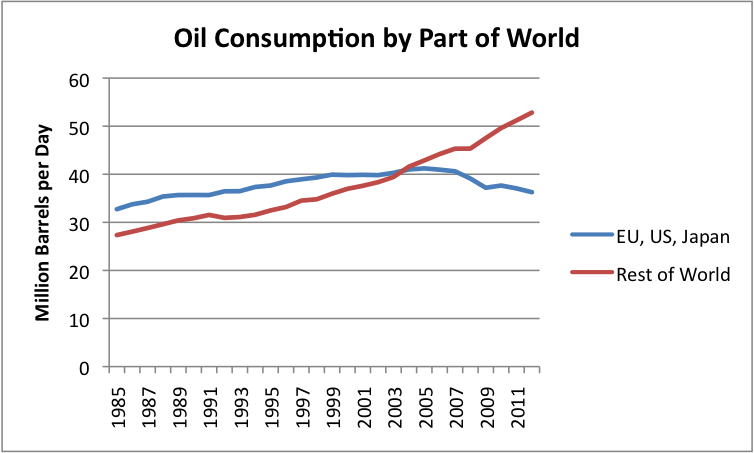
Without a huge, huge increase in US oil production (far more than is being proposed), being “oil independent” simply means that we are unable to compete in the world market for buying oil exports. US oil consumption ends up dropping, and we end up on the edge of recession, or actually in recession. Oil exports instead go to the countries that have lower manufacturing costs (that is, use oil more sparingly).  See Figure 1 below. In fact, even some of the oil products that are created by US refineries end up going to users in other countries, because it is businesses in other countries that are making many of today’s goods, and it is these businesses and the workers they hire who can  afford to buy products like gasoline for their cars or diesel for their irrigation pumps.

Figure 1. Oil consumption by part of the world, based on EIA data. 2012 world consumption data estimated based on world "all liquids" production amounts.

The Green version of this paradigm seems to be, “If world oil supply is rising, everything is fine.” This is related to the idea that our problem is “peak oil” production caused by geological depletion, and if we haven’t hit peak oil production, everything is more or less OK. In fact, the limit we are reaching is an economic limit, that comes far before world oil supply begins to decline for geological reasons. See my post, Low Oil Prices Lead to Economic Peak Oil.

The real paradigm is, “Limited oil supply leads to financial collapse.” This is true for both oil exporters and for oil importer. For oil importers, the problem occurs because they cannot import enough oil, and oil is needed for critical parts of the economy. The belief by economists that substitution will take place is not happening in the quantity and at the price level (very low) that it needs to happen at, to keep the economy expanding as it has in the past.

Limited oil supply first leads to high oil prices, as it did in the 2004 to 2008 period; then it leads to government financial distress, as governments try to deal with less employment and lower tax revenue. By the time oil prices start falling because of the poor condition of oil importers, we are well on our way down the slippery slope to financial collapse.

Growth Paradigm

The MSM version of this paradigm is, “Growth can be expected to continue forever.” A corollary to this is, “The economy can be expected to return to robust growth, soon.”

In a finite world, this paradigm is obviously untrue.  At some point, we start reaching limits of various kinds, such as fresh water limits and the inability to extract an adequate supply of oil cheaply.

Economists base their models on the assumption that the economy only needs labor and capital; it doesn’t need specific resources such as fresh water and energy of the proper type. Unfortunately, substitutability among resources is not very good, and price is all-important. In the real world, growth slows as resources become more expensive to extract.

The Green version of the growth paradigm seems to be, “We can have a steady state economy forever.” Unfortunately, this is just as untrue as the “Growth can be expected to continue to forever.” Even to maintain a steady state economy requires far more cheap-to-extract oil resources than the earth really has. (US shale oil resources, which are the new hope for oil growth, can only grow if oil prices are sufficiently high.)

We are very dependent on fossil fuels for making our food supply possible and for our ability to make metals in reasonable quantity. Fossil fuels are also necessary for making concrete and glass in reasonable quantities, and for making modern renewable energy, such as hydroelectric dams, wind turbines, and PV panels. We cannot keep 7 billion people alive without fossil fuels. Perhaps the quantity of fossil fuels consumed can be temporarily reduced from current levels, but with continued population growth, any savings will be quickly offset by additional mouths to feed and by the desire of the poorest segment of the population to have the living standards of the richest.

Unfortunately, the correct version of the paradigm seems to be, “Overshoot and collapse is to be expected.” This is what happens in nature, whenever any species discovers a way to way to increase its energy (food) supply. Yeast, when added to grape juice will multiply, until the yeast have consumed the available sugars and turned them to alcohol. They then die.

The same pattern has happened over and over with historical civilizations. They learned to use a new approach that allowed them to increase food supply (such as clearing land of trees and farming the land, or adding irrigation to an area), but eventually population caught up. Research shows that before collapse, they reached financial limits much as we are reaching now. The symptoms, both then and now, were increasingly great wage disparity between the rich and the working class, and governments that needed ever-higher taxes to fund their operations.

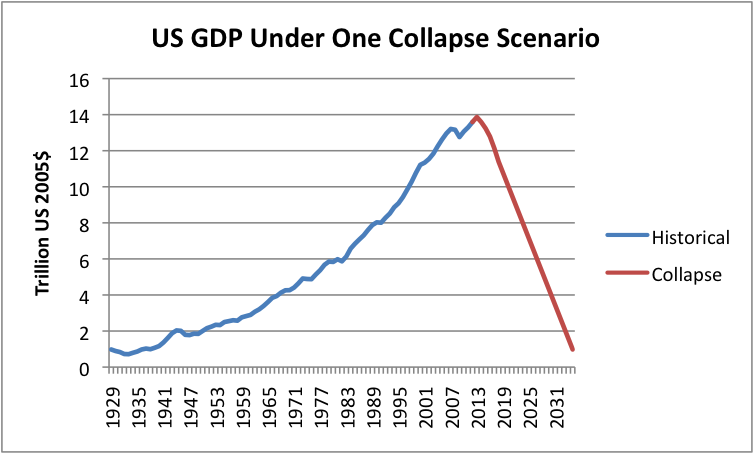
Eventually a Crisis period hit these historical civilizations, typically lasting 20 to 50 years. Workers rebelled against the higher taxes, and more government changes took place. Governments fought wars to get more resources, with many killed in battle. Epidemics became more of a problem, because of the weakened condition of workers who could no longer afford an adequate diet. Eventually the population was greatly reduced, sometimes to zero. A new civilization did not rise again for many years.

Figure 2. One possible future path of future real (that is, inflation-adjusted) GDP, under an overshoot and collapse scenario.

It seems to me that unfortunately overshoot and collapse is the model to expect. It is not a model anyone would like to have happen, so there is great opposition when the idea is suggested. Overshoot and collapse is very similar to the model described in the 1972 book Limits to Growth by Donella Meadows and others.

Role of Economics, Science, and Technology Paradigm

The MSM paradigm seems to be, “Economics and the businesses that make up the economy can solve all problems.” Growth will continue. New technology will solve all problems. We don’t need religion any more, because we now understand what makes people happy: More stuff! As long as the economy can give people more stuff, people will be satisfied and happy. Economics even can allow us to find “green” solutions that will solve environmental problems with win-win solutions (assuming you believe MSM).

The Green version of the paradigm seems to be, “Science and technology can solve all problems, and can properly alert us to future problems.” Again, we don’t need religion, because here we can put our faith in science to solve all of our problems.

I am not sure the Green version of the paradigm is any more accurate than the MSM media version. Science is not good at figuring out turning points. It is very easy to miss interactions that are outside the realm of science, and more in the realm of economics–for example, the fact high-priced oil is not an adequate substitute for cheap-to-extract oil, and it is the lack of cheap oil that is causing a major portion of today’s problem.

It is also very easy to put together climate change models that are based on far too high assumptions of the amount of fossil fuels that will be burned in the future, because economic interactions are missed. If debt collapse brings down the economy, it will bring down all fossil fuels at once, meaning that the vast majority of what we think of as reserves today will stay in the ground forever. A debt collapse will also affect renewables, by cutting off production of new renewables, and by making maintenance of existing systems more difficult.

The real paradigm should be, “Neither science and technology, nor economics can solve the problems of humans. We have instincts similar to those of other species to reproduce in far greater numbers than needed for survival, and to utilize all resources available to us. This leads us toward overshoot and collapse scenarios, even though we have great knowledge.

Because of our propensity toward overshoot and collapse scenarios, humans have a real need for a “moral compass” to tell us what is right and wrong. If there is no longer enough food to go around, how do we decide which family members should get it? Is it OK to start a civil war, if there are not enough resources to go around? There is also a need to deal with our many personal disappointments, such as finding that the advanced degrees we worked so hard on will have little use in the future, and that life expectancies are much lower. Perhaps there is still a need for religion, even though many have abandoned the idea. The “story line” of religions may not sound exactly reasonable, but if a particular religion can provide reasonable guidance on how to handle today’s problems, it may still be helpful.

Climate Change Paradigm

The MSM view of climate change seems to vary with the country. In the US, the view seems to be that it is not too important, and that it can be adapted to. Perhaps the models are not right. In Europe, there is more belief that the models are right, and that local cutbacks in fossil fuel consumption will reduce world CO2 production.

The Green view of climate change seems to be, “Of course climate change models are 100% right. We should rationally be able to solve the problem.” There is only the minor detail that humans (like other species) have a basic instinct to use energy resources at their disposal to allow more of their offspring to live and to allow themselves personally to live longer.

Unfortunately, a more realistic view is that climate change may indeed be happening, and may indeed by caused by human actions, but (1) we are already on the edge of collapse. Moving collapse ahead by a few months will not solve the climate change problem, and (2) collapse itself is an even worse problem than climate change to deal with.  By the time rising ocean levels become a problem, population is likely to be low enough that the remaining population can move to higher ground, and agriculture can move to where the climate is more hospitable.

Climate change may indeed cause population to drop even more than it would if our only problem were overshoot and collapse. But because the cause is related to human instincts (having more offspring than needed to replace oneself and the drive to use energy supplies that are available), changing the underlying behavior is extremely difficult.

Over the eons, the earth has been cycling from one climate state to another, with one species after another being the dominant species. Perhaps natural balances are such that the time has now come that humans’ turn as the dominant species is over. The earth is now ready to cycle to a state where some other species is dominant, perhaps a type of plant that can use high carbon dioxide levels. If this is the case, this is another disappointment that we  will need to deal with.

Nature of  Our Problem Paradigm

The MSM’s paradigm seems to be, “Our problem is getting the economy back to growth.” Or, perhaps, “Our problem is preventing climate change.

In a way, the MSM paradigm of “Our problem is getting the economy back to growth,” has some truth to it. We are slipping into financial collapse, and in a sense, getting the economy back to growth would be a solution to the problem.

The underlying problem, however, is that oil supply is getting more and more expensive to extract. This means that an increasing share of resources must be devoted to oil extraction, and to other necessary activities (such as desalinating water because we are reaching fresh water limits as well). As a result, the rest of the world’s economy is getting squeezed back. See my post Our Investment Sinkhole Problem. Squeezing the world’s economy creates great problems for all of the debt outstanding. The likely outcome is widespread debt defaults, and collapse of the world economy as we know it.

The Green paradigm seems to be, “We have a liquid fuel supply problem.”  If we can solve this with other liquid fuels, or with electricity, we will be fine. Many Greens also emphasize the climate change problem, so their big issue is finding electric solutions for the liquid fuel supply problems. There is also an emphasis on local food production, especially with respect to perishable foods.

Unfortunately, the real problem seems to be, “We are facing a financial collapse scenario that is likely to wreak havoc on all energy sources at once.” Using less oil products may be helpful for a while, but in the long term, we are dealing with an issue of major system collapses. Using less of a particular product “works” as long as the supply chain for that product is still intact, including the existence of all of the factories needed to make the product, and the existence of trained workers to operate the factories. Banks also need to remain open. World trade needs to continue as well, if we are to keep our supply chains operating. The real danger is that supply chains for many essential services, including fresh water, sewage disposal, medicines, grain production, road repair, and electricity transmission repair will be interrupted. As a result, we will need to find local solutions for all of them.

The situation we are facing is not at all good. While we can do a little, it will be very challenging to build a new system that does not use fossil fuels. In the past, when the world did not use fossil fuels, the population was much lower than today–one billion or less.

Also, in the past, we started simple, and gradually added complexity to solve the problems that arose. This time around, we need to do the reverse. We already have very complex systems, that are too difficult to maintain for the long term. What we need instead is simpler systems that can be maintained with local materials. This is not a direction in which science and technology is used to working.

Creating new systems that require only local resources (and a few other resources, if transport can be arranged) will be a real challenge. Areas of the world that have never adopted modern technology would seem  to have the bast chance of making such a change.

Importance of Tomorrow Paradigm

MSM seems to assume that we can save and plan for tomorrow. Greens have a similar view.

Perhaps, given the changes that are happening, we need to change our focus more toward to day, and less toward tomorrow. How can we make today the best day possible? What are the good things we can appreciate about today? Are there simple things we can enjoy today, like sunshine, and fresh air, and our children?

We have come to believe that we can and will fix all of the problems of tomorrow. Perhaps we can; but perhaps we cannot. Maybe we need to simply take each day as it comes, and solve that day’s problems as best as we can. That may be all we can reasonably accomplish.

Posted in Gail Tverberg | Comments Off on Reaching Oil Limits – New Paradigms are Needed by Gail Tverberg

Energy Watch Group. Peak Uranium 2020-2035

Energy Watch Group. March 2013. Fossil and Nuclear Fuels – the Supply Outlook (172 pages)

Uranium production peaks for the same reasons as oil, coal, and natural gas: the depletion of easy and cheap to develop mines.  EWG’s guess is peak will happen between 2020 and 2035.

150 reactors have already been shut down. The 437 reactors still in operation are an average of 26 years old. The average operation time of reactors already shut down was 23 years, even though some reactors achieved operation time s close to 50 years. For the scenario projections , it is assumed that reactors now in operation will on average be shut down after 40 years of service. If no new reactors were constructed, global nuclear capacity would decline by about 70% until 2030 (red broken line in Figure 23). The figure also shows how many new reactors must be grid connected each year just to keep electric power capacity constant (blue bars). This would require a substantial increase in new construction starts with up to 30 GW/yr of total new capacity, plus 7 GW of new construction to match the low scenario forecast by NEA 2011 (lower purple broken line). In order to match the high forecast by NEA 2011, more than 15 GW would need to be added a year (pink bars which correspond to the upper purple broken line).

EWG figure 23 nuclear power plants

Figure 23: Historical development of nuclear power capacity and scenario until 2035. Source:  International Atomic Energy Agency (PRIS), September 2012

Nuclear Power Plants Worldwide

435 operational reactors allocate a total net electric capacity of 370 GW

Nuclear Power Plants Worldwide EWG


  • Green Line: net electrical capacity of plants connected to the grid.
  • Red line (right axis) accumulates the net capacity of all operational nuclear power plants worldwide.
  • Blue Bars: construction starts

In recent years the construction start of nuclear power plants has gained momentum. Since 2006, the construction of reactors with an additional capacity of 48 GW started. Currently a total of 62 GW are under construction including 10 GW of electric capacity with a construction start prior to 2000. Some of those reactors are under construction since the 1980s. If and when this 10 GW reactor capacity will ever go online is very uncertain. The capacity which was shutdown each year is not shown.

The service life for most reactors is between fifteen and forty years. Today the majority of the reactors (and capacity) in operation are more than 25 years old. Only 10 percent of the net electrical capacity is below 20 years of age. This means that the majority of operating reactors will be shut down permanently within the next two decades.

China, Russia, Korea (Rep. of) and India account for 85 percent of the net electrical capacity being under construction right now (not counting construction starts prior to 2000). With a share of over 50 percent, China is currently constructing the largest capacities. The European share (without Russia) adds up to only 6 percent.

To sustain the current net capacity of 375 GW about 250 GW (equalling 66 percent of current global capacity) have to be added until 2035.

The additional required capacity can be supplied either with newly constructed reactors, and/or the prolongation of the life-span of operating reactors, and/or the reactivation of existing reactors currently having the status “longterm shutdown”. The capacity that can be supplied from long-term shutdown reactors is minimal and amounts to only 3 GW (five reactors, shutdown since 1995 and 1997). If the average reactor lifespan is extended from the assumed 40 years to an average of 50 years, the need to construct new reactors is reduced by 95 GW until 2035. With an extended reactor lifespan of 50 years a total of about 150 GW have to be constructed until 2035 to keep the nuclear electricity production at current level.

Assuming a construction time of 5 years, on average the construction of 8 GW per year (50 years reactor lifetime) respectively 14 GW/a (40 years reactor lifetime) has to commence every year between 2012 and 2030 in order to sustain the current production level. To meet the NEA 2011 low case scenario, on average every year a capacity of between 17 GW/yr (50 years reactor lifetime) and 22 GW/yr (40 years reactor lifetime) has to be added.

Future uranium demand and supply

The NEA 2011 forecast on nuclear power capacity (540 GW in the low case, 746 GW in the high case) leads to a uranium fuel demand between 95 and 130 ktU/yr in 2035. Assuming a linear capacity growth, a total of 2,000 to 2,500 kt uranium are needed until 2035 to power all reactors. The reasonable assured resources with extraction costs below 80 $/kgU are not sufficient to meet this demand. If the uranium supply is extended to the cost category <130 $/kgU RAR, this would be barely enough to meet the fuel demand in the NEA low case scenario for the next 10 – 20 years.

Figure 113 shows the fuel demand for both NEA 2011 forecasts. The dark green area indicates the  possible future uranium production from Reasonable Assured Resources with extraction costs below 80 $/kgU. The light green area indicates additional uranium (+ 1,441 kt RAR) that can be produced at cost of 80 to 130 $/kgU. The blue area shows the maximal amount of additional fuel (+ 3,641 ktU) that can be produced at costs below 260$/kgU while also including Inferred Resources.

Nuclear Power Plants Uranium supply EWG


EWG’s best guess at likely uranium production is  somewhere in between Figure 114 and 115 (My comment: but with oil having peaked in 2012 and being needed to grow food rather than mine uranium, and the likelihood aging plants will have a meltdown or other major disaster like Fukushima, means that far fewer nuclear plants are likely to be built than forecast, and far less uranium mined as well):

Nuclear Power Plants Uranium production fig 114 EWG

Nuclear Power Plants Uranium production EWG


ccccccc


Posted in Nuclear Power Energy, Peak Uranium | Tagged , | Comments Off on Energy Watch Group. Peak Uranium 2020-2035

Energy Watch Group 2013 Natural Gas Supply Outlook

Energy Watch Group. March 2013. Fossil and Nuclear Fuels – the Supply Outlook (172 pages)

Summary (see report for details)

This report also contains scenario projections for the future supply of natural gas. These are performed in similar depth as the projections of future oil supply. Important findings are:
Conventional gas production is in decline in Europe and North America which together hold almost 35 per cent of world gas production.

Unconventional gas production, predominantly shale gas production, has increased US production in the last years since the exemption of the gas industry from environmental regulations of the Safe Drinking Water Act (SDWA). Now shale gas has a U.S. market share of 30 percent.

Shale gas production in the USA is unlikely to see a significant further expansion. Due to the particular production dynamics of shale gas it will decline as soon as new wells are not being developed any more at an adequate rate. The decline of shale gas production from 2015 onward will add to the decline of conventional gas production. In 2030 gas production in the US probably will be far below present production levels.

Gas production in Europe has been in decline since the turn of the century and will continue to follow that trend. Shale gas production will not play a role comparable to the one in U.S., since geological, geographical, and industrial conditions are much less favorable. In order to keep gas consumption in Europe flat or rising, imports will need to increase by at least additionally 200 billion m3/yr.

Russia, the second largest natural gas producer closely behind the U.S., faces a struggle between declining production from aging fields and new expensive and time consuming developments in Northern Siberia and offshore. Russian gas production reached a first peak in 1989 when the largest fields passed peak production. Gazprom production never reached that level again. Aging fields force Russia to speed up the development of new fields. The developments of Shtokmanskoye in the Barents Sea and of other fields in Yamal are delayed. If the gas fields in the Yamal Peninsula would be developed in time, they would have produced 310-360 bcm in 2030 according to Gazprom. But even this will not be sufficient to compensate for the decline of aging current fields.

Domestic consumption in Russia and growing demand from Asia will put increasing pressure on volumes available for export from Eurasia to Europe in the coming years.

The Middle Eastern countries Iran and Qatar are expected to feed the rising demand for liquefied natural gas over the next decades. Though these countries have large reserves, it is highly probable that reported reserves are exaggerated.

Posted in Natural Gas | Comments Off on Energy Watch Group 2013 Natural Gas Supply Outlook

No More Oil Exports by 2030

Jeffery J. Brown. 10 Jun 2013. Commentary: Is it only a question of when the US once again becomes a net oil exporterASPO-USA


Key points made in this article:

  • In just 17 years given current trends, China and India would be consuming 100% of all exported oil
  • In order to be crude oil independent by 2023, we would need to add, over 10 years, the productive equivalent of the 2012 crude oil production from Saudi Arabia + Iraq + Kuwait.
  • At a 10% per year decline rate, to maintain a production rate of 7.5 million b/d out to 2023, the US oil industry would have to replace the productive equivalent of every single oil field in the USA–everything from the Thunder Horse Complex in the Gulf of Mexico, to the Eagle Ford Play, to the Permian Basin, to the Bakken Play to the North Slope of Alaska.

In a recent Radio Free Europe/Radio Liberty interview with Daniel Yergin, the interviewer had the following rather remarkable question, “How will the fact that the United States is going from an oil importer to a net oil exporter change its foreign policy calculations?” The underlying premise–that the US would soon be a candidate for membership in OPEC–was not challenged by Mr. Yergin, and he talked about the implications of a steady increase in US and North American oil production.

Given the apparently widespread view that it is not if, but when, that the US becomes a net oil exporter, I thought that it would be a worthwhile exercise to examine the challenges facing the US oil and gas industry, as an ever greater percentage of US oil and gas production comes from very high decline rate oil and gas wells, especially in the context of what has been a post-2005 decline in Global Net Exports of oil (GNE).

ExxonMobil put the annual decline rate from existing well-bores in the 4%/year to 6%/year range a few years ago. For the sake of argument, let’s assume that the decline rate from existing US oil wells was about 5%/year in 2008, when the US hit a recent low crude oil production rate of 5.0 million b/d. Of course, the 2005 Gulf Coast hurricane damage contributed to the 2004 to 2008 decline in production. In this paper, I am using the EIA’s definition of crude oil, which is crude + condensate.

Let’s assume that US crude oil production averages 7.5 million b/d in 2013, and let’s make (in my opinion a conservative) assumption that the decline rate from existing US oil wells averages 10 percent/year over the next 10 years, as an increasing percentage of US production comes from high decline rate shale/tight plays.

At a 10 percent /year decline rate, in order to simply maintain a production rate of 7.5 million b/d out to 2023, the US oil industry would have to replace the productive equivalent of every single oil field in the United States of America–everything from the Thunder Horse Complex in the Gulf of Mexico, to the Eagle Ford Play, to the Permian Basin, to the Bakken Play to the North Slope of Alaska.

Or let me put it this way, at 5%/year decline rate, in 2008 the US lost 250,000 b/d per year due to declining production. At a 10%/year decline rate and a production rate of 7.5 million b/d, we would lose 750,000 b/d this year due to declining production.

In other words, a 50% increase in net production plus an increase in the decline rate from 5 percent /year to 10 percent /year would lead to a tripling in the volume of crude oil production lost every year due to production declines from existing wellbores.

Assuming an annual loss of about 750,000 b/d from existing wellbores, the gross increase in production would have to exceed 750,000 b/d in order to show a net increase in production. For example, let’s assume that we average 7.5 million b/d in 2013, and let’s assume that we lose 750,000 b/d from existing wellbores this year. In order to show a net increase of 0.25 million b/d from 2013 to 2014 (from 7.5 to 7.75 million b/d), the industry would have to show a gross increase in production of 1.0 million b/d, which would be the production from new wells in 2014 that were not producing in 2013.

In regard to the possibility of becoming crude oil self-sufficient, probably the simplest way to look at the US supply and demand situation is to focus on crude oil production versus refinery inputs.

Let’s use the above assumptions, to-wit, annual US production of 7.5 million b/d in 2013, with an overall decline rate from existing wellbores of 10 percent/year. The decline rate will probably continue to increase, but for simplicity, let’s assume that it averages 10 percent/year. As noted above, in order to maintain a constant 7.5 million b/d production rate out to 2023, given a 10 percent/year decline rate, we would have to replace the productive equivalent of 100% of current US crude oil production.

We are currently processing about 15 million b/d of crude oil in US refineries. A portion of the refined product is exported, and then we have refinery gains plus biofuels plus natural gas liquids, but let’s ignore all of that and focus on crude oil production versus refinery inputs. Currently, we are producing about half of the crude oil inputs into US refineries, and importing the other half.

If we want to produce, in 2023, 100% of the crude oil that we currently process in US refineries, based on the above assumptions (especially a 10 percent /year decline rate), we would need to add the 7.5 million b/d, in order to offset declines, plus add another 7.5 million b/d over 10 years, for a total of 15 million b/d of new production, or about 1.5 million b/d per day per year for 10 years. And of course, once we reach the 15 million b/d level, assuming a 10%/year decline rate, we would need 1.5 million b/d of new production, every year, just to maintain the 15 million b/d production rate.

To meet the 1.5 million b/d per year rate, in order to be crude oil independent by 2023, in round numbers we would need to add–every single year–the combined current productive equivalent of the Bakken Play + the Eagle Ford Play. Or, we would need to add, over 10 years, the productive equivalent of the 2012 crude oil production from Saudi Arabia + Iraq + Kuwait.

This exercise illustrates why peaks happen, and it shows why production declines are inevitable. On the upslope of a production increase, new oil wells can offset the declines from existing wellbores, but with time, new oil wells can no longer offset the increasing volume of oil lost to production declines.

And of course the overall decline rate from existing US gas wells is almost certainly even higher than for oil wells.

We are currently averaging about 66 BCF/day (billion cubic feet per day) in dry natural gas production in the US (EIA). If we assume an overall 20%/year decline in natural gas production from existing wellbores, the industry would have to put online the productive equivalent of 100% of current US dry natural gas production over the next five years, in order to maintain a production rate of 66 BCF/day.

So, based on a 10%/year decline rate for oil wells and a 20%/year decline rate for gas production, in order to just maintain a crude oil production rate of about 7.5 million b/d and a natural gas production rate of 66 BCF/day, in round numbers the industry would have to add the productive oil equivalent of one new Bakken play every year and the productive gas equivalent of more than two Barnett Shale plays–every single year, year after year.

Globally, the dominant trend we are seeing is a post-2005 decline in Global Net Exports of oil (GNE), which I define as the combined net oil exports from the top 33 net oil exporters in 2005, as the developing countries, led by China, so far at least have consumed an increasing share of a post-2005 declining volume of GNE. Of course, this means that developed net oil importing countries like the US have to make do with a declining share of a declining volume of GNE. And the US is still dependent on imports for about half of crude oil processed in US refineries. The post-2005 decline in GNE, combined with increasing demand from developing countries were, in my opinion, the primary factors that contributed to global annual (Brent) crude oil prices more than quadrupling from $25 in 2002 to $112 in 2012.

Currently rising US crude oil production is very important, but in all likelihood we will see a continuation of the “Undulating Decline” pattern that we have seen in US crude oil production since it peaked in 1970–set against the backdrop of what will probably be a continuing pattern of developing countries, led by China, consuming an increasing share of a smaller post-2005 supply of Global Net Exports of oil.

In fact, recently released EIA data confirm a continuation of a pattern that we have seen since 2002, to wit, China and India have been consuming a steadily increasing share of GNE. At the 2005 to 2012 rate of decline in the ratio of GNE to China and India’s combined net oil imports, in only 17 years China and India alone would theoretically consume 100% of global net exports of oil.

For more information on Global Net Exports of oil, following is a link to my recent paper on the Export Capacity Index concept.

For a concrete example of how the Export Capacity Index (ECI) concept works, consider two countries that are widely considered to be critically important sources of future crude oil production: Brazil and Iraq. If we extrapolate the 2008 to 2012 rate of decline in Brazil + Iraq’s combined ECI ratio (the ratio of liquids production* to consumption), they would collectively approach zero net oil exports in about 20 years.

Given Brazil’s status as a net oil importer in 2012, even if we count biofuels, it’s instructive to consider what the conventional wisdom was just a few years ago regarding Brazil. In April, 2009 Bloomberg published a column discussing the prospect for Brazil continuing “to take market share away from OPEC.”

We should keep case histories like this in mind when we read in the media about the “Fact” that the US will soon be a net oil exporter, and while there are always uncertainties in forecasting future trends, we can be certain of three objective facts: (1) All oil fields, sooner or later, peak and decline; (2) Global crude oil production is the sum of discrete oil fields that peak and decline and (3) Given an ongoing production decline in an oil exporting country, it is an mathematical certainty that unless domestic consumption in that oil exporting country falls at the same rate as the rate of decline in production, or at a faster rate, the resulting net export decline rate will exceed the production decline rate and the net export decline rate will accelerate with time.

*EIA data, production = total petroleum liquids + other liquids (mostly biofuels in the other liquids category)

The Export Capacity Index (ECI): A New Metric For Predicting Future Supplies of Global Net Oil Exports 

April, 2009: OPEC Cuts Thwarted as Brazil, Russia Grab U.S. Market 

Jeffrey J. Brown is a licensed professional geoscientist. He is responsible for the discovery of several oil and gas fields in West Central Texas, and currently manages an exploration program searching for oil and gas fields in this region. Jeff has conducted analysis of Peak Oil issues for many years, and has authored numerous articles with a special emphasis on global oil exports.


Posted in Exports decline to ZERO | Comments Off on No More Oil Exports by 2030