Why Banks and Wall St will go broke if interest rates ever go up

Dumb Money Day 1 by Charles Marohn, Strong Towns   Jun 10, 2013

This week I want to write about one very technical finance subject and the implications for the housing market and, by extension, for cities and the great reset we are going through). I want to bolster those of you that inherently believe that there is something rotten at the core of the economy. I want to give you context for all the propaganda being thrown at you about how our economy is getting back on track (record stock prices and accelerating housing market being two oft-repeated benchmarks). I don’t want you to slide back into the Ponzi Scheme, especially since the market’s need for dumb money is so intense right now. This week is about giving you confidence to stay the course.

First we are going to start with a lesson on debt and something called the “carry trade.” Let’s start with a very simplified explanation of how debt is used to magnify returns.

Let’s say I have $1,000. I use it all to go out and buy a 30-year treasury note paying 3.5% (roughly the current rate). I now own a $1,000 note that will pay 3.5% ($35) annually for each of the next 30 years, after which my original $1,000 will be returned to me.

With that $1,000 note as collateral, I now go and borrow $900. I have 10% equity here — some skin in the game — but I’m still pledging the entire $1,000 so I can borrow another $900. I get the additional $900 and use that to buy 30-year treasury notes at 3.5%. Understand what I’ve done: I started with $1,000 and now, after one iteration of leverage, I have $1,900 in treasury notes along with a $900 debt. It’s the same amount of money — $1,000 — but deployed differently in the market.

Now I take my $1,900 in treasury notes and I go through this leverage process again, essentially pledging that collateral for a loan of 90%, or $1,710. I promptly buy another $1,710 in AAA rated 30-year US treasuries. Good as gold. My $1,000 has now gotten me $3,610 in treasury notes along with $2,610 worth of debt. I still have more assets than liabilities, meaning I still have equity and everything I owe is fully collateralized with AAA securities.

This cycle continues again and again and again until my $1,000 yields $47,046 in 30-year treasuries along with $46,046 in debt. This is roughly the ratios of leverage that firms like Goldman and Bear Stearns were at when they went under and, reportedly, the levels that many of the remaining Wall Street banks are at today.

Why would a bank take on so much debt? The answer is something called the carry trade. While I said that our $1,000 is being used to buy 30-year notes at 3.5%, I didn’t say what rate we were borrowing at. Obviously, if we had to borrow at a rate higher than 3.5% — which you and I would have to for something like this — we’d lose money in this trade. That’s not how things work for banks, however.

A bank can borrow overnight today at essentially no cost. The bank borrows $46,046 this morning and promises to repay you at the end of the day. There is a tiny charge, but not much. Even if they were borrowing for 90 days — the rate is going to be really low (say, 0.1%) thanks to the Federal Reserve artificially suppressing interest rates. At the end of 90 days, you just roll that debt over into a new 90-day loan.

So the carry trade is simple. You borrow at a low rate and lend back at a high rate. In this case you borrow for 90-days at 0.1% and then lend out at 3.5% for a 30-year note. In the first year, you have to pay 0.1% on your $46,046 debt (that’s $46), but you make 3.5% on your $47,046 in 30-year treasuries (that’s $1,647).

I know this is a lot of numbers, but pause there for a second and understand what you just read. You started this exercise with $1,000. Due to your ability to leverage and the artificially low rates you pay on that debt, you pay $46 in interest expense and have $1,647 in interest earnings. In other words, your $1,000 earned you $1,601 in pure profit. You can sell all your securities, pay off all of your debts and walk away at the end of one year with a profit of 260%. Now just imagine that, instead of $1,000, you were talking about $100 billion.

Generally, it’s not that easy. The carry trade has some obvious risk involved. By financing short term to purchase a long term security, you are taking a very real risk that short term rates could rise and invert the trade. Let’s say short term rates rose to 5%, the historical average over the past thirty years. Now you have a 30-year security paying just 3.5% but you are paying 5% on your financing. You are going to burn through your $1,000 in equity very quickly and then you’re insolvent. Nobody is going to lend to you short term, or any term, and it’s all over.

But what if you just sold your long term notes to pay off the debt? Well, when short term rates rise, long term will rise as well. If I am going to take a long term risk, I’m going to demand a higher interest rate than I could get for a short term risk. So if short term rates go from zero to 5%, long term rates would make at least that bump, from 3.5% to 8.5%.

Why is that important? If I’m in the market trying to buy a 30-year note and I can get one paying 8.5%, how much am I going to be willing to pay you for your $1,000 note that is paying just 3.5%? The answer: a lot less than $1,000. In other words, as those long term interest rates rise, your long term securities are now worth less. This trade is now blowing up on both sides; your financing costs are rising while your asset value is falling. That’s a deadly combination.

So the carry trade has a lot of risk…..that is, unless the Federal Reserve signals very clearly that they are going to keep interest rates low and stable for an extended period of time. When that happens, the carry trade is on and becomes a relatively low risk way to make a lot of money very quickly.

Summary:

  • Big banks and large investors have the capacity to leverage modest amounts of equity into large market positions by taking on debt.
  • One form of the carry trade takes advantage of the interest rate difference between short term and long term securities.
  • Interest rates kept artificially low and stable reduce the risk associated with that form of a domestic carry trade.

Dumb Money Day 2   Jun 11, 2013

Yesterday we looked at how debt is used to generate high returns, particularly for a small subset of the population and especially during times when central policy makers commit to extended periods of low, stable interest rates. Today we’re going to add a couple more pieces of financial background before we move on and apply this to our current situation.

We all understand how savings work. We put our money in a bank and are paid a rate of interest for our capital. The bank then turns around and loans that money out at a higher interest rate, a mechanism by which they (a) make money and (b) pay depositors interest. If you had a lot of money, you could make your own loans, but for most of us (and even for the wealthy) it makes more sense to diversify over many projects and have the bank, made up of financial experts, evaluate projects on your behalf.

So, in normal times, we must save to invest. The bank is not going to have any money to loan out unless people deposit money into it. (If you want a more detailed explanation, note that banks are part of the process in which money is created, a process described eloquently by Chris Martenson in this Crash Course video.)

Here’s the next critical insight: In a normal market system, interest rates represent the supply and demand for capital. If there is a lot of demand for money from businesses and individuals that want to borrow, then a bank will raise interest rates to encourage people to save more. If the bank has too much money and not enough people asking for loans, then interest rates will drop. Now banks borrow money back and forth among each other which tends to even things out across institutions, but every now and then you’ll see one pop up with a rate quite a bit on one side of the curve. Something’s going on — they either have a big deal and they need some capital or they have too much money and are having a tough time putting it to productive use.

Now enter the Federal Reserve System and national, centralized monetary policy. When the Federal Reserve intervenes to manipulate interest rates, it is distorting the relationship between supply and demand of capital. If the Fed raises rates, it will encourage people to save and if the Fed lowers rates, it will encourage people to do something else with their money. This is irrespective of what would naturally be happening in the market.

This is an accepted practice among nearly all economists. According to their theories, when the economy needs a kick in boot, the Federal Reserve should lower interest rates to make capital easier for people to borrow. When the economy is overheated, manipulating interest rates higher is a way to dampen that.

It is important to understand the mechanism the Federal Reserve uses to raise and lower interest rates. To lower rates, the Fed simply buys treasury notes. When they buy the notes from Wall Street banks, those banks then have a lot of cash and so they need more borrowers, fewer savers. Thus interest rates go down. To raise rates, the Fed does the opposite and sells notes. When it does that, it is putting these US treasury certificates — instruments of savings — out there and taking the cash back in return (which they put under their mattress). This reduces the amount of cash the banks have and, to have money to lend, banks then need to raise interest rates.

So let’s put these two things together; When the Federal Reserve determines that the market is not working correctly — generally that growth, unemployment and inflation are not being optimized — they will intervene to manipulate the market interest rate.

There is one more concept you need to understand: the Mortgage Backed Security (MBS). As an analogy, if you created a company, had that company buy a thousand mortgages, then you sold a thousand shares in that company, each of those shares would be an MBS. With that MBS, instead of owning the debt of one mortgage, you would own 1/1000 of each. You are essentially spreading out your risk over a wider pool, just like a bank does when they do multiple loans.

Mortgage Backed Securities are important for one reason: yield. Yield is the interest rate at which the MBS pays. Due to the fact that there is more risk in an MBS than in a Federal Treasury note — even when that MBS is rated AAA — the MBS is going to pay a higher interest rate.

Now go back to yesterday where I described the carry trade. An MBS with a higher yield and a generally shorter maturing period (few mortgages make it the full 30 years w/o a refi) is a much more attractive than a 30-year Treasury note with a higher return and less long term risk, a nice combo when trying to spur home purchasing.

You may remember the Federal Reserve’s Operation Twist. This was a shift by the Federal Reserve from buying short term Treasury notes to long term notes, driving down the interest rates on those longer notes even further. The effect of this is to make those MBS investments even more attractive by comparison.

Summary:

  • In a normal economy, we must save to invest.
  • In a normal economy, interest rates represent the supply and demand of capital.
  • When the Federal Reserve determines that the market is not working correctly — generally that growth, unemployment and inflation are not being optimized — they will intervene to manipulate the market interest rate.
  • Mortgage Backed Securities provide a higher yielding, shorter term investment than long term Treasury notes.

Dumb Money Day 3

On Monday, we showed how banks and large investors have the capacity to leverage modest amounts of equity into large market positions by taking on debt. We also explained one form of the carry trade that takes advantage of the interest rate difference between short term and long term securities, a trade that has much less risk when interest rates are kept artificially low and stable.

On Tuesday, we pointed out that a normal economy requires savings in order to have money that can be loaned out by banks and that interest rates are the market’s mechanism for balancing savings and investment. This equilibrium is manipulated by the Federal Reserve to discourage or encourage savings in an effort to optimize market outcomes. Finally, Mortgage Backed Securities — a financial product consisting of home mortgages — provide a higher yielding, shorter term investment than long term treasury notes.

So let’s move on to the red flags, as indicated by the Federal Advisory Council, a group that regularly advises the Federal Reserve. Here is how the FAC is described on the Fed’s website:

The Federal Advisory Council (FAC), which is composed of twelve representatives of the banking industry, consults with and advises the Board on all matters within the Board’s jurisdiction.

The most recent FAC meeting was May 17, the minutes of which can be found here. While the fifteen pages are generally full of statements that support current Fed policies and give endorsement to the notion of a gradual recovery in the economy, the last page has some very revealing insights. The FAC asked their opinion on current Fed policy, which is essentially manipulating the overnight borrowing rate to zero and using quantitative easing to further manipulate downward short term and long term treasuries. Here are some of their statements, which I’ll provide some comments on.

The Fed’s securities purchases have reduced mortgage yields and, to a lesser extent, Treasury yields. Current low bond yields are disruptive to management of fixed-income portfolios, retirement funds, consumer savings, and retirement planning. They may encourage unsophisticated investors to take on undue risk to achieve better returns.

The first sentence is essentially what we’ve been discussing here — yield is the interest rate and the Fed has been driving down rates. The second and third sentences can be read like this: because your savings account is not paying any interest (or your pension fund, 401(k), etc…), in order to have some earnings, you need to put your money elsewhere.

That’s the “undue risk” part, AKA: dumb money.

When your pension fund, for example, is underfunded by 25% and that already assumes an 8% annual return from now on, very low interest rates on risk-free securities means that, to avoid falling further behind, the fund needs to invest more and more into higher risk areas. While we may think of the unsophisticated investor as the kid betting on dot.com stocks, we can just as easily think of them as the pension fund manager being sold the comparatively high-yielding Mortgage Backed Security that is very risky yet rated AAA by Moodys.

If you want to remove for yourself the veneer of sophistication surrounding Wall Street and investment in general, read Liar’s Poker or The Big Short, two essential Micheal Lewis novels.

Unsophisticated is essentially a euphemism for “dumb money,” which includes everyone not part of the inside operation (and even many of those that are.) This is not a commentary on intelligence, but access to information and, increasingly, access to bandwidth.

The FAC is indicating that, with interest rates directed by the Fed to remain low for a long time, capital is moving from safe to risky investments. Junk bonds are now paying around 5%. Junk bonds are the packaged debt of high risk corporate borrowers. Just a few years ago, these very risk funds paid over 20% interest. So much money is flowing out of zero-interest, safe havens and into high risk places that is huge competition for even junk.

MBS purchases account for over 70% of gross issuance, causing price distortion and volatility in the MBS market. Fixed-income investors worry that attractive mortgage-backed securities are in very tight supply.

Mortgage backed securities (MBS) pay a higher rate of interest than a treasury note. With the rates on treasury notes being artificially depressed, investors like your pension fund are looking to mortgage backed securities to increase the return.

Here’s the problem: the Fed is buying 70% of all mortgage backed securities. The remaining 30% are in high, high demand because they have a slightly higher rate of return and so are fought over by investors (i.e. a fixed income pension fund).

This all drives mortgage rates down, down, down to historic lows. Any mortgage that can make it through the origination process can be purchased, securitized and sold in short order.

Many are concerned about the Fed’s significant presence in the market. They have underweighted MBS in favor of corporate, municipal, and emerging-market bonds.

The term “underweight” here is meant to denote that investors (keep thinking pension funds) are not holding a normal share of MBS and instead are buying other, more risky, bonds. In other words, the Fed is essentially forcing investors not inclined to risk into risky investments. This is why junk bond yields are so low. If fixed-income investors could get their yield in a normal mortgage market, they wouldn’t be buying junk bonds and the interest rate on junk bonds would rise.

There’s also another risk here with the Fed dominating the mortgage market: the carry trade. If the Fed starts to exit the MBS market, rates will go up. That makes the low rate securities actually drop in value (remember: I’m not going to pay you full face value if I can get a higher rate somewhere else). Since few people are going to refinance when rates rise — we’re essentially mining the refi market right now with these low rates — MBS holders could be stuck with low yielding notes for a long time. Corporate bonds, emerging market bonds and other instruments have a quicker turnover and give a little bit more flexibility in a market where rates are rising.

There is also concern about the possibility of a breakout of inflation, although current inflation risk is not considered unmanageable, and of an unsustainable bubble in equity and fixed-income markets given current prices.

Let’s focus on the unsustainable bubble in equity and fixed-income markets.

The equities market is the stock market. The FAC is saying that all of this money printing and frantic search for yield could encourage a lot of people to invest in stocks, something that would drive up prices to unjustified — and thus “unsustainable” — levels. On the way up, this is a self-reinforcing effect; the more stocks rise and the more safer yields are depressed, the more the “dumb money” is lured into the rally. That the “smart money” counts on this reaction is a tragic reality.

Further, current policy has created systemic financial risks and potential structural problems for banks. Net interest margins are very compressed, making favorable earnings trends difficult and encouraging banks to take on more risk.

Banks can’t pay much interest. With banks competing against the Federal Reserve for places to put money, they are left with the same choices everyone else has: make no money or take uncomfortably high risks. Banks that takes risks face huge problems when the market changes.

The Fed’s aggressive purchases of 15-year and 30-year MBS have depressed yields for the “bread and butter” investment in most bank portfolios; banks seeking additional yield have had to turn to investment options with longer durations, lower liquidity, and/or higher credit risk.

With the Federal Reserve crowding everyone else out of the mortgage backed securities market — and thus sucking all the mortgages out of banks (the originators) and into the secondary market — what’s a bank to do? Two things. More transactions, meaning originate more loans and essentially make your money on fees (a dwindling market as the number of homes that could refinance but haven’t is shrinking rapidly) and take on more risk.

For at least a portion, that means that carry trade — taking short term money (deposits that can be redeemed at any time) and buying longer term notes that fewer people want (which is what is meant by “lower liquidity”). This makes the bank financially very fragile.

Finally, the regressive nature of the artificially compressed savings yields creates pent-up demand within bank deposit portfolios; these deposits may be at risk once yields begin to rise and competitive pressures increase.

Here’s the million dollar statement. Or perhaps the trillion dollar statement.

Regressive nature: the Federal reserve policy of low rates and money printing is hitting ma and pa investor really hard.

Artificially compressed savings yield: this means banks are not paying any interest because the Fed is manipulating the rate downward.

Pent-up demand within bank deposit portfolios: Without good options, people are sitting on cash. They wish they could be putting that money someplace productive, yet not overly risky.

Let’s put that together: Federal Reserve policy is hitting the average saver really hard. Those savers are going to bolt to something that pays a market rate of interest when they get a chance.

So when you read the rest of that statement — deposits may be at risk once yields begin to rise and competitive pressures increase — it could be taken one of two ways (or both).

1)      When the Fed stops intervening in the market and things go back to normal, depositors bolt immediately to higher yielding securities, say a normal 90-day Treasury paying 5%. Banks, which have been forced to invest in longer term, less liquid instruments risk losing their depositors if they don’t raise rates to match their competition. No depositors, no money, fire sale, out of business. But if they raise rates, they are struck with the downside of the carry trade and burn through their equity with the same result: no equity, fire sale, out of business.

2)      I’m not sure if the FAC is going Cyprus on us here, but they could be saying that deposits are at risk, meaning the insolvency of the banks and the sheer scale of the problem could be so great that it would exceed what a depleted FDIC could bail out. If that were the case, then your actual deposit — the money you have put in the bank — could be at risk for a partial or complete loss.

Imagine the US government saying, sorry, the FDIC is insolvent and so we’re going to take twenty cents of every dollar you have in the bank and put it into the bank itself. We’ll give you (non-redeemable) shares in the bank, though, so if it ever earns a profit you can share in that. That’s Cyprus, and probably not what the FAC meant (although some members may have).

Either way, this is not a fun time for the dumb money that is left holding the bag.

Uncertainty exists about how markets will reestablish normal valuations when the Fed withdraws from the market. It will likely be difficult to unwind policy accommodation, and the end of monetary easing may be painful for consumers and businesses.

The Fed may have things under control today, but it is not clear how they are going to remove the fingers from the dike without the whole thing collapsing. And, by the way, the water is building behind the dike and so this can’t go on forever, there needs to eventually be a change in policy back to normal markets.

But look; the entire economy is shifted to either (a) those in cash and desperate for a return to market rates so they can bolt or (b) those who have positioned themselves at great risk with assurances that the Fed will continue to keep rates low. The more people that shift from (a) to (b), theoretically the better the economy will get since there will be less hoarding (saving) and more investing and spending. The problem is, the more people following strategy (b), the more critical it is to suppress rates as rising rates will sink their investment.

And there’s the problem. The Fed is stuck in a trap of its own making. If it stops intervening, bank positions go bad, the equities market falls and mortgage rates climb, depressing housing prices, all at once. If it continues to intervene, it is only making these distortions worse, setting itself up for an even more painful unraveling, a reality summed up in the final sentence from the FAC.

Given the Fed’s balance sheet increase of approximately $2.5 trillion since 2008, the Fed may now be perceived as integral to the housing finance system.

What is your house worth? What is a company’s stock worth? What is your dollar worth? Nobody really knows because there isn’t actually a market for any of those things. Now there’s a “market” where things are bought and sold, but not a market where price discovery plays a role in determining what something costs. The very value of the currency is being manipulated, forced into risky and speculative places where it would not naturally go. We’re living through the greatest, high stakes, financial experiment in human history.

Dumb Money, Day 4   Friday, June 14, 2013 | Charles Marohn

The inspiration for this entire series was a set of people who, independently, expressed to me that there were thinking about either (a) investing in the stock market or (b) buying a home. All cited recent reports of upward trends in the price of stocks and houses as justification for their moves.

I’ve also experienced a lot of enthusiasm for municipal investments to induce growth, borrow more money to get things going and essentially get back to the economy of 2005, which is going to happen really soon for those that get in the game. I also wanted to shatter this delusion.

And finally, I’m just so frustrated with the narrative from the Krugman Keynesians. As they hold out the king-sized candy bar and tell everyone that, if we just ate another, the sugar rush would get us up off the floor and we’d then have the strength in our economy to prosper. It’s true, we can get up off the floor with another candy bar, but a lot of good, prudent and innocent people are going to get slammed hard when the sugar rush goes away. Statements to the contrary are comforting and convenient, but ultimately are reckless and harmful.

Abundant capital is a great thing. On it’s face, that is clearly true. For an economy, abundant capital will provide for investment and growth. Continuing with the human body analogy (another complex system), it is a little like saying “energy” is a great thing. When we have a lot of energy, we can accomplish a lot of things.

(I’ll also note here that too much capital causes inflation while too much energy causes hyperactivity and insomnia — abundant capital/energy has limits, for certain, but what we’re talking about here is a lack of sluggishness.)

We all understand that a body can get energy in productive ways and unproductive ways. Good sleep habits, a healthy diet and plenty of exercise is the healthy way for a body to have energy. This requires discipline and balance and, even when it is not pleasant, it requires one to listen to their body. That sore muscle is telling you something; maybe you need to stretch it more, or make sure it isn’t neglected in your routine. That headache is a good thing if it is warning you that you are dehydrated.

So the human body, a complex machine, experiences volatility and gives off warning signs when things are not optimal. Sometimes we can respond to those signs in a way that is clearly productive — we can drink more water or alter our exercise to be more balanced — but sometimes we have to resort to other means. We can’t solve a torn ACL with diet and exercise; for that we need some surgery followed by some antibiotics and pain killers.

He’s the fine line; we all understand that we ultimately need to shed the pain killers. Even Ben Bernanke and Paul Krugman will say, we ultimately need to shed the pain killers — the low interest rates and quantitative easing —  and let this patient (a sick economy) learn to walk again. The trillion dollar question is: when?

This gets me back to the statement I made on Tuesday.

In normal times, we must save to invest.

Savings is the diet and exercise of a healthy economy. We save money — delay the immediate reward of consumption — for the promise of a greater future reward. These savings, in turn, can be productively invested by others today, resulting in growth. The natural regulator between savings and investment is the interest rate.

What economic stimulus does — whether it is manipulation of the interest rate, printing of money or deficit spending — is to give us investment without the need for savings. So we get energy without the need for a healthy diet and exercise.

We can see how, in an emergency situation or on a really bad day, it might be convenient to drink a Red Bull or eat a candy bar to give ourselves an energy boost. A steady diet of Red Bull and candy bars, however, can only lead to disaster.

I have 3 graphs that show how the steady, 60 year diet of Red Bull and candy bars every time our economy has felt a little sluggish has deformed our economy. I particularly want to give some context to the recent stock market highs and housing data.

Here’s our overall economic growth as compared to debt. As we proceeded through the second life cycle of the Suburban Experiment, the lack of real productivity in the economy was replaced with Red Bull (debt). This kept the economy going, allowed us to continue to grow our GDP, but allowed us to also become increasingly unproductive. By 2005, the height of the housing boom, our ability to sustain growth was almost entirely based on Red Bull (debt) and even then, we needed to grow debt at a faster rate than the economy just to manage meager growth.

The gains we are seeing now in the stock market — paper gains — are not based on real productive growth. They are largely the result of cheap credit, something only sustainable so long as the Red Bull continues to flow at accelerating amounts. The crowding out of real savings by the Federal Reserve also means that people are being enticed into stock markets as a way to have any earnings at all. Although people have been shown to be unwilling to gamble where they can lose, when the momentum shifts and perceptions change, people are more than willing to gamble when they believe they will win.

In terms of housing, this was the chart that brought together everything that I’m seeing. We’ve been treated to the media reports that median homes prices are rising. This graph shows how this relates to median incomes.

Home prices might be rising, but it is not a product of us having an economy where people are making more, earning more and having more money to invest in housing. It is an artificial creation of cheap credit. If we were transitioning to a real economy — something stable — that graph should be trending down, not up.

We must save to invest. As we got into the second life cycle of the Suburban Experiment and the growth from horizontal expansion slowed, we replaced savings with Red Bull, putting off a difficult conversation about the wisdom of our approach and, in the process, creating an even larger deformation that we will ultimately have to deal with.

This is an incredibly fragile economy. That fragility is not the construct of recent bailouts, natural economic cycles, greedy politicians, a prolific consumer, lazy freeloaders, the 99%, the 1% or any of the other groups we like to pin the blame on. It is the result of sixty years of deformation, of responding to the aches and pains with Red Bull and pain killers.

Yes, that approach – what has evolved into a supply side, Keynesian amalgamation — allowed us to grow faster, much faster, than we otherwise would have. It allowed us to live large, have an enormous standard of living, and accomplish many, many things that we would not have been able to do were we not taking economic steroids.

Smoothing of the business cycle and decades of this faux-prosperity has all come at a price, however. That price is a great unwinding. On Day 5, I’m going to provide an optimistic roadmap for how a great unwind could happen. On Day 6, I’ll give a less generous version.

Dumb Money, Day 5  June 17, 2013  Charles Marohn

The optimistic and the pessimistic view of the future. He gives the optimistic scenario a less than 5% chance of happening.

If the Federal Reserve’s Quantitative Easing program that artificially suppresses interest rates ends, I explain what would happen in the housing market, the stock market and the federal budget.

On Day 4 I explained that: (1) stock markets gains are not real but simply a byproduct of cheap credit, (2) rising housing prices reflect this same bubble and likewise are not real and (3) we can’t make up for a lack of savings by simply printing money.

Assume, in a very optimistic sense, that Fed interventions have the desired effect, the economy begins to grow on its own and the Fed is then able to reduce QE and allow interest rates to return to market prices.

The housing market is then going to have some huge downward pressure. First, the main buyer of Mortgage Backed Securities (MBS) is now the Fed, which purchases 70% of all new mortgages that wind up on the secondary market (nearly all). Without the Fed buying MBS’s, rates will rise. Optimistically, this will present a buying opportunity for those that have kept cash under the mattress (granted — not sure who those people would be as QE and the other Fed interventions have been designed to get all that cash into the market) and others who are looking for higher yields, perhaps from overseas investors looking for a place to put their dollars (and not worried about recent history in the housing market).

As rates go up, those investors that own low rate MBS sell them to avoid getting burned in the carry trade (see Day 1). While this wave of selling makes rates spike, once the shock passes and banks (and pension funds) have taken their losses, the market stabilizes at a new normal of moderate interest.

Interest rates will rise, by definition, as the Fed stops artificially suppressing them. As rates rise, purchasing power declines as the same payment now buys less house. While this has traditionally exerted downward pressure on home prices, the vigor of the recovery and the pent up demand (?) for housing convinces those (few) people who qualify yet don’t own a home to overlook the fact that they didn’t buy at historically low interest rates. This, along with immigration, allows the housing market to remain healthy.

As part of this, home-builders begin to correct the imbalance between single family homes and households of single individuals. Many 1 and 2 BR unites will be constructed while the number of new 4+ bedroom units declines rapidly. This is a different approach for home builders, appraisers, lenders, brokers, realtors and insurers — not to mention inconsistent with our tax and regulatory structure — yet there are market incentives to make the shift and so it occurs in relative order.

As Baby Boomers seek to sell their suburban homes and relocate to other areas, there are enough Millennials — as well as recent immigrants — with sufficient affluence to purchase all of these homes at higher rates. Some places of the country fare better than others, but the worst performers are not sufficiently bad as to drag down the national economy.

As this is going on, the stock market continues to climb steadily. Stock prices are a reflection of earnings and earnings a reflection of sales and margins. A climbing stock market indicates that companies are still expected to make increasing earnings, improve sales and increase their profit margins while interest rates rise.

Rising interest rates will certainly dispatch some high growth companies whose business models rely on low borrowing costs to build new stores and expand their market position. Rising rates will also force the liquidation of a number of companies that are highly indebted when those companies now have to take their narrow profits and pay competitive rates of interest. These bankruptcies will only make room for other competitors to gain in the market.

As interest rates rise, consumers — particularly the prolific spenders that are carrying high debt levels — will be squeezed by higher debt payments. Home equity loans will no longer be as readily available or as lucrative. Despite this, the growing economy increases optimism about the future.  People feel they will have increased capacity in the future so they begin to take on (even) more debt for consumption purposes, despite the higher rates. This allows businesses to continue to grow and expand justifying elevated stock prices.

Despite higher interest rates, commercial construction continues as national chains, and local enterprises, expand to more and more locations. In contrast to the established approach for national retailers, their protocols for store siting, their chains of suppliers and the entire regulatory and tax structure, business models begin to shift to respond to a new geography. Fewer strip malls are being built and business expansion is now taking place within traditional neighborhoods. This transition represents something of a new market niche and profits continue to soar, justifying broadly higher stock prices.

Finally, as interest rates climb and the Federal Reserve backs out of being the primary buyer of US Treasury bills, Congress is forced to deal with the rising deficit problem. A national debt of $17 trillion financed at less than half a percent interest suddenly becomes unwieldy when rates rise to 5%. The “devastating” sequester of $83 billion looks paltry in the face of what is now an additional $800 billion annually just in interest.

So Congress is forced to act decisively. A 2–4% increase in tax rates relative to GDP along with steep declines in military spending (and military commitments) and means testing of Social Security, Medicare and whatever emerges once Obamacare is implemented. These policy changes are made without any defaults and without any downgrading of the US credit rating. Foreign governments remaining willing (and able) to pick up the gap now that the Fed has exited the market, with Europe, China and Japan now buying trillions of dollars of US debt each year.

All of this allows the US economy to sail on, the Great Recession a nasty episode that we resolved by learning the lessons of the Great Depression and acting aggressively in times of crisis.—

A couple of late evening additions….a friend of mine (a banker) emailed me this article from the NY Times. The article elegantly made some of the points I tried to make earlier in this series.


Dumb Money, Finale  July 1, 2013  Charles Marohn Also a 5% chance of happening? He thinks this is more likely, but how much more?

Above is the optimistic scenario for how the post-2008 economy resolves itself, an entry that was full of wishful thinking and, in my opinion, a lot of rosy assumptions that have very little likelihood of coming to fruition. I do not think we’ll run the table, that Quantitative Easing ends with a gradual taper, leaving the housing market to rise despite rising interest rates, the stock market to climb despite increased borrowing costs and Congress able to act decisively, in a way that does not negatively impact the economy, when the carrying costs on the national debt soars. While I’ve not conducted a statistical analysis, I would give the optimistic scenario a less than 5% chance it will come to fruition.

That is not so say that the pessimistic scenario I’m outlining today has a high likelihood either, although I do find it more likely. A 5% chance that it will all work out weighed against even a 5% chance that the worst case scenario will happen should raise some doubt on how much we are risking and to what end. Ultimately, our economy is in need of a massive retooling. We’re doing everything we can to keep that from happening. If we succeed, we get the optimistic scenario I outlined, a malaise with modest improvement over where we are today. If we fail, here is one way this could go.

The Federal Reserve is not going to be able to end its QE program. Just the mild suggestion that someday in the future there will be a tapering put the bond markets in an uproar. Nobody wants to be the last one to exit this market, and so everyone sitting on a carry spread has one eye always on the exit. Note that the Fed is not suggesting a return to market rates of interest — they still intend to keep rates artificially low — just that they are going to slow that rate at which they pound rates lower with a weekly QE sledgehammer. There is a prisoner’s dilemma at work here.

So the Fed keeps printing and printing and printing. That is, until inflation shows up on our shores.

There are two important things to understand about inflation. First, the Fed’s actions have produced inflation and are continuing to produce inflation, it is just not the kind reported in the vaunted CPI. For many economists, housing prices can artificially triple from cheap credit and it isn’t inflation so long as milk prices don’t rise. Also, we are exporting our inflation. When our cheap credit allows us to buy imported goods, that money winds up in some emerging economy, driving up their prices.

Think those protests in Brazil, Egypt and Turkey have nothing to do with US monetary policy? The spark may be domestic, but the underlying fuel that burns is rising prices.

The second important thing to understand is that inflation is like ketchup in a glass bottle. You want a little ketchup so you tip the bottle upside down. One shake – nothing. Two shakes – nothing. Three. Four. Five. You give it a sixth shake and a third of the bottle spills out all at once. In other words, it is not like there is an inflation dial you can just gradually move up and down. Inflation could easily spiral if all of those foreign holders of dollar-backed debt (not to mention domestic holders, although they are easier to coerce) logically decided they would rather own acres of cornfield in Nebraska, some oils wells, a couple factories or a few trillion in other real assets rather than a currency that is being aggressively debased.

So the Fed keeps printing until they are forced to stop by a spike in inflation. They may still be unwilling to act, even in the face of double digit inflation, but ultimately they will be forced to abandon QE and raise interest rates. A return to the double digit rates of the early 1980’s would not be without precedent (and may ultimately be an underestimate, given where we are today compared to then).

When interest rates climb, it’s over. The Fed has lost control — or the illusion of control is gone — and the correction that was put off is now in full, unabated motion.

A federal debt of $17 trillion now has annual interest in the $2 trillion range, making things like the 2012 interest payment ($220 billion), the difficult decision of the fiscal cliff ($60 billion) and the horrors of the recent sequestration ($85 billion) seem quaint in comparison. Raising taxes, slashing entitlements, gutting the military and every other formerly unthinkable action now becomes the low hanging fruit in a debate over a federal budget that is nearly 50% interest payments.

Things at the state level are perhaps even worse. Many states have simply given up — states like Illinois, New Jersey and California — and have declared bankruptcy. [JBK Pension? Those pension obligations that were dependent on rates of return 250% greater than historic growth rates are now simply discharged, the pensioners getting pennies on the dollar in a lump sum check. Things like maintaining roads — let alone building new ones — are sporadic, where they happen at all. High speed rail systems half built with borrowed money seem like a cruel joke.

Rising interest rates — and the steep reduction in government contracts — force many businesses to go bankrupt, the artificial gains during the cheap money era now gone exposing poor underlying business models and weak balance sheets. Those that remain have higher prices and a shrinking market. Unemployment consequently spikes and the Misery Index (inflation plus unemployment) is revived. In nominal terms, the stock market may be higher or lower, but who cares because in real terms (inflation taken into account) it is dropping dramatically.

Unlike the early 1980’s, however, housing prices do not inflate, their value already too high from prior attempts to prop up the housing market. These prices remain sticky, refusing to drop substantially. The stagnation in price freezes markets, preventing people from being able to sell and move for new work or better opportunity or being liquidated by price deflation. This is extra unfortunate as price inflation is making everything else associated with home ownership — local taxes, replacement shingles for the roof, fixing a broken window — vastly more expensive. This problem — can’t sell but can’t afford not to — is the most pronounced in auto-based neighborhoods, where demand for housing is lowest, jobs fewest and mobility problematic in the face of inflating gas prices, now over $6 per gallon in some places (even though Americans are using less).

In the end, the economy reaches equilibrium. A market rate of interest is restored, but not until the other imbalances of the economy are largely addressed. Median wages have increased bringing median house prices — which have stayed flat — back in line with income. This has not provided the average family with more resources, however, as it now takes twice as much to fill up the refrigerator and the car each month. Americans become savers again, not by choice but because they can’t afford credit, their houses and 401(k) plans have not kept up with inflation and interest rates on savings are once again respectable. The quality of life for most Americans is dramatically changed to the negative, devastating the poorest of the poor. Riots and large protests are now a common occurrence (although the government, thanks to the NSA, are able to head off the worst of the latter by detaining “evil doers” that are stirring things up).

Finally, following the inevitable path of all great empires, the dominance of the dollar is relinquished. After 70 years as the world’s reserve currency, the dollar now competes with a gold-backed Renminbi, a gold-backed Russian Ruble, and a new, northern-bloc Euro backed by a basket of commodities and currencies. The dollar, too, finds international stability only when it ceases to be a fiat currency and, once again, pegs its value to some sort of “barbarous relic” that is beyond the reach of a government or central bank to devalue. 

I’ll close by saying again that this is not a prediction as much as it is an exercise in imagining possibilities. I contend that we’re so fixated on maintaining the status quo that we’re not even considering the likelihood that we’ll be successful (low, in my opinion) or the risk that something calamitous could happen (by no means certain, but much higher than I am comfortable with).

For the time being, we’re simply content with being dumb money.


My comment: I don’t agree with all of the above, but many good points are made, especially about the sneak accounting tricks that make banks seem like they’re doing well, when all they’re doing is borrowing more and more at our and future generations expense.  There has to be deflation first, but after that inflation is a possibility.  Also it’s unlikely that gold will ever be our currency. 


Posted in Banking, Crash Coming Soon, Interest Rates, Ponzi Schemes | Comments Off on Why Banks and Wall St will go broke if interest rates ever go up

Gail Tverberg on Inflation, Deflation, or Discontinuity?

Gail Tverberg. July 1, 2013. Inflation, Deflation, or Discontinuity? ourfiniteworld.com

A question that seems to come up quite often is, “Are we going to have inflation or deflation?” People want to figure out how to invest. Because of this, they want to know whether to expect a rise in prices, or a fall in prices, either in general, or in commodities, in the future.

The traditional “peak oil” response to this question has been that oil prices will tend to rise over time. There will not be enough oil available, so demand will outstrip supply. As a result, prices will rise both for oil and for food which depends on oil.

I see things differently. I think the issue ahead is deflation for commodities as well as for other types of assets. At some point, deflation may “morph” into discontinuity. It is the fact that price falls too low that will ultimately cut off oil production, not the lack of oil in the ground.

Even with little oil, there will still be some goods and services produced. These goods and services will not necessarily be available to holders of assets of the kind we have today. Instead, they will tend to go to those who produced them, and to those who win them by fighting over them.

Up and Down Escalator Economies

It seems to me that economies operate on two kinds of escalators–an up escalator, and a down escalator. The up escalator is driven by a favorable feedback cycle; the down escalator is driven by an unfavorable feedback cycle.

For a long time, the US economy has been on an up escalator, fueled by growth in the use of cheap energy. This growth in cheap energy led to rising wages, as humans learned to use external energy to leverage their own meager ability to “perform work”–dig ditches, transport goods, perform computations, and do many other tasks that machines (powered by electricity or oil) could do much better, and more cheaply, than humans.

Debt helped lever this growth up even faster than it would otherwise ramp up. Continued growth in debt made sense, because growth seemed likely for as far in the future as anyone could see. We could borrow from the future, and have more now.

Unfortunately, there is also a down escalator for economies, and we seem to be headed in that direction now. Such down escalators have hit local economies before, but never a networked global economy. We are in uncharted territory.

Many economies have grown for many years, hit a period of stagflation, and ultimately collapsed. According to research of Turchin and Mefedov documented in the book Secular Cycles, such economies have typically gotten their start by learning to exploit a new resource, such as using land cleared for farming, or learning to use irrigation, or in our case more recently, learning to use fossil fuels. These economies typically start out by growing for many years, thanks to the opportunity for more population and more goods and services from the new resource.

After a while, a period of stagflation is reached. Population catches up to the new resource, and job opportunities for young people become less plentiful. Wage disparity grows, with wages of the common worker lagging behind. The cost of government rises. Because of the low wages of workers, it becomes increasingly difficult to collect enough taxes from workers to pay for rising government costs. To work around these problems, use of debt grows. This scenario tends to end very badly.

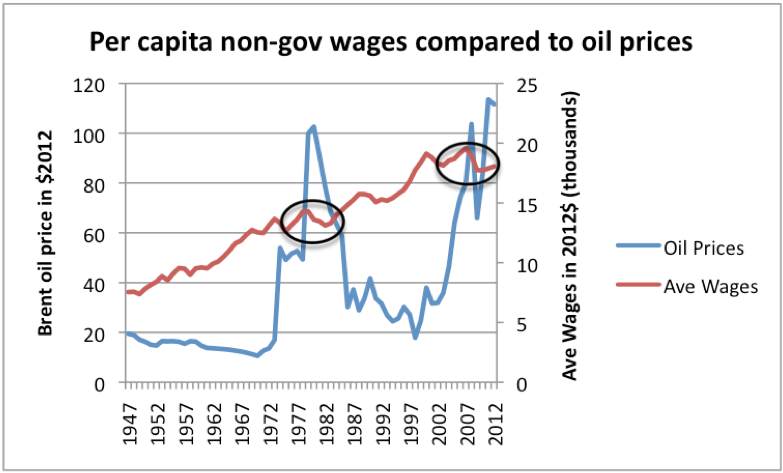
Our situation today sounds a great deal like the down escalator situation. As I have discussed previously, wages stagnate as oil prices rise. In fact, most increases in wages have taken place when the real price of oil was less than $30 barrel, in today’s dollars.

Figure 1. High oil prices are associated with depressed wages. Oil price through 2011 from BP’s 2012 Statistical Review of World Energy, updated to 2012 using EIA data and CPI-Urban from BLS. Average wages calculated by dividing Private Industry wages from US BEA Table 2.1 by US population, and bringing to 2012 cost level using CPI-Urban.

As oil prices rise, wage-earners hit a second problem–higher costs for fuel and food, since fuel is used in growing and transporting food. Wage-earners are hit on two sides–flat income and higher payments for necessities, leading to less discretionary income.  Governments find that they need more taxes to pay for increased benefits for the many who no longer have jobs. Higher taxes place another burden on those who are still working. Businesses find their profits pinched by higher oil prices, and respond by outsourcing to a low wage country, or automating processes to cut costs, lowering the amount local citizens earn in wages further, and globalization tends to pull US wages down as well.  All of these issues tend to add to the down-escalator phenomenon for the US economy.

In past years, governments and businesses have made promises of many types, such as bank account balances, pensions, Social Security, Medicare, insurance policies, stock certificates, and bonds. The question becomes: what happens to these promises, as we step off the up escalator, and onto the down escalator? All of these promises could be paid when we were on the up escalator. The amount that gets paid is much less clear, if we are on the down escalator.  In this post, I would like to examine what happens.

The General Price Trend: Downward, with Discontinuities

Each year, an economy produces various kinds of goods and services. It grows crops, and extracts minerals. It uses energy products to process the crops and minerals into finished goods, and to transport them to their final destination. The amount produced depends on the amount of goods and services potential buyers can afford. If wages are stagnant, and the government’s share keeps rising, the amount wage-earners can afford (in inflation adjusted dollars) keeps falling.

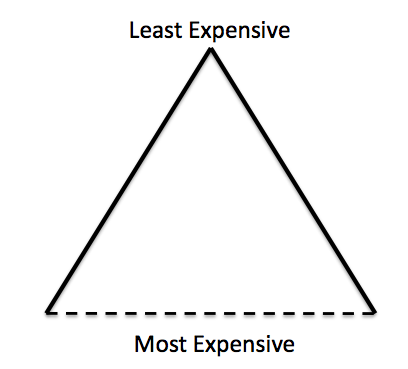
Since the early 2000s, the cost of extracting oil products has been rising, because the oil that was cheapest to extract was extracted first, and the “easy oil” is now gone. There tends to be a relatively small amount of a resource available cheaply, and increasing amounts available at higher and higher prices (Figure 2, below).

Figure 2. Resource triangle, with dotted line indicating uncertain financial cut-off.

In fact, minerals of all types tend to follow the same pattern as oil for two reasons: (1) Mineral extraction follows the same pattern–cheapest to extract first, moving to the more expensive to extract, and (2) Oil is generally used in extraction. If the cost of oil is rising, its cost tends to get passed on. Of course, in some instances, technological improvements can offset rising prices, but for most of the time since the year 2000, cost of commodity extraction has tended to rise.

There has been a lot of publicity recently about more oil being available, and more natural gas being available. This additional availability is because of high price. It doesn’t bring the cost of extraction down. In fact, if price drops, extraction is likely to drop. This drop will not occur immediately, because much of the cost has already been paid on wells that have already been drilled, so extraction from these wells tends to continue. But future investment is likely to drop off quickly if prices drop, bringing supply down, with a lag.

Because of the downward escalator the economy is on, wage-earners don’t really have enough money to pay the higher prices that are needed for increasingly costly extraction of oil and other minerals. Instead, prices tend to be volatile. The general trend can be expected to be downward, because even if  oil prices rise when the economy is functioning fairly well, at some point, the higher price leads to adverse feedbacks, such as consumers defaulting on debt and cutting back on discretionary purchases. The result can be expected to be recession, and again lower oil prices.

The big danger is that lower oil prices will lead to lower oil production, and this lower oil production will become a problem for business and commerce around the world. The United States is likely to be one of the countries whose oil production will be affected most by lower oil prices, for three reasons:

  1. We have most tight oil production, and tight oil production is very expensive to produce, and production drops off quite quickly if drilling stops.
  2. Shale gas drillers use a lot of debt. Shale drillers will especially be hit if interest rates rise because of debt problems.
  3. Taxes and fees related to oil production in the US (unlike many countries) do not vary with the price of oil. The US government will continue to get most of its revenue (estimated to average $33.29 per barrel on a $80 barrel of US tight oil by Barry Rogers, Oil & Gas Journal, May 2013), even as companies find themselves short of funds for new drilling.

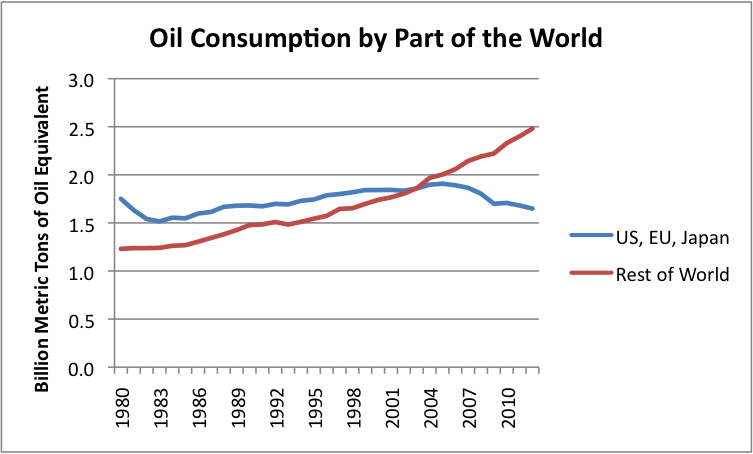
If oil production is down, US oil consumptionwill be lower as well. The reason for low oil price is likely to be recession and greater job loss. With fewer jobs, less oil is needed for making and shipping goods. Furthermore, the many unemployed cannot afford cars. The pattern of  declining demand in the European Union, and Japan is likely to continue, and get worse. (See my post, Peak Oil Demand is Already a Huge Problem.)

Figure 3. Oil consumption based on BP's 2013 Statistical Review of World Energy.

In 2008-2009, the economy was able to somewhat recover, so commodity prices increased again. This recovery was not based on US economy fundamentals–a large part of it seems to be related to artificially low interest rates and deficit spending. As interest rates rise, and as deficit spending is eliminated through higher taxes/lower benefits, the US economy seems likely to head back into recession, with more job loss, probably worse than last time.

Countries with low wages to begin with may be spared of some of the down-escalator economy dynamics for a few years, because their low wage levels will continue to make them competitive in a world economy. These countries will attract a disproportionate share of new jobs, allowing them to continue grow for a time, even as the US, the European Union, and Japan continue to lose jobs.  Thus, world oil prices may be able to bounce back, but probably not to as high a level as in the recent past. Eventually, these countries will tend to follow the rest of the world into stagflation and collapse, because of the interconnectedness of the global economy, and the similar dynamics that all countries are subject to.

Chance of Discontinuity

In order for the models to work in the expected way, business as usual must continue. A few obvious problems come into play:

(1) “Demand,” as defined by economists, is what consumers can afford to pay. Therefore, a jobless individual without any type of government compensation, would have no demand for food, clothing or shelter–at least using the term in the way economists use the word. All of us know that in the real world, lack of a job and lack of government benefits causes problems. At some point, marginalized people will riot and  overthrow governments. Civil war may take place, or war against another country.

(2) Part of Business as usual is continuing availability of debt. At some point, it will start to become clear that the economy has gotten off the up escalator, and moved to the down escalator. On the down escalator, much less debt makes sense. It probably still makes sense to use debt on a short-term basis to cover goods in transit, and it may make sense to use debt to finance investments with a high expected rate of return. Debt is likely to become much less common, greatly worsening the down escalator problem.

(3) As long as the economy was on an up escalator, increasing economies of scale were part of what caused a positive feedbacks. When the economy is on a down elevator, we have the reverse effect–higher fixed costs relative to production. This is even an issue when reduction in sales are intentional–for example, increased water conservation tends to lead to higher fixed costs, per unit of water sold, and greater use of high-efficiency light bulbs leads to greater electricity fixed costs (such as grid costs) per kWh sold. These higher fixed costs tend to push up prices for services further, increasing the down escalator effect.

(4) Investment in a capitalistic system does not work on a down economic escalator. Who wants to invest, if it is probable that the economy will shrink, leading to increasing diseconomies of scale?

What Happens to Government and Business Promises?

There are many kinds of promises currently outstanding:

1. Government promises

  • Social Security
  • Medicare
  • Unemployment insurance
  • Continued maintenance of roads
  • Free education for all through high school
  • Government debt (Federal, state, and local)
  • Financial help after hurricane damage
  • Guarantees of bank accounts and pension plans

2. Insurance and bank promises

  • Life insurance policies
  • Annuities
  • Long term care policies
  • Pension plans
  • Auto and homeowners policies, etc.
  • Bank account balances

3. Promises by companies of all types

  • Stock – implied promise it will be worth more in the future
  • Loans borrowed will be paid back (to banks or on bonds)
  • Pension plans
  • Implied guarantee of future 24/7 electricity availability; grid maintenance

What happens to these promises? Over time, it is clear that pretty much all of them will disappear. They are up-escalator benefits that work when there are plenty of fossil fuels and the economy is expanding. They don’t work for very long on a down escalator.

Promises to Individuals

At the level of the individual, one of the implied promises has been is that an individual who gets a good education will be able to get a good paying job. This is one of the promises that is already disappearing.

There is also a second implied promise–people who actually perform the work, will be compensated for it. This promise is falling by the wayside, as wages fall (partly due to globalization, and partly due to other down escalator effects). At the same time, governments need higher tax rates, to pay for all the promises made to those who are retired, unemployed, or have wages that are too low to support a family.

Goods and Services Produced in a Given Year

In any year, there will be a mixture of people buying goods and services:

  • People who are currently in the work force
  • Retirees
  • People who own assets and want to sell them

One thing that may not be obvious without thinking about it, is that all of the people wanting goods and services have to compete for the same set of goods and services that are available at that time.

For example, we grow a certain amount of corn and rice, and we extract a certain amount of oil and coal and copper, and we make a certain amount of electricity in electric power plants. Because of inventories, there is a little flexibility in these amounts, but basically, the amount that is available is determined by market prices and availability of supply lines. If the amount of goods and services produced is decreasing, because we are on a down escalator economy, this smaller quantity of goods and services needs to be shared by the entire population.

If there is relatively little available in total, and those who produced it don’t want to part with it, a person trying to trade accumulated “assets” for current production will not receive very much scarce production in return for his accumulated wealth, no matter what form it may take. In the case of most assets (stocks, bond, gold, silver, etc,) this means that the value of the asset tends toward $0. If currency is viewed as another asset, its value may go to close to zero as well. In fact, if there has been a government change, its value of the currency may be exactly zero.

How about Quantitative Easing?

Quantitative Easing (QE) represents an attempt to re-inflate the economy by making more credit available to the economy, at lower interest rates. It also has the effect of reducing the interest rate the government pays on its own long-term debt, thus holding down that taxes the government needs to collect.

In terms of inflation/deflation effects QE has, its primary effect seems to be to artificially inflate asset prices–stocks, bonds, home prices, and agricultural land prices. The announced goal of the Japanese QE attempt was to try to raise the inflation rate (generally) in Japan to 2%, but it has not had that effect. In fact, the same link shows that in general, QE has not led to inflation.

The primary effect of QE is to create asset price bubbles. The price of bonds is raised, because of the artificially low interest rates.  The price of stocks is raised, because people switch from bonds to stocks, to try to get yield (or capital gains). To get better yield, businesses find it worthwhile investing in homes, with the idea of renting then out on a long-term basis. Very little of QE actually gets through to wages, which is where the major shortfall is.

QE will at some point stop, and the asset price bubble will deflate.

(Crunch Time: Fiscal Crises and the Role of Monetary Policy points out that QE is not viable as a long-term strategy.) This is likely to add to deflation woes. The higher interest rates and the need for higher taxes to cover the higher interest the government needs to pay will add to the down escalator effects, making the trends noted previously even worse.

76 Responses to Inflation, Deflation, or Discontinuity?

Gail: I think rising interest rates and a need to raise taxes are the big problems will we be running into in the near future. The government may also realize it can’t keep raising the debt level either, because of the high cost of servicing the debt. (Not to mention the problems in Europe, China, and Japan.)

If China and Asia slow down the world economy escalator significantly flattens. We are increasingly approaching the situation where the whole world is on a down escalator. Their flattening moves us significantly along in this direction.

The lack of good solutions, and the possibility that good individual solutions will make the situation for the group as a whole worse, makes a person wonder whether even discussing this subject is even worthwhile. This is one (of several) reasons why The Oil Drum has not wanted to touch the issue.

One thing that comes out of this analysis is that each of us should make the best use of the time we have now, before collapse, that we can. Appreciate each day. Don’t worry about spending money if you have savings. A penny saved in a bank is a penny ultimately lost (unfortunately). This solution actually works in the direction of delaying collapse, as well.

There is at least some chance that knowing what we have gotten ourselves into will give us some insights as to what might mitigate the problem. For example, as collapse gets underway, (to a greater extent than it already is), we will need to learn ways of coping. An increasing proportion of people will not have jobs, even those with good educations. What does one do to cope with this situation? Most people will not be well enough off to own land. This is ultimately the problem we need to mitigate–how do we keep this problem from overwhelming the system? Perhaps insightful people can help fashion a new system, at least for some small areas. But this would probably require land redistribution, and a plan of lower population. This will be resisted by those who currently own land, and by families who want several children.

I think the major issue with farmland is whether it will be taken over, perhaps by a new government, and run in a way that is viewed to be better–give everyone a small piece, or use very large plots, overseen by someone who is supposedly knowledgeable and has access to tools, and can optimize water use and rotation of livestock over various parts of the land.

Another issue is that land prices have been run up the way everything else has been run up–by artificially low interest rates, and by the view that commodities are the only things that can go up. You would think that land that is good for crops and is in a good location would hold up better in value than other things, though.

Without fossil fuels, it will take quite a bit more land to feed a person than it does today. (At least, that is the way it worked in the past, without metal fences and pesticides and herbicides). From that point of view, the productivity of land will be a lot lower. Logically, its price should relate to it productivity.

Someone asked if the US$ would remain viable currency, Gail replies:

The short answer is “No”. If things really go to pieces, it is hard for a government to continue in power. There are various ways this could happen–a new group could come in and promise great things, with a new constitution. Or the Unites States could break up, more in the way the Former Soviet Union broke up. Or the richer states could decide to secede. If there is a new government, there could very well be a totally different currency.

Posted in Gail Tverberg, Inflation or Deflation | Comments Off on Gail Tverberg on Inflation, Deflation, or Discontinuity?

29 Things to Keep in Mind about buying Real Estate

This is an edited down version of 30 Reasons To Get Out Of Real Estate And Into REAL Assets by “Don’t Tread on Me” at businessinsider.com.

The shift from paper assets to real assets is driven by money/debt creation. Since our dollar IS debt, it is necessary for more debt to be created every year in excess of the debt AND interest accrued the year before. The majority of this debt was created during boom times when no one feared debt. When the inevitable slow down came, the Elite created more money/debt to keep the system going.

This cycle has been successfully managed by the Elite in the past with the creation of Bretton Woods, the closing of the gold window, the Petro Dollar, Paul Volker slaying the inflation dragon in the 80s with 22% interest rates, the banker bailout and QE 1 & 2.

This time around, there is no way out except for a default. How that default plays out is still up in the air. I believe that we will get another deflationary shock to scare Congress and us into more money creation.

One of the most common misconceptions of real tangible assets is that Real Estate is a real tangible asset. After all, it is called REAL Estate. But it’s more of a paper asset since the bank owns your part of your home until you pay it off.   We are on the verge of another leg down in Real Estate and the name of the game is wealth preservation. Beyond wealth preservation, I believe that those that hold their wealth in real assets will see a massive increase in their real purchasing power.

1. Real Estate is not a tangible asset. Yes, the property is real and tangible, but its value is dramatically affected by the paper/debt market. Almost all Real Estate is bought with mortgages/debt paper and leverage. Even if a property is paid in full with cash, its value was affected by competing bidders using leveraged debt. Ask yourself how “real” it is if interest rates were at 10% instead of 4%. What is the cash value of your property if there is no credit market at all? That’s what happens in a big deflationary crash. Prices keep going down, so people don’t buy anything, so prices go down further. What is the value of your property if/when the dollar collapses? The answer should show that the value of Real Estate is much more determined by paper/debt market than its real tangible value.

2. Most of your Real Estate is not an asset at all because it produces no income. If your property isn’t a positive cash flow asset, it’s a liability. Factor in taxes, interest, maintenance and upgrades, and it can even be a negative asset. Yes it has value, but it’s not an asset.

3. Even in a hyper inflationary environment owning property is not a “no brainer.” In a hyperinflation the value of the mortgage debt would essentially become worthless. That is great for owning your property outright. The reality is that there are going to be other factors that will dramatically affect the real value of the property. In a hyper-inflation the food in your freezer drawer will be worth more than you mortgage. The cost on running your home will become exorbitant. What if you cannot afford the higher water, electricity and gas bills? What is property worth if these utilities are not even working or available?

4. Real Estate is an illiquid asset/liability. What if you are in the “wrong” area when this goes down? Having a better part of your wealth tied to an asset that cannot move is highly disadvantageous during a period of social upheaval. We’ve all seen pictures of refugees leaving their homes with the few possessions they own. What if you are in an area going to go through massive social upheaval or has low carrying capacity?

5. If you have the majority of your fortune tied to an area that is essentially a war zone, you are putting your life and fortune at risk unnecessarily. This is magnified by the fact that if the dollar collapses there will be NO market what so ever for selling.

6. You never truly own Real Estate. Even if you own your home outright you still have to pay taxes on it. If you do not pay the taxes you will see who has the real ownership of your property.

7. Taxes will be raised as local governments get more desperate. During the boom, few people saw or cared about their property taxes. They figured as long as the asset went up the taxes were sure to follow. Many figured if the property value fell, the taxes would naturally go down. Wrong. Local governments either kept taxes the same when property values fell or worse raised the rate or taxable property valuation to steal more money from you. The sad thing is we have not seen anything yet. When the dollar collapses governments will become more desperate and take extraordinary actions to maintain their power. For a local government the best place to steal money is the property owner. (For a Federal government the best place to steal is your retirement funds.) The local government can raise rates and there is nothing you can do about it. If you don’t pay they will simply take your property and sell it at a tax sale. Or what if they create a massive sales tax on the sale of Real Estate?

8. What they can’t tax, they will take. Governments have many other tools in their pocket to steal your property, like zoning. What if they mandate that your home must be energy neutral before you can sell it? What if they use eminent domain to give your property to corporate pirates? What if there is a new zoning law that says you cannot build with in 500 feet of any water source or endangered species?

9. Income producing property is at risk also. The value of income producing property is directly tied to the economy. If the economy cannot support businesses, the value of all of the underlying property is worth less. Overnight the property turns from an income producing asset into a cash sucking liability. I have seen franchises go broke and once prime property losses 50% of its value overnight. With so many empty properties on the market it acts a drain to your ability to hold rents up.

10. When the economy deteriorates, domestic violence and drunken disorderly conduct rises. People steal air conditioners and strip homes clean. If people don’t have jobs, they cannot pay for their rent. Towns may enact laws to prevent you from getting rid of non-paying renters. People stop caring about the upkeep of a property. Even if you do get rent, the real value of that rent is falling as things get tougher. If things get really bad, people will be paying more for food and heat and may not have the money to pay the rent. Finally, they may also look at you as the cause of all of their problems. You probably look like a Rothschild or Rockefeller to most of these renters, and they may take out their frustrations on the guy taking money from them.

11. Renters have no buffer. Half of all Americans cannot come up with $2,000 in one month for an emergency. Rent is often the easiest expense to skip out on.

12. The Existing Homes inventory is going back up. Wait until after the next financial crisis. Many people simply cannot afford to sell because they owe too much on their house. (May 2014, New York Times, “What Housing Recovery?” One-fifth of homes are still underwater, 9.8 million homes, are at risk of joining the 5 million households that have had foreclosures).

13. Flippers make up a huge portion of those sales. The sales numbers are skewed because there are a lot of homes that are bought and then sold. So the real buyers that are actually moving into new homes is much lower than we are lead to believe.

14. The Shadow Inventory. On top of the homes on the market there are MILLIONS of homes not on the market. These are homes that have been foreclosed upon by the banks and they are not even attempting to sell these homes. They know that if they dump these homes on the market it will crush all of their performing mortgages as homes prices sink further and more people just stop paying.

15. Millions more beyond the Shadow Inventory. Even if we somehow get past the gut of existing and shadow inventory there are millions more beyond even that. There are homeowners that have simply stopped paying their mortgages and they have not been foreclosed upon, even though they should. They pay their property taxes and utilities. These homes tend to be on the lower end in undesirable areas. These people also draw strength away from the renter market. If they are not evicted they don’t need to rent your property. There are also the Strategic Defaulters that purposely don’t pay their mortgages even though they can.

16. We still have another year of mortgage resets. We are not done yet…Beyond the existing…Beyond the Shadow…Beyond the as of yet to be foreclosed, we have millions more that will fall into default as their mortgages reset or they lose their job in a ever worsening economy. You might remember that this housing mess all got going because people got in over their heads not only with the Real Estate but also the mortgages. People with no jobs or income now had exploding mortgages that reset at double the payments. The adjustable ARMs and Alt As are coming due and the properties are worth a lot less and peoples financial and job situation are much worse. This coupled with stricter lending is a potent combination.

17. The MERS monster. Mortgage Electronic Registration Systems is a scheme cooked up by the banksters to slice and dice huge pools of mortgages into tranches, so that they can then resell the pools of mortgages all over the world. This is a huge problem since there is now no clear owner of the title of the properties, banks cannot foreclose on properties in default. Would you feel comfortable buying a property from a bank knowing that millions of mortgages are involved in this mess. You may wake up only to find that the property you thought was a steal is actually someone else’s property. Much of the paper work that was done, was done very wrong.

18. Tougher lending standards mean fewer buyers. Credit requirements are tougher as banks seek to sober up their balance sheets. They require more money down and are much more stringent in their lending. Nearly 27% of all mortgage applications are rejected now.

19. The boomers have lost a great deal to the paper stock and the paper housing bubble, and it seems like it is too late for a second chance. Without this generational demand it is going to take years to fill the massive glut of homes we have built. We are going to see American Ghost towns again.

20. My comment: when people retire, they often downsize to smaller homes and use the profit to help fund their retirement. This is partly what popped the Japanese asset price bubble 22 years ago and Japan has had deflation since then.  But they were in much better shape than we are, because everyone had a lot of savings.  And the younger generations can’t even pay off their student loans, let alone pay high prices for boomer homes. Don’t be fooled by the rising stock market — it just means the next crash will be even worse since there have been no meaningful reforms, and the level of debt and corruption is unprecedented in history – and can’t be “fixed” anyhow, except with enough market crashes to the point where we start over.

21. The Generation below is broke. If the Boomers are scared and downsizing there must be a generation below that will pick up the slack as they grow, right? My generation is destroyed. There is now an unprecedented $1.2 Trillion dollars in student loan debt chained to my generation. And thanks to Bush, that debt can NEVER be gotten rid of through bankruptcy. So here you have a generation with $20,000 to $250,000 dollars of debt before they even earn one penny in the real world. Never mind the credit card, auto and home debt. This debt is keeping my generation from starting families and having any disposable income. They are just getting by now, wait until the next shock comes. If this debt is holding back families from having kids, this acts as a further throttle to the growth in long term housing trends.

22. Multi-generational housing is coming back. Not only does this make sense financially, it makes sense emotionally. We are going to be going through very tough times and we need to have a strong family to rely upon. This trend will leave a lot of unnecessary homes on the market, as sons, daughters, and grand parents live together once again.

23. Obsolete housing. Many huge homes will simply become abandoned. [My comment: especially as energy prices rise, McMansions will be too big to heat affordably].

24. Obsolete towns. The value of properties in areas has a lot to do with the companies that provides jobs. I am in Cleveland and I can tell you first hand that the amount of jobs that has left the area has been huge. If cities and towns cannot keep their businesses they are doomed. All along the rust belt you can see this very clearly. Now the towns that went up with the housing boom are the ones that are the biggest bust.

25. Possible Illegal Immigrant exodus. History has shown that foreigners tend to take the brunt of the frustration of the populace during extreme economic collapses. When the economy heads south again, the illegals may head south of the border as opportunities get slim and social pressure mounts.

26. Political, financial and eventually military power is shifting to Asia. This shift of power will affect property values as real money would rather be in Hong Kong or Shanghai rather than New York or London.

27. The most important factor in the housing market is JOBS. We are on a death spiral for jobs. Our manufacturing was gutted and sold overseas by the Elite to make a bonus. Do you remember Ross Perot and his “Giant Sucking Sound?” He said that until the price of labor here is on par with the slave labor in other countries, jobs will never come back. The other factor is 70% of the economy is part of the consumer economy.

28. I recommend people buy in a safe area near water and food. Owning a home is much more desirable to renting during a financial crisis. Most rentals are near other desperate people. Having a “castle” to defend is vital to surviving a collapse. You need to have a place to safely stages your preps. Being evicted during a collapse is a very dangerous experience. Just remember the 3 most important rules of Real Estate, location, location, location.

29. My comment: because of the net energy cliff (2015-2020 according to experts), the economy will never grow again, but shrink until we are back to pre-fossil fuel carrying capacity, about 1 billion people world-wide, 100-150 million people in the United States. Therefore, if you buy a house now for $200,000 with mostly borrowed money, and the value drops to whatever people can afford to pay in cash (say $25,000) when deflation strikes again after the next crash (due to credit vanishing, again), then the Banksters are going to take your house back. Even if you’re renting it out, you can’t count on the renters to still have jobs to pay rent so you can pay the mortgage.   Better to buy real goods now (tools, grain mills, emergency food supplies, etc.) and wait to buy a home free and clear with cash after the next crash. But if you’ve got $500,000 then buy the house now so you don’t end up without a chair when the music stops.  If you can’t buy a home now free and clear, don’t wait too long after the crash, because although home prices may keep dropping, your cash will be worthless if the dollar fails in a sovereign default, or currency is re-issued, or people realize how dire the situation is and don’t sell to make sure they have a roof over their heads, or you’re in a safe area and are outbid by the wealthy 10% fleeing large cities once peak oil awareness is commonplace knowledge, which will crash stock markets world-wide according the German Military peak oil study.

Bottom Line: Have cash under your mattress since you won’t be able to get it out of the banks for a while (I could be wrong about that though, there’s a good chance of nationalization this time around).  Regardless, be ready to buy real estate after the next downturn, which may not be the bottom of the market, but who cares, once the net energy cliff begins, and the money/energy transition begins in earnest, money will mean nothing, and living in an area under carrying capacity with real goods (many of which won’t be available anymore as businesses fail) will mean everything.  And you’d better have the skills to continue to pay property taxes so that you don’t lose your home. Also, a modest home so that it’s not a target of gangs, mafias, or local government officials when social disorder occurs.

Posted in Investing advice, Real Estate | Comments Off on 29 Things to Keep in Mind about buying Real Estate

Disarray by James Howard Kunstler

Feb 21, 2008  DISARRAY  by James Howard Kunstler

The dark tunnel that the U.S. economy has entered began to look more and more like a black hole recently, sucking in lives, fortunes, and prospects behind a Potemkin facade of orderly retreat put up by anyone in authority with a story to tell or an interest to protect – Fed chairman Bernanke, CNBC, The New York Times , the Bank of America… Events are now moving ahead of anything that personalities can do to control them.

The “housing bubble” implosion is broadly misunderstood. It’s not just the collapse of a market for a particular kind of commodity, it’s the end of the suburban pattern itself, the way of life it represents, and the entire economy connected with it. It’s the crack up of the system that America has invested most of its wealth in since 1950. It’s perhaps most tragic that the mis-investments only accelerated as the system reached its end, but it seems to be nature’s way that waves crest just before they break.

This wave is breaking into a sea-wall of disbelief. Nobody gets it. The psychological investment in what we think of as American reality is too great. The mainstream media doesn’t get it, and they can’t report it coherently. None of the candidates for president has begun to articulate an understanding of what we face: the suburban living arrangement is an experiment that has entered failure mode.

I maintain that all the “players” – from the bankers to the politicians to the editors to the ordinary citizens – will continue to not get it as the disarray accelerates and families and communities are blown apart by economic loss. Instead of beginning the tough process of making new arrangements for everyday life, we’ll take up a campaign to sustain the unsustainable old way of life at all costs.

A reader sent me a passel of recent clippings last week from the Atlanta Journal-Constitution . It contained one story after another about the perceived need to build more highways in order to maintain “economic growth” (and incidentally about the “foolishness” of public transit). I understood that to mean the need to keep the suburban development system going, since that has been the real main source of the Sunbelt’s prosperity the past 60-odd years. They cannot imagine an economy that is based on anything besides new subdivisions, freeway extensions, new car sales, and NASCAR spectacles. The Sunbelt, therefore, will be ground-zero for all the disappointment emanating from this cultural disaster, and probably also ground-zero for the political mischief that will ensue from lost fortunes and crushed hopes.

From time-to-time, I feel it’s necessary to remind readers what we can actually do in the face of this long emergency. Voters and candidates in the primary season have been hollering about “change” but I’m afraid the dirty secret of this campaign is that the American public doesn’t want to change its behavior at all. What it really wants is someone to promise them they can keep on doing what they’re used to doing: buying more stuff they can’t afford, eating more bad food that will kill them, and driving more miles than circumstances will allow.

Here’s what we better start doing.

Stop all highway-building altogether. Instead, direct public money into repairing railroad rights-of-way. Put together public-private partnerships for running passenger rail between American cities and towns in between. If Amtrak is unacceptable, get rid of it and set up a new management system. At the same time, begin planning comprehensive regional light-rail and streetcar operations.

End subsidies to agribusiness and instead direct dollar support to small-scale farmers, using the existing regional networks of organic farming associations to target the aid. (This includes ending subsidies for the ethanol program.)

Begin planning and construction of waterfront and harbor facilities for commerce: piers, warehouses, ship-and-boatyards, and accommodations for sailors. This is especially important along the Ohio-Mississippi system and the Great Lakes.

In cities and towns, change regulations that mandate the accommodation of cars. Direct all new development to the finest grain, scaled to walkability. This essentially means making the individual building lot the basic increment of redevelopment, not multi-acre “projects.” Get rid of any parking requirements for property development. Institute “locational taxation” based on proximity to the center of town and not on the size, character, or putative value of the building itself. Put in effect a ban on buildings in excess of seven stories. Begin planning for district or neighborhood heating installations and solar, wind, and hydro-electric generation wherever possible on a small-scale network basis.

We’d better begin a public debate about whether it is feasible or desirable to construct any new nuclear power plants. If there are good reasons to go forward with nuclear, and a consensus about the risks and benefits, we need to establish it quickly. There may be no other way to keep the lights on in America after 2020.

We need to prepare for the end of the global economic relations that have characterized the final blow-off of the cheap energy era. The world is about to become wider again as nations get desperate over energy resources. This desperation is certain to generate conflict. We’ll have to make things in this country again, or we won’t have the most rudimentary household products.

We’d better prepare psychologically to downscale all institutions, including government, schools and colleges, corporations, and hospitals. All the centralizing tendencies and gigantification of the past half-century will have to be reversed. Government will be starved for revenue and impotent at the higher scale. The centralized high schools all over the nation will prove to be our most frustrating mis-investment. We will probably have to replace them with some form of home-schooling that is allowed to aggregate into neighborhood units. A lot of colleges, public and private, will fail as higher ed ceases to be a “consumer” activity. Corporations scaled to operate globally are not going to make it. This includes probably all national chain “big box” operations. It will have to be replaced by small local and regional business. We’ll have to reopen many of the small town hospitals that were shuttered in recent years, and open many new local clinic-style health-care operations as part of the greater reform of American medicine.

Take a time-out from legal immigration and get serious about enforcing the laws about illegal immigration. Stop lying to ourselves and stop using semantic ruses like calling illegal immigrants “undocumented.

Prepare psychologically for the destruction of a lot of fictitious “wealth” – and allow instruments and institutions based on fictitious wealth to fail, instead of attempting to keep them propped up on credit life-support. Like any other thing in our national life, finance has to return to a scale that is consistent with our circumstances – i.e., what reality will allow. That process is underway, anyway, whether the public is prepared for it or not. We will soon hear the sound of banks crashing all over the place. Get out of their way, if you can.

*** Prepare psychologically for a sociopolitical climate of anger, grievance, and resentment. A lot of individual citizens will find themselves short of resources in the years ahead. They will be very ticked off and seek to scapegoat and punish others. The United States is one of the few nations on earth that did not undergo a sociopolitical convulsion in the past hundred years. But despite what we tell ourselves about our specialness, we’re not immune to the forces that have driven other societies to extremes. The rise of the Nazis, the Soviet terror, the “cultural revolution,” the holocausts and genocides – these are all things that can happen to any people driven to desperation. ****

==========================

May 5, 2008 The Risk Economy

As the West’s industrial regime sputters toward a cheap-energy-crackup conclusion, there have been attempts to recast what our economy is actually about, how to account for whatever wealth we manage to produce, and project what our society will actually be organized to do in the years ahead.

For a while in the 1990s, the idea was a “service economy,” kind of like the old fable of the town whose inhabitants made a living by taking in each other’s laundry — only in our case it was selling hamburgers to tourists on vacation from their jobs making hamburgers elsewhere, or something like that.

Then came the idea of the “information economy” in which making things of value would no longer matter, only the processing and deployment of information (sometimes misidentified as “knowledge”). This model seemed to suggest a yin-yang of software engineers who made up games like “Grand Theft Auto” serving the opposite cohort of people who bought and played the game. If nothing else, it certainly explained how lifetimes could be frittered away on stupid activities.

That illusion yielded to the housing bubble economy, which actually did produce a lot of things, but not necessarily of value — for instance, houses made of particle board and vinyl 38 miles outside of Sacramento. It was a tragic and manifold waste of resources, as well as an insult to the landscape. But the darker side of the housing bubble lay in the world of finance, where a vast empire of swindles was constructed to support the Potemkin facade of production homebuilding.

Now we are in a strange period when those swindles are unwinding. The people who run the finance sector — the Wall Street investment banks, hedge funds and ratings agencies, the Federal Reserve, and the US Dept of the Treasury — in desperately trying to prevent the unwind, have rapidly ramped up another new economy based entirely on the buying and selling of risk. Risk, as a pure abstraction unconnected to any real capital activity, is all that’s left to buy and sell after all other plausibly practical vehicles for finance have failed.

While a lack of transparency in the individual risk vehicles has been an object of complaint over the past year, the system as whole is transparently absurd. The system is also abstruse enough to prevent most mortals (including many employed in the system) from understanding its operations. But the general public and the news media are virtually helpless to intervene in this last gasp racket, so the probability increases that it will do tremendous damage to whatever remains of the US economy. One feature of the risk economy is the Federal Reserve’s new willingness to absorb any sort of crap collateral in exchange for massive cheap loans to insolvent companies and institutions. The Fed has, in effect, made itself the world’s largest financial shit-magnet. It has already taken in a few hundred billion in securities based on non-performing real estate loans, and has now opened the window to securities based on non-performing credit card debt, car loans, and other miscellaneous IOUs still drifting un-hedged in the banking ether.

It’s a mark of our collective desperation to avoid the consequences of so much reckless behavior that no credible authorities have stepped up to denounce this racket — no Fed governor, no politician of standing (including the candidates for president), no newspaper-of-record. The Attorney-general of New York, Andrew Cuomo, may be quietly cooking up some cases in the deep background, but the SEC and the federal banking regulators hung up their “out-to-lunch” signs on this long ago.

Meanwhile, the basic situation is this: the world is awash with bad investment paper. The standard of living in the US can’t be supported on debt anymore. The people of the US don’t produce enough real value to service their debts. Institutions can no longer be supported on debt gone bad. Something’s got to give — meaning something has to bring the US standard of living down to a level consistent with our declining actual wealth.

Everything else going on right now is a dodge. The Fed maneuvers, the “coordinated actions” of the western central banks, the postponements of default, the non-disclosure of contents in bank portfolios, the pretense that risk alone is a kind of fungible resource that can be endlessly traded to generate fees — all this fucking nonsense will only make the eventual unwinding much worse.

Personally, I doubt that it can go on more than a few more months. The velocity of everything is going up past the “red line” where things really fly apart. The increased velocity of non-performing mortgages and deadbeat credit card accounts is one thing that can’t be hidden or escaped. America will feel and see very vividly when the repossession teams rush families from their homes, when the pickup truck is taken away, and when the pink slip appears in the pay envelope. Meanwhile all the higher-end banking shenanigans will only debase the dollar and make it more difficult for people already in distress to buy gasoline and food.

If the bankers and treasury officials collude to prop up one more failing big bank a la Bear Stearns, the political fallout for Wall Street could be lethal. In any case, I think we will have a way different sense of ourselves as a society by the time the election comes.

Posted in Expert Advice | Comments Off on Disarray by James Howard Kunstler

Vulnerabilities pose risks in top U.S. oil suppliers Elizabeth Bunn

Many of the countries the U.S. depends on for oil and petroleum products have corrupt governments at varying levels, crime problems and face civil unrest. Whether initiated by al-Quida in Iraq, militant groups in Nigeria or armed rebels along the Columbia-Venezuela and also the Columbia-Ecuador border, attacks on the oil and gas industry can cripple and cause major economic damage.  The United States spends a tremendous amount of time and money to secure our oil and counter the threats that disseminate throughout the global supply chain.

The U.S. receives nearly 60 percent of its oil and petroleum imports via tanker, according to a 2011 report from the American Petroleum Institute. Many of the tankers arriving in U.S. ports carry crude oil and petroleum from Mexico, Saudi Arabia, Venezuela and Nigeria. Threats to production in these crucial supplier countries – whether from natural disaster, crime, or terrorist or cyber attacks – threaten both the global supply chain and the Unites States’ access to oil.

Top exporters to the U.S. A look at some of the major threats to the U.S. oil supply today:

oil risk by country and disaster

Canada is by far the largest supplier of foreign oil to the United States, accounting for approximately 25% of U.S. crude oil imports in 2011. The majority of Canada’s estimated 180 billion barrels of oil reserves come to the U.S. via pipeline from the oil or tar sands in Alberta’s Athabasca region. “If you have a 2,000-mile pipeline from Canada to Texas, you simply cannot protect the entire pipeline“. – Paul Rosenzweig, former deputy assistant secretary for policy, Department of Homeland Security

Mexico. The United States imported roughly 1.1 million barrels of crude oil per day from Mexico in 2011, making it the third largest net exporter of oil to the United States. Almost all of Mexico’s exports arrive in the U.S. by oil tanker. “The national pipeline network [is practically taken over] by organized crime gangs, associated with heavily armed groups.” – Petroleos Mexicanos, or PEMEX, the Mexican state-owned petroleum company, August 2012

Saudi Arabia. Oil powerhouse Saudi Arabia is still the hub of the global oil market, although its importance as a supplier to the U.S. has declined in recent years. In terms of infrastructure, Saudi Arabia is a unique case because of the concentration of a lot of oil – five or six million barrels per day – running through only a few facilities each day. “Abqaiq or Ras Tanura is what Wall Street is for the financial system. What Hollywood would be for the movie industry.” – Gal Luft, Institute for the Analysis of Global Security and author of several books on oil security

Venezuela boasts the second largest oil reserves in the world, but many of the country’s fields require heavy investment to maintain production capacity. Turmoil within the country – opposition to socialist policies touted by former President Hugo Chávez, civil unrest and high crime rates, especially along the Venezuela-Colombia border – discourage foreign investment and consequently pose a challenge to the country’s profit-driving oil industry.

Nigeria. Militant groups seeking a share of Nigeria’s oil wealth – such as the Movement for the Emancipation of the Niger Delta, or MEND – repeatedly attack the country’s oil infrastructure and personnel. Since 2005, when Nigeria reached its oil production peak, the county has seen a steep increase in pipeline vandalism, kidnappings and militant takeovers of oil facilities in the Niger Delta, the heart of Nigerian oil production. “There has been attacks on oil pipelines, and foreign oil workers are being held hostage… this escalating attack is also helping drive up oil prices.” – Testimony of economist George N. N. Ayittey, U.S. House of Representatives hearing, “Nigeria’s Struggle with Corruption,” 2006

Posted in Chokepoints | Comments Off on Vulnerabilities pose risks in top U.S. oil suppliers Elizabeth Bunn

Energy Overview. Oil is butter-fried-steak wrapped in bacon. Alternative Energy is lettuce.

cartoon peak oil gas coal uranium

Why oil is so hard to replace

1) How much fossil fuel energy is burned?

In 2013, the United States burned 96.5 quads (96.5 quadrillion BTU’s) of energy a year, 84% was fossil fuels: 36 petroleum, 26 natural gas, 18.5 coal. In 2013, the United States generated about 4,058 billion kilowatt hours of electricity, 67% from fossil fuels (coal 39%, natural gas 27%, and petroleum 1%), 19% nuclear, and 7% hydropower.

Renewables are a tiny fraction of that, with biomass at 1.48%, geothermal 0.41%, solar 0.23%, wind 4.13%. At the rate they’re growing, it would take thousands of years to replace fossils, which since 2013 have continued to grow in overall energy production far more than renewables.

Electricity is just 15% of our energy use.

So using wind and solar to replace the 67% of electricity from fossil fuels doesn’t make even a tiny dent in the way the other 85% of energy is used which comes from fossil fuels, for essentials such as transportation, manufacturing, and heating.

2) This is a liquid fuel crisis because nearly all FREIGHT transportation runs on oil, mainly diesel.

I like to fly and drive cars, but they don’t plant, harvest, and deliver food — tractors, harvesters, and trucks do that.  We might not like it, but we can live without cars and airplanes.  But not without trucks, railroads, and ships.

These billions of diesel-engine-powered vehicles and equipment represent trillions of dollars of investment with lifespans of 20 to 40 years, so you can’t just wave a magic wand and instantly replace them, and their billions of tons of steel, copper, aluminum, and so on, which also require energy.

Diesel is available at over 160,000 service stations in the U.S. alone.  Whatever you think a “something else” might be, that’s a huge distribution system that also has to be replaced.

3) We can’t electrify the transportation that matters most: medium and heavy trucks, tractors and harvesters, ships, mining equipment, etc.

Batteries and fuel cells aren’t energy carriers – they store the electrical energy generated mainly by  non-renewable natural gas and coal.

Diesel & gasoline (46 MJ/kg) have up to 92 times the energy density of a lithium battery and 271 times the energy density of a lead-acid battery.

A truck can’t move even an inch with a battery 92 to 271 times the size and weight of its current diesel-fuel containing tank.

The maximum possible energy density, according to laws of physics and thermodynamics, of a perfect battery is 3 MJ/kg, which is still 15.3 times less than diesel, so you’d still need a “gas” tank 15.3 times larger.  I explain in “Who Killed the Electric Car” why it’s unlikely such a battery will ever be developed.

And the lifespan of batteries isn’t nearly as long as diesel engines.

Read all about it in “Diesel is finite. Trucks are the bedrock of civilization. So where are the battery electric trucks?” and the related article links within.

4) Scale. World-wide, we burn 1 cubic mile of oil a year.  Here’s what you’d need to do to replace that energy 

1 cubic mile of oil

Allowing fifty years to develop the requisite capacity, 1 Cubic Mile of energy per year could be produced by any one of these developments (source Joules, BTUs, Quads-Let’s Call the Whole Thing Off – IEEE Spectrum):

5) Energy Density

Oil is a butter fried steak wrapped in bacon.  Solar, Wind, and most other alternative energy resources are lettuce. You’d get all of your 2,000 calories a day from one and a quarter pounds of bacon-wrapped steak, versus 31 pounds of lettuce.

Oil is second only to uranium in energy density. This is because a gallon of gas comes from 100 tons of prehistoric plant matter (40 acres of wheat), condensed like moonshine over millions of years into the densest form of solar energy on the planet.  If you look at just the gasoline consumed every year in America, 131 billion gallons, that’s equal to 25 quadrillion pounds of prehistoric biomass.

6) Fossil fuels not only provide the energy to make goods, they are also physically used as a feedstock in over 500,000 products — the basis of the petrochemical industry

Here are just a few: Medicines, Ink, Hand lotion, Nail polish, Heart valves, Toothbrushes, Dashboards, Crayons, Toothpaste, Luggage, Parachutes, Guitar strings, DVDs, Enamel, Movie film, Balloons, Antiseptics, Paint brushes, Purses, Sunglasses, Footballs, Deodorant, Glue, Dyes, Pantyhose, Artificial limbs, Oil filters, Ballpoint pens, Skis, Pajamas, Golf balls, Perfumes, Cassettes, Contact lenses, Shoe polish, Fishing rods, Dice, Fertilizers, Electrical tape, Trash bags, Insecticides, Floor wax, Shampoo, Cold cream, Tires, Cameras, Detergents

7) If you wanted to invent an ideal energy source, you’d make oil

Oil has extremely high energy density, and is the most convenient form of energy ever discovered. As a liquid, it’s easily stored, transported, and used. It’s wonderfully combustible, but with a high enough flashpoint that it doesn’t explode easily.

Oil is a liquid, easily transported in pipelines (by far the least energy to move versus rail, truck, or ship). It takes very little time to pour gas or diesel into a vehicle gas tank. Compared to natural gas or hydrogen, petroleum takes up very little space.

Solids like wood, coal, oil shale, and biomass can’t be put into a pipeline (the cheapest way to move energy), and it takes energy to convert them to a liquid fuel.  They’re less convenient to transport than a liquid or gas.

Gases take up so much space, you need to compress or liquefy them, and that takes both energy and time.

Energy from wind or solar can’t easily be transported, first you have to build apparatus to harness the wind or sun, then you have to convert the energy to something that can travel, such as electricity, which requires an expensive electric grid.

8) Alternative energy resources are dependent on fossil fuels from start to finish and beyond to operations & maintenance

For example, consider a windmill.  A windmill farm in the Escalante desert, built to produce 5.55 TWh of power, would require 13.8 million pounds of aluminum, 2.8 trillion pounds of concrete, 639 billion pounds of steel, etc.  The wind farm would occupy over 189 square miles.  In 1992 dollars such a wind farm would cost $200 million, which doesn’t include labor, future operational, and maintenance costs, and would serve less than 1% of the United States population (Pacca).

After fossil fuels are gone, the windmills must be able to generate enough energy to maintain themselves and reproduce new windmills, including all of the equipment and tools used to mine the metal and concrete, forge metal into blades and towers, the energy needed to deliver 8,000 parts from all over the globe by ship, rail, or truck and build/maintain all ships, railroads, and trucks (which corrode/rust and need replacement every 6 (trucks) to 29 (ships) years, and the roads the trucks drive on to deliver the windmills to be delivered to their sites.  Windmill energy must also provide the energy to build and maintain the electric grid and storage infrastructure, and all of the workers involved in the process from birth, to school, to the vehicles they arrive at work in 18+ years later.  Any extra energy generated beyond these needs can now be used to run the rest civilization.

9) At the heart of our dilemma is the fact that Oil is the MASTER RESOURCE that UNLOCKS ALL OTHER RESOURCES.

Nothing is impossible if you have oil:

  • As long as you have oil, you have fresh water, because you can drill down and pump it up from 500 feet below or desalinate it
  • As long as you have oil, you can go to the most distant parts of the ocean to find the last schools of fish with sonar and spotting planes.
  • As long as there is oil, even ore with a very low percent of metal can still be used to get metals to make stuff with, such as alternative energy contraptions
  • Food is grown with oil-based pesticides, planted, harvested, distributed, packaged, cooked, and so on with fossil fuels.
  • When oil declines, where will we get the energy to do phenomenal things like moving  The Tallest structure ever moved by Mankind? 

10) TIME. We’re running out of it.

The Department of Energy paid Robert Hirsch to do a Peak Oil study in 2005. Hirsch concluded you’d want to start at least 10, or better yet, 20 years ahead of time before peak oil to prepare for the transition to other energy resources.

Conventional oil peaked world-wide in 2005 (Kerr 2011, Murray, IEA World Energy Outlook 2010) and we’ve been on a plateau ever since then.  We don’t have 10 or 20 years. Unconventional oil is nasty, heavy, difficult and very expensive to get at and has a very slow rate of flow — very soon (between now and 2025) it will not be able to make up for the decline rate of conventional oil.

11) Why we can NOT substitute natural gas, liquefied coal, tar sands oil, and other liquid fuels for diesel 

Not enough Natural Gas to use for Transportation

The National Resource Council noted that we don’t have enough natural-gas to use as a feedstock for transportation-fuel production. So we’d have to import it and we don’t have the infrastructure to do that or distribute it. We also increasingly are using natural gas for electricity production and to keep the grid from blowing up from intermittent alternative energy like wind and solar with NGCC plants.   Natural Gas vehicles aren’t a solution — there aren’t enough fueling stations, and the tanks take up most of the trunk space, their range is at best 100-150 miles, and the public thinks of natural gas as too explosive.

Local truck fleets can use CNG and LNG or diesel made with GTL, but there just isn’t enough natural gas in the USA for this to last very long – the fracking boom is temporary. So it doesn’t make much sense to build fleets of trucks that can use CNG at a time when supplies are about to end, and NG is also needed to generate electricity and balance wind and solar power.  CNG/LNG aren’t likely to be added to over 100,000 gas stations either.

Coal-to-liquids would use half the energy contained in the coal to make it and require doubling of coal production. If Carbon sequestration were used, then another 40% of the energy would be used. Oh, and we’re at peak coal too, certainly energy-wise – we’ve used most of the easy, high-energy coal. More research needs to be done to determine exactly what the reserves are now though, since it hasn’t been done since 1974.  But the few studies done since then have found less reserves, not more in the areas studied.

Dimethyl ether (DME) has about half the energy content of diesel fuel, so a truck will have to carry about twice the amount of DME for a given range – a penalty that’s worse than CNG and LNG. Two gallons of DME weigh 11 pounds compared to diesel’s 7.5 pounds, so a DME-fueled truck or tractor will be heavier than a diesel-fueled truck, and is better suited to local than long-haul distances. Diesel engines need a special injection system and different cylinder heads to handle the high fuel flow of DME, and steel fuel tanks to store it aboard a truck.  The refining process from natural gas to DME may have too high an EROEI as well. As with other gas-to-liquids processes, the first step is conversion to syngas, a mixture of hydrogen, carbon monoxide, and carbon dioxide. This syngas is then synthesized into methanol. Finally, DME is produced through a methanol dehydration reaction.The primary challenge facing the use of DME is the lack of an infrastructure for distribution. Other disadvantages include low viscosity, poor lubricity, a propensity to swell rubber and cause leaks, and lower heating value compared with conventional diesel (NAS 2009).  DME costs twice as much to make as methanol, an intermediate product in the methane-to-DME refining process, and is also more expensive to make than diesel fuel, so refiners prefer to sell methanol.  DME is mainly used as aerosol propellant to replace chloroflurocarbons in paints and cosmetics. World-wide production of DME in the world is less than 150,000 tons per year.

12) Economic, political, social obstacles

Can we really afford to spend trillions on new vehicles and renewable energy and fix our broken infrastructure, and pay for medicare, social security, and so on?

How much energy will be needed to fight wars to keep the oil flowing?

There’s a lot of social opposition to building new dams, LNG facilities, wind turbines, and so on.

Alternative Energy Sources

In the news:

Fact Check: Las Vegas does NOT run on renewable energy, just 140 government offices

1) Renewables are INTERMITTENT and UNRELIABLE

Renewables are far worse off than fossil fuels and even wood when it comes to another crucial energy quality: continuity of supply. A coal-fired power plant can be cranked up as needed; not so sun or wind.

Coal-fired, gas-fired, or nuclear power plants operate 75% to 90% of the time. But wind turbines typically operate between 20 and 35% of the time. The sun is always unavailable half the time, plus whenever there’s cloud cover.

Often wind power or solar power is generated when it is least needed, wind power at night, and solar power much less in the winter when there’s both less sunshine and the angle of the sun generate less power.

Worse yet, building wind and solar doesn’t mean you can get rid of coal, natural gas, or nuclear power plants at all. In fact, often utilities have to build natural gas combined cycle plants to quickly kick in to make up for the power lost when the wind stops blowing or the sun stops shining.

Wind and solar make the grid LESS RELIABLE:

“Within minutes of wind or solar disappearing, a thousand megawatts of electricity — the output of a nuclear reactor — can disappear and threaten stability of the grid. To avoid that calamity, fossil fuel plants have to be ready to generate electricity in mere seconds. That requires turbines to be hot and spinning, but not producing much electricity until complex data networks detect a sudden drop in the output of renewables. Then, computerized switches are thrown and the turbines roar to life, delivering power just in time to avoid potential blackouts. The state’s electricity system can handle the fluctuations from existing renewable output, but by 2020 vast wind and solar complexes will sprawl across the state, and the problem will become more severe.”

Renewable energy adds unprecedented levels of stress to a grid designed for the previous century.  Green energy is the least predictable kind.  “The grid was not built for renewables,” said Trieu Mai, senior analyst at the National Renewable Energy Laboratory. The role of the grid is to keep the supply of power steady and predictable. Engineers carefully calibrate how much juice to feed into the system as everything from porch lights to factory machines are switched on and off. The balancing requires painstaking precision. A momentary overload can crash the system (Halper).

Engineers haven’t yet developed energy storage devices suitable for storing solar and wind power, and they would add to the ultimate cost.

2) Patchiness

Many of the windiest and sunny regions in the world are virtually uninhabited, so electricity would have to be moved long distances to cities. The same patchiness holds for other renewables, from geothermal to hydro energy. For biomass, everyone has some arable land for growing energy crops, but much of it is already spoken for. And even if the land were available, energy crop yields would fall short of the need.

3) TIME

Check out this post by Roger Andrews, Renewable Energy Growth in Perspective, which shows how insignificant wind and solar are in the amount of overall energy used by society (and hydro and geothermal as well).

The “sobering reality,” Smil says, is that there is only one renewable—solar energy—that could by itself meet future energy demands. Wind power could conceivably make a significant contribution, but the rest—hydro, biomass, ocean waves, geothermal, ocean currents, and ocean thermal differences—would provide just one-tenth to one-ten-thousandth of today’s energy output from fossil fuels. So the bulk of the burden will fall on solar, but turning the sun’s rays into useful energy has a long way to go, Smil notes. Today, photovoltaic electricity accounts for less than 0.1% of the world’s electricity. Solar heating, such as solar water heaters, accounts for less than 0.1% of total global energy production. Such numbers would have to grow rapidly for a long time to make a difference, but renewables’ handicaps do not bode well for speeding up the next energy transition. Fossil fuels “were phenomenally attractive,” yet it still took 50 to 70 years to bring them into widespread use, says IIASA’s Grübler. That’s because, no matter how attractive a fuel might be, it takes time to create the infrastructure for extracting and transporting the resource, converting it into a usable form, and conveying it to the end user. It also takes time for inventors to develop enduse technologies—such as steam engines, internal combustion engines, and gas turbines—and for consumers to adopt them and create demand. Renewables “will be slower because they’re less attractive,” says Grübler. “They don’t offer new services; they just cost more.” (Kerr)

4) Dependence on other stuff

You have to build windmills to harness wind, solar plants to harness solar power.  These apparatus need all kinds of materials depleting faster than even oil, coal, and natural gas.  There isn’t a single object or step that doesn’t have fossil fuel inputs – ore is mined with ore trucks, crushed to extract the ore, smelted, fabricated, delivered.

5) Environmental Impact

Biofuels deplete topsoil and aquifers, nuclear energy plants can melt down and there’s nowhere to put the waste, dams displace people, mining the metals for wind and solar PV harm the environment, and so on. Dams emit a lot of carbon dioxide during construction from the massive use of cement, methane is released from drowned plants, habitat is destroyed, water quality changes, gravel and sand are trapped behind the dam walls, affecting beaches, estuaries, and rivers downstream, prevent salmon from spawning, and so on.  Any kind of reactor that uses water to cool down with (coal, nuclear) heats the water which can harm the habitat.

6) Is the resource renewable?

What’s the point in replacing fossil fuels with something temporary?  We want something sustainable that will last forever.  Wind and sunlight are renewable, but the equipment to capture the wind and sunshine are not renewable, because the equipment requires non-renewable metals, minerals, and significant amounts of non-renewable oil, coal, and natural gas to make.

Wood is renewable, but only if not too much is harvested. John Perlin documents many civilizations that fell because they harvested too much wood in his wonderful book “A Forest Journey: The Role of Wood in the Development of Civilization”

7) Scale — see #3 above – there is nothing we could build that would replace a cubic mile of oil every year

8) Is the resource close enough to get?

We’ve built millions of miles of natural gas pipelines at over a million dollars per mile.  There are a lot of natural gas reservoirs we’d love to exploit, but it would cost too much to run pipelines to them, more than what the natural gas could be sold for.

Most of our wind is in Montana, North Dakota, and South Dakota, far from the big cities where people live. The cost of harvesting wind in these states and building up the electric grid to deliver the electricity is simply too much money, plus 10% of the electricity is lost as it travels such long distances.  And as we heat up from climate change, the risk of the wires starting forest fires grows.

Solar power is best in the far Southwest, again, far from the main population centers (except for southern California and Arizona).

Most of the power from the ocean (Wave, Tide, Ocean Current, OTEC) or rivers is too far to hook up to the electric power grid (and vulnerable to corrosion, hurricanes, large waves, bio-fouling, high capital costs, etc).

9) Energy Density (also see #4 above)

Weight density. An electric battery typically is able to store and deliver only about 0.1 to 0.5 MJ/kg, and this is why electric batteries are problematic in transport applications: they are very heavy in relation to their energy output. Thus electric cars tend to have limited driving ranges.

Volume (or Volumetric) Density This refers to the amount of energy that can be derived from a given volume unit of an energy resource (e.g., MJ per liter). Obviously, gaseous fuels will tend to have lower volumetric energy density than solid or liquid fuels. Natural gas has about .035 MJ per liter at sea level atmospheric pressure, and 6.2 MJ/l when pressurized to 200 atmospheres. Oil, though, can deliver about 37 MJ/l. In most instances, weight density is more important than volume density; however, for certain applications the latter can be decisive. For example, fueling airliners with hydrogen, which has high energy density by weight, would be problematic because it is a highly diffuse gas at common temperatures and surface atmospheric pressure; indeed a hydrogen airliner would require very large tanks even if the hydrogen were super-cooled and highly pressurized.

The greater ease of transporting a fuel of higher volume density is reflected in the fact that oil moved by tanker is traded globally in large quantities, while the global tanker trade in natural gas is relatively small. Consumers and producers are willing to pay a premium for energy resources of higher volumetric density.

Area density This expresses how much energy can be obtained from a given land area (e.g., an acre) when the energy resource is in its original state. For example, the area energy density of wood as it grows in a forest is roughly 1 to 5 million MJ per acre.  Area energy density matters because energy sources that are already highly concentrated in their original form generally require less investment and effort to be put to use.

If the energy content of the resource is spread out, then it costs more to obtain the energy, because a firm has to use highly mobile extraction capital [machinery], which must be smaller and so cannot enjoy increasing returns to scale. If the energy is concentrated, then it costs less to obtain because a firm can use larger-scale immobile capital that can capture increasing returns to scale. Thus energy producers will be willing to pay an extra premium for energy resources that have high area density, such as oil that will be refined into gasoline, over ones that are more widely dispersed, such as corn that is meant to be made into ethanol.

10) High Energy Returned on Energy Invested

At the start of the oil age, the net energy — the amount produced versus how much energy was used to produce it  was 100:1.

That left 99 other units of energy to build houses, roads, bridges, airports, railroads, schools, hospitals, drinking water and sewage treatment plants, chemicals, amusement parks, drive across the country, heat and cool structures, build millions of electronic gadgets, toys, and so on.

Charles A. S. Hall estimates you’d need an EROEI of at least 12 to 13:1 to run civilization as we know it.

Solar PV has an EROEI of only 2.45 in sunny Spain, and somewhere between 1.6 and 2 in Germany.

Richard Heinberg defines EROEI as

  • The amount of useful energy that’s left over after the amount of energy invested to drill, pipe, refine, or build infrastructure (including solar panels, wind turbines, dams, nuclear reactors, or drilling rigs) has been subtracted from the total amount of energy produced from a given source.
  • If 10 units of energy are “invested” to develop additional energy sources, then one hopes for 20 units or 50 or 100 units to result.
  • “Energy out” must exceed “energy in,” by as much as possible. Net energy is what’s left over that can be employed to actually do further work. It can be thought of as the “profit” from the investment of energy resources in seeking new energy.
  • The net energy concept bears an obvious resemblance to a concept familiar to every economist or businessperson—return on investment, or ROI. Every investor knows that it takes money to make money; every business manager is keenly aware of the importance of maintaining a positive ROI; and every venture capitalist appreciates the potential profitability of a venture with a high ROI. Maintaining a positive energy return on energy invested (EROEI) is just as important for energy producers, and for society as a whole.
  • The transition to alternative energy sources must be negotiated while there is still sufficient net energy available to continue powering society while at the same time providing energy for the transition process itself.

Heinberg prefers EROEI over EROI because the latter might lead readers to think it means energy returned on money invested.  Money is meaningless, an abstract concept to grease the wheels of commerce, not something you can put in your gas tank and drive on.  It’s best to leave money out of net energy (EROEI) considerations.  I don’t use EROEI as much as I’d like to because people just don’t get it, and change the discussion, or reply with objections in terms of  money, which they’re more familiar with.

I also despair of discussions about EROEI, because corporate scientists who always publish in non-peer-reviewed journals easily fool the public by setting the boundaries too narrowly.  For instance, researchers who found ethanol production to have a positive EROEI above 1:1 only considered the energy used at the ethanol refinery.  They left out the energy to make tractors, the energy to plant, fertilize, harvest, and deliver the corn to the ethanol plant, and trucks and trains delivering the ethanol after it’s been made (it can’t go in a pipeline).

Another problem is that the EROEI of each wind or solar plant will vary depending on how old it is, where it is, and so on.

Back when we depended on wood before coal, and grew all of our food, it took 90% of the population to produce enough food to feed themselves and another 10% of town folk who were merchants, artists, soldiers, or gentry.  Even as recently as 1850 over 65% of work done was muscle-powered, versus only 1% today now that machines do most of the work.  Just 1 liter of oil is equal to a person working two weeks of 10-hour days (Pimentel).

11) Electricity doesn’t solve our problems

Smelting requires coal.  Not electricity.  Large vehicles will never be able to run on (electric) batteries or fuel cells.  They’re too heavy, and the laws of physics mean that per unit weight, they can only carry a small fraction of the energy the same weight of energy-dense oil can:

“Today’s lead acid batteries can store about 0.1 mega-joules per kilogram: 500 times less than crude oil (50 MJ/k).  Lithium ion batteries are able to deliver .5 mega-joules per kilogram: 100 times less than oil.  The theoretical maximum a battery could ever deliver is 5 mega-joules per kilogram, 10 times less energy than oil”, according to Kurt Zenz House, Chief Executive of C12 Energy.

Who cares about cars?  Since the billions of diesel engines that do all of the work of society that keeps us alive — tractors, harvesters, trucks, trains, and ships can’t be converted to run on electricity, we’re back to the age of wood again, and 2 billion people or less on the planet.

12) Scaling up is hard to do

No matter what the technology, bringing something that works in the lab to commercial scale is hard to do. See Lester et al., (2015) “Closing the Energy-Demonstration Gap” from Issues in Science and Technology, Volume XXXI Issue 2 for details

13) Renewables are Expensive!

FYI, here are the so-called Leveraged Cost of Energy figures of various electricity generating sources:

eia-2016-lcoe-2022-fossil-nukes-renewable

Table 1b. Estimated LCOE (simple a verage of regional values) for new generation resources, for plants entering service in 2022    Source: EIA. August 2016. Levelized Cost and Levelized Avoided Cost of New Generation Resources in the Annual Energy Outlook 2016. Energy Information Administration.

I have several problems with the numbers in Table 1b above

The cost of wind and solar may seem cheap, but:

  1. Power that’s dependable and available whenever you want it around the clock if need be (high capacity factor) is more valuable than intermittent, unpredictable, variable power like wind and solar. The EIA doesn’t consider hydropower dispatchable because it varies seasonally and is often not available since it’s being held back for agriculture, drinking water, and maintaining a healthy ecology, especially for the fishing industry.
  2. Wind and solar power DEPEND on backup power, from mostly natural gas (because coal and nuclear don’t ramp up and down quickly enough) to keep the electric grid in exact balance between supply and demand.
  3. Some fraction of the LCOE for fossil and nuclear plants and energy storage should be added to the LCOE costs of wind and solar since they can’t exist on their own.
  4. Subsidies make renewable costs look better than they are. Tax credits in 2022 will be LOWER than what they are now, so the actual LCOE figures with subsidies NOW are HIGHER than in the future

The table has higher capacities than reality that make renewables sound better than they are:

  1. Hydropower capacity is 37.3%, not 58%.
  2. Wind capacity is 33%, not 40%, and since most of the best wind is already built out in most states, it is likely wind capacity will go DOWN in the future.
  3. Geothermal is 73.1 not 91
  4. Biomass is 56.1 not 83
  5. The above are from EIA Table 6.7.B. Capacity Factors for Utility Scale Generators Not Primarily Using Fossil Fuels

Natural gas production is expected to peak in 2020, yet huge amounts of coal and nuclear plants have already retired or will over the next 20 years, which accelerates depletion even faster.  Coal plants can’t come back because we are 1) past peak coal, 2) Carbon Capture and Storage (CCS) technology is far from commercial and 3) uses far too much energy to ever be commercial, about 40% of the power generated.

Overviews

  1. David Fridley, LBNL scientist
  2. No single or combination of alternative energy resources can replace fossil fuels
  3. Wind & Solar need thousands of tons of steel, aluminum, cement, concrete, copper but produce little energy
  4. High-Tech can’t last: Limited minerals & metals essential for wind, solar, microchips, cars, & other high-tech gadgets
  5. Alternative Energy Reading List
  6. Heinberg, Richard. September 2009. Searching for a Miracle. “Net Energy” Limits & the Fate of Industrial Society. Post Carbon Instutite.  Heinberg concludes there will be no combination of alternative energy solutions that might enable the long term continuation of economic growth, or of industrial societies in their present form and scale.

Issues by type of Alternative Energy Resource

Also go to the energy and books sections of energyskeptic to get more detailed information on specific kinds of energy.

The only hope to replace the problem we face — the need for liquid transportation fuels — would be biomass converted to diesel.  We don’t have enough biomass to do this. Even if you burned every single plant in America, including their roots – which is much more energy producing than converting all of this biomass to liquid fuels, you would still produce less energy than we burn in a year, and you’d be left with a barren moonscape.

Biofuels have a low EROEI (possibly negative in fact), and are tremendously ecologically destructive — they deplete topsoil, aquifers, are the 3rd major source of carbon dioxide from cutting down rainforests to grow palm oil, runoff of fertilizer to grow biomass creates vast dead zones in waterways, make food prices far more expensive as corn is diverted to make fuel instead, and much more (see “Peak Soil“).

Biomass

Most forms of alternative energy create electricity, which doesn’t solve the main problem, the need for LIQUID TRANSPORTATION FUELS.  There are enormous issues with the electric grid which wind, solar, and other kinds of generated electricity travel over

Electric Grid

Batteries

Fusion

Geothermal

Hydrogen

Hydropower

Methane Hydrates

Nuclear Power

Solar

Wave and Tidal

Wind

The best books and articles to understand in detail the problems with the various kinds of energy are:

References

Bucknell III, Howard.  1981.  Energy and the National Defense.  University of Kentucky Press.

Frumkin, H. Energy and Public Health: The Challenge of Peak Petroleum.  http://www.ncbi.nlm.nih.gov/pmc/articles/PMC2602925/

Hall, C.A.S., R. Powers and W. Schoenberg. 2008. Peak oil, EROI, investments and the economy in an uncertain future.  in Pimentel, David. (ed). Renewable Energy Systems: Environmental and Energetic Issues. Elsevier London

Halper, E. Dec 2, 2013.Power struggle: Green energy versus a grid that’s not ready. Minders of a fragile national power grid say the rush to renewable energy might actually make it harder to keep the lights on. Los Angeles Times.

Huber, Peter. Nov 27, 2006. Love Uranium. Forbes.

IEA World Energy Outlook 2010 (world oil peaked in 2006).

Kerr, Richard. 13 Aug 2010. Do We Have the Energy For the Next Transition? Past energy transitions to inherently attractive fossil fuels took half a century; moving the world to cleaner fuels could be harder and slower. Science Vol 329.

Kerr, Richard. 25 March 2011.  Peak Oil May Already Be Here. Science Vol. 331 no. 6024 pp. 1510-1511

Murray, J., and King, D. 26 January 2012. Oil’s tipping point has passed.  Nature, Vol 481 pp 43-4

NAS 2009. America’s Energy Future: Technology and Transformation. 2009. National Academy of Sciences, National Research Council, National Academy of Engineering.

NAS 2010. Hidden Costs of Energy: Unpriced Consequences of Energy Production and Use. 2010. Committee on Health, Environmental, and Other External Costs and Benefits of Energy Production and Consumption; National Research Council

NAS 2013. Transitions to Alternative Vehicles and Fuels Committee on Transitions to Alternative Vehicles and Fuels; Board on Energy and Environmental Systems; Division on Engineering and Physical Sciences; National Research Council

Pacca, S. et al. July 15, 2002. Greenhouse Gas Emissions from Building & Operating  Electric Power Plants. Environ Sci Technology 36(14):3194-200.

Pimentel, David et al. 2008. Food, Energy and Society,Third Edition.

Posted in Alternative Energy, An Overview, Energy, Oil, Peak Oil | Tagged , , , , , , , , , , , , , , , , | 2 Comments

Why World War III Could Start In Space Forbes

Why World War III Could Start In Space

April 25, 2014. We are inextricably linked to hundreds of spacecraft racing around our planet.  But near-Earth space is reaching a saturation point — a detail driven home in James Clay Moltz’s new space history — Crowded Orbits: Conflict and Cooperation in Space. And the idea that such orbital competition could potentially trigger a global conflict is one of the book’s major themes.

In “Crowded Orbits,” Moltz — an expert on space policy and national security issues — covers the civil, military and commercial space sectors, but also includes chapters on diplomatic space initiatives and future trends. Forbes.com turned to the author, a professor at the Naval Postgraduate School in Monterey, California, to learn more.

Is space warfare in our future?

If one tracks current trends and the increasing rate of military spending on space by a variety of countries, one has to worry. These militaries are going to have to engage in mutual restraint if conflict is going to be avoided.

We managed to do so during the Cold War through U.S.-Soviet non-interference pledges, ongoing talks, and a shared belief that satellite security was critical to nuclear stability and arms control. It is less clear that such restraint will prevail in the 21st century.  This decade nearly a dozen countries will have the ability to test space weapons and/or attack enemy spacecraft.

You argue that warfare in earth orbit would create totally uncontrolled projectiles traveling 17,000 mph. What would be the immediate effects?

China’s 2007 ASAT (anti-satellite weapons) test created over 3,000 pieces of large orbital debris (larger than 4 inches in diameter), which will now continue to hurtle around the Earth at orbital speeds (over 17,000 mph) for some 40 or more years; until they finally re-enter the atmosphere and burn up.

Any piece of this debris field could hit a satellite or, worse, a manned spacecraft and cause serious damage, depressurization, and death. A space war involving even just a dozen similar attacks on satellites would create such a large field of hazardous debris that it could render low-Earth orbit too dangerous for astronauts or high-value spacecraft —making near-Earth space essentially unusable.

Does Iran or North Korea possess the technology for space-to-space warfare?

Not yet. The challenge will be whether existing space-faring countries can convince newly-emerging space actors to behave responsibly. One possible incentive is that in space, destructive acts — such as the release of orbital debris from weapons tests — harm everyone in orbit. So, China, Russia, and other developed space powers share an interest in ensuring safe access to space.

What effect has the 1967 Outer Space Treaty had on deterring an all out arms race in space?

The Outer Space Treaty and other agreements have created strong norms of restraint. A current effort—started by the European Union—to create an International Code of Conduct for Outer Space Activities would enhance cooperation in space situational awareness and traffic control; encourage non-interference and debris mitigation; and require yearly consultations among signatories on space security issues.

Whether these mechanisms will be enough to prevent future space conflict and the possible ruination of critical orbits remains to be seen. There are still loopholes for weapons testing and deployment within existing treaties that could create serious future problems.

You mention that during World War II, the Nazis had planned a military space bomber aimed at attacking the U.S. Could you elaborate?

It was a rocket-powered manned aircraft that would enter space en route to its target. Its planned flight profile was in some respects similar to Virgin Galactic’s SpaceShipTwo—which has a conventional take-off and then a rocket assist to get into space. But the so-called “Amerika” bomber had military aims and a weapons payload.

The commercial space sector has grown into an industry that grosses nearly $300 billion annually. What do you see as its primary Achilles’ heel going forward?

The primary challenges faced in the coming years by the commercial space industry are: possible degradation of the geostationary orbital belt (22,300 miles up) by orbital debris and satellite crowding; exhaustion of the available radio-frequency spectrum; and inaction by countries in reining in illegal jamming of satellite communications.

How will the cubesat revolution exacerbate these already crowded orbits?

Cubesats typically have no means of propulsion. This means that they cannot get out of the way of impending collisions and frequently are delivered into low-Earth orbit in batches, meaning that the cubesats all look alike from the ground because of their identical shape and small size. This poses a problem in cases involving damage liability.

The U.S., Russia, and China are all known to have offensive space weaponry. Anyone else?

At present, only three countries have tested devoted space weapons. But a number of other countries are capable of doing so, and India and a few others have already stated their intention to develop these capabilities.

Although U.S. and Soviet nuclear weapons tests took place in space from 1958-62, they are now prohibited by the 1963 Partial Test Ban Treaty. Countries might decide to violate this agreement, but they would risk the ire of all space-faring nations since electromagnetic pulse radiation would harm all unhardened satellites indiscriminately.

What about kinetic weapons?

Kinetic space weapons include direct-ascent systems (that move straight from launch—using a radar or infrared seeker—to collide with their target) and co-orbital systems (that maneuver over several orbits into the same altitude and inclination of their target satellite and then destroy it). Fortunately, both types have specific limitations.

Less discriminate kinetic weapons include the distribution of sand, pebbles, or other objects into crowded areas of space, which could destroy random satellites. Presumably, such a weapon would only be used by a terrorist (and only if they afford a rocket).

And lasers and killer satellites?

High-powered lasers based on the ground or in space could harm sensors or cause spacecraft fuel tanks to explode. They include satellites capable of space-to-space capture or kill activities, or possible microwave weapons, which could damage a satellite’s electronics. Weapons with less permanent effects include electronic jammers, which interfere with broadcast signals or satellite controls. Fortunately, few effective space weapons have been tested to date, and even fewer deployed. So, there is still a reasonable potential to stop their proliferation.

If satellite launches jump from under a 100 per year, at present, to a 1000 or more by 2020, what sort of political tension will this create?

The coming increase in satellite numbers will make collisions far more likely and give added impetus to efforts to improve space situational awareness and traffic control, especially in low-Earth orbit.

What’s the worst satellite collision to date?

The most serious was the 2009 collision of a functioning Iridium [telecommunications] satellite with a dead Russian Cosmos spacecraft. No liability came into play because the Russian spacecraft was not operational, so the loss for Iridium could not be “blamed” on the Russians.

A more serious incident might be one involving a U.S., Russian, or Chinese military satellite in a time of crisis, where there could be considerably more tension, mistrust, and possible counter-actions. It is not hard to see such an incident bringing countries to the brink of war.

Posted in War | Comments Off on Why World War III Could Start In Space Forbes

Gail Tverberg on why Oil Decline will be FAST

Will the decline in world oil supply be fast or slow?

April 11, 2011 by Gail Tverberg

Below are excerpts, read the link above to see all of this excellent article. Gail makes the case that the downslope of energy production is likely to steeper than Hubbert’s Curve would predict.

(1) A slow decline assumes that the only issue is geological decline in oil supply, and the economy and everything else can go on as usual. Technological advances and switches to alternatives might also be expected to help keep supply up.

(2) A fast decline can be expected if one or more adverse factors make oil supply decline faster than geological factors would suggest. These might include:

  • Liebig’s Law of the Minimum – some necessary element for production, such as political stability, or adequate food for the population, or adequate financial stability, is missing or
  • Declining Energy Return on Energy Invested (EROEI) interferes with the functioning of society, so the society generates too little net energy, and economic problems ensue, or
  • Oil becomes so high priced that there is little demand for it. This would quite likely be related to declining EROEI.

The faster decline scenario is likely, because we will hit limits that interfere with oil production or oil demand.

Declining EROEI

EROEI means Energy Returned on Energy Invested.  Wikipedia says: When the EROEI of a resource is equal to or lower than 1, that energy source becomes an “energy sink, and can no longer be used as a primary source of energy. The situation is worse than that.

An economy needs a certain level of energy just to keep its infrastructure — roads, bridges, schools, medical system, etc. — repaired and working. So energy resources need an EROEI significantly higher than 1 to maintain the system at its current level of functioning.

[MY NOTE: Charles A. S. Hall, one of the founders of EROEI, estimates you’d need an EROEI of least 12 or 13 to maintain civilization as we know it now]

If the average EROEI available to society is falling because oil is becoming more and more difficult to extract, an economy with a high standard of living, the US will be more affected than countries with a lower standard of living, like China or India.  Ultimately, though, the world is one economy, so problems in one country are likely to affect the economies of other countries as well.

More issues related to declining EROEI:

1. High cost to extract. Sources of oil or natural gas or coal that are difficult (high cost) to extract tend to be lower in EROEI than sources that are low-cost to extract. So high cost of extraction tends to be a marker for low EROEI. We are increasingly running into this issue, for both oil and natural gas.

2. Declining Net Energy. EROEI is closely related to “Net Energy,” which is the amount of usable energy that is left after deducting the energy that it takes to make energy. When net energy decreases, we have less energy to run society, making it difficult to do things like maintain bridges and roads, and fund schools.

What did M. King Hubbert Say?

M. King Hubbert in various papers such as these (195619621976) talked about a world in which other fuels took over, long before fossil fuels encountered problems with short supply.

In such a world, there would be plenty of net energy from alternative fuels to run society. Because of this, even if fossil fuels ran low, it would be easy to maintain the economy’s infrastructure, without disruption. In Hubbert’s 1962 paper, Energy Resources – A Report to the Committee on Natural Resources, Hubbert writes about the possibility of having so much cheap energy that it would be possible to essentially reverse combustion–combine lots of energy, plus carbon dioxide and water, to produce new types of fuel plus water. If we could do this, we could solve many of the world’s problems–fix our high CO2 levels, produce lots of fuel for our current vehicles, and even desalinate water, without fossil fuels.

He also showed this figure in his 1956 paper:

In this figure, most of the additional energy comes from nuclear energy, while a smaller amount comes from “solar” energy. By solar energy, Hubbert would seem to mean solar, wind, tidal, wood, biofuels, and other energy we get on a day-to-day basis, indirectly from the sun. His figure seems to suggest that solar energy would basically act as a fossil fuel extender, and would not last beyond the time fossil fuels last. The primary long-term source of energy would be nuclear.

In such a world, applying Hubbert’s Curve to world oil supply would make perfect sense, because there would be plenty of other energy, to provide the energy needed to keep up the infrastructure needed to main extraction of oil, gas, and other fuels as long as they were available. Even liquid fuels and pollution wouldn’t be a problem, if they could be manufactured synthetically.

Another Approach to Forecasting Future Oil Supply: Limits to Growth Type Modeling

Another approach estimating the shape of the decline curve is applying modeling techniques, such as used in the 1972 book Limits to Growth by Donella Meadows et al. The factors in this model were population, food per capita, industrial output, pollution, and resources. Resources were modeled in total — oil wasn’t separated from other types of resources. 24 scenarios were run. The base scenario suggested that the world would start hitting resource limits about now (plus or minus 10 or 20 years). There have been several analyses regarding how this model is faring, and the conclusion seems to be that it is more or less on track. This is a link to such an analysis by Charles Hall and John Day.

With this type of model, according to Limits to Growth (p. 142), “The basic mode of the world system is exponential growth of population and capital, followed by collapse.” This type of decline would seem to be substantially faster than the decline predicted by the Hubbert Curve.

The Limits to Growth model leaves out our debt-based financial system. Since so much capital is borrowed in today’s world, it seems like including such a variable would tend to make the system even more “brittle”, and perhaps move up the date when collapse occurs.

Demand for Oil (or other Fossil Fuels)

Even if there is plenty of high-priced oil extracted from the ground, if potential buyers cannot afford it, there can be a problem, leading to a decline in oil production. Demand can be thought of as the willingness and ability to purchase oil products. Many people would like to have gasoline for their cars, but if they are unemployed, or have a part-time minimum wage job, they are likely not to have enough money to buy very much.

US energy consumption in general, and oil consumption in particular, has been relatively flat in the 2000-2009 period, and declining at the end of that period, indicating low demand. Prior to this period, it was rising.  More or less the reverse has happened in China and India. Growth in oil use and energy products in general was moderate prior to 2000, but increased rapidly after 2000.

When we look at the percentage of the US population that is employed (Figure 9), it has been decreasing since 2000, so there are fewer people earning wages, and thus able to buy oil and other products. Prior to 2000, the percentage of the US population working was increasing.

In fact, over time, in the US, there is a high correlation between number of people employed and amount of oil consumed.

This high correlation is not surprising for two reasons: (1) jobs very often involve often use oil in producing or shipping goods, and because (2) people who are earning a salary can afford to buy goods and services that use oil.


Posted in EROEI remaining oil too low, Gail Tverberg, Oil Shocks | Comments Off on Gail Tverberg on why Oil Decline will be FAST

External costs of coal: probably over $500 billion per year in USA

Paul R. Epstein, et al. 2011. Full cost accounting for the life cycle of coal in “Ecological Economics Reviews.” Robert Costanza, Karin Limburg & Ida Kubiszewski, Eds. Ann. N.Y. Acad. Sci. 1219: 73–98.

This paper tabulates a wide range of costs associated with the full life cycle of coal, separating those that are quantifiable and monetizable; those that are quantifiable, but difficult to monetize; and those that are qualitative.

Our comprehensive review finds that the best estimate for the total economically quantifiable costs, based on a conservative weighting of many of the study findings, amount to some $345.3 billion, adding close to 17.8¢/kWh of electricity generated from coal. The low estimate is $175 billion, or over 9¢/kWh, while the true monetizable costs could be as much as the upper bounds of $523.3 billion, adding close to 26.89¢/kWh.

These and the more difficult to quantify externalities are born by the general public.

These figures do not represent the full societal and environmental burden of coal. In quantifying the damages, we have omitted:

  1. impacts of toxic chemicals and heavy metals on ecological systems, plants and animals
  2. many of the long-term impacts on the physical and mental health of those living in coal-field regions and nearby MTR sites
  3. The direct risks and hazards posed by sludge, slurry, and CCW impoundments;
  4. The full contributions of nitrogen deposition to eutrophication of fresh and coastal sea water
  5. The prolonged impacts of acid rain and acid mine drainage;
  6. the full assessment of impacts due to an increasingly unstable climate.

The true ecological and health costs of coal are thus far greater than the numbers suggest.

Below are some excerpts from this 26 page paper of some of the external costs:

With 70% of U.S. rail traffic devoted to transporting coal, there are strains on the railroad cars and lines, and (lost) opportunity costs, given the great need for public transport throughout the nation. There are direct hazards from transport of coal. People inmining communities report that road hazards and dust levels are intense. In many cases dust is so thick that it coats the skin, and the walls and furniture in homes. This dust presents an additional burden in terms of respiratory and cardiovascular disease.

Coal mining and combustion releases many more chemicals than those responsible for climate forcing.

Coal also contains mercury, lead, cadmium, arsenic, manganese, beryllium, chromium, and other toxic, and carcinogenic substances. Coal crushing, processing, and washing releases tons of particulate matter and chemicals on an annual basis and contaminates water, harming community public health and ecological systems. Coal combustion also results in emissions of NOx, sulfur dioxide (SO2), the particulates PM10 and PM2.5, and mercury; all of which negatively affect air quality and public health.

Chemicals in the waste stream include ammonia, sulfur, sulfate, nitrates, nitric acid, tars, oils, fluorides, chlorides, and other acids and metals, including sodium, iron, cyanide, plus additional unlisted chemicals.

Emissions and seepage of toxins and heavy metals into fresh and marine water were significant. Elevated levels of arsenic in drinking water have been found in coal mining areas, along with ground water contamination consistent with coal mining activity in areas near coal mining facilities.

In 2005, coal was responsible for 82% of the U.S.’s GHG emissions from power generation.

In one study of drinking water in 4 counties in West Virginia, heavy metal concentrations (thallium, selenium, cadmium, beryllium, barium, antimony, lead, and arsenic) exceeded drinking water standards in 25% of homes.

Of the emissions of carcinogens in the life cycle inventory (inventory of all environmental flows) for coal-derived power, 94% were emitted to water, 6% to air, and 0.03% were to soil, mainly consisting of arsenic and cadmium.

Ecological impacts

Appalachia is a biologically and geologically rich region, known for its variety and striking beauty. There is loss and degradation of habitat from MTR; impacts on plants and wildlife (species losses and species impacted) from land and water contamination, and acid rain deposition and altered stream conductivity; and the contributions of deforestation and soil disruption to climate change. Globally, the rich biodiversity of Appalachian head water streams is second only to the tropics. For example, the southern Appalachian mountains harbor the greatest diversity of salamanders globally, with 18% of the known species world-wide

Acid precipitation

In addition to the health impacts of SO2, sulfates contribute to acid rain, decreased visibility, and have a greenhouse cooling influence.  The long-term Hubbard Brook Ecosystem Study104 has demonstrated that acid rain (from sulfates and nitrates) has taken a toll on stream and lake life, and soils and forests in the United States, primarily in the Northeast. The leaching of calcium from soils is widespread and, unfortunately, the recovery time is much longer than the time it takes for calcium to become depleted under acidic conditions.

Mercury

Coal combustion in the U.S. releases approximately 48 tons of the neurotoxin mercury each year. The most toxic form of mercury is methylmercury, and the primary route of human exposure is through consumption of fin and shellfish containing bioaccumulated methylmercury. Methylmercury exposure, both dietary and in utero through maternal consumption, is associated with neurological effects in infants and children, including delayed achievement of developmental milestones and poor results on neurobehavioral tests—attention, fine motor function, language, visual-spatial abilities, and memory. Seafood consumption has caused 7% of women of childbearing age to exceed the mercury reference dose set by the EPA, and 45 states have issued fish consumption advisories.

Direct costs of mercury emissions from coal-fired power plants causing mental retardation and lost productivity in the form of IQ detriments were estimated by Trasande et al. to be $361.2 million and $1.625 billion, respectively, or 0.02¢/kWh and 0.1¢/kWh, respectively. Low-end estimates for these values are $43.7 million and $125 million, or 0.003¢/kWh and 0.007¢/kWh; high-end estimates for these values are $3.3 billion and $8.1 billion, or 0.19¢/kWh and 0.48¢/kWh.

There are also epidemiological studies suggesting an association between methylmercury exposure and cardiovascular disease.


Posted in Chemicals, CO2 and Methane, Coal, Hazardous Waste, Water Pollution | Comments Off on External costs of coal: probably over $500 billion per year in USA

Feedback Loops


1) Feedback loops that lead to oil prices drop below the cost of production

Oil price rises or spikes from blockage of straits of hormuz, exports decline (ELM), Saudi Arabia and/or Middle Eastern high decline rates,  China and India can afford high prices more than developed world can, etc.

Consumers can’t afford this price

Oil price falls to lower than the cost of extraction, especially where the cost is high like the US and Canada

Oil exporters suffer because they can’t collect the revenue they were depending on

Which leads to uprisings in the Middle East and elsewhere

Artificially low interest rates go away

Tax rates rise

Oil falls in value as do other asset prices (stocks, bonds, homes)


Posted in 3) Fast Crash, Oil Shocks | Comments Off on Feedback Loops