Why is oil production peak the problem and not when the oil runs out?

First, a little history

The exponential growth of population from 1 billion to 7 billion in less than 200 years was fueled by fossil fuels, especially oil, which does the actual work of a society and is as necessary as food itself: oil grows, cooks, distributes, and refrigerates our food, and is the basis of 97% of all transportation.

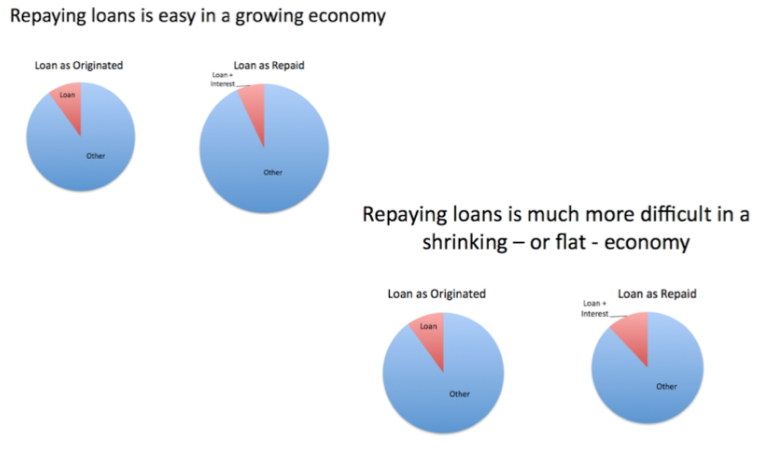
Our financial system has also become dependent on oil.  It is entirely structured around credit being lent out and debt paid back.  But debt can only be paid back if the business or salary of the borrower grows, and for the past two centuries that has been true because we have exponentially extracted oil, coal, and natural gas to make billions of combustion engines, roads, bridges, sewage systems, dams, medicine, plastic, ships, trucks, cars and everything else you see around you.  We industrialized agriculture to mine topsoil to grow enough crops to feed 7 billion people to the point where the soil will be exhausted within 200 years.  Previous civilizations without enormously destructive tractors were physically incapable of doing that, but even they depleted their soil over an average of 1,500 years by using the so-called waste as feed for their animals, to burn to cook with, and thatch for their roofs.

We’ve grown so used to that we forget that for the previous two million years homo sapiens lived in a steady state economy.  If you ate all the fish, shot all the game with arrows or spears, drank the last fresh water from a pool in the desert, your tribe died. When agriculture arrived, there wasn’t a single region that didn’t periodically suffer famines from one or more years of bad crops.  People had no choice but to live within the boundaries the natural world had set for them.

Okay, so it’s peaked, we’ll just drive a bit less  

Half the oil is left after all.

But it’s expensive.  If the financial system fails, how will the super-expensive projects to get at oil under miles of ocean be financed?   There are many reasons the financial system could fail.  A high-speed trading flash crash, the corruption and greed, 1 quadrillion in derivatives unwinding, a natural disaster like an earthquake in Tokyo or Los Angeles, cyber warfare taking out part or all of our electric grid for a year or two, and so on.

The remaining oil is remote and inaccessible.

We’re consuming more oil than we’re finding.  The few discoveries are few and very small compared to the giant fields that have provided 80% of our oil for decades.

The remaining oil is nasty, gunky, sour, full of impurities and comes out slowly like tar instead of quickly like the sweet light oil we’ve been pumping so far.   Before you could get $500 a day out of your checking account at the ATM.  But from now on you can get less every day, eventually not enough to pay the rent, pay for the utilities, and buy food.  The money is there, but you can’t get it out…

Nicole Foss on the intersection of oil and the financial system, December 7, 2008

“One might imagine that as an essential resource becomes scarcer, it’s price would move in one direction only – up – and for a while it appeared that would be the case. However, our energy supply system is set in the context of our existing economic and financial structures. The extreme and increasing stress that these structures are under will interact with future energy scarcity with devastating effect, effectively placing a hard limit on any eventual recovery. Energy is the master resource without which no activity, economic or otherwise, is possible.

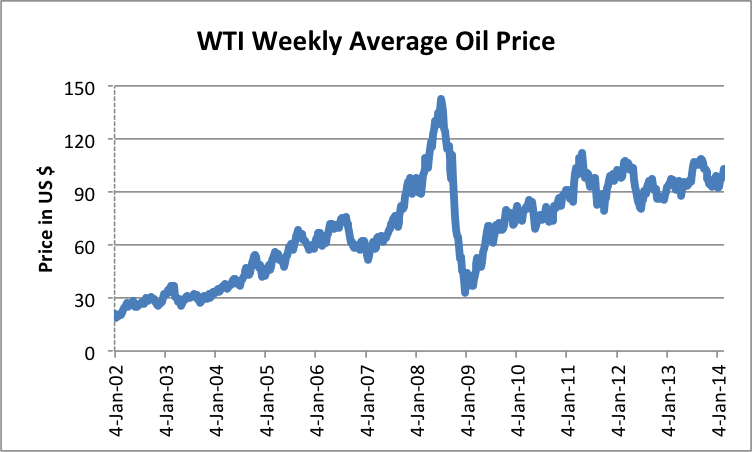
The effect of easy credit was to flood commodity exchanges with liquidity, as liquidity fleeing risky securitized assets searched for a safe haven. This pushed up the prices of all commodities beyond what could be justified, sending premature signals of scarcity that attracted even more speculative investment. In this way a bubble was formed, but bubbles always burst, and when they do, the speculative money disappears very quickly, taking price support with it. The price collapse we have seen since is partly a result of speculation in reverse, as speculators go short, and partly a result of falling demand, and that fall in demand has only just begun.

The consequence of that price plunge is a severe impact on the viability of continued fossil fuel exploration and development, and also a similarly significant impact on the viability of energy alternatives such as renewables and efficiency investments. Ilargi has long referred to this as the Law of Receding Horizons, meaning that each time alternatives appear to be reaching the threshold of viability, the combination of the price of conventional energy and the cost structure for the alternative is such that the threshold is never quite reached. Once again, energy prices are falling as costs for alternative have remained high, so that the hoped for developments will again be put on hold.

We are seeing the beginning of a global demand collapse, as the credit crunch takes an ever increasing toll on global economic activity and international trade. Already we are seeing the dire effects on shipping in the Baltic Dry index, thanks to the difficulty in obtaining letters of credit for shipments. Consumers in developed countries are tapped out and trying to repair their tattered balance sheets by cutting back, as are companies and banks. Consumption is therefore falling, which will hit exporting economies very hard indeed. They have spent vast sums, and used huge amounts of raw materials, to build what will now be shown to be an enormous excess of productive capacity. Their demand for raw materials will not recover any time soon, as there will be no demand for their products for a very long time.

For the time being, the on-going demand collapse, which has very much further to go, is causing the price of commodities, and particularly energy, to drop like a stone. This may well continue for a period of time, but the danger is that the demand collapse will lead to a supply collapse, and at that point prices will find a floor and begin to climb again. This price bottom could happen earlier in the coming Depression than would be the case for other goods and services.  Exactly when we might see the impact on supply is not clear. Already there are many projects with high cost structures which are no longer viable. These are the projects that could have cushioned the down slope of Hubbert’s curve (the decline from peak production of oil), but will not now come on line. Although they could in theory be developed at a later date, increasing capital constraints will make financing almost impossible, hence development will be unlikely for a very long time. We will therefore continue to make do with the fields already in production, but many of those are depleting very quickly – Ghawar in Saudi Arabia, Cantarell in Mexico, Burgan in Kuwait and many others.

For a while it will be enough to sustain the much lower level of economic activity that we are headed for, but not for all that much longer, especially since there will be many other ‘above ground factors’ to consider. For instance, production infrastructure requires expensive maintenance that will be increasingly difficult to perform, separatist movements in producing countries will seek to control resources for their own benefit, productive capacity being fought over will be damaged or destroyed, sabotage by the disaffected with nothing left to lose will increasingly become a factor, and piracy will make delivery much more challenging. Living off our fossil fuel legacy will therefore become progressively more difficult.

Many governments around the world, including those of all the major powers, are well aware of peak oil. In a very real sense in a modern world, oil IS power, as there is no comparable source of concentrated, transportable and flexible fuel. Securing access to it is therefore of the utmost strategic importance. Some governments, like the Anglo-Saxon economies, have so far appeared to place their trust in the global markets and their own perceived ability to outbid the competition. Others, notably China, have been quietly arranging long term bilateral supply contracts directly with producers, thereby taking production off the market.

China’s strategy is likely to prove far superior in difficult times when international trade is drying up, the fungibility of oil comes under threat and no one can be sure of being able to outbid the competition. By the time others realize that trusting the market to provide is essentially a modern day cargo cult, they may have been completely out maneuvered. In my opinion, this will be the foundation of the coming shift in hegemonic power towards the Far East, but it will not be a peaceful transition. Resource wars are a given under these circumstances.”

Posted in Flow Rate, How Much Left | Comments Off on Why is oil production peak the problem and not when the oil runs out?

SEC charges pair of brokers, investment advisory firm, others with $80M variable annuity scam

SEC charges pair of brokers, investment advisory firm, others with $80M variable annuity scam

Mar 13, 2014 Darla Mercado

The Securities and Exchange Commission Thursday filed charges against a group of brokers in a scheme wherein wealthy investors used variable annuities with death benefits to wager on the lives of the terminally ill.

The complaint targeted brokers Michael A. Horowitz of Los Angeles and Moshe Marc Cohen of Brooklyn, N.Y., slapping both with a cease-and-desist order and allegations of fraud.

The plan — which involved the sale of more than $80 million in variable annuities — ran its course from July 2007 to February 2008. Mr. Horowitz was allegedly the “architect” of a scheme to profit from the death of terminally ill hospice and nursing home patients, according to the SEC’s complaint.

Mr. Horowitz allegedly obtained the personal health and identification data of the dying patients through fraud, marking them as annuitants on variable annuity contracts that he had marketed to wealthy clients, according to the SEC’s complaint. He allegedly recruited Mr. Cohen to help facilitate the sale of these “stranger-owned annuities.” Under false pretenses, both men allegedly received their broker-dealers’ approval to sell the annuities. The brokers reaped a windfall in commissions from their sale, the SEC claimed, with Mr. Horowitz obtaining more than $300,000 and Mr. Cohen snagging more than $700,000.

“This was a calculated fraud exploiting terminally ill patients,” Julie M. Riewe, co-chief of the SEC’s Enforcement Division’s Asset Management Unit, said in a news release.

(See also: SEC says investors need to know more about fees)

At the heart of the matter is the fact that variable annuities don’t require proof of insurable interest or a physical examination of the annuitant — the person whose demise would trigger the payout of the annuity’s death benefits.

Mr. Horowitz allegedly told the contract owners — the wealthy investors funding the variable annuities — to invest aggressively to help drive up the value of the account, according to the complaint. His alleged argument was that there was no way to lose: If the value of the annuity contract climbed, the client would receive it as the death benefit payout following the demise of the terminally ill annuitant. If the value fell, then clients received a death benefit that guaranteed a payout equal to the premiums paid minus any withdrawals, according to the SEC’s complaint.

At least 16 terminally ill people were designated the annuitants in some 50 variable annuity contracts that were allegedly sold by Mr. Horowitz, Mr. Cohen or other associates, according to the SEC. All of the patients lived in southern California or Chicago.

The SEC also singled out three individuals for their role in allegedly identifying sickly patients to be annuitants: Harold Ten of Los Angeles, Menachem “Mark” Berger of Chicago and Debra Flowers of Chicago.

In order to obtain identification information, Mr. Ten allegedly started up a business that purported to provide charitable aid to people in hospice care, according to the complaint. Mr. Berger, meanwhile, is the executive director of a firm that owns and operates nursing homes in Chicago and the owner of a firm that supposedly provided financial aid to the terminally ill. Ms. Flowers, meanwhile, had worked for Mr. Berger as an admissions and marketing director for the nursing homes he oversaw, according to the SEC.

In fall 2007, Mr. Horowitz allegedly sought to expand his variable annuities scheme beyond retail clients and tap institutional investors. He allegedly met with the principals of two affiliated hedge funds in New York, which led to the establishment of an affiliate called BDL Group, advised by BDL Manager, according to the suit.

The principals of the hedge fund allegedly retained commodities trader Howard A. Feder of Woodmere, N.Y. to operate BDL Group and BDL Manager, according to the SEC. The supposed investment strategy here was to obtain guaranteed short-term gains by exploiting the annuity contract’s bonus credit and enhanced death benefit provisions, seeking terminally ill people to be annuitants, aggressively invest the premiums and then roll the death benefits into new stranger-owned annuity deals, according to the complaint.

Finally, the SEC filed a complaint against former registered representatives Richard Mark Horowitz and Marc Steven Firestone, both of Los Angeles, for negligently permitting point-of-sale forms for a dozen annuities in this scheme to be submitted to their broker-dealer, NFP Securities Inc.

The sales took place between mid-November and mid-December 2007, according to the SEC. Mr. Firestone allegedly signed off on the variable annuities — supposedly with the knowledge of Richard Horowitz, his supervisor — and submitted them to NFP with incorrect information on the investors’ time horizons, the SEC alleged.

NFP is not a named defendant in the SEC’s case. Emily Deissler, a spokeswoman for NFP, said the firm declined to comment.

Though the litigation with Mr. Horowitz and Mr. Cohen is still continuing, the SEC also obtained some $4.5 million in settlements from other parties in the elaborate grift.

Mr. Ten agreed to pay a disgorgement of $181,147, plus prejudgment interest of $20,858 and a penalty of $90,000. Mr. Berger agreed to pay $119,000 in disgorgement, plus $11,579 in prejudgment interest and a penalty of $100,000.

Ms. Flowers, meanwhile, submitted a sworn statement of financial condition last May and a sworn declaration in October 2013, asserting her inability to pay the penalties and disgorgement.

Mr. Feder will pay a penalty of $130,000. BDL Manager will pay a disgorgement of $1.5 million, prejudgment interest of $196,608 and a penalty of $1.5 million.

Finally, Mr. Horowitz will pay a disgorgement of $292,767, plus prejudgment interest of $36,512 and a penalty of $40,800. Mr. Firestone will pay $127,853 in disgorgement, prejudgment interest of $17,140 and a penalty of $40,800.

Attorney Eliot Lauer of Curtis Mallet-Prevost Colt & Mosle is representing Mr. Feder and BDL Manager. He had no comment on the SEC’s case. Attorneys for the other defendants did not immediately return calls.

As elaborate as this latest “stranger-owned annuities” caper is, it’s hardly the first such scheme. Cranston, R.I.-based estate planning attorney Joseph Caramadre captured the attention of regulators, compliance professionals and the media more than four years ago when he was the subject of civil suits filed by life insurers for allegedly soliciting terminally ill people to be annuitants on variable annuity contracts with death benefits.

Litigation flew: The issuing insurers sued the broker-dealers and registered reps who allegedly sold the annuities. In turn, the broker-dealers countersued the life insurers.

Federal authorities filed conspiracy and wire fraud charges against Mr. Caramadre in relation to the scheme. He was sentenced to six years in prison last December.

Posted in Scams | Comments Off on SEC charges pair of brokers, investment advisory firm, others with $80M variable annuity scam

Inside North Korea’s environmental collapse

Red soil in North Korea

The reddish hue of this soil in North Korea comes from lack of organic matter, vital for farming.

Related Posts:

Alice Friedemann  www.energyskeptic.com  Author of Life After Fossil Fuels: A Reality Check on Alternative Energy; When Trucks Stop Running: Energy and the Future of Transportation”, Barriers to Making Algal Biofuels, & “Crunch! Whole Grain Artisan Chips and Crackers”.  Women in ecology  Podcasts: WGBH, Jore, Planet: Critical, Crazy Town, Collapse Chronicles, Derrick Jensen, Practical Prepping, Kunstler 253 &278, Peak Prosperity,  Index of best energyskeptic posts

***

McKenna, P. March 6, 2013.  Inside North Korea’s Environmental Collapse.  PBS.

North Korea has been hiding something beyond its prison camps, nuclear facilities, pervasive poverty, aching famine, and lack of energy…something more fundamental than all of these: an environmental collapse so severe it could destabilize the entire country.

Before ecologist Margaret Palmer visited North Korea, she didn’t know what to expect, but what she saw was beyond belief. From river’s edge to the tops of hills, the entire landscape was lifeless and barren. Villages were little more than hastily constructed shantytowns where residents wore camouflage netting, presumably in preparation for a foreign invasion they feared to be imminent. Emaciated looking farmers tilled the earth with plows pulled by oxen and trudged through half-frozen streams to collect nutrient-rich sediments for their fields. “We went to a national park where we saw maybe one or two birds, but other than that you don’t see any wildlife,” Palmer says.

“The landscape is just basically dead,” adds Dutch soil scientist Joris van der Kamp. “It’s a difficult condition to live in, to survive.”

Countryside near Wonsan

Farmers preparing a field for the planting season outside Wonsan, North Korea, in the shadow of a denuded hillside.

Palmer and Van der Kamp were part of an international delegation of scientists invited by the government of North Korea and funded by the American Association for the Advancement of Science to attend a recent conference on ecological restoration in the long-isolated country. Through site visits and presentations by North Korean scientists they witnessed a barren landscape that is teetering on collapse, ravaged by decades of environmental degradation.

“There are no branches of trees on the ground,” Van der Kamp says. “Everything is collected for food or fuel or animal food, almost nothing is left for the soil. We saw people mining clay material from the rivers in areas that had been polished by ice and warming their hands along the roadside by small fires from the small amounts of organic bits they could find.”

Farmers carrying supplies in North Korea

Farmers carrying supplies on foot in North Korea.

The country’s ecological ruin is partially responsible for the disastrous famine in the 1990s, when massive flooding washed away crops and destroyed stored grain. Today, it continues to undermine the country’s economy and threaten national stability.

A Broken Landscape

For Palle Madsen, visiting North Korea was a bit like going back in time 150 years. “At that time the forest was nearly completely gone here in Denmark,” says Madsen, a forester at the Danish Center for Forest Landscape and Planning at the University of Copenhagen. “There wasn’t a totalitarian regime, but we had a similarly over exploited and degraded landscape. It influences the entire microclimate when you remove all of the trees,” Madsen says.

Mountains make up much of the country’s landscape leaving only 15 percent of land available for agriculture. Erosion, lack of nutrients, and acidification of the soil have had a devastating effect on crop yields, according to presentations by members of North Korea’s Academy of Sciences.

A 2004 study by the Korea Environment Institute reports that forest cover in North Korea dropped by 17 percent from the 1970s to the late 1990s. Following the collapse of the Soviet Union, which provided oil to its communist ally at a discounted “friendship price,” oil imports dropped by 60 percent. Unsurprisingly, the use of firewood for heating more than doubled.

North Korean soldiers hauling firewood

North Korean soldiers hauling firewood back to base. Fuel for heating is scarce, so many rely on what wood they can find, including, apparently, the normally well-supplied Korean People’s Army.

What resulted was an increasingly barren landscape. Even saplings are felled for fuel, stripping forests of their ability to regenerate.

“They don’t have trees to hold the soil,” says Jinsuk Byun of Sookmyung Women’s University in Seoul.  “When it rains the soil washes into the river, landslides occur and rivers flood. It triggers a really serious disaster.”

Conditions in North Korea appear to be little better now than during the famine of the 1990s. In Pyongyang, generally considered to be the most well-off city in the country, delegation members saw bonfires burning on apartment balconies at night, presumably lit by residents to keep warm. Other basic utilities were lacking, too. “I saw a woman lifting a bucket of water with a rope up ten stories to her apartment,” Palmer says.

Looming Famine?

Barbara Demick, author of Nothing To Envy, a book about the lives of ordinary North Koreans who later defected says  “Up to 10 percent of the country perished from starvation in the 1990s. It’s a cold mountainous country, and there is very little arable land. North Korea is highly dependent on artificial fertilization and irrigation and when they ran out of electricity, everything spiraled downhill.”

The lack of birds and other small animals noted by the scientists on their recent visit are a direct result of the famine in the 1990s, Demick says. “The frogs disappeared because everyone caught the frogs,” Demick says. “You see many fewer birds and small animals in North Korea than other countries. People living near the sea ate seaweed but that also ran out.” Ongoing food scarcity continues to take its toll.. A United Nations report released in May 2012 estimated that two-thirds of North Korea’s 24 million people continue to suffer from chronic food shortages and malnutrition.

Similar famines occurred throughout Europe in the 1800s due to over-exploitation of the land, says Madsen, the Danish forestry expert. What turned things around in Europe was the development of artificial fertilizers, the capacity to breed better crops, emigration to North America, and above all, land reform. “The feudal system of old Europe was still in existence,” he says. “It’s a different system in North Korea, much worse than the feudal system of Europe, but allowing farmers to own their own land is what changed things here.”

Small-scale land reform has begun in North Korea, but such policy changes may be making matters worse instead of better. In recent years, the government has allowed individual households to cultivate their own private vegetable gardens. But that has lead to the cutting down and cultivation of forested hillsides.

“They are farming every inch of the land,” says delegation member Keith Bowers, president of Biohabitats, an ecological restoration consultancy based in Baltimore, Maryland. “From the rivers to the hillsides, there is no vegetation on this landscape that provides any of the types of ecosystem services in terms of stabilizing soils, filtering air, attenuating flood flows, or controlling against erosion.” Flooding in North Korea left more than 212,000 people homeless last year according to recent news reports. “You have whole towns being buried in mud because they’ve terraced around the town,” Demick says.

Costs of Reunification

North Korean scientists told the delegates that they would like to reforest hillsides with trees, including the Japanese chestnut, black chokeberry, and Korean pine, that could both stabilize the soil and provide edible fruits and seeds. But funding for such reforestation appears tight. During their week-long visit the foreign scientists were taken to a tree nursery that is part of the country’s current reforestation effort. The automated potting machinery was inoperable either due to a lack of fuel or spare parts, delegates report, and its greenhouse stood empty. Even if the nurseries were running at full capacity, North Korea would still have a long road ahead of it. Bowers estimates that reforesting even half the country would cost around $46 billion, an amount that exceeds the nation’s annual gross domestic product by $6 billion.

North Korean farmers are heavily reliant on nitrogen-based fertilizers, which in certain formulations can paradoxically drain the soil of nutrients. “It’s a very unbalanced fertilizer, lacking in magnesium, calcium, potassium, and phosphorus,” says Dutch soil scientist Van der Kamp of the fertilizer predominantly used in North Korea. “When you don’t replace those minerals you basically mine the soil for these other nutrients, so the soils in general are very acidic, with very low organic matter content and low microbial activity.”


Posted in Deforestation, North Korea, Oil shock collapse, Peak Topsoil | Tagged , , , | Comments Off on Inside North Korea’s environmental collapse

Cost of Invasive Species in the United States

[ My note: It’s been 15 years since this paper was written, yet it is so thorough and well-written that it stands up well today and still cited by thousands of other papers as the best estimate of what invasive species cost.  But now the costs and spread of invasive species might need to be doubled or tripled. 

All of the methods used to protect food crops rely on finite fossil fuels, from the airplanes spraying oil-based pesticides, herbicides, insecticides, and fungicides to the combustion-engine driven equipment chemical spraying and weeding equipment.  The point at which the net energy cliff and consequent shortage of fossil fuels prevents the extreme measures being taken now to prevent crop losses will be a major transition point to a lower human population carrying capacity.  

Alice Friedemann   www.energyskeptic.com  author of “When Trucks Stop Running: Energy and the Future of Transportation”, 2015, Springer and “Crunch! Whole Grain Artisan Chips and Crackers”. Podcasts:  KunstlerCast 253, KunstlerCast278, Peak Prosperity]

Pimentel, D., et all. June 12, 1999. Environmental and economic costs associated with non-indigenous species in the United States

Invading non-indigenous species in the United States cause major environmental damages and losses adding up to more than $138 billion per year. There are approximately 50,000 foreign species and the number is increasing. About 42% of the species on the Threatened or Endangered species lists are at risk primarily because of non-indigenous species.

In the history of the United States, approximately 50,000 non-indigenous (non-native) species are estimated to have been introduced into the United States. Introduced species, such as corn, wheat, rice, and other food crops, and cattle, poultry, and other livestock, now provide more than 98% of the U.S. food system at a value of approximately $800 billion per year (USBC 1998). Other exotic species have been introduced for landscape restoration, biological pest control, sport, pets, and food processing. Some non-indigenous species, however, have caused major economic losses in agriculture, forestry, and several other segments of the U.S. economy, in addition to harming the environment. One recent study reported approximately $97 billion in damages from 79 exotic species during the period from 1906 to 1991 (OTA 1993).

Estimating the full extent of the environmental damages caused by exotic species and the number of species extinctions they have caused is difficult because little is known about the estimated 750,000 species in the United States, half of which have not even been described (Raven and Johnson 1992). Nonetheless, about 400 of the 958 species that are listed as threatened or endangered under the Endangered Species Act are considered to be at risk primarily because of competition with and predation by non-indigenous species (Nature Conservancy 1996; Wilcove et al. 1998). In other regions of the world, as many as 80% of the endangered species are threatened due to the pressures of non-native species (Armstrong 1995). Many other species worldwide that are not listed are also negatively affected by alien species and/or ecosystem changes caused by alien species. Estimating the economic impacts associated with non-indigenous species in the United States is also difficult; nevertheless, enough data are available to quantify some of the impacts on agriculture, forestry, and public health. In this article, we assess as much as possible the magnitude of the environmental impacts and economic costs associated with the diverse non-indigenous species that have become established within the United States. Although species translocated within the United States can also have significant impacts, this assessment is limited to non-indigenous species that did not originate within the United States or its territories.

ENVIRONMENTAL DAMAGES AND ASSOCIATED CONTROL COSTS

Most plant and vertebrate animal introductions have been intentional, whereas most invertebrate animal and microbe introductions have been accidental. In the past 40 years, the rate of and risks associated with biotic invaders have increased enormously because of human population growth, rapid movement of people, and alteration of the environment. In addition, more goods and materials are being traded among nations than ever before, thereby creating opportunities for unintentional introductions (Bryan 1996; USBC 1998).

Some of the approximately 50,000 species of plants and animals that have invaded the United States cause many different types of damage to managed and natural ecosystems (Table 1). Some of these damages and control costs are assessed below.

Plants. Most alien plants now established in the United States were introduced for food, fiber, or ornamental purposes. An estimated 5000 introduced plant species have escaped and now exist in U.S. natural ecosystems (Morse et al. 1995), compared with a total of about 17,000 species of native U.S. plants (Morin 1995). In Florida, of the approximately 25,000 alien plant species imported mainly as ornamentals for cultivation, more than 900 have escaped and become established in surrounding natural ecosystems (Frank and McCoy 1995a; Frank et al. 1997; Simberloff et al. 1997). More than 3000 plant species have been introduced into California, and many of these have escaped into the natural ecosystem (Dowell and Krass 1992).

Some of the 5000 non-indigenous plants established in U.S. natural ecosystems have displaced several native plant species (Morse et al. 1995). Non-indigenous weeds are spreading and invading approximately 700,000 ha/yr of the U.S. wildlife habitat (Babbitt 1998). One of these pest weeds is the European purple loosestrife (Lythrum salicaria), which was introduced in the early 19th century as an ornamental plant (Malecki et al. 1993). It has been spreading at a rate of 115,000 ha/yr and is changing the basic structure of most of the wetlands it has invaded (Thompson et al. 1987). Competitive stands of purple loosestrife have reduced the biomass of 44 native plants and endangered wildlife, including the bog turtle (Clemmys muhlenbengil) and several duck species, that depend on these native plants (Gaudet and Keddy 1988). Loosestrife now occurs in 48 states and costs $45 million per year in control costs and forage losses (ATTRA 1997).

Many introduced plant species established in the wild are having an effect on U.S. parks (Hiebert and Stubbendieck 1993). In Great Smoky Mountains National Park, 400 of approximately 1,500 vascular plant species are exotic, and 10 of these are currently displacing and threatening other species in the park (Hiebert and Stubbendieck 1993).

The problem of introduced plants is especially significant in Hawaii. Hawaii has a total of 2690 plant species, 946 of which are non-indigenous species (Eldredge and Miller 1997). About 800 native species are currently endangered (Vitousek 1988).

Sometimes one non-indigenous plant species competitively overruns an entire ecosystem. For example, in California, yellow star thistle (Centaurea solstitalis) now dominates more that 4 million ha of northern California grassland, resulting in the total loss of this once productive grassland (Campbell 1994).

Similarly, European cheatgrass (Bromus tectorum) is dramatically changing the vegetation and fauna of many natural ecosystems. This annual grass has invaded and spread throughout the shrub-steppe habitat of the Great Basin in Idaho and Utah, predisposing the invaded habitat to fires (Kurdila 1995; Vitousek et al. 1996; Vitousek et al. 1997). Before the invasion of cheatgrass, fire burned once every 60 – 110 years, and shrubs had a chance to become well established. Now, fires occur about every 3 – 5 years; shrubs and other vegetation are diminished, and competitive monocultures of cheatgrass now exist on 5 million ha in Idaho and Utah (Whisenant 1990). The animals dependent on the shrubs and other original vegetation have been reduced or eliminated.

An estimated 138 non-indigenous tree and shrub species have invaded native U.S. forest and shrub ecosystems (Campbell 1998). Introduced trees include salt cedar (Tamarix pendantra), eucalyptus (Eucalyptus spp.), Brazilian pepper (Schinus terebinthifolius), and Australian melaleuca (Melaleuca quenquenervia) (OTA 1993; Miller 1995; Randall 1996). Some of these trees have displaced native trees, shrubs, and other vegetation types, and populations of some associated native animal species have been reduced in turn (OTA 1993). For example, the melaleuca tree is competitively spreading at a rate of 11,000 ha/yr throughout the vast forest and grassland ecosystems of the Florida Everglades (Campbell 1994), where it damages the natural vegetation and wildlife (OTA 1993).

Exotic aquatic weeds are also a significant problem in the United States. For example, in the Hudson River basin of New York, there are 53 exotic aquatic weed species (Mills et al. 1997). In Florida, exotic aquatic plants, such as hydrilla (Hydrilla verticillata), water hyacinth (Eichhornia crassipes), and water lettuce (Pistia straiotes), are altering fish and other aquatic animal species, choking waterways, altering nutrient cycles, and reducing recreational use of rivers and lakes. Active control measures of the aquatic weeds have become necessary (OTA 1993). For instance, Florida spends about $14.5 million each year on hydrilla control (Center et al. 1997). Nevertheless, hydrilla infestations in just 2 Florida lakes have caused an estimated $10 million in recreational losses in the lakes annually (Center et al. 1997). In the United States as a whole, a total of $100 million is invested annually in non-indigenous species aquatic weed control (OTA 1993).

Mammals. About 20 species of mammals have been introduced into the United States; these include dogs, cats, horses, burros, cattle, sheep, pigs, goats, and deer (Layne 1997). Several of these species have escaped or were released into the wild; many have become pests by preying on native animals, grazing on vegetation, or intensifying soil erosion. For example, goats (Capra hirus) introduced on San Clemente Island, California, are responsible for the extinction of 8 endemic plant species as well as the endangerment of 8 other native plant species (Kurdila 1995).

Many small mammals have also been introduced into the United States. These species include a number of rodents, (the European [black or tree] rat [Rattus rattus)], Asiatic [Norway or brown] rat [Rattus norvegicus], house mouse [Mus musculus], and European rabbit [Oryctolagus cuniculus] (Layne 1997).

Some introduced rodents have become serious pests on farms, in industries, and in homes (Layne 1997). Rats and mice are particularly abundant and destructive on farms. On poultry farms, there is approximately 1 rat per 5 chickens (D. Pimentel, unpublished, 1951; Smith 1984). Using this ratio, the total rat population on U. S. poultry farms may easily number more than 1.4 billion (USDA 1998). Assuming that the number of rats per chicken has declined because of improved rat control since these observations were made, we estimate that the number of rats on poultry and other farms is approximately 1 billion. With an estimated additional 1 rat per person in homes and related areas (Wachtel and McNeely 1985), there are an estimated 250 million rats in the United States (USBC 1998).

If we assume, conservatively, that each adult rat consumes and/or destroys stored grains (Chopra 1992; Ahmed et al. 1995) and other materials valued at $15/yr, then the total cost of destruction by introduced rats in the United States is more than $19 billion per year. In addition, rats cause fires by gnawing electric wires, pollute foodstuffs, and act as vectors of several diseases, including salmonellosis and leptospirosis, and, to a lesser degree, plague and murine typhus (Richards 1989). They also prey on some native invertebrate and vertebrate species like birds and bird eggs (Amarasekare 1993).

One of the first cases of the failure of biological control is the use of the Indian mongoose (Herpestes auropunctatus). It was first introduced into Jamaica in 1872 for biological control of rats in sugarcane (Pimentel 1955). It was subsequently introduced to the territory of Puerto Rico, other West Indian Islands, and Hawaii for the same purpose. The mongoose controlled the Asiatic rat but not the European rat, and it preyed heavily on native ground nesting birds (Pimentel 1955; Vilella and Zwank 1993). It also preyed on beneficial native amphibians and reptiles, causing at least 7 amphibian and reptile extinctions in Puerto Rico and other islands of the West Indies (Henderson 1992). In addition, the mongoose emerged as the major vector and reservoir of rabies and leptospirosis in Puerto Rico and other islands (Everard and Everard 1992). Based on public health damages, killing of poultry in Puerto Rico and Hawaii, extinctions of amphibians and reptiles, and destruction of native birds, we estimate that the mongoose is causing approximately $50 million in damages each year in Puerto Rico and the Hawaiian Islands.

Introduced cats have also become a serious threat to some native birds and other animals. There are an estimated 63 million pet cats in the United States (Nassar and Mosier 1991), plus as many as 30 million feral cats (Luoma 1997). Cats prey on native birds (Fitzgerald 1990), plus small native mammals, amphibians, and reptiles (Dunn and Tessaglia 1994). Estimates are that feral cats in Wisconsin and Virginia kill more than 3 million birds in each state per year (Luoma 1997). Based on the Wisconsin and Virginia data, we assume that 5 birds are killed per feral cat/year; McKay (1996) reports that pet cats kill a similar number of birds as feral cats. Thus, about 465 million birds are killed by cats per year in the nation. Each adult bird can be valued at $30. This cost per bird is based on the literature that reports that a bird watcher spends $0.40 per bird observed, a hunter spends $216 per bird shot, and specialists spend $800 per bird reared for release; in addition, note that EPA fines polluters $10 per fish killed, including small, immature fish (Pimentel and Greiner 1997). Therefore, the total damage to U.S. bird population is approximately $14 billion/yr. This figure does not include small mammals, amphibians, and reptiles that are killed by feral and pet cats (Dunn and Tessaglia 1994).

Like cats, most dogs introduced into the United States were introduced for domestic purposes, but some have escaped into the wild. Many of these wild dogs run in packs and kill deer, rabbits, and domestic cattle, sheep, and goats. Carter (1990) reported that feral dog packs in Texas cause more than $5 million in livestock losses each year. Dog packs have also become a serious problem in Florida (Layne 1997). In addition to the damages caused by dogs in Texas, and conservatively assuming $5 million for all damages for the other 49 states combined, total losses in livestock kills by dogs per year would be approximately $10 million per year.

Moreover, an estimated 4.7 million people are bitten by feral and pet dogs annually, with 800,000 cases requiring medical treatment (Sacks et al. 1996). Centers for Disease Control estimates medical treatment for dog bites costs $165 million/yr, and the indirect costs, such as lost work, increase the total costs of dog bites to $250 million/yr (Colburn 1999; Quinlan and Sacks, 1999). In addition, dog attacks cause between 11 and 14 deaths per year, and 80% of the victims are small children (CDC 1997).

Birds. Approximately 97 of the 1,000 bird species in the United States are exotic (Temple 1992). Of the approximately 97 introduced bird species, only 5%, including chickens, are considered beneficial. Most (56%), though, are considered pests (Temple 1992). Pest species include the pigeon, which was introduced into the United States for agricultural purposes.

Introduced bird species are an expecially severe problem in Hawaii. A total of 35 of the 69 non-indigenous bird species introduced between 1850 and 1984 in Hawaii are still extant on the islands (Moulton and Pimm 1983; Pimm 1991). One such species, the common myna (Acridotheres tristis), was introduced to help control pest cutworms and armyworms in sugarcane (Kurdila 1995). However, it became the major disperser of seeds of an introduced serious weed, Lantana camara. In the continental United States, the English or house sparrow (Passer domesticus) was introduced in 1853 to control the canker worm (Laycock 1966; Roots 1976). By 1900, the had become pests because they damage plants around homes and public buildings and consume wheat, corn, and the buds of fruit trees (Laycock 1966). Furthermore, English sparrows harass native birds, including robins, Baltimore orioles, yellow-billed cuckoos, and black-billed cuckoos, and displace native bluebirds, wrens, purple martins, and cliff swallows from their nesting sites (Laycock 1966; Roots 1976; Long 1981). They are also associated with the spread of about 29 human and livestock diseases (Weber 1979).

The single-most serious pest bird in the United States is the exotic common pigeon (Columba livia) that exists in most cities of the world, including those in the United States (Robbins 1995). Pigeons are considered a nuisance because they foul buildings, statues, cars, and sometimes people, and feed on grain (Long 1981; Smith, 1992). The control costs of pigeons are at least $9 per pigeon per year (Haag-Wackernagel 1995). Assuming 1 pigeon per ha in urban areas (Johnston and Janiga 1995) or approximately 0.5 pigeons per person, and using potential control costs as a surrogate for losses, pigeons cause an estimated $1.1 billion/yr in damages. These control costs do not include the environmental damages associated with pigeons, which serve as reservoirs and vectors for over 50 human and livestock diseases, including parrot fever, ornithosis, histoplasmosis, and encephalitis (Weber 1979; Long 1981).

Amphibians and Reptiles. Amphibians and reptiles introduced into the United States number about 53 species. All these non-indigenous species occur in relatively warm states — Florida is now host to 30 species and Hawaii to 12 (McCoid and Kleberg 1995; Lafferty and Page 1997). The negative ecological impacts of several of these exotic species have been enormous .

The brown tree snake (Boiga irregularis) was accidentally introduced to the snake-free U.S. territory of Guam immediately after World War II, when military equipment was moved onto Guam (Fritts and Rodda 1995). Soon the snake population reached densities of 100 per ha, and dramatically reduced native bird, mammal, and lizard populations. Of the 13 species of native forest birds originally found on Guam, only 3 still exist (Rodda et al. 1997); of the 12 native species of lizards, only 3 have survived (Rodda et al.1997). The snake eats chickens, eggs, and caged birds, causing major problems to small farmers and pet owners. It also crawls up trees and utility poles and has caused power outages on the island. One island-wide power outage caused by the snake cost the power utility more than $250,000 (Teodosio 1987). Local outages that affect businesses are estimated to cost from $2,000 to $10,000 per commercial customer (Coulehan 1987). With about 86 outages per year (BTSCP 1996), our estimate of the cost of snake-related power outages is conservatively $1 million/yr.

In addition, the brown tree snake is slightly venomous, and has caused public health problems, especially when it has bitten children. At one hospital emergency room, about 26 people per year are treated for snake bites (OTA 1993). Some bitten infants require hospitalization and intensive care, at an estimated total cost of $25,000 per year.

The total costs of endangered species recovery efforts, environmental planning related to snake containment on Guam and other programs directly stemming from the snake’s invasion of Guam reach more than $1 million per year; in addition, up to $2 million per year is invested in research to control this serious pest. The brown tree snake has also invaded Hawaii but thus far has been exterminated. Hawaii’s concern about the snake, though, has prompted the federal government to invest $1.6 million per year in brown tree snake control (Holt 1997-1998). The total cost associated with the snake is therefore more than $5.6 million/yr.

Fish. A total of 138 non-indigenous fish species has been introduced into the United States (Courtenay et al. 1991; Courtenay 1993, 1997). Most of these introduced fish have been established in states with mild climates, such as Florida (50 species) (Courtenay 1997) and California (56 species) (Dill and Cordone 1997). In Hawaii, 33 non-indigenous freshwater fish species have become established (Maciolek 1984). Forty-four native species of fish are threatened or endangered in the United States by non-indigenous fish species (Wilcove and Bean 1994). An additional 27 native fish species are also negatively affected by introductions (Wilcove and Bean 1994).

Introduced fish species frequently alter the ecology of aquatic ecosystems. For instance, the grass carp (Ctenopharyngodon idella) reduces natural aquatic vegetation, while the common carp (Cyprinus carpio) reduces water quality by increasing turbidity. These changes have caused the extinctions of some native fish species (Taylor et al. 1984).

Although some native fish species are reduced in numbers, are driven to extinction, or hybridized by non-indigenous fish species, alien fish do provide some economic benefits in the improvement of sport fishing. Sport fishing contributes $69 billion to the economy of the United States (Bjergo et al. 1995; USBC 1998). However, even taking into account these economic benefits, based on the more than 40 non-indigenous species that have negatively affected native fishes and other aquatic biota, a conservative estimate puts the economic losses due to exotic fish at more than $1 billion annually.

Arthropods and Annelids. Approximately 4,500 arthropod species (2,582 species in Hawaii and more than 2,000 in the continental United States) have been introduced to the United States. Also, 11 earthworm species (Hendrix 1995), and nearly 100 aquatic invertebrate species have been introduced (OTA 1993). About 95% of these introductions were accidental, with many species gaining entrance via plants or through soil and water ballast from ships.

For example, the accidentally-introduced balsam woolly adelgid (Adelges piceae) inflicts severe damage in balsam-fir natural forest ecosystems (Jenkins 1998). According to Alsop and Laughlin (1991), this aphid is destroying the old-growth spruce-fir forest in many regions. Over the last two decades, it has spread throughout the southern Appalachians, where it has destroyed up to 95% of the fraser firs. Alsop and Laughlin (1991) report the loss of 2 native bird species and the invasion by 3 other bird species as a result of adelgid-mediated forest death.

Other introduced insect species have become pests of livestock and wildlife. For example, the red imported fire ant (Solenopsis invicta) kills poultry chicks, lizards, snakes, and ground nesting birds (Vinson 1994). A 34% decrease in swallow nesting success as well as a decline in the northern bobwhite quail populations was reported due to these ants (Allen et al. 1995). The estimated damage to livestock, wildlife, and public health caused by fire ants in Texas is estimated to be $300 million/yr. An additional $200 million is invested in control per year (Vinson 1992; TAES 1998). Assuming similar damages in other infested southern states — such as Florida, Georgia, and Louisiana — the fire ant damages total more than $1 billion/yr. Southern states are also affected by another insect, the Formosan termite (Coptotermes formosanus), which is reported to cause structural damages totalling approximately $1 billion/yr in Southern United States, especially in the New Orleans region (Corn et al. 1999).

The European green crab (Carcinus maenas) has been associated with the demise of the soft shell clam industry in New England and maritime provinces of Canada (Lafferty and Kuris 1996). It also destroys commercial shellfish beds and preys on large numbers of native oysters and crabs (Lafferty and Kuris 1996), with an annual estimated economic impact of $44 million/yr (Lafferty and Kuris 1996).

Mollusks. Eighty-eight species of mollusks have been both intentionally and accidentally introduced and established in U. S. aquatic ecosystems (OTA 1993). Two have become serious pests: the zebra mussel (Dreissena polymorpha) and the Asian clam (Corbicula fluminea).

The zebra mussel was first found in Lake St. Clair after gaining entrance via ballast water released in the Great Lakes from ships that had traveled from Europe (Benson and Boydstun 1995). It has spread into most of the aquatic ecosystems in the eastern United States and is expected to invade most freshwater habitats throughout the nation in approximately 20 years (Benson and Boydstun 1995). Large mussel populations reduce food and oxygen for native fauna. In addition, zebra mussels have been observed completely covering native mussels, clams, and snails, thereby further threatening their survival (Benson and Boydstun 1995; Keniry and Marsden 1995). Mussel densities have reached 700,000/m2 in some locations (Griffiths et al. 1991). Zebra mussels also invade and clog water intake pipes and water filtration and electric generating plants; it is estimated that they will cause $5 billion/yr in damages to these facilities and associated control costs by the year 2000 (Khalanski 1997).

Although the Asian clam grows and disperses less rapidly than the zebra mussel, it too is causing significant fouling problems and is threatening native species. Costs associated with its fouling damage are about $1 billion/yr (Isom 1986; OTA 1993).

Another pest mollusk is the introduced shipworm (Teredo navalis), which was first introduced into the San Francisco Bay. It has caused serious damage since the early 1990s. Currently, damages are estimated to be approximately $200 million/yr (Cohen and Carlton 1995).

CROP, PASTURE, AND FOREST LOSSES & ASSOCIATED CONTROL COSTS

Many weeds, pest insects, and plant pathogens are biological invaders. These non-indigenous species cause several billion dollars worth of losses to crops, pastures, and forests annually in the United States. In addition, several billion dollars are spent on pest control.

Weeds. In crop systems, including forage crops, an estimated 500 introduced plant species have become weed pests; some of these, such as Johnson grass (Sorghum halepense) and Kudzu (Pueraria lobata), were actually introduced as crops and then became pests (Pimentel et al. 1989). Most of these weeds were accidentally introduced with crop seeds, from ship-ballast soil, or from various imported plant materials, among which were yellow rocket (Barbarea vulgaris) and Canada thistle (Cirsium arvense).

In U.S. agriculture, weeds cause an overall reduction of 12% in crop yields. In economic terms, this reduction represents about $33 billion in lost crop production annually, based on the crop potential value of all U.S. crops of more than $267 billion/yr (USBC 1998). Based on the survey that about 73% of the weed species are non-indigenous (Pimentel 1993), it follows that about $24 billion/yr of these crop losses are due to introduced weeds. However, non-indigenous weeds are often more serious pests than native weeds; this estimate of $24 billion/yr is conservative. In addition to direct losses, approximately $4 billion/yr in herbicides are applied to U.S. crops (Pimentel 1997), of which about $3 billion/yr is used for control of non-indigenous weeds. Therefore, the total costs of introduced weeds to the U.S. economy is about $27 billion annually.

In pastures, 45% of weeds are non-indigenous species (Pimentel 1993). U.S. pastures provide about $10 billion in forage crops annually (USDA 1998), and the estimated losses due to weeds are approximately $2 billion (Pimentel 1991). Forage losses due to non-indigenous weeds are nearly $1 billion/yr.

Some introduced weeds are toxic to cattle and wild ungulates, such as leafy spurge (Euphoria esula) (Trammel and Butler 1995). In addition, several non-indigenous thistles have reduced native forage plant species in pastures, rangelands, and forests, thus reducing cattle grazing (Dewey 1991). According to Interior Secretary Bruce Babbitt (1998), ranchers spend about $5 billion each year to control invasive non-indigenous weeds in pastures and rangelands. Nevertheless, these weeds continue to spread.

Control of weed species in lawns, gardens, and golf courses is a significant proportion of the total management costs of about $36 billion/yr (USBC 1998). In fact, Templeton et al. (1998) estimated that each year about $1.3 billion of the $36 billion is spent just on residential weed, insect, and disease pest control each year. Because a large proportion of these weeds, such as dandelions (Taraxacum officinale) are exotics, we estimate that $500 million is spent on residential exotic weed control and an additional $1 billion is invested in non-indigenous weed control on golf courses.

Weed trees also have an economic impact, and from $3 to $6 million per year is being spent in efforts to control only the melaleuca tree in Florida.

Vertebrate Pests. Horses (Equus caballus) and burros (Equus asinus), deliberately released in the western United States, have attained wild populations of approximately 50,000 animals (Pogacnik 1995). These animals graze heavily on native vegetation, allowing non-indigenous annuals to displace native perennials (Rosentreter 1994). Burros inhabiting the northwestern United States also diminish the primary food sources of native bighorn sheep and seed-eating birds, thereby reducing the abundance of these native animals (Kurdila 1995). In general, the large populations of introduced wild horses and burros cost the nation an estimated $5 million/yr in forage losses (Pimentel et al. 1999).

Feral pigs (Sus scrofa), native to Eurasia and North Africa, have been introduced into some U.S. parks for hunting, including parks in the California coastal prairie and Hawaiian islands, where they have substantially changed the vegetation in these parks (Kotanen 1995). In Hawaii, more than 80% of the soil is bare in regions inhabited by pigs (Kurdila 1995). This disturbance allows annual plants to invade the overturned soil and intensifies soil erosion. Pig control per park in Hawaii (~1500 pigs/park) (Stone et al. 1992) costs about $150,000/yr . Assuming that the 3 parks in Hawaii have similar pig control problems, the total is $450,000/yr (P. C., R. Zuniga, Cornell University, 1999).

Feral pigs have also become a serious problem in Florida, where their population has risen to more than 500,000 (Layne 1997); similarly, in Texas their number ranges from 1 to 1.5 million. In Florida, Texas, and elsewhere, pigs damage grain, peanut, soybean, cotton, hay, and various vegetable crops, and the environment (Rollins 1998). Pigs also transmit and are reservoirs for serious human and livestock diseases, including brucellosis, pseudobrucellosis, and trichinosis (Davis 1998).

Nationwide, there are an estimated 4 million feral pigs. Based on environmental and crop damages of about $200 per pig annually (one pig can cause up to $1000 of damages to crops in one night), and assuming that 4 million feral pigs inhabit the United States, the yearly damage amounts to about $800 million/yr. This estimate is conservative because pigs cause significant environmental damages and diseases that cannot be easily translated into dollar values.

Other animals that threaten crop production include birds. European starlings (Sturnus vulgaris) are serious pests and are estimated to occur at densities of more than 1 per ha in agricultural regions (Moore 1980). Starlings are capable of destroying as much as $2,000 worth of cherries per hectare (Feare 1980). In grain fields, starlings consume about $6/ha of grain (Feare 1980). Conservatively assuming $5/ha for all damages to many crops in the United States, the total loss due to starlings would be approximately $800 million/yr. In addition, these aggressive birds have displaced numerous native birds (Laycock 1966). Starlings have also been implicated in the transmission of 25 diseases, including parrot fever and other diseases of humans (Laycock 1966; Weber 1979).

Insect and Mite Pests. Approximately 500 non-indigenous insect and mite species are pests in crops in the United States. Hawaii has 5,246 identified native insect species, and an additional 2,582 introduced insect species (Howarth 1990; Frank and McCoy 1995a; Eldredge and Miller 1997). Introduced insects account for 98% of the crop pest insects in the state (Beardsley 1991). In addition to Florida’s 11,500 native insect species, 949 introduced species have, mostly accidentally, invaded the state (42 species were intentionally introduced for biological control; Frank and McCoy 1995b). In California, the 600 introduced species are responsible for 67% of all crop losses (Dowell and Krass 1992).

Each year, pest insects destroy about 13% of potential crop production representing a value of about $33 billion in U.S. crops (USBC 1998). Considering that about 40% of the pests were introduced (Pimentel 1993), we estimate that introduced pests cause about $13 billion in crop losses each year. In addition, about $1.2 billion in pesticides are applied for all insect control each year (Pimentel 1997). The portion applied against introduced pest insects is approximately $500 million/yr. Therefore, the total cost for introduced non-indigenous insect pests is approximately $13.5 billion/yr. In addition, based on the analysis of management costs of lawns, gardens, and golf courses, we estimate the control costs of pest insects and mites in lawns, gardens, and golf courses to be at least $1.5 billion/yr.

In addition to crops, about 360 non-indigenous insect species have become established in American forests (Liebold et al. 1995), of which approximately 30% of these are now serious pests. Insects cause the loss of approximately 9% of forest products, amounting to a cost of $7 billion per year (Hall and Moody 1994; USBC 1998). Because 30% of the pests are non-indigenous, annual losses attributed to non-indigenous species is about $2.1 billion per year.

The gypsy moth (Lymantria dispar), intentionally introduced into Massachusetts in the 1800s for possible silk production, has developed into a major pest of U.S. forest and ornamental trees, especially oaks (Campbell and Schlarbaum 1994). The U.S. Forest Service currently spends about $11 million annually on gypsy moth control (Campbell and Schlarbaum 1994).

Plant Pathogens. There are an estimated 50,000 parasitic and non-parasite diseases of plants in the United States, most of which are caused by fungae species (USDA 1960). In addition more than 1300 species of viruses are plant pests in the United States (USDA 1960). Many of these microbes are non-native and were introduced inadvertently with seeds and other parts of host plants and have become major crop pests in the United States (Pimentel 1993). Including the introduced plant pathogens plus other soil microbes, we estimate conservatively that more than 20,000 species of microbes have invaded the United States.

U.S. crop losses to all plant pathogens total approximately $33 billion per year (Pimentel 1997; USBC 1998). Approximately 65% (Pimentel 1993), or an estimated $21 billion per year of losses are attributable to non-indigenous plant pathogens. In addition, $0.72 billion is spent in total annually for fungicides (Pimentel 1997), with approximately $0.5 billion/yr for only the control of non-indigenous plant pathogen. This brings the costs of damage and control of non-indigenous plant pathogens to about $21.5 billion/yr. In addition, based on the earlier discussion of pests in lawns, gardens, and golf courses, we estimate the control costs of plant pathogens in lawns, gardens, and golf courses to be at least $2 billion/yr.

In forests, more than 20 non-indigenous species of plant pathogens attack woody plants (Liebold et al. 1995). Two of the most serious plant pathogens are the chestnut blight fungus (Cryphonectria parasitica) and Dutch elm disease (Ophiostoma ulmi). Before the accidental introduction of chestnut blight, approximately 25% of eastern U.S. deciduous forest consisted of American chestnut trees (Campbell 1994). Now chestnut trees have all but disappeared. Removal of elm trees devastated by O. ulmi costs about $100 million/yr (Campbell and Schlarbaum 1994).

In addition, plant pathogens of forest plants cause the loss of approximately 9%, or $7 billion, of forest products each year (Hall and Moody 1994; USBC 1998). The proportion of introduced plant pathogens in forests is similar to that of introduced insects (about 30%), thus, approximately $2.1 billion in forest products are lost each year to non-indigenous plant pathogens in the United States.

LIVESTOCK PESTS

Similar to crops, exotic microbes (e.g., calf diarrhea rotavirus) and parasites (e.g., face flies, Musca autumnalis) were introduced along with livestock brought into the United States (Drummond et al., 1981; Morgan, 1981). In addition to the hundreds of pest microbes and parasites that have already been introduced, more than 60 microbes and parasites could invade and become serious pests to U.S. livestock (USAHA 1984). A conservative estimate of the losses to U.S. livestock from exotic microbes and parasites was reported to be approximately $3 billion/yr in 1980 (Drummond et al. 1981; Morgan 1981). Current livestock losses to pests are estimated to be approximately $9 billion/year.

HUMAN DISEASES

The non-indigenous diseases now having the greatest impact on humans are Acquired Immune Deficiency Syndrome (AIDS), syphilis, and influenza (Newton-John 1985; Pimentel et al. 1999). In 1993, there were 103,533 cases of AIDS with 37,267 deaths (CDC 1996). The total U.S. health care cost for the treatment of AIDS averages about $6 billion per year (USPHS 1994).

New influenza strains originating in the Far East spread quickly to the United States. Influenza causes 540 deaths in the United States each year (USBC 1998). Costs of hospitalizations for a single outbreak of influenza, like type A, can exceed $300 million/yr (Chapman et al., 1992).

In addition, each year there are approximately 53,000 cases of syphilis in the United States; to treat only newborn children infected with syphilis costs $18.4 million/yr (Bateman et al. 1997).

In total, AIDS and influenza take the lives of more than 40,000 people each year in the United States, and treatment costs for these diseases total approximately $6.5 billion/yr. The costs of treating other exotic diseases pushes this total much higher. An increasing threat of exotic diseases exists because of rapid transportation, encroachment of civilization into new ecosystems, and growing environmental degradation.

THE NON-INDIGENOUS SPECIES THREAT

With more than 50,000 non-indigenous species in the United States, the fraction that is harmful does not have to be large to inflict significant damage to natural and managed ecosystems and cause public health problems. A suite of ecological factors may cause non-indigenous species to become abundant and persistent. These include the lack of controlling natural enemies (e.g., purple loosestrife and imported fire ant); the development of new associations between alien parasite and host (e.g., AIDS virus in humans and gypsy moth in U.S. oaks); effective predators in a new ecosystem (e.g., brown tree snake and feral cats); artificial and/or disturbed habitats that provide favorable invasive ecosystems for the aliens (e.g., weeds in crop and lawn habitats); and invasion by some highly adaptable and successful species (e.g., water hyacinth and zebra mussel).

Our study reveals that economic damages associated with non-indigenous species effects and their control amount to approximately $138 billion/yr. The Office of Technology Assessment (OTA 1993) reported average costs of $1.1 billion/yr ($97 billion over 85 years) for 79 species. The reason for our higher estimate is that we included more than 10 times the number of species in our assessment and found higher costs reported in the literature than OTA (1993) for some of the same species. For example, for the zebra mussel, OTA reported damages and control costs of slightly more that $300, 000 per year; we used an estimate of $5 billion/yr (Khalanski 1997).

Although we reported total economic damages and associated control costs to be $138 billion/yr, precise economic costs associated with some of the most ecologically damaging exotic species are not available. The brown tree snake, for example, has been responsible for the extinction of dozens of bird and lizard species on Guam. Yet for this snake, only minimal cost data are known. In other cases, such as the zebra mussel and feral pigs, only combined damage and control cost data are available. The damage and control costs are considered low when compared with the extensive environmental damages these species cause. If we had been able to assign monetary values to species extinctions and losses in biodiversity, ecosystem services, and aesthetics, the costs of destructive non-indigenous species would undoubtedly be several times higher than $138 billion/yr. Yet even this understated economic loss indicates that non-indigenous species are exacting a significant toll.

We recognize that nearly all of our crop and livestock species are non-indigenous and have proven essential to the viability the U.S. agriculture and economy. However, the fact that certain non-indigenous crops (e.g., corn and wheat) are vital to agriculture and the U.S. food system does not diminish the enormous negative impacts of other non-indigenous species (e.g, zebra mussel and exotic weeds).

The true challenge lies not in determining the precise costs of the impacts of exotic species, but in preventing further damage to natural and managed ecosystems caused by non-indigenous species. Formulation of sound prevention policies needs to take into account the means through which non-indigenous species gain access to and become established in the United States. Since the modes of invasion vary widely, a variety of preventative strategies will be needed. For example, public education, sanitation, and effective screening and searches at airports, seaports, and other ports of entry will help reduce the chances for biological invaders becoming established in the United States.

Fortunately, the problem is gaining the attention of policy makers. On February 2, 1999, President Clinton issued an Executive Order allocating $28 million to combat alien species invasions and creating an Interagency Invasive Species Council to produce a plan within 18 months to mobilize the federal government to defend again non-indigenous species invasions. In addition, a Federal Interagency Weed Committee has been formed to help combat non-indigenous plant species invasions (FIWC 1999). The objective of this interagency committee is education, formation of partnerships among concerned groups, and stimulation of research on the biological invader problem. Secretary Bruce Babbitt (1999) has also established an Invasive Weed Awareness Coalition to combat the invasion and spread of non-native plants, such as knapweed (Centaurea spp.) and St. Johnswort (Hypericum perforatum).

While these policies and practices may help prevent accidental and intentional introduction of potentially harmful exotic species, we have a long way to go before the resources devoted to the problem are in proportion to the risks. We hope that this environmental and economic assessment will advance the argument that investments made now to prevent future introductions will be returned many times over in the preservation of natural ecosystems, diminished losses to agriculture and forestry, and lessened threats to public health.

Table 1. Estimated annual costs associated with some non-indigenous species introduction in the United States (see text for details and sources) (x millions of dollars).

Category

Non-Indigenous Species

Losses and Damages

Control Costs

Total

PLANTS

25,000

Purple loosestrife

$45

Aquatic weeds

$10

$100

110

Mealeuca tree

NA

3-6

3

Crop weeds

24,000

3,000

27,000

Weeds in pastures

1,000

5,000

6,000

Weeds in lawns, gardens, golf courses

NA

1,500

1,500

MAMMALS

20

Wild horses and burros

5

NA

5

Feral Pigs

800

0.5

800.5

Mongooses

50

NA

50

Rats

19,000

NA

19,000

Cats

14,000

NA

14,000

Dogs

250

NA

250

BIRDS

97

Pigeons

1,100

NA

1,100

Starlings

800

NA

800

REPTILES & AMPHIBIANS

53

Brown tree snake

1

4.6

5.6

FISH

138

1,000

NA

1,000

ARTHROPODS

4,500

Imported fire ant

600

400

1,000

Formosan termite

1,000

NA

1,000

Green crab

44

NA

44

Gypsy moth

NA

11

11

Crop pests

13,000

500

13,500

Pests in lawns, gardens, golf courses

NA

1,500

1,500

Forest pests

2,100

NA

2,100

MOLLUSKS

88

Zebra mussel

5,000

Asian clam

1,000

NA

1,000

Shipworm

205

NA

205

MICROBES

20,000

Crop plant pathogens

21,000

500

21,500

Plant pathogens in lawns, gardens, golf courses

NA

2,000

2,000

Forest plant pathogens

2,100

NA

2,100

Dutch elm disease

NA

100

100

LIVESTOCK DISEASES

9,000

NA

9,000

HUMAN DISEASES

NA

6,500

6,500

TOTAL

$138,229.1

References

Ahmed E, Hussain I, Brooks JE. 1995. Losses of stored foods due to rats at grain markets in Pakistan. International Biodeterioation & Biodegradation 36 (1-2): 125-133.

Allen CR, Lutz RS, Demarais S. 1995. Red imported fire ant impacts on northern bobwhite populations. Ecological Applications 5 (3): 632-638.

Alsop FJ and Laughlin TF. 1991. Changes in the spruce-fir avifauna of Mt Guyot, Tennessee, 1967-1985. Journal of the Tennessee Academy of Science 66 (4): 207-209.

Amarasekare P. 1993. Potential impact of mammalian nest predators on endemic forest birds of western Mauna Kea, Hawaii. Conservation Biology. 7 (2): 316-324.

Armstrong S. 1995. Rare plants protect Cape’s water supplies. New Scientist, February 11, p. 8.

ATTRA. 1997. Purple Loosestrife: Public Enemy #1 on Federal Lands. Washington, DC: ATTRA Interior Helper Internet: http//refuges.fws.gov/NWRSFiles/HabitatMgmt/PestMgmt/LoosestrifeProblem.html.

Babbitt B. 1998. Statement by Secretary of the Interior on invasive alien species. Proceedings, National Weed Syposium, BLM Weed Page. April 8-10, 1998.

Babbitt B. 1999. Weed Coalition Announces National Strategy to Combat the Spread of Non-Native Invasive Plants. Wednesday, March 10, 1999. U.S. Depatment of the Interior. Washington, DC.

Bateman DA, Phibbs CS, Joyce T, Heagarty MC. 1997. The hospital cost of congenital syphilis. Journal of Pediatrics. 130 (5): 752-758.

Beardsley JW 1991. Introduction of arthropod pests into the Hawaiian Islands. Micronesia Supplement 3: 1-4.

Benson AJ, Boydstun CP. 1995. Invasion of the zebra mussel into the United States. Pages 445-446 in LaRoe ET, Farris GS, Puckett CE, Doran PD, Mac MJ, eds. Our Living Resources: a Report to the Nation on the Distribution, Abundance, and Health of U.S. Plants, Animals and Ecosystems. Washington, DC.: U.S. Department of the Interior, National Biological Service.

Bjergo C, Boydstun C, Crosby M, Kokkanakis S, Sayers R. 1995. Non-native aquatic species in the United States and coastal water. Pages 428-430 in LaRoe ET, Farris GS, Puckett CE, Doran PD, Mac MJ, eds. Our Living Resources: a Report to the Nation on the Distribution, Abundance, and Health of U.S. Plants, Animals and Ecosystems. Washington, DC.: U.S. Department of the Interior, National Biological Service.

Bryan RT. 1996. Alien species and emerging infectious diseases: past lessons and future applications. Pages 74-80 in Sandlund GT, Schel PJ, Viken A, eds. Proceedings of the Norway/UN Conference on Alien Species, July 1-5. Trondheim, Norway: Norwegian Institute for Nature Research.

BTSCP. 1996. Brown Tree Snake Control Plan. Honolulu, Hawaii: Brown Tree Snake Control Committee, Aquatic Nuisance Species Task Force, June 1996.

Campbell FT. 1994. Killer pigs, vines, and fungi: alien species threaten native ecosystems. Endangered Species Technical Bulletin 19 (5): 3-5.

Campbell FT. 1998. “Worst” Invasive Plant Species in the Conterminous United States. Report. Springfield, VA:Western Ancient Forest Campaign.

Campbell FT, Schlarbaum SE. 1994. Fading Forests: North American Trees and the Threat of Exotic Pests. New York: Natural Resources Defense Council.

Carter CN. 1990. Pet population control: another decade without solutions? Journal of American Veterinary Medicine Association 197 (2): 192-195.

CDC. 1996. Summary of Notifiable Diseases, United States, 1995. Mortality and Morbidity Weekly Report of the Communicable Disease Center 44 (53): 1-87.

CDC. 1997. Dog-bite-related fatalities — United States, 1995-1996. Mortality and Morbidity Weekly Report of the Communicable Disease Center 46 463-467.

Center TD, Frank JH, Dray FA. 1997. Biological control. Pages 245-266 in Simberloff D, Schmitz DC, Brown TC, eds. Strangers in Paradise. Washington, DC: Island Press.

Chapman LE, Tipple MA, Schmeltz LM, Good SE, Regenery HL, Kendal AP, Gary HE, Cox NJ. 1992. Influenza — United States, 1989-90 and 1990-91 seasons. Mortality and Morbidity Weekly Report Surveillance Summaries 41 (SS-3): 35-46.

Chopra G. 1992. Poultry farms. In Rodents in Indian Agriculture, eds. I. Prakash and P.K. Ghosh. 309-330. Jodhpur, India: Scientific Publishers.

Cohen AN, Carlton JT. 1995. Nonindigenous Aqautic Species in a United States Estuary: A Case Study of the Biological Invasions of the San Francisco Bay and Delta. Washington, DC: United States Fish and Wildlife Service.

Colburn D. 1999. Dogs take a big bite out of health care costs. The Washington Post, February 2, 1999. Page z5.

Corn ML, Buck EH, Rawson J, Fischer E. 1999. Harmful Non-Native Species: Issues for Congress. Washington, DC: Congressional Research Service, Library of Congress.

Coulehan K. 1987. Powerless again. About your partners in business: snales and GPA. Guam Business News January 1987: 13-15.

Courtenay WR. 1993. Biological pollution through fish introductions. Pages 35-62 in McKnight BN, ed. Biological Pollution: The Control and Impact of Invasive Exotic Species. Indianapolis: Indiana Academy of Science.

Courtenay W.R. 1997. Nonindigenous fishes. Pages 109-122 in Simberloff D, Schmitz DC, Brown TC, eds. Strangers in Paradise. Washington, DC: Island Press.

Courtenay WR, Jennings DP, Williams JD. 1991. Appendix 2. Exotic fishes of the United States and Canada. In Robins CR, ed. A List of Common and Scientific Names of Fishes from the United States and Canda. Special Publication 20. Bethesda, MD: American Fisheries Society.

Davis DS. 1998. Feral hogs and disease: implications for humans and livestock. College Station, Texas: Department of Veterinary Pathology, Texas A & M University.

Dewey SA. 1991. Weedy thistles of the western USA. Westview Special Studies in Agricultural Science and Policy Noxious Range Weeds National Noxious Range Weed Conference on a Forum for Continuing Cooperation. Boulder, CO: Westview Press.

Dill WA, Cordone AJ. 1997. History and Status of Introduced Fishes in California, 1871-1996. Fish Bulletin 178. State of California: The Resources Agency, Department of Fish and Game.

Dowell RV, Krass CJ. 1992. Exotic pests pose growing problem for California. California Agriculture 46 (1): 6-10.

Drummond RO, Lambert G, Smalley HE, Terrill CE. 1981. Estimated losses of livestock to pests. Pages 111-127 in Pimentel D, ed. Handbook of Pest Management in Agriculture. Boca Raton, FL: CRC Press, Inc.

Dunn EH, Tessaglia DL. 1994. Predation of birds at feeders in winter. Journal of Field Ornithology 65 (1): 8-16.

Eldredge LG, Miller SE. 1997. Numbers of Hawaiian species: supplement 2, Including a review of freshwater invertebrates. Bishop Museum Occasional Papers no. 48: 3-32.

Everard COR, Everard JD. 1992. Mongoose rabies in the Caribbean. Annals of the New York Academy of Sciences 653: 356-366.

Feare CJ. 1980. The economics of starling damage. Pages 39-55 in Wright EN, Inglis IR, Feare CJ, eds. Bird Problems in Agriculture. Croydon, UK: The British Crop Protection Council.

Fitzgerald BM. 1990. Diet of domestic cats and their impact on prey populations. Pages 123-150 in Turner DC, Bateson P, eds. The Domestic Cat: the Biology of Its Behavior. Cambridge: Cambridge University Press.

FIWC. 1999. Pulling Together: National Strategy for Invasive Plant Management. Wednesday March 10, 1999. hhtp://bluegoose.arw.r9.fws.gov/ficmnewfiles/NatlweedStrategytoc.html.

Frank JH, McCoy ED. 1995a. Introduction to insect behavioral ecology: the good, the bad and the beautiful: non-indigenous species in Florida. The Florida Entomologist 78 (1): 1-15.

Frank JH, McCoy ED. 1995b. Precinctive insect species in Florida. The Florida Entomologist 78 (1): 21-35.

Frank JH, McCoy ED, Hall HG, O’Meara F, Tschinkel WR. 1997. Immigration and introduction of insects. Pages 75-100 in Simberloff D, Schmitz DC, Brown TC, eds. Strangers in Paradise. Washington, DC: Island Press.

Fritts TH, Rodda GH. 1995. Invasions of the brown tree snake. Pages 454-456 in LaRoe ET, Farris GS, Puckett CE, Doran PD, Mac MJ, eds. Our Living Resources: a Report to the Nation on the Distribution, Abundance, and Health of U.S. Plants, Animals and Ecosystems. Washington, DC.: U.S. Department of the Interior, National Biological Service.

Gaudet CL, Keddy PA. 1988. Predicting competitive ability from plant traits: a comparative approach. Nature 334: 242-243.

Griffiths DW, Schloesser DW, Leach JH, Koalak WP. 1991. Distribution and dispersal of the zebra mussel (Dreissena polymorpha) in the Great Lakes Region. Canadian Journal of Fishery and Aquatic Science. 48: 1381-1388.

Haag-Wackernagel D. 1995. Regulation of the street pigeon in Basel. Wildlife Society Bulletin 23 (2): 256-260.

Hall JP, Moody B. 1994. Forest Depletions Caused by Insects and Diseases in Canada 1982-1987. Forest Insect and Disease Survey Information Report ST-X-8, Ottawa, Canada: Forest Insect and Disease Survey, Canadian Forest Service, Natural Resources Canada.

Henderson RW. 1992. Consequences of predator introductions and habitat destruction on amphibians and reptiles in the post-Columbus West Indies. Caribbean Journal of Science 28 (1-2): 1-10.

Hendrix PF. 1995. Earthworm Ecology and Biogeography. Boca Raton, FL: Lewis Publishers.

Hiebert RD, Stubbendieck J. 1993. Handbook for Ranking Exotic Plants for Management and Control. Denver, CO: U.S. Department of Interior, National Park Service.

Holt A. 1997-1998. Hawaii’s reptilian nightmare. World Conservation . 4/97 – 1/98: 31-32.

Howarth FG. 1990. Hawaiian terrestrial arthropods: an overview. Bishop Museum Occasional Papers 30: 4-26.

Isom BG. 1986. ASTM (American Society for Testing and Materials) Special Technical Publication, 894. Rationale for Sampling and Interpretation of Ecological Data in the Assessment of Freshwater Ecosystems. Philadelphia, PA: American Society for Testing and Materials.

Jenkins JC. 1998. Measuring and Modeling Northeaster Forest Response to Environmental Stresses. Ph.D. Dissertation Submitted to the University of New Hampshire, Durham, N.H.

Johnston RF, Janiga M. 1995. Feral Pigeons. New York: Oxford University Press.

Keniry T, Marsden JE. 1995. Zebra mussels in Southwestern Lake Michigan. Pages 445-448 in LaRoe ET, Farris GS, Puckett CE, Doran PD, Mac MJ, eds. Our Living Resources: a Report to the Nation on the Distribution, Abundance, and Health of U.S. Plants, Animals and Ecosystems. Washington, DC.: U.S. Department of the Interior, National Biological Service.

Khalanski M. 1997. Industrial and ecological consequences of the introduction of new species in continental aquatic ecosystems: the zebra mussel and other invasive species. Bulletin Francais de la Peche et de la Pisciculture 0 (344-345): 385-404.

Kotanen PM. 1995. Responses of vegetation to a changing regime of disturbance: effects of feral pigs in a California coastal prairie. Ecography 18: 190-197.

Kurdila J. 1995. The introduction of exotic species into the United States: there goes the neighborhood. Environmental Affairs 16: 95-118.

Lafferty KD, Kuris AM. 1996. Biological control of marine pests. Ecology 77 (7): 1989-2000.

Lafferty KD, Page CJ. 1997. Predation of the endangered tidewater goby, Eucyclogobius newberryi, by the introduced African Clawed frog, Xenopus laevis, with notes on the frog’s parasites. Copeia 3 589-592.

LaRoe ET, Farris GS, Puckett CE, Doran PD, Mac MJ. 1995. Our Living Resources: a Report to the Nation on the Distribution, Abundance, and Health of U.S. Plants, Animals and Ecosystems. Washington, DC.: U.S. Department of the Interior, National Biological Service.

Laycock G. 1966. The Alien Animals. New York: Natural History Press.

Layne JN. 1997. Nonindigenous mammals. Pages 157-186 in Simberloff D, Schmitz DC, Brown TC, eds. Strangers in Paradise. Washington, DC: Island Press.

Liebold AM, MacDonald WL, Bergdahl D, Mastro VC. 1995. Invasion by exotic forest pests: a threat to forest ecosystems. Forest Science 41 (2): 1-49.

Long JL. 1981. Introduced Birds of the World: the Worldwide History, Distribution, and Influence of Birds Introduced to New Environments. New York: Universe Books.

Luoma JR. 1997. Catfight. Audubon 99 (4): 85-90.

Maciolek JA. 1984. Exotic fishes in Hawaii and other islands of Oceania. Pages 131-161 in Courtenay WR, Stauffer JR, eds. Distribution, Biology, and Management of Exotic Fishes. Baltimore: Johns Hopkins University Press.

Malecki RA, Blossey B, Hight SD, Schroeder D, Kok DT, Coulson JR. 1993. Biological control of purple loosestrife. BioScience. 43(10): 680-686.

McCoid MJ, Kleberg C. 1995. Non-native reptiles and amphibians. Pages 433-437 in LaRoe ET, Farris GS, Puckett CE, Doran PD, Mac MJ, eds. Our Living Resources: a Report to the Nation on the Distribution, Abundance, and Health of U.S. Plants, Animals and Ecosystems. Washington, DC.: U.S. Department of the Interior, National Biological Service.

McKay GM. 1996. Feral cats in Australia: origin and impacts. Unwanted Aliens? Australia’s Introducted Animals. Nature Conservation Council of NSW. The Rocks, NSW, Australia.

Miller JH. 1995. Exotic plants in southern forests: their nature and control. Proceedings, Southern Weed Science Society 48: 120-126.

Mills EL, Scheuerell MD, Carlton JT, Strayer DL. 1997. Biological Invasions in the Hudson River Basin. New York State Museum Circular No. 57. The University of the State of New York, State Education Department.

Moore NW. 1980. How many wild birds should farmland support? Pages 2-6 in Wright EN, Inglis IR, Feare CJ, eds. Bird Problems in Agriculture. Croydon, UK: The British Crop Protection Council.

Morgan NO. 1981. Potential impact of alien arthropod pests and vectors of animal diseases on the U.S. livestock industry. Pages129-135 in Pimentel D, ed. Handbook of Pest Management in Agriculture. Boca Raton, FL: CRC Press, Inc.

Morin N. 1995. Vascular plants of the United States. Pages 200-205 in LaRoe ET, Farris GS, Puckett CE, Doran PD, Mac MJ, eds. Our Living Resources: a Report to the Nation on the Distribution, Abundance, and Health of U.S. Plants, Animals and Ecosystems. Washington, DC.: U.S. Department of the Interior, National Biological Service.

Morse LE, Kartesz JT, Kutner LS. 1995. Native vascular plants. Pages 205-209 in LaRoe ET, Farris GS, Puckett CE, Doran PD, Mac MJ, eds. Our Living Resources: a Report to the Nation on the Distribution, Abundance, and Health of U.S. Plants, Animals and Ecosystems. Washington, DC.: U.S. Department of the Interior, National Biological Service.

Moulton MP, Pimm SL. 1983. The introduced Hawaiian avifauna: biogeographic evidence for competition. The American Naturalist 121(5): 669-690.

Nassar R, Mosier J. 1991. Projections of pet population from census demographic data. Journal of the American Veterinary Medical Association 198 (7): 1157-1159.

Nature Conservancy. 1996. America’s Least Wanted: Alien Species Invasions of U.S. Ecosystems. Arlington, Va: The Nature Conservancy.

Newton-John H. 1985. Exotic human diseases. Pages 23-27 in Gibbs AJ, Meischke HRC, eds. Pests and Parasites as Migrants. Sydney: Cambridge University Press.

OTA. 1993. Harmful Non-Indigenous Species in the United States. Washington, DC: Office of Technology Assessment, United States Congress.

Pimentel D. 1955. The control of the mongoose in Puerto Rico. American Journal of Tropical Medicine and Hygiene 41: 147-151.

Pimentel D. 1991. Handbook on Pest Management in Agriculture.Volumes 1,2, and 3. Boca Raton, FL: CRC Press.

Pimentel D. 1993. Habitat factors in new pest invasions. Pages 165-181 in Kim KC, McPheron BA, eds. Evolution of Insect Pests — Patterns of Variation. New York: John Wiley & Sons.

Pimentel D. 1997. Techniques for Reducing Pesticides: Environmental and Economic Benefits. Chichester, UK: John Wiley & Sons.

Pimentel D, Hunter MS, LaGro JA, Efronymson RA, Landers JC, Mervis FT, McCarthy CA, Boyd AE. 1989. Benefits and risks of genetic engineering in agriculture. BioScience, 39: 606-614.

Pimentel D, Greiner A. 1997. Environmental and soci-economic costs of pesticide use. Pages 51-78 in Pimentel D, ed. Techniques for Reducing Pesticide Use: Economic and Environmental Benefits. Chichester, UK: John Wiley & Sons.

Pimentel D, Lach L, Zuniga R, Morrison D. 1999. Environmental and economic costs associated with introduced non-native species in the United States. Manuscript.

Pimm SL. 1991. The Balance of Nature? Chicago: The University of Chicago Press.

Pogacnik T. 1995. Wild horses and burros on Public lands. Pages 456-458 in LaRoe ET, Farris GS, Puckett CE, Doran PD, Mac MJ, eds. Our Living Resources: a Report to the Nation on the Distribution, Abundance, and Health of U.S. Plants, Animals and Ecosystems. Washington, DC.: U.S. Department of the Interior, National Biological Service.

Quinlan KP, Sacks JJ. 1999. Hospitalizations for Dog Bite Injuries. Centers for Disease Control website. http://www.cdc.gov/ncipc/duip/hospital.htm ( 23 February 1999).

Randall JM. 1996. Weed control for the preservation of biological diversity. Weed Technology 10: 370-381.

Raven PH, Johnson GB. 1992. Biology. Third Edition, St. Louis, MO: Mosby Year Book.

Richards CGJ. 1989. The pest status of rodents in the United Kingdom. Pages 21-33 in Putman RJ, ed. Mammals as Pests. London: Chapman and Hall.

Robbins CS. 1995. Non-native birds. Pages 437-440 in LaRoe ET, Farris GS, Puckett CE, Doran PD, Mac MJ, eds. Our Living Resources: a Report to the Nation on the Distribution, Abundance, and Health of U.S. Plants, Animals and Ecosystems. Washington, DC.: U.S. Department of the Interior, National Biological Service.

Rodda GH, Fritts TH, Chiszar D. 1997. The disappearance of Guam’s wildlife. BioScience 47 (9): 565-574.

Rollins D. 1998. Statewide attitude survey on feral hogs in Texas. Texas: Texas Agricultural Extension Service.

Roots C. 1976. Animal Invaders. New York: Universe Books.

Rosentreter R. 1994. Displacement of rare plants by exotic grasses. Pages 170 -175 in Monsen SB, Kitchen SG, eds. Proceedings — Ecology and Management of Annual Rangelands. Washington, DC: USDA, Forest Service, Rocky Mountain Research Station.

Sacks JJ, Kresnow M, Houston B. 1996. Dog bites: how serious a problem? Injury Prevention 2: 52-54.

Simberloff D, Schmitz DC, Brown TC. 1997. Strangers in Paradise. Washington, DC: Island Press.

Smith R. 1984. Producers need not pay startling “rodent tax” losses. Feedstuffs, 56(22): 13-14.

Smith RH. 1992. Rodents and birds as invaders of stored-grain ecosystems. Pages 289-323 in Jayas DS, White NDG, Muir WE, eds. Books in Soils, Plants, and the Environment: Stored-Grain Ecosystems. New York: Marcel Dekker, Inc.

Stone CP, Cuddihy LW, Tunison T. 1992. Response of Hawaiian ecosystems to removal of pigs and goats. Pages 666-702 in Alien Plant Invasions on Native Ecosystems in Hawaii: Management and Research. Honolulu: University of Hawaii Cooperative National Park Studies Unit.

TAES. 1998. Texas Imported Fire Ant Research & Management Plan. Report. College Station, TX: Texas Agricultural Extension Service, Texas A & M University.

Taylor JN, Courtenay WR, McCann JA. 1984. Known impacts of exotic fishes in the continental United States. Pages 322-373 in Courtenay WR, Stauffer JR, eds. Distribution, Biology, and Management of Exotic Fishes. Baltimore: Johns Hopkins University Press.

Temple SA. 1992. Exotic birds, a growing problem with no easy solution. The Auk 109: 395-397.

Templeton SR, Zilberman D, Yoo SJ. 1998. An economic perspective on outdoor residential pesticide use. Environmental Science & Technology. I In press.

Teodosio R. 1987. Tree snake brings Guam blackouts. Pacific Magazine 12(6): 42.

Thompson DG, Stuckey RL, Thompson EB. 1987. Spread, impact, and control of purple loosestrife (Lythrum salicaria) in North American wetland. Washington, DC: U.S. Fish and Wildlife Service, Fish and Wildlife Research 2.

Trammel MA, Butler JL. 1995. Effects of exotic plants on native ungulate use of habitat. Journal of Wildlife Management 59 (4): 808-816.

USAHA. 1984. Foreign Animal Diseases: Their Prevention, Diagnosis and Control. Richmond, VA: Committee on Foreign Animal Diseases of the United States Animal Health Association.

USBC. 1998. Statistical Abstract of the United States 1996. 200th ed. Washington, DC: U.S. Bureau of the Census, U.S. Government Printing Office.

USDA. 1960. Index of Plant Diseases in the United States. Crop Research Division, ARS. Washington, DC: U.S. Department of Agriculture.

USDA. 1998. Agricultural Statistics. Washington, DC: U.S. Department of Agriculture.

USPHS. 1994. For a Healthy Nation: Returns on Investments in Public Health. Washington, DC: U.S. Department of Health and Human Services, Public Health Service.

Vilella FJ, Zwank PJ. 1993. Ecology of the small Indian mongoose in a coastal dry forest of Puerto Rico where sympatric with the Puerto Rican nightjar. Caribbean Journal of Science 29 (1-2): 24-29.

Vinson SB. 1992. The economic impact of the imported fire ant infestation on the State of Texas. Report. College Station, TX: Texas A & M University.

Vinson SB. 1994. Impact of the invasion of Solenopsis invicta (Buren) on native food webs. Pages 241-258 in Williams DF, ed. Exotic Ants: Biology, Impact, and Control of Introduced Species. Boulder, CO: Westview Press.

Vitousek PM. 1988. Diversity and biological invasions of Oceanic Islands. Pages 181-189 in Wilson EO, Peter FM, eds. Biodiversity. Washington, DC: National Academy of Sciences.

Vitousek PM, D’Antonio CM, Loope LL, Westbrooks R. 1996. Biological invasions as global environmental change. American Scientist 84: 468-478.

Vitousek PM, D’Antonio CM, Loope LL, Rejmanek M, Westerbrooks R. 1997. Introduced species: a significant component of human-caused global change. New Zealand Journal of Ecology. 21 (1): 1-16.

Wachtel SP, McNeely JA. 1985. Oh rats. International Wildlife 15 (1): 20-24.

Weber WJ. 1979. Health Hazards from Pigeons, Starlings and English Sparrows: Diseases and Parasites Associated with Pigeons, Starlings, and English Sparrows which Affect Domestic Animals. Fresno, CA: Thomson Publications.

Whisenant SG. 1990. Changing fire frequencies on Idaho’s Snake River Plain: Ecological and Management Implications. The Station. Nov. 1990 (276). Ogden, Utah: General Technical Report INT – U.S. Department of Agriculture, Forest Service, Intermountain Research Station.

Wilcove DS, Bean MJ. 1994. The Big Kill: Declining Biodiversity in America’s Lakes and Rivers. Washington, DC: Environmental Defense Fund.

Wilcove DS, Rothstein D, Bubow J, Phillips A, Losos E. 1998. Quantifying threats to imperiled species in the United States. BioScience 48(8): 607-615.


Posted in Biodiversity Loss, BioInvasion | Tagged , | Comments Off on Cost of Invasive Species in the United States

Garrett Hardin: POPULATION: BIGGER IS LESS FREE

Recently the BIB school of population pundits— “Bigger is Better” — has become noisier. That bigger is not always better is known to everyone with eyes and a memory.

An expanding population erodes individual freedom. The freedom  people had to drive their automobiles wherever they wanted to in 1920 has been greatly reduced since then. Timed traffic signals now tell us when we can move and how fast. Parking meters tell us where we can leave our cars, and for how long.

When our population gets still larger, we will lose more liberty of movement. At some level of population, only an elite few will be able to have personal cars. The rest will have to be satisfied with mass transit.

Liberty of location is also lost with population growth. When a population is small, businesses, homes and farms can locate on flatland. The increase in real estate prices that comes with population growth squeezes out first the farms, then the homes. Deep topsoil is paved over, and farms are relocated on slopes where the soil is thinner and erosion is greater. Not an intelligent arrangement

Anticipating higher populations, a society that was willing to restrict freedom of location could save the best farmland for farms. Businesses and homes could use hilly land, where the costs of building is greater but the view is better.

Without such anticipation and rational action, what is called “normal development” produces such abominations as Silicon Valley where fruit trees should be growing. Future food production is constricted.

The free growth of cities progressively produces loss of freedom. Every city is a monument of hope that we can get more people together is a small space without losing anything significant.

The hope is thwarted. People working in the third dimension of a skyscraper must come down at rush hours to be squeezed into the two dimensions of the streets below. The modern city should be called “Bottleneck City.”

The costs to freedom of Bottleneck City are many: traffic jams; waste of travel times; sacrifice of space-demanding amenities like street trees and city parks; loss of clean air from automobile pollution; crowding of pedestrians; more hectic psychological pace; and greater per capita cost of security forces.

The Bigger Is Better population  pundits seem unaware of a major principle of all science: the Scale Effect. Growth in size always causes change in properties. There is no way that a hummingbird can be scaled up to 30 pounds in weight and still be a hummingbird: It becomes something like a slow flying vulture.

Likewise there is no way that a nation of our size … can be governed by a Town Meeting; we have to settle for a representative democracy. Group decisions become ever more difficult.

A growing population loses one freedom after another. We have passed the level of economies of scale. From here on out, bigger is not better: Bigger is less free.

The enduring problem for the nation is this: Which freedoms should we prize most? Can we agree to restrict certain lesser freedoms in order to preserve the greater ones? Unless we can find ways to bring population growth to a halt, we surely shall have to give up one freedom after another.

If we choose the freedoms to be renounced, we maybe able to preserve the more important freedoms.

Garrett Hardin, Professor Emeritus of Human Ecology, University of California-Santa Barbara, is the author of a dozen books and more than 200 articles, essays, and reviews on a variety of social issues.

Posted in Overpopulation | Comments Off on Garrett Hardin: POPULATION: BIGGER IS LESS FREE

David Pimentel: Last orders please … room is running out at the global dinner table

Last orders please … room is running out at the global dinner table

by Dr David Pimentel, professor of ecology and agricultural science at Cornell University, New York, Sydney Morning Herald, 12/07/2002, p 11, edited transcript of two speeches given in Australia, July, 2002.

With the world’s population jumping by 250,000 every day, argues David Pimentel, firm action is needed quickly.

I’ve been trying to save the world for the past 50 years and I’m not doing too good a job. The problems are getting worse.

The freedom to reproduce is creating problems for other freedoms: from poverty, from disease, from malnutrition and from environmental problems.  And it has an impact on our democratic freedoms, because each new person in a democracy dilutes our vote and our views.

Trying to limit population growth will have a significant impact on social structure and the economy. However, allowing the population to continue to grow will have significantly more social and environmental impacts.

Each day, about 250,000 people are added to the 6 billion who exist. Yet the availability of natural resources food, fresh water, quality soil, energy and biodiversity are being degraded and depleted. The world’s population is more than 6.2 billion. It doubled during the past 45 years, and is projected to double again within 50 years.


Even now, as the human population continues to increase and expand its activities, including transport systems and urbanisation, vital cropland is being lost to production. The growing shortage of cropland is one of the underlying causes of worldwide food shortages and poverty.


Globally, the annual loss of land to urbanization and highways ranges from 10 million to 35 million hectares (about 1 per cent) a year, half from cropland. As a result, the average per capita cropland, worldwide, has diminished to about a quarter of a hectare, or about half the amount needed to provide diverse food supplies similar to those enjoyed in the US and Europe.

Worldwide, more than 10 million hectares of productive arable land are degraded and abandoned each year. To compensate, about 10 million hectares  of new land must be put into production each year, most coming from the world’s forest areas. This urgent need to feed people accounts for more than 60% of the deforestation occurring worldwide.

As well, per capita fresh water supplies are declining. Water demands far exceed supplies in nearly 80 nations. For instance in China, more than 300 cities suffer from inadequate water supplies, and the problem is intensifying as the population increases.

Water and fossil fuel supplies are emerging as a major constraint on food production, too.

If all people are to be fed adequately and equitably, we must have a gradual transition to a global population of 2 billion. A population policy ensuring that each couple produces an average of only 1.5 children would be necessary. If this were implemented, more than 100 years would be required to make the adjustment.


Posted in Overpopulation | Comments Off on David Pimentel: Last orders please … room is running out at the global dinner table

The congressional report on “The Financial Crisis” and what happened

The Financial Crisis Inquiry Report. Final Report of the national Commission on the Causes of the Financial and Economic Crisis in the United States

2011. Phil Angelides Chairman, Brooksley Born Commissioner, Senator Bob Graham Commissioner, etc.

This is the best written, easy to understand explanation of how the financial crisis happened I’ve read. To explain how the crisis happened, you’ll also learn a lot about the history of our financial system, as well as very good explanations of what derivatives, subprime mortgages, collateralized debt obligations, and the other financial instruments of destruction.    

CONCLUSIONS OF THE FINANCIAL CRISIS INQUIRY COMMISSION

This financial crisis was avoidable

Despite the expressed view of many on Wall Street and in Washington that the crisis could not have been foreseen or avoided, there were warning signs. The tragedy was that they were ignored or discounted. There was an explosion in risky subprime lending and securitization, an unsustainable rise in housing prices, widespread reports of egregious and predatory lending practices, dramatic increases in household mortgage debt, and exponential growth in financial firms’ trading activities, unregulated derivatives, and short-term “repo” lending markets, among many other red flags.

The prime example is the Federal Reserve’s pivotal failure to stem the flow of toxic mortgages, which it could have done by setting prudent mortgage-lending standards. The Federal Reserve was the one entity empowered to do so and it did not. The record of our examination is replete with evidence of other failures: financial institutions made, bought, and sold mortgage securities they never examined, did not care to examine, or knew to be defective; firms depended on tens of billions of dollars of borrowing that had to be renewed each and every night, secured by subprime mortgage securities; and major firms and investors blindly relied on credit rating agencies as their arbiters of risk.

Widespread failures in financial regulation and supervision proved devastating to the stability of the nation’s financial markets

The sentries were not at their posts, in no small part due to the widely accepted faith in the self- correcting nature of the markets and the ability of financial institutions to effectively police themselves. More than 30 years of deregulation and reliance on self-regulation by financial institutions, championed by former Federal Reserve chairman Alan Greenspan and others, supported by successive administrations and Congresses, and actively pushed by the powerful financial industry at every turn, had stripped away key safeguards, which could have helped avoid catastrophe. This approach had opened up gaps in oversight of critical areas with trillions of dollars at risk, such as the shadow banking system and over-the-counter derivatives markets. In addition, the government permitted financial firms to pick their preferred regulators in what became a race to the weakest supervisor

We do not accept the view that regulators lacked the power to protect the financial system. They had ample power in many arenas and they chose not to use it. To give just three examples: the Securities and Exchange Commission could have required more capital and halted risky practices at the big investment banks. It did not. The Federal Reserve Bank of New York and other regulators could have clamped down on Citigroup’s excesses in the run-up to the crisis. They did not. Policy makers and regulators could have stopped the runaway mortgage securitization train. They did not. In case after case after case, regulators continued to rate the institutions they oversaw as safe and sound even in the face of mounting troubles.

As the report will show, the financial industry itself played a key role in weakening regulatory constraints on institutions, markets, and products. It did not surprise the Commission that an industry of such wealth and power would exert pressure on policy makers and regulators. From 1999 to 2008, the financial sector expended $2.7 billion in reported federal lobbying expenses; individuals and political action committees in the sector made more than $1 billion in campaign contributions. What troubled us was the extent to which the nation was deprived of the necessary strength and independence of the oversight necessary to safeguard financial stability.

Dramatic failures of corporate governance and risk management at many systemically important financial institutions were a key cause of this crisis

There was a view that instincts for self-preservation inside major financial firms would shield them from fatal risk-taking without the need for a steady regulatory hand, which, the firms argued, would stifle innovation. Too many of these institutions acted recklessly, taking on too much risk, with too little capital, and with too much dependence on short-term funding.

large investment banks and bank holding companies focused their activities increasingly on risky trading activities that produced hefty profits. They took on enormous exposures in acquiring and supporting subprime lenders and creating, packaging, repackaging, and selling trillions of dollars in mortgage-related securities, including synthetic financial products.

The CEO of Citigroup told the Commission that a $40 billion position in highly rated mortgage securities would “not in any way have excited my attention,” and the co- head of Citigroup’s investment bank said he spent “a small fraction of 1%” of his time on those securities. In this instance, too big to fail meant too big to manage.

Financial institutions and credit rating agencies embraced mathematical models as reliable predictors of risks, replacing judgment in too many instances. Too often, risk management became risk justification

Compensation systems—designed in an environment of cheap money, intense competition, and light regulation—too often rewarded the quick deal, the short-term gain—without proper consideration of long-term consequences. Often, those systems encouraged the big bet—where the payoff on the upside could be huge and the down- side limited. This was the case up and down the line—from the corporate boardroom to the mortgage broker on the street.

Our examination revealed stunning instances of governance breakdowns and irresponsibility. You will read, among other things, about AIG senior management’s ignorance of the terms and risks of the company’s $79 billion derivatives exposure to mortgage-related securities; Fannie Mae’s quest for bigger market share, profits, and bonuses, which led it to ramp up its exposure to risky loans and securities as the housing market was peaking; and the costly surprise when Merrill Lynch’s top management realized that the company held $55 billion in “super-senior” and supposedly “super-safe” mortgage-related securities that resulted in billions of dollars in losses.

a combination of excessive borrowing, risky investments, and lack of transparency put the financial system on a collision course with crisis.

In the years leading up to the crisis, too many financial institutions, as well as too many households, borrowed to the hilt, leaving them vulnerable to financial distress or ruin if the value of their investments declined even modestly. For example the five major investment banks—Bear Stearns, Goldman Sachs, Lehman Brothers, Merrill Lynch, and Morgan Stanley—were operating with extraordinarily thin capital. By one measure, their leverage ratios were as high as 40 to 1, meaning for every $40 in assets, there was only $1 in capital to cover losses. Less than a 3% drop in asset values could wipe out a firm. To make matters worse, much of their borrowing was short-term, in the overnight market—meaning the borrowing had to be renewed each and every day. For example, at the end of 2007, Bear Stearns had $12 billion in equity and $384 billion in liabilities and was borrowing as much as $70 billion in the overnight market.

The leverage was often hidden—in derivatives positions, in off-balance-sheet entities, and through “window dressing” of financial reports available to the investing public.

The kings of leverage were Fannie Mae and Freddie Mac, the two behemoth government-sponsored enterprises (GSEs). For example, by the end of 2007, Fannie’s and Freddie’s combined leverage ratio, including loans they owned and guaranteed, stood at 75 to 1.

Financial firms were not alone in the borrowing spree: from 2001 to 2007, national mortgage debt almost doubled, and the amount of mortgage debt per house- hold rose more than 63% from $149,500 while wages were stagnant. When the housing downturn hit, heavily indebted financial firms and families alike were walloped.

Within the financial system, the dangers of this debt were magnified because transparency was not required or desired. Massive, short-term borrowing, combined with obligations unseen by others in the market, heightened the chances the system could rapidly unravel. In the early part of the 20th century, we erected a series of protections—the Federal Reserve as a lender of last resort, federal deposit insurance, ample regulations—to provide a bulwark against the panics that had regularly plagued America’s banking system in the 19th century. Yet, over the past 30-plus years, we permitted the growth of a shadow banking system—opaque and laden with short-term debt—that rivaled the size of the traditional banking system. Key components of the market—for example, the multi-trillion-dollar repo lending market, off-balance-sheet entities, and the use of over-the-counter derivatives—were hidden from view, without the protections we had constructed to prevent financial meltdowns. We had a 21st-century financial system with 19th-century safeguards.

The government was ill prepared for the crisis, and its inconsistent response added to the uncertainty and panic in the financial markets.

Key policy makers—the Treasury Department, the Federal Reserve Board, and the Federal Reserve Bank of New York—who were best positioned to watch over our markets were ill prepared for the events of 2007 and 2008. Other agencies were also behind the curve. They were hampered because they did not have a clear grasp of the financial system they were charged with overseeing, particularly as it had evolved in the years leading up to the crisis. This was in no small measure due to the lack of transparency in key markets. They thought risk had been diversified when, in fact, it had been concentrated. Time and again, from the spring of 2007 on, policy makers and regulators were caught off guard as the contagion spread, responding on an ad hoc basis with specific programs to put fingers in the dike. There was no comprehensive and strategic plan for containment, because they lacked a full understanding of the risks and interconnections in the financial markets.

There was a systemic breakdown in accountability and ethics

As has been the case in past speculative booms and busts—we witnessed an erosion of standards of responsibility and ethics that exacerbated the financial crisis. This was not universal, but these breaches stretched from the ground level to the corporate suites. They resulted not only in significant financial consequences but also in damage to the trust of investors, businesses, and the public in the financial system.

The percentage of borrowers who defaulted on their mortgages within just a matter of months after taking a loan nearly doubled from the summer of 2006 to late 2007. This data indicates they likely took out mortgages that they never had the capacity or intention to pay. You will read about mortgage brokers who were paid “yield spread premiums” by lenders to put borrowers into higher-cost loans so they would get bigger fees, of- ten never disclosed to borrowers. The report catalogs the rising incidence of mort- gage fraud, which flourished in an environment of collapsing lending standards and lax regulation. The number of suspicious activity reports—reports of possible financial crimes filed by depository banks and their affiliates—related to mortgage fraud grew 20-fold between 1996 and 2005 and then more than doubled again between 2005 and 2009. One study places the losses resulting from fraud on mortgage loans made between 2005 and 2007 at $112 billion.

collapsing mortgage-lending standards and the mortgage securitization pipeline lit and spread the flame of contagion and crisis.

When housing prices fell and mortgage borrowers defaulted, the lights began to dim on Wall Street. This report catalogs the corrosion of mortgage-lending standards and the securitization pipeline that transported toxic mortgages from neighborhoods across America to investors around the globe. These trends were not secret. As irresponsible lending, including predatory and fraudulent practices, became more prevalent, the Federal Reserve and other regulators and authorities heard warnings from many quarters. Yet the Federal Reserve neglected its mission “to ensure the safety and soundness of the nation’s banking and financial system and to protect the credit rights of consumers.” The Office of the Comptroller of the Currency and the Office of Thrift Supervision, caught up in turf wars, preempted state regulators from reining in abuses.

over-the-counter derivatives contributed significantly to this crisis. The enactment of legislation in 2000 to ban the regulation by both the federal and state governments of over-the-counter (OTC) derivatives was a key turning point in the march toward the financial crisis. From financial firms to corporations, to farmers, and to investors, derivatives have been used to hedge against, or speculate on, changes in prices, rates, or indices or even on events such as the potential defaults on debts. Yet, without any oversight, OTC derivatives rapidly spiraled out of control and out of sight, growing to $673 trillion in notional amount. This report explains the uncontrolled leverage; lack of transparency, capital, and collateral requirements; speculation; interconnections among firms; and concentrations of risk in this market.

OTC derivatives contributed to the crisis in three significant ways. First, one type of derivative—credit default swaps (CDS)—fueled the mortgage securitization pipeline. CDS were sold to investors to protect against the default or decline in value of mortgage-related securities backed by risky loans. Companies sold protection—to the tune of $79 billion, in AIG’s case—to investors in these newfangled mortgage securities, helping to launch and expand the market and, in turn, to further fuel the housing bubble.

Second, CDS were essential to the creation of synthetic CDOs. These synthetic CDOs were merely bets on the performance of real mortgage-related securities. They amplified the losses from the collapse of the housing bubble by allowing multiple bets on the same securities and helped spread them throughout the financial system. Goldman Sachs alone packaged and sold $73 billion in synthetic CDOs from 2004 to 2007.

Finally, when the housing bubble popped and crisis followed, derivatives were in the center of the storm. AIG, which had not been required to put aside capital re- serves as a cushion for the protection it was selling, was bailed out when it could not meet its obligations. The government ultimately committed more than $180 billion because of concerns that AIG’s collapse would trigger cascading losses throughout the global financial system. In addition, the existence of millions of derivatives con- tracts of all types between systemically important financial institutions—unseen and unknown in this unregulated market—added to uncertainty and escalated panic, helping to precipitate government assistance to those institutions.

The failures of credit rating agencies were essential cogs in the wheel of financial destruction

The three credit rating agencies were key enablers of the financial meltdown. The mortgage-related securities at the heart of the crisis could not have been marketed and sold without their seal of approval. Investors relied on them, often blindly. In some cases, they were obligated to use them, or regulatory capital standards were hinged on them. This crisis could not have happened without the rating agencies. Their ratings helped the market soar. From 2000 to 2007, Moody’s rated nearly 45,000 mortgage-related securities as triple-A. This compares with six private-sector companies in the United States that carried this coveted rating in early 2010. In 2006 alone, Moody’s put its triple-A stamp of approval on 30 mortgage-related securities every working day. The results were disastrous: 83% of the mortgage securities rated triple-A that year ultimately were downgraded. You will also read about the forces at work behind the breakdowns at Moody’s, including the flawed computer models, the pressure from financial firms that paid for the ratings, the relentless drive for market share, the lack of resources to do the job despite record profits, and the absence of meaningful public oversight. And you will see that without the active participation of the rating agencies, the market for mortgage-related securities could not have been what it became.

How the Shadow Banking system arose

For most of the 20th century, banks and thrifts accepted deposits and loaned that money to home buyers or businesses. Before the Depression, these institutions were vulnerable to runs, when reports or merely rumors that a bank was in trouble spurred depositors to demand their cash. If the run was widespread, the bank might not have enough cash on hand to meet depositors’ demands: runs were common be- fore the Civil War and then occurred in 1873, 1884, 1890, 1893, 1896, and 1907. To stabilize financial markets, Congress created the Federal Reserve System in 1913, which acted as the lender of last resort to banks.

But the creation of the Fed was not enough to avert bank runs and sharp contractions in the financial markets in the 1920s and 1930s. So in 1933 Congress passed the Glass-Steagall Act, which, among other changes, established the Federal Deposit Insurance Corporation. The FDIC insured bank deposits. Depositors no longer needed to worry about being first in line at a troubled bank’s door. And if banks were short of cash, they could now borrow from the Federal Reserve, even when they could borrow nowhere else. The Fed, acting as lender of last resort, would ensure that banks would not fail simply from a lack of liquidity.

With these backstops in place, Congress restricted banks’ activities to discourage them from taking excessive risks, another move intended to help prevent bank fail- ures, with taxpayer dollars now at risk. Furthermore, Congress let the Federal Reserve cap interest rates that banks and thrifts—also known as savings and loans, or S&Ls— could pay depositors. This rule, known as Regulation Q, was also intended to keep institutions safe by ensuring that competition for deposits did not get out of hand

The system was stable as long as interest rates remained relatively steady, which they did during the first two decades after World War II. Beginning in the late-1960s, however, inflation started to increase, pushing up interest rates.

In the 1970s, Merrill Lynch, Fidelity, Vanguard, and others persuaded consumers and businesses to abandon banks and thrifts for higher returns.

These funds differed from bank and thrift deposits in one important respect: they were not protected by FDIC deposit insurance. Nevertheless, consumers liked the higher interest rates, and the stature of the funds’ sponsors reassured them. The fund sponsors implicitly promised to maintain the full ?? net asset value of a share. The funds would not “break the buck,” in Wall Street terms. Even without FDIC insurance, then, depositors considered these funds almost as safe as deposits in a bank or thrift. Business boomed, and so was born a key player in the shadow banking industry, the less-regulated market for capital that was growing up beside the traditional banking system. Assets in money market mutual funds jumped from $3 billion in 1977 to $1.8 trillion in 2000.

To maintain their edge over the insured banks and thrifts, the money market funds needed safe, high-quality assets to invest in, especially “commercial paper”, i.e. loans to corporations, and repo (see page 60 for details).

The new parallel banking system—with commercial paper and repo providing cheaper financing, and money market funds providing better returns for consumers and institutional investors—had a crucial catch: its popularity came at the expense of the banks and thrifts. Some regulators viewed this development with growing alarm. According to Alan Blinder, the vice chairman of the Federal Reserve said, “We were concerned as bank regulators with the eroding competitive position of banks, which of course would threaten ultimately their safety and soundness, due to the competition they were getting from a variety of nonbanks—and these were mainly Wall Street firms, that were taking deposits from them, and getting into the loan business to some extent. So, yeah, it was a concern; you could see a downward trend in the share of banking assets to financial assets.

Banks argued that their problems stemmed from the Glass-Steagall Act. Glass-Steagall strictly limited commercial banks’ participation in the securities markets, in part to end the practices of the 1920s, when banks sold highly speculative securities to depositors.

Bank supervisors monitored banks’ leverage—their assets relative to equity— because excessive leverage endangered a bank. Leverage, used by nearly every financial institution, amplifies returns. For example, if an investor uses $100 of his own money to purchase a security that increases in value by 10%, he earns $10. However, if he borrows another $900 and invests 10 times as much ($1,000), the same 10% increase in value yields a profit of $100, double his out-of-pocket investment. If the investment sours, though, leverage magnifies the loss just as much.

If you’re interested in reading more about why and how the shadow banking system got into problems, see pages 62 through 66.  And then continue onwards into the giant mess of derivatives and all the other corruption referred to in the conclusions section above.

Posted in Debt, Economic Instability, No Reforms | Comments Off on The congressional report on “The Financial Crisis” and what happened

Republicans have righteous minds? Really? Book review of the “Righteous Mind”

Preface. Although I liked this book, I found other books on far better and more profound.

Garcia and Shermer deal with humanity as a species (Tomasello too, but he is hard to read and repetitious, find a book review), and Gelfand from the standpoint of culture. After all, the conservative tendency to hate change and settle on fixed, unchangeable points of view, and liking to be told what to do, are tendencies that go all the way back to the beginning of our species.  Conniff’s book is hilarious as he studies the rich from a scientific point of view.

  • Garcia, H. 2019. Sex, Power, and Partisanship. How evolutionary science makes sense of our political divide.  Prometheus.
  • M. Shermer. The Science of Good & Evil. Why People Cheat, Gossip, Care, Share, and follow the golden rule
  • Gelfand M (2018) Rule Makers, Rule Breakers: How Tight and Loose Cultures Wire Our World. Scribner.
  • R. Conniff. The Natural History of the Rich: A Field Guide
  • Wrangham R (2019) The Goodness Paradox: The Strange Relationship Between Virtue and Violence in Human Evolution
  • Tomasello M (2019) Becoming Human: A theory of ontogeny.

Book reviews. To some extent what is said about American Republicans applies to all conservative minds past and future

And other posts in the categories of politics here and religion here.

Alice Friedemann  www.energyskeptic.com Women in ecology  author of 2021 Life After Fossil Fuels: A Reality Check on Alternative Energy best price here; 2015 When Trucks Stop Running: Energy and the Future of Transportation”, Barriers to Making Algal Biofuels, & “Crunch! Whole Grain Artisan Chips and Crackers”.  Podcasts: Crazy Town, Collapse Chronicles, Derrick Jensen, Practical Prepping, KunstlerCast 253, KunstlerCast278, Peak Prosperity

***

Jonathan Haidt. 2013. The Righteous Mind: Why Good People Are Divided by Politics and Religion.

Haidt states his reasons for writing this book as

  • To understand why we are so easily divided into hostile groups, each one certain of its righteousness.
  • To show why human nature is intrinsically moralistic, critical, and judgmental.
  • Our obsession with righteousness is part of our evolution, and enables us to cooperate in groups from tribes to nations, unlike any other animal on earth.
  • But we’re also doomed to conflict. Which is fine, it keeps competing ideas in balance
  • We reason morally to strategically argue for ourselves, to justify our actions, defend our group – not find the truth out
  • To change how you think about morality, politics, religion, and each other, whether you’re liberal or conservative, secular or religious.

This book is one of several I’ve read lately on cognitive bias.  Daniel Kahneman’s book “Thinking Fast and Slow” is one of the best introductions to this topic, Chris Mooney’s book “The Republican Brain” the most fun (see my review from April 2013), and this book the best description of how we’re ruled by the 99% of mental processes that occur outside of our conscious awareness.

Another central premise is that humans have six basic moral spheres, and which ones you subscribe to predict a lot about whether you have a liberal or conservative mind (as these terms mean in America).  Haidt is not writing just about democrats and republicans in America like Mooney is in “Republican Brain”, but seeks to make this idea of liberal and conservative mind a more universal concept across cultures and history.

In evolutionary terms, there’s our individual “selfish” nature, as well as a “higher” moral nature to cooperate with others in our group, fostering altruism and heroism within the group (as well as war and genocide towards other groups).  Darwin predicted that the most cohesive groups would triumph over groups of selfish individuals.

Haidt thinks that religion probably evolved to help bind groups together in communities that shared the same morals.  And once you join a group (such as the Democrats or Republicans), you become blind to the alternative moral worlds.

Haidt is a liberal who is interested in applying this understanding to helping Democrats win political elections.  He believes that democratic candidates don’t appeal enough to people’s moral values, unlike Republicans who know exactly how to push those buttons in the electorate.

Haidt has extensively studied thousands of responses to questionaires at his website and come up with six kinds of basic morals that apply to any human society:

  • Concern about harm and suffering
  • Fairness and injustice
  • Liberty
  • Loyalty
  • Authority
  • Sanctity

A key argument of his is that some liberals are “blind” to some of these morals, that it’s as if they can only taste sweet and salty substances, while conservatives can taste all of these.  When I’ve heard him interviewed on radio shows, I did not get it, but reading this book helps since he offers many examples.  If you can’t understand this point, then you won’t be able to understand your own righteous mind because it’s essential to realize that morality differs within societies.

The United States and Western Europe are extraordinary and unique in history because they’re oriented around individual rights, not communities.  They’ve done away with the rules that you’ll find in all other societies on earth – rules that anthropologists call “purity” and “pollution” – by which he means taboos about what you can eat, how boys become men, the large percentage of the Hebrew Bible devoted to “food, menstruation ,sex, skin, and handling of corpses”.

Societies above all must be ordered and stable, and there are only so many ways of doing this.  By far the majority now and in the past have put the needs of groups and institutions above individual rights.

Much of what Haidt writes about is how Westerners can see certain situations as permissible, but most other societies see the same situations as completely and unalterably wrong, because social conventions are moral issues, so violating them is wrong even if now one is harmed.   For example, if widows aren’t allowed to eat fish in India but one does, in America we would side with her as an individual, she should be able to eat anything she wants and cultures that prevent that are wrong since no one was harmed.  But in India, Hindus believe that fish is a “hot” food that will stimulate a widow’s sexual appetite, leading to sex with another man, which will offend the spirit of her dead husband and prevent her from reincarnating at a higher level.

Since trying to help liberals understand where conservatives are coming from is such a large part of his book, here are some cross-cultural examples between India & America:

Both Indians and Americans agree are wrong:

  • While walking, a man saw a dog sleeping on the road. He walked up to it and kicked it.
  •  A father said to his son, “If you do well on the exam, I will buy you a pen.” The son did well on the exam, but the father did not give him anything.

Americans: wrong    Indians: acceptable

  • A young married woman went alone to see a movie without informing her husband. When she returned home her husband said, “If you do it again, I will beat you black and blue.” She did it again; he beat her black and blue. (Judge the husband.)
  • A man had a married son and a married daughter. After his death his son claimed most of the property. His daughter got little. (Judge the son.)

Americans: acceptable   Indians: wrong

  • In a family, a twenty-five-year-old son addresses his father by his first name.
  • A woman cooked rice and wanted to eat with her husband and his elder brother. Then she ate with them. (Judge the woman.)

To further test this theory of differences in morality, Haidt made up stories where no one was harmed but that offended peoples sense of disgust and disrespect (such as a family eating a dog, but no one saw them do it).  Haidt found it interesting that the way in which the 38% who insisted wrong had been done did this by inventing victims.  When challenged, they said they knew it was wrong but couldn’t think of a reason why.

They were reasoning not to find the truth but to justify their emotional reactions.

To Haidt, this implies morality doesn’t come from reasoning.  It comes from what culture you grow up in through social learning and some innateness. The range of moral issues is unusually narrow in Western individualistic cultures.  More social cultures have broad moral domains that encompass many more aspects of life, with a lot more rules.  We’re all born to be righteous, but we learn what to be righteous about.

Haidt calls it the western philosophy of worshiping reason and denying the passions the rationalist delusion.  Because once a group considers something sacred, they’re almost cult-like in their inability to think clearly about it anymore.

Further proof of our emotional basis for reasoning came from patients with brain damage in the prefrontal cortex who hadn’t lost any IQ or moral reasoning, but felt almost no emotions.  This led to alienation from friends and family, and an inability to make decisions, and when they did, often foolish ones.   We need emotional feelings to help us make conscious choices, otherwise all options seem equally good.  Reasoning requires passion, and passion is the master, not reasoning.  When passion goes away, we don’t cope well anymore.

We don’t reason about our moral choices but to convince others we were right to make that choice.

Emotions used to be thought of as visceral but gradually scientists discovered they were full of cognition as well.  Emotions first decide whether what just happened helped or hindered your goal and prepares you to respond. So if the event was hearing someone running up behind you in the dark, your nervous system is instantly fired up to fight or flee, your heart pounds, and your pupils widen to be better able to see what’s going on.

The vast majority of your emotions aren’t as dramatic, they’re so subtle you wouldn’t think of them as emotions.  But watch yourself closely the next time you’re driving and  you’ll hear flashes of annoyance at other drivers, the same as you read the newspaper.

The hundreds of effortless judgments and decisions we make every day might better be labeled intuitions than emotions, with only a few intuitions growing into fully felt emotions.

A summary of what Haidt has to say in his own words is that he calls reasoning the rider, and automatic processes, including emotion, intuition, and all forms of “seeing-that” the elephant.  “I chose an elephant rather than a horse because elephants are so much bigger—and smarter—than horses. Automatic processes run the human mind, just as they have been running animal minds for 500 million years, so they’re very good at what they do, like software that has been improved through thousands of product cycles. When human beings evolved the capacity for language and reasoning at some point in the last million years, the brain did not rewire itself to hand over the reins to a new and inexperienced charioteer. Rather, the rider (language-based reasoning) evolved because it did something useful for the elephant. The rider can do several useful things. It can see further into the future (because we can examine alternative scenarios in our heads) and therefore it can help the elephant make better decisions in the present. It can learn new skills and master new technologies, which can be deployed to help the elephant reach its goals and sidestep disasters. And, most important, the rider acts as the spokesman for the elephant, even though it doesn’t necessarily know what the elephant is really thinking. The rider is skilled at fabricating post hoc explanations for whatever the elephant has just done, and it is good at finding reasons to justify whatever the elephant wants to do next. Once human beings developed language and began to use it to gossip about each other, it became extremely valuable for elephants to carry around on their backs a full-time public relations firm”.

“I also wanted to capture the social nature of moral judgment. Moral talk serves a variety of strategic purposes such as managing your reputation, building alliances, and recruiting bystanders to support your side in the disputes that are so common in daily life. I wanted to go beyond the first judgments people make when they hear some juicy gossip or witness some surprising event. I wanted my model to capture the give-and-take, the round after round of discussion and argumentation that sometimes leads people to change their minds.”

“We make our first judgments rapidly, and we are dreadful at seeking out evidence that might disconfirm those initial judgments.  Friends can do for us what we cannot do for ourselves: they can challenge us, giving us reasons and arguments (link 3) that sometimes trigger new intuitions, thereby making it possible for us to change our minds. We occasionally do this when mulling a problem by ourselves, suddenly seeing things in a new light or from a new perspective”.

“Far more common than such private mind changing is social influence. Other people influence us constantly just by revealing that they like or dislike somebody. That form of influence is the social persuasion link. Many of us believe that we follow an inner moral compass, but the history of social psychology richly demonstrates that other people exert a powerful force, able to make cruelty seem acceptable and altruism seem embarrassing, without giving us any reasons or arguments.”

The social intuitionist model offers an explanation of why moral and political arguments are so frustrating: because moral reasons are the tail wagged by the intuitive dog. A dog’s tail wags to communicate. You can’t make a dog happy by forcibly wagging its tail. And you can’t change people’s minds by utterly refuting their arguments.

Since reasoning is not the source that either person gets his belief from then no logic which doesn’t speak to the emotions can get someone to change their mind.

In his classic book How to Win Friends and Influence People, Carnegie repeatedly urged readers to avoid direct confrontations. Instead he advised people to “begin in a friendly way,” to “smile,” to “be a good listener,” and to “never say ‘you’re wrong.’ ” The persuader’s goal should be to convey respect, warmth, and an openness to dialogue before stating one’s own case.  You might think his techniques are superficial and manipulative, appropriate only for salespeople. But Carnegie was in fact a brilliant moral psychologist who grasped one of the deepest truths about conflict. He used a quotation from Henry Ford to express it: “If there is any one secret of success it lies in the ability to get the other person’s point of view and see things from their angle as well as your own.”

It’s such an obvious point, yet few of us apply it in moral and political arguments because our righteous minds so readily shift into combat mode. The rider and the elephant work together smoothly to fend off attacks and lob rhetorical grenades of our own. The performance may impress our friends and show allies that we are committed members of the team, but no matter how good our logic, it’s not going to change the minds of our opponents if they are in combat mode too. If you really want to change someone’s mind on a moral or political matter, you’ll need to see things from that person’s angle as well as your own. And if you do truly see it the other person’s way—deeply and intuitively—you might even find your own mind opening in response. Empathy is an antidote to righteousness, although it’s very difficult to empathize across a moral divide.

Animals assess the world thousands of times a day to decide whether to approach or avoid something without reasoning about it. We do too, but these perceptions are so fleeting and subtle they don’t deserve the word emotion, they’re more like flashes of liking or disliking something the instant we see it.

So it makes sense that reasoning, which evolved later, is not the master and leader of our emotions, but merely a useful second check on reality that can override a bad emotional decision at times.  But most of the time we anticipate that our emotions are steering in a certain direction and ignore the other possibilities as our thoughts jump in to rationalize the emotion we’re feeling.

Experiments have shown we tend to like familiar things.  I’ve heard the music industry gets radio stations to sandwich a new song they want to turn into a hit between two popular familiar songs, in addition to playing the new song as often as possible.

This all operates at such fast speeds we’re often unaware of our biases.  Haidt writes that most people have negative associations with many social groups, such as black people, immigrants, obese people, and the elderly.

We also are biased positively towards pretty people.  We think they’re smarter and they’re more likely to be acquitted by a jury.

Here’s a scary experiment.  Hundreds of pairs of photos of winners and losers in senate and house elections were shown to people who were asked to pick out the face that looked the most competent.  It turned out that in real life, that’s the person who actually won the election two-thirds of the time.  Being attractive or likeable looking did not predict who won as well, so a judgment of competence wasn’t just based on a snap positive opinion.  Even when people only had one-tenth of a second to decide between photos, the results were the same.

Our brains work awfully fast.  Within a second of meeting someone, we’ve already made snap judgments about them.

Immorality makes people want to get clean. People who are asked to recall their own moral transgressions, or merely to copy by hand an account of someone else’s moral transgression, find themselves thinking about cleanliness more often, and wanting more strongly to cleanse themselves. They are more likely to select hand wipes and other cleaning products when given a choice of consumer products to take home with them after the experiment.

In one of the most bizarre demonstrations of this effect, Eric Helzer and David Pizarro asked students at Cornell University to fill out surveys about their political attitudes while standing near (or far from) a hand sanitizer dispenser. Those told to stand near the sanitizer became temporarily more conservative. Moral judgment is not a purely cerebral affair in which we weigh concerns about harm, rights, and justice. It’s a kind of rapid, automatic process more akin to the judgments animals make as they move through the world, feeling themselves drawn toward or away from various things. Moral judgment is mostly done by the elephant.

Roughly one in a hundred men (and many fewer women) are psychopaths. Most are not violent, but the ones who are commit nearly half of the most serious crimes, such as serial murder, serial rape, and the killing of police officers. Robert Hare, a leading researcher, defines psychopathy by two sets of features. There’s the unusual stuff that psychopaths do—impulsive antisocial behavior, beginning in childhood—and there are the moral emotions that psychopaths lack. They feel no compassion, guilt, shame, or even embarrassment, which makes it easy for them to lie, and to hurt family, friends, and animals. Psychopaths do have some emotions. When Hare asked one man if he ever felt his heart pound or stomach churn, he responded: “Of course! I’m not a robot. I really get pumped up when I have sex or when I get into a fight.” But psychopaths don’t show emotions that indicate that they care about other people. Psychopaths seem to live in a world of objects, some of which happen to walk around on two legs.

The ability to reason combined with a lack of moral emotions is dangerous. Psychopaths learn to say whatever gets them what they want. The serial killer Ted Bundy, for example, was a psychology major in college, where he volunteered on a crisis hotline. On those phone calls he learned how to speak to women and gain their trust. Then he raped, mutilated, and murdered at least thirty young women before being captured in 1978. Psychopathy does not appear to be caused by poor mothering or early trauma, or to have any other nurture-based explanation. It’s a genetically heritable condition that creates brains that are unmoved by the needs, suffering, or dignity of others. The elephant doesn’t respond with the slightest lean to the gravest injustice. The rider is perfectly normal—he does strategic reasoning quite well. But the rider’s job is to serve the elephant, not to act as a moral compass.

Infants as young as two months old will look longer at an event that surprises them than at an event they were expecting. If everything is a buzzing confusion, then everything should be equally surprising. But if the infant’s mind comes already wired to interpret events in certain ways, then infants can be surprised when the world violates their expectations.

Infants come equipped with innate abilities to understand their social world as well. They understand things like harming and helping.

By six months of age, infants are watching how people behave toward other people, and they are developing a preference for those who are nice rather than those who are mean. In other words, the elephant begins making something like moral judgments during infancy, long before language and reasoning arrive.

The results were clear and compelling. When people read stories involving personal harm, they showed greater activity in several regions of the brain related to emotional processing. Across many stories, the relative strength of these emotional reactions predicted the average moral judgment.

With few exceptions, the results tell a consistent story: the areas of the brain involved in emotional processing activate almost immediately, and high activity in these areas correlates with the kinds of moral judgments or decisions that people ultimately make.

In an article titled “The Secret Joke of Kant’s Soul,” Greene summed up what he and many others had found. Greene did not know what E. O. Wilson had said about philosophers consulting their “emotive centers” when he wrote the article, but his conclusion was the same as Wilson’s: We have strong feelings that tell us in clear and uncertain terms that some things simply cannot be done and that other things simply must be done. But it’s not obvious how to make sense of these feelings, and so we, with the help of some especially creative philosophers, make up a rationally appealing story [about rights]. This is a stunning example of consilience. Wilson had prophesied in 1975 that ethics would soon be “biologicized” and refounded as the interpretation of the activity of the “emotive centers” of the brain. When he made that prophecy he was going against the dominant views of his time. Psychologists such as Kohlberg said that the action in ethics was in reasoning, not emotion.

In the 33 years between the Wilson and Greene quotes, everything changed. Scientists in many fields began recognizing the power and intelligence of automatic processes, including emotion.

A slave is never supposed to question his master, but most of us can think of times when we questioned and revised our first intuitive judgment. The rider-and-elephant metaphor works well here. The rider evolved to serve the elephant, but it’s a dignified partnership, more like a lawyer serving a client than a slave serving a master. Good lawyers do what they can to help their clients, but they sometimes refuse to go along with requests. Perhaps the request is impossible (such as finding a reason to condemn Dan, the student council president—at least for most of the people in my hypnosis experiment). Perhaps the request is self-destructive (as when the elephant wants a third piece of cake, and the rider refuses to go along and find an excuse). The elephant is far more powerful than the rider, but it is not an absolute dictator. When does the elephant listen to reason? The main way that we change our minds on moral issues is by interacting with other people. We are terrible at seeking evidence that challenges our own beliefs, but other people do us this favor, just as we are quite good at finding errors in other people’s beliefs. When discussions are hostile, the odds of change are slight. The elephant leans away from the opponent, and the rider works frantically to rebut the opponent’s charges. But if there is affection, admiration, or a desire to please the other person, then the elephant leans toward that person and the rider tries to find the truth in the other person’s arguments. The elephant may not often change its direction in response to objections from its own rider, but it is easily steered by the mere presence of friendly elephants (that’s the social persuasion link in the social intuitionist model) or by good arguments given to it by the riders of those friendly elephants (that’s the reasoned persuasion link).

In other words, under normal circumstances the rider takes its cue from the elephant, just as a lawyer takes instructions from a client. But if you force the two to sit around and chat for a few minutes, the elephant actually opens up to advice from the rider and arguments from outside sources. Intuitions come first, and under normal circumstances they cause us to engage in socially strategic reasoning, but there are ways to make the relationship more of a two-way street.

Elephants rule, but they are neither dumb nor despotic. Intuitions can be shaped by reasoning, especially when reasons are embedded in a friendly conversation or an emotionally compelling novel, movie, or news story.

Why do we have this weird mental architecture? As hominid brains tripled in size over the last 5 million years, developing language and a vastly improved ability to reason, why did we evolve an inner lawyer, rather than an inner judge or scientist? Wouldn’t it have been most adaptive for our ancestors to figure out the truth, the real truth about who did what and why, rather than using all that brainpower just to find evidence in support of what they wanted to believe? That depends on which you think was more important for our ancestors’ survival: truth or reputation.

In this chapter I’ll show that reason is not fit to rule; it was designed to seek justification, not truth. I’ll show that Glaucon was right: people care a great deal more about appearance and reputation than about reality. In fact, I’ll praise Glaucon for the rest of the book as the guy who got it right—the guy who realized that the most important principle for designing an ethical society is to make sure that everyone’s reputation is on the line all the time, so that bad behavior will always bring bad consequences.

Human beings are the world champions of cooperation beyond kinship, and we do it in large part by creating systems of formal and informal accountability. We’re really good at holding others accountable for their actions, and we’re really skilled at navigating through a world in which others hold us accountable for our own. Phil Tetlock, a leading researcher in the study of accountability, defines accountability as the “explicit expectation that one will be called upon to justify one’s beliefs, feelings, or actions to others,” coupled with an expectation that people will reward or punish us based on how well we justify ourselves.8 When nobody is answerable to anybody, when slackers and cheaters go unpunished, everything falls apart.

We act like intuitive politicians striving to maintain appealing moral identities in front of our multiple constituencies.

In Tetlock’s research, subjects are asked to solve problems and make decisions. For example, they’re given information about a legal case and then asked to infer guilt or innocence. Some subjects are told that they’ll have to explain their decisions to someone else. Other subjects know that they won’t be held accountable by anyone. Tetlock found that when left to their own devices, people show the usual catalogue of errors, laziness, and reliance on gut feelings that has been documented in so much decision-making research. But when people know in advance that they’ll have to explain themselves, they think more systematically and self-critically. They are less likely to jump to premature conclusions and more likely to revise their beliefs in response to evidence.

Tetlock concludes that conscious reasoning is carried out largely for the purpose of persuasion, rather than discovery. But Tetlock adds that we are also trying to persuade ourselves. We want to believe the things we are about to say to others.

Our moral thinking is much more like a politician searching for votes than a scientist searching for truth.

Leary’s conclusion was that “the sociometer operates at a nonconscious and preattentive level to scan the social environment for any and all indications that one’s relational value is low or declining.”16 The sociometer is part of the elephant. Because appearing concerned about other people’s opinions makes us look weak, we (like politicians) often deny that we care about public opinion polls. But the fact is that we care a lot about what others think of us. The only people known to have no sociometer are psychopaths.

If you want to see post hoc reasoning in action, just watch the press secretary of a president or prime minister take questions from reporters. No matter how bad the policy, the secretary will find some way to praise or defend it. Reporters then challenge assertions and bring up contradictory quotes from the politician, or even quotes straight from the press secretary on previous days. Sometimes you’ll hear an awkward pause as the secretary searches for the right words, but what you’ll never hear is: “Hey, that’s a great point! Maybe we should rethink this policy.” Press secretaries can’t say that because they have no power to make or revise policy. They’re told what the policy is, and their job is to find evidence and arguments that will justify the policy to the public. And that’s one of the rider’s main jobs: to be the full-time in-house press secretary for the elephant.

“What about 35–37–39?” “Yes.” “OK, so the rule must be any series of numbers that rises by two?” “No.” People had little trouble generating new hypotheses about the rule, sometimes quite complex ones. But what they hardly ever did was to test their hypotheses by offering triplets that did not conform to their hypothesis. For example, proposing 2–4–5 (yes) and 2–4–3 (no) would have helped people zero in on the actual rule: any series of ascending numbers. Wason called this phenomenon the confirmation bias, the tendency to seek out and interpret new evidence in ways that confirm what you already think. People are quite good at challenging statements made by other people, but if it’s your belief, then it’s your possession—your child, almost—and you want to protect it, not challenge it and risk losing it.

Deanna Kuhn, a leading researcher of everyday reasoning, found evidence of the confirmation bias even when people solve a problem that is important for survival: knowing what foods make us sick. To bring this question into the lab she created sets of eight index cards, each of which showed a cartoon image of a child eating something—chocolate cake versus carrot cake, for example—and then showed what happened to the child afterward: the child is smiling, or else is frowning and looking sick. She showed the cards one at a time, to children and to adults, and asked them to say whether the “evidence” (the 8 cards) suggested that either kind of food makes kids sick. The kids as well as the adults usually started off with a hunch—in this case, that chocolate cake is the more likely culprit. They usually concluded that the evidence proved them right. Even when the cards showed a stronger association between carrot cake and sickness, people still pointed to the one or two cards with sick chocolate cake eaters as evidence for their theory, and they ignored the larger number of cards that incriminated carrot cake. As Kuhn puts it, people seemed to say to themselves: “Here is some evidence I can point to as supporting my theory, and therefore the theory is right.”

Perkins found that IQ was by far the biggest predictor of how well people argued, but it predicted only the number of my-side arguments. Smart people make really good lawyers and press secretaries, but they are no better than others at finding reasons on the other side. Perkins concluded that “people invest their IQ in buttressing their own case rather than in exploring the entire issue more fully and evenhandedly.”

Research on everyday reasoning offers little hope for moral rationalists. In the studies I’ve described, there is no self-interest at stake. When you ask people about strings of digits, cakes and illnesses, and school funding, people have rapid, automatic intuitive reactions. One side looks a bit more attractive than the other. The elephant leans, ever so slightly, and the rider gets right to work looking for supporting evidence—and invariably succeeds.

If thinking is confirmatory rather than exploratory in these dry and easy cases, then what chance is there that people will think in an open-minded, exploratory way when self-interest, social identity, and strong emotions make them want or even need to reach a preordained conclusion?

Many psychologists have studied the effects of having “plausible deniability.” In one such study, subjects performed a task and were then given a slip of paper and a verbal confirmation of how much they were to be paid. But when they took the slip to another room to get their money, the cashier misread one digit and handed them too much money. Only 20 percent spoke up and corrected the mistake. But the story changed when the cashier asked them if the payment was correct. In that case, 60 percent said no and returned the extra money. Being asked directly removes plausible deniability; it would take a direct lie to keep the money. As a result, people are three times more likely to be honest. You can’t predict who will return the money based on how people rate their own honesty, or how well they are able to give the high-minded answer on a moral dilemma of the sort used by Kohlberg. If the rider were in charge of ethical behavior, then there would be a big correlation between people’s moral reasoning and their moral behavior. But he’s not, so there isn’t.

When given the opportunity, many honest people will cheat. In fact, rather than finding that a few bad apples weighted the averages, we discovered that the majority of people cheated, and that they cheated just a little bit.

People didn’t try to get away with as much as they could. Rather, when Ariely gave them anything like the invisibility of the ring of Gyges, they cheated only up to the point where they themselves could no longer find a justification that would preserve their belief in their own honesty. The bottom line is that in lab experiments that give people invisibility combined with plausible deniability, most people cheat. The press secretary (also known as the inner lawyer)27 is so good at finding justifications that most of these cheaters leave the experiment as convinced of their own virtue as they were when they walked in.

The difference between can and must is the key to understanding the profound effects of self-interest on reasoning. It’s also the key to understanding many of the strangest beliefs—in UFO abductions, quack medical treatments, and conspiracy theories.

The social psychologist Tom Gilovich studies the cognitive mechanisms of strange beliefs. His simple formulation is that when we want to believe something, we ask ourselves, “Can I believe it?” Then (as Kuhn and Perkins found), we search for supporting evidence, and if we find even a single piece of pseudo-evidence, we can stop thinking. We now have permission to believe. We have a justification, in case anyone asks. In contrast, when we don’t want to believe something, we ask ourselves, “Must I believe it?” Then we search for contrary evidence, and if we find a single reason to doubt the claim, we can dismiss it. You only need one key to unlock the handcuffs of must. Psychologists now have file cabinets full of findings on “motivated reasoning,”29 showing the many tricks people use to reach the conclusions they want to reach. When subjects are told that an intelligence test gave them a low score, they choose to read articles criticizing (rather than supporting) the validity of IQ tests.30 When people read a (fictitious) scientific study that reports a link between caffeine consumption and breast cancer, women who are heavy coffee drinkers find more flaws in the study than do men and less caffeinated women.

If people can literally see what they want to see—given a bit of ambiguity—is it any wonder that scientific studies often fail to persuade the general public? Scientists are really good at finding flaws in studies that contradict their own views, but it sometimes happens that evidence accumulates across many studies to the point where scientists must change their minds. I’ve seen this happen in my colleagues (and myself) many times,34 and it’s part of the accountability system of science—you’d look foolish clinging to discredited theories. But for nonscientists, there is no such thing as a study you must believe. It’s always possible to question the methods, find an alternative interpretation of the data, or, if all else fails, question the honesty or ideology of the researchers.

And now that we all have access to search engines on our cell phones, we can call up a team of supportive scientists for almost any conclusion twenty-four hours a day. Whatever you want to believe about the causes of global warming or whether a fetus can feel pain, just Google your belief. You’ll find partisan websites summarizing and sometimes distorting relevant scientific studies. Science is a smorgasbord, and Google will guide you to the study that’s right for you.

Many political scientists used to assume that people vote selfishly, choosing the candidate or policy that will benefit them the most. But decades of research on public opinion have led to the conclusion that self-interest is a weak predictor of policy preferences. Parents of children in public school are not more supportive of government aid to schools than other citizens; young men subject to the draft are not more opposed to military escalation than men too old to be drafted; and people who lack health insurance are not more likely to support government-issued health insurance than people covered by insurance.

Rather, people care about their groups, whether those be racial, regional, religious, or political. The political scientist Don Kinder summarizes the findings like this: “In matters of public opinion, citizens seem to be asking themselves not ‘What’s in it for me?’ but rather ‘What’s in it for my group?’ Political opinions function as “badges of social membership.” They’re like the array of bumper stickers people put on their cars showing the political causes, universities, and sports teams they support. Our politics is groupish, not selfish.

Studies have documented the “attitude polarization” effect that happens when you give a single body of information to people with differing partisan leanings. Liberals and conservatives actually move further apart when they read about research on whether the death penalty deters crime, or when they rate the quality of arguments made by candidates in a presidential debate, or when they evaluate arguments about affirmative action or gun control.

The threatening information (their own candidate’s hypocrisy) immediately activated a network of emotion-related brain areas—areas associated with negative emotion and responses to punishment. The handcuffs (of “Must I believe it?”) hurt. Some of these areas are known to play a role in reasoning, but there was no increase in activity in the dorso-lateral prefrontal cortex (dlPFC). The dlPFC is the main area for cool reasoning tasks. Whatever thinking partisans were doing, it was not the kind of objective weighing or calculating that the dlPFC is known for. Once Westen released them from the threat, the ventral striatum started humming—that’s one of the brain’s major reward centers. All animal brains are designed to create flashes of pleasure when the animal does something important for its survival, and small pulses of the neurotransmitter dopamine in the ventral striatum (and a few other places) are where these good feelings are manufactured. Heroin and cocaine are addictive because they artificially trigger this dopamine response. Rats who can press a button to deliver electrical stimulation to their reward centers will continue pressing until they collapse from starvation. Westen found that partisans escaping from handcuffs (by thinking about the final slide, which restored their confidence in their candidate) got a little hit of that dopamine. And if this is true, then it would explain why extreme partisans are so stubborn, closed-minded, and committed to beliefs that often seem bizarre or paranoid. Like rats that cannot stop pressing a button, partisans may be simply unable to stop believing weird things. The partisan brain has been reinforced so many times for performing mental contortions that free it from unwanted beliefs. Extreme partisanship may be literally addictive.

From Plato through Kant and Kohlberg, many rationalists have asserted that the ability to reason well about ethical issues causes good behavior. They believe that reasoning is the royal road to moral truth, and they believe that people who reason well are more likely to act morally. But if that were the case, then moral philosophers—who reason about ethical principles all day long—should be more virtuous than other people. Are they? The philosopher Eric Schwitzgebel tried to find out. He used surveys and more surreptitious methods to measure how often moral philosophers give to charity, vote, call their mothers, donate blood, donate organs, clean up after themselves at philosophy conferences, and respond to emails purportedly from students. And in none of these ways are moral philosophers better than other philosophers or professors in other fields. Schwitzgebel even scrounged up the missing-book lists from dozens of libraries and found that academic books on ethics, which are presumably borrowed mostly by ethicists, are more likely to be stolen or just never returned than books in other areas of philosophy. In other words, expertise in moral reasoning does not seem to improve moral behavior, and it might even make it worse (perhaps by making the rider more skilled at post hoc justification). Schwitzgebel still has yet to find a single measure on which moral philosophers behave better than other philosophers. Anyone who values truth should stop worshipping reason. We all need to take a cold hard look at the evidence and see reasoning for what it is.

Most of the bizarre and depressing research findings make perfect sense once you see reasoning as having evolved not to help us find truth but to help us engage in arguments, persuasion, and manipulation in the context of discussions with other people. As they put it, “skilled arguers … are not after the truth but after arguments supporting their views.” This explains why the confirmation bias is so powerful, and so ineradicable. How hard could it be to teach students to look on the other side, to look for evidence against their favored view? Yet, in fact, it’s very hard, and nobody has yet found a way to do it. It’s hard because the confirmation bias is a built-in feature (of an argumentative mind), not a bug that can be removed (from a platonic mind). I’m not saying we should all stop reasoning and go with our gut feelings. Gut feelings are sometimes better guides than reasoning for making consumer choices and interpersonal judgments, but they are often disastrous as a basis for public policy, science, and law. Rather, what I’m saying is that we must be wary of any individual’s ability to reason.

In the same way, each individual reasoner is really good at one thing: finding evidence to support the position he or she already holds, usually for intuitive reasons. We should not expect individuals to produce good, open-minded, truth-seeking reasoning, particularly when self-interest or reputational concerns are in play. But if you put individuals together in the right way, such that some individuals can use their reasoning powers to disconfirm the claims of others, and all individuals feel some common bond or shared fate that allows them to interact civilly, you can create a group that ends up producing good reasoning as an emergent property of the social system. This is why it’s so important to have intellectual and ideological diversity within any group or institution whose goal is to find truth (such as an intelligence agency or a community of scientists) or to produce good public policy (such as a legislature or advisory board).

Miscellaneous insights of Haidt:

Religion.  “Groups create supernatural beings not to explain the universe but to order their societies”

Evolution of morality in children: For a long time moral psychology believed in rationalism, that kids figure out morality for themselves when their minds are ready and when they have the right kinds of experiences.  Piaget and others did experiments that showd children grew in their ability to understand an apply rules, resolve arguments that grew in sophistication as their minds matured.  Piaget thought kids learned morality by playing with other kids, not from adults or hard-wired genetically. Kohlberg and others slanted experiments by having a framework that was secular, questioning, and egalitarian – unintentionally with no hidden motivations, and Haidt sets out to prove that there is a lot more going on with the development of childhood morality.

More reading: 28 May 2012. Dan Jones. The argumentative ape: Why we’re wired to persuade. NewScientist.

Posted in Human Nature | Tagged , | Comments Off on Republicans have righteous minds? Really? Book review of the “Righteous Mind”

A financial crash would stop new oil production, sending us over the net energy cliff with a 10% decline rate per year

Gail Tverberg’s March 4, 2014 “Reasons for our Energy Predicament – an overview” gave me this sudden insight:

There is the potential for a sudden drop of 10 to 30% in oil production.  That magnitude of world-wide oil shocks would be too much for most nations to cope with, which could lead to a fast collapse.

Here’s how it could happen:

Gail states in this article that another FINANCIAL crash could cause a very steep drop in oil production, like the 10% drop in oil production per year when the Former Soviet Union collapsed.

If this happens when we’re also reaching the world-wide GEOLOGICAL decline rate of over 9% per year (IEA 2008), then there’s a 20% exponential potential drop in oil production per year (see Randy Udall & Steve Andrew’s “Peak oil: “It’s the flows, stupid!”).

Add in POLITICAL causes brought on by the oil shocks from the financial and geological factors, and you could easily have another 10% decline or more of oil production.
In addition to war and social unrest, there’s:

Reasons for our Energy Predicament – An Overview

March 4, 2014 by

Some key points Gail makes:

  • When the economy crashes the next time, oil prices will fall like last time too, perhaps in the low $30 range, and drilling will stop, that’s too low a price to make a profit (and this will be true of coal, natural gas, mining, etc., as well).  The Fed has few options left, they can’t keep lending trillions forever. 
  • An essential part of today’s economy is very long supply lines which allow very complex products to be made with supplies from all over the world. In the 2008 credit crisis  many businesses (both large and small) in these supply chains were hit hard by lack of credit availability. If this problem can’t be solved, we will be faced with making goods locally using smaller companies and very much shorter supply lines. It would be a different system than we have today, and a smaller world population.

Quiz: What will cause world oil supply to fall?

  1. Too little oil in the ground
  2. Oil prices are too low for oil producers
  3. Oil prices are too high for oil consumers leading to recession, debt defaults, and ultimately a cut back in credit availability and very low oil prices
  4. Oil exporters are subject to civil unrest and overthrow of governments, due to low prices and/or depleting reserves
  5. Lack of money (and physical resources that might be purchased with this money) to pull oil out of the ground.
  6. Pollution related issues–too much smog in China; too many problems with fracking; too many problems with CO2.
  7. The financial current system fails, and can only be replaced by one that allows much less debt. Oil prices remain too low under such a system.

In my view, any answer other that the first one is likely to be at least partially right. Ultimately, the issue is that to extract oil or any fossil fuel, we have to keep the financial and political systems together. These systems can be expected to fail, far before we run out of oil in the ground. Most oil in the ground (as well as most other fossil fuels in the ground) will be left in the ground, in my view.

Basing estimates of future oil production on oil reserves is likely to give far too high an indication with respect to actual future production. Even more absurd numbers come from using “resource” numbers (which are higher than reserve numbers) to make estimates of future oil production. Coal and natural gas production is likely to fall at exactly the same time as oil, because the problems are likely to be financial and political ones, not “resources in the ground” problems.

Direct Application of M. King Hubbert Theory is Incorrect

M. King Hubbert is known for his estimates of future oil production  (195619621976) based on reserve amounts. There are two things of importance to notice about his estimates:

(a) The oil reserve estimates used are of free flowing oil reserves of the type that geologists currently were looking at. Thus, they were restricted to “cheap to extract” reserves, and

(b) When Hubbert showed graphs of world oil production following a generally symmetric curve (so downslope looks like a mirror image of upslope), Hubbert showed some other source of energy supply (nuclear in his early papers, solar in later ones) rising to high levels, before world oil production ever dropped. He even talked about making liquid fuels using a huge amount of energy plus carbon dioxide and water–in other words, reversing combustion (1962). In order to ramp nuclear or solar up to these very high levels, they would need to be  extremely cheap.

The assumptions that M. King Hubbert makes are effectively ones that would allow the economy to continue to grow and the financial system to “hang together.” If a person looks at today’s situation, it is quite different. We do not have an alternate fuel supply that will  allow the economy to continue to grow, regardless of fossil fuel consumption. The published reserves include large amounts of oil in the ground that are not of the very cheap to extract type. Extracting such oil will be impossible if oil prices are very low, or if credit availability is lacking. It is tempting for observers to look at oil reserves and assume that all is well, but this is definitely not the case.


Basic issue: Future oil extraction and future substitution is uncertain 

One basic issue is the “iffiness” of the reported reserve and resource amounts:

There is lots of oil in the ground, if we can actually get it out. Getting it out requires a combination of a financial system that allows us to do this (high enough prices for producers, adequate credit availability for producers, equity investment available if credit is not available, buyers who can afford the products) and political system that allows this to happen (citizens in countries with oil extraction not rioting for lack of food; banks open in countries trying to import oil; adequate trade connections among countries).

Likewise, substitution is possible among energy products, if it is possible to overcome the many hurdles involved in doing this. There are two cost hurdles: the higher ongoing cost of the substitute and the transition cost. The transition cost gets to be very high if there are a lot of “sunk costs” that are lost–for example, if citizens  are forced to quickly change from gasoline powered cars to electric cars, so that the resale value of their gasoline powered cars drops precipitously. There is also a technology hurdle: we need to have the technology to enable using the different energy source.

If the cost of the substitute is higher than the cost of the original energy source, a change to the substitute will tend to make the economy shrink, because wages will “go less far”. If citizens need to pay a whole lot more for new cars, or if electricity is more expensive, citizens will cut back on discretionary expenditures. This cut-back on expenditures will lead to layoffs in discretionary sectors, and will make it more difficult for the government to collect enough tax revenue.

Another basic issue: Wages don’t rise as oil (or energy) prices rise

Economists would like us to believe that we just pay each other’s wages. Wages can rise arbitrarily high independently of actually creating goods and services using energy products.

Unfortunately, this doesn’t seem to be true in practice. Based on my research, in the US high oil prices are associated with flat wages, in inflation-adjusted terms. Wages do not rise as fast as oil prices. Instead, wages tend to rise when oil prices are low, making goods and services affordable.

Part of the problem with rising oil prices is that they radiate through the economy in many ways: in higher food prices, because oil is used to produce and transport food; in higher metal prices, because oil used in metal production; and in higher finished products, such as automobiles and new homes, because they use oil in their production. With wages not rising sufficiently, as oil prices rise, workers find they need to cutback on discretionary goods. The result is recession and job layoffs. I document this issue in the article Oil Supply Limits and the Continuing Financial Crisis, published in journal Energy in 2012.

The flip side of this issue is that without wages rising as fast as the cost of oil extraction, it is hard for the selling price of oil to rise high enough to provide an adequate profit margin for oil producers. It is inadequate oil prices for oil producers that seem to be the current problem. I talk about this issue in two recent posts: What’s Ahead? Lower Oil Prices, Despite Higher Extraction Costs and Beginning of the End? Oil Companies Cut Back on Spending.

Economists don’t think that prices can remain too low for oil producers. It can happen, because their model of supply and demand is not correct in a world with energy limits. Even if prices temporarily rise again, recession hits again, and we are back to low prices again.

Another basic issue: Diminishing returns

Diminishing returns occurs when it takes more and more energy or other resources to produce the same amount of goods. In the case of oil supply, we reach diminishing returns because companies extract the easy-to-extract oil first. Thus, the price of oil rises because the oil that can be produced cheaply is mostly gone. If we want to obtain more oil, we need to extract the more expensive to extract oil.

One way to see what diminishing returns does is to think about an economy producing two kinds of goods and services:

  1. The goods and services the consumer really wants–such as food, fresh water, transportation that takes the consumer from door to door, electronic goods, and housing that meets the person’s needs.
  2. All of the intermediate “stuff” that goes into making the end products in (1).

What happens with diminishing returns is more and more of society’s physical labor and its resources go into intermediate products, leaving less and less to produce end products, and less to actually “grow” the economy. In some sense, it is as if we are becoming less and less efficient at producing final goods and services. In my view, this is a major reason why wages stop rising as oil prices rise, and as other energy prices rise.

Another basic issue: The rate of growth in energy supply is closely tied to the rate of GDP growth

We use energy to make goods and services, so it stands to reason that using more energy would lead to more GDP growth. Economists don’t necessarily agree. They are sometimes of the view that the connection has only to do with “Demand”–in other words, when the economy is growing rapidly it needs more oil and energy products to support it its growth. I discuss Steve Kopits’ talk on this subject in Beginning of the End? Oil Companies Cut Back on Spending.

Something that is perhaps not obvious is the fact that cheap energy supply tends to easier to ramp up than expensive energy supply. Cheap energy supply requires relatively less investment. Goods created using cheap energy supply tend to be inexpensive, making them easier to sell to consumers and more competitive in the world market. I talk about these issues in Oil Limits Reduce GDP Growth; Unwinding QE a Problem.  

Another basic issue: The role of debt

Long term debt plays an extremely important role in the economy, because it allows consumers to buy expensive goods like houses and automobiles that they could not otherwise afford, and because it allows businesses to invest in projects before they have saved up sufficient profits from past projects to fund the new projects. It also allows governments to spend more money than they have in tax dollars. All of this purchasing power tends to prop up the price of commodities such as oil and metals, making it feasible to extract them.

We had a chance to see how important a role debt plays in 2008, during the debt crisis in the second half of the year. During that period, the price of oil dropped from briefly hitting $147 barrel to the low $30s range. Major banks needed to be bailed out, and the insurance company AIG was taken over by the US government because of problems with derivatives.

Figure 1. Average weekly West Texas Intermediate "spot" oil price, based on EIA data.

Figure 1. Average weekly West Texas Intermediate “spot” oil price, based on EIA data.

The big drop in oil price in 2008 was due to a drop in oil demand because of lack of credit availability. I wrote an article in 2008  about the huge impact this decrease in credit availability had on energy prices of all kinds, even uranium.

A related concern relates to the fact that “borrowing from the future” — which is what we do with long-term debt, is a great deal more feasible in a growing economy than it is in a shrinking economy. There are a lot more defaults in the latter case, because people keep losing their jobs and businesses keep closing.

Figure 2. Repaying loans is easy in a growing economy, but much more difficult in a shrinking economy.

Figure 2. Repaying loans is easy in a growing economy, but much more difficult in a shrinking economy.

The concern I have is that as economic growth slows, we will reach a point where long term debt becomes very hard to obtain. The lack of credit in 2008 has not been fully fixed. It was only with the help of Quantitative Easing (QE), which added more demand to the marketplace because of very low interest rates, that oil prices have been able to rise again after the drop in 2008. With the very slow economic growth we have been experiencing recently, it has been necessary to use QE to keep interest rates low enough that people can still afford to buy homes and cars.

If the economy shifts from adding debt to subtracting debt, we are likely to see a huge drop in oil prices, perhaps similar to the drop in oil prices in 2008 to the low $30′s range. If this should happen again, it is not clear that the Federal Reserve would be able to find a way to make the price rise again because is already using a huge amount of stimulus, and thus has fewer options left.

If oil prices drop to a low level and stay down, a large share of oil production will be discontinued. Very little new drilling will be done. Similar effects are likely to happen for other fossil fuels and for mining for metals as well. Such a drop in oil production is likely to be steep–at least as steep as when the Former Soviet Union collapsed. Oil production dropped by about 10% per year, and other energy use dropped rapidly as well. Customers such as the Ukraine and North Korea saw even steeper declines in their oil imports.

Another basic issue: Government funding

Governments are only possible because of the surpluses of an economy. Greater surpluses allow more government employees and more services. Mario Giampietro (2009) is one researcher who writes specifically about this issue. Furthermore, as an economy grows, rising tax revenue makes it is easy to add more programs and services.

As an economy reaches diminishing returns, studies of past economies show that inadequate government funding is one of the major bottlenecks. This occurs because falling resources per capita leads to increasing disparity of wages, with new workers finding it difficult to find good-paying jobs. Governments are called on to provide more programs at precisely the time when their ability to raise sufficient funds to pay for these programs is lacking. A major factor leading to collapse is the inability of governments to collect sufficient taxes from increasingly impoverished citizens.

The Two Way Escalator Problem

As I see it, the economy as it is currently constructed only gives us two options: up and down. The markers of the “up escalator” are

  1. Cheap energy
  2. Growing energy supply
  3. GDP growth
  4. Wage growth
  5.  Debt growth
  6. Growing government programs

The markers of the “down escalator” are

  1.  Expensive to produce energy supply
  2. Energy supply grows slowly
  3. GDP Growth lags or declines
  4. Wages lag
  5. Outstanding debt tends to shrink
  6. Increasing inability to fund government programs

The two deal-killers with respect to these two escalators are

  • Moving from debt supply growth to debt supply shrinkage. This is like moving from Keynesian economics to the opposite. Or from getting a credit card with a large available balance, to having to pay back old credit card debt without adding new debt.
  • Increasing inability to fund government programs

The above two reasons are why I expect financial and governmental problems to lead to the end of our current system. Diminishing returns is already leading to higher oil prices, and thus moving us from the up escalator to the down escalator.

I am doubtful we can reestablish very widespread use of long-term debt after a collapse because by that time, the economy will clearly be shrinking. A person often hears people talk about getting rid of the fractional reserve banking system because it requires growth to maintain, but in fact, having such a system has been very helpful in enabling extraction of fossil fuels and allowing the economy to use metals and concrete in quantity. The availability of bonds for financing has been helpful as well.

One essential part of today’s economy is very long supply lines. These allow very complex products to be made, using supplies from all over the world. What we found in the 2008 credit crisis is that many businesses (both large and small) in these supply chains were hit hard by lack of credit availability. I see this issue as being very difficult to solve. If it cannot be solved, we will be faced with making goods locally using smaller companies and very much shorter supply lines. It would be a different system than we have today, and would likely support a smaller world population.

A lot of “peak oilers” would like to think that somehow it is possible to “get off at the mezzanine,” and have a viable economy similar to today’s with a small amount of expensive renewables, plus a continuing supply of fossil fuels. I have a hard time seeing this actually happen. One problem is the likelihood that fossil fuel supply will decline quickly because of low price. Another potential problem is a major cutback in credit availability making transactions difficult; a third issue is governmental problems, as taxes fall short of what is needed to fund programs.

We could in theory get back on the up escalator if we find alternative fuels that meet all of the required specifications–very cheap; available in huge quantity, expanding year by year; can be transformed to a liquid fuel similar to oil; and non-polluting. This seems unlikely right now.

Otherwise, what we do have is all the “stuff” we have today, for as long as it lasts. The economy won’t stop on a dime. We also have the ability to recycle things that we can no longer use, that might be more helpful in another place. Solar panels that people currently own will continue to function for a while (especially off-grid), and the grid will probably continue for a while. We know that many people lived in local economies, before we had fossil fuels, and it is likely to be possible again. We certainly live in interesting times.

Posted in Energy Markets, Flow Rate, Oil Shocks, Threats to oil supply | Comments Off on A financial crash would stop new oil production, sending us over the net energy cliff with a 10% decline rate per year

Credit Rating Agencies gave bad debt AAA ratings

How banks gamed the rating system from biz.yahoo.com April 2008 Triple-A Failure

Nothing sent the [credit ratings] agencies into high gear as much as the development of structured finance. As Wall Street bankers designed ever more securitized products — using mortgages, credit-card debt, car loans, corporate debt, every type of paper imaginable — the agencies became truly powerful.

In structured-credit vehicles like Subprime XYZ, the agencies played a much more pivotal role than they had with (conventional) bonds. According to Lewis Ranieri, the Salomon Brothers banker who was a pioneer in mortgage bonds, “The whole creation of mortgage securities was involved with a rating.

What the bankers in these deals are really doing is buying a bunch of I.O.U.’s and repackaging them in a different form. Something has to make the package worth — or seem to be worth — more that the sum of its parts, otherwise there would be no point in packaging such securities, nor would there be any profits from which to pay the bankers’ fees.

That something is the rating. Credit markets are not continuous; a bond that qualifies, though only by a hair, as investment grade is worth a lot more than one that just fails. As with a would-be immigrant traveling from Mexico, there is a huge incentive to get over the line.

The challenge to investment banks is to design securities that just meet the rating agencies’ tests. Risky mortgages serve their purpose; since the interest rate on them is higher, more money comes into the pool and is available for paying bond interest. But if the mortgages are too risky, Moody’s will object. Banks are adroit at working the system, and pools like Subprime XYZ are intentionally designed to include a layer of Baa bonds, or those just over the border. “Every agency has a model available to bankers that allows them to run the numbers until they get something they like and send it in for a rating,” a former Moody’s expert in securitization says. In other words, banks were gaming the system; according to Chris Flanagan, the subprime analyst at JPMorgan, “Gaming is the whole thing.

When a bank proposes a rating structure on a pool of debt, the rating agency will insist on a cushion of extra capital, known as an “enhancement.” The bank inevitably lobbies for a thin cushion (the thinner the capitalization, the fatter the bank’s profits). It’s up to the agency to make sure that the cushion is big enough to safeguard the bonds. The process involves extended consultations between the agency and its client. In short, obtaining a rating is a collaborative process.

The evidence on whether rating agencies bend to the bankers’ will is mixed. The agencies do not deny that a conflict exists, but they assert that they are keen to the dangers and minimize them. For instance, they do not reward analysts on the basis of whether they approve deals. No smoking gun, no conspiratorial e-mail message, has surfaced to suggest that they are lying. But in structured finance, the agencies face pressures that did not exist when John Moody was rating railroads. On the traditional side of the business, Moody’s has thousands of clients (virtually every corporation and municipality that sells bonds). No one of them has much clout. But in structured finance, a handful of banks return again and again, paying much bigger fees. A deal the size of XYZ can bring Moody’s $200,000 and more for complicated deals. And the banks pay only if Moody’s delivers the desired rating. Tom McGuire, the Jesuit theologian who ran Moody’s through the mid-’90s, says this arrangement is unhealthy. If Moody’s and a client bank don’t see eye to eye, the bank can either tweak the numbers or try its luck with a competitor like S.&P., a process known as “ratings shopping.”

Posted in Credit Rating Agencies | Tagged , , , , | Comments Off on Credit Rating Agencies gave bad debt AAA ratings