Nuclear Winter in China: Chinese Smog will lower food supplies

Scientists liken Chinese smog to ‘nuclear winter’

February 27, 2014.  by Kim Kyung-Hoon. Reuters.

Air pollution in parts of China is now so extreme it could lead to conditions similar to a nuclear winter,” scientists say. The smog that covers the country has become so thick it is impeding photosynthesis, potentially disrupting China’s food supply.

China’s pollution problem is reaching crisis point, with acrid smog covering six southern provinces for the past week. Over the last few days 19 cities have had levels of pollution drastically exceeding the World Health Organization’s (WHO) safety levels (20 times higher than safe levels: i.e. in Bejing 505 micrograms of particles per cubic meter, 25 or less is safe).

A recent experiment in Beijing showed a significant slowdown in photosynthesis –chili and tomato seeds usually take 20 days to sprout took over 2 months to grow into seedlings.

“They will be lucky to live at all. Now almost every farm is caught in a smog panic,” He Dongxian said, adding that the poor seedling quality would have a severe effect on agricultural output this year.

China’s smog problem has begun to affect its neighbors overseas. On Wednesday officials in Kumamoto prefecture in southwestern Japan issued a health warning to residents after a dramatic rise in air pollution levels. Authorities advised people to stay indoors and not to exercise outside. [Over a third of air pollution in California is coming from China as well].

Ministers from China, Japan and South Korea are set to meet in May to discuss ways to mitigate the rising levels of pollution in the region. China has been criticized by its neighbors for its excessive use of coal-burning power stations.
The toxic smog is having severe consequences, with aircraft being grounded across the country because of poor visibility, roads closing and a significant reduction in tourist numbers. An associate professor at China Agricultural University, He Dongxian, told the South China Morning Post that if these conditions continued, China will experience something akin to a “nuclear winter.

Posted in Air | Tagged , , | Comments Off on Nuclear Winter in China: Chinese Smog will lower food supplies

Science: A Drier Future. Global Warming is likely to lead to overall drying of land surfaces.

A Drier Future. Global Warming is likely to lead to overall drying of land surfaces. Sherwood, S & Fu, Q. Science. 14 Feb 2014. Vol 343. pp 737-739

Global temperature increases affect the water cycle over land, but the nature of these changes remains difficult to predict. A key problem is to distinguish between droughts, which are regionally temporary extreme phenomena versus normal dryness. Average dryness depends on precipitation and how fast water evaporates. As the planet warms, global average rainfall increases, but so does evaporation. What is the likely net impact on average aridity?

Most studies of dryness focus on droughts rather than on the usual, background dryness that don’t take into consideration changes in available energy, air humidity, and wind speed that can exaggerate the trend toward more drought in a warming climate, which has undone past claims that drought is on the rise globally, and led to weaker claims about observed drought trends in the most recent Intergovernmental Panel on Climate Change report.

However, that does not mean that conditions will not get drier

The key factor causing drying is that land surfaces (and the air just above them) warm, on average, about 50% more than ocean surfaces. Enhanced warming of land surfaces relative to oceans occurs because continental air masses are drier than maritime ones, which in turn is a consequence of the limited availability of surface water.

The second factor ensuring drying is that water vapor content over land does not increase fast enough relative to the rapid warming there. This increases the aridity.

Positive feedback from soil moisture changes is not needed to explain enhanced land warming, but likely amplifies it in some regions.

The general trend toward a drier land surface appears to rest on relatively firm foundations. The predicted drying would be sufficient to shift large portions of the Earth to new, drier climate categories (although the richer atmospheric CO2 might mitigate the impact on some plants). The background drying is separate from, but may be compounded by, the expected trend toward more intermittent rainfall for a given mean rain rate.

As the above considerations show, focusing on changes in precipitation, as typical in high-profile climate reports, does not tell the whole story—or perhaps even the main story—of hydrological change. In particular, it obscures the fact that in a warmer climate, more rain is needed. Many regions will get more rain, but it appears that few will get enough to keep pace with the growing evaporative demand.

Posted in Drought & Collapse | Comments Off on Science: A Drier Future. Global Warming is likely to lead to overall drying of land surfaces.

PNAS: Abrupt Impacts of Climate Change: Anticipating Surprises

Abrupt Impacts of Climate Change: Anticipating Surprises. 2013. sponsored by the National Oceanic Atmospheric Administration, the National Science Foundation, and the U.S. Intelligence community.

This was the best summary of the 223 page National Academy of Sciences publication I could find.  The first report on abrupt climate change came out in 2002. It is sobering that one-fifth of all fossil fuels that have ever been burned happened since the 2002 report was released.

What surprises could climate change have in store for us?   Brad Plumer December 4, 2013  Washington Post

On Tuesday, the National Research Council published a brand new report, “Abrupt Impacts of Climate Change: Anticipating Surprises,” that lays out what scientists have learned since 2002 about the possibility of sudden climate shifts. There are still plenty of troubling uncertainties, but researchers have learned a fair bit.

The upshot? Earth is already seeing some abrupt changes, like the fast retreat of summer Arctic sea ice. There’s also a real risk that other rapid and drastic shifts could follow in the coming decades if the Earth keeps warming — including widespread plant and animal extinctions and the creation of large “dead zones” in the ocean.

On the flip side, other drastic changes “are now considered unlikely to occur this century.” That includes shifts in Atlantic ocean circulation patterns that could radically alter Europe’s climate, as hyped in the disaster flick “The Day After Tomorrow.” Also unlikely this century: Collapsing ice sheets in West Antarctica that would push sea levels up very quickly, as well as sudden methane eruptions from the Arctic that could heat the planet drastically. Those doomsday scenarios are left to future generations.

The authors do emphasize, however, that scientists still don’t fully understand all the different ways the Earth’s climate can change in short order. There are lots of unknowns here. “Some surprises in the climate system may be inevitable,” they conclude, “but with improved scientific monitoring and a better understanding of the climate system it could be possible to anticipate abrupt change before it occurs and reduce the potential consequences.”

Here’s a longer rundown of some of the abrupt changes the new National Research Council report explores, as well as how probable they are to occur this century (I’ve ordered them from most likely to least likely):

— Sharp increases in extinction rates. A recent study in Science found that the world is on track to warm much faster than it has in the past 65 million years. That could require some species to shift habitats at an unprecedented rate.

This concept is known as the “velocity of climate change,” and the map on the right shows two different estimates of how quickly species would have to shift in order to maintain the climates of their current habitats (assuming they needed to).

Some species will be able to keep up, others likely won’t: There’s only so far up a mountain that pikas can climb to stay cool, for instance. And coral reefs will have difficulty adapting if the oceans keep warming and become more acidic. Add it up, and it raises the prospect of extinctions for many species.

Likelihood this century: Moderate. When you toss in other pressures that many plant and animal species are facing — deforestation, for instance — the report concludes that a mass extinction event “could conceivably occur before the year 2100,” Coral reefs in particular get singled out here: “some models show a crash of coral reefs from climate change alone as early as 2060 under certain scenarios.”

However, the report adds that scientists still need to develop a better understanding of how many species will react to these shifting climates. “It is an open question whether the climatic tolerances of local populations can evolve fast enough to keep up with rapid climate change.”

The report also explores the possibility of an abrupt “collapse” of the Amazon rain forest due to a combination of climate change and deforestation (say, by creating a self-sustaining cycle of fires and dryness). The report concludes that some of these scenarios are “plausible,” but they’re still subject to much intense debate and are very difficult to model the likelihood.

— An abrupt decrease in ocean oxygen. Scientists expect the oxygen content of the ocean to decline as the world warms, due to various chemical and biological changes. And that raises a concern: In some parts of the ocean, it’s possible that this process could accelerate abruptly, creating large “oxygen minimum zones” that are virtually uninhabitable for fish and other organisms.

Likelihood this century: Moderate. Similar “dead zones” are already popping up in many coastal areas around the world, mainly caused by fertilizer run-off and improperly treated wastewater. When combined with other changes in the warming ocean, “the decrease in oxygen availability might become non-linear.”

— Destabilization of the West Antarctic ice sheet. The current scientific consensus is that the world will likely see between 0.4 and 1.2 meters of sea-level rise (1 to 4 feet) by century’s end, depending on how fast emissions rise. This assumes the oceans will expand as they warm and ice caps and glaciers melt at a predictable pace.

But what about surprises? The report notes that the West Antarctic Ice Sheet carries enough ice to raise sea levels by 3 to 4 meters (10 to 13 feet). Right now, that massive ice sheet looks stable. But the geological record that these sheets are capable of shifting very quickly, particularly at the boundary between sea ice and land ice.

“Locations where meltwater forms on the ice shelf surface can wedge open crevasses and cause ice-shelf disintegration—in some cases, very rapidly.”

— Carbon or methane “bombs” released from the Arctic. There’s a lot of carbon that’s locked in frozen permafrost at high latitudes. There’s also a lot of methane stored in the northern oceans, trapped in lattice-like structures known as clathrates. All told, there may be more carbon stored in permafrost and ocean hydrates than their are in known fossil-fuel reserves (Allen et al 2009, IPCC 2007)

So what if the Earth heated up enough that the permafrost melted, the oceans warmed, and these greenhouse gases suddenly got released into the atmosphere? That could, in theory, trigger an extremely large climate shift.

Likelihood this century: Low. A sudden massive release looks unlikely this century. The report concludes that as the Arctic warms, it will gradually release more carbon and methane into the atmosphere, which will “amplify” existing warming. But a very large release is unlikely to happen a short span, say, just one or two decades.

The report cautions, however, that “this conclusion is based on immature science and sparse monitoring capabilities.” Scientists still need better assessments of the long-term stability of those carbon stores. Not out of the clear yet. And the odds here also keep going up if the planet keeps warming after 2100.

— A chaotic disruption of Atlantic ocean circulation patterns. Ever wonder how Western Europe manages to stay relatively warm despite being so far north? Some scientists give partial credit to the Atlantic Meridional Overturning Circulation (AMOC), an ocean pattern that transports warm water into the North Atlantic and Nordic seas. The pattern also plays many other vital roles, like maintaining the ocean’s ability to absorb carbon from the atmosphere.

Back in the early 2000s, scientists raised the prospect of a nightmare climate scenario here. Paleoclimate evidence suggests that the AMOC has changed abruptly in the past due to an influx of cool melting freshwater.

So what if, say, Greenland’s ice sheets melted quickly enough to disrupt this circulation? Would we get a “The Day After Tomorrow” style scenario in Europe, where some coastal areas cool down very rapidly? (Some scientists have argued that a disruption in Atlantic ocean heat circulation may have led to such a cold spell roughly 12,900 years ago.)

Likelihood this century: Low. Fortunately, this doomsday scenario now seems unlikely anytime soon. Climate models broadly agree that an abrupt change to the AMOC “will not occur this century.” Greenland would have to melt at a far faster rate than even the worst-case scenarios. The report does suggest, however, that “it is important to keep a close watch on this system,” to understand both the impact of smaller changes and keep an eye on the remote possibility of big, drastic shifts.

==============================

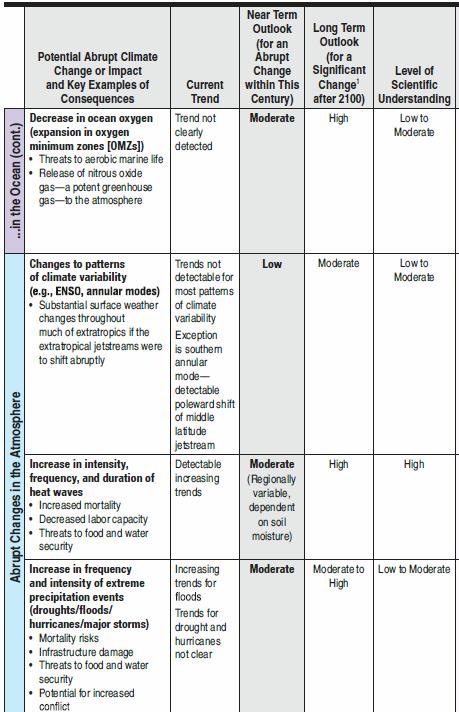
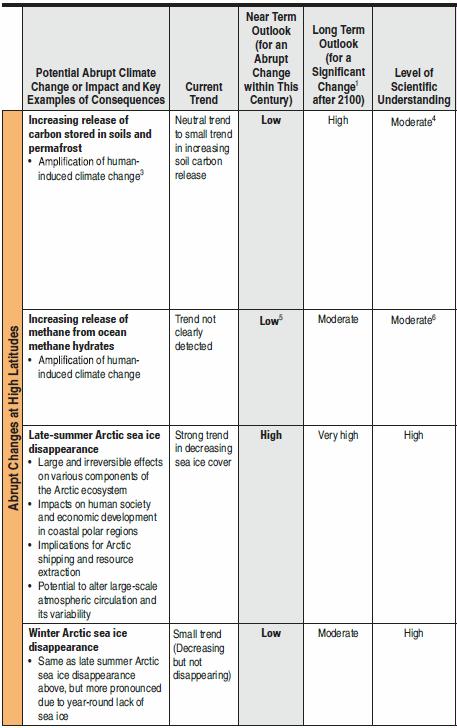
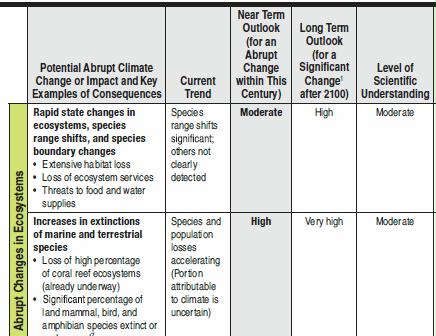
Table S1 from the report (pp 29-32) summarizing the possibilities
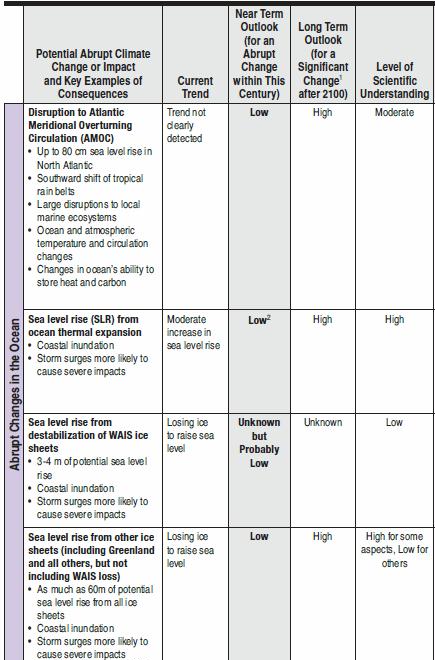
Abrupt climate change Table S1 (1)Abrupt climate change Table S1 (2)Abrupt climate change Table S1 (3)Abrupt climate change Table S1 (4)

The implications for food, disease, infrastructure, national security, and much more are discussed as well.  Here are some more pieces I copied from the NAS paper before I gave up — it’s just too long to summarize.

Abrupt changes—which can occur over periods as short as decades, or even years—have been a natural part of the climate system throughout Earth’s history.  One such abrupt change was at the end of the Younger Dryas, a period of cold climatic conditions and drought in the north that occurred about 12,000 years ago. Following a millennium-long cold period, the Younger Dryas abruptly terminated in a few decades or less and is associated with the extinction of 72 percent of the large-bodied mammals in North America.

Abrupt Changes Already Underway

Some abrupt climate changes are already underway, including the rapid decline of Arctic sea ice over the past decade due to warmer polar temperatures. Impacts include disruptions in the marine food web, shifts in the habitats of some marine mammals, and erosion of lation systems of the ocean and atmosphere, changes in the extent of sea ice could cause shifts in climate and weather around the northern hemisphere. The Arctic is also a region of increasing economic importance for a diverse range of stakeholders, and reductions in Arctic sea ice will bring new legal and political challenges as navigation routes for commercial shipping open and marine access to the region increases for offshore oil and gas development, tourism, fishing and other activities.

Increases in Extinction Threat for Marine and Terrestrial Species

The rate of climate change now underway is probably as fast as any warming event in the past 65 million years, and it is projected that its pace over the next 30 to 80 years will continue to be faster and more intense. These rapidly changing conditions make survival difficult for many species. Biologically important climatic attributes—such as number of frost-free days, length and timing of growing seasons, and the frequency and intensity of extreme events (such as number of extremely hot days or severe storms)—are changing so rapidly that some species can neither move nor adapt fast enough

The distinct risks of climate change exacerbate other widely recognized and severe extinction pressures, especially habitat destruction, competition from invasive species, and unsustainable exploitation of species for economic gain, which have already elevated extinction rates to many times above background rates. If unchecked, habitat destruction, fragmentation, and over-exploitation, even without climate change, could result in a mass extinction within the next few centuries equivalent in magnitude to the one that wiped out the dinosaurs. With the ongoing pressures of climate change, comparable levels of extinction conceivably could occur before the year 2100; indeed, some models show a crash of coral reefs from climate change alone as early as 2060

Loss of a species is permanent and irreversible, and has both economic impacts and ethical implications. The economic impacts derive from loss of ecosystem services, revenue, and jobs, for example in the fishing, forestry, and ecotourism industries. Ethical implications include the permanent loss of irreplaceable species and ecosystems as the current generation’s legacy to the next generation.

Abrupt Changes of Unknown Probability

Destabilization of the West Antarctic Ice Sheet

Of greatest concern among the stocks of land ice are those glaciers whose bases are well below sea level, which includes most of West Antarctica, as well as smaller parts of East Antarctica and Greenland. These glaciers are sensitive to warming oceans, which help to thermally erode their base, as well as rising sea level, which helps to float the ice, further destabilizing them.   Locations where meltwater forms on the ice shelf surface can wedge open crevasses and cause ice-shelf disintegration—in some cases, very rapidly.

the Greenland ice sheet is not expected to destabilize rapidly within this century. However, a large part of the West Antarctic Ice Sheet (WAIS), representing 3–4 m (10 to 13 feet) of potential sea-level rise, is capable of flowing rapidly into deep ocean basins. Because the full suite of physical processes occurring where ice meets ocean is not included in comprehensive ice-sheet models, it remains possible that future rates of sea-level rise from the WAIS are underestimated, perhaps substantially. Because large uncertainties remain, the Committee judges an abrupt change in the WAIS within this century to be plausible, with an unknown although probably low probability.

Abrupt Changes Unlikely to Occur This Century

More recent research findings have shown that they may be less likely to occur within this century than previously considered possible. These include disruption to the Atlantic Meridional Overturning Circulation (AMOC) and potential abrupt changes of high-latitude methane sources (permafrost soil carbon and ocean methane hydrates). Although the Committee judges the likelihood of an abrupt change within this century to be low for these processes, should they occur even next century or beyond, there would likely be severe impacts.

Potential Abrupt Changes due to High-Latitude Methane

Large amounts of carbon are stored at high latitudes in potentially labile reservoirs such as permafrost soils and methane-containing ices called methane hydrate or clathrate, especially offshore in ocean marginal sediments. Owing to their sheer size, these carbon stocks have the potential to massively affect Earth’s climate should they somehow be released to the atmosphere. An abrupt release of methane is particularly worrisome because methane is many times more potent than carbon dioxide as a greenhouse gas over short time scales. Furthermore, methane is oxidized to carbon dioxide in the atmosphere, representing another carbon dioxide pathway from the biosphere to the atmosphere. According to current scientific understanding, Arctic carbon stores are poised to play a significant amplifying role in the century-scale buildup of carbon dioxide and methane in the atmosphere, but are unlikely to do so abruptly, i.e., on a timescale of one or a few decades. Although comforting, this conclusion is based on immature science and sparse monitoring capabilities. Basic research is required to assess the long-term stability of currently frozen Arctic and sub-Arctic soil stocks, and of the possibility of increasing the release of methane gas bubbles from currently frozen marine and terrestrial sediments, as temperatures rise.

Bark Beetle Outbreaks

Bark beetles are a natural part of forested ecosystems, and infestations are a regular force of natural change. In the last two decades, though, the bark beetle infestations that have occurred across large areas of North America have been the largest and most severe in recorded history, killing millions of trees across millions of hectares of forest from Alaska to southern California.  Climate change is thought to have played a significant role in these recent outbreaks by maintaining temperatures above a threshold that would normally lead to cold-induced mortality. In general, elevated temperatures in a warmer climate, particularly when there are consecutive warm years, can speed up reproductive cycles and increase the likelihood of outbreaks.

Climate is not the only stressor on the Earth system—other factors, including resource depletion and ever-growing human consumption and population, are exerting enormous pressure on nature’s and society’s resilience to sudden changes

infrastructure is built with certain expectations of useful life expectancy, but even gradual climate changes may trigger abrupt thresholds in their utility, such as rising sea levels surpassing sea walls or thawing permafrost destabilizing pipelines, buildings, and roads.

VULNERABILITY OF U.S. COASTAL INFRASTRUCTURE TO RISING SEAS

• 39% of the population lives in coastal shoreline counties, by 2020 the percent will rise to 47%. Coastal counties contributed almost half of USA GDP in 2011 ($6.6 trillion dollars)

• 51 million: Total number of jobs in the coastal shoreline counties of the US in 2011.

• $2.8 trillion: Wages paid out to employees working at establishments in the coastal shoreline counties in 2011.

• 3: Global GDP rank (behind the United States and China) of the coastal shoreline counties, if considered an individual country.

• 446 persons/mi2: Average population density of the coastal watershed counties (excluding Alaska). Inland density averages 61 persons per square mile.

It’s likely sea level will rise at least by a meter by the end of the century.  For low lying metropolitan areas, such as Miami and San Francisco, such a rise could lead to significant flooding. These areas would be difficult to defend by dikes and dams, and such a large sea level rise would require responses ranging from potentially large and expensive engineering projects to partial or complete abandonment of now-valuable areas as critical infrastructure such as sewer systems, gas lines, and roads are disrupted, perhaps crossing tipping points for adaptation. Miami was founded little more than one century ago, and could face the possibility of sea level rise high enough to potentially threaten the city’s critical infrastructure in another century. In terms of modern expectations for the lifetime of a city’s infrastructure, this is abrupt.

If sometime in the coming centuries sea level should rise 20 to 25 m, as suggested for the Pliocene Epoch, 3 to 5 million years ago (see Figure 2.5), when CO2 is estimated to have had levels similar to today of roughly 400 parts per million, most of Delaware, the first State in the Union, would be under water without very large engineering projects (Figure B). In terms of the expected lifetime of a State, this could also qualify as abrupt.

A study of Earth’s climate history suggests the inevitability of “tipping points”— thresholds beyond which major and rapid changes occur when crossed—that lead to abrupt changes in the climate system. The history of climate on the planet—as read in archives such as tree rings, ocean sediments, and ice cores—is punctuated with large changes that occurred rapidly, over the course of decades to as little as a few years.

The current rate of carbon emissions is changing the climate system at an accelerating pace, making the chances of crossing tipping points all the more likely.

Surprises are inevitable. The question is whether surprises can be anticipated and reduced. That issue is addressed in this report.

Scientific research has already helped us reduce this uncertainty in two important cases; potential abrupt changes in ocean deep water formation and the release of carbon from frozen soils and ices in the polar regions were once of serious near-term concern are now understood to be less imminent, although still worrisome as slow changes over longer time horizons.

In contrast, the potential for abrupt changes in ecosystems, weather and climate extremes, and groundwater supplies critical for agriculture now seem more likely, severe, and imminent.

And the recognition that a gradually changing climate can push both natural systems, as well as human systems, across tipping points has grown over the past decade. This report addresses both abrupt climate changes in the physical climate system, and abrupt climate impacts that occur in human and natural systems from a steadily changing climate.

In addition to a changing climate, multiple other stressors are pushing natural and human systems toward their limits, and thus become more sensitive to small perturbations that can trigger large responses. Groundwater aquifers, for example, are being depleted in many parts of the world, including the southeast of the United States. Groundwater is critical for farmers to ride out droughts, and if that safety net reaches an abrupt end, the impact of droughts on the food supply will be even larger.

it is important to carefully catalog the assets at risk—societies cannot protect everything and will need to prioritize, and without an understanding of what could be lost, such as coastal infrastructure to rising seas, for example, intelligent decisions about what to protect first cannot be made.

Can all tipping points be foreseen? Probably not. Some will have no precursors, or may be triggered by naturally occurring variability in the climate system. Some will be difficult to detect, clearly visible only after they have been crossed and an abrupt change becomes inevitable. Imagine an early European explorer in North America, paddling a canoe on the swift river. This river happens to be named Niagara, but the paddler does not know that. As the paddler approaches the Falls, the roar of the water goes from faint to alarming, and the paddler desperately tries to make for shore. But the water is too swift, the tipping point has already been crossed, and the canoe—with the paddler—goes over the Falls.

Likelihood of Abrupt Changes in ocean oxygen levels

Changes in global ocean oxygen concentrations have the potential to be abrupt because of the threshold to anoxic conditions, under which the region becomes uninhabitable for aerobic organisms including fish and benthic organisms. Once this tipping point is reached in an area, anaerobic processes would be expected to dominate resulting in a likely increase in the production of the greenhouse gas N2O.

OMZs have also been intensified in many areas of the world’s coastal oceans by runoff of plant fertilizers from agriculture and incomplete wastewater treatment. These ‘dead zones’ have spread significantly since the middle of the last century and pose a threat to coastal marine ecosystems

Weather and Climate Extremes

Extreme weather and climate events are among the most deadly and costly natural disasters. For example, tropical cyclone Bhola in 1970 caused about 300,000-500,000 deaths in East Pakistan (Bangladesh today) and West Bengal of India.3,4 Hurricane Katrina caused more than 1,800 deaths and $96-$125 billion in damages to the Southeast U.S. in 2005. Worldwide, more than 115 million people are affected and more than 9,000 people are killed annually by floods, most of them in Asia (Figure 2.9 or see, for example, the Emergency Events Database5). Heat waves contributed to more than 70,000 deaths in Europe in 2003 (e.g., Robine et al., 2008) and more than 730 deaths and thousands of hospitalizations in Chicago in 1995 (Chicago Tribune, July 31, 1995; Centers for Disease Control and Prevention, 1995). Heat waves are one of the largest weather-related sources of mortality in the United States annually.6 According to data collected by the National Climate Data Center, there were 134 weather or climate disaster events with losses exceeding $1 billion each in the United States between 1980 and 2011, an average of more than four per year (Table 2.1). Floods, droughts and wildfires—events that appear to be changing in frequency and severity due to climate change—make up about a third of these and slightly more than a third of the dollar damages (adjusted to 2012 dollars). Droughts are particularly costly, comprising about 12 percent of the events by number, but about double that (23.8 percent) by total cost.

Abrupt Changes at High Latitudes

Potential Climate Surprises Due to High-Latitude Methane and Carbon Cycles

Interest in high-latitude methane and carbon cycles is motivated by the existence of very large stores of carbon (C), in potentially labile reservoirs of soil organic carbon in permafrost (frozen) soils and in methane-containing ices called methane hydrate or clathrate, especially offshore in ocean marginal sediments. Owing to their sheer size, these carbon stocks have potential to massively impact the Earth’s climate, should they somehow be released to the atmosphere. An abrupt release of methane (CH4) is particularly worrisome as it is many times more potent as a greenhouse gas than carbon dioxide (CO2) over short time scales. Furthermore, methane is oxidized to CO2 in the atmosphere representing another CO2 pathway from the biosphere to the atmosphere in addition to direct release of CO2 from aerobic decomposition of carbon-rich soils.

Permafrost

Frozen northern soils contain enough carbon to drive a powerful carbon cycle feedback to a warming climate. These stocks across large areas of Siberia comprise mainly an ice-rich, loess-like deposit averaging ~25 m deep, peatlands, and river delta deposits. Estimates of the total soil-carbon stock in permafrost in the Arctic range from 1,700–1,850 Gt C (Gt C = gigatons of carbon).

To put the Arctic soil carbon reservoir into perspective, the carbon it contains exceeds current estimates of the total carbon content of all living vegetation on Earth (approximately 650 Gt C), the atmosphere (730 Gt C, up from ~360 Gt C during the last ice age and 560 Gt C prior to industrialization), proved reserves of recoverable conventional oil and coal (about 145 Gt C and 632 Gt C, respectively), and even approaches geological estimates of all fossil fuels contained within the Earth (~1,500 – 5,000 Gt C). It represents more than two and a half centuries of our current rate of carbon release through fossil fuel burning and the production of cement (nearly 9 Gt C per year).

it is clear that the time scale for deep permafrost thaw is measured in centuries, not years. Furthermore, unlike methane hydrates (see below), the very large stocks of permafrost soil carbon (i.e., the 1,672 Gt C ) must first undergo anaerobic microbial fermentation to produce methane, itself a gradual decomposition process. There are no currently proposed mechanisms that could liberate a climatically significant amount of methane or CO2 from frozen permafrost soils within an abrupt time scale of a few years, and it appears gradual increases in carbon release from warming soils can be at least partially offset, owing to rising vegetation net primary productivity. Over a time scale of decades, however, a possible self-sustaining decomposition of Yedoma could occur before the end of this century (Khvorostyanov et al., 2008a, 2008b, 2008c). A related idea is the possibility of rising soil temperatures triggering a “compost bomb instability” —possibly including combustion—and a prime example of a rate-dependent tipping point. Such possibilities would represent a rapid breakdown of the Arctic’s very large soil carbon stocks and warrant further research. Even absent an abrupt or catastrophic mobilization of CO2 or methane from permafrost carbon stocks, it is important to recognize that Arctic emissions of these critical greenhouse gases are projected to increase gradually for many decades to centuries, thus helping to drive the global climate system more quickly towards other abrupt thresholds examined in this report.

Methane Hydrates in the Ocean

Under conditions of high pressure, high methane concentration, and low temperature, water and methane can combine to form icy solids known as methane hydrates or clathrates in ocean sediments. The methane derives from biological or thermal degradation of organic matter originally deposited on the sea floor. Although the overall rate of methane production in ocean sediments is fairly slow, over millions of years, substantial reservoirs of methane hydrate have accumulated in the world’s ocean margins. Throughout most of the world ocean, a water depth of about 700 m is required for hydrate stability. In the Arctic, due to colder-than-average water temperatures, only about 200 m of water depth is required, which increases the vulnerability of those methane hydrates to a warming Arctic Ocean. The Arctic is also a focus of concern because of the wide expanse of continental shelf (25 percent of the world’s total), much of which is still frozen owing to its exposure to the frigid atmosphere during lowered sea levels of the last glacial maximum.

The inventory of methane in ocean margin sediments is large but not well constrained, with a generally agreed upon range of 1,000-10,000 Gt C (Archer, 2007; Boswell, 2007; Boswell et al., 2012). One inventory places the total Arctic Ocean hydrates at about 1,600 Gt C by extrapolation of an estimate from Shakhova et al. (2010a) to the entire Arctic shelf region (Isaksen et al., 2011) (see Figure 2.12). The geothermal increase in temperature with depth in the sediment column restricts methane hydrate to within a few hundred meters thickness near the upper surface of the sediments (e.g., Davie and Buffett, 2001). Beneath this stability zone, a layer rich in methane bubbles is often seen in seismic reflection data, called a “bottom simulating reflector.” The areal extent of methane-rich sediments is fairly well known from seismic observations of this feature, but uncertainty in the concentration of methane in those sediments is very large, thus resulting in the large uncertainty in the global inventory of ocean-floor methane.

Potential response to a warming climate

Climate change has the potential to impact ocean methane hydrate deposits through changes in ocean water temperature near the sea bed, or variations in pressure associated with changing sea level. Of the two, temperature changes are thought to be most important, both during the last deglaciation and also in the future. Warming bottom waters in deeper parts of the ocean, where surface sediment is much colder than freezing and the hydrate stability zone is relatively thick, would not thaw hydrates near the sediment surface, but downward heat diffusion into the sediment column would thin the stability zone from below, causing basal hydrates to decompose, releasing gaseous methane. The time scale for this mechanism of hydrate thawing is on the order of centuries to millennia, limited by the rate of anthropogenic heat diffusion into the deep ocean and sediment column. Even on the Siberian continental margin, where water temperatures are colder than the global average, and where the sediment column retains the cold imprint from its exposure to the atmosphere during the last glacial time 20,000 years ago, any methane hydrate must be buried under at least 200 m of water or sediment. Bottom waters at depths of 50 or 100 m might warm relatively quickly with a collapse in sea ice cover, but it would take centuries for that heat to diffuse through the 100- 150 m of sediment column to the hydrate stability zone. Thus the release of 50 Gt C from the Siberian continental shelf in 10 years as postulated by Whiteman et al. (2013) is unlikely.

The proportion of this gas production that will reach the atmosphere as CH4 is likely to be small. To reach the atmosphere, the CH4 would have to avoid oxidization within the sediment column (a chemical trap) and re-freezing within the stability zone shallower in the sediment column (a cold trap). However, the hydrate stability zone thickness decreases to zero near the top of its depth range in the ocean, and an increase in water column temperature there could eliminate the stability zone entirely, potentially providing an easier pathway for methane to reach the sea floor. Episodic and explosive escapes of gaseous methane from the sediment column have been documented by kilometer-scale “wipeout zones” in seismic images, and pockmarks on the sea floor, called eruption craters. However, the processes responsible for these observations are too poorly understood to predict what fraction of deeper CH4 might be released through them.

Most of the methane gas that emerges from the sea floor dissolves in the water column and oxidizes to CO2 instead of reaching the atmosphere. Bubble plumes tend to dissolve on a height scale of tens of meters, although larger plumes, consisting of larger bubbles, do rise farther. However, even in the cold Arctic Ocean, methane hydrate is only stable below about 200 m water depth, making for an inefficient pathway to the atmosphere at best.

The highest oceanic methane fluxes to the atmosphere in the Arctic are probably in the coastal zone, associated with erosion of coastal permafrost. In this region and terrestrial lakes the methane flux to the atmosphere is strongly impacted by ice formation on the water surface, providing another mechanism for climate feedback.

A more abrupt way to transfer methane hydrate from the sediment column to the atmosphere is by way of a submarine landslide. Methane hydrate floats in seawater just as water ice floats, and it also has greater potential to reach the atmosphere than methane bubbles. The largest known submarine landslide (called Storegga) occurred ~8000 years ago, as documented in sediment deposits off Norway. The volume of sliding material multiplied by a reasonable hydrate fraction in the pore space yields a possible methane source of about 1 Gt C. The climatic impact of this quantity of methane would be comparable to that of a volcanic eruption (although warming rather than cooling). As such it would have a significant climate impact, but one that is likely to be smaller than that of the anthropogenic CO2 rise.

Over time scales of centuries and millennia, the ocean hydrate pool has the potential to be a significant amplifier of the anthropogenic fossil fuel carbon release. Because the chemistry of the ocean equilibrates with that of the atmosphere (on time scales of decades to centuries), methane oxidized to CO2 in the water column will eventually increase the atmospheric CO2 burden.

As with decomposing permafrost soils, such release of carbon from the ocean hydrate pool would represent a change to the Earth’s climate system that is irreversible over centuries to millennia. Modeling the response of ocean hydrates to climate change is in its infancy. The largest uncertainty is the concentration of methane hydrate, especially in the shallow sediment column near the sediment water interface.

In summary, the ocean methane hydrate pool has strong potential to amplify the human CO2 release from fossil fuel combustion over times scales of decades to centuries. While anthropogenic warming should accelerate the thawing of offshore permafrost via warming of Arctic Ocean shelf waters, this impact should be considered additive to a broader thawing trend that has been underway for thousands of years.

Impacts of Arctic Methane on Global Climate

Although attention is often focused on methane when considering a potential Arctic carbon release, because methane is a short-lived gas in the atmosphere (CH4 oxidizes to CO2 within about a decade), ultimately a methane problem is a CO2 problem. It does matter how rapidly methane is released, and the impacts of a spike versus chronic emissions are discussed in Box 2.4. As methane emissions from permafrost degradation will also be accompanied by larger fluxes of CO2, Arctic carbon stores clearly have the potential to be a significant amplifier to the human release of carbon.

Speculations about potential methane releases in the Arctic have ranged up to about 75 Gt C from the land and 50 Gt C from the ocean. A release of 50 Gt C methane from the Arctic to the atmosphere over 100 years would increase Arctic CH4 emissions by about a factor of 25, and would make the present-day permafrost area about two times more productive of CH4 on average as comes from wetlands today. Postulating such a methane release over a more abrupt 10-year time scale, the emission rates from present-day permafrost would have to exceed that from wetlands by a seemingly implausible factor of 20, supporting a longer century timescale for this process, and making methane emission from polar regions an unlikely candidate for a tipping point in the climate system.

Nonetheless, as can be seen in Box 2.4, releasing 50 Gt C of methane over 100 years would have a significant impact on Earth’s climate. The atmospheric CH4 concentration would roughly quadruple, with a resulting total radiative forcing from CH4 of about 3 Watts/m2. The magnitude of this forcing is comparable to that from doubling the atmospheric CO2 concentration, but the impact of the methane forcing would be strongly attenuated by its short duration.   As concluded above, an increase in Arctic CH4 emissions of more than a factor of 10 is required before it would begin to have a significant impact on Earth’s climate in the short term. Such a strong acceleration of methane degassing from the Arctic would result in measurably higher concentrations of methane in the high northern latitudes.

Summary

Arctic carbon stores are poised to play a significant amplifying role in the century time scale buildup of CO2 and methane in the atmosphere, but are unlikely to do so abruptly, on a time scale of one or a few decades. This conclusion is based on immature science, however, and a truly sparse monitoring capability


What is known about the likelihood and timing of abrupt changes in the climate system over decadal timescales?

• large, abrupt changes in ocean circulation and regional climate;

• reduced ice in the Arctic Ocean and permafrost regions;

• large-scale clathrate release;

• changes in ice sheets;

• large, rapid global sea-level rise;

• growing frequency and length of heat waves and droughts;

• effects on biological systems of permafrost/ground thawing (carbon cycle effects);

• phase changes such as cloud formation processes; and

• changes in weather patterns, such as changes in snowpack, increased frequency and magnitude of heavy rainfall events and floods, or changes in monsoon patterns and modes of interannual or decadal variability.

Posted in CO2 and Methane | 1 Comment

Pity Brazil’s Military Police. FEB. 19, 2014. Vanessa Barbara. New York Times.

Pity Brazil’s Military Police. FEB. 19, 2014.  Vanessa Barbara. New York Times.

  • In 2012, 1,890 Brazilians were killed by the police.
  • 351 occurred in São Paulo — 20% of all homicides.
  • Organized crime retaliated by killing 11 police officers and another 100 off-duty.
  • Police officers are 3 times more likely to be murdered than the average Brazilian.
  • 70 percent of Brazilians distrust the police — they have lost their legitimacy.

In São Paulo, lower ranked military police officers earn an annual salary of $15,248, including benefits and danger pay allowances. They work in 12-hour shifts, night and day, for an average of 42 hours a week. But only in theory. Officers claim the rules are often ignored, with extended overtime, short notice of scheduling changes and irregular or no lunch breaks. Some take on additional jobs to supplement their wages, not only as private security guards (which is illegal), but also in a program called “Atividade Delegada,” through which the city hires policemen in their spare time, offering the equivalent of $64 for eight extra hours patrolling the streets.

There are two main kinds of police in Brazil. The civilian police concentrate on criminal investigations, while the military police have the duty of maintaining public order and working to prevent crimes.

The military police are not part of the armed forces, and yet they operate according to military principles of rank and discipline. They cannot strike or unionize, and are subject to a military-style penal code (meaning transgressions at work can be treated as mutiny or treason, and officers are tried in a special court). They are prohibited from “revealing facts or documents that can discredit the police or disrupt hierarchy or discipline.

They also can’t openly disapprove of the acts of civilian authorities from the executive, legislative or judicial branches of government, and are forbidden to express their personal political opinions.

“I love my job, I really do,” one member of the military police recently told me. “But our work goes unrecognized. Our errors are scrutinized. We have fractions of a second to decide between accelerating or braking, shooting or retreating; either way we are blamed. He noted that police officers were sometimes the only agents of the state stationed in poor neighborhoods dominated by organized crime. “Everything is on us.

But their main complaint is the impunity of criminals. Many believe Brazil’s judicial institutions are too lenient and inefficient. Officers are tired of arresting the same suspects over and over.

According to Adilson Paes, a retired police lieutenant colonel who conducted a study on police brutality, some officers turn vigilante as a result. This was also the conclusion of an investigation into policing in Rio de Janeiro and São Paulo conducted by Human Rights Watch: Many deaths of civilians “resisting arrest” are in fact extrajudicial killings, the report found, and “some police officers are members of ‘death squads,”’ which are “responsible for hundreds of murders each year.

This often leads to a cycle of retribution between the police and organized crime. Just a month ago, in Campinas, a city 60 miles from São Paulo, a policeman was killed in front of his wife during a robbery; within a few hours, 12 people were found executed — apparently by the police, as revenge. And sometimes corrupt police officers themselves are involved in organized crime.

Lately, more Brazilians have been taking notice, as police brutality is increasingly directed against journalists and political protesters (many from the middle class), instead of just the same old black and poor citizens who live in favelas.

Posted in Crime, Gangs, Corrupt police, Private security | Comments Off on Pity Brazil’s Military Police. FEB. 19, 2014. Vanessa Barbara. New York Times.

Gail Tverberg advice on what to do

Below are 2 columns of advice from Gail Tverberg.

Feb 17, 2014. Reaching Limits to Growth: What Should our Response Be?

Oil limits seem to be pushing us toward a permanent downturn, including a crash in credit availability, loss of jobs, and even possible government collapse. In this process, we are likely to lose access to both fossil fuels and grid electricity. Supply chains will likely need to be very short, because of the lack of credit. This will lead to a need for the use of local materials.

The time-period is not entirely clear. Some countries, such as Greece and Syria, will be seeing these effects quite soon. Other countries may not see the full effects for perhaps ten or twenty years. What should our response be?

It seems to me that there are many different answers, depending on who we are and what our goals are. The various options are not mutually exclusive.

Option 1. Make the most of the time we have available.

If there are things that are important to you, do them now. If you have been meaning to reconnect ties with family members or old friends, now is the time to do it. If there are things you would like to accomplish that require today’s transportation and services, do them now. If you want to support local charities, now would be a good time to do it.

Appreciate what you have now. We have been privileged to live in a society where transportation is readily available and where most of us can live in homes that are comfortably heated and cooled. At the same time, we can still enjoy many of the benefits of nature—clear skies and plants and animals around us. Life expectancies in the past were generally 35 years or less. Most of us have already lived longer than we could have expected to live in the past.

Develop stronger relationships with family and community.  This is likely to be a difficult transition. It is likely to be helpful to have as many allies as possible in transition. It may be helpful to move closer to other family members. Another approach is to form or join community groups, such as a church group or a group interested in common goals. The ties a person can form are likely to be helpful regardless of what path lies ahead.

Option 2. Prepare at least a little for the future

Learn to bounce back from downturns.  When I was an editor at The Oil Drum, I was editor for a letter from a man who grew up in Kenya and returned there practically every year. He told that the people in Kenya were very happy, even though they had little material goods and mortality was high.  One thing he mentioned was that if things went wrong—the death of a child for example—people were able to mourn for a day, and then move on. They also rejoiced in things we take for granted, such as being able to obtain enough food for the current day.

Do what you can to improve your health. In the United States, we have been used to a combination of practices that lead to overweight: (1) much too large food portions, (2) much processed food including much sugar and (3) lack of exercise. If we can change our eating and exercise practices, it is likely that we can improve our health. If healthcare goes downhill, fixing our personal health somewhat protects us.

Learn what you can about first aid. Injuries are likely to be more of an issue, as we work outside more.

We will need some specialists as well. As long as we eat grains, we will need dentists. As long as babies are born, we will need helpers of some type–doctors or midwives.

If circumstances permit, plant a garden and fruit or nut trees. Eventually, all food production will need to be local. Getting from our current industrialized agricultural model to a model with local food production with little (if any) fossil fuel inputs is likely to be a difficult transition. One approach is to learn what local plants, animals, and insects are edible. Another is to attempt to grow your own. Doing the latter will generally require considerable learning about what plants grow in your area, approaches to building and maintaining soil fertility, methods of preventing erosion, and a variety of related topics.

Find alternative water supplies. We currently are dependent on a water supply chain that can be broken in a variety of ways—drought, loss of electricity, storm damage, or pollution problems. If the long-term water supply seems questionable, it may be helpful to move to another location, sooner rather than later. Alternatively, we can figure out how to bridge a gap in water supplies, such as through access to a creek or lake. For the very short-term, a water barrel of stored water might be helpful.

Figure out alternative cooking arrangements. We humans are dependent on cooking for purifying water, for allowing us to eat a wider variety of food, and for allowing us to obtain greater nutrition from the food we eat, without chewing literally half of the day. We now depend primarily on electricity or natural gas for cooking. Determine what alternative cooking arrangements can be made in your area, in the event current cooking arrangements become unavailable. An example might be an outdoor fireplace with locally gathered sticks for fuel, perhaps supplemented by a solar cooker with reflective sides.

Store up a little food to bridge a temporary supply interruption. We have troubles today with wind storms and snow storms. There are any number of other types of interruptions that could happen if businesses encounter credit problems that lead to supply chain interruptions. It doesn’t hurt to be prepared.

Option 3. Figure out what options might work for a few years for taking care of yourself and your family 

We have a lot of goods made with fossil fuels that probably will work for a while, but likely won’t be available for the long term. Examples include solar PV, batteries, power saws, electric pumps, electric fences, bicycles, light bulbs, and many other devices that we take for granted today. Of course, as soon as any part breaks and can’t be replaced, we are likely to be “up a creek, without a paddle.”

I expect that quite a few of the permaculture solutions and organic gardening solutions are temporary solutions. They work for now, but whether they will work for the long term is less clear. We are not going to be able to make and transport organic sprays for fruit for very long and irrigation systems will need to be very simple to be resilient. Plastic wears out and even metal tools will be hard to replace.

Purchasing land for agriculture can perhaps be a partial solution for some individuals, with sufficient skills and tools. Ideally, a person will want to be part of a larger group of people using a larger piece of land, rather than a smaller group, using a smaller piece of land, because of the problem that occurs if one worker gets sick or injured. It may be helpful to have multiple non-contiguous pieces of land, to help even out impacts of bad weather and pests. Ideally, the land should be large enough so that part of the land can remain fallow, or be used for feeding animals, and can be rotated with crop-producing land.

Security is likely be a problem, especially if a single home is distant from other homes. Ideally, a family will be part of a larger group in order to provide security.

Other issues include inability to pay taxes and the government taking over property. Because of the many issues involved, any solution is, at best, temporary. Unfortunately, that may be the best we can do. As parts of the system fail, a local group may be able to support fewer people. Then the group will need to deal with how to handle this situation–everyone starve, or kick out a few members from the group, or attack another group, with the hope of obtaining control of their resources.

Option 4. Work on trying to solve the long-term problem.

There are many studies of how pre-industrial societies operated without fossil fuels and without electricity. For example, Jared Diamond gives his view of how some very early societies functioned in The World Until Yesterday. The Merchant of Prato by Iris Origo documents the life of one particular 14th century merchant, based on old letters and other documents.

Through studies of how past societies behaved, it might be possible for today’s people to develop a civilization that could be operated using only renewable resources of the types used in pre-industrial times, such as wood, water wheels, and sail boats. Such groups would probably not be able to use much metal or concrete because of the problem with deforestation when wood is used for energy-intensive operations. (Today’s so-called “renewables,” such as hydro-electric, wind turbines and solar PV require fossil fuels for manufacture and upkeep, so likely will not be available for very long.)  Heating of homes will need to be very limited as well, to prevent deforestation.

As a practical matter, the groups best equipped to make such a change are ones that have recently been hunter-gatherers and still have some memory of how they operated in the past. Perhaps some former hunter-gatherers could give instruction to others in sort of a reverse Peace Corps operation.

We do know some approaches that have been used in the past. Dogs have been used to help with herding animals, for hunting, and for warmth. Animals of various types have been used for transportation and for plowing. The downside is that animals require the use of a lot of land to produce the food needed for them to eat.

Traditional societies have used the giving of gifts and the requirement of reciprocal gift giving to increase the strength of relationships and as a substitute for our money-based financial system. With such an approach, a person gains status not by what he has, but by what he gives away.

Storytelling has been a way of passing on knowledge and entertainment for generations. Songs, games, and simple musical instruments are also part of many traditions. These are approaches that can be used in the future as well.

Option 5. Take steps toward getting population in line with likely long-term energy availability.

The world is now overfilled with people and with the many animals that people raise for food or as pets. Without fossil fuels and network electricity, we probably will not be able to feed more than a fraction of the current population of humans and domesticated animals.

Some steps we might take:

Keep family sizes small. Encourage one-child families. When a family pet dies, don’t replace it (or replace it with a smaller animal).

Eat much less meat. This could be started even now.

Option 6. Rearrange personal finances.

Paper investments are, in general, not going to be worth much, regardless of how we rearrange them, if resource availability drops greatly. Ultimately, paper investments allow us to buy goods available in the marketplace. But if there isn’t much to buy in the marketplace, they are likely to be much less helpful than we assume. Precious metals have the same difficulty–they can’t buy what is not available.

Purchasing land is theoretically better, but even land can be taken away from us by taxes or by appropriation. There is also a possibility that we may need to move, if conditions change, regardless of what property ownership conditions seem to be.

We need to learn to take each day as it comes. If we find that our bank accounts aren’t there, or that only a small fraction of the money can be withdrawn, or that the money is in the bank doesn’t buy much of anything, we need somehow to figure out a way around the situation. Very likely everyone else will be in the same boat. This is a major reason for working on substitute access to food and water supplies.

Option 7. Put more emphasis on relationships. 

Studies show that relationships are what bring happiness—not the accumulation of goods. Starting to work now on developing additional strong relationships would seem to be a worthwhile goal. In traditional societies, extended family relationships were very important.

Religions can teach us how we treat our neighbors and thus about relationships. A version of the Golden Rule (Do unto others as you would have then do unto you) is found in several major religions. Many readers of this blog have given up on religions as hopelessly out of date, instead choosing such “wisdom” as, “He who dies with the most toys wins.” In fact, this latter wisdom is clearly nonsense. We can expect our fossil-fuel based “toys” to lose their usefulness before our very eyes in the not too distant future. Ben Bernanke and Janet Yellen are not gods, even if we are told that they are all-powerful.

Another aspect of keeping good relationships is finding ways to mend broken relationships. One such approach is forgiveness. Another is through reconciliation procedures aimed at returning broken relationships to wholeness. Such procedures are common in small societies, according to Diamond (2012).

Option 8. Find ways to deal with the stresses of a likely downturn ahead.

As much as we would like to take one day at a time, oftentimes it is easy to worry, even though this does no good.

Even though we think we know that outcome of our current difficulties, we really do not. The universe has many physical laws. Ultimately, the source of all of these physical laws is not clear–is there a Supreme Being behind them? The story of natural selection is in many ways a miracle. The story of human existence represents more miracles—learning to control fire; learning to control our environment through agriculture; learning to modify our environment further through the use of fossil fuels. In my own personal life, I see a pattern of circumstances working together in ways I could never have expected.

We are not the first to go through hard times. Because of my background, I find myself comforted by many Biblical passages. I am sure other religions have other passages that are also helpful.

Yea, though I walk through the valley of the shadow of death, I will fear no evil, for though art with me. Thy rod and thy staff they comfort me. .  . Surely goodness and mercy will follow me all the days of my life. . . (Psalm 23: 4, 6)

. . . in all things God works for the good of those who love him . . . (Romans 8:28)

For me personally, more things have worked together for good than I would ever have dreamed possible. I will not rule out the possibility of this happening again in the future, regardless of what the external circumstances may look like.

Option 9. For those who are concerned about Climate Change

In my view, the changes we are encountering will bring a quick end to the use of fossil fuels. Thus, the concern that future fossil fuel use will cause rapid climate change is over-blown. If individuals would like to personally reduce their own fossil fuel use, I would suggest the following:

  • Stop eating meat now, especially that raised in our current industrial system.
  • Get rid of pets that are not providing support functions, such as hunting for food.
  • Spend less of your wages. With more of the money left in the bank or in paper investments, this money will lose value and thus will reduce spending on fossil fuel-based goods and services. (While theoretically this money could be lent out and reinvested, lack of credit availability will put an end to this practice.)
  • Use a bicycle for transport instead of a car, when possible. Or walk.
  • Purchase a more fuel efficient car, if you need to replace a current vehicle.
  • Turn down the heat in your home or apartment. Don’t use air conditioning.

I would suggest quitting your job as well, but if you quit your job, the job is likely to go to someone else, resulting in the same fossil fuel use for someone else.  Even stopping a business you own will not necessarily work, if another business will expand and take its place. If the business that ramps up is in a part of the world that uses coal as its primary fuel, stopping your local business may lead to an increase in world carbon dioxide emissions.

Gail Tverberg. 30 May 2013. Energy limits: Is there anything we can do? 

The energy limit we are running into is a cost limit. I would argue that neither the Republican or Democrat approach to solving the problem will really work.

The Republicans favor “Drill Baby Drill”. If the issue is that the price of oil extraction is too high, additional drilling doesn’t really fix the problem. At best, it gives us a little more expensive oil to add to the world’s supply. The Wall Street research firm Sanford Bernstein recently estimated that the non-Opec marginal cost of production rose to $104.50 a barrel in 2012, up more than 13 per cent from $92.30 a barrel in 2011.

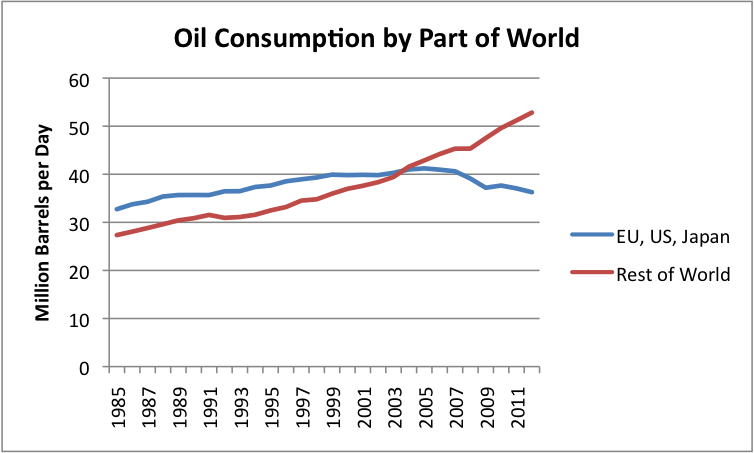
US consumers still cannot afford to buy high-priced oil, even if we extract the oil ourselves. The countries that see rising oil consumption tend to be ones that can leverage its use better with cheaper fuels, particularly coal (Figure 1). See Why coal consumption keeps rising; what economists missed. The recent reduction in US oil usage is more related to young people not being able to afford to drive than it is to improved automobile efficiency. See my post, Why is gasoline mileage lower? Better gasoline mileage?

Figure 1. Oil consumption by part of the world, based on EIA data. 2012 world consumption data estimated based on world "all liquids" production amounts.

The Democrats favor subsidizing high-priced energy approaches that wouldn’t be competitive without such subsidies. Government debt is at 103% of GDP. It is hard to see that the government can afford such subsidies. Also, it is doubtful that the supposed carbon-saving benefit is really there, when all of the follow-on effects are included. Buying wind turbine parts, solar panels, and goods that use rare earth minerals (used in many high-tech goods, including electric cars and  wind turbines) helps to stimulate the Chinese economy, adding to their coal use. Furthermore, the higher taxes needed to pay for these subsidies reduces the spendable income of the common worker, pushing the country in the direction of recession.

So what do we do as an alternative, if neither the Republican or Democrat approach works? I would argue that we are dealing with a situation that is essentially unfixable. It can be expected to morph into a financial crash, for reasons I explained in How Resource Limits Lead to Financial Collapse. Thus, the issue we will need to mitigate will be debt defaults, loss of jobs, and possibly major changes to governments. If we are dealing with a financial crash, oil prices may in fact be lower, but people will still be unable to afford the oil because of other issues, such as lack of jobs or lack of access to money in their bank accounts.

Because neither political party can fix our problem, I expect that most of our responses will necessarily be individual, personal responses. These are a few ideas:

1. Get out of debt situations, if it is easy to do. 

There are a lot of people who own stocks on margin, or who own an expensive house with a big mortgage on it. Now, with prices of stocks and homes both higher, would be a good time to get out of both types of debt. Sell the stock or buy a less expensive house, without the mortgage.

Equities and home prices both seem to be inflated now, indirectly because of Quantitative Easing. Some recent analysis suggests that real (that is, inflation adjusted) interest rates are rising partly because inflation is falling.  The reason that inflation is falling is because oil prices are lower (Figure 2). Comparing the first four months of 2013 with the first four months of 2012, oil prices are about $9 per barrel lower. Oil prices are lower because of reduced demand due to economic contraction, especially in Europe.

Figure 2. Spot oil prices and actual refiners acquisition costs, based on EIA data.

In the past month, there has also been an uptick in interest rates (even apart from the declining inflation component). According to the Wall Street Journal, “Yields on the benchmark 10-year U.S. Treasury note now stand above 2.1%—still low by historic standards, but nearly half a percentage point higher than at the start of May.” Mortgage rates are also reported to be half a percentage point higher than they were six months ago.

There are a number of risks with rising real interest rates and falling inflation. One is that the higher interest rates will trigger lower stock prices and lower house prices. Another is that deflation will continue, making debt payback more difficult. If this happens, it is something that the Fed can’t handle with its monetary easing policy. Interest rates can go to zero, but not below. A third issue, especially if interest rates rise further, is the adverse impact on the US government financial situation.

2. Reduce your expectations about what investments can do for you.

Dmitry Orlov, who has had experience with the collapse of the Former Soviet Union, made the remark, “There are two kinds of investments: those that lose all their value at once, and those that lose value slowly.” Paper investments are a particular problem, because they can decline in value very quickly if conditions change. Even real estate can be a problem, though, because governments can take away what you thought you owned, or raise taxes to a level that you cannot afford. If you buy something and have to move, but cannot take the object with you, you will likely lose the value you invested. The only things that are really yours to keep (at least until your declining years) are skills that you learn.

3. Take up a hobby that will provide food for your family (planting a few fruit or nut trees, adding a garden, raising a few chickens, or learning to hunt/fish).

Taking up hobbies such as these provide several functions: They provide a diversion away from the problems of the day, and let you feel like you are doing something helpful. They may actually provide a cushioning effect, if there is a sharp downturn. Taking up such hobbies can provide a useful skill for the future. In some cases, it may make sense to purchase land for purposes such as these. If considering doing this, a person should take note of items (1) and (2) above. It takes quite a long time to get started, and you can’t take the improved land with you, if you have to leave.

4. Learn to appreciate nature, family, and simple joys that can’t easily be taken away. It is possible to be happy, regardless of circumstances. We can find many good things in every day. Obsessing over the future is not really helpful. Don’t tie your happiness to having more “stuff”; you are likely to be disappointed. Learn to sing happy songs, or how to play a musical instrument. Or memorize uplifting poetry or religious writings.

5. Build a network of friends. If things go downhill, we can’t expect to use a gun to ward off intruders, night and day. If nothing else, we will run out of ammunition. Over the long term, the approach that is likely to be successful is working together with other community members toward a common goal.

6. Learn new skills, if you are concerned about job loss. Try to think of what will be needed in a lower-energy world. People will always need dentists and midwives, regardless of how poor they are. Buggy whip manufacturers went out of business long ago. Maybe we will need them back!

7. If you want to develop larger-scale plans (such as for cities or regions), keep them cheap and easy to implement. Governments are already running short of funds to implement plans. Look for approaches that are inexpensive to put in place, such as car-sharing plans. Alternatives that worked years ago, such as boats and canals, might be considered as well.

8. Aim for a flexible approach to problems. We don’t know things will turn out. Water may be in very short supply in one part of the country. Or job opportunities may open up in a place far from home. Even more than in the past, we are likely to need to be able to change our plans on short notice.

Posted in Expert Advice | Comments Off on Gail Tverberg advice on what to do

Colombia’s Warning for Mexico

Preface. This is a pattern you see over and over again in civil wars and collapsing bits of nations no longer under government control

Abadfeb’s editorial reminds me of feudalism. Until the rise of state-level armies in the 17th century, the nobility had their own soldiers to keep the peasants in line. Now, rich landowners hire vigilantes to fight guerrillas and drug cartels, which leads to vigilantes also dealing in drugs and killing civilians, and they become indistinguishable from the guerrillas, and too strong to be defeated by state level armies.  Here’s a summary of what Abadfeb describes is happening in Columbia and Mexico, which applies to many other countries as well:

  1. The army, blessed by central authorities, looks for an ally
  2. Compared to the evil guerrilla army, the vigilante self-defense groups look great — they have popular support and the state army gives them permission to fight the guerrillas.
  3. The government ignores the fact that some of these vigilantes might be financed by a rival drug gang.
  4. When the state tries to reassert order, they can’t. The vigilantes have turned into a powerful armed power and are now indistinguishable from the guerrilla army and gangsters they’re fighting. Abadfeb says the outcome is “outlying territories turn into battlefields where life is impossible for defenseless civilians. The legitimate economy and tourism disappear, death tolls soar, and the final winner, inevitably, is not the state but some local narco-dictator with his own army of mercenaries”.
  5. “The vigilantes might begin by killing kidnappers, drug dealers and extortionists, but soon they begin killing their relatives, and then their friends, or those they think are their friends, and then the friends’ families, until everyone is suspect and they might come knocking at your own door, as happened to us in Colombia — as happened to my own father, when he was gunned down in the streets of Medellín.  To allow private armies, even if they are supposedly for self-defense, is to create a monster like the Hydra: If you cut off one head, two more grow back”

When the State breaks down, here’s what happens, it can only guarantee security and the rule of law in certain areas, which tend to be the big cities. The farther away you get from cities, the more likely police officers are corrupt, judges are threatened by local dictators with their private armies, and bribery keeps anyone  from doing anything.  This is a pattern that can be throughout history as Turchin describes in his book Secular Cycles.

Alice Friedemann  www.energyskeptic.com  Author of Life After Fossil Fuels: A Reality Check on Alternative Energy; When Trucks Stop Running: Energy and the Future of Transportation”, Barriers to Making Algal Biofuels, & “Crunch! Whole Grain Artisan Chips and Crackers”.  Women in ecology  Podcasts: WGBH, Planet: Critical, Crazy Town, Collapse Chronicles, Derrick Jensen, Practical Prepping, Kunstler 253 &278, Peak Prosperity,  Index of best energyskeptic posts

Abadfeb H (2014) Colombia’s Warning for Mexico. New York Times.

Most everyone agrees: The only thing worse than killing is being killed. If our lives are threatened, we have the right to defend ourselves, with force if necessary. In a civilized society, that defense is delegated to the state.

Vigilante self-defense groups arose to protect people in Colombia in the 1990s.

Because the state was losing the war against the guerrilla army — essentially a drug cartel — and drug lord Pablo Escobar’s private army, the state gave the green light to these groups. They were made up of agricultural laborers, trained by soldiers, and financed by landowners and agribusinesses.  When the vigilantes began to extort money from the very businessmen who were financing them, they were declared illegal. But it was already too late. They had become clandestine paramilitary groups, using the same weapons as those they were fighting: kidnapping, murder of innocents, drug trafficking.

What has been going on these last few months in Mexico, in the western state of Michoacán, makes me fear that the same thing is happening there today. “Autodefensas” have organized to drive out the vicious local drug cartel, called the Knights Templar. After first demanding that the vigilantes disband, the government of President Enrique Peña Nieto has now sanctioned them as part of the Rural Defense Corps — at least nominally under the control of the military.

Sometimes the United States — which badly misunderstands Latin American realities — asks for elimination of illicit crops, total war on drugs or extermination of guerrilla forces. The most obedient governments ignore what might be real solutions — like cutting off the source of the cartels’ enormous wealth by legalizing drugs — and instead attempt to carry out these requests. They send their national armies to undertake the thankless task of fighting against their own compatriots. That’s what Felipe Calderón, Mexico’s previous president, tried.

But these wars to the death always fail.

This is what we learned in Colombia: When the state is not present, it is local tyrants who take power and brutally impose their rules, which are nothing more than the defense of their privileges. The old Hobbesian concept, that the natural state of mankind is that man is a wolf to man, seems confirmed in these involuntary Latin American anarchist experiments. The strongest and richest wolf (from trafficking drugs or illegal mining) dominates the other wolves.

The vigilantes appear to be a cure — they are seen as saviors — but in reality they are part of the illness, one more illegal army, acting without restraints and financed by dirty money.

Posted in Crime, Gangs, Corrupt police, Private security | Tagged , , , , , | Comments Off on Colombia’s Warning for Mexico

Eduardo Porter : Next Crisis from Rising Interest Rates? (New York Times)

A World Unprepared, Again, for Rising Interest Rates. Feb 11, 2014. Eduardo Porter. New York Times.

I was living in São Paulo in 1997 when, out of the blue, an investment banker I knew called to ask about Brazilian cocktails. He didn’t want one. He needed a name for a potential economic crisis, in the vein of Mexico’s Tequila affair in 1994 and Thailand’s Tom Yum Kung debacle, which was unfolding at the time.

As unlikely as it seemed to most Brazilians then, the crisis did arrive. A default by the Russian government in 1998 set off a run on Brazilian bonds, as investors rushed to pare their holdings in emerging markets by selling the most liquid among them. Suffering from large trade and budget deficits and a shrinking stock of foreign reserves, Brazil was forced a few months later to sever the real’s link to the dollar and let it sink.

That’s when it dawned on me that we weren’t living in my parent’s economy anymore.

The stable American economic order lasted more than 3 decades from the end of WWII, when economic cycles were essentially driven by the Federal Reserve’s raising and lowering of interest rates to combat inflation.

It started to crumble with the severing of the link between gold and the dollar and the twin oil crises of the 1970s. That ushered in an era of footloose capital, unshackled by three decades of increasing deregulation, that led to the global tides that now drive economic ups and downs.

That Brazilian morning 17 years ago has come to mind again as the Fed has started gradually reducing the amount of money it pumps into the economy. The move could hardly have been a surprise, because the Fed announced as early as last spring that it would begin doing so by the end of 2013. The Fed’s action has had an easing effect on domestic interest rates.

And yet around the world, financial markets have swooned as if struck by lightning.

The reasoning behind investors’ abrupt change of heart makes a certain sense. China’s economic slowdown will blunt the exports of commodity producers, weakening their trade balances. Macroeconomic management in many developing countries has been poor. Budget and trade deficits in some are way too high.

The pullout of capital from developing countries around the world has an eerie resemblance to the seemingly unlikely financial wave that emerged from Asia, crossed through Russia and Eastern Europe and ended up walloping Brazil.

As Carmen M. Reinhart, a renowned international economist at Harvard’s Kennedy School, put it, capital bonanzas, inevitably followed by financial crises, are “older than the hills.  The problem is, the cycles of boom and bust seem to keep getting worse. Whether the Fed continues removing monetary stimulus at the same pace or it pauses, perhaps worried by sluggish job growth, long-term interest rates eventually will rise.

The world is not prepared. And it’s even less prepared for the bigger crisis that we seem doomed to suffer after this one.

Lawrence Summers, President Obama’s former top economic adviser, recently articulated an idea that suggests booms and busts, each one bigger than the last, might be with us for a while.

At a speech at the International Monetary Fund last November, he said that the global economy was suffering from “secular stagnation,” persistent low growth caused by the fact that there are more savings around than profitable investments to be made.

There could be several reasons, including slowing labor force growth or declining productivity. Cautious consumers and businesses burned by the crisis might be prone to save more and invest less. Income inequality might blunt consumption.

Regardless of the cause, a persistent savings glut would make bubbles much more likely. “In an era of secular stagnation, when equilibrium interest rates are low, there will be more financial stability problems,” Mr. Summers told me.

This rings a bell. Asian countries emerged from the 1990s intent on never suffering like that again. It’s debatable whether their primary motivation was to build trade surpluses or to amass financial war chests against future attacks. The fact is they bulked up on savings, held back on consumption and investment, and amassed huge caches of foreign reserves.

Sunk into Treasury bonds, these reserves drove a speculative boom in the “emerging market” of the moment: American subprime mortgages.

It was a wave of money that — to the confusion of Alan Greenspan, the Fed chairman at the time — the Fed seemed powerless to manage. When it did stop, as all such waves do, the housing bubble came to a cataclysmic end.

Is there anything to be done about the new unstable order?

“International monetary cooperation has broken down,” said Raghuram G. Rajan, India’s central bank chief, a couple of days after he was forced to raise interest rates to keep the rupee from sinking.

Posted in Crash Coming Soon, Interest Rates | Comments Off on Eduardo Porter : Next Crisis from Rising Interest Rates? (New York Times)

Banks get around Bonus Rules = less money to take back after risky bets go bad

February 13, 2014. Banks in London Devise Way Around Europe’s Bonus Rules. Jenny Anderson. New York Times.

Since the 2008 crisis, regulators around the world have tried to rein in bonuses, worried that big payouts encourage excessive risk-taking by bankers and traders.

These new packages undermine what bank regulators worldwide have sought to do for 6 years: force banks to stagger the payment of bonuses over much longer periods. Such deferrals enable the money to be taken back if bets go bad. The new structures pay more upfront and leave less available to take back.

But bank giants in London such as Goldman Sachs, Bank of America Merrill Lynch and Barclays are flouting the restrictions by structuring new pay packages that try to satisfy both their emboldened regulators and their very expensive employees.

So goodbye, big bonus.  Hello, role-based pay.  Other banks have called their new payments “allowances.” At least one labeled it “reviewable salary.

“These are bonuses in disguise,” said Philippe Lamberts, a Belgian member of the Green Party in the European Parliament.

“This may leave us not just no better off, but worse off from the management of systemic risk,” said Andrew Tyrie, chairman of the Treasury Select Committee and a Conservative member of Parliament. The commission on banking standards that he led concluded, among other issues, that compensation needed to include longer deferrals and more take-backs to discourage excessive risk-taking.

Posted in Crash Coming Soon, No Reforms | Comments Off on Banks get around Bonus Rules = less money to take back after risky bets go bad

Matt Taibbi : Commodity Scams on Wall Street Will Cause the Next Crash

The Vampire Squid Strikes Again: The Mega Banks’ Most Devious Scam Yet

Banks are no longer just financing heavy industry. They are actually buying it up and inventing bigger, bolder and scarier scams than ever.

Matt Taibbi.  February 12, 2014.  Rolling Stone.

Below is the beginning of the article which I’ve both shortened and highlighted.  Do read the entire piece if you have time, because the details and history of how this may unfold are fascinating, especially if you want to understand how this new kind of corruption is likely to be a factor in the next financial crash.   

Call it the loophole that destroyed the world. In 1999 Congress crafted a law that would make possible a broader concentration of financial and industrial power than we’ve seen in more than a century. But the crazy thing is, nobody at the time quite knew it. Most thought the Financial Services Modernization Act of 1999 – also known as the Gramm-Leach-Bliley Act – was just the latest and boldest in a long line of deregulatory handouts to Wall Street that had begun in the Reagan years.

Wall Street had spent much of that era arguing that America’s banks needed to become bigger to compete globally with the German and Japanese-style financial giants, which were about to swallow up all the world’s banking business.

Bank lobbyists pushed a new law designed to wipe out 60-plus years of bedrock financial regulation. The key was repealing the famed Glass-Steagall Act separating bankers and brokers, which had been passed in 1933 to prevent conflicts of interest within the finance sector that had led to the Great Depression. Now, commercial banks would be allowed to merge with investment banks and insurance companies, creating financial megafirms potentially far more powerful than had ever existed in America.

But it took until now to understand the most explosive part of the bill, which additionally legalized new forms of monopoly, allowing banks to merge with heavy industry. A tiny provision in the bill also permitted commercial banks to delve into any activity that is “complementary to a financial activity and does not pose a substantial risk to the safety or soundness of depository institutions or the financial system generally.”  Complementary to a financial activity. What the hell did that mean?  It turns out that pretty much everything is considered complementary to a financial activity.

Fifteen years later, in fact, it now looks like Wall Street and its lawyers took the term to be a synonym for ruthless campaigns of world domination.

Today, banks like Morgan Stanley, JPMorgan Chase and Goldman Sachs own oil tankers, run airports and control huge quantities of coal, natural gas, heating oil, electric power and precious metals. They exert direct control over the supply of a whole galaxy of raw materials crucial to world industry and to society in general, including everything from food products to metals like zinc, copper, tin, nickel, aluminum, and uranium.

But banks aren’t just buying stuff, they’re buying whole industrial processes. They’re buying oil that’s still in the ground, the tankers that move it across the sea, the refineries that turn it into fuel, and the pipelines that bring it to your home. They’re also betting on the timing and efficiency of these same industrial processes in the financial markets – buying and selling oil stocks on the stock exchange, oil futures on the futures market, swaps on the swaps market, etc.

Allowing one company to control the supply of crucial physical commodities, and also trade in the financial products that might be related to those markets, is an open invitation to commit mass manipulation. It’s something akin to letting casino owners who take book on NFL games during the week also coach all the teams on Sundays.

The situation has opened a Pandora’s box of horrifying new corruption possibilities, but it’s been hard for the public to notice, since regulators have struggled to put even the slightest dent in Wall Street’s older, more familiar scams. In just the past few years we’ve seen an explosion of scandals – from the multitrillion-dollar Libor saga (major international banks gaming world interest rates), to the more recent foreign-currency-exchange fiasco (many of the same banks suspected of rigging prices in the $5.3-trillion-a-day currency markets), to lesser scandals involving manipulation of interest-rate swaps, and gold and silver prices.

But those are purely financial schemes. In these new, even scarier kinds of manipulations, banks that own whole chains of physical business interests have been caught rigging prices in those industries. For instance, in just the past two years, fines in excess of $400 million have been levied against both JPMorgan Chase and Barclays for allegedly manipulating the delivery of electricity in several states, including California. In the case of Barclays, which is contesting the fine, regulators claim prices were manipulated to help the bank win financial bets it had made on those same energy markets.

And last summer, The New York Times described how Goldman Sachs was caught systematically delaying the delivery of metals out of a network of warehouses it owned in order to jack up rents and artificially boost prices.

By exploiting loopholes in a dense, 15-year-old piece of financial legislation, Wall Street has effected a revolutionary change that American citizens never discussed, debated or prepared for, and certainly never explicitly permitted in any meaningful way: the wholesale merger of high finance with heavy industry. This blitzkrieg reorganization of our economy has left millions of Americans facing a smorgasbord of frightfully unexpected new problems. Do we even have a regulatory structure in place to look out for these new forms of manipulation? (Answer: We don’t.) And given that the banking sector that came so close to ruining the world economy five years ago has now vastly expanded its footprint, who’s in charge of preventing the next crash?

But the potential for wide-scale manipulation and/or new financial disasters is only part of the nightmare that this new merger of banking and industry has created. The other, perhaps even darker problem involves the new existential dangers both to the environment and to the stability of the financial system. Long before Goldman and Chase started buying up metals warehouses, for instance, Morgan Stanley had already bought up a substantial empire of physical businesses – electricity plants in a number of states, a firm that trades in heating oil, jet fuels, fertilizers, asphalt, chemicals, pipelines and a global operator of oil tankers.

How long before one of these fully loaded monster ships capsizes, and Morgan Stanley becomes the next BP, not only killing a gazillion birds and sea mammals off some unlucky country’s shores but also taking the financial system down with them, as lawsuits plunge the company into bankruptcy with Lehman-style repercussions?

The regulators are almost worse. Remember the 2008 collapse happened when government bodies like the Fed, the Office of the Comptroller of the Currency and the Office of Thrift Supervision – whose entire expertise supposedly revolves around monitoring the safety and soundness of financial companies – somehow missed that half of Wall Street was functionally bankrupt.

Now that many of those financial companies have been bailed out, those same regulators who couldn’t or wouldn’t smell smoke in a raging fire last time around are suddenly in charge of deciding if companies like Morgan Stanley are taking out enough insurance on their oil tankers, or if banks like Goldman Sachs are properly handling their uranium deposits.

“The Fed isn’t the most enthusiastic regulator in the best of times,” says Brown. “And now we’re asking them to take this on?”

Banks in America were never meant to own industries. This principle has been part of our culture practically from the beginning of our history. The original restrictions on banks getting involved with commerce were rooted in the classically American fear of overweening government power – citizens in the early 1800s were concerned about the potential for monopolistic abuses posed by state-sponsored banks.

Later, however, Americans also found themselves forced to beat back a movement of private monopolies, in particular the great railroad and energy cartels built by robber barons of the Rockefeller type who, by the late 1800s, were on the precipice of swallowing markets whole and dictating to the public the prices of everything from products to labor. It took a long period of upheaval and prolonged fights over new laws like the Sherman and Clayton anti-trust acts before those monopolies were reined in.

Banks, however, were never really regulated under those laws. Only the Great Depression and years of brutal legislative trench warfare finally brought them to heel under the same kinds of anti-trust concepts that stopped the robber barons, through acts like Glass-Steagall and the Bank Holding Company Act of 1956. Then, with a few throwaway lines in a 1999 law that nobody ever heard of until now, that whole struggle went up in smoke, and here we are, in Hobbes’ jungle, waiting for the next catastrophe to unfold.

Read the full article here

Posted in Commodity Scams, Crash Coming Soon, No Reforms | Comments Off on Matt Taibbi : Commodity Scams on Wall Street Will Cause the Next Crash

Set the planet on fire: Burn underground coal to gasify it. Worse than Fracking.

Fire in the hole: After fracking comes coal. 13 February 2014 by Fred Pearce. NewScientist.

Setting fire to coal underground could answer our energy prayers, or start an environmental disaster on a bigger scale than ever before. Without a way to capture all the carbon and store it out of harm’s way, it could raise the world’s temperature by 10 degrees or more.

If you thought shale gas was a nightmare, you ain’t seen nothing yet. A subterranean world of previously ignored reserves is about to be opened up. These are the vast coal deposits that have proved unreachable by conventional mining, along with gas deposits around them. To the horror of anyone concerned about climate change, modern miners want to set fire to these deep coal seams and capture the gases this creates for industry and power generation. Some say this will provide energy security for generations to come. Others warn that it is a whole new way to fry the planet.

A primitive version of the technology behind this Dantean inferno of underground coal gasification (UCG) has already been running for 50 years in the former Soviet republic of Uzbekistan. Some 300 meters beneath the plains east of Tashkent, Stalin’s engineers and their successors have been burning a seam of brown coal that can’t be mined conventionally. There are two well heads on the surface: one pumps air down to fan the flames while the other retrieves a million cubic meters of combustion gases a day. Scrubbed of coal dust, cooled and compressed on site, the gases are then sent down a pipeline that snakes across the countryside to a sprawling power station on the outskirts of the industrial town of Angren, where they are burned to generate electricity.

If it can be scaled up successfully, the Australian engineers who bought the operation seven years ago think it could transform the world’s energy markets, open up trillions of tons of unmineable coal and provide a new carbon-based energy source that could last a thousand years.

With trials of UCG under way globally from China to Queensland, and South Africa to Canada, the stakes are high. Not least for the atmosphere. Is this burning desire for fossil fuel pushing us towards disaster?

Until recently, only reserves with rich concentrations of coal, oil and natural gas were exploited – but not any more. With those reserves approaching exhaustion, the hunt is on to tap huge volumes of “unconventional” energy sources, particularly natural gas, or methane. With these we could keep the lights on, power vehicles, deliver feedstock for the chemicals industry, and quite possibly heat the planet, for centuries to come.

In the past decade, the focus has been on shale gas: methane tightly trapped in tiny pores and fractures in shale, a sedimentary rock made up of mud and clay mixed with minerals such as quartz. Capturing that gas required 2 crucial new technologies. Horizontal drilling launched from conventional vertical wells can penetrate for up to 3 kilometers along shale beds. And hydraulic fracturing, or fracking, blasts high-pressure water into the shale to fracture the rock and release the gas. As well as opening up the shale, these technologies open the door to a wide range of alternative sources of methane. They can release methane trapped within coal seams, for example, notably in the coalfields of Wyoming and Montana. Methane is often produced as seams develop, as the coal becomes compacted and heated deep underground. The gas has always been the bane of coal mining, but if collected and pumped to the surface, it becomes an asset.

According to the International Energy Agency’s latest estimates, some 400 trillion cubic meters of economically recoverable methane lies trapped in coal and shale beds around the world. It roughly doubles estimates of how much gas miners may be able to get their hands on. But that is just the start. There might be even more gas down there in different rock strata, much of which has migrated from coal seams over millions of years. And why limit the plan to existing gas? The real prize, the miners say, is to create yet more methane by setting fire to the huge amount of unmineable coal lurking underground.

Setting fire to coal and capturing the gaseous emissions has long been routine above ground. Till half a century ago, many of us got our gas for heating and cooking from gas works that ignited and “gasified” coal. The combustion converts the carbon in the coal to carbon dioxide while providing heat for subsequent reactions in which the CO2 reacts with steam to produce hydrogen, carbon monoxide and methane.

In most countries, gas works were replaced by natural gas from oil fields. But now the idea is to turn coal seams into underground gas works. That, say proponents of the idea, exploits coal once thought too deep, too costly or too dangerous to exploit. It also saves time and money in mining, and land isn’t spoiled by mines and waste dumps – not to mention the costs and environmental hazards of conventional gas works. Any nasty by-products can be left below ground (see diagram).

The idea of UCG originated with the German engineer William Siemens in the 1860s. It was first tried out a century ago by British Nobel prizewinning chemist William Ramsay, at the end of tunnels in conventional mines in the Durham coalfield in northern England. The experiments successfully produced useful gas, but only the Soviet Union followed it up.

Then in the 1990s, Australian engineers led by Len Walker, and Cliff Mallett from CSIRO, the Australian government research agency, developed their own systems that borrowed techniques in horizontal drilling from the US oil industry. Walker set up Linc Energy and began trials at Chinchilla, in Western Downs, Queensland. Within two years the plant had shown UCG was feasible.

By 2002, both Linc and Mallett’s Carbon Energy appeared on the brink of commercial operation. In 2006, Walker also set up Cougar Energy. And in 2007, Linc bought into Soviet operational experience by acquiring a controlling stake in the Uzbek operation. But then things turned sour.

Following groundwater contamination with benzene during UCG trials in the US, the Queensland state regulators wanted to be sure that underground fires wouldn’t create similar problems that surface later. In 2011 the Queensland authorities shut down Cougar’s operations at Kingaroy after benzene and toluene seeped into a nearby water borehole. And last July, a state-sponsored scientific review vetoed commercial operations by Linc and Carbon Energy until the companies could demonstrate safe decommissioning, by extinguishing the fires, shutting off reactions and preventing groundwater contamination. Both companies reacted angrily. They say decommissioning is no big deal, but demonstrating you can do it for a commercial-size operation is difficult when you don’t actually have such an operation. In response, Linc announced that it is shutting its Chinchilla project after more than a decade of production, and moving to China and the US. Meanwhile Carbon Energy is busy in China, Argentina and Chile, and Walker’s Cougar Energy has shifted its attention to Indonesia.

All systems go

Despite those setbacks, Julie Lauder, CEO of the UK-based UCG Association, says the success of the Chinchilla trials was a “eureka moment” for the nascent industry and there have never been more UCG trials set to go round the world (see map). At Cook Inlet in Alaska, and Swan Hills in Alberta, Canada, there are plans to go commercial as early as 2015. Excited by the success of shale gas in the US, UCG enthusiasts think their time may have come. And nowhere more so than in the UK, where they know a thing or two about coal. While there is plenty of coal untouched beneath the rolling hills of England, some of the best coal is out of reach, under the North Sea. These seams are now the prime targets for half a dozen British start-ups, including the biggest and most ambitious, Five Quarter Energy.

Late last year, I sat with the company’s three founders in a hotel suite in the heart of Newcastle upon Tyne in north-east England. We were less than a hundred meters from the banks of the River Tyne, where since the 13th century they have cut coal to fuel domestic grates and industrial boilers. Coal mining in the region has virtually ground to a halt in the past 30 years, but there is still plenty down there, says Harry Bradbury, a British-born geologist, formerly of Yale University. “More than 70 per cent of UK coal has never been mined; it is still underground. We want to burn it where it sits to revive new industry.”

The team are still working out the detailed chemical engineering. “The black arts lie in controlling the combustion,” says Roddy. “We want to produce the valuable hydrogen, methane and carbon monoxide, while minimizing gases we can’t use, such as carbon dioxide.” Pumping down oxygen rather than air raises the temperature of combustion and produces more methane and less CO2. The perfect combustion temperature, says Roddy, is 1500 °C, “but 900 °C is good enough”. The Uzbek plant, by contrast, pumps down air rather than oxygen, burns at cooler temperatures and delivers ten times as much CO2 as methane.

But the Five Quarter team have even bigger plans. They say the other strata beneath the North Sea are full of methane too, and they want to tap that in a strategy they call “deep gas winning”. For instance, there is a shale seam below the coal that is their prime target. Fracking could release the gas in that. And nearby layers may all contain methane from the coal. “We believe we can harvest these at the same time,” says Bradbury. He reckons that underground subsidence created by the burning coal seam will help liberate this gas.

This is a break with the orthodox narrative of UCG entrepreneurs. Most insist, in public at least, that strata surrounding the coal seams are impermeable, and that any pollutants released by burning will stay within the seam. Not so, says Bradbury. “The rocks above, in particular, will be disturbed. They will be fractured. Even if they were impermeable before, they won’t be afterwards. It is inevitable. We estimate the disturbance will extend up to 60 times higher than the width of the seam.”

If this is true, could toxic by-products migrate into aquifers used for drinking water, as happened during Cougar’s Queensland trial? As with the exploitation of shale gases, the potential contamination of underground water is a major technical and public relations challenge. But Bradbury says the dangers are greatly reduced when the coal seams you are tapping are beneath the sea. Water under the seabed is not used for public supplies, and is unlikely to be in future because most of it is saline. For him the appeal of deep gas winning is the ability to harvest more gas from a bigger area – both from coal combustion, and the stuff that has migrated out of the coal or is trapped in shale seams.

Not just a fuel

Such gas is undoubtedly valuable. Most obviously, the methane can be delivered to domestic consumers or burned in power stations to generate electricity. But there are other options. In Australia they have been turning it into liquid fuel for vehicles. “Unlike with shale gas, we are not just bringing methane to the surface,” said Bradbury. “We are bringing up a cocktail of gases.” Five Quarter is eyeing another potential market for these gases (see “Chemical Toolkit“).

North-east England’s large chemicals industry is short of cheap feedstock. So North Sea coal gas could be a lifesaver. Roddy, who once ran a local chemical plant, pictures turning hydrogen, carbon monoxide and CO2 into acetic acid and acetates; and hydrogen and CO2 into methanol. The region already has a pipeline network for supplying hydrogen. Similarly, in Scotland, the giant Grangemouth chemicals complex is importing gas from North America while coal seams sit unused just a few hundred meters offshore under the Firth of Forth. Bradbury argues that a UCG revolution in the UK could dramatically reduce the price of some feedstocks for a chemicals industry that has threatened to decamp to the US, where costs are lower. “If we don’t solve the problem, then the chemicals industry will go.”

Other UCG enthusiasts around the world are also keen to start – they say their technology is ready and the gases they can generate are in demand as both fuel and chemical feedstock. The trick will be to convince the regulators, investors and the industry partners who will all have to come on board to turn UCG into big business.

Late last year, the British government dipped its toe in the water when it set up an Office for Unconventional Gas and Oil and stumped up £15 million to help fund Five Quarter’s plans for a plant to clean and distribute its gas. And Bradbury claims he has a big name industrial collaborator to announce soon. Meanwhile, the business press is full of stories about the presence of Algy Cluff among the UK holders of UCG offshore licenses, a charismatic figure who made his name and money in North Sea oil exploitation in the 1970s.

Bradbury would be the first to admit that coal still has an image problem. Nevertheless, it is the world’s most abundant fossil fuel and the great majority of it can only be accessed by burning the coal where it lies. UCG could quadruple recoverable coal reserves in the US.

An assessment by the World Energy Council puts the proportion of global coal that is readily recoverable at 15 to 20 per cent of the total, which Gordon Couch of the International Energy Agency’s Clean Coal Centre puts at 18 trillion tonnes. Potentially, UCG could unleash the energy from the other 80 to 85 per cent – enough to supply the world, at current requirements, for 1000 years.

Industrialists may salivate at the idea of burning all that coal, but for the climate the prospect is truly terrifying. The Intergovernmental Panel on Climate Change recently reckoned that the world needs to limit total emissions of carbon, from now on, to less than half a trillion tons just to keep global warming below 2 °C. Most climate analysts agree even burning a large fraction of conventional fossil fuel reserves would produce unacceptable warming, let alone what could be released by UCG.

Burning dilemma

What to do? Either we have to leave the fuel in the ground, or develop a global industry for capturing CO2 at the source and storing it out of harm’s way. In the case of UCG that would mean capturing the CO2 produced both when the coal is burned underground and when the resulting methane is burned in power stations. Climate scientists such as Myles Allen at the University of Oxford argue that carbon capture and storage (CCS) is the only practical way forward. And this is where UCG has something to offer. Burning coal in situ leaves huge voids that are ideal places for burying captured CO2. And the infrastructure created to bring coal gas to the surface, purify it and deliver it to power stations would be ideal for carrying the CO2 away again.

So far efforts to kick-start CCS technology have failed. A plan to burn UK coal seams beneath Hatfield in South Yorkshire, to supply gas to a power station and strip out CO2 for burial beneath the North Sea, was scrapped by the government in late 2012, despite backing from the European Union. Ministers said it did not offer value for money.

But Bradbury remains enthusiastic. “Half the cost of CCS will be transport and storage,” he says. “Why not pay for it through profits made from extracting the gas from the coal seams?” Nice idea. But suppose things don’t work out as expected. What if there are no profits? Even fracking, which is now seen as a deliverer of golden eggs, took three decades to become profitable. What if CCS technology proves as slow to develop as UCG has already been? A 2007 study by the Massachusetts Institute of technology concluded that commercial CCS development was unlikely before 2030, and since then little progress has been made. And what if the regulators backslide on their insistence that UCG cannot go forward without CCS? To its critics, UCG still sounds like playing Russian roulette with the climate – and the onus is on those who want to develop yet more fossil fuels to prove them wrong.

This article appeared in print under the headline “Beyond fracking”

Posted in Coal, Global Warming | Tagged , , , | Comments Off on Set the planet on fire: Burn underground coal to gasify it. Worse than Fracking.