
Global Warming increases violence and wars

2 Aug 2013. Seth Borenstein. Global warming may fuel wars.

A massive new study finds that aggressive acts like committing violent crimes and waging war become more likely with each added degree of temperature. The study was published online yesterday by the journal Science.

In war-torn Africa, it says, every added degree Fahrenheit increases the chance of conflict between groups— rebellion, war, civil unrest — by 11 to 14%

For the United States, for every increase of 5.4 degrees Fahrenheit, the likelihood of violent crime goes up 2-4% (likely by 2065).

Posted in War & Violence | Comments Off on Global Warming increases violence and wars

Northern California marijuana harms ecosystem, has huge carbon footprint. Legalize ASAP!

A book review by Alice Friedemann of Emily Brady’s 2013 book: “Humboldt. Life on America’s marijuana frontier.”

The tales I hear from my friends in Mendocino and Humboldt counties fascinate me.  There are stories of mayors and sheriffs on opposite sides of the drug war plotting revenge against one another.  I’ve heard rumors of murderous felons and the Mexican mafia starting marijuana plantations next to non-growing family ranches, who can’t get law enforcement to do anything because they don’t want to risk their lives – though the officers have promised to look the other way and not do an investigation if someone kills the SOBs.   All kinds of rumors float around, I have no idea if they’re true or not, but life up there sure is interesting.

Bruce Anderson has great over-the-top columns. And I’ll never forget the amazing mock trial “Who Killed Judi Bari?” years ago at Ashkenaz in Berkeley (Anderson’s opinion can be found at “Who Really Bombed Judi Bari?” in the January 3, 2013 online edition of the Humboldt Sentinel).

The book is a romp through the various lives of people who represent different aspects of the marijuana trade.  If you’ve ever wondered why stores like the one in Laytonville advertise they have so many kinds of scissors, it’s because you’d want to buy a Fiskar’s sewing scissor to clean the buds off of marijuana.

Not that you could ever get a job doing that.  Garberville and other towns are overwhelmed by fortune-seeking transients who hope to find a job in the marijuana industry at harvest time and live in the weeds and underpasses waiting for jobs that never appear.  Growers only hire people they know, and now that it’s the second generation of hippie and logger children growing it, they have plenty of friends and family to help out come harvest time.

Meanwhile, listen to local radio station KMUD and you’ll hear about products like “sweet sticky fingers” that helps workers get the gummy resins of marijuana off their hands.  Back in the day when law enforcement swarmed over the land in trucks and helicopters, KMUD and local phone trees broadcast their location, so many growers escaped before they could be arrested. Now growers also have sophisticated motion detecting cameras and alarm systems, as well as pit bulls to defend their crops.

Bob Hamilton, a Humboldt county Sherriff’s deputy, patrols 1200 square miles.  He’s got too many crimes to solve to spend much  time busting marijuana operations, especially now that it’s semi-legal.  The Cato Institute estimates the government spent $41 Billion in 2010 on the war on drugs, but they’ve cut way back on going after the growers in California.  The Eureka Times-Standard June 21, 2013 issues says there are about 4,100 marijuana farms in Humboldt county, and on average law enforcement only shuts down 50 or 60 sites.

Humboldt County perhaps wouldn’t be such an epicenter for this crop if it weren’t for the U.S. government spraying the pesticide paraquat on Mexican marijuana crops back in the 70s, when 90% of dope came from Mexico.  By 2010, 79% of Cannabis smoked in the USA came from California.

This crop brings in over $400 million in unreported income — about a quarter of the county’s $1.6 billion economy.  It’s all cash, so growers have to find places to hide it – most bury the cash in plastic pickle barrels or mason jars deep in their yards or the woods.  Now and then a new home owner finds cash when landscaping.

Growers are keen to deliver a harvest as soon as they can before the price drops.  They’ll wash their cars so the dust doesn’t give them away to officers parked along the road looking for pot dealers.

Legalization is greatly feared, so it’s not uncommon to see the bumper sticker “Save Humboldt County: Keep Pot Illegal”.  Growers fear that once it’s legal, Philip Morris will plant thousands of acres in the Central Valley and drive the price from the current $2,000 a pound down to $50 per pound, and China perhaps would grow it for pennies.  Not totally unrealistic, given that even the “small family farms” in Napa and Sonoma have often been bought out by big players.

What really grabbed my attention were the few pages about the environmental and energy impacts. That got me doing a little research on my own, also motivated by having spent the last weekend swimming in the Eel river and being repulsed by all the green slime, perhaps blue-green algae, which can cause rashes, skin and eye irritation, allergic reactions, and at high levels, serious illness or even death (California department of public health).  Whatever was growing in the water was mainly caused by the fertilizer and pesticide runoff used to grow marijuana crops, which also starves the river of oxygen, harms life in the river, and can cause fish die-offs.

Worse yet, the growers trap so much water in ponds to irrigate the Cannibis that the river levels are artificially low.  Check out the youtube.com video “Google Earth Reveals Devastation caused by Marijuana Growers”.

The New York Times has an excellent June 20, 2013 article “Marijuana Crops in California Threaten Forests and Wildlife” that discusses these issues.  Growers poison wood rats with d-Con which kills fishers and other forest creatures. Hilltops have been leveled which start landslides and erosion, clogging streams with soil.  Other streams go dry after being diverted to irrigate crops, leaving little water for endangered salmon to spawn in.

I was very surprised to learn that most marijuana is grown indoors in Humboldt and Mendocino counties, because it is far more lucrative than marijuana grown outdoors, and you can harvest it several times a year, instead of just once.  Sungrown marijuana only fetches $30/oz at medical marijuana dispensaries.  But indoor greenhouse dope can fetch 3 times as much.  One of the reasons is that there’s a perception outdoor marijuana is “dirty” from wind-blown debris.

The energy use and carbon footprint of indoor marijuana growing is huge. Check out this peer-reviewed study at: “Energy up in Smoke: The Carbon Footprint of Indoor Cannibis Production” by Evan Mills, a researcher at Lawrence Berkeley National Laboratory. Some interesting statistics:

  • The lights used to grow marijuana are as intense as those in an operating room — 500 times more than required for reading.
  • This industry uses $6 billion in energy
  • The electricity used is equivalent to 1% of national electricity consumption, or 2 million average homes
  • In California, indoor growers use 3% of the electricity
  • Off-the-grid marijuana requires 70 gallons of diesel fuel to produce one indoor Cannabis plant and up to 140 gallons if it’s a smaller or less-efficient gasoline generator.

This book brings up the fact that it would be better for the environment to grow Cannabis outdoors, and that there’s a movement up in Humboldt county to do so.

Clearly the sooner marijuana is legalized the better. Growing marijuana in Humboldt County is disaster for the Eel river ecosystem!  Cannibis should be only be grown outdoors in areas with plentiful water.

Alcohol was legalized in Great Depression because cities needing more tax revenue, and given how little reform, if any, has been done to prevent another financial collapse, we may yet sink into a deeper depression. That and legalization in Washington and Colorado, will perhaps finally lead to legalization.
Posted in Agriculture | Comments Off on Northern California marijuana harms ecosystem, has huge carbon footprint. Legalize ASAP!

Eric Sibul on the history of replacing railroads with roads: a disaster

A review of: Sibul, Eric. 26 Apr 2013. Transportation Readings for American Conservatives – How did we get in such a Mess? The American Conservative.

My main problem with this article is that it heaps all the blame on liberals, so I’ve tried to cut out the right-wing propaganda and focus on why getting rid of our railroad system was such a huge mistake.  He recommends you read these 9 books in the order they appear below.

Albro Martin. 1971. Enterprise denied; origins of the decline of American railroads, 1897-1917.

Albro Martin. 1992. Railroads Triumphant: The Growth, Rejection, and Rebirth of a Vital American Force.

While the federal government assisted the construction of private railroads with land grants, this was not without a price as railroads had to carry government cargoes (mails and military supplies) and personnel at reduced cost. Railroads also paid income taxes and property taxes, perhaps making them the only form of transportation to be profitable to federal and state governments.

American railroads were quite amazing. They maintained their own infrastructure including major urban passenger terminals, provided for their own security with their own police forces, provided health care for their own employees with their own hospitals and surgeons, cleaned up their own accidents, and even maintained a cadre of transportation specialists at their own expense to stand ready for military mobilization during national emergencies.

Stephen Goddard. 1996. Getting There: The Epic Struggle between Rail and Rail in the American Century.

Helen Leavitt. 1970. Superhighway – Superhoax.

Robert A. Caro. 1975. The Power Broker: Robert Moses and the Fall of New York.

The rise to primacy of the petroleum powered motor vehicle in America was in part due to the destruction of privately owned and operated electric interurban and street railways. The CEO of General Motors (GM), Alfred P. Sloan, Jr., came to the conclusion in 1923 that the American automobile market was saturated – those who wanted cars already owned them. As a result, from the 1920s to the 1950s GM used its sizeable financial muscle through a Byzantine network of subsidiaries and holding companies to buy privately owned electric railway systems throughout the United States and systematically dismantle them, forcing former users no other alternative but to purchase automobiles. While GM and their co-conspirators, Standard Oil, Mack Trucks and Firestone Tire Company, were caught red-handed at this, they received only token fines.

General James A. Van Fleet.  1956. Rail Transport and the Winning of War.

The federal interstate highway system was perhaps the greatest American defense fraud of the twentieth century. According to Leavitt, labeling the interstate highway system as vital to national defense “was simply a ‘sweetening’ device to gain support for the program back in 1956.”

Highway transportation was actually more vulnerable in an atomic attack and interstate highway construction for defense purposes was counter to the transportation lessons learned in the Korean War where Van Fleet was commander of the Eighth Army. Both sides in the Korean conflict were heavily reliant on rail transport. Despite strategic bombing, the North Koreans and Chinese were able to keep their railroads running, supplying new offensives against the United Nations forces.

Robert Goralski et al. 1978. Oil & War: How the Deadly Struggle for Fuel in WWII Meant Victory or Defeat.

This book clearly shows the overall strategic stupidity of developing a national transportation system increasingly dependent on the consumption of petroleum. By the 1950s, the United States was an importer rather than an exporter of petroleum, increasingly dependent on distant sea lanes that could be disrupted as shown by the Suez Crisis of 1956. The virtue of rail transport from a strategic perspective has been (and still is) that it is about three times more energy efficient than motor transportation. Railroads could also be powered electrically from alternative sources such as coal, hydro, or nuclear power.

James Howard Kunstler. 1994. The Geography of Nowhere: The Rise and Decline of America’s Man-Made Landscape  

Kunstler describes the long term effects of the destruction of privately owned rail mass transit systems…that led to the destruction of the traditional sense of community on a large scale. It also shows that a national economic policy based on continuously encouraging construction of patches of McMansions connected to the interstate highway system is not sustainable or fiscally sound.

Paul M. Weyrich, et al. 2009. Moving Minds: Conservatives and Public Transportation  

This book has some ideas about what to do.


Posted in Railroads | Comments Off on Eric Sibul on the history of replacing railroads with roads: a disaster

Exponential growth and carrying capacity

Watch it happen — see the populations of major cities grow in these animated maps that reveal in 60 seconds how cities have exploded in size over the last 130 years

Al Bartlett, Professor Emeritus of Physics, University of Colorado, Boulder, Colorado toured universities around the world to explain exponential growth, his excellent videos are here: Arithmetic, Population, & Energy

Al Bartlett. Science 1 November 2002: 981-987In their comprehensive review of advanced technology paths to global climate stability, Hoffert et.al. (1) open with a clear statement of the origin of the problem: “In the 20th century, the human population [of the earth] quadrupled and primary power consumption increased 16-fold” (2). If these rates were to persist through the 21st century, Earth’s population would be 16 times larger than in 1900, and the primary power consumption would be 256 times that in 1900. Even without the greenhouse problems, the obvious impossibility of continuing these growth rates would lead rational people to say that the present declines in the growth rates of U.S. and world populations are too slow and that the world’s first order of business should be to stop the growth of populations and the growth of per capita primary power consumption. Instead of advocating the obvious, the authors paint a picture of all manner of technological fixes which, at enormous expense, may provide some answers to the need to stop the growth in emissions of greenhouse gases that are associated with energy production. As is so often the case, technological fixes are offered without being reviewed in the light of Eric Sevareid’s Law: “The chief cause of problems is solutions” (3, 4). One can be sure that each technological solution will create new problems that are not indicated by calculations, equations, and technical speculations.

The article makes it clear that achieving global climate stability won’t be easy, but it ignores the first and easiest thing we should do. We should follow the lead of the countries of Europe that all have population growth rates that are presently near or below zero. These countries are making real strides toward sustainability as is indicated in the First Law of Sustainability: “Population growth and/or growth in the rates of consumption of resources, cannot be sustained” (5).

More exponential growth examples

1) Chapter 8 of Hardin’s Living within Limits:  Assume 2 grams of gold grows at 5% compound interest.  In 2,000 years, this would grow to the equivalent of 4.78 x 1042 grams of gold, more than the mass of the earth — 5.983 x 1027 grams – or the equivalent of 800 Trillion earths.

2) Evar Nering, in “The Mirage of a Growing Fuel Supply”: In my classes, I described the following hypothetical situation. We have a 100-year supply of a resource, say oil — that is, the oil would last 100 years if it were consumed at its current rate. But the oil is consumed at a rate that grows by 5 percent each year. How long would it last under these circumstances? This is an easy calculation; the answer is about 36 years.

Oh, but let’s say we underestimated the supply, and we actually have a 1,000-year supply. At the same annual 5 percent growth rate in use, how long will this last? The answer is about 79 years.

Then let us say we make a striking discovery of more oil yet — a bonanza — and we now have a 10,000-year supply. At our same rate of growing use, how long would it last? Answer: 125 years.

If you want to play around with exponential growth rates, check out an Exponential Growth Calculator.  To convert an exponential number to decimal, use a Scientific notation to decimal converter.

3) M. King Hubbert has an excellent article on exponential growth I highly recommend reading:

Hubbert, M.K., 1993. Exponential Growth as a Transient Phenomena in Human History, in: Daly, H., Townsend, K. (Eds.), Valuing the Earth: Economics, Ecology, Ethics. MIT Press, Cambridge, pp. 113-125.

—————————

My comment: When we’ve gone back to the age of Wood after fossil fuels go away, our agricultural system is so dependent on fossil fuels we won’t be able to support over 300 million people.  Systems ecologists, who study the carrying capacity of the United States, have estimated that without fossil fuels, the USA can provide food for between 100 million (Pimentel), 150 million (Erlich), and 250 million (Smil 2000).

Matters will be made even worse by how far people live to where the food is grown — more than half of us live near the coasts, but must of the food is grown in the middle of the country.  The Ogalla aquifer which provides about a third of our food over the ten high plains states is also drying up.

Any population increase, however small, will eventually saturate the Earth. It doesn’t matter if Egyptian women have gone from having 7 to 3 children. That’s still way too many children. The population needs to drop down to carrying capacity quickly, even one child per woman might be too many given the carrying capacity of Egypt and the decline rate of oil in the future.  Egypt is way past their carrying capacity now. They relied on exports of fuel to pay for food, now they are importing oil.

Fossil fuels enabled the human population to grow at a rate of 2.0% for a while –133 times higher than the .00015 rate before fossil fuels and an overall average of 0.833% for the past 300 years, or 55 times higher than the growth rate of homo sapiens for millions of years before that (Hardin):

  • Initial human population: 600,000,000 in 1700
  • Growth rate .00833 (.833%)
  • Time unit: 300 (years)
  • Final amount: 7.3 Billion people

If we continue to grow at a .833% rate there’ll be 15 billion people in 2100.  Cut that in half, and you’ve still got 10.5 billion people.

We need a negative growth rate of 1 child per woman or less world-wide to stay under the depletion curve of oil and other fossil fuels.   It’s too late to do that.  It would have never worked anyhow, since capitalism depends on endless growth, businessmen need more customers, religious leaders want more followers, and nations more children to out-reproduce their enemies to win battles.  And ultimately it’s part of our biological nature to consume and reproduce at maximum possible levels, like all the other creatures on the planet from algae to elephants.

Alice Friedemann at energyskeptic

References

1. M. I. Hoffert et al., Advanced Technology Paths to Global Climate Stability: Energy for a Greenhouse Planet, Science 298, 981 (2002).

2. It must be stressed that these enormous increases are consequences of negligibly small annual growth rates; of population of 1.386%, of per capita primary power consumption of 1.386%, and of total primary power consumption of 2.77%.

3. E. Sevareid, CBS News, December 29, 1970; quoted in T.L. Martin, Malice in Blunderland (McGraw-Hill, New York, 1973).

4. For instance, when the problem was the need for more electric energy, a solution was nuclear power. But nuclear power has presented a whole new set of problems, each of which, it is said, can be solved by more technology.

5. A. A. Bartlett, “Reflections on Sustainability,” Population & Environment, Vol. 16, No. 1, September 1994. Renewable Resources Journal, Vol. 15, No. 4, Winter 1997-98, Pgs. 6-23

Garrett Hardin. 1995. Living Within Limits: Ecology, Economics, and Population Taboos. Oxford    University Press

Pimentel, D. et al. 1991. Land, Energy, and Water.  The Constraints Governing Ideal U.S. Population Size. Negative Population Growth.

Smil, V. 2000. Enriching the Earth: Fritz Haber, Carl Bosch, and the Transformation of World Food Production.  MIT Press.

Posted in Exponential Growth, Limits To Growth | Tagged , | 1 Comment

Photovoltaic solar has many problems

Although sunlight is renewable, photovoltaic panels aren’t.

PV isn’t ready yet. NREL (National Renewable Energy Lab) lists the technical barriers below in: PV Roadmap. U.S. Dept of Energy National Center for Photovoltaics.

  • Lack of widespread availability of low-cost feedstock and packaging materials
  • Performance and manufacturing costs of high-efficiency silicon, thin-film, and concentrator cells and modules
  • Improved reliability of modules and, especially, of balance-of-systems components
  • Lack of standard products, packages, and service offerings
  • Need for Manufacturing Center of Excellence
  • Lack of knowledge of high-throughput processes
  • Lack of standard module electrical/ mechanical “interfaces”

Photovoltaic (PV) performance in the real world is often much less than what the manufacturer claims. There are losses due to:

  • Panels accumulate dust.
  • In winter, the angle of the sun in winter is lower, so sunlight has to travel a greater distance through the atmosphere.
  • The further north you go the more solar power diminishes.
  • The air is often clogged with dust, pollution, or water vapor.
  • PV takes a beating under the sun all day, the thin-film variety, which it’s possible to produce in large quantities, and efficiency declines, producing less electricity.

Large-scale solar PV farms need to be located in desert areas, where there’s very little water to rinse off the dust that accumulates.  In 2013 the world’s largest solar-thermal plant will open, and it will need 600 acre-feet of groundwater to wash off dust and cool auxiliary equipment.  Desert groundwater is not renewable.  Meanwhile, sand storms will scour the surfaces of panels and other equipment, leading to reduced power and efficiency.

The amount of energy embodied in the full solar structure is far more than PV panels. It’s the energy required to build the PV manufacturing plant, to mine and deliver the silicon and copper, solar tracking systems, aluminum frames, concrete foundations, transmission subsystems, inverters, batteries, cement platforms, cabling, transformers, control systems, storage subsystems, backup power, the energy costs of delivering the PV components to the site where they’ll be used.

“For solar power, the life cycle for solar photovoltaic systems requires the use of hazardous materials which must be minded from the earth and can contaminate areas of land when such systems break down or are destroyed, such as during hurricanes and tornados.  Chemical pollution has also been noted to occur durnig the manufacturing phase of solar cells and modules”. p28 of “The Routledge Handbook of Energy Security”

Photovoltaic cells are made from silicon not pure enough to make computer chips. Computers need one of the most pure substances ever made – silicon that’s 99.9999999% pure, or “seven nines” of purity. That means if you had jars with ten million pennies, only one could be a misplaced nickel. Solar panels require less purity – “six nines”, which means you could have ten nickels. The solar industry feeds off the rejected scraps. Only a few firms make purified silicon, because these manufacturing facilities cost over two hundred million dollars and three years to build.

Tom Abate. Sep 4, 2006. Chip material shortage spooks Silicon Valley. San Francisco Chronicle.

To make silicon this pure, a lot of energy is used. Quartz rocks must be ground up and then heated to 2500 degrees Farenheit. It takes 800 kWh of electrical energy to make a 200-mm semiconductor wafer. If we assume this cell has an efficiency of 10% and don’t even count the energy to deliver it to a site or store the energy and retrieve it at 100% efficiency, it will take 145 years to produce as much energy as was used making it. (Assuming the PV cell produces an average of 20 watts per square meter of surface, and the cell is .031 square meters, which makes it capable of producing .63 watts. In one year, it can generate 5 kWh of energy).

[Huber and Mills] Peter W. Huber and Mark P. Mils, “No Limits: Energy and Technology,” (Banc of America Securities, Energy and Power Conference, New York June 19,2002)

The most efficient solar cells are made from expensive materials. No one has yet figured out how to build very efficient PV from cheap material. Cheap, thin, PV has a short lifespan as it grows less efficient while breaking down in the sun.

The direct current generated by solar cells can’t power a typical household’s appliances. First it has to be converted by an inverter to alternating current. For a home to be completely self-sufficient, a battery bank is required. Acid and hydrogen gas batters are heavy, expensive, and potentially dangerous.

A PV plant that could produce 5.5 TWh of power (what the Glen Canyon dam produces) would displace an enormous ecosystem, about 20 square miles. It requires 177,788 MT (megatons) of aluminum, 2,222,356 MT cement, 480,029 MT copper, 7,556,010 MWh of electricity, and 4,600,276 MT of steel. (S. Pacca, D. Horvath 2002 Greenhouse Gas Emissions from Building & Operating Electric Power Plants in the Upper Colorado River Basin. Env Sci & Tech /Vol 36, # 14 3194-3200)

Ted Trainer estimates that building a PV power plant would cost at least 48 times as much as building a coal power plant. 2003. Renewable Energy: What are the Limits?

If the PV panels use a tracking system to capture as much sunlight as possible as it arcs across the sky, it may not track properly, and the energy to build and to move the solar panels to track the sun must be subtracted from the energy gains.

PV for home use is still far too expensive for the average household to afford, and very complex to maintain and repair. And a PV system isn’t merely PV panels, there are many other components involved, such as Charge Controllers, Inverters, Fuse Blocks, devices to feed the power to the grid, or if it’s an off-grid system, batteries and an oil-based generator to keep the batteries from being drained. All of these products can break down, requiring maintenance or replacement, and require energy to build.

The amount of PV that can be effectively used on buildings is limited by how much of the roof faces south and whether trees shade the roof.

PV. by Mark Boberg.  Jun 28, 2000

PV industry, if you’re listening, here’s the challenge: commit to building and operating a PV production facility using only PV power to do it.

1)   Use your best, most efficient technology, and build 10 megawatts of PV panels. Acquire all the necessary mounts, trackers, inverters, wire, batteries, controllers, etc. We won’t even count the energy required to make all this, it’s a freebie.

2)   Find the best solar site in the World and set up your system there.

3)   Locate, lease, and set up the equipment necessary to construct a PV plant from scratch.  Select versions of all this stuff that will run on PV electrical power (invent new versions as required – an electric backhoe comes to mind).  Use a PV powered truck, train, boat to bring the equipment and raw materials to the site.  The lease cost of this stuff will be charged to the future PV production of the plant on an energy basis (i.e. equivalent PV panel lifetime energy production).

4)   Saw the wood, smelt the steel, burn the limestone for the cement, crush the gravel, machine the bolts, dig the dirt, etc, etc, and erect the building, all using the PV from your 10 megawatt system.

5)   Locate, lease, and set up the equipment necessary to produce PV panels complete (silicon production, wafer production, panel assembly, etc.)  The lease cost for this stuff will also be charged to the future PV production of the plant on an energy basis.

6)   Operate the plant, the employee housing, the stores and utilities supporting the employees, all from the 10 megawatt system.  Don’t forget to pay the employees in scrip redeemable in PV panels.

7)   Produce PV panels until “break even”, which would be something like 10 megawatts worth (item 1) plus a bunch more (items 3, 5 and 6).

8)   (Maybe) produce a bunch more “net” panels until the plant wears out.  Don’t forget to subtract any panels made to replace “burnouts” in your 10 megawatt array and PV panel scrip redemptions by the employees (I’m guessing about one to three 100 watt panels per employee per week).

9)   Divide the number of panels produced by the number of “breakeven” panels in item 7).  If the number is say, 2.0 or more, you win.  Less than 2.0, we all lose.

This isn’t really an unreasonable challenge, if PV really has what it takes to replace some significant portion of the hydrocarbon energy demand. So, how about it?  Solarex?  Siemens? Koyocera? Solec? Anybody?

http://groups.yahoo.com/group/energyresources/message/1608

Solar power requires too many subsidies

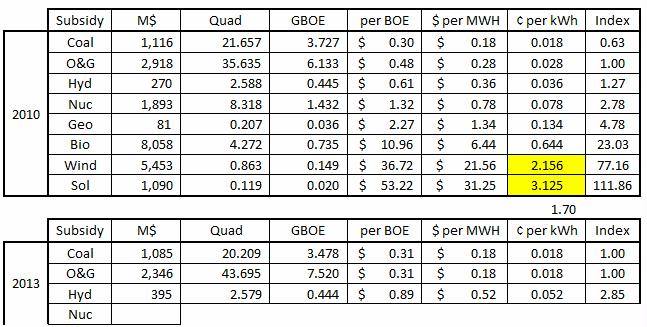
Todd Kiefer: Just crunched an “EIA report to Congress on energy subsidies (http://www.eia.gov/analysis/requests/subsidy/pdf/subsidy.pdf) .  In 2010 wind was subsidized at 2.16 cent/kWh and solar at 3.13 cent/kWh.   In 2013 (latest data available), wind was subsidized at 1.31 cent/kWh and solar at 6.36 cent/kWh.  Makes it easier to see why there are solar PPAs out there for 4 cent/kWh.

Full table of subsidies normalized to units of energy delivered is below.  M$ is million dollar.  Quad is quadrillion BTU.  BOE is barrel of oil equivalent.  Subsidies do not take into account offsetting federal revenues such as fees, permits, leases, excise taxes, corporate income taxes, etc.  Oil and gas generates a 2,000% return on these subsidies in federal corporate income and excise taxes alone (> $9/barrel).  Then there are the taxes from the 185,000 people directly employed in the oil and gas industry.  I haven’t researched coal in as much detail, but I’m sure the government gets a positive return.  Non-hydro renewables, on the other hand are surely net negative.”

Energy resource subsidies from  http://www.eia.gov/analysis/requests/subsidy/pdf/subsidy.pdf

Energy resource subsidies from http://www.eia.gov/analysis/requests/subsidy/pdf/subsidy.pdf

Posted in Photovoltaic Solar | Tagged , | Comments Off on Photovoltaic solar has many problems

Solar 1 and 2 in the United States

Howard Hayden estimates Solar Two would need to take up 127 square miles to produce as much energy as a 1000-MWe power plant does in one year. (Solar Fraud, p. 187).

According to Robert Bradley Jr, Solar One was very disappointing. This solar thermal 10-megawatt project was mainly funded by the Dept of Energy and run by Southern California Edison for high demand periods. It closed in 1988 after six years. The facility was so experimental and expensive that no cost per kwh was publicly revealed (Robert Bradley, Conversation with Mark Skowronski, former project director, Solar One Project, Southern California Edison, January 19, 1996). Robert Bradley. Why Renewable Energy is not cheap and not green. NCPA.

Here’s what Bradley has to say about Solar Two, a $48 million, 10-megawatt demonstration project that began producing electricity in 1996: “In place of a parabolic dish, this project uses a receiver tower where the concentrated heat from the field mirrors (called heliostats) is converted to electricity. Its $4,000 per kilowatt installed cost — which would have been as much as $14,000 more per kilowatt if Solar One’s equipment had not been utilized — is still between five and 10 times greater than a gas-fired plant under current technology. An annual operating cost of $3 million virtually ensures a shutdown in 1999, the year federal subsidies are scheduled to terminate”. Robert Bradley. Why Renewable Energy is not cheap and not green. NCPA.

“Solar Two looks good on paper, and it is expected to provide steady baseload electricity as well as late afternoon peaking capacity, but the future of all the central solar generators is in doubt. They are expensive to build, their very scale escalates financial risks — as with nuclear power — and their massive height (in excess of 200 meters) may attract opposition”. Christopher Flavin and Nicholas Lenssen, Power Surge, p. 143.

Solar Two took up quite a bit of land for the power being generated. There were 1,900 mirrored panels, each one over 100 square yards, and the results were only one megawatt per 17 acres of capacity. A natural gas facility taking up that much space would generate 150 times as much power. Robert Bradley. Why Renewable Energy is not cheap and not green. NCPA.

Central-station solar requires between five and 17 acres per megawatt, and more than 1,000 times the material of a gas-fired power plant. A 1,000 MW solar plant needs 35,000 tons of aluminum, 2 million tons of concrete, 7,500 tons of copper, 600,000 tons of steel, 75,000 tons of glass, 1,500 tons of chromium and titanium, and other materials. The energy that goes into the construction of a solar thermal-electric plant is, in fact, so large that it raises serious questions of whether the energy will ever be paid back. (Petr Beckmann. 1979. Why “Soft” Technology Will Not Be America’s Energy Salvation (Golem Press), p. 6).

Posted in Concentrated Solar Power | Comments Off on Solar 1 and 2 in the United States

Lack of water threatens energy production

July 2013. U.S. Energy Sector Vulnerabilities to Climate Change and Extreme Weather.

18 July 2013. Katherine Tweed. Collision Between Water and Energy Is Underway, and Worsening. spectrum.ieee.org

24 July 2013. Bloomberg News. China Coal-Fired Economy Dying of Thirst as Mines Lack Water.  Coal mining and power stations use 17% of China’s water.  Nearly all coal mines are in one of the China’s driest regions. About half of China’s rivers have dried up since 1990 — 28,000 rivers –and those that remain are mostly contaminated. Without enough water, coal can’t be mined, new power stations can’t run and the economy can’t grow. At least 80% of the nation’s coal comes from regions where the United Nations says water supplies are either “stressed” or in “absolute scarcity.”  A government plan to boost the coal industry and build more power plants near mines will lift industrial demand for water in Inner Mongolia 141% by 2015, causing aquifers to dry up and deserts to expand. Severe water pollution affects 75% of China’s rivers and lakes and 28% are unsuitable even for agricultural use. A shortage of coal from lack of water to mine and process may force China to increase imports, pushing up world prices. China, which mines 45% of the world’s coal, may adopt an aggressive “coal-mine grab” to secure supplies, and will likely be importing 25% of the world’s coal production by 2015.

Sandra Postel. 18 July 2013. Water Stress Threatens Future Energy Production. National Geographic.

  • Thermoelectric power plants alone use more than 200 billion gallons of water a day – about 49 percent of the nation’s total water withdrawals.
  • Every gallon of gasoline at the pump takes about 13 gallons of water to make.
  • Large quantities of water are needed as well for the production, refining and transport of the fuels that light and heat our homes and buildings, and run our buses and cars.
  • Hydroelectric energy from dams require water to drive turbines to generate the power.  Each 1 foot drop in the level of Lake Mead on the Colorado River, causes the Hoover Dam to lose 5-6 megawatts of generating capacity – enough to supply electricity to about 5,000 homes.
  • Nuclear and coal power plants need 20,000-60,000 gallons per megawatt-hour for their “once-through” cooling systems.
  • Of the one hundred coal-fired power plants deemed to be most vulnerable to water shortages, most are located in the southeastern states of Alabama, Florida, Georgia, North Carolina and South Carolina. In these states, water for cooling may be constrained by low river flows, high water temperatures or both – forcing utilities to cut back on power generation.
Posted in Energy Production | Tagged | Comments Off on Lack of water threatens energy production

Trillion of dollars of debt and unfunded liabilities

Unfunded liabilities

Boston University economist Laurence Kotlikoff has calculated that the U.S. government is facing unfunded liabilities of 222 trillion dollars in the years ahead. To name just a few: Medicare and Medicaid, social security, service treasury bonds, food stamps, buying drones, etc.

Debt

Michael Snyder. 21 July 2013. Share This Chart With Anyone That Believes The U.S. Economy Is Not Going To Crash. theeconomiccollapseblog.com

Anyone that thinks that the U.S. economy can keep going along like this is absolutely crazy.  We are in the terminal phase of an unprecedented debt spiral which has allowed us to live far, far beyond our means for the last several decades.  Unfortunately, all debt spirals eventually end, and they usually do so in a very disorderly manner.  The chart that you are about to see is one of my favorite economic charts.  It compares the growth of U.S. GDP to the growth of total debt in the United States.  Yes, U.S. GDP has certainly grown at a decent pace over the years, but our total debt has absolutely exploded.  40 years ago, the total amount of debt in our system (government debt + corporate debt + consumer debt, etc.) was about 2 trillion dollars.  Today it has grown to more than 56 trillion dollars.  Our debt has grown at a much, much faster rate than our economy has, and there is no way in the world that we will be able to continue to do that for long.

  • Since 2000, the U.S. national debt has grown by more than 11 trillion dollars.
  • The debt of the U.S. government is growing faster than the economy with more government debt per capita than Greece, Portugal, Italy, Ireland or Spain.
  • The number of Americans on Medicare is expected to grow from 50 million today to 73.2 million in 2025.
  • The number of Americans collecting Social Security benefits will grow from 56 million today to 91 million in 2035.
  • State and local government debt has grown from 1.2 trillion dollars in 2000 to 3 trillion dollars today.
  • According to the Detroit Free Press, state governments are facing unfunded pension obligations of nearly a trillion and a half dollars.
  • Total home mortgage debt in the United States is now about 5 times larger than20 years ago.
  • Student loan debt in America is over one trillion dollars.
  • About 41 percent of all working age Americans either have medical bill problems or are currently paying off medical debt.
  • The American Journal of Medicine reports that medical bills are a major factor in more than 60 percent of personal bankruptcies in the United States.
  • Consumer debt in the United States has risen by a whopping 1700% since 1971, and 46% of all Americans carry a credit card balance from month to month.
  • An astounding 43 percent of all American families spend more than they earn each year.  Are you starting to understand why approximately half of all Americans die broke?

2009 Feb 25 money.cnn.com   American Boomers: 30% underwater

[Although many have recovered a lot of these losses, it’s just temporary to trick people yet AGAIN into putting their money into stocks so the smart money can get out before the next downturn which is likely to plunge people into even deeper debt than the 2008 or 2000 crashes did]

Boomers between 45 and 54 have lost 45% of their median net worth, leaving them with just $80,000 in net worth, including home equity

Those between 55 and 64 have lost 38% of their net worth, leaving them with $140,000. But this group is rapidly nearing retirement age and they have few working years left to make up the losses


Posted in Debt | Comments Off on Trillion of dollars of debt and unfunded liabilities

Cities will go bankrupt

As the cost of energy keeps rising, and more and more “money” goes to obtaining energy, which leaves less for everything else.  And since capitalism depends on growth, but we’re on the cusp of shrinking back to the stone age, this will manifest economically at first as cities going bankrupt, among many other economic shocks.

Right now (July 2013), all eyes are on Detroit, because at some point many of us suspect the financial industry will find ways to grab the pension money for the bondholders, which should make anyone who expects to get a pension a bit worried, not just city workers.  When the various pundits like Paul Krugman and Robert Reich told you that the banks and wall street had stolen your future when the Federal Reserve bailed them out with public money, this is exactly what they meant.  The future is here right now for Detroit.

What’s going on now is like the Twilight Zone.  Half of Americans are living in grim third world poverty, barely getting by, with 1 in 6 depending on food stamps, over half are in debt with zero savings, and that has allowed the rest of us in the 10% or with good jobs to continue to shop, go the latest hot restaurant, buy expensive clothing, and unless you have lots of poor relatives, be pretty distanced from this since much of this poverty is out of sight, far away.

But some day, when your city goes bankrupt, here is what that will mean — I’ve pulled out 10 quality of life statistics from  Michael Snyder’s 25 Facts About The Fall Of Detroit That Will Leave You Shaking Your Head:

  • There are 70 “Superfund” hazardous waste sites in Detroit.
  • 40 percent of the street lights do not work.
  • Two-thirds of the parks in the city of Detroit have been permanently closed down since 2008.
  • Only about a third of the ambulances are running.
  • When you call the police in Detroit, it takes them an average of 58 minutes to respond.
  • Due to budget cutbacks, most police stations in Detroit are now closed to the public for 16 hours a day.
  • The violent crime rate in Detroit is five times higher than the national average.
  • The murder rate in Detroit is 11 times higher than it is in New York City.
  • Police solve less than 10 percent of the crimes that are committed in Detroit.
  • Crime has gotten so bad in Detroit that even the police are telling people to “enter Detroit at your own risk“.

Alexander Ac. 21 July 2013. The Decline of an Empire. cassandralegacy.blogspot.com


Millions of people in American cities, and countryside, are living in third world poverty.  There are 14 million disabled, 11 million unemployed, 22 million underemployed, 4.5 million institutionalized, 1 in 6 Americans getting food stamps, 15% living in poverty officially but in reality the percent is much higher, 56 Trillion dollars of debt, and another 50% of the population that would have a hard time getting their hands on $2,000 — they are all barely getting by, consuming a lot less, allowing many of us not affected yet to still buy stuff as if nothing had changed.


Posted in Debt | Comments Off on Cities will go bankrupt

Survival: stay out of institutions

I’ve always been amazed at how many people are not in the labor force and that the taxes on those who work can support everyone else.  Including those who are institutionalized.

On the other hand, I ran across a survivalist site while trying to find out how many people were in prison, and the site recommended using prisons as a defendable fortress, since most homes are totally vulnerable to attack…

Roughly 1.4% of Americans are institutionalized. In 2000:

Institution # of them Population
Prison (correctional) 15,775 1,993,302
Juvenile Institutions 6,335 129,132
Nursing homes 29,736 1,727,811
Hospitals 9,289 237,597
Group homes 45,113 460,474
4,548,316
Institutional Group Quarters: Facilities for people under formally authorized, supervised care or custody, such as correctional facilities, nursing facilities/skilled nursing facilities, in-patient hospice facilities, mental (psychiatric) hospitals, group homes for juveniles, and residential treatment centers for juveniles. Source: Peiyun She & David Stapleton. Rehabilitation Research and Training Center on Disability Demographics and Statistics Research Brief A Review of Disability Data for the Institutional Population  Cornell university.

According to the Bureau of the Census, institutional group quarters (GQs) include correctional institutions, nursing homes, and a lengthy list of othe r institutions, many of which exclusively house people with disabilities. The institutional population is a very small share of the entire population, but increased from 1.3 percent of the population in 1990 (3.3 million people) to 1.4 percent in 2000 (4.0 million people). 1 The increase was not uniform across institutional types, however. Nursing home residents, the largest institutional population in 1990, decreased from 0.71 percent of the total population to 0.61 percent, while the incarcerated population increased from 0.45 percent to 0.70 per cent, surpassing the nursing home population in size. In 2000, about 98 percen t of incarcerated persons were age 18-64, while about 90 percent of nursing home residents were age 65 or over. The percentage of the institutional population that is of working age (ages 18-64) increased from 0.98 percent in 1990 (1.5 million people) to 1.3 percent in 2000 (2.3 million people), and working-age people accounted for a much larger proportion of the institutional population in 2000 (56 percent) than in 1990 (45 percent). In 2000, a large majority of the institutional working-age population (86 percent) resided in correctional institutions, and the remaining 14% were approximately evenly split between nursing homes and other institutions

Other statistics:

Nursing & Retirement Homes   3,300,000 A relatively small number (1.5 million) and percentage (4.1%) of the 65+ population in 2009 lived in institutional settings such as nursing homes (1.3 million). However, the percentage increases dramatically with age, ranging (in 2009) from 1.1% for persons 65-74 years to 3.5% for persons 75-84 years and 13.2% for persons 85+. In addition, approximately 2.4% of the elderly lived in senior housing with at least one supportive service available to their residents.  About 11% (3.7 million) of older Medicare enrollees received personal care from a paid or unpaid source in 1999.

Prison 2,300,000 in 4,575 prisons (1 in 100 adults, 219,000 in Federal prison)

Juvenile Detention Centers: 71,000 juveniles in 2010

Mental retardation facilities: 200,000

Psychiatric Institutions: 58,000

Wheelchair Users: 1 million wheelchair users is about 1 out of 250 persons. 10,000 people every year are spinal cord injured 82% of spinal cord injuries are male 307,000 under age 44 use wheelchairs

Other references

OLMSTEAD: Reclaiming Institutionalized Lives (Abridged Version). council on disability.

INSTITUTIONAL GROUP QUARTERS
Correctional Facilities for Adults
101 Federal Detention Centers
102 Federal Prisons
103 State Prisons
104 Local Jails and Other Municipal Confinement Facilities
105 Correctional Residential Facilities
106 Military Disciplinary Barracks and Jails
Juvenile Facilities
201 Group Homes for Juveniles (Non-Correctional)
202 Residential Treatment Centers (Non-Correctional)
203 Correctional Facilities Intended for Juveniles
Nursing Facilities/Skilled-Nursing Facilities
301 Nursing Facilities/Skilled-Nursing Facilities
Other Institutional Facilities
401 Mental (Psychiatric) Hospitals and Psychiatric Units in Other Hospitals
402 Hospitals With Patients Who Have No Usual Home Elsewhere
403 In-Patient Hospice Facilities
404 Military Treatment Facilities With Assigned Patients
405 Residential Schools for People With Disabilities

Posted in Advice | Tagged , , , , , | Comments Off on Survival: stay out of institutions