Only you can prevent wildfires: write FEMA by June 17, 2013

If you’d like to prevent another wildfire, I encourage you to write FEMA or go to the meeting tomorrow, May 18th at 10 am – see http://claremontcanyon.org/ for details on where to send a letter and meeting place.

A great deal is known about wildfires in the East Bay hills.

After every major fire (there have been 15 major wildfires between 1923 and 1992), a blue ribbon commission was appointed and produced excellent reports on what needed to be done.  We know from the 1982 and 1995 commission reports that the eucalyptus, pine, and acacia have to be removed, how to go about it, and which native species to replace them with.  Native oaks, redwoods, and other trees are far less fire-prone, and when they do burn, create far less catastrophic fires.

There has also been an extremely knowledgeable and hardworking wildfire prevention district since 1991.

The Claremont Canyon conservancy has an excellent website about the history of wildfire in our area and what needs to be done.  They’ve teamed up with professors and wildfire experts at the University of California, Berkeley, Lawrence Berkeley Laboratories, and other institutions to try to prevent wildfires in the future:

Many of the people in my neighborhood now moved in after the 1991 wildfire that burned down 3500 homes.  Those of us who lived through it never want to see it happen again.  You will spend up to five years fighting the insurance company to get paid (see my book review of “Delay, Deny, Defend” for details at http://www.amazon.com/review/R2QU1EU62P2QXU), and at least two years to get your house rebuilt and furnished.

Back in 1991, dozens of us had gone through CORE training in the Rockridge Terrace area, many of us all the way through CORE IV, and so we knew we needed to get out.  Perhaps that’s one of the reasons no one died in our neighborhood.  But we lost 97 of 100 homes on Contra Costa Road, and many more homes on Buena Vista and Golden Gate avenue as well.

History of wildfires in East Bay Hills

Between 1923 and 1992, 15 major wildfires occurred in the East Bay Hills of Alameda and Contra Costa Counties, California.

• These 15 fires burned about 9,000 acres, destroyed more than 3,500 homes, and killed 26 people.

• Among these fires, the 1923 Berkeley Fire destroyed over 600 homes in an hour.

• The 1970 fire consumed over 200 acres and burned 37 homes.

• The 1991 Tunnel Fire killed 25 people, destroyed approximately 3,400 homes and did an estimated $1.5 billion in damages.

Eucalyptus

Eucalyptus trees are the largest problem.  They have oily bark and leaves which can aerodynamically spread fires one to six miles ahead of the main flame front, and as far as 18 miles ahead (Cheney 1981, McCaw, L. et al. 1992, Stretton 1939).

That’s why our homes burned down in 1991 – eucalyptus can easily jump 8 lanes of freeway plus Lake Temescal.

Eucalyptus are the most likely kind of tree to cause the worst possible kind of fire — a crown fire, which travels three to eight times as fast as a ground fire.  And crown fires cause the worst spotting, exploding with firebrands, as happened in the Oakland hills fire of 1991 where the “wide dispersal of firebrands contributed significantly to the rapid and extensive spread of the fire” (Bradley 1995).

Eucalyptus are especially prone to crown fire because their bark and leaves are imbued with flammable oils that ignite easily, and the shape of the tree — an open crown — creates updrafts which lift the fiery bark and ground litter up into the hanging branches (USDA Forest Service).

Another reason to get rid of eucalyptus is that they evolved to not only cope well with fire, but are so good at it, that after a fire, their range spreads.  They are the most adapted to fire of any tree in the world, that’s why Australia is covered with them.   Many species of trees in Australia can only exist where it’s too wet for wildfires or too cold for eucalyptus to survive.


Eucalyptus trees poison the soil with terpenes and phenolic acids that make it hard for other plants to grow.  There’s very little, if any, understory vegetation in eucalyptus stands in California (USDA). So even if you get rid of a eucalyptus tree, one is likely to come back in that spot.

I think a good monster movie could be made with eucalyptus as the villain.  They are awfully hard to kill.  They have four different ways of reproducing if burned or cut down: heat-resistant seed capsules, sprouting from the stump, sprouting from the lignotuber, or sprouting from the roots (USDA).

I’ve been a naturalist for 50 years, and volunteer to take inner city children on hikes at Audubon Canyon Ranch.  I’ve hiked thousands of miles of Bay Area trails.  One thing I’ve always noticed is how silent, dead, eucalyptus groves are.  Nothing moves and nothing lives there. This is because eucalyptus is not native, so very few of the local species can use them for food or homes (1995 Fire Hazard Mitigation Program).

Worse yet, eucalyptus can harm native species. Many birds are coated with a tarry pitch when they seek nectar.  In Australia, birds have evolved nostrils far away from their bills to cope, here bird nostrils can get clogged, killing the bird from suffocation, according to Rich Stallcup of PRBO conservation science.

In closing, I’d like to remind you that in Australia, eucalyptus has always been, and always will be a scourge.   In 1976, one in ten rural Australians was part of a volunteer bush fire brigade.

Let’s not let eucalyptus take over the ecology of California, or we’ll have fires like the Ash Wednesday fire in South Australia, 1983, that burned 1350 square miles and killed 71 people.  Fire tornadoes rose 410 yards into the air. Survivors described the sound of the fire burning as a “deafening metallic roar that was terrifying and disorienting”.  The smoke was so thick and the fire so fast, escape routes couldn’t be seen and were cut off.  Water pumps stopped working as the fire severed electric lines.

References

1982 “Report of the blue ribbon urban interface fire prevention committee”.

1995 “Fire Hazard Mitigation Program & Fuel Management Plan for the East Bay Hills”

Bradley, Gordon A. 1995. “Urban Forest Landscapes: Integrating Multidisciplinary Perspectives.”  University of Washington Press.

Cheney, N.P. 1981. Fire Behaviour. In “Fire and the Australian Biota.” Editors A.M. Gill, R.H. Groves & I.R. Noble. Australian Academy of Science. Canberra pp 151-176

FEMA project Fact Sheet. april 1, 2013. East Bay Hills Hazardous Fire Risk Reduction Environmental Impact Statement (EIS)

National Park Service.  september 2006. “Managing Eucalyptus”

U.S. Department of the Interior. Golden Gate National Recreation Area

McCaw, L. et al. 1992. Extreme wildfire behaviour in 3-year-old fuels in a Western Australian mixed Eucalyptus forest. Western Australian Dept. of Conservation and Land Management, Manjimup)

O’Brien, Bill.  2005. Ubiquitous Eucalyptus. “How an Aussie Got Naturalized”. Bay Nature

Pyne, Stephen J. 1991. “Burning Bush. A Fire History of Australia”. Henry Holt.

Stretton, Leonard. E. B.   Royal Commissioner Judge describing the 1939 “Black Friday” fire that consumed millions of acres in Australia

“The speed of the 1939 fire as apalling…lighting forests 6 or 7 miles in advance of the main fires…balls of crackling fire sped at a great pace in advance of the fires, consuming with a roaring, explosive noice, all that they touched.  Great pieces of burning bark were carried by the wind to set in raging flame regions not yet reached by the fires.

USDA FOREST SERVICE. Fire effects information page

http://www.fs.fed.us/database/feis/plants/tree/eucglo/all.html#BOTANICAL%20AND%20ECOLOGICAL%20CHARACTERISTICS


Posted in Wildfire | Tagged , , | Comments Off on Only you can prevent wildfires: write FEMA by June 17, 2013

Why we might not go extinct from fossil fuel emissions

Peak Fossils means Peak Emissions and the lowest to medium IPCC projections at worst

This is an overview, other posts in this category contain peer-reviewed papers that show why this is true.  The heart of the problem is that the IPCC uses old projections from 1998 and have not ever invited petroleum and coal geologists with more up-to-date data to the hearings.

Energy is the master resource that unlocks all the others.  Don’t have fresh water?  No problem, just use oil to drill down 1,000 feet and bring it up.  Can’t find any fish nearby? No problem, build a mega-factory boat and sail it to the ends of the earth where the remaining fish are.  And so on.  It’s allowing us to mine topsoil and grow crops for a few generations before the topsoil washes and blows off, or becomes too saline to grow crops anymore.

Plentiful oil allows us to make microchips, keep supply chains going, deliver food — there isn’t anything that does NOT depend on oil at some point in its life cycle.

Oil is a liquid fuel transportation problem.  Everything in your house, everything in stores got there on a truck at some point, if only for the last mile, and was probably on a ship and train as well.  In my new book “When Trucks Stop Running: Energy and the Future of Transportation”, I show why transportation can’t be electrified, and that there is no renewable liquid fuel that scales up or has enough energy returned on invested to keep our billions of diesel engines in heavy-duty vehicles and equipment running. Therefore, when transportation goes below some minimal level, civilization as we know it fails, and carbon emissions from fossil fuels go to nearly zero.

Carbon emissions also go to zero from fast crashes due to EMPs, nuclear war, peak phosphorous, and too many other limits to growth and resources to list.

Burning fossil fuels is also the main reason we have climate change. And why 7+ billion people can survive off of this borrowed energy. Before fossil fuels powered society, there were 1 billion people.

The end of fossil fuels means we will stop emitting so much carbon dioxide. We won’t be able to manufacture as many chemicals as we are now that poison land, sea, and air. Nor will we won’t be able to feed 7 billion people whose consumption of every mineral, tree, animal, and plant is destroying the world.

The Permian extinction drove 90% of species extinct when volcanoes belched far more CO2 than fossil fuels are capable of emitting. Scientists found it unlikely that the die-off resulted from the CO2 (Kerr).

To stay under the 2 degrees Celsius limits some estimate we can only emit a further 275 Gt, about 34 more years of business-as-usual emissions, which the IPCC assumes will increase until 2100.  Yet in 2005 oil production reached a peak and has been on a plateau since then, slightly rising mainly due to fracked oil and canadian tar sands, both of which are likely to decline from now on. That means coal and natural gas will also decline, since oil is essential for their production, and do little to solve the transportation problem (Coal-to-Liquids will not solve the problem, nor will natural gas (read When Trucks Stop Running or posts at energyskeptic)

Declining fossil fuels means a lot less CO2 and methane emissions:

1. Carbon dioxide and methane will start to go down due to peak oil and peak coal (Hart, Heinberg, Höök, Nel, Patzek) and natural gas.  Because of this, Patzek and other scientists predict only the bottom 4 IPCC projections are likely to be reached.

2. In “The Ecological Indian: Myth and History” by Shepard Krech III you can see that people were very destructive in the past, but they couldn’t do much harm because there were so few of them — if they destroyed all the buffalo or burned down the forest they had to move on, and the buffalo and forest recovered.  It’s only with fossil fuels and the machines we built plus their emissions that we have been able to alter the planet so much.

3.  Gail Tverberg in Oil Limits and Climate Change: “My estimate of CO2 generation by fossil fuels in the 21st century is only about one-quarter of the amount (range midpoint) assumed in the 2007 Intergovernmental Panel on Climate Change (IPCC) Report.”

4. Our ability to do any kind of harm to any resource will diminish drastically once oil and oil equivalent fuels diminish because so many large vehicles and any other equipment with combustion engines won’t operate any more:

  • farm tractors will no longer compress and erode topsoil (or grow enough food to feed 7+ billion people)
  • earth moving machines will no longer harvest coal and other minerals and metals
  • our roads, bridges, airports, and docks will last less than 100 years because we didn’t build anything with cement to last over a century (unlike Roman cement, which is still going strong). We won’t have the energy to rebuild or maintain most of our infrastructure
  • It will be much harder to chop down (rain)forests with roads crumbling and large trucks gone
  • There won’t be ships that can go to the ends of the earth to harvest the last schools of fish. Marine reserves have often restored fish populations faster than anyone expected.
  • due to lack of fuel, future world wars or world war on the scale of WWI & II will not be possible.  Wars will be far more local, more like pre-WWI.
  • Although biodiversity loss will probably increase initially as anyone with a gun goes out hunting, that’s likely to change because the people who live where hunters can get to on foot or bicycle will defend their territory.   The same goes for fishing and foraging.

5. The book “The Earth Without Us” shows that the earth recovers rather rapidly absent humans.  Human population and oil production curves are locked together in a death-grip. If oil declines, population declines too.

6. In 2075 when sea levels start to rise to the point of forcing migration, so many people will have already died off from the decline in fossil fuels that there will be plenty of room for coastal dwellers to move to

7. The loss of our ability to make microchips and breakdown in supply chains will be nearly as important as the loss of oil in rapidly changing civilization back to wood-based energy, and also increase the rate and numbers of people dying.

Climate change will still exist for many millenia, and drive population down even further than the end of oil from mosquito borne and other diseases, years of failures to grow crops and/or less crop production, and so on.

Even though even a small nuclear war would kill over 1 billion people (and a solar or nuclear EMP even more), the ozone would recover after 5 years, many people around the equator will be fine, others will have stockpiled enough food to get by.

All of the 9 planetary boundaries will diminish as human population declines from lack of fossil fuels.  Peak phosphorous will come even sooner without fossil-fuel driven vehicles and equipment to harvest and transport it.

This is too big a topic to list every factor and how it might turn out as you can see from the menu items in Decline and Collapse at energyskeptic.com.  Yes, extinction is a possibility if too many of these happen at once over just a few centuries.

But since both human population and energy resources are likely to decline exponentially rather quickly, we won’t be able to do the harm we are now, to the planet or ourselves, and that has a good chance of saving us from extinction.

Alice Friedemann

References

Hart, Phil. 15 Nov 2010. Oil Demand to Decline in the West, according to International Energy Agency.  http://anz.theoildrum.com/node/7114

Heinberg, R., Fridley, D. The end of cheap coal. New forecasts suggest that coal reserves will run out faster than many believe. Nature 468, 367-369 (18 November 2010) doi:10.1038/468367a

Höök, M., Sivertsson, A. & Aleklett, K. “Validity of the fossil fuel production outlooks in the IPCC Emission Scenarios” Natural Resources Research, 2010, Vol. 19, Issue 2: 63-81

Kerr, R.A. 2013. Mega-Eruptions Drove the Mother of Mass Extinctions. Science  20 Dec 2013: Vol. 342, # 6165, pp. 1424 DOI: 10.1126/science.342.6165.1424

Nel and Cooper (2009) Implications of fossil fuel constraints on economic growth and global warming, Energy Policy 37: 166-180.

Patzek, T, Croft, G. A global coal production forecast with multi-Hubbert cycle analysis.  Energy 35 (2010) 3109e3122

Posted in But not from climate change: Peak Fossil Fuels | 1 Comment

Oil can never be replaced with alternative energy

People who think that wind, solar, biofuels, hydrogen, batteries, and so on will save us simply don’t understand how much energy is contained in oil and other fossil fuels, how much we rely on it, how it is at the root of every aspect of our lives.

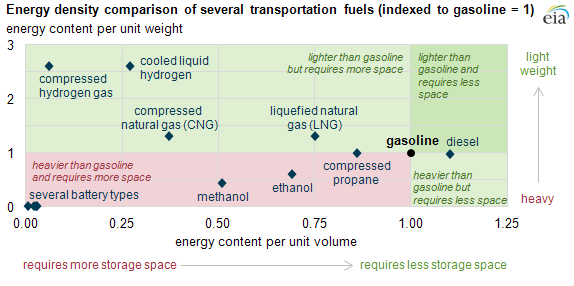
January 3, 2014 Few transportation fuels surpass the energy densities of gasoline and diesel

Graph of energy densities of different fuels, as explained in the article text

Source: U.S. Energy Information Administration, based on the National Defense University.

Energy density and the cost, weight, and size of onboard energy storage are important characteristics of fuels for transportation.

Fuels that require large, heavy, or expensive storage can reduce the space available to convey people and freight, weigh down a vehicle (making it operate less efficiently), or make it too costly to operate, even after taking account of cheaper fuels. Compared to gasoline and diesel, other options may have more energy per unit weight, but none have more energy per unit volume.

On an equivalent energy basis, motor gasoline was estimated to account for 99% of light-duty vehicle fuel consumption in 2012. Over half of the remaining 1% was from diesel; all other fuels combined for less than half of 1%. The widespread use of these fuels is largely explained by their energy density and ease of onboard storage, as no other fuels provide more energy within a given unit of volume.

The chart above compares energy densities (both per unit volume and per unit weight) for several transportation fuels that are available throughout the United States. The data points represent the energy content per unit volume or weight of the fuels themselves, not including the storage tanks or other equipment that the fuels require. For instance, compressed fuels require heavy storage tanks, while cooled fuels require equipment to maintain low temperatures (my comment: this is important because the heavier a vehicle, the fewer miles per gallon it can go).

Beyond gasoline and diesel, other fuels like compressed propane, ethanol, and methanol offer energy densities per unit volume that are less than gasoline and diesel, and energy densities per unit weight that are less than or equal to that of gasoline. Natural gas, either in liquefied form (LNG) or compressed (CNG), are lighter than gasoline but again have lower densities per unit volume. The same is true for hydrogen fuels, which must be either cooled (down to -253oC) or compressed (to 3,000 to 10,000 psi).

——————————-

More energy density tables:

Thousand
Btu per
cubic foot
1058      Diesel fuel
990        F-T Diesel
950        Biorenewable Diesel
922        Gasoline
683        Propane
635        LNG
594        Ethanol
488        Methanol
270        Liquid hydrogen
266        CNG @ 3626 psi
68          Compressed Hydrogen @ 3626 psi
16          NiMH Battery

ENERGY DENSITY OF FUELS NORMALIZED TO DIESEL FUEL
Percent of
Diesel Fuel
Energy Density
100.0 %      Diesel Fuel
93.6 %        F-T Diesel
89.8 %        Biorenewable Diesel
87.2 %        Gasoline
64.6 %        Propane
60.0 %        LNG
56.2 %        Ethanol
46.1 %        Methanol
25.5 %        Liquid Hydrogen
25.1 %        CNG  @ 3626 psi
6.4 %          Compressed Hydrogen @ 3626 psi
1.3 %          NiMH Battery

There are a lot of videos and movies about this, here’s some recent ones from national geographic.

Run out of oil

Aftermath: world without oil

Oil in your life today:

MMFTFF = Materials Mined, Fabricated, Transported with Fossil Fuels

MFO – Made from oil or natural gas — fossil fuels are a substance in over half a million products

EGNGC = Electricity Generated from Natural Gas or Coal, other power plants such as dams (hydroelectric) and Windmills were MMFTFF

Alarm went off: alarm was MMFTFF, likely powered by electricity generated from natural gas or coal (EGNGC). LThe plast

Brush teeth: toothbrush was MMFTFF and is made from fossil fuels (plastic has oil in int).  Medicines: MMFTFf and made from oil.

Shower – water pumped with EGNGC electricity, all materials MMFTFF

Your clothes?  All MMFTFF and all synthetics are made from oil.

Breakfast: eggs fried with natural gas, pan, plate, fork, knife, spoon MMFTFF.  All of the food was planted by a tractor that burned oil, harvested with oil, driven to the store with oil.

Drive or commute to work?  Oil.


Posted in Oil | Comments Off on Oil can never be replaced with alternative energy

Natural Gas and Trucking

What we are facing is a liquids fuels crisis, since 97% of transportation depends on oil (especially to plant, harvest, and distribute food, long-haul trucking, trains, etc).  To the extent that natural gas can fill in for oil, that will soften the impact of going over the energy cliff a little.

It’s likely we may be able to extend the life of natural gas in America by up to 20-25 years, but not 100 years like all the hype says (see post Shale Oil and Gas will not save us).

This buys us time if enough LNG stations, heavy trucks, and infrastructure are built within the next few years

But — to build a new fleet of trucks requires a lot of oil, costs nearly twice as much as conventional trucks, and by the time you’ve built such a fleet, LNG stations, etc., the natural gas boom will be over.

One of the reasons natural gas is attractive now is that it’s cheap, but that’s not likely to last, and that could slow down the conversion of local fleets to burning compressed NG and long-haul trucks from burning Liquified Natural Gas (LNG).

Some stats from the New York Times Cardwell article:

  • 8 million mid-to-heavy trucks consume 3 million barrels of oil a day, 15% of total consumption or 75% of what we import from OPEC nations.
  • 3 million 18-wheelers — the long distance haulers — consume two-thirds of all diesel fuel
  • 157,000 gasoline stations
  •         53 Liquid Natural Gas (LNG) stations in the USA now, two-thirds of them in California.

Large trucks need to run on LNG, local fleets can get by on compressed natural gas.  Many transit buses, refuse haulers, delivery trucks, and garbage trucks can, and are, running on compressed natural gas.

References

Diane Cardwell. 22 Apr 2013. Trucking Industry Is Set to Expand Its Use of Natural Gas. New York Times.

Posted in Natural Gas Vehicles | Comments Off on Natural Gas and Trucking

Peak Oil Acknowledged by Middle Eastern countries — they’re scared

Very interesting reflections on a peak oil conference in the Middle east of the countries that export oil.  I think it must mean we’re past peak, don’t believe “the near future”.

Peak Oil as seen through the eyes of Arab oil producers by Robert Hirsch, originally published by Fabius Maximus  | Apr 12, 2013

Reflections by the author of the “Hirsch Report” on the Conference “Peak Oil: Challenges and Opportunities for the Gulf Cooperation Council (GCC) Countries.”

I was fortunate to be among the few westerners invited to attend and speak at this first-of-its kind “peak oil” (PO) conference in a Middle East. The fact that a major Middle East oil exporter would hold such a conference on what has long been a verboten subject was quite remarkable and a dramatic change from decades of PO denial. The two and a half day meeting was well attended by people from the GCC as well as other regional countries.

The going-in assumption was that “peak oil” will occur in the near future. The timing of the impending onset of world oil decline was not an issue at the conference, rather the main focus was what the GCC countries should do soon to ensure a prosperous, long-term future. To many of us who have long suffered the vociferous denial of PO by Gulf Cooperation Council (GCC) and OPEC countries, this conference represented a major change. In the words of Kjell Aleklett (Professor of Physics at Uppsala University, Sweden), who summarized highlights of the conference, the meeting was “an historic event.”

While many PO aficionados have been focused on the impacts and the mitigation of “peak oil” in the importing countries, most attendees at this conference were concerned with the impact that finite oil and gas reserves will have on the long-term future of their own exporting countries. They see the depletion of their large-but-limited reserves as affording their countries a period of time in which they either develop their countries into sustainable entities able to continue into the long term future or they lapse back into the poor, nomadic circumstances that existed prior to the discovery of oil/gas. Accordingly, much of the conference focus was on how the GCC countries might use their current and near-term largesse to build sustainable economic and government futures.

A flavor of the conference can be gotten from the following loosely translated, random quotations:

About the Conference:

  • This is a groundbreaking conference.
  • The organizers were brave to organize this conference.

Peak Oil:

  • Peak oil provides an incentive to consider important national and regional issues. The GCC is currently working new problems with old solutions.
  • Oil revenue represents about 93% of the Saudi budget. Everything is now imported — foreign expertise and most labor. Saudi can’t continue on the current track, because it would lead to a “bad future.” We need radical change.
  • After peak oil, will there be great cities, or will Middle East cities end up like the gold mining ghost towns of the old U.S. west?
  • So far we have wasted our opportunity.
  • Shale oil in the U.S. is so much foolishness and does not invalidate peak oil. We definitely must worry about peak oil.

The Gulf States:

  • Political reforms have failed to properly address our lack of democracy and accountability.
  • When people are excluded from politics, they get unruly.
  • Citizens in the Middle East prefer public sector jobs because they pay better than private sector jobs.
  • Foreigners are the majority of our populations, typically 80%.
  • Schools are teaching children “old stuff.” Schools are a disaster.
  • The current culture is one of waste.
  • There are job vacancies in Saudi but local people are not prepared to fill them. Saudi’s go abroad to get advanced degrees but don’t qualify for Saudi jobs, so Saudi must import foreign labor. Aramco did a good job of training Saudi nationals.
  • The GCC must educate women and give them greater rights and equality.
  • In many countries absolute rulers get the incomes and revenues and not much is left for the people. A selfish dictator does not develop his country.
  • The Arab legal system is in bad shape and needs attention.
  • People read religious literature when they should be reading technical literature.
  • The region has wealthy, wealthy persons and poor, poor people.
  • Rulers must understand that the people must be part of the future.
  • Future generations must have rights.

About the world and peak oil:

  • Globalization is being broadly viewed more negatively now. When peak oil comes, it will be extremely difficult to maintain.
  • High oil prices will impact the world even before the onset of peak oil.
  • Peak oil is the most important question in this part of the world.

Robert Hirsch ran the US Fusion Program during the 1970′s, and went from there to become one of America’s top energy experts. Here is a brief biography. He was the lead author of one of the major papers about 21st century energy: “Peaking of World Production: Impacts, Mitigation, and Risk Management“, commissioned by the Dept of Energy, published in 2005. Co-authors are the economists Roger Bezdek and Robert Wendling. They also wrote The Impending World Energy Mess: What It Is and What It Means to You (2010).

See Wikipedia for a list of his positions and publications. He has over 50 publications, plus 14 patents — including Farnsworth–Hirsch fusor (see Wikipedia).

Posted in How Much Left | Comments Off on Peak Oil Acknowledged by Middle Eastern countries — they’re scared

The Big 5 Personality Traits – psychobabble or science?

Alice Friedemann’s review of :

Daniel Nettle.  2008.  “Personality, What makes you the way you are”.  Oxford University Press.

Scientists have considered psychology to be a very soft science at best and quackery or psychobabble at worst.  But psychology is finally making scientific strides with the testable theories generated by evolutionary biology, brain imaging equipment, being able to measure genetic variation between people, and animal studies – critters also exhibit what in humans we call personality traits.

Daniel Nettle has written a book for the public explaining the latest scientific research on personality.  He explains how it’s measured, what the measures mean or predict, and why we vary in personality traits.

He defines personality as:

  • Consistent patterns in our lives across love, career, and friendships, often repeating the same sorts of triumphs or mistakes.
  • Even smaller, less significant patterns in everyday life tend to have patterns – how we dress, whether we talk to strangers, etc
  • Basically, everyone’s nervous system is wired up differently.

Nearly all psychologists agree on a Big Five model of personality dimensions, consolidating decades of research.  Before this, different researchers used different varying traits.  For example, 4 main types (thinking, feeling, sensing, or intuiting), or just reward vs harm avoidance. Each study had results that appeared to have no relationship to each other.

The five factor model created order out of this mess, all previous studies can be fit into this framework because they either measured one of the big five or a sub-part of one of them, or perhaps a mix of several.

Okay, it’s not science entirely yet – to do that, this new approach needs to prove these traits are neurobiologically real, but this framework gives personality psychologists testable hypotheses.  Until now, much of it sounded like psychobabble to me, and I do cringe at lumping people into categories.

What makes the big 5 more plausible to me is that we all have all five traits to varying degrees, and we change over time depending on our genetics and our life experiences (which is why twins, even though totally the same genetically, can be quite different).

Here’s the list of the Big 5:

Dimension                   High Scorers are                    Low Scorers are

Extraversion                Outgoing, enthusiastic            Aloof, quiet

Neuroticism                 Prone to stress & worry         Emotionally stable

Conscientiousness       Organized, self-directed         Spontaneous, careless

Agreeableness              Trusting, empathetic              Uncooperative, hostile

Openness                     Creative, imaginative             Practical, conventional

About half of your score is out of your control – genetics is responsible.

These traits have important consequences in life. High neuroticism in either partner is more likely to lead to divorce or an unhappy marriage.  Divorce is also likely if the male is low in conscientiousness.  Extraverts are the least likely to stay in an unhappy marriage.

Other consequences, such as low agreeableness, have less dire consequences, but will nevertheless affect how a person gets along in the world.  These folks are more likely to snap at others and be irritated easily, leading to less satisfying personal relationships and career advancement.

Situations make a difference, extraverts have more casual sex than introverts, probably because introverts are at home and extraverts are at parties, meeting potential partners.

A recurring theme of the book is that while you might think that there’s some optimum level of any trait to have, this doesn’t appear to be the case or natural selection would make us much more similar.  For example, high scoring neurotics are more worried than other people.  Why not just be happy all the time?

Nettle says that animals vary in what we could call neuroticism too – some guppies hide if there’s a predatory fish in the tank because they come from a stream with predators, and other guppies are fearless because they live in a place with no predatory fish.  The fearful guppies outlive the fearless guppies by far if you introduce a predator.

But creatures who spend too much time looking for predators won’t get enough to eat and be as healthy as their more relaxed brethren – so there’s a constant balancing act going on in nature across neuroticism and all of the other traits.  In one situation a trait might be good, in another bad, and so there is never an optimal balance of a particular trait that nature settles on (in evolutionary theory this is called fluctuating selection).

Extraversion

Extraverts are high in sociability but that doesn’t mean they have good social relationships – that’s predicted by agreeableness.  Shyness isn’t usually due to low extraversion, but to high neuroticism and anxiety.  Someone low on extraversion can do without much social activity and not mind it, often seeming aloof.

Extravert traits: enjoy sex, romance, tend to be ambitious, work hard for fame or money, like active sports, travel, and novelty. They have a lot of positive emotion, with more joy, desire, enthusiasm, and excitement than low scorers.  This acts as an incentive, so they’re more willing to go the extra mile to a party, event, or date after an exhausting day at work.  This doesn’t mean low scorers on the extrovert scale are negative or sad, they’re just emotionally flatter, which makes them less likely to get out and about, because there’s less reward in it for them.

Extraverts brains even operate differently – with higher responsiveness in several brain areas than low scorers.

Nettle speculates at the end of each chapter about the advantages and disadvantages of each trait.  So who wouldn’t want to be an extrovert?  Nettle says that perhaps their predilection for dangerous sports leads to earlier deaths, and more breakups of marriages from affairs, which puts their children at risk with step-parents.

Within a marriage, if your partner is a higher scorer than you, they’ll want to do things that seem pointless and expensive whether it’s buying a sports car, wanting to go to far more parties than you do, or taking up a wild new hobby.  If you score higher, then you’ll feel disappointed (s)he doesn’t want to do as much as you do or get enthusiastic about your latest passion.  Nettle concludes “Don’t worry. It’s just how they are wired up”.

Neurotics

Scoring high means being more affected by the tribulations of everyday life, feeling more fear, anxiety, shame, guilt and sadness than most people. Neurotics are more likely to have depression, anxiety, eating, personality, and obsessive-compulsive disorders, phobias, PTSD, schizophrenia, insomnia, and headaches.

Sadness may be useful — to the extent it slows us down enough to re-think our plans if they’ve failed, and make better plans for the future, and signal to others we need support and comfort.

Why on earth would such an unhappy trait be selected for? We’re probably all wired to look for dangerous predators, loss of social position, or the risk of social ostracism – death sentences for most of our ancestors.   But Nettle says that neurotics are like overly sensitive smoke detectors, spending a lot of time looking for dangers.   Chances are the ancestors of neurotics worried a lot, but in the end, were less likely to make a fatal error than their happier brethren, and avoided being eaten or making the leaders of the tribe angry and being expelled from the group.

High scorers tend to direct their negative emotions towards themselves, leading to low self-esteem. Neurotics think ‘it was my fault’, everybody hates me’, or ’I will never succeed’ in reaction to bad events.  A high scorer is constantly wondering if (s)he did the right thing and often changes their identity and goals throughout life.

High scorers fear dangers faced in the past – rejection, illness, open spaces, strangers, and unspoken negative intentions of others.  In the long run they have a slightly increased risk for heart disease, gastric disorders, and hypertension.  They have less satisfactory marriages and work lives. Their negative emotions can bring about the very result they fear, such as a wife who worries and nags her husband due to her fear he’ll leave may give him reason to do just that.

Nettle posits this trait is selected for to protect us, and the threshold of what’s appropriate to worry about is constantly changing depending on what sort of world we’re born into.  Perhaps those who score low have a higher mortality rate because they’re not worried enough.

Although this trait usually harms careers, a neurotic open person might write as a form of therapy.  Their fear of failing motivates them to strive (as long as they aren’t too disorganized or feel too awful to function). Nettle writes that neurotics “see the problems of the world starkly, in all their equivocal complexity”.

He concludes “High scorers should not just wish their worry away, but, just like any other trait, understand the strength, sensitivity, striving, and insight that it may give them. There are niches in the world where these are very valuable.  They do come at a cost of often awful suffering through many days of their lives. The art is to manage these costs, to live with them, and to limit them so they do not become overwhelming”.

Controllers

High scorers are conscientious and high scores predict better than any other trait occupational success in any kind of work, as well as living longer – up to 30% more than someone who scores low.

Low scorers have impulse control problems and are more likely to succumb to one or more of gambling, drug dependencies, irresponsible behavior, law breaking, and antisocial personality disorder.  They’re more impulsive, spontaneous, and have weak wills.  A low score in this trait is the most likely predictor of addiction problems.

Addictions happen when a person can’t stop a once-rewarding behavior.  There may be no euphoria involved, because their brains have become so used to the addictive substance.  They just can’t stop their habit.

Agreeableness

Agreeable people can sort out complex descriptions of how people are feeling.  Nettle gives these two examples:

Tom hoped that Jim would believe that Susan thought that Edward wanted to marry Jenny (4th level nested description).

John though that Penny thought that Tom wanted Penny to find out whether Sheila believed that John knew what Susan wanted to do (5th level nested description).

It turns out that people who do best at understanding the last sentence tend to have a larger network of friends than those who don’t do well. Young children with this skill are perceived by their teachers as getting along well with other kids.

Empathizers pay more attention to the mental states of others and tend to be helpful, social, warm trusting behavior.  They tend to have good relationships, good social support, and rarely fall out with or insult others.  They’re quick to forgive, and slow to anger even with people who deserve it.  Often they end up in careers as counselors, social workers, or volunteer work.

Those who score low are less likely to trust or help others, can be cold or antagonistic, have less harmonious relationships, and at the very bottom, psychopathy.

Psychopaths are egocentric, dishonest, feel no remorse, can’t love, and tend to use others for their own ends.  They have no qualms about being aggressive.  Of the three traits, empathy for others is the most important in preventing psychopathy.

But to be a full-blown monster, you’d also need to score low on conscientiousness and anxiety.  Without empathy, the person still might not do harm because they’re not impulsive and will realize the likely consequences of their actions.  If he’s also low in neuroticism, he’ll feel no fear – now all the barriers are down and this can result in some very bad people.  Fortunately it’s rare for someone to be very low across all three traits.

Autistics are not psychopaths.  Although they have trouble with social relationships, and struggle to understand the mental state of others, they tend to be helpful to others in distress.  Psychopaths can predict others mental states just fine and use that knowledge to manipulate and deceive.

Nettle speculates that being a good group member is a very important trait – being ostracized from the group in the past could be a death sentence.

He doesn’t discuss why psychopathy would exist, but I’ve read elsewhere that psychopaths are the only people unafraid in battle, and our history is one of constant skirmishes, so this trait would be useful throughout most of history if these people were channeled into the military.

Being too agreeable tends to lessen success a bit, since you’re spending more time than average maintaining a wide network of relationships, which takes time away from work, or lessens the ambition to rise in a career since that isn’t as important as friendships.  Nettle refers to two studies that showed nice guys finish last. Some ruthlessness is required to reach the highest positions in corporations perhaps.

Which brings up the conundrum of finding an ideal partner – women would like someone who’s kind and empathic, but also someone successful – and these traits don’t usually coincide. As Nettle puts it “the kind of person who could give you a glittering lifestyle is quite likely not the kind of person you would wish to share such a life with”.

One of the most documented and proven differences between men and women score higher in Agreeableness than men – the average man scores lower than 70% of women.   When women are given testosterone, it reduces their empathetic behavior.

Openness

High scorers are more likely to read books, and go to art galleries, theater, and music events than the average person.  This trait is correlated with intelligence, but it’s not the same as intelligence.  People who score high tend to be imaginative and pursue artistic endeavors.

In several pages of writing about Ginsberg’s poem “Howl”, Nettle conveys the trait of openness with a bit of poetry himself.  He thinks that those who score high in openness have fewer, more permeable filters that allow broader associations.  Those high in openness are more likely to challenge social norms, try out many different jobs, philosophies, and lifestyles.  They also have a strong sense of spirituality, or even supernatural belief.

Often they have a schizotype personality – they’re of sound mind but more psychotic than the rest of the population.  They might hear voices, have perceptual disturbances where everything seems strange or significant, magical ideas (supernatural forces, feelings of telepathy).  Or they might have unusual experiences and aberrant thoughts and even some beliefs similar to those of schizophrenics, but not have other aspects of schizophrenia like emotional flatness or social withdrawal and lack of motivation. High-scorers are more likely to have psychosis-like experiences.  They tend to be politically liberal and avoid orthodox institutions, with strong idiosyncratic supernatural or spiritual beliefs.  They’re more likely to experiment with exotic religions or creeds, New Age ideas, or believe in the paranormal.  They’re more likely to have beliefs that run against the mores of their time and less governed by taboos or social acceptability.   They’re relatively susceptible to hypnosis.

Advantages: “Geoffrey Miller argued in his book, “The Mating Mind”, that verbal creativity became a potent mate-selection trait.  …Individuals would tend to select mates displaying the quality of their brains through unusually complex verbal and symbolic” ways of writing or speaking, driving up general intelligence in the population, as well as openness.

How we come to have our personalities

Except for genetics, studies with identical twins, fraternal twins, and siblings have shown that parents have very little effect on our personalities.  In normal households that is, clearly an abusive or violent upbringing might have lasting effects.

“This is a stunning finding, and it has caused quite a stir.  It is probably the most important discovery in psychology in recent decades, not least because it is counter-intuitive and overturns many entrenched beliefs.  Out must go all simple notions about how cold mothers or absent fathers or large families or farm living shape our personalities”.

Then he knocks out birth order and prenatal effects.

The main thing that seems to make a difference is your own traits:

“The extent to which one should be neurotic about sources of harm depends in part on how fleet of foot one is, how good one’s immune system is, etc.  Whether one should pursue risky rewards depends a lot on whether one is strong and attractive.  The former makes one able to cope if things go wrong, whilst the latter is a big determinant of success if the rewards pursued are social or sexual ones.  Whether one needs to be very conscientious in working hard at problems depends in part how smart one is; very quick-witted people can probably prepare on the fly.  Basically, it makes a lot of sense that evolution would have built into us a capacity to modulate our personalities in response to our health, intelligence, size, and attractiveness”.

There is some evidence for this – extraverts are more symmetrical, implying fewer mutations or environmental stressors during development, and they’re perceived as being more attractive.  Men increase in extraversion when they’re tall, though this isn’t the case with women.  Large men also seem to be slightly less nice, on average, perhaps because large men can get away wit breaking rules.

Conclusion

All of us vary in each of the 5 dimensions, just like we do with weight, height, or intelligence. Nettle posits that if we could measure people with ten distinct points along each of the five personality scales, there’d be 105, or 100,000 possible personalities. So even though life would be much simpler if we could wedge everyone into a few categories, we’d be wearing blinders to the true complexity of our fellow human beings.

If you took the 100,000 personalities literally, there’d be 1,500 other women just like me in the USA.  But they won’t be like me.

Nettle speculates that though they’ll have more similar lives and relationships than a random sample, their lives will be very different because they’ve all found different ways of expressing the traits they have.  There are many ways of expressing extroversion.

Even more importantly, there’s the level of one’s subjective life story.  We all tell our story of who we are, what we’re doing, and why differently in our personal stories.  This unique narration has a considerable effect on identity.   Nettle gives the examples of someone who never married could either tell this story as a tragedy or a comedy.  Another who was never successful in a career, but had great varied experiences could either tell their story as one of failure or how they’d escaped the rat race and had a much better time.

Which brings up the topic of change – what if we don’t want to be shy worried irresponsible hostile conformists?

Luckily, as we age, all of us tend to get slightly more agreeable and conscientious, and slightly less open, extroverted, and neurotic.  We have the power to change ourselves, to stop destructive or dangerous behaviors.

It’s easier when the changes we try to make go along with our nature, like an extrovert switching from riding a motorcycle to driving a sports car. But even an introverted person can change themselves against the grain, by finding work or social activities that involve being around lots of people.

And above all, we can spin our own personal stories to see our lives in a better light.

Alas, Nettle says, those who most need to do this – those high in neuroticism — have the hardest time seeing their lives in anything but a negative light (though they’re more realistic than low scorers).  Those most likely to be unhappy about their personalities tend to neurotics who infuse everything with suffering.  He recommends neurotics try meditation, exercise, yoga, cognitive behavior therapy, and medications to work around their fears and anxieties.

Nettle concludes by reminding the reader that no one should regret the constellation of personality traits they have – all have their advantages and disadvantages, which he has illustrated throughout the book.   Though these speculations about why a trait might be good or bad given different environments is the least scientific part of the book – but then there’s still much to be learned, and we can hope this new grouping of traits will lead to better testing.

I was not able to tell from reading the book if this new “big 5” concept was a major revolutionary shift within the personality field and adopted by the vast majority of researchers.  Wikipedia says that “The model is considered to be the most comprehensive empirical or data-driven enquiry into personality”.

Wikipedia gives these main criticisms:

1)      This is not a theory, just data-driven descriptions of traits

2)      Not all traits are included (i.e. Religiosity, Honesty, Thriftiness, Conservativeness,  Sense of humor, etc)

3)      There are 3, or 18, or 7 factors, not 5

So it looks like personality research has a long way to go to reach more scientific credibility.

But overall, this book was useful and fun to read.  Nettle describes quite well what it’s like to be weak or strong in these dimensions, and I recognized myself and so many others in the descriptions – it’s somehow satisfying to know that I share these traits, both good and bad, with so many others, and to have another tool to understand others with.

I also liked Nettle strongly emphasizing throughout the book that there is no best profile to have, not even being average in all of them.  Your best bet is to make the best of the hand you’ve been dealt – maximize your strengths and minimize your weaknesses.  Your basic dispositions are a resource, not a curse.

Posted in Evolution | Comments Off on The Big 5 Personality Traits – psychobabble or science?

Renewable Energy can’t supply more than 30% of electricity without revolutionary battery breakthrough

Wind and solar are too intermittent to comprise much of electric grid power now, according to Steven Chu, former US energy secretary.  In 2010, Chu said, “Without technological breakthroughs in efficient, large-scale energy storage, it will be difficult to rely on intermittent renewables for much more than 20-30% of electricity.”

Unless a major breakthrough in batteries happens, we will continue to require natural gas fueled power plants to ramp up and down quickly to cope with intermittent sources of power.  “When you ramp power plants up and down they lose efficiency” according to Haresh Kamath of the Electric Power Research Institute in Washington DC.

Some batteries cannot survive deep discharge cycles

An inability to withstand deep discharge cycles means, in effect, that additional capacity needs to be installed in order to provide effective capacity. Thus, if a technology were deployed that were limited to 50 percent discharge, it would be necessary to provide twice the capacity of a technology of one that had no such limit. Thus, a storage system with a 50 percent limit would in effect need 12,000 MWh of storage where the study had determined that a 3,000 MW, 2-hour unit was required (CEC).

And keep in mind, for the long run, these batteries need to have a positive EROEI over their entire life cycle from mining and crushing of rocks for metals to fabrication to delivery.  If they require more energy to construct across the life cycle than they more energy to create than at least 5 times the energy stored and discharged, our way of life can’t continue.

In addition, batteries must be composed of cheap and abundant materials.  Platinum, lithium, and many other metals are scarce and take too much energy to extract.

Without energy storage, conventional power generation plants are harmed

Without the use of storage, ramping of combustion turbine generators and hydro?electric generation is likely to increase. This may likely have detrimental effects on equipment maintenance costs and life of the equipment, and greenhouse gas emissions because the resources will be asked to generate more often at less than optimal production ranges as well as to remain committed-that is, on?line-in anticipation of ramping needs The 3,000 to 4,000 MW of storage which could be used to address renewables management requires a ramp rate capacity of 5 to 10 MW/second, or 0 to full power charging / discharging in 5 minutes. This equals or exceeds the ramping capabilities of most conventional generating units, and particularly the larger combustion turbines. Smaller combustion turbines in the California ISO database can meet this ramp rate requirement, but there are insufficient quantities of such units to provide the required 3,000 to 4,000 MW of fast ramping (CEC).

Concentrating Solar Power (CSP) storage

Existing molten salt thermal storage is both expensive and operationally challenging. New technologies are needed now before the large solar plants are all designed and built.

References

CEC. June 2010. Research evaluation of wind generation, solar generation, and storage impact on the California Grid. Prepared by KEMA, Inc for the California Energy Commission.

Hal Hodson. 2 Feb 2013. Greening the Grid. NewScientist.

Posted in Alternative Energy, Batteries | 1 Comment

Noam Chomsky: If Nuclear War Doesn’t Get Us, Climate Change Will

The growing threats of nuclear war and environmental catastrophe make it hard to bet on the survival of our species.

Watch the video at:

http://www.thenation.com/video/173205/noam-chomsky-if-nuclear-war-doesnt-get-us-climate-change-will#


Posted in Extinction Experts | Comments Off on Noam Chomsky: If Nuclear War Doesn’t Get Us, Climate Change Will

Financial Monsters — Bigger Crashes than 2008 are yet to come

by Alice Friedemann   October 12, 2007

The monsters are still there. Sure, quantitative easing fed them enough money to keep them away for a while, but cheap money can’t be doled out to bankrupt banksters and Wall Street forever.  Meanwhile it’s 2014 and there haven’t been meaningful reforms in derivatives ($600 trillion), leveraged debt, private equity and hedge funds are still unregulated, the distribution of wealth is getting worse, enormous debt at all levels (personal, corporate, government) continues to grow, the unemployment rate is certainly over 10% as documented at shadowstats.com, medicare obligations loom large as boomers retire, pension funds are underfunded, corporate and wall street fraud and insider trading continue as usual, while yet unknown Black Swans circle overhead.

Original article from 2007:

We are entering the Money / Energy transition (a term coined by Tom Robertson at listserve energyresources).  This is when people will realize they can’t fuel their cars with dollar bills — that money is meaningless and all that really matters is energy.  Hubbert proposed an energy currency half a century ago so that people would understand how critical a role it plays in our survival, but it isn’t practical to carry tanks of gas or bits of uranium around in your pocket.

So we spent our energy foolishly, plundering and poisoning the planet for a blip-in-time of pleasure, and now the “Limits to Growth” boas of peak oil, climate change, and natural resource shortages are tightening around us.

But most people don’t see the world ecologically.  Nearly everyone is brainwashed to see the world through economic and political filters.  As we sink into a never-ending depression, brought on by increasing population, pollution,  and decreasing energy and natural resources, most people will blame politicians, the Federal Reserve, and evil foreign governments for our woes.   It will take a while before people realize that it’s too many people and declining resources, not an economic crash, that’s the root of the problem.  So we should recognize our own financial monsters, listed and described herein.

It appears the United States is succumbing to what all governments have been tempted to do over time: run the money printing presses overtime to pay for wars, debts, and corporate welfare. But in a credit/debit system where there’s an estimated quadrillion in debt, these bits of electronic currency vanish into the black hole of debt and end up in the pockets of the wealthy, who spin the fake money into new bubbles for the middle class to spend their remaining dollars on, while the “smart money” gets out just before the bubble pops, fleecing the Middle class of even more wealth.  Sooner or later, you’ve got to pay to the piper, and the BRIC nations aren’t going to allow American dollars to be the world’s reserve currency forever.

In anticipation of completely worthless money, we ought to at least design with much better pictures and colors – we have the most boring currency in the world, and doing so would allow us to make great wallpaper or origami animals once it’s worthless.  Though again, unless you drop the money out of helicopters, it will keep ending up in the hands of those who need it least, the top 1%, and they can already afford decent wallpaper.

The subprime market is just the first Tremblor bursting out of the ground to suck the life-blood out of your bank account and ‘disappear’ your job.

Other Economic Monsters

Derivatives.   Originally used to hedge risks, then as leverage, i.e. “swaps”, derivatives allowed hedge funds to get around the leveraged limits the SEC instituted after the 1929 crash.

Warren Buffet has been warning for years that derivatives are endangering the financial system.   He believes that the widespread use of swaps makes the leverage that preceded the 1929 crash “look like a Sunday school picnic.” (Smith 2007).  He warns that derivatives are financial weapons of mass destruction (BBC 2003):

  • An explosion in derivatives contracts could create serious systemic risks – that derivatives are time bombs waiting to explode the economic system. Large amounts of risk have become concentrated in the hands of relatively few derivatives dealers.
  • Outstanding derivatives contracts – excluding those traded on exchanges such as the International Petroleum Exchange – are worth close to $85 trillion.
  • Some derivatives contracts appear to have been devised by “madmen”. He warns that derivatives can push companies onto a “spiral that can lead to a corporate meltdown”, like the demise of the notorious hedge fund Long-Term Capital Management in 1998.
  • Derivatives also pose a dangerous incentive for false accounting.   The profits and losses from derivatives deals are booked straight away, even though no actual money changes hand. In many cases the real costs hit companies many years later. This can result in nasty accounting errors. Some of them spring from “honest” optimism. But others are the result of “huge-scale fraud”, for example, the US energy market, which relied for most of its deals on derivatives trading and resulted in the collapse of Enron.

Many derivatives don’t trade often, making it hard to value them accurately. Institutions don’t trust each other because no one knows who’s got the most skeletons to hide.  It’s hard to make financial instruments like leveraged loans transparent if the asset has never traded, or no one’s buying. Institutions tend to put as much gloss on their numbers as possible, and investors, lenders, and shareholders are very suspicious.  (Davies 2007)

If hedge funds ever have to put an accurate price on what they own, the outcome could be scary – that’s why the Bear Stearns subprime debacle caused such concern, because it could start a chain reaction of other hedge funds forced to truly discover their asset values and adjust them sharply downward.  Banks have about 375 billion dollars in leveraged loans. Bank, private equity, brokerages, & hedge fund failures are likely as assets continue to decline in value. Hedge funds have used derivatives to dampen volatility, and act like shock absorbers against market risk.  But if the real value of derivatives has been exaggerated, then when these “shock absorbers” break down, there could be a hard landing (Patterson 2007).

The Great Unwind: Leveraged Debt.  Not since the Great Depression has there been so much leverage in the stock market.   Hedge funds, private equity firms, and Wall Street have found ways to work around the legal limits of leverage via derivatives and other complex financial instruments. Part of the reason we got into this mess was that banks, which are regulated and transparent, don’t control credit or money anymore.

Hedge funds and private equity firms are not regulated.  If there’s a serious market downturn, leverage can create a snowball effect, as stocks are dumped to raise cash, spiraling prices ever downwards.  Wall Street analysts call this “The Great Unwind”. The Wall Street Journal summarized this risk by saying “No one is sure what will happen with this complex web of borrowing and derivatives in the event of a serious market downturn”.

Larry Fink of BlackRock, says that lenders to highly indebted companies are making the same mistake as the subprime mortgage market, and will become “tomorrow’s problem” as leveraged buy-out and junk-rated lending grows.  The Bank of England also warned that cheap corporate lending with loose credit standards “has increased the vulnerability of the global financial system”, and cautioned against weak standards of risk assessment for repackaged bank loans that are sold to the rest of the financial system (Beales 2007).

In the Economist magazine (June 21, 2007), Daniel Arbess, of Xerion Capital Partners, said that “perhaps the most worrying thing for financial institutions holding mortgage-backed paper is not the subprime market, but the unnerving parallels with an even bigger one to which they are also exposed: leveraged loans to companies”.  Subprime might well be “a dress rehearsal for something bigger and scarier.”

Private Equity & Hedge Funds.  These financial devices are not subject to regulation, so the risk they’re adding to the financial system is unknown.  Worse yet, they’re given special tax rates of less than 10% (which amounts to a public subsidy), and that, combined with investor money, is used for leveraged buyouts.  Then, these companies are stripped of assets and the employees outsourced. Jobs are lost and established companies destroyed.  The big winners are the managers who engineer the buyout, who can earn billions in just one year (Monks 2007).

The time horizon of asset-stripping is short – just 3 to 4 years – and ignores the long-term interests of investors, employees, customers, and suppliers.  The Chairman of Germany’s Social Democratic party in 2005, Franz Munterfering, described private equity groups as “swarms of locusts” (Gordon 2007).

After asset stripping and outsourcing, these companies are laden with debt, which will be a serious problem when borrowing costs rise and an economic downturn occurs.

Distribution of Wealth.  The gap between rich and poor has never been as great as it is now.   The top 1% of households in the USA received 8% of national income in 1980 and 16% in 2004. During that period, the tax burden on the top 1% decreased from 44.4% to 30.4%, increasing their income even further.   Wealthy individuals and corporations know how to hide their wealth offshore, or put money in questionable tax shelters, so the gap is even wider than what Piketty has been able to glean from tax records (Piketty 2007).

The Pew and Brookings Institutions have done research which shows that men in their 30s earn 12% less than their fathers did in 1974 adjusting for inflation (Guha 2007).

Such huge and fundamental unfairness often leads to social chaos, civil war, or revolution eventually.

Federal Debt.  The long-term economic health of the United States is threatened by $53 trillion in government debts and liabilities that start to come due when baby boomers begin to retire. Many leading economists say that even the world’s most prosperous economy cannot fulfill these promises without a crushing increase in taxes — and perhaps not even then – as each household has an obligation of about $475,000 (Cauchon 2004).

Public Debt.  The average American household in 2004 was $85,000 in debt from the $9.5 trillion owed on mortgages, cars, credit cards and other personal debt. The average American has negative savings.

Energy Costs.  McMansions and sprawling suburbia will force families to dedicate dollars to heating their homes and driving that they would have rather spent eating out, and on vacations, electronic toys, and so on.

Job Loss: Offshoring.  Check out the U.S. Department of Labor “Occupational Outlook Handbook” at http://www.bls.gov/search/ooh.asp?ct=OOH which lists job categories and statistics in America.  A large percent of these have been or can be outsourced overseas to the billions willing to work for less money than Americans in clerical, administrative, accounting, actuaries, analysts, bookkeeping, etc.  Up to 40 million jobs are potentially offshorable (Wessel 2007).  Work that must be done here often goes to illegal immigrants.

Job Loss:  Real Estate.  Nationally, real-estate-related industries accounted for 74 percent of new jobs over the past five years (Irwin 2005).  In 2004, there were 460,000 real estate brokers, 1 million construction laborers, plus millions of other jobs dependent on real estate in furnishings, lumber, and other industries.

As the subprime meltdown expands, millions will earn less or lose their jobs. David Richards, in Barron’s, estimates that the housing industry accounts for 6% of the US economy.  Others, using wider boundaries, estimate it’s more like 10% of the US economy.  This many people spending less will affect everyone else in the economy; it’s already happening in Florida and other hard hit states

Job Loss: Automobile Industry.   The Aug 2, 2007 issue of the L.A. Times article “Imports now lead car sales in the U.S.” reports that for the first time, Americans bought more imported cars than those made here.   That will reverberate through the economy as well, since the supply chain for autos represents such a large part of the economy, at one time, one out of every six jobs.

Medicare/Social Security. Medicare is running out of money, and may be in worse shape than SS (Alonso-Zaldivar).

Underfunded Pension Funds (Schwanhausser 2002).  Bad investments in pension funds will unwind, and as auto companies and other large companies decline or fail, their pension insurance is vastly under funded by hundreds of billions of dollars – most people aren’t going to collect what was promised.

Sudden drop in value of the dollar. What if foreigners decide to stop buying our treasury bills?  As the Fed keeps printing more and more money, foreigners won’t want to be inflationary dupes.  Currently, foreigners own $3 trillion of our assets — equal to about a third of U.S. GDP.   Middle East countries have been plowing their winnings into treasury bills, but they may prefer to get more of a return on their money in China and India to buy off their increasingly angry citizens.   China and India will spend their increasingly valuable currency on importing food, energy, and other resources, so Americans are going to continually be experiencing a lower standard of living.  It will be hard to cut back because there is such a sprawling infrastructure, petrochemical-agriculture, and minimal rail and mass transit.

Food prices.   Food prices are going to rise dramatically as we continue to lose cropland to pavement and development, topsoil losses, extreme weather from climate change, increasing population, and aquifer depletion.  BUT THIS IS NOT INFLATIONARY.  The worst part about a deflation is that no one has money, yet prices for absolutely essential goods like food and energy keep going up.

As the energy used to fertilize, plant, douse with petroleum insecticides, harvest, process, distribute, and cook food grows more expensive, food prices will rise even further.  Grain will be exported to the highest bidder, countries like China with huge cash surpluses.  Food is now 11% of the average household budget.  In 1900 it was 40%, at a time when over a quarter of Americans still lived on farms and had much larger yards to grow some of their own food.  Growing crops to make ethanol and transporting ethanol by truck and train from the Midwest to the coasts will increase food costs as well.

California grows a third of the nation’s food, but as global warming shortens the growing season by depriving farms of much-needed snowmelt water in the summer, is entering a potential long-term drought, and the cost of energy to electrically pump water for irrigation (25% of on-farm energy), everyone in America will feel California’s pain in their pocketbooks.

Corporate Fraud & Ecological Destruction. As Bakan points out in “The Corporation: The Pathological Pursuit of Profit and Power”, corporate charters state that the corporation must do whatever will benefit the stockholder. So even if the CEO wants to save the environment, he can’t do it if it will cost the shareholders more money than destruction.  Unless we can enact the reforms Bakan recommends, we can’t make the necessary U-turn back to sustainability, and corporations will continue to strip-mine the earth at an exponential rate to the point that many scientists believe will drive us extinct (if it isn’t too late already).

Massive Illegal Trade.  Moises Naim, former editor of “Foreign Policy”, makes the case in “Illicit” that illegal trade may comprise 10% of the world economy now.  It’s gotten so sophisticated that small groups don’t specialize – they’ll run drugs, people, weapons – whatever pays best.  This trade isn’t taxed, leads to immense corruption, and makes it much easier for terrorists to potentially smuggle nuclear weapons.

Your Money Market Fund may lose money.  Money funds hold subprime too (Richardson 2007).  Worse yet, according to Catherine Austin Fitts, former Assistant  Secretary of Housing-Federal Housing Commissioner in the first Bush Administration, Fannie Mae and Freddie Mac are not in good shape (Fitts 2004), and these federal agencies are NOT insured.  Most money market funds own bonds in Fannie Mae & Freddie Mac.

Glass-Steagall Act no longer in effect.   After the 1929 market crash, the Glass-Steagall Act was enacted to keep banks doing the business of banks, and not getting into the stock market or insurance business.   This act has slowly been eroded to the point where it’s non-existent. Now you have banks doing everything, including gambling with energy derivatives.

Deflation, Inflation, or Both?  Because of oil shocks, runaway debt, massive amounts of money “printed” by the Feds and other governments, and other liquidity in the market, there’s been a debate for at least 5 years about whether there’ll be deflation, inflation, hyper-inflation, or a mix of all three when the financial system crashes.   Bill Bonner (Bonner 2007) argues for deflation.  He thinks the Fed is wrong about the risk of inflation, and here’s how he sees the crisis evolving:  Liquidity dries up, and then lenders don’t want to lend and spenders don’t want to spend, they want to hang onto what they have.  And it’s a downward spiral, the more prices fall, the more consumers are reluctant to spend because they might get a better deal if they wait.  Basically, they turn Japanese and hoard money.  Takeovers and leveraged buyouts came to a stop.

Bonner asks “What can the feds do?”  Sure they can print more money, but how are they going to get it into the hands of people who will spread it around?  Once deflation kicks in, people won’t borrow because they’re not sure they can pay it back.  Prices fall, so money paid back on a loan is more valuable than the borrowed money.

Bonner quotes Ben Bernacke, who is fully aware of the dangers but says the Feds can get around it with “a technology…called a printing press…”, and if need be can drop dollars from helicopters to get money into circulation (if you start subscribing to thedailyreckoning.com, that’s why he’s called “Helicopter” Ben).  Of course Bonner says, Ben was being fanciful, the Fed won’t actually do this or the dollar would inflate faster than in Zimbabwe, where inflation is over 5,000% a year.

Basically, the Fed would prefer inflation – they’re already printing too much money.  But they won’t be able to inflate their way out of the economic crisis, because the Feds won’t be able to get the money into the hands of the people who need it most, so we’ll eventually end up with deflation.

When Japan’s real estate and stock bubbles popped, everyone had a lot of savings, the country had a huge trade surplus, and there was no subprime lending problem.  But in America the average person is in debt.  Bonner asks “Can America afford a liquidity crunch…a credit contraction…a deflation? We don’t know…but if we were Ben Bernanke, we might want to make sure the printing presses and helicopters were in good running order.”

Real Estate Bubble. The sub-prime debacle has only just begun and is likely to widen to other sectors of the economy.

Japan’s equivalent of our baby boom generation began retiring and selling their homes in the late 1980’s, which burst their real estate bubble.  By 1989 Japanese real estate and the stock market had gone down by 60%.  Our baby boomers begin turning 65 in three years.

Alan Greenspan pointed out the market has a lot further to fall, due to a very large inventory of unsold, shoddy new homes that are deteriorating rapidly, which puts pressure on builders to sell them quickly, which could lead to far bigger price declines (Greenspan).

The last time the housing market nose-dived in the early 90’s. Americans had half as much debt as they do now and owned 70% of their homes – now their equity is down to 52%.

Insurance Rates Rising.  Insurance companies have stopped insuring, or greatly increased the rates for hurricane, fire, health, etc to the point where some people are going with inadequate or no coverage.

Other Bubbles the past 35 years (Saxena 2006):

1970’s: sugar went up 45 times, oil 30, and gold and silver went up 24 times

1980’s: NIKKEI went up eight times

1980’s – 1990’s: NASDAQ went up 50 times, the DOW went up 14 times

Black Swans.  Taleb, in his book “The Black Swan”, warns that the world is not the nice, predictable place we see it as.  Rather, it’s full of awful and wonderful surprises that are likely to hit us over the head from out of nowhere.   So to protect yourself against a financial Black Swan, you should invest 90% of it very conservatively, so you don’t lose it all.   Some of the Black Swans potentially on the horizon are World War III over the remaining energy resources, a sudden decline in the value of the dollar, energy shocks, terrorists blowing up supertankers in the straits of Hormuz (which would prevent nearly half the world’s oil supplies from being delivered), a large earthquake in Tokyo or San Francisco, hurricanes knocking down refineries and oil platforms in the Gulf, any sort of major disruption in global trade since we’re so dependent on “just-in-time” delivery, a revolution in an oil state (i.e. Saudia Arabia, Nigeria), the collapse of Mexico (see theoildrum website’s “Mexico: A nation-state dissolves?” by Jeff Vail), a major nuclear disaster, etc.

In addition, China is in a massive speculation bubble, growing exponentially at rates of over 9% per year that can’t possibly be sustained.   China’s history is one of cataclysmic paroxysms, so when, not if, they explode, let’s hope it’s inward and not outward.

Dailyreckoning.com has been writing about these issues in highly entertaining and intelligent prose for over a decade – they foresaw the dot com and housing bubble busts, and explain derivatives, CDO’s and other lurking financial monsters far better than I do.  If you want to weather the coming storms financially, then subscribe to their email newsletter, and read anything Bill Bonner has ever written, especially “Financial Reckoning Day” and “Empire of Debt”.

Only recently have the mainstream papers begun to sound the alarm – the Wall Street Journal started to warn their readers about a year ago that “benign conditions will one day come undone.  But for now, nobody can see how or why” (Sender 2007), “Eventually this confidence game will end” (Murry 2007), and “The longer the credit cycle lasts, the worse it will be when it ends” (Conway 2007).

Wall Street has always been Win-Lose, with the rich raking in the chips at the end of the game at the expense of the middle class suckers, who play with stocks for years, lulled by steady gains in the DOW.  They stop paying attention, too distracted by TV, working overtime, and are brainwashed by conventional financial propaganda spouted by the few remaining news conglomerates.   Then Bam!  Wall Street swoops in on 401K and pension nest eggs, smashing them apart.

The Bottom Line:  Any investments outside of commodities will vaporize, any job that can be offshored will be, and the culture is about to change – like it or not!

2013 note: back in 2007 I didn’t fully understand the deflationary side of the inflation/deflation debate, now I am convinced that Nicole Foss (aka Stoneleigh) at the http://theautomaticearth.com/ has the best grasp of what’s going on and how to cope with it.  My 2007 recommendation of commodities is not a good one, it will “cost” so much money (energy) to get the remaining oil, coal, and natural gas out of the ground that profits will be slim to eventually non-existent.

References  FT = Financial Times    WSJ = Wall Street Journal

Alonso-Zaldiver, R. Dec 20, 2004. “Medicare’s Troubles May Be Sleeping Giant.The program could run out of funds two decades before Social Security is forecast to, experts say”.  Los Angeles Times.

BBC News. Mar 4, 2003. Buffett warns on investment ‘time bomb’.

Beales, R. Apr 26, 2007 “Fink warns of fallout from leveraged loans”.   FT.

Bonner, Bill. Aug 6, 2007. thedailyreckoning.com

Brown, Ellen. 29 March 2013. It Can Happen Here: The Confiscation Scheme Planned for US and UK Depositors. The Web of Debt.

Cauchon, D. Oct 3, 2004. “Part I: The looming national benefit crisis”. USA TODAY. www.usatoday.com/news/nation/2004-10-03-debt-cover_x.htm

Conway, William.  April 24, 2007. “Secretive sector steps into the glare of publicity”. FT

Davies, P.    Sep 13, 2007. “So what’s it worth when there’s no regular market?” FT.

http://www.ft.com/cms/s/0/51f80dfe-6192-11dc-bf25-0000779fd2ac.html

Fitts, Catherine Austin. May 27, 2004. “America’s Black Budget & Manipulation of Markets”. Financial Sense NewsHour.    http://www.scoop.co.nz/mason/stories/HL0405/S00268.htm

Gordon, M. Feb 16, 2007.  “Do we condemn or cheer the flight to private equity?” FT.

Greenspan, Alan. Sep 17, 2007. “Greenspan’s Dismay Extends Both Ways”.  WSJ.

Guha, K.  Jun 5, 2007. Graduates in US not immune to earnings inequality.  Research will fuel middle class unease.  Bargaining power of workers reduced.  FT.

Irwin, N. Apr 5, 2006. Is Reliance on Real Estate a Crack in the Foundation? Washington Post.

Monks, J.  June 4, 2007. Europe should not give in to casino capitalists. FT.

Murry, Alan. Jan 2007. Alan Murry. “Money Is Everywhere, but for how long?” WSJ

Saxena, P.  Apr 21, 2006.  “Cash is Trash”. http://www.financialsense.com/editorials/saxena/2006/0421.html

Schwanhausser, Mark. Sep. 29, 2002. ‘Accounting Gimmick’ Based on Pensions Needs Rethinking, Analysts Say. Knight Ridder/Tribune.

Sender, Henry. Jan 2007.  “Investors Riding the ‘Cash’ Rapids”. WSJ.

Patterson, S.  July 2, 2007. Subprime Flu Sheds a Light on Derivatives. WSJ.

Piketty, T.  Jan 11, 2007. “How the Income Share of the top 1% of Families has Increased Dramatically”. WSJ.

Richardson, K; Reilly, D.  Aug 13, 2007. “Money funds may hold subprime, too”.  WSJ

Smith, R.  Apr 20, 2007. “As Funds Leverage Up, Fears of Reckoning Rise.  Fed & SEC Question Wall Street on Policies; ‘A Mockery’ of Margin”. WSJ.

Wessel, D.  Mar 30, 2007. “Pain From Free Trade Spurs Second Thoughts”. WSJ

Posted in Crash Coming Soon, Economic Instability | Tagged , , , , , | Comments Off on Financial Monsters — Bigger Crashes than 2008 are yet to come

We are over the edge of the Energy Cliff

Figure 1. Conventional Oil Production vs. Conventional Oil Discoveries. NOTE:  These conventional oil reserves DO NOT include Heavy oil or Oil Sands.
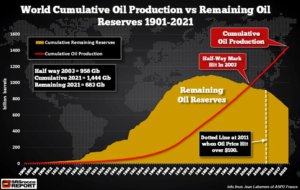
Preface.  I don’t know who wrote what follows, I was on the end of a chain of many forwarded emails. It appears to be a summary of the newsletter “Steve Angelo, SRSrocco in Energy, Silver Members on November 23, 2022″. Interesting if true…

Alice Friedemann  www.energyskeptic.com  Author of Life After Fossil Fuels: A Reality Check on Alternative Energy; When Trucks Stop Running: Energy and the Future of Transportation”, Barriers to Making Algal Biofuels, & “Crunch! Whole Grain Artisan Chips and Crackers”.  Women in ecology  Podcasts: WGBH, Jore, Planet: Critical, Crazy Town, Collapse Chronicles, Derrick Jensen, Practical Prepping, Kunstler 253278, Peak Prosperity,  Index of best energyskeptic posts

I will show THREE CHARTS on why the Peak in Conventional Oil Production is the ENERGY CLIFF.

The Global Economy has grown on the back of high-quality, high EROI, conventional oil production. While we have added a significant amount of U.S. shale oil and Alberta oil sands, this low-quality unconventional oil supply cannot sustain our High-Tech Global Economy that needs a much higher EROI of Oil to pay for everything. Thus, there is no coincidence that world debt has doubled from $150 trillion in 2008 to over $303 trillion in 2021 to bring on this lower-quality oil.

Let’s start with Cumulative Oil Discoveries vs. Cumulative Crude Oil & Condensate Production. You will notice a troubling sign. The Graph of Cumulative Conventional Oil Discoveries has been leveling off in the past decade while production (consumption) continues higher.  So, if we look at conventional oil production vs. conventional oil discoveries… We have already PAST THE POINT OF NO RETURN (figure 1). The chart above shows that conventional oil discoveries are not moving up in the same trend as cumulative oil production.  Thus, the world is devouring its past conventional oil discoveries (remaining reserves) much faster than it’s replacing them.  In a nutshell, the world is EATING ITS SEED CORN of oil. GOOD GRIEF…

The data from the following two charts came from Jean Laherrère. I started using data from Rystad, but Jean let me know the figures Rystad puts out are likely INFLATED.  Furthermore, these charts are based upon my analysis and may differ slightly from Jean regarding remaining reserves, but not by much. Again, this analysis is to provide a Fundamental View of the Conventional Oil Energy Cliff.

The following chart (figure 2) shows cumulative conventional oil production vs. remaining oil reserves… and this is very important to understand.  If we subtract the cumulative oil production from cumulative discoveries, we get the REMAINING OIL RESERVES.  This is not a pretty picture.

Of course, we will continue to discover more conventional oil reserves, but this won’t be much compared to the past.  Again, that is why the cumulative oil discovery trend in the first chart, figure 1, is PLATEAUING.  

Returning to figure 2, you will notice that the HALFWAY Mark for the Remaining Reserves and Cumulative Oil Production was met in 2003.  Thus, it’s no coincidence that the oil price began to surge after that period as the world peaked in conventional oil production (Shown in figure 3 below).

According to Jean’s data, my analysis shows the HALFWAY mark at 958 billion barrels (Gb).  With Cumulative oil production at 1,444 Gb and with only 683 Gb of Remaining Reserves, we have reached the CONVENTIONAL OIL ENERGY CLIFF.  We are now really devouring conventional oil reserves at a breakneck speed.

Since 2003, the world has been consuming more of its remaining oil reserves than it has been discovering.  This picked up speed, especially after 2011, shown in the WHITE DOTTED LINE… and where the oil price averaged over $100 a barrel for the next three years.

Figure 2. Conventional oil production versus remaining oil reserves
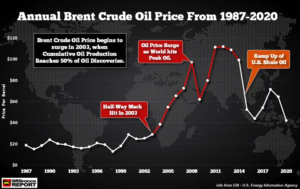
The last chart (figure 3) shows there is a relationship between the fundamental factors of Conventional Oil Production vs. Discoveries and Remaining Reserves to the Brent Crude Oil Price.Figure 3 Annual Brent Crude oil price from 1987-2020

We can see that the average annual Brent Crude Oil price began to surge after 2003 when the world reached the HALFWAY Mark as we reached peak conventional oil production.  As the world continued to consume more of its reserves than it was being replaced, the price jumped to over $100 and stayed there for three years until U.S. shale oil production came on in a BIG WAY.

So, with the world being saved by U.S. Shale oil and Canadian Oil Sands, the Brent Crude Oil price declined to allow BUSINESS AS USUAL to continue.  Unfortunately, U.S. shale oil production has likely peaked or will peak shortly, and will collapse by 2030.  

This is why I continue to stick with my forecast of the ENERGY CLIFF beginning circa 2025.

PS. I wrote this in 2013, so you can’t say I didn’t warn you!

WileyCoyoteCliff EdgeHere we are at the energy cliff, approaching the time we warned everyone about.  Wiley coyote is over the edge, legs wheeling in the air.

In California it’s warm and sunny, home prices are going up, Silicon Valley is booming again. Almost impossible to believe it won’t continue this way!  Not even after having studied this more than the average person.

I don’t dare talk about peak oil and resource depletion in my social circles.  At this point I’m told point blank no one wants to venture into my dark world, and I think some are hoping I’ll apologize about being wrong now that fracking has brought us energy independence (NOT).

What’s coming is so much bigger than any tragedy in history, than any war, epidemic — a 6th extinction event that may nail us as well.

So you could consider peak fossil fuels a blessing, a chance at not going extinct, since the remaining fossil fuels that are left are hard to get at, often stranded, and will take so much time and energy to extract that society will have to stop growing and start to contract, bringing on wars and social unrest, preventing us from getting every last bit of what’s left.

I often wonder how many people are watching ecological collapse approach.  A wild guess, given the membership at peakoil.com of 33000, America2point0 550, energyresources 2700, runningonempty2 7400, and another 60,000 in theoildrum, ASPO, transition towns, universities, non-english speaking forums I don’t know about, and local peak oil forums, minus a large overlap in membership, and further subtracting a third of the people on these forums who don’t get that solar, wind, nuclear, biofuels and so on won’t save us from a liquid fuels crisis, gives me a rough guess of about 50,000 actively watching the cliff approach.

Since Hubbert’s curve isn’t a symmetric bell curve, but rather a cliff because of net energy loss, is there any town, ranch, or farm in the world that won’t feel the repercussions?

Since the collapse will be seen as a financial crash by most people, and blamed on the government, Wall Street, and corporations – not carrying capacity hitting the wall of oil and resource depletion — it would be a shame if no one understood what really happened.

So with the coming collapse in mind I try to travel and see friends and family more often.  What my friends consider my “dark place” has its virtues. I’m keenly aware of how lucky I am to live at the peak of human civilization, to be closer to a Goddess than a Queen flying 40,000 feet above the earth in an airplane, zooming at 80 miles and hour through Utah salt flats with thousands of energy slaves at my service (Buckminster Fuller).

When I volunteer to take 4th and 5th graders on hikes at a nature preserve, I start by asking them to open their eyes and try to see everything, cup their hands around their ears to hear every sound better, to smell the aromas of flowers and the scents of the damp earth, to let all sensations flow in.  I give them hardware store paint samples with many colors of green and ask them to match one of these colors exactly with a leaf so they notice how many shades of green there are, which leads them to notice the textures and shapes of leaves as well.

The bright side of Post Carbon is not such a dark place, I expect that many of us share a more vivid appreciation of the beauty around us, the freedom to travel where we please, can even be more patient in traffic jams knowing we might be nostalgic about them ten years from now.

Perhaps our role is to be among the few witnesses who weren’t fooled by Business As Usual, and watched the approaching tsunami with eyes wide open.

Alice Friedemann

WileyCoyoteCliff Falling

Buckminster Fuller: “Energy slave unit = average output of a man doing 150,000 foot-pounds of work per day, 250 days per year. In low-energy societies, non-human energy slaves are horses, oxen, windmills, riverboats. Now, the average American has more than 8,000 energy-slaves at his or her disposal, and these slaves can work under extreme conditions: no sleep, 5,000° F, at 400,000 pounds per square inch pressure, etc”


Posted in Peak Oil | Tagged , | 1 Comment