Preface. Economic reasons are the main hurdle to new nuclear plants now, with capital costs so high it’s almost impossible to get a loan, especially when natural gas is so much cheaper and less risky. But there are other reasons nuclear power is in trouble as well. Far more plants are in danger of closing than are being built because they’re so expensive (37 were predicted to shut down in 2013, 21 have been or will be soon). The $14 billion Vogtle reactors ended up cost $35 billion — of taxpayer money. If there is another Fukushima or spent fuel pool release, the public will also be on the line for potentially trillions of dollars (Stone, R. May 24, 2016. Spent fuel fire on U.S. soil could dwarf impact of Fukushima. & Near miss at Fukushima is a warning for U.S., panel says. Science)
I have several chapters on nuclear reactors in my next book (and nuclear waste, war, and winter) that will be more up-to-date than this post, hopefully out in 2026 or 2027.
Alice Friedemann www.energyskeptic.com Author of Life After Fossil Fuels: A Reality Check on Alternative Energy; When Trucks Stop Running: Energy and the Future of Transportation”, Barriers to Making Algal Biofuels, & “Crunch! Whole Grain Artisan Chips and Crackers”. Women in ecology Podcasts: WGBH, Jore, Planet: Critical, Crazy Town, Collapse Chronicles, Derrick Jensen, Practical Prepping, Kunstler 253 &278, Peak Prosperity, Index of best energyskeptic posts
***
Nuclear power plants take too long to build
The Vogtle reactors were AP 1000 MODULAR reactors, which small nuclear reactor proponents say will differentiate make them more successful. No they won’t, and so far they cost billions too, beyond what lenders will lend. k
It often takes 10 years to build one due to the many years it takes to get licensed, fabricate components, and finally another 4 to 7 years to actually build it. Or more: the Vogtle units 3 and 4 have been under construction since 2013 and aren’t expected to be ready until 2023.
That’s too long for investors to wait, they want far more immediate returns. Techno-optimists can argue that some new-fangled kind of reactor could be built more quickly. But the public is afraid of reactors because there is nowhere to store their million-years of toxic wastes, so it’s bound to go slowly as protestors demand stringent inspections every step of the way. So even a small, simple reactor would have many hurdles to overcome.
Financial markets are wary of investments in new nuclear plants until it can be demonstrated they can be constructed on budget and on schedule. Nuclear plants have not been built in the United States for decades, but there are unpleasant memories, because construction of some of the currently operating plants was associated with substantial cost overruns and delays. There is also a significant gap between when construction is initiated and when return on investment is realized.
Nuclear power costs too much
U.S. nuclear power plants are old and in decline. By 2030, U.S. nuclear power generation might be the source of just 10% of electricity, half of production now, because 38 reactors producing a third of nuclear power are past their 40-year life span, and another 33 reactors producing a third of nuclear power are over 30 years old. Although some will have their licenses extended, 37 reactors that produce half of nuclear power are at risk of closing because of economics, breakdowns, unreliability, long outages, safety, and expensive post-Fukushima retrofits (Cooper 2013. Nuclear power is too expensive, 37 costly reactors predicted to shut down and A third of Nuclear Reactors are going to die of old age in the next 10-20 years.
New reactors are not being built because it takes years to get permits and $8.5–$20 billion in capital must be raised for a new 3400 MW nuclear power plant (O’Grady, E. 2008. Luminant seeks new reactor. London: Reuters.). This is almost impossible since a safer 3400 MW gas plant can be built for $2.5 billion in half the time. What utility wants to spend billions of dollars and wait a decade before a penny of revenue and a watt of electricity is generated?
In the USA there are 104 nuclear plants (largely constructed in the 1970s and 1980s) contributing 19% of our electricity. Even if all operating plants over 40 years receive renewals to operate for 60 years, starting in 2028 it’s unlikely they can be extended another 20 years, so by 2050 nearly all nuclear plants will be out of business.
Joe Romm “The Nukes of Hazard: One Year After Fukushima, Nuclear Power Remains Too Costly To Be A Major Climate Solution” explains in detail why nuclear power is too expensive, such as:
- New nuclear reactors are expensive. Recent cost estimates for individual new plants have exceeded $5 billion (for example, see Scroggs, 2008; Moody’s Investor’s Service, 2008).
- New reactors are intrinsically expensive because they must be able to withstand virtually any risk that we can imagine, including human error and major disasters
- We’d need to add an average of 17 plants each year, while building an average of 9 plants a year to replace those that will be retired, for a total of one nuclear plant every two weeks for four decades — plus 10 Yucca Mountains to store the waste
- Before 2007, price estimates of $4000/kw for new U.S. nukes were common, but by October 2007 Moody’s Investors Service report, “New Nuclear Generation in the United States,” concluded, “Moody’s believes the all-in cost of a nuclear generating facility could come in at between $5,000 – $6,000/kw.”
- That same month, Florida Power and Light, “a leader in nuclear power generation,” presented its detailed cost estimate for new nukes to the Florida Public Service Commission. It concluded that two units totaling 2,200 megawatts would cost from $5,500 to $8,100 per kilowatt – $12 billion to $18 billion total!
- In 2008, Progress Energy informed state regulators that the twin 1,100-megawatt plants it intended to build in Florida would cost $14 billion, which “triples estimates the utility offered little more than a year ago.” That would be more than $6,400 a kilowatt. (And that didn’t even count the 200-mile $3 billion transmission system utility needs, which would bring the price up to a staggering $7,700 a kilowatt).
Extract from Is Nuclear Power Our Energy Future, Or in a Death Spiral? March 6th, 2016, By Dave Levitan, Ensia:
In general, the more experience accumulated with a given technology, the less it costs to build. This has been dramatically illustrated with the falling costs of wind and solar power. Nuclear, however has bucked the trend, instead demonstrating a sort of “negative learning curve” over time.
According to the Union of Concerned Scientists, the actual costs of 75 of the first nuclear reactors built in the U.S. ran over initial estimates by more than 200 percent. More recently, costs have continued to balloon. Again according to UCS, the price tag for a new nuclear power plant jumped from between US$2 billion and US$4 billion in 2002 all the way US$9 billion in 2008. Put another way, the price shot from below US$2,000 per kilowatt in the early 2000s up to as high as US$8,000 per kilowatt by 2008.
Steve Clemmer, the director of energy research and analysis at UCS, doesn’t see this trend changing. “I’m not seeing much evidence that we’ll see the types of cost reductions [proponents are] talking about. I’m very skeptical about it — great if it happens, but I’m not seeing it,” he says.
Some projects in the U.S. seem to face delays and overruns at every turn. In September 2015, a South Carolina effort to build two new reactors at an existing plant was delayed for three years. In Georgia, a January 2015 filing by plant owner Southern Co. said that its additional two reactors would jump by US$700 million in cost and take an extra 18 months to build. These problems have a number of root causes, from licensing delays to simple construction errors, and no simple solution to the issue is likely to be found.
In Europe the situation is similar, with a couple of particularly egregious examples casting a pall over the industry. Construction began for a new reactor at the Finnish Olkiluoto 3 plant in 2005 but won’t finish until 2018, nine years late and more than US$5 billion over budget. A reactor in France, where nuclear is the primary source of power, is six years behind schedule and more than twice as expensive as projected.
“The history of 60 years or more of reactor building offers no evidence that costs will come down,” Ramana says. “As nuclear technology has matured costs have increased, and all the present indications are that this trend will continue.”
Nuclear plants require huge grid systems, since they’re far from energy consumers. The Financial Times estimates that would require ten thousand billion dollars be invested world-wide in electric power systems over the next 30 years.
In summary, investors aren’t going to invest in new reactors because:
- of the billions in liability after a meltdown or accident
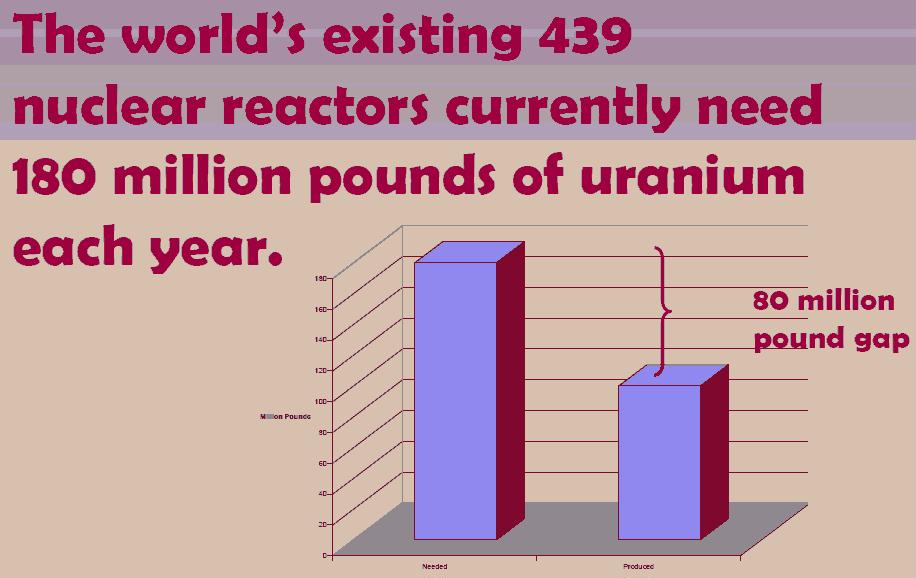
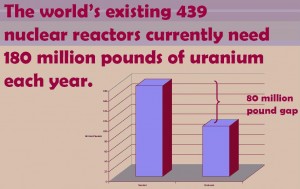
- there may only be enough uranium left to power existing plants
- the cost per plant ties up capital too long (it can take 10 billion dollars over 10 years to build a nuclear power plant)
- the costs of decommissioning are very high
- properly dealing with waste is expensive
- There is no place to put waste — in 2009 Secretary of Energy Chu shut down Yucca mountain and there is no replacement in sight.
Nor will the USA government pay for the nuclear reactors given that public opinion is against that — 72% said no (in E&E news), they weren’t willing for the government to pay for nuclear power reactors through billions of dollars in new federal loan guarantees for new reactors.
Cembalest, an analyst at J.P. Morgan, wrote “In some ways, nuclears goose was cooked by 1992, when the cost of building a 1 GW plant rose by a factor of 5 (in real terms) from 1972” (Cembalest).
Nuclear power depends on fossil fuels to exist (Ahmed 2017)
“One extensive study finds that the construction, mining, milling, transporting, refining, enrichment, waste reprocessing/disposal, fabrication, operation and decommissioning processes of nuclear power are heavily dependent on fossil fuels (Pearce 2008). This raises serious questions about the viability of nuclear power in about two decades time, when hydrocarbon resources are likely to be well past their production peaks.
Further, the study concludes that nuclear power is simply not efficient enough to replace fossil fuels, an endeavor which would require nuclear production to increase by 10.5% every year from 2010 to 2050-an “unsustainable prospect”. This large growth rate requires a “cannibalistic effect”, whereby nuclear energy itself must be used to supply the energy to construct future nuclear power plants. The upshot is that the books cannot be balanced as the tremendous amounts of energy necessary for mining and processing uranium ore, building and operating the power plant, and so on, cannot be offset by output in a high growth scenario. In particular, growth limits are set by the grade of uranium ore available-and high-grade uranium is predicted to become rapidly depleted in coming decades, leaving largely low-grade ore falling below 0.02% (Pearce 2008)”.
Peak Uranium
Energy experts warn that an acute shortage of uranium is going to hit the nuclear energy industry. Dr Yogi Goswami, co-director of the Clean Energy Research Centre at the University of Florida warns that proven reserves of uranium will last less than 30 years. By 2050, all proven and undiscovered reserves of uranium will be over. Current nuclear plants consume around 67,000 tonnes of high-grade uranium per year. With present world uranium reserves of 5.5 million tons, we have enough to last last 42 years. If more nuclear plants are built, then we have less than 30 years left (Coumans).
Uranium production peaked in the 1980s but supplies continued to meet demand because weapons decommissioned after the Cold War were converted commercial fuel. Those sources are now drying up, and a new demand-driven peak may be on the horizon.
The only way we could extend our supplies of uranium is to build breeder reactors. But we don’t have any idea how to do that and we’ve been trying since the 1950s.
China switched on its 19th nuclear power reactor as it rushes to increase nuclear generation. The country plans to switch on 8.64 gigawatts of nuclear generating capacity in 2014 as compared to 3.24 gigawatts of new capacity in 2013. The availability of uranium for China’s nuclear industry is becoming an issue. Beijing may have to import some 80 percent of its uranium by 2020, as compared to the current 60 percent.
There may not even be enough uranium to power existing plants. For example, Nuclear fission startup TerraPower, founded and chaired by Microsoft co-founder Bill Gates, has raised $750 million to develop advanced nuclear reactors to serve as alternatives to the light-water reactors. The future Natrium reactor is hoped to be running by 2028 for just $4 billion dollars. It will use a different fuel than standard nuclear reactors — high-assay low-enriched uranium (HALEU), which is enriched with more uranium than the fuel used in traditional nuclear plants. But the only source of HALEU is in Russia, and with the war in Ukraine threatening to go on for quite a while, this source is untenable. And even if money from Biden’s Inflation and climate acts is used to create a HALEU source, that’s many years away. Worse yet, the project will lose $2 billion in funding if it isn’t ready by 2028 (Wesoff 2022).
 Source: Colorado Geological survey
Related articles:
Nuclear power is Way too Dangerous
In 2016, top journal Science, based on the National Academy of Sciences of lessons learned from Fukushima, reported that a nuclear spent fuel fire at Peach Bottom in Pennsylvania could force 18 million people to evacuate. This is because there’s still nowhere to put nuclear waste, so it’s stored in pools of water on-site that are not under the containment dome, but open to the air, and a prime target for terrorists at over 100 locations. If electric power were ever down more than 10 days due to a natural disaster, electromagnetic pulse from a nuclear weapon / solar flare, or any other reason, these nuclear pools would catch on fire and spew out radiation for many square miles and force millions of people to evacuate. Also see: Shocking state of world’s riskiest nuclear waste sites
The dangers of nuclear waste is the main reason California and many other states won’t allow new nuclear power plants to open. To find out more about the dangers of nuclear waste and why we have nowhere to store it, read by book review of “Too Hot to touch: The Problem of high-level nuclear waste“.
Greenpeace has a critique of nuclear power called The Global Crisis of Nuclear Waste (2018) and Nuclear Reactor Hazards (2005) which makes the following points:
- As nuclear power plants age, components become embrittled, corroded, and eroded. This can happen at a microscopic level which is only detected when a pipe bursts. As a plant ages, the odds of severe incidents increase. Although some components can be replaced, failures in the reactor pressure vessel would lead to a catastrophic release of radioactive material. The risk of a nuclear accident grows significantly each year after 20 years. The average age of power plants now, world-wide, is 21 years.
- In a power blackout, if the emergency backup generators don’t kick in, there is the risk of a meltdown. This happened recently in Sweden at the Fosmark power station in 2006. A former director said “It was pure luck that there was not a meltdown. Since the electricity supply from the network didn’t work as it should have, it could have been a catastrophe.” Another few hours and a meltdown could have occurred. It should not surprise anyone that power blackouts will become increasingly common and long-lasting as energy declines.
- 3rd generation nuclear plants are pigs wearing lipstick – they’re just gussied up 2nd generation — no safer than existing plants.
- Many failures are due to human error, and that will always be the case, no matter how well future plants are designed.
- Nuclear power plants are attractive targets for terrorists now and future resource wars. There are dozens of ways to attack nuclear and reprocessing plants. They are targets not only for the huge number of deaths they would cause, but as a source of plutonium to make nuclear bombs. It only takes a few kilograms to make a weapon, and just a few micrograms to cause cancer.
If Greenpeace is right about risks increasing after 20 years, then there’s bound to be a meltdown incident within ten years, which would make it almost impossible to raise capital. (And indeed there was, Fukushima had a meltdown in 2011).
It’s already hard to raise capital, because the owners want to be completely exempt from the costs of nuclear meltdowns and other accidents. That’s why no new plants have been built in the United States for decades.
The Energy Returned on Energy Invested may be too low for investors as well. When you consider the energy required to build a nuclear power plant, which needs tremendous amount of cement, steel pipes, and other infrastructure, it could take a long time for the returned energy to pay back the energy invested. The construction of 1970’s U.S. nuclear power plants required 40 metric tons of steel and 190 cubic meters of concrete per average megawatt of electricity generating capacity (Peterson 2003).
The amount of greenhouse gases emitted during construction is another reason many environmentalists have turned away from nuclear power.
The costs of treating nuclear waste have skyrocketed. An immensely expensive treatment plant to cleanup the Hanford nuclear plant went from costing 4.3 billion in 2000 to 12.2 billion dollars today. If the final treatment plant is ever built, it will be twelve stories high and four football fields long (Dininny 2006).
A crisis will harden public opinion against building new Nuclear Power Plants
I wrote this section before the Fukushima disaster, and there will be more disasters as aging nuclear power plants, extended beyond their lifetime and being pushed to produce electricity full-tilt, succumb to many hazards detailed in the Green Peace International report “Nuclear Reactor Hazards“. It’s only a matter of time before one of our aging reactors melts down. When that happens, the public will fight the development of more nuclear power plants. Other factors besides aging that could cause a disaster are natural disasters, failure of the electric grid, increased and more severe flooding, drought, and severe and unstable weather from climate change, lack of staffing as older workers retire with few educated engineers available to replace them.
Even Edward Teller, father of the hydrogen bomb, thought Nuclear Power Plants were dangerous and should be put underground for safety in case of a failure and to make clean-up easier.
Five of the six reactors at the Fukushima plant in Japan were Mark 1 reactors. Thirty-five years ago, Dale G. Bridenbaugh and two of his colleagues at General Electric quit after they became convinced that the Mark 1 nuclear reactor design they were reviewing was so flawed it could lead to a devastating accident (Mosk).
Nuclear power plants are extremely attractive targets for terrorists and in a war. Uranium is not only stored in the core, but the “waste” area near the plant, providing plenty of material for “dirty” or explosive atom bombs.
For details, read the original document or my summary of the Greenpeace report.
EROEI and decommissioning
See: Decommissioning a nuclear reactor
The energy to build, decommission, dispose of wastes, etc., may be more than the plant will ever generate a negative Energy Returned on Energy Invested (EROEI). A review by Charles Hall et al. of net energy studies of nuclear power found the data to be “idiosyncratic, prejudiced, and poorly documented,” and concluded the most reliable EROEI information was too old to be useful (results ranged from 5 to 8:1). Newer data was unjustifiably optimistic (15:1 or more) or pessimistic (low, even less than 1:1). One of the main reasons EROEI is low is due to the enormous amount of energy used to construct nuclear power plants, which also create a great deal of GHG emissions.
Scale
“To produce enough nuclear power to equal the power we currently get from fossil fuels, you would have to build 10,000 of the largest possible nuclear power plants. That’s a huge, probably nonviable initiative, and at that burn rate, our known reserves of uranium would last only for 10 or 20 years.” (Goodstein). Are there enough sites for 10,000 plants near water for cooling yet not so low that rising sea levels destroy them or drought remove cooling water supplies?
Staffing
Nuclear power has been unpopular for such a long time, that there aren’t enough nuclear engineers, plant operators and designers, or manufacturing companies to scale up quickly (Torres 2006). The number of American Society of Mechanical Engineers (ASME) nuclear certificates held around the world fell from 600 in 1980 to 200 in 2007. There is also an insufficient supply of people with the requisite education or training at a time when vendors, contractors, architects, engineers, operators, and regulators will be seeking to build up their staffs. In addition, 35% of the staff at U.S nuclear utilities are eligible for retirement in the next 5–10 years.
There could be shortages in certain parts and components (especially large forgings), as well as in trained craft and technical personnel, if nuclear power expands significantly worldwide.
There are fewer suppliers of nuclear parts and components now than in the past.
Nuclear Proliferation & terrorism targets
Can we really prevent crazed dictators for 30,000 years from using plutonium and other wastes to wage war? Even if a nuclear bomb is beyond the capabilities of society in the future, the waste could be used to make a dirty bomb. Meanwhile, reactors make good targets for terrorists who do have the money to hire scientists help them make a nuclear bomb from stolen uranium or plutonium.
Water
Nuclear plants must be built near water for cooling, and use a tremendous amount of water. Scientists are certain that global warming will raise sea levels — about half of existing power plants would be flooded. Climate change will cause longer and more severe droughts, with the potential for not enough water to cool the plant down, and more severe storms will bring more hurricanes and tornadoes.
NIMBYism
Never underestimate NIMBYism, which is already preventing nuclear power plants from being built. The political opposition to building thousands of nuclear plants will be impossible to overcome.
No good way to store the energy
One of the most critical needs for power is a way to store it. Utility scale storage batteries have not been invented despite decades of research, and only enough materials exist on earth to build NaS batteries at a cost of over $44 trillion that would take up 945 square miles of real estate (Friedemann 2015)
A great deal of the electric power generated would need to be used to replace the billions of combustion engine machines and vehicles rather than providing heat, cooling, cooking power and light to homes and offices. It takes decades to move from one source of power to another. It’s hard to see how this could be accomplished without great hardship and social chaos, which would slow the conversion process down. Desperation is likely to lead to stealing of key components of the new infrastructure to sell for scrap metal, as is already happening in Baltimore where 30-foot tall street lights are being stolen (Gately 2005).
Related posts: Energy Storage
Ramping up and down quickly to balance solar & wind damages nuclear power plants
Nuclear plants can’t ramp up or down quickly like natural gas — they are very incompatible with intermittent wind and solar power.
The German nuclear plant Brokderf was damaged because its operators increased and decreased its output to respond to energy grid fluctuations. The incident supports the theory that nuclear and renewable energy generation are incompatible. Brokdorf’s period of inactivity has cost plant owner EON more than €100 million, according to reports by Bloomberg.
State Minister for Energy Robert Habeck warned that the power plant’s output should not be increased or decreased at short notice to adapt to the supply of renewable energies on the electricity grid because “atomic energy is not a bridging technology”.
A 2011 study by Greenpeace also concluded that renewables and nuclear are not compatible and that fuel rod damage is a possible consequence.
Kiel’s nuclear supervisory authority explained that the corrosion of Brokdorf’s fuel rods was a result of the reactor’s capacity being increased from 1,440 MW to 1,480 MW in 2006. The investigation also concluded that the decision to run the plant as a load-following power station, where output was tailored to grid fluctuations, contributed to the damage (Dehmer 2017).
Breeder reactors. You’d need 24,000 Breeder Reactors, each one a potential nuclear bomb (Mesarovic)
- We’ve known since 1969 that we needed to build breeder reactors to stretch the lifetime of radioactive material to tens of thousands of years, and to reduce the radioactive wastes generated, but we still don’t know how to do this. (NAS)
- If we ever do succeed, these reactors are much closer to being bombs than conventional reactors – the effects of an accident would be catastrophic economically and in the number of lives lost if it failed near a city (Wolfson).
- The by-product of the breeder reaction is plutonium. Plutonium 239 has a half-life of 24,000 years. How can we guarantee that no terrorist or dictator will ever use this material to build a nuclear or dirty bomb during this time period?
Assume, as the technology optimists want us to, that in 100 years all primary energy will be nuclear. Following historical patterns, and assuming a not unlikely quadrupling of population, we will need, to satisfy world energy requirements, 3,000 “nuclear parks” each consisting of, say, 8 fast-breeder reactors. These 8 reactors, working at 40% efficiency, will produce 40 million kilowatts of electricity collectively. Therefore, each of the 3,000 nuclear parks will be converting primary nuclear power equivalent to 100 million kilowatts thermal. The largest nuclear reactors presently in operation convert about 1 million kilowatts (electric), but we will give progress the benefit of doubt and assume that our 24,000 worldwide reactors are capable of converting 5 million kilowatts each. In order to produce the world’s energy in 100 years, then, we will merely have to build, in each and every year between now and then, 4 reactors per week! And that figure does not take into account the lifespan of nuclear reactors. If our future nuclear reactors last an average of thirty years, we shall eventually have to build 2 reactors per day to replace those that have worn out. By 2025, sole reliance on nuclear power would require more than 50 major nuclear installations, on the average, in every state in the union.
For the sake of this discussion, let us disregard whether this rate of construction is technically and organizationally feasible in view of the fact that, at present, the lead time for the construction of much smaller and simpler plants is seven to ten years. Let us also disregard the cost of about $2000 billion per year — or 60 percent of the total world output of $3400 billion — just to replace the worn-out reactors and the availability of the investment capital. We may as well also assume that we could find safe storage facilities for the discarded reactors and their irradiated accessory equipment, and also for the nuclear waste. Let us assume that technology has taken care of all these big problems, leaving us only a few trifles to deal with.
In order to operate 24,000 breeder reactors, we would need to process and transport, every year, 15 million kilograms (16,500 tons) of plutonium-239, the core material of the Hiroshima atom bomb. Only 10 pounds are needed to construct a bomb. If inhaled, just ten micrograms (.00000035 ounce) of plutonium-239 is likely to cause fatal lung cancer. A ball of plutonium the size of a grapefruit contains enough poison to kill nearly all the people living today. Moreover, plutonium-239 has a radioactive life of more than 24,000 years. Obviously, with so much plutonium on hand, there will be a tremendous problem of safeguarding the nuclear parks — not one or two, but 3000 of them. And what about their location, national sovereignty, and jurisdiction? Can one country allow inadequate protection in a neighboring country, when the slightest mishap could poison adjacent lands and populations for thousands and thousands of years? And who is to decide what constitutes adequate protection, especially in the case of social turmoil, civil war, war between nations, or even only when a national leader comes down with a case of bad nerves. The lives of millions could easily be beholden to a single reckless and daring individual.
References
Ahmed, Nafeez. 2017. Failing States, Collapsing Systems BioPhysical Triggers of Political Violence. Springer.
Amy J (2021) Georgia nuclear plant cost tops $27B as more delays unveiled. Associated Press.
Cembalest, M.21 Nov 2011. Eye on the Market. The quixotic search for energy solutions. J P Morgan
Coumans, C. 4 Sep 2010. Uranium reserves to be over by 2050. Deccan Chronicle.
Dehmer, D. July 19, 2017. German nuclear damage shows atomic and renewable power are unhappy bedfellows. Der Tagesspiegel
Dininny, S. 7 Sep 2006. Cost for Hanford waste treatment plant grows to $12.2 billion. The Olympian / Associated Press.
Friedemann, A. 2015. When Trucks stop running: Energy and the Future of Transportation. Springer.
Gately, G. 25 Nov 2005. Light poles vanishing — believed sold for scrap by thieves 130 street fixtures in Baltimore have been cut down. New York Times.
Goodstein, D. April 29, 2005. Transcript of The End of the Age of Oil talk
(Greenpeace) H. Hirsch, et al. 2005. Nuclear Reactor Hazards: Ongoing Dangers of Operating Nuclear Technology in the 21st Century http://www.greenpeace.org/raw/content/international/press/reports/nuclearreactorhazards.pdf
Heinberg, Richard. September 2009. Searching for a Miracle. “Net Energy” Limits & the Fate of Industrial Society. Post Carbon Institute.
Hirsch, R. L., et al. February 2005. Peaking of World Oil Production: Impacts, mitigation, & risk management. Department of Energy.
Hoyos, C. 19 OCT 2003 Power sector 'to need $10,000 bn in next 30 years'. Financial Times.
Mesarovic, Mihajlo, et al. 1974. Mankind at the Turning Point. The Second Club of Rome Report. E.P. Dutton, 1974 pp. 132-135
Mosk, M. 15 Mar 2011. Fukushima: Mark 1 Nuclear Reactor Design Caused GE Scientist To Quit In Protest. ABC World News.
(NAS) “It is clear, therefore, that by the transition to a complete breeder-reactor program before the initial supply of uranium 235 is exhausted, very much larger supplies of energy can be made available than now exist. Failure to make this transition would constitute one of the major disasters in human history." National Academy of Sciences. 1969. Resources & Man. W.H.Freeman, San Francisco. 259.
Peterson, P. 2003. Will the United States Need a Second Geologic Repository? The Bridge 33 (3), 26-32.
Pearce, J. M. 2008. Thermodynamic Limitations to nuclear energy deployment as a greenhouse gas mitigation technology. International Journal of Nuclear Governance, Economy and Ecology 2(1): 113.
Torres, M. “Uranium Depletion and Nuclear Power: Are We at Peak Uranium?” http://www.theoildrum.com/node/2379#more
Wesoff E (2022) Bill Gates’ nuclear startup wins $750M, loses sole fuel source. Canary Media
Wolfson, R. 1993. Nuclear Choices: A Citizen's Guide to Nuclear Technology. MIT Press
To see what plants are open, closing, or being built (excel):
United States Nuclear Regulatory Commission 2014-2015 Information Digest. Nuclear materials, radioactive waste, nuclear reactors, nuclear security.