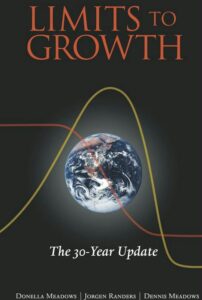
Preface. Dennis Meadows is a co-author of The Limits to Growth. In 1972, the team of 66 scientists he assembled for the original Limits to Growth study concluded the most probable result will be a rather sudden and uncontrollable decline in both population and industrial capacity. This post has a longer explanation from 2012 explaining their model.
Other scientists and articles think so too. And there have been more studies since this was posted (not shown below), that find the results still on schedule for collapse as in the 1972 Business As Usual scenario
Alice Friedemann www.energyskeptic.com Author of Life After Fossil Fuels: A Reality Check on Alternative Energy; When Trucks Stop Running: Energy and the Future of Transportation”, Barriers to Making Algal Biofuels, & “Crunch! Whole Grain Artisan Chips and Crackers”. Women in ecology Podcasts: WGBH, Planet: Critical, Crazy Town, Collapse Chronicles, Derrick Jensen, Practical Prepping, Kunstler 253 &278, Peak Prosperity, Index of best energyskeptic posts
***
At the 2014 Age of Limits conference he also said that in 1972 we had reached about 85% of Earth’s carrying capacity and today we are about 125%, and every month we delay in getting back within limits erodes Earth’s further ability to tolerate us. “The reason we don’t have a response to climate change,” he said, “is not because we don’t have better models. It’s because people don’t care about climate change.” That may be our epitaph.
In 1972 there were two possible options provided for going forward — overshoot or sustainable development. Despite myriad conferences and commissions on sustainable development since then, the world opted for overshoot. The two-legged hairless apes did what they always have done. They dominated and subdued Earth. Faced with unequivocal evidence of an approaching existential threat, they equivocated and then attempted to muddle through.
Global civilization will only be the first of many casualties of the climate the Mother Nature now has coming our way at a rate of change exceeding any comparable shift in the past 3 million years, save perhaps the meteors or super volcanoes that scattered our ancestors into barely enough breeding pairs to be able to revive. This change will be longer lived and more profound than many of those phenomena. We have fundamentally altered the nitrogen, carbon and potassium cycles of the planet. It may never go back to an ecosystem in which bipedal mammals with bicameral brains were possible. Or, not for millions of years”.
Video Presentation starts at 17:30, slides below
http://deepresource.wordpress.com/2012/05/28/dennis-meadows/
It Is Too Late For Sustainable Development
Smithsonian Institution Washington, DC; February 29, 2012
- I will briefly describe what we did in 1970 – 1972 and summarize the main contributions of our study.
- Then I will describe five reasons it is too late to achieve sustainable development.
- Public discourse has difficulty with subtle, conditional messages.
- Growth advocates change the justification for their paradigm rather than changing the paradigm itself.
- The global system is now far above its carrying capacity.
- We act as if technological change can substitute for social change.
- The time horizon of our current system is too short.
- As a result, I will suggest that it is essential now to put more emphasis on raising the resilience of the system.
What we did
A team of 16 people worked under my direction to elaborate a computer model representing the causes and consequences of growth in the main physical factors characterizing global development over the period 1900 – 2100. The model was first conceived by Jay Forrester, who described it in his book, World Dynamics. My team wrote and published 3 additional books on the project, The Limits to Growth, Toward Global Equilibrium, and
Dynamics of Growth in a Finite World.
Our focus was on: Population, Nonrenewable resources, Industrial goods, Peristent pollution, and Food
Our Main Contributions
- We did NOT prove that there are limits to physical growth on a finite planet. We assumed it.
- We did present information about a variety of physical limits- water, soils, metals, and other resources – in order to make the idea of limits plausible.
- We described the reasons growth of population and industrial output is inherently exponential.
- We showed that exponential growth quickly rises to any conceivable limit.
- Our computer scenarios demonstrated that prevailing growth policies will lead to overshoot and collapse, not asymptotic approach to limits.
- We suggested that changes in the policies could lead to a sustainable state, if the changes dealt with both cultural and technical issues and were implemented soon.
The Limits to Growth presented 12 scenarios. Four of them showed a relatively attractive global equilibrium without any collapse. However, it was written in the New York Times: “It is no coincidence that all the simulations based on the Meadows world model invariably end in collapse” The Limits to Growth, Peter Passell, Marc Roberts, and Leonard Ross, New York Times, April 2, 1972
We said: “These graphs are not exact predictions of the values of the variables at any particular year in the future. They are indications of the system’s behavioral tendencies only. P. 93, The Limits to Growth
However a Google today search on “the Club of Rome predicted” yields 13,700 hits, for example: “In 1972 Limits to Growth, published by the Club of Rome, predicted that the world will run out of gold in 1981, mercury in 1985, tin by 1987, zinc by 1990, petroleum by 1992, and copper, lead and natural gas by 1993”.
Growth advocates change the justification for their paradigm rather than changing the paradigm itself. “At every single stage – from its biased arrival to its biased encoding, to organizing it around false logic, to misremembering and then misrepresenting it to others, the mind continually acts to distort information flow in favor of the usual good goal of appearing better than one really is“, Page 139, in The Folly of Fools; The Logic of Deceit and Self-Deception in Human Life, Robert Trivers, Basic Books, New York, NY 2011
Evolution of the criticisms
- 1970s: There are no effective limits.
- 1980s: There are limits, but they are far away.
- 1990s: The limits are near, but technology and markets can evade them easily.
- 2000s: Technology and markets do not always evade the limits, but the best policy is still to pursue GNP growth, so we will have more resources to solve problems.
- 2010s: If we had been able to sustain economic growth, we would not have had trouble with the limits.
Given enough energy, minerals might be reclaimed from under the sea, or from seawater itself. A virtually infinite source of energy, the controlled nuclear fusion of hydrogen, will probably be tapped within 50 years. “The Limits to Growth”, by Peter Passell, Marc Roberts and Leonard Ross, New York Times, April 2, 1972.
“natural resources are not finite in any meaningful economic sense, mind-boggling though this assertion may be. The stocks of them are not fixed but rather are expanding through human ingenuity. p. 24, Julian L. Simon, The Ultimate Resource2, Princeton University Press, Princeton, NJ, 1996
The global system is now far above its carrying capacity
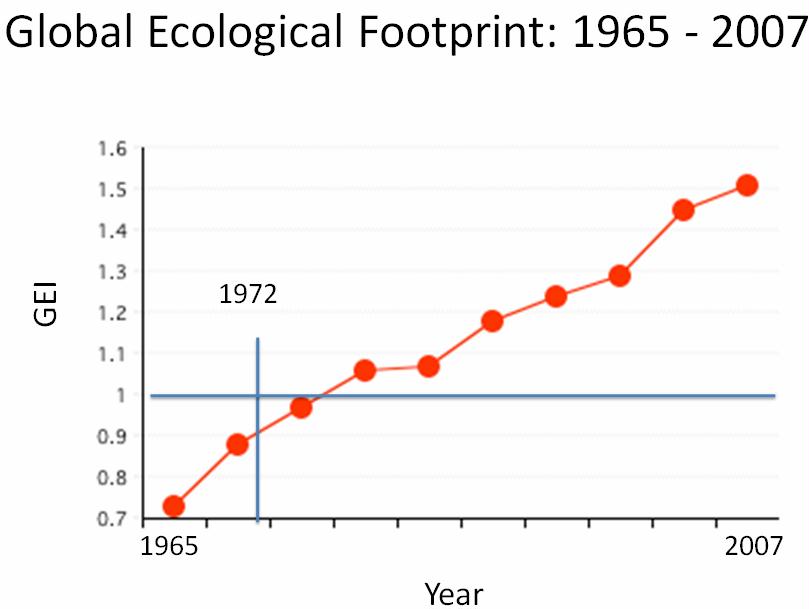
Avoiding collapse will require a longer time horizon than our current system provides.
The Easy Oil is Gone
- Oil discoveries peaked in 1960s.
- Every year since 1984 oil consumption has exceeded oil discovery.
- In 2009 discoveries were about 5 billion barrels (bb); consumption was about 31 bb.
- Of the world’s 20 largest oil fields, 18 were discovered 1917 – 1968; 2 in the 1970s; 0 since
Global Oil Production is Nearing the End of its Plateau
- 1995 – 1999 + 5.5%
- 2000 – 2004 + 7.9 %
- 2005 – 2009 + 0.4 %
– data from the International Statistical Supplement – 2010 edition, International Energy Agency, p. 18
• 2010 – 2030 – 50%*
* Projection from Crude Oil – The Supply Outlook, Energy Watch Group, Feb 2008, p. 12.
“By 2012, surplus oil production capacity could entirely disappear, and as early as 2015, the shortfall in output could reach nearly 10 MBD.” – U S Joint Forces Command, Joint Operating Environment Report, February, 2010
“Peak Oil Production May Already be Here,” – Science, p. 1510, Vol 331, March 25, 2011
It is essential now to put more emphasis on raising the resilience of the system. It is essential now to start changing our behavior
Meadows holds that collapse is now all but inevitable, but that its actual form will be too complex for any model to predict. “Collapse will not be driven by a single, identifiable cause simultaneously acting in all countries,” he observes. “It will come through a self-reinforcing complex of issues”—including climate change, resource constraints and socioeconomic inequality. When economies slow down, Meadows explains, fewer products are created relative to demand, and “when the rich can’t get more by producing real wealth they start to use their power to take from lower segments.” As scarcities mount and inequality increases, revolutions and socioeconomic movements like the Arab Spring or Occupy Wall Street will become more widespread—as will their repression.
Many observers protest that such apocalyptic scenarios discount human ingenuity. Technology and markets will solve problems as they show up, they argue. But for that to happen, contends economist Partha Dasgupta of the University of Cambridge in the U.K., policymakers must guide technology with the right incentives. As long as natural resources are underpriced compared with their true environmental and social cost—as long as, for instance, automobile consumers do not pay for lives lost from extreme climatic conditions caused by warming from their vehicles’ carbon emissions—technology will continue to produce resource-intensive goods and worsen the burden on the ecosystem, Dasgupta argues. “You can’t expect markets to solve the problem,” he says. Randers goes further, asserting that the short-term focus of capitalism and of extant democratic systems makes it impossible not only for markets but also for most governments to deal effectively with long-term problems such as climate change.
“We’re in for a period of sustained chaos whose magnitude we are unable to foresee,” Meadows warns. He no longer spends time trying to persuade humanity of the limits to growth. Instead, he says, “I’m trying to understand how communities and cities can buffer themselves” against the inevitable hard landing.

 Preface. This is a book review of “In Defense of Witches: The Legacy of the Witch Hunts and Why Women Are Still on Trial.” The author Chollet writes that the book won’t spend much time on witchcraft today, but explore the afterlife of the witch-hunts in Europe and the US that amped up prejudices about women, repressing certain behaviors and lifestyles. Chollet shows how we have inherited these representations as forged over centuries, today producing barriers wherever we turn as well as hostility and even violence. Among those accused of witchcraft, single women and widows are the majority, women not formally bound and subordinate to a man. During the centuries of witch burning, women were driven out of roles they had been used to occupying in the world of work, expelled from businesses.

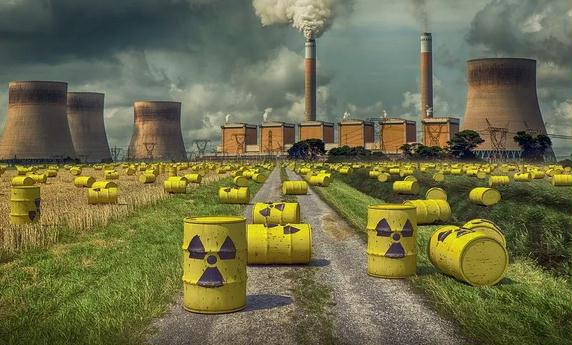 Preface. One the greatest tragedies of energy decline will be the nuclear waste left to harm 30,000 future generations so 3 generations could keep the lights on. We owe it to the future to clean up waste while we still have the fossil fuels to do it, since digging a hole deep and large enough requires serious offroad vehicles burning 50 gallons or more an hour. The great grandchildren sure won’t be able to do it with shovels.