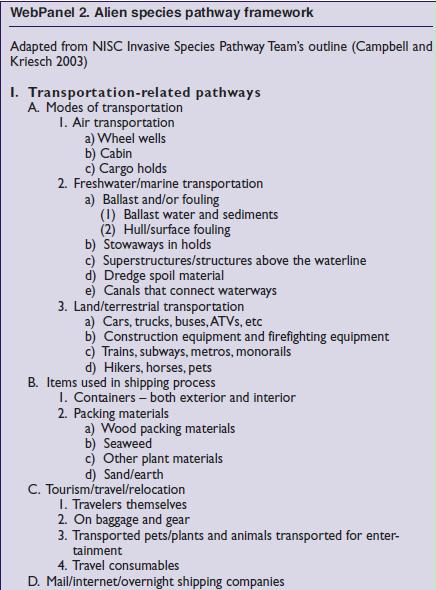
There are 17 rare earth elements in the periodic table. About nine of those elements go into every iPhone sold… and if China were suddenly to disappear from a map tomorrow, Apple would lose about 90% of those elements. Source: Brownlee 2013.
Preface. This long post describes the rare metals and minerals phones, laptops, cars, microchips, and other essential high-tech products civilization depends on. Without them, there can’t be a transition to wind turbines, solar panels, nuclear energy, and so on.
Metals and minerals aren’t just physically limited, they can be economically limited by a financial collapse, which dries up credit and the ability to borrow for new projects to mine and crush ores. Economic collapse drives companies and even nations out of business, disrupting supply chains.
Supply chains can also be disrupted by energy shortages & natural disasters.
The more complex, the more minerals, metals, and other materials, machines, chemicals, a product depends on, the greater the odds of disruption.
Minerals and metals can also be politically limited. China controls over 90% of some critical elements, for example, just three mines in China produce all of the world’s cesium.
And of course, they’re energetically limited. Once oil begins to decline, so too will mining and all other manufacturing steps, which all depend on fossil energy.
The next war over resources is likely to be done via cyber-attacks that take down an opponent’s electric grid, which would affect nearly all of the other essential infrastructure such as agriculture; defense; energy; healthcare, banking, finance; drinking water and water treatment systems; commercial facilities; dams; emergency services; nuclear reactors, information technology; communications; postal and shipping; transportation and systems; government facilities; and critical manufacturing (NIPP).
Cars require over 76 elements, with self-charging hybrid and plug-in hybrid vehicles having twice the supply chain raw material cost risks of conventional models (Bhuwalka et al 2021).
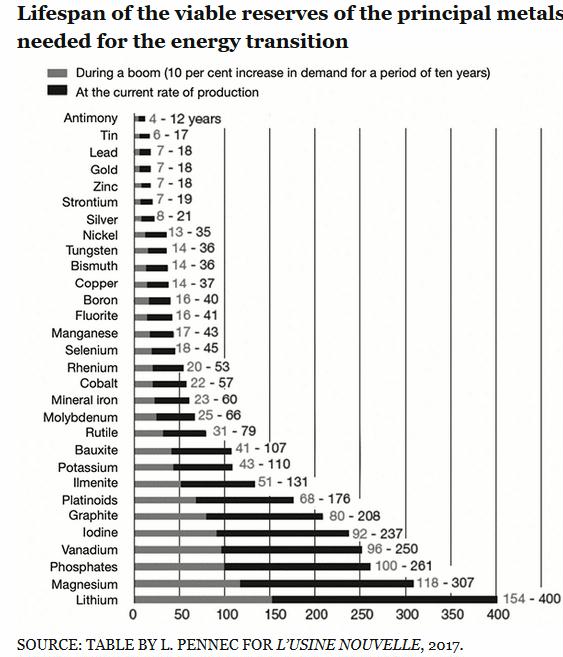
As you can see below, we are running of time to make an energy transition, and this is an optimistic estimate, since conventional oil peaked in 2018, the tremendous amount of energy needed to mine, smelt, fabricate into parts, transport to assembly factories, and deliver will shorten all of these time spans tremendously.
iPhones (Stone 2019)
200 million of iPhones are sold a year, each of them with 75 of the 118 elements in the periodic table, many of them rare, many of them sourced only from China. The minerals mentioned in this article were tungsten, tantalum, copper, tin, gold, silver, palladium, aluminum, cobalt, neodymium, gallium, all of which produce toxic byproducts during their mining and the refining of metals.
And less than one percent of these metals are recycled, due to the how difficult it is to collect enough electronic devices to make recycling worthwhile and getting the extremely minute quantities of metals out of them.
Each element was extracted fromores using hands, shovels and hammers, heavy machinery, and explosives, then smelted and refined into metals before being molded, cut, screwed, glued, and soldered into products that are stuffed into packages and shipped worldwide for sale. Every step in this production process requires fossil fuel energy.
Recycling is very expensive, and iPhones would need to cost $5,000 to recover the extreme costs recycling would entail. And recycling also generates a lot of waste as acids and other chemicals are used to try to separate the various metals from each other. Recycling also takes energy, and today it’s basically impossible to extract all the metals that went into a phone.
Apple’s parts are soldered and glued into place before being fastened together with proprietary screws which makes basic repairs like swapping out a broken screen or replacing a dead battery a headache. Which makes it difficult for anyone lacking a half dozen robotic arms to tear apart an iPhone to recycle the components. This is why most e-waste recyclers still primarily mainly recycle CRT TVs and other bulky, pre-smartphone-era devices. They don’t have the precision equipment to take apart a phone or tablet which were made difficult to tear apart, and they can potentially explode during the process.
For Apple, this may be a feature rather than a bug: Documents obtained by Motherboard in 2017 revealed that the company requires its recycling partners to shred iPhones and MacBooks so that their components cannot be reused, further reducing the value recyclers can get out.
These are nearly as essential as fossil fuels to maintaining civilization, yet depend on 60 minerals & metals, chemicals, high-tech machines, etc., making them more vulnerable than any other product to supply chain and cascading failures.
While just 12 minerals were used to fabricate microchips initially, now over 60 different kinds of minerals are required (NMA 2017):
The U.S. is 100% dependent on imports for 19 different minerals and over 50% for another 43 minerals. These trends are unsustainable in a highly competitive world economy in which the demand for minerals continues to grow and supply stability is a growing concern.
Many of these minerals are both rare andpast peak production
Many of them come from only one country (single-source failure)
China is the sole source for many of these minerals, and other countries such as failed nations like the Democratic Republic of Congo are not a reliable source.
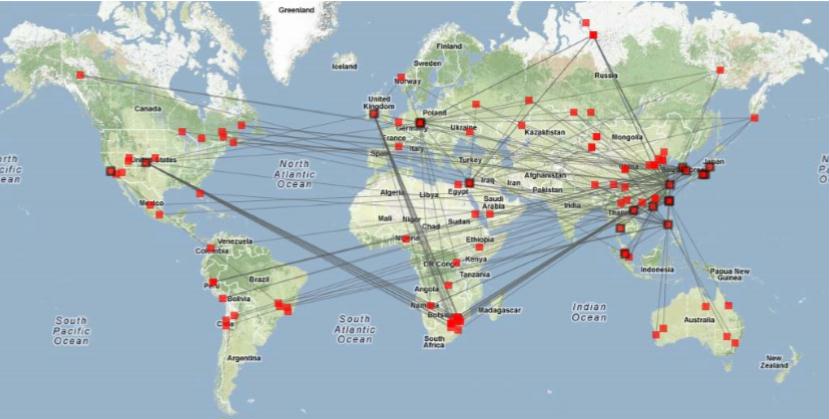
Laptops need 44 raw materials from 27 Countries (Ruffle 2010)
Laptop supply chain: Geographical
Cesium is entirely produced in China. Some of its uses include (Kennedy 2020):
strategic organic chemistry, including in x-ray radiation for cancer treatments.
catalyst promoters, glass amplifiers and photoelectric cell components, crystals in scintillation counters, and getters in vacuum tubes.
the oil and gas industry uses cesium formate brines in drilling fluids to prevent blow-outs in high-temperature, over-pressurized wells.
the “cesium standard” is how accurate commercially available atomic clocks measure time, and it’s vital for the data transmission infrastructure of mobile networks, GPS and the internet.
serious defense including in infrared detectors, optics, night vision goggles and much, much more.
References
Bhuwalka K et al (2021) Characterizing the Changes in Material Use due to Vehicle Electrification. Environmental Science & Technology 55: 10097
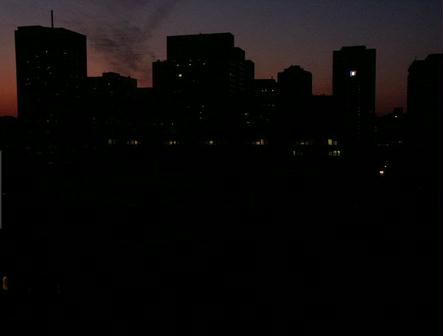
Toronto during the 2003 Northeast blackout, which required black-starting of generating stations. Source: https://en.wikipedia.org/wiki/Black_start
Black starts
Large blackouts can be quite devastating and it isn’t easy to restart the electric grid again.
This is typically done by designated black start units of natural gas, coal, hydro, or nuclear power plants that can restart themselves using their own power with no help from the rest of the electrical grid. Not all power plants can restart themselves.
After a brief introduction to black starts, I have a recent example of one in Venezuela to give you an idea of how hard restarting a grid can be.
Clearly a renewable grid running mainly on wind and solar will crash a lot, and without hydropower or fossil fuels to restart the grid (which are finite and won’t be available at some point), the idea we can just do stuff when the grid is up and wait it out for when the grid is down isn’t going to work. This is a huge problem for a 100% renewable system that may not be solvable. Microgrids don’t solve anything, manufacturing and industry require mind-boggling amounts to electricity to stay in business.
In regions lucky enough to have hydropower (just 10 states have 80% of the hydropower in the U.S.) this is usually the designated black start source since a hydroelectric station needs very little initial power to start, and can put a large block of power on line very quickly to allow start-up of fossil-fuel or nuclear stations.
Wind turbines are not suitable for black start because wind may not be available when needed (Fox 2007) and likewise solar power plants suffer from the same problem.
The impact of a blackout exponentially increases with the duration of the blackout, and the duration of restoration decreases exponentially with the availability of initial sources of power. For several time-critical loads, quick restoration (minutes rather than hours or even days) is crucial. Blackstart generators, which can be started without any connection to the grid, are a key element in restoring service after a widespread outage. These initial sources of power include pump-storage hydropower, which can take 5-10 minutes to start, to certain types of combustion turbines, which take on the order of hours.
For a limited outage, restoration can be rapid, which will then allow sufficient time for repair to bring the system to full operability, although there may be a challenge for subsurface cables in metropolitan areas. On the other hand, in widespread outages, restoration itself may be a significant barrier, as was the case in the 1965 and 2003 Northeast blackouts. Natural disasters, however, can also lead to significant issues of repair—after Hurricanes Rita and Katrina, full repair of the electric power system took several years (NAS)
Restoring a system from a blackout required a very careful choreography of re-energizing transmission lines from generators that were still online inside the blacked-out area, from systems from outside the blacked-out area, restoring station power to off-line generating units so they could be restarted, synchronizing the generators to the interconnection, and then constantly balancing generation and demand as additional generating units and additional customer demands are restored to service.
Many may not realize it takes days to bring nuclear and coal fired power plants back on-line, so restoring power was done with gas-fired plants normally used for peak periods to cover baseload needs normally coal and nuclear-powered. The diversity of our energy systems proved invaluable (CR).
Restarting the grid after the 2003 power outage was especially difficult.
The blackout shutdown over 100 power plants, including 22 nuclear reactors, cutoff power for 50 million people in 8 states and Canada, including much of the Northeast corridor and the core of the American financial network, and showed just how vulnerable our tightly knit network of generators, transmission lines, and other critical infrastructure is.
The dependence of major infrastructural systems on the continued supply of electrical energy, and of oil and gas, is well recognized. Telecommunications, information technology, and the Internet, as well as food and water supplies, homes and worksites, are dependent on electricity; numerous commercial and transportation facilities are also dependent on natural gas and refined oil products.
Venezuela’s massive nationwide power outages, which began on Thursday, have so far resulted in at least 20 deaths, looting, and loss of access to food, water, fuel, and cash for many of the country’s 31 million residents. Late Monday, the United States said its diplomats would leave the US embassy in Caracas, citing deteriorating conditions. As the societal impacts intensify and Venezuela’s internal power struggle continues, the country is clearly struggling to restart its grid and meaningfully restore power—a problem exacerbated by its aging infrastructure.
Reenergizing a dead grid, a process known as a black start, is challenging under any circumstances.
Government statements and reports indicate that the blackout stems from a problem at the enormous Guri dam hydropower plant in eastern Venezuela, which generates 80 percent of the country’s electricity. And the already arduous process of restoring power seems hobbled by years of system neglect. It’s also unclear whether Venezuela has the specialists, workforce, and spare equipment available on the ground to triage the situation quickly.
“The challenge with black start is always just knowing specifically what happened,” says Nathan Wallace, director of cyber operations and a staff engineer at secure grid companies Cybirical and Ampirical Solutions. “It sounds like there may be lack of maintenance and some mismanagement. And typically if a system hasn’t been maintained, that means they really don’t have the visualization needed to understand the state of the system in real time. If the procedure for black start is not accurately representing the state of the system, there can be problems.”
A black start generally involves seeding power from an independent source—like small diesel generators or natural gas turbines—to restart power plants in an otherwise dead transmission network. This process is often called bootstrapping. Hydroelectric plants in particular can be designed to essentially black-start themselves. In these plants, water—often from a dam, as in the case of Guri—flows through a turbine, which spins it, powering an electric generator. Since it takes relatively little independent energy to open the water intake gates and potentially generate a lot of power very quickly, hydroelectric plants can work well for black start. It is unclear whether Venezuela’s Guri plant is designed with this scenario in mind.
What makes any black-start process especially complicated is the need to load balance a system, so that as power surges through, the supply from the generator matches the demand. Otherwise the generation plant will run too fast or be exhausted, causing the system to fail again.
It’s a large stepwise process to build up load, build up generation, build up more load, build up more generation until they’ve got enough reliability to go to the next element of the system. If a utility has issues with maintenance, or has a history of operational issues, or they don’t have a plan, or that plan is outdated, or if they don’t have a really good understanding of the limitations of the grid system, everything the utility is attempting to do becomes far more difficult.
Venezuela’s grid is based on a classic model of bulk power generation. From a centralized plant—in this case, Guri—substations transform electricity from low to high voltage so it can be transmitted all over the country and then converted back down to lower voltage for local distribution. This is fairly typical in small countries, though some prioritize adding diverse generation or connecting with neighboring grids to increase redundancy. Black-start researchers and practitioners say, though, that any model has pros and cons. While distributed systems don’t have a single point of generation failure, they can be more difficult to black start if they do go down, since more generation sites need to be bootstrapped and there are more loads to balance.
Regardless of the setup, the crucial component of all black starts is understanding what caused the outage, having the ability to fix it, and working with a system that can handle the power surges and fluctuations involved in bringing power back online. Without all of these elements in place, says Tim Yardley, a senior researcher at the University of Illinois focused on industrial control crisis simulations, black starts can be prohibitively difficult to execute.
“Reenergizing a grid in some ways is more of a shock to the system than it operating in its norm,” Yardley says. “If infrastructure is aging, and there’s a lack of maintenance and repairs, as you try to turn it back on and try to balance the loads you may have stuff that’s not going to come back up, infrastructure that’s been physically damaged or that was in such a bad state of repair that reenergizing it causes other problems.”
Crews attempting to deal with black-starting a frail and brittle grid also face major safety considerations, like explosions. “You have a maintenance issue and a manpower issue, because it’s extremely dangerous to reenergize a system if you have gear that hasn’t been maintained well,” Yardley notes.
Venezuela has faced years of power instability since about 2009, including two major blackouts in 2013 and a power and water crisis in 2016. At times the blackouts were caused in part by weather conditions like El Niño, but overall they have established a pattern of poor planning, mismanagement, and lack of investment on the part of the government. President Maduro has repeatedly overseen rationing efforts resulting in erratic power and has even set official national clocks back to put the country’s morning commute in daylight.
References
CR. September 4 & 23, 2003. Implications of power blackouts for the nation’s cybersecurity and critical infrastructure protection. Congressional Record, House of Representatives. Serial No. 108–23. Christopher Cox, California, Chairman select committee on homeland security
Fox, Brendan et al; Wind Power Integration – Connection and System Operational Aspects, Institution of Engineering and Technology, 2007 page 245
NAS. 2012. Terrorism and the Electric Power Delivery System. National Academy of Science
NAS. 2013. The Resilience of the Electric Power Delivery System in Response to Terrorism and Natural Disasters. National Academy of Science
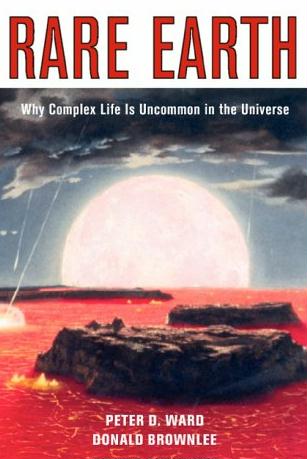
I think that Ward & Brownlee’s 2000 book “Rare Earth: why Complex Life is Uncommon in the Universe” is one of the most profound books I’ve ever read. What if we are the only intelligent species in the galaxy, or even universe? There are dozens of reasons to think so. Bacteria on the other hand, are probably a dime a dozen, splattered over planets within a reasonable Goldilocks zone from their star.
But even the Goldilocks zone doesn’t guarantee life can exist. Mars is within this zone and almost certainly impossible to live on. Think again: “Escape to Mars after we’ve trashed the Earth?” And at the end of this post is a fiction story from the New Yorker, in which we can’t count on the Space Aliens to rescue us if they show up.
I think that the reason we haven’t detected other civilizations, the Fermi paradox, is because fossil fuels didn’t form on most planets in the universe. If they did, the odds are very high that intelligent life never evolved, as explained in this book review of Rare Earth (also see new science about why life may be rare in the universe here). Even if intelligent life evolved, it may have lacked the dexterity of an oppositional thumb. Or a history that led to inventing steam engines, and many more contingencies. Even if intelligent beings on other planets did discover coal, oil, and natural gas and build civilizations like ours, the distances between planets are too far apart, let alone stars or other galaxies, that they never went anywhere. And we didn’t detect them because like us, they exponentially consumed fossils until they went back to life before fossil fuels.
The Rare Earth hypothesis argues that the evolution of biological complexity requires a host of fortuitous circumstances, such as
a galactic habitable zone
a central star and planetary system having the requisite character
the circumstellar habitable zone
a right-sized terrestrial planet
the advantage of a gas giant guardian like Jupiter
a large natural satellite (the moon),
a magnetosphere and plate tectonics
the chemistry of the lithosphere, atmosphere, and oceans
the role of “evolutionary pumps” such as massive glaciation and rare bolide impacts
whatever led to the appearance of the eukaryote cell, sexual reproduction and the Cambrian explosion of animal, plant, and fungi phyla.
The evolution of human intelligence may have required yet further events, which are extremely unlikely to have happened were it not for the Cretaceous–Paleogene extinction event 66 million years ago removing dinosaurs as the dominant terrestrial vertebrates.
In order for a small rocky planet to support complex life, Ward and Brownlee argue, the values of several variables must fall within narrow ranges. The universe is so vast that it could contain many Earth-like planets. But if such planets exist, they are likely to be separated from each other by many thousands of light years. Such distances may preclude communication among any intelligent species evolving on such planets, which would solve the Fermi paradox: “If extraterrestrial aliens are common, why aren’t they obvious?”
The right location in the right kind of galaxy
Rare Earth suggests that much of the known universe, including large parts of our galaxy, are “dead zones” unable to support complex life. Those parts of a galaxy where complex life is possible make up the galactic habitable zone, primarily characterized by distance from the Galactic Center. As that distance increases:
Star metallicity declines. Metals (which in astronomy means all elements other than hydrogen and helium) are necessary to the formation of terrestrial planets.
The X-ray and gamma ray radiation from the black hole at the galactic center, and from nearby neutron stars, becomes less intense. Thus the early universe, and present-day galactic regions where stellar density is high and supernovae are common, will be dead zones.
Gravitational perturbation of planets and planetesimals by nearby stars becomes less likely as the density of stars decreases. Hence the further a planet lies from the Galactic Center or a spiral arm, the less likely it is to be struck by a large bolide which could extinguish all complex life on a planet.
Item #1 rules out the outer reaches of a galaxy; #2 and #3 rule out galactic inner regions. Hence a galaxy’s habitable zone may be a ring sandwiched between its uninhabitable center and outer reaches.
Also, a habitable planetary system must maintain its favorable location long enough for complex life to evolve. A star with an eccentric (elliptic or hyperbolic) galactic orbit will pass through some spiral arms, unfavorable regions of high star density; thus a life-bearing star must have a galactic orbit that is nearly circular, with a close synchronization between the orbital velocity of the star and of the spiral arms. This further restricts the galactic habitable zone within a fairly narrow range of distances from the Galactic Center. Lineweaver et al. calculate this zone to be a ring 7 to 9 kiloparsecs in radius, including no more than 10% of the stars in the Milky Way, about 20 to 40 billion stars. Gonzalez, et al. would halve these numbers; they estimate that at most 5% of stars in the Milky Way fall in the galactic habitable zone.
Approximately 77% of observed galaxies are spiral, two-thirds of all spiral galaxies are barred, and more than half, like the Milky Way, exhibit multiple arms. According to Rare Earth, our own galaxy is unusually quiet and dim (see below), representing just 7% of its kind. Even so, this would still represent more than 200 billion galaxies in the known universe.
Our galaxy also appears unusually favorable in suffering fewer collisions with other galaxies over the last 10 billion years, which can cause more supernovae and other disturbances. Also, the Milky Way’s central black hole seems to have neither too much nor too little activity (Scharf 2012).
The orbit of the Sun around the center of the Milky Way is indeed almost perfectly circular, with a period of 226 Ma (million years), closely matching the rotational period of the galaxy. However, the majority of stars in barred spiral galaxies populate the spiral arms rather than the halo and tend to move in gravitationally aligned orbits, so there is little that is unusual about the Sun’s orbit. While the Rare Earth hypothesis predicts that the Sun should rarely, if ever, have passed through a spiral arm since its formation, astronomer Karen Masters has calculated that the orbit of the Sun takes it through a major spiral arm approximately every 100 million years. Some researchers have suggested that several mass extinctions do correspond with previous crossings of the spiral arms.
Orbiting at the right distance from the right type of star
According to the hypothesis, Earth has an improbable orbit in the very narrow habitable zone (dark green) around the Sun.
The terrestrial example suggests that complex life requires liquid water, requiring an orbital distance neither too close nor too far from the central star, another scale of habitable zone or Goldilocks Principle: The habitable zone varies with the star’s type and age.
For advanced life, the star must also be highly stable, which is typical of middle star life, about 4.6 billion years old. Proper metallicity and size are also important to stability. The Sun has a low 0.1% luminosity variation. To date no solar twin star, with an exact match of the sun’s luminosity variation, has been found, though some come close. The star must have no stellar companions, as in binary systems, which would disrupt the orbits of planets. Estimates suggest 50% or more of all star systems are binary. The habitable zone for a main sequence star very gradually moves out over its lifespan until it becomes a white dwarf and the habitable zone vanishes.
The liquid water and other gases available in the habitable zone bring the benefit of greenhouse warming. Even though the Earth’s atmosphere contains a water vapor concentration from 0% (in arid regions) to 4% (in rain forest and ocean regions) and – as of February 2018 – only 408.05 parts per million of CO2, these small amounts suffice to raise the average surface temperature by about 40 °C, with the dominant contribution being due to water vapor, which together with clouds makes up between 66% and 85% of Earth’s greenhouse effect, with CO2 contributing between 9% and 26% of the effect.
Rocky planets must orbit within the habitable zone for life to form. Although the habitable zone of such hot stars as Sirius or Vega is wide, hot stars also emit much more ultraviolet radiation that ionizes any planetary atmosphere. They may become red giants before advanced life evolves on their planets. These considerations rule out the massive and powerful stars of type F6 to O (see stellar classification) as homes to evolved metazoan life.
Small red dwarf stars, one of the most common kinds of stars in our galaxy, have small habitable zones wherein planets are in tidal lock, with one very hot side always facing the star and another very cold side; and they are also at increased risk of solar flares (see Aurelia), coronal mass ejections, sterilization from ionizing radiation, and atmospheric erosion since their habitable zone is so close to the star (Hunt 2020). Life therefore cannot arise in such systems. Rare Earth proponents claim that only stars from F7 to K1 types are hospitable. Such stars are rare: G type stars such as the Sun (between the hotter F and cooler K) comprise only 9% of the hydrogen-burning stars in the Milky Way.
Such aged stars as red giants and white dwarfs are also unlikely to support life. Red giants are common in globular clusters and elliptical galaxies. White dwarfs are mostly dying stars that have already completed their red giant phase. Stars that become red giants expand into or overheat the habitable zones of their youth and middle age (though theoretically planets at a much greater distance may become habitable).
An energy output that varies with the lifetime of the star will likely prevent life (e.g., as Cepheid variables). A sudden decrease, even if brief, may freeze the water of orbiting planets, and a significant increase may evaporate it and cause a greenhouse effect that prevents the oceans from reforming.
All known life requires the complex chemistry of metallic elements. The absorption spectrum of a star reveals the presence of metals within, and studies of stellar spectra reveal that many, perhaps most, stars are poor in metals. Because heavy metals originate in supernova explosions, metallicity increases in the universe over time. Low metallicity characterizes the early universe: globular clusters and other stars that formed when the universe was young, stars in most galaxies other than large spirals, and stars in the outer regions of all galaxies. Metal-rich central stars capable of supporting complex life are therefore believed to be most common in the quiet suburbs of the larger spiral galaxies—where radiation also happens to be weak.
With the right arrangement of planets
Rare Earth proponents argue that a planetary system capable of sustaining complex life must be structured more or less like the Solar System, with small and rocky inner planets and outer gas giants. Without the protection of ‘celestial vacuum cleaner’ planets with strong gravitational pull, a planet would be subject to more catastrophic asteroid collisions.
Observations of exo-planets have shown that arrangements of planets similar to our Solar System are rare. Most planetary systems have super Earths, several times larger than Earth, close to their star, whereas our Solar System’s inner region has only a few small rocky planets and none inside Mercury’s orbit. Only 10% of stars have giant planets similar to Jupiter and Saturn, and those few rarely have stable nearly circular orbits distant from their star. Konstantin Batygin and colleagues argue that these features can be explained if, early in the history of the Solar System, Jupiter and Saturn drifted towards the Sun, sending showers of planetesimals towards the super-Earths which sent them spiralling into the Sun, and ferrying icy building blocks into the terrestrial region of the Solar System which provided the building blocks for the rocky planets. The two giant planets then drifted out again to their present position. However, in the view of Batygin and his colleagues: “The concatenation of chance events required for this delicate choreography suggest that small, Earth-like rocky planets – and perhaps life itself – could be rare throughout the cosmos.”
A continuously stable orbit
Rare Earth argues that a gas giant must not be too close to a body where life is developing. Close placement of gas giant(s) could disrupt the orbit of a potential life-bearing planet, either directly or by drifting into the habitable zone.
The need for stable orbits rules out stars with systems of planets that contain large planets with orbits close to the host star (called “hot Jupiters“). It is believed that hot Jupiters have migrated inwards to their current orbits. In the process, they would have catastrophically disrupted the orbits of any planets in the habitable zone. To exacerbate matters, hot Jupiters are much more common orbiting F and G class stars.
A terrestrial planet of the right size
It is argued that life requires terrestrial planets like Earth and as gas giants lack such a surface, that complex life cannot arise there.
A planet that is too small cannot hold much atmosphere, making surface temperature low and variable and oceans impossible. A small planet will also tend to have a rough surface, with large mountains and deep canyons. The core will cool faster, and plate tectonics may be brief or entirely absent. A planet that is too large will retain too dense an atmosphere like Venus. Although Venus is similar in size and mass to Earth, its surface atmospheric pressure is 92 times that of Earth, and surface temperature of 735 K (462 °C; 863 °F). Earth had a similar early atmosphere to Venus, but may have lost it in the giant impact event.
Plate tectonics depend on the right chemical composition and a long-lasting source of heat from radioactive decay. Continents must be made of less dense felsic rocks that “float” on underlying denser mafic rock. Taylor emphasizes that tectonic subduction zones require the lubrication of oceans of water. Plate tectonics also provides a means of biochemical cycling.
Plate tectonics and as a result continental drift and the creation of separate land masses would create diversified ecosystems and biodiversity, one of the strongest defences against extinction. An example of species diversification and later competition on Earth’s continents is the Great American Interchange. North and Middle America drifted into South America at around 3.5 to 3 Ma. The fauna of South America evolved separately for about 30 million years, since Antarctica separated. Many species were subsequently wiped out in mainly South America by competing Northern American animals.
Diamonds: bad for life. The planets circling some stars may be too diamond-rich, as much as 50% pure diamond. Their mantle might consist of a hard, brittle diamond that is incapable of flowing. Whereas iron and silicon trap heat inside our planet, resulting in geothermal energy, diamonds transfer heat so readily that the planet’s interior would quickly freeze. Without geothermal energy, there couldn’t be any plate tectonics, magnetic field, or atmosphere. Panero describes these diamond super-earths as “very cold, dark” worlds (Wilkins 2011).
A large moon
The Moon is unusual because the other rocky planets in the Solar System either have no satellites (Mercury and Venus), or only tiny satellites which are probably captured asteroids (Mars).
The Giant-impact theory hypothesizes that the Moon resulted from the impact of a Mars-sized body, dubbed Theia, with the young Earth. This giant impact also gave the Earth its axial tilt (inclination) and velocity of rotation. Rapid rotation reduces the daily variation in temperature and makes photosynthesis viable. The Rare Earth hypothesis further argues that the axial tilt cannot be too large or too small (relative to the orbital plane). A planet with a large tilt will experience extreme seasonal variations in climate. A planet with little or no tilt will lack the stimulus to evolution that climate variation provides. In this view, the Earth’s tilt is “just right”. The gravity of a large satellite also stabilizes the planet’s tilt; without this effect the variation in tilt would be chaotic, probably making complex life forms on land impossible.
If the Earth had no Moon, the ocean tides resulting solely from the Sun’s gravity would be only half that of the lunar tides. A large satellite gives rise to tidal pools, which may be essential for the formation of complex life, though this is far from certain.
A large satellite also increases the likelihood of plate tectonics through the effect of tidal forces on the planet’s crust. The impact that formed the Moon may also have initiated plate tectonics, without which the continental crust would cover the entire planet, leaving no room for oceanic crust. It is possible that the large scale mantle convection needed to drive plate tectonics could not have emerged in the absence of crustal inhomogeneity. A further theory indicates that such a large moon may also contribute to maintaining a planet’s magnetic shield by continually acting upon a metallic planetary core as dynamo, thus protecting the surface of the planet from charged particles and cosmic rays, and helping to ensure the atmosphere is not stripped over time by solar winds.
Most planets have moons, but Earth’s moon is distinct in that it is large compared to the size of Earth; the moon’s radius is larger than a quarter of Earth’s radius, a much larger ratio than most moons to their planets. And it now appears that only certain types of planets can form moons that are large in respect to their host planets, planets that are less than six times the size of earth, because in a collision with another planet forming, the potential moon will be vaporized since these collisions are too energetic to form a large moon (Nakajima 2022).
Atmosphere
A terrestrial planet of the right size is needed to retain an atmosphere, like Earth and Venus. On Earth, once the giant impact of Theia thinned Earth’s atmosphere, other events were needed to make the atmosphere capable of sustaining life. The Late Heavy Bombardment reseeded Earth with water lost after the impact of Theia. The development of an ozone layer formed protection from ultraviolet (UV) sunlight. Nitrogen and carbon dioxide are needed in a correct ratio for life to form. Lightning is needed for nitrogen fixation. The carbon dioxide gas needed for life comes from sources such as volcanoes and geysers. Carbon dioxide is only needed at low levels] (currently at 400 ppm); at high levels it is poisonous. Precipitation is needed to have a stable water cycle. A proper atmosphere must reduce diurnal temperature variation.
One or more evolutionary triggers for complex life
Regardless of whether planets with similar physical attributes to the Earth are rare or not, some argue that life usually remains simple bacteria. Biochemist Nick Lane argues that simple cells (prokaryotes) emerged soon after Earth’s formation, but since almost half the planet’s life had passed before they evolved into complex ones (eukaryotes) all of whom share a common ancestor, this event can only have happened once. In some views, prokaryotes lack the cellular architecture to evolve into eukaryotes because a bacterium expanded up to eukaryotic proportions would have tens of thousands of times less energy available; two billion years ago, one simple cell incorporated itself into another, multiplied, and evolved into mitochondria that supplied the vast increase in available energy that enabled the evolution of complex life. If this incorporation occurred only once in four billion years or is otherwise unlikely, then life on most planets remains simple. An alternative view is that mitochondria evolution was environmentally triggered, and that mitochondria-containing organisms appeared soon after the first traces of atmospheric oxygen. Oxygen was needed for powering the process of aerobic respiration for both plants and animals.
The evolution and persistence of sexual reproduction is another mystery in biology. The purpose of sexual reproduction is unclear, as in many organisms it has a 50% cost (fitness disadvantage) in relation to asexual reproduction. Mating types (types of gametes, according to their compatibility) may have arisen as a result of anisogamy (gamete dimorphism), or the male and female genders may have evolved before anisogamy. It is also unknown why most sexual organisms use a binary mating system, and why some organisms have gamete dimorphism. Charles Darwin was the first to suggest that sexual selection drives speciation; without it, complex life would probably not have evolved.
The right time in evolution
While life on Earth is regarded to have spawned relatively early in the planet’s history, the evolution from multicellular to intelligent organisms took around 800 million years. Civilizations on Earth have existed for about 12,000 years and radio communication reaching space has existed for less than 100 years. Relative to the age of the Solar System (~4.57 Ga) this is a short time, in which extreme climatic variations, super volcanoes, and large meteorite impacts were absent. These events would severely harm intelligent life, as well as life in general. For example, the Permian-Triassic mass extinction, caused by widespread and continuous volcanic eruptions in an area the size of Western Europe, led to the extinction of 95% of known species around 251.2 Ma ago. About 65 million years ago, the Chicxulub impact at the Cretaceous–Paleogene boundary (~65.5 Ma) on the Yucatán peninsula in Mexico led to a mass extinction of the most advanced species at that time.
If there were intelligent extraterrestrial civilizations able to make contact with distant Earth, they would have to live in the same 12Ka period of the 800Ma evolution of life.
Snowball Earth (Ward & Brownlee)
It is possible that the extreme conditions of snowball earth were required to force multicellular life to evolve 650 million years ago when the Earth’s surface became entirely or nearly frozen at least once.
Complex life evolved just once. All complex life is descended from a single common ancestor. Why? Nick Lane says that natural selection normally favors fast replication, keeping simple cells simple. Then a freak event occurred: an archaeon engulfed a bacterium and the 2 cells formed a symbiotic relationship. That transformed the dynamics of evolution, leading to a period of rapid change that produced innovations such as sex. The incorporated bacterium eventually evolved into mitochondria, the energy generators of complex cells. So there was nothing inevitable about the rise of the sophisticated organisms from which we evolved. “The unavoidable conclusion is that the universe should be full of bacteria, but more complex life will be rare” (NS 2010).
We are on our way to your planet. We will be there shortly. But in this, our first contact with you, our “headline” is: We do not want your gravel.
We are coming to Earth, first of all, just to see if we can actually do it. Second, we hope to learn about you and your culture(s). Third—if we end up having some free time—we wouldn’t mind taking a firsthand look at your almost ridiculously bountiful stores of gravel. But all we want to do is look.
You’re probably wondering if we mean you harm. Good question! So you’re going to like the answer, which is: We mean you no harm. Truth be told, there is a faction of us who want to completely annihilate you. But they’re not in power right now. And a significant majority of us find their views abhorrent and almost even barbaric.
But, thanks to the fact that our government operates on a system very similar to your Earth democracy, we have to tolerate the views of this “loyal opposition,” even while we hope that they never regain power, which they probably won’t (if the current poll tracking numbers hold up).
By the way, if we do take any of your gravel, it’s going to be such a small percentage of your massive gravel supply that you probably won’t even notice it’s gone.
You may be wondering how we know your language. We are aware that there’s a theory on your planet that we (or other alien species from the far reaches of the galaxy) have been able to learn your language from your television transmissions. This is not the case, because most of us don’t really watch TV. Most of our knowledge about your Earth TV comes from reading Zeitgeisty think pieces by our resident intellectuals, who watch it not for fun but for ideas for their print articles about how Earth TV holds a mirror up to Earth society, and so on. We mean, we’ll watch Earth TV sometimes—if it happens to be on already—but, generally, we prefer to read a good book or revive the lost art of conversation.
Sadly, Earth TV is like a vast wasteland, as the Earthling Newton Minow once said. But, for those of you who can understand things only in TV terms, just think of us as being very similar to Mork from Ork, in that he was a friendly, non-gravel-wanting alien who visited Earth just to find out what was there, and not to harvest gravel.
Speaking of a vast wasteland, you might want to start picking out and clearing off a place for our spacecraft to land. Our spacecraft, as you will see shortly, is huge. Do not be alarmed; this does not mean that each one of us is that much bigger than each one of you. It’s just that there were so many of us who wanted to come that we had to build a really huge spacecraft.
So, again, no cause for alarm.
(Full disclosure: each of us actually is much bigger than each of you, and there’s nothing we can do about it. So please don’t use any of your Earth-style discrimination against us. This is just how we are, and it’s not our fault.)
Anyway, re our spacecraft: it’s kind of gigantic. The deceleration thrusters alone are sort of, like . . . well, imagine four of your Vesuvius volcanoes (but bigger), turned upside down.
We don’t want to hurt anyone, so, if you could just clear off one continent, we think we can keep unintended fatalities to a minimum. Australia would probably work. (But don’t say Antarctica. Because we’d just melt it, and then you’d all end up underwater. Which would make it virtually impossible for us to learn about your hopes and your dreams, and your culture, and to harvest relatively small, sample-size amounts of your gravel, just for scientific study.)
A little bit about us: our males have two penises, while our females have only one. So, gender-wise, if you use simple math, we’re pretty much identical to you.
And, as far as protocol goes, we’re a pretty informal species. If you want to put together a welcoming ceremony with all your kings and queens and Presidents and Prime Ministers and leading gravel-owners, that’s fine. But please don’t feel like you have to.
Technically, it would be possible for us to share our space-travel technology with you, so that you could build a spacecraft and travel to our planet also. But, for right now, it just feels like it would be better if we came to your place.
Speaking of gravel, one thing we can’t tell from our monitoring of Earth is how your gravel tastes. It’s just something we’re curious about, for no real reason. Is it salty? It looks salty.
Maybe you could form a commission of scientists/gravel-tasters to look into this and let us know. Just have them collect all the gravel you have and put it in one big pile. (There are some pretty big empty parts of Utah, New Mexico, and Russia that might be good spots for such a large gravel pile, but that’s just an F.Y.I.)
Then, if you could have your top scientists/gravel-tasters go through this gravel pile, tasting each and every piece, that would be great. Also, if it’s not too much of a hassle, have them put all the saltier-tasting pieces in a separate pile.
Anyway, that about wraps up this transmission! Looking forward to seeing you very soon. (Sorry we couldn’t have given you more notice, but we didn’t want you Earth people going crazy and looting stuff and having sex in the streets out of panic about losing all your delicious gravel, which is something that is definitely not going to happen, because, when it comes down to it, what is gravel really but just a bunch of baby rocks?)
Our E.T.A. on Earth is sometime in the next 450 to 500 years, which we know is a blink of an eye in your Earth time, so start getting ready! Let’s have fun with this.
Yours,
A Species from a Galaxy You Haven’t Even Noticed Yet
P.S.—We saw that you sent some people to your moon recently. Good job! But, just to let you know, don’t waste your time with the moon. There’s no gravel there. We already checked.
References
Gribbin, J. 2018. Why we are probably the only intelligent life in the galaxy. Scientific American.
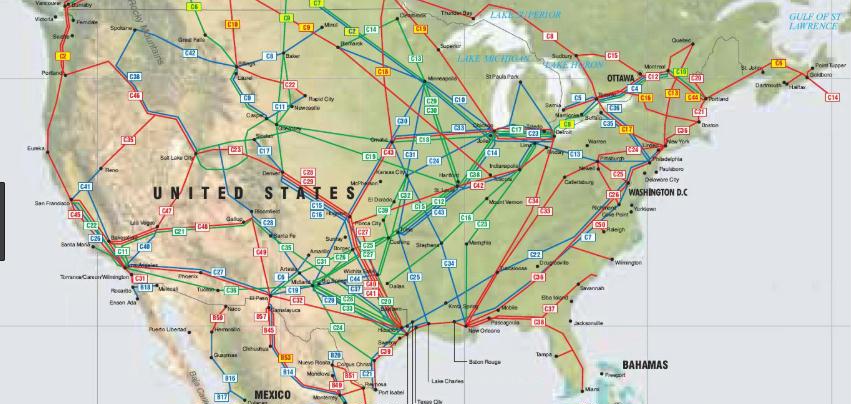
Preface. At some point of energy decline there will be Americans who tap into pipelines to get scarce oil for themselves and to sell it on black markets. Just look at the massive amount of oil being stolen in Nigeria here. And the rate of theft is increasing, in 2017 9,000 barrels a day were stolen versus 6,000 in 2016, which also often resulted in messy spills.
The United States has 150,000 miles of crude oil pipelines, while Nigeria has just 2,800 miles and can’t protect them from theft (Wikipedia 2015).
One of the best and most effective ways governments can help their citizens cope with energy decline is to ration oil to agriculture whatever it needs, and after that other essential services and citizens. If oil theft can’t be prevented, the descent of civilization will be even faster.
Hampton, L., et al. 2016. Bolt cutters expose vulnerability of North America’s oil pipeline grid. Reuters.
All it took was a pair of bolt cutters and the elbow grease of a few climate activists to carry out an audacious act of sabotage on North America’s massive oil and gas pipeline system.
For an industry increasingly reliant on gadgets such as digital sensors, infrared cameras and drones to monitor security and check for leaks, the sabotage illustrated how vulnerable pipelines are to low-tech attacks.
On Tuesday, climate activists broke through fences and cut locks and chains simultaneously in several states and simply turned the pipelines off.
All they had to do was twist shut giant valves on five cross-border pipelines that together can send 2.8 million barrels a day of crude to the United States from Canada – equal to about 15 percent of daily U.S. consumption.
The activists did no damage to the pipelines, which operating companies shut down as a precaution for checks before restarting.
The United States is the world’s largest energy market, and the infrastructure to drill, refine, store and deliver that energy to consumers is connected by millions of miles of pipeline that are impossible to protect entirely from attack.
“You’re not manning these things on a permanent basis. It’s not viable,” said Stewart Dewar, a project manager at Senstar, an Ottawa-based company that authored a 2012 white paper on pipeline security. “It’s too expensive.”
Preface. This is a gruesome post you may want to skip.
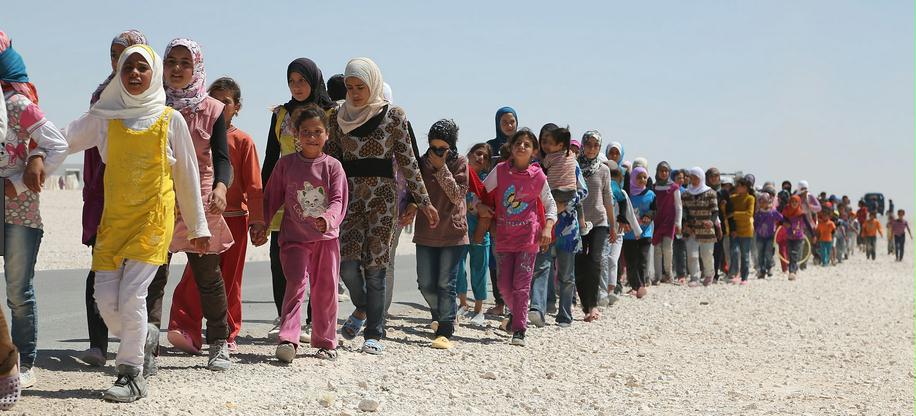
My main interest in this book was what will happen to the hundreds of millions forced to flee in the future because of the crash of civilization as oil declines, topsoil vanishes, sea levels rise, fresh water disappears, droughts / hurricanes / tornadoes / fires, invasive species and pests ruin crop production and a hundred other calamities occur in the future. Potentially you if you live long enough…
But mainly oil decline will be at the root of it all, since with oil fires can be fought, fresh water pumped for over a thousand feet down, topsoil amended with natural gas fertilizers, pests crushed with oil-based pesticides, and so on. Fossil fuels allow 6.5 billion extra people to be alive today.
Although this book is about Christian families in Iraq
and their Muslim terrorist oppressors (the Daesh who call themselves the
Islamic State, see wiki here
for more info), these atrocities are a common pattern I’ve seen in other books
about what refugees go through. In the
future even more civil wars will erupt everywhere that depends on oil in any
way as resources and energy decline.
Various groups will try to take control of regions and kill those not
part of the in group.
Basically what happens, and has occurred throughout human history is that men and older women are killed, nubile women sold as wives, and children become slaves. There are many examples to be found in the old testament, such as “The Israelites war against Midian, and “slew every male”. They take captive the women and children, and take all cattle, flocks and goods as loot, and burn all cities and camps. When they return to Moses, he is angered, and commands “Now therefore kill every male among the little ones, and kill every woman that hath known man by lying with him. But all the women children, that have not known man by lying with him, keep alive for yourselves” (Numbers 31). There are a lot more examples from the bible in Wikipedia at “The Bible and violence”.
Those without a place to go, and water and food along the way often don’t make it. Many of the survivors randomly knocked on doors seeking help and got it, though we don’t know about those who knocked on the wrong door and were turned in to their captors.
Read the depressing accounts of escapees below for details.
Dunya Mikhail. 2018.
The Beekeeper. Rescuing the Stolen Women of Iraq . New Directions.
I didn’t ask my students if they knew that the letter was
now being written in red on doors, notifying residents that they must leave
their homes or else face death. Reduced to an N, those Nasara — “Christians” —
were shaken out of sleep by megaphones blaring all over town that they had 24
hours to get out, and that they couldn’t take anything with them; and just like
that, with the stroke of a red marker across their doors, they would have to
abandon the houses they’d lived in for over 1,500 years. They’d leave their
doors ajar and turn their backs on houses that would become Property of the
Islamic State. But I didn’t explain any of this. My job is to teach Arabic,
Abdullah translated what Nadia said into Arabic for me: I
was at home when my husband, moving the telephone away from his ear, told us,
“We have to leave now, Daesh is nearby.” That was a Sunday morning, the first
Sunday in August, when we fled our home in the village of Sawlakh, east of
Sinjar, along with our neighbors and their families. I walked with my husband
and our three children alongside a caravan of nearly 200 people
It was very hot outside and we had departed without any
water or food or diapers. We headed up into the mountains, stopping every hour
so that we could rest a bit, especially for the sake of the exhausted children.
We found a vegetable farm and stopped to pick tomatoes — we were so thirsty.
That’s when we were surrounded by Daesh fighters. First they loaded the men,
then the women and children, onto big trucks, taking us to Mosul.
When they unloaded us in Mosul, they separated the
virgins from the married women; they also set apart children over the age of
twelve.
Then they took us to a school in Talafar where we stayed
for eighteen days, studying Quran. They forced us to recite verses in that
filthy place, even as we were dying of hunger and thirst. They told us that we
were infidels, that we must convert to Islam because it’s “the true faith,” and
that we’d have to get married. Then they transferred us to another building
near Raqqa, in Syria, where they put us up for auction.
They handed me a slip of paper with the name of the buyer
written on it, informing me that it was my marriage certificate. I had no idea
what they’d done with my husband and his father and his brother and all the
rest of our relatives who’d been with us in the convoy. The man who’d bought me
told me I was now his wife.
We stayed there for three months, and during that time we
made hundreds of rockets. My children and I worked twelve hours a day for them.
They gave my five-year-old daughter the most dangerous job, tying together the
detonation lines.
At any moment a mistake could explode the bomb right in
her face. Along with another female captive, I would load the rockets into a
truck. She was a Yazidi from my village, and she had two children. We became so
close that we conspired to escape together.
The seven of us stood in front of the bakery with both
anxiety and hope.
A man gestured for us to get into his car. He took us to
Manbij province, northeast of Aleppo, then to the Euphrates. The plan was for
us to cross over to Kobani in a skiff. But we saw dead people lying in the
road, which sent our children into a panic, making them shake and cry. I felt
like I was going to throw up and my friend covered her eyes. The driver had to
take us back to Manbij, where we spent the night in a house whose inhabitants
seemed to have fled. The smuggler explained to us that most of the homes there
had been abandoned after Daesh’s assault. It was a very small house that still
smelled of people, as if they had just left. We stayed the night there, but too
nervous that the Daeshis would find us, we counted the minutes until morning,
unable to sleep. After the smuggler picked us up, we headed for a rural area
east of the Euphrates. There he instructed us to get out of the car and walk
toward the river. We followed his instructions, continuing our journey on foot.
After about half an hour of walking, we heard the sound of gunshots. We hid
among the reeds in the marshes, huddled there for hours, afraid of what might
happen at any moment. The smuggler was still with us but he had become
extremely tense, especially when the children started crying. He ordered us to
stay absolutely silent.
Once the sound of gunfire had subsided, we continued
walking to the edge of the river, crossing in a skiff over to Kobani, on the
Turkish border. There we were greeted by a group of people, mostly women. They
took us to a hotel where we were able to rest for a few days. They gave us
fresh clothes and then drove us to Dohuk Province in Iraq, where Abdullah and
my mother-in-law lived. Now I live with her. She prays every day for the return
of her son, my husband, my real husband.
Our work isn’t without danger, of course. Daesh gruesomely
executed one of our drivers when he was caught. We were extremely sad to lose
him. He was a young man, and I depended on him very much. In fact, up until
now, we’ve lost twelve smugglers.” “How?” “Sometimes Daesh will propose letting
the sabaya return to their families in exchange for a large sum of money. Those
who are serious will release their sabaya in exchange for the money; yet there
are others who claim they’re willing to go through with the exchange but then
ambush the go-between when he shows up, killing him despite their previously
agreed-upon arrangement.
About 25% of direct purchases from Daesh ended up with
our smugglers getting ambushed.
I instruct the family to give the captive my telephone
number so that I can make arrangements with her directly. Then we come up with
a plan based on where she is. I use Google Maps to scope out the area — the old
map of Syria I used back when I was selling honey is no good anymore because
many of those regions have changed. Now I know all the neighborhoods in Raqqa,
building by building. When the captive calls me, I pick a specific rendezvous
point and a code word,
Once they get far enough away, she’ll be moved into a
safe house, the same houses where smugglers warehoused cigarettes in the past.
She’ll stay there for a few days, until the commotion caused by her
disappearance dies down
After two or three days the driver will come back to the
safe house and they’ll continue their journey by car, then on foot for another
five or six hours. Sometimes the operation will include crossing the river to
Turkey in a skiff and, finally, spending about twelve hours in another car in
order to reach the northern border of Iraq, where her family will finally greet
her. Sometimes I’ll follow the mission step by step; sometimes I cross over
into Syria to meet with the smugglers, guiding and encouraging them. There’s no
need for me to welcome back those captives but often I tag along with the
family to the border region between Iraq and Syria because I love being a part
of these moments. It’s indescribable, everyone bursting with ecstasy and tears
and hugs; I’ve witnessed this over seventy times, and every time I can’t keep
myself from crying.
Marwa opened the door at four in the morning, then closed
it behind her and walked out into the street, flagged down a cab and got in.
The taxi driver was stunned. As you know it’s rare to find a young lady hailing
a taxi in the street at such an early hour. Where are you going? he asked her.
She broke down in tears, telling him that she had just escaped from Daesh. Kill
me please, I beg you, just don’t take me back to them. “I can take you to a
neighborhood where the clans are sure to offer you shelter, he said. When they
open the door, tell them: ‘I’m at your mercy.’ Arab clans won’t turn away
anyone who knocks on their door and says that. Dawn was extremely quiet as
Marwa approached a large house and knocked on the front door. “A woman opened the
door. As soon as she listened to Marwa’s story she invited her inside.
But when the woman’s husband heard that she had run away
from Daesh he refused to take her in. He didn’t want to shoulder the
responsibility; he said that he would have to hand her over to the police. The
wife pleaded with her husband to just let the girl be on her way; eventually
she apologized as she said goodbye to Marwa at the door. Marwa headed somewhere
else, this time knocking on the door of a smaller house. A man opened the door
with his wife and children behind him. When she told them she was running away
from Daesh they invited her inside. They sat down in a circle around her and
asked her to tell them what had happened. She wept even as they tried to calm
her down, telling her they weren’t going to abandon her. Their house and their
furniture signaled extreme poverty — they didn’t even have a telephone. They
promised that as soon as the shops opened in the morning they’d take her to the
Internet café so she could use the phone. When Marwa called me, I didn’t have a
functioning network yet, but I decided to make a few calls and find her a
smuggler. Marwa ended up staying with that family for fifteen days. They shared
their food with her and told her repeatedly that she was safe with them. By the
time I found a smuggler we’d run into a snag: the owner of the Internet café
found out that she’d escaped from Daesh and threatened the generous family that
he would send her back if they didn’t pay him $7,500. The family agreed to the
ransom even though they had nothing, asking the man to give them time to scrape
the money together. The members of the family went from house to house,
managing to raise $7,000. When they went to give the money to the Internet café
owner, they asked him to forgive the remaining five hundred; he agreed and let
Marwa leave with the driver. Marwa came back alone, without her mother or
father or sisters or brothers. My brother and my sister and fifty-six members
of my family, including cousins, are still missing.
We heard the booming sound of artillery. We had never
heard such blasts, even in times of war. Twenty-eight of us gathered together —
my mother, my siblings, and their families — all of us hesitant to flee. It
isn’t so easy for a person to give up their home.
A lot of people died on the journey, including the ill,
whose families had to leave them behind.
Those who had tried to go home were captured by Daesh
after the withdrawal of Peshmerga forces.
My sister, my brother, my cousins, and all of their
families were among those who had gone back and fallen into the trap. The worst
thing I heard was that Daesh had separated the elderly from everyone else and
had buried them all alive
We managed to reach the Syrian border on a road that was
being protected by the People’s Defense Brigades. To tell you the truth, it was
an unusual protection force, as it was mostly made up of women. Throughout that
harsh and difficult journey we’d hoped an American or European plane would come
to airlift us all to safety, but that never happened. Our convoy had about 350people,
including women on the verge of giving birth, disabled people who were barely
able to walk,
They threw us down there in shifts. Every 15 minutes they
would lower down about a dozen men from the outcropping and open fire on them.
They arranged us into rows, telling us to line up next to each other so it
would be easier for them to shoot us. My brother was in the first shift. My
other brother was in the second shift. I was in the third. I knew everyone down
there with me; they were my neighbors and friends.
After they shouted Allahu Akbar, the sound of gunfire
rang out, and once they had finished shooting us one by one, I was swimming in
a pool of blood. They shot at us again, then a third time. I shut my eyes and
prepared to die, as one must.” “How long did you stay like that?” “I was bleeding
there for almost five hours.” “Where were you shot?” “In three different
places. Once in my foot and twice in my hand.” “And did everyone else die?”
“All except for one other man, Idrees, a childhood friend of mine. His feet
were injured.
“You need tricks,”
Badia told me when I asked her how she’d managed to escape Daesh. The first
trick was to stop bathing for an entire month, until she smelled so bad that
the fighters would stay away from her, refusing to buy her. The second trick
was to claim that she was married, and that the little child beside her was her
son. It took longer for married women to be sold. The third trick was to
pretend she was pregnant in order to avoid being raped, even if only
temporarily. The
We were a big family living in the village of Kocho — my
mother and father, and my five brothers and five sisters. In the beginning we
heard that Daesh had occupied Mosul; we heard that they were killing people
there, raping women; we heard that they were coming toward us, that they were
going to do the same thing to us. We didn’t believe it.
Daesh was a lie. And even if it wasn’t a lie, they would
never make it to Kurdistan because the Peshmerga fighters would stop them. We
had a hundred soldiers. Surely they would be able to protect us. We shared
these rumors until late into the night. At two in the morning my father’s
telephone rang. It was his friend from the village of Siba Sheikh Khidr. He said:
“You have to leave. Daesh has reached our land. They’re going to kill us all.
We would take a few steps toward the door, then retreat.
We’d make up our minds to leave, but then remain where we were.
A caravan of thirty families emerged and headed toward
the mountains. We decided to do the same. We joined our relatives and friends,
but just as we were about to leave, a group of Peshmerga fighters arrived,
saying they would put Daesh in their crosshairs and stop them in their tracks.
Everyone was fired up, including my father. We decided to stay and assist the
Peshmerga, or fight alongside them.
Then we heard the terrible news that those thirty
families that had set out before us had been stopped by Daesh, that they had
killed all the men and enslaved the women and children. At that point the
Peshmerga made up their minds to go assess the situation and then report back
to us. They advised us to stay where we were until they returned with an
update. They left and never came back. They didn’t send any word. They left us
there, adrift. We never learned what happened to them.
Everybody was calling their relatives who had fled,
trying to find out whatever they could about what was going on. None of the men
picked up their phones. The women who answered their phones said that the men
had all been killed.
Daesh had surrounded the area, and it was too late to get
away. At 4 p.m. on August 3, 2014, Daesh came to our homes. Our first shock was
seeing men we knew among them. They didn’t live far from our village. We even
used to consider them friends. But now they had joined the ranks of Daesh. They
behaved as if they were our enemies.
At midnight, all the children who were older than six
were taken away from their mothers and sent to a training camp. In the morning
they took all the older women, even the pregnant ones, and killed them all.
They dumped them into fishponds
Some of the women and children died of thirst. At that
point a man showed up with a bucket of water. But before we could drink any of
it, he threw in a dirty diaper. I don’t know why he did this, but we drank the
water anyway, despite the filth. We nearly died of thirst. I think they put
some kind of chemical in the water because all of us got dizzy and nauseous and
tired.
Ssomeone they called “the Caliph” came and announced that
we would have to marry the fighters. We said: “We’re already married.” The
Caliph said: “We killed all of your men. So now you’re for sale on the market.
They ordered us to bathe, but I went into the bathroom
and came back out again without washing. I knew they were going to come and
smell me, and cleanliness was dangerous in that situation. A month passed, and
every day I began to smell worse. I didn’t even wash my face despite the fact
that my eyes were itching from crying so much. They brought us fresh clothes to
make us more enticing to the customers. They said: “Put on these beautiful
clothes. The photographer will be here any minute.
“Nobody wants you,
so we’re going to send you to Syria.” They moved us to a building in Raqqa.
There I was reunited with my sisters, my brother’s wife, and my friends — they
said they’d been there for two weeks. After thirteen days they sold us off, ten
of us for each man. An American came and bought me along with nine other women.
He took us to his house in Aleppo. His guards there all called him “the
American Emir.” The first thing he ordered us to do was bathe. He pointed
toward the bathroom, saying: “Get in line. Each and every one of you has to
take a bath. Or else.” Then he brought us new clothes and told us to put them
on.
He introduced himself to me, and said, in formal Arabic:
“I’m an American. Tell me, when was your last period?” “Why are you asking?”
“Because we don’t marry pregnant women.” “It’s been five months.” “Well then, I
won’t marry you today. Tomorrow I’ll take you to the doctor to see whether or
not you’re pregnant.” I went back to our room and Nada looked at me
inquisitively. I said: “We’ve got to get out of here tomorrow. Otherwise the
Emir is going to find out I lied, and then he’ll rape me.” Nada agreed that we
would run away the next morning, as soon as the Emir left the house — he went
out every day at 10 a.m., and didn’t come back until nine at night.
The Emir showed me photos of his family on his computer:
his American wife, his one-year-old son, and his infant daughter. The two
children were playing on swings in a park. He said he’d been a teacher in an
elementary school. “Isn’t it haram for you to abandon two small children who
might be wondering where their father is?” “I go to America every once in a while,
to see my family, then I come back.
The next night he drugged me and then raped me five
times. When he woke up in the morning, he said: “Don’t tell anyone that the boy
isn’t yours. If the members of the organization find out, they’ll kill me. This
has to be our secret.” “Whatever you say.” “We’ll raise him together, you and
I. But I’m going to sell Nada.” “No. Please. I need her. I don’t have anyone
else. You go to work all day — I can’t bear to be here without Nada.
After living with him for two months we tried to run
away, unsuccessfully. We tried to run away four times, but the Daesh police
brought us back each time. And each time he punished me with a beating. On the
fourth time he was so angry that he strung me up by my feet and beat me
mercilessly. Even worse, he left with my nephew, and when he came back the boy
wasn’t with him. I was beside myself. I begged. I wept. But he didn’t care. A
week went by and he wouldn’t speak to me. He didn’t tell me what he had done
with my nephew.
It was 9 p.m. when he called me into his room. He said:
“We’re going to Kobani to fight. We might be gone four or five days. I’m going
to lock the doors. You can’t go out — not at all, not even to buy bread. Do you
need me to bring you anything before we go?” “No. We have everything we need.
Thanks.” We made a plan to break down the door and run away.
We got our Islamic clothes ready and started looking for
something to break down the door. We found some small metal tools and used them
to smash it. We had to work at that for hours. We didn’t go to sleep until we
managed to finally break down the door at four o’clock in the morning, but
waited until eight so we wouldn’t raise any suspicions. We hurried as far away
from the house as we could. After about two hundred yards we saw a cell phone
shop with a sign that read “International Phone.” We went inside. I still
remembered the phone number given to me by a woman in that building where we’d
been detained before we were sold. She told me: “Memorize this number.” Then I
gave it to somebody else and told her: “Memorize this number.” I repeated the number
in my head every day so I would never forget it. We were a few steps away from
the phone. I told the shopkeeper that we wanted to use the phone but we didn’t
have any money. He said: “Sorry. No free calls.” I asked him: “Do you know the
Emir Abu Abdullah the American? I’m his wife. He went to Kobani. I need to call
him to make sure he’s okay. I’m new here. I don’t know anybody else.
The little boy I told you about made it, the one who was
in Daesh’s camp. He arrived with his mother and his younger brother.” “They
were training to fight, right?” “Yes. Ragheb was forced to train for four hours
every day, learning how to kill, how to chop off people’s heads. They would
also teach him Quran for two hours a day, and fiqh for another hour. They have
classes on everything, from how to wash your hands to sex education, from
impurity to handling an animal, from genetics to just about anything you can
imagine — and things you can’t even imagine. And finally a personalized sermon
to convince him to die for God, so that he’ll be rewarded in heaven. They have
special passes to get into heaven that are handed out at the end.
Both routes would eventually lead to Mount Sinjar, the
same mountain refuge that had protected them from harm every time. They’d done
this many times over the course of history: the people of the region, in times
of danger, wouldn’t think about going anywhere else, they wouldn’t think twice.
The half of the caravan heading west reached the mountain,
and survived, but the other half heading east, including Elias’s family, never
made it there. The Daeshis were waiting in their path and they were captured.
Daesh took them to Mosul
A week later the Mosulli driver brought Kamy three packs
of cigarettes, which she kept carefully hidden. As soon as the Daeshis left,
Kamy opened a pack, took pleasure in a kind of luxury, and breathed out some of
her repressed anger. She found herself smiling at the generosity shown to her
by the Mosulli driver. But the next day she saw something she would never
forget: a Daeshi holding up two severed hands in front of the captives. He said
those were the hands of the tanker driver who’d brought the captives
cigarettes. Kamy nearly choked, as if she had inhaled all of the tobacco of the
world in a single moment, thinking, I wish I were dead, I wish I hadn’t asked
him for anything.
I ended up spending a year confronting those beasts along
with the other young female captives from my village, in a house in the Deir
al-Zor area in Syria. They raped us, beat us; they forced us to cook and clean
and wash their clothes. During the day, they would take their weapons and go
out. At night, they would come back and gather together to take drugs and
recite religious verses. When they told us it was time for “Quran lessons,”
this also meant that they were also going to rape us, because they typically
did that right after prayers. They would take naked pictures of us with their
cell phones, and before starting each “Quran lesson,” they’d exchange pictures
of us with one another to see whether there was anyone who wanted to swap with
them.
The main motivation for these Daesh men was sexual: they
would kill anyone in order to rape women. In the end they would kill themselves
to meet their houris in heaven.
Whenever Abu Nasir needed money, he would give me to
someone temporarily, loaning me and then taking me back later. All I could
think about was escaping but it took seventy days before I was able to steal
the key from Abu Nasir. I managed to escape but the terrible realization was that
my family was all missing.
Preface. After presenting a lot of evidence for why nuclear power plants are inherently unsafe, Jaczko concludes: “There is only one logical answer: we must stop generating nuclear waste, and that means we must stop using nuclear power. You would think that it would make sense to suspend nuclear power projects until we know what to do with the waste they create”.
I read this book hoping Jaczko would explain why he shut Yucca mountain down. The 2013 book “Too Hot to Touch: The Problem of High-Level Nuclear Waste” by William M. Alley & Rosemarie Alley, Cambridge University Press goes into great detail about why Yucca Mountain is the ideal place to put nuclear waste.
I have a lot of problems with Yucca being shut down. How is it safer to have 70,000 tons of spent nuclear reactor fuel and 20,000 giant canisters of high-level radioactive waste at 121 sites across 39 states, with another 70,000 tons on the way before reactors reach the end of their life?
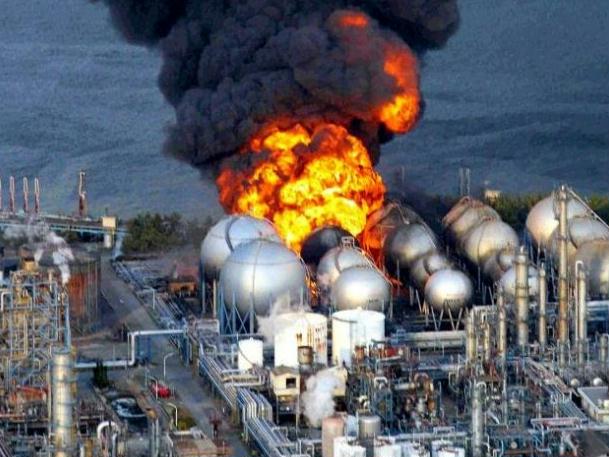
Spent fuel pools in America’s 104 nuclear power plants, have an average of 10 times more radioactive fuel stored than what was at Fukushima, most of them so full they have four times the amount they were designed to hold.
All of this waste will harm future generations for at least a million years, all of these above ground sites are vulnerable to terrorists, tsunamis, floods, rising sea levels, hurricanes, electric grid outages, earthquakes, tornadoes, and other disasters.
So Yucca mountain isn’t perfect? Not making a choice about where to store nuclear waste is a choice. We will expose many future generations to toxic radioactive wastes if we don’t clean them up now.
Here is what Jaczko has to say for why he shut down Yucca Mountain:
“There were many technical, political, and safety reasons why the site was not ideal, in fact Yucca failed to meet the original geological criteria. The rock that would hold the nuclear waste allowed far too much water to penetrate; water would eventually free the radiation and carry it elsewhere. In addition safety studies that showed the site to be acceptable were based on infeasible computer simulations projecting radiation hazards over millions of years. Realistically forecasting the complex, long-term behavior of spent nuclear fuel in underground facilities is scientifically impossible. After 35 years, the Yucca mountain project was over.”
Yet Jaczko knows his decision to leave nuclear waste at 121 sites is dangerous:
“As waste piles up, we leave behind dangerous materials that later generations will eventually have to confront. The short-term solution—leaving it where it is—can certainly be accomplished with minimal hazard to the public. But such solutions require active maintenance and monitoring by a less than willing industry. This is already an organizational and financial burden. In 30,000 years when these companies no longer exist who will be responsible for this material?” [my comment: or even 30 years after a financial crash or oil decline]
Thousands of scenarios were modeled at Yucca mountain of every combination of earthquake, volcanic intrusion and eruption, upwelling water, increased rainfall, and much more. Jaczko offers no countering scientific evidence, which I expected to find in his book. Yucca mountain passed with flying colors, here are just a few reasons why:
Volcanic activity stopped millions of years ago
Earthquakes mainly affect the land surface — not deep underground storage
Waste could be stored 1,000 feet below the land surface yet still be 1,000 feet above the water table in an area with little water and only a few inches of rain a year. Rain was not likely to travel 1,000 feet down.
The entire area is a closed basin. No surface water leaves the area. The Colorado River is more than 100 miles away.
There’s no gold, silver, or oil to tempt future generations to dig or drill into the nuclear waste.
The mountain is made of a rock that makes tunneling easy yet at the same time tough enough to form stable walls that are unlikely to collapse.
If Jaczcko’s secret motive was to stop Yucca waste storage so states wouldn’t build more nuclear power plants (6 states won’t allow new plants until there’s nuclear waste disposal), he shouldn’t have worried. The upfront costs to build a nuclear power plant is 4 times an equivalent natural gas plant so banks aren’t going to lend money, no money will be coming in for the minimum of ten years it takes to get permission and fight off lawsuits and NIMBYism, there are uninsurable liabilities, and there are limited uranium reserves left.
And once peak oil production hits, most likely within the next 5 years according to the latest IEA 2018 report, the odds are that we’ll spend dwindling energy on nuclear waste disposal to protect thousands of future generations is nil. That rapidly disappearing oil (at an exponential 6% per year) is going to be spent growing food and wars.
Jaczcko spends a few paragraphs on the hazards of spent nuclear fuel pools and points out that terrorism, floods, earthquakes, tornadoes, mudslides, and hurricanes could affect them enough for another Fukushima to happen here.
But if his agenda is to stop new nuclear power plants, he should have mentioned the 2016 report of the National Research Council “Lessons Learned from the Fukushima nuclear accident for improving safety and security of U.S. Nuclear plant” in which it was learned that “If electric power were out 12 to 31 days (depending on how hot the stored fuel was), the fuel from the reactor core cooling down in a nearby nuclear spent fuel pool could catch on fire and cause millions of flee from thousands of square miles of contaminated land, because these pools aren’t in a containment vessel.”
The National Research Council estimated that if a spent nuclear fuel fire happened at the Peach Bottom nuclear power plant in Pennsylvania, nearly 3.5 million people would need to be evacuated and 12 thousand square miles of land would be contaminated. A Princeton University study that looked at the same scenario concluded it was more likely that 18 million people would need to evacuated and 39,000 square miles of land contaminated (see my post on this here).
Okay, enough criticizing. Overall this book will interest anyone who is concerned about nuclear power, which comes up a lot now as a potential part of the Green New Deal and a way to provide power without CO2.
Here are some excerpts from the first half of the book, the second half is worth reading too.
Gregory Jaczko. 2019. Confessions of a Rogue Nuclear Regulator. Simon & Schuster.
The problem was that I wasn’t the kind of leader the NRC was used to: I had no ties to the industry, no broad connections across Washington, and no political motivation other than to respect the power of nuclear technology while also being sure it is deployed safely. I knew my scientific brain could stay on top of the facts. I knew to do my homework and to work hard. But I could also be aggressive when pursuing the facts, sometimes pressing a point without being sensitive to the pride of those around me. This may have had something to do with why I eventually got run out of town. But I also think that happened because I saw things up close that I was not meant to see: an agency overwhelmed by the industry it is supposed to regulate and a political system determined to keep it that way.
And I was especially determined to speak up after the nuclear disaster at Fukushima in Japan, which happened while I was chairman of the NRC. This cataclysm was the culmination of a series of events that changed my view about nuclear power. When I started at the NRC, I gave no thought to the question of whether nuclear power could be contained. By the end, I no longer had that luxury. I know nuclear power is a failed technology. This is the story of how I came to this belief.
The next step in my nomination, beyond excitedly telling my parents, was to wait. And wait. And wait. And wait. Nominees to commission positions become hostages for leverage in the U.S. Senate, as the confirmation process creates the opportunity for senators to fulfill other related—or unrelated—goals by placing a hold on a nomination until they get what they want. In my case, the confirmation process took two years.
Up until that point, I had been a surrogate for Senator Reid and for Congressman Markey, with very little record of my own. Since both of these legislators had been antagonists of the nuclear power industry for decades, I was guilty by association. With little to go on, the industry had to assume the worst: that my bosses’ views were my views. That triggered relentless opposition from the industry and its standard-bearers in the U.S. Senate.
The blunt message I would get over the next two years of Senate stalling was that honesty and integrity mean nothing if you are perceived to be critical of nuclear power.
Frustrated with the two years of obstruction, Reid decided to place holds on every nominee waiting to pass through the Senate’s approval process—more than three hundred people—until I was confirmed. But even this muscular action—which made for great headlines in Nevada, where Reid was seen as fighting for the interests of the state—was not enough. There was one hold on my nomination he could not get released, that of Pete Domenici. The New Mexico senator was known as “Saint Pete” among nuclear proponents because of his prolific and unflinching support of the nuclear energy and nuclear weapons industries. In the mid-1990s he had made a very simple threat to the NRC: Reduce your intrusiveness by adopting more industry-friendly approaches to regulation, or your budget will be slashed.
The Nuclear Regulatory Commission oversees all the commercial nuclear power plants in the United States. It is part of the family of government agencies known as independent regulatory commissions,
To ensure that each commission has, at least in theory, a diversity of views, no more than three of its members can belong to any one political party.
Each commissioner serves a term of 5 years and the terms are staggered, so one member leaves the commission every year as a new one is seated. These agencies are designed to be independent of but not isolated from the president, whose power comes from the fact that the president chooses each board’s chair. This chair wields tremendous authority,
When I chaired it means having executive responsibility for nearly 4,000 staff members and a budget of over $1 billion. Congress, however, has even greater control than the president over the independent regulatory commissions, because it oversees and funds them.
Because these regulatory commissions wield enormous power over industries like telecommunications, commercial banking, investment, and electricity, the commissioners are often the subject of intense fighting in Washington.
In the case of the NRC, powerful electric utilities strongly influence the choice of commissioners, as they depend on allies on the board for their livelihood; no nuclear power plant can operate without the agency’s approval. For the past several years, this has meant that the NRC’s board has been made up primarily of industry-backing commissioners. Prospective commissioners who might make safety a priority—or even dare to oppose nuclear power—don’t survive the Senate confirmation process.
Although people talk about the nuclear power industry as if it were a monolith, nuclear power is produced by many different companies in many different sectors of the economy. Some of their names are familiar: General Electric, Westinghouse, Toshiba. Most of them make products, plants, and services that create all types of electricity, not just from nuclear power, using a combination of traditional and renewable energy resources.
What all of these disparate electricity producers, suppliers, and distributors have in common is membership in the Nuclear Energy Institute, the lobbying organization representing the industry’s interests.
When it comes to influencing laws and regulations, NEI members have a history of acting as one. This solidarity gives them tremendous influence with Congress.
Killing regulations, or even modifying them slightly, can produce savings of millions of dollars per year in operating costs, equipment purchases, and technical analysis. With millions to spend and a unified message, NEI shapes every NRC regulation, guidance, and policy. In some instances, NEI works through formal channels, commenting on documents produced for the public. In others, it exerts its power through informal meetings with commissioners. In any given month, I could be visited by as many representatives of the industry as I would be by public interest groups across my entire seven and a half years on the commission.
A typical visit from a representative of NEI or a utility company would start at the middle manager level and end with the commissioners. That way, if NEI heard troubling news from midlevel staff, they could raise the issue with one or more friendly commissioners, and actions would be taken. I saw this happen all the time, even though staff members were repeatedly told to not take direction from commissioners or industry executives.
“Health care and energy are the president’s two most important issues. And nuclear power is crucial to his energy program. We don’t need any distractions from that basic goal. So don’t fuck it up.” I took this to mean that I shouldn’t be too hard on the industry because the president needed its support to address his climate change goals.
Although I had already spent more than four years at the agency, I had kept my distance from industry leaders. I knew them and they knew me, but I believed it would be easier to make objective safety decisions if I didn’t get too friendly with them.
Then bigger issues came along. The first arose when I pushed to make good on the president’s promise to end the program to store nuclear waste in Nevada.
No one can design a safety system that will work perfectly. Reactor design is inherently unsafe because a nuclear plant’s power—if left unchecked—is sufficient to cause a massive release of radiation. So nuclear power plant accidents will happen. Not every day. Not every decade. Not predictably. But they will happen nonetheless.
The designers of nuclear facilities would not agree that accidents are inevitable. When building their safety backups, they essentially say, “Whatever you need, double or triple it.” If it takes one pump to move water during an accident, for example, then put in another pump somewhere in the plant. However, this fail-safe setup only reduces the chance of an accident; it does not eliminate it. What if a failure disables both pumps simultaneously? And what about the problems that no engineer, scientist, or safety regulator can foresee? No amount of planning can prepare a plant for every situation. Every disaster makes its own rules—and humans cannot learn them in advance. Who would have thought a tsunami would cause a nuclear disaster in Japan?
Uncertainty about when an accident will happen is exactly why the industry makes the argument for doing nothing. “Why spend billions of dollars to prevent something that might not happen for thousands of years, if at all?” they say. But the accident at the Fukushima plant is a rebuttal to that argument: despite decades of advances in safety systems, reactor physics knowledge, and nuclear plant operator performance, a catastrophic accident shocked most of the world simply by happening. Maybe another accident won’t happen for thousands of years. Or maybe it will happen tomorrow.
Many tried to dismiss Fukushima as a result of Japanese unwillingness to challenge authority. Their engineers simply didn’t push back against the norms that stand in the way of safety, people said. But that same obeisance to the powerful is exactly what I saw at home in the NRC.
When I realized how flawed the safety technology was—not just in Japan but at U.S. nuclear facilities—I decided I would do everything I could to fix it. My determination set up a major conflict between my fellow commissioners and me. Following the Fukushima accident they appeared to me most concerned with preventing the agency from inflicting pain on an industry now struggling to respond to a major nuclear power plant accident in a country far away.
American politicians had long ago been led to believe that these kinds of calamities were no longer possible. And so pressure was placed on the agency—even after the disaster—to do just enough to say safety was taken care of, but not so much that it forced the industry to make meaningful changes. From my prime seat at the most significant contest over the future of nuclear power, I saw the industry and its allies continue to try to thwart even the most basic and commonsense safety reforms.
In hindsight, the Fukushima incident revealed what has long been the sad truth about nuclear safety: the nuclear power industry has developed too much control over the NRC and Congress. In the aftermath of the accident, I found myself moving from my role as a scientist impressed by nuclear power to a fierce nuclear safety advocate. I now believe that nuclear power is more hazardous than it is worth. Because the industry relies too much on controlling its own regulation, the continued use of nuclear power will lead to catastrophe in this country or somewhere else in the world. That is a truth we all must confront.
3 nuclear accidents:
Pennsylvania, in 1979. Three Mile Island
Chernobyl nuclear power plant in the Soviet Union.
2002 at the troubled Davis-Besse nuclear power plant in Ohio.
The problem is that with each new accident, all the people in charge of nuclear safety seemed to revert to the belief that this one would be the last one. As chairman of the NRC I battled nearly every day against this instinct to believe the worst was over. You can prepare for the next accident only if you can get all the players to admit that a next one is coming, even if when and where are impossible to predict.
Three mile island
It started on March 28 at around 4:00 a.m., when a water pump stopped working. The failed pump affected the steam generators, large cylinders filled with many tiny metal tubes that help turn hot water from the nuclear engine into steam so that the turbines can create electricity. When the flow of water was cut off, this massive heat exchange stopped working, creating the conditions for a serious accident. The reactor engine was immediately turned off. But so long as the reactor fuel remained hot (which it would for quite some time), its natural radioactive decay would continue, producing enough heat (called “decay heat”) to melt through the metal containers enclosing the reactor fuel. (This same problem would later affect the Fukushima plant.) The failure of the main feedwater pump was not in and of itself a serious crisis. But the systems responsible for removing the decay heat—and the people operating those systems—did not respond correctly.
As the reactor shut down, the closed cooling system suddenly no longer had anywhere to deposit its energy. This caused a significant spike in pressure in the pipes circulating water to cool the reactor. Plants of this type are outfitted with a large tank of water designed to regulate this pressure; it’s called a pressurizer. Like a bob on a fishing line, the pressurizer water level rises and falls to keep the pressure consistent. When it gets too high, a valve opens to release some of that pressure. During the initial phase of the accident, this safety valve did something it wasn’t supposed to do: it stayed open after the pressure had been relieved. Operators can fix a stuck pilot-operated relief valve, as this pesky component is called. But the people running the plant were let down by their instruments. The control panel, with all its lights, knobs, and switches, told them the valve had closed.
The open valve allowed essential water to pour out of the pressurizer, draining the reactor vessel, exposing the nuclear fuel to air. These hot fuel rods now lacked the necessary cooling to keep from melting.
Seeing the pressurizer appear to go solid—as they were taught to expect—the operators reduced the water in the reactor cooling system. This made the reactor fuel even hotter. As the pressure dropped throughout the system, the immense pumps that circulate water through the plant began to vibrate fiercely. To protect the pumps, the operators turned them on and off, further reducing the heat removal capability of the limited amount of water left in the reactor vessel. The fuel began to melt, releasing a burst of radioactive material into the containment structure.
By evening the reactor’s normal cooling had been restored, but the damage was done.
Outside the walls of the Three Mile Island plant, the confusion was just beginning.
The first signal that something serious might be happening came when a general emergency (the highest level of safety alert) was declared around 7:00 a.m. Because of ineffective communication, however, this alert did not reach the NRC’s regional staff outside Philadelphia for another forty-five minutes. Contacting government officials—even in an emergency—is never easy, and this was before cell phones and text messaging. Since the NRC rarely required power plants to notify the agency about less significant issues, these communication challenges were only now becoming apparent. It would take a few more hours before the White House learned about the situation. Nothing about this communication failure is unique. As I learned in the wake of the Fukushima accident, crises on this scale are often characterized by incoherent communication and conflicting information. Both the Three Mile Island and Fukushima disasters featured contradictory assessments of the state of the reactor, a limited appreciation of the fact that the damage to the reactor had occurred very early, and rapidly changing statements from elected officials. To the public, these statements can appear to suggest prevarication or incompetence. But when government officials—imperfect human beings like everyone else—try to make sense of the complicated physics of a nuclear reactor accident, they will invariably make mistakes in communication
After a general emergency was declared at the Three Mile Island plant, the governor of Pennsylvania, Dick Thornburgh, chose not to execute an evacuation. Although state officials are responsible for such decisions, they rarely have the background in nuclear technology to accurately assess the situation and instead rely on experts at the plant or the NRC, who are also scrambling to understand what is going on. Of course, communication between these disparate groups is never perfect. Elected officials in Harrisburg received updates from the press instead of the plant.
The accident was over, but more than ten years would pass before the plant would be cleaned up. Over $1 billion was spent to recover and dispose of the damaged reactor fuel. The nation may have avoided a nuclear catastrophe, but the costs were high—and Americans had lost confidence in nuclear power.
The Three Mile Island accident exposed serious weaknesses in the control rooms, communication and safety systems, and operations of nuclear power plants, leading the NRC to add or modify countless regulations to address these shortcomings. Control room layouts, emergency procedures, and operations practices were changed. More alerts and information panels dotted the control boards.
Chernobyl
The Soviet Union’s nuclear plants were also technologically and operationally different from most in the West, which meant that what went wrong at Chernobyl did not exactly apply elsewhere. While water, for example, performs many of the operational and safety functions in American reactor systems, the Chernobyl reactor relied on graphite, which significantly increased the accident’s radiation contamination. What’s more, the accident read like a handbook of everything not to do when operating a nuclear power plant. Even the most ardent nuclear opponents would have had a hard time believing the people who controlled nuclear plants in the West would be so careless.
Chernobyl was not used as a learning opportunity. The NRC’s final assessment of the disaster found that no changes should be required by American plants. The world’s most significant commercial nuclear reactor accident would have no discernible impact on the nuclear industry in the United States.
Davis-Besse
Before Fukushima, the most prominent nuclear incident in recent times took place at the Davis-Besse nuclear power plant near Toledo, Ohio. As so often happens, Davis-Besse’s problem had begun years before it was finally discovered. The designers of the first wave of nuclear plants had limited experience with the metals and other materials used to build these structures, so some of their choices turned out to perform worse than expected in the high heat, harsh radiation, and extreme chemical environment of nuclear reactors.
Throughout that decade each additional probe into Alloy 600 conditions had identified new physical evidence suggesting the problem was worse than the models and many nuclear safety professionals had predicted. This is one of the more important implications of Davis-Besse: despite decades spent evaluating nuclear reactors, we can always discover new problems that surprise us. This challenges the idea that professionals can ever really know for sure what’s safe when it comes to a nuclear plant.
After the NRC’s first formal notice about the vulnerability of Alloy 600, plants responded in a variety of ways. Some made modifications quickly; others asked for more time. This second approach is typical in the nuclear industry. No issue ever appears to be pressing because there is a mistaken belief that early warnings inside the plants themselves will always preface a major incident. Leaks will appear well before pipes ever break. Inspections will catch cracks before they grow big enough to affect the performance of vital safety equipment. Fires will be caught and extinguished before they can spread. The operators of the Davis-Besse plant shared this complacency.
The issue at Davis-Besse started with the reactor pressure vessel head, which had parts made of Alloy 600. This large steel lid caps the container housing the reactor fuel, making it one of the most important barriers keeping radioactive material out of the environment. Like most barriers in a nuclear plant, the vessel head has openings to allow equipment to access the reactor fuel and measure the status of the reactor engine. One of these penetrations that dot the top of the lid like a series of chimneys was severely corroded. The cause of the corrosion was boric acid, which had leaked through cracks in the Alloy 600. (Boric acid is added to the water used to cool the reactor to help control the nuclear fission process.) The corrosion made the surface of the metal look like popcorn—not a difficult sign to miss.
Indeed the signs of boric acid corrosion are so unmissable that the NRC was confident operators would notice any prospective problem long before it posed a hazard. But at Davis-Besse, if anyone noticed, no one said a word. Earlier in 2001 the NRC had asked all plants to send data on the conditions of parts made from Alloy 600 and the ability of inspection programs to identify cracks long before they became a cause for alarm. This information was due in December. But Davis-Besse delayed responding to the agency’s request. The operators planned to gather the information the following spring, when the plant would shut down to perform routine maintenance.
Worried about the risk of waiting until spring, the NRC ordered Davis-Besse to stop operations.
Subsequent inspections revealed extensive damage: the six-inch steel vessel head had corroded away completely. During the inspection, the chimney-like protrusion where the leak originated toppled over like a domino, hitting the one next to it. The only remaining barrier to the reactor was a thin piece of steel not designed to hold back the pressures that would come during operation. Had Davis-Besse been in operation, a significant accident would likely have occurred.
The incident was a tremendous embarrassment to the industry and the agency. Warning sign after warning sign from inspection after inspection had indicated that there was a leak in the reactor pressure vessel head, yet neither the NRC nor the plant owner took action. While the Three Mile Island accident was the result of a minor equipment malfunction followed by human error, the problem at Davis-Besse was in some ways much more serious. The damage to the reactor vessel was so significant that had the thin steel liner failed, there would have been no easy remedy, no matter what the operators did.
There followed the usual round of hand-wringing, report writing, and penance serving. The Davis-Besse plant owners received a record fine of $5.5 million from the agency and $28 million from the Department of Justice, a pittance compared to the cost of the accident that would likely have occurred. At a time when some nuclear plants were generating profits of nearly $1 million a day, this was hardly a significant penalty. No senior executives were held responsible,
The NRC launched a massive effort, the Davis-Besse Lessons Learned Task Force, to try to prevent this kind of systematic human failure from happening again. The program lasted for more than a decade, well into the time I served on the commission. It is difficult to prevent the kinds of systematic failures that characterized the Davis-Besse accident, especially since the false information provided by the people criminally charged made it harder to identify what actually went wrong.
Fire is one of the biggest hazards inside a nuclear plant. With duplicate and triplicate safety systems throughout, the worst dangers come from events that can take out all these systems at one time—a “common cause failure” in industry jargon. A plant’s maze of hallways and passageways provides an easy environment for heat and flame to sweep through, causing potentially unfixable damage to safety systems. The flames’ most vulnerable targets are the data and power cables that supply information about vital plant systems and make those systems work. In the late 1990s, calculation after calculation by modern computer models confirmed that fire brought the most significant risk of complete breakdown at many nuclear power plants. Yet the industry and the regulators were slow to grasp the importance of these models, so slow that by the time I became NRC chairman in 2009 this issue was still unresolved.
My attempt to improve the ability of nuclear power plants to deal with fires turned into a drama featuring industry foot-dragging, obfuscation, and downright resistance.
Despite their formidable size, the containment structures of many nuclear power plants, designed to corral dangerous radiation in the event of an accident, are punctured by vents and ducts. These penetration points are the weak spots that can undermine an otherwise airtight containment shell. A leak in one of these areas is a significant problem.
The workers were searching for a possible leak in the walls separating the reactor from the public. To determine the location of a draft—which could serve as an escape route for dangerous radioactive material—a technician held a candle up to places where there might be holes and watched to see if the flame wiggled in the slight breeze of outward-flowing air. While performing this low-tech examination, the technician held the candle too close to a nearby cable; its insulation started to burn. Over the next several hours, the fire raced along cables like a fuse on a stick of dynamite in a cartoon, taking out not only many of the safety systems of the reactor where the fire occurred, but also those of a second reactor whose cables shared this spreading room. As the fire burned the plastic insulation coating off the cables, the raw metal wire—now exposed—could easily touch other wires, leading to electrical shorts that disabled vital safety equipment. It took hours for plant engineers and operators to determine how best to arrest the blaze, confusion that wasted precious time and allowed more and more systems to burn. As we all learn as children, water and live electric wires can be a dangerous combination, and so the plant operators feared that water used to douse the flames would react with the exposed wiring of the now-burned cables. Eventually they did use water, and the fire was extinguished, but not before causing significant damage to the plant’s vital systems, despite the fact that the actual fire progressed only a short distance. The primary emergency cooling systems were rendered useless, forcing the plant to shut down for over a year.
The incident alerted the industry and the NRC to the fact that fires could no longer be treated as merely a company problem. They were a public safety threat.
This realization led to a comprehensive rewrite of the agency’s fire safety standards—standards that would then go unenforced for decades.
After the Browns Ferry fire, the agency designed a straightforward approach to safeguard plants against a typical fire that could spread throughout the facility, wiping out many systems. The rules were simple, so simple that I could easily remember and recite them. As the Browns Ferry fire showed, the plant’s most vulnerable elements were the power and control cables that ran throughout the building like nerves in the human body. To address this, the new deterministic rules called for separation: keeping combustibles far away from one another. That way a fire confined to one spot might disable some but not all of the safety systems in a plant. The problem was that not all systems could be separated. Unless plants were going to be completely redesigned to isolate each independent safety system in a separate control room, all the cables for all the equipment would coalesce in one room. This meant that in addition to separating everything that could be separated, you needed a way to prevent fires from spreading in places where you could not achieve separation. So the agency added another requirement: systems that could not be sufficiently separated had to be protected against fires. Either safety systems had to be separated from one another by twenty feet, or the plant had to have each system protected by a barrier that could withstand a nearby fire for three hours, or the plant had to have systems protected by a barrier that could withstand a fire for one hour if there was also a fire suppression and detection system nearby. There was one more requirement too: there had to be an alternate control room in case the main control room was disabled.
In principle, twenty feet of separation between vital safety equipment seems reasonable; if one piece of equipment is fifteen feet away from another, simply move one of them another five feet. But this becomes difficult when the room the equipment is in is only fifteen feet wide. And if the room is locked in like the middle piece in a jigsaw puzzle amid other rooms inside the fortress that is a nuclear power plant, then moving walls to accommodate a greater need for separation is nearly impossible.
So almost as soon as the new fire safety rules were enacted, the industry challenged them in court as unworkable—not to mention a financial burden.
Finally, after years of debate, the courts eventually upheld the rules put in place after Browns Ferry, but only because the NRC promised to be flexible, allowing companies exemptions to pursue alternative approaches to preventing fires from spreading. And so the great fire regulation exemption marathon began. Over the subsequent decades, some plants would have hundreds of exemptions, many of them never even reviewed by the NRC.
Compare, for example, the threat of nuclear disaster with other hazards, like driving a car. Surely, the nuclear power supporters argued, a public that understood they were more likely to die in a car accident than from an accident at a nuclear power plant would come to embrace nuclear technology.
During Senator Pete Domenici’s push to weaken the authority of the NRC in the late 1990s, he advocated for more reliance on voluntary, risk-informed, performance-based standards, shifting the responsibility for oversight from the agency to the industry.
The NRC at the time agreed with Domenici. When I joined the commission in 2005, it was still trying to encourage power plant owners to adopt these voluntary safety standards. Of course, voluntary standards would be accepted only if they worked in the industry’s favor—namely, when they reduced regulation and saved money. In contrast, the new fire protection rules determined by computer modeling would cost money—tens of millions of dollars per plant—making them unattractive to most power plant owners.
It’s worth emphasizing: these were fire safety regulations the nuclear power industry itself had developed. Why was it so difficult to convince them to support their own standards? Because the nation had been living with imperfect fire safety regulations for 30 years. Waiting a little longer couldn’t hurt. Also, it was hard to find safety experts who understood the new cutting edge simulations, another good reason to delay.
Preface. Although I consider peak oil to be the largest threat, since all other resources and economic activities depend on it, we’re faced with a convergence of hundreds of other problems enabled by fossil fuels, which caused the the huge population explosion of humans. Marine biodiversity is just one of these problems.
Sardain, A., et al. 2019. Global forecasts of shipping traffic and biological invasions to 2050. Nature Sustainability.
Rising global maritime traffic could lead to sharp increases in invasive species around the world over the next 30 years, according to a new study by McGill University researchers.
“Biological invasions are believed to be a major driver of biodiversity change, and cause billions of dollars in economic damages annually,” says senior author Brian Leung, an associate professor in McGill’s Department of Biology and School of Environment. “Our models show that the emerging global shipping network could yield a 3 to 20-fold increase in global marine invasion risk between now and 2050.”
Shipping is responsible for over 80% of world trade, and 60-90% of marine bio-invasions, often in their ballast water, or attached to the hulls.
Molnar, J. L., et al. 2008. Assessing the global threat of invasive species to marine biodiversity. Frontiers in ecology and the environment #6
Although invasive species are widely recognized as a major threat to marine biodiversity, there has been no quantitative global assessment of their impacts and routes of introduction. Here, we report initial results from the first such global assessment. Drawing from over 350 databases and other sources, we synthesized information on 329 marine invasive species, including their distribution, impacts on biodiversity, and introduction pathways. Initial analyses show that only 16% of marine ecoregions have no reported marine invasions, and even that figure may be inflated due to under-reporting.
International shipping, followed by aquaculture, represent the major means of introduction.
Invasive species have transformed marine habitats around the world. The most harmful of these invaders displace native species, change community structure and food webs, and alter fundamental processes, such as nutrient cycling and sedimentation.
Alien invasives have damaged economies by diminishing fisheries, fouling ships’ hulls, and clogging intake pipes. Some can even directly impact human health by causing disease.
We defined “harmful” invasive species as those having ecological impact scores of 3 or 4 (disrupting multiple species or wider ecosystems). Using this definition, 57% of species in our database are harmful, ranging from 47% of cnidarians to 84% of plants
Our data reveal high levels of invasion in the following ecoregions:
Northern California, including San Francisco Bay (n = 85 species, 66% of which are harmful),
Hawaiian Islands (73, 42%)
North Sea (73, 64%)
Levantine Sea in the eastern Mediterranean (72, 50%).
Realms that feature the highest degree of invasion are:
Temperate Northern Atlantic (240, 57%)
Temperate Northern Pacific (123, 63%)
Eastern Indo-Pacific (76, 45%).
The least invaded realms are the Southern and Arctic Oceans (1, 100%, and 9, 56%, respectively).
More than 80% of species were introduced unintentionally. The most common pathway for 60 marine species in the database was shipping (ballast and/or fouling; 228 species, 57% of50which are harmful). Of the 205 species with more detailed shipping pathway information, 39% are known to have been, or are likely to have been transported only by ship fouling, 31% are transported only by ballast,30and 31% are transported by either ship foul ing or ballast. The aquaculture industry is the next most common pathway (13420 species, 64% of which are harmful;
Each invasive species was assigned a score (where data allowed) for the following categories: ecological impact, geographic extent, invasive potential, and management difficulty (Panel 1). The “ecological impact” score measures the severity of the impact of a species on the viability and integrity of native species and natural biodiversity. For example, the green alga, Caulerpa taxifolia, was assigned the highest ecological impact score (4), based on its ability to outcompete native species and reduce overall biodiversity (Jousson et al. 2000). The sea slug, Godiva quadricolor, was conservatively assigned a lower score (2), because its only known impact is feeding on one taxon – other sea slugs – with no wider effects documented (Hewitt et al. 2002). The ecological impact score was assigned globally for each species, not for specific occurrences.
Ecological impact:
4 – Disrupts entire ecosystem processes with wider abiotic influences
3 – Disrupts multiple species, some wider ecosystem function, and/or keystone species or species of high conservation value (eg threatened species)
2 – Disrupts single species with little or no wider ecosystem impact
1 – Little or no disruption
U – Unknown or not enough information to determine score
Geographic extent
4 – Multi-ecoregion
3 – Ecoregion
2 – Local ecosystem/sub-ecoregion
1 – Single site
U – Unknown or not enough information to determine score
Invasive potential
4 – Currently/recently spreading rapidly (doubling in < 10 years) and/or high potential for future rapid spread
3 – Currently/recently spreading less rapidly and/or potential for future less rapid spread 2 – Established/present, but not currently spreading and high potential for future spread
1 – Established/present, but not currently spreading and/or low potential for future spread U – Unknown or not enough information to determine score
Management difficulty
4 – Irreversible and/or cannot be contained or controlled
3 – Reversible with difficulty and/or can be controlled with significant ongoing management
2 – Reversible with some difficulty and/or can be controlled with periodic management
1 – Easily reversible, with no ongoing management necessary (eradication)
U – Unknown or not enough information to determine score
We have compiled information from over 350 data sources. The database now includes 329 marine invasive species, with at least one species documented in 194 ecoregions (84% of the world’s 232 marine ecoregions; Figure 1).
The dominant groups of species in our database are crustaceans (59 species), mollusks (54), algae (46), fish (38), annelids (31), plants (19), and cnidarians (17). We scored all 329 species for ecological impact and geographic extent. The mean ecological impact score was 2.55 (SD = 1.04) – halfway between “disrupts single species with little or no wider ecosystem impact” and “disrupts multiple species, some wider ecosystem function. Most species have been found in multiple ecoregions (mean geographic extent score of 3.98, SD = 0.19). We scored 324 species for invasive potential, with a mean score of 2.05 (SD = 1.03; “established/present…high potential for future spread”). The 268 species scored for management difficulty had a mean of 3.56 (SD = 0.71), indicating that most are difficult if not impossible to remove or control.
USGS’s Florida Integrated Science Center – Gainesville http://cars.er.usgs.gov/Nonindigenous_Species/nonindigenous_species.html
USGS’s Marine Nuisance Species http://woodshole.er.usgs.gov/project-pages/stellwagen/didemnum/
WA State Noxious Weed Control Board’s Information www.nwcb.wa.gov/weed_info/Written_findings/Spartina_anglica.html about common cordgrass (Spartina anglica)
Weed Information Sheet: Hygrophila costata www.portstephens.local-e.nsw.gov.au/files/46654/File/Hygrophila_info_sheet.pdf
Why do jellyfish sting? (author: B Galil) www.ocean.org.il/Eng/Focus/Jellyfish.asp
I often get letters from people about energy breakthroughs in biofuels, solar, electric trucks, and so on. This post is about the “record breaking amount of battery storage add in 2018” (go here to read the article).
To enhance your own evaluation of the constant barrage of happy news in the media, here’s why I didn’t get excited or cheered up and go back to thinking the future was bound to be bright and shiny.
First, let’s go over the four possible ways to store electrical energy. We don’t need to store much now, because we still have natural gas, which kicks in to balance solar and wind power (but not coal and nuclear, which are damaged by trying to do this), and for much of the year provides 66% of electricity generation (along with coal), because wind and solar are so seasonal.
So if the grid is to be 100% renewable someday, which it has to be since the 66% of power coming from fossil fuels now to generate electricity is finite, then utility scale energy storage is essential Let’s look at what it would take each of the four methods to store just one day of U.S. electricity generation, 11.12 Terawatt Hours (TwH).
The only commercial way to store electricity is pumped hydro storage (PHS), which can store 2% of America’s electricity generation today. But we’ve run out of places to put new dams. Only two have been built since 1995. There are only 43 PHS dams now, and we’d need 7800 more to store one day of U.S. electricity.
The only other commercially proven way to store electricity is compressed air energy storage (CAES). But we only have one small 110 MW plant in Alabama. This is because they must be located above rare geological salt domes 1650-4250 feet underground that only exist in 3 gulf states and a small part of Utah, and they use quite a bit of fossil fuels to compress the air.
Then there’s Concentrated Solar Power with Thermal Energy storage (TES). But these plants only contribute 0.06% of our electricity and most don’t have any TES. The billion dollar Crescent Dunes plant is one of the few that does have TES. We’d need 8,265 more of them to store one day of electricity.
So that leaves batteries. As I mentioned above, the March 2019 article “US Energy Storage Broke Records in 2018, but the Best Is Yet to Come” gushes about the record deployments of energy storage batteries in 2018 and the expectations that even more will arrive in 2019 and thereafter.
But don’t get too excited. The total storage capability of batteries in 2019 (IEA 2019a) was only 0.001236 Terawatt hours (TwH). Every day the United States generates 11.43 TwH (4171 Twh/year in 2018 (IEA 2019b), so to store one day of electricity generation would require 9250 times more batteries than exist in 2018.
On top of that, because wind and solar are so extremely seasonal, and there’s no national grid or ever likely to be one, on average a region would need to store at least 42 days of electricity to make it through long periods when the wind isn’t blowing and the sun isn’t shining. That’s 600,000 times more batteries than installed in 2018.
There are three possible candidates for utility-scale energy storage: NaS (sodium–sulfur), advanced lead–acid (PbA), and lithium-ion. As with advanced auto batteries, there are challenges:
Storing energy in a battery is no free lunch. Energy is lost due to heat and other inefficiencies. Roundtrip efficiency defines how much energy is lost in a “round trip” between the time the battery is charged and then discharged. Batteries lose 10–40 % of the energy generated due to roundtrip efficiency losses, so to produce 11 TWh would require generation of between 12.1 and 15.4 TWh to make up for losses (depending on the battery technology used).
Lead–acid batteries take five times as long to recharge as to discharge.
Battery lifespan is reduced if charged or discharged beyond optimal range.
Li-ion are more expensive than PbA or NaS, can be charged and discharged only a discrete number of times, can fail or lose capacity if overheated, and the cost of preventing overheating is expensive. Lithium does not grow on trees. The amount of lithium needed for utility-scale storage is likely to deplete known resources (Vazquez et al. 2010).
Using data from the Department of Energy energy storage handbook, I calculated that the cost of NaS batteries capable of storing 24 hours of electricity generation in the United States came to $40.77 trillion dollars, covered 923 square miles, and weighed in at a husky 450 million tons.
Sodium Sulfur (NaS) Battery Cost Calculation: NaS Battery 100 MW. Total Plant Cost (TPC) $316,796,550. Energy Capacity @ rated depth-of-discharge 86.4 MWh. Size: 200,000 square feet. Weight: 7000,000 lbs, Battery replacement 15 years (DOE/EPRI p. 245). 128,700 NaS batteries needed for 1 day of storage = 11.12 TWh/0.0000864 TWh. $40.77 trillion dollars every 15 years = 128,700 NaS * $316,796,550 TPC. 923 square miles = 200,000 square feet * 128,700 NaS batteries. 450 million short tons = 7,000,000 lbs * 128,700 batteries/2000 lbs.
Using similar logic and data from DOE/EPRI, Li-ion batteries would cost $11.9 trillion dollars, take up 345 square miles, and weigh 74 million tons. Lead– acid (advanced) would cost $8.3 trillion dollars, take up 217.5 square miles, and weigh 15.8 million tons. These calculations exclude the round- trip losses. It is even more expensive if you take round-trip efficiency into account. NaS batteries have a round-trip efficiency of 75%. That means the U.S. would need to increase generation capacity by 33% (1/0.75−1). So it’s not just the cost that is prohibitive, we would need an insane amount of wind and solar to charge these goliath battery storage farms.
These batteries are so large that most of them will literally run out of the materials needed even if all of that mineral only was devoted to energy storage batteries. Barnhart looked at how much material and energy it would take to make batteries that could store up to 12 hours of average daily world power demand, 25.3 TWh. Eighteen months of worldwide primary energy production would be needed to mine and manufacture these batteries, and material production limits were reached for many minerals even when energy storage devices got all of the world’s production (with zinc, sodium, and sulfur being the exceptions). Annual production by mass would have to double for lead, triple for lithium, and go up by a factor of 10 or more for cobalt and vanadium, driving up prices. The best to worst in terms of material availability are CAES, NaS, ZnBr, PbA, PHS, Li-ion, and VRB
And these batteries aren’t cheap. Assuming a constant per-energy-unit battery price of $209/kWh, the system costs vary from $380/kWh to $895/kWh. So 777,000 kwh worth of these batteries cost from $295 million to $695 million dollars (Fu, R., et al. 2018. 2018 U.S. Utility-Scale PhotovoltaicsPlus-Energy Storage System Costs Benchmark. National Renwable Energy Laboratory).
Yet we need over 14,000 times more battery power to store just one day of U.S. electricity generation, 600,000 times more for 6 weeks of storage.
Preface. Some of the points I found most alarming or interesting:
After water, concrete is the most widely used substance on Earth.
Concrete is a thirsty behemoth, sucking up almost a 10th of the world’s industrial water use. This often strains supplies for drinking and irrigation
If the cement industry were a country, it would be the third largest CO2 emitter, accounting for 4 to 8% of the world’s CO2
Puts roofs over the heads of billions, fortifies defenses against natural disasters, and the structure for healthcare, education, transport, energy and industry. When combined with steel, it is the material that ensures our dams don’t burst, our tower blocks don’t fall, our roads don’t buckle and our electricity grid remains connected.
But they also entomb vast tracts of fertile soil, constipate rivers, & choke habitats
we may have already passed the point where concrete outweighs the combined carbon mass of every tree, bush and shrub on the planet.
All the plastic produced over the past 60 years amounts to 8bn tonnes. The concrete industry pumps out more than that every two years.
The amount of concrete laid per square meter in Japan is 30 times the amount in America (the same as California using as much concrete as the entire U.S.)
Many engineers argue that there is no viable alternative. Steel, asphalt and plasterboard are more energy intensive than concrete. The world’s forests are already being depleted at an alarming rate
After water, concrete is the most widely used substance on the planet. But its benefits mask enormous dangers to the planet, to human health – and to culture itself
In the time it takes you to read this sentence, the global building industry will have poured more than 19,000 bathtubs of concrete. By the time you are halfway through this article, the volume would fill the Albert Hall and spill out into Hyde Park. In a day it would be almost the size of China’s Three Gorges Dam. In a single year, there is enough to patio over every hill, dale, nook and cranny in England.
After water, concrete is the most widely used substance on Earth. If the cement industry were a country, it would be the third largest carbon dioxide emitter in the world with up to 2.8bn tonnes, surpassed only by China and the US.
The material is the foundation of modern development, putting roofs over the heads of billions, fortifying our defenses against natural disaster and providing a structure for healthcare, education, transport, energy and industry.
Concrete is how we try to tame nature. Our slabs protect us from the elements. They keep the rain from our heads, the cold from our bones and the mud from our feet. But they also entomb vast tracts of fertile soil, constipate rivers, choke habitats and – acting as a rock-hard second skin – desensitise us from what is happening outside our urban fortresses.
Our blue and green world is becoming greyer by the second. By one calculation, we may have already passed the point where concrete outweighs the combined carbon mass of every tree, bush and shrub on the planet.
Our built environment is, in these terms, outgrowing the natural one. Unlike the natural world, however, it does not actually grow. Instead, its chief quality is to harden and then degrade, extremely slowly.
All the plastic produced over the past 60 years amounts to 8bn tonnes. The concrete industry pumps out more than that every two years. But though the problem is bigger than plastic, it is generally seen as less severe. Concrete is not derived from fossil fuels [my noted: not as a feedstock but mainly coal is used as the energy source to create it]. It is not being found in the stomachs of whales and seagulls. Doctors aren’t discovering traces of it in our blood. Nor do we see it tangled in oak trees or contributing to subterranean fatbergs. We know where we are with concrete. Or to be more precise, we know where it is going: nowhere. Which is exactly why we have come to rely on it.
This solidity, of course, is what humankind yearns for. Concrete is beloved for its weight and endurance. That is why it serves as the foundation of modern life, holding time, nature, the elements and entropy at bay. When combined with steel, it is the material that ensures our dams don’t burst, our tower blocks don’t fall, our roads don’t buckle and our electricity grid remains connected.
Solidity is a particularly attractive quality at a time of disorientating change. But – like any good thing in excess – it can create more problems than it solves.
At times an unyielding ally, at times a false friend, concrete can resist nature for decades and then suddenly amplify its impact. Take the floods in New Orleans after Hurricane Katrina and Houston after Harvey, which were more severe because urban and suburban streets could not soak up the rain like a floodplain, and storm drains proved woefully inadequate for the new extremes of a disrupted climate.
It also magnifies the extreme weather it shelters us from. Taking in all stages of production, concrete is said to be responsible for 4-8% of the world’s CO2. Among materials, only coal, oil and gas are a greater source of greenhouse gases. Half of concrete’s CO2 emissions are created during the manufacture of clinker, the most-energy intensive part of the cement-making process.
But other environmental impacts are far less well understood. Concrete is a thirsty behemoth, sucking up almost a 10th of the world’s industrial water use. This often strains supplies for drinking and irrigation, because 75% of this consumption is in drought and water-stressed regions. In cities, concrete also adds to the heat-island effect by absorbing the warmth of the sun and trapping gases from car exhausts and air-conditioner units – though it is, at least, better than darker asphalt.
It also worsens the problem of silicosis and other respiratory diseases. The dust from wind-blown stocks and mixers contributes as much as 10% of the coarse particulate matter that chokes Delhi, where researchers found in 2015 that the air pollution index at all of the 19 biggest construction sites exceeded safe levels by at least three times. Limestone quarries and cement factories are also often pollution sources, along with the trucks that ferry materials between them and building sites. At this scale, even the acquisition of sand can be catastrophic – destroying so many of the world’s beaches and river courses that this form of mining is now increasingly run by organized crime gangs and associated with murderous violence. Concrete is tipping us into climate catastrophe.
This touches on the most severe, but least understood, impact of concrete, which is that it destroys natural infrastructure without replacing the ecological functions that humanity depends on for fertilization, pollination, flood control, oxygen production and water purification.
Concrete can take our civilization upwards, up to 163 storeys high in the case of the Burj Khalifa skyscraper in Dubai, creating living space out of the air. But it also pushes the human footprint outwards, sprawling across fertile topsoil and choking habitats. The biodiversity crisis – which many scientists believe to be as much of a threat as climate chaos – is driven primarily by the conversion of wilderness to agriculture, industrial estates and residential blocks.
For hundreds of years, humanity has been willing to accept this environmental downside in return for the undoubted benefits of concrete. But the balance may now be tilting in the other direction.
The Pantheon and Colosseum in Rome are testament to the durability of concrete, which is a composite of sand, aggregate (usually gravel or stones) and water mixed with a lime-based, kiln-baked binder. The modern industrialized form of the binder – Portland cement – was patented as a form of “artificial stone” in 1824 by Joseph Aspdin in Leeds. This was later combined with steel rods or mesh to create reinforced concrete, the basis for art deco skyscrapers such as the Empire State Building.
Rivers of it were poured after the second world war, when concrete offered an inexpensive and simple way to rebuild cities devastated by bombing. This was the period of brutalist architects such as Le Corbusier, followed by the futuristic, free-flowing curves of Oscar Niemeyer and the elegant lines of Tadao Ando – not to mention an ever-growing legion of dams, bridges, ports, city halls, university campuses, shopping centers and uniformly grim car parks. In 1950, cement production was equal to that of steel; in the years since, it has increased 25-fold, more than three times as fast as its metallic construction partner. Advertisement
Debate about the aesthetics has tended to polarize between traditionalists like Prince Charles, who condemned Owen Luder’s brutalist Tricorn Centre as a “mildewed lump of elephant droppings”, and modernists who saw concrete as a means of making style, size and strength affordable for the masses.
The politics of concrete are less divisive, but more corrosive. The main problem here is inertia. Once this material binds politicians, bureaucrats and construction companies, the resulting nexus is almost impossible to budge. Party leaders need the donations and kickbacks from building firms to get elected, state planners need more projects to maintain economic growth, and construction bosses need more contracts to keep money rolling in, staff employed and political influence high. Hence the self-perpetuating political enthusiasm for environmentally and socially dubious infrastructure projects and cement-fests like the Olympics, the World Cup and international exhibitions.
The classic example is Japan, which embraced concrete in the second half of the 20th century with such enthusiasm that the country’s governance structure was often described as the doken kokka (construction state).
At first it was a cheap material to rebuild cities ravaged by fire bombs and nuclear warheads in the second world war. Then it provided the foundations for a new model of super-rapid economic development: new railway tracks for Shinkansen bullet trains, new bridges and tunnels for elevated expressways, new runways for airports, new stadiums for the 1964 Olympics and the Osaka Expo, and new city halls, schools and sports facilities.
This kept the economy racing along at near double-digit growth rates until the late 1980s, ensuring employment remained high and giving the ruling Liberal Democratic party a stranglehold on power. The political heavyweights of the era – men such as Kakuei Tanaka, Yasuhiro Nakasone and Noboru Takeshita – were judged by their ability to bring hefty projects to their hometowns. Huge kickbacks were the norm. Yakuza gangsters, who served as go-betweens and enforcers, also got their cut. Bid-rigging and near monopolies by the big six building firms (Shimizu, Taisei, Kajima, Takenaka, Obayashi, Kumagai) ensured contracts were lucrative enough to provide hefty kickbacks to the politicians. The doken kokka was a racket on a national scale.
But there is only so much concrete you can usefully lay without ruining the environment. The ever-diminishing returns were made apparent in the 1990s, when even the most creative politicians struggled to justify the government’s stimulus spending packages. This was a period of extraordinarily expensive bridges to sparsely inhabited regions, multi-lane roads between tiny rural communities, cementing over the few remaining natural riverbanks, and pouring ever greater volumes of concrete into the sea walls that were supposed to protect 40% of the Japanese coastline.
In his book Dogs and Demons, the author and longtime Japanese resident Alex Kerr laments the cementing over of riverbanks and hillsides in the name of flood and mudslide prevention. Runaway government-subsidised construction projects, he told an interviewer, “have wreaked untold damage on mountains, rivers, streams, lakes, wetlands, everywhere — and it goes on at a heightened pace. That is the reality of modern Japan, and the numbers are staggering.
He said the amount of concrete laid per square meter in Japan is 30 times the amount in America, and that the volume is almost exactly the same. “So we’re talking about a country the size of California laying the same amount of concrete [as the entire US]. Multiply America’s strip malls and urban sprawl by 30 to get a sense of what’s going on in Japan.
Traditionalists and environmentalists were horrified – and ignored. The cementation of Japan ran contrary to classic aesthetic ideals of harmony with nature and an appreciation of mujo (impermanence), but was understandable given the ever-present fear of earthquakes and tsunamis in one of the world’s most seismically active nations. Everyone knew the grey banked rivers and shorelines were ugly, but nobody cared as long as they could keep their homes from being flooded.
Which made the devastating 2011 Tohoku earthquake and tsunami all the more shocking. At coastal towns such as Ishinomaki, Kamaishi and Kitakami, huge sea walls that had been built over decades were swamped in minutes. Almost 16,000 people died, a million buildings were destroyed or damaged, town streets were blocked with beached ships and port waters were filled with floating cars. It was a still more alarming story at Fukushima, where the ocean surge engulfed the outer defences of the Fukushima Daiichi nuclear plant and caused a level 7 meltdown.
Briefly, it seemed this might become a King Canute moment for Japan – when the folly of human hubris was exposed by the power of nature. But the concrete lobby was just too strong. The Liberal Democratic party returned to power a year later with a promise to spend 200tn yen (£1.4tn) on public works over the next decade, equivalent to about 40% of Japan’s economic output.
Construction firms were once again ordered to hold back the sea, this time with even taller, thicker barriers. Their value is contested. Engineers claim these 12-metre-high walls of concrete will stop or at least slow future tsunamis, but locals have heard such promises before. The area these defenses protect is also of lower human worth now the land has been largely depopulated and filled with paddy fields and fish farms. Environmentalists say mangrove forests could provide a far cheaper buffer. Tellingly, even many tsunami-scarred locals hate the concrete between them and the ocean.
“It feels like we’re in jail, even though we haven’t done anything bad,” an oyster fisherman, Atsushi Fujita, told Reuters. “We can no longer see the sea,” said the Tokyo-born photographer Tadashi Ono, who took some of the most powerful images of these massive new structures. He described them as an abandonment of Japanese history and culture. “Our richness as a civilisation is because of our contact with the ocean,” he said. “Japan has always lived with the sea, and we were protected by the sea. And now the Japanese government has decided to shut out the sea.
There was an inevitability about this. Across the world, concrete has become synonymous with development. In theory, the laudable goal of human progress is measured by a series of economic and social indicators, such as life-expectancy, infant mortality and education levels. But to political leaders, by far the most important metric is gross domestic product, a measure of economic activity that, more often than not, is treated as a calculation of economic size. GDP is how governments assess their weight in the world. And nothing bulks up a country like concrete.
That is true of all countries at some stage. During their early stages of development, heavyweight construction projects are beneficial like a boxer putting on muscle. But for already mature economies, it is harmful like an aged athlete pumping ever stronger steroids to ever less effect. During the 1997-98 Asian financial crisis, Keynesian economic advisers told the Japanese government the best way to stimulate GDP growth was to dig a hole in the ground and fill it. Preferably with cement. The bigger the hole, the better. This meant profits and jobs. Of course, it is much easier to mobilise a nation to do something that improves people’s lives, but either way concrete is likely to be part of the arrangement. This was the thinking behind Roosevelt’s New Deal in the 1930s, which is celebrated in the US as a recession-busting national project but might also be described as the biggest ever concrete-pouring exercise up until that point. The Hoover Dam alone required 3.3m cubic metres, then a world record. Construction firms claimed it would outlast human civilization.
But that was lightweight compared to what is now happening in China, the concrete superpower of the 21st century and the greatest illustration of how the material transforms a culture (a civilization intertwined with nature) into an economy (a production unit obsessed by GDP statistics). Beijing’s extraordinarily rapid rise from developing nation to superpower-in-waiting has required mountains of cement, beaches of sand and lakes of water. The speed at which these materials are being mixed is perhaps the most astonishing statistic of the modern age: since 2003, China has poured more cement every three years than the US managed in the entire 20th century. Advertisement
Today, China uses almost half the world’s concrete. The property sector – roads, bridges, railways, urban development and other cement-and-steel projects – accounted for a third of its economy’s expansion in 2017. Every major city has a floor-sized scale model of urban development plans that has to be constantly updated as small white plastic models are turned into mega-malls, housing complexes and concrete towers.
But, like the US, Japan, South Korea and every other country that “developed” before it, China is reaching the point where simply pouring concrete does more harm than good. Ghost malls, half-empty towns and white elephant stadiums are a growing sign of wasteful spending. Take the huge new airport in Luliang, which opened with barely five flights a day, or the Olympic Bird’s Nest stadium, so underused that it is now more a monument than a venue. Although the adage “build and the people will come” has often proved correct in the past, the Chinese government is worried. After the National Bureau of Statistics found 450 sq km of unsold residential floor space, the country’s president, Xi Jinping, called for the “annihilation” of excess developments.
Empty, crumbling structures are not just an eyesore, but a drain on
the economy and a waste of productive land. Ever greater construction
requires ever more cement and steel factories, discharging ever more
pollution and carbon dioxide. As the Chinese landscape architect Yu
Kongjian has pointed out, it also suffocates the ecosystems – fertile
soil, self-cleansing streams, storm-resisting mangrove swamps,
flood-preventing forests – on which human beings ultimately depend. It
is a threat to what he calls “eco-security”.
Yu has been consulted by government officials, who are increasingly aware of the brittleness of the current Chinese model of growth. But their scope for movement is limited. The initial momentum of a concrete economy is always followed by inertia in concrete politics. The president has promised a shift of economic focus away from belching heavy industries and towards high-tech production in order to create a “beautiful country” and an “ecological civilization”, and the government is now trying to wind down from the biggest construction boom in human history, but Xi cannot let the construction sector simply fade away, because it employs more than 55 million workers – almost the entire population of the UK. Instead, China is doing what countless other nations have done, exporting its environmental stress and excess capacity overseas.
Yu has led the charge against concrete, ripping it up whenever possible to restore riverbanks and natural vegetation. In his influential book The Art of Survival, he warns that China has moved dangerously far from Taoist ideals of harmony with nature. “The urbanization process we follow today is a path to death,” he has said.
Beijing’s much-vaunted Belt and Road Initiative – an overseas infrastructure investment project many times greater than the Marshall Plan – promises a splurge of roads in Kazakhstan, at least 15 dams in Africa, railways in Brazil and ports in Pakistan, Greece and Sri Lanka. To supply these and other projects, China National Building Material – the country’s biggest cement producer – has announced plans to construct 100 cement factories across 50 nations.
This will almost certainly mean more criminal activity. As well as being the primary vehicle for super-charged national building, the construction industry is also the widest channel for bribes. In many countries, the correlation is so strong, people see it as an index: the more concrete, the more corruption.
According to the watchdog group Transparency International, construction is the world’s dirtiest business, far more prone to graft than mining, real estate, energy or the arms market. No country is immune, but in recent years, Brazil has revealed most clearly the jawdropping scale of bribery in the industry.
As elsewhere, the craze for concrete in South America’s biggest nation started benignly enough as a means of social development, then morphed into an economic necessity, and finally metastasized into a tool for political expediency and individual greed. The progress between these stages was impressively rapid. The first huge national project in the late 1950s was the construction of a new capital, Brasília, on an almost uninhabited plateau in the interior. A million cubic meters of concrete were poured on the highlands site in just 41 months to encase the soil and erect new edifices for ministries and homes.
This was followed by a new highway through the Amazon rainforest – the TransAmazonia – and then from 1970, South America’s biggest hydroelectric power plant, the Itaipu on the Paraná river border with Paraguay, which is almost four times bulkier than the Hoover Dam. The Brazilian operators boast the 12.3m cubic meters of concrete would be enough to fill 210 Maracaña stadiums. This was a world record until China’s Three Gorges Dam choked the Yangtze with 27.2m cubic metres.
With the military in power, the press censored and no independent judiciary, there was no way of knowing how much of the budget was siphoned off by the generals and contractors. But the problem of corruption has become all too apparent since 1985 in the post-dictatorship era, with virtually no party or politician left untainted.
For many years, the most notorious of them was Paulo Maluf, the governor of São Paulo, who had run the city during the construction of the giant elevated expressway known as Minhocão, which means Big Worm. As well as taking credit for this project, which opened in 1969, he also allegedly skimmed $1bn from public works in just four years, part of which has been traced to secret accounts in the British Virgin islands. Although wanted by Interpol, Maluf evaded justice for decades and was elected to a number of senior public offices. This was thanks to a high degree of public cynicism encapsulated by the phrase most commonly used about him: “He steals, but he gets things done” – which could describe much of the global concrete industry.
But his reputation as the most corrupt man in Brazil has been overshadowed in the past five years by Operation Car Wash, an investigation into a vast network of bid-rigging and money laundering. Giant construction firms – notably Odebrecht, Andrade Gutierrez and Camargo Corrêa – were at the heart of this sprawling scheme, which saw politicians, bureaucrats and middle-men receive at least $2bn worth of kickbacks in return for hugely inflated contracts for oil refineries, the Belo Monte dam, the 2014 World Cup, the 2016 Olympics and dozens of other infrastructure projects throughout the region. Prosecutors said Odebrecht alone had paid bribes to 415 politicians and 26 political parties. Advertisement
As a result of these revelations, one government fell, a former president of Brazil and the vice president of Ecuador are in prison, the president of Peru was forced to resign, and dozens of other politicians and executives were put behind bars. The corruption scandal also reached Europe and Africa. The US Department of Justice called it “the largest foreign bribery case in history”. It was so huge that when Maluf was finally arrested in 2017, nobody batted an eyelid.
Such corruption is not just a theft of tax revenue, it is a motivation for environmental crime: billions of tonnes of CO2 pumped into the atmosphere for projects of dubious social value and often pushed through – as in the case of Belo Monte – against the opposition of affected local residents and with deep concerns among environmental licensing authorities.
Although the dangers are increasingly apparent, this pattern continues to repeat itself. India and Indonesia are just entering their high-concrete phase of development. Over the next 40 years, the newly built floor area in the world is expected to double. Some of that will bring health benefits. The environmental scientist Vaclav Smil estimates the replacement of mud floors with concrete in the world’s poorest homes could cut parasitic diseases by nearly 80%. But each wheelbarrow of concrete also tips the world closer to ecological collapse.
Chatham House predicts urbanization, population growth and economic development will push global cement production from 4 to 5bn tonnes a year. If developing countries expand their infrastructure to current average global levels, the construction sector will emit 470 gigatonnes of carbon dioxide by 2050, according to the Global Commission on the Economy and Climate.
This violates the Paris agreement on climate change, under which every government in the world agreed that annual carbon emissions from the cement industry should fall by at least 16% by 2030 if the world is to reach the target of staying within 1.5C to 2C of warming. It also puts a crushing weight on the ecosystems that are essential for human well being.
The dangers are recognized. A report last year by Chatham House calls for a rethink in the way cement is produced. To reduce emissions, it urges greater use of renewables in production, improved energy efficiency, more substitutes for clinker and, most important, the widespread adoption of carbon capture and storage technology – though this is expensive and has not yet been deployed in the industry on a commercial scale.
Architects believe the answer is to make buildings leaner and, when possible, to use other materials, such as cross-laminated timber. It is time to move out of the “concrete age” and stop thinking primarily about how a building looks, said Anthony Thistleton.
“Concrete is beautiful and versatile but, unfortunately, it ticks all the boxes in terms of environmental degradation,” he told the Architects Journal. “We have a responsibility to think about all the materials we are using and their wider impact.”
But many engineers argue that there is no viable alternative. Steel, asphalt and plasterboard are more energy intensive than concrete. The world’s forests are already being depleted at an alarming rate even without a surge in extra demand for timber.
Phil Purnell, a professor of materials and structures at Leeds University, said the world was unlikely to reach a “peak concrete” moment.
“The raw materials are virtually limitless and it will be in demand for as long as we build roads, bridges and anything else that needs a foundation,” he said. “By almost any measure it’s the least energy-hungry of all materials.
Instead, he calls for existing structures to be better maintained and conserved, and, when that is not possible, to enhance recycling. Currently most concrete goes to landfill sites or is crushed and reused as aggregate. This could be done more efficiently, Purnell said, if slabs were embedded with identification tags that would allow the material to be matched with demand. His colleagues at Leeds University are also exploring alternatives to Portland cement. Different mixes can reduce the carbon footprint of a binder by up to two-thirds, they say.
Arguably more important still is a change of mindset away from a developmental model that replaces living landscapes with built environments and nature-based cultures with data-driven economies. That requires tackling power structures that have been built on concrete, and recognizing that fertility is a more reliable base for growth than solidity.
Preface. I stopped trying to find out why each civilization failed because it’s not always clear and historians bicker over it, so I was glad to run across this article that attempts to summarize this broad topic.
It’s clear drought, invasions, civil wars, and famines played a role in most of them. Yet what’s seldom mentioned are biophysical factors such as deforestation (Perlin “A forest journey”) and topsoil erosion (Montgomery “Dirt: the erosion of civilization”) which were often the main reasons for collapse.
But what’s clear is that societies collapse eventually (the Roman Empire for 210 reasons according to one historian) and our civilization will fail as well, since it depends on a one-time only supply of fossil fuels. I suspect faster than any civilizations in the past, and this time globally.
Kemp, L. 2019. Are we on the road to civilization collapse? Studying the demise of historic civilizations can tell us how much risk we face today says collapse expert Luke Kemp. Worryingly, the signs are worsening. BBC
The chart below shows the lifespan of civilizations with agriculture, multiple cities, military dominance in its geographical region and a continuous political structure. Given this definition, all empires are civilizations, but not all civilizations are empires.
Civilization [Duration in years]
Ancient Egypt, Old Kingdom [505] The power of pharaoh gradually weakened in favor of powerful nomarchs (regional governors)…. The country slipped into civil wars mere decades after the close of Pepi II’s reign. The final blow was the 22nd century BC drought in the region that resulted in a drastic drop in precipitation. For at least some years between 2200 and 2150 BC, this prevented the normal flooding of the Nile. The collapse of the Old Kingdom was followed by decades of famine and strife.
Ancient Egypt, Middle Kingdom [405]
Ancient Egypt, New Kingdom [501] Egypt was increasingly beset by droughts, below-normal flooding of the Nile, famine, civil unrest and official corruption
Norte Chico Civilisation [827] when this civilization is in decline, we begin to find extensive canals farther north. People were moving to more fertile ground and taking their knowledge of irrigation with them
Harappan Civilisation (Indus Valley Civilisation) [800] Aridification of this region during the 3rd millennium BCE eventually also reduced the water supply enough to cause the civilisation’s demise, and to scatter its population eastward
Kerma [400] Egypt grew increasingly powerful and envious of Kerma’s resources. They launched a series of military campaigns that destroyed Kerma
Akkadian Empire [187] The empire of Akkad fell, perhaps in the 22nd century BC, within 180 years of its founding, ushering in a “Dark Age” collapsing outright from the invasion of barbarian peoples from the Zagros Mountains known as the Gutians. Another theory is a century of drought.
Elam Civilisation (Awan Dynasty) [157] The Assyrians had utterly destroyed the Elamite nation
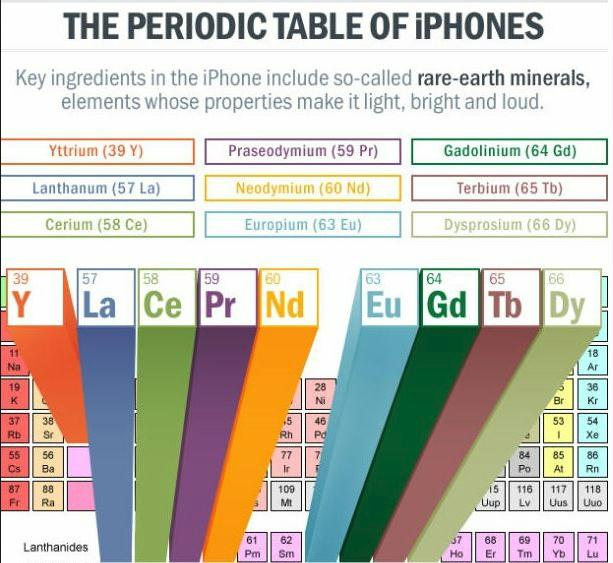 There are 17 rare earth elements in the periodic table. About nine of those elements go into every iPhone sold… and if China were suddenly to disappear from a map tomorrow, Apple would lose about 90% of those elements. Source: Brownlee 2013.