Preface. The IPCC, like economists, assumes our economy and burning of fossil fuels will grow exponentially until 2100 and beyond, with no limits to growth. But conventional oil peaked and has stayed on a plateau since 2005, so clearly peak global oil production is in sight. As is peak soil, aquifer depletion, biodiversity destruction, and deforestation to name just a few existential threats besides climate change.
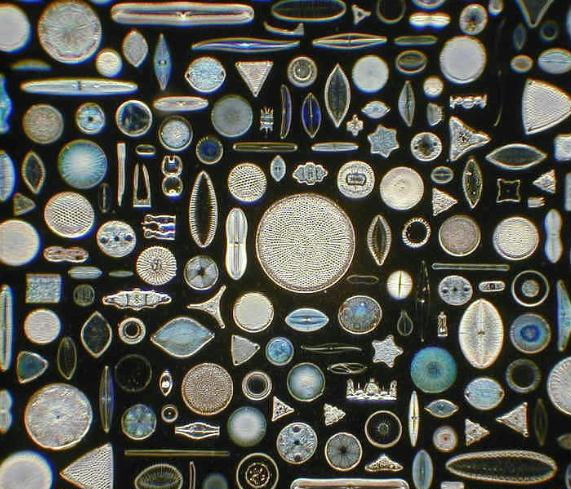
The lack of attention to microbes in the IPCC model further weakens their predictions about the trajectory of climate change. As this article notes, diatoms are our friends, they “perform 25–45% of total primary production in the oceans, owing to their prevalence in open-ocean regions when total phytoplankton biomass is maximal. Diatoms have relatively high sinking speeds compared with other phytoplankton groups, and they account for ~40% of particulate carbon export to depth”.
Diatoms didn’t appear until 40 million years ago, and sequester so much carbon that they caused the poles to form ice caps. So certainly scientists should study whether their numbers are decreasing or increasing. But also the IPCC needs to include diatoms and other microbes in their models. It’s a big deal that they haven’t, since microorganisms support the existence of all higher life forms.
More than 30 microbiologists from 9 countries have issued a warning to humanity — they are calling for the world to stop ignoring an ‘unseen majority’ in Earth’s biodiversity and ecosystem when addressing climate change.
The researchers are hoping to raise awareness both for how microbes can influence climate change and how they will be impacted by it — calling for including microbes in climate change research, increasing the use of research involving innovative technologies, and improving education in classrooms.
“Micro-organisms, which include bacteria and viruses, are the lifeforms that you don’t see on the conservation websites,” says Professor Cavicchioli. “They support the existence of all higher lifeforms and are critically important in regulating climate change. “However, they are rarely the focus of climate change studies and not considered in policy development.”
Professor Cavicchioli calls microbes the ‘unseen majority’ of lifeforms on earth, playing critical functions in animal and human health, agriculture, the global food web and industry.
For example, the Census of Marine Life estimates that 90% of the ocean’s total biomass is microbial. In our oceans, marine lifeforms called phytoplankton take light energy from the sun and remove carbon dioxide from the atmosphere as much as plants. The tiny phytoplankton form the beginning of the ocean food web, feeding krill populations that then feed fish, sea birds and large mammals such as whales.
Marine phytoplankton perform half of the global photosynthetic CO2 fixation and half of the oxygen production despite amounting to only ~1% of global plant biomass. In comparison with terrestrial plants, marine phytoplankton are distributed over a larger surface area, are exposed to less seasonal variation and have markedly faster turnover rates than trees (days versus decades). Therefore, phytoplankton respond rapidly on a global scale to climate variations.
Sea ice algae thrive in sea ice ‘houses’. If global warming trends continue, the melting sea ice has a downstream effect on the sea ice algae, which means a diminished ocean food web.
“Climate change is literally starving ocean life,” says Professor Cavicchioli.
Beyond the ocean, microbes are also critical to terrestrial environments, agriculture and disease.
“In terrestrial environments, microbes release a range of important greenhouse gases to the atmosphere (carbon dioxide, methane and nitrous oxide), and climate change is causing these emissions to increase,” Professor Cavicchioli says.
“Farming ruminant animals releases vast quantities of methane from the microbes living in their rumen — so decisions about global farming practices need to consider these consequences.
“And lastly, climate change worsens the impact of pathogenic microbes on animals (including humans) and plants — that’s because climate change is stressing native life, making it easier for pathogens to cause disease.
“Climate change also expands the number and geographic range of vectors (such as mosquitos) that carry pathogens. The end result is the increased spread of disease, and serious threats to global food supplies.”
Greater commitment to microbe-based research needed
In their statement, the scientists call on researchers, institutions and governments to commit to greater microbial recognition to mitigate climate change.
“The statement emphasizes the need to investigate microbial responses to climate change and to include microbe-based research during the development of policy and management decisions,” says Professor Cavicchioli.
Additionally, climate change research that links biological processes to global geophysical and climate processes should have a much bigger focus on microbial processes.
“This goes to the heart of climate change, so if micro-organisms aren’t considered effectively it means models cannot be generated properly and predictions could be inaccurate,” says Professor Cavicchioli.
“Decisions that are made now impact on humans and other forms of life, so if you don’t take into account the microbial world, you’re missing a very big component of the equation.”
Professor Cavicchioli says that microbiologists are also working on developing resources that will be made available for teachers to educate students on the importance of microbes.
“If that literacy is there, that means people will have a much better capacity to engage with things to do with microbiology and understand the ramifications and importance of microbes.”
Preface. As declining fossil fuels force more and more people back into being farmers, eventually 75 to 90% of the population, it would be much better for this to happen with family farms than gigantic mega-farms with workers who are slaves in all but name. This essay offers an alternative, collaborative worker-owned farming that has already been proven to work..
Family farms are central to our nation’s identity. Most Americans, even those who have never been on a farm, have strong feelings about the idea of family farms — so much that they’re the one thing that all U.S. politicians agree on. Each election, candidates across the ideological spectrum roll out plans to save family farms — or give speeches about them, at least. From Little House on the Prairie to modern farmer’s markets, family farms are also the core of most Americans’ vision of what sustainable, just farming is supposed to look like.
But as someone who’s worked in agriculture for 20 years and researched the history of farming, I think we need to understand something: Family farming’s difficulties aren’t a modern problem born of modern agribusiness. It’s never worked very well. It’s simply precarious, and it always has been. Idealizing family farms burdens real farmers with overwhelming guilt and blame when farms go under. It’s crushing.
I wish we talked more openly about this. If we truly understood how rare it is for family farms to happen at all, never mind last multiple generations, I hope we could be less hard on ourselves. Deep down we all know that the razor-thin margins put families in impossible positions all the time, but we still treat it like it’s the ideal. We blame these troubles on agribusiness — but we don’t look deeper. We should. If we’re serious about building food systems that are sustainable and robust in the long term, we need to learn from how farming’s been done for most of human history: collaboratively.
Farming has almost always existed on a larger social scale—very extended families up to whole villages. We tend to think of medieval peasants as forebears of today’s family farms, but they’re not. Medieval villages worked much more like a single unit with little truly private infrastructure—draft animals, plows, and even land were operated at the communitylevel. Family farming as we know it— nuclear families that own their land, pass it on to heirs, raise some or all of their food, and produce some cash crops—is vanishingly rare in human history.
It’s easy to see how Anglo-Americans could mistake it for normal. Our cultural heritage is one of the few places where this fluke of a farming practice has made multiple appearances. Family farming was a key part of the political economy in ancient Rome, late medieval England, and colonial America. But we keep forgetting something very important about those golden ages of family farming. They all happened after, and only after, horrific depopulation events.
Rome emptied newly conquered lands by selling the original inhabitants into slavery. In England, the Black Death killed so many nobles and serfs that surviving peasants seized their own land and became yeomen — free small farmers who neither answered to a master nor commanded their own servants. Colonial Americans, seeking to recreate English yeoman farming, began a campaign of genocide against indigenous people that has lasted for centuries, and created one of the greatest transfers of land and wealth in history.
Family farming isn’t just difficult. It’s so brittle that it only makes a viable livelihood for farmers when land is nearly valueless for sheer lack of people. In areas where family farming has persisted for more than a couple generations it’s largely thanks to extensive, modern technocratic government interventions like grants, guaranteed loans, subsidized crop insurance, free training, tax breaks, suppression of farmworker wages, and more. Family farms’ dependence on the state is well understood within the industry, but it’s heresy to talk about it openly lest taxpayers catch on. I think it’s time to open up, because I don’t think a practice that needs that much life support can truly be considered “sustainable.” After seeing what I’ve seen from 20 years in the industry, continuing to present it as such feels to me like a type of con game — because there is a better way.
America’s history is filled with examples of collaborative farming. It’s just less publicized than single-family homesteading. African-American farmershave a long and determined history of collaborative farming, a brace against the viciousness of slavery and Jim Crow. Native peoples that farmed usually did so as a wholecommunity rather than on a single-family basis. In the early days of the reservation system, some reservations grew their food on one large farm run by the entire nation or tribe. These were so successful that colonial governments panicked, broke them up, and forced indigenous farmers to farm as individual single-family homesteads. This was done with the express goal of impoverishing them — which says a lot about the realities of family farming, security, and financial independence. It also says a lot about how long those grim realities have been understood. Indigenous groups today run modern, innovative, community-level land operations, including over half the farms in Arizona; or Tanka’s work restoring prairies, bison, and traditional foodways in the Dakotas as the settler-built wheat economy dries up.
One collaborative tradition that’s been very public about how their community-size farms function is the Hutterites, a religious group of about 460 communities in the U.S. and Canada numbering 75-150 people apiece. Despite the harsh prairies where they live, and farming about half as many acres per capita as neighboring family farmers, Hutterites are thriving and expanding when neighboring family farms are throwing in the towel. Their approach — essentially farming as a large employee-owned company with diverse crops and livestock — has valuable lessons.
Outsiders often chalk up the success of the Hutterites, who forgo most private property, to “free labor” or “not having to pay taxes.” Neither of these are accurate. Hutterite farms thrive due to farming as a larger community rather than as individual families. Family farms can achieve economies of scale by specializing in one thing, like expanding a dairy herd or crop acreage. But with only one or two family members running a farm, there simply isn’t enough bandwidth to run more than one or two operations, no matter how much labor-saving technology is involved. The community at a Hutterite farm allows them to actually pull off what sustainability advocates talk about, but family farms consistently struggle with: diversifying.
To understand why this structure is useful, take the experience of a colleaguewhose family runs a wheat farm in the Great Plains. He’s trying to make extra cash by grazing cattle on their crop when it’s young. This can enhance the soil and future yields if done right, and his family agreed to it, but they couldn’t help build the necessary fence, or pay for another laborer to help him. The property remains fenceless, without additional income, and without the soil health boosts from carefully managed grazing. Community-size farms like Hutterite operations have larger, more flexible labor pools that don’t get stuck in these catch-22 situations.
Stories like this abound in farm country. America’s farmland is filled with opportunities to sustainably grow more food from the same acres and earn extra cash, thwarted by the limited attention solo operations can give. We treat this plight as natural and inevitable. We treat it as something to solve by collective action on a national level — government policies that help family farms. We don’t talk about how readily these things can be solved by collective action at the local level.
Collaboration doesn’t just make better use of the land — it can also do a lot for farmers’ quality of life. Hutterites, thanks to farming on a community scale, get four weeks of vacation per year; new mothers get a few months’ maternity leave and a full-time helper of their choosing — something few American women in any vocation can do.
We don’t have to commit to the Hutterite lifestyle to benefit from the advantages of collaborative farming. Big, diverse, employee-owned farms work, and they can turn farming into a job that anyone can train for and get — you don’t have to be born into it.
Many of today’s new farmers who weren’t born into farming are young and woefully undercapitalized, stuck in a high-labor/low-revenues cycle with little chance for improvement. Others begin farming as a second career, with plenty of capital but a time horizon of perhaps 20 years — rather than the 40 it often takes to make planting orchards, significant investments in land, and other improvements worth it. These new farmers are absolutely trying to do the right thing, but solo farming simply doesn’t give them the resources or time horizon to “think like a cathedral builder.” Good farming is a relay race. We have to build human systems that work like a relay team.
Finally, and perhaps most important, collaborative farming can be a powerful tool for decolonization. Hutterite communities are powerhouses, raising most of the eggs, hogs, or turkeys in some states — and they’re also largely self-sufficient. This has allowed them to build their own culture to suit their own values. They have enough scale to build their own crop processing, so they can work directly with retailers and customers on their own terms instead of going through middlemen. They build their own knowledge instead of relying on “free” agribusiness advice as many family farms do. In other words, they’re powerful. Imagine what groups like this, with determined inclusivity from top leadership down through rank-and-file, could do to right the balance of power in the United States.
Solo farming does work for a few. I don’t want to discount their accomplishments — but I also don’t think we can give them their due without acknowledging the uphill battle they’re in. I think it’s important to be honest about family farming’s challenges and proactive about handling them. One of the best ways to do that is to pool efforts. Our culture puts so much emphasis on one “right” way of farming — solo family operations — that we ignore valuable lessons from people who’ve done it differently for hundreds or thousands of years. It’s time for us to open up and look at other ways of doing things.
Preface. This is a post written by Bodhi Paul Chefurka in 2013 at his blog paulchefurka.ca here. I don’t understand his ultimate sustainable carrying capacity based on hunter gatherers. Why will agriculture go away? But the rest of the article is spot on.
Ever since the writing of Thomas Malthus in the early 1800s, and especially since Paul Ehrlich’s publication of “The Population Bomb” in 1968, there has been a lot of learned skull-scratching over what the sustainable human population of Planet Earth might “really” be over the long haul.
This question is intrinsically tied to the issue of ecological overshoot so ably described by William R. Catton Jr. in his 1980 book “Overshoot:The Ecological Basis of Revolutionary Change”. How much have we already pushed our population and consumption levels above the long-term carrying capacity of the planet?
In this article I outline my current thoughts on carrying capacity and overshoot, and present five estimates for the size of a sustainable human population.
Carrying Capacity
“Carrying capacity” is a well-known ecological term that has an obvious and fairly intuitive meaning: “The maximum population size of a species that the environment can sustain indefinitely, given the food, habitat, water and other necessities available in the environment.”
Unfortunately that definition becomes more nebulous and controversial the closer you look at it, especially when we are talking about the planetary carrying capacity for human beings. Ecologists will claim that our numbers have already well surpassed the planet’s carrying capacity, while others (notably economists and politicians…) claim we are nowhere near it yet!
This confusion may arise because we tend to confuse two very different understandings of the phrase “carrying capacity”. For this discussion I will call these the “subjective” view and the “objective” views of carrying capacity.
The subjective view is carrying capacity as seen by a member of the species in question. Rather than coming from a rational, analytical assessment of the overall situation, it is an experiential judgement. As such it tends to be limited to the population of one’s own species, as well as having a short time horizon – the current situation counts a lot more than some future possibility. The main thing that matters in this view is how many of one’s own species will be able to survive to reproduce. As long as that number continues to rise, we assume all is well – that we have not yet reached the carrying capacity of our environment.
From this subjective point of view humanity has not even reached, let alone surpassed the Earth’s overall carrying capacity – after all, our population is still growing. It’s tempting to ascribe this view mainly to neoclassical economists and politicians, but truthfully most of us tend to see things this way. In fact, all species, including humans, have this orientation, whether it is conscious or not.
Species tend to keep growing until outside factors such as disease, predators, food or other resource scarcity – or climate change – intervene. These factors define the “objective” carrying capacity of the environment. This objective view of carrying capacity is the view of an observer who adopts a position outside the species in question.It’s the typical viewpoint of an ecologist looking at the reindeer on St. Matthew Island, or at the impact of humanity on other species and its own resource base.
This is the view that is usually assumed by ecologists when they use the naked phrase “carrying capacity”, and it is an assessment that can only be arrived at through analysis and deductive reasoning. It’s the view I hold, and its implications for our future are anything but comforting.
When a species bumps up against the limits posed by the environment’s objective carrying capacity,its population begins to decline. Humanity is now at the uncomfortable point when objective observers have detected our overshoot condition, but the population as a whole has not recognized it yet. As we push harder against the limits of the planet’s objective carrying capacity, things are beginning to go wrong. More and more ordinary people are recognizing the problem as its symptoms become more obvious to casual onlookers.The problem is, of course, that we’ve already been above the planet’s carrying capacity for quite a while.
One typical rejoinder to this line of argument is that humans have “expanded our carrying capacity” through technological innovation. “Look at the Green Revolution! Malthus was just plain wrong. There are no limits to human ingenuity!” When we say things like this, we are of course speaking from a subjective viewpoint. From this experiential, human-centric point of view, we have indeed made it possible for our environment to support ever more of us. This is the only view that matters at the biological, evolutionary level, so it is hardly surprising that most of our fellow species-members are content with it.
The problem with that view is that every objective indicator of overshoot is flashing red. From the climate change and ocean acidification that flows from our smokestacks and tailpipes, through the deforestation and desertification that accompany our expansion of human agriculture and living space, to the extinctions of non-human species happening in the natural world, the planet is urgently signalling an overload condition.
Humans have an underlying urge towards growth, an immense intellectual capacity for innovation, and a biological inability to step outside our chauvinistic, anthropocentric perspective. This combination has made it inevitable that we would land ourselves and the rest of the biosphere in the current insoluble global ecological predicament.
Overshoot
When a population surpasses its carrying capacity it enters a condition known as overshoot. Because the carrying capacity is defined as the maximum population that an environment can maintain indefinitely, overshoot must by definition be temporary. Populations always decline to (or below) the carrying capacity. How long they stay in overshoot depends on how many stored resources there are to support their inflated numbers. Resources may be food, but they may also be any resource that helps maintain their numbers. For humans one of the primary resources is energy, whether it is tapped as flows (sunlight, wind, biomass) or stocks (coal, oil, gas, uranium etc.). A species usually enters overshoot when it taps a particularly rich but exhaustible stock of a resource. Like fossil fuels, for instance…
Population growth in the animal kingdom tends to follow a logistic curve. This is an S-shaped curve that starts off low when the species is first introduced to an ecosystem, at some later point rises very fast as the population becomes established, and then finally levels off as the population saturates its niche.
Humans have been pushing the envelope of our logistic curve for much of our history. Our population rose very slowly over the last couple of hundred thousand years, as we gradually developed the skills we needed in order to deal with our varied and changeable environment,particularly language, writing and arithmetic. As we developed and disseminated those skills our ability to modify our environment grew, and so did our growth rate.
If we had not discovered the stored energy resource of fossil fuels, our logistic growth curve would probably have flattend out some time ago, and we would be well on our way to achieving a balance with the energy flows in the world around us, much like all other species do. Our numbers would have settled down to oscillate around a much lower level than today, similar to what they probably did with hunter-gatherer populations tens of thousands of years ago.
Unfortunately, our discovery of the energy potential of coal created what mathematicians and systems theorists call a “bifurcation point” or what is better known in some cases as a tipping point. This is a point at which a system diverges from one path onto another because of some influence on events. The unfortunate fact of the matter is that bifurcation points are generally irreversible. Once past such a point, the system can’t go back to a point before it.
Given the impact that fossil fuels had on the development of world civilization, their discovery was clearly such a fork in the road. Rather than flattening out politely as other species’ growth curves tend to do, ours kept on rising. And rising, and rising.
What is a sustainable population level?
Now we come to the heart of the matter. Okay, we all accept that the human race is in overshoot. But how deep into overshoot are we? What is the carrying capacity of our planet? The answers to these questions,after all, define a sustainable population.
Not surprisingly, the answers are quite hard to tease out. Various numbers have been put forward, each with its set of stated and unstated assumptions –not the least of which is the assumed standard of living (or consumption profile) of the average person. For those familiar with Ehrlich and Holdren’s I=PAT equation, if “I” represents the environmental impact of a sustainable population, then for any population value “P” there is a corresponding value for “AT”, the level of Activity and Technology that can be sustained for that population level. In other words, the higher our standard of living climbs, the lower our population level must fall in order to be sustainable. This is discussed further in an earlier article on Thermodynamic Footprints.
To get some feel for the enormous range of uncertainty in sustainability estimates we’ll look at five assessments, each of which leads to a very different outcome. We’ll start with the most optimistic one, and work our way down the scale.
The Ecological Footprint Assessment
The concept of the Ecological Footprint was developed in 1992 by William Rees and Mathis Wackernagel at the University of British Columbia in Canada.
The ecological footprint is a measure of human demand on the Earth’s ecosystems. It is a standardized measure of demand for natural capital that may be contrasted with the planet’s ecological capacity to regenerate. It represents the amount of biologically productive land and sea area necessary to supply the resources a human population consumes, and to assimilate associated waste. As it is usually published, the value is an estimate of how many planet Earths it would take to support humanity with everyone following their current lifestyle.
It has a number of fairly glaring flaws that cause it to be hyper-optimistic. The “ecological footprint” is basically for renewable resources only. It includes a theoretical but underestimated factor for non-renewable resources. It does not take into account the unfolding effects of climate change, ocean acidification or biodiversity loss (i.e. species extinctions). It is intuitively clear that no number of “extra planets” would compensate for such degradation.
Still, the estimate as of the end of 2012 is that our overall ecological footprint is about “1.7 planets”. In other words, there is at least 1.7 times too much human activity for the long-term health of this single, lonely planet. To put it yet another way, we are 70% into overshoot.
It would probably be fair to say that by this accounting method the sustainable population would be (7 / 1.7) or about four billion people at our current average level of affluence. As you will see, other assessments make this estimate seem like a happy fantasy.
The Fossil Fuel Assessment
The main accelerant of human activity over the last 150 to 200 years has been fossil fuel. Before 1800 there was very little fossil fuel in general use, with most energy being derived from wood, wind, water, animal and human power. The following graph demonstrates the precipitous rise in fossil fuel use since then, and especially since 1950.
This information was the basis for my earlier Thermodynamic Footprint analysis. That article investigated the influence of technological energy (87% of which comes from fossil fuels) on human planetary impact, in terms of how much it multiplies the effect of each “naked ape”. The following graph illustrates the multiplier at different points in history:
Fossil fuels have powered the increase in all aspects of civilization, including population growth. The “Green Revolution” in agriculture that was kicked off by Nobel laureate Norman Borlaug in the late 1940s was largely a fossil fuel phenomenon, relying on mechanization,powered irrigation and synthetic fertilizers derived from fossil fuels. This enormous increase in food production supported a swift rise in population numbers, in a classic ecological feedback loop: more food (supply) => more people (demand) => more food => more people etc…
Over the core decades of the Green Revolution from 1950 to 1980 the world population almost doubled, from fewe rthan 2.5 billion to over 4.5 billion. The average population growth over those three decades was 2% per year. Compare that to 0.5% from 1800 to 1900; 1.00% from 1900 to 1950; and 1.5% from 1980 until now:
This analysis makes it tempting to conclude that a sustainable population might look similar to the situation in 1800, before the Green Revolution, and before the global adoption of fossil fuels: about 1 billion peopleliving on about 5% of today’s global average energy consumption.
It’s tempting (largely because it seems vaguely achievable), but unfortunately that number may still be too high. Even in 1800 the signs of human overshoot were clear, if not well recognized: there was already widespread deforestation through Europe and the Middle East; and desertification had set into the previously lush agricultural zones of North Africa and the Middle East.
Not to mention that if we did start over with “just” one billion people, an annual growth rate of a mere 0.5% would put the population back over seven billion in just 400 years. Unless the growth rate can be kept down very close to zero, such a situation is decidedly unsustainable.
The Population Density Assessment
There is another way to approach the question. If we assume that the human species was sustainable at some point in the past, what point might we choose and what conditions contributed to our apparent sustainability at that time?
I use a very strict definition of sustainability. It reads something like this: “Sustainability is the ability of a species to survive in perpetuity without damaging the planetary ecosystem in the process.” This principle applies only to a species’ own actions, rather than uncontrollable external forces like Milankovitch cycles, asteroid impacts, plate tectonics, etc.
In order to find a population that I was fairly confident met my definition of sustainability, I had to look well back in history – in fact back into Paleolithic times. The sustainability conditions I chose were: a very low population density and very low energy use, with both maintained over multiple thousands of years. I also assumed the populace would each use about as much energy as a typical hunter-gatherer: about twice the daily amount of energy a person obtains from the food they eat.
There are about 150 million square kilometers, or 60 million square miles of land on Planet Earth. However, two thirds of that area is covered by snow, mountains or deserts, or has little or no topsoil. This leaves about 50 million square kilometers (20 million square miles) that is habitable by humans without high levels of technology.
A typical population density for a non-energy-assisted society of hunter-forager-gardeners is between 1 person per square mile and 1 person per square kilometer. Because humans living this way had settled the entire planet by the time agriculture was invented 10,000 years ago, this number pegs a reasonable upper boundary for a sustainable world population in the range of 20 to 50 millionpeople.
I settled on the average of these two numbers, 35 million people. That was because it matches known hunter-forager population densities, and because those densities were maintained with virtually zero population growth (less than 0.01% per year)during the 67,000 years from the time of the Toba super-volcano eruption in 75,000 BC until 8,000 BC (Agriculture Day on Planet Earth).
If we were to spread our current population of 7 billion evenly over 50 million square kilometers, we would have an average density of 150 per square kilometer. Based just on that number, and without even considering our modern energy-driven activities, our current population is at least 250 times too big to be sustainable. To put it another way, we are now 25,000%into overshoot based on our raw population numbers alone.
As I said above, we also need to take the population’s standard of living into account. Our use of technological energy gives each of us the average planetary impact of about 20 hunter-foragers. What would the sustainable population be if each person kept their current lifestyle, which is given as an average current Thermodynamic Footprint (TF) of 20?
We can find the sustainable world population number for any level of human activity by using the I = PAT equation mentioned above.
We decided above that the maximum hunter-forager population we could accept as sustainable would be 35 million people, each with a Thermodynamic Footprint of 1.
First, we set I (the allowable total impact for our sustainable population) to 35, representing those 35 million hunter-foragers.
Next, we set AT to be the TF representing the desired average lifestyle for our population. In this case that number is 20.
We can now solve the equation for P. Using simple algebra, we know that I = P x AT is equivalent to P = I / AT. Using that form of the equation we substitute in our values, and we find that P = 35 / 20. In this case P = 1.75.
This number tells us that if we want to keep the average level of per-capita consumption we enjoy in in today’s world, we would enter an overshoot situation above a global population of about 1.75 million people. By this measure our current population of 7 billion is about 4,000 times too big and active for long-term sustainability. In other words, by this measure we are we are now 400,000% into overshoot.
Using the same technique we can calculate that achieving a sustainable population with an American lifestyle (TF = 78) would permit a world population of only 650,000 people – clearly not enough to sustain a modern global civilization.
For the sake of comparison, it is estimated that the historical world population just after the dawn of agriculture in 8,000 BC was about five million, and in Year 1 was about 200 million. We crossed the upper threshold of planetary sustainability in about 2000 BC, and have been in deepening overshoot for the last 4,000 years.
The Ecological Assessments
As a species, human beings share much in common with other large mammals. We breathe, eat, move around to find food and mates, socialize, reproduce and die like all other mammalian species. Our intellec tand culture, those qualities that make us uniquely human, are recent additions to our essential primate nature, at least in evolutionary terms.
Consequently it makes sense to compare our species’ performance to that of other, similar species – species that we know for sure are sustainable. I was fortunate to find the work of American marine biologist Dr. Charles W. Fowler, who has a deep interest in sustainability and the ecological conundrum posed by human beings. The following two assessments are drawn from Dr. Fowler’s work.
First assessment
In 2003, Dr. Fowler and Larry Hobbs co-wrote a paper titled, “Is humanity sustainable?” that was published by the Royal Society. In it, they compared a variety of ecological measures across 31 species including humans. The measures included biomass consumption, energy consumption, CO2 production, geographical range size, and population size.
It should come as no great surprise that in most ofthe comparisons humans had far greater impact than other species, even to a 99%confidence level. The only measure inwhich we matched other species was in the consumption of biomass (i.e. food).
When it came to population size, Fowler and Hobbs foundthat there are over two orders of magnitude more humans than one would expectbased on a comparison to other species – 190 times more, in fact. Similarly, our CO2 emissions outdid otherspecies by a factor of 215.
Based on this research, Dr. Fowler concluded that there are about 200 times too many humans on the planet. This brings up an estimate for a sustainable population of 35 million people.
This is the same as the upper bound established above by examining hunter-gatherer population densities. The similarity of the results is not too surprising, since the hunter-gatherers of 50,000 years ago were about as close to “naked apes” as humans have been in recent history.
Second assessment
In 2008, five years after the publication cited above, Dr. Fowler wrote another paper entitled “Maximizing biodiversity, information and sustainability.” In this paper he examined the sustainability question from the point of view of maximizing biodiversity. In other words, what is the largest human population that would not reduce planetary biodiversity?
This is, of course, a very stringent test, and one that we probably failed early in our history by extirpating mega-fauna in the wake of our migrations across a number of continents.
In this paper, Dr. Fowler compared 96 different species, and again analyzed them in terms of population, CO2 emissions and consumption patterns.
This time, when the strict test of biodiversity retention was applied, the results were truly shocking, even to me. According to this measure, humans have overpopulated the Earth by almost 700 times. In order to preserve maximum biodiversity on Earth, the human population may be no more than 10 million people – each with the consumption of a Paleolithic hunter-forager.
Urk!
Conclusions
As you can see, the estimates for a sustainable human population vary widely – by a factor of 400 from the highest to the lowest.
The Ecological Footprint doesn’t really seem intended as a measure of sustainability. Its main value is to give people with no exposure to ecology some sense that we are indeed over-exploiting our planet. (It also has the psychological advantage of feeling achievable with just a little work.) As a measure of sustainability,it is not helpful.
As I said above, the number suggested by the Thermodynamic Footprint or Fossil Fuel analysis isn’t very helpful either – even a population of one billion people without fossil fuels had already gone into overshoot.
That leaves us with three estimates: two at 35 million, and one of 10 million.
I think the lowest estimate (Fowler 2008, maximizing biodiversity), though interesting, is out of the running in this case, because human intelligence and problem-solving ability makes our destructive impact on biodiversity a foregone conclusion. We drove other species to extinction 40,000 years ago, when our total population was estimated to be under 1 million.
That leaves the central number of 35 million people, confirmed by two analyses using different data and assumptions. My conclusion is that this is probably the largest human population that could realistically be considered sustainable.
So, what can we do with this information? It’s obvious that we will not (and probably cannot) voluntarily reduce our population by 99.5%. Even an involuntary reduction of this magnitude would involve enormous suffering and a very uncertain outcome. In fact, it’s close enough to zero that if Mother Nature blinked, we’d be gone.
In fact, the analysis suggests that Homo sapiens is an inherently unsustainable species. This outcome seems virtually guaranteed by our neocortex, by the very intelligence that has enabled our rise to unprecedented dominance over our planet’s biosphere. Is intelligence an evolutionary blind alley? From the singular perspective of our own species, it quite probably is. If we are to find some greater meaning or deeper future for intelligence in the universe, we may be forced to look beyond ourselves and adopt a cosmic, rather than a human, perspective.
Discussion
How do we get out of this jam?
How might we get from where we are today to a sustainable world population of 35 million or so? We should probably discard the notion of “managing” such a population decline. If we can’t get our population to simply stop growing, an outright reduction of over 99% is simply not in the cards. People seem virtually incapable of taking these kinds of decisions in large social groups. We can decide to stop reproducing, but only as individuals or (perhaps) small groups. Without the essential broad social support, such personal choices will make precious little difference to the final outcome. Politicians will by and large not even propose an idea like “managed population decline” – not if they want to gain or remain in power, at any rate. China’s brave experiment with one-child families notwithstanding, any global population decline will be purely involuntary.
Crash?
A world population decline would (will) be triggered and fed by our civilization’s encounter with limits. These limits may show up in any area: accelerating climate change, weather extremes,shrinking food supplies, fresh water depletion, shrinking energy supplies,pandemic diseases, breakdowns in the social fabric due to excessive complexity,supply chain breakdowns, electrical grid failures, a breakdown of the international financial system, international hostilities – the list of candidates is endless, and their interactions are far too complex to predict.
In 2007, shortly after I grasped the concept and implications of Peak Oil, I wrote my first web article on population decline: Population: The Elephant in the Room. In it I sketched out the picture of a monolithic population collapse: a straight-line decline from today’s seven billion people to just one billion by the end of this century. As time has passed I’ve become less confident in this particular dystopian vision. It now seems to me that human beings may be just a bit tougher than that. We would fight like demons to stop the slide, though we would potentially do a lot more damage to the environment in the process. We would try with all our might to cling to civilization and rebuild our former glory. Different physical, environmental and social situations around the world would result in a great diversity in regional outcomes. To put it plainly, a simple “slide to oblivion” is not in the cards for any species that could recover from the giant Toba volcanic eruption in just 75,000 years.
Or Tumble?
Still, there are those physical limits I mentioned above. They are looming ever closer, and it seems a foregone conclusion that we will begin to encounter them for real within the next decade or two. In order to draw a slightly more realistic picture of what might happen at that point, I created the following thought experiment on involuntary population decline. It’s based on the idea that our population will not simply crash, but will oscillate (tumble) down a series of stair-steps: first dropping as we puncture the limits to growth; then falling below them; then partially recovering; only to fall again; partially recover; fall; recover…
I started the scenario with a world population of 8 billion people in 2030. I assumed each full cycle of decline and partial recovery would take six generations, or 200 years. It would take three generations (100 years) to complete each decline and then three more in recovery, for a total cycle time of 200 years. I assumed each decline would take out 60% of the existing population over its hundred years, while each subsequent rise would add back only half of the lost population.
In ten full cycles – 2,000 years – we would be back to a sustainable population of about 40-50 million. The biggest drop would be in the first 100 years, from 2030 to 2130 when we would lose a net 53 million people per year. Even that is only a loss of 0.9% pa, compared to our net growth today of 1.1%, that’s easily within the realm of the conceivable,and not necessarily catastrophic – at least to begin with.
As a scenario it seems a lot more likely than a single monolithic crash from here to under a billion people. Here’s what it looks like:
It’s important to remember that this scenario is not a prediction. It’s an attempt to portray a potential path down the population hill that seems a bit more probable than a simple, “Crash! Everybody dies.”
It’s also important to remember that the decline will probably not happen anything like this, either. With climate change getting ready to push humanity down the stairs, and the strong possibility that the overall global temperature will rise by 5 or 6 degrees Celsius even before the end of that first decline cycle, our prospects do not look even this “good” from where I stand.
Rest assured, I’m not trying to present 35 million people as some kind of “population target”. It’s just part of my attempt to frame what we’re doing to the planet, in terms of what some of us see as the planetary ecosphere’s level of tolerance for our abuse.
The other potential implicit in this analysis is that if we did drop from 8 to under 1 billion, we could then enter a population free-fall. As a result, we might keep falling until we hit the bottom of Olduvai Gorge again. My numbers are an attempt to define how many people might stagger away from such a crash landing. Some people seem to believe that such an event could be manageable. I don’t share that belief for a moment. These calculations are my way of getting that message out.
I figure if I’m going to draw a line in the sand, I’m going to do it on behalf of all life, not just our way of life.
What can we do?
To be absolutely clear, after ten years of investigating what I affectionately call “The Global Clusterfuck”, I do not think it can be prevented, mitigated or managed in any way. If and when it happens, it will follow its own dynamic, and the force of events could easily make the Japanese and Andaman tsunamis seem like pleasant days at the beach.
The most effective preparations that we can make will all be done by individuals and small groups. It will be up to each of us to decide what our skills, resources and motivations call us to do. It will be different for each of us – even for people in the same neighborhood, let alone people on opposite sides of the world.
I’ve been saying for a couple of years that each of us will each do whatever we think is appropriate to the circumstances, in whatever part of the world we can influence. The outcome of our actions is ultimately unforeseeable, because it depends on how the efforts of all 7 billion of us converge, co-operate and compete. The end result will be quite different from place to place – climate change impacts will vary, resources vary, social structures vary, values and belief systems are different all over the world.The best we can do is to do our best.
Here is my advice:
Stay awake to what’s happening around us.
Don’t get hung up by other people’s “shoulds and shouldn’ts”.
Occasionally re-examine our personal values. If they aren’t in alignment with what we think the world needs, change them.
Stop blaming people. Others are as much victims of the times as we are – even the CEOs and politicians.
Blame, anger and outrage is pointless. It wastes precious energy that we will need for more useful work.
Laugh a lot, at everything – including ourselves.
Hold all the world’s various beliefs and “isms” lightly, including our own.
Forgive others. Forgive ourselves. For everything.
Love everything just as deeply as you can.
That’s what I think might be helpful. If we get all that personal stuff right, then doing the physical stuff about food, water, housing,transportation, energy, politics and the rest of it will come easy – or at least a bit easier. And we will have a lot more fun doing it.
Preface. This is interesting, but not commercial. And as my book “When trucks stop running” explains, trucks are the basis of civilization, and can’t run on electric batteries or overhead wires. Even if they could, I explained why a 100% renewable energy grid was impossible, especially because you need 30 days of storage to ride out seasonal shortages of wind and solar. And even if I were wrong, oil decline is likely to begin with 10 years, so we’ll be stuck with whatever solutions are commercial at the time.
The speculative field of gravity-based energy storage got a boost recently with news of a strategic investment and new patents.
Swiss-U.S. startup Energy Vault, one of the most high-profile gravity storage players to date, secured financial backing from Cemex Ventures, the corporate venture capital unit of the world’s second-largest building materials giant, and a pledge to help with deployment through Cemex’s “strategic network.”
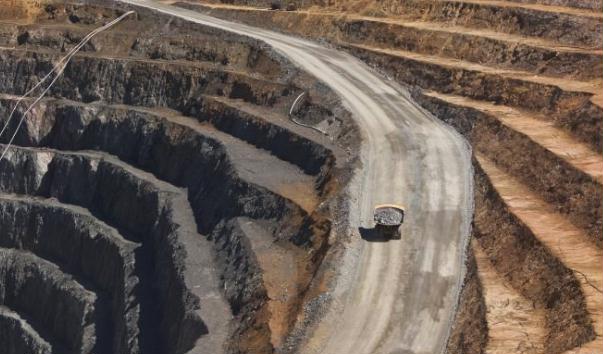
Meanwhile, the University of Nottingham and the World Society of Sustainable Energy Technologies confirmed the filing of patent applications for a concept called EarthPumpStore, which uses abandoned mines as gravity storage assets.
Implementing the technology across 150,000 disused open-cast mines in China alone could deliver an estimated storage capacity of 250 terawatt-hours , the University of Nottingham said in a press note.
MY NOTE: well whoop-dee-doo. China generates 16.2 trillion terawatt-hours (TWh) a day. That’s 64 billion times more than all of the open-cast mines can provide. Better start digging more holes!
The announcements indicate growing interest in a class of energy storage concepts that appear seductively simple but have yet to gain widespread acceptance.
Most gravity storage concepts are based on the idea of using spare electricity to lift a heavy block, so the energy can be recovered when needed by letting the weight drop down again.
In the case of Energy Vault, the blocks are made of concrete and are lifted up by cranes 33 stories high. EarthPumpStore, meanwhile, envisages pulling containers filled with compacted earth up the sides of open-cast mines.
Gravity is also the force underpinning pumped hydro, the most widespread and cost-effective form of energy storage in the world. But pumped hydro development is slow and costly, requiring sites with specific topographical characteristics and often involving significant permitting hurdles.
The proponents of newer gravity storage options claim that installation and deployment of their technology is quicker, easier and cheaper.
The University of Nottingham, for example, estimates EarthPumpStore would cost about $50 per installed kilowatt-hour, compared to $200 for pumped hydro and $400 for battery storage.
The university also said EarthPumpStore could achieve a round-trip efficiency of more than 90 percent, compared to between 50 percent and 70 percent for pumped hydro, plus an energy storage density up to eight times higher. Other sources have made similar claims.
In 2017, for example, a study by Imperial College London for the gravity storage technology developer Heindl Energy concluded that Heindl’s concept could achieve a levelized cost of storage of $148 per megawatt-hour, compared to $206 for pumped hydro.
“Based on the given data, gravity storage is most cost-efficient for bulk electricity storage, followed by pumped hydro and compressed air energy storage,” the research concluded.
Given gravity storage’s apparent simplicity and cost-effectiveness, it is curious that the concept hasn’t taken off. One of the first companies to emerge with a gravity-based idea was Advanced Rail Energy Storage (ARES), a Santa Barbara-based firm that was founded in 2010.
ARES plans to hoist railcar-based weights up a hillside, and in 2016 finally got U.S. Bureau of Land Management approval for a proposed 50-megawatt, 12.5-megawatt-hour project in Nevada. At the time, ARES was expecting the project to be up and running in early 2019.
However, as of last August the company was still securing permits and pushed its go-live date back to 2020. Other gravity storage hopefuls seem to be making equally slow progress, although last year saw two U.K. companies getting funding.
Energy SRS, a collaboration of five U.K. firms and the University of Bristol, got £727,000 (about $922,000 at today’s exchange rate) from the government research and innovation body Innovate U.K.
The funding was for a prototype, which Energy SRS is hoping to scale up by 2020. Meanwhile, another startup, Gravitricity, got a separate Innovate U.K. grant, of £650,000 ($824,000 today), to build a 250-kilowatt prototype of its mineshaft-based gravity concept.
Gravitricity is also aiming for full-scale implementation next year.
Daniel Finn-Foley, principal analyst at Wood Mackenzie Power & Renewables, said concerns over the safety, scalability and round-trip efficiency of lithium-ion batteries could lead to growing interest in alternatives such as gravity storage.
“It could be a key technology in the long term as states continue to mandate carbon-free energy,” he said. “I doubt the 100 percent vision will be solved by dropping lithium-ion batteries everywhere, so seeing new technologies emerge will be key.”
Preface. Steel and nickel are not on the critical mineral list, but nickel ought to be, since this study shows that there is a significant risk that stainless steel production will reach its maximum capacity around 2055 because of declining nickel production. The model assumes business as usual for metal production and fossil fuel supplies (though the authors note that energy limitations are likely in the future, which will limit mining).
There are two kinds of steel. Stainless which resists corrosion and is more ductile and tough than regular steel, also known as mild or carbon steel. By weight, stainless steel is the fourth largest metal produced, after carbon steel, cast iron, and aluminum. But stainless steel is limited by the alloying metals manganese (Mn), chromium (Cr) and nickel (Ni), which have limited reserves.
There are over 150 grades of stainless steel used for cutlery, cookware, zippers, construction, autos, handrails, counters, shipping containers, medical instruments and equipment, transportation of chemicals, liquids, and food products, harsh environments with high heat and toxic substances, off-shore oil rigs, wind, solar, geothermal, hydropower, battleships, tanks, submarines, and many other products.
Steel of all kinds is crafted for a specific purpose with alloys added to make it harder, softer, more bendable, stiffer, corrosion resistant and more. It is used in every single kind of energy generating contraption and vehicle. Renewable evangelists like to point out that steel can be made in electric arc furnaces, but 70% of steel is made from scratch with iron ore, since there isn’t enough steel scrap, recycled steel is lower quality, and at times has alloys that make it unusable for products. Over 100 nations do not have enough electricity for electric arc furnaces either.
Preface. This is a 3-page review of a 34-page overview
Congressional Budget Office report requested by congress on establishing a
single-payer health care system.
IMHO, I don’t see how this can possibly happen. How can a dysfunctional congress deal with
such a complex undertaking, let alone ignore powerful insurance, hospitals, and
health care provider lobbyists? Haven’t we learned anything from both Clinton
& Obama’s attempts to reform health care with a public option?
Also, although Medicare is seen as a single payer system, many analysts disagree, since “private insurers play a significant role in delivering Medicare benefits outside the traditional Medicare program.”
Peak oil and
health care
But the biggest stumbling block of all is that it really
does look like we’re on the cusp of peak oil.
The 2019 BP Statistical review of world energy showed that 98% of all
new oil produced in 2018 came from U.S. Fracking, and we’re nowhere “peak
demand”, consumption grew by 3.1 million barrels per day (bpd) to a new record
of 99.8 million bpd (Rapier 2019). Since
what really matters is peak diesel to keep trucks running, we may be past peak
diesel, since fracked oil is far better for plastics than transportation fuel.
So take good care of yourself. There will be far less
health care in the future, and eventually nothing but what your local community
provides.
CBO. 2019. Key design components and considerations for
establishing a single-payer health care system. United States Congressional Budget Office.
The report does not address all of the issues involved in
designing, implementing, and transitioning to a single-payer system, nor does
it analyze the budgetary effects of any specific proposal.
Statistics
29 million
people under age 65 were uninsured, 11% of the population.
243 million people under age 65 had health insurance:
160 million people through an employer, 69 million via Medicaid the
Children’s Health Insurance Program
Some of the key design considerations for policymakers
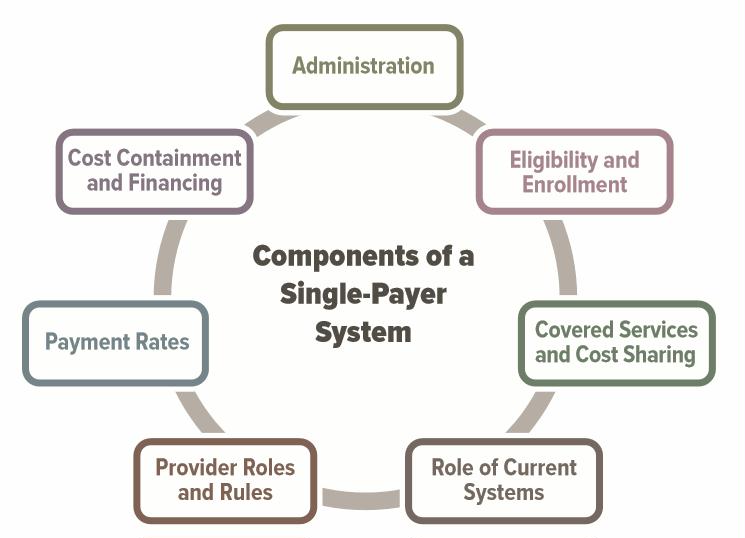
interested in establishing a single-payer system include the following:
How would the government administer a
single-payer health plan?
Who would be eligible for the plan, and what
benefits would it cover?
What cost sharing, if any, would the plan
require?
What role, if any, would private insurance and
other public programs have?
Which providers would be allowed to participate,
and who would own the hospitals and employ the providers?
How would the single-payer system set provider
payment rates and purchase prescription drugs?
How would the single-payer system contain health
care costs?
How would the system be financed?
Establishing a single-payer system would be a major
undertaking that would involve substantial changes in the sources and extent of
coverage, provider payment rates, and financing methods of health care in the
United States.
Although a single-payer system could substantially reduce
the number of people who lack insurance, the change in the number of people who
are uninsured would depend on the system’s design. For example, some people
(such as noncitizens who are not lawfully present in the United States) might
not be eligible for coverage under a single-payer system and thus might be
uninsured.
Single-Payer Health Care Systems
Although single-payer systems can have a variety of
different features and have been defined in many ways, health care systems are
typically considered single-payer systems if they have these four key features:
The government entity (or government-contracted
entity) operating the public health plan is responsible for most operational
functions of the plan, such as defining the eligible population, specifying the
covered services, collecting the resources needed for the plan, and paying providers
for covered services
The eligible population is required to contribute
toward financing the system
The receipts and expenditures associated with
the plan appear in the government’s budget
Private insurance, if allowed, generally plays a
relatively small role and supplements the coverage provided under the public
plan.
In the United States, the traditional Medicare program is
considered an example of an existing single-payer system for elderly and
disabled people, but analysts disagree
about whether the entire Medicare program is a single-payer system because
private insurers play a significant role in delivering Medicare benefits
outside the traditional Medicare program.
Questions and
complexities
Could people opt out?
Which services would the system cover, and would
it cover long-term services and supports?
How would the system address new treatments and
technologies?
What cost sharing, if any, would the plan
require?
How would the system purchase and determine the
prices of prescription drugs?
Would the government finance the system through
premiums, cost sharing, taxes, or borrowing?
How would the system pay providers and set
provider payment rates?
What role would private health insurance have?
Who would own the hospitals and employ the
providers?
Differences Between Single-Payer Health Care Systems and
the Current U.S. System
Establishing a single-payer system in the United States
would involve significant changes for all participants— individuals, providers,
insurers, employers, and manufacturers of drugs and medical devices—because a
single-payer system would differ from the current system in many ways,
including sources and extent of coverage, provider payment rates, and methods
of financing. Because health care spending in the United States currently
accounts for about one-sixth of the nation’s gross domestic product, those
changes could significantly affect the overall U.S. economy.
Although policymakers could design a single-payer system
with an intended objective in mind, the way the system was implemented could
cause substantial uncertainty for all participants. That uncertainty could
arise from political and budgetary processes, for example, or from the
responses of other participants in the system.
The transition toward a single-payer system could be
complicated, challenging, and potentially disruptive. To smooth that
transition, features of the single-payer system that would cause the largest
changes from the current system could be phased in gradually to minimize their
impact. Policymakers would need to consider how quickly people with private
insurance would switch their coverage to the new public plan, what would happen
to workers in the health insurance industry if private insurance was banned
entirely or its role was limited, and how quickly provider payment rates under
the single-payer system would be phased in from current levels.
Coverage. In a single-payer system that achieved
universal coverage, everyone eligible would receive health insurance coverage
with a specified set of benefits regardless of their health status. Under the
current system, CBO estimates, an average of 29 million people per
month—11% of U.S. residents under age 65—were uninsured in 2018.5 Most (or
perhaps all) of those people would be covered by the public plan under a
single-payer system, depending on who was eligible.
A key design choice is whether noncitizens who are not
lawfully present would be eligible. An average of 11 million people per
month fell into that category in 2018, and they might not have health insurance
under a single-payer system if they were not eligible for the public plan. About
half of those 11 million people had health insurance in 2018.
In 2018, a monthly average of about 243 million
people under age 65 had health insurance. About two-thirds of them, or an
estimated 160 million people, had health insurance through an employer.
Roughly another quarter of that population, or about 69 million people,
are estimated to have been enrolled in Medicaid or the Children’s Health
Insurance Program (CHIP).
Currently, national health care spending—which totaled
$3.5 trillion in 2017—is financed through a mix of public and private
sources, with private sources such as businesses and households contributing
just under half that amount and public sources contributing the rest (in direct
spending as well as through forgone revenues from tax subsidies). Shifting such
a large amount of expenditures from private to public sources would
significantly increase government spending and require substantial additional
government resources. The amount of those additional resources would depend on
the system’s design and on the choice of whether or not to increase budget
deficits. Total national health care spending under a single-payer system might
be higher or lower than under the current system depending on the key features
of the new system, such as the services covered, the provider payment rates,
and patient cost-sharing requirements.
It would probably have lower administrative costs than
the current system—following the example of Medicare and of single-payer
systems in other countries—because it would consolidate administrative tasks
and eliminate insurers’ profits. Moreover, unlike private insurers, which can
experience substantial enrollee turnover over time, a single-payer system
without that turnover would have a greater incentive to invest in measures to
improve people’s health and in preventive measures that have been shown to
reduce costs. Whether the single-payer plan would act on that incentive is
unknown.
An expansion of
insurance coverage under a single-payer system would increase the demand for
care and put pressure on the available supply of care.
A single-payer system would affect other sectors of the
economy that are beyond the scope of this report. For example, labor supply and
employees’ compensation could change because health insurance is an important
part of employees’ compensation under the current system.
Preface. Oh how I love cheddar. When I hear that someone is a vegan I stare in disbelief. A life without cheese is a life not worth living, especially a life without cheddar. As a perpetually hungry child, if Mom was in the front room, I’d dash to the back of the house and get cheddar out of the refrigerator and slice off a small piece of cheese. If there is a substitute for oil, oh please let it be cheese!
Paraskova, T. 2019. Cheddar To The Rescue? UK Company Uses Cheese To Power 4,000 Homes. oilprice.com
A UK dairy in Yorkshire has signed an agreement
with a local biogas plant to supply it with a by-product of
cheese-making that would be turned into thermal power to heat homes in
the area.
The Wensleydale Creamery, which produces the Yorkshire
Wensleydale cheese, makes 4,000 tons of cheese every year at its dairy
in Hawes in the heart of the Yorkshire Dales.
The company has struck a deal with specialist environment
fund manager Iona Capital, under which an Iona biogas plant will produce
more than 10,000 MWh of energy per year from whey—a by-product of
cheese making, Wensleydale Creamery said on Monday.
Under the deal, Wensleydale Creamery will provide Iona Capital’s Leeming Biogas plant in North Yorkshire with leftover whey from the process of cheese making. The plant will process and turn the whey into “green gas” via anaerobic digestion that will produce thermal power sufficient to heat 800 homes a year.
Iona Capital already has nine such renewable energy plants in Yorkshire, which save the equivalent of 37,300 tons of carbon dioxide (CO2) each year.
“Once we have converted the cheese by-product supplied by Wensleydale into sustainable green gas,
we can feed what’s left at the end of the process onto neighbouring
farmland to improve local topsoil quality. This shows the real impact of
the circular economy and the part intelligent investment can play in
reducing our CO2 emissions,” Mike Dunn, co-founder of Iona, said in a
statement.
“The whole process of converting local milk to premium
cheese and then deriving environmental and economic benefit from the
natural by-products is an essential part of our business plan as a proud
rural business. It is only possible as a result of significant and
continued investments in our Wensleydale Creamery at Hawes and to sign
this agreement and have the opportunity to convert a valuable by-product
of cheese making into energy that will power hundreds of homes across
the region will be fantastic for everyone involved,” Wensleydale
Creamery’s managing director, David Hartley, said.
Preface. This is the only commercial way to store energy now (CAES hardly counts with just one plant and salt domes to put more in existing in only 5 states). Though of course hydropower is only in a few states as well, 10 states have 80% of hydropower, and PHS needs to go far above existing reservoirs. There are very few places this could be done.
And the few places that exist are getting huge NIMBY opposition.
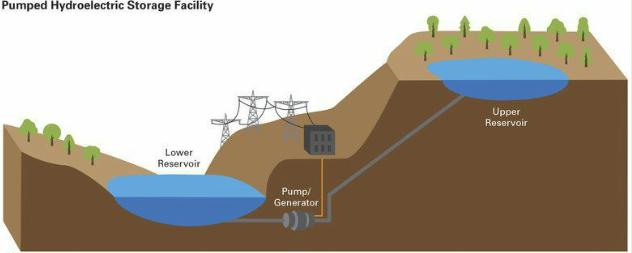
Pumped hydro storage generates power by using electrically powered turbines to move water from a lower level at night uphill to a reservoir above.
During daylight hours when electricity demand is higher, the water is released to flow back downhill to spin electrical turbines. Locations must have both high elevation and space for a reservoir above an existing body of water.
Pumped hydro uses roughly 20–30 % more energy than it produces, with more electricity required to pump the water uphill than is generated when it goes downhill. Nonetheless, pumped hydro enables load shifting, and is important to balance wind and solar power.
Appearances can be deceiving: Pumped hydro is not a Rube Goldberg scheme. Many of you have used a kilowatt or two of pumped hydro yourself. PHS accounts for over 98 % of what little current energy storage exists in the United States, and is the only kind of commercial storage that can provide sustained power over 12 hours (typically, the other 12 hours are spent pumping the water up).
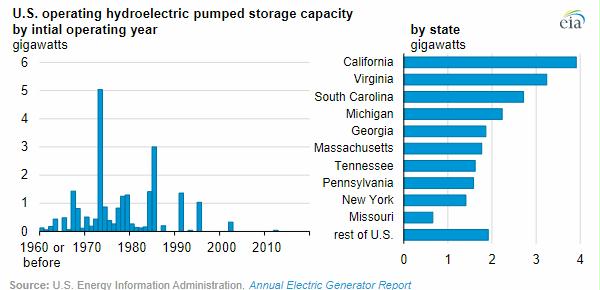
Existing PHS facilities store terawatts of power annually, but account for less than 2 % of annual U.S. power generation. In 2018, the United States had 22.9 gigawatts (GW) of pumped storage hydroelectric generating capacity, compared with 79.9 GW of conventional hydroelectric capacity. This isn’t likely to increase much, since like hydroelectric dams, there are few places to put PHS. Only two have been built since 1995, for a grand total of 43 in the U.S., with most of the technically attractive sites already used (Hassenzahl 1981).
Most were built between 1960 and 1990; nearly half of the pumped storage capacity still in operation was built in the 1970s (EIA 2019).
Existing PHS in the U.S. can store 22 GW, with the potential for another 34 GW more across 22 states, though high cost and environmental issues will prevent many from being built. Additionally, saltwater PHS could be built above the ocean along the West coast, but so far the high cost of doing so, shorter lifespan due to saltwater corrosion, distance from the grid, and concerns of salt seepage into the soil have prevented their development. Underground caverns and floating sea walls are other possibilities, but also aren’t commercial yet.
PHS has a very low energy density. To store the energy contained in just one gallon of gasoline requires over 55,000 gallons to be pumped up the height of Hoover Dam, which is 726 feet high (CCST 2012).
In 2011, pumped hydro storage produced 23 TWh of electricity across the U.S. However, those plants consumed 29 TWh moving water uphill, a net loss of 6 TWh.
So, how many PHS units would it take to give the U.S. that one day of electricity storage, 11.12 TWh? Over 365 days, our 43 existing pumped hydro plants produced two days of energy storage (23 TWh). Thus, the U.S. would need more than 7800 additional plants (365/2 * 43). Rube Goldberg, I can imagine what you would make of this.
FEW PLACES TO PUT MORE
Roger Andrews looked at where PHS seawater reservoirs could be put all over the world and found only three where a combination of favorable shoreline topography and minimal impacts would allow any significant amount of SWPH to be developed – Chile (discussed here), California (discussed here) and, of all places, Croatia (Andrews 2018).
Andrews R (2018) The seawater pumped hydro potential of the world. Energy Matters. http://euanmearns.com/the-seawater-pumped-hydro-potential-of-the-world/
NIMBY
The Navajo are objecting to three PHS in the Black Mesa. They cite the projects’ potential harm to water resources, traditional land uses and wildlife, and the developer’s failure to obtain consent from local communities before seeking federal approval. The projects propose eight new reservoirs across 38,000 acres. Filling them would require 450,000 acre-feet of water, an enormous share of the remaining Colorado River flows. Even under the best-case scenario, up to 8,000 acre-feet would be lost to evaporation each year, which is nearly double the rate of aquifer depletion from historical coal extraction. The applications list the aquifers beneath Black Mesa and the Colorado and San Juan rivers as potential water sources but provide no evidence of availability or legal rights to those sources (CBS 2023).
References
CBS (2023) 18 Navajo Chapters Oppose Huge Pumped Storage Projects Threatening Arizona’s Black Mesa. Center for Biological diversity. https://biologicaldiversity.org/w/news/press-releases/18-navajo-chapters-oppose-huge-pumped-storage-projects-threatening-arizonas-black-mesa-2023-07-14/
CCST. 2012. California’s energy future: electricity from renewable energy and fossil fuels with carbon capture and sequestration. California: California Council on Science and Technology.
Hassenzahl, W.V. ed. 1981. Mechanical, thermal, and chemical storage of energy. London: Hutchinson Ross.
I don’t know whether to go to these countries to see
these beautiful creatures before they’re extinct, or to spend my money on
countries like Costa Rica and Tanzania that have set aside a quarter or more of
their land to preserve biodiversity.
An excessive number of people using half the land and what it produces on the planet is what’s driving exitinction. Interesting how many of these nations where species are going to be permanently extinct don’t allow abortions and getting birth control can be difficult. So I’ve added whether a nation allows abortion and has birth control to the statistics.
One of the first acts of the Trump administration in January 2017 was to cut the funding for abortions and contraception, which has made it hard for hundreds of thousands of women to get birth control
Industry, pollution, agriculture,
deforestation, air travel and decreasing habitats are conspiring to make it
very hard for thousands of species to survive, let alone flourish. And that
truth stretches to every corner of the world, be it forest, mountain, reef,
ocean, city or savannah.
The International Union for Conservation of
Nature (IUCN) Red List has been the world’s foremost information source on the
global conservation status of animal, fungi and plant species since 1964. It
currently lists an astounding 27,000 species as at risk of extinction, which is
an even more astounding 27% of all species we currently know about.
Why? Mexico has one of the highest
deforestation rates in the world to make more farmland available to feed an
ever growing population, which may double by 2050. This is because of restrictions on abortions
in most states, and abortion not being decriminalized until 2007 and
contraceptives prohibited until the late 1960s (Wiki 2019)
#2 Indonesia: 583 191 mammals,
160 birds
Contraception is only available on the black
market and abortion in back alley clinics for many women. A legal abortion is
hard to obtain (GI 2008)
#3 Madagascar: 553
Abortion is illegal.
#4 India: 542
Despite six decades of family planning promotion, contraceptive prevalence rate in India remains poor, particularly in the three North Indian states where 18 percent of the population lives
#5 Columbia: 540
Only allows abortion for rape, incest, or the
mother is at risk, and hard to get. But birth control is available.
#6 USA 475
#7 Ecuador: 436
Only allows abortion if the mother is at
risk, illegal even in cases of rape, incest, and severe fetal impairment. But
birth control is available.
#8 China: 435
#9 Brazil: 414
Abortion is prohibited in all circumstances,
though a woman who was raped or whose life is in danger won’t go to jail. Birth control is legal.
#10 Peru: 385
Only allows abortion if the mother is at risk.
If a woman has an illegal abortion she may spend up to 2 years in prison, and
the person who performed the abortion from 1 to 6 years. Birth control is available. It’s hard to get
the morning after pill, and it was discovered that 25% of them are fake.
References
GI. 2008. Abortion in Indonesia. Guttmacher
Institute.
Wiki. 2019. Abortion in Mexico and Women in
Mexico.
Preface. We are caught in the carbon trap — we utterly depend on fossils that don’t have an electric replacement. Someday people will figure this out the hard way, but Chefurka compassionately points out that there is no one to blame for our situation, and it’s not something we can do anything about.
Here are just a few ways our lives depend on fossils:
Petroleum diesel powers the transportation that matters: heavy-duty trucks, rail, and ships
Manufacturing depends on process heat and steam generated by fossil fuels
Energy to keep the electric grid up around the clock
The majority of people alive today should thank natural-gas based fertilizers, and oil-based pesticides, herbicides, and insecticides
Half a million products are made out of fossil fuels and with energy from fossil fuels
The natural gas that heats homes and businesses. About 90% of homes and businesses depend on fossil fuels for heat, mainly natural gas (EIA 2018). Generating heat from electricity today is terrifically wasteful. Two-thirds of electricity is generated by burning natural gas and coal, and two-thirds of this coal and natural gas energy vanishes as heat, plus another 6-10% is lost on the wires, so only 24 to 28% arrives at homes and businesses. It’s far better to use fossils onsite to generate heat.
Whether we realize it or not, everyone living on planet Earth today is caught in what I have come to call the “carbon trap”. The nature of the trap is simple, and can be described in one sentence:
Our continued existence depends on the very thing that is killing us – the combustion of our planet’s ancient stocks of carbon.
This unfortunate situation was not intentional, and is no one’s fault.
The trap was constructed well outside of our conscious view or understanding.
Its design came from our evolved desires for status, material comfort and security.
We recognized its seductive promise long before we knew enough science to discover its hidden hook.
It was built with the best of intentions by well-meaning scientists and engineers, whose knowledge of the consequences was both incomplete and clouded by their own evolved desire for a better life.
Most of us, even those who are aware of our predicament, distract ourselves by creating and admiring elaborate and luxurious appointments for our carbon-clad prison.
Many who can see the bars spend their time dreaming of ways to slip through them into the world outside – a world of natural freedom that they can see but never reach.
Those who are fully aware of the trap also understand that we now need it to survive; that leaving it (if that were even possible) would be as fatal as staying inside. We are victims of what complex systems scientists call “path dependence” – where we came from and how we got here puts strict limits on what is now possible for us to do.
One of the things we can’t do is simply open the door and leave. Even the fact that our carbon-barred prison is now on fire can’t change the cold equations. We are condemned to wait here until the walls burn down, when a few soot-blackened survivors may stumble out into the blasted and barren landscape left behind by our self-absorbed construction project.
This is why I believe that the one quality most needed in the world today is compassion.