Rex Weyler on “what to do” about limits to growth, peak energy

Preface. Professor Nate Hagens is teaching a class at the University of Minnesota about the state of the world that may be expanded to all incoming freshmen.  Many despair when they learn about limits to growth and finite fossil fuels.  So Rex Weyler came up with a list of “what to do actions” they could take.  It’s one of the best lists I’ve seen.

Alice Friedemann   www.energyskeptic.com  author of “When Trucks Stop Running: Energy and the Future of Transportation”, 2015, Springer and “Crunch! Whole Grain Artisan Chips and Crackers”. Podcasts:  KunstlerCast 253, KunstlerCast278, Peak Prosperity]

***

   I. Linear vs. Complex: “What do I do?” generally seeks a linear answer to a complex living system polylemma. “What do I do?” wants a “solution” for a “problem.” This is linear, mechanistic, engineering thinking at its worst, the type of thinking that contributes to our challenge, but we’re stuck with it in popular culture, so yes, we need an answer. This first part of the answer (changing complex systems is NOT going to be a linear and mechanistic “solution”) is probably too confusing for most people, so could be skipped over. However, your students should be aware of this.

  II. There is lots to do, which your students should be taught.

  1. Find ways to help reduce human population

  • with women’s rights
  • start a campaign to achieve universally available contraception

  2. Find ways to help reduce consumption

  •       start a campaign to reduce frivolous travel, entertainment, fashions, etc. purchased by the rich
  •       do this with heavy tax incentives

  3. reduce meat consumption .. tax and popularization

  4. limit corporate power in politics

  5. publicly fund universities, all education, to limit corporate corruption of education

  6. localize food production, home gardens, community gardens

  7. popularize modest lifestyles in wealthy countries

  8. support and preserve modest lifestyles among indigenous and farmer communities

  9. Learn how complex living systems actually work

10. Spend as much time in wild nature as possible, pay attention, observe, take notes, think about it

11. Plant a garden and pay attention to what it takes to help useful, nutritious plants grow

12. Open a clinic and begin to research localized, small-scale health care

13. Educate yourself about wild nature, evolution, and complexity:

  • read Gregory Bateson, Howard Odum, Gail Tverberg ..
  • Read “The Collapse of Complex Societies by Joseph Tainter
  • Read Arne Naess, Chellis Glendinning, David Abram, and Paul Shepard
  • Read “Small Arcs of Larger Circles” by Nora Bateson

14. Think about what it means to stop looking for a Silver Bullet Tech “Solution” — linear, engineered, mechanistic, profitable, BAU, socially popular “solution”  — and start thinking about where and how change actually occurs in a complex living system.

15. Learn about the errors of modern, neo-liberal economics, and learn about other ways to approach economics. Read: N. Georgescu-Roegen, Frederick Soddy, Gail again, Herman Daly, Donella Meadows, Mark Anielski.

16. Start a Campaign to create and institute a new economic system in your community, your state, your county, your nation, your company, your family.

17. Find a spiritual practice that helps you calm down and see the world with more compassion and patience, and that helps you appreciate the more-than-human world.

18. Localize:

  • Start a company that uses local resources and local skills to create useful locally consumed tools
  • Start that local, community health clinic
  • Lobby your government to create community gardens
  • Study and create energy systems that can be built, operated, and maintained locally
  • Campaign to consume only locally produced products.

19. Start an economic De-Growth group, Décroissance

20. Start a school for the homeless and disenfranchised, and teach localized, useful skills, gardening.

21. Take in a homeless foster child; give them some love and security

22. Read Vaclav Smil, Bill Rees, and Charles Hall

24. Start a psychology practice and begin to learn and support community therapy; build community cohesion

25. Read Wendell Berry: “Solving for Pattern” and “Gift of Good Land.”

26. Start a campaign for all shoppers to reduce consumption, and leave ALL PACKAGING at the stores.

27. Start a free store in your community, help recycle, repair, and circulate everything

28. Are you a lawyer, or do you want to be? Start a practice to defend Ecology activists, and start class action lawsuits against corporations that pollute.

29. Read Rachel Carson, Basho, Li Po, William Blake, Mary Oliver, Denise Levertov, Gary Snyder, Susan Griffin, Nanao Sakaki, Diane di Prima, Walt Whitman. Go to art galleries. Contemplate the connection between creative artistic expression and change in a complex system.

30. See if you can fall in love with something that’s not human. See if you can fall in love with wild nature.

Several people participated in this discussion, a professor added “if they really want to move things along, they must become politically engaged at every level–ask the embarrassing questions at all-candidates meetings, write your representatives, push for policies that will make a difference and protest official idiocy wherever it occurs. And if this fails, civil disobedience will not be far behind.”

These are 30 things your students can DO!

Take your pick. They all count. Teach them. Discuss them. Add to the list. 

There is NO SILVER BULLET TECH SOLUTION that is going to allow us to continue living this endless growth, high consumption, expanding population, fossil-fueled, wasteful, arrogant, human-centered, presumptuous life .. so GET OVER IT. 

Don’t be bullied by the popular hope that there is a magic way to engineer ourselves out of overshoot.

Get creative.

Get local. 

Let go of “changing the world” with human cleverness 

Accept that “the world” is a complex living system, made from complex living subsystems out of your control. 

Find the light inside and share it with the world. 

Avoid whining “What should I do?” by staying active with activities that will matter in the long run.

Posted in What to do | Tagged , , | 8 Comments

Fresh water depletion, contamination, saltwater intrusion, & subsidence

Map of the U.S. showing cumulative groundwater depletion from 1900 through 2008 in 40 aquifers. Source: Groundwater Depletion in the United States (1900-2008), USGS Scientific Investigations Report 2013-5079.

Preface.  This isn’t mentioned in the subsidence paper below, but half of USA refineries are in the southeast, where the threat of subsidence is greatest, and since subsidence means more floods and storm surges, this may put them out of operation more often for longer periods of time.  Also affected will be electric power plants, hazardous waste sites, roads, bridges and other infrastructure as well, plus the potential for tens of thousands of acres of farmland eroded or ruined by saltwater from above or intrusion into aquifers below.

The second paper below discusses subsidence as well as the depletion of the aquifers in the United States that grow half of America’s crops.

Alice Friedemann  www.energyskeptic.com  Author of Life After Fossil Fuels: A Reality Check on Alternative Energy; When Trucks Stop Running: Energy and the Future of Transportation”, Barriers to Making Algal Biofuels, & “Crunch! Whole Grain Artisan Chips and Crackers”.  Women in ecology  Podcasts: WGBH, Jore, Planet: Critical, Crazy Town, Collapse Chronicles, Derrick Jensen, Practical Prepping, Kunstler 253 &278, Peak Prosperity,  Index of best energyskeptic posts

***

Herrera-Garcia G et al (2021) Mapping the global threat of land subsidence Nineteen percent of the global population may face a high probability of subsidence. Science 371: 34-36

During this century, climate change will cause serious impacts on the world’s water resources through sea-level rise, more frequent and severe floods and droughts, changes in the mean value and mode of precipitation (rain versus snow), and increased evapotranspiration. Prolonged droughts will decrease groundwater recharge and increase groundwater depletion, intensifying subsidence.

Subsidence permanently reduces aquifer-system storage capacity, causes earth fissures, damages buildings and civil infrastructure, and increases flood susceptibility and risk. During the next decades, global population and economic growth will continue to increase groundwater demand and accompanying groundwater depletion and, when exacerbated by droughts, will probably increase land subsidence occurrence and related damages or impacts.

Subsidence permanently reduces aquifer-system storage capacity, causes earth fissures, damages buildings and civil infrastructure, and increases flood susceptibility and risk.

Our results suggest that potential subsidence threatens 4.6 million square miles or 12 million km2 (8%) of the global land surface with a probability greater than 50%.

Our results identify 1596 major cities, or about 22% of the world’s 7343 major cities that are in potential subsidence areas, with 57% of these cities also located in flood-prone areas. Moreover, subsidence threatens 15 of the 20 major coastal cities ranked with the highest flood risk worldwide, where potential subsidence can help delimit areas in which flooding risk could be increased and mitigation measures are necessary.

Ayre, J. April 2018. Fossil Water Depletion, Groundwater Contamination, Saltwater Intrusion, & Permanent Subsidence — The Great Freshwater Depletion Event Now Underway. CleanTechnica.

Much of the modern world’s agricultural productivity, industrial activity, and high degree of urbanization is dependent upon the pumping and exploitation of limited freshwater resources. In some regions the water that is being relied upon is so-called fossil water — that is, water that was deposited many millennia ago and is mostly not being replenished for whatever reasons, such as lack of rainfall or impermeable geologic layers like heavy clay or calcrete laid on top.

As these fossil water reserves are depleted, there is often nothing to replace them (the one notable exception being the possibility of desalination in some regions), with the eventuality often being large populations, industrial infrastructure, and farmland that is untenable in the regions in question, to be followed by mass migrations out of such regions.

Particularly notable regions that are dependent upon fossil water are the American Great Plains (the Ogallala Aquifer), northeastern Africa (the Nubian Sandstone Aquifer System), and central-southern Africa (the Kalahari Desert fossil aquifers).

The situation as regards to fossil water depletion in some regions is compounded by extensive development (and paving over) of aquifer-recharge areas in regions where rainfall is otherwise sufficient to replenish aquifers, and further so simply by unsustainable usage rates which draw down reserves.

As groundwater in regions with the possibility of recharge is pumped at unsustainable rates, though, what generally also occurs is ground subsidence. In plain language, the ground sinks due to the lack of support previously provided by groundwater that is no longer there. Subsidence in this context is notable because it leaves the ground and aquifer in question far less capable of storing water, due to compaction. In other words, excess groundwater pumping permanently removes the ability of many aquifers to store water, leaving total aquifer capacity far lower than previously, and thus contributing to the drying out of the region in question.

Going back to the issue of over-paving watersheds that have been developed, another issue that follows from this is the eventuality of large flood events (due to the lack of open ground-space to run down into), and thus further soil erosion which itself leaves the land in question less capable of holding and retaining water/moisture.

All of these above issues are themselves further compounded by saltwater intrusion in coastal regions due to the pumping of groundwater creating a vacuum-effect that draws nearby saltwater into the aquifers, and also due to ground subsidence, general sea level rise, and groundwater contamination in many regions, which is often the direct result of the industrial and agricultural activities that are themselves drawing the most water.

So what we have in the modern world, when we take a step back, is the convergence of growing problems of: fossil water depletion; the destruction of the ability of many aquifers to retain water due to over-pumping as the result of ground subsidence; saltwater intrusion of aquifers caused by over-pumping and sea level rise; widespread groundwater contamination due to industrial and agricultural activities; and ever growing population numbers and food/agricultural needs.

With that in mind, the following is a basic overview of where things stand on different issues.

First, here are a couple of basic facts:

  • More than 4 billion people around the world already experience extreme water scarcity at least 1 month every year.
  • More than 500 million people around the world already experience extreme water scarcity essentially year-round. This number is expected to increase significantly over the coming decades.
  • Well over half of the largest cities around the world now experience water scarcity occasionally.
  • Fresh-water demand is estimated to exceed demand by at least ~40% by 2030.
  • Deforestation and accompanying aridification and/or desertification are primary drivers of water scarcity in some regions due to decreasing atmospheric moisture and thus rainfall levels. This is largely driven by consumer demand for cheap meat and livestock-feed on the one hand, and by demand for timber products on the other. Other water-intensive crops play a part as well though, like cotton and various types of oil/tree-nut/fruit crops for instance.
  • With “higher” standards of living, water use increases exponentially as people switch from a low-resource lifestyle to one of profligate use and waste. People in the wealthier countries of the world are known to use 10-50 times more fresh-water on an annual basis than those in the poorest.
  • Over just the last century, more than half of the world’s wetlands and watersheds have been destroyed and no longer exist in any capacity. Unsurprisingly, this has resulted in the loss of a very large amount of biodiversity, and also of numerous fisheries. In the US and Europe the loss of historic wetlands over the last century is in the 80-95% range.
  • A large majority of the groundwater now being pumped up from aquifers is being used by agriculture and industry.
  • Many of the largest rivers of Asia could effectively be gone by as soon as the end of the century due to the current rapid melting of associated glaciers.

Overpumping, Ground Subsidence, & Saltwater Intrusion

The overpumping of freshwater from aquifers, as noted previously, is a direct cause of ground subsidence and saltwater intrusion in coastal areas. What wasn’t stated previously is that as aquifer levels are drawn down, the quality of the water being pumped is generally being lowered, with rising levels of salinity (via ground salts), and also rising levels of grit and contaminants also being observed.

Something else to note on that count is that as aquifers are diminished, the natural outflows of the region — springs, etc. — experience much reduced outflows, or simply cease to exist.

In relation to this, the aforementioned experience of ground subsidence results in sinking land, which increases the danger of flood events in addition to reducing the capacity of the aquifer in question to hold water. It’s notable, for instance, that in some of the land surrounding Houston, Texas, ground levels have dropped by as much as 9 feet in recent decades due to extensive groundwater pumping.

Despite all of this, resistance to a reduction in pumping rates is often high, with those involved in agriculture in particular often fighting hard to stop the imposition of such an approach.

Accompanying ground subsidence in coastal regions is often saltwater intrusion into the aquifers being pumped — thereby diminishing the quality of the water, and often demanding costly treatment processes to allow continued potability.

Generally speaking, freshwater pumping in coastal regions allows saltwater to flow further inland than is otherwise the case, as do agricultural drainage systems. Sea level rise itself does as well, of course, as do the storm surges that accompanying powerful storms. This is all especially true in coastal regions where the aquifers are highly porous — in parts of New Jersey and Florida, for instance.

Groundwater Contamination & Pollution

In addition to problems of sheer freshwater unavailability are the fast increasing problems of freshwater contamination. Groundwater contamination has become an increasingly common problem in recent decades as industrial and agricultural productivity levels have been brought to unsustainable levels.

While contamination that ultimately is the result of industrial and agricultural activities is the most common type, increasing urbanization is another, as population-dense regions are often unable to deal effectively with the waste products that result without expensive systems (which some regions can’t afford). Ineffective wastewater treatment facilities, landfills, and fueling stations, for instance, are often sources of groundwater contamination in urban regions. Some regions, it should be noted, feature groundwater with high levels of arsenic or fluoride regardless of human activity, and aquifer reliance in those regions is thus dangerous.

An example of a dangerous but common type of groundwater contaminant deriving from human activities is nitrates, which is generally the result of agricultural activities. Other, more dangerous, compounds are also common groundwater pollutants, including various types of solvents, PAHs, heavy metals, hydrocarbons, pesticides, herbicides, other artificial fertilizers, radioactive compounds, pharmaceuticals and their metabolites, and various types of persistent chemical pollution.

Before closing this section, I suppose that hydraulic fracturing (fracking) as a means of extracting fossil oil and gas reserves deserves a mention. While the practice itself does not inherently need to be a cause of groundwater contamination, in practice it often is due to the reality that it is often pursued carelessly and that e companies involved have a tendency to dissolve when problems arise (with those involved simply starting a new firm afterwords).

Groundwater salinization

Lower groundwater levels can prevent drainage of water and salts from a basin and increase aquifer salinity that eventually renders the groundwater unsuitable for use as drinking water or irrigation without expensive desalination. This is happening in many places. Pauloo (2021) focused on California’s Tulare Lake Basin (TLB), where evaporation is concentrating salts further. The TLB irrigates 4600 square miles (12,000 square kilometers) of crops bringing in $23 billion dollars. The only solution is to add more water than is taken out, not likely now that California is in the worst drought in 1200 years.

Loss Of Glaciers, Climate Change, Rising Temperatures, & Increasing Atmospheric Moisture

Accompanying the depletion and contamination of groundwater freshwater resources, the world’s above-ground freshwater resources — largely glaciers, winter snowpack, and high-altitude lakes — are rapidly disappearing as well in many parts of the world.

While the rapid melting of many glaciers in recent years has led to an increase in water availability in some regions — in particular in the parts of the world that ultimately source their freshwater from glaciers in South and Central Asia (via rivers originating there) — all that this means is that long-term supply is being compromised even faster than would otherwise be the case. As these glaciers disappear, there will be increased water scarcity affecting literally hundreds of millions to billions more people than is currently the case.

Also worth noting here, is that rising temperatures are themselves affecting freshwater supplies by increasing the rate of evaporation in many regions and thereby limiting the amount of surface water and the ability of aquifers to recharge. Accompanying this is the reality that as atmospheric moisture levels rise as a result, temperatures will continue rising even faster due to the reality that water vapor is itself a potent greenhouse gas.

References

Pauloo RA (2021) Anthropogenic basin closure and groundwater salinization (ABCSAL). Journal of Hydrology 593

Posted in Groundwater, Peak Water, Water Infrastructure, Water Pollution | Tagged , , , , , , , | Comments Off on Fresh water depletion, contamination, saltwater intrusion, & subsidence

Why tar sands, a toxic ecosystem-destroying asphalt, can’t fill in for declining conventional oil

This is a book review of Tar Sands: Dirty Oil and the Future of a Continent by Andrew Nikiforuk.

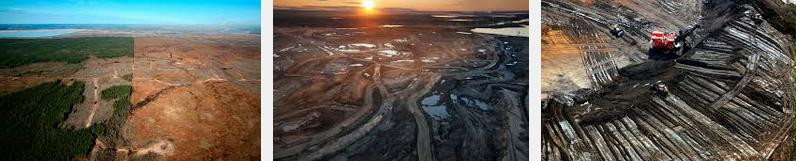
tar-sands-aerial-views tar-sands-aerial-views-2tar-sands-plantsMany “energy experts” have said that a Manhattan tar sands project could prevent oil decline in the future.   But that’s not likely. Here are a few reasons why:

  1. Reaching 5 Mb/d will get increasingly (energy) expensive, because there’s only enough natural gas to mine 29% of tar sands (and limited water as well). Using the energy of the tar sand bitumen itself would greatly reduce the amount that could be produced and dramatically increase the cost and energy to mine it
  2. Since there isn’t enough natural gas, many hope that nuclear reactors will replace natural gas. That would take a lot of time. Kjell Aleklett estimates it would take at least 7 years before a candu nuclear reactor could be built, and the Canadian Parliament estimates it would take 20 nuclear reactors to replace natural gas as a fuel source.
  3. Mined oil sands have been estimated to have an energy returned on invested of EROI of 5.5–6 for mined tar sands (perhaps 10% of the 170 billion barrels), with in situ processing much lower at 3.5–4 (Brandt 2013).  Right now, 90% of the reserves being developed are via higher-EROI mining, yet 80% of remaining oil sands reserves are in situ, so the remaining reserves will be much less profitable
  4. Counting on tar sands to replace declining conventional oil, with an EROI as high as 30 will be hard to accomplish, especially if it turns out to be the case that an EROI of 7 to 14  is required to maintain civilization as we know it (Lambert et al. 2014; Murphy 2011; Mearns 2008; Weissbach et al. 2013)

In a crash program to ramp up production as quickly as possible, production would likely peak in 2040 at 5–5.8 million barrels a day (Mb/d)  (NEB 2013; Soderbergh et al. 2007). Kjell Aleklett estimated that at best a megaproject could get 3.6 Mb/d by 2018.  Even that goal would require Canada to choose between exporting natural gas to the United States or burning most of its reserves in the tar sands to melt bitumen.

So far, Canadian oil sands have contributed to the 5.4 % increase in oil production since 2005, increasing from 0.974 to 2.1 Mb/d in 2014 (2.7 % of world oil production). There are about 170 billion barrels thought to be recoverable, equal to 6 years of world oil consumption.

Already, oil sand production forecasts for 2030 have declined 24 % over the past 3 years, from 5.2 Mb/d in 2013, to 4.8 Mb/d in 2014, to 3.95 Mb/d in June 2015 (CAPP 2015).

At least half the book describes the damage being done that is too long to write about in a book review, and one of the most horrifying accounts of wilderness destruction I’ve ever heard.  But because it’s not a major tourist destination in an area few live in, the expected out-cry of environmentalists is muted and almost non-existent.

If it’s true that future generations are likely to move north as climate change renders vast areas uninhabitable, what a shame that an area the size of New York is well on the way to being such a toxic cesspool of polluted water, land, and radioactive uranium tailings that it may be uninhabitable for centuries if not millennia.   As author Nikiforuk puts it “Reclamation in the tar sands now amounts to little more than putting lipstick on a corpse.”

Much of this book covers the horrifying, sickening destruction of the ecology of a vast region.  You may think you will not be affected, but very close to major rivers, flimsy dams holding back large lakes of toxic sludge are bound to fail at some point and eventually spill out into the arcti. That would damage  the fragile arctic system and the fish you buy in the grocery store potentially unsafe to eat.

I have rearranged and paraphrased some of what follows, as well as quoted the original text.

Alice Friedemann  www.energyskeptic.com  Author of Life After Fossil Fuels: A Reality Check on Alternative Energy; When Trucks Stop Running: Energy and the Future of Transportation”, Barriers to Making Algal Biofuels, & “Crunch! Whole Grain Artisan Chips and Crackers”.  Women in ecology  Podcasts: WGBH, Planet: Critical, Crazy Town, Collapse Chronicles, Derrick Jensen, Practical Prepping, Kunstler 253 &278, Peak Prosperity,  Index of best energyskeptic posts

***

What is arguably the world’s last great oil rush is taking place today.  Alberta has approved nearly 100 mining and in situ projects. That makes the tar sands the largest energy project in the world, bar none.

The size of the resource being exploited has grown exponentially. The 54,000 square mile bitumen-producing zone contains nearly 175 billion barrels in proven reserves, which makes it the single-largest pile of hydrocarbons outside of Saudi Arabia.

But although it’s large, only ten percent is actually recoverable via strip mining, the least energy intensive method. And it’s an energy intensive messy operation – in a load of tar sands, only 10% is bitumen, so the other 90% has to be separated out.  This is done by dumping the sands into a large hot-water “washing machines” where they’re spun around and the bitumen siphoned off.  For every barrel of synthetic crude eventually produced, 4500 pounds of tar sands were dug up, separated, and disposed of. To get the other 90% deep underground takes twice as much energy as the strip-mined tar sands using in-situ steam injected underground, so much that for every three barrels of in-situ oil produced, the energy in one of them was used to get it, though not really, in that natural gas is used currently, 2 billion cubic feet a day, enough to heat all the homes in Canada (Kolbert 2007).

Bitumen is what a desperate civilization mines after it’s depleted its cheap oil. It’s a bottom-of-the-barrel resource, a signal that business as usual in the oil patch has ended. To use a drug analogy, bitumen is the equivalent of scoring heroin cut with sugar, starch, powdered milk, quinine, and strychnine. Calling the world’s dirtiest hydrocarbon “oil” grossly diminishes the resource’s huge environmental footprint. It also distracts North Americans from two stark realities: we are running out of cheap oil, and seventeen million North Americans run their cars on an upgraded version of the smelly adhesive used by Babylonians to cement the Tower of Babel. That ancient megaproject did not end well. Without a disciplined plan for them, the tar sands won’t either.

David Hughes points out that in 1850, 90% of the world traveled by horse and heated with biomass. Now nearly 90% of the world depends on hydrocarbons and consumes 43 times as much energy with 7 times as many people as in 1850.  He questions whether that is really sustainable.  He’s pretty sure people will be upset in the future about squandering so much oil so quickly, since just one barrel of oil equals 8 years of human labor.

Walter Youngquist, author of one of the best books about the history of energy and natural resource use, “Geodestinies”, points out that the tar sands are a valuable long-term resource for Canada which should stretch out their production for as long as possible, as efficiently and sparingly as possible.

Tar sands are limited by natural gas

In 2006, the Oil & Gas Journal noted sadly that Canada had only enough remaining natural gas to recover 29% of the bitumen in the tar sands.

The North American Energy Working Group (NAEWG) reported similar findings that year at a meeting in Houston, Texas. If the tar sands produced five million barrels a day, the group said, oil companies would consume 60 per cent of the natural gas available in Western Canada by 2030. Even the NAEWG found that level of consumption “unsustainable and uneconomical.” As one Albertan recently observed: “Using natural gas to develop oil sands is like using caviar as fertilizer to grow turnips.

Cambridge Energy Research Associates, a highly conservative private energy consultancy, confirmed the cannibalistic character of natural gas consumption in its 2009 report on the tar sands. Incredibly, industrial development in the tar sands region now consumes 20% of Canadian demand. By 2035, the project could burn up between 25 and 40% of the total national demand, or 6.5 billion cubic feet a day. Such a scenario would drain most of the natural gas contained in the Arctic and Canada’s Mackenzie Delta, as well as Alaska’s North Slope. Armand Laferrère, the president and CEO of Avera Canada, estimates that the tar sands industry could commandeer the majority of Canada’s natural gas supply by 2030.

What are tar sands?

 Tar sands are a half-baked substance, a finite product of up to 300-million-year-old sun-baked algae, plankton, and other marine life, compressed, cooked, and degraded by bacteria.  Good cooking results in light oil. Bad cooking makes bitumen, which is so hydrogen poor that it takes energy-intensive upgrading to make marketable. Fifty per cent of Canada now depends on a half-baked fuel.

It’s a very dirty fuel.  Bitumen is 5% sulfur (about 8 times more than high-quality Texas oil), 0.5% nitrogen, 1,000 parts per million heavy metals such as nickel and vanadium, and also has salts, clays, and  resins.  This can sometimes lead to fouling and corrosion of equipment, causing energy inefficiencies and refinery shutdowns. Between 2003 and 2007, processing lower-quality oil from the tar sands increased energy consumption at U.S. refineries by 47%.

Miners and engineers generally don’t canoe on or fish in the ponds because of two really nasty pollutants: polycyclic aromatic hydrocarbons (PAH) and naphthenic acids. Of 25 PAH s studied by the U.S. Environmental Protection Agency (and there are hundreds), 14 are proven human carcinogens. The EPA found that many PAH s produce skin cancers in “practically all animal species tested.” Fish exposed to PAH s typically show “fin erosion, liver abnormalities, cataracts, and immune system impairments leading to increased susceptibility to disease.” Even the Canadian Association of Petroleum Producers recognizes that a “significant increase in processing of heavy oil and tar sands in Western Canada in recent years has led to the rising concerns on worker exposure to polycyclic aromatic hydrocarbons.” In 2003, the ubiquitous presence of PAH s in the tar ponds prompted entomologist Dr. Jan Ciborowski to make another one of those unbelievable tar sands calculations: he estimated that it would take 7 million years for the local midge and black fly populations to metabolize all of the industry’s cancer makers.

Naphthenic acids, which by weight compose 2% of bitumen deposits in the Athabasca region, are not much friendlier than pahs. Industry typically recovers these acids from oil to make wood preservatives or fungicides and flame retardants for textiles. The acids are also one of the key ingredients used in napalm bombs. Naphthenic acids kill fish and most aquatic life.

Upgrading requires so much fuel that this step adds 100 to 200 pounds of CO2 per barrel. This toxic, polluting, ultra-heavy hydrocarbon is a damned expensive substitute for light oil. The Canadian Industrial End-Use Energy Data and Analysis Centre concluded in 2008 that synthetic crude oil made from bitumen had “the highest combustion emission intensity” of five domestic petroleum products and was “the most energy intensive one to process” in Canada.

Bitumen looks like molasses and smells like asphalt, sticky as tar on a cold day. In fact, Canada’s National Centre for Upgrading Technology says that “raw bitumen contains over 50 per cent pitch” and can be used to cover roads.   Because of its stickiness, bitumen cannot move through a pipeline without being diluted by natural gas condensate or light oil.

Why Canadian bitumen should be called tar sands, not oil sands

tar-sand-bitumenIndustry executives  and many politicians hate the word tar sands.  Oil sands sounds much better, implying abundance, easy access, and much cleaner.  The world oil raises investment cash better than the word tar.  It’s more likely to make investors forget that extraction requires a huge amount of energy to mine and upgrade than oil drilling. The Alberta government says it’s okay to describe the resource as oil sands “because oil is what is finally derived from bitumen.” If that lazy reasoning made any sense, tomatoes would be called ketchup and trees called lumber.

Rick George, president and CEO of Suncor, unwittingly made a good argument for calling the stuff tar. Bitumen may contain a hydrocarbon, he said, but you can’t use it as a lubricant because “it contains minerals nearly as abrasive as diamonds.” You can’t pump it, because “it’s as hard as a hockey puck in its natural state.” It doesn’t burn all that well, either; “countless forest fires over the millennia have failed to ignite it.

In 1983, engineer Donald Towson made a good case for calling the resource tar, not oil, in the Encyclopedia of Chemical Technology. He argued that the word accurately captures the resource’s unorthodox makeup, which means it is “not recoverable in its natural state through a well by ordinary production methods.” Towson noted that bitumen not only has to be diluted with light oil to be pumped through a pipeline but requires a lot more processing than normal oil. (Light oil shortages are so chronic that industry imported 50,000 barrels by rail last year to the tar sands.) Even after being upgraded into “synthetic crude,” the product requires more pollution-rich refining before it can become jet fuel or gasoline.

Brute force extraction

Bitumen can’t be sucked out of the ground like Saudi Arabia’s black gold. It took an oddball combination of federal and provincial scientists and American entrepreneurs nearly seventy years from the time of Mair’s visit to the tar sands (and billions of Canadian tax dollars) to figure out how to separate bitumen from sand. They finally arrived at a novel solution: brute force.

Extracting bitumen from the forest floor is done in two earth-destroying ways. About 20% of the tar sands are shallow enough to be mined by 3-story-high, 400-ton Caterpillar trucks and $15-million Bucyrus electric shovels.

The open-pit mining operations look more hellish than an Appalachian coal field. To get just ONE barrel of bitumen:

  1. hundreds of trees must be cut
  2. acres of soil removed
  3. wetlands drained
  4. 4 tons of earth dug up to get 2 tons of bituminous sand
  5. boiling water poured over the sand to extract the oil

This costs about $100,000 per flowing barrel, making bitumen one of the planet’s most expensive fossil fuels.

Scale:

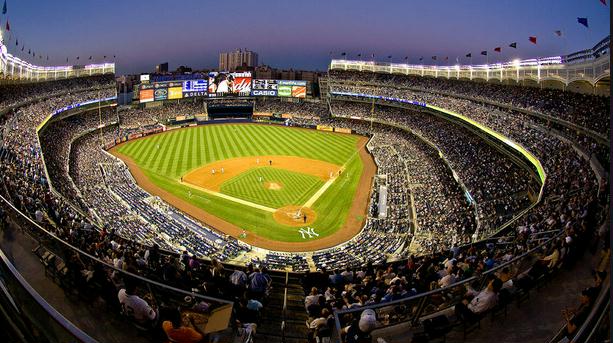
  • Every other day, the open-pit mines move enough dirt and sand to fill Yankee Stadium  yankee-stadium-tar-sands-per-day-volume
  • Since 1967, one major mining company has moved enough earth (2 billion tons) to build seven Panama canals.

In-situ process

Most of the tar sands are so deep that the bitumen must be steamed or melted out of the ground, with the help of a bewildering array of pumps, pipes, and horizontal wells. Engineers call the process in situ (in place). The most popular in situ technology is Steam-Assisted gravity Drainage (SAGD). “Think of a big block of wax the size of a building, SAGD expert Neil Edmunds explains. “Then take a steam hose and tunnel your way in and melt all the wax above. It will drain to the bottom where it can be collected.

SAGD technology burns enough natural gas, for boiling water into steam, to heat six million North American homes every day. In fact, natural gas now accounts for more than 60% of the operating costs for a SAGD project. Using natural gas to melt a resource as dirty as bitumen is, as one executive said, like “burning a Picasso for heat.

SAGD EROEI IS VERY LOW

  • In 2008, the Canadian federal government revealed that 1 joule of energy was needed to produce only 1.4 joules of energy as gasoline in the SAGD projects.
  • The U.S. Department of Energy calculates that an investment of one barrel of energy yields between four and five barrels of bitumen from the tar sands.
  • Some experts figure that the returns on energy invested may be as low as two or three barrels.

Compare that with oil –on average, it takes 1 barrel of oil (or energy equivalent), to pump out 20 to 60 barrels of cheap oil.

Bitumen’s low-energy returns and earth-destroying production methods explain why the unruly resource requires capital investments up to $126,000 per barrel of daily production and market prices of between $60 and $80. Given its impurities, bitumen often sells for half the price of West Texas crude.

Here are just a few reasons why it’s so expensive:

  • High wages: high-school grads earn more than $100,000 a year driving the world’s largest trucks (400-ton vehicles with the horsepower of a hundred pickup trucks) to move $10,000 worth of bitumen a load.
  • Land: Suncor had started to clear-cut an estimated 290,000 trees for its Steep Bank mine, and surveyors and contractors staked out new mine sites for Shell and Syncrude. Bitumen leases that had sold for $6 an acre in 1978 now sold for $120. (By 2006, companies would be paying $486 per acre.)
  • Equipment: The trucks dump the ore into a crusher, which spits the bitumen onto the world’s largest conveyor belt, about 1,600 yards long.
  • Processing: The bitumen is eventually mixed with expensive light oil and piped to an Edmonton refinery.
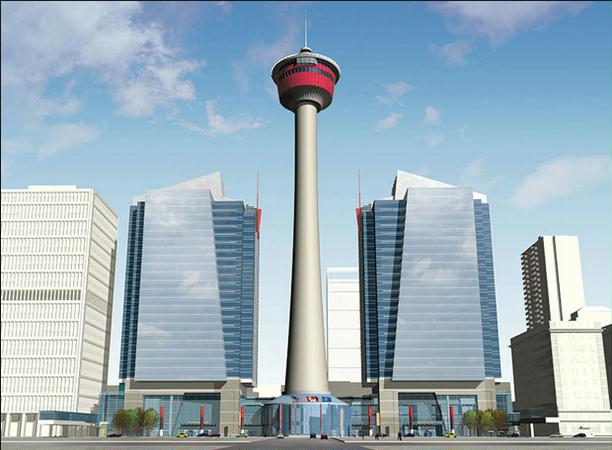
  • Shell’s boreal-forest-destroying enterprise required 995 miles of pipe and consumes enough power to light up a city of 136,000 people. It gobbled up enough steel cable to stretch from Calgary to Halifax and poured enough concrete to build thirty-four Calgary Towers. tar-sands-34-calgary-towers-cement-shell-mine
  • The price tag for an open-pit mine plus an upgrader has climbed from $25,000 to between $90,000 and $110,000 per flowing barrel over the last decade. Conventional oil requires, on average, $1,000 worth of infrastructure to remove a flowing barrel a day

The rising price of oil largely obscured these extravagant costs until prices crashed in 2008 and again in 2014.

Pollution!!!

tar-sand-water-pollutionBiologists and ecologists understood that the environmental consequences of digging up a forest in a river basin that contained 20% of Canada’s fresh water could be enormous. According to Larry Pratt’s lively account of Kahn’s presentation in his book The Tar Sands, one federal government official calculated that the megaproject would dump up to 20,000 tons of bitumen into the Athabasca River every day and destroy the entire Mackenzie basin all the way to Tuk-toyaktuk. Studies and reports completed in 1972 had warned that the construction of “multi-plant operations” would “turn the Fort McMurray area of northeastern Alberta into a disaster region resembling a lunar landscape” or a “biologically barren wasteland.

At a 50 per cent use of groundwater, SAGD generates formidable piles of toxic waste. Companies can’t make steam without first taking the salt and minerals out of brackish water. As a consequence, an average SAGD producer can generate 33 million pounds of salts and water-solvent carcinogens a year, which simply gets trucked to landfills. Because the waste could contaminate potable groundwater, industry calls its salt disposal problem “a perpetual care issue.  Insiders remain alarmed by industry’s rising salt budget. “There is no regulatory oversight of these landfills, and these problems will be enormously difficult to fix,” says one SAGD developer.

Arsenic, a potent cancer-maker, poses another challenge. Industry acknowledges that in situ production (the terrestrial equivalent of heating up the ocean) can warm groundwater and thereby liberate arsenic and other heavy metals from deep sediments. No one knows how much arsenic 78 approved SAGD projects will eventually mobilize into Alberta’s groundwater and from there into the Athabasca River.

Pollution from the tar sands has now created an acid rain problem in Saskatchewan and Manitoba. With much help from 150,000 tonnes of acid-making air-borne pollution from the tar sands and local upgraders, Alberta now produces 25% of Canada’s sulfur dioxide emissions and a third of its nitrogen oxide emissions.  12 per cent of forest soils in the Athabasca and Cold Lake regions are already acidifying. Rain as acidic as black coffee is now falling in the La Loche region just west of Fort McMurray.

Albertans are expected to believe that the world’s largest energy project can displace more than a million tons of boreal forest a day, industrialize a landscape mostly covered by wetlands, create fifty square miles of toxic-waste ponds, spew tons of acidic emissions, and drain as much water from the Athabasca River as that annually used by Toronto, all with no measurable impact on water quality or fish.

Tailings Ponds pollution

Astronauts can see the ponds from space, and politicians typically confuse them with lakes. Miners call the watery mess “tailings.” Industry prefers the term “oil sands process materials” (ospm). Call them what you like, there is no denying that the world’s biggest energy project has spawned one of the world’s most fantastic concentrations of toxic waste, producing enough sludge every day (400 million gallons) to fill 720 Olympic pools.

The ponds are truly a wonder of geotechnical engineering. Made from earth stripped off the top of open-pit mines, they rise an average of 270 feet above the forest floor like strange flat-topped pyramids. By now, the ponds hold more than 40 years of contaminated water, sand, and bitumen.

Amazingly, regulators have allowed industry to build nearly a dozen of them on either side of the Athabasca River. The river, as noted, feeds the Mackenzie River Basin, which carries a fifth of Canada’s fresh water to the Arctic Ocean. The basin ferries wastes from the tar sands to the Arctic too.

The ponds are a byproduct of bad design and industry’s profligate water abuse. Of the 12 barrels of water needed to make one barrel of bitumen, approximately three barrels become mudlike tailings. All in all, approximately 90% of the fresh water withdrawn from the Athabasca River ends up in settling ponds engineered by firms such as Klohn Crippen Berger and owned by the likes of Syncrude, Imperial, Shell, or CNRL. After separating bitumen from sand with hot water and caustic soda, industry pumps the leftover ketchup-like mess into the ponds.

Engineers originally thought that the clay and solids would quickly settle out from the water. But bitumen’s clay chemistry confounded their expectations, and the ponds have been stubbornly growing ever since. They now cover fifty square miles of forest and muskeg. That’s equivalent to the size of Staten Island, New York, or nearly 150 Lake Louises without the Rocky Mountain scenery—or 300 Love Canals. Within a decade, the ponds will cover an area of eighty-five square miles. Experts now say that it might take a thousand years for the clay in the dirty water to settle out.

Given a tailings cleanup cost of $2–3 per barrel of oil, the ponds represent a $10-billion liability.

Every year the ponds quietly swallow thousands of ducks, geese, and shorebirds as well as moose, deer, and beaver.  Industry has tried to keep bird killing to a minimum by using scarecrows affectionately called Bit-U-Men.

In 2003, the intergovernmental Mackenzie River Basin Board identified the tailings ponds as a singular hazard. The board noted that “an accident related to the failure of one of the oil sands tailings ponds could have a catastrophic impact on the aquatic ecosystem of the Mackenzie River Basin.” Such catastrophes have happened before. In 2000, a tailings pond operated by the Australian-Romanian company Aurul S.A. broke after a heavy rain in Baia Mare, Romania. The pond released enough cyanide-laced water to potentially kill one billion people,

Bruce Peachey of New Paradigm Engineering. “If any of those [tailings ponds] were ever to breach and discharge into the river, the world would forever forget about the Exxon Valdez,” adds the University of Alberta’s David Schindler. (The Valdez released about 11 million gallons of crude oil into Prince William Sound, Alaska, in 1989. PAH concentrations alone in the tar ponds represent about 3,000 Valdezes.)

McDonald was born on the river, and he had trapped, fished, farmed, and worked for the oil companies. He fondly remembered the 1930s and 1940s, when Syrian fur traders exchanged pots and pans for muskrat and beaver furs along the Athabasca River. Families lived off the land then and had feasts of rabbit. They netted jackfish, pickerel, and whitefish all winter long. “Everyone walked or paddled, and the people were healthy,” McDonald said. “No one travels that river anymore. There is nothing in that river. It’s polluted. Once you could dip your cup and have a nice cold drink from that river, and now you can’t.

McDonald had recently told his son not to have any more children: “They are going to suffer. They are going to have a tough time to breathe and will have nothing to drink.” He dismissed the talk of reclaiming waste ponds and open-pit mines as a white-skinned fairy tale. “There is no way in this world that you can put Mother Earth back like it was.

Like most residents of Fort Chipewyan, Ladouceur believes there is definitely something wrong with the water. He has a list of suspects. Abandoned uranium mines on the east end of the lake, for example, have been leaking for years. “God knows how much radium is in this lake,” he says. Then there are the pulp mills and, of course, the tar sands and tar ponds. Ladouceur says his cousin collected yellow scum from the river downstream from the mines and dried it, and “it caught on fire.” Almost everyone in Fort Chip has witnessed oil spills or leaks on the Athabasca River.

Little if any regulation allows the destruction to continue unabated

The Ottawan government concluded that a massive tar-sands mega-scheme could overheat the economy, create steel shortages, unsettle the labor market, drive up the value of the Canadian dollar, and generally change the nation beyond recognition. The tar sands would also be needed to meet future domestic energy needs. “I don’t know why we should feel any obligations to rush into such large-scale production [of tar sands], rather than leave it in the ground for future generations,” reasoned Donald Macdonald.

But since the 1990s the destruction Kahn predicted has gone mostly unobstructed, because the Energy Resources Conservation Board (ERCB), the province’s oil and gas regulator, has become a captive regulator, largely funded by industry and mostly directed by lawyers and engineers with ties to the oil patch.

On paper, the ERCB has a mandate to develop and regulate oil and gas production in the public interest and claims to have the world’s most stringent rules. But these “rules” have allowed the board to:

  • Approve oil wells in lakes and parks, permit sour-gas wells — as poisonous as cyanide —near schools, Endorse the carpet-bombing of the province’s most fertile farmland with thousands of coal-bed methane wells and transmission lines
  • Until recently, the board refused to report the names of oil and gas companies not in compliance with its regulations, citing security reasons.
  • The agency has only two mobile air monitors to investigate leaks from 244 sour-gas plants, 573 sweet-gas plants, 12,243 gas batteries, and about 250,000 miles of pipelines.
  • In 2006, the board approved more than 95% of the 60,000applications submitted by industry.
  • After hearing in 2006 that the construction of Suncor’s $7-billion Voyageur Project would draw down groundwater by 300 feet, overwhelm housing and health facilities, and result in air quality exceedances for sour gas, benzene, and particulate matter, the board agreed that the project would “further strain public infrastructure” but declared the impacts “acceptable.”
  • After the Albian Sands Muskeg River Mine Expansion proposed to dig up 31,000 acres of forest, destroy 170 acres of fish habitat along the Muskeg River, and withdraw enough water from the Athabasca River to fill 22,000 Olympic-sized pools a year, the board concluded in 2006 that the megaproject was “unlikely to result in significant adverse environmental effects.

Mountain-top coal removal versus Tar Sands destruction

Mountaintop removal and open-pit bitumen mining are classic forms of strip mining, with a few key differences. In mountaintop removal, the company first scrapes off the trees and soil. Next, it blasts up to 800 feet off the top of mountains (in West Virginia alone, industry goes through 3 million pounds of dynamite every day.) Massive earth movers, like those used in the tar sands, then push the rock, or “excess spoil,” into river valleys, a process industry calls “valley fill.” Finally, giant drag lines and shovels scoop out thin layers of coal.

In the tar sands, companies specialize in forest-top removal. First they clear-cut up to 200,000 trees, then drain all the bogs, fens, and wetlands. Unlike in Appalachia, companies don’t throw the soil and rock (what the industry calls “overburden”) into nearby rivers or streams. Instead, they use the stuff to construct walls for the tar ponds, the world’s largest impoundments of toxic waste.

As earth-destroying economies, mountaintop removal and bitumen mining have few peers in their role as water abusers.

The EPA published its damning findings in a series of studies, despite massive interference along the way by the coal-friendly administration of George W. Bush. In an area encompassing most of eastern Kentucky, southern West Virginia, western Virginia, and parts of Tennessee, mountaintop removal smothered or damaged 1,200miles of headwater streams between 1985 and 2001, which bring life and energy to a forest. The studies were blunt: “Valley fills destroy stream habitats, alter stream chemistry, impact downstream transport of organic matter and . . . destroy stream habitats before adequate pre-mining assessment of biological communities has been conducted.” The EPA predicted that mountaintop removal would soon bury another 1,000 miles of headwater streams. Downstream pollution from the strip mines also contaminated rivers and streams with extreme amounts of selenium, sulfate, iron, and manganese. In addition, mountaintop removal dried up an average of 100water wells a day and dramatically polluted groundwater.  More than 450 mountains were destroyed during a six-year period, as well as 7% (370,000 acres) of the most diverse hardwood forest in North America.

The tar sands have already created a similar footprint in the Mackenzie River Basin, which protects and makes 20% of Canada’s fresh water. Throughout the southern half of the basin, bitumen mining destroys wetlands, drains entire watersheds, guzzles groundwater, and withdraws Olympic amounts of surface water from the Athabasca and Peace rivers. A large pulp mill industry struggles along in the wake of the oil patch, and a nascent nuclear industry threatens to become another water thief in the basin.

To date, no federal or provincial agency has done a cumulative impact study evaluating the industry’s footprint on boreal wetlands and rivers.

Bitumen is one of the most water-intensive hydrocarbons on the planet

If water shortages were to occur, both industry and government have limited courses of action—they can either reduce water consumption or build upstream, off-site storage for water taken from the Athasbasca during high spring flows.    Although industry and government have set goals of three million barrels a day by 2015, Peachey thinks water availability could well constrain such exuberance.

On average, the open-pit mines require 12 barrels of water to make 1 barrel of molasses-like bitumen. [Like tar sands, liquefied coal is often seen as a solution to oil decline, but liquid coal production is also highly limited by water which requires 6 to 15 tons of water per ton of coal-to-liquids(CTL).]

Most of the tar-sands water is needed for a hot-water process (similar to that of a giant washing machine) that separates the hydrocarbons from sand and clay.

Some companies recycle their water as many as 18 times, so every barrel of bitumen consumes a net average of 3 barrels of potable water. Given that the industry produces 1 million barrels of bitumen a day, the tar sands industry virtually exports 3 million barrels of water from the Athabasca River daily.

The industry will need more water as it processes increasingly dirtier bitumen deposits, because now the best ores are being mined.  In the future the clay content will increase, requiring ever larger volumes of water.

City-sized open-pit mines will soon be eclipsed by another water hog in the tar sands: in situ production. About 80% of all bitumen deposits lie so deep under the forest that industry must melt them into black syrup with technologies such as steam-assisted gravity drainage (SAGD). Twenty-five SAGD projects worth nearly $80 billion could produce 4 million barrels of bitumen a day by 2020 and easily surpass mine production. But as Robert Watson, president of Giant Grosmont Petroleum Ltd., warned in 2003 at a regulatory hearing: “David Suzuki is going to have problems with SAGD. Alberta natural gas consumers are going to have problems with SAGD . . . SAGD is not sustainable”.  Land leased for SAGD production now covers an area the size of Vancouver Island, which means in situ drilling will threaten water resources over an area 50 times greater than that affected by the mines. SAGD is not benign: it generally industrializes the land and its hydrology with a massive network of well pads, pipelines, seismic lines, and thousands of miles of roads.

Although industry spin doctors calculate that it takes about one barrel of raw water (most from deep salty aquifers) to produce 4 barrels of bitumen, most SAGD engineers admit to much higher water-to-bitumen ratios. Actually, SAGD could be removing as much water from underground aquifers as the mines are withdrawing from the Athabasca River within a decade.

Moreover, SAGD’s water thirst appears to be expanding. Industry used to think that it only needed 2 barrels’ worth of steam to melt 1 barrel of bitumen out of deep formations, but the reservoirs have proved uncooperative. Opti-Nexen’s multibillion-dollar Long Lake Project south of Fort McMurray, for example, originally predicted an average steam-oil ratio of 2.4. But Nexen now forecasts a 35% increase in steam (a 3.3 ratio). Most SAGD projects have increased their steam ratios to greater than 3 barrels, with a few projects already as high as 7 or 8.

“A lot of projects may prove uneconomic in their second or third phases because it takes too much steam to recover the oil,” explains one Calgary-based SAGD developer.

High-pressure steam injection into bitumen formations can cause micro earthquakes and heave the surface of land by up to eight inches. Steam stress can also fracture overlying rock, allowing steam to escape into groundwater or the empty chambers of old SAGD operations. (The steam stress problem is so dramatic, says one engineer, that all forecasts of SAGD potential production are probably grossly exaggerated.) Both Imperial Oil and Total have experienced spectacular SAGD failures that left millions of dollars of equipment soaking in mud bogs.

The dramatic loss in steam efficiency for deep bitumen deposits means companies have to drain more aquifers to boil more water. To boil more water, the companies have to use more natural gas (the industry currently burns enough gas every day to keep the population of Colorado warm), which in turn means more greenhouse gas emissions. By some estimates, SAGD could consume 40% of Canadian demand by 2035.

SAGD’S frightful natural gas addiction is now driving shallow drilling as well as coal-bed methane developments on prime agricultural land throughout central Alberta. (Coal-bed methane is the tar sands of natural gas: it requires more wells and more land disturbance than conventional gas and poses a huge threat to groundwater, which often moves along coal seams.) The quick removal of natural gas from underground pools and coal deposits creates a void that could, over time, fill up with either water or migrating gas. Nobody really knows at the moment how many old gas pools connect with water aquifers or how many are filling up with water. Bruce Peachey estimates that natural gas drilling could result in the eventual disappearance of 350 to 530 billion cubic feet of water in arid central Alberta.

Due to spectacular growth in SAGD (nearly $4 billion worth of construction a year until 2015), Alberta Environment can no longer accurately predict industry’s water needs. The Pembina Institute, a Calgary-based energy watchdog, reported that the use of fresh water for SAGD in 2004 increased three times faster than the government forecast of 110 million cubic feet a year. Government has made a conscious effort to get SAGD operations to switch to using salty groundwater. However, since it costs more to desalinate the water and creates a salt disposal problem, SAGD could be still be drawing more than 50 per cent of its volume from freshwater sources by 2015.

The biggest issue for SAGD production may be changes in the water table over time. “If you take out a barrel of oil from underground, it will be replaced with a barrel of water from somewhere,” explains Bruce Peachey. The same rule applies to natural gas. Peachey figures that if all the depleted gas pools near the tar sands were to refill with water, the water debt could amount to half the Athabasca River’s annual flow. This vacuum effect may also explain why the most heavily drilled energy states in the United States are experiencing the most critical water shortages.

Brad Stelfox, a prominent land-use ecologist who works for both industry and government, notes that a century ago all water in Alberta was drinkable. “Three generations later all water is non-potable and must be chemically treated,” he points out. “Is that sustainable?

Tar sands will also destroy  Saskatchewan province

By 2020, three provincial pipelines from Fort McMurray will ferry three million barrels of raw bitumen a day to Upgrader Alley, and in so doing transform the counties of Strathcona, Sturgeon, and Lamont and the City of Fort Saskatchewan into a “world class energy hub.” Just about every company with a mine or SAGD project in Fort McMurray, from Total to Statoil, has joined the rush to build nearly $45 billion worth of upgraders, refineries, and gasification plants. The colossal development will not only industrialize a 180-square-mile piece of prime farmland straddling the North Saskatchewan River (an area half the size of Edmonton) but consume the same amount of water as one million Edmontonians.

A landscape that once supported potato and dairy farms will soon be dotted with supersized industrial bitumen factories exporting synthetic crude and jet fuel to Asia and the United States.

Bitumen upgraders are among the world’s most proficient air polluters because, as the 2006 Alberta’s Heavy Oil and Oil Sands guidebook notes, they are “all about turning a sow’s ear into a silk purse.” Removing impurities from bitumen or adding hydrogen requires dramatic feats of engineering that produce two to three times more nitrogen dioxides (a smog maker), sulfur dioxide (an acid-rain promoter), volatile organic compounds (an ozone developer), and particulate matter (a lung and heart killer) than the refining of conventional oil.

From the government’s point of view, a multibillion-dollar upgrader is much more appealing than a farm. A typical midsized upgrader, for example, can pipe $450 million worth of taxes into federal and provincial coffers every year for twenty-five years. The construction of half a dozen upgraders can employ twenty thousand people for a decade and keep the economy growing like an algae bloom.

Relative to conventional crude, bitumen typically sells at such a heavy discount that U.S. refineries equipped to handle the product can turn over incredible profits. “The lost profits and lost opportunities are simply too large to ignore,” concluded Dusseault. But the Alberta government did ignore them, and by 2007 bitumen’s lower price differential amounted to a loss of $2 billion a year. Money is lost whenever raw bitumen is exported.

The oil patch is the second-highest water user in the North Saskatchewan River basin (using 18% of water withdrawals). The upgrader boom will make the petroleum sector number one. A 2007 report for the North Saskatchewan Watershed Alliance says that “nearly all of the projected increase in surface water use will be in the petroleum sector.” By 2015, the upgraders’ demands on river water will increase by 278%; by 2025, 339%. John Thompson, author of the report, says the absence of an authoritative study on the river’s ecosystem, an Alberta trademark, leaves a big hole. “We don’t know what it takes to maintain the river’s health.” Providing energy for the upgraders will also take a toll on water. Sherritt International and its investment partner, the Ontario Teachers’ Pension Plan, are proposing to strip-mine a 120-square-mile area just east of Upgrader Alley for coal.

Gasification plants would render the coal into synthetic gas and hydrogen to help power the upgraders. Current estimates suggest that the project will consume somewhere between 70 million and 317 million cubic feet of water from the North Saskatchewan annually. Strip-mining farmland will also “affect groundwater aquifers and surface water hydrology.

Enbridge, the largest transporter of crude to the U.S., also wants to open the floodgates to Asia with a proposed $5-billion global superhighway, the Northern Gateway Project. Now backed by ten anonymous investors, the project would ferry 525,000 barrels of dilbit (diluted bitumen) from Edmonton to the deep-water port of Kitimat, B.C., to help put more cars on the road in Shanghai. Paul Michael Wih-bey, a tar sands promoter, describes the pipeline as part of a grand “China-Alberta-U.S. Nexus” and “ a new global market order based on secure supplies of reasonably priced heavy oils.” The dual 700-mile-long pipeline would also import 200,000 barrels of condensate or diluent from Russia or Malaysia to help lubricate the export line. Enbridge calls the Northern Gateway Project “an important part of Canada’s energy future,” and the company has hired a former local mla and cbc journalist to talk up the project in rural communities. Given that the megaproject would cross 1,000 streams and rivers that now protect some of the world’s last remaining salmon fisheries, it was received coldly in many quarters.

Given that NAFTA rules force Canada to maintain a proportional export to the United States (Mexico wisely rejected the proportionality clause on energy exports), these three new pipelines will undermine our nation’s energy security. In the event of an international energy emergency, the pipelines guarantee that the United States will get the greatest share of Canadian oil. “It hasn’t dawned on most Canadians that their government has signed away their right to have first access to their own energy supplies,” says Gordon Laxer, director of the Parkland Institute.

The export of bitumen to retrofitted U.S. refineries will dirty waterways, air sheds, and local communities. About 70% of current refinery expansion proposed in the United States (a total of 17 renovations and five new refineries) is dedicated to bitumen from the tar sands. Companies such as BP, Marathon, Shell, and ConocoPhillips have announced plans to expand and refit nearly half a dozen older refineries in the Great Lakes region to process bitumen.

On the Canadian side of the Great Lakes, refineries are expanding in Sarnia’s notorious Chemical Valley. The area already boasts more than 65 petrochemical facilities, including a Suncor refinery that has been upgrading bitumen for 55 years. Shell wants to add a bitumen upgrader to the mix, and Suncor just completed a billion-dollar addition to handle more dirty oil. The region currently suffers from some of the worst air pollution in Canada. Industrial waste from Chemical Valley has feminized male snapping turtles in the St. Clair River, turned 45% of the whitefish in Lake St. Clair “intersexual,” and exposed 2,000 members of the Aamjiwnaang First Nation to a daily cocktail of 105 carcinogens and gender-benders. Newborn girls outnumber boys by two to one on the reserve. Two-thirds of the children have asthma, and 40% of pregnant women experience miscarriages. Calls for a thorough federal investigation have gone unheeded.

The marketplace and quislinglike regulators are directing our country’s insecure economic future without a vote or even so much as a polite conversation over coffee. Canadians can now choose between two nightmares: an air-fouling, river-drinking economy that upgrades the world’s dirtiest hydrocarbon on prime farmland or a traditional staples economy that exports cheap bitumen and thousands of jobs to polluting refineries in China, the Gulf Coast, and the Great Lakes while making Eastern Canada ever more dependent on the uncertain supply of foreign oil. There is currently no plan C.

The rapid development  of the tar sands has made climate change a joke about Everybody, Somebody, Anybody, and Nobody. Everybody thinks reducing carbon dioxide emissions needs to be done and expects Somebody will do it. Anybody could have reduced emissions, but Nobody did. Everybody now blames Somebody, when in fact Nobody asked Anybody to do anything in the first place.

In meetings and in its proposed rules for geologic storage, the EPA has strongly recommended that government map out the current state of groundwater and soil near potential storage sites. Once CO2 begins to be injected at carefully chosen sites, the EPA has proposed that regulators track CO2 plumes in salt water, monitor local aquifers above and beyond the storage site to assure protection of drinking water, and sample the air over the site for traces of leaking CO2. And this isn’t something to be done over twenty or fifty years—the EPA believes this oversight needs to be maintained for hundreds, if not thousands, of years.

Just how likely is leakage? If Florida’s experience with the deep injection of wastewater is any indication, there will be leakage, and lots of it. Since the 1980s, 62 Florida facilities have been pumping three gigatons—0.7 cubic miles—of dirty water full of nitrate and ammonia into underground saltwater caves, some 2,953 feet deep, every year to keep the ocean clean. During the 1990s, the wastewater migrated into at least three freshwater zones, contaminating drinking water, though the EPA didn’t acknowledge the scale of the problem until 2003. David Keith, who has studied the Florida problem, says surprises will occur with carbon capture; regulations must adapt and be based on results from a dozen large-scale pilot projects. Absolutely prohibiting CO2 leakage would be a mistake, he says, since “it seems unlikely that large-scale injection of CO2 can proceed without at least some leakage.” Keith suspects the risks to groundwater will be

Other scientists, such as a group at the U.S. Lawrence Berkeley National Laboratory, suspect keeping CO2 out of groundwater will be more difficult than managing liquid waste in Florida. They say CO2 injection involves more complex hydrologic processes than storing liquid waste, and it could even force salt water into freshwater sources. The group, now studying CCS and groundwater, says scientists don’t have a good idea of how CCS could change the pressure at the groundwater table level, impact discharge and recharge zones, and affect drinking water.

Nuclear power and tar sands

In 1956, Manley Natland had the kind of energy fantasy that the tar sands invite with predictable regularity. As the Richfield Oil Company of California geologist sat in a Saudi Arabian desert watching the sun go down, it occurred to him that a 9-kiloton nuclear bomb could release the equivalent of a small, fiery sun in the stubborn Alberta tar sands deposits. Detonating the bomb underground would make a massive hole into which boiled bitumen would flow like warmed corn syrup. “The tremendous heat and shock energy released by an underground nuclear explosion would be distributed so as to raise the temperature of a large quantity of oil and reduce its viscosity sufficiently to permit its recovery by conventional oil field methods,” Natland later wrote. He thought that the collapsing earth might seal up the radiation, and the bitumen could provide the United States with a secure supply of oil for years to come. Two years after his desert vision, Natland and other Richfield Oil representatives, the Alberta government, and the United States Atomic Energy Commission held excited talks about Project Cauldron, which planners later renamed Project Oil Sands. Natland selected a bomb site sixty-four miles south of Fort McMurray, and the U.S. government generously agreed to supply a bomb. Richfield acquired the lease site. Alberta politicians celebrated the idea of rapid and easy tar sands development, and the Canadian government set up a technical committee. Popular Mechanics magazine enthused about “using nukes to extract oil.

Edward Teller, the nuclear physicist and hawkish father of the hydrogen bomb, championed Natland’s vision. In an era when nuclear proponents got giddy about nuclear-powered cars, Teller regarded Project Cauldron as another opportunity to hammer the threat of nuclear swords into peaceful ploughs. “Using the nuclear car to move the fossil horse” was a promising idea, the bomb maker wrote. Chance, however, intervened. Canadian Prime Minister John D. Diefenbaker didn’t relish the idea of nuclear proliferation, or of the United States meddling in the Athabasca tar sands. The Soviets had experimented with nuking oil deposits only to learn that there was no market for radioactive oil. The promise of cheaper conventional sources in Alaska also lured Richfield Oil away from Project Cauldron. The moment passed for Natland. But the idea of using a nuclear car to fuel a hydrocarbon horse never really died, and these days some new scheme to run the tar sands on nuclear power emerges weekly with great fanfare. The CEO of Husky Energy, John Lau, seems interested, and Gary Lunn, the federal minister of natural resources, says he’s “very keen,” adding that it’s a matter of “when and not if.” Roland Priddle, former director of the National Energy Board and the Energy Council of Canada’s 2006 Energy Person of the Year, speaks enthusiastically about the synthesis “of nuclear and oil sands energy,” as does Prime Minister Stephen Harper. Bruce Power, an Ontario-based company, has proposed four reactors at a cost of $12 billion for tar sands production in Peace River country. France’s nuclear giant Avera wants to build a couple of nukes in the tar sands too. Saskatchewan, an Alberta wannabe, has proposed two nuclear facilities: one near the tar sands and one on Lake Diefenbaker. Employees of Atomic Energy of Canada Ltd. (aecl), a federal Crown corporation that designs and markets candu reactors, told a Japanese audience in 2007 that “nuclear plants provide a sustainable solution for oil sands industry energy requirements, and do not produce ghg emissions.” If realized, these latest

In sunny Alberta, nukes for oil are being celebrated these days as some sort of magic bullet for carbon pollution as well as for rapid depletion of natural gas supplies. Natural gas now fuels rapid bitumen production, and it takes approximately 1,400 cubic feet of natural gas to produce and upgrade a barrel, equal to nearly a third of the barrel’s energy content. The tar sands are easily Canada’s biggest natural gas customer. They burn the blue flame to generate electricity to run equipment and facilities, they convert it as a source of hydrogen for upgrading, and they use it to heat water. SAGD operations, which need anywhere from two to four barrels of steam to melt deep bitumen deposits, are super-sized natural gas consumers. Thanks to the unexpectedly low quality of many bitumen deposits, SAGD requires more steam and therefore more natural gas every year.

Nuclear plants overheat without regular baths of cool water. (This explains why current proposals have placed nuclear reactors on the Peace River, one of Alberta’s longest rivers, or Lake Diefenbaker, the source of 40 per cent of the water for Saskatchewan.) The Darlington and Pickering facilities in Ontario require approximately two trillion gallons of water for cooling a year, about nineteen times more water than the tar sands use. In fact, water has become an Achilles heel for the nuclear industry. Recent heat waves in Europe and the United States either dried up water supplies or forced nuclear plants to discharge heated wastewater into shallow rivers, killing all the fish.

How tar sands corrupt democracy

  • When revenue comes from oil, citizens pay lower taxes, and all the government has to do is approve more tar sands projects, regardless of the harm they will do to the environment
  • Without taxation, people don’t pay much attention to how it’s spent, ask questions, or vote.
  • In turn, oil revenue driven governments are less likely to listen to voters, and better able to buy votes and influence people, enrich their friends and family
  • These oil-corrupted government leaders then use some of the money to discourage thought, debate, or dissent. For example, the Alberta government spends $14 million a year on 117 employees to tell Albertans what to think, and another $25 milloin in convincing Alberta’s citizens and U.S. oil consumers that tar sands are quite green and not as nasty as some have portrayed.
  • In Mexico and Indonesia, oil funds have propped up one party rule, used the money to buy guns, tanks and other means of putting rebellions down.

[ Canadians above all should really read this book, because they’re being robbed now and for millennia in the future of the financial gains and a stretched-out, longer use of this energy for their own nation.  The tar sands are open to anyone to exploit.  This is because most people who work in the oil industry know that peak oil is real and the tar sands are the last place on earth where oil companies can make an investment and grow production. ]

“In the big picture, deepwater oil and the oilsands are the only game left in town.  You know you are at the bottom of the ninth when you have to schlep a ton of sand to get a barrel of oil,” notes CIBC chief economist Jeffrey Rubin.

History

Mair didn’t see the grand and impossible future of Canada until the steamer docked at Fort McMurray, a “tumble-down cabin and trading-store.” That’s where he encountered the impressive tar sands, what Alexander Mackenzie had described as “bituminous fountains” in 1778 and what federal botanist John Macoun almost a century later called “the ooze.” Federal surveyor Robert Bell described an “enormous quantity of asphalt or thickened petroleum” in 1882. Mair called the tar sands simply “the most interesting region in all the North.” The tar was everywhere. It leached from cliffs and broke through the forest floor. Mair observed giant clay escarpments “streaked with oozing tar” and smelling “like an old ship.” Wherever he scraped the bank of the river, it slowly filled with “tar mingled with sand.” The Cree told him that they boiled the stuff to gum and repair canoes. One night Mair’s party burned the tar like coal in a campfire.

Against all economic odds, visionary J. Howard Pew, then the president of Sun Oil and the seventh-richest man in the United States, had built a mine and an upgrader (now Suncor) on the banks of the Athabasca River in 1967. Pew’s folly, then the largest private development ever built in Canada, would lose money for twenty years by producing the world’s most expensive oil at more than $30 a barrel.

But Pew reasoned that “no nation can long be secure in this atomic age unless it be amply supplied with petroleum.” Given the inevitable depletion of cheap oil, he recognized that the future of North America’s energy supplies lay in expensive bitumen.

Project Independence, the title given to U.S. government energy policy in the early 1970s. The policy stated that “there is an advantage to moving early and rapidly to develop tar sands production” because it “would contribute to the availability of secure North American oil supplies.

Mining Canada’s forest for bitumen would give the United States some time to figure out how to economically exploit its own dirty oil in places such as Colorado’s oil shales and Utah’s tar sands.

Given the current energy crisis and OPEC’s reluctance to boost oil production, Kahn hailed the bituminous sands of northern Alberta as a global godsend. He then presented a tar sands crash-development program to Prime Minister Pierre Elliott Trudeau and Energy Minister Donald Macdonald.

Like everything about Kahn, his rapid development scheme was big and bold. (A crash program, said Kahn, was really “overnight go-ahead decision making.”) This one called for the construction of 20 gigantic open-pit mines with upgraders on the scale of Syncrude, soon to be one of the world’s largest open-pit mines. The futurist calculated that the tar sands could eventually pump out 2 to 3 million barrels of oil a day, all for export. Canada wouldn’t have to spend a dime, either. A global consortium formed by the governments of Japan, the United States, and some European countries would put up the cash: a cool $20 billion. Korea would provide 30 to 40,000 temporary workers, who would pay dues and contribute to pension plans to keep the local unions happy. Kahn pointed out that Canada would receive ample benefits: the full development of an under-exploited resource, high revenues, a refining industry, a secure market, and lots of international trade. The audacity of the vision stunned journalist Clair Balfour at the Financial Post, who wrote, “It would be as though the 10,000 square miles of oil sands were declared international territory, for the international benefit of virtually every nation but Canada.

In the late 1990s, development exploded abruptly with the force of a spring flood on the Athabasca River. The region’s fame spread to France, China, South Korea, Japan, the United Arab Emirates, Russia, and Norway. Everyone wanted a piece of the magic sand-pile. The Alberta government, with its Saudi-like ambitions, promised that the tar sands would be “a significant source of secure energy” in a world addicted to oil. But since then, greed and moral carelessness have turned the wonder of Canada’s Great Reserve to dread.

Tar sand investments now total nearly $200 billion. That hard-to-imagine sum easily makes the tar sands the world’s largest capital project. The money comes from around the globe, including France, Norway, China, Japan, and the Middle East. But approximately 60% of the cash hails from south of the border. An itinerant army of bush workers from China, Mexico, Hungary, India, Romania, and Atlantic Canada, among other places, is now digging away.

The Alberta tar sands are a global concern. The Abu Dhabi National Energy Company (taqa), an expert in low-cost conventional oil production, bought a $2-billion chunk of bitumen real estate just to be closer to the world’s largest oil consumer, the United States. South Korea’s national oil company owns a piece of the resource, as does Norway’s giant national oil company, Statoil, which just invested $2 billion. Total, the world’s fourth-largest integrated oil and gas company, with operations in more than 130 countries, plans to steam out two billion barrels of bitumen. Shell, the global oil baron, lists the Athabasca Oil Sands Project as its number-one global enterprise and plans to produce nearly a million barrels of oil a day — more oil than is produced daily in all of Texas. Synenco Energy, a subsidiary of Sinopec, the Chinese national oil company, says it will assemble a modular tar sands plant in China, Korea, and Malaysia, then float the whole show down the Mackenzie River. Japan Canada Oil Sands Limited has put up money.

Over 50,000 temporary foreign workers have poured into Alberta to feed the bitumen boom.  Abuse of these guest workers is so widespread that the Alberta government handled 800 complaints in just one three-month period in 2008.

With just 5% of the world’s population, the United States now burns up 20.6 million barrels of oil a day, or 25% of the world’s oil supply. Thanks to bad planning and an aversion to conservation, the empire must import two-thirds of its liquid fuels from foreign suppliers, often hostile ones. “The reality is that at least one supertanker must arrive at a U.S. port every four hours,” notes Swedish energy expert Kjell Aleklett. “Any interruption in this pattern is a threat to the American economy.” This crippling addiction has increasingly become an unsustainable wealth drainer. In 2000, the United States imported $200 billion worth of oil, thereby enriching many of the powers that seek to undermine the country. By 2008, it was paying out a record $440 billion annually for its oil.

The undeclared crash program in the tar sands has transformed Canada’s role in the strategic universe of oil. By 1999, the megaproject had made Canada the largest foreign supplier of oil to the United States. By 2002, Canada had officially replaced Saudi Arabia and Mexico as America’s number-one oil source, an event of revolutionary significance. Canada currently accounts for 20% of U.S. oil imports (that’s 12% of American consumption), and the continuing development of the tar sands will double those figures. Incredibly, only two in ten Americans and three in ten Canadians can accurately identify the country that now keeps the U.S. economy tanked up.

The rapid development of the Alberta tar sands has also served as a dirty-oil laboratory. Utah has 60 billion barrels of tar sands that are deeper and thinner, and therefore uglier, than Alberta’s resource. To date, appalling costs and extreme water issues have kept Americans from ripping up 2.4 million acres of western landscape. But that may soon change. Republican Utah Senator Orrin G. Hatch said that ”U.S. companies active in the tar sands are only waiting for the U.S. government to adopt a policy similar to Alberta’s which promotes rather than bars the development of the unconventional resources”.

In 2006, a three-volume report by the Strategic Unconventional Fuels Task Force to the U.S. Congress gushed that Alberta’s rapid development approach to “stimulate private investment, streamline permitting processes and accelerate sustainable development of the resource” was one that should be “adapted to stimulate domestic oil sands.” Even with debased fiscal and environmental rules, though, the U.S. National Energy Technology Laboratory has calculated that it would take 13 years and a massively expensive crash program to coax 2.4 million barrels a day out of the U.S. tar sands. A 2008 report by the U.S. Congressional Research Service concluded that letting Canada do all the dirty work in the tar sands made more sense than destroying watersheds in the U.S. Southwest: “In light of the environmental and social problems associated with oil sands development, e.g., water requirements, toxic tailings, carbon dioxide emissions, and skilled labor shortages, and given the fact that Canada has 175 billion barrels of reserves . . . the smaller U.S. oil sands base may not be a very attractive investment in the near-term.

In 2009, the U.S. Council on Foreign Relations, a non-partisan think tank that informs public policy south of the border, critically examined the tar sands opportunity. The council’s report, entitled “Canadian Oil Sands,” found that the project delivered “energy security benefits and climate change damages, but that both are limited.” Natural gas availability, water scarcity, and “public opposition due to local social and environmental impacts” could clog the bitumen pipeline, the report said.

Criminal Intelligence Service Alberta, a government agency that shares intelligence with police forces, reported in 2004 that the boom had created fantastic opportunities for the Hell’s Angels, the Indian Posse, and other entrepreneurial drug dealers: “With a young vibrant citizen base and net incomes almost double the national average, Fort McMurray represents a tremendous market for illegal substances.” By some estimates, as much as $7 million worth of cocaine now travels up Highway 63 every week on transport trucks. According to the Economist, a journal devoted to studying global growth, about “40 per cent of the [tar sands] workers test positive for cocaine or marijuana in job screening and post accident tests.” Health food stores can’t keep enough urine cleanse products in stock for workers worried about random drug trials. There is even a black market in clean urine.

After years of denial and delays, the Alberta Cancer Board announced in May 2008 that it would conduct a comprehensive review of cancer rates in Fort Chipewyan. The peer-reviewed report, released in 2009, completely vindicated O’Connor and the people of Fort Chipewyan. The study found that the northern community had a 30 per cent higher cancer rate than models would predict and a “higher than expected” rate of cases of cancers of the blood, lymphatic system, and soft tissue.

Many of the companies digging up wetlands along the Athabasca River, such as Exxon (part of the Syncrude consortium) and Shell, have already left an expensive legacy in Louisiana. Like Alberta, the bayou state has been a petro-state for years, producing 30 per cent of the domestic crude oil in the United States. For more than three decades, the state’s oil industry compromised coastal marshes and wetlands with ten thousand miles of navigational canals and thirty-five thousand miles of pipelines. These industrial channels, carved into swamps, invited salt water inland, which in turn killed the trees and grasses that kept the marshes intact. The U.S. Geological Survey suspects that the sucking of oil from the ground has also abetted the erosion. Since the 1930s, nearly one-fifth of the state’s precious delta has disappeared into the Gulf of Mexico. In fact, the loss of coastal wetlands now threatens the security of the industry that helped to destroy them. Without the protective buffer of wetlands, wells, pipelines, refineries, and platforms are more vulnerable to storms and hurricanes.  Federal scientists now lament that the state loses a wetland the size of a football field every 38 minutes.

The government’s own records show that it has knowingly permitted the province’s reclamation liability to rocket from $6 billion in 2003 to $18 billion in 2008. If not addressed, the public cost of cleanup could eventually consume more than two decades’ worth of royalties from the tar sands. The ERCB holds but $35 million in security deposits for $18-billion worth of abandoned oil field detritus.

Quotes from the book:

  • “Control oil and you control nations; control food and you control the people.” Henry Kissinger, U.S. National security advisor, 1970
  • Vaclav Smil, Canada’s eminent energy economist says that the main problem is unbridled energy consumption and points out that “All economies are just subsystems of the biosphere and the first law of ecology is that no trees grow to heaven. If we don’t reduce our energy use, the biosphere may do the scaling down for us in a catastrophic manner”.
  • “I do not think there is any use trying to make out that the tar sands are other than a ‘second line of defense’ against dwindling oil supplies.” Karl A. Clark, research engineer, letter to Ottawa, 1947.  

References

Brandt A.R., et al. 2013. The energy efficiency of oil sands extraction: Energy return ratios from 1970 to 2010. Energy.

CAPP. 2015. Canadian crude oil production forecast 2014–2030. Canadian Association of Petroleum Producers.

Kolbert, E. November 12, 2007. Unconventional Crude. Canada’s synthetic fuels boom. New Yorker.

Lambert, J G., C.A.S. Hall, et al. 2014. Energy, EROI and quality of life. Energy Policy 64:153–167.

Mearns, E. 2008. The global energy crisis and its role in the pending collapse of the global economy. Presentation to the Royal Society of Chemists, Aberdeen, Scotland. See http://www. theoildrum.com/node/4712

Murphy, D.J., C. Hall, M. Dale, and C. Cleveland. 2011. Order from chaos: a preliminary protocol for determining the EROI of fuels. Sustainability 3(10):1888–1907.

NEB. 2013. Canada’s energy future, energy supply and demand to 2035. Government of Canada National Energy Board.

Soderbergh, B., et al. 2007. A crash programme scenario for the Canadian oil sands industry. Energy Policy 35.

Weissbach, D., G. Ruprecht, A. Huke, K. Czerski, S. Gottlieb, and A. Hussein. 2013. Energy intensities, EROIs, and energy payback times of electricity generating power plants. Energy 52:1, 210–221.


Posted in Tar Sands (Oil Sands) | Tagged , , , | 2 Comments

Toxic textiles: the lethal history of Rayon

Preface. This is a book review from Science magazine of Paul David Blanc’s 2016 book “Fake Silk The Lethal History of Viscose Rayon”, Yale University Press.  I’ve shortened the review and changed some of the text.

This book exposes how rayon, aka viscose, and especially the compound within it — carbon disulfide is very toxic, and has destroyed the bodies and minds of factory workers for over a century.

Blanc makes the case that the harm done by rayon deserves to be as well known as asbestos insulation, leaded paint, and mercury-tainted seafood in Minimata Bay.

It made me wonder how many other man-made materials harm the lives of those who make them, but are yet to be undiscovered, or already are known to be harmful but remain unregulated due to the powerful chemical industry lobby, i.e. flame retardants, which despite decades of scientific research showing them to be harmful, are still not regulated, despite 40 bills introduced into state legislatures — only two were passed (West, J. 2018. Update on the regulatory status of flame retardants).

Alice Friedemann   www.energyskeptic.com  author of “When Trucks Stop Running: Energy and the Future of Transportation”, 2015, Springer and “Crunch! Whole Grain Artisan Chips and Crackers”. Podcasts: Practical Prepping, KunstlerCast 253, KunstlerCast278, Peak Prosperity , XX2 report ]

Monosson, E. 2016. Toxic Textiles. A physician uncovers the disturbing history of an “ecofriendly” fiber. Science 354: 977

In this slim, action-packed book, Paul David Blanc takes the reader on a historical tour that touches on chemistry, occupational health, and the maneuverings of multinational corporations.

Who knew that the fabric that has had its turn on the high-fashion runway, as a pop-culture joke (remember leisure suits?), and more recently as a “green” textile had such a dark side?

Rayon is a cellulose-based textile in which fibers from tree trunks and plant stalks are spun together into a soft and absorbent fabric. First patented in England in 1892, viscose-rayon production was firmly established by the American Viscose Company in the United States in 1911. Ten years later, the factory was buzzing with thousands of workers. “[E]very man, woman, and child who had to be clothed” were once considered potential consumers by ambitious manufacturers.

However, once the silken fibers are formed, carbon disulfide—a highly volatile chemical—is released, filling factory workrooms with fumes that can drive workers insane. Combining accounts from factory records, occupational physicians’ reports, journal articles, and interviews with retired workers, Blanc reveals the misery behind the making of this material: depression, weeks in the insane asylum, and, in some cases, suicide. Those who were not stricken with neurological symptoms might still succumb to blindness, impotency, and malfunctions of the vascular system and other organs. For each reported case, I could not help but wonder how many others retreated quietly into their disabilities or graves.

Yet, “[a]s their nerves and vessels weakened, the industry they worked in became stronger,” writes Blanc. In Fake Silk, he exposes an industry that played hardball: implementing duopolies and price-fixing and influencing federal health standards. Viscose manufacturers, he writes, served as a “prototype of a multinational business enterprise, an early model of what would become the dominant modus operandi for large business entities after World War II.

The business of transforming plants into products is once again on the rise as consumers increasingly shun petroleum-based synthetic materials. China now accounts for 60% of rayon production, with India, Thailand, and several other countries accounting for the rest. (According to Blanc, U.S. production of viscose rayon has “gone offline.”) Yet, despite modernization of the manufacturing process—including improved ventilation—worker safety, writes Blanc, is not a given. The few available reports on contemporary production suggest that recommended exposure limits are often exceeded.

The fabric’s recent rebirth as an ecofriendly product [marketed by one manufacturer with the tagline “Nature returns to Nature” (1)], notes Blanc, is a “real tour de force of corporate chutzpah.

Years ago, I taught a class focused on toxic textiles. Had Blanc’s book Fake Silk been available at the time, it certainly would have been on the reading list.

“I am motivated by a desire to memorialize the terrible suffering that has occurred,” writes Blanc. With Fake Silk, he has surely succeeded.

Posted in Chemicals | Tagged , , | Comments Off on Toxic textiles: the lethal history of Rayon

Invasive insects

Preface.  Below is a by no means exhaustive list of insect scourges, just the ones I happen to run across.  Whoever is still around after collapse will sure be hard pressed to survive — unless they add insects to their diets.

Related:

Chemical industrial farming is unsustainable. Why poison ourselves when pesticides don’t save more of our crops than in the past?

Alice Friedemann   www.energyskeptic.com  author of “When Trucks Stop Running: Energy and the Future of Transportation”, 2015, Springer and “Crunch! Whole Grain Artisan Chips and Crackers”. Podcasts: Derrick Jensen, Practical Prepping, KunstlerCast 253, KunstlerCast278, Peak Prosperity , XX2 report

***

Baker M. 2020. ‘Murder Hornets’ in the U.S.: The Rush to Stop the Asian Giant Hornet. New York Times.

Sightings of the Asian giant hornet have prompted fears that the vicious insect could establish itself in the United States and devastate bee populations. Asian giant hornets can use mandibles shaped like spiked shark fins to wipe out a honeybee hive in a matter of hours, decapitating the bees and flying away with the thoraxes to feed their young. For larger targets, the hornet’s potent venom and stinger — long enough to puncture a beekeeping suit — make for an excruciating combination that victims have likened to hot metal driving into their skin.

June 2019.  ‘This is going to be a bad one’: A new pest is causing quarantines in Va. and Pa. Washington Post.

The latest worrisome organism is a strange insect from East Asia named the spotted lanternfly. The insect is known to sup from about 70 species. The mass feeding can seriously weaken its host. It likes grapevines and fruit trees, and afflicted plants suffer a much-diminished harvest.  The pest is also attracted to oaks, black walnuts and maples — high-value species for the timber industry.

Lanternfly excrete enormous amounts of a sugary waste called honeydew, and in their great numbers, this becomes excessive. On one wall of vegetation, leaves were glossy wet, as if sprayed with a hose.  Within a few days, honeydew draws a black fungus called sooty mold. In the yard, this can discolor decks, patio furniture, play equipment, arbors, vehicles and the rest. When the mold settles on leaves, a plant’s powers of photosynthesis are compromised.

May 2017. New crop pest takes Africa at lightning speed. Science 356:473-474.

In Rwanda, the drab caterpillars were first spotted last February. By April, they were turning up across the country, attacking a quarter of all maize fields. As farmers panicked, soldiers delivered pesticides by helicopter and helped pick off caterpillars by hand.

Unknown in Africa until last year, the fall armyworm (Spodoptera frugiperda) is now marching across the continent with an astonishing speed. At least 21 countries have reported the pest in the past 16 months. The fall armyworm can devastate maize, a staple, and could well attack almost every major African crop.

Armyworms get their name because when the caterpillars have defoliated a field, they march by the millions to find more food. The adult moths can travel hundreds of kilometers per night on high-altitude winds. The endemic African armyworm (S. exempta) already causes major crop losses every few years. But the fall armyworm, a native of the Americas, causes more damage because females lay their eggs directly on maize plants rather than on wild grasses, and the caterpillars have stronger, sharper jaws.

In many other countries, damage reports are still preliminary. “We don’t yet know if this is going to cause a food security crisis,” Wilson says. In the Americas, the armyworm feeds on more than 80 plants, seriously damaging maize, sorghum, and pasture grass and has has evolved resistance both to several pesticides and to some kinds of transgenic maize.

the pest appears likely to spread beyond Africa. The moths will probably arrive in Yemen within a few months, Wilson says. Migration or trade also could bring the pest to Europe, he adds, making it important to inspect imported plant material and conduct field surveys with pheromone traps. If the species reaches Asia, says entomologist Ramasamy Srinivasan of the World Vegetable Center in Taiwan, “its introduction might have a huge economic impact.”

María Virginia Parachú Marcó. 2015. Red Fire Ant (Solenopsis invicta) Effects on Broad-Snouted Caiman Nest Success. Journal of Herpetology 49(1):70-74.

Argentinian fire ants are held in check by native predators.  But in the USA where no natural predators exist, they could kill 70% of turtle hatchlings in Florida, and they’ve been caught eating snakes, lizards, birds, and even deer fawns who freeze when in danger, giving the ants the chance to attack.

Posted in BioInvasion | Tagged , , , , | Comments Off on Invasive insects

Book: John Perlin’s “A Forest Journey: The Story of Wood and Civilization”

Preface.  This contains excerpts from John Perlin’s “A Forest Journey: The Story of Wood and Civilization”. It’s one of my favorite books about natural resources, exploring the role wood has played in the rise and fall of civilizations since they began.

One of the many reasons cutting forests down crashes nations is that the land is no longer protected from wind or rain and the topsoil blows or washes away, and food production declines precipitously.  Also harbors silt up and are rendered useless.

This book is all the more relevant and important now, since we probably reached world peak oil in 2018 (see citations in chapter 2 of Life After Fossil Fuels: A Reality Check on Alternative Energy) and are returning to wood as our main thermal and infrastructure source, as did all civilizations before fossil fuels.

Wood is still the largest renewable energy source in Europe and used extensively in America as well to heat and cook with, and generate electricity. about 90 million people in Europe and North America now use wood energy as the main source of domestic heating.

In fact, wood is the main source of energy for the bottom 2 billion poor of the world. Africa uses over 90% of their wood for energy and overall is 27% of their primary energy. In Latin America wood is 13% of their total energy supply, and it is 5% in Asia and Oceana.  And it is also increasingly used in developed countries with the aim of reducing dependence on fossil fuels (FAO. 2015. Status of the World’s Soil Resources. Food and Agriculture Organization of the United Nations).

This summary has left out some of the most fascinating material from early civilizations such as Mesopotamia, Crete, Greece, the Roman empire, Venetia and so on, so do get the book, preferably in print for when the grid comes down for good and all electronic knowledge is lost (see “Preservation of Knowledge“.

The constant and resounding theme of the book is that there is such a thing as Peak Wood and that this has felled civilizations over and over again.  America was headed that way faster than Europe or any other nation because so many forests were being cut down to feed steamboats, locomotives, factories, and other steam engines, as well as heating and cooking for seven months of the year, and to construct buildings, wagons, and the other myriad uses of wood.

But then along came coal and oil, and collapse from decimated forests was delayed for a century or so.  Let’s hope forest fires don’t decimate our remaining trees, we’re going to need them!

Alice Friedemann  www.energyskeptic.com Women in ecology  author of 2021 Life After Fossil Fuels: A Reality Check on Alternative Energy best price here; 2015 When Trucks Stop Running: Energy and the Future of Transportation”, Barriers to Making Algal Biofuels, & “Crunch! Whole Grain Artisan Chips and Crackers”.  Podcasts: Crazy Town, Collapse Chronicles, Derrick Jensen, Practical Prepping, KunstlerCast 253, KunstlerCast278, Peak Prosperity

***

Perlin, John. 2005. A Forest Journey: The Story of Wood and Civilization. Countryman Press.

Shortages of wood led to coal becoming king

Shortages of wood spurred most industries throughout Britain to convert from wood to coal. Some cities, like London, began burning coal earlier than others.  Worcestershire managed to use wood as fuel in their salt-works until the late 1670s. By at that point industry had so destroyed the trees in the vicinity that at best enough wood for just a few months could be found.  Hence a switch to coal was made.  Likewise the town of Staffordshire found their woods spent and began to rely on coal for industry, offices, and homes. By the end of the 17th century, glass-houses, salt-works, brick making and malting burned only coal.

The ruling class could see wood shortages approaching and did all they could to protect forests to make them last longer.  But the economic incentives to cut timber illegally were just too great. Fuel cutters and tanners often teamed up. Tanners wanted as much bark per acre as could be obtained for their tanneries while the fuel cutter was paid by the amount of wood cut. In the event they were caught by the manager of the estate, they simply bribed him.

Wood permeated and made possible every aspect of society.  Since water transport was far less expensive than going overland, many miles of canals were built.  But that required wood for the scaffolding, wooden retaining walls on each side of the canal trench to prevent earth from collapsing once water entered, using thousands of pilings of oak.  Where locks were placed, timber was used for their gates.  Canal building used immense amounts of wood.

Wood had many uses in agriculture, including the poles that supported hop vines and the charcoal used to dry the hops.  Cider producers used a great deal of wood to build their barrels.  Aging cheese required very large structures of oak.

Even when water was the main source of power, the waterwheels themselves were made of wood, the shaft of the wheel, the cogs, and spinning machinery.  The mills to make cotton, flour, and other industries required a tremendous amount of wood.

When coal finally became the favored fuel, it too needed a lot of wood. Indeed, the transition from wood to coal couldn’t have taken place without wood to make supports for coal mine shafts, many miles of wooden rails to take the coal in wooden wagons to a port or city.  The coal was so heavy that the wooden rails required constant replacement. And finally the coal was usually brought to markets on wooden boats.

Only when iron could be produced with coal rather than charcoal from wood was dependence on wood dramatically lessened.   Iron rails replaced wood rails, as well as wood bridges, beams, machinery, and ships.

The rise of iron and coal caused timber to lose its status as civilization’s primary building material and fuel and become comparatively worthless lumber.

Madeira and the rise of Portugal

Madeira was so thickly wooded when the Portuguese first set foot there that they named it “isola de Madeira,” or “island of timber, for there was not a foot of ground that was not entirely covered with great trees.  But these forests were doomed when the Portuguese decided that the best use of this land was sugarcane, which requires wood all the way.  Sugar mills are made of wood, as was the mill’s machinery, waterwheels, and the rollers that crushed sugar cane stalks, where it was concentrated by kettles heated around the clock with a wood fire.  By 1494, the island’s sugar industry needed about 60,000 tons of wood just to boil the cane. Four of the 16 mills required 80,000 pack animal loads per year.   In addition, vast amounts of timber were shipped to Portugal for their new navy and merchant fleet. Having an ocean-going fleet enabled Portugal to go to India, and break the Venetian monopoly on Asian commerce, tipping the balance of wealth.  But just 240 years later, a sailor wrote that Madeira was “so miserably burnt by the sun … we could perceive no part of it … that had the appearance of green nor any tree bigger than a small hawthorn, and very few of these.”  By 1851 the rivers had almost dried up.

Other European nations joined in the ship-building frenzy and realized that the Caribbean offered the same ideal conditions for growing and processing sugar as existed on Madeira. The Portuguese soon established sugar plantations in Brazil.  To get the wood to build and fuel these sugar mills, each mill needed to have about eight slaves to cut and carry wood to the mill, and each mill needed about 90 acres of forests per year.  Within 20 years, all of the forests on Barbados were gone.

Alexander von Humboldt, explained why deforested lands in the tropics experienced torrid heat and catastrophic desiccation. Trees “affect the copiousness of springs … because by sheltering the soil from the direct action of the sun, they diminish the evaporation of water produced by rain. When the forests are destroyed, as they are everywhere in America with imprudent precipitancy, the springs are entirely dried up, or become less abundant. The beds of rivers, remaining dry during a part of the year, are converted into torrents, whenever great rains fall, because cutting wood also destroys the grass cover and moss, so rain is no longer impeded, forming sudden and destructive inundations.”

Planters discovered additional changes in the land on account of deforestation. The soil rapidly lost its fertility after its original cover was cleared. After fewer than 30 years of cultivation, the governor of Barbados complained that the land produced by two-thirds of what it once did, and the soil loss was exacerbated by the heavy rains of violent tropical storms “to run away”.  Entire hillsides planted in sugarcane often slid into the valleys below.

The Europeans rid the Indies of their native populations with the same violence that they employed to clear the forests of their trees. The Spanish chronicler Juan Acosta informed the world that by 1588 “there have remained few natural Indians.   With the Indians gone, the planters lacked hands to work their sugar mills, making it “more requisite to send over Blacks”.

The sugar mills would have gone out of business if settlers hadn’t colonized New England, chock full of timber that was sent to the tropics in exchange for sugar and rum. For example, between 1771 and 1773, 240,000 trees were cut in exchange for 3 million gallons of rum.

New England exported wood to many forest-less nations such as Madeira, and eventually Portugal and Spain. A huge ship building industry sprang up as well due to the plentiful wood. One dockyard alone built over 500 ships between 1697 and 1731.  And in turn this huge merchant fleet, which cost far less than deforested European nations, enabled New England to win a greater and greater share of world trade.  In addition, fishing and whaling boats were built.

Enormous amounts of wood raised the settlers’ standard of living considerably, with plenty of wood to build homes and burn for warmth.  Families generally sat close to the fireplace for seven months of the year. The size of the fireplace around was often so large it required logs dragged inside by a horse or oxen.

After building their log cabin, many families built a sawmill along the nearest stream to sell planks and staves in the international market. Each mill destroyed about 14 trees per day. There were so many mills that even in 1719 it was predicted that it wouldn’t take long for settler’s to destroy all the woods in the province.

By the late 17th century, Massachusetts had cut down so much of their lumber that they had no choice but to obtain fuel from Maine. A whole fleet of sloops worked the Maine-Boston run all year so people living in Boston could cook and heat their houses, and the city’s industries, including its many rum distilleries, could stay in production.

Great Britain needed desperately needed tall masts to retain their mastery of global trade and marine warfare.  Yet it could not furnish itself with masts by the 17th century.  And so Great Britain had to rely on the Baltic states such as Denmark, Poland, and Russia for its mast supply via the Baltic sea.  In 1658 the Dutch had plans to bring the British to their knees by keeping them out of the Baltic Sea by taking control of the narrow sound between Denmark to the south and Norway and Sweden on the north.  Oliver Cromwell, in a speech before Parliament, asked a joint session rhetorically, “If they can shut us out of the Baltic Sea and make themselves masters of that … where are the materials to preserve … shipping? And so 60 ships were sent to keep the Baltic safe for English navigation and it stayed open.

But as early as 1634 New England was already providing some masts and by 1700 provided most of them.  The trees most in demand were Eastern White pines that grew from 150 to 240 feet tall and required 72 oxen to pull to the nearest river for transport.  Trees too distant from rivers cost six times as much to haul out, and consequently were left untouched. Their lumber was light but strong and easy for a carpenter to shape and finish, with the added bonus of being resistant to rot, and desired for homes, bridges, and other structures in addition to shipping.

The Dutch and French were Great Britain’s rivals, and both nations tried to stop the New England Mast trade.  The Dutch captured at least two ships sailing from America’s shores, and the French military tried to sabotage mast trees by giving them three or four chops of a hatchet.  France also paid native Americans for each English scalp brought in, driving the British out of most of Maine and much of New Hampshire in the late 1600s.  Native warriors succeeded in shutting down much of the commerce in masts by destroying all the oxen used to draw masts out of the woods and creating so much fear in most English settlers that they didn’t dare venture into the woods. Eventually England could depend on the Piscataqua River, in all of New England, to deliver masts.

These tall trees were so critical to the British Empire that British surveyor’s went across large tracts of land and emblazoned them with a mark that came to be known as King’s Broad Arrow to be harvested and used solely for ships of the Royal British Navy.

The colonists had their own uses for mast trees and resented Britain’s reserving the best trees for themselves.  This was a hard law to enforce.  Some historians believe that the British laws denying them to use forests they saw as theirs instrumental as the taxation of tea in bringing about the American Revolution.  In the end, these emblazoned marks only helped colonists to quickly find and harvest the best trees in a forest with little chance of being caught.

Many decades before the Revolution, Dr. Cooke, who gave up his medical practice to run his many sawmills, challenged the king’s right to the woods. He insisted that he and his countrymen had the right to dispose of timber resources as they saw fit. In the province of Maine, the king had no right to any trees, not even to those 24 inches or greater in diameter which the revised charter had reserved for the Crown. It had never held that right, he argued, since Maine belonged to a private individual, was purchased by Massachusetts and became its private property before the new charter came into force. As the charter exempted trees growing on property held privately prior to its enactment from the Crown’s jurisdiction, Cooke concluded, Massachusetts, not England, owned all the trees in Maine and could do whatever it pleased with them.  Others argued that they owned the trees through titles bought from Indian chiefs who originally were the original owners.

Meanwhile the iron industry in Great Britain needed a great deal of lumber, and purchasing it was draining England’s hard currency and was a threat to its balance of payments.  England needed more than wood – pitch and tar were essential to waterproofing the Navy, and Sweden put the squeeze on them in 1703 as England was about to battle France.  The Swedes not only raised their prices considerably, they also reduced the amount they’d sell to England, and increased their exports to France.

And so this trade also fell to the American colonists, who began producing very large quantities and a high price, but Great Britain was willing to pay them rather than be dependent on Sweden.  Tar is made by splitting pine into three-foot pieces and placing them around a hole in the center of a kiln, and the heat of a fire burning above the pine wood forced the tar out, where it trickled through the hole to where workers could scoop it up and pour into barrels

Until coke from coal (starting in 1709) rather than charcoal from wood was used to make iron, forests continued to disappear.   With so much wood, it wasn’t long before investors in America built furnaces and forges to make iron, since wood cost 14 times less per cord of wood than in England.  This gave American iron a huge competitive edge.   That led to local manufacturers making goods such as skillets, pots, ladles, chimney backs, scythes, sickles, spades, shovels, hoes, and plows far more cheaply than these products could be purchased from English or Dutch manufacturers.

The rapid growth of the colonial iron industry rounded out America’s potential to become a major power in the world. As much iron was produced in the colonies in 1776 as in the British Isles. Even more important, a certain type of American iron, called “Best Principio,” was judged, “as good as any in the world for making firearms.” In testimony before the House of Lords, Richard Penn, the proprietor of Pennsylvania, informed the lords and all of England of America’s ability to make her own arms. The House was told that the colonists “had means of casting iron cannon in great plenty … and had … made great quantities of small arms of very good quality.

So important had the colonies become to the well-being of England that Benjamin Franklin allegedly suggested that as an alternative to breaking up the English-speaking world, “America should become the general seat of Empire, and that Great Britain and Ireland should be governed by Viceroys sent over from Court Residences either at Philadelphia, or New York, or some other American Imperial City.

“The most striking feature” of the new American nation was “an almost universal forest,” starting at the coast, “thickening and enlarging … to the heart of the country.” C. Volney, a French naturalist visiting America right after its independence, came to this conclusion after journeying “from the mouth of the Delaware [River], through Pennsylvania, Maryland, Virginia and Kentucky to the Wabash river [which today forms the southern portion of the Illinois and Indiana border], northward to Detroit, through Lake Erie to Niagara and Albany.

One of the first native American geographers, Jedidiah Morse, informed his readers of the “stately oaks, hickories and chestnuts which grew in the hilly and mountainous parts of” New Jersey. Upstate New York, according to Morse, was “clothed thick with timber.” Alex de Tocqueville found Morse’s assessment quite accurate, describing the state as one vast forest.

As impressive as the eastern forest was to travelers during the late 18th and early 19th centuries, once they passed from states bordering the Atlantic, crossed over the Appalachian Mountains, and descended into the Ohio valley, they were “agreeably surprised on finding nature in a novel and more splendid garb.” Nature had formed the trees “on a grander scale” than anywhere else, according to Edmund Dana, author of an early guidebook for people wishing to settle in the Ohio region. Another person who viewed the forests west of the Appalachians compared the trees to “a grand assemblage of gigantic beings which carry the imagination back to others times before the foot of the white man had touched the American shore.” Dana wrote that “the forest trees west of the Appalachians grow to an uncommon height.

Indiana, at the beginning of the 19th century, was “one vast forest” of sycamore, oak, maple, beech, dogwood, birch, walnut, and hickory. These same trees made southern Michigan, during the early 1800s, one of the most heavily forested areas in the Union and gave Illinois plenty of timber and Wisconsin all kinds of wood of the best quality. None, however, could compare with Ohio’s woodlands, which presented “the grandest unbroken forest of 41,000 square miles that was ever beheld on this continent. Immense forests of pine dominated the northern portions of Michigan, Wisconsin, and Minnesota.

After the American Revolution, England faced a crisis of being able to get enough wood.  This was when the idea that ships ought to be made out of iron instead, since England had plenty of coal, as did other trades as well, waterwheels began to be made of iron rather than wood, as did bridges and much more.

The first building to go up in the wilderness was usually a sawmill. Lumberjacks either sold their logs to the mill owner or had them sawed into boards or planks, giving the mill owner some logs in exchange for the service. The owner of the mill accumulated wealth through his business and, according to Kendall, with his money “builds a large wooden house,” opens a store, and “erects a still and barters rum” and other goods for more logs.

The woodsmen eventually clear a good portion of the surrounding countryside. Farmers settle on the deforested land and they soon need a gristmill, Kendall observed, which goes up near the sawmill. Sheep are also raised on the farms, requiring a mill to prepare woolen fibers for spinning. More farmers move to the vicinity to take advantage of living near such mills. And to serve the needs of this burgeoning rural community, “a blacksmith, a shoemaker, a tailor, and various other artisans and artificers successively assemble” and the congregation of people now forms a parish.

Manufacturing villages such as the one described by Kendall were scattered over a vast extent of the country, from Indiana to the Atlantic, and from Maine to Georgia.

In the state of New York alone in 1835 there were over 2,000 gristmills, almost 7,000 sawmills, 71 oil mills, 965 mills engaged in preparing woolen fabric, 293 iron mills, 141 sheet iron mills, 69 clover mills, 70 paper mills, and 412 tanneries run by waterpower.

Many manufacturers such as “breweries, distilleries, salt and potash works, casting and steel furnaces, and works for animal and vegetable oils and refining drugs” needed heat to produce a finished product. To create heat required some type of fuel. Fortunately, for America’s future, there was “no limit to our fund of charcoal,” in Coxe’s opinion, because of America’s rich endowment of forest lands which Coxe felt had to be cleared in any case since they impeded “the cultivation of the richest soils.

The bakers and brickmakers of New York, Philadelphia, and Baltimore commonly consumed prodigious quantities of pitch pine. Hatters of Pittsburgh, on the other hand, preferred charcoal made from white maple. Boats sailed all along the Erie Canal picking up wood to fuel the nation’s largest saltworks, located in upstate New York. Boiling rooms, in which the salt water was evaporated, occupied a three-mile portion of the canal’s shoreline. They produced 2 million bushels of salt per year. The salt went to Canada, Michigan, Chicago, and all points west. Farmers were the largest purchasers, using the salt for preserving meat they marketed. Steam engines, which in the 1830s began to free factories from their dependence on water sites, usually burned wood as their fuel.

Throughout the nation charcoal-burning iron mills produced 19 million tons of iron between 1830 and 1890. During the heyday of the British charcoal-burning iron industry, which dated from the 1540s to the 1750s, the entire nation produced in a 60-year period somewhat more than 1 million tons of iron.

Michigan, famous for its iron ore and pine forests, had one furnace that smelted 9,500 tons of iron each year.

The average annual output for a single English furnace amounted to around 350 tons

In 1790 the U.S. had only 4 million people living in its territories. This doubled to 8 million in 1810, and by 1880 there were over 50 million inhabitants. All these people needed housing and the great majority resided in dwellings built of wood.

Wood was the principal material from which all land-transport vehicles were built. Carriage makers and wagon-wrights made axles out of hickory and wheel spokes from white oak. White oak also formed the waggoner’s very flexible whip.

Roads were made passable by setting logs 10-12 feet long across marshy or muddy portions. Vehicles could only advance over the log-covered sections in leaps and starts.

A more refined type of wooden pavement, plank, enhanced travel comfort by eliminating the roads’ extremely dusty condition in summer and their muddy state in winter. Unlike log roads, any stretch covered with plank was welcomed by travelers.

The necessity of crossing the many watercourses while traveling entailed a tremendous amount of bridge building. Bridges were usually made of wood, owing to its cheapness, according to an engineer. Many were quite large. The one that spanned the Schuykull River in Philadelphia measured 1,500 feet long. The bridge that crossed the Delaware River at Trenton was twice that length.

Shipping

Because the rivers and lakes made it possible to travel by water through almost the entire territory that comprised the American nation in 1783, Jedidiah Morse felt that “the United States … seems to have been formed by nature for the most intimate union.” Canals rounded out what nature “forgot” to do. The Erie Canal connected Lake Erie to the Hudson River, making it possible to sail from the Atlantic to the foot of the Rocky Mountains.

The vast network of watercourses in the United States allowed woodsmen to cut timber thousands of miles away from their markets without worrying about transportation problems. During winter, loggers felled trees, dressed them into logs, and dragged them with teams of oxen over hardened snow to the nearest stream. “When the ice thaws, the logs … are launched into numerous streams in the neighborhood in which they have been cut and floated down into the larger rivers where they are stopped by … a line of logs extending the breadth of the river. Then every lumberman searches out his timber and forms it into a raft, floating it down the river to its destination.”

Pine logs from Minnesota and Wisconsin headed south in this fashion, floating from tributaries of the Mississippi into the main river. “The river from end to end was flaked with … timber rafts,” Mark Twain recalled. He nostalgically remembered “the annual procession of mighty rafts that used to glide by Hannibal”. Each raft had “an acre or so of white, sweet smelling boards, a crew of two dozen men or more, three or four wigwams scattered about the raft’s vast level for storm quarters …,” according to Twain. Just like Huck Finn, Twain, as a child, would “swim out a quarter or third of a mile” with his friends and “get on these rafts and have a ride.”

Timber was not the only cargo floated down the Mississippi. Many rafts carried grain produced by the many new farms that had sprung up along the Ohio and Mississippi rivers and their tributaries. To minimize carrying costs, the grain was first milled and then loaded onto rafts, called flatboats, for the long haul to New Orleans where the produce would be sold and freighted by oceangoing vessels. Once rid of his cargo, the flat-boatman had to sell his boat as he could not float back home against the current: it would be broken up for timber. He returned home by foot, usually walking thousands of miles to return.

The flatboat and other rafts suffered a major and insurmountable defect: they could only sail with the current. When farmers in the lower Ohio valley began producing large quantities of crops and could find no other market but Pittsburgh, a method of navigation was needed to transport produce upstream. The development of the keelboat initially solved the problem. Running boards from bow to stern on either side of the boat distinguished the keelboat from all others. Five men on each side held poles, set in sockets, that reached into the water. They placed their poles near the bow, faced the stern, and with bodies bent, walked slowly, poles against their shoulder, along the running board to the end of the boat, and then raced back to the head of the boat for another round. With the pilot steering, they propelled upriver in this fashion these long, narrow boats with twenty to forty tons of freight on board. Each man in a keelboat could push forward two or three tons twenty miles per day upstream while a team of five packhorses and one man could transport only half a ton at the same speed.

Steamboats beat out all competition. A round-trip from Pittsburgh to New Orleans by keelboat took six or seven months while the same voyage by steamboat was accomplished in a little more than three weeks.  Keel boats became obsolete.

Comparing steamboats to land transport, a writer in 1842 showed their advantage:   If each wagon carried two tons of goods, you’d need 25,000 wagons to hold what one steamship can carry.  And steam boats not only go ten times faster than wagons, they can travel around the clock.  To match them you’d need 250,000, or a wagon every 106 feet of the road for 5,000 miles.

The number of steamers plying the Ohio, Mississippi, and their tributaries grew rapidly between the 1810s and the outbreak of the Civil War, greatly exceeding the number of steam-powered vessels traversing the Atlantic. So many were afloat that when night fell, an observer on the riverbank could see “steamer after steamer” sweeping by, “sounding, thundering on, blazing with … thousands of lights, casting long, brilliant reflections on the fast rolling water beneath.” At times, the traffic thickened to such a degree that one after another would pass, appearing to someone standing on shore “like so many comets passing in Indian file.

François Michaux pointed out to Robert Fulton the difficulty he would face in trying to obtain coal along the routes his new steamships would take. Fulton quickly responded that his ships would burn wood instead. Relying on wood to power his ships would definitely resolve the fuel problem, he told Michaux, since “the banks of the Mississippi were almost uninterruptedly covered with thick forests.

Great quantities of wood were needed for fuel. The large steamboat Eclipse, for example, had an array of fifteen boilers. To keep them heated “required wood by the carload.” When steamboats first appeared on the rivers, there was no organized system for provisioning them with fuel. Once north of Natchez, Mississippi, crews depended on driftwood or getting wood at settlements along the river. Sometimes they had to tie up at a village for several days before enough wood was found. On other occasions, crew members had to land the boat near a forest and go into the wilderness to cut wood.

Eventually, thousands of wood yards were set up along the banks of every navigable river simply to provide steamers with fuel. Backwoodsmen brought the timber they had cut to these depots and hacked them into proper size for the ships’ furnaces. To the civilized eye, many of these men had the appearance of being “half horse, half alligator, all wild originals to a man.” At night, the owners of these wood lots kept gigantic fires blazing so those onboard the boats could see the yards and fuel up. Stopping every two hours or so to take on fuel and then waiting several hours more for it to be loaded on board wasted many precious hours. To eliminate such delays, flatboats piled with wood waited in the middle of the river for a steamer to approach. If the steamer needed fuel, its crew lashed the flatboat to theirs and as they pushed upriver, “the logs were thrown aboard.

Boats passing up and down the Mississippi bought around fifty thousand cords a year from them, paying $1.25 a cord.

Wood ranked high among the cargoes transported by steamboat. From Michigan, steamers on Lake Huron transported timber, lumber, and shingles to the Atlantic states which, by the 1830s, did not have enough wood of their own. New England’s local supplies had become scarce by 1835 due to “200 years of occupation and settlement, with the pursuit of shipbuilding and other industries, having nearly cleared the primitive forests from such parts of the country as were accessible from water courses,” according to a 19th-century authority on shipbuilding.

Of the 38,619 ships that were in service in 1880, only five or six were built of iron. The rest were constructed almost entirely of wood.

Rail

Trestles and ties are expected to be of wood. But rails? Yes, in the early days, the rails of most lines were wooden. William Nowlin lived in Michigan during its settlement and as a youth watched the building of a railroad through his neighborhood. He described the way the railroadmen constructed the rails. “They took timbers as long as trees … hewed them on each side and flattened them down to about a foot in thickness,” Nowlin recollected, “then laid them on blocks which were placed in the bed of the road. They were laid lengthwise … far enough apart so that they would be directly under the wheels of the cars.” The tops of the timbers were covered with a thin strap of iron, saving the railroads much money by reducing their expenditure for iron.

When building any railroad in America, Mackay added, “it is seldom that the Americans have to look far, or to pay much for timber.” The availability of cheap wood was one of the main reasons American railroads cost much less to construct than those in England. In America, according to David Stevenson, “wood, which is the principal material used in their construction, is got at very small cost,” while “with us, in the construction of a line,” Mackay added, “timber figures as an item of expense by no means insignificant.” Mackay estimated that the English had to pay six times more than Americans to lay a mile of track.

English locomotives burned coal. With plenty of timber growing along the right-of-way of most railroads in America, or at least close by, American trains used wood as their only fuel up to the Civil War. Fuel needs of New York Central engines required the line to put up 115 woodsheds along its track. If the woodsheds were stacked against each other, they would have covered almost five miles. An Indiana railroad that ran north-south from Lake Michigan to the Ohio River placed its “wood-up” stations 20 to 25 miles apart. The largest one was located at Lafayette, Indiana, and could hold fourteen carloads of wood. The wood yard at Columbus, Nebraska, dwarfed Lafayette’s, measuring a half mile in length and having a capacity to hold 1,000 cords of wood.

Trains usually stopped every two hours to take on wood for fuel.

Railroads liberated Americans from their dependence on waterways for shipping freight and personal travel.  Canal traffic rarely moved faster than four miles per hour and proved quite costly. The railroads not only slashed expenses but saved much time.

America’s supply of timber provided pioneers with all their needs. Upon arriving at the usual 160-acre spread in the middle of the forest, the pioneer family constructed a temporary shelter, building a shanty from hemlock boughs. Once that was standing, giving the family a modicum of protection, they began to build a more permanent structure, chopping down enough logs to construct the four walls of their house. Peeled bark roofed the house, split logs served as flooring, and the door was made of hewed plank which was locked with a wooden latch. The house was furnished with wooden stumps for chairs and even hinges were made from wood.

With the house constructed, pioneers began fence building. The land to be turned into fields had to be protected from animals, including their own livestock. A good worker could, in one day, split approximately two hundred fence rails after felling the trees and cutting them to proper size.

In the Midwest, where most of the early pioneers settled, during winter “a fire [had to] be kept going constantly lest the room be chilled at once,” an early settler recalled. When feeding such a fire, William Nowlin, the child of a pioneer, recalled, Father “would tell us children to stand back and take the chairs out of the way. Then he would roll the log into the fireplace.” Nowlin wrote that the logs his father brought in were usually twenty inches thick and five to six feet long.

Leaves falling from the hardwood forests every autumn for millennia greatly enriched the soil the settlers farmed. As Edmund Dana informed those wishing to cultivate lands in Ohio, “Nature has provided for the husbandman … inexhaustible support and sources of wealth,” exempting him “from that tedious and expensive process of manuring, to which farmers of old settled countries, rendered sterile by a long course of cropping, are necessarily subjected.”

What farmers did with their felled timber depended on where they settled. If they owned land in the Northeast, pioneers could bank on selling it for cooking and heating fuel, which was in great demand, especially by city dwellers. The money earned from the sale usually paid for the property. In fact, land sellers used this as an enticement, stating in advertisements: “Brace up, young man. You have lived on your parents long enough. Buy this farm, cut off the wood, haul it to market, get your money for it and pay for the farm. … The owner estimated there will be five hundred cords of market wood.”

Farmers could sell their timber for other uses, too. The son of an Indiana settler wrote, “what had to be cut … of the white oak … for the clearing of fields was made into staves for cooperage.” Hundreds of barrels were fashioned from these trees in which pork and flour were eventually packed.

Sometimes settlers could find no market for the logs they had to cut. Such was the case for the Nowlins before the railroad came. In those times, they just burned the timber where they had felled it. The younger Nowlin estimated that enough wood had been set ablaze “to have made 5,000 cords of wood.” Throughout America, settlers engaged in such practices when no one wanted to buy their wood.

Wood, not quality of soil, played the deciding role in where settlers established their farms. If the land west of the Appalachians and east of the Great Plains had also been all prairie and hence timberless, “though unconceivably fertile, it would [have been] uninhabitable by man,” an early encyclopedia on life in America pointed out, “by reason of lack of fuel, fencing and building material.

The difference in settlement patterns of this forested region and the Great Plains demonstrates the importance of trees in the choice of a homestead. While over a million people had settled such states as Ohio, Illinois, and Indiana by 1860, the combined population of Kansas and Nebraska did not exceed 40,000 at that time. Even in these two states, the existence of forests influenced where people settled. The majority of Kansas’s population in 1860 lived in the river valleys of the northern and eastern sections of the state where quite a lot of oak, black walnut, cottonwood, and hickory grew. During the early part of the 19th century, settlers and Indians agreed that the lack of timber growing in the Great Plains would severely restrict settlement. Zebulon Pike, the first American to explore the area, observed that on the banks of the Kansas, Platte, and Arkansas rivers and their tributaries, it would be “only possible to introduce a limited population … the wood now in the country would not be sufficient for a moderate share of the population more than 15 years and it would be out of the question to think of it in manufactures.

In contrast with the pioneers living in forested areas, who never lacked wood for fuel, fencing, and building, anyone trying to set up a farm on the prairie could not even find an armful of timber to pick up. Buffalo chips were the only fuel found in large quantities, but the supply varied with the animals’ migration habits. Francis Parkman discovered this on his famous ventures along the Oregon Trail. The first year out he found an endless supply of chips to burn; the next year, after traveling along the Platte for four days continuously, he could not find a single chip.

Farmers on the Great Plains had to fence in their land to protect their crops from herds of wandering cattle. The huge outlay of capital required to minimally fence their plots threatened to break the many young settlers who ventured there “with strong hands and little cash.” Although they could buy an entire spread for under $20, the cost of fencing it averaged around $1000.

The railroads’ ability to provide the Great Plains with a reliable supply of timber made the region more attractive for settlement than forested areas, in the opinion of John Wesley Powell, head of the United States Geological Survey in the 1870s, since farmers did not have to waste precious time and energy clearing land for cultivation. The ground here awaited immediate plowing and planting. People moved to the plains en masse once they could get enough wood.

From the end of the Revolution to the beginning of the Civil War, America grew into a great nation.

Not many appreciated the role wood played in this development, but Increase Lapham, a respected scientist, did. “Few persons … realize … the amount we owe to the native forests of our country for the capital and wealth our people are now enjoying,” he wrote. “Yet without the fuel, the buildings, the fences, furniture and [a] thousand utensils, and machines of every kind, the principal materials for which are taken directly from the forests,” Lapham informed his readers, “we should be reduced to a condition of destitution.” He therefore maintained that when evaluating the factors that had led to America’s astounding prosperity, “anyone who studies closely and carefully the elements that have contributed to that greatness will find cheap lumber and cheap fuel [wood] the greatest of all factors.” This was because “Cheap houses, cheap bread and cheap transportation for passengers and freights, are among the fundamental elements of a nation’s growth and prosperity … A nation that produces the raw material for manufacture at low cost … which moves its people, its products and manufactures quickly and cheaply, is in the best position” to prosper, Lapham concluded.

Lapham found that the manner in which Americans had exploited the woods to achieve such material success was a cause for serious reflection rather than celebration. The devastation he saw as a consequence led him to write in 1867, at the request of the legislature of Wisconsin, his Report on the Disastrous Effects of the Destruction of Forest Trees Now Going on So Rapidly in the State of Wisconsin. His report discussed “the experience of other countries, ancient and modern, whose forests have been improvidently destroyed … the effects of clearing land of forest trees, upon springs, streams and rainfall … how [forests] temper winds, protect the earth … enrich the soil and modify the climate … the economic value of forests in their relation to cheap houses, cheap fuel, cheap bread, cheap motive power, cheap transportation and cheap freights … [and] the propagation and culture of trees…

Almost 5 billion cords of wood had been consumed for fuel in fireplaces, industrial furnaces, steamboats, and railroads. To obtain 5 billion cords meant the cutting of about 200,000 square miles of woodlands, an area nearly equal to all the land that comprises the states of Illinois, Michigan, Ohio, and Wisconsin. Half of all these cords were consumed in the 17 years that preceded the publication of Lapham’s work.

The amount of timber felled for building between 1810 and 1867 was minuscule when compared with the quantity removed for fuel. Still, approximately 25,000 square miles of forest went to build houses, ships, railroads, bridges, wagons, waterwheels, and thousands of other necessary objects. At first glance, fashioning railroad ties did not appear to make great inroads on the forest. But because only vigorous young trees were selected for ties, great quantities of potentially valuable timber were being prematurely plucked out of America’s timberlands, imperiling future supplies.

Fuel cutters usually cut relatively young trees that measured, near the base of the trunk, between twelve and twenty inches in diameter since the small ones took less effort to chop down.

Clearing land for cultivation also contributed to the deforestation problem. In just one decade, from 1850 to 1860, farmers destroyed 31,250 square miles of timberlands in order to plant crops.

Pasturing of livestock in the forest also inflicted great damage to the woodlands. Cattle, horses, and sheep consumed large amounts of seedlings, destroying future growth. They also ate bark, which debilitated and many times killed sizable trees. Hogs rooted up young pines and other species to get at their roots and also gorged on the seeds of a wide variety of trees, showing a preference for the nuts of beeches, chestnuts, pine, and white oaks over inedible seeds of other species, seriously changing the natural growth in the woods, especially in hardwood forests.

“the pasturage of the forest is not only enormously expensive in the destruction of young plants and seeds, but the habit induces the burning over every year of great tracts of woodlands, which would otherwise be permitted to grow up naturally in order to hasten the early growth of spring herbage … all undergrowth and seedlings are swept away … and not infrequently fires thus started destroy valuable bodies of timber.

The amount of forests lost due to pasturage and felling trees to clear land for cultivation, for lumber, and for fuel increased over time, accelerating from 1,600 square miles per year in 1835 to 7,000 square miles 20 years later. As the pace of deforestation picked up, the area of land covered by dense forest declined considerably. In 1850, 25% of the land area of United States was densely forested; 20 years later, this figure had dropped to 15%.

When Mannaseh Cutler entered Ohio in 1787 to explore the region, he encountered “innumerable herds of … elk and buffalo … sheltered in the groves.” These animals had all but disappeared by the 1840s as the great forest land that was their home faded away. Nowlin correctly credited people such as his father with destroying what “was a few years before … the hunting ground of the Red Man.” On account of the work of people such as the Nowlins, the Indians could no longer “get venison to eat or bark to make huts, for the beasts are run away and the trees cut down,” a surviving Native American complained. The Great Seal of the State of Indiana succinctly sums up the metamorphoses of the flora and fauna of the Midwest as a result of American settlement. A tree stump lies on the ground as a pioneer fells another tree and a buffalo flees to escape the havoc.

Seventy years later another report on the condition of America’s forests appeared in the census of 1880. The author, Charles Sargent, wrote of protecting the trees, rather than indiscriminately chopping them down. “Forests perform … important duties in protecting the surface of the ground and in regulating and maintaining the flow of rivers,” Sargent informed his readers. “In mountainous regions they are essential to prevent destructive torrents, and mountains cannot be stripped of their forest covering without entailing serious dangers upon the whole community … Inroads have already been made into these forests,” he warned: “the ax, fire, and the destructive agency of browsing animals are now everywhere invading them … [and] if the forests which control the flow of the great rivers of the country perish, the whole community will suffer widespread calamity which no precautions taken after the mischief has been done can avert or future expenditure prevent.” “The American people must learn,” Sargent professed, “that a forest, whatever its extent and resources, can be exhausted in a surprisingly short space of time through total disregard in its treatment,” A detailed look at the condition of the forests east of the Mississippi and north of the Ohio from facts compiled by Sargent for the census report showed reason for such a warning. The forests of New York, Sargent found, “are no longer important as a source of general lumber supply … White oak … has become scarce … Elm, ash, hickory, and other woods are reported scarce …” As for Pennsylvania, “merchantable pine has now almost disappeared … manufactures using hardwood report great deterioration and scarcity of the material.” As a consequence, it “must soon lose with its rapidly disappearing forests, its position as one of the great lumber producing states,” Moving west to Ohio, Sargent reported that its “original forest has now been generally removed … everywhere the walnut and other valuable timbers have been culled, and Ohio must soon depend almost exclusively for the lumber which it consumes upon the northern pineries …” Conditions were no better in neighboring Indiana. “The forests of the state have been largely removed,” according to Sargent, and “no large bodies of the original timber remain … at the present rate of destruction the forests of the state must lose all commercial importance … Serious inroads have already been made upon the forests of Michigan,” the dismal compilation continued: “the hardwood has been generally cleared from the southern counties … and timber remaining in this part of the state … can hardly suffice for the wants of its population.” As for the great pine forests of northern Michigan, Wisconsin, and Minnesota, the extent of their stands had become “dangerously small in proportion to the country’s consumption of white pine lumber,” leading Sargent to conclude that “the entire exhaustion of these forests in a comparatively short time is certain.

Another alarming report preceding the 1880 census by only three years claimed that “the states of Ohio and Indiana, and the southern part … of … Michigan, so recently a part of the great East-American forest, have even now a greater percentage of treeless area than Austria, and the North-German Empire, which have been settled and cultivated for upward of a thousand years.” By the time the 1880 census came out, it had become increasingly clear that the forests in the northeastern quadrant of the United States were going to become just another chapter in humanity’s piecemeal destruction of the planet. One of America’s leading forestry authorities, N. Egleston, lamented this fact, writing in an 1882 issue of Harper’s Monthly, “we are … following … the course of nations which have gone before us. The nations of Europe and Asia have been as reckless in their destruction of the forests as we have been, and by that recklessness have brought themselves unmeasurable evils, and upon the land itself barrenness and desolation. The face of the earth in many instances had been changed as the result of the destruction of the forests, from a condition of fertility and abundance to that of a desert.” Hoping that education might prevent the same happening to America, Egleston felt that “The mass of the people … should have set before them the warnings from history.” We, too, must learn from what has happened in the past, and by doing so, we can help save what remains of our world’s forests.

In 1890, when Pinchot returned from studying forestry in Europe, he found to his shock that in America, instead of the practice of forestry, “the most rapid and extensive forest destruction ever known was in full swing.” “The American Colossus,” Pinchot accurately observed, “was fiercely intent on appropriating and exploiting the riches of the richest continents—grasping with both hands, reaping where he had not sown, wasting what he had thought would last forever.

“At long last, however, the reaction began,” reported Pinchot. John Muir described that reaction: “Lovers of their country, bewailing its baldness, are now crying aloud, ‘Save what is left of the forests!’” Opposition to the American style of forestry—“Get timber by hook or crook, get it quick and cut it quick”—was quite justified in Pinchot’s opinion. “Any great evil eventually gives rise to protest.” At first, public opinion dismissed those trying to break the onslaught of forest devastation “as impractical theorists, fanatics, more or less touched in the head.” A flurry of articles sympathetic to the views of Muir and Pinchot, such as those appearing in America’s premier magazines like Harper’s Monthly and the Atlantic Monthly during the last three decades of the 19th century and continuing into the 20th century, helped change that opinion. Through these articles, people learned how intact forests protected much of America, especially in the West. Muir articulated well the importance of forests to the welfare of the nation. “It has been shown over and over again that if mountains were to be stripped of their trees and underbrush, and kept bare and sodless,” Muir wrote, “both lowlands and mountains would speedily become little better than deserts compared with their present beneficent fertility. During heavy rainfalls and while winter accumulations of snow were melting, the larger streams would swell into destructive torrents; cutting deep, rugged-edged gullies, carrying away the fertile humus and soil as well as sand and rocks, filling up and overflowing their lower channels, and covering the lowland fields with raw detritus.

Drought and barrenness would follow.” In contrast, Muir continued, “the cool shades of the forest give rise to moist beds and currents of air, and the sod of grasses and the various flowering plants and shrubs thus fostered, together with the network of tree roots, absorb and hold back the rain and the waters from melting snow, compelling them to ooze and percolate and flow gently through the soil in streams that never dry. All the pine needles and rootlets and blades of grass, and the fallen decaying trunks of trees, are dams, storing the bounty of the clouds and dispensing it in perennial life-giving streams, instead of allowing it to gather suddenly and rush headlong in short-lived devastating floods.” Pinchot agreed with Muir’s assessment. He wrote that “successful irrigation involves and demands the preservation of forest,” and emphasized, as Muir did, that the government should set up forest: reserves in the west where “preservation is essential.

The American Association for the Advancement of Science came to agree with arguments such as those presented by Muir and Pinchot for the establishment of government-protected forest reserves. The organization therefore urged President Harrison to withdraw from sale all timberlands in federal hands. Surprisingly, Harrison complied. His proclamation taking millions of acres of forestland off the market and placing them in reserve ended a century of government giveaways, primarily for the enrichment of powerful corporate entities. The establishment of these reserves set the foundation for today’s National Forests.

Subsequent presidents added to these first reserves. By 1899, they totaled 43 million acres. Gifford Pinchot was now chief forester of the United States. Pinchot wrote A Primer of Forestry to guide the wise use of America’s newly acquired forestlands. He began by describing the many functions of forests: they serve as home to many animals, “tend to prevent floods and droughts, supply fuel,” which Pinchot noted was “one of the first necessaries of life,” and provide lumber, “without which cities, railroads and all the great achievements of material progress would have been either long delayed or wholly impossible.” In fact, Pinchot let his readers know, “From every point of view [forests are] one of the most helpful friends of man. Perhaps no other material has done so much for the human race.” Despite its utilitarian value, the forest is as beautiful as it is useful, according to Pinchot.

While Pinchot advocated the provision of timber as one of the functions of the forest reserves, as did John Muir, he carefully instructed, “Draw from the forest while protecting it.” He was emphatic, though, in his stand against what then was called “clean cutting,” known today as clear-cutting. In one speech, he made it definitely clear that though he was “a cutter down of trees, it by no means follows that the face of the land should be denuded.

Old growth occupied a special place in Muir’s and Pinchot’s hearts.

“The Big Trees,” the giant Sequoias remained a special delight to both Muir and Pinchot. Muir described the species ecstatically as “nature’s forest masterpiece.” Pinchot regarded them as “the grandest, the largest, the oldest, the most majestically graceful of trees.” He deemed them “beautiful and worthy of preservation” and their destruction “as complete and deplorable as the untouched forest is unparalleled.

At first Pinchot thought that cooperation between the timber industry and the government for the benefit of America’s forests could be achieved. As the years wore on, Pinchot soured on the idea when he realized that the lumber industry “is trying to fool the American people” into believing that the industry “has given up the practice of forest devastation.” As a consequence of the destructive practices of the timber industry, Pinchot pointed out, “Of 822,000,000 acres of virgin forest only about one-eighth remains.

Army Major George Ahern, the man Pinchot commissioned to write an exposé of the timber industry’s destructive policies, described the problem in more human terms. “The facts tell a moving story,” wrote Ahern, “of forest devastation, abandoned towns, abandoned farms, the closing down of hundreds of wood-using industries, as the centers of lumber production shift from the Northeast to the Lake States, to the South, and finally to the last stand in the Pacific Northwest.” “Public control of lumber is the only measure capable of putting an end to forest devastation in America,” Pinchot came to believe. “Without it forest devastation has never been stopped anywhere. Without it forest devastation cannot be stopped in the United States.” Despite his best efforts, however, just the opposite happened. Private timber interests gained de facto control of the Forest Service after World War II and perversely proved Pinchot a prophet.

With industry calling the shots, all conservation values, which served as the basis for the founding of the United States Forest Service, fell to the wayside. The new generation of foresters working for the Service knew that failure in all environmental areas, but success at turning out more board feet of lumber, would bring a raise in pay and position. And the converse was true as well. Hence, foresters saw only lumber waiting to be harvested when they looked at the trees. Water quality and soil integrity no longer mattered. It was all about the tree cut.

Advances in technology conspired with the new ideology to destroy what even the nineteenth-century “freebooters” couldn’t get their hands on. Terrain and distance from markets had restricted the amount of destruction possible in earlier days, especially in the mountainous western National Forests. The chain saw, which came of age after World War II, could cut down far more trees per hour than axe or saw. Timber growing on any slope could now be cut as Caterpillars, winches, or even helicopters could pick it up and pile the logs in yards, where trucks maneuvered up roads cut by “dozers,” loaded up, and headed for the mill. Such capital-intensive forestry demanded taking down as many trees as possible in one fell swoop in order to maximize profits.

The greed of the 1980s, combined with “conveyor-belt” lumbering, brought devastation to a new level. As reported in Fortune and other magazines, the leveraged buyout of Pacific Lumber and its consequences was a cautionary tale that not even the most wild-eyed conservationist could invent. Before the takeover, the company had carefully stewarded the land. On its property grew 193,000 acres of redwoods, most of which were from 200 to 2,000years old, the largest as tall as twenty stories with trunks measuring up to 15 feet in diameter. The original company had cut only a few large trees from each stand to avoid flooding and silting of neighboring salmon-filled rivers. Practicing such judicious logging left Pacific Lumber holding hundreds of millions of dollars’ worth of timber.

These jewels attracted corporate raider Charles Hurwitz. To purchase Pacific Lumber, Hurwitz borrowed nearly a billion dollars from junk bond dealer Michael Milken. To pay the loan back, he had to cut the forest down.

Studies have shown that forests and their soil contain 400 times more carbon than that emitted by the burning of fossil fuels each year.  In addition, human-induced loss of forests and their conversion to other uses since 1850 has contributed more carbon to the atmosphere than any other source but the burning of fossil fuels, which are for the most part, very old plants and trees.


Posted in Collapse of Civilizations, Collapsed & collapsing nations, Deforestation, Life Before Oil, Limits To Growth, Peak Resources, Soil, Wood | Tagged , , , , | 1 Comment

Book review of “White Trash. The 400-year untold history of class in America”

Preface.  This book makes the case that the poor arrived 500 years ago when America was first settled, and most of them never rose to the middle or upper classes because “land was the principal source of wealth, and those without any had little chance to escape servitude. It was the stigma of landlessness that would leave its mark on white trash from this day forward”.  The poor and their ancestors remained in the underclass for the most part, and still are today.

Britain saw sending the poor and criminals to distant lands as a good way to get rid of them.  And often done forcefully, as Bailyn’s book “The Barbarous Years: The Peopling of British North America: The Conflict of Civilizations, 1600-1675” explains in great detail.

English writer Richard Hakluyt (1553-1616) envisioned America as becoming a workhouse, “a place where the surplus poor, the waste people of England, could be converted into economic assets. The land and the poor could be harvested together, to add to—rather than continue to subtract from—the nation’s wealth. Among the first waves of workers were the convicts, who would be employed at heavy labor, felling trees and burning them for pitch, tar, and soap ash; others would dig in the mines for gold, silver, iron, and copper. The convicts were not paid wages. As debt slaves, they were obliged to repay the English commonwealth for their crimes by producing commodities for export. In return, they would be kept from a life of crime, avoiding, in Hakluyt’s words, being “miserably hanged,” or packed into prisons to “pitifully pine away” and die.”

“During the 1600s, far from being ranked as valued British subjects, the great majority of early colonists were classified as surplus population and expendable “rubbish,” a rude rather than robust population. The English subscribed to the idea that the poor dregs would be weeded out of English society in four ways. Either nature would reduce the burden of the poor through food shortages, starvation, and disease, or, drawn into crime, they might end up on the gallows. Finally, some would be impressed by force or lured by bounties to fight and die in foreign wars, or else be shipped off to the colonies. Such worthless drones as these could be removed to colonial outposts that were in short supply of able-bodied laborers and, lest we forget, young “fruitful” females. Once there, it was hoped, the drones would be energized as worker bees.”

“The colonists were a mixed lot. On the bottom of the heap were men and women of the poor and criminal classes. Among these unheroic transplants were roguish highwaymen, mean vagrants, Irish rebels, known whores, and an assortment of convicts shipped to the colonies for grand larceny or other property crimes, as a reprieve of sorts, to escape the gallows. Not much better were those who filled the ranks of indentured servants, who ranged in class position from lowly street urchins to former artisans burdened with overwhelming debts. They had taken a chance in the colonies, having been impressed into service and then choosing exile over possible incarceration within the walls of an overcrowded, disease-ridden English prison. Labor shortages led some ship captains and agents to round up children from the streets of London and other towns to sell to planters across the ocean—this was known as “spiriting.” Young children were shipped off for petty crimes. One such case is that of Elizabeth “Little Bess” Armstrong, sent to Virginia for stealing two spoons. Large numbers of poor adults and fatherless boys gave up their freedom, selling themselves into indentured servitude, whereby their passage was paid in return for contracting to anywhere from four to nine years of labor. Their contracts might be sold, and often were, upon their arrival. Unable to marry or choose another master, they could be punished or whipped at will. Owing to the harsh working conditions they had to endure, one critic compared their lot to “Egyptian bondage.” Discharged soldiers, also of the lower classes, were shipped off to the colonies.”

“At all times, white trash reminds us of one of the American nation’s uncomfortable truths: the poor are always with us. A preoccupation with penalizing poor whites reveals an uneasy tension between what Americans are taught to think the country promises—the dream of upward mobility—and the less appealing truth that class barriers almost invariably make that dream unobtainable.”

The Sydney Morning Herald in Australia reports that the top think tank in China is studying the book “White Trash” to understand Trump. What a great idea.  This book presents a new understanding of our American history and how entrenched and berated the poor have always been, with little chance of emerging from poverty due to the class structure in the U.S.

What follows are the rest of my Kindle Notes.  Toss out everything you learned in school, it was Fake History.

Alice Friedemann   www.energyskeptic.com  author of “When Trucks Stop Running: Energy and the Future of Transportation”, 2015, Springer and “Crunch! Whole Grain Artisan Chips and Crackers”. Podcasts: Derrick Jensen, Practical Prepping, KunstlerCast 253, KunstlerCast278, Peak Prosperity , XX2 report ]

***

Nancy Isenberg. 2016. White Trash.  The 400-Year Untold History of Class in America.  Penguin Books.

Beyond white anger and ignorance is a far more complicated history of class identity that dates back to America’s colonial period and British notions of poverty. In many ways, our class system has hinged on the evolving political rationales used to dismiss or demonize (or occasionally reclaim) those white rural outcasts seemingly incapable of becoming part of the mainstream society.  Their history starts in the 1500s, not the 1900s. It derives from British colonial policies dedicated to resettling the poor, decisions that conditioned American notions of class and left a permanent imprint. First known as “waste people,” and later “white trash,” marginalized Americans were stigmatized for their inability to be productive, to own property, or to produce healthy and upwardly mobile children—the sense of uplift on which the American dream is predicated. The American solution to poverty and social backwardness was not what we might expect. Well into the 20th century, expulsion and even sterilization sounded rational to those who wished to reduce the burden of “loser” people on the larger economy.

In Americans’ evolving attitudes toward these unwanted people, perhaps the most dramatic language attached to the mid-19th century, when poor rural whites were categorized as somehow less than white, their yellowish skin and diseased and decrepit children marking them as a strange breed apart. The words “waste” and “trash” are crucial to any understanding of this powerful and enduring vocabulary. Throughout its history, the United States has always had a class system. It is not only directed by the top 1 percent and supported by a contented middle class. We can no longer ignore the stagnant, expendable bottom layers of society in explaining the national identity.

The poor, the waste, the rubbish, as they are variously labeled, have stood front and center during America’s most formative political contests. During colonial settlement, they were useful pawns as well as rebellious troublemakers, a pattern that persisted amid mass migrations of landless squatters westward across the continent. Southern poor whites figured prominently in the rise of Abraham Lincoln’s Republican Party, and in the atmosphere of distrust that caused bad blood to percolate among the poorer classes within the Confederacy during the Civil War. White trash were dangerous outliers in efforts to rebuild the Union during Reconstruction; and in the first two decades of the twentieth century, when the eugenics movement flourished, they were the class of degenerates targeted for sterilization. The poor were not only described as waste, but as inferior animal stocks too.

As evidenced in the popularity of the “reality TV” shows Duck Dynasty and Here Comes Honey Boo Boo in recent years, white trash in the 21st century remains fraught with the older baggage of stereotypes of the hopelessly ill bred.

This book tells many stories, then. One is the importance of America’s rural past. Another, and arguably the most important, is the one we as a people have trouble embracing: the pervasiveness of a class hierarchy in the United States. It begins and ends with the concepts of land and property ownership: class identity and the material and metaphoric meaning of land are closely connected. For much of American history, the worst classes were seen as extrusions of the worst land: scrubby, barren, and swampy wasteland. Home ownership remains today the measure of social mobility.

British colonists promoted a dual agenda: one involved reducing poverty back in England, and the other called for transporting the idle and unproductive to the New World. After settlement, colonial outposts exploited their unfree laborers (indentured servants, slaves, and children) and saw such expendable classes as human waste. The poor, the waste, did not disappear, and by the early eighteenth century they were seen as a permanent breed. This way of classifying human failure took hold in the United States. Every era in the continent’s vaunted developmental story had its own taxonomy of waste people—unwanted and unsalvageable. Each era had its own means of distancing its version of white trash from the mainstream ideal.

Long before they were today’s “trailer trash” and “rednecks,” they were called “lubbers” and “rubbish” and “clay-eaters” and “crackers”—and that’s just scratching the surface.

Let us recognize the existence of our underclass. It has been with us since the first European settlers arrived on these shores. It is not an insignificant part of the vast national demographic today.

In grand fashion, promoters imagined America not as an Eden of opportunity but as a giant rubbish heap that could be transformed into productive terrain. Expendable people—waste people—would be unloaded from England; their labor would germinate a distant wasteland. Harsh as it sounds, the idle poor, dregs of society, were to be sent thither simply to throw down manure and die in a vacuous muck. Before it became that fabled “City upon a Hill,” America was in the eyes of 16TH-century adventurers a foul, weedy wilderness—a “sink hole” suited to ill-bred commoners.

The idea of America as “the world’s best hope” came much later. Historic memory has camouflaged the less noble origins of “the land of the free and the home of the brave.

Class is the most outstanding, if routinely overlooked, element in presuppositions about early settlement. Even now, the notion of a broad and supple middle class functions as a mighty balm, a smoke screen. We cling to the comfort of the middle class, forgetting that there can’t be a middle class without a lower.

It is only occasionally shaken up, as when the Occupy Wall Street movement of recent years shone an embarrassing light on the financial sector and the grotesque separation between the 1 percent and the 99 percent. And then the media giants find new crises and the nation’s inherited disregard for class reboots, as the subject recedes into the background again.

Above all, we must stop declaring what is patently untrue, that Americans, through some rare good fortune, escaped the burden of class that prevailed in the mother country of England. Far more than we choose to acknowledge, our relentless class system evolved out of recurring agrarian notions regarding the character and potential of the land, the value of labor, and critical concepts of breeding.  Embarrassing lower-class populations have always been numerous, and have always been seen on the North American continent as waste people.

Beyond the web of stories the founding generation itself wove, our modern beliefs have most to do with the grand mythmakers of the 19TH-century. The inspired historians of that period were nearly all New Englanders; they outpaced all others in shaping the historical narrative, so that the dominant story of origins worked in their favor. That is how we got the primordial Puritan narrative of a sentimental community and a commendable work ethic. Of course, the twin attributes of religious freedom and hard work erase from the record all those settlers who did not live up to these high ideals. The landless, the impoverished, the progenitors of future generations of white trash conveniently disappear from the founding saga.

The compression of history, the winnowing of history, may seem natural and neutral, but it is decidedly not. It is the means by which grade school history becomes our standard adult history. And so the great American saga, as taught, excludes the very pertinent fact that after the 1630s, less than half came to Massachusetts for religious reasons.

Americans do not like to talk about class. It is not supposed to be important in our history. It is not who we are. Instead, we have the Pilgrims (a people who are celebrated at Thanksgiving, a holiday that did not exist until the Civil War), who came ashore at Plymouth Rock (a place only designated as such in the late eighteenth century).

The quintessential American holiday was associated with the native turkey to help promote the struggling poultry industry during the Civil War. The word “Pilgrim” was not even popularized until 1794.

The 1607 founding of Jamestown may lack a national holiday, but it does claim a far sexier fable in the dramatic rescue of John Smith by the “Indian princess” Pocahontas. As the story goes, in the middle of an elaborate ceremony, the 11-year-old “beloved daughter” of “King” Powhatan rushed forward and placed her head over Smith, stopping tribesmen from smashing his skull with their clubs. A magical bond formed between the proud Englishman and the young naïf, cutting through all the linguistic and cultural barriers that separated the Old and New Worlds.

Scholars have debated whether the rescue of Smith ever took place, since only his account exists and its most elaborate version was published years after Pocahontas’s death. Smith was a military adventurer, a self-promoter, a commoner, who had the annoying habit of exaggerating his exploits. His rescue story perfectly mimicked a popular Scottish ballad of the day in which the beautiful daughter of a Turkish prince rescues an English adventurer who is about to lose his head. Though an Anglican minister presided over Princess Pocahontas’s marriage to the planter John Rolfe, one member of the Jamestown council dismissed her as the heathen spawn of a “cursed generation” and labeled her a “barbarously-mannered” girl. Even Rolfe considered the union a convenient political alliance rather than a love match.

The Pocahontas story requires the princess to reject her own people and culture. This powerful theme has persisted, as the historian Nancy Shoemaker observes, because it contributes to the larger national rationale of the Indians’ willing participation in their own demise. Yet this young girl did not willingly live at Jamestown; she was taken captive. In the garden paradise of early Virginia that never was, war and suffering, greed and colonial conquest are conveniently missing. Class and cultural dissonance magically fade from view in order to remake American origins into a utopian love story.

Here was England’s opportunity to thin out its prisons and siphon off thousands; here was an outlet for the unwanted, a way to remove vagrants and beggars, to be rid of London’s eyesore population. Those sent on the hazardous voyage to America who survived presented a simple purpose for imperial profiteers: to serve English interests and perish in the process. In that sense, the “first comers,” as they were known before the magical “Pilgrims” took hold, were something less than an inspired lot. Dozens who disembarked from the Mayflower succumbed that first year to starvation and disease linked to vitamin deficiency; scurvy rotted their gums, and they bled from different orifices. By the 1630s, New Englanders reinvented a hierarchical society of “stations,” from ruling elite to household servants. In their number were plenty of poor boys, meant for exploitation. Some were religious, but they were in the minority among the waves of migrants that followed Winthrop’s Arbella. The elites owned Indian and African slaves, but the population they most exploited were their child laborers. Even the church reflected class relations: designated seating affirmed class station.

Virginia was even less a place of hope. Here were England’s rowdy and undisciplined, men willing to gamble their lives away but not ready to work for a living. England perceived them as “manure” for a marginal land. All that these idle men understood was a cruel discipline when it was imposed upon them in the manner of the mercenary John Smith, and the last thing they wanted was to work to improve the land. All that would keep the fledgling colony alive was a military-style labor camp meant to protect England’s interests in the country’s ongoing competition with the equally designing Spanish, French, and Dutch governments. That a small fraction of colonists survived the first twenty years of settlement came as no surprise back home—nor did London’s elite much care. The investment was not in people, whose already unrefined habits declined over time, whose rudeness magnified in relation to their brutal encounters with Indians. The colonists were meant to find gold, and to line the pockets of the investor class back in England. The people sent to accomplish this task were by definition expendable.

So now we know what happens to our colonial history. It is whitewashed.

To put class back into the story where it belongs, we have to imagine a very different kind of landscape. Not a land of equal opportunity, but a much less appealing terrain where death and harsh labor conditions awaited most migrants.

A firmly entrenched British ideology justified rigid class stations with no promise of social mobility.

So, welcome to America as it was. The year 1776 is a false starting point for any consideration of American conditions. Independence did not magically erase the British class system, nor did it root out long-entrenched beliefs about poverty and the willful exploitation of human labor. An unfavored population, widely thought of as waste or “rubbish,” remained disposable well into modern times.

Whether barren or empty, uncultivated or rank, the land acquired a quintessentially English meaning. The English were obsessed with waste, which was why America was first and foremost a “wasteland” in their eyes. Wasteland meant undeveloped land, land that was outside the circulation of commercial exchange and apart from the understood rules of agricultural production. To lie in waste, in biblical language, meant to exist desolate and unattended; in agrarian terms, it was to be left fallow and unimproved.

Like other Englishmen of his day, he equated wastelands with commons, forests, and fens—those lands that 16th century agrarian improvers eyed for prospective profits. Wasteland served the interest of private owners in the commercial marketplace, when the commons was enclosed and sheep and cattle grazed there; forests could be cut down for timber and cleared for settlements; fens or marshes could be drained and reconstituted as rich, arable farmland. It was not just land that could be waste. People could be waste too.

This brings us to our most important point of embarkation: Hakluyt’s America required what he classified as “waste people,” the corps of laborers needed to cut down the trees, beat the hemp (for making rope), gather honey, salt and dry fish, dress raw animal hides, dig the earth for minerals, raise olives and silk, and sort and pack bird feathers.  He pictured paupers, vagabonds, convicts, debtors, and lusty young men without employment doing all such work. The “fry [young children] of wandering beggars that grow up idly and hurtfully and burdenous to the Realm, might be unladen and better bred up.” Merchants would be sent to trade with the Indians, selling trinkets, venting cloth goods, and gathering more information about the interior of the continent. Artisans were needed: millwrights to process the timber; carpenters, brick makers, and plasterers to build the settlement; cooks, launderers, bakers, tailors, and cobblers to service the infant colony.

The bulk of the labor force was to come from the swelling numbers of poor and homeless. They were, in Hakluyt’s disturbing allusion, “ready to eat up one another,” already cannibalizing the British economy. Idle and unused, they were waiting to be transplanted to the American land to be better (albeit no more humanely) put to use.

This view of poverty was widely shared. One persistent project, first promoted in 1580 but never realized, involved raising a fleet of 100-ton fishing vessels comprising 10,000 men, half of whom were to be impoverished vagrants. The galley labor scheme was designed to beat the famously industrious Dutch at the fishing trade. Leading mathematician and geographer John Dee was another who imagined a maritime solution to poverty. In 1577, as the British navy expanded, he proposed converting the poor into sailors. Others wished for the indigent to be swept from the streets, one way or another, whether gathered up as forced laborers building highways and fortifications or herded into prisons and workhouses. London’s Bridewell Prison was chartered in 1553, the first institution of its kind to propose reformation of vagrants. By the 1570s, more houses of corrections had opened their doors. Their founders offered to train the children of the poor to be “brought up in labor and work,” so they would not follow in the footsteps of their parents and become “idle rogues.

As Hakluyt saw it, the larger reward would be reaped in the next generation. By importing raw goods from the New World and exporting cloth and other commodities in return, the poor at home would find work so that “not one poor creature” would feel impelled “to steal, to starve, and beg as they do.” They would prosper along with the growth of colonial trade. The children of “wandering beggars,” having been “kept from idleness, and made able by their own honest and easy labor,” would grow up responsibly, “without surcharging others.” Children who escaped pauperism, no longer burdens on the state, might reenter the workforce as honest laborers. The poor fry sent overseas would now be “better bred up,” making the lot of the English people better off, and the working poor more industrious. It all sounded perfectly logical and realizable.

Seeing the indigent as wastrels, as the dregs of society, was certainly nothing new. The English had waged a war against the poor, especially vagrants and vagabonds, for generations. A series of laws in the 14TH century led to a concerted campaign to root out this wretched “mother of all vice.” By the 16TH century, harsh laws and punishments were fixed in place. Public stocks were built in towns for runaway servants, along with whipping posts and cages variously placed around London. Hot branding irons and ear boring identified this underclass and set them apart as a criminal contingent. An act of 1547 allowed for vagrants to be branded with a V on their breasts and enslaved. While this unusual piece of legislation appears never to have been put into practice, it was nonetheless a natural outgrowth of the widespread vilification of the poor.

Slums enveloped London. As one observer remarked in 1608, the heavy concentrations of poor created a subterranean colony of dirty and disfigured “monsters” living in “caves.” They were accused of breeding rapidly and infecting the city with a “plague” of poverty, thus figuratively designating unemployment a contagious disease. Distant American colonies were presented as a cure. The poor could be purged. In 1622, the famous poet and clergyman John Donne wrote of Virginia in this fashion, describing the new colony as the nation’s spleen and liver, draining the “ill humors of the body . . . to breed good blood.” Others used less delicate imagery. American colonies were “emunctories,” excreting human waste from the body politic.

As masterless men, detached and unproductive, the vagrant poor would acquire colonial masters. For Hakluyt and others, a quasi-military model made sense. It had been used in Ireland. In the New World, whether subduing the Native population or contending with other European nations with colonial ambitions, fortifications would have to be raised, trenches dug, gunpowder produced, and men trained to use bows. Militarization served other crucial purposes. Ex-soldiers formed one of the largest subgroups of English vagrants. Sailors were the vagrants of the sea, and were often drawn into piracy. The style of warfare most common in the sixteenth century involved attacks on nearly impregnable fortifications, and required prolonged sieges and large numbers of foot soldiers. Each time war revived, the poor were drummed back into service, becoming what one scholar has called a “reserve army of the unemployed.

The life of the early modern soldier was harsh and unpredictable. Disbanded troops often pillaged on their way home. In the popular literature of the day, soldiers-turned-thieves were the subjects of a number of racy accounts. John Awdeley’s The Fraternity of Vagabonds (1561) and others of its kind depicted the wandering poor as a vast network of predatory gangs. Ex-soldiers filled empty slots in the gangs as “uprightmen,” or bandit leaders.  Sending veteran soldiers and convicts to America would reduce crime and poverty in one masterstroke.

When Jamestown, the English outpost along the Chesapeake Bay, was finally founded in 1607, the hardships its settlers experienced proved the general flaw in Hakluyt’s blueprint for creating real-life colonies. Defenders of the Virginia Company of London published tracts, sermons, and firsthand accounts, all trying to explain away the many bizarre occurrences that haunted Jamestown. Social mores were nonexistent. Men defecated in public areas within the small garrison. People sat around and starved. Harsh laws were imposed: stealing vegetables and blasphemy were punishable by death. Laborers and their children were virtual commodities, effectively slaves. One man murdered his wife and then ate her.

Jamestown’s was a slow, painful birth, attended by scant confidence in its future. That year, a lopsided Indian attack nearly wiped out the entire population. The pervasive traumas throughout Jamestown’s early years are legend. Before 1625, colonists dropped like flies, 80% of the first 6,000 dying off. Several different military commanders imposed regimes of forced labor that turned the fledgling settlement into a prison camp. Men drawn to Jamestown dreamt of finding gold, which did little to inspire hard work. Not even starvation awoke them from the dream. A new group arrived in 1611, and described how their predecessors wallowed in “sluggish idleness” and “beastial sloth.” Yet they fared little better. There were few “lusty men” in Virginia, to repeat Hakluyt’s colorful term. It remained difficult to find recruits who would go out and fell trees, build houses, improve the land, fish, and hunt wild game. The men of early Jamestown were predisposed to play cards, to trade with vile sailors, and to rape Indian women.  Bad decisions, and failed recruitment strategies left the colony with too few ploughmen and husbandmen to tend the fields and feed the cattle that were being shipped from England.

Tobacco was at once both a boom and bane. Though it saved the colony from ruin, it stunted the economy and generated a skewed class system. The governing council jealously guarded what soon became the colony’s most precious resource: laborers. The only one of Hakluyt’s lessons to be carefully heeded was the one they applied with vengeance: exploiting a vulnerable, dependent workforce.

The governor and members of his governing council pleaded with the Virginia Company to send over more indentured servants and laborers, who, like slaves, were sold to the highest bidder. Indentured servants were hoarded, overworked, and their terms unfairly extended. Land was distributed unequally too, which increased the class divide.

Contracts of indenture were longer than servant contracts in England—four to nine years versus one to two years. According to a 1662 Virginia law, children remained servants until the age of 24. Indentures were unlike wage contracts: servants were classified as chattels, as movable goods and property. Contracts could be sold, and servants were bound to move where and when their masters moved. Like furniture or livestock, they could be transferred to one’s heirs.

The leading planters in Jamestown had no illusion that they were creating a classless society. From 1618 to 1623, a good many orphans from London were shipped to Virginia––most indentured servants who followed in their train were adolescent boys. As a small privileged group of planters acquired land, laborers, and wealth, those outside the inner circle were hard-pressed to escape their lower status. Those who did become poor tenants found that little had changed in their condition; they were often forced do the same work they had done as servants. A sizable number did not survive their years of service. Or as John Smith lamented in his 1624 General History of Virginia . . . , “This dear bought Land with so much blood and cost, hath only made some few rich, and all the rest losers.

The leaders of Jamestown had borrowed directly from the Roman model of slavery: abandoned children and debtors were made slaves. When indentured adults sold their anticipated labor in return for passage to America, they instantly became debtors, which made their orphaned children a collateral asset.

The transportation of female cargo would “tie and root the Planters minds to Virginia by the bonds of wives and children.” Sexual satisfaction and heirs to provide for would make slothful men into more productive colonists. All that was required of the women was that they marry. Their prospective husbands were expected to buy them, that is, to defray the cost of passage and provisions. Each woman was valued at 150 pounds of tobacco.

The Puritan family was at no time the modern American nuclear family, or anything close. It was often composed of children of different parents, because one or another parent was likely to die young, making remarriage quite common. Winthrop fathered 16 children with 4 different wives, the last of whom he married at age 59, two years before his death. Most households also contained child servants who were unrelated to the patriarch; during harvest season, hired servants were brought in as temporary workers, and poor children were purchased for longer terms as menial apprentices for domestic service or farm-work. The first slave cargo arrived in Boston in 1638. Winthrop, for his part, owned Indian slaves; his son purchased an African.

While servants were expected to be submissive, few actually were. Numerous court cases show masters complaining of their servants’ disobedience, accompanied by charges of idleness, theft, rudeness, rebelliousness, pride, and a proclivity for running away. In 1696, the powerful minister Cotton Mather published A Good Master Well Served, which was an unambiguous attempt to regulate the Bay Colony’s disorderly servant population. Directing his words toward those who served, he insisted, “You are the Animate, Separate, Active Instruments of other men.” In language that is impossible to misunderstand, he reaffirmed, “Servants, your Tongues, your Hands, your Feet, are your Masters, and they should move according to the Will of your Masters.

One had to know his or her place in Puritan Massachusetts. Church membership added a layer of privilege before the courts and elsewhere to an already hierarchical regime. Expulsion from the church carried a powerful stigma. Heretics such as Anne Hutchinson and Mary Dyer were physically banished, cut off and ostracized. Only those who begged forgiveness and humbled themselves before the dual authority of court and church returned to the community. Dyer returned unrepentant, determined to challenge the ruling order. Between 1659 and 1661, she and three other Quakers were charged with “presumptuous & incorrigible contempt” of civil authority. After trial, they were summarily hanged.

Anne Hutchinson was excommunicated from the Boston congregation and expelled from the Bay Colony in 1638 for refusing to bend to the authority of the town fathers. She was sternly advised: “You have rather been a Husband than a Wife and a preacher than a Hearer, and a Magistrate than a Subject.” Hutchinson had held religious classes in her home, and had acquired a large following. Turning the social order upside down, she had undermined the carefully orchestrated moral geography of the Puritan meetinghouse. Male dominance was unquestioned, and ranks so clearly spelled out, that no one could miss the power outlined in something so simple as a seating chart. Members and nonmembers sat apart; husbands and wives were divided; men sat on one side of the room, women on the other. Prominent men occupied the first two rows of benches: the first was reserved exclusively for magistrates, the second for the families of the minister and governor, as well as wealthy merchants. The more sons a man had, the better his pew. Age, reputation, marriage, and estate were all properly calculated before a church seat was assigned.

Breeding had a place in more than one market. In Virginia and elsewhere in the Chesapeake region in the early 17th century, a gender imbalance of six to one among indentured servants gave women arriving from England an edge in the marriage exchange. Writing of Maryland in 1660, former indentured servant George Alsop claimed that women just off the boat found a host of men fighting for their attention. Females could pick and choose: even servants had a shot at marrying a well-heeled planter.

Women and land were for the use and benefit of man. Land held power because of its extent, potential for settlement, and future increase. Knowing how to master the land’s fruitfulness was the true definition of class power. It is important that we understand Bacon’s Rebellion for what it revealed: the most promising land was never equally available to all. The “Parasites” who encircled Governor Berkeley held a decided advantage. Inherited station was mediated by political connections or the good fortune of marrying into a profitable inheritance. By 1700, indentured servants no longer had much of a chance to own land. They had to move elsewhere or become tenants. The royal surveyors made sure that large planters had first bids on new, undeveloped land, and so the larger tracts were increasingly concentrated in fewer hands. Then, as more shipments of slaves arrived in the colony, these too were monopolized by the major landholding families.

Locke undoubtedly had a decisive hand in drafting the inherently illiberal Fundamental Constitutions. The Fundamental Constitutions did more than endorse slavery. It was a manifesto promoting a semi-feudalistic and wholly aristocratic society. Much ink was spilled in devising a colonial kingdom that conferred favor upon titled elites and manor lords. It was on the basis of a fixed class hierarchy that the precious commodity of land was allocated. Each new county was divided into sections: one-fifth of the land was automatically reserved for proprietors, another fifth for the colonial nobility, and three-fifths for untitled manor lords and freeholders.

Governing powers were left in the hands of the Grand Council, run by the local nobility and the proprietors, and it was this body that had sole authority for proposing legislation. A top-heavy colonial parliament consisted of proprietors or their deputies, all of the hereditary nobility of the colony, and one freeholder from each precinct. The constitution made clear that power rested at the top and that every effort had been made to “avoid erecting a numerous democracy.

Even the faux nobility was not as strange as another feature of the Locke-endorsed Constitutions. That dubious honor belongs to the nobility and manor lord’s unique servant class, ranked above slaves but below freemen. These were the “Leet-men,” who were encouraged to marry and have children but were tied to the land and to their lord. They could be leased and hired out to others, but they could not leave their lord’s service. Theirs, too, was a hereditary station: “All the children of Leet-men shall be Leet-men, so to all generations,” the Constitutions stated. The heirs of estates inherited not just land, buildings, and belongings, but the hapless Leet-men as well.

More than some anachronistic remnant of the feudal age, Leet-men represented Locke’s awkward solution to rural poverty. Locke did not call them villains, though they possessed many of the attributes of serfs. He instead chose the word “Leet-men,” which in England at this time meant something very different: unemployed men entitled to poor relief. Locke, like many successful Britons, felt contempt for the vagrant poor in England. He disparaged them for their “idle and loose way of breeding up,” and their lack of morality and industry. There were poor families already in Carolina, as Locke knew, who stood in the way of the colony’s growth and collective wealth. In other words, Locke’s Leet-men would not be charity cases, pitied or despised, but a permanent and potentially productive peasant class—yet definitely an underclass.

But did Leet-men ever exist? Shaftesbury’s Carolina plantation, which was run by his agent, had slaves, indentured servants, and Leet-men of a sort. In 1674, the absent owner instructed his agent to hire laborers as “Leet-men,” emphasizing that by their concurrence to this arrangement he could retain rights to the workers’ “progeny.” In this way, Shaftesbury saw children as key to his hereditary class system—as did his colonial predecessors in Virginia and Massachusetts.9 The Fundamental Constitutions was really a declaration of war against poor settlers.

The first surveyor reported that most of the Virginia émigrés in Carolina territory were not legitimate patent holders at all. They were poor squatters. The surveyor warned that the infant Carolina colony would founder if more “Rich men” were not recruited, that is, men who could build homes and run productive plantations. Landless trespassers (who were not servants) promised only widespread “leveling,” by which the surveyor meant a society shorn of desirable class divisions.

The proprietors definitely did not want a colony overrun with former indentured servants. They did not want Virginia’s refuse. In their grand scheme, Leet-men were intended to take the place of those who lived off the land without contributing to the coffers of the ruling elite. Serfs, in short, were better than those “lazy lubbers,” meaning stupid, clumsy oafs, the word that came to describe the vagrant poor of Carolina.

Locke’s invention of the Leet-men explains a lot. It enables us to piece together the curious history of North Carolina, to demonstrate why this colony lies at the heart of our white trash story. The difficult terrain that spanned the border with Virginia, plus the high numbers of poor squatters and inherently unstable government, eventually led Carolina to be divided into two colonies in 1712. South Carolinians adopted all the features of a traditional class hierarchy, fully embracing the institution of slavery, just as Locke did in the Fundamental Constitutions. The planter and merchant classes of South Carolina formed a highly incestuous community: wealth, slaves, and land were monopolized by a small ruling coterie. This self-satisfied oligarchy were the true inheritors of the old landgraves, carrying on the dynastic impulses of those who would create a pseudo-nobility of powerful families.

North Carolina, which came to be known as “Poor Carolina,” went in a very different direction from its sibling to the south. It failed to shore up its elite planter class. Starting with Albemarle County, it became an imperial renegade territory, a swampy refuge for the poor and landless. Wedged between proud Virginians and upstart South Carolinians, North Carolina was that troublesome “sink of America” so many early commentators lamented. It was a frontier wasteland resistant (or so it seemed) to the forces of commerce and civilization. Populated by what many dismissed as “useless lubbers” (conjuring the image of sleepy and oafish men lolling about doing nothing), North Carolina forged a lasting legacy as what we might call the first white trash colony. Despite being English, despite having claimed the rights of freeborn Britons, lazy lubbers of Poor Carolina stood out as a dangerous refuge of waste people, and the spawning ground of a degenerate breed of Americans.

Without a major harbor, and facing burdensome taxes if they shipped their goods through Virginia, many Carolinians turned to smuggling. Hidden inlets made North Carolina attractive to pirates. Along trade routes from the West Indies to the North American continent, piracy flourished in the late seventeenth and early eighteenth centuries. Several of Albermarle’s governors were accused of sheltering these high-seas thieves and personally profiting from the illicit trade. The notorious Blackbeard (a.k.a. Edward Teach, or Edward Thatch) made a home here, as did the Barbados gentleman turned pirate, Major Stede Bonnet. Supposedly, both were warmly welcomed into the humble homes of North Carolinians.

The settlers refused to pay their quitrents (land tax), which was one of the ways the proprietors hoped to make money. By 1729, when the proprietors sold their original grant to the British government, North Carolina listed 3,281 land grants, and 309 grantees who owned almost half the land. This meant that in a population of nearly 36,000 people, the majority received small or modest grants, or owned no land at all. Most poor households lacked slaves, indentured servants, or even sons working the land. In 1709, squatters in the poorest district in Albemarle petitioned “your honors” for tax relief, pointing out that their land was nothing more than sand. A few months later, an Anglican minister reported in disgust that the colonists “were so careless and uncleanly” that there was “little difference between the corn in the horse’s manger and the bread on their tables.” The entire North Carolina colony was “overrun with sloth and poverty.

Over the years, colonial officials rarely succeeded in collecting customs duties. The proprietors faced resistance in collecting quitrents. Disorder ruled. A British possession in name only, Albemarle County was routinely able to escape imperial rule

When Byrd identified the Carolinians as residents of “Lubberland,” he drew upon a familiar English folktale that featured one “Lawrence Lazy,” born in the county of Sloth near the town of Neverwork. Lawrence was a “heavy lump” who sat in his chimney corner and dreamt. His dog was so lazy that he “lied his head agin the wall to bark.” In Lubberland, sloth was contagious, and Lawrence had the power to put all masters under his spell so that they fell into a deep slumber. As applied to the rural poor who closed themselves off to the world around them, the metaphor of sleep suggested popular resistance to colonial rule. Byrd found the people he encountered in Carolina to be resistant to all forms of government: “Everyone does what seems best in his own eyes.

Byrd’s views, if colorfully expressed, were by no means his alone. An Anglican minister named John Urmston reported that his poor white charges loved their hogs more than they did their minister. They let the hogs into their churches to avoid the heat, leaving “dung and nastiness” on the floor. In 1737, Governor Gabriel Johnson of North Carolina referred to his people as “the meanest, most rustic and squalid part of the species.

Shocking as it is for us to contemplate, large numbers of early American colonists spent their entire lives in such dingy, nasty conditions. The sordid picture conveyed here is an unavoidable part of the American past. Yet there’s more. They walked around with open sores visible on their bodies; they had ghastly complexions as a result of poor diets; many were missing limbs, noses, palates, and teeth. As a traveler named Smyth recorded, the ignorant wretches he encountered wore “cotton rags” and were “enveloped in dirt and nastiness.”

The poor of colonial America were not just waste people, not simply a folk to be compared to their Old World counterparts. By reproducing their own kind, they were, to contemporaneous observers, in the process of creating an anomalous new breed of human.

GEORGIA

The colony of free laborers offered a ready boundary (and slave-free zone) that would protect the vulnerable planter class from Native tribes and Spanish settlers in Florida, who might otherwise offer a haven to their runaway slaves. Georgia was a remarkable experiment.

Georgia was founded as a charitable venture, designed to uplift poor families and to reform debtors. One of the most important minds behind it belonged to James Edward Oglethorpe. Oglethorpe was a military adventurer who, with permission of Parliament and the colony’s trustees, traveled to the American colony and helped to plant settlers.

He saw this venture as a unique opportunity to reconstruct class relations. It was a charitable endeavor, one meant to reform debtors and rescue poor men, by offering society a decidedly more humane alternative to Locke’s servile Leet-men.  In refusing to permit slavery, the Georgia colony promised that “free labor” would replace a reliance on indentured servants as well as African bondsmen.

Unique among the American settlements, Georgia was not motivated by a desire for profit. Receiving its charter in 1732, the southernmost colony was the last to be established prior to the American Revolution. Its purpose was twofold: to carve out a middle ground between the extremes of wealth that took hold in the Carolinas, and to serve as a barrier against the Spanish in Florida. As such, it became the site of an unusual experiment.

Conservative land policies limited individual settlers to a maximum of 500 acres, thus discouraging the growth of a large-scale plantation economy and slave-based oligarchy such as existed in neighboring South Carolina. North Carolina squatters would not be found here either.

Poor settlers coming from England, Scotland, and other parts of Europe were granted fifty acres of land, free of charge, plus a home and a garden. Distinct from its neighbors to the north, Georgia experimented with a social order that neither exploited the lower classes nor favored the rich. Its founders deliberately sought to convert the territory into a haven for hardworking families. They aimed to do something completely unprecedented: to build a “free labor” colony.  Two “peculiar” customs stood out: both alcohol and dark-skinned people were prohibited. “No slavery is allowed, nor negroes,” Moore wrote. As a sanctuary for “free white people,” Georgia “would not permit slaves, for slaves starve the poor laborer.” Free labor encouraged poor white men in sober cultivation and steeled them in the event they had to defend the land from outside aggression. It also promised to cure settlers of that most deadly of English diseases, idleness.

A trustee, Oglethorpe never held the office of governor, nor did he even purchase land to enrich himself. Though a highly educated member of Parliament, he traveled without a servant and lived simply. Having fought as an officer under Prince Eugene of Savoy in the Austro–Turkish War of 1716–18, he understood military discipline. This was how he came to trust in the power of emulation; he believed that people could be conditioned to do the right thing by observing good leaders. He shared food with those who were ill or deprived. Visiting a Scottish community north of Savannah, he refused a soft bed and slept outside on the hard ground with the men. More than any other colonial founder, Oglethorpe made himself one of the people, promoting collective effort.

One young believer in the colony, 16-year-old Philip Thicknesse, wrote to his mother in 1735 that “a man may live here upon his own improvements, if he be industrious.” In his grand plan, Oglethorpe wanted a colony of orderly citizen-soldiers; he subscribed to the classical agrarian ideal that virtue was acquired by cultivating the soil and achieving self-sufficiency. Productive, stable, healthy farming families were meant to anchor the colony. As he wrote in 1732, women provided habits of cleanliness and “wholesome food,” and remained on hand to nurse the sick. Unlike others before him, Oglethorpe felt the disadvantaged could be reclaimed if they were given a fair chance. Far more radical was his calculation that a working wife and eldest son could replace the labor of indentured servants and slaves. He claimed that a wife and one son equaled the labor value of an adult male. He was clearly not fond of the practice of indenture, considering it the same as making “slaves for years.” While Georgia’s trustees did not prohibit the use of white servants, Oglethorpe made sure their tenures were limited. Oddly, it turned out that the colonists best suited to the Georgia experiment were not English but Swiss, German, French Huguenot, and Scottish Highlander, all of whom seemed prepared for lives of hardship, arriving as whole communities of farming families.

William Byrd weighed in on the ban against slavery in Georgia in a letter to a Georgia trustee. He saw how slavery had sparked discontent among poor whites in Virginia, who routinely refused to “dirty their hands with Labor of any kind,” preferring to steal or starve rather than work in the fields. Slavery ruined the “industry of our White People,” he confessed, for they saw a “Rank of Poor Creatures below them,” and detested the thought of work out of a perverse pride, lest they might “look like slaves.

Oglethorpe waged a war of words with proslavery settlers, whom he called “Malcontents.” At the height of the controversy, in 1739, he argued that African slavery should never be introduced into his colony, because it went against the core principle of the trustees: “to relieve the distressed.” Instead of offering a sanctuary for honest laborers, Georgia would become an oppressive regime, promoting “the misery of thousands in Africa” by permitting a “free people” to be “sold into perpetual Slavery.

He had written similarly about English sailors back in 1728. Strange though it might seem to us, Oglethorpe’s argument against slavery was drawn from his understanding of the abuse sailors faced as a distinct class. In the eighteenth century, seamen were imagined as a people naturally “bred” for a life at sea, whose very constitution was amenable to a hard life in the British navy. In his tract protesting the abuse of sailors, the more enlightened Oglethorpe rejected claims that men were born to such an exploited station. For him, seamen literally functioned as “slaves,” deprived of the liberties granted to freeborn Britons. As poor men, they were dragged off the streets by press gangs, thrown into prison ships, and sold into the navy. Poorly fed, grossly underpaid, and treated as “captives,” they were a brutalized class of laborers, and in every way coerced.

According to Georgians who petitioned for slaves, Negroes were “bred up” for hard labor in the same way as sailors. Africans would survive in damp, noxious swamps as well as in the sweltering heat. They were cheap to feed and clothe. A meager subsistence diet of water, corn, and potatoes was thought adequate to keep them alive and active. One outfit and a single pair of shoes would last an entire year. White indentured servants were fundamentally different. They demanded English dress for every season. They expected meat, bread, and beer on the table, and if denied this rich diet felt languid and feeble and would refuse to work. If forced to labor as hard as African slaves through the grueling summer months, or so the petitioners claimed, white servants would run away from Georgia as if escaping a “charnel house” (a repository for rotting corpses).

He now charged that the Georgians who fled to South Carolina preferred “whipping Negroes” to regular work. Oglethorpe pointed to those settlers who were not afraid of labor, who knew how to “subsist comfortably” without clamoring for slaves. They were the Scottish Highlanders and German settlers who had petitioned the trustees to keep slavery out of the colony. Oglethorpe felt that these folks were hardier and their predisposition to work was superior to that of Englishmen. But the truth lay in an ability to work collectively, a desire to understand and appreciate the demands of subsistence farming—a commitment to long-term survival in a sparsely settled colony.

Despite his good intentions, the colony failed to eliminate all class divisions. In addition to the fifty acres allotted to charity cases, settlers who paid their own way might be granted as many as five hundred acres. They were expected to employ between four and ten servants. But five hundred acres was the maximum limit for freeholders. The trustees wanted settlers to occupy the land, not to speculate in land. Absentee landholders were not welcome. Georgia also instituted a policy of keeping the land “tail-male,” which meant that land descended to the eldest male child. This feudal rule bound men to their families. The tail-male provision protected heirs whose poor fathers might otherwise feel pressure to sell their land.53 Many settlers disliked the practice. Hardworking families worried about the fate of their unmarried daughters, who might be left with nothing. One such complaint came from Reverend Dumont, a leader of French Protestants interested in migrating to Georgia. What would happen to widows “too old to marry or beget children,” he asked. And how could daughters survive, especially those “unfit for Marriage, either by Sickness or Evil Construction of their Body”? Dumont’s questions went to the core of Oglethorpe’s and the trustees’ philosophy. Young widows and daughters were seen as breeders of the next generation of free white laborers.

Alas, Oglethorpe was fighting a losing battle. Many of the men demanding slaves were promised credit to buy slaves from South Carolinian traders. Slaves were a lure, dangled before poorer men in order to persuade them to put up their land as collateral. That is why Oglethorpe believed that a slave economy would have the effect of depriving vulnerable settlers of their land. Keeping out slavery went hand in hand with preserving a more equitable distribution of land. If the colony allowed settlers to have “fee simple” land titles (so they could sell their land at will), large-scale planters would surely come to dominate. He predicted in 1739 that, left to their own devices, the “Negro Merchants” would gain control of “all the lands in the Colony,” leaving nothing for “all the laboring poor white Men.”

Oglethorpe left the colony in 1743, never to return. Three years earlier, a soldier had attempted to murder him, the musket ball tearing through his wig. He survived, but his dream for Georgia died. Over the next decade, land tenure policies were lifted, rum was allowed to flow freely, and slaves were sold surreptitiously. In 1750, settlers were formally granted the right to own slaves.58 A planter elite quickly formed, principally among transplants from the West Indies and South Carolina. By 1788, Carolinian Jonathan Bryan was the most powerful man in Georgia, with thirty-two thousand acres and 250 slaves. He set up shop there in 1750, the very year slavery was made legal, and his numerous slaves entitled him to large tracts of lands. But to build his empire he had to pull the strings of Georgia’s Executive Council, whose chief duty was distributing land. A long tenure on the council ensured that he acquired the most fertile land, conveniently situated along major trade routes. By 1760, only 5 percent of white Georgians owned even a single slave, while a handful of families possessed them in the hundreds.

Oglethorpe’s ideas did not entirely disappear. Both Benjamin Franklin and Thomas Jefferson agreed that slave-owning corrupted whites. The idea of promoting a free white labor buffer zone went into Jefferson’s draft of what became the Northwest Ordinance (1787), a blueprint for the admission of new states to the Union. Franklin and Jefferson were equally passionate about mobilizing the forces of reproduction. They saw population growth as a sign of national strength. Slavery, too, was to be measured as a numbers game. As Reverend Bolzius had observed, if slaves were encouraged to “breed like animals,” then poor whites could not reproduce at the same rate and hold on to their land or their freedom.

Land was the principal source of wealth, and remained the true measure of liberty and civic worth. Hereditary titles may have gradually disappeared, but large land grants and land titles remained central to the American system of privilege. When it came to common impressions of the despised lower class, the New World was not new at all.

As the colonies’ leading man of science, Franklin popularized the latest theories. Of primary interest here are his efforts to apply scientific knowledge to that most perplexing of all subjects: the creation of classes. It was an article of faith in eighteenth-century British thought that civilized societies usually formed out of the fundamental human need for security to ensure survival, but the same societies were gradually corrupted by a preoccupation with luxuries, which resulted in decadence. The rise and fall of the Roman Empire stood behind such theorizing; what Franklin did was to shift the focus to human biology. Underneath all human endeavors were gut-level animal instincts—and foremost for Franklin was the push and pull of pain and pleasure. Too much pleasure produced a decadent society; too much pain led to tyranny and oppression. Somewhere in between was a happy medium, a society that channeled humanity’s better animal instincts.4 Did North America offer the environment to achieve this happy medium? Franklin thought so. Its unique environment could strip away the unnatural conditions of the Old World system. The vast continent would give Americans a demographic advantage in breeding quickly and more fruitfully than their English counterparts. Freed from congested cities, as well as the swelling numbers of unemployed and impoverished, Americans would escape the extremes of great wealth and grinding poverty. Instead of a frantic competition over resources, the majority would be perfectly content to occupy a middling stage, what he called a “happy mediocrity.

In “Observations Concerning the Increase of Mankind” (1751), one of his most important treatises, Franklin predicted that Americans would double in population in twenty years. Idleness would be bred out of the English constitution. Large families encouraged parents to be industrious. Children would be put to work, imitating their parents, and spurred on by the will to survive. Class formation would occur, but it would be in a state of flux and adjustment, as people spread outward and filled the available territory. People needed incentives to produce more children.

Franklin reminded his readers in “Observations” that in the Roman Empire, fruitful women had been rewarded for the number of offspring they produced. Slave women were rewarded with their liberty, while freeborn widows with large broods earned property rights and the autonomy ordinarily reserved for freeborn men. His point was that great empires needed large populations (strength came in numbers) in order to people and settle new territories. The incentives that America offered were of a different kind than elsewhere: an abundance of land and the liberty to marry young.

In the American colonies and in England, the unmarried man of means was a scandalous figure. He was ridiculed as a hermaphrodite, as half man, half woman; his prescribed punishment, as one New York newspaper demanded, should be to have half of his beard shaved from his face to indicate his diminished manliness. Others felt he should lose his inheritance. In the same way that land could be left fallow, human fertility could be wasted. Having no children, wasting their seed, bachelors indulged in the worst kind of reproductive idleness.

Franklin deplored the racial imbalance in the West Indies, which kept the population of laboring whites at artificially low numbers. Slave-owners, who didn’t perform their own labor, suffered from physical defects: they were “enfeebled, and therefore not so generally prolific.” In short, he concluded that slavery made Englishmen idle and impotent.

Franklin also believed that slavery taught children the wrong lessons: “White Children become proud, disgusted with Labor, and being educated in Idleness, are rendered unfit to get a Living by Industry.

On a larger scale than Oglethorpe, Franklin was fashioning a free-labor zone for the northern colonies. The magic elixir to achieve his idealized British America was, in a word, breeding. In his imagination, a continental expanse populated by fertile settlers would create a more stable society. Children would replace indentured servants and slaves as laborers, mirroring the system of labor that Oglethorpe had tried but failed to permanently institute in Georgia.

Franklin’s own experiences belied his optimism as to the ease with which colonists moved from one place to another. As a teenager, he had run away from Boston to Philadelphia, cutting short the full term of an apprenticeship he had been contracted to serve with his elder brother. A fugitive and vagrant, he was part of the large class of servants on the lam. His movement, like so many others, was haphazard, less methodical than the ants he studied. William Moraley, who arrived in Philadelphia in the same decade as young Franklin and wrote a memoir about his experiences, may have said it best when he described himself as a “Tennis-ball of fortune,” bouncing from one new master to the next. Despite his literary skills, training as a law clerk and watchmaker, the un-Franklinesque Moraley seemed to migrate in circles and never up the social ladder. There was no guarantee that restlessness ensured social mobility.

Poverty was increasingly common as the eighteenth century wore on. Philadelphia had its economic slumps, brutally cold winter weather, and shortages of wood that caused the poor nearly to freeze to death. In 1784, one man who was part of the working poor in the city wrote to the local newspaper that he had six children, and though he “strove in all his power,” he could not support them. Hard work by itself was not the magic balm of economic self-sufficiency, nor was Franklin correct that big families were always a boon. He was even wrong about his tabulations on American birthrates. Infant mortality in Philadelphia was surprisingly high, and comparable to English rates, proving that Franklin’s prediction of a healthy and happy population was more rhetorical than it was demographic fact.

The quintessential self-made man was not self-made. The very idea is ludicrous given the inescapable network of patron-client relationships that defined the world of Philadelphia. To cushion his rise, Franklin relied on influential patrons, who provided contacts and loans that enabled him to acquire the capital he needed to set up his print shop and invest in costly equipment. For Franklin to obtain patronage and navigate contending political factions was a tricky enterprise. Pennsylvania’s class structure had some unusual quirks. At the top were the proprietors, members of William Penn’s family, who owned vast tracts of land and collected quitrents. Next came the wealthy Quaker landowners and merchants, bound together by family and religious ties. In the eighteenth century, the Society of Friends disowned any member who married outside the

Franklin was neither a Quaker nor a quasi-Quaker, but he did develop strong personal relationships with several cosmopolitan and highly educated Friends in Philadelphia and in England. He relied on Quaker patrons, especially in the early days of his business.

Class status was still based on family name in Pennsylvania, for the top tier was dominated by the Penn, Pemberton, and Logan families—the proprietors and Quaker elites. Below them was a growing transatlantic merchant class that set itself apart by engaging in a conspicuous display of wealth. These families owned slaves and servants, and silver tea sets; they wore rich fabrics, had grand homes, and drove carriages. At the time Franklin retired from his printing operations in 1748, he was in the top tenth percentile in wealth, owning a horse and chaise and having invested in a large tract of land. Even among the plain Quakers, known for their simple dress, carriages were a status symbol. In 1774, in a city of fifteen thousand, only eighty-four Philadelphians owned a carriage. Class was about more than wealth and family name; it was conveyed through appearances and reputation. Franklin understood this.

A legal distinction existed between the free and the unfree, the latter including not only slaves but also indentured servants, convict laborers, and apprentices. As dependents, they were all classified as mean, servile, and ill-bred. Thousands of unfree laborers flooded Philadelphia, so that as early as 1730, Franklin was complaining about “vagrants and idle persons” entering the colony. He wrote these words after having escaped impoverished circumstances not many years before. He had arrived in Philadelphia in 1723 as a runaway, meanly dressed in filthy, wet clothing.

Franklin was a man of his time, expressing a natural discomfort with unrestrained social mobility. For most Americans of the eighteenth century, it was assumed impossible for a servant to shed his lowly origins; the meaner sort, as one newspaper insisted, could never “wash out the stain of servility.” There were fears that the meaner sort were treading too close on the heels of those above them.30 Franklin certainly never endorsed social mobility as we think of it today, despite his own experience. To be accurate, he fantasized that the continent would flatten out classes, but it was clear that this condition was contingent upon keeping poor people in perpetual motion. Franklin’s militia plan expressed a conservative impulse. Giving the accomplished middling sort a feeling of public respect and a sense of civic duty would yield them the solid contentment of happy mediocrity.

Contentment might actually reduce the desire of more ambitious men to rise up the social ladder too quickly or recklessly.

Franklin was not blind to the fact that North America’s frontier settlers would not be composed solely of the finest British stock. He was quick to call those who inhabited the Pennsylvania backcountry the “refuse” of America. But at the same time, he hoped that the forces of nature would carry the day, that the demands of survival would weed out the slothful, and that the better breeders would supplant the waste people.

Paine’s sleight of hand in concealing class reflected his preference for talking about breeds. His overarching argument was that European-descended Americans were a new race in the making, one specially bred for free trade instead of the state machinery of imperial conquest. His critique of the British political economy was centered on the enormous debts it incurred through expensive military adventures, which he blamed on the frivolous ambitions of English royalty. Over time, kings and queens had become wasteful heads of state, in and of themselves a social liability.

The American colonies, meanwhile, were being “drained” of their collective manpower and wealth, merely to underwrite new overseas wars. Independence would allow America to “begin the world over again,” Paine declared dramatically. The new nation would signal a new world order. Unburdened by constant debt and a large military, it would be a vibrant continental power erected on the ideals of free trade and global commerce.

The Swedish botanist Carl von Linné, better known to history as Linnaeus, organized all of plant and animal life, and divided Homo sapiens, the word he coined for humans, into four varieties. The European type he said was sanguine, brawny, acute, and inventive; the American Indian he deemed choleric and obstinate, yet free; the Asian was melancholic and greedy; and the African was crafty, indolent, and negligent. This grand (and ethnocentric) taxonomy served Paine’s purpose in justifying the American Revolution. To “begin the world over again,” Americans of English and European descent had to be a new race in the making—perhaps a better one—as they laid claim to North America.45 In Paine’s simple formulation, breeding was either conditioned by nature or it was corrupted through superstition. The first possibility allowed a people’s fullest potential to be unleashed, while the latter only reduced their ability to grow and improve themselves. Again, he was not alone in equating monarchy with bad breeding. Paine

There was nothing sacred about a royal breed. Blind allegiance to what enlightened critics had reduced to a barnyard custom exposed how an intelligent, civilized people might lose their grip on reality. The natural order was greatly out of alignment: British kings were exalted above everyone else for no logical reason. Americans had a unique opportunity to break free from the relics of the past and to set a true course for a better future, one unburdened by the deadweight of kings and queens.

It was this antiauthoritarian idea that made Paine’s pamphlet most radical. If kings could be seen as “ignorant and unfit,” then why not royal governors, Quaker proprietors, or the “Better Sort” riding in their carriages? If monarchy was not what it was supposed to represent, other customary forms of power could be questioned too. Class appearances might be similarly seen as mere smoke and mirrors. This is why Paine was careful to downplay the distinction between the rich and the poor. He wanted his American readers to focus on distant kings, not local grandees. He wanted them to break with the Crown, not to disturb the class order.

For like reasons, he turned a blind eye to slavery. Paine’s America was above all else an “asylum” for future-directed Europeans. No one else need apply. He argued against the inherited notion that America was a dumping ground for lesser humans. It was only a sanctuary for able, hardworking men and women. This overly sanguine portrait cleaned up class and ignored what was unpleasant to look at. Indentured servitude and convict labor were still very much in evidence as the Revolution neared, and slavery was a fact of life. Philadelphia had a slave auction outside the London Coffee House, at the center of town on Front and Market Streets, which was directly across from Paine’s lodgings. In Common Sense, the propagandist mentioned “Negroes” and “Indians” solely to discredit them for being mindless pawns of the British, when they were incited to harass and kill white Americans and to undermine the worthy cause of independence. The English military had “stirred up Indians and Negroes to destroy us.” Us against them. Civilized America was being pitted against the barbarous hordes set upon them by the “hellish” power of London.47 Paine’s purpose was to remind his readers of America’s greatness, drawing on the visual comparison of the continent in its size and separation from the tiny island that ruled it.

Paine gave consideration to one more element that impinges on our study of class. He was thoroughly convinced that independence would eliminate idleness. Like Franklin, he projected a new continental order in which poverty was diminished. “Our present numbers are so happily proportioned to our wants,” he wrote, “that no man need be idle.” There were enough men to raise an army and engage in trade: enough, in other words, for self-sufficiency.

Thomas Jefferson thought about class in continental terms. His greatest accomplishment as president was the 1803 acquisition of Louisiana, a vast territory that more than doubled the size of the United States.

The Louisiana Territory, as he envisioned it, would encourage agriculture and forestall the growth of manufacturing and urban poverty—that was his formula for liberty. It was not Franklin’s “happy mediocrity” (a compression of classes across an endless stretch of unsettled land), but a nation of farmers large and small.

Eighteenth-century Virginia was both an agrarian and a hierarchical society. By 1770, fewer than 10% of white Virginians laid claim to over half the land in the colony; a small upper echelon of large planters each owned slaves in the hundreds. More than half of white men owned no land at all, working as tenants or hired laborers, or contracted as servants. Land, slaves, and tobacco remained the major sources of wealth in Jefferson’s world, but the majority of white men did not own slaves. That is why Mr. Jefferson wafted well above the common farmers who dotted the countryside that extended from his celebrated mountaintop home. By the time of the Revolution, he owned at least 187 slaves, and by the Battle of Yorktown he held title to 13,700 acres in six different counties in Virginia. Pinning down Jefferson’s views on class is complicated by the seductiveness of his prose. His writing could be powerful, even poetic, while reveling in rhetorical obfuscation. He praised “cultivators of the earth” as the most valuable of citizens; they were the “chosen people of God,” and they “preserved a republic in vigor” through their singularly “useful occupation.” And yet Jefferson’s pastoral paragon of virtue did not describe any actual Virginia farmers, and not even he could live up to this high calling. Despite efforts at improving efficiency on his farms, he failed to turn a profit or rescue himself from mounting debts. In a 1796 letter, he sadly admitted that his farms were in a “barbarous state” and that he was “a monstrous farmer.” Things continued downhill from there.

Virginians were far behind the English in the use of fertilizers, crop rotation, and harvesting and ploughing methods. It was common for large planters and small farmers alike to deplete acres of soil and then leave it fallow and abandoned. “We waste as we please,” was how Jefferson phrased it.

Jefferson’s various reform efforts were thwarted by those of the ruling gentry who had little interest in elevating the Virginia poor. Even more dramatically, his agrarian version of social mobility was immediately compromised by his own profound class biases, of which he was unaware. To imagine that Jefferson had some special insight into the anxious lives of the lower sort, or that he truly appreciated the unpromising conditions tenant farmers experienced, is to fail to account for the wide gulf that separated the rich and poor in Virginia

Revolutionary Virginia was hardly a place of harmony, egalitarianism, or unity. The war effort exacerbated already simmering tensions between elite Patriots and those below them. In British tradition, the American elite expected the lower classes to fight their wars. In the Seven Years’ War, for example, Virginians used the infamous practice of impressment to round up vagabonds to meet quotas. During the Revolution, General Washington stated that only “the lower class of people” should serve as foot soldiers. Jefferson believed that class character was palpably real. As a member of the House of Delegates, he came up with a plan to create a Virginia cavalry regiment specifically for the sons of planters, youths whose “indolence or education, has unfitted them for foot-service.

As early as 1775, landless tenants in Loudoun County, Virginia, voiced a complaint that was common across the sprawling colony: there was “no inducement for the poor man to Fight, for he had nothing to defend.” Many poor white men rebelled against recruitment strategies, protested the exemptions given to the overseers of rich planters, and were disappointed with the paltry pay. Such resistance led to the adoption of desperate measures. In 1780, Virginia assemblymen agreed to grant white enlistees the bounty of a slave as payment for their willingness to serve until the end of the war. Here was an instant bump up the social ladder. Here was the social transfer of wealth and status from the upper to the lower class. But even this gruesome offer wasn’t tempting enough, because few took the bait. Two years later when the Battle of Yorktown decided the outcome of the war, the situation was unchanged. Of those fighting on the American side, only a handful hailed from Virginia.

The committee considered a proposal granting each freeborn child a tract of seventy-five acres as an incentive to encourage poorer men to marry and have children. Jefferson’s freeholders needed children to anchor them to the land and as an incentive to turn from idleness. But reform did not take easily. Virginia’s freehold republic failed to instill virtue among farmers, the effect that Jefferson had fantasized. The majority of small landowners sold their land to large planters, mortgaged their estates, and continued to despoil what was left of the land. They looked upon it as just another commodity, not a higher calling. Jefferson failed to understand what his predecessor James Oglethorpe had seen: the freehold system (with disposable land grants) favored wealthy land speculators. Farming was arduous work, with limited chance of success, especially for families lacking the resources available to Jefferson: slaves, overseers, draft animals, a plough, nearby mills, and waterways to transport farm produce to market. It was easy to acquire debts, easy to fail. Land alone was no guarantee of self-sufficiency.

They were quite content to dump the poor into the hinterland. With the opening up of the land office in 1776, a new policy was adopted: anyone squatting on unclaimed land in western Virginia and Kentucky could claim a preemption right to buy it. Like the long-standing British practice of colonizing the poor, the Virginians sought to quell dissent, raise taxes, and lure the less fortunate west. This policy did little to alter the class structure. In the end, it worked against poor families. Without ready cash to buy the land, they became renters, trapped again as tenants instead of becoming independent landowners.

Jefferson, too, wanted Americans tied to the land, with deep roots to their offspring, to future generations. Agrarian perfection would germinate: a love of the soil, no less than a love of one’s heirs, instilled amor patriae, a love of country. He was not promoting a freewheeling society or the rapid commercial accumulation of wealth; nor was he advocating a class system marked by untethered social mobility. Jefferson’s husbandmen were of a new kind of birthright station, passed from parents to children. They were not to be an ambitious class of men on the make.

Jefferson’s idealized farmers were not rustics either. They sold their produce in the marketplace, albeit on a smaller scale. There was room enough for an elite gentry class, and gentleman farmers like himself. Using the latest husbandry methods, improving the soil, the wealthier farmers could instruct others, the less skilled beneath them. Education and emulation were necessary to instill virtue. American farmers required an apprenticeship of a sort, which was only possible if they were planted in the right kind of engineered environment

He had a lot to defend in the aftermath of the American Revolution. The war years had taken their toll. A postwar depression created widespread suffering. States had acquired hefty debts, which caused legislatures to increase taxes to levels far higher, sometimes three to four times higher, than before the war. Most of these tax dollars ended up in the hands of speculators in state government securities that had been sold to cover war expenses. Many soldiers were forced to sell their scrip and land bounties to speculators at a fracture of the value. Wealth was being transferred upward, from the tattered pockets of poor farmers and soldiers to the bulging purses of a nouveau riche of wartime speculators and creditors—a new class of “moneyed men.

“No distinction between man and man has ever been known in America,” he insisted. Among private individuals, the “poorest labourer stood on equal ground with the wealthiest Millionary,” and the poor man was favored when the rights of the rich and poor were contested in the courts. Whether the “shoemaker or the artisan” was elected to office, he “instantly commanded respect and obedience.” With a final flourish, Jefferson declared that “of distinctions by birth or badge,” Americans “had no more idea than they had of existence in the moon or planets.”33 Though Jefferson sold Europeans on America as a classless society, no such thing existed in Virginia or anywhere else. In his home state, a poor laborer or shoemaker had no chance of getting elected to office. Jefferson wrote knowing that semiliterate members of the lower class did not receive even a rudimentary education. Virginia’s courts meticulously served the interests of rich planters. And wasn’t slavery a “distinction between man and man”? Furthermore, Jefferson’s freehold requirement for voting created “odious distinctions” between landowners and poor merchants and artisans, denying the latter classes voting rights. One has to wonder at Jefferson’s blatant distortion.

Americans not only scrambled to get ahead; they needed someone to look down on. “There must be one, indeed, who is the last and lowest of the human species,” Adams concluded, and even he needed his dog to love him. He also sarcastically acknowledged that while Jefferson and his brand of republicans might disdain titles and stations, they had no intention of disturbing private forms of authority; the subordinate positions of wives, children, servants, and slaves were left safely intact.

Jefferson’s model of breeding generated an “accidental aristocracy” of talent. Class divisions would form through natural selection. Men would marry women for more than money; they would consciously and unconsciously choose mates with other favorable traits. It was all a matter of probability: some would marry out of sheer lust, others for property, but the “good and wise” would marry for beauty, health, virtue, and talents. If Americans had enough native intelligence to distinguish the natural aristocrats from the pseudo-aristocrats in choosing political leaders, then they had reasonable instincts for selecting spouses. A “fortuitous concourse of breeders” would produce a leadership class—one that would sort out the genuinely talented from the ambitious men on the make. The question that Jefferson never answered was this: What happened to those who were not part of the talented elite? How would one describe the “concourse of breeders” living on the bottom layer of society?

Conjuring a potent topographical metaphor, Jefferson contended that the colony had had a stagnant class system, whose social order resembled a slice of earth on an archeological dig. The classes were separated into “strata,” which shaded off “imperceptibly, from top to bottom, nothing disturbing the order of their repose.” Jefferson divided the top tier of supposed social betters into “Aristocrats, half breeds, pretenders.” Below them was the “solid independent yeomanry, looking askance at those above, yet not ventured to jostle them.” On the bottom rung he put “the lowest feculum of beings called Overseers, the most abject, degraded and unprincipled race.” Overseers were tasked to keep slaves engaged in labor on southern plantations. By pitting the honest yeomanry against the “feculum” of overseers, Jefferson harshly invoked the old English slur of human waste. That wasn’t enough. He portrayed overseers as panderers, with their “cap in hand to the Dons”; they were vicious men without that desirable deposit of virtue, who feigned subservience in order to indulge the “spirit of domination.

In this strange sleight of hand, slaves became invisible laborers outside his tripartite social ranking. Jefferson made them victims of overseers, not of their actual owners.

He presented the upper class as an odd collection of breeds: great planters (pure-blooded Aristocrats) sat at the top, but their children might marry down and produce a class of “half breeds.” The pretenders were outsiders who dared claim the station of the leading families, where they were never really welcomed. Despite his pose in his exchange with John Adams two years earlier, Jefferson’s brief natural history of Virginia’s classes proved that elites and upstarts married the “wellborn.” The Virginia upper class was a creation of marrying for money, name, and station, in which kinship and pedigree were paramount.

The western territories were for all intents and purposes America’s colonies. Despite the celebratory spirit in evidence each Fourth of July beginning in 1777, many anxieties left over from the period of the English colonization revived. Patriotic rhetoric aside, it was not at all clear that national independence had genuinely ennobled ordinary citizens. Economic prosperity had actually declined for most Americans in the wake of the Revolution. Those untethered from the land, who formed the ever- expanding population of landless squatters heading into the trans-Appalachian West, unleashed mixed feelings. To many minds, the migrant poor represented the United States’ re-creation of Britain’s most despised and impoverished class: vagrants. During the Revolution, under the Articles of Confederation (the first founding document before the Constitution was adopted), Congress drew a sharp line between those entitled to the privileges of citizenship and the “paupers, vagabonds, and fugitives from justice” who stood outside the national community.

The presumptive “new man” of the squatter’s frontier embodied the best and the worst of the American character. The “Adam” of the American wilderness had a split personality: he was half hearty rustic and half dirk-carrying highwayman. In his most favorable cast as backwoodsman, he was a homespun philosopher, an independent spirit, and a strong and courageous man who shunned fame and wealth. But turn him over and he became the white savage, a ruthless brawler and eye-gouger. This unwholesome type lived a brute existence in a dingy log cabin, with yelping dogs at his heels, a haggard wife, and a mongrel brood of brown and yellow brats to complete the sorry scene.

Both crackers and squatters—two terms that became shorthand for landless migrants—supposedly stayed just one step ahead of the “real” farmers, Jefferson’s idealized, commercially oriented cultivators. They lived off the grid, rarely attended a school or joined a church, and remained a potent symbol of poverty. To be lower class in rural America was to be one of the landless. They disappeared into unsettled territory and squatted down (occupied tracts without possessing a land title) anywhere and everywhere. If land-based analogies were still needed, they were not to be divided into grades of soil, as Jefferson had creatively conceived, but spread about as scrub foliage or, in bestial terms, mangy varmints infesting the land.

Both “squatter” and “cracker” were Americanisms, terms that updated inherited English notions of idleness and vagrancy. “Squatter,” in one 1815 dictionary, was a “can’t name” among New Englanders for a person who illegally occupied land he did not own. An early usage of the word occurred in a letter of 1788 from Federalist Nathaniel Gorham of Massachusetts, writing to James Madison about his state’s ratifying convention. Identifying three classes of men opposed to the new federal Constitution, he listed the former supporters of Shays’ Rebellion in the western counties, the undecided who might be led astray by opinionated others, and the constituents of Maine: this last group were “squatters” who “lived upon other people’s land” and were “afraid of being brought to account.” Not yet a separate state, Maine was the wooded backcountry of Massachusetts, and Gorham was about to become one of the most powerful speculators in the unsettled lands of western New York State. In 1790, “squatter” appeared in a Pennsylvania newspaper, but written as “squatters,” describing men who inhabited the western borderlands of that state, along the Susquehanna River. They were men who “sit down on river bottoms,” pretend to have titles, and chase off anyone who dares to usurp their claims.5 Interlopers and trespassers, unpoliced squatters and crackers grew crops, cut timber, hunted and fished on land they did not own. They lived in temporary huts beyond the reach of the civilizing forces of law and society and often in close proximity to Native Americans. In Massachusetts and Maine, squatters felt they had a right to the land (or should be paid) if they made improvements, that is, if they cleared away the trees, built fences, homes, and barns, and cultivated the soil. Their de facto claims were routinely challenged; families were chased off, their homes burned. Squatters often refused to leave, took up arms, and retaliated.

Even the threat of the gallows did not stop the flow of migrants across the Susquehanna, down the Ohio, and as far south as North Carolina and Georgia.

The motley caravan of settlers that gathered around encampments such as Fort Pitt (the future Pittsburgh), at the forks of the Ohio, Allegheny, and Monongahela Rivers, served as a buffer zone between the established colonial settlements along the Atlantic and Native tribes of the interior. A semi-criminal class of men, whose women were dismissed as harlots by the soldiers, they trailed in the army’s wake as camp followers, sometimes in the guise of traders, other times as whole families.8 Colonial commanders such as Swiss-born colonel Henry Bouquet in Pennsylvania treated them all as expendable troublemakers, but occasionally employed them in attacking and killing so-called savages. Like the vagrants rounded up in England to fight foreign wars, these colonial outcasts had no lasting social value. In 1759, Bouquet argued that the only hope for improving the colonial frontier was through regular pruning. For him, war was a positive good when it killed off the vermin and weeded out the rubbish. They were “no better than savages,” he wrote, “their children brought up in the Woods like brutes, without any notion of Religion, [or] Government.” Nothing man could devise “improved the breed.

“Crackers” first appeared in the records of British officials in the 1760s and described a population with nearly identical traits. In a letter to Lord Dartmouth, one colonial British officer explained that the people called “crackers” were “great boasters,” a “lawless set of rascals on the frontiers of Virginia, Maryland, the Carolinas and Georgia, who often change their places of abode.” As backcountry “banditti,” “villains,” and “horse thieves,” they were dismissed as “idle stragglers” and “a set of vagabonds often worse than the Indians.

An Anglican minister, Charles Woodmason, who traveled for six years in the Carolina wilderness in the 1760s, offered the most damning portrait of the lazy, licentious, drunken, and whoring men and women whom he adjudged the poorest excuses for British settlers he had ever met.

The “cracking traders” of the 1760s were described as noisy braggarts, prone to lying and vulgarity. One could also “crack” a jest, and crude Englishmen “cracked” wind. Firecrackers gave off a stench and were loud and disruptive as they snapped, crackled, and popped. A “louse cracker” referred to a lice-ridden, slovenly, nasty fellow.

Another significant linguistic connection to the popular term was the adjective “crack brained,” which denoted a crazy person and was the English slang for a fool or “idle head.” Idleness in mind and body was a defining trait. In one of the most widely read sixteenth-century tracts on husbandry, Thomas Tusser offered the qualifying verse, “Two good haymakers, worth twenty crackers.” As the embodiment of waste persons, they whittled away time, producing only bluster and nonsense. American crackers were aggressive. Their “delight in cruelty” meant they were not just cantankerous but dangerous.

The persistence of the squatter and cracker allows us to understand how much more limited social mobility was along the frontier than loving legend has it. In the Northwest (Ohio, Indiana, Illinois, Michigan, and Wisconsin Territories), the sprawling upper South (Kentucky, Tennessee, Missouri, and Arkansas Territories), and the Floridas (East and West), classes formed in a predictable manner. Speculators and large farmers—a mix of absentee land investors and landowning gentry—had the most power and political influence, and usually had a clear advantage in determining how the land was parceled out. The middling landowners had personal or political connections to the large landowning elite.

With this flood of new settlers, squatters made their presence known. Sometimes identified as families, at other times as single men, they were viewed as a distinct and troublesome class. In the Northwest Territory, they were dismissed as unproductive old soldiers, rubbish that needed to be cleared away before a healthy commercial economy could be established. President Jefferson termed them “intruders” on public lands. Some transients found subsistence as hired laborers. All of them existed on the margins of the commercial marketplace

Educated observers feared social disorder, particularly after the financial panic of 1819, when political writers predicted in the West a “numerous population, in a state of wretchedness.” Increasing numbers of poor settlers and uneducated squatters were “ripe for treason and spoil”—a familiar refrain recalling the language circulated during Shays’ Rebellion in 1786. In the wake of the panic, the federal government devised a program of regulated land sales that kept prices high enough to weed out the lowest classes.

Federal laws for purchasing land were weighted in favor of wealthier speculators.

Americans tend to forget that Andrew Jackson was the first westerner elected president. Tall, lanky, with the rawboned look of a true backwoodsman, he wore the harsh life of the frontier on his face and literally carried a bullet next to his heart. Ferocious in his resentments, driven to wreak revenge against his enemies, he often acted without deliberation and justified his behavior as a law unto himself. His controversial reputation made him the target of attacks that painted him as a Tennessee cracker.

Jackson’s personality was a crucial part of his democratic appeal as well as the animosity he provoked. He was the first presidential candidate to be bolstered by a campaign biography. He was not admired for statesmanlike qualities, which he lacked in abundance in comparison to his highly educated rivals John Quincy Adams and Henry Clay. His supporters adored his rough edges, his land hunger, and his close identification with the Tennessee wilderness. As a representative of America’s cracker country, Jackson unquestionably added a new class dimension to the meaning of democracy. But the message of Jackson’s presidency was not about equality so much as a new style of aggressive expansion. In 1818, General Andrew Jackson invaded Florida without presidential approval; as president, he supported the forced removal of the Cherokees from the southeastern states and willfully ignored the opinion of the Supreme Court. Taking and clearing the land, using violent means if necessary, and acting without legal authority, Jackson was arguably the political heir of the cracker and squatter.

Though by the 1830s he would come to be known as a bear hunter and “Lion of the West,” David Crockett was a militia scout and lieutenant, justice of the peace, town commissioner, state representative, and finally a U.S. congressman. He was first elected to the House of Representatives in 1827. What makes the historic David Crockett interesting is that he was self-taught, lived off the land, and (most notably for us) became an ardent defender of squatters’ rights—for he had been a squatter himself. As a politician he took up the cause of the landless poor.

In Congress he opposed large planters’ engrossment of vast tracts of land. He championed a bill that would have sold land directly from the federal government to squatters at low prices. He also opposed the practice of having courts hire out insolvent debtors to work off fees—an updated variation on indentured servitude.

Representative Crockett may have compared speculators to sneaky coons in an 1824 speech before the Tennessee House, but he never lost sight of the legal ploys used to trick poorer settlers out of their land warrants. In the end, the man, not the legend, did a better job of exposing class conflict in the backcountry, where real speculators were routinely pitted against real squatters.

Democrat Andrew Jackson’s stormy relationship with Crockett was replicated again and again with any number of contemporaries over the course of a career that was built on sheer will and utter impulse.

Whether supporters portrayed him as the conquering hero or his enemies labeled him King Andrew, all focused on his volatile emotions. He certainly lacked the education and polite breeding of his presidential predecessors.   His political rise came through violence, having slaughtered the Red Stick faction of the Creek Nation in the swamps of Alabama in 1813–14, while leaving hundreds of British soldiers dead in the marshes of New Orleans in January 1815. Jackson bragged about the British death toll, as did American poets. And it was no exaggeration. Bodies floated in rivers and streams, and bones of the vanquished were found by traveler’s decades later.

“Boisterous in ordinary conversation, he makes up in oaths what he lacks in arguments.” Not known for his subtle reasoning, Jackson was blunt in his opinions and quick to resent any who disagreed with him. Shouting curses put him in the company of both common soldiers and uncouth crackers.

Jackson’s aggressive style, his frequent resorting to duels and street fights, his angry acts of personal and political retaliation seemed to fit what one Frenchman with Jacksonian sympathies described as the westerner’s “rude instinct of masculine liberty”.

After New Orleans, Jackson led his army into Spanish Florida in 1818. He began by raising troops in Tennessee without waiting for the governor’s approval, then invaded East Florida under the guise of arresting a handful of Seminole Indians who were accused of attacking American settlers. When he attacked the fortified Spanish at Pensacola, what had begun as a foray to capture Indians quickly turned into a full-scale war and occupation.

Jackson went beyond squatting on Spanish soil. He violated his orders and ignored international law. After overtaking several Florida towns and arresting the Spanish governor, he executed two British citizens without real cause. The British press had a field day, calling the U.S. major general a “ferocious Yankee pirate with blood on his hands.” In a devastating caricature, Jackson appeared as a swarthy, swaggering bandit flanked by a corps of militiamen who were no more than ragged, shoeless brutes, beating drums with bones and wearing skulls instead of hats.

The pirate who doubled as a backcountry cracker bruiser was unrestrained and unrestrainable. In the Florida invasion, he was reportedly aided by squatters dressed up as “white savages,” who may in fact have been the true catalyst behind Jackson’s controversial action. The Florida conflict had all the signs of a squatters’ war. Soldiers reported that Seminole warriors only attacked “cracker houses,” leaving those of British or northern settlers untouched.

Prominent critics insisted on a congressional investigation. The powerful Speaker of the House, Henry Clay, demanded the rogue general’s censure. Jackson went to Washington, damned the established legal authorities, and told Secretary of State John Quincy Adams that the entire matter of Florida was between President Monroe and himself—and no one else. Confirmed rumors circulated that Jackson had threatened to cut off the ears of some senators because they had dared to investigate—and humiliate—him on the national stage.

In Jackson’s crude lexicon, territorial disputes were to be settled by violent means, not by words alone. He explained his Indian policy as the right of “retaliatory vengeance” against “inhumane bloody barbarians.” In 1818, he was heralded in a laudatory biography as a kind of backcountry Moses, administering justice with biblical wrath. To those who protested his lack of regard for international law or constitutional details, defenders claimed that he was “too much a patriot in war, to suffer the scruples of a legal construction.

Few of Jackson’s critics were buying the chivalrous portrait his defenders presented. He was not protecting women and children so much as opening up Florida lands to squatters and roughs and other uncivilized whites. But unlike Crockett, Jackson was never a champion of squatters’ rights. When ordered to remove them, he used the military to do the job. Yet at the same time he favored white possession of the land in the same way squatters had always defended their claims: those who cleared and improved the land were worthy occupants. Jackson’s thinking shaped his Indian removal policy as president. He argued that Indians should not be treated as sovereign nations with special claims on the public domain, but as a dependent class.

Could the members of the investigation committees fully appreciate the difficulties while sitting at home, their families safe from harm? The men censuring Jackson, whom the Kentucky congressman mocked as the “young sweet-smelling and powdered beau of the town,” were out of their league. With this clever turn of phrase, he recast Jackson’s foes as beaus and dandies, the classic enemies of crackers and squatters.55 Walker had tapped into a dominant class motif of cracker democracy, dating back at least to 1790, when the cracker-versus-beau plotline began to take shape.

The beau was an effete snob, and his ridicule an uncalled-for taunt. The real men of America were Jacksonian, the hearty native sons of Tennessee and Kentucky. They fought the wars. They opened up the frontier through their sacrifice and hardship. They fathered the next generation of courageous settlers. Defensive westerners thus attached to Jackson their dreams and made him a viable presidential candidate.

When John Quincy Adams supporters circulated a note written by Jackson filled with misspellings and bad grammar, Jacksonians praised him as “self-taught.” If his lack of diplomatic experience made him “homebred,” this meant that he was less contaminated than the former diplomat Adams by foreign ideas or courtly pomp. The class comparison could not be ignored: Adams had been a professor of rhetoric at Harvard, while his Tennessee challenger was “sprung from a common family,” and had written nothing to brag about. Instinctive action was privileged over unproductive thought.

The candidate’s private life came under equal scrutiny. His irregular marriage became scandalous fodder during the election of 1828. His intimate circle of Tennessee confidants scrambled to find some justification for the couple’s known adultery. John Overton, Jackson’s oldest and closest friend in Nashville, came up with the story of “accidental bigamy,” claiming that the couple had married in good conscience, thinking that Rachel’s divorce from her first husband had already been decreed. But the truth was something other. Rachel Donelson Robards had committed adultery, fleeing with her paramour Jackson to Spanish-held Natchez in 1790. They had done so not out of ignorance, and not on a lark, but in order to secure a divorce from her husband. Desertion was one of the few recognized causes of divorce.

In the ever-expanding script detailing Jackson’s misdeeds, adultery was just one more example of his uncontrolled passions. Wife stealing belonged to the standard profile of the backwoods aggressor who refused to believe the law applied to him. In failing to respect international law, he had conquered Florida; in disregarding his wife’s first marriage contract, he simply took what he wanted.

Jackson’s candidacy changed the nature of democratic politics. One political commentator noted that Jackson’s reign ushered in the “game of brag.” Jacksonians routinely exaggerated their man’s credentials, saying he was not just the “Knight of New Orleans,” the country’s “deliverer,” but also the greatest general in all human history.

Bragging had a distinctive class dimension in the 1820s and 1830s. In a satire published in Tennessee, a writer took note of the strange adaptations of the code of chivalry in defense of honor. The story involved a duel between one Kentucky “Knight of the Red Rag” and a “great and mighty Walnut cracker” of Tennessee. The nutcracker gave himself an exalted title: “duke of Wild Cat Cove, little and big Hog Thief Creek, Short Mountain, Big Bore Cave and Cuwell’s Bridge.” So what did this kind of posturing mean? Like certain masters of gangsta rap in the twenty-first century, crackers had to make up for their lowly status by dressing themselves up in a boisterous verbal garb.

While Jackson had little interest in squatters’ rights, his party did shift the debate in their favor. Democrats supported preemption rights, which made it easier and cheaper for those lacking capital to purchase land. Preemption granted squatters the right to settle, to improve, and then to purchase the land they occupied at a “minimum price.” The debate over preemption cast the squatter in a more favorable light. For some, he was now a hardworking soul who built his cabin with his own hands and had helped to clear the land, which benefited all classes.

Thomas Hart Benton, in quitting Tennessee and moving to Missouri, buried the hatchet with Jackson. As an eminent senator during and after Jackson’s two terms in office, he pushed through preemption laws, culminating in the “Log Cabin Bill” of 1841. But Benton’s thinking was double-edged: yes, he wished to give squatters a chance to purchase a freehold, but he was not above treating them as an expendable population. In 1839, he proposed arming squatters, giving them land and rations as an alternative to renewing the federal military campaign against the Seminoles in Florida. By this, Benton merely revived the British military tactic of using squatters as an inexpensive tool for conquering the wilderness.

The presidential campaign of 1840 appears to be the moment when the squatter morphed into the colloquial common man of democratic lore. Both parties now embraced him. Partisans of Whig presidential candidate William Henry Harrison claimed that he was from backwoods stock. This was untrue. Harrison was born into an elite Virginia planter family, and though he had been briefly a cabin dweller in the Old Northwest Territory, by the time he ran for office that cabin had been torn down and replaced with a grand mansion. Kentuckian Henry Clay, who vied with him for the Whig nomination, celebrated his prizewinning mammoth hog—named “Corn Cracker,” no less. The new class politics played out in trumped-up depictions of log cabins, popular nicknames, hard-cider drinking, and coonskin caps.

The squatter may have been tamed, at least in the minds of some, but political equality did not come to America in the so-called Age of Jackson. Virginia retained property qualifications for voting until 1851; Louisiana and Connecticut until 1845; North Carolina until 1857. Tennessee did not drop its freehold restriction until 1834—after Jackson had already been elected to a second term. Eight states passed laws that disenfranchised paupers, the urban poor.

Dirt-poor southerners living on the margins of plantation society became even more repugnant as “sandhillers” and pathetic, self-destructive “clay-eaters.” It was at this moment that they acquired the most enduring insult of all: “poor white trash.” The southern poor were not just lazy vagrants; now they were odd specimens in a collector’s cabinet of curiosities, a diseased breed, and the degenerate spawn of a “notorious race.” A new nomenclature placed the lowly where they would become familiar objects of ridicule in the modern age. Though “white trash” appeared in print as early as 1821, the designation gained widespread popularity in the 1850s.

The shift seemed evident in 1845 when a newspaper reported on Andrew Jackson’s funeral procession in Washington City. As the poor crowded along the street, it was neither crackers nor squatters lining up to see the last hurrah of Old Hickory. Instead, it was “poor white trash” who pushed the poor colored folk out of the way to get a glimpse of the fallen president. What made the ridiculed breed so distinctive? Its ingrained physical defects. In descriptions of the mid-19th century, ragged, emaciated sandhillers and clay-eaters were clinical subjects, the children prematurely aged and deformed with distended bellies. Observers looked beyond dirty faces and feet and highlighted the ghostly, yellowish white tinge to the poor white’s skin—a color they called “tallow.” Barely acknowledged as members of the human race, these oddities with cotton-white hair and waxy pigmentation were classed with albinos. Highly inbred, they ruined themselves through their dual addiction to alcohol and dirt. In the 1853 account of her travels in the South, Swedish writer Fredrika Bremer remarked that in consuming the “unctuous earth,” clay-eaters were literally eating themselves to death.

White trash southerners were classified as a “race” that passed on horrific traits, eliminating any possibility of improvement or social mobility. If these Night of the Living Dead qualities were not enough, critics charged that poor whites had fallen below African slaves on the scale of humanity. They marked an evolutionary decline, and they foretold a dire future for the Old South. If free whites produced feeble children, how could a robust democracy thrive? If whiteness was not an automatic badge of superiority, a guarantee of the homogeneous population of independent, educable freemen, as Jefferson imagined, then the ideals of life, liberty, and the pursuit of happiness were unobtainable

The Republican Party (1854) declared that poor whites were proof positive of the debilitating effects of slavery on free labor. A slave economy monopolized the soil, while closing off opportunities for non-slaveholding white men to support their families and advance in a free-market economy. Slavery crushed individual ambition, inviting decay and death, and draining vitality from the land and its vulnerable inhabitants. Poor whites were the hapless victims of class tyranny and a failed democratic inheritance.

Proslavery southerners took a different ideological turn, defending class station as natural. Conservative southern intellectuals became increasingly comfortable with the notion that biology was class destiny. In his 1860 Social Relations in Our Southern States, Alabamian Daniel Hundley denied slavery’s responsibility for the phenomenon of poverty, insisting that poor whites suffered from a corrupt pedigree and cursed lineage. Class was congenital, he believed.

Hundley’s ideology appealed broadly. Many northerners, even those who opposed slavery, saw white trash southerners as a dangerous breed. No less an antislavery symbol than Harriet Beecher Stowe agreed with the portrait penned by the Harvard-educated future Confederate Hundley. Though she became famous (and infamous) for her bestselling antislavery novel Uncle Tom’s Cabin (1852), Stowe’s second work told a different story. In Dred: A Tale of the Great Dismal Swamp (1856), she described poor whites as a degenerate class, prone to crime, immorality, and ignorance.

By the time of annexation, Anglo-Texans routinely ridiculed the dark-skinned, lower-class Tejanos as a sign of degradation among the native population. Here again, common language underscored the degradation of bloodlines. Increasingly, Mexicans were thrown together with blacks and Indians and contemptuously dismissed by Americans in general as a “mongrel race.” “Mongrel” was just another word for “half-breeds” or “mulattoes,” those of a “polluted” lineage. In 1844, Pennsylvania senator and future president James Buchanan crudely described an “imbecile and indolent Mexican race,” insistent that no Anglo-Saxon should ever be under the political thumb of his inferior. His colleague from New Hampshire, former treasury secretary Levi Woodbury, elevated the Texas Revolution into a racial war of liberation: “Saxon blood had been humiliated, and enslaved to Moors, Indians, and mongrels.” Such rhetoric had appeal far beyond the bloviated oratory of politicians. One Texas woman confidently wrote to her mother, “You feel the irresistible necessity that one race must subdue the other,” and “they, of the superior race, can easily learn to look upon themselves as men of Destiny.

California’s early history had been as grim as that of Texas. Both of these extensive territories were overrun with runaway debtors, criminal outcasts, rogue gamblers, and ruthless adventurers who thrived in the chaotic atmosphere of western sprawl. The California gold rush attracted not only grizzled gold diggers but also prostitutes, fortune hunters, and con men selling fraudulent land titles.

Built tall and rail thin, Helper must have stood out among the motley assortment of émigrés. He spent three long years in California and came away hating the state. Despite all the harsh things he had to say about almost everyone he met, he was obliged to admit that most imported women had little choice but prostitution if they wished to survive in the unruly town of San Francisco.

The new campaign turned the squatter into an entitled freeman. To be a homesteader was to be of the American people—who collectively owned as their inalienable “birthright” all the public land in the territories. Unfortunately, blocked by southern votes in Congress, the “inalienable homestead” would not become law until 1862, after secession.

The new Republicans revived the old critique of Washington and Jefferson: southern agriculture depleted the soil and turned the land into waste. Helper published tables proving the North’s greater productivity over the South.

All knew that poor whites were cursed because they were routinely consigned to the worst land: sandy, scrubby pine, and swampy soil. This was how they became known in the mid-nineteenth century as “sandhillers” and “pineys.” Forced to the margins, often squatting on land they did not own, they were regularly identified with the decaying soil.

Suffrage could be stripped away from any freeman by the planter-controlled courts. In the 1840s and 1850s, North Carolina, South Carolina, Louisiana, and Virginia kept poor whites at bay by retaining property qualifications for holding office. Social ostracism was an even greater mark of shame, as planters forced poor whites to use the back door when entering the master’s house. Slaves called them “stray goats” when they came begging for food or supplies. Southern reformers were just as disparaging. In a speech before the South Carolina Institute in 1851, industrial advocate and cotton mill owner William Gregg underscored the evolutionary argument in saying that “our poor white people . . . are suffered to while away an existence in a state but one step in advance of the Indian of the forest.

Few white trash squatters had any access to free soil or to homesteads. They lived instead like scavengers, vagrants, and thieves—at least according to reports by wealthy southerners. But the truth is more complicated. Many worked as tenants and day laborers alongside slaves; during harvesttime, poor men and women worked day and night for paltry wages. In cities such as Baltimore and New Orleans, some of the most backbreaking labor—working on the railroads, paving streets, dray driving, ditch building—was chiefly performed by underpaid white laborers.

In the 1850s, poor whites had become a permanent class. As non-slaveholders, they described themselves as “farmers without farms.” Small-scale slaveholders tended to be related to large planters, a reminder of how much pedigree and kinship mattered. Slave owners had unusual financial instruments that situated them above non-slaveholders: they raised slave children as an investment, as an invaluable source of collateral and credit when they sought to obtain loans. Whether they stayed put or moved west, poor whites occupied poor land. Nearly half left the Atlantic South for Texas, Arkansas, Mississippi, and elsewhere, and still poor whites as a percentage in the original slave states remained fairly constant.

Ten years before he became president of the Confederacy, Senator Jefferson Davis of Mississippi had argued that the slave states enjoyed greater stability. Recognizing that “distinctions between classes have always existed, everywhere, and in every country,” he observed that two distinct labor systems coexisted in the United States. In the South, the line between classes was drawn on the basis of “color,” while in the North the boundary had been marked “by property, between the rich and poor.” He insisted that “no white man, in a slaveholding community, was the menial servant of anyone.” Like many other proslavery advocates, Davis was convinced that slavery had elevated poor whites by ensuring their superiority over blacks. He was wrong: in the antebellum period, class hierarchy was more extreme than it ever had been.

Jefferson Davis and James Hammond spoke the same language. Confederate ideology converted the Civil War into a class war. The South was fighting against degenerate mudsills and everything they stood for: class mixing, race mixing, and the redistribution of wealth. By the time of Abraham Lincoln’s election, secessionists claimed that “Black Republicans” had taken over the national government, promoting fears of racial degeneracy. But a larger danger still loomed. As one angry southern writer declared, the northern party should not be called “Black Republicans,” but “Red Republicans,” for their real agenda was not just the abolition of slavery, but inciting class revolution in the South.

Class mattered for another reason. Confederate leaders knew they had to redirect the hostility of the South’s own underclass, the non-slaveholding poor whites, many of whom were in uniform. Charges of “rich man’s war and poor man’s fight” circulated throughout the war, but especially after the Confederate Congress passed the Conscription Act of 1862, instituting the draft for all men between the ages of eighteen and thirty-five. Exemptions were available to educated elites, slaveholders, officeholders, and men employed in valuable trades—leaving poor farmers and hired laborers the major target of the draft. Next the draft was extended to the age of forty-five, and by 1864 all males from seventeen to fifty were subject to conscription.

The Union army and Republican politicians advanced a strategy aimed at further exploiting class divisions between the planter elite and poor whites in the South. Generals Ulysses S. Grant and William T. Sherman, as well as many Union officers, believed they were fighting a war against a slaveholding aristocracy, and that winning the war and ending slavery would liberate not only slaves but also poor white trash. In his memoir, Grant voiced the class critique of the Union command. There would never have been secession, he wrote, if demagogues had not swayed non-slaveholding voters and naïve young soldiers to believe that the North was filled with “cowards, poltroons, and negro-worshippers.

Not surprisingly, evidence exists to prove that southern whites lagged behind northerners in literacy rates by at least a six-to-one margin. Prominent southern men defended the disparity in educational opportunity.

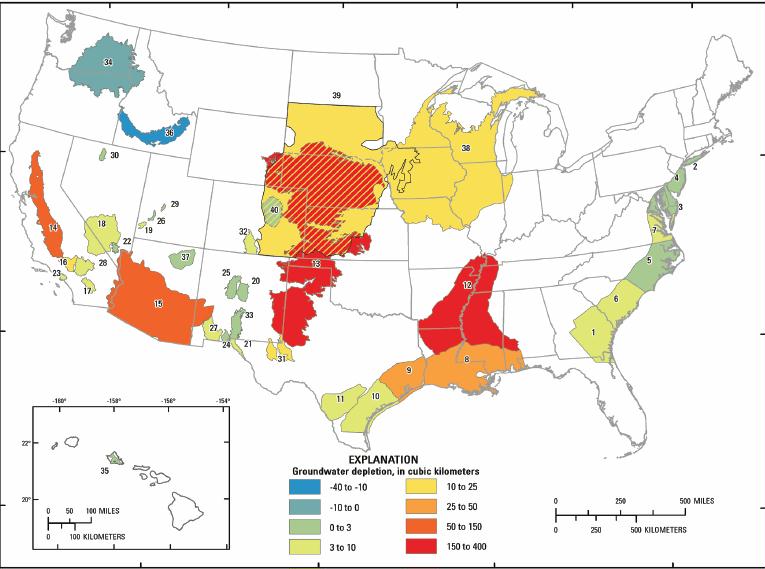


Posted in Distribution of Wealth, Financial, Politics, Poverty | Tagged , , | Comments Off on Book review of “White Trash. The 400-year untold history of class in America”

Book Review about why the electric grid is fragile and falling apart

Preface.  This is a book review of Munson’s “The Business of Power and what it means for the future of electricity”. Although it was written in 2008 and some efforts have been made in some places to improve the grid, it is still falling apart, deregulation made matters worse.

I live in California, and am witnessing another effect of the poor maintenance of the electric grid: wildfires. I had a front-row seat in 1991 when our home burned down in Oakland.  For any of you who may suffer in the future from wildfire or any disaster, I recommend you read my post about how insurance companies deny claims to prevent them from doing so: Delay, Deny, Defend: Why Insurance Companies Don’t Pay Claims and What You Can Do About It by Jay M Feinman.

Most forms of alternative energy depend on the electric grid (nuclear, wind, solar, geothermal, hydropower, wave, tidal, batteries). But the grid is falling apart because of privatization and the splitting of the grid into thousands of competing, uncoordinated entities with little economic incentive or subsidies to maintain the grid. Shareholders and executive perks are far more important in privately owned utilities than their rate payers.

Richard C Duncan proposed an “Olduvai Theory” that the current industrial civilization would have a maximum duration of 100 years from 1930 to 2030. A key indicator that the “End Was Near” would be when partial and total blackouts began to grow common.  And it is getting more common in the poorest nations of Venezuela, North Korea, Syria and others.  Much as I write about why fossil fuels are essential for civilization, so is the electric grid (which is nearly two-thirds dependent on fossil fuels in the USA) for many reasons explained in this post: “A nationwide blackout lasting 1 year could kill up to 90% Americans“.  An unreliable grid would also make producing microchips which are essential to just about every product that runs on electricity, from toasters to cars to financial systems:  “Microchip fabrication plants need electricity 24 x 7 for four months“.

Alice Friedemann  www.energyskeptic.com  Author of Life After Fossil Fuels: A Reality Check on Alternative Energy; When Trucks Stop Running: Energy and the Future of Transportation”, Barriers to Making Algal Biofuels, & “Crunch! Whole Grain Artisan Chips and Crackers”.  Women in ecology  Podcasts: WGBH, Jore, Planet: Critical, Crazy Town, Collapse Chronicles, Derrick Jensen, Practical Prepping, Kunstler 253 &278, Peak Prosperity,  Index of best energyskeptic posts

***

Munson, Richard.  2008. From Edison to Enron: The Business of Power and What It Means for the Future of Electricity 

We’ve only been able to use electricity about a century, with profound changes in lifestyle.  We stay up late, move about on streetcars and elevators, use electric motors throughout industry or at home in our washing machines, refrigerators, air conditioners, ovens, television, computers, and so on.

There are still about 2 billion people who don’t have access to electric power, and population is growing faster than electrical wires are expanding.

Electricity can’t easily be stored, and delivering it is incredibly tricky, with the grid needing to balance supply and demand every microsecond.

It’s a huge business – electric utilities have assets worth over $600 billion – the nation’s largest industry.   It’s extremely capital intensive, requiring massive amounts of investment – up to 100 times more investment per delivered unit of energy than oil systems.

The electric industry donated over $21 million dollars to politicians,  mainly for subsidies to allow old and dirty plants to keep polluting.  Utilities also court Wall Street, which sells their bonds.

You could consider the electric grid of North America to be the world’s largest machine, with wires stretching from coast to coast.

The grid is complex, fragile, and has a lot of problems:

  • 200,000 miles of high-voltage transmission lines that must balance electricity consumption second-by-second
  • Despite advanced computers, much of the electricity transmission system relies on mechanical circuit breakers and controls from the 1950s.
  • Threats to the grid include sagging power lines, trees, hurricanes, and terrorists.
  • The most frightening threat is if just one nuclear weapon were exploded at high altitude — 70% of the U.S. power grid could fail from EMPs causing cascading failures
  • The efficiency of the utility industry hasn’t increased since the late 1950s
  • 66% of the fuel burned to generate electricity is lost (i.e. 3 lumps of coal to deliver 1 lump of electricity).  As electricity travels along the lines, another 10% of energy is lost.
  • Power blackouts and surges cost Americans $119 billion per year – a 44% surcharge
  • Electric power generation is the largest pollution source, spewing mercury, sulfur dioxide, carbon dioxide, and many other pollutants into the air and water
  • Power generation plants are old, inefficient, filthy.  The average plant was built in 1964 with 1959 technology.  More than 20% of plants are more than 50 years old.
  • The electric grid is fragile.  Munson calls our grid a “rickety antique”.  Transmission lines were not built to handle the huge amounts of electricity transmitted now, which overloads them and leads to blackouts.  In 2003, it only took 3 minutes for 50 million Americans and Canadians to lose their electricity, the 4th catastrophic failure in 10 years.  2 million lost power in 1996 when the conjunction of a squirrel burning on a transformer and a power line in Idaho came in contact with a tree caused an outage.  In 1998 an ice storm cut power to parts of the United States and Canada.
  • Expansion. It’s hard to expand the grid because construction costs are high, the best corridors are not available because of urban development or go through wilderness areas, military reservations are in the way, and NIMBYism.
  • It’s polluting and filthy. After Carson’s 1962 “Silent Spring”, American activists attacked utilities for the air pollution they generated that could lead to emphysema, lung cancer, and heart disease.  Electric power was the source of more than half of the nation’s sulfur dioxide emissions.

Thomas Edison saw electricity as vastly superior for lighting than gas lamps, which flickered, emitted ammonia and sulfur, blackened glass globes and rooms, and had to be lit and snuffed one by one.

The early electrical industry was:

  • Ugly: in New York alone 20 different companies strung up their own wires on poles and buildings. The New York Times described downtown streets as “darkened by wires”. Wires remained up after business failures, sometimes fraying and causing short circuits.
  • Corrupt: bribes of aldermen to get permits, price fixing (which led Congress to pass the Sherman Antitrust Act)
  • Had no standards:  plugs were different sizes, voltages varied. If you moved, you risked your appliances no longer working.
  • Bad for horses: exposed wires and fault insulation threatened horses wearing metal shoes pulling trams about on streets.
  • Inefficient: large plants were most likely to fail and cost the most to construct. Turbine blades twisted, furnaces didn’t stay hot enough, and many other defects reduced reliability and performance.

Nuclear generated electricity – why it will never happen despite peak oil

Cost overruns on reactors nearly drove some power companies into bankruptcy.   In 1984 the Department of Energy calculated more than 75% of reactors cost at least double the estimated price.

Utility WPPSS in Washington state defaulted, scaring investors, who once thought there’d be over a thousand reactors running by 2000 with electricity too cheap to meter.  In fact, only 82 plants existed in 2000 and power prices soared 60% between 1969 and 1984 due to the cost overruns.

Nuclear executives tried to blame their problems on too much regulation and environmentalists, but regulations only came after reactors began to break down.   Intense radiation and high temperatures caused pipes, valves, tubes, fuel rods, and cooling systems to crack, corrode, bend, and malfunction.  Only then did the public create the Atomic Energy Commission (now the Nuclear Regulatory Commission) to regulate nuclear power facilities.

Munson lists quite a few problems, but you should search on “Nuclear Reactor Hazards  Ongoing Dangers of Operating Nuclear Technology in the 21st Century” to get a real good understanding of the magnitude of failures despite regulation.  Indeed, even the Wall Street Journal was forced to admit at one point that reactor troubles “tell the story of projects crippled by too little regulation, rather than too much.”

Some of this stemmed from nuclear engineers seeing uranium as just a complicated way to boil water.  But a reactor is not simple, there are over 40,000 valves, the fuel rods reach temperatures over 4,800 F, and it isn’t easy to contain the nuclear reactions.

Management was poor as well, with Forbes magazine calling the U.S. nuclear program “the largest managerial disaster in business history, a disaster on a monumental scale.”

Deregulation has been a disaster

Electricity generators make more money constructing more power plants, but not transmission and distribution due to the Public Utility Regulatory Policies Act in 1978 and the Energy Policy Act of 1992.

While power demand went up 30%, transmission capacity only grew 15%.  Suddenly there are a lot more companies moving power in unprecedented amounts, and they aren’t coordinating their efforts as well as the fewer, regulated utilities did.  There are no financial incentives to cooperate.

According to Michigan’s top utility regulator, “It would surprise a great number of Americans to know there is presently no government oversight of the reliability of this country’s electric transmission system”.

The Federal Energy Regulatory Commission would like to stop this balkanized system, but utilities have successfully fought off such regulation so far.  Munson says that this “greed, of course, only forces the rest of the nation to live with an old and uncoordinated transmission system”.

How to improve the industry

Munson spends many chapters explaining how utilities could be better regulated, encouraged to cooperate and innovate, how to discourage Enron-like behavior, and build more efficient power plants.

My own conclusions

I think it’s too late to do much about the poor state of the electric grid and how it’s operated — world oil production probably peaked in 2018, so the energy to fabricate, deliver, and maintain new infrastructure and fix existing facilities means it’s too late to add wind, solar, and so on to fill in the fossil fuel gap.

And don’t forget, this is a LIQUIDS FUEL CRISIS.  99% of transportation is oil-based.

At the same time, the financial system is in the largest bubble ever and on the brink of collapse. Where will the investment come from?  How can such delicate, fragile systems operate as social unrest grows?  How will it even be maintained let alone increased in size and stability as declining resources make growth impossible in a finite world?

Posted in Alternative Energy, Blackouts Electric Grid, Books, Electricity Infrastructure, Energy Books | Tagged , , , | 2 Comments

Book review of Hillbilly Elegy and why hillbillies voted for Trump

Source: David Horsey / Los Angeles Times

Preface. I bought “Hillbilly Elegy: A memoir of a family and culture in crisis” because I’d like to understand why anyone would vote for Donald Trump. Before the election, it was well-known that he should have been in jail several times, was a billion dollars in debt because he lied to the banks about what he’d already borrowed from other banks. He was allowed to stay in business because the banks figured that way they’d get some income from his hotels versus nothing at all.  It was well-known he was a gangster, a lousy businessman, and stiffed thousands of his employees.  Read all about it in the 2016 book “The Making of Donald Trump”.   

Many websites say this book is the best one to understand Trump voters.  But it isn’t. Instead, it is yet another memoir of growing up in a dysfunctional family and culture.  Now I do like these autobiographies, but it doesn’t begin to touch the hardships endured in “Glass Castle” or “A long way Gone: Memoirs of a Boy Soldier”.   

There are no insights about why hillbillies went from voting Democratic to becoming right-wing Republicans and evangelical Christians who’d like to replace America’s Constitution with Biblical Commandments.  For that, you’ll need to read One Nation Under God: How Corporate America Invented Christian America by Kevin Kruse (2016) or my review of this book in post How corporations used conservative religion to gain wealth and power and undo the New Deal.

Or why blacks and Hispanics, who have suffered far more from poverty and dysfunctional families vote for Democrats, not Republicans.

If you really want understand Trump voters, the best book is the highly entertaining  book by Joe Bageant “Deer Hunting with Jesus: Dispatches from America’s Class War“.

For a big picture view of how Trump voters came to exist, then the book for you is “White Trash: The 400-Year Untold History of Class in America” which  goes back to the founding of the U.S. and beyond to the Calvinist Scots-Irish immigrants who came here.  It will be a shocking book to many who haven’t read much history, because it shows why and how it came to be that Americans have never been equals, and never will be.  If you didn’t own property by 1700, chances are you never would.  Unfairness goes back to the very beginning of the United States and the immigrants from Europe.

The main reason given for voting for Trump is that their standard of living is going down, and Trump promised to change that by cleaning out the Swamp.  But why is poverty growing?  Because we’ve hit the limits to growth of energy and natural resources. Even if we hadn’t, only a certain amount of resources can be extracted per year, and the population is still growing exponentially, which means less stuff per capita, period.  So in the end both Republicans and Democrats are absolutely nuts.  They both offer the solution of “growing our way out of it”.  Obviously, on a finite planet, endless growth isn’t possible.   But the parties are different, make no mistake.  Republicans are willing to take the brakes off the runaway engine and allow rules protecting the health and wealth of the public to be removed, get rid of the New Deal which basically means stealing from the poor and middle class for the sake of the already rich.  On the other side of peak oil people will desperately wish they had leaders that rationed energy and food fairly, it will become a matter of life and death.  But if The People vote for Republicans like Trump, or worse, well…

What follows are kindle excerpts from Hillbilly Elegy.  And since they’re yanked from various parts of the book, there’s no narrative flow, but it may give you an idea of whether you like his writing enough to purchase the book.  If you like hard luck memoirs that may be enough reason.  It’s certainly a way better book than “Strangers in their own Land: Anger and Mourning on the American Right” by Arlie Russell Hochschild written by a middle-class outsider in boring, academic language that bends over backwards to be kind and understanding.

Alice Friedemann   www.energyskeptic.com  author of “When Trucks Stop Running: Energy and the Future of Transportation”, 2015, Springer and “Crunch! Whole Grain Artisan Chips and Crackers”. Podcasts: Derrick Jensen, Practical Prepping, KunstlerCast 253, KunstlerCast278, Peak Prosperity , XX2 report

***

J. D. Vance. 2016. Hillbilly Elegy: A Memoir of a Family and Culture in Crisis. Harper.

I grew up poor, in the Rust Belt, in an Ohio steel town that has been hemorrhaging jobs and hope for as long as I can remember. I have, to put it mildly, a complex relationship with my parents, one of whom has struggled with addiction for nearly my entire life. My grandparents, neither of whom graduated from high school, raised me, and few members of even my extended family attended college.

I was one of those kids with a grim future. I almost failed out of high school. I nearly gave in to the deep anger and resentment harbored by everyone around me. Today people look at me, at my job and my Ivy League credentials, and assume that I’m some sort of genius, that only a truly extraordinary person could have made it to where I am today. With all due respect to those people, I think that theory is a load of bullshit. Whatever talents I have, I almost squandered until a handful of loving people rescued me.

It was Greater Appalachia’s political reorientation from Democrat to Republican that redefined American politics after Nixon. And it is in Greater Appalachia where the fortunes of working-class whites seem dimmest. From low social mobility to poverty to divorce and drug addiction, my home is a hub of misery.

What is more surprising is that, as surveys have found, working-class whites are the most pessimistic group in America. More pessimistic than Latino immigrants, many of whom suffer unthinkable poverty. More pessimistic than black Americans, whose material prospects continue to lag behind those of whites. While reality permits some degree of cynicism, the fact that hillbillies like me are more down about the future than many other groups—some of whom are clearly more destitute than we are—suggests that something else is going on.

Indeed it is. We’re more socially isolated than ever, and we pass that isolation down to our children. Our religion has changed—built around churches heavy on emotional rhetoric but light on the kind of social support necessary to enable poor kids to do well. Many of us have dropped out of the labor force or have chosen not to relocate for better opportunities.

When I mention the plight of my community, I am often met with an explanation that goes something like this: “Of course the prospects for working-class whites have worsened, J.D., but you’re putting the chicken before the egg. They’re divorcing more, marrying less, and experiencing less happiness because their economic opportunities have declined. If they only had better access to jobs, other parts of their lives would improve as well.” I once held this opinion myself, and I very desperately wanted to believe it during my youth. It makes sense. Not having a job is stressful, and not having enough money to live on is even more so. As the manufacturing center of the industrial Midwest has hollowed out, the white working class has lost both its economic security and the stable home and family life that comes with it.

The problems that I saw at the tile warehouse run far deeper than macroeconomic trends and policy. Too many young men immune to hard work. Good jobs impossible to fill for any length of time.

There is a lack of agency here—a feeling that you have little control over your life and a willingness to blame everyone but yourself. This is distinct from the larger economic landscape of modern America.

Jackson is a small town of about 6,000in the heart of southeastern Kentucky’s coal country. Calling it a town is a bit charitable: There’s a courthouse, a few restaurants—almost all of them fast-food chains—and a few other shops and stores. Most of the people live in the mountains surrounding Kentucky Highway 15, in trailer parks, in government-subsidized housing, in small farmhouses, and in mountain homesteads like the one that served as the backdrop for the fondest memories of my childhood.

I was obsessed with the Blanton men. I would sit among them and beg them to tell and retell their stories. These men were the gatekeepers to the family’s oral tradition, and I was their best student. Most of this tradition was far from child appropriate. Almost all of it involved the kind of violence that should land someone in jail. Much of it centered on how the county in which Jackson was situated—Breathitt—earned its alliterative nickname, “Bloody Breathitt.” There were many explanations, but they all had one theme: The people of Breathitt hated certain things, and they didn’t need the law to snuff them out. One of the most common tales of Breathitt’s gore revolved around an older man in town who was accused of raping a young girl. Mamaw told me that, days before his trial, the man was found face down in a local lake with sixteen bullet wounds in his back. The authorities never investigated the murder, and the only mention of the incident appeared in the local newspaper on the morning his body was discovered. In an admirable display of journalistic pith, the paper reported: “Man found dead. Foul play expected.” “Foul play expected?” my grandmother would roar. “You’re goddamned right. Bloody Breathitt got to that son of a bitch.” Or there was that day when Uncle Teaberry overheard a young man state a desire to “eat her panties,” a reference to his sister’s (my Mamaw’s) undergarments. Uncle Teaberry drove home, retrieved a pair of Mamaw’s underwear, and forced the young man—at knifepoint—to consume the clothing.

Uncle Pet was a tall man with a biting wit and a raunchy sense of humor. The most economically successful of the Blanton crew, Uncle Pet left home early and started some timber and construction businesses that made him enough money to race horses in his spare time. He seemed the nicest of the Blanton men, with the smooth charm of a successful businessman. But that charm masked a fierce temper. Once, when a truck driver delivered supplies to one of Uncle Pet’s businesses, he told my old hillbilly uncle, “Off-load this now, you son of a bitch.” Uncle Pet took the comment literally: “When you say that, you’re calling my dear old mother a bitch, so I’d kindly ask you speak more carefully.” When the driver—nicknamed Big Red because of his size and hair color—repeated the insult, Uncle Pet did what any rational business owner would do: He pulled the man from his truck, beat him unconscious, and ran an electric saw up and down his body. Big Red nearly bled to death but was rushed to the hospital and survived. Uncle Pet never went to jail, though. Apparently, Big Red was also an Appalachian man, and he refused to speak to the police about the incident or press charges.  He knew what it meant to insult a man’s mother.

Some people may conclude that I come from a clan of lunatics. But the stories made me feel like hillbilly royalty, because these were classic good-versus-evil stories, and my people were on the right side. My people were extreme, but extreme in the service of something—defending a sister’s honor or ensuring that a criminal paid for his crimes. The Blanton men, like the tomboy Blanton sister whom I called Mamaw, were enforcers of hillbilly justice, and to me, that was the very best kind.

On a recent trip to Jackson, I made sure to stop at Mamaw Blanton’s old house, now inhabited by my second cousin Rick and his family. We talked about how things had changed. “Drugs have come in,” Rick told me. “And nobody’s interested in holding down a job.” I hoped my beloved holler had escaped the worst, so I asked Rick’s boys to take me on a walk. All around I saw the worst signs of Appalachian poverty. Some of it was as heartbreaking as it was cliché: decrepit shacks rotting away, stray dogs begging for food, and old furniture strewn on the lawns. Some of it was far more troubling. While passing a small two-bedroom house, I noticed a frightened set of eyes looking at me from behind the curtains of a bedroom window. My curiosity piqued, I looked closer and counted no fewer than eight pairs of eyes, all looking at me from three windows with an unsettling combination of fear and longing. On the front porch was a thin man, no older than 35, apparently the head of the household. Several ferocious, malnourished, chained-up dogs protected the furniture strewn about the barren front yard. When I asked Rick’s son what the young father did for a living, he told me the man had no job and was proud of it. But, he added, “they’re mean, so we just try to avoid them.

That house might be extreme, but it represents much about the lives of hill people in Jackson. Nearly a third of the town lives in poverty, a figure that includes about half of Jackson’s children. And that doesn’t count the large majority of Jacksonians who hover around the poverty line. An epidemic of prescription drug addiction has taken root. The public schools are so bad that the state of Kentucky recently seized control. Nevertheless, parents send their children to these schools because they have little extra money, and the high school fails to send its students to college with alarming consistency. The people are physically unhealthy, and without government assistance they lack treatment for the most basic problems.

The truth is hard, and the hardest truths for hill people are the ones they must tell about themselves. Jackson is undoubtedly full of the nicest people in the world; it is also full of drug addicts and at least one man who can find the time to make eight children but can’t find the time to support them. It is unquestionably beautiful, but its beauty is obscured by the environmental waste and loose trash that scatters the countryside. Its people are hardworking, except of course for the many food stamp recipients who show little interest in honest work. Jackson, like the Blanton men, is full of contradictions.

After my cousin Mike buried his mother, his thoughts turned immediately to selling her house. “I can’t live here, and I can’t leave it untended,” he said. “The drug addicts will ransack it.” Jackson has always been poor, but it was never a place where a man feared leaving his mother’s home alone. The place I call home has taken a worrisome turn.

Jackson’s plight has gone mainstream. Thanks to the massive migration from the poorer regions of Appalachia to places like Ohio, Michigan, Indiana, Pennsylvania, and Illinois, hillbilly values spread widely along with hillbilly people.

As the economies of Kentucky and West Virginia lagged behind those of their neighbors, the mountains had only two products that the industrial economies of the North needed: coal and hill people. And Appalachia exported a lot of both.

It is certain that many millions of people traveled along the “hillbilly highway”—a metaphorical term that captured the opinion of Northerners who saw their cities and towns flooded with people like my grandparents. The scale of the migration was staggering. In the 1950s, 13 of every 100 Kentucky residents migrated out of the state. Some areas saw even greater emigration: Harlan County, for example, which was brought to fame in an Academy Award–winning documentary about coal strikes, lost 30% of its population to migration. In 1960, of Ohio’s ten million residents, one million were born in Kentucky, West Virginia, or Tennessee. This doesn’t count the large number of migrants from elsewhere in the southern Appalachian Mountains; nor does it include the children or grandchildren of migrants who were hill people to the core. There were undoubtedly many of these children and grandchildren, as hillbillies tended to have much higher birthrates than the native population.

To Papaw and Mamaw, not all rich people were bad, but all bad people were rich. Papaw was a Democrat because that party protected the working people. This attitude carried over to Mamaw: All politicians might be crooks, but if there were any exceptions, they were undoubtedly members of Franklin Delano Roosevelt’s New Deal coalition.

Still, Mamaw and Papaw believed that hard work mattered more. They knew that life was a struggle, and though the odds were a bit longer for people like them, that fact didn’t excuse failure. “Never be like these fucking losers who think the deck is stacked against them,” my grandma often told me. “You can do anything you want to.

Their community shared this faith, and in the 1950s that faith appeared well founded. Within two generations, the transplanted hillbillies had largely caught up to the native population in terms of income and poverty level. Yet their financial success masked their cultural unease, and if my grandparents caught up economically, I wonder if they ever truly assimilated. They always had one foot in the new life and one foot in the old one. They slowly acquired a small number of friends but remained strongly rooted in their Kentucky homeland. They hated domesticated animals and had little use for “critters” that weren’t for eating,

Hillbilly culture at the time (and maybe now) blended a robust sense of honor, devotion to family, and bizarre sexism into a sometimes explosive mix. Before Mamaw was married, her brothers had been willing to murder boys who disrespected their sister. Now that she was married to a man whom many of them considered more a brother than an outsider, they tolerated behavior that would have gotten Papaw killed in the holler. “Mom’s brothers would come up and want to go carousing with Dad,” Uncle Jimmy explained. “They’d go drinking and chasing women. Uncle Pet was always the leader. I didn’t want to hear about it, but I always did. It was that culture from back then that expected the men were going to go out and do what they wanted to do.

I couldn’t believe that mild-mannered Papaw, whom I adored as a child, was such a violent drunk. His behavior was due at least partly to Mamaw’s disposition. She was a violent nondrunk. And she channeled her frustrations into the most productive activity imaginable: covert war. When Papaw passed out on the couch, she’d cut his pants with scissors so they’d burst at the seam when he next sat down. Or she’d steal his wallet and hide it in the oven just to piss him off. When he came home from work and demanded fresh dinner, she’d carefully prepare a plate of fresh garbage. If he was in a fighting mood, she’d fight back. In short, she devoted herself to making his drunken life a living hell.

Mamaw told Papaw after a particularly violent night of drinking that if he ever came home drunk again, she’d kill him. A week later, he came home drunk again and fell asleep on the couch. Mamaw, never one to tell a lie, calmly retrieved a gasoline canister from the garage, poured it all over her husband, lit a match, and dropped it on his chest. When Papaw burst into flames, their eleven-year-old daughter jumped into action to put out the fire and save his life. Miraculously, Papaw survived the episode with only mild burns.

During her sophomore year of high school, Lori’s boyfriend stole some PCP, and the two of them returned to Mamaw’s to indulge. “He told me that he should do more, since he was bigger. That was the last thing I remembered.” Lori woke up when Mamaw and her friend Kathy placed Lori in a cold bathtub. Her boyfriend, meanwhile, wasn’t responding. Kathy couldn’t tell if the young man was breathing. Mamaw ordered her to drag him to the park across the street. “I don’t want him to die in my fucking house,” she said. Instead she called someone to take him to the hospital, where he spent five days in intensive care. The next year, at sixteen, Lori dropped out of high school and married. She immediately found herself trapped in an abusive home just like the one she’d tried to escape. Her new husband would lock her in a bedroom to keep her from seeing her family. “It was almost like a prison,” Aunt Wee later told me.

Bev (my mom) didn’t fare so well. Like her siblings, she left home early. She was a promising student, but when she got pregnant at eighteen, she decided college had to wait. After high school, she married her boyfriend and tried to settle down. But settling down wasn’t quite her thing: She had learned the lessons of her childhood all too well. When her new life developed the same fighting and drama so present in her old one, Mom filed for divorce and began life as a single mother. She was nineteen, with no degree, no husband, and a little girl—my sister, Lindsay.

Today downtown Middletown is little more than a relic of American industrial glory. Abandoned shops with broken windows line the heart of downtown, where Central Avenue and Main Street meet. Richie’s pawnshop has long since closed,

If you need a payday lender or a cash-for-gold store, downtown Middletown is the place to be.  A street that was once the pride of Middletown today serves as a meeting spot for druggies and dealers. Main Street is now the place you avoid after dark.

This change is a symptom of a new economic reality: rising residential segregation. The number of working-class whites in high-poverty neighborhoods is growing. In 1970, 25% of white children lived in a neighborhood with poverty rates above 10%. In 2000, that number was 40%. It’s even higher today.

In other words, bad neighborhoods no longer plague only urban ghettos; the bad neighborhoods have spread to the suburbs This has occurred for complicated reasons. Federal housing policy has actively encouraged homeownership, from Jimmy Carter’s Community Reinvestment Act to George W. Bush’s ownership society. But in the Middletowns of the world, homeownership comes at a steep social cost: As jobs disappear in a given area, declining home values trap people in certain neighborhoods. Even if you’d like to move, you can’t, because the bottom has fallen out of the market—you now owe more than any buyer is willing to pay. The costs of moving are so high that many people stay put. Of course, the people trapped are usually those with the least money; those who can afford to leave do so.

People didn’t leave because our downtown lacked trendy cultural amenities. The trendy cultural amenities left because there weren’t enough consumers in Middletown to support them. And why weren’t there enough well-paying consumers? Because there weren’t enough jobs to employ those consumers.

Growing up, my friends and I had no clue that the world had changed. Papaw had retired only a few years earlier, owned stock in Armco, and had a lucrative pension. Armco Park remained the nicest, most exclusive recreation spot in town, and access to the private park was a status symbol: It meant that your dad (or grandpa) was a man with a respected job. It never occurred to me that Armco wouldn’t be around forever, funding scholarships, building parks, and throwing free concerts. Still, few of my friends had ambitions to work there. As small children, we had the same dreams that other kids did; we wanted to be astronauts or football players or action heroes. I wanted to be a professional puppy-player-wither, which at the time seemed eminently reasonable. By the sixth grade, we wanted to be veterinarians or doctors or preachers or businessmen. But not steelworkers. Even at Roosevelt Elementary—where, thanks to Middletown geography, most people’s parents lacked a college education—no one wanted to have a blue-collar career and its promise of a respectable middle-class life. We never considered that we’d be lucky to land a job at Armco; we took Armco for granted. Many kids seem to feel that way today. A few years ago I spoke with Jennifer McGuffey, a Middletown High School teacher who works with at-risk youth. “A lot of students just don’t understand what’s out there,” she told me, shaking her head. “You have the kids who plan on being baseball players but don’t even play on the high school team because the coach is mean to them. Then you have those who aren’t doing very well in school,

There was no sense that failing to achieve higher education would bring shame or any other consequences. The message wasn’t explicit; teachers didn’t tell us that we were too stupid or poor to make it. Nevertheless, it was all around us, like the air we breathed: No one in our families had gone to college; older friends and siblings were perfectly content to stay in Middletown, regardless of their career prospects; we knew no one at a prestigious out-of-state school; and everyone knew at least one young adult who was underemployed or didn’t have a job at all. In Middletown, 20 percent of the public high school’s entering freshmen won’t make it to graduation. Most won’t graduate from college. Virtually no one will go to college out of state.

Students don’t expect much from themselves, because the people around them don’t do very much. Many parents go along with this phenomenon. I don’t remember ever being scolded for getting a bad grade

People talk about hard work all the time in places like Middletown. You can walk through a town where 30% of the young men work fewer than 20 hours a week and find not a single person aware of his own laziness.

Of course, the reasons poor people aren’t working as much as others are complicated, and it’s too easy to blame the problem on laziness. For many, part-time work is all they have access to, because the Armcos of the world are going out of business and their skill sets don’t fit well in the modern economy.

Alongside these conflicting norms about the value of blue-collar work existed a massive ignorance about how to achieve white-collar work. We didn’t know that all across the country—and even in our hometown—other kids had already started a competition to get ahead in life.

Mom and Bob’s problems were my first introduction to marital conflict resolution. Here were the takeaways: Never speak at a reasonable volume when screaming will do; if the fight gets a little too intense, it’s okay to slap and punch, so long as the man doesn’t hit first; always express your feelings in a way that’s insulting and hurtful to your partner; if all else fails, take the kids and the dog to a local motel, and don’t tell your spouse where to find you—if he or she knows where the children are, he or she won’t worry as much, and your departure won’t be as effective. I began to do poorly in school. Many nights I’d lie in bed, unable to sleep because of the noise—the furniture rocking, heavy stomping, yelling, sometimes glass shattering. The next morning I’d wake up tired and depressed, meandering through the school day, thinking constantly about what awaited at home. I just wanted to retreat to a place where I could sit in silence. I couldn’t tell anyone what was going on, as that was far too embarrassing. And though I hated school, I hated home more. When the teacher announced that we had only a few minutes to clear our desks before the bell rang, my heart sank. I’d stare at the clock as if it were a ticking bomb. Not even Mamaw understood how terrible things had become. My slipping grades were the first indication.

Even when the house was ostensibly peaceful, our lives were so charged that I was constantly on guard. Mom and Bob never smiled at each other or said nice things to Lindsay and me anymore. You never knew when the wrong word would turn a quiet dinner into a terrible fight, or when a minor childhood transgression would send a plate or book flying across the room. It was like we were living among land mines—one wrong step, and kaboom.

Seeing people insult, scream, and sometimes physically fight was just a part of our life. After a while, you didn’t even notice it. I always thought it was how adults spoke to one another.

Over time, I started to like the drama. Instead of hiding from it, I’d run downstairs or put my ear to the wall to get a better listen. My heart would still race, but in an anticipatory way, like it did when I was about to score in a basketball game. Even the fight that went too far—when I thought Bob was about to hit me—was less about a brave kid who intervened and more about a spectator who got a little too close to the action. This thing that I hated had become a sort of drug.

One day I came home from school to see Mamaw’s car in the driveway. It was an ominous sign, as she never made unannounced visits to our Preble County home. She made an exception on this day because Mom was in the hospital, the result of a failed suicide attempt. For all the things I saw happening in the world around me, my eleven-year-old eyes missed so much. In her work at Middletown Hospital, Mom had met and fallen in love with a local fireman and begun a years-long affair. That morning Bob had confronted her about the affair and demanded a divorce. Mom had sped off in her brand-new minivan and intentionally crashed it into a telephone pole. That’s what she said, at least. Mamaw had her own theory: that Mom had tried to detract attention from her cheating and financial problems. As Mamaw said, “Who tries to kill themselves by crashing a fucking car? If she wanted to kill herself, I’ve got plenty of guns.

Within a month, we moved back to Middletown, and Mom’s behavior grew increasingly erratic. She was more roommate than parent. She had new friends, most of them younger and without kids. And she cycled through boyfriends, switching partners every few months.  Though Mom had been many things, she hadn’t been a partier. When we moved back to Middletown, that changed. With partying came alcohol, and with alcohol came alcohol abuse and even more bizarre behavior.

Mom [rarely apologized, but one time] was extra-apologetic because her sin was extra-bad. So her penance was extra-good: She promised to take me to the mall and buy me football cards. Football cards were my kryptonite, so I agreed to join her. It was probably the biggest mistake of my life. We got on the highway, and I said something that ignited her temper. So she sped up to what seemed like a hundred miles per hour and told me that she was going to crash the car and kill us both. I jumped into the backseat, thinking that if I could use two seat belts at once, I’d be more likely to survive the impact. This infuriated her more, so she pulled over to beat the shit out of me. I leaped out of the car and ran for my life. We were in a rural part of the state, and I ran through a large field of grass, the tall blades slapping my ankles as I sped away. I happened upon a small house where Mom found me, broke down the woman’s door and dragged me out. The woman had dialed 911. So as Mom dragged me to her car, two police cruisers pulled up, and the cops who got out put Mom in handcuffs. She did not go quietly; they wrestled her into the back of a cruiser. Then she was gone.

Religious institutions remain a positive force in people’s lives, but in a part of the country slammed by the decline of manufacturing, joblessness, addiction, and broken homes, church attendance has fallen off. Dad’s church offered something desperately needed by people like me. For alcoholics, it gave them a community of support and a sense that they weren’t fighting addiction alone. For expectant mothers, it offered a free home with job training and parenting classes. When someone needed a job, church friends could either provide one or make introductions. When Dad faced financial troubles, his church banded together and purchased a used car for the family. In the broken world I saw around me—and for the people struggling in that world—religion offered tangible assistance to keep the faithful on track.

I was a curious kid, and the deeper I immersed myself in evangelical theology, the more I felt compelled to mistrust many sectors of society. Evolution and the Big Bang became ideologies to confront, not theories to understand. Many of the sermons I heard spent as much time criticizing other Christians as anything else. Theological battle lines were drawn, and those on the other side weren’t just wrong about biblical interpretation, they were somehow unchristian.

I admired my uncle Dan above all other men, but when he spoke of his Catholic acceptance of evolutionary theory, my admiration became tinged with suspicion. My new faith had put me on the lookout for heretics. Good friends who interpreted parts of the Bible differently were bad influences.

As a young teenager thinking seriously for the first time about what I believed and why I believed it, I had an acute sense that the walls were closing in on “real” Christians. There was talk about the “war on Christmas”—which, as far as I could tell, consisted mainly of ACLU activists suing small towns for nativity displays. I read a book called Persecution by David Limbaugh about the various ways that Christians were discriminated against. The Internet was abuzz with talk of New York art displays that featured images of Christ or the Virgin Mary covered in feces. For the first time in my life, I felt like a persecuted minority.

In my new church, on the other hand, I heard more about the gay lobby and the war on Christmas than about any particular character trait that a Christian should aspire to have.

Morality was defined by not participating in this or that particular social malady: the gay agenda, evolutionary theory, Clintonian liberalism, or extramarital sex. Dad’s church required so little of me. It was easy to be a Christian. The only affirmative teachings I remember drawing from church were that I shouldn’t cheat on my wife and that I shouldn’t be afraid to preach the gospel to others.

The world lurched toward moral corruption—slouching toward Gomorrah. The Rapture was coming, we thought. Apocalyptic imagery filled the weekly sermons and the Left Behind books (one of the best-selling fiction series of all time, which I devoured). Folks would discuss whether the Antichrist was already alive and, if so, which world leader it might be.

I remember watching an episode of The West Wing about education in America, which the majority of people rightfully believe is the key to opportunity. In it, the fictional president debates whether he should push school vouchers (giving public money to schoolchildren so that they escape failing public schools) or instead focus exclusively on fixing those same failing schools. That debate is important, of course—for a long time, much of my failing school district qualified for vouchers—but it was striking that in an entire discussion about why poor kids struggled in school, the emphasis rested entirely on public institutions. As a teacher at my old high school told me recently, “They want us to be shepherds to these kids. But no one wants to talk about the fact that many of them are raised by wolves.

I don’t know what happened the day after Mom and I escaped Ken’s to Mamaw’s for the night. Maybe I had a test that I wasn’t able to study for. Maybe I had a homework assignment due that I never had the time to complete. What I do know is that I was a sophomore in high school, and I was miserable. The constant moving and fighting, the seemingly endless carousel of new people I had to meet, learn to love, and then forget—this, and not my subpar public school, was the real barrier to opportunity.

Those three years with Mamaw—uninterrupted and alone—saved me. I didn’t notice the causality of the change, how living with her turned my life around. I didn’t notice that my grades began to improve immediately after I moved in. And I couldn’t have known that I was making lifelong friends. During that time, Mamaw and I started to talk about the problems in our community. Mamaw encouraged me to get a job—she told me that it would be good for me and that I needed to learn the value of a dollar. When her encouragement fell on deaf ears, she then demanded that I get a job, and so I did, as a cashier at Dillman’s, a local grocery store. Working as a cashier turned me into an amateur sociologist.

Some folks purchased a lot of canned and frozen food, while others consistently arrived at the checkout counter with carts piled high with fresh produce. The more harried a customer, the more they purchased precooked or frozen food, the more likely they were to be poor.

As my job taught me a little more about America’s class divide, it also imbued me with a bit of resentment, directed toward both the wealthy and my own kind.

I also learned how people gamed the welfare system. They’d buy two dozen-packs of soda with food stamps and then sell them at a discount for cash. They’d ring up their orders separately, buying food with food stamps, and beer, wine, and cigarettes with cash. They’d regularly go through the checkout line speaking on their cell phones. I could never understand why our lives felt like a struggle while those living off of government largesse enjoyed trinkets that I only dreamed about.

Mamaw listened intently to my experiences at Dillman’s. We began to view much of our fellow working class with mistrust. Most of us were struggling to get by, but we made do, worked hard, and hoped for a better life. But a large minority was content to live off the dole. Every two weeks, I’d get a small paycheck and notice the line where federal and state income taxes were deducted from my wages. At least as often, our drug-addict neighbor would buy T-bone steaks, which I was too poor to buy for myself but was forced by Uncle Sam to buy for someone else. This was my mind-set when I was seventeen, and though I’m far less angry today than I was then, it was my first indication that the policies of Mamaw’s “party of the working man”—the Democrats—weren’t all they were cracked up to be.

Political scientists have spent millions of words trying to explain how Appalachia and the South went from staunchly Democratic to staunchly Republican in less than a generation. Some blame race relations and the Democratic Party’s embrace of the civil rights movement. Others cite religious faith and the hold that social conservatism has on evangelicals in that region. A big part of the explanation lies in the fact that many in the white working class saw precisely what I did, working at Dillman’s. As far back as the 1970s, the white working class began to turn to Richard Nixon because of a perception that, as one man put it, government was “payin’ people who are on welfare today doin’ nothin’! They’re laughin’ at our society! And we’re all hardworkin’ people and we’re gettin’ laughed at for workin’ every day!

At around that time, our neighbor—one of Mamaw and Papaw’s oldest friends—registered the house next to ours for Section 8. Section 8 is a government program that offers low-income residents a voucher to rent housing. Mamaw’s friend had little luck renting his property, but when he qualified his house for the Section 8 voucher, he virtually assured that would change. Mamaw saw it as a betrayal, ensuring that “bad” people would move into the neighborhood and drive down property values.

Despite our efforts to draw bright lines between the working and nonworking poor, Mamaw and I recognized that we shared a lot in common with those whom we thought gave our people a bad name. Those Section 8 recipients looked a lot like us. The matriarch of the first family to move in next door was born in Kentucky but moved north at a young age as her parents sought a better life. She’d gotten involved with a couple of men, each of whom had left her with a child but no support. She was nice, and so were her kids. But the drugs and the late-night fighting revealed troubles that too many hillbilly transplants knew too well. Confronted with such a realization of her own family’s struggle, Mamaw grew frustrated and angry.

From that anger sprang Bonnie Vance the social policy expert: “She’s a lazy whore, but she wouldn’t be if she was forced to get a job”; “I hate those fuckers for giving these people the money to move into our neighborhood.

She’d rant against the people we’d see in the grocery store: “I can’t understand why people who’ve worked all their lives scrape by while these deadbeats buy liquor and cell phone coverage with our tax money.

These were bizarre views for my bleeding-heart grandma. And if she blasted the government for doing too much one day, she’d blast it for doing too little the next. The government, after all, was just helping poor people find a place to live, and my grandma loved the idea of anyone helping the poor. She had no philosophical objection to Section 8 vouchers. So the Democrat in her would resurface. She’d rant about the lack of jobs and wonder aloud whether that was why our neighbor couldn’t find a good man. In her more compassionate moments, Mamaw asked if it made any sense that our society could afford aircraft carriers but not drug treatment facilities—like Mom’s—for everyone. Sometimes she’d criticize the faceless rich, whom she saw as far too unwilling to carry their fair share of the social burden. Mamaw saw every ballot failure of the local school improvement tax (and there were many) as an indictment of our society’s failure to provide a quality education to kids like me.

Mamaw’s sentiments occupied wildly different parts of the political spectrum. Depending on her mood, Mamaw was a radical conservative or a European-style social Democrat. Because of this, I initially assumed that Mamaw was an unreformed simpleton and that as soon as she opened her mouth about policy or politics, I might as well close my ears. Yet I quickly realized that in Mamaw’s contradictions lay great wisdom. I had spent so long just surviving my world, but now that I had a little space to observe it, I began to see the world as Mamaw did. I was scared, confused, angry, and heartbroken. I’d blame large businesses for closing up shop and moving overseas, and then I’d wonder if I might have done the same thing. I’d curse our government for not helping enough, and then I’d wonder if, in its attempts to help, it actually made the problem worse.

Mamaw could spew venom like a Marine Corps drill instructor, but what she saw in our community didn’t just piss her off. It broke her heart. Behind the drugs, and the fighting matches, and the financial struggles, these were people with serious problems, and they were hurting. Our neighbors had a kind of desperate sadness in their lives. You’d see it in how the mother would grin but never really smile, or in the jokes that the teenage girl told about her mother “smacking the shit out of her.” I knew what awkward humor like this was meant to conceal because I’d used it in the past. Grin and bear it, says the adage. If anyone appreciated this, Mamaw did.

The problems of our community hit close to home. Mom’s struggles weren’t some isolated incident. They were replicated, replayed, and relived by many of the people who, like us, had moved hundreds of miles in search of a better life. There was no end in sight. Mamaw had thought she escaped the poverty of the hills, but the poverty—emotional, if not financial—had followed her. Something had made her later years eerily similar to her earliest ones. What was happening? What were our neighbor’s teenage daughter’s prospects? Certainly the odds were against her, with a home life like that.

I was unable to answer these questions in a way that didn’t implicate something deep within the place I called home. What I knew is that other people didn’t live like we did. When I visited Uncle Jimmy, I did not wake to the screams of neighbors. In Aunt Wee and Dan’s neighborhood, homes were beautiful and lawns well-manicured, and police came around to smile and wave but never to load someone’s mom or dad in the back of their cruiser.

So I wondered what was different about us—not just me and my family but our neighborhood and our town and everyone from Jackson to Middletown and beyond. When Mom was arrested a couple of years earlier, the neighborhood’s porches and front yards filled with spectators; there’s no embarrassment like waving to the neighbors right after the cops have carted your mother off.

As millions migrated north to factory jobs, the communities that sprouted up around those factories were vibrant but fragile: When the factories shut their doors, the people left behind were trapped in towns and cities that could no longer support such large populations with high-quality work. Those who could—generally the well-educated, wealthy, or well connected—left, leaving behind communities of poor people. These remaining folks were the “truly disadvantaged”—unable to find good jobs on their own and surrounded by communities that offered little in the way of connections or social support.

Wilson’s book spoke to me. I wanted to write him a letter and tell him that he had described my home perfectly. That it resonated so personally is odd, however, because he wasn’t writing about the hillbilly transplants from Appalachia—he was writing about black people in the inner cities. The same was true of Charles Murray’s seminal Losing Ground, another book about black folks that could have been written about hillbillies—which addressed the way our government encouraged social decay through the welfare state.


Posted in (Auto)biography, Human Nature, Politics | Tagged , , , | 1 Comment

The dangers of relativism, of not being able to criticize anyone or anything because all of our beliefs are equal

[ I’ve been criticized for attacking right-wing Republicans, fundamentalist Christians, astrology, medicinal quackery, and so on.  This is dangerous nonsense. It means I can’t criticize Hitler, because after all, he was a product of his times.  I can’t tell my friends who smoke or shoot up heroin to stop because they are killing themselves and ruining the lives of those who love them. I can’t criticize herbal supplements that have never been tested for efficacy or potential harms.  Or be upset that Republicans  and fundamentalist Christians want to dismantle the social safety net and replace it with corporate welfare and the Constitution with Biblical Law and end the separation of church and state.  Or object to fundamentalists who want to take my right to control my own body and fate by denying me birth control and abortion.

The whole idea of being nicey-nice and not hurting anyone’s feelings has gotten us into a huge irrational mess. Relativism is the same thing as the darkness of superstition and ultimately leads to facism, demagogues, oppression of women, extremely unfair distribution of wealth — there are consequences to relativism. Because after all, you can’t fight against racists and fascists, you might hurt their feelings.

Relativism means that science is no more correct than astrology. Really? Science measures, tests, improves our understanding of how the universe works, it is a method that constantly modifies what we know, not a fixed religion where every word written 3,000 years ago is true.  If the findings of science contradict what an astrologer or evangelical would prefer to believe, the answer is not to attack science, but to become scientifically literate.  Which is of course, very unlikely, but Michael Shermer, founder of Skeptic magazine and author of many books on morality and critical thinking, made the journey from fundamentalist beliefs to science, and has since then dedicated his life to trying to get others to see the light. Carl Sagan called science a “candle in the dark”.  Relativism seeks to snuff the candle out.

How can understanding how the universe works not be better than the constant terror of a vengeful irrational God, or random stars chosen to depict Virgo by a few Greeks thousands of years ago that are capable of sending malice and changing the fates and personalities of 1 in 12 people?

If you still don’t think so, read my recent book reviews of the fabulous book “Fantasyland” which I broke down into 9 posts, with many more dangers of relativism.

Alice Friedemann   www.energyskeptic.com  author of “When Trucks Stop Running: Energy and the Future of Transportation”, 2015, Springer and “Crunch! Whole Grain Artisan Chips and Crackers”. Podcasts: Derrick Jensen, Practical Prepping, KunstlerCast 253, KunstlerCast278, Peak Prosperity , XX2 report ]

Brittanica.com (shortened and paraphrased):

If ethical relativism is correct, it would mean that even the most outrageous practices, such as slavery and the physical abuse of women, are “right” if they are permitted by a society. Relativism therefore deprives us of any means of raising moral objections against horrendous social customs as long as those customs are approved by the societies in which they exist.

But shouldn’t we be tolerant of other cultures?

Critics reply that it depends on what sort of social differences are at issue. Tolerance may seem like a good policy where benign differences between cultures are concerned, but it does not seem so when, for example, a society engages in officially approved genocide, even within its own borders. It is a mistake to think that relativism implies that we should be tolerant, because tolerance is simply another value about which people or societies may disagree. Only an absolutist could say that tolerance is objectively good.

Moreover, we sometimes want to criticize our own society’s values, and ethical relativism deprives us of the means of doing so.

If ethical relativism is correct, we could not make sense of reforming or improving our own society’s morals, for there would be no standard against which our society’s existing practices could be judged deficient. Abandoning slavery, for example, would not be moral progress; it would only be replacing one set of standards with another.

Critics also point out that disagreement about ethics does not mean that there can be no objective truth. After all, people disagree even about scientific matters. Some people believe that disease is caused by evil spirits, while others believe it is caused by microbes, but we do not therefore conclude that disease has no “real” cause. The same might be true of ethics—disagreement might only mean that some people are more enlightened than others.

Posted in Critical Thinking, Human Nature, Politics, Religion | Tagged , | 5 Comments