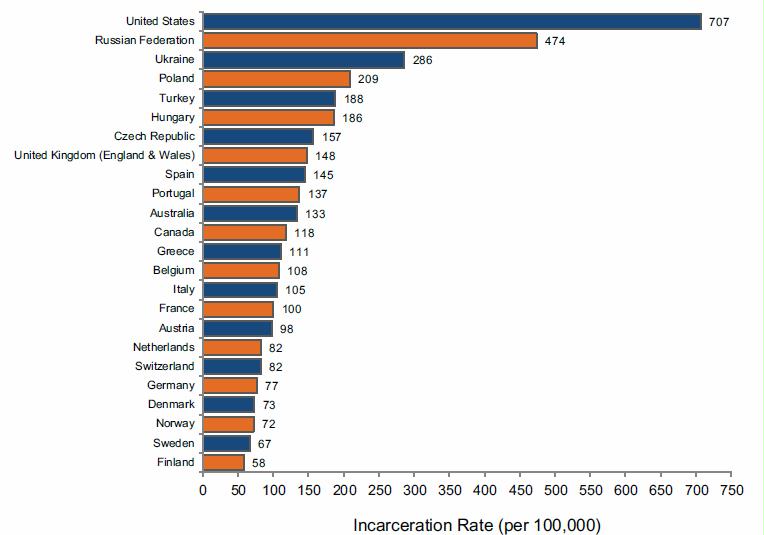
 Preface. This National Research Council 465-page report may be the most comprehensive study of the U.S. prison system there is. It will make you cry. I’ve excerpted about one-sixth of it below. It is shocking that the “U.S. penal population of 2.2 million adults is the largest in the world. In 2012, close to 25% of the world’s prisoners were held in American prisons, although the United States accounts for about 5% of the world’s population. The U.S. rate of incarceration, with nearly 1 of every 100 adults in prison or jail, is 5 to 10 times higher than rates in Western Europe and other democracies. The growth in incarceration rates in the United States over the past 40 years is historically unprecedented and internationally unique.”
Here are a few of the political consequences of incarceration that have affected all of us:
Manza and Uggen (2006, p. 192) estimate that if Florida had not banned an estimated 800,000 former felons from voting in the 2000 election, Al Gore would likely have carried the state and won the White House, and also contend that the Democratic Party would likely have controlled the U.S. Senate for much of the 1990s, as well as several additional governorships, had former felons been permitted to vote.
After the Civil War, public officials carefully tailored their felon disenfranchisement laws so as to circumvent the Fifteenth Amendment and thus restrict the vote of newly freed blacks. The U.S. Supreme Court has generally upheld such laws, except in instances of clear and convincing evidence that they were enacted with a racially discriminatory intent.
As of 2010, nearly 6 million people were disenfranchised because of a felony conviction —a 5-fold increase since 1976. This figure represents about 2.5% of the total U. S. voting-age population, or 1 in 40 adults. One of every 13 African Americans of voting age, or approximately 7.7%, is disenfranchised. This rate is about three times greater than the disenfranchisement rate for non-African Americans
The distribution of disenfranchised felons varies greatly by state, race, and ethnicity because of variations in state disenfranchisement statutes and state incarceration rates. In the three states with the highest rates of African American disenfranchisement—Florida, Kentucky, and Virginia—more than one in five African Americans is disenfranchised. In Arizona and Florida, an estimated 9 to 10% of voting-age Latino citizens are disenfranchised because of their criminal record.
The evidence of political inequities in redistricting due to the way the U.S. Census Bureau counts prisoners is “compelling” according to a report of the National Research Council. If prisoners in Texas were enumerated in their home county rather than where they are incarcerated, Houston would likely have one additional state representative in the latest round of redistricting. Likewise, an analysis by the Prison Policy Initiative finds that several Republican seats in the New York State Senate would be in jeopardy if prisoners in upstate correctional institutions were counted in their home neighborhood in New York City.
Clearly the “what to do” advice is stay out of jail! Though you might also want to be there after collapse. I stumbled on a survival site when doing an internet search on prisons that suggested during the worst of collapse a prison is one of the few defendable and most impregnable of structures (though apartments are to a lesser extent as well, that’s why in crime-ridden third world countries the wealthy live in them rather than houses which are easily invated).
Related: The War on Drugs and Its Impact on Mass Incarceration in the United States
Summary
After decades of stability from the 1920s to the early 1970s, the rate of incarceration in the United States more than quadrupled in the past four decades. Our work encompassed research on, and analyses of, the proximate causes of the dramatic rise in the prison population and the societal dynamics that supported those proximate causes. Our analysis reviewed evidence of the effects of high rates of incarceration on public safety as well as those in prison, their families, and the communities from which these men and women originate and to which they return. We also examined the effects on U.S. society.
Issues regarding criminal punishment necessarily involve ideas about justice, fairness, and just deserts. Accordingly, this report includes a review of established principles of jurisprudence and governance that have historically guided society’s use of incarceration.
FINDINGS AND CONCLUSIONS
From 1973 to 2009, the state and federal prison populations that are the main focus of this study rose steadily, from about 200,000 to 1.5 million, declining slightly in the following 4 years. In addition to the men and women serving prison time for felonies, another 700,000 are held daily in local jails. In recent years, the federal prison system has continued to expand, while the state incarceration rate has declined. Between 2006 and 2011, more than half the states reduced their prison populations, and in 10 states the number of people incarcerated fell by 10% or more.
The U.S. penal population of 2.2 million adults is the largest in the world. In 2012, close to 25% of the world’s prisoners were held in American prisons, although the United States accounts for about 5% of the world’s population. The U.S. rate of incarceration, with nearly 1 of every 100 adults in prison or jail, is 5 to 10 times higher than rates in Western Europe and other democracies.
The growth in incarceration rates in the United States over the past 40 years is historically unprecedented and internationally unique.
Those who are incarcerated in U.S. prisons come largely from the most disadvantaged segments of the population. They comprise mainly minority men under age 40, poorly educated, and often carrying additional deficits of drug and alcohol addiction, mental and physical illness, and a lack of work preparation or experience. Their criminal responsibility is real, but it is embedded in a context of social and economic disadvantage.
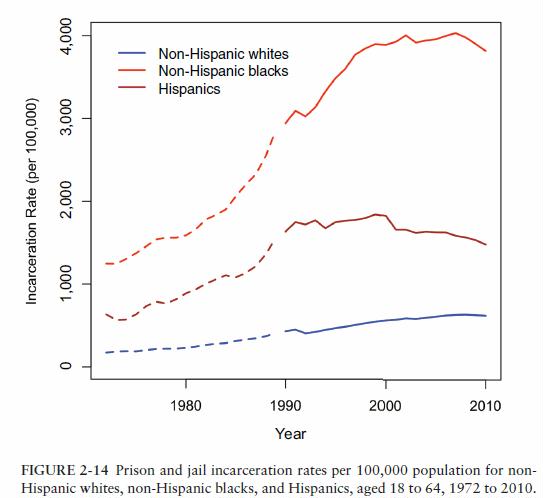
More than half the prison population is black or Hispanic. In 2010, blacks were incarcerated at six times and Hispanics at three times the rate for non-Hispanic whites.
Causes
By the time incarceration rates began to grow in the early 1970s, U.S. society had passed through a tumultuous period of social and political change. Decades of rising crime accompanied a period of intense political conflict and a profound transformation of U.S. race relations. The problem of crime gained a prominent place in national policy debates. Crime and race were sometimes conflated in political conversation.
In the 1960s and 1970s, a changed political climate provided the context for a series of policy choices. Across all branches and levels of government, criminal processing and sentencing expanded the use of incarceration in a number of ways: prison time was increasingly required for lesser offenses; time served was significantly increased for violent crimes and for repeat offenders; and drug crimes, particularly street dealing in urban areas, became more severely policed and punished. These changes in punishment policy were the main and proximate drivers of the growth in incarceration. In the 1970s, the numbers of arrests and court caseloads increased, and prosecutors and judges became harsher in their charging and sentencing. In the 1980s, convicted defendants became more likely to serve prison time. More than half of the growth in state imprisonment during this period was driven by the increased likelihood of incarceration given an arrest. Arrest rates for drug offenses climbed in the 1970s, and mandatory prison time for these offenses became more common in the 1980s.
During the 1980s, the U.S. Congress and most state legislatures enacted laws mandating lengthy prison sentences—often of 5, 10, and 20 years or longer—for drug offenses, violent offenses, and “career criminals.” In the 1990s, Congress and more than one-half of the states enacted “three strikes and you’re out” laws that mandated minimum sentences of 25 years or longer for affected offenders. A majority of states enacted “truth-in-sentencing” laws requiring affected offenders to serve at least 85% of their nominal prison sentences. The Congress enacted such a law in 1984.
These changes in sentencing reflected a consensus that viewed incarceration as a key instrument for crime control. Yet over the four decades when incarceration rates steadily rose, U.S. crime rates showed no clear trend: the rate of violent crime rose, then fell, rose again, then declined sharply.
The best single proximate explanation of the rise in incarceration is not rising crime rates, but the policy choices made by legislators to greatly increase the use of imprisonment as a response to crime. Mandatory prison sentences, intensified enforcement of drug laws, and long sentences contributed not only to overall high rates of incarceration, but also especially to extraordinary rates of incarceration in black and Latino communities.
Intensified enforcement of drug laws subjected blacks, more than whites, to new mandatory minimum sentences—despite lower levels of drug use and no higher demonstrated levels of trafficking among the black than the white population. Blacks had long been more likely than whites to be arrested for violence. But three strikes, truth-in-sentencing, and related laws have likely increased sentences and time served for blacks more than whites. As a consequence, the absolute disparities in incarceration increased, and imprisonment became common for young minority men, particularly those with little schooling.
CONCLUSION: The unprecedented rise in incarceration rates can be attributed to an increasingly punitive political climate surrounding criminal justice policy formed in a period of rising crime and rapid social change. This provided the context for a series of policy choices —across all branches and levels of government—that significantly increased sentence lengths, required prison time for minor offenses, and intensified punishment for drug crimes.
Consequences. Relationships among incarceration, crime, sentencing policy, social inequality, and numerous other variables influencing the growth of incarceration are complex, change across time and place, and interact with each other. As a result, estimating the social consequences of high rates of incarceration, including the effects on crime, is extremely challenging. Because of the challenge of separating cause and effect from an array of social forces, studies examining the impact of incarceration on crime have produced divergent findings. Most studies conclude that rising incarceration rates reduced crime, but the evidence does not clearly show by how much. A number of studies also find that the crime-reducing effects of incarceration become smaller as the incarceration rate grows, although this may reflect the aging of prison populations.
The increase in incarceration may have caused a decrease in crime, but the magnitude of the reduction is highly uncertain and the results of most studies suggest it was unlikely to have been large.
Much research on the crime effects of incarceration attempts to measure reductions in crime that might result from deterrence and incapacitation. Long sentences characterize the period of high incarceration rates, but research on deterrence suggests that would-be offenders are deterred more by the risk of being caught than by the severity of the penalty they would face if arrested and convicted. High rates of incarceration may have reduced crime rates through incapacitation (locking up people who might otherwise commit crimes), although there is no strong consensus on the magnitude of this effect. And because offending declines markedly with age, the incapacitation effect of very long sentences is likely to be small.
The incremental deterrent effect of increases in lengthy prison sentences is modest at best. Because recidivism rates decline markedly with age, lengthy prison sentences, unless they specifically target very high-rate or extremely dangerous offenders, are an inefficient approach to preventing crime by incapacitation.
The distribution of incarceration across the population is highly uneven. As noted above, regardless of race or ethnicity, prison and jail inmates are drawn mainly from the least educated segments of society. Among white male high school dropouts born in the late 1970s, about one-third are estimated to have served time in prison by their mid-30s. Yet incarceration rates have reached even higher levels among young black men with little schooling: among black male high school dropouts, about two-thirds have a prison record by that same age—more than twice the rate for their white counterparts. The pervasiveness of imprisonment among men with very little schooling is historically unprecedented, emerging only in the past two decades.
Much of the significance of the social and economic consequences of incarceration is rooted in the high absolute level of incarceration for minority groups and in the large racial disparities in incarceration rates. In the era of high incarceration rates, prison admission and return have become commonplace in minority neighborhoods characterized by high levels of crime, poverty, family instability, poor health, and residential segregation. Racial disparities in incarceration have tended to differentiate the life chances and civic participation of blacks, in particular, from those of most other Americans.
People who live in poor and minority communities have always had substantially higher rates of incarceration than other groups. As a consequence, the effects of harsh penal policies in the past 40 years have fallen most heavily on blacks and Hispanics, especially the poorest.
Coming from some of the most disadvantaged segments of society, many of the incarcerated entered prison in unsound physical and mental health. The poor health status of the inmate population serves as a basic marker of its social disadvantage and underlines the contemporary importance of prisons as public health institutions. Incarceration is associated with overlapping afflictions of substance use, mental illness, and risk for infectious diseases (HIV, viral hepatitis, sexually transmitted diseases, and others). This situation creates an enormous challenge for the provision of health care for inmates, although it also provides opportunities for screening, diagnosis, treatment, and linkage to treatment after release. Prison conditions can be especially hard on some people, particularly those with mental illness, causing severe psychological stress. Although levels of lethal violence in prisons have declined, conditions have deteriorated in some other ways. Increased rates of incarceration have been accompanied by overcrowding and decreased opportunity for rehabilitative programs, as well as a growing burden on medical and mental health services.
Many state prisons and the Federal Bureau of Prisons operate at or above 100% of their designed capacity. With overcrowding, cells designed for a single inmate often house two and sometimes three people. The concern that overcrowding would create more violent environments did not materialize during the period of rising incarceration rates: rather, as the rates rose, the numbers of riots and homicides within prisons declined. Nonetheless, research has found overcrowding, particularly when it persists at high levels, to be associated with a range of poor consequences for health and behavior and an increased risk of suicide. In many cases, prison provides far less medical care and rehabilitative programming than is needed.
Incarceration is strongly correlated with negative social and economic outcomes for former prisoners and their families. Men with a criminal record often experience reduced earnings and employment after prison. Fathers’ incarceration and family hardship, including housing insecurity and behavioral problems in children, are strongly related. The partners and children of prisoners are particularly likely to experience adverse outcomes if the men were positively involved with their families prior to incarceration.
From 1980 to 2000, the number of children with incarcerated fathers increased from about 350,000 to 2.1 million—about 3% of all U.S. children. From 1991 to 2007, the number of children with a father or mother in prison increased 77% and 131%, respectively.
The rise in incarceration rates marked a massive expansion of the role of the justice system in the nation’s poorest communities. Many of those entering prison come from and will return to these communities. When they return, their lives often continue to be characterized by violence, joblessness, substance abuse, family breakdown, and neighborhood disadvantage. The best evidence to date leaves uncertain the extent to which these conditions of life are themselves exacerbated by incarceration.
Given the evidence, crime reduction and socioeconomic disadvantage are both plausible outcomes of increased incarceration, but estimates of the size of these effects range widely. The vast expansion of the criminal justice system has created a large population whose access to public benefits, occupations, vocational licenses, and the franchise is limited by a criminal conviction. High rates of incarceration are associated with lower levels of civic and political engagement among former prisoners and their families and friends than among others in their communities. Disfranchisement of former prisoners and the way prisoners are enumerated in the U.S. census combine to weaken the power of low-income and minority communities. For these people, the quality of citizenship—the quality of their membership in American society and their relationship to public institutions—has been impaired. These developments have created a highly distinct political and legal universe for a large segment of the U.S. population.
The consequences of the decades-long build-up of the U.S. prison population have been felt most acutely in minority communities in urban areas already experiencing significant social, economic, and public health disadvantages. For policy and public life, the magnitude of the consequences of incarceration may be less important than the overwhelming evidence of this correlation. In communities of concentrated disadvantage—characterized by high rates of poverty, violent crime, mental illness and drug addiction— the United States embarked on a massive and unique intensification of criminal punishment. Although many questions remain unanswered, the greatest significance of the era of high incarceration rates may lie in that simple descriptive fact.
Policies regulating criminal punishment cannot be determined only by the scientific evidence. The decision to deprive another human being of his or her liberty is, at root, anchored in beliefs about the relationship between the individual and society and the role of criminal sanctions in preserving the social compact. Thus, sound policies on crime and incarceration will reflect a combination of science and fundamental principles.
GUIDING PRINCIPLES. A broad discussion of principles has been notably absent from the nation’s recent policy debates on the use of imprisonment. Beginning in the early 1970s, in a time of rising violence and rapid social change, policy makers turned to incarceration to denounce the moral insult of crime and to deter and incapacitate criminals. As offender accountability and crime control were emphasized, principles that previously had limited the severity of punishment were eclipsed, and punishments became more severe. Yet a balanced understanding of the role of imprisonment in society recognizes that the deprivation of personal liberty is one of the harshest penalties society can impose. Even under the best conditions, incarceration can do great harm—not only to those who are imprisoned, but also more broadly to families, communities, and society as a whole. Moreover, the forcible deprivation of liberty through incarceration is vulnerable to misuse, threatening the basic principles that underpin the legitimacy of prisons.
We believe that as policy makers and the public consider the implications of the findings presented in this report, they also should consider the following four principles whose application would constrain the use of incarceration: • Proportionality: Criminal offenses should be sentenced in proportion to their seriousness. • Parsimony: The period of confinement should be sufficient but not greater than necessary to achieve the goals of sentencing policy. • Citizenship: The conditions and consequences of imprisonment should not be so severe or lasting as to violate one’s fundamental status as a member of society. • Social justice: Prisons should be instruments of justice, and as such their collective effect should be to promote and not undermine society’s aspirations for a fair distribution of rights, resources, and opportunities.
POLICY IMPLICATIONS AND RECOMMENDATION. We have looked at an anomalous period in U.S. history, examining why it arose and with what consequences. Given the available evidence regarding the causes and consequences of high incarceration rates, and guided by fundamental normative principles regarding the appropriate use of imprisonment as punishment, we believe that the policies leading to high incarceration rates are not serving the country well. We are concerned that the United States has gone past the point where the numbers of people in prison can be justified by social benefits. Indeed, we believe that the high rates of incarceration themselves constitute a source of injustice and social harm. A criminal justice system that made less use of incarceration might better achieve its aims than a harsher, more punitive system
RECOMMENDATION: Given the small crime prevention effects of long prison sentences and the possibly high financial, social, and human costs of incarceration, federal and state policy makers should revise current criminal justice policies to significantly reduce the rate of incarceration in the United States. In particular, they should reexamine policies regarding mandatory prison sentences and long sentences. Policy makers should also take steps to improve the experience of incarcerated men and women and reduce unnecessary harm to their families and their communities.
We recommend such a systematic review of penal and related policies with the goals of achieving a significant reduction in the number of people in prison in the United States and providing better conditions for those in prison. To promote these goals, jurisdictions would need to review a range of programs, including community-based alternatives to incarceration, probation and parole, prisoner reentry support, and diversion from prosecution, as well as crime prevention initiatives.
To minimize harm from incarceration, we urge reconsideration of the conditions of confinement and programs in prisons. Given that nearly all prisoners are eventually released, attention should be paid to how prisons can better serve society by addressing the need of prisoners to adjust to life following release and supporting their successful reintegration with their families and communities. Reviews of the conditions and programs in prisons would benefit from being open to public scrutiny. One approach would be to subject prisons to systematic ratings related to their public purposes. Such ratings could incorporate universal standards that recognize the humanity and citizenship of prisoners and the obligation to prepare them for life after prison.
After decades of stability from the 1920s to the early 1970s, the rate of incarceration in the United States has increased to a rate more than four times higher than in 1972. In 1972, the U.S. incarceration rate—the number in prisons and local jails per 100,000 population—stood at 161. After peaking in 2009, the number of people in state and federal prisons fell slightly through 2012. Still, in 2012, the incarceration rate was 707 per 100,000, a total of 2.23 million people in custody (Glaze and Herberman, 2013). Nearly 1 of every 100 adults in the U.S. is in prison or jail.
The large racial disparity in incarceration is striking. Of those behind bars in 2011, about 60% were minorities (858,000 blacks and 464,000 Hispanics)
To preserve order and safety, to affirm norms of lawful conduct, and to help remedy criminal behavior, we built lockups, detention centers, asylums, jails, and prisons. These institutions reflect how a society through its political process has negotiated a compromise between order and freedom. Incarceration is in many ways a foundational institution, being the last resort of a state’s authority in the performance of its many other functions. As many have remarked, the use and character of incarceration thus reveals something fundamental about a society’s level of civilization and the quality of citizenship (de Beaumont and de Tocqueville, 1970; Churchill, 1910; Dostoevsky, 1861).
Crime and punishment are social and legal constructs. Their nature and meanings change over time and differ from one society (and one person) to another. In American jurisprudence, a prison sentence serves three possible purposes. First, the purpose of a prison sentence may be understood primarily as retribution, or “just deserts,” meaning that the severity of a given crime requires deprivation of the liberty of the person found guilty of that crime. Second, a prison sentence may be justified as a way of preventing crime, either through deterrence of the individual sentenced (specific deterrence), deterrence of others in society at large who may be inclined to offend (general deterrence), or avoidance of crimes that might otherwise have been committed by that individual absent incarceration (incapacitation). Finally, a prison sentence may be deemed justified as a means of preventing future crimes through the rehabilitation of the individual incarcerated. Of course, these rationales are not mutually exclusive.
Throughout U.S. history, the emphasis on one or another rationale for incarceration has shifted significantly, and it continues to change. As a consequence, the conditions of confinement and the experience of returning to society also have changed. To understand the effects of the rise in incarceration, one must examine how prison environments have changed as the numbers of prisoners have increased and how this changed environment may lead to different outcomes for the individuals incarcerated.
Whereas the jurisprudence of incarceration emphasizes the purposes of retribution, deterrence, incapacitation, and rehabilitation, criminal punishment also provides a vivid moral symbol, publicly condemning criminal conduct. Thus the French sociologist Emile Durkheim (1984) argued that penal law affirms basic values and helps build social solidarity. By this account, punishment activates society’s moral sentiments and reinforces the collective sense of right and wrong.
Critics have objected that, rather than reflecting “society as a whole,” institutions of punishment under real conditions of social and economic inequality burden the disadvantaged. From this perspective, prisons and jails reflect and perhaps exacerbate social inequalities rather than promote social solidarity.
Some scholars have argued that, in light of this nation’s long history of troubled race relations, it is especially important to consider whether prison and other punishments unfairly burden African Americans and other minority groups. If so, the justice system only reinforces historical inequalities, thereby undermining the social compact that should undergird the nation’s laws.
Prisons also can support the rehabilitation of those incarcerated so that after release, they are more likely to live in a law-abiding way and reintegrate successfully into the rhythms of work, family, and civic engagement. In this narrower view of the instrumental value of incarceration policies, the effectiveness of prisons is measured by such outcomes as lower rates of recidivism and higher rates of employment, supportive family connections, improved health outcomes, and the standing of the formerly incarcerated as citizens in the community. The relevant scholarly literature focuses on issues of the availability and effectiveness of programs; the impact of the prison environment on the self-concept, behavior, and human capital of those incarcerated; and the experience of leaving prison and returning home.
Yet another stream of scholarly inquiry examines the role of the criminal justice system, and in particular the role of prisons, in controlling entire categories or communities of people. In this view, the laws of society and the instruments of punishment have been used throughout history to sustain those in power by suppressing active opposition to entrenched interests and deterring challenges to the status quo. This scholarly literature has examined the role of the justice system—including the definition of crimes by legislatures, enforcement of laws by the police, and uses of incarceration—in dealing with new immigrant groups, the labor and civil rights movements, the behavior of the mentally ill, and the use of alcohol and illegal drugs, to cite some examples. In recent years, scholars in this tradition have focused on the impact of the justice system on racial minorities in the United States and specifically on the impact of recent high rates of incarceration on the aspiration for racial equality. Researchers who study the power relations of society reflected in the criminal justice system often observe that the poor, minorities, and the marginal are seen as dangerous or undeserving. In these cases, the majority will support harsh punishments entailing long sentences and the use of imprisonment for lesser offenses. The effect of incarceration and other punishments used in this way may be to reproduce and deepen existing social and economic inequalities.
Because incarceration imposes pain and loss on both those sentenced and, frequently, their families and others, these costs also must be weighed against its social benefits in determining when or whether the deprivation of liberty is justified.
Because incarceration encompasses a range of experiences that vary widely across individuals and from one era or place to another, its effects are difficult to assess. This variation arises not only from differences in the legal terms of sentences, such as length and conditions for release, but also from differences in the conditions of confinement and after release. Harsh or abusive prison environments can cause damage to those subjected to them, just as environments that offer treatment and opportunities to learn and work can provide them with hope, skills, and other assets. So while we talk about incarceration as a single phenomenon, it in fact describes a wide range of experiences that may have very different effects.
Our analysis of both causes and consequences (discussed below) must remain provisional because the growth of incarceration is so recent, its effects are still unfolding, and the level and uses of incarceration at a given moment in time are the result of a complex set of past and ongoing social and political changes. Beginning in the 1960s, a complex combination of organized protests, urban riots, violent crime and drug use, the collapse of urban schools, and many other factors contributed to declining economic opportunities in many neighborhoods and too often to greater fear of crime. After 1970, a wave of heavy industry closings and mass layoffs resulting from technological changes, international competition, and shifting markets contributed to the elimination of many relatively high-paying jobs for less educated workers with specialized skills. Places hardest hit by the wave of industrial losses also experienced large and sustained increases in crime. In the 1980s, a wave of crack cocaine use and related street crime hit many of the nation’s already distressed inner cities.
In the wake of these and other structural shifts, employment fell among young people with little schooling and work experience. The income gap between unskilled and skilled workers widened. Large-scale migrations from rural to urban areas and an influx of lower-skilled undocumented workers from Mexico and Central America coincided with this widening inequality. In past decades, then, as growing percentages of all ethnic and racial groups have graduated from high school and went on to higher education, those who dropped out were left further behind with fewer options for earning a living.
In the past two decades of the period of the rise in incarceration rates, new attention to illegal immigration and to sex offenses led to new laws and penalties, contributing to growing numbers detained, convicted, and sentenced to prison for these offenses.
A full description of this complex and evolving social context for the expanded use of prison as a response to crime in the United States is beyond the scope of this study. Nonetheless, it is important to examine this history to better understand the rising use of imprisonment over nearly four decades. The committee does not view the growth of incarceration as an inevitable product of these larger social changes. The United States has experienced other periods of sweeping social change and disorder in which incarceration rates did not rise. During the recent period, moreover, the United States stood apart from other modern industrial democracies in the direction it took. To understand how U.S. incarceration rates reached their current level, the committee examined and weighed evidence of various kinds, drawing on the methods of historians, economists, and political scientists, as well as other social scientists.
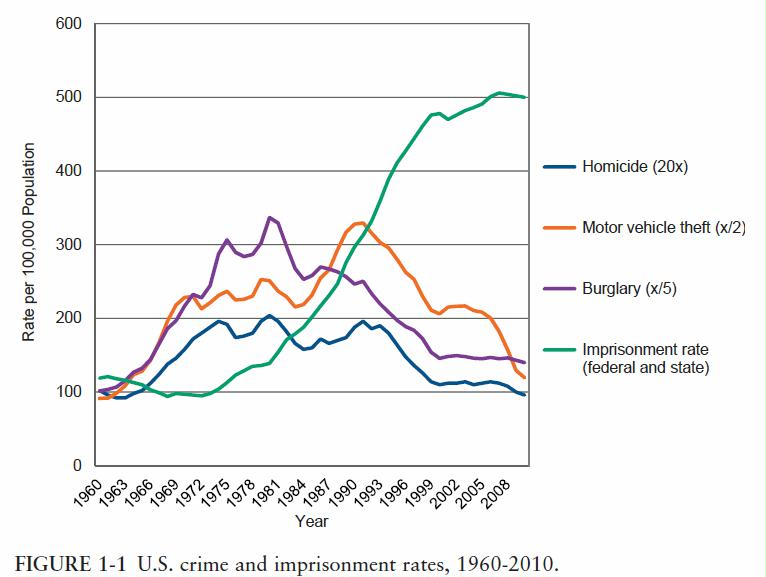
As rates of many major crime types rose and fell for more than five decades, incarceration rates started to rise nationally in 1973 and continued to rise for 40 years, stabilizing only recently (Tonry, 2012; see Figure 1-1). Some may compare the decline in crime rates after 1980 and again in the 1990s with the increase in incarceration rates and infer that incarceration greatly reduces crime. However, studies of crime trends that consider many possible influences, including changes in incarceration rates, have had limited success separating different causes.
600 500 400 Homicide (20x) Motor vehicle theft (x/2) 300 Burglary (x/5) 200 Imprisonment rate (federal and state) 100 0 Year FIGURE 1-1 U.S. crime and imprisonment rates, 1960-2010.
Depending, among other things, on the conditions and duration of confinement and release, imprisonment can be humane and even helpful. Incarceration can provide time for reflection and personal growth, access to better health care and treatment of drug dependency or illness, respite from toxic environments or situations, and opportunities to learn and acquire skills. Alternatively, prison can be harmful and degrading, exposing the confined to criminal influence, violence, and humiliation; isolating them from nurturing human contact and personal responsibility; and leaving them poorly equipped for life outside.
A further limit on analysis of prison conditions is imposed by barriers to researchers’ access to prisons. In earlier times, scholars were given broad access to prisons, prisoners, and corrections officers. By contrast, the contemporary prison has not been the subject of sustained empirical inquiry, perhaps reflecting less interest on the part of researchers and wariness on the part of prison administrators. The lack of research access, combined with cutbacks in other forms of outside review—journalistic investigations of life on the inside and judicial review of legal challenges to prison conditions—means that the nation’s prison systems are less open than before to public scrutiny. Finally, prisons have not been subjected to the same degree of regular reporting and public scrutiny based on transparent, published standards of performance as some other major public institutions, such as schools and hospitals.
Members of this committee share the view that the inherent severity of incarceration as a punishment—including the harm it often does to prisoners, their families, and communities—argues for limiting its use to cases where alternatives are less effective in achieving the same social ends. The evidence reviewed in this report reveals that the costs of today’s unprecedented rate of incarceration, particularly the long prison sentences imposed under recent sentencing laws, outweigh the observable benefits. We are conscious as well that a key feature of today’s high rate of incarceration is that large proportions of poor, less educated African American and Hispanic men are likely to be in jail or prison at some time in their lives. Indeed, for many poorly educated African American and Hispanic men, coercion is the most salient of their encounters with public authority. These findings led us to look for better policy choices.
Through the middle of the twentieth century, from 1925 to 1972, the combined state and federal imprisonment rate, excluding jails, fluctuated around 110 per 100,000 population, rising to a high of 137 in 1939.
The historically high U.S. incarceration rate also is unsurpassed internationally. European statistics on incarceration are compiled by the Council of Europe, and international incarceration rates are recorded as well by the International Centre for Prison Studies (IPS) at the University of Essex in the United Kingdom.
The 2011 IPS data show approximately 10.1 million people (including juveniles) incarcerated worldwide. In 2009, the United States (2.29 million) accounted for about 23% of the world total. In 2012, the U.S. incarceration rate per 100,000 population was again the highest reported (707), significantly exceeding the next largest per capita rates of Rwanda (492) and Russia (474).
Western European democracies have incarceration rates that, taken together, average around 100 per 100,000, one-seventh the rate of the United States. The former state socialist countries have very high incarceration rates by European standards, two to five times higher than the rates of Western Europe. But even the imprisonment rate for the Russian Federation is only about two-thirds that of the United States. In short, the current U.S. rate of incarceration is unprecedented by both historical and comparative standards.
Trends in Prison and Jail Populations
Discussion and analysis of the U.S. penal system generally focus on three main institutions for adult penal confinement: state prisons, federal prisons, and local jails. State prisons are run by state departments of correction, holding sentenced inmates serving time for felony offenses, usually longer than a year. Federal prisons are run by the U.S. Bureau of Prisons and hold prisoners who have been convicted of federal crimes and pretrial detainees. Local jails usually are county or municipal facilities that incarcerate defendants prior to trial, and also hold those serving short sentences, typically under a year. This sketch captures only several small states (Alaska, Connecticut, Delaware, Hawaii, Rhode Island, Vermont) hold all inmates (including those awaiting trial and those serving both short and long sentences) under the jurisdiction of a single state correctional agency. In Massachusetts, county houses of correction incarcerate those serving up to 3 years. Many prisons have separate units for pretrial populations. But this simple description does not encompass the nation’s entire custodial population. Minors, under 18 years old, typically are held in separate facilities under the authority of juvenile justice agencies. Additional adults are held in police lockups, immigration detention facilities, and military prisons and under civil commitment to state mental hospitals.
Trends in the State Prison Population
State prisons accounted for around 57% of the total adult incarcerated population in 2012, confining mainly those serving time for felony convictions and parolees reincarcerated for violating their parole terms.
The state prison population can be broadly divided into three offense categories: violent offenses (including murder, rape, and robbery), property offenses (primarily auto vehicle theft, burglary, and larceny/theft), and drug offenses (manufacturing, possession, and sale). In 2009, about 716,000 of 1.36 million state prison inmates had been convicted of violent crimes.
The most marked change in the composition of the state prison population involves the large increase in the number of those convicted for drug offenses. At the beginning of the prison expansion, drug offenses accounted for a very small percentage of the state prison population.
In 1996, 23% of state prisoners were convicted of drug offenses. By the end of 2010, 17.4% of state prisoners had been convicted of drug crimes.
Trends in the Federal Prison Population
Federal prisons incarcerate people sentenced for federal crimes, so the mix of offenses among their populations differs greatly from that of state prisons. The main categories of federal crimes involve robbery, fraud, drugs, weapons, and immigration. These five categories represented 88% of all sentenced federal inmates in 2010.
Federal crimes are quite different from those discussed above for state prisons. Robbery entails primarily bank robbery involving federally insured institutions; fraud includes violations of statutes pertaining to lending/credit institutions, interstate wire/communications, forgery, embezzlement, and counterfeiting; drug offenses typically involve manufacturing, importation, export, distribution, or dispensing of controlled substances; weapons offenses concern the manufacturing, importation, possession, receipt, and licensing of firearms and cases involving a crime of violence or drug trafficking when committed with a deadly weapon; and immigration offenses include primarily unlawful entry and reentry, with a smaller fraction involving misuse of visas and transporting or harboring of illegal entrants (Bureau of Justice Statistics, 2012a).
At least one-half of the remainder comprised those sentenced for possession/trafficking in obscene materials (3.7%) or for racketeering/extortion (2.7%) (Bureau of Justice Statistics, n.d.-b).
Trends in the Jail Population
 In 2012, one-third of the adult incarcerated population was housed in local jails. Jail is often the gateway to imprisonment. Jails serve local communities and hold those who have been arrested, have refused or been unable to pay bail, and are awaiting trial. They also hold those accused of misdemeanor offenses—often arrested for drug-related offenses or public disorder—and those sentenced to less than a year. John Irwin’s (1970) study of jail describes its occupants as poor, undereducated, unemployed, socially detached, and disreputable. Because of their very low socioeconomic status, jail inhabitants, in Irwin’s language, are “the rabble,” and others have similarly described them as “social trash,” “dregs,” and “riff raff”. The jail population is about one-half the size of the combined state and federal prison population and since the early 1970s has grown about as rapidly as the state prison population. It is concentrated in a relatively small number of large urban counties. The short sentences and pretrial detention of the jail population create a high turnover and vast numbers of admissions. BJS estimates that in 2012, the jail population totaled around 745,000, with about 60% of that population turning over each week.
In 2010, the nation’s jails admitted around 13 million inmates. With such high turnover, the growth of the jail population has greatly expanded the footprint of penal confinement.
The Increasing Scope of Correctional Supervision
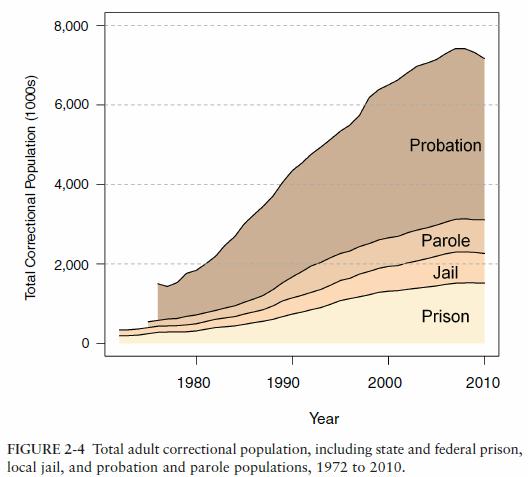
The significant increase in the number of people behind bars since 1972 occurred in parallel with the expansion of community corrections. Figure 2-4 shows the scale of the entire adult correctional system.
Correctional supervision encompasses prisons and jails and also the community supervision of those on probation and parole. Probation usually supervises people in the community who can, following revocation for breach of conditions, be resentenced to prison or jail.
the probation population increased greatly in absolute terms, from 923,000 in 1976 to 4.06 million in 2010, declining slightly to 3.94 million in 2012.
The large probation and parole populations also expand a significant point of entry into incarceration. If probationers or parolees violate the conditions of their supervision, they risk revocation and subsequent incarceration. In recent decades, an increasing proportion of all state prison admissions have been due to parole violations. As a proportion of all state prison admissions, returning parolees made up about 20% in 1980, rising to 30% by 1991 and remaining between 30 and 40% until 2010. This represents a significant shift in the way the criminal justice system handled criminal offenses, increasing reliance on imprisonment rather than other forms of punishment, supervision, or reintegration. Parole may be revoked for committing a new crime or for violating the conditions of supervision without any new criminal conduct (“technical violators”), or someone on parole may be charged with a new crime and receive a new sentence.
The rising numbers of parole violations contributed to the increase in incarceration rates. The number of parole violators admitted to state prison following new convictions and sentences has remained relatively constant since the early 1990s. The number of technical violators more than doubled from 1990 to 2000. In 2010, the approximately 130,000 people reincarcerated after parole had been revoked for technical violations accounted for about 20% of state admissions. These returns accounted for 23% of all exits from parole that year.
By 2010, slightly more than 7 million U.S. residents, 1 of every 33 adults, were incarcerated in prison or jail or were being supervised on parole or probation.
Variation in Incarceration Rates Among States
Trends in incarceration rates vary greatly among states. While the national imprisonment rate increased nearly 5-fold from 1972 to 2010, state incarceration rates in Maine and Massachusetts slightly more than doubled. At the other end of the spectrum, the rates in Louisiana and Mississippi increased more than 6-fold.
To see the change in trends, it is useful to divide the period since 1972 into two parts: from 1972 to 2000 and from 2000 to 2010 (see Figure 2-5). As discussed above, the period from 1972 to 2000 was a time of rapid growth for state prison populations; the change in incarceration rates in this period is indicated for each state in blue. The largest increases in this period generally occurred in southern and western states. From 1972 to 2000, incarceration rates grew most in Louisiana, Mississippi, Oklahoma, and Texas. In Louisiana, the rate grew by 700 per 100,000 population—more than 10-fold—rising to 801 per 100,000 by 2000, then climbing further to 867 by 2010.
Growth in state incarceration rates was much slower in the northeast and midwest. In Maine and Minnesota, the rates grew by only around 100 per 100,000. These two states had the lowest incarceration rates by 2010—148 for Maine and 185 for Minnesota. In the period since 2000, incarceration rates have grown more slowly across the country. As shown by the red circles in Figure 2-5, a few states have registered very large declines, including Delaware, Georgia, and Texas in the south and New Jersey and New York in the northeast.
The country experienced a large increase in crime from the early 1960s until the 1980s. From the early 1990s, crime rates began to fall broadly for the following two decades. Property and violent crime show roughly similar trends, although the property crime rate peaked in 1979, while violence continued to rise through the mid-1980s after falling in the first half of the decade. Following the broad trends in crime, the homicide rate—widely thought to be the most accurately measured—began to increase from the 1960s, peaking in 1981. Similar to the property crime rate, the homicide rate fluctuated through the 1980s until peaking again in 1991, just below the 1981 level.
Trends in drug arrests followed a different pattern. The drug arrest rate grew very sharply in the 1980s, more than doubling from 1980 to 1989. After a 2-year decline, the drug arrest rate again increased over the next decade, and by 2010 was more than double its level in 1980.
In summary, the growth in incarceration rates beginning in 1973 was preceded for about a decade by a very large increase in crime rates. Incarceration rates showed their strongest period of growth in the 1980s, as violent crime fell through the first half of the decade and then increased in the second. Incarceration rates continued to climb through the 1990s as the violent crime rate began to fall. Finally, in the 2000s, crime rates have remained stable at a low level, while the incarceration rate peaked in 2007, and the incarcerated population peaked in 2010. Thus the very high rates of incarceration that emerged over the past decades cannot simply be ascribed to a higher level of crime today compared with the early 1970s, when the prison boom began.
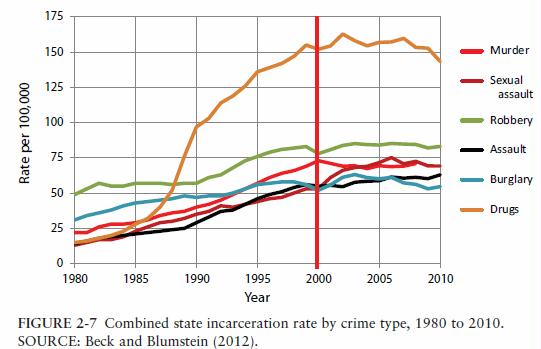
Most striking, however, is the dramatic increase in the incarceration rate for drug-related crimes. In 1980, imprisonment for drug offenses was rare, with a combined state incarceration rate of 15 per 100,000 population. By 2010, the drug incarceration rate had increased nearly 10-fold to 143 per 100,000. Indeed, the rate of incarceration for the single category of drug-related offenses, excluding local jails and federal prisons, by itself exceeds by 50% the average incarceration rate for all crimes of Western European countries and is twice the average incarceration rate for all crimes, including pretrial detainees, of a significant number of European countries.
Trends in Arrests per Crime
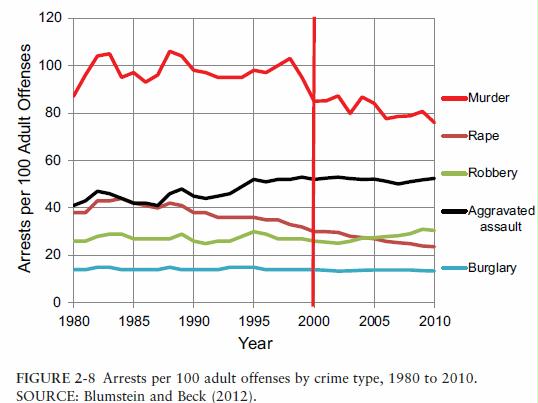 The first point at which the criminal justice system can affect the incarceration rate is through the likelihood of arrest of someone who has committed a crime. The ratio of arrests to crimes is sometimes interpreted as a measure of policing effectiveness or efficiency. Despite significant changes in police technology and management from 1980 to 2010, the ratio of arrests to crimes for the major crime types handled by states and localities has shown little change (see Figure 2-8). For example, the arrest rate for burglaries remained at about 14 arrests per 100 adult offenses. Arrest rates for rape declined rather steadily after 1984 (dropping from a peak of 44 arrests per 100 adult offenses to 24 per 100 by 2010). Robbery arrest rates were steady until 2000 and then increased slightly from 26 to 31 arrests per 100 reported offenses by 2010. In contrast, the arrest rate for aggravated assault grew until 2000 and then remained flat (around 52 arrests per 100 offenses). Murder is the exception, showing a decline in the arrest rate per crime after 2000: arrests for murder were close to 100 per 100 adult offenses until 1998 and then declined to 80 per 100 after 2000. by the measure of the ratio of arrests to crimes, no increase in policing effectiveness occurred from 1980 to 2010 that might explain higher rates of incarceration.
it is clear that drug law enforcement efforts escalated substantially over the period of the prison boom. From 1980 to 1989, the arrest rate for possession and use offenses increased by 89%. After a 2-year period of decline, the drug arrest rate climbed again to peak in 2006, 162% above the 1980 level. The arrest rate fell slightly from this peak, but in 2009 was still more than double the rate in 1980. In 2009, 1.3 million arrests were reported to the UCR for drug use and possession, and another 310,000 arrests were made for the manufacture and sale of drugs.
To foreshadow our later discussion of racial disparity, drug arrest rates, at least since the early 1970s, have always been higher for African Americans than for whites. In the early 1970s, when drug arrest rates were low, blacks were about twice as likely as whites to be arrested for drug crimes. The great growth in drug arrests through the 1980s had a large and disproportionate effect on African Americans. By 1989, arrest rates for blacks had climbed to 1,460 per 100,000, compared with 365 for whites (Western, 2006). Throughout the 1990s, drug arrest rates remained at historically high levels. It might be hypothesized that blacks may be arrested at higher rates for drug crimes because they use drugs at higher rates, but the best available evidence refutes that hypothesis. A long historical trend, dating back to the 1970s, is available from the Monitoring the Future survey of high school seniors. Self-reported drug use among blacks is consistently lower than among whites, a pattern replicated among adults in the National Survey on Drug Abuse. Fewer data are available on drug selling, but self-reports in the National Longitudinal Survey of Youth, 1979 and 1997, show a higher level of sales among poor white than poor black youth. In short, the great escalation in drug enforcement that dates from the late 1970s is associated with an increase in the relative arrest rate among African Americans that is unrelated to relative rates of drug use and the limited available evidence on drug dealing.
For the major crime types handled at the state level, the probability that arrest would lead to prison rose over the three decades from 1980 to 2010. The number of prison commitments per 100 adult arrests showed a significant and nearly steady increase (see Figure 2-9), i.e. the rate of commitment to state prison for murder rose from 41 to 92 per 100 arrests, an increase of more than 120%.
Between 1980 and 2010, prison commitments for drug offenses rose 350% (from 2 to 9 per 100 arrests); commitments for sexual assault rose 275% (from 8 to 30 per 100 arrests); and commitments for aggravated assault rose 250% (from 4 to 14 per 100 arrests). State prison commitment rates for burglary and robbery also increased, but these increases were below 100%. These figures indicate that an increased probability that arrest would lead to prison commitment contributed greatly to the rise in incarceration rates between 1980 and 2010.
Time Served
BJS’s analysis of recent trends in the state prison population reveals the growing population serving life and other long sentences. As of the end of 2000, BJS estimated that about 54,000 state prison inmates were serving life sentences, with a median age of under 30. Using a different methodology, a 2013 survey report by the Sentencing Project estimates that more than 150,000 people were serving life sentences in state prison in 2012.
Because of non-stationarity in admission rates and the growing prevalence of very long sentences, the estimates of time served presented below should be viewed as a lower bound on the increase in time served. The downward bias is likely to be largest for violent crimes, for which the growth in very long sentences has been greatest.
The most dramatic change in average time served was for murder, which climbed from 5.0 years in 1981 to 16.9 years in 2000, an increase of 238%. The second largest growth was in time served for sexual assault, which increased 94%, from 3.4 years in 1981 to 6.6 years in 2009; the rate of increase for this crime type was the largest observed during the 2000-2010 decade, adding about 2.5 months each year. The slowest rate of increase in time served was for drug offenses, increasing from 1.6 years in 1981 to 1.9 years in 2000 and then remaining nearly steady through 2009. The stability of time served by those committing drug offenses contrasts with the significant growth in rates of arrest and commitment for drug offenses discussed earlier. Time served may have changed little because short prison sentences were imposed on those committing drug offenses who may previously have served probation or time in jail. Trends in time served for the other three crime types—aggravated assault, burglary, and robbery—showed somewhat similar growth patterns. Averaging 4.0, 2.8, and 2.0 years, respectively, over the entire 1980-2010 period, all had some growth from 1980 to 2000 (83, 41, and 79%, respectively), and all remained nearly stable after 2000
Trends in the Federal System
 Growth in the incarceration rate has been larger and more sustained in the federal system than in the states. Between 1980 and 2000, the federal prison population increased by nearly 500%, from 24,363 to 145,416, surpassing the growth in state prison systems.
By 2000, the federal system was the third largest prison system in the nation, behind those of Texas and California. Moreover, while the rapid growth of the states’ prison populations tapered off after 2000, the federal system continued to see a steady increase, becoming the largest system by midyear 2002. By 2010, the federal system, with a population of 209,771 inmates, had grown to be larger than the next largest system, the Texas Department of Criminal Justice, by more than 36,000 inmates. The federal system thus accounts for roughly 10% of the total prison population, but its share has been growing during the prison boom.
Nearly all incarceration in federal prisons is due to federal convictions for robbery; fraud; and drug, weapon, and immigration offenses. During 1980-2000, as with the states, the most dramatic change was in drug-related offending, for which the incarceration rate increased more than 10-fold, from 3 per 100,000 in 1980 to 35 in 2000.
The other two crime types that saw comparably large growth are weapon and immigration offenses, which also increased more than 1,000%; that growth is less apparent because incarceration rates for these offenses started at such low levels in 1980.
The incarceration rate for fraud grew considerably (about 227%) over this period, but still much less than the rates for the other three crime types. The incarceration rate for robbery rose steadily from 2.9 per 100,000 adults and then peaked at 4.6 per 100,000 in 2000. Since 2000, the patterns of growth in incarceration rates have changed.10 With an already high rate of incarceration for drug offenses (35 per 100,000 adults), the increase for these offenses was more modest, up 16% (to 41 per 100,000 adults). At the same time, the dominant source of growth was weapon offenses, up 135% (from 5.2 to 12.2 per 100,000 adults) and immigration offenses, up 40% (from 6.5 to 9.1 per 100,000 adults). Fraud showed little change (up 5.5%), while robbery declined (from 4.6 to 3.2 per 100,000).
RACIAL DISPARITY IN IMPRISONMENT
BJS compiled state and federal prison admission rates for blacks and whites separately in a historical series extending from 1926 to 1986 (Langan, 1991b). The data are available annually from 1926 to 1946 and then intermittently for the post-World War II period until 1986. They show an increase in African American imprisonment from 1926 to 1940, while imprisonment rates were declining for whites. Prison admission rates climbed steeply in the mid-1970s but much more in absolute terms for African Americans than for whites.
In 2010, the imprisonment rate for blacks was 4.6 times that for whites.
Violent Crimes
The relative involvement of blacks in violent crimes has declined significantly since the late 1980s (see Figure 2-12). From 1972 to 1980, the relative share of blacks in arrests for rape and aggravated assault fell by around one-fourth; more modest declines in their share of arrests were recorded for murder and robbery from the 1970s to the 2000s. In the 1970s, blacks accounted for about 54% of all homicide arrests; by the 2000s, that share had fallen below half. For robbery, blacks accounted for 55% of arrests in the 1970s, falling to 52% by the 2000s. For rape, blacks accounted for about 46% of all arrests in the 1970s, declining by 14 percentage points to 32% by the 2000s. The declining share of blacks in violent arrests also is marked for aggravated assaults, which constitute a large majority of violent serious crimes: 41% in the 1970s and just 33% in the 2000s.
These figures show that arrests of blacks for violent crimes constitute smaller percentages of absolute national numbers that are less than half what they were 20 or 30 years ago. Violent crime has been falling in the United States since 1991. In absolute terms, involvement of blacks in violent crime has followed the general pattern; in relative terms, it has fallen substantially more than the overall averages. Yet even though participation of blacks in serious violent crimes has declined significantly, disparities in imprisonment between blacks and whites have not fallen by much; as noted earlier, the incarceration rate for non-Hispanic black males remains seven times that of non-Hispanic whites.
Drug Crimes
The situation for drug offenses is similar to that for violent crime in some respects, but there is a critical difference. Although, according to both arrest and victimization data, blacks have higher rates of involvement than whites in violent crimes, the prevalence of drug use is only slightly higher among blacks than whites for some illicit drugs and slightly lower for others; the difference is not substantial. There is also little evidence, when all drug types are considered, that blacks sell drugs more often than whites. In recent years, drug-related arrest rates for blacks have been three to four times higher than those for whites
In the late 1980s, the rates were six times higher for blacks than for whites
Marijuana arrestees are preponderantly white and are much less likely than heroin and cocaine arrestees to wind up in prison
Incarceration of Hispanics
In 1974, only 12% of the white state prison population and a negligible proportion of blacks reported being of Hispanic origin. By 2004, 24% of the white prison population and around 3% of blacks reported being Hispanic.
Hispanic incarceration rates fall between the rates for non-Hispanic blacks and whites. Over the period of the growth in incarceration rates, the rate has been two to three times higher for Hispanics than for non-Hispanic whites. From 1972 to 1990, the Hispanic rate grew strongly along with incarceration in the rest of the population. Through the 1990s, the Hispanic rate remained roughly flat at around 1,800 per 100,000 of the population aged 18 to 64. Since 2000, the incarceration rate for Hispanics has fallen from 1,820 to just under 1,500.
Rumbaut finds that incarceration rates (and arrest rates) for the immigrant population are relatively low given their poverty rates and education. The highest incarceration rates are found among long-standing national groups—Puerto Ricans and Cubans. For national groups with large shares of recent immigrants—Guatemalans and Salvadorans for example—incarceration rates are very low.
The largest national group, Mexicans, includes significant native-born and foreign-born populations. The incarceration rate indicated in the 2000 census is more than five times higher for native-born U.S. citizens of Mexican descent than for U.S. immigrants born in Mexico.
In fact, U.S. born Mexicans have higher incarceration rates than any other U.S.-born Hispanic group. Overall, the incarceration rate for those of Mexican origin is lower than either Puerto Ricans or Cubans.
This discussion of incarceration of Hispanics has been limited to those in prisons or local jails, and does not encompass immigrant detention outside of those institutions. There is evidence that the latter form of detention has increased significantly in the past decade in specialized immigrant detention facilities but this type of incarceration lies beyond the committee’s charge.
CONCENTRATION OF INCARCERATION BY AGE, SEX, RACE/ETHNICITY, AND EDUCATION
Although racial and ethnic disparities in incarceration are very large, differences by age, sex, and education are even larger. The combined effects of racial and education disparities have produced extraordinarily high incarceration rates among young minority men with little schooling.
The age and gender composition of the incarcerated population has changed since the early 1970s, but the broader demographic significance of the penal system lies in the very high rate of incarceration among prime-age men. The prison population also has aged as time served in prison has increased, but 60% of all prisoners still were under age 40 in 2011
Incarceration rates have increased more rapidly for females than for males since the early 1970s. In 1972, the prison and jail incarceration rate for men was estimated to be 24 times higher than that for women. By 2010, men’s incarceration rate was about 11 times higher.
Women’s incarceration rate had thus risen twice as rapidly as men’s in the period of growing incarceration rates. Yet despite the rapid growth in women’s incarceration, only 7% of all sentenced state and federal prisoners were female by 2011
The racial disparity in incarceration for women is similar to that seen for men. As with the trends for men, the very high rate of incarceration for African American women fell relative to the rate for white women, although the 3 to 1 black-white disparity in women’s imprisonment in 2009 was still substantial
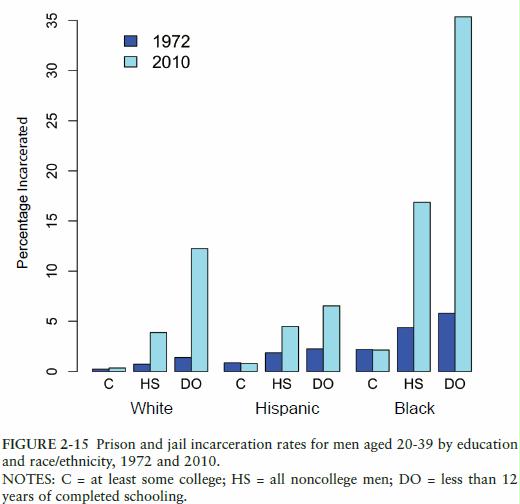
Extremely high incarceration rates had emerged among prime-age noncollege men by 2010 (see Figure 2-15). Around 4% of noncollege white men and a similar proportion of noncollege Hispanic men in this age group were incarcerated in 2010. The education gradient is especially significant for African Americans. Among prime-age black men, around 15% of those with no college and fully a third of high school dropouts were incarcerated on an average day in 2010. Thus at the height of the prison boom in 2010, the incarceration rate for all African Americans is estimated to be 1,300 per 100,000. For black men under age 40 who had dropped out of high school, the incarceration rate is estimated to be more than 25 times higher, at 35,000 per 100,000. Educational inequalities in incarceration rates have increased since 1972
Incarceration rates have barely increased among those who have attended college; nearly all the growth in incarceration is concentrated among those with no college education. The statistics clearly show that prison time has become common for men with little schooling.
It is instructive to compare the risks of imprisonment by age 30-35 for men in two birth cohorts: the first born in 1945-1949, just before the great increase in incarceration rates, and the second born in the late 1970s, growing up through the period of high incarceration rates (see Figure 2-16). Because most of those who go to prison do so for the first time before age 30 to 35, these cumulative proportions can be interpreted roughly as lifetime risks of going to prison. Education, for these cumulative risks, is recorded in three categories: for those who attended at least some college, for high school graduates or GED earners, and for those who did not complete high school.
Similar to the increases in incarceration rates, cumulative risks of imprisonment have increased substantially for all men with no college education and to extraordinary absolute levels for men who did not complete high school. The prison system was not a prominent presence in the lives of white men born just after World War II. Among high school dropouts, only 4% had been to prison by their mid-30s. The lifetime risk of imprisonment was about the same for Hispanic high school dropouts at that time. For African American men who dropped out of high school and reached their mid-30s at the end of the 1970s, the lifetime risk of imprisonment was about 3 times higher, at 15%.
The younger cohort growing up through the prison boom and reaching their mid-30s in 2009 faced a significantly elevated risk of imprisonment. Similar to the rise in incarceration rates, most of the growth in lifetime risk of imprisonment was concentrated among men who had not been to college. Imprisonment risk reached extraordinary levels among high school dropouts. Among recent cohorts of African American men, 68% of those who dropped out of school served time in state or federal prison. For these men with very little schooling, serving time in state or federal prison had become a normal life event. Although imprisonment was less pervasive among low-educated whites and Hispanic men, the figures are still striking. Among recent cohorts of male dropouts, 28% of whites and 20% of Hispanics had a prison record by the peak of the prison boom.
In sum, trends in these disaggregated rates of incarceration show that not only did incarceration climb to historically high levels, but also its growth was concentrated among prime-age men with little schooling, particularly low-educated black and Hispanic men. For this segment of the population, acutely disadvantaged to begin with, serving time in prison had become commonplace.
CONCLUSION
After a lengthy period of stability in incarceration rates, the penal system began a sustained period of growth beginning in 1973 and continuing for the next 40 years. U.S. incarceration rates are historically high, and currently are the highest in the world. Clues to the causes and consequences of these high rates lie in their community and demographic distribution. The characteristics of the penal population—age, schooling, race/ethnicity—indicate a disadvantaged population that not only is involved in crime but also has few economic opportunities and faces significant obstacles to social mobility. Through its secondary contact with families and poor communities, the penal system has effects that extend far beyond those who are incarcerated
The review of the evidence in this chapter points to four key findings: 1. Current incarceration rates are historically and comparatively unprecedented. The United States has the highest incarceration rates in the world, reaching extraordinary absolute levels in the most recent two decades. 2. The growth in imprisonment—most rapid in the 1980s, then slower in the 1990s and 2000s—is attributable largely to increases in prison admission rates and time served. Increased admission rates are closely associated with increased incarceration for drug crimes and explain much of the growth of incarceration in the 1980s, while increased time served is closely associated with incarceration for violent crimes and explains much of the growth since the 1980s. These trends are, in turn, attributable largely to changes in sentencing policy over the period, as detailed in Chapter 3. Rising rates of incarceration for major offenses are not associated with trends in crime. 3. The growth in incarceration rates in the 1970s and 1980s was associated with high and increasing black-white disparities that subsequently declined in the 1990s and 2000s. Yet despite the decline in racial disparity, the black-white ratio of incarceration rates remained very high (greater than 4 to 1) by 2010. 4. Racial and ethnic disparities have combined with sex, age, and education stratification to produce extremely high rates of incarceration among recent cohorts of young African American men with no college education. Among recent cohorts of black men, about one in five who have never been to college and well over half of all high school dropouts have served time in state or federal prison at some point in their lives.
CHAPTER 3 Policies and Practices Contributing to High Rates of Incarceration
High rates of incarceration in the United States and the great numbers of people held in U.S. prisons and jails result substantially from decisions by policy makers to increase the use and severity of prison sentences. At various times, other factors have contributed as well. These include rising crime rates in the 1970s and 1980s; decisions by police officials to emphasize street-level arrests of drug dealers in the “war on drugs”; and changes in prevailing attitudes toward crime and criminals that led prosecutors, judges, and parole and other correctional officials to deal more harshly with individuals convicted of crimes. The increase in U.S. incarceration rates over the past 40 years is preponderantly the result of increases both in the likelihood of imprisonment and in lengths of prison sentences—with the latter having been the primary cause since 1990. These increases, in turn, are a product of the proliferation in nearly every state and in the federal system of laws and guidelines providing for lengthy prison sentences for drug and violent crimes and repeat offenses, and the enactment in more than half the states and in the federal system of three strikes and truth-in-sentencing laws.
The increase in the use of imprisonment as a response to crime reflects a clear policy choice. In the 1980s and 1990s, state and federal legislators passed and governors and presidents signed laws intended to ensure that more of those convicted would be imprisoned and that prison terms for many offenses would be longer than in earlier periods. No other inference can be drawn from the enactment of hundreds of laws mandating lengthier prison terms. In the federal Violent Crime Control and Law Enforcement
Act of 1994, for example, a state applying for a federal grant for prison construction was required to show that it: (A) has increased the percentage of convicted violent offenders sentenced to prison; (B) has increased the average prison time which will be served in prison by convicted violent offenders sentenced to prison; (C) has increased the percentage of sentence which will be served in prison by violent offenders sentenced to prison.
American sentencing policies, practices, and patterns have changed dramatically during the past 40 years. In 1972, the incarceration rate had been falling since 1961
The federal system and every U.S. state had an “indeterminate sentencing” system premised on ideas about the need to individualize sentences in each case and on rehabilitation as the primary aim of punishment. Indeterminate sentencing had been ubiquitous in the United States since the 1930s. Statutes defined crimes and set out broad ranges of authorized sentences. Judges had discretion to decide whether to impose prison, jail, probation, or monetary sentences.
Sentence appeals were for all practical purposes unavailable. Because sentencing was to be individualized and judges had wide discretion, there were no standards for appellate judges to use in assessing a challenged sentence. For the prison-bound, judges set maximum (and sometimes minimum) sentences, and parole boards decided whom to release and when. Prison systems had extensive procedures for time off for good behavior.
Few people questioned the desirability of indeterminate sentencing. The American Law Institute (1962) in the Model Penal Code, the National Commission on Reform of Federal Criminal Laws (1971) in its Proposed New Federal Criminal Code, and the National Council on Crime and Delinquency (1972) in the Model Sentencing Act all endorsed the approach.
Criticisms of indeterminate sentencing grew. Judge Marvin Frankel’s (1973) Criminal Sentences—Law without Order referred to American sentencing as “lawless” because of the absence of standards for sentencing decisions and of opportunities for appeals. Researchers argued that the system did not and could not keep its rehabilitative promises. Unwarranted disparities were said to be common and risks of racial bias and arbitrariness to be high. Critics accused the system of lacking procedural fairness, transparency, and predictability. Others asserted that parole release procedures were unfair and decisions inconsistent.
Not all objections focused primarily on consistency and procedural fairness. Conservatives objected that indeterminate sentencing allowed undue “leniency” in individual cases and paid insufficient attention to punishment’s deterrent and incapacitative effects. Policy histories of California’s Uniform Determinate Sentencing Law of 1976 describe an alliance of liberals and conservatives favoring determinate sentencing and abolition of parole. A first set of sentencing guidelines developed by the Pennsylvania Sentencing Commission was rejected by the legislature after conservatives characterized them as being insufficiently severe.
Those criticisms sparked major changes in American sentencing and punishments, and ultimately in the scale of imprisonment. In retrospect, three distinct phases are discernible. During the first, principally from 1975 to the mid-1980s, the reform movement aimed primarily to make sentencing procedures fairer and sentencing outcomes more predictable and consistent. The problems to be solved were “racial and other unwarranted disparities,” and the mechanisms for solving it were various kinds of comprehensive sentencing and parole guidelines and statutory sentencing.
The second phase, from the mid-1980s through 1996, aimed primarily to make sentences for drug and violent crimes harsher and their imposition more certain. The principal mechanisms to those ends were mandatory minimum sentence, three strikes, truth-in-sentencing, and life without possibility of parole laws. Mandatory minimum sentence laws required minimum prison terms for people convicted of particular crimes. Three strikes laws typically required minimum 25-year sentences for people convicted of a third felony. State truth-in-sentencing laws typically required that people sentenced to imprisonment for affected crimes serve at least 85% of their nominal sentences.
The third phase, since the mid-1990s, has been a period of drift. The impetus to undertake comprehensive overhauls or make punishments substantially harsher has dissipated. No states have created new comprehensive sentencing systems, none has enacted new truth-in-sentencing laws, and only one has enacted a three strikes law. Mandatory minimum sentence laws have been enacted that target carjacking, human smuggling, and child pornography, but they are much more narrowly crafted than were their predecessors. According to annual reports issued by the National Conference of State Legislatures, several hundred state laws have been enacted since 2000 that in various ways make sentencing less rigid and less severe. Most of these laws are relatively minor and target less serious offenses.
Parole guidelines were the first major policy initiative of the sentencing reform movement, although one foot remained firmly in the individualization logic of indeterminate sentencing. In the 1970s, the U.S. Parole Board and boards in Minnesota, Oregon, and Washington created guideline systems for use in setting release dates. They sought to increase procedural fairness through the publication of release standards, reductions in disparities in time served by those convicted of comparable crimes, and the linking of release decisions in part to empirical evidence on prisoners’ probabilities of subsequent offending. The parole guidelines movement quickly lost steam, however, despite evidence of the guidelines’ effectiveness, when well implemented, in improving consistency in the setting of release dates and in time served for similar offenses.
The four pioneering systems were abandoned in the 1980s, replaced in each case by presumptive sentencing guideline systems that also sought to achieve greater procedural fairness and consistency.
Although the introduction of crack cocaine was associated with an increase in drug-related violence, subsequent reductions in violence have been consistent with the aging of the crack cocaine user and trafficker populations.
One advantage of parole guidelines is that they can make case-by-case decision making within a well-run administrative agency faster, less costly, and more easily reviewable than decisions made by judges. A second advantage is that, as commonly happened during the indeterminate sentencing era, parole boards can address prison overcrowding problems by adjusting release dates. A major disadvantage, however, is that parole boards have authority only over those sentenced to imprisonment. Parole guidelines can reduce unwarranted sentence-length disparities among prisoners, but not between them and others sentenced to local jails or community punishments.
Voluntary Sentencing Guidelines
During the 1970s, local courts and, occasionally, state judiciaries in most states created systems of voluntary sentencing guidelines. Today, they would usually be referred to as “advisory” guidelines. Judges were not bound to follow them and needed to give no reasons if they did not; a defendant could not appeal the judge’s decision. Most early voluntary guideline systems were abandoned or fell into desuetude. Evaluations through the late 1980s, most notably of judicially crafted systems in Maryland and Florida, showed that they had few or no effects on sentencing decisions or disparities
prison population growth in two especially well-known systems using voluntary guidelines—in Delaware and Virginia—has long been below national averages.
Determinate Sentencing Laws
The most influential reform proposals during this phase called for the abolition of parole release and the creation of enforceable standards to guide judges’ decisions in individual cases and provide a basis for appellate review. Policy makers responded. Maine in 1975 abolished parole release and thereby became the first modern “determinate” sentencing state in the sense that the length of time to be served under a prison sentence could be known, or “determined,” when it was imposed. California came second, enacting the Uniform Determinate Sentencing Act of 1976; the act abolished parole release and set forth recommended normal, aggravated, and mitigated sentences for most offenses. Other states—including Arizona, Illinois, Indiana, and North Carolina—quickly followed California’s lead in enacting such laws. Evaluations concluded, however, that the laws had little if any effect on sentencing disparities. No additional states have created comprehensive statutory determinate sentencing systems since the mid-1980s.
Presumptive Sentencing Guidelines
In 1978, Minnesota enacted legislation to create a specialized administrative agency—a sentencing commission—with authority to promulgate presumptive sentencing guidelines. Judges were required to provide reasons for sentences not indicated in the guidelines; the adequacy of those reasons could be appealed to higher courts. Minnesota’s guidelines took effect in 1980. Oregon, Pennsylvania, and Washington created similar systems in the 1980s. Evaluations showed that well-designed and -implemented presumptive guidelines made sentencing more predictable, reduced racial and other unwarranted disparities, facilitated systems planning, and controlled correctional spending. Kansas, North Carolina, and Ohio created similar systems.
The Minnesota, North Carolina, and Washington commissions operated under “population constraint” policies; the aim was to ensure that the number of inmates sentenced to prison would not exceed the capacity of state prisons to hold them. The population constraint policies worked. During the periods when they were in effect, those states experienced prison population growth well below national averages. The primary policy goal of the early presumptive guideline systems was to reduce disparities and unfairness
The approach was proceduralist and technocratic, focusing primarily on the development of procedures for improving consistency and predictability and of population projection models for use in financial and facilities planning. The primary aim of North Carolina’s guidelines was to control the size of the prison population. This aim was realized: after the guidelines took effect in 1994, North Carolina’s incarceration rate through 2011 fluctuated between 340 and 370 per 100,000 population, while most other states’ rates rose substantially. Population constraint policies made obvious sense to the early sentencing commissions and the legislatures that established them.
Things quickly changed. From the mid-1980s through 1996, policy making in this area ceased to be significantly influenced by concerns about evidence, fairness, and consistency. In Minnesota, the legislature in 1989 instructed the commission to abandon its population constraint policy. In Oregon, the committee that had drafted and monitored the guidelines was disbanded, and the guidelines were trumped by a broad-based mandatory minimum sentence law enacted in 1994. The Pennsylvania Commission on Sentencing survived, but state supreme court decisions effectively converted the nominally presumptive guidelines into voluntary ones
The promulgation of federal sentencing guidelines, which took effect in 1987, signaled the end of the phase of modern U.S. sentencing reform that targeted disparities and the beginning of a phase focused on increased certainty and severity. The Sentencing Reform Act of 1984 directed the U.S. Commission on Sentencing to develop guidelines for reducing disparities, to provide for nonincarcerative punishments for most nonviolent and nonserious first offenses, and to be guided by a prison population constraint policy. The commission ignored the directives concerning first offenses and prison capacity and instead promulgated “mandatory” guidelines that greatly increased both the percentage of individuals receiving prison sentences and the length of sentences for many offenses (Stith and Cabranes, 1998). The federal guidelines were effectively converted from presumptive to voluntary by the U.S. Supreme Court in U.S. v. Booker, 543 U.S. 220 (2005).
Phase II: Changes Aimed at Increased Certainty and Severity
Sentencing laws enacted from the mid-1980s through the mid-1990s differed substantially from most of those enacted in the preceding period. Whereas the earlier initiatives were aimed principally at making sentences more predictable and consistent and making processes fairer and more transparent, initiatives in the second phase of change in modern sentencing law typically targeted making sentences harsher and more certain and preventing crime through deterrence and incapacitation. The focus shifted from fairness to certainty, severity, crime prevention, and symbolic denunciation of criminals. The shift toward severity took place despite three generations of efforts, often with federal demonstration project funding, to develop alternatives to incarceration (sometimes synonymously called “intermediate sanctions” or “community penalties”)
The policy initiatives of the second phase, symbolized by the proliferation of mandatory minimum sentence laws, undermined pursuit of the aims of the first phase. Two centuries of experience has shown that mandatory punishments foster circumvention by prosecutors, juries, and judges and thereby produce inconsistencies among cases. Problems of circumvention and inconsistent application have long been documented and understood. To illustrate this point with modern experience, we draw on the findings of the American Bar Foundation’s Survey of the Administration of Criminal Justice in the United States, which was conducted in the 1950s.
According to Frank Remington, director of the project, “Legislative prescription of a high mandatory sentence for certain offenders is likely to result in a reduction in charges at the prosecution stage, or if this is not done, by a refusal of the judge to convict at the adjudication stage.
“Mandatory minimums are almost universally disliked by trial judges. . . . The clearest illustration of routine reductions is provided by reduction of sale of narcotics to possession or addiction. . . . Judges . . . actively participated in the charge reduction process to the extent of refusing to accept guilty pleas to sale and liberally assigning counsel to work out reduced charges.” Newman (1966, p. 182) tells of efforts to avoid 15-year mandatory maximum sentences: “In Michigan conviction of armed robbery or breaking and entering in the nighttime (fifteen-year maximum compared to five years for daytime breaking) is rare. The pattern of downgrading is such that it becomes virtually routine, and the bargaining session becomes a ritual.
The real issue in such negotiations is not whether the charge will be reduced but how far, that is, to what lesser offense” (Newman, 1966, p. 182). Dawson (1969, p. 201) describes “very strong” judicial resistance to a 20-year mandatory minimum sentence for the sale of narcotics: “Charge reductions to possession or use are routine.
Indeed, in some cases, judges have refused to accept guilty pleas to sale of narcotics, but have continued the case and appointed counsel with instructions to negotiate a charge reduction.
Many individuals committing offenses targeted by mandatory punishments do, of course, receive them, but others on whose behalf officials circumvent the laws do not. Mandatory punishments transfer dispositive discretion in the handling of cases from judges, who are expected to be nonpartisan and dispassionate, to prosecutors, who are comparatively more vulnerable to influence by political considerations and public emotion.
Truth-in-Sentencing Laws
The term “truth-in-sentencing,” a 1980s neologism, alludes to federal “truth-in-lending” laws of the 1970s that required consumer lenders and merchants to disclose interest rates and other key financing terms. The implication is that there is something untruthful about parole release and other mechanisms that allow discretionary decisions about release dates to be made. Under the indeterminate sentencing systems that pervaded the United States before 1975, however, there was nothing unwarranted or untruthful about parole release. The system was meant to allow tailoring of prison terms to the rehabilitative prospects and other circumstances of individuals. Maximum sentences—for example, in the American Law Institute’s (1962) Model Penal Code—were not meant to indicate how long individuals should remain in prison but by what final date they must be released.
Policy advocates in the second phase of sentencing reform, however, defined the differences between the sentences announced by judges and the time served by prisoners as a problem that needed fixing. For example, U.S. Attorney General William Barr, writing a preface to a U.S. Department of Justice (1992) report titled The Case for More Incarceration, for example, argued that “prison works,” urged that the number of people in prison be increased, and proposed a major national program of prison construction. Barr emphasized that most prisoners were released before their maximum sentences expired, pointed out that some committed offenses after release that would not have occurred had they been locked up, and implicitly urged that discretionary parole release be abandoned as a way to achieve more incarceration.
Proposals like Barr’s were later enacted in the Violent Crime Control and Law Enforcement Act of 1994. The act authorized $8 billion for distribution to states to pay for the construction of additional prisons, although much less was ultimately appropriated. To qualify for a substantial portion of these funds, states had to demonstrate that violent offenders would be required to serve at least 85% of the sentence imposed. Twenty-eight states and the District of Columbia satisfied this and the other federal criteria
Evaluators at the Urban Institute sought to determine how truth-in-sentencing laws affected sentencing patterns and prison populations
In one state, “the increase in the percentage of sentences required to be served before release led to larger increases in length of stay and consequently a larger effect of length of stay on the expected number of prisoners”.
Truth-in-sentencing laws have little immediate effect but a substantial long-run effect. This analysis makes sense: Truth-in-sentencing laws increase time served and reduce the number of offenders released in future years; the full effect would only be observed after prisoners sentenced under the old regime are replaced by those sentenced under the new law.
Mandatory minimum sentence, truth-in-sentencing, and three strikes laws requiring decades-long sentences inevitably have a “sleeper” effect. For many years, newly admitted prisoners accumulate; their numbers are not offset by others being released. The ultimate effects of the enactment of truth-in-sentencing legislation in the mid-1990s thus are not yet apparent. This is true of many laws mandating decades-long sentences that were enacted during the second phase of sentencing reform. Under the three strikes laws of California and other states mandating 25-year minimum sentences, for example, most of which were enacted during 1993-1996, not a single prisoner’s 25-year term expired by 2014. Under an 85% rule, a prisoner serving a 25-year sentence is not eligible for release before 21 years and 3 months. Only after several more years pass will newly admitted prisoners begin to be offset by the release of others admitted decades earlier.
Mandatory Minimum Sentence and Three Strikes Laws
Mandatory minimum sentence and three strikes laws have little or no effect on crime rates, shift sentencing power from judges to prosecutors, often result in the imposition of sentences that practitioners believe to be unjustly severe, and for those reasons foster widespread circumvention.
Between 1975 and 1996, mandatory minimums were the most frequently enacted change in sentencing law in the United States. By 1983, 49 of the 50 states had adopted such laws for offenses other than murder or drunk driving. By 1994, every state had adopted mandatory minimum sentences; most had several. Mandatory minimum sentences apply primarily to drug offenses, murder, aggravated rape, felonies involving firearms, and felonies committed by people who have previous felony convictions.
The evidence is overwhelming that practitioners frequently evade or circumvent mandatory sentences, that there are stark disparities between cases in which the laws are circumvented and cases in which they are not, and that the laws often result in the imposition of sentences in individual cases that everyone directly involved believes to be unjust.
Many sentences mandated and imposed under current laws are neither proportionate nor justifiable in terms of their preventive effects. Many street-level drug traffickers, for example, are mandated to receive minimum prison terms of 5, 10, 20, or more years—more severe than punishments received by many people convicted of robbery, rape, or aggravated assault. These laws violate retributive ideas about proportionality given that the general public typically views robberies, rapes, and aggravated assaults as more serious than most drug sales and deserving of greater punishment.
Social science evidence has had little influence on legislative policy-making processes concerning sentencing and punishment in recent decades. The consequences of this disconnect have contributed substantially to contemporary patterns of imprisonment. Evidence on the deterrent effects of mandatory minimum sentence laws is just one such example. Two centuries of experience with laws mandating minimum sentences for particular crimes have shown that those laws have few if any effects as deterrents to crime and, as discussed above, foster patterns of circumvention and manipulation by prosecutors, judges, and juries. Three National Research Council studies have examined the literature on deterrence and concluded that insufficient evidence exists to justify predicating policy choices on the general assumption that harsher punishments yield measurable deterrent effects. Nearly every leading survey of the deterrence literature in the past three decades has reached the same conclusion. Despite those nearly unanimous findings, during the 1970s, 1980s, and 1990s the U.S. Congress and every state enacted laws calling for mandatory minimum sentences.
Chapter 4 The Underlying Causes of Rising Incarceration: Crime, Politics, and Social Change
This chapter examines the social, political, economic, and institutional forces that help explain why politicians, policy makers, and other public figures responded to changes in U.S. society in the decades after World War II by pursuing harsher practices, policies, and laws—and why they succeeded. Running through those explanations is a uniquely American combination of crime, race, and politics that shaped the adoption of more punitive criminal justice policies. The salient forces include social and political unrest following World War II, especially in the 1960s; a major electoral realignment as the Democratic Party divided over civil rights and other issues and as the Republican Party became competitive in the south for the first time since Reconstruction; a decades-long escalation in national crime rates beginning in 1961; and major transformations in urban economies that included the disappearance of many well-paid jobs for low-skilled workers. They also include distinctive features of American political institutions, including the election and partisan political appointment of judges and prosecutors, a winner-take-all two-party electoral system, and the use of ballot initiatives and referenda in some states to develop criminal justice policy. These conditions made the United States more vulnerable than other developed democracies to the politicization of criminal justice in a punitive direction.
The shift in criminal justice practices, policies, and laws in the postwar era that resulted in high incarceration rates was distinctive. It was a departure in some important ways from the historical experience of the United States prior to World War II. It was also distinct from the experience of many other Western countries during the latter part of the twentieth century.
Before World War II, the making, implementation, and enforcement of criminal justice policy in the United States were almost exclusively within the purview of the states or local authorities, not the federal government. From the 1940s onward, public officials and policy makers at all levels of government—from federal to state to local—increasingly sought changes in judicial, policing, and prosecutorial behavior and in criminal justice policy and legislation. These changes ultimately resulted in major increases in the government’s capacity to pursue and punish lawbreakers and, beginning in the 1970s, in an escalation of sanctions for a wide range of crimes. Furthermore, criminal justice became a persistent rather than an intermittent issue in U.S. politics. To a degree unparalleled in U.S. history, politicians and public officials beginning in the 1960s regularly deployed criminal justice legislation and policies for expressive political purposes as they made “street crime”—both real and imagined—a major national, state, and local issue.
Although rising crime rates are a key part of this story, it is only by examining those trends within their social, political, institutional, and historical context that one can understand the underlying causes of the steep increase in incarceration rates. Most other Western countries experienced rising crime rates beginning in the 1960s. However, because of underlying differences in the social, political, economic, and institutional context, other Western countries did not respond to increased crime by adopting markedly harsher policies and laws.
POLITICS OF CRIME AND CRIMINAL JUSTICE FROM THE 1940S TO THE EARLY 1960S
Concerns about crime and criminal justice have surfaced periodically as major issues in U.S. politics at the national, state, and local levels, dating back to the nation’s founding. While the committee members varied in their views on the weight to be given to the political origins of crime policy before the 1960s, it is clear that the poor and racial and ethnic minorities often were associated with the problem of crime in policy debates and popular culture throughout the nation’s history.
In the late nineteenth and early twentieth centuries, national campaigns were waged against specific categories of crimes and types of lawbreakers, including family violence, prostitution, alcohol, gangsters, ransom kidnappings, marijuana use, sexual psychopaths, juvenile delinquents, and organized crime. These highly publicized campaigns often marked certain groups as inherently “criminal,” including, depending on the moment, the Irish, Mexicans, African Americans, and single women.
The country’s criminal justice apparatus developed fitfully in the course of these intense and often morally and racially charged campaigns. These efforts typically produced at most a relatively small rise in the incarcerated population—not the very large and sustained shift toward harsher penal policies and consequences of the sort witnessed since the 1970s. Nevertheless, they left increasingly fortified law enforcement institutions in their wake. This proved important in the second half of the twentieth century as a growing number of politicians, policy makers, and other public figures chose to respond to the social and political turmoil that gripped the country from the 1940s to the 1970s and to the rise in crime rates in the 1960s by greatly expanding the nation’s penal capacity.
Earlier crime waves did not spur sustained and wide-scale political attacks on judges, other public figures, and experts who sought to stem crime by addressing its structural causes and who emphasized the rehabilitation of lawbreakers rather than increased incapacitation and retribution.
There is a long history in the United States of debates over criminal justice policy, often in relation to the issues of race and civil rights. To many African Americans and Mexican Americans, dramatic, often violent confrontations in the years immediately after World War II illustrated serious problems of bias on the part of police forces. These confrontations included the lynching of black veterans returning home to the south after World War II; the numerous clashes between long-time white residents and new black and other migrants in U.S. cities, notably the infamous “Zoot Suit Riots” in Los Angeles in 19422 and the 1943 race riot in Detroit; and rising urban-suburban tensions with the rapid expansion of suburbia after the war
These developments led many to demand that more attention be paid to episodes of police brutality as well as to police inaction in the face of organized and wide-scale white violence.
During this period, whites in the south and increasingly in the north also demanded that greater attention be paid to problems of crime and disorder. Many of them believed that these problems could be solved only with tougher laws; tougher sanctions; and tougher police, prosecutors, and judges. They sought greater protection from what they perceived to be disorderly protests by blacks and their allies seeking to desegregate U.S. society. Arguing that integration breeds crime, they sought an expanded criminal justice apparatus as a way to stem what they perceived as the increased lawlessness of blacks and their supporters who were challenging the Jim Crow regime
In response to this unrest and other political pressures at home and abroad, President Harry S. Truman and his supporters invoked the need for more “law and order” as they sought a greatly expanded role for the federal government in the general administration of criminal justice and law enforcement at the local and state levels and in the specific prosecution and punishment of civil rights crimes.3 They introduced a flurry of bills in the 1940s and 1950s aimed at offering federal assistance to improve local and state police forces by making them more professional and providing them better equipment and training. They also proposed numerous measures to expand the federal role in areas that historically had been almost exclusively within the purview of states and municipalities, such as regulation of police brutality, anti-lynching measures, and anti-conspiracy statutes
Most of these bills were not enacted. However, all this legislative activity in the 1940s and 1950s deeply influenced how future discussions of law and order, crime, and the federal role in law enforcement would unfold. In advocating these measures, Truman and his allies helped establish a federal role in state and local law enforcement. They also hoped that greater procedural protections would ensure that members of minority groups would be treated fairly in the criminal justice system. By rendering the criminal justice system more legitimate in the eyes of minority groups, such protections, in their view, would eliminate a main source of protests and political discontent and also an important cause for criminal behavior on the part of groups that did not view the system as fair and legitimate
The American Bar Foundation’s expansive research agenda in the 1950s and 1960s on the problem of discretion and arbitrary power also was a contributing factor to the political push for more uniformity, neutrality, and proceduralism in law enforcement and sentencing. Two other key factors were the American Legal Institute’s project to devise a Model Penal Code (to guide sentencing policy) and the Warren Court’s series of decisions expanding the procedural rights of suspects, defendants, and prisoners.
This was the context in which Barry Goldwater, the Republican presidential nominee, ran a stridently law-and-order campaign in 1964 that sought white electoral support through explicit and implicit race-based appeals and denunciations of the civil rights movement.
From then on, the law-and-order issue became a persistent tripwire stretching across national and local politics. Politicians and policy makers increasingly chose to trigger that wire as they sought support for more punitive policies and for expansion of the institutions and resources needed to make good on promises to “get tough.” In the past, crime and punishment concerns would burst on the scene and then usually recede without leaving behind a massive increase in the state’s penal capacity. After 1964, however, the issue of law and order did not ebb, for several reasons discussed below.
THE JOHNSON ADMINISTRATION AND THE WAR ON CRIME
The social, political, and economic pressures that northern and southern whites felt from the Second Great Migration and from the civil rights movement persisted and intensified in the 1960s and 1970s. Leading public figures and their supporters—including mayors of large northern cities, such as Frank Rizzo of Philadelphia and Richard J. Daley of Chicago, and conservative southern Democrats, such Sen. Sam Erwin and Sen. Strom Thurmond—began calling for even more law enforcement power in response to rising crime rates and the demands of blacks for greater rights in the cities to which they had migrated.
In response to these pressures, the Johnson Administration reformulated the law-and-order problem and expanded federal support for crime policy. Because Johnson-era initiatives expanded the role of the federal government in state and local crime policy but did not directly promote harsher penal policy, there are a variety of views on the significance of these measures for later policy. For some of the committee members, Johnson’s initiatives laid some of the most important foundations for the “war on crime.
When President Johnson launched the war on crime, he linked it to his war on poverty and to the need to address the “root causes” of crime. This approach suggested investing more in education, health, welfare, and other social and economic programs, not just law enforcement. Numerous presidential and other national commissions assembled in the late 1960s and early 1970s also highlighted the social and ecological dimensions of crime prevention. But the root causes approach lost out for several reasons.
While conservatives fashioned a coherent point of view on the crime and punishment issue during these years, liberals had trouble finding a clear voice on the issue . As mentioned earlier, some liberals had been arguing since the 1940s for greater investments in law enforcement. They also had been arguing for more neutral procedures to resolve the law-and-order problem, which they characterized primarily as an issue of police brutality, organized white violence against those who challenged the color line, and discriminatory enforcement of laws. Others had been arguing for this greater investment in law enforcement, but for more punitive reasons. In short, strengthening investments in cities and social programs to mitigate the stresses and strains of the Great Migration had long been a secondary priority for many liberals, along with enhancing law enforcement and professionalizing the police.
In 1965, with strong support from the Johnson Administration, Congress enacted the Law Enforcement Assistance Act. This legislation established the Office of Law Enforcement Assistance to award grants and administer other programs aimed at improving and expanding law enforcement, court administration, and prison operations at the state and local levels. The dollar amounts involved were small, but the political significance was considerable. This measure engaged the federal government in criminal justice and law enforcement, both rhetorically and substantively, to an unprecedented degree.
The 1965 act garnered strong support spanning the political spectrum. Liberal Democrats, who had been ardently pushing since the 1940s for more proceduralism, neutrality, and uniformity in policing practices and sentencing policies, generally supported the act. Some of them rallied for greater police professionalism in the hope that this would yield racial fairness and thus reduce political unrest and crime among minority groups. Some of them also viewed an increase in expenditures on the police as complementing the recent series of Supreme Court decisions that had expanded procedural rights for suspects and defendants. In contrast, conservatives in both parties sought to use the expansion of federal involvement in law enforcement as a means of empowering police to deal forcefully with urban unrest. Many of them also hoped to counteract the Warren Court decisions that in their view had procedurally handcuffed the police and prosecutors. Thus, with mixed motivations, both liberals and conservatives helped clear the political ground for this and subsequent measures that expanded the criminal justice system and ultimately gave local, state, and federal authorities increased capacity for arrest, prosecution, and incarceration.
In 1965, Johnson also established the President’s Commission on Law Enforcement and Administration of Justice. Three years later, Congress enacted the controversial Omnibus Crime Control and Safe Streets Act of 1968 in response to the commission’s findings. Liberals were generally supportive of initial drafts of this legislation, which provided federal grants to police for equipment, training, and pilot programs and also greater federal investments in rehabilitation, crime prevention, and alternatives to incarceration. But as the bill moved through the legislative process, southern Democrats and their Republican allies were able to substantially modify the final bill. They added funding formulas that gave state governments—not cities or the federal government—great leeway to distribute the large amounts of federal money that would be funneled over the years through the new Law Enforcement Assistance Administration. They successfully inserted provisions on wiretapping, confessions, and use of eyewitnesses that curtailed the procedural protections extended by Supreme Court decisions
Still, some liberals viewed passage of the Safe Streets Act as another important step toward modernizing, professionalizing, and federalizing the criminal justice system. A number of them also saw it as an important mechanism for containing the growing social and political unrest in their own cities and states (Murakawa, forthcoming; Hinton, 2012). However, many other liberals were strongly opposed to the measure. They objected to what they saw as an emphasis on law enforcement solutions as the cost of addressing the “root causes” of crime. They also were strongly opposed to several provisions in the bill that they viewed as an inappropriate erosion of core civil liberties.
The assassination of Robert F. Kennedy in June 1968, near the end of the primary season, helped tip the balance in favor of the Safe Streets Act
Two weeks after the assassination, Johnson signed the Safe Streets Act, though with considerable reluctance. He calculated that a veto might result in even harsher legislation and could irreparably harm Vice President Hubert Humphrey’s campaign for the presidency
LAW AND ORDER AND THE RISING CRIME RATE
The national crime rates had started to turn upward in 1961, and they continued rising through 1981. The lack of political consensus at the time on the causes of the increase in violent crime and what to do about it served to increase public concern. Fear of crime continued to provide political opportunities for candidates and office-holders even after crime rates began to fall. The responses of politicians, policy makers, and other public figures to rising crime rates were political choices not determined by the direction in which the crime rate was moving. Certain features of the social, political, and institutional context at the time help explain why in the U.S. case, those choices ultimately entailed embracing harsher policies rather than emphasizing other remedies (such as greater public investment in addressing the root causes of crime and in developing alternatives to incarceration), as well as stoking public fears of crime even after crime rates had ceased to increase.
Republican Party leaders were in an especially good position during these years to tap into public fears and anxieties about crime and to turn crime into a wedge issue between the two parties. As the Democratic Party split over civil rights issues, the south became politically competitive for the first time since the end of Reconstruction a century earlier. This development ushered in a major political realignment. Furthermore, key features of the political structure of the United States, which are discussed in greater detail below, made it especially vulnerable to politicians seeking to exploit public fears concerning crime and other law-and-order issues.
Rates for most serious crimes counted in the Uniform Crime Reports (UCR), compiled by the Federal Bureau of Investigation (FBI), increased significantly after 1961. Between 1964 and 1974, the U.S. homicide rate nearly doubled to 9.8 per 100,000,7 and rates of other serious crimes also jumped. The homicide rate continued to oscillate around a relatively high rate of 8 to 10 per 100,000 until the early 1990s, before beginning a steady and significant drop that has since continued. Other Western countries have experienced strikingly similar patterns in their crime rates, although from smaller bases (Tonry, 2001). The rise in homicide rates was concentrated geographically and demographically. As far back as the 1930s, the homicide rate for blacks in northern cities was many times the rate for whites (Lane, 1989). The gap in black-white homicide rates widened further over the course of the Second Great Migration as millions of blacks moved to urban areas outside the south, and it continued to grow thereafter
The homicide rates in poor neighborhoods of concentrated disadvantage often were many times higher than those in affluent urban neighborhoods. Before crime rates began their steep drop in the early 1990s, the homicide rate among young black men aged 18 to 24 was nearly 200 per 100,000, or about 10 times the rate for young white men and about 20 times the rate for the U.S. population as a whole
historical data on homicides among Latinos have been largely missing or unreported in existing official sources such as the UCR. Still, homicide rates for Latinos in 2005 were 7.5 per 100,000, as compared with 2.7 for white non-Latinos. The disparities are more pronounced for young men aged 15 to 24, with 31 deaths per 100,000 for Latinos compared with 10.6 for white non-Latinos.
Like the Great Migration, earlier waves of immigration from Ireland and southern and central Europe that flowed into U.S. cities in the nineteenth and early twentieth centuries prompted “widespread fears and predictions of social deterioration,” including public alarm that crime would rise as the number of immigrants rose in U.S. cities
Yet in the early twentieth century, a “hopeful vision of white criminality” eventually took hold in the wake of waves of immigration from Europe
This vision grew out of the view that white criminality in urban areas was rooted primarily in the strains of industrial capitalism and urban life. Thus, policy makers, legislators, and social activists in the Progressive era sought to ameliorate those strains by pressing for greater public and private investments in education, social services, social programs, and public infrastructure in urban areas with high concentrations of European immigrants. The empirical findings of leading sociologists of the early twentieth century (Sutherland, 1947; Sellin, 1938) bolstered claims in the public sphere that “it was not immigration per se that accounted for social ills” but the poor living conditions in those overcrowded, unhealthy urban areas that tended to be magnets for immigrants entering the United States
The national homicide rate stood at 5.1 in 1960 and fluctuated around that level until 1964, when it was at 4.9.
In contrast, the country responded to the rise in urban crime rates that followed the influx of many African Americans into U.S. cities and of many Mexicans into southwestern states by adopting increasingly punitive policies. For example, the rise in Mexican immigration to communities in the southwest was associated with increases in arrests without cause, denial of legal counsel, and harsh tactics ranging from interrogation sessions to beatings
Research also suggests that the federal anti-marijuana law of 1937 was directed primarily against Mexican Americans
POLITICAL AND ELECTORAL REALIGNMENT
Democrats were divided on how to respond to the increase in the crime rate. This split, together with deep differences over civil rights, the Vietnam War, and a series of controversial U.S. Supreme Court decisions that extended the rights of defendants, created a ripe opportunity for the political ascent of the Republican Party in states and localities where the Democratic Party had long been dominant, notably in the south and the southwest and in the growing suburbs around northern cities. Many leading Republican candidates and office-holders began developing political strategies that used the crime issue to appeal to white racial anxieties in the wake of the burgeoning black power movement and the gains of the civil rights movement.
Some liberals interpreted the rise in the crime rate that occurred in the 1960s-1970s as a less serious threat to public safety than it was being depicted by conservative politicians and in the media. They viewed heightened public fears over crime as a by-product of political posturing and an artifact of inaccurate and misleading statistics. For example, Nicholas Katzenbach, who served as U.S. attorney general in the early years of the Johnson Administration, maintained that the crime figures were inconclusive and that false information about crime often intimidated or misled the general public
Prior to 1973, when the U.S. Department of Justice began its yearly household survey of crime victims (the National Crime Victimization Survey), the UCR were the major source of national-level crime statistics. These data, which were recorded and collated by local police departments and then reported to the FBI, were often systematically skewed in recording and reporting, due in part part to incentives to record more crime in order to receive more government funding to combat crime
Those liberals who did take the crime jump seriously often failed to challenge conservatives when they conflated riots, street crime, and political activism, especially on the part of African Americans and their supporters, and when they attributed the crime increase to the launch of the Great Society and to the mixing of the races due to the demise of segregation. Indeed, some key liberals contended that the “crime problem” was predominantly a race and civil rights problem, suggesting that entrenched segregation had created black cultural dysfunction and social disorder that, among other things, contributed to higher crime rates in urban areas
The rise in national crime rates beginning in the 1960s coincided with an exceptional period in which punishments for many crimes were easing. During this time, moreover, the U.S. Supreme Court issued a series of landmark decisions that restricted the authority of the police, established protections for suspects and those in custody, and overturned criminal convictions that violated newly articulated constitutional principles. Conservative critics of the Warren Court charged that these “soft on crime” rulings, together with misguided liberal social welfare policies, had contributed to the increase in the crime rate.
Taken together, these developments helped foster a receptive environment for political appeals for harsher criminal justice policies and laws. So, too, did the escalation of clashes between protesters and law enforcement authorities during the 1960s and 1970s. In many cases—most notably the police crackdown on protesters at the 1968 Democratic National Convention in Chicago, the shooting deaths of antiwar student protesters at Kent State and Jackson State in 1970, and the bloody assault on New York’s Attica prison in 1971 that left dozens dead—a degree of public sympathy was fostered for protesters and prisoners, at least initially.
That sympathy dissipated, however, as civil rights opponents continued to link concerns about crime with anxieties about racial disorder; the transformation of the racial status quo; and wider political turmoil, including the wave of urban riots in the 1960s and large-scale demonstrations against the Vietnam War
Internal Democratic Party divisions over civil rights and the law-andorder question created new opportunities for the Republican Party in the south and elsewhere. In the north, many urban white voters initially maintained a delicate balance on civil rights. Although personally concerned over and often opposed to residential integration at the local level, they supported national pro-civil rights candidates. This balance was undermined as crime and disorder were depicted as racial and civil rights issues; together they “became the fulcrum points at which the local and national intersected
In response to this altered political context, Republican Party strategists developed what has been termed the “southern strategy. Centered in racially coded appeals to woo southern and working-class white voters, this strategy gradually transformed the landscape of American politics. As historians make clear, the term “southern strategy” is somewhat misleading. At least some Republicans and even some Democrats had been associating crime with both “blackness” and civil disorder more broadly, in locations outside the south. They had done so, with some success, long before Nixon political operative Kevin Phillips popularized the idea of a southern strategy in the late 1960s
Although Richard Nixon’s presidential campaign in 1968 involved a law-and-order message combined with a tacit racial appeal to white voters, George Wallace’s third-party run also contributed significantly to a climate in which issues of race, protest, and disorder were joined to build a conservative constituency in the south and across the country
The southern strategy was different in that it rested on politicizing the crime issue in a racially coded manner. Nixon and his political strategists recognized that as the civil rights movement took root, so did more overt and seemingly universally accepted norms of racial equality.
Effectively politicizing crime and other wedge issues—such as welfare—would require the use of a form of racial coding that did not appear on its face to be at odds with the new norms of racial equality. As top Nixon aide H.R. Haldeman explained, Nixon “emphasized that you have to face the fact that the whole problem is really the blacks.
The widespread loss of popular faith in liberalism’s ability to ensure public safety, declining confidence in elite- and expert-guided government policies, and deeply felt anxieties and insecurities related to rapid social change and the economic stagflation of the 1970s fostered a political environment conducive to the southern strategy and populist law-and-order appeals
Tough law-and-order agendas appealed to whites’ anxieties about the rising crime rate, which were entangled with other anxieties about their “loss of stature and privileges as economic opportunities narrowed and traditionally marginalized groups gained new rights
Furthermore, the increase in the crime rate coincided with the heyday of Lyndon Johnson’s Great Society programs. Although there were many factors contributing to the rise in crime, this coincidence created an opportunity for claims that greater investment in social and other programs did not reduce crime. Some commentators argued that social programs actually contributed to rising crime rates by fostering a host of personal pathologies they claimed were the “real” roots of crime
A number of politicians contended that a weak work ethic, poor parenting practices, and a culture of dependency had all been created or exacerbated by expanded public assistance and other social programs, and that these personal and cultural shortcomings were the major sources of the rise in disorder and violence.
OTHER POLITICAL FACTORS
The southern strategy was soon followed by the rise of a number of new social movements and interest groups whose messages and actions in some ways reinforced the punitive direction in which the nation was beginning to move.
They included the victims’ rights movement, the women’s movement, the prisoners’ rights movement, and organized opposition to the death penalty. Advocating for victims and against criminal defendants became a simple equation that helped knit together politically disparate groups.
Unlike prisoners’ movements in other Western countries at the time, the movement in the United States was closely associated with broader issues involving race, class, and various struggles around injustice. As a consequence, criminal activity became associated in the public mind with controversial issues relating to race and rebellion, which fostered zero-sum politics that reduced public sympathy for people charged with crimes and thus was conducive to the promotion of harsher penal policies
Finally, legal battles over the death penalty “legitimized public opinion as a central, perhaps the central, consideration in the making of penal policy,” which further enshrined the zero-sum view of victims and defendants in capital and noncapital cases
Although African Americans experienced the largest absolute increases in incarceration rates, there is evidence that the black community was divided in its support for tough crime control policy. On the one hand, as discussed in further detail below, blacks have been generally less supportive than whites of punitive criminal justice policies, and survey data from as early as 1977 and 1982 show that blacks are less likely than whites to support severe sentences for violent crimes
And while the attitudes of both black and white Americans have become less punitive over the past few decades, whites are consistently more likely than blacks to report that court sentences are not harsh enough
On the other hand, new research also finds that some black leaders supported tougher laws, most notably in the early years of the war on drugs, while others were fierce opponents. The growing concentration of violence, drug addiction, and open-air drug markets in poor urban neighborhoods; disillusionment with government efforts to stem these developments; and widening class divisions among blacks help explain why some African American community leaders endorsed a causal story of the urban crisis that focused on individual flaws, not structural problems, and that singled out addicts and drug pushers as part of the “undeserving poor” who posed the primary threat to working- and middle-class African Americans
Other black leaders endorsed what Forman (2012) describes as an “all-of-the-above” approach, calling for tougher sanctions and aggressive law enforcement but also for greater attention and resources to address underlying social and economic conditions. According to Forman, this helps explain why African American political, religious, and other leaders in Washington, DC, the only black-majority jurisdiction that controlled its sentencing policies (after home rule was granted in 1973), supported tougher crime policy. Opposition to these policies remained muted, even after their disproportionate toll on blacks, especially young black men, became apparent.
Forman (2012) attributes this stance to the stigmatizing and marginalizing effects that contact with criminal justice had on former prisoners and their families, inhibiting them from taking public positions or engaging in political debates about these policies. Black leaders, politicians, and advocacy groups clearly were not the main instigators of the shift to harsh crime policy, but at least in some instances, their actions helped foster this turn, in many cases unwittingly.
THE WAR ON DRUGS
The war on drugs has disproportionately affected African Americans and Latinos and has been an important contributor to higher U.S. rates of incarceration. Researchers have related racial considerations to the war on drugs in much the same way that social and status conflicts between native Protestants and newly arrived Irish Catholics provided context for the temperance and prohibition movements in the late nineteenth and early twentieth centuries
In the war on drugs, politicians characterized addicts and pushers as “responsible not only for their own condition” but also for many of the problems plaguing inner-city neighborhoods where blacks predominated, including crime, eroding urban infrastructure, and widespread social and economic distress
President Nixon declared the war on drugs in 1971 after initially having embraced greater investment in treatment, rehabilitation, and public health to combat substance abuse
Two years later, Republican Governor Nelson Rockefeller of New York, who had authorized the assault on Attica and was trying to reposition himself politically in the face of the southern strategy and a possible run for the White House, led the state in enacting some of the nation’s toughest drug laws. These new laws mandated steep minimum sentences for the sale and use of controlled substances, notably heroin and cocaine.17 New York’s new drug laws also influenced other states that sought to enact tough lengthy sentences for drug offenses.
These opening salvos in the war on drugs drew significant support from some leading black politicians and community leaders, as well as from some residents in poor urban areas
For example, some black activists in Harlem supported the Rockefeller drug laws, as did the city’s leading black newspaper
In New York City and elsewhere, black leaders called for tougher laws for drug and other offenses and demanded increased policing to address residents’ demands that something be done about rising crime rates and the scourge of drug abuse, especially the proliferation of open-air drug markets and the use of illegal drugs such as heroin and then crack cocaine
The Reagan Administration dramatically escalated the war on drugs even though drug use had been falling for most illicit substances since 1979.18 After President Reagan launched his own version of the war on drugs in 1982 and renewed the call to arms 4 years later, public opinion surveys in 1986 indicated that fewer than 2% of the American public considered illegal drugs to be the most important problem facing the country
Surveys conducted 2 years later, however, showed that a majority of the public now identified drug abuse as a leading problem
The shift in public opinion was partly a consequence of the enactment of tough new federal drug laws in 1986 and 1988, spurred by reports that crack cocaine had been introduced into urban drug markets.
For much of the 1970s, New York’s new drug laws had only a modest impact on the state’s incarceration rate, thanks to “selective pragmatic enforcement” by local criminal justice authorities. That situation changed in the 1980s and 1990s as incoming mayor Ed Koch of New York City sought to “retake the streets” and made a highly publicized shift toward “quality-of-life” policing in 1979, and Governor Hugh Cary promised significant additional support for prison construction, state prosecutors, local law enforcement, and a new joint state-local initiative to target drug trafficking. As a result, the proportion of all inmates serving time in New York State prisons for felony drug convictions soared as the Rockefeller laws belatedly became a major driver of the state’s prison population.
These new drug laws resulted in historically unprecedented rates of imprisonment for drug use and possession. People convicted of drug offenses grew to make up about one-fifth of all state prison inmates and nearly two-thirds of all federal inmates by 1997. Since then, the portion of state prisoners serving time for drug offenses has stabilized at about the same rate, while the portion of federal inmates serving time for drug offenses has declined somewhat, to about one-half
In the 1980s, some Democratic politicians notably joined the war on drugs effort that had been initiated by the Republican administration in the 1970s. The two parties embarked on periodic “bidding wars” to ratchet up penalties for drugs and other offenses. Wresting control of the crime issue became a central tenet of up-and-coming leaders of the Democratic Party represented by the center-right Democratic Leadership Council, most notably “New Democrat” Bill Clinton
Statistical analyses indicate that Republican Party control, especially at the state level, generally has been associated with larger expansions of the prison population
However, it is also the case that some leading Democrats—including Governor Mario Cuomo of New York in the 1980s and early 1990s, Governor Ann Richards of Texas in the early 1990s, and President Clinton in the 1990s— presided over large increases in prison populations or the adoption of harsh sentences. As criminal justice policy in the United States continued to rely more heavily on incarceration, official party positions on crime control differed less and less. For example, Murakawa (forthcoming) observes that the Democratic Party platforms of the 1980s and 1990s invoked law-and-order rhetoric that differed little from what Richard Nixon had expressed two decades earlier, and extolled the long list of harsh penal policies the party had been instrumental in enacting.
CRIME, PUNISHMENT, RACE, AND PUBLIC OPINION
As shown above, the role of public opinion in penal policy is complex, and public concern about crime and support for punitive crime control policy does not necessarily rise and fall in tandem with fluctuations in the crime rate. Important intervening variables include the kind of crime-related initiatives that are promoted by politicians, the nature and amount of media coverage of crime, and the interplay of racial and ethnic conflict and concerns.
Consequently, crime-related public opinion can be volatile. Public opinion surveys and electoral outcomes demonstrate clear public support for certain hard-line policies, such as “three strikes” laws and increased use of incarceration
But support for such punitive policies often is soft and therefore highly malleable, partly because public knowledge about actual criminal justice practices and policies is so limited
For example, the public consistently overestimates the level of violent crime and the recidivism rate. Perhaps because people in the United States and elsewhere possess limited knowledge of how the criminal justice system actually works, they generally believe the system is far more lenient toward lawbreakers than it actually is
Public opinion surveys that use simplistic approaches tend to reinforce the assumption that the U.S. public is unflinchingly punitive. They also mask significant differences in the perspectives of certain demographic groups—especially African Americans and whites—on issues of crime and punishment. For example, African Americans are more likely than whites to perceive racial bias in the criminal justice system. And as noted above, African Americans also are traditionally less likely to support harsh punishments for violent crime. Moreover, some evidence suggests that public officials and policy makers misperceive or oversimplify public opinion on crime, focusing on Americans’ punitive beliefs but deemphasizing or ignoring their support for rehabilitative goals
The influence of race on public opinion about crime and punishment is particularly complex,
Research on racial attitudes suggests a decline in overt racism—or what Unnever (2013) calls “Jim Crow racism”—founded in beliefs about the innate inferiority of blacks and in adamant support for racial segregation. Survey research also shows that people generally believe racial discrimination is wrong and that they almost universally endorse norms of racial equality
Nonetheless, there are large and in some cases widening gaps in white, black, and Hispanic public opinion on racial issues. Nearly 50% of white Americans surveyed in 2008 said they believed blacks had achieved racial equality, compared with only 11% of blacks. Nearly three-quarters of blacks surveyed agreed that racism is still a major problem, compared with more than half of Latinos and about one-third of whites
Although overt racial hostility is less pervasive than it was years ago, latent and often unconscious stereotypes and prejudices still influence political and policy choices in subtle but powerful ways. Such subtle but powerful prejudice may play an important role in public policy preferences on crime and punishment. For example, results of both experimental and survey research suggest that racial resentment is a strong predictor of whites’ support for capital punishment and that whites’ support for the death penalty is undiminished even when they are reminded of racial disproportionality and bias in its application
Research also shows that racial prejudice is associated with increased support for punitive penal policies
Deeply held racial fears, anxieties, and animosities likely explain the resonance of coded racial appeals concerning crime-related issues, such as the infamous “Willie Horton ad” aired during the 1988 presidential election. But racial indifference and insensitivity—as distinguished from outright racial hostility—may help explain the long-term public support for criminal justice policies that have had an adverse and disproportionate impact on blacks (and Latinos). For example, policing practices with large racially disparate impacts, such as the war on drugs and New York City’s “stop-and-frisk” policies, are much more likely to be supported by whites than by blacks. In 2011, 85% of the approximately 685,000 stop-and-frisks conducted by the New York City police involved people who were black or Latino. In recent polling, whites approved of stop-and-frisk policies at more than twice the rate of blacks (57% versus 25%)
In short, a sizable body of research supports the thesis that public opinion about crime and punishment is highly racialized. Whites tend to associate crime and violence with being black and are more likely than blacks to support harsh penal policies. Whites who harbor racial resentments are especially likely to endorse tougher penal policies and to reject claims that the criminal justice system discriminates against blacks. Blacks are much more likely than whites to say the criminal justice system is racially biased and much less likely to endorse capital punishment and other tougher sanctions
POLITICAL INSTITUTIONS AND CULTURE
During the decades-long rise in imprisonment, determination of sentencing and other penal policies increasingly became the domain of the legislative branches of government. Legislators gained power over sentences from the executive branch by, among other things, eliminating parole, limiting commutation powers, and reducing early release programs. They also gained power over the judicial branch by, among other things, eliminating indeterminate sentencing, setting mandatory minimum sentences, and enacting truth-in-sentencing legislation. These shifts allowed the more populist impulses in the United States to have direct impacts on sentencing and other criminal justice policies. The most vivid example of this—what some have called the “democratization of punishment”—is the direct enactment of more punitive measures through ballot initiatives, most notably the three strikes ballot initiative in California
Compared with the criminal justice systems of many other developed countries, the U.S. system is more susceptible to the influence of “short-term emotionalism” and partisan and interest group politics
The U.S. House and U.S. Senate have been far more likely to enact stiffer mandatory minimum sentence legislation in the weeks prior to an election. Because of the nation’s system of frequent legislative elections, dispersed governmental powers, and election of judges and prosecutors, policy makers tend to be susceptible to public alarms about crime and drugs and vulnerable to pressures from the public and political opponents to quickly enact tough legislation. Such actions serve an expressive purpose over the short run but may have negative long-term consequences
it is relatively easy for local government officials to advocate increased sentence lengths and higher incarceration rates that state government officials are typically responsible for funding (including the building and running of state penitentiaries). Yet, despite taking hard-line positions on crime control, local governments often hire too few police officers (since cities and counties are responsible for paying nearly all local police budgets)
Studies show that blacks who are stopped and frisked are less likely than whites to be in possession of guns or other contraband and are no more likely to be arrested. Because so many more blacks than whites are stopped in the first place, however, many more blacks are taken into police custody as a result of being stopped (Center for Constitutional Rights, 2009).
Lappi-Seppälä (2008) finds that democracies that are “consensual” (i.e., having a larger number of major political parties, proportional representation, and coalition governments) have lower rates of incarceration and have experienced smaller increases in incarceration since 1980 than winner-take-all, two-party democracies, such as the United States. Lacey (2008) and others find that countries (such as Germany) with consensual electoral systems and coordinated market economies tend to be less punitive and more conducive to inclusionary and welfarist policies than the United States and Britain, whose electoral systems are less consensual and whose market economies are relatively less regulated.
In the United States, most prosecutors are elected, as are most judges (except those who are nominated through a political process). Therefore, they are typically mindful of the political environment in which they function. Judges in competitive electoral environments in the United States tend to mete out harsher sentences. In contrast, prosecutors and judges in many European countries are career civil servants who have evolved a distinctive occupational culture with a less punitive orientation, partly as a result of differences in legal training and career paths between the United States and European countries
Cultural differences—in particular, the degree of social and political trust and cohesion—also help explain some of the variation in incarceration rates, both cross-nationally and within the United States.
Within the United States, incarceration rates generally have been lower in states with higher levels of social capital, voter participation, and other forms of complex civic engagement
In examining the underlying causes of high rates of incarceration, it is important to keep in mind that the factors that sparked the increase may not be the same as those that currently sustain it. Economic interests, for example, initially did not play a central role in the upward turn in incarceration rates. Over time, however, the buildup created new economic interests and new political configurations. By the mid-1990s, the new economic interests—including private prison companies, prison guards’ unions, and the suppliers of everything from bonds for new prison construction to Taser stun guns—were playing an important role in maintaining and sustaining the incarceration increase.
The influence of economic interests that profit from high rates of incarceration grew at all levels of government, due in part to a “revolving door” that emerged between the corrections industry and the public sector. Another factor was the establishment of powerful, effective, and well-funded lobbying groups to represent the interests of the growing corrections sector. The private prison industry and other companies that benefit from large prison populations have expended substantial effort and resources in lobbying for more punitive laws and for fewer restrictions on the use of prison labor and private prisons
Many legislators and other public officials, especially in economically struggling rural areas, became strong advocates of prison and jail construction in the 1990s, seeing it as an important engine for economic development. The evidence suggests, however, that prisons generally have an insignificant, or sometimes negative, impact on the economic development of the rural communities where they are located
Residents of rural counties, which have been the primary sites for new prison construction since the 1980s, are no less likely to be unemployed than people living in counties without prisons, nor do they have higher per capita incomes. New jobs created by prisons tend to be filled by people living outside the county where the prison is built. Prisons also fail to generate significant linkages to the local economy because local businesses often are unable to provide the goods and services needed to operate penal facilities. Furthermore, new prison construction often necessitates costly public investments in infrastructure and services, such as roads, sewers, and courts, where the prisons are sited
URBAN ECONOMIC DISTRESS
long-term structural changes in urban economies also formed part of the context for the growth in incarceration rates. In American cities, problems of violence, poverty, unemployment, and single parenthood came together in minority neighborhoods as a focus of debates on crime and social policy. The connections among crime, poverty, and criminal punishment have been a long-standing interest of social theorists. They have argued that the poor are punished most because their involvement in crime and life circumstances are seen as threatening to social order.
In this view, the scale and intensity of criminal punishment fluctuate with overall economic cycles.
The social and economic decline of American cities in the 1970s and 1980s is well documented. William Julius Wilson (1987) provides a classic account in The Truly Disadvantaged. In Wilson’s view, the decline of manufacturing industry employment combined with the out-migration of many working- and middle-class families to the suburbs. These economic and demographic changes left behind pockets of severe and spatially concentrated poverty
It was in these poor communities that contact with the criminal justice system and incarceration rates climbed to extraordinary levels, particularly among young minority men with little schooling. Rates of joblessness, births to single or unmarried parents, and violent crime all increased in poor inner-city neighborhoods. These social and economic trends unfolded in the broader context of deteriorating economic opportunities for men with low levels of education, especially those who had dropped out of high school, and the decline of organized labor and the contraction of well-paying manufacturing and other jobs in urban areas for low-skilled workers.
Rising incarceration rates overall appear to be produced primarily by the increased imprisonment of uneducated young men, especially those lacking a college education
In the wake of the civil rights movement, improved educational and economic opportunities appeared to foreshadow a new era of prosperity for blacks in the 1960s. However, the decline of urban manufacturing undermined economic opportunities for those with no more than a high school education. Fundamental changes also were unfolding in urban labor markets as labor force participation declined among young, less educated black men
In a careful review of labor market data from the 1970s and 1980s, Bound and Freeman (1992) found growing racial gaps in earnings and employment that extended from the mid-1970s to the end of the 1980s.
The connections among urban unemployment, crime, and incarceration have been found in ethnographic and quantitative studies. With fewer well-paying economic opportunities available, some young men in poor inner-city neighborhoods turned to drug dealing and other criminal activities as sources of income. Ethnographers have documented the proliferation of drug dealing and violence in high-unemployment urban neighborhoods in the 1980s and 1990s
Qualitative researchers also argue that in poor urban areas, drunkenness, domestic disturbances, and the purchase and consumption of illegal drugs are more likely to take place in public places, whereas in suburban and more affluent urban areas, these activities tend to transpire in private homes and other private spaces.
Consequently, poor urban residents are more exposed to police scrutiny and are more likely to be arrested than people residing in the suburbs or in wealthier unrlikely to be arrested than people residing in the suburbs
CONCLUSION
The policies and practices that gave rise to unprecedented high rates of incarceration were the result of a variety of converging historical, social, economic, and political forces. Although debates over crime policy have a long history in the United States, these various forces converged in the 1960s, which served as an important historical turning point for prison policy. Crime rates also increased sharply beginning in the 1960s, with the national homicide rate nearly doubling between 1964 and 1974. The relationship between rising crime trends and increased incarceration rates unfolded within, and was very much affected by, the larger context in which debates about race, crime, and law and order were unfolding.
The powerful institutional, cultural, political, economic, and racial forces discussed in this chapter helped propel the United States down a more punitive path. Yet the unprecedented rise in incarceration rates in the United States over this period was not an inevitable outcome of these forces.
Rather, it was the result of the particular ways in which the political system chose to respond to the major postwar changes in U.S. society, particularly since the 1960s. Unlike many other Western countries, the United States responded to escalating crime rates by enacting highly punitive policies and laws and turning away from rehabilitation and reintegration. The broader context provides a set of important explanations for both the punitive path that many politicians, policy makers, and other public figures decided to pursue and, perhaps more important, why so many Americans were willing to follow.
5 The Crime Prevention Effects of Incarceration
The growth in U.S. incarceration rates over the past 40 years was propelled by changes in sentencing and penal policies that were intended, in part, to improve public safety and reduce crime. A key task for this committee was to review the evidence and determine whether and by how much the high rates of incarceration documented in Chapter 2 have reduced crime rates. In assessing the research on the impact of prison on crime, we paid particular attention to policy changes that fueled the growth of the U.S. prison population—longer prison sentences, mandatory minimum sentences, and the expanded use of prison in the nation’s drug law enforcement strategies.
One of our most important conclusions is that the incremental deterrent effect of increases in lengthy prison sentences is modest at best. Also, because recidivism rates decline markedly with age and prisoners necessarily age as they serve their prison sentence, lengthy prison sentences are an inefficient approach to preventing crime by incapacitation unless the longer sentences are specifically targeted at very high-rate or extremely dangerous offenders.
Analyses of the deterrent effect of California’s “Three Strikes and You’re Out” law, which mandated a minimum sentence of 25 years upon conviction for a third strikeable offense. Zimring and colleagues (2001) conclude that the law reduced the felony crime rate by at most 2% and that this reduction was limited to those individuals with two strikeable offenses. Other authors examine before-and-after trends, conclude that the law’s crime prevention effects were negligible. The most persuasive study of California’s three strikes law is that of Helland and Tabarrok (2007). As discussed below, this study finds an effect but concludes that it is small.
The Helland and Tabarrok (2007) study concludes that California’s third-strike provision does indeed have a deterrent effect, a point conceded even by Zimring and colleagues (2001). However, Helland and Tabarrok (2007) also conclude, based on a cost-benefit analysis, that the crime-saving benefits are so small relative to the increased costs of incarceration that the lengthy prison sentences mandated by the third-strike provision cannot be justified on the basis of their effectiveness in preventing crime.
The conclusion that increasing already long sentences has no material deterrent effect also has implications for mandatory minimum sentencing. Mandatory minimum sentence statutes have two distinct properties. One is that they typically increase already long sentences, which we have concluded is not an effective deterrent. Second, by mandating incarceration, they also increase the certainty of imprisonment given conviction. Because, as discussed earlier, the certainty of conviction even following commission of a felony is typically small, the effect of mandatory minimum sentencing on certainty of punishment is greatly diminished. Furthermore, as discussed at length by Nagin (2013a, 2013b), all of the evidence on the deterrent effect of certainty of punishment pertains to the deterrent effect of the certainty of apprehension, not to the certainty of postarrest outcomes (including certainty of imprisonment given conviction). Thus, there is no evidence one way or the other on the deterrent effect of the second distinguishing characteristic of mandatory minimum sentencing.
Econometric studies also examine the overall relationship between the crime rate and the imprisonment rate. These studies are discussed in greater detail in the next section. The range of elasticity estimates from these studies is similarly large—from no reduction in crime (Marvell and Moody, 1994; Useem and Piehl, 2008; Besci, 1999) to a reduction of about –0.4 or more (Levitt, 1996). These divergent findings are one of the key reasons the committee concludes that we cannot arrive at a precise estimate, or even a modest range of estimates, of the magnitude of the effect of incarceration on crime rates.
Many factors contribute to the large differences in estimates of the crimes averted by incapacitation. These factors include whether the data used to estimate crimes averted pertain to people in prison, people in jail, or nonincarcerated individuals with criminal histories; the geographic region from which the data are derived; the types of crimes included in the accounting of crimes averted; and a host of technical issues related to the measurement and modeling of key dimensions of the criminal career
The criminal career model assumes that the offending rate is constant over the course of the criminal career. However, large percentages of crimes are committed by young people, with rates peaking in the mid-teenage years for property offenses and the late teenage years for violent offenses, followed by rapid declines
The implication is that estimates of offending rates of prison inmates based on self-reports or arrest data for the period immediately prior to their incarceration will tend to substantially overstate what their future offending rate will be, especially in their middle age and beyond.
This conclusion is reinforced by the criminal desistance research of Blumstein and Nakamura (2009), Bushway and colleagues (2011), and Kurlychek and colleagues (2006). Blumstein and Nakamura (2009), for example, find that offending rates among the formerly arrested are statistically indistinguishable from those of the general population after 7 to 10 years of remaining crime free.
From the inception of research on incapacitation, it has been recognized that incarceration of drug dealers is ineffective in preventing drug distribution through incapacitation because dealers are easily replaced. Miles and Ludwig (2007) argue that analogous market mechanisms may result in replacement for other types of crime.
The criminal career model assumes away co-offending, a phenomenon that is particularly common among juveniles and young adults. In so doing, the model implicitly assumes that incapacitation of one of the co-offenders will avert the offense in its entirety—a dubious assumption. Indeed, Marvell and Moody (1994) conclude that failure to account for co-offending may inflate incapacitation estimates by more than a third.
Most active career offenders also desist from crime at relatively early ages—typically in their 30s. The “age-crime curve” and the short residual lengths of criminal careers are among the principal reasons why it can be difficult to implement ideas about “selective incapacitation” of high-rate offenders—it is easy to identify high-rate serious offenders retrospectively but not prospectively.
For several categories of offenders, an incapacitation strategy of crime prevention can misfire because most or all of those sent to prison are rapidly replaced in the criminal networks in which they participate. Street-level drug trafficking is the paradigm case. Drug dealing is part of a complex illegal market with low barriers to entry. Net earnings are low, and probabilities of eventual arrest and imprisonment are high. Drug policy research has nonetheless shown consistently that arrested dealers are quickly replaced by new recruits. At the corner of Ninth and Concordia in Milwaukee in the mid-1990s, for example, 94 drug arrests were made within a 3-month period. “These arrests, [the police officer] pointed out, were easy to prosecute to conviction. But . . . the drug market continued to thrive at the intersection”. Despite the risks of drug dealing and the low average profits, many young disadvantaged people with little social capital and limited life chances choose to sell drugs on street corners because it appears to present opportunities not otherwise available. However, such people tend to overestimate the benefits of that activity and underestimate the risks. This perception is compounded by peer influences, social pressures, and deviant role models provided by successful dealers who live affluent lives and manage to avoid arrest. Similar analyses apply to many members of deviant youth groups and gangs: as members and even leaders are arrested and removed from circulation, others take their place. Arrests and imprisonments of easily replaceable offenders create illicit “opportunities” for others.
Between 1991 and 2010, the percentage of prisoners in state and federal prisons over age 45 nearly tripled, from 10.6% to 27.4%. Thus, the apparent decline in the incapacitative effectiveness of incarceration with scale may simply be reflecting the aging of the prison population (regardless of whether this is attributable to longer sentences), which coincided with rising imprisonment rates.
Further complicating the decreasing returns interpretation is the changing composition of the prison population with respect to the types of offenses for which prisoners have been convicted. For more than four decades, the percentage of prisoners incarcerated for Federal Bureau of Investigation (FBI) index crimes has increased substantially. Thus, the reduction in crime prevention effectiveness may be due to the types of prisoners incarcerated rather than the high rate of incarceration itself.
THE CRIMINAL INVOLVEMENT OF THE FORMERLY INCARCERATED
Research on incapacitation and deterrence focuses largely on the contemporaneous effect of incarceration—the crime prevented now by today’s incarceration. However, today’s incarceration may also affect the level of crime in the future. In studying the lagged effects of incarceration on crime, researchers generally have focused on the criminal involvement of people who have been incarcerated. Two competing hypotheses appear plausible. First, people who have served time in prison may be less likely to be involved in crime because the experience of incarceration has deterred them or because they have been involved in rehabilitative programs. Second, the formerly incarcerated may be more involved in crime after prison because incarceration has damaged them psychologically in ways that make them more rather than less crime prone, has brought them into contact with criminally involved peers, has exposed them to violent or other risky contexts, or has placed them at risk of crime because of imprisonment’s negative social effects on earnings and family life
A recent review of the literature on imprisonment and reoffending by Nagin and colleagues (2009) concludes that there is little evidence of a specific deterrent or rehabilitative effect of incarceration, and that all evidence on the effect of imprisonment on reoffending points to either no effect or a criminogenic effect.
Whatever the effects of incarceration on those who have served time, research on recidivism offers a clear picture of crime among the formerly incarcerated. The Bureau of Justice Statistics has published two multistate studies estimating recidivism among state prisoners. Both take an annual cohort of prison releases and use state and federal criminal record databases to estimate rates of rearrest, reconviction, and resentencing to prison. Beck and Shipley (1989) examine criminal records for a 1983 cohort of released prisoners in 11 states, while Langan and Levin (2002) analyze a 1994 cohort in the 11 original states plus 4 others. Although the incarceration rate had roughly doubled between 1983 and 1994, the results of the two studies are strikingly similar: the 3-year rearrest rate for state prisoners was around two-thirds in both cohorts (67.5% in 1994 and 62.5% in 1983).
Research on recidivism recently has been augmented by studies of “redemption”—the chances of criminal involvement among offenders who have remained crime free
Using a variety of cohorts in the United States and the United Kingdom, this research finds that the offending rate of the formerly arrested or those with prior criminal convictions converges toward the (age-specific) offending rate of the general population, conditional on having been crime free for the previous 7 to 10 years. The redemption studies also show that the rate of convergence of the formerly incarcerated tends to be slower if ex-offenders are younger or if they have a long criminal history.
Rehabilitative programming has been the main method for reducing crime among the incarcerated. Such programming dates back to Progressive-era reforms in criminal justice that also produced a separate juvenile justice system for children involved in crime, indeterminate sentencing laws with discretionary parole release, and agencies for parole and probation supervision. For much of the twentieth century, rehabilitation occupied a central place in the official philosophy—if not the practice—of U.S. corrections. This philosophy was significantly challenged in the 1970s when a variety of reviews found that many rehabilitative programs yielded few reductions in crime
By the late 1990s, consensus had begun to swing back in favor of rehabilitative programs. Gaes and colleagues (1999) report, with little controversy, that well-designed programs can achieve significant reductions in recidivism, and that community-based programs and programs for juveniles tend to be more successful than programs applied in custody and with adult clients. Gaes and colleagues also point to the special value of cognitive-behavioral therapies that help offenders manage conflict and aggressive and impulsive behaviors.
Researchers and policy makers often have claimed that prison is a “school for criminals,” immersing those with little criminal history with others who are heavily involved in serious crime. Indeed, this view motivated a variety of policies intended to minimize social interaction among the incarcerated in the early nineteenth-century penitentiary.
Research suggests the importance of steady employment and stable family relationships for desisting from crime
To the extent that incarceration diminishes job stability and disrupts family relationships, it may also be associated with continuing involvement in crime.
EFFECTS OF INCARCERATION FOR DRUG OFFENSES ON DRUG PRICES AND DRUG USE
Law enforcement efforts targeting drug offenses expanded greatly after the 1970s, with the arrest rate for drugs increasing from about 200 per 100,000 adults in 1980 to more than 400 per 100,000 in 2009
Sentencing for drug offenses also became more punitive, as mandatory prison time for these offenses was widely adopted by the states through the 1980s and incorporated in the Federal Sentencing Guidelines in 1986. Expanded enforcement and the growing use of custodial sentences for drug offenses also produced a large increase in the incarceration rate for these offenses. From 1980 to 2010, the state incarceration rate for drug offenses grew from 15 per 100,000 to more than 140 per 100,000, a faster rate of increase than for any other offense category. State prison admissions for drug offenses grew most rapidly in the 1980s, increasing from about 10,000 in 1980 to about 116,000 by 1990 and peaking at 157,000 in 2006
successive iterations of the war on drugs, announced by the Nixon, Reagan, and Bush administrations, focused drug control policy on both the supply side and the demand side of the illegal drug market. The intensified law enforcement efforts not only were aimed chiefly at reducing the supply of drugs, but also were intended to reduce the demand for drugs. On the supply side, the specific expectation of policy makers has been that, by taking dealers off the streets and raising the risks associated with selling drugs, these enforcement strategies and more severe punishments would reduce the supply of illegal drugs and raise prices, thereby reducing drug consumption. On the demand side, penalties for possession became harsher as well, and criminal justice agencies became actively involved in reducing demand through the arrest and prosecution of drug users. As a result of this twin focus on supply and demand, incarceration rates for drug possession increased in roughly similar proportion to incarceration rates for drug trafficking
The combined effect of both supply- and demand-side enforcement on price is uncertain because effective demand-suppression policies will tend to decrease rather than increase price. Thus, the well-documented reduction in the price of most drugs since the early 1980s (Reuter, 2013) may, in principle, be partly a reflection of success in demand suppression.
Nevertheless, the ultimate objective of both supply- and demand-side enforcement efforts is to reduce the consumption of illicit drugs, and there is little evidence that enforcement efforts have been successful in this regard.
The National Research Council concludes: “In summary, existing research seems to indicate that there is little apparent relationship between severity of sanctions prescribed for drug use and prevalence or frequency of use, and that perceived legal risk explains very little in the variance of individual drug use.” Although data often are incomplete and of poor quality, the best empirical evidence suggests that the successive iterations of the war on drugs—through a substantial public policy effort—are unlikely to have markedly or clearly reduced drug crime over the past three decades.
The deterrent effect of lengthy sentences is modest at best.
CONCLUSION
Many studies have attempted to estimate the combined incapacitation and deterrence effects of incarceration on crime using panel data at the state level from the 1970s to the 1990s and 2000s. Most studies estimate the crime-reducing effect of incarceration to be small and some report that the size of the effect diminishes with the scale of incarceration. Where adjustments are made for the direct dependence of incarceration rates on crime rates, the crime-reducing effects of incarceration are found to be larger. Thus, the degree of dependence of the incarceration rate on the crime rate is crucial to the interpretation of these studies. Several studies influential for the committee’s conclusions in Chapters 3 and 4 find that the direct dependence of the incarceration rate on the crime rate is modest, lending credence to a small crime-reduction effect on incarceration. However, research in this area is not unanimous and the historical and legal analysis is hard to quantify. If the trend in the incarceration rate depended strongly on the trend in crime, then a larger effect of incarceration on crime would be more credible. On balance, panel data studies support the conclusion that the growth in incarceration rates reduced crime, but the magnitude of the crime reduction remains highly uncertain and the evidence suggests it was unlikely to have been large.
Whatever the estimated average effect of the incarceration rate on the crime rate, the available studies on imprisonment and crime have limited utility for policy. The incarceration rate is the outcome of policies affecting who goes to prison and for how long and of policies affecting parole revocation. Not all policies can be expected to be equally effective in preventing crime. Thus, it is inaccurate to speak of the crime prevention effect of incarceration in the singular. Policies that effectively target the incarceration of highly dangerous and frequent offenders can have large crime prevention benefits, whereas other policies will have a small prevention effect or, even worse, increase crime in the long run if they have the effect of increasing postrelease criminality.
Evidence is limited on the crime prevention effects of most of the policies that contributed to the post-1973 increase in incarceration rates. Nevertheless, the evidence base demonstrates that lengthy prison sentences are ineffective as a crime control measure. Specifically, the incremental deterrent effect of increases in lengthy prison sentences is modest at best. Also, because recidivism rates decline markedly with age and prisoners necessarily age as they serve their prison sentence, lengthy prison sentences are an inefficient approach to preventing crime by incapacitation unless they are specifically targeted at very high-rate or extremely dangerous offenders. For these reasons, statutes mandating lengthy prison sentences cannot be justified on the basis of their effectiveness in preventing crime.
Finally, although the body of credible evidence on the effect of the experience of imprisonment on recidivism is small, that evidence consistently points either to no effect or to an increase rather than a decrease in recidivism. Thus, there is no credible evidence of a specific deterrent effect of the experience of incarceration.
Our review of the evidence in this chapter reaffirms the theories of deterrence first articulated by the Enlightenment philosophers Beccaria and Bentham. In their view, the overarching purpose of punishment is to deter crime. For state-imposed sanctions to deter crime, they theorized, requires three ingredients—severity, certainty, and celerity of punishment. But they also posited that severity alone would not deter crime. Our review of the evidence has confirmed both the enduring power of their theories and the modern relevance of their cautionary observation about overreliance on the severity of punishment as a crime prevention policy.
CHAPTER 6 The Experience of Imprisonment
Although this chapter considers the direct and immediate consequences of incarceration for prisoners while they are incarcerated, many of the most negative of these consequences can undermine postprison adjustment and linger long after formerly incarcerated persons have been released back into society.
In examining this topic, we reviewed research and scholarship from criminology, law, penology, program evaluation, psychiatry, psychology, and sociology. These different disciplines often employ different methodologies and address different questions (and at times come to different conclusions). In our synthesis of these diverse lines of research, we sought to find areas of consensus regarding the consequences of imprisonment for individuals confined under conditions that prevailed during this period of increasing rates of incarceration and reentry.
Prisons in the United States are for the most part remote, closed environments that are difficult to access and challenging to study empirically.
VARIATIONS IN PRISON ENVIRONMENTS
It is important to note at the outset of this discussion of the consequences of imprisonment that not all “prisons” are created equal. Not only are correctional institutions categorized and run very differently on the basis of their security or custody levels, but even among prisons at the same level of custody, conditions of confinement can vary widely along critical dimensions—physical layout, staffing levels, resources, correctional philosophy, and administrative leadership— that render one facility fundamentally different from another. One of the important lessons of the past several decades of research in social psychology is the extent to which specific aspects of a context or situation can significantly determine its effect on the actors within it (e.g., Haney, 2005; Ross and Nisbett, 1991). This same insight applies to prisons. Referring to very different kinds of correctional facilities as though the conditions within them are the same when they are not may blur critically important distinctions and result in invalid generalizations about the consequences of imprisonment (or the lack thereof). It also may lead scholars to conclude that different research results or outcomes are somehow inconsistent when in fact they can be explained by differences in the specific conditions to which they pertain. This chapter focuses primarily on the consequences of incarceration for individuals confined in maximum and medium security prisons, those which place a heavier emphasis on security and control compared with the lower custody-level facilities where far fewer prisoners are confined (Stephan and Karberg, 2003). Prisoners in the higher security-level prisons typically are housed in cells (rather than dormitories), and the facilities themselves generally are surrounded by high walls or fences, with armed guards, detection devices, or lethal fences being used to carefully monitor and control the “security perimeters.” Closer attention is paid to the surveillance of inmate activity and the regulation of movement inside housing units and elsewhere in the prison.
TRENDS AFFECTING THE NATURE OF PRISON LIFE
Although individual prisons can vary widely in their nature and effects, a combination of six separate but related trends that occurred over the past several decades in the United States has had a significant impact on conditions of confinement in many of the nation’s correctional institutions: (1) increased levels of prison overcrowding, (2) substantial proportions of the incarcerated with mental illness, (3) a more racially and ethnically diverse prisoner population, (4) reductions in overall levels of lethal violence within prisons, (5) early litigation-driven improvements in prison conditions followed by an increasingly “hands-off” judicial approach to prison reform, and (6) the rise of a “penal harm” movement.
The first and in many ways most important of these trends was due to the significant and steady increase in the sheer numbers of persons incarcerated throughout the country. As noted in Chapter 2, significant increases in the size of the prisoner population began in the mid-to-late 1970s in a number of states and continued more or less unabated until quite recently. The resulting increases in the numbers of prisoners were so substantial and occurred so rapidly that even the most aggressive programs of prison construction could not keep pace. Widespread overcrowding resulted and has remained a persistent problem. Congress became concerned about prison overcrowding as early as the late 1970s (Subcommittee on Penitentiaries and Corrections, 1978). Overcrowding was described as having reached “crisis-level” proportions by the start of the 1980s and often thereafter, and it was addressed in a landmark Supreme Court case as recently as 2011.1 At the end of 2010, 27 state systems and the Federal Bureau of Prisons were operating at 100% design capacity or greater
In addition to the rapid expansion of the prisoner population and the severe overcrowding that resulted, recent surveys of inmates have shown high prevalence of serious mental illness among both prisoners and jail inmates (James and Glaze, 2006). Although the reasons for this high prevalence are not entirely clear, some scholars have pointed to the effect of the deinstitutionalization movement of the 1960s, which effectively reduced the amount of public resources devoted to the hospitalization and treatment of the mentally ill. Some have suggested that untreated mental illness may worsen in the community, ultimately come to the attention of the criminal justice system, and eventually result in incarceration.
However, Raphael and Stoll (2013) have estimated that deinstitutionalization accounted for no more than approximately “7% of prison growth between 1980 and 2000” (p. 156). Even this low estimate of the contribution of deinstitutionalization to the overall rise in incarceration indicates that in the year 2000, “between 40,000 and 72,000 incarcerated individuals would more likely have been mental hospital inpatients in years past” (p. 156). Other scholars and mental health practitioners have suggested that the combination of adverse prison conditions and the lack of adequate and effective treatment resources may result in some prisoners with preexisting mental health conditions suffering an exacerbation of symptoms and even some otherwise healthy prisoners developing mental illness during their incarceration (e.g., Haney, 2006; Kupers, 1999). In any event, the high prevalence of seriously mentally ill prisoners has become a fact of life in U.S. prisons.
During the past 40 years of increasing imprisonment, incarceration rates for African Americans and Hispanics have remained much higher than those for whites, sustaining and at times increasing already significant racial and ethnic disparities. Racially and ethnically diverse prisoner populations live in closer and more intimate proximity with one another than perhaps anywhere else in society. In some prison systems, they also live together under conditions of severe deprivation and stress that help foment conflict among them. Despite this close proximity, racial and ethnic distinctions and forms of segregation occur on a widespread basis in prison—sometimes by official policy and practice and sometimes on the basis of informal social groupings formed by the prisoners themselves. Race- and ethnicitybased prison gangs emerged in part as a result of these dynamics
Estimates of gang membership vary greatly from approximately 9% to as much as 24% of the prison population during the past two decades
However, these different estimates mask the wide variation in the proportion of gang members within different prison systems and locations and the level of organization of the gangs themselves
A number of scholars predicted that many of the above changes would result in prisons becoming more disorderly and unsafe
However, some key indicators of order and safety in prisons—including riots, homicides, and suicides—showed significant improvement instead. For example, in a study of reported riots, Useem and Piehl (2006, p. 95) find that “both the absolute number of riots and the ratio of inmates to riots declined.” The number of riots declined from a peak in 1973 (about 90 riots per 1,000,000 inmates) to become a rare event by 2003, even though the prison population significantly increased over this period. The rate of inmate homicides likewise decreased, declining 92% from more than 60 per 100,000 inmates in 1973 to fewer than 5 per 100,000 in 2000. Useem and Piehl also report a similar drop in the rate of staff murdered by inmates—a rare but significant event that fell to zero in 2000 and 2001. In addition, as discussed further in Chapter 7, suicide rates in prison declined from 34 per 100,000 in 1980 to 16 per 100,000 in 1990, and largely stabilized after that. Although these measures of lethal violence do not encompass the full measure of the quality of prison life (or even the overall amount of violence that occurs in prison settings), these significant declines during a period of rising incarceration rates are noteworthy, and the mechanisms by which they were accomplished merit future study.
In the early years of increased rates of incarceration in the United States, many of the most important improvements in the quality of prison life were brought about through prison litigation and court-ordered change. Thus, as part of the larger civil rights movement, a period of active prisoners’ rights litigation began in the late 1960s and continued through the 1970s. It culminated in a number of federal district court decisions addressing constitutional violations, including some that graphically described what one court called “the pernicious conditions and the pain and degradation which ordinary inmates suffer[ed]” within the walls of certain institutions, and that also brought widespread reforms to a number of individual prisons and prison systems. As prison law experts acknowledged, this early prison litigation did much to correct the worst extremes, such as uncivilized conditions, physical brutality, and grossly inadequate medical and mental health services within prison systems.
By the beginning of the 1980s, as state prison populations continued to grow and correctional systems confronted serious overcrowding problems, the Supreme Court signaled its intent to grant greater deference to prison officials. In a landmark case, Rhodes v. Chapman (1981), for example, the Court refused to prohibit the then controversial practice of “double-celling” (housing two prisoners in cells that had been built to house only one). Even so, at least 49 reported court cases decided between 1979 and 1990 addressed jail and prison overcrowding, a majority of which resulted in court-ordered population “caps” or ceilings to remedy unconstitutional conditions. By the mid-1990s, there were only three states in the country—Minnesota, New Jersey, and North Dakota—in which an individual prison or the entire prison system had not been placed under a court order to remedy unacceptable levels of overcrowding or other unconstitutional conditions.
In 1995, Congress passed the Prison Litigation Reform Act (PLRA), which greatly limited prisoners’ access to the courts to challenge their conditions of confinement. Among other things, the law prohibited prisoners from recovering damages for “mental or emotional injury suffered while in custody without a prior showing of physical injury” [at 42 U.S.C. Section 1997e(3)], and it also required prisoners to “exhaust” all “administrative remedies” (no matter how complicated, prolonged, or futile) before being permitted to file claims in court. Legal commentators concluded that the PLRA had helped achieve the intended effect of significantly reducing the number of frivolous lawsuits; however, it also instituted significant barriers to more creditable claims that could have drawn needed attention to harmful prison conditions and violations of prisoners’ rights (Cohen, 2004; Schlanger and Shay, 2008). By the late 1990s, the average inmate could find much less recourse in the courts than the early years of prison litigation had appeared to promise (Cohen, 2004). Schlanger and Shay (2008, p. 140) note that the “obstacles to meritorious lawsuits” were “undermining the rule of law in our prisons and jails, granting the government near-impunity to violate the rights of prisoners without fear of consequences.
The mid-1970s marked the demise of the pursuit of what had come to be called the “rehabilitative ideal”. Rehabilitation—the goal of placing people in prison not only as punishment but also with the intent that they eventually would leave better prepared to live a law-abiding life—had served as an overarching rationale for incarceration for nearly a century. In this period, the dominant rationale shifted from rehabilitation to punishment.
Once legislatures and prison systems deemphasized the rehabilitative rationale, and as they struggled to deal with unprecedented overcrowding, they were under much less pressure to provide prison rehabilitative services, treatment, and programming during the period of incarceration growth, politicians and policy makers from across the political spectrum embraced an increasingly “get tough” approach to criminal justice. Eventually, advocates of these more punitive policies began to focus explicitly on daily life inside the nation’s prisons, urging the implementation of a “no frills” approach to everyday correctional policies and practices. Daily life inside many prison systems became harsher, in part because of an explicit commitment to punishing prisoners more severely. What some scholars characterized as a “penal harm” movement that arose in many parts of the country included attempts to find “creative strategies to make offenders suffer
As Johnson point out, political rhetoric advocated “restoring fear to prisons,” among other things through a new “ethos of vindictiveness and retribution” that was clearly “counter to that of previous decades, which had emphasized humane treatment of prisoners and the rehabilitative ideal.
In some jurisdictions, “get tough” policies addressed relatively minor (but not necessarily insignificant) aspects of prisoners’ daily life, such as, in one southern state, “removing air conditioning and televisions in cells, discontinuing intramural sports, requiring inmates to wear uniforms, abolishing furloughs for inmates convicted of violent crimes, and banning long hair and beards
In 1995 and several times thereafter, Congress considered an explicit No Frills Prison Act that was designed to target federal prison construction funds to states that “eliminate[d] numerous prison amenities—including good time, musical instruments, personally owned computers, in-cell coffee pots, and so on. Although the No Frills Prison Act never became law, it did reflect prevailing attitudes among many citizens and lawmakers at the time. As described in more detail below, a number of restrictions on “prison amenities” were imposed through changes in correctional policy rather than legislation.
The collection and reporting of data from official sources measuring actual living conditions and overall quality of life inside the nation’s correctional institutions remain problematic. No mandatory reporting requirement exists for most key indicators or measures, and many prison systems do not systematically assess or report them. In addition, there is little or no standardization of this process (so that different systems often use different definitions of the indicators); little or no quality control over the data; and no outside, independent oversight. As recently as 2005, for example, Allen Beck, chief statistician at BJS, testified that, because of this imprecision and unreliability, “the level of assaults [in prison] is simply not known
Few official or comprehensive data collection efforts have attempted to capture the quality-of-life aspects of prison confinement.
Ambitious attempts to estimate and compare the overall “punitiveness” of individual state criminal justice systems have been constrained by not only the quality but also the scope of the data on which they were based. Gordon’s initial effort to construct a punitiveness or “toughness” index includes no data that pertained directly to conditions of confinement. Kutateladze’s more recent and elaborate analysis includes six categories of measurable indicators of conditions of confinement—overcrowding, operating costs per prisoner, food service costs per prisoner, prisoner suicide and homicide rates, sexual violence between inmates and between staff and inmates, and rate of lawsuits filed by prisoners against correctional agencies or staff members. But these indicators, too, were derived from data of questionable reliability; in addition, the analysis omits many important aspects of prison life.
No comprehensive national data are routinely collected on even the most basic dimensions of the nature and quality of the prison experience, such as housing configurations and cell sizes; the numbers of prisoners who are housed in segregated confinement and their lengths of stay and degree of isolation; the amount of out-of-cell time and the nature and amount of property that prisoners are permitted; the availability of and prisoners’ levels of participation in educational, vocational, and other forms of programming, counseling, and treatment; the nature and extent of prison labor and rates of pay that prisoners are afforded; and the nature and amount of social and legal visitation prisoners are permitted. Moreover, the subtler aspects of the nature of prison life tend to be overlooked entirely in official, comprehensive assessments,6 including those that Liebling (2011) finds are most important to prisoners: treatment by staff and elements of safety, trust, and power throughout the institution.
The lack of high-quality national data on prison life is due in part to the closed nature of prison environments and the challenges faced in studying the nature and consequences of life within them. Nonetheless, a substantial body of scholarly literature provides important insights into prevailing conditions of confinement and the experience of incarceration. Our review of that literature proceeds in the context of internationally recognized principles of prisoner treatment (see Box 6-1) and the long-established standards and guidelines adopted by the American Correctional Association and the American Bar Association.
Some of the most valuable knowledge we have about corrections is the product of in-depth and sometimes qualitative research conducted by academics and policymakers inside our correctional institutions. For example, Lynch’s (2010) historical and qualitative study of the Arizona prison system chronicles a series of changes in correctional policies and practices that took place in that state over the previous several decades, many of which had direct consequences for the nature and quality of life inside Arizona prisons.
These changes included significant increases in the length of prison sentences meted out by the courts, the introduction of mandatory minimum sentences, and the implementation of truth-in-sentencing provisions to ensure that prisoners would serve longer portions of their sentences before being released (see the discussion in Chapter 3). The prison population was reclassified so that a greater percentage of prisoners were housed under maximum security conditions. The nation’s first true “supermax” prison was opened, where prisoners were kept in specially designed, windowless solitary confinement cells, isolated from any semblance of normal social contact nearly around the clock and on a long-term basis (a practice discussed later in this chapter). Investments in security measures expanded in Arizona during this era, including the use of trained attack dogs to extract recalcitrant prisoners from their cells, while rehabilitative program opportunities declined
Lynch also shows the ways in which Arizona prison officials modified many aspects of day-to-day prison operations in ways that collectively worsened more mundane but nonetheless important features of prison life.
The changes included housing two prisoners in cells that had been designed to hold only one, reducing prisoners’ access to higher education, removing certain kinds of exercise equipment from the prison yard, reducing the time prisoners could spend watching television, placing greater limits on the amount and kind of personal property prisoners could have in their cells, requiring prisoners to pay fees for medical services and for the electricity needed to run their electrical appliances, charging room and board to those engaged in compensated inmate labor, greatly reducing the number of “compassionate leaves” that had allowed prisoners to be escorted outside prison to attend to urgent family matters (such as funerals), placing additional restrictions on prison visits in general and on contact visits in particular, requiring prisoners’ visitors to consent to being strip searched as a precondition for prison visitation, instituting the tape recording of all prisoner phone calls and adding the expense of the recording process to the fees paid by prisoners and their families for the calls, and returning to the use of “chain gangs” in which groups of shackled prisoners were publicly engaged in hard labor under the supervision of armed guards on horseback.
Other observers have documented severe conditions in other states as well and reached sobering conclusions about the outcomes of incarceration. For example, in an ethnographic study of a modern and otherwise apparently well-run prison in California, Irwin (2005) finds: For long-termers, the new situation of doing time, enduring years of suspension, being deprived on material conditions, living in crowded conditions without privacy, with reduced options, arbitrary control, disrespect, and economic exploitation is excruciatingly frustrating and aggravating. Anger, frustration, and a burning sense of injustice, coupled with the crippling processing inherent in imprisonment, significantly reduce the likelihood [that prisoners can] pursue a viable, relatively conventional, non-criminal life after release.
Irwin (2005) concludes that such conditions did “considerable harm to prisoners in obvious and subtle ways and [made] it more difficult for them to achieve viability, satisfaction, and respect when they are released from prison.
One of the most recent and comprehensive summaries of the current state of the nation’s prisons was provided by the bipartisan Commission on Safety and Abuse in America’s Prisons. In 2005, the Commission held a series of information-gathering hearings in several locations around the country in which it heard live testimony and received evidence from correctional, law enforcement, and other government officials; representatives of interested community agencies and citizens’ groups; and a wide array of academic and legal experts. Witness testimony provided the most informed “snapshot” of prison conditions across the country available at that time and since.
The Commission also observes that, despite the decreases nationally in riots and homicides, there is still too much violence in America’s prisons and jails, too many facilities that are crowded to the breaking point, too little medical and mental health care, unnecessary uses of solitary confinement and other forms of segregation, a desperate need for the kinds of productive activities that discourage violence and make rehabilitation possible, and a culture in many prisons and jails that pits staff against prisoners and management against staff.
The authors argue that “steady decreases nationally in riots and homicides do not tell us about the much larger universe of less-than-deadly violence” or the “other serious problems that put lives at risk and cause immeasurable suffering”.
Imprisonment of Women
Although most of the research conducted on the effects of imprisonment on individuals focuses on male prisoners, approximately 1 of every 14 prisoners in the United States is female. In fact, the incarceration rates of white and Hispanic women in particular are growing more rapidly than those of other demographic groups. Compared with men, women are sentenced more often to prison for nonviolent crimes: about 55% of women sentenced to prison have committed property or drug crimes as compared with about 35% of male prisoners. Women also are more likely than men to enter prison with mental health problems or to develop them while incarcerated: about three-quarters of women in state prisons in 2004 had symptoms of a current mental health problem, as opposed to 55% of men
Ward and Kassenbaum’s (2009) ethnographic study of a women’s prison finds that, although women were subjected to virtually the same pains and deprivations of imprisonment as men (albeit with less pressing threats of victimization by other inmates), they felt the loss of familial roles and affectional relationships much more acutely and adapted to the prison environment in ways that reflected this.
Owen’s (1998) ethnographic study of the very large women’s prison in California (the Central California Women’s Facility [CCWF]) reveals an inmate culture that developed “in ways markedly different from the degradation, violence, and predatory structure of male prison life”; that is, “in some ways, the culture of the female prison seeks to accommodate these struggles rather than to exploit them
Also as in male prisons, Owen reports that overcrowding permeated the conditions of daily life at CCWF.
Although there are a number of parallels between life in men’s and women’s prisons, women prisoners face a number of additional hardships that complicate their experience of incarceration. For one, women’s prisons historically have been under-resourced and underserved in correctional systems, so that women prisoners have had less access to programming and treatment than their male counterparts (e.g., Smykla and Williams, 1996). Women prisoners also are more likely to be the targets of sexual abuse by staff (e.g., Buchanan, 2007). Specifically, women victims of sexual coercion and assault in prison are much more likely than their male counterparts to report that the perpetrators were staff members (e.g., Struckman-Johnson and Struckman-Johnson, 2006). Beck (2012) finds that of all reported staff sexual misconduct in prison, three-quarters involved staff victimizing women prisoners.
A majority of women prisoners are mothers, who must grapple with the burden of being separated from their children during incarceration
In 2004, 62% of female state and federal inmates (compared with 51% of male inmates) were parents. Of those female inmates, 55% reported living with their minor children in the month before arrest, 42% in single-parent households; for male inmates who were parents, the corresponding figures were 36 and 17%
Imprisonment of Youth
In the 1980s and 1990s, new laws and changing practices criminalized many juvenile offenses and led more youth to be placed in custody outside the home,9 including many who were tried as adults and even incarcerated in adult prisons. Confining youth away from their homes and communities interferes with the social conditions that contribute to adolescents’ healthy psychological development: the presence of an involved parent or parent figure, association with prosocial peers, and activities that require autonomous decision making and critical thinking. In addition, many youth face collateral consequences of involvement in the justice system, such as the public release of juvenile and criminal records that follow them throughout their lives and limit future education and employment opportunities
Youth transferred to the adult criminal justice system fare worse than those that remain in the juvenile justice system
The number of juveniles held in adult jails rose dramatically from 1,736 in 1983 to 8,090 in 1998, a 366% increase. In the late 1990s, 13% of confined juveniles were in adult jails or prisons; the proportion of confined juveniles who end up in adult jails or prisons is about the same today. According to Deitch and colleagues (2009), “once a [youth] has been transferred to adult court, many states no longer take his or her age into consideration when deciding where the child is to be housed before trial and after sentencing. . . . Although federal law requires separation of children and adults in correctional facilities, a loophole in the law does not require its application when those children are certified as adults. On any given day, a significant number of youth are housed in adult facilities, both in local jails and in state prisons”. In 2008, 7,703 youth were counted in jails, and 3,650 prisoners in state-run adult prisons were found to be under 18 (Sabol et al., 2009). The number of juvenile inmates has declined in recent years, with 1,790 in prisons and 5,900 in jails in 2011. With the growth in prison and jail populations, juveniles still represent less than 1% of the overall incarcerated population.
When youth are confined in jails, detention centers, or prisons designed for adults, they have limited access to educational and rehabilitative services appropriate to their age and development. Living in more threatening adult correctional environments places them at greater risk of mental and physical harm
Research also has shown that placing youth in the adult corrections system instead of retaining them in the juvenile system increases their risk of reoffending
Disadvantages are borne disproportionately by youth of color, who are overrepresented at every stage of the juvenile justice process and particularly in the numbers transferred to adult court. Youth of color also remain in the system longer than white youth. Minority overrepresentation within the juvenile justice system raises at least two types of concerns. First, it calls into question the overall fairness and legitimacy of the juvenile justice system. Second, it has serious implications for the life-course trajectories of many minority youth who may be stigmatized and adversely affected in other ways by criminal records attained at comparatively young ages
General Psychological Observations
Imprisonment produces negative, disabling behavioral and physical changes in some prisoners, and certain prison conditions can greatly exacerbate those changes. Although imprisonment certainly is not uniformly devastating or inevitably damaging to individual prisoners, “particular vulnerabilities and inabilities to cope and adapt can come to the fore in the prison setting, [and] the behavior patterns and attitudes that emerge can take many forms, from deepening social and emotional withdrawal to extremes of aggression and violence
Coping with the Stresses of Incarceration
Many aspects of prison life—including material deprivations; restricted movement and liberty; a lack of meaningful activity; a nearly total absence of personal privacy; and high levels of interpersonal uncertainty, danger, and fear—expose prisoners to powerful psychological stressors that can adversely impact their emotional well-being.12 Toch and Adams (2002, p. 230) conclude that the “dictum that prisons are stressful cannot be overestimated” and identify patterns of “acting out” and other forms of apparently “maladaptive” behavior in which prisoners sometimes engage as they attempt to cope with the high levels of stress they experience in confinement.
Some prisoners experience the initial period of incarceration as the most difficult, and that stress may precipitate acute psychiatric symptoms that surface for the first time. Preexisting psychological disorders thus may be exacerbated by initial experiences with incarceration (e.g., Gibbs, 1982). Other prisoners appear to survive the initial phases of incarceration relatively intact only to find themselves worn down by the ongoing physical and psychological challenges and stress of confinement. They may suffer a range of psychological problems much later in the course of their incarceration
For some prisoners, extreme prison stress takes a more significant psychological toll. Posttraumatic stress disorder (PTSD) is a diagnosis applied to a set of interrelated, trauma-based symptoms, including depression, emotional numbing, anxiety, isolation, and hypervigilance.
In a review of the international literature, Goff and colleagues (2007) find that the prevalence of PTSD in prisoner populations varies across studies from 4 to 21%, suggesting a rate that is 2 to 10 times higher than the prevalence found in community samples
Studies conducted in the United States have observed the highest prevalence: PTSD is reported in 21% of male prisoners and in as many as 48% of female prisoners , and in 24 to 65% of male juvenile inmates.
Herman (1992) proposes an expanded diagnostic category that appears to describe more accurately the kind of traumatic reactions produced by certain experiences within prisons. What she terms “complex PTSD” is brought about by “prolonged, repeated trauma or the profound deformations of personality that occur in captivity” (p. 118). As reported in Haney (2006, p. 185), “unlike classic PTSD—which arises from relatively circumscribed traumatic events—complex PTSD derives from chronic exposure that is more closely analogous to the experience of imprisonment. Complex PTSD can result in protracted depression, apathy, and the development of a deep sense of hopelessness as the long-term psychological costs of adapting to an oppressive situation.
The unique and potent stresses of imprisonment are likely to interact with and amplify whatever preexisting vulnerabilities prisoners bring to prison. Prisoners vary in their backgrounds and vulnerabilities and in how they experience or cope with the same kinds of environments and events. As a result, the same prison experiences have different consequences for different prisoners
Many prisoners come from socially and economically marginalized groups and have had adverse experience in childhood and adolescence that may have made them more rather than less vulnerable to psychological stressors and less able to cope effectively with the chronic strains of prison life than those with less problematic backgrounds
Significant percentages of prisoners suffer from a range of serious, diagnosable psychological disorders, including clinical depression and psychosis as well as PTSD. The exact onset and causal origins of these disorders cannot always be determined—some are undoubtedly preexisting conditions, some are exacerbated by the harshness and stress of incarceration, and others may originate in the turmoil and trauma generated by prison experiences.
Prisonization: Adaptation to the Nature of Prison Life
Clemmer defined “prisonization” as “the taking on in greater or less degree of the folkways, mores, customs, and general culture of the penitentiary”. Incorporating these mores is a matter less of choice than of necessity. As one prisoner put it: “Those who adhere to the main tenets of prison culture— never ‘rat’ on another prisoners, always keep your distance from staff, ‘do your own time’—have the best chance of avoiding violence”. In addition to the internalizing of cultural aspects of the prison, prisonization occurs as prisoners undergo a number of psychological changes or transformations to adapt to the demands of prison life. It is a form of coping in response to the abnormal practices and conditions that incarceration entails. The nature and degree of prisonization will vary among prisoners, depending, in part, on their personal identity, strengths and weaknesses, and individual experiences both prior to prison and during the course of their prison stay
Two notable characteristics of the prison environment contribute to the process of prisonization: the necessary structure and routines that can erode personal autonomy and the threat of victimization. Maintaining order and safety within prisons often requires that routines and safeguards be established. As a result, daily decisions—such as when they get up; when, what, or where they eat; and when phone calls are allowed—are made for prisoners. Over long periods, such routines can become increasingly natural, and some prisoners can become dependent on the direction they afford because prison life is completely routinized and restricted, over time “prisoners steadily lose their capacity to exert power and control their destiny. . . .” He elaborates: “Months or years of getting up at a certain time to certain signals, going about the day in a routine fashion, responding to certain commands, being among people who speak a certain way, and doing things repetitively inures prisoners to a deeply embedded set of unconscious habits and automatic responses”. Those who succumb to prisonization may have trouble adjusting to life back in the community, which is more unstructured and unpredictable. In extreme cases, some lose the capacity to initiate activities and plans and to make decisions
Prisoners often are aware of the threat of victimization, especially in overcrowded institutions. As part of the process of prisonization, prisoners develop strategies for coping with or adjusting to this threat.
Some prisoners become hypervigilant. Some cope with the threat of victimization by establishing a reputation for toughness, reacting quickly and instinctively even to seemingly insignificant insults, minor affronts, or slightest signs of disrespect, sometimes with decisive (even deadly) force
Other prisoners adopt aggressive survival strategies that include proactively victimizing others. For example, sexual assault in prison has been described as a tragic and extreme adaptation to prison’s harsh context, with severe, traumatic consequences for others. As King put it: “Men who have been deprived of most avenues of self-expression and who have lost status by the act of imprisonment may resort to the use of sexual and physical power to reassert their uncertain male credentials.
The process of adapting to the prison environment has several psychological dimensions. Prisonization leads some prisoners to develop an outward emotional and behavioral demeanor—a kind of “prison mask”—that conceals internal feelings and reactions. Often unable to trust anyone, they disconnect and withdraw from social engagement
Some prisoners can become psychologically scarred in ways that intensify their sense of anger and deepen their commitment to the role of an outsider, and perhaps a criminal lifestyle
The prisonization process has additional psychological components. In discussing the “degradation ceremonies” that are a common feature of prison life, Irwin emphasizes that “treating prisoners with contempt and hostility and persistently and systematically casting them as unworthy harms them in complicated and somewhat unexpected ways,” including leaving them psychologically scarred; deepening their commitment to an outsider, criminal lifestyle; and intensifying a sense of anger that collectively “leaves them ill-equipped for assuming conventional life on the outside.
Finally, as Lerman notes, the experience of prison may also socialize prisoners “toward the entrenchment or adoption of antisocial norms, which reinforce attitudes that undermine compliance. Similarly, it may build an ‘us against them mentality’ that leads individuals to feel isolated from correctional workers, law-abiding citizens, or society as a whole.” This aspect of prisonization may rigidify once a prisoner is released.
Prisoners who have deeply internalized the broad set of habits, values, and perspectives brought about by prisonization are likely to have difficulty transitioning to the community. Indeed, the ability to adapt successfully to certain prison contexts may be inversely related to subsequent adjustment in one’s community (Goodstein, 1979). Not surprisingly, according to Haney (2006, p. 179), “a tough veneer that precludes seeking help for personal problems, the generalized mistrust that comes from the fear of exploitation, and the tendency to strike out in response to minimal provocations are highly functional in many prison contexts and problematic virtually everywhere else.
Extreme Conditions of Imprisonment
Maximum and medium security prisons vary widely in how they are physically structured, in the procedures by which they operate, and in the corresponding psychological environment inside. We have focused our analysis primarily on what can be regarded as the common features of prison life, lived under ordinary circumstances. Living in prison necessarily includes exposure to deprivation, danger, and dehumanization, all experienced as part of what might be termed the “incidents of incarceration.” The experience is not (and is not intended to be) pleasant and, as we have shown, can be harmful or damaging when endured over a long period of time.
Overcrowding
The rapid increase in the overall number of incarcerated persons in the United States resulted in widespread prison overcrowding. The speed and size of the influx outpaced the ability of many states to construct enough additional bed space to meet the increased demand. Despite recent declines in the populations of some state prison systems, many state systems, as well as the Federal Bureau of Prisons, remain “overcrowded,” defined as operating at or very near their design capacity and many cases well above it.
Specifically, as of the end of 2010, only 20 state prison systems were operating at less than 100% of design capacity, while 27 state systems and the Federal Bureau of Prisons were operating at 100% of design capacity or greater
At the extremes, statewide prison systems in Alabama and California were operating at nearly 200% of design capacity in 2010. California has experienced significant prison population reductions since then, largely in response to the federal court directive issued in Brown v. Plata (2011).16 The Federal Bureau of Prisons was operating at 136% of its design capacity in 2010
In the mid-1970s, the average prisoner in a maximum security prison in the United States was housed in a single cell that was roughly 60 square feet in dimension (slightly larger than a king size bed or small bathroom). That relatively small area typically held a bunk, a toilet and sink (usually fused into a single unit), a cabinet or locker in which prisoners stored their personal property (which had to be kept inside the cell), and sometimes a small table or desk.
After the 1970s, double-celling (or, in extreme cases, triple-celling, dormitory housing, or even the use of makeshift dormitories located in converted gymnasiums or dayrooms) became the norm in prisons throughout the country as correctional systems struggled to keep pace with unprecedented growth in the prison population. The use of doublecelling can place a significant strain on prison services if not accompanied by commensurate increases in staffing, programming resources and space, and infrastructure to accommodate the larger population of prisoners in confined spaces. During the period of rapidly increasing rates of incarceration, legislators, correctional officials, and prison architects came to assume that double-celling would continue, and as noted earlier, the Supreme Court in essence authorized its use.17 The new prisons that were built during this period provided somewhat larger cells, responding to the revised American Correctional Association (2003) standards calling for a minimum of 80 square feet of space for double-bunked cells, which typically housed two prisoners.
Despite the initial widespread concern over double-celling among correctional professionals, prison litigators, and human rights groups, this practice became common in prison systems across the United States. Although many prisoners have a decidedly different view, correctional officials report that it causes a minimum of disruption to basic prison operations. Several correctional practices have perhaps ameliorated the dire consequences that were predicted to follow widespread double-celling. One such practice is use of the larger cells mentioned above. These are smaller than the previously recommended 60 square feet of space per prisoner, and not all prisons adhere to this new standard. However, those that do—typically prisons built more recently—provide double-celled prisoners with more space than they had in the small cells common in older facilities. In addition, even in some older facilities that do not meet the newer standard, the adverse consequences of double-celling can be mitigated by extending the amount of time prisoners are permitted to be out of their cells and increasing the number of opportunities they have for meaningful programming and other productive activities.
A large literature on overcrowding in prison has documented a range of adverse consequences for health, behavior, and morale, particularly when overcrowding persists for long periods
Early research observed elevated blood pressures and greater numbers of illness complaints. More recently, British researchers found that overcrowding and perceived aggression and violence were related to increased arousal and stress and decreased psychological well-being . In another study, Gillespie (2005) observed that prior street drug use and degree of overcrowding could explain the likelihood of in-prison drug use. In addition, several studies have made a connection between overcrowding and the increased risk of suicide
According to Haney, “overcrowding may affect prisoners’ mental and physical health by increasing the level of uncertainty with which they regularly must cope. . . . Crowded conditions heighten the level of cognitive strain prisoners experience by introducing social complexity, turnover, and interpersonal instability into an environment in which interpersonal mistakes or errors in social judgment can be detrimental or dangerous
Overcrowding is likely to raise collective frustration levels inside prisons by generally decreasing the amount of resources available to prisoners. In addition, overcrowding has systemic consequences for prison systems. Prisons and prison systems may become so crowded that staff members struggle to provide prisoners with basic, necessary services such as proper screening and treatment for medical and mental illnesses.
In fact, the Supreme Court recently concluded that overcrowding in the large California prison system was the primary cause of the state’s inability to provide its prisoners with constitutionally adequate medical and mental health care.
Prison administrators can take steps to ameliorate the potentially harmful impact of overcrowding, and many of them have done so. To deal with drug use, for example, prison officials have effectively employed increased surveillance and interdiction of the flow of drugs into prisons, increased the number and effectiveness of internal searches, implemented more random drug testing of prisoners, provided significant disincentives for drug possession or use, made treatment more accessible to prisoners with substance abuse problems, and closely monitored the continued application of these measures and their outcomes. Such control efforts have proven effective as part of a comprehensive drug interdiction program in reducing overall levels of drug use even in overcrowded prisons
There is evidence that at least since the 1990s, prisons generally have become safer and more secure along certain measurable dimensions. Specifically, the number of riots and escapes and per capita rates of staff and inmate homicides and suicides all have decreased sharply from the early 1970s. Thus, however much the severe overcrowding and lack of programming may have adversely affected the quality of life for prisoners, certain basic and important forms of order and safety were maintained and even improved in some prison systems
There are a number of plausible explanations for this unexpected finding. For one, during the period in which rates of imprisonment rapidly increased, a greater proportion of prisoners were incarcerated for nonviolent, less serious crimes. In addition, the architecture and technology of institutional control became much more sophisticated and elaborate over this period, so that correctional systems may have become more effective at responding to and thwarting disruptive or problematic behavior.
Long-Term Isolation
Historically, to maintain order and safety within facilities, prison administrators have placed individuals exhibiting assaultive, violent, or disruptive behaviors in housing units separate from the general prison population. Segregation or isolated confinement goes by a variety of names in prisons in the United States—solitary confinement, security housing, administrative segregation, close management, high security, closed cell restriction, and others. Isolated units may also be used for protective custody, for those inmates that need to be protected from others but do not necessarily pose a threat to the population. Such units have in common the fact that the prisoners they house have limited social contact in comparison with the general prison population.
Among prison systems, there are different types of isolation units, ranging from less to more restrictive in terms of social contact and security. For example, the Bureau of Prisons has three types of segregated housing: special housing units, special management units, and administrative maximum. Referral to and placement in these units are governed by policies for determining the level of security and supervision the Bureau of Prisons believes is required (Government Accountability Office, 2013).
In less restrictive units, inmates may have limited congregate activity with others, be provided access to programming (e.g., educational and vocational training), and even be permitted to have work assignments. In more restrictive units, isolated inmates rarely if ever engage in congregate or group activity of any kind, have limited if any access to meaningful programming, are not permitted contact visits, and have most or all of their social contact limited to routine interactions with correctional staff. The social contact permitted with chaplains, counselors, psychologists, and medical personnel may occur under conditions in which prisoners are confined in cages, separated by bars or security screens, in mechanical restraints, or sometimes all three. The same is typically true of whatever limited contact they may be permitted to have with other inmates. Even under the best of circumstances, such restrictions mean that social contact or social interaction can hardly be considered “normal.” This applies to instances in which prisoners in isolation units are double-celled with others. Although they have more social contact of a certain sort, in some ways double-celled prisoners in “isolated” confinement experience the worst of both worlds—they are deprived of even the minimal freedoms and programming opportunities afforded to mainline prisoners while at the same time being housed virtually around the clock with another person, inside a small space barely adequate for one.
It appears that about 5% of the U.S. prison population resides in isolated housing units at any given time.
The fact that there are many more persons in prison means that significantly more of them have been subjected to isolated confinement. Prison censuses conducted by BJS have yielded estimates of increased numbers of prisoners in “restricted housing,” growing from 57,591 in 1995 to 80,870 in 2000 and then 81,622 in 2005 (Stephan, 2008). In these data, restricted housing includes disciplinary segregation, administrative segregation, and protective custody, and these figures represent a 1-day count. In each case, some facilities simply failed to respond to this census item, which may make these figures low-end estimates (e.g., in 2005 the Bureau of Prisons simply did not answer the relevant questions, whereas in 2000 it reported 5,000 in restricted housing).
A recent review by the Government Accountability Office (2013) found that 7% of the federal prison population was held in segregated housing units in 2013 (5.7% in special housing units, 1.1% in special management units, and 0.3% in administrative maximum). This represents an increase of approximately 17% over the numbers held in 2008 and, based on the current Bureau of Prisons prisoner population, indicates that approximately 15,000 federal inmates are confined in restricted housing.
There is general agreement that over the past several decades, prison systems in the United States began to rely more heavily on the practice of confining prisoners on a long-term basis inside the most restrictive kind of isolation units—so-called “supermax prisons.” Thus, as Useem and Piehl (2006, p. 101) note: “Supermax prisons, once a novelty, have become common. In 1984, the U.S. Penitentiary in Marion, Illinois, was the only supermax prison in the country. By 1999, 34 states and the federal system had supermax prisons, holding just over 20,000 inmates or 1.8% of the total prison population. . . .
The average lengths of stay within isolation units are also difficult to calculate precisely and, because of sporadic reporting by state and federal prisons administrations, impossible to estimate overall. Indeed, only a handful of states have collected data on time spent in isolation. In one public report, Colorado’s fiscal year 2011 review found that prisoners spent a mean of 19.5 months in isolation (14.1 months for those with mental health needs) (Colorado Department of Corrections, 2012). Jurisdictions vary widely in the degree to which they impose determinate and indeterminate terms of isolated confinement, whether there are mechanisms or “steps” by which prisoners can accelerate their release from such restrictive housing, and whether “step-down” or transitional programming is provided for prisoners who are moving from isolated confinement to mainline prison housing or being released from prison. There have been a number of reported cases of isolated confinement for periods of 25 or more years.
The rest of this section focuses on what is known about long-term confinement in these most restrictive “supermax”-type isolated housing units. By policy, these special units are reserved for inmates believed by correctional officials to pose serious problems for prison operations. The supermax prison represents an especially modern version of an old practice—prison isolation—but now paired with increasingly sophisticated correctional technology.20 Many supermax prisoners are subjected to these conditions for years (and, in extreme cases, for decades), an official practice that had not been widely used in the United States for the better part of a century.
Indeed, many penologists and correctional legal scholars have condemned the practice as “draconian, redolent with custodial overkill, and stultifying” (Toch, 2001, p. 383) and concluded that this kind of confinement “raise[d] the level of punishment close to that of psychological torture”.
Supermax prison” most commonly refers to modern solitary confinement or segregation units that are often free-standing facilities dedicated entirely (or nearly so) to long-term isolation and that employ particularly technologically sophisticated forms of correctional surveillance and control. The possibility that supermaxes may have contributed to a reduction in misbehavior in prisons has been characterized as “speculative” by some analysts, and the existing empirical evidence suggests that these facilities have done little or nothing to reduce system-wide prison disorder or disciplinary infractions (Briggs et al., 2003). At least one prison system that greatly reduced the number of segregated prisoners by transferring them to mainline prisons reported experiencing an overall reduction in misconduct and violence systemwide. Moreover, some empirical evidence indicates that time spent under supermax prison conditions contributes to elevated rates of recidivism. Further research is needed on the relationship between levels of use of long-term isolation of prisoners and both overall behavior within prisons and recidivism rates. There are sound theoretical bases for explaining the adverse effects of prison isolation, including the well-documented importance of social contact and support for healthy psychological and even physical functioning.
Psychological risks of sensory and social deprivation are well known and have been documented in studies conducted in a range of settings, including research on the harmful effects of acute sensory deprivation, the psychological distress and other problems that are caused by the absence of social contact, and the psychiatric risks of seclusion for mental patients.
A socially isolated individual who has few, and/or superficial contacts with family, peers, and community cannot benefit from social comparison. Thus, these individuals have no mechanism to evaluate their own beliefs and actions in terms of reasonableness or acceptability within the broader community. They are apt to confuse reality with their idiosyncratic beliefs and fantasies and likely to act upon such fantasies, including violent ones. An extensive empirical literature indicates that long-term isolation or solitary confinement in prison settings can inflict emotional damage. The overwhelming majority of studies document the painful and potentially damaging nature of long-term prison isolation.21
One noteworthy example of research in this area is Toch’s large-scale psychological study of prisoners “in crisis” in New York state correctional facilities, which includes important observations about the consequences of isolation. In-depth interviews with a large sample of prisoners led Toch to conclude that “isolation panic”—whose symptoms included rage, panic, loss of control and breakdowns, psychological regression, and a buildup of physiological and psychic tension that led to incidents of self-mutilation—was “most sharply prevalent in segregation.” Moreover, prisoners he interviewed made an important distinction “between imprisonment, which is tolerable, and isolation, which is not”. Other direct studies of prison isolation document a broad range of harmful psychological effects
These effects include heightened levels of “negative attitudes and affect, insomnia, anxiety, panic, withdrawal, hypersensitivity, ruminations, cognitive dysfunction, hallucinations, loss of control, irritability, aggression and rage, paranoia, hopelessness, depression, a sense of impending emotional breakdown, self-mutilation, and suicidal ideation and behavior
According to Haney (2003, p. 130), “Despite some methodological limitations that apply to some of the individual studies, the findings are robust. Evidence of these negative psychological effects comes from personal accounts, descriptive studies, and systematic research on solitary and supermax-type confinement, conducted over a period of four decades, by researchers from several different continents who had diverse backgrounds and a wide range of professional expertise. . . . Specifically, in case studies and personal accounts provided by mental health and correctional staff who worked in supermax units, a range of similar adverse symptoms have been observed to occur in prisoners, including appetite and sleep disturbances, anxiety, panic, rage, loss of control, paranoia, hallucinations, and self-mutilations. Moreover, direct studies of prison isolation have documented an extremely broad range of harmful psychological reactions. These effects include increases in the following potentially damaging symptoms and problematic behaviors: negative attitudes and affect, insomnia, anxiety, withdrawal, hypersensitivity, ruminations, cognitive dysfunction hallucinations, loss of control, irritability, aggression, and rage, paranoia, hopelessness, lethargy, depression, a sense of impending emotional breakdown, self-mutilation, and suicidal ideation and behavior. In addition, among the correlational studies of the relationship between housing type and various incident reports, again, self-mutilation and suicide are more prevalent in isolated housing, as are deteriorating mental and physical health (beyond self-injury), other-directed violence, such as stabbings, attacks on staff, and property destruction, and collective violence
Beyond these discrete negative consequences of isolation, a number of significant transformations appear to occur in many prisoners who have been placed in long-term segregation (see Box 6-2) that, although more difficult to measure, may be equally if not more problematic over the long term (Haney, 2003). These transformations come about because many prisoners find that they must change their patterns of thinking, acting, and feeling to survive the rigors of penal isolation. Such changes are perhaps best understood as forms of “social pathology”—brought about by the absence of normal social contact—that can become more or less permanent and limit the ability of those affected to integrate with others when released from segregation.
Some of the social pathologies that are adopted in reaction to and as a way of psychologically surviving the extreme rigors and stresses of longterm segregation can be especially dysfunctional and potentially disabling if they persist in the highly social world to which prisoners are expected to adjust once they are released.
Idleness and Programming
One prisoner observed: For me, and many like me in prison, violence is not the major problem; the major problem is monotony. It is the dull sameness of prison life, its idleness and boredom, that grinds me down. Nothing matters; everything is inconsequential other than when you will be free and how to make time pass until then. But boredom, time-slowing boredom, interrupted by occasional bursts of fear and anger, is the governing reality of life in prison.
BOX 6-2 Consequences of Long-term Segregation: Social Pathologies
Haney (2003, pp. 138-140) describes “several of the social pathologies that [he and others found] can and do develop in prisoners who struggle to adapt to the rigors of [isolation in] supermax confinement. . . . “First, the unprecedented totality of control in supermax units forces prisoners to become entirely dependent on the institution to organize their existence . . . because almost every aspect of the prisoners’ day-to-day existence is so carefully and completely circumscribed in these units, some of them lose the ability to set limits for themselves or to control their own behavior through internal mechanisms. . . . “Second, prisoners may also suffer a seemingly opposite reaction [in that] they may begin to lose the ability to initiate behavior of any kind—to organize their own lives around activity and purpose—because they have been stripped of any opportunity to do so for such prolonged periods of time. Chronic apathy, lethargy, depression, and despair often result. . . . “Third, [in] the absence of regular, normal interpersonal contact and any semblance of a meaningful social context . . . prisoners are literally at risk of losing their grasp on who they are, of how and whether they are connected to a larger social world. Some prisoners act out literally as a way of getting a reaction from their environment, proving to themselves that they are still alive and capable of eliciting a genuine response—however hostile—from other human beings. “Fourth, the experience of total social isolation can lead, paradoxically, to social withdrawal for some. . . . That is, they . . . move from, at first, being starved for social contact to, eventually, being disoriented and even frightened by it. As they become increasingly unfamiliar and uncomfortable with social interaction, they are further alienated from others and made anxious in their presence. . . . “Fifth, and finally, the deprivations, restrictions, the totality of control, and the prolonged absence of any real opportunity for happiness or joy fills many prisoners with intolerable levels of frustration that, for some, turns to anger and then even to uncontrollable and sudden outbursts of rage. Others . . . occupy this idle time by committing themselves to fighting against the system and the people that surround, provoke, deny, thwart, and oppress them.
Measuring the extent to which idleness persists across U.S. prisons is difficult, in part because of the uneven and unreliable reporting practices discussed earlier. Many people enter prison with educational deficits and could benefit from education while incarcerated. Literacy rates among prisoners generally are low, and substantially lower than in the general population
Over the past 40 years, the percentage of prisoners having completed high school at the time of their incarceration fluctuated between about one-quarter and more than one-third for state prison inmates, with higher rates for those housed in federal facilities.
As part of the “get tough” movement in 1994 Congress restricted inmates from receiving Pell grants, which had been enacted and funded by Congress in the 1970s as a way for disadvantaged groups to obtain postsecondary education. Moreover, reductions in federal funding under the Workforce Investment Act cut funding for correctional education to a maximum of 10% (from a minimum of 10%).
The percentage of facilities offering basic and secondary education is consistently higher for federal than for state prisons (more than 90%). However, the proportion of facilities offering college courses dropped after 1990, reflecting the elimination of Pell grants for inmates. Most prison systems now offer at least some academic or educational programs for inmates targeting different literacy and academic levels. The most common types of programs are adult basic education, general education development (GED) certificate programs, special education, and (less often) college.
The existence of prison educational programs does not directly translate into participation by prisoners. Analyses of data from the Survey of Inmates in State and Federal Prisons reveal a decline in inmate participation in academic programs from 45% in 1986 to about 27% in 2004, with the majority of inmates participating in those focused on secondary education. These reductions may reflect reduced funding in the 1990s as more of correctional budgets went to prison operations, as well as reduced support for rehabilitation programming among policy makers and the public
In addition, not all prisoners are eligible to participate in educational or other kinds of programming. Prisoners who have committed disciplinary infractions, been placed in isolation, or been convicted of certain kinds of crimes may be restricted or prohibited from enrolling. Priority may be given to prisoners with upcoming release dates or those with relatively greater educational needs. The availability of offerings within prisons is seldom sufficient to meet demand, meaning that individual prisoners often are wait-listed until a course opening occurs
In addition to more academically oriented education, many prisons offer instruction in vocational or work-related skills. As prison systems moved from contract labor to in-house production of goods, vocational education was seen as a way to keep prisoners busy and keep idleness at a minimum
However, funding for prison vocational programs decreased during the period of increasing rates of incarceration. In 1998, federal Perkins Act funding was reduced from a required minimum of 1% to a maximum of 1% of funds spent on correctional education. Nonetheless, most prisons now do manage to offer some kind of vocational training to improve the occupational skills of at least some prisoners. Training is provided in specific trade areas such as carpentry, electronics, welding, office skills, food service, horticulture, and landscaping. The best prison vocational training classes teach inmates skills that are currently in demand and are technologically sophisticated enough to transfer to viable job opportunities outside prison. More recently, certification in specific trades has become important as a way to ensure that skills learned in prison help prisoners transition into the outside labor market.
The percentage of state prisons offering vocational training programs has increased slightly over the past 20 years, from about 51% to just over 57%. The percentage of federal prisons offering vocational training also has been increasing, from 62% in 1990 to 98% in 2005. As with educational programming, however, the percentage of prisoners actually participating is low, generally ranging from 27% to 31% in state prisons from 1974 to 2004 and decreasing between 1997 and 2004. The percentage participating in federal prisons has been relatively flat—approximately 30% in 1990 and 32% in 2004.
In addition to educational and vocational training, prisons offer opportunities for work experience. Work can serve as a rehabilitative tool as inmates develop and improve work habits and skills. Participation in work assignments among state prison inmates dropped from 74% in 1974 to 66% in 2005. Participation in federal prisons has remained much higher than in most state prisons—around 90% over the past 20 years. Most assignments are “facility support” jobs. Other options include prison industry and work release programs.
Consistently large percentages of prisoners work only in facility support jobs. These low-paid work assignments are especially useful to the prison—they include general janitorial services, food preparation, laundry, and grounds or road maintenance—but not likely to enhance the future employment options of the prisoners. In fact, the most common work assignments for both state and federal inmates are in food preparation, followed by general janitorial work. Not all prisoners are paid for their work, and wages paid for prison labor generally are very low—only cents per hour. Over the past 40 years as incarceration rates have increased, the median number of hours of work per week for state inmates has dropped from 40 to 20.
Prison industry programs produce goods and services for the prison as well as outside vendors. Such work can include a wide range of activity, such as manufacture of license plates, textiles, or furniture or refurbishing of computers for use outside of schools. In 1979, Congress created the Prison Industry Enhancement Certification program as “a cost-effective way of reducing prison idleness, increasing inmate job skills, and improving the success of offenders’ transition into the community” (Lawrence et al., 2002, p. 17). Slightly more than one-third of state prisons offer prison industry programs; in contrast, more than three-quarters of federal prisons have offered prison industry programs over the past 20 years.
Some prisoners participate in work release programs that allow them to leave the facility during the day for jobs in the community and return to the facility at night, but these opportunities have declined sharply over the period of the incarceration rise. States’ work release offerings have fallen dramatically, from almost 62% of state prisons in 1974 to 22% in 2005. As of 2005, only 2% of federal prisons offered work release programs.
In summary, the 2004-2005 figures cited above indicate that only about one-quarter of state prisoners were involved in educational programming, fewer than a third were involved in vocational training, and about two-thirds had work assignments of any kind (most of these in facility support jobs).
Given the increasing rate of incarceration and declining rates of participation in these programs, larger numbers of prisoners are going without programming or work assignments. In addition, the quality of the programs and work is likely to be undermined by the disjunction between the number of prisoners who need them and the resources devoted to meeting those needs. For example, Irwin (2005, p. 75) studied vocational training programs in a medium security California prison—in which fewer than 20% of the prisoners participated—and characterizes the quality of these programs in this way:
Several conditions greatly weaken the efficacy of these vocational training programs, most important, the lack of funds and resources. Instructors report that they have great difficulty obtaining needed equipment and materials. . . Instructors are fired, or they quit and are not replaced. . . Further, the training programs are regularly interrupted by lockdowns [and inclement weather] during which prisoners cannot be released to the hill for vocational training.
POTENTIAL POSTPRISON CRIMINOGENIC EFFECTS
Petersilia (2003, p. 53) describes the challenges faced by prisoners being released during the period of high rates of incarceration: The average inmate coming home will have served a longer prison sentence than in the past, be more disconnected from family and friends, have a higher prevalence of substance abuse and mental illness, and be less educated and less employable than those in prior prison release cohorts. Each of these factors is known to predict recidivism, yet few of these needs are addressed while the inmate is in prison or on parole.
Vieraitis and colleagues analyzed panel data from 46 states for the period 1974 to 1991 and found that “increases in the number of prisoners released from prison seem to be significantly associated with increases in crime,” a finding they attribute to the “criminogenic effects of prison” and the fact that “imprisonment causes harm to prisoners.” A related meta-analysis found that imprisonment had a modest criminogenic effect, and that the effect increased with longer amounts of time served.
The psychological mechanisms involved are not difficult to understand. The changes brought about by prisonization—including dependence on institutional decision makers and contingencies, hypervigilance, and incorporation of the most exploitive norms of prison culture—may be adaptive in the unique environment of prison but become maladaptive or dysfunctional if they persist in the very different world outside prison. Cullen and colleagues (2011, p. 53S) summarize some aspects of the “social experience” of imprisonment that help explain its criminogenic effect: For a lengthy period of time, [prisoners] associate with other offenders, endure the pains of imprisonment, risk physical victimization, are cut off from family and prosocial contact on the outside, and face stigmatization as “cons,” a label that not only serves as a social obstacle or impediment with others but also can “foster anger and a
sense of defiance” among prisoners themselves. Thus, the negative individual-level changes that often result from imprisonment can adversely affect the interpersonal interactions in which prisoners engage once they are released, closing off opportunities to obtain badly needed social, economic, and other kinds of support.
Sampson and Laub (1993, p. 256) conclude that the indirect criminogenic effects of long periods of incarceration on the men they studied stemmed from how the experience ensured that they were “simply cut off from the most promising avenues of desistance from crime.
Moreover, some studies indicate that prisoners confined in higher security prisons appear to be more likely to recidivate once they are released. To some extent, this can be attributed to the characteristics of persons sentenced to these kinds of facilities. However, researchers have concluded that negative labeling effects and environmental influences play a separate, independent role. As Bench and Allen (2003, p. 371) note, in general, a prisoner “classified as maximum security instantly obtains an image of one who is hard to handle, disrespectful of authority, prone to fight with other inmates, and at high risk for escape.” To control for this negative initial “labeling effect,” the authors conducted a double-blind experiment in which neither prison staff nor inmates knew the inmates’ original classification scores. They found that when a group of prisoners originally classified as maximum security were randomly assigned to be housed in a medium security facility, the risk of disciplinary problems did not increase. This was true even though, at the outset, the maximum security prisoners “[stood] out on a number of dimensions such as length of sentence, severity of offense, prior incarcerations, and propensity to for violence” (p. 378). The authors conclude that, in addition to positive labeling effects (so that prisoners labeled and treated as “medium security” were more likely to behave as such), “it seems naïve to assume that the classification at any level is not affected by factors such as environmental influences, behavioral expectations, and contextual situations” (p. 378). Prisoners who are placed in environments structured to house better-behaved prisoners may also help elicit such behavior.
Lerman (2009a, 2009b) discusses other ways in which exposure to certain aspects of prison life can have criminogenic effects on prisoners. Her study revealed that, “among those [prisoners] with a relatively limited criminal past—with little experience in the criminal justice system and few past offenses—placement in a higher-security prison appears to have a criminogenic effect on both cognitions and personality”. She also found that the severity of the prison environment appeared to influence prisoners’ self-reported “social network,” so that higher security prisons place prisoners in environments where they are surrounded by “significantly more friends who have been arrested, friends who have been jailed, and friends involved in gangs” (p. 19). In addition, she found that the likelihood that prisoners who were unaffiliated with a gang before entering prison would eventually join a gang increased with the security level of the prison to which they were assigned. Even those whom prison officials identified as gang members at the time they were admitted to the prison system were influenced by the security level of the prison to which they were assigned and were more likely to self-identify as gang members in higher security than in lower security prisons.
Other researchers have found similar results and concluded that time spent in higher security prisons and living under harsher prison conditions is associated with a greater likelihood of reoffending after release. As a group of Italian researchers conclude, “overall, prison harshness, measured by overcrowding and numbers of deaths in prison, exacerbates recidivism”.
WHAT WORKS IN PRISON REHABILITATON AND REENTRY
In any given year, approximately three-quarters of a million prisoners leave prison and return to free society
The most significant barriers to successful reentry include the difficulties faced in obtaining satisfactory employment and housing, arranging successful family reunification, and obtaining health care and transportation
Despite the widely recognized importance of prisoner education, comprehensive, reliable data are not available on the nature and quality of programs offered, the levels of actual participation, and the overall effectiveness of various approaches. Studies often examine numbers of prisoners participating in such programs but overlook the actual amount of time spent in the classroom, specific program components, and the level of academic achievement attained. Other than documenting the impressive success of certain postsecondary prison education programs, research has as yet not resolved the critical issues of what works for whom, when, why, and under what circumstances, as well as the way in which special challenges faced by inmate-students in prison, such as lockdowns, transfers between facilities, and restricted movement, affect their learning and undermine their educational progress.
The available research indicates that, when carried out properly, certain forms of cognitive-behavioral therapy, drug treatment, academic programs, and vocational training appear to reduce recidivism. As yet, fewer studies have demonstrated positive outcomes for prison work programs (such as correctional industries) and “life skills” programs.
Diversion Programs
One way of limiting the adverse consequences of imprisonment for individuals is to ensure that fewer people are incarcerated. It appears especially important to consider the option of relying on alternative sanctions or programs in cases of nonviolent crime and for lawbreakers who suffer from substance abuse problems or serious mental illness. Thus, there is a continuing need for research on evidence-based diversion programs that address both societal needs for safety and protection and the social, psychological, and medical needs of those convicted, but do so in ways that are less psychologically damaging and more cost-effective than incarceration.
CONCLUSION
Increased rates of incarceration may have altered the prison experience in ways that are, on balance, appreciably harmful to some prisoners and undermine their chances of living a normal life when released. Prisons are powerful social settings that can incur a variety of psychological, physical, and behavioral consequences for the persons confined within them. In general, those consequences include the ways in which prisoners can be adversely affected by the severe stressors that characterize prison life (e.g., danger, deprivation, and degradation), albeit to different degrees, and the many accommodations prisoners make to adjust to and survive the psychological pressures they confront and the behavioral mandates with which they must comply while incarcerated. On the other hand, prisons also can have positive impacts on some prisoners, especially when they provide effective programming that prepares them for life after release.
Conditions of confinement vary widely from prison to prison along a number of dimensions discussed in this chapter. Those variations affect the nature and degree of the changes prisoners undergo in the course of their incarceration. Some poorly run and especially harsh prisons can cause great harm and put prisoners at significant risk. Individual prisoners also vary in the degree to which they are affected by their conditions of confinement. Persons who enter prison with special vulnerabilities—for example, having suffered extensive preprison trauma or preexisting mental illness—are likely to be especially susceptible to prison stressors and potential harm.
The commitment of at least some prison systems to the goal of rehabilitation fluctuated over the period during which rates of incarceration rose in the United States—ranging from outright rejection in many jurisdictions at the outset of that period to greater acceptance and commitment in at least some places in more recent years. As a result, the potential of prisons to provide prisoners with meaningful opportunities for educational, vocational, and other forms of programming has been only partially realized (and in some places, and for some prisoners, not at all).
The individual consequences summarized in this chapter underscore the importance of moving beyond the admittedly significant interrelated issues of who is incarcerated, for how long, and under what conditions; what is done with them while they are there; and whether and how their postprison reintegration is supported. It is also important to consider the possibility that less restrictive and potentially less psychologically damaging alternatives are more appropriate for a number of those who are currently incarcerated. These alternatives also may be more cost-effective and contribute as much or even more than imprisonment to the overall goal of ensuring public safety.
In many ways, the use of long-term segregation needs to be reviewed. It can create or exacerbate serious psychological change in some inmates and make it difficult for them to return to the general population of a prison or to the community outside prison. Although certain highly disruptive inmates may at times need to be segregated from others, use of this practice is best minimized, and accompanied by specific criteria for placement and regular meaningful reviews for those that are thus confined. Long-term segregation is not an appropriate setting for seriously mentally ill inmates. In all cases, it is important to ensure that those prisoners who are confined in segregation are monitored closely and effectively for any sign of psychological deterioration.
Regardless of how many people are sent to prison and for how long, the nation’s prisons should be safe and humane. The physical and psychological needs of prisoners should be properly addressed in a manner that is mindful of the reality that virtually all of them eventually return to free society. The way prisoners are treated while they are imprisoned and the opportunities they are provided both in prison and upon release will have a direct impact on their eventual success or failure and important consequences for the larger society.
7 Consequences for Health and Mental Health
The incarcerated population over represents socially marginalized and disadvantaged individuals with a high burden of disease. Health and mental health are prominent issues in debates about incarceration, both because in many cases health issues contributed to incarcerated individuals’ involvement with the criminal justice system and because the vast majority of prisoners eventually return to the community (Travis, 2000), bringing their health conditions with them (Rich et al., 2011). In addition to the causes of incarceration described elsewhere, the inadequate community treatment of drug addiction and, to a lesser extent, mental illness can be viewed as underlying contributors to behaviors leading to incarceration (and reincarceration) in many cases (Rich et al., 2011).
People without jobs frequently lack the health insurance that allows them to seek medical care and the income that allows them to eat healthfully, buy medicines, and otherwise address their health needs. Housing is another example of a social determinant of health: people without access to stable, adequate housing are at higher risk of a host of physical and mental stressors, from asthma to anxiety. As discussed elsewhere in this report, prisoners, as well as jail inmates, are more likely than the general U.S. population to be unemployed, poor, black or Hispanic, homeless, and uninsured, and these social variables are all strongly associated with poor health.
Increasing incarceration rates have drawn greater attention among health care professionals to the relationships between incarceration and health.1 They have been presented with a dilemma in that the high rates of incarceration have offered an opportunity to identify and treat vulnerable people who might otherwise not have access to (or seek) health care; but at the same time, prisons are not the ideal setting for medical treatment
Both jails and prisons house a high-risk population with a heavy burden of disease; both present health perils as well as health opportunities; and in nearly all cases, the individuals held in these institutions are then released back into the community. For jails, the turnover often is quite rapid and the numbers are much greater; although the average daily jail census in 2011 was under 750,000, there were nearly 12 million admissions to jails from July 2011 to June 2012 and as many releases (Minton, 2013). By contrast, there were under 700,000 releases from state and federal prisons in 2011
HEALTH PROFILE OF INMATES
Much of the disease in incarcerated populations can be attributed to substance use, infectious diseases, and mental illness in the context of poverty, violence, homelessness, and limited access to health care. In this section, we address in turn the following
Mental Health
A recent survey by the Bureau of Justice Statistics (James and Glaze, 2006) found that more than half of all inmates had some kind of mental health problem
The prevalence of mental health problems is most striking in jails (64%); the prevalence is slightly lower in state and federal prisons but still is 56% and 45%, respectively. The prevalence of mental health problems is higher among whites than among blacks and Hispanics: 71% of whites in jails, compared with 63% of blacks and 51% of Hispanics, and 62% of whites in state prisons, compared with 55% of blacks and 46% of Hispanics. These figures may misrepresent the state of mental illness among the incarcerated as a result of self-reporting bias or to the extent that the accuracy of traditional measures of mental health varies by race and ethnicity
By some estimates, 10-25% of prisoners in the United States suffer from serious mental health problems, such as major affective disorders or schizophrenia; corresponding estimates for jail inmates are nearly 15% for men and 31% for women (Steadman et al., 2009). By comparison, an earlier study estimates that 5% of the general population has a serious mental illness.,
The presence of large concentrations of mentally ill persons within prisons and jails has been noted for almost 100 years, but attention to this issue has increased since the closing of mental hospitals in the 1970s. Between 1970 and 2002, the number of public psychiatric hospital beds fell from 207 to 20 per 100,000 population. Deinstitutionalization was intended to shift patients to more humane care in the community, but insufficient funding instead left many people without access to treatment altogether
As a result, mentally ill individuals likely became at greater risk of incarceration.
In San Diego, for example, 12% of mental health service recipients were incarcerated during a 1-year period; in Los Angeles, 24% of Medicaid clients receiving mental health services were arrested over a 10-year period. Mental illness frequently becomes de facto criminalized when those affected by it use illegal drugs, sometimes as a form of self-medication, or engage in behaviors that draw attention and police response. Even with appropriate training, police have diverted such people into the criminal justice system rather than the mental health system because of time or resource constraints (e.g., through “mercy bookings,” when it appears that no mental health resources are available for a person in need)
Substance Abuse
Given the contribution of the war on drugs to the dramatic rise in incarceration high rates of drug addiction among prisoners can be expected. Grant and colleagues (2004) report a 9% prevalence of substance use disorders within the U.S. population. In contrast, the Bureau of Justice Statistics reports that 68% of jail inmates have symptoms consistent with DSM-IV definitions of dependence or abuse. About 47% of jail inmates have alcohol dependence or abuse, compared with 54% of jail inmates with drug dependence or abuse, indicating a substantial population dealing with both substances simultaneously (Karberg and James, 2005). Among jail inmates, 78% of whites compared with 64% of blacks and 59% of Hispanics meet the criteria for substance dependence or abuse
Rates are lower in state prisons—59% for whites, 50% for blacks, and 51% for Hispanics
In 2004, 17% of prisoners and 18% of federal inmates reported that “they committed their current offense to obtain money for drugs
Neuroscience research has demonstrated that addiction is a disease of the brain. Drug addiction is a chronic but treatable condition (see Box 7-1). Relapse is frequent, but with rates comparable to those for failure to adhere to treatment for other medical conditions, such as hypertension and diabetes (McLellan et al., 2000). The perception of addiction as a moral failing rather than a medical issue may have contributed to the low availability of treatment in the community. As a result, drug dependence remains left largely in the hands of the criminal justice system instead of the health care system—i.e., criminalized rather than medicalized. Simply incarcerating someone does not constitute effective treatment; without medical treatment, individuals are prone to relapse to drug use and too often to criminal behavior that results in reincarceration.
Many inmates have both a mental illness and a history of substance abuse. In jails, more than 70% of those with a serious mental illness have a co-occurring substance abuse disorder; the corresponding percentage in the general population is about 25%
Co-occurring disorders can complicate detection and effective treatment, especially when staff or diagnostic instruments are insufficiently sensitive, or where overcrowding or understaffing reduces the time spent on medical screening.
Infectious Diseases
Contagious diseases such as tuberculosis (TB) have traditionally been a major health problem in correctional facilities. One study found that in 1997, an estimated 40% of all those in the United States with TB passed through a correctional facility, while another study found that jail and prison inmates, respectively, had up to 17 times and 4 times the TB prevalence of the general population
Worldwide, transmission behind bars has been estimated to contribute to 6.3-8.5% of the TB cases in the community
Rates of sexually transmitted diseases (STDs) among people who pass through correctional facilities, particularly jails,2 are higher than those in the general population
According to the Centers for Disease Control and Prevention (CDC) (2011c), “prevalence rates for Chlamydia and gonorrhea in these settings are consistently among the highest observed in any venue.” Prevalence is especially high among female inmates, in whom syphilis seropositivity may be as high as 28%, compared with 10% among male inmates (Parece et al., 1999). However, reported rates may understate the true prevalence in facilities that do not perform universal screening or among sex workers, who often are released from jail before testing is conducted
HIV prevalence also is higher in correctional populations than in the population at large. The prevalence of diagnosed HIV in correctional facilities declined from 194 cases per 10,000 inmates in 2001 to 146 cases per 10,000 in 2010, but remains two to seven times higher than in the general population, with an overall prevalence of 1.5% (range 0.3% to 5.5%) among state and federal prisoners
A large portion of incarcerated individuals are at risk for HIV because of addiction, injection drug use, sexual practices, and high-risk social networks. An estimated 17% of all Americans living with HIV pass through a correctional facility (jail or prison) annually. This includes 22-28% of all black men with HIV and 22-33% of all Hispanic men with HIV
People living with HIV frequently have other health problems, including coexisting infectious diseases. Because injection drug use is a common route of transmission for both HIV and hepatitis C virus (HCV) infections, HIV/HCV coinfection is especially common; in one study, 65% of prisoners with HIV also had HCV (Solomon et al., 2004). HCV by itself (monoinfection) is a “silent” infection, often without symptoms; it can remain unsuspected and undiagnosed until a late stage. Point estimates of HCV prevalence among correctional populations vary widely. An estimated 16-41% of prisoners carry HCV antibodies, and 12-31% have advanced to chronic infection, a rate 8-20 times higher than in the general population
Chronic Conditions and Special Populations
Chronic diseases, such as hypertension, asthma, and diabetes, as well as health conditions in special populations, have only recently become a substantial focus for researchers in correctional health. Chronic conditions now constitute a growing percentage of correctional health care needs as the result of a confluence of trends, especially the increase in chronic disease among younger Americans and the aging of the correctional population (see below). One study estimates that 39-43% of all inmates have at least one chronic condition
With few exceptions, the prevalence of almost all chronic conditions is higher among both prison and jail inmates than in the general population (Binswanger et al., 2009). In a national study, inmates had 1.2-fold more hypertension than the general population. Even in the youngest age group (18-33), 10% of jail inmates and 11% of prison inmates had hypertension, compared with 7% of nonincarcerated individuals in the same age group, and patterns were similar for other common chronic conditions (e.g., asthma)
Certain populations present unique health care challenges within correctional facilities. Incarcerated juveniles generally are held separately from adults; however, about 10% are held in adult prisons
In either setting, they are highly vulnerable and, like adult prisoners, have a higher disease burden than their non-incarcerated peers. More than two-thirds of incarcerated adolescents report a health care need. Dental decay, injury, and prior abuse are common, and 20% are parents or expecting
Studies have found a high prevalence of STDs among incarcerated adolescents, as well as engagement in high-risk behaviors associated with HIV, STDs, and hepatitis and limited access to health care
Prisoners with disabilities also tend to be overlooked. Disabilities that are relatively minor in society at large can constitute serious impediments to well-being in prison. Living in correctional facilities entails activities of daily living (ADLs) that pose particular challenges to people with physical or developmental disabilities. For instance, regular ADLs include bathing and dressing, but ADLs in prison also can involve getting on and off an upper bunk, dropping to the floor for alarms, and hearing and promptly following orders against extensive background noise
The Aging Incarcerated Population
From 1990 to 2012, the U.S. population aged 55 or older increased by about 50%. In that same period, the U.S. incarcerated population aged 55 or older in the state and federal prison systems increased by some 550% as the prison population doubled
The overall percentage of older adults within prison systems remains small compared with the vast majority of those 40 and under; however, those 55 and older generally are in poorer health than those younger than 55
As in the general population, older compared with younger inmates tend to have higher rates of typical chronic health conditions (e.g., congestive heart failure, diabetes, chronic obstructive pulmonary disease) and serious life-limiting illnesses. A Texas study, for example, found that 41% of prisoners aged 45-54 had at least one chronic condition, compared with 65% of those 55 or older
Older inmates also may have high rates of additional geriatric syndromes, such as cognitive impairment or dementia, and disabilities or impaired ability to perform ADLs. Like inmates with disabilities, older inmates may not be able to drop to the floor as instructed in response to an alarm or, worse, be unable to get back up again after the alarm is over, or have difficulty climbing on or off their assigned bunk.
The Health of Female Inmates
Although female inmates make up only about 10% of the correctional population, they have higher rates of disease than male inmates and additional reproductive health issues. Rates of mental illness are substantially higher among female than male inmates, particularly because they have high rates of childhood sexual abuse and PTSD
18-30% of male prison inmates exhibited alcohol dependence/ abuse, only slightly in excess of figures for the U.S. general public, while at 10-29% prevalence, female prisoners were two to four times as likely as non-incarcerated women to have alcohol dependence/abuse
An estimated 5 to 6% of women entering prisons and jails are pregnant
In general, babies weigh more the longer a woman is incarcerated. Reasons for these better birth outcomes likely include better access to prenatal care; decreased substance use; and for some, stable housing and regular meals.
Studies also have shown that most women who enter incarceration pregnant conceived within 3 months of leaving a prior incarceration (Clarke et al., 2010). This finding suggests the value of correctional facilities providing family planning services. In fact, about 70% of women in the criminal justice system who are at risk of an unplanned pregnancy say they want to start using a contraceptive method
The prevalence of STDs (tested for on entry to prison or jail) is about 10 to 20 times higher in the incarcerated than in the general population, and at least twice as high as in the incarcerated male population (Hammett, 2009). In addition, 25-40% of female inmates have abnormal pap smears, compared with 7% of women in the general population. Screening and treating women for such infections is important, as the health consequences of these diseases are much greater for women than for men.
Comprehensive data are lacking on costs to correctional facilities for providing health care. The Bureau of Justice Statistics reports that in 2001, state prisons spent 12% of their operating expenditures, or $3.3 billion, on health care for prisoners. There was wide variation by state, ranging from $5,601 (Maine) to $860 (Louisiana) per inmate per year, with an average of $2,625 per inmate per year, or $7.19 per day
There are a number of international guidelines for prisoner care, especially those framed by the United Nations High Commissioner for Human Rights (United Nations, 2005) and the World Health Organization (2007), but the United States has either not ratified or not regularly monitored and enforced such international agreements. Standards for correctional health care also have been established by the American Public Health Association, the American Correctional Association, and the National Commission on Correctional Health Care. About 500 of more than 3,000 facilities have been accredited, but no systematic studies are available to provide any evidence of conditions following adoption of these standards (Stern et al., 2010). Uniform quality-of-care standards for correctional systems and facilities, which would permit comparisons to identify better- and worseperforming facilities or improvements in care delivery over time, currently are lacking.
A number of state audits and anecdotal evidence suggest that private health care services to correctional facilities are particularly marked by substandard care (Bedard and Frech, 2009; Robbins, 1999). For instance, a state audit in Maryland, where health care services were contracted out among six different companies, found that 8 of 37 medical contractor employees were not present as scheduled during a site visit, including 6 scheduled to perform the required intake medical exams used to screen new arrivals for critical health problems and suicide risk (Office of Legislative Audits, 2007). Timekeeping records also showed that 48% of employees were working 12 hours or more per day, contravening a state cap of 8 hours designed to ensure quality of care. And the Maryland audit found a failure to respond to sick call requests in a timely manner in 39-45% of cases, more than 2,700 appointment cancellations in a 6-month period, and regular medication dispensing errors.
The substandard practices documented in the Maryland audit are offered for illustrative purposes, not as especially egregious examples. Insufficient levels of health care staffing and poor access to health care providers are common in correctional facilities, and may be more so where health care services have been contracted out
The health outcomes associated with staffing shortages were highlighted in testimony during Brown v. Plata, which specifically linked overcrowding to the failure to abide by constitutionally required provider-to-patient ratios. California had vacancies among 25% of its budgeted physicians, 39% of its nurse practitioners, and 54% of its psychiatrists, and the federal court declared even the number of positions in the budget insufficient to meet inmate needs. Brown v. Plata further revealed that the conditions of care created by overcrowding had resulted in a staff culture of “cynicism and fear,” which made it even more difficult to attract competent clinicians and presumably affected the care provided by existing staff. The California staffing shortfalls became especially notorious in association with holding conditions for inmates awaiting treatment, particularly the mentally ill, who were held in phone booth-sized cages without access to toilets for extended periods of time.
Drug Treatment
As noted earlier, a body of evidence shows that drug addiction is a chronic brain disease that can be treated effectively. The principles of drug abuse treatment of the National Institute on Drug Abuse presented earlier in Box 7-1 suggest that drug treatment, in parallel with sanctions for individuals involved with the criminal justice system, can be effective in leading toward recovery from drug addiction as well as reducing criminal behavior. Nationwide, the current levels of treatment for substance abuse/dependence are insufficient to meet the needs of those involved in the criminal justice system. By one estimate, 70-85% of state prisoners were in need of drug treatment, while only 13% received care (in a 1996 study by the Center on Addiction and Substance Abuse reported in Mears et al. [2002]). Another survey found that on average, fewer than 10% of inmates had access to drug treatment services at any given time.
Despite growing evidence of the usefulness of drug treatment programs (Chandler et al., 2009), survey results show that few correctional facilities have adopted evidence-based treatments, relying more frequently on less effective drug education services
Although methadone maintenance has been found effective in reducing heroin use (Centers for Disease Control and Prevention, 2002), HIV risk behaviors and transmission, and overdose deaths (Institute of Medicine, 1995), U.S. prison authorities have largely rejected its use.
Mortality rates in prison appear to support the argument that incarceration is associated with a reduction in health disparities. The state prison mortality rate in 2009 was 366/100,000 for whites, compared with 225/100,000 for blacks and 195/100,000 for Hispanics (Noonan and Carson, 2011). These figures reflect a black mortality rate that is 57% lower than that in the general black population and a white rate that is 10% higher than that in the general white population
The striking difference between mortality for African Americans in and out of prison should draw attention to the context of their lives outside of prison and consideration of how that context has changed over time, particularly during this period of increased incarceration. With some methodological variation, these studies all agree that blacks are less likely to die in than outside prison,
Possible explanations include theories on the temporarily eliminated risk of vehicle- and firearm-related mortality that plays a prominent role in some communities; the provision of health care during incarceration;
As discussed in subsequent chapters, however, in the long run, incarceration, as a disruptive life event experienced disproportionately by young black and Hispanic men, may have adverse effects on employment, homelessness, marriage, and other social determinants of health that end up concentrated among nonwhite families
Conditions of Incarceration and Health
For people living especially chaotic lives, incarceration can offer respite and stabilization. In addition to access to health care, it provides stable meals; a structured day; and reduced access to alcohol, drugs, and cigarettes. As
The prison environment may exacerbate health conditions such as asthma because of poor ventilation, overcrowding, and stress (which may trigger asthma attacks). Smoking is a serious problem, with a prevalence of 60-80% and secondhand smoke concentrations from 1.5 to 12 times greater than in the average smoker’s home. There is an ongoing trend toward smoke-free correctional facilities, but although 60% of prison systems have total smoking bans and 27% more ban smoking inside, smoking remains common among prisoners
Thus despite some improvements with smoking bans, both smoking and exposure to secondhand smoke during incarceration likely are contributors to ongoing deterioration of health, including asthma, among prisoners.
More evidence is available regarding the effects of incarceration on mental health. Two conditions are particularly associated with a serious degeneration of mental health: overcrowding and confinement in isolation units
In addition to their often untreated illness, mentally ill prisoners are more likely than other prisoners to incur disciplinary infractions and suffer punishment as a result
And they also are more likely to be victimized, including sexual victimization, in the course of their confinement
Significant reductions in the rate of suicides in U.S. prisons have been achieved over the past several decades. Thus, suicide rates in prison dropped from 34 per 100,000 in 1980 to 16 per 100,000 in 1990, and largely stabilized after that
Nonetheless, suicide remains the leading cause of death in local jails and in the top five causes of deaths in state prisons (among cancer, heart disease, liver disease, and respiratory disease
Violence and Health
With the decline of HIV and TB rates, injuries are now the most common health problem in correctional facilities (Sung, 2012). Fifteen% of state prisoners surveyed by the Bureau of Justice Statistics reported violence-related injuries, and 22% reported accidental injuries (Sung, 2010). A New York City jail study found that 66% of all inmate injuries were intentional, and 39% of those injuries were serious enough to require care beyond the means of the facility’s medical staff (Ludwig et al., 2012). Among jail inmates nationally, 13% reported being injured either through violence or accidentally (Sung, 2012). In a study of one jurisdiction, 32% of male prison inmates reported a physical assault in a 6-month period. In a study among U.S. prisoners, 14% of white men and 18% of black men sustained fight-related injuries, although some may have forgone medical treatment for their injuries in keeping with prison culture
Certain types of injury are becoming the focus of concern. Traumatic brain injury (TBI) may have distinctive repercussions for not only long-term health but also recidivism, as it is associated with violence and criminal justice involvement
a meta-analysis found consistently and substantially higher lifetime prevalence among prisoners than in the general population (Farrer and Hedges, 2011), indicating the need for greater attention to targeted treatment and/or behavioral interventions for inmates with a TBI history.
Self-injury also is common. According to one study, about 50% of female prison inmates engaged in self-injury (e.g., cutting or ingesting foreign objects, as distinct from suicidal behaviors), self-injury was most common for those held in segregation units
More data are available on sexual assault as a result of the 2003 Prison Rape Elimination Act, which required the collection and analysis of data on sexual assault in correctional facilities (Fellner, 2010). This important legislation is a good example of the federal government’s taking an active role in responding to a problem within the nation’s prisons. Sexual assault not only places victims at risk of physical injury during the assault but also increases the risk of STDs, including HIV, and mental health repercussions, including depression and suicide. Interviews with inmates reveal that many still do not report sexual assault, however, either because they fear repercussions from other inmates or correctional authorities or because they are unable to discuss the experience. In a survey of parolees by the Bureau of Justice Statistics, nearly 10% of former state prisoners reported at least one episode of sexual victimization during their most recent incarceration. In a survey of current inmates, more than 4% of prison inmates and 3% of jail inmates reported sexual assault. The increase in data collection as a result of the Prison Rape Elimination Act also has allowed a better understanding of both victims and perpetrators. A substantial proportion of incidents involving staff were reported as consensual (without coercion or force) and between male inmates and female staff.
However, female inmates were far more likely than males to report being pressured into sexual activity by staff (82% of female victims versus 55% of male victims). Based on self-report, women also were more subject to sexual victimization by other inmates; 14% reported such assaults, compared with 4% of men (Bureau of Justice Statistics, 2012b). Women who have previously been abused are at especially heightened risk of sexual assault during incarceration. Inmates who reported their sexual orientation as other than heterosexual (12% of such prisoners and 8.5% of such jail inmates [Beck et al., 2013]) or who had experienced sexual victimization prior to incarceration also were at higher risk. Bisexual or gay men were 10 times as likely to be victimized as straight men
While the Prison Rape Elimination Act required all states to collect and report all allegations of such incidents and to note whether they had been “substantiated” through investigation, serious questions continue to be raised about the completeness and reliability of the data acquired. For example, the extreme state-by-state variability in numbers of “substantiated” claims of sexual abuse perpetrated by staff members against inmates reported in 2006 (e.g., none of 152 allegations substantiated in Florida as compared with 6 of 7 substantiated in West Virginia) led one researcher to conclude “that not only are state practices of dealing with the allegations of sexual abuse strikingly different, but that some of them are also suspiciously perfunctory in determining whether evidence was (in)sufficient to show that the alleged incident occurred” (Kutateladze, 2009, p. 201).
HEALTH FOLLOWING RELEASE
Mortality rates within prisons and jails are comparable to those among the general population for white males and lower than among non-incarcerated peers for black males, ex-prisoners are nearly 13 times more likely than the general population to die in the 2 weeks following release
Studies show that prisoners are at great risk of suicide shortly after being released from prison
In addition, those recently released are 129 times more likely than the general population to die of an overdose. During periods of absolute or relative abstinence from regular opiate use, such as incarceration, individuals lose their tolerance to opiates, which puts them at high risk for overdose and death. Drug treatment during incarceration often is undermined by a return to the original environment.
Access to Health Care After Release
Almost 80% of inmates are without private or public insurance upon reentry, making it difficult for them to access health care services
Because unemployment is high among those formerly incarcerated, Medicaid is a particularly important source of coverage; however, a large number of these individuals have been ineligible for Medicaid. Moreover, those who are enrolled in Medicaid often lose their coverage during incarceration
Despite federal guidance suggesting that states only suspend Medicaid during incarceration, many states terminate it altogether and take no steps to reenroll incarcerated individuals when they leave prison or jail. As a result, many lack health insurance and thus access to most health care during the critical reentry period.
CONCLUSION
The incarcerated population bears a disproportionate burden of many diseases, not only posing challenges for the provision of care but also creating opportunities for screening, diagnosis, treatment, and linkage to treatment after release. The evidence suggests that improving the health of the vulnerable populations who become incarcerated and their communities will require integrating multiple strategies, including (1) diversion options, (2) comprehensive screening and care, and (3) continuity of care after release. When asked about reducing correctional medical costs, a correctional administrator replied, “No problem, just stop sending me sick prisoners.” Correctional institutions have essentially no control over who enters and leaves. To reduce the burden of disease in correctional facilities, diversion strategies in the court system could potentially connect individuals to more appropriate treatment, particularly those with histories of mental illness and substance abuse given their high prevalence in incarcerated populations.
In light of the high prevalence of infectious diseases such as HIV, HCV, and STDs and of mental illness and substance use disorders, as well as general medical problems, among disadvantaged populations that are incarcerated, programs for comprehensive screening, diagnosis, and treatment of these individuals would likely improve their health while capitalizing on public health opportunities. Some prisons and a few jails have become important public health partners by screening most inmates for various health conditions, but many facilities screen only a few inmates for a limited number of health needs, so that many illnesses go undiagnosed and untreated.
A strong focus on reentry services, including linkages to health insurance and medical care, also is needed. Given the statistics on mortality and morbidity, relapse to substance abuse, and high emergency room use after release, many have argued that linkage to care after release is critically important to preserve individual and community health and reduce costly and often avoidable hospitalizations. Linkage to care postrelease can sustain treatments begun on the inside. In practice, however, such linkage rarely occurs in a systematic and comprehensive fashion. As a consequence, many of the diagnoses that are made and treatments that are begun during incarceration do not translate into improved health after release. Expensive and inefficient emergency room care and preventable hospitalizations result, and the investments made in health during incarceration are lost.
8 Consequences for Employment and Earnings
In the best of worlds, those who were incarcerated would serve their time and receive treatment if necessary, and upon release would be able to return to work or find meaningful employment. For many ex-prisoners, however, labor market prospects after prison are bleak. Several studies of ex-prisoner populations report that roughly half remain jobless up to a year after their release.
Those who are incarcerated have certain characteristics associated with both the risk of incarceration and poor labor market outcomes: they average less than 12 years of schooling; have low levels of functional literacy; score low on cognitive tests; often have histories of drug addiction, mental illness, violence, and/or impulsive behavior; and have little work experience prior to incarceration, with at least one-quarter to one-third of inmates being unemployed at the time of their incarceration
Unemployment and low wages among the formerly incarcerated may therefore result not from incarceration but from preexisting low employability and productivity. Many of the incarcerated come from marginalized communities. Because of shifts in the American labor market these communities often have fewer quality jobs and more unstable, low-paying, low-quality jobs—the kind of jobs for which those released from prison are most likely to compete when they are able to compete at all. And it is to those neighborhoods—where others are marginally employed and where the social networks needed to link to quality employment are most disrupted or nonexistent—that most men and women released from prison return. It may be, then, that the employment challenges of the formerly incarcerated are driven largely by characteristics of those who end up in prison and the communities from which they come, rather than by any direct consequence of incarceration itself.
While some inmates advance their education, develop job skills, and/or stabilize their lifestyle during their time in prison, many others are worse off when they leave prison than when they arrived as a result of a range of disruptive and debilitating features of prison life. Moreover, behaviors that are adaptive for survival in prison—a taciturn demeanor, a suspicious approach to human often are counterproductive for stable employment
In addition, extended periods of absence from the labor market can erode skills and create large gaps in work histories, in turn raising questions about individuals’ preparation for work. Extended periods away also can disrupt social and familial relationships (Hagan, 1993), which often are critical to securing employment.
The legal and social stigma of a criminal record,1 especially now that criminal record information is widely available to employers, may mean that mere contact with the criminal justice system can have lasting employment consequences. The labeling due to criminal conviction can result in both legal and social exclusion. Formal exclusion is imposed through the web of federal and state laws that restrict those with a criminal record from a range of labor market activities
The number of barred occupations and limits on employment for those with a criminal record has increased substantially during this period. The nature of the restrictions can vary from bans for anyone with a criminal record to bans for certain crimes; the restrictions can be time-limited or lifetime bans. Some restrictions offer employers hiring discretion, and some provide the job seeker avenues for demonstrating rehabilitation. These hiring restrictions have been adopted by legislatures and state agencies overtime in response to diverse events. As such, these policies are spread across chapters of state laws and records and have become quite complex to navigate for those seeking employment, those seeking to hire, as well as those trying to aid persons with criminal records. There are also a number of federal and local restrictions.
Florida, for example, identified state-created restrictions on 40% of the jobs in large employment sectors
Beyond legal restrictions, employers express a reluctance to hire individuals with a criminal record, which often is viewed as a sign of untrustworthiness or unreliability (Holzer, 1996). Over time, employers have become increasingly likely to ask job applicants about their criminal history and substantially more likely to conduct official criminal background checks to verify applicants’ reports on their prior criminal convictions
The American Bar Association has begun assembling a database of collateral consequences of conviction for each U.S. jurisdiction. This work is supported through the National Institute of Justice under a provision in the Court Security Improvement Act of 2007. To date, this database contains more than 30,000 state laws that restrict access to employment, occupational and professional licenses, and other basic rights. The database is expected to include information from all states by 2014. For more information, see http://www.abacollateralconsequences. org/
Surveys of Employer Attitudes
Surveys of employers have examined attitudes toward hiring individuals with a criminal record. In contrast with other sensitive topics, such as race or gender, employers do not appear reluctant to express negative views about those who have had trouble with the law. According to Holzer (1996), for example, roughly 40% of employers in a sample of four large urban labor markets reported that they would not knowingly hire someone with a criminal record. Another 25-35% of the employers responded “it depends” which suggests that at least for some employers, the type of crime or the circumstances of the conviction provide relevant information beyond the simple fact of conviction. Overall, though, the plurality of employers appear highly reluctant to hire those with a prior criminal record.
Some survey research suggests that employer attitudes vary by type of occupation, with greater restrictions being placed on sales and clerical jobs than on those entailing more manual skill
Employers filling positions that require contact with customers and handling of cash are less receptive than those with jobs not requiring these tasks
Large firms are more willing than small firms to hire someone with a criminal record (although the latter firms are less likely to conduct criminal background checks); manufacturing firms are more likely to hire such an individual than those in finance, insurance, or real estate; and employers located in the central city are more willing to do so than those in the suburbs where violent and property crimes evoke more negative reactions than drug crimes, it appears that given the choice, employers would consistently prefer to avoid hiring individuals with a criminal record.
Ethnographic and Other Qualitative Studies
Researchers who have studied firsthand the experiences of individuals released from prison have consistently documented the range of hardships facing those seeking employment
A study of black men in Chicago, Young (2003, p. 95) concludes, “Nothing created as great a stigma for them than the possession of a criminal record. Each knew very well that a record was a severe detriment to finding work.
Sullivan documents some of the concrete experiences in which employment difficulties appeared to follow directly from criminal justice involvement. “Gaspar Cruz lost one job that he had held for a year after his employer found out that he had been in jail. . . . Miguel Tirado lost four different jobs in the course of a six-month period during which he had to make weekly court appearances. He did not want to tell his employers that he had to go to court and could not otherwise explain his absences.
Several studies have used experiments to examine the labeling effects of incarceration on employment decisions. Much of the rigorous work accomplished to date was inspired by a classic study by Schwartz and Skolnick (1962) in which researchers prepared four fictitious resumes to present to prospective employers for an unskilled hotel job. Three of the four résumés reflected varying levels of criminal justice contact related to an assault charge, ranging from conviction to arrest to acquittal; the fourth résumé reflected no criminal record. Each of the applicants with a criminal record was less likely to be considered for the job relative to the noncriminal control, even when the individual had subsequently been cleared of any wrongdoing. Although the severity of the criminal record mattered, these results suggest that mere contact with the criminal justice system can have serious negative effects on employment.
Several later studies have formalized and extended Schwartz and Skolnick’s design, varying the types of crimes committed by the hypothetical applicants or the national context
Most recently, Pager (2003) and Pager and colleagues (2009b) conducted a series of experimental in-person audit studies of entry-level jobs in Milwaukee and New York City, respectively. In these studies, résumés reflecting equivalent schooling and work histories were assigned to pairs of trained testers, with one tester in the pair receiving a criminal record condition; the member of each pair receiving this condition alternated each week. The results from both cities indicate that employers strongly disfavored job seekers with a criminal record (with reductions in callbacks of 30-60%), the penalty of a criminal record being especially large for blacks.
Beyond the effect of a criminal record in these studies, the direct effect of race also loomed large. In both Milwaukee and New York, blacks with a clean record experienced callback rates similar to those of whites with a felony conviction. Some have argued that contemporary racial
To the extent that the growth of incarceration and racial disproportionality therein may contribute to perceptions of widespread criminality among young black men, the estimated impact of incarceration on employment may be understated.
According to Western and Pettit (2010, p. 12), “Conventional estimates of the employment rate show that by 2008, around 40% of African American male dropouts were employed. . . . Once prison and jail inmates are included in the population count (and among the jobless), employment among young African American men with little schooling fell to around 25% by 2008. Indeed, by 2008 these men were more likely to be locked up than employed.” Official statistics based on household surveys thus overlook the degree to which contemporary employment patterns are affected by high rates of incarceration.
9 Consequences for Families and Children
In a calculation of the number of minor children with fathers in prison or jail in the two decades from 1980 to 2000, Western and Wildeman (2009) found that the number of children with an incarcerated father increased from about 350,000 to 2.1 million, about 3% of all U.S. children in 2000. According to the most recent estimates from the Bureau of Justice Statistics, 53% of those in prison in 2007 had minor children. In that year, an estimated 1.7 million children under age 18 had a parent in state or federal prison (Glaze and Maruschak, 2008). The racial and ethnic disparities of the prison population are reflected in the disparate rates of parental incarceration. In 2007, black and Hispanic children in the United States were 7.5 and 2.7 times more likely, respectively, than white children to have a parent in prison
While the consequences for families and children can be expected to vary by race and ethnicity, much of the research reviewed for this study does not distinguish outcomes by these characteristics.
The literature on women’s incarceration is limited but growing. Most of the literature examining the consequences of maternal incarceration for families and children is primarily qualitative or limited to specific field sites.
1,800,000 1,600,000 1,400,000 1,200,000 Children with incarcerated fathers 1,000,000 Fathers in prison 800,000 Children with incarcerated 600,000 mothers 400,000 Mothers in prison 200,000 – 19911997 1999 2004 2007 Year FIGURE 9-1 Estimated number of parents in state and federal prisons and their minor children, by inmate’s gender.
The number of children with a mother in prison increased 131% from 1991 to 2007
In a 2004 survey of inmates, 55% of female inmates in state prisons who were parents, compared with 36% of male inmates, reported living with their children in the month before arrest. Incarcerated parents in federal prisons were more likely to report living with their children before arrest (73% of female inmates, compared with 46% of male inmates). In addition, incarcerated mothers are more likely than incarcerated fathers to have come from single-parent households (42% versus 17% in state prisons, and 52% versus 19% in federal prisons)
Wildeman (2009) calculated the probability that a child would have experienced a parent being sent to prison by the child’s teenage years. This cumulative risk of parental imprisonment was calculated for two different birth cohorts of children.
For white children born in 1978, Wildeman (2009) found that 2.2 to 2.4% had experienced a mother or father being sent to prison by age 14. For a birth cohort born 12 years later, in 1990, the cumulative risk of parental imprisonment for white children had increased to 3.6 to 4.2%.
Among black children, parental imprisonment in the 1978 cohort was 13.8 to 15.2%, compared with 25.1 to 28.4% in the 1990 cohort.
In 2009, 15% of white children whose parents had not completed high school had experienced a parent being sent to prison by age 17. Among Hispanic children with similarly low-educated parents, 17% had experienced parental imprisonment by age 17. The comparable percentage for African American children is 62% (Pettit
Most studies find that incarceration is associated with weaker family bonds and lower levels of child well-being. Men with a history of incarceration are less likely to marry or cohabit and more likely to form unstable partnerships than those who have never been incarcerated, and children of incarcerated fathers tend to exhibit more problems in childhood and adolescence.
Some studies find that the negative association between incarceration and family outcomes is limited to families in which the father was living with the family prior to imprisonment. Finally, there is evidence that in cases in which a father is violent, incarceration may actually improve his family’s well-being. The few studies that have examined the consequences for children of incarcerated mothers tend to focus on separation from children and housing stability. These studies often find persistent disadvantage in terms of poor education and financial circumstances, substance abuse, mental illness, domestic abuse, or a combination of these. At this time, findings on the effects of maternal incarceration on child well-being are mixed.
PM Male-Female Relationships
An extensive body of qualitative research examines relationship dynamics between incarcerated men and their female partners. These studies find that although these men view marriage as a desirable goal, incarceration (in addition to the father’s criminal activity) poses difficulties for maintaining a relationship, and for those who are not yet married, it makes marriage less feasible than for those not incarcerated due to several factors. First, women grow weary of the time, energy, and money required to maintain a relationship with an incarcerated partner. Studies find that while family members often view their role as one of moral and emotional support, making regular visits and phone calls and sending letters and packages to prisoners can be difficult and costly, particularly when visits require long-distance travel and hours of waiting. Second, women may undergo emotional strain from not knowing what their partner is experiencing while incarcerated or from feeling socially excluded (some report feeling as if they themselves were incarcerated). Upon visiting their partners, for example, women often are subject to searches, removal of personal belongings, and the enforcement of strict rules
Similarly, following release, partners may become subject to some terms of the parolee’s supervision, such as searches of their residence or car. Third, either partner may perceive an imbalance in the relationship. Often, this is because men are unable to contribute as much financially while incarcerated.
Incarceration may diminish trust between partners and augment the perception that individuals need to look out for themselves first, that others are selfish, and that relationships are exploitive. Moreover, Goffman (2009) finds that former prisoners and men on parole may feel the need to avoid or carefully navigate their relationships with partners who may use the criminal justice system as a way to control their behavior e. g., a woman may threaten to call her partner’s parole officer if he continues arriving home late, becomes involved with another woman, or does not contribute enough money to the household). In communities with high levels of incarcerated males, the overall gender imbalance also may shape behavior, making men more inclined to seek other partners
Despite these findings, it is important to note that incarceration is not always harmful to relationships. Edin and colleagues (2004) find that while incarceration may strain the bonds between parents who are in a relationship prior to incarceration, it more often proves beneficial to couples whose relationship has been significantly hindered by lifestyle choices (almost always substance abuse) prior to incarceration. For some of these men, incarceration serves as a turning point, a time to rehabilitate and rebuild ties with their child’s mother—at least a cooperative friendship if not a romantic relationship. There is also evidence that marriage prevents dissolution of relationships. Indeed, Braman (2004) reports that wives of incarcerated men often say they would have left their husband had they not been married to him.
Married men who were incarcerated were three times more likely to divorce than married men who were convicted but not incarcerated. These researchers also report that the effect of incarceration on divorce was stronger among men without children and those convicted of serious offenses.
Possible benefits of high rates of male incarceration: namely, more education for women and the prevention of unintended pregnancies among young black women.
Economic Well-Being
According to the Bureau of Justice Statistics, more than half of fathers in state prison report being the primary breadwinner in their family (Glaze and Maruschak, 2008). Thus the partners and children of these men are likely to experience a loss of economic resources while the provider is in prison. This effect also is likely to persist after the father returns home, given what is known about the link between incarceration and unemployment
Many affected families already were living in unfavorable economic circumstances prior to the incarceration, and many were dependent on public assistance or other financial support. Even so, Arditti and colleagues (2003) find that these families become even more impoverished following the partner’s or father’s incarceration.
The increased economic stress among families affected by incarceration is due to several factors. One is the extra expenses (collect calls, travel costs, sending money and packages) reported by women trying to maintain a relationship with the incarcerated individual
Other new expenditures include attorney or other legal fees or job loss stemming from increased work-family conflict
Geller and Walker (2012) find that the partners of incarcerated fathers are at increased risk of experiencing homelessness and other types of housing insecurity.
Parenting
The father’s relationship with his child’s mother appears to play an important role in the father-child relationship during incarceration and after his release from prison. Fathers who lived with their child prior to incarceration are more likely than nonresident fathers to stay in contact with the child. In addition, while some mothers and families provide encouragement for continuing contact between the child and his or her father, others promote social exclusion (Nurse, 2004). For example, some family members refuse to bring the child when making visits (Martin, 2001), and some fathers feel that mothers use the incarceration to justify limiting or prohibiting contact or painting a negative view of the father so the child does not want to interact with him
The father’s lifestyle prior to his incarceration and the quality of the father-child relationship also are important influences on the parenting effects of incarceration. As Edin and colleagues (2004) note, if the father’s severe substance abuse or criminal activity prior to incarceration was enough to prevent him from making financial contributions to the family or developing a close relationship with his child(ren) prior to his arrest, then his incarceration may serve as a time to rebuild bonds, even allowing parents and children to communicate more frequently (Giordano, 2010). Some fathers believe their incarceration will serve as an example to their children, discouraging them from making similar mistakes.
On the other hand, among fathers who previously experienced frequent contact with their children, incarceration almost always proves to be detrimental— breaking bonds in terms of physical closeness and financial contributions and eroding relationships that may already have been fragile. Most often, this is because the mother ends her relationship with the father or becomes involved with another man (Edin et al., 2004). Martin (2001) also finds that fathers themselves sometimes refuse to accept visits from their child (ren) to protect themselves and their child(ren) emotionally.
Child Well-Being
Negative outcomes for children are commonly reported in open-ended interviews with fathers and their families. Mothers and some fathers believe their children perform more poorly or have more difficulties in school following their father’s incarceration. And many parents report negative behavioral changes in their children, including becoming more private or withdrawn, not listening to adults, becoming irritable, or showing signs of behavioral regression
Some studies also provide evidence of changes in children’s emotional or mental health, with children experiencing such feelings as shame or embarrassment about their father’s incarceration; emotional strain, including a belief that the father did not want to live at home; a loss of trust in the father; grief or depression; or even guilt. The strongest and most consistent findings regarding effects of fathers’ incarceration on child well-being are for behavior problems and delinquency. Most studies examining behavior problems focus on young children. However, results of these studies generally are consistent with those of studies looking at older children. In both age groups, researchers find that fathers’ incarceration increases externalizing behaviors, especially aggression.
Another type of problem behavior examined by researchers is delinquency, specifically among older children. Using nationally representative longitudinal data, Roettger and Swisher (2011) find fathers’ incarceration to be positively associated with the propensity of adolescent and young adult males for delinquency and risk of arrest. They find no interactions with race or ethnicity and note that father’s incarceration both before and after birth is associated with these outcomes, although the relationships are stronger when the incarceration occurred during the child’s life. Using data from the Pittsburgh Youth Study, Murray and colleagues (2012b) find that parental incarceration is not associated with boys’ marijuana use but is positively associated with theft; in this study, the associations are stronger among white than among black youth.
Roettger and Boardman (2012) find that fathers’ incarceration is positively associated with higher body mass index (BMI) in young adult women, an effect that operates primarily through depression. Foster and Hagan (2007) find evidence that fathers’ absence due to incarceration increases daughters’ risk of physical and sexual abuse and neglect.
INCARCERATION OF MOTHERS
More than 200,000 women are in jails or prisons in the United States, representing nearly one-third of incarcerated females worldwide
The past three to four decades have seen rapid growth in women’s incarceration rates—a rise of 646% since 1980 compared with a 419% rise for men. Prior to 2000, most of this growth occurred among African American women. In 2000, black women were imprisoned at six times the rate of white women. Between 2000 and 2009, however, the rate declined for black women by 31% while continuing to increase for white and Hispanic women (by 47 and 23%, respectively). Mauer (2013) suggests that much of this recent shift was due to a reduction in drug-related incarcerations among black women and an increase in methamphetamine prosecutions among white women.
As the rate of women’s incarceration has grown, so has the risk of maternal imprisonment. One in 30 children born in 1990 had a mother incarcerated by age 14, compared with 1 in 60 born in 1978. Scholars have been examining the experiences of incarcerated women and their children for decades, with a majority of studies using small convenience samples and qualitative methods. These studies highlight the prevalence of economic and educational disadvantage, substance use, mental illness, and domestic abuse among mothers with an incarceration history, with some mothers portraying jail or prison as a “safe haven” from battering and problems related to substance addiction
Nearly two-thirds of mothers in state prisons were living with their child(ren) prior to their incarceration, many in single-parent households. Thus, a predominant theme in the literature on incarcerated mothers is mother-child separation. Using single-prison samples, Poehlmann describes the initial separation as one of intense distress for both mothers and children. During the incarceration period, mother-child contact may be limited as a result of travel costs or mother-caregiver relationship issues . Less mother-child contact may be associated with mothers’ increased depressive symptoms. Other studies find that maternal incarceration is associated with a host of negative child outcomes, including poor academic performance, classroom behavior problems, suspension, and delinquency
Children of incarcerated mothers are more likely than children of incarcerated fathers to enter foster care
Men who go to prison are different from other men in ways that are likely to affect their family relationships as well as their chances of incarceration. As noted elsewhere in this report, men and women with an incarceration history are less educated and more likely to have mental health problems and alcohol and drug addictions than the general population. In turn, their families are likely to be unstable and to experience economic hardships and their children to be at risk of doing less well in school regardless of whether the father or mother spends time in jail; that is, the correlation between incarceration and family hardship may be due to conditions other than incarceration. The failure to take account of characteristics that affect incarceration as well as social and economic hardships leads to what researchers call “omitted variable bias.” This problem is endemic in the literature on incarceration effects.
SPATIAL CONCENTRATION OF HIGH RATES OF INCARCERATION
Our review of the evidence underscores the fact that incarceration is concentrated in specific places, and the dramatic increases in incarceration have been concentrated disproportionately in those neighborhoods. In other words, rates of incarceration are highly uneven, with some communities experiencing stable and disproportionately high rates and others seeing very few if any residents imprisoned. The communities and neighborhoods with the highest rates of incarceration tend to be characterized by high rates of poverty, unemployment, and racial segregation. In particular, the geography of incarceration is contingent on race and concentrated poverty, with poor African American communities bearing the brunt of high rates of imprisonment. These same places also have high levels of violence and frequent contact with criminal justice institutions (e.g., the police, probation and parole, and the court system). The spatial inequality of incarceration is a general phenomenon across the United States and is seen in multiple cities. To illustrate, we consider four cities: Chicago, Seattle, New York City, and Houston.
Chicago provides an example of the spatial inequality in incarceration. West Garfield Park and East Garfield Park on the city’s West Side, both almost all black and very poor, stand out as the epicenter of incarceration, with West Garfield having a rate of admission to prison more than 40 times higher than that of the highest-ranked white community. This is a difference of kind, not simply degree.
A second example is Seattle, which is demographically very different from Chicago. The highest levels of incarceration in Seattle are in the Central District and the Rainer Valley. Only a few census tracts in the city or even within these neighborhoods are majority black, but the plurality of the population in those places is African American, and the residents have the city’s highest levels of economic disadvantage. Here, too, incarceration is concentrated in the most disadvantaged places
In New York City (Figure 10-1), incarceration is concentrated in such neighborhoods as Central and East Harlem, the South Bronx, and pockets of Brooklyn near Bedford Stuyvesant and East New York, almost all of which are black or Hispanic and are characterized by concentrated poverty (see legend graphs). By contrast, many neighborhoods of the city are virtually incarceration free, as, for example, are most of Queens and Staten Island. Overall, just 15 of the city’s 65 community districts account for more than half of those sent to prison over the course of the year. These communities have twice the poverty rate of the rest of the city and are more than 90% minority, compared with less than 60% among the remaining areas.
While having much higher levels of incarceration than New York City, Houston has rates of removal to prison that are also highly uneven. Incarceration rates are highest in a sector extending south of downtown (e.g., Third Ward, South Union) and to the northeast (e.g., Kashmere Gardens). As in New York City, these neighborhoods are disproportionately black or Hispanic and poor (see legend graphs). Overall, these neighborhoods represent less than 20% of the city’s population yet generate more than half of the admissions to state prison.
The level and cost of this kind of spatial concentration can be surprisingly high. In their analysis of the residential blocks in Brooklyn, New York City, with the highest incarceration rates, Cadora and Swartz (1999) find that approximately 10% of men aged 16 to 44 were admitted to jail or prison each year. In a subsequent study, they calculate the costs of incarcerating the men from those blocks. For blocks with the highest rates of incarceration, the taxpayers of New York were spending up to $3 million a year per block to house those incarcerated from that block
In 1984, early in the prison buildup, about half of the 220,000 individuals released from state prisons returned to “core counties,” which the authors define as those with a central city. In 1996, by contrast, two-thirds of the reentry cohort, which had grown to 500, 000 individuals, returned to these counties. In absolute numbers, this shift from 110, 000 to 330,000 individuals returning to the nation’s urban centers represents a tripling of the reentry burden shouldered by these counties in just 12 years.
Wider Consequences for U.S. Society
The effects of high rates of incarceration extend far beyond the millions of people who have served time in jail or prisons and the families and communities they have left behind. The committee found that the increase in incarceration rates has also had broader effects on U.S. society—on civic and political participation, on fundamental notions of citizenship, on the allocation of public resources, and on the functioning of the polity and government. These effects are only beginning to receive sustained scholarly and analytical attention.
More specifically, we found that the extraordinary growth of the U.S. penal system has begun to alter how major governing and public institutions operate. It also has begun to compromise the quality of important demographic, political, and socioeconomic databases, producing misleading findings about trends in economic growth, political participation, unemployment, poverty, internal migration, and public health. Furthermore, many people, including prisoners, parolees, probationers, convicted sex offenders, and others with a criminal record, are now routinely denied a range of rights as well as access to many public benefits because of previous or current involvement with the criminal justice system. The result is a growing number of people who are “partial citizens” or “internal exiles” in the United States (Manza and Uggen, 2006, p. 9; Simon, 2007, p. 164). As the number of people in the United States with a criminal record has grown, the criminal justice system is increasingly serving as a major gateway to a much larger system of stigmatization and long-term marginalization. This trend has some similarities with earlier patterns of legal discrimination and racial segregation (Alexander, 2010, p. 12). For U.S. citizens, a criminal record, especially a felony conviction, often confers a legal, political, and social status that falls far short of full citizenship.
Another major societal consequence is that the penal system has been consuming larger portions of many government budgets. As a result, less money is available to spend on education, health care, economic development, state and local police, and other key government interventions and services to aid historically disadvantaged groups and improve the health and well-being of the population as a whole.
NEW GRADATIONS OF CITIZENSHIP
Focused on the sharp increase in the number of people serving time in jail or prison, analysts have only just begun to pay attention to the remarkable rise in the number of people who are not confined to jail or prison but are nonetheless enmeshed in the penal system. As noted in Chapter 2, on any given day, in addition to the more than 2 million people confined in jail or prison, another 5 million are on probation or parole or under some form of community supervision—altogether about 1 of every 31 U.S. adults (Glaze et al., 2010). By age 23, at least a third of Americans have been arrested, compared with an estimated 22% in the mid-1960s. At least 16 million people have a criminal record that includes a felony conviction. In some major cities, 80% of young African American men now have a criminal record. This involvement with the penal system curtails the citizenship of those affected in a number of ways.
Probationers and Parolees
Technological, legal, and other developments have made it easier and less costly to maintain elaborate surveillance systems that extend beyond the prison. Probation and parole officers are permitted to regulate many aspects of the lives of the people they are supervising—everything from where probationers and parolees live and with whom they associate to whether they are permitted to keep beer in their refrigerator or carry a cell phone. Law enforcement officers also are permitted to conduct warrantless searches of probationers and parolees that are not subject to the standard Fourth Amendment protections, and many probationers and parolees are subject to frequent unannounced drug tests
In her ethnographic study of “life on the run” in a disadvantaged neighborhood in Philadelphia, Goffman (2009) details the extensive systems of policing and supervision that have accompanied the rise of incarceration rates. She demonstrates how these developments have fostered a climate of fear and suspicion that penetrates all aspects of daily life in these neighborhoods, including intimate and family relations, labor force participation, and access to medical care. Goffman describes how men on probation or parole and those with outstanding warrants, even for trivial offenses, avoid the police and the courts at all costs—even when they are the victims of violent attacks and other serious crimes—out of a justified fear they will be sent to prison or jail.
Extensions of Punishment
Punishment for many does not end after they have served their prison sentence or successfully completed their probation or parole. Many ex-felons (and even some former misdemeanants) are subjected to what is commonly known as “civil death,” or the loss of certain civil rights due to a criminal conviction. This loss of rights and privileges pushes them further to the political, social, and economic margins. Travis (2005) terms these legal extensions of incarceration “invisible punishment.” In November 2011, the American Bar Association released a database identifying 38,000 punitive provisions that apply to people convicted of crimes.
States deny those with a criminal record licenses to work in many professions, including plumbing; food catering; and even haircutting, a popular trade in many prisons. Numerous states suspend or revoke the driver’s licenses of people convicted of drug offenses, even when those offenses did not involve a driving-related incident. Many states provide no means for obtaining restricted driver’s licenses that would allow those convicted of drug offenses to get to work, school, or treatment. Individuals with felony convictions sometimes must forfeit all or some of their pension, disability, or veteran’s benefits. Many are ineligible for public housing, student loans, food stamps, and other forms of public assistance. Dozens of states and the federal government ban former felons from jury service for life. As a result, nearly one-third of African American men in the United States are estimated to be permanently ineligible to serve as jurors. These developments, together with the persistence of extensive racial discrimination in jury selection, compound the problem of the gross underrepresentation of African Americans on juries.
Some jurisdictions forbid employers to discriminate against job applicants based solely on their criminal record unless their offense is directly relevant to performing the job (see, e.g., National Employment Law Project [2012]). But applicants with a criminal record are still disproportionately denied jobs (see Chapter 8), and rejected job seekers have great difficulty obtaining redress in the courts. The problem of employment discrimination against people with a criminal record has grown as the numbers arrested and convicted have escalated and as background checks have become less costly and easier for employers to conduct.2 Pager’s (2007) seminal audit study of employment, race, and criminal history, discussed in Chapter 8, reveals that the stigma of a criminal conviction presents an enormous barrier to employment for black applicants and a considerable barrier for white applicants
More than 90% of employers surveyed conducted criminal background checks in 2009, up from 66% in 1996. Many employers rely on unregulated private firms to conduct these checks, which often contain information that is inaccurate, incomplete, or misleading.
Political Disenfranchisement
As a result of the rise in the incarceration rate, a growing proportion of U.S. citizens—especially from poorer and minority communities—is now excluded from key aspects of civic and political life. The widespread practice in the United States of denying the right to vote to people with a criminal conviction raises questions about how the growth of the prison population is transforming conceptions of citizenship and affecting democratic institutions. As Chief Justice Earl Warren declared in the landmark 1964 Reynolds v. Sims decision: “The right to vote freely for the candidate of one’s choice is of the essence of a democratic society, and any restrictions on that right strike at the heart of representative government.
Recent presidential elections drew public attention to the plight of the millions of Americans barred from voting by a maze of state laws that deny the right to vote to people who have completed their sentence, as well as probationers, parolees, and prisoners. Other established democracies generally place far fewer restrictions on the right to vote for people with a criminal conviction, including those in prison. The United States not only disenfranchises most of its prisoners but also routinely disenfranchises people who have completed their sentence—an exceptional practice in most other Western democracies. Numerous states also disenfranchise non-incarcerated individuals who are serving probation or parole
The political impact of laws disenfranchising felons in the United States is so large because the number of people with a criminal conviction is so large and those laws also have racial origins and racial consequences.
After the Civil War, public officials carefully tailored their felon disenfranchisement laws so as to circumvent the Fifteenth Amendment and thus restrict the vote of newly freed blacks. The U.S. Supreme Court has generally upheld such laws, except in instances of clear and convincing evidence that they were enacted with a racially discriminatory intent.
As of 2010, nearly 6 million people were disenfranchised because of a felony conviction —a 5-fold increase since 1976. This figure represents about 2.5% of the total U. S. voting-age population, or 1 in 40 adults. One of every 13 African Americans of voting age, or approximately 7.7%, is disenfranchised. This rate is about three times greater than the disenfranchisement rate for non-African Americans
The distribution of disenfranchised felons varies greatly by state, race, and ethnicity because of variations in state disenfranchisement statutes and state incarceration rates. In the three states with the highest rates of African American disenfranchisement—Florida, Kentucky, and Virginia—more than one in five African Americans is disenfranchised (Uggen et al., 2012a, p. 2). In Arizona and Florida, an estimated 9 to 10% of voting-age Latino citizens are disenfranchised because of their criminal record. New research suggests that administrative practices— such as providing former felons with incomplete or inaccurate information about their voting rights—sometimes turn temporary voting bans into de facto lifelong disenfranchisement
Experts disagree about the magnitude of the impact of the disenfranchisement of those with a criminal record on the outcome of close elections.
Since the mid-1990s, about two dozen states have amended their statutes and policies to expand the eligibility to vote for citizens with felony convictions. By 2010, an estimated 800,000 people had regained the right to vote thanks to the repeal of or amendments to lifetime disenfranchisement laws, the extension of voting rights to parolees and probationers, and the relaxation of restrictions on the process of restoring voting and other rights (Porter, 2010). However, some of the measures designed to ease restrictions on voting rights have since been reversed
Manza and Uggen (2006, p. 192) estimate that if Florida had not banned an estimated 800,000 former felons from voting in the 2000 election, Al Gore would likely have carried the state and won the White House, and also contend that the Democratic Party would likely have controlled the U.S. Senate for much of the 1990s, as well as several additional governorships, had former felons been permitted to vote. Hjalmarsson and Lopez (2010) agree with Manza and Uggen’s analysis.
The impact of penal policies on political participation extends beyond official barriers to voting such as felon disenfranchisement statutes. Evidence shows that those who have contact with the criminal justice system are more likely than others to withdraw from political and civic life. Having a criminal conviction may be a more significant factor than formal legal barriers to voting in depressing voter turnout among those affected (Burch, 2007). After controlling for socioeconomic status, criminality, and other key variables, contact with the criminal justice system—from being stopped by the police to serving time in prison— appears to have a cumulatively negative effect not only on voter registration and turnout but also on involvement in civic groups and trust in the government
New research suggests that, all things being equal, the family and fellow community members of felons and ex-felons also are more likely to be politically disengaged and to perceive the criminal justice system as unfair and illegitimate
Because police stops, arrests, and convictions are concentrated within certain racial and ethnic groups and in certain geographic areas, growing contact with the criminal justice system and the related rise in incarceration and restrictions on citizenship appear to be creating a phenomenon that Burch calls “concentrated disenfranchisement”.
THE U.S. CENSUS AND POLITICAL REPRESENTATION
The way prisoners are enumerated in the decennial census not only affects the accuracy and quality of demographic data (see the discussion of “invisible inequality” below) but also raises important political questions. In every state except Maine and Vermont, imprisoned felons are barred from voting. Yet disenfranchised prisoners are included in the census’s population tallies for the jurisdictions where prisons are located. These tallies are used for congressional reapportionment and for redistricting of state house and senate seats, city councils, and other government bodies. Prisoners counted as part of those local populations have bolstered the electoral representation of those jurisdictions.
Enumerating prisoners in this manner dilutes the votes of urban and rural areas that do not have a prison within their jurisdiction. For example, nearly 40% of the inmates in Pennsylvania’s state prisons come from Philadelphia, which has no state prisons in its city limits (Elliott-Engel, 2009). For census and redistricting purposes, these Philadelphia citizens— nearly all of whom are black or Latino—are considered residents of the counties where they are imprisoned. These tend to be predominantly white, rural districts.
The evidence of political inequities in redistricting due to the way the U.S. Census Bureau counts prisoners is “compelling” according to a report of the National Research Council (2006, p. 9). If prisoners in Texas were enumerated in their home county rather than where they are incarcerated, Houston would likely have one additional state representative in the latest round of redistricting (Houston Chronicle, 2011). Likewise, an analysis by the Prison Policy Initiative (Wagner, 2002) finds that several Republican seats in the New York State Senate would be in jeopardy if prisoners in upstate correctional institutions were counted in their home neighborhood in New York City.
Under growing political pressure to revise how it enumerates prisoners, the U.S. Census Bureau announced in early 2010 that it would begin collecting and providing to states data on the size of the population living in group quarters such as prisons. This decision has made it easier for states, should they so choose, to redraw districts based on counts that enumerate prisoners in their home neighborhood, not where they happen to be serving their prison sentence. Since 2010, several states, including New York, Maryland, California, and Delaware, have enacted laws that call for counting prisoners at their last address for purposes of redistricting rather than as “residents” of the jurisdiction in which they are incarcerated
INVISIBLE INEQUALITY
The contribution of higher rates of incarceration to the growth in political, social, and economic inequality in the United States can be difficult to discern because of the way standard social surveys account for individuals incarcerated in prison and jail. Government-collected survey data are widely used to measure such key social indicators as trends in unemployment, wage inequality, high school completion, voting participation, and mortality and morbidity. With the growth in the size of the prison population, whether and how one counts jail and prison inmates has large implications for the resulting estimates. Most general population data collections exclude current inmates by design. As a consequence, measures commonly used to assess the well-being of the U.S. population will be biased, and the time trend in these measures will generally be overly positive, especially for historically disadvantaged groups, concealing the extent of deprivation in American society.
Nearly 200 counties nationwide now have at least 5% of their “residents” in prison, and about 20 counties have more than 20% of their “residents incarcerated in prison”. In one city council district in Anamosa, Iowa, 96% of the inhabitants were incarcerated.
Politicians and policy makers at all levels of government—from Washington to state capitals to city halls—routinely use the census and other federal surveys to identify problems and target resources. Since the 1930s, these federal surveys have been central to determining how federal government funds are allocated to state and local jurisdictions.
Undercounting of historically disadvantaged groups has been a perennial problem for the decennial census. Since the mid-twentieth century, the size of the census undercount has diminished, thanks in part to improved statistical techniques; greater investments in data collection; and growing political pressure, especially from urban areas and advocacy groups, to enumerate marginalized groups fully and accurately. Nonetheless, the undercount of African Americans remains considerable, estimated to be as high as 3% in the 2000 census. Because this problem is well understood, users can apply the weights provided by the Census Bureau to compensate for the undercount. More troubling is that the census also appears to be doing a worsening job of enumerating how many people are inmates. From 1980 to 2000, census estimates of the size of the jail and prison population reasonably matched Bureau of Justice Statistics (BJS) figures, but since then, the census and BJS data have been diverging dramatically
An estimated 5% of African American men were excluded from the 2000 U.S. census (Robinson et al., 2002, cited in Pettit, 2012, p. 30). Much of the undercount of African Americans and other minorities likely is due to their “higher rates of residential mobility and instability, homelessness, and residence in highly concentrated urban areas”—the same factors that are highly correlated with people who have spent time in jail or prison (Pettit, 2012, pp. 30-31). The Census Bureau itself reports an undercount of 2.1% of the black population in 2010, essentially unchanged from the 1.8% it estimated for 2000.
For certain purposes, the decennial census has been severely compromised by the growth in numbers of people incarcerated. Distortions resulting from the way the census enumerates prisoners have led to misleading conclusions on such matters as economic growth, migration, household income, and racial composition. For the 2010 census, the Census Bureau chose to continue the practice of enumerating prisoners as residents of the towns and counties where they are incarcerated. But most inmates have no personal or civic ties to these communities and almost always return to their home neighborhood upon release. In the 2000 census, 56 counties nationwide—or 1 in 50—with declining populations were reported to be growing because of the inclusion of their incarcerated populations in census counts
Other Databases
Other major social surveys, such as the Current Population Survey (CPS), do an even worse job than the decennial census of incorporating marginalized populations, especially young black men, in their data collection. The CPS and many other leading federal surveys are based on periodic statistical sampling of people living in households. This practice omits the growing population of people confined to jails and prisons. Furthermore, these household-based surveys tend to undercount young black men who are not in prison or jail because many of these men maintain a loose connection (at best) to a household. Pettit (2012, p. 32) estimates that 16% or more of black men are rendered invisible in standard household surveys because of these two factors. Users of these databases could adjust for the jail and prison population, but often do not.
The leading surveys used to assess health outcomes, notably the National Health Interview Survey, the National Health and Nutrition Examination Survey, and the National Survey of Family Growth, are modeled on the CPS and therefore also undercount marginalized populations not attached to households. They also do not statistically sample inmates, even though it is well established that imprisonment exacerbates many public health problems—notably the rates of transmission of communicable diseases, such as hepatitis C, HIV/AIDS, and tuberculosis—and even though prisoners and former prisoners are much more likely to test positive for these diseases than the general population.
When researchers incorporate the impact of the growth of the incarcerated population into their analyses of trends in leading measures of inequality, the picture of widening inequalities is at odds with conventional narratives that stress a narrowing of the black-white gap in such critical areas as wages, employment, education, and political participation. Research accounting for the incarcerated population challenges claims about the achievements of the economic expansion of the 1990s, widely regarded as the largest peacetime economic expansion in U.S. history. With the incarcerated population factored in, the unemployment rate for males would have been at least 2 percentage points higher by the mid-1990s. Furthermore, the jobless rate for young black males in 2000 would have been 32%, not the official 24%.
As another example, including inmates in analyses of high school dropout rates increases the dropout rate for young black men by about 40% over conventional estimates. This finding suggests that the black-white gap in high school graduation rates has not narrowed since the early 1990s. Analyses of wage trends that incorporate inmates also suggest that the relative wages of young black men have not improved over the past two decades and that claims about the recent shrinking of the black-white wage gap are overstated.
Voter Turnout
For more than half a century, the country’s plummeting voter turnout rate has been a cause of national concern and been vigorously debated. But most analyses of voter turnout fail to consider the large and growing number of noncitizens, prisoners, people on parole or probation, and ex-felons who have been disenfranchised by electoral laws. By not doing so, they tend to misestimate the extent and sources of the overall decline in voter turnout in the United States
Conventional accounts of growing political participation among African Americans based on national surveys, such as the CPS and the National Election Study, also appear to be off the mark. The much heralded narrowing of the black-white gap in voter turnout in recent years likely is due not to rising voter turnout among blacks but to the exclusionary effects of high rates of incarceration and to declines in turnout among whites. Claims that voter turnout among young black men reached record levels in the 2008 election and exceeded that of young white men for the first time do not hold up once the incarcerated population is factored in
The U.S. Census Bureau (2013) recently reported that African Americans voted at a higher rate than whites in the 2012 presidential election. This was the first time blacks outvoted whites since the Census Bureau started publishing voting rates by eligible citizenship population in 1996. However, the Census Bureau analysis did not consider the institutionalized population, which is composed primarily of people residing in correctional institutions and nursing homes. If the hundreds of thousands of African Americans who are incarcerated and therefore ineligible to vote were factored in, the turnout figures for blacks in the 2012 presidential election would have been substantially reduced, perhaps below the turnout rate for whites.
PUBLIC COSTS AND FISCAL PRESSURES
The corrections system and the public safety system more broadly (that is, police, prosecutors, and the courts) command a larger share of government budgets than was the case 30 years ago. Budgetary allocations for corrections have outpaced budget increases for nearly all other key government services (often by wide margins), including education, transportation, and public assistance (Pew Center on the States, 2009, p. 11).
Today, state spending on corrections is the third highest category of general fund expenditures in most states, ranked behind Medicaid and education.
The actual fiscal burden of the corrections system is probably much higher. A Vera Institute of Justice survey of 40 states added 13.9% to those states’ 2010 corrections spending totals for other corrections-related expenditures recorded elsewhere, including current and accruing contributions to employee health care and pensions, some capital costs, and some hospital and health care for prisoners.
Corrections budgets have skyrocketed at a time when spending for other key social services and government programs has slowed or contracted. As a result, the criminal justice system increasingly is the main provider of health care, substance abuse treatment, mental health services, job training, education, and other critical social and economic supports for the most disadvantaged groups in U.S. society.
Between 1972 and 2010, public expenditures for building and operating the country’s prisons and jails increased sharply, keeping pace with the increase in the number of people held in those facilities. From fiscal year 1985 to 2012, corrections spending increased from 1.9% to 3.3% of state budgets, or from $6.7 to $53.2 billion. State corrections spending accounted for 7% or more of combined states’ general fund expenditures from fiscal year 2008 through fiscal year 2012. Over 20 years beginning with fiscal year 1980, only Medicaid grew more rapidly as a proportion of state budgets. At the local level, government spending for jails totaled $26.8 billion in fiscal year 2010. Corrections spending rose from 1.2% of all local spending in 1985 to 1.6% in 2010. At the federal level, spending for the Bureau of Prisons—both operations and capital—totaled $6.5 billion in fiscal year 2011. As a percentage of the federal budget, spending by the Bureau of Prisons has risen from 0.05 to 0.2% of total outlays since 1985. Still, spending on incarceration remains a tiny fraction of the federal budget
The federal government and some states, mainly in the south and west, have funded private entities to administer some prisons and other detention facilities. In 2011, 7.2% of state prisoners were in privately run institutions, an increase from 6.4% in 2000 but a smaller percentage than in 2010. In 2011, 14.5% of federal prisoners were housed in private institutions, more than double the percentage in 2000
Adjusted for inflation, states’ combined corrections spending from 1980 to 2009 increased by just over 400%, while the number of prisoners increased by 475%. Local spending for jails and federal spending for prisons followed similar patterns. Figure 11-1 shows inflation-adjusted trends in spending for incarceration since 1980 for all three levels of government. The increase in government spending for corrections since 1980 has been driven almost entirely by increased numbers of prisoners.14
A 2012 study shows that the cohort of state prisoners released in 2009 were in custody almost 3 years, 9 months—an average prison stay that was 12 months, or 36%, longer than the average stay of those released in 1990 (Pew Center on the States, 2012).
Adjusted for inflation, annual costs per prisoner at all three levels of government are about the same as they were 30 years ago and have fluctuated during this period only slightly. In 2010 dollars, federal spending per prisoner was around $30,000 per year at the beginning of the 1980s and was $31,000 in 2010. State spending per prisoner was about $37,000 per year (in 2010 dollars) in both 1980 and 2008, the last year for which these figures have been calculated.15 Similarly, local spending for jails was $33,000 per year per inmate in 2010 dollars in 1980 and almost the same in 2008.
Spending per prisoner varies greatly among the states, partly reflecting differences in facilities and services for prisoners, including rehabilitation programming and health care. In 2010, a survey of annual costs in 40 states showed a range of $14,603 per prisoner in Kentucky to $60,076 per prisoner in New York. Corrections spending can be considered part of a larger set of expenditures related to public safety that also includes police, courts, and prosecution. Combining these functions, the country was spending around $90 billion annually on state and federal public safety, including corrections, by the end of the prison boom, about 6.8% of all state and local spending in 2010 (U.S. Census of Governments). This represents a significant shift in public resources, particularly at the state level. While varying by state, policing is largely a local government responsibility; 87% of combined state and local police spending in 2010 was by local governments. In contrast, 63% of combined state and local corrections spending that year was by state governments. Spending for judicial and legal functions was split almost evenly between the two levels but with wide variation from state to state.
The growth of state corrections spending has slowed with the stabilization of the incarceration rate; cutbacks in staffing, correctional programs, and other services in some jails and prisons; and the levying of more fees on those convicted and their families for everything from a doctor’s visit in prison to parole supervision on the outside. But with the aging of the prison population and mounting medical costs, correctional budgets will continue to be under substantial pressure for years to come.
With the rise in the incarceration rate over the past four decades, a uniquely American form of social policy has emerged that has clear implications for the quality of American democracy. The criminal justice system has become central to how the nation deals with social dysfunction. Corrections spending has grown as a share of government budgets. This system of laws and punishments is meting out stigma and producing social stratification on a large scale and has become a key contributor to the political, social, and economic marginalization of African Americans and members of other groups that have historically been disadvantaged in the United States. The new penal regime of tougher criminal sanctions, high rates of incarceration, and severely reduced opportunities for the millions of people with a criminal record has not yet drawn widespread public concern. That is partly because these developments have been legitimized so that they appear to be natural, inevitable, necessary, and just, despite the social and political inequalities that result.
12 The Prison in Society: Values and Principles
This chapter documents important shifts in prevailing ways of thinking that reinforced the growth in the use of prison.
The emphasis on rehabilitation was replaced by an emphasis on punishment as a symbol of moral accountability and as a means to control crime.
Many recent sentencing laws sought to be punitive, and were, but failed to assure that punishments were apportioned to the seriousness of offenders’ crimes. Many recent sentencing laws sought to prevent crime through deterrence and incapacitation, but failed to ensure that punishments were no more severe than was necessary to achieve their aims. Today, with little evidence of a sizable reduction in crime that is attributable to a more than 4-fold increase in incarceration over nearly 40 years, and with the possibility of real social harm from excessive use of incarceration, old principles of restrained punishment need to be reemphasized.
Sentencing guidelines were widely adopted by state and local U.S. jurisdictions during the 1970s and 1980s. Ideas about proportionality provided a framework for creating comprehensive systems for setting sentences for criminal offenses. Guidelines typically took the form of two-dimensional grids that specified sentences according to the severity of the offense and the offender’s criminal history. (See Chapter 3 for a discussion of these developments and the social science evidence concerning their largely positive effects.) Well-designed, well-managed systems successfully reduced disparities, made sentencing predictable, made the system more transparent, and held judges accountable. They also provided important tools for rational and economic policy making. Early guidelines systems in Minnesota, Washington, and Oregon not only made sentencing more consistent, predictable, and transparent, but also enhanced financial planning and correctional management (Tonry, 1996). The gains in justice, rationality, and cost-effectiveness that proportionality ideas fostered ultimately proved short- lived. The core ideas about justice and equal treatment that motivated support for proportionality were eroded by the adoption of mandatory minimum sentences, three- strikes laws, and other measures that readily imposed incarceration. Such laws often disconnected the severity of punishments from the seriousness of crimes. Low-level drug crimes often were punished as severely as serious acts of violence. Under three strikes laws, some misdemeanors and minor property felonies were punished as severely as homicides, rapes, and robberies. In other Western countries that enacted mandatory minimum sentence laws, judges were almost always authorized to disregard the minimums in the “interest of justice.” By contrast, U.S. laws almost never give judges that discretion (Tonry, 2009b).
Parsimonious use of criminal punishments may have benefits larger than sparing offenders unnecessary suffering and saving public monies. Greater restraint in the use of punishment could, for example, advance public safety. When punishments are unduly severe and affect large numbers of people in particular communities, crime may flourish as justice institutions lose legitimacy, time in prison becomes a predictable feature of young men’s lives, and the deterrent effect of prison is dulled (Muller and Schrage, 2014; Nagin, 1998).
Findings, Conclusions, and Implications
The steep increase in incarceration in the United States was carried out with little regard for an objective evaluation of benefits or possible harms. This committee was charged with assessing the causes
The U.S. rate of incarceration in 2007 was more than four and one-half times the rate in 1972 (Chapter 2 details these trends). By 2012, the prison and jail population had grown to 2.23 million people, and the United States had by far the highest reported rate of incarceration in the world. Today, adult incarceration rates of the Western European democracies average around 100 per 100,000, and in the common law countries of Australia and Canada, the rates are only slightly higher. The
- S. rate in 2012 was seven times higher, at 707 per 100,000. At this level of penal confinement, the United States (accounting for about 5% of the world’s population) holds close to 25% of the global incarcerated population.
CONCLUSION: The growth in incarceration rates in the United States over the past 40 years is historically unprecedented and internationally unique.
CONCLUSION: The unprecedented rise in incarceration rates can be attributed to an increasingly punitive political climate surrounding criminal justice policy formed in a period of rising crime and rapid social change. This provided the context for a series of policy choices —across all branches and levels of government—that significantly increased sentence lengths, required prison time for minor offenses, and intensified punishment for drug crimes.
CONCLUSION: The increase in incarceration may have caused a decrease in crime, but the magnitude is highly uncertain and the results of most studies suggest it was unlikely to have been large.
CONCLUSION: The incremental deterrent effect of increases in lengthy prison sentences is modest at best. Because recidivism rates decline markedly with age, lengthy prison sentences, unless they specifically target very high-rate or extremely dangerous offenders, are an inefficient approach to preventing crime by incapacitation.
CONCLUSION: People who live in poor and minority communities have always had substantially higher rates of incarceration than other groups. As a consequence, the effects of harsh penal policies in the past 40 years have fallen most heavily on blacks and Hispanics, especially the poorest.
RECOMMENDATION: Given the small crime prevention effects of long prison sentences and the possibly high financial, social, and human costs of incarceration, federal and state policy makers should revise current criminal justice policies to significantly reduce the rate of incarceration in the United States. In particular, they should reexamine policies regarding mandatory minimum sentences and long sentences. Policy makers should also take steps to improve the experience of incarcerated men and women and reduce unnecessary harm to their families and their communities.