Power density of biomass, wind, & solar take too much land to replace fossil fuels

This image has an empty alt attribute; its file name is Palmer-2020-energy-density.jpg

Volumetric versus specific energy density for selected energy carriers. Source: Palmer, G. 2020. Energy storage & civilization: a systems approach. Springer.

Preface. Vaclav Smil writes “The fact that wind, solar, and biomass have incredibly low energy density per square meter means that a fully renewable system to replace the 320 GW of fossil fueled electricity generation and 1.8 TW of coal, oil, and gas with biofuels would take up up to 50% of the America’s territory, 1.81 million square miles (250-470 Mha), since the average power density of biomass is just 0.45 W/m2 to produce liquid biofuels.”

Alice Friedemann  www.energyskeptic.com Women in ecology  author of 2021 Life After Fossil Fuels: A Reality Check on Alternative Energy best price here; 2015 When Trucks Stop Running: Energy and the Future of Transportation”, Barriers to Making Algal Biofuels, & “Crunch! Whole Grain Artisan Chips and Crackers”.  Podcasts: Crazy Town, Collapse Chronicles, Derrick Jensen, Practical Prepping, KunstlerCast 253, KunstlerCast278, Peak Prosperity

***

Smil V (2015) Power Density: A Key to Understanding Energy Sources and Uses.  MIT Press.

If we were to cultivate phytomass at 1 W/m2 to replace today’s 12.5 TW of fossil fuels would require 4,826,275 million square miles (12.5 million square kilometers), roughly the size of the U.S. and India.  If all of America’s gasoline demands were derived from ethanol, that would take an area 20% larger than the nation’s total arable land.  It would be worse elsewhere — the U.S. produces twice as much corn per acre than the rest of the world.

If the U.S. tried to generate 10% of electricity (405 Twh in 2012) it would require wood chips from forests growing in an area the size of Minnesota (84,950 square miles) since the power density is only 0.6 W/m2.

Currently the area used by fossil fuel production and extraction, hydro power, and nuclear generation takes up only 0.5% of the land (21,235 square miles, 5.5 Mha).  The low energy density of biofuels restricts facilities to small areas or the fossil fuel used to transport it to the biorefinery is more than the energy of what’s made (i.e. corn for ethanol needs to be less than 50 miles away)

Power density in watts per square meter

  • Rich middle eastern oil fields: > 10,000 W/m2
  • American oil fields: 1,000-2,000 W/m2
  • Natural gas 1,000 to 10,000 W/m2
  • Coal: 250-500 W/m2 (used to be much higher but the best coal mines were mined first, remaining mines have lower energy density coal) though it can be 1,000 to 10,000 W/m2 in bituminous thick coal seams
  • Fast growing trees in plantations: 1 W/m2 (arid) 1 W/m2 (temperate) 1.2 W/m2 tropical
  • Bioengineered trees that don’t exist yet: 2 W/m2 but not really, they’d be constrained by nutrients, fertilizer inputs, soil erosion, and 10 years or more between harvests
  • Harvesting mature virgin forests or coppiced beech or oak: 0.22-0.25 W/m2
  • Crop residues: 0.05 W/m2
  • ethanol: 0.25 W/m2
  • Biodiesel: 0.12 to 0.18 W/m2
  • Solar 2.7 W/m2 (Germany’s Waldpolenz)
  • Wind turbines: 2 to 10 W/m2.
  • hydropower: 3 W/m2 due to large reservoir size, Three gorges will be as high as 30 W/m2 though

Consumption.  Wind, solar, biomass take too much land to support today’s industries and cities, from 500 W/m2 to 1,000 W/m2 at industrial facilities (especially steel mills and refineries), downtown’s in northern cities in the winter, and high-rise buildings.

All About Power Density. A Comparison of Various Energy Sources in Horsepower (and Watts:

  • Nuclear: 56 Watts per square meter (W/m2). 300 Horsepower (HP)/acre (56 W/m2)
  • Average U.S. natural gas well @ 115,000 cubic feet per day: 53 W/m2. 287.5 hp/acre
  • Solar PV: 7 W/M2. 36 hp/acre
  • Wind turbines: 2 W/m2.  6.4 hp/acre
  • Biomass-fueled power plant: 4 W/M2. 2.1 hp/acre
  • Corn ethanol: 05 W/M2. 0.26 hp/acre
Posted in Alternative Energy, Biomass, Coal, Hydropower, Natural Gas, Oil | Tagged , , , , , , , | 1 Comment

America’s energy security, jobs & climate challenges

Preface. In this 2010 House of Representatives hearing, General Wesley Clark foresaw in 1973 “that US military forces might have to become engaged to defend or protect oil-producer governments”.  Today “we can look back on the continuing failures of American government spanning the terms of seven Presidents, Republican and Democratic. Over this time we have been twisted and turned in our foreign policy by our pursuit of energy security, we have subsidized foreign governments inimical to our own interests, seen “petrodollars” diverted to corruption and terrorism, deployed hundreds of thousands of troops, and billions of dollars’ worth of materiel, fought the Gulf War, invaded Iraq, and remained engaged in a long term commitment in Afghanistan, at costs already exceeding a trillion dollars, all directly or indirectly due to our energy dependence.”

Vice Admiral Dennis M. McGinn notes that “Climate change has the potential to create more frequent, intense and widespread natural and humanitarian disasters due to typhoons, flooding, drought, disease, crop failure and the consequent migration of large populations [which will] magnify existing tensions in critical regions, overwhelm fragile political, economic and social structures, causing them to fracture and fail. Fragile governments will become failed states, and desperation will drive whole populations to be displaced on a scale far beyond what we see today. And into this turmoil and power vacuum will rush paramilitaries, organized crime, extremists producing a highly exportable brand of terrorism. The predictable result will be much greater frequency and intensity of regional conflict and direct threats to U.S. interests and national security. Population growth and projected per capita increase in energy consumption of the next 20 years will make fossil fuel supply and demand curves widely divergent.”

Alice Friedemann  www.energyskeptic.com  Author of Life After Fossil Fuels: A Reality Check on Alternative Energy; When Trucks Stop Running: Energy and the Future of Transportation”, Barriers to Making Algal Biofuels, & “Crunch! Whole Grain Artisan Chips and Crackers”.  Women in ecology  Podcasts: WGBH, Jore, Planet: Critical, Crazy Town, Collapse Chronicles, Derrick Jensen, Practical Prepping, Kunstler 253 &278, Peak Prosperity,  Index of best energyskeptic posts

***

House 111-20. December 1, 2010. Not going away: America’s energy security, jobs and climate challenges. House of Representatives Hearing.  Committee on energy independence and global warming.

Edward J. Markey, Massachusetts.  In April of 2007, the Select Committee on Energy Independence and Global Warming held its first hearing. At that inaugural gathering, we discussed the twin challenges of climate change and our dependence on foreign oil. Since that time, Congress passed new fuel economy standards. We made investments into renewable energy, advanced battery technology and efficiency measures that save families and small businesses money.

Our troops continue to fight bravely in Iraq and Afghanistan, where our energy interests remain entangled.

The Gulf of Mexico was sullied by BP’s oil spill, which became the worst environmental disaster in United States history.

Over the last few years, the politics of energy have changed and shifted more times than we can count, yet what has not changed are the problems we face as a Nation and as a planet. Today’s hearing is called ‘‘Not Going Away’’, a fitting title for issues that will be central to the health and survival of our planet and our economy for decades and centuries to follow. The national security challenges from our dependence on oil are not going away.

Today before our committee we have Vice Admiral Dennis McGinn, who was a witness at our very first hearing. He knows the price of our dependence on foreign oil borne out not in this rhetorical battlefield but in the theater of actual war where bullets and bombs are spent to defend or acquire barrels of oil.

The national security threats from climate change are not going away. During the first select committee hearing, we discussed the drought-influenced Somali conflict that led to Black Hawk down. A warming world exacerbated a military hotspot. This September, we hosted the Pakistani ambassador to discuss his country’s devastating floods. He discussed how his country diverted resources like helicopters away from fighting Al Qaeda to assist in the flood response. An increasingly destabilized climate will invariably lead to more of these destabilizing geopolitical events. The economic security threats stemming from America’s lack of an energy plan are not going away.

The pollution we emit today will still be in the atmosphere centuries from now. Every day that we wait to act to stem the tide of carbon emissions will be felt for decades and centuries to come as our planet warms and our weather patterns become less stable.

General Wesley Clark

In the summer of 1973, as an Army Captain on the faculty at West Point, I spent two months working the first sets of analyses of the “energy crisis” for the Pentagon. At a time when gasoline prices had quadrupled, and long lines extended into the streets at every service station, Americans seemed determined to take action. For my part, I analyzed the adverse consequences of our increasing dependence on foreign oil [and found] that it would distort American foreign policy, and that the funds expended might go to governments that were unstable or didn’t support our interests, and that ultimately, US military forces might have to become engaged to defend or protect oil-producer governments.

At a time when the US was ending its commitments in South East Asia, this was disturbing. After the Yom Kippur War, in October, 1973, there was a rising call for American “Energy Independence”.

Today, we can look back on the continuing failures of American government spanning the terms of seven Presidents, Republican and Democratic. Over this time we have been twisted and turned in our foreign policy by our pursuit of energy security, we have subsidized foreign governments inimical to our own interests, seen “petrodollars” diverted to corruption and terrorism, deployed hundreds of thousands of troops, and billions of dollars’ worth of materiel, fought the Gulf War, invaded Iraq, and remained engaged in a long term commitment in Afghanistan, at costs already exceeding a trillion dollars, all directly or indirectly due to our energy dependence.

And the costs of that dependence continue to grow. Today the American economy sits with over 16% unemployment, or underemployment. Yet even in this slack economy we will be sending over $300 billion dollars abroad this year to pay for American’s thirst for petroleum. This is equivalent to a tax – a levy – a bounty of about $1,000 for every man, woman and child in America…money that is desperately needed within the American economy to create jobs, build communities, fund education, repair infrastructure, and give our children and grandchildren a future. Instead it is sent abroad to fund governments in places like Venezuela, Nigeria, and states on the Arabian peninsula.

And then, we ask our military to organize, train and equip our forces, and deploy to fight, or provide secure access to these petroleum resources So, add to the $300 billion annual costs to the American economy in the defense budget for the “secure access” portion of the Defense Department budget – ships, aircraft, bases, Marines, ground troops, prepositioned equipment, exercises, and all the long-lead time procurement that goes with this. Then add another amount – $150-$200 billion per year for the costs of the actual engagement in Iraq and the fighting in Afghanistan. Surely we are one of the most generous nations in history, not only purchasing oil abroad but organizing vast armed forces , equipped, trained, deployed and engaged in fighting which is directly or indirectly aimed at protecting some of the very nations to which we are remitting vast sums of money in exchange for oil and gas. And somehow, although we don’t take the majority of our oil imports from the Gulf, nevertheless, we pay the vast majority of the costs for access there. Why should a nation struggling to create jobs and move its economy forward be spending hundreds of billions of dollars importing oil, when alternatives are available?

Of course, unlike 1973, we now understand that the greenhouse effect of carbon dioxide and other global warming gases is contributing significantly, and perhaps decisively, to long-term world-wide climate change. We must address this, also as a threat to our national security. But however great this concern, as an American, I have to look first at our own country, and how we are squandering our near-term future.

Vice Admiral Dennis M. McGinn

The Advisory Board consists of about a dozen or 15 retired generals and admirals from all four of the military services, including the Coast Guard and the National Guard, and came up with the consensus in that report that climate change was a threat to national security because it will act as a threat multiplier for instability in critical regions of the world. This can be manifested in many different ways, but it occurred to me this summer when Pakistan had 20 million people affected by torrential monsoon flood, historical levels of flooding, that here is a nation that is nuclear armed, has an ongoing Taliban insurgency that threatens the stability of that government, and is essential to our success and the success of NATO in Afghanistan. And we have 20 million people that are affected by severe weather, the type of scenario that was exactly in the minds of the Military Advisory Board when we said climate change is a threat to national security.

It is not environmental restrictions on oil exploration that are keeping us from energy independence; it is a fundamental problem of supply and demand that will grow more divergent over time. We cannot drill our way to sustainable energy independence.  The US controls only 3% of the world’s known oil reserves but uses over 25% of the world’s oil supplies—we will never have enough domestic supply to meet our need for this fuel.

Clearly the U.S. Military will be called to respond to these new threats. At the same time, we will be confronted with more frequent resource based conflicts-think oil-in the most volatile regions of the world.  At the same time increasing demand for, and dwindling supplies of fossil fuels will add greatly to this instability in many of the very same places worst hit by climate change. In May 2009 the CAN Military Advisory Board concluded that America’s current energy posture constitutes a serious and urgent threat to national security – militarily, diplomatically and economically. This creates an ongoing unacceptable level of risk to our nation.

Some of [you] may be surprised to hear former generals and admirals talk about climate change and energy threats…but they shouldn’t be. In the military, you learn quickly that reducing threats and vulnerabilities is essential, well before you get into harm’s way. As we consider the threat of climate change and energy to global security, the trends and warnings are clear, we need to take appropriate action. Climate change has the potential to create more frequent, intense and widespread natural and humanitarian disasters due to typhoons, flooding, drought, disease, crop failure and the consequent migration of large populations. These climate-driven severe weather events will magnify existing tensions in critical regions, overwhelm fragile political, economic and social structures, causing them to fracture and fail. The predictable result will be much greater frequency and intensity of regional conflict and direct threats to U.S. interests and national security.

Population growth and projected per capita increase in energy consumption of the next 20 years will make fossil fuel supply and demand curves widely divergent unless we start now to diversify and change our energy posture. Our fossil fuel dependence will be with us for decades. Fierce global competition, instability and conflict over dwindling supplies of fossil fuels and increasing global warming will be a major part of the future strategic landscape.

Climate impacts like extreme drought, flooding, storm, temperatures, sea level rise, ocean acidification, and wildfire—occurring more frequently and more intensely across the globe—will inevitably create political instability where societal demands for the essentials of life exceed the capacity of governments to cope. As noted above, fragile governments will become failed states, and desperation and hopelessness will drive whole populations to be displaced on a scale far beyond what we see today. And into this turmoil and power vacuum will rush paramilitaries, organized crime, extremists producing a highly exportable brand of terrorism.

Clearly the U.S. Military will be called to respond to these new threats. At the same time, we will be confronted with more frequent resource based conflicts—think oil—in the most volatile regions of the world.  At the same time increasing demand for, and dwindling supplies of fossil fuels will add greatly to this instability in many of the very same places worst hit by climate change. In May 2009 the CAN Military Advisory Board concluded that America’s current energy posture constitutes a serious and urgent threat to national security – militarily, diplomatically and economically. This creates an ongoing unacceptable level of risk to our nation.

Militarily, our dependence on oil stretches our military thin because we are obliged to protect and ensure the free flow of oil in hostile or destabilized regions—even as our troops are on their 3rd and 4th combat deployment in Iraq and Afghanistan. Protecting our access to foreign oil jeopardizes our military and exacts a huge price in dollars and lives.

Beyond assuring the free flow of oil, our nation’s, and our military’s inefficient use of fuel adds to the already great risks assumed by our troops. It reduces combat effectiveness and puts our troops—more directly and more often—in harm’s way. Petro-dollars going into Iranian coffers have directly helped to finance our enemies in both Iraq and Afghanistan. The insurgents have used that money to buy communications, sensors and the most lethal components of improvised explosive devices and roadside bombs that continue to kill and maim our troops on a weekly basis.

Climate-driven disruption is such a viable threat that the Pentagon has already started to prepare contingencies for such scenarios, and focused on the issue in its 2010 Quadrennial Defense Review, as did the State Department in its Quadrennial Diplomacy and Development Review.

Another aspect of this was that the board recognized that our economy, energy, climate change, and national security are all inextricably linked. If you want to develop policies and solutions to address any one of those, you have to carefully think through the effects on all of the others.

We got together and put out a report in May of 2009 that focused on the energy aspect of these interlinked challenges. And our main conclusion in that report was unequivocal. America’s energy posture constitutes a serious and urgent threat to our national security—diplomatically, economically, and militarily. In the military venue, we see it manifesting in Iraq with roadside bombs now in Afghanistan. We saw burning NATO fuel convoys that were along the Pakistan-Afghanistan border. We see from intelligence reports that petro dollars that are going to Iran are finding their way into the hands of the Taliban and al Qaeda and being used to buy the equipment and the very lethal projectiles and components that are killing and maiming our troops on a weekly basis over there. That money is coming from global purchase of oil, and the United States purchases one-quarter of that oil every year.

Diplomatically, we are trying to do something about preventing a nuclear armed Iran from emerging. Our leverage in the international diplomatic community is undercut by the fact that we use 25% of the world’s oil every year and we sit on perhaps 3%.

And economically, make no mistake, the recession that we are hopefully and too slowly starting to come out of, has as a fundamental cause factor the tremendous cost of our addiction to oil in the past. In fact, if you go back in history, over the past four recessions, every one of them has been preceded within 6 months by oil spikes, oil price spikes.

This is not going to go away. We are going to come out of this recession. The economy of the world and the United States is going to heat up and so will the appetite for oil and so will return the volatile cycle but ever higher prices and ever scarcer availability, certainly over the next 10 years but perhaps even sooner than that. We have got to find ways to break that addiction.

Finally, in July of this year, the Military Advisory Board put out a report titled Powering America’s Economy: Energy Innovation at the Crossroads of National Security Challenges; and the key finding of this report was that our economy and our national security are so inextricably linked. As we look at ways to deal with our deficit, as we look for ways to afford all of the priorities of America, one of the things that will be inevitably on the table is how much do we pay for defense. If you don’t have a good and strong economy, you don’t have a good and strong defense structure in armed services. So there is an inextricable link. And the fact that our energy choices in the past and certainly going forward are going to have a tremendous effect for the good or for not good on our economic strength is the key part.

The main recommendation from this report that was published in July of this year was simply that the United States Government should take bold and aggressive action to support clean energy technology innovation and rapidly decrease the Nation’s dependence on fossil fuels.

This is an American challenge. It is one that Americans together will meet. It doesn’t have partisan labels on it. The solutions are available today. They need to be guided by leadership and good policy which enables us to advance our energy efficiency and to increase our choices of clean, renewable fuels in order to create opportunity for our economy, create opportunity for our society, and raise our level of national security and to be a leader in the global sense in meeting these energy and climate challenges.’’

Dr. Peter Gleick.  I offer one example in my testimony of the massive consequences expected simply from sea level rise along the California coast from an analysis my Institute did for the State of California. The value of infrastructure at risk along the coast of California from expected sea level rise is already $100 billion. There are 500,000 people in areas that are expected to be flooded from sea level rise, and that is one small impact in one small area of the world that we are going to have to deal with. We need environmental standards for greenhouse gas emissions, including not just carbon dioxide but methane, hydroflurocarbons.

I don’t often tell jokes at congressional hearings—and I am not an economist—but there is a classic economics joke about an economist walking down the street with his little girl. And the little girl—they are holding hands, and the little girl says, daddy, there is a $20 bill on the ground. And the economist says, don’t be silly, dear. If there was a $20 bill on the ground, someone would have found it already.

The truth is the potential for efficiency improvements are enormous. The ability to improve the efficiency with which we use energy in this country, do the things we want to do with much less energy, and I would argue water efficiency as well, which has an enormous greenhouse gas savings as well, is largely untapped. We have made progress in that area, but there is enormous progress to be made. And it is far, far cheaper to do that than for the Federal Government to be spending money on expensive, unreliable efforts to sequester carbon.

Mr. Kauffman, Chairman of the board of Levi Strauss & Company.  We rely upon an agricultural product, in this case cotton, to make 95% of our product. Extreme weather events in Pakistan have driven up prices of cotton 50% since July, 100% since the beginning of the year. So we are actually seeing prices that we haven’t seen since Levi Strauss himself was around. Climate change puts consumers of agricultural products at risk for crop availability, quality, and pricing.

Another opportunity for us is energy efficiency. At a single distribution facility—and we have quite a number of them—we could save over $600,000 a year, a 33 percent savings at this site. The millions of dollars that we could save from energy efficiency we would be able to reinvest in our business.

And in terms of energy efficiency, we could do more faster and cheaper with Federal legislation that incentivizes utilities to work with us. Utilities generally still have the incentive to sell more electricity rather than invest in energy efficiency.  In terms of energy efficiency, there are substantial upfront costs we must make to invest that are difficult for us to finance. We see that the financing system for renewables and energy efficiency is not up to the task. And while we applaud government policy in supporting more R&D, the emphasis on innovation over deployment make it difficult for us to achieve our objectives by using good enough technology that is available today.

KENNETH GREEN.  We hear about efficiency gains. The idea that there are massive efficiency gains just lying around is an economic fallacy. There are not $100 bills lying on the ground to get picked up by actors who internalize that value. If they have to go to the government to do something, it is because it doesn’t really make sense for them to do it without the government. It is not actual real efficiency. It is faux efficiency.

We should stop making things worse. Right now, governments incentivize people to live in climatically fragile areas. If they are flooded out of a coast, we rebuild them on the same coast. If they have a drought area, we subsidize bringing water in to remedy their drought. Government as an insurer of last resort is a risk subsidizer. Governments are great at building infrastructure. But they don’t price it.

I would like to point out somebody recently from the Tyndall Center in the U.K., one of their scientists, said that in order to really deal with climate change the developed world—the entire developed world—must forgo 20 years of economic growth. Does anyone realistically think that is going to happen? I don’t think so. And I think it is a waste of time and money and energy to focus on attempting to do what will not be done.

They are cutting their subsidies to wind and solar power, and rampant corruption has been discovered. In Spain some of the criminal cartels moved heavily into solar power and were using diesel generators to sell solar power at night to the Spanish government at a fixed rate higher than the competitive sources of energy. These things are, frankly, boondoggles. They are promoted by rent seekers, and this has been shown time after time after time.

ROBERT F. KENNEDY, JR. We should be replacing the coal. We have 320 gigawatts of build capacity for coal in this country. We have 450 GW of natural gas capacity. The coal capacity is used 99% of the time, the gas capacity is used 38 percent of the time. And that is not good for the environment.

My home in Mount Kisco, New York is powered by geothermal. We could do that with virtually every home in our country outside of the major cities we have, that we are number two in solar resources in the world. The Scientific American just did a study saying that if we were to harness the solar in an area that is 75 miles by 75 miles in desert southwest, we could power 100% of the existing grid. The Great Plains States, the Saudi Arabia of wind. We have enough wind in Montana, North Dakota, and Texas to provide 100 percent of the energy grid of North America three times over, even if every American owned an electric car.

We need to develop a grid system in this country. And I know your prejudices against a national unified grid because of the ease with which that would facilitate coal power into New England when we already have a New England extraordinary wind resource that we ought to be exporting. But we need a grid system. We need a grid system, whether it is regional grids or national unified grids that are going to create a marketplace that is governed by rational rules, rather than having 50 different public utility commissions in 50 different States, each with its own arcane, Byzantine set of rules, a vulcanized set of rules that restricts access to the grid.

Today we have a marketplace in the energy sector that is governed by rules that were rigged by the incumbents to reward the dirtiest, filthiest, most poisonous, most destructive, most addictive fuels from hell, rather than the cheap, clean, green, abundant, and wholesome and local fuels from heaven. We need to reverse that dynamic.

You build an oil plant, now you have got to go to Saudi Arabia, punch holes in the ground, bring up the oil, refine it expensively, genuflect to the sheiks who despise democracy and are hated by their own people, get in periodic wars that cost $4.3 trillion, according to OMB—that is what this one is going to cost over the next 20 years—bring it across the Atlantic, with a military export that Exxon doesn’t pay for, but you and I pay for, then spill it all over the Gulf, spill it all over Valdez, burn it, and poison everybody in America.


Posted in Caused by Scarce Resources, Climate Change, Congressional Record U.S., Military | Tagged , , | 1 Comment

Peak Carbon

[ This is from the Seneca Effect written by somebody in the Netherlands, wish I knew who, he or she is quite brilliant.

Alice Friedemann   www.energyskeptic.com  author of “When Trucks Stop Running: Energy and the Future of Transportation”, 2015, Springer and “Crunch! Whole Grain Artisan Chips and Crackers”. Podcasts: Practical Prepping, KunstlerCast 253, KunstlerCast278, Peak Prosperity , XX2 report ]

2015-5-30. https://thesenecaeffect.wordpress.com

Is peak carbon behind us?

Back in November of last year, the US and China came to an agreement to ensure a peak in carbon dioxide emissions by 2030. After 2030, yearly emissions would go down. Estimates by scholars in China were that by 2030, emissions would peak at 10.6 billion tonnes, 34% above the 2012 rate of 7.9 billion tonnes a year.1 To wait this long with reducing emissions would be catastrophic, eliminating any chance we might have to stay beneath two degree Celsius.

The problem with passing the two degree target is that we expect a number of positive feedback loops to kick in eventually, that will start emitting such high amounts of greenhouse gasses on their own that humans lose their control over the process. As some examples, bacteria in wetlands start producing higher amounts of methane, while the melting of permafrost will release methane as well. Forests may start to die in giant forest fires, releasing the carbon that’s currently stored in their soil and biomass.

Is there no solution whatsoever then? Well, there is one glimmer of hope. This hope is referred to as peak carbon: The idea that most of the world’s remaining fossil fuels are of such low quality that their use will prove to be economically nonviable. As a result, carbon and methane emissions would peak. Humans would be forced to start using drastically less energy and the economy would rapidly start to contract.

Peak carbon would require a painful and difficult period of transition. How painful such a transition would be depends largely on whether we took measures to prepare ourselves for this scenario and how a society responds to sudden shortages. Societies that suffer internal cultural divisions, like Syria and Iraq, seem less capable of coping with prolonged periods of economic contraction in a stable and peaceful manner than societies that are more homogeneous, like Japan and Greece.

Peak carbon is an extension of a concept that most people have heard of, peak oil. Peak oil has traditionally been seen as the fossil fuel that will be first to pose significant problems of shortage. Unlike coal and natural gas, the Western world has had experiences with oil shortages in the 1970’s, as a result of political instability affecting the middle east. Thus our society’s dependence on oil has traditionally been more prominent on the public radar than our dependence on coal and gas.

There are however peculiar global developments that suggest we are reaching limits in multiple natural resources simultaneously, which may lead to the phenomenon of peak carbon. To start with, the world was surprised a few months ago, with the news that CO2 emisisons in 2014 had flatlined compared to 2013.2 This is a unique development that hardly anyone had anticipated. The Global Carbon Project estimated in September 2014 that CO2 emissions in 2014 would be 2.5% higher than in 2013.3

Thus, it would appear that in late 2014, something began to readily diverge from our projections. Something highly unusual appears to have happened in China.4 Economic growth declined to its lowest rate since 1990. Energy consumption in China grew by just 3.8%, while coal consumption dropped by 2.9%.

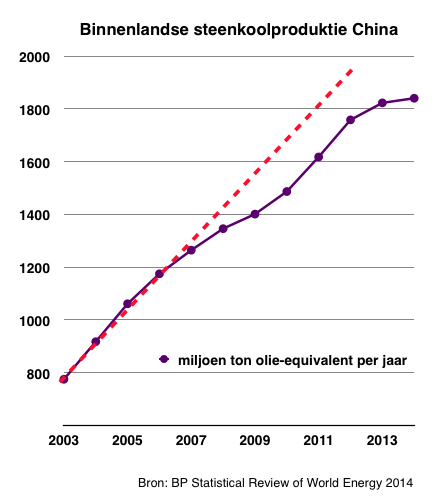
Important to note first of all is that this is not a fluke. The decline in coal consumption fits an overall pattern seen in China over the past few years, which suggests that China is running out of high quality coal. The image below shows Chinese coal production until 2009:

What we see here is that although Bituminous coal production continued to grow enormously, Anthracite production peaked. This is a signal of depletion, as anthracite is generally seen as a very high quality type of coal. Most of the world’s industrialized nations have hardly any anthracite left, some are even starting to run out of bituminous coal. As the image below demonstrates, the overall rate of growth in coal production also began to slow down before the drop observed in 2014:

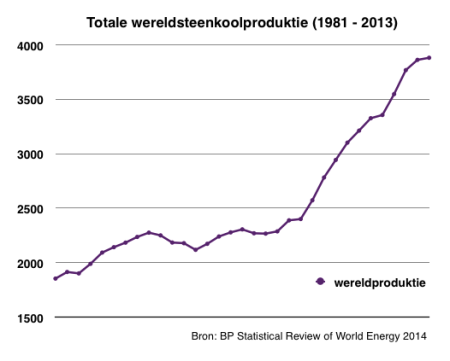
This decline of coal consumption in China also corresponds to a global plateau in coal consumption:

Interestingly enough, the decline in coal consumption in China appears to continue. On an annualized basis, statistics show that in the first four months of 2015, coal consumption in China dropped by an incredible 8%, while overall CO2 emissions dropped by 5%.8 So, what has happened then? There have been suggestions that the Chinese data are simply inaccurate, that coal mines are continuing to produce coal without being registered by the Chinese government. However, the stabilization in coal production has been a process that has taken place over multiple years, so I consider this an unlikely explanation, as the data fit in line with what we would expect.

It would also be persuasive to assume that the Chinese economy has simply started to decarbonize, by transitioning to low-carbon sources of heat and electricity and increasing energy efficiency. This would contradict the Chinese plan to peak carbon emissions by 2030 however. Why wait until 2030 and risk a global catastrophe, if you’re perfectly capable of reducing your emissions without affecting economic growth today?

A third possible explanation would be to suggest that the Chinese economy is being involuntarily decarbonized. Perhaps the Chinese are simply no longer capable of burning ever increasing amounts of coal. Multiple factors can be responsible for this. Overseas demand for carbon-intensive products may have declined. Low coal prices triggered by low demand may have forced some coal manufacturers to drastically reduce their production, because they can not produce coal at such low costs.

Evidence that verifies the case for low demand being responsible would include the 6% decline in demand for steel in the first quarter of 2015.11 Rail freight in China is declining by double-digit figures, and electricity use has declined for the first time since 2009, back when the world was in the middle of the global recession. In light of these problems, some analysts are skeptical about the GDP growth figures coming out of China.

There are also other factors, that could be interpreted as either voluntary or involuntary decarbonization, depending on how you wish to look at it. The Chinese government estimated in 2014 that 20% of its farmland is polluted, as a result of industrial activity. Many places face epidemics of birth defects as a result of pollution and cities across China are facing enormous problems with smog. Some coal resources are so dirty that the Chinese government aims to ensure through regulations that they will never be burned.9 If there is no “clean” coal available to replace such dirty coal, it’s inevitable that less coal will have to be burned.

The idea of China hitting peak coal around this time may come as a shock to some of us, but others have anticipated something similar occurring on a global level around this time. In 2010, Tadeusz Patzek estimated that the world would hit peak coal around 2011.10 The exact year that global coal production would peak is less interesting than the implication. He found that 36 of the IPCC’s 40 projected scenarios for the future are not going to happen, simply because we will never find enough fossil fuels that we can afford to burn. Croft estimates that we only have enough fossil fuels left to raise global temperatures by another 0.8 degree Celsius, which should mean that we end up staying well below 2 degree, assuming that positive feedback loops don’t begin to kick in yet at such temperatures.20

The idea of peak coal is not as strange as it may seem. The deindustrialization of Europe and North America that we have seen occur can be largely attributed to the fact that we simply could not afford to maintain our energy-intensive economies. The United Kingdom, which was first to undergo the industrial revolution, saw its coal production peak in the year 1913, at 292 Mt (million metric tons). Today, electricity prices in Germany, Denmark and other European countries are around four times as high as the price in India and China.

Western governments take limited action to maintain energy-intensive manufacturing industries inside their own countries. Rather, they try to preserve the relevance of their economies by focusing on service jobs. We find for example that Western nations prefer to focus on branding, marketing and associated factors in their products. The EU ensures that only certain regions of France are allowed to call their wine champagne.

To make the case for peak coal in China, it’s important to note the historical difference in coal use between China and Europe. Whereas between the year 1 and 1000, China had a significant share of the world’s population, Europe’s share back then was relatively low. Lower population density allowed Europe to use wood as a source of heat energy, whereas China was forced to rely on coal. In Britain some monarchs even prohibited the burning of coal, because of the pollution it created.

As a result, we find that throughout recorded history, China has always had a fair amount of industrial activity involving coal combustion, whereas Europe did not. No other nation in the world came as close to an industrial revolution as Southern Song did between 1127 and 1279. Such industrial activity also would have been significantly less energy efficient than modern industrial activity. Thus, although coal was burned at nowhere near the yearly rate that China currently uses it, hundreds of years of industrial activity may have robbed China of some of its best and most easily accessible coal.

In addition to this, there is no guarantee that other nations have high quality coal reserves about as large as those found in Europe. Climatic and geological conditions have varied across different parts of the planets for millions of years. Europe’s brown coal deposits were mostly produced by the giant coniferous trees related to redwoods that once grew in Europe millions of years ago. A different climate in China can have the effect of producing fewer economically useful coal deposits than we find in Europe.

At around 28% of the world’s carbon emissions, China is the most important factor in global carbon emissions.The United States trails China at about 15% of the world’s emissions. Looking at coal alone, China and the US are responsible for 40% and 16.2% of emissions respectively. In regards to the United States, the total tonnes of coal mined peaked in 2008. On the other hand, the total energy content of the coal mined peaked in 1998, because the quality of coal mined continues to deteriorate.12 By 2012, the total energy content of coal mined in the United States was down to 86% of its 1998 high. Natural gas has been increasingly forced to substitute for coal as a result.

An interesting development we can note in American coal production is that the sulfur content in burned coal is steadily climbing. Whereas between 2005 and 2008, sulfur content hovered around 0.98%, by 2009 sulfur content began to climb, rising to 1.32% by 2014.16 This is odd, considering the glut of natural gas. We would expect that abundant natural gas would have the effect of enabling a move away from dirty coal. The rise in sulfur content is indicative of the increasing use of brown coal of a particular low quality.

Since China and the United States together constitute more than half of global coal production, a peak of coal use in these nations can be sufficient to ensure that the peak in coal use is now behind us. A skeptic might argue that this does not necessitate peak coal, because other developing countries home to billions of people are still nowhere near the level of electricity use of the Western world.

A big part of future coal use hinges on the amount of recoverable coal found in India, something still unclear. India’s coal use is rising rapidly to serve its rapidly expanding economy, but the industry is mired by tremendous corruption. This is a problem that can be overcome, but it leaves us to wonder how much can be stated with certainty in regards to the size of its coal deposits.

Greenpeace has published an interesting report on India’s coal reserves.13 By 2012 it stated, India’s main producer CIL, responsible for 80% of production, had revised its coal reserves downwards by 16% compared to 2010. The company has consistently failed to meet its production targets. Greenpeace estimated in 2013 that at India’s targeted growth rates, CIL’s official coal reserves could be depleted within 17 years.

Important to note here is that CIL’s coal reserves are in all likelihood hopelessly optimistic. CIL has not made any effort to estimate geographical and land use limitations in its estimate of extractable coal reserves. This is quite a big problem, as India’s population density is about as high as the Netherlands’. Much of it would thus seem likely never to be used, as the soil above the coal deposits will prove to be more valuable. To recover coal after all is inevitably a more disruptive process that recovering oil or gas.

When it comes to coal, it’s important to note that different grades of coal have different properties and uses. Anthracite is generally the most useful type, followed by Bituminous and sub-bituminous. There is also coal that can be classified as metallurgical grade, based on its purity. This type of coal has to be very low in contaminating elements, as steel is very vulnerable to the effects of adding small amounts of sulfur or phosphorus.

Finally, we have lignite, the desperate man’s coal. Burning lignite yields so little energy, that lignite has to be burned directly near the location where it is recovered, as transporting this heavy coal over large distances means that you simply end up spending more energy transporting the coal than you recover from it. At this point, Germany only has significant amounts of lignite left. This forces the country to forcibly evacuate small towns that happen to have lignite beneath their soil. For this reason, Germany is particularly enthusiastic about transitioning to renewable energy.

Having some background knowledge about the different types of coal out there allows us to look at stated coal reserves with some skepticism. As an example, Pakistan has large lignite deposits in the Thar desert. This lignite will have to be burned on the spot to generate energy, it can not be exported. Of course this yields some problems, as mining and burning coal requires large amounts of water, water that simply is not available in a desert in the middle of Pakistan.

This is part of a larger problem that industry in countries closer to the equator will face should they ever seek to utilize large amounts of nuclear or coal power. Water is used to generate power. This water can then be passed through cooling towers, where it is lost to evaporation. Large parts of the world are increasingly facing water shortages and will thus be less than enthusiastic about losing what little water remains to coal plants. These towers tend to be expensive to build, so many coal plants don’t have them. Rather than losing the water to evaporation, it can also be dumped back into a river or lake, where it causes thermal pollution, which kills most of the fish that live there and creates toxic algae blooms and other problems.

We’ve looked at the problems that coal extraction faces. It’s interesting to look at oil and natural gas now, although an in depth analysis of oil and natural gas depletion is outside the scope of this essay. It’s worth noting however, that there is agreement that conventional oil has peaked in 2006, as even the IEA admits.17

What has increasingly substituted for conventional oil is unconventional oil, that is comparatively dirty, with higher carbon dioxide emissions per barrel of oil production. The debate focuses on whether or not the economy can continue to function when it becomes fully dependent on such unconventional oil.

In regards to unconventional oil, it remains to be seen how much of its is economically viable to extract. Current oil prices have rendered much of the US shale oil deposits economically nonviable to extract, even though these companies benefit from low interest rates as a result of monetary policies. Companies have focused on “sweet spots”, where the geology is just right. The American “miracle” is also unlikely to be repeated elsewhere, as the United States is believed to have more than three quarters of the world’s reserves.

Shale gas, now making up 39% of US natural gas production, can be produced at a low cost, because of the negative externalities that are imposed on the environment. If companies can be sued for the earthquakes their waste injections cause, oil and gas production is jeopardized.18 In the meantime, the earthquakes continue to get worse. The Oklahoma geological survey projects 941 M3+ earthquakes over the entire year 2015, a thousand-fold increase over the earthquake rate before the wastewater injection process began.19

The problems of peak oil and peak coal are difficult to see as separate from one another, as shortages in one resource will significantly affect the production potential of the other. Production of oil shale, with its extensive network of pipelines and many wells, requires high amounts of steel. The collapse of the oil shale industry in the United States is causing hundreds of people working in the steel manufacturing industry to lose their jobs. Steel production in turn depends largely on coal, 12% of all the world’s coal is used to produce steel, a figure that includes the poor quality coal types like lignite that are exclusively used for electricity generation.14

We find ourselves faced with a situation where a variety of resources are becoming increasingly difficult to extract. As an example, the mining industry in Australia is faced with ore grades that have halved in thirty years, while waste that has to be removed to access the ores has doubled, causing a tremendous increase in required energy.14 This shouldn’t be surprising, as the process of industrialization and exponential economic growth has meant that exploitation of a variety of resources is now at record highs. The effect the situation has on our economy is comparable to adding a variety of heavy burdens on a camel’s back.


1 – http://www.reuters.com/article/2014/11/14/china-carbon-idUSL3N0T41EY20141114

2 – http://www.iea.org/newsroomandevents/news/2015/march/global-energy-related-emissions-of-carbon-dioxide-stalled-in-2014.html

3 – http://www.earth-syst-sci-data-discuss.net/7/521/2014/essdd-7-521-2014.html

4 – http://www.bloomberg.com/news/articles/2015-03-13/china-s-carbon-emissions-drop-for-the-first-time-since-2001

5 – http://upload.wikimedia.org/wikipedia/commons/d/d7/China_coal_prod.PNG

6 – Found on http://cassandraclub.wordpress.com

7 – Found on http://cassandraclub.wordpress.com

8 – http://www.vox.com/2015/5/22/8645455/china-emissions-coal-drop

9 – http://www.wsj.com/articles/china-coal-ban-highly-polluting-types-banned-starting-in-2015-1410852013

10 – http://www.nytimes.com/gwire/2010/09/29/29greenwire-study-worlds-peak-coal-moment-has-arrived-70121.html?pagewanted=all

11 – http://www.bloomberg.com/news/articles/2015-04-29/china-s-steel-demand-slides-from-peak-while-exports-supported

12 – http://www.eia.gov/cfapps/ipdbproject/iedindex3.cfm?tid=1&pid=7&aid=1&cid=ww,&syid=1980&eyid=2012&unit=TST

13 – http://www.greenpeace.org/india/Global/india/report/2013/Coal-India-Running-on-Empty.pdf

14 – https://coalactionnetworkaotearoa.wordpress.com/2013/04/24/can-we-make-steel-without-coal/

15 – https://web.archive.org/web/20130409115625/http://www.crcore.org.au/ind-challenge.html

16 – http://www.eia.gov/electricity/monthly/current_year/march2015.pdf

17 – http://www.treehugger.com/corporate-responsibility/iea-chart-says-conventional-oil-production-peaked-in-2006.html

18 – http://www.wsj.com/articles/frackings-new-legal-threat-earthquake-suits-1427736148

19 – http://upload.wikimedia.org/wikipedia/commons/thumb/e/eb/Oklahoma_3.0_earthquake_bar_graph_since_1978.png/800px-Oklahoma_3.0_earthquake_bar_graph_since_1978.png

20 – http://www.nytimes.com/gwire/2010/09/29/29greenwire-study-worlds-peak-coal-moment-has-arrived-70121.html?pagewanted=all

Posted in Peak Coal, Peak Oil | Tagged , | 1 Comment

World’s first multi-million dollar carbon-capture plant does work of just $17,640 worth of trees

Preface. This is a shortened and reworded version of the original article.  Obviously, since we’re at the peak of global fossil fuel production, when the plateau ends sometime between now and 2025 and production declines exponentially, greenhouse gas emissions will start to drop dramatically as well. Meanwhile, transportation, supply chains, diesel engines, blast furnaces, the chemical industry (500,000 products made with and OF fossil fuels), are utterly dependent on petroleum. We simply can’t kick the fossil fuel habit no matter how much we’d like to since there are no commercially viable alternatives (I explain why in my book: “When Trucks Stop Running”).

Alice Friedemann   www.energyskeptic.com  author of “When Trucks Stop Running: Energy and the Future of Transportation”, 2015, Springer and “Crunch! Whole Grain Artisan Chips and Crackers”. Podcasts: Practical Prepping, KunstlerCast 253, KunstlerCast278, Peak Prosperity , XX2 report

***

Editorial Staff. June 2, 2017. World’s First Multi-Million Dollar Carbon-Capture Plant Does Work Of Just $17,640 Worth Of Trees—It’s The “Worst Investment In Human History. National Economics.

On May 31st the world’s first commercial carbon dioxide capture-plant was opened in Hinwil, Switzerland.  It’s designed and operated by a Swiss company called Climeworks, and uses a modular design that can be scaled up over time.

The company says that the plant will remove 900 tons of carbon dioxide from the atmosphere every year by passing it through a special filter that isolates carbon dioxide molecules.

What will happen to all of this carbon dioxide?

Some of it will be cycled into nearby greenhouses to help the plants grow and some to use in carbonated beverages, the rest underground.

The company says their technology could be used to stop climate change.

They estimate that 250,000 such plants would be necessary to capture enough carbon to meet the Intergovernmental Panel on Climate Change‘s goals of capturing 1% of global emissions by 2025.

Why would anyone do this when you could plant beautiful trees instead, trees that provide shade and fruits, as well as take carbon dioxide from the atmosphere and replace it with breathable oxygen?  Trees are really good at this. It only takes an average of 98 trees to remove 1 ton of carbon dioxide from the atmosphere per year.

That means that this plant is worth only 88,200 trees per year — and really more than that if you add in the enormous carbon and energy footprint for the fabrication of all the parts.

We can’t compare the costs of Climeworks “solution” to trees, because Climeworks doesn’t state the cost of their plant on their website—probably because it’s egregiously high.

But we do know the cost of planting trees.  You can sponsor charities to plant trees for you at 20 cents per tree.

We probably don’t even need to plant more trees, we just need to stop cutting them down to make room for new development and ranch land—better land management is actually our cheapest, and most effective option at preserving the environment.


Posted in Carbon Capture & Storage (CCS), Climate Change | Tagged , , | 1 Comment

From wood to fossil fueled civilizations — the greatest tragedy mankind will ever know

Preface. These are my notes from this book about how we went from an organic sustainable economy to a temporary fossil-fueled one.  It’s one of the few books I’ve found that explains what life was like before fossil fuels in a biophysical way that focuses on energy and population.  This book might even convince an economist that there are limits to growth, since it explains why a biomass-based society couldn’t exponentially grow, but that might be hoping for too much (since neoclassical economics is a religion but this book is based on science).

Wrigley also compares the Western European marriage system, where couples were much older because they had to wait until they could support themselves, which might require the parents to die. Though not always, in Eastern European countries, most women were married at a very young age not long after puberty, and ended up having far more children as well.

The Western European marriage system prevented the outcome Malthus had predicted in his first writings — that inevitably the standard of living was bound to be depressed to bare subsistence level and misery for most of the population.  He later saw that in fact marriage systems could prevent this from happening and wrote about it in later books.

Wrigley closes his book with the following warning:

“The industrial revolution may come to be regarded not as a beneficial event which liberated mankind from the shackles which limited growth possibilities in all organic economies but as the precursor of an overwhelming tragedy – assuming that there are still survivors to tell the tale.”

P.S. I discovered this book in the excellent list at the BioPhysical Economics Policy center: https://biophyseco.org/resources/books/

Alice Friedemann  www.energyskeptic.com  Author of Life After Fossil Fuels: A Reality Check on Alternative Energy; When Trucks Stop Running: Energy and the Future of Transportation”, Barriers to Making Algal Biofuels, & “Crunch! Whole Grain Artisan Chips and Crackers”.  Women in ecology  Podcasts: WGBH, Jore, Planet: Critical, Crazy Town, Collapse Chronicles, Derrick Jensen, Practical Prepping, Kunstler 253 &278, Peak Prosperity,  Index of best energyskeptic posts

***

Wrigley, E. A.  2016. The Path to Sustained Growth: England’s Transition from an Organic Economy to an Industrial Revolution. University of Cambridge.

The three centuries between the reigns of Elizabeth I and Victoria, are conventionally termed the industrial revolution. At the beginning of the period England was not one of the leading European economies. It was a deeply rural country where agricultural production was largely focused on local self-sufficiency. In part this was a function of the low level of urbanization at the time. England was one of the least urbanized of European countries: the only large town was London. The market for any agricultural surplus was limited other than close to the capital city.

Before the industrial revolution, prolonged economic growth was unachievable. All economies were organic, dependent on plant photosynthesis to provide food, raw materials, and energy. This was true both of heat energy, derived from burning wood, and mechanical energy, provided chiefly by human and animal muscle. The flow of energy from the sun captured by plant photosynthesis was the basis of all production and consumption. Britain began to escape the old restrictions by making increasing use of the vast stock of energy contained in coal measures, initially as a source of heat energy but eventually also of mechanical energy, thus making possible the industrial revolution.

In organic economies negative feedback between different factors of production was common. For example, if the population increased it would involve at some point taking into cultivation marginal land, or farming existing land more intensively, or increasing the arable acreage at the expense of pasture, changes which tended to reduce labor productivity, inhibiting further growth and reducing living standards. In early modern England the rising importance of a fossil fuel as an energy source meant that many of the relationships which involved negative feedback in organic economies changed: positive feedback became more common. The growth process tended to foster further advance, whereas in organic economies the reverse was the case.

If the woolen industry was flourishing and the demand for wool therefore rising, more land would be devoted to sheep pasture, but this must mean less land available to grow corn for human consumption, or less land under forest. Expanding the production of woolen cloth must at some point create difficulties for the supply of food, or of fuel for domestic heating, or for the production of charcoal iron. If the land was the source of virtually all the material products of value to man, expansion in one area of the economy was all too likely to be secured only by shrinkage elsewhere.

Most of the raw materials used by industry in organic economies were also vegetable, such as wood, wool, cotton, or leather. Even when the raw material was mineral, plant photosynthesis was essential to production, since converting ores into metals required a large expenditure of heat energy that came from burning wood or charcoal.

Coal is a stock, not a flow. Each ton of coal dug from a mine marginally reduces the size of the stock, and the same is true of all fossil fuels. Drawing upon a stock will ultimately lead to its exhaustion.

On this estimate of woodland productivity, therefore, it would be necessary to reserve 2 million acres of land for forest to produce the same quantity of heat energy each year as could be secured from burning 1 million tons of coal.

The advantage gained by employing draught animals was perhaps greatest in relation to overland transport. The output in terms of ton-miles performed during a working day by a man with a sack on his back or pushing a wheelbarrow is almost derisory compared with what is possible by a man with a horse and cart on a firm road surface. In many agricultural systems draught animals were essential. This was normally true of the cultivation of cereals such as wheat. If the yield per acre of a cereal is modest, it may be beyond the physical capacity of one man to cultivate a large enough area by his own efforts to support himself and his family. The land had to be ploughed by oxen or horses.

If the produce of 5 acres of land is needed to feed a working horse, the area available to feed people is reduced commensurately. As Cottrell remarked: ‘Where land is plentiful, population sparse and draught animals available, there may be an economy in substituting draught animals for manpower; but with increased population and competition for land for the production of food and feed, the situation may be reversed, the survival of man being more important than the feeding of work animals.’ It was an unfortunate feature of organic economies after the neolithic agricultural revolution that a period of growth and prosperity when the population was rising tended to restrict the area that could be devoted to growing fodder for draught animals unless productivity per acre was rising sufficiently to offset the population rise.

Domestic heating in towns. Bairoch estimated that each town dweller typically needed between 1.0 and 1.6 tons of firewood each year, which Van der Woude et al. estimated would represent the annual product of 0.5 to 0.8 hectares of woodland, or roughly 1.25 to 2 acres. For simplicity, I assume that 1.6 acres would cover the firewood needs of the average town dweller.

A town with 10,000 inhabitants, therefore, would need access to the annual growth of wood taking place in woodland covering 16,000 acres. For an urban population totalling, say, half a million people and therefore needing 650,000 tons of firewood a year, it would be necessary to devote the wood growth of roughly 800,000 acres to meeting their domestic heating needs. The same quantity of heat energy could be secured from burning approximately 325,000 tons of coal, since burning 1 ton of coal produced as much heat as 2 tons of dry firewood.

The switch from wood to coal therefore enabled approximately 800,000 acres of woodland to be used instead to produce food, or wool and hides, rather than fuel.

The classical economists saw all activity giving rise to material production as involving three component elements: capital, labor, and land. The quantity of capital and labor available to allow production to take place might in principle be increased as necessary and without apparent limit, but the same was not true of land. The area of land was limited and could not be increased. Advances in technology might permit significant improvements in aggregate output. The output from any given area of land might be increased by the introduction of a new crop, as when the potato arrived from the Americas; or by innovations which reduced the proportion of arable land kept in fallow each year; or the area of land under cultivation might be increased by drainage of marshland, enclosure of heath, or reclamation from the sea, but the general problem was permanent and insoluble. If growth occurred it must at some point increase the pressure on the land since the land was the source of all food and the great bulk of the raw materials of industry. If either poorer land was taken into cultivation or existing land used more intensively, this must tend to involve declining returns both to capital and labor, and eventually growth would grind to a halt or be reversed.

Ricardo made it clear that his gloomy conclusion was due not to institutional shortcomings, the character of economic systems, or the failure of human judgement, but to the operation of the laws of nature. He summarized his analysis in a manner that left no grounds for optimism about the secular trends of real wages or profit levels. His reasoning excluded any possibility of the type of sustained growth that came to be termed an industrial revolution: Whilst the land yields abundantly, wages may temporarily rise, and the producers may consume more than their accustomed proportion; but the stimulus which will thus be given to population, will speedily reduce the laborers to their usual consumption. But when poor lands are taken into cultivation, or when more capital and labor are expended on the old land, with a less return of produce, the effect must be permanent. A greater proportion of that part of the produce which remains to be divided, after paying rent, between the owners of stock and the laborers will be apportioned to the latter. Each man may, and probably will, have a less absolute quantity; but as more laborers are employed in proportion to the whole produce retained by the farmer, the value of a greater proportion of the whole produce will be absorbed by wages, and consequently the value of a smaller proportion will be devoted to profits. This will necessarily be rendered permanent by the laws of nature, which have limited the productive powers of the land.

To someone sitting in a congregation today the sentence in the Lord’s Prayer, ‘Give us this day our daily bread’, may occasion mild surprise. It is seldom a grave concern in societies that have been transformed in the wake of the industrial revolution, but would have had pressing and immediate relevance from time to time for congregations in Tudor times. Poverty and the difficulty of securing an adequate supply of basic food were ever-present features of organic economies.

Adam Smith had previously expressed it bluntly: Every species of animals naturally multiplies in proportion to their means of subsistence, and no species can ever multiply beyond it. But in civilized society it is only among the inferior ranks of people that the scantiness of subsistence can set limits to the further multiplication of the human species; and it can do so in no other way than by destroying a great part of the children which their fruitful marriages produce.

In times of prosperity the population would rise quickly, outpacing production. Living standards would therefore fall and, as the bulk of the population became poorer, mortality would rise, eventually to the point where it matched the level of fertility. The population would therefore cease growing and the laboring poor would hover on the verge of destitution.

What was distinctive about the system when compared with other marriage systems was that decisions to marry were strongly affected by economic circumstances. This in turn was the result of the convention that on marriage a couple should create a new household. Instead of joining an existing household, a couple on marriage was expected to establish a new one. This involved accumulating the resources necessary to acquire and equip a household. For many couples it was necessary to save from income over a period of time to make the marriage possible. If incomes were depressed or irregular it took longer to do so than in more prosperous times. As a result the average age of marriage might rise or fall in sympathy. In western Europe societies, moreover, a significant fraction of each rising generation never married, and this proportion was also influenced by economic circumstances. In other societies the timing of marriage was governed by the prevailing conventional norms that meant that the vast majority of women married young.

It was frequently the case that celibacy was almost unknown and the average age of marriage for women was far lower than in western Europe, often close to the attainment of sexual maturity. The fact that in western Europe between a tenth and a fifth of each generation never married, combined with a relatively late average age at marriage for women, implied that fertility levels were normally lower than in other societies. This generalization is too sweeping. Fertility levels were influenced by many factors other than age at marriage and celibacy levels. Relatively modest levels of general fertility sometimes prevailed through the effect of social and personal conventions and practices very different from the west European system. And the west European marriage system itself took varying forms. Nevertheless, Malthus’ recognition that the ‘preventive checks of moral restraint’ implied the possibility of stationing a society at some distance from the Malthusian precipice is relevant to any consideration of the circumstances in which escape from the constraints of an organic economy might occur.

Jevons’ book, The coal question. The first edition was published in 1865. His subject was the ‘Age of Coal’. He remarked: Coal in truth stands not beside, but entirely above all other commodities. It is the material source of the energy of this country – the universal aid – the factor in everything we do. With coal almost any feat is possible or easy; without it we are thrown back on the laborious poverty of early times.

He was deeply concerned about the depletion of coal reserves generally and the export of coal in particular: To part in commerce with the surplus yearly interest of the soil may be unquestioned gain; but to disperse so lavishly the cream of our mineral wealth is to be spendthrifts of our capital – to part with that which can never be reproduced.  In short, the export of corn was less hazardous than the export of coal because the former was the product of an energy flow, whereas the latter was an exhaustible stock.

If mechanical energy had continued to be provided almost exclusively by human and animal muscle, the constraints of an organic economy would have continued to limit growth. Because draught animals were the most important single source of mechanical energy in early modern England, increasing use of mechanical energy would only have been possible by devoting a larger and larger acreage to animal fodder.

In the mid-19th century, it was 270 times larger than it had been in the 1560s, and 20 times larger than in 1700.

The annual growth rate for coal production varied between 1.2 and 1.9 per cent per annum throughout the period from the 1560s to 1800, with only limited variation. In the final half-century 1800 to 1850/4, however, the annual rate of growth accelerated markedly to 3 per cent, in part a reflection of the fact that coal was an increasingly important source of mechanical as well as heat energy.

The total rose massively between the mid 16th and mid 19th centuries. In 1560–9 the annual average figure was 65 petajoules, a quantity roughly equivalent to the energy contained in 2.2 million tons of coal. Three centuries later, in 1850–9, energy consumption had risen to 1,833 petajoules, a total more than 28 times as large as the earlier figure. The very large increase in energy consumption that took place was mainly due to the rapid expansion in coal production over the three centuries in question. Coal provided an annual average of 7 petajoules in 1560–9; in 1850–9 the equivalent figure was 1,689 petajoules.

Coal supplied only 11% of total energy consumption in the 1560s, rising to 33% in the 1650s, 61% in the 1750s, and no less than 92% in the 1850s.

Peat represents an accumulation of the product of plant photosynthesis over thousands of years; coal a similar accumulation over millions of years. Sieferle estimated that in the 17th century 0.3–0.5 per cent of the stock then existent in the Netherlands was used annually, suggesting that over the century as a whole approaching half of it was consumed.

The use of peat as an energy source was feasible only where the cost of transport could be kept to a minimum, and this constraint is especially severe in the case of peat because of its greater bulk in relation to its energy potential. Van der Woude et al. made a calculation that brings home forcefully how strong this constraint was in an organic economy: Water transport was essential to the economical digging and transporting of this bulky commodity. Had road transport been used to bring the peat to its urban markets, 110,000 horses would have been required, and to feed these horses 230,000 hectares – one third of the nation’s arable land – would have been withdrawn from the production of crops destined for human consumption.

Coal transport

The great bulk of both coal and grain were consumed at a distance from their points of production and therefore in both cases their cost at the point of consumption included significant transport costs.

A country’s grain crop required millions of acres.  As a result, the transport network needed to take grain to market was dendritic, that is, resembling the structure of a tree. The route from the farm to a neighboring village represented a twig which linked first to a thin branch and then through thicker branches to boughs, before finally reaching the main trunk.

Whereas the coal pitheads were a scattering of points covering only a few acres rather than millions of acres. In contrast the transport network needed to bring coal to the settlement or industrial plant where it was consumed was linear in character. Large volumes moved from the mine head to a limited number of final destinations,

The fact that coal production was punctiform, that coal was bulky and heavy, and that its transport to market was often linear rather than dendritic in character, created a powerful incentive to invest in transport improvements. In particular, it transformed the economics of canal construction. A large proportion of canal construction was explicitly undertaken to reduce the cost of coal in centers that promised to become large-scale consumers if the price could be lowered.

Canals passing through predominantly rural areas brought many benefits to farms close to the canal route by reducing the cost of lime, marl, coal, and other bulky or heavy materials, but they seldom proved profitable investments if largely dependent on rural custom, since traffic volumes were modest compared to canals linking coalfields to industrial and commercial centers.

Ironically, although the nature of coal production and its rapidly increasing scale encouraged major improvements in transport facilities, until the early decades of the 19th century the transport improvements were all made subject to the limitations inherent in organic economies. The mechanical energy source used in moving raw materials and finished goods by road and canal remained animal muscle, and therefore the scope for increasing the scale, speed, and reliability of transport facilities remained limited. It was only with the construction of a national railway system in the middle decades of the 19th century, using coal rather than muscle as its source of mechanical energy, that transport could achieve advances to parallel those already long achieved in the branches of industry in which cheap and abundant heat energy was the key to rapid expansion.

In organic economies it was always the case that the size of the urban sector was strongly influenced by the productivity of agriculture. City dwellers needed food and drink no less than those living in the countryside and since they produced little food themselves, they depended upon the existence of a rural surplus. If, for example, the agricultural sector produced 25% more food than would cover the needs of the rural population, the food needs of an urban population that constituted a fifth of the total population could be satisfied. Agricultural productivity set limits to the urban growth that could take place, but agricultural productivity was itself strongly influenced by urban demand. In the absence of a substantial urban sector, in rural areas there was little incentive to produce an output greater than that needed to meet local needs. In other words, agricultural productivity and urban growth might be characterized by either negative or positive feedback. If the urban sector was trivially small and stagnant there would be minimal incentive for increased agricultural output since any surplus over local rural needs would be unable to find a market. If, however, the urban sector was significant and growing it created an incentive to increase agricultural output, thus ensuring that demand and supply remained in balance as urban growth progressed. Positive feedback between urban growth and improved agricultural productivity was always possible in organic economies. If it occurred, however, although the level of urbanization might increase for a time, matched by an increasing rural surplus, the positive feedback could not continue indefinitely, because of the implications of the fixed supply of land which the classical economists described so effectively.

The size of London’s population meant that the area needed to satisfy its food requirements was large even in 1600. Gras estimated London’s annual consumption of grain as 0.5 million quarters (4 million bushels) at the beginning of the 17th century when the population of the city was about 200,000. This suggests that each Londoner was consuming 20 bushels annually on average.  Chartres considered that food and drink, bread and beer, contributed roughly equally to the total of grain consumed. The gross yield per acre of a combination of grains at the time is not known with any certainty. I assume a figure of 12 bushels per acre for a mixture of wheat and barley, the two main food and drink cereals. When calculating the acreage of arable land needed to supply the food and drink needs of the population, however, the gross yields are misleading. Account must be taken of two factors that reduce it considerably. Net yield may be taken as 9 bushels after allowing for the reservation of 3 bushels as seed for the next harvest. Furthermore, about 30% of the arable acreage was fallowed each year. This means that the quantity of grain available for consumption from each arable acre should be taken as only 6.3 bushels (9 × 0.7 = 6.3).15

To provide 20 bushels for each Londoner therefore meant securing the grain output from about 3.2 acres of arable land, implying that London’s ‘footprint’ in meeting the grain needs of its 200,000 inhabitants in 1600 extended to 640,000 acres, or 1,000 square miles. On the same assumptions in 1800 with a population of 960,000 London’s grain ‘footprint’ would have covered 3,100,000 acres or 4,800 square miles; and the national urban requirement in 1800, when the national urban population total was 2,380,000, would have been 11,900 square miles, an impressively large total, given that the total arable acreage in England and Wales is estimated to have been 11.5 million acres, or 18,000 square miles. Moreover, the urban ‘footprint’ resulting from the urban demand for food is considerably understated by this calculation since meeting the urban demand for meat, cheese, butter, fruit, and vegetables would have enlarged its size substantially; and providing fodder to feed the horses used to transport rural produce to the towns would have extended the ‘footprint’ still further.

It seems plain that if the circumstances of urban food provision, determined by cereal yields per acre, which prevailed throughout Europe in, say, 1500 had continued to hold good thereafter, urban growth in England would have come to a halt well short of the level it had actually reached in 1800. What, then, had changed?  A remarkable advance in net agricultural output per acre. For example, gross grain yields roughly doubled between the end of the 16th century and the beginning of the 19th, rising from 12 to 24 bushels per acre. Allowing again 3 bushels for seed, the net yield was 21 bushels at the end of the period. The proportion of arable land that was fallowed each year had declined substantially to c. 16 per cent. As a result, the net output secured from an acre of arable land used for grain production rose to 17.6 bushels per acre (21 × 0.84 = 17.6) from 6.3 bushels two centuries earlier. London’s claim on arable land in 1800, therefore, may be taken as 1,100,000 acres, or 1,700 square miles compared with a figure of 4,800 square miles if the yield per acre and fallowing percentage had remained at their levels two centuries earlier. The comparable figure for the English towns as a whole is 2,700,000 acres, or 4,200 square miles compared with 11,900 square miles if yields had not changed. In 1800 the national urban population total in towns with 5,000 or more inhabitants had risen 7-fold from 1600 but an area only two-and-a-half times as large as in 1600 could supply their grain requirements.

The area of land involved in meeting urban grain and fuel needs rose in round numbers from 2,000 square miles in 1600 to 4,500 square miles in 1800, a rise of 125 per cent during a period when the urban population rose from 335,000 to 2,380,000, or by more than 600 per cent.

In organic economies it was normal for 70–80% of the workforce to be employed on the land, reflecting the fact that labor productivity in agriculture was low.

Ten peasants might produce enough food for their own families and perhaps two or three other families who were then able to engage in textile manufacture, handicrafts, building, retailing, transport, etc., but the surplus in question was limited and might prove fragile in hard times.

Equally, the absence of a large urban demand for food meant that there was little incentive for a peasant farmer to increase his output since there was no guarantee that it would find a market.

It has been estimated that to meet its firewood requirements, ‘A town of 10,000 inhabitants would need to witness the annual arrival of between 10,000 and 16,000 horse-drawn carts’ carrying the firewood in question.

There were almost 110,000 shoemakers in England in 1831. They were the largest occupation in the retail trade and handicraft category in the 1831 census. One man in thirty of all male workers in England at that date was a shoemaker. In the tertiary sector clerical work was largely sedentary, and in most other tertiary sectors the level of energy expended was modest by the standards of agricultural work. Given the scale of occupational change between the mid-17th and mid-19th centuries, an unchanging average level of calorie intake would imply an improvement in the average nutritional level. It also suggests that a fall in the level of calorie intake did not necessarily mean worsening nutrition.

An autumn peak in marriages was characteristic of a farming year predominantly concerned with the harvesting of corn. In pastoral parishes the peak was in the late spring or early summer. In both farming types, the peak of marriages followed the season of the year in which the demand for labor had been at its height. In arable areas this occurred when the grain had been harvested, in pastoral areas when lambing and calving had taken place.

It was increasingly the case that market-orientated farming was determining land use rather than a ‘peasant’ focus on local self-sufficiency.

This change may well have been greatly expedited by the very large acreage that passed from royal to private hands following the dissolution of the monasteries. Clay suggested that: ‘If estates granted away to courtiers and royal servants in the mid-16th century are also included, perhaps 25 per cent of the land of England had passed from royal into private hands by 1642. He considered that royal estates had been poorly managed.

The demographic characteristics of a society may have an important bearing on its prevailing standard of living and economic growth prospects. This was an issue explored by Hajnal in his remarkable essay on marriage in western and Eastern Europe, published in 1965. He was intent on exploring the nature and significance of the west European marriage system.

The differences between the two marriage systems are striking. They are especially pronounced in the case of women. In the western pattern, approaching half of the women in the age group 25–29 are unmarried, and this remains true of roughly a sixth of women even in the 45–49 age group. In eastern Europe in both these age groups the proportion of women who had never married was negligible. Hajnal provided evidence that what was true of eastern Europe was true of almost all societies elsewhere in the world for which he had reliable data. The difference in proportions ever married in the two systems clearly implies wide differences in the average age at first marriage.

The mean age at first marriage for women was 19.7 years in Serbia. In the west European marriage system the average female age at first marriage, though it varied considerably, was 3-8 years later in life.

Even though exponential growth was physically impossible in organic economies, the prevailing standard of living was not foredoomed to be depressed close to bare subsistence for the mass of the population in societies in which the west European marriage system had become established. In drawing attention to this fact, exemplified in the economic history of countries in north-west Europe, Hajnal emphasized that he was essentially re-expressing views which Malthus had propounded as a mature thinker.

If the prevailing fertility level is somewhat lower, because marriage takes place later in life and a proportion of each generation remains single, and if marriage decisions are influenced by prevailing economic conditions – in short, if fertility as well as mortality is sensitive to the level and trend of living standards – a different outcome is readily possible.

Given the nature of organic economies, the potential disadvantages of a society in which fertility is high and invariant are clear. The poor will indeed always be with you. But this is only a limiting possibility. There were many circumstances that might cause fertility to fall well short of the highest level attainable. Clearly this will be true where, as in the west European marriage system, there is a high average age at marriage for women and conventions that lead to a proportion of each rising generation of women never marrying.

What is remarkable about the populations of pre-industrial western Europe is that they not only evolved a set of social rules, which effectively linked their rate of family formation with changes in their environment, but also managed to secure such low fertility that they achieved both a demographically efficient replacement of their population, and an age-structure which was economically more advantageous than the age-structures generally to be found among non-industrial societies today.

At one extreme there were societies in which every woman was married at or close to the age of arriving at sexual maturity unless she was seriously handicapped physically or mentally. The timing of marriage for women was determined by physiological change. At the other extreme in the west European marriage system, economic circumstances played a major role in influencing the timing and frequency of marriage. The social convention that brought this about lay in the expectation that on marriage the newly married couple would set up a new household rather than joining an existing household as was the norm in many other organic societies. This created an economic hurdle to be surmounted before a marriage could take place.

Rather than the timing of marriage being governed by reaching or approaching sexual maturity, it was strongly influenced by the time spent by the couple in securing an adequate sum in advance of marriage to enable them to create a new household. This meant that the average age at marriage for women was characteristically in the mid-20s rather the mid to late teens. Family sizes were therefore significantly smaller. With a mean birth interval of 30 months, for example, marriage at 25 rather than 18 would reduce completed family size by 2.8 children on average. If the economic barrier to be surmounted was severe, or saving was difficult and parents were unable or unwilling to assist, it also meant that a proportion of both sexes would never marry because they had failed to assemble the wherewithal to do so.

In peasant communities, for example, the ability to marry might depend upon gaining access to a holding. If holdings were not subdivided this would result in an unchanging number of married couples.

When living costs rose because a bad harvest caused grain prices to soar, marriages were delayed. Long-term economic trends that affected living standards might also influence the timing and extent of marriage. Worsening economic circumstances tended to produce a rise in the proportion of men and women remaining single; and those who did marry would do so later in life.

An implication of relatively high mortality is that fertility must also be high if the population is not to decline. This in turn implies that, ceteris paribus, age at marriage will be lower and celibacy less common than in countries where a ‘low-pressure’ rather than a ‘high-pressure’ demographic system exists.

Late marriage and the fact that a significant proportion of women remained single affected the composition of the labor force. In England unmarried women normally entered the labor force.

A single woman is usually regarded as contributing more to national output than a married woman.

To transfer of a load of grain weighing 2,400 pounds by a wagon drawn by four horses 23 miles the horses at almost ten percent of their cargo, 150 pounds of grain, so only 2,250 pounds of grain was delivered.

The heavier and bulkier the product, the more severely the accessible market area was limited.

In the wealth of nations, Adam Smith stressed the significance of transport costs in relation to the size of an accessible market. In an assessment of the importance of good transport facilities, he asserted that: ‘Good roads, canals, and navigable rivers, by diminishing the expense of carriage, put the remote parts of the country more nearly upon a level with those in the neighborhood of the town. They are upon that account the greatest of all improvements. They encourage the cultivation of the remote, which must always be the most extensive circle of the country.’

In the band closest to the town the land is devoted to market gardening, fruit-growing, and milk production (perishability rather than transport cost determines this usage). The next band illustrates vividly the restrictive nature of high transport cost. It is forest land from which the town meets its fuel needs both for domestic heating and for local industry. Access to timber is also vital for other purposes, notably for the construction industry. Because of its bulk and weight timber has to be grown close to the town. Its price rapidly becomes prohibitive as the length of the journey to market increases.

The outermost circle is devoted to pasture since, for example, beef cattle can provide their own transport by walking to market at a relatively low cost, and sheep’s wool is both light, durable, and of relatively high value per unit weight. In von Thünen’s model the outermost circle is the sixth band. The three bands between the timber and pastoral bands are devoted to cereal growing.

High transport costs operate rather like tariff barriers. Most local industries are, in effect, protected in much the same way that a tariff would provide protection. Competition is restricted, except in regard to products of high value per unit weight. In contrast, if transport costs are low an efficient producer will be able to sell at a profit over a larger area, and the consumer will benefit. Hence Adam Smith’s insistence that transport improvements are ‘the greatest of all improvements’.

A river that passed through a market town gave some farmers a huge advantage.  The strips of land on either side of the river distort the original simple pattern of concentric bands of land use. The bands are extended outwards on either side of the river because close to the river the cost of transporting a crop or other produce to the town might be no higher at, say, three times the distance from the town at which the same cost is incurred if the product is moved over land.

Until the advent of the railway, transport continued to be entirely an ‘organic economy’ activity. In contrast with other major branches of the economy, the energy used in transport was exclusively mechanical energy and until the middle decades of the 19th century this continued to be provided, as in the past, by animal muscle on land and by the wind at sea. Only with the development of an effective method of converting heat energy into mechanical energy did this change.

If production is areal the associated transport system will be dendritic. Much of the agricultural production takes place towards the periphery of the farmland surrounding a town and is therefore transported to the town from the outermost twigs of the system. In order to reach an urban market the grain must journey first along the twigs to reach the small branches and then the larger boughs before reaching a main trunk of the system. Similarly, for urban products to reach rural markets they must journey through the dendritic system in the opposite direction. The volume of traffic along any given stretch of road will be modest except on the roads close to the main market. In organic economies this meant that it was difficult to secure an adequate return on road improvement since the resulting saving in reduced transport cost could seldom justify the initial expenditure.

Greene, writing about horse usage in the United States, notes that the average density of horses in the forty-six largest cities in the country when urban horse usage peaked in 1900 was 426 horses per square mile. She estimates that in Philadelphia, where the density was about 400 per square mile, there were more than 50,000 horses in the city as a whole. The pressure on horse supply had long been apparent at the local level.

For example, it was noticed in the 18th century coal mines at mines some distance from the nearest navigable water. Langton, describing this problem in Lancashire, wrote: ‘At Haydock in 1756, just before the Sankey was opened, coal sales stopped when ploughing began and in 1769, when the canal was presumably the colliery’s main market, sales dipped during haying time as agriculture took its prime claim on the available horses.’  Horses had, of course, long been employed in large numbers in moving coal over short distances. It is said that 20,000 horses were employed in the Newcastle coal trade in 1696.  Musson noted that horses were still widely used as a source of power in the classic period of the industrial revolution: ‘They had long worked drainage pumps and winding whims for mines and were commonly employed to drive grinding wheels in potteries and glassworks (flint-mills), in tanneries (bark-mills), in lime-kilns for grinding chalk and in brickworks for mixing clay (pug-mills); they also came to be used frequently to drive carding, scribbling and spinning machinery in early textile horse-mills.’

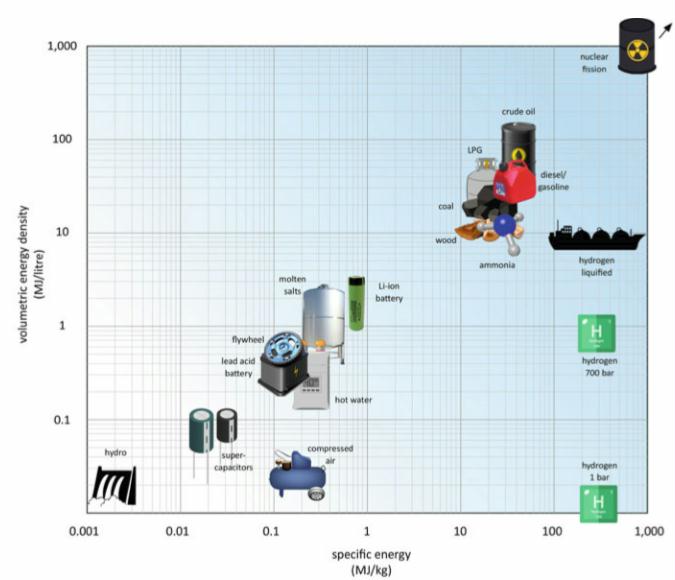


Posted in Agriculture, Life Before Oil, Supply Chains | Tagged , , , , , , | 5 Comments

Can the lights be kept on with distributed generation? 2015 U.S. House hearing on a reliable electric system

Preface.  Corporate speakers testify mainly, rather than less biased researchers from universities or national laboratories. Corporations are selling a product, and likely to exaggerate what their product can do.

The most interesting testimony is from Dean Kamen, who is “selling” his company’s Stirling engine generator to congress as a way to decentralize the grid by using them for distributed power from natural gas or oil.  Well, that doesn’t solve the finite fossil fuel problem.  It’s spun as a way to balance renewables, but I doubt that this can be done yet – the technology to manage hundreds of thousands of stirling engines, solar panels, and other distributed devices doesn’t exist, nor the math, algorithms, or computers to attempt to do so.  Nor can we revolutionize the grid quickly, because deregulation has forced every player into strictly and narrowly defined roles (i.e. just generation, just distribution, just selling electricity, etc). And if we did decentralize – would there be enough fossil fuels left to power them?

The advantage of a distributed system / microgrid / islanding is that cyber-attacks, natural disasters, and power outages could be kept within a much smaller area and after a natural disaster, neighborhoods would still have power because they use underground natural gas lines, less likely to be damaged than overhead power lines, and they can also run on gasoline, propane, and other fossil fuels.

Meanwhile, electric vehicles are creating a new demand for power equal to an entire home. Since renewables require an equal amount of fossil generation backup, that means more fossil power plants, not less in the future.  Since we are likely past peak oil in 2018, and within 20 years of peak natural gas and peak coal, this means dozens of new import Liquefied Natural gas facilities along our coasts that are potential terrorist targets and continued dependency on other nations with natural gas and coal, and more potential for war as fossils decline.

Whether centralized or decentralized, the electric grid mainly runs on fossil fuels, which are finite.  My own guess is that as the electric grid becomes increasingly unreliable, whether from cyber-attack, natural disasters, lack of hydropower, coal, or natural gas, or breakdowns from lack of maintenance, the richest 10% of Americans will buy a generator, which is how the wealthy cope now in the third world, and invest in more insulation.  The bottom 90% of Americans won’t be able to afford to do this, and will turn to wood to heat and cook with.  Already 10% of American homes use wood for heat, so that will lead to unsustainable cutting of forests.

Alice Friedemann  www.energyskeptic.com  Author of Life After Fossil Fuels: A Reality Check on Alternative Energy; When Trucks Stop Running: Energy and the Future of Transportation”, Barriers to Making Algal Biofuels, & “Crunch! Whole Grain Artisan Chips and Crackers”.  Women in ecology  Podcasts: WGBH, Jore, Planet: Critical, Crazy Town, Collapse Chronicles, Derrick Jensen, Practical Prepping, Kunstler 253 &278, Peak Prosperity,  Index of best energyskeptic posts

***

House 114-18. March 4, 2015. The 21st Century electricity challenge: ensuring a secure, reliable, and modern electricity system. U.S. House hearing.  116 pages.

Excerpts (with some alterations and cuts to make the testimony clearer):

ED WHITFIELD, KENTUCKYMr Patel, you said “Customer adoption of electric vehicles is creating new demand for power, each vehicle equivalent to an entire home while charging, requiring new utility demand control measures to avert overloading of existing infrastructure. Please provide the study or data which you are using as a basis for your statement that electric vehicles are creating new demand for power equivalent to an entire home.

Naimish Patel, CEO, Gridco Systems.  Various sources of data are available to support my statement that electric vehicles are creating new demand for power, equivalent to an entire home.  One such source is a December 2014 ARRA report produced by the U.S. Department of Energy titled: “Evaluating electric vehicle charging impacts and customer charging behaviors: Experiences from six smart grid investment grant projects”  at http://energy.gov/sites/prod/files/2014/12/f19/SGIG-EvaluatingEVcharging-Dec2014.pdf  On page iv of the report, in the Grid Impacts section of Table 1. Summary of Key Project Experiences, it is noted that “The average power demand to charge most vehicles was 3-6 kilowatts, which is roughly equivalent to powering a small, residential air conditioning unit.” It is also noted in the same section that “…depending on the model, the load from one electric vehicle model can be as much as 19 kilowatts, which is more than the load for most large, single-family homes.

Also:

  • The most common type of charger is a portable 120-volt special charging cord, referred to as AC Level 1 charging, which typically provides 3-5 miles of range per hour of charge. Depending on the size of the battery, and the initial state of charge, this could take 8 to 20 hours to fully charge a depleted battery.
  • Some makes and models — particularly all-electric vehicles or those with larger battery packs — may take about 20 to 60 hours to charge a fully depleted battery at 120 volts. While 120-volt charging is relatively slow, it can often be accomplished with little to no additional cost or installation work if an outlet is already available at home.
  • Users can cut charging times significantly by installing AC Le vel 2, 240-volt charging stations. However, these sy stems can add $600-$3,600 to the cost of in-home charging, depending on the availability of power in the electric panel. Typically, installations require permits and licensed electricians.

Alice Friedemann   www.energyskeptic.com  author of “When Trucks Stop Running: Energy and the Future of Transportation”, 2015, Springer and “Crunch! Whole Grain Artisan Chips and Crackers”. Podcasts:  KunstlerCast 253, KunstlerCast278, Peak Prosperity]

USDOE. December 2014. Evaluating electric vehicle charging impacts and customer charging behaviors – experiences from six smart grid investment grant projects. United States Department of Energy, electricity delivery and energy reliability. www.smartgrid.gov

ED WHITFIELD, KENTUCKY. The U.S. was the first nation to electrify, and our system of generation, transmission, distribution and related communications remains the best in the world. Nonetheless, new challenges are emerging, as are opportunities to modernize and improve the electric grid. The challenges are significant:

  • much of our grid is outdated
  • coal-fired generation facilities are shutting down at an alarming rate
  • reserve margins are inadequate in several regions
  • intermittent and remote renewable capacity is coming online
  • cyber threats pose a growing concern

While encouraging technology and innovation in the electricity sector should be a priority, policies must ensure that new grid-related products do no leave the grid more exposed or compromise customer information and privacy.

DEAN KAMEN, Founder and President, DEKA Research and Development Corporation.

In the 1880s there was these guys Edison and Tesla, who gave us big centralized plans, …now it is 150-year- old architecture. What do we know about it? Is it ready for disruption? Well, it is old, it is inefficient, it is unreliable, it is expensive, and it is dirty.

Quick facts about what the grid is today. We have about 1 terawatt, 1,000 gigawatts, of production capacity at an average of $1 a watt to produce. That is $1 trillion in generation assets.  More than half of it is 30 years old, and if you only replace the stuff that is that old at $1 a watt, it will cost $500 billion. Once you make that energy, you have to move it. High voltage transmission lines cost about $1 million a mile, and oops, sometimes they are not quite what we would like them to be. And 70% of those lines are 25 years old or more, and there are 280,000 miles of that high voltage lines, another $200 billion to replace.

Then you have the low voltage lines in all your neighborhoods–wires hanging on wooden poles. What could possibly go wrong? So these are a real deal, only $140,000 a mile, and there are 2.2 million miles and half of them are over 30 years old. And if you just replace just the old stuff, that’s another $150 billion. And then, of course, you have the annual capital cost of that infrastructure, which is $90 billion now to keep this architecture operating.

Everybody I know loves solar panels. So how do you catalyze more people to do this? Well, the more you put solar panels up without doing something else, you are actually hurting the grid because they add instability…

You have to do something that can catalyze this stuff to happen in a way that helps everybody, including the people supplying the power.  New technologies bring new opportunities, but they also sometimes bring problems, especially to stranded infrastructure.

From a practical point of view, the entire system that has ran for 150 years was premised on the generating company only making money by selling more power, so there is no encouragement to save.

I don’t think regulators understand that those big power plants are very good at producing a constant amount of power and it can take hours and hours to bring those big boilers up. When you start putting transient capability [like solar power] online –what happens when that cloud goes by and suddenly a couple of hundred megawatts that was there goes away, or when wind stops, you are asking that big tired grid you were trying to avoid paying their bill an hour ago, suddenly you are desperate for more power. They have a tougher time reacting and keeping a stable grid with these other systems online than they had before, and they are making less money.

In the case of Germany, the instability from a pure technology point of view, not an economic or financial point of view, but the instability induced in their large systems by all these new transient systems is making life difficult, causing a reliability issue and a security issue. And I think we should avoid that in this country.

I think we could make generators that use the largest buried infrastructure in the country – natural gas — that we don’t need $100 million a mile for. Plus many buildings have buried tanks with oil, propane. If our device could be moved close to where it is needed, but still on the energy producer’s side of that equation, yet just outside the meter, then the energy producers could have millions of these small devices that they own and operate, because grandma doesn’t want to become her own utility company because she has a solar panel, but if the utility companies and energy providers could compete with each other to have small units that are so close to the loads, they still get the full advantage of being a supplier of energy, except with just millions of little plants, they can avoid needing transmission lines, distribution lines, substations, et cetera, that everybody is talking about being expensive, unreliable, and subject to issues.

DAVID B. MCKINLEY, WEST VIRGINIA. I thought that the hearing was the ensuring a secure, reliable and modern electric system, and we were going to be talking a lot more about the grid, and I have gotten more confused as I have heard all this discussion. I am an engineer. I have heard very professorial comments, very in-depth, your white papers that you have all developed about this topic, but I wonder whether or not we have been able to reach America with the story, because we have been talking about source agnostic architecture. We have even heard about balkanizing. We have heard about platforms, we have talked about polar vortexes. Mr. Kamen, you were about as close to talking to the American public as I have seen in this panel. One thing I have learned in Congress in my 4 years here, that we have trouble when we are confronted with more than one option, and I haven’t heard the option.

I have heard seven or eight different themes of where we should go, and I am really trying to get to a point with the grid of a consensus on where we should go to develop grid reliability, because what we have not talked about is the public’s resistance. The public doesn’t want high-tension lines over their property, in their back yard’. We haven’t talked about electromagnetic pulse, the threat to our grid reliability with that, because we know that is a serious challenge. We have talked about the fact that we can shut off someone else’s grid in another country, and they can shut off our grid. There was some mention about the EPA regulations and shutting down some of our powerhouses that when we had this polar vortex, that we came within 700 megawatts of having a brown-out last winter. That is really threatening.   And then the option of the age issue, I would like for you to just explain in terms that we don’t use here in the beltway for Mildred Schmidt to understand, what does that have to do with age because we have waterlines and sewer lines, and buildings and roads and bridges that are far older than 25 years old. Why should I be worried about electric grid power lines being 25 years old? I would like to hear, is there a consensus of where we should go, where Congress should be putting its first priority in getting greater reliance or dependability, or are we just kind of talking abstract again? Is there a consensus?

Mr. KAMEN. We call it coopertition. We believe that if you apply technologies properly, everybody can win as they compete because the public gets the best that way. And I think what you have heard from everybody is the grid is getting older, it is getting, for various reasons — the environment, terrorism, cyber-attacks — more fragile.

You are hearing a lot of people adding a lot of new technologies.  Where there is a consensus should be that you have to get all the people that provide the net result to the public working together so that you don’t create an if-I-win-you-lose situation.

And the energy providers, the transmission or the generation—for instance, our partner for our little box is a major generator, NRG, yet they are now becoming one of the biggest suppliers of solar panels, and working with us on these small distributed boxes. In one perverse way, you could say they are undermining their core business, but, you know, like they always say, the railroads went away because they thought they were in the train business, not the transportation business.

And to your point, the public doesn’t care about CDMA and TDMA and Time Division—they care about a cell phone being more convenient than a landline. So if the public could have a simple appliance put into their home that already used infrastructure that we have great confidence in, because it is buried under the ground, like gas lines, like their oil, like their propane, and it could be made to work in parallel with solar and wind and the grid, because it sits at the intersection of all those things, somebody with an appliance like that would say, my costs went down because the waste heat from this thing is now my water system and my furnace, and I have more security and reliability because it is distributed, like getting a back-up generator free.  And the people that run the grid and all the other systems win as well because it deals with transient problems, is compatible with solar panels, is compatible with batteries, and is compatible with the big producers.

[  Mr. Kamen has made the case for distributed generation above,, but as Mr. Ivy points out below, there is a need for the opposite – states will need to run lines over a wider area to cope with the instability of variable power to balance it. Texas is an island of power (ERCOT) but in the future if wind penetration reaches 30% or more, not a big enough island to cope with that much variablity ]

Mr. IVY. As renewable energy gets to be much more prolific in our industry, our ability to offload the variability is a way to help manage the system reliability. If any one of us believes that we are going to get up to 30, 40, 50 percent penetration and manage it all on our own, we are not drinking the right Kool-Aid. So I think it is very important that we start looking at [running lines from Texas to other states]. It is almost blasphemy to say that you are going to build transmission outside the State, but you may well get to the point where that needs to be the thing that you do just to be able to help manage the variability.

Thomas Siebel, Chairman and Chief Executive Officer, C3 Energy.  You have an 800-pound gorilla in the room here:  the cybersecurity problem. This is an opportunity where the Federal Government can play a role.  The fact is any hostile government, or just 10 smart engineers from UC Berkeley,   could bring down the grid from Boston to New York in 4 days.   And if you bring in the leadership from Homeland Security, DHS, in here  what they will say is before we really do something about this, we are going to have the equivalent of 9/11. And then we will get serious and spend $100 billion a year on it.

DAVID  LOEBSACK, IOWA.   I am thinking in terms of a regulatory framework, to make sure that we integrate some of these things into the generation and provision of power to folks, because it was mentioned that we have to have the right regulatory framework, right policy, right regulatory approach. What is that approach?

Paul Nahi, Chief Executive Officer, Enphase Energy. I completely agree with Mr. Kamen that the right answer is distributor generation. In terms of the regulatory and policy changes that need to be adopted for that, we have to recognize that the potential for an adverse relationship between the renewable energy companies and the utilities exists. It doesn’t have to.  There are ways these companies can work together, there are ways that we can help the utilities adopt to a business model that would provide for more distributed generation. Right now, most of the distributed generation, not all but most, is done by third-party companies. There is no reason why the utilities themselves can’t take a greater ownership and greater responsibility for putting on more of that distributed generation.

BILL JOHNSON, OHIO. Mr. Atkinson, your testimony suggests that the grid of the future will enable electrons to flow into or even multiple directions. Why is having flexibility in power flows significant, and how can advanced grid technologies facilitate this?

Michael Atkinson, President, Alstom Grid, Inc., on Behalf of GridWise Alliance. In the traditional hub and spoke that was mentioned before, you have an outage upstream, everybody downstream is out of power. When you have multiple directional flow, you get a chance to re-switch your system, reconfigure your grid on the fly, thus allowing, all or some of the people to be brought back up immediately and not suffer that outage. The technologies today exist to do this and continue to get better, the algorithms continue to improve.

Mr. JOHNSON.  As a chief information officer for a global manufacturing company, I had to be concerned we had steady power. A lot of folks don’t realize in today’s high-tech arena what a power outage, a power surge, and constantly changing power parameters do to solid state circuitry. It wreaks havoc.

Joel Ivy, General Manager, Lakeland Electric, on Behalf of American Public Power Association.  If there is an outage somewhere in the field in the original hub and spoke method, you are out if you are downstream of that. There are high-speed switches that are sensing where these short-circuits are in the system, and talking to each other to try to figure out how to isolate it. And then the goal is to have an outage isolated to the smallest area that you can possibly have it in. So then that allows us to dispatch somebody straight to where the problem is, because normally it is lightning, it is trees, it is an animal, something that can be cleared up very quickly, we can get the lights back on very, very quickly.

MARK WAYNE MULLIN, OKLAHOMA. Mr. Kamen, you made a point in your written testimony that more than 50% of the generating capacity in the U.S. is 30 years old, and that 70% of the 280,000 miles of transmission line is more than 25 years old. What do you feel your company, as well as other companies like yours bring to the table in addressing this issue?

Mr. KAMEN. I think that like with a used car, you reach a point where it is cheaper to buy a new one than to keep fixing the old one.  If the proper incentives were put before the people that produce the energy, transmit the energy, distribute the energy, supply it to the end user, if they had a clean piece of paper and could invest their money in alternatives to fix the problems you’ve heard about  There are only a few plants that are hub and spoke, easy to take down, and it is very hard to make them self-healing. But if you could have thousands and thousands of small, locally operated and controlled units close to where you need the electricity and that you can also use their waste heat, you would get as a bonus to replace furnaces and heat water, you would be much safer against anybody taking one [centralized electric] system down. It might require more sophisticated controls and interaction, but as we have heard, that is becoming easier and easier. So if you could create a system instead of taking these very, very old systems, which they sort of have no other choice but to keep up and operating, and allow them to transition to a new alternative technology, they would do better.

Mr. MULLIN. What is keeping the companies from being able to do this?

Mr. KAMEN. From my understanding, when I have talked to people that do generation, that do transmission, it is a—it boggles my mind,… I have heard CEOs of major energy-related companies say I am not allowed to do transmission, I [am only allowed to] generate, or I am not allowed to generate, I [can only] do transmission. I can’t put your box somewhere there.

MORGAN GRIFFITH, VIRGINIA. I live on a cul-de-sac with 13 houses, [so how would your generators work in my neighborhood?]

Mr. KAMEN. The average American home consumes less than 2 kilowatts. So I would put a cluster of four 10 kilowatt units on a pad to handle your neighborhood. If one of them went down, there is enough redundancy for the other three to keep everybody happy, and at their convenience, somebody would fix the one that went down.  [And after a big storm] there is another advantage — we run on any fuel, and typically your neighborhood has buried lines in it that are bringing natural gas. You probably have buried tanks with heating oil or propane. Those things are way less susceptible to problems than wires running through all the trees that get taken down by ice or wind or hurricanes, and these boxes then are so close to where you need them that the rest of the system going down hundreds of miles away isn’t going to affect you, and again, they are so close to your loads that you can also take their ‘‘waste heat’’ and turn it into your heat and hot water.

We right now run on natural gas, propane, diesel fuel, gasoline. The device is actually running on something that looks like a burner in your hot water heater, which is why it doesn’t make lots of noise. An engine, diesel cycle, Rankine cycle, auto cycle, typical—an engine has a very specific kind of fuel because it touches every part of the inside of your engine. It gets atomized, a spark comes in, compression come—an engine typically has a very, very selective appetite for fuel, but your hot water heater will keep water hot if there is a flame under it, and it doesn’t really care what the fuel is. We are running a system that looks much more similar to your hot water heater, but we turn some of that energy into electricity instead of heat.

Mr. Green.  We have refineries and chemical plants, they are always looking for ways that they can efficiently run those plants as cheap as possible. And some of them probably have cut their fuel requirements over the years because the cogeneration and other things, in fact, I don’t think we have a chemical plant that doesn’t have a cogen facility, but do you expect industrial and consumer demand to increase over the new few years? We can’t save our way out of the power.

Gardiner, B. October 8, 2013. Bypassing the Power Grid. New York Times.

Small, decentralized generators are mostly inefficient, costing far more per unit of output than conventional power or even utility-scale renewable energy, like big solar farms.  Making haphazard changes to a system as complex as the electrical grid could have unintended consequences


Posted in Congressional Record U.S., Distributed Generation, Grid instability | Tagged , , | Comments Off on Can the lights be kept on with distributed generation? 2015 U.S. House hearing on a reliable electric system

Why facts don’t change our mind

Preface. Below are excerpts from this article.  Longish descriptions of various studies at Stanford and elsewhere lead to conclusions such as that once formed, impressions are remarkably perserverant, and even after the evidence for their beliefs has been totally refuted, people failed to make appropriate revisions in these beliefs, a failure was quite impressive.

Alice Friedemann   www.energyskeptic.com  author of “When Trucks Stop Running: Energy and the Future of Transportation”, 2015, Springer and “Crunch! Whole Grain Artisan Chips and Crackers”. Podcasts: Derrick Jensen, Practical Prepping, KunstlerCast 253, KunstlerCast278, Peak Prosperity , XX2 report

***

Elizabeth Kolbert. February 27, 2017 Issue Why Facts Don’t Change Our Minds New discoveries about the human mind show the limitations of reason. The New Yorker.

Any graduate student with a clipboard can demonstrate that reasonable-seeming people are often totally irrational. Rarely has this insight seemed more relevant than it does right now. Still, an essential puzzle remains: How did we come to be this way?

In a new book, “The Enigma of Reason” (Harvard), the cognitive scientists Hugo Mercier and Dan Sperber take a stab at answering this question. Mercier, who works at a French research institute in Lyon, and Sperber, now based at the Central European University, in Budapest, point out that reason is an evolved trait, like bipedalism or three-color vision. It emerged on the savannas of Africa, and has to be understood in that context.

Stripped of a lot of what might be called cognitive-science-ese, Mercier and Sperber’s argument runs, more or less, as follows: Humans’ biggest advantage over other species is our ability to cooperate. Cooperation is difficult to establish and almost as difficult to sustain. For any individual, freeloading is always the best course of action. Reason developed not to enable us to solve abstract, logical problems or even to help us draw conclusions from unfamiliar data; rather, it developed to resolve the problems posed by living in collaborative groups.

“Reason is an adaptation to the hypersocial niche humans have evolved for themselves,” Mercier and Sperber write. Habits of mind that seem weird or goofy or just plain dumb from an “intellectualist” point of view prove shrewd when seen from a social “interactionist” perspective.

Consider what’s become known as “confirmation bias,” the tendency people have to embrace information that supports their beliefs and reject information that contradicts them.

If reason is designed to generate sound judgments, then it’s hard to conceive of a more serious design flaw than confirmation bias. Imagine, Mercier and Sperber suggest, a mouse that thinks the way we do. Such a mouse, “bent on confirming its belief that there are no cats around,” would soon be dinner. To the extent that confirmation bias leads people to dismiss evidence of new or underappreciated threats—the human equivalent of the cat around the corner—it’s a trait that should have been selected against. The fact that both we and it survive, Mercier and Sperber argue, proves that it must have some adaptive function, and that function, they maintain, is related to our “hypersociability.”

Mercier and Sperber point out that aren’t randomly credulous. Presented with someone else’s argument, we’re quite adept at spotting the weaknesses. Almost invariably, the positions we’re blind about are our own.

This is because reason evolved to prevent us from getting screwed by the other members of our group. Living in small bands of hunter-gatherers, our ancestors were primarily concerned with their social standing, and with making sure that they weren’t the ones risking their lives on the hunt while others loafed around in the cave. There was little advantage in reasoning clearly, while much was to be gained from winning arguments.

Among the many, many issues our forebears didn’t worry about were the deterrent effects of capital punishment and the ideal attributes of a firefighter. Nor did they have to contend with fabricated studies, or fake news, or Twitter. It’s no wonder, then, that today reason often seems to fail us. As Mercier and Sperber write, “This is one of many cases in which the environment changed too quickly for natural selection to catch up.”

People believe that they know way more than they actually do. What allows us to persist in this belief is other people. In the case of a toilet, someone else designed it so that I can operate it easily. This is something humans are very good at. We’ve been relying on one another’s expertise ever since we figured out how to hunt together, which was probably a key development in our evolutionary history. So well do we collaborate, Sloman and Fernbach argue, that we can hardly tell where our own understanding ends and others’ begins.

“One implication of the naturalness with which we divide cognitive labor,” they write, is that there’s “no sharp boundary between one person’s ideas and knowledge” and “those of other members” of the group.

This borderlessness, or, if you prefer, confusion, is also crucial to what we consider progress. As people invented new tools for new ways of living, they simultaneously created new realms of ignorance; if everyone had insisted on, say, mastering the principles of metalworking before picking up a knife, the Bronze Age wouldn’t have amounted to much. When it comes to new technologies, incomplete understanding is empowering.

Where it gets us into trouble, according to Sloman and Fernbach, is in the political domain. It’s one thing for me to flush a toilet without knowing how it operates, and another for me to favor (or oppose) an immigration ban without knowing what I’m talking about. Sloman and Fernbach cite a survey conducted in 2014, not long after Russia annexed the Ukrainian territory of Crimea. Respondents were asked how they thought the U.S. should react, and also whether they could identify Ukraine on a map. The farther off base they were about the geography, the more likely they were to favor military intervention. (Respondents were so unsure of Ukraine’s location that the median guess was wrong by eighteen hundred miles, roughly the distance from Kiev to Madrid.)

Surveys on many other issues have yielded similarly dismaying results. “As a rule, strong feelings about issues do not emerge from deep understanding,” Sloman and Fernbach write. And here our dependence on other minds reinforces the problem. If your position on, say, the Affordable Care Act is baseless and I rely on it, then my opinion is also baseless. When I talk to Tom and he decides he agrees with me, his opinion is also baseless, but now that the three of us concur we feel that much more smug about our views. If we all now dismiss as unconvincing any information that contradicts our opinion, you get, well, the Trump Administration.

This is how a community of knowledge can become dangerous. In a study conducted in 2012, people were asked their position on questions like: Should there be a single-payer health-care system? Or merit-based pay for teachers? Participants were asked to rate their positions depending on how strongly they agreed or disagreed with the proposals. Next, they were instructed to explain, in as much detail as they could, the impacts of implementing each one. Most people at this point ran into trouble. Asked once again to rate their views, they ratcheted down the intensity, so that they either agreed or disagreed less vehemently.

If we—or our friends or the pundits on CNN—spent less time pontificating and more trying to work through the implications of policy proposals, we’d realize how clueless we are and moderate our views. This may be the only form of thinking that will shatter the illusion of explanatory depth and change people’s attitudes.

One way to look at science is as a system that corrects for people’s natural inclinations. In a well-run laboratory, there’s no room for bias; the results have to be reproducible in other laboratories, by researchers who have no motive to confirm them. And this, it could be argued, is why the system has proved so successful. At any given moment, a field may be dominated by squabbles, but, in the end, the methodology prevails. Science moves forward, even as we remain stuck in place.

In “Denying to the Grave: Why We Ignore the Facts That Will Save Us” (Oxford), Jack Gorman, a psychiatrist, and his daughter, Sara Gorman, a public-health specialist, probe the gap between what science tells us and what we tell ourselves. Their concern is with those persistent beliefs which are not just demonstrably false but also potentially deadly, like the conviction that vaccines are hazardous. Of course, what’s hazardous is not being vaccinated; that’s why vaccines were created in the first place. “Immunization is one of the triumphs of modern medicine,” the Gormans note. But no matter how many scientific studies conclude that vaccines are safe, and that there’s no link between immunizations and autism, anti-vaxxers remain unmoved. (They can now count on their side—sort of—Donald Trump, who has said that, although he and his wife had their son, Barron, vaccinated, they refused to do so on the timetable recommended by pediatricians.)

The Gormans, too, argue that ways of thinking that now seem self-destructive must at some point have been adaptive. And they, too, dedicate many pages to confirmation bias, which, they claim, has a physiological component. They cite research suggesting that people experience genuine pleasure—a rush of dopamine—when processing information that supports their beliefs. “It feels good to ‘stick to our guns’ even if we are wrong,” they observe.

The Gormans don’t just want to catalogue the ways we go wrong; they want to correct for them. There must be some way, they maintain, to convince people that vaccines are good for kids, and handguns are dangerous. (Another widespread but statistically insupportable belief they’d like to discredit is that owning a gun makes you safer.) But here they encounter the very problems they have enumerated. Providing people with accurate information doesn’t seem to help; they simply discount it. Appealing to their emotions may work better, but doing so is obviously antithetical to the goal of promoting sound science. “The challenge that remains,” they write toward the end of their book, “is to figure out how to address the tendencies that lead to false scientific belief.”

“The Enigma of Reason,” “The Knowledge Illusion,” and “Denying to the Grave” were all written before the November election. And yet they anticipate Kellyanne Conway and the rise of “alternative facts.” These days, it can feel as if the entire country has been given over to a vast psychological experiment being run either by no one or by Steve Bannon. Rational agents would be able to think their way to a solution. But, on this matter, the literature is not reassuring.

Posted in Critical Thinking | Tagged | Comments Off on Why facts don’t change our mind

Peak Cobalt

Preface.  Electric vehicles use many other finite platinum group elements, precious elements, and rare earth elements.  And there are many challenges batteries must overcome.

In addition, the electric grid can’t stay up without utility scale energy storage of at least a month of electricity to compensate for seasonal deficits (see When Trucks Stop Running Chapter 17 The Electric Blues: Energy Storage for Calm and Cloudy Day). Natural gas fulfills that role now, but it is finite. The electric grid could crash from a weapon or solar flare electromagnetic pulse and be down for a year or more. Electric trucks are impossible. Without trucks, civilization fails. Manufacturing uses over half of all fossil fuels, and depends on the high heat only they can generate (also see Chapter 9 of my book Life After Fossil Fuels).

Alice Friedemann   www.energyskeptic.com  author of “Life After Fossil Fuels: A Reality Check on Alternative Energy”, 2021, Springer; “When Trucks Stop Running: Energy and the Future of Transportation”, 2015, Springer, Barriers to Making Algal Biofuels, and “Crunch! Whole Grain Artisan Chips and Crackers”. Podcasts: Collapse Chronicles, Derrick Jensen, Practical Prepping, KunstlerCast 253, KunstlerCast278, Peak Prosperity , XX2 report

***

A shortage of cobalt could create a bottleneck for electric vehicles.  Most of these rely on lithium batteries, prompting concern about lithium supplies (see Peak Lithium posts here). It’s said by many there are 400 years of lithium left, but much of this is in minerals that will be very expensive to get it out of. We’re getting the easy stuff now.

The battery industry currently uses 42% of cobalt production.  The remaining 58 percent is used in diverse industrial and military applications such as jet engines that rely exclusively on the material.  They can afford to pay regardless of the price, which battery makers can’t afford to do.

But guess what? Lithium batteries also need cobalt. The best lithium battery cathodes (negative electrodes) all contain cobalt.

If 10 million EV sales are made in 2025, the cobalt required would be 330,000 metric tons, but the supply then is expected to be at most 290,000 metric tons. In 2015, 124,000 metric tons were produced, so triple the current supply must somehow happen.

There are seven major obstacles to overcome:

  1. Cobalt is a by-product of copper and nickel mining, so its production depends on the demand for those metals. But copper and nickel prices are plunging, making many deposits uneconomic.
  2. Even if new primary cobalt mines come online, exploration, licensing and development take years and billions of dollars.
  3. So few countries produce cobalt, 60% comes from the politically unstable Democratic Republic of the Congo, which has 49% of cobalt reserves. China has a controlling interest in the main mine producing cobalt, so at some point they might stop selling cobalt to keep their own electric car industry going. They have controlling interest in two other mines as well.
  4. If cobalt prices go up, the price of EV will go up, because lithium batteries use a lot of cobalt — the Tesla 85 KWh battery needs 17.6 (8 kg) of cobalt.
  5. and the number sold go down
  6. If there’s a global recession, depression, or crash, the demand for copper and nickel will dry up, as will the capital to build new cobalt mines.
  7. It’s not ethical: A large share of the country’s cobalt exports comes from “artisanal” mines — those dug by locals under the control of various strongmen. Child labor and harsh exploitation are rife, according to an Amnesty International report released last month.

Recycling lithium batteries is rarely done, it’s too complicated. Even if it were at a higher rate and using yet to be invented cheaper processes, recycling wouldn’t make a dent until 10 or more years after the mass-market penetration of EVs.

Maybe if aluminum or something cheaper and more abundant can be found to substitute for cobalt the situation will be less dire, but we’ve been trying to improve batteries 205 years and they are only 5 times more powerful, so this can’t be counted on.  Each element has very specific special properties that can’t be substituted for something else.

This is why these applications don’t use common, cheap, abundant minerals, and use these, most of which are scarcer than cobalt:

Rare Earth metals are used in many products:

  1. Magnets (Neodymium, Praseodymium, Terbium, Dysprosium): Motors, disc drives, MRI, power generation, microphones and speakers, magnetic refrigeration
  2. Metallurgical alloys (Lanthanum, Cerium, Praseodymium, Neodymium, Yttrium): NimH batteries, fuel cells, steel, lighter flints, super alloys, aluminum/magnesium
  3. Phosphors (Europium, Yttrium, Terbium, Neodymium, Erbium, Gadolinium, Cerium, Praseodymium): display phosphors CRT, LPD, LCD; fluorescent lighting, medical imaging, lasers, fiber optics
  4. Glass and Polishing (Cerium, Lanthanum, Praseodymium, Neodymium, Gadolinium, Erbium, Holmium): polishing compounds, decolorizers, UV resistant glass, X-ray imaging
  5. Catalysts (Lanthanum, Cerium, Praseodymium, Neodymium): petroleum refining, catalytic converter, diesel additives, chemical processing, industrial pollution scrubbing
  6. Other applications:
  • Nuclear (Europium, Gadolinium, Cerium, Yttrium, Sm, Erbium)
  • Defense (Neodymium, Praseodymium, Dysprosium, Terbium, Europium, Yttrium, Lanthanum, Lutetium, Scandium, Samarium)
  • Water Treatment
  • Pigments
  • Fertilizers
  • Fuel cells (SOFC use lanthaneum, cerium, prasedymium)

8 Rare Earth Metals are used in hybrid electric vehiclesSource: Ree applications in a hybrid electric vehicle. Molycorp Inc. 2010

  1. Cerium: UV cut glass, Glass and mirrors, polishing powder, LCD screen, catalytic converter, hybrid NiMH battery, Diesel fuel additive
  2. Dysprosium: Hybrid electric motor and generator
  3. Europium: LCD screen
  4. Lanthanum: Catalytic Converter, Hybrid NiMH battery, diesel fuel additive
  5. Neodymium: magnets in 25+ electric motors throughout vehicle, Headlight Glass, Hybrid electric motor and generator
  6. Praseodymium: Hybrid electric motor and generator
  7. Terbium: Hybrid electric motor and generator
  8. Yttrium: LCD screen, component sensors

References

Bershidsky, L. Oct 17, 2017. Electric Car Makers have an Africa problem. Automakers find it hard to lock in the price of cobalt for batteries. Bloomberg.

Friedemann, A. 2014. High-tech can’t last: Limited minerals and metals essential for wind, solar, microchips, cars, and other high-tech gadgets.  Energyskeptic.com

Gandon, S. Jan 1, 2017. No Cobalt, no Tesla? Techcrunch.com

Patel, P. January 2018. Could Cobalt choke our vehicle future? Demand for the metal, which is critical to EV batteries, could soon outstrip supply. Scientific American.


Posted in Peak Critical Elements | Tagged , , , | Comments Off on Peak Cobalt

Blackouts in the news

Preface.  Richard C Duncan proposed an “Olduvai Theory” that the current industrial civilization would have a maximum duration of 100 years from 1930 to 2030. A key indicator the End Was Near would be when partial and total blackouts began to be common.  And it is getting more common, and for myriad reasons, the electric grid is jut as essential as fossil fuels to society as explained in this post: “A nationwide blackout lasting 1 year could kill up to 90% Americans“.  An unreliable grid would also make producing microchips which are essential to just about every product that runs on electricity, from toasters to cars to financial systems:  “Microchip fabrication plants need electricity 24 x 7 for four months“.

With world oil production likely to have peaked in November of 2018 (still true in October 2022), when I run across stories about blackouts I’ll put news stories in this post (there are already several here).

Alice Friedemann  www.energyskeptic.com  Author of Life After Fossil Fuels: A Reality Check on Alternative Energy; When Trucks Stop Running: Energy and the Future of Transportation”, Barriers to Making Algal Biofuels, & “Crunch! Whole Grain Artisan Chips and Crackers”.  Women in ecology  Podcasts: WGBH, Jore, Planet: Critical, Crazy Town, Collapse Chronicles, Derrick Jensen, Practical Prepping, Kunstler 253 &278, Peak Prosperity,  Index of best energyskeptic posts

***

Posts within category Collapse / Collapsed and collapsing nations here. Especially:

Cox S (2013) “To Create Civil Disorder and Inspire Further Violence”: The Far-Right Assault on Our Future. City Lights.

https://citylights.com/to-create-civil-disorder-and-inspire-further-violence-the-far-right-assault-on-our-future/

Law enforcement officials are noting that the nation’s 55,000 substations—essentially huge transformers that reduce the voltage of electricity delivered by long-distance lines before it’s distributed to customers—make for juicy targets. Most substations are located in isolated spots that punctuate the nation’s 160,000 miles of high-voltage power lines—places where saboteurs can break into the station or fire a few rounds at the equipment and then make a getaway without being seen. Indeed, it appears that none of this fall’s perpetrators has been identified yet.

Domestic terrorists, officials told the news site Insider, may “feel that disrupting the electrical supply will disrupt the ability of government to operate. . . . And, secondly, by conducting attacks against the communications and electrical infrastructure, [that] it will actually accelerate the coming civil war that they anticipate, because it will disrupt the lives of so many people that they will lose faith in government.”

Writing less than two weeks before Election Day 2022, O’Connor and Jamali argued that these far-right terrorists’ focus on energy infrastructure was no coincidence: “Adding to the volatility of the situation, inflation and rising gas prices have proven top issues among voters, making energy sites an attractive target for groups and individuals seeking to cause mayhem at a politically sensitive time for the nation.”

Speaking in September to the ultra-right student-led movement Turning Point USA, radio host and provocateur Alex Jones (who did more to assemble and mobilize the January 6 mob than just about anyone with a last name other than Trump) was asked by TPUSA’s Charlie Kirk how the Green New Deal and “environmental fascism” connect to what the far right has come to call the “Great Reset”: the claim that a global liberal elite is plotting to control humanity. Jones responded, “If energy was a chess piece for the globalist game plan, on the board, it’s the queen.” That, he said, means, “if you control energy, you control populations, you can bring them to their knees.”

CNN intelligence analyst John Miller believes that right-wing extremist groups’ ultimate aim is to take out large swaths of the national power supply: “Their theory is that if you identify the key nodes and you knock out one and they divert power to the next one, and you knock out the next one and the next one, a domino effect can actually start to topple the national grid and plunge the nation into darkness and chaos.”

To make matters worse, a future, much greener power grid may be even more vulnerable to widespread breakdowns. Eliminating fossil fuels from the nation’s power supply will require the buildout of a vastly larger energy-delivery system. According to the National Renewable Energy Laboratory, a fully “decarbonized” electric grid would need to have two to three times the capacity of our current grid. It would also have to be even more comprehensively fine-tunable than today’s grid, to make a gazillion adjustments a minute, rerouting power across vast areas, from solar or wind farms that are at that moment enjoying plenty of sun or wind to areas where renewable power stations are not producing enough.

As Politico observes: The number of critical grid components vulnerable to attack will grow as the U.S. expands the power grid over the coming decades and more people and businesses buy electric vehicles. Wind and solar power plants in particular are often in remote areas where fewer grid protections may exist—and they offer more entry points for attack than a single power plant.

Having suffered serious setbacks in the political arena throughout last year, the MAGA cult may be embracing even more warmly the idea that political violence can be a more effective means of achieving the sinister goal that they are failing to reach through legal and political means: an authoritarian takeover of US society. Disinformation and violence failed to get them what they wanted on January 6, 2021, and they must not be allowed to prevail in 2023.

2022 Most of Bangladesh plunged into darkness after failure of national power grid.

At least 130 million people in Bangladesh were without power on Tuesday afternoon after a grid failure caused widespread blackouts, the government’s power utility company said. Bangladesh has suffered a major power crisis in recent month as a result of higher global energy prices following Russia’s invasion of Ukraine, and has imposed regular service cuts to conserve electricity. But it remained unclear what caused Tuesday’s unscheduled blackout, which hit more than 80 percent of the country

Wright R (2017) The lights are going out in the Middle East.  New Yorker.

Six months ago, I was in the National Museum in Beirut, marvelling at two Phoenician sarcophagi among the treasures from ancient Middle Eastern civilizations, when the lights suddenly went out. A few days later, I was in the Bekaa Valley, whose towns hadn’t had power for half the day, as on many days. More recently, I was in oil-rich Iraq, where electricity was intermittent, at best. “One day we’ll have twelve hours. The next day no power at all,” Aras Maman, a journalist, told me, after the power went off in the restaurant where we were waiting for lunch. In Egypt, the government has appealed to the public to cut back on the use of light bulbs and appliances and to turn off air-conditioning even in sweltering heat to prevent wider outages. Parts of Libya, which has the largest oil reserves in Africa, have gone weeks without power this year. In the Gaza Strip, two million Palestinians get only two to four hours of electricity a day, after yet another cutback in April.

The world’s most volatile region faces a challenge that doesn’t involve guns, militias, warlords, or bloodshed, yet is also destroying societies. The Middle East, though energy-rich, no longer has enough electricity. From Beirut to Baghdad, tens of millions of people now suffer daily outages, with a crippling impact on businesses, schools, health care, and other basic services, including running water and sewerage. Little works without electricity.

“The social, economic and political consequences of this impending energy crisis should not be underestimated,” the U.N. special coördinator for the Middle East peace process, Nickolay Mladenov, warned last month, about the Gaza crisis. The same applies across the region.

Public fury over rampant outages has sparked protests. In January, in one of the largest demonstrations since Hamas took control in Gaza a decade ago, ten thousand Palestinians, angered by the lack of power during a frigid winter, hurled stones and set tires ablaze outside the electricity company. Iraq has the world’s fifth-largest oil reserves, but, during the past two years, repeated anti-government demonstrations have erupted over blackouts that are rarely announced in advance and are of indefinite duration. It’s one issue that unites fractious Sunnis in the west, Shiites in the arid south, and Kurds in the mountainous north. In the midst of Yemen’s complex war, hundreds dared to take to the streets of Aden in February to protest prolonged outages. In Syria, supporters of President Bashar al-Assad in Latakia, the dynasty’s main stronghold, who had remained loyal for six years of civil war, drew the line over electricity. They staged a protest in January over a cutback to only one hour of power a day.

Over the past eight months, I’ve been struck by people talking less about the prospects of peace, the dangers of ISIS, or President Trump’s intentions in the Middle East than their own exhaustion from the trials of daily life. Families recounted groggily getting up in the middle of the night when power abruptly comes on in order to do laundry, carry out business transactions on computers, charge phones, or just bathe and flush toilets, until electricity, just as unpredictably, goes off again. Some families have stopped taking elevators; their terrified children have been stuck too often between floors. Students complained of freezing classrooms in winter, trying to study or write papers without computers, and reading at night by candlelight. The challenges will soon increase with the demands for power—and air-conditioning—surge, as summer temperatures reach a hundred and twenty-five degrees.

The reasons for these outages vary. With the exception of the Gulf states, infrastructure is old or inadequate in many of the twenty-three Arab countries. The region’s disparate wars, past and present, have damaged or destroyed electrical grids. Some governments, even in Iraq, can’t afford the cost of fuelling plants around the clock. Epic corruption has compounded physical challenges. Politicians have delayed or prevented solutions if their cronies don’t get contracts to fuel, maintain, or build power plants.

The movement of refugees has further strained equipment. Lebanon, Jordan, Iraq, and Egypt, already struggling, have each taken in hundreds of thousands of Syrian refugees since 2011. The frazzled governor of Erbil, Nawzad Hadi Mawlood, told me that Iraq’s northern Kurdistan—home to four million Kurds—has taken in almost two million displaced Iraqis who fled the Islamic State since 2014, as well as more than a hundred thousand refugees fleeing the war in neighboring Syria since 2011. Kurdistan no longer has the facilities, fuel, or funds to provide power. It averages between nine and ten hours a day, a senior technician in Kurdistan’s power company told me, although it’s worse in other parts of Iraq.

In Erbil, as in cities across the Middle East and North Africa, the only alternatives are noisy and polluting generators that cost three to ten times state rates. “I have no generator,” the technician noted.

Posted in Blackouts, Blackouts Electric Grid | Tagged , , , , , , | 1 Comment

Why it is futile to think that Wind could ever make a significant contribution to energy supplies

Matt Ridley. May 15, 2017. Wind turbines are neither clean nor green and they provide zero global energy. Even after 30 years of huge subsidies, it provides about zero energy. The Spectator.

The Global Wind Energy Council recently released its latest report, excitedly boasting that ‘the proliferation of wind energy into the global power market continues at a furious pace, after it was revealed that more than 54 gigawatts of clean renewable wind power was installed across the global market last year’.

You may have got the impression from announcements like that, and from the obligatory pictures of wind turbines in any BBC story or airport advert about energy, that wind power is making a big contribution to world energy today. You would be wrong. Its contribution is still, after decades — nay centuries — of development, trivial to the point of irrelevance.

Even put together, wind and photovoltaic solar are supplying less than 1 per cent of global energy demand. From the International Energy Agency’s 2016 Key Renewables Trends, we can see that wind provided 0.46 per cent of global energy consumption in 2014, and solar and tide combined provided 0.35 per cent. Remember this is total energy, not just electricity, which is less than a fifth of all final energy, the rest being the solid, gaseous, and liquid fuels that do the heavy lifting for heat, transport and industry.

[One critic suggested I should have used the BP numbers instead, which show wind achieving 1.2% in 2014 rather than 0.46%. I chose not to do so mainly because that number is arrived at by falsely exaggerating the actual output of wind farms threefold in order to take into account that wind farms do not waste two-thirds of their energy as heat; also the source is an oil company, which would have given green blobbers a excuse to dismiss it, whereas the IEA is unimpleachable But it’s still a very small number, so it makes little difference.]

Such numbers are not hard to find, but they don’t figure prominently in reports on energy derived from the unreliables lobby (solar and wind). Their trick is to hide behind the statement that close to 14 per cent of the world’s energy is renewable, with the implication that this is wind and solar. In fact the vast majority — three quarters — is biomass (mainly wood), and a very large part of that is ‘traditional biomass’; sticks and logs and dung burned by the poor in their homes to cook with. Those people need that energy, but they pay a big price in health problems caused by smoke inhalation.

Even in rich countries playing with subsidised wind and solar, a huge slug of their renewable energy comes from wood and hydro, the reliable renewables. Meanwhile, world energy demand has been growing at about 2 per cent a year for nearly 40 years. Between 2013 and 2014, again using International Energy Agency data, it grew by just under 2,000 terawatt-hours.

If wind turbines were to supply all of that growth but no more, how many would need to be built each year? The answer is nearly 350,000, since a two-megawatt turbine can produce about 0.005 terawatt-hours per annum. That’s one-and-a-half times as many as have been built in the world since governments started pouring consumer funds into this so-called industry in the early 2000s.

At a density of, very roughly, 50 acres per megawatt, typical for wind farms, that many turbines would require a land area [half the size of] the British Isles, including Ireland. Every year. If we kept this up for 50 years, we would have covered every square mile of a land area [half] the size of Russia with wind farms. Remember, this would be just to fulfil the new demand for energy, not to displace the vast existing supply of energy from fossil fuels, which currently supply 80 per cent of global energy needs. [para corrected from original.]

Do not take refuge in the idea that wind turbines could become more efficient. There is a limit to how much energy you can extract from a moving fluid, the Betz limit, and wind turbines are already close to it. Their effectiveness (the load factor, to use the engineering term) is determined by the wind that is available, and that varies at its own sweet will from second to second, day to day, year to year.

As machines, wind turbines are pretty good already; the problem is the wind resource itself, and we cannot change that. It’s a fluctuating stream of low–density energy. Mankind stopped using it for mission-critical transport and mechanical power long ago, for sound reasons. It’s just not very good.

As for resource consumption and environmental impacts, the direct effects of wind turbines — killing birds and bats, sinking concrete foundations deep into wild lands — is bad enough. But out of sight and out of mind is the dirty pollution generated in Inner Mongolia by the mining of rare-earth metals for the magnets in the turbines. This generates toxic and radioactive waste on an epic scale, which is why the phrase ‘clean energy’ is such a sick joke and ministers should be ashamed every time it passes their lips.

It gets worse. Wind turbines, apart from the fibreglass blades, are made mostly of steel, with concrete bases. They need about 200 times as much material per unit of capacity as a modern combined cycle gas turbine. Steel is made with coal, not just to provide the heat for smelting ore, but to supply the carbon in the alloy. Cement is also often made using coal. The machinery of ‘clean’ renewables is the output of the fossil fuel economy, and largely the coal economy.

A two-megawatt wind turbine weighs about 250 tonnes, including the tower, nacelle, rotor and blades. Globally, it takes about half a tonne of coal to make a tonne of steel. Add another 25 tonnes of coal for making the cement and you’re talking 150 tonnes of coal per turbine. Now if we are to build 350,000 wind turbines a year (or a smaller number of bigger ones), just to keep up with increasing energy demand, that will require 50 million tonnes of coal a year. That’s about half the EU’s hard coal–mining output.

The point of running through these numbers is to demonstrate that it is utterly futile, on a priori grounds, even to think that wind power can make any significant contribution to world energy supply, let alone to emissions reductions, without ruining the planet. As the late David MacKay pointed out years back, the arithmetic is against such unreliable renewables.

MacKay, former chief scientific adviser to the Department of Energy and Climate Change, said in the final interview before his tragic death last year that the idea that renewable energy could power the UK is an “appalling delusion” — for this reason, that there is not enough land.

Posted in Alternative Energy, Wind | Tagged , , | Comments Off on Why it is futile to think that Wind could ever make a significant contribution to energy supplies