

Preface. Who cares about electric cars? Civilization ends when trucks stop running. Trucks can’t run on batteries because they’re too heavy, with 63 times less energy density than diesel.
If all U.S. transportation were to be electrified, the existing electric grid would need to double (Groom 2021, NREL 2021) and add hundreds of thousands of square miles of solar PV and wind turbines built. That is not likely to happen, there are 15,000 wind and solar projects waiting to be approved in utility queues, because they often need more transmission and substations so they do not crash the grid. Plus the electric grid is falling apart, will be increasingly affected by climate change, and since wind and solar construction depends on fossil fuels for every step of their life cycle, their construction will be constrained by energy shortages due to peak crude oil likely happening by 2030-2035. Or sooner.
In the news:
Naranjo et al (2022) found that electric cars are not zero emission, and less clean than conventional cars when you look at their entire life cycle of manufacturing, charging, operating, and disposal of electric vehicles. Over their lifespan, they will produce more of every major category of pollutants than conventional cars, including an increase in fine particulate matter formation (26%), human carcinogenic (20%) and non-carcinogenic toxicity (61%), terrestrial ecotoxicity (31%), freshwater ecotoxicity (39%), and marine ecotoxicity (41%) relative to petrol vehicles. There’s also a lot of ecological damage done by mining lithium (Agusdinata 2018) that needs to be considered. Timmers (2016) found that since electric vehicles are 24% heavier than their conventional cars, “non-exhaust emissions” like “tire wear, brake wear, road surface wear and resuspension of road dust” are higher.
Edwards PN (2021) Climate change is an infrastructure problem – map of electric vehicle chargers shows one reason why. The Conversation. Most of America’s 107,000 gas stations can fill several cars every five or 10 minutes at multiple pumps. Not so for the 43,000 public EV charging stations, with about 106,000 outlets charging just 1 vehicle at a time, and even fast-charging outlets take an hour to provide 180-240 miles’ worth of charge (and can shorten battery life); most take much longer. On top of that, chargers are very unevenly distributed; almost a third of all outlets are in California, with many gaps, such as 550 miles between Reno and Salt Lake City. “Range anxiety” about longer trips is one reason electric vehicles still make up fewer than 1% of U.S. passenger cars and trucks. And charging an electric car can cost more than a gasoline car (LaReau 2021).
2022-4-6 Car Shipping Giant Bans Used EVs After Felicity Ace Sinking. Automotive transport companies are beginning to implement policies restricting or outright banning EVs out of concerns for the fire risks posed by batteries after 4,000 cars worth $500 million were lost due to a fire
Feng K (2020) Can we evacuate from hurricanes with electric vehicles? Transportation research part D: Transport and environment. Six of nine main power authorities in Florida would be short of power during the evacuation process. The power outage in mid-Florida may induce cascading failure throughout Florida’s power network.
Peterson R (2021) The use of electric cars in short-notice evacuations: A case study of California’s natural disasters. In California, the two main natural disasters are earthquakes and wildfires. This study found that both short-notice events have the potential to knock out the power grid with no warning, making it difficult, if not impossible, to charge a Battery Electric Vehicle (BEV). And these stalled cars will lead to increased delays for everyone else as well as accidents
Alice Friedemann www.energyskeptic.com Author of Life After Fossil Fuels: A Reality Check on Alternative Energy; When Trucks Stop Running: Energy and the Future of Transportation”, Barriers to Making Algal Biofuels, & “Crunch! Whole Grain Artisan Chips and Crackers”. Women in ecology Podcasts: WGBH, Jore, Planet: Critical, Crazy Town, Collapse Chronicles, Derrick Jensen, Practical Prepping, Kunstler 253 &278, Peak Prosperity, Index of best energyskeptic posts
***
Who Killed the Electric Car & Truck?
The battery did it. They are still too expensive, with the average cost of an EV in the USA of just under $60,000. Thanks to the unfair distribution of wealth, with 37% of people unable to come up with $400 cash for an emergency a minority of people can afford to buy one (Straughan 2024, FD 2024, Jones 2023). And eventually by limits of copper, lithium, cobalt, graphite, and nickel (Michaux 2022a, 2022b).
Especially for heavy-duty trucks, without which civilization would crash within a week. Long-haul truck batteries only last for 500,000 miles, which at average driving distances of 80,600 miles a year, a new battery would be needed after 6.2 years (Short 2022). The largest cost of an HD BEV truck is the battery, from 55% to 70% (Stinson 2021, Beaty 2021).
Nor are there battery charging stations for long-haul trucks to charge at besides a few demonstration government subsidized stations. It takes several hours to charge a truck because ultra-fast 1 to 3.5 MW charging is far from working yet. Indeed, long-haul electric trucks are also far from commercial and still in prototype and development stages of technology (citations will be in my new book “Showstoppers”).
And they aren’t likely to get better any time soon. Sorry to ruin the suspense so quickly, guess I’ll never be a mystery writer.
The big advances in battery technology happen rarely. It’s been more than 200 years and we have maybe 5 different successful rechargeable batteries,” said George Blomgren, a former senior technology researcher at Eveready (Borenstein).
And yet hope springs eternal. A better battery is always just around the corner:
- 1901: “A large number of people … are looking forward to a revolution in the generating power of storage batteries, and it is the opinion of many that the long-looked-for, light weight, high capacity battery will soon be discovered.” (Hiscox)
- 1901: “Demand for a proper automobile storage battery is so crying that it soon must result in the appearance of the desired accumulator [battery]. Everywhere in the history of industrial progress, invention has followed close in the wake of necessity” (Electrical Review #38. May 11, 1901. McGraw-Hill)
- 1974: “The consensus among EV proponents and major battery manufacturers is that a high-energy, high power-density battery – a true breakthrough in electrochemistry – could be accomplished in just 5 years” (Machine Design).
- 2014 internet search “battery breakthrough” gets 7,710,000 results, including: Secretive Company Claims Battery Breakthrough, ‘Holy Grail’ of Battery Design Achieved, Stanford breakthrough might triple battery life, A Battery That ‘Breathes’ Could Power Next-Gen Electric Vehicles, 8 Potential EV and Hybrid Battery Breakthroughs.
So is an electric car:
- 1911: The New York Times declares that the electric car “has long been recognized as the ideal solution” because it “is cleaner and quieter” and “much more economical.”(NYT 1911)
- 1915: The Washington Post writes that “prices on electric cars will continue to drop until they are within reach of the average family.”(WP 1915)
- 1959: The New York Times reports that the “Old electric may be the car of tomorrow.” The story said that electric cars were making a comeback because “gasoline is expensive today, principally because it is so heavily taxed, while electricity is far cheaper” than it was back in the 1920s (Ingraham 1959)
- 1967: The Los Angeles Times says that American Motors Corporation is on the verge of producing an electric car, the Amitron, to be powered by lithium batteries capable of holding 330 watt-hours per kilogram. (That’s more than two times as much as the energy density of modern lithium-ion batteries.) Backers of the Amitron said, “We don’t see a major obstacle in technology. It’s just a matter of time.” (Thomas 1967)
- 1979: The Washington Post reports that General Motors has found “a breakthrough in batteries” that “now makes electric cars commercially practical.” The new zinc-nickel oxide batteries will provide the “100-mile range that General Motors executives believe is necessary to successfully sell electric vehicles to the public.”(Knight, J. September 26, 1979. GM Unveils electric car, New battery. Washington Post, D7.
- 1980: In an opinion piece, the Washington Post avers that “practical electric cars can be built in the near future.” By 2000, the average family would own cars, predicted the Post, “tailored for the purpose for which they are most often used.” It went on to say that “in this new kind of car fleet, the electric vehicle could pay a big role—especially as delivery trucks and two-passenger urban commuter cars. With an aggressive production effort, they might save 1 million barrels of oil a day by the turn of the century.” (WP 1980)
Lithium-ion batteries appear to be the winner for all-electric cars given Elon Musk’s new $5 billion dollar li-ion battery factory in Nevada. Yet Li-ion batteries have a very short cycling life of 5 to 10 years (depending on how the car is driven), and then they’re at just 70% of initial capacity, which is too low to drive, and if a driver persists despite the degraded performance, eventually the batteries will go down to 50% of capacity, a certain end-of-life for li-ion (ADEME).
One reason people are so keen on electric cars is because they cost less to fuel. But if electricity were $0.10 per kWh, to fill up a 53 kWh Tesla battery takes about 4 hours and costs $5.30. 30 days times $5.30 is $159. I can fill up my gas tank in a few minutes for under $40. I drive about 15 miles a day and can go 400 miles per fill up, so I only get gas about once a month. I’d have to drive 60 miles a day to run the cost up to $159. If your electricity costs less than ten cents, it won’t always. Shale gas is a one-time-only temporary boom that probably ends around 2020. Got a dinkier battery than the Tesla but go 80 miles or less at most? Most people won’t consider buying an electric car until they go 200 miles or more.
So why isn’t there a better battery yet?
The lead-acid battery hasn’t changed much since it was invented in 1859. It’s hard to invent new kinds of batteries or even improve existing ones, because although a battery looks simple, inside it’s a churning chaos of complex electrochemistry as the battery goes between being charged and discharged many times.
Charging and recharging are hard on a battery. Recharging is supposed to put Humpty Dumpty back together again, but over time the metals, liquids, gels, chemicals, and solids inside clog, corrode, crack, crystallize, become impure, leak, and break down.
A battery is like a football player, with increasing injuries and concussions over the season. An ideal battery would be alive, able to self-heal, secrete impurities, and recover from abuse.
The number of elements in the periodic table (118) is limited. Only a few have the best electron properties (like lithium), and others can be ruled out because they’re radioactive (39), rare earth and platinum group metals (23), inert noble gases (6), or should be ruled out: toxic (i.e. cadmium, cobalt, mercury, arsenic), hard to recycle, scarce, or expensive.
There are many properties an ideal Energy Storage device would have:
- Small and light-weight to give vehicles a longer range
- High energy density like oil (energy stored per unit of weight)
- Recharge fast, tolerant of overcharge, undercharging, and over-discharge
- Store a lot of energy
- High power density, deliver a lot of power quickly
- Be rechargeable thousands of times while retaining 80% of their storage capacity
- Reliable and robust
- A long life, at least 10 years for a vehicle battery
- Made from very inexpensive, common, sustainable, recyclable materials
- Deliver power for a long time
- Won’t explode or catch on fire
- Long shelf life for times when not being used
- Perform well in low and high temperatures
- Able to tolerate vibration, shaking, and shocks
- Not use toxic materials during manufacture or in the battery itself
- Take very little energy to make from cradle-to-grave
- Need minimal to no maintenance
For example, in the real world, these are the priorities for heavy-duty hybrid trucks (NRC 2008):
- High Volumetric Energy Density (energy per unit volume)
- High Gravimetric Energy Density (energy per unit of weight, Specific Energy)
- High Volumetric Power Density (power per unit of volume)
- High Gravimetric Power Density (power per unit of weight, Specific Power)
- Low purchase cost
- Low operating cost
- Low recycling cost
- Long useful life
- Long shelf life
- Minimal maintenance
- High level of safety in collisions and rollover accidents
- High level of safety during charging
- Ease of charging method
- Minimal charging time
- Storable and operable at normal and extreme ambient temperatures
- High number of charge-discharge cycles, regardless of the depth of discharge
- Minimal environmental concerns during manufacturing, useful life, and recycling or disposal
Pick Any Two
In the real world, you can’t have all of the above. It’s like the sign “Pick any two: Fast (expensive), Cheap (crappy), or Good (slow)”.
So many different properties are demanded that “This is like wanting a car that has the power of a Corvette, the fuel efficiency of a Chevy Malibu, and the price tag of a Chevy Spark. This is hard to do. No one battery delivers both high power and high energy, at least not very well or for very long,” according to Dr. Jud Virden at the Pacific Northwest National Laboratory (House 114-18 2015).
You always give up something. Battery chemistry is complex. Anode, cathode, electrolyte, and membrane separators materials must all work together. Tweak any one of these materials and the battery might not work anymore. You get higher energy densities from reactive, less stable chemicals that often result in non-rechargeable batteries, are susceptible to impurities, catch on fire, and so on. Storing more energy might lower the voltage, a fast recharge shorten the lifespan.
“You have to optimize many different things at the same time,” says Venkat Srinivasan, a transportation battery expert at Lawrence Berkeley National Laboratory in California. “It’s a hard, hard problem” (Service).
Conflicting demands. The main job of a battery is to store energy. Trying to make them discharge a lot of power quickly may be impossible. “If you want high storage, you can’t get high power,” said M. Stanley Whittingham, director of the Northeast Center for Chemical Energy Storage. “People are expecting more than what’s possible.”
Battery testing takes time. Every time a change is made the individual cells, then modules, then overall pack is tested for one cycle and again for 50 cycles for voltage, current, cycle life (number of recharges), Ragone plot (energy and power density), charge and discharge time, self-discharge, safety (heat, vibration, external short circuit, overcharge, forced discharge, etc.) and many other parameters.
Battery development takes money. One issue now is that there are so many technologies, from foam, to flow, to exotic chemistry batteries that there’s no one clearly superior battery to attract more funding and research. It takes $500 million to set up a small manufacturing line and all the research required to make a product, according to Gerd Ceder, a professor of materials science at the University of California, Berkeley. Automakers test new battery systems out for years before deciding which one to buy. Start-ups simply can’t invest $500 million in manufacturing if they only have $5 million in funding a year. It’s also hard for them to make anything better than lithium-ion batteries, which have had incremental improvements since the 1970s (Martin 2016).
Crossing the valley of death from prototype to commercial success. When a battery maker finally manages to bring their technology to market, they may still fail, like Leyden Energy and A123 Systems as their cash needs grew too large and demand failed to meet expectations (Martin 2016).
Why spend the money to invent a better battery? The largest battery makers, Samsung, LG, and Panasonic, are not so interested in the risky development of a different kind of battery, they perfer the safer route of making gradual improvements in the batteries they’re already making (Martin 2016).
Batteries deteriorate. The more deeply you discharge a battery, the more often you charge/recharge it (cycles), or the car is exposed to below freezing or above 77 degree temperatures, the shorter the life of the battery will be. Even doing nothing shortens battery life: Li-ion batteries lose charge when idle, so an old, unused battery will last less long than a new one. Tesla engineers expect the power of the car’s battery pack to degrade by as much as 30% in five years (Smil).
Batteries are limited by the physical laws of the universe. Lithium-ion batteries are getting close to theirs. According to materials scientist George Crabtree of Argonne National Laboratory, li-ion batteries are approaching their basic electrochemical limits of density of energy they can store. “If you really want electric cars to copete with gasoline, you’re going to need the next generation of batteries.” Rachid Yazami of Nanyang Technological University in Singapore says that this will require finding a new chemical basis for them. Although engineers have achieved a lot with lithium-ion batteries, it hasn’t been enough to charge electric cars very fast, or go 500 miles (Hodson 2015).
Be skeptical of battery breakthroughs. It takes ten years to improve an existing type of battery, and it’s expensive since you need chemists, material scientists, chemical and mechanical engineers, electrochemists, computer and nanotechnology scientists. The United States isn’t training enough engineers to support a large battery industry, and within 5 years, 40% of full-time senior engineering faculty will be eligible for retirement.
Dr. Virden says that “you see all kinds of press releases about a new anode material that’s five times better than anything out there, and it probably is, but when you put that in with an electrolyte and a cathode, and put it together and then try to scale it, all kinds of things don’t work. Materials start to fall apart, the chemistry isn’t well known, there’s side reactions, and usually what that leads to is loss of performance, loss of safety. And we as fundamental scientists don’t understand those basic mechanisms. And we do really undervalue the challenge of scale-up. In every materials process I see, in an experiment in a lab like this big, it works perfectly. Then when you want to make thousands of them-it doesn’t.” (House 114-18).
Breakthroughs may depend on an extremely rare elements like Tellurium (Lavars 2020), one of the least common elements on Earth (USGS 2014). Most rocks contain an average of about 3 parts per billion tellurium, making it rarer than the rare earth elements. It is a byproduct of copper mining and as high-grade copper ores decrease and copper mines shut down, that would constrain tellurium recovery. Regardless, there isn’t enough left to scale up to electric cars or utility scale energy storage, and it is already being used in the solar and other industries.
We need a revolutionary new battery that takes less than 10 years to develop
“We need to leapfrog the engineering of making of batteries,” said Lawrence Berkeley National Lab battery scientist Vince Battaglia. “We’ve got to find the next big thing.”
Dr. Virden testified at a U.S. House hearing that “despite many advances, we still have fundamental gaps in our understanding of the basic processes that influence battery operation, performance, limitations, and failures (House 114-18 2015).
But none of the 10 experts who talked to The Associated Press said they know what that big thing will be yet, or when it will come (Borenstein).
The Department of Energy (DOE) says that incremental improvements won’t electrify cars and energy storage fast enough. Scientists need to understand the laws of battery physics better. To do that, we need to be able to observe what’s going on inside the battery at an atomic scale in femtoseconds (.000000000000001 second), build nanoscale materials/tubes/wires to improve ion flow etc., and write complex models and computer programs that use this data to better predict what might happen every time some aspect of the battery is meddled with to zero in on the best materials to use.
Are you kidding? Laws of Physics? Femtoseconds? Atomic Scale? Nanoscale technology — that doesn’t exist yet?
Extremely energy-dense batteries for autos are impossible because of the laws of Physics and the “Pick any Two” problem
There’s only so much energy you can force into a black box, and it’s a lot less than the energy contained in oil – pound for pound the most energy density a battery could theoretically contain is only around 6 percent that of oil. The energy density of oil 500 times higher than a lead-acid battery (House), which is why it takes 1,200 pounds of lead-acid batteries to move a car 50 miles.
The performance of batteries has to be improved 100-fold or more to make them light enough for trucks and cars. The cost is always touted as the main factor, but a battery weighing 10 tons that only cost a dollar is not going to move a truck, period. Energy, not money is what matters.
Even though an electric vehicle needs only a quarter of the energy a gasoline vehicle needs to deliver the same energy to turn the wheels, this efficiency is more than overcome by the much smaller energy density of a battery compared to the energy density of gasoline. This can be seen in the much heavier weight and space a battery requires. For example, the 85 kWh battery in a Tesla Model S weighs 1,500 pounds (Tesla 2014) and the gasoline containing the equivalent energy, about 9 gallons, weighs 54 pounds. The 1500 pound weight of a Tesla battery is equal to 7 extra passengers, and reduces the acceleration and range that could otherwise be realized (NRC 2015).
Lithium batteries are more powerful, but even so, oil has 120 times the energy density of a lithium battery pack. Increased driving ranges of electric cars have come more from weight reduction, drag reduction, and decreased rolling resistance than improved battery performance.
The amount of energy that can be stored in a battery depends on the potential chemical energy due to their electron properties. The most you could ever get is 6 volts from a Lithium (highest reduction) and Fluorine (highest oxidation). But for many reasons a lithium-fluoride or fluoride battery is not in sight and may never work out (not rechargeable, unstable, unsafe, inefficient, solvents and electrolytes don’t handle the voltages generated, lithium fluoride crystallizes and doesn’t conduct electricity, etc.).
The DOE has found that lithium-ion batteries are the only chemistry promising enough to use in electric cars. There are “several Li-ion chemistries being investigated… but none offers an ideal combination of energy density, power capability, durability, safety, and cost” (NAS 2013).
Lithium batteries can generate up to 3.8 volts but have to use non-aqueous electrolytes (because water has a 2 volt maximum) which gives a relatively high internal impedance.
They can be unsafe. A thermal runaway in one battery can explode into 932 F degrees and spread to other batteries in the cell or pack.
There are many other problems with all-electric cars
It will take decades or more to replace the existing fleet with electric cars if batteries ever do get cheap and powerful enough. Even if all 16 million vehicles purchased every year were only electric autos, the U.S. car fleet has 250 million passenger vehicles and would take over 15 years to replace. But only 120,000 electric cars were sold in 2014. At that rate it would take 133 years.
Electric cars are too expensive. The median household income of a an electric car buyer is $148,158 and $83,166 for a gasoline car. But the U.S. median household income was only $51,939 in 2014. The Tesla Model S tends to be bought by relatively wealthy individuals, primarily men who have higher incomes, paid cash, and did not seriously consider purchasing another vehicle (NRC 2015).
And when gasoline prices began to drop in 2014, people stopped buying EVs and started buying gas guzzlers again.
Autos aren’t the game-changer for the climate or saving energy that they’re claimed to be. They account for just 20% of the oil wrung out of a barrel, trucks, ships, manufacturing, rail, airplanes, and buildings use the other 80%.
And the cost of electric cars is expected to be greater than internal combustion engine and hybrid electric autos for the next two decades (NRC 2013). Given the demand for lithium, cobalt, graphite and nickel in the future, prices for raw materials are more likely to up than down. Lithium supply has to double every four to five years to meet demand and similar magnitudes for the others. The ability to pass these costs on to customers is limited (Mining 2020).
The average car buyer wants a low-cost, long range vehicle. A car that gets 30 mpg would require a “prohibitively long-to-charge, expensive, heavy, and bulky” 78 kWh battery to go 300 miles, which costs about $35,000 now. Future battery costs are hard to estimate, and right now, some “battery companies sell batteries below cost to gain market share” (NAS 2013). Most new cathode materials are high-cost nickel and cobalt materials.
Rapid charging and discharging can shorten the lifetime of the cell. This is particularly important because the goal of 10 to 15 years of service for automotive applications, the average lifetime of a car. Replacing the battery would be a very expensive repair, even as costs decline (NAS 2013).
It is unclear that consumer demand will be sufficient to sustain the U.S. advanced battery industry. It takes up to $300 million to build one lithium-ion plant to supply batteries for 20,000 to 30,000 plug-in or electric vehicles (NAE 2012).
Almost all electric cars use up to 3.3 pounds of rare-earth elements in interior permanent magnet motors. China currently has a near monopoly on the production of rare-earth materials, which has led DOE to search for technologies that eliminate or reduce rare-earth magnets in motors (NAS 2013).
Natural gas generated electricity is likely to be far more expensive when the fracking boom peaks 2015-2019, and coal generated electricity after coal supplies reach their peak somewhere between now and 2030.
100 million electric cars require ninety 1,000-MWe power plants, transmission, and distribution infrastructure that would cost at least $400 billion dollars. A plant can take years to over a decade to build (NAS 2013).
By the time the electricity reaches a car, it’s lost 50% of the power because the generation plants are only 40% efficient and another 10% is lost in the power plant and over transmission lines, so 11 MWh would be required to generate enough electricity for the average car consuming 4 MWh, which is about 38 mpg — much lower than many gasoline or hybrid cars (Smil).
Two-thirds of the electricity generated comes from fossil fuels (coal 39%, natural gas 27%, and coal power continues to gain market share (Birnbaum)). Six percent of electricity is lost over transmission lines, and power plants are only 40% efficient on average – it would be more efficient for cars to burn natural gas than electricity generated by natural gas when you add in the energy loss to provide electricity to the car (proponents say electric cars are more efficient because they leave this out of the equation). Drought is reducing hydropower across the west, where most of the hydropower is, and it will take decades to scale up wind, solar, and other alternative energy resources.
The additional energy demand from 100 million PEVs in 2050 is about 286 billion kWh which would require new generating capacity of ninety 1,000 MW plants costing $360 billion, plus another $40 billion for high-voltage transmission and other additions (NAS 2013).
An even larger problem is recharge time. Unless batteries can be developed that can be recharged in 10 minutes or less, cars will be limited largely to local travel in an urban or suburban environment (NAS 2013). Long distance travel would require at least as many charging stations as gas stations (120,000).
Level 1 charging takes too long, level 2 chargers add to overall purchase costs. Level 1 is the basic amount delivered at home. A Tesla model S85 kWh battery that was fully discharged would take more than 61 hours to recharge, a 21 kWh Nissan Leaf battery over 17 hours. So the total cost of electric cars should also include the cost of level 2 chargers, not just the cost itself (NRC 2015).
Fast charging is expensive, with level 3 chargers running $15,000 to $60,000. At a recharging station, a $15,000 level 3 charger would return a profit of about $60 per year and the electricity cost higher than gasoline (Hillebrand 2012). Level 3 fast charging is bad for batteries, requires expensive infrastructure, and is likely to use peak-load electricity with higher cost, lower efficiency, and higher GHG emissions.
Battery swapping has many problems: battery packs would need to be standardized, an expensive inventory of different types and sizes of battery packs would need to be kept, the swapping station needs to start charging right away during daytime peak electricity, batteries deteriorate over time, customers won’t like older batteries not knowing how far they can go on them, and seasonal travel could empty swapping stations of batteries.
Argonne National Laboratory looked at the economics of Battery swapping (Hillebrand 2012), which would require standardized batteries and enough light-duty vehicles to justify the infrastructure. They assumed that a current EV Battery Pack costs $12,000 to replace (a figure they considered wildly optimistic). They assumed a $12,000 x 5% annual return on investment = $600, 3 year battery life means amortizing cost is $4000, and annual Return for each pack must surpass $4600 per year. They concluded that to make a profit in battery swapping, each car would have to drive 1300 miles per day per battery pack! And therefore, an EV Battery is 20 times too expensive for the swap mode.
Lack of domestic supply base. To be competitive in electrified vehicles, the United States also requires a domestic supply base of key materials and components such as special motors, transmissions, brakes, chargers, conductive materials, foils, electrolytes, and so on, most of which come from China, Japan, or Europe. The supply chain adds significant costs to making batteries, but it’s not easy to shift production to America because electric and hybrid car sales are too few, and each auto maker has its own specifications (NAE 2012).
The embodied energy (oiliness, EROEI) of batteries is enormous. The energy to make Tesla’s lithium ion energy batteries is also huge, substantially subtracting from the energy returned on invested (Batto 2017).
Ecological damage. Mining and the toxic chemicals used to make and with batteries pollute water and soil, harm health, and wildlife.
The energy required to charge them (Smil)
An electric version of a car typical of today’s typical American vehicle (a composite of passenger cars, SUVs, vans, and light trucks) would require at least 150 Wh/km; and the distance of 20,000 km driven annually by an average vehicle would translate to 3 MWh of electricity consumption. In 2010, the United States had about 245 million passenger cars, SUVs, vans, and light trucks; hence, an all-electric fleet would call for a theoretical minimum of about 750 TWh/year. This approximation allows for the rather heroic assumption that all-electric vehicles could be routinely used for long journeys, including one-way commutes of more than 100 km. And the theoretical total of 3 MWh/car (or 750 TWh/year) needs several adjustments to make it more realistic. The charging and recharging cycle of the Li-ion batteries is about 85 percent efficient, 32 and about 10 percent must be subtracted for self-discharge losses; consequently, the actual need would be close to 4 MWh/car, or about 980 TWh of electricity per year. This is a very conservative calculation, as the overall demand of a midsize electric vehicle would be more likely around 300 Wh/km or 6 MW/year. But even this conservative total would be equivalent to roughly 25% of the U.S. electricity generation in 2008, and the country’s utilities needed 15 years (1993–2008) to add this amount of new production.
The average source-to-outlet efficiency of U.S. electricity generation is about 40 percent and, adding 10 percent for internal power plant consumption and transmission losses, this means that 11 MWh (nearly 40 GJ) of primary energy would be needed to generate electricity for a car with an average annual consumption of about 4 MWh.
This would translate to 2 MJ for every kilometer of travel, a performance equivalent to about 38 mpg (6.25 L/100 km)—a rate much lower than that offered by scores of new pure gasoline-engine car models, and inferior to advanced hybrid drive designs
The latest European report on electric cars—appropriately entitled How to Avoid an Electric Shock—offers analogical conclusions. A complete shift to electric vehicles would require a 15% increase in the European Union’s electricity consumption, and electric cars would not reduce CO2 emissions unless all that new electricity came from renewable sources.
Inherently low load factors of wind or solar generation, typically around 25 percent, mean that adding nearly 1 PWh of renewable electricity generation would require installing about 450 GW in wind turbines and PV cells, an equivalent of nearly half of the total U.S. capability in 2007.
The National Research Council found that for electric vehicles to become mainstream, significant battery breakthroughs are required to lower cost, longer driving range, less refueling time, and improved safety. Battery life is not known for the first generation of PEVs.. Hybrid car batteries with performance degradation are hardly noticed since the gasoline combustion engine kicks in, but with a PEV, there is no hiding reduced performance. If this happens in less than the 15 year lifespan of a vehicle, that will be a problem. PEV vehicles already cost thousands more than an ICE vehicle. Their batteries have a limited warranty of 5-8 years. A Nissan Leaf battery replacement is $5,500 which Nissan admits to selling at a loss (NAS 2015).
An EV must go 124,000 miles before carbon emissions equal an internal combustion engine (GR 2021)
There is a tremendous amount of energy (and by extension CO2) needed to manufacture a lithium-ion battery. Moreover, a typical EV is on average 50% heavier than a similar internal combustion engine, requiring more steel and aluminum in the frame, and therefore the “embedded carbon” in an EV (i.e., when it rolls off the lot) is 20–50% more than an internal combustion engine.
Worse yet, a modern lithium-ion battery has about 135,000 miles of range before it degrades to the point of becoming unusable. Incidentally, Tesla’s Model 3 warranty covers the battery for the lesser of eight years or 120,000 miles and does not apply until the battery has degraded by at least 30%. If so, then an EV will reach carbon-emission parity with an internal-combustion vehicle just as its battery requires replacement.
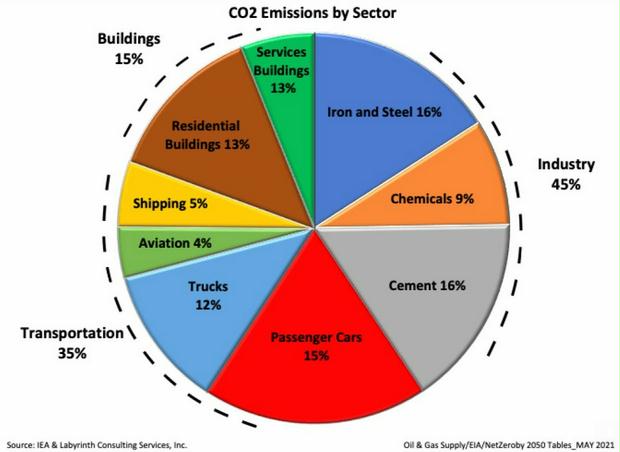
And why on earth the emphasis on cars to reduce carbon? They are only 15% of the problem:
Cold weather increases energy consumption
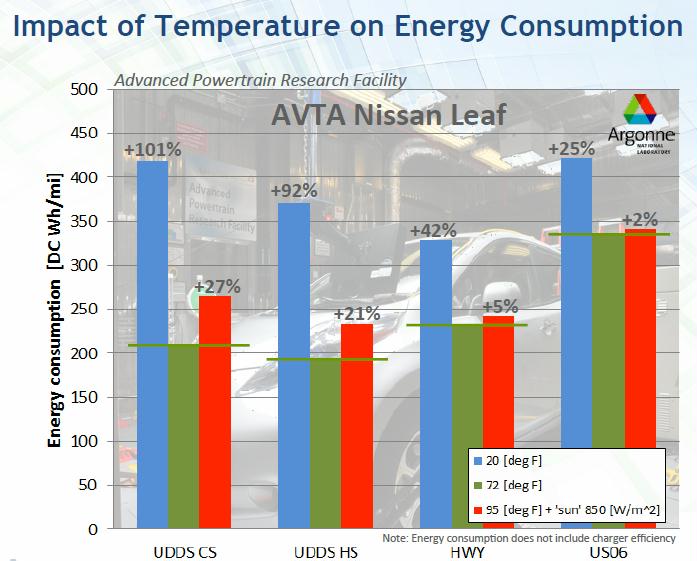
Source: Argonne National Laboratory
On a cold day an electric car consumes its stored electric energy quickly because of the extra electricity needed to heat the car. For example, the range of a Nissan Leaf is 84 miles on the EPA test cycle, but if the owner drives 90% of the time over 70 mph and lives in a cold climate, the range could be as low as 50 miles (NRC 2015).
Going Electric doesn’t necessarily reduce CO2
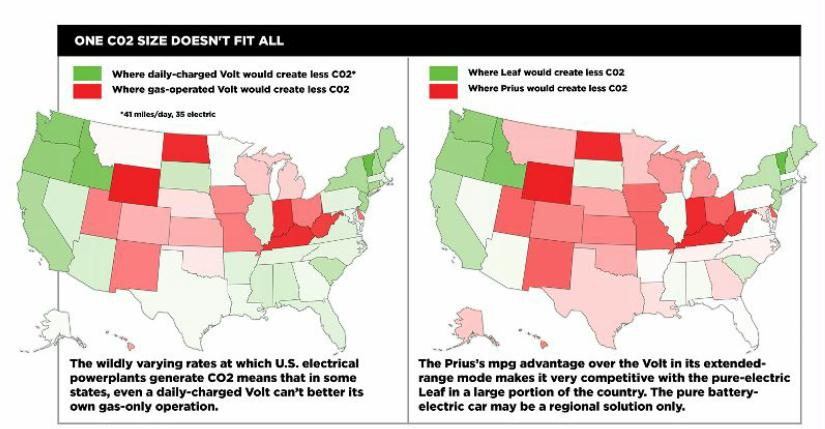
Source: Hillebrand 2012, page 24
Related Posts & Articles: There are many other barriers to building a battery electric car or truck. They use many finite platinum group elements, precious elements, and rare earth elements. Plus there are dozens of challenges to improving batteries that must be overcome but mostly can’t be due to the laws of physics and thermodynamics. Nor are trucks going to be running on hydrogen: The dumbest & most impossible renewable
The electric grid will eventually fail without utility scale energy storage of at least a month of electricity to compensate for seasonal deficits (When Trucks Stop Running Chapter 17 The Electric Blues). Natural gas is the main energy storage now (and coal), and essential for balancing the sudden life and death of wind and solar power. And hydropower can be used in the 10 lucky states that have 80% of it, and the few places that can afford multi-million-dollar batteries (though only for an hour or so). Natural gas also provides peak power in extreme heat or cold. But natural gas is finite. The electric grid could crash from a weapon or solar flare electromagnetic pulse and be down for a year or more. Electric trucks are impossible. Without trucks, civilization fails. Manufacturing uses over half of all fossil fuels, and depends on the high heat only they can generate and cement, steel, glass, brick, ceramics, microchips and more can’t be made with electricity or hydrogen (see Chapter 9 of Life After Fossil Fuels).
2016-08-29. Why We Still Don’t Have Better Batteries. Startups with novel chemistries tend to falter before they reach full production. MIT Technology Review.
2017-11-24. Tesla’s Newest Promises Break the Laws of Batteries Elon Musk touted ranges and charging times that don’t compute with the current physics and economics of batteries. Bloomberg.
Kane M (2021) Tesla Delays (Again) Semi Launch To 2022. InsideEVS.com
References
ADEME. 2011. Study on the second life batteries for electric and plug-in hybrid vehicles.
Agusdinata DB et al (2018) Socio-environmental impacts of lithium mineral extraction: towards a research agenda. Environ. Res. Lett.
Batto, A. B. 2017. The ecological challenges of Tesla’s Gigafactory and the Model 3. AmosBatto.wordpress.com
Beaty K (2021) Commercial Vehicle Battery Cost Assessment. CALSTART. https://calstart.org/commercial-value-battery-cost-assessment
Birnbaum, M. November 23, 2015. Electric cars and the coal that runs them. Washington Post.
Borenstein, S. Jan 22, 2013. What holds energy tech back? The infernal battery. Associated Press.
FD (2024) Economic Well-Being of U.S. Households in 2023 Fact Sheet. U.S. Federal Reserve.
GR (2021) Exploring lithium-ion electric vehicles’ carbon footprint. Goehring & Rozencwajg. http://blog.gorozen.com/blog/exploring-lithium-ion-electric-vehicles-carbon-footprint?utm_campaign=Weekly%20Blog%20Notification&utm_source=hs_email&utm_medium=email&utm_content=131502455&_hsenc=p2ANqtz-_KcPUIgJaGA8wUvhk4oTOdmeUcR5zCZt-7EDZc4N1HIrfEzUdy4Cow93BEGOWlKW2ZgjrjKsQ6T3l3Xw4ZNrd73LzUvQ
Groom N et al (2021) EV rollout will require huge investments in strained U.S. power grids. Reuters.
Hillebrand, D. October 8, 2012. Advanced Vehicle Technologies; Outlook for Electrics, Internal Combustion, and Alternate Fuels. Argonne National Laboratory.
Hiscox, G. 1901. Horseless Vehicles, Automobiles, Motor Cycles. Norman Henley & Co.
Hodson, H. Jully 25, 2015. Power to the people. NewScientist.
House, Kurt Zenz. 20 Jan 2009. The limits of energy storage technology. Bulletin of the Atomic Scientists.
House 114-18. May 1, 015. Innovations in battery storage for renewable energy. U.S. House of Representatives.
Jones JB (2023) A guide to Economic Inequality. Portfolios Across the U.S. Wealth Distribution. AmericanCompass.org
LaReau JL (2021) Which is more expensive: charging an electric vehicle or fueling a car with gas? Detroit Free Press.
Lavars N. 2020. Rare metalloid quadruples lifespan of lithium-sulfur batteries. Newatlas.
Martin, R. 2016. Why we still don’t have better batteries. Startups with novel chemistries tend to falter before they reach full production. MIT Technology Review.
Michaux (2022a) Assessment of the extra capacity required of alternative energy electrical power systems to completely replace fossil fuels & Assessment of the physical requirements to globally phase out fossil fuels. https://ieo.imf.org/-/media/IEO/Files/Seminars/michaux-ppt.ashx
Michaux SP (2022b) Assessments of the physical requirements to globally phase out fossil fuels. https://www.akadeemia.ee/wp-content/uploads/2022/05/simon-michaux.-30.05.2022.pdf
Mining (2020) Can EV batteries get any cheaper? Mining.com
NAE. 2012. National Academy of Engineering. Building the U.S. Battery Industry for Electric Drive Vehicles: Summary of a Symposium. National Research Council
Naranjo GPS et al (2022) Comparative life cycle assessment of conventional, electric and hybrid passenger vehicles in Spain. Journal of Cleaner Production.
NAS 2013. National Academy of Sciences. Transitions to Alternative Vehicles and Fuels. Committee on Transitions to Alternative Vehicles and Fuels; Board on Energy and Environmental Systems; Division on Engineering and Physical Sciences; National Research Council
NAS. 2015. Cost, effectiveness and deployment of fuel economy tech for Light-Duty vehicles. National Academy of Sciences. 613 pages.
NRC. 2008. Review of the 21st Century Truck Partnership. National Research Council, National Academy of Sciences.
NRC. 2013. Overcoming Barriers to Electric-Vehicle Deployment, Interim Report. Washington, DC: National Academies Press.
NRC. 2015. Overcoming Barriers to Deployment of Plug-in Electric Vehicles. National Research Council, National Academies Press.
NREL (2021) Electrification Futures Study. National Renewable Energy Laboratory.
NYT. Novermber 12, 1911. Foreign trade in Electric vehicles. New York Times C8.
Service, R. 24 Jun 2011. Getting there. Better Batteries. Science Vol 332 1494-96.
Short J, Shirk A, Pupillo A (2022) Charging Infrastructure Challenges for the U.S. Electric Vehicle Fleet. American Transportation Research Institute.
Smil, V. 2010. Energy Myths and Realities: Bringing Science to the Energy Policy Debate. AEI Press.
Stinson J (2021) Money and range: Experts note roadblocks to EV adoption. Transport Dive https://www.transportdive.com/news/act-expo-electric-trucks-battery-infrastructure/606386/
Straughan (2024) Electric Vehicle Statistics 2024. MarketWatch.com.
Tesla. 2014. “Increasing Energy Density Means Increasing Range.”
http://www.teslamotors.com/roadster/technology/battery.
Thomas, B. December 17, 1967. AMC does a turnabout: starts running in black. Los Angeles Times, K10.
Timmers RJH (2016) Non-exhaust PM emissions from electric vehicles. Atmospheric Environment 134: 10-17
USGS. 2014. Tellurium — the bright future of solar energy. United States Geological Survey.
WP. October 31, 1915. Prophecies come true. Washington Post, E18.
WP. June 7, 1980. Plug ‘Er In?”. Washington Post, A10.
P.S. Because I live in Northern California, the cost of electricity is roughly double the national average. In January of 2021, disappointly, it costs slightly more to drive our Toyota Prius Prime on the battery than on gasoline. This is despite the fact that gasoline costs $3/gallon and up here. It takes about 6.7 to 6.8 kWh to fully charge the drained Prius battery, which is good for 30 miles of driving. So, at the current electricity rate of 28 cents/kWH here, we pay $1.90 to charge the 30-mile battery. At 55 mpg it costs $1.77 to go 30 miles when paying $3.25/gallon for gas. Of course, that may change. Global oil production peaked in 2018, including fracked natural gas and oil, so natural gas (and oil) prices will go up, driving electricity prices even higher, especially since the electric grid can’t stay up without it. Plus wind and solar costs will go up, since they depend on oil, coal, and/or natural gas for every single step of their life cycle. The U.S. has only four four LNG import terminals and few LNG ships. Scaling up would take decades. By then global NG production will have peaked. Meanwhile the U.S. has been building EXPORT LNG terminals and is the third largest natural gas exporter in the world. Doh! Political and economic leaders bought all the hype and thought we had a century of oil independence from fracking (though we never did, even at the height of fracking we still imported about half of our oil). And here are 24 more problems with electric cars.
P.S. I wonder if Bill Gates has read “When Trucks Stop Running”? He said “The renaissance of electrification that we’re seeing in passenger vehicles unfortunately won’t likely adapted to heavier forms of transportation — such as airplanes, cargo ships and semi tractor trailers — in the foreseeable future. Today’s batteries simply can’t hold enough power to sufficiently offset their weight and bulk.” And elaborates more on that here.


 Hemp product categories include: Clothing & Accessories, Health & Wellness, Food & Drinks, Pet Supplies, Beauty & Skincare, Farming & Gardening, Home & Office supplies, Automobiles, Industrial. Source:
 Preface. It was recently Thanksgiving so I thought I’d post something from Mann’s 1491 about the pilgrims that I later found out was grievously wrong from an expert who gives lectures on the Mayflower history. Here is a more subtle, accurate, and interesting account of what happened. Though Thanksgiving is never mentioned in this book…