1177 B.C. The year civilization collapsed

[ These are my notes that are disjointed but can give you an idea of how fast our fossil-fueled civilization could collapse.  We are far more interdependent on much longer global supply chains (a wind turbine has 8,000 parts). We are far more vulnerable to asymmetric threats, EMP, cyberwar, nuclear war, a steep net energy cliff, and other topics discussed in 3) Fast Crash.  Another good article on this is Ugo Bardi’s “The fall of the Mediterranean society during the bronze age: why we still don’t understand civilization collapse” at  http://cassandralegacy.blogspot.com

Alice Friedemann   www.energyskeptic.com  author of “When Trucks Stop Running: Energy and the Future of Transportation”, 2015, Springer and “Crunch! Whole Grain Artisan Chips and Crackers”. Podcasts: Practical Prepping, KunstlerCast 253, KunstlerCast278, Peak Prosperity , XX2 report ]

Eric H. Cline. 2014. 1177 B.C.: The Year Civilization Collapsed: Turning Points in Ancient History. Princeton University Press.

Summary: “In 1177 B.C., marauding groups known only as the “Sea Peoples” invaded Egypt. The pharaoh’s army and navy managed to defeat them, but the victory so weakened Egypt that it soon slid into decline, as did most of the surrounding civilizations. After centuries of brilliance, the civilized world of the Bronze Age came to an abrupt and cataclysmic end. Kingdoms fell like dominoes over the course of just a few decades. No more Minoans or Mycenaeans. No more Trojans, Hittites, or Babylonians. The thriving economy and cultures of the late second millennium B.C., which had stretched from Greece to Egypt and Mesopotamia, suddenly ceased to exist, along with writing systems, technology, and monumental architecture. But the Sea Peoples alone could not have caused such widespread breakdown. How did it happen? In this major new account of the causes of this “First Dark Ages,” Eric Cline tells the gripping story of how the end was brought about by multiple interconnected failures, ranging from invasion and revolt to earthquakes, drought, and the cutting of international trade routes. Bringing to life the vibrant multicultural world of these great civilizations, he draws a sweeping panorama of the empires and globalized peoples of the Late Bronze Age and shows that it was their very interdependence that hastened their dramatic collapse and ushered in a dark age that lasted centuries.

The economy of Greece is in shambles. Internal rebellions have engulfed Libya, Syria, and Egypt, with outsiders and foreign warriors fanning the flames. Turkey fears it will become involved, as does Israel. Jordan is crowded with refugees. Iran is bellicose and threatening, while Iraq is in turmoil. AD 2013? Yes. But it was also the situation in 1177 BC, more than three thousand years ago, when the Bronze Age Mediterranean civilizations collapsed one after the other, changing forever the course and the future of the Western world.

The Bronze Age in the Aegean, Egypt, and the Near East lasted nearly 2,000 years, from approximately 3000 BC to just after 1200 BC. When the end came, as it did after centuries of cultural and technological evolution, most of the civilized and international world of the Mediterranean regions came to a dramatic halt in a vast area stretching from Greece and Italy in the west to Egypt, Canaan, and Mesopotamia in the east. Large empires and small kingdoms, which had taken centuries to evolve, collapsed rapidly. With their end came a period of transition, once regarded by scholars as the world’s first Dark Age. It was not until centuries later that a new cultural renaissance emerged in Greece and the other affected areas, setting the stage for the evolution of Western society as we know it today.

In the current global economy, and in a world recently wracked by earthquakes and tsunamis in Japan and the “Arab Spring” democratic revolutions in Egypt, Tunisia, Libya, Syria, and Yemen, the fortunes and investments of the United States and Europe are inextricably intertwined within an international system that also involves East Asia and the oil-producing nations of the Middle East. Thus, there is potentially much to be gleaned from an examination of the shattered remains of similarly intertwined civilizations that collapsed more than three thousand years ago.

Edward Gibbon wrote about the fall of the Roman Empire. A more recent example is Jared Diamond’s book Collapse. However, these authors were considering how a single empire or a single civilization came to an end—the Romans, the Maya, the Mongols, and so forth. Here, we are considering a globalized world system with multiple civilizations all interacting and at least partially dependent upon each other. There are only a few instances in history of such globalized world systems; the one in place during the Late Bronze Age and the one in place today are two of the most obvious examples,

“The strategic importance of tin in the LBA [Late Bronze Age] … was probably not far different from that of crude oil today.”  At that time, tin was available in quantity only from specific mines in the Badakhshan region of Afghanistan and had to be brought overland all the way to sites in Mesopotamia (modern Iraq) and north Syria, from where it was distributed to points farther north, south, or west, including onward across the sea to the Aegean. Bell continues, “The availability of enough tin to produce … weapons grade bronze must have exercised the minds of the Great King in Hattusa and the Pharaoh in Thebes in the same way that supplying gasoline to the American SUV driver at reasonable cost preoccupies an American President today!

Genuinely useful analogies between the world of 1200 BC and that of today, include an increase in political, social, and economic fragmentation, as well as the conducting of direct exchange at unprecedented social levels and over unprecedented distances. Most relevant is that the situation at the end of the Late Bronze Age provides an analogy for our own increasingly homogenous yet uncontrollable global economy and culture, in which … political uncertainties on one side of the world can drastically affect the economies of regions thousands of miles away.

We are not certain where the Sea Peoples originated: perhaps in Sicily, Sardinia, and Italy, according to one scenario, perhaps in the Aegean or western Anatolia, or possibly even Cyprus or the Eastern Mediterranean.

We think of them as moving relentlessly from site to site, overrunning countries and kingdoms as they went. According to the Egyptian texts, they set up camp in Syria before proceeding down the coast of Canaan (including parts of modern Syria, Lebanon, and Israel) and into the Nile delta of Egypt. The year was 1177 BC. It was the eighth year of Pharaoh Ramses III’s reign. 3 According to the ancient Egyptians, and to more recent archaeological evidence, some of the Sea Peoples came by land, others by sea. 4 There were no uniforms, no polished outfits. Ancient images portray one group with feathered headdresses, while another faction sported skull-caps; still others had horned helmets or went bareheaded. Some had short pointed beards and dressed in short kilts, either bare-chested or with a tunic; others had no facial hair and wore longer garments, almost like skirts. These observations suggest that the Sea Peoples comprised diverse groups from different geographies and different cultures. Armed with sharp bronze swords, wooden spears with gleaming metal tips, and bows and arrows, they came on boats, wagons, oxcarts, and chariots.

We know that the invaders came in waves over a considerable period of time. Sometimes the warriors came alone, and sometimes their families accompanied them.

According to Ramses’s inscriptions, no country was able to oppose this invading mass of humanity. Resistance was futile. The great powers of the day— the Hittites, the Mycenaeans, the Canaanites, the Cypriots, and others—fell one by one. Some of the survivors fled the carnage; others huddled in the ruins of their once-proud cities; still others joined the invaders, swelling their ranks and adding to the apparent complexities of the mob of invaders. Each group of the Sea Peoples was on the move, each apparently motivated by individual reasons. Perhaps it was the desire for spoils or slaves that spurred some; others may have been compelled by population pressures to migrate eastward from their own lands in the West.

Of all the foreign groups active in this arena at this time, only one has been firmly identified. The Peleset of the Sea Peoples are generally accepted as none other than the Philistines, who are identified in the Bible as coming from Crete.

This was not the first time that the Egyptians fought against a collective force of “Sea Peoples.” Thirty years earlier, in 1207 BC, during the fifth year of Pharaoh Merneptah’s reign, a similar coalition of these shadowy groups had attacked Egypt.

The identification of the Shardana and the Shekelesh as “countries of the sea” reinforces the suggestion that they are to be linked with Sardinia and Sicily, respectively.

The general practice of the day was to cut off the hand of a dead enemy and bring it back as proof, in order to get credit and reward for the kill.

In 1177 BC, as previously in 1207 BC, the Egyptians were victorious. The Sea Peoples would not return to Egypt a third time.  However, it was a Pyrrhic victory. Although Egypt under Ramses III was the only major power to successfully resist the onslaught of the Sea Peoples, New Kingdom Egypt was never the same again afterward, most likely because of the other problems faced by the entire Mediterranean region during this period.

Beyond Egypt, almost all of the other countries and powers of the second millennium BC in the Aegean and Near East—those that had been present during the golden years of what we now call the Late Bronze Age—withered and disappeared, either immediately or within less than a century. In the end, it was as if civilization itself had been wiped away in much of this region. Many, if not all, of the advances of the previous centuries vanished across great swaths of territory, from Greece to Mesopotamia. A new transitional era began: an age that was to last for at least one century and perhaps as many as three in some areas. There seems little doubt that terror must have prevailed throughout the lands in the final days of these kingdoms.

There was a tendency on the part of earlier scholars to attribute any destruction from this period to the Sea Peoples. However, it may be presumptuous to lay the blame for the end of the Bronze Age in the Aegean and Eastern Mediterranean entirely at their feet. It probably gives them too much credit, for we have no clear evidence, apart from the Egyptian texts and inscriptions, which give conflicting impressions. Did the Sea Peoples approach the Eastern Mediterranean as a relatively organized army, like one of the more disciplined Crusades intent on capturing the Holy Land during the Middle Ages? Were they a loosely or poorly organized group of marauders, like the Vikings of a later age? Or were they refugees fleeing a disaster and seeking new lands? For all we know, the truth could involve a combination of all or none of the above.

We are no longer certain that all of the sites with evidence of destruction were razed by the Sea Peoples. We can tell from the archaeological evidence that a site was destroyed, but not always by what or by whom. Moreover, the sites were not all destroyed simultaneously, or even necessarily within the same decade. As we shall see, their cumulative demise spans several decades and perhaps as much as a century. Moreover, while we do not know for certain the cause, or all the causes, of the collapse of the Bronze Age world in Greece, Egypt, and the Near East, the weight of contemporary evidence suggests that it was probably not the Sea Peoples alone who were to blame. It now seems likely that they were as much the victims as they were the aggressors in the collapse of civilizations. 28 One hypothesis suggests that they were forced out of their homes by a series of unfortunate events and migrated eastward where they encountered kingdoms and empires already in decline. It is also quite possible that they were able to attack and ultimately vanquish many of the kingdoms of the region precisely because those monarchies were already in decline and in a weakened state.

The Sea Peoples may well have been responsible for some of the destruction that occurred at the end of the Late Bronze Age, but it is much more likely that a concatenation of events, both human and natural—including climate change and drought, seismic disasters known as earthquake storms, internal rebellions, and “systems collapse”—coalesced to create a “perfect storm” that brought this age to an end.

The Hyksos invasion of Egypt brought the Middle Kingdom period (ca. 2134–1720 BC) to an end. Their success was quite possibly the result of an advantage in weapons technology and first-strike capability, for they possessed composite bows that could shoot arrows much farther than a traditional bow of the time. They also had horse-drawn chariots, the likes of which had not previously been seen in Egypt. After their conquest, the Hyksos then ruled over Egypt, primarily from their capital city of Avaris in the Nile delta, during the so-called Second Intermediate period (Dynasties Fifteen–Seventeen) for nearly 200 years, from 1720 to 1550 BC.  It is one of the only times during the period from 3000 to 1200 BC when Egypt was ruled by foreigners.

About 1550 BC the Egyptians expelled the Hyksos from the land. They fled back to Retenu (one of the ancient Egyptian names for modern-day Israel and Syria,

The Minoans of Crete had already been in contact with several areas in the ancient Near East long before their interactions with the New Kingdom Egyptian pharaohs. For example, we know of Minoan-manufactured objects that had been transported across the Aegean Sea and the Eastern Mediterranean all the way to Mesopotamia, the land between the two rivers—the Tigris and Euphrates—by the eighteenth century BC, nearly 4,000 years ago.

We do know that they established a civilization on Crete during the third millennium BC that lasted until ca. 1200 BC. Partway through this period, in about 1700 BC, the island was hit by a devastating earthquake that required the rebuilding of the palaces at Knossos and elsewhere on the island. However, the Minoans recovered quickly and flourished as an independent civilization until Mycenaeans from the Greek mainland invaded the island later in the second millennium, after which time the island continued under Mycenaean rule until everything collapsed ca. 1200 BC. Minoans seem to have been in both the import and the export business, industriously networking with a number of foreign areas in addition to Egypt.

We should first note that the Hittites, despite ruling a large empire from their homelands in central Anatolia for much of the second millennium BC, were lost to history, at least geographically, until only about two hundred years ago.

We are told at one point that a Hittite king named Mursili I, grandson and successor of the above-named Hattusili I, marched his army all the way to Mesopotamia, a journey of over one thousand miles, and attacked the city of Babylon in 1595 BC, burning it to the ground and bringing to an end the two-hundred-year-old dynasty made famous by Hammurabi “the Law-Giver.” Then, instead of occupying the city, he simply turned the Hittite army around and headed for home, thus effectively conducting the longest drive-by shooting in history. As an unintended consequence of his action, a previously unknown group called the Kassites was able to occupy the city of Babylon and then ruled over it for the next several centuries.

We should probably understand that the trade between the Aegean, Egypt, and the Near East during the Bronze Age took place on a scale many times larger than the picture that we currently see through the lens of archaeological excavation.

We may sum up this century as a period that saw the rise of international connections on a sustained basis throughout the ancient Mediterranean world, from the Aegean to Mesopotamia. By this time, the Minoans and Mycenaeans of the Bronze Age Aegean were well established, as were the Hittites in Anatolia. The Hyksos had been evicted from Egypt, and the Egyptians had begun what we now call the Eighteenth Dynasty and the New Kingdom period. However, as we shall see next, this was only the beginning of what would become a “Golden Age” of internationalism and globalization during the following fourteenth century BC.

Egypt established itself as one of the great powers for the rest of the Late Bronze Age, along with the Hittites, Assyrians, and Kassites/Babylonians, in addition to assorted other players such as the Mitannians, Minoans, Mycenaeans, and Cypriots,

Thus, the two last major players of the Late Bronze Age in the ancient Near East, Assyria and Cyprus, finally appear on stage. We now have a full cast of characters: Hittites, Egyptians, Mitannians, Kassites/Babylonians, Assyrians, Cypriots, Canaanites, Minoans, and Mycenaeans, all present and accounted for. They all interacted, both positively and negatively, during the coming centuries, though some, such as Mitanni, vanished from the stage long before the others.

The cargo carried in the Uluburun ship consisted of an incredible assortment of goods, truly an international manifest. In all, products from at least seven different countries, states, and empires were on board the ship. In addition to its primary cargo of 10 tons of Cypriot copper, one ton of tin, and a ton of terebinth resin, there were also two dozen ebony logs from Nubia; almost 200 ingots of raw glass from Mesopotamia, about 140 Canaanite storage jars in two or three basic sizes, which contained the terebinth resin, remains of grapes, pomegranates, and figs, as well as spices like coriander and sumac; brand-new pottery from Cyprus and Canaan, including oil lamps, bowls, jugs, and jars; scarabs from Egypt and cylinder seals from elsewhere in the Near East; swords and daggers from Italy and Greece, including one with an inlaid hilt of ebony and ivory; and even a stone scepter-mace from the Balkans. There was also gold jewelry, including pendants, and a gold chalice; duck-shaped ivory cosmetic containers; copper, bronze, and tin bowls and other vessels; twenty-four stone anchors; 14 pieces of hippopotamus ivory and one elephant tusk; and a six-inch-tall statue of a Canaanite deity made of bronze overlaid with gold

The tin probably came from the Badakhshan region of Afghanistan. There were also at least two Mycenaeans on board, even though this seems to have been a Canaanite ship. Clearly this ship does not belong to a world of isolated civilizations, kingdoms, and fiefdoms, but rather to an interconnected world of trade, migration, diplomacy, and, alas, war. This really was the first truly global age.

About the same time as the run-up to the Battle of Qadesh, the Hittites were also busy on a second front, in western Anatolia, where they were trying to contain rebellious subjects whose activities were apparently being underwritten by the Mycenaeans. This may be one of the earliest examples that we have of one government deliberately engaging in activities designed to undermine another (think Iranian support for Hezbollah in Lebanon, 3,200 years after the Battle of Qadesh).

Dörpfeld believed that the Mycenaeans had captured this city (Troy VI) and burned it to the ground, and that it was this event that formed the basis of Homer’s epic tales. Blegen, digging several decades later, disagreed, and published what he said was indisputable evidence for destruction not by humans, but by an earthquake. His argument included positive evidence, such as walls knocked out of line and collapsed towers, as well as negative evidence, for he found no arrows, no swords, no remnants of warfare. In fact, it is now clear that the type of damage that Blegen found was similar to that seen at many sites in the Aegean and Eastern Mediterranean, including Mycenae and Tiryns on mainland Greece. It is also clear that these earthquakes did not all take place at the exact same time during the Late Bronze Age.

By the time of the first Sea Peoples attack on the Eastern Mediterranean in 1207 BC, Assyria had been one of the major players on the international scene in the ancient Near East for nearly 200 years. It was a kingdom linked by marriage, politics, war, and trade over the centuries with the Egyptians, Babylonians, Hittites, and Mitanni. It was, without question, one of the Great Powers during the Late Bronze Age.

Tudhaliya IV decided to attack the island of Cyprus. The island had been a major source of copper throughout the second millennium BC, and it is possible that the Hittites decided to try to control this precious metal, so essential to the creation of bronze.  We are not certain about his motivation for attacking Cyprus. It may instead have had something to do with the possible appearance of the Sea Peoples in the area or with the drought that is thought to have occurred in the Eastern Mediterranean at this time.

International trade was ongoing at the end of the thirteenth century BC, even when things were beginning to fall apart in the Eastern Mediterranean and the Aegean regions.

THE END OF AN ERA: THE TWELFTH CENTURY BC

This is the moment for which we have been waiting: the climax of the play and the dramatic beginning of the end to 300 and more years of the globalized economy that had been the hallmark of the Late Bronze Age in the Aegean and Eastern Mediterranean. The twelfth century BC, as we will see in this final act, is marked more by tales of woe and destruction than by stories of trade and international relations.

The city and kingdom of Ugarit, located on the coast of north Syria, a functioning, busy, and prosperous commercial city and port, was suddenly destroyed and abandoned soon after the beginning of the twelfth century BC. Within the ruins, products from all over the Eastern Mediterranean and Aegean have been found.

The textual evidence from the various archives and houses at Ugarit indicate that international trade and contact was going strong in the city right up until the last possible moment. In fact, one of the scholars publishing the letters from the House of Urtenu noted almost twenty years ago that there was very little indication of trouble, apart from the mention of enemy ships in one letter, and that the trade routes seemed to be open right up until the end. The same was true in Emar, on the Euphrates River far to the east in inland Syria, where it has been noted that “the scribes were conducting normal business until the end.” However, Ugarit was destroyed, apparently quite violently, during the reign of King Ammurapi, most likely between 1190 and 1185 BC. It was not reoccupied until the Persian period, approximately 650 years later. The excavators report “evidence of destruction and fire throughout the city,” including “collapsed walls, burnt pisé plaster, and heaps of ashes,” with a destruction level that reached two meters high in places. Marguerite Yon, the most recent director of the excavations, says that the ceilings and terraces in the residential quarters were found collapsed, and that elsewhere the walls were “reduced to a shapeless heap of rubble.” She believes that the destruction was caused by enemy attack rather than an earthquake, as had previously been suggested by Schaeffer, and that there was violent fighting in the city, including street fighting. This, she says, is indicated by “the presence of numerous arrowheads dispersed throughout the destroyed or abandoned ruins,” as well as the fact that the inhabitants—eight thousand, more or less—fled in haste and did not return, not even to collect the hoards of valuables that some had buried before leaving.

During this same period, in the twelfth century BC, a number of cities and towns were destroyed in southern Syria and Canaan. Just as in north Syria, it is not clear who destroyed them or when exactly they were destroyed, and as with Hazor and Megiddo, it is unclear who destroyed Lachish VI or the earlier city of Lachish VII. Both, or neither, could have been devastated by the Sea Peoples, or by someone—or something—else entirely.

Even as far to the east as Mesopotamia, evidence of destruction can be seen at multiple sites including Babylon, but these were clearly caused by forces other than the Sea Peoples.

In Anatolia at this time, a number of cities were also destroyed. Once again, though, the reason in each case is hard to discern; and once again the Sea Peoples have traditionally been credited for the devastation on the basis of little or no evidence.  The Kashka—longtime enemies of the Hittites—are more likely than the Sea Peoples to have been responsible for the actual destruction, though it may well have taken place only after the Hittite Empire had been severely weakened through other agencies, such as drought, famine, and interruption of the international trade routes.

The one site in the west that was destroyed by fire early in the twelfth century BC was Troy, specifically Troy VIIA, located on the western coast of Anatolia.

If the Mycenaeans were not involved in the destruction of Troy VIIA, it may have been because they were also under attack at approximately the same time. It is universally accepted by scholars that Mycenae, Tiryns, Midea, Pylos, Thebes, and many other Mycenaean sites on the Greek mainland suffered destructions at this same approximate time, at the end of the thirteenth century BC, and early in the twelfth.

It is clear that something tumultuous occurred, although some scholars see this as merely the final stages of a dissolution or collapse that had begun as early as 1250 BC. Jeremy Rutter of Dartmouth College, for example, believes that “the destruction of the palaces was anything but an unforeseen catastrophe which precipitated a century of crisis in the Aegean, but was instead the culmination of an extended period of unrest which afflicted the Mycenaean world from the mid-thirteenth century onwards.

It is unclear, according to Iakovidis, what caused the fires that destroyed large portions of Mycenae just after 1200 BC, but he eschews the notion of invasions or other dramatic events, preferring to attribute the gradual decline of the site during the following decades to the collapse of the palatial system and of long-distance trade. Recent research by other archaeologists may prove his thesis to be correct.

Thus, we are now faced with a situation in which our current knowledge is being reassessed and conventional historical paradigms are being overthrown, or at least called into question. While it is clear that there were destructions on Cyprus either just before or after 1200 BC, it is by no means clear who was responsible for this damage; possible culprits range from the Hittites to invaders from the Aegean to Sea Peoples and even earthquakes. It is also conceivable that what we see in the archaeological record is merely the material culture of those who took advantage of these destructions and settled into the now fully or partially abandoned cities and settlements, rather than the material culture of those who were actually responsible for the destructions.

Regardless, Cyprus seems to have survived these depredations essentially intact. There is now every indication that the island was flourishing during the remainder of the twelfth and into the eleventh century BC;

We need to acknowledge first and foremost, as frequently noted in the preceding pages, that it is not always clear who, or what, caused the destruction of the Late Bronze Age cities, kingdoms, and empires of the Aegean and Eastern Mediterranean.

Second, we need to admit that there is currently no scholarly consensus as to the cause or causes of the collapse of these multiple interconnected societies just over three thousand years ago; culprits recently blamed by scholars include “attacks by foreign enemies, social uprising, natural catastrophes, systems collapse, and changes in warfare.

Recent research by archaeo-seismologists reveals that Greece, as well as much of the rest of the Aegean and Eastern Mediterranean, was struck by a series of earthquakes, beginning about 1225 BC and lasting for as long as 50 years, until about 1175 BC. We must concede that although these earthquakes undoubtedly caused severe damage, it is unlikely that they alone were sufficient to cause a complete collapse of society, especially since some of the sites were clearly reoccupied and at least partially rebuilt afterward.

CLIMATE CHANGE, DROUGHT, AND FAMINE

One suggestion favored by scholars, especially those seeking to explain not only the end of the Late Bronze Age but also why the Sea Peoples may have begun their migrations, is climate change, particularly in the form of drought, resulting in famine.

Drought was long the favored explanation of earlier scholars for the movement of the Sea Peoples out of the regions of the Western Mediterranean and into the lands to the east. They postulated that a drought in northern Europe had pressured the population to migrate down into the Mediterranean region, where they displaced the inhabitants of Sicily, Sardinia, and Italy, and perhaps those in the Aegean as well. If this occurred, it might have initiated a chain reaction that culminated in the movement of peoples far away in the Eastern Mediterranean.

Using data from the site of Tell Tweini (ancient Gibala) in north Syria, the team noted that there may have been “climate instability and a severe drought episode” in the region at the end of the second millennium BC. 31 In particular, they studied pollen retrieved from alluvial deposits near the site, which suggest that “drier climatic conditions occurred in the Mediterranean belt of Syria from the late 13th/early 12th centuries BC to the 9th century BC.”  Kaniewski’s team has now also published additional evidence of a probable drought on Cyprus at this same time, using pollen analysis.  Their data suggest that “major environmental changes” took place in this area during the end of the Late Bronze Age and the beginning of the Iron Age, that is, during the period from 1200 to 850 BC.

If Kaniewski and his colleagues are correct, they have retrieved the direct scientific evidence that scholars have been seeking for a drought that may have contributed to the end of the Late Bronze Age. In fact, they conclude that the data from both coastal Syria and coastal Cyprus strongly suggest “that the LBA crisis coincided with the onset of a ca. 300-year drought event 3200 years ago. This climate shift caused crop failures, dearth and famine, which precipitated or hastened socio-economic crises and forced regional human migrations at the end of the LBA in the Eastern Mediterranean and southwest Asia.

While it “is difficult to directly identify a point in time when the climate grew more arid,” the change most likely occurred before 1250–1197 BC, which is precisely the time period under discussion here. Also, there was a sharp increase in Northern Hemisphere temperatures immediately before the collapse of the Mycenaean palatial centers, possibly causing droughts,

Abandonment of these centers, meaning that it first got hotter and then suddenly colder, resulting in “cooler, more arid conditions during the Greek Dark Ages.

Exciting as these findings are, at this point we must also acknowledge that droughts have been frequent in this region throughout history, and that they have not always caused civilizations to collapse. Climate change, drought, and famines, even if they “influenced social tensions, and eventually led to competition for limited resources,” are not enough to have caused the end of the Late Bronze Age without other mitigating factors having been involved.

The hypothesis of internal rebellions is not enough to account for the collapse of the Late Bronze Age civilizations in the Aegean and Eastern Mediterranean.  Among events that could have led to an internal rebellion, we have just glimpsed the specter of outside invaders cutting the international trade routes and upsetting fragile economies that might have been overly dependent upon foreign raw materials.

The cutting of the trade routes could have had a severe, and immediate, impact upon Mycenaean kingdoms such as Pylos, Tiryns, and Mycenae.

While natural disasters such as earthquakes could cause a temporary disruption in trade, potentially leading to higher prices and perhaps to what we today would call inflation, more permanent disruptions would more likely have been the result of outside invaders targeting the affected areas.

The wealthiest city-states in the Eastern Mediterranean were the hardest-hit by the events taking place during the twelfth century BC, since they were not only the most attractive targets for the invaders but also the most dependent on the international trade network. Dependence, or perhaps overdependence, on capitalist enterprise, and specifically long-distance trade, may have contributed to the economic instability seen at the end of the Late Bronze Age.

What jumps out from the materials in the Rapanu and Urtenu archives is the tremendous amount of international interconnection that apparently still existed in the Eastern Mediterranean even at the end of the Late Bronze Age. Moreover, it is clear from the few texts published from the Urtenu archive that these international connections continued right up until almost the last moment before Ugarit’s destruction. This seems to be a clear indication that the end was probably sudden, rather than a gradual decline after trade routes had been cut or because of drought and famine, and that Ugarit specifically was destroyed by invaders, regardless of whether these forces had also cut the international trade routes.

Even if decentralization and private individual merchants were an issue, it seems unlikely that they caused the collapse of the Late Bronze Age, at least on their own. Instead of accepting the idea that private merchants and their enterprises undermined the Bronze Age economy, perhaps we should consider the alternative suggestion that they simply emerged out of the chaos of the collapse,

The Sea Peoples, despite their moniker, most likely traveled both by land and by sea—that is, by any means possible. The Sea Peoples who came by land possibly, and perhaps likely, proceeded along a predominantly coastal route, where the destruction of specific cities would have opened up entire new areas to them,

In 1985, when Nancy Sandars published a revised edition of her classic book on the Sea Peoples, she wrote, “In the lands surrounding the Mediterranean, there have always been earthquakes, famines, droughts and floods, and in fact dark ages of a sort are recurrent.” Furthermore, she stated, “catastrophes punctuate human history but they are generally survived without too much loss. They are often followed by a much greater effort leading to greater success.” So what was different about this period, the end of the Late Bronze Age? Why didn’t the civilizations simply recover and carry on? As Sandars mused, “many explanations have been tried and few have stood. Unparalleled series of earthquakes, widespread crop-failures and famine, massive invasion from the steppe, the Danube, the desert—all may have played some part; but they are not enough.” She was correct. We must now turn to the idea of a systems collapse, a systemic failure with both a domino and a multiplier effect, from which even such a globalized international, vibrant, inter-societal network as was present during the Late Bronze Age could not recover.

Colin Renfrew of Cambridge University, one of the most respected scholars ever to study the prehistoric Aegean region, had already suggested the idea of a systems collapse back in 1979. At the time, he framed it in terms of catastrophe theory, wherein “the failure of a minor element started a chain reaction that reverberated on a greater and greater scale, until finally the whole structure was brought to collapse.

The general features of systems collapse are: (1) the collapse of the central administrative organization; (2) the disappearance of the traditional elite class; (3) a collapse of the centralized economy; and (4) a settlement shift and population decline. It might take as much as a century for all aspects of the collapse to be completed. In the aftermath of such a collapse, there would be a transition to a lower level of sociopolitical integration and the development of “romantic” Dark Age myths about the previous period. Not only does this fit the Aegean and the Eastern Mediterranean region ca. 1200 BC, but it also describes the collapse of the Maya, Old Kingdom Egypt, and the Indus Valley civilization at various points in time.

In my opinion none of these individual factors would have been cataclysmic enough on their own to bring down even one of these civilizations, let alone all of them. However, they could have combined to produce a scenario in which the repercussions of each factor were magnified, in what some scholars have called a “multiplier effect.

The failure of one part of the system might also have had a domino effect, leading to failures elsewhere. The ensuing “systems collapse” could have led to the disintegration of one society after another, in part because of the fragmentation of the global economy and the breakdown of the interconnections upon which each civilization was dependent. In 1987, Mario Liverani, of the University of Rome, laid the blame upon the concentration of power and control in the palaces, so that when they collapsed, the extent of the disaster was magnified. As he wrote, “the particular concentration in the Palace of all the elements of organization, transformation, exchange, etc.—a concentration which seems to reach its maximum in the Late Bronze Age—has the effect of transforming the physical collapse of the Palace into a general disaster for the entire kingdom.” In other words, to put it in modern investment terms, the Bronze Age rulers in the Aegean and the Near East should have diversified their portfolios, but they did not.

Liverani’s work and suggested that the economy of the Late Bronze Age became unstable because of its increasing dependency on bronze and other prestige goods. Specifically, he saw “capitalist enterprise”—in which he included long-distance trade, and which dominated the palatial system present in the Late Bronze Age—as having transformed traditional Bronze Age modes of exchange, production, and consumption to such an extent that when external invasions and natural catastrophes combined in a “multiplier effect,” the system was unable to survive.

An unanticipated systems collapse—quite possibly triggered by climate change, or precipitated by earthquakes or invasion—seems much more likely, but Monroe’s words might serve as something of a warning for us today, for his description of the Late Bronze Age, especially in terms of its economy and interactions, could well apply to our current globalized society, which is also feeling the effects of climate change.

Major Observations

  1. We have a number of separate civilizations that were flourishing during the 15th to 13th centuries BC in the Aegean and Eastern Mediterranean, from the Mycenaeans and the Minoans to the Hittites, Egyptians, Babylonians, Assyrians, Canaanites, and Cypriots. These were independent but consistently interacted with each other, especially through international trade routes.
  1. It is clear that many cities were destroyed and that the Late Bronze Age civilizations and life as the inhabitants knew it in the Aegean, Eastern Mediterranean, Egypt, and the Near East came to an end ca. 1177 BC or soon thereafter.
  1. No unequivocal proof has been offered as to who or what caused this disaster, which resulted in the collapse of these civilizations and the end of the Late Bronze Age. Discussion of Possibilities There are a number of possible causes that may have led, or contributed, to the collapse at the end of the Late Bronze Age, but none seems capable of having caused the calamity on its own.

In addition:

  1. Clearly there were earthquakes during this period, but usually societies can recover from these.
  2. There is textual evidence for famine, and now scientific evidence for droughts and climate change, in both the Aegean and the Eastern Mediterranean, but again societies have recovered from these time and time again.
  3. There may be circumstantial evidence for internal rebellions in Greece and elsewhere, including the Levant, although this is not certain. Again, societies frequently survive such revolts. Moreover, it would be unusual (notwithstanding recent experience in the Middle East to the contrary) for rebellions to occur over such a wide area and for such a prolonged period of time.
  4. There is archaeological evidence for invaders, or at least newcomers probably from the Aegean region, western Anatolia, Cyprus, or all of the above, found in the Levant from Ugarit in the north to Lachish in the south. Some of the cities were destroyed and then abandoned; others were reoccupied; and still others were unaffected.
  5. It is clear that the international trade routes were affected, if not completely cut, for a period of time, but the extent to which this would have impacted the various individual civilizations is not altogether clear—even if some were overly dependent upon foreign goods for their survival, as has been suggested in the case of the Mycenaeans. It is true that sometimes a civilization cannot recover from invaders or an earthquake, or survive a drought or a rebellion, but at the moment, for lack of a better explanation, it looks as though the best solution is to suggest that all of these factors together contributed to the collapse of what had been the dominant Late Bronze Age kingdoms and societies in these regions. Based on the evidence presently available, therefore, we may be seeing the result of a systems collapse that was caused by a series of events linked together via a “multiplier effect,” in which one factor affected the others, thereby magnifying the effects of each. Perhaps the inhabitants could have survived one disaster, such as an earthquake or a drought, but they could not survive the combined effects of earthquake, drought, and invaders all occurring in rapid succession. A “domino effect” then ensued, in which the disintegration of one civilization led to the fall of the others. Given the globalized nature of their world, the effect upon the international trade routes and economies of even one society’s collapse would have been sufficiently devastating that it could have led to the demise of the others. If such were the case, they were not too big to fail.

Sherratt described the similarities between the Late Bronze Age world and our own “increasingly homogenous yet uncontrollable global economy and culture, in which … political uncertainties on one side of the world can drastically affect the economies of regions thousands of miles away.

The most important premise is that such a system exhibits phenomena that are generally surprising, and may be extreme, where basically anything can happen—and if you wait long enough, it generally will. For example all stock markets will eventually have some sort of crash, and all traffic systems will eventually have some kind of jam. These are generally unexpected when they arise, and could not have been specifically predicted in advance, even though one knew full well that they could and would occur.

Since there has never been a civilization in the history of the world that hasn’t collapsed eventually, and since the reasons are frequently the same, as Jared Diamond and a host of others have pointed out, the eventual collapse of the Late Bronze Age civilizations was predictable, but it is unlikely that we would have been able to predict when it would happen, or that they would all collapse at the same time, even with a full working knowledge of each civilization. Even a detailed knowledge of the specifications of a car’s engine, color and shape, is useless when trying to predict where and when traffic jams will arise in a new road system. Likewise, understanding individuals’ personalities in a crowded bar would give little indication as to what large-scale brawls might develop.

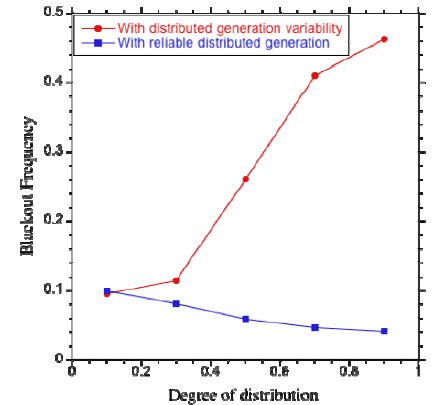
As such systems become more complex, and the degree of interdependence between their constituent parts grows, keeping the overall system stable becomes more difficult. Known as “hyper-coherence,” this occurs when each part of the system becomes so dependent upon each other that change in any part produces instability in the system as a whole. Thus, if the Late Bronze Age civilizations were truly globalized and dependent upon each other for goods and services, even just to a certain extent, then change to any one of the relevant kingdoms, such as the Mycenaeans or the Hittites, would potentially affect and destabilize them all.

Moreover, it is especially relevant that the kingdoms, empires, and societies of the Late Bronze Age Aegean and Eastern Mediterranean can each be seen as an individual sociopolitical system. Such complex socio-political systems will exhibit an internal dynamic which leads them to increase in complexity…. [T]he more complex a system is, the more liable it is to collapse. Thus, in the Late Bronze Age Aegean and Eastern Mediterranean, we have individual sociopolitical systems, the various civilizations, that were growing more complex and thus apparently more liable to collapse. At the same time, we have complex systems, the trading networks, that were both interdependent and complicated in their relationships, and thus were open to instability the minute there was a change in one of the integral parts. Here is where one malfunctioning cog in an otherwise well-oiled machine might turn the entire apparatus into a pile of junk, just as a single thrown rod can wreck the engine of a car today. Therefore, rather than envisioning an apocalyptic ending overall—although perhaps certain cities and kingdoms like Ugarit met a dramatic, blazing end—we might better imagine that the end of the Late Bronze Age was more a matter of a chaotic although gradual disintegration of areas and places that had once been major and in contact with each other, but were now diminished and isolated, like Mycenae, because of internal and/or external changes that affected one or more of the integral parts of the complex system.

It is clear that such damage would have led to a disruption of the network. We might picture a modern power grid that has been disrupted, perhaps by a storm or an earthquake, wherein the electric company can still produce power but cannot get it out to the individual consumers.

If the disruption is permanent, as might be the case in a major catastrophe, such as a nuclear explosion today, eventually even the production of the electricity will halt. The analogy may hold for the Late Bronze Age.

The consequence of such instability is that when the complex system does collapse, it decomposes into smaller entities, which is exactly what we see in the Iron Age that follows the end of these Bronze Age civilizations. Thus, it seems that employing complexity theory, which allows us to take both catastrophe theory and systems collapse one step further, may be the best approach to explaining the end of the Late Bronze Age in the Aegean and Eastern Mediterranean in the years following 1200 BC.

The argument that the Bronze Age civilizations were increasing in complexity and were therefore prone to collapse does not really make all that much sense, especially when one considers their “complexity” relative to that of the Western European civilizations of the last 300 years. Thus, while it is possible that complexity theory might be a useful way to approach the collapse of the Late Bronze Age once we have more information available as to the details of all the relevant civilizations, it may not be of much use at this stage, except as an interesting way to reframe our awareness that a multitude of factors were present at the end of the Late Bronze Age that could have helped destabilize, and ultimately led to the collapse of, the international system

And yet, scholarly publications still continue to suggest a linear progression for the collapse of the Late Bronze Age, despite the fact that it is not accurate to simply state that a drought caused famine, which eventually caused the Sea Peoples to start moving and creating havoc, which caused the Collapse. The progression wasn’t that linear; the reality was much more messy. There probably was not a single driving force or trigger, but rather a number of different stressors, each of which forced the people to react in different ways to accommodate the changing situation(s).

Rather than a single driver, is therefore advantageous both in explaining the collapse at the end of the Late Bronze Age and in providing a way forward for continuing to study this catastrophe.

A fluid event, taking place over the course of several decades and perhaps even up to a century, not an occurrence tied to a specific year.

Egypt stands out and is the most representative of the entire collapse. For it was in that year, according to the Egyptian records, that the Sea Peoples came sweeping through the region, wreaking havoc for a second time. It was a year when great land and sea battles were fought in the Nile delta; a year when Egypt struggled for its very survival; a year by which time some of the high-flying civilizations of the Bronze Age had already come to a crashing halt. In fact, one might argue that 1177 BC is to the end of the Late Bronze Age as AD 476 is to the end of Rome and the western Roman Empire. That is to say, both are dates to which modern scholars can conveniently point as the end of a major era. Italy was invaded and Rome was sacked several times during the fifth century AD, including in AD 410 by Alaric and the Visigoths and in AD 455 by Geiseric and the Vandals.

The end of the Late Bronze Age and the transition to the Iron Age is a similar case, insofar as the collapse and transition was a rolling event, taking place between approximately 1225 and 1175 BC or, in some places, as late as 1130 BC.

The mighty Bronze Age kingdoms and empires were gradually replaced by smaller city-states during the following Early Iron Age. Consequently, our picture of the Mediterranean and Near Eastern world of 1200 BC is quite different from that of 1100 BC and completely different from that of 1000 BC. We have firm evidence that it took decades, and even centuries in some areas, for the people in these regions to rebuild and reclaim their societies, and to forge new lives that would bring them back up out of the darkness into which they had been plunged.

The area of the Mycenaean kingdom of Pylos remained, as a whole in fact, severely depopulated for nearly a millennium.

It is clear that after the catastrophes were over, there were no palaces, the use of writing as well as all administrative structures came to an end, and the concept of a supreme ruler, the wanax, disappeared from the range of political institutions of Ancient Greece. In terms of literacy and writing, the same holds true for Ugarit and the other entities that had flourished in the Eastern Mediterranean during the Late Bronze Age, for with their end came also the end of cuneiform writing

Christopher Monroe has stated, “all civilizations eventually experience violent restructuring of material and ideological realities such as destruction or re-creation.” We see this in the constant rise and fall of empires over time, including the Akkadians, Assyrians, Babylonians, Hittites, Neo-Assyrians, Neo-Babylonians, Persians, Macedonians, Romans, Mongols, Ottomans, and others, and we should not think that our current world is invulnerable, for we are in fact more susceptible than we might wish to think. While the 2008 collapse of Wall Street in the United States pales in comparison to the collapse of the entire Late Bronze Age Mediterranean world, there were those who warned that something similar could take place if the banking institutions with a global reach were not bailed out immediately. For instance, the Washington Post quoted Robert B. Zoellick, then the president of the World Bank, as saying that “the global financial system may have reached a ‘tipping point,’ ” which he defined as “the moment when a crisis cascades into a full-blown meltdown and becomes extremely difficult for governments to contain.” In a complex system such as our world today, this is all it might take for the overall system to become destabilized, leading to a collapse.

Posted in Cascading Failure, Collapse of Civilizations, Collapsed & collapsing nations, Drought & Collapse, Interdependencies, Supply Chains | Tagged , , , , | Comments Off on 1177 B.C. The year civilization collapsed

Shale “fracked” natural gas peak by 2020: Mason Inman’s “Natural gas, the fracking fallacy”

[ In 2005 the U.S. was making desperate plans to build dozens of Liquefied Natural Gas plants for importing gas. Fracked gas changed that for the past 10 years, indeed, now the U.S. is talking about exporting natural gas.  But most companies have been spending more money than they’ve made, and now in 2016 we are seeing the shale bubble burst.  Even if Wall Street had been able to continue funding drillers using middle class money placed in 401K and IRA high-yield bond and stock mutual funds, scientists at the University of Texas have estimated that the largest fracked gas plays will peak in 2020.

There is a lot of natural gas left in the world.  But much of it is stranded, requiring too many miles of pipelines to reach civilization (too expensive).

Alice Friedemann   www.energyskeptic.com  author of “When Trucks Stop Running: Energy and the Future of Transportation”, 2015, Springer]

Inman, Mason. December 3, 2014. Natural Gas: The fracking fallacy. Nature 516, 28-30

Editorial

The EIA projects that production will rise by more than 50% over the next quarter of a century, and perhaps beyond, with shale formations supplying much of that increase.

But such optimism contrasts with forecasts developed by a team of specialists at the University of Texas, which is analyzing the geological conditions using data at much higher resolution than the EIA’s. The Texas team projects that gas production from four of the most productive formations will peak in the coming years and then quickly decline. If that pattern holds for other formations that the team has not yet analyzed, it could mean much less natural gas in the United States’ future.

Like all energy forecasts, the lower projections from the Texas team could turn out to be inaccurate. Technological advances in the next few decades could open up more resources at lower costs, driving US production even higher than the EIA has predicted. But it is also possible that the Texas forecasts are too high, and that gas production will fall off even faster than the team suggests.

The one certainty here is that the United States and other nations have invested relatively little in tracking and assessing their natural resources. The EIA has a total budget of US$117 million, less than the value of one day’s gas production from the country’s shale formations.

Natural gas: The fracking fallacy

The United States is banking on decades of abundant natural gas to power its economic resurgence. That may be wishful thinking.

When US President Barack Obama talks about the future, he foresees a thriving US economy fueled to a large degree by vast amounts of natural gas pouring from domestic wells. “We have a supply of natural gas that can last America nearly 100 years,” he declared in his 2012 State of the Union address.

Obama’s statement reflects an optimism that has permeated the United States. It is all thanks to fracking — or hydraulic fracturingwhich has made it possible to coax natural gas at a relatively low price out of the fine-grained rock known as shale. Around the country, terms such as ‘shale revolution’ and ‘energy abundance’ echo through corporate boardrooms.

Companies are betting big on forecasts of cheap, plentiful natural gas. Over the next 20 years, US industry and electricity producers are expected to invest hundreds of billions of dollars in new plants that rely on natural gas. And billions more dollars are pouring into the construction of export facilities that will enable the United States to ship liquefied natural gas to Europe, Asia and South America.

All of those investments are based on the expectation that US gas production will climb for decades, in line with the official forecasts by the US Energy Information Administration (EIA). As agency director Adam Sieminski put it last year: “For natural gas, the EIA has no doubt at all that production can continue to grow all the way out to 2040.”

But a careful examination of the assumptions behind such bullish forecasts suggests that they may be overly optimistic, in part because the government’s predictions rely on coarse-grained studies of major shale formations, or plays. Now, researchers are analyzing those formations in much greater detail and are issuing more-conservative forecasts. They calculate that such formations have relatively small ‘sweet spots’ where it will be profitable to extract gas.

Tad Patzek, head of the University of Texas at Austin’s department of petroleum and geosystems engineering says this is “bad news, we’re setting ourselves up for a major fiasco”.

If US natural-gas production falls, plans to export large amounts overseas could fizzle. And nations hoping to tap their own shale formations may reconsider. “If it begins to look as if it’s going to end in tears in the United States, that would certainly have an impact on the enthusiasm in different parts of the world,” says economist Paul Stevens of Chatham House, a London-based think tank.

The idea that natural gas will be abundant is a sharp turnaround from more pessimistic outlooks that prevailed until about five years ago. Throughout the 1990s, US natural-gas production had been stuck on a plateau. With gas supplying 25% of US energy, there were widespread worries that supplies would shrink and the nation would become dependent on imports. The EIA, which collects energy data and provides a long-term outlook for US energy, projected as recently as 2008 that US natural-gas production would remain fairly flat for the following couple of decades.

The shale boom caught everyone by surprise. It relied on fracking technology that had been around for decades — but when gas prices were low, the technology was considered too costly to use on shale. In the 2000s, however, prices rose high enough to for companies to afford fracking shale formations. Combined with new techniques for drilling long horizontal wells, this pushed US natural-gas production to an all-time high, allowing the nation to regain a title it had previously held for decades: the world’s top natural-gas producer.

Rich rocks

Much of the credit for that goes to the Marcellus shale formation, which stretches across West Virginia, Pennsylvania and New York. Beneath thickly forested rolling hills, companies have sunk more than 8,000 wells over several years, and are adding about 100 more every month. Each well extends down for about 2 kilometers before veering sideways and snaking for more than a kilometer through the shale. The Marcellus now supplies 385 million cubic meters of gas per day, more than enough to supply half of the gas currently burned in US power plants.

A substantial portion of the rest of the US gas supply comes from three other shale plays — the Barnett in Texas, the Fayetteville in Arkansas and the Haynesville, which straddles the Louisiana–Texas border. Together, these ‘big four’ plays boast more than 30,000 wells and are responsible for two-thirds of current US shale-gas production.

The EIA — like nearly all other forecasters — did not see the boom coming, and has consistently underestimated how much gas would come from shale. But as the boom unfolded, the agency substantially raised its long-term expectations for shale gas. In its Annual Energy Outlook 2014, the ‘reference case’ scenario — based on the expectation that natural-gas prices will gradually rise, but remain relatively low — shows US production growing until 2040, driven by large increases in shale gas.

The EIA has not published its projections for individual shale-gas plays, but has released them to Nature. In the latest reference-case forecast, production from the big four plays would continue rising quickly until 2020, then plateau for at least 20 years. Other shale-gas plays would keep the boom going until 2040.

Petroleum-industry analysts create their own shale-gas forecasts, which generally fall in the neighborhood of the EIA assessment. “EIA’s outlook is pretty close to the consensus,” says economist Guy Caruso of the Center for Strategic and International Studies in Washington DC, who is a former director of the agency. However, these consultancies rarely release the details behind their forecasts. That makes it difficult to assess and discuss their assumptions and methods, argues Ruud Weijermars, a geoscientist at Texas A&M University in College Station. Industry and consultancy studies are “entirely different from the peer-reviewed domain”, he says.

To provide rigorous and transparent forecasts of shale-gas production, a team of a dozen geoscientists, petroleum engineers and economists at the University of Texas at Austin has spent more than three years on a systematic set of studies of the major shale plays. The research was funded by a US$1.5-million grant from the Alfred P. Sloan Foundation in New York City, and has been appearing gradually in academic journals1, 2, 3, 4, 5 and conference presentations. That work is the “most authoritative” in this area so far, says Weijermars.

If natural-gas prices were to follow the scenario that the EIA used in its 2014 annual report, the Texas team forecasts that production from the big four plays would peak in 2020, and decline from then on. By 2030, these plays would be producing only about half as much as in the EIA’s reference case. Even the agency’s most conservative scenarios seem to be higher than the Texas team’s forecasts. “Obviously they do not agree very well with the EIA results,” says Patzek.

The main difference between the Texas and EIA forecasts may come down to how fine-grained each assessment is.

  • The EIA breaks up each shale play by county, calculating an average well productivity for that area. But counties often cover more than 1,000 square kilometers, large enough to hold thousands of horizontal fracked wells.
  • The Texas team, by contrast, splits each play into blocks of one square mile (2.6 square kilometers)a resolution at least 20 times finer than the EIA’s.

Resolution matters because each play has sweet spots that yield a lot of gas, and large areas where wells are less productive. Companies try to target the sweet spots first, so wells drilled in the future may be less productive than current ones. The EIA’s model so far has assumed that future wells will be at least as productive as past wells in the same county. But this approach, Patzek argues, “leads to results that are way too optimistic”.

The high resolution of the Texas studies allows their model to distinguish the sweet spots from the marginal areas. As a result, says study co-leader Scott Tinker, a geoscientist at the University of Texas at Austin, “we’ve been able to say, better than in the past, what a future well would look like”.

The Texas and EIA studies also differ in how they estimate the total number of wells that could be economically drilled in each play. The EIA does not explicitly state that number, but its analysis seems to require more wells than the Texas assessment, which excludes areas where drilling would be difficult, such as under lakes or major cities. These features of the model were chosen to “mimic reality”, Tinker says, and were based on team members’ long experience in the petroleum industry.

Alternative Futures

The lower forecasts from Texas mesh with a few independent studies that use simpler methods. Studies by the following researchers suggest that increasing production, as in the EIA’s forecasts, would require a significant and sustained increase in drilling over the next 25 years, which may not be profitable.

  1. Weijermars 6, R. 2014. US shale gas production outlook based on well roll-out rate scenarios. Applied Energy, 124, 283-297.
  2. Mark Kaiser7 of Louisiana State University in Baton Rouge
  3. retired Geological Survey of Canada geologist David Hughes8,

Some industry insiders are impressed by the Texas assessment. Richard Nehring, an oil and gas analyst at Nehring Associates in Colorado Springs, Colorado, which operates a widely used database of oil and gas fields, says the team’s approach is “how unconventional resource assessments should be done”.

Patzek acknowledges that forecasts of shale plays “are very, very difficult and uncertain”, in part because the technologies and approaches to drilling are rapidly evolving. In newer plays, companies are still working out the best spots to drill. And it is still unclear how tightly wells can be packed before they significantly interfere with each other.

Yet in a working paper9 published online on 14 October, two EIA analysts acknowledge problems with the agency’s methods so far. They argue that it would be better to draw upon high-resolution geological maps, and they point to those generated by the Texas team as an example of how such models could improve forecasts by delineating sweet spots. The paper carries a disclaimer that the authors’ views are not necessarily those of the EIA — but the agency does plan to use a new approach along these lines when it assesses the Marcellus play for its 2015 annual report. (When Nature asked the authors of that paper for an on-the-record interview, they referred questions to Staub.)

Boom or bust

Patzek argues that actual production could come out lower than the team’s forecasts. He talks about it hitting a peak in the next decade or so — and after that, “there’s going to be a pretty fast decline on the other side”, he says. “That’s when there’s going to be a rude awakening for the United States.” He expects that gas prices will rise steeply, and that the nation may end up building more gas-powered industrial plants and vehicles than it will be able to afford to run. “The bottom line is, no matter what happens and how it unfolds,” he says, “it cannot be good for the US economy.”

If forecasting is difficult for the United States, which can draw on data for tens of thousands of shale-gas wells, the uncertainty is much larger in countries with fewer wells. The EIA has commissioned estimates of world shale potential from Advanced Resources International (ARI), a consultancy in Washington DC, which concluded in 2013 that shale formations worldwide are likely to hold a total of 220 trillion cubic meters of recoverable natural gas10. At current consumption rates — with natural gas supplying one-quarter of global energy — that would provide a 65-year supply. However, the ARI report does not state a range of uncertainty on its estimates, nor how much gas might be economical to extract.

Such figures are “extremely dubious”, argues Stevens. “It’s sort of people wetting fingers and waving them in the air.” He cites ARI’s assessments of Poland, which is estimated to have the largest shale-gas resources in Europe. Between 2011 and 2013, the ARI reduced its estimate for Poland’s most promising areas by one-third, saying that some test wells had yielded less than anticipated. Meanwhile, the Polish Geological Institute did its own study11, calculating that the same regions held less than one-tenth of the gas in ARI’s initial estimate.

If gas supplies in the United States dry up faster than expected — or environmental opposition grows stronger — countries such as Poland will be less likely to have their own shale booms, say experts.

For the moment, however, optimism about shale gas reigns — especially in the United States. And that is what worries some energy experts. “There is a huge amount of uncertainty,” says Nehring. “The problem is, people say, ‘Just give me a number’. Single numbers, even if they’re wrong, are a lot more comforting.”

The EIA is underfunded

Patzek says that the EIA’s method amounts to “educated guesswork”. But he and others are reluctant to come down too hard. The EIA is doing “the best with the resources they have and the timelines they have”, says Patzek. Its 2014 budget — which covers data collection and forecasting for all types of energy — totaled just $117 million, about the cost of drilling a dozen wells in the Haynesville shale. The EIA is “good value for the money”, says Caruso. “I always felt we were underfunded. The EIA was being asked to do more and more, with less and less.”

Representatives of the EIA defend the agency’s assessments and argue that they should not be compared with the Texas studies because they use different assumptions and include many scenarios. “Both modelling efforts are valuable, and in many respects feed each other,” says John Staub, leader of the EIA’s team on oil and gas exploration and production analysis. “In fact, EIA has incorporated insights from the University of Texas team,” he says.

Access the data used in this feature at https://github.com/the-frack-lab/data/wiki/Nature-feature-%22The-Fracking-Fallacy%22

Rebuttal of the rebuttal above article

Nature published objections to the article above in a later issue, Art Berman best rebuts the rebuttal below:

Nature Responds To EIA and BEG Denial Letters

Posted in The Petroleum Truth Report on December 19, 2014

Today, Nature responded to letters earlier this week from the EIA (Energy Information Administration) and BEG (Bureau of Economic Geology, University of Texas at Austin) claiming that Mason Inman’s article “The Fracking Fallacy” published on December 4, 2014 was flawed.
Nature stands by Inman’s article and, interestingly, revealed that EIA was asked some questions by Inman while he was working on the article but they did not reply.
It is also interesting that the EIA denial letter was not signed by the EIA Administrator Adam Sieminski but by Deputy Administrator Howard Gruenspecht.
Let’s get a few things straight as people attempt to sort through this bit of energy theater.
First, Allen Brooks has documented the events and facts of this story in two issues of Musings From The Oil Patch:
Allen showed many of BEG Director Scott Tinker’s slides that set off the debate in the first of these articles but the key chart in my view is the following:


Despite denial of any differences by both the EIA and BEG, the obvious truth is that the BEG Sloan studies of the major shale gas plays in the United States forecast lower EUR (estimated ultimate recovery), a shorter life-cycle, an earlier and steeper decline and a lower contribution to total gas supply than does the EIA.
Period.
Denying that there is any discrepancy between EIA and BEG is false.  This difference does not disappear by accusing Inman and Nature of misrepresentation and bias.  Attempts by both agencies to discredit Tad Patzek or minimize his role in the BEG studies–more about that a bit later in my comments–are factually incorrect and shameful.
The BEG studies confirm what many “shale gas skeptics” (including me) have said for many years:  The shale gas phenomenon is real, it has contributed a significant volume of gas that nobody thought was available, and there is a lot less of it than some people believe.  I add that it also costs more than represented to produce although that is not part of the immediate debate among EIA, BEG and Nature.
The EIA published 2013 proven reserves of shale gas earlier this month.  Shale gas will provide about 6 years of supply at present consumption.  We can debate about the various classes of reserves and speculate about resources from now until we run out of gas but the plain and simple truth is what Inman and the BEG studies concluded:  there is less gas than many people thought and certainly less than EIA has represented in its natural gas forecasts (do the EIA people who do the gas forecasts talk to the people who do the reserve accounting?).

Much of the EIA’s position stated in Gruenspecht’s letter (and interpreted by me)  is that uncertainty exists and the EIA represents multiple scenarios and should not be held to account for one or, in fact, any of them.  That sounds good but, as someone pointed out to me, applications for LNG export to the Department of Energy are based on the EIA base case.

Tad Patzek was quoted often in the Nature article and was shamelessly “thrown under the bus” by the EIA and BEG in both denial letters.

Tad is Professor and Chairman of the Petroleum Eng. & Geosystems Department at the University of Texas at Austin and a lead researcher in the BEG Sloan studies on U.S. shale gas plays.

Despite comments in both letters saying that Tad’s role was relatively minor in those studies, I dispute those statements as distortions of fact.  The work done by Tad and his engineering team addressed the determination of individual well EUR which, in my view, is the core of the studies.

I believe that the BEG Sloan studies represent a monumental achievement and demonstrate an unparalleled level of comprehensive and integrated analysis on the important subject of shale gas. I fully support the technical analysis and Tad Patzek and his team provided the credible core of that work.  Please see the papers following for proof of this:

1.     Patzek, T.W. Male, F., and Marder, M.,“A simple model of gas production from hydrofractured horizontal wells in shales,” AAPG Bulletin, v. 98, no. 12 (December 2014), pp. 2507–2529.
2.     Patzek, T. W., Male, F. and Marder, M. “Gas production in the Barnett Shale obeys a simple scaling theory,”  PNAS, doi:10.1073/pnas.1313380110, November 18, 2013. Awarded with the Cozzarelli Prize by the National Academy of Sciences for the best paper in engineering in 2013.
3.      Patzek, T. W., Male, F. and Marder, M. “Supporting Materials to: Gas production in the Barnett Shale obeys a simple scaling theory,”  PNAS, doi:10.1073/pnas.1313380110, November 18, 2013.
4.     John Browning, Katie Smye, Scott W. Tinker, Susan Horvath, Svetlana Ikonnikova, Tad Patzek Gürcan Gülen, , Frank Male, Eric Potter, Forrest Roberts , and Qilong Fu, “Study develops Fayetteville shale reserves, production forecast, OGJ, 01/06/2014.
5.     John Browning, Scott W. Tinker, Svetlana Ikonnikova, Gürcan Gülen, Eric Potter, Qilong Fu, Susan Horvath, Tad Patzek, Frank Male, William Fisher, Forrest Roberts and Ken Medlock, III, “BARNETT SHALE MODEL-2 (Conclusion): Barnett study determines full-field reserves, production forecast,” OGJ, September 9, 2013.
6.     John Browning, Scott W. Tinker, Svetlana Ikonnikova, Gürcan Gülen, Eric Potter, Qilong Fu, Susan Horvath, Tad Patzek, Frank Male, William Fisher, Forrest Roberts and Ken Medlock, III, “BARNETT SHALE MODEL-1: Barnett study determines full-field reserves, production forecast,” OGJ, p. 62, August 5, 2013.
7.     Frank Male, Akand W. Islam, Tad W. Patzek, Michael P. Marder, Paper SPE168993-MS: “Analysis of Gas Production From Hydraulically Fractured Wells In The Haynesville Shale Using Scaling Methods,” presented at the SPE Unconventional Resources Conference – USA, held in The Woodlands, Texas, USA, 1-3 April 2014.
8.     Frank Male, Akand W. Islam, Tad W. Patzek, Svetlana Ikonnikova, John Browning and Michael P. Marder,  “Analysis of gas production from hydraulically fractured wells in the Haynesville shale using scaling methods,” submitted to the Journal of Unconventional Oil and Gas Resources, 2014 (now in revision to be send back to the editor).

References

  1. Patzek, T. W., Male, F. & Marder, M. Gas production in the Barnett Shale obeys a simple scaling theory. Proc. Natl Acad. Sci. USA 110, 19731–19736 (2013).

Ten years ago, US natural gas cost 50% more than that from Russia. Now, it is threefold less. US gas prices plummeted because of the shale gas revolution. However, a key question remains: At what rate will the new hydrofractured horizontal wells in shales continue to produce gas? We analyze the simplest model of gas production consistent with basic physics of the extraction process. Its exact solution produces a nearly universal scaling law for gas wells in each shale play, where production first declines as 1 over the square root of time and then exponentially. The result is a surprisingly accurate description of gas extraction from thousands of wells in the United States’ oldest shale play, the Barnett Shale.

The fast progress of hydraulic fracturing technology (SI Text, Figs. S1 and S2) has led to the extraction of natural gas and oil from tens of thousands of wells drilled into mudrock (commonly called shale) formations. The wells are mainly in the United States, although there is significant potential on all continents (1). The “fracking” technology has generated considerable concern about environmental consequences (2, 3) and about whether hydrocarbon extraction from mudrocks will ultimately be profitable (4). The cumulative gas obtained from the hydrofractured horizontal wells and the profits to be made depend upon production rate. Because large-scale use of hydraulic fracturing in mudrocks is relatively new, data on the behavior of hydrofractured wells on the scale of 10 y or more are only now becoming available.

There is more than a century of experience describing how petroleum and gas production declines over time for vertical wells. The geometry of horizontal wells in gas-rich mudrocks is quite different from the configuration that has guided intuition for the past century. The mudrock formations are thin layers, on the order of 30–90 m thick, lying at characteristic depths of 2 km or more and extending over areas of thousands of square kilometers. Wells that access these deposits drop vertically from the surface of the earth and then turn so as to extend horizontally within the mudrock for 1–8 km. The mudrock layers have such low natural permeability that they have trapped gas for millions of years, and this gas becomes accessible only after an elaborate process that involves drilling horizontal wells, fracturing the rock with pressurized water, and propping the fractures open with sand. Gas seeps from the region between each two consecutive fractures into the highly permeable fracture planes and into the wellbore, and it is rapidly produced from there.

Gas released by hydraulic fracturing can only be extracted from the finite volume where permeability is enhanced. Exponential decline of production once the interference time has been reached is inevitable, and extrapolations based upon the power law that prevails earlier are inaccurate. The majority of wells are too young to be displaying interference yet. The precise amount of gas they produce, and therefore their ultimate profitability, will depend upon when interference sets in.

For the moment, it is necessary to live with some uncertainty. Upper and lower bounds on gas in place are still far apart, even in the Barnett Shale with the longest history of production. Pessimists (4) see only the lower bounds, whereas optimists (19) look beyond the upper bounds. A detailed economic analysis based on the model presented here is possible, however, and is being published elsewhere (17, 18, 20, 21). The theoretical tools we are providing should make it possible to detect the onset of interference at the earliest possible date, provide increasingly accurate production forecasts as data become available, and assist with rational decisions about how hydraulic fracturing should proceed in light of its impact on the US environment and economy.

  1. Browning, J. et al. Oil Gas J. 111 (8), 62–73 (2013).
  2. Browning, J. et al. Oil Gas J. 111 (9), 88–95 (2013).
  3. Browning, J. et al. Oil Gas J. 112 (1), 64–73 (2014).
  4. Gülen, G., Browning, J., Ikonnikova, S. & Tinker, S. W. Energy 60, 302–315 (2013).
  5. Weijermars, R. Appl. Energy 124, 283–297 (2014).
  6. Kaiser, M. J. & Yu, Y. Oil Gas J. 112 (3), 62–65 (2014).
  7. Hughes, J. D. Drilling Deeper (Post Carbon Institute, 2014); available at http://go.nature.com/o84xwk and Hughes JD (2013) Energy: A reality check on the shale revolution. Nature 494(7437):307–308
  8. Cook, T. & Van Wagener, D. Improving Well Productivity Based Modeling with the Incorporation of Geologic Dependencies (EIA, 2014); available at http://go.nature.com/dmwsdd
  9. US Energy Information Administration Technically Recoverable Shale Oil and Shale Gas Resources (EIA, 2013); available at http://go.nature.com/mqkmwx
  10. Assessment of Shale Gas and Shale Oil Resources of the Lower Paleozoic Baltic–Podlasie–Lublin Basin in Poland — First Report (Polish Geological Institute, 2012); available at http://go.nature.com/lw8fg7
  11. Assessment of Shale Gas and Shale Oil Resources of the Lower Paleozoic Baltic–Podlasie–Lublin Basin in Poland — First Report (Polish Geological Institute, 2012); available at http://go.nature.com/lw8fg7


Posted in Natural Gas, Peak Natural Gas | Tagged , , , | Comments Off on Shale “fracked” natural gas peak by 2020: Mason Inman’s “Natural gas, the fracking fallacy”

Natural Gas-to-Liquids (GTL) as a Drop-in Diesel fuel

[The reason GTL is a big deal is that it can substitute for diesel without having to modify a diesel engine to do so — therefore, it’s a “drop-in fuel” substitute.

However, GTL isn’t likely to be the answer, since it’s far more “economically attractive” to use natural gas to produce electricity and Liquified Natural Gas (LNG), according to the U.S. Energy Information administration.

Once oil begins to decline, a substitute for diesel fuel must be found to continue to allow the billions of truck, train, shipping, and agricultural tractor/harvester etc., diesel combustion engines to operate since they can’t run on diesohol, ethanol, and can at most use 5 to 20% biodiesel (though there are some truck diesel engines warrantied now for 100% biodiesel).  Yet even if all diesel engines were warrantied for 100% biodiesel, there can never be enough biodiesel made to be the sole provider of freight vehicle fuel, not even if all oilseeds (soybeans, etc) now being used for food were also converted to biodiesel.

Currently there are only 5 GTL plants in the world producing from 2,700 to 140,000 barrels/day.  Another is under construction, and 3 are proposed in the USA, only 1 large-scale).

There are 2 articles below. The 1st one explains the GTL process and the 2nd looks at the largest GTL plant in the world in Qatar. 

In the USA, a GTL plant can only be profitable if it maximizes wax production for the chemicals market rather than making diesel and other fuels.

Alice Friedemann wwww.energyskeptic.com]


Tom Murphy on Gas to Liquids

As with coal, methane gas can be synthesized into liquids like octane via the Fischer-Tropsch method.

The U.S. uses about 20 tcf of natural gas per year. A liter of octane (at 700 grams) requires 1100 liters of natural gas. Replacing a 3% annual shortfall of 200 million barrels (at 160 ℓ/bbl) of oil would require 35 trillion liters of methane, or 1.2 tcf: a 6% annual increase in natural gas production—similar to the impact on coal.   The U.S. Energy Information Agency projects that shale gas—currently at about 15% of domestic gas production— will nearly triple by 2035 to be our single biggest resource for natural gas. This is on top of a conventional supply that falls by 29% over the same period. In aggregate, the rapid expansion of shale gas allows a slow net growth rate of 0.4% per year. The faith in shale gas to deliver seems stretched a bit, so that it is difficult to assess the likelihood of net gas production growth at all. And even if it does grow, the 0.4% per year projection falls far short of the 6% level that would be needed to offset a 3% per year decline in oil.

Gas-to-liquids plants face challenges in the U.S. market

February 19, 2014. United States Energy Information Administration (EIA)

The most common GTL technique to convert natural gas to diesel and other liquid fuels (and waxes) is Fischer-Tropsch (F-T) synthesis.

Although F-T synthesis has been around for nearly a century, it is very expensive but has lately been of interest due to the growing spread between the value of petroleum products and the cost of natural gas.

The first step is to convert natural gas to a mixture of hydrogen, carbon dioxide, and carbon monoxide (syngas) and then removing sulfur, water, and carbon dioxide to prevent catalyst contamination. The F-T reaction combines hydrogen with carbon monoxide to form different liquid hydrocarbons. These liquid products are then further processed using different refining technologies into liquid fuels.

The F-T reaction typically happens at high pressure (40 atmospheres) and temperature (500o-840oF) in the presence of an iron catalyst. The cost of building a reaction vessel to produce the required volume of fuel or products and to withstand these temperatures and pressures can be considerable ($18-19 billion to create the Qatar facility).

Diagram of GTL process, as explained in the article text

Source: U.S. Energy Information Administration

There are currently five GTL plants operating globally, with capacities ranging from 2,700 barrels per day (bbl/d) to 140,000 bbl/d. Two in Malaysia,  two in Qatar, and one in South Africa. One plant in Nigeria is currently under construction.

Three plants in the United States are proposed, only one of them  a large-scale GTL plant.  Update Jan 29, 2015: Sasol has delayed an expansive $14 billion project in southwestern Louisiana to make diesel out of natural gas. The Sasol project depended on two dynamics in the energy markets: oil prices remaining high and natural gas prices staying low, because the conversion process for producing diesel is expensive and highly complex. Now any diesel produced by the plant would almost surely cost more than diesel produced by conventional refiners.  The Westlake, La facility would have produced 96,000 barrels of fuel a day. “In order for the G.T.L. technology to pay, it has to use inexpensive natural gas and sell into a high-priced market, the $100-a-barrel oil market we have grown accustomed to the last few years,” said Don Hertzmark, an international energy consultant who has worked on gas-to-liquids and other global natural gas projects for three decades. “That cost advantage has collapsed, taking with it the profit potential for G.T.L. in the United States at least for now.   GTL technology has a mixed record — the world’s largest plant in Qatar, cost $19 billion, 3 times more than its original projected cost, and was plagued with unexpected maintenance problems. BP and ConocoPhillips briefly operated demonstration plants in Alaska and Oklahoma, but never built a commercial facility. Exxon Mobil and ConocoPhillips announced plans to build giant plants in Qatar, but backed out, putting their capital instead into terminals to export liquefied natural gas (Krauss).

In December 2013, Shell cancelled plans to build a large-scale GTL facility in Louisiana because of high capital costs. The Annual Energy Outlook 2014 does not include any large-scale GTL facilities in the United States through 2040. Other uses for available natural gas in industry, electric power generation, and exports of pipeline and liquefied natural gas are more economically attractive than GTL.

To improve the profitability of GTL plants, developers have reconfigured their designs to include the production of waxes and lubricating products. Because of the smaller size of the chemical market, smaller-scale GTL plants similar to those proposed in the Midwest are economically viable. F-T waxes are used in industries producing candles, paints and coatings, resins, plastic, synthetic rubber, tires, and other products.


High Costs Slow Quest For Ultraclean Diesel

February 23, 2007, by Russell Gold. Wall Street Journal 

[Although this article was published in 2007, it’s still true in 2014.

Updates: In 2012 the Shell Qatar plant reached full production of 140,000 GTL barrels/day (b/d), a drop in the bucket of the 90,000,000 b/d produced worldwide and over its lifetime will produce 3 billion barrels of oil equivalent (half GTL, half other products), less than 1 month of world oil production]

The rush to build a new industry that turns natural gas into a transportation fuel is stumbling over rising costs, showing how tough it is for emerging fuels to compete with crude oil.

This past week, Exxon Mobil Corp. backed out of plans to build an enormous gas-to-liquids, or GTL, plant in Qatar. Yesterday, Royal Dutch Shell PLC broke ground on its own similarly sized GTL plant in Qatar, but said the cost might have tripled to as high as $18 billion.

  • The Hope: Energy companies have been investing in a potential petroleum substitute that turns natural gas into a liquid fuel.
  • The Problem: Gas-to-liquids projects have surged in cost due to overall oil-patch inflation.
  • The Result: Exxon Mobil this week joined other companies putting GTL projects on hold.

Escalating budgets are threatening to constrain the growth of the GTL industry, which produces a clear liquid that can run existing diesel engines without any of the sooty pollutants associated with diesel. The rising costs of steel, engineering and labor have led to steep inflation among major energy projects world-wide, underscoring how the rush to find new fuel sources is driving up the cost of developing them.

Higher costs have hit companies developing Canada’s oil sands, where crude is packed into tar-like deposits. Prices for corn and other crops have risen, in part, because of the U.S.’s increasing interest in ethanol.

Other than Shell’s Qatar facility, the only other GTL plant under construction also is facing cost pressures. Last year, Halliburton Co. hal -10.86% took a charge to earnings because of delays and cost increases for the plant its KBR Inc. kbr -11.23% unit is building in Nigeria for Chevron Corp. cvx -5.42% and Sasol Ltd. ssl -10.03%

Exxon officials wouldn’t say whether rising costs were the main factor in the decision to drop plans for the Qatar GTL plant. “Deciding not to progress with GTL is in line with our investment approach, which is very disciplined,” said Exxon spokeswoman Jeanne Miller.

Other GTL proposals, including projects led by Marathon Oil Corp. MRO -11.02% and ConocoPhillips, cop -6.72% in recent years were put on hold.

Exxon’s decision is likely to cause other companies to rethink their commitment to GTL. Bernard Picchi, an energy analyst for research and trading firm Wall Street Access, who keeps close tabs on GTL, said he expects other GTL hopefuls “to take a timeout, a deep breath and re-evaluate the cost and technology.”

Using technology developed in Nazi Germany, the process of turning natural gas into liquids had long been too expensive to be commercial. Small-scale GTL plants in Malaysia, operated by Shell, and South Africa, by Sasol, have been in operation for years. Several years ago, the Middle Eastern nation of Qatar decided to encourage large projects to turn its natural-gas resources into an exportable liquid fuel. The scale of the facilities, as well as rising oil costs, were expected to make the GTL fuel competitive. The Exxon and Shell projects, alongside a project by Sasol, were set to generate more than 300,000 barrels a day of the fuel.

Qatar hoped the plants could help GTL put a dent in crude oil’s near-monopoly on the world’s largest energy market — powering the world’s vehicles — by creating an alternative fuel.

Shell Chief Executive Jeroen van der Veer, flanked by Qatar’s energy minister and Prince Charles of Britain, said yesterday that Shell had an advantage over other competitors because of the GTL plant in Malaysia it has operated since 1993. “For us, GTL is proven technology,” he told reporters in Qatar, according to Reuters. He said the project remained inside its development-cost estimates of $4 to $6 per oil-equivalent barrel of production over a period of time.

Based on that, total project costs have been pegged as high as $18 billion based on estimated lifetime output of about three billion barrels of oil equivalent. A Shell spokesman said that is comparable to other big exploration and production projects it undertakes.

At the same time as announcing the end of its GTL project, Exxon said it had been selected by Qatar Petroleum to participate in a project to tap offshore natural gas for the industrial and power sector. The project, in which Exxon will own a 10% stake, will deliver 1.5 billion cubic feet of gas a day by 2012.

Krauss, C. Jan 28, 2015. Oil Company Sasol Delays Huge Louisiana Project as Prices Slide. New York Times.

Posted in GTL Gas-To-Liquids | Tagged , , , , , | Comments Off on Natural Gas-to-Liquids (GTL) as a Drop-in Diesel fuel

Population posts on the internet

[Below are posts I’ve run across on population. It will be left to Mother Nature to cut our numbers back to what the earth can support after fossil fuels decline.  In the brief 100 years or so the oil-boom lasted, we have ravaged our atmosphere, oceans, and soil hemically and physically with enormous diesel-combustion petroleum powered machines that blew up and leveled mountains, destroyed biodiversity to clear forests and wetlands to grow food, scarred the earth with mining, and paved the landscape with roads, parking lots, cities, shopping malls.

Alice Friedemann   www.energyskeptic.com  author of “When Trucks Stop Running: Energy and the Future of Transportation”, 2015, Springer and “Crunch! Whole Grain Artisan Chips and Crackers”. Podcasts: Practical Prepping, KunstlerCast 253, KunstlerCast278, Peak Prosperity , XX2 report ]

Erlich, Paul. 2017. Population and the environment: How do law and policy respond? Without policy changes, a global crash is inevitable. Environmental Law Institute.

The basic driver of today’s environmental overshoot is aggregate consumption, now causing humanity to live on its natural capital, rather than on the interest that flows from that capital. Natural capital is not just fossil fuels, minerals, and timber, but it also includes soils, plankton, fish stocks, pollinators, natural enemies of crop pests, disease vectors, and sinks for carbon dioxide, plastic trash, and other pollutants and toxins.

The signs of overshoot are everywhere: hundreds of millions hungry, and billions of people malnourished in terms of micronutrients, the accelerating sixth mass extinction, the dramatic decline in energy returned on energy invested in the scramble for oil, the heating planet and increasing extreme weather, the escalating refugee crisis, the scramble after remaining high-grade resources, the pollination crisis, the weight of plastic trash in the oceans soon to exceed that of fishes, ocean dead zones, symptoms of global toxification with hormone-mimicking compounds, falling sperm counts, and the automatic decline (with population growth) of democratic government, as each individual voter’s say is diluted. These, examples, along with global footprint analyses, show that the human population greatly exceeds Earth’s long-term carrying capacity.

From a policy viewpoint, the driver most easily addressed is overconsumption by the rich. We know when incentives are right, consumption patterns can be changed overnight. This was clearly demonstrated in the rapid U.S. reaction and mobilization after Pearl Harbor. There are potentially many legal and other mechanisms for curbing overconsumption: regulations, tax policies, campaigns to change norms, etc., but none of them seem feasible considering the hold faith-based economics has on politicians and businesspeople alike. The magical notion that growth on a finite planet can continue forever and that growth is the cure for all economic problems has a death grip on most societies, built into such institutions as fractional reserve banking and advertising.

Humanely shrinking the global population, the other side of the aggregate consumption coin, will take many decades to show significant progress. It would require moving the total fertility rate (average completed family size) down to somewhere just a little above 1, by making a single child family the ethical norm. But there persists a widespread belief in a right to have as many children as one desires.

All rights, regardless of their putative origins, clearly have attached responsibilities and limitations where they impinge on other peoples’ rights. The right to pursue happiness does not allow one to drive 100 miles per hour through school zones or throw garbage over the back fence, no matter how joyous it makes you. In order to suppress such activities, people form governments, and governments prohibit various actions because they interfere with some of their principal functions: maintaining order and peace and protecting public health. Since overpopulation is now a major threat to all three, indeed to the persistence of civilization, regulating the size of their populations clearly should be a central policy concern of all national governments.

Giving women everywhere legally equal rights to men and providing everyone with access to modern contraception and safe back-up abortion might lead to the critically necessary slow decline in numbers. But the required changing of norms before legal steps could be taken could be a slow process in many societies, and just achieving those goals could be controversial and difficult. More direct regulation, as in China’s one-child program, would present even more difficult policy and legal challenges. And whatever steps are taken, because of the momentum built into its age structure, humane shrinkage of the global population is not likely even to reduce it below today’s level within this century.

The scientific community’s repeated warnings about the population problem have fallen on deaf ears. Numerous studies point to the problem. There is, sadly, no sign that a general abandoning of economic growth-mania or humane global population shrinkage could occur in the critical next few decades. All this means that progressive civil society must start putting its efforts into planning to soften the coming collapse of civilization and finding ways to prepare for a post-collapse recovery that might give survivors in remnant societies a reasonably decent life.

Paul R. Ehrlich is Bing Professor of Population Studies. Emeritus, and president of the Center for Conservation Biology at Stanford University.

21 Nov 2014 Richard Adriann Reese The Population Bomb – revisited by What Is Sustainable. culturechange.org

Posted in Population, Scientists Warnings to Humanity | Tagged , , | Comments Off on Population posts on the internet

Giant Oil Field Decline Rates

Summary of article 1, Cobb’s “Aging Giant Oil Fields” 2013

  • The world’s 507 giant oil fields comprise a little over 1% of all oil fields, but produce 60% of current world supply
  • Of the 331 largest fields, 261, or 79%, are declining at 6.5% per year.
  • Techno-fixes have made matters worse because they’ll increase the decline rate to 10% or more, because we’re getting oil now, faster, with new technology that we would have gotten later.
  • And that will make it harder for unconventional oil (tar sands, deep ocean, tight “fracked” oil, etc.) to replace it

Summary of article 2, Koppelaar’s “… future oil supply”:

Based on 3 studies, average global oil decline rate of 4.5 to 6% assumed. No problems until 2013, and only then if there’s a rapid recovery of the economic system. Otherwise:
2014: in a weak recovery oil starts to tighten
2017: weak recovery, growing demand can’t be met
2020: if there’s another economic downturn, there is ample supply for a decade]

Aging giant oil fields, not new discoveries are the key to future oil supply

April 7, 2013  by Kurt Kobb

With all the talk about new oil discoveries around the world and new techniques for extracting oil in such places as North Dakota and Texas, it would be easy to miss the main action in the oil supply story: Aging giant fields produce more than half of global oil supply and are already declining as a group. Research suggests that their annual production decline rates are likely to accelerate.

Here’s what the authors of “Giant oil field decline rates and their influence on world oil production” concluded:

  1. The world’s 507 giant oil fields comprise a little over 1% of all oil fields, but produce 60% of current world supply (2005). (A giant field is defined as having more than 500 million barrels of ultimately recoverable resources of conventional crude. Heavy oil deposits are not included in the study.)
  2. “[A] majority of the largest giant fields are over 50 years old, and fewer and fewer new giants have been discovered since the decade of the 1960s.” The top 10 fields with their location and the year production began are: Ghawar (Saudi Arabia) 1951, Burgan (Kuwait) 1945, Safaniya (Saudi Arabia) 1957, Rumaila (Iraq) 1955, Bolivar Coastal (Venezuela) 1917, Samotlor (Russia) 1964, Kirkuk (Iraq) 1934, Berri (Saudi Arabia) 1964, Manifa (Saudi Arabia) 1964, and Shaybah (Saudi Arabia) 1998 (discovered 1968). (This list was taken from Fredrik Robelius’s “Giant Oil Fields -The Highway to Oil.”)
  3. The 2009 study focused on 331 giant oil fields from a database previously created for the groundbreaking work of Robelius mentioned above. Of those, 261 or 79 percent are considered past their peak and in decline.
  4. The average annual production decline for those 261 fields has been 6.5 percent. That means, of course, that the number of barrels coming from these fields on average is 6.5 percent less EACH YEAR.
  5. Now, here’s the key insight from the study. An evaluation of giant fields by date of peak shows that new technologies applied to those fields have kept their production higher for longer only to lead to more rapid declines later. As the world’s giant fields continue to age and more start to decline, we can therefore expect the annual decline in their rate of production to worsen. Land-based and offshore giants that went into decline in the last decade showed annual production declines on average above 10 percent.
  6. What this means is that it will become progressively more difficult for new discoveries to replace declining production from existing giants. And, though I may sound like a broken record, it is important to remind readers that the world remains on a bumpy production plateau for crude oil including lease condensate (which is the definition of oil), a plateau which began in 2005.

[rest of article snipped from here on]

1 Mar 2010  Drawing the lower and upper boundaries of future oil supply

By Rembrandt Koppelaar, ASPO Netherlands

The oil supply challenge is often summarized in terms of the production volume equivalent of Saudi-Arabia’s that needs to be replaced.

This popular metric is based on in-depth studies of global decline rates that show a decline range between 4.5 and 6 percent over the current 73 million barrels of crude oil produced per day. By using such literature values for all types of production, it can be shown that:

  • In the next 3 years there’s a sufficient oil supply for world demand under any economic scenario.
  • Supply constraints will arise if OPEC proves to be too slow in turning available capacity into production.
  • Oil supply can no longer meet growing demand beyond 2013 only in the unlikely case of a rapid economic recovery.
  • In case of a fairly weak economic recovery the oil market will begin to tighten in 2014 when production capacity begins to decline and growing demand can no longer be met around 2017.
  • If we suffer another economic downturn, ample oil supply will be available for a period of at least a decade.

Decline rates over current conventional production.
Recent studies have been conducted to date on the global decline rate of total conventional oil production, including fields with rising, declining and plateau production.

1) Cambridge Energy Research Associates in 2007, showed that 2007 average decline of oil fields under production was 4.5% per year (CERA 2007). This study used data from 811 oil fields representing two thirds of global oil production, obtained from the IHS Energy database. The selection was comprised of 400 fields, each with reserves of more than 300 million barrels, that produced half of global production in 2006, and 411 fields with less than 300 million barrels that produced only 8.5% of production in 2006.

2) Höök et al. (2009) estimated that the overall decline rate is 6% globally based on the finding that decline rates in smaller fields are equal or greater than those of giant fields.

Based on these studies, a starting point for current decline lies between 4.5% and 6%. Within this range a decline rate around 5% can be taken as a reasonable number. The value given by CERA (2007) of 4.5% probably over represents giant and super giant fields and hence is likely too low as small fields have bigger decline rates. The value given by Höök et al. (2009a) of 6% is probably too high as the total decline rate is inferred directly from post-peak decline of giant and supergiant fields on the assumption that smaller fields will tend to have an equal and higher decline, ignoring the effect of fields still on a plateau and in build-up.

Although 5% is a good starting point, the catch lies in knowing what will happen in the future. More supergiant and giant fields will go into decline due to depletion as time passes by, causing an increase in the average decline rate that needs to be compensated. This was shown by Höök et al. (2009) who found that the world average decline rate of the 331 giant fields was near zero until 1960, after which the average decline rate increased by around 0.15% per year.  Höök, M., Hirsch, R., Aleklett, K., 2009. Giant oil field decline rates and their influence on world oil production, Energy Policy Vol. 37, pp. 2262-2272

For scenario analysis we can take optimistic and pessimistic boundaries based on the studies describe above. The most optimistic stance is to extrapolate the starting point decline rate, estimated here at 5%, onto the entire forecast horizon up to 2030. The most pessimistic view based on current information would be a rapid increase in decline in the next five to ten years up to 6.7% as the production-weighed decline rate rapidly catches up with the average decline rate. After this a more smooth decline increase of 0.15% per year as historically was the case, up to a value of 8.6% in 2030, is an informed estimate. The real decline will lie somewhere in between these two bounds.


Posted in Flow Rate, How Much Left | Comments Off on Giant Oil Field Decline Rates

Gail Tverberg: 8 pitfalls in evaluating green energy solutions

Eight Pitfalls in Evaluating Green Energy Solutions

Does the recent climate accord between US and China mean that many countries will now forge ahead with renewables and other green solutions? I think that there are more pitfalls than many realize.

Pitfall 1. Green solutions tend to push us from one set of resources that are a problem today (fossil fuels) to other resources that are likely to be problems in the longer term.  

The name of the game is “kicking the can down the road a little.” In a finite world, we are reaching many limits besides fossil fuels:

  1. Soil quality–erosion of topsoil, depleted minerals, added salt
  2. Fresh water–depletion of aquifers that only replenish over thousands of years
  3. Deforestation–cutting down trees faster than they regrow
  4. Ore quality–depletion of high quality ores, leaving us with low quality ores
  5. Extinction of other species–as we build more structures and disturb more land, we remove habitat that other species use, or pollute it
  6. Pollution–many types: CO2, heavy metals, noise, smog, fine particles, radiation, etc.
  7. Arable land per person, as population continues to rise

The danger in almost every “solution” is that we simply transfer our problems from one area to another. Growing corn for ethanol can be a problem for soil quality (erosion of topsoil), fresh water (using water from aquifers in Nebraska, Colorado). If farmers switch to no-till farming to prevent the erosion issue, then great amounts of Round Up are often used, leading to loss of lives of other species.

Encouraging use of forest products because they are renewable can lead to loss of forest cover, as more trees are made into wood chips. There can even be a roundabout reason for loss of forest cover: if high-cost renewables indirectly make citizens poorer, citizens may save money on fuel by illegally cutting down trees.

High tech goods tend to use considerable quantities of rare minerals, many of which are quite polluting if they are released into the environment where we work or live. This is a problem both for extraction and for long-term disposal.

Pitfall 2. Green solutions that use rare minerals are likely not very scalable because of quantity limits and low recycling rates.  

Computers, which are the heart of many high-tech goods, use almost the entire periodic table of elements.

Figure 1. Slide by Alicia Valero showing that almost the entire periodic table of elements is used for computers.

When minerals are used in small quantities, especially when they are used in conjunction with many other minerals, they become virtually impossible to recycle. Experience indicates that less than 1% of specialty metals are recycled.

Figure 2. Slide by Alicia Valero showing recycling rates of elements.

Green technologies, including solar panels, wind turbines, and batteries, have pushed resource use toward minerals that were little exploited in the past. If we try to ramp up usage, current mines are likely to deplete rapidly. We will eventually need to add new mines in areas where resource quality is lower and concern about pollution is higher. Costs will be much higher in such mines, making devices using such minerals less affordable, rather than more affordable, in the long run.

Of course, a second issue in the scalability of these resources has to do with limits on oil supply. As ores of scarce minerals deplete, more rather than less oil will be needed for extraction. If oil is in short supply, obtaining this oil is also likely to be a problem, also inhibiting scalability of the scarce mineral extraction. The issue with respect to oil supply may not be high price; it may be low price, for reasons I will explain later in this post.

Pitfall 3. High-cost energy sources are the opposite of the “gift that keeps on giving.” Instead, they often represent the “subsidy that keeps on taking.”

Oil that was cheap to extract (say $20 barrel) was the true “gift that keeps on giving.” It made workers more efficient in their jobs, thereby contributing to efficiency gains. It made countries using the oil more able to create goods and services cheaply, thus helping them compete better against other countries. Wages tended to rise, as long at the price of oil stayed below $40 or $50 per barrel (Figure 3).

Figure 3. Average wages in 2012$ compared to Brent oil price, also in 2012$. Average wages are total wages based on BEA data adjusted by the CPI-Urban, divided total population. Thus, they reflect changes in the proportion of population employed as well as wage levels.

More workers joined the work force, as well. This was possible in part because fossil fuels made contraceptives available, reducing family size. Fossil fuels also made tools such as dishwashers, clothes washers, and clothes dryers available, reducing the hours needed in housework. Once oil became high-priced (that is, over $40 or $50 per barrel), its favorable impact on wage growth disappeared.

When we attempt to add new higher-cost sources of energy, whether they are high-cost oil or high-cost renewables, they present a drag on the economy for three reasons:

  1. Consumers tend to cut back on discretionary expenditures, because energy products (including food, which is made oil and other energy products) are a necessity. These cutbacks feed back through the economy and lead to layoffs in discretionary sectors. If they are severe enough, they can lead to debt defaults as well, because laid-off workers have difficulty paying their bills.
  2.  An economy with high-priced sources of energy becomes less competitive in the world economy, competing with countries using less expensive sources of fuel. This tends to lead to lower employment in countries whose mix of energy is weighted toward high-priced fuels.
  3. With (1) and (2) happening, economic growth slows. There are fewer jobs and debt becomes harder to repay.

In some sense, the cost producing of an energy product is a measure of diminishing returns–that is, cost is a measure of the amount of resources that directly and indirectly or indirectly go into making that device or energy product, with higher cost reflecting increasing effort required to make an energy product. If more resources are used in producing high-cost energy products, fewer resources are available for the rest of the economy. Even if a country tries to hide this situation behind a subsidy, the problem comes back to bite the country. This issue underlies the reason that subsidies tend to “keeping on taking.”

The dollar amount of subsidies is also concerning. Currently, subsidies for renewables (before the multiplier effect) average at least $48 per barrel equivalent of oil.1 With the multiplier effect, the dollar amount of subsidies is likely more than the current cost of oil (about $80), and possibly even more than the peak cost of oil in 2008 (about $147). The subsidy (before multiplier effect) per metric ton of oil equivalent amounts to $351. This is far more than the charge for any carbon tax.

Pitfall 4. Green technology (including renewables) can only be add-ons to the fossil fuel system.

A major reason why green technology can only be add-ons to the fossil fuel system relates to Pitfalls 1 through 3. New devices, such as wind turbines, solar PV, and electric cars aren’t very scalable because of high required subsidies, depletion issues, pollution issues, and other limits that we don’t often think about.

A related reason is the fact that even if an energy product is “renewable,” it needs long-term maintenance. For example, a wind turbine needs replacement parts from around the world. These are not available without fossil fuels. Any electrical transmission system transporting wind or solar energy will need frequent repairs, also requiring fossil fuels, usually oil (for building roads and for operating repair trucks and helicopters).

Given the problems with scalability, there is no way that all current uses of fossil fuels can all be converted to run on renewables. According to BP data, in 2013 renewable energy (including biofuels and hydroelectric) amounted to only 9.4% of total energy use. Wind amounted to 1.1% of world energy use; solar amounted to 0.2% of world energy use.

Pitfall 5. We can’t expect oil prices to keep rising because of affordability issues.  

Economists tell us that if there are inadequate oil supplies there should be few problems:  higher prices will reduce demand, encourage more oil production, and encourage production of alternatives. Unfortunately, there is also a roundabout way that demand is reduced: wages tend to be affected by high oil prices, because high-priced oil tends to lead to less employment (Figure 3). With wages not rising much, the rate of growth of debt also tends to slow. The result is that products that use oil (such as cars) are less affordable, leading to less demand for oil. This seems to be the issue we are now encountering, with many young people unable to find good-paying jobs.

If oil prices decline, rather than rise, this creates a problem for renewables and other green alternatives, because needed subsidies are likely to rise rather than disappear.

The other issue with falling oil prices is that oil prices quickly become too low for producers. Producers cut back on new development, leading to a decrease in oil supply in a year or two. Renewables and the electric grid need oil for maintenance, so are likely to be affected as well. Related posts include Low Oil Prices: Sign of a Debt Bubble Collapse, Leading to the End of Oil Supply? and Oil Price Slide – No Good Way Out.

Pitfall 6. It is often difficult to get the finances for an electrical system that uses intermittent renewables to work out well.  

Intermittent renewables, such as electricity from wind, solar PV, and wave energy, tend to work acceptably well, in certain specialized cases:

  • When there is a lot of hydroelectricity nearby to offset shifts in intermittent renewable supply;
  • When the amount added is sufficient small that it has only a small impact on the grid;
  • When the cost of electricity from otherwise available sources, such as burning oil, is very high. This often happens on tropical islands. In such cases, the economy has already adjusted to very high-priced electricity.

Intermittent renewables can also work well supporting tasks that can be intermittent. For example, solar panels can work well for pumping water and for desalination, especially if the alternative is using diesel for fuel.

Where intermittent renewables tend not to work well is when

  1. Consumers and businesses expect to get a big credit for using electricity from intermittent renewables, but
  2. Electricity added to the grid by intermittent renewables leads to little cost savings for electricity providers.

For example, people with solar panels often expect “net metering,” a credit equal to the retail price of electricity for electricity sold to the electric grid. The benefit to electric grid is generally a lot less than the credit for net metering, because the utility still needs to maintain the transmission lines and do many of the functions that it did in the past, such as send out bills. In theory, the utility still should get paid for all of these functions, but doesn’t. Net metering gives way too much credit to those with solar panels, relative to the savings to the electric companies. This approach runs the risk of starving fossil fuel, nuclear, and grid portion of the system of needed revenue.

A similar problem can occur if an electric grid buys wind or solar energy on a preferential basis from commercial providers at wholesale rates in effect for that time of day. This practice tends to lead to a loss of profitability for fossil fuel-based providers of electricity. This is especially the case for natural gas “peaking plants” that normally operate for only a few hours a year, when electricity rates are very high.

Germany has been adding wind and solar, in an attempt to offset reductions in nuclear power production. Germany is now running into difficulty with its pricing approach for renewables. Some of its natural gas providers of electricity have threatened to shut down because they are not making adequate profits with the current pricing plan. Germany also finds itself using more cheap (but polluting) lignite coal, in an attempt to keep total electrical costs within a range customers can afford.

Pitfall 7. Adding intermittent renewables to the electric grid makes the operation of the grid more complex and more difficult to manage. We run the risk of more blackouts and eventual failure of the grid. 

In theory, we can change the electric grid in many ways at once. We can add intermittent renewables, “smart grids,” and “smart appliances” that turn on and off, depending on the needs of the electric grid. We can add the charging of electric automobiles as well. All of these changes add to the complexity of the system. They also increase the vulnerability of the system to hackers.

The usual assumption is that we can step up to the challenge–we can handle this increased complexity. A recent report by The Institution of Engineering and Technology in the UK on the Resilience of the Electricity Infrastructure questions whether this is the case. It says such changes, ” .  .  . vastly increase complexity and require a level of engineering coordination and integration that the current industry structure and market regime does not provide.” Perhaps the system can be changed so that more attention is focused on resilience, but incentives need to be changed to make resilience (and not profit) a top priority. It is doubtful this will happen.

The electric grid has been called the worlds ‘s largest and most complex machine. We “mess with it” at our own risk. Nafeez Ahmed recently published an article called The Coming Blackout Epidemic, discussing challenges grids are now facing. I have written about electric grid problems in the past myself: The US Electric Grid: Will it be Our Undoing?

Pitfall 8. A person needs to be very careful in looking at studies that claim to show favorable performance for intermittent renewables.  

Analysts often overestimate the benefits of wind and solar. Just this week a new report was published saying that the largest solar plant in the world is so far producing only half of the electricity originally anticipated since it opened in February 2014.

In my view, “standard” Energy Returned on Energy Invested (EROEI) and Life Cycle Analysis (LCA) calculations tend to overstate the benefits of intermittent renewables, because they do not include a “time variable,” and because they do not consider the effect of intermittency. More specialized studies that do include these variables show very concerning results. For example, Graham Palmer looks at the dynamic EROEI of solar PV, using batteries (replaced at eight year intervals) to mitigate intermittency.2 He did not include inverters–something that would be needed and would reduce the return further.

Figure 4. Graham Palmer's chart of Dynamic Energy Returned on Energy Invested from "Energy in Australia."

Palmer’s work indicates that because of the big energy investment initially required, the system is left in a deficit energy position for a very long time. The energy that is put into the system is not paid back until 25 years after the system is set up. After the full 30-year lifetime of the solar panel, the system returns 1.3 times the initial direct energy investment.

One further catch is that the energy used in the EROEI calculations includes only a list of direct energy inputs. The total energy required is much higher; it includes indirect inputs that are not directly measured as well as energy needed to provide necessary infrastructure, such as roads and schools. When these are considered, the minimum EROEI needs to be something like 10. Thus, the solar panel plus battery system modeled is really a net energy sink, rather than a net energy producer.  

Another study by Weissbach et al. looks at the impact of adjusting for intermittency. (This study, unlike Palmer’s, doesn’t attempt to adjust for timing differences.) It concludes, “The results show that nuclear, hydro, coal, and natural gas power systems . . . are one order of magnitude more effective than photovoltaics and wind power.”

Conclusion

It would be nice to have a way around limits in a finite world. Unfortunately, this is not possible in the long run. At best, green solutions can help us avoid limits for a little while longer.

The problem we have is that statements about green energy are often overly optimistic. Cost comparisons are often just plain wrong–for example, the supposed near grid parity of solar panels is an “apples to oranges” comparison. An electric utility cannot possibility credit a user with the full retail cost of electricity for the intermittent period it is available, without going broke. Similarly, it is easy to overpay for wind energy, if payments are made based on time-of-day wholesale electricity costs. We will continue to need our fossil-fueled balancing system for the electric grid indefinitely, so we need to continue to financially support this system.

There clearly are some green solutions that will work, at least until the resources needed to produce these solutions are exhausted or other limits are reached. For example, geothermal may be solutions in some locations. Hydroelectric, including “run of the stream” hydro, may be a solution in some locations. In all cases, a clear look at trade-offs needs to be done in advance. New devices, such as gravity powered lamps and solar thermal water heaters, may be helpful especially if they do not use resources in short supply and are not likely to cause pollution problems in the long run.

Expectations for wind and solar PV need to be reduced. Solar PV and offshore wind are both likely net energy sinks because of storage and balancing needs, if they are added to the electric grid in more than very small amounts. Onshore wind is less bad, but it needs to be evaluated closely in each particular location. The need for large subsidies should be a red flag that costs are likely to be high, both short and long term. Another consideration is that wind is likely to have a short lifespan if oil supplies are interrupted, because of its frequent need for replacement parts from around the world.

Some citizens who are concerned about the long-term viability of the electric grid will no doubt want to purchase their own solar systems with inverters and back-up batteries. I see no reason to discourage people who want to do this–the systems may prove to be of assistance to these citizens. But I see no reason to subsidize these purchases, except perhaps in areas (such as tropical islands) where this is the most cost-effective way of producing electric power.

Notes:

[1] In 2013, the total amount of subsidies for renewables was $121 billion according to the IEA. If we compare this to the amount of renewables (biofuels + other renewables) reported by BP, we find that the subsidy per barrel of oil equivalent in was $48 per barrel of oil equivalent. These amounts are likely understated, because BP biofuels include fuel that doesn’t require subsidies, such as waste sawdust burned for electricity.

[2] Palmer’s work is published in Energy in Australia: Peak Oil, Solar Power, and Asia’s Economic Growth, published by Springer in 2014. This book is part of Prof. Charles Hall’s “Briefs in Energy” series.

Posted in Alternative Energy, Gail Tverberg | Tagged , , , , , , , , , | Comments Off on Gail Tverberg: 8 pitfalls in evaluating green energy solutions

Why You Should Love Trains

Why You Should Love Trains

by Alice Friedemann    November 13, 2014

Trains rock!

Trains are over 4 times more fuel efficient than trucks. On average it takes just 1 gallon to move a ton 473 miles, using just 2% of transportation oil. Trucks suck, burning 46% of transportation oil— 20% medium / heavy trucks, and 26% light trucks (FRA, USDOT 2014b, Davis).

Energy has been so cheap and plentiful we’ve blown our oil wad on gas-guzzling trucks, the limousines of the freight world. They lumber over 4 million miles of roads, often half empty with just the parts needed at a factory and drive back empty for their next haul.

A short-sighted transportation policy that favored energy-gulping trucks has reduced our rail system from 380,000 miles of tracks in 1920 to 140,000. About 45,000 of these miles are short-line tracks run by 500 small rail companies that go to grain elevators, steel mills, stock yards, and other businesses. The other 95,000 miles are the mainline tracks that move freight across the country, run by the seven large class 1 rail companies. These tracks tend to be in better condition and capable of hauling heavier railcars and locomotives than short-line rail.

Trains keep lights burning and bread on the table. Half of what trains haul (by weight) is energy related.

Rail excels at hauling heavy goods like coal and grain long distances (615 miles on average), so much so, that when you multiply weight times miles traveled, trains carry 45% of freight by ton-miles, versus 38% for trucks, yet trucks carry most of the weight overall, about three-quarters of it, because most freight travels less than 250 miles (USDOT 2014a).

Almost 40% of all tons carried by trains are coal, 42% of it from Wyoming, and 93% of U.S. coal will be used to generate electricity.

Trains also carry refined petroleum and coke (2.6%), fracked (tight) oil (2.2%), natural gas based fertilizers (2%) and plastics (2%), ethanol (1.5%), and petrochemicals (1%).

Other major commodities trains haul are chemicals 10%, grain 7%, crushed stone, sand, gravel 7%, food 6%, metals 3%, waste & scrap 2%, pulp/paper 2%, lumber/wood 1%, and import/export containers, which could contain just about anything.

Why not build more railroad tracks to conserve oil?

This seems like a no-brainer:

  • Heavy-duty trucks ruin roads and bridges and don’t pay for 20% of the damage (HR). Moving more freight by rail would save billions of dollars in road maintenance, and reduce road congestion (one train equals several hundred trucks), saving $121 billion in wasted fuel and time (TTI).
  • For every 10% of truck freight switched to rail, another billion gallons of fuel are saved as well as reducing nitrous oxides 80%, particulates 90%, and greenhouse gas emissions by 75% per ton-mile (EPA).
  • Railroad tracks are cheaper to add and maintain, $129,000 per mile (including bridges, land, buildings, wharves, docks, etc. (AAR 2012) versus $327,000 per mile to add and maintain roads (average of USDOT 2010-11-12).
  • Maintaining tracks is $10-$14,000 per mile/year (Liu, TDOT). Resurfacing and restoring roads costs $205,000 per mile/year (USDOT 2010-11-12).

Who’s going to pay for the revolution? Railroads can’t afford to

Trucks, airlines, and barges use highways, airways, and waterways mostly paid for by taxes and the government.

Railroads are incredibly capital-intensive, and private railroad companies pay for nearly everything. Since 1980 railroads have reinvested $550 billion on maintenance and improvements, 40 cents of every revenue dollar, five times more than the average manufacturer (AAR 2014).

On top of that, railroads are spending billions to comply with regulations–about $8 billion on Congress’s Rail Safety Improvement Act of 2008 and billions more to replace or modify locomotives to meet EPA Tier 4 emissions standards.

In 2012 railroads spent $62 billion – here are a few of the costs:

  • $11.5 billion for 3.6 billion gallons of fuel to move cargo 1.7 trillion ton-miles
  • $2.5 billion for 755 locomotives
  • $2.1 billion on materials to maintain 25,000 locomotives, 364,000 freight cars, 160,000 miles of track, 16.5 million ties, replace 6,000 miles of rail, etc.
  • $1.1 billion on signaling systems for safety and to run more trains
  • $1.1 billion on freight rail cars
  • $1 billion on ballast– the rocky bed of railroad ties and tracks
  • $600 million to maintain 100,000 railroad bridges

The Government isn’t going to pay for what’s needed either

No money. Every level of government has a huge amount of debt, unfunded liabilities, and nearly-bankrupt pension funds.

Opposition from powerful trucking and road lobby interests. Plus companies and associations that are heavily truck-dependent fight government funding of railroads, although the rail lobby is also powerful and manages to get earmarks from state and federal government.

The Highway trust fund doesn’t have enough money to give to freight rail projects. It’s almost gone bankrupt every year since 2008 (CRS, Keith).

Railroads are private companies, so unless a public benefit is clear, federal and state government agencies are reluctant to fund rail, though it does happen sometimes via earmarks, tax reductions, etc.

Most rail projects happen at the state level. Many states have found it’s cheaper to keep short-line (class 2 & 3) railroads in business maintaining and building roads.

There are many ways to improve railroads

If the money could be found, there are many projects that would also save energy, such as (AASHTO Appendix D, ASCE, FDOT, Keith, USDOT 2010, USDOT 2014b, USGAO, Vigrass):

  • Get rid of roads that cross railroad tracks by relocating tracks, or add bridges or underpasses so trains and highway vehicles don’t have to stop for each other
  • Heighten tunnels and bridges for stack trains, which carry twice as much cargo (containers are stacked two levels high)
  • Put in more short-line tracks between ports and major distribution centers, or along corridors heavily traveled by trucks, and where warehouses and manufacturing are concentrated
  • Divert cargo from trucks to rail or water with better intermodal terminals so it’s faster to move containers from trucks to rail
  • Increase the number of trains by adding another parallel track, or more side tracks where trains can wait for another to pass
  • Reduce distance traveled by punching tunnels through hills, and get rid of curved tracks, which will increase their longevity as well
  • Move train yards out of the way of through traffic
  • States should buy more railcars so farmers can get their grain and produce to markets instead of depending on just-in-time trucking

The European Union’s Marco Polo program has been shifting truck freight to rail and water since 2002. The goal is to shift 30% of road freight going over 185 miles to rail or water by 2030 (EC).

If I were benevolent dictator…

I’d fund the projects above, because by the time oil shocks or the next financial crisis occurs, it’s too late. The market-driven goal of short-term profits over long-term national interest will continue to prevail until it’s too late — the money and energy to build a better rail system won’t be there. Revolutionary thinking about how to rearrange society needs to happen at least 20 years ahead of energy shortages, because drastic changes need to be made (Hirsch).

It’s real simple – when you lose your job, it’s not a good time to buy a new house or buy a new car. A benevolent dictator might seem like an outrageous idea in a democratic society, but it’s the only way to overcome political squabbling, nimbyism, opposition from trucking and road lobbyists, and allocating the necessary funds.

If I were dictator, the first thing I’d do is say “Slow Down!” Slower speeds, more efficient engines, and other improvements could decrease fuel consumption by as much as 75%. Trucks and trains are chunky non-aerodynamic blocks that have to power through increasing air resistance (aerodynamic drag) the faster they go:

  • It takes 4 times the energy to move a train at 80 mph as at 40 mph.
  • At highway speeds, drag is about 65% of fuel consumed by a heavy-duty truck.

High-speed trains? Bah Humbug. Give high-speed and other passenger train funds to freight rail. This is another reason for a dictator, since “freight doesn’t vote”.

It will cost California $68 billion to build 520 miles of high-speed rail between Los Angeles and San Francisco (Nagourney). That’s enough for 45,000 miles of rural freight tracks at $1.5 million per mile. Do you want to eat, or do you want to go to Los Angeles?

Instead of passenger rains, use empty freight cars for passengers. As dictator, I will hire stage hands to put in seats as quickly as scenes are changed in the theater, and mattresses during harvest season so hoboes can again ride the rails to gather crops (Street).

Add more miles of short-line and mainline rail. You’d want rail to go to warehouses, factories, distribution centers, large retailers like Costco and Walmart, as well as relocate businesses to be next to rail.

Discourage just-in-time logistics. Change tax incentives so that businesses would prefer to keep large inventories on hand so trucks don’t arrive half empty with just what’s needed for just-in-time manufacturing needs, often returning empty.

Let a million miles of roads revert to gravel to save road maintenance costs.

That would free up money from the Highway trust fund and other sources for rail projects.

We don’t need all these roads: as oil, coal, and natural gas decline world-wide, so too will manufacturing and other trade, leading to reduced needs for freight transportation.

Instead of the congestion feared in transportation analyses, there will be empty roads as increasing unemployment and declining wages make fuel and other goods less affordable.

Add more rail between ports, major urban areas, and inland agricultural regions

Many people in rural areas will migrate to cities because of job losses, high gas prices, or gas stations closing. Fewer trucks will make it to the 80% of towns totally dependent on them as diesel or other fuel substitute prices make their delivery rates unaffordable.

At a time when we ought to be moving towards 50 million farmers (Heinberg 2006), farmers will move to cities as larger, more industrialized farms, continue to drive smaller farms out of business–in 1920 there were 7 million farms; today just 188,000 farms produce nearly two-thirds of agricultural products (USDA 2009). Farm workers will move to urban areas as they continue to lose jobs from more mechanization (Hightower).

Other migrations to cities will include those areas running out of water from drought, topsoil erosion, and declining aquifers (Konikow), and cities swamped by sea level rise such as Miami, New York City, and many in the Gulf region.

If the future repeats the past, then the crumbling of roads, rail, and other infrastructure will make the interior less habitable and people will once again mainly live along coasts and navigable waterways. Until then, to the extent we can stretch out oil supplies for trucks and trains, the interior can remain inhabited and provide food for everyone.

Energy isn’t the main concern in transportation policy

Planning should revolve around moving the most freight for the least energy. Forget about shipper preferences, just-in-time delivery, and speed.

Current transportation studies are mainly concerned with how to accommodate a doubling of freight growth over the next forty years and emphasize prices, customer convenience, greenhouse gas emissions, and just-in-time logistics.

None of them acknowledge the peaking of conventional oil in 2005, flat production since then, the possibility of the end of growth, and the need to conserve fuel as the new basis for the funding freight transportation projects.

Major hurdles and future Gotcha’s

Politically, is it likely a shift from truck to rail and water is likely? Because transportation policy and funding isn’t based on conserving energy, the most likely outcome will be slow, incremental change. Business-as-usual means only about 10% of freight could be shifted from truck to rail or water (USDOE 2013).

Trucking, road, and heavily truck dependent businesses are likely to oppose any expansion of rail that reduces funding for roads.

Getting coordination and investment dollars across private, city, state, federal, tribal, neighborhood, and special interest groups for a national rail plan is a daunting prospect.

Customers care more about speed of delivery and convenient door-to-door service than fuel prices. When energy costs become a factor in delivery prices, it’s too late to do much, since solutions require enormous amounts of energy (i.e. building new liquid fuel infrastructure, better miles-per-gallon trucks, etc.), and the economy is likely to be in a recession with little capital to do much.

Trucks can be more efficient at short distances. The vast majority of freight is moved less than 250 miles. Even if rail and water were improved and expanded, could enough miles be built to shift most of the 90% of cargo traveling short distances from trucks? Could enough rail be built soon enough for there to still be enough fuel to operate locomotives and barges despite exponentially declining fossil fuels? How much arctic, gulf, tar sand, tight, and conventional (imported) oil production are likely? What is the EROI of expanding rail and water versus fuel saved from fewer trucks?

Design for rising sea levels which will swamp railroad tracks and roads, rendering many major ports inaccessible. Much of the rail infrastructure is built around imports and exports from ports. Whatever future plans are made should take this into account since storm surges from rising sea levels will affect transportation by 2050, well within the lifespan of new infrastructure. Some of the most important ports and their road and rail connections will be difficult to fix because they can’t be raised since the land below is subsiding (Gulf coast) or vulnerable to liquefaction after an earthquake, such as Oakland, California and other west coast ports (Biging, Copeland, Heberger).

Large ships can be six times more efficient than rail, and 40 times more efficient than trucks (Smil) so nations across the oceans can be more local than rail or trucks from inland American cities. Our topsoil is younger and in better shape than most other nations, so keeping ports open so that we can trade food for oil (until our rising population grows too great to do so) gives the United States an advantage in competing for shrinking oil exports.

Rail is very vulnerable to sabotage and terrorism. This is also a reason why it would be nice to have more miles of double or alternative tracks, so trains had other routes for when rail was damaged from terrorism, natural disasters, train accidents, or aging infrastructure. Plus having more rail would make maintenance easier (Vigrass).

Food will be the most important cargo rail carries in the future

Famines finally ended in inland regions where crops had failed when railroads, and later trucks, could transport food (Fagan). Even now many poor countries that grow plenty of food, such as India, lose much of it to crops rotting on the ground from lack of transportation to markets.

Until the mid-19th century, America’s economy depended on water transport and two out of three people lived within 50 miles of the Atlantic coast, canals, or navigable rivers. It cost more to move a ton of goods 30 miles inland than across the Atlantic (McPherson). When rail arrived in the 19th century, businesses were able to move to the interior.

About 80% of our food calories (grain, potatoes, meat, dairy, etc.) are grown in the interior, especially the corn and wheat belts. Yet about 80% of the population lives within 100 miles of the coasts. The greatest need for future rail will be to move food to the 400 million people of 2050, most of whom will live hundreds or even thousands of miles away from where their food is grown (US Census).

Currently short line rail is involved in about 50% of all agricultural products even though they only represent only 1% of the ton-miles (Martland). They mainly serve to get food products to the class 1 main tracks (Keith). Even more short rail will be needed in the future to save energy, though studies need to be done to see how much short rail can replace trucks.

Despite the clear need for more short line rail to reduce energy use, some trends are leading to more heavy trucks. For example, new $20 million dollar gigantic grain elevators to load class 1 unit trains that don’t stop until their destination, is making smaller grain elevators and the short lines that go out of business. This in turn has led to a need for much heavier trucks that driving twice or more miles to get to the further away huge grain elevators, destroying rural roads that were never meant for so many heavy trucks.

Rural roads weren’t designed for heavy trucks, which pay for at best for only 60-67% of the damage done on rural roads. The damage loaded semitrailer trucks do to major rural highways is 13.5 times the amount of damage they do to rural interstate highways, and 21 times the damage to minor highways. When counties like Ottawa in Kansas, population 6400, lost rail service, their roads reverted to gravel and maintenance costs increased from $1 to $7 million a year (USDA 2013).

Truck and road lobbies keep trying to raise maximum truck weight levels at state and federal levels. So far they’ve been defeated at the federal level (HR), but many states have allowed trucks over 80,000 pounds. Trucks take business away from short lines because they have the advantage of shorter trip times and can pick up and deliver from any location. Allowing larger trucks would even shift freight from class 1 short and medium distance rail unit trains (Martland).

Perhaps narrow gauge rail within farmland could be used to haul crops to short-line rail, with much smaller and lighter railcars that can be hauled by oxen if need be. Trucks will still be essential but perhaps can be stored locally so drivers don’t need to come from long distances at harvest time. The energy justifications need to be studied since much of rural rail will only needed for part of the year.

Whatever oil exists after the next energy crisis is likely to be rationed to agriculture, if history repeats itself and actions similar to the 1980 Standby Gasoline Rationing Plan are taken. Agriculture was the top priority, followed by high-priority activities such as law enforcement, firefighting, the U.S. postal service, emergency medical services, sanitation, snow removal, telecommunications, utilities and energy production (USDOE 1980).

Some of our rail tracks now will have less purpose in the future, such as when coal production declines world-wide and in the Wyoming Powder River area as the overburden keeps increasing making extraction unprofitable at some point (Glustrom, Heinberg 2010, Rutledge). Perhaps these tracks can be moved to other areas, reused, or recycled.

Note: if you’ve ever wondered how tracks are constructed, see  these 5-minute videos: Track Building Train Ever wondered how they build mile after mile and How Train rails are made

References

AAR. 2012. Total Annual Spending. 2012 Data. How Railroads spend their money.  Association of American Railroads. Doesn’t break out maintenance from adding rail, and lumps in many other peripheral infrastructure.

AAR. 2014. Freight Railroad Capacity and Investment.

AASHTO. 2002. Transportation. Invest in America. Freight-rail bottom line report.  American Association of State Highway and Transportation Officials.

ASCE. 2013 Report Card for America’s Infrastructure: Rail. American Society of Civil Engineers.

Biging, G. S. et al. July 2012. Impacts of predicted sea-level rise and extreme storm events on the Transportation Infrastructure in the San Francisco Bay Region. College of Natural Resources, University of California, Berkeley.

Copeland, B, et al. November 24, 2012 What Could Disappear. Maps of 24 USA cities flooded as sea level rises. New York Times.

CRS. Congressional Research Service. December 26, 2012. Funding and Financing Highways and Public Transportation, Report R42877.

Davis, S., et al. 2012. Transportation Energy Data Book: Edition 31 (Chapter 2). ORNL-6987 (Edition 31 of ORNL-5198). Oak Ridge National Laboratory.

EC. European Commission. 2011. Roadmap to a Single European Transport Area. Marco Polo II.

EPA. 2004. Highway Diesel Progress Review. U.S. Environmental Protection Agency

Fagan, B. 2000. The Little Ice Age. How climate made history 1300-1850. Basic Books.

FDOT. 2002. Analysis of Freight Movement Mode Choice Factors. Florida Department of Transportation.

FRA. Federal Railroad Administration. November 19, 2009. Comparative Evaluation of Rail and Truck Fuel Efficiency on Competitive Corridors. ICF International for U.S. Department of Transportation

Glustrom, L. March 18, 2013. The US Coal Industry—How Much Longer? NYU Coal Finance Workshop. Clean Energy Action, Boulder, CO

Heberger, M. et al. May 2009. The Impacts of Sea-Level rise on the California Coast. Pacific Institute.

Heinberg, R. 17 Nov 2006. Fifty Million Farmers. E. F. Schumacher Society Stockbridge Massachusetts.

Heinberg, R., Fridley, D. 18 Nov 2010. The end of cheap coal. Nature, vol 468

Hightower, J. 1978. Hard Tomatoes, Hard Times. Transaction publishers.

Hirsch, R. 2005. Peaking of World Oil Production: Impacts, Mitigation, & Risk Management. U. S. Department of Enegy.

HR. House of Representatives. 113th congress, 1st session. October 1, 2013. Perspectives from users of the nation’s freight system hearing before the panel on 21st-century freight transportation. Committee on Transportation & Infrastructure.

Keith, K. Jan 2013. Maintaining a track record of success. Expanding rail infrastructure to accommodate growth in agriculture and other sectors. TRC Consulting.

Konikow, L.F., 2013, Groundwater depletion in the United States (1900-2008): U.S. Geological Survey Scientific Investigations Report 2013-5079

Liu, X. et al. 2008. Benefit-cost Analysis of heavy haul railway track upgrade for safety & efficiency. Rail Transportation & Engineering center, University of Illinois.

Martland, C. 2010. Estimating the Competitive Effects of Larger Trucks on Rail Freight Traffic.

McPherson, J. 1988. Battle Cry of Freedom, the civil war era. Oxford University Press.

Nagourney, A. Jan 6, 2014. High-speed train in California is caught in a Political Storm. New York Times.

Rutledge, D.2011. Estimating long-term world coal production with logit and probit transforms. International Journal of Coal Geology: 85

Smil, V. 2010. Prime Movers of Globalization. The History and Impact of Diesel Engines and Gas Turbines and the Making the modern World.

Street, R. 2005. Beasts of the Field: A narrative history of California farmworkers, 1769-1913.

TDOT. by Neel Schaffer Inc.. 2005. Task 6. Maintenance requirements. Tennessee Department of Transportation.

TTI. 2012. Urban Mobility Report. Texas Transportation Institute.

US Census. 2012 National Population Projections: Summary Tables 2015-2060.

USDA. Dec 2009. 2007 Census of Agriculture. National Agricultural Statistics Service. U.S. Department of Agriculture.

USDA. Aug 2013. The Effects of Increased Shuttle-Train Movements of Grain and Oilseeds. United States Department of Agriculture.

USDOE. June 1980. Standby Gasoline Rationing Plan. U.S. Department of Energy.

USDOE. March 2013. Freight Transportation Modal Shares: Scenarios for a Low-Carbon Future. Energy Efficiency & Renewable Energy. U.S. Department of Energy.

USDOT. 2010. National Rail Plan. Moving Forward. Federal Railroad Administration. U.S. Department of Transportation.

USDOT. 2010-11-12. Obligation of Federal-aid highway funds for highway improvements. Average of stats 2010- 2012. Federal Highway Administration.

USDOT. 2014a. U.S. Freight on the Move: Highlights from the 2012 Commodity Flow Survey Preliminary Data.

USDOT. 2014b. Best Practices and Strategies for Improving Rail Energy Efficiency Federal Railroad Administration.

USGAO. U.S. Government Accountability Office. January 2008. Freight Transportation: National Policy and Strategies Can Help Improve Freight Mobility GAO-08-287

Vigrass, J. W. Feb 6, 2007. A proposed National System of Interstate and Defense Railroads, as an infrastructure project for the next fifty years. USDOT. National Surface Transportation Policy and Revenue Study Commission.

Posted in Rail, Railroads, Transportation Infrastructure | Tagged , , , , | 2 Comments

Looking for a good book to read?

Here are eight book lists with recommendations from 45 years of non-fiction reading

  1. Booklist: Natural history & Science, Evolution, Critical thinking, Health, Resource allocation, Climate change, Fire
  2. Booklist: Travel, Psychology, World history, Food, Anthropology, (Auto)biography, Religion
  3. Booklist: American History, Politics, Corruption, and Economics & Investing
  4. Booklist: Agriculture
  5. Energy Crisis Booklist: EROEI, Peak oil, Peak coal, Peak natural gas, Nuclear, Kerogen, Methane hydrates
  6. Alternative Energy Booklist: Biofuels, Batteries, Solar, Wind, Nuclear, Hydropower, Hydrogen, Fusion, Geothermal, Wind & tidal, Muscle power, Far out
  7. The Depressing Booklist: War, Extinction, Pollution, Resource depletion, Limits to growth, Overpopulation, Collapse, Infrastructure, Peak minerals, Transportation, Postcarbon life
  8. What to do about peak everything and limits to growth

Alice Friedemann  www.energyskeptic.com  Author of Life After Fossil Fuels: A Reality Check on Alternative Energy; When Trucks Stop Running: Energy and the Future of Transportation”, Barriers to Making Algal Biofuels, & “Crunch! Whole Grain Artisan Chips and Crackers”.  Women in ecology  Podcasts: WGBH, Crazy Town, Collapse Chronicles, Derrick Jensen, Practical Prepping, Kunstler 253 &278, Peak Prosperity,  Index of best energyskeptic posts


Posted in Book List, Books | Tagged , | Comments Off on Looking for a good book to read?

Statistics: USA Rail, Truck, and Water Transportation

Average Miles of track,
# of Rail Tonnage Length road, or
Carloads 2010 in tons of haul navigable water
Class 1 Rail 29,200,000 1,851,000,000 914 95,700
Class II & III Rail 7,800,000 600,000,000 32 43,000
Truck 8,778,000,000 4,016,000
Inland water 532,000,000 25,320
The U.S. Bureau of Census and U.S. Department of Transportation 2007:
Tons Ton Miles
Total Movements 12,543,000,000 3,345,000,000,000
Single Mode Movements
   Truck 8,779,000,000 1,342,000,000,000
   Rail 1,861,000,000 1,344,000,000,000
   Waterway 404,000,000 157,000,000,000
Multi-mode movements
   Truck/Rail 226,000,000 197,000,000,000
   Truck/Water 145,000,000 98,000,000,000
   Rail/Water 55,000,000 47,000,000,000
   Unknown 1,097,000,000 160,000,000,000
Agriculture-related Shipments—volumes, All modes of transport:
Cereal Grains (02) 514,000,000 tons for 203,000,000,000 ton/miles
Ag Products (03) 212,000,000 tons for   88,000,000,000 ton/miles
Animal Feeds/Proteins (04) 246,000,000 tons for   76,000,000,000 ton/miles
Milled Grain Products (06) 120,000,000 tons for 51,000,000,000 ton/miles
Other Foodstuffs/Oils (07) 468,000,000 tons for 171,000,000,000 ton/miles
Non-agricultural products, all modes of transport by volume
Coal 25%, Chemicals/plastics/rubber 10%, Sand/gravel 7%, Metals/machines 6%, Petroleum/products 5%, wood products 3%, Fertilizer 2%

Source: Keith, K. Jan 2013. Maintaining a track record of success. Expanding rail infrastructure to accommodate growth in agriculture and other sectors. TRC Consulting.

The tables below can be found at these links, and a lot more
http://www.ops.fhwa.dot.gov/freight/freight_analysis/nat_freight_stats/docs/12factsfigures/index.htm
http://www.ops.fhwa.dot.gov/freight/freight_analysis/nat_freight_stats/docs/12factsfigures/pdfs/fff2012_highres.pdf
Table 2-1. Weight of Shipments by Transportation Mode 2011
(Millions of tons)
2011
Total Domestic Exports Imports
Total 17,622 15,336 895 1,390
Truck 11,301 11,065 107 130
Rail 1,895 1,695 108 92
Water 825 501 75 248
Air, air & truck 17 3 5 10
Multiple modes & mail 1,618 409 547 662
Pipeline 1,652 1,412 6 235
Other & unknown 313 251 48 14
35,244
The largest percentage of goods movement occurs close to home. Approximately 50 percent of the weight and 40 percent of the value of goods were moved less than 100 miles between origin and destination in 2007. Less than 10 percent of the weight and 18 percent of the value of goods were moved more than 1,000 miles. Distance, as used in this publication, refers to the Great Circle Distance, which is commonly called “as-the-crow-flies.”
Table 2-3. Total Freight Moved by Distance Band: 2007
Distance Band (miles) Weight Ton-Miles
Percent Cumulative Percent Percent Cumulative Percent
Below 100 51 51 7 7
100–249 19 71 10 17
250–499 11 82 13 29
500–749 5 87 9 39
750–999 4 90 10 49
1,000–1,499 6 96 22 71
1,500–2,000 2 98 14 85
Over 2,000 2 100 15 100
Source:   U.S. Department of Transportation, Federal Highway Administration, Office of Freight Management and Operations, Freight Analysis Framework, version 3.4, 2012.
65 percent of total tonnage but only 19 percent of the value of goods moved in 2011.
Table 2-4. Top Commodities: 2011
Millions of Tons
Total, all commodities 17,622
Gravel 1,612
Cereal grains 1,574
Natural gas, coke, asphalt 1,507
Coal 1,413
Waste/scrap 1,187
Non-metallic mineral products 1,011
Gasoline 989
Fuel oils 799
Crude petroleum 781
Other foodstuffs 571
Source:   U.S. Department of Transportation, Federal Highway Administration, Office of Freight Management and Operations, Freight Analysis Framework, version 3.4, 2012.
Table 2-4. Top Commodities: 2011
Billions of Dollars
Total, all commodities 16,804
Machinery 2,078
Electronics 1,289
Motorized vehicles 1,237
Mixed freight 980
Pharmaceuticals 815
Textiles/leather 710
Gasoline 677
Misecllaneous manufactured products 663
Plastics/rubber 611
Other foodstuffs 589
Table 2-7. Domestic Mode of Exports and Imports by Tonnage and Value: 2007
Millions of Tons Billions of Dollars
Total 2,027 3,193
Truck 749 1,968
Rail 279 200
Water 151 54
Air, air & truck 2 206
Multiple modes & mail 149 278
Pipeline 346 137
Other & unknown 51 220
No domestic mode 300 130
Source: U.S. Department of Transportation, Federal Highway Administration, Office of Freight Management and Operations, Freight Analysis Framework, version 3.4, 2012.
Table 2-8. Top 25 Trading Partners of the United States in Merchandise Trade: 2011
Partner Rank Billions of Dollars
Canada 1 596
China 2 503
Mexico 3 461
Japan 4 195
Germany 5 148
United Kingdom 6 107
South Korea 7 100
Brazil 8 75
France 9 68
Taiwan 10 67
Netherlands 11 66
Saudi Arabia 12 61
India 13 58
Venezuela 14 56
Singapore 15 50
Italy 16 50
Switzerland 17 49
Belgium 18 47
Ireland 19 47
Russian Federation 20 43
Hong Kong 21 41
Malaysia 22 40
Nigeria 23 39
Australia 24 38
Colombia 25 37
Top 25 total1 3,041.8
U.S. total trade 3,688.3
Top 25 as % of total 82.5
Source:   U.S. Department of Commerce, International Trade Administration, TradeStats Express, available at www.ita.doc.gov/
Table 3-1. Miles of Infrastructure by Transportation Mode
2009
Public roads, route miles 4,059,343
National Highway System (NHS) 164,096
Interstates 47,013
Other NHS 117,083
Other 3,895,246
Strategic Highway Corridor Network (STRAHNET) 62,253
Interstate 47,013
Non-Interstate 15,240
Railroad 139,118
Class I 93,921
Regional 12,804
Local 32,393
Inland waterways
Navigable channels 11,000
Great Lakes-St. Lawrence Seaway 2,342
Pipelines
Oil 171,328
Gas 1,526,400
Key: N = not applicable; NA = not available.
Sources: Public Roads: U.S. Department of Transportation, Federal Highway Administration, Highway Statistics (Washington, DC: annual issues), tables HM-16 and HM-49, available at www.fhwa.dot.gov/policyinformation/statistics/2009/ as of August 30, 2012. Rail: Association of American Railroads, Railroad Facts (Washington, DC:   annual issues). Navigable channels: U.S. Army Corps of Engineers, A Citizen’s Guide to the USACE, available at www.corpsreform.org/sitepages/downloads/CitzGuideChptr1.pdf as of August 30, 2012. Great Lakes-St. Lawrence Seaway: The St. Lawrence Seaway Development Corporation, “The Seaway,” available at www.greatlakes-seaway.com/en/seaway/facts/index.html as of August 30, 2012. Oil pipelines:   1980-2000:   Eno Transportation Foundation, Transportation in America, 2002 (Washington, DC: 2002). 2001-2009:   U.S. Department of Transportation, Pipeline and Hazardous Materials Safety Administration, Office of Pipeline Safety, Pipeline Statistics, available at www.phmsa.dot.gov/pipeline/ library/data-stats as of August 30, 2012. Gas pipelines: American Gas Association, Gas Facts (Arlington, VA: annual issues).
Table 3-2. Number of U.S. Vehicles, Vessels, and Other Conveyances
2009
Highway 254,212,610
Truck, single-unit 2-axle 6-tire or more 8,356,097
Truck, combination 2,617,118
Truck, total 10,973,215
Trucks as percent of all highway vehicles 4.3
Rail
Class I, locomotive 24,045
Class I, freight cars 416,180
Nonclass I, freight cars 108,233
Car companies and shippers freight cars2 839,020
Water 40,109
Nonself-propelled vessels 31,008
Self-propelled vessels 9,101
Highway: U.S. Department of Transportation, Federal Highway Administration, Highway Statistics (Washington, DC: annual issues), table VM-1, available at www.fhwa.dot.gov/policyinformation/statistics/2009/ as of August 30, 2012.
Rail: Locomotive: Association of American Railroads, Railroad Facts (Washington, DC: annual issues).
Freight cars: Association of American Railroads, Railroad Equipment Report (Washington, DC: annual issues).
Water: Nonself-propelled vessels and self-propelled vessels: U.S. Army, Corps of Engineers, Waterborne Transportation Lines of the United States, Volume 1, National Summaries (New Orleans, LA: annual issues).
Table 3-3. Containership Calls at U.S. Ports by Vessel Size and Number of Vessels
Vessel Size (TEUs) 2010
Calls
< 2,000 3,709
2,000–2,999 2,761
3,000–3,999 2,053
4,000–4,999 5,881
> 4,999 5,126
Total Calls 19,530
Vessels
< 2,000 178
2,000–2,999 206
3,000–3,999 130
4,000–4,999 315
> 4,999 396
Total Vessels 1,225
Key: TEU = twenty-foot equivalent unit.
Sources: Lloyd’s Marine Intelligence Unit, Vessel Movements Data Files, 2005-2010 (London: Lloyd’s Marine Intelligence Unit, 2005-2010); Lloyd’s Marine Intelligence Unit, Seasearcher (London: Lloyd’s Marine Intelligence Unit, 2011); and Clarkson Research Studies, Clarkson’s Vessel Registers (London: Clarkson Research Studies, January 2011).
Table 3-7. Trucks and Truck Miles by Average Weight
Average weight (pounds) 2002 Percent Change,         1987 to 2002
Number (thousands) Vehicle Miles Traveled (millions) Number VMT
Total 5,415 145,624 49.4 61.9
Light-heavy 1,914 26,256 85.9 143.8
10,001 to 14,000 1,142 15,186 117.6 179.2
14,001 to 16,000 396 5,908 63.6 115.8
16,001 to 19,500 376 5,161 43.2 99.3
Medium-heavy 910 11,766 18.8 55.2
19,501 to 26,000 910 11,766 18.8 55.2
Heavy-heavy 2,591 107,602 41.7 50.2
26,001 to 33,000 437 5,845 15.9 8.0
33,001 to 40,000 229 3,770 9.7 -8.4
40,001 to 50,000 318 6,698 9.0 -12.2
50,001 to 60,000 327 8,950 73.8 25.1
60,001 to 80,000 1,179 77,489 63.1 70.5
80,001 to 100,000 69 2,950 144.3 135.2
100,001 to 130,000 26 1,571 238.5 257.2
130,001 or more 6 329 43.2 77.9
Key: VMT = vehicle miles traveled.
Notes: Weight includes the empty weight of the vehicle plus the average weight of the load carried. Numbers may not add to totals due to rounding.
Sources:   U.S. Department of Commerce, Census Bureau, 2002 Vehicle Inventory and Use Survey: United States, EC02TV-US (Washington, DC: 2004), available at www.census.gov/prod/ec02/ec02tv-us.pdf as of August 5, 2012; U.S. Department of Commerce, Census Bureau, 1992 Truck Inventory and Use Survey: United States, TC92-T-52 (Washington, DC: 1995), available at www.census.gov/prod/ec97/97tv-us.pdf as of August 5, 2012.
Most trucks larger than pickups, minivans, other light vans, and sport utility vehicles typically operate close to home. About one-half of all trucks usually travel to destinations within 50 miles of their base, and three-fourths stayed within their base state. Less than 10 percent of trucks larger than pickups, minivans, other light vans, and sport utility vehicles typically travel to places more than 200 miles away, but these trucks account for 30 percent of the mileage.
Table 3-10. Trucks, Truck Miles, and Average Distance by Range of Operations and Jurisdictions: 2002
Number of Trucks (thousands) Truck Miles (millions) Miles per Truck (thousands)
Total 5,521 145,173 26
Off the road 183 2,263 12
50 miles or less 2,942 42,531 15
51 to 100 miles 685 19,162 28
101 to 200 miles 244 11,780 48
201 to 500 miles 232 17,520 76
501 miles or more 293 26,706 91
Not reported 716 25,061 35
Not applicable 226 150 1
Operated in Canada 2 72 43
Operated in Mexico 2 29 19
Operated within the home base state 4,196 84,974 20
Operated in states other than the home base state 496 40,901 83
Not reported 599 19,046 32
Not applicable 226 150 1
Notes: Includes trucks registered to companies and individuals in the United States except pickups, minivans, other light vans, and sport utility vehicles. Numbers may not add to totals due to rounding.
Source: U.S. Department of Commerce, Census Bureau, 2002 Vehicle Inventory and Use Survey: United States, EC02TV-US, table 3a (Washington, DC: 2004), available at www.census.gov/prod/ec02/ec02tv-us.pdf as of August 5, 2012.
Approximately three-fourths of the miles traveled by trucks larger than pickups, minivans, and other light vans are for the movement of products that range from electronics to sand and gravel. Most of the remaining mileage is for empty backhauls and empty shipping containers.
Table 3-11. Truck Miles by Products Carried: 2002
Products carried Millions
of miles
Total 145,173
Animals and fish, live 735
Animal feed and products of animal origin 2,088
Grains, cereal 1,368
All other agricultural products 2,661
Basic chemicals 876
Fertilizers and fertilizer materials 1,666
Pharmaceutical products 305
All other chemical products and preparations 1,351
Alcoholic beverages 1,124
Bakery and milled grain products 3,553
Meat, seafood, and their preparations 3,056
Tobacco products 445
All other packaged foodstuffs 7,428
Logs and other wood in the rough 1,149
Paper or paperboard articles 3,140
Printed products 765
Pulp, newsprint, paper, paperboard 1,936
Wood products 3,561
Articles of base metal 3,294
Base metal in primary or semifinished forms 2,881
Nometallic mineral products 3,049
Tools, nonpowered 7,759
Tools, powered 6,478
Electronic and other electrical equipment 3,024
Furniture, mattresses, lamps, etc. 2,043
Machinery 3,225
Miscellaneous manufactured products 4,008
Precision instruments and apparatus 734
Textile, leather, and related articles 1,538
Vehicles, including parts 3,844
All other transportation equipment 636
Coal 301
Crude petroleum 132
Gravel or rushed stone 2,790
Metallic ores and concentrates 45
Monumental or building stone 462
Natural sands 1,089
All other nonmetallic minerals 499
Fuel oils 1,232
Gasoline and aviation turbine fuel 849
Plastic and rubber 2,393
All other coal and refined petroleum products 1,172
Hazardous waste (EPA manifest) 190
All other waste and scrape (non-EPA manifest) 2,647
Recyclable products 922
Mail and courier parcels 4,760
Empty shipping containers 794
Passengers 274
Mixed freight 14,659
Products, equipment , or materials not elsewhere classified 265
Products not specified 6,358
Not applicable2 150
No product carried 28,977
Notes: Includes trucks registered to companies and individuals in the United States except pickups, minivans, other light vans, and sport utility vehicles.
Source:   U.S. Department of Commerce, Census Bureau, 2002 Vehicle Inventory and Use Survey: United States, EC02TV-US (Washington, DC: 2004), available at www.census.gov/prod/ec02/ec02tv-us.pdf as of August 5, 2012.
Total private and public fixed assets grew from just over $26.9 trillion in 2000 to nearly $46.4 trillion in 2011 (current U.S. dollars). Transportation equipment and structures (private and public) accounted for nearly 12 percent of the total in 2011. The components of transportation fixed assets and their 2011 values are private transportation equipment ($1.04 trillion), private transportation structures ($680 billion), and government transportation structures ($3.77 trillion).1
1 Fixed assets include both passenger and freight transportation.  See the Bureau of Economic Analysis at www.bea.gov/national/FA2004/index.asp, tables 2.1, 3.1s, and 7.1b.
Table 4-1. Transportation Fixed Assets (Billions of dollars)
2011
Private Sector
Transportation Equipment1 1,037
Transportation Structures2 680
Public Sector
Highways 3,132
Transportation Structures2 635
Federal 15
State and Local 621
Key: R=revised.
1Includes trucks, truck trailers, buses, automobiles, aircraft, ships, boats, and railroad equipment.
2Includes physical structures for all modes of transportation.
Source: U.S. Department of Commerce, Bureau of Economic Analysis, National Economic Accounts, Fixed Assests Tables, tables 2.1, 3.1s, and 7.1b, available at www.bea.gov/iTable/index_FA.cfm as of August 30, 2012.


Table 1-1: System Mileage Within the United States (Statute miles)
1960 2001 2009 2012
Highwaya 3,545,693 3,948,335 4,050,717 4,092,730
Class I railb,c 207,334 97,817 93,921 95,391
Amtrakc N 23,000 21,178 U
Transitd
Commuter railc N 5,209 7,561 7,722
Heavy rail N 1,572 1,623 1,622
Light raile N 897 1,477 1,724
Navigable channelsf 25,000 25,000 25,000 25,000
Oil pipelineg,h U 158,248 175,965 185,569
Gas pipelinei 630,950 1,412,876 1,545,319 1,566,446

a All public road and street mileage in the 50 states and the District of Columbia. For years prior to 1980, some miles of nonpublic roadways are included. No consistent data on private road mileage are available. Beginning in 1998, approximately 43,000 miles of Bureau of Land Management Roads are excluded. 2010 Missouri and Wyoming’s data are 2009. b Data represent miles of road owned (aggregate length of road, excluding yard tracks, sidings, and parallel lines). c Portions of Class I freight railroads, Amtrak, and Commuter rail networks share common trackage. Amtrak data represent miles of road operated. d Transit system length is measured in directional route-miles. Directional route-miles are the distance in each direction over which public transportation vehicles travel while in revenue service. Directional route-miles are computed with regard to direction of service, but without regard to the number of traffic lanes or rail tracks existing in the right-of-way. Beginning in 2002, directional route-mileage data for the Commuter and Light rail modes include purchased transportation. 2005 and later years directional route-mileage data for the Heavy rail mode include purchased transportation. eBeginning in 2011, Light rail includes Light Rail, Street Car Rail, and Hybrid Rail. f These are estimated sums of all domestic waterways which include rivers, bays, channels, and the inner route of the Southeast Alaskan Islands, but does not include the Great Lakes or deep ocean traffic. The Waterborne Commerce Statistics Center monitored 12,612 miles as commercially significant inland shallow-draft waterways in 2001. Beginning in 2007, waterways connecting lakes and the St. Lawrence seaway inside the U.S. are included. g The large drop in mileage between 2000 and 2001 is due to a change in the source of the data. CO2 or other is excluded for 2004 to 2008. h Includes trunk and gathering lines for crude-oil pipeline. i Excludes service pipelines. Data not adjusted to common diameter equivalent. Mileage as of the end of each year. Data includes gathering, transmission, and distribution mains. Prior to 1985 data also include field lines. See table 1-10 for a more detailed breakout of Oil and Gas pipeline mileage. Length data reported in Gas Facts prior to 1985 was taken from the American Gas Association’s member survey, the Uniform Statistical Report, supplemented with estimates for companies that did not participate. Gas Facts length data is now based on information reported to the U.S. Department of Transportation on Form 7100. Since data for 1985 and later years are obtained from the Pipeline and Hazardous Material Safety Administration, data for these years are not comparable with prior years or with numbers published in the previous NTS reports.

Table 4-10: Estimated Consumption of Alternative and Replacement Fuels for Highway Vehicles (Thousand gasoline-equivalent gallons)
1993 2011 Percent
TOTAL fuel consumptiona 135,912,964 171,042,834
Alternative fuels, total 293,334 515,920
Liquefied petroleum gases 264,655 124,457 0.0007
Compressed natural gas 21,603 220,247 0.001288
Liquefied natural gas 1,901 26,242 0.000153
Methanol, 85%b 1,593 N
Methanol, neat 3,166 N
Ethanol, 85%b 48 137,165 0.000802
Ethanol, 95%b 80 N
Electricityc 288 7,635
Hydrogen N 174
Other Fuels N 0
Biodiesel N 910,968 0.005326
Oxygenates
Methyl-tertiary-butyl-etherd 2,069,200 0
Ethanol in gasohol 760,000 8,563,841 0.050068
Traditional fuels, total 135,619,630 170,526,914
Gasolinee 111,323,000 130,597,071
Dieself 24,296,630 39,929,843  


KEY:  N = data do not exist; R = revised.

a Total fuel consumption is the sum of Alternative fuels, Gasoline, and Diesel. Oxygenate consumption is included in Gasoline consumption. b The remaining portion of 85% methanol, 85% ethanol, and 95% ethanol fuels is Gasoline. Consumption data include the Gasoline portion of the fuel. c Excludes gasoline-electric hybrids. d Includes a very small amount of other ethers, primarily tertiary-amyl-methyl-ether and ethyl-tertiary-butyl-ether. e Gasoline consumption includes Ethanol in gasohol and Methyl-tertiary-butyl-ether. f Diesel includes Biodiesel.


http://www.rita.dot.gov/bts/sites/rita.dot.gov.bts/files/publications/national_transportation_statistics/index.html

$5.1 Trillion: Value of all transportation equipment and structures, public and private (trucks, buses, autos, aircraft, ships, boats, railroad and roads, bridges, etc,


Miles of

  • Railroad tracks: 138,524 miles (Class 1, 2, 3), 76,000 rail bridges, 800 tunnels
  • Roads: 4,092,730 miles
  • Oil pipelines: 185,569     Gas pipelines: 1,566,446


Existing Vehicles 2011

  • 192,513,278   Passenger cars, average age 11.4, went 2 TRILLION miles
  • 41,328,144   Light-duty trucks, average age 11.3 went 603 Billion miles
  •    7,819,055    Medium-duty trucks > 10,000 lbs went 105 Billion miles
  •    2,451,638    Heavy-duty trucks traveled 163 Billion miles 5.8 mpg
  •          24,250    Locomotives (class 1) went 500 million miles


New Vehicles bought in 2011 (RITA 1-12)

  • 7,242,000        Passenger Cars, 431,798 hybrids: 445 years to replace fleet
  • 4,641,596        Trucks (light)
  •          473        Railroad Locomotives


Ships

  • Lifespan: 27 years old on average
  • Cargo: 53,000 ships carry 80-90% of all cargo using 10% of the world’s oil.
  • Energy: A third of all cargo by weight is oil. TI Class supertankers can carry 3.2 million barrels

Railroads

  • Cargo: Carry 40% of cargo in ton-miles (weight x distance)
  • Energy: rail tonnage 40% coal, 2.2% oil, 2.6% petroleum & coke, 1.5% ethanol
  • Locomotives: Class 1: 24,250, 473 new ones bought in 2011
  • Freight cars, Class 1, 2, 3: 475,000
  • Diesel fuel: 3.9 billion gallons of diesel/year or 4% of electric generation
  • 3,883,000,000,000 kWh electricity generated 2013 = 95.4 billion gallons of diesel

Trucks

http://www.rita.dot.gov/bts/sites/rita.dot.gov.bts/files/publications/national_transportation_statistics/html/table_04_13.html

Table 4-13: Single-Unit 2-Axle 6-Tire or More Truck Fuel Consumption and Travel

Number registered: 8,190,000 @ 7.3 mpg   gallons: 1,428,700,000

Over 26 million trucks (all classes) hauled just under 9 billion tons of freight. Of the more than 26 million trucks, 2.4 million were Class 8 vehicles. Also, there were 5.7 million commercial trailers registered in 2009. All trucks (excluding vehicles used by the government and on farms, but including all weight classes) used for business purposes logged a total of 397.8 billion miles in 2010, which accounted for 13.4% of all motor vehicle miles and 29.8% of all truck miles. According to an analysis by Martin Labbe Associates for ATA, Class 8 trucks drove a total of 99.2 billion miles, which means that, on average, a Class 8 truck drove almost 43,000 miles in 2010, although most long-haul Class 8 tractors travel in excess of 100,000 miles each year. In 2011, trucks (all classes) consumed 52.3 billion gallons of fuel, including both diesel and gasoline. Most heavy-duty trucks run on diesel fuel, which is why over 70% of all fuel burned by trucks is diesel fuel, equating to 37.2 billion gallons annually and 14.8 billion gallons of gasoline

131.2 billion miles logged by all Class 6 – 8 trucks used for business purposes (excluding government and farm) in 2010

Retail truck sales (thousands) grand total 6,951,210

2011 class 1 4,714.1    class 2 1,735.6    class 3 195.3    class 4 10.5  class 5 42.5    class 6 40.7    class 7 41.2    class 8 171.4      TOTAL 6,951.2

Federal Highway-user taxes: $14.3 billion   diesel taxes (58.5%), gas tax (19.3%) retail truck tax 13.2% federal use tax 6.7% and tire tax 2.2%

State Highway-user taxes: of the total $18.7 billion from all sources (cars, etc), $7.4 billion, or 39.5% came from commercial truck diesel taxes.

http://images.politico.com/global/2012/04/120417_trucking.html

Table 4-14: Combination Truck Fuel Consumption and Travel

Number registered 2,469,000 @ 5.8 mpg gallons 27,926,000,000

USA Imports: 805 million tons (60% petroleum, 17% manufactured equipment and goods, 6% Chemicals, 5% farm products, 12% other)

USA Exports: 617 million tons (25% Food, 43% petroleum products, coal, and coke, 32% other)

Ton Miles of freight (table 1-50 USDOT RITA)

http://www.rita.dot.gov/bts/sites/rita.dot.gov.bts/files/publications/national_transportation_statistics/html/table_01_50.html

Truck 44% Train 29% Ship 8%   Pipeline 17% air

Efficiency:

Ships use roughly 10 times less energy than railroads, and 20 times less than trucks. Supertankers (Smil).

This is a very rough estimate, because factors like speed, weight, aerodynamics, rolling resistance, diesel engine efficiency, and so on. For example, rail fuel efficiency varies from 156 to 512 ton-miles/gallon, while truck fuel efficiency ranges from 68 to 133 ton-miles/gallon (FRA).

The fuel efficiency of Class I freight rail is 2 to 5.5 times better than that of trucks (ICF), having doubled over the past 30 years (1980–2011) to 480 ton-miles/gallon.

On average, freight trains are 4 times more fuel efficient than trucks, moving a ton of freight for 484 mi per gallon (206 km/l) of fuel (up from 280 mi in 1980)

A loaded freight train is equivalent to removing about 280 trucks, or 1,100 cars, from roads, thereby providing both emissions reduction, as well as congestion relief (USDOT)

FRA. November 19, 2009. Federal Railroad Administration Comparative Evaluation of Rail and Truck Fuel Efficiency on Competitive Corridors. ICF International for U.S. Department of Transportation. 156 pages.

Smil, Vaclav. 2010. Prime Movers of Globalization. The History and Impact of Diesel Engines and Gas Turbines and 2014 Making the modern World. Supertankers consume less than 50 kJ/tkm, smaller faster ships 100-150 kJ/tkm, trains 300 to 600 kJ/tkm, heavy trucks between 2000 and 4000 MJ/tkm, and airplanes 30,000 kJ/tkm. kJ= kilojoules tkm =tons per kilometer

USDOT. Jan 2014. Best Practices and Strategies for Improving Rail Energy Efficiency. Federal Railroad Administration, U.S. Department of Transportation.

USDOT BTS. National Transportation Statistics. U.S. Department of Transportation, Bureau of Transportation Statistics.  http://www.rita.dot.gov/bts/sites/rita.dot.gov.bts/files/publications/national_transportation_statistics/index.html

Dreifus, C. Oct 27, 2014. A Chronicler of Warnings Denied: Naomi Oreskes Imagines the Future History of Climate Change. New York Times.

The development of truck and highway technologies in the early 20th century freed business and industry again, this time from the need to locate near rail lines and terminals. A grid of east-west and north-south Interstate highways was built to connect cities and regional economies. Businesses and communities migrated outward from city centers, taking advantage of inexpensive land made newly accessible by the trucking and highway systems. Long-haul trucking captured a large share of east-west freight traffic from the railroads and much of the north-south freight traffic from coastal steamers and river barges. While rail and water continued to serve some traditional markets, trucks were the only way to serve the new suburban and ex-urban markets. Trucking became the dominant mode of freight transportation, and much of the railroad industry shrank into bankruptcy.


Table 8: Ton-Miles by Two-Digit Commodity: 2007
SCTG
code (1)
Commodity description Ton-miles (2)
(millions)
All Commodities 3,490,806
15 Nonagglomerated bituminous coal 722,280
02 Cereal grains 280,363
19 Coal and petroleum products, NEC (3) 206,377
07 Other prepared foodstuffs and fats and oils 159,873
32 Base metal in primary or semifinished forms 148,620
20 Basic chemicals 148,281
26 Wood products 134,137
12 Gravel and crushed stone 132,653
17 Gasoline and aviation turbine fuel 129,911
31 Nonmetallic mineral products 123,301
03 Other agricultural products 121,512
24 Plastics and rubber 102,718
27 Pulp, newsprint, paper, and paperboard 80,369
04 Animal feed and products of animal origin, NEC (3) 70,558
18 Fuel oils 65,627
(1) Based on 2-digit code for Standard Classification of Transported Goods (SCTG).
(2) Horizontal lines and color codes are used within the table to group the commodities. Commodities within the same group, or the same color code, cannot be determined to be different statistically from one another.   However, from top to bottom, a change in grouping, or a change in color, denotes a statistical decrease in level of ton-miles, based on statistical significance testing at the 95% confidence level.
(3) NEC = not elsewhere classified.
SOURCE: U.S. Department of Transportation, Research and Innovative Technology Administration, Bureau of Transportation Statistics, 2007 Commodity Flow Survey, preliminary data table 6, December 2008.


Posted in Transportation | Tagged , , , , , , | Comments Off on Statistics: USA Rail, Truck, and Water Transportation

PNAS: Human population reduction is not a quick fix

Human population reduction is not a quick fix for environmental problems

by Corey J. A. Bradshaw and Barry W. Brook

Proceedings of the National Academy of Sciences (PNAS). Edited by Paul R. Ehrlich, Stanford University, and approved September 15, 2014

The planet’s large, growing, and over-consuming human population, especially the increasing affluent component, is rapidly eroding many of the Earth’s natural ecosystems.

Society’s only real policy lever to reduce the human population humanely is to encourage lower per capita fertility.

How long might fertility reduction take to make a meaningful impact?

We examined various scenarios for global human population change to the year 2100 by adjusting fertility and mortality rates (both chronic and short-term interventions) to determine the plausible range of outcomes.

Even one-child policies imposed worldwide and catastrophic mortality events would still likely result in 5–10 billion people by 2100.

Because of this demographic momentum, there are no easy ways to change the broad trends of human population size this century.

Abstract

The inexorable demographic momentum of the global human population is rapidly eroding Earth’s life-support system. There are consequently more frequent calls to address environmental problems by advocating further reductions in human fertility. To examine how quickly this could lead to a smaller human population, we used scenario-based matrix modeling to project the global population to the year 2100. Assuming a continuation of current trends in mortality reduction, even a rapid transition to a worldwide one-child policy leads to a population similar to today’s by 2100.

Even a catastrophic mass mortality event of 2 billion deaths over a hypothetical 5-year window in the mid-21st century would still yield around 8.5 billion people by 2100.

In the absence of catastrophe or large fertility reductions (to fewer than two children per female worldwide), the greatest threats to ecosystems—as measured by regional projections within the 35 global Biodiversity Hotspots—indicate that Africa and South Asia will experience the greatest human pressures on future ecosystems.

Humanity’s large demographic momentum means that there are no easy policy levers to change the size of the human population substantially over coming decades, short of extreme and rapid reductions in female fertility; it will take centuries, and the long-term target remains unclear. However, some reduction could be achieved by mid-century and lead to hundreds of millions fewer people to feed. More immediate results for sustainability would emerge from policies and technologies that reverse rising consumption of natural resources.

Posted in Birth Control, Population, Scientists Warnings to Humanity | Tagged , , , , | 1 Comment