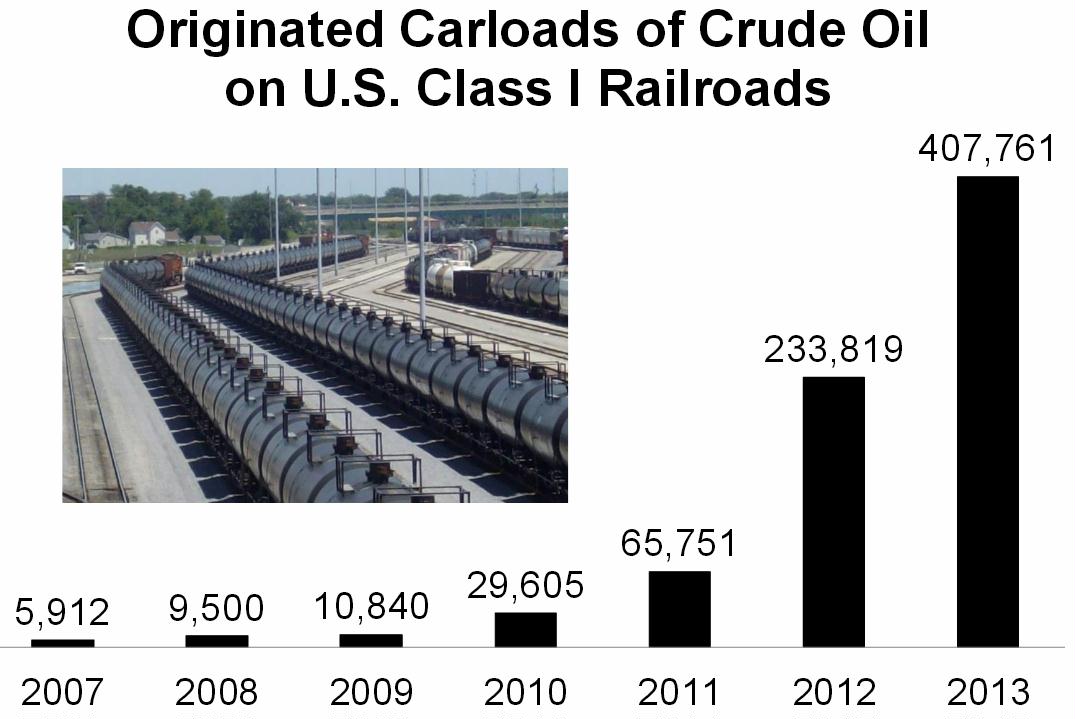
Almost half of Rail Freight is Energy, increasingly Crude Oil

RR crude oil carriedSource: American Association of Railroads.

46% of all tonnage hauled by freight trains is Energy:

In 2014, crude oil will likely be 650,000 carloads — 2% of all carloads, 2.2% of tonnage.  In addition 2.6% of rail tonnage was refined petroleum & coke.

In 2013, coal was 5,950,000 carloads of coal (693.8 million tons), 20.6% of all carloads, 39.5% of rail tonnage, 20% of rail revenue.

In 2012, ethanol was 306,000 carloads, 1% of all carloads, 1.5% of rail tonnage 

It’s probably more than half if you count commodities derived from petroleum.  In 2002, the last time the U.S. Dept of Transportation (RITA) published “Table 12 – U.S. Rail Total Carload and Intermodal Commodity Shipments”, 2% of rail tonnage was fertilizer, 2% plastics and rubber, and some fraction of the 1% chemical products tonnage comes from the petrochemical industry (i.e. agrochemicals, methanol, etc).  In 2002, 47% of rail tonnage was coal, coal and petroleum products, fuel oils, gasoline and aviation turbine fuel, and crude petroleum.

Alice Friedemann October 8, 2014.

Nixon, R. Oct 8, 2014. As Trains Move Oil Bonanza, Delays Mount for Other Goods and Passengers. New York Times.

An energy boom that has created a sharp increase in rail freight traffic nationwide is causing major delays for vital consumer and industrial goods, including chemicals,  coal, and grain shipments for farmers, likely to grow worse since record harvests of corn, soybeans, and wheat are expected this year.

On the long-distance routes, aging tracks and a shortage of train cars, locomotives and crews have also caused delays.

Rail accounts for 40% of all goods moved in the country as measured in ton-miles (multiply cargo weight by distance shipped). Trucks are second at 28%.

Frittelli, J., et al. May 5, 2014. U.S. Rail Transportation of Crude Oil: Background and Issues for Congress. Congressoinal Research Service.

According to rail industry officials, U.S. freight railroads are estimated to have carried 434,000 carloads of crude oil in 2013 (roughly equivalent to 300 million barrels), compared to 9,500 carloads in 2008. In 2014, 650,000 carloads of crude oil are expected to be carried. Crude imports by rail from Canada have increased more than 20-fold since 2011.

The Assoc of American RR says that “crude oil accounted for 1.6 percent of total Class I originated carloads in the first half of 2014.

Assuming, for simplicity, that each rail tank car holds about 30,000 gallons (714 barrels) of crude oil, the 229,798 carloads of crude oil originated by U.S. Class I railroads in the first half of 2014 was equivalent to 900,000 barrels per day moving by rail. According to EIA data, total U.S. domestic crude oil production in the first half of 2014 was 8.2 million barrels per day, so the rail share was around 11 percent of the total.”

The volume of crude oil carried by rail increased 423% between 2011 and 2012, and the volume moving by barge, on inland waterways as well as along intracoastal routes, increased by 53%. The volume of crude oil shipped by truck rose 38% between 2011 and 2012.

Rail transportation cost is perhaps $5 to $10 per barrel higher than pipeline costs.

Given the uncertainty about the future value of the oil and the longevity of the deposits, it is not certain that investors will undertake construction of pipelines from the Bakken fields to the East Coast. In that case, large volumes of crude could be transported by rail well into the future.

Rail has also been critical to development of Canadian oil sands. Although the vast majority of crude oil imports from Canada are delivered via existing pipeline, imports by rail are estimated to have increased from 1.6 million barrels in 2011 to 40 million barrels in 2013.

A significant fall-off in railroad coal movements has increased railroads’ capacity to transport oil over some routes. In 2013, railroads carried about 395,000 more tank cars of crude than in 2005, but about 1.3 million fewer cars of coal. To put the increase in crude traffic in perspective, crude oil represented less than 1% of total rail carloads in 2012. In the first three quarters of 2013, crude carloads increased to 1.4% of total rail car loadings. While, on a national scale, increased rail car loadings of crude oil represent a relatively small percentage of total traffic, significant increases in traffic in a specific area can cause bottlenecks that can reverberate across the entire rail network.

The STB held a hearing in April 2014 to hear complaints from non-oil shippers concerning poor rail service in the upper Midwest due to oil traffic and the severe winter weather.   The STB ordered BNSF and CP railroads to report how they intended to ensure delivery of fertilizer to farmers in spring 2014. At the hearing, BNSF (the railroad most directly serving the Bakken region) noted that its car loadings in North Dakota had more than doubled from 2009 to 2013, and that in October 2013, crude oil and agricultural car loadings surged by more than it could manage.

One hindrance to the expansion of crude-by-rail has been the lack of tank cars and loading and unloading infrastructure. Much of this investment is being made by the oil industry or by rail equipment leasing companies, not railroads. As of April 2014, manufacturers had 50,000 crude oil tank cars on order, on top of an existing fleet of 43,000. (This is in addition to 30,000 tank cars that carry ethanol and 27,000 that carry other flammable liquids.

Tank trucks operating on U.S. roadways have been an important link in moving crude oil from domestic drilling sites to pipelines and rail terminals. A typical tank truck can hold 200 to 250 barrels of crude oil. Trucks readily serve the need for gathering product, as the hydraulic fracturing method of drilling employed in tight oil production involves multiple drilling sites in an area and the location of active wells is constantly in flux. A large volume of crude oil is being transported by truck between production areas and refineries in Texas because of the close proximity of the two.

While there are about 57,000 miles of crude oil pipeline in the United States, there are nearly 140,000 miles of railroad

The U.S. Dept of Transportation, Bureau of Transportation Statistics only goes up to 2009 in Table 1-61: Crude Oil and Petroleum Products Transported in the United States by Mode

2009 Combined crude and petroleum products by ton-mile, percent carried by:  Pipelines (70.2), ships and barges (23.1), trucks (4.2), railroads (2.6)

Pick Your Poison For Crude — Pipeline, Rail, Truck Or Boat
by James Conca   April 26, 2014  Forbes

In the U.S., 70% of crude oil and petroleum products are shipped by pipeline. 23% of oil shipments are on tankers and barges over water. Trucking only accounts for 4% of shipments, and rail for a mere 3%.

Amid a North American energy boom and a lack of pipeline capacity, crude oil shipping on rail is suddenly increasing. The trains are getting bigger and towing more and more tanker cars.

With the number of refineries decreasing, and capacity concentrating in fewer places, crude usually has to be moved some distance. There are 4 ways to move it over long distances: by pipeline, by boat, by truck, or by rail.

It’s cheaper and quicker to transport by pipeline than by rail or by truck. The difference in cost is about $50 billion a year for shipping via the Keystone pipeline versus rail.

A rail tank car carries about 30,000 gallons (÷ 42 gallons/barrel = about 700 barrels). A train of 100 cars carries about 3 million gallons (70,000 barrels) and takes over 3 days to travel from Alberta to the Gulf Coast, about a million gallons per day. The Keystone will carry about 35 million gallons per day (830,000 barrels).

The Congressional Research Service estimates that transporting crude oil by pipeline is cheaper than rail, about $5/barrel versus $10 to $15/barrel (NYTimes.com). But rail is more flexible and has 140,000 miles of track in the United States compared to 57,000 miles of crude oil pipelines. Building rail terminals to handle loading and unloading is a lot cheaper, and less of a hassle, than building and permitting pipelines.

Rail. If crude oil shipping on rail is becoming a preferred mode for oil producers in our North American energy boom, this trend is very disturbing. In 2011, crude rail capacity between southern Alberta and the northern U.S. Great Plains tripled to about 300,000 barrels per day, about a third of the Keystone XL capacity. U.S. railroads delivered 7 million barrels of crude in 2008, 46 million in 2011, 163 million in 2012, and 262 million in 2013 (almost as much as that anticipated by the Keystone XL alone). To replace the Keystone XL with rail shipments would mean another doubling of rail capacity, but that would be just another couple of years given this trend.

The Association of American Railroads points out that over 11 billion gallons of crude were shipped in 2013.

Truck. The issue with trucking is that it takes lots and lots of trucks to move billions of gallons of crude since a single tank trailer only holds about 9,000 gallons or 200 barrels, a little under a third of a rail car. Our present fleet only handles 4% of our needs, so shipping by truck instead of the Keystone XL would take another 1.5 million tanker trucks.

Refineries

Crude is a nasty material, very destructive when it spills into the environment, and very toxic when it contacts humans or animals. It’s not even useful for energy, or anything else, until it’s chemically processed, or refined, into suitable products like naphtha, gasoline, heating oil, kerosene, asphaltics, mineral spirits, natural gas liquids, and a host of others.
U.S. Refinery Capacity by PADD (Petroleum Administration for Defense Districts) in 2012.

U.S. Refinery Capacity by PADD (Petroleum Administration for Defense Districts) in 2012. Source: Congressional Research Service; Energy Information Administration

Every crude oil has different properties, such as sulfur content (sweet to sour) or density (light to heavy), and requires a specific chemical processing facility to handle it (Permian Basin Oil&Gas). Different crudes produce different amounts and types of products, sometimes leading to a glut in one or more of them, like too much natural gas liquids that drops their price dramatically, or not enough heating oil that raises their price.

As an example, the second largest refinery in the United States, Marathon Oil’s GaryVille Louisiana facility, can handle over 520,000 barrels a day (bpd) of heavy sour crude from places like Mexico and Canada but can’t handle sweet domestic crude from New Mexico.

Thus the reason for the Keystone Pipeline or increased rail transport – to get heavy tar sand crude to refineries along the Gulf Coast than can handle it.

The last entirely new petroleum refinery in the United States opened in 1976 (Congressional Research Service). Since then, the number of refineries has steadily declined while refining capacity has concentrated in ever-larger facilities. 25% of U.S. capacity is found in only eleven refineries. Recently, Shell’s Baytown refinery in Texas, the largest in the nation, was expanded to 600,000 bpd. Most of the big refineries can handle heavy crude, but many smaller refineries can process only light to intermediate crude oil, most of which originates within the U.S.

33 states have refineries, and most refineries can handle tens-of-thousands to hundreds-of-thousands of barrels per day, but the largest capacity sits around the Gulf Coast and in California where the oil boom in America began. However, in the 1990s after production of sweet domestic crude had significantly declined from mid-century highs, the big companies like Exxon, Shell, CITCO and Valero spent billions upon billion of dollars to retool their refineries to handle foreign heavy crudes.

What is important to note, however, is that regardless of the long-hauling mode, most petroleum eventually gets onto a truck for the short moves.

Ship

Ship transport is possible along coastal waters and along large rivers and is the method that is used for almost all foreign imports except from Canada.


Posted in Oil & Gas, Pipeline, Railroads, Refining, Trucks | Tagged , , , , , , , , , , | Comments Off on Almost half of Rail Freight is Energy, increasingly Crude Oil

Conservation? Maybe not: Jevon’s Paradox & the Rebound Effect

Conservation? Maybe not: Jevon’s Paradox & the Rebound Effect

by Alice Friedemann, October 7, 2014

The rebound effect makes it much more difficult to solve our energy problems, because the full energy savings aren’t realized, and the energy savings can even be negative — see Jevons paradox (a.k.a. ‘back-fire’).

It’s simple to understand – if gasoline goes from $4 to $5 a gallon so I sell my 15 mpg car for a 45 mpg one, but drive it further, faster, and more often now that it’s cheaper, my 200% increase in fuel efficiency could be mostly wiped out.

This can be quantified:  if a 5% improvement in vehicle fuel efficiency results in only a 1% drop in fuel use, the rebound effect would be 80%  ((5-1)/5 = 80%).

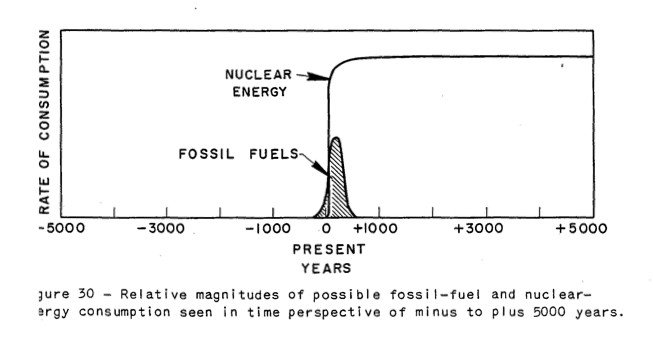
The only way to stop energy decline from crashing civilization is to stay under the depletion curve, and that means cutting fossil fuel consumption in transportation (When Trucks Stop). If oil depletes at 5%, consumption has to drop 5% for any meaningful benefit to society, and a lot more than that if we want to stretch supplies out a bit longer for the truly essential diesel railroad, train, tractor, and infrastructure repairing vehicles.

Shellenberger, M. Oct 8, 2014. The Problem With Energy Efficiency. New York Times.

In announcing the award [for a more efficient form of lighting — the LED], the academy said, “Replacing light bulbs and fluorescent tubes with LEDs will lead to a drastic reduction of electricity requirements for lighting.” The president of the Institute of Physics noted: “With 20 percent of the world’s electricity used for lighting, it’s been calculated that optimal use of LED lighting could reduce this to 4 percent.”

But it would be a mistake to assume that LEDs will significantly reduce overall energy consumption.

The growing evidence that low-cost efficiency often leads to faster energy growth was recently considered by both the Intergovernmental Panel on Climate Change (IPCC) and the International Energy Agency (IEA). They concluded that energy savings associated with new, more energy efficient technologies were likely to result in significant “rebounds,” or increases, in energy consumption. This means that very significant percentages of energy savings will be lost to increased energy consumption.

The I.E.A. and I.P.C.C. estimate that the rebound could be over 50 percent globally. Recent estimates and case studies have suggested that in many energy-intensive sectors of developing economies, energy-saving technologies may backfire, meaning that increased energy consumption associated with lower energy costs because of higher efficiency may in fact result in higher energy consumption than there would have been without those technologies.


Posted in Conserve Energy, Dependence on Oil | Comments Off on Conservation? Maybe not: Jevon’s Paradox & the Rebound Effect

Super Rust Corrodes hundreds of ships and could sink the oil industry

Blame it on super-rust, a virulent form of corrosion that has destroyed hundreds of ships and could sink the oil industry.

By Richard Martin, June 2002. Wired Magazine.

Key points (see the full article at http://archive.wired.com/wired/archive/10.06/superrust.html):

Ships that cost hundreds of millions of dollars to build are rusting and falling apart, spilling millions of gallons of oil every year, many of them oil tankers. From 1995 and 2001, 2856 oil tankers broke apart at sea or barely escaped that fate, according to the International Association of Independent Tanker Owners. The main cause was collision, but nearly as many suffered from excessive corrosion.

The latest generation of oil tankers are more vulnerable to rust due to the mandate that all tankers operating in the US have double hulls by 2015. This innovation has inadvertently propelled corrosion to unheard-of levels. A 2000 Intertanko report concluded that excessive rust is afflicting double hulls within two years of launch. In double hulls, accelerated corrosion is engineered right into the ships themselves. The extra layer of steel gives rust many more square feet of surface area to attack, much of it hidden in cramped, inaccessible crawl spaces. What’s more, these crawl spaces form an insulating layer that keeps the internal temperature much higher than it would be in a single-hull tanker. Corrosion rates tend to double with each 20-degree Fahrenheit increase.

Manufacturing efficiencies have reduced the thickness of hulls and decks so now many shipbuilders trade corrosion-resistance for lower cost. Every ounce of steel saved in the construction of a ship translates into greater profits for the builder and reduced fuel bills for the owner. Between 1970 and 1990, the amount of steel used to construct a tanker declined by almost one-fifth. Modern tanker walls are only 14 to 16 millimeters thick, compared with 25 millimeters a generation ago. Assuming a microbial corrosion rate of 1.5 millimeters a year, rusted-out pits would reach halfway through those hulls in five years.

Lack of Maintenance

Rust attacks steel from the moment the metal encounters moisture. To keep that from happening, shipowners paint steel surfaces with corrosion-resistant coatings and are supposed to reapply them, but first-class ship maintenance has become increasingly rare in recent decades, as ships trade hands several times and new owners care more about maximizing their investment than maintenance.  When a ship is cited for corrosion, maintenance can be avoided by shifting to another flag.

How Rusting Happens

Rust arises from an intricate subatomic dance in which water’s oxygen and hydrogen atoms snatch electrons from atoms of iron. Because saltwater conducts electricity better than freshwater, the iron in steel oxidizes more quickly in seawater – up to 0.10 millimeter per year.

The way corrosion attacks the interior of a tanker, however, is more insidious. It can be seen most vividly in the cargo tanks, which line up along the ship’s backbone beneath the deck, and in the ballast tanks that cushion the cargo tanks along their outer edges. In these areas, steel deteriorates at five, ten, even thirty times the nominal rate. In the ballast tanks, which are normally filled with seawater when the cargo tanks are empty, water conducts electrons between plates on either side, and between separate areas of a single plate – that is, the tanks become huge, if weak, batteries. The increased electrical activity hastens the metal’s degradation.

At the top of the cargo tanks, the vapor space between the oil’s surface and the underside of the deck traps highly acidic gases – products of the reaction between petroleum, oxygen, and water – that condense against the metal. The deck flexes at sea, causing degraded steel to flake off the ceilings of the tanks, exposing more bare steel for the acid to attack.

At the bottoms of the tanks, in the water that settles under the oil, corrosive bacteria thrive. Consuming hydrocarbons, microbes like Desulfovibrio desulferican produce acids that dissolve the tanks’ floors and lower sides at rates as high as 2 millimeters per year. Some microorganisms even feed on the coatings that protect the tanks from rust. Essentially, a tanker is a gigantic floating petri dish for a peculiarly vicious sort of steel-eating sludge – the ultimate metallivore.

Enforcement is hard

In addition to switching to another nation, the tanker industry is overrun with so many holding companies, limited-liability partnerships, and owners-of-record that even determining who bears ultimate responsibility for a ship can be difficult.

Posted in Exports decline to ZERO, Ships and Barges, Transportation Infrastructure | Tagged , , , , | Comments Off on Super Rust Corrodes hundreds of ships and could sink the oil industry

Moving oil by ship or barge to refineries

Frittelli, J., et al. May 5, 2014. U.S. Rail Transportation of Crude Oil: Background and Issues for Congress. Congressional Research Service.

Barge

One river barge can hold 10,000 to 30,000 barrels of oil. Two to three river barges are typically tied together in a single tow that carries 20,000 to 90,000 barrels, about the same load as a unit train. Coastal tank barges designed for open seas, known as articulated tug-barges, or ATBs, 22 can hold 50,000 to 185,000 barrels, although newer ATBs can carry as much as 340,000 barrels, comparable to the capacity of coastal tankers. ATBs are slower, less fuel-efficient, and more restricted by sea conditions, but nevertheless may have an economic advantage over tankers because Coast Guard crewing regulations allow them to sail with one-third to half the crew required on a tanker. Crude oil tankers used to move Alaska oil to West Coast refineries have capacities of 800,000 to over 1 million barrels.

An advantage of tankers over railroads is the greater amount of oil they can carry in a single voyage, which better matches the daily consumption rate of refineries. With the median capacity for U.S. refineries at about 160,000 barrels per day, a coastal tanker can carry a two-day supply of oil. In addition, while railroads must build and maintain tracks and pay property taxes on their rights-of-way, the ocean is free, and harbor channels are largely provided by the federal government. For these reasons, tankers can be much cheaper than railroads in moving oil, even though the railroad route may be much more direct. For instance, the distance between the Bakken region in North Dakota and refineries in the Northeast is approximately 1,800 miles, and the cost of railroad transport is $14 per barrel. 23 The distance from Texas ports near the Eagle Ford region to the same refineries is about 2,100 miles, and tanker rates are $5 to $6 per barrel. 24 Similarly, the overland distance from the Eagle Ford region to Los Angeles-area refineries is about 1,400 miles, and the estimated cost of railroad transport is $15 per barrel, while the water route through the Panama Canal is 5,200 miles and is estimated to cost $10 per barrel. 25

Although seemingly a circuitous route compared to rail, it is not inconceivable that tankers could play a role in moving Bakken oil to East or West Coast refineries. Significant amounts of Bakken oil are moved to Gulf Coast terminals by pipeline, railroad, barge, or combinations of these modes for refining within that region. From a Gulf Coast port, tankers could transport the oil to either East or West Coast refineries. Via existing rail and pipeline connections to Great Lakes ports, tankers could also move Bakken oil from there to Northeast refineries.

Posted in Refining, Ships and Barges | Comments Off on Moving oil by ship or barge to refineries

Thorium in the news

[ When trucks stop running, civilization as we know it ends.  Nuclear electricity — or anything that generates electricity — doesn’t matter a rat’s ass if trucks can’t be electrified to run on batteries or overhead wires — especially tractors that plant and harvest billions of acres of farmland and the heavy-duty trucks that move all goods for every home and business on four million miles of the U.S. alone.  Breaking supply chains have been the downfall of civilizations in the past.

Alice Friedemann   www.energyskeptic.com  author of “When Trucks Stop Running: Energy and the Future of Transportation”, 2015, Springer and “Crunch! Whole Grain Artisan Chips and Crackers”. Podcasts: Practical Prepping, KunstlerCast 253, KunstlerCast278, Peak Prosperity , XX2 report ]

Rees, I. June 2011. Don’t believe the spin on thorium being a greener nuclear option.  The Guardian.

India hopes to reduce climate change with thorium, a naturally occurring radioactive element, four times more abundant than uranium in the earth’s crust.

The pro-thorium lobby claim a single tonne of thorium burned in a molten salt reactor (MSR) – typically a liquid fluoride thorium reactor (LFTR) – which has liquid rather than solid fuel, can produce one gigawatt of energy. A traditional pressurised water reactor (PWR) would need to burn 250 tonnes of uranium to produce the same amount of energy.

They also produce less waste, have no weapons-grade by-products, can consume legacy plutonium stockpiles and are meltdown-proof – if the hype is to be believed.

India certainly has faith, with a burgeoning population, chronic electricity shortage, few friends on the global nuclear stage (it hasn’t signed the nuclear non-proliferation treaty) and the world’s largest reserves of thorium. ‘Green’ nuclear could help defuse opposition at home (the approval of two new traditional nuclear power reactors on its west coast led to fierce protests recently) and allow it to push ahead unhindered with its stated aim of generating 270GW of energy from nuclear by 2050.

China, Russia, France and the US are also pursuing the technology, while India’s department of atomic energy and the UK’s Engineering and Physical Sciences Research Council are jointly funding five UK research programmes into it.

There is a significant sticking point to the promotion of thorium as the ‘great green hope’ of clean energy production: it remains unproven on a commercial scale. While it has been around since the 1950s (and an experimental 10MW LFTR did run for five years during the 1960s at Oak Ridge National Laboratory in the US, though using uranium and plutonium as fuel) it is still a next generation nuclear technology – theoretical.

China did announce this year that it intended to develop a thorium MSR, but nuclear radiologist Peter Karamoskos, of the International Campaign to Abolish Nuclear Weapons (ICAN), says the world shouldn’t hold its breath.

‘Without exception, [thorium reactors] have never been commercially viable, nor do any of the intended new designs even remotely seem to be viable. Like all nuclear power production they rely on extensive taxpayer subsidies; the only difference is that with thorium and other breeder reactors these are of an order of magnitude greater, which is why no government has ever continued their funding.’

China’s development will persist until it experiences the ongoing major technical hurdles the rest of the nuclear club have discovered, he says.

Others see thorium as a smokescreen to perpetuate the status quo: the world’s only operating thorium reactor – India’s Kakrapar-1 – is actually a converted PWR, for example. ‘This could be seen to excuse the continued use of PWRs until thorium is [widely] available,’ points out Peter Rowberry of No Money for Nuclear (NM4N) and Communities Against Nuclear Expansion (CANE).

In his reading, thorium is merely a way of deflecting attention and criticism from the dangers of the uranium fuel cycle and excusing the pumping of more money into the industry. Advertisement

And yet the nuclear industry itself is also sceptical, with none of the big players backing what should be – in PR terms and in a post-Fukushima world – its radioactive holy grail: safe reactors producing more energy for less and cheaper fuel.

In fact, a 2010 National Nuclear Laboratory (NNL) report (PDF)concluded the thorium fuel cycle ‘does not currently have a role to play in the UK context [and] is likely to have only a limited role internationally for some years ahead’ – in short, it concluded, the claims for thorium were ‘overstated’.

Proponents counter that the NNL paper fails to address the question of MSR technology, evidence of its bias towards an industry wedded to PWRs. Reliant on diverse uranium/plutonium revenue streams – fuel packages and fuel reprocessing, for example – the nuclear energy giants will never give thorium a fair hearing, they say.

But even were its commercial viability established, given 2010’s soaring greenhouse gas levels, thorium is one magic bullet that is years off target. Those who support renewables say they will have come so far in cost and efficiency terms by the time the technology is perfected and upscaled that thorium reactors will already be uneconomic. Indeed, if renewables had a fraction of nuclear’s current subsidies they could already be light years ahead.

All other issues aside, thorium is still nuclear energy, say environmentalists, its reactors disgorging the same toxic byproducts and fissile waste with the same millennial half-lives. Oliver Tickell, author of Kyoto2, says the fission materials produced from thorium are of a different spectrum to those from uranium-235, but ‘include many dangerous-to-health alpha and beta emitters’.

Tickell says thorium reactors would not reduce the volume of waste from uranium reactors. ‘It will create a whole new volume of radioactive waste from previously radio-inert thorium, on top of the waste from uranium reactors. Looked at in these terms, it’s a way of multiplying the volume of radioactive waste humanity can create several times over.’

Putative waste benefits – such as the impressive claims made by former Nasa scientist Kirk Sorensen, one of thorium’s staunchest advocates – have the potential to be outweighed by a proliferating number of MSRs. There are already 442 traditional reactors already in operation globally, according to the International Atomic Energy Agency. The by-products of thousands of smaller, ostensibly less wasteful reactors would soon add up.

Anti-nuclear campaigner Peter Karamoskos goes further, dismissing a ‘dishonest fantasy’ perpetuated by the pro-nuclear lobby.

Thorium cannot in itself power a reactor; unlike natural uranium, it does not contain enough fissile material to initiate a nuclear chain reaction. As a result it must first be bombarded with neutrons to produce the highly radioactive isotope uranium-233 – ‘so these are really U-233 reactors,’ says Karamoskos.

This isotope is more hazardous than the U-235 used in conventional reactors, he adds, because it produces U-232 as a side effect (half life: 160,000 years), on top of familiar fission by-products such as technetium-99 (half life: up to 300,000 years) and iodine-129 (half life: 15.7 million years).Add in actinides such as protactinium-231 (half life: 33,000 years) and it soon becomes apparent that thorium’s superficial cleanliness will still depend on digging some pretty deep holes to bury the highly radioactive waste. Advertisement

With billions of pounds already spent on nuclear research, reactor construction and decommissioning costs – dwarfing commitments to renewables – and proposed reform of the UK electricity markets apparently hiding subsidies to the nuclear industry, the thorium dream is considered by many to be a dangerous diversion.

Energy consultant and former Friends of the Earth anti-nuclear campaigner Neil Crumpton says the government would be better deferring all decisions about its new nuclear building plans and fuel reprocessing until the early 2020s: ‘By that time much more will be known about Generation IV technologies including LFTRs and their waste-consuming capability.’

In the meantime, says Jean McSorley, senior consultant for Greenpeace’s nuclear campaign, the pressing issue is to reduce energy demand and implement a major renewables programme in the UK and internationally – after all, even conventional nuclear reactors will not deliver what the world needs in terms of safe, affordable electricity, let alone a whole raft of new ones.

‘Even if thorium technology does progress to the point where it might be commercially viable, it will face the same problems as conventional nuclear: it is not renewable or sustainable and cannot effectively connect to smart grids. The technology is not tried and tested, and none of the main players is interested. Thorium reactors are no more than a distraction.’

Bagla, P. November 13, 2015. Thorium seen as nuclear’s new frontier. Science 350:  726-727.

In the 1950s, U.S. nuclear scientists proposed building a fleet of nuclear-powered airplanes. That was probably a bad idea.

Compared with uranium, thorium is 3 to 4 times more abundant than uranium and harder to divert to weapons production, and it yields less radioactive waste. But thorium can’t simply be swapped in for uranium in standard reactors.  Driving the interest in thorium is the latest in a string of accidents involving uranium-fueled power reactors. The meltdowns at the Fukushima Daiichi Nuclear Power Plant in Japan in March 2011 prompted many countries to take operating reactors offline and to scale back or scuttle plans to build new ones. India plans to have a thorium power reactor running within 10 years.

Thorium holds little appeal for bomb makers: Daughter isotopes, born as thorium naturally decays, are highly radioactive, emitting gamma rays that would fry weapon electronics and make thorium-derived bombs cumbersome to store. At the same time, thorium-based fuels yield much less high-level radioactive waste than uranium or plutonium, and molten-salt reactors are touted by their backers as meltdown proof.

The catch is that thorium itself is not fissile…. it is like wood too soggy for a fire and must be converted into fissile material by bombarding thorium with neutrons to transmute it into fissile uranium-233.  The disaster-scarred track record of uranium reactors casts a long shadow on thorium, too. Ever since the United States during the Cold War went whole hog into uranium, “the world has been paying a price for the wrong technology choice,” argues Jean-Pierre Revol, president of the international Thorium Energy Committee in Geneva, Switzerland.

Posted in Thorium | Tagged , | 3 Comments

Out of time: 50 years to make a transition, 210 years at the current rate

If transportation is to be electrified, then electric generation and the electric grid must be doubled, or even tripled. So by Cobb’s calculation, that would push back the transition time to renewables 420 to 630 years.  Alice Friedemann.

By Kurt Cobb, October 1, 2012. Christian Science Monitor.

The clunky, lagging transition to renewable energy

History suggests that it can take up to 50 years to replace an existing energy infrastructure, and we don’t have that long.

No doubt you’ve heard people speak of an energy transition from a fossil fuel-based society to one based on renewable energy–energy which by its very nature cannot run out. Here’s the short answer to why we need do it fast: climate change and fossil fuel depletion. And, here’s the short answer to why we’re way behind: History suggests that it can take up to 50 years to replace an existing energy infrastructure, and we don’t have that long.

Perhaps the most important thing that people don’t realize about building a renewable energy infrastructure is that most of the energy for building it will have to come from fossil fuels.

Currently, 84 percent of all the energy consumed worldwide is produced using fossil fuels–oil, natural gas and coal. Fossil fuels are therefore providing the lion’s share of power to the factories that make solar cells, wind turbines, geothermal equipment, hydroelectric generators, wave energy converters, and underwater tidal energy turbines.

Right now we are producing at or close to the maximum amount of energy we’ve ever produced from fossil fuels. But the emerging plateau in world oil production, concerns about the sustainability of coal production, and questionable claims about natural gas supplies are warnings that fossil fuels may not remain plentiful long enough to underwrite an uneven and loitering transition to a renewable energy society.

This is what’s been dubbed the rate-of-conversion problem. In a nutshell, is our rate of conversion away from fossil fuels fast enough so as to avoid an unexpected drop in total energy available to society? Will we be far enough along in that conversion when fossil fuel supplies begin to decline so that we won’t be forced into an energy austerity that could undermine the stability of our society?

The answer can’t be known. But the numbers are not reassuring. Based on data from the U.S. Energy Information Administration, it would take more than 70 years to replace the world’s current electrical generating capacity with renewables including hydroelectric, wind, solar, tidal, wave, geothermal, biomass and waste at the rate of installation seen from 2005 through 2009, the last years for which such data is available. And, that’s if worldwide generating capacity–which has been expanding at a 4 percent clip per year–is instead held steady.

This also doesn’t take into account the amount of energy actually produced versus what is called nameplate capacity. Nameplate capacity is what a wind generator could generate if it operated at maximum capacity 100 percent of the time. But in practice, the turbines are only spinning when the wind blows and then not always at the maximum speed. This so-called capacity factor was just 27 percent for wind farms in the United Kingdom from 2007 to 2011. For solar photovoltaic the number was 8.3 percent. Even hydroelectric stations ran at only about 35 percent of capacity. This compares to about 42 percent for conventional coal, 61 percent for natural gas, and 60 percent for nuclear power stations (PDF). The contrast is starker using U.S. numbers: 72 percent for coal and 91 percent for nuclear using 2008 figures, though natural gas was only 11 percent, probably because these were primarily plants that only come on to meet peak demand and so don’t run very often.

What this means is that installing two to three times our current nameplate capacity in the form of renewables may be required to replace existing fossil-fueled plants. So, the transition period would actually turn out to be longer than what I’ve calculated, perhaps 140 to 210 years using 2005 to 2009 installation figures.

Of course, installations of such renewables as wind and solar are accelerating. So, that would tend to shorten this longer transition period–as would leaving existing nuclear power capacity intact. But would we be able to shorten the transition period enough to head off declines in total energy production and prevent additional serious damage to the climate?

Of course, some would say that we need to expand nuclear power generation rapidly to meet these challenges. Whether you support such an expansion or not, there are three key problems. First, building enough nuclear power stations to replace fossil fuel-fired plants would be the largest construction project ever undertaken and require the use of enormous amounts of fossil fuels. Making the necessary concrete alone would be a large new contributor to greenhouse gas emissions. That means that the initial phase of a nuclear transition would actually increase the rate of fossil fuel emissions. The savings on fuel and emissions wouldn’t come until much later.

Second, after the Fukushima disaster, there doesn’t seem to be much appetite for such a buildout. I’ll be very surprised if nuclear power generation even maintains its current level in the next 20 years as Japan and Germany abandon nuclear power. Third, the timeline for such a buildout would be measured in decades, partly because of the sheer logistics involved and partly because of the brake that regulatory approvals put on such projects. Even new, cheaper and easier-to-build designs may not help if they cannot achieve the necessary regulatory approvals promptly. The history of such approvals is not encouraging. The safest thing a nuclear regulatory agency can do is say no.

I haven’t even touched on replacing the fuels which power our transportation system and provide heat for our buildings and industrial processes. Transportation offers an extraordinary challenge since 80 percent of all transportation fuel worldwide is still derived from petroleum. In the United States the number is 93 percent. Despite billions of dollars spent and decades of research, we still have no good substitutes that scale to the size necessary to replace petroleum for transportation fuel.

Biofuels offer little hope. Already the ethanol bubble has burst. Biofuels–today mainly ethanol and biodiesel–compete with food. There is simply not a limitless supply of suitable farmland, and so there will be competition with the demand for food until we find substitutes for the industry’s main feedstocks, namely corn, sugar and soybeans.

Beyond this the problem of scale is simply unsolvable. To supply the entire U.S. car fleet–assuming it could run on ethanol–we’d have to plant 1.8 billion acres in corn for ethanol continuously. There are only about 440 million acres in the United States in cultivation now. And, it’s worth noting that current methods of corn cultivation require the copious use of herbicides and pesticides made from oil; tractors and other vehicles that run on oil to plow, harvest and spray the fields as well as transport the crop; and natural gas-derived nitrogen fertilizers to boost growth and replenish depleted soil. Fossil fuels are currently integral to growing corn, and I cannot see the wisdom of growing organic corn for anything but food.

As for heat for buildings, certainly we could insulate and seal our existing buildings better. And, this points the way to achieving an energy transition within the time we need to achieve it. Since it will probably be impossible to scale renewable energy fast enough to a level sufficient to produce the amount of energy we use today, the one absolute necessity to a successful energy transition is reducing consumption drastically. No politician dares to say anything remotely approaching this. And yet, it would be the cheapest, fastest way to address the twin crises of fossil fuel depletion and climate change.

Now, when I say reduce, I mean on the order of 80 percent over the next 20 to 30 years. For Americans this may seem impossible until they contemplate that the average European lives on half the energy of the average American. So often we hope for technological breakthroughs that will give us all the clean energy we desire. But we ought to focus equally, if not more, on using our prowess to find ways to reduce our energy consumption drastically. This is actually the much easier road. When we are made conscious of our energy use, we can change our behavior quickly to modify it without compromising the quality of our lives. As more homes and businesses are given the means to monitor their energy use, the people in them will change to lower their consumption and costs.

Already we know how to build so-called passive design structures which can lower energy use by 80%. And, we desperately need to figure out how to apply these techniques cheaply and economically to existing homes and businesses. In transportation we need to stop thinking that cars equal transportation and instead realize that cars provide the service of transportation which can be obtained in a number of ways, many of which use much less energy.
We may also need to speed the energy transition in electric power generation using so-called feed-in tariffs. These tariffs–which harness the ingenuity of countless small producers–have enabled Germany to expand solar, wind and other alternatives so that they generate 25 percent of its electricity today. Germany, not a particularly sunny place, is currently the world’s top generator of solar electricity.

Of course, per person energy consumption in poor countries is only a small fraction of that in rich countries. We cannot expect the world’s poor to reduce their energy use by 80 percent. Instead, we must help them to move quickly beyond fossil fuels to renewable energy.

By simultaneously reducing consumption and encouraging a rapid buildout of renewable energy, it is possible that we could mitigate the problem of declining fossil fuel supplies before it becomes so acute that it would cripple that very build out. And, we could address climate change at the same time. Certainly, there are difficult problems to be solved with renewable energy, storage being the key one. Most renewable energy comes in the form of electricity, and since there is often a mismatch between the time we produce that electricity and the time we need it, we will have to master storage.

But we will need a lot less storage if we focus on reducing consumption. This is the one strategy which will allow us to overcome the rate-of-conversion problem and achieve an energy transition in far less time than we have in the past.

Posted in Alternative Energy, Electric Grid & EMP Electromagnetic Pulse, Peak Oil | Tagged , , , | Comments Off on Out of time: 50 years to make a transition, 210 years at the current rate

Why You Should Love Trucks

truck-largesource: bitsandpieces1.blogspot.com

Preface. Before the age of fossil fuels, getting food, water, and shelter was simple. Nine out of ten people were self-sufficient farmers.

But now there are global 24/7 just-in-time supply chains that depend on trucks and other modes of transportation between us and what we need to survive.

Trucks carry 70% of all freight (by weight) an average of 206 miles.  Five million medium and heavy-duty trucks travel 329 billion miles to deliver all these goods (ORNL).

Over 80% of communities in the United States depend completely on trucks for all their goods (ATA).

This is a shame!  Trucks ruin roads, cause the most air pollution (75% of ghg), and waste the most energy by far. Rail is 4 times and ships up to 50 times more energy efficient than trucks (USDOE 2008, USDOT 2009, Notteboom, Tolliver).

Trucks can substitute for most other kinds of transportation, but the reverse isn’t true:

  • Few factories, warehouses, and businesses have direct rail, barge, or ship connections.
  • There are only 140,000 miles of freight rail tracks and 25,000 miles of commercially navigable waterways, but over 4 million miles of roads.
  • Even if cargo could go by rail or ship, the cost to transfer it on and off again, or the risk of delay to just-in-time delivery, often make energy-inefficient trucks the preferred mode
  • This means that even if some goods travel mainly by rail, ship, or barge, a truck is usually still needed to take the goods to and from the train yard and to the final destination.

Even a container arriving by ship and then rail will get on a truck three or more times:

  1. Sea port. Container is grabbed by a reach-stacker truck and loaded on a train
  2. Destination Train yard. Unloaded by a reach-stacker
  3. Loaded onto a truck for delivery to a regional distribution center or final store delivery
  4. Regional Distribution Center. Cargo consolidated for final delivery to local stores, and often transloaded to two smaller trucks if delivery in in a dense urban area.
truck-reachstacker-ctr-xferReach-stacker truck getting a container to load onto a truck or train

Most businesses are very dependent on trucks:

  • Trucks are a key part of the 24/7 just-in-time delivery system. Large grocery stores receive 10-15 truck shipments a day, assembly lines depend on regular deliveries of a wide range of parts from many suppliers within narrow time slots.  Manufacturers have little packaging material on hand because it’s bulky and low value.
  • Tax incentives and efficiency have driven businesses to keep as little inventory as possible and instead rely on frequent deliveries by trucks

Trucks fulfill our basic needs

Food.  Trucks carry 83% of all food.

Never in human history have so many people lived so far from where their food is grown. In the past this would have caused famine, but gasoline and diesel trains, ships, and trucks solved this unprecedented problem.

  • Two-thirds of food (by value) is grown in the inland states, but two-thirds of people live in coastal states (Atlantic, pacific, or gulf).
  • By food calories, 92% of corn, 90% of soybeans, 80% of wheat, and 71% of cattle are produced in inland states.

Of all the various kinds of supply chains, from farm to table, food is the most truck-dependent.

Water. Trucks deliver water purification chemicals to water treatment plants every week or two.

Energy.  Trucks deliver fuel to service stations every 2.4 days on average. Trucks also deliver fuel for trains, ships, and airplanes.

Health: Trucks keep pharmacies and hospitals stocked

Shelter: Trucks haul 92% of wood products and deliver materials to construction sites.  Cement must arrive within 1-2 hours.

Electricity. 39% of electricity is generated by coal, which is delivered by train (71%) and truck (14%).

The National Academy of Sciences (NAS) looked at 12  urban supply chains. I’ve broken out a few of them by each leg of the journey goods move to show  how important trucks are.

  • T This leg depends completely on trucks
  • t Trucks and other transport modes used
  • Trucks played no role

Alice Friedemann  www.energyskeptic.com  Author of Life After Fossil Fuels: A Reality Check on Alternative Energy; When Trucks Stop Running: Energy and the Future of Transportation”, Barriers to Making Algal Biofuels, & “Crunch! Whole Grain Artisan Chips and Crackers”.  Women in ecology  Podcasts: WGBH, Jore, Planet: Critical, Crazy Town, Collapse Chronicles, Derrick Jensen, Practical Prepping, Kunstler 253 &278, Peak Prosperity,  Index of best energyskeptic posts

Urban Wholesale Food Supply Chain Exhibit A-3

T         Multiple Warehouse Market. 18 Wheeler TRUCKS deliver food from airports, seaports, and regional vendors.

t           Multiple Warehouse Market. 18 Wheeler TRUCKS  and rail deliver food from extra regional vendors

T         Retail outlets & Institutions, Purveyors & Jobbers, Grocers & Restaurants. All of these businesses receive food from the Multiple Warehouse Market by 18 Wheeler TRUCKS and smaller TRUCKS & VANS

supply chain urban wholesale food

Supermarket Grocery Supply Chain Exhibit A-4

T          Regional Distribution Center. TRUCKS deliver food from External Suppliers

T          Local Distribution Center. TRUCKS deliver food from External Suppliers and Regional Distribution Center.

         Local Retail Stores. TRUCKS deliver food from External Suppliers and Local Distribution Center.

supply chain supermarket grocery

Farm to Table: The Dairy Supply Chain (USDA)

T          Farm. TRUCKS deliver 65% of feed for cows  

T          Milk Processing Plant. Milk is transported in insulated tanker TRUCKS (avg of 5,800 gallons traveling 500 miles round-trip).

T          Retail stores, schools. Packaged milk is distributed by refrigerated TRUCKS.

Gasoline and petroleum Supply Chain Exhibit 3-1

t           Refinery: Crude petroleum from overseas arrives by ship or barge, Domestic crude by pipeline, and increasingly by train or TRUCK (i.e. North Dakota fracked oil).

t           Tank Farm: Refined oil (i.e. diesel or gasoline) arrive by ship, barge, or pipeline, ethanol by train, and additives by TRUCK

T         Gas Station: Diesel and gasoline arrive by TRUCK

supply chain oil and diesel

Construction Materials (Cement) Supply Chain Exhibit 3-4

–           Regional Cement Consolidation Terminal. Raw materials (limestone, clay, aluminum & iron ore, gypsum powder, silica sand) arrive by train or barge from the Consolidated Cement plant.

t           Intermediate River Terminal. Raw materials (crushed stone, gravel, sand) arrive from a gravel pit by TRUCK or barge.

T         Many Metro Region Ready Mix Plants. TRUCKS deliver raw materials from the Terminals above to many ready mix plants.

T         Construction Sites (road, commercial, residential). Cement TRUCKS must reach these sites from local ready mix plants within one to two hours.

supply chain construction materials


supply chain big box retail


supply chain waste and recyclables

Next: When Trucks Stop Running, Civilization Stops Running.  

References

NAS National Academy of Sciences. 2012. NCFRP Report 14: Guidebook for Understanding Urban Goods Movement.

Notteboom, T. et al. 2009. Fuel surcharge practices of container shipping lines: Is it about cost recovery or revenue making?. Proceedings of the 2009 International Association of Maritime Economists (IAME) Conference, June, Copenhagen, Denmark

ORNL transportation energy data book Edition 31. July 2012. Oak Ridge National Laboratory.

Tolliver, D, et al. October 2013. Comparing rail fuel efficiency with truck and waterway. Transportation Research Part D: Transport and environment. volume 24:69-75.

USDA. 2010. National Agricultural statistics service, agricultural statistics board.

USDOE. U.S. Department of Energy. 2008. Transportation Energy Data Book. 2008.

USDOT. U.S. Department of Transportation. 2009. National Transportation Statistics.

APPENDIX.  WHAT IT IS LIKE TO BE A TRUCKER

If you want to know what it’s like to be a trucker, read “So You Want to be a Truck Driver (BigRig Training Book 1)”.  It sure isn’t for everyone!

April 14, 2011. Drilling for a solution: finding ways to curtail the crushing effect of high gas prices on small business. U.S. House of Representatives. Small Business Committee Document Number 112–011

Dick Pingel. I live in Plover, Wisconsin, and have been a small business trucker for the past 28 years. I am a member of Owner-Operators Independent Drivers Association and currently run a one-truck operation hauling food around the country. As you are most likely aware, O-O-I-D-A, or OOIDA as it is known in the trucking industry, is a national trade association representing the interests of small business trucking professionals and professional truck drivers. The more than 152,000 members of OOIDA are small business men and women in all 50 states who collectively own and operate more than 200,000 individual heavy- duty trucks. The majority of the trucking community in this country is made up of small businesses as 93 percent of all carriers have less than 20 trucks in their fleet and 78 percent of carriers have just 6 or fewer trucks. In fact, a one-truck operation such as me represents nearly half of the total number of federally registered motor carriers.

Assuming that the trucking industry exclusively moves about 70 percent of our nation’s goods and that just about all freight is moved by truck at some point in the supply chain, it is not hard to see that the costs and burdens that encumber small business truckers have an impact on our nation’s businesses and consumers. The cost of fuel is very often the largest operating expense with which small business truckers must contend. For folks like me, fuel costs can easily be 50 percent or more of our annual operating expenses. To give you some perspective, the average OOIDA member runs their truck about 120,000 miles or more each year while getting somewhere in the ballpark of only 7 miles per gallon. Most of us will be operating trucks equipped with either twin 135-gallon tanks or twin 150-gallon tanks, so we can easily see a bill of over 1,000 dollars when we fill up.

In addition to the fuel going into the tanks of my tractor, I use a trailer with a diesel-powered refrigerating unit to haul dairy products for producers in Wisconsin. Until recently, I could count on it costing about $50 to fill up my tank for the reefer unit. However, in recent months the cost to fill this tank has increased to more than $100. The additional money I am now spending on fuel for my truck and trailer once went into investing in other areas of my business, but now it must cover basic operating expenses. Every time I pull into a truck stop I hear similar stories,

The national average for diesel is now around $4.12 a gallon, with prices in some states approaching $4.50 per gallon. To put this into perspective, each time the price of a gallon of diesel fuel increases by a nickel, a trucker’s annual cost increases by $1,000. Diesel prices today are more than a dollar higher than they were this time last year, resulting in an enormous extra burden on small business truckers whose average annual income is less than $40,000.

Small business truckers operate in a hyper competitive market, so managing their number one expense is imperative for their survival. In our marketplace, we often see costs increase without any corresponding rate increases. As such, the only way to survive is to become more efficient in how one operates their truck. Small business truckers always drive with an eye towards saving fuel no matter what the price because our business survival depends on it. As small business truckers like myself know, reducing fuel costs is not a science, it is an art and one that we pride ourselves on being masters of.

On biofuels and natural gas for trucks:

some of the states mandated B5. And the problem that we ran into at that time was during the winter because biofuel has a tendency to gel up faster. So it is great during the summer. And as far as natural gas, the problem with natural gas is the range on my truck right now in miles per gallon is over 1,000 miles. You cannot carry enough natural gas to go that far, and the range on most of the natural gas trucks that I have seen is right around 300 miles. So you are stopping consistently more times.


Posted in Agriculture Infrastructure, Supply Chains, Transportation Infrastructure, Trucks | 4 Comments

Two-thirds of coal to power sector delivered by railroads

June 11, 2014  U.S. Energy Information Administration www.eia.gov

Railroad deliveries continue to provide the majority of coal shipments to the power sector

graph of coal shipments to the electric power sector by transit mode and year, as explained in the article text

Source: U.S. Energy Information Administration, Form EIA-923, Power Plant Operations Report
Note: Sum of components may not equal 100% because of independent rounding. Other includes Pipeline, Other Waterway, Great Lakes Barge, Tidewater Pier, and Coastal Ports. Data for 2013 are preliminary.
Note: Intermodal transit uses multiple modes of delivery. Intermodal rail includes some movement over railways, while intermodal nonrail signifies multiple modes that do not include railway.

In 2013, electric power generators consumed 858 million tons of coal, accounting for 93% of all coal consumed in the United States and 39% of electric power generation. Two-thirds of the coal (67%) was shipped either completely or in part by rail. The balance was moved by river barge (especially over the Mississippi and Ohio rivers and their tributaries), truck, and—for power plants located at the coal mine—by conveyor.

The coal transportation network is most densely concentrated in the eastern portion of the United States. This area contains many relatively small coal mines, most of the country’s coal-fired power plants, and also rail infrastructure and suitable waterways. In the western United States, coal mines are often large, and a small number of routes handle large amounts of coal.

The primary mode by which a power plant receives its coal is largely determined by its location and access to the rail system. River barge is the most cost-effective method of transporting large quantities of coal over long distances, but the option is limited to plants located on a suitable river. Transporting coal by rail is more expensive, but two related facts result in its dominant market share of transportation: first, the United States is covered by an extensive railway network; and second, coal is produced in a relatively few parts of the country—predominantly in the Powder River Basin (Wyoming and Montana), the Illinois Basin, and Central and Northern Appalachia—while it is consumed by power plants in 46 of the 48 contiguous states.

By the numbers—how many trains and how much coal?

To better comprehend the amount of coal that a power plant consumes, consider that the largest coal-fired plants in the country receive 1 or 2 unit trains of coal each day. Each train has approximately 115 cars, and each car carries an average of 116 tons of coal. Some plants receive more than 26,000 tons of coal in a single day.

After rail and river barge, the third most common method of receiving coal is by truck (10%). This method, however, is typically employed only by plants that are located relatively close to a coal mine because of the higher cost on a per-ton-mile basis. Those plants that are located directly at or very near a mine can also have their coal delivered by conveyor, but, taken together, truck, barge, and conveyor movements make up less than 30% of the coal shipments in the country.

The prominence of rail has not changed in recent years, although slight fluctuations occur as a result of changes in plant operators’ coal supply requirements. These changes are driven by a combination of factors, including recent and expected retirements of coal-fired generators, the installation of sulfur dioxide scrubbers at an increasing number of plants that widens the range of coals a plant may burn, changes in regional coal prices, and competition with natural gas and renewable energy. Although coal consumption in the electric power sector decreased by 18% from 2008 to 2013, and the number of coal-fired generators dropped from 1,445 to 1,285 units during that same period, the share of shipments made either exclusively by rail or with rail as the primary mode has remained effectively unchanged.

Between 2008 and 2013, the share of coal shipments made by river barge increased from 7% to 12%. In contrast, truck shipments fell from 12% to 10%, and shipments made by other modes (i.e., nonriver barge waterways, pipeline, tidewater piers, and coastal ports), fell from 7% to 1%. These changes occurred because many of the plants that received their coal by one of the other modes in 2008 either retired or shifted to another mode.

Posted in Coal, Railroads, Trucks | Comments Off on Two-thirds of coal to power sector delivered by railroads

Fuel economy improvements show diminishing returns in fuel savings

This means it’s unlikely we’ll turn over the vehicle fleet fast enough to make a difference in fuel consumption.  Which wouldn’t have happened anyhow due to Jevon’s paradox.

July 11, 2014

Fuel economy improvements show diminishing returns in fuel savings

graph of annual fuel savings and fuel cost savings by miles per gallon, as explained in the article text

Source: U.S. Energy Information Administration, Annual Energy Outlook 2014
Note: Calculations in graphic assume a fuel price of $3.50 per gallon and annual travel of 12,000 miles per vehicle.

Fuel costs, which depend on vehicle fuel economy, miles driven, and fuel price, are an important factor in vehicle purchasing decisions. However, fuel economy improvement exhibits diminishing returns in fuel savings. For example, switching from a 10-mile-per-gallon (mpg) vehicle to a 15-mpg vehicle saves more fuel and results in greater fuel cost savings than switching from a 25-mpg vehicle to a 75-mpg vehicle. The fuel and cost savings of improving fuel economy from 12 mpg to 15 mpg are the same as increasing from 30 mpg to 60 mpg.

Much of the reduction in fuel consumption and fuel cost comes from incremental fuel economy improvement at the relatively low fuel economy levels. For a consumer who drives 12,000 miles per year and pays $3.50 per gallon for gasoline, increasing fuel economy from 10 mpg to 11 mpg saves $382 in annual fuel cost and from 30 mpg from 31 mpg saves $45; raising fuel economy from 40 to 41 mpg saves just $26 and from 60 to 61 saves $11.

Posted in Automobiles | Comments Off on Fuel economy improvements show diminishing returns in fuel savings

EIA definition of Proved Reserves and Resources

July 17, 2014

Oil and natural gas resource categories reflect varying degrees of certainty

graph of oil and natural gas resource categories, as explained in the article text

Source: U.S. Energy Information Administration
Note: Resource categories are not drawn to scale relative to the actual size of each resource category. The graphic shown above is applicable only to oil and natural gas resources.

Crude oil and natural gas resources are the estimated oil and natural gas volumes that might be produced at some time in the future. The volumes of oil and natural gas that ultimately will be produced cannot be known ahead of time. Resource estimates change as extraction technologies improve, as markets evolve, and as oil and natural gas are produced. Consequently, the oil and gas industry, researchers, and government agencies spend considerable time and effort defining and quantifying oil and natural gas resources.

For many purposes, oil and natural gas resources are usefully classified into four categories:

  • Remaining oil and gas in-place (original oil and gas in-place minus cumulative production at a specific date)
  • Technically recoverable resources
  • Economically recoverable resources
  • Proved reserves

The oil and natural gas volumes reported for each resource category are estimates based on a combination of facts and assumptions regarding the geophysical characteristics of the rocks, the fluids trapped within those rocks, the capability of extraction technologies, and the prices received and costs paid to produce oil and natural gas. The uncertainty in estimated volumes declines across the resource categories (see figure above) based on the relative mix of facts and assumptions used to create these resource estimates. Oil and gas in-place estimates are based on fewer facts and more assumptions, while proved reserves are based mostly on facts and fewer assumptions.

Remaining oil and natural gas in-place (original oil and gas in-place minus cumulative production). The volume of oil and natural gas within a formation before the start of production is the original oil and gas in-place. As oil and natural gas are produced, the volumes that remain trapped within the rocks are the remaining oil and gas in-place, which has the largest volume and is the most uncertain of the four resource caetgories.

Technically recoverable resources. The next largest volume resource category is technically recoverable resources, which includes all the oil and gas that can be produced based on current technology, industry practice, and geologic knowledge. As technology develops, as industry practices improve, and as the understanding of the geology increases, the estimated volumes of technically recoverable resources also expand.

The geophysical characteristics of the rock (e.g., resistance to fluid flow) and the physical properties of the hydrocarbons (e.g., viscosity) prevent oil and gas extraction technology from producing 100% of the original oil and gas in-place.

Economically recoverable resources. The portion of technically recoverable resources that can be profitably produced is called economically recoverable oil and gas resources. The volume of economically recoverable resources is determined by both oil and natural gas prices and by the capital and operating costs that would be incurred during production. As oil and gas prices increase or decrease, the volume of the economically recoverable resources increases or decreases, respectively. Similarly, increasing or decreasing capital and operating costs result in econmically recoverable resource volumes shrinking or growing.

U.S. government agencies, including EIA, report estimates of technically recoverable resources (rather than economically recoverable resources) because any particular estimate of economically recoverable resources is tied to a specific set of prices and costs. This makes it difficult to compare estimates made by other parties using different price and cost assumptions. Also, because prices and costs can change over relatively short periods, an estimate of economically recoverable resources that is based on the prevailing prices and costs at a particular time can quickly become obsolete.

Proved reserves. The most certain oil and gas resource category, but with the smallest volume, is proved oil and gas reserves. Proved reserves are volumes of oil and natural gas that geologic and engineering data demonstrate with reasonable certainty to be recoverable in future years from known reservoirs under existing economic and operating conditions. Proved reserves generally increase when new production wells are drilled and decrease when existing wells are produced. Like economically recoverable resources, proved reserves shrink or grow as prices and costs change. The U.S. Securities and Exchange Commission regulates the reporting of company financial assets, including those proved oil and gas reserve assets reported by public oil and gas companies.

Each year EIA updates its report of proved U.S. oil and natural gas reserves and its estimates of unproved technically recoverable resources for shale gas, tight gas, and tight oil resources. These reserve and resource estimates are used in developing EIA’s Annual Energy Outlook projections for oil and natural gas production.

  • Unproved technically recoverable oil and gas resource estimates are reported in EIA’s Assumptions report of the Annual Energy Outlook. Unproved technically recoverable oil and gas resources equal total technically recoverable resources minus the proved oil and gas reserves.

Over time, oil and natural gas resource volumes are reclassified, going from one resource category into another category, as production technology develops and markets evolve.

Additional information regarding oil and natural gas resource categorization is available from the Society of Petroleum Engineers and the United Nations.

Posted in Oil | Tagged , , , | Comments Off on EIA definition of Proved Reserves and Resources