Natural Gas used in Agriculture

Will Natural Gas Fuel America in the 21st Century?

May 2011    Post Carbon Institute

Agriculture and Natural Gas by Michael Bomford

Michael Bomford is a research scientist and extension specialist at Kentucky State University and an adjunct faculty member in the University of Kentucky Department of Horticulture. His work focuses on organic and sustainable agriculture systems suitable for adoption by small farms operating with limited resources.

Natural gas has many uses in the agricultural sector, both on-farm and off-farm; it has provided between a third to half of the fossil fuel energy used by U.S. farms over the past 40 years.1

The vast majority of the natural gas supporting American agriculture today is used off-farm. Most of it is used to manufacture farm inputs like pesticides, plastics, and fertilizers; nitrogen fertilizer production in turn accounts for most of that. Nitrogen fertilizer use has almost quadrupled in the U.S. since 1961 while rising more than eight-fold globally (Figure 1); industrial production of nitrogen fertilizer accounts for 2-3% of natural gas consumption in the U.S., and about 5% globally.2 A less significant use of natural gas off-farm is the generation of electricity for farms, even though electricity consumption rose from 6% of farm energy use in 1965 to 22% in 2002.3

The least significant use of natural gas in the farming sector is on-farm, where it is used primarily for energy: powering irrigation pumps, drying crops before storage, heating buildings and greenhouses, and other uses. Efficiency gains and fuel substitution enabled American farmers to cut on-farm use of natural gas from 8% of U.S. farm energy use in 1965 to 4% in 2002.

Nitrogen Fertilizer Production

Nitrogen is the most abundant element in the earth’s atmosphere and the most important mineral nutrient for crop production. Plants need nitrogen to make proteins, but they cannot access the nitrogen in the air because it consists mainly of stable pairs of nitrogen atoms bound together by strong chemical bonds. Nitrogen fertilizer is made by combining gaseous nitrogen (N2) and hydrogen (H2) under very high heat and pressure to form ammonia (NH3). Nitrogen gas comes from the air and natural gas typically provides both the hydrogen and the energy needed to maintain the temperature and pressure that enables the reaction. Although ammonia can be used to make plastics, synthetic fibers, resins, explosives, fuels, and other chemical compounds, almost 90% of it is currently used for fertilizer.

Nitrogen fertilizer production in the U.S. fell by one third between 1995 and 2010, while imports rose from 15% to 43% of consumption.10 The imported fertilizer is made in countries with plentiful natural gas, including Trinidad and Tobago (57%), Russia (15%), Canada (13%), the Ukraine (7%), and others (8%). As a result, regions that use nitrogen fertilizer may be far removed from the regions that bear the environmental costs of its production.

Chemical Dependence?

The rapid increase in nitrogen fertilizer consumption in the latter half of the 20th century is often credited with keeping grain production growing faster than population. President Nixon’s secretary of agriculture, Earl Butz, famously dismissed the idea of large-scale conversion to organic methods (which preclude the use of synthetic nitrogen fertilizer) by saying, “Before we move in that direction we must decide which 50 million of our people will starve.”14 A quarter century later, geographer Vaclav Smil estimated that “at least two billion people are alive because the proteins in their bodies are built with nitrogen that came—via plant and animal foods—from a factory […] In just one lifetime,” he concluded, “humanity has indeed developed a profound chemical dependence.”

[Bomford then goes on to explain how we could use less nitrogen and the benefits that would have, and believes organic agriculture can grow as much food].


Posted in Natural Gas | Comments Off on Natural Gas used in Agriculture

Bill Black on why there aren’t any prosecutions for financial fraud

2011 Will Bring More De facto Decriminalization of Elite Financial Fraud

Dec 28, 2010   Bill Black

The role of the criminal justice system with regard to financial fraud by elite bankers in 2011 is likely to reprise its role last decade — de facto decriminalization. The Galleon investigation of insider trading at hedge funds will take much of the FBI’s and the Department of Justice’s (DOJ) focus.

The state attorneys general investigations of foreclosure fraud do focus on the major players such as the Bank of America (BoA), but they are unlikely to lead to criminal liability for any senior bank officials. It is most likely that they will lead to financial settlements that include new funding for loan modifications.

The FBI and the DOJ remain unlikely to prosecute the elite bank officers that ran the enormous “accounting control frauds” that drove the financial crisis. While over 1000 elites were convicted of felonies arising from the savings and loan (S&L) debacle, there are no convictions of controlling officers of the large nonprime lenders. The only indictment of controlling officers of a far smaller nonprime lender arose not from an investigation of the nonprime loans but rather from the lender’s alleged efforts to defraud the federal government’s TARP bailout program.

What has gone so catastrophically wrong with DOJ, and why has it continued so long? The fundamental flaw is that DOJ’s senior leadership cannot conceive of elite bankers as criminals. On Huffington Post, David Heath writes:

Benjamin Wagner, a U.S. Attorney who is actively prosecuting mortgage fraud cases in Sacramento, Calif., points out that banks lose money when a loan turns out to be fraudulent. An investor in loans who documents fraud can force a bank to buy the loan back. But convincing a jury that executives intended to make fraudulent loans, and thus should be held criminally responsible, may be too difficult of a hurdle for prosecutors. ‘It doesn’t make any sense to me that they would be deliberately defrauding themselves,’ Wagner said.”

Mr. Wagner is confused by his own pronouns: “It doesn’t make any sense to me that they would be deliberately defrauding themselves.” This direct quotation needs to be read in conjunction with the author’s description of his position: “banks lose money” when loans “turn out to be fraudulent.” Wagner was responding to a question about control fraud — frauds led by the person controlling the seemingly legitimate entity who uses it as a “weapon.” The relevant “they” is the person looting the bank — the CEO. The word “themselves” refers not to the CEO, but rather to the bank. The CEO is not looting the CEO; he is looting the bank’s creditors and shareholders. Two titles capture this well known fraud dynamic. The Nobel laureate in economics, George Akerlof, and Paul Romer co-authored Looting: the Economic Underworld of Bankruptcy for Profit in 1993 and I wrote The Best Way to Rob a Bank is to Own One (2005). The CEO becomes wealthy by looting the bank. He uses accounting as his ammunition because, to quote Akerlof & Romer, it is “a sure thing.” The firm fails (or in the modern era, is bailed out), but the CEO walks away wealthy.

Here is the 4-part recipe for maximizing fraudulent accounting income in the short-term:

1. Grow extremely rapidly

2. By making bad loans at high yields

3. While employing extreme leverage, and

4. Providing only minimal loss reserves

A bank that follows this recipe is mathematically guaranteed to report record income in the near term. The first two ingredients in the recipe are linked. A bank in a reasonably competitive, mature market such as home mortgage lending cannot decide to grow extremely rapidly by making good loans. A bank can, however, guarantee its ability to grow rapidly — and charge a premium yield — if it lends to the tens of millions of people who cannot afford to own a home. Equally importantly, if many lenders follow the same recipe they will cause a financial bubble to hyper-inflate. Financial bubbles extend the lives of accounting control frauds by making it simple to refinance loans to those who cannot afford to purchase the asset. The longer that delinquencies and defaults can be delayed the more the CEO can loot the bank.

Note that the same recipe that maximizes short-term fictional income in the near term maximizes real losses in the longer term. Mr. Wagner is unable to understand that accounting control fraud represents the ultimate “agency” problem — the unfaithful agent (the CEO) enriches himself at the expense of the principals he is supposed to serve and the firm’s creditors. Agency problems are well known to white-collar criminologists, economists, lawyers that practice corporate, securities, or criminal law, and financial regulators. Yes, accounting control fraud causes the bank to suffer huge losses. The loans don’t “turn out to be fraudulent” — they are fraudulent when made. The recognition of the losses is delayed when an epidemic of accounting control fraud hyper-inflates a bubble, but the bubble will increase the ultimate losses. Sacramento, California is one of the epicenters of the mortgage fraud that drove the financial crisis, so Mr. Wagner’s lack of understanding of fraud mechanisms is particularly harmful.

Financial regulators are essential to prevent this kind of error by senior prosecutors. The regulators have to serve as the Sherpas for the criminal justice system to succeed against epidemics of control fraud. The FBI cannot have hundreds of agents expert in many hundreds of industries. The regulators have to do the heavy investigative lifting. They have the expertise and greater staff resources. The regulators also have to serve as the guides. Their criminal referrals have to provide the roadmaps that allow the FBI to conduct successful investigations. The regulators played this role successfully at key times during the S&L debacle, filing thousands of criminal referrals that led to over 1000 priority felony convictions. During the current crisis the OCC and the OTS – combined – made zero criminal referrals. None of the federal regulatory agencies appear to have enforced the regulatory mandate that federally insured depositories file criminal referrals – and noncompliance with that requirement was and is the norm. There is no indication that the FBI has demanded that the regulators enforce their rules.

Absent guidance and support from the regulators, the FBI turned to the worst conceivable source of guidance and support – the trade association of the “perps” — the Mortgage Bankers Association (MBA). The MBA, predictably, defined its members as the victims of mortgage fraud. The MBA invented a nonsensical definition of mortgage fraud which made accounting control fraud impossible. All fraud supposedly fell into one of two categories: “fraud for housing” or “fraud for profit.” The MBA members are, in fact, victims of accounting control fraud. The mortgage banks, however, do not set MBA policy. The CEOs of the mortgage banks determine MBA policy and they are not about to tell the FBI that they are the primary source of the epidemic of mortgage fraud. Similarly, they are not about to make criminal referrals, which might cause the FBI to investigate why some lenders made loans that were overwhelmingly fraudulent. MBA members virtually never made criminal referrals even though they made millions of fraudulent loans. Why don’t the victims make criminal referrals and help the FBI protect them from the frauds?

Why did an industry, home mortgage lending, which had traditionally been able to keep losses from all sources to roughly one percent suddenly begin to suffer 80-100 percent fraud incidence on “liar’s” loans? Why would an honest mortgage lender make “liar’s” loans knowing that doing so would produce intense “adverse selection” and a “negative expected value”? They would not do so. They were not mandated to do so by federal regulation or law. They were not encouraged to do so by federal regulation or law. They did so because their CEOs decided they would do so in order to maximize fictional income and real bonuses. The CEOs increased the number of liar’s loans they made after they were warned by the FBI that there was an “epidemic” of mortgage fraud and the FBI predicted it would cause an “economic crisis” were it not contained. The CEOs increased their liar’s loans after the MBA’s own anti-fraud experts stated that they deserved the name “liar’s” loans because they were pervasively fraudulent and after those experts said that “liar’s” loans were “an open invitation to fraudsters.” The industry’s formal euphemisms for liar’s loans were “alt-a” and “stated income” loans. None of this makes sense for honest CEOs.

The federal regulators have not made any public study of liar’s loans. The FDIC and OTS’ joint data system on mortgages is an anti-study — it uses a categorization system that ignores whether the loans were underwritten. This makes the data base useless for studying loans made without full underwriting — the loans that were overwhelmingly fraudulent and drove the crisis. Credit Suisse reported that mortgage loans without full underwriting constituted 49% of all new originations in 2006. If that percentage is even in the ballpark it indicates that that there were millions of fraudulent loans originated in 2005-2007. It is appalling that the regulators are not studying the facts necessary to understand the crisis and hold the perpetrator accountable.

Fortunately, the state attorneys general have studied these mechanisms and they have found that it was the lenders and their agents that overwhelmingly (1) prompted the false loan application data and (2) coerced appraisers to inflate market values. An honest lender would never engage in either practice or permit its agents to do so. The federal regulators, however, have spent their passion trying to preempt state efforts to protect borrowers. The federal regulators took no effective action in response to the State AGs’ findings.

The combined effect of these private sector, regulatory, and criminal justice failures has created a set of intellectual blinders that have caused DOJ to mischaracterize the nature of mortgage fraud. Attorney General Mukasey famously dismissed the epidemic of mortgage fraud as “white-collar street crime.” He did so in the context of refusing to establish a national task force against mortgage fraud. A national task force is essential in this crisis because of the national lending scope of many of the worst accounting control frauds. Attorney General Holder has maintained Mukasey’s passive approach to the elite frauds that drove the crisis.

The U.S. needs to take three major steps to be effective against the epidemic of accounting control fraud. First, DOJ needs to realize that it is dealing with accounting control fraud. That task is not terribly difficult. The criminology, economics, and regulatory literature — as well as the data on fraud and analytics are all readily available. The FBI must end its “partnership” with the MBA.

Second, the regulators need new leadership picked for a track record of success as vigorous regulators and a willingness to hold elites accountable regardless of their political allies. The regulators need to make assisting prosecutions, and bringing civil and enforcement actions, against the senior officers that led the control frauds their top priority. The regulators need to make detailed criminal referrals, enforce vigorously the regulatory mandate that insured depositories file criminal referrals, and prioritize banks that made large numbers of nonprime loans but few criminal referrals. The regulators need to work with DOJ to prioritize the cases. In the S&L debacle we used a formal process to create our “Top 100″ priority cases. The regulators need to investigate rigorously every large nonprime lending specialist by creating a comprehensive national data base. We have unique opportunities given the massive holding of nonprime paper by the Fed and Fannie and Freddie to create a reliable data base and use it to conduct reliable studies and investigations.

Third, the regulators and the DOJ need to partner with the SEC and the state AGs to share data (where appropriate under Grand Jury rule 6e). The federal regulators need to end their unholy war against state regulatory efforts and the SEC needs to end its disdain for the state AGs. The SEC needs to clean up accounting and the Big Four audit firms. The bank control frauds’ “weapon of choice” is accounting. The Big Four audit firms consistently gave clean opinions to even the most egregious frauds. Provisions for losses (ALLL) fell to farcical levels. Losses were not recognized. Clear evidence of endemic fraud was ignored.

What are the prospects for these three vital changes occurring in 2011? They are poor. There is no evidence that any of the three changes is in process. The new House committee chairs have championed even weaker regulation and have not championed the prosecution of Wall Street elites.

The media, however, has begun to pick up our warnings about the failure of the criminal justice response to the epidemic of fraud. Prominent economists, particularly Joseph Stiglitz and Alan Greenspan, have joined Akerlof, Romer, Galbraith,Wray, and Prasch in emphasizing the key role that elite fraud played in driving this crisis. Even Andrew Ross Sorkin, generally seen as an apologist for the Street’s elites, has decried the lack of prosecutions.

Our best bet is to continue to win the scholarly disputes and to continue to push media representatives to take fraud seriously. If the media demands for prosecution of the elite banking frauds expand there is a chance to create a bipartisan coalition in Congress and the administration supporting prosecutions. In the S&L debacle, Representative Annunzio was one of the leading opponents of reregulation and leading supporters of Charles Keating. After we brought several hundred successful prosecutions he began wearing a huge button: “Jail the S&L Crooks!” Bringing many hundreds of enforcement actions, civil suits, and prosecutions causes huge changes in the way a crisis is perceived. It makes tens of thousands of documents detailing the frauds public. It generates thousands of national and local news stories discussing the nature of the frauds and how wealthy the senior officers became through the frauds. All of this increases the saliency of fraud and increases demands for serious reforms, adequate resources for the regulators and criminal justice bodies, and makes clear that elite fraud poses a severe danger. Collectively, this creates the political space for real reform, vigorous regulators, and real prosecutors.

Posted in No Jail for Bankers & Wall St execs | Comments Off on Bill Black on why there aren’t any prosecutions for financial fraud

Inflation: defining and identifying it

Ilargy 2011 automatic earth

The fact that there’s all that zombie money around (or zombie credit, to be precise) leads many to believe the US witnesses inflation. Not true.

Inflation is not the same as rising prices. Prices can rise for many reasons:

  1. Scarcity
  2. Speculation
  3. Real inflation

It’s important to be able to identify which of these causes is in play.

If you call all price rises inflation, you lose the ability to distinguish between the causes, which means you lose a crucial analytical tool.

The media has force-fed the incorrect definition of inflation to the masses, and there are plenty of people who say rising prices is all they care about, not monetary theory. However, a clear view of causation is essential when it comes to defining your reaction to rising or falling prices, and prices that rise because of scarcity demand a totally different set of actions than those that do because of a rise in total supply of money and credit, combined with velocity of money, which is what inflation truly is.

The present, incorrect and force-fed “meaning” of inflation as all price rises no matter what their cause is, is relatively new. Rising prices used to be referred to as “(currency) devaluation”. Not perfect, but way better than what we have now, where terms like “monetary inflation”, “price inflation”, “consumer inflation”, “energy inflation” all the way down to “cookie inflation” fill the media.

Why is the distinction between the definitions important? Because today in the US both the money/credit supply and the velocity of money are falling (deflation), while some prices are rising, in particular those of food and energy. And no, you can’t have deflation in one sector and inflation in the other. That really turns the whole debate into obscure nonsense. It’s important that we can determine that if prices rise in times of deflation, the cause for those price rises might be something other than inflation.

In today’s world, that something else is speculation. But not of the ordinary kind. What we have right now is zombie money speculation. The same unrecognized losses in the financial system that our governments cover up with criminally negligent accounting non-standards cause prices of oil and food to rise, since that’s where the zombie money -inevitably- ends up. And it’s not just the banks that invest zombie money, it’s all of us.

If banks had been forced to reveal their losses, the hammering of home prices would have been huge. Since this did not happen, a lot of people are still sitting pretty in their homes, which are way more overvalued -in free market terms- than just about anyone is ready to recognize. Also, if banks had revealed their losses, unemployment rates would have been far higher than they are today.

I know what many are thinking: maybe it’s not such a bad idea to cover up those losses. But you’re not seeing the whole picture. First, the cover-up has enabled the banks to access your money in order to pay down their debts. And second, zombie money is not the same as real money, as something that has been earned by adding real value. Zombie money is not real.

I read a piece at Zero Hedge the other day by a group that calls themselves the NIA, for National Inflation Association. But they don’t even know what inflation means. Hence their slogan: “Preparing Americans for Hyperinflation”. Hey, if you can’t define inflation, chances are you’ll miss the truth on hyperinflation too. Look, the US depends for its money and credit supply on international bond markets. Whenever Bernanke turns on his so-called “printing press”, which in actual fact is an “additional credit” press, it’s not as if free money is created. There‘s interest to be paid on all of it. And while interest rates may be low right now, it’s not Bernanke who sets those rates, try as he might to make you think so.

If and when the bond markets decide that the risk on US debt rises enough -or too much-, they will decide what the interest rate is, not Bernanke, and not Geithner. Obviously, with every dollar printed, risk assessments will rise, and the outcome is inevitable: less appetite for US debt (don’t forget that there’s plenty zombie money in the bond markets too), and higher rates. And only if and when the US no longer has access to international markets does the option of hyperinflation come into play.

I may be quite negative on the prospects for the US economy, but a full separation from global debt markets is a while away yet, and that means the prospect of hyperinflation is as well.

Preparing for hyperinflation is not just useless at this point in time, it’s also damaging in that it makes people blind to the real problem: deflation. And before we get to hyperinflation, if we ever do, deflation will cause so much pain and grief and unrest and death, that the very thought of hyperinflation will come to be seen as a highly delusional non-issue.

So how long will the zombie money last? Can it last as long as Bernanke and Geithner and Obama and Dimon want it to? No, in fact, they’re fighting a lost battle against time itself.

The zombie money has to disappear, and it will. It all starts and ends with US and European real estate, the biggest investment of those of us living on Main Street, by far. US home prices have now fallen for 53 consecutive months, despite the fact that Fannie Mae and Freddie Mac buy up and guarantee near 100% of all mortgages, and despite the fact that the Fed has purchased huge swaths of the securities allegedly backed by these mortgages.

All those trillions “worth” of your money haven’t been able to prevent that. And no amount of additional trillions will. Foreclosures are setting brand new records across the country, even as banks are ever more nervous about their paperwork, and their balance sheets. It doesn’t matter how much money Washington throws at the issue, other than it’ll make you a whole lot poorer, for you’ll never see it back.

A further deterioration in home prices can’t be prevented. Fannie and Freddie can’t buy 101% of mortgages; they’re buying close to a 100% right now and prices still fall. Wal-Mart greeters, burger flippers and the rest of the great unwashed will not be allowed back into the housing market. There are over 10 million homes on the market, and perhaps twice that if you count all foreclosed properties that banks sit on (and the millions they won’t foreclose on), plus all those that people would like to sell but can’t lest they go underwater. And the pool of potential buyers has shrunk with a vengeance since the 2005-6 “heydays”. Huge increase in supply, huge decrease in demand; e all know where this will go.

Now, take Fannie and Freddie out of this picture. What do you see? They’ll be taken out in some way, and at some time. I know what I see: the housing and mortgage situation in the US has turned into what I’ve always called the “Bulgaria model”, where you guarantee the mortgage on your neighbor’s home, and he guarantees yours; anything goes as long as it’s not the free market your politicians and media tell you about. And we know what happened to Bulgaria in the end, don’t we?

I’m all for a society, a government, that takes care of the weakest in its midst. I’m all against a government that props up the strongest in its midst, in this case the bankers with bonuses larger in one year than the weaker among us can make in a lifetime, the same bankers who lost more money in bad wagers than the entire country can cough up, and still be economically viable. We’re fast becoming zombie societies.

Food prices

Let’s start with the news that the Tunisian president has fled his country, and the military’s taken over, according to Al Jazeera. Mass protests are ongoing in Morocco and Algeria. The riots in Tunisia are not all about food prices, but they were certainly a substantial factor. And more, much more, of the same is on the horizon, in many different places.

The consequence of the zombie money is is that it is driving up food prices to levels where millions of people around the world will go hungry, and will revolt as a result of that. Wall Street and the bankers have long realized that they can’t maintain their velvet “God’s work” thrones just by robbing Americans of all they’re worth. Their losses are far too great. They need to have access to everyone’s wealth all over the world.

And since oil and food are traded on international commodity markets, and they have gotten hold of all the money America is worth, and then some, they can play these markets as much as they want, whether it’s wheat or natural gas or gold. People like to claim that gold will rise as the US dollar becomes worth less, but they forget that it’s zombie money that has been buying gold, and that has thus lifted gold prices. Once daylight comes and the zombies are gone, there’s only one way left to go for gold prices too.

What we know for sure is that the zombie money we elected to have flow through our financial systems is going to kill a lot of people this year.

Posted in Crash Coming Soon, Inflation or Deflation, Money | Comments Off on Inflation: defining and identifying it

How you’re tricked into thinking there is an economic recovery

Ilargi 2011 theautomaticearth

A real recovery would require a surge in real productivity, i.e. outside of the service industry. Where and how have we increased production since the crisis started? Obviously, nowhere. The vast majority of “jobs created” is in the service sector, while manufacturing today counts for less than 10% of US jobs. And no, flipping burgers does not create value. For the US economy to recover for real, we would need to see hundreds of thousands of jobs created every month, on top of the 150-250,000 needed to just keep up with population growth. Not happening.

How you’re tricked into thinking there is a recovery

the US government and the Federal Reserve have injected more trillions of dollars into the system than anyone can keep track of. Moreover, they have done so only in those sectors that remain beyond the grasp of the average American. Which means that we see relative highs in the markets, as well as record or near record amounts paid out in bonuses on Wall Street, and at the same time there are record numbers of foreclosures and record or near record unemployment numbers.

While it’s true that stock markets have been rising lately, how anyone can see that as proof of a recovery is beyond me. The idea that if you just make the rich richer, the rest will follow, is not even something I want to discuss anymore.

Second, any attempt to maintain what could be considered accounting standards, such as those that would apply to you and me, was given up long ago. The reason for this is that the trillions upon trillions of dollars that were taken away from you and your offspring, and handed to the main banks, would still not have been enough by any stretch of the imagination to keep up even the slightest appearance of solvency for these banks. It’s important to let that sink in.

The untold trillions have been only sufficient to pay down the first “level” of debt the banks had accumulated, that part of the debt that could no longer be hidden from view. The rest of the debt, which is far greater than all the trillions handed out so far, remains in dark vaults, treated like some sort of state secrets that can’t be divulged for the next 50 or 100 years. The result is that hardly anyone realizes how big the debt is, and the losses are, and that bank stocks have actually been going up. This is how zombie money is created.

You, too, if you’re a gambling addict, could live for a while pretending you’re rich, even after you’ve lost all you have and ten times more, provided you’re capable of hiding your lost wagers. Charles Ponzi and Bernie Madoff did it on their own for years; JPMorgan Chase and Bank of America do it with the full aiding and abetting from Washington, which uses your money to comply with whatever it is the banksters say is needed to stave off a collapse.

In other words, the economy may seem to be recovering, and the banking system may seem to have recovered, but the illusion has come at a gigantic price to the American (and European) societies, and in the end it will not make one iota of difference for the outcome. Then again, let’s correct that: it will make a difference, but not – at all- in your favor: the multi-trillion dollar illusion will greatly enhance the misery and destitution on Main Street. All that money could have been used to mitigate and minimize the suffering of the herd; instead, it’s all gone to wolf packs and vampire squids. We’ll yet come to deeply regret this.

Posted in Crash Coming Soon, Debt | Comments Off on How you’re tricked into thinking there is an economic recovery

Predictions on how a crash will unfold

You can read Martin Weiss’ prediction here.

Keep in mind that although these predictions were made years ago, and it seems as if some of them were wrong, all that’s happened is that the trillions of dollars given to banks has kicked the can down the road.  These events will still happen for many reasons listed in other posts.

Ilargi

Housing: Real estate prices will need to fall more, and a lot, to make homes affordable again in a time of greatly reduced credit availability, but that same fall in prices will hammer Americans’ wealth and consumer spending like there’s no tomorrow, which will reduce available credit even more, which will further lower real estate prices and so on and so forth. There is no way to avoid going through this process, called deleveraging. None. The American economy can’t even stand still, let alone grow, without a “healthy” housing market; it’s just that big a part of the economy, a home is the biggest asset purchase of their lives for most Americans. But we have entered a time where prospective buyers can’t afford to buy at present prices, and owners can’t afford to lose the difference between what they wish their home were worth and what the market will soon tell them it is.

Everyone who today holds assets, such as real estate, or stocks, or yes, even gold and silver, will at some point need to acknowledge that the perceived value of what they hold has been hugely propped up by the government’s refusal to mark assets to market.  That is as true for your assets as it is for those held by the banks. The difference is that these banks have received trillions of dollars of your money in order to make the zombie accounting look at least somewhat credible for a while, while the same government that handed them your funds, has left you to your own means. That is to say, your own means minus what it gave away to the banks.

China, Japan, Europe all show signs of instability in many ways (my comment: too big a topic to add here, but easy to look up on the internet, and still going on despite not much news coverage).

The question is: how long can our governments and bankers extend ‘Extend and Pretend’?

The answer to that question is not that easy. The financial industry has a very firm grip on government throughout the western world. It can therefore save its own -thoroughly bankrupt- skin at the expense of the public at large for a long time.  And since the public craves the green shoots and recovery illusion so much, it may take a while to wake up. Then again, with real and actual unemployment numbers approaching 20% in the US, we need to remember what Bill Black says: “governments cannot remain in power with 20% unemployment”. Still, Wall Street owns both sides of the aisle in Washington, so a new government makes little difference. Just feed them another puppet who can rake ’em in with yet another ‘change they can believe in’.

There is a (side) effect of the Extend and Pretend, mark-to-whatever, policies, that doesn’t get a lot of attention, but that may well decide the timing of the return of mark-to-market. That is, it’s not just the banks that can keep roaming the plains in their zombie guises, while hiding the lost wagers that would do them in under lock in dark closets. Everybody appears much richer than they truly are, including pension funds, market funds, governments, and individuals. Yeah, you! Many parties among these, which are today still active as “investors”, would no longer be that if mark-to-market would be the rule of the land.

There is therefore a huge amount of fake -or virtual- money and credit out there that is looking for profits. And it’s inevitable that much of it will eventually move into commodities, thereby raising the price of oil and food and many other basic needs across the globe, including our parts of the world.

The desire to look richer today than you really are will make you a lot poorer down the line. Not just because it takes trillions of dollars per year in public funds -(future) tax revenue- in the US alone to keep the illusion alive, but also because it raises prices for everyday necessities. While at the same time, on top of all else, governments at all levels will raise taxes across the board like you wouldn’t have dreamt possible until very recently.


Posted in Crash Coming Soon | Comments Off on Predictions on how a crash will unfold

Martin Weiss on how a crash unfolds and how to protect yourself

A massive default on debt servicing and obligations by states and localities will trigger a run on the banks.

The credit inflation that has been growing over the last two decades will reverse in a nano-second and leave people who have money in the market, CDs, bonds, and savings accounts with nothing.

The FDIC, the Fed and the Treasury Department will be unable to stop the bleeding.

We will see rationing, price fixing, wage controls, seizures, mandates and nationalizations.

No solution that I can see

Massive cuts in spending will reduce the money flowing into the economy, which will result in less government revenue. This, in turn, will lower the vitality of the economy and lead to greater deficits.

If we cut spending, we may have deflation with all the bad consequences.

If the federal government continues to print money and gives that money to the states, we will have higher interest rates, which will wreck the housing market or what’s left of it, with another banking crisis. Checkmate.

How Bad Could It Get? Consider This Possible Sequence of Events

1) A state or major city announces that it is unable to pay the yield on its bonds.

2) Panic grips the entire bond market.

3) Investors dump nearly ALL tax-exempt instruments.

4) Scores of other cities and states find it impossible to refinance their debt or sell new bonds without offering sky-high, double-digit yields.

5) Many MORE defaults follow.

6) The U.S. dollar folds like a cheap suit.

7) Interest rates launch into double digits.

8) Soaring interest rates hit America’s businesses like a ton of bricks.

9) Earnings crater — and along with them, stock prices.

10) Dozens of government entities declare states of emergency and demand billions of dollars in immediate bailouts from Washington.

What Happens Next?

Will our new, fiscally conservative Congress surrender to political pressure and save the states and cities? Or will it surrender their principles to these realities and step into the gap?

Consider the latest news …

  • Late last week, Fed Chairman Bernanke formally declared that the Federal Reserve cannot and WILL not bail out the local governments.
  • At the same time, the new Republican leadership in Congress has also drawn a line in the sand, foreswearing any bailouts of cities and states.

Moreover, this is not just political posturing. Far from it! These pronouncements reflect the inescapable fact that Washington has truly exhausted the political will to embark on a whole new round of bailouts.

What If Washington DOES Decide to Pile Up Billions More in Federal Debt To Save the States and Cities?

Then, the question will be an even MORE ominous one: WHO IS GOING TO SAVE WASHINGTON when the next shoe in this great debt crisis — the implosion of federal debt — drops?

Could it happen?

“NO!” say Standard & Poor’s and Moody’s — the two bond rating agencies that got everything wrong in the housing collapse.

My answer is quite different: The federal day of reckoning is ALSO imminent!

That time could come a lot sooner than you might think …

  • No more papering over the debt monster with phony-baloney accounting tricks!
  • No more borrowing from Peter to pay Paul!
  • No more time for the United States of America to stay on the dole from overseas creditors like China and Japan!

Look. Regardless of what happens on a federal level, it’s only a matter of a short time before news of the first city and state defaults explodes into the headlines — and then, it could be too late for you to protect your wealth.

Social Chaos

Russia: The country’s bonds collapsed in value; interest rates exploded to over 200%. In just 6 months, its stock market plunged 75%. The common people suffered tremendously: A staggering 60% of the workforce was paid only partially and received their paychecks months after they were due. As the economy imploded, millions of average citizens fell victim to crime and corruption. The police demanded bribes for traffic violations, whether real or imagined. Public officials lined their own pockets with the people’s money. Organized crime syndicates divvied up the country into their own private fiefdoms, profiting from protection rackets, prostitution, smuggling, narcotics-peddling and even murder for hire. The government itself admitted that the criminals owned or controlled about half of the country’s private businesses. “Many banks, including some of the largest in the country, shut down. They closed their doors forever. Our savings were wiped out. “All people could do about it was to go to their banks and hammer on locked doors. Other people demonstrated on the streets. They carried their devalued money in miniature coffins and marched past our central bank. “The government didn’t even have enough money to pay the military. So hundreds of thousands of soldiers were broke and many used their skills to resort to crime.

Ireland. Just a few years ago, its economy was booming. Banks loaned people money hand over fist to finance homes, cars — all the joys of modern life. Then, the bubble burst. Real estate values crashed. Mortgage defaults and bank foreclosures soared. Suddenly, the banks had lost billions of euros and were in danger of failure. So, just as in the U.S., the Irish government stepped in and bailed out the banks. And soon, it was the government itself — not just the banks — that was in danger of going under. In May of 2010, with Dublin on the verge of defaulting on its debts, Europe rode to its rescue with a $140 billion bailout. But now, the Irish people are living under crushing austerity measures. Countless jobs have been wiped out; the official unemployment rate is 15%. Salaries have been cut to the bone; pensions and health benefits have been slashed.

Spain: Madrid, Barcelona and 53 more cities, where tens of thousands of workers have taken to the streets to protest a problem they thought they’d NEVER see again in their lifetime: Not just 10 percent official unemployment like we’ve recently seen in the U.S. — but 21 percent official unemployment! A Spanish friend of mine says:  “You wouldn’t believe what I’m seeing here on the streets of Madrid. In big central squares like Plaza Mayor, or even in small, picturesque ones like Plaza de la Villa, it seems beggars outnumber tourists and protesters outnumber beggars.

On December 7, 2001, the Argentinean government announced it would seize $2.3 billion of retirement savings by forcing private pension funds to transfer money to a state bank in exchange for Treasury bills. The move came after depositors withdrew $1.3 billion from their banks, fearing Argentina would devalue the peso. Of course, economic turmoil ensued. Capital flows into the country dried up. Government officials ordered foreign exchange dealers to sell dollars only at the official rate. Over the coming months, the chaos gutted the purchasing power of the Argentinean peso — and the retirement savings seized by the government — by 75%.

Think that can’t happen in the United States? Think again.

The U.S. Government is considering a law that compels retirees to buy annuities for retirement by forcing them in their retirement plans to buying low yielding Treasuries or the same maturity dates as needed for withdrawal.  For years the Obama Administration has seriously considered government-created “guaranteed retirement accounts.” The plan would force employers to enroll employees (unless they opt out) in an account where the government pays a 3% fixed interest rates. Compared to an 8% return for a traditional 401(k) (very possible if you choose the right investments), let’s see how this Obama 401(k) plan stacks up. The latest plan defers taxes at either $20,000 or 20% of your income, whichever is lower.

My comment

So now you are supposed to pay money to find out how to protect yourself, but no need: you can read my book review of Martin Weiss’s Ultimate Depression.

The problem with Weiss, who I greatly admire and trust, is that he is not a systems ecologist, and like most people brainwashed by classical economics, ignores energy and natural resources, which are why the economy will be crashing, even if it seems solely financial.

I think there has to be deflation first to knock the debt down.  Since the only way to protect yourself in a deflation is real goods, you risk losing everything if you buy a house with arable land now, because after the crash homes will only be worth what people can afford with cash, since credit will dry up.  But if you wait too long within the deflationary phase, people may not be selling their homes at all for what they perceive as too little cash.  Most people have been brainwashed into thinking that we will get the economy growing again at some point (but since peak oil = end of growth, that ain’t gonna happen).  Until that hope is dashed, there might be very little real estate to buy.  I don’t know….  You have to walk a very fine tightrope through the wildly fluctuating cascading failures ahead, which eventually might involve inflation, sovereign default, and currency collapse.

If you can afford a home now in an area I recommend in other posts, with enough savings to pay the mortgage until it ends and not hoping that you’ll find renters who still have jobs to rent a room, then by all means do so now.

But meanwhile, buy real goods.  After a financial crash lots of companies will go bankrupt due to insufficient cash flow [and available credit] to service their debts, so you won’t be able to buy stuff like a small backpacking stove and cans of fuel, a 3rd world stove that needs hardly any twigs to cook with, since wood will run out quickly once people are forced to cut down forests to cook and heat with, a year of food (especially grains and legumes), a flour mill so you can grind these grains and high protein legumes and field corn.  Then you can make the flour into pancakes that cook in minutes and sell or barter them for other essential goods.  Plus there are many other items recommended in other posts about this topic.

After the die-off there will be plenty of free empty homes, but Turchin writes that the crisis phase often lasts for 20 years, and there are many ways in which the United States can cope for at least a decade or even longer in the best areas if mass migrations can be prevented, such as rationing oil to agriculture and delivery trucks, central breadlines in towns and cities so that lots of food is cooked for lots of people with the minimal amount of energy needed — everyone cooking at home is wasteful, etc.

Posted in Bond Market, Crash Coming Soon, Sovereign Default | Comments Off on Martin Weiss on how a crash unfolds and how to protect yourself

Electric Grid Energy Storage

Storing electricity

Electricity can’t be stored. It has to be converted to something else.   Nearly all of the electric grid storage (95%) comes from pumping water up to a reservoir so the water can fall again and generate electricity. But dams have a finite lifetime just like fossil fuels – they silt up within 50 to 200 years, and there aren’t many places to build more dams.  Second most common is compressed air storage, but that is also geographically limited to areas with suitable underground caverns.

The electric grid can  handle at best 30% of intermittent energy resources like wind and solar before the grid becomes too unstable — it’s so fragile that it needs to be kept within 2% of 60 Hz. There’s no safety net, what keeps the electric grid from falling off the wire into cascading failures is the stability provided by Natural Gas Combined Cycle (NGCC) plants that kick in when the wind dies or the sun sets, and the constant hum of coal and nuclear power plants that provide 24 x 7 baseline power.

The irony is that the more wind and solar you add, the more NGCC plants you need to add for stability.

The Los Angeles Times (Halper) reports that wind and solar are making the  grid less stable because:

  • The role of the grid is to keep the supply of power steady and predictable. Engineers carefully calibrate how much juice to feed into the system as everything from porch lights to factory machines are switched on and off which requires painstaking precision. A momentary overload can crash the system.
  • Energy officials worry about the stability of the massive patchwork of wires, substations and algorithms that keeps electricity flowing.
  • “The grid was not built for renewables,” according to Trieu Mai, senior analyst at the National Renewable Energy Laboratory.

Meanwhile, the electric grid is falling apart

Seventy percent of transmission lines and power transformers are over 25 years old, and 60% of circuit breakers are more than 30 years old (Fitch).  The American Society of Civil Engineers gave the electric grid a D+ in their 2013 report card. The Pew Center said “In short, the present U.S. electric grid will not work on any scale–local, state, national or international—at the higher loads and more diverse generation sources required in the future.”

Nuclear power (19%) and fossil fuels keep the lights burning (coal 40% & natural gas 27.5%).  The maximum amount of electricity we can store is only 2.3% of the total 25 GW electric production capacity.

The Current State of Energy Storage (GES)

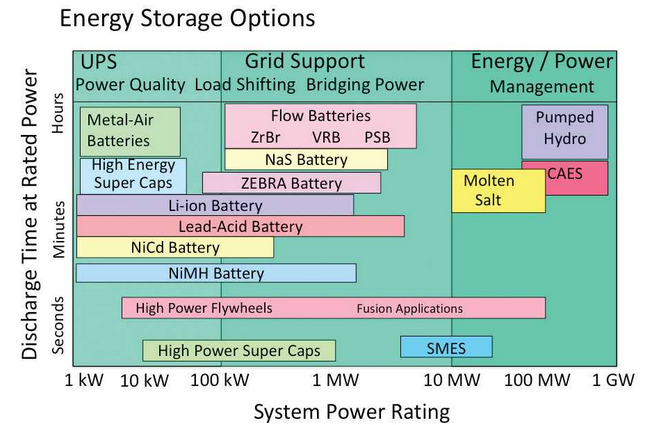
So of course if we keep adding more NGCC plants we’re not lessening our need for fossil fuels.  We need to store energy if we’re to wean ourselves off of them.  But we’re still a long way from figuring out how to make low cost, high energy density, fast response, safe storage devices.

Electric Grid Energy Storage Options Peter Singer

Source: Peter Singer. 2011. Energy Storage Crucial Step for Renewable Electricity, Says APS. EnergyStorageTrends.Blogspot.com.

Pumped Hydro: 1) Geographically limited 2) Environmental impacts 3) High overall project cost

Flywheels 1) Rotor tensile strength limitations 2) Limited energy storage time due to high frictional losses (1-2 hours).

Flywheels spin at very high speeds, up to 20,000 rpm, which makes them very unsafe when fragments of a broken flywheel spin off.  for safety, they’d need to go underground (or expensive thick-walled enclosure), which greatly increases their cost.

Superconductive magnetic energy storage: 1) Low energy density 2) Material and manufacturing cost prohibitive

Electrochemical capacitors: Currently cost prohibitive

Thermochemical energy storage: Currently cost prohibitive

Compressed Air Storage:  1) Geographically limited and a lack of suitable caverns, 2) Lower efficiency due to round-trip conversion, 3) Slower response time than flywheels or batteries, 4) Environmental impact

Batteries

There are many issues, see “Why Killed the Electric Car” for details.  But the deal killer is the cost –$100-200/kWh — at least as expensive as generating electricity.  And scale: the energy density of batteries is so low that you’d need a LOT of batteries, and the the billions of tons of materials to make them would likely exceed known mineral reserves and drive the cost of batteries even higher, with dire environmental consequences if their cadmium, lead, nickel, and so on were released (Pew).

There is significant uncertainty about the usable life of batteries, and concerns about their safety as well.

It takes a long time to bring a battery to market. The sodium–sulfur battery, conceived by the Ford Motor Company back in 1967 was finally commercialized over 40 years later (Whittingham).

Lead Acid: 1) Limited depth of discharge 2) Low energy density 3) Large footprint 4) Electrode corrosion limits useful life

NaS: 1) Operating Temperature required between 250°-300° C (482°-572° F)   2) Liquid containment issues corrosion and brittle glass seals

Li-ion: 1) High production cost – scalability 2) Extremely sensitive to over temperature, overcharge and internal pressure buildup 3) Intolerance to deep discharges

Flow: 1) Developing technology, not mature for commercial scale development 2) Complicated design 3) Lower energy density

Too complicated?

One of the main reasons societies collapse is they grow too complex (Tainter).  Not only is each of these storage devices complex, we need a dozen different kinds of energy storage to meet the different needs of the complicated electric grid:

1) Off-to-on-peak intermittent shifting and firming. Charge at the site of off peak renewable and/ or intermittent energy sources; discharge energy into the grid during on peak periods.
2) On-peak intermittent energy smoothing and shaping. Charge/discharge seconds to minutes to smooth intermittent generation and/or charge/discharge minutes to hours to shape energy profile
3) Ancillary service provision. Provide ancillary service capacity in day ahead markets and respond to ISO signaling in real time.
4) Black start provision. Unit sits fully charged, discharging when black start capability is required.
5) Transmission infrastructure. Use an energy storage device to defer upgrades in transmission
6) Distribution infrastructure. Use an energy storage device to defer upgrades in distribution
7) Transportable distribution-level outage mitigation. Use a transportable storage unit to provide supplemental power to end users during outages due to short term distribution overload situations
8) Peak load shifting downstream of distribution system. Charge device during off peak downstream of the distribution system below secondary transformer); discharge during 2-4 hour daily peek
9) Intermittent distributed generation integration. Charge/Discharge device to balance local energy use with generation. Sited between the distributed and generation and distribution grid to defer otherwise necessary distribution infrastructure upgrades
10) End-user time-of-use rate optimization. Charge device when retail TOU prices are low and discharge when prices are high
11) Uninterruptible power supply. End user deploys energy storage to improve power quality and /or provide back up power during outages
12) Micro grid formation. Energy storage is deployed in conjunction with local generation to separate from the grid, creating an islanded micro-grid

References

(BES) Basic Research Needs for Electrical Energy Storage. 2007. Report of the Basic Energy Sciences workshop on electrical energy storage.

EIA. Table 1.1. Net Generation by Energy Source: Total (All Sectors), 2004-February 2014. U.S. Energy Information Administration.

Fitch Ratings, “Frayed Wires: US Tr ansmission System Shows Its Age,” 2006

Friedemann, A. 2014. Electric Grid Overview.  www.energyskeptic.com

Fridley, David. 2010. Electric Energy challenges. Post Carbon Institute.

GES. December 2013. Grid Energy Storage. U.S. Department of Energy.

Halper, E. Dec 2, 2013.   Power struggle: Green energy versus a grid that’s not ready. Los Angeles Times.

Pew Center. 2004. The 10-50 solution. Technologies and Policies for a Low-Carbon future. The National Commission on Energy Policy.

Whittingham, M. S. April 2008. Materials Challenges Facing Electrical Energy Storage. Harnessing Materials for Energy  www.mrs.org/bulletin vol 33.

Posted in Batteries, Electric Grid | Comments Off on Electric Grid Energy Storage

Technology Won’t Save Us

Too many science fiction books, movies, comic books, Landing on the Moon, the Manhattan Project, and Happy Endings have  created an unspoken certainty that a hero will arrive before aliens can destroy the Earth and that alternative energy will allow us to continue devouring the planet with hardly a hiccup.

But consider these energy predictions that didn’t come true:

1945. Oak Ridge National Laboratory nuclear physicists Weinberg and Soodak predict that nuclear breeders will be man’s ultimate energy source; a decade later, the chairman of the US Atomic Energy Commission predict it would be “too cheap to meter

1973. “Let this be our national goal: At the end of this decade, in the year 1980, the United States will not be dependent on any other country for the energy we need to provide our jobs, to heat our homes, and to keep our transportation moving.” Richard Nixon

1978. “Through modeling of supply and demand for over 200 US utilities it was projected that, by the year 2000, almost 60% of US cars could be electrified, and that only 17% of the recharging power would come from petroleum.

1979. An influential Harvard Business School study projects that by 2000, the US could satisfy 20% of its energy needs through solar

1980. Physicist Bent Sorenson predicts that 49% of America’s energy could come from renewable sources by the year 2005

1994. Hypercar Center established, whose lightweight material and design would yield 200 mpg cars with a 95% decline in pollution

1994. InterTechnology Corporation predicts that solar energy would supply 36% of America’s industrial process heat by 2000

1995. Energy consultant and physicist Alfred Cavallo projects that wind could have a capacity factor of 60%, which when combined with compressed air storage, would rise to 70 – 95%3

1999. US Department of Energy hopes to sequester 1 billion tonnes of carbon per year by 2025

2000. Fuel cell companies announce 250-kilowatt production plants that can fit into a conference room and produce energy at 10 cents per kilowatt hour, with the goal of 6 cents by 2003

2008. “Today I challenge our nation to commit to producing 100% of our electricity from renewable energy and truly clean carbon-free sources within 10 years. This goal is achievable, affordable and transformative.” Al Gore

2009. Gene scientist Craig Venter announces plans to develop next-generation biofuels from algae in a partnership with Exxon Mobil

How have things turned out?

There are no commercial nuclear breeders on anyone’s horizon; global nuclear capacity is only 20% of the Atomic Energy Agency’s 1970 forecast; the Hypercar is nowhere to be seen; solar and wind make up a miniscule portion of US electricity generation; wind capacity factors range from 20%-30%; the US is reliant for 50% of its oil from foreign sources; 70% of US electricity generation comes from coal and natural gas; fuel cells haven’t worked as expected; hybrids are 2% of US car sales; “clean coal” is mostly a blueprint; and Venter announced that his team failed to find naturally occurring algae that can be converted into commercial-scale biofuel (they will now work with synthetic strains instead).

Cembalest, Michael. 21 Nov 2011. Eye on the Market: The quixotic search for energy solutions. J. P. Morgan

Posted in 3) Fast Crash | Comments Off on Technology Won’t Save Us

Drowning in digits: National, Unfunded Liabilities, State, and Derivative Debt

Just about everyone I know believes in the permanence of the Dollar, the Eternal Supremacy of the United States, and the propaganda to constantly grow their money by taking risks. So they dutifully feed hard-earned wages into the voracious slot machine of Wall Street, despite the rot of the system revealed after the financial meltdown and the continuing fraud and corruption afterwards, as if nothing had happened.

Meanwhile, imaginary digits of currency propagate and grow heavy in computer systems, compressing into a digital critical mass ready to explode. Although the $18.77 Trillion of “Official” United States Treasury National Debt seems huge, it’s a dust mote in the eye of Unfunded Liabilities:

$100.4 trillion (US unfunded liabilities (GAAP)), $840,063 liability per taxpayer

$66 trillion (U.S. total debt) USDebtClock.org. Total Debt per US citizen: $205,228

$205,000,000,000,000  Congressional Budget Office (CBO) Alternative Fiscal  Scenario (AFS). Debt per citizen: $644,785.

$53,761 personal debt per citizen ($940 billion credit card, $1.3 trillion student loan debt, $13.76 trillion mortgage)

$492.3 trillion in currency and credit derivatives (2015)

$6.7 trillion: U.S. debt held by other countries

Professor of Economics Laurence Kitlikoff at Boston University, and author of The Coming Generational Storm: What You Need to Know About America’s Future, said the CBO figure of $205 trillion is more realistic, because it includes government commitments and obligations that aren’t counted as debt, but should be, “such as paying for your social security benefits, mine, or your mother’s Medicare benefits, defense spending, etc. All of these things are obligations that aren’t recorded on the books as debt, whereas paying off future principal and interest payments on Treasury bills and bonds are recorded. If you take the value of all of those commitments and subtract all the taxes coming to pay those commitments, the difference is what’s called the fiscal gap; and that fiscal gap in the U.S. is now $205 trillion. Most of the problems we’re facing and most of the debt we have is off the books and Congress has done bookkeeping to make sure the public doesn’t see it”.

When asked why this wasn’t well known, Kotlikoff replied “The Clinton administration put out the fiscal gap studies for a couple of years and then the Clinton administration censored it. President Bush’s Treasury Secretary O’Neil wanted us to do a fiscal gap accounting for the President’s budget in 2003 but was fired December 7, 2002, and that study was censored two days after he was fired. So, this is not accidental. This is more or less a conspiracy to hide the truth to keep ourselves and our kids in the dark about what the politicians are really doing, which is trying to garner the votes of older people and then get reelected and leave a bigger mess for our kids to handle.”

Kitlikoff argues this can’t go on. There are 4 payees for every beneficiary now. By 2030 there’ll be 2 payees for every beneficiary. That’s obviously not sustainable.

There are so many other debts as well: Personal $16,500,000,000,000 Mortgage $13,300,000,000,000  Student Loans $1,150,000,000,000 and Credit Cards $850,000,000,000.

State level debt. California alone has $354,500,000,000 in unfunded retirement benefits and $132,000,000,000 in other debt.

Plus, if we want to keep civilization in the United States going, there’s $3,600,000,000,000 of maintenance needed on our infrastructure by 2020 according the 2013 American Society of Civil Engineers Report Card.

If you have been brainwashed by libertarianism, capitalism, by classical economics and business “news”, then there’s no need to worry. Every political party, whether Democrat, Republican, or Tea, agrees we can grow our way out of the problem and reduce the dizzying digits of debt.

But if you are both [systems] ecologically and energy literate, it’s hard to understand how anyone could think money, rather than energy, was the engine of growth.

Civilization as we know it, and recent Globalization, happened because oil-fueled container ships carry 90% of all cargo and oil-fueled trucks and trains deliver containers to stores where oil-fueled cars pick the goods up.

Yet so many, even scientists who should know better, collectively hallucinate electric schemes to keep the dream going, as if feeble and intermittent wind and sun or fusion and fission fantasies could crush rocks into concrete, forge steel, smelt iron ore, power thousand foot long ships across the ocean, and keep the growing digits of debt from overwhelming the future.

When the oil crunch hits, the digits will explode, and all of us will say goodbye to more and more of our beloved energy slaves every day, until 90% of survivors till the earth again.

Alice Friedemann

www.energyskeptic.com

Posted in Crash Coming Soon, Debt, Money, No Reforms, Ponzi Schemes | Comments Off on Drowning in digits: National, Unfunded Liabilities, State, and Derivative Debt

Tom Whipple on how the energy crisis might unfold

The Peak Oil Crisis: An Announcement

June 1, 2011. FNPC.com

There are far too many people in nearly every country of the world that are dependent on a very complex supply chain to bring them the necessities of modern life – food, shelter, clothing, medicine, education, and some form of entertainment and recreation – to make a return to 19th century practicable.

There are simply too many people and not enough arable land left in the world.

This implies that for the coming decades, the best solution for the world’s peoples is to shelter-in-place.

While there may be limited opportunities to migrate, these will become increasingly difficult to find. Oil-fueled transportation will become expensive and governments will be taking whatever measures are necessary to stem unauthorized cross-border migrations.

Some intra-country movement will have to take place as regions become uninhabitable for most due to climate change.

This raises the key issue of the next few decades – What will be the role of government in holding society together during the transition to the post carbon age? A corollary issue will be how well current systems of finance, industrial organization and capital formation will function during what is likely to be a prolonged period of economic decline as fossil fuels and then many other resources become scarcer and much more expensive.

As people naturally prefer to stay with accustomed life styles and ways of doing things as long as possible, there will inevitably be a period of political controversy between those who have come to recognize that major changes in our civilization must take place if society is to survive in a recognizable fashion and those who will cling to the familiar until overcome by events. Indeed, the opening rounds of this debate have likely started already in the controversies over global warming, jobs, taxes, deficits, and sovereign debts.

In the United States a great political debate is taking place on 20th century terms with discussion focused on reviving economic growth, cutting federal deficits, and stimulating spending. In the 21st century, an era of depleting resources, much of this debate is no longer relevant. Efforts to create jobs in traditional ways in what will soon be a steadily contracting economy will need to be rethought and new ways of creating new kinds of jobs will be necessary to keep complex societies functioning. Whether the lead will be taken by free enterprise or will fall to governments by default is yet to be seen.

There will be many other issues besides the creation of jobs, and supplying goods and services in the coming transition. Some of these issues are not yet apparent and some will not be recognized for years.

Posted in By People | Comments Off on Tom Whipple on how the energy crisis might unfold