Preface. Because I’d been reading non-fiction since college across every section in bookstores for decades before I stumbled on Peak oil in 2000 (full story in about), I understood the horror and tragedy of energy decline and was depressed for months.
Today people accuse me of nihilism because I don’t offer solutions. Well I do — just not the techno-fixes they want to hear. My “solution” is to accept we are going back to the 14th century and not waste any time on making renewables, electric vehicles and so on that can’t possibly solve the problem. We are running out of time, metals, minerals, energy, forests, fresh water, topsoil — if peak energy didn’t get us, there are plenty of other Limits to Growth that will.
I found Jackson & Jensen’s book “An inconvenient Apocalypse” a very important framework for looking at what lies ahead that will help you cope. They explain why optimism and hope are not the goal. It is a common among activists to challenge me since by not offering hope and optimism there is no incentive for people to do anything. Sure there is, garden and other 14th century skills.
I’ve summarized some of the parts from the book I liked most, but I left so much out. it will give you perspective, wisdom, and perhaps better acceptance and ability to cope with what lies ahead so you aren’t driven to despair by your awareness.
Alice Friedemann www.energyskeptic.com Author of Life After Fossil Fuels: A Reality Check on Alternative Energy; When Trucks Stop Running: Energy and the Future of Transportation”, Barriers to Making Algal Biofuels, & “Crunch! Whole Grain Artisan Chips and Crackers”. Women in ecology Podcasts: WGBH, Financial Sense, Jore, Planet: Critical, Crazy Town, Collapse Chronicles, Derrick Jensen, Practical Prepping, Kunstler 253 &278, Peak Prosperity, Index of best energyskeptic posts
***
Wes Jackson and Robert Jensen. An Inconvenient Apocalypse: Environmental Collapse, Climate Crisis, and the Fate of Humanity
Throughout this book, our goal is to confront difficult issues as honestly as we can, even when our analysis might create tension with friends and allies. We believe this approach is more necessary than ever at this all-hands-on-deck point in human history.
We believe that feeling some despair in the face of these threats is a rational, reasonable, and responsible reaction. Such despair—not over our personal fates but our species’ collective inability to value the larger living world—should be pondered, not waved away with platitudes.
If we stop fantasizing about doing the impossible, we can focus on doing the best job we can to achieve what is possible.
We have faith in the better angels of our nature but realize that those better angels alone won’t save us from what we call “the temptations of dense energy,” which have come most recently in the form of fossil fuels.
Driving less—walking, biking, taking the bus—is a good thing, but it won’t change the world if the larger car culture endures and cities are designed in such a way that living and working without a car is difficult. If you think trading in your gas-burning car for an electric vehicle is the solution, think again. The energy consumption and resource extraction required to manufacture EVs make them an ecologically unsustainable choice as well.
Our thesis is that while not every individual or culture is equally culpable, the human failure over the past ten thousand years is the result of the imperative of all life to seek out energy-rich carbon.
The global North—which is to say, fossil fuel–powered capitalism as it developed in Europe—bears primary responsibility for the shape of the contemporary crises, and those societies have failed to meet their obligation or, in some cases, even acknowledge an obligation to change course. In our lifetimes, the primary force behind that failure has been the United States. Within affluent societies, the wealthy and powerful bear the greatest responsibility for destructive policies. But if there is to be a decent human future, we have to realize that human-carbon nature is at the core of the problem, a reality that exempts no one. We cannot ignore the relevance of “we.
Our task today is not only to learn how to live “lower on the food chain,” but how to transition from the existing infrastructure and organization of contemporary societies to infrastructure and organization that is consistent with a sustainable future. And we have to do this living with population densities far greater than any previous phase of human history, with an eye toward dramatic reductions in population. No past or existing society or ideology provides a workable model or viable plan for this task.
The task before us today is far more daunting: a down-powering on a global level with the goal of fewer people living on less energy, achieved by means of democratically managed planning to minimize suffering. Daunting, indeed.
No one has yet offered a program to achieve the task before us. Simply invoking previous societies that lived with less energy and lower population densities is not a program.
Because planning for transition on this scale is difficult to imagine, people are quick to embrace technological optimism and imagine that we will invent our way to a just and sustainable future without harsh reckoning and dramatic realignment. This optimism slides all too easily into a technological fundamentalism that undermines people’s ability to acknowledge and face the difficult challenges.
This optimism allows the fantasy that societies can continue at existing high-energy levels through endless innovation that can be fueled by low-cost renewable energy that will become abundant enough to replace fossil fuels.
Because capitalism is, and always has been, a wealth-concentrating system, a relatively small number of people reap most of the financial benefits from the ecological destruction that comes with modern economic growth. In short, the first world is rich, and much of its wealth is concentrated in the hands of a relatively small segment of those societies’ populations. Some people who benefit from these arrangements are dedicated to maintaining the hierarchical systems at the heart of the unsustainable economy and its unjust distribution of wealth.
No individual, political movement, or government has a viable plan for transitioning from an unsustainable high-energy, interdependent global society of nearly eight billion people to low-energy societies with sustainable levels of population and consumption. While lessons from low-energy societies will undoubtedly be valuable, there is no way to flip a switch and return to a previous era’s living arrangements and lower population densities.
Technological innovation and renewable energy will play a role but cannot power the infrastructure of a world built with the highly dense carbon of fossil fuels.
It is our human nature, like the nature of all life, to seek out energy-rich carbon. To be alive is to go after carbon. Over time, humans have gotten exceedingly good at tapping into five major carbon pools—soils, forests, coal, oil, natural gas—and maximizing the extraction of all the carbon we can get our hands on. There are few exceptions to that pattern. Our greatest success as a species has become our most profound failure, given the many negative consequences of all that carbon grabbing.
To put it as bluntly as possible: Any policy that does not understand and account for the temptations of dense energy will fail. Humancarbon nature matters.
We routinely talk with people who assert that the problem is not that there’s too much aggregate consumption but that the distribution of that consumption across the human population is unequal and inequitable and that capitalism creates wasteful consumption by manipulating human desires in pursuit of profit. Those observations about capitalism’s unjust and wasteful character are accurate, but they don’t undermine the importance of asking critical questions about consumption more generally.
We are anticapitalist, on moral, political, and ecological grounds. Capitalism, with its growth imperative and wealth concentration, has proved to be inconsistent with basic human decency, democracy, and sustainability. But this assessment shouldn’t lead to a demand for political purity today. Given the global dominance of capitalism’s regime of ownership and finance, for now, any strategy for advancing justice and sustainability has to account for that power and maneuver within that system. We have no plan for vanquishing capitalism and are open to any and all creative proposals for change. Still, we believe it’s crucial to point out the pathological nature of capitalism and endless growth economics, both to guide immediate action and to keep us focused on the eventual end of that system.
Our vision of a just and sustainable future includes a rejection not just of the capitalist worldview but also of the industrial worldview’s expectations for expansive energy consumption. We do not think that even a well-designed socialist system is up to the challenge in front of us, unless it emphasizes the need for collective self-imposed limits on human energy expectations.
Why? Because of our humancarbon nature. Is there any reason to believe that socialists would not have acted from the species propensity to maximize the amount of carbon we could extract from the environment? We have no doubt, however, that a well-designed socialist society would have used that energy for different, and more socially beneficial, purposes than a capitalist society. Instead of maximizing return on capitalists’ investment, a socialist system could seek to maximize human flourishing for everyone.
Nor is there reason to believe that a more egalitarian system today would be able to limit ecological destruction in significant ways, unless it embraced a collective rejection of the contemporary high-energy “lifestyle” and prioritized a collectively imposed cap on the amount of carbon we use. Yet this component of a viable plan for ecological sustainability—a clear statement of the need to dramatically reduce human aggregate consumption—is either absent or downplayed in current socialist and ecosocialist programs. Instead, these programs tend to suggest that continued development of renewable energy will solve our problems without a dramatic reduction of economic activity.
A preference for the industrial solutions made possible by the dense energy of fossil fuels is not the product of capitalist indoctrination. It’s just easier on one’s back. Given the current crises, we should constantly look for places to abandon high-energy tools in favor of lower-energy methods and reassess the need for the work those high-energy tools do. In the contemporary United States, we have yet to see such questions asked.
Surplus-and-hierarchy predate agriculture in a few resource-rich places, which produced what anthropologists sometimes call complex hunter-gatherers or affluent foragers. Human nature is variable and plastic. When living under conditions that generate surpluses over which people might struggle for control, it’s within our nature to abandon the egalitarian features of our gathering-and-hunting history and create hierarchies. It’s all part of human nature, all connected to the scramble for energy-rich carbon that is at the center of life on this planet. That is who we are.
No one talks about the individual choices that foragers made a hundred thousand years ago, or fifty thousand years ago. What should we say about the first farmers, the first smelters of ore, the first people who tapped fossil fuels to do work in machines? All of them contributed to the mess we are in but without knowledge of the consequences of their actions.
How many churchgoers who have doubts about their congregation’s doctrine decide to squelch their questions out of fear of losing friends and community? How often do people in intimate relationships avoid confronting tension because they know a problem can’t be resolved and speaking of it will bring the end of the relationship? How many people have delayed a trip to the doctor because they know that an examination will lead to a diagnosis they don’t want to deal with?
We often avoid hard questions precisely because they are hard. What we experience individually is also true of the larger culture. There are hard questions that, collectively, we have so far turned away from, either because we have no answers or because we won’t like the answers waiting for us. As we have already said, contemporary societies face problems for which there likely are no solutions if we are only willing to consider solutions that promise no dramatic disruption in our current living arrangements.
Here are some of those hard questions we must confront now: 1) What is the sustainable size of the human population? 2) What is the appropriate scale of a human community? 3) At what speed must we move toward different living arrangements if we are to avoid catastrophic consequences?
When we have raised these issues in conversation, the most common response is that those hard questions may be interesting, but they have no bearing on what is possible today in real-world struggles for justice and sustainability. The implication is that such questions either somehow don’t really matter or are too dangerous to ask. We’ve heard this not just from people within the conventional political arena but also from environmentalists and activists on the Left. Their argument tends to be:
Those questions raise issues that most people simply will not engage and suggest a need for changes that most people simply will not make. Sensible environmentalists and activists know that you cannot expect people to think about such huge questions when they face everyday problems of living and making a living, which take up most of their time and energy. And what’s the point of thinking about these things anyway, when we all know that politicians can only move so far, so fast in our political system? Why ask questions and offer policies that are certain to be ignored?
Sensible people, we have been told, are those who accept the “Overton Window.” Named after the late Joseph P. Overton from the Mackinac Center for Public Policy, the idea is that politicians “generally only pursue policies that are widely accepted throughout society as legitimate policy options. These policies lie inside the Overton Window. Other policy ideas exist, but politicians risk losing popular support if they champion these ideas which lie outside the Overton Window.
That can be a useful concept for thinking about what laws might be passed today, but it becomes an impediment to critical thinking when people use it to avoid hard but necessary questions that can’t be put off forever. When confronting questions of size, scale, scope, and speed, we encourage people to climb out of the Overton Window to get a wider view of the world, to think not about how human political processes limit what actions are possible today (which they do) but about what the larger living world’s forces demand of us (which dictate the material conditions in which we live our lives). When attempting to come to terms with biophysical realities, refusing to look beyond the Overton Window guarantees collective failure. That window certainly exists in the realm of environmental policy: politicians fear the loss of support if they move too far, too fast. But that doesn’t exempt anyone from asking those hard questions. The environmental policies that are possible today are important, but we also must recognize that we likely face a dramatically different set of choices in a far more challenging tomorrow. And that tomorrow isn’t as far away as we may want to believe.
We realize that asking these hard questions in the mainstream political arena today is nearly impossible and that the key actors in our current political system will not engage those questions anytime soon. But to cite those two impediments as a reason not to ever grapple with those questions in any context is not sensible.
As one science writer put it, people who take Malthus seriously “cannot let go of the simple but clearly wrong idea that human beings are no different than a herd of deer when it comes to reproduction.”
The goal of our planning can be stated simply and clearly: fewer and less. Fewer people, less stuff.
Many people, including many environmentalists we know, prefer not to talk about the growth of the human population as a problem or about population control as a component of a viable environmental policy. Why? Three reasons seem to push people away from this discussion.
The first is that such concerns about population have been associated with a lack of compassion and/or racism, ethnocentrism, and class prejudice. Some of the most vocal supporters of population control also espouse white supremacist and anti-immigrant sentiments.
We are grateful that some environmentalists, such as Eileen Crist, are willing to speak bluntly: “The dismal consequences for Earth and for humanity of an oversized global population are indisputable.”
The second reason people might avoid the subject is that no one has ever proposed a viable non-coercive strategy for serious population reduction on the scale necessary, because no such strategy exists.
The other side of the population equation—the death rate—is even more vexing.
The ease with which some politicians were able to scare people with such claims indicates how far the United States is from an honest discussion on the subject of the appropriate level of intervention to prevent death, especially as we age. We need such a debate about setting policy, not only on when to withdraw care from the terminally ill, but also on the wisdom of using a range of life-extending medical procedures (e.g., heart bypasses, organ transplants).
Many of the key problems we now face as a species are second-order effects of reduced mortality.
Also important to social stability is what is called the dependency ratio, the relationship between people of working age and those who are not working. The strain of longer lives and low fertility, leading to fewer workers and more retirees, threatens to upend how societies are organized and may also require a reconceptualization of family and nation.
People also avoid the population issue because everyone recognizes that raw population numbers are meaningless without attention to per capita consumption.
Behind all the denial is the techno-optimism that assumes we will always invent our way out of any problem, which may turn out to be the biggest impediment to meaningful change.
Reasonable people with good track records on understanding ecological limits suggest that the human population could stabilize at about two billion. (That was, by the way, the human population in 1927.)
It may not be possible. In fact, if human history is any guide, it’s almost certainly not possible.
Refusing to acknowledge difficult problems doesn’t allow us to escape them. Instead, denial of reality opens up space for people peddling pseudo-solutions. When reasonable people stay silent, the voices of unreasonable people dominate. Progressives who are unwilling to address the issue of human numbers and consumption cede this terrain to political actors without progressive values who want to use ecological crises to pursue an ugly agenda. To press the question of population and consumption is not reactionary but rather an attempt to forestall reactionary political projects.
The analysis just presented is not new, nor are we alone today in this analysis. For a half century, insightful scholars have been making these points. In the early 1970s, Paul Ehrlich and John Holdren offered the “IPAT” concept to capture the impact of human activity on the environment by looking at population, affluence, and technology. In their 1972 book, The Limits to Growth, Donella and Dennis Meadows and coauthors used computer modeling to warn that humans were moving beyond Earth’s carrying capacity. After years of these authors being dismissed as alarmist, an increasing number of people are recognizing they were right.
The ecologists William Rees and Mathis Wackernagel developed ecological footprint analysis to make the unsustainability of contemporary societies easier to grasp, publishing Our Ecological Footprint in 1996. Such work continues with scholar-activists such as Richard Heinberg and his colleagues at the Post Carbon Institute.
Our genetic endowment makes some things possible and some things impossible. No human being can fly in the sense that a bird flies or live underwater in the sense that fish do. But our technological prowess has led people to forget the obvious. Airplanes create the illusion that we can fly and submarines, the illusion we can breathe underwater.
Another example of this pattern is the megachurch, congregations with thousands of members, which in addition to large spectacle worship services offer myriad specialty groups. In these small groups, members of the congregation build strong connections to a manageable number of people, a cell model of organizing. Megachurch pastors learned something that should not be surprising given our evolutionary history: “The small group was an extraordinary vehicle of commitment.” Such models can also be found in political groups.
No matter how difficult the transition may be, in the not-too-distant future we will have to live in far smaller and more flexible social organizations than today’s nation-states and cities.
Moving from eight billion people living in large political units to a sustainable human population living in smaller social organizations is a difficult task, unlikely to be achieved by planning in the existing political and economic systems in the time available. There are myriad ways that human-built infrastructure and social systems can—and likely will—fray, falter, fail, and fall apart before we humans can figure out how to manage that task. The unraveling of large systems in the past has generally resulted in social dislocation and intensified conflict, along with lower levels of available material resources and considerable deprivation.
That’s not a pleasant future to ponder and prepare for, so it’s not surprising that many people, especially those in societies whose affluence is based on dense energy and advanced technology, clamor for solutions that claim to be able to keep the energy flowing and the technology advancing. Jackson has long labeled this approach “technological fundamentalism. If there is to be a decent human future, we face the tasks of reducing the number of humans and aggregate consumption, moving to smaller and more flexible political units and social organizations, and recognizing the limits of our intelligence to manage complex systems.
That leaves the question of speed: how fast must we move toward these dramatically different living arrangements and collectively self-imposed limits if we are to avoid catastrophic consequences? It is folly to offer precise predictions, but this does not mean we should abandon attempts to understand the trajectory of human societies or stop trying to deepen our understanding of where we are heading. A good example is the debate over peak oil, the point at which humans will have extracted about half of all oil that will ever be extracted. After that point, petroleum extraction will permanently decline.
It seems clear that even if greenhouse gases weren’t a problem, the era of cheap oil is over and we can assume the end of the era of oil is coming. We don’t need exact predictions to assess the trajectory and act on that assessment. The warning light has been flashing red not for years but for decades, in some ways even for centuries. If year after year the evidence piled up and still there was no meaningful collective action to deal with questions of size, scale, and scope, what makes us believe that piling more evidence in business-as-usual fashion will produce the change we need at the speed required?
It’s unwise to believe that what is often called the magic of modern science and engineering can actually work magic.
When research from the insurance industry starts sounding like it came from environmental groups, perhaps we should pay attention. “A fifth of countries worldwide at risk from ecosystem collapse as biodiversity declines,” reports Swiss Re Group, a leading reinsurance firm (the firms that regular insurance companies call when they need to lay off some of the risk in policies they have written). The company’s study “highlights the dangers of these economies potentially reaching critical tipping points when essential natural resources are disrupted.” A year later, another Swiss Re report predicted that on the currently anticipated trajectory, the world could lose up to 10% of total economic value by midcentury from climate change.
Hard questions lead to painful conclusions. We are starting too late to prevent billions of people from enduring incalculable suffering. We are starting too late to prevent the permanent loss of millions of species and huge tracts of habitat. We are starting too late, but we have to start. We do not believe the world will end. Human abuse of ecosystems cannot destroy Earth. Nor do we expect the human species to become extinct anytime soon. Our chances of coping successfully with the “end times” of those human-created systems increase if we are diligent in learning how the laws of physics and chemistry, along with the lessons of biology, are relevant to our struggles.
We use the term “royal” not to describe a specific form of executive power but as a critique of a system that concentrates authority and marginalizes the needs of ordinary people. The royal tradition, in this context, describes ancient Israel, the Roman Empire, European monarchs, or the contemporary United States—societies in which those holding wealth and power can ignore the needs of the majority of the population if they so choose, societies in which the wealthy and powerful tend to offer pious platitudes about their beneficence as they pursue policies to enrich themselves. This corrosive consciousness develops not only in top leaders but throughout the privileged sectors, often filtering down to a wider public that accepts a power system and its cruelty: “The royal consciousness leads people to numbness, especially to numbness about death.
The inclusion of the United States in a list of royalist societies may seem odd, given the country’s democratic traditions (however frayed), but it is a nation that has been at war—either shooting wars or cold wars for domination—for our entire lives. Economic inequality and the resulting suffering have deepened in our lifetimes, facilitated by a government so captured by concentrated wealth that attempts to renew the moderate New Deal–era social contract seem radical to many. Brueggemann describes such a culture as one that is “competent to implement almost anything and to imagine almost nothing,” though an empire’s competence wanes over time, a process visible in the United States today. Much of the intellectual establishment—not just the right wing but also centrists and liberals—either explicitly endorses or capitulates to royal power.
When prophetic warnings have been ignored, time and time again, what comes next? That is when an apocalyptic sensibility is needed. Again, to be clear: “apocalypse” in this context does not mean lakes of fire, rivers of blood, or bodies raptured up to heaven. The shift from the prophetic to the apocalyptic can instead mark the point when hope for meaningful change within existing systems is no longer possible and we must think in dramatically new ways. Invoking the apocalyptic recognizes the end of something. It’s not about rapture but a rupture severe enough to change the nature of the whole game. The prophetic imagination helps us analyze and strategize about the historical moment we’re in, typically with the hope that the systems in which we live can be reshaped to stop the worst consequences of the royal consciousness, to shake off that numbness of death in time.
In a culture that encourages, even demands, optimism no matter what the facts, it is important to consider plausible alternative endings. Anything that blocks us from looking honestly at reality, no matter how harsh the reality must be rejected. To borrow an often-quoted line of James Baldwin, “Not everything that is faced can be changed; but nothing can be changed until it is faced.”
To speak from the royal tradition is to tell only those truths that the system can bear. To speak prophetically is to tell as much of the truth as one can bear and then a little more. To speak apocalyptically is to tell as much of the truth as one can bear, then a little more, and then all the rest of the truth, whether one can bear it or not. If it seems like all the rest of the truth is more than one can bear, that’s because it is. We are facing new, more expansive challenges than ever before in history. Never have potential catastrophes been so global. Never have social and ecological crises of this scale threatened at the same time. Never have we had so much information about the threats that we must come to terms with.
The human species faces multiple cascading social and ecological crises that will not be solved by virtuous individuals making moral judgments of others’ failures or by frugal people exhorting the profligate to lessen their consumption. Things are bad, getting worse, and getting worse faster than we expected. This is happening not just because of a few bad people or bad systems, though there are plenty of people doing bad things in bad systems that reward people for doing those bad things. At the core of the problem is our human-carbon nature, the scramble for energy-rich carbon that defines life.
Ironically, in those more developed societies with greater dependency on high energy and high technology, the eventual crash might be the most unpredictable and disruptive. Affluent people tend to know the least about how to get by on less.
When presenting an analysis like this, we get two common responses from friends and allies who share our progressive politics and ecological concerns. The first is the claim that fear appeals don’t work. The second is to agree with the assessment but advise against saying such things in public because people can’t handle it.
We are not trying to scare people at all. We are not proposing a strategy using the tricks of advertising and marketing (the polite terms in our society for propaganda). We are simply reporting the conclusions we have reached through our reading of the research and personal experience. We do not expect that a majority of people will agree with us today, but we see no alternative to speaking honestly. It is because others have spoken honestly to us over the years that we have been able to continue on this path. Friends and allies have treated us as rational adults capable of evaluating evidence and reaching conclusions, however tentative, and we believe we all owe each other that kind of respect.
We are not creating fear but simply acknowledging a fear that a growing number of people already feel, a fear that is based on an honest assessment of material realities and people’s behavior within existing social systems. Why would it be good strategy to help people bury legitimate fears that are based on rational evaluation of evidence? As Barbara Ehrenreich points out, an obsession with so-called positive thinking not only undermines critical thinking, but also produces anxiety. Fear is counterproductive if it leads to paralysis but productive if it leads to inquiry and appropriate action to deal with a threat. Productive action is much more likely if we can imagine the possibility of a collective effort, and collective effort is impossible if we are left alone in our fear. The problem isn’t fear but the failure to face our fear together.
Who are these people who are either cognitively or emotionally incapable of engaging these issues? These allegedly deficient folks are sometimes called “the masses,” implying a category of people not as smart as the people who are labeling them as such. We assume that whenever someone asserts that people can’t handle it, the person speaking really is confessing “I can’t handle it.” But we have no choice but to handle reality, since we can’t wish it away. We increase our chances of handling it sensibly if we face reality together.
We think modern systems are coming to an end, and we need to lift the veil that obscures an honest assessment of what those end times will require of us. But we are not scholarly “collapsologists,” a term that has been used by some to describe an emerging research community studying systemic risk in industrial society.
Basic questions are impossible to avoid. How much time do industrial societies have left, and what is their collapse going to look like? For some people in the most vulnerable locations, collapse has already begun. Is collapse coming for us all? The questions are now common enough to warrant a feature in the New York Times Magazine that summarizes the scholarly research on collapse. The same newspaper ran a story on the popularity of a British professor’s paper arguing that it is too late to prevent a breakdown in modern civilization in most countries within our lifetimes. Curiously, the article ran in the “Style” section.
Scholars study past collapses and look for patterns that can help us plan for the future, but they have yet to come up with a widely accepted definition of collapse. If one key marker is a reduction in population, what level of human die-off over what time period constitutes a collapse? To what extent do the political institutions of a society have to fall apart to warrant use of the term? From whose point of view do we say a society collapsed? That last question is particularly important, reminding us that not everyone in a society is equally affected by social and ecological disintegration. Vulnerable people may suffer more during the process, but those who are most exploited by centralized power might benefit in the long run from the collapse of that power. They are intellectually interesting but not necessary to resolve for our purposes. Change is likely in a matter of decades. Big change is coming, sooner than any society is ready for.
For our purposes, Jared Diamond’s definition of collapse is an adequate starting point: “a drastic decrease in human population size and or political/economic/social complexity, over a considerable area, for an extended time.” Collapse is not about the failure of a leader or of elites more generally, though when societies fall apart leaders and elites often make bad decisions. Neither is it simply the result of a society exhausting natural resources and polluting the environment, though the degradation of ecosystems is usually part of the process of collapse. Collapse is not all bad, that there are positive consequences to the end of complex systems.
Our focus is on how to minimize the human suffering and ecological damage done as a system collapses.
When that process begins, we can expect a loss of “social resilience,” the capacity of a society to cooperate effectively to achieve shared goals. Peter Turchin, another prominent scholar of collapse, suggests that structural trends that undermine social resilience have been building in the United States for decades.
Taking seriously the questions about size, scale, scope, and speed, attempts to make the existing system more robust are likely a losing proposition. Better to invest in resilience. Investing in electric vehicles may make the existing system more robust in the short term—we may be able to keep driving longer—but that investment in new technology to keep alive an old idea of personal car ownership will undermine resilience. Investing in mass transit, along with the recognition that in a low-energy future we will travel less, will enhance resilience.
The ecological costs—not only in direct fuel consumption but also in metals and other resources to produce the cars and their batteries, along with infrastructure construction and maintenance—will be just as unsustainable for electric vehicles as petroleum-fueled cars.
One reaction to the possibility/inevitability of collapse is to join the “prepper” or “survivalist” movements—folks who are actively assembling the means and materials they believe will allow them to survive the societal disintegration they believe is imminent. Depending on one’s wealth, prepper actions range from ordinary people stocking up on survival supplies and packing “bug-out bags” to the more affluent folks buying space in a survivalist bunker compound to the mega-rich building a community that can float in the ocean and claim political independence.
There is nothing wrong with individuals or communities taking action that might enhance short-term survival in crises. It’s a good thing for individuals to expand basic skills in food production and storage that will be needed when cheap energy is no longer plentiful and reliable. Being more self-reliant is a good thing. Developing such skills in cooperation with neighbors is an even better thing, enhancing the self-reliance of a group. But those activities should go forward without illusions that individuals or small communities can successfully cope with collapse on their own. No person or community can build a wall high enough or dig a moat wide enough to guarantee survival. And if that were possible, what kind of survival would it be?
Along with any individual and community action, a larger political process is necessary to deal with the dramatic changes coming. Being ready for a radically different life for everyone as part of a radically different ecosphere requires planning. Such a process will need to not only build new political and economic systems but also cultivate a more ecological vision to replace the dominant culture’s current linking of a good life to an industrial worldview, what in other writing we have called a “creaturely worldview.”
We should expect different people, depending on their talents and temperaments, to focus on different aspects of the challenge. We aren’t proposing a specific plan for life on the other side of a collapse. We are suggesting it is reckless not to consider the question.
For all of our adult lives, the two of us have lived in a culture that assumed expansion—more people, more energy, more technology, more abundance. Hunger and poverty were problems that could be solved in an ever-expanding world. That was the future we assumed was coming. It’s time to retire that notion. The future we are going to have to cope with—will be defined not by expansion but by contraction.
If we accept the high probability of coming changes that would warrant the term “collapse” on a global scale, we should be thinking about what lies beyond. What comes after existing social, political, and economic systems are no longer functional?
One place looking at this is the Heidelberg University which established the Käte Hamburger Centre for Apocalyptic and Post-Apocalyptic Studies in 2021.
We assume that the first instinct of people still reading this book is not to stockpile dried food and shotgun shells, an approach that says, “The hell with everyone except me and my loved ones.” There may come a time, if things get desperate enough, when that will be the default response of most people. Most of us find disturbing precisely because such scenarios aren’t hard to imagine. But we’re not there yet.
We don’t play the prediction game, and we also are not in the prescription business. We don’t pretend we can see the future, and we also aren’t arrogant enough to think we know enough to dictate to people exactly what they should be doing in response to the maddeningly complex challenges before us. [Hello, that’s partly why I’m reading this book, for ideas on “What to do”]
People—and we mean everyone, ourselves included—are only capable of doing what we are capable of doing.
People with a similar view of the human trajectory and similar objectives can pursue very different projects. That’s fine with us. If no one can know for sure how to achieve common objectives, as Mao Zedong said, “Let a hundred flowers bloom, and a hundred schools of thought contend.
Since we cannot produce much indefinitely, desiring little is going to become more important.
We know that the most basic needs for survival are food, water, clothing, shelter, healing, security, and sociality. Everything else in our lives is in the category of a want, a desire, a yearning—the things we can live without and still live fulfilling lives.
This process of down-powering should not be confused with the “new minimalism” fad of the 2000s, the project of “decluttering and design for sustainable, intentional living.” The use of “sustainable” in that context has little or nothing to do with ecological sustainability. There’s nothing wrong with “tidying up” one’s home or office, and it may improve one’s mental health. But we shouldn’t expect such superficial changes to be “life changing,
We’re focusing on the day when this move to simpler living will not be voluntary. Frugality will have to be imposed through collective action. Whether that imposition will involve what we recognize today as “government” or some new form of political association depends on a trajectory we cannot predict. But at some point, “fewer and less” will not be a matter of choice but will be reality, whether we like it or not. We will have to manage collectively the choices within new limits. We see no reason to believe that, in the time frame available, human societies will embrace public policies that significantly change the collapse trajectory.
But once we are faced with new limits, societies will need to work out strategies for democratic self-management of resources at the local level, allowing people to hold each other accountable without centralized power. How to do that is neither easy nor obvious.
A capitalist culture dependent on mass consumption cultivates a close connection between people and our stuff. Many people’s identity is tied to activities that require buying a lot of goods and services, and we should not be naive about how much struggle will be involved in leaving that consumption behind.
Most of our stuff—including the stuff that we think is important in defining who we are—is not only ephemeral, but soon will be unavailable.
It would be folly not to recognize and try to root out the Consumer in ourselves. Rejecting the Consumer in us all and embracing a new identity isn’t so easy. Capitalism has depended on both state and private violence to get established and survive; think of imperial wars to acquire resources and establish markets and decades of strike-breaking. But the strength of the identity of Consumer is maintained primarily through pleasure. For most people it feels good, at least in the short term, to consume. Once we settle into the Consumer identity, it’s surprisingly hard to escape,
A saving remnant will need new stories born of resistance to the Consumer. What stories can we tell about what it means to be human that will help us on the other side of collapse? We especially will need a story about why so many people continued to be so short-sighted and cruel, even when the knowledge of coming collapse is widespread.
Electricians, carpenters, construction workers, plumbers, and people with applied engineering skills of all kinds will be the truly essential workers in a down-powering world. In hard times it is hands-on skills and experiential knowledge that carry the day over management skills and abstract understanding.
In a low-energy future, agriculture that is not so heavily dependent on fossil fuels and does not answer to agribusiness multinationals will require more people on the land with more practical skills. Human and animal muscle power will replace the dense energy of oil and natural gas that currently provides traction, fertility, and weed and pest control. Much farm labor is hard work and also requires complex knowledge and skills that precious few in the United States and other affluent countries still have.
Those people living farthest from the temptations of dense energy—what many affluent people look down on as “the peasantry”—possess far more of those skills than the affluent.
Many people are already moving in this direction, learning to garden, hunt, preserve food, and cook without prepared foods. Everyone will need to be capable of “tinkering,” repairing things in our domestic and work lives that are designed to be thrown away and replaced with new items.
Online resources are incredibly helpful today, but we should not neglect the importance of face-to-face communication, aware that in a low-energy future that will again become the dominant—and perhaps eventually the only—form of human interaction.
We will need more public spaces for the kind of human interaction that doesn’t depend on high-energy/ high-technology communication infrastructure. The construction of such spaces requires rethinking contemporary living arrangements in affluent cultures, from the obsession so many have with spacious private homes to the layout of towns and cities. It also requires a shift in our thinking about human relationships. Instead of constructing our lives around protection of the private sphere (typically family and close friends) we will have to learn to anchor our lives in the public sphere (typically the concept of community).
What’s important is having a place where everyone knows to gather, whether it’s a fairly permanent temple or a deliberately temporary tabernacle. We are convinced that a big part of the attraction of religion—so important that many people keep coming long after they no longer believe in the doctrine or dogma—is that sense of familiarity and comfort in a familiar space.
We can learn much about how to organize low-energy communities from paying attention to the spaces and routines of religion. One might be tempted to cite bars and pubs as well.
Belonging to a community-sized congregation provides a fellowship of familiarity, an assumption of acceptance, and shared struggle. But unlike a bar, there’s also a commitment to a shared worldview and accompanying ethic, even if it is lived imperfectly. There’s a great deal of hypocrisy, as members of a congregation articulate noble ideals but ignore them in practice. It’s important that the ideals are articulated and regularly reinforced in that space, and returning every day or week to be reminded of those ideals is a good thing.
Attempts to keep the existing systems going will simply accelerate the movement toward collapse and leave future generations with fewer options.
“What should we do?” Our approach suggests that those of us living in affluent societies start with a different question: “What are we willing to give up?
Our evolutionary history reminds us that we evolved to take care of each other in small groups that can maintain a rough equality by developing social practices to control human arrogance and greed.
Even though the ecosphere does not love us, it gives us everything we need to continue living, just as it gives other organisms what they need to continue living. We aren’t on top. If the ecosphere favors any creatures, it would appear to be partial to bacteria, which were here before us, are here all around us and inside our own bodies, and will be here long after we are gone.
The material abundance generated by civilizations is the result of expansive and effective methods of capturing and storing energy—first in the soils that produced the annual grains domesticated in agriculture beginning ten thousand years ago, then in the forests used to smelt the ore of the Bronze and Iron Ages, and more recently in the coal, oil, and natural gas that have powered the Industrial and Digital Ages. That annual grain agriculture and its energy surpluses gave rise to class societies based on hierarchies, in which craftspeople, scribes, soldiers, and kings did not have to produce their own food. This led to new ideas about ownership (not just owning objects but also people, starting with men’s claim to own women and children and the creation of patriarchy), social systems of hierarchical control, and greater potential for expansion and conflict. The systems that institutionalized that control have varied over time and place: slave economies, feudal economies, capitalist economies.
The down-powering that is necessary presents new challenges that we could potentially meet with planning that strives to be democratic and rational. But the deep denial of biophysical limits by most people in most cultures today makes such planning difficult. In some cases, the impediment is the depth of people’s cult-like devotion to various systems that promise miracles. Some people believe that it is God who can be trusted to work whatever miracles are necessary for the faithful. In economics, some believe in the miracle working of capitalist markets, while others argue against markets and have faith that socialist systems and deeper democracy will somehow create sustainability.
The unintended consequences of civilization now leave us a choice: use the big brain that makes us so clever to face honestly our problems or continue denying, minimizing, and ignoring. The former path is uncertain; the latter is guaranteed to end ugly.
We should be willing to speak apocalyptically, not to preach the end of the world, but to acknowledge that there is no decent human future possible within existing economic and political systems, that we are at the end of the age of those systems.
There will be a time when even the financial instruments hoarded by the wealthy, and the political power such wealth can buy, will offer little privilege or protection.
So “Is there any reason to have hope?” and “How do you sustain hope in your life? Hope is not something that one person can give to another. The value of the idea is in a call for collective action.
“Hope for what outcome?” As we have made clear, we have no hope that eight billion people can live on Earth in anything like the current social, economic, and political systems. If that’s the goal, then we counsel giving up. Better to articulate new goals that are consistent with what we know about ecology and basic biology, operating within the biophysical limits set by the laws of physics and chemistry. Let’s say that the new goal is getting to a world of two billion people who consume far less energy and resources. Do we have hope that our species can get there, with as little human suffering and as little ecological destruction as possible?
How do I sustain hope? I don’t, because I can’t sustain what I don’t have and never had. Hope has never been terribly relevant in my life, never been a big part of my motivation to act in the world.
Why has a kind of joyful hopelessness been second nature for me? While introspection is not a perfect method for answering such questions, here’s my best guess. My early experience in the world was defined by trauma, on multiple levels from multiple sources, fairly relentless and with no safe harbor.
I was lucky eventually to have opportunities for higher education and satisfying professional work, but by that time I had found a way to live that did not require hope.
I had concluded that the only meaning in our lives is created through our own thoughts, words, and deeds. I don’t recall ever searching for the divine or seeking epiphanies to provide meaning. Instead I developed a rather banal workaday attitude: get up in the morning, day after day, try to find something worth doing, and then do it as well as possible, realizing that failure will be routine but that small successes—sometimes really small, maybe even too small to see in the moment—make it possible to continue.
The systems that govern the world have demanded that I give a fair amount of my time and energy to a boss. Like most of us, I have had to meet the demands of various employers so that I can pay my bills and live a kind of normal life. But I have carved out as much space as possible for activities that challenge me personally and intellectually. I have sought the company of others who also seek those challenges. I have tried to create opportunities to help remedy problems in whatever small way possible. I have done this not out of hope for dramatic change in the world but because it has been for me the best way to live a decent life.
What does matter is getting out of bed in the morning and finding work that is worth doing. I believe in this path not just because it has sustained me, but because I have seen it sustain others, and sharing this perspective with others
Over the years, people have often put the question to me, “Are you an optimist or a pessimist?” In years past, I usually responded with something like, “I’m not an optimist, but I am hopeful. In recent years, I have done my best to avoid using the word hope. The reason has to do in part with a growing recognition that we are all caught in one big Ponzi scheme that started with agriculture. Although it began without fraudulent intent, the human pursuit of carbon is the biggest Ponzi scheme of them all and now nearly eight billion people are dependent on keeping that carbon-extraction scheme going.
But here we are now, stuck with our place near the end of the long line of Ponzi investors. People have been drawing down the ecological capital of the ecosphere ever since agriculture, taking from Earth in ways that reduce options for future generations.
If this intensified carbon seeking kicked off by agriculture is a kind of Ponzi scheme, paying off one generation by drawing down the assets of the next, what kind of hope makes sense? Ponzi schemes only end one way, with some people paying for the illusion of other people’s embrace of endless growth and high returns. Where’s the hope if that’s what we’re up against?
We can do our best to understand the signals that the ecosphere is sending and act intelligently, for our own self-respect and for the sake of the planet’s creatures, human and other. Our species propensity for cooperation, combined with our cognitive abilities and symbolic capacities, has gotten us into trouble. But those same attributes are also available to help us atone. We are stuck using the same big brain that brought us to this place in history to try to prevent more suffering, lessen the destruction, and create a soft landing after existing social, political, and economic systems are gone, either because we worked to transcend them or because of collapse. We are stuck using the assets that got us in trouble to try to get out.
When facing difficult truths, it’s tempting to want to slide out of trouble with an invocation of love, and there’s nothing wrong with that so long as the invocation doesn’t become a mode of evasion.


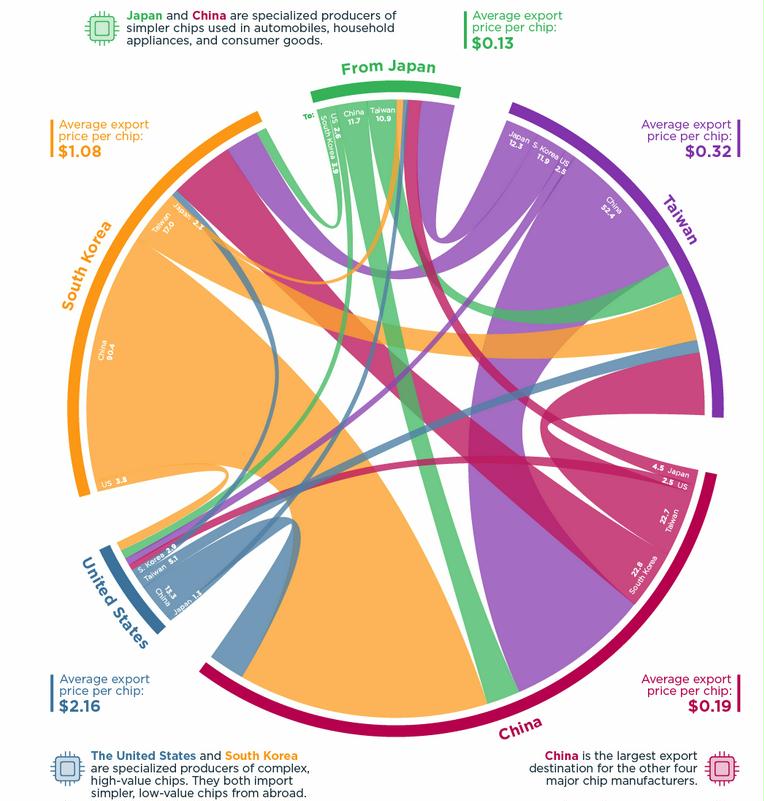
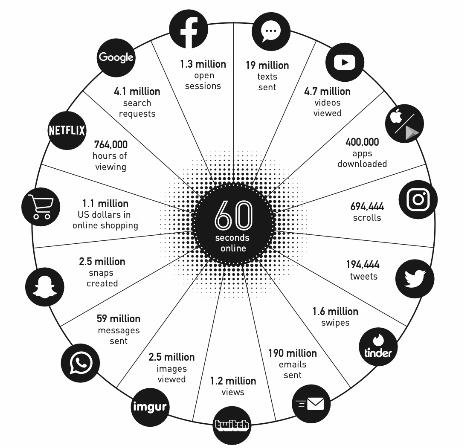 One minute on the internet around the world. Source Infographic by @LoriLewas and @officiallyChad, 2020.