Preface. This is a book review of Ehrman’s 2023 Armageddon: What the Bible Really Says about the End. Ehrman is a very devout biblical scholar who explains brilliantly what Revelations and other verses in the bible mean within their historical context. The apocalypse was certainly meant to be happening back when the chapters were written, not in the future.
Ehrman explains how apocalypse in our own time became popular in the 1800s, especially from Hal Lindsey’s book The Late Great Planet Earth. A book important to none other than President Ronald Reagan, Secretary of Defense Caspar Weinberger, and other members of Reagan’s cabinet, who were convinced that the nuclear bombs were eventually going to fly. For people in power to think that mutual self-destruction has been foreordained in holy writ is frightening!
The belief in Late Great Planet Earth and Revelations in the Bible has led many evangelists to believe that if the world is going to end (soon) as the Bible proclaims, so no need to take care of climate change or the environment. The existential horror of nuclear bombs is not a problem, since that might be how God intends to destroy the planet before Jesus returns. Nor is there anything to fear, the Lord will build a new Jerusalem made completely of gold with a wall of jasper, gates of pearl, and a foundation of jewels and 2 million square miles of solid gold.
Ugh, heaven is decorated in worse taste than Trump’s homes!
Many evangelicals treat the bible like the I Ching, and randomly open it up and read a verse, hoping it will shed light on some problem they’re dealing with. Verses are randomly taken out of context and strung together from all over the Bible to come up with really wacky predictions.
The violence in other chapters of the bible, full of genocide, slaughter, enslavement, rape of women who didn’t believe in God are also brought in to give perspective to the even greater horrors of Revelations. No matter how good you are, most people are going to eternally burn in the Lake of Fire for many reasons explained in this book.
Revelations is one torture after another. Men, women, and children are crushed like grapes with their blood flowing horse high for hundreds of miles. And my favorite: When the 5th trumpet blows, locusts emerge from a bottomless pit that look like horses equipped for battle, but with tails like scorpions that have stingers which give people with so much pain for five months that they beg to die, but God forbids the locusts from killing them (Revelation 9:1–6).
Revelations is the ultimate prosperity gospel: And the opposite of what Jesus preached
The apocalyptic visions of Revelations begin and end with glorification of wealth and heavenly opulence. God is described only in terms of precious jewels on a throne surrounded by a rainbow like an emerald. Imagine what the whole palace must look like. The new Jerusalem is made completely of gold with a wall of jasper, gates of pearl, and a foundation of jewels. The ground is covered by 2 million square miles of solid gold.
Even The Beast has 10 diadems and controls the world’s economy, hoarding all the money, while Jesus’s followers have none at all. The Whore of Babylon is adorned with gold, jewels, and pearls. John castigates this grotesque affluence, but this is exactly what the new Jerusalem will be like – much much better in fact! The followers of God will get what Rome has now, and even more. All the wealth on earth will be transferred to the Saved. And not just wealth, but POWER. All the nations of the earth will be subservient to them (wait –weren’t they all destroyed?) For John, the problem is that the wrong people (the Romans) have all the power. But not after they are tortured in myriad ways, and burned in the lake of fire
Despite the claims of televangelists and preachers of the “Prosperity Gospel,” this is surely not what Jesus had in mind. He insisted his followers not care what they eat, drink, or wear. They were to live spiritual lives removed from material concerns. Material things need to be abandoned.
Jesus preached the opposite. The way to greatness was humility, the way to power through service, and mastery though sacrifice. Service is the goal. He tells Peter that God’s ways are not human ways. God values service, not domination. He never says that those willing to serve now will become ruthless tyrants in the afterlife. His message is far more radical than that: serving itself is the mark of greatness.
I thought this book was both profound and interesting. I have been trying for years to understand what evangelists are thinking, why they voted for Trump, are easily tricked into being anti-vaccination and so on. And no wonder they are so gullible, they believe in what the Bible says literally, though few have actually read it, or understood what they were reading, which requires knowing history and other languages. Besides, like most authoritarian followers (see post Conservatives without Conscience and Republicans Brains are wired to deny science & reality), they prefer to believe what their chosen leaders tell them. The risk of doing research on their own might lead to evidence that didn’t fit their world views, and the very definition of a conservative is disliking change and changing their minds.
What follows are excerpts from the book, sometimes paraphrased. A lot has been left out that is also of interest.
Alice Friedemann www.energyskeptic.com Author of Life After Fossil Fuels: A Reality Check on Alternative Energy; When Trucks Stop Running: Energy and the Future of Transportation”, Barriers to Making Algal Biofuels, & “Crunch! Whole Grain Artisan Chips and Crackers”. Women in ecology Podcasts: WGBH, Financial Sense, Jore, Planet: Critical, Crazy Town, Collapse Chronicles, Derrick Jensen, Practical Prepping, Kunstler 253 &278, Peak Prosperity, Index of best energyskeptic posts
Ehrman BD (2023) Armageddon: What the Bible Really Says about the End
Many early Christians opposed the book of Revelation and argued it should not be included in the New Testament. The author, they insisted, was not an apostle and the book presented unacceptable views of the future of earth and the people who will inherit it. In the end, of course, they lost the argument. Once the book was widely accepted as Scripture, the followers of Jesus had to figure out how to make sense of it.
Over the long course of Christian history, many readers of the Bible have opted simply not to delve into its mysteries. Even today, most find the book of Revelation bizarre and unapproachable. Those who do read it usually fall into two camps. Since the end of the nineteenth century, most evangelical Christians have taken the book as a blueprint for events soon to come. These readers are convinced that the book’s prophecies are now, at last, being fulfilled. God has begun to intervene in history through a series of foreordained disasters. At a final confrontation of the powers of good and evil, the Battle of Armageddon, Christ will appear from heaven to destroy his enemies. But true believers in Jesus will survive and thrive in a glorious utopia—a city of gold with gates of pearl, from which they will rule the world for all time.
I began my study of Revelation as a teenager in the mid-1970s. As a committed evangelical Christian, I considered every word of the Bible inspired and true, and I heartily embraced a literal reading of the prophecies of Revelation, convinced they showed beyond any doubt that Jesus was soon to return from heaven, and then there would be hell to pay, at least for those who, unlike me, were not true believers.
I came to see the difficulties with this view and began to explore the book of Revelation from a more historical perspective. I realized why it was important to understand the work in its own context in relation to other ancient Jewish and Christian books collectively called “apocalypses.” These are endlessly fascinating works that narrate visions of things to come in order to show how the awful realities of earth can be explained by the truths of heaven, with the goal of providing comfort.
In the second part, I show why I also don’t think Revelation provides a comforting message for the vast majority of those who suffer in this life. The overwhelming emphasis of Revelation is not about hope but about the wrath and vengeance of God against those who have incurred his displeasure. For the author of Revelation, that entails the vast majority of those who have ever lived, including, perhaps surprisingly, a number of committed Christians. The largest section of Revelation describes God inflicting horrible suffering on the planet: war, starvation, disease, drought, earthquake, torture,
and death. The catastrophes end with the Battle of Armageddon, where Christ destroys all the armies of earth and calls on the scavengers of the sky to gorge themselves on their flesh. This is the climax of the history of earth.
But it is not the end of all things. After the slaughter there will be a final judgment, when God’s faithful followers, his “slaves,” will be saved; everyone else who has ever lived will be brought back to life and then thrown, while still alive, into a lake of burning sulfur. Afterward, God will reward his obedient slaves by giving them a glorious new city of gold with gates of pearl. The saved are God’s minions who do what he demands. The love of God—for anyone or anything—is never mentioned in the book of Revelation, not once.
Would Jesus have accepted John’s celebration of violence, quest for vengeance, passion for glory, and hope for world domination? Did he not instead urge his followers to pursue love, non-retaliation, poverty, and service?
I also explain how a literal reading has created disastrous problems, including personal and psychological damage of myriads around us: family members, friends, and neighbors. But there is more than that.
The expectation—or, rather, hope—for imminent Armageddon has affected our world in ways you might not expect, involving carnage, US foreign policy, and the welfare of our planet.
There could scarcely be a better time to reflect on such matters. We live in apocalyptic times of massive starvation, population shifts, plague, global superpowers waging war, and, possibly most frightening of all, a burning planet. Parts of our Western cultural heritage that are driven by traditional apocalyptic thinking have encouraged fatalism and inaction in the face of our crises. We would do well, then, to reflect on the historical roots of these views.
For readers who do not know about the “rapture”: for well over a century now, self-identified fundamentalists and other conservative evangelical Christians have maintained that Jesus is soon to return from heaven in order to take his followers out of the world. They will be “snatched” up with him from earth to heaven—hence the term “rapture”. Jesus will remove them from the world so they can escape the coming “tribulation,” a seven-year period of absolute misery in which the chief opponent of Christ, the Satan-inspired “Antichrist,” assumes sole political power over all the nations of earth, while natural and military catastrophes occur one after the other. At the end of this period, when the world is about to blow itself into oblivion (in most scenarios since 1945 through a massive nuclear exchange), Jesus will return again, this time to put an end to the madness before all is lost. He will then bring a thousand-year period of peace on earth, to be followed by a last judgment and then a utopian kingdom for the saved, for all time.
Since the end of the nineteenth century, most fundamentalist Christians have maintained that all this is taught in the Bible. That would have been news to Christians throughout most of the first 1900 years of the church. But starting especially in the 1890s, this view spread in popularity until it became the standard understanding of what was to happen here on planet earth, at least among Christians in North America and some parts of Europe.
Today, a belief in the coming rapture is held by hundreds of millions of people—not just fundamentalists—all of whom believe it is simply what the Bible teaches, especially in its final book, the Apocalypse of John, also known as the book of Revelation. The author, who calls himself John, assures his readers that these events are “coming soon.” But when?
The summer before going to Moody bible college, I studied the Bible as best I could. I knew there was an entrance exam and I didn’t want to seem like an idiot. But the book of Revelation scared me. The week before leaving for Chicago, I decided I had to bite the bullet, but it was to no avail: I couldn’t make heads or tails of it. My sense is that most readers are like that. It really is a mystifying book, and unless someone gives you a road map to explain how the author gets from point A to point B and tells you how to interpret the signs along the way, you’ll get lost. After getting to Moody, I was given that map.
I got the general lay of Revelation’s land right off the bat—the book is quite popular among fundamentalist futurists—and in my second year I took a semester-long course on it. In addition, I had a private guide, recommended by millions of travelers before me: Hal Lindsey, whose book The Late Great Planet Earth (Wiki: 28 million sold), first published in 1970, became something of a second Bible for evangelicals around the country. This book was the single bestselling work of nonfiction (using the term loosely) of the 1970s, a book later important to none other than President Ronald Reagan, Secretary of Defense Caspar Weinberger, and other members of Reagan’s cabinet, who were convinced that the bombs were eventually going to fly. For people in power to think that mutual self-destruction has been foreordained in holy writ is not, obviously, a comforting thought.
In Lindsey’s account, the now-restored Israel was soon to assume control of the entire city of Jerusalem and, in the process, claim the Temple Mount entirely for itself. It would then level the Dome of the Rock, the Islamic shrine built over the site of the original temple, which had been destroyed in 70 CE. Israel would rebuild the temple, as predicted by the biblical prophets. This reassertion of Israel’s religious and national rights would rouse opposition from the neighboring Arab states, compelling Israel to seek political and military assistance through an alliance with a newly formed ten-nation European Commonwealth. The leader of the Commonwealth would negotiate peace in the Middle East for three and a half years but would then show his true colors. He would enter the Jerusalem temple and, in the holy place itself, declare himself to be God. This would begin a reign of terror designed to beat the nations of earth into submission so that he himself, the Antichrist, could control the entire world’s economy.
The Arab-African coalition would respond to this threat by invading Israel. Then the big guns would get involved. The Soviet Union, always eager to flex its expansionist muscles and keen to acquire the vast resources of the Middle East, would enter the fray with an amphibious and ground attack that would overwhelm the Arab-African alliance. The European Commonwealth would respond with a tactical nuclear strike, wiping out the Russian homeland. At this point, China would see its opportunity and, with a newly refurbished 200-million-soldier army, would converge on the Europeans in the final battle. (Lindsey did not spell out the involvement of the U.S.; he vaguely links it with the European Commonwealth.) In desperation, both sides would release their nuclear arsenals and the human race would be on the brink of complete annihilation when… Jesus returned to end the nonsense.
For Hal Lindsey, this is what the Bible teaches. And it teaches it will all happen soon. But believers in Jesus would see none of it happen. Immediately before this entire sequence of events begins, the followers of Jesus would be taken out of the world. They would be raptured.
For those of us inclined to subscribe to the infallibility of the prophetic writings of Scripture, these dismal projections were not speculations but judicious interpretations of God’s holy word. Everyone had a choice. They could go directly to heaven at the first return of Jesus to enjoy the bliss of paradise, or they could stay down here to experience hell on earth.
But here is a little-known factoid: The word “rapture” never appears in the Bible. Or anything about the followers of Jesus being taken out of the world before it all goes up in flames. The idea of the rapture has not been taken from the Bible; it has been read into the Bible. No one had even thought of the idea of a “rapture” until the 1830s. Of the many, many thousands of serious students of the Bible throughout Christian history who pored over every word—from leading early Christian scholars such as Irenaeus in the second century; to Tertullian and Origen in the third; to Augustine in the fifth; to all the biblical scholars of the Middle Ages up to Aquinas; to the Reformation greats Luther, Melanchthon, and Calvin; on to, well, everyone who studied or simply read or even just heard passages from the Bible—the idea of the rapture occurred to no one until John Nelson Darby came up with the idea in the early 1800s.
Surely the rapture was in the Bible, in 1 Thessalonians 4:13–18, in a letter by the apostle Paul to his converts in the city of Thessalonica to provide assurance and comfort because they were worried about “those who have fallen asleep.” A euphemism in the Bible for “those who have died.” When Paul converted the Thessalonians, he had taught them that the end of the present age was coming very soon: God was about to bring a utopian world to the world, the glorious kingdom of God. Some of the Thessalonians had died before this could happen, and the survivors were very upset: Had those who were no longer living lost out on their chance for the coming kingdom?
No. When Jesus returns from heaven, the very first to be rewarded will be the believers who have already died. They will be raised up from their graves to meet Jesus on his way down; then those still living on earth will also rise up to meet him in the air. That’s the rapture, right? It sure seems to be if you read the passage with fundamentalist eyes: For we tell you this by a word of the Lord: we who are living, who are left until the coming of the Lord, will not go before those who sleep. For the Lord himself will descend from heaven with a cry, with the voice of an archangel, and with the trumpet of God—and the dead in Christ will rise first. Then we who are living, who remain, will be taken up together with them in the clouds, to meet the Lord in the air. And so we will always be with the Lord. (1 Thessalonians 4:15–18) How can this not be referring to the rapture? To begin with, it is important to read the passage, and all passages of the Bible, in context.
The key is to understand Paul’s explanation of what will actually occur at that second coming. Paul insists that Christ will return in judgment. Jesus was crushed by his enemies at the crucifixion, but he is coming back to annihilate them. His return will bring destruction to everyone who has not accepted the good news of his salvation. The “saved” will survive the onslaught and be rewarded with glorious bodies that will never again be hurt, sick, or die; they will then live forever with Christ in the coming kingdom (see 1 Corinthians 15 and 1 Thessalonians 1:9–10). I
In these next words, he indicates that the coming of the Lord (4:13–18) will bring “sudden destruction” for those not expecting it (5:3). Christ will be like a “thief in the night” (5:4). This is not a reassuring image. The robber comes to harm, not to help. But the good news for Paul is that this harm will come only to those who are not among Jesus’s followers; his faithful will survive the onslaught, “For God has not destined us for wrath but for salvation through our Lord Jesus Christ” (5:9). So what does Paul mean in 4:17 when he says that Jesus’s followers will “meet him in the air”? It can’t be a “rapture” that removes his followers from the world before the long-term tribulation. Jesus is not coming to provide an escape for his followers but “sudden destruction” for his enemies.
Then why are his followers floating up to meet him? The Thessalonians, reading this letter in 50 CE, would have had no trouble understanding it. As scholars have long suggested, Paul’s description of Jesus, the “Lord,” coming to his “kingdom” uses an image familiar in antiquity. When a king or high-ranking official arrived for a visit to one of his cities, the citizens would know in advance he was coming and would prepare a banquet and festivities. When the long-awaited king and his entourage approached, the city would send out its leading figures to meet and greet him before escorting him back to their town with great fanfare.
For Paul in 1 Thessalonians, that’s what it will be like when Jesus comes. He is the king coming to visit his own people, who will go out to greet him. In this case, though, he is not coming with his entourage on horses; he is coming with his angels from heaven to destroy his enemies. And so, to greet him, his followers—all of them, not just the leaders—will be taken “up” to “meet him in the air.” But this escort will not remain in the air any more than, on earth, the king’s welcoming committee would remain outside the city walls. They will accompany him back to earth, where he will enter his kingdom and rule forever, in a paradise provided to his chosen ones, now that all others have been suddenly destroyed.
There is no “rapture” here, no account of Jesus’s followers being taken to heaven to escape a massive and prolonged tribulation on earth. The same is true of other passages used by fundamentalists who insist that the rapture is taught in Scripture. Such as: Then two will be in the field; one will be taken and one will be left. Two women will be grinding meal together; one will be taken and one will be left. Keep awake therefore, for you do not know on what day your Lord is coming.
We took the verse out of context as a pretty obvious reference to the rapture, where some will be taken out of the world and others abandoned for long-term misery. If we had read it in context, however, we would have seen that this is the opposite of what Jesus was teaching. In the verses right before the passage (Matthew 24:38–39) Jesus likens the coming of the Lord to what happened in “the days of Noah,” when only Noah and his family were saved in the ark when the flood took away—that is, drowned—everyone else. In this passage, then, it is the people who are “taken” who are destroyed; those “left behind” are the ones who are saved.
Notice that Paul includes himself among the living at the time. When he speaks of the two groups, he refers to “those” who are dead and “we” who will still be alive. It’s a point worth emphasizing. These New Testament authors who speak of Christ’s return thought it was to happen in their own day.
That’s not what we believed back in my evangelical days. We had been told that passages like these referred to what would happen two millennia later, in our time. (Hey, it’s all about us!) We needed to be ready. This was a message drummed into our heads through various media—not just “prophecy books,” but Christian rock music, such as Larry Norman’s ever popular “You’ve Been Left Behind,” and Christian film, starting with A Thief in the Night in 1972, an unusually low-budget production about what would happen if you were not among those raptured and had to face the terrifying rule of the Antichrist.
The movie was meant to scare the hell out of teenagers, and it was massively successful. Everyone I know who was a 1970s evangelical has stories about it, often about the horrible sense that came over them when, one day, they found themselves alone in the house and thought the rapture had just happened but they had missed it.
All this would seem terribly bizarre and irrelevant were it not for how commercially successful the subject remained in the following decades. In the Left Behind novels over the course of 16 volumes (80 million sold from 1995 to 2007) the pair narrate events on earth after true believers in Jesus (i.e., fellow conservative evangelicals) have been raptured out of it as those who realize their mistaken ways band together and wage battle with the Antichrist and his forces. For many readers the books were page-turning stuff, and these people were not all fundamentalists, or even Christians. But the vast majority of them—studies have shown—not only turned the pages; they believed them. They thought that what they read in the novels was simply what the Bible itself says.
A fairly recent poll indicates that 79% of Christians in America believe Jesus will be returning to earth at some point. Another poll, taken in 2010, shows that 47% of the Christians in the country believe Jesus will return by 2050 (27% definitely and 20% probably). The vast majority of these people believe this is stated throughout the Bible itself, culminating in that great set of predictions in the book that brings the entire sacred canon of Scripture to a close, the Apocalypse of John.
Revelation was almost never read as a prediction of the near future for nearly two millennia. It certainly is not read that way among most historical scholars today. Revelation was not written to show what would happen in the 21st-century. It was written by an author in the first century who was addressing readers of his own time with a message they needed to learn. This view of the book is certainly not as scintillating as the claim that a prophet 2,000 years ago could see what would transpire at an end of the world that we ourselves will be experiencing. You mean God was not principally concerned about our generation from the very beginning? We aren’t the culmination of the human race, the goal of all human history?
Many people (most?) open the Bible to find answers to personal, pressing questions and to receive guidance [my aside: sounds like the I Ching or astrology]. Such readers want direction. For them, since the Bible is the means by which God speaks to his followers, it can be used to provide almost mystical answers that would not be available through a simple reading. A very common technique is simply to open the Bible at random—either with a particular concern in mind or hoping to learn whatever God “wants to tell me today”—and to read the first passage that strikes your eye (or the passage you blindly place your finger on) to find out what it is saying to you. That, of course, is not how you read The Grapes of Wrath. The logic is that the Bible is a different kind of book from every other, because God is speaking through it. In my view this is not reading the Bible as a book. It is using the Bible as a kind of Christian Ouija board. God directs your gaze or your finger to what he wants to tell you. You then interpret what you read in light of your concerns.
The professional prophecy writers like Hal Lindsey and Timothy LaHaye who appeal to Scripture as a guide to our imminent future do not take a Ouija board approach. On the contrary, they read the Bible very carefully, picking out subtleties that might be missed on a first or ninth reading. But in doing so they are looking for something. They are trying to find the pieces of a great puzzle, in fact the greatest puzzle of all: what will happen in the future. If the Bible is inspired and gives all the answers to the important questions of life, then this Big Answer must also be in its pages. For these readers, the Bible is like a great jigsaw puzzle, with one piece hidden in this place, one in another, and yet a third somewhere else. The way to use the Bible is to assemble the pieces to reveal the big picture, which until now no one has seen before. It is relatively easy to observe prophecy writers ferreting out and arranging the pieces of their puzzle, having retrieved them from hither and yon.
In one of his 88 reasons, Edgar Whisenant reaches his date of 1988 by putting together Daniel 2:1, Leviticus 26:2, and Romans 11:25. On the same page, he appeals as well to the pieces provide by Matthew 13:39; Luke 21:24; Acts 3:21; and Zechariah 14:4. Lindsey also moves flawlessly over the entire expanse of Scripture, pulling out the requisite pieces from Ezekiel 38, Daniel 11, Joel 2, Matthew 24, and Revelation 11 all in one breath. These may be biblical books written over the course of many centuries by authors living in different areas, speaking different languages, addressing different audiences with different concerns, but for these fundamentalist readers, each writing may contain a vital missing piece to the Puzzle of the End. Another famous prophecy writer, Jack Van Impe, who spent a long career lecturing that the end was coming right away by splicing together Nahum 2:3; Isaiah 31:5; Deuteronomy 7:6–8; and 1 Chronicles 17:22.10
In graduate school we denigrated this approach to biblical “study” by calling it “proof-texting”,
finding “proofs” for your views by jumping from one text to another. It is designed to assemble the pieces of the great puzzle of life hidden throughout the books of Scripture, even if each book is actually about something else altogether. It’s a bit like finding Waldo in a Dickens novel.
Irenaeus says the heretics are like someone who takes a gorgeous mosaic of a gallant king and rearranges the stones so they now portray a mangy dog, claiming this is what the artist intended all along.
The Bible is not a single book but an anthology of sixty-six books. Imagine reading The Odyssey or The Divine Comedy knowing nothing about the history of ancient Greece or medieval Italy.
If you don’t read a book the way books are written to be read, you’ll be taking a mosaic and rearranging the pieces to show what you yourself want it to show.
Historian Norman Cohn pointed out that many of them thought the current news matched biblical predictions of what would happen near the end of the age: “Since the ‘signs’ included bad rulers, civil discord, war, drought, famine, plague, comets, sudden deaths of prominent persons and an increase in general sinfulness, there was never any difficulty about finding them.”
Many people coming to the book of Revelation for the first time find its sweeping narrative disturbing. It is almost impossible to read the book without being struck by its sheer violence: it describes an apocalypse where God will vent his wrath against the world and everyone he opposes, bringing widespread misery and pain. The book recounts heaven-sent catastrophe after catastrophe: famine, epidemic, war and, in the end, a lake of fire for the majority of the human race.
There can be little question that the book of Revelation is the most mystifying book of the Bible. There are other contenders, of course, most certainly the book of Daniel, with its befuddling visions in chapters 7 through 12. Read them and you’ll see. John, the author of Revelation, certainly read them, as they were a major source of inspiration for his own visionary expositions some two and a half centuries later. The book has befuddled readers throughout the course of Christian history. For centuries, it was not widely read, and those who did read it admitted to finding it opaque at best. Even scribes were not particularly interested in copying it. We have far fewer manuscripts of Revelation than for any other book of comparable size in the New Testament.
Even top-of-the-line biblical scholars who labored long and hard over its meaning found it a frustrating task. Take Martin Luther (1483–1546). He was not confident the book of Revelation belonged among the inspired writings of the New Testament. In his translation, he placed the book in an appendix
. At times he used it to attack the Roman Catholic Church as the embodiment of evil. Like other reformers before him, Luther maintained the pope was the “Antichrist,” the “beast” of the Apocalypse, whose number was 666.
All the followers of Jesus are slaves of God in Revelation (see 1:1; 2:20; 7:3; 10:7; 19:2, 5; 22:3, 6), but this is portrayed as a very good thing. There is a clear upside to enslavement: in the end, God’s entire slave force is allowed to live in the fantastic abode he provides and enjoy all its luxuries; everyone else will be ruthlessly destroyed.
John explains that the revelation he received involved a vision (“that he saw”) about what “will take place soon” (1:2). He then names the intended recipients of his message: “the seven churches in Asia” (1:4). I need to stress this point: John was writing to seven groups of Christians that he personally knew, not to people living 2000 years later in North America. When he says he has seen a vision about what “will take place soon,” he means “soon” for his actual readers. He does not mean “thousands of years from now.”
Most readers find the letters written to the seven churches in chapters 2 and 3 a rather uninspiring beginning to the Apocalypse. Why do we need to read someone else’s mail? Bring on the action! But the letters are unusually important. John was told to write an account of his revelation to these seven specific churches and these letters show why the members of the churches need to listen.
For a very long time, biblical scholars maintained that the main problem facing these churches was persecution by Roman authorities While there may have been local cases of opposition to Christians here and there throughout the empire, but there was no imperially sanctioned opposition. Why would John indicate there was? Throughout history—and still today—some religious groups have insisted, and believed, they have been violently opposed far more rigorously than in fact they were. Possibly John and his communities were like that. Some scholars have argued that he, and they, perceived persecution because they felt isolated and rejected, or because they made mountains out of molehills, or because thinking they were a persecuted minority helped strengthen their commitment and bonds.
Persecution is just one of the issues he raises. He is far more worried about false teachings and his followers’ general lack of fervor. Persecution does not appear to be his most pressing concern.
One of the most intriguing features of the letters of chapters 2 and 3 is that John does not compose them: he is merely serving as the secretary, taking dictation from Christ himself. This is the only place in the entire New Testament that Christ is said to “write” anything. His words show he is not happy with his followers. We will later see, repeatedly, that he is extremely unhappy with the vast majority of the human race, who are not his followers—to a person, they will be sent to a horrendous death. But a lot of his followers are also in hot water (or, rather, bound for a lake of fire). He shows no leniency to Christians who are morally lax or theologically adrift. He “hates” those (among his followers) who do not toe the line: accepting errant teachings, growing lazy in their commitment, accommodating themselves to outsiders, and being led astray by Satan no less than the pagans and Jews (see 2:6). If they do not repent and change their ways, Christ will judge them just as harshly as the rest of lost humanity.
False teachers are not outsiders trying to lead Christians astray. They are church leaders. John specifically attacks the “false teaching” that allows followers of Jesus to eat food offered to pagan idols and to practice fornication (2:14, 20). Almost certainly, though, the church members under attack were not actively practicing paganism. More likely they were in a situation similar to that described by Paul some years earlier in 1 Corinthians 8 and 10, which deal with the problem of whether it is acceptable for Christians to eat meat that had been sacrificed to pagan gods. Possibly there was no real option for anyone wanting a piece of meat for a meal, since pagan priests were the local butchers. In any event, Paul indicates in his letter that the Christians who considered it acceptable to eat the meat did so because they thought the pagan gods did not actually exist. Idols were just wood or stone. If the gods didn’t exist, they couldn’t really have received sacrifices, so eating the meat didn’t involve worshipping them. But others in Corinth—possibly people who were less educated and more superstitious—were convinced the pagan gods actually did exist—not because they were really gods but because they were demons. Eating the meat, then, involved participating in a demonic ritual, and that should be avoided at all costs.
Paul thought it was better not to eat the meat. In Revelation, John is far more emphatic: eating meat offered to idols is an affront to Christ.
In a letter to the church of Thyatira, Christ attacks a woman prophet he calls “Jezebel,” an allusion to the notorious queen of Israel who led the people of God astray (1 Kings 16:31; 2 Kings 9:22). This Jezebel is said to be a church leader who “teaches and deceives my slaves to commit sexual immorality and to eat food offered to idols” (2:20). That is, she has taken the position on idol meat found among some of the prominent members of Paul’s church in Corinth: Paul advises against the practice but does not roundly condemn it.
In Revelation 2, Christ indicates he has already given Jezebel a chance to repent—in other words, to stop condoning the practice of eating meat purchased from a pagan temple—but she has refused. And so he indicates her judgment: See, I will throw her onto a bed, and those who commit adultery with her I will throw into a great affliction, if they do not repent from her deeds. And I will kill her children. (2:22). What happens on the bed is not that Jezebel gets sick. She has illicit sex with others. After Christ has thrown her there. This is not a pretty image, but it gets worse. Christ will kill them. That probably means that they will be condemned in the coming judgment, but John may mean it literally as a threat in the present. We do have examples of God killing those among his followers he is not pleased with, not just in the Old Testament (for example, Numbers 16:1–35), but also in the book of Acts (5:1–11) and the writings of Paul (1 Corinthians 11:27–30). The latter instance, interestingly, also involves a case of inappropriate dining practices
The letters of chapters 2 and 3 set the context for the entire Apocalypse. Christ is in charge. He considers Jews to be Satan-worshipping enemies of his people. Christians must avoid pagan associations. Those who are lax in their faith are in danger of losing their salvation. Christ hates Christians who do not adhere to correct teachings about how to live, so much so that he threatens them with a judgment that will be without mercy. But those who are obedient, faithful, and passionate about their faith—who in the end “conquer”—will be gloriously rewarded. There are clear dividing lines here between “us,” the committed Christians who follow the truth, and “them,” non-Christian and Christian alike. “They” are in big trouble.
Chapter 4 is where the real action begins. John is again “in the spirit” and he arrives in heaven to a gloriously terrifying scene. He is in the throne room of God himself (4:1–6). On his throne, God appears like brightly colored jewels and his throne is surrounded by a rainbow with thunder and lightning shooting out. Around the throne are four living creatures with eyes all over their bodies; apart from the eyes, they look like a lion, an ox, a human, and an eagle (4:6–8). They reveal that the entire order of living existence has been created to bow in eternal adoration before its creator. There are also 24 human “elders” sitting on their own thrones around the throne of God (4:4, 9–11). As I suggested before, these may represent the 12 patriarchs of Israel and the 12 apostles of Jesus. They, too, worship God constantly and “forever and ever,” and cast their crowns before him, declaring he alone is worthy of all glory, honor, and power. The vision begins with the absolute Sovereignty of the Almighty Creator God, who rules in heaven, dwelling in mind-boggling majesty, worshipped by those he has made.
Even though God’s appearance is described as jewellike, he apparently has body parts. Chapter 5 begins by indicating that he is holding a scroll in his right hand. The Lamb is worthy to break the seals of the mysterious scroll and he begins to do so. The scroll appears to contain God’s directives for the fate of planet earth. Now the disasters begin.
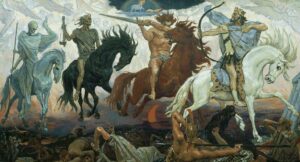
Each time the Lamb breaks one of the seals, a new catastrophe hits the earth. First come the famous “four horsemen of the Apocalypse” (6:1–8). The first appears on a white horse and wields a bow with which he conquers, possibly signifying foreign (barbarian) invasions. The next rides a red horse and causes people to slaughter one another; that is, he prompts domestic bloodshed. Then there is one on a black horse who creates massive food shortages and starvation. Finally one appears on a pale green horse and is Death itself, with Hades following, having the authority to destroy an entire fourth of the world’s population. The extent of the violence should give us pause: if this horseman—and he alone—were to appear tomorrow, he would slaughter nearly two billion people.
Then comes the most horrific seal of all, the sixth. When the Lamb breaks this seal, cosmic chaos erupts: there is a massive earthquake, the sun turns black, the moon turns red as blood, the stars fall from the sky, the sky vanishes, and—well, you would think the world is over now with the collapse of the universe, right? Wrong.
With its many descriptions of wars, natural disasters, retribution, bloodshed, and death to come, the narrative is not showing an actual sequence of events but is instead repeating itself in different terms and various ways to emphasize a point: at the end, all hell is going to break out, until God brings it all to a crashing halt with the destruction of his enemies.
After the sixth seal we have a one-chapter hiatus, in which followers of God are separated from the rest of humankind, in two major groupings. First there are 144,000 Jews, 12,000 from each of the 12 tribes of Israel, who are “sealed” with the “seal of the living God” (7:1–8). Since these Jews receive God’s own seal, they will be saved, fulfilling God’s promises to the Jewish people that they are the chosen ones.
John has structured his narrative of repetitive catastrophes by making the disasters of the seven seals conclude with disasters brought by seven angelic trumpet blasts; the trumpeting then concludes with seven disasters brought by seven bowls of God’s wrath poured by angels onto the earth. Thus we have three sequences: the last of the seven seals contains the seven trumpets, the last of which contains the seven bowls of wrath.
The first is the appearance in chapter 13 of God’s archenemy on earth, “the beast of the sea” (13:1). This horrifying sea monster comes ashore and is empowered by Satan to assume complete control of the earth. The creature is often identified by readers as the “Antichrist,” although that term is not used in Revelation. Still, it is certainly apt. This is Christ’s opposite, a ruler of the human race who is wicked, seemingly all-powerful, and violently opposed to Christ’s followers (13:1–18). Its number is 666. Following the sea beast is another beast, which rises up from the earth and is elsewhere called the “false prophet” (13:11–17; 16:13). Its purpose is to make the inhabitants of earth worship the first beast, persuading them by performing great miracles. Those it convinces—everyone but the followers of Jesus—must receive a “mark” on their right hand or forehead. Without this “mark of the beast,” no one can buy or sell anything (13:17). In other words, the beast of the sea exercises a complete monopoly over the economy of the earth.
The second interlude (14:14–20) involves a series of disasters, war, and bloodshed where two heavenly reapers use “sickles” to harvest the earth—that is, to cut down their enemies, who are likened to grapes for “the wine press of the wrath of God.” The “harvest” of this slaughter is then “trodden” and we are told that “blood flowed from the wine press up to the horses’ bridles, for 200 miles” (14:20).
At this conclusion of the cycles of earthly disasters, an unusually memorable scene occurs as the prophet is taken into the wilderness in chapter 17 to see a horrifying woman, clothed with fine raiment and many jewels, sitting on a scarlet beast with seven heads and ten horns. She is “drunk with the blood of the saints and the blood of the witnesses to Jesus, and has a name written on her head: ‘Babylon the great, mother of whores and of the abominations on earth’ ” (17:1–6).
In a somewhat surprising twist, Satan is not destroyed immediately. Instead, he is seized by an angel, put in chains, and thrown into a bottomless pit for a thousand years (20:1–3). Then comes a scene of judgment, but not for everyone. Those who had refused the “mark of the beast”—that is, the followers of Jesus who had been martyred—are brought back to life to rule on earth with Christ for a thousand years. This is called the “first resurrection”. When the thousand years are over, Satan is released from his prison and once more makes war on the saints (20:7–9). It is a short-lived affair. The Devil is defeated, captured, and thrown into the lake of fire, where the beast and his prophet have already been bobbing for ten centuries.
Then comes the denouement of this extended period of revenge and justice, the “Great White Throne Judgment.” All the dead—everyone who has ever lived—are restored to life and made to stand before the throne of God. Everyone whose name is not in the Book of Life is thrown into the lake of fire with the beast, the prophet, and the Devil (20:13). Throughout his narrative, John has described untold pain, misery, and suffering, but his book ends on a happy note, at least for the followers of Jesus who have survived. God will “wipe away every tear from their eyes and there will be no more death, suffering, weeping or pain” (21:4). They have “conquered” and now will inherit God’s gifts. They and no one else: all other inhabitants of earth, we are told again, have been tossed into the lake of fire.
The new Jerusalem is a marvel to behold. It is said to be a 12,000 “stadia” cube—that is, about 1,500 miles long, wide, and high (21:16). Its length would be from about New York City to Oklahoma City, its width from Miami to Toronto, and its height, well, 1,500 miles. We are never told why it needs to be so high. (Many levels? Amazing skyscrapers? Just on principle?) The city is made of “pure gold” (21:18). It has twelve foundations made of precious stones, and twelve gates (Just twelve? For a city 1,500 miles on each side?), each featuring a single pearl. The street (singular!) of the city is pure gold (21:21). There is no temple in the city—none is needed. God and his Lamb are worshipped directly. And there is no need for light. The glory of God provides all the light needed and the Lamb is the lamp (21:22).
Then, in one of the many glorious perplexities of the book, we are told the other nations on earth will walk by the light of the city. Kings of other lands will bring their resources into it and no one who “practices abomination or lying” will be allowed to enter, “only those who are written in the Lamb’s book of life” (21:24–27). The attentive reader (or even the inattentive one) will naturally wonder: What “other nations,” “kings,” and “sinners”? Weren’t they all just destroyed?
John certainly believes that what he has described in this mysterious narrative is to happen soon. In the final chapter alone he indicates that these things “must take place soon” (22:6); Jesus himself says, “I am coming soon” (22:7); Jesus again assures his readers, “I am coming soon” (22:12), and then yet again says, “I am coming soon” (22:20). John urges him on: “Amen. Come Lord Jesus!” (22:20). For John, Jesus was not coming two thousand years later to rapture his followers out of this world. He was coming in judgment in John’s own near future. Those who opposed him would be horribly destroyed, while his followers would enter into a glorious city made of gold, where they would enjoy peace, joy, and security in the worship of God forever. And God would wipe away every tear.
Throughout Christian history the dominant view was one espoused by Augustine (350–430 CE), the most influential theologian of Christian history. Augustine insisted that the “future” millennium described in Revelation—when Jesus and his followers would rule on earth—was not a literal event but a metaphor for what was already being experienced in the life of the church. We will explore Augustine’s views later, but for now it is enough to observe that this great giant of a Christian intellectual sent the “futurist” understanding of Revelation into long-term hibernation. It reemerged only occasionally over the centuries, until it was born again in the 1800s and began to spread its message of an imminent end with all the fervor of the newly converted.
We have no record of how the book of Revelation was read by its intended audience, the Christians of the seven churches of Asia Minor, but they likely would have understood most of the bizarre symbolism with relative ease.
Later church fathers would attack this view as materialistic and unsophisticated. Church fathers found this literalist view of future glory troubling because they maintained salvation was a spiritual affair, not one of bodily pleasure in a luxurious kingdom of God.
One of the first on record to oppose the idea of an imminent end of all things was a well-known church leader, Hippolytus of Rome, who around 200 CE provided an actual date for the end of the world, apparently to circumvent the idea that it would be any-time soon. To make sense of Hippolytus’s dating of doomsday, we need to understand why there have long been Christians who thought the world would last six thousand years. The first Christian text to support the idea is the Epistle of Barnabas, which dates to around 135 CE. Some early church leaders considered the epistle part of the canon of Scripture, although we should be thankful that it wasn’t ultimately included: it is far more vitriolic in its attacks on Jews than anything in the eventual New Testament.
In Genesis 1, God created the world in six days, and then on the seventh he rested. This shows the seventh day is a Sabbath, the day of God’s rest. God’s creation thus lasts six days. The Bible elsewhere states that “with the Lord, a day is as a thousand years and a thousand years as one day” (2 Peter 3:8; see Psalms 90:4). And so, when God instructs his people to “observe” the Sabbath, he means they should realize that the world will last six thousand years before the “day” of rest, the earthly millennium (Barnabas 15.1–5).
Hippolytus wants to explain when this will be. He argues that the world was created 5,500 years before Christ’s birth. If the world is to last six thousand years (here Hippolytus relies on the tradition found in Barnabas), then it will end around 500 CE, when the Antichrist arises and persecutes the saints. Hippolytus wrote his commentary in about 204 CE, and the point he is making is a bit subtle: the end will not come right away. The world will last another nearly 300 years, so there is no need for his readers to panic.
One of the most significant shifts in Christian thinking about the Apocalypse away from the Augustinian view came over seven centuries later in the reflections of the medieval Italian monk, theologian, and mystic Joachim of Fiore (1135–1202 CE). He argued that these truths were not only about the nature of the divine and the significance of the past: they were also about the future. Joachim believed God had revealed to him how the entire history of the world Since God was a Trinity, history was to unfold in a succession of three ages, the age of the Father, of the Son, and of the Spirit. The first age, of the Father, was the period of law and servitude; God gave his law to show his chosen people how they were to relate to him. That age lasted until the life of Christ, whose death and resurrection brought in the second age, characterized by grace and submission. The final age, the age of the Spirit, was yet to come. It was to be characterized by the direct and immediate knowledge of God. For Joachim that would be heaven on earth. God’s chosen people would live in ecstatic and devout contemplation of God. This, in effect, was the life of a Cistercian monk writ large. At the end of this third age, the Antichrist would briefly arise, but his evil influence would be put down and the final judgment would come. Joachim did not set a precise date for the end of the world.
On the assumption that a biblical generation lasts thirty years, Joachim crunched the numbers. The age of the Father (from Abraham to Jesus) lasted 1,260 years. In the 1240s and 1250s, these Franciscans revived interest in Joachim’s writings and in some cases began propagating forgeries in his name. Most important for our purposes, they began to insist on doing the math. As propagated by the Franciscans, Joachim’s concept of the three ages made a significant impact on Christian thinking, but it never became the majority view—possibly because of its vision of what the age of the Spirit would involve
In European Christianity, it did not surface until there were reasons for thinking the world really was coming to an end. The unprecedented violence of the Reign of Terror was seen to be so catastrophic by some British Christians that devout church members could not help but think the horrors of the Apocalypse had come upon them. That would mean, of course, that what had been the traditional understanding of John’s Revelation from the time of Augustine was completely wrong: the book was not describing what had already happened during the course of Christian history – the book really did appear to predict what was yet to come.
This was not the first time that a more literal reading of Revelation had popped up. You will recall that Protestant Christians, going back to Luther himself, had identified the beast of the sea—which rules the earth, blasphemes God, and persecutes the saints—as the pope.
In the 1790s some Anglican theologians calculated that the papacy as an institution assumed full power over the church in 538 CE under Pope Vigilius. If the beast was to rule 1,260 years, then his demise would come in 1798. As it turns out, that was the date Napoleon’s chief of staff, Louis-Alexandre Berthier, invaded the Vatican, banished Pope Pius VI from office, imprisoned him, and established the Roman Republic. This was the “mortal wound” that Revelation predicted the beast would receive.
The apocalyptic implications of events in Europe happened to coincide with a seemingly unrelated development within British Christianity, a renewed interest in the fate of the nation of Israel based on biblical prophecies. As odd as it might seem, the combination of these two developments—a renewed sense that the end had begun and an interest in the fate of the Jewish people—led ultimately to the formation of biblical fundamentalism and, more recently, the apocalyptic expectations of the Left Behind series. The Christian interest in the modern state of Israel, most strongly expressed today among American evangelicals, has its roots in the first decades of nineteenth-century England, in a serendipitous course of events involving a little-known figure named Lewis Way (1772–1840).
For years, evangelical Christians had been convinced that Scripture predicted Jews were to return to the Holy Land to reestablish themselves there as a sovereign state. After all, the Old Testament prophet Jeremiah had reported God’s words to the people of Judah: “I will restore your fortunes and gather you from all the nations and all the places where I have driven you… and I will bring you back to the place from which I sent you to exile” (Jeremiah 29:14). If the end was near, as indicated by the events in France, then the eschatological restoration of Israel must be at hand. Between 1796 and 1800, this view was advanced in fifty-some books published in Britain.
Many evangelicals were thrilled when Napoleon’s army invaded Palestine in 1799, declaring that Jews were “the rightful heirs” of the land. As one commentator put it in 1812, “We know that the latter times approach, and that the Jews must and will be restored; these things greatly animate us in exertion and enliven our hearts in labor. In the widely held evangelical view at the time, the “conversion of the Jews” would go hand in hand with divine restoration of Israel. The new fervor for the return of Israel, combined with the widening belief that world events signaled the End was near, contributed to the rise of an entirely new school of eschatological thought that dominates conservative evangelical Christianity and its interpretation of Revelation still today. It is called dispensational premillennialism.
In the American colonies, most futuristic Christian thinkers believed the millennium would arrive through human progress rather than direct divine intervention. New scientific discoveries, new technologies, and the worldwide spread of the Christian faith showed that humans were enroute to achieving their potential, making this world a better place in the present and a utopian one in the future. This view eventually came to be known as “postmillennialism,” since it posited that Christ would return only after the future millennial age had run its course. A “premillennial” view, in which Jesus first returns before the millennium. Darby situated these two returns of Christ in a broader vision of God’s plan for the history of salvation, which included a number of distinct periods of human history. Within each period people interacted with him differently,
These discrete periods of history were called “dispensations,” and so Darby’s system came to be known as dispensational premillennialism. The idea of dividing history into discrete periods in which people worshipped and obeyed God differently had been around at least since Joachim of Fiore. But Darby’s view was far more complex.
Scofield realized there could be a way to spread a conservative evangelical view of the Bible by incorporating it into an edition of the Bible itself. His “Reference Bible” was one of the first of its kind, an edition of the King James Version that went beyond translation to provide introductions to each of the books, explanations of key biblical passages, footnotes to explain cross-references, maps, charts, and so on, all to guide readers in their reading and incorporating conservative evangelical views. Study Bibles are common today, with a wide variety to choose from, but they were unheard-of before the rise of fundamentalism. Scofield’s notes incorporated—and therefore propagated—Darby’s understanding of the seven dispensations. Readers who found a dispensational view in their Scofield Bible did not take it to be an unusual theory; it was part of the Bible itself. With so many conservative Protestant Christians reading the Scofield edition, its dispensational views became standard among evangelicals.
Darby’s system of dispensations included one innovation that is especially relevant to our discussion. He and his small group of dispensational premillennialists disagreed with other Christians who claimed that advances in culture and the spread of Christianity painted a rosy picture for what lay ahead. They were pessimistic that things would get worse and worse until literally all hell broke out. After all, the Apocalypse of John was principally about disasters to come, and none of its predictions had been fulfilled yet.
Unimaginable catastrophes were soon to transpire that would wipe out enormous swaths of the earth’s population and natural resources. It would be a time of incredible suffering for everyone on the planet. And so, in 1833, Darby pronounced his new idea: The followers of Jesus would not be here to experience these catastrophes. There would be a “rapture” before the coming tribulation. First, Christ would return in the air for his followers, to escort them to heaven for a period of bliss. Following this rapture, the world would descend into chaos and the Antichrist would arise. Some people would convert to Christ in this period and eventually be saved, but only after suffering through the most horrendous misery the world has ever seen. The tribulation would last for seven years. Then Christ would return again to bring an end to it all, destroying his enemies and bringing in his millennial kingdom. Scripture affirms repeatedly that it would be coming “soon.” Since it still hadn’t happened, the biblical writers obviously did not mean it would come soon in their own day; their prophecies were for people living in our time, or in the near future.
These obviously were important issues for the individuals concerned: How much will I need to suffer? They also had broader social implications: Do I start stockpiling weapons to protect my family and food to help us survive?
it was less popular in Great Britain than in America, where its popularity was boosted by a series of conferences held in Niagara, New York, in the 1890s, organized and attended by leading evangelical teachers who were concerned about the direction of both the world and the church.
Science had begun to pose a clear and certain threat to traditional Christian claims, with biologists propounding Darwinism and geologists estimating the actual age of the earth. Even many religion scholars were being seduced, especially by biblical scholars in Germany, who were practicing “historical criticism,” treating the Bible as if it were like any other book: finding contradictions, claiming historical errors, doubting the authorship of some of the writings, disputing its truth claims.
In response, the conservative theologians at the Niagara conferences doubled down on their literal views of Scripture. This is when modern formulations of the doctrine of biblical “inerrancy” arose: every word of the Bible was inspired by God and literally true, whether a statement about doctrine, history, or science. Anyone who said otherwise—who disputed a six-day creation, a real Adam and Eve, a worldwide flood, a tower of Babel, or anything else the Bible said—was not a genuine Christian and was in danger of eternal damnation. Dispensationalists insisted they alone took the literal teachings of biblical prophecy seriously, especially the book of Revelation. Since nothing John of Patmos predicted had happened yet, it all must be still to come. This literalist reading was aided by a widespread collapse of optimism about human progress.
Obliterated in the trenches of World War I. It may be hard to imagine that the invention of the machine gun would have affected biblical hermeneutics, but it certainly did. Any optimism in the West that remained after the armistice was more or less swallowed up by the Great Depression and then spit out by yet another world war that ended with the unleashing of atomic bombs.
Then came the Cold War, nuclear proliferation, and the never-before-imagined possibility that we might destroy ourselves and our planet simply by the way we lived on it. Jesus had better come back soon, or there would be no one left to save.
It is no surprise that so many evangelical Christians today are dispensational premillennialists and as a rule they embrace the basic idea that even though all hell will soon break out, there is hope for believers. Jesus will return to rescue his people from the horrors ahead. No one knows exactly when, so we all must be ready.
Miller was one of those lay readers who became intimately familiar with these texts down to their very precise detail, and came to the solemn conclusion, that in about 25 years from that time all the affairs of our present state would be wound up.” That is, he realized the world would end around 1843. He spent the next 25 years working out the details and starting a movement that grew to tens of thousands of believers. But midnight on October 22 came and went, and life went on. This ultimate failure of Miller’s prediction brought palpable despondency among the one-time hopeful.
The effects of this particular instance of end-time thinking were not limited to psychic trauma. The Millerites were subject to widespread ridicule and even to physical hardship. Soon afterward, one of the erstwhile Millerites, Luther Boutelle, explained the real-life consequences of their belief in the imminent end: Crops were left unharvested, their owners expecting never to want what they had raised. Men paid up their debts. Many sold their property to help others pay their debts, who could not have done so themselves. Beef cattle were slaughtered and distributed among the poor.
But even then, the idea does not go away, nor do the groups themselves. Various American religious groups emerged from the Millerites’ Great Disappointment—“at least 33,” according to sociologists of religion Rodney Stark and William Sims Bainbridge. Hope springs eternal, and these groups thrive among us today, holding strong eschatological views about the coming end—normally, now, without setting dates. The two break-off groups most familiar to modern readers are the Jehovah’s Witnesses and the Seventh-day Adventists.
It is from the latter denomination that another religious movement splintered off, coming to be known as the Branch Davidians, one of the most notorious groups of believers of modern times, famous since the 1993 destruction of their compound outside Waco, Texas, during a clash with the FBI after a fifty-day siege. Eighty people were killed, including the group’s leader, David Koresh. The entire disaster occurred, in part, because of Koresh’s unusual interpretation of the book of Revelation. Koresh and his followers were devotees of the Apocalypse. They did what they did because they were convinced they were the ones prophesied in the book. Koresh himself was the Lamb of God of Revelation 4–5 who was breaking the seals of the divine scroll. One of the seals predicted the Davidians’ own martyrdoms.
Most people who know about the tragedy at Waco have some vague idea about Koresh. Few people, though, know about the role Koresh’s religious views played in the tragic affair. As the story unfolded over the next few days, it became clear that the besieged group of Davidians were following what they understood to be divine principles laid out in the book of Revelation. They saw the current situation as a fulfillment of the signs. It also became clear that the FBI, which had been called in to deal with the situation, had no clue what any of that meant. When they repeatedly contacted Koresh inside the compound by phone, he eagerly explained his interpretation of Revelation for hours on end. The agents assumed he was a kook likely to continue whatever nefarious activities he was engaged with inside the compound, or that he might end it all with a mass suicide.
Tabor and Arnold studied Koresh’s biblical interpretations and realized how and why he understood the text of Revelation to be predicting the demise of his community. They also came to believe they could present alternative interpretations of the text that would make sense to Koresh, who, they believed, would be open to other views if presented in language he could understand. Koresh himself indicated to the FBI that he wanted to have discussions with biblical scholars about the matter. The FBI was becoming frustrated with what they understandably took to be the stalling tactics of a religious maniac. In the end, after a fifty-day siege, they went in and the disaster resulted. Some eighty Davidians died, including Koresh.
Misinterpretations of the book of Revelation rarely lead to catastrophe of this magnitude. But they can and have done so—in fact, throughout the Middle Ages, they sometimes led to much worse. Those of us who watch such events unfold have no difficulty seeing the narcissism of messianic pretenders. But what about the millions of regular old folk—our friends, families, and neighbors—who also genuinely believe they are living the fulfillment of prophecy? Are they delusional, too, when they claim that God’s eternal plan is now coming to fulfillment for them in particular, that they are the ones predicted by the ancient prophets of God? I try not to pass moral judgment on anyone who believes such things. All of us are almost certainly wrong about one thing or another when it comes to ultimate reality. But the belief that the divine plan of the entire human race has now climaxed with us (lucky us!) is, if not delusional, then at least a bit narcissistic. Narcissists, like their eponymous ancestor, do not see what is in the water when they gaze into it. Or for that matter what is in the Bible. They see themselves. This is not always disastrous, but it is nearly always sad.
The belief that we are living at the very end of time not only affects personal religious views; it also has significant effects on our culture, including our collective decisions. Every eligible voter in our country who thinks the End Is Upon Us has a say, and votes are often guided by their personal religious convictions. That, of course, is how democracy works.
I need to say at the outset that I am emphatically not taking a stand on the Israeli-Palestinian situation in general or American support of Israel in particular. Still, to understand that support—whatever one thinks about it—it is absolutely essential to understand how deeply it originally was and still is connected to Christian beliefs in a coming Apocalypse. In traditional Christian thinking, for reasons I will explain, Jesus cannot return until Israel has full control of the Promised Land and all of Jerusalem, including the Temple Mount. In particular, the Jewish temple, destroyed in 70 CE, needs to be rebuilt. Most evangelicals may not know this is the historical grounding for the support for the state of Israel in their tradition, but it is easily demonstrated. Who woulda thought the crisis in the Middle East would be about the Antichrist?
Hechler looked into biblical prophecies about the return of Jews to the Holy Land, and he became committed to the cause. Fourteen years later, when the founder of the modern Zionist movement, Theodor Herzl, published The Jewish State, arguing for the creation of an independent state for the Jews, Hechler saw the potential beginnings of the End. He arranged for a meeting with Herzl, who also worked in London, and the two became friends. Zionists like Hechler were certainly interested in converting Jews—and everyone else—to the Christian faith. But even more important was the role a restored Israel could play in the coming of the end-times: if Jews would not convert—and it appeared that, by and large, they would not—God’s plan would nonetheless prevail. The Jewish people would still return to the land to fulfill prophecy and that would then set the stage for the return of Jesus.
Only a small population of Jews lived in Palestine, but the idea of a state of Israel found support among a large number of Christians in Britain and, as a result, in the British government. And so Balfour wrote the famous Balfour Declaration, dated November 2, 1917, in the name of the country’s cabinet in a letter addressed to Lionel Walter Rothschild, 2nd Baron Rothschild, a leader in the British Jewish community. This was the first time a major government explicitly endorsed the key objective of the Zionist movement. As the letter states in its opening line: “His Majesty’s Government view with favor the establishment in Palestine of a national home for the Jewish people, and will use their best endeavors to facilitate the achievement of this objective. Many Jews saw the declaration as the beginning of the fulfillment of their ancestors’ dreams for centuries; many Christians saw it the beginning of the end.
For such reasons Zionism caught hold among evangelicals in America as well, and their support for the state of Israel has been almost unquestionably strong until very recent times. This Christian belief began to assert its influence on American foreign policy most decisively with the appearance of the “Moral Majority” in the late 1970s. According to the founder of the movement, the influential believer-in-the-end-times Jerry Falwell: “You can’t belong to Moral Majority without being a Zionist. The evangelical support continues, of course. Many evangelicals saw the Trump administration’s decision to move the US embassy in Israel from Tel Aviv to Jerusalem as a fulfillment of the plan of God, all part of the end-times scenario that would lead up to the return of Jesus.
This has long been the irony of Christian Zionism. Many evangelicals love Israel but believe most of its inhabitants will be sent to the fires of hell. Hagee has claimed that even the Holocaust was part of God’s plan to restore the Jewish people to Israel.
In a recent poll by Lifeway Research, some 80 percent of evangelicals believe that the establishment of the state of Israel was a fulfillment of biblical prophecy that shows that we are now closer to the second coming of Christ.
It is important to stress that evangelicals think God is faithful to Israel even if Jews are not faithful to God. He has fulfilled and will continue to fulfill his promises that Israel will have the Promised Land. But Jews who reject his messiah cannot possibly be saved. That is not God’s fault. He is not the one who broke the eternal covenant. Jews did when they rejected their own messiah. Therefore, they will be punished. Ezekiel indicated that the temple in Jerusalem had to be rebuilt. That hasn’t happened yet. It has to happen before Jesus can return. The problem, of course, is that the Temple Mount is a sacred site for Islam as well, home to the Dome of the Rock for the past thirteen centuries. The dome is located over the site of the original Jerusalem temple. For the prediction of 2 Thessalonians to be fulfilled, the temple needs to be rebuilt there, which means the dome has to go. What matters most, though, is that before this destruction takes place, the Antichrist figure will take “his seat in the temple of God,” declaring himself to be God. That obviously cannot happen until the temple is rebuilt. Jesus therefore cannot return until Israel assumes full control of the Temple Mount. There can be no question, then, about whether or not to support Israel to expand its reach into the Palestinian territories; that was what was promised Abraham “in the beginning.” And there can be no question about whether or not to support Israel in the heart of Jerusalem itself. It must destroy the Dome of the Rock and rebuild the temple for the foreordained “end” to come.
This is not a marginal religious belief held by a tiny slice of American Christendom. It is held by millions, all of them able and encouraged to vote. And this is far from the only way that a belief in an imminent apocalypse influences our government. Since the early 1980s, those concerned with protecting the environment and mitigating climate change have worried about the relative lack of support among evangelicals, as repeatedly documented in national polling. The widespread evangelical indifference to such causes is usually understood to relate in some way to biblical beliefs, but rarely do outsiders recognize the real issues.
When it comes to environmental issues, what matters more are broad ideas encapsulated in Scripture. Controlled studies have demonstrated that Bible readers who take the texts literally are more inclined to deny (a) that planet earth is facing serious problems, or (b) that humans have anything to do with it, or (c) that it matters much, and/or (d) that there is anything we can do about it.
Why would a view of biblical inerrancy lead to such denials? Because God created this world and is guiding its history to a preordained end. His plans for planet earth cannot be altered by human incompetence or even sin. God created the world and he will destroy it. We should probably take care of the place while we’re here, but we’re not going to inadvertently destroy it ourselves. God has other plans.
Public attention was drawn to potential evangelical apathy to environmental concerns in a rather dramatic way in 1981 after a comment made by Ronald Reagan’s Secretary of the Interior, James Watt. Some had not been pleased when Watt was appointed to this position, which made him responsible for managing federal lands and the nation’s natural resources. As a private citizen Watt had repeatedly sued the Environmental Protection Agency, the Department of the Interior, and the Sierra Club for environmental overreach, often winning his cases. As environmentalist Robin Veldman notes, with his cabinet appointment, Watt “was being called to oversee an organization whose mission he had previously worked to thwart.
He said that “I do not know how many future generations we can count on before the Lord returns. Whatever it is, we have to manage with a skill to leave the resources for future generations.”
Watt’s comment about the Lord returning caught many by surprise. It was not typical government-speak. But Watt was a Pentecostal Bible-believing Christian with a Pentecostal Bible-believing eschatology. Many environmentalists found it troubling that his immediate response to a question about preserving resources was based on his religious belief that the world may not have much time left.
Since God awarded the planet to humans, he expected them to be good stewards of it. Many Christians have understood the passage that way, including increasing numbers of evangelicals today, especially in the younger generations, many of whom are taking climate change more seriously.
How Long Do We Have?
A 2006 poll of Christians (not just evangelicals) in the US showed that 79 percent believed Jesus will return to earth at some point in the future. A poll in 2010 indicated that nearly half of all Christians in the US believed that Christ will definitely (27%) or probably (20%) return by 2050. If half the voting public expects the world to last for only 40 more years, why would we be overly concerned about the Paris Agreement, which aims to draw down greenhouse gas emissions to zero by 2050? Wouldn’t it be a mark of unbelief to be making long-term plans for a planet that Scripture indicates will be re-created by God soon anyway? Political scientists David Barker and David Bearce have found that those who believe in the second coming are 20% less likely to agree that the government should work to fight climate change and 17% more likely to actively disagree that it should do so (as opposed simply to not caring one way or the other).
Megachurch pastor John MacArthur, thinks environmentalists by their very nature stand in defiance of God. As he explained to 1,800 avid listeners at a 2008 conference called “The Beginning and End of the Universe”: This is a disposable planet, a disposable universe. This is only a means for God to put on display, for how else would God reveal his wrath, anger, grace, mercy, compassion, and love? This planet is a theater through which he can put himself on full display and when he is through with this purpose he can lay it to waste. This is a disposable universe. He can then create a better one in an instant.
Economist Joel Slemrod showed that, during the Cold War, Americans who feared an imminent nuclear war tended to put less in their savings accounts. Why sock it away for later use if there won’t be anything to spend it on? With this in mind, Barker and Bearce entered into their study with the suspicion that for those expecting the return of Jesus, “policies designed to preserve the global community at the expense of incurring some pain now… would become less desirable.” They suspected this would be true not only for those who think the End is coming right away: “What is more important is that they think it is going to occur eventually and that it could very well happen tomorrow.” Their study bore out this thesis.
On some level, the refusal to tend to dwindling natural resources and rising temperatures has a calculated logic. If God created this world and is himself planning to destroy it, it is not his plan to allow humans to take matters out of his hands with reckless acts of self-destruction. So there really is no need to worry about CO2 emissions, strip-mining, deforestation, massive extinctions, or poisoning of the air, land, and water. God is in charge and his will be done. In the meantime, take what you want.
The wholesale destruction of natural habitats, the reckless ravaging of resources, the poisoning of the planet—none of that can be sanctioned by the God who looked at his creation and “called it good.” Among young evangelicals, such views are taking hold and growing. Those outside their ranks can only be thankful, and hope that their tribe increases.
When you change the context, you change the meaning. If you read in a science fiction novel that a highly toxic virus has accidentally leaked from a top secret governmental lab and infected the entire water supply of New York City, you’d pretty much know where the story’s going. But if you read it on the front page of the New York Times, you might well get going yourself. Every genre of literature involves an unexpressed contract between the author and her readers. Both writer and reader know the rules of this particular game, understanding what is to be expected and how expectations can be met.
The majority of people who read the book of Revelation never ask about its historical context and literary genre, even though they know (at least implicitly) that these things radically affect a text’s meaning. When it comes to this book in particular, that is a terrible mistake. Making the mistake may not be the end of the world, but it may make you think it is the end of the world. Readers who do not consider the literary context of Revelation typically consider it a one-off, the only book of its kind. It seems so weird, so mystical: How could there be anything like it? Scholars of ancient Judaism and Christianity know otherwise.
This genre was in common use among Jews and Christians from 200 BCE to 200 CE. Just as you won’t understand how a particular haiku or gothic novel “works” if you don’t know something about its genre, you won’t understand the book of Revelation without knowing about these other “apocalypses.
If I were to take a stab for “apocalypses,” it would be something like this: apocalypses are first-person narratives of highly symbolic visionary experiences that reveal heavenly secrets to explain earthly realities. Some scholars realized that the book of Daniel was not written by the “Daniel” whose story it tells. Nearly all our surviving apocalypses were produced pseudonymously, by authors claiming to be famous religious figures of the past. So, for example, we have apocalypses claiming to be written by the great prophet Elijah, by Abraham, by Enoch, and by none other than Adam himself. There are no scholarly disputes about these works: they were not really written by their alleged authors. But why would someone claim to be a revered religious figure from hundreds of years earlier? Part of the answer is fairly obvious: Who else would God choose to show the great mysteries of heaven?
Daniel 7 begins by describing “a dream and visions” that Daniel had in the “first year of King Belshazzar of Babylon” (v. 1). From a historical standpoint this is a disheartening beginning, since there never was a Babylonian king named Belshazzar. But that’s one of the problems ancient authors had when claiming to be someone living centuries earlier. It is hard to get all those names and dates straight.
Like the later readers of Revelation, the original audience of Daniel would have had little difficulty understanding its symbolism. The short explanation is this: the Jewish people at the time of the book’s writing (in the 160s CE) were experiencing severe persecution under the rule of the Syrian king Antiochus Epiphanes, who was working to force them to abandon their customs and traditions and adopt Greek culture and religion as a way of making his large kingdom more culturally unified.4 This opening chapter of Daniel’s visions shows that Antiochus (the little horn) will fail, that God will destroy him, and that the Jewish people will become rulers in his place.
The older empires that had earlier conquered Israel—the Babylonians and the Persians, for example—had no interest in persecuting Jews for keeping their laws and sacred traditions. They wanted the Jews’ submission, wealth, and land; they were not interested in their religion or culture. It was different under the Hellenizing Syrians. This, then, is the context for the “little horn” in Daniel 7, said by the angel to be a monarch blaspheming God, persecuting the holy ones, and attempting “to change the sacred seasons and the law” (v. 25). The little horn is Antiochus Epiphanes. Once the identification of the final horn is clear, the rest of the passage makes perfect sense. Daniel, allegedly living in the sixth century BCE, has a vision of four terrible beasts that come out of the sea, followed by a vision of one like a son of man who, by contrast, comes from heaven. The sea in many texts of antiquity represents the realm of chaos from which the enemies of the gods emerge. So, too, here. The beasts represent a succession of four kingdoms opposed to God and his people.
From a rhetorical point of view, if your text predicts things your reader knows did indeed happen, and then starts predicting what will happen next, your unwary reader assumes your actual predictions are just as likely to happen as the “predictions” that have already come to pass. When Daniel predicts that Antiochus Epiphanes will be destroyed by God and the rule of the earth will be taken from the Syrians and delivered to the “one like a son of man,” that seems just as likely as everything else he has said. We really are living at the end. God will get rid of our oppressors. The one like a son of man will rule gloriously.
Ancient apocalypses are filled with expectations that are never realized. Seeing how Daniel’s apocalypse works can still help us understand some of the key features of the genre, which will aid us in interpreting the one apocalypse we are most interested in here: the Revelation of John. Apocalypses tend to be: First-person, pseudonymous prose narratives that: Consist of visions and dreams, which: Are given by God through divine intermediaries, who then reveal their meanings to the human seer. These visions and dreams contain: Bizarre images, such as wild beasts and supernatural creatures. The narratives can: Come in two forms, either symbolic sketches of the future or peeks into the realms of heaven itself. In both cases the visions: Reveal transcendent, heavenly truths that can explain puzzling earthly realities. In particular, they: Try to explain why this world involves so much suffering, especially for the chosen ones, if the God who created the world is sovereign. The visions are therefore: Typically narrated in a triumphalist mode, showing that in the end God, and all that is good, will win the battle against evil. Thus, the ultimate goal of these apocalypses is to assure their Jewish and/or Christian readers that God is in control, even if he does not seem to be, given the horrible suffering experienced by his chosen ones.
These books show that those who are oppressed and afflicted now will be vindicated later. Their enemies will be destroyed, and they themselves will be exalted.
Unlike most apocalypses, which are written pseudonymously in the names of great religious figures of the past, this one appears to be written by the person who actually claims to be the author. Just as a reader of Daniel’s “prediction” about the little horn would have no trouble recognizing it as the Hellenizing monarch Antiochus Epiphanes, so, too, Revelation’s descriptions of the beast of the sea, the False Prophet, and the Whore of Babylon: John’s original readers would not have found these hugely puzzling, even though the meanings came to be lost in later generations.
In broad terms, the “transcendent truths” conveyed by Daniel and John are very similar. The world is a hostile place for the people of God, who are experiencing (at least in the author’s view) intense persecution. In light of their suffering, it may appear that God is not actually in control. But he is. There is evil on the earth now, but God has planned to destroy it and his plan will soon be carried out. In the near future he will obliterate those who are harming his people and exalt his chosen ones, giving them power and dominion over the other nations, forever and ever.
John was deeply concerned about a situation confronting both him and his readers. In his case, it involved the Roman world of the first century CE. Rome had taken control of what John considered to be the “entire earth.” It had economically enslaved the other nations and was dominating all other peoples with its military might. It compelled the worship of false gods, including the emperor himself, and had shed the blood of the Christians. But, John wrote to his readers, this state of affairs was not to last long. The end was coming. God was soon to intervene. He was sending Jesus back in judgment, the “one like a son of man,” to unleash the forces of heaven against the tyrants of earth, leading to massive destruction, widespread slaughter of God’s enemies, and the overthrow of the Roman state and its heinous emperor. All this was to happen in the near future—as the text states five times in just the closing chapter.
The view that John was writing about his own immediate future rather than ours may seem weird to many readers, but it has been the standard scholarly understanding of Revelation for a very long time.
Authors write for readers in their own time and place. When John addressed the first-century Christians in the church of Philadelphia in Asia Minor, he was giving them a message. He did not secretly intend the message for twenty-first-century Christians in the church of Philadelphia, Pennsylvania.
Among modern prophecy “experts” who argue to the contrary that Revelation was meant for readers living 1,900 years after its author’s death, none has been more outspoken than the aforementioned Hal Lindsey, author of The Late Great Planet Earth.
Lindsey explains how this works, over and again. His explanations seem to make good sense to his readers… millions of them. But the explanations never do quite work when you look at what the biblical author actually says. Most readers don’t do that, of course; they just take Lindsey’s word for it. They would be better off looking at the passages. Let me give an example, one that Lindsey has repeated over the years.
It involves a striking passage from Revelation 9 that describes the plague of torturous locusts unleashed on the earth when the “fifth trumpet” is blown. And the fifth angel blew his trumpet, and I saw a star that had fallen from heaven to earth, and he was given the key to the shaft of the bottomless pit; he opened the shaft of the bottomless pit, and from the shaft rose smoke like the smoke of a great furnace…. Then from the smoke came locusts on the earth, and they were given authority like the authority of scorpions of the earth. They were told not to damage the grass of the earth or any green growth or any tree, but only those people who do not have the seal of God on their foreheads. They were allowed to torture them for five months, but not to kill them, and their torture was like the torture of a scorpion when it stings someone. And in those days, people will seek death but will not find it; they will long to die, but death will flee from them. (Revelation 9:1–6). These details give Lindsey the code he needs to unlock the puzzle of the modern-day reality
In appearance the locusts were like horses equipped for battle. On their heads were what looked like crowns of gold; their faces were like human faces, their hair like women’s hair, and their teeth like lions’ teeth; they had scales like iron breastplates, and the noise of their wings was like the noise of many chariots with horses rushing into battle. They have tails like scorpions, with stingers, and in their tails is their power to harm people for five months. Lindsey uses these details to show what these locusts coming through the air to assault people really are. They are attack helicopters. The prophet John is seeing a battle scene right out of Apocalypse Now, or, for Lindsey, right out of the actual war in Vietnam.
They seem to have human faces: those are the pilots looking through the windscreens. They have crowns of gold: those are the pilots’ helmets. The creatures have something that looks like women’s hair. That’s a description of the rotors moving so quickly, they appear like wispy strands of hair. They seem to have lion’s teeth because under the windscreens are six-barrel cannons that from a distance look like teeth at the bottoms of the faces. And they sound like many chariots rushing into battle because of the overwhelming noise from the rotors,
There’s a problem with this understanding, and it involves what these locusts are instructed to do. Why, according to Revelation, do they come out of the pit in the first place? What is the catastrophe they are to cause on earth? Lindsey skips that little detail. These creatures are told to torture people for five months… but not to kill them. The people they attack do not die. They are not allowed to die. On the contrary, they desperately want to die but cannot. The locusts sting, and the sting is fiercely painful but never mortal. Everyone but the followers of Jesus is forced to endure five months of horrible anguish, with no possibility of death. These locusts can’t be attack helicopters. If they were, why would they not be able to kill anyone? Isn’t that the point of an attack helicopter? Has any government ever designed one with, say, a six-barrel cannon meant to inflict unstoppable torment for five months without causing a single death?
Then one of the seven angels who had the seven bowls came and said to me, “Come, I will show you the judgment of the great whore who is seated on many waters, with whom the kings of the earth have committed fornication, and with the wine of whose fornication the inhabitants of the earth have become drunk.” So he carried me away in the spirit into a wilderness, and I saw a woman sitting on a scarlet beast that was full of blasphemous names, and it had seven heads and ten horns. The woman was clothed in purple and scarlet, and adorned with gold and jewels and pearls, holding in her hand a golden cup full of abominations and the impurities of her fornication; and on her forehead was written a name, a mystery: “Babylon the Great, mother of whores and of earth’s abominations.” And I saw that the woman was drunk with the blood of the saints and the blood of the witnesses to Jesus. (Revelation 17:1–6) Unfortunately, John’s horror and amazement may not be evident to those who read the passage in the King James Version. In that translation, after seeing this “whore,” John says: “I wondered at her with great admiration” (17:7). But, alas, that is simply one of the problems with using a brilliant but 400-year-old English translation. At the time of King James I, the word “admiration” meant “astonishment.
Throughout his condemnations of “Babylon” in Revelation, especially in chapter 18, John decries her economic exploitation of the other nations who “fornicate” with her and pay her for her services. Historically, it was not purely for the sake of power that Rome used its military might to overwhelm the lands around the Mediterranean; Rome wanted those lands’ resources. The provinces paid tribute in agricultural products, goods, and cash to sustain the wealthiest empire at that point of Western history.
The entire imperial apparatus was designed to extract resources and revenue from its conquered people, who either cooperated or were forced to pay an even higher price.
When the great fire of Rome occurred in 64 CE, destroying large parts of the city, some residents came to suspect that Nero himself was responsible for the blaze, that he had ordered the city torched so he could rebuild it with his own architectural designs. Nero had to shift the blame and, according to Tacitus, did so by rounding up the Christians in the city and subjecting them to horrible forms of public execution, crucifying some, wrapping others in animal skins to be torn apart by ravenous dogs, and having others rolled in pitch and used as human torches to light his gardens. John knows about Nero’s slaughter and he does not think it was an isolated event. He believes that many, many Christians have been martyred by Roman officials, so that the city is “drunk with the blood” of the saints.
Jews were exempt from worshiping the emperor because they had ancient traditions that required them to maintain their monotheistic practices: they alone were not allowed by their religion to worship other gods. They were not, therefore, required to participate in the imperial cult, so long as they prayed for the emperor and, while there was still a Jewish temple, perform sacrifices on his behalf. To outsiders, Christians were not Jews, which meant they were not exempt from worshipping the emperor. By the early second century—not long after the book of Revelation was written—we hear of Christians being persecuted for not participating in the imperial cult.
One piece of evidence comes to us from 110 CE in a letter written by Pliny the Younger, the Roman governor of the province of Bithynia-Pontus in Asia Minor, to his emperor, Trajan. In the letter, Pliny asks for advice about the pestiferous Christians he has encountered. He indicates that when Christians were brought up on charges before him, he required them to perform a sacrifice in the presence of an image of the emperor. If they refused, he had them executed. Pliny asks Trajan if that is an acceptable practice; by return mail, the emperor assures him it is (Pliny, Letters 10.96, 97).
The book of Revelation is filled with exaggerated claims. That often happens in situations of conflict: the “enemy” is portrayed as massive and unstoppable, an inherent threat to decency and truth. For John, Rome rules with an iron fist; everyone in the empire has to bow before the image of the emperor or be slaughtered without mercy. Only the followers of Jesus refuse. As a result, they are martyred, myriads and myriads of them. But they will be avenged when God, the world’s true power, intervenes and disposes of his enemies: the beast, his false prophet, the Devil who empowers them, and all who side with them. “Babylon the Great” will be destroyed and God will bring in a glorious New Jerusalem for his faithful, who will replace the Romans as the great power to whom all peoples are subject and subservient.
This is a message written for John’s day. Followers of Jesus are not only assured that these things will happen, they are repeatedly told they will happen “soon.” Futurist interpreters who claim these events are yet to transpire are misreading the book, not heeding its literary genre and not paying attention to its historical context.
In the following chapters we will see that when we interpret the book of Revelation in light of these concerns, it presents a very different set of problems, very grave ones. The difficulty with Revelation is not that it predicts a future that never happened but that it presents a view of God that is deeply unsettling. Even readers from Christian antiquity often found it disturbing. Is it not disturbing that, in the end, the unstoppable justice of God triumphs over his mercy? That in his wrath God sends catastrophes upon the planet, indiscriminately bringing misery and destruction, and then casts most of the humans who have ever lived into a lake of fire?
Far more people revere the Bible than read it. This has always struck me as both interesting and inexplicable. I’ve known thousands of people who insist that the Bible is the very Word of God who have never bothered to read it, or at least not read much of it, let alone read it carefully from beginning to end. But if God wrote a book, wouldn’t you want to see what he had to say?
The Christian Old Testament, by far the largest part of the Bible. Scarcely ever are the Old Testament passages the topic of a sermon or a lesson in Sunday school. Many Christians admit they are just not that interested in the Old Testament because its teachings have been surpassed and even superseded by the coming of Jesus and because, well, they find it boring.
The Hebrew Joshua was a warrior who led Israelite troops in the slaughter of entire cities as part of the divine plan. Centuries earlier, according to the book of Genesis, God vowed to give the Promised Land to the descendants of Abraham, the father of the Jews. When it came time for the promise to be fulfilled, there was a rather obvious problem: there were already people living in the land. These current inhabitants had homes, families, farms, jobs, towns, and cities. They were civilized people presumably doing what they could to eke out a living. But God had promised their land to someone else. How was that someone else—the people of Israel—to acquire the land, property, and possessions of others? They had to take them by force. The Old Testament Joshua/Jesus leads the charge—or rather the slaughter.
We used to sing a song about it in Sunday school, a lovely ditty that ends with “Joshua and the Battle of Jericho, and the walls come a-tumblin’ down!” As kids we thought it was marvelous. God orders Joshua/Jesus to march the troops around the besieged city once a day for six days. Then on the seventh day they are to march around it seven times, blow their trumpets, and shout—and the walls will fall. They do. What we were not told in Sunday school is what happens next. The divinely inspired Joshua/Jesus tells the soldiers to enter the defenseless city and slaughter every man, woman, and child—including the infants—along with every animal. They do so. It is a mass murder of every living thing.
For Marcion, the God of the Israelite prophet Elisha who called on two she-bears to maul 42 boys to death because they had been calling him names (“Baldy! Baldy!” 2 Kings 2:23–24) was not the same God who told his followers, “Let the little children come unto me” (Matthew 19:14). The leaders of the church of Rome declared Marcion a heretic and kicked him out of the church. Marcion, however, did not give up on his message: he planted churches throughout the Roman empire, and many of them thrived. One could argue that Marcion still has lots of Christian followers today, even though they have never heard of him and do not realize that thinking the God of the Old Testament is different from the God of the New is an ancient Christian heresy.
There are also lots of Christians today—not to mention Jews—who object to the idea that the God of the Old Testament is principally a God of wrath.
He also commands: “You shall love your neighbor as yourself” (Leviticus 19:18; Mark 12:31). Jesus did not invent these words; he was quoting Jewish Scripture. The Old Testament God commanded his people to love. And the New Testament God is a God of wrath. Anyone who thinks otherwise has never taken seriously the Bible’s final book, the very climax of the Christian Scriptures. Here God ordains and oversees the bloody massacre of the majority of the inhabitants of earth. The Bible can be a brutal book, and the Apocalypse of John is the most brutal of all.
It is Moses, therefore, who begins the slaughter of the non-Israelites. One of his early military conflicts is particularly horrific and illustrates well the targets of God’s wrath in the conquest narratives. The episode involves two peoples, the Moabites and the Midianites. In Numbers 25, some Israelite men take up with Moabite women and have sexual relations with them. For Yahweh, the God of Israel, this is very bad: he is jealous for his people and insists they abstain from outside influence, otherwise they may be led away from worshipping him alone. And that’s what happens. The Israelite men join their Moabite womenfolk (prostitutes? wives? illicit lovers?) in religious ceremonies and start worshipping the pagan god Baal of Peor (Numbers 25:1–3). God is incensed and punishes this malfeasance by sending a plague against Israel—all the people, not just the offenders.
2,182 Before God relents, 24,000 Israelites are killed (Numbers 25:9), not for their own transgressions but because of the sins of others. While the plague is still raging, Moses instructs the people to avert “the fierce anger of the LORD” (25:4); this will require human sacrifices. The “chiefs of the people”—that is, the leaders of the various Israelite tribes, who again were not among the guilty—are ordered to be impaled under the hot sun, apparently because they could not keep their people in line. When the executions are finished, God relents. But that is not the worst part of the story. Interwoven with the account is another grisly episode, involving the Midianites. While the plague is still raging, an Israelite man brings “a Midianite woman into his family” (Numbers 25:6). It is not clear if that means he marries her or just brings her home for a romp. In any event, he takes her into the privacy of his tent. One particularly zealous Israelite, Phinehas, decides to put an end to the matter. He enters the tent and drives a spear through the two lovers while they are still engaged in coitus, killing them both. God is extremely pleased with this outcome and issues a special blessing on Phinehas, giving him “my covenant of peace” because he “made atonement for the Israelites, an atonement made by the blood of the murdered lovers.
That, though, is not the end of God’s punishment on the Midianites. Six chapters later, God commands Moses to take care of them once and for all: “The LORD spoke to Moses, saying ‘Avenge the Israelites on the Midianites’ ” (Numbers 31:1). Moses does so by sending out 12,000 troops to attack the people of Midian. They are massively successful: they kill “every male” (Numbers 31:7). But they spare the “women of Midian and their little ones,” taking them captive, along with all their livestock ad possessions, before burning all their towns and encampments to the ground.
Moses, though, is not satisfied with this mass murder and destruction: it is not massive enough. What were the soldiers thinking? He orders that all the surviving male children, including infants, be slaughtered, along with every woman or girl who has ever had sex. But the Israelite men are to “keep alive for yourselves” all the “young girls who have not known a man by sleeping with him” (Numbers 31:18). We are later told the virgin girls now enslaved to Israelite men number 32,000.
The entire Old Testament is not about such brutality against God’s enemies, but a good bit of it is. And it is striking that in this particular account, God destroys both those outside of Israel and those within. The outsiders are portrayed as dangerous because they can lead the Israelites astray to the worship of other gods; God cannot allow that. It is better to remove these people completely. It doesn’t matter if the targets of slaughter are decent people who love their spouses and children, who give graciously to those in need, and who do their best to live a good life. The Old Testament authors don’t care or even think about that. Anyone who might badly influence the people of God must be destroyed.
In other parts of the Old Testament, God vows to take out nations that have used their power maliciously, not against the Israelites but other people. The prophet Amos, one of our earliest known authors (eighth century BCE), claims God will destroy Damascus and send the Syrians into exile for national misbehavior. He will also destroy the Philistine cities of Gaza, Ashdod, and Ashkelon; burn down the city of Tyre; and attack the Edomites, the Ammonites, and the Moabites (Amos 1:3-2:6).
Most of the Old Testament, though, focuses on God’s punishment of his own people. One of the most hair-raising reports of what God does (or will do) to his chosen people comes in some of the final words of Moses. Near the end of the book of Deuteronomy, just before the children of Israel enter the Promised Land, Moses delivers a final speech (Deuteronomy 28). In it, he describes the blessings God will shower upon the Israelites if they obey the laws he has given, and the divine curses he will inflict if they do not. Fourteen verses are devoted to the blessings, 53 to the curses. There can be good rewards of MASSIVE punishments.
The blessings are relatively straightforward: if the people of Israel obey, they will thrive. They will be set above all the other nations of earth, they will be blessed wherever they go, their crops will be abundant, their livestock will increase, they will be prosperous, and they will have large families. But if they disobey, things will be very bad indeed, and Moses provides a good bit of gory detail in his threats. If the people are disobedient, all the blessings will be reversed: they will be cursed everywhere they go, the crops will fail, and the livestock will die, as will the children (28:15–19). But more than that, the people will experience “disaster, panic, and frustration in everything” they do. There will be “pestilence… consumption, fever, and inflammation”; they will experience “heat and drought,” with “blight and mildew” (28:21–22). They will lose their wars; other nations will be horrified at what has happened to them (28:25); their corpses will be devoured by scavengers. They will be afflicted with “boils,… ulcers, scurvy, and itch” that cannot be healed, they will lose their minds; their children will be sold into slavery and afflictions that go on for another 36 verses.
Scholars call the narrative books in the Old Testament that immediately follow Deuteronomy (Joshua, Judges, 1 and 2 Samuel, and 1 and 2 Kings) the “Deuteronomistic History.” These were written by a single author who took Deuteronomy’s idea of “blessings and curses” very seriously, and described the entire history of Israel in light of its obedience and disobedience to God. Failure dominates. After many warnings, God reacts to the disobedience of those living in the northern part of the land, the nation called “Israel,” by having the Assyrians destroy it, never to exist again (721 BCE). Those in the souther part, the nation of Judah, go on for another 150 years, but they too, succumb to disobedience and are wiped out by the Babylonians (586 BCE).
In Deuteronomy, God promises wrath for those who refuse to keep his law, and in the subsequent Deuteronomistic History, he delivers on his promise, with full vengeance. This theme of God’s wrath against those who fail to worship him properly appears not just in the narrative books of the Old Testament but regularly throughout. It is the relentless drumbeat of all the prophets: Isaiah, Jeremiah, Ezekiel, Hosea, Joel, Amos, and… take your pick. God’s people need to obey him or he will enter into judgment with them. If they do suffer disaster, it is because God is punishing them. They need to return to obedience if they want to live.
These prophets are decidedly not fortune-tellers predicting what will happen in the distant future—say, in 1988 or 2027. Nor do they have any interest in predicting a messiah to come hundreds of years later to deliver his people from their sins. They are speaking to people of their own time, the chosen ones, Israel (in the north) and Judah (in the south). The prophets’ only future concerns are for the immediate future. These prophets are not “foretellers” describing events to transpire long after their dy. They are speaking God’s word to people faced with crisis, telling what they need to do to survive.
The prophets repeatedly emphasize the realities of divine wrath. God will punish those who disobey him and will do so in violent ways. His wrath is meant to lead people to repentance; if they refuse, they will suffer horribly and perish. There is no need for me to demonstrate this book by book; simply read Isaiah, Jeremiah, or any of the others.
Amos is a gem of a book and it is a real shame it is not read more. The message it contains is terrifying, but it is delivered with powerful rhetorical skill. Amos does not restrain himself from attacking the people of Israel for their unethical behavior: they enslave fellow Israelites for not paying their debts, they abuse the needy, and they “trample the head of the poor into the dust” (2:6–7). God deplores these kinds of economic exploitation. And many people oppose those who are committed to religious service (2:12). What is God’s response? These are the people he chose, yet they refuse to obey and God tells them he will punish them with national destruction.
Amos chooses not to end there; he continues attacking the bad behavior of the Israelites, including the luxurious lifestyles of rich women in Samaria, who “oppress the poor, who crush the needy, who say to their husbands, ‘Bring something to drink’ ” (4:1). God is especially aggravated because he has tried to compel the people to return to his ways, but they refused. He tried starving them—“I gave you cleanness of teeth in all your cities, and lack of bread in all your places”—but it didn’t work (4:6). He caused drought, “yet you did not return to me” (4:7–8). He brought blight, mildew, and locusts to destroy the crops, “yet you did not return to me” (4:9). He “killed your young men with the sword” and “yet you did not return to me” (4:10). (Note: God himself killed the men.) He destroyed some of their cities, “yet you did not return to me” (4:11). And so, having tried everything else, he has only one option. Prepare to meet your God O Israel! (4:12) In this context, “meeting your God” is not a happy prospect. God will meet them with the full force of his divine power. He will wipe them out.
Amos’s eighth-century contemporary Hosea has a similar message, but uses a different powerful image to convey it. Here the problem is not so much Israel’s ethical transgressions but its cultic ones. Israel has refused to worship the Lord and him alone. The people have turned to other gods, thinking these other divinities could provide what they need—like a lover on the lookout for something better. God, in Hosea’s imagery, is not merely a judge of his people; he is a jilted lover and Israel is a whore who enjoys wanton sex with others. Her true husband, God, will therefore give her what she deserves. God speaks to the children of Israel: Plead with your mother, plead… That she put away her whoring from her face And her adultery from between her breasts Or I will strip her naked And expose her as in the day she was born And make her like a wilderness And turn her into a parched land, And kill her with thirst Upon her children…
The condemnation and threats of punishment go on for 13 chapters, leading to even more graphic images about what God will do to the unfaithful people of Israel: So I will become like a lion to them, like a leopard I will lurk beside the way. I will fall upon them like a bear robbed of her cubs, and will tear open the covering of their heart; there I will devour them like a lion, as a wild animal would mangle them. I will destroy you, O Israel; who can help you?… They shall fall by the sword, their little ones shall be dashed to pieces, and their pregnant women ripped open (13:7-8;16).
You may think God is justified in his anger. But having infants dashed to pieces and mothers ripped open?
For most of the Bible, God’s love comes to very few: he rewards only those among his elect who steadfastly obey his specific commands. Any outsider who threatens the purity of God’s people or acts in ways that he cannot abide is subject to his wrath. So, too, even his chosen ones. And he exacts this wrath in horrifying ways, inflicting terrible suffering and death on innocent boys, girls, and infants because of the sins of others.
Back, then, to my original question: Is this the God of the New Testament? It depends on which parts of the New Testament you choose to read. Many Christians would say that nowhere in the New Testament can you find divine violence like the horrifying destruction of the entire population of Jericho in Joshua 6, or the brutal executions and enslavement of the Midianites in Numbers 25 and 31. But it does get worse: just read the book of Revelation, described by biblical scholar John Dominic Crossan as “the most relentlessly violent book in all the canonical literature of the great religions of the world.
When people read the Bible, they tend to see what they want to see.
One of the points of scholarship is to help people see what is really there. The bible is often read today with sympathetic eyes by those who do not expect to see anything seriously problematic in Scripture. That is true of many Christian laypeople, but also of a large number of Christian scholars who are totally convinced there is nothing really wrong with God destroying most of the humans on the planet by having them thrown into a lake of fire. I myself thought that for a long time, reasoning that God is just and justice requires judgment, so those who offend God are the ones at fault. After all, God has provided a way for people to be forgiven of their sins by having his own son die for them. Anyone who willfully rejects this incredible gift of grace brings judgment on themselves. If they prefer judgment to salvation, they are getting what they deserve. No one can blame God for that. Even more, I thought that those who have accepted God’s gracious gift of salvation had been oppressed, persecuted, and martyred. They deserve justice. Those who mistreated the innocent people of God must pay the price.
At times my thoughts went even further: God is above our understanding of ethics and right and wrong. Whatever he does is right by definition. It would certainly not be right for my next-door neighbor to inject scorpion venom into someone’s veins and allow them to suffer in anguish for five months, refusing to put them out of their misery when they begged to die. And no one could justify a tyrant who chose to torture his people and then throw them into a vat of burning sulfur. But God is not my next-door neighbor or an earthly tyrant, and so he cannot be judged by human standards.
The God of Revelation is not all-loving, not even close. Neither is the Christ of Revelation. They favor only Jesus’s devoted followers. All others are tormented and then horribly destroyed, including many Christians, those whom John considers lukewarm in their faith or misguided in following practices he disagrees with. All are tossed into the lake of fire.
It is somewhat ironic that so many readers of Revelation think, as I did, that the God portrayed there is above all human sense of right and wrong. Most of these same readers also believe that our own sense of right and wrong has been given to us by God. This, as you probably know, is a commonly invoked “proof” that God exists. But if our own sense of right and wrong reveals the character of God, what if God’s moral code requires him to torture and destroy those he disapproves of, those who refuse to become his slaves? (“Torture” is not too strong a word here: Remember those locusts.) If God is like that, and we are told to be “godly” people—told to imitate God in our lives—then surely it follows that we should imitate him in how we treat others. If God hates those who refuse to be his slaves and hurts and then destroys them, shouldn’t we do so as well? Are we to act “godly” or not? And what does it mean to be Christlike if Christ’s wrath leads to the destruction of nearly the entire human race? Are we really to be “imitators of Christ”? Should we, too, force our enemies to suffer excruciating pain and death?
Scholars who defend a reading of Revelation as nonviolent do so in a variety of ways. Some stress that the book never urges humans to assume the role of God and inflict violence on others. This is an extremely common view, but it is simply not true. In chapter 18, when an angel pronounces the “fall of Babylon,” a voice comes from heaven telling the followers of Jesus: “Come out of her, my people, so that you do not take part in her sins.” That is, the saints are told to leave the wretched place that is to be destroyed (18:4). But the angel goes on to order them about what to do to Babylon. These are the orders delivered to the followers of Jesus: Rome has made you suffer, so return the favor double. Torment and grieve the supporters of Rome twice as much as they tormented and grieved you.
Most of the book, of course, is not about human violence but about the terrible violence brought by God and his divine agents. How can that be denied? All the catastrophes—the wars, famine, economic collapse, natural disasters, tortures—are sent precisely from heaven. They aren’t ordained by the forces of evil or Satan, or inflicted by wicked people. The seals that are broken—ushering in all this destruction—are broken by Christ, the Lamb. This is not a meek Lamb who conquers because of or through his willingness to be sacrificed, but a Lamb that comes back from the dead with a vengeance. Nowhere in the book does he passively submit to suffering. That happened before. Now, after his suffering, he comes for revenge, tormenting and destroying those who oppose him and his followers.
In my judgment this is a complete misreading of the entire book of Revelation. The book is not about a lion that becomes a lamb; it is about a lamb that becomes a lion. An Almighty Lion who is not king of the forest but of the world, the “King of Kings and Lord of Lords” (17:14). It is as King over all other kings that Christ now engages with his enemies. They may have shed his innocent blood the first time, but now he wreaks vengeance—not just on those who opposed him in life, but even on those who had nothing to do with his death.
At the end, the beast appears on earth with his armies to fight Christ and his heavenly forces; Christ comes forth from heaven on a white horse and wages a war of righteous judgment. He is called “the Word of God” and we are told that he is clothed with “a robe dipped in blood” (19:13). He will not be shedding his own blood again; he will now make his enemies pay for his earlier sacrifice. Once more he is said to have a sharp sword coming from his mouth. Now there is no doubt what this sword is for: it is to avenge blood with blood. The sword will “strike down the nations” so that Christ can rule the world with a “rod of iron” (19:15). He treads “the wine press of the fury of the wrath of God Almighty” (19:15) by killing all the enemy troops; the scavenging birds of heaven feast on the battlefield, eating “the flesh of kings, the flesh of captains, the flesh of the mighty, the flesh of horses and their riders—flesh of all, both free and slave, both small and great” (19:17–18).
This is not the proponent of nonviolent resistance who inspired Mahatma Gandhi and Martin Luther King Jr. This is the lamb who has become a lion, set to destroy everyone who is not a slave of God. And this destruction is not quick and painless. Disaster after disaster, all released by the Lamb.
These chapters are not even the most violent parts of the book. Three passages I’ve already mentioned compete for that dubious honor, and all reveal a Christ who is out for blood. The first passage comes as an interlude between the seven trumpets and the seven bowls of God’s wrath (14:14–20). Here we have another vision of “one like the Son of Man,” who is seated on a cloud, wearing a golden crown and carrying a sharp sickle (14:14). An angel emerges from the heavenly temple and calls to this (grim) reaper, “Use your sickle and reap”. It is time for judgment to begin.
Had the author stopped there, the reader would assume that those opposed to God had been suddenly killed. But then the account becomes painfully graphic. Another angel emerges from the temple also bearing a sickle, and yet another issues a fearful command: “Use your sharp sickle and gather the clusters of the vine of the earth, for its grapes are ripe” (14:18). Now we understand this is a grape harvest, of sorts. The vines are cut down, their grapes removed, and the grapes thrown into “the wine press of the wrath of God,” where they are trodden (14:19). It is not red wine that flows, however, but human blood. And it is a vintage crop: “the blood flowed from the wine press, as high as a horse’s bridle, for a distance of about 200 miles. This is what happens to people who do not worship God properly.
The second passage involves not just drinking but also eating. Before the final battle, an angel tells the seer John: “Blessed are those invited to the marriage supper of the Lamb” (19:9). Christ, the Lamb, is to be united with his bride, the church of his followers, and there will be a celebration. That sounds festive. But who are the banqueters? And what is on the menu? Those who eat the marriage supper of the Lamb are the scavenger birds; their meal is the flesh of Christ’s enemies. The final battle is over in a flash. “The beast and the kings of the earth” (so not just Rome but also all its supporters) have gathered their armies, and as soon as they appear, they are overwhelmed. The beast and his false prophet are cast into the lake of burning sulfur, where they will suffer but never die, while all their troops are slaughtered by Christ himself.
The third passage shows that Christ directs his violence not only against pagans who do not accept his message and the Jews who worship in the “Synagogue of Satan” but also against his own followers, even active leaders and teachers in his church. He thinks participating in meals with pagans with meat purchased in a temple is an offense that would lead straight to the lake of fire.
I have difficulty seeing how a text can be much more violent than this. Couldn’t he simply give them a simultaneous and fatal coronary? Or just disintegrate them with a cosmic ray gun? Not for John. The wrath of God and the Lamb needs to be satisfied. The Christian martyrs plead for vengeance, and God gives it to them. Everyone except the most devoted followers of Jesus will suffer torment and then be subjected to a hideous death.
I anticipate many people reading this will be thinking that the book of Revelation is symbolic and that I’m making a mistake in supposing any of this is literally going to happen. Jesus is not actually going to kill babies, torture almost everyone on earth, and then execute them in the most horrifying way he can imagine. The book is all a metaphor about how God will restore justice, destroy evil, and make the world good again, a paradise for those who are faithful.
On one hand, I agree. I do not think John imagines the events he narrates will literally happen as he describes. It is important to realize that even though the author’s account is symbolic, his symbols embody his understanding of God, the world, and humanity. The beast represents Rome, and there is good reason to believe John really does think Rome is soon to be destroyed by God. It is not clear if John thinks God will use Christian soldiers who’ll engage in battle, or an angelic host, or even the returning Son of Man. The final option would not be at all odd for someone living in John’s time who was familiar with the biblical and extra-biblical Jewish tradition. Many Jews, including Jesus himself, expected something similar, an apocalyptic intervention that would annihilate all those opposed to God, so his people would rule in the future kingdom. But, as I will show in chapter 8, Jesus thought about this in a very different way from John. He did not celebrate the violence and did not think this intervention was about vengeance, domination, or the mind-boggling material glories to be enjoyed by saints. John does.
Even so, if his narrative is meant to be symbolic of God’s coming victory, why should I be bothered by the symbols he uses to describe it? It is because the symbols themselves are important. Symbolic images reveal an author’s deepest values, commitments, perspectives, and beliefs. And John’s are deeply disturbing. As New Testament scholar Pieter de Villiers has put it: This is language that soaks the imagination of readers in violence. He goes on to argue that such “harsh, violent language can create violent behavior. It an and has. He could have told a completely different story if he had wanted, perhaps an account of highly successful missionary campaigns by the apostles of Christ, who convert the nations to the truth of God and the message of Jesus by their divinely inspired rhetoric and great miracles of healing, with all the lands of the earth appointing rulers who were most the spiritual men and women among them to guide them into the glorious future God had prepared. Why not? Why do you need them all tortured and killed?
That John tells the story the way he does reveals his understanding of God as a God of wrath. Love hardly features at all in this account. John does say that Christ “loves” his followers and “freed them from their sins by his blood” (1:5), and in the letters he dictates Christ does indicate that he loves some of his followers (3:9, 19). But these are the only three places Christ is said to love anyone in the entire book. And John says not a word, not a single word, about God himself loving anyone or anything. His God is a God of wrath, determined to wreak vengeance through heaven-sent catastrophes and torments.
To be sure, the followers of Jesus are well taken care of in the end: they inherit an incredibly glorious city. But John never indicates that God rewards them because he loves them. It is because they alone are unerringly obedient “slaves” who are committed to worshipping him day and night. And so to say that this is all “just a story” completely misses the point. The story conveys a message, an understanding of right and wrong and of what really matters before the Almighty. The book celebrates judgment, condemnation, bloody vengeance, and divine wrath—not love, mercy, forgiveness, and reconciliation.
Is this what Jesus thought?
Some highlights have been hidden or truncated due to export limits.
- H. Lawrence is famous for his racy novels: Sons and Lovers, Women in Love, Lady Chatterley’s Lover, The Rainbow. But sex was not his only passion. There was also religion. Traditional Christianity was no mysterium tremendum for him, no dangerous but irresistible attraction. It was a psychic horror. Few people know that Lawrence’s final book was Apocalypse, an analysis of the book of Revelation, written not out of love out of loathing. Lawrence realized that the entire visionary narrative of the Apocalypse is driven not by a flowery message of the goodness of God or the Christian virtue of sacrificial love for others. It celebrates their opposite: raw and undisguised Christian envy. God, in the narrative, uses brutal force to give his people what they desire: the massive wealth and unstoppable power held by the empire of Rome. In fact, the Christians will acquire far more wealth and power. In the end, they will gleefully see their enemies destroyed before their very eyes so they themselves can become incomparably rich and rule the entire world.
Lawrence stresses that, unlike John of Patmos, some leaders of the early Christian tradition (including Jesus and Paul) understood wealth and power to be problems in and of themselves and urged their fellow believers to eschew them in their quest to live humble, spiritual lives. John had a contrary view. For him there was no problem with wealth and power per se. The problem was that the wrong people had them. Lawrence argues that wealth- and power-envy relate to two kinds of human nature. Jesus and Paul could pull away from the things of the world, the material possessions and power so desired by others. But, Lawrence says, “John of Patmos felt himself weak, in his very soul,” and like other weak and needy personalities, he hated those who had worldly power.
As a result, the Christian religion… became dual. The religion of the strong taught renunciation and love. And the religion of the weak taught down with the strong and the power powerful, and let the poor be glorified. Since there are always more weak people than strong, in the world, the second sort of Christianity has triumphed and will triumph…. The rule of the weak is Down with the strong!
Lawrence summarizes his view: These early Christians fairly lusted after the end of the world…. [T]hey insisted that the whole universe must be wiped out, sun, stars, and all—and a new Jerusalem should appear, with the same old saints and martyrs in glory, and everything else should have disappeared except the lake of burning brimstone in which devils, demons, beasts, and bad men should frizzle and suffer for ever and ever and ever, Amen!
By the time of Jesus, all the lowest classes… had realized that never would they get a chance to be kings, never would they go in chariots, never would they drink wine from gold vessels. Very well then—they would have their revenge by destroying it all… all the gold and silver and pearls and precious stones and fine linen and purples, and silk, and scarlet…. All these that are destroyed, destroyed, destroyed in Babylon the great—how one hears the envy, the endless envy screeching through this song of triumph. Lawrence concludes this “is the dark side of Christianity.” After spending many years studying the book of Revelation, I have trouble disagreeing with him.
It is hard to reject his sense of the values the book promotes. For decades I had read the account as a story of hope: written to Christians who were ruthlessly oppressed and persecuted, and meant to show them that in the end justice would be done, good would triumph, God would overcome the miseries of this world, and his followers would be rewarded for their faithfulness. I still do see the book that way. But how will they be rewarded? God will destroy every other man, woman, and child on earth, everyone who has not accepted the author’s particular way of following Jesus—no matter who or where, whether good or wicket—so the true followers of Jesus can have all the wealth and power in the world.
The ultimate goal is revenge, limitless possessions and power. In the end, the right people will get what the wrong people have now. The opposite of what Jesus recommended – God’s rewards were wealth and domination.
But Jesus explicitly tells his followers not to accumulate wealth in Matthew 6:19-21.
Many Christians today believe that they will be given fantastic resources in the great beyond. They ignore the fact that Jesus said that treasures in heaven would come to those who abandoned their wealth on earth. That money and things are not what matter. Jesus himself and his 12 disciples lived as impoverished beggars who relied on others for sustenance. Often they must have been hungry and cold. Most people don’t want to hear that Jesus expected people to also live that way, surely he didn’t mean it.
But he says it over and over – it is not enough to obey all of god’s commandments: you have to abandon everything to attain the “wealth” of heaven, that it is almost impossible for a wealthy person “to enger the kingdom of god” Mark 10:24. Back then and today, most Christians see wealth as a sign of divine favor. Wrong. Not to Jesus who said it is “easier for a camel to pass through the eye of a needle than for a rich person to enter into the kingdom of God” Mark 10:25. Interpreters have tried to soften this, saying Jesus meant the needle was a low gate in the wall of Jerusalem – but there was no such gate.
[the author goes on to cite other verses and explain in even more detail the teachings of Jesus and why he really did mean what he said ]
My subtitle: John’s apocalypse is the ultimate prosperity gospel
John’s visions begin and end with glorification of wealth brackets and heavenly opulence. God is described only in terms of precious jewels on a throne surrounded by a rainbow like an emerald. Imagine what the whole palace must look like. The new Jerusalem is made completely of gold with a wall of jasper, gates of pearl, and a foundation of jewels. The ground is covered by 2 million square miles of solid gold.
Even The Beast has 10 diadems and controls the worlds economy, hoarding all the money, Jesus’s followers have none at all. The Whore of Babylon is adorned with gold, jewels, and pearls. John debases her grotesque affluence, but that is what the new Jerusalem will be like! Basically the followers of Jesus will get what Rom has now, only more so. Fantastic wealth doesn’t draw a person away from got, it is the ultimate end of the saints’ existence. He continues to celebrate wealth. All the wealth on earth has been transferred to God and the Saved.
Despite the claims of televangelists and preachers of the “Prosperity Gospel,” this is surely not what Jesus had in mind. He insisted his followers not care what they eat, drink, or wear. They were to live spiritual lives removed from material concerns. You cannot serve God and wealth. Material things need to be abandoned. So when Jesus talks about treasures in heaven, he isn’t referring to golden mansions.
In Revelatnions, not just wealth, but POWER awaits the slaves of God. All the nations of the earth will be subservient to them. For John, the problem is that the wrong people (the Romans) have all the iron rods of control.
Jesus preached the opposite. The way to greatness was humility, the way to power through service, and mastery though sacrifice. Service is the goal. He tells Peter that God’s ways are not human ways. God values service, not domination. He never says that those willing to serve now will become ruthless tyrants in the afterlife. His message is far more radical than that: serving itself is the mark of greatness.
How Jesus’s teachings made a difference
The most significant impact on the social and political world was that those with means should provide for those in need. The powerful should hep the weak, upending the understanding of human relations in the Roman World, which everyone agreed should conquer weaker empires, and there was no ethical problem slaughtering them and enslaving the survivors. The roman empire was a slave economy. Great leaders were expected to dominate their subjects, the weak, the uneducated, and the poor, who comprised about 40% of the urban population. Another 30% were destitute. The only time the wealthy gave money to the poor was to buy their vote. Men were expected to dominate women domestically, financially and sexually. There was no shame in a male master having sex with a male slave, no moral problem with it being “unnatural” – domination was natural.
Christian leaders in the early church preached it was important to serve others. Widows, orphans, and the destitute to be cred for. Of giving charity to the poor (not a Christian invention, it arose centuries earlier within Judaism). Before Christianity there were no hospitals, orphanages, or organized charities to help the poor.
And more – do get the book!