The 10 countries with the most endangered species in the world

I don’t know whether to go to these countries to see these beautiful creatures before they’re extinct, or to spend my money on countries like Costa Rica and Tanzania that have set aside a quarter or more of their land to preserve biodiversity.

An excessive number of people using half the land and what it produces on the planet is what’s driving exitinction. Interesting how many of these nations where species are going to be permanently extinct don’t allow abortions and getting birth control can be difficult. So I’ve added whether a nation allows abortion and has birth control to the statistics.

One of the first acts of the Trump administration in January 2017 was to cut the funding for abortions and contraception, which has made it hard for hundreds of thousands of women to get birth control

Alice Friedemann   www.energyskeptic.com  author of “When Trucks Stop Running: Energy and the Future of Transportation”, 2015, Springer and “Crunch! Whole Grain Artisan Chips and Crackers”. Podcasts: Practical Prepping, KunstlerCast 253, KunstlerCast278, Peak Prosperity, XX2 report

***

Madden, D. 2019. Ranked: the ten countries with the most endangered species in the world. Forbes.

Industry, pollution, agriculture, deforestation, air travel and decreasing habitats are conspiring to make it very hard for thousands of species to survive, let alone flourish. And that truth stretches to every corner of the world, be it forest, mountain, reef, ocean, city or savannah.

The International Union for Conservation of Nature (IUCN) Red List has been the world’s foremost information source on the global conservation status of animal, fungi and plant species since 1964. It currently lists an astounding 27,000 species as at risk of extinction, which is an even more astounding 27% of all species we currently know about. 

  • 40% of all amphibians
  • 34% of conifers
  • 33% of reef corals
  • 31% of sharks and rays
  • 27% of crustaceans
  • 25% of mammals
  • 14% of birds

#1 Mexico: 665 endangered species

71 birds, 96 mammals, 98 reptiles, 181 fish, 219 amphibians

Why? Mexico has one of the highest deforestation rates in the world to make more farmland available to feed an ever growing population, which may double by 2050.  This is because of restrictions on abortions in most states, and abortion not being decriminalized until 2007 and contraceptives prohibited until the late 1960s (Wiki 2019)

#2 Indonesia: 583   191 mammals, 160 birds

Contraception is only available on the black market and abortion in back alley clinics for many women. A legal abortion is hard to obtain (GI 2008)

#3 Madagascar: 553  

Abortion is illegal.

#4 India: 542  

Despite six decades of family planning promotion, contraceptive prevalence rate in India remains poor, particularly in the three North Indian states where 18 percent of the population lives

#5 Columbia: 540  

Only allows abortion for rape, incest, or the mother is at risk, and hard to get. But birth control is available.

#6 USA 475  

#7 Ecuador: 436  

Only allows abortion if the mother is at risk, illegal even in cases of rape, incest, and severe fetal impairment. But birth control is available.

#8 China: 435  

#9 Brazil: 414

Abortion is prohibited in all circumstances, though a woman who was raped or whose life is in danger won’t go to jail.  Birth control is legal.

#10 Peru: 385

Only allows abortion if the mother is at risk. If a woman has an illegal abortion she may spend up to 2 years in prison, and the person who performed the abortion from 1 to 6 years.  Birth control is available. It’s hard to get the morning after pill, and it was discovered that 25% of them are fake.

References

GI. 2008. Abortion in Indonesia. Guttmacher Institute.

Wiki. 2019. Abortion in Mexico and Women in Mexico.

Posted in Biodiversity Loss, Deforestation | Tagged , , , | 3 Comments

The carbon trap by Paul Chefurka

Preface. We are caught in the carbon trap — we utterly depend on fossils that don’t have an electric replacement. Someday people will figure this out the hard way, but Chefurka compassionately points out that there is no one to blame for our situation, and it’s not something we can do anything about.

Here are just a few ways our lives depend on fossils:

  • Petroleum diesel powers the transportation that matters: heavy-duty trucks, rail, and ships
  • Manufacturing depends on process heat and steam generated by fossil fuels    
  • Energy to keep the electric grid up around the clock  
  • The majority of people alive today should thank natural-gas based fertilizers, and oil-based pesticides, herbicides, and insecticides   
  • Half a million products are made out of fossil fuels and with energy from fossil fuels
  • The natural gas that heats homes and businesses.   About 90% of homes and businesses depend on fossil fuels for heat, mainly natural gas  (EIA 2018). Generating heat from electricity today is terrifically wasteful.  Two-thirds of electricity is generated by burning natural gas and coal, and two-thirds of this coal and natural gas energy vanishes as heat, plus another 6-10% is lost on the wires, so only 24 to 28% arrives at homes and businesses.  It’s far better to use fossils onsite to generate heat.

Alice Friedemann  www.energyskeptic.com  Author of Life After Fossil Fuels: A Reality Check on Alternative Energy; When Trucks Stop Running: Energy and the Future of Transportation”, Barriers to Making Algal Biofuels, & “Crunch! Whole Grain Artisan Chips and Crackers”.  Women in ecology  Podcasts: WGBH, Jore, Planet: Critical, Crazy Town, Collapse Chronicles, Derrick Jensen, Practical Prepping, Kunstler 253 &278, Peak Prosperity,  Index of best energyskeptic posts

***

Whether we realize it or not, everyone living on planet Earth today is caught in what I have come to call the “carbon trap”. The nature of the trap is simple, and can be described in one sentence:

Our continued existence depends on the very thing that is killing us – the combustion of our planet’s ancient stocks of carbon.

This unfortunate situation was not intentional, and is no one’s fault.

The trap was constructed well outside of our conscious view or understanding.

Its design came from our evolved desires for status, material comfort and security.

We recognized its seductive promise long before we knew enough science to discover its hidden hook.

It was built with the best of intentions by well-meaning scientists and engineers, whose knowledge of the consequences was both incomplete and clouded by their own evolved desire for a better life.

Most of us, even those who are aware of our predicament, distract ourselves by creating and admiring elaborate and luxurious appointments for our carbon-clad prison.

Many who can see the bars spend their time dreaming of ways to slip through them into the world outside – a world of natural freedom that they can see but never reach.

Those who are fully aware of the trap also understand that we now need it to survive; that leaving it (if that were even possible) would be as fatal as staying inside. We are victims of what complex systems scientists call “path dependence” – where we came from and how we got here puts strict limits on what is now possible for us to do.

One of the things we can’t do is simply open the door and leave. Even the fact that our carbon-barred prison is now on fire can’t change the cold equations. We are condemned to wait here until the walls burn down, when a few soot-blackened survivors may stumble out into the blasted and barren landscape left behind by our self-absorbed construction project.

This is why I believe that the one quality most needed in the world today is compassion.


Posted in Human Nature, Interdependencies, Paul Chefurka | Tagged , , | 13 Comments

How Much Oil is in an Electric Vehicle? by Nicholas LePan

LePan shows how plastics, made from fossil fuels, make up so much of a car, plus lighten the weight so the car can go further on gasoline.

Since fossil fuels are finite, many assume we’ll just make them out of plants in the future. But that’s really hard, biomass has too much other junk that needs to be removed, oxygen, phosphorous, and another 20 or so elements. These need to be removed or the many of the process steps will not work and a low quality plastic produced.

To illustrate the problem, consider that the chemical composition of plants is one reason cellulosic ethanol is not yet commercial. It’s just too difficult to break lignocellulose down into fermentable sugars. Even if you came up with the perfect enzyme for corn stover to break it down, a different hybrid and very likely some other kind of planet entirely might have a dissimilar enough chemistry to keep the enzyme from being effective.

Creating plastics from biomass also has a negative energy return: you’ve got to plant, harvest, deliver biomass to the plastics plant and use it before it composts. Then you’ll need even more biomass to power the dozens of steps (since fossil fuels are finite), fabricate the plastic to the desired shape, deliver it, and install it in an auto.

Plastics are by far the hardest to make, harder than all the other components of a toaster as you can see in this post “Toasters are toast

Alice Friedemann   www.energyskeptic.com  author of “When Trucks Stop Running: Energy and the Future of Transportation”, 2015, Springer and “Crunch! Whole Grain Artisan Chips and Crackers”. Podcasts: Practical Prepping, KunstlerCast 253, KunstlerCast278, Peak Prosperity , XX2 report

***

LePan, N. May 20, 2019. How Much Oil is in an Electric Vehicle? visualcapitalist.com

How Much Oil is in an Electric Vehicle?

How Much Oil is in an Electric Vehicle?

When most people think about oil and natural gas, the first thing that comes to mind is the gas in the tank of their car. But there is actually much more to oil’s role, than meets the eye…

Oil, along with natural gas, has hundreds of different uses in a modern vehicle through petrochemicals.

Today’s infographic comes to us from American Fuel & Petrochemicals Manufacturers, and covers why oil is a critical material in making the EV revolution possible.

Pliable Properties

It turns out the many everyday materials we rely on from synthetic rubber to plastics to lubricants all come from petrochemicals.

The use of various polymers and plastics has several advantages for manufacturers and consumers:

  1. Lightweight
  2. Inexpensive
  3. Plentiful
  4. Easy to Shape
  5. Durable
  6. Flame Retardant

Today, plastics can make up to 50% of a vehicle’s volume but only 10% of its weight. These plastics can be as strong as steel, but light enough to save on fuel and still maintain structural integrity.

This was not always the case, as oil’s use has evolved and grown over time.

Not Your Granddaddy’s Caddy

Plastics were not always a critical material in auto manufacturing industry, but over time plastics such as polypropylene and polyurethane became indispensable in the production of cars.

Rolls Royce was one of the first car manufacturers to boast about the use of plastics in its car interior. Over time, plastics have evolved into a critical material for reducing the overall weight of vehicles, allowing for more power and conveniences.

Timeline:

  • 1916
    Rolls Royce uses phenol formaldehyde resin in its car interiors
  • 1941
    Henry Ford experiments with an “all-plastic” car
  • 1960
    About 20 lbs. of plastics is used in the average car
  • 1970
    Manufacturers begin using plastic for interior decorations
  • 1980
    Headlights, bumpers, fenders and tailgates become plastic
  • 2000
    Engineered polymers first appear in semi-structural parts of the vehicle
  • Present
    The average car uses over 1000 plastic parts

Electric Dreams: Petrochemicals for EV Innovation

Plastics and other materials made using petrochemicals make vehicles more efficient by reducing a vehicle’s weight, and this comes at a very reasonable cost.

For every 10% in weight reduction, the fuel economy of a car improves roughly 5% to 7%. EV’s need to achieve weight reductions because the battery packs that power them can weigh over 1000 lbs, requiring more power.

Today, plastics and polymers are used for hundreds of individual parts in an electric vehicle.

Oil and the EV Future

Oil is most known as a source of fuel, but petrochemicals also have many other useful physical properties.

In fact, petrochemicals will play a critical role in the mass adoption of electric vehicles by reducing their weight and improving their ranges and efficiency. In According to IHS Chemical, the average car will use 775 lbs of plastic by 2020.

Although it seems counterintuitive, petrochemicals derived from oil and natural gas make the major advancements by today’s EVs possible – and the continued use of petrochemicals will mean that both EVS and traditional vehicles will become even lighter, faster, and more efficient.

Posted in Automobiles | Tagged , , , , | 6 Comments

Can concentrated solar power be used to generate industrial process heat?

Preface. The bright future of solar thermal powered factories, makes some important points about using concentrated solar power to generate heat:

“…A large share of energy consumed worldwide is by heat. Cooking, space heating and water heating dominate domestic energy consumption. In the UK, these activities account for 85% of domestic energy use, in Europe for 89% and in the USA for 61%. Heat also dominates industrial energy consumption. In the UK, 76% of industrial energy consumption is heat. In Europe, this is 67%. Few things can be manufactured without heat.

Although it is perfectly possible to convert electricity into heat, as in electric heaters or electric cookers, it is very inefficient to do so. It is often assumed that our energy problems are solved when renewables reach ‘grid parity’ – the point at which they can generate electricity for the same price as fossil fuels. But to truly compete with fossil fuels, renewables must also reach ‘thermal parity‘.

It still remains significantly cheaper to produce heat with oil, gas or coal than with a wind turbine or a solar panel.

In today’s solar thermal plants, solar energy is converted into steam (via a steam boiler), which is then converted into electricity (via a steam turbine that drives an electric generator). This process is just as inefficient as converting electricity into heat: two-thirds of energy gets lost when converted from steam to electricity. If we were to use solar thermal plants to generate heat instead of converting this heat into electricity, the technology could deliver energy 3 times cheaper than it does today.

43% of industrial heat demand in Europe is above 400 °C (752 °F). These include many of the industrial processes that we need to manufacture renewable energy sources (wind turbines, solar panels, flat plate collectors and solar concentrators) as well as other green technologies (like LEDs, batteries and bicycles). Examples include the production of glass (requiring temperatures up to 1,575 °C/2870 F) and cement (1,450 °C / 2640 F), the recycling of aluminum (660 °C / 1220 F) and steel (1,520 °C / 2770 F), the production of steel (1,800 °C / 3275 F) and aluminum (2,000 °C / 3600 F) from mined ores, the firing of ceramics (1,000 to 1,400 °C / 1830 to 2550 F) and the manufacturing of silicon microchips and solar cells (1,900°C / 3450 F )“.

Matt Egan (2019) has an article on CNN titled “Secretive energy startup backed by Bill Gates achieves solar breakthrough“. This big breakthrough will allow a solar oven to generate 1000 C (1800 F). As you can see from the above industrial products that’s not nearly enough.

These concentrated solar power contraptions can only be constructed in areas with almost no water in the atmosphere, mainly the desert Southwest in the U.S.

Heat can’t travel far. it’s too hard to transfer hot fluids like steam more than a few hundred meters, while electricity can be sent for hundreds of miles.  So solar collectors need to be next to the manufacturing plant. 

The CSP in Egan’s article uses mirrors to concentrate sunlight into a very small area. That means Ford, DuPont, U.S. Steel and all other industries that need cement or metal will need to move to the Southwest right next to the CSP plant (so far, CSP plants have cost about $1 billion each) and fight over which piece of a companies product can be made in the tiny area where the solar rays are concentrated during the brief 10 am to 2 pm window when high heat can be generated. 

Oh, you say. Each company can build their own $1 billion CSP plant. That won’t be easy. Siting a CSP plant is difficult, because most of the suitable land is federal, and it can take quite a long time to get permission to build on protected federal land. It’s also hard to get permits for water in these dry regions, since cities and agriculture are usually considered to be more important and CSP competes with agriculture for level land with less than a 1% slope.  CSP locations are far from rivers and lakes, making groundwater the only possible source of water.  In Arizona, it is hard to get permission to obtain groundwater without a grandfathered water right on that land or get a special permit in many regions.

Let’s hope industries don’t need water for anything!  Current estimates indicate that operational CSP plants use at least 620 acre-feet per year.   That’s 765,000 cubic meters of water, 202 million gallons in the desert regions of the Southwest (Arizona, California, and Nevada).   CSP facilities with wet cooling can consume more water per unit of electricity generated than traditional fossil fuel facilities using wet cooling.

Alice Friedemann   www.energyskeptic.com  author of “When Trucks Stop Running: Energy and the Future of Transportation”, 2015, Springer and “Crunch! Whole Grain Artisan Chips and Crackers”. Podcasts: Derrick Jensen, Practical Prepping, KunstlerCast 253, KunstlerCast278, Peak Prosperity , XX2 report

***

Kurup, P., et al. 2015. Initial Investigation into the Potential of CSP Industrial Process Heat for the Southwest United States. National Renewable Energy Laboratory.

Alice Friedemann   www.energyskeptic.com  author of “When Trucks Stop Running: Energy and the Future of Transportation”, 2015, Springer and “Crunch! Whole Grain Artisan Chips and Crackers”. Podcasts: Practical Prepping, KunstlerCast 253, KunstlerCast278, Peak Prosperity , XX2 report

***

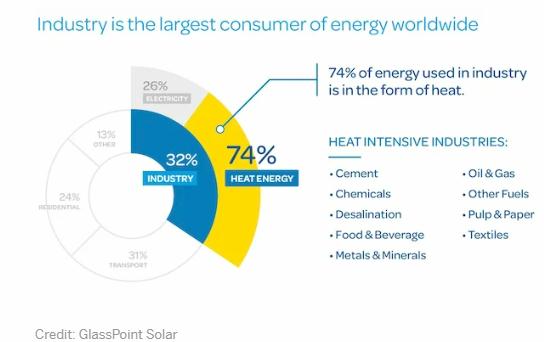
Industries use enormous amounts of fossil fuels to generate heat and electricity to make products like steel, cement, chemicals, glass, and refine petroleum, with nearly three-quarters of energy used in the form of heat. Industry uses 30% of all energy, and 83% of that energy is generated by fossil fuels mainly to create process heat directly, indirectly with steam heat, or to generate electricity at the factory for reliability and to operate machine drive equipment (EI 2010).

This image has an empty alt attribute; its file name is CSP-to-generate-high-heat-needed-by-industry.jpg

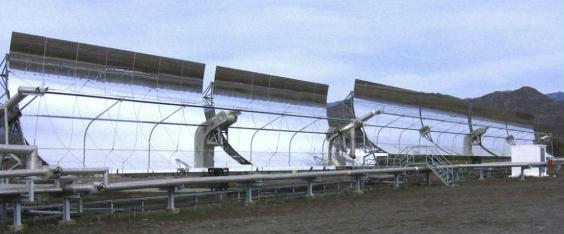
It is possible for a Parabolic Trough collector (PTC), which looks like a giant upended cattle trough, to make some of this industrial heat and replace some of the fossil fuels used (mainly natural gas).

But the industrial uses this concentrated solar power collection is most useful for are heat applications from 110 to 220 C (230 – 430 F), especially those processes that use pressurized water or steam.

So that leaves quite a few very important industries out, since they use 2000 F heat or more, such as iron, steel, fabricated metals, transportation equipment (cars, trucks), computers, electronics, aluminum, cement, glass, machinery, and foundries.

Industries where solar industrial process heat (SIPH) might be used are paper, dairy, food, beer, chemicals, and washing/cleaning.   No doubt some processes within other industries like plastics and rubber, textiles, and others also have a need for industrial process heat that’s less than 430 F.

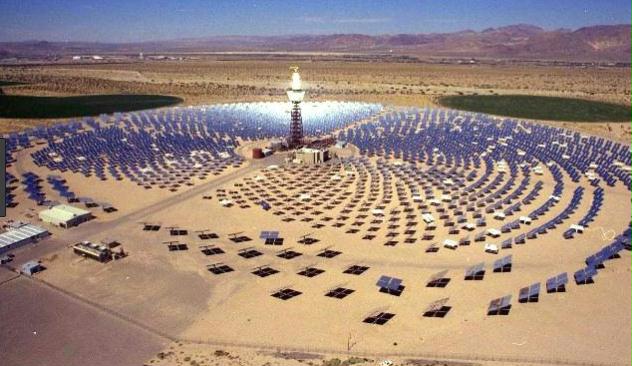
NREL isn’t proposing gigantic, billion dollar concentrated solar power collectors like the ones that take up miles of land in the deserts of California, Nevada, and Arizona.

Rather they suggest that much smaller facilities could be built.  Have been built actually, Frito Lay set aside 5 acres to use heat to fry potato chips in Modesto, California.  Prestage Foods in North Carolina also has 7 acres of PTC to heat 100,000 gallons of water a day for their turkey processing operations.  Currently there are 16 other SIPH plants (9 food & dairy, 4 breweries, 2 desalination & water treatment, 1 subway washing).

Another reason these plants need to be small and local is that unlike electricity, it’s too hard to transfer hot fluids like steam more than a few hundred meters, while electricity can be sent for hundreds of miles.  So solar collectors need to be next to the manufacturing plant. 

But SIPH can barely make a dent in the industrial process heat required.  In 2013 a German study found that solar heat generation could only replace 3.4% of overall industrial heat demands.  This 3.4% would require 16 Terawatt hours (TWh) a year, which would require 46 Nevada Solar One plants.  This plant cost $266 million, so that’s $12.2 billion for this small fraction of manufacturing.

Like all electricity generating contraptions, PTC and other concentrated solar power collectors can’t outlast the age of oil, since their life cycle depends on fossil fuels from beginning to end — from mining, ore crushing, metal smelting and fabrication, transportation by diesel trucks, ships, and trains, and finally delivery with een more diesel. If solar collectors were good at generating the 3000 F temperatures needed by iron, steel, and aluminum, or the 2700 F needed by cement these contraptions, then they’d come closer than wind or solar PV towards replacing fossils and being able to make themselves from their own energy, but that simply isn’t the case.

Just look at the materials needed for a 1 Gigawatt Parabolic trough collector:

                                                                High heat

Material               Tons                      > PTC  can generate

Water            12,000,000

Rock                 1,300,000

Iron                        650,000 Yes

NaNO3                 340,000

Cement                                250,000 Yes

Steel                      240,000 Yes

Sodium Nitrate 220,000

Limestone           170,000

Glass                     130,000 Yes        

Silicon sand           92,000

Table 1. Materials needed per GW for a parabolic trough collector (Pihl 2012)

In addition thousands of tons of Copper (3200), Chromium (2200), Foam glass (2500), Magnesium (3000), Manganese (2000), Rock Wool (4700), Soda Ash (18,000), and hundreds of tons of Aluminum (740),  Fibreglass (310), Molybdenum (200), Polypropylene (500), Zinc (650) and many more materials as well.

The years of reserve life for many aren’t far off Iron (33), Copper (39), Manganese (48), Chromium (16), Nickel (49), Molybdenum (43), Niobium (48), and Silver (25), so solar collector contraptions, if not limited by oil, natural gas, and coal for their construction will be limited by their materials.

References

EI. 2010. Manufacturing Energy and Carbon Footprint Sector: All Manufacturing (NAICS 31-33). Energetics Incorporated for the U. S. Department of Energy

Pihl, E., et al. 2012. Material constraings for concentrating solar thermal power.

Related posts:

Posted in Concentrated Solar Power, Energy Infrastructure, Manufacturing & Industrial Heat | Tagged , , , , , , | 6 Comments

Concentrated Solar Power can only exist in deserts and use too much water

What follows is my summary of:

Bracken, N., et al. 2015. Concentrating solar power and water issues in the U.S. Southwest. U.S. department of energy, National renewable energy lab.

Alice Friedemann   www.energyskeptic.com  author of “When Trucks Stop Running: Energy and the Future of Transportation”, 2015, Springer and “Crunch! Whole Grain Artisan Chips and Crackers”. Podcasts: Derrick Jensen, Practical Prepping, KunstlerCast 253, KunstlerCast278, Peak Prosperity , XX2 report

***

Concentrated Solar Power plants can only be built in desert regions with huge amounts of direct sunlight.  But these are usually the most water scarce regions in the nation and nearly all of them are in the deserts of Arizona, California, and Nevada. 

CSP requires water in construction, the steam cycle, process cooling, and cleaning of solar collectors or mirrors.

If the grid were ever to become 100% renewable, CSP would play a key role, because it can be built with thermal storage to keep the grid up long after the sun goes down.

However, only one CSP plant of 39 has thermal storage, so this probably won’t happen.  And at a billion dollars per plant not many more are likely to be built either (i.e. the 392 MW Ivanpah cost $2.2 billion on 3,600 acres). At $7,100/kW per CSP plant, it’s much cheaper to build natural gas ($1,100), Solar PV ($2,900), or coal ($3,600) electricity generating facilities.

No wonder only 0.03% of electricity is generated using CSP.

Yet CSP in a fossil-free world will be essential to generate the very high heat needed in manufacturing, much of it steam heat which requires enormous amounts of water.  The only other source of non-fossil, renewable high heat is charcoal from wood. 

The following industries need heat of up to 3275 F: Chemicals, Forest products, Iron and Steel, Plastics & Rubber, Fabricated metals, Transport Equipment, Computers, electronics & equipment, Aluminum, Cement, Glass, Machinery, Foundries. For most of these products, there is no alternative electric process.

The only industries that can get by without high heat are the food, beverage and textile industries. 

Though water alone is a showstopper, it’s also equally unlikely that industries across America would move to the desert Southwest to build factories even if there were plentiful water.

It is also questionable how sustainable this is. How long would these aquifers last? There would be very little recharge at just a few inches of rain a year, limiting how much water can be withdrawn sustainably.

Siting a CSP plant is difficult, because most of the suitable land is federal, and it can take quite a long time to get permission to build on protected federal land. It’s also hard to get permits for water in these dry regions, since cities and agriculture are usually considered to be more important and CSP competes with agriculture for level land with less than a 1% slope.  CSP locations are far from rivers and lakes, making groundwater the only possible source of water.  In Arizona, it is hard to get permission to obtain groundwater without a grandfathered water right on that land or get a special permit in many regions.

Current estimates indicate that operational CSP plants use at least 620 acre-feet per year.   That’s 765,000 cubic meters of water, 202 million gallons in the desert regions of the Southwest (Arizona, California, and Nevada). 

CSP facilities with wet cooling can consume more water per unit of electricity generated than traditional fossil fuel facilities using wet cooling.

If all of the expected CSP projects are completed, most will be wet-cooled and require 221,000 acre feet a year, with dry-cooled using 18,000 acre feet per year.  Because wet-cooled plants use so much more water than dry-cooled, California and Nevada have tried to limit them, and Arizona may well do so as well.  So 9 of the 15 future CSP projects under construction will be dry-cooled, hybrid-cooled, or use reclaimed water.

But wet-cooled plants are more efficient than dry-cooled, and dry-cooled electricity generation drops off at temperatures above 100°F when generation is needed the most to meet summer peak electricity demand.  Dry-cooled plants also need to employ massive cooling fans to remove heat from the pipe array since air has far less ability to lower heat than water does.  These fans consume electricity being generated at the CSP plant, which not only subtracts from the amount of energy generated, it reduces the thermal efficiency of the steam turbines.

If significant amounts CSP power generated were transmitted to other states, the result would be a virtual export of scarce water to other states.   

Related post:

Concentrated Solar Power: Water Constraints

References

CRS. 2009. Water Issues of Concentrating Solar Power (CSP) Electricity in the U.S. Southwest. Congressional Research Service.

USGAO. September 2012. ENERGY-WATER NEXUS. Coordinated Federal Approach Needed to Better Manage Energy and Water Tradeoffs GAO-12-880 U.S. Government Accountability Office.

Posted in Concentrated Solar Power, Electricity Infrastructure | Tagged , , , | 1 Comment

Saudi oil infrastructure at risk from drone attacks

Preface. This NYT article was published 4 months ago, and its warning just came true. Quite prescient!

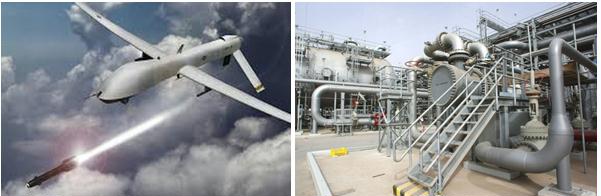
Drones make it pretty easy to anonymously attack the thousands of miles of pipelines across the Arabian peninsula, oil tankers, pumping stations, and refineries. The Saudis counter that they’ve spent quite a bit to protect their infrastructure, but now that drones can be launched 1,000 miles away to accurately hit targets, whatever protections they have may not be enough, because they can evade the kingdom’s main air defenses, which are intended to repel missiles and aircraft rather than smaller objects.

At least as great a threat is Iran or some other nation using cyber warfare to damage the petroleum infrastructure of Saudi Arabia and its neighbors.

Peak oil production can not only happen for geological reasons. Politics (war) can also bring peak production about, making the collapse of civilization happen that much sooner, and perhaps a lot of oil left in the ground, which climate activists should love.

Alice Friedemann   www.energyskeptic.com  author of “When Trucks Stop Running: Energy and the Future of Transportation”, 2015, Springer and “Crunch! Whole Grain Artisan Chips and Crackers”. Podcasts: Practical Prepping, KunstlerCast 253, KunstlerCast278, Peak Prosperity , XX2 report

***

Reed, S. May 17, 2019. Saudi Oil Infrastructure at Risk as Small Attacks Raise Potential for Big Disruption. New York Times.

Saudi Arabia spent heavily to protect its oil production lines but rapid changes in technology may mean ports and pipelines are increasingly exposed in the turbulent region.

Across the Arabian peninsula, thousands of miles of pipes run above and below the desert in one of the world’s most sophisticated production lines for pumping oil from the ground and distributing it around the world. This vast system of oil fields, refineries and ports has largely run like clockwork despite political turbulence across the region.

Then a drone strike claimed by Houthi rebels this week forced the Saudis to temporarily halt the flow of a crucial oil artery to the west side of the country. The assault came a day after mysterious incidents damaged two Saudi tankers and two other ships in a key port in the United Arab Emirates.

These were perhaps the most serious attacks on the kingdom’s oil infrastructure since Al Qaeda militants were thwarted trying to blow up a key Saudi facility at Abqaiq in 2006.

While American officials are still trying to determine whether Iran was behind these incidents, the question for the oil market is how well the Saudi and Persian Gulf infrastructure is protected and whether, with tensions building in the region, it could survive a conflict with Iran.

Analysts and executives of Saudi Aramco, the national oil company, say the kingdom has spent heavily to protect the industry that is its lifeblood. Key Saudi installations are tightly guarded and protected by missile batteries and other weaponry. “Security systems were bulked up in the 2000s amid the Al Qaeda threat, including the 2006 attack on the Abqaiq facility,” said Ben Cahill, manager for research & advisory, at Energy Intelligence, a research firm. “The country’s oil fields, refineries and pipelines are blanketed by surveillance and remote sensing.”

In light of that security effort, Mr. Cahill and other analysts concede that it was eye-opening, even shocking, that a drone apparently launched from as far as 500 miles away in Yemen, managed to cross deep into Saudi Arabia and cause damage.

It was also worrisome and even embarrassing that someone managed to damage tankers in waters off Fujairah, a vital port in the United Arab Emirates where ships take on fuel and provisions on their way in and out of the Gulf.

Despite the security spending of the last decade, rapid changes in technology may mean that the Saudi infrastructure is more exposed than previously thought, analysts say. United Nations experts have estimated, for instance, that drones used by the Houthis have a range of nearly 1,000 miles allowing them to reach well into Saudi Arabia. “The simple fact that they managed to reach tankers and a pipeline” is meaningful, said Riccardo Fabiani, a geopolitical analyst at Energy Aspects, a market research firm. “It means they could strike at the heart of Saudi interests if they wanted to.”

Iran is well-placed for inflicting pain in the no-war-no-peace existence in the region. Analysts say it is proficient at using relatively cheap unconventional weapons like drones and speed boats, and at covering its tracks. It can also make use of proxies including the Houthi rebels, who claimed responsibility for the pipeline attack.

Analysts say that drones could prove to be a nuisance for producers like the Saudis. It would be difficult if not impossible to protect an entire pipeline system, and even concentrating air defense units around key points like pumping stations, which were hit this week, would mean taking these defenses from somewhere else.

Drones may also be able to evade the kingdom’s main air defenses, which are intended to repel missiles and aircraft rather than smaller objects. Jeremy Binnie, a Middle East and Africa defense specialist at Jane’s Defense Weekly, said that satellite imagery showed that the key Saudi export terminal at Ras Tanura was guarded by batteries of sophisticated United States-made Hawk surface-to-air missiles. But these weapons “might not be able to engage the UAVs (drones) that Iran has developed with small radar cross sections,” he said.

Another concern is that Iran, which is regarded as skilled in digital hacking, could use cyber warfare to damage the petroleum infrastructure of Saudi Arabia and its neighbors.

At Saudi Aramco, activities like drilling wells, pumping oil to the surface, and loading the fuel on tankers can all be monitored and managed remotely. Such sophistication, though, may also create openings for attack. “A lot of those movements are run out of a central command center at Saudi Aramco headquarters,” said Phillip Cornell, a fellow at the Atlantic Council, a Washington-based research institution, who previously worked at Aramco as a senior corporate planning adviser.

Mr. Cornell said that Aramco officials suspected Iran was responsible for a cyber attack earlier in this decade and that “there has been a lot of investment to reinforce those cyber security defenses.”

However, analysts say the cyber vulnerabilities remain a major worry. “I think cyber is the really underappreciated risk,” said Helima Croft, an oil analyst at RBC Capital markets, an investment bank.


Posted in Middle East, Oil & Gas, Peak Oil | Tagged , , , | Comments Off on Saudi oil infrastructure at risk from drone attacks

Why “fracked” shale oil and gas will not save us

This image has an empty alt attribute; its file name is Fracking-flare.jpg

Preface. As early as 2011 experts were questioning how large fracked natural gas reserves were.

The latest IEA 2018 report predicts shale oil/gas could start to decline by 2025, and all global oil as soon as 2023. 

Shale oil and gas might not even exist without super low interest rates making it quite easy to borrow money, as Bethany McLean writes in her book “Saudi America”.  And even though these companies are $300 billion in debt, as long as they can get money, they’ll continue to drill.  Some day the dumb middle-class money will be surprised that their 401K and other high interest mutual funds and bonds have crashed after the next economic crash.

Jeremy Leggett’s slide show on fracking has many interesting observations, including that:

  • China has the biggest shale resource in the world on paper, but 80% is below 3,500 meters (11,500 feet), far beyond the range of hydraulic fracturing.”  Fracking hasn’t been successful anywhere but in America, and it has arguably not been very successful given how much money has been lost.
  • UK shale gas reserves may hold only 5-7 years supply, not the 50 reported in the BGS study.

Developing shale gas in China is much more difficult than in the U.S. due to a lack of adequate infrastructure to remote mountainous regions where most of the Chinese shale resources lie, low well productivity, marginal economics, and deeper wells with severe geological constraints, requiring major technological breakthroughs (Paraskova 2021). 

Developing fracked natural gas anywhere but the U.S. is a problem — there is no existing oil and gas pipeline infrastructure, there are not enough fracking workers with expertise in the United States, and virtually none in foreign countries, there is stronger opposition in other nations quite often, the rules of being able to drill on land are much harder to overcome, a lack of fracking sand, and much more.  So although China, Poland, Argentina and many other nations may have fracked oil and gas, the cost to develop it will probably prevent this from happening, plus all of the factors above.

Alice Friedemann  www.energyskeptic.com  Author of Life After Fossil Fuels: A Reality Check on Alternative Energy; When Trucks Stop Running: Energy and the Future of Transportation”, Barriers to Making Algal Biofuels, & “Crunch! Whole Grain Artisan Chips and Crackers”.  Women in ecology  Podcasts: WGBH, Planet: Critical, Crazy Town, Collapse Chronicles, Derrick Jensen, Practical Prepping, Kunstler 253 &278, Peak Prosperity,  Index of best energyskeptic posts

***

Cunningham, N. 2019. The Shale Boom Is About To Go Bust. oilprice.com

The shale industry faces an uncertain future as drillers try to outrun the treadmill of precipitous well declines.

For years, companies have deployed an array of drilling techniques to extract more oil and gas out of their wells, steadily intensifying each stage of the operation. Longer laterals, more water, more frac sand, closer spacing of wells – pushing each of these to their limits, for the most part, led to more production. Higher output allowed the industry to outpace the infamous decline rates from shale wells.

In fact, since 2012, average lateral lengths have increased 44 percent to over 7,000 feet and the volume of water used in drilling has surged more than 250 percent, according to a new report for the Post Carbon Institute. Taken together, longer laterals and more prodigious use of water and sand means that a well drilled in 2018 can reach 2.6 times as much reservoir rock as a well drilled in 2012, the report says.

That sounds impressive, but the industry may simply be frontloading production. The suite of drilling techniques “have lowered costs and allowed the resource to be extracted with fewer wells, but have not significantly increased the ultimate recoverable resource,” J. David Hughes, an earth scientist, and author of the Post Carbon report, warned. Technological improvements “don’t change the fundamental characteristics of shale production, they only speed up the boom-to-bust life cycle,” he said.

For a while, there was enough acreage to allow for a blistering growth rate, but the boom days eventually have to come to an end. There are already some signs of strain in the shale patch, where intensification of drilling techniques has begun to see diminishing returns. Putting wells too close together can lead to less reservoir pressure, reducing overall production. The industry is only now reckoning with this so-called “parent-child” well interference problem.

Also, more water and more sand and longer laterals all have their limits. Last year, major shale gas driller EQT drilled a lateral that exceeded 18,000 feet. The company boasted that it would continue to ratchet up the length to as long as 20,000 feet. But EQT quickly found out that it had problems when it exceeded 15,000 feet. “The decision to drill some of the longest horizontal wells ever in shale rocks turned into a costly misstep costing hundreds of millions of dollars,” the Wall Street Journal reported earlier this year.

Ultimately, precipitous decline rates mean that huge volumes of capital are needed just to keep output from declining. In 2018, the industry spent $70 billion on drilling 9,975 wells, according to Hughes, with $54 billion going specifically to oil. “Of the $54 billion spent on tight oil plays in 2018, 70% served to offset field declines and 30% to increase production,” Hughes wrote.

As the shale play matures, the field gets crowded, the sweet spots are all drilled, and some of these operational problems begin to mushroom. “Declining well productivity in some plays, despite application of better technology, are a prelude to what will eventually happen in all plays: production will fall as costs rise,” Hughes said. “Assuming shale production can grow forever based on ever-improving technology is a mistake—geology will ultimately dictate the costs and quantity of resources that can be recovered.”

There are already examples of this scenario unfolding. The Eagle Ford and Bakken, for instance, are both “mature plays,” Hughes argues, in which the best acreage has been picked over. Better technology and an intensification of drilling techniques have arrested decline, and even led to a renewed increase in production. But ultimate recovery won’t be any higher; drilling techniques merely allow “the play to be drained with fewer wells,” Hughes said. And in the case of the Eagle Ford, “there appears to be significant deterioration in longer-term well productivity through overcrowding of wells in sweet spots, resulting in well interference and/or drilling in more marginal areas that are outside of sweet-spots within counties.”

In other words, a more aggressive drilling approach just frontloads production, and leads to exhaustion sooner. “Technology improvements appear to have hit the law of diminishing returns in terms of increasing production—they cannot reverse the realities of over-crowded wells and geology,” Hughes said.

The story is not all that different in the Permian, save for the much higher levels of spending and drilling. Post Carbon estimates that it the Permian requires 2,121 new wells each year just to keep production flat, and in 2018 the industry drilled 4,133 wells, leading to a big jump in output. At such frenzied levels of drilling, the Permian could continue to see production growth in the years ahead, but the steady increase in water and frac sand “have reached their limits.” As a result, “declining well productivity as sweet-spots are exhausted will require higher drilling rates and expenditures in the future to maintain growth and offset field decline,” Hughes warned.

7/29/2017 ASPO newsletter: Last week a $2 billion private-equity fund heavily invested in oil and gas wells went bust, raising the question of whether this is about to happen to other investors. With oil prices in the $40s, many drilling operators are losing money with every barrel of oil they produce. These losses ultimately flow back to the investors that acquired their oilfield assets back when oil was selling for over $100 a barrel.

If spectacular increases in US oil production are to come in the five to eight years, most analysts say it must come from the Permian Basin which is the only shale oil play currently experiencing rapid growth. The Eagle Ford and Bakken shale oil deposits peaked four years ago and have not enjoyed much growth recently and without a substantial increase in investment, there is little hope that there will be substantial growth in the Gulf of Mexico oil fields.

This leaves the Permian Basin as the one oil play that could give America “energy dominance” by pushing up US shale oil production from 5.5 million b/d to 12 million. For this to happen, there must be enough oil in the Permian oil play that can be exploited at prevailing prices. A recent analysis of likely Permian reserves by Arthur Berman concludes that the total recoverable oil in the Permian Basin is likely to be on the order of 3.7 billion barrels and not the 160 billion barrels that the CEO of Pioneer Natural Resources recently was claiming could be recovered from the Permian. The two leading producers of Permian shale oil are anticipating peak production in 2019, which is not that far away.

3/19/2015 ASPO newsletter: Reining in overseas drilling for shale oil: After spending more than five years and billions of dollars trying to re-create the US shale boom overseas, some of the world’s biggest oil companies are starting to give up amid a world-wide collapse in crude prices. Chevron Corp., Exxon Mobil Corp. and Royal Dutch Shell PLC have packed up nearly all of their hydraulic fracturing wildcatting in Europe, Russia, and China. The reasons vary from sanctions in Russia, a ban in France, a moratorium in Germany and poor results in Poland to crude prices below what it can cost to produce a barrel of shale oil.

Here are just a few of many articles on this topic:

  1. 2019-11-02 Why the UK government finally gave up on fracking shale for oil and gas. And the related story of why American shale is heading for a financially ruinous crash by Jeremy Leggett
  2. 2016-4-30 Australian Public Broadcaster ABC unable to look at oil statistics
  3. May 10, 2015. Einhorn’s Fracking Concerns Are Nothing New, But They Matter For Investors (Part 1). SeekingAlpha.com
  4. R. Heinberg. Chapter 5 of How Fracking’s False Promise of Plenty Imperils Our Future: The Economics of Fracking: Who Benefits? October 2013.
  5. Hall, C. Are we Entering the Second Half of the Age of Oil? Some epirical constraints on optimists’ predictions of an oil-rich future. 2013 Geological Society of America.
  6. Richard Heinberg. 12 Nov 2012. Museletter #246: Gas Bubble Leaking, About to Burst.
  7. Gail Tverberg. 17 Oct 2012. Why Natural Gas isn’t Likely to be the World’s Energy Savior.
  8. Jeff Goodell. 1 Mar 2012. Politics: The Big Fracking Bubble: The Scam Behind the Gas Boom. Rolling Stone.
  9. James Howard Kunstler. 19 Nov 2012. Epic Disappointment.
  10. David Hughes. 29 May 2011. Will Natural Gas Fuel America in the 21st Century?
  11. James Stafford. 12 Nov 2012. Shale Gas Will be the Next Bubble to Pop – An Interview with Arthur Berman.
  12. Peter Coy. 12 Nov 2012. U.S. the New Saudi Arabia? Peak Oilers Scoff.  Bloomberg.
  13. Kelly, S. 29 Apr 2013. Faster Drilling, Diminishing Returns in Shale Plays Nationwide?

October 29, 2013 Tom Whipple. The Peak Oil Crisis: The Shale Oil Bubble.  Falls Church News-Press.

“fracked oil is very expensive, requiring circa $80 a barrel to cover the costs of extraction. Production from fracked oil wells drops off quickly, so new wells have to be drilled constantly to maintain production. Until recently information about just how fast our fracked oil wells were depleting was hard to come by, so the hype about the US becoming energy independent and a major oil exporter became conventional wisdom for most.

Nearly all of the growth in U.S. onshore crude production these days is coming from North Dakota’s Bakken field and Texas’s Eagle Ford. They account for nearly 2 million of the 2.4 million b/d increase in oil production that the US has seen in recent years. It sure looks as if the increase in production in these fields will keep up with the rate of decline within the next 12 to 18 months and that US shale oil production will no longer be growing. While it is possible that a surge of investment will increase the drilling to keep up with declines in production from the older wells, this is expensive, and for now it looks as if oil prices are heading for a level where fracked oil production is not profitable. Outside geologists with access to proprietary data on decline rates have been forecasting for some time now that as the number of wells increases and their quality declines, the shale boom will be coming to an end in the next two years. The release of EIA data seems to confirm these predictions.”

David Hughes at the 2013 Geological Society of America: These are heady times for U.S. oil bulls, with projections of production from tight oil rising to five million barrels per day, or more, by 2019, from essentially nothing just a few years ago. This compares to total U.S. oil production of less than seven million barrels per day as recently as 2008. Declarations of near term “energy independence” are commonplace in the main stream media.

Notwithstanding the substantial contribution of this new supply made possible by the combination of multi-stage hydraulic fracturing and horizontal drilling, the U.S. burns more than 18 million barrels per day. Even five million barrels per day of tight oil production is highly unlikely to free the U.S. from the need for imported oil. Furthermore, tight oil fields are characterized by high decline rates and the need for continual high rates of drilling to maintain production levels. The long term sustainability of tight oil production is thus of paramount concern.

An analysis of the Bakken Field, of North Dakota and Montana, and the Eagle Ford Field, of Texas, which together comprise more than half of projected tight oil production, reveals static field production declines of about 40 percent annually. Moreover, these fields are far from homogenous in terms of well productivity, with “sweet spots” of high productivity comprising a small proportion of the touted productive area. These sweet spots are targeted first resulting in the spectacular ramp up in production observed in these plays, but the steep decline rates inevitably take their toll. Production in the Bakken Field, which is the poster child for tight oil, has plateaued in the past few months, and requires 120 new wells each month to maintain production. The Eagle Ford is still growing rapidly, with 3000 new wells added each year, but it is only a question of time before the sweet spots are exhausted.

Tight oil is an important contributor to U.S. energy supply, but its long term sustainability is questionable. It should be not be viewed as a panacea for business-as-usual in future U.S. energy security planning.

December 11, 2013   California shale.  Tom Whipple.

[Note: the US EIA states that this California shale has 65% of the total recoverable shale oil resource base in the country, with 400 billion barrels of oil and 15 billion barrels using today’s technology.  But it doesn’t look like that will work out].

We now have a second look at the Monterey shale and things don’t look so rosy. First, the geology of California is similar to a bowl of spaghetti with the earth squeezed into folds and steep inclines, not the 20,000 sq. miles of flat-laying shale deposits found in North Dakota. The Monterey shales are thick and complex, and do not lend themselves to drilling the long horizontal wells that can be fracked so productively in other places. Much of the shale oil in California appears to have drained over the years into conventional oil reservoirs and has already been extracted by many of the 238,000 oil wells that have been drilled in the state during the last century.

Our new study by an experienced Canadian geologist, who has already examined the productivity of other shale oil formations in the US, concludes that the government and its contractor’s study is absurdly optimistic about the prospects for shale oil production in California. Despite the use of all the latest drilling and production techniques, oil production in California has fallen from 1.1 million b/d 30 years ago to 500,000 b/d today. It is highly unlikely that this will be turned around given the geology of the region.

The Department of Energy’s report starts with the assumption that California’s shale is much like that in Texas and North Dakota. It posits that the oil industry will only have to drill 28,000 new wells, each yielding ridiculously large 550,000 barrels of oil, to extract California’s shale oil. This is simply not supported by the recent history of drilling in the state and is unlikely to happen. We will be lucky if California’s oil production does not continue to decline, for its geology is simply not the same.

D. Rogers. Feb 2013. Shale & Wall Street: Was the Decline in Natural Gas Prices Orchestrated?

Excerpts from a 32-page report:

Leases were bundled and flipped on unproved shale fields in much the same way as mortgage-backed securities had been bundled and sold on questionable underlying mortgage assets prior to the economic downturn of 2007.

In 2011, shale mergers and acquisitions (M&A) accounted for $46.5 B in deals and became one of the largest profit centers for some Wall Street investment banks. This anomaly bears scrutiny since shale wells were considerably underperforming in dollar terms during this time. Analysts and investment bankers, nevertheless, emerged as some of the most vocal proponents of shale exploitation. By ensuring that production continued at a frenzied pace, in spite of poor well performance (in dollar terms), a glut in the market for natural gas resulted and prices were driven to new lows. In 2011, U.S. demand for natural gas was exceeded by supply by a factor of four. It is highly unlikely that market-savvy bankers did not recognize that by overproducing natural gas a glut would occur with a concomitant severe price decline. This price decline, however, opened the door for significant transactional deals worth billions of dollars and thereby secured further large fees for the investment banks involved. In fact, shales became one of the largest profit centers within these banks in their energy M&A portfolios since 2010. The recent natural gas market glut was largely effected through overproduction of natural gas in order to meet financial analyst’s production targets and to provide cash flow to support operators’ imprudent leverage positions.

Wall Street promoted the shale gas drilling frenzy, which resulted in prices lower than the cost of production and thereby profited [enormously] from mergers & acquisitions and other transactional fees.

U.S. shale gas and shale oil reserves have been overestimated by a minimum of 100% and by as much as 400-500% by operators according to actual well production data filed in various states.

Shale oil wells are following the same steep decline rates and poor recovery efficiency observed in shale gas wells.

The price of natural gas has been driven down largely due to severe overproduction in meeting financial analysts’ targets of production growth for share appreciation coupled and exacerbated by imprudent leverage and thus a concomitant need to produce to meet debt service.

Due to extreme levels of debt, stated proved undeveloped reserves (PUDs) may not have been in compliance with SEC rules at some shale companies because of the threat of collateral default for those operators.

Industry is demonstrating reticence to engage in further shale investment, abandoning pipeline projects, IPOs and joint venture projects in spite of public rhetoric proclaiming shales to be a panacea for U.S. energy policy.

Exportation is being pursued for the differential between the domestic and international prices in an effort to shore up ailing balance sheets invested in shale assets

It is imperative that shale be examined thoroughly and independently to assess the true value of shale assets, particularly since policy on both the state and national level is being implemented based on production projections that are overtly optimistic (and thereby unrealistic) and wells that are significantly underperforming original projections.

for more than a decade the largest oil and gas producers (the “Majors” as they are collectively called) have not been able to materially expand their reserve replacement ratios.14 In fact, approximately one quarter of their reserve growth has come from acquisitions rather than the drill bit, such as ExxonMobil’s acquisition of XTO Energy. This constitutes consolidation rather than organic growth.

To give another example, in 2010 Chevron replaced less than one fourth of the oil and gas it had sold the prior year.  This is highly problematic for the future share price of these companies and explains the exuberant share repurchase programs which they have engaged in recently, buying back shares in excess of as much $5 billion a quarter in the case of ExxonMobil. This is, of course, highly problematic for the future health of global economies. It is also problematic for the share prices of the individual fossil fuel companies.

Further, there are various grades and types of hydrocarbons, some much more efficient as fuels than others. Additionally, some hydrocarbons simply require such an expenditure of energy to extract and produce that their use becomes questionable.

In order for a publicly traded oil and gas company to grow extensively, it must manage not only its core business but also the relationship it enjoys with its investment bankers. Thus, publicly traded oil and gas companies have essentially two sets of economics. There is what may be called field economics, which addresses the basic day to day operations of the company and what is actually occurring out in the field with regard to well costs, production history, etc.; the other set is Wall Street or “Street” economics. This entails keeping a company attractive to financial analysts and investors so that the share price moves up and access to the capital markets is assured. “Street” economics has more to do with the frenzy we have seen in shales than does actual well performance in the field.

Before the mortgage crisis, once the extent of the appetite was realized for credit default swaps, representatives of the capital markets worldwide embraced the new products. The fees generated were immense. It was similar with shale. Land was bid up to ridiculous prices with signing bonuses reaching nearly $30,000/acre and leases on unproven fields being flipped for as much as $25,000/acre, multiples of original investment.  There seemed an unending appetite.

In another example of parallels: credit default swaps were not traded on any exchange, so transparency became a paramount issue. It proved very difficult to accurately measure the underlying fundamentals with such a lack of transparency. It was the same with shales. Due to the new technology of hydrofracture stimulation, shale results could not be verified for a number of years. There simply was not enough historical production data available to make a reasonable assessment. It wasn’t until Q3 of 2009 that enough production history on shale wells in the Barnett had been filed with the Texas Railroad Commission that well performance could be checked.24 What emerged was significantly different from the operators’ original rosy projections. Of further interest is the fact that once numbers could begin to be verified in a play, operators sold assets quickly. This has followed in each play in the U.S. as it matured. The dismal performance numbers were recognized as a potential drag on company share prices. A good example would be the operators in the Barnett play in Texas. The primary players were Chesapeake Energy(significant portion of assets sold or jv’ed), Range Resources (all Barnett assets sold), Encana,( all Barnett assets sold) and Quicksilver Resources (company attempting to monetize all Barnett assets via MLP or asset sale since 2011. In that time frame, stock has plunged from about $15/share to $2.50/ share).

The issue of well performance disclosure has continued to mask problems in shale production. States such as Pennsylvania and Ohio do not release well performance data on a timely basis, which makes it very difficult to get a true picture of actual well history.

WRITE-DOWNS

In the lead up to the mortgage crisis, there were hints of things to come in the form of asset write downs.

Similar hints have been emerging with regard to shale (several examples listed)

This is of particular interest. Pipeline projects are expensive and require that a steady and consistent stream of gas or oil can be counted on for a long period of time in order to recoup initial capital outlay. Once initial capital is recouped, however, they tend to be cash cows. Given the steep decline curves for shale oil that are now readily apparent, it appears that operators  recognize that the Bakken will not be a long-term play. As such, they are not prepared to invest the needed capital upfront for a pipeline: again, a distinct lack of confidence in the long term viability of shales.

December 2013. DRILLING CALIFORNIA. A Reality Check on the Monterey Shale By J. David Hughes

it is not clear that hydraulic fracking techniques like those used on the Bakken and Eagle Ford will work on the Monterey shale.

Bakken/Eagle Ford

  • Deposits less than a few hundred feet thick
  • Flat and gently dip
  • Bakken: 20,000 square miles
  • Eagle Ford: 8,000 Square miles

Monterey

  • Complex and unpredictable
  • Much thicker deposits of up to 2,000 feet
  • Much deeper – anywhere from the surface to 18,000 feet down
  • 2,000 square miles
  • 1,363 wells have been drilled in shale reservoirs of the Monterey Formation. Oil production from these wells peaked in 2002, and as of February 2013 only 557 wells were still in production.3 Most of these wells appear to be recovering migrated oil, not “tight oil” from or near source rock as is the case in the Bakken and Eagle Ford plays.

The EIA/INTEK report assumed that 28,032 tight oil wells could be drilled over 1,752 square miles (16 wells per square mile) and that each well would recover 550,000 barrels of oil. The data suggest, however, that these assumptions are extremely optimistic for the following reasons:

  • Initial productivity per well from existing Monterey wells is on average only a half to a quarter of the assumptions in the EIA/INTEK report. Cumulative recovery of oil per well from existing Monterey wells is likely to average a third or less of that assumed by the EIA/INTEK report.
  • Existing Monterey shale fields are restricted to relatively small geographic areas. The widespread regions of mature Monterey shale source rock amenable to high tight oil production from dense drilling assumed by the EIA/INTEK report (16 wells per square mile) likely do not exist.

Thus the EIA/INTEK estimate of 15.4 billion barrels of recoverable oil from the Monterey shale is likely to be highly overstated. Certainly some additional oil will be recovered from the Monterey shale, but this is likely to be only modest incremental production—even using modern production techniques such as high volume hydraulic fracturing and acidization. This may help to temporarily offset California’s longstanding oil production decline, but it is not likely to create a statewide economic boom.

Art Berman: There is about eight years’ worth of shale gas supply available in the United States. The math: If you divide the “technically recoverable resource” of about 1,900 Tcf (trillion cubic feet) of gas, as identified by the Potential Gas Committee’s (PGC’s) report by annual U.S. consumption, you come up with 90 years. However, the PGC’s report says the “probable recoverable resource” is only 550 Tcf— 25% of the “technically recoverable resource. Then, if you divide the 550 Tcf “probable recoverable resource” by 3, which represents the amount of the resource that is actually provided by shale gas, you get about 180 Tcf. (Nov-Dec 2012. A contrarian on Shale Gas. Amerian Public Power Association.)

August 2013. Shale truth interview Arthur Berman Segments 1, 2, 3, 4, 5

Some paraphrased excerpts from these videos:

The high rate of drilling means someone is willing to spend money and there is gas, but not necessarily a lot of profit.  My concern is – what if there’s an economic contraction? They’re spending far more than their earnings, they have to find money to drill more wells. Twice as much as they’re making. A person couldn’t sustain that, and neither can they if capital goes away.  The assumption is they must be making money.  No, other reasons are to keep your leases, maintain production growth so Wall St thinks you’re a good company and stock price doesn’t go down.  If people give E&P money, they’ll spend it.  Lots of wells doesn’t persuade me they’re making money.

Question: if not profitable, then what do you think it will take for politicians and public to understand that?

Art: There’s not big money being made, but being spent.  They think that over time they’ll figure out a way to make money at it, their experts see demand growing and price increasing, especially in north America where we’ve nearly gone through our oil reserves. So our economy will be more and more NG oriented.  There is a lot of gas but most isn’t commercial, but if prices go up, then more will be profitable.  By the end it will be the Exxon, Chevron, Anardako, Apache, Statoil, with the deep pockets, to get through this non-profitable period.  Everyone is losing money right now.  I’ve looked at all their balance sheets, none are making money.  If you’re making money it ought to show up in the SEC filings.  Chesapeake for 2012 is clearly the shale gas leader, they started it, have the most land, the 2nd largest reserves of natural gas after Exxon, but their SEC filing is a train wreck, they lost a Billion last year, had to write down reserves, 3/4 of earnings are from asset sales, not operations.  If CHK is a paragon, then we’re in trouble.   Forget about reserves, resources — clearly no one is making any money.

Q: We hear about a GLUT of shale NG?

No, it’s been flat since Dec 2011, for 15 months flat. do we have an oversupply? Not really, we have an equilibrium that’s keeping prices somewhat low, though they’ve doubled since April.  The question is how long will it take until there’s less NG than we demand, then price will come up.  I think it’ll be sooner than the others are predicting.  over the past 7 decades we’ve had 5 complete fiascos based on predictions everyone agreed on. Now that it’s cheap forever, what about when we were building LNG to import it? Now we think the situation is reversed, no more problems.

Shale is about 35% of our NG supply. Where’s the 65%? Conventional, in terminal decline. No one is drilling those wells. 2/3 of our gas is declining, and shale is not increasing.  Barnett, Haynesville, etc.,  only the Marcellus is continuing to increase.

Q: What should we do?

Change our behavior. No silver bullet suolutions. There are no solutions. The solutions, if they are out there, are very long term. so only 2 things to do: efficiency – use the fuels we have more efficiently. The more important thing is our own behavior – how do we use energy – how many drive alone to work? Leave lights on, not enough insulation — simple things, not solar panels. People don’t feel like they need to conserve when they hear we’re energy independent. Even if we had 100 years of gas, why should we use it up fast?

Several years ago there were the real estate shenanigans, subprime, securitized mortgages, credit default swaps, and so on responsible for economic collapse.  This is similar to some of the shale gas ventures. There are some striking comparisons. We’re told it’ll get better and bigger forever and ever, that S&P/Moody’s mortgages grade A investments but they were wrong, now all the experts say everyone’s making money in shale gas.

But look at the financial position of CHK or Enron, It’s a kind of a train wreck. Many natural gas companies are run well and expect they’ll make money -but whether we believe that – I’m just raising a cautionary note.  I believe the financial collapse had as much to do with energy as real estate. oil got to nearly $150/barrel at same time subprime reached its crescendo, that has an effect — Energy isn’t a sector separate from economics, politics – it’s what ties everything together.


Bill Powers: The U.S. has nowhere close to a 100-year supply.

In his new book “Cold, Hungry and in the Dark: Exploding the Natural Gas Supply Myth”, Powers concludes the USA has a 5 to 7 year supply of shale gas.  People and companies who benefit economically are behind the promotion of the shale gas myth. In reality, many corporations are taking write-downs of their reserves. (Peter Byrne. 8 Nov 2012. US Shale Gas Won’t Last Ten Years: Bill Powers. The Energy Report.)

James Howard Kunstler, 24 Sep 2012 “Duty” 

“In all the monumental yammer of the media sages surrounding the candidates they follow, and among the freighted legions of meticulously trained economists who try so hard to fit their equations and models over the spilled chicken guts of daily events, there is no sense of the transience of things. Tom Friedman over at The New York Times still thinks that the petroleum-saturated present he calls “the global economy” is a permanent condition of human life, and so does virtually every elected and appointed official in Washington, not to mention every broadcaster in Manhattan.Someone told all these clowns about 14 months ago that we will be able to keep running WalMart on shale oil and shale gas virtually forever, and they swallowed the story whole, and then force-fed it down the distracted public’s throat. In reality – that alternative universe to flat-screen America – all the mechanisms that allow us to keep running this wondrous show teeter on a razor’s age of extreme fragility.  We’re one bomb-vest or High Frequency Trading keystroke away from a possible dark age…”

Richard Heinberg (excerpt from July 2012 Museletter #242: The End of Growth Update Part 2):

whether the latest financial news is giddy or dismal, whether oil prices are up or down, the game of growing the economy by increasing the production of affordable transport fuel is now officially over. Previously, we enjoyed both a growing economy and low fuel prices, with the latter feeding the former; now we see “cheap” oil only when the economy is in a tailspin of demand destruction.

Yes, “fracking” has given America temporarily inexpensive and abundant natural gas—so why not oil? In the case of natural gas, record-high prices back in 2006-2007 (due to depletion of conventional gas deposits) led to truly heroic rates of drilling and a temporary supply glut. Gas has become so cheap in fact that the shale gas industry is imploding, starting with Chesapeake Energy, the biggest fracker of them all. Producers are losing money on each well, so they’re pulling back on drilling even if that hurts their company’s share value (which it does). Next we’ll see a consolidation of the industry, rising prices, and falling production—against nearly everyone’s recent expectations. This is all clearly and persuasively explained in David Hughes’s recent report for Post Carbon Institute, “Will Natural Gas Fuel America for the 21st Century?
 
The media-storm touting America’s energy resurgence has been truly surreal. During the past 12 months oil prices were at their highest sustained level in history, while the rate of world crude oil production has been flat-lined for seven years. Available oil exports are disappearing from world markets as exporting countries use ever more of their product domestically. The data shout “Peak Oil!” but news markets demand happy talk. And so pundits seize upon a temporary production increase in North Dakota achieved by fracking oil-bearing shale as a “game changer.” Once again we’re told that technology will save us!
 

In reality, virtually all the easy, cheap oil has already been found and put into production; what’s left to find and produce will be hard, nasty, and expensive. Oil-bearing shales have been known to geologists for decades, and fracking has been part of the technical arsenal of the industry since the 1980s, but the cost of development was considered too high. Meanwhile, despite its “miraculous” growth in domestic oil production, the United States saw its trade deficit in oil increase to $327 billion in 2011, accounting for 58 percent of the total trade deficit, the highest-ever annual share.

Not necessarily. As the economy tanks, that will cut demand for oil and the price will fall below the new-supply break-even level; when that happens, companies will cancel or delay new projects (as they did in late 2008 when the per-barrel price fell to $40). But if, for the moment, the economic news looks good, demand will grow and oil prices must inevitably return to levels that justify new supply. And those price levels are just high enough to begin undermining economic growth, as a spate of recent economic research has shown.

Huffington Post, 27 Mar 2013: Deep water and tight oil (like what comes from the Bakken and Eagle Ford) have extremely high depletion rates.

Deep water wells deplete about 10-20 percent a year. Tight oil depletes at about 40 percent annually the first few years. Think about that latter number, where most of our new oil extraction is coming from. What if you had a part-time job but within two years you would only be making about a quarter of your current income. Probably need a new part time job, right? But that one does the same thing. Before you know it, you need 40,000 part time jobs. But even that doesn’t help, because they’re all still depleting at 40 percent. Give a thought to how much you would have to work to maintain your original income after five years, then ten years, then twenty years…  Source: The Reward for Being Right About Peak Oil: Scorn Heaped With Derision

ASPO newsletter 19 Nov 2012:

The International Energy Agency 2012 World Energy Outlook forecast that US shale oil production would continue to grow more rapidly than expected for the rest of the decade, leading to the US becoming the world’s largest oil producer by 2012 and largely energy independent (though not for oil) by 2035.

The world’s press trumpeted the energy crisis was now way in the future and that all would be well for the next 20 years. The few writers that consulted people in the peak oil community buried their skeptical comments at the bottom of their stories.

The issue is how much longer shale oil production can continue to grow at the spectacular rates of the past few years before it too peaks and starts to decline. Oil production from the Bakken Shale in North Dakota is about 660,000 b/d, Eagle Ford in Texas about 600,000 b/d and growing. Some say the 2 fields will produce 2 million b/d in the next year or so. The IEA seems to be saying that tight oil production in the US will peak at about 5 million b/d around 2020.

Most people in the peak oil community who have looked into the issue have major problems with these forecasts, believing that a peak in shale oil production around 3 million b/d is more realistic. Remember, demand is increasing at about 750,000 b/d each year, so 8 years from now an additional 6 million b/d of new production will be required worldwide plus another 3-4 million b/d will be needed to replace the depletion from existing fields every year.

The first problem with the IEA’s estimate is the rapid depletion of fracked oil wells. Despite limited experience with this relatively new technology, some are calculating that production from many of these wells is dropping by over 40% or more a year.

We know the average daily production from North Dakota’s 4,630 producing wells is currently 143 b/d. If we assume that the Bakken oil fields are to produce 2.5 million b/d by the end of the decade then it will need some 18,000 wells, each producing the average of 140 b/d. While this is a not an inconceivable number, when one takes into account that most, if not all of these wells will have be redrilled twice in the next 8 years, the number becomes improbable. We shall have to drill more and more wells just to maintain the same level of production.

The second problem with the optimism over tight oil is the very high cost of the horizontal drilling and fracking of these wells, which may run 3 to 4 times that of a conventional well. Some people put the cost of producing a barrel of oil from the Bakken at $80-90, which is just about where oil is currently selling in the region. Should the global economy continue to contract, the selling price of fracked oil could well fall below the cost of production, bringing a marked slowdown to further drilling.

Roger Blanchard: A Closer Look at Bakken and U.S. Oil Production:

  • Oil production outside of Texas and North Dakota has actually declined in the last few years
  • Bakken extends over a large area of North Dakota, Montana and Saskatchewan, but just 4 counties in North Dakota are 80.8% of all the oil production. Even within that area, some spots are better than others.
  • “Oil wells in the Bakken region decline rapidly. From data I’ve seen, the average decline in the first year is ~60%. The only way to maintain or increase Bakken oil production is to rapidly increase the number of wells. As the industry has to drill in less fruitful areas, being able to maintain production will become an increasing challenge.”
  • “I expect oil production in the Bakken to peak in 2013 to 2015. I expect Texas oil production to have a secondary peak around 2014 (Texas oil production peaked in 1972 at 3.57 mb/d while it’s presently ~1.5 mb/d). If oil production in both Texas and North Dakota begins to decline around 2015, I expect U.S. oil production as a whole to begin to decline in that same time frame.” (my comment: Blanchard also says that oil production is declining now in the Gulf of Mexico!)

ASPO Newsletter Nov 26, 2012   Who do you believe, Likvern or North Dakota official?

Rune Likvern

  • performed an in-depth analysis of data from fracked wells in North Dakota and concluded that the fracked wells are depleting so fast production from the region is unlikely to get much beyond 600,000-700,000 b/d.
  • the average Bakken well produces 85,000 barrels of oil in its first year
  • production steady due to accelerating rate of drilling at about 143 b/d. September to september # of wells: 590 2009-2010  1010 2010-2011  1762 2011-2012
  • Each well costs $10 million – how long can that be sustained?
  • Hess oil costs was $13 million per well drilled/fracked
  • Unless the geology is significantly different, what happens in the Bakken over the next few years will be similar to Texas shales. A recent study of 1000 wells in the Eagle Ford, Texas field shows that each well will produce about 120,000 barrels over its lifetime. This is a long way from the 600,000 barrels North Dakota claims each well will yield.

Director of the North Dakota Oil & Gas Division:

  • production may reach any where from 900,000 to 1.2 million b/d in the next 3 years and sustain this level until 2020 or even 2025 before tapering off to 650-700,000 b/d by 2050.
  • the average Bakken well produces 329,000 barrels of oil in its first year
  • Predicts a revenue 3 times higher over the lifetime of a well than Likvern:Over a 45-year lifetime, each well will produce 615,000 barrels of oil, easily covering the $9 million it costs to drill and frack. if avg prd is 329,000 barrels first year, even spectacular rates of depletion allows a well to produce 600,000 barrels in 5 or 6 years. If Likvern is right and the average well yields 85,000 barrels the first year, then it would only 200,000 barrels.
  • Platts estimates each well generates $20 million in profits

An energy expert (I don’t have permission to give attribution) on oil and gas shales:

  • Barnett (once our great natural gas savior) has peaked (at least for now)
  • Haynesville has peaked
  • Montana Bakken oil has peaked and is half way down
  • North Dakota is increasing rapidly but gets most of its oil out of two sweet spots — Bakken is not nearly as big as it appears on maps… so far all the oil drilling is concentrated in 3 sweet spots: Parshall, Nesson anticline and Elm Coulee Montana. These areas, about 5-10 percent of of the Bakken area on the map, are packed with oil wells and there are essentially none in other areas and according to USGS those other wells produce little oil.
  • The question is: is it all only about sweet spots? How many more sweet spots are there? …early estimate of the EROI of these sites is about same as US oil now (~10:1) FOR THE SWEET SPOTS only.
  • Also from a Texas oil man: “Few are making profits in Eagle Ford. Its a vast Ponzi scheme

Chris Nelder: “… the decline rates of shale gas wells are steep. They vary widely from play to play, but the output of shale gas wells commonly falls by 50% to 60% or more in the first year of production. This is why I have called it a treadmill: you have to keep drilling furiously to maintain flat output.

In the U.S., the aggregate decline of natural gas production from both conventional and unconventional sources is now 32% per year, so 22 bcf/d of new production must be added every year to keep overall production flat, according to Canadian geologist David Hughes. That’s close to the total output of U.S. shale gas, after nearly a decade of its development. It will require thousands more shale gas and tight oil wells to keep domestic gas production flat.”

American Geophysical Union conference 2012: TITLE: The Future of Fossil Fuels: A Century of Abundance or a Century of Decline?

ABSTRACT: Horizontal drilling, hydraulic fracturing, and other advanced technologies have spawned a host of new euphoric forecasts of hydrocarbon abundance. Yet although the world’s remaining oil and gas resources are enormous, most of them are destined to stay in the ground due to real–]world constraints on price, flow rates, investor appetite, supply chain security, resource quality, and global economic conditions. While laboring under the mistaken belief that it sits atop a 100–]year supply of natural gas, the U.S. is contemplating exporting nearly all of its shale gas production even as that production is already flattening due to poor economics. Instead of bringing “energy independence” to the U.S. and making it the top oil exporter, unrestricted drilling for tight oil and in the federal outer continental shelf would cut the lifespan of U.S. oil production in half and make it the world’s most desperate oil importer by mid–]century. And current forecasts for Canadian tar sands production are as unrealistic as their failed predecessors. Over the past century, world energy production has moved progressively from high quality resources with high production rates and low costs to lower quality resources with lower production rates and higher costs, and that progression is accelerating. Soon we will discover the limits of practical extraction, as production costs exceed consumer price tolerance. Oil and gas from tight formations, shale, bitumen, kerogen, coalbeds, deepwater, and the Arctic are not the stuff of new abundance, but the oil junkie’s last dirty fix. This session will highlight the gap between the story the industry tells about our energy future, and the story the data tells about resource size, production rates, costs, and consumer price tolerance. It will show why it’s time to put aside unrealistic visions of continued dependence on fossil fuels, face up to a century of decline, and commit ourselves to energy and transportation transition.

Bill Powers: “There is production decline in the Haynesville and Barnett shales. Output is declining in the Woodford Shale in Oklahoma. Some of the older shale plays, such as the Fayetteville Shale, are starting to roll over. As these shale plays reverse direction and the Marcellus Shale slows down its production growth, overall U.S. production will fall.  At the same time, Canadian production is falling. And Canada has historically been the main natural gas import source for the U.S. In fact, Canada has already experienced a significant decline in gas production — about 25%, since a peak in 2002 — and has dramatically slowed its exports to the United States.”

Art Berman: in 2011 published a report showing industry reserves had been overstated by at least 100% based on detailed review of both individual well and group decline profiles for Barnett, Fayetteville, and Haynesville Shale plays.


Ian Urbina. 25 Jun 2011. Insiders Sound an Alarm Amid a Natural Gas Rush. New York Times.

[Natural] gas may not be as easy and cheap to extract from shale formations deep underground as [energy] companies are saying, according to hundreds of industry e-mails and internal documents and an analysis of data from thousands of wells.

In the e-mails, energy executives, industry lawyers, state geologists and market analysts voice skepticism about lofty forecasts and question whether companies are intentionally, and even illegally, overstating the productivity of their wells and the size of their reserves. Many of these e-mails also suggest a view that is in stark contrast to more bullish public comments made by the industry, in much the same way that insiders have raised doubts about previous financial bubbles.

“Money is pouring in” from investors even though shale gas is “inherently unprofitable,” an analyst from PNC Wealth Management, an investment company,  wrote to a contractor in a February e-mail. “Reminds you of dot-coms.

The word in the world of independents is that the shale plays are just giant Ponzi schemes and the economics just do not work,” an analyst from IHS Drilling Data, an energy research company,  wrote in an e-mail on Aug. 28, 2009.

Company data for more than 10,000 wells in three major shale gas formations raise further questions about the industry’s prospects. There is undoubtedly a vast amount of gas in the formations. The question remains how affordably it can be extracted.

The data show that while there are some very active wells, they are often surrounded by vast zones of less-productive wells that in some cases cost more to drill and operate than the gas they produce is worth. Also, the amount of gas produced by many of the successful wells is falling much faster than initially predicted by energy companies, making it more difficult for them to turn a profit over the long run.

If the industry does not live up to expectations, the impact will be felt widely…if natural gas ultimately proves more expensive to extract from the ground than has been predicted, landowners, investors and lenders could see their investments falter, while consumers will pay a price in higher electricity and home heating bills.

There are implications for the environment, too. The technology used to get gas flowing out of the ground — called hydraulic fracturing, or hydrofracking — can require over a million gallons of water per well, and some of that water must be disposed of because it becomes contaminated by the process. If shale gas wells fade faster than expected, energy companies will have to drill more wells or hydrofrack them more often, resulting in more toxic waste.

The e-mails were obtained through open-records requests or provided to The New York Times by industry consultants and analysts who say they believe that the public perception of shale gas does not match reality.

Studying the Data

Ms. Rogers, a former stockbroker with Merrill Lynch, said she started studying well data from shale companies in October 2009 after attending a speech by the chief executive of Chesapeake, Aubrey McClendon. The math was not adding up, her research showed that wells were petering out faster than expected.

In May 2010, the Federal Reserve Bank of Dallas called a meeting to discuss the matter after prodding from Ms. Rogers. One speaker was Kenneth B. Medlock III, an energy expert at Rice University, who described a promising future for the shale gas industry in the United States. When he was done, Ms. Rogers peppered him with questions.

Might growing environmental concerns raise the cost of doing business? If wells were dying off faster than predicted, how many new wells would need to be drilled to meet projections?

Mr. Medlock conceded that production in the Barnett shale formation — or “play,” in industry jargon — was indeed flat and would probably soon decline.

Bubbling Doubts

Some doubts about the industry are being raised by people who work inside energy companies, too.

“In these shale gas plays no well is really economic right now, they are all losing a little money or only making a little bit of money.”  Around the same time the geologist sent this e-mail, Mr. McClendon, Chesapeake’s chief executive, told investors, “It’s time to get bullish on natural gas.

In September 2009, a geologist from ConocoPhillips, one of the largest producers of natural gas in the Barnett shale, warned in  an e-mail to a colleague that shale gas might end up as “the world’s largest uneconomic field.”
Forecasting these reserves is a tricky science. Early predictions are sometimes lowered because of drops in gas prices, as happened in 2008. Intentionally overbooking reserves, however, is illegal because it misleads investors. Industry e-mails, mostly from 2009 and later, include language from oil and gas executives questioning whether other energy companies are doing just that.

The e-mails do not explicitly accuse any companies of breaking the law. But the number of e-mails, the seniority of the people writing them, the variety of positions they hold and the language they use — including comparisons to Ponzi schemes and attempts to “con” Wall Street — suggest that questions about the shale gas industry exist in many corners.

“Do you think that there may be something suspicious going with the public companies in regard to booking shale reserves?” a senior official from Ivy Energy, an investment firm specializing in the energy sector, wrote in  a 2009 e-mail.

A former Enron executive wrote in 2009 while working at an energy company: “I wonder when they will start telling people these wells are just not what they thought they were going to be?” He added that the behavior of shale gas companies reminded him of what he saw when he worked at Enron.

Production data, provided by companies to state regulators and reviewed by The Times, show that many wells are not performing as the industry expected. In three major shale formations — the Barnett in Texas, the Haynesville in East Texas and Louisiana and the Fayetteville, across Arkansas — less than 20 percent of the area heralded by companies as productive is emerging as likely to be profitable under current market conditions, according to the data and industry analysts.

Richard K. Stoneburner, president and chief operating officer of Petrohawk Energy, said that looking at entire shale formations was misleading because some companies drilled only in the best areas or had lower costs. “Outside those areas, you can drill a lot of wells that will never live up to expectations,” he added.

Although energy companies routinely project that shale gas wells will produce gas at a reasonable rate for anywhere from 20 to 65 years, these companies have been making such predictions based on limited data and a certain amount of guesswork, since shale drilling is a relatively new practice.

Most gas companies claim that production will drop sharply after the first few years but then level off, allowing most wells to produce gas for decades.  Gas production data reviewed by The Times suggest that many wells in shale gas fields do not level off the way many companies predict but instead decline steadily.

“This kind of data is making it harder and harder to deny that the shale gas revolution is being oversold,” said Art Berman, a Houston-based geologist who worked for two decades at Amoco and has been one of the most vocal skeptics of shale gas economics.

The Barnett shale, which has the longest production history, provides the most reliable case study for predicting future shale gas potential. The data suggest that if the wells’ production continues to decline in the current manner, many will become financially unviable within 10 to 15 years.

A review of more than 9,000 wells, using data from 2003 to 2009, shows that — based on widely used industry assumptions about the market price of gas and the cost of drilling and operating a well — less than 10% of the wells had recouped their estimated costs by the time they were 7 years old.

In private exchanges, many industry insiders are skeptical, even cynical, about the industry’s pronouncements. “All about making money,” an official from Schlumberger, an oil and gas services company, wrote in  a July 2010 e-mail to a former federal regulator about drilling a well in Europe, where some United States shale companies are hunting for better market opportunities.

“Looks like crap,” the Schlumberger official wrote about the well’s performance, according to the regulator, “but operator will flip it based on ‘potential’ and make some money on it.”

David Hughes at the 2012 American Geophysical Union conference 2012: Shale Gas and Tight Oil: A Panacea for the Energy Woes of America?

ABSTRACT: Shale gas has been heralded as a game changer in the struggle to meet America’s demand for energy. The Pickens Plan of Texas oil and gas pioneer T.Boone Pickens suggests that gas can replace coal for much of U.S. electricity generation, and oil for, at least, truck transportation. Industry lobby groups such as ANGA declare that the dream of clean, abundant, home grown energy is now reality. In Canada, politicians in British Columbia are racing to export the virtual bounty of shale gas via LNG to Asia despite the fact that Canadian gas production is down 16% from its 2001 peak). And the EIA has forecast that the U.S. will become a net exporter of gas by 20213. Similarly, recent reports from Citigroup and Harvard suggest that an oil glut is on the horizon thanks in part to the application of fracking technology to formerly inaccessible low permeability tight oil plays. The fundamentals of well costs and declines belie this optimism. Shale gas is expensive gas. In the early days it was declared that continuous plays like shale gas were manufacturing operations, and that geology didn’t matter. One could drill a well anywhere, it was suggested, and expect consistent production. Unfortunately, Mother Nature always has the last word, and inevitably the vast expanses of purported potential shale gas resources contracted to core areas, where geological conditions were optimal. The cost to produce shale gas ranges from $4.00 per thousand cubic feet (mcf) to $10.00, depending on the play. Natural gas production is a story about declines which now amount to 32% per year in the U.S. So 22 billion cubic feet per day of production now has to be replaced each year to keep overall production flat. At current prices of $2.50/mcf, industry is short about $50 billion per year in cash flow to make this happen. As a result I expect falling production and rising prices in the near to medium term. Similarly,
tight oil plays in North Dakota and Texas have been heralded as a new Saudi Arabiah of oil. Growth in production has been spectacular, but currently amounts to just one million barrels per day which is less than 15% of US oil and other liquids production. Tight oil is offsetting declines in conventional crude oil production as well as contributing to a modest production increase from the 40 year US crude oil production low of 2008. The mantra that natural gas is a transition fuel to a low carbon future is false. The environmental costs of shale gas extraction have been documented in legions of anecdotal and scientific reports. Methane and fracture fluid contamination of groundwater, induced seismicity from fracture water injection, industrialized landscapes and air emissions, and the fact that near term emissions from shale gas generation of electricity are worse than coal. Tight oil also comes with environmental costs but has been a saviour in that it at least temporarily arrested a terminal decline in US oil production. A sane energy security strategy for America must focus on radically reducing energy consumption through investments in infrastructure that provides alternatives to our current high energy throughput. Shale gas and tight oil will be an important contributors to future energy requirements, given that other gas and oil sources are declining, but there is no free lunch.

2012 American Geophysical Union conference 2012: Charles A. Hall. Quantity vs quality of oil: Implications for the future economy

ABSTRACT: There has considerable interest recently in various indications of important changes in the technology of oil production and its impact on US oil production. The data indicate a clear increase in oil production for the US after 40 years of year by year decline. This has led some commentators to predict that the US will become a net oil exporter before long. Maps showing the enormous extent of e.g. the Bakken formation in North Dakota and Montana, and our ability to now exploit this oil using the new techniques of horizontal drilling and fracking, gives the impression that there are enormous new oil reserves that can satisfy our wants indefinitely. Other assessments indicate that the amount of oil still available globally is 3, 4 or more times the usual assessments of about 1 trillion barrels. But “oil” is not a single substance, but rather a suite of materials of widely varying qualities and hence utility. One important index is the energy return on investment (EROI), the ratio of energy returned from energy used to get it. EROI reflects the balance of the countervailing impacts of depletion and technology and ultimately determines the price of a fuel. This ratio is declining all around the world, and gives a practical limit to how much oil we can exploit at an energy and economic profit. Bringing quality of oil into the equation gives a much more restrictive estimate of how much oil we are likely to be able to exploit for fuel.

The “shale revolution” has been often touted as a game changer in energy production (1). Indeed, during the past few years, the increasing production trend of shale (or “tight”) gas in the US has generated a wave of optimism invading the media and the Web. However, not everyone has joined the chorus and several commentators have predicted that the trend would be short lived (see, e.g. Sorrell (2), Laherrere (3), Hughes (4), and Turiel (5)). Some have flatly stated that the effort in gas production in the US is simply a financial bubble, destined to deflate soon (see e.g. Orlov (6) and Berman (7)).  Some, such as R. P. Siegel (8) even argue that the bursting of the gas bubble might bring about a financial collapse not unlike the one of 2008.

While the optimism about the future of natural gas seems to be still prevalent, the data show that the gas bubble may be already bursting. The most recent data from EIA (9) show that that the total US gas production has not been growing for the past 1-2 years and that it shows signs to be declining. Fitted with a Gaussian curve, it shows a peak taking place around the end of 2012.

The declining trend is not yet very pronounced and specific data about shale gas production after 2011 are not available in the EIA site (9). However, since the production of conventional gas has been declining since 2007, the production of shale gas may not be declining yet, but it is surely not growing any more at the rates that were common just a few years ago.

In any case, there are data indicating that the decline of total gas production in the US was expected. Drilling rigs for gas has been plummeting down during the past few years, as shown in the following figure (data from Baker and Hughes (10)

Obviously, one can’t extract anything without having drilled first to find it. Since the lifetime of shale gas wells is of the order of a few years, it was unavoidable that the drop in the number of gas drilling rigs would generate in a production decline; which is what we are seeing today.

Basically, these data seem to confirm the interpretation that we are facing a financial “gas bubble”, rather than a robust trend of development of new resources. The gas glut produced by the rush to gas of the past few years has lowered prices to the point that companies have been extracting gas without making any profit, actually losing money in the process (7). That couldn’t last forever.

In the near future, the decline in gas production in the US may lead to an increase in prices which, in turn, may direct the industry to restart drilling for gas. But it remains to be seen if prices high enough to generate a profit are affordable for consumers. In any case, the idea of a “gas revolution” that will bring for us an age of abundance is rapidly fading.

In the end, what we are doing with gas is simply one more step along a path that we are forced to follow. With the gradual disappearance of high grade mineral resources, we must extract the minerals we need from lower grade resources, and this is more expensive and more polluting. That’s exactly what happening with gas but it is much more general. As described in the most recent report of the Club of Rome (Plundering the Planet (11)), the gradual depletion of high grade mineral resources is leading us to a world where mineral commodities will be rarer and more expensive. We will have to adapt to this empty new world.

1. http://belfercenter.ksg.harvard.edu/files/Oil-%20The%20Next%20Revolution.pdf

2. http://www.theoildrum.com/node/9327

3 http://www.theoildrum.com/node/9495

4. http://shalebubble.org/drill-baby-drill/

5. http://crashoil.blogspot.it/2010/12/un-mar-de-gas-natural.html

6. http://cluborlov.blogspot.com.es/2012/05/shale-gas-view-from-russia.html

7. http://www.youtube.com/watch?v=cDDseuvO2SM&feature=share&list=PL3yVl0q9sFIwgSJfLSBEA3pLrDsxMDMwe

8. http://www.triplepundit.com/2013/02/shale-gas-bubble-threatens-second-economic-collapse/

9. http://www.eia.gov/naturalgas/

10. http://www.bakerhughes.com/rig-count

11. http://www.clubofrome.org/?p=6166

————————————————————————————————-

References

Paraskova T (2021) Why China can’t replicate America’s shale boom. oilprice.com

Posted in Natural Gas, Oil & Gas Fracked, Peak Natural Gas, Peak Oil | Tagged , , , , | Comments Off on Why “fracked” shale oil and gas will not save us

Why technology can’t solve all of our problems

I have many posts about energy contraptions that have had hundreds of thousands of breakthrough stories in the media, yet here we are, without powerful enough batteries, hydrogen fuel cells, and so on to replace fossil fuels despite the exciting news that never actually happened.  Here are some of my posts on this topic:

Below is a post by Kevin Cameron, who points out that inventions can take a long time to come to fruition, such as the carbon-fiber he saw in 1976 that didn’t appear in a commercial flight until 2011—35 years later.  But this hasn’t appeared in motorcycles yet.

Alice Friedemann   www.energyskeptic.com  author of “When Trucks Stop Running: Energy and the Future of Transportation”, 2015, Springer and “Crunch! Whole Grain Artisan Chips and Crackers”. Podcasts: Derrick Jensen, Practical Prepping, KunstlerCast 253, KunstlerCast278, Peak Prosperity , XX2 report

***

Kevin Cameron. 2019. Electric bikes, rocket fuel, and the possibility of disappointment. Yearning for a breakthrough that may never come.  Cycleworld.com

Our expectations of what technology can give us result from fast changes in areas such as computing. We are impressed by social change caused by the coming of phones that are really pocket-sized computer terminals connected to “an internet of everything.” This tells us that technology can give us whatever we want and soon.

We know that around 1975 John B. Goodenough devised a workable rechargeable battery of high energy density based upon lithium ions. By 1992, the concept had been commercialized by Sony, and since then, with increasing intensity, hundreds of academic and commercial laboratories have striven night and day to be the first to create for electric vehicles a better battery that has it all.

Having it all means being affordable, free of high-priced materials, safe in operation, fast-charging, capable of producing large current, long-lasting, and able to store enough energy in a lightweight package to compete heads-up with the range and performance of vehicles powered by internal-combustion engines.

Many different electrode chemistries exist for the basic lithium-ion process, but no single one of them has yet achieved a “round” performance offering all of the listed desirable attributes.

One way to look at the future is to say, “Well, all these hundreds of labs have been hard at it for many years, so the big breakthrough will come any minute. We deserve it. All it takes is for some brilliant chemist to add a pinch of this or that and we’re home.”

The development of Rocket Fuels

I was fascinated to tear through the late John D. Clark’s little book Ignition!, which describes the intensity, creativity, and results of rocket-fuels research from the end of World War II to the mid-1960s. Military planners knew that any future world war would be decided by nuclear ICBMs, with results final in 20 minutes. Driven by that sharp spur, world governments poured treasure and resources into the development of rocket fuels that might give them Cold War leverage.

Chemists can compute the ideal energy yields of even quite complex fuel and oxidizer molecules. But it’s quite another thing to realize ideals in practice. Some fuels, such as powdered aluminum, burn too slowly to react completely before they leave the nozzle. Others failed to meet the services’ standards for storability or low freezing temperatures. Some compounds slowly deteriorated over time, generating gas that could burst storage containers. Little by little, useful combinations were discovered, but the exotic promise of super fuels kept research going, trying to create ultra-high-energy combinations based on boron, fluorine (it eats through glass), and even remarkably poisonous mercury. Standards were created to measure sensitivity; some fuels, especially monopropellants, detonated if poured, or if they touched dust, or from micro-cavitation. Countless thousands of compounds were proposed, produced in labs, tested, and, if possible, fired in research rocket engines. Micro-contamination of containers by trace elements led to terrible surprises. Researchers were injured or killed.

Here we are in 2019 with heavy rocket boosters still burning RP-1—a kind of standardized kerosene—and liquid oxygen, as in the Apollo program.

At the same time, the US Air Force worked to develop range-extending boron-based fuels for gas turbines. One class of fuels showed promise, until its combustion product turned out to be a viscous material like melted glass, which plugged up the engines in which it was burned. There were explosions with no discoverable cause. Eventually the materials under study proved just too dangerous, and the program was ended.

Here we are in 2019 with heavy rocket boosters still burning RP-1—a kind of standardized kerosene—and liquid oxygen, as in the Apollo program. Higher-performing engines burn liquid hydrogen and liquid oxygen, and the storable propellants are either conventional solids or based on good old nitrogen tetroxide and acids. In the mid-1960s, computer programs were run on mainframes to exhaustively grind through all possible chemistries. The result? The same compounds that had been discovered by conventional means, so many of which were too sensitive to be used.

There are other ongoing programs that have yet to succeed. One is thermonuclear fusion, a potentially unlimited power source. For much of my lifetime, I have read that, “The problem of controlled fusion will be solved within the next 50 years.” Another is the “room-temperature” superconductor, which would enable super-efficient electrical devices and lossless transmission of power. In each case, success would be of great benefit to humankind. We want success very much. We feel we deserve it.

Posted in Critical Thinking, Transportation | 2 Comments

Challenges to making California’s grid renewable

The critical role of natural gas in meeting electricity demand with intermittent wind and solar resources. 2013. Velerity

What follows is a report from the California Energy Commission. But in less bureaucratic language, this may summarize it better (Petersen 2019):

“I’ve always been amazed at a strange mental disconnect that’s common among renewable power advocates. On one hand, they freely acknowledge that industrial societies can’t function without stable power grids to supply electricity on demand, 24 hours a day, seven days a week, 365 days a year, and with 99.999% reliability. On the other hand, they insist that we have a moral duty to use non-dispatchable, intermittent, and generally unreliable power from renewables despite the fact that intermittency is the mortal enemy of a stable electric grid. The electrons from wind turbines and solar panels may be green and squeaky clean, but their intermittent electric current is the grid equivalent of sewage in a mountain stream.

According to the California Independent System Operator, or CAISO, the biggest challenge of managing a greener grid is maintaining a precise balance between supply and demand as the percentage of intermittent power from renewables increases. To meet the challenge, CAISO is working overtime to develop a fleet of flexible power resources with the capacity to:

  • Sustain upward and downward ramp;
  • Respond for a defined period of time;
  • Change ramp directions quickly;
  • Store energy or modify energy use;
  • React quickly to meet expected operating levels;
  • Start with short notice from a zero or low-electricity operating level;
  • Start and stop multiple times per day; and
  • Accurately forecast operating capability.

While the contract price for green electricity from a wind- or solar-farm may be cheaper than the contract price for electricity from a conventional power plant, the downstream cost of making green power stable, reliable, and useful in the electric grid can be immense, which is why electricity in states that have implemented renewable portfolio standards is often more costly than it is in states that haven’t implemented RPS programs.

Alice Friedemann   www.energyskeptic.com  author of “When Trucks Stop Running: Energy and the Future of Transportation”, 2015, Springer and “Crunch! Whole Grain Artisan Chips and Crackers”. Podcasts: Practical Prepping, KunstlerCast 253, KunstlerCast278, Peak Prosperity , XX2 report

***

Meier, A. May 2014. Challenges to the integration of renewable resources at high system penetration. California Energy Commission.

Energy Research and Development Division Final report. 2014.  California Energy Commission, California Institute for Energy and Environment, Alexandra von Meier California Institute for Energy, and Environment University of California

Excerpts

Successfully integrating renewable resources into the electric grid at penetration levels to meet a 33 percent Renewables Portfolio Standard for California presents diverse technical and organizational challenges.

Renewable and distributed resources introduce space (spatial) and time (temporal) constraints on resource availability and are not always available where or when they are wanted.

Although every energy resource has limitations, the constraints associated with renewables may be more stringent and different from those constraints that baseload power systems were designed and built around.

These unique constraints must be addressed to mitigate problems and overcome difficulties while maximizing the benefits of renewable resources. New efforts are required to coordinate time and space within the electric grid at greater resolution or with a higher degree of refinement than in the past. This requires measuring and actively controlling diverse components of the power system on smaller time scales while working toward long‐term goals. These smaller time scales may be hourly or by the minute, but could also be in the milli‐ or even microsecond range.

To cope with intermittent renewables there needs to be

  • reserve generation capacity at least a day
  • dispatchable generation with high ramp rates in MW/s
  • generation with regulation capability
  • dispatchable electric storage
  • electric demand response (from customers)
  • direct load control down to a 5-second time scale without impacting end-use (!) their exclamation mark, not mine in http://uc-ciee.org/downloads/Renewable_Energy_2010.pdf

It also important to plan and design around the diverse details of local distribution circuits while considering systemic interactions throughout the Western interconnect. Simultaneously coordinating or balancing these resources in an electric under a variety of time and distances, without any specific technology to assist, is defined as a “smart grid.”

Temporal coordination specifically addresses the renewable resources time‐varying behavior and how this intermittency interacts with other components on the grid where not only quantities of power but rates of change and response times are crucially important.

Research needs for temporal coordination relate to:

  • resource intermittence,
  • forecasting and modeling on finer time scales;
  • electric storage and implementation on different time scales;
  • demand response and its implementation as a firm resource;
  • and dynamic behavior of the alternating current grid, including stability and low‐frequency oscillations, and the related behavior of switch‐controlled generation.

Different technologies, management strategies and incentive mechanisms are necessary to address coordination on different time scales.

Spatial coordination refers to how resources are interconnected and connected to loads through the transmission and distribution system. This means connecting remote resources and also addressing the location‐specific effects of a given resource being connected in a particular place. The latter is particularly relevant for distributed generation, which includes numerous smaller units interconnected at the distribution rather than the transmission level.

Research needs for spatial coordination relate to: technical, social and economic challenges for

  • long‐distance transmission expansion;
  • problematic aspects of high‐penetration distributed generation on distribution circuits, including clustering, capacity limitations, modeling of generation and load, voltage regulation, circuit protection, and prevention of unintentional islanding;
  • microgrids and potential strategic development of microgrid concepts, including intentional islanding and variable power quality and reliability.

A challenge to “smart grid” coordination is managing unprecedented amounts of data associated with an unprecedented number of decisions and control actions at various levels throughout the grid.

This report outlined substantial challenges on the way to meeting these goals.

More work is required to move from the status quo to a system with 33 percent of intermittent renewables. The complex nature of the grid and the refining temporal and spatial coordination represented a profound departure from the capabilities of the legacy or baseload system. Any “smart grid” development will require time for learning.

Researchers concluded that time was of the essence in answering the many foundational questions about how to design and evaluate new system capabilities, how to re‐write standards and procedures accordingly, how to create incentives to elicit the most constructive behavior from market participants and how to support operators in their efforts to keep the grid working reliably during these transitions. Addressing these questions early may help prevent costly mistakes and delays later on.

CHAPTER 1: Introduction to the Coordination Challenge

Successfully integrating renewable resources in the electric grid at high penetration levels – that is, meeting a 33 percent renewables portfolio standard for California – requires diverse technical and organizational challenges. Some of these challenges have been well‐recognized in the literature, while others are emerging from more recent observations. What these challenges have in common is that they can be characterized as a coordination challenge. Renewable and distributed resources introduce space or location (spatial) and time (temporal) constraints on resource availability. It is not always possible to have the resources available where and when they are required.

New efforts will be required to coordinate these resources in space and time within the electric grid.

A combination of economic and technical pressures has made grid operators pay more attention to the grid’s dynamic behaviors, some of which occur within a fraction of an alternating current cycle (one‐sixtieth of a second). The entire range of these relevant time increments in electric grid operation and planning spans fifteen orders of magnitude: from the micro‐second interval on which a solid‐state switching device operates, to the tens of years it may take to bring a new fleet of generation and transmission resources online or as a billion seconds (a season).CA grid 33 pct renewable time scaleIn the spatial dimension, it is also the case that power systems have expanded geographically and become strongly interdependent over long distances, while local effects such as power quality are simultaneously gaining importance. About six orders of magnitude covered ‐ from the very proximate impacts of harmonics (on the scale of an individual building) to the wide‐area stability and reliability effects that reach across the Western Interconnect, on the scale of a thousand miles.

Because of their unique properties, any effort to integrate renewable resources to a high penetration level will push outward time and distance scales on which the grid is operated. For example, it will force distant resource locations to be considered as well as unprecedented levels of distributed generation on customer rooftops.

The physical characteristics of these new generators will have important implications for system dynamic behavior.

In extending the time and distance scales for grid operations and planning, integrating renewable resources adds to and possibly compounds other, pre‐existing technical end economic pressures.

This suggests at least a partial definition for what has recently emerged as a” Holy Grail” or the “smart grid.” The “smart grid” is one that allows or facilitates managing electric power systems simultaneously on larger and smaller scales of distance and time.

Special emphasis is at the smaller end of each scale, where a “smart grid” allows managing energy and information at higher resolution than the legacy or baseload system.

The fact that solar and wind power are intermittent and non‐dispatchable is widely recognized.

More specifically, the problematic aspects of intermittence include the following:

High variability of wind power. Not only can wind speeds change rapidly, but because the mechanical power contained in the wind is proportional to wind speed cubed, a small change in wind speed causes a large change in power output from a wind rotor.

  1. High correlation of hourly average wind speed among prime California wind areas. With many wind farms on the grid, the variability of wind power is somewhat mitigated by randomness: especially the most rapid variations tend to be statistically smoothed out once the output from many wind areas is summed up. However, while brief gusts of wind do not tend to occur simultaneously everywhere, the overall daily and even hourly patterns for the best California wind sites tend to be quite similar, because they are driven by the same overall weather patterns across the state.
  2. Time lag between solar generation peak and late afternoon demand peak. The availability of solar power generally has an excellent coincidence with summer‐peaking demand. However, while the highest load days are reliably sunny, the peak air‐conditioning loads occur later in the afternoon due to the thermal inertia of buildings, typically lagging peak insolation by several hours.
  3. Rapid solar output variation due to passing clouds. Passing cloud events tend to be randomized over larger areas, but can cause very rapid output variations locally. This effect is therefore more important for large, contiguous photovoltaic arrays (that can be affected by a cloud all at once) than for the sum of many smaller, distributed PV arrays. Passing clouds are also less important for solar thermal generation than for PV because the ramp rate is mitigated by thermal inertia (and because concentrating solar plants tend to be built in relatively cloudless climates, since they can only use direct, not diffuse sunlight).
  4. Limited forecasting abilities. Rapid change of power output is especially problematic when it comes without warning. In principle, intermittence can be addressed by firming resources, including • reserve generation capacity • dispatchable generation with high ramp rates • generation with regulation capability • dispatchable electric storage • electric demand response that can be used in various combinations to offset the variability of renewable generation output. Vital characteristics of these firming resources include not only the capacity they can provide, but their response times and ramp rates.

Solar and wind power forecasting obviously hinges on the ability to predict temperature, sunshine and wind conditions. While weather services can offer reasonably good forecasts for larger areas within a resolution of hours to days, ranges of uncertainty increase significantly for very local forecasts. Ideally, advance warning could be provided at the earliest possible time before variations in solar and wind output occur, to provide actionable intelligence to system operators.

Needed:

Real‐time forecasting tools for wind speed, temperature, total insolation (for PV) and direct normal insolation (for concentrating solar), down to the time scale of minutes

Tools for operators that translate weather forecast into renewable output forecast and action items to compensate for variations.

A related question is the extent to which the variability of renewable resources will cancel or compound at high penetration levels, locally and system‐wide. Specifically, we wish to know how rapidly aggregate output will vary for large and diverse collections of solar and wind resources.

Needed: • Analysis of short‐term variability for solar and wind resources, individually and aggregate, to estimate quantity and ramp rates of firming resources required.

Analysis of wide area deployment of balancing resources such as storage, shared among control areas, to compensate effectively for short‐term variability.

2.1.3 Background: Firming Resources Resources to “firm up” intermittent generation include

  • reserve generation capacity
  • dispatchable generation with high ramp rates

The various types of firming generation resources are distinguished by the time scale on which they can be called to operate and the rate at which they can ramp power output up or down.
The most responsive resources are hydroelectric generators and gas turbines.

The difficult question is how much of each might be needed.

Electric storage includes a range of standard and emerging technologies:

  • pumped hydro
  • stationary battery banks
  • thermal storage at solar plants
  • electric vehicles
  • compressed air (CAES)
  • supercapacitors
  • flywheels
  • superconducting magnetic (SMES)
  • hydrogen from electrolysis or thermal decomposition of H2O

An inexpensive, practical, controllable, scalable and rapidly deployable storage technology would substantially relieve systemic constraints related to renewables integration.

The spectrum of time scales for different storage applications is illustrated in Figure 5.

  • months: seasonal energy storage (hydro power)
  • 4‐8 hours: demand shifting
  • 2 hours: supplemental energy dispatch
  • 15‐30 minutes: up‐ and down‐regulation
  • seconds to minutes: solar & wind output smoothing
  • sub‐milliseconds: power quality adjustment; flexible AC transmission system (FACTS) devices that shift power within a single cycle

Given that storing electric energy is expensive compared to the intrinsic value of the energy, the pertinent questions at this time concern what incentives there are for electric storage, at what level or type of implementation, and for what time target.

Alternating ‐current (a.c.) power systems exhibit behavior distinct from direct‐current (d.c.) circuits. Their essential characteristics during steady‐state operation, such as average power transfer from one node to another, can usually be adequately predicted by referring to d.c. models. But as a.c. systems become larger and more complex, and as their utilization approaches the limits of their capacity, peculiar and transient behaviors unique to a.c. become more important.


3 Eto, Joe et al. 2008. Real Time Grid Reliability Management. California Energy Commission, PIER Transmission research Program. CEC‐500‐2008‐049.

The increased need to manage California’s electricity grid in real time is a result of the ongoing transition from a system operated by vertically integrated utilities serving native loads to one operated by an independent system operator supporting competitive energy markets. During this transition period, the traditional approach to reliability management—construction of new transmission lines—has not been pursued due to unresolved issues related to the financing and recovery of transmission project costs. In the absence of investments in new transmission infrastructure, the best strategy for managing reliability is to equip system operators with better real-time information about actual operating margins so that they can better understand and manage the risk of operating closer to the edge.

Traditional rotating generators support grid stability by resisting changes in rotational speed, both due to magnetic forces and their own mechanical rotational inertia. Through their inherent tendency to keep rotating at a constant speed, these generators give the entire AC system a tendency to return to a steady operating state in the face of disturbances. Legacy power systems were designed with this inertial behavior in mind.

Large fossil fuel and nuclear generators naturally promote 60-Hz grid stability because their rotational speed is constant due to magnetic forces and inertia. Despite disturbances they to revert to a steady operating state. But the inverters that renewable energy use to supply AC power depend on very rapid on-off switching within solid-state semiconductor materials. It’s possible that at some point when a larger percent of power comes from renewables, these inverters will destabilize the grid voltages, frequencies, and oscillations by not responding collectively well to temporary disturbances and that we’ll need to keep large rotating generators to maintain stability.

Unlike conventional rotating generators, inverters produce alternating current by very rapid on‐off switching within solid‐state semiconductor materials. Inverters are used whenever 60‐Hz AC power is supplied to the grid from

  • c. sources such as PV modules, fuel cells or batteries
  • variable speed generators, such as wind whose output is conditioned by successive a.c.‐c.‐a.c. conversion (this does not include all wind generators, but a significant fraction of newly installed machines). What we do not understand well are the dynamic effects on a.c. systems of switch‐controlled generation:
  • How will switch‐controlled generators collectively respond to temporary disturbances, and how can they act to stabilize system voltage and frequency?
  • What will be the effect of switch‐controlled generation on wide‐area, low‐frequency oscillations?
  • Can inverters “fake” inertia and what would it take to program them accordingly?
  • What is the minimum system‐wide contribution from large, rotating generators required for stability?

Needed:

  • Modeling of high‐penetration renewable scenarios on a shorter time scale, including dynamic behavior of generation units that impacts voltage and frequency stability
  • Generator models for solar and wind machines
  • Inverter performance analysis, standardization and specification of interconnection requirements that includes dynamic behavior
  • Synchro‐phasor measurements at an increased number of locations, including distribution circuits, to diagnose problems and inform optimal management of inverters

CHAPTER 3: Spatial Coordination

Relevant distance scales in power system operation span six orders of magnitude, from local effects of power quality on the scale of an individual building to hundreds or even thousands of miles across interconnected systems. A “smart grid” with high penetration of renewables will require simultaneous consideration of small‐ and large‐scale compatibilities and coordination.

3.1 Transmission Level: Long-distance Issues

3.1.1 Background: Transmission Issues

The need for transmission capacity to remote areas with prime solar and wind resources is widely recognized. It is worth noting that renewable resources are not unique in imposing new transmission requirements. For example, a new fleet of nuclear power plants would likely be constrained by siting considerations that would similarly require the construction of new transmission capacity. In the case of solar and wind power, however, we know where the most attractive resources are – and they are not where most people live. Challenges for transmission expansion include social, economic and technical factors. Social and economic challenges for transmission expansion include • Long project lead times for transmission siting, sometimes significantly exceeding lead times for generation

NIMBY resistance to transmission siting based on aesthetics and other concerns (e.g., exposure to electromagnetic fields) • Higher cost of alternatives to visible overhead transmission • Uncertainty about future transmission needs and economically optimal levels

On the technical side, • Long‐distance AC. power transfers are constrained by stability limits (phase angle separation) regardless of thermal transmission capacity • Increased long‐distance AC power transfers may exacerbate low‐frequency oscillations (phase angle and voltage), potentially compromising system stability and security

Both of the above technical constraints can in theory be addressed with a.c.‐d.c. conversion, at significant cost. The crucial point, however, is that simply adding more, bigger wires will not always provide increased transmission capacity for the grid. Instead, it appears that legacy a.c. systems are reaching or have reached a maximum of geographic expansion and interconnectivity that still leaves them operable in terms of the system’s dynamic behavior. Further expansion of long‐distance power transfers, whether from renewable or other sources, will very likely require the increased use of newer technologies in transmission systems to overcome the dynamic constraints.

3.1.2 Research Needs Related to Transmission

On the social‐political and economic side, research needs relate to the problems of deciding how much transmission is needed where, and at what reasonable cost to whom. In addition, options for addressing siting constraints can be expanded by making transmission lines less visible or otherwise less obtrusive. Needed: • Analysis of economic costs and benefits to communities hosting rights of way • Political evaluation of accelerated siting processes • Continuing analysis to identify optimal investment level in transmission capacity relative to intermittent generation capacity, and to evaluate incentives • Public education, including interpretation of findings regarding EMF exposure • Continuing R&D on lower‐visibility transmission technologies, including compact designs and underground cables

Needed: • Dynamic system modeling on large geographic scale (WECC) providing analysis of likely stability problems to be encountered in transmission expansion scenario, the benefit potential of various d.c. link options • Continuing R&D on new infrastructure materials, devices and techniques that enable transmission capacity increases, including: dynamic thermal rating, power flow control, e.g. FACTS devices o fault current controllers, intelligent protection systems, e.g. adaptive relaying, stochastic planning and modeling tools, new conductor materials and engineered line and system configurations4

CHAPTER 4: Overarching Coordination Issues

Refinement of both spatial and temporal coordination – in other words, “smartness” – demands a substantial increase of information flow among various components on the electric grid. This information flow has implications for system control strategies, including the role of human operators. Some of this coordination is specifically associated with renewable and distributed resources, requiring increased information volume for • mitigating intermittence of renewable resources accommodating siting constraints for renewable and distributed generation

Problematic issues in the context of information aggregation include the following: • How much data volume is manageable for both operators and communications systems? • What level of resolution needs to be preserved? • What data must be monitored continuously, and what opportunities exist to filter data by exceptional events? • How can information best be presented to operators to support situational awareness?

Once data have been selected and aggregated into manageable batches, they must be translated or somehow used to frame and inform action items for operators. For example, we might ask what local information goes into an operator’s decision to switch a particular feeder section, or to dispatch demand response, generation or storage. Operating procedures are necessarily based on the particular sets of information and control tools available to operators. The introduction of significant volumes of new data as well as potential control capabilities on more refined temporal and spatial scales also forces decisions about how this information is to be used, strategically and practically. Issues concerning actionable items include the following: • What new tasks and responsibilities are created for grid operators, especially distribution operators, by distributed resources? • How are these tasks defined? • What control actions may be taken by parties other than utility operators? Needed: • Modeling of distribution circuit operation with high penetration of diverse distributed resources, including evaluation of control strategies. 4. Locus of Control

A question related to the definition of action items is who, exactly, is taking the action. With large amounts of data to be evaluated and many decisions to be made in potentially a short time frame, it is natural to surmise that some set of decisions would be made and actions initiated by automated systems of some sort, whether they be open‐loop with human oversight or closed‐loop “expert systems” that are assigned domains of responsibility. Such domains may range from small to substantial: for example, automation may mean a load thermostat that automatically resets itself in response to an input (e.g. price or demand response signal); distributed storage that charges or discharges in response to a schedule, signal or measurement of circuit conditions; or it could mean entire distribution feeders being switched automatically.

Finally, it would be naive to expect any substantial innovation in a technical system as complex as the electric grid to proceed without setbacks, or for an updated and improved system to operate henceforth without failures. Rather than wishing away mistakes and untoward events, the crucial question is what corrective feedback mechanisms are available, not if but when failures do occur. This includes, for example, contingency plans in response to failures of hardware, communications or control algorithms, cyber‐security breach, or any other unexpected behavior on the part of a system component, human or machine. A higher degree of spatial and temporal resolution in coordinating electric grids – more information, more decisions, and more actions – means many more opportunities for intervention and correction, but first it means many more opportunities for things to go wrong.

CHAPTER 5: Conclusion

The effective integration of large amounts of new resources, including distributed and renewable resources, hinges on the ability to coordinate the electric grid in space and time on a wide range of scales. The capability to perform such coordination, independent of any particular technology used to accomplish it, can be taken to define a “smart grid.”

Ultimately, “smart” coordination of the grid should serve to • mitigate technical difficulties associated with renewable resources, thereby enabling California to meet its policy goals for a renewable portfolio • maximize beneficial functions renewable generation can perform toward supporting grid stability and reliability

Much work lies between the status quo and a system with 33 percent of intermittent renewables. Due to the complex nature of the grid, and because the refinement of temporal and spatial coordination represents a profound departure from the capabilities of our legacy system, any “smart grid” development will require time for learning, and will need to draw on empirical performance data as they become available. Time is of the essence, therefore, in answering the many foundational questions about how to design and evaluate new system capabilities, how to re‐write standards and procedures accordingly, how to incentivize the most constructive behavior from market participants, and how to support operators in their efforts to keep the grid working reliably in the face of these transitions. With all the research needs detailed in this white paper, the hope is that questions addressed early may help prevent costly mistakes and delays later on. The more aggressively these research efforts are pursued, the more likely California will be able to meet its 2020 goals for renewable resource integration.

References

Petersen, J. 2019. CAISO Data Highlights Critical Flaws In The Evolving Renewables Plus Storage Mythology. seekingalpha.

National Renewable Energy Laboratory. Western Wind and Solar Integration Study. May 2010. http://wind.nrel.gov/public/WWIS/

Vittal, Vijay, “The Impact of Renewable Resources on the Performance and Reliability of the Electricity Grid.” National Academy of Engineering Publications, Vol. 40 No. 1, March 2010. http://www.nae.edu/Publications/TheBridge/Archives/TheElectricityGrid/18587.aspx

Posted in Grid instability | Tagged , , , , , , , | 1 Comment

One million plant & animal species at risk of extinction

As usual, no mention of birth control or carrying capacity.

Related:

2019-9 Huge decline in songbirds linked to common insecticide (neo nicotinoids). National Geographic.

Alice Friedemann   www.energyskeptic.com  author of “When Trucks Stop Running: Energy and the Future of Transportation”, 2015, Springer and “Crunch! Whole Grain Artisan Chips and Crackers”. Podcasts: Practical Prepping, KunstlerCast 253, KunstlerCast278, Peak Prosperity , XX2 report

Plumer, B. 2019. Humans Are Speeding Extinction and Altering the Natural World at an ‘Unprecedented’ Pace. New York Times.

Extinction rates are tens to hundreds of times higher than they have been in the past 10 million years.

Over the past 50 years, global biodiversity loss has primarily been driven by activities like the clearing of forests for farmland, the expansion of roads and cities, logging, hunting, overfishing, water pollution and the transport of invasive species around the globe.

All told, three-quarters of the world’s land area has been significantly altered by people, the report found, and 85 percent of the world’s wetlands have vanished since the 18th century.

Humans are transforming Earth’s natural landscapes so dramatically that as many as one million plant and animal species are now at risk of extinction, posing a dire threat to ecosystems that people all over the world depend on for their survival, a sweeping new United Nations assessment has concluded.

The 1,500-page report, compiled by hundreds of international experts and based on thousands of scientific studies, is the most exhaustive look yet at the decline in biodiversity across the globe and the dangers that creates for human civilization.

Its conclusions are stark. In most major land habitats, from the savannas of Africa to the rain forests of South America, the average abundance of native plant and animal life has fallen by 20 percent or more, mainly over the past century. With the human population passing 7 billion, activities like farming, logging, poaching, fishing and mining are altering the natural world at a rate “unprecedented in human history.”

At the same time, a new threat has emerged: Global warming has become a major driver of wildlife decline, the assessment found, by shifting or shrinking the local climates that many mammals, birds, insects, fish and plants evolved to survive in. When combined with the other ways humans are damaging the environment, climate change is now pushing a growing number of species, such as the Bengal tiger, closer to extinction.

As a result, biodiversity loss is projected to accelerate through 2050, particularly in the tropics, unless countries drastically step up their conservation efforts.

The report is not the first to paint a grim portrait of Earth’s ecosystems. But it goes further by detailing how closely human well-being is intertwined with the fate of other species.

“For a long time, people just thought of biodiversity as saving nature for its own sake,” said Robert Watson, chair of the Intergovernmental Science-Policy Platform on Biodiversity and Ecosystem Services,which conducted the assessment at the request of national governments. “But this report makes clear the links between biodiversity and nature and things like food security and clean water in both rich and poor countries.”

previous report by the group had estimated that, in the Americas, nature provides some $24 trillion of non-monetized benefits to humans each year. The Amazon rain forest absorbs immense quantities of carbon dioxide and helps slow the pace of global warming. Wetlands purify drinking water. Coral reefs sustain tourism and fisheries in the Caribbean. Exotic tropical plants form the basis of a variety of medicines.

But as these natural landscapes wither and become less biologically rich, the services they can provide to humans have been dwindling.

Humans are producing more food than ever, but land degradation is already harming agricultural productivity on 23 percent of the planet’s land area, the new report said. The decline of wild bees and other insects that help pollinate fruits and vegetables is putting up to $577 billion in annual crop production at risk. The loss of mangrove forests and coral reefs along coasts could expose up to 300 million people to increased risk of flooding.

The authors note that the devastation of nature has become so severe that piecemeal efforts to protect individual species or to set up wildlife refuges will no longer be sufficient.

Posted in Biodiversity Loss, Extinction | Tagged , | Comments Off on One million plant & animal species at risk of extinction