Preface. In case you’d forgotten– given all the talk about climate change — we’re still in an ice age that’s been going on for 2.6 million years. Lucky for us, we’ve been in one of the few warm periods for the past 12,000 years.
Scientists have been debating what triggers ice ages for many decades. The most popular theory is that an ice age is caused by the Milankovitch cycles, in which predictable changes in the Earth’s tilt and orbit combine to affect which areas on Earth get more or less solar radiation. Based on previous cycles, we are due for an ice age now, and perhaps were even heading that direction the past 6,000 years, since summers have been getting colder for that long.
But once we started burning fossil fuels, we emitted enough greenhouse gases to stave off the next ice age for a while. But not forever, especially since fossil fuels are on the cusp of depleting (we’re at or near both peak oil and peak coal production globally). And once they do start to decline, we’ll emit less CO2, and the oceans and land will eventually absorb most of it within centuries, setting the stage for the return of an ice age.
This is a new theory that may or may not be true, but since it was published in the world’s top scientific magazine, Science, it deserves attention.
“A hothouse Earth appears to be the planet’s default state, prevailing for three-fourths of the past 500 million years. An Indonesia-style collision (lifting mountain ranges up) may push the global climate into a glacial period, but only for a while. Mountains erode and continents drift. And the planet warms again.”
And if a hothouse earth ever returns, it won’t be from burning coal, oil, and natural gas, they’ll be long gone. Thank goodness we didn’t burn them during the usual hothouse default state, when even more damage might have been done.
Voosen, P. 2019. Tropical uplift may set Earth’s thermostat. Science 363: 13.
Hate the cold? Blame Indonesia. It may sound odd, given the contributions to
global warming from the country’s 270 million people, rampant deforestation,
and frequent carbon dioxide (CO2)-belching volcanic eruptions. But over much longer times, Indonesia is
sucking CO2 out of the atmosphere.
Many mountains in Indonesia
and neighboring Papua New Guinea consist of ancient volcanic rocks from the
ocean floor that were caught in a colossal tectonic collision between a chain
of island volcanoes and a continent, and thrust high. Lashed by tropical rains,
these rocks hungrily react with CO2 and sequester it in minerals.
That is why, with only 2% of the world’s land area, Indonesia accounts for 10%
of its long-term CO2 absorption. Its mountains could explain why ice
sheets have persisted, waxing and waning, for several million years (although
they are now threatened by global warming).
Now, researchers have extended
that theory, finding that such tropical mountain-building collisions coincide
with nearly all of the half-dozen or so significant glacial periods in the past
500 million years. “These types of environments, through time, are what
sets the global climate,” said Francis Macdonald, a geologist at the University
of California, Santa Barbara, when he presented the work last month at a
meeting of the American Geophysical Union in Washington, D.C. If Earth’s climate has a master switch, he
suggests, the rise of mountains like Indonesia’s could be it.
Most geologists agree that long-term changes in the planet’s
temperature are governed by shifts in CO2, and that plate tectonics
somehow drives those shifts as it remakes the planet’s surface. But for several decades, researchers have
debated exactly what turns the CO2 knob. Many have focused on the
volcanoes that rise where plates dive beneath one another. By spewing carbon
from Earth’s interior, they could turn up the thermostat. Others have
emphasized rock weathering, which depends on mountain building driven by plate
tectonics. When the mountains contain seafloor rocks rich in calcium and
magnesium, they react with CO2 dissolved in rainwater to form
limestone, which is eventually buried on the ocean floor. Both processes
matter; “the issue is which one is changing the most,” says Cin-Ty Lee, a
volcanologist at Rice University in Houston, Texas.
Having the right rocks to
drive the CO2-chewing reaction is not sufficient. Climate matters,
too.The Siberian Traps, a region
that saw devastating volcanic eruptions 252 million years ago, are rich in such
rocks but absorb little, says Dennis Kent, a geologist at Rutgers
University in New Brunswick, New Jersey. “It’s
too damn cold,” he says.
Saudi Arabia has the heat and the
rocks but lacks another ingredient. “It’s hotter than Hades but it doesn’t
rain.” Indonesia’s location in the rainy tropics is just right. “That is
probably what’s keeping us centered in an ice age,” Kent adds.
Macdonald and his collaborators have found other times when tectonics
and climate conspired to open an Indonesia-size CO2 drain. They
found that glacial conditions 90 million and 50 million years ago lined up
neatly with the collisions of a chain of island volcanoes in the now-vanished
Neo-Tethys Ocean with the African and Asian continents. A similar collision
some 460 million years ago formed the Appalachians, but it was thought to have
taken place in the subtropics, where a drier climate does not favor weathering.
By reanalyzing ancient magnetic fields in rocks formed in the collision,
Macdonald’s team found the mountains actually rose deep in the tropics. And
their uplift matched a 2-million-year-long glaciation. “They’re developing a
pretty compelling story that this was a climate driver in Earth’s past,” says
Lee Kump, a paleoclimatologist at Pennsylvania State University in University
Park.
But those cases could be exceptions. So the team compiled a database
of every tectonic “suture”—the linear features left by tectonic
collisions—known to contain ophiolites, those bits of volcanic sea floor, over
the past half-billion years. Based on magnetism in each suture’s rocks and a
model of continental drift, they mapped their ancient latitudes to see which
formed in the topics, and when.
The team compared the results to records of past glaciations and
found a strong correlation. They also looked for declines in volcanism, which
might have cooled the climate. But their influence was much weaker, Macdonald
said.
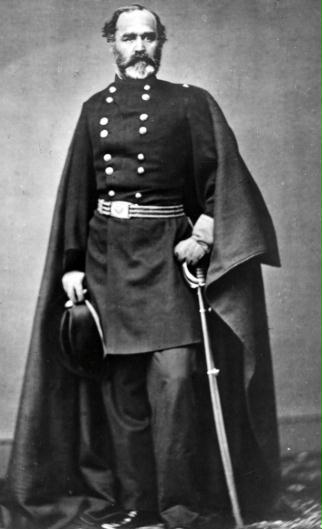
Preface. This is a book review of Robert O’Harrow’s 2016 book “The Quartermaster.Montgomery C. Meigs. Lincolns general, master builder of the Union army”.
I can’t believe I never heard of him, but he is as much responsible for the North winning the Civil war as any general or President Lincoln. As chief quartermaster he kept the military clothed, fed, and sheltered despite a million difficulties that had to be overcome, including corruption, lack of horses, wagons, and other equipment.
My main motive in reading this was to find out what fighting wars in the future will be like without fossil fuels. Also, I worked in transportation, so the logistics of trying to supply so many hundreds of thousands of soldiers and horses across many thousands of miles is interesting as well.
I became interested in the behind-the-scenes providers of fighting wars recently when I read that the list of goods Philip Paul, comte de Ségur (1780–1873) was expected to provide to Napoleon to invade Russia. Paul was one of Napoleon’s generals and perhaps the most famous chronicler of the disastrous Russian invasion. Here was just the Prussian contribution: 22,046 tons of rye, 264 tons of rice, two million bottles of beer, 44,092 tons of wheat, 71,650 tons of straw, 38,581 tons of hay, six million bushels of oats, 44,000 oxen, 15,000 horses, 300,600 wagons with harness and drivers, each carrying a load of 1700 pounds; and finally, hospitals provided with everything necessary for 20,000 sick.
Makes you wonder how anyone can afford to fight a war!
By the time of the Civil war, far fewer wagons and horses were needed. The North won by moving most of the goods on railroads and ships, which are far faster and can carry the equivalent weight of thousands of horses pulling wagons. No matter how often the rebels blew up railroad tracks and bridges, a huge crew of men with spare rails, ties, and the lumber to build bridges put it all back together again.
At this time, locomotives and ships burned wood in their
steam engines, but only a few years later they switched to coal. They had
to. Most of the forests East of the
Mississippi were gone, even though there were only 30 million people. The forests were cut down not only to power
steam engines, but for cooking, heating, and building homes and other wood
products.
One of the problems that had to be overcome were the
corrupt contractors, who sold sand in
place of sugar, lame horses as wagon ready, and rusty muskets that the army had
previously rejected as worthless. One
product embodied the fraud and corruption accompanying the army’s mobilization:
shoddy, a fabric made of cuttings and other waste retrieved from the floors of
clothing makers. Combined with glue, pounded and rolled, it had the appearance
of sturdy cloth. Its lack of integrity became apparent only in the field, under
a hot sun and exposed to drenching showers. It literally fell off the backs of
soldiers.
The Quartermasters duties included: supplying horses to haul artillery, cavalry, and wagon trains, as well
as the forage to feed them. It built barracks and hospitals. It furnished
uniforms, socks, shoes, needles, thread, pots, canteens, and other goods to the
men. The department’s men also constructed and repaired roads, bridges,
railroads, and military telegraph lines. They chartered ships and steamers,
providing the coal to fuel them and the docks and wharves to unload them.
The army consumed 600,000
tons or more of supplies every day, nearly all of which had to be shipped in at
great expense. Every horse needed to eat 14 pounds of hay and 12 pounds of corn,
barley, and oats, while each soldier required just 3 pounds of food.
After a battle quartermaster
men were asked to collect huge amounts of materiel left behind by both armies,
including muskets, ammunition, cartridge boxes, knapsacks, clothing, and more.
But collecting
the gear was hard — people came in swarms to plunder the battlegrounds. Some
took guns, bayonets, and other equipment by the wagonload.
Robert O’Harrow. 2016.The Quartermaster. Montgomery C. Meigs. Lincolns general, master
builder of the Union army. Simon & Schuster.
The army quickly faced shortages. The new force needed a
logistical machine that could feed and clothe and arm and move an unprecedented
number of men for an unknown amount of time. To create that system, Meigs had
to engage in what one historian has called the “art of defining and extending
the possible” to provide “three big M’s of warfare—materiel, movement, and
maintenance.
Meigs was occupied by the most basic questions. What clothing did the army have? What about
boots, blankets, and tents? How would he acquire the horses and wagons needed
to carry the food, guns, and ammunition? How to reconcile the need for speedy
decisions against the obligation to prevent fraud and contracting abuses?
Meigs had to find
horses, mules, and oxen. He sent telegrams around the country to order what the
army needed, only to discover that defectors had absconded with most of the
army’s stock of animals.
Meigs discovered that he had been too optimistic about
his ability to muster animals to support the offensive. He had ordered 6,000 horses and mules, but they could not get to
Washington. Railcars filled with supplies jammed the depots in Washington. The
quartermaster also discovered an acute shortage of wagons. Some 9,000 soldiers
heading to the Shenandoah Valley could not go beyond Hagerstown, Maryland,
because the army did not have enough wagons to move their supplies from a train
depot into the mountains.
Soldiers carried three days’ worth of rations in their
haversacks. Many of them demonstrated their lack of discipline, eating
provisions with abandon and thus leaving themselves nothing for after the
fighting.
Contractors came from everywhere in the spring and summer
of 1861, angling to sell an unprepared army everything the soldiers needed. There were contractors for bread,
contractors for clothing, contractors for shoes. They provided horses, mules,
forage, rail transport, steamers, coal, and construction equipment. They
supplied the bullets for killing, surgical equipment to cut off mangled limbs,
and ambulance wagons to take the wounded and corpses away. The men of the
fast-growing army needed it all, and they needed it now, making the government
an easy mark for chiselers.
They sold sand in
place of sugar, lame horses as wagon ready, and rusty muskets that the army had
previously rejected as worthless. One
product embodied the fraud and corruption accompanying the army’s mobilization:
shoddy, a fabric made of cuttings and other waste retrieved from the floors of
clothing makers. Combined with glue, pounded and rolled, it had the appearance
of sturdy cloth. Its lack of integrity became apparent only in the field, under
a hot sun and exposed to drenching showers. It literally fell off the backs of
soldiers.
Government
employees enabled the profiteering. Horse inspectors in Washington endorsed the
purchase of lame animals in exchange for cash bribes.
In St. Louis, a fountain of corruption sprang forth from
the army’s new Western Department headquarters. In some ways, the department
epitomized the blockheadedness, waste, and abuses of those early months in the
war. The department was led by Major General John Frémont, the flamboyant
former presidential candidate sometimes known as the Pathfinder. Frémont was
blamed for failing to give adequate support to General Nathaniel Lyon who, on a
mission to clear Missouri of secessionist soldiers, was defeated at the Battle
of Wilson’s Creek. More than twelve hundred Federals were killed,
Lincoln was among the angry. With his encouragement,
Congress enacted the False Claims Act of 1863, a landmark law that gave
whistle-blowers a reward for bringing forward evidence of contracting abuses.
Sometimes called “Lincoln’s Law,” it remains one of the government’s key
enforcement tools against fraud today.
Much has been written about the tactics and glory of
battles. But as Napoleon said, an army marches on its stomach. Before a commander can even hope to attack,
destroy, or simply wear down an enemy, he must first be able to deliver 3,000
calories a day to each soldier. He must keep them warm and healthy. Then he has
to be able to move them from point A to point B in a reasonable amount of time.
“The fighting, the
direction, even the planning of the battles occupies in the whole seconds only
to the hours of labor involved in the preparation & execution of marches.”
Regulations mandated that the Quartermaster Department provide transportation
for all men, food, weapons, and materiel, a list that grew as the war expanded.
It supplied horses to haul artillery,
cavalry, and wagon trains, as well as the forage to feed them. It built
barracks and hospitals. It furnished uniforms, socks, shoes, needles, thread,
pots, canteens, and other goods to the men. The department’s men also
constructed and repaired roads, bridges, railroads, and military telegraph
lines. They chartered ships and steamers, providing the coal to fuel them and
the docks and wharves to unload them.
The supply system relied heavily on depots, and Meigs
gave his depot officers room to run them and their field operations as they
wanted, so long as they followed his rules and principles
In the first year of the war, spending shot up 18-fold to
$174 million annually. It kept rising in each of the next four years. The
outlays by the department now far exceeded any other category of spending in
the entire federal government
Quartermaster employees needed to be entrepreneurial,
dogged, and diplomatic. In every theater of war, at every supply depot and in
the cramped offices they occupied in Washington, they engaged in a complex
dance with clothing makers, weapons factories, railroads, providers of forage,
and many others. They made up many of the steps as they went along.
New technology helped Meigs overcome certain challenges.
Consider Isaac M. Singer’s sewing machine, which eventually helped the Union
surmount the limitations of an industry in which seamstresses stitched most
clothing by hand, or Gordon McKay’s machine for stitching soles onto boots and
shoes.
Northern factories went on to produce nearly a half
million pairs. The army found that they typically lasted eight times longer
than handmade shoes.
Efforts to provide war necessities soon exceeded all
other industrial enterprises in the nation, including as many as 130,000
civilian participants. In superintending this colossal endeavor, Meigs provided
momentum to the nation’s economy for years to come.
For now, in the summer of 1861, Meigs still had to ensure
that Union troops received guns to shoot and pants to wear and food to eat. And
that was far from a sure thing. Though Meigs’s duties did not include buying
weapons, he took it upon himself to dispatch an agent to Europe to acquire a
hundred thousand muskets, twenty thousand sabers, and ten thousand revolvers
and carbines.
Union troops died by friendly fire because of soldiers’
inability to identify friend or enemy. Meigs ordered the irregular clothing
replaced as soon as possible with blue uniforms made under exact
specifications. (His demand for uniformity and efficiency left the nation with
a novel legacy that has come down to this day: small, medium, and large sizes.)
Waste compounded Meigs’s challenge. Infantry soldiers
often abandoned heavy clothing on warm days. He wrote with frustration about a
large, new regiment that cast aside eight hundred coats on a single march, only
to find themselves freezing days later in a cold rain.
Textile mills, which simply could not keep up with the
army’s extraordinary needs.
Finding enough blankets posed an even harder challenge
than providing clothing. Army regulations called for each soldier to receive
two blankets every five years. Gray, wool, and warm, they were substantial
affairs that weighed about five pounds each. The problem was that no one
manufactured enough of them. In
something of an experiment, he also turned to French contractors for entire
sets of clothing and camp gear for ten thousand men—uniforms, belts, knapsacks,
blankets, tents, cooking utensils, and more. He paid the same prices as the
French army, about $800,000 in all.
The America-first crowd now blasted him for spending tax
dollars abroad. The Board of Trade in Boston reached out to Cameron and
predicted dire consequences, including widespread unemployment and nothing less
than the ruin of the American economy. The complaints from the industry
eventually had an effect. Congress prohibited most foreign purchases for the
rest of the war.
Meigs standardized contracting practices and imposed
rules for army buying that generally required advertisements in advance, sealed
bids, and the award of work to the lowest bidders. The results showed. The Union army now fed, sheltered, and
outfitted nearly 700,000 men. It had acquired tens of thousands of horses and
mules, along with harnesses, wagons, and mountains of feed.
Unlike Cameron, Stanton prohibited visitors to his home
and curbed the access of lobbyists and lawmakers in the department, who
previously had wandered through the offices at will. He also limited Congress’s
access to him to just one day a week. Contractors and other visitors also had a
single day for lobbying and other business. Stanton reserved the rest of the
week to run the war.
Meigs was asked to assess plans for gunboats that could
pummel rebel forts, protect river traffic, and support infantry movements. The idea for the boats came from the
recognition that the Union had to control the western rivers to prevail. The
rivers ran deep into the South and offered promising alternatives to the rutted
tracks that often passed for roads there. The Mississippi bisected the
Confederacy and served as a highway of commerce. The Tennessee offered a direct
route to the rear of the enemy.
Hundreds of vessels
transported more than 100,000 men over several weeks’ time.
Department
officers under Meigs eventually leased 753 steamers, almost 1,100 sailing
vessels, and more than 800 barges. They bought or commissioned construction of
about 300 additional vessels.
In addition to moving men, the Peninsula fleet transported more than 14,000 animals, 3,600 wagons,
700 ambulances, mountains of feed for the horses and rations for the men,
pontoon bridges, telegraph gear, and vast amounts of other equipment.
While planning the offensive, McClellan told Stanton that
the roads were passable in every season. As it happened, the flat, sandy
pathways became quagmires in heavy rain that spring. Even lightly loaded wagons
sunk down to their beds. Only mules could get them through. The department
officers quickly adapted to the conditions,
The logistical
demands were unprecedented. The army consumed 600,000 tons or more of supplies
every day, nearly all of which had to be shipped in at great expense.
McClellan made matters still more challenging by prohibiting troops from
foraging in enemy fields unless they paid for whatever they took or issued
receipts guaranteeing government payment later. He thought this benign approach
would win over Southerners and shorten the war—a notion that Meigs condemned as
silliness, or worse. In his judgment,
the Union had to use every means to support its soldiers and exhaust the
rebels’ will to fight. This included
using enemy land to feed the army’s great herds of horses and mules.
Meigs was concerned about keeping up with the army’s
insatiable demand for horses. Union forces relied on the animals to a degree
that might be hard to imagine now. It needed horses and mules to maintain its
very existence. The numbers in play were remarkable. Armies with about 426,000 men would soon have nearly 114,000 horses and
88,000 mules. That’s not counting
the creatures sidelined by illness, wounds, or fatigue. Until now, Meigs had
been lucky in meeting the demand. At the
beginning of the war, Northern states had almost 5 million horses on hand.
Enough were available even to offset the corruption among dealers who sold the
government old, lame, and even blind animals. For many months, the prices
remained steady, with horses delivered to Washington at the cost of about $125
each. But lately the market price had crept up close to $185, putting stress on
both the Treasury and Meigs.
Thousands had been sent back to Louisville. Meigs said
the circumstances showed that Rosecrans simply asked for too many to be able to
inspect them. Besides, Meigs said, the horses were overworked, underfed, and
abused. Why did Rosecrans take his men and their horses on long marches with no
clear purpose? “Such marches destroy the horses,” he wrote. “We have over 126
regiments of cavalry, and they have killed ten times as many horses for us as
for the rebels.
The provision of
forage presented one of the great challenges of the war to Meigs’s
department. Every horse needed to eat 14
pounds of hay and 12 pounds of corn, barley, and oats, while each soldier
required just 3 pounds of food. All together, the animals of the Army of
the Potomac needed more than four hundred tons of forage each day. Without that
fuel, the army could not move. Buying that feed and moving it to the right
place, in a timely way, without bankrupting the government, was a stupendous
logistical problem.
At the beginning of the war, Meigs had left it to
quartermaster officers at each depot and with each army to buy feed as needed.
Those officers soon began competing with one another for supplies, driving up
prices and further depleting a nearly empty Treasury. To contain the costs, a
senior quartermaster officer launched a plan to cut corners by feeding the
animals a less expensive mix of corn and oats. Contractors soon grasped that
they could jack up profits by secretly bulking up the feed mix with less costly
and less nutritious grains. Meigs investigated those scams, studied the market,
and imposed price controls.
Delays due to winter storms, railway disruptions, and
simple chaos sometimes put the animals perilously close to starvation. They
constructed temporary piers. To fashion the piers, they pulled boats and barges
onto shore at high tide, covered them with planks, and then linked them
together. They herded cattle over land, maintaining them in corrals and
butchering them as needed. To minimize chaos, Van Vliet ordered that
supplies remain aboard ships until needed. His
men constructed a steam-hoist to speed the movement of food, ammunition, and
other supplies onto wagons. The systems worked, but available food often could
not be moved quickly enough over narrow, crowded, and mucky roads. Inevitably,
many soldiers could never get enough to eat.
Lee was intent on preventing a siege of Richmond. Federal
soldiers suffered thousands of casualties before McClellan decided to retreat
to Harrison’s Landing on the James River, about 24 miles southeast of Richmond.
In the rush back, the trains of wagons supporting each brigade were permitted
to make their own way. Instead of one well-organized line, there were as many
as nine, all of them vying for position. Competition to get to the head was
fierce because the roads were inevitably ruined for those lagging behind.
Confusion often resulted. The Quartermaster Department bore responsibility. “A
struggle for the lead would naturally set in, each division wanting it and
fighting for it.
They hustled all night long, going some thirty miles to
Manassas Junction. On their arrival, they saw evidence of what the fight
against the North really entailed. Packed warehouses, overloaded railcars, and
long lines of barrels held one of the great stores of supplies brought into the
field during the war. Fifty thousand pounds of bacon, a thousand barrels of
salt pork, hills of flour; jellies, coffee, and tea; piles of uniforms, new
boots, and rifled muskets; toothbrushes and candles. “The hungry, threadbare
rebels swooped down on the mountain of supplies at Manassas like a plague of
grasshoppers,” one historian of the war wrote.
After stuffing themselves and putting on needed clothing,
Jackson’s men gathered what they could carry, torched the remaining supplies,
and fled. The next day, the army forded the Potomac and entered Maryland. Lee
ordered all commanders to reduce their supplies to the minimum. This was in
part to minimize the demands on the overtaxed animals the army needed to move
cannons, ordnance, and food. “All cannoneers are positively prohibited from
riding on the ammunition chests or guns.”
They still did not have enough food or animals. Many
residents were unwilling to accept Confederate money. Lee grew more concerned,
aware that a lack of supplies could hobble his remarkable and dedicated force
every bit as much as fire from the enemy. “I shall endeavor to purchase horses,
clothing, shoes, and medical stores for our present use,
The shortfalls the year before had been replaced by
abundance. The main challenge was moving the materiel to the men in the field.
The main fear was that field generals would not use what they had to crush the
enemy.
Steamboats and
railway offered remarkable advantages to the North, but supplies still had to
get from wharves and depots to soldiers in the field. The wagon was the way.
Meigs admired the regulation army model known as the Conestoga. It had been refined over the
years on the western plains. Stout and lumbering, it had interchangeable parts
that could be repaired in camp with portable forges. Each wagon had a tool box
in front, a feed trough in back, and an iron “slush bucket” for grease hanging
from the rear axle. Freight was protected by a canvas cover. Drawn by four to
six horses, a wagon could move 2,800 pounds of supplies over good roads in good
weather. A team of six mules could carry more than 3,700 pounds, plus about 270
pounds of forage.
No one had established clear guidelines for their use.
The wagon trains that followed the armies reached absurd proportions, causing
chaos and slowing nearly every movement. They carried every kind of comfort:
stoves, kettles, pans, chairs, desks, trunks, valises, knapsacks, tents,
floorboards, and any other conveniences. Loaded in this way, the wagons could
go about two and a half miles per hour over good roads. They could barely move
on bad ones.
In a stern letter to McClellan, on September 9, Meigs
insisted on reforms. He prescribed no more than three wagons for stationary
regiments to carry daily rations. Remaining wagons should be set aside for
supply trains. He said that officers had to curb their appetite for comfort,
including their use of the voluminous Sibley tents. Meigs felt they should make
do with smaller, more portable “shelter tents.” He was motivated in part by the
cost of cotton, which was rising because of the war. Soldiers dubbed the small
shelter a “dog tent,” because that’s what it seemed fit for; sometimes they
stuck their heads out of the tents and barked like dogs.
The name for the small shelters eventually became “pup
tent.” The quartermaster pegged the
ideal use of wagons at about one for every 80 men, roughly the standard adopted
by Napoleon. He noted that the Army of the Potomac used about one wagon for
every 34 men, an untenable arrangement. “The extra wagons, now filled with
officers’ baggage, should be emptied, and the officers compelled to move
without this unnecessary load,
In a related push for mobility, earlier Meigs had
circulated a French proposal for the organization of a light, highly mobile
“flying column” of troops that would lighten the burden on the army’s
logistical system and diminish the need for wagons and animals. The paper,
prepared by a contractor to the French army, prescribed columns with 2,000 infantry,
400 cavalry, two pieces of artillery, and 50 horses. Soldiers would carry eight
days of their own rations, including coffee, tea, sugar, rice, seven pounds of “sea biscuits,” and
“desiccated and compressed vegetables.” The paper said the soldiers would be
divided into squads, the members of which would share the burden of carrying
equipment, including sections of shelter tents. In theory, the flying columns
created a nimbler force, at least in the short run. Wagons loaded with
additional supplies could follow in the rear. “Alarm the enemy, break up his
camps, and keep always advancing,” the paper said. Squads should take along hand mills for
grinding corn, with the aim of lessening the burden on the Quartermaster
Department to provide flour for bread.
After experimentation and refinements, the board found
the flying column system workable. At Meigs’s urging, Rufus Ingalls, chief
quartermaster of the Army of the Potomac, began adopting variations of the
system in future campaigns.
Drawing on lessons learned from earlier campaigns, along
with the experiments with flying columns, Ingalls and Meigs directed the long
wagon trains well out of the way of the troops. Baggage and tents were not
stored near the fighting. Soldiers carried only a small amount of food, and
ammunition was delivered at night, mostly by wagon. Troops rarely saw the
operations that sustained them. Ingalls established a temporary depot 25 miles
behind Union forces, at the head of a small rail line and a road leading to
Baltimore.
Several
quartermaster men were asked to oversee collection of huge amounts of materiel
left behind by both armies, including muskets, ammunition, cartridge boxes,
knapsacks, clothing, and more. But that collecting the gear was harder than he
had expected. People came in “swarms to sweep & plunder the battlegrounds”
of souvenirs. Some took guns, bayonets, and other equipment by the wagonload.
One man made away with a six-pound cannon and lowered it into a well. Others
took horses and mules, cutting out or burning away the US brand on the animals
to obscure evidence of their thefts.
Eventually scores of looters were arrested and assigned the grim work of
burying the bodies of men and horses. More than 24,000 muskets and rifles,
10,000 bayonets, 2,400 cartridge boxes, sabers, belts, and hundreds of other
items were retrieved eventually and made available to the army.
By capturing half of Mississippi, Grant and Sherman
blocked the supply of beef cattle to the rebels in the east and prevented
Richmond from sending weapons, food, clothing, and reinforcements to the west.
The soldiers carried only what they needed for the trip
and the following few days. That included forty rounds per man and two days’
cooked rations. Commissary and quartermaster men arranged to provide coffee and
sugar during the journey. Planners made
sure that the trains moved in the dark to conceal them from rebel spotters in
distant hills.
The logistical challenges facing the quartermaster corps
were nearly overwhelming. Thousands of
mules died from starvation and the work of hauling in rations for 50,000 men
and forage for the starving horses, many of which no longer had strength enough
to pull artillery. Mule carcasses lined the rough road all the way to
Bridgeport, Alabama, where the Union army had a boatyard and maintained
supplies. Rebel cavalry made a devastating attack on the tenuous supply line.
The attack, on October 2, destroyed more than 300dred loaded wagons. The rebels
killed or captured 1,800 mules. The army, with enough ammunition for less than
a day’s fighting, hung on “by the merest thread.” Meigs scrambled in his usual
way. He urged Stanton to send more mules, in part to support Hooker’s arriving
men. He guided pioneer troops who had
put two abandoned sawmills into action, spitting out lumber for bridges, boats,
and fortifications. He oversaw the inventory of equipment and metal from a
large foundry and a destroyed bridge, stuff that was eventually transformed
into rolling mills for rail lines.
A key to this was the construction of a steamboat that
could ply the upper Tennessee River, which could not be reached easily from
downstream because of thin water at Muscle Shoals, Alabama.
A quartermaster man, Captain Arthur Edward, had
responsibility for building the boat. Meigs arranged for delivery of
specialized supplies, including boilers and engines that were floated down the
Ohio River and shipped by rail to the boatyard at Bridgeport, on the upstream
side of Muscle Shoals. Mechanics and carpenters hustled down from the North to
help out. The quartermaster team built the steamer from a flat-bottomed scow
outfitted with pontoons, a new steam engine, a rough pilothouse, and a paddle
wheel. The team fashioned a cabin from a rough frame and covered it with
canvas. With the boat nearly complete, Grant launched a stealthy campaign to
take key points on the river. At three in the morning on October 27, 1,400 men
floated silently nine miles down the Tennessee on other pontoon boats,
surprising the rebels at Brown’s Ferry. The Union force dismantled those boats
and used the pontoons to build a bridge.
On May 4, 1864, the Army of the Potomac began its great
Overland Campaign into the Confederacy. It would culminate nearly a year later
with the fall of Richmond, but only after what Grant described “as desperate
fighting as the world has ever witnessed.” The numbers associated with the
offensive—the supplies, the men, the deaths—remain notable. The force included
nearly one hundred thousand infantry, fifteen thousand cavalry, and six
thousand artillery men.
They deployed
4,300 wagons to carry an immense supply of pork, crackers, coffee, salt, and
sugar, along with mess kits, ammunition, and baggage. On hand to draw the
wagons were 23,000 mules. More than 30,000 horses carried cavalry soldiers and
pulled the artillery. Beef cattle followed on the hoof, to be butchered as
needed. Grant later estimated that if put into single file and spaced properly,
the train would have extended the 70 miles or so from the crossing on the
Rapidan to the city of Richmond.
Ingalls adopted a strict method for using the wagons. As
soon as they were emptied, they generally would be sent to the rear for
resupply with identical provisions. Apart from creating a new level of
efficiency, his system addressed one of the great logistical burdens of the
war, the feeding of animals. Instead of having to carry tons of forage for
themselves, the animals often ate when they returned to depots.
Maj. Gen. Philip
Sheridan, whose rapid rise through the ranks was fueled by his aggression,
echoed Grant’s relentlessness. With 10,000 cavalry soldiers, he carved a path
toward Richmond, inviting an attack from the smaller rebel cavalry force
under Jeb Stuart. They lived largely off
what they found and destroyed railroads, trestle bridges, and telegraph lines
along the way. At one rebel depot, Sheridan’s men dismantled or torched 100
railcars, 2 locomotives, and 1.5 million rations, including 200,000 pounds of
bacon, according to Sheridan’s estimate.
Behind it all, legions of supply workers, sometimes
operating in the line of fire, provided steadfast support. For the crossing of the James River, army engineers built what was one
of the longest floating bridges in the history of warfare, a 2,200-foot-long
structure composed of 101 wooden pontoons. It enabled the crossing of a line of
3,500 beef cattle and a wagon train 35 miles long. The quartermasters,
meanwhile, had to hustle to keep pace with the destruction of horses. In the
first six months of 1864, the Army of the Potomac received almost 40,000
cavalry horses, representing two complete remounts.
In less than a month, the city’s hospitals took in 18,000
new patients. Many of them died in short order, and then the corpses stacked up
faster than they could be buried. A stench drifted over the city like smoke.
Meigs had to provide the answer to a grim, practical question: Where would all the bodies go?
In July 1862 Congress authorized Lincoln to create
national cemeteries for servicemen. As the war ground on, finding burial sites
became a monumental challenge. By the spring of 1864, the pine and rosewood
caskets passed through Washington in a seemingly unending flow. On May 13 a
cemetery on the property of the Old Soldiers’ Home ran out of room. Nearly
6,000 soldiers had been interred there in less than three years. Another 2,000
had been buried at Harmony Cemetery and elsewhere in the vicinity of
Washington. Added to that were burials of more than 4,100 deceased former
slaves.
They succumbed to gunshots, cannon fire, and bayonet
wounds; diseases that included dysentery, typhoid, and diphtheria; infections
contracted during surgeries; and the blunt physical or emotional shock of
losing a limb.
Meigs soon dug a mass grave nearby, a huge pit to hold
the bones of unidentified soldiers.
In the war’s Western theater, the armies under Sherman
moved steadily closer to Atlanta. Every movement depended on support from the
railroad construction corps. The supply line began far back at Nashville. It
extended 151 miles to Chattanooga. The railcars carried provisions, clothing,
gear for the men, and forage for the animals.
The supply line later snaked its way toward Atlanta, 136
miles farther along the Western & Atlantic Railroad. The rebels attacked and destroyed sections of both lines repeatedly.
They twisted the iron tracks and burned the timber cross ties. Meigs ordered the completion of the rolling
mill in Chattanooga that he and his men began working on during the siege the
previous fall. The mill enabled them to
straighten 50 tons of rails each day, far more quickly and at a far lower cost
than manufacturing and shipping the rails from the North. The railroad workers
rebuilt more than a dozen bridges that summer.
Chattahoochee River. It
took the corps just four days to rebuild the 780-foot-long, 92-foot-high bridge
over the river. All told, the logistical work during the campaign was among the
most impressive of the war. Rail lines in the region under Union control rose
to 956 miles from 123 miles a year before. The number of cars shot up to 1,500
from 350.
Sherman calculated
that it would have taken almost 37,000 wagons to carry the same loads as the
railroads, in the same stretch of time.
The force brought relatively few wagons. Sherman encouraged his men to forage
liberally and to take or slaughter mules, horses, hogs, and other animals. The
Union rules for war had changed. Gone was the sense of delicacy about civilian
interests. The army cut a broad swath through the fertile state, some thirty
miles on either side of its path to the sea, causing perhaps $100 million in
damage, or roughly $1.5 billion now.
It fell to Meigs to ensure that the men received supplies
at its terminus, even though no one in Washington knew for sure where that
would be. Sherman planned to head to Savannah. Meigs reckoned it was possible
Lee would pull out of Petersburg and confront Sherman’s army, forcing it toward
Pensacola. To Meigs, it demonstrated like never before the viability of warfare
untethered from supply lines. He was especially taken by the fact that
Sherman’s men found forage for their animals rather than relying on costly
deliveries from the North.
Nearly everything
had to be delivered by sea, with Northern ships cycling in a constant stream
along the East Coast. Grant’s siege force required a virtual armada to keep it
supplied, including 190 steamers, 60 tugs, 40 sailboats, and 100 barges. Those
vessels comprised a mere subset of the Quartermaster Department’s ocean fleet,
which in the last year of the war included 719 vessels that cost more than
$92,000 a day on average to operate. The department operated another 599
vessels for river transport.
The war ends. 600,000 men died
Next came the task of demobilization. The men of the army
had to be discharged, paid, and transported home. Once again, the Quartermaster
Department managed. In 40 days, some
233,000 men, 12,800 horses, and 4 million pounds of baggage traveled across the
border between war and civilian life. By
winter, a second wave brought the diaspora’s total to 800,000. The
department’s transportation branch had never been busier. The logistics were
akin to those needed for the massive offensives of the previous year—save for
the absence of gunfire.
Much more still had to be done for the dead. The bones of
tens of thousands of Northern men lay in forests, fields, and shallow graves on
battlefields across the South. Men scoured the landscape for remains. For two
weeks, they buried and reburied bodies and bones. They had no difficulty
deciding where to build new cemeteries. They efficiently chose the places of
the greatest carnage, and interred more than 50,000 bodies across Georgia,
Virginia, and Maryland.
By late 1866, more than three dozen national military
cemeteries anchored battlefields across the country. They held the remains of
almost 105,000 Union soldiers—with many more to come. Meigs calculated the cost
of removing and reburying the bodies at about $9.75 each.
The department held fire sales of 207,000 horses and
mules, 4,400 barracks, hospitals, and other buildings and mountains of
irregular or damaged clothing.
To help former slaves eke out a living and guarantee them
a measure of economic freedom, he urged lawmakers to give each family five
acres of land. “The emancipation of the negro slave is incomplete as long as,
being without land, he is at the mercy of his former master.” His lobbying came
to nothing. President Andrew Johnson showed no interest in the cause. In his
frustration, Meigs predicted Southerners would resume their oppressive ways and
return “like dogs to their vomit. They can not enslave but they will outrage
& oppress. Their hearts are not changed.
Quartermasters were still needed after the war ended
since settlers needed the protection of soldiers, and the soldiers needed
supplies from the Quartermaster Department.
BEFORE THE WAR
[my comment: I was only going to take notes on the supply
chains and other aspects of supplying soldiers for battle, but Meigs was such
an amazing man I found myself noting other aspects of his life as well. Yet most of them are left out below, but this
gives you some idea of how accomplished he was across many fields, plus his
great skills as a leader and hard work to execute complex projects quickly and
under budget with complete and utter honesty, unlike many of the scoundrels
around him.]
On March 29, 1861, Army Captain Montgomery Meigs, just
home from work, found a letter waiting for him. Secretary of State William
Seward wanted him to go to a meeting at the White House as soon as possible.
President Abraham Lincoln had a problem to solve and needed to talk to a
soldier about certain military operations. It was unusual for a president to
seek advice from a captain, but these were unusual times, and Meigs was an
unusual man.
Meigs was an army engineer with no fighting experience,
but few could match his mix of creativity and talent for organization. He had
built the capital’s new aqueduct, including a bridge with the longest masonry
arch in the world. He also was the man behind the US Capitol’s recent expansion
and the ongoing installation of its great dome.
Philadelphia was a bustling business center quickly
filling with schools, churches, and businesses. It retained the charm of a
provincial city, giving way quickly to unspoiled countryside. About sixty-three
thousand residents relied on wood to heat their homes. Farmers brought food to
the city by wagons.
Meigs soon become a brevet second lieutenant in the Army
Corps of Engineers, an elite organization that played a primary role in
building the young country’s roads, canals, bridges, and harbors. Its
achievements included the country’s longest highway, the Cumberland Road, west
of the Ohio River.
In the summer of 1837, one of his first assignments
paired him with another West Point graduate, Robert E. Lee, class of 1829.
Their task was to find ways of improving navigation on the Mississippi River.
Meigs admired Lee, “then in the vigor of youthful
strength, with a noble and commanding presence, and an admirable, graceful, and
athletic figure. He was one with whom nobody ever wished or ventured to take a
liberty, though kind and generous to his subordinates, admired by all women,
and respected by all men.
They would remain fond of each other until a national
crisis turned them into mortal enemies.
***
Meigs helped rebuild Fort Delaware, a massive
fortification on Pea Patch Island destroyed by fire. The project posed many
challenges. The island had formed from silt over the centuries, and the mud
went forty feet deep in places. Meigs and other engineers created an intricate
wooden grillage as a foundation, pounding more than twelve thousand wooden
piles into the mud, using steam-powered pile drivers. Builders had been using
such structures since the days of the Roman Empire.
***
President Polk underscored his support of the annexation
of Texas from Mexico. The new president was prepared to go to war. For the
soldiers who would put his words into action, this meant a chance to earn
glory, a rise in rank, and a boost in salary, which resulted in appalling
casualties, including more than 13,280 American dead. Many of his army colleagues became famous and
received promotions. Among them were Ambrose Burnside, Jefferson Davis, Ulysses
Grant, Robert E. Lee, and Thomas Jackson, later known as “Stonewall.
***
The location of the blaze could not have been worse, the
reading rooms of the Library of Congress. Just the night before, a nearby hotel
had burned down. Fire in the confines of the Capitol could spell disaster. The
great pile of wood, brick, and sandstone was more than the center of the
government. It also anchored the young country’s outsized aspirations to
greatness. The building had been under construction or renovation for a half
century. Though architects and builders had done their best with the budgets they
had, the place had become a grand, handsome tinderbox on a hill.
After a daylong battle, two-thirds of the fifty-five
thousand books were reduced to gray ash. Lost too were maps, charts,
thousand-year-old bronze medals, and more.
Investigators quickly determined the cause. On the floors
below, the drafty committee rooms had large fireplaces, which lawmakers had
kept stoked in a struggle against the subzero frost that had enveloped the
District in those first days of winter. Sparks had ignited a wooden joist
jutting into the flue of a poorly constructed chimney.
Nothing could contribute more to the health, comfort, and
safety of the city and the security of the public buildings and records than an
abundant supply of pure water, I respectfully recommend that you make such
provisions for obtaining the same
But lawmakers simply couldn’t divine the benefit of
spending millions on work so far from their home districts. But the library
fire stirred them to action. They agreed to allocate $5,000, more than ever
before, to support the search for a solution.
Meigs was to conduct a survey and find “an unfailing and
abundant supply of good and wholesome water” for the nation’s capital and
neighboring Georgetown.
In a 1,700-year-old book Meigs found a grand Roman water
system that would work well. The Potomac water would course through
seven-foot-wide conduits made of bricks, dropping on average about
nine-and-a-half inches each mile. The minimum cost would be just over $1.9
million.
Meigs would be allowed to succeed only if he directed
some of the work to the right people and their friends. To prevail, he would
have to master the dark arts of politics and bureaucratic wrangling—while also
managing men, overseeing millions in spending, and seeking solutions to mind-boggling
engineering problems. Meigs’s first lessons in Washington corruption came at
the Capitol, a building that epitomized the striving and contradictory
character of the republic it represented. From the fields down the hill,
Congress’s home appeared stately and steadfast. Prints at the time showed it as
a romantic vision, cloaked in a gauzy bank of moist air. In reality, it was
drafty, damp, and cramped. And that was only the start of the problems. Design
flaws made it nearly impossible for lawmakers to understand one another during
debates.
Work on the aqueduct languished for lack of funding, and
opponents on Capitol Hill held up proposals for new infusions of cash.
Designing the Capitol
Meigs’s plans, derived in part from an earlier proposal,
placed the legislative chambers in the interior of the expanded building. His
changes would give lawmakers private rooms and passageways beyond the reach of
the public or reporters. To link the building to the outside world, he planned
to install a telegraph. His plans included monumental staircases, glazed
ceiling panels, and galleries capable of seating 1,200 people. He also called
for stained glass set in iron frames in the ceiling and a lobby in the House
wing that featured Corinthian columns. Much of what he proposed was modelled on
Renaissance painting, architecture, and ambitions. Because he had never
traveled abroad, nearly all his ideas came from books. Meigs soon took aim at the building’s
engineering problems, including the atrocious acoustics and a substandard
heating system.
The physics of sound had long confounded scientists and
builders. Certain churches, theaters, and concert halls over the centuries had
just the right angles and proportions to enable speakers to hear one another at
great distances, often with amazing clarity. In the best spaces, such as
Milan’s La Scala opera house, singers and actors could easily cast their voices
to the back seats. Obtaining such effects took ingenuity or plain luck. In the
legislative chambers in Washington, the result was a fog of sounds. That was a
significant defect in a building where talk and debate were the reasons for
being. The three men visited concert halls, theaters, churches, and a prison.
They spoke from different parts of every room, taking note of the duration,
volume, and direction of the echoes. They made drawings showing the general
form of the spaces.
In his plans for moving the chambers to the center of the
building, he also eliminated windows. Behind this unorthodox idea was a double
agenda. Solid walls would eliminate exterior sounds and drafts, which he
assumed blocked voices from reaching distant points in the room. Without
windows, he also would have to create an unprecedented, steam-powered fan
system for pumping air through the legislative chambers.
Cast iron and new building methods might be the hallmarks
of the industrial revolution, but the homely red baked brick provided its
foundation. England had used billions of bricks in the first half of the
century. Almost every project Meigs supervised relied on bricks, including the
Capitol’s inner walls and the aqueduct’s culverts and tunnels.
Most Americans took pride in their bland tastes. To them,
stark interiors and whitewashed walls reflected what Meigs called a “republican
simplicity.” In contrast, Meigs wanted to emulate the complex designs, vibrant
colors, and richness that characterized much Renaissance art.
Meigs’s desire to make the Capitol a palace of art. Meigs
went on to commission oil paintings, elaborate ironwork, and columns adorned
with carvings of native plants and vegetables. He secured permission from the
Capitol gardener to gather sticks, leaves, and flowers as models for metal
ornaments to decorate doors of the House chamber. In fulfilling the captain’s
artistic vision, a foundry at the Capitol also produced decorative cherubs,
grapevines, lizards, beetles, and flies. When he learned that two Ojibwa
leaders were in town to settle a treaty with the federal government, he called
on a decorative stonecutter to make likenesses of them. The busts remain among
the finest nineteenth-century depictions of Native Americans.
The construction demands posed by the dome were
unprecedented. Almost nine million pounds of iron components had to be lifted
one by one and bolted into place by men who had never worked at such heights. There
was little room for error.
How would the tower stay upright during the strain of
lifting? For the answer, Meigs turned to the techniques of ship rigging. Stays
like those used on the mast of a schooner would hold the derrick in place. But
under the pressures exerted here, hemp ropes like those used on ships would
shred.
***
Militaristic rhetoric grew more extreme by the week. On
May 8 the District was jolted when a Southern-born representative shot dead an
Irish waiter at the Willard Hotel, an anchor of political and social life in
the city. The shooting had no direct connection to slavery, but Northerners saw
it as a symbol of Southern aggression and intolerance. Meigs was appalled, writing, “This is one
example of the evil of carrying weapons.
On May 22 Brooks walked up to Sumner at his Senate desk,
where he was preparing mail.
Brooks began pounding Sumner with a gold-headed cane made
of gutta-percha, a hard, rubbery substance. Brooks chose the cane because he
thought it would deliver maximum pain without actually killing. The first blow
stunned and blinded Sumner. Others came quickly.
When others in the Senate moved to help Sumner, Keitt
held them off. The attack stunned the nation. Northerners saw it as an effort
to silence “an eloquent and erudite” spokesman for freedom. In the South,
editorialists applauded the episode, with some deriding Sumner as “an inanimate
lump of incarnate cowardice.” Brooks was lauded as a hero and given canes to
replace the one he had broken during the attack. Radicals in the South would do
almost anything now to protect slavery, the institution that anchored their
society.
Democrats selected James Buchanan of Pennsylvania, a
bland 65-year-old bachelor. He had served so long and often as a lawmaker and
diplomat that he was nicknamed Old Public Functionary. The fledgling Republican
Party went with John Frémont, the politically connected but inexperienced
“Pathfinder,” who had earned renown for his exploration of the West. The
American Party, which promoted nativism, chose former president Millard
Fillmore of New York as a compromise candidate. The South generally lined up
behind Buchanan. In the North, it was not clear who the electorate would
support. Many Northern regular voters were energized, even radicalized, by
events in Kansas. Voters pored over newspaper accounts of the campaign and
turned out everywhere for raucous political rallies, concerts, and picnics. They
were treated to a remarkable array of stump speakers, including Greeley,
Seward, and Ralph Waldo Emerson. Abraham Lincoln gave close to ninety speeches.
On March 4, 1857, one of the most hapless men in American
history was inaugurated president of the United States, President James
Buchanan.
Meigs’s new boss, Secretary of War John B. Floyd, was a
former governor of Virginia. He came into office with the apparent conviction
that it was his right to provide patronage to his friends. He also thought that
slave ownership was the natural right of Southerners. The Buchanan
administration was filled with Southerners, who jammed the parties and seemed
at times to be celebrating their standing in the capital. Floyd took advantage
of the power that flowed from the South’s dominance. Soon after taking control
of the War Department, he began turning his authority on Meigs. In one move, he
urged the captain to begin applying a political litmus test to his workforce.
He wanted to purge followers of the Know-Nothing movement, who objected to
Irish, Germans, and Catholic immigrants. More to the point, they also opposed
slavery, which offended Floyd.
Meigs and other sensible folk—including Abraham Lincoln,
then a lawyer in private practice in Springfield, Illinois—thought the group’s
members were nearly unhinged.
More pressing now was another of Floyd’s demands. He
wanted Meigs to award every contract automatically to the lowest bidder. At
first blush, this seemed reasonable. Competition helped keep prices low for
taxpayers. But Meigs knew that something else was afoot. Experience taught him
that certain companies engaged in a type of legal extortion. They lowballed
their original bids and then, when the work was too far along to stop, demanded
more money. Floyd’s games and machinations rarely ceased.
Administration leaks suggested that Meigs was about to be
fired soon wafted through the capital. Floyd then added to the pressure,
ordering Meigs to provide advance notice of any impending purchases worth
$2,000 or more. In late August Floyd redoubled his effort to purge the
workforce of political undesirables.
Opinions about the new chamber varied. Some praised the
circulation system. Others grumbled that the temperature was too high or low.
An article in the Boston Post said that the acoustics could not have been
worse. One unsigned piece published in the Philadelphia Inquirer predicted that
the hall “is, I fear, to prove an entire failure. I have not met the first man
yet who speaks of it favorably.
Meigs had a hard time accepting that his younger brother
tolerated slavery and considered secession a legitimate possibility. He decided
that Henry had sold out, trading his family’s veneration for the country for
“the almighty dollars which he has invested in Columbus Mills.”
AFTER THE WAR
The federal Pension Bureau needed a new building, and
Congress took the unusual step of naming Meigs to build it. Meigs once calculated that the space holds 4
million cubic feet of air. The volume of air inside was key to his goal of
air-conditioning the place. He came up
with an innovative scheme involving vents in the walls that allowed fresh air
in, and hot air to rise up and escape. His theory about the space turned out to
be true, as the courtyard served as a natural chimney. By 1985, the great brick pile was so admired
that it was transformed into the home of the National Building Museum.
Miscellaneous politics in the war
McClellan blames his endless retreats on the Quartermaster
(not true of course) but an example of the nasty politics Meigs had to deal
with (dozens more examples left out)
Luck seemed to be on the Union’s side. On September 13 a
Union corporal near Frederick, Maryland, saw an envelope on the ground that
contained Lee’s plans for the campaign, Special Order 191, wrapped around three
cigars. It was the greatest intelligence coup of the war, a single document
spelling out the positions of Lee’s divided forces. But McClellan hesitated
under the impression that enemy forces outweighed his own. The delay gave Lee
time to gather his troops near Antietam Creek, not far from the town of
Sharpsburg. McClellan massed his men there as well. On September 16 he took
still more time to examine Lee’s lines and put his units into what he
considered proper positions.
He ordered a retreat back across the Potomac. No one on
the Union side moved to stop him. McClellan claimed later that he had planned
on resuming the fight but felt compelled to bury the dead. He also said his men
needed rest and that he saw “long columns of dust” to the south that he said
proved rebels were arriving to reinforce Lee. “This army is not now in
condition to undertake another campaign nor to bring on another battle”. He directed Halleck to order McClellan to
cross the Potomac, fight the enemy, or drive him south before the roads became
impassable in fall rains. And now
McClellan turned to an old excuse, contending the Quartermaster Department had
let him down. The army could not move because it had not received enough
horses, clothing, or other supplies. McClellan said he had done what he
could with what he had been given.
Before fossil fuels arrived, we depended on the energy
from burning wood to make metals, bricks, ceramics, structures, and other
objects, and the muscle power of men and animals to do work.
We discovered fire at least 250,000 years ago for cooking
and warmth. Hunters and gatherers relied
on muscle power when hunting, fishing, trapping, and gathering until
approximately 12,000–10,000 B.C.. when agriculture began and transformed
societies into sedentary villages. Work
animals were domesticated to do the arduous work of plowing. Civilizations with
excess muscle power were able to put it to other uses, such as constructing the
13,170 mile Great Wall of China, which probably required 2,000 years and
millions of laborers. In Egypt the great
pyramid in Khufu had 2.3 million blocks weighing from 2.5 to 80 tons, which
probably took 25,000 laborers at least 20 years to build.
Ways to use energy more efficiently with mechanical
devices such as pulley systems, windlasses, tread wheels, and gear wheels were
invented that made muscle power go even further.
Now we’re almost entirely dependent on fossil fuels for
our unprecedented high quality of life, yet we know fossils are finite and
likely to decline.
So it is time to look again at what we can gain from
muscle power, which will have to increasingly replace fossil fuels as they
decline.
This has the added bonus of helping to cope with the
obesity crisis. The authors estimate
that an average American has 5 pounds of excess fat, which translates to
133,000 GJ of stored energy. Using human
muscle as an energy source has the added benefit of reducing heart disease,
strokes, and diabetes.
Gym members comprise a large potential muscle power
workforce. Over 54 million people are
members of a fitness center in the U.S. where their potential electricity
generating exercise is wasted. Instead,
members do the opposite and consume electricity, since equipment such as
treadmills, ellipticals, stationary bikes, and rowers are electric. And air conditioning to keep members cool
uses additional electricity.
This study looked at how much electric power could be
generated by 40 members at a gym in South Carolina.
At best, 3-5% of the gym’s average daily electricity demand could be provided at a large cost. To convert the rowing machines to generate electricity would take 33 years to pay back, perhaps longer than a rowing machine will last.
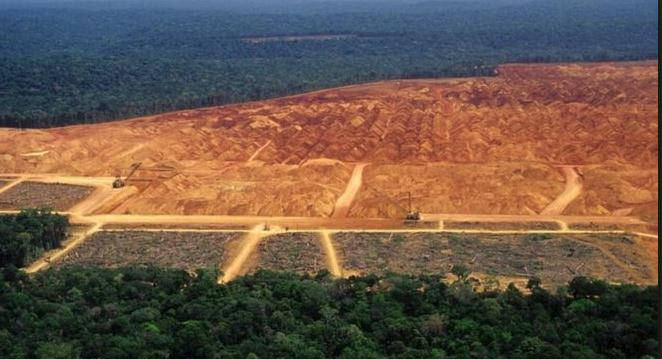
Preface. Humans are destroying the wilderness so quickly there it could mostly disappear in less than a century. Since 1993 the world lost an area twice the size of Alaska.
So kiss biodiversity, carbon sequestration, ecology, and a stable climate goodbye. To the extent this land was mined or otherwise developed, it won’t be available for the coming extra 3 billion people to grow food on either.
The Amazon accounted for nearly a third of the “catastrophic” loss,
showing huge tracts of pristine rainforest are still being disrupted
despite the Brazilian government slowing deforestation rates in recent years. A further 14% disappeared in central Africa, home to thousands of species including forest elephants and chimpanzees.
The loss of the world’s last untouched refuges would not just be
disastrous for endangered species but for climate change efforts, the
authors said, because some of the forests store enormous amounts of
carbon.
“Without any policies to protect these areas, they are falling victim to widespread development.
The team counted areas as no longer wilderness if they scored on eight measures of humanity’s footprint, including roads, lights at night and agriculture.
Watson said unique ecosystems were being lost, and there was no turning
back. “What is critical about this paper is when you erode these
wildernesses, they don’t come back, you can’t restore them. They will
come back as something else, but you can’t restore them,” he said.
Preface. Below are excerpts of articles about the costs and challenges of dismantling nuclear power plants. This is at the top of my “Energy Descent To Do List” given the consequences for future generations for up to a million years, and has to be done while there is still lots of cheap fossil energy to do it. Other decommissioning news:
2018: Clearing the Radioactive Rubble Heap That Was Fukushima Daiichi, 7 Years On. The water is tainted, the wreckage is dangerous, and disposing of it will be a prolonged, complex and costly process. The Japan Center for Economic Research, a private think tank, said the cleanup costs could mount to some $470 billion to $660 billion and take far longer than the initial 30-40 year estimate.
Barnard M (2020) US Nuclear Site Cleanup Underfunded By Up To $70 Billion. Cleantechnica.
Members of Parliament have stated that the UK’s Nuclear Decommissioning Authority doesn’t have a handle on the 17 sites, their costs, or the vendors chosen for cleanup. They project a $177 billion and 120 year time-frame for complete decommissioning at well over $1 billion per site. Some of this is due to botched procurement, with two different cleanup vendors stripped of their contracts.
The US has collected a bunch of money from operating reactors into a cleanup fund that they acknowledge is underfunded to the tune of billions already. But the industry estimates show that they are collecting under half of what it will actually take to decommission the sites.
There are about 100 reactors in the United States. Assuming they collect the $320 million per reactor (they won’t, as reactors are closing prematurely), they would have a fund of $32 billion. At a cleanup cost of a billion each, as has been the case in Europe and Slovakia, they need an additional $70 billion.
When you add in graft, the costs are higher still.
A new era is approaching ‒ the era of nuclear decommissioning, which will entail:
A decline in the number of operating reactors.
An increasingly unreliable and accident-prone reactor fleet as ageing sets in.
Countless battles over lifespan extensions for ageing reactors.
An internationalization of anti-nuclear opposition as neighboring countries object to the continued operation of ageing reactors (international opposition to Belgium’s ageing reactors is a case in point ‒ and there are numerous other examples).
Battles over and problems with decommissioning projects (e.g. the UK government’s £100+ million settlement over a botched decommissioning tendering process).
Battles over taxpayer bailout proposals for companies and utilities that haven’t set aside adequate funds for decommissioning and nuclear waste management and disposal. (According to Nuclear Energy Insider, European nuclear utilities face “significant and urgent challenges” with over a third of the continent’s nuclear plants to be shut down by 2025, and utilities facing a €118 billion shortfall in decommissioning and waste management funds.)
Battles over proposals to impose nuclear waste repositories and stores on unwilling or divided communities.
There will likely be an average of 8‒11 permanent reactor shutdowns annually over the next few decades. This will add up to about 200 reactor shutdowns between 2014 and 2040.
The International Atomic Energy Agency (IAEA) anticipates 320 gigawatts (GW) of retirements from 2017 to 2050, which is about 80% of the current worldwide reactor fleet.
Other estimates are 140 to 200 reactors closing by 2035.
That won’t be made up for by the 41 reactors expected to begin operating by 2022. Worldwide 49 reactors are under construction. What growth exists is mainly due to China, but their enthusiasm seems to have ended in 2016 since now new commercial construction sites have existed since then, nor is India or other Asian states likely to build reactors.
Generation IV fantasies are as fantastical as ever. David Elliot ‒ author of the 2017 book Nuclear Power: Past, Present and Future ‒ notes that many Generation IV concepts “are in fact old ideas that were looked at in the early days and mostly abandoned. There were certainly problems with some of these early experimental reactors, some of them quite dramatic.” One example of the gap between Generation IV rhetoric and reality was Transatomic Power’s decision to give up on its molten salt reactor R&D project in the US in September 2018.
Nor do these smaller reactors appear to be economically viable. Carnegie Mellon University’s Department of Engineering and Public Policy, published in the Proceedings of the National Academy of Science in July 2018, argues that no US advanced reactor design will be commercialized before mid-century. They also investigated how a domestic market could develop to support a small modular reactor industry in the US over the next few decades ‒ including using them to back up wind and solar, desalinate water, produce heat for industrial processes, or serve military bases ‒ and were unable to make a convincing case.
The era of nuclear decommissioning will be characterized by escalating battles (and escalating sticker shock) over reactor lifespan extensions, decommissioning and nuclear waste management. In those circumstances, it will become even more difficult than it currently is for the industry to pursue new reactor projects. A feedback loop could take hold and then the nuclear industry will be well and truly in crisis, if it isn’t already.
Europe faces a €253bn bill for nuclear waste management and plant decommissioning: €123bn of that to decommission old reactors and €130bn for the management of spent fuel, radioactive waste and deep geological disposal processes. Some 90% of the continent’s nuclear plants are set to shut by 2050 – almost half within the next decade.
At present, nuclear reactors make up 27% of Europe’s energy capacity and produce less carbon over their lifetime than fossil fuels such as gas, coal or oil. But no solution has yet been found for the long-term storage of radioactive waste.
The commission’s experts considered closed fuel recycling of plutonium and uranium in ‘fast breeder reactors’ so long-term and uncertain a prospect that they did not forecast possible scenarios for its becoming available this century.
By the start of 2012, according to the International Atomic Energy Agency, 138 commercial power reactors had been permanently shut down with at least 80 expected to join the queue for decommissioning in the coming decade – more if other governments join Germany in deciding to phase out nuclear power following the Fukushima disaster in Japan last year.
And yet, so far, only 17 of these have been dismantled and made permanently safe. That’s because decommissioning is difficult, time-consuming and expensive.
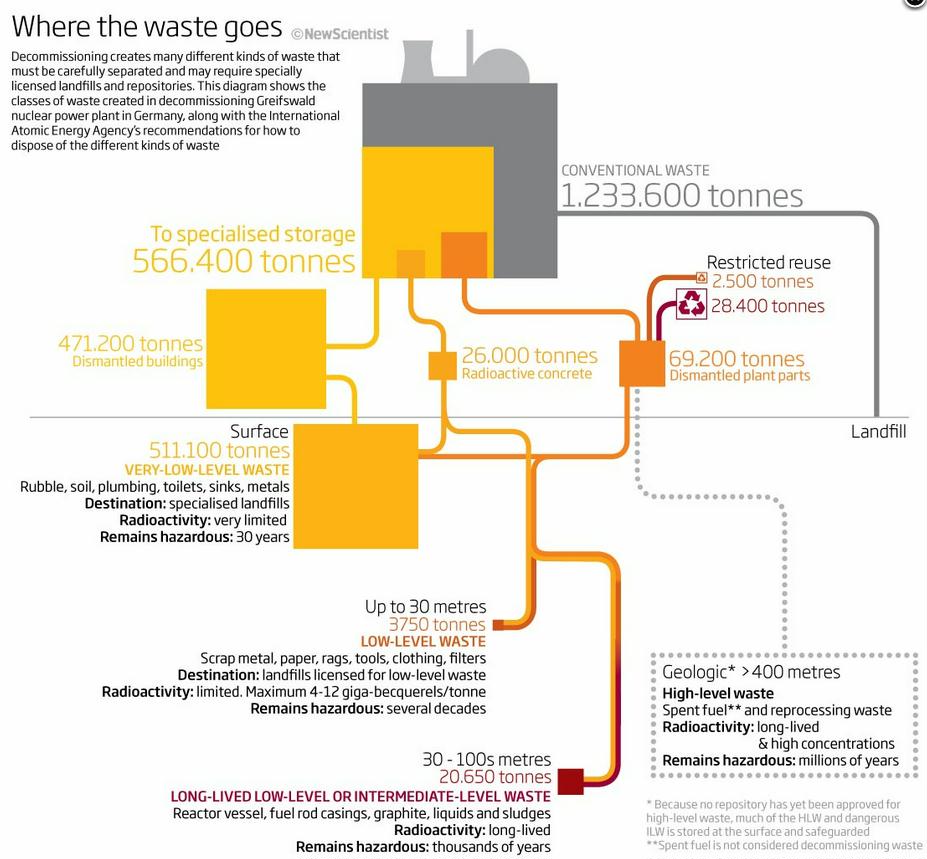
A standard American or French-designed pressurised water reactor (PWR) – the most common reactor design now in operation – will produce more than 100,000 tonnes of waste, about a tenth of it significantly radioactive, including the steel reactor vessel, control rods, piping and pumps. Decommissioning just a single one generally costs up to half a billion dollars.
Decommissioning Germany’s Soviet-designed power plant at Greifswald produced more than half a million tonnes of radioactive waste. The UK’s 26 gas-cooled Magnox reactors produce similar amounts and will eventually cost up to a billion dollars each to decommission. That’s because they weren’t designed with decommissioning in mind.
The many variations also mean that there is no agreed-upon standard for how to go about the process. If you want to decommission a nuclear power plant, you have three options. The first is the fastest: remove the fuel, then take the reactor apart as swiftly as possible, storing the radioactive material somewhere safe to await a final burial place. The second approach is to remove the fuel but lock up the reactor, letting its troublesome radioactive isotopes decay, which makes dismantling easier – much later. The third option is to simply entomb the reactor where it is.
Even when the reactor can be dismantled, where do you put the radioactive waste? Even the least contaminated material – old overalls, steel heat exchangers and toilets – must be carefully separated and sent to specially licensed landfill sites. Not every country has such designated facilities. Intermediate-level waste, contrary to its name, is even more of a problem because it may require deep ground burial alongside the high-level spent fuel.
In 1976, a British Royal Commission said no more nuclear power plants should be built until the waste disposal problems were resolved. Thirty-five years on, nothing much has changed.
Preface. This is a summary of Herman Pontzer’s 2019 “Humans evolved to exercise. Unlike our ape cousins, humans require high levels of physical activity to be healthy” in Scientific American. As fossils decline, it’s almost guaranteed you’ll use more muscle power, so get in shape now…
Also, your personality as measured by the Big Five Personality traits will be better if you exercise. Couch potatoes are less conscientious, open, agreeable, and extroverted. The link with exercise was relatively strong. Physical activity predicted personality better than disease burden did (Stephan 2018).
Apes are a lot like us, orangutans, gorillas, chimpanzees and bonobos share over 97% of our DNA. But the differences are interesting. Our bodies changed dramatically over the past two million years with a larger brain, invented tools, language, hunted and gathered, and our survival depended on lots of physical activity.
We couldn’t just sit around like chimpanzees and eat fruit all morning, nap, groom, then gorge on figs, hang out with friends, group, another nap, and more fruit and some leaves. Likewise, oranguatans and gorillas are also idle and sedentary, spending 8 to 10 hours resting and then 9 or 10 sleeping, walk about 1.8 miles a day and climb about 330 feet, equal to another mile of walking.
Humans who try to slack off this much risk serious health problems. Without at least 10,000 steps a day, the risk of heart disease, diabetes, and metabolic disease increases. Sitting at a desk or in front of a TV for long times ias also associated with an increased risk of illness and a shorter life span. Basically, physical inactivity is on par with smoking as a health risk.
Yet our ape cousins can get away with lolling around. their blood pressure doesn’t go up, diabetes is rare, and their arteries don’t harden and clog with cholesterol.
Diet is destiny. About 1.8 million years ago our ancestors began to evolve to hunting and gathering, which required a great deal more walking to find animals and edible plants. Today hunter-gatherers get roughly have of their calories from plants, and cover 5.6 miles (12,000 steps) to 8.7 (18,000 steps) in search of food, traveling 3 to 5 times farther every day than any of the great apes. Before we invented the bow and arrow, humans may have had to be even more active.
On top of that, we evolved to run prey to exhaustion (Bramble 2004).
Although we’ve long known exercise is good for us, it appears that it’s good for every organ system even down to the cellular level. Our brains hae evolved to reward prolonged physical activity with endocannabinoids which is where the so-called runner’s high comes from. Many have argued that exercise helped enable the massive expansion of the human brain to the point where we require physical activity for normal brain development. Exercise releases molecules that promote neurogenesis and brain growth, as well as improve memory and stave off cognitive decline in old age.
Our maximum sustained power output (VO2max) is at least four times higher than the great apes due mainly to our leg muscles which afe 50% larger with a much greater proportion of slow-twitch fatigue resistant fibers than the legs of other apes. We have more red blood cells to carr oxygen to working muscles. Exercise accelerates the rate at which our cells function and calories are burned.
Exercise has been sold as a way to lose weight. But it isn’t optional, and weight loss is probably the one health benefit it often fails to deliver. Unfortunately, exercise doesn’t increase energy expenditure, it just makes our bodies work better. This is why those hunter gatherers walking almost 9 miles a day don’t expend much more energy than sedentary Westerners.
Here are some of the ways we do know exercise benefits us. It reduces chronic inflammation which can lead to heart disease. It lowers levels of reproductive hormones (i.e. testosterone, extrogen) which reduces the rate of reproductive cancers. It probably blunts the morning rise in the stress hormone cortisol. It reduces insulin insensitivity, the immediate cause behind type 2 diabetes, and shuttles glucose into muscles instead of fat. Exercise also improves the immune system, and produces enzymes that help clear fat from circulating blood.
References
Bramble D. M., Lieberman D. E.. 2004. Endurance running and the evolution of Homo. Nature 432.
Pontzer, H. 2017. The crown joules: energetics, ecology, and evolution in humans and other primates. Evolutionary anthropology 26:12-24.
Pontzer, H. 2017. Economy and endurance in human evolution. current biology 27.
A graphic showing how sea level rise lifts freshwater, causing groundwater inundation in low-lying areas. Credit: UHM Coastal Geology Group
Preface. In coastal areas flooding is likely to be caused from groundwater rise because as sea levels rise, they won’t only move inland, flooding low-lying land near the shore; but also push water up from the saltwater water table, on top of which is a layer of lighter fresh water. As the salt water rises with rising seas, it will push this fresh water upward. In low-lying areas, that water may emerge from the ground.
The consequences are that water will leach inside homes through basement cracks. Toilets may become chronically backed up. Raw sewage may seep through manholes. Brackish water will corrode sewer and water pipes and inundate building foundations. And most hazardous of all, water percolating upward may flow through contaminants buried in the soil, spreading them underground and eventually releasing them into people’s homes. The coup de grace will be the earthquakes, which, when they strike, may liquefy the entire toxic mess, pushing it toward the surface.
The result will be that in places like Oakland, flooding will occur not just at the shoreline, but inland in areas once considered safe from sea level rise. The threat it poses can’t be neutralized with the usual strategy: physical structures that keep the sea at bay. No matter how many seawalls we build, many experts say, groundwater can still gurgle up from below, potentially turning large swaths of the densely populated shoreline around the Bay into unwanted, unplanned, possibly toxic wetlands.
Grace Mitchell Tada. March 25, 2019. The Sea Beneath Us Sea level rise has a gotcha-from- behind twin: rising groundwater. It’s already here. And some experts maintain, we’re not ready for it. Bay Nature
In East Oakland, on a residential street in front of a small park, Kristina Hill stopped and got out of her vehicle. She walked to the center of the street as a gaggle of graduate students emerged from their cars and gathered around her. It was midday, early September, the bright, hot sun directly overhead. Hill, a professor of urban and environmental design at UC Berkeley, had chosen the spot because when it rains heavily, water gushes up from storm drains here, forming filthy brown ponds. “That will happen more and more,” Hill said. Then she proceeded to describe a peculiar, almost apocalyptic future.
Water will leach inside homes, she said, through basement cracks. Toilets may become chronically backed up. Raw sewage may seep through manholes. Brackish water will corrode sewer and water pipes and inundate building foundations. And most hazardous of all, water percolating upward may flow through contaminants buried in the soil, spreading them underground and eventually releasing them into people’s homes. The coup de grace will be the earthquakes, which, when they strike, may liquefy the entire toxic mess, pushing it toward the surface.
The future Hill described is caused by a phenomenon called groundwater rise. In a nutshell, as a warming climate raises sea levels, the sea won’t only move inland, flooding low-lying land near the shore; it may also push water up from beneath our feet. That’s because for those of us living near the shore, a sea lurks in the ground—a saltwater water table. On top of that salt water floats a layer of lighter fresh water. As the salt water rises with rising seas, Hill and others think, it will push the fresh water upward. In low-lying areas, that water may emerge from the ground.
The result, Hill explained, will be that in places like Oakland, flooding will occur not just at the shoreline, but inland in areas once considered safe from sea level rise, including the Oakland Coliseum and Jones Avenue, where Hill and her students now stood, more than a mile from San Leandro Bay. In fact, she added, rising groundwater menaces nearly the entire band of low-lying land around San Francisco Bay, as well as many other coastal parts of the U.S.
The threat it poses can’t be neutralized with the usual strategy: physical structures that keep the sea at bay. No matter how many seawalls we build, many experts say, groundwater can still gurgle up from below, potentially turning large swaths of the densely populated shoreline around the Bay into unwanted, unplanned, possibly toxic wetlands. The issue is barely on the radar of Bay Area planners and decision-makers; it’s been mostly overlooked until recently. The public has hardly heard of it. Hill is trying to change all that. She’s on a mission to increase awareness of sea level rise’s gotcha-from-behind twin—groundwater rise.
When we think of the water table, we probably imagine a hard line that runs parallel to the earth’s surface some distance below us and, beneath that line, a big blob-like lake that we call groundwater. But it’s not really lake-like. Groundwater exists within permeable layers of rock, called aquifers, classified as either confined or unconfined. Water fills the space between rock particles. Confined aquifers are usually tucked deep in the earth, pressurized between less permeable layers of rock. Unconfined aquifers, like the one Hill described beneath Oakland, commonly exist in coastal areas and at river mouths. These aquifers often sit close to the surface, and they swell when, for instance, it rains. Only recently have scientists come to understand how sea level rise can affect coastal groundwater.
Around the Bay, most development has occurred on wetlands filled with sand, mud, and building rubble from 19th-century construction efforts, as well as alluvium, the material that washes down from surrounding watersheds.
This will be a disaster in earthquakes, which can exacerbate the problems posed by rising groundwater as it did Christchurch, New Zealand where 80% of the city’s underground infrastructure was obliterated, and thousands of buildings were leveled. Why? The city was built on a sand-and-gravel plain with a high water table. When the earthquake struck, the soil acted like a liquid, partly swallowing vehicles and cracking and tilting buildings. It is a problem shared by and well-known in the Bay Area.
The USGS has liquefaction susceptibility maps for the Bay Area, but these don’t account for sea level rise. Municipalities needed to incorporate the risk posed by rising water tables into their climate adaptation plans. As sea levels gradually rise in the decades to come, water might push up through storm drains or directly through the ground, damaging infrastructure and building foundations. Freeways and airports near the sea (and there are many, SFO and Oakland International Airport included) would likely become soggy messes. Inundation at wastewater treatment facilities, often sited on low-lying land, could trigger leaks of untreated water. Rising salt water might corrode urban drainage systems, which would stop functioning properly as their pipes filled permanently with groundwater. Brackish pools of water could become regular features of the urban environment.
More worrisome, rising groundwater might carry toward the surface hazardous material trapped in the soil. Around the rim of the Bay, once a center of heavy industry, we could see arsenic, lead, benzene, polycyclic aromatic hydrocarbons, PCBs, even possibly radioactive waste.
Another effect of climate change is that rainfall is predicted to become more intense. Flooding would likely become more frequent, bringing to the surface various buried toxic substances, such as the vinyl chloride and TCA of concern in the groundwater beneath the nearby tool and die machine shop, or the gasoline in the groundwater around the neighborhood’s former and existing gas stations.
Even if the water table recedes after the rainy season and the summer dry season sets in, some contaminants could become airborne in buildings. People may inhale them. “Even an event where it’s a seasonal thing for a few days could have really important long-term effects,” Hill told me.
East Oakland is already among the top five percent of polluted California zip codes. The mostly low-income, primarily nonwhite residents who live there have relatively high rates of chronic disease. Life expectancy for African Americans in the Oakland “flats” can be up to 14 years less than in the hills. And now these already beleaguered communities face the prospect of contaminants welling up from beneath their feet.
Rising groundwater is “a whole new game-changer, particularly when
you’re talking about sites that are contaminated with industrial
solvents,” says Grant Cope, the deputy secretary for environmental
policy at the California Environmental Protection Agency. What can be
done? Contaminated groundwater could be pumped out of the ground,
treated, cleaned, and reinjected into the aquifer, Cope says. Otherwise,
it remains unclear whether caps meant to keep pollutants buried—a
strategy used at remediated sites in recent decades—would continue to
work if groundwater rises. The caps were not designed for this purpose,
Cope says.
Judging by what the federal EPA has learned from its experience with hurricanes in other parts of the country, the most acute risk posed by groundwater rise are infections from pathogens in wastewater, according to John Blue, Cal EPA’s manager of climate programs. (Hill disagrees, saying, “I would take a bath in wastewater before I would have any skin contact with benzene”—one of the pollutants she worries about in Oakland. “There’s no safe exposure” level.) And how would affected wastewater be dealt with? Blue pauses. “These are very difficult questions,” he says. “That’s the eight-hundred-million-dollar question. That remains to be seen.”
There are important caveats to the wet, bleak future scenario Hill and Plane’s report describes. Their maps, which have been submitted for publication but haven’t appeared in a peer-reviewed journal yet, are approximate and don’t account for subtleties in the landscape—for instance, streams and valley-like topography that might allow rising groundwater to flow downhill and away, preventing water from pooling. Hill and Plane’s conclusions assume that water tables will rise linearly with sea level rise, which, judging from patterns in local geography, may or may not be true. The report’s data is based on the highest water table levels recorded in the past 20-odd years, which may present an exaggerated picture of what’s likely to happen, says Kevin Befus, assistant professor at the University of Wyoming’s College of Engineering and Applied Science. Tina Low of SFRWQCB maintains that, in conjunction with monitoring, current remediation standards for buried pollutants are sufficient to prevent leaching, even if groundwater rises. (Older sites that don’t adhere to these standards may need to be studied to assess the risk they pose, she adds.)
Still, many planners I queried around the Bay found the study both credible and worrisome. “It’s a really nice data-driven approach that leverages this incredible data set [from] wells to look at where the water table actually is,” says Patrick Barnard of the USGS. Abby Mohan, a marine geographer at Silvestrum Climate Associates, who is working with Hill and Plane to further refine their research, emphasizes that this is pioneering, groundbreaking work. “Ellen and Kristina did something really interesting and great,” she says.
Steve Goldbeck, chief deputy director of the Bay Conservation and Development Commission, says the commission had been aware of the groundwater issue in a general sense before, but with Plane and Hill’s work, “now we know it’s going to be a problem” in the Bay Area.
Thus far in recent history, the three general responses to sea level rise have been to armor, to retreat, or to adapt in place. Around the Bay, many municipalities are considering the least radical strategy: armor. San Francisco aims to rebuild its seawall, a more than $2 billion project that won’t address groundwater issues (though it does, importantly, address seismic hazards). Moreover, as the sea rises, seawall construction could actually increase water levels in the Bay, says Mark Stacey, an environmental engineer at UC Berkeley who has modeled such scenarios. If, for example, Foster City, San Mateo, Redwood City, and Menlo Park all erect seawalls, those barriers together could alter tidal amplification enough to raise water levels in the Bay, potentially worsening flooding in other areas.
Planners elsewhere are taking bold actions to address groundwater
rise. Miami envisions using urban green space as a sponge to draw out
and absorb groundwater. Boston recently unveiled a plan for its harbor
that uses barrier walls to keep the sea out as well as tidal marshes and
parks to absorb emergent groundwater. (The Bay Area has restored tens
of thousands of acres of wetlands, but unlike in Boston or Miami’s
plans, they’re not tightly integrated into the urban landscape. So it’s
not clear that they can serve the same “release valve” function, drawing
groundwater away from infrastructure.) And in New Zealand, after the
devastation of the 2011 earthquake in Christchurch, the government
purchased and then razed more than 7,000 homes on land at risk of
further liquefaction, essentially an admission that some areas of the
city’s plain were too dangerous to inhabit in the short term without
greater fortification.
Things have moved more slowly in the Bay Area. That’s partly because
the Bay’s geology is more complex than along the Eastern Seaboard and
scientists don’t yet have all the data, and partly because Bay Area
decision-makers want greater certainty on what to plan for. “We’re ready
to apply [the information] as soon as we really understand the risk,”
says San Mateo County climate adaptation manager Hilary Papendick. Phil
Bobel, Palo Alto’s manager of public works engineering, echoes that
view, saying the city leadership now assumes it will have to deal with
groundwater rise eventually but wants more research first.
Bay Area planners eagerly await USGS models in development that will
allow them to predict, with greater accuracy than Hill and Plane’s maps,
how the coastal water table will respond to sea level rise. The models,
which use Hill and Plane’s data set for validation, are slated for
public release later this year. With them in hand, “we’ll incorporate
that understanding into our broader adaptation planning,” Alex Westhoff,
a planner at the Marin County Community Development Agency, says.
But even with these models available, next steps aren’t necessarily
clear because the problem is so new. Replacing and shoring up
infrastructure and implementing other adaptation strategies will be
expensive, so the biggest hurdle may be funding. “It’s a
multibillion-dollar area, and we struggle in the millions to try to do
shoreline restoration,” Paul Detjens of Contra Costa County Flood
Control and Water Conservation District says. “We’re talking a whole
’nother order of magnitude.” In 2016, Bay Area voters passed Measure AA
to fund wetland restoration, so there is reason to think that as they
become aware of the issue, voters might support adaptation initiatives
that address groundwater rise.
Hill has her own bold ideas for how the Bay Area can prepare. She,
Kevin Befus at the University of Wyoming, and Chip Fletcher at the
University of Hawaii think that learning to live with water, rather than
trying to keep it out, is the best way forward. “If you wage war with
water you will lose,” Fletcher says, paraphrasing a Dutch expression.
Hill imagines floating cities in ponds, or neighborhoods linked by
canals—a Californian Amsterdam. The idea is to manage emergent
groundwater by opening space for it in the cityscape. Canal systems
installed in flood-prone areas of East Oakland, for example, would help
existing structures remain in place a bit longer; elevating and
retrofitting for seismic risks is too expensive, she says. Over time, as
groundwater rises, neighborhoods could become what she and her
colleagues call “tidal cities.” Homes, apartment buildings, and
businesses could rest atop floating pontoons connected to land.
Those ideas may sound far-fetched, but planners welcome them. “We’ll
need creative solutions for design and planning,” Westhoff says.
Rohin Saleh, a civil engineer at Alameda County Flood Control who has
watched the water table rise over the past 15 years, says Hill’s vision
may not be feasible everywhere, but “is a really great component of the
type of solution that we need to have in our backpack.”
Many questions remain unanswered. Who will pay for urban adaptation,
cleaning and remediation? How will the many municipalities around the
Bay come together to manage what is, by definition, a regional problem
that no one area can solve alone? And what, for that matter, does a
floating apartment building look like? Whatever the answers to these
questions, one thing is certain. As Lindy Lowe, the Port of San
Francisco’s resilience program director, says, at least people are
thinking and talking about groundwater rise now—which they weren’t doing
eight to ten years ago. That, she notes, is already a triumph.
Preface. Ahmed is one of the best writers on the energy crisis and other biophysical calamities. He’s written about why many states are failing now in part due to peak oil, but also drought and other biophysical factors in his book “Failing States, Collapsing Systems BioPhysical Triggers of Political Violence“. Below is his take on Venezula, where peak oil production occurred in 1997.
What happened there may be how events unfold in the United States as well, so it is worth reading how collapsing states like Venezuela fail if you’re curious about your own future.And Mexico may be the next to collapse, as you can read here.
For some, the crisis in Venezuela is all about the endemic corruption of Nicolás Maduro, continuing the broken legacy of Chavez’s ideological experiment in socialism under the mounting insidious influence of Putin. For others, it’s all about the ongoing counter-democratic meddling of the United States, which has for years wanted to bring Venezuela — with its huge oil reserves — back into the orbit of American power, and is now interfering again to undermine a democratically elected leader in Latin America.
Neither side truly understands the real driving force behind the collapse of Venezuela: we have moved into the twilight of the Age of Oil.
So how does a country like Venezuela with the largest reserves of crude oil in the world end up incapable of developing them? While various elements of socialism, corruption and neoliberal capitalism are all implicated in various ways, what no one’s talking about — especially the global oil industry — is that over the last decade, we’ve shifted into a new era. The world has moved from largely extracting cheap, easy crude, to becoming increasingly dependent on unconventional forms of oil and gas that are much more difficult and expensive to produce.
Oil isn’t running out, in fact, it’s everywhere — we’ve more than enough to fry the planet. But as the easy, cheap stuff has plateaued, production costs have soared. And as a consequence the most expensive oil to produce has become increasingly unprofitable.
In a country like Venezuela, emerging from a history of US interference, plagued by internal economic mismanagement, combined with external intensifying pressure from US sanctions, this decline in profitability has became fatal.
Since Hugo Chavez’s election in 1999, the US has continued to explore numerous ways to interfere in and undermine his socialist government. This is consistent with the track record of US overt and covert interventionism across Latin America, which has sought to overthrow democratically elected governments which undermine US interests in the region, supported right-wing autocratic regimes, and funded, trained and armed far-right death squads complicit in wantonly massacring hundreds of thousands of people.
For all the triumphant moralizing in parts of the Western media about the failures of Venezuela’s socialist experiment, there has been little reflection on the role of this horrific counter-democratic US foreign policy in paving the way for a populist hunger for nationalist and independent alternatives to US-backed cronyism.
Before Chavez
Venezuela used to be a dream US ally, model free-market economy, and a major oil producer. With the largest reserves of crude oil in the world, the conventional narrative is that its current implosion can only be due to colossal mismanagement of its domestic resources.
Described back in 1990 by the New York Times as “one of Latin America’s oldest and most stable democracies”, the newspaper of record predicted that, thanks to the geopolitical volatility of the Middle East, Venezuela “is poised to play a newly prominent role in the United States energy scene well into the 1990’s”. At the time, Venezuelan oil production was helping to “offset the shortage caused by the embargo of oil from Iraq and Kuwait” amidst higher oil prices triggered by the simmering conflict.
But the NYT had camouflaged a deepening economic crisis. As noted by leading expert on Latin America, Javier Corrales, in ReVista: Harvard Review of Latin America, Venezuela had never recovered from currency and debt crises it had experienced in the 1980s. Economic chaos continued well into the 1990s, just as the Times had celebrated the market economy’s friendship with the US, explained Corrales: “Inflation remained indomitable and among the highest in the region, economic growth continued to be volatile and oil-dependent, growth per capita stagnated, unemployment rates surged, and public sector deficits endured despite continuous spending cutbacks.”
Prior to the ascension of Chavez, the entrenched party-political system so applauded by the US, and courted by international institutions like the IMF, was essentially crumbling. “According to a recent report by Data Information Resources to the Venezuelan-American Chamber of Commerce, in the last 25 years the share of household income spent on food has shot up to 72%, from 28%,” lamented the New York Times in 1996. “The middle class has shrunk by a third. An estimated 53 percent of jobs are now classified as ‘informal’ — in the underground economy — as compared with 33% in the late 1970’s”.
The NYT piece cynically put all the blame for the deepening crisis on “government largesse” and interventionism in the economy. But even here, within the subtext the paper acknowledged a historical backdrop of consistent IMF-backed austerity measures. According to the NYT, even the ostensibly anti-austerity president Rafael Caldera — who had promised more “state-financed populism” as an antidote to years of IMF-wrought austerity — ended up “negotiating for a $3 billion loan from the IMF” along with “a second loan of undisclosed size to ease the social impact of any hardships imposed by an IMF agreement.”
So it is convenient that today’s loud and self-righteous moral denunciations of Maduro ignore the instrumental role played by US efforts to impose market fundamentalism in wreaking economic and social havoc across Venezuelan society. Of course, outside the fanatical echo chambers of the Trump White House and the likes of the New York Times, the devastating impact of US-backed World Bank and IMF austerity measures is well-documented among serious economists.
In a paper for the London School of Economics, development economist Professor Jonathan DiJohn of the UN Research Institute for Social Development found that US-backed economic “liberalization not only failed to revive private investment and economic growth, but also contributed to a worsening of the factorial distribution of income, which contributed to growing polarisation of politics.”
Neoliberal reforms further compounded already existing centralized nepotistic political structures vulnerable to corruption. Far from strengthening the state, they led to a collapse in the state’s regulative power. Analysts who hark back to a Venezuelan free market golden age ignore the fact that far from reducing corruption, “financial deregulation, large-scale privatizations, and private monopolies create[d] large rents, and thus rent-seeking/corruption opportunities.”
Instead of leading to meaningful economic reforms, neoliberalisation stymied genuine reform and entrenched elite power. And this is precisely how the West helped create the Chavez it loves to hate. In the words of Corrales in the Harvard Review: “economic collapse and party system collapse—are intimately related. Venezuela’s repeated failure to reform its economy made existing politicians increasingly unpopular, who in turn responded by privileging populist policies over real reforms. The result was a vicious cycle of economic and political party decay, ultimately paving the way for the rise of Chavez.”
Dead oil
While it is now fashionable to blame the collapse of the Venezuelan oil industry solely on Chavez’s socialism, Caldera’s privatization of the oil sector was unable to forestall the decline in oil production, which peaked in 1997 at around 3.5 million barrels a day. By 1999, Chavez’s first actual year in office, production had already dropped dramatically by around 30 percent.
A deeper look reveals that the causes of Venezuela’s oil problems are slightly more complicated than the ‘Chávez killed it’ meme. Since peaking around 1997, Venezuelan oil production has declined over the last two decades, but in recent years has experienced a precipitous fall. There can be little doubt that serious mismanagement in the oil industry has played a role in this decline. However, there is a fundamental driver other than mismanagement which the press has consistently ignored in reporting on Venezuala’s current crisis: the increasingly fraught economics of oil.
The vast bulk of Venezuela’s oil is not conventional crude, but unconventional “heavy oil”, a highly viscous liquid that requires unconventional techniques to extract and flow, often with heat from steam, and/or mixing it with lighter forms of crude in the refining process. Heavy oil thus has a higher cost of extraction than normal crude, and a lower market price due to the refining difficulties. In theory, heavy oil can be produced at below break-even prices to a profit, but greater investment is still needed to get to that point.
The higher costs of extraction and refining have played a key role in making Venezuela’s oil production efforts increasingly unprofitable and unsustainable. When oil prices were at their height between 2005 and 2008, Venezuela was able to weather the inefficiencies and mismanagement in its oil industry due to much higher profits thanks to prices between $100 and $150 a barrel. Global oil prices were spiking as global conventional crude oil production began to plateau, causing an increasing shift to unconventional sources.
That global shift did not mean that oil was running out, but that we were moving deeper into dependence on more difficult and expensive forms of unconventional oil and gas. The shift can be best understood through the concept of Energy Return on Investment (EROI), pioneered principally by the State University of New York environmental scientist Professor Charles Hall, a ratio which measures how much energy is used to extract a particular quantity of energy from any resource. Hall has shown that as we are consuming ever larger quantities of energy, we are using more and more energy to do so, leaving less ‘surplus energy’ at the end to underpin social and economic activity.
This creates a counter-intuitive dynamic — even as production soars, the quality of the energy we are producing declines, its costs are higher, industry profits are squeezed, and the surplus available to sustain continued economic growth dwindles. As the surplus energy available to sustain economic growth is squeezed, in real terms the biophysical capacity of the economy to continue buying the very oil being produced reduces. Economic recession (partly induced by the previous era of oil price spikes) interacts with the lack of affordability of oil, leading the market price to collapse.
That in turn renders the most expensive unconventional oil and gas projects potentially unprofitable, unless they can find ways to cover their losses through external subsidies of some kind, such as government grants or extended lines of credit. And this is the key difference between Venezuela and countries like the US and Canada, where extremely low EROI levels for production have been sustained largely through massive multi-billion dollar loans — fueling an energy boom that is likely to come to a catastrophic endwhen the debt-turkey comes home to roost.
“It’s all a bit reminiscent of the dot-com bubble of the late 1990s, when internet companies were valued on the number of eyeballs they attracted, not on the profits they were likely to make,” wrote Bethany McLean recently (once again in the New York Times), a US journalist well-known for her work on the Enron collapse. “As long as investors were willing to believe that profits were coming, it all worked — until it didn’t.”
A number of scientists have previously estimated the EROI of heavy oil production to amount to around 9:1 (with room for variation up or down depending on how inputs are accounted for and calculated; the unfashionable but probably more accurate approach would be downwards, closer to 6:1 when both direct and indirect energy costs are considered). Compare this to the EROI of about 20:1 for conventional crude prior to 2000, which gives an indication of the challenge Venezuela faced — which unlike the US and Canada, had emerged into the Chavez era from a history of neoliberal devastation and debt-expansion that already made further investments or subsidies to Venezuela’s oil industry a difficult ask.
Venezuela, in that sense, was ill-prepared to adapt to the post-2014 oil price collapse, compared to its wealthier, Western competitors in other forms of unconventional oil and gas. To be sure, then, the collapse of Venezuela’s oil industry cannot be reduced to geological factors, though there can be little doubt that those factors and their economic ramifications tend to be underplayed in conventional explanations. Above-ground factors were clearly a major problem in terms of chronic inadequacy of investment and the resulting degradation of production infrastructure. A balanced picture thus has to acknowledge both that Venezuela’s vast reserves are far more expensive and difficult to bring to market than standard conventional oil; and that Venezuala’s very specific economic circumstances in the wake of decades of failed IMF-austerity put the country in an extremely weak position to keep its oil show on the road.
Since 2008, oil production has declined by more than 350,000 barrels per day, and more than 800,000 per day since its peak level in 1997. This has driven the collapse of net exports by over 1.1 million barrels per day since 1998. Meanwhile, to sustain refining of heavy oil, Venezuela has increasingly imported light oil to blend with heavy oil as well as for domestic consumption. Currently, only extra-heavy oil production in the Orinoco Oil Belt has been able to increase, while conventional oil production continues to rapidly decline. Despite significant proved conventional reserves, these still require more expensive enhanced recovery techniques and infrastructure investments — which are unavailable. But profit margins from exports of extra-heavy crude are much smaller due to the higher costs of blending, upgrading and transportation, and the heavy discounts in international refining markets. In summary, oil industry expert Professor Francisco Monaldi at the Center for Energy and the Environment at IESA in Venezuela concludes: “oil production in Venezuela is comprised of increasingly heavier oil and thus less profitable, PDVSA’s operated production is falling more rapidly, and the production that generates cash-flow is almost half of the total production. These trends were problematic enough at peak oil prices, but with prices falling they become much more acute.”
The folly of endless growth
Unfortunately, much like his predecessors, Chavez didn’t appreciate the complexities, let alone the biophysical economics, of the oil industry. Rather, he saw it simplistically through the short-term lens of his own ideological socialist experiment.
From 1998 until his death in 2013, Chavez’s application of what he called ‘socialism’ to the oil industry succeeded in reducing poverty from 55 to 34 percent, helped 1.5 million adults become literate, and delivered healthcare to 70% of the population with Cuban doctors. All this apparent progress was enabled by oil revenues. But it was an unsustainable pipe-dream.
Instead of investing oil revenues back into production, Chavez spent them away on his social programs during the heyday of the oil price spikes, with no thought to the industry he was drawing from — and in the mistaken belief that prices would stay high. By the time prices collapsed due to the global shift to difficult oil described earlier — reducing Venezuala’s state revenues (96 percent of which come from oil) — Chavez had no currency reserves to fall back on.
Chavez had thus dramatically compounded the legacy of problems he had been left with. He had mimicked the same mistake made by the West before 2008, pursuing a path of ‘progress’ based on an unsustainable consumption of resources, fueled by debt, and bound to come crashing down.
So when he ran out of oil money, he did what governments effectively did worldwide after the 2008 financial crash through quantitative easing: he simply printed money.
The immediate impact was to drive up inflation. He simultaneously fixed the exchange rate to dollars, hiked up the minimum wage, while forcing prices of staple goods like bread to stay low. This of course turned businesses selling such staple goods or involved at every chain in their production into unprofitable enterprises, which could no longer afford to pay their own employees due to hemorrhaging income levels. Meanwhile, he slashed subsidies to farmers and other industries, while imposing quotas on them to maintain production. Instead of producing the desired result, many businesses ended up selling their goods on the black market in an attempt to make a profit.
As the economic crisis escalated, and as oil production declined, Chavez pinned his hopes on the potential transformation that could be ushered in by massive state investment in a new type of economy based on nationalized, self or cooperatively managed industries. Those investments, too, had little results. Dr Asa Cusack, an expert on Venezuela at the London School of Economics, points out that “even though the number of cooperatives exploded, in practice they were often as inefficient, corrupt, nepotistic, and exploitative as the private sector that they were supposed to displace.”
Meanwhile, with its currency reserves depleted, the government has had to slash imports by over 65 percent since 2012, while simultaneously reducing social spending to even lower than it was under IMF austerity reforms in the 1990s. Chavistan crisis-driven ‘socialism’ began with unsustainable social spending and has now switched to catastrophic levels of austerity that make neoliberalism look timid.
In this context, the rise of the black market and organized crime, exploited by both the government and the opposition, became a way of life while the economy, food production, health-care and basic infrastructure collapsed with frightening speed and ferocity.
Climate wild cards
Amidst this perfect storm, the wild card of climate impacts pushed Venezuela over the edge, accelerating an already dizzying spiral of crises. In March 2018, on the back of hyperinflation and recession, the government enforced electricity rationing across six western states. In one state, San Cristobal, residents reported 14-hour stretches without power after water levels in reservoirs used for hydroelectric plants were reduced due to drought. A similar crisis had erupted two years earlier when water levels behind the Guri Dam, which provides well over half the country’s electricity, hit record lows.
Venezuela generates around 65% of its electricity from hydropower, with a view to leave as much oil available as possible for export. But this has made electricity supplies increasingly vulnerable to droughts induced by climate change impacts.
It is well known that the El-Nino Southern Oscillation, the biggest fluctuation in the earth’s climate system comprising a cycle of warm and cold sea-surface temperatures in the tropical Pacific Ocean, is increasing in frequency and intensity due to climate change. A new study on the impact of climate change in Venezuela finds that between 1950 and 2004, 12 out of 15 El-Nino events coincided with years in which “mean annual flow” of water in the Caroni River basin, affecting the Guri reservoir and hydroelectric power, was “smaller than the historical mean.”
From 2013 to 2016, an intensified El-Nino cycle meant that there was little rain in Venezuela, culminating in a crippling deficit in 2015. It was the worst drought in almost half a century in the country, severely straining the country’s aging and poorly managed energy grid, resulting in rolling blackouts.
According to Professor Juan Carlos Sanchez, a co-recipient of the 2007 Nobel Peace Prize for his work with Intergovernmental Panel on Climate Change (IPCC), these trends will dramatically deteriorate under a business as usual scenario. Large areas of Venezuelan states which are already water scarce, such as Falcon, Sucre, Lara and Zulia, including the north of the Guajira peninsula, will undergo desertification. Land degradation and decreased rainfall would devastate production of corn, black beans and plantains across much of the country. Sanchez predicts that some regions of the country will receive 25 percent less water than today. And that means even less electricity. By mid-century, climate models indicate an overall 18 percent decrease in rainfall in the Caroni River basin that leads to the Guri Dam.
Unfortunately, no Venezuelan government has ever taken seriously its climate pledges, preferring to escalate as much as possible its oil production, and even intensifying the CO2 intensive practice of gas flaring. Meanwhile, escalating climate change is set to exacerbate Venezuela’s electricity blackouts, infrastructure collapse and agricultural crisis.
Economic war
The crisis convergence unfolding in Venezuela gives us a window into what can happen when a post-oil future is foisted upon you. As domestic energy supplies dwindle, the state’s capacity to function recedes in unprecedented ways, opening the way for state-failure. As the state collapses, new smaller centers of power emerge, competing for control of diminishing resources.
In this context, reports of food-trafficking as a mechanism of ‘economic war’ are real, but they are not exclusive to either political side. All sides have become incentivized to horde products and sell them on the black market as a direct result of the collapsing economy, retrograde government price controls and wildly speculative prices.
Venezuelan state-owned media have pinpointed cases where private companies engaged in hoarding have close ties to the opposition. In response, the government has appropriated vast assets, farmland, bakeries, other businesses — but has failed to lift production.
On the other hand, Katiuska Rodriguez, a journalist investigating shortages at El Nacional, a pro-opposition newspaper, said that there is little clear evidence of hoarding being a result of an ‘economic war’ by capitalist business elites against the government. Although real, she explained, hoarding is driven largely by commercial interests in survival.
And yet, there is mounting evidence that the Maduro government is complicit in not just hoarding, but mass embezzlement of public funds. Sociologist Chris Carlson of the City University of New York Graduate Center points outthat a number of former senior Chavista government officials have come on record to confirm how powerful elites within the government have exploited the crisis to extract huge profits for themselves. “A gang was created that was only interested in getting their hands on the oil revenue,” said Hector Navarro, former Chavista minister and socialist party leader. Similarly, Chavez’s former finance minister, Jorge Giordani, estimated that some $300 billion was embezzled in this way.
And yet, the real economic war is not really going on inside Venezuela. It has been conducted by the US against Venezuela, through a draconian sanctions regime which has exacerbated the arc of collapse. Francisco Rodriguez, Chief Economist at Torino Economics in New York, points out that a major drop in Venezuela’s production numbers occurred precisely “at the time at which the United States decided to impose financial sanctions on Venezuela.”
He argues that: “Advocates of sanctions on Venezuela claim that these target the Maduro regime but do not affect the Venezuelan people. If the sanctions regime can be linked to the deterioration of the country’s export capacity and to its consequent import and growth collapse, then this claim is clearly wrong.” Rodriguez marshals a range of evidence suggesting this might well be the case.
Others with direct expertise have gone further. Former UN special rapporteur to Venezuela, Alfred de Zayas, who finished his term at the UN in March 2018, criticised the US for engaging in “economic warfare” against Venezuela. On his fact-finding mission to the country in late 2017, he confirmed the role of overdependence on oil, poor governance and corruption, but blamed the US, EU and Canadian sanctions for worsening the economic crisis and “killing” Venezuelans.
US goals are fairly transparent. In an interview with FOX News that has been completely ignored by the press, Trump’s National Security Advisor John Bolton explained the focus of US attention: “We’re looking at the oil assets. That’s the single most important income stream to the government of Venezuela. We’re looking at what to do to that.” He continued: “… we’re in conversation with major American companies now… I think we’re trying to get to the same end result here… It will make a big difference to the United States economically if we could have American oil companies really invest in and produce the oil capabilities in Venezuela.”
The coming oil crisis
It is not entirely surprising that Bolton is particularly eager at this time to extend US energy companies into Venezuela.
North American exploration and production companies have seen their net debt balloon from $50 billion in 2005 to nearly $200 billion by 2015. “[The fracking] industry doesn’t make money…. It’s on much shakier financial footing than most people realize,” said McLean, who has just authored the book, Saudi America: The Truth About Fracking and How It’s Changing the World. Indeed, there is serious gulf between oil industry claims about opportunities for profit, and what is actually happening in those companies: “When you look at oil companies’ presentations, there’s something that doesn’t make sense because they show their investors these beautiful investor decks with gorgeous slides indicating that they will produce an 80% or 60% internal rate of return. And then you go to the corporate level and you see that the company isn’t making money, and you wonder what happened between point A and point B.”
In short, cheap debt-money has permitted the industry to grow — but how long that can continue is an open question. “Part of the point in writing my book was just to make people aware that as we trump at American energy independence, let’s think about some of the foundation of this [industry] and how insecure it actually is, so that we’re also planning for the future in different ways”, adds McLean.
Indeed, US shale oil and gas production is forecast to peak in around a decade — or in as little as four years. It’s not just the US. Europe as a continent is already well into the post-peak phase, and Russian oil ministry officials privately anticipate an imminent peak within the next few years. As China, India and other Asian powers experience further demand growth, everyone will be looking increasingly for a viable energy supply, whether from the Middle East or Latin America. But it won’t come cheap, or easy. And it won’t be healthy for the planet.
Whatever their ultimate causes, the horrifying collapse of Venezuela heralds insights into a possible future for today’s major oil producers — including the United States. The US is enjoying a revival in its oil industry but how long it will last and how sustainable it is are awkward questions that few pundits dare to ask — except a brave few, such as McLean.
This does not necessarily mean oil production will simply slowly grind to a halt. As production limits are reached using current techniques, new techniques might be brought into play to try to mine vast reserves of more difficult resources. However, whatever technological innovations emerge they are unlikely to be able to avert the trajectory of increasing costs of extraction, refining and processing before getting fossil fuels to market. And this means that the surplus energy available to devote to the delivery of public goods familiar to modern industrial consumerist societies will become smaller and smaller.
As we shift into a post-carbon era, we will have to adapt new economic thinking, and restructure our ways of life from the ground up.
Right now the Venezuelan people find themselves locked into a vicious cycle of ill-conceived human systems collapsing into violent in-fighting, in the face of the earth system crisis erupting beneath them. It is not yet too late for the rest of the world to learn a lesson. We can either be dragged into a world after oil kicking and screaming, or we can roll up our sleeves and walk there in a manner of our own choosing. It really is up to us. Venezuela should function as a warning sign as to what can happen when we bury our heads in the (oil) sands.
Preface. Climate change will impact California agriculture without the snow melt that allows for up to three crops to be grown a year, perhaps just one crop in the future. Not to mention the impact on the 40 million people living in California.
As far as a renewable future, hydropower is one of the only dispatchable forms of power besides natural gas, but there’ll be far less water behind dams to balance intermittent wind and solar, or provide power when neither is available. In California, it is the largest source of renewable electric power. Though as it is, it is often unavailable due to drought, low reservoirs, held back for agriculture and drinking water, for fisheries, river ecosystems and more.
Preface. When fossil fuels are gone, there aren’t many ways to balance the unreliable, intermittent, and often absent for weeks at a time power from wind and solar. Biofuels and burning biomass is one solution, it’s dispatchable and can kick in at any time to make up for lack of wind and solar, but there is far too little of it for power generation, let alone transportation fuels, soil nutrition and replacing the high heat of coal to make cement, iron, steel, and other blast furnace / kiln products.