Energy Crisis Booklist: EROEI, Peak oil, Peak coal, Peak natural gas, Nuclear, Kerogen, Methane hydrates

More booklists

Laws of physics

Professor Tom Murphy, at the University of California, San Diego has a free textbook showing the math and physics of why renewables can’t replace fossil fuels: “Energy and Human Ambitions on a Finite Planet. Assessing and Adapting to Planetary Limits“.

Overviews

  1. C Hall. Energy & the Wealth of Nations: Understanding the Biophysical economy 
  2. Alice Friedemann. When Trucks stop running: Energy and the future of transportation.
  3. Alice Friedemann. Life After Fossil Fuels: A Reality Check on Alternative Energy.
  4. M Inman. The Oracle of Oil: A Maverick Geologist’s Quest for a Sustainable Future
  5. J. Perlin, A Forest Journey: The Role of Wood in the Development of Civilization, 2005.
  6. C. Ponting, A New Green History of the World: The Environment & the Collapse of Great Civilizations, 2007
  7. R. Heinberg. The End of Growth. Adapting to our New Economic Reality. 2011.

Energy Returned on Energy Invested (EROEI)

  1. P Prieto & Charles A. S. Hall. 2013. Spain’s Photovoltaic Revolution. The Energy Return on Investment. Springer.
  2. D Murphy. The Net Hubbert Curve: What Does it Mean? 2009.
  3. J Lambert. EROI of Global Energy Resources Preliminary Status and Trends.  State  University of New York, College of Environmental Science and Forestry. 2012.
  4. C Hall. What is the Minimum EROI that a Sustainable Society Must Have? 2009.
  5. C Hall. Energy Return on Investment: A Unifying Principle for Biology, Economics, and Sustainability
  6. D Murphy, Energy return on investment, peak oil, and the end of economic growth, 2011.

Peak Oil

  1. Peak Oil is Here! World oil production peaked in 2018 (and 2nd chapter of Life After Fossil Fuels)
  2. German peak oil report: Armed Forces, Capabilities and Technologies in the 21st Century Environmental Dimensions of Security. PEAK OIL Security policy implications of scarce resources. Bundeswehr Transformation Centre, Future Analysis Branch. 2010.
  3. R Heinberg. Afterburn: Society Beyond Fossil Fuels
  4. K. Cobb. The only true metric of energy abundance: The rate of flow. 2013.
  5. R. Hirsch.  Peaking of World Oil Production.  Department of Energy. 2005.

Tar Sands & Heavy Oil

Peak Coal

  1. Wang, J. September 4, 2013. Chinese coal supply and future production outlooks [peak likely in 2024]. Energy 60: 204-214.
  2. R. Heinberg. The End of Cheap Coal. Nature 468. 18 Nov 2010.
  3. A. Friedemann. Coal: why it can’t easily substitute for oil. 2011.
  4. T. Patzek. A global coal production forecast with multi-Hubbert cycle analysis.  Energy. 2010.
  5. R. Heinberg. Blackout. Coal, Climate and the Last Energy Crisis. 2009
  6. A. Friedemann. Peak Coal is already here or likely by 2020 — if true — IPCC 100 year projections too high? 2013.
  7. New York Academy of Sciences. Full cost accounting for the life cycle of coal.  2011 pp 73-98
  8. R. Heinberg. Blackout. Coal, Climate and the Last Energy Crisis  2009

Peak Natural Gas

  1. D Hughes. Oct 27, 2014. Drilling Deeper. A reality check on U.S. government forecasts for a lasting tight oil & shale gas boom.  PostCarbon
  2. B Powers. Cold, hungry, and in the Dark: Exploding the Natural Gas Supply Myth. 2013
  3. D. Hughes. April 28, 2015. Has Well Productivity Peaked in the Nation’s Largest Shale Gas Play? Postcarbon.org
  4. SBC. October 2014. Factbook Natural Gas. [20-40% of recoverable resources are low EROI Sour Gas] SBC Energy Institute
  5. R Heinberg. Chapter 5 of How Fracking’s False Promise of Plenty Imperils Our Future: The Economics of Fracking: Who Benefits? October 2013.
  6. A Friedemann. Shale Oil and Gas Will Not Save Us. 2012.
  7. A Friedemann. Natural Gas pros and cons. 2011.

Peak Uranium

Oil substitutes

Nuclear Power

Nuclear Waste

Kerogen a.k.a. Shale Oil

  1. A. Friedemann. Shale Oil Overview. 2011.
  2. R. Udall. The Illusive Bonanza: Oil Shale in Colorado. 2005.

Methane Hydrates

  1. A. Friedemann. Why we aren’t mining methane hydrates now. Or ever. 2014.
  2. C. Nelder. Are Methane Hydrates Really Going to Change Geopolitics?  The Atlantic.  2013.
  3. Office of Naval Research Science & Technology. Fiery ice from the Sea. 2002.

Books about Energy

  • V Smil. Energy and Civilization A History
  • V Smil. Energy Transitions: History, Requirements, Prospects.
  • L Margonelli. Oil on the Brain: Adventures from the Pump to the Pipeline
  • V Smil. Power Density: A Key to Understanding Energy Sources and Uses
  • V Smil. Natural Gas: Fuel for the 21st Century
  • V Smil. Energy: A Beginner’s Guide

IPCC models assume exponential consumption of fossils until 2400

Other scientists who realize that we are on the cusp of energy decline have plugged in realistic amounts of fossils and found we don’t have enough oil, coal, or natural gas left for a hothouse 8.5 future, at worst 4.5 to 5.5 for 500 to several thousand years.

Tang, X. 2013. Depletion of fossil fuels and anthropogenic climate change: a review. Energy Policy, 52: 797-809

Short term solutions for energy decline

  • R. L. Hirsch. Peaking of World Oil Production: Impacts, Mitigation, & Risk Management       2005
  • Howard Bucknell III.  Energy and the National Defense. 1981
  • Department of Energy.  Standby Gasoline Rationing Plan. 1980

Alice Friedemann  www.energyskeptic.com  Author of Life After Fossil Fuels: A Reality Check on Alternative Energy; When Trucks Stop Running: Energy and the Future of Transportation”, Barriers to Making Algal Biofuels, & “Crunch! Whole Grain Artisan Chips and Crackers”.  Women in ecology  Podcasts: WGBH, Jore, Planet: Critical, Crazy Town, Collapse Chronicles, Derrick Jensen, Practical Prepping, Kunstler 253 &278, Peak Prosperity,  Index of best energyskeptic posts

FYI, I have two articles published on biofuels here:

  • Sheila Newman (ed)   The Final Energy Crisis           2008
  • Jacqueline Langwith, ed.        Opposing Viewpoints: Renewable Energy, vol. 2      2008
Posted in Book List | Tagged , | 7 Comments

Rob Mielcarski: You know you are in trouble when…

[ This is from the outstanding blog by Rob Mielcarski (un-denial.com) which you can see here.  I cant think of anything he’s left out…

Alice Friedemann   www.energyskeptic.com  author of “When Trucks Stop Running: Energy and the Future of Transportation”, 2015, Springer and “Crunch! Whole Grain Artisan Chips and Crackers”. Podcasts: Derrick Jensen, Practical Prepping, KunstlerCast 253, KunstlerCast278, Peak Prosperity , XX2 report ]

Examples of denial are both profound and unacknowledged.

The short-term solution to our problems is the long-term cause of our problems: economic growth

The long-term solution to our problems is the short-term cause of our problems: reduced consumption

All political parties in all countries and almost all citizens, including the few citizens that understand our predicament, reject our best course of action: austerity

Most citizens have no idea how fortunate they are to be alive at this point in history: Blindspots and Superheroes

Despite wildly different beliefs about our predicament, there is one thing that almost everyone agrees on: I don’t want to change my behavior

The only problems society does not acknowledge, or discuss, or act on, are the only problems that matter: species extinction, limits to growth, debt, peak oil, overshoot, resource depletion, climate change, sea level rise, fisheries collapse & ocean acidification, nitrogen imbalance & tree decline 

Every country has similar economic problems and not one leader anywhere in the world connects the dots and publicly acknowledges the root cause, even after they leave office: declining energy surplus a.k.a. energy extraction cost + debt

Citizens believe the exact opposite of reality: technology creates wealth and energy rather than energy creates wealth and technology

Citizens misunderstand the root cause of social unrest and wars because the media presents these conflicts as political or economic problems and ignores their underlying forces: biophysical constraints

There is evidence that feedback loops are taking over and causing some problems to go exponential: climate change, CO2 emissions, ice loss, sea level rise, debt

The previous year’s worst case predictions are tending to become this year’s most likely prediction: sea level rise

Actions that improve the long-term worsen the short-term: air pollution masks 0.5C of warming, austerity and debt reduction, renewable energy, population reduction 

The only possible permanent solution is rejected by the belief systems of 90+% of citizens: population reduction

The only possible permanent solution is too slow to avoid the worst problems: population reduction laws

Countries fortunate to have a low birth rate often cancel their good fortune with immigration: Canada

The few people who understand the severity of our problems do not set good examples in their personal lives: leaders, climate scientists, environmentalists

History suggests that the consequence of not voluntarily contracting our economies as non-renewable resources deplete is an unthinkable war, so we don’t think about it: nuclear weapons

The quality of our leaders is declining because those people with high intelligence, wisdom, and integrity do not want to be in charge of our predicament, and because citizens are feeling the impact of overshoot, do not understand what is going on, and are angry: Trump

The leader of the free world denies science and issues daily, jaw-dropping, cringe-inducing tweets: Trump

The one world leader that did understand the problem and spoke out was rejected by the citizens and no longer speaks out: Jimmy Carter

We do not acknowledge that the world’s economic problems began with the peaking of a key non-renewable resource: conventional oil

Low energy prices have led citizens to believe we have a glut of fossil energy when in fact: all types of energy have peaked

We do not discuss or act on economic history research that shows countries always get into serious trouble when they permit an important ratio to exceed a threshold we long passed: debt to GDP

Bankers, the creators of money, do not understand the one thing that creators of money should understand: thermodynamics of wealth

The professionals with the most influence on public policy use models that violate the most trusted laws of physics: economists

The scientific theory that explains the relationship between the economy, energy, and climate is ignored by everyone that should understand it: Tim Garrett

The people who deserve the most respect and admiration get the least: scientists

The people who deserve the least respect and admiration get the most: celebrities

All types of non-fossil energy do not provide a substitute for the only energy we can’t live without: diesel for trucks, trains, ships, tractors, and combines, and mining machines; plus natural gas for fertilizer

People who think the shale revolution will make America prosperous and energy independent ignore one thing: facts and more facts

Intelligent people who understand the climate change threats, like James Hansen and Bill Gates, and who want business as usual to continue, know that nuclear energy is the only option, but they ignore a problem: peak uranium

If climate deniers continue to win elections and try to maintain the existing electric grid they’ll find that strategy may not work for long: peak coal

A key component of our infrastructure appears durable but is not: reinforced concrete

Citizens most vulnerable to a fragile global supply chain with only a few days of inventory experience the strongest illusion of abundance and security: inhabitants of large cities

The “green” revolution, which increased food production to enable 7+ billion humans, was and is entirely dependent on fossil energy, and has long-term consequences that will make a return to traditional agriculture very difficult.

Most citizens are not even vaguely aware of the invention that enabled their existence and created about 50% of the nitrogen in their bodies: Haber-Bosch conversion of natural gas to fertilizer

Well meaning environmentalists demand that we stop subsidizing fossil energy companies without understanding the source of all that they cherish in modern civilization: fossil energy

Well meaning environmentalists demand that we stop subsidizing fossil energy companies without realizing that many fossil energy companies are going bankrupt: ExxonMobil

A solution frequently advocated makes things worse by accelerating growth and decreasing system resilience: efficiency

The best solution for removing CO2 from the atmosphere is being harmed by the same activity that creates CO2: planting more trees which are then injured or killed by ground level ozone

All climate science models that do not predict disaster now depend on an unproven technology that we probably can’t afford and other species definitely can’t afford: BECCS (bio-energy with carbon capture and storage)

We have not acted to prevent a predictable and very dangerous side effect of trying to maintain business-as-usual with low interest rates: increasing wealth gap

We still enjoy historically vast surplus wealth that could be deployed to improve our future lives but we are squandering it: military, airports, highways, new cars, high rises, etc.

Earth with its diverse complex life and a highly intelligent species is extraordinarily rare, precious, and worth fighting to protect, yet we dream of other barren homes: colonizing Mars

The tool that could be used to unite citizens in common purpose and useful action is instead being used to create tribes that reinforce preexisting beliefs: internet

Many people are hurting and lashing out in anger because they do not understand the cause of their pain: Brexit, Trump, Syria, Venezuela, etc.

The few sources of information that understand and communicate the truth are under threat: fake news

Few people study or heed the best predictor of the future: history

The majority of citizens share a common characteristic that makes the election of an intelligent and wise leader empowered to do the right thing unlikely: wacky beliefs

None of our schools teach skills useful and relevant to our future: growing food and other forms of lower complexity life skills

The thing that enabled the evolution of our high intelligence and its ability to understand and act on problems is the same thing that causes our problems and prevents us from acting on them: denial of reality

The theory that best explains our existence and our self-destructive behavior is ignored by everyone, including those people seeking to understand our problems: Varki and Brower’s denial of reality theory

Posted in Conserve Energy, Critical Thinking, Population, What to do | Tagged , | 11 Comments

Why didn’t any white collar corporate criminals go to jail after the crash?

[ This is a book review with excerpts of “The Chickenshit club: Why the justice department fails to prosecute executives”.  Here is how the author Eisinger summarizes the problem and consequences:

“Businesses now have privileges not seen since the Gilded Age. Executives make more money than ever. Corporate profits are at record highs. The courts are expanding corporate rights, as companies exert great political power and dominate our policy discourse. But the most valuable perquisite corporate officers possess is the ability to commit crimes with impunity. Such injustice threatens American democracy. Today the justice system is broken.”

Eisinger takes the reader on a journey of the good old days, when S&L, insider traders, Enron, and other white collar criminals went to jail, and how this was done, the expertise the Justice department used to have and why they’ve now become timid and soft on corporate crime.

Now there’s no trial, no jail, just a settlement amount.  The only payment is a fine – money subtracted from the shareholders, reduced wages, and increased consumer prices.  This does absolutely nothing to reform business, quite the opposite.  Not only is there no jail time, but executive retirement packages remain intact, there are no claw backs, no reason not to get even more greedy, and the company can write off some of the fine, since it’s tax deductible, and banks could earn credits for building affordable housing or helping mortgage holders, subtracting from the fine owed further.

Nor are there more regulations, or licenses pulled to enforce good behavior in the future.  

I think this is an important book because corruption will accelerate the consequences of declining oil and in and of itself makes it more likely that another crash and the end of democracy will happen sooner rather than later.

Here are some, but not all, of the reasons why CEOs and other high-level executives didn’t go to jail:

  1. Lack of staff, time, and expertise to flip lower level employees upward to the top
  2. The lack of technology made the DOJ far less effective and productive. The DOJ was woefully behind private industry. In 2003, the DOJ had old computers, no blackberries, no document management system, and no way even to email the FBI agents assigned to the investigation. With this pathetic setup, they were taking on the infernally complex company Enron in the most important corporate fraud case in memory, against a legion of defense lawyers from the best firms in the world.
  3. The decisions that led to getting a fast enormous monetary award being better than a slow many years-long trial
  4. The FBI used to help the Justice department, now their main focus is Homeland Security; a huge loss of expert investigative staff
  5. Of the 94 offices, the Southern District of New York, has the smartest and ablest prosecutors in the land. The other 93 are less competent.
  6. The rich and powerful are able to hire better paid and prepared lawyers than Department of Justice lawyers
  7. Banks and Wall Street increasingly rewrote financial rules for politicians to enact into law that made what were once illegal acts legal or arguable
  8. More was discussed live and less in emails to evade leaving a trail for the prosecution
  9. Public Relations firms were paid huge sums to spin positive news on the “bad” corporation.
  10. Prosecutors who took a hard line risked never getting more lucrative jobs in industry. Sheila Bair, who had headed up the FDIC and challenged the Obama administration over its bank bailouts, could not land a prominent corporate or administration position.
  11. Large fines did little to deter corporations from breaking the law. “Over 50% of the most serious fraud and larceny culprits were recidivists, about the same as robbery and firearms offenders and far higher than drug traffickers.”
  12. Settlements have another downside: they weaken prosecutorial skills, which over time becomes lost knowledge. Settlements breed investigative laziness and erodes trial skills.
  13. Many prosecutors are wealthy and were in their class, perhaps even their friends or in school together
  14. It’s risky to go to trial and have a hung jury
  15. Corporate responsibility is diffused; the top leadership of giant corporations make few day-to-day decisions and none without the advice of lawyers and accountants.
  16. Time and again, the government went after only one low-level employee.
  17. Proposals to expand prosecutorial power over white collar crime, extend the statute of limitations, expand the criminal code, expand the ability to punish corporate officers who harmed public health and safety, bank failures and their consequent job losses and economic devastation. None of these proposals were ever enacted.
  18. The justice department set up a new layer of bureaucracy, a compliance office, to evaluate corporate cooperation. Sounds good, but this extra layer made it even harder to bring cases against corporations or high-level individuals.
  19. A broad coalition of corporate interests led a fight against prosecutorial power. They forced the Department of Justice to stop using their tools and techniques to investigate companies.
  20. Trump made matters worse. He fired Sally Yates, the architect of the DOJ’s attempt to improve its prosecution of corporate crime. He appointed men who would eviscerate the Consumer Financial Protection Bureau and get rid of Dodd-Frank
  21. Senior officials take a pass on indictments because they are too inexperienced to judge the evidence. As the abilities of the FBI, SEC, and Justice Department corrode, they make blunders. The blunders make them more reluctant to pursue riskier paths such as prosecutions of powerful and well-defended individual corporate executives, which leads to more mistakes
  22. Corporate whistle-blowers had it even worse. Their lives were never the same. They faced divorce, financial ruin, and joblessness. They wondered whether it had been worth it. They wondered why they had been disbelieved so often by government investigators—when they had been interviewed at all.
  23. The Justice Department has been hurt by budget constraints and less help from the FBI, which used to conduct investigations for the department, but after 9/11 focuses on antiterrorism. The Justice Department has kept track of white-collar cases only since the early 1990s.
  24. Judges all over the country made generous interpretations of the law, broadening corporate and executive rights and privileges, narrowing white-collar criminal statutes, and repeatedly overturning federal prosecutors in notable white-collar cases. Over the last decadethe courts have repeatedly decided in favor of corporate top executives over the government.
  25. Large and powerful corporations, under the advice of their expensive defense lawyers, were eager to appear cooperative and wrap up investigations quickly, before prosecutors uncovered more damning information.
  26. The culture of the Justice Department changed. They came to view the highly successful Enron prosecutors as reckless and abusive, when in fact it requires being sufficiently aggressive to flip each rung in the corporate hierarchy. This was once a basic tool of prosecutors that are now rarely used, in favor of speedy fines.
  27. Big Law corporatized white-collar criminal defense, working more often in symbiosis with prosecutors than as adversaries. These lawyers, not the government, conducted extensive and lucrative investigations, delivering their findings to the government and moving on to the next.
  28. In the four years from 1992 through 1995, white-collar cases averaged 19% of overall cases. In the four years from 2012 to 2015, that number had fallen to just under 9.9%. And the Department of Justice wasn’t just going after fewer cases, but easier cases. In 2016 the Department of Justice brought the lowest number of white-collar cases against individuals in twenty years, on track for just 6,200 cases, down more than 40% from 1996—despite population and economic growth.
  29. I have a friend who was a white collar defense attorney. He told me their clients had enormous amounts of money, and could hire the best lawyers. They usually weren’t even paying the fees out of their own pocket – the company covered their legal expenses. His defense firm was one of the best in the Bay Area, and easily beat the prosecution, over and over again.  The money also paid for mock trials where fake juries were paid to vote on which arguments worked the best

Alice Friedemann   www.energyskeptic.com  author of “When Trucks Stop Running: Energy and the Future of Transportation”, 2015, Springer and “Crunch! Whole Grain Artisan Chips and Crackers”. Podcasts: Derrick Jensen, Practical Prepping, KunstlerCast 253, KunstlerCast278, Peak Prosperity , XX2 report ]

Jesse Eisinger. 2017. The Chickenshit club: Why the justice department fails to prosecute executives. Simon & Schuster. 400 pages

The Department of Justice is a loose federation of 94 offices around the country, each a realm unto itself, run by a US attorney who is almost untouchable by headquarters in faraway Washington, DC. Of all those offices, the Southern District of New York, located at the bottom tip of Manhattan, has the smartest and ablest prosecutors in the land. Any alum of the office will be happy to verify that.

The Department of Justice does not merely struggle to prosecute top bankers. The problems go beyond the financial crisis and beyond the financial sector.

Walmart found through its own internal investigation at least $24 million in suspicious payments. The lead agent on the probe determined that American and Mexican laws had probably been broken. Then, the report went on to demonstrate, Walmart’s leaders, including then CEO H. Lee Scott Jr., kiboshed the investigation. Barstow won a Pulitzer for the stories the following spring.

After the New York Times approached Walmart but before the story came out, the company reported itself to the Department of Justice for possible violations of the FCPA. The retail giant had known about the bribery allegations but had shown little inclination to reveal itself to the government until the Times forced the matter. The Feds initiated an investigation. The Walmart investigation generated a cornucopia for law firms. The retailer spent upward of $700 million on legal advice and compliance improvements. All that money was well spent. The Justice Department’s probe proceeded slowly. The government was frequently stymied. Many of the allegations involving Mexico were old. The statute of limitations had run out. The Mexican government barely cooperated, ignoring the Department of Justice’s official requests for assistance for years. Walmart seemed to have had troubled operations in other countries as well. Justice Department officials investigated its activities in India, China, and Brazil. The department tried to put resources into the case. There were two prosecutors from the Eastern District of Virginia and three from Main Justice. But early on, prosecutors couldn’t get the FBI or the IRS engaged. The agencies did not prioritize the case.

After two years, Walmart eased out at least eight executives who had been involved in the suspicious activities or had been alerted to them. Their retirement packages, however, remained intact. The Department of Justice probe lasted years but slowed dramatically by 2015. In October of that year, the Wall Street Journal reported that the federal investigation found no serious violations. That Walmart made its changes and avoided any charges or even a deferred prosecution settlement suggested that the gentle farewells had been carried out with at least the tacit approval of the government. One of the biggest corporate scandals in years faded away to nothing.

After two years, Walmart eased out at least eight executives who had been involved in the suspicious activities or had been alerted to them. Their retirement packages, however, remained intact. The Department of Justice probe lasted years but slowed dramatically by 2015. In October of that year, the Wall Street Journal reported that the federal investigation found no serious violations. That Walmart made its changes and avoided any charges or even a deferred prosecution settlement suggested that the gentle farewells had been carried out with at least the tacit approval of the government. One of the biggest corporate scandals in years faded away to nothing.

Similar problems plagued the corporate investigations into Toyota (for the unintended acceleration problems with its cars) and General Motors (faulty ignition switches). Toyota did not cooperate fully with the Southern District’s investigation. As for GM, the Department of Justice could not identify any executives who had the full picture of the carmaker’s problems and responsibility for fixing them.

Even dedicating resources does not bring success. After the Deepwater Horizon platform exploded in 2010, killing 11 people and causing the largest oil spill off the US coast in history, Lanny Breuer gathered together a task force to investigate. BP paid $4 billion in criminal penalties and pled guilty. But by early 2016, the task force had come up almost entirely empty against individuals. It had started by charging low- and midlevel executives with a variety of crimes, but began withdrawing charges and dropping executives from its cases as courts ruled against it. The government ended up withdrawing manslaughter charges against two midlevel supervisors. Some of the cases were dismissed. Finally, the Justice Department lost three trials against executives.

Even supposed triumphs against corporate executives often underwhelm. In late 2015, the Justice Department brought coal baron Don Blankenship, CEO of Massey Energy Company and a power in West Virginia, to trial for his role in creating unsafe conditions at the Upper Big Branch mine, the site of a terrible explosion that killed twenty-nine miners in 2010.

The jury found Blankenship guilty, the first conviction of a top executive for a workplace safety violation. But the success was tempered. Massey was not in the Fortune 500 and presented an easier target than, say, a Goldman Sachs or JPMorgan executive. More troublingly, the jury found Blankenship guilty only on one count of conspiracy, a misdemeanor for breaking federal safety rules, and exonerated him on two other felony counts. Even with a local jury made up of people supposedly sympathetic to dead miners, such cases don’t go smoothly. The judge sentenced Blankenship to one year in prison, the maximum allowed by law. People hailed the result, relieved that at least yet another CEO wasn’t getting off. But for a man who had been so cavalier about jeopardizing the lives of his employees, one year seems paltry.

Defenders of the Department of Justice maintain that these failed corporate investigations did not indicate a lack of will or skill. They highlighted the inherent difficulties with prosecuting corporate crime. Corporate responsibility is diffused; the top leadership of giant corporations make few day-to-day decisions and none without the advice of lawyers and accountants. They say that prosecutors didn’t make cases because there were not cases to make. But then the Department of Justice started changing its corporate investigative practices and policies. In making these shifts, the department tacitly admitted that its past actions were indeed wanting. The age of deferred prosecution agreements gave way to what we have today: prosecutors and the SEC, responding to criticism from Judge Jed Rakoff, academics, the media, lawmakers, and activists, made companies admit wrongdoing and plead guilty.

The government now assigns corporate monitors to oversee its settlements more frequently. By early 2016, the 2008 crisis had resulted in nearly $190 billion in fines and settlements from 49 separate financial institutions. These new arrangements are no more satisfying than the previous period’s. The fines continued to hit the shareholders, not the wrongdoing executives. Prosecutors almost never named any individuals. Portions of the penalties often were tax deductible (since they were partially disgorging profits). All the big banks lined up to make mea culpas over mortgage securities misdeeds. For mortgage securities abuses, JPMorgan paid $13 billion, Bank of America paid $8.5 billion, and others paid giant sums. The big banks paid up for foreclosure abuses; for manipulating interest rates and foreign exchange rates; for trading with sanctioned countries; for money-laundering-monitoring failures; and for conflicts of interest in their research activities.

But many of these settlements became less impressive once the particulars came out. The banks could earn credit for building affordable housing or helping mortgage holders, earning bonus dollars for each dollar actually spent. Perhaps worst of all, the department’s statements of fact that went along with these settlements were terse documents that contained little detail about who did what to whom and when. The banks wrote checks and in exchange won the ability to shield their executives from punishment and the specifics of their activities from the public eye.

Prosecutors took extreme measures to minimize the regulatory consequences for a guilty plea. Regulators did not pull licenses. They did not ban them from government programs. The guilty pleas had only symbolic value. They lacked force just as much as the old settlements did.

The Yates memo was seen for what it was: an implicit critique of the previous Holder administration and a tacit admission that it had not done enough to prosecute top executives. Yates created new policy: the department had to go after individuals again. The key element of a corporation’s cooperation, the memo stated, was to identify individuals who had done something wrong. Without naming the people responsible, a company could not get credit for cooperation and softer penalties. Some critics welcomed the new policy but with caution. What individuals would corporations be required to finger? How would the Justice Department prevent a company from scapegoating some low-level schnook? In the SEC case on Abacus, the agency had been satisfied to go after Fabrice Tourre and no one else. Time and again, the government went after only one low-level employee, a “lone gunman theory” of corporate crime. Would the Yates memo change this practice? Would the department’s investigations go high enough, to the boardroom and the top corporate offices? Would prosecutors still be overly reliant on Big Law’s internal investigations of its clients?

The department even undermined these minor improvements. At the same time that it issued the Yates memo, Main Justice also set up a compliance office to vet corporate cooperation. The ostensible aim was to determine whether companies were cooperating or not and whether they were receiving due credit. The effect would be to add to the bureaucracy. The move added yet another layer of evaluation for investigations, making it harder to bring cases against either corporations or high-level individuals.

The Yates memo suggested that the Justice Department’s policy had changed, but had it altered the way the department conducted business? The answer soon appeared to be no. In the first year of the Yates memo, the DOJ scored few obvious successes. When it brought a civil action against Goldman Sachs in 2016 for mortgage-related wrongdoing in the lead-up to the financial crisis, the Department of Justice named no individuals. The government charged individual executives from Volkswagen for having faked its emissions tests, but it did not appear likely to charge top officials at the German carmaker.

BACKLASH.  A broad coalition of corporate interests had led a fight against prosecutorial power in the post-Enron period. After Enron, Arthur Andersen, WorldCom, Adelphia, and Tyco, corporations, their lobbyists, and the white-collar defense bar revolted. They forced the Department of Justice to roll back the Thompson memo, depriving the government of tools and techniques to push corporate investigations. Over the decade, these interests changed the way the government enforces the corporate criminal code.

Now the same forces gathered again to fight the Obama administration’s initiatives. Modest as the corporate guilty pleas and the Yates memo were, the corporate lobby recognized a new danger: the government understood how inadequate its corporate investigations were. And so, in response to the reforms of the post-financial-crisis era, the same interests tried to roll out the same campaign from more than a decade earlier. Why shouldn’t the defense bar go back to the exact same playbook it had employed then? It had worked.

Former members of the Obama administration, now working for corporations, attacked the Yates memo.

Some reformers hoped to expand prosecutorial power when it came to white-collar crime. They discussed extending statutes of limitations and expanding the criminal code. In health and public safety, prosecutors can charge responsible corporate officers criminally (with a misdemeanor). It does not matter if they were not aware of the problems. Some argued to expand that into other sectors, such as finance. Bank failures could cause job losses and economic devastation. Perhaps bankers who drove their institutions to disaster merited such punishment. None of these proposals made progress.

With Donald Trump in office, corporations have an even friendlier Washington despite his populist rhetoric and pitch as the champion of the working class. He fired Sally Yates, the architect of the DOJ’s attempt to improve its prosecution of corporate crime.

His appointees came from corporate boardrooms and Wall Street, especially Goldman Sachs. Meanwhile, Republicans moved to gut regulations, especially those reining in the banks, seeking to eviscerate the Consumer Financial Protection Bureau and roll back Dodd-Frank.

Jefferson “Jeff” Sessions III took over the DOJ, promising to pull back on its aggressive civil rights enforcement and go after voter “fraud,” a Republican obsession and vehicle for voter suppression. The incoming SEC chairman, the Sullivan & Cromwell partner Walter J. “Jay” Clayton, boasted Goldman Sachs as a loyal client and had few public views on securities enforcement, except that the government had gone too far in pushing the FCPA anti-bribery law, passed in the wake of Stanley Sporkin’s enforcement push in the 1970s. Any hope for tougher corporate enforcement appears laughably misplaced.

Breuer and his supporters believed he had overseen a significant upgrade in talent, recruiting a class of attorney that Main Justice hadn’t been able to secure in the past. He had commanded the first guilty pleas from banks in decades, overseen investigations into currency and interest rate fixing, guided major public corruption cases, and set up the BP Task Force in the wake of the Deepwater Horizon disaster, which supporters praised for having won a guilty plea and large fine from the company itself. He received little credit for any of those measures, however. In a maddening turn of events for him and his loyalists, Breuer left the Justice Department having become the face of the department’s inability to bring cases against Wall Street. That was unfair. The problem was much greater than one man.

In September 2013 James Comey, who had talked so bravely about not being chickenshits at the beginning of the century, took a job as Obama’s FBI head. His interventions during the 2016 presidential campaign soiled his hard-won reputation, perhaps permanently. In July of that year, he gave an unusual press conference chastising Hillary Clinton for her handling of her email scandal, while explaining why he wasn’t recommending criminal charges in the matter. Prosecutors were appalled, viewing it as a grandstanding spectacle. Good prosecutors do not explain their declinations publicly. To smear the subject of an investigation while passing on charges is regarded as unethical.

Then Comey reopened the Clinton email investigation 11 days before the election, after the FBI had found new emails—which were not even on her computer, but disgraced former Congressman Anthony Weiner’s, who was married to Huma Abedin, a Clinton aide. Comey alerted Congress before agents had reviewed the emails, violating long-standing FBI and Justice Department policy not to go public about investigations right before elections. The FBI closed the matter soon after as the email trove contained nothing new. But the damage to the Clinton campaign was done.

Bad judgment, acts of prosecutorial abuse, fears of losing—all could be seen as products of the eroded investigative skills. A senior official goes rogue, as Comey did, because he doesn’t have enough faith in the customs of his institution. Abuses happen when a prosecutor doesn’t have a strong enough case but goes forward anyway. Senior officials take a pass on indictments because they are too inexperienced to judge the evidence. As the abilities of the FBI, SEC, and Justice Department corrode, they make blunders. The blunders make them more reluctant to pursue riskier paths such as prosecutions of powerful and well-defended individual corporate executives, which leads to more mistakes. Those who fought hard against the large corporations incurred costs, not rewards. They often left with diminished status and did not alight on such prominent perches as Breuer’s. The people who broke with the prevailing culture, such as Paul Pelletier and James Kidney, were pains in the ass and made life difficult for their bosses. Often the people who do so—the whistle-blowers at companies and the prosecutors who take on the powerful—share a character flaw: they don’t play exactly by the unwritten rules, they lack diplomatic skills, and they don’t understand how to preserve their viability, either within the bureaucracy or for their next job. Their righteousness offends others. Most people act in their own self-interest. They do not. A reputation for toughness was not its own reward.

Justin Weddle, who had suffered public criticism from a judge in the KPMG case, struggled to find work in private practice. Stanley Okula, also a key prosecutor in the KPMG case, stayed at the Southern District—a lifer whom defense attorneys felt free to criticize because he had been assailed by judges. Shirah Neiman, the long-serving and unrelenting government lawyer, was pushed out of the Southern District of New York.

Corporate whistle-blowers had it even worse. Their lives were never the same. They faced divorce, financial ruin, and joblessness. They wondered whether it had been worth it. They wondered why they had been disbelieved so often by government investigators—when they had been interviewed at all.

Those who took on the large financial institutions from other government roles also suffered. Sheila Bair, who had headed up the FDIC and challenged the Obama administration over its bank bailouts, could not land a prominent corporate or administration position.

Ben Lawsky, the former Southern District prosecutor who had risen to become the head New York State financial regulator and had miffed his fellow regulators and the banks with his aggression, did not take a job at a top law firm. One chairman of a major New York firm said the New York bar had blackballed him.

Judge Jed Rakoff had a tough time as well. His rulings faced legal setbacks. In 2016 a panel of the Second Circuit Appeals Court threw out a verdict in a civil fraud trial that Rakoff had presided over. The Southern District had brought charges against Countrywide Home Loans, the mortgage bank, for deceptive mortgages it had sold to mortgage giants Fannie Mae and Freddie Mac. The government had also brought charges against one midlevel executive. The jury found the company, now owned by Bank of America, and the executive liable. In reversing the jury, the appellate panel criticized Rakoff’s jury instructions. It determined that the judge had erred in his definition of fraud. The panel wrote that since Countrywide had not intended to commit fraud at the time the contracts with Fannie and Freddie were written, the government had not met the standard of proof. Countrywide had intentionally breached its contracts, but that did not constitute fraud.17 Prosecutors at the Southern District and Rakoff found the decision ridiculous. The Southern District petitioned the panel to review it, a request the higher court rejected.

The Southern District’s founding, in 1789, predates that of the Department of Justice itself. The office held its first criminal trial in 1790, which lasted a day. The first US attorney convicted two men of conspiring to destroy a brigantine and murder its captain and a passenger. The second US attorney simultaneously served as mayor of New York City. Today the office specializes in the most complex and difficult criminal cases: corporate white-collar fraud, often securities law violations. Insiders relish its nickname: the “sovereign” district, for its penchant for claiming jurisdiction over any such case from any corner of the United States, the other 93offices be damned.

But it takes something even more to get to the Southern District; something more personal. Someone somewhere—a top partner at a law firm, a respected judge or professor—had to send the signal. That sign indicated the candidate wasn’t just special; he or she was a superstar in the making. The Manhattan US Attorney’s Office launched the careers of judges and legal giants of every kind; politicians (New York City mayor Rudolph Giuliani and Representative Charles Rangel); cabinet secretaries (Henry Stimson, the US secretary of war under presidents William Howard Taft, Franklin Delano Roosevelt, and Harry Truman); a US attorney general (Michael Mukasey); FBI directors (Louis Freeh); and two Supreme Court justices (Felix Frankfurter and John M. Harlan II).

America’s economic history has unfolded in a series of booms followed by busts followed, crucially, by crackdowns. After the stock market crash of 1929, congressional hearings channeled public outrage and resulted in landmark laws regulating Wall Street and creating the Securities and Exchange Commission in 1934. A few years later, the new SEC helped put the head of the mighty New York Stock Exchange (NYSE) in prison. Though inconsistent, the SEC over the intervening decades emerged as one of the most respected government regulatory bodies. The SEC is the country’s most important corporate regulator, overseeing publicly traded companies and the nation’s capital markets.

After the savings and loan scandals of the 1980s, when hundreds of small banks across the country failed due to reckless real estate loans, the Department of Justice prosecuted over 1,000 people, including top executives at many of the largest failed banks.

After the Michael Milken–run junk bond boom and blow-up of the late 1980s, prosecutors spent years digging up evidence of stock manipulation and insider trading at major investment banks and law firms, prosecuting some of the most powerful Wall Street figures of the era.

In the early 2000s, the burst Nasdaq bubble revealed a corporate book-cooking pandemic. Top officers from giants such as Enron, WorldCom, Qwest Communications, Adelphia, and Tyco International ended up in prison.

By contrast, after the 2008 financial crisis, the government failed. In response to the worst calamity to hit capital markets and the global economy since the Great Depression, the government did not charge any top bankers. The public was furious. The bank bailouts and lack of consequences for bankers radicalized both ends of the political spectrum and gave rise to two of the most potent social movements of our time: the Tea Party and Occupy Wall Street. Anger about the lack of Wall Street accountability seeded disenchantment with Obama.

According to a Wall Street Journal analysis of 156 criminal and civil cases brought by the Justice Department, the Securities and Exchange Commission, and the Commodity Futures Trading Commission against 10 of the largest Wall Street banks since 2009, in 81% of the cases, the government neither charged nor even identified individual employees. In the remainder, the government only charged 47 low and midlevel employees with just one boardroom-level executive, whom the SEC charged civilly.

In his own incoherent and superficial way, Donald Trump rode anger about Wall Street throughout his campaign, railing at bank power. He closed his campaign by hinting poisonously about a cabal of global bankers rigging the system. He assailed politicians who were “owned” by Goldman Sachs: first Ted Cruz in the primary and then Hillary Clinton in the general. The Republican platform called for breaking up the big banks by returning to the Glass-Steagall Act, the Depression-era law that split commercial banking from investment banking, a reflection of resentment about the government bailout of the financial system as bankers wriggled free. No sooner had Trump taken office then he rushed to stuff members of that cabal into his White House and cabinet. He and the Goldman alumni who advised him moved within days of taking office to unravel Dodd-Frank and loosen restrictions on corporations generally.

Today’s Department of Justice has lost the will and indeed the ability to go after the highest-ranking corporate wrongdoers. The problem did not begin in the aftermath of the 2008 crash—and it has not ended. Prosecutors don’t simply struggle to put executives for “Too Big to Fail” banks in prison. They also cannot hold accountable wrongdoing executives from a gamut of large corporations: from pharmaceuticals, to technology, to large industrial operations, to retail giants.

A little-understood shift in how the government prosecutes white-collar corporate crime has happened. After the post-Nasdaq-bubble prosecutions of the early 2000s, the Justice Department began to suffer fiascos, losses in court, damning acts of prosecutorial abuse, and years of intense lobbying and pressure from corporations and the defense bar to ease up. Prosecutors lost potent investigative tools and softened their practices, changes that have made it harder to gather evidence and conduct even the most basic investigations.

Compounding this issue, the Justice Department has been hurt by budget constraints. The FBI, which usually conducts investigations for the department, shifted resources to anti-terrorism efforts in the wake of 9/11. The Justice Department has kept track of white-collar cases only since the early 1990s. In the four years from 1992 through 1995, white-collar cases averaged 19 percent of overall cases. In the four years from 2012 to 2015, that number had fallen to just under 9.9 percent. The Department of Justice wasn’t just going after fewer cases, but easier cases.

Judges all over the country embarked on newly generous interpretations of the law, broadening corporate and executive rights and privileges, narrowing white-collar criminal statutes, and repeatedly overturning federal prosecutors in notable white-collar cases. The Supreme Court has expanded the rights of corporations in the most potent, visible fashion, but lower courts have contributed to the trend. Over the last decade, while draconian when it came to street criminals, the courts have repeatedly read the US Constitution expansively when the government tried to charge corporations or their top executives.

To compensate for these changes, the Department of Justice shifted from targeting individual corporate executives with trial and imprisonment. Instead, prosecutors switched to a regime of almost exclusively settling with corporations for money.

Since 2001, more than 250 federal prosecutions have involved large corporations. These include some of the biggest names in corporate America: AIG, Google, JPMorgan Chase, and Pfizer among them. The majority of these have been negotiated deals, not indictments. From 2002 through the fall of 2016, the Justice Department entered into 419 such settlements, called deferred prosecutions and non-prosecution agreements, with corporations.

Meanwhile, corporate prosecutions fell. The Justice Department prosecuted 237 companies in 2014, 29% below the number in 2004.These prosecutions tended to be of tiny, inconsequential companies.

Large and powerful corporations, under the advice of their expensive defense lawyers, were eager to appear cooperative and wrap up investigations quickly, before prosecutors uncovered more damning information. They could pay settlements with other people’s money: that of their shareholders.

Big Law corporatized white-collar criminal defense, working more often in symbiosis with prosecutors than as adversaries. These lawyers, not the government, conducted extensive and lucrative investigations, delivering their findings to the government and moving on to the next.

Prosecutors, for their part, could generate headlines with eye-popping dollar amounts and set themselves up for lucrative careers in the private sector. And they hadn’t had to go to court to prove their case. The bigger the penalties, the more headlines they grabbed, and the more appealing they became to the prosecutors who could name their price.

These settlements did little to deter corporations from breaking the law. “Over 50% of the most serious fraud and larceny culprits were recidivists, “about the same as robbery and firearms offenders and far higher than drug traffickers.

Corporate settlements were easier to reach than indictments of individuals, particularly top executives.

In 2016 the Department of Justice brought the lowest number of white-collar cases against individuals in twenty years, on track for just 6,200 cases, down more than 40% from 1996—despite population and economic growth.

Investigations and prosecutions of people are much more difficult than going after corporations. Prosecutors began to see probes of single human beings, one by one by one, as a slog; nasty trench warfare that carries a risk of humiliation if they lose. Investigations of individuals consume more time. Investigators must work slowly, first going after lower-level employees and then flipping them against their bosses. To their bosses at the Department of Justice, prosecutors who pursue individuals appear less productive. Investigating top executives at large corporations is more difficult because they insulate themselves from day-to-day decision making. Prosecutors find it harder to accumulate the evidence necessary to prove their cases beyond a reasonable doubt. And individuals have greater incentive to fight prosecutors.

Defaulting to a settlement with a corporation without prosecuting individuals corrodes the rule of law.

Companies argue that the government has extorted them into forking over money for unproven crimes.

The public, meanwhile, sees corporations writing checks to make charges disappear.

Settlements have another downside: they weaken prosecutorial skills. Over time, prosecutorial aversion turns into lost knowledge. Settlement culture breeds investigative laziness and erodes trial skills.

Businesses now have privileges not seen since the Gilded Age. Executives make more money than ever. Corporate profits are at record highs. The courts are expanding corporate rights, as companies exert great political power and dominate our policy discourse. But the most valuable perquisite corporate officers possess is the ability to commit crimes with impunity. Such injustice threatens American democracy.

Today the justice system is broken.

The Justice Department succumbed to pressures, avoided the biggest cases. It became fearful of losing and lost sight of its fundamental mission to make this country a just place.

The lack of technology made the DOJ far less effective and productive. The DOJ was woefully behind private industry. In 2003, the DOJ had old computers, no blackberries, no document management system, and no way even to email the FBI agents assigned to the investigation. With this pathetic setup, they were taking on the infernally complex company Enron in the most important corporate fraud case in memory, against a legion of defense lawyers from the best firms in the world.

Speculation dominated the company’s culture and contributed an outsized portion of its profits. Once, after a trader had lost close to a half billion in one day, Skilling came down to the trading floor and exhorted the traders to “man up.” Get back out there and make more trades. Win it back.

Instead of having Enron disclose trading profits, Delainey and his executives hid them. They stashed the millions of dollars of earnings, in what prosecutors figured out was actually a “cookie jar,” that set aside profits for a possible legal settlement, was a lie. Poring over the company’s intentionally complicated and messy financial statements one more time, they’d noticed that a year after creating the reserve, Enron had lost millions in another division and dipped into that money—reserved for legal costs—to cover the losses and make it look like it had made money that quarter. That accounting hocus-pocus was illegal.

Enron executive Delainey could explain that little scam, but that’s not why they needed to flip him. Complex white-collar investigations required finding “rabbis” to guide you through the transactions.

They were conducting an old-fashioned investigation. They needed someone on the inside. If they could flip Delainey, they could take the prosecution all the way to the top. They could begin to build a case that Jeff Skilling had lied to investors and the public.

Most white-collar criminals are “individuals who find themselves involved in schemes that are initially small in scale, but over which they quickly lose control.

Few corporate white-collar fraudsters—not egregious Ponzi schemers or boiler room operators but perpetrators at large, respectable companies—start out thinking they will commit a crime.

They tell themselves, “I’ll just do it this quarter so we don’t miss the number, and then I’ll stop it and undo what I’ve done.” They don’t think of themselves as crooks. It’s just a short-term fix. Then they use the device again and again until they have no choice but to keep up the charade. They start rationalizing what they’re doing. It may be aggressive, but it’s not wrong. It’s not theft. The bad guys aren’t lying just to prosecutors. They are lying to their shareholders, their colleagues, and their families.

The prosecutor’s job is to crack through that self-justification and self-delusion.

When Enron filed for bankruptcy in December 2001, the implosion devastated a major US city, Houston, both economically and psychologically.

Ken Lay, Enron’s founder, was a longtime Bush family friend and major Republican donor.

Over the next few years, new companies reported accounting problems with alarming regularity: Tyco, Adelphia, HealthSouth, WorldCom.

Enron’s significance would recede, however, and the lessons it holds for white-collar enforcement would be forgotten. Despite Enron’s political might, the US government aggressively investigated the fraud at the energy trading company and prosecuted dozens of individuals, including the top officers of the company. Lay, Skilling, and Andrew Fastow, the chief financial officer, were all found guilty. Skilling and Fastow went to prison; Lay would have gone, too, but he died of a massive heart attack in 2006,

In all, the government charged thirty-two people associated with the Enron frauds, including Wall Street bankers who’d facilitated the deceptions.

The crimes were so egregious that the prosecutions were thought to have been easy. But that’s not at all true. What persecutors on the Enron Task Force did was not simple and never inevitable. If the task force hadn’t had resources, time, intelligence, and patience, Lay and Skilling may not have been prosecuted at all or could have easily been acquitted. Lay and others were hard to prosecute because they never or rarely used.  So the government lacked direct, incriminatory evidence of their guilt.

Despite their success, the Justice Department took the wrong lesson from Enron. The defense bar and Justice Department officials came to view the Enron prosecutors as reckless and abusive rather than sufficiently aggressive to meet the prosecutorial challenge. Today it’s an open question whether the Justice Department would be capable of taking on Enron the same way the task force did.

White-collar cases could languish for years, a poor way of conducting any investigation. The evidence trail grows cold, memories fade, and defense lawyers have time to formulate their client’s stories and tactics. Prosecutors needed to maintain momentum. Thompson and Chertoff understood that with the Enron debacle, the public would be bothered with slow justice. That there might be no justice—no prosecutions at all—never even occurred to anyone.

The Enron defense would point out that lawyers and accountants blessed the company’s actions. Indeed, that was true. Prosecutors needed to move cautiously. They had to sift through the complexities to find the potential crimes. However, the public and the press did not understand or sympathize. The press assailed the government for moving too slowly and letting the perpetrators walk.


Posted in Corruption, Mortgages, No Jail for Bankers & Wall St execs | Tagged , , | 1 Comment

Why is nearly all solar power built where subsidies are the highest?

If solar net energy return is as high as some solar advocates claim, why does solar need any subsidies? And not just U.S. subsidies, it’s subsidies on top of subsidies when you add in that we’re buying Chinese government subsidized solar panels and equipment.

States with only federal incentives produce the least solar power. Those that offer state and local incentives have the most. California is the King Kong of solar power due to its 49 incentives at the state, city, county, and utility levels ( http://www.dsireusa.org/). Subsidies are why California produces 60% of all U.S. solar power. High levels of subsidies are perhaps why Arizona has 14% of solar power, Nevada 7%, North Carolina 5.5%, New Jersey and New Mexico 2.5%, Massachusetts 1.8%, and Texas 1.6%. Together, these 8 states provide 94% of all solar power.

Of course, the southwestern states are by far the best places to put solar, since it is so damn seasonal as you can see in my post about Concentrated Solar Power (which applies to plain old solar power as well) here.

Federal, state, and local financial incentives can be rebates, corporate depreciation, tax credits, and tax exemptions, feed-in tariffs, grants, green building incentives, loans, net metering, PACE financing, personal tax credits and exemptions, and more.  City level subsidies can be substantial. San Francisco has incentives of up to $10,500.

On top of that, solar (and wind) don’t pay anything at all for transmission or the natural gas plants essential to balancing their intermittent power. Sure, hydropower is dispatchable too, but it is seasonally limited and spoken for by cities, agriculture, and river ecosystems most of the year. Pumped hydro storage, compressed air energy storage, and utility-scale batteries are only able to store 1-2% of power generation.

When there is another financial crash, it is highly unlikely that these subsidies will be maintained.

In the 11 states with the most potential solar power (21 to 35 degrees latitude), Georgia, Louisiana, Mississippi, Alabama, South Carolina, and Arkansas, produce only half a percent of U.S. solar power.  These states have few state level incentives and five of them have no Renewable Portfolio Standard (RPS).

But States at these latitudes that have more financial incentives produce 20% of solar power (Hawaii, Florida, Texas, Arizona, and New Mexico), and four of them have Renewable Portfolio Standards.

The entire United States is north of optimal solar power, but even so, on the whole the states with the most southerly latitudes (36 or less), where solar is most profitable, produced 68% of solar power.  The 15 states with 13 incentives or more produced 88% of the power, and the 11 states with an RPS that began before 2003 produce 75% of the power.  Of course, California skews everything with the lion’s share of production.

Conversely, the 14 states above 42 degrees latitude produced just three-tenths  of one percent of all solar power.  And the 36 states with few fewest incentives, those with 12 or less, produced just 12% of solar power.

Although the number of state subsidies is a rough indicator of how profitable it is to install solar, just one large incentive can be enough.  For example, until 2016 North Carolina had one of the highest state renewable tax credits, 35%, a big reason why North Carolina now generates 5.5% of U.S. solar power.

Texas ought to have more solar power than it does, since it has 20% of the potential solar power in the U.S., but developers prefer wind power because it has lower front-end costs and is therefore less risky.  According to Warren Buffett “we get a tax credit if we build a lot of wind farms. That’s the only reason to build them. They don’t make sense without the tax credit” (Pfotenhauer 2014).

Texas also doesn’t have net metering, which allows solar power to be sold back to the grid, which 43 other states have.  And electricity is already dirt-cheap, making it hard for any kind of power plant to make profits, especially solar with its high up-front costs.

But it is questionable how much more solar power California will build.  California appears to have hit the solar wall at just 7.7% in-state solar generation, yet after fossil fuels are gone, solar and wind will need to provide 80 to 90% of electricity generation.  Which can’t be done without massive energy storage. Which is 99% provided by natural gas, a finite fossil fuel like oil and coal.

The California Enegy Commission is also concerned about being able to reach the RPS goal of 33%, and doesn’t see how it a 50% goal can be reached with today’s technology.  Already an enormous power ramp rate that wasn’t expected until 2020 has occurred because solar power is mainly generated at noon, but electricity is most needed in the late afternoon, requiring vast amounts of natural gas power to ramp up to meet demand (Meier 2010, CEC 2016).

In 2016, Stanford scientists worried that California could hit the solar wall (Benson 2016).

In 2017, California did hit the solar wall, and this is rendering natural gas plants  unprofitable, plants that cost $2.5 to 5 billion and were able to borrow money because the banks believed they would be generating power much of the time.

Nothing but natural gas can balance solar and wind.  Energy storage batteries can’t be scaled up (only enough material exists on earth to build sodium sulfur batteries), there are few places to put dams for pumped hydro, even fewer places for compressed air underground storage, and hydrogen is the most ridiculous of all the possible ideas for providing energy.


APPENDIX A – Some details

The 8 states below produced 94% of all solar power, and tended to have one or more of these traits: latitude 36 or less (5), having an RPS (all), having an RPS that began before 2005 (5), and more financial incentives  than average (6).

  • # state      % of                            Average     Year RPS
  • Subsidies  power   State                 Latitude     Began
  • 64           60         California             36          2002
  • 16           14         Arizona               34          2006
  •   8             7         Nevada               38          1997
  • 13             6         North Carolina     36          2007
  •   9             3         New Jersey          40          1999
  • 30             2         Texas                 31         1999
  • 16             2         New Mexico         35         2002
  • 21             2         Massachusetts    42          1997

ALASKA Despite Alaska’s high latitude, solar energy is playing a role in off-grid applications, especially in remote locations. Solar thermal technologies, primarily for hot water and building heat, and solar photovoltaic panels are all being used to tap solar energy when it is available, reducing the need for other fuels

In 2014, California became the first state in the nation to get more than 5% of its utility-scale electricity generation from its solar resource. In 2015, utility-scale solar photovoltaic (PV) and solar thermal resources supplied 7.5% of the state’s net generation. California has considerable solar potential, especially in the state’s southeastern deserts. Several of the world’s largest solar thermal plants are located in California’s Mojave Desert. On a smaller scale, the California Solar Initiative encourages Californians to install solar power systems on the rooftops of their homes and businesses. When distributed (customer-sited, small-scale) generation is included, about one-tenth of California’s total net generation is provided by solar power.89 Currently, California has about 14,000 megawatts of installed solar power generating capacity.90

MONTANA had 4.5 megawatts of installed solar generating capacity by the end of 2015, but none of it was at electric utility-scale solar facilities.

WYOMING Although the state has good solar resources no utility-scale solar generation has been installed, in part because of Wyoming’s relatively low electricity rates. A small amount of distributed (customer-sited, small-scale) solar photovoltaic capacity has been installed around the state.123,124 The state does not have a renewable portfolio standard or other requirement for renewable energy

References

Benson, S., Majumdar, A. July 12, 2016. On the path to deep decarbonization: Avoiding the solar wall. also see  https://energyskeptic.com/2016/california-has-hit-the-solar-wall/

CEC. December 2016. Tracking resource flexibility. California Energy Commission.

DTF. June 2003. Diesel-Powered Machines and Equipment: Essential Uses, Economic Importance and Environmental Performance. Diesel Technology Forum.

Friedemann, Alice. 2015. When trucks stop running: energy and the future of transportation. Springer.

Heinberg, Richard and Fridley, David. 2016. Our Renewable Future: Laying the Path for One Hundred Percent Clean Energy. Island Press.

Meier, Alexandra von. (California Institute for Energy and Environment). 2010. Challenges to the Integration of Renewable Resources at High System Penetration. California Energy Commission. Publication number: CEC-500-2014-042.

NC. 2017. NC clean energy technology center database of incentives for renewables and efficiency http://www.dsireusa.org/. Also see https://solarpowerrocks.com/2017-state-solar-power-rankings/and https://energy.gov/savings

Pfotenhauer, N. May 12, 2014. Big wind’s bogus subsidies. Giving tax credits to the wind energy industry is a waste of time and money. U.S. News and world report.

Smil, Vaclav. 2013. Prime Movers of Globalization. The History and Impact of Diesel Engines and Gas Turbines. MIT press.

Posted in Concentrated Solar Power, Photovoltaic Solar, Solar EROI, U.S. Congress Energy Policy | Tagged , , , , , , | 6 Comments

Minerals & Energy from Ugo Bardi’s “Extracted”

Preface. This is a small section of Ugo Bardi’s excellent book “Extracted”.

His most important observation is that:

“The limits to mineral extraction are not limits of quantity; they are limits of energy. Extracting minerals takes energy, and the more dispersed the minerals are, the more energy is needed. Today, humankind doesn’t produce sufficient amounts of energy to mine sources other than conventional ores, and probably never will.

But like all minerals, long before they “run out”, if oil peaks, then game over, fossil fuel resources are necessary for the extraction of almost everything else, and the easy high-grade ores have been mined, leaving crummy ore and expensive declining fossils left to extract it.”

Bardi also explains why we can’t extract copper, uranium, or any other metal from the ocean.

Alice Friedemann www.energyskeptic.com  author of “When Trucks Stop Running: Energy and the Future of Transportation”, 2015, Springer, Barriers to Making Algal Biofuels, and “Crunch! Whole Grain Artisan Chips and Crackers”. Podcasts: Collapse Chronicles, Derrick Jensen, Practical Prepping, KunstlerCast 253, KunstlerCast278, Peak Prosperity , XX2 report

***

Bardi, Ugo. 2014. Extracted: How the Quest for Mineral Wealth Is Plundering the Planet. Chelsea Green Publishing.

The average crustal abundance of elements such as copper, zinc, lead, and others is below 0.01 percent in weight (100 parts per million). Some very rare elements, such as gold, platinum, and rhodium, exist in the crust as a few parts per billion or even less. However, most rare elements form specific chemical compounds that can be found at relatively high concentrations, called deposits, in certain regions. As we know, some of those deposits that are concentrated enough that we can actually extract minerals from them are called ores.

Mining ores is a multistage process. The first is the extraction phase, in which materials are extracted from the ground. Then follows the beneficiation stage, when the useful minerals are separated from the waste (also known as gangue). Further processing stages normally follow; for instance, the production of metals requires a smelting stage and a refining one. All these stages require energy. Table 1 lists the specific energy needed for the production of some common metals, together with the total energy requirement for the present world production.

energy and mining ugo bardi


Table 1. Energy required for production of some common metals.

From this table, we can see that the world’s production of steel alone requires 24 exajoules, equivalent to about 5% of the world’s total primary energy production (about 450 exajoules).  Also note that, today, we extract copper from ores that contain it in concentrations of 0.5 to 1 percent. The total energy involved is 50 megajoules per kilogram. Using this value, we find that we need about 0.7 exajoules for the world’s copper production. This is about 0.2 percent of the world’s total energy production.

Taken together, the data of the table indicate that the total energy used by the mining and metal-producing industry might be close to 10% of the total world energy production—an estimate consistent with other projections.

As we run out of high-grade ores, we have to move to lower-grade ores. 

In general, the lower the ore grade, the more energy is needed for extraction. For example, if an ore has a mineral concentration that is 10 times lower than another, it will take 10 times more energy to extract that mineral from the ore. This is an approximation, especially when applied to the whole production process that includes smelting and refining. But we can take it as a reasonable “first order” approximation. We saw that we are already committing about 10% of the world’s primary energy to the production of minerals. This amount can only increase as we access lower-grade resources, even if we are aiming at just maintaining the present production levels. Therefore, if we want to maintain the current fraction of energy allocated to the mining industry, we must increase the world’s total energy production in proportion. That has been possible, so far, by increasing the production of fossil fuels, but it is becoming more and more difficult. The problem of dwindling ore grades occurs also with fossil fuels; energy is becoming more and more energy-expensive to produce. Nevertheless, the extra energy needed to access low-grade ores must come from somewhere, and at present it is being drawn from other sectors of the economy. That can’t be painless, and the pain appears in the present trend of rising prices for all mineral commodities.

Copper is present at very small concentrations, about 25 parts per million, in the upper crust. To produce 1 kilogram of copper from the undifferentiated crust, we would need to process 40 tons of rock.

The average American home consumes about 9,000 kilowatt-hours per year of electric energy, or 32,400 MJ.

Antarctica is the only major continent still unexplored for mineral resources, and there are most likely ores there. But at present finding or extracting anything that exists under kilometers of ice is an unthinkable endeavor.

Underwater mining requires complex and expensive technologies. The high costs involved may be justified only in the case of very valuable minerals, such as offshore diamond mines. That is done, for instance, off the coast of Namibia. 21 In some cases it is possible to mine undersea deposits as an extension of conventional mines, as is done in Japan for some coal mines. 22 It is often possible to extract oil and gas from the continental shelf because the process of offshore drilling can be completely automated and is not much different than it is on land—except for the need for a floating platform for hosting the drilling equipment. Of course, this kind of drilling carries risks that are not seen on land, as when the Deepwater Horizon drilling platform operating in the Gulf of Mexico exploded in 2010, releasing huge amounts of oil into the ocean ecosystem.

In general, sea floor deposits are too dispersed and at concentrations too low to be commercially interesting, even without considering the energy and monetary cost of mining at such great depths.

The problems with extracting minerals from seawater are twofold: the limited amounts available and the energy requirement. Calculations of these parameters are not encouraging.  The oceans are vast, but rare metals are dissolved in them in extremely tiny amounts. In the case of copper, for instance, there is about 1 billion tons of it in the form of copper ions dissolved in the whole mass of seawater on the Earth. That may seem to be a large amount, but consider that we now produce about 15 million tons of copper every year. Even if we were able to filter the whole mass of all the oceans—an unlikely prospect (also very bad from the viewpoint of fish, whales, and all other sea creatures)—we would run out of oceanic copper in little more than 60 years.

Extracting ions dissolved in water doesn’t require the energy-expensive process of rock breaking, lifting, and crushing of conventional mining. However, the concentrations of rare metal ions in seawater are enormously smaller than they are in mineral ores. So extracting a specific ion from seawater requires filtering enormously large amounts of water. That is not just a practical problem; it takes energy to pump water through a filtering membrane or, alternatively, for all the operations needed to transport the membrane to sea, leaving sea currents to move water in and out, and then to recover it.

Uranium extraction from seawater is still discussed as a future possibility. However, it is possible to calculate that the energy needed to extract and process uranium from seawater would be about the same as the energy that could be obtained by the same uranium using the current nuclear technology.  That, of course, would make extraction from seawater useless.

Lithium recycling is almost non-existent – less than 1% globally partly because it’s cheaper to mining it than to recycle it.

Mining the solar system.  Even if it turns out that asteroids and other planets have minerals we want, “the energy cost needed to reach them, mine ores, and then bring back the minded materials to earth is truly out of this world.

Nickel and zinc have limited exploitable deposits, so the problem of depletion cannot be ignored.

More than 12,000,000 tons of zinc are mined a year, the 6th most used metal. The average ore grade decreased from 7 to 5.5% between just 2000 and 2012.  The “official” current reserves represent 20 years of production.

Over 1,800,000 tons of nickel are mined a year, putting it in 10th place. Nickel reserves-to-production ration yields estimate 45 years of supply at current production rates.

Dissipation of minerals makes them unavailable for recycling. For example, zinc oxide in toothpaste won’t be recycled at a water treatment plant or reclaimed when used as a white pigment or additive in plastics or glass. When used in car tires, infinitesimal amounts are left on the pavement, and the rest is lost in landfills or ashes when incinerated.

After collapse, the remaining population will have plenty of metals though.  And once we’ve switched from cars to bicycles and horses, we’ll have little need for most of the high-tech ways we use many metals today.

Depletion is unavoidable

Perhaps this is why we have low oil prices now]: Jevons and Hotelling emphasized that over a certain limit, rising prices cause a reduction in demand, and that eventually stops rising production.  Industry won’t extract resources so expensive they’re impossible to sell.  Consequently, there’s a limit to the low-grade resources the industry can exploit. Economists assume that technology will always come to the rescue, lower costs of extraction and restoring both demand and industry profits. But this is a leap of faith: technology has monetary and energy costs so there are limits to what it can do.

And one thing is for sure: no technology can extract minerals that are not there.

The metaphor of Achilles’ heel is often used when a large and apparently solid structure fails because of a critical defect. Petroleum could be the Achilles’ heel of modern society. It could be argued that phosphorus is even more essential than oil.

Optimism about the depletion problem comes from a basic mistake – that of considering the amounts of minerals available and not the energy cost of recovering them.

Posted in Mining, Peak Critical Elements, Ugo Bardi | Tagged , , , , | Comments Off on Minerals & Energy from Ugo Bardi’s “Extracted”

House hearing on Venezuela’s collapse March 2017

“The economy of Venezuela is largely based on the petroleum sector and manufacturing. Revenue from petroleum exports accounts for more than 50% of the country’s GDP and roughly 95% of total exports” (wiki).

Preface. Venezuela supposedly has 18.2% of the world’s oil reserves, and they are near the U.S., so no wonder Congress pays attention to what’s going on there. Years ago we got 10% of our oil there, and with world peak oil production peaking in 2018, and our fracked shale oil in decline, Venezuela will only grow more in importance. But I wouldn’t get excited about their oil, it is very heavy, very expensive, very difficult and low quality to get and refine, so it’s energy return on invested is low.

This is a summary of the 2017 House hearing “Venezuela’s tragic meltdown’. According to representative McCarthy, collapse in Venezuela has already happened: “By most standards, Venezuela has collapsed. At this point, it is about preventing open civil strife in the country”.

Like North Korea, Venezuela has 30 million potential refugees.  Already one million have moved to Colombia. Europe is worried about the 800,000 to 1 million Venezuelans with European Union passports arriving.

Oil decline is why North Korea, Syria, Yemen, Iraq, Egypt, Nigeria and other countries are failing, plus climate change.  Until oil and consequently oil revenues decline, Middle Eastern and other nations could buy their way out of a lack of food and water and other goods by being able to afford to import them.

Related Posts

Alice Friedemann  www.energyskeptic.com  Author of Life After Fossil Fuels: A Reality Check on Alternative Energy; When Trucks Stop Running: Energy and the Future of Transportation”, Barriers to Making Algal Biofuels, & “Crunch! Whole Grain Artisan Chips and Crackers”.  Women in ecology  Podcasts: WGBH, Jore, Planet: Critical, Crazy Town, Collapse Chronicles, Derrick Jensen, Practical Prepping, Kunstler 253 &278, Peak Prosperity,  Index of best energyskeptic posts

***

House 115-13. 2017-3-28. Venezuela’s tragic meltdown. U.S. House of Representatives.

What will happen if there’s a collapse?

Steve Hanke, Institute for applied economics, Johns Hopkins University

In a collapse scenario, neighbor Colombia would experience the most severe direct repercussions. This is of great concern to US interests in South America. While Colombia has made important strides in strengthening state institutions and expanding sovereignty throughout the countryside, it is still in a very fragile place.

Globally, a collapse in Venezuela would likely produce three sets of disruptive effects: financial panic amid an increased chance of debt defaults, oil market volatility from the loss of Venezuelan oil exports, and a deepening of already complex security challenges regarding transnational crime.  A collapse would significantly heighten concern about a debt default. With Chinese and Russian state enterprises extending critical loans to Venezuela, both these governments have financial leverage. We do not know the fuII details of their bilateral financial arrangements. But it seems plausible to assume that Chinese and Russian government-linked companies could make claims on Venezuela’s oil assets in the context of a default. Such claims could also include U.S.-based Citgo.

Commercially, a collapse would roil international oil markets and create challenges tor importers of Venezuela’s oil. A disruption of Venezuelan oil exports to the United States would have a substantial commercial impact, in particular along U.S. Gulf Coast.  From 2000 to 2016, Venezuelan oil exports to the United States declined roughly 50% — from1.54 million barrels a day to 796,000barrels a day, according to the United States Energy Information Agency. Venezuelan oil now makes up 9% of total US. imports.

For global security, a collapse would provide an important opportunity window for the numerous criminal actors operating in-country. Narco-trafficking interests have penetrated the highest levels of the government and military, police corruption severely undermines the capacity to tight organized crime and reduce the astonishing murder rate of 70 per 100,000, and security forces are seriously hampered in their effort to safeguard borders because informal economic mafias exercise de facto control. In a situation of civil strife, the various criminal actors would likely expand their influences over illicit economies and state institutions.

The United States should continue contingency planning efforts for two possibilities: debt default and a migration crisis.

Collapse also means less oil for the United States. Venezuela provides 9% of our oil today.

Steve Hanke, Institute for applied economics, Johns Hopkins University

Venezuela has the largest proven oil reserves in the world, and not surprisingly produces one major product, oil. Oil production is carried out by a state-owned oil company, Petroleos de Venezuela, S.A. (PDVSA). PDVSA is so poorly ru1 and its proven oil reserves arc exploited so slowly as to render the value of its reserves worthless (Hanke, 2017).

Despite sitting on the world’s largest oil reserves, Venezuela’s oil production has fallen below 2 million barrels per day (bpd). That is down from 3.5 million bpd when Chavez took over the country. According to PDVSA’s 2015 audited financials, Venezuela uses 580,000 bpd domestically for fuel and power plants. Most of that is sold at less than a penny a gallon– at a total loss -leaving just 1.4 million bpd for export.

Of that remaining exportable 1.4 million bpd, 579,000 bpd go to China. The problem being that Venezuela receives no cash for those exports. China has loaned Venezuela over $60 billion dollars (65% of all its investment in Latin America) and Venezuela has already spent all that money and repays that loan by sending crude to Beijing.

With 580,000 bpd being burned domestically at a loss and 579,000 bpd going to China for free to repay loans, Venezuela is left with just 800,000 bpd to export for hard cash. The bulk of that goes to the USA, where according to the Energy Information Agency, Venezuela shipped 719,000 bpd to the U.S. in December, making us their largest customer- and the largest consistently paying customer. To keep it simple, rounding up to 1 million bpd for cash sale at Venezuela’s average price so far in 2017 of $45 a barrel (Venezuela’s mix of heavy oil trades at $10 below Brent and WTT), Venezuela is realizing just $45 million per day. $45 million per day in a country of 31 million is less than $1.50 per person.  And that is before the actual costs of producing the 2 million bpd which is conservatively $10 a barrel).

Mr Duncan.  We are at a critical point in Venezuela’s history. Severe widespread shortages in food, electricity, medicine, and the basic goods in what was once the richest country in Latin America have led to starvation, the highest infant mortality rate in the world, and horrific conditions in the hospitals. Today, Venezuela is on the edge of a complete meltdown. The country has the highest inflation rate in the world, a falling GDP, its oil company PDVS, is not generating enough revenue, and the Venezuelan currency is worthless. Gross economic mismanagement, widespread corruption throughout the government, and an erosion of democracy, rule of law, and human rights in the country have led Venezuela to its sad state today. Americans should take note, Venezuela is a case study for the failures of socialism [my comment: and oil decline].

Venezuela has the largest oil and second-largest gold reserves in the world. But, incredibly, under President Maduro’s tenure—and dating back to President Chavez’s tenure—the country has become practically a failed state. Last year, the economy shrank by almost 17%. This year, the International Monetary Fund estimates that inflation will in (1) crease to over 1,600%. The poverty rate is the highest in four decades and the homicide rate is at a 35-year high.

Those who can afford to leave are fleeing in droves to Colombia, and Brazil, seeking food and medicine. In the U.S. Venezuelans make up the largest percentage of asylum requests to the United States, with those numbers growing by 150% since 2015, according to the United States Department of Homeland Security. If the crisis in Venezuela continues, we could all have a situation on our hands where we are faced with massive refugee flows and public health threats from rising numbers of malaria and diphtheria cases in Venezuela, and those do not respect borders.

Venezuela’s PDVSA continues to creep along, but corruption and low oil prices have led to slower output. This situation has the potential to greatly impact gas prices here at home, as the United States is the third-largest importer of Venezuelan oil.

The recent news that PDVSA received a $1.5 billion loan in exchange for giving Russia’s state-owned oil company Rosneft 49.1% of its shares in CITGO is problematic for U.S. interests. Should Venezuela default on its debt obligation to Rosneft, the Russians would become the 2nd-largest foreign owner of U.S. refining capacity and thereby take control of a critical U.S. energy infrastructure, including three U.S. refineries and a network of pipelines.

Maduro and his cronies continue to get richer as they traffic money and drugs, while doing nothing to help billions of suffering people. Instead of focusing on the economy, Maduro is staging mock military exercises and stoking fears by spreading propaganda of a U.S. led invasion. Press reports show that of the 800,000 businesses that operated under Chavez, nearly 600,000 have shut down.

Maduro’s tactics are making it next to impossible to survive. With the recent sanctions of Vice President Tareck El Aissami under the Kingpin Act, it has become clear that Venezuela’s Government is acting as a narco-state and facilitating the shipment of narcotics throughout the region.

Steve Hanke, Institute for applied economics, Johns Hopkins University

The United States is keeping the lights on in Venezuela.

Allowing Venezuela to fall further into the hands of drug kingpins — with close relationships with Cuba, Iran, Hamas, Hezbollah, Russia and China — intent on doing us harm while sitting on top of the world’s largest oil reserves must not be an option.  Confirmation that coca cultivation spiked to 188,000 hectares -a level unseen in two decades -is very alarming.

The collapse of the public health system has been much worsened by the government’s incompetence and its criminal refusal to accept international humanitarian aid. The Maduro government talks about foreign invasion. They reject the foreign invasion of the Red Cross to assist this humanitarian crisis.

Venezuela experienced 28,000 killings and violent acts throughout the country in 2015. Caracas is the most violent city on Earth, with a murder rate of 120 per 100,000 inhabitants.

There are 1 million refugees in Colombia alone. Venezuela is a large country, 30 million people, bordering Brazil, Colombia, Guyana, and with a coast in the Caribbean.

In Europe, governments in Italy, Portugal, and Spain are casting a watchful eye over events. There are between 800,000 and 1 million Venezuelans with European Union passports. The overwhelming majority of these passport holders are from these three countries.

The bottom line is, well, what should the U.S. actually do in terms of policy? I would strongly advise no meddling, no direct meddling, forget the regime change kind of rhetoric that is so common in certain circles in Washington.

Mr. HANKE. If there is an increase in the price of a barrel of oil, in the short term PDVSA, the state-owned oil company, might actually move from a negative cash flow—they are spending more money than they are actually taking in right now. So they are running a negative cash flow. And they are exploiting their proven reserves at a very slow rate, and the rate is so slow, actually, that the reserves are actually worthless. And the reason they are doing that is that they haven’t been able to maintain their production capacity or expand it.

So if the price goes up my models show that oil prices will probably reach $70 a barrel by the end of the year, which is quite a bit above the $50 now.  That would be helpful, but it is just going to be a Band-Aid on PDVSA. It will help them. The bleeding will slow down, but they will keep bleeding. This is the worst run state-owned oil company in the world.

Mr. Putin and Mr. Sechin both wrote their graduate theses on using oil as a geopolitical tool. And some of the decisions that Rosneft has made have not been economically rewarding, but they have given them access and control of important markets all over the world, including our allies in Germany, making them the third-largest refiner now in Germany.

Mr. SIRES. We have been hearing about Venezuela being on the verge of collapse for the last few years.

Mr. HANKE. It has been going on for a long time. Even when I was President Caldera’s adviser, things were deteriorating massively, and that is why he brought me in to see if something could be done. It turned out he didn’t have the political power at the time to make some of the changes that would have probably corrected the situation.


Posted in Mass migrations, U.S. Congress Energy Dependence, Venezuela | Tagged , , , | 4 Comments

How long will the marriage of fracked oil and tar sands last?

[ Below is a post by Art Berman which I found interesting because I’m concerned about whether enough diesel can be made in the future to keep trucks running.  Light tight “fracked” oil is better at making plastics and gasoline than diesel fuel.  Tar sands need natural gas or light oil additions to thin the tarry asphalt enough to get through pipelines to refineries to be further refined with light “fracked” oil, hence the happy marriage of light oil and tar sands.

But can their marriage last?  TransCanada is betting oil prices will go much higher and faster than most forecasts anticipate and that the volumes will be there by the time that the Keystone pipeline is built. Canada would like to build the this pipeline to make sure any expansion of tar sands can deliver them for blending with tight oil. 

But Berman questions the longevity of the tight oil plays, since production from both the Bakken and Eagle Ford plays is declining and Permian tight oil production growth has slowed. 

U.S. ultra-light oil production is a central component of the global supply dilemma.  When tight oil output is high, some fraction can neither be refined nor exported and simply adds to inventories. 

An oil crunch surely is coming a few years from now, causing oil prices to rise dramatically. New E&P project investments are being deferred at a time when production from developed fields is accelerating. Improved production efficiency now will just further accelerate reserve depletion and make the decline rate steeper later. Meanwhile, new field discoveries are at the lowest level in decades and their average reserve size has gotten smaller.

The risk for the Keystone XL is that much higher prices will collapse the global economy before new projects can fill the pipeline and pay out the investment.

Alice Friedemann   www.energyskeptic.com  author of “When Trucks Stop Running: Energy and the Future of Transportation”, 2015, Springer and “Crunch! Whole Grain Artisan Chips and Crackers”. Podcasts: Practical Prepping, KunstlerCast 253, KunstlerCast278, Peak Prosperity , XX2 report ]

Art Berman. February 3, 2017. The Keystone XL Pipeline: A Risky Bet on Higher Oil Prices and Tight Oil. artberman.com  

The Keystone XL Pipeline (KXL) is a bet on much higher oil prices several years from now.  It will take at least $85 oil prices to develop the new oil sand projects needed to fill the pipeline.

It is also a bet that U.S. tight oil output will continue to grow and will need heavy oil to blend for refining. Both bets are risky.

A Bet On Higher Oil Prices

Keystone & Keystone XL Map 29 Jan 2017

Figure 1. Location map of Keystone XL and Base Keystone pipeline systems. Source: TransCanada and Labyrinth Consulting Services, Inc.

It was not until prices exceeded $70 per barrel in 2005 (December 2016 dollars) that oil sands expansion began to accelerate (Figure 2). Since then, production has almost doubled from 1.3 to 2.4 mmb/d and cumulative production has increased from 5.4 to 10 billion barrels.

Oil Sands Production Accelerated at $30 and $70 per Barrel

Figure 2. Oil Sands Production Nearly Doubled After Oil Prices Exceeded $70 Per Barrel. Source: Statistics Canada and Labyrinth Consulting Services, Inc.

By comparison, the Bakken and Eagle Ford tight oil plays have each produced 2.4 billion barrels. The Permian horizontal tight oil plays–Spraberry, Wolfcamp and Bone Spring–have produced less than 1 billion barrels.*

Oil Sands-Tight Oil Cumulative Comparison Table FEB 2017

Table 1. Comparison of Oil Sands and U.S. tight oil plays. Source: Statistics Canada, EIA, Drilling Info and Labyrinth Consulting Services, Inc.

In 2015, oil prices averaged only $43 per barrel. No new oil sand projects have been sanctioned since oil prices collapsed in 2014 although 3 pilot projects have been approved since prices moved into the $50 per barrel range. Approval is not the same as sanctioning and these 3 projects together would add only 35,000 b/d.

It seems unlikely that new greenfield projects will be sanctioned until oil prices move much higher (Canadian heavy oil (WCS) trades at a 25% discount to WTI). Assuming that prices stabilize in the $50 to $60 range, it is reasonable that pilots may evolve into brownfield expansion projects over the next year or two.

The Canadian Association of Petroleum Producers estimates that annual oil sand production will grow 128,000 b/d until 2021 and then, grow more slowly at 59,000 b/d. If all of that new oil were going to KXL, it would not reach capacity for about 10 years. But other pipelines are already approved for expansion and will probably get much of the oil before KXL is completed.

TransCanada’s bet, therefore, is that oil prices will move much higher and more quickly than most forecasts anticipate and that the volumes will be there by the time that the pipeline is built.

Light Oil and Heavy Oil

U.S. tight oil plays produce ultra-light oil. Almost all of it is too light for refinery specifications. That means that it must be blended with heavy oil in order to be refined and that is why there is demand for Canadian heavy oil.

The Keystone XL Pipeline is, therefore, a bet that tight oil plays will continue for several decades.

Similarly, Canadian viscous, heavy oil must be diluted with ultra-light oil to move through pipelines. Because of that, Canada is the biggest importer of U.S. light oil.

The U.S. imports almost 3 times more oil from Canada than from Saudi Arabia (Figure 3). Imports from Canada are roughly equal to the amount from Saudi Arabia, Venezuela, Mexico, Colombia and Iraq combined.

The U.S. Imports Almost 3 Times More Oil From Canada Than From Saudi Arabia

Figure 3. The U.S. imports almost 3 times more oil from Canada than from Saudi Arabia. Source: EIA and Labyrinth Consulting Services, Inc.

The average U.S. refinery is designed for 31° API gravity oil but 80% of domestic crude oil is more than 30° and 70% is more than 35° API gravity so it must be blended with heavier oil before it can be refined (Figure 4). The Keystone Pipeline carries oil that is approximately 22° API so the fit with lighter U.S. oil is perfect.

80% of U.S. Crude Oil > 30 API and 70% > 35 API

Figure 4. 80% of U.S. Crude Oil is greater than 30° API and 70% is greater than 35° API. Source: Drilling Info, EIA, Labyrinth Consulting Services, Inc. and Crude Oil Peak.

The increasing percentage of ultra-light oil (>40° API) after 2011 shown in Figure 4 is because of the growth of tight oil plays. More than 95% of tight oil is greater than 30° API and these plays now account for more than half (52%) of U.S. output.

It is, therefore, no surprise that 98% of the oil imported by the U.S. is heavy that is, less than 35° API gravity (Figure 5). The biggest sources of heavy oil other than Canada are Saudi Arabia, Venezuela and Mexico.

98% of U.S. Imports Less Than 35° API Gravity

Figure 5. 98% of U.S. Imports Less Than 35° API Gravity. Source: Drilling Info, Labyrinth Consulting Services, Inc. and Crude Oil Peak.

Production from Venezuela and Mexico is declining (Figure 6). Canada, Iraq and Saudi Arabia have strong production histories and are, therefore, more reliable long-term providers of heavy oil to the U.S. Canada has many advantages over other providers because of geographic proximity, supply security and price.

Mexico, Venezuela, Nigeria and Angola Have Declining Production

Figure 6. Mexico, Venezuela, Nigeria and Angola Have Declining Incremental Production. Source: EIA and Labyrinth Consulting Services, Inc.

Venezuela has enormous reserves of heavy oil and declining production is mostly because of political and social instability. This could change but it is more likely that Venezuela’s problems will continue. Mexico’s production decline is more systemic because the country has not made a significant new discovery since 1980.

A Bet on Tight Oil

So far, so good for the Keystone XL Pipeline but what about the longevity of the tight oil plays?

Production from the Bakken and Eagle Ford plays is in marked decline and Permian tight oil production growth has slowed (Figure 7). This is despite record high numbers of producing wells in all 3 plays.

Eagle Ford-Bakken-Permian PROD by API 1 FEB 2017

Figure 7. Bakken and Eagle Ford production are declining and Permian basin tight oil production growth has slowed. Source: Drilling Info, Labyrinth Consulting Services, Inc. and Crude Oil Peak.

The Bakken and Eagle Ford plays have probably peaked based on remaining core area locations, generally poorer performance from recently drilled wells compared to older wells, and current rig activity. Assuming that oil prices recover to the $70 range in coming years, production should increase as more marginal locations become economically viable–just not to peak levels reached in 2015.

The Permian basin, on the other hand, should continue to grow for several years for all of the reasons that the Bakken and Eagle Ford will not. There are substantial areas in the Permian core that have not been fully developed. Well performance continues to improve and the horizontal rig count has increased 70% since mid-August to 243.

Most forecasts are optimistic about tight oil output. The EIA Annual Energy Outlook 2017 anticipates that tight oil production will decline in 2017 but recover to 2015 peak levels by 2019 (Figure 8). WTI oil prices are expected to be $64 per barrel then and slowly increase to $80 by 2025. Tight oil production will rise to 6 mmb/d by 2026.

EIA Forecast- Tight Oil Will Not Recover to 2015 Levels Until 2019

Figure 8. EIA Forecast: Tight Oil Will Not Recover to 2015 Levels Until 2019 and Then Increase to 6 mmb/d by 2026. Source: EIA AEO 2017 and Labyrinth Consulting Services, Inc.

Although the forecast seems reasonable, it assumes that 2016 was the oil-price floor and that prices will continue to increase. It also suggests that prices will not reach the $70 threshold for new oil sand projects for 5 years. Other forecasts like HSBC are more aggressive and anticipate mid-$70 WTI prices as early as 2018.

The Big Long

If the last few years since the oil-price collapse have taught us anything it is that prices are unlikely to move in one direction. Nor are they likely to conform to mainstream analyst views.

Markets have been driven partly by an expectation that prices must inevitably return to levels of at least $70 to $80 per barrel sooner than later. This belief has endured despite a persistent global supply surplus and outsized inventories. The long-anticipated OPEC deus ex machina was lowered onto the stage in late 2016 and markets responded enthusiastically. Yet WTI prices have not crossed $55 per barrel so far.

It is difficult to find supply-demand fundamentals support even for the limited price rally that began with the OPEC announcement.  There may already be an expectation premium of $10-12 per barrel built into current prices. Yet markets don’t always follow fundamentals in the short term although they return to them eventually.

U.S. ultra-light oil production is a central component of the global supply dilemma. Permian basin companies are adding rigs like the boom days of 2011 to 2014 have already returned. When tight oil output is high, some fraction can neither be refined nor exported and simply adds to inventories. This occurs despite the best efforts of Canadian oil sand producers to bring as much heavy oil to the party as they can.

Oil consumption remains relatively weak in the U.S. This is disturbing against the backdrop of surging tight oil rig counts.

Consumption increased with very low oil prices in 2015 and early 2016 but not to the levels before the Financial Collapse of 2007-2008 (Figure 9). Most of the increase was from greater gasoline use and more refined products exports. Modestly increasing prices in 2016 dampened consumption suggesting that demand is highly price-sensitive.

Consumption Fell >2 mmb-d After 2005 But Recovered

Figure 9. Consumption fell >2 mmb/d after 2005 but recovered 1 mmb/d with increased refined product exports, lower oil prices & increased gasoline use. Source: EIA and Labyrinth Consulting Services, Inc.

This does not represent peak demand.  All credible forecast anticipate oil-demand growth over the next decade or so, albeit at a slower rate. Instead, it reflects an economy weakened by excessive debt and changes in Federal Reserve Bank monetary policy after mid-2014.

These rather gloomy observations may explain TransCanada’s motivation to complete the Keystone XL Pipeline now. I’m talking about a long bet on oil prices.

Future supply constraints will become greater the longer new E&P project investments are deferred. At the same time, the decline of production from developed fields will be more pronounced. Improved production efficiency will further accelerate reserve depletion. Meanwhile, new field discoveries are at the lowest level in decades and the average reserve size of those discoveries has gotten smaller.

Oil prices will increase dramatically at some time in the next several years. That should lead to the next oil boom and the Keystone XL Pipeline will be there to provide heavy oil to U.S. tight oil plays.

There is little doubt that a supply crunch lurks in the future. The risk for the Keystone XL is that much higher prices will collapse the global economy before new projects can fill the pipeline and pay out the investment.

___________________________________________________________________________________

*EIA’s Drilling Productivity Report estimate of 4.8 billion barrels includes all conventional production in the counties in which the tight oil plays are located.

Matt Mushalik contributed to the research on light oil.

Posted in Oil & Gas Fracked, Tar Sands (Oil Sands) | Tagged , , , | 4 Comments

Underground pumped hydro storage is the only technology capable of massive storage for renewable electricity

[ Picard concludes that “None of the candidate technologies for massive-scale renewable and sustainable generation of ‘‘green’’ electricity deliver it in a form suitable for high-efficiency storage. None of the prospectively-massive storage modes for transformed electricity is at present well enough developed to be designated a sovereign remedy for intermittency.  His “current foci are the theory of heat exchangers upon which thermal storage depends and underground pumped hydro, the only electro-technology that currently seems scalable to the multi-terawatt-day levels needed”.

Alice Friedemann   www.energyskeptic.com  author of “When Trucks Stop Running: Energy and the Future of Transportation”, 2015, Springer and “Crunch! Whole Grain Artisan Chips and Crackers”]

Picard, W.F. August 28, 2015. Massive Electricity Storage for a Developed Economy of Ten Billion People. IEEE Access.
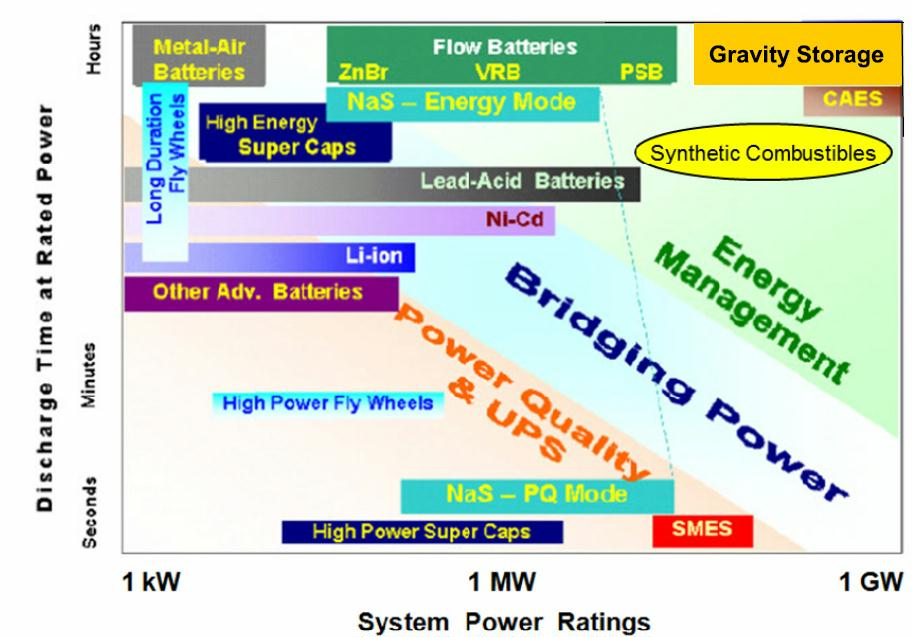
FIGURE 3. Ragone diagram of the discharge time at rated power (a factor in energy storage) vs. system power rating for a number of different electricity storage technologies; it is similar to many others that can be found on the Web. This one, ascribed to Nobelist Steven Chu and available at http://energy.wesrch.com/wiki-511-energy-storage-is-critical-to-grid-operations, has been augmented to include: (i) gravity storage; and (ii) stable synthetic chemicals (e.g., hydrogen gas, methane, or ammonia) that can be manipulated to produce mechanical energy. The maximum rates of charging and discharging of a storage module need not necessarily be the same.

FIGURE 3. Ragone diagram of the discharge time at rated power (a factor in energy storage) vs. system power rating for a number of different electricity storage technologies; it is similar to many others that can be found on the Web. This one, ascribed to Nobelist Steven Chu and available at http://energy.wesrch.com/wiki-511-energy-storage-is-critical-to-grid-operations, has been augmented to include: (i) gravity storage; and (ii) stable synthetic chemicals (e.g., hydrogen gas, methane, or ammonia) that can be manipulated to produce mechanical energy. The maximum rates of charging and discharging of a storage module need not necessarily be the same.

Excerpts from this 16 page paper:

ABSTRACT Presently, America’s average electrical power consumption is~1.3 kW/p; in the world as a whole, it is~0.33 kW/p. If, for 2050, a world goal of 1 kW/p is adopted, this implies an average electric power draw of 1 GW for each population cohort of 1,000,000 residents; and the Earth will have ~10,000 such cohorts. Multi-hour outages are already common; demand peaks daily; and renewable generation is intermittent. Hence, as a hedge against rare supply failures, each cohort would profit from local backup storage of electricity/energy in the order of 1–2 GWd. For comparison, the biggest electrochemical storage scheme yet seriously proposed will contain~240 MWh, while most of the largest pumped hydro storage reservoirs are <50 GWh. In approximately 50 years, when fossil fuels have become scarce, we should already have constructed this bulk storage. This review argues that the principal contenders for the storage of electricity in bulk are: 1) electrochemical storage in flow batteries; 2) chemical storage in agents, such as ammonia, hydrogen, methanol, or light hydrocarbons; 3) compressed air energy storage; and 4) underground pumped hydro. Finally, it will argue that not one of these four contenders has yet been built, tested, and perfected, while virtually none of the needed storage capacity exists today.

INTRODUCTION

Mankind is on a trajectory towards exhaustion of our planet’s supply of economically recoverable fossil fuels [1].

When that inevitable exhaustion has been accomplished, whatever electrical energy is consumed by our civilization must be derived from renewables or (possibly) nuclear.

And that means we risk losing the convenient electricity-on-demand to which we have become accustomed — unless, of course, we have had the foresight to build massive electricity storage sufficient to buffer the variations of supply and demand, accumulating energy during times of abundance and disbursing it during times of scarcity [2]–[4].

The term ‘massive electricity storage’ is vague because ‘massive’ has no agreed upon definition. In the context of this paper, it will be defined as ‘at least one gigawatt-day [GWd]’. This follows from the projection that, in 2050, the planet we be home to approximately 10 billion persons, each seeking a lifestyle undergirded by approximately 1 kilowatt of reliable electricity. Therefore, a typical geographical enclave of a million persons should desire at least 1 GWd of backup electricity storage sited locally because (i) the modern world doesn’t operate without electricity and (ii) backup a few hundred kilometers away is not very helpful if the grid fragments.

Recent models of intermittent renewable generation seem uniformly to recognize a necessity for at least some form of electricity storage [2]–[4]. The type and quantity of such storage is open to debate. Massive electricity storage for ten billion people in the latter half of this century is a task so far outside the historical experience of humanity that even conservative estimates of how much of it will be desired, are daunting.

Nobody knows how many people will be on Earth in 2050; but the best estimate of the United Nations was 8.9 to 10.6 billion [22]; more recent studies have modestly increased these estimates [23]. Therefore, it will be assumed that, in 2050, the population of earth will be roughly 10 billion people.

Ten billion consumers could require an average generation of ~10 TW : this is roughly ten-fold the current nameplate capacity of America’s generators.

To meet such a demand will require a global electricity production of ~87,600 TWh a year. If these electrical joules are to be derived from fossil fuel combustion in typical steam plants, then – due to Carnot inefficiencies – more thermal primary energy will be needed:~160 billion barrels per year of petroleum ([25], or ~34 billion metric tonnes of coal per year  [26], or ~2,7000,000,000,000 standard cubic meters per year of natural gas [26]; alternatively, this amounts to ~24,000,000,000 tonnes of oil equivalent.11

These figures are far in excess of the World’s current annual production in metric tons of oil equivalent [9] of oil (~4.2 billion), coal (~3.5 billion toe), or natural gas (~2.7 billion).

And this is to provide in 2050 just the electricity for a world that is based on today’s technology but has eliminated electricity poverty, a world in which the Haves and the Have-Nots cannot be readily identified on the basis of per capita electricity consumption: energy generation for transportation or process heating, which today proceeds largely without electrical intermediate steps, is not included [11]

As the fossil fuels bequeathed mankind are used up the demand for renewable energy and its associated storage solutions will markedly exceed that which arises from electricity use.

Ten billion consumers could require an average generation of~10 TW : this is roughly ten-fold the current nameplate capacity of America’s generators. To meet such a demand will require a global electricity production of ~87600 TWh y-1 or~320×1018 Je y-1. If these electrical joules are to be derived from fossil fuel combustion in typical steam plants, then – due to Carnot inefficiencies – more thermal primary energy will be needed:~1000×1018 Jth y-1, or ~160×109 barrels per year of petroleum ([25], s. 45K(d)(5)), or~34×109 metric tonnes per year of coal [26], or~27×1012 standard cubic meters per year of natural gas [26]; alternatively, this amounts to ~24×109 toe (tonne of oil equivalent).11 These figures are far in excess of the World’s current annual production [9] of oil (~4.2×10⁹ toe), coal (~3.5×10⁹ toe), or natural gas (~2.7×10⁹ toe). And this is to provide in 2050 just the electricity for a world that is based on today’s technology but has eliminated electricity poverty, a world in which the Haves and the Have-Nots can not be readily identified on the basis of per capita electricity consumption: energy generation for transportation or process heating, which today proceeds largely without electrical intermediate steps, is not 11 Often it is hard to translate joules into the non-metric units employed in practical energy calculations. The ‘‘barrel of oil equivalent’’ or ‘‘boe’’ is defined by the U.S. Internal Revenue Service as precisely 5.8 million Btu [25], which – employing thermochemical calories – yields the SI equivalence~6.115 GJ per boe; the Reader is cautioned that this value is nominal only and that the actual caloric content of a particular barrel may vary by a few percent from this defined equivalence [9]. The ‘‘tonne of coal equivalent’’ or ‘‘TCE’’ is defined nominally as 7E09 calories [26], here taken to be thermochemical calories; and thus, 1 TCE= 29.288 GJ, although considerable variation is to be expected from coal seam to coal seam ([9, p. 59]). The natural gas is traditionally measured in ‘‘standard cubic feet’’ for which a nominal caloric equivalent is 1000 Btu per cubic foot, which translates into~37.24 MJ per cubic meter; once again, there is considerable variation from gas field to gas field ([9, p. 60]). Alternatively, the energy content of any source of fossil fuel can be measured in terms of: 1 metric tonne of oil equivalent= 1 toe= 10E09 thermochemical calories=~ 41.84 GJ

In addition to assuring an adequate supply of electrical energy, the world of 2050 must, if it is to be sustainable, also assure a sustainable supply of mineral resources. This task is predicted to be, with much much effort, tractable: but only if the sustainable energy hurdle has already been successfully jumped [30], [31].

WORLD RESOURCES OF FOSSIL FUEL.  Since the Pearl Street generating station came on line in 1882, developed economies have enjoyed the benefits of massive energy storage. This has always been visible as the coal pile behind the generating station, and almost no utility customers ever remarked upon this because they never connected the dots. Today that fossil fuel is rapidly being depleted and is forecasted to be nearly gone and rather costly within a few decades [1], [32], [33].

ULTIMATELY RECOVERABLE RESOURCES. With respect to a particular nonrenewable substance, the ultimately recoverable resource is ‘‘an estimate of the total amount of [that substance] that will ever be recovered and produced. It is a subjective estimate in the face of only partial information.’’ [34]. Moreover, the estimated URR is subject to revision as the economic worth of the substance varies and as the technologies of extraction change. Nevertheless, there are two useful rules of thumb: (i) when resource depletion becomes so marked that the processes of extracting the substance costs more money than will be received when the substance is marketed, the substance ceases to be recoverable; and (ii), when the substance is a fossil fuel and a deposit becomes so lean that the energy stored in the substance is less than the energy expended extracting the substance, then the substance likewise ceases to be recoverable. Useful subsets of the URR are [34]: (i) proved reserves, the subset that is still recoverable with 90% probability; (ii) probable reserves, the subset that is still recoverable with 50% probability; and (iii) ) possible reserves, the subset that is still recoverable with 20% probability.

Whenever a substance is nonrenewable and mankind is consuming it at a rate that will soon exhaust the URR, mankind is facing a crisis.

COAL IS RUNNING OUT. The October 2013 prediction from Professor David Rutledge of the California Institute of Technology is that 90% of the World’s economically recoverable coal will have been recovered by 2067 [35]. Because his quantitative methodology has been so successful in modeling the exhaustion of already depleted coal fields, his date of 2067 should be taken seriously. Moreover, quantitatively similar predictions abound [1], [36]–[40].

The URR of coal has been estimated by several different authors. Mohr and Evans [36] predicted a URR of 700-1243 Gt. Höök et al. ([38, Table 4]) predicted~1000 Gt.

Rutledge [41] predicted 653-749 Gt. These predictions average out at around 860 Gt.

PETROLEUM IS RUNNING OUT. First, recent studies predict that oil resources also are being depleted and will, by the end of this century, be sharply diminished [1], [32], [40], [42]–[44]. Second, ‘‘From the beginning it was plain that only a finite amount of oil was in the ground and that no level of production, however low, could be maintained indefinitely. But as long as oil was being discovered faster than it was being produced, this limitation was a matter of only vague concern.’’ ([45, p.648]). Petroleum discovery, though complex, does seem to follow certain simple rules: (i) most of the petroleum in a region is contained in a few large fields [45]; (ii) when a region is explored, its large fields are discovered early [45]; (iii) giant oil fields (URR above 0.5 Gbbl) are responsible for~60% of world production [46]; (iv) in recent decades the discovery of giant fields has fallen precipitously [46]; and (v) for the past thirty or so years the consumption of oil has exceeded the discovery of new reserves ([47, Fig. 5.10]).

The data analyses of Brecha [44] suggest an estimate range of 2-3 Tbbl for ultimate planetary petroleum production. Therefore, for Fermi calculations, a reasonable URR value for Fermi calculations could be 2.5 Tbbl.

NATURAL GAS IS RUNNING OUT. Natural gas, oil, and tar sands are different end points achieved by the same basic geological processes ([32, Ch. 4): just as oil is a finite resource that is running out, the same is to be expected of natural gas – although its timeline may be modestly different ([1, Fig. 5]).

THE SIZE OF THE PLANET’S DOWRY OF FOSSIL FUEL. Fermi estimates of the planet’s RRR of fossil fuels are provided in Table 2. It seems clear that, if the World’s developing economies are to achieve Human Development Indices characteristic of present OECD economies, fresh energy supplies must be developed. Even if the projections of Table 2 are off by a factor of as much as three, the situation is still dire. For remember that Table 2 considers only the energy needs of traditional electricity generation: the demands of process heating in industry and the demands of transportation were not included.

A World Economy based upon energy from exhaustible fossil fuels therefore faces a triple whammy: (i) World population is growing; (ii) within developing economies, expectations and consumption are growing; and (iii), as a result of production and consumption, the resource bases themselves are shrinking rapidly. These trends combine to expand global demand for the benefits of fossil fuels while simultaneously diminishing mankind’s dowry of those fuels: what appears today to be an ample reserve can become depleted with startling rapidity.

RENEWABLE ENERGY AND ITS CHALLENGES. On no timescale relevant to human evolution is renewal of our rapidly depleting fossil fuels resource a rational possibility: when what we now have is used up, it is gone forever [32].

Fissile nuclei are a finite resource, even though their supply can (in principle) be extended by neutron irradiation of rather more common fertile but non-fissile nuclei. The ultimately recoverable resource (URR) of naturally occurring fissile nuclei is a matter of debate, as is the case with the better studied fossil fuels [40]. The supply of fertile nuclei (e.g., 232Th and 238U) is very large so that (in principle) ‘‘breeding’’ of fissile nuclei by irradiating fertile nuclei with neutrons could supply many thousands of years of fissile material. A significant impediment to a nuclear fission solution is that safe and profitable breeding has yet to be well-demonstrated, despite decades of off-again on-again research activity. A major downside to fission power is the generation of large quantities of radioactive waste that must be somehow be permanently and safely disposed of; and nigh seventy years into the ‘‘atomic era’’ this problem has not demonstrably and unequivocally been solved [51].

Nuclei for use in fusion reactors are much more abundant, but profitable fusion reactors have neither (i) been built nor (ii) been operated safely and for extended periods; moreover, they too should generate long-lived radioactive waste. In summary, there is widespread doubt that anthropogenically generated nuclear-based power can meet the World’s electricity needs [8], [52]–[56].

If a nuclear reactor of some sort is not a realistic source of sustainable power, then one must fall back upon the renewables. Two eminently readable treatises on renewable/sustainable energy are those of Armaroli and Balzani [57] and of MacKay [58]; the latter is notable for its dedication (p. vii) ‘‘to those who will not have the benefit of two billion years’ accumulated energy reserves’’. For readers in a hurry, the review article by Abbott ([59, pp. 48–52]) provides a compact no-nonsense summary of the relevant numbers: solar radiation and wind, both conspicuously intermittent generators of electricity, are the obvious hegemonic sources; and the others are anticipated to be niche players only.

MATCHING SUPPLY AND DEMAND: THE ACHILLES’ HEEL IS MASSIVE ELECTRICITY STORAGE.  Early in the Twentieth Century, the celebrated radio pioneer Reginald Fessenden pithily described the challenge of electricity storage [60]: ‘‘ The problem of the commercial utilization, for the production of power, of the energy of solar radiation, the wind and other intermittent natural sources is a double one. The energy of the sources must first be changed so as to be suitable in form; it must next be stored so as to be available in time.’’

This Intermittency Challenge is with us still, so much so that the World’s questionable technological preparedness has been memorialized by calling massive electricity storage “the Achilles” heel of renewable energy’’ [61]. If electricity storage of requisite quality and quantity does not become available in timely fashion, then both developed’’ and ‘‘developing’’ economies will most probably stagnate and, in some cases, may regress egregiously.

As it would be most unwise to bungle the transition from the Age of Fossil Fuels to an Age of Renewable Energy, we should presumably develop storage facilities for massive amounts of electrical energy.

Absolute safety of supply is not achievable, but a hundred hours of backup would be enough to ride out most catastrophes. The quantity the World would need works out to be on the order of 1000 TWeh.16

STEADY-OUTPUT GENERATORS OF ELECTRIC POWER ALSO PROFIT FROM ELECTRICITY STORAGE.  A practical device for ‘‘storing’’ massive quantities of electricity as electricity seems not at present exist [62]. However, as suggested by Fessenden [60], the energy can be converted into a form that can be stored; and the stored form can, at will, then be back-converted into electricity. Thus, for practical purposes, an electrical storage device can be thought of as a sort of ‘‘granary’’ for electricity, storing when electrical energy is in surplus and disbursing when it is in deficit: in concept it should work equally well, either with solar photovoltaic generation on a day of scudding clouds or with nuclear plant generation, which is output-sluggish and hard to match to diurnally shifting consumer demand.

UNTESTED SOLUTIONS TO THE INTERMITTENCY CHALLENGE SHOULD BE DISCOUNTED.  While many papers are written in which the merits of massive electricity storage are modeled, the evidence for the existence of such storage is sparse [63]–[66]. To be specific, if one defines ‘‘massive’’ as ‘‘at least one gigawatt-hour’’ and consults the U. S. Department of Energy’s ‘‘Global Energy Storage Database’’ [67], one discovers that the database does not sort entries by energy capacity! If instead one tries ‘at least 250,000 kW rated output’ plus ‘at least 4 h operation at rated output’, one comes up with 37 projects that have a record of successful operation: all are pumped hydro and only 10 exceed 9.9 GWh, the largest being 39.1 GWh. This last figure is minuscule compared to the electricity storage that will be desirable in an era of renewable energy: it misses the impending need by perhaps four orders of magnitude!

Some Readers may stand firm in their belief that modern science and technology will, when the need becomes urgent, triumphantly surmount the technological challenges facing mankind. They are requested to study the cautionary tales presented in extenso in the Appendix: the history of technology abounds with compelling ideas that just did not work out as expected. Deus ex machina solutions may have been a useful devices in classical drama, but they have no place in guiding the course of nations.

THE RAGONE DIAGRAM AND ITS CONSEQUENCES.  THE STORAGE “SMORGASBORD”.  A storage facility for electrical energy is conceptually decomposable into three parts: (1) an input energy conversion module, which accepts electrical energy from (for example) a grid and converts it to a storable form; (2) an energy storage module, which actually warehouses that storable form; and (3) an output conversion module, which back-converts the stored form into electrical energy to be transported over the grid. Such a storage facility will typically be described by a Ragone diagram17 that displays two of the three variables: (i) the maximum rate (W) of energy conversion to/from the stored form; (ii) or the time (s) that this maximum rate can be sustained; or (iii) the rated capacity (J) of the storage module. A typical Ragone diagram is shown in Figure 3. The many colored areas indicate roughly (very roughly) the current operating ranges for single units within the ‘‘smorgasbord’’ of available storage technologies [67]; but all these technologies can in principle be stretched by building bigger or by combining storage units in series or parallel.18 What are vital to massive electricity storage are those technologies that appear in the upper right of the diagram, because (i) that corner is where extant massive storage technologies are located and  (ii) all devices located there can (easily, in principle) be scaled up enormously. It is they that will be focussed upon below: synthetic combustibles, electrochemical storage in flow batteries, and storage as mechanical energy via either compressed air or elevated mass.

The discussions of electricity storage given below are intended, not to be encyclopedic, but rather to provide brief overviews of those technologies that cluster toward the upper right-hand corner of the Ragone chart of Fig. 3.

CANDIDATE MASSIVE TECHNOLOGIES 1) SYNTHETIC COMBUSTIBLES.  Coal, oil, and natural gas – the backbone of the Age of Fossil Fuels [32], [73]–[75]19 – are natural products, the end result of photosynthesis coupled with eons of ordinary geological processes. What rendered them so historically important were: first, their ease of harvesting, with the useful energy returned by the harvest greatly exceeding the energy expended during the harvest; and, second, their high energy density, making their transport, storage, and use relatively convenient. As exhaustion of fossil fuels forces a switch to renewable energy, that convenience is in danger of being lost. Without jet fuel, the convenience of modern air travel vanishes. Without high energy liquid fuel, ground transport as we know it likewise vanishes. Consequently, many researchers have suggested that surplus renewably-generated electricity could be stored by using it to drive the synthesis of suitable combustible chemicals, which might then be used in roughly traditional ways: this certainly seems better than letting the surplus energy go to waste.

2) STORAGE IN BATTERIES In Fig. 3, the only batteries that appear anywhere near the upper right-hand corner are flow batteries. Flow batteries are exceptional among batteries in that the current-limiting surface areas of the anode, ion-selective membrane, and cathode are effectively independent of the volumes of anolyte and catholyte that determine the quantity of energy stored [91]. However, despite much research and many specialist meetings over the past several years, there is not yet very much of such storage extant. For example, among the operational flow-battery facilities listed by the DOE Global Energy Storage Database [67], the largest appears to be only 10 MWh. A recent DOE publication states that ‘‘. . . due to lack of MW-scale field history, flow batteries have not gained substantial commercial traction in the US, with various flow battery technologies still in the demonstration phase, and the largest single operational system at 0.6 MW . . . ’’ ([92, p. 18]). Moreover, even if one were tempted to fall back upon the tried and true non-flow lead-acid battery, this prospective energy storage device has been considered by two different groups and judged non-viable at the terawatt-day quantities needed [93], [94]. Finally, the modularity of batteries should make them seem extremely attractive, but only if (i) the chosen module uses no scarce mineral elements and (ii) the problem of weak links in the storage array can be resolved. With flow batteries, as with all batteries, questions of round-trip energy efficiency, storage, supply sustainability end-of-life recycling (or waste management) loom large.

Hydroelectric pumped storage.  Storing water at a high head is desirable, whereas flat-topped mountains over 500 m high and suitable for an upper reservoir are scarce near metropolitan areas;

None of the candidate technologies for massive-scale renewable/sustainable generation of ‘‘green’’ electricity deliver it in a form suitable for high-efficiency storage. None of the prospectively-massive storage modes for transformed electricity is at present well enough developed to be designated a sovereign remedy for Intermittency.

ABOUT WILLIAM F. PICKARD.   He received the Ph.D. degree in applied physics from Harvard University. He has pursued a continuously evolving career in teaching and academic research, the preponderance of which has been spent as a Professor with the Department of Electrical and Systems Engineering, Washington University in St. Louis, MO. His research areas have included:

high voltage engineering, electrobiology, the biological effects of electromagnetic elds, and biological transport and systems biology. He currently concentrates upon the theory and practice of massive energy storage because the sustainability of an industrial civilization depends upon reliable dispatchable energy even though the major renewables are intermittent.

His current foci are the theory of heat exchangers upon which thermal storage depends and underground pumped hydro, the only electrotechnology that currently seems scalable to the multi-terawatt-day levels needed.

Abbreviations (including units not commonly employed in SI): bbl, barrel (of oil, equivalent); d, day; kcf, 1000 standard cubic feet; p, person; scf, standard cubic foot (of natural gas, equivalent); scm, standard cubic meter (of natural gas, equivalent); st, short ton of 2000 pounds; toe, metric tonne of oil equivalent; URR, ultimately recoverable resource;

MWh y-1 translates to 0.114 kW, which by Fig. 2 implies that a steady 1 kW per capita should deliver an HDI in the range of 0.88±0.05. That is, the 1 kW- assumption of Section II.B should, other things being equal, suffice to sustain what most of humanity would deem an enviable quality of life.

References (lots of good references if you want to do further research):

[1] S. H. Mohr, J. Wang, G. Ellem, J. Ward, and D. Giurco, “Projection of world fossil fuels by country,” Fuel, vol. 141, pp. 120135, Feb. 2015. [
2] C. Budischak, D. Sewell, H. Thomson, L. Mach, D. E. Veron, and W. Kempton, “Cost-minimized combinations of wind power, solar power and electrochemical storage, powering the grid up to 99.9% of the time, J. Power Sour., vol. 225, pp. 6074, Mar. 2013.
[3] M. Z. Jacobson et al., “Examining the feasibility of converting New York state’s all-purpose energy infrastructure to one using wind, water, and sunlight,” Energy Policy, vol. 57, pp. 585601, Jun. 2013.
[4] S. Pfenninger, P. Gauché, J. Lilliestam, K. Damerau, and F. Wagner, “Potential for concentrating solar power to provide baseload and dispatchable power,” Nature Climate Change, vol. 4, pp. 689692, Jun. 2014.
[5] Philostratus (the Athenian), The Life of Apollonius of Tyana: TR, C. P. Jones. Eds. Cambridge, MA, USA: Harvard Univ. Press, , 2005.
[6] J. Dator, Foreward. The Knowledge Base of Futures Studies, vol. 1, R. A. Slaughter, Ed. Hawthorn, Vic., Australia: DDM Media Group, 1996, pp. xixxx.
[7] W. F. Pickard, “The future of biomass energy: A Fermi-calculation perspective,” Energy Policy, vol. 38, no. 4, pp. 16721674, 2010.
[8] M. V. Ramana, “The forgotten history of small nuclear reactors,” IEEE Spectrum, vol. 52, no. 5, pp. 4458, May 2015. [9] International Energy Agency, Paris, France. (2012). Key World Energy Statistics. [Online]. Available: http://www.oecd-ilibrary.org/energy/ key-world-energy-statistics-2012_key_energ_stat-2012-en, accessed Jul. 4, 2015.
[10] S. B. Carter. (2006). Historical Statistics of the United States (Millennial Edition). [Online]. Available: http://hsus.cambridge.org/ HSUSWeb/toc/tableToc.do?id=Aa6-8
[11] U.S. Census Bureau. (2010). Population Estimates. [Online]. Available:
https://www.census.gov/popest/data/historical/index.html, accessed
Jul. 4, 2015.
[12] (2014). U.S. and World Population Clock. [Online]. Available:
http://www.census.gov/popclock/, accessed Jun. 29, 2015.
[13] Historical Statistics of the United States: Colonial Times to 1970.
U. S. Census Bureau, Washington, DC, USA, 1975.
[14] U.S. Energy Information Administration,Washington, DC, USA. (2012). Total Energy. [Online]. Available: http://www.eia.gov/totalenergy/ data/annual/showtext.cfm?t=ptb0802a, accessed Jul. 4, 2015.
[15] U.S. Energy Information Administration, Washington, DC, USA. (2015). Electricity Net Generation: Total (All Sectors). [Online]
http://www.eia.gov/totalenergy/data/monthly/pdf/sec7_5.pdf
[16] G. Constable and B. Somerville, A Century of Innovation: Twenty Engi- neering Achievements That Transformed Our Lives. Washington, DC, USA: Joseph Henry Press, 2003.
[17] United Nations Development Programme. (2010). Human Develop- ment Report 2010. The Real Wealth of Nations: Pathways to Human Development. [Online].
http://hdr.undp.org/sites/default/les/ reports/270/hdr_2010_en_complete_reprint.pdf, accessed Jun. 29, 2015.
[18] The World Bank, Washington, DC, USA. (2013). Electric Power Consumption (kWh Per Capita). [Online]. Available: http://data. worldbank.org/indicator/EG.USE.ELEC.KH.PC, accessed Jun. 29,
2015.

[19] J. G. Lambert, C. A. S. Hall, S. Balogh, A. Gupta, and M. Arnold, “Energy, EROI and quality of life,” Energy Policy, vol. 64, pp. 153167, Jan. 2014.
[20] L. W. Davis and J. Gertler, “Contribution of air conditioning adoption to future energy use under global warming,” Proc. Nat. Acad. Sci. USA, vol. 112, no. 19, pp. 59625967, 2015.
[21] The World Bank. (2014). World Development Indicators:
Electricity Production, Sources, and Access. [Online]. Available:
http://wdi.worldbank.org/table/3.7, accessed Jun. 29, 2015.
[22] United Nations. (2004). World Population to 2300. [Online]. Available: http://www.un.org/esa/population/publications/longrange2/ WorldPop2300nal.pdf, accessed Jun. 29, 2015.
[23] P. Gerland et al., “World population stabilization unlikely this century,” Science, vol. 346, no. 6206, pp. 234237, 2014.
[24] K. Malik. (2013). Human development report 2013: The rise of the south: Human progress in a diverse world. United Nations Development Programme. [Online]. Available: http://hdr.undp.org/sites/ default/les/reports/14/hdr2013_en_complete.pdf
[25] United States Internal Revenue Service, New York, NY, USA. (2012). Internal Revenue Bulletin: 201218. [Online]. Available:
http://www.irs.gov/irb/2012-18_IRB/ar13.html, accessed Jul. 4, 2015.
[26] American Physical Society, New York, NY, USA. (2014). Energy Units. [Online]. Available: http://www.aps.org/policy/reports/popareports/ energy/units.cfm, accessed Jun. 24, 2015.
[27] L. Guruswamy, “Energy poverty,” Ann. Rev. Environ. Resour., vol. 36, pp. 139161, Nov. 2011.
[28] ABET, Baltimore, MD, USA. (2015). Criteria for Accrediting Engineer- ing Programs, 20152016. [Online]. Available: http://www.abet.org/ accreditation/accreditation-criteria/criteria-for-accrediting-engineeringprograms-2015-2016/#objectives
[29] J. Rawls, A Theory of Justice. Cambridge, MA, USA: Harvard Univ. Press, 1971.
[30] W. F. Pickard, “Geochemical constraints on sustainable development: Can an advanced global economy achieve long-term stability?” Global Planetary Change, vol. 61, nos. 34, pp. 285299, 2008.
[31] D. J. Murphy and C. A. S. Hall, “Year in reviewEROI or energy return on (energy) invested,” Ann. New York Acad. Sci., vol. 1185, pp. 102118, Jan. 2010.
[32] K. Aleklett, Peeking at Peak Oil. New York, NY, USA: Springer-Verlag, 2012.
[33] W. F. Pickard, “Smart grids versus the Achilles’ heel of renewable energy: Can the needed storage infrastructure be constructed before the fossil fuel runs out?” Proc. IEEE, vol. 102, no. 7, pp. 10941105, Jul. 2014.
[34] BP. (2015). Oil Reserve Denitions. [Online]. Available: http:// www.bp.com/content/dam/bp/pdf/Energy-economics/statistical-review -2015/oil-reserve-denitions-bp-2015.pdf, accessed Jul. 4, 2015.
[35] D. Rutledge. (2013). Projections for Ultimate Coal Production From Production Histories Through 2012. [Online]. http://rutledge.caltech.edu/, accessed Jun. 24, 2015.
[36] S. H. Mohr and G. M. Evans, “Forecasting coal production until 2100,” Fuel, vol. 88, no. 11, pp. 20592067, 2009.
[37] T. W. Patzek and D. Croft, “A global coal production forecast with multi-Hubbert cycle analysis,” Energy, vol. 35, no. 8, pp. 31093122, 2010.
[38] M. Höök,W. Zittel, J. Schindler, and K. Aleklett, “Global coal production outlooks based on a logistic model,” Fuel, vol. 89, no. 11, pp. 35463558, 2010.
[39] R. Heinberg and D. Fridley, “The end of cheap coal,” Nature, vol. 468, no. 7322, pp. 367369, 2010. [40] G. Maggio and G. Cacciola, “When will oil, natural gas, and coal peak?” Fuel, vol. 98, pp. 111123, Aug. 2012. [41] D. Rutledge, “Estimating long-term world coal production with logit and probit transforms,” Int. J. Coal Geol., vol. 85, no. 1, pp. 2333, 2011.
[42] C. J. Schenk. (2012). An estimate of undiscovered conventional oil and gas resources of the world, 2012. U.S. Geological Survey Fact Sheet 20123042, U.S. Geological Survey. [Online]. http://pubs.usgs.gov/fs/2012/3042/fs2012-3042.pdf
[43] J.Wang, L. Feng, L. Zhao, S. Snowden, and X.Wang, “A comparison of two typical multicyclic models used to forecast the world’s conventional oil production,” Energy Policy, vol. 39, no. 12, pp. 76167621, 2011.
[44] R. J. Brecha, “Ten reasons to take peak oil seriously,” Sustainability, vol. 5, no. 2, pp. 664694, 2013.

[45] D. H. Root, L. J. Drew, and F. G. Wood, “The pattern of petroleum discovery rates: Why does the amount of petroleum discovered per unit of exploratory drilling drop off so sharply after the initial phases of exploration?” Amer. Sci., vol. 67, no. 6, pp. 648652, 1979.
[46] M. Höök, R. Hirsch, and K. Aleklett, “Giant oil eld decline rates and their inuence on world oil production,” Energy Policy, vol. 37, no. 6, pp. 22622272, 2009.
[47] F. Robelius. (2007). Giant oil eld decline rates and their inuence on world oil production. Uppsala Univ., Uppsala, Sweden. [http://uu.diva-portal.org/smash/record.jsf?pid=diva2:169774
[48] BP. 2015. Statistical Review ofWorld Energy 2015. http://www.bp.com/content/dam/bp/pdf/Energy-economics/statisticalreview-2015/bp-statistical-review-of-world-energy-2015-full-report.pdf
[49] GPO. (2008). U.S. Government Printing Ofce Style Manual. [Online]. Available: http://www.gpo.gov/fdsys/pkg/GPO-STYLEMANUAL-2008/pdf/GPO-STYLEMANUAL-2008.pdf
[50] American Oil & Gas Historical Society, Washington, DC, USA. (2014). History of the 42-Gallon Oil Barrel. http://aoghs.org/popular-oil-history-articles/history-of-the-42-gallon-oilbarrel/
[51] W. F. Pickard, “Finessing the fuel: Revisiting the challenge of radioactive waste disposal,” Energy Policy, vol. 38, no. 2, pp. 709714, 2010.
[52] D. Abbott, “Is nuclear power globally scalable?” Proc. IEEE, vol. 99, no. 10, pp. 16111617, Oct. 2011.
[53] D. Abbott, “Limits to growth: Can nuclear power supply the world’s needs?” Bull. Atomic Scientists, vol. 68, no. 5, pp. 2332, 2012.
[54] A. Ahmad and M. V. Ramana, “Too costly to matter: Economics of nuclear power for Saudi Arabia,” Energy, vol. 69, pp. 682694, May 2014.
[55] S. R. Pillai and M. V. Ramana, “Breeder reactors: A possible connection between metal corrosion and sodium leaks,” Bull. Atomic Scientists, vol. 70, no. 3, pp. 4955, 2014.
[56] N. S. Lewis, “Powering the planet,” MRS Bull., vol. 32, no. 10, pp. 808820, 2007.
[57] N. Armaroli and V. Balzani, Energy for a Sustainable World: From the Oil Age to a Sun-Powered Future. Weinheim, Germany: Wiley, 2011.
[58] D. J. C. MacKay, Sustainable EnergyWithout the Hot Air. Cambridge, U.K.: UIT Cambridge Ltd., 2009.
[59] D. Abbott, “Keeping the energy debate clean: How do we supply the world’s energy needs?” Proc. IEEE, vol. 98, no. 1, pp. 4266, Jan. 2010.
[60] R. A. Fessenden, “The commercial solution of the problem of utilising, for the production of power, the energy of solar radiation, the wind and other intermittent natural sources,” Electrician, vol. 65, pp. 951953, Sep. 1910.
[61] B. S. Lee and D. E. Gushee, “Electricity storage: The Achilles’ heel of renewable energy,” Chem. Eng. Progr., vol. 104, pp. S29S32, Mar. 2008.
[62] W. F. Pickard, A. Q. Shen, and N. J. Hansing, “Parking the power: Strategies and physical limitations for bulk energy storage in
supplydemand matching on a grid whose input power is provided by intermittent sources,” Renew. Sustain. Energy Rev., vol. 13, no. 8, pp. 19341945, 2009.
[63] G. Philippidis, “Commentary: Powering America with sustainable energy in the 21st century,” J. Renew. Sustain. Energy, vol. 4, no. 6, p. 062801, 2012.
[64] T. Kousksou, P. Bruel, A. Jamil, T. El Rhaki, and Y. Zeraouli, “Energy storage: Applications and challenges,” Solar Energy Mater. Solar Cells,
vol. 120, pp. 5980, Jan. 2014.
[65] M. J. Alexander, P. James, and N. Richardson, “Energy storage against interconnection as a balancing mechanism for a 100% renewable UK electricity grid,” IET Renew. Power Generat., vol. 9, no. 2, pp. 131141, 2015.
[66] T. M. I. Mahlia, T. J. Saktisahdan, A. Jannifar, M. H. Hasan, and H. S. C. Matseelar, “A review of available methods and development on energy storage; technology update,” Renew. Sustain. Energy Rev., vol. 33, pp. 532545, May 2014.
[67] U.S. Department of Energy, Washington, DC, USA. (2015). Global Energy Storage Database. [Online]. Available: http://www. energystorageexchange.org/, accessed May 21, 2015.
[68] B. Zakeri and S. Syri, “Electrical energy storage systems: A comparative life cycle cost analysis,” Renew. Sustain. Energy Rev., vol. 42, pp. 569596, Feb. 2015.

[69] S. Sabihuddin, A. E. Kiprakis, and M. Mueller, “A numerical and graphical review of energy storage technologies,” Energies, vol. 8, no. 1, pp. 172216, 2015.
[70] F. Díaz-González, A. Sumper, O. Gomis-Bellmunt, and R. Villafála-Robles, “A review of energy storage technologies for wind power applications,” Renew. Sustain. Energy Rev., vol. 16, no. 4, pp. 21542171, 2012.
[71] A. Poullikkas, “A comparative overview of large-scale battery systems for electricity storage,” Renew. Sustain. Energy Rev., vol. 27, pp. 778788, Nov. 2013.
[72] Z. Zhou, M. Benbouzid, J. F. Charpentier, F. Scuiller, and T. Tang, “A review of energy storage technologies for marine current energy systems,” Renew. Sustain. Energy Rev., vol. 18, pp. 390400, Feb. 2013.
[73] P. J. E. M. van Dam, “Sinking peat bogs: Environmental change Holland, 13501550,” Environ. History, vol. 6, no. 1, pp. 3245, 2001.
[74] U.S. Geological Survey, Reston, VA, USA. (2013). Peat. Mineral Commodity Summaries 2013. [Online]. Available: http://minerals.usgs. gov/minerals/pubs/mcs/2013/mcs2013.pdf, accessed Jun. 29, 2015.
[75] J. Grönroos et al., “Life-cycle climate impacts of peat fuel: Calculation methods and methodological challenges,” Int. J. Life Cycle Assessment, vol. 18, no. 3, pp. 567576, 2013.
[76] A. Ursúa, L. M. Gandia, and P. Sanchis, “Hydrogen production from water electrolysis: Current status and future trends,” Proc. IEEE, vol. 100, no. 2, pp. 410426, Feb. 2012.
[77] S. Verhelst et al., “Electricity powering combustion: Hydrogen engines,” Proc. IEEE, vol. 100, no. 2, pp. 427439, Feb. 2012.
[78] U. Bossel, “Does a hydrogen economy make sense?” Proc. IEEE, vol. 94, no. 10, pp. 18261837, Oct. 2006.
[79] J. Andrews and B. Shabani, “Re-envisioning the role of hydrogen in a sustainable energy economy,” Int. J. Hydrogen Energy, vol. 37, no. 2, pp. 11841203, 2012.
[80] S. Verhelst, “Future vehicles will be driven by electricity, but not as you think,” Proc. IEEE, vol. 102, no. 10, pp. 13991403, Oct. 2014.
[81] W. L. Ahlgren, “The dual-fuel strategy: An energy transition plan,” Proc. IEEE, vol. 100, no. 11, pp. 30013052, Nov. 2012.
[82] Agency for Toxic Substances and Disease Registry, Atlanta, GA, USA. (2004). Ammonia.  http://www.atsdr.cdc.gov/ toxproles/tp126-c1-b.pdf, accessed Jun. 28, 2015.
[83] M. Mikkelsen, M. Jørgensen, and F. C. Krebs, “The teraton challenge. A review of xation and transformation of carbon dioxide,” Energy Environ. Sci., vol. 3, no. 1, pp. 4381, 2010.
[84] C. Graves, S. D. Ebbesen, M. Mogensen, and K. S. Lackner, “Sustainable hydrocarbon fuels by recycling CO2 and H2O with renewable or nuclear energy,” Renew. Sustain. Energy Rev., vol. 15, no. 1, pp. 123, 2011.
[85] G. A. Olah, G. K. S. Prakash, and A. Goeppert, “Anthropogenic chemical carbon cycle for a sustainable future,” J. Amer. Chem. Soc., vol. 133, no. 33, pp. 1288112898, 2011.
[86] F. Schüth, “Chemical compounds for energy storage,” Chem. Ingenieur Tech., vol. 83, no. 11, pp. 19841993, 2011.
[87] R. J. Pearson et al., “Energy storage via carbon-neutral fuels made from CO2, water, and renewable energy,” Proc. IEEE, vol. 100, no. 2, pp. 440460, Feb. 2012.
[88] A. Harriman, “Prospects for conversion of solar energy into chemical fuels: The concept of a solar fuels industry,” Philos. Trans. Roy. Soc.
London A, Math., Phys., Eng. Sci., vol. 371, no. 1996, p. 20110415, 2013.
[89] V. N. Nguyen and L. Blum, “Syngas and synfuels from H2O and CO2:
Current status,” Chem. Ingenieur Tech., vol. 87, no. 4, pp. 354375, 2015.
[90] K. S. Lackner, S. Brennan, J. M. Matter, A.-H. A. Park, A. Wright, and B. van der Zwaan, “The urgency of the development of CO2 capture from ambient air,” Proc. Nat. Acad. Sci. USA, vol. 109, no. 33, pp. 1315613162, 2012.
[91] A. A. Akhil et al. (2013). DOE/EPRI 2013 electricity storage handbook. Sandia National Laboratories, Albuquerque, NM, USA. http://www.sandia.gov/ess/publications/SAND2013-5131.pdf
[92] U.S. Department of Energy. (2013). Grid Energy Storage. http://energy.gov/sites/prod/les/2013/12/f5/Grid%20Energy%20Storage%20December%202013.pdf
[93] T.W. Murphy. (2011). A Nation-Sized Battery. http:// physics.ucsd.edu/do-the-math/2011/08/nation-sized-battery/ [94] W. F. Pickard, “A nation-sized battery?” Energy Policy, vol. 45, pp. 263267, Jun. 2012.

[95] B. Huskinson et al., “A metal-free organicinorganic aqueous ow battery,” Nature, vol. 505, pp. 195198, Jan. 2014.
[96] I. Dincer and M. A. Rosen, Exergy: Energy, Environment and Sustainable Development, 2nd ed. Oxford, U.K.: Elsevier, 2012.
[97] P. Vadasz, “Compressed air energy storage: Optimal performance and techno-economical indices,” Int. J. Appl. Thermodyn., vol. 2, no. 2, pp. 6980, 1999.
[98] J. E. Mason and C. L. Archer, “Baseload electricity from wind via compressed air energy storage (CAES),” Renew. Sustain. Energy Rev., vol. 16, no. 2, pp. 10991109, 2012.
[99] R. Kushnir, A. Ullmann, and A. Dayan, “Thermodynamic and hydrodynamic response of compressed air energy storage reservoirs: A review,” Rev. Chem. Eng., vol. 28, nos. 23, pp. 123148, 2012. [100] G. Grazzini and A. A. Milazzo, “A thermodynamic analysis of multistage adiabatic CAES,” Proc. IEEE, vol. 100, no. 2, pp. 461472, Feb. 2012.
[101] Y.-M. Kim, J.-H. Lee, S.-J. Kim, and D. Favrat, “Potential and evolution of compressed air energy storage: Energy and exergy analyses,” Entropy, vol. 14, no. 8, pp. 15011521, 2012.
[102] Y. Zhang, K. Yang, X. Li, and J. Xu, “The thermodynamic effect of air storage chamber model on advanced adiabatic compressed air energy storage system,” Renew. Energy, vol. 57, pp. 469478, Sep. 2013.
[103] H. Safaei, D. W. Keith, and R. J. Hugo, “Compressed air energy storage (CAES) with compressors distributed at heat loads to enable waste heat utilization,” Appl. Energy, vol. 103, pp. 165179, Mar. 2013.
[104] S. D. Lim, A. P. Mazzoleni, J.-K. Park, P. I. Ro, and B. Quinlan, “Conceptual design of ocean compressed air energy storage system,” Marine Technol. Soc. J., vol. 47, no. 2, pp. 7081, Mar./Apr. 2013.
[105] C. M. Oldenburg and L. Pan, “Porous media compressed-air energy storage (PM-CAES): Theory and simulation of the coupled wellbore reservoir system,” Transp. Porous Media, vol. 97, no. 2, pp. 201221, Mar. 2013.
[106] U.S. Energy Information Administration, Electric Power Annual. (2013). Existing Capacity by Energy Source. http://www.eia.gov/electricity/annual/html/epa_04_03.html
[107] U.S. Energy Information Administration, Electric Power Annual. (2013). Planned Generating Capacity Changes, by Energy Source. http://www.eia.gov/electricity/annual/html/epa_04_05.html
[108] W. F. Pickard, “The history, present state, and future prospects of underground pumped hydro for massive energy storage,” Proc. IEEE, vol. 100, no. 2, pp. 473483, Feb. 2012.
[109] Sogecom. (2011). Flat-Land Large-Scale Electricity Storage (FLES). http://www.sogecom.nl/energy.html
[110] ARES. (2015). Grid Scale Energy Storage. http://www.aresnorthamerica.com/grid-scale-energy-storage
[111] C. Marchetti, “Primary energy substitution models: On the interaction between energy and society,” Technol. Forecasting Soc. Change, vol. 10, no. 44, pp. 345356, 1977.
[112] R. Fouquet, Heat, Power and Light: Revolutions in Energy Services. Cheltenham, U.K.: Edward Elgar, 2008.
[113] V. Smil, Energy Transitions: History, Requirements, Prospects. Santa Barbara, CA, USA: Praeger, 2010.
[114] R. Fouquet, “The slow search for solutions: Lessons from historical energy transitions by sector and service,” Energy Policy, vol. 38, no. 11, pp. 65866596, Nov. 2010.
[115] S. Chu and A. Majumdar, “Opportunities and challenges for a sustainable energy future,” Nature, vol. 488, pp. 294303, Aug. 2012.
[116] W. F. Pickard and D. Abbott, “Addressing the intermittency challenge: Massive energy storage in a sustainable future [scanning the issue],” Proc. IEEE, vol. 100, no. 2, pp. 317321, Feb. 2012.
[117] U.S. Energy Information Administration. (2014). U.S. Petroleum and Other Liquids.  http://www.eia.gov/forecasts/steo/ report/us_oil.cfm?src=Petroleum-b1
[118] U.S. Energy Information Administration. (2014). Coal. http://www.eia.gov/coal/
[119] U.S. Energy Information Administration. (2014). Natural Gas.  http://www.eia.gov/naturalgas/
[120] BEA. (2014). Bureau of Economic Analysis.  http:// www.bea.gov/newsreleases/national/gdp/gdpnewsrelease.htm

[121] G. F. Nemet; D. M. Kammen. U.S. energy research and development: Declining investment, increasing need, and the feasibility of expansion. Energy Policy, vol. 35, no. 1, pp. 746755, Jan. 2007.
[122] M. G. Smith and J. Urpelainen, Why has public R&D on alternatives to fossil fuels decreased in industrialized countries? Environ. Sci. Policy, vol. 25, pp. 127137, Jan. 2013.
[123] National Priorities. 2014. Federal Spending: Where Does the Money Go? National Priorities Project. http://nationalpriorities.org/budget-basics/federal-budget-101/spending/
[124] F. L. Pryor, Z. P. Pryor, M. Stadnik, and G. J. Staller, Czechoslovak aggregate production in the interwar period, Rev. IncomeWealth, vol. 17, no. 1, pp. 3559, Mar. 1971.
[125] A. Teichova, The Czechoslovak Economy, 1918-1980. London, U.K.: Routledge, 1988.
[126] M. Albright and W. Woodward, Prague Winter: A Personal Story of Remembrance and War, 19371948. New York, NY, USA: Harper, 2012.
[127] T. W. Murphy. (2011). The Energy Trap. http://physics.ucsd.edu/do-the-math/2011/10/the-energy-trap/
[128] G. Crabtree, E. Kocs, and T. Aláan, Energy, society and science: The fifty-year scenario, Futures, vol. 58, pp. 5365, Apr. 2014.
[129] R. Baxter, Energy Storage: A Nontechnical Guide. Tulsa, OK, USA: PennWell, 2006.
[130] H. Ibrahim, A. Ilinca, and J. Perron, Energy storage systems Characteristics and comparisons, Renew. Sustain. Energy Rev., vol. 12, no. 5, pp. 12211250, Jun. 2008.
[131] D. J. C. MacKay, “Solar energy in the context of energy use, energy transportation and energy storage, Philos. Trans. Roy. Soc. London A, Math. Phys. Sci., vol. 371, p. 20110431, Jul. 2013. [132] B. Dunn, H. Kamath, and J.-M. Tarascon, “Electrical energy storage for the grid: A battery of choices, Science, vol. 334, no. 6058, pp. 928935, Nov. 2011.
[133] SBC Energy Institute, s-Gravenhage, The Netherlands. (2013). Electricity Storage. [https://www.sbc.slb.com/ SBCInstitute/Publications/ ~ / media/Files/SBC%20Energy%20Institute/ SBC%20Energy%20Institute_Electricity_Storage%20Factbook_vf1.pdf
[134] J. Nelson and P. Simshauser, Is the merchant power producer a broken model? Energy Policy, vol. 53, pp. 298310, Feb. 2013.
[135] A. Ansar, B. Flyvbjerg, A. Budzier, and D. Lunn, Should we build more large dams? The actual costs of hydropower megaproject development, Energy Policy, vol. 69, pp. 4356, Jun. 2014.
[136] C. Sulzberger, An early road warrior: Electric vehicles in the early years of the automobile, IEEE Power Energy Mag., vol. 2, no. 3, pp. 6671, May/Jun. 2004.
[137] M. B. Schiffer, T. C. Butts, and K. K. Grimm, Taking Charge: The Electric Automobile in America. Washington, DC, USA: Smithsonian Institution Press, 1994.
[138] Electric Drive Transportation Association. (2015). Electric Drive Vehicle Sales Figures. http://electricdrive. org/index.php?ht=d/sp/i/20952/pid/20952
[139] Union of Concerned Scientists, Cambridge, MA, USA. (2013). U.S. Ballistic Missile Defense Timeline: 19452013.
http://www.ucsusa.org/nuclear_weapons _ and_global_security/solutions/missile-defense/us-ballistic-missile-defense.html

[140] E. Marshall, “MILITARY RESEARCH: A midcourse correction for U.S. missile defense system,” Science, vol. 339, no. 6127, pp. 15081509, Mar. 2013.
[141] Missile Defense Agency, Fort Belvoir, VA, USA. (2013). Aegis Bal- listic Missile Defense System Completes Successful Intercept Flight Test. http://www.mda.mil/news/13news0009.html
[142] M. Dodge. (2013). Missile defenses: Robust testing program essential. The Heritage Foundation. http://www.heritage.org/research/reports/2013/05/missile-defense-testing-robust-programessential
[143] World Bank. (2015). GDP Growth (Annual%). http://data.worldbank.org/indicator/NY.GDP.MKTP.KD.ZG?page=4
[144] A. Ciralsky. (Sep. 16, 2013). Will it Fly? Vanity Fair.  http://www.vanityfair.com/politics/2013/09/joint-strike-ghter-lockheed-martin
[145] W. Boardman. (2014). F-35 Burns on Runway During Testing. http://readersupportednews.org/opinion2/277-75/24466-focus-f-35-burns-on-runway-during-testing
[146] W. Boardman. (2014). F-35: Zombie Fighter-Bomber of American `Defense’ Fantasies? http://www.smirkingchimp.com/thread/william-boardman/58078/f-35-zombie-ghter-bomber-ofamerican-defense-fantasies
[147] T. Mason, T. Curry, and D. Wilson. (2012). Capital costs for transmission and substations. Black & Veatch.
https://www.wecc.biz/Reliability/1210_BV_WECC_TransCostReportFinal.pdf
[148] H. Petroski, Success Through Failure: The Paradox of Design. Princeton, NJ, USA: Princeton Univ. Press, 2006.


 

Posted in Electric Grid & EMP Electromagnetic Pulse, Energy Storage, Grid instability, Hydropower, Renewable Integration | Tagged , | 4 Comments

Nate Hagens “Peak Oil” – Why Smart Folks Disagree – Part II

[ There’s a great deal of interest in the Hill’s Group report, but Nate Hagens came up with similar results back in 2007 and he explains his ideas far more eloquently.  Although much production of U.S. oil and gas may perhaps go net energy negative by 2030, the Middle East and a few other areas will still be producing net energy positive barrels.  Though whether they will be exporting as much is doubtful given that their population is growing at the same time their oil production is declining — see the export land model post for details. There is also a part 1 here and a part 3 here.  See all of Nate Hagens posts at theoildrum here]

If you ask 100 people about Peak Oil, you will get a few shrugs of disdain, a few vehement diatribes and about 90 blank stares. Its not a subject easily talked about, easily understood, or easily internalized. This post points out some major areas of why people either disagree about or don’t comprehend the magnitude of this human problem. These issues have been thoroughly discussed on this site for the past 2 years, but for new readers I will attempt to briefly summarize some of these major areas of disagreement – for old readers (err..seasoned readers), please jump down to Reason #6, where begins some new analysis. This post will be followed by Part III, which will discuss the more interesting and controversial social and psychological reasons why there exists such a polarization of opinion on this important topic.

REASON #1 THERE IS VERY LITTLE RELIABLE DATA ON OIL, GAS (AND COAL)

Neither the concerned nor the unconcerned camp can have any great confidence in reserve or future production data due to the fact that 85-90% of the worlds oil is owned or controlled by nations or national oil companies. Furthermore, estimates on the dollar and energy costs to produce this oil are all but nonexistent. The unconcerned camp leans heavily on forecasts from the USGS and EIA, both of which have in recent years been overly optimistic. (The US government Energy Information Agency has a $60 median forecast for oil for 2030!!(1) While there is a (very slight) chance they could be right, the prediction is based on not only a paucity of data, but (at least historically) has been comprised of economic as opposed to scientific analysis:

“..These adjustments to the USGS and MMS estimates are based on non-technical considerations that support domestic supply growth to the levels necessary to meet projected demand levels.”(2)

In other words, the figures were rearranged to show that we will always have enough. Yet these pronouncements and predictions are received by corporate America as carrying the weight of certainty (more on this in part III).

The concerned camp at least uses the data that we DO have – that of past and current production. 50 countries have already peaked in production and many more could peak in the very near future based on logistical and hubbert linearization methods discussed on this website. While its possible these countries could rebound and see new peaks, that has not been the pattern. The USA peaked in production in 1970 and has since been in terminal decline with the exception of the blip up from the North Slope in Alaska. Yet the EIA ccurrently continues to forecast increased US production from now until 2016 in their latest report.

The basic point here is: we don’t know, so isn’t it better to use the precautionary principle than keep driving and hoping we’re not on fumes?

REASON #2 -ACTUAL PRODUCTION FLOWS DO NOT EQUAL “PRODUCTIVE CAPACITY”

CERA forecasts some 3.7 trillion barrels of (notional) oil remaining while most in the concerned camp estimate remaining recoverable reserves of about 1 trillion barrels. We currently produce around 85 million barrels per day which is over 30 billion per year.

THOUGHT EXPERIMENT

Imagine for the moment that a large group of apple orchards represents the worlds oil fields (apples being the oil). As frugivores, we care about the rate at which apples can be picked in one orchard (and all orchards) and delivered to the grocer. CERA type analysis is focused on counting how many total apples are in all the orchards, including the wormy ones (heavy oil), the ones on top of trees requiring heavy equipment to pick (oil sands) and the ones on farmers land they have never been allowed onto, but take the word of the farmer how many apples he has (middle east). They also are including oranges (coal-to liquids), pears (oil shale) and kumquats (ethanol) to come up with their ‘apple resource’. Even if we can and should count all these fruits as apples, the rate at which our apple picking resources can extract the apples and get them to the supermarket is a far more limiting statistic than the number of apples in the orchards. Plus many of our recipes just don’t taste as good using kumquats.


The second half of oil(or even 3/4 according to CERA) will follow vastly different rules than the first half. Deeper wells in more remote, sensitive locations, heavier, sourer oil, growing populations and internal consumption in exporting countries, lack of skilled oil personnel and geologists, geopolitical conflict, hurricanes in new exploration areas, expensive rigs, environmental limitations, first nation disputes, lack of upstream capital expenditures, etc will all contribute to actual production being unlikely to match ‘productive capacity’. Again, maybe it will. But maybe it won’t. And the flow rate of liquid fuels is what makes the world economy run, not how much is conceivably underground.

A prime example of the risk of these type of projections was pointed out by our resident water cut sleuth” last week. Cambridge Energy (CERA) expects Saudi Arabia to grow to 14.3 million barrels a day in 2015 from 12.7 mbpd in 2005 (actual production in 2005 was under 9.5 mbpd). So, sometimes productive capacity is even higher than actual production in the past.

REASON #3 – THE TIMING OF PEAK OIL IS SO IMPORTANT BECAUSE OF THE TIME LAGS REQUIRED FOR MITIGATION


The worlds transportation (and therefore food) system is utterly dependent on oil. In the DOE funded Hirsch Report, the economist authors made it very clear that the Peaking of global oil production was a monumental task and would require 20 years! lead time to effectively mitigate (noticeably absent from the report were environmental consequences of the choices of mitigation). Even at 10 year lead time they predicted liquid fuel shortfalls. In other words, this is not a problem that we can solve overnight.

Last weeks release of the much anticipated GAO Report on Peak Oil echoes the urgency with which to change policy due to long lead times and the pervasivness of oil services in our society.

REASON #4 – THE MARKET WILL SOLVE IT, RIGHT?

In Part III of this article I will discuss our penchant for believing confident authority figures. For now lets address the most embedded theme among the unconcerned – that the market will automatically solve the energy problem via advanced price signals that will lead to new energy technology that replaces fossil fuels.

Neoclassical economic theory has as a core assumption perfect information. But, as we have seen above, we actually have very little good information on future oil supplies and flows. The worlds major oil exporters mostly have below investment grade sovereign credit ratings, and the market is priced at the marginal barrel. As long as the market is reasonably supplied over the short term, and the major media focus on the government forecast for oil prices to remain constant for the next 25 years (the EIA has two forecasts a high of $90 in 2030 and a low of $28), the classic Hotelling model of resource extraction, where resource owners charge increasing rents and withhold production to maximize rents, has not yet started to kick in. From the above referenced TOD post:

The authors (Gowdy et al) conclude that temporary incremental production gains are offset by later steeper decline rates in the tail end of production without increasing the overall URR. Their main conclusions are essentially that 1) oil is not being treated as a finite resource as oil field analyses predict and 2) temporary production gains mask real scarcity and result in misleading low oil prices.

This is consistent with the thesis that parts of Ghawar are mostly watered out and there will not be a gradual decline when they quit but more of an abrupt crash. How many of the worlds productive fields will show this pattern due to horizontal drilling and advanced techniques getting out as much as possible as soon as possible? As ‘John’ said in the introductory interview, people may believe in the concept of peak oil, but they are trying to make money and live for today – the market probably wont give us a strong signal until we are well past peak oil – and that may even be masked by demand destruction due to recession/depression. Following the precautionary principle is not a strong suit of a market based economy. Without good information on 90% of the worlds oil, and decades needed to properly adapt, it is likely the market will be in for some surprises that don’t have easy invisible hand fixes.

Briefly regarding alternative energy, we a)have to replace the total liquid fuels lost by a source or sources that give us the same or higher energy gain and can scale/grow at the same or higher rate than oil and gas deplete and b) do so without running into limitations of other finite resources such as water, land, soil, etc.(3) A colleague and I have just completed a paper showing that global bio-energy growth will be severely limited by water constraints by 2025, as one example.

REASON #5 – ITS NOT ABOUT RUNNING OUT OF OIL, BUT RUNNING OUT OF THE PERCEPTION OF GROWTH

There will still be oil in the ground 100 years from now, and even 1 million years from now. Peak oil has never been about it ‘running out’. But society has become accustomed to growth. The embodied energy in fossil fuels generates this growth (aided and leveraged by human labor and ingenuity, but the vast majority due to the energy capacity of oil to do work). Remember one barrel of oil has the amount of BTUs it would take an average man 12.5 years of 40 hours a week of labor to produce.

Our debt based capitalist society is based on the ability of everyone to climb the ladder. If it becomes apparent that there is a ceiling, all the rules of the system breakdown. Growth is based on the ability of people to get loans, grow businesses and repay the loans with interest. If there is less and less energy available each year thats one thing – it might just show up as recession/belt-tightening. However, if peoples PERCEPTION is that less and less energy will be available then why would banks give out loans, why would people go to work, etc? The economy can only grow if the Energy Return on Investment from oil is replaced with something as high or higher. (more on that below)

Largely because oil is finite and dollars are not, King Hubbert concluded we would have either a zero interest rate, or (very high) inflation(5).

REASON #6 – THERE IS AN INCREASING GAP BETWEEN REPORTED BTU CONTENT AND USABLE ENERGY

Most oil analysts focus on the gross amount of oil produced. This will be increasingly misleading, for many reasons. First of all, the different liquids called ‘oil’ in the EIA and CERA forecasts differ in their BTU content.


Gross Heat Content of 42 Gallons (1 US Barrel) of different fuels (Source EIA -ConversionFactors and Gross Heat Contents and the DEO (BiomassEnergy Book, Appendix A).

Natural Gas Plant Liquids(NGPL) and “Other Liquids” (primarily ethanol) are taking up a larger share of world production (the relative width of the two lighter gray areas is growing on left graph). These liquids have much less BTU content than crude oil and we need more of these products to accomplish the same amount of work as with straight crude oil. 42 gallons of Ethanol equals 0.61 barrel of crude oil. One barrel of NGPL only equates to 0.64 barrel of crude oil. The graph on the top is what is reported by the EIA as ‘total oil production’. The graph on the bottom is adjusted for the lower BTU content of NGPL and ethanol. As you can see – there is about a 5mpbd drop in BTU content available to do economic work.

We need oil for the energy services it provides. Though we notionally have 85mbpd, we only get to use 80mbpd of ‘oil’ BTU content. So other than convenience, using gross figures in projecting supply, especially when an increasing % of the liquids will be coming from lower BTU sources is overly optimistic.

US ONLY


EIA Forecast US Production (gross)in mbpd EIA BTU Adjusted US Production in mbpd

Above are the EIA oil production forecasts through 2030 for domestic US production. As can be seen the lower BTU content in NGPL and ethanol cause our governments gross production to be about 12% too high by BTU content.

But wait. It gets worse. Potentially much worse.

REASON #7 NET ENERGY MATTERS FAR MORE THAN GROSS ENERGY

Net energy analysis is little used and much misunderstood. Essentially, the economy is 100% dependent on energy to do work. The first law of thermodynamics states there is a finite amount of energy in a closed system – that capital, labor and technology cannot create more energy. Available energy must be used to transform existing resources (e.g., oil), or to divert existing energy flows (e.g., wind or solar) into more available energy.

The second law of thermodynamics posits that there is an energy loss at every step in the economic process. (for example – about 30% of the BTUs in internal combustion engines are ‘utilized’ the rest is dissipated as heat loss). An energy resource has to produce more energy than it uses, otherwise it becomes an energy sink. It takes about 735 joules of energy to lift 15 kg of oil 5 meters out of the ground just to overcome gravity -imagine how much energy is required to lift oil from 27,000 feet beneath the ocean (Jack II). The most concentrated and easiest accessible oil is produced as soon as technology and scale can access it; thereafter, more and more energy is required to locate, harvest, refine and and distribute oil. At some unknown point in the future, more energy will be required to find and procure oil than the energy recovered in the oil– and the “resource” will become a “sink”, irrespective of oil prices. I wrote a specific example of how declines in net energy would take away from productive sectors of society here.

This is theoretically illustrated in the below graphic from an upcoming paper in AMBIO.


Graphic from Energy Return on Investment – Towards a Consistent Framework Mulder, K. and Hagens, N. forthcoming (Click to Enlarge)

The total ‘resource’ in the above graphic is the area A+B+C+D. It directly requires D energy to extract A+B+C+D energy. Extraction and distribution also requires indirect costs (like employees driving to work, health insurance, steel for the drillpipes, sandwich meat, etc.) This is energy cost C. As the scale of resource extraction increases, the ratio of A/(C+D) declines. Though conventional economics might not have done so, we also included cost B, which is the environmental externality costs of increased extraction. Once the scale of extraction reaches the point between A and B on the X axis, it takes more energy to produce the marginal unit than the marginal unit is worth. The ‘resource’ is still in the ground but is energetically unprofitable to produce. If at this point, (assuming one values the environmental tier B), an energy company uses its own stocks of energy to continue production, they do so at an energy loss, and would be better of selling or using their stored energy for other purposes.

As Richard Heinberg recently wrote about, an upcoming report from Energy Watch Group called “Coal: Resources and Future Production,” notes that:

Each coal class has a different energy content:

anthracite 30 MJ/kg
bituminous coal 18.8–29.3 MJ/kg
sub-bitiminous coal 8.3–25 MJ/kg
lignite 5.5–14.3 MJ/kg

and

“the authors of the report conclude that growth in total volumes (in USA) can continue for 10 to 15 years. However, in terms of energy content U.S. coal production peaked in 1998 at 598 million tons of oil equivalents (Mtoe); by 2005 this had fallen to 576 Mtoe.”

In other words, we can continue to grow the gross amount of resource, but the amount of BTUs available to do work has declined since 1998. (Ive not yet seen this report so dont know what to make of it, but illustrate the concept here so as to make declining net energy on oil and gas more easy to grasp.

WE NEED THE SAME TYPE OF ANALYSIS ON OIL AND GAS

Where does the oil ‘resource’ fall on this scale? It is difficult to say for certain. Analysis by Cutler Cleveland suggests that the net energy of oil (EROI-1) was over 100:1 in the 1930s when discovery peaked in the US. It dropped to 30:1 in the 1970s and has since fallen to 10-15:1. Once you account for refining the EROI declines to 5-10:1 Why does this matter? Well lets put it in its simplest terms. Lets for the moment assume that the energy inputs in oil extraction are completely oil and gas. This is actually not far from the truth:


Source Cutler ClevelandClick to EnlargeIn this example, if the world oil and gas industry is averaging a 10:1 energy gain, that means 10% of the worlds oil and gas is needed to procure the rest. If the net energy drops to 4:1, then 20% of the worlds oil and gas is needed to procure the other 80%. If the net energy drops to 3:1, which it eventually could, 25% of the worlds oil and gas will be needed to get the other 75% used by society. So clearly 85 million barrels a day doesn’t tell us the whole picture. Perhaps 50 million bpd at 20:1 net energy generates more ‘wealth’ for the world than 120mbpd of 5:1 oil – because an increasing part of the ‘gross resource’ will be required by oil companies before non-energy society ever sees it.

Most people think of net energy as some esoteric topic that has fleeting relevance to our energy predicament. However, as Joseph Tainter outlined, energy gain (or lack thereof) is critical to the functioning and expansion of society.(3) Many in the investment community are confused as to why energy prices are so high, yet many energy companies (particularly exploration) are struggling to show profits. One reason is their own higher energy use coupled with higher prices for everything in the last few years.

I dont have accurate net energy figures for current oil and gas exploration. (No one does, but it is sorely needed). If we use Professor Clevelands’ net energy figures for US exploration and production and linearly extrapolate the average EROI decline over the last 3 decades forward in time and then overlay it with the EIA forecast for US production, you’d get a graph that would look something like this!:


Total domestic oil projection (EIA)(1) in mbpd with sensitivity on net available to society (green)
The total area of black and green is total US liquids EIA production forecast whereas the green is what is left over for non-energy company society under a linear declining net energy assumptions above. As can be seen, an energy break even point is reached within 20 years – at which point it makes no sense to drill/extract any more resource because it takes as much energy to do so as you get out. The resource has become a sink. Of important note, is WELL before that date, a significant amount of energy is removed from productive society and allocated towards energy production. This graph is probably unrealistic as new technology and demand/credit issues will impact extraction in next decade or so, making the net closer to the gross than the graph shows. But as a hypothetical exercise, it calls attention to a critical issue. At some point, declining net energy will mean the end of economic growth, unless it’s replaced with equally high or higher energy gain systems. (*cautionary note – an energy source that DOES replace the energy gain from fossil fuels will still contribute to planetary waste absorption limits)

As natural gas prices increase, the costs of petroleum extraction will also increase (which at least partially explains the higher cost numbers from E&P last year). If North America doesn’t get off the natural gas treadmill, there will start to be a strong positive feedback loop as natural gas is the largest energy input into petroleum extraction. More and more gas will be needed for exploration and production leaving less for plastic bags, fertilizers, and furnaces.

INDIRECT COSTS

Another aspect of net energy that is missed by most wall street analysts (in my opinion) is indirect costs. In addition to the direct electricity, natural gas, etc needed for E&P, there are also pipes, machinery, cement, lumber, steel, wires, tools, etc. As much energy that is used directly in the discovery and harvesting process, the indirect energy is even greater:


Source: Cleveland, CJ, “Net Energy from the Extraction of Oil and Gas in the United States”There are even wider boundary costs not included here but are part of the global closed economy. Part of the 85 million bpd goes to highways, insurance, wheels for employees cars, schools, medicine, dogfood, etc. A wide boundary energy analysis such as this, as you might imagine, is difficult to accurately model in a world of dollar data. Yet its important – because this is how our interconnected world really works.

What does this all mean? It has two important implications. First, it suggests that the ‘total resource’ that gives CERA its confidence to delay the timing of Peak Oil, is not an apples and apples comparison of energy-many of the resources that make up their ‘stacked resource’ are not equivalent in terms of how much energy is left over for society. Second, and more worrisome, is the fact that as net energy of each fossil resource declines, a greater and greater % of its productive flows, will have to be used by the oil and gas companies themselves. This at a minimum robs economic growth and energy services from the rest of society and at a maximum, robs from both the economy and the environment, as energy companies seek out resources that have not yet become sinks (think Florida coast, ANWAR, etc)

SOME REAL LIFE DATA

There is some compelling and concerning pieces of evidence that tie together the last several paragraphs. Much of the expected growth in ‘oil’ in the coming decades comes from unconventional sources. The net energy of shale oil, tar sands, ethanol, etc is a fraction of that of historical crude production. Though a credible net energy study has yet to be done on tar sands, equity research on SUNCOR from John S Herold suggests it costs $30 a barrel to upgrade bitumen to oil. This presumably covers direct costs of the easier mining of bitumen as opposed to the in-situ production. If oil goes to $150 per barrel, will it still cost $30 to produce? Or do costs keep up with or outpace the commodity price? What happens if there is a cost blowout in Fort McMurray for housing, helicopters, services, raw materials, transportation, water, etc?

Before you look at the next graph, imagine how the above net energy information might translate into dollars, as net energy declines. As depleted regions require more energy to be productive, the costs should increase, and if we are approaching energy break even they should increase more than the commodity itself.


Finding and Development Costs per Barrel Oil Equivalent – Source – John S. Herold, IncClick to Enlarge
Though this is only a two year sample and comprises about half of the industry, the implications of extreme increases in finding and development costs in a country like the US which peaked 37 years ago, suggests that energy break even may not be science fiction. First of all, the % increase in costs from 2005 to 2006 far outpaces the % increase in oil prices for both US and Worldwide projects. Furthermore, consistent with the ‘best-first’ principle, costs of development went up much higher in the US, which relative to the rest of the world as a whole, is more fully depleted.

A FEW CLOSING WORDS ON NET ENERGY

Net energy analysis is not a purely physical principle, as the economy dictates how much energy it takes to make and deliver products that are used to procure energy. More efficient methods will result in higher net energy and vice versa. If the markets were perfectly functioning, devoid of subsidies and inclusive of environmental externalities, then in theory energy return would equate to financial return. But since the market is focused on the marginal barrel, if enough dollars exist to pay for production at a profit then those dollars will be printed. Net energy analysis holds moving pieces more constant than financial analysis (though the two can never totally be separated)

In sum, net energy analysis is important not only for comparing alternative energy technologies, but for determining how much energy out of our fixed pie is used by the energy sector. Since its the ‘net’ that we care about, it’s important that the energy data agencies move towards ‘net liquid fuel available to non-energy producing sectors’ as a measure of Peak Oil. Oil production and cost to society will increasingly be obfuscated as debt and credit become more significant drivers of growth. As such, we are highly likely to grow gross production, while net energy declines. The unawares will be focused on the gross, as usual.

As an important future exercise, I would like to analyze how much of the worlds 85 million barrels per day of oil (which we now know has a BTU content equal to 80 million) is used by the energy and utility companies finding and delivering the energy services to the rest of society. Is it 20%, 25%? Whatever % this is, I expect it to increase. If it increases, some other economic sectors use will decrease – hospitals? shopping centers? individual drivers? airplanes? Disneyland?

CONCLUSIONS

In the era of fossil fuel use and depletion, much uncertainty and confusion still exists in policy circles and the general public as to the urgency of the situation. CERA, historically respected in oil supply analysis, is in my opinion providing detailed maps to the wrong destinations. In the only category that really matters in the Peak Oil debate, net liquid fuel availability and cost to non-energy producing society, there is ample evidence suggesting that the peak in cheap oil, which society and institutions are built around, is already behind us. This is not a binomial equation. An imminent peak or a peak of affordable oil in 2040 (CERAs projection) have dramatically different risk profiles for society. The best case scenario brewed by conflating reserves with resources, net energy with gross energy, capacity with flow-rates and ignoring the environment makes for a sweet tasting drink. But should we be drinking it?

(**I admit the possibility that although I am looking 2 steps ahead CERA might be looking 3 steps ahead, meaning they are part of an intentional effort to make the 2040 peak message take hold, so that societal uncertainty and pell-mell policy doesn’t disrupt needed upstream investment. But I think it more likely they, and others, are just too narrowly focused in the boundaries of their analysis.)

Actual production can and will differ dramatically from productive capacity. To base decade lag time decisions (like changing transportation infrastructure to more electric, and relocalizing certain basic goods manufacturing) on best case scenarios is foolhardy. What is the risk reward scenario of such decisions? If CERA is right and we get to some 120 mbpd (net)of oil, all the better to use it for an early transition. If they are wrong or potentially WAY wrong, then the complacency in corporate circles from CERA and EIA optimism will mean we have missed our chance to prepare. To focus on a particular productive capacity or even flow rate are the wrong goals, because at 120 mpbd of lower quality/much more expensive oil, we will be stealing from both the environment and the economy. Using dollars to forecast costs is using a moving target. If tar sands are profitable at $32 with oil at $55, will the cost be $132 when oil is $155? Or even higher given wide boundary costs? Money, research and effort needs to go towards a better accounting and estimation of the energy costs of extracting our remaining fossil fuels.

This is the most important issue facing the 3 generations sharing the planet today. We are at a critical time for our nation and our world. Whether we make no changes, small changes or huge paradigm shifts in the direction of our policies and priorities is an open question, but one that will affect not only the environment and our children, but us as well.

THE BOTTOM LINE

1. Flow rates of liquid fuels available to non-energy society matter. Productive capacity means little.

2. Better technology is in a race with depletion, and so far is losing (declining net energy).

3. Focusing on energy return (gross minus energy cost) bypasses many of the moving pieces in project decision criteria inherent in financial analysis which increasingly includes debt/credit.

4. Modern society has been built around high energy density infrastructure. Declines in net energy, if not replaced, will have serious economic implications.

5. Declines in net energy, if replaced, must adhere to increasing limitations on other resources, particularly water, food, and waste absorption.

6. During the last 150 years, the market treated oil as a ‘near infinite resource’. Increasing awareness of many of the issues raised above means classic Hotelling analysis of resource owners acting to maximize rents may soon become a reality (e.g. Opec permanently restraining production, knowing they will get higher prices in the future)

7. The window to address these issues at a societal level is before net energy declines so much that half of us are working for Exxon. Oil at $80, $100, $120, etc. will increasingly price out sectors of the global economy, and eventually population.

To conclude, here is a hypothetical conversation between the head of an oil analysis company and the president of the United States circa 2020. It is one of many such possible conversations for a decade hence. As a citizen of the US or of the planet, how would you want to change it?

SOURCES

(1) EIA Annual Energy Outlook 2007
(2) US Department of Energy: Annual Energy Outlook, 1998 pg. 217
(3) Tainter, Joseph Resource Transitions and Energy Gain: Contexts of Organization Ecology and Society 2003
(4) Cleveland, CJ, “Net Energy from the Extraction of Oil and Gas in the United States
(5) Hubbert, M King. “On the Nature of Growth – Testimony on Hearing for National Energy Conservation Policy Act 1974” June 6, 1974

Posted in How Much Left, Nate Hagens | Tagged , | 2 Comments

Kurt Cobb: Peak oil production has been hidden by the EIA by including condensate and other non-transportation fuels

[ The Energy Information Administration has done what they can to hide peak oil production by adding in everything but the kitchen sink to overall oil production numbers, such as ethanol and natural gas liquids, which are not true transportation fuels (diesel engines can’t burn ethanol).  Only 13% of NGL’s can be blended with gasoline (the pentane). The rest is ethane, butane, propane, and isobutane — mainly useful for petrochemicals, plastics, and heating (propane). 

Kurt Cobb argues in his post that lease condensates ought to be left out too: “As for condensates and NGLs, terminology in this case is the enemy of clarity. For a good treatment of this problem How the changing definition of oil has deceived both policymakers and the public. NGLs generally refer to both natural gas plant liquids and lease condensate which originate from two different sources, i.e. gas wells vs. oil wells. Part of the storage issue is the storage of lease condensate since it is often mixed with crude oil. Natural gas plant liquids come from natural gas processing plants and so are not typically stored in combination with crude oil.”

Westexas added: “The Cornucopian Crowd argues that there is no sign of any kind of peak in sight. I would argue that this assertion is manifestly false when it comes to actual crude oil production (45 API and lower crude oil). In my opinion, the available data strongly suggest that we have been on an “Undulating Plateau” in actual global crude oil production since 2005, while global natural gas production and associated liquids, condensate & natural gas liquids, have so far continued to increase.  Again, what the EIA calls “Crude oil” is actually Crude + Condensate (C+C), and based on EIA data, 22% of Lower 48 C+C production in 2015 exceeded 45 API gravity and about 40% of US Lower 48 C+C production exceeded the maximum API limit for WTI crude (42 API Gravity).

The EIA has a section called international energy statistics where you used to be able to isolate out ethanol or NGL’s or crude oil and lease condensate (Table 6.1) in the International Energy Statistics.  But now this is a BETA version, and even though it is 2017, there is no 2015 or 2016 data.  You can only select crude oil and lease condensate for OPEC nations). Globally you must select petroleum and other liquids production.  The results have no grand total or an excel spreadsheet download so you can do your own sums and calculations. I’ve been waiting almost a year now for the BETA version to be fixed. Is the EIA trying to hide peak oil?

Alice Friedemann   www.energyskeptic.com  author of “When Trucks Stop Running: Energy and the Future of Transportation”, 2015, Springer and “Crunch! Whole Grain Artisan Chips and Crackers”. Podcasts: Practical Prepping, KunstlerCast 253, KunstlerCast278, Peak Prosperity , XX2 report ]

Kurt Cobb. January 17, 2016. The great condensate con: Is the oil glut just about oil?  Resource Insights.

My favorite Texas oilman Jeffrey Brown is at it again. In a recent email he’s pointing out to everyone who will listen that the supposed oversupply of crude oil isn’t quite what it seems. Yes, there is a large overhang of excess oil in the market. But how much of that oversupply is honest-to-god oil and how much is so-called lease condensate which gets carelessly lumped in with crude oil? And, why is this important to understanding the true state of world oil supplies?

In order to answer these questions we need to get some preliminaries out of the way.

Lease condensate consists of very light hydrocarbons which condense from gaseous into liquid form when they leave the high pressure of oil reservoirs and exit through the top of an oil well. This condensate is less dense than oil and can interfere with optimal refining if too much is mixed with actual crude oil. The oil industry’s own engineers classify oil as hydrocarbons having an API gravity of less than 45–the higher the number, the lower the density and the “lighter” the substance. Lease condensate is defined as hydrocarbons having an API gravity between 45 and 70. (For a good discussion about condensates and their place in the marketplace, read “Neither Fish nor Fowl – Condensates Muscle in on NGL and Crude Markets.”)

Refiners are already complaining that so-called “blended crudes” contain too much lease condensate, and they are seeking out better crudes straight from the wellhead. Brown has dubbed all of this the great condensate con.

Brown points out that U.S. net crude oil imports for December 2015 grew from the previous December, according to the U.S. Energy Information Administration (EIA), the statistical arm of the U.S. Department of Energy. U.S. statistics for crude oil imports include condensate, but don’t break out condensate separately. Brown believes that with America already awash in condensate, almost all of those imports must have been crude oil proper.

Brown asks, “Why would refiners continue to import large–and increasing–volumes of actual crude oil, if they didn’t have to–even as we saw a huge build in [U.S.] C+C [crude oil plus condensate] inventories?”

Part of the answer is that U.S. production of crude oil has been declining since mid-2015. But another part of the answer is that what the EIA calls crude oil is actually crude plus lease condensate. With huge new amounts of lease condensate coming from America’s condensate-rich tight oil fields–the ones tapped by hydraulic fracturing or fracking–the United States isn’t producing quite as much actual crude oil as the raw numbers would lead us to believe. This EIA chart breaking down the API gravity of U.S. crude production supports this view.

Exactly how much of America’s and the world’s presumed crude oil production is actually condensate remains a mystery. The data just aren’t sufficient to separate condensate production from crude oil in most instances.

Brown explains: “My premise is that U.S. (and probably global) refiners hit in late 2014 the upper limit of the volume of condensate that they could process” and still maintain the product mix they want to produce. That would imply that condensate inventories have been building faster than crude inventories and that the condensate is looking for an outlet.

That outlet has been in blended crudes, that is heavier crude oil that is blended with condensates to make it lighter and therefore something that fits the definition of light crude. Light crude is generally easier to refine and thus more valuable.

Trouble is, the blends lack the characteristics of nonblended crudes of comparable density (that is, the same API gravity), and refiners are discovering to their chagrin that the mix of products they can get out of blended crudes isn’t what they expect.

So, now we can try to answer our questions. Brown believes that worldwide production of condensate “accounts for virtually all of the post-2005 increase in C+C [crude plus condensate] production.” What this implies is that almost all of the 4 million-barrel-per-day increase in world “oil” production from 2005 through 2014 may actually be lease condensate. And that would mean crude oil production proper has been nearly flat during this period–a conjecture supported by record and near record average daily prices for crude oil from 2011 through 2014. Only when demand softened in late 2014 did prices begin to drop.

Here it is worth mentioning that when oil companies talk about the price of oil, they are referring to the price quoted on popular futures exchanges–prices which reflect only the price of crude oil itself. The exchanges do not allow other products such as condensates to be mixed with the oil that is delivered to holders of exchange contracts. But when oil companies (and governments) talk about oil supply, they include all sorts of things that cannot be sold as oil on the world market including biofuels, refinery gains and natural gas plant liquids as well as lease condensate. Which leads to a simple rule coined by Brown: If what you’re selling cannot be sold on the world market as crude oil, then it’s not crude oil.

The glut that developed in 2015 may ultimately be tied to some increases in actual, honest-to-god crude oil production. The accepted story from 2005 through 2014 has been that crude oil production has been growing, albeit at a significantly slower rate than the previous nine-year period–15.7 percent from 1996 through 2005 versus 5.4 percent from 2005 through 2014 according to the EIA. If Brown is right, we have all been victims of the great condensate con which has lulled the world into a sense of complacency with regard to actual oil supplies–supplies he believes have been barely growing or stagnant since 2005.

“Oil traders are acting on fundamentally flawed data,” Brown told me by phone. Often a contrarian, Brown added: “The time to invest is when there’s blood in the streets. And, there’s blood in the streets.”

He explained: “Who of us in January of 2014 believed that prices would be below $30 in January of 2016? If the conventional wisdom was wrong in 2014, maybe it’s similarly wrong in 2016” that prices will remain low for a long time.

Brown points out that it took trillions of dollars of investment from 2005 through today just to maintain what he believes is almost flat production in oil. With oil companies slashing exploration budgets in the face of low oil prices and production declining at an estimated 4.5 and 6.7 percent per year for existing wells worldwide, a recovery in oil demand might push oil prices much higher very quickly.

That possibility is being obscured by the supposed rise in crude oil production in recent years that may just turn out to be an artifact of the great condensate con.

Posted in How Much Left, Kurt Cobb, Peak Oil | Tagged , , , , | 2 Comments