Peak coal 2013-2045 — most likely 2025-2030

Preface.  The amount of coal reserves is far less than what the IPCC has assumed in their models, where they used RESOURCES, which is coal that can’t be economically and/or technologically obtained.  Typical economists, they assume humans are so smart they can figure out everything.

Peak oil sets the timetable for peak coal, since coal mining and transport depends on oil.

Signs of peak coal?

2020: The Energy 202: U.S. coal production hit its lowest point in last four decades. Washington Post.  The United States mined 706 million tons of coal in 2019 — the lowest total since 1978. That’s a 7% drop from 2018, continuing a decade-long decline in overall output since the coal-mining sector’s peak production in 2008. Wyoming, the top coal-producing state, saw a 9% drop in 2019. Arizona stopped mining coal altogether. With the coronavirus pandemic leading to a decline in demand for electricity, the U.S. coal sector is on pace for even bigger drop in 2020, with the U.S. Energy Information Administration projecting in a blog post Monday mining levels “comparable with those in the 1960s.”  On the other hand, coal is still the main source for electricity globally, and 70% of world steel production.

Alice Friedemann  www.energyskeptic.com  author of “When Trucks Stop Running: Energy and the Future of Transportation”, 2015, Springer, Barriers to Making Algal Biofuels, and “Crunch! Whole Grain Artisan Chips and Crackers”. Podcasts: Collapse Chronicles, Derrick Jensen, Practical Prepping, KunstlerCast 253, KunstlerCast278, Peak Prosperity , XX2 report

***

Dennis Coyne. March 11, 2016. Coal Shock Model. peakoilbarrel.com

Coal is an important energy resource, but we do not know how the size of the economically recoverable resource that will eventually be recovered. The mainstream view is that there are extensive coal resources that are economically recoverable. But research by Rutledge, Mohr, and Laherrere contradicts this view.

My estimates of the coal URR are based on the work of David Rutledge and Steve Mohr. Recent work by Jean Laherrere has coal URR estimates which are higher than my estimates, his medium scenario (650 Gtoe) is higher than my high case (630 Gtoe) and his estimates are usually conservative. My estimate may be too conservative, though my medium case (URR=510 Gtoe) is somewhat higher than the best estimate of Steve Mohr (465 Gtoe), whose work on coal is the best that I have found.

The average of the best estimate of Mohr and Laherrere’s medium case is about 550 Gtoe, a little higher than my medium case and similar to Laherrere’s low case. Based on the recent work by Laherrere, my best estimate would be 560 Gtoe (570 Gtoe is the average of my medium and high cases and 550 Gtoe is the average of the Mohr and Laherrere medium cases, the average of all 4 is 560 Gtoe).

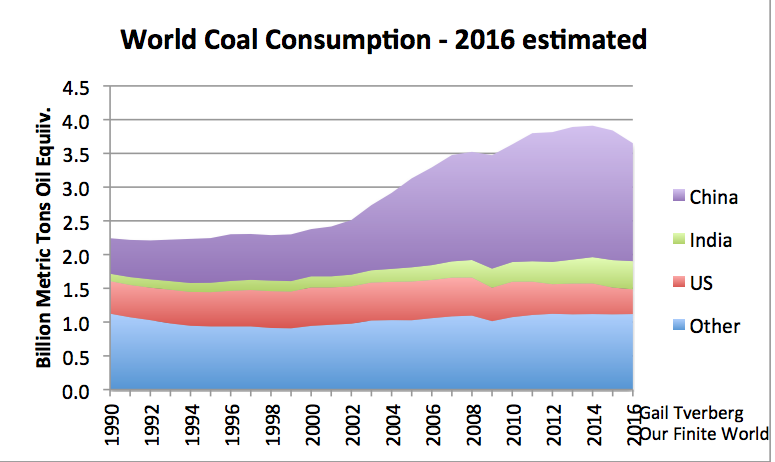
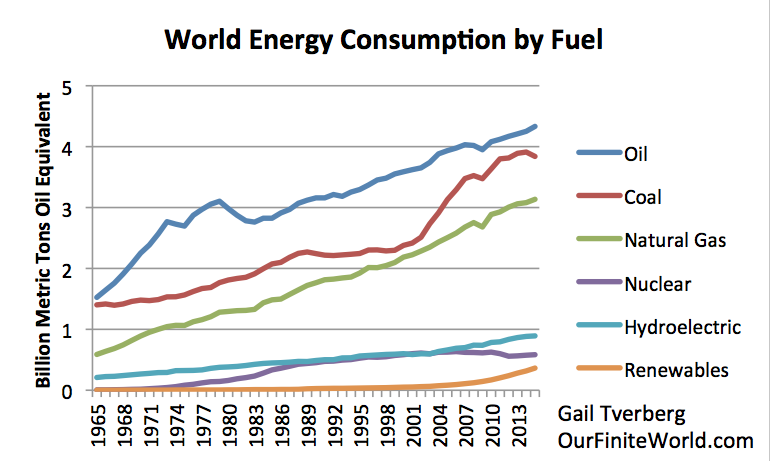
The peak for world coal output will be sooner than most people think, the range is 2013 to 2045, my estimate is 2025 to 2030 with peak output between 4 and 5 Gtoe/year (2014 output was about 4 Gtoe/year).

blog1603/

The eventual peak in World fossil fuel output is a potentially serious problem for human civilization. Many people have studied this problem, including Jean Laherrere, Steve Mohr, Paul Pukite (aka Webhubbletelescope), and David Rutledge.

I have found Steve Mohr’s work the most comprehensive as he covered coal, oil, and natural gas from both the supply and demand perspective in his PhD Thesis. Jean Laherrere has studied the problem extensively with his focus primarily on oil and natural gas, but with some exploration of the coal resource as well. David Rutledge has studied the coal resource using linearization techniques on the production data (which he calls logit and probit).

Paul Pukite introduced the Shock Model with dispersive discovery which he has used primarily to look at how oil and natural gas resources are developed and extracted over time. In the past I have attempted to apply Paul Pukite’s Shock Model (in a simplified form) to the discovery data found in Jean Laherrere’s work for both oil and natural gas, using the analysis of Steve Mohr as a guide for the URR of my low and high scenarios along with the insight gleaned from Hubbert Linearization.

In the current post I will apply the Shock model to the coal resource, again trying to build on the work of Mohr, Rutledge, Laherrere, and Pukite.

A summary of URR estimates for World coal are below:blog1603/

The “Laherrere+Rutledge” estimate uses the Rutledge best estimate for the low case and Laherrere’s low and medium cases for the medium and high cases. Laherrere also has a high case of 750 Gtoe for the World coal URR, which seems too optimistic in my opinion. The “high” estimate of Steve Mohr has been reduced from his “Case 3” estimate of 670 Gtoe by 40 Gtoe because I have assumed lignite and black coal resources are lower than his high estimate.

An update of David Rutledge’s estimate using the latest BP data through 2014 gives a URR of about 400 billion tonnes of oil equivalent (Gtoe) for coal. The Rutledge 2009 estimate was about 350 Gtoe.

My initial estimate was in billions of tonnes (Gt) of coal at 800 Gt for the low estimate (a round number near Steve Mohr’s low estimate of 770 Gt) and 1300 Gt for the high estimate (about the same as Steve Mohr’s high estimate), my medium estimate was simply the average of the high and low estimates. I came across Jean Laherrere’s estimate after I had developed my model, surprisingly his medium estimate is a little higher than my guess, which is usually not the case (for other fossil fuels).

I do not have access to discovery data for coal, but based on World Resource estimates gathered by David Rutledge, most coal resources had been discovered by the 1930s. I developed simple dispersive discovery models with peak discovery around 1900 for each of the three cases, these are rough estimates, I only know is that coal was discovered over time. The cumulative coal discovery models in Gtoe are shown in the chart below for the low, medium and high URR cases.

blog1603/

In each case about 75% of coal discovery was prior to 1940.  Coal resources have been developed very slowly, especially since the discovery of oil and natural gas. As a simplification I assume that the rate that the discovered coal is developed remains constant over time.

A maximum entropy probability density function with a mean time from discovery to first production of 100 years is used to approximate how quickly new proved developed producing reserves are added to any reserves already producing each year. For example a 1000 million tonne of oil equivalent (1 Gtoe) coal discovery would be developed (on average) as shown in the chart below:

blog1603/

Reading from the chart, about 9 Mtoe of new producing reserves would be developed from this 1850 discovery in 1860 and about 5 Mtoe of new producing reserves would be developed in 1920. About half of the 1000 Mt discovered in 1850 would have become producing reserves by 1920, so the median time from discovery to producing reserve is about 70 years (the mean is 100 years due to the long tail of the exponential probability density function).

The model takes all the discoveries for each year and applies the probability density function (pdf) above to each year’s discoveries (the pdf is 1000 less than shown in the chart because we multiplied the pdf by 1000 to show the new producing reserves in Mtoe.) Then the new producing reserves from each year’s discoveries are simply added together in a spreadsheet, not complicated, just an accounting exercise.  The new producing reserves curve (when everything is added up) is shown below for the medium URR case (510 Gtoe):

blog1603/

Each year new producing reserves are added to the pool of producing reserves while some of these reserves are produced and become fossil fuel output. This is indicated schematically below:

blog1603/

If the Fossil fuel output is less than the new producing reserves added in any year, then the producing reserves would increase during that year, if the reverse is true they would decrease.

The fossil fuel output divided by the producing reserves is called the extraction rate.

Using data from David Rutledge for fossil fuel output to 1980 and data from BP’s Statistical Review of World Energy from 1981 to 2014, I extrapolated the extraction rate trend from 2000 to 2014 to estimate future coal output. The chart below shows the discovery curve, new producing reserves curve, and the output curve for the scenario with a URR of 510 Gtoe.

blog1603/

Note that when new producing reserves are more than output the producing reserves will increase (up to 1986), after 1993 output is higher than the new producing reserves added each year so producing reserves start to decrease. Producing reserves are in the following chart for the medium scenario (URR=510 Gtoe).

blog1603/

The fall in producing reserves combined with increased World output of coal from 2000 to 2013 required an increase in extraction rates from 1.5% to 2.9%. I assume after 2014 that this increase in extraction rates continues at a similar rate until reaching 4% in 2026 and then extraction rates gradually flatten, reaching 5.1% in 2070.

Clearly I do not know the future extraction rate, this is an estimate assuming recent trends continue. For this scenario with a coal URR of 510 Gtoe output peaks in 2026 at about 4250 Mtoe/year.

blog1603/

For the low and high URR cases the details of the analysis are covered at the end of the post. The extraction rate trend from 2000 to 2014 was also extended until a peak was reached and then the increase in extraction rates were assumed to lessen until a constant rate of extraction was reached.

The three scenarios(low, medium, and high) are presented in the chart below.

blog1603/

The low scenario peaks in 2013 at about 4 Gtoe/a, the medium scenario peaks in 2025 at about 4.3 Gtoe/a, and the high scenario peaks in 2045 at about 4.9 Gtoe/a. Note that the medium scenario is not my best estimate, it is simply a scenario between possible low or high URR cases, reality might fall on any path between the high and low scenarios, depending on the eventual URR and extraction rates in the future.

A blog post by Luis de Sousa covered Jean Laherrere’s estimate of future coal output with URR between 550 Gtoe and 750 Gtoe.

blog1603/
blog1603/

For comparison, I have adjusted my chart (shown above) to have a similar scale as Jean Laherrere’s chart.

Note that only the two higher scenarios in my chart can be roughly compared with the lower two scenarios in Laherrere’s chart (510 compared with 550 Gtoe and 630 compared with 650 Gtoe). My scenarios peak at higher output at a later year and decline more steeply as a result.

The chart below is Steve Mohr’s medium independently dynamic scenario, where supply responds to coal demand.

blog1603/
blog1603/

The Chart above labelled C Case 2 is figure 5-8 from page 69 of Steve Mohr’s PhD Dissertation, the peak output is 210 EJ/year in 2019 (from Table 5-7 on page 71), Case 2 has a URR of 19.4 ZJ or 465 Gtoe (ZJ=zettajoule=1E21 J). My medium scenario (URR of 21.3 ZJ) has a lower peak output of 180 EJ/year, which occurs 6 years later than Mohr’s scenario. (1 Gtoe=41.868 EJ=4.1868E-2 ZJ).

It is interesting that Jean Laherrere’s larger URR scenario (550 Gtoe) has a peak of 4 Gtoe/year, while Mohr’s smaller URR (465 Gtoe) has a peak of 5 Gtoe/year. Mohr’s scenario was created in 2010 before the 2014 slowdown in Chinese coal consumption and he may have assumed that China and India would resume their rapid increase in coal consumption from 2010 to 2025. Jean Laherrere’s scenario was created in 2015 and in his 550 Gtoe scenario he may assume that the recent decrease in World coal output (in 2014) will continue in the future.

My medium scenario (510 Gtoe) is between Mohr’s medium (case 2) scenario and Laherrere’s low scenario. I have created two new scenarios using a URR of 510 Gtoe which match the peak output of Laherrere’s 550 Gtoe scenario and Mohr’s 465 Gtoe scenario. I have also created a “plateau” scenario with URR=510 Gtoe with World output remaining at the 2014 level until 2025. The various scenarios are presented in the chart below.

blog1603/

The extraction rates in the 4 different 510 Gtoe scenarios can be compared in the chart that follows.

blog1603/

Generally  a higher peak in output leads to steeper annual decline rates, the chart below compares annual decline rates for the 4 different 510 Gtoe URR scenarios.

blog1603/

Works Cited

  • De Sousa, Luis. “Peak Coal in China and the World, by Jean Laherrère.”          attheedgeoftime.blogspot.com. Web. 11 March. 2016.
  • Mohr, Steve. Projection of world fossil fuel production with supply and demand interactions. 2010. Web. 11 March. 2016.
  • Oil Conundrum. theoilconundrum.com. Web. 11 March. 2016.
  • Rutledge, David. “Estimating long-term world coal production with logit and probit transforms.” International Journal of Coal Geology. 85 (2011): 23-33. Web. 11 March. 2016.

Appendix with details of Low and High cases

With links to Excel files at end of appendix

Low case-URR=390 Gtoe

blog1603/

blog1603/

blog1603/

blog1603/

High Case- URR=630 Gtoe

blog1603/

blog1603/

blog1603/

blog1603/

Further reading

Posted in Coal, Peak Coal | Tagged | Comments Off on Peak coal 2013-2045 — most likely 2025-2030

Ugo Bardi: The Hill’s Group report

[ The Hill’s group consists of energy insiders, and I must admit I was impressed by the predictions they said their model had already gotten right, such as the drop in oil price when everyone was expecting the price to rise.  And much of what they say matches the predictions and timeline of others as well as how the net energy cliff will unfold.  The charts and calculus are very impressive, and for years their paper has been discussed on peak oil forums. 

A scientist I know working in Saudi Arabia thinks we’ve got at least 20 years, and that if Exxon, Chevron, and other oil and gas companies go bankrupt, no problem — the government will nationalize them.  Another scientist pointed out that “Modern society runs on oil, thus the oil industry will be the absolute LAST industry to fail. It will be supported by hook or crook until then. Even at $200 a barrel we get energy a thousand times cheaper than human labor. Just not 20,000 times as much anymore”.

Dennis Coyne, who published Seppo Korpela’s article here says: “Oil prices are not determined primarily by thermodynamics as the Hill’s Group suggests.  Geology and technology will affect the cost to supply the oil and World economic growth and technology will affect the demand for oil, the price of oil will mostly be determined by these factors along with policy and political choices made by individual nations.”

After Bardi’s post I’ve added some of the predictions Bill Hill said their model predicted on various forums — many sound plausible, but perhaps not an outcome of their model…  And at the very bottom, an English translation of one of the Spanish articles.  Stay tuned for a peer-reviewed critique of their paper, which I’ve heard is in the works.

Alice Friedemann   www.energyskeptic.com  author of “When Trucks Stop Running: Energy and the Future of Transportation”, 2015, Springer and “Crunch! Whole Grain Artisan Chips and Crackers”. Podcasts: Practical Prepping, KunstlerCast 253, KunstlerCast278, Peak Prosperity , XX2 report ]

Ugo Bardi. Feb 26, 2017. Catastrophism is popular, but not necessarily right. Debunking the “Hill’s Group” analysis of the future of the oil industry. Cassandra’s Legacy.

“The Hill’s Group” has been arguing for the rapid demise of the world’s oil industry on the basis of a calculation of the entropy of the oil extraction process. While it is true that the oil industry is in trouble, the calculations by the Hill’s group are, at best, irrelevant and probably simply plain wrong. Entropy is an important concept, but it must be correctly understood to be useful. It is no good to use it as an excuse to pander unbridled catastrophism. 

Catastrophism is popular. I can see that with the “Cassandra’s Legacy” blog. Every time I publish something that says that we are all going to die soon, it gets many more hits than when I publish posts arguing that we can do something to avoid the incoming disaster. The latest confirmation of this trend came from three posts by Louis Arnoux that I published last summer (link to the first one). All three are in the list of the ten most successful posts ever published here.

Arnoux argues that the problems we have today are caused by the diminishing energy yield (or net energy, or EROI) of fossil fuels. This is a correct observation, but Arnoux bases his case on a report released by a rather obscure organization called “The Hill’s Group.” They use calculations based on the evaluation of the entropy of the extraction process in order to predict a dire future for the world’s oil production. And they sell their report for $28 (shipping included).

Neither Arnoux nor the “Hill’s Group” are the first to argue that diminishing EROEI is at the basis of most of our troubles. But the Hill’s report gained a certain popularity and it has been favorably commented on many blogs and websites. It is t is understandable: the report has an aura of scientific correctness that comes from its use of basic thermodynamic principles and of the concept of entropy, correctly understood as the force behind the depletion problem. There is just a small problem: the report is badly flawed.

When I published Arnoux’s posts on this blog, I thought they were qualitatively correct, and I still think they are. But I didn’t have the time to look at the details of the report of Hill’s group. Now, some people did that and their analysis clearly shows the many fundamental flaws of the treatment. You can read the results in English by Seppo Korpela, and in Spanish by Carlos De Castro and Antonio Turiel. [ NOTE: at the very bottom I have an english translation minus the equations ].

Entropy is a complex subject and delving into the Hill’s report and into the criticism to it requires a certain effort. I won’t go into details, here. Let me just say that it simply makes no sense to start from the textbook definition of entropy to calculate the net energy of oil production. The approximations made in the report are so large to make the whole treatment useless (to say nothing of the errors it contains). Using the definition of entropy to analyze oil production is like using quantum mechanics to design a plane. It is true that all the electrons in a plane have to obey Schroedinger’s equation, but that’s not the way engineers design planes.

Of course, the problem of diminishing EROEI exists and can be studied. The way to do that is known and it is based on the “life cycle analysis” (LCA) of the process. This method takes into account entropy indirectly, in terms of heat losses, without attempting the impossible task of calculating it from first principles. By means of this method we can see that, at present, oil production still provides a reasonable energy return on investment (EROEI) as you can read, for instance, in a recent paper by Brandt et al.

But if producing oil still provides an energy return, why is the oil industry in such dire troubles? (see this post on the SRSrocco report, for instance). Well, let me cite a post by Nate Hagens:

In the last 10 years the global credit market has grown at 12% per year allowing GDP growth of only 3.5% and increasing global crude oil production less than 1% annually. We’re so used to running on various treadmills that the landscape doesn’t look all too scary. But since 2008, despite energies fundamental role in economic growth, it is access to credit that is supporting our economies, in a surreal, permanent, Faustian bargain sort of way. As long as interest rates (govt borrowing costs) are low and market participants accept it, this can go on for quite a long time, all the while burning through the next higher cost tranche of extractable carbon fuel in turn getting reduced benefits from the “Trade” creating other societal pressures.

Society runs on energy, but thinks it runs on money. In such a scenario, there will be some paradoxical results from the end of cheap (to extract) oil. Instead of higher prices, the global economy will first lose the ability to continue to service both the principal and the interest on the large amounts of newly created money/debt, and we will then probably first face deflation. Under this scenario, the casualty will not be higher and higher prices to consumers that most in peak oil community expect, but rather the high and medium cost producers gradually going out of business due to market prices significantly below extraction costs. Peak oil will come about from the high cost tranches of production gradually disappearing.

I don’t expect the government takeover of the credit mechanism to stop, but if it does, both oil production and oil prices will be quite a bit lower. In the long run it’s all about the energy. For the foreseeable future, it’s mostly about the credit

In the end, it is simply dumb to think that the system will automatically collapse when and because the net energy of the oil production process becomes negative (or the EROEI smaller than one). No, it will crash much earlier because of factors correlated to the control system that we call “the economy”. It is a behavior typical of complex adaptative systems that are never understandable in terms of mere energy return considerations. Complex systems always kick back.

The final consideration of this post would simply be to avoid losing time with the Hill’s report (to say nothing about paying $28 for it). But there remains a problem: a report that claims to be based on thermodynamics and uses resounding words such as “entropy” plays into the human tendency of believing what one wants to believe. Catastrophism is popular for various reasons, some perfectly good. Actually, we should all be cautious catastrophists in the sense of being worried about the catastrophes we risk to see as the result of climate change and mineral depletion. But we should also be careful about crying wolf too early. Unfortunately, that’s exactly what Hill&Arnoux did and now they are being debunked, as they should be. That puts in a bad light all the people who are seriously trying to alert the public of the risks ahead.

Catastrophism is the other face of cornucopianism; both are human reactions to a difficult situation. Cornucopianism denies the existence of the problem, catastrophism (in its “hard” form) denies that it can be solved or even just mitigated. Both attitudes lead to inaction. But there exists a middle way in which we don’t exaggerate the problem but we don’t deny it, either, and we do something about it

A defense of the Hills Group (one of the comments at Cassandra’s Legacy):

Your preference for Life Cycle Analysis over the Thermodynamics of Steady State is just that…your preference. The ETP model includes as a cost the cost of replacing reserves as they are used. The method used in the ETP model is similar to what one might use for a biological system…that is, the parents have to provide for the children…adult birds need to look for caterpillars to feed the young. Now, if, as Hubbert assumed, we have a boundless supply of nuclear energy just waiting in the wings, a Life Cycle study would be appropriate. But since oil is part of the very biological business of keeping humans alive and functioning, there is nothing wrong with the ETP method. Whichever method is used, the user is responsible for understanding the assumptions and applying them appropriately.
*You fail to see that the numbers quoted by Nate Hagens MIGHT just have a more fundamental cause than ‘just because’. If the falling value of energy, and particularly oil, as displayed by the output from the ETP model is correct, then we would expect the numbers that Hagens quotes. Hagens is not ‘disproving’ the ETP model.
*After accusing other people of confusing the EROEI methodology, you fall into the same trap. The ETP model does not claim that EROEI is going below 1. As estimated from the ETP model, the ‘dead state’ is arrived at when the EROEI is around 7 (as I remember). Such numbers are reasonably consistent with what Charles Hall and others have called ‘extended EROEI’. That is, they count the costs beyond the well-head. The ETP methodology estimates that, with a well-head EROEI of 7, we will no longer be able to sustain the industrial economy as it is presently configured.
*While the ETP model does not model the human reaction to the recognition that the economic and social system cannot go on much longer as it has been going for the last decades and centuries, Mr. Hill has been very clear that he thinks the situation is dire. The oil companies could lose enormous amounts of equity values overnight. The recognition would reverberate through the economy and the social system. The ETP model tells us something about the physical world, which we must interpret in terms of the financial and social world.

And FYI, some of the predictions the Hills Group claim that their model predicts for the future:

The 2012 energy half way point, set out by the Etp Model, marked the point where the world started being better off without oil than with it. That conversion will be complete by no later than 2030.

Our model indicates that conventional crude production will fall to 44 mb/d by 2030. Thereafter, it goes into catastrophic decline.

Our analysis indicates that it will probably be in the range of 15 to 20 years after that when the majority of petroleum production will ceaseThe oil age is coming to an end. The Etp Model provides a very important time line; one that informs us that we have at most 14 years to put into place an alternate energy system; one beyond oil. Past that point the world will have fallen into such a deep depression that it will no longer be able to help itself.

We expect to have reached permanent depression by the end of 2017 (prediction made June 2016).

The reduction will not hit all nations the same way. The richer Western countries will be able to afford fuels for longer than smaller poorer counties. But, how that will feed back into their general economies is yet an unknown. It will definitely have a negative impact, and perhaps a gigantic one. Like the S&P collapsing, an explosion of corporate bankruptcies, and supply chains breaking. But all and all we will just have to wait and see. It has been four years since petroleum hit its energy half way point. We should not have to wait much longer. We are likely to see the first major impacts this year!

Things are a lot worse than oil producers are admitting. The Etp Model indicates that in the present price environment that only about 35% of the world’s producers are making money over their full life cycle costs. Their desperation for cash ensures that production will not decline until many of them start to fail. The energy dynamics of the situation point to falling prices until at least 2020. By then much of the world’s petroleum production capacity will be gone forever!

Damage is being inflicted on the industry that will never be repaired. CapEx is being cut everywhere in the industry, and future development is likely to never fully recover. The Etp Model indicates that only about an additional 320 Gb will now ever be extracted. In 2012 petroleum contributed $6.22 trillion to the $16.16 trillion GDP of the US. That contribution will fall by more than half during the next decade.

Very low priced oil is a catastrophe for the petroleum industry, and the world. Whereas the oil age might have staggered forward for another 14 to 15 years, it might all come unglued over the next 5 or 6.

The Etp Model indicates that only about an additional 320 Gb will now ever be extracted.

The industry’s net worth is now declining by 24% per year. If the price decline continues, as expected, trillions of dollars will be lost to bond and equity holders over the next few years. Pension funds, and Sovereign wealth fund will be hit particularly hard.

EROEI

Year EROEI : 1
1945 167.0
1980 30.4
2014 9.1
2015 8.9

At 6.9 : 1 it will have reached its the theoretical limit, or were the PPS (Petroleum Production System) reaches the “dead state”. That will be dependent on its accumulated production, which has had a very consistent rate of increase for the last 100 years. The accumulated production has followed Hubbert’s curve almost exactly; by 2009 it had deviated from that curve by 0.04 Gb. In other words the amount remaining to be extracted is a product of how much has already been removed. Any amount after 1,780 Gb will remain in the ground as it will no longer be able to act as an energy source.

The highest ERoEI crude left in the world is probably coming out of the Middle East and Nigeria; and both of them are about to explode.

Saudi Arabia

When Ghawar will start to collapse has been the subject of heated discussion for a very long time. Looking at its water cut, as reported by Aramco reserve engineers, and the fact that they have been drilling horizontal wells to skim the last few feet off the top of the oil column indicates that it probably won’t be long in coming. A better indication is probably the price. The Affordability Curve gives a pretty good indication as to what is likely to transpire, and The Price of Oil  puts the maximum affordability at:

2015 – $77.28
2016 – 65.94
2017 – 54.18
2018 – 41.16
2019 – 26.88

By the looks of the above graph sometime between 2018 and 2019 the Saudi’s will no longer be able to cover their lifting cost. Once that happens their production will collapse, and they will likely break the peg. My WAG (wild ass guess) would be sometime in that time frame.   Of course, the Iranians may decide to blow the crap out of them at any time, and that would put a real crimp onto their production. It looks like the best case scenario is 2 to 3 years before Saudi Arabia implodes.

Shale / Light Tight Oil

U.S. LTO production will not start to decline because of a lack of drilling opportunities, lack of funds (the FED has their back), or because of high well decline rates. It will decline when it runs out of buyers for it. That will happen in the next couple of years.

It now requires about 74,000 BTU to extract, process, and distribute a gallon of petroleum. Only the lower API fractions have an energy content that is sufficient to provide a surplus of energy after their process energy is subtracted.

The energy dynamics imply that once conventional crude is depleted, that other alternative liquid fuels will not be able to maintain enough of the economy needed to produce them, or provide for their demand. Shale is a good example of this phenomenon. Most shale is incapable of driving the economy, and its only use is as a feedstock for other processes.

Civilization is likely to experience something resembling a brown out. Voltage drops until the motors grind to halt, and burn up. Imagine billions of people milling around trying to figure out why things are running slower, and slower. Not much has yet fully stopped working, but nothing is working quite right!

Petroleum is providing just enough energy at this point in time to keep what is running going. If any additional load is placed on the system, like having to bail out the banks again, a good sized war, or even some natural disaster something is going to burn up. Maybe a big chunk of the health care system, the consumer economy, or the petroleum industry but something will no longer be maintainable. The world no longer has the extra energy to expend on anything but what it is presently using. The danger is that when it starts it could cascade into a black out!


An analysis of the theoretical foundations of the ETP model  By Antonio Turiel

Last February 20th,  we held a monographic session in the Transition Forum organized by FUHEM (a Spanish foundation concerned with social issues, basically a NGO of many intellectuals and scarce funds), to analyze the ETP model. This model created by the Hill’s Group tries to forecast the global oil production evolution in the next years. It is based in the decreasing net energy that oil is offering.

To start the discussion, FUHEM asked me to make an analysis to validate and check the theoretical robustness of the said model. They were trying to see, among other things, if their conclusions (quite terrible, by the way) could be used in their discussions with political agents.


I have deemed convenient to write this post explaining the conclusions of my analysis, due to its importance and the raising interest on this subject.


This is a rather technical post, but I will try to explain the basic concepts in the most intuitive possible form. The formulas and concepts treated are those included in the document “Depletion: A determination for the world’s petroleum reserve”, release 2 of March 1st. 2015.


The following critique is not exhaustive; there are many aspects in the model that will not be treated. I will mainly focus on the most relevant theoretical aspects, but not even all of them, and I will deliberately sidestep the discussion on use of data. Carlos de Castro, on his turn, made a detailed analysis for the same session on the data processing in the ETP model. This analysis can be accessed as post in the blog of the Energy, Economy and System Dynamics Group of the Valladolid University.


The Hill’s Group Report (hereinafter HGR) states in its introduction that they intend to estimate the energy needed by the oil production and distribution system (so called Petroleum Production system, or PPS) to make its products reach the society and to check if this energy is approaching to the energy efficiency limit, which corresponds with the energy that can be obtained just burning this oil.


All the HGR is based on the equations used to calculate the energy needed by the PPS to continue working. This needed energy is called Total Production Energy or ETP. They use some thermodynamic equations to this effect and I will precisely focus my analysis on the theoretical derivation of these equations.


Theoretical foundations of the ETP


One of the weakest points of the report is the inadequate definition of the validity boundaries.  By the treatment given to the variables, it could be thought that calculations are made at the well head and therefore, that the calculated ETP  refers to the energy spent to just extract the oil. However, as per other considerations, it is mentioned that the calculations include all the PPS.


Making a calculation for the whole PPS is a rather complex issue, even introducing simplifying hypothesis, such as taking typical or mean values, as there are a huge amount of mixed processes with different efficiencies. The conditions under which extraction, refining and distribution take place greatly change from one place to another in the planet (the spatial dimension, as quoted to Antonio Serrano in his analysis of these problems).


In fact, the biggest problem to tackle the analysis with thermodynamic equations is to define and accurately enclose the limits of the system under study and to be sure that the hypotheses are correctly applied to it. In fact, sometimes implicit hypothesis are included inadvertently. So, one has to be extremely careful with the data handling and with the terms included in the equations.


Other conceptual problems observed from the start is that the analysis takes the PPS isolated from the rest of the economy and specifically form other energy sources that could back the oil extraction, (oil could still be interesting when no net energy can be extracted from it due to its possibly bigger added value). That makes the statements on the collapse of the PPS questionable, to say the least. The collapse may finally happen, but it is not unavoidable in pure logic, from what is being theoretically analyzed.


The basic variable to derive the ETP is the calculation of the entropy variation rate. As the “entropy” word appears, you can bet that 90% of the readers will just jump over the part of the report with the formulas and go directly to the graphs and the conclusions.


This post has precisely the aim to analyze to which extent these equations are physically sound, if they are well applied and to which system they are applied. I will try to make the explanation as simple as possible, complementing each theoretical concept with a more simple explanation. In any case, I recommend the (Spanish speaking) readers with time and will to know about this in more detail, to read an old post of this blog, called “Entropía


The first equation introduced in the HGR is a general one, valid for any system, on the entropy variation rate with time:


Equation 1.


Intimidating, as it appears, this equation shows, in fact, a very simple equality

(Notation: S is the symbol to denote entropy). The first term of the equation is the derivative of entropy with time. This term does not say anything specific, being at the left of the sign equal. The equation is issued to calculate this term in the left side. The terms in the right side will give information on which things change the entropy.


(Notation: Q means heat. The dot on top means the variation with (respect) time. T means temperature). The entropy of a given body is intimately associated to its temperature. This term includes all the changes of the entropy produced in the considered system due to heat flows. The sigma letter Σ heading the term is a sum indicating that we have to add all the transferences of associated entropies due to all possible heat flows: there exists an undefined amount of heat sources Qj, each of them associated to a temperature Tj and we have to add all of them (for all the values of j index).


(Notation: m is the mass of a substance or a given body and s is the entropy per mass unit of this substance or body; it is also called “specific entropy”). This term is just telling that if there are substances or bodies entering into the system, they bring their entropy with them. The dot on top of the m means variation of the mass of the entering substance or body with time and as in the previous term, it is added over all the possible entering bodies, in this case numbered with the i index.


Analog to the previous term, but in this case, referred to the substances or bodies abandoning the system. That’s why the negative sign before the summation, because leaving the system also removes entropy from the total.


This is the last term of the equation and refers to all the changes in the entropy associated to irreversible processes taking place in the system. This term is a complete hotchpotch where it can be included everything that could not be counted in the other terms. That’s why is the most difficult to evaluate.


The equation just dissected is correct. It is a general one specifying the different factors contributing to the increase of entropy and it can be applied to any system without exceptions. The problem of this equation is that has an undefined number of terms (the sums could easily contain thousands of terms), which makes hard to use it in practice. When this general equation is applied to simple systems, it is possible to make approximations that allow to simplify it and make it manageable. But each of these approximations implies certain hypothesis that could determine the particular system for which they are of application. This implicit specification of the system of application may happen and pass unnoticed to the person who is applying it, that could even claim that the system of application is another one. This is precisely the case of the ETP model, as we shall see below.


The first hypothesis in the HGR is to assume that there are no entering masses in the system; only outgoing masses: the oil flow that leaves the wellhead and enters into the PPS. Besides, there is a simplification, when considering only one temperature, taken in a first approach as the typical temperature of the oil deposits. For the outgoing mass the HGR considers the total oil mass leaving all oil deposits. Therefore, the equation is reduced to the following form:


Equation 2.


Simplifying sums and substituting the quantities by typical values (or by mean values, the report is not explicit on that) is an approximation, but that is not the main problem of this equation. Such kind of simplification is what in Statistical Mechanics is called “mean field” and is applied to systems containing a large number of parts, all of them with the same type of interaction. The mean field gives a good first approach to the reality, maybe incurring in some degree of error but correctly capturing trends.


But the problem is not the mean field approximation. It is that the HGR ignores all type of interactions that a real PPS system has. For instance, all the intense flow of materials (steel, concrete, electronics of many different types, etc.) which are required to build and maintain the wells, to build and repair the distribution system (pipelines, trucks, supertankers, etc.). The report also ignores the intense heat inflows and outflows associated to all these processes. All these interactions are of diverse types and cannot be managed with a mean field approximation. Simply because the system is extremely heterogeneous and there are no mean or typical values that could properly describe such complex systems.


I will put an example to make myself better understood.


Talking about fusion or freezing temperatures of water is useful in practical terms, even if we could be talking of waters from different origins with different mineral salts diluted and therefore slightly different freezing points. In all cases, we are talking of liquids with homogeneous aspects, suffering similar processes. At the end, all the water samples considered will freeze into ice at approximately the same temperature, with slight differences among them. So, it has some sense to talk of a fusion temperature at zero degrees Celsius, and this allow us to understand how ice behaves.


Now, let’s think in a heterogeneous system; one constituted by different parts with different behaviors. One apparently simple like ice cream in a vanilla cornet. If we increase the temperature of the system over the melting point of the ice cream, the ice cream will melt, but it will still be contained within the wafer cone. If we continue increasing the temperature, the water content of the ice cream will eventually evaporate, leaving a viscous mass than then a dry mass. If we still increase the temperatures, the system will burn, but the way it will do it, will depend on the different combustion points; it will depends on how the wafer will be softened, the amount of remaining water in the ice cream, etc.


The cornet ice cream system cannot be understood with the temperature changes and even less with a given fusion temperature. All the ice cream cornet interactions are rather complex and to understand how the system behaves it is not enough with assessing the behavior of each part (ice cream and wafer cone) separately; it depends also on how the two parts interact with each other for the particular ice cream and wafer cone under consideration. And if the ice cream cornet is complex, we have to imagine how complex should be all the global production and distribution system.


This is the reason why the mean field approach used in the equation above cannot be applied (apart from the fact that there are incoming masses and this term cannot be neglected). The conclusion is that the simplified equation applies to the liquid oil contained in the geological deposits, although the interactions with the rocks are also neglected and they may not be so negligible when, for instance, the reservoir rock is collapsing and cementing when the oil is extracted from its interstices.


There is a new formula introduced in this point of the report, even it is not used until later, that confirms that the report refers to liquid oil. The formula tells about the entropy variation for an uncompressible, non-reactive liquid, when its temperature is modified from T1 to T2


Equation 3


The variable c is the specific (per unit of mass)  heat capacity of a liquid (it is explicitly stated in the report that the constant-volume specific heat equals the pressure-constant specific heat, what means that we are talking about uncompressible liquids. Therefore, this formula has only sense when applied to uncompressible liquids that are not undergoing any type of chemical reaction (nor a phase change, as we shall discuss later). In fact, when this equation is used later one, it evidences that all the derivation of the ETP equation refers to liquid oil.


If the first hypothesis is very restrictive and determines the system to which is applied, the second hypothesis has much more implications and is regrettably more inconsistent. It is enounced as follows:


Given


(that is, the entropy variation is diminishing as the outgoing mass is decreasing), so the author of the model concludes that


Equation 4


There are many problems with this deduction. First, limits of applicability. To obtain Equation 4 we have been told that we can neglect the total entropy variation and the entropy associated to outgoing mass because the outgoing mass flow is decreasing. This means that the formula could only be valid for wells that are already in an advanced terminal decline. This hypothesis is not true if we consider the total global number of wells.


Equation 4 is not valid for wells not yet in final decline because even if the entropy change due to heat fluxes equals the entropy change due to irreversible processes when the outgoing mass flow is very low, it does not imply that those two terms are equal at any other time.


But the situation is even worse: if the oil outflow tends to zero, not only the entropy will tend to vanish, but also the heat flow (there is less heat to transfer, by lacking its source, the oil still to be extracted) and also the change in entropy due to irreversibility will bend to zero. All four terms from Equation 3 tend to zero in the final terminal decline, and for assuming that some terms become negligible in front of others (they go to zero faster, we could say), a very detailed analysis is required. This analysis is not done in the report.


The small detail that on top of equation 4 there is a wrong sign (the entropy variation due to irreversibility should appear with a sign minus, when solving equation 2)  is in fact a minor issue (the entropy transference could be redefined with a different convention of signs).


Equation 4 is the starting point to calculate what the report calls “rate of irreversibility production” identified with the letter I and defined as follows:

Equation 5


This amount, as per equation 4, corresponds exactly with the heat Q (being rigorous, the variations are the both quantities are equal), so what can be calculated solving this equation is the associated flow of heat. Coming back to the expression of equation 3 and combining it with that of equation 5 (it is exactly what the report does), what they calculate is the heat flow obtained when taking a uncompressible, non-reactive liquid, that does not experiment any phase transition and taking it from a given temperature (the one of the geological deposit) to other (the one at the surface).


In this last pirouette, without any theoretical explanation, the heat flow is identified with the specific ETP; that is, per unit of oil mass extracted and surprisingly divided by billions of barrels (Gb), thus obtaining the fundamental formula of the report:


Equation 6


Where m represent the extracted masses (of oil if with subscript c, and water, if with subscript w) and the letters c represent the specific heat capacity of the substance (oil if with subscript c and water, if with subscript w)


It is worth to spend some time analyzing this expression. The important thing is the numerator, because the rest consist in dividing by some quite arbitrary amounts (the extracted mass of oil and the Gigabarrels). The numerator has a form that should sound familiar even to a secondary grade student:

Expression 1. Sensible heat of the oil and water mix.


We must remember that the specific heat capacity of a given substance is the amount of heat that has to be given to a gram of it to increase its temperature by 1 degree Celsius. For instance the heat capacity of pure water at 25 º C and normal pressure is one calorie per gram and per centigrade degree, or otherwise, 4.18 joules per gram and centigrade degree. Taking this into account and that the heat capacities of the liquids are “quite” constant (with many nuances), the expression 1 is simply the amount of released heat by a mixture of oil and water when it goes from a temperature TR (that of the deposit) to a T0 (that of the environment). In this point, the problems of this theoretical digression are so numerous that it is difficult to list them all.


There is no reason whatsoever to identify this heat flow from the mixture of oil and water leaving a deposit with that of the energy ETP (Etp by definition has to be the energy consumed by the PPS to obtain, refine and distribute oil).


It is not just that the theoretical rationale implies only a minimum part of the PPS (oil in the deposit) and that there are errors in the approximations (the direst one that invalids everything, in obtaining  equation 4). It is not only that the HGR only computes the heat derived from the extracted mixture. Even discarding these errors, the ETP, as well as the heat, should be a variable of process, not a variable of state. This means that the amount of energy consumed by PPS  depends on the specific processes used to move from one state to the other. Which has the following logic: we do not use the same energy to extract oil with a specialized brand new drilling machine, that using a more deteriorated and obsolete equipment. We do not incur in the  the same energy consumption when transporting oil by a tortuous and long road, that sending it through a well-maintained pipeline system, etc. etc. That is precisely the difficulty implied by trying to assess the ETP from first principles: it is necessary to know in detail the specific processes used. Besides, these processes can be improved with time (in fact this is what usually happens). Therefore, any attempt to make forecasts has to consider these factors as well as many others (financial, geopolitical technological, or demand) that the report does not even mention.


Even from the point of view of evaluating this heat flow (which by the way has a minor importance with respect to many other processes that need to be described)  there are many errors. Specifically, given the fact that the temperature of the deposit is of several hundreds degrees Celsius, it could be assumed that in some point from the deposit and the wellhead, the mix of oil and water could suffer a liquid to gas transition, as the pressure decreases, and the subsequent latent heat should be accounted. In any case this heat flow has no much sense, because the oil does not come out at the deposit temperature (it will be very dangerous, as the contact with the oxygen could lead to a deflagration). There must be a temperature exchange process in the extraction (likely favored by the well design), that will introduce irreversible processes that should be accounted in the last term of the equation (and there are not).


It is rather curious to see the water fraction appearing in the last moment of the derivation, when in fact this water is entering basically pumped in from the surface to favor the oil extraction; but it was  precisely the incoming mass term what was the first one to be eliminated in the first simplification. In fact the water inflow also implies a heat flow not considered, of opposite sign to the one considered in the formula, that will probably tend to diminish in the left side of equation 4.


The entropy is a variable of state and it characterizes, as such, the state of the system; but knowing just the entropy does not suffice to completely characterize a state; other complementary variables are needed, such as temperature, pressure, internal energy, chemical potentials…That’s why even knowing completely the specific process involved in the ETP for the PPS system, the entropy alone will not be enough for evaluation ETP; other complementary variables that the report does not contemplate will also be required.


This flaw is severe: apart from the need to introduce more terms in the sums of equation 1 and making consistent hypothesis, it will be necessary to define a good number of additional equations, as many as the state variables, also containing a good number of terms in each of them. In this sense the ETP model has only scratched the surface of the thermodynamic modeling of the energy required for the continuity of the PPS.


Some more observations could be made, but I believe it is crystal clear that there is no theoretical reason for the ETP curve, derived from this thermodynamic model. As such, at most the model could work in an effective way, assuming that the curve resembles the right one and that the model parameters can be adjusted a posteriori to produce meaningful results Therefore, data processing in the model is crucial. Regrettably, data processing has many problems on itself, as described by  Carlos de Castro.. I will leave them out to shorten this post.


Discussion of the ETP model.


The emergence of the ETP model some months ago raised big expectations among the experts in energy depletion, especially because the convincing nature of a fast collapse of the oil industry. The present strong divestment in upstream by oil companies, that started in 2014 and still lasts today, seems to be in perfect agreement with the problems anticipated with the HGR and with the posts by Louis Arnoux


In this sense, the appearance of the report whose theoretical grounds have been discussed here, it is something positive, as it opens a necessary debate on the decline of the net energy to still today reluctant sectors to this type of discussion. On the other hand the application of the thermodynamic principles to the assessment of the net energy limits, it is something that has sense and it seems an interesting path to explore, even if this will imply a very exhaustive and meticulous work, with a good comprehension of the many aspects of the oil industry, to ensure a correct accounting.


In the negative side, there are many things: an incorrect application of the theory, wrong deductions, definitions with no physical meaning, defective data processing, lack of interaction with the economy and other energy sources, etc.

Taking into account these deficiencies, it is obvious that the ETP model cannot be used for a serious discussion of the energy depletion problems; at least not until a whole review is made.


My work in this post, has been somehow similar (although more informal) than the one I would have made as a peer reviewer if sent to a scientific media. In fact, once the Hill’s Group released the report, it should have been desirable to send it to a scientific journal to be peer reviewed, to be later released and disseminated in the scientific community, general public and stakeholder. Passing this revision would have been a guarantee that the work had been assessed by experts and the results are trustworthy.  I understand the authors may already be working on that. My advice is that they wait for the reviewers to finish and apply the suggested corrections, before giving more publicity to a model that as it is today can only serve to discredit to a community that deserves to be heard more than ever.


Personal assessment


The appearance of the ETP model has prompted the necessity to endow the community with the adequate models to describe the growing non-linearity of the system, that will be growing if there are no short term reactions to the problems already detected.


However, the ETP model has been received with a surprising lack of criticism by the community, in a collective gap in which I myself have participated in some way. It may have happened a confirmation bias: as one colleague said, a brilliant and enlightened physicist, the model started with correct premises and arrived to coherent conclusions; therefore, it was reasonable to expect that the model will work properly.


In reality, very few had bothered to calmly analyze the model and point out the deficiencies. I hope this should serve to maintain a critical thinking  and do not accept things that seem to confirm what we believe. All hypothesis must be examined and all the works revised to obtain the highest efficiency, yielding the best results to all of us. I do hope that this post and similar others could contribute to improve the model and to improve our understanding of the troubled way ahead of all of us.


Bests.


Antonio


Posted in Ugo Bardi | Tagged , , | Comments Off on Ugo Bardi: The Hill’s Group report

Peak Uranium by Ugo Bardi from Extracted: How the Quest for Mineral Wealth Is Plundering the Planet

Figure 1. Cumulative uranium consumption by IPCC model 2015-2100 versus measured and inferred Uranium resources. Figure 1 shows that the next IPCC report counts very much on nuclear power to keep warming below 2.5 C.  The black line represents how many million tonnes of reasonably and inferred resources under $260 per kg remain source: 2016 IAEA redbook Clearly most of the IPCC models are unrealistic. Source: David Hughes (private communication)

Preface. This is an extract of Ugo Bardi’s must read “Extracted” about the limits of production of uranium. You can find plenty of material saying there is are a lot of uranium reserves and resources  left elsewhere (EMD 2019). The problem is, uranium requires fossil fuels to be mined, extracted, and processed, and world oil production peaked in 2018, peak world coal in 2013. If you read my book “When Trucks stop running”, you’ll see why trucks can’t run on electric batteries or overhead wires, and without trucks, civilization collapses, so nuclear electricity is not going to solve the energy crisis, and leaves toxic waste our descendants will have to deal with for hundreds of thousands of years (Alley 2013)

Uranium in the news:

Novikova T (2022) Russia & US Uranium. Counterpunch.org. The United States relies heavily on imported uranium, with Russia supplying about 16 percent. And also 23% of enrichment services are provided by Russia, so total imports may be more than 16%.  Though so many reactors in the U.S. are long past their time of retirement and are shutting down that this may well reduce consumption by 16% or more.  The U.S. only produced 1% of world uranium production, and new permits take years.

July 2016 Water power. Extracting uranium from seawater. Scientific American. Stephen Kung of the DOE’s office of Nuclear Energy said that terrestrial sources of uranium are expected to last for only another 100 to 200 more years. It takes 8 weeks to extract 6 grams of uranium from seawater, or 0.75 grams per day,  It takes 27,000,000 grams to run a 1 gigawatt nuclear power plant for one year, so it would take 98,630 years to extract enough uranium from seawater to run just one nuclear power plant.

Alice Friedemann  www.energyskeptic.com  Author of Life After Fossil Fuels: A Reality Check on Alternative Energy; When Trucks Stop Running: Energy and the Future of Transportation”, Barriers to Making Algal Biofuels, & “Crunch! Whole Grain Artisan Chips and Crackers”.  Women in ecology  Podcasts: WGBH, Planet: Critical, Crazy Town, Collapse Chronicles, Derrick Jensen, Practical Prepping, Kunstler 253 &278, Peak Prosperity,  Index of best energyskeptic posts

***

Bardi, Ugo. 2014. Extracted: How the Quest for Mineral Wealth Is Plundering the Planet. Chelsea Green Publishing.

Although there is a rebirth of interest in nuclear energy, there is still a basic problem: uranium is a mineral resource that exists in finite amounts.

Even as early as the 1950s it was clear that the known uranium resources were not sufficient to fuel the “atomic age” for a period longer than a few decades.

That gave rise to the idea of “breeding” fissile plutonium fuel from the more abundant, non-fissile isotope 238 of uranium. It was a very ambitious idea: fuel the industrial system with an element that doesn’t exist in measurable amounts on Earth but would be created by humans expressly for their own purposes. The concept gave rise to dreams of a plutonium-based economy. This ambitious plan was never really put into practice, though, at least not in the form that was envisioned in the 1950s and ’60s. Several attempts were made to build breeder reactors in the 1970s, but the technology was found to be expensive, difficult to manage, and prone to failure. Besides, it posed unsolvable strategic problems in terms of the proliferation of fissile materials that could be used to build atomic weapons. The idea was thoroughly abandoned in the 1970s, when the US Senate enacted a law that forbade the reprocessing of spent nuclear fuel.

A similar fate was encountered by another idea that involved “breeding” a nuclear fuel from a naturally existing element—thorium. The concept involved transforming the 232 isotope of thorium into the fissile 233 isotope of uranium, which then could be used as fuel for a nuclear reactor (or for nuclear warheads). 48 The idea was discussed at length during the heydays of the nuclear industry, and it is still discussed today; but so far, nothing has come out of it and the nuclear industry is still based on mineral uranium as fuel.

Today, the production of uranium from mines is insufficient to fuel the existing nuclear reactors. The gap between supply and demand for mineral uranium has been as large as almost 50% from 1995 to 2005, though gradually reduced the past few years.

The U.S. mined 370,000 metric tons the past 50 years, peaking in 1981 at 17,000 tons/year.  Europe peaked in the 1990s after extracting 460,000 tons.  Today nearly all of the 21,000 ton/year needed to keep European nuclear plants operating is imported.

The European mining cycle allows us to determine how much of the originally estimated uranium reserves could be extracted versus what actually happened before it cost too much to continue. Remarkably in all countries where mining has stopped it did so at well below initial estimates (50 to 70%). Therefore it’s likely ultimate production in South Africa and the United States can be predicted as well.

Table 1. The European mining cycle allows us to determine how much of the originally estimated uranium reserves could be extracted versus what actually happened before it cost too much to continue. Remarkably in all countries where mining has stopped it did so at well below initial estimates (50 to 70%). Therefore it’s likely ultimate production in South Africa and the United States can be predicted as well.

The Soviet Union and Canada each mined 450,000 tons. By 2010 global cumulative production was 2.5 million tons.  Of this, 2 million tons has been used, and the military had most of the remaining half a million tons.

The most recent data available show that mineral uranium accounts now for about 80% of the demand.  The gap is filled by uranium recovered from the stockpiles of the military industry and from the dismantling of old nuclear warheads.

This turning of swords into plows is surely a good idea, but old nuclear weapons and military stocks are a finite resource and cannot be seen as a definitive solution to the problem of insufficient supply. With the present stasis in uranium demand, it is possible that the production gap will be closed in a decade or so by increased mineral production. However, prospects are uncertain, as explained in “The End of Cheap Uranium.” In particular, if nuclear energy were to see a worldwide expansion, it is hard to see how mineral production could satisfy the increasing uranium demand, given the gigantic investments that would be needed, which are unlikely to be possible in the present economically challenging times.

At the same time, the effects of the 2011 incident at the Fukushima nuclear power plant are likely to negatively affect the prospects of growth for nuclear energy production, and with the concomitant reduced demand for uranium, the surviving reactors may have sufficient fuel to remain in operation for several decades.

It’s true that there are large quantities of uranium in the Earth’s crust, but there are limited numbers of deposits that are concentrated enough to be profitably mined. If we tried to extract those less concentrated deposits, the mining process would require far more energy than the mined uranium could ultimately produced [negative EROI].

Modeling Future Uranium Supplies

Uranium supply and demand to 2030

Table 2. Uranium supply and demand to 2030

Michael Dittmar used historical data for countries and single mines, to create a model that projected how much uranium will likely be extracted from existing reserves in the years to come. The model is purely empirical and is based on the assumption that mining companies, when planning the extraction profile of a deposit, project their operations to coincide with the average lifetime of the expensive equipment and infrastructure it takes to mine uranium—about a decade.

Gradually the extraction becomes more expensive as some equipment has to be replaced and the least costly resources are mined. As a consequence, both extraction and profits decline. Eventually the company stops exploiting the deposit and the mine closes. The model depends on both geological and economic constraints, but the fact that it has turned out to be valid for so many past cases shows that it is a good approximation of reality.

This said, the model assumes the following points:

  • Mine operators plan to operate the mine at a nearly constant production level on the basis of detailed geological studies and to manage extraction so that the plateau can be sustained for approximately 10 years.
  • The total amount of extractable uranium is approximately the achieved (or planned) annual plateau value multiplied by 10.

Applying this model to well-documented mines in Canada and Australia, we arrive at amazingly correct results. For instance, in one case, the model predicted a total production of 319 ± 24 kilotons, which was very close to the 310 kilotons actually produced. So we can be reasonably confident that it can be applied to today’s larger currently operating and planned uranium mines. Considering that the achieved plateau production from past operations was usually smaller than the one planned, this model probably overestimates the future production.

Table 2 summarizes the model’s predictions for future uranium production, comparing those findings against forecasts from other groups and against two different potential future nuclear scenarios.

As you can see, the forecasts obtained by this model indicate substantial supply constraints in the coming decades—a considerably different picture from that presented by the other models, which predict larger supplies.

The WNA’s 2009 forecast differs from our model mainly by assuming that existing and future mines will have a lifetime of at least 20 years. As a result, the WNA predicts a production peak of 85 kilotons/year around the year 2025, about 10 years later than in the present model, followed by a steep decline to about 70 kilotons/year in 2030. Despite being relatively optimistic, the forecast by the WNA shows that the uranium production in 2030 would not be higher than it is now. In any case, the long deposit lifetime in the WNA model is inconsistent with the data from past uranium mines. The 2006 estimate from the EWG was based on the Red Book 2005 RAR (reasonably assured resources) and IR (inferred resources) numbers. The EWG calculated an upper production limit based on the assumption that extraction can be increased according to demand until half of the RAR or at most half of the sum of the RAR and IR resources are used. That led the group to estimate a production peak around the year 2025.

Assuming all planned uranium mines are opened, annual mining will increase from 54,000 tons/year to a maximum of 58 (+ or – 4) thousand tons/year in 2015. [ Bardi wrote this before 2013 and 2014 figures were known. 2013 was 59,673 (highest total) and 56,252 in 2014.]

Declining uranium production will make it impossible to obtain a significant increase in electrical power from nuclear plants in the coming decades.

Here are 7 other posts from this great book:

References

Alley, W. M., et al. 2014. Too Hot to Touch: The Problem of High-Level Nuclear Waste.Cambridge University Press.

EMD. 2019. EMD Uranium (Nuclear minerals and REE) committee annual report. i2massociates.com

Posted in Peak Uranium, Ugo Bardi | Tagged , | 5 Comments

Ward-Perkins “The Fall of Rome: And the End of Civilization”

[ This is a book review of Ward-Perkins “The Fall of Rome: And the End of Civilization“.

What sparked my interest in reading several books on the decline of Rome was when James Howard Kunstler  (KunstlerCast 278) interviewed me about my book “When Trucks Stopped Running” and asked whether I thought there’d be mass migrations at some point of energy decline as supply chains broke. This was certainly one of the reasons that many civilizations fell in 1177 B.C., and our supply chains are far more complex, global, and fragile than they were back gotten.

One of my favorite books in high school was Gibbon’s “Decline and Fall of the Roman Empire”, and I discovered there’s been a tremendous amount of scholarship since then.  Peter Turchin finds the patterns of the rise and fall of nations going back 5,000 years to Mesopotamia, including Rome.  Montgomery’s book “Dirt: The erosion of civilizations” makes the case that loss of topsoil is the main, or one of the main reasons civilizations have fallen, and Perlin’s “A Forest Journey” makes the case that civilizations fell due to deforestation. The Roman Empire lost top soil and was deforested, but evaded crashing for a very long time by making Carthage and Egypt send them massive shipments of food.  

Alice Friedemann   www.energyskeptic.com  author of “When Trucks Stop Running: Energy and the Future of Transportation”, 2015, Springer and “Crunch! Whole Grain Artisan Chips and Crackers”. Podcasts: Practical Prepping, KunstlerCast 253, KunstlerCast278, Peak Prosperity , XX2 report ]

Bryan Ward-Perkins. 2006. The Fall of Rome: And the End of Civilization. Oxford University Press.

Notes from this book follow:

The Germanic invaders of the western empire seized or extorted through the threat of force the vast majority of the territories in which they settled, without any formal agreement on how to share resources with their new Roman subjects. The impression given by some recent historians that most Roman territory was formally ceded to them as part of treaty arrangements is quite simply wrong. Evidence shows that conquest or surrender to the threat of force was definitely the norm, not peaceful settlement.

The city of Rome was repeatedly besieged by the Goths, before being captured and sacked over a 3-day period in August 410.  During one siege the inhabitants were forced to progressively reduce their rations and eat only half the previous daily allowance, and later as scarcity continued, only a third. When there was no means of relief, and their food was exhausted, plague not unexpectedly succeeded famine. Corpses lay everywhere. The eventual fall of the city, according to another account, occurred because a rich lady ‘felt pity for the Romans who were being killed off by starvation and who were already turning to cannibalism’, and so opened the gates to the enemy.’

Unsurprisingly, the defeats and disasters of the first half of the 5th century shocked the Roman world. This reaction can be charted most fully in the perplexed response of Christian writers to some obvious and awkward questions. Why had God, so soon after the suppression of the public pagan cults (in 391), unleashed the scourge of the barbarians on a Christian empire; and why did the horrors of invasion afflict the just as harshly as they did the unjust? The scale of the literary response to these difficult questions, the tragic realities that lay behind it, and the ingenious nature of some of the answers that were produced, are all worth examining in detail. They show very clearly that the fifth century was a time of real crisis, rather than one of accommodation and peaceful adjustment.” It was an early drama in the West, the capture of the city of Rome itself in 410, that created the greatest shock waves within the Roman world. In military terms, and in terms of lost resources, this event was of very little consequence, and it certainly did not spell the immediate end of west Roman power.

The pagans now, not unreasonably, attributed Roman failure to the abandonment by the State of the empire’s traditional gods, who for centuries had provided so much security and success. The most sophisticated, radical, and influential answer to this problem was that offered by Augustine, who in 413 (initially in direct response to the sack of Rome) began his monumental City of God.” Here he successfully sidestepped the entire problem of the failure of the Christian empire by arguing that all human affairs are flawed, and that a true Christian is really a citizen of Heaven. Abandoning centuries of Roman pride in their divinely ordained state (including Christian pride during the 4th century), Augustine argued that, in the grand perspective of Eternity, a minor event like the sack of Rome paled into insignificance.

Most resorted to what rapidly became Christian platitudes in the face of disaster.  In a similar vein and also in early 5th-century Gaul, Orientius of Auch confronted the difficult reality that good Christian men and women were suffering unmerited and violent deaths. Not unreasonably, he blamed mankind for turning God’s gifts, such as fire and iron, to warlike and destructive ends.

Roman military dominance over the Germanic peoples was considerable, but never absolute and unshakeable. The Romans had always enjoyed a number of important advantages: they had well-built and imposing fortifications; factory-made weapons that were both standardized and of a high quality; an impressive infrastructure of roads and harbors; the logistical organization necessary to supply their army, whether at base or on campaign; and a tradition of training that ensured disciplined and coordinated action in battle, even in the face of adversity. Furthermore, Roman mastery of the sea, at least in the Mediterranean, was unchallenged and a vital aspect of supply. It was these sophistications, rather than weight of numbers, that created and defended the empire.

These advantages were still considerable in the 4th century. In particular, the Germanic peoples remained innocents at sea (with the important exception of the Anglo-Saxons in the north), and notorious for their inability to mount successful siege warfare. Consequently, small bands of Romans were able to hold out behind fortifications, even against vastly superior numbers, and the empire could maintain its presence in an area even after the surrounding countryside had been completely overrun.

The Alamans were physically stronger and swifter; Roman soldiers, through long training, more ready to obey orders. The enemy were fierce and impetuous; Roman men quiet and cautious, putting trust in their minds while barbarians trusted in their huge bodies. At Strasbourg discipline, tactics, and equipment triumphed over mere brawn.

However, even at the best of times, the edge that the Romans enjoyed over their enemies, through their superior equipment and organization, was never remotely comparable to that of Europeans in the 19th century using rifles, Gatling and Maxim guns against peoples armed mainly with spears. Consequently, although normally the Romans defeated barbarians when they met them in battle, they could and did occasionally suffer disasters. Even at the height of the empire’s success, in AD 9, three whole legions under the command of Quinctilius Varus, along with a host of auxiliaries, were trapped and slaughtered by tribesmen in north Germany. Some 20,000 men died:

The West was lost mainly through failure to engage the invading forces successfully and to drive them back. This caution in the face of the enemy, and the ultimate failure to drive him out, are best explained by the severe problems that there were in putting together armies large enough to feel confident of victory. Avoiding battle led to a slow attrition of the Roman position, but engaging the enemy on a large scale would have risked immediate disaster on the throw of a single dice. Did the invaders push at the doors of a tottering edifice, or did they burst into a venerable but still solid structure? Because the rise and fall of great powers have always been of interest, this issue has been endlessly debated. Famously, Edward Gibbon, inspired by the secularist thinking of the Enlightenment, blamed Rome’s fall in part on the 4th-century triumph of Christianity and the spread of monasticism: “’a large portion of public and private wealth was consecrated to the specious demands of charity and devotion; and the soldiers pay was lavished on the useless multitudes of both sexes, who could only plead the merits of abstinence and chastity.”

Gibbon’s ideas about the damaging effects of Christianity were fiercely contested at the time; then fell into abeyance. In the 19th and early 20th centuries, the fall of Rome tended to be explained in terms of the grand theories of racial degeneration or class conflict that were then current. But in 1964 the pernicious influence of the Church was given a new lease of life by the then doyen of late Roman studies, A. H. M. Jones. Under the wonderful heading ‘Idle Mouths’, Jones lambasted the economically unproductive citizens of the late empire-aristocrats, civil servants, and churchmen: “the Christian church imposed a new class of idle mouths on the resources of the empire … a large number lived on the alms of the peasantry, and as time went on more and more monasteries acquired landed endowments which enabled their inmates to devote themselves entirely to their spiritual duties.”

In my opinion, the key internal element in Rome’s success or failure was the economic well-being of its taxpayers. This was because the empire relied for its security on a professional army, which in turn relied on adequate funding. The 4th-century Roman army contained as many as 600,000 soldiers, all of whom had to be salaried, equipped, and supplied. The number of troops under arms, and the levels of military training and equipment that could be lavished on them, were all determined by the amount of cash that was available. As in a modern state, the contribution in tax of tens of millions of unarmed subjects financed an elite defense corps of full-time fighters. Consequently, again as in a modern state, the strength of the army was closely linked to the well-being of the underlying tax base. Indeed, in Roman times this relationship was a great deal closer than it is today. Military expenditure was by far the largest item in the imperial budget, and there were no other massive departments of state, such as ‘Health’ or ‘Education’, whose spending could be cut when necessary in order to protect ‘Defense’; nor did the credit mechanisms exist in Antiquity that would have allowed the empire to borrow substantial sums of money in an emergency. Military capability relied on immediate access to taxable wealth.

Invasions were not the only problem faced by the western empire; it was also badly affected during parts of the 5th century by civil war and social unrest.

We know that what the empire required during these years was a concerted and united effort against the Goths (then marching through much of Italy and southern Gaul, and sacking Rome itself in 410), and against the Vandals, Sueves, and Alans (who entered Gaul at the very end of 406 and Spain in 409). What it got instead were civil wars, which were often prioritized over the struggle with the barbarians.

As we have seen, the revolts by the Bacaudae in the West can partly be understood as an attempt by desperate provincials to defend themselves, after the central government had failed to protect them. Roman civilians had to relearn the arts of war in this period, and slowly did so. As early as 407-8 two wealthy landowners in Spain raised a force of slaves from their own estates, in support of their relative the emperor Honorius. But it would, of course, take time to convert a disarmed and demilitarized population into an effective fighting force.

Interestingly, the most successful resistance to Germanic invasion was in fact offered by the least Romanized areas of the empire: the Basque country; Brittany; and western Britain. Brittany and the Basque country were only ever half pacified by the invaders, while north Wales can lay claim to being the very last part of the Roman Empire to fall to the barbarians-when it fell to the English under Edward I in 1282. It seems that it was in these ‘backward’ parts of the empire that people found it easiest to re-establish tribal structures and effective military resistance.

Sophistication and specialization, characteristic of most of the Roman world, were fine, as long as they worked: Romans bought their pots from professional potters, and bought their defense from professional soldiers. From both they got a quality product–much better than if they had had to do their soldiering and potting themselves. However, when disaster struck and there were no more trained soldiers and no more expert potters around, the general population lacked the skills and structures needed to create alternative military and economic systems. In these circumstances, it was in fact better to be a little ‘backward’.

Unlike the Romans, who relied for their military strength on a professional army (and therefore on tax), freeborn Germanic males looked on fighting as a duty, a mark of status, and, perhaps, even a pleasure. As a result, large numbers of them were practiced in warfare-a very much higher proportion of the population than amongst the Romans. Within reach of the Rhine and Danube frontiers lived tens of thousands of men who had been brought up to think of war as a glorious and manly pursuit, and who had the physique and basic training to put these ideals into practice. Fortunately for the Romans, their innate bellicosity was, however, to a large extent counterbalanced by another, closely related, feature of tribal societies-disunity, caused by fierce feuds, both between tribes and within them.

Already, before the later fourth century, there had been a tendency for the small Germanic tribes of early imperial times to coalesce into larger political and military groupings. But events at the end of this century and the beginning of the next unquestionably accelerated and consolidated the trend. In 376 a disparate and very large number of Goths were forced by the Huns to seek refuge across the Danube and inside the empire. By 378 they had been compelled by Roman hostility to unite into the formidable army that defeated Valens at Adrianopolis. At the very end of 406 substantial numbers of Vandals, Alans, and Sueves crossed the Rhine into Gaul. All these groups entered a still functioning empire, and, therefore, a very hostile environment. In this world, survival depended on staying together in large numbers. Furthermore, invading armies were able to pick up and assimilate other adventurers, ready to seek a better life in the service of a successful war band. We have already met the soldiers of the dead Stilicho and the slaves of Rome, who joined the Goths in Italy in 408; but even as early as 376-8 discontents and fortune-seekers were swelling Gothic ranks, soon after they had crossed into the empire-the historian Ammianus Marcellinus tells us that their numbers were increased significantly, not only by fleeing Gothic slaves, but also by miners escaping the harsh conditions of the state’s gold mines and by people oppressed by the burden of imperial taxation.

The different groups of incomers were never united, and fought each other, sometimes bitterly, as often as they fought the `Romans’– just as the Roman side often gave civil strife priority over warfare against the invaders.” When looked at in detail, the ‘Germanic invasions’ of the fifth century break down into a complex mosaic of different groups, some imperial, some local, and some Germanic, each jockeying for position against or in alliance with the others, with the Germanic groups eventually coming out on top.

Balkans, Italy, Gaul, and Spain between 376 and 419, were indeed quite unlike the systematic annexations of neighboring territory that we expect of a true invasion. These Goths on entering the empire left their homelands for good. They were, according to circumstance (and often concurrently), refugees, immigrants, allies, and conquerors, moving within the heart of an empire that in the early fifth century was still very powerful. Recent historians have been quite correct to emphasize the desire of these Goths to be settled officially and securely by the Roman authorities. What the Goths sought was not the destruction of the empire, but a share of its wealth and a safe home within it, and many of their violent acts began as efforts to persuade the imperial authorities to improve the terms of agreement between them.

The incoming peoples were not ideologically opposed to Rome–they wanted to enjoy a slice of the empire rather than to destroy the whole thing. Emperors and provincials could, and often did, come to agreements with the invaders. For instance, even the Vandals, the traditional ‘bad boys’ of this period, were very happy to negotiate treaty arrangements, once they were in a strong enough negotiating position. Indeed it is a striking but true fact that emperors found it easier to make treaties with invading Germanic armies who would be content with grants of money or land than with rivals in civil wars-who were normally after their heads.

Because the military position of the imperial government in the fifth century was weak, and because the Germanic invaders could be appeased, the Romans on occasion made treaties with particular groups, formally granting them territory on which to settle in return for their alliance.

Is it really likely that Roman provincials were cheered by the arrival on their doorsteps of large numbers of heavily armed barbarians under the command of their own king? To understand these treaties, we need to appreciate the circumstances of the time, and to distinguish between the needs and desires of the local provincials, who actually had to host the settlers, and those of a distant imperial government that made the arrangements. I doubt very much that the inhabitants of the Garonne valley in 419 were happy to have the Visigothic army settled amongst them; but the government in Italy, which was under considerable military and financial pressure, might well have agreed this settlement, as a temporary solution to a number of pressing problems. It bought an important alliance at a time when the imperial finances were in a parlous condition. At the same time it removed a roving and powerful army from the Mediterranean heartlands of the empire, converting it into a settled ally on the fringes of a reduced imperial core. Siting these allies in Aquitaine meant that they could be called upon to fight other invaders, in both Spain and Gaul. They could also help contain the revolt of the Bacaudae, which had recently erupted to the north, in the region of the Loire. It is even possible that the settlement of these Germanic troops was in part a punishment on the aristocracy of Aquitaine, for recent disloyalty to the emperor.

The interests of the center when settling Germanic peoples, and those of the locals who had to live with the arrangements, certainly did not always coincide. The granting to some Alans of lands in northern Gaul in about 442, on the orders of the Roman general Aetius, was resisted in vain by at least some of the local inhabitants. The Alans, to whom lands in northern Gaul had been assigned by the patrician Aetius to be divided with the inhabitants, subdued by force of arms those who resisted, and, ejecting the owners, forcibly took possession of the land. But, from the point of view of Aetius and the imperial government, the same settlement offered several potential advantages. It settled one dangerous group of invaders away from southern Gaul (where Roman power and resources were concentrated); it provided at least the prospect of an available ally; and it cowed the inhabitants of northern Gaul, many of whom had recently been in open revolt against the empire.) All this, as our text makes very clear, cost the locals a very great deal. But the cost to the central government was negligible or non-existent, since it is unlikely that this area of Gaul was any longer providing significant tax revenues or military levies for the emperor. If things went well (which they did not), the settlement of these Alans might even have been a small step along the path of reasserting imperial control in northern Gaul.

The imperial government was entirely capable of selling its provincial subjects downriver, in the interests of short-term political and military gain.

At a number of points along the line, things might have gone differently, and the Roman position might have improved, rather than worsened. Bad luck, or bad judgment, played a very important part in what actually happened. For instance, had the emperor Valens won a stunning victory at Hadrianopolis in 378 (perhaps by waiting for the western reinforcements that were already on their way), the ‘Gothic problem’ might have been solved, and a firm example would have been set to other barbarians beyond the Danube and Rhine. Similarly, had Stilicho in 402 followed up victories in northern Italy over the Goths with their crushing defeat, rather than allowing them to retreat back into the Balkans, it is much less likely that another Germanic group in 405-6, and the Vandals, Alans, and Sueves in 406, would have taken their chances within the western empire.

How did the East Survive? The eastern half of the Roman empire survived the Germanic and Iiunnic attacks of this period, to flourish in the 5th and early 6th centuries; indeed it was only a thousand years later, with the Turkish capture of Constantinople in 1453, that it came to an end. No account of the fall of the western empire can be fully satisfactory if it does not discuss how the East managed to resist very similar external pressure. Here, I believe, it was primarily good fortune, rather than innately greater strength, that was decisive.

The Cost of Peace. The new arrivals demanded and obtained a share of the empire’s capital wealth, which at this date meant primarily land. We know for certain that many of the great landowners of post-Roman times were of Germanic descent, even though we have very little information as to how exactly they had obtained their wealth at the expense of its previous owners.

The Germanic settlers rapidly used their power to acquire more wealth.

The Germanic peoples entered the empire with no ideology that they wished to impose, and found it most advantageous and profitable to work closely, within the well-established and sophisticated structures of Roman life. The Romans as a group unquestionably lost both wealth and power in order to meet the needs of a new, and dominant, Germanic aristocracy. But they did not lose everything, and many individual Romans were able to prosper under the new dispensation.

In the case of the Anglo-Saxons and others who bordered Roman territory by land or sea, the number of immigrants was probably substantially larger, since here the initial conquests could readily he followed up by secondary migration. However, except perhaps in regions that were right on the frontiers, it is unlikely that the numbers involved were so large as to dispossess many at the level of the peasantry. Many smallholders in the new kingdoms probably continued to hold their land much as before, except that much of the tax and rent that they paid will now have gone to enrich Germanic masters.

THE DISAPPEARANCE OF COMFORT

It is currently deeply unfashionable to state that anything like a ‘crisis’ or a ‘decline’ occurred at the end of the Roman empire, let alone that a ‘civilization’ collapsed and a ‘dark age’ ensued. The new orthodoxy is that the Roman world, in both East and West, was slowly, and essentially painlessly,’transformed’ into a medieval form. However, there is an insuperable problem with this new view: it does not fit the mass of archaeological evidence now available, which shows a startling decline in western standards of living during the 5th to 7th centuries. This was a change that affected everyone, from peasants to kings, even the bodies of saints resting in their churches. It was no mere transformation-it was decline on a scale that can reasonably be described as ‘the end of a civilization’.

The Fruits of the Roman Economy

The Romans produced goods, including mundane items, to a very high quality, and in huge quantities; and then spread them widely, through all levels of society. Because so little detailed written evidence survives for these humble aspects of daily, life, it used to be assumed that few goods moved far from home, and that economic complexity in the Roman period was essentially there to satisfy the needs of the state and the whims of the elite, with little impact on the broad mass of society. However, painstaking work by archaeologists has slowly transformed this picture, through the excavation of hundreds of sites, and the systematic documentation and study of the artefacts found on them. This research has revealed a sophisticated world, in which a north-Italian peasant of the Roman period might eat off tableware from the area near Naples, store liquids in an amphora from North Africa, and sleep under a tiled roof. Almost all archaeologists, and most historians, now believe that the Roman economy was characterized, not only by an impressive luxury market, but also by a very substantial middle and lower market for high-quality functional products.

Evidence comes from the study of the different types of pottery found in such abundance on Roman sites: functional kitchen wares, used in the preparation of food; fine table wares, for its presentation and consumption; and amphorae, the large jars used throughout the Mediterranean for the transport and storage of liquids, such as wine and oil.’

Pots, although not normally the heroes of history books, deserve our attention. Three features of Roman pottery are remarkable, and not to be found again for many centuries in the West: its excellent quality and considerable standardization; the massive quantities in which it was produced; and its widespread diffusion, not only geographically (sometimes being transported over many hundreds of miles), but also socially (so that it reached, not just the rich, but also the poor). In the areas of the Roman world that I know best, central and northern Italy, after the end of the Roman world, this level of sophistication is not seen again until perhaps the fourteenth century, some 800 years later.

What strikes the eye and the touch most immediately and most powerfully with Roman pottery is its consistently high quality. This is not just an aesthetic consideration, but also a practical one. These vessels are solid (brittle, but not friable), they are pleasant and easy to handle (being light and smooth), and, with their hard and sometimes glossy surfaces, they hold liquids well and are easy to wash. Furthermore, their regular and standardized shapes will have made them simple to stack and store. When people today are shown a very ordinary Roman pot, and, in particular, are allowed to handle it, they often comment on how ‘modern’ it looks and feels, and need to be convinced of its true age.

On the left bank of the Tiber in Rome, by one of the river ports of the ancient city, is a substantial hill some So meters high, Monte Testaccio, Pottery Mountain, is a reasonable translation into English. It is made up entirely of broken oil amphorae, mainly of the second and third centuries AD and primarily from the province of Baetica in south-western Spain. It has been estimated that Monte Testaccio contains the remains of some 53 million amphorae, in which around 6,000,000,000 liters of oil were imported into the city from overseas.” Imports into imperial Rome were supported by the full might of the state and were therefore quite exceptional-but the size of operations at Monte Testaccio, and the productivity and complexity that lay behind them, none the less cannot fail to impress. This was a society with similarities to our own-moving goods on a gigantic scale, manufacturing high-quality containers to do so, and occasionally, as here, even discarding them on delivery. Like us, the Romans enjoy the dubious distinction of creating a mountain of good-quality rubbish.

In all but the remotest regions of the empire, Roman pottery of a high standard is common on the sites of humble villages and isolated farmsteads.

Pottery in most cultures is vital in relation to one of our primary needs, food. Ceramic vessels, of different shapes and sizes, play an essential part in the storage, preparation, cooking, and consumption of foodstuffs. They certainly did so in Roman times, even more than they do today, since their importance for storage and cooking has declined considerably in modern times, with the invention of cardboard and plastics, and with the spread of cheap metal ware and glass.

Amphorae, not barrels, were the normal containers for the transport and domestic storage of liquids. There is every reason to see pottery vessels as central to the daily life of Roman times.

I am also convinced that the broad picture that we can reconstruct from pottery can reasonably be applied to the wider economy. Pots are low-value, high-bulk items, with the additional disadvantage of being brittle-in other words, no one has ever made a large profit from making a single pot (except for quite exceptional art objects), and they are difficult and expensive to pack and transport, being heavy, bulky, and easy to break. If, despite these disadvantages, vessels (both fine table wares and more functional items) were being made to a high standard and in large quantities, and if they were travelling widely and percolating through even the lower levels of society-as they were in the Roman period-then it is much more likely than not that other goods, whose distribution we cannot document with the same confidence, were doing the same. If good-quality pottery was reaching even peasant households, then the same is almost certainly true of other goods, made of materials that rarely survive in the archaeological record, like cloth, wood, basketwork, leather, and metal. There is, for instance, no reason to suppose that the huge markets in clothing, foot ware, and tools were less sophisticated than that in pottery.

Further confirmation for this view can be found in an even humbler item, which also survives well in the soil but has received less scholarly attention than pottery-the roof tile.

Even buildings intended only for storage or for animals may well often have been tiled:

Tiles can be made locally in much of the Roman world, but they still require a large kiln, a lot of clay, a great deal of fuel, and expertise. After they have been manufactured, carrying them, even over short distances, without the advantages of mechanized transport, is also no mean feat. On many of the sites where they have been found, they can only have arrived laboriously, a few at a time, loaded onto pack animals. The roofs we have been looking at may not seem very important, but they represented a substantial investment in the infrastructure of rural life. A tiled roof may appeal in part because it is thought to be smart and fashionable, but it also has considerable practical advantages over roofs in perishable materials, such as thatch or wooden shingles. Above all, it will last much longer, and, if made of standardized well-fired tiles, as Roman roofs were, will provide more consistent protection from the rain-with minor upkeep, a tiled roof can function well for centuries; whereas even today a professionally laid thatch roof, of straw grown specifically for its durability, will need to be entirely remade every thirty years or so. A tiled roof is also much less likely to catch fire, and to attract insects, than wooden shingles or thatch. In Roman Italy, indeed in parts of pre-Roman Italy, many peasants, and perhaps even some animals, lived under tiled roofs. After the Roman period, sophisticated conditions such as these did not return until quite recent times.

Even smaller industries will have required considerable skills and some specialization in order to flourish, including, for example: the selection and preparation of clays and decorative slips; the making and maintenance of tools and kilns; the primary shaping of the vessels on the wheel; their refinement when half-dry; their decoration; the collection and preparation of fuel; the stacking and firing of the kilns; and the packing of the finished goods for transport. From unworked clay to finished product, a pot will have passed through many different processes and several different hands, each with its own expert role to play.

To reach the consumer then required a network of merchants and traders, and a transport infrastructure of roads, wagons, and pack animals, or sometimes of boats, ships, river- and sea-ports.

How exactly all this worked we will never know, because we have so few written records from the Roman period to document it; but the archaeological testimony of goods spread widely around their region of production, and sometimes further afield, is testimony enough to the fact that complex mechanisms of distribution did exist to link a potter at his kiln with a farmer needing a new bowl to eat from.

Wrecks filled with amphorae are so common that two scholars have recently wondered whether the volume of Mediterranean trade in the second century AD was again matched before the nineteenth century.

I am keen to emphasize that in Roman times good-quality articles were available even to humble consumers, and that production and distribution were complex and sophisticated. In many ways, this is a world like our own; but it is also important to try and be a little more specific. Although this is inevitably a guess, I think we are looking at a world that is roughly comparable, in terms of the range and quality of goods available, to that of the thirteenth to fifteenth centuries, rather than at a mirror image of our own times. The Roman period was not characterized by the consumer frenzy and globalized production of the modern developed world, where mechanized production and transport, and access to cheap labor overseas, have produced mountains of relatively inexpensive goods, often manufactured thousands of miles away. In Roman times machines still played only a relatively small part in manufacture, restricting the quantity of goods that could be made; and everything was transported by humans and animals, or, at best, by the wind and the currents. Consequently, goods imported from a distance were inevitably more expensive and more prestigious than local products.

Although some goods traveled remarkable distances, the majority of consumption was certainly local and regional-Roman pottery, for instance, is always much commoner near its production site than in more distant areas.

Many people were able to buy at least a few of the more expensive products from afar.

However, even if many would now choose to prioritize the role of the merchant over that of the state, no one would want to deny that the impact of state distribution was also considerable. Monte Testaccio alone testifies to a massive state effort with a wide impact: on Spanish olive-growers; on amphora-manufacturers; on shippers; and, of course, on the consumers of Rome itself, who thereby had their supply of olive oil guaranteed. The needs of the imperial capitals, like Rome and Constantinople, and of an army of around half a million men, stationed mainly on the Rhine and Danube and on the frontier with Persia, were very considerable, and the impressive structures that the Roman state set up to supply them are at least partially known from written records.

The distributive activities of the state and of private commerce have sometimes been seen as in conflict with each other; but in at least some circumstances they almost certainly worked together to mutual advantage. For instance, the state coerced and encouraged shipping between Africa and Italy, and built and maintained the great harbor works at Carthage and Ostia, because it needed to feed the city of Rome with huge quantities of African grain. But these grain ships and facilities were also available for commercial and more general use.

The End of Complexity. In the post-Roman West, almost all this material sophistication disappeared. Specialized production and all but the most local distribution became rare, unless for luxury goods; and the impressive range and quantity of high-quality functional goods, which had characterized the Roman period, vanished, or, at the very least, were drastically reduced. The middle and lower markets, which under the Romans had absorbed huge quantities of basic, but good-quality, items, seem to have almost entirely disappeared. Pottery, again, provides us with the fullest picture. In some regions, like the whole of Britain and parts of coastal Spain, all sophistication in the production and trading of pottery seems to have disappeared altogether: only vessels shaped without the use of the wheel were available, without any functional or aesthetic refinement. In Britain, most pottery was not only very basic, but also lamentably friable and impractical. In other areas, such as the north of Italy, some solid wheel-turned pots continued to be made and some soapstone vessels imported, but decorated table wares entirely, or almost entirely, disappeared; and, even amongst kitchen wares, the range of vessels being manufactured was gradually reduced to only a very few basic shapes. By the seventh century, the standard vessel of northern Italy was the olla (a simple bulbous cooking pot), whereas in Roman times this was only one vessel type in an impressive batterie de cuisine (jugs, plates, bowls, serving dishes, mixing and grinding bowls, casseroles, lids, amphorae, and others).

The great tableware producers of Roman North Africa continued to make (and export) their wares throughout the fifth and sixth centuries, and indeed into the latter half of the seventh. But the number of pots exported and their distribution became gradually more-and-more restricted-both geographically (to sites on the coast, and eventually, even there, only to a very few privileged centers like Rome), and socially (so that African pottery, once ubiquitous, by the sixth century is found only in elite settlements).

It was not only quality and diversity that declined; the overall quantities of pottery in circulation also fell dramatically.

Rome continued to import amphorae and table wares from Africa even in the late seventh century, and it was here, in the eighth century, that one of the very first medieval glazed wares was developed. These features are impressive, suggesting the survival within the city of something close to a Roman-style ceramic economy. But, even in this exceptional case, a marked decline from earlier times is evident, if we look at overall quantities.

In the Mediterranean region, the decline in building techniques and quality was not quite so drastic-what we witness here, as with the history of pottery production, is a dramatic shrinkage, rather than a complete disappearance. Domestic housing in post-Roman Italy, whether in town or countryside, seems to have been almost exclusively of perishable materials. Houses, which in the Roman period had been primarily of stone and brick, disappeared, to be replaced by settlements constructed almost entirely of wood. Even the dwellings of the landed aristocracy became much more ephemeral, and far less comfortable: archaeologists, despite considerable efforts, have so far failed to find any continuity into the late-sixth and seventh centuries of the impressive rural and urban houses that had been a ubiquitous feature of the Roman period-with their solid walls, and marble and mosaic floors, and their refinements such as underfloor heating and piped water.

It may have been as much as a thousand years later, perhaps in the fourteenth or fifteenth centuries, that roof tiles again became as readily available and as widely diffused in Italy as they had been in Roman times. In the meantime, the vast majority of the population made do with roofing materials that were impermanent, inflammable, and insect-infested. Furthermore, this change in roofing was not an isolated phenomenon, but symptomatic of a much wider decline in domestic building standards-early medieval flooring, for instance, in all but palaces and churches, seems to have been generally of simple beaten earth.

Coinage is undoubtedly a great facilitator of commercial exchange-copper coins, in particular, for small transactions. In the absence of coinage, raw bullion for major purchases, and barter for minor ones, can admittedly be much more sophisticated than we might initially suppose.” But barter requires two things that coinage can circumvent: the need for both sides to know, at the moment of agreement, exactly what they want from the other party; and, particularly in the case of an exchange that involves one party being ‘paid back’ in the future, a strong degree of trust between those who are doing the exchanging. If I want to exchange one of my cows for a regular supply of eggs over the next five years, I can do this, but only if I trust the chicken-farmer. Barter suits small face-to-face communities, in which trust either already exists between parties, or can be readily enforced through community pressure. But it does not encourage the development of complex economies, where goods and money need to circulate impersonally. In a monied economy, I can exchange my cow for coins, and only later, and perhaps in a distant place, decide when and how to spend them. I need only trust the coins that I receive.

A Return to Prehistory? The economic change that I have outlined was an extraordinary one. What we observe at the end of the Roman world is not a ‘recession’ with an essentially similar economy continuing to work at a reduced pace. Instead what we see is a remarkable qualitative change, with the disappearance of entire industries and commercial networks. The economy of the post-Roman West is not that of the fourth century reduced in scale, but a very different and far less sophisticated entity. This is at its starkest and most obvious in Britain. A number of basic skills disappeared entirely during the fifth century, to be reintroduced only centuries later. Some of these, such as the technique of building in mortared stone or brick,

All over Britain the art of making pottery on a wheel disappeared in the early fifth century, and was not reintroduced for almost 300 years.

Rare elite items, made or imported for the highest levels of society. At this level, beautiful objects were still being made, and traded or gifted across long distances. What had totally disappeared, however, were the good-quality, low-value items, made in hulk, and available so widely in the Roman period.

The complex system of production and distribution, whose disappearance we have been considering, was an older and more deeply rooted phenomenon than an exclusively `Roman’ economy. Rather, it was an ‘ancient’ economy that in the eastern and southern Mediterranean was flourishing long before Rome became at all significant, and that even in the north-western Mediterranean was developing steadily before the centuries of Roman domination. Cities such as Alexandria, Antioch, Naples and Marseille were ancient long before they fell under Roman control.

What was destroyed in the post-Roman centuries, and then only very slowly re-created, was a sophisticated world with very deep roots indeed.

Patterns of Change. There was no single moment, nor even a single century of collapse. The ancient economy disappeared at different times and at varying speeds across the empire.

There is general agreement that Roman Britain’s sophisticated economy disappeared remarkably quickly and remarkably early. There may already have been considerable decline in the later fourth century, but, if so, this was a recession, rather than a complete collapse: new coins were still in widespread use and a number of sophisticated industries still active. In the early fifth century all this disappeared, and, as we have seen in the previous chapter, Britain reverted to a level of economic simplicity similar to that of the Bronze Age, with no coinage, and only hand-shaped pots and wooden buildings.2 Further south, in the provinces of the western Mediterranean, the change was much slower and more gradual, and is consequently difficult to chart in detail. But it would be reasonable to summarize the change in both Italy and North Africa as a slow decline, starting in the fifth century (possibly earlier in Italy), and continuing on a steady downward path into the seventh. Whereas in Britain the low point had already been reached in the fifth century, in Italy and North Africa it probably did not occur until almost two centuries later, at the very end of the sixth century, or even, in the case of Africa, well into the seventh.’ Turning to the eastern Mediterranean, we find a very different story. The best that can be said of any western province after the early fifth century is that some regions continued to exhibit a measure of economic complexity, although always within a broad context of decline. By contrast, throughout almost the whole of the eastern empire, from central Greece to Egypt, the fifth and early sixth centuries were a period of remarkable expansion. We know that settlement not only increased in this period, but was also prosperous, because it left behind a mass of newly built rural houses, often in stone, as well as a rash of churches and monasteries across the landscape (Fig. 6.2). New coins were abundant and widely diffused, and new potteries, supplying distant as well as local markets, developed on the west coast of modern Turkey, in Cyprus, and in Egypt-. Furthermore, new types of amphora appeared, in which the wine and oil of the Levant and of the Aegean were transported both within the region, and outside it, even as far as Britain and the upper Danube. If we measure `Golden Ages’ in terms of material remains, the fifth and sixth centuries were certainly golden for most of the eastern Mediterranean, in many areas leaving archaeological traces that are more numerous and more impressive than those of the earlier Roman empire.’ In the Aegean, this prosperity came to a sudden and very dramatic end in the years around AD 6oo.` Great cities such as Corinth, Athens, Ephesus, and Aphrodisias, which had dominated the region since long before the arrival of the Romans, shrank to a fraction of their former size-the recent excavations at Aphrodisias suggest that the greater part of the city became in the early seventh century an abandoned ghost town, peopled only by its marble statues.” The tablewares and new coins, which had been such a prominent feature of the fifth and sixth centuries, disappeared with a suddenness similar to the experience of Britain some two centuries earlier

My focus here, however, will be on what happened after the invasions began. The evidence available very strongly suggests that political and military difficulties destroyed regional economies, irrespective of whether they were flourishing or already in decline. The death of complexity in Britain in the early fifth century must certainly have been closely related to the withdrawal of Roman power from the province, since the two things happened at more or less at the same time.

All regions, except Egypt and the Levant, suffered from the disintegration of the Roman empire, but distinctions between the precise histories of different areas show that the impact of change varied quite considerably. In Britain in the early fifth century, and in the Aegean world around AD 6oo, collapse seems to have happened suddenly and rapidly, as though caused by a series of devastating blows. But in Italy and Africa change was much more gradual, as if brought about by the slow decline and death of complex systems. These different trajectories make considerable sense. The Aegean was hit by repeated invasion and raiding at the very end of the sixth century, and throughout the seventh-first by Slavs and Avars (in Greece), then by Persians (in Asia Minor), and finally by Arabs (on both land and sea).

The effect of the disintegration of the Roman state cannot have been wholly dissimilar to that caused by the dismemberment of the Soviet command economy after 1989. The Soviet structure was, of course, a far larger, more complex, and all-inclusive machine than the Roman. But most of the former Communist bloc has faced the problems of adjustment to a new world in a context of peace, whereas, for the Romans of the West, the end of the state economy coincided with a prolonged period of invasion and civil war. The emperors also maintained, primarily for their own purposes, much of the infrastructure that facilitated trade: above all a single, abundant, and empire-wide currency; and an impressive network of harbours, bridges, and roads. The Roman state minted coins less for the good of its subjects than to facilitate the process of taxing them; and roads and bridges were repaired mainly in order to speed up the movement of troops and government envoys. But coins in fact passed through the hands of merchants, traders, and ordinary citizens far more often than those of the taxman; and carts and pack animals travelled the roads much more frequently than did the legions.” With the end of the empire, investment in these facilities fell dramatically: in Roman times, for instance, there had been a continuous process of upgrading and repairing the road network, commemorated by the erection of dated milestones; there is no evidence that this continued in any systematic way beyond the early sixth century.

Security was undoubtedly the greatest boon provided by Rome

it is a remarkable fact that few cities of the early empire were walled-a state of affairs not repeated in most of Europe and the Mediterranean until the late nineteenth century, and then only because high explosives had rendered walls ineffective as a form of defense. The security of Roman times provided the ideal conditions for economic growth.

There were also other problems that played a subsidiary role. In 541, for instance, bubonic plague reached the Mediterranean

Economic sophistication has a negative side

Because the ancient economy was in fact a complicated and interlocked system, its very sophistication rendered it fragile and less adaptable to change. For bulk, high-quality production to flourish in the way that it did in Roman times, a very large number of people had to be involved, in more-or-less specialized capacities. First, there had to be the skilled manufacturers, able to make goods to a high standard, and in a sufficient quantity to ensure a low unit-cost. Secondly, a sophisticated network of transport and commerce had to exist, in order to distribute these goods efficiently and widely. Finally, a large (and therefore generally scattered) market of consumers was essential, with cash to spend and an inclination to spend it. Furthermore, all this complexity depended on the labour of the hundreds of other people who oiled the wheels of manufacture and commerce by maintaining an infrastructure of coins, roads, boats, wagons, wayside hostelries, and so on. Economic complexity made mass-produced goods available, but it also made people dependent on specialists or semi-specialists-sometimes working hundreds of miles away-for many of their material needs. This worked very well in stable times, but it rendered consumers extremely vulnerable if for any reason the networks of production and distribution were disrupted, or if they themselves could no longer afford to purchase from a specialist. If specialized production failed, it was not possible to fall back immediately on effective self-help. Comparison with the contemporary western world is obvious and important. Admittedly, the ancient economy was nowhere near as intricate as that of the developed world in the twenty-first century. We sit in tiny productive pigeon-holes, making our minute and highly specialized contributions to the global economy and we are wholly dependent for our needs on thousands, indeed hundreds of thousands, of other people spread around the globe, each doing their own little thing. We would be quite incapable of meeting our needs locally, even in an emergency. The ancient world had not come as far down the road of specialization and helplessness as we have.

The enormity of the economic disintegration that occurred at the end of the empire was almost certainly a direct result of this specialization. The post-Roman world reverted to levels of economic simplicity, lower even than those of immediately pre-Roman times, with little movement of goods, poor housing, and only the most basic manufactured items.

The sophistication of the Roman period, by spreading high-quality goods widely in society, had destroyed the local skills and local networks that, in pre-Roman times, had provided lower-level economic complexity. It took centuries for people in the former empire to reacquire the skills and the regional networks that would take them back to these pre-Roman levels of sophistication.

Food production may also have slumped, causing a steep drop in the population. Almost without exception, archaeological surveys in the West have found far fewer rural sites of the fifth, sixth, and seventh centuries AD than of the early empire.  In many cases, the apparent decline is startling, from a Roman landscape that was densely settled and cultivated, to a post-Roman world that appears only very sparsely inhabited. Almost all the dots that represent Roman-period settlements disappear, leaving only large empty spaces. At roughly the same time, evidence for occupation in towns also decreases dramatically-the fall in the number of rural settlements was certainly not produced by a flight from the countryside into the cities.

Since economic complexity definitely increased the quality and quantity of manufactured goods, it is more likely than not that it also increased production of food, and therefore the number of people the land could feed. Archaeological evidence, from periods of prosperity, does indeed seem to show a correlation between increasing sophistication in production and marketing, and a rising population.

However sophisticated Roman agriculture was, harvests could still fail, and, when they did, transport was not cheap or rapid enough to bring in the large quantities of affordable grain that could have saved the poor from starvation. Edessa in Mesopotamia was one of the richest cities of the Roman East, surrounded by prosperous arable farming. But in AD 500 a swarm of locusts consumed the wheat harvest; a later harvest, of millet, also failed. For the poor, disaster followed. The price of bread shot up, and people were forced to sell their few possessions for a pittance in order to buy food. Many tried, in vain, to assuage their hunger with leaves and roots. Those who could, fled the region; but crowds of starving people flocked into Edessa and other cities, to sleep rough and to beg: ‘They slept in the colonnades and streets, howling night and day from the pangs of hunger.’ Here disease and the cold nights of winter killed large numbers of them; even collecting and burying the dead became a major problem.”‘

If we ask ourselves how the ability to read and write came to be so widespread in the Roman world, the answer probably lies in a number of different developments, which all encouraged the use of writing. In particular, there is no doubt that the complex mechanism of the Roman state required literate officials at all levels of its operations. There was no other way that the state could raise taxes in coin or kind from its provincials, assemble the resulting profits, ship them across long distances, and consume or spend them where they were needed. A great many lists and tallies will have been needed to ensure that a gold solidus raised in one of the peaceful provinces of the empire, like Egypt or Africa, was then spent effectively to support a soldier on the distant frontiers of Mesopotamia, the Danube, or the Rhine.

In Italy, the primacy of ancient civilization is seldom doubted, and a traditional view of the end of the Roman world is very much alive. Most Italians are with me in remaining highly skeptical about a peaceful `accommodation’ of the barbarians, and the ‘transformation’ of the Roman world into something new and equally sophisticated.’ The idea that the Germanic incomers were peaceful immigrants, who did no harm, has not caught on.

[ My comment: Egads! American historians are so politically correct that they ignore the role of invading immigrants and material life ]

A recent Guide to Late Antiquity, published by Harvard University Press, asks us “to treat the period between around 250 and 800 as a distinctive and quite decisive period of history that stands on its own’, rather than as the story of the unraveling of a once glorious and “higher” state of civilization”. This is a bold challenge to the conventional view of darkening skies and gathering gloom as the empire dissolved.

Words like ‘decline’ and ‘crisis’, which suggest problems at the end of the empire and which were quite usual into the 1970s, have largely disappeared from historians’ vocabularies, to be replaced by neutral terms, like ‘transition’, ‘change’, and ‘transformation’.

Here too old certainties are being challenged. According to the traditional account, the West was, quite simply, overrun by hostile ‘waves’ of Germanic peoples. The long-term effects of these invasions have, admittedly, been presented in very different ways, depending largely on the individual historian’s nationality and perspective. For some, particularly in the Latin countries of Europe, the invasions were entirely destructive. For others, however, they brought an infusion of new and freedom-loving Germanic blood into a decadent empire.

Unsurprisingly, an image of violent and destructive Germanic invasion was very much alive in continental Europe in the years that immediately followed the Second World War.” But in the latter half of the twentieth century, as a new and peaceful Western Europe became established, views of the invaders gradually softened and became more positive

More recently, however, some historians have gone very much further than this, notably the Canadian historian Walter Goffart, who in 1980 launched a challenge to the very idea of fifth-century ‘invasions’. He argued that the Germanic peoples were the beneficiaries of a change in Roman military policy. Instead of continuing the endless struggle to keep them out, the Romans decided to accommodate them into the empire by an ingenious and effective arrangement. The newcomers were granted a proportion of the tax revenues of the Roman state, and the right to settle within the imperial frontiers; in exchange, they ceased their attacks, and diverted their energies into upholding Roman power, of which they were now stakeholders. In effect, they became the Roman defense force.

Goffart was very well aware that sometimes Romans and Germanic newcomers were straightforwardly at war, but he argued that ‘the 5th century was less momentous for invasions than for the incorporation of barbarian protectors into the fabric of the West’. In a memorable sound bite, he summed up his argument: “what we call the Fall of the Western Roman empire was an imaginative experiment that got a little out of hand.” Rome did fall, but only because it had voluntarily delegated away its own power, not because it had been successfully invaded. Like the new and positive ‘Late Antiquity’, the idea that the Germanic invasions were in fact a peaceful accommodation has had a mixed reception. The world at large has seemingly remained content with a dramatic ‘Fall of the Roman empire’, played out as a violent and brutal struggle between invaders and invaded.

As someone who is convinced that the coming of the Germanic peoples was very unpleasant for the Roman population, and that the long-term effects of the dissolution of the empire were dramatic, I feel obliged to challenge such views.

The historians who have argued for a new and rosy Late Antiquity are primarily North Americans, or Europeans based in the USA, and they have shifted their focus right out of the western Roman empire. Much of the evidence that sustains the new and upbeat Late Antiquity is rooted firmly in the eastern Mediterranean, where, as we have seen, there is good evidence for prosperity through the fifth and sixth centuries, and indeed into the eighth in the Levant.

Until fairly recently it was institutional, military, and economic history that dominated historians’ views of the fourth to seventh centuries.’ Quite the reverse is now the case, at least in the USA. Of the 36 volumes so far published by the University of California Press in a series entitled ‘The Transformation of the Classical Heritage’, 30 discuss the world of the mind and spirit (primarily different aspects of Christian thought and practice); only five or six cover more secular topics (such as politics and administration); and none focuses on the details of material life.’

Posted in Collapse of Civilizations, Roman Empire, Supply Chains | Tagged , , , | Comments Off on Ward-Perkins “The Fall of Rome: And the End of Civilization”

EROI of Canadian Natural Gas. A peak was reached despite enormous investment

[ Although I’ve extracted much of this paper, it is not complete—there are missing equations, figures, tables, and text– so see the paper for details (it is available online).  I’ve rearranged the order of the paper.  The conclusion is just below the introduction.  Some of the important points include:

  1. Natural gas production in Western Canada peaked in 2001 and remained nearly flat until 2006 despite more than quadrupling the drilling rate.
  2. Canada seems to be one of many counter examples to the idea that oil and gas production can rise with sufficient investment.
  3. The drilling intensity for natural gas was so high that net energy delivered to society peaked in 2000–2002, while production did not peak until 2006.
  4. The industry consumed all the extra energy it delivered to maintain the high drilling effort.
  5. The inability of a region to increase net energy may be the best definition of peak production. This increase in energy consumption reduces the total energy provided to society and acts as a contracting pressure on the overall economy as the industry consumes greater quantities of labor, steel, concrete and fuel.
  6. It is clear that state of the art conventional oil & natural gas extraction is unable to improve drilling efficiency as fast as depletion is reducing well quality.
  7. This pattern shows the falsehood of the idea that additional investment always results in increased production. During the initial rising EROI phase, flat or falling drilling rates can increase production, and during the falling EROI phase, production can fall despite dramatic increases in investment.
  8. There appears to be a maximum energy investment that can be sustained, which is about 15:1 to 22:1 EROI or 5% to 7% of gross energy. [If this is the case], then economic growth may not be possible if more energy is diverted into the energy producing sector. If this minimum exists, then it places a lower bound EROI on any energy source that is expected to become a major component of societies’ future energy mix.

Alice Friedemann   www.energyskeptic.com  author of “When Trucks Stop Running: Energy and the Future of Transportation, 2015, Springer]

Freise, J. November 3, 2011 The EROI of Conventional Canadian Natural Gas Production.  Sustainability 2011, 3, 2080-2104.

Abstract: Canada was the world’s third largest natural gas producer in 2008, with 98% of its gas being produced by conventional, tight gas, and coal bed methane wells in Western Canada.

Natural gas production in Western Canada peaked in 2001 and remained nearly flat until 2006 despite more than quadrupling the drilling rate.

Canada seems to be one of many counter examples to the idea that oil and gas production can rise with sufficient investment.

This study calculated the Energy Return on Energy Invested and Net Energy of conventional natural gas and oil production in Western Canada by a variety of methods to explore the energy dynamics of the peaking process. All these methods show a downward trend in EROI during the last decade.

Natural gas EROI fell from 38:1 in 1993 to 15:1 at the peak of drilling in 2005.

The drilling intensity for natural gas was so high that net energy delivered to society peaked in 2000–2002, while production did not peak until 2006.

The industry consumed all the extra energy it delivered to maintain the high drilling effort. The inability of a region to increase net energy may be the best definition of peak production. This increase in energy consumption reduces the total energy provided to society and acts as a contracting pressure on the overall economy as the industry consumes greater quantities of labor, steel, concrete and fuel. It appears that energy production from conventional oil and gas in Western Canada has peaked and entered permanent decline.

Introduction

At the start of the 21st century we have a lot of pressing questions about our future energy supply: Can the world maintain its oil production plateau? Can natural gas production grow to replace coal and oil? Is it physically possible to grow the economy using renewable energy sources or even transition to renewable energy sources? What ties these questions together is a concept called net energy. It takes an investment of energy (in the form of fuel, steel, labor, and more) to produce energy. The net energy is the amount of surplus after this investment has been paid. This surplus is the energy available to operate the rest of the economy. All of these questions may be asked in a simpler form: Can we do X and still maintain or grow the net energy supply? Thus, insight gained from understanding the energy production of fossil fuels may transition to understanding of the growth (or decline) of renewable energy sources.

Canada’s oil and natural gas industry makes an interesting case study for net energy analysis. The country is a very large petroleum producer and was the world’s third largest natural gas producer in 2008 [1] and most of that production comes from the onshore Western Canadian Sedimentary Basin (WCSB). It went through a peak in oil production in the 1970s and, despite an increase in drilling, the country could not return to peak rates. Most recently, natural gas production fell from an eight-year plateau despite a 300% increase in the rate of drilling and an even greater increase in investment.

A net energy analysis of Canadian conventional oil and natural gas provides several things: First, it is a measurement of current conditions. How much net energy is being produced now and what is the trend? Second, it provides insight into the net energy dynamics of the production growth, peak/plateau, and decline for oil and natural gas production. Third, it gives some indication of what net energy levels are needed for an energy system to grow and below which levels cause a peak or decline in the energy system.

Net Energy and the Economy.  It takes energy to produce energy. For natural gas and oil production, energy is consumed as fuel to drive drilling rigs and other vehicles, energy to make the steel in drill and casing pipe, energy to heat the homes of the workers and provide them with food. These energy expenditures make up the cost of producing energy. Net energy is the surplus energy after these costs have been paid.

Friese 2011 NG EROI figure 1

Figure 1. (a) Energy return on energy invested (EROI) 20:1 energy supply & surplus; (b) contraction caused by fall to 10:1 EROI; and (c) Surplus returned by higher end use efficiency.

As costs rise, the energy sector makes a huge increase in its demand for labor, steel, fuel, etc. from society at large, shown by a large increase in the red area. But at the same time, the energy sector is providing no additional energy that is needed to create that extra steel, supply the fuel, or support the labor. Society must then cannibalize other sectors to supply the demands of the energy sector and the non-energy economy is seen to contract. This non-energy sector contraction would then cause a collapse in demand for energy, and returning society to somewhere between A and B.

To help formalize this example, assume Figure 1 shows a theoretical energy source supplying 1 Giga Joule (GJ) of energy. The three columns show three different net energy conditions. Column A shows an energy supply that requires 5% of the gross energy as input energy. It has an EROI of 20:1 and a net energy of 95%. Column B shows the same energy source, but where the cost of producing energy has doubled to consume 10% of the gross energy supply. It has an EROI of 10:1 and a net energy of 90%. The transport, refining, and end use efficiency remain the same and so the final surplus has contracted.

Column C represents a society that has adapted to the lower EROI energy source by improving efficiency of use and the surplus has returned. The more efficient a society, the lower the net energy supply it may subsist upon. This last point will be important when examining the difference between the peaks in oil and natural gas.

CONCLUSION: The Current State of Western Canadian Natural Gas and Oil Production.  All of three methods show a downward trend in EROI during the last decade (Figure 10) and the combined oil and gas industry has fallen from a long term high EROI of 79:1 (about 1% energy consumed) to a low of 15:1 (7% energy consumed)

Friese 2011 Figure 10 EROI comparison according to technique

Figure 10. EROI comparison according to technique.

Natural gas EROI reached an even deeper low of 14:1 (7%) or even 13:1 (8%) with the NEB EUR method.


It is clear that state of the art conventional oil & natural gas extraction is unable to improve drilling efficiency as fast as depletion is reducing well quality. The fact that EROI does not rebound to match prior drilling rates and the EUR result shows no rebound indicates that well quality continues to decline. The small rebound in EROI is an result of the rolling average technique of methods one and two.

The conventional oil and gas in the WCSB has peaked. Falling well quality will likely continue to push cost up or production down.

This pattern shows the falsehood of the idea that additional investment always results in increased production. During the initial rising EROI phase, flat or falling drilling rates can increase production, and during the falling EROI phase, production can fall despite dramatic increases in investment.

There appears to be a maximum energy investment that can be sustained, which is about 15:1 to 22:1 EROI or 5% to 7% of gross energy. This might indicate a minimum EROI that can be supported while the economy grows. The minimum was higher for the oil peak than the natural gas peak and this might have been caused by inexpensive imported oil or because the economy had become more energy efficient (Figure 1 column C) allowing a lower minimum EROI.

The natural gas and oil peaks differed when analyzed using net energy. The oil peak had a peak in gross and net energy on the same year, suggesting that some outside factor was responsible for reducing investment. Natural gas showed a net energy peak before a gross production peak. This suggests that price was not the limiting factor in reducing drilling effort. Instead, from 1996 to 2005, the drilling rate for natural gas quadrupled and expenditures rose even faster, despite falling net energy and this in turn suggests that it was falling net energy was the eventual cause of economic contraction and falling prices.

A peak in net energy may be the best definition of “peak” production. When net energy peaks before gross energy it indicates that price was not the limiting factor in the effort to liberate energy. This is a likely model of world net energy production where less expensive imported energy sources cannot replace existing but declining energy sources.

A rise in EROI appears to be possible only when a new resource or region is being exploited, such as the transition from oil to gas as the primary energy production in the WCSB during the late 1980s. This study has focused on conventional natural gas production and it is very uncertain how exploitation of shale gas reserves will change the energy return.

Wider Implications.  Some wider conclusions about renewable energy are suggested by this net energy study. If there is a maximum level of investment between 5% and 7% of gross energy, then economic growth may not be possible if more energy is diverted into the energy producing sector. If this minimum exists then it places a lower bound EROI on any energy source that is expected to become a major component of societies’ future energy mix. For instance, nuclear power with its low EROI is likely below this level [25,26].

Also, if the maximum level of investment is 7% of output energy consumed and a renewable energy source has an EROI of 20:1, or 5%, then the 2% remaining is the maximum that may be invested into growth of the energy source without causing the economy to decline. This radically reduces the rate at which society may change the energy mix that supports it [27].

This study does not attempt to estimate the EROI or net energy of shale gas, but some caution is warranted by comparison between these results and some cursory findings for the cost of shale gas. The International Energy Agency’s World Energy Outlook 2009 contained a graph showing the cost of natural gas production in the Barnett Shale (Figure 11). The core (best) counties, Johnson and Tarrant, show the lowest cost while counties outside the core production region show higher costs.

A very rough comparison can be made to the costs in this report. If the royalty amounts are subtracted and inflation adjusted into $2002 values, the Johnson County cost would be $2.94 resulting in an EROI of roughly 15:1 (7% of output consumed). This is not much higher than the lowest EROI values found in the WCSB. All the remaining Barnett Shale costs are much higher. Hill and Hood would have an EROI of 8:1 and Jack and Erath would have an EROI of roughly 5:1 (22% of output energy consumed in extraction). Given the history of the WCSB production peaks, it is hard to see how shale gas production could be much increased with such low net energy values. Shale gas may have a very short lived EROI increase over conventional while the core counties are exploited and then suffer a production collapse as EROI falls rapidly. This would fit the pattern seen with oil and then with natural gas in the WCSB.

The IEA WEO 2009 also contains Figure 12, an illustration of a world view that increasing cost will liberate more and more energy for use by society.

Friese 2011 figure 12 net energy reduces volume as quality declines

Figure 12. Modified from the IEA WEO 2009 [28] with dotted lines added to illustrate concept of net energy reducing the total volume of energy available as resource quality declines.


Conventional gas reservoirs, now peaked in production and shrinking in the WCSB, are seen as the small tip of a huge number of other resources that could be liberated with increasing investment. But falling net energy may prove this view false. If the energy return is too low, production growth may be limited or impossible from many of these energy sources. Much of the energy produced may need to be consumed during extraction. The proper shape of this diagram is likely to be a diamond with non-conventional resources forming a smaller part of the diamond underneath as denoted by the added dotted lines.


Background on the Western Canadian Sedimentary Basin.  Western Canada produced 98% of Canada’s natural gas in 2009 with the majority of that coming from the Western Canadian Sedimentary Basin (WCSB) that underlies most of Alberta, parts of British Columbia, Saskatchewan and the Northwest Territories [7].

Friese 2011 Energy Content of Petroleum Production by type stacked

Figure 3. Energy Content of Petroleum Production, by type, stacked.

This paper focuses on conventional natural gas, tight natural gas (gas in a low porosity geologic formation that must be liberated via artificial fracturing) and conventional oil production. Western Canadian natural gas production is still largely conventional and so makes a good area of study. In 2008, 55% of marketed natural gas was conventional gas from gas wells, 32% was tight gas, 8% was solution gas from oil wells, 5% coal bed methane (non-conventional), and less than 1% was shale gas [9,10]. Figure 3. Energy Content of Petroleum Production, by type, stacked.

The Canadian Gas Potential Committee in 2005 estimated that the WCSB contains 71% of the conventional gas endowment of Canada and that of an original 278 Tcf of marketable natural gas (technically and economically recoverable) 143 Tcf remain [11]. They note: “The majority of the large gas pools have been discovered and a significant portion of the discovered reserves has been produced” and further “62% of the undiscovered potential occurs in 21,100 pools larger than 1 Bcf OGIP. The remaining 38% of the undiscovered potential occurs in approximately 470,000 pools each containing less than 1 Bcf”. To put this in context, the petroleum industry has drilled less than 200,000 natural gas wells from 1947 to 2009 [7], and so will require at least a doubling of drilling effort to reach at last half of the marketable natural gas.

Results and Discussion.

Method One: EROI and Net Energy of Western Canadian Oil and Gas Production

The Canadian Association of Petroleum Producers (CAPP) maintains records of oil and gas production and expenditures going back to 1947. In theory it is simple to calculate net energy and EROI from this public data. Energy output equals the total production volumes of each hydrocarbon produced in a given year (conventional oil, natural gas, natural gas liquids), which is converted to heat energy equivalents, and measured in Giga Joules. The energy input side is more difficult as the public data for expenditures is recorded only in Canadian $ per year and not in energy. An energy intensity factor is used to convert the dollar expenditures into energy. This factor is calculated from Energy Input Output—Life Cycle Analysis

As the energy intensity factor includes wages paid to labor, but energy inputs are not quality corrected, the results are equivalent to EROIsociety and not the EROIStandard [12]. EROIStandard corrects the input energy for quality but excludes labor costs. The energy intensity factor was 24 MJ/$(U.S. 2002) and all expenditures were inflation corrected and converted to U.S. dollars. While the focus of this paper is on natural gas production, this result provides a historical time line to compare with the more limited time series for natural gas only. The results are first plotted as gross energy and net energy alongside the meters drilled per year as in Figure 4.

Friese 2011 Net energy content ofoil and gas

Figure 4. Net Energy content of oil and gas produced after invested energy is subtracted, with total meters drilled.

The time period from 1947 to 1956 showed rising production along with a rising drilling rate. From 1956 to 1973 production rose despite no corresponding rise in drilling. From 1973 to 1985 production fell despite a rise in drilling effort. The increased drilling rates were unable to increase gross energy and actually drove down net energy during this period.

In the mid-1980s, energy production once again rose with a falling drilling rate. That trend reversed to rising production with increased drilling. Then, in the year 2000, the petroleum industry showed an initial peak in gross and net energy (see Table 1). The increases in drilling effort that happened after 2000 were unable to increase production and actually drove down net energy (falling EROI). When the drilling rate increased, it drove down net energy. When the drilling rate slowed (as it did after 2006) then production dropped and net energy fell even faster.

Friese 2011 table 1 annual gross and net energy prd of oil gas ngl

Table 1. Annual gross and net energy production of oil, gas, and natural gas liquids.


Plotting the same data as EROI is quite illuminating. Figure 5 shows that the industry underwent a dramatic rise in energy efficiency from the early 1950s until 1973 when it reached a peak in EROI of 79:1. At this peak the industry consumed only the equivalent of 1% of the energy it produced. Then, the industry suffered a tremendous efficiency drop to a low EROI of 22:1 (about 5% of energy production consumed by investment) only 7 years later as the industry more than doubled its drilling rate in an effort to return to the oil production peak.

Another interesting inflection point was 1985 when the industry started a 7-year period when a reduced drilling rate providing an increase in production. We can see this corresponded to an increase in efficiency as the industry focused on growing natural gas production (see Figure 3). EROI rose to 46:1 (about 2% consumed by investment) by 1992. This fortunate trend was not long lived. Once the drilling rate started to rise, EROI has had a volatile but downward trend to a new low of 15:1 in 2006, where the industry consumed the equivalent of 7% of all the energy it produced. And further, it took a dramatic reduction in drilling and falling back on the production of older wells to achieve the small uptick in EROI seen in 2009.

Friese 2011 EROI of oil and gas 1947-2009

Figure 5. EROI of oil and gas from 1947 to 2009 with meters drilled.

Natural gas from conventional and tight natural gas wells is now the dominant energy source in the WCSB and has just recently peaked. By removing the oil from the net energy and EROI calculations we can gain an insight into the energy dynamics of peak natural gas production. The data necessary to separate oil and gas production and expenditure is limited to 1993 to 2009. The details of splitting out both gas expenditures and gas production from the oil data are explained in Section 3 methodology. The basic method for finding the net energy from natural gas wells alone is very similar to that for oil and natural gas combined. On the energy output side, the difficulty is that oil wells also produce natural gas and NGL and the amount from oil vs. gas wells is not recorded in the CAPP statistics. A NEB report [13] did report the amount of oil well-associated gas for a limited time series and this relation was used to estimate the amount of associated gas for the remaining years. On the input side, the expenditures for oil and gas well drilling and production are also intermixed. As drilling is the largest expense, it was assumed that the distance of drilling is directly proportional to percentage of expenditures. For example, if gas wells were 75% of the meters drilled, then 75% of exploration and development costs were apportioned to natural gas production.

Figure 6 shows the resulting EROI for natural gas wells and displays a variable but downward trend in EROI over the whole data period except for a rebound during 2007 to 2009 when drilling rates fell back to 1998 levels. However, the EROI did not return to 1998 levels along with the drilling rate.

Friese 2011 EROI of natural gas wells

Figure 6. EROI of natural gas wells with meters drilled

Table 2 displays the net energy of natural gas well production. The peak for the estimated gross energy from natural gas wells occurred in 2006 at 6.9 e9 GJ, but the peak in net energy happened much sooner. In 2002, net energy peaked at 6.5 GJ. The drilling industry doubled the meters drilled from 2002 to 2005, but could not deliver more net energy to society. The additional industry investment consumed all the extra energy produced, and more.

Friese 2011 Table 2a


Friese 2011 Table 2bTable 2. Gross and net energy from natural gas wells. Gross Net Industry Gas Year Energy Energy Directed

The first two methods used to estimate EROI suffer an inherent inaccuracy: The output energy of a given year is mostly produced by wells drilled in past years. Figure 7 shows an example of how production from wells drilled each year stack on top of each other to yield the annual production rate. Each colored band represents the natural gas produced from a given year’s wells. The wells drilled from 2003 to 2004 produced the yellow band. It is easy to see from this chart how most of the natural gas produced in 2003 was actually from wells drilled in prior years.

Friese 2011 Figure 7 estimate of NG prd by wells each year


Figure 7. Canadian National Energy Board (NEB) Estimate of natural gas produced by wells drilled each year. From [8].


A well may produce oil or gas for 30 years, but all the expense is applied during the year it was drilled. This mismatch in time scales can cause EROI to spike and dip if the drilling rate moves up and down. A rapid increase in drilling can cause EROI to dip as the investment is booked all at once, but production will take years to arrive. A rapid decrease in drilling will cause investment to suddenly drop, while production from wells from previous years stays high and will result in an EROI spike. These spikes and dips are exactly how the economy experiences the change in energy flows, and so it is perfectly valid to use this technique, but the averaging effect hides how the newest wells are performing.

One method to reveal current well performance would be to attribute the expected full life production of the well, the Estimated Ultimate Recovery (EUR), against the investment amount the year the well was drilled. The Canadian National Energy Board does periodic studies of producing natural gas. They calculate the EUR for the wells drilled each year [8]. They examined the wells drilled each year, totaled the past production from those wells, and used decline curves to estimate the remaining production of each year’s wells.

In this third method, the NEB calculated EUR was used instead of the annual production statistics for that year. The goal was to try to estimate the EROI of the very latest natural gas wells drilled and thus learn if the natural gas EROI rebound seen with the rolling average method was an artifact of the drop in drilling rate or if the natural gas wells improved in quality. The results are shown in Tables 3 and 4 and Figure 8. Again, the EROI trend is clearly declining. A specific example is to compare 1997 to 2005. Both years have very similar estimated ultimate recovery (EUR), but 2005 had a capital expenditure that was 3 times higher. This strongly suggests that the well prospects worsened over a short time period.

Friese 2011 table 3

Table 3. Estimated Ultimate Recovery (EUR) and cost per GJ for natural gas wells. Estimated


Friese 2011 Table 4Table 4. Total cost per GJ, Net EUR and EROI for natural gas wells.


Friese 2011 figure 8 EROI usnig NEB ests of ultimate recoveryFigure 8. EROI using NEB estimates of ultimate recovery, with meters drilled.


The EROI curve in Figure 8 is slightly less volatile than the rolling average technique, but more strikingly, the years 2007 and 2008 do not show the rebound in EROI that the rolling average method displayed. Assuming the NEB estimates for EUR are correct, this result indicates that the rebound was an artifact of the rapidly falling drilling rate on the rolling average and that new wells are performing considerably worse than prior years’ wells.

EROI Boundary

There are many stages to petroleum production: exploration, drilling, gathering and separation, refining, and transport of finished products, and the burning of the final fuel. The EROI could be calculated at any of these points in the process. Some studies have looked at the EROI of these various stages [6]. This paper examines the EROI within a boundary that includes the exploration, drilling, gathering and separating stages. This is typically referred to as the upstream petroleum industry.  This analysis does not include refining, the transport of finished products, or the final usage efficiency. This boundary does include labor costs. These results correspond to EROI society (lower case) as described in the EROI protocol [12].

These results are not quite EROI Standard which would include quality correcting the input energy values (not available from the EIO-LCA) and excluding the labor costs (which are rolled into the industry statistics and not removable). Care should be taken to match the boundary conditions before comparing these results to other studies.

Method One: EROI and Net Energy of Western Canadian Conventional Oil and Gas Production.  The Canadian Association of Petroleum Producers (CAPP) maintains statistics on oil and natural gas production and oil and gas expenditures going back to 1947 [22] but the expense data is intermingled. This forces us to estimate the EROI of oil and gas together, but doing so provides a historical perspective for the more limited natural gas EROI that will be calculated later. The net energy and EROI of the combined oil and natural gas industry is thus the first result calculated.

Energy Output: Oil and Gas Production Statistics. Records of petroleum production are also maintained by CAPP and published in the annual statistical handbook [22]. Summed were the values for Western Canadian conventional oil, marketed natural gas, condensates, ethane, butane, propane, and pentane plus. This paper focuses on conventional production and excludes synthetic oil from tar sands and bitumen production. States included in Western Canada are Alberta, British Columbia, Manitoba, Saskatchewan, and the Northwest Territories. The resulting energy production values are displayed in Figure 3.

Energy Input: Oil and Gas Expenditure Statistics. CAPP also maintains expenditure statistics for the petroleum industry back to 1947 [22]. Statistics are organized by state and major category. Money paid for land acquisition and royalties were excluded as these do not involve energy expenditure (money paid for land and royalties shifts to who gets to spend the industry profits, not how much energy is expended in extracting the resources). Investment categories include these Exploration expenses: Geological and Geophysical, Drilling and Other. Development expenses include: Drilling, Field Equipment, Enhanced Recovery (EOR), Gas Plants, and Other. Operating expenses include: Well and flow lines, Gas Plants and Other. All expenditures from all categories and states were summed into one value for each year.

Inflation Adjustment & Exchange Rate. The Canadian dollar expenditure statistics are nominal must be inflation corrected to the year 2002 to use the energy intensity factor calculated via EIO-LCA analysis. The inflation adjustment is intended to remove the effect of currency devaluation. The inflation adjustment was done using the Canadian CPI [23]. The adjusted results were converted into U.S. $ using the Bank of Canada Annual Average of Exchange rates for 2002 of $1.0 (U.S.) to $1.57 (Canadian) [24] and then converted into Joules of energy input using the expenditures energy intensity factor of 24 MJ/(U.S. 2002).

Combined Oil and Gas Results and Example. The results are displayed in Table 1 located in Section 2.1. A worked example for the year 2002 has an invested energy of 361 e6 GJ = $15 e9 × 24 MJ/($U.S. 2002). Net energy is 9.78 e9 GJ = 10.14 e9 GJ – 0.361 e9 GJ (note the scale change of 361). EROI is 28 = 10.14 e9 GJ / 0.361 e9 GJ.

Method Two: Net Energy and EROI of Western Canadian Natural Gas Wells. The method of calculating the EROI and net energy of natural gas wells is very similar to that used for oil and gas combined. Production and expenditure data were taken from the CAPP statistics and converted to units of energy. Oil production and expenditures were removed (as detailed below). The same energy intensity factor, inflation correction, and exchange rate were used as during the petroleum EROI calculation. The same EROI boundary was used, which includes the gas plants, but not refining or transportation.

Natural Gas Production Statistics. The energy from oil production was excluded, but natural gas also produced as a byproduct of oil production was included. Natural gas is trapped in solution in the liquid oil. The gas comes out of solution when the pressure drops as the oil is produced. Oil also contains some of the lighter fraction hydrocarbons, such as condensates, propane etc. The CAPP statistical handbook does not make the distinction between solution gas and non-associated gas. However, the Canadian National Energy Board provided solution gas data from private sources for the years 2000 to 2008 [13]. Solution gas accounts for about 10% of the total marketed natural gas so it is important it be removed. For 2000 to 2008 the NEB values were used directly. To extend the solution gas estimates for the whole period of 1993 to 2009, a regression was fit between conventional oil production and the amount of solution gas for the 8 years of data. The linear correlation was high, R = 0.93 and the resulting regression was used to predict the amount of solution gas from conventional oil production for the remaining years. The energy in the lighter hydrocarbons (natural gas liquids) needed to be apportioned between oil and gas wells as they are roughly equal to 16% of the energy in the produced natural gas (so about 1.6% of natural gas well gross energy). No public data could be found that suggested a proper ratio, so for this study it was assumed that the ratio of lighter hydrocarbons associated with oil would be the same as the ratio of natural gas associated with the oil. The solution gas ratio was used for each year and that portion of the total NGLs was removed from the gross energy produced.

Natural Gas Exploration and Development Expenditures. The CAPP expenditure statistics encompass both oil and gas expenditures, so some secondary statistic is needed to estimate how the combined expenditures should be apportioned. The statistics do separate the meters of exploration and development drilling that target oil vs. gas wells. For this study it was assumed that the apportionment of expenditure dollars would be directly related to the meters of drilling. This assumption is true only if the oil and gas wells have similar costs. As most oil and gas are produced from the same basin, this was assumed to be a reasonable apportionment (as opposed to if all the natural gas were on shore and the oil production was done much more expensively off shore). The online version of the CAPP statistical handbook contains only the drilling distance statistics for the current year. Copies of data from past handbooks must be requested directly from CAPP for the years 1993 to 2010 [22]. Table 6 relates these hard to acquire numbers. As an example, in 2002 the total meters drilled for oil was 0.71 e6 + 4.65 e6 = 5.36 e6 meters and the total meters drilled for natural gas was 2.63 e6 + 6.02 e6 = 8.65 e6. Natural gas was thus 61.7% of total drilling and so 61.7% of exploration and development expenditures would be apportioned to natural gas wells for 2002. Exactly like the combined oil and gas method, royalties and land expenditures were removed.

References and Notes

  1. International Energy Statistics: Natural Gas Production. http://www.eia.gov/cfapps/ipdbproject/ IEDIndex3.cfm?tid=3&pid=3&aid=1
  2. Hall, C.A.S.; Powers, R.; Schoenberg, W. Peak Oil, EROI, investments and the economy in an uncertain future. In Biofuels, Solar and Wind as Renewable Energy Systems, 1st ed.; Pimentel, D., Ed.; Springer: Berlin, Germany, 2008; pp. 109-132.
  3. Downey, M. Oil 101, 1st ed.; Wooden Table Press: New York, NY, USA, 2009; p. 452.
  4. Hamilton, J.D. Historical oil shocks. Nat. Bur. Econ. Res. Work. Pap. Ser. 2011, 16790.
  5. Carruth, A.A.; Hooker, M.A.; Oswald, A.J. Unemployment equilibria and input prices: Theory and evidence from the United States. Rev. Econ. Stat. 1998, 80, 621-628.
  6. Hall, C.A.S.; Balogh, S.; Murphy, D.J.R. What is the minimum EROI that a sustainable society must have? Energies 2009, 2, 25-47.
  7. Canada’s Energy Future: Infrastructure changes and challenges to 2020—An Energy Market Assessment October 2009; Technical Report Number NE23-153/2009E-PDF; National Energy Board: Calgary, Alberta, Canada, 2010.
  8. Short-term Canadian Natural Gas Deliverability 2007-2009Short-term Canadian Natural Gas Deliverability 2007-2009 1/2007E; National Energy Board: Calgary, Alberta, Canada, 2007. Available online: http://www.neb-one.gc.ca/clf-nsi/rnrgynfmtn/nrgyrprt/ntrlgs/ntrlgsdlvrblty20072009/ ntrlgsdlvrblty20072009-eng.html
  9. Short-term Canadian Natural Gas Deliverability 2007-2009 Appendices; NE2-1/2007-1E-PDF; National Energy Board: Calgary, Alberta, Canada, 2007. Available online: http://www.nebone.gc.ca/clf-nsi/rnrgynfmtn/nrgyrprt/ntrlgs/ntrlgsdlvrblty20072009/ntrlgsdlvrblty20072009ppndceng.pdf
  10. Johnson, M. Energy Supply Team, National Energy Board, 444 Seventh Avenue SW, Calgary, Alberta, T2P 0X8, Canada; Personal communication, 2010.
  11. Natural Gas Potential in Canada – 2005 (CGPC – 2005). Executive Summary; Canadian Natural Gas Potential Committee: Calgary, Alberta, Canada, 2006. Available online: http://www.centreforenergy.com/documents/545.pdf (accessed on October 1, 2010)
  12. Murphy, D.J.; Hall, C.A.S. Order from chaos: A preliminary protocol for determining EROI of fuels. Sustainability 2011, 3, 1888-1907.
  13. 2009 Reference Case Scenario: Canadian Energy Demand and Supply to 2020—An Energy Market Assessment. Appendixes; National Energy Board: Calgary, Alberta, Canada, 2009. Available online: http://www.neb.gc.ca/clf-nsi/rnrgynfmtn/nrgyrprt/nrgyftr/2009/rfrnccsscnr2009ppndc- eng.zip (accessed on September 7, 2010)
  14. Hall, C.; Kaufman, E.; Walker, S.; Yen, D. Efficiency of energy delivery systems: II. Estimating energy costs of capital equipment. Environ. Manag. 1979, 3, 505-510.
  15. Bullard, C. The energy cost of goods and services. Energ. Pol. 1975, 3, 268-278.
  16. Cleveland, C. Net energy from the extraction of oil and gas in the United States. Energy 2005, 30, 769-782.
  17. Hendrickson, C.T.; Lave, L.B.; Matthews, H.S. Environmental Life Cycle Assessment of Goods and Services: An Input-Output Approach; RFF Press: Washington, DC, USA, 2006; p. 272.
  18. Carnegie Mellon University Green Design Institute Economic Input-Output Life Cycle Assessment (EIO-LCA), USA 1997 Industry Benchmark model. Available online: http://www.eiolca.net (accessed on October 1, 2010).
  19. Crude Petroleum and Natural Gas Extraction: 2002, 2002 Economic Census, Mining, Industry Series; EC02-21I-211111; U.S. Census Bureau: Washington, DC, USA, 2004.
  20. Natural Gas Liquid Extraction: 2002, 2002 Economic Census, Mining, Industry Series Natural Gas Liquid Extraction: 2002, 2002 Economic Census, Mining, Industry Series 21I-211112; U.S. Census Bureau: Washington, DC, USA, Appendices.
  21. Gagnon, N.; Hall, C.A.S.; Brinker, L. A preliminary investigation of energy return on energy investment for global oil and gas production. Energies 2009, 2, 490-503.
  22. Canadian Petroleum Association. Statistical Handbook for Canada’s Upstream Petroleum Industry; Canadian Association of Petroleum Producers: Calgary, Canada, 2010.
  23. Statistics Canada Table 326-0021 Consumer Price Index (CPI), 2005 basket, annual (2002 = 100 unless otherwise noted). Available online: http://www.statcan.gc.ca/start-debut-eng.html (accessed on 20 September 2010).
  24. Annual Average of Exchange Rates 2002. Available online: http://www.cra-arc.gc.ca/tx/ndvdls/ fq/xchng_rt-eng.html (accessed on October 23, 2010) 2
  25. Lenzen, M. Life cycle energy and greenhouse gas emissions of nuclear energy: A review. Energy Convers. Manag. 2008, 49, 2178-2199.
  26. Pearce, J.M. Thermodynamic limitations to nuclear energy deployment as a greenhouse gas mitigation technology. Int. J. Nucl. Govern. Econ. Ecol. 2008, 2, 113-130.
  27. Mathur, J.; Bansal, N.K.; Wagner, H.-J. Dynamic energy analysis to assess maximum growth rates in developing power generation capacity: Case study of India. Energ. Policy 2004, 32, 281-287.
  28. Gas Resources, Technology and Production Profiles, Chapter 11. World Energy Outlook 2009; International Energy Agency: Paris, France, 2009.


Posted in EROEI Energy Returned on Energy Invested, Natural Gas, Peak Natural Gas | Tagged , | 4 Comments

Drinking water and sewage treatment use a lot of energy

[ Water treatment (drinking and sewage) use tremendous amounts of energy. Some of the statistics from this document “Water & Wastewater Utility energy research roadmap” below are:

  • In 2008 municipal wastewater treatment systems (WWTP) in the United States used approximately 30.2 billion kilowatt hours (kWh) per year, or about 0.8% of total electricity used in the United States.
  • These WWTPs are becoming large energy consumers and they can require approximately 23% of the public energy use of a municipality.
  • About 10-40% of the total energy consumed by wastewater treatment plants is consumed for sludge handling.
  • Desalination consumes 3% of annual electricity consumption in the United States Future projections estimate this percentage to double to 6% due to higher water demand and more energy intensive treatment processes
  • A significant percentage of energy input to a water distribution system is lost in pipes due to friction, pressure and flow control valves, and consumer taps.
  • AWWA estimates that about 20% of all potable water produced in the United States never reaches a customer water meter mostly due to loss in the distribution system. When water is lost through leakage, energy and water treatment chemicals are also lost.
  • In California, agricultural groundwater and surface water pumping is responsible for approximately 60% of the total peak day electrical demand related to water supply, particularly the energy consumed within Pacific Gas and Electric’s (PG&E) controlled area. Over 500 megawatts (MW) of electrical demand for water agencies in California is used for providing water and sewer services to customers. The water related electrical consumption for the State of California is approximately 52,000 gigawatt hours (GWh). Electricity use for pumping is approximately 20,278 GWh, which is 8% of the state’s total electricity use. The remaining is consumed at the customer end side for heat, pressurize move and cool water.

This paper also looks at ways to save energy, and extraction of nutrients such as phosphorous — a good idea, since phosphate production may peak as soon as 40 years from now.

As global oil production declines and there isn’t enough energy to run civilization as we know it now, hard choices will need to be made.  First in line is agriculture, which consumes about 15 to 20% of energy in the U.S. to plant, harvest, store, distribute, cook, and so on.

Clean water and sewage treatment are just as important as food.  But drought threatens to increase energy requirements.   “The energy intensity of desalination is at least 5 to 7 times the energy intensity of conventional treatment processes”, so even though only 3% of the population is served by desalination, 18% of electricity used in the municipal water industry is for desalination plants.

But making water systems more energy efficient is trivial compared to trying to maintain and replace our aging water infrastructure, which is falling apart.

Alice Friedemann   www.energyskeptic.com  author of “When Trucks Stop Running: Energy and the Future of Transportation”, 2015, Springer and “Crunch! Whole Grain Artisan Chips and Crackers”. Podcasts: Practical Prepping, KunstlerCast 253, KunstlerCast278, Peak Prosperity , XX2 report ]

CEC. 2016. Water and wastewater utility energy research road map. California Energy Commission.  135 pages.

Excerpts:

ABSTRACT.  Water and wastewater utilities are increasingly looking for innovative and cost effective energy management opportunities to reduce operating costs, mitigate contributions to climate change, and increase the resiliency of their operations. The Water Research Foundation, the California Energy Commission and the New York State Energy Research and Development Authority jointly funded this project to assess the current state-of-knowledge on energy management, concepts and practices at water and wastewater utilities; understand the issues, trends and challenges to implement  energy projects; identify new opportunities to set a direction for future research; and develop a roadmap for energy research that includes a list of prioritized research, development, and demonstration projects on energy management for water and wastewater utilities.

EXECUTIVE SUMMARY.  The water industry faces challenges associated with escalating energy costs due to increased energy consumption and higher energy unit prices. Increased energy consumption is affected by energy-intensive treatment technologies needed to meet more stringent water quality regulations, growing water demand, pumping over longer distances, and climate change. More desalinated water to augment water supply shortages and the growth of groundwater augmentation is also anticipated.

The water industry faces challenges associated with escalating energy costs due to increased energy consumption and higher energy unit prices. Increased energy consumption is affected by energy-intensive treatment technologies needed to meet more stringent water quality regulations, growing water demand, pumping over longer distances, and climate change (GWRC, 2008). Moreover, the need for desalinated water to augment water supply shortages and the growth of groundwater augmentation is also anticipated (House, 2007). The same study by the Energy Commission estimates the demand for electricity in the water industry to double in the next decade. The water sector has shown only a limited response in implementing improvements that effectively address sustainability issues due to insufficient modernization, the presence of numerous regulatory and economic hurdles, and poor integration of energy issues within the water policy decision-making process (Liner and Stacklin, 2013; Rothausen and Conway, 2011).

Energy Management Opportunities in Wastewater Treatment and Water Reuse. Currently, there are over 15,000 municipal wastewater treatment plants (WWTPs), including 6,000 publicly owned treatment works (POTWs) providing wastewater collection and treatment services to around 78% of the United States’ population (Mo and Zhang, 2013; Spellman, 2013). According to the report published by EPRI and the WRF (Arzbaecher et al., 2013) in 2008 municipal wastewater treatment systems in the United States used approximately 30.2 billion kilowatt hours (kWh) per year, or about 0.8% of total electricity used in the United States. These WWTPs are becoming large energy consumers and they can require approximately 23% of the public energy use of a municipality (Means, 2004). Typical wastewater treatment operations have a total average electrical use of 500 to 4,600 kWh per MG treated, which varies depending on the unit operations and their efficiency (Kang et al., 2010; WEF, 2009; GWRC, 2008; NYSERDA, 2008a). Treatment-process power requirements as high as 6,000 kilowatt hours per million gallons (kWh/MG) are required when membrane bioreactors are used in place of activated sludge or extended aeration (Crawford & Sandino, 2010).

Approximately 2,000 million kWh of electricity are consumed annually by wastewater treatment plants in California (Rajagopalan, 2014). Energy use by these utilities is affected by influent loadings and effluent quality goals, as well as process type, size and age (Spellman, 2013). The majority of energy use occurs in the treatment process, for aeration (44%) and pumping (7%) (WEF, 2009). In major Australian WWTPs, the pumping energy for wastewater facilities ranged from 16 to 62% of the energy used for treatment (Kenway et al., 2008). In New York, the wastewater sector uses approximately 25% more electricity on a per unit basis (1,480 kWh/MG) than the national average (1,200 kWh/MG) due to the widespread use of energy intensive activated sludge, as well as compliance with stringent New York State effluent limits, which often require tertiary or other advanced treatment. Additionally, the predominance of combined (storm water and wastewater) sewer systems at the largest facilities, coupled with significant inflow and infiltration, result in extremely large variations in influent flow rates and loading, making efficient operations difficult (Yonkin et al., 2008).

The greatest potential for net positive energy recovery occurs at larger facilities, which are only a small percentage of the treatment works nationwide, but treat a large percentage of the nation’s wastewater. By achieving energy neutrality and eventually energy positive operations at larger facilities, the energy resources in the majority of domestic wastewater can be captured. This principle guided WERF to prepare a program to conduct the research needed to assist treatment facilities over 10 million gallons per day (MGD) to become energy neutral (Cooper et al., 2011). Energy self-sufficiency has been attained at a wastewater plant in Strass, Austria, where the average power usage is approximately 1,000 kWh/million gallon (MG) treated, which is also the approximate electricity generation from the sludge (Kang et al., 2010). The design employs two stages of aerobic treatment, with innovative controls, where biosolids generated in the two stages are thickened and anaerobically digested, with gas recovery and power generation. The centrate from the dewatering operation is treated in a sequencing batch reactor using the DEamMONification (DEMON) process to reduce the recirculation of nutrients to the head of the plant.

The importance of the scale of a facility in understanding the different strategies that may be implementable for the technology or service options available is pointed out in a recent report (AWE and ACEEE, 2013). It is important that energy management best practices are defined with consideration of specific plant size or treatment process. The largest per unit users of energy are, in fact, small water and wastewater treatment plants that treat less than 1 MGD, as well as those that employ an activated sludge with or without tertiary treatment process.

Wastewater treatment facilities have significant electricity demand during periods of peak utility energy prices. An effective energy load management strategy can help wastewater utilities to significantly reduce their electricity bills. A number of electrical load management opportunities are available to wastewater utilities (Table 2.1), notably by flattening the energy demand curve, particularly during peak pricing periods and by shifting major electrical demand to lower cost tariff blocks (e.g., overnight), for intra–day operations, or from season to season where long- or short-term wastewater or sludge storage is practical (NYSERDA, 2010). Wastewater treatment facilities have the potential to benefit from electric utility demand response (DR) opportunities, programs and tariffs. Although the use of integrated energy load management systems for wastewater utilities is still in its infancy, some wastewater utilities have begun implementing strategies that provide a foundation for participation in demand response programs. Such implementations are thus far limited to control pumping in lift stations of wastewater collection systems in utilities equipped with sufficient storage (Thompson et al., 2008). Wastewater treatment processes may offer other opportunities for shifting wastewater treatment loads from peak electricity demand hours to off-peak hours, as part of Demand Management Programs (DMPs), by modulating aeration, backwash pumps, biosolids thickening, dewatering and anaerobic digestion for maximum operation during offpeak periods. Recently, wastewater utilities, such as the Camden County Municipal Utilities Authority, have developed a computerized process system that shaved the peaks by avoiding simultaneous use of energy-intensive process units, to the maximal extent possible, thereby minimizing the peak charge from the energy provider (Horne and Kricun, 2008). In addition, the East Bay Municipal Utilities District has implemented a load management strategy which stores anaerobic digester gas until it can be used for power generation during peak-demand periods. Another opportunity for shifting electrical loads from on-peak to off-peak hours is over-oxygenating stored wastewater prior to a demand response event, then turning off aerators during peak periods without compromising effluent quality (Thompson et al., 2008). For a wastewater facility to successfully implement demand response programs, advanced technologies that enhance efficiency and control equipment are needed, such as a comprehensive and real-time demand control from centralized computer control systems that can provide an automatic transfer switch to running onsite power generators during peak demand periods, in accordance with air quality requirements (Thompson et al., 2008).

An interesting opportunity for reducing energy use in municipal wastewater treatment is to improve storm water management (Lekov, 2010). The adoption of stormwater treatment only at CSO communities can reduce energy consumption for wastewater treatment systems due to reductions in volume at the treatment plant and reduction in volumes requiring pumping in the combined sewer collection system.

Wastewater utilities are actively working to reduce the energy use of their facilities by increasing efficiency. Energy efficiency is part of the process to reduce energy demand along the path to a net energy neutral wastewater treatment plant. Briefly, wastewater treatment plants can target energy efficiency by replacing or improving their core equipment, through use of variable frequency devices (VFDs), appropriately sized impellers and implementation of energy-saving automation schemes. Efficiency can also be improved at the process level, by implementing low energy treatment alternatives to an activated sludge process or improving process control.

Energy Efficient Equipment. There are numerous types of energy efficient equipment that a wastewater utility can utilize to reduce energy consumption. Common facility-wide plant improvements include upgrade of electric motors and the installation of VFDs in pumps. These modifications can result in substantial energy efficiency because at least 60% of the electrical power fed to a typical wastewater treatment plant is consumed by electric motors (Spellman, 2013). VFDs enable pumps to accommodate fluctuating demand and allow more precise control of processes. VFDs can reduce a pump’s energy use by up to 50% compared to a motor running at constant speed for the same period. Wastewater treatment facilities can also upgrade their heating, cooling, and ventilation systems (HVAC) to improve energy efficiency and reduce energy costs. The latest developments in HVAC equipment can substantially reduce cooling energy use by approximately 30 to 40% and achieve energy efficiency ratios as high as 11.5. The latest air-source heat pumps can reduce heating energy use by about 20 to 35%. Water-source heat pumps also have superior ratings, especially when outside air temperatures drop below 20 degrees Fahrenheit (°F) (15.2 energy efficiency ratio) and can use heat from treated effluent to supply space heating. The Sheboygan Wastewater Treatment Plant reduced its energy consumption by 20% from 2003 solely by implementing energy demand management strategies that targeted efficiency by equipment replacement (e.g., motors, VFDs, blowers, etc.) and scheduling of regular maintenance (Liner and Stacklin, 2013).

Wastewater treatment plants have also recently used advanced sensors and control devices to optimize energy so that what is supplied meets but does not exceed the actual demand. For example, the adoption of lower dissolved oxygen set-points in the aeration basin can still maintain microbial growth and generate energy savings of 15-20% (Kang et al., 2010). The installation of energy submeters is another important plant improvement that, however, can require high capital investments for a utility. Recent advances in lamps, luminaries, controls, and lighting design provide numerous advantages over traditional lighting systems. Since lighting accounts for 35 to 45% of the energy use of an office building, the installation of high-efficiency alternatives for nearly every plant can dramatically reduce the operational energy bill for the utility. Incentives and rebates are commonly available from electric utilities and other agencies, such as NYSERDA, to support the installation of energy-efficient fixtures and equipment that reduce energy use financial impacts

Aeration is the largest energy user in a typical wastewater treatment plant, thus the aeration process should be evaluated when implementing energy reduction programs. Installing automatic dissolved oxygen control enables continuous oxygen level monitoring in the wastewater and so that aerators can be turned off when the oxygen demand is met. Based on the aeration capacity of the wastewater treatment system and the average wastewater oxygen requirement, the automated dissolved oxygen control can be the most cost effective method to optimize aeration energy and achieve energy savings up to 25% to 40% if compared to manually controlled systems. In addition to automated control systems, the installation of smaller modular and high efficiency blowers to replace centralized blowers, the proximity of the blowers to the aeration basin to reduce energy losses from friction, and the installation of high efficiency pulsed air mixers are important efficiency measure to be considered.

About 10-40% of the total energy consumed by wastewater treatment plants is consumed for sludge handling. Most of the energy required is due to the shear force applied for dewatering, solids drying and treatment of high-strength centrate. As an example, in California centrifuge and belt filter presses consume 30,000 kWh/year/MGD and 2-6,000 kWh/year/MGD, respectively (Rajagopalan, 2014). Many studies have been conducted on understanding sludge dewatering processes and improving their efficiency. Recent studies by the Energy Commission have focused on the improvement of sludge dewatering to achieve lower energy consumption by using nanoparticulate additives. By implementing this solution at wastewater treatment plants in California, the state would be able to save an additional 10.5 million kWh per year, which includes the cost of energy, polymer and nanoadditives for sludge dewatering, and sludge disposal

Another innovation directed toward more energy efficient systems is the use of distributed systems in place of the centralized treatment systems historically favored due to their economies of scale. Centralized plants are generally located down gradient in urban areas, permitting gravity wastewater flow to the treatment plant, while the demand for reclaimed wastewater generally lies up gradient. This means higher energy demands for pumping the reclaimed wastewater back to the areas in need. These energy costs can be reduced through use of smaller distributed treatment plants located directly in water limited areas

Processes and technologies already in use at wastewater treatment plants include biogas-powered combined heat and power (CHP), thermal conversion from biosolids, renewable energy sources (e.g., systems solar arrays and wind turbines), energy recovery at the head of the wastewater treatment plant and within the treatment process.

Energy recovery from anaerobic digestion with biogas utilization and biosolids incineration with electricity generation is widespread, but there is potential for further deployment. Of the approximately 837 biogas generating facilities in the United States, only 35% generate electricity from biogas and only 9% sell electricity back to the grid (Liner and Stacklin, 2013). The low application rate is partly due to the

dominance of small wastewater systems in the United States (less than 5 MGD). It is estimated that anaerobic digestion could produce about 350 kWh of electricity for each million gallons of wastewater treated at the plant and save 628 to 4,940 million kWh annually in the United States (Stillwell et al., 2010). The electricity produced by CHPs is reliable and consistent, but the installation requires relatively high one-time capital costs. Research shows that recovery of biogas becomes cost-effective for wastewater treatment plants with treatment capacities of at least 5 MGD (Mo and Zhang, 2013; Stillwell et al., 2010). Various wastewater treatment plants, such as by the East Bay Municipal Utility District (Oakland, California) and the Strass WWTP (Austria) became a net-positive, energy-generating wastewater plant by powering low-emission gas turbines with biogas from co-digestion processes.

Biosolids incineration with electricity generation is an effective energy recovery option that uses multiple hearth and fluidized bed furnaces.  Both incineration technologies require cleaning of exhaust gases to prevent emissions of odor, particulates, nitrogen oxides, acid gases, hydrocarbons, and heavy metals.

As for biogas-generating electricity, incineration can be used to power a steam cycle power plant, thus producing electricity in medium to large wastewater treatment plants where a high amount of solids is produced.

Disadvantages of incineration are high capital investments, high operating costs, difficult operations, and the need for air emissions control (Stillwell et al., 2010). Despite these disadvantages, biosolids incineration with electricity generation is an innovative approach to managing both water and energy. For example, the Hartford Water Pollution Control Facility in Hartford (Connecticut) is incorporating an energy recovery facility into their furnace upgrade project and they anticipate that biosolids incineration will generate 40% of the plant’s annual electricity consumption (Stillwell et al., 2010).

Wastewater utilities can now strategically replace incineration with advanced energy recovery technologies (MWH Global, 2014). Like incineration, gasification and pyrolysis offer the potential to minimize the waste mass for ultimate disposal from processing sewage sludge for its sludge treatment centers and also offer the prospect of greater energy recovery and/or lower operating cost than that offered by incineration (MWH Global, 2014). The range of gasification technologies available is large and at present it is believed that there are further synergies, such as recovering heat for digester and/or thermal hydrolysis process heating, that can be derived for a digestion or advanced digestion/ gasification advanced energy recovery. Pyrolysis, offers further advantages over the gasification options due to the production of a better syngas product than gasification, favoring more effective gas engine/CHP power generation.

Nutrient recovery from wastewater can offset the environmental loads associated with producing the equivalent amount of fertilizers from fossil fuels (Mo and Zhang, 2013). Various nutrient recovery methods have been applied in wastewater treatment processes and include biosolids land application, urine separation, controlled struvite crystallization and nutrient recovery through aqua-species. Biosolids land application involves spreading biosolids on the soil surface or incorporating or injecting biosolids into the soil. Urine separation involves separation of urine from other wastewater sources for recovery of nutrients. The process is promising in terms of maximizing nutrient recovery from wastewater, because around 70-80% of nitrogen and 50% of phosphorus in domestic wastewater is contained in urine (Maurer et al., 2003).

Although not widely applied, aqua-species, such as macroalgae, microalgae, duckweed, crops and wetland plants after utilizing nutrients in wastewater, can be harvested and used as fertilizers or animal feeds

While these individual resource recovery methods have been studied, there is a paucity of peer-reviewed articles focusing on the current status and sustainability of these individual methods as well as their integration at different scales

Recently, a few research programs have started investigating the potential for nutrient recovery, including carbon, nitrogen and phosphorus from wastewater treatment process. A recent report from WERF with support from the Commonwealth Scientific and Industrial Research Organization (CSIRO), Resource Recovery from Wastewater: A Research Agenda, summarized and defined the future research needs for the resource recovery opportunities in the wastewater sector (Burn et al., 2014).

WERF is developing a tool for the implementation and acceptance of resource recovery technologies at WWTPs, with a major focus on extractive nutrient (phosphorus) recovery technologies that employ greater energy efficiency and offer monetary savings (Latimer, 2014). WERF has prioritized high profile research on P concentration and recovery opportunities during wastewater treatment processes. Polyphosphate-accumulating organisms (PAO) can be responsible for P concentration in cells and direct concentration and precipitation of struvite that can be recovered for niche agricultural markets (Burn et al., 2014). This report implies that nitrogen recovery seems to be a lower priority than carbon (through biogas) or phosphorus recovery, unless combined with other recovery opportunities. N recovery is possible through the use of adsorption/ion-exchange, precipitation and stripping processes.

A $26 million ion-exchange pilot facility in New York that concentrated ammonia from recycle streams (centrate) of anaerobically digested sludge showed that the above mentioned methods are viable, however not yet as cost effective as the Haber-Bosch process (Burn et al., 2014).

Treated wastewater can be reused for various beneficial purposes to provide ecological benefits, reduce the demand of potable water and augment water supplies (Mo and Zhang, 2013). Beneficial uses include agricultural and landscape irrigation, toilet flushing, groundwater replenishing and industrial processes (EPA, 2004). Currently, around 1.7 billion gallons per day of wastewater is reused in the US, and this reuse rate is growing by 15% every year (Mo and Zhang, 2013) and Florida and California are pioneering states in the country focusing on water reuse. The level of wastewater treatment required varies depending on the regulatory standards, the technologies used and the water quality characteristics. Some of the treatment process or schemes utilized are able to save energy for the same amount of water delivered.

Although there is integrated resource recovery in practice currently, particularly at the community level, the related studies are rare. In a WWTP in Florida onsite energy generation, nutrient recycling and water reuse are combined: CHP is used to generate electricity from the digested gases, biosolids are sold for land application and part of the treated water is used for agricultural and landscape irrigation. In general, to date, very limited studies have reviewed the integrated energy-nutrient-water recovery in WWTPs, particularly on a national-scale (McCarty et al., 2011; Mo and Zhang, 2013; Verstraete et al., 2009) and there are no studies optimizing the resource recovery via multiple approaches

Energy Management Opportunities in Drinking Water and Desalination. Desalination consumes 3% of annual electricity consumption in the United States (Boulos and Bros, 2010; EPA, 2012b; Sanders and Webber, 2012; Arzbaecher et al., 2013). Future projections estimate this percentage to double to 6% due to higher water demand and more energy intensive treatment processes (Chaudhry and Shrier, 2010). Estimates indicate that approximately 90% of the electricity purchased by water utilities, or approximately $10 billion per year, is required for pumping water through the various stages of extraction, treatment, and final distribution to consumers (Bunn, 2011; Skeens et al., 2009). Despite recent energy efficiency progress in pumping systems, there has not been any notable impact on existing energy intensity values. Furthermore, the energy use in drinking water utilities, with the exclusion of energy use for water heating by residential and commercial users, contributes significantly to an increasing carbon footprint with an estimated 45 million tons of greenhouse gases (GHG) emitted annually in the UnitedStates.

In California, agricultural groundwater and surface water pumping is responsible for approximately 60% of the total peak day electrical demand related to water supply, particularly the energy consumed within Pacific Gas and Electric’s (PG&E) controlled area. Over 500 megawatts (MW) of electrical demand for water agencies in California is used for providing water and sewer services to customers (House, 2007). The water related electrical consumption for the State of California is approximately 52,000 gigawatt hours (GWh) (House, 2007). Electricity use for pumping is approximately 20,278 GWh, which is the 8% of the state’s total electricity use. The remaining is consumed at the customer end side for heat, pressurize move and cool water.

To address the challenges associated with poorer quality sources and/or reduced supply, water utilities have been exploiting new water supply options such as seawater and saline groundwater, the use of which is growing about 10% each year. The use of these new water sources require two to ten times more energy per unit of water treated than traditional water treatment technologies.

While previous studies have focused on energy requirements for water utilities, there is a lack of studies that estimate peak electric demand and peak use in the water sector (House, 2007). This lack of understanding of peak electrical demand and use is even more limited by the lack of water demand profiles that can be compared to electric use profiles in the water sector. Development of water demand profiles is very difficult and not monitored as well as electric use, due to the fact that water is billed by volume and not by time-of-use (House, 2007). Pricing water in a TOU structure is still a complicated task for water utilities, however it has the potential to offer large energy savings.

In many cases, successful water efficiency programs reduce the total revenues for water agencies under typical rate structures

Research is needed to investigate the potential for decoupling investments from revenues in water markets and other financial methods that would make conservation and efficiency programs more attractive and encourage alternative energy supplies. Better valuing of the different qualities and sources of water would also facilitate better choices of water resource applications that take the real cost/value of the supply and quality into consideration.

Energy Efficiency Estimates indicate that between 10 and 30% cost savings are readily achievable by almost all utilities implementing energy efficient programs or strategies (Leiby and Burke, 2011). In addition to cost savings, improving efficiency will result in a number of benefits, including the potential to reinvest in new infrastructure or programs, reduce the pressure on the electrical grid, achieve

Energy efficient processes and new technologies to be applied in the water treatment and desalination sector are still at the research stage or are under-development. For example, NeoTech Aqua Solutions, Inc. has developed a new ultraviolet (UV) disinfection technology (D438) that uses 1/10 of the energy compared to lamps required in similar flow conventional UV systems. The technology demands less electricity and results in a smaller electrical bill, less maintenance, and a smaller overall carbon footprint.

Estimates of energy efficiency in water supply and drinking water systems, associated economics and related guidelines are lacking.

Energy Efficient Operations and Processes

Energy efficiency can be targeted in water supply and distribution system operations as well as water treatment. Efficient pump scheduling and network optimization are significant contributors to efficiency practices

A significant percentage of energy input to a water distribution system is lost in pipes due to friction, pressure and flow control valves, and consumer taps (Innovyze, 2013).

The energy intensity (kWh per MG of water treated) of desalination is at least 5 to 7 times the energy intensity of conventional treatment processes, so even though the population served by desalination is only about 3%, we estimate that approximately 18% of the electricity used in the municipal water industry is for desalination plants. Due to the lower energy consumption, RO processes are preferred to thermal treatments for domestic water desalinization in the United States.

In an RO process, costs associated with electricity are 30% of the total cost of desalinated water. Reducing energy consumption is critical for lowering the cost of desalination and addressing environmental concerns about GHG emissions from the continued use of conventional fossil fuels as the primary energy source for seawater desalination plants.

The feed water to the RO is pressurized using a high pressure feed pump to supply the necessary pressure to force water through the membrane to exceed the osmotic pressure and overcome differential pressure losses through the system

Typically, an energy recovery device (ERD) in combination with a booster pump is used to recover the pressure from the concentrate and reduce the required size of the high pressure pump (Stover, 2007; Jacangelo et al., 2013). A theoretical minimum energy is required to exceed the osmotic pressure and produce desalinated water. As the salinity of the seawater or feed water recovery increases, the minimum energy required for desalination also increases. For example, the theoretical minimum energy for seawater desalination with 35,000 milligrams per liter (mg/L) of salt and a feed water recovery of 50% is 1.06 kilowatt hours per cubic meter (kWh/m3)(Elimelech and Philip, 2011). The actual energy consumption is larger as real plants do not operate as a reversible thermodynamic process

Typically, the total energy requirement for seawater desalination using RO (including pre- and post-treatment) is on the order of 3 – 6 kWh/m3 (Semiat, 2008; Subramani et al., 2011). More than 80% of the total power usage by desalination plants is attributed to the high pressure feed pumps

The energy consumption associated with filtration systems increases due to fouling by nanoparticles as reported in a study from the Energy Commission (Rosso and Rajagopalan, 2013). For example, flux analysis of MF 200 nanometer (nm) pore size membranes showed that particles between 100 and 2.5 nm contributed the most to the membrane fouling, more than fouling due to cake formation. Further understanding of the mechanisms of membrane fouling and of pretreatment options with coagulants will offer energy savings opportunities for water and water reclamation utilities

AWWA estimates that about 20% of all potable water produced in the United States never reaches a customer water meter mostly due to loss in the distribution system. When water is lost through leakage, energy and water treatment chemicals are also lost.

REFERENCES

  • ACEEE (American Council for an Energy Efficient Economy). 2005. A Roadmap to Energy in Water and Wastewater Industry. Report # IE054.
  • Adham, S. 2007. Dewatering Reverse Osmosis Concentrate from Water Reuse Applications Using Forward Osmosis. Water Reuse Research Foundation. WRRF # 05-009-1.
  • Arzbaecher, C., K. Parmenter, R. Ehrhard, and J. Murphy. 2013. Electricity Use and Management in the Municipal Water Supply and Wastewater Industries. Denver, Colo.: Water Research Foundation; Palo Alto, Calif.: Electric Power Research Institute. AWE (Alliance for Water Efficiency) and ACEEE (American Council for an Energy Efficient Economy). 2013. Water Energy nexus research recommendations for future opportunities. June, 2013.
  • Badruzzaman, M., C. Cherchi, J. Oppenheimer, C.M. Bros, S. Bunn, M. Gordon, V. Pencheva, C. Jay, I. Darcazallie, and J.G. Jacangelo. 2015. Optimization of Energy and Water Quality Management Systems for Drinking Water Utilities. Denver, Colo.: Water Research Foundation, forthcoming.
  • Bollaci, D. 2013. Challenge Projects on Low Energy Treatment Schemes for Water Reuse, Phase 1. Water Environment Research Foundation
  • Boulos, P.F. and C.M. Bros. 2010. Assessing the carbon footprint of water supply and distribution systems. Journal of American Water Works Association, 102 (11).
  • Brandt, M.J., R.A. Middleton, and S. Wang. 2010. Energy Efficiency in the Water Industry: A compendium of Best Practices and Case studies. UK Water Industry Research. WERF #OWSO9C09.
  • Bunn, S. 2011. Optimizing operations holistically for maximum savings, Proceedings of Annual Conference and Exposition 2010 of the American Water Works Association, June 20–24, 2010, Chicago, IL.
  • Burn, S., T. Muster, A. Kaksonen, and G. Tjandraatmadja. 2014. Resource Recovery from Wastewater: A Research Agenda. Water Environment Research Foundation. Report #NTRY2C13.
  • Cantwell, J.L. 2010a. Energy Efficiency in Value Engineering: Barriers and Pathways. Water Environment Research Foundation. WERF # OWSO6R07a.
  • Cantwell, J.L. 2010b. Overview of State Energy Reduction Programs and Guidelines for the Wastewater Sector. Water Environment Research Foundation. WERF # OWSO6R07b.
  • Carlson, S.W., and A. Walburger. 2007. Energy Index Development for Benchmarking Water and Wastewater Utilities. Denver, Colo.: Water Research Foundation.
  • Cath, T.Y., J.E. Drewes, and C.D. Lundin. 2009. A Novel Hybrid Forward Osmosis Process for Drinking Water Augmentation using Impaired Water and Saline Water Sources. Las Cruces, NM: WERC; Denver, Colo.: Water Research Foundation.
  • Chan, C. 2013. Personal communication. Interview on June 6th, 2013. East Bay Municipal Utility District, Oakland, CA. Chandran, K. [N.d.] Development and Implementation of a Process Technology Toolbox for Sustainable Biological Nutrient Removal using Mainstream Deammonification. Water Environment Research Foundation. WERF # STAR_N2R14. Forthcoming.
  • Chang, Y., D.J. Reardon, P. Kwan, G. Boyd, J. Brandt, K.L. Rakness, and D. Furukawa. 2008. Evaluation of Dynamic Energy Consumption of Advanced Water and Wastewater Treatment Tecnologies. Denver, Colo.: Water Research Foundation.
  • Chaudhry, S., and C. Shrier. 2010. Energy sustainability in the water sector: Challenges and opportunities. Proceedings of Annual Conference and Exposition 2010 of the American Water Works Association, June 20–24, 2010, Chicago, IL.
  • Cherchi, C., M. Badruzzaman, J. Oppenheimer, C.M. Bros, and J.G. Jacangelo. 2015. Energy and water quality management systems for water utility’s operations: A review. Journal of environmental management, 153, 108-120.
  • Conrad, S. [N.d.]. Water and Electric Utility Integrated Planning. Denver, Colo.: Water Research Foundation. Forthcoming.
  • Conrad, S.A., J. Geisenhoff, T. Brueck, M. Volna, and P. Brink. 2011. Decision Support System for Sustainable Energy Management. Denver, Colo.: Water Research Foundation.
  • Cooley, H., and R. Wilkinson. 2012. Implications of Future Water Supply Sources for Energy Demands. Water Reuse Research Foundation. WRRF # 08-16.
  • Cooper, A., C. Coronella, R. Humphries, A. Kaldate, M. Keleman, S. Kelly, N. Nelson, K. O’Connor, S. Pekarek, J. Smith, and Y. Zuo. 2011. Energy Production and Efficiency Research – The Roadmap to Net-Zero Energy. Water Environment Research Foundation Fact Sheet, 2011.
  • Crawford, G.V. 2011a. Sustainable Energy Optimization Tool- Carbon Heat Energy Assessment Plant Evaluation Tool (CHEApet). Water Environment Research Foundation. Report # OWSO4R07c.
  • Crawford, G.V. 2011b. Demonstration of the Carbon Heat Energy Assessment Plant Evaluation Tool (CHEApet). Water Environment Research Foundation. Report # OWSO4R07g.
  • Crawford, G.V. 2010a. Best Practices for Sustainable Wastewater Treatment: Initial Case Study Incorporating European Experience and Evaluation Tool Concept. Water Environment Research Foundation. Report # OWSO4R07a.
  • Crawford, G.V. 2010b. Technology Roadmap for Sustainable Wastewater Treatment Plants in a Carbon-Constrained World. Water Environment Research Foundation. Report # OWSO4R07d.
  • Crawford, G., and J. Sandino. 2010. Energy Efficiency in Wastewater Treatment in North America. WERF, Alexandria, VA.
  • CRS (Congressional Research Service). 2014. Energy-Water Nexus: The Water Sector’s Energy Use. A Report. Elimelech, M., and W.A. Phillip. 2011. The future of seawater desalination: Energy, technology, and the Environment. Science, 333, 712 – 717.
  • El-Shafai, S.A., F.A. El-Gohary, F.A. Nasr, N. Peter van der Steen, and H.J. Gijzen. 2007. Nutrient recovery from domestic wastewater using a UASB-duckweed ponds system. Bioresource Technology 98, 798-807. Environmental KTN (Environmental Knowledge Transfer Network). 2008. Energy Efficient Water & Wastewater Treatment. Stimulating business innovation and environmental protection through the transfer of knowledge. January, 2008.
  • EPA (U.S. Environmental Protection Agency). 2004. Guidelines for Water Reuse. September, 2004.
  • EPA (U.S. Environmental Protection Agency). 2008. Ensuring a Sustainable Future: An Energy Management Guidebook for Wastewater and Water Utilities.
  • EPA (U.S. Environmental Protection Agency). 2012a. Centers for Water Research on National Priorities Related to a Systems View of Nutrient Management Priorities Related to a Systems View of Nutrient Management STAR-H1.
  • EPA (U.S. Environmental Protection Agency). 2012b. National Water Program 2012 Strategy: Response to Climate Change. December 2012.
  • Forrest, A.L., K.P. Fattah, D.S. Mavinic, and F.A. Koch. 2008. Optimizing struvite production for phosphate recovery in WWTP. Journal of Environmental Engineering, 134(5), 395-402.
  • Ghiu, S. 2014. DORIS – Energy Consumption Calculator for Seawater Reverse Osmosis Systems. Denver, Colo.: Water Research Foundation.
  • Griffiths-Sattenspiel, B., and W. Wilson. 2009. The carbon footprint of water. River Network, Portland. GWRC (Global Water Research Coalition). 2008. Water and energy: Report of the GWRC Research Strategy workshop.
  • He, C., Z. Liu, and M. Hodgins. 2013. Using Life Cycle Assessment for Quantifying Embedded Water and Energy in a Water Treatment System. Water Research Foundation. WRF #4443.
  • Hernández, E., M.A. Pardo, E. Cabrera, and R. Cobacho. 2010. Energy assessment of water networks, a case study, Proceedings of the Water Distribution System Analysis 2010 Conference – WDSA2010, Tucson, AZ, USA, Sept. 12–15, 2010. Hightower, M., D. Reible, and M. Webber. 2013. Workshop Report: Developing a Research Agenda for the Energy Water Nexus. National Science Foundation. Grant # CBET 1341032.
  • Holt, J.K., H.G. Park, Y.M. Wang, M. Stadermann, A.B. Artyukhin, C.P. Grigoropoulos, A. Noy, and O. Bakajin. 2006. Fast mass transport through sub-2-nanometer carbon nanotubes. Science, 312, 1034 – 1037.
  • Horne, J., and A. Kricun. 2008. Using management systems to reduce energy consumption and energy costs. Proceedings of the Water Environment Federation, 2008(10), 5826-5843.
  • Horne, J., J. Turgeon, and E. Byous. 2011. Energy Self-Assessment Tools and Energy Audits for Water and Wastewater Utilities. A presentation.
  • Horvath, A., and J. Stokes. 2013. Life-cycle energy assessment of alternative water supply systems in California. California Energy Commission. Report # CEC-500-2013-037.
  • House, L. 2007. Water supply-related electricity demand in California. California Energy Commission. Report # CEC-500-2007-114.
  • House, L. 2011. Time-of-use water meter effects on customer water use. California Energy Commission. Report # CEC-500-2011-023.
  • Huxley, D.E., W.D. Bellamy, P. Sathyanarayan, M. Ridens, and J. Mack. 2009. Greenhouse Gas Emission Inventory and Management Strategy Guidelines for Water Utilities. Denver, Colo.: Water Research Foundation. Innovyze, Inc. 2013. Available online at: www.innovyze.com
  • Jacangelo, J., A. Subramani, J. Oppenheimer, M. Badruzzaman. 2013. Renewable Energy Technologies and Energy Efficiency Strategies (Guidebook for Desalination and Water Reuse). Water Reuse Research Foundation. WateReuse-08-13.
  • Jacobs, J., T.A. Kerestes, and W.F. Riddle. 2003. Best Practices for Energy Management. Denver, Colo.: AwwaRF.
  • Jentgen, L.A., S. Conrad, H. Kidder, M. Barnett, T. Lee, and J. Woolschlager. 2005. Optimizing Operations at JEA’s Water System. Denver, Colo.: AwwaRF.
  • Jentgen, L.A., S. Conrad, R. Riddle, E.V. Sacken, K. Stone, W. Grayman, and S. Ranade. 2003. Implementing a Prototype energy and Water Quality Management System. Denver, Colo.: AwwaRF. Jimenez, J. [N.d.]. Advancing Anaerobic Wastewater and Solids Treatment Processes. Water Environment Research Foundation. WERF # ENER5R12. Forthcoming. Johnson Foundation. 2013. Building Resilient Utilities How Water and Electric Utilities Can CoCreate Their Futures. Report.
  • Jolly, M., and J. Gillard. 2009. The economics of advanced digestion. In Proceedings of the 14th European Biosolids and Organic Resources Conference and Exhibition—9th–11th November (Vol. 2009).
  • Kärkkäinen, S., and J. Ikäheimo. 2009. Integration of demand side management with variable output DG. Proceedings of the 10th IAEE European conference, September, 2009, Vienna, 7–10.
  • Kang, S.J., K.P. Olmstead, and T. Allbaugh. 2010. A Roadmap to Energy Self-Sufficiency for U.S. Wastewater Treatment Plants. In the Proceedings of the Water Environment Federation Technical Exhibition and Conference (WEFTEC), 2010.
  • Kenway, S.J., A. Priestley, S. Cook, S. Seo, M. Inman, A. Gregory, and M. Hall. 2008. Energy Use in the Provision and Consumption of Urban Water in Australia and New Zealand. Commonwealth Scientific and Industrial Research Organisation, Victoria, Australia; & Water Services Association of Australia, Melbourne, Australia. Available online at: www.clw.csiro.au/publications/waterforahealthycountry/2008/wfhc-urban-waterenergy.pdf.
  • Kilian, R.E. [N.d.]. Co-digestion of Organic Waste – Addressing Operational Side Effects. Water Environment Research Foundation. WERF # ENER9C13. Forthcoming.
  • Kim, Y.J., and J.H. Choi. 2010. Enhanced desalination efficiency in capacitive deionization with an ion-selective membrane. Separation and Purification Technology, 71, 70 – 75.
  • Knapp, J., and G. MacDonald. [N.d.] “Energy Recovery from Pressure Reducing Valve Stations Using In-Line Hydrokinetic Turbines.” Denver, Colo.: Water Research Foundation. Forthcoming.
  • Latimer, R. 2014. Towards a renewable future: assessing resource recovery as a viable treatment alternative. Water Environment Research Foundation. Report #NTRY1R12.
  • Lawson, R., R. Sandra, G. Shreeve, and A. Tucker. 2013. Links and Benefits of Water and Energy Efficiency Joint Learning. Denver, Colo.: Water Research Foundation.
  • Leiby, V., and M.E. Burke. 2011. Energy Efficiency in the North American Water Supply Industry: A Compendium of Best Practices and Case Studies. Denver, Colo.: Water Research Foundation.
  • Lekov, A. 2010. Opportunities for Energy Efficiency and Open Automated Demand Response in Wastewater Treatment Facilities in California – Phase I Report. A Report by the Lawrence Berkeley National Laboratory.
  • Li, B. 2011. Electricity Generation from Anaerobic Wastewater Treatment in Microbial Fuel Cell. Water Environment Research Foundation. WERF # OWSO8C09.
  • Liner, B., and C. Stacklin. 2013. Driving Water and Wastewater Utilities to More Sustainable Energy Management. ASME 2013 Power Conference. American Society of Mechanical Engineers, 2013.
  • Lisk, B., E. Greenberg, and F. Bloetscher. 2013. Case Studies: Implementing Renewable Energy at Water Utilities. Denver, Colo.: Water Research Foundation.
  • Lorand, R.T. 2013. Green Energy Life Cycle Assessment Tool Version 2. Denver, Colo.: Water Research Foundation.
  • Maurer, M., P. Schwegler, and T.A. Larsen. 2003. Nutrients in urine: energetic aspects of removal and recovery. Water Science & Technology, 48(1), 37-46.
  • McCarty, P.L., J. Bae, and J. Kim. 2011. Domestic wastewater treatment as a net energy producer–can this be achieved? Environmental science & technology, 45(17), 7100-7106.
  • McCutcheon, J., R.L. McGinnis, and M. Elimelech. 2005. A novel ammonia-carbon dioxide forward (direct) osmosis desalination process. Desalination, 174, 1 – 11.
  • McGuckin, R., J. Oppenheimer, M. Badruzzaman, A. Contreras, and J.G. Jacangelo. 2013 . Toolbox for Water Utility Energy and Greenhouse Gas Emission Management: An International Review. Denver, Colo.: Water Research Foundation.
  • Means, E. 2004. Water and Wastewater Industry Energy Efficiency: A Research Roadmap. Denver, Colo.: AwwaRF.
  • Mo, W., and Q. Zhang. 2013. Energy–nutrients–water nexus: Integrated resource recovery in municipal wastewater treatment plants municipal wastewater treatment plants 267.
  • Monteith, H.D. 2008. State-of-the-Science Energy and Resource Recovery from Sludge. Water Environment Research Foundation. WERF # OWSO3R07. Monteith, H.D. 2011. Life Cycle Assessment Manager for Energy Recovery (LCAMER). Water Environment Research Foundation. Report # OWSO4R07h/f. MWH Global. 2007. Assessment of Energy Recovery Devices for Seawater Desalination” by MWH Global, 2007 – West Basin Ocean Water Desalination Demonstration Facility, Redondo Beach, CA. MWH Global. 2014. The burning question on energy recovery. February 2014. Available at: wwtonline.co.uk.
  • Nerenberg, R., J. Boltz, G. Pizzarro, M. Aybar, K. Martin, and L. Downing. 2013. Challenge Projects on Low Energy Treatment Schemes for Water Reuse, Phase 1. Water Reuse Research Foundation. WateReuse-10-06C, University of Notre Dame.
  • Nikkel, C., E. Marchand, A. Achilli, and A. Childress. 2013. Challenge Projects on Low Energy Treatment Schemes for Water Reuse, Phase 1. Water Reuse Research Foundation WateReuse-10-06B, University of Nevada, Reno.
  • NYSERDA (New York State Energy Research and Development Authority). 2004. Energy Efficiency in Municipal Wastewater Treatment Plants: Technology Assessment.
  • Albany, N.Y. NYSERDA (New York State Energy Research and Development Authority). 2008a. Statewide Assessment of Energy Use by the Municipal Water and Wastewater Sector. NYSERDA. Albany, N.Y.
  • NYSERDA (New York State Energy Research and Development Authority). 2008b. Energy and the Municipal Water and Wastewater Treatment Sector. A presentation for the Genesee/Finger Lakes Regional Planning Council. May 9, 2008.
  • NYSERDA (New York State Energy Research and Development Authority). 2010. Water & wastewater energy management best practices handbook. NYSERDA. Available online at: http://www.nyserda.ny.gov.
  • Papa, F., D. Radulj, B. Karney, and M. Robertson. 2013. Pump Energy Efficiency Field Testing & Benchmarking in Canada. International Conference on Asset Management for Enhancing Energy Efficiency in Water and Wastewater Systems, International Water Association, Marbella, Spain.
  • Parry, D.L. 2014. Co-digestion of Organic Waste Products with Wastewater Solids: Final Report with Economic Model. Water Environment Research Foundation. WERF # OWSO5R07.
  • PLMA (Peak Load Management Alliance). 2002. Demand Response: Principles for regulatory guidance. Jupiter, Fla.: Peak Load Management Alliance, Report.
  • Rajagopalan, G. 2014. The use of novel nanoscale materials for sludge dewatering. California Energy Commission. Report # CEC-500-2014-081.
  • Raucher, R.S., J.E. Cromwell, K. Cooney, P. Thompson, L. Sullivan, B. Carrico, and M. MacPhee. 2008. Risks and Benefits of Energy Management for Drinking Water Utilities. Denver, Colo.: AwwaRF.
  • Reardon, D. [N.d.] Striking the Balance between Nutrient removal in Wastewater Treatment and Sustainability. Water Environment Research Foundation. WERF # NUTR1R06n. Forthcoming.
  • Rosso, D. 2014. Framework for Energy Neutral Treatment for the 21st Century through Energy Efficient Aeration. Water Environment Research Foundation. WERF # INFR2R12.
  • Rosso, D., L.E. Larson, and M.K. Stenstrom. 2010a. Aeration of large-scale municipal wastewater treatment plants: state of the art. CEC-500-2009-076-APF.
  • Rosso, D., S.-Y. Leu, P. Jiang, L.E. Larson, R. Sung, and M.K. Stenstrom. 2010b. Aeration Efficiency Monitoring with Real-Time Off-Gas Analysis. CEC-500-2009-076-APF.
  • Rosso, D., and G. Rajagopalan. 2013. Energy reduction in membrane filtration process through optimization of nanosuspended particle removal. California Energy Commission. Report # CEC-500-2013-132.
  • Rothausen, S.G., and D. Conway. 2011. Greenhouse-gas emissions from energy use in the water sector. Nature Climate Change, 1(4), 210-219.
  • Salveson, A.T. 2013. Challenge Projects on Low Energy Treatment Schemes for Water Reuse, Phase 1. Water Reuse Research Foundation. WateReuse-10-06A, Carollo Engineers.
  • Salveson, A. [N.d.] Evaluation of Innovative Reflectance Based UV for Enhanced Disinfection and Advanced Oxidation. Denver, Colo.: Water Research Foundation. Forthcoming.
  • Sanders, K.T., and M.E. Webber. 2012. Evaluating the energy consumed for water use in the United States. Environmental Research Letters, 7(3), 034034.
  • Sandino, J. 2010. Evaluation of Processes to Reduce Activated Sludge Solids Generation and Disposal. Water Environment Research Foundation. WERF # 05-CTS-3.
  • Seacord, T., J. MacHarg, and S. Coker. (2006). Affordable Desalination Collaboration 2005 Results. Proceedings of the American Membrane Technology Association Conference in Stuart, FL, USA, July 2006.
  • Semiat, R. 2008. Energy issues in desalination processes. Environmental Science and Technology, 42, 8193 – 8201.
  • Senon, C., M. Badruzzaman, A. Contreras, J. Adidjaja, M.S. Allen, and J.G. Jacangelo. [N.d.] Drinking Water Pump Station Design and Operation for Energy Efficiency. Denver, Colo.: Water Research Foundation. Forthcoming.
  • Skeens, B., W. Wood, and N. Spivey. 2009. Water production and distribution real–time energy management. Proceedings of the Awwa DSS Conference, Reno, NV, USA, September.
  • Skerlos, S.J., L. Raskin, N.G. Love, A.L. Smith, L.B. Stadler, and L. Cao. 2013. Challenge Projects on Low Energy Treatment Schemes for Water Reuse, Phase 1. Water Reuse Research Foundation. WateReuse-10-06D, University of Michigan.
  • Spellman, F.R. 2013. Water & Wastewater Infrastructure: Energy Efficiency and Sustainability. CRC Press, Boca Raton, FL.
  • Stillwell, A.S., D.C. Hoppock, and M.E. Webber. 2010. Energy recovery from wastewater treatment plants in the United States: a case study of the energy-water nexus.” Sustainability, 2.4 (2010): 945-962.
  • Stover, R. 2007. Seawater reverse osmosis with isobaric energy recovery devices. Desalination, 203, 168 – 175.
  • Stover, R., and N. Efraty 2011. Record low energy consumption with Closed Circuit Desalination. International Desalination Association (IDA) World Congress – Perth Convention and Exhibition Center (PCEC), Perth, Western Australia, September 4 – 9, 2011.
  • Subramani, A., M. Badruzzaman, J. Oppenheimer, and J.G. Jacangelo. 2011. Energy minimization strategies and renewable energy utilization for desalination: A review. Water Research, 45, 1907 – 1920.
  • Sui, H., B.G. Han, J.K. Lee, P. Walian, and B.K. Jap. 2001. Structural basis of water specific transport through the AQP1 water channel. Nature, 414, 872 – 878.
  • Tarallo, S. 2014. Utilities of the Future Energy Findings.
  • Water Environment Research Foundation. WERF # ENER6C13. Tarallo, S. [N.d.] Energy Balance and Reduction Opportunities, Case Studies of Energy-Neutral Wastewater Facilities and Triple Bottom Line (TBL) Research Planning Support. Water Environment Research Foundation. WERF # ENER1C12. Forthcoming.
  • Thompson, L., K. Song, A. Lekov, and A. McKane. 2008. Automated Demand Response Opportunities in Wastewater Treatment Facilities. Ernest Orlando Lawrence Berkeley National Laboratory. November 2008.
  • Toffey, B. 2010. Beyond Zero Net Energy: Case Studies of Wastewater Treatment for Energy and Resource Production. AWRA-PMAS Meeting. September 16, 2010.
  • Van Horne, M. [N.d.] Developing Solutions to Operational Side Effects Associated with Co-digestion of High Strength Organic Wastes. Water Environment Research Foundation. WERF # ENER8R13. Forthcoming.
  • Van Paassen, J., W. Van der Meer, and J. Post. 2005. Optiflux: from innovation to realization. Desalination 178, 325-331.
  • Veerapaneni, S., B. Jordan, G. Leitner, S. Freeman, and J. Madhavan. 2005. Optimization of RO desalination process energy consumption. International Desalination Association World Congress, Singapore.
  • Veerapaneni, S.V., B. Klayman, S. Wang, and R. Bond. 2011. Desalination Facility Design and Operation for Maximum Energy Efficiency. Denver, Colo.: Water Research Foundation.
  • Verstraete, W., P. Van de Caveye, and V. Diamantis. 2009. Maximum use of resources present in domestic “used water”. Bioresource technology, 100(23), 5537-5545.
  • Von Meier, A. 1999. Occupational cultures as a challenge to technological innovation. Engineering Management, IEEE Transactions on, 46(1), 101-114.
  • VWEA (Virginia Water Environment Association). 2013. WERF: Research on Sustainable and ReNEW-able Resources – Nutrients, Energy, Water. A Presentation for the VWEA Education Committee, 2013 Annual Seminar. Richmond, VA.
  • Wallis, M.J, M.R. Ambrose, C., and C. Chan. 2008. Climate change: Charting a water course in an uncertain future. Journal of American Water Works Association, 100 (6).
  • WEF (Water Environment Federation). 2009. Energy Conservation in Water and Wastewater Facilities – MOP 32 (WEF Manual of Practice). McGraw-Hill Professional, 2009.
  • WEF (Water Environment Federation). 2012. Energy Roadmap: Driving Water and Wastewater Utilities to More Sustainable Energy Management. October, 2012.
  • Welgemoed, T.J. 2005. Capacitive Deionization Technology: Development and evaluation of an industrial prototype system. University of Pretoria, 2005, Dissertation.
  • Wiesner, M. 2013. Direct Contact Membrane Distillation for Water Reuse Using Nanostructured Ceramic Membranes. Water Reuse Research Foundation. WRRF # 07-05-1.
  • Wilcoxson, D., and M. Badruzzaman. 2013. Optimization of wastewater lift stations for reduction of energy usage and greenhouse gas emissions. Water Environment Research Foundation. Report # INFR3R11.
  • Wilf, M., L. Awerbuch, and C. Bartels. 2007. T he guidebook to membrane desalination technology: reverse osmosis, nanofiltration and hybrid systems process, design, applications and economics. Balaban Desalination Publications.
  • Wilf, M., and C. Bartels. 2005. Optimization of seawater RO systems design. Desalination, 173, 1 – 12. Wilf, M., and J. Hudkins. 2010. Energy Efficient Configuration of RO Desalination Units. Proceedings of Water Environment Federation Membrane Applications Conference, Anaheim, California.
  • Willis, J.L. 2011. Combined Heat and power system evaluation tool instruction manual. Water Environment Research Foundation. Report WERF#U2R08b. Willis, J., L. Stone, K. Durden, N. Beecher, C. Hemenway, and R. Greenwood. 2012. Barriers to Biogas Use for Renewable Energy. Water Environment Research Foundation. Report # OWSO11C10.
  • Willis, J.L. [N.d.] Identification of Barriers to Energy Efficiency and Resource Recovery at WRRF’s and Solutions to Promote These Practices. Water Environment Research Foundation. WERF # ENER7C13. Forthcoming.
  • Yonkin, M., K. Clubine, and K. O’Connor. 2008. Importance of Energy Efficiency to the Water and Wastewater Sector. Clearwaters.


Posted in Sewage treatment, Water Infrastructure | Tagged , , , , | Comments Off on Drinking water and sewage treatment use a lot of energy

Nicole Foss: Negative interest rates and the war on cash

Nicole Foss, September 4-8, 2016, theautomaticearth.com

Part 1 is here: Negative Interest Rates and the War on Cash (1)

Part 2 is here: Negative Interest Rates and the War on Cash (2)

Part 3 is here: Negative Interest Rates and the War on Cash (3)

Part 4 is here: Negative Interest Rates and the War on Cash (4)

Nicole Foss: As momentum builds in the developing deflationary spiral, we are seeing increasingly desperate measures to keep the global credit Ponzi scheme from its inevitable conclusion. Credit bubbles are dynamic — they must grow continually or implode — hence they require ever more money to be lent into existence. But that in turn requires a plethora of willing and able borrowers to maintain demand for new credit money, lenders who are not too risk-averse to make new loans, and (apparently effective) mechanisms for diluting risk to the point where it can (apparently safely) be ignored. As the peak of a credit bubble is reached, all these necessary factors first become problematic and then cease to be available at all. Past a certain point, there are hard limits to financial expansions, and the global economy is set to hit one imminently.

Borrowers are increasingly maxed out and afraid they will not be able to service existing loans, let alone new ones. Many families already have more than enough ‘stuff’ for their available storage capacity in any case, and are looking to downsize and simplify their cluttered lives. Many businesses are already struggling to sell goods and services, and so are unwilling to borrow in order to expand their activities. Without willingness to borrow, demand for new loans will fall substantially. As risk factors loom, lenders become far more risk-averse, often very quickly losing trust in the solvency of of their counterparties. As we saw in 2008, the transition from embracing risky prospects to avoiding them like the plague can be very rapid, changing the rules of the game very abruptly.

Mechanisms for spreading risk to the point of ‘dilution to nothingness’, such as securitization, seen as effective and reliable during monetary expansions, cease to be seen as such as expansion morphs into contraction. The securitized instruments previously created then cease to be perceived as holding value, leading to them being repriced at pennies on the dollar once price discovery occurs, and the destruction of that value is highly deflationary. The continued existence of risk becomes increasingly evident, and the realisation that that risk could be catastrophic begins to dawn.

Natural limits for both borrowing and lending threaten the capacity to prolong the credit boom any further, meaning that even if central authorities are prepared to pay almost any price to do so, it ceases to be possible to kick the can further down the road. Negative interest rates and the war on cash are symptoms of such a limit being reached. As confidence evaporates, so does liquidity. This is where we find ourselves at the moment — on the cusp of phase two of the credit crunch, sliding into the same unavoidable constellation of conditions we saw in 2008, but on a much larger scale.

From ZIRP to NIRP

Interest rates have remained at extremely low levels, hardly distinguishable from zero, for the several years. This zero interest rate policy (ZIRP) is a reflection of both the extreme complacency as to risk during the rise into the peak of a major bubble, and increasingly acute pressure to keep the credit mountain growing through constant stimulation of demand for borrowing. The resulting search for yield in a world of artificially stimulated over-borrowing has lead to an extraordinary array of malinvestment across many sectors of the real economy. Ever more excess capacity is being built in a world facing a severe retrenchment in aggregate demand. It is this that is termed ‘recovery’, but rather than a recovery, it is a form of double jeopardy — an intensification of previous failed strategies in the hope that a different outcome will result. This is, of course, one definition of insanity.

Now that financial crisis conditions are developing again, policies are being implemented which amount to an even greater intensification of the old strategy. In many locations, notably those perceived to be safe havens, the benchmark is moving from a zero interest rate policy to a negative interest rate policy (NIRP), initially for bank reserves, but potentially for business clients (for instance in Holland and the UK). Individual savers would be next in line. Punishing savers, while effectively encouraging banks to lend to weaker, and therefore riskier, borrowers, creates incentives for both borrowers and lenders to continue the very behaviour that set the stage for financial crisis in the first place, while punishing the kind of responsibility that might have prevented it.

Risk is relative. During expansionary times, when risk perception is low almost across the board (despite actual risk steadily increasing), the risk premium that interest rates represent shows relatively little variation between different lenders, and little volatility. For instance, the interest rates on sovereign bonds across Europe, prior to financial crisis, were low and broadly similar for many years. In other words, credit spreads were very narrow during that time. Greece was able to borrow almost as easily and cheaply as Germany, as lenders bet that Europe’s strong economies would back the debt of its weaker parties. However, as collective psychology shifts from unity to fragmentation, risk perception increases dramatically, and risk distinctions of all kinds emerge, with widening credit spreads. We saw this happen in 2008, and it can be expected to be far more pronounced in the coming years, with credit spreads widening to record levels. Interest rate divergences create self-fulfilling prophecies as to relative default risk, against a backdrop of fear-driven high volatility.

Many risk distinctions can be made — government versus private debt, long versus short term, economic center versus emerging markets, inside the European single currency versus outside, the European center versus the troubled periphery, high grade bonds versus junk bonds etc. As the risk distinctions increase, the interest rate risk premiums diverge. Higher risk borrowers will pay higher premiums, in recognition of the higher default risk, but the higher premium raises the actual risk of default, leading to still higher premiums in a spiral of positive feedback. Increased risk perception thus drives actual risk, and may do so until the weak borrower is driven over the edge into insolvency. Similarly, borrowers perceived to be relative safe havens benefit from lower risk premiums, which in turn makes their debt burden easier to bear and lowers (or delays) their actual risk of default. This reduced risk of default is then reflected in even lower premiums. The risky become riskier and the relatively safe become relatively safer (which is not necessarily to say safe in absolute terms). Perception shapes reality, which feeds back into perception in a positive feedback loop.

The process of diverging risk perception is already underway, and it is generally the states seen as relatively safe where negative interest rates are being proposed or implemented. Negative rates are already in place for bank reserves held with the ECB and in a number of European states from 2012 onwards, notably Scandinavia and Switzerland. The desire for capital preservation has led to a willingness among those with capital to accept paying for the privilege of keeping it in ‘safe havens’. Note that perception of safety and actual safety are not equivalent. States at the peak of a bubble may appear to be at low risk, but in fact the opposite is true. At the peak of a bubble, there is nowhere to go but down, as Iceland and Ireland discovered in phase one of the financial crisis, and many others will discover as we move into phase two. For now, however, the perception of low risk is sufficient for a flight to safety into negative interest rate environments.

This situation serves a number of short term purposes for the states involved. Negative rates help to control destabilizing financial inflows at times when fear is increasingly driving large amounts of money across borders. A primary objective has been to reduce upward pressure on currencies outside the euro zone. The Swiss, Danish and Swedish currencies have all been experiencing currency appreciation, hence a desire to use negative interest rates to protect their exchange rate, and therefore the price of their exports, by encouraging foreigners to keep their money elsewhere. The Danish central bank’s sole mandate is to control the value of the currency against the euro. For a time, Switzerland pegged their currency directly to the euro, but found the cost of doing so to be prohibitive. For them, negative rates are a less costly attempt to weaken the currency without the need to defend a formal peg. In a world of competitive, beggar-thy-neighbor currency devaluations, negative interest rates are seen as a means to achieve or maintain an export advantage, and evidence of the growing currency war.

Negative rates are also intended to discourage saving and encourage both spending and investment. If savers must pay a penalty, spending or investment should, in theory, become more attractive propositions. The intention is to lead to more money actively circulating in the economy. Increasing the velocity of money in circulation should, in turn, provide price support in an environment where prices are flat to falling. (Mainstream commentators would describe this as as an attempt to increase ‘inflation’, by which they mean price increases, to the common target of 2%, but here at The Automatic Earth, we define inflation and deflation as an increase or decrease, respectively, in the money supply, not as an increase or decrease in prices.) The goal would be to stave off a scenario of falling prices where buyers would have an incentive to defer spending as they wait for lower prices in the future, starving the economy of circulating currency in the meantime. Expectations of falling prices create further downward price pressure, leading into a vicious circle of deepening economic depression. Preventing such expectations from taking hold in the first place is a major priority for central authorities.

Negative rates in the historical record are symptomatic of times of crisis when conventional policies have failed, and as such are rare. Their use is a measure of desperation:

First, a policy rate likely would be set to a negative value only when economic conditions are so weak that the central bank has previously reduced its policy rate to zero. Identifying creditworthy borrowers during such periods is unusually challenging. How strongly should banks during such a period be encouraged to expand lending?

However strongly banks are ‘encouraged’ to lend, willing borrowers and lenders are set to become ‘endangered species’:

The goal of such rates is to force banks to lend their excess reserves. The assumption is that such lending will boost aggregate demand and help struggling economies recover. Using the same central bank logic as in 2008, the solution to a debt problem is to add on more debt. Yet, there is an old adage: you can bring a horse to water but you cannot make him drink! With the world economy sinking into recession, few banks have credit-worthy customers and many banks are having difficulties collecting on existing loans.
Italy’s non-performing loans have gone from about 5 percent in 2010 to over 15 percent today. The shale oil bust has left many US banks with over a trillion dollars of highly risky energy loans on their books. The very low interest rate environment in Japan and the EU has done little to spur demand in an environment full of malinvestments and growing government constraints.

Doing more of the same simply elevates the already enormous risk that a new financial crisis is right around the corner:

Banks rely on rates to make returns. As the former Bank of England rate-setter Charlie Bean has written in a recent paper for The Economic Journal, pension funds will struggle to make adequate returns, while fund managers will borrow a lot more to make profits. Mr Bean says: “All of this makes a leveraged ‘search for yield’ of the sort that marked the prelude to the crisis more likely.” This is not comforting but it is highly plausible: barely a decade on from the crash, we may be about to repeat it. This comes from tasking central bankers with keeping the world economy growing, even while governments have cut spending.


Experiences with Negative Interest Rates


The existing low interest rate environment has already caused asset price bubbles to inflate further, placing assets such as real estate ever more beyond the reach of ordinary people at the same time as hampering those same people attempting to build sufficient savings for a deposit. Negative interest rates provide an increased incentive for this to continue. In locations where the rates are already negative, the asset bubble effect has worsened. For instance, in Denmark negative interest rates have added considerable impetus to the housing bubble in Copenhagen, resulting in an ever larger pool over over-leveraged property owners exposed to the risks of a property price collapse and debt default:

Where do you invest your money when rates are below zero? The Danish experience says equities and the property market. The benchmark index of Denmark’s 20 most-traded stocks has soared more than 100 percent since the second quarter of 2012, which is just before the central bank resorted to negative rates. That’s more than twice the stock-price gains of the Stoxx Europe 600 and Dow Jones Industrial Average over the period. Danish house prices have jumped so much that Danske Bank A/S, Denmark’s biggest lender, says Copenhagen is fast becoming Scandinavia’s riskiest property market.

Considering that risky property markets are the norm in Scandinavia, Copenhagen represents an extreme situation:

“Property prices in Copenhagen have risen 40–60 percent since the middle of 2012, when the central bank first resorted to negative interest rates to defend the krone’s peg to the euro.”

This should come as no surprise: recall that there are documented cases where Danish borrowers are paid to take on debt and buy houses “In Denmark You Are Now Paid To Take Out A Mortgage”, so between rewarding debtors and punishing savers, this outcome is hardly shocking. Yet it is the negative rates that have made this unprecedented surge in home prices feel relatively benign on broader price levels, since the source of housing funds is not savings but cash, usually cash belonging to the bank.


The Swedish property market is similarly reaching for the sky. Like Japan at the peak of it’s bubble in the late 1980s, Sweden has intergenerational mortgages, with an average term of 140 years! Recent regulatory attempts to rein in the ballooning debt by reducing the maximum term to a ‘mere’ 105 years have been met with protest:

Swedish banks were quoted in the local press as opposing the move. “It isn’t good for the finances of households as it will make mortgages more expensive and the terms not as good. And it isn’t good for financial stability,” the head of Swedish Bankers’ Association was reported to say.

Apart from stimulating further leverage in an already over-leveraged market, negative interest rates do not appear to be stimulating actual economic activity:

If negative rates don’t spur growth — Danish inflation since 2012 has been negligible and GDP growth anemic — what are they good for?….Danish businesses have barely increased their investments, adding less than 6 percent in the 12 quarters since Denmark’s policy rate turned negative for the first time. At a growth rate of 5 percent over the period, private consumption has been similarly muted. Why is that? Simply put, a weak economy makes interest rates a less powerful tool than central bankers would like.

“If you’re very busy worrying about the economy and your job, you don’t care very much what the exact rate is on your car loan,” says Torsten Slok, Deutsche Bank’s chief international economist in New York.

Fuelling inequality and profligacy while punishing responsible behaviour is politically unpopular, and the consequences, when they eventually manifest, will be even more so. Unfortunately, at the peak of a bubble, it is only continued financial irresponsibility that can keep a credit expansion going and therefore keep the financial system from abruptly crashing. The only things keeping the system ‘running on fumes’ as it currently is, are financial sleight-of-hand, disingenuous bribery and outright fraud. The price to pay is that the systemic risks continue to grow, and with it the scale of the impacts that can be expected when the risk is eventually realised. Politicians desperately wish to avoid those consequences occurring in their term of office, hence they postpone the inevitable at any cost for as long as physically possible.


The Zero Lower Bound and the Problem of Physical Cash


Central bankers attempting to stimulate the circulation of money in the economy through the use of negative interest rates have a number of problems. For starters, setting a low official rate does not necessarily mean that low rates will prevail in the economy, particularly in times of crisis:

The experience of the global financial crisis taught us that the type of shocks which can drive policy interest rates to the lower bound are also shocks which produce severe impairments to the monetary policy transmission mechanism. Suppose, for example, that the interbank market freezes and prevents a smooth transmission of the policy interest rate throughout the banking sector and financial markets at large. In this case, any cut in the policy rate may be almost completely ineffective in terms of influencing the macroeconomy and prices.

This is exactly what we saw in 2008, when interbank lending seized up due to the collapse of confidence in the banking sector. We have not seen this happen again yet, but it inevitably will as crisis conditions resume, and when it does it will illustrate vividly the limits of central bank power to control financial parameters. At that point, interest rates are very likely to spike in practice, with banks not trusting each other to repay even very short term loans, since they know what toxic debt is on their own books and rationally assume their potential counterparties are no better. Widening credit spreads would also lead to much higher rates on any debt perceived to be risky, which, increasingly, would be all debt with the exception of government bonds in the jurisdictions perceived to be safest. Low rates on high grade debt would not translate into low rates economy-wide. Given the extent of private debt, and the consequent vulnerability to higher interest rates across the developed world, an interest rate spike following the NIRP period would be financially devastating.

The major issue with negative rates in the shorter term is the ability to escape from the banking system into physical cash. Instead of causing people to spend, a penalty on holding savings in a banks creates an incentive for them to withdraw their funds and hold cash under their own control, thereby avoiding both the penalty and the increasing risk associated with the banking system:

Western banking systems are highly illiquid, meaning that they have very low cash equivalents as a percentage of customer deposits….Solvency in many Western banking systems is also highly questionable, with many loaded up on the debts of their bankrupt governments. Banks also play clever accounting games to hide the true nature of their capital inadequacy. We live in a world where questionably solvent, highly illiquid banks are backed by under capitalized insurance funds like the FDIC, which in turn are backed by insolvent governments and borderline insolvent central banks. This is hardly a risk-free proposition. Yet your reward for taking the risk of holding your money in a precarious banking system is a rate of return that is substantially lower than the official rate of inflation.

In other words, negative rates encourage an arbitrage situation favouring cash. In an environment of few good investment opportunities, increasing recognition of risk and a rising level of fear, a desire for large scale cash withdrawal is highly plausible:

From a portfolio choice perspective, cash is, under normal circumstances, a strictly dominated asset, because it is subject to the same inflation risk as bonds but, in contrast to bonds, it yields zero return. It has also long been known that this relationship would be reversed if the return on bonds were negative. In that case, an investor would be certain of earning a profit by borrowing at negative rates and investing the proceedings in cash. Ignoring storage and transportation costs, there is therefore a zero lower bound (ZLB) on nominal interest rates.

Zero is the lower bound for nominal interest rates if one would want to avoid creating such an incentive structure, but in a contractionary environment, zero is not low enough to make borrowing and lending attractive. This is because, while the nominal rate might be zero, the real rate (the nominal rate minus negative inflation) can remain high, or perhaps very high, depending on how contractionary the financial landscape becomes. As Keynes observed, attempting to stimulate demand for money by lowering interest rates amounts to ‘pushing on a piece of string‘. Central authorities find themselves caught in the liquidity trap, where monetary policy ceases to be effective:

Many big economies are now experiencing ‘deflation’, where prices are falling. In the euro zone, for instance, the main interest rate is at 0.05% but the “real” (or adjusted for inflation) interest rate is considerably higher, at 0.65%, because euro-area inflation has dropped into negative territory at -0.6%. If deflation gets worse then real interest rates will rise even more, choking off recovery rather than giving it a lift.

If nominal rates are sufficiently negative to compensate for the contractionary environment, real rates could, in theory, be low enough to stimulate the velocity of money, but the more negative the nominal rate, the greater the incentive to withdraw physical cash. Hoarded cash would reduce, instead of increase, the velocity of money. In practice, lowering rates can be moderately reflationary, provided there remains sufficient economic optimism for people to see the move in a positive light. However, sending rates into negative territory at a time pessimism is dominant can easily be interpreted as a sign of desperation, and therefore as confirmation of a negative outlook. Under such circumstances, the incentives to regard the banking system as risky, to withdraw physical cash and to hoard it for a rainy day increase substantially. Not only does the money supply fail to grow, as new loans are not made, but the velocity of money falls as money is hoarded, thereby aggravating a deflationary spiral:

A decline in the velocity of money increases deflationary pressure. Each dollar (or yen or euro) generates less and less economic activity, so policymakers must pump more money into the system to generate growth. As consumers watch prices decline, they defer purchases, reducing consumption and slowing growth. Deflation also lifts real interest rates, which drives currency values higher. In today’s mercantilist, beggar-thy-neighbour world of global trade, a strong currency is a headwind to exports. Obviously, this is not the desired outcome of policymakers. But as central banks grasp for new, stimulative tools, they end up pushing on an ever-lengthening piece of string.


Japan has been in the economic doldrums, with pessimism dominant, for over 25 years, and the population has become highly sceptical of stimulation measures intended to lead to recovery. The negative interest rates introduced there (described as ‘economic kamikaze’) have had a very different effect than in Scandinavia, which is still more or less at the peak of its bubble and therefore much more optimistic. Unfortunately, lowering interest rates in times of collective pessimism has a poor record of acting to increase spending and stimulate the economy, as Japan has discovered since their bubble burst in 1989:

For about a quarter of a century the Japanese have proved to be fanatical savers, and no matter how low the Bank of Japan cuts rates, they simply cannot be persuaded to spend their money, or even invest it in the stock market. They fear losing their jobs; they fear a further fall in shares or property values; they have no confidence in the investment opportunities in front of them. So pathological has this psychology grown that they would rather see the value of their savings fall than spend the cash. That draining of confidence after the collapse of the 1980s “bubble” economy has depressed Japanese growth for decades.

Fear is a very sharp driver of behaviour — easily capable of over-riding incentives designed to promote spending and investment:

When people are fearful they tend to save; and when they become especially fearful then they save even more, even if the returns on their savings are extremely low. Much the same goes for businesses, and there are increasing reports of them “hoarding” their profits rather than reinvesting them in their business, such is the great “uncertainty” around the world economy. Brexit obviously only added to the fears and misgivings about the future.

Deflation is so difficult to overcome precisely because of its strong psychological component. When the balance of collective psychology tips from optimism, hope and greed to pessimism and fear, everything is perceived differently. Measures intended to restore confidence end up being interpreted as desperation, and therefore get little or no traction. As such initiatives fail, their failure becomes conformation of a negative bias, which increases the power of that bias, causing more stimulus initiatives to fail. The resulting positive feedback loop creates and maintains a vicious circle, both economically and socially:

There is a strong argument that when rates go negative it squeezes the speed at which money circulates through the economy, commonly referred to by economists as the velocity of money. We are already seeing this happen in Japan where citizens are clamouring for ¥10,000 bills (and home safes to store them in). People are taking their money out of the banking system to stuff it under their metaphorical mattresses. This may sound extreme, but whether paper money is stashed in home safes or moved into transaction substitutes or other stores of value like gold, the point is it’s not circulating in the economy. The empirical data support this view — the velocity of money has declined precipitously as policymakers have moved aggressively to reduce rates.

Physical cash under one’s own control is increasingly seen as one of the primary escape routes for ordinary people fearing the resumption of the 2008 liquidity crunch, and its popularity as a store of value is increasing steadily, with demand for cash rising more rapidly than GDP in a wide range of countries:

While cash’s use is in continual decline, claims that it is set to disappear entirely may be premature, according to the Bank of England….The Bank estimates that 21pc to 27pc of everyday transactions last year were in cash, down from between 34pc and 45pc at the turn of the millennium. Yet simultaneously the demand for banknotes has risen faster than the total amount of spending in the economy, a trend that has only become more pronounced since the mid-1990s. The same phenomenon has been seen internationally, in the US, eurozone, Australia and Canada….

….The prevalence of hoarding has also firmed up the demand for physical money. Hoarders are those who “choose to save their money in a safety deposit box, or under the mattress, or even buried in the garden, rather than placing it in a bank account”, the Bank said. At a time when savings rates have not turned negative, and deposits are guaranteed by the government, this kind of activity seems to defy economic theory. “For such action to be considered as rational, those that are hoarding cash must be gaining a non-financial benefit,” the Bank said. And that benefit must exceed the returns and security offered by putting that hoarded cash in a bank deposit account. A Bank survey conducted last year found that 18pc of people said they hoarded cash largely “to provide comfort against potential emergencies”.

This would suggest that a minimum of £3bn is hoarded in the UK, or around £345 a person. A government survey conducted in 2012 suggested that the total number might be higher, at £5bn….

…..But Bank staff believe that its survey results understate the extent of hoarding, as “the sensitivity of the subject” most likely affects the truthfulness of hoarders. “Based on anecdotal evidence, a small number of people are thought to hoard large values of cash.” The Bank said: “As an illustrative example, if one in every thousand adults in the United Kingdom were to hoard as much as £100,000, this would account for around £5bn — nearly 10pc of notes in circulation.” While there may be newer and more convenient methods of payment available, this strong preference for cash as a safety net means that it is likely to endure, unless steps are taken to discourage its use.

PART 2.

Closing the Escape Routes


Nicole Foss: History teaches us that central authorities dislike escape routes, at least for the majority, and are therefore prone to closing them, so that control of a limited money supply can remain in the hands of the very few. In the 1930s, gold was the escape route, so gold was confiscated. As Alan Greenspan wrote in 1966:

In the absence of the gold standard, there is no way to protect savings from confiscation through monetary inflation. There is no safe store of value. If there were, the government would have to make its holding illegal, as was done in the case of gold. If everyone decided, for example, to convert all his bank deposits to silver or copper or any other good, and thereafter declined to accept checks as payment for goods, bank deposits would lose their purchasing power and government-created bank credit would be worthless as a claim on goods.

The existence of escape routes for capital preservation undermines the viability of the banking system, which is already over-extended, over-leveraged and extremely fragile. This time cash serves that role:

Ironically, though the paper money standard that replaced the gold standard was originally meant to empower governments, it now seems that paper money is perceived as an obstacle to unlimited government power….While paper money isn’t as big impediment to government power as the gold standard was, it is nevertheless an impediment compared to a society with only electronic money. Because of this, the more ardent statists favor the abolition of paper money and a monetary system with only electronic money and electronic payments.

We can therefore expect cash to be increasingly disparaged in order to justify its intended elimination:

Every day, a situation that requires the use of physical cash, feels more and more like an anachronism. It’s like having to listen to music on a CD. John Maynard Keynes famously referred to gold (well, the gold standard specifically) as a “barbarous relic.” Well the new barbarous relic is physical cash. Like gold, cash is physical money. Like gold, cash is still fetishized. And like gold, cash is a costly drain on the economy. A study done at Tufts in 2013 estimated that cash costs the economy $200 billion. Their study included the nugget that consumers spend, on average, 28 minutes per month just traveling to the point where they obtain cash (ATM, etc.). But this is just first-order problem with cash. The real problem, which economists are starting to recognize, is that paper cash is an impediment to effective monetary policy, and therefore economic growth.

Holding cash is not risk free, but cash is nevertheless king in a period of deflation:

Conventional wisdom is that interest rates earned on investments are never less than zero because investors could alternatively hold currency. Yet currency is not costless to hold: It is subject to theft and physical destruction, is expensive to safeguard in large amounts, is difficult to use for large and remote transactions, and, in large quantities, may be monitored by governments.

The acknowledged risks of holding cash are understood and can be managed personally, whereas the substantial risk associated with a systemic banking crisis are entirely outside the control of ordinary depositors. The bank bail-in (rescuing the bank with the depositors’ funds) in Cyprus in early 2013 was a warning sign, to those who were paying attention, that holding money in a bank is not necessarily safe. The capital controls put in place in other locations, for instance Greece, also underline that cash in a bank may not be accessible when needed.

The majority of the developed world either already has, or is introducing, legislation to require depositor bail-ins in the event of bank failures, rather than taxpayer bailouts, in preparation for many more Cyprus-type events, but on a very much larger scale. People are waking up to the fact that a bank balance is not considered their money, but is actually an unsecured loan to the bank, which the bank may or may not repay, depending on its own circumstances.:

Your checking account balance is denominated in dollars, but it does not consist of actual dollars. It represents a promise by a private company (your bank) to pay dollars upon demand. If you write a check, your bank may or may not be able to honor that promise. The poor souls who kept their euros in the form of large balances in Cyprus banks have just learned this lesson the hard way. If they had been holding their euros in the form of currency, they would have not lost their wealth.


Even in relatively untroubled countries, like the UK, it is becoming more difficult to access physical cash in a bank account or to use it for larger purchases. Notice of intent to withdraw may be required, and withdrawal limits may be imposed ‘for your own protection’. Reasons for the withdrawal may be required, ostensibly to combat money laundering and the black economy:

It’s one thing to be required by law to ask bank customers or parties in a cash transaction to explain where their money came from; it’s quite another to ask them how they intend to use the money they wish to withdraw from their own bank accounts. As one Mr Cotton, a HSBC customer, complained to the BBC’s Money Box programme: “I’ve been banking in that bank for 28 years. They all know me in there. You shouldn’t have to explain to your bank why you want that money. It’s not theirs, it’s yours.”

In France, in the aftermath of terrorist attacks there, several anti-cash measures were passed, restricting the use of cash once obtained:

French Finance Minister Michel Sapin brazenly stated that it was necessary to “fight against the use of cash and anonymity in the French economy.” He then announced extreme and despotic measures to further restrict the use of cash by French residents and to spy on and pry into their financial affairs.

These measures…..include prohibiting French residents from making cash payments of more than 1,000 euros, down from the current limit of 3,000 euros….The threshold below which a French resident is free to convert euros into other currencies without having to show an identity card will be slashed from the current level of 8,000 euros to 1,000 euros. In addition any cash deposit or withdrawal of more than 10,000 euros during a single month will be reported to the French anti-fraud and money laundering agency Tracfin.

Tourists in France may also be caught in the net:

France passed another new Draconian law; from the summer of 2015, it will now impose cash requirements dramatically trying to eliminate cash by force. French citizens and tourists will only be allowed a limited amount of physical money. They have financial police searching people on trains just passing through France to see if they are transporting cash, which they will now seize.

This is essentially the Shock Doctrine in action. Central authorities rarely pass up an opportunity to use a crisis to add to their repertoire of repressive laws and practices.

However, even without a specific crisis to draw on as a justification, many other countries have also restricted the use of cash for purchases:

One way they are waging the War on Cash is to lower the threshold at which reporting a cash transaction is mandatory or at which paying in cash is simply illegal. In just the last few years.

  • Italy made cash transactions over €1,000 illegal;
  • Switzerland has proposed banning cash payments in excess of 100,000 francs;
  • Russia banned cash transactions over $10,000;
  • Spain banned cash transactions over €2,500;
  • Mexico made cash payments of more than 200,000 pesos illegal;
  • Uruguay banned cash transactions over $5,000

Other restrictions on the use of cash can be more subtle, but can have far-reaching effects, especially if the ideas catch on and are widely applied:

The State of Louisiana banned “secondhand dealers” from making more than one cash transaction per week. The term has a broad definition and includes Goodwill stores, specialty stores that sell collectibles like baseball cards, flea markets, garage sales and so on. Anyone deemed a “secondhand dealer” is forbidden to accept cash as payment. They are allowed to take only electronic means of payment or a check, and they must collect the name and other information about each customer and send it to the local police department electronically every day.

The increasing application of de facto capital controls, when combined with the prevailing low interest rates, already convince many to hold cash. The possibility of negative rates would greatly increase the likelihood. We are already in an environment of rapidly declining trust, and limited access to what we still perceive as our own funds only accelerates the process in a self-reinforcing feedback loop. More withdrawals lead to more controls, which increase fear and decrease trust, which leads to more withdrawals. This obviously undermines the perceived power of monetary policy to stimulate the economy, hence the escape route is already quietly closing.

In a deflationary spiral, where the money supply is crashing, very little money is in circulation and prices are consequently falling almost across the board, possessing purchasing power provides for the freedom to pursue opportunities as they present themselves, and to avoid being backed into a corner. The purchasing power of cash increases during deflation, even as electronic purchasing power evaporates. Hence cash represents freedom of action at a time when that will be the rarest of ‘commodities’.

Governments greatly dislike cash, and increasingly treat its use, or the desire to hold it, especially in large denominations, with great suspicion:

Why would a central bank want to eliminate cash? For the same reason as you want to flatten interest rates to zero: to force people to spend or invest their money in the risky activities that revive growth, rather than hoarding it in the safest place. Calls for the eradication of cash have been bolstered by evidence that high-value notes play a major role in crime, terrorism and tax evasion. In a study for the Harvard Business School last week, former bank boss Peter Sands called for global elimination of the high-value note.

Britain’s “monkey” — the £50 — is low-value compared with its foreign-currency equivalents, and constitutes a small proportion of the cash in circulation. By contrast, Japan’s ¥10,000 note (worth roughly £60) makes up a startling 92% of all cash in circulation; the Swiss 1,000-franc note (worth around £700) likewise. Sands wants an end to these notes plus the $100 bill, and the €500 note – known in underworld circles as the “Bin Laden”.


Cash is largely anonymous, untraceable and uncontrollable, hence it makes central authorities, in a system increasingly requiring total buy-in in order to function, extremely uncomfortable. They regard there being no legitimate reason to own more than a small amount of it in physical form, as its ownership or use raises the spectre of tax evasion or other illegal activities:

The insidious nature of the war on cash derives not just from the hurdles governments place in the way of those who use cash, but also from the aura of suspicion that has begun to pervade private cash transactions. In a normal market economy, businesses would welcome taking cash. After all, what business would willingly turn down customers? But in the war on cash that has developed in the thirty years since money laundering was declared a federal crime, businesses have had to walk a fine line between serving customers and serving the government. And since only one of those two parties has the power to shut down a business and throw business owners and employees into prison, guess whose wishes the business owner is going to follow more often?

The assumption on the part of government today is that possession of large amounts of cash is indicative of involvement in illegal activity. If you’re traveling with thousands of dollars in cash and get pulled over by the police, don’t be surprised when your money gets seized as “suspicious.” And if you want your money back, prepare to get into a long, drawn-out court case requiring you to prove that you came by that money legitimately, just because the courts have decided that carrying or using large amounts of cash is reasonable suspicion that you are engaging in illegal activity….

….Centuries-old legal protections have been turned on their head in the war on cash. Guilt is assumed, while the victims of the government’s depredations have to prove their innocence….Those fortunate enough to keep their cash away from the prying hands of government officials find it increasingly difficult to use for both business and personal purposes, as wads of cash always arouse suspicion of drug dealing or other black market activity. And so cash continues to be marginalized and pushed to the fringes.

Despite the supposed connection between crime and the holding of physical cash, the places where people are most inclined (and able) to store cash do not conform to the stereotype at all:

Are Japan and Switzerland havens for terrorists and drug lords? High-denomination bills are in high demand in both places, a trend that some politicians claim is a sign of nefarious behavior. Yet the two countries boast some of the lowest crime rates in the world. The cash hoarders are ordinary citizens responding rationally to monetary policy. The Swiss National Bank introduced negative interest rates in December 2014. The aim was to drive money out of banks and into the economy, but that only works to the extent that savers find attractive places to spend or invest their money. With economic growth an anemic 1%, many Swiss withdrew cash from the bank and stashed it at home or in safe-deposit boxes. High-denomination notes are naturally preferred for this purpose, so circulation of 1,000-franc notes (worth about $1,010) rose 17% last year. They now account for 60% of all bills in circulation and are worth almost as much as Serbia’s GDP.

Japan, where banks pay infinitesimally low interest on deposits, is a similar story. Demand for the highest-denomination ¥10,000 notes rose 6.2% last year, the largest jump since 2002. But 10,000 Yen notes are worth only about $88, so hiding places fill up fast. That explains why Japanese went on a safe-buying spree last month after the Bank of Japan announced negative interest rates on some reserves. Stores reported that sales of safes rose as much as 250%, and shares of safe-maker Secom spiked 5.3% in one week.

In Germany too, negative interest rates are considered intolerable, banks are increasingly being seen as risky prospects, and physical cash under one’s own control is coming to be seen as an essential part of a forward-thinking financial strategy:

First it was the news that Raiffeisen Gmund am Tegernsee, a German cooperative savings bank in the Bavarian village of Gmund am Tegernsee, with a population 5,767, finally gave in to the ECB’s monetary repression, and announced it’ll start charging retail customers to hold their cash. Then, just last week, Deutsche Bank’s CEO came about as close to shouting fire in a crowded negative rate theater, when, in a Handelsblatt Op-Ed, he warned of “fatal consequences” for savers in Germany and Europe — to be sure, being the CEO of the world’s most systemically risky bank did not help his cause.

That was the last straw, and having been patient long enough, the German public has started to move. According to the WSJ, German savers are leaving the “security of savings banks” for what many now consider an even safer place to park their cash: home safes. We wondered how many “fatal” warnings from the CEO of DB it would take, before this shift would finally take place. As it turns out, one was enough….

….“It doesn’t pay to keep money in the bank, and on top of that you’re being taxed on it,” said Uwe Wiese, an 82-year-old pensioner who recently bought a home safe to stash roughly €53,000 ($59,344), including part of his company pension that he took as a payout. Burg-Waechter KG, Germany’s biggest safe manufacturer, posted a 25% jump in sales of home safes in the first half of this year compared with the year earlier, said sales chief Dietmar Schake, citing “significantly higher demand for safes by private individuals, mainly in Germany.”….

….Unlike their more “hip” Scandinavian peers, roughly 80% of German retail transactions are in cash, almost double the 46% rate of cash use in the U.S., according to a 2014 Bundesbank survey….Germany’s love of cash is driven largely by its anonymity. One legacy of the Nazis and East Germany’s Stasi secret police is a fear of government snooping, and many Germans are spooked by proposals of banning cash transactions that exceed €5,000. Many Germans think the ECB’s plan to phase out the €500 bill is only the beginning of getting rid of cash altogether. And they are absolutely right; we can only wish more Americans showed the same foresight as the ordinary German….

….Until that moment, however, as a final reminder, in a fractional reserve banking system, only the first ten or so percent of those who “run” to the bank to obtain possession of their physical cash and park it in the safe will succeed. Everyone else, our condolences.

The internal stresses are building rapidly, stretching economy after economy to breaking point and prompting aware individuals to protect themselves proactively:

People react to these uncertainties by trying to protect themselves with cash and guns, and governments respond by trying to limit citizens’ ability to do so.

If this play has a third act, it will involve the abolition of cash in some major countries, the rise of various kinds of black markets (silver coins, private-label cash, cryptocurrencies like bitcoin) that bypass traditional banking systems, and a surge in civil unrest, as all those guns are put to use. The speed with which cash, safes and guns are being accumulated — and the simultaneous intensification of the war on cash — imply that the stress is building rapidly, and that the third act may be coming soon.

Despite growing acceptance of electronic payment systems, getting rid of cash altogether is likely to be very challenging, particularly as the fear and state of financial crisis that drives people into cash hoarding is very close to reasserting itself. Cash has a very long history, and enjoys greater trust than other abstract means for denominating value. It is likely to prove tenacious, and unable to be eliminated peacefully. That is not to suggest central authorities will not try. At the heart of financial crisis lies the problem of excess claims to underlying real wealth. The bursting of the global bubble will eliminate the vast majority of these, as the value of credit instruments, hitherto considered to be as good as money, will plummet on the realisation that nowhere near all financial promises made can possibly be kept.

Cash would then represent the a very much larger percentage of the remaining claims to limited actual resources — perhaps still in excess of the available resources and therefore subject to haircuts. Not only the quantity of outstanding cash, but also its distribution, may not be to central authorities liking. There are analogous precedents for altering legal currency in order to dispossess ordinary people trying to protect their stores of value, depriving them of the benefit of their foresight. During the Russian financial crisis of 1998, cash was not eliminated in favour of an electronic alternative, but the currency was reissued, which had a similar effect. People were required to convert their life savings (often held ‘under the mattress’) from the old currency to the new. This was then made very difficult, if not impossible, for ordinary people, and many lost the entirety of their life savings as a result.


A Cashless Society?


The greater the public’s desire to hold cash to protect themselves, the greater will be the incentive for central banks and governments to restrict its availability, reduce its value or perhaps eliminate it altogether in favour of electronic-only payment systems. In addition to commercial banks already complicating the process of making withdrawals, central banks are actively considering, as a first step, mechanisms to impose negative interest rates on physical cash, so as to make the escape route appear less attractive:

Last September, the Bank of England’s chief economist, Andy Haldane, openly pondered ways of imposing negative interest rates on cash — ie shrinking its value automatically. You could invalidate random banknotes, using their serial numbers. There are £63bn worth of notes in circulation in the UK: if you wanted to lop 1% off that, you could simply cancel half of all fivers without warning. A second solution would be to establish an exchange rate between paper money and the digital money in our bank accounts. A fiver deposited at the bank might buy you a £4.95 credit in your account.


To put it mildly, invalidating random banknotes would be highly likely to result in significant social blowback, and to accelerate the evaporation of trust in governing authorities of all kinds. It would be far more likely for financial authorities to move toward making official electronic money the standard by which all else is measured. People are already used to using electronic money in the form of credit and debit cards and mobile phone money transfers:

I can remember the moment I realised the era of cash could soon be over. It was Australia Day on Bondi Beach in 2014. In a busy liquor store, a man wearing only swimming shorts, carrying only a mobile phone and a plastic card, was delaying other people’s transactions while he moved 50 Australian dollars into his current account on his phone so that he could buy beer. The 30-odd youngsters in the queue behind him barely murmured; they’d all been in the same predicament. I doubt there was a banknote or coin between them….The possibility of a cashless society has come at us with a rush: contactless payment is so new that the little ping the machine makes can still feel magical. But in some shops, especially those that cater for the young, a customer reaching for a banknote already produces an automatic frown. Among central bankers, that frown has become a scowl.

In some states almost anything, no matter how small, can be purchased electronically. Everything down to, and including, a cup of coffee from a roadside stall can be purchased in New Zealand with an EFTPOS (debit) card, hence relatively few people carry cash. In Scandinavian countries, there are typically more electronic payment options than cash options:

Sweden became the first country to enlist its own citizens as largely willing guinea pigs in a dystopian economic experiment: negative interest rates in a cashless society. As Credit Suisse reports, no matter where you go or what you want to purchase, you will find a small ubiquitous sign saying “Vi hanterar ej kontanter” (“We don’t accept cash”)….A similar situation is unfolding in Denmark, where nearly 40% of the paying demographic use MobilePay, a Danske Bank app that allows all payments to be completed via smartphone.

Even street vendors selling “Situation Stockholm”, the local version of the UK’s “Big Issue” are also able to take payments by debit or credit card.


Ironically, cashlessness is also becoming entrenched in some African countries. One might think that electronic payments would not be possible in poor and unstable subsistence societies, but mobile phones are actually very common in such places, and means for electronic payments are rapidly becoming the norm:

While Sweden and Denmark may be the two nations that are closest to banning cash outright, the most important testing ground for cashless economics is half a world away, in sub-Saharan Africa. In many African countries, going cashless is not merely a matter of basic convenience (as it is in Scandinavia); it is a matter of basic survival. Less than 30% of the population have bank accounts, and even fewer have credit cards. But almost everyone has a mobile phone. Now, thanks to the massive surge in uptake of mobile communications as well as the huge numbers of unbanked citizens, Africa has become the perfect place for the world’s biggest social experiment with cashless living.

Western NGOs and GOs (Government Organizations) are working hand-in-hand with banks, telecom companies and local authorities to replace cash with mobile money alternatives. The organizations involved include Citi Group, Mastercard, VISA, Vodafone, USAID, and the Bill and Melinda Gates Foundation.

In Kenya the funds transferred by the biggest mobile money operator, M-Pesa (a division of Vodafone), account for more than 25% of the country’s GDP. In Africa’s most populous nation, Nigeria, the government launched a Mastercard-branded biometric national ID card, which also doubles up as a payment card. The “service” provides Mastercard with direct access to over 170 million potential customers, not to mention all their personal and biometric data. The company also recently won a government contract to design the Huduma Card, which will be used for paying State services. For Mastercard these partnerships with government are essential for achieving its lofty vision of creating a “world beyond cash.”

Countries where electronic payment is already the norm would be expected to be among the first places to experiment with a fully cashless society as the transition would be relatively painless (at least initially). In Norway two major banks no longer issue cash from branch offices, and recently the largest bank, DNB, publicly called for the abolition of cash. In rich countries, the advent of a cashless society could be spun in the media in such a way as to appear progressive, innovative, convenient and advantageous to ordinary people. In poor countries, people would have no choice in any case.

Testing and developing the methods in societies with no alternatives and then tantalizing the inhabitants of richer countries with more of the convenience to which they have become addicted is the clear path towards extending the reach of electronic payment systems and the much greater financial control over individuals that they offer:

Bill and Melinda Gates Foundation, in its 2015 annual letter, adds a new twist. The technologies are all in place; it’s just a question of getting us to use them so we can all benefit from a crimeless, privacy-free world. What better place to conduct a massive social experiment than sub-Saharan Africa, where NGOs and GOs (Government Organizations) are working hand-in-hand with banks and telecom companies to replace cash with mobile money alternatives? So the annual letter explains: “(B)ecause there is strong demand for banking among the poor, and because the poor can in fact be a profitable customer base, entrepreneurs in developing countries are doing exciting work – some of which will “trickle up” to developed countries over time.”

What the Foundation doesn’t mention is that it is heavily invested in many of Africa’s mobile-money initiatives and in 2010 teamed up with the World Bank to “improve financial data collection” among Africa’s poor. One also wonders whether Microsoft might one day benefit from the Foundation’s front-line role in mobile money….As a result of technological advances and generational priorities, cash’s days may well be numbered. But there is a whole world of difference between a natural death and euthanasia. It is now clear that an extremely powerful, albeit loose, alliance of governments, banks, central banks, start-ups, large corporations, and NGOs are determined to pull the plug on cash — not for our benefit, but for theirs.

Whatever the superficially attractive media spin, joint initiatives like the Better Than Cash Alliance serve their founders, not the public. This should not come as a surprise, but it probably will as we sleepwalk into giving up very important freedoms:

As I warned in We Are Sleepwalking Towards a Cashless Society, we (or at least the vast majority of people in the vast majority of countries) are willing to entrust government and financial institutions — organizations that have already betrayed just about every possible notion of trust — with complete control over our every single daily transaction. And all for the sake of a few minor gains in convenience. The price we pay will be what remains of our individual freedom and privacy.

PART 3

Promoters, Mechanisms and Risks in the War on Cash


Nicole Foss: Bitcoin and other electronic platforms have paved the way psychologically for a shift away from cash, although they have done so by emphasising decentralisation and anonymity rather than the much greater central control which would be inherent in a mainstream electronic currency. The loss of privacy would no doubt be glossed over in any media campaign, as would the risks of cyber-attack and the lack of a fallback for providing liquidity to the economy in the event of a systems crash. Electronic currency is much favoured by techno-optimists, but not so much by those concerned about the risks of absolute structural dependency on technological complexity. The argument regarding greatly reduced socioeconomic resilience is particularly noteworthy, given the vulnerability and potential fragility of electronic systems.

There is an important distinction to be made between official electronic currency – allowing everyone to hold an account with the central bank — and private electronic currency. It would be official currency which would provide the central control sought by governments and central banks, but if individuals saw central bank accounts as less risky than commercial institutions, which seems highly likely, the extent of the potential funds transfer could crash the existing banking system, causing a bank run in a similar manner as large-scale cash withdrawals would. As the power of money creation is of the highest significance, and that power is currently in private hands, any attempt to threaten that power would almost certainly be met with considerable resistance from powerful parties. Private digital currency would be more compatible with the existing framework, but would not confer all of the control that governments would prefer:

People would convert a very large share of their current bank deposits into official digital money, in effect taking them out of the private banking system. Why might this be a problem? If it’s an acute rush for safety in a crisis, the risk is that private banks may not have enough reserves to honour all the withdrawals. But that is exactly the same risk as with physical cash: it’s often forgotten that it’s central bank reserves, not the much larger quantity of deposits, that banks can convert into cash with the central bank. Both with cash and official e-cash, the way to meet a more severe bank run is for the bank to borrow more reserves from the central bank, posting its various assets as security. In effect, this would mean the central bank taking over the funding of the broader economy in a panic — but that’s just what central banks should do.

A more chronic challenge is that people may prefer the safety of central bank accounts even in normal times. That would destroy private banks’ current deposit-funded model. Is that a bad thing? They would still have a role as direct intermediators between savers and borrowers, by offering investment products sufficiently attractive for people to get out of the safety of e-cash. Meanwhile, the broad money supply would be more directly under the control of the central bank, whereas now it’s a product of the vagaries of private lending decisions. The more of the broad money supply that was in the form of official digital cash, the easier it would be, for example, for the central bank to use tools such as negative interest rates or helicopter drops.

As an indication that the interests of the private banking system and public central authorities are not always aligned, consider the actions of the Bavarian Banking Association in attempting to avoid the imposition of negative interest rates on reserves held with the ECB:

German newspaper Der Spiegel reported yesterday that the Bavarian Banking Association has recommended that its member banks start stockpiling PHYSICAL CASH. The Bavarian Banking Association has had enough of this financial dictatorship. Their new recommendation is for all member banks to ditch the ECB and instead start keeping their excess reserves in physical cash, stored in their own bank vaults. This is officially an all-out revolution of the financial system where banks are now actively rebelling against the central bank. (What’s even more amazing is that this concept of traditional banking — holding physical cash in a bank vault — is now considered revolutionary and radical.)

There’s just one teensy tiny problem: there simply is not enough physical cash in the entire financial system to support even a tiny fraction of the demand. Total bank deposits exceed trillions of euros. Physical cash constitutes just a small percentage of that sum. So if German banks do start hoarding physical currency, there won’t be any left in the financial system. This will force the ECB to choose between two options:

  1. Support this rebellion and authorize the issuance of more physical cash; or
  2. Impose capital controls.

Given that just two weeks ago the President of the ECB spoke about the possibility of banning some higher denomination cash notes, it’s not hard to figure out what’s going to happen next.

Advantages of official electronic currency to governments and central banks are clear. All transactions are transparent, and all can be subject to fees and taxes. Central control over the money supply would be greatly increased and tax evasion would be difficult to impossible, at least for ordinary people. Capital controls would be built right into the system, and personal spending information would be conveniently gathered for inspection by central authorities (for cross-correlation with other personal data they possess). The first step would likely be to set up a dual system, with both cash and electronic money in parallel use, but with electronic money as the defined unit of value and cash subject to a marginally disadvantageous exchange rate.

The exchange rate devaluing cash in relation to electronic money could increase over time, in order to incentivize people to switch away from seeing physical cash as a store of value, and to increase their preference for goods over cash. In addition to providing an active incentive, the use of cash would probably be publicly disparaged as well as actively discouraged in many ways. For instance, key functions such as tax payments could be designated as by electronic remittance only. The point would be to forced everyone into the system by depriving them of the choice to opt out. Once all were captured, many forms of central control would be possible, including substantial account haircuts if central authorities deemed them necessary.


The main promoters of cash elimination in favour of electronic currency are Willem Buiter, Kenneth Rogoff, and Miles Kimball.

Economist Willem Buiter has been pushing for the relegation of cash, at least the removal of its status as official unit of account, since the financial crisis of 2008. He suggests a number of mechanisms for achieving the transition to electronic money, emphasising the need for the electronic currency to become the definitive unit of account in order to implement substantially negative interest rates:

The first method does away with currency completely. This has the additional benefit of inconveniencing the main users of currency-operators in the grey, black and outright criminal economies. Adequate substitutes for the legitimate uses of currency, on which positive or negative interest could be paid, are available. The second approach, proposed by Gesell, is to tax currency by making it subject to an expiration date. Currency would have to be “stamped” periodically by the Fed to keep it current. When done so, interest (positive or negative) is received or paid.

The third method ends the fixed exchange rate (set at one) between dollar deposits with the Fed (reserves) and dollar bills. There could be a currency reform first. All existing dollar bills and coin would be converted by a certain date and at a fixed exchange rate into a new currency called, say, the rallod. Reserves at the Fed would continue to be denominated in dollars. As long as the Federal Funds target rate is positive or zero, the Fed would maintain the fixed exchange rate between the dollar and the rallod.

When the Fed wants to set the Federal Funds target rate at minus five per cent, say, it would set the forward exchange rate between the dollar and the rallod, the number of dollars that have to be paid today to receive one rallod tomorrow, at five per cent below the spot exchange rate — the number of dollars paid today for one rallod delivered today. That way, the rate of return, expressed in a common unit, on dollar reserves is the same as on rallod currency.

For the dollar interest rate to remain the relevant one, the dollar has to remain the unit of account for setting prices and wages. This can be encouraged by the government continuing to denominate all of its contracts in dollars, including the invoicing and payment of taxes and benefits. Imposing the legal restriction that checkable deposits and other private means of payment cannot be denominated in rallod would help.

In justifying his proposals, he emphasises the importance of combatting criminal activity…

The only domestic beneficiaries from the existence of anonymity-providing currency are the criminal fraternity: those engaged in tax evasion and money laundering, and those wishing to store the proceeds from crime and the means to commit further crimes. Large denomination bank notes are an especially scandalous subsidy to criminal activity and to the grey and black economies.

… over the acknowledged risks of government intrusion in legitimately private affairs:

My good friend and colleague Charles Goodhart responded to an earlier proposal of mine that currency (negotiable bearer bonds with legal tender status) be abolished that this proposal was “appallingly illiberal”. I concur with him that anonymity/invisibility of the citizen vis-a-vis the state is often desirable, given the irrepressible tendency of the state to infringe on our fundamental rights and liberties and given the state’s ever-expanding capacity to do so (I am waiting for the US or UK government to contract Google to link all personal health information to all tax information, information on cross-border travel, social security information, census information, police records, credit records, and information on personal phone calls, internet use and internet shopping habits).

In his seminal 2014 paper “Costs and Benefits to Phasing Out Paper Currency.”, Kenneth Rogoff also argues strongly for the primacy of electronic currency and the elimination of physical cash as an escape route:

Paper currency has two very distinct properties that should draw our attention. First, it is precisely the existence of paper currency that makes it difficult for central banks to take policy interest rates much below zero, a limitation that seems to have become increasingly relevant during this century. As Blanchard et al. (2010) point out, today’s environment of low and stable inflation rates has drastically pushed down the general level of interest rates. The low overall level, combined with the zero bound, means that central banks cannot cut interest rates nearly as much as they might like in response to large deflationary shocks.

If all central bank liabilities were electronic, paying a negative interest on reserves (basically charging a fee) would be trivial. But as long as central banks stand ready to convert electronic deposits to zero-interest paper currency in unlimited amounts, it suddenly becomes very hard to push interest rates below levels of, say, -0.25 to -0.50 percent, certainly not on a sustained basis. Hoarding cash may be inconvenient and risky, but if rates become too negative, it becomes worth it.

However, he too notes associated risks:

Another argument for maintaining paper currency is that it pays to have a diversity of technologies and not to become overly dependent on an electronic grid that may one day turn out to be very vulnerable. Paper currency diversifies the transactions system and hardens it against cyber attack, EMP blasts, etc. This argument, however, seems increasingly less relevant because economies are so totally exposed to these problems anyway. With paper currency being so marginalized already in the legal economy in many countries, it is hard to see how it could be brought back quickly, particularly if ATM machines were compromised at the same time as other electronic systems.

A different type of argument against eliminating currency relates to civil liberties. In a world where society’s mores and customs evolve, it is important to tolerate experimentation at the fringes. This is potentially a very important argument, though the problem might be mitigated if controls are placed on the government’s use of information (as is done say with tax information), and the problem might also be ameliorated if small bills continue to circulate. Last but not least, if any country attempts to unilaterally reduce the use of its currency, there is a risk that another country’s currency would be used within domestic borders.

Miles Kimball’s proposals are very much in tune with Buiter and Rogoff:

There are two key parts to Miles Kimball’s solution. The first part is to make electronic money or deposits the sole unit of account. Everything else would be priced in terms of electronic dollars, including paper dollars. The second part is that the fixed exchange rate that now exists between deposits and paper dollars would become variable. This crawling peg between deposits and paper currency would be based on the state of the economy. When the economy was in a slump and the central bank needed to set negative interest rates to restore full employment, the peg would adjust so that paper currency would lose value relative to electronic money. This would prevent folks from rushing to paper currency as interest rates turned negative. Once the economy started improving, the crawling peg would start adjusting toward parity.

This approach views the economy in very mechanistic terms, as if it were a machine where pulling a lever would have a predictable linear effect — make holding savings less attractive and automatically consumption will increase. This is actually a highly simplistic view, resting on the notions of stabilising negative feedback and bringing an economy ‘back into equilibrium’. If it were so simple to control an economy centrally, there would never have been deflationary spirals or economic depressions in the past.

Assuming away the more complex aspects of human behaviour — a flight to safety, the compulsion to save for a rainy day when conditions are unstable, or the natural response to a negative ‘wealth effect’ — leads to a model divorced from reality. Taxing savings does not necessarily lead to increased consumption, in fact it is far more likely to have the opposite effect.:

But under Miles Kimball’s proposal, the Fed would lower interest rates to below zero by taxing away balances of e-currency. This is a reduction in monetary base, just like the case of IOR, and by itself would be contractionary, not expansionary. The expansionary effects of Kimball’s policy depend on the assumption that households will increase consumption in response to the taxing of their cash savings, rather than letting their savings depreciate.

That needn’t be the case — it depends on the relative magnitudes of income and substitution effects for real money balances. The substitution effect is what Kimball has in mind — raising the price of real money balances will induce substitution out of money and into consumption. But there’s also an income effect, whereby the loss of wealth induces less consumption and more savings. Thus, negative interest rate policy can be contractionary even though positive interest rate policy is expansionary.

Indeed, what Kimball has proposed amounts to a reverse Bernanke Helicopter — imagine a giant vacuum flying around the country sucking money out of people’s pockets. Why would we assume that this would be inflationary?


Given that the effect on the money supply would be contractionary, the supposed stimulus effect on the velocity of money (as, in theory, savings turn into consumption in order to avoid the negative interest rate penalty) would have to be large enough to outweigh a contracting money supply. In some ways, modern proponents of electronic money bearing negative interest rates are attempting to copy Silvio Gesell’s early 20th century work. Gesell proposed the use of stamp scrip — money that had to be regularly stamped, at a small cost, in order to remain current. The effect would be for money to lose value over time, so that hoarding currency it would make little sense. Consumption would, in theory, be favoured, so money would be kept in circulation.

This idea was implemented to great effect in the Austrian town of Wörgl during the Great Depression, where the velocity of money increased sufficiently to allow a hive of economic activity to develop (temporarily) in the previously depressed town. Despite the similarities between current proposals and Gesell’s model applied in Wörgl, there are fundamental differences:

There is a critical difference, however, between the Wörgl currency and the modern-day central bankers’ negative interest scheme. The Wörgl government first issued its new “free money,” getting it into the local economy and increasing purchasing power, before taxing a portion of it back. And the proceeds of the stamp tax went to the city, to be used for the benefit of the taxpayers….Today’s central bankers are proposing to tax existing money, diminishing spending power without first building it up. And the interest will go to private bankers, not to the local government.

The Wörgl experiment was a profoundly local initiative, instigated at the local government level by the mayor. In contrast, modern proposals for negative interest rates would operate at a much larger scale and would be imposed on the population in accordance with the interests of those at the top of the financial foodchain. Instead of being introduced for the direct benefit of those who pay, as stamp scrip was in Wörgl, it would tax the people in the economic periphery for the continued benefit of the financial centre. As such it would amount to just another attempt to perpetuate the current system, and to do so at a scale far beyond the trust horizon.

As the trust horizon contracts in times of economic crisis, effective organizational scale will also contract, leaving large organizations (both public and private) as stranded assets from a trust perspective, and therefore lacking in political legitimacy. Large scale, top down solutions will be very difficult to implement. It is not unusual for the actions of central authorities to have the opposite of the desired effect under such circumstances:

Consumers today already have very little discretionary money. Imposing negative interest without first adding new money into the economy means they will have even less money to spend. This would be more likely to prompt them to save their scarce funds than to go on a shopping spree. People are not keeping their money in the bank today for the interest (which is already nearly non-existent). It is for the convenience of writing checks, issuing bank cards, and storing their money in a “safe” place. They would no doubt be willing to pay a modest negative interest for that convenience; but if the fee got too high, they might pull their money out and save it elsewhere. The fee itself, however, would not drive them to buy things they did not otherwise need.

People would be very likely to respond to negative interest rates by self-organising alternative means of exchange, rather than bowing to the imposition of negative rates. Bitcoin and other crypto-currencies would be one possibility, as would using foreign currency, using trading goods as units of value, or developing local alternative currencies along the lines of the Wörgl model:

The use of sheep, bottled water, and cigarettes as media of exchange in Iraqi rural villages after the US invasion and collapse of the dinar is one recent example. Another example was Argentina after the collapse of the peso, when grain contracts priced in dollars were regularly exchanged for big-ticket items like automobiles, trucks, and farm equipment. In fact, Argentine farmers began hoarding grain in silos to substitute for holding cash balances in the form of depreciating pesos.


For the electronic money model grounded in negative interest rates to work, all these alternatives would have to be made illegal, or at least hampered to the point of uselessness, so people would have no other legal choice but to participate in the electronic system. Rogoff seems very keen to see this happen:

Won’t the private sector continually find new ways to make anonymous transfers that sidestep government restrictions? Certainly. But as long as the government keeps playing Whac-A-Mole and prevents these alternative vehicles from being easily used at retail stores or banks, they won’t be able fill the role that cash plays today. Forcing criminals and tax evaders to turn to riskier and more costly alternatives to cash will make their lives harder and their enterprises less profitable.

It is very likely that in times of crisis, people would do what they have to do regardless of legal niceties. While it may be possible to close off some alternative options with legal sanctions, it is unlikely that all could be prevented, or even enough to avoid the electronic system being fatally undermined.

The other major obstacle would be overcoming the preference for cash over goods in times of crisis:

Understanding how negative rates may or may not help economic growth is much more complex than most central bankers and investors probably appreciate. Ultimately the confusion resides around differences in view on the theory of money. In a classical world, money supply multiplied by a constant velocity of circulation equates to nominal growth.

In a Keynesian world, velocity is not necessarily constant — specifically for Keynes, there is a money demand function (liquidity preference) and therefore a theory of interest that allows for a liquidity trap whereby increasing money supply does not lead to higher nominal growth as the increase in money is hoarded. The interest rate (or inverse of the price of bonds) becomes sticky because at low rates, for infinitesimal expectations of any further rise in bond prices and a further fall in interest rates, demand for money tends to infinity.

In Gesell’s world money supply itself becomes inversely correlated with velocity of circulation due to money characteristics being superior to goods (or commodities). There are costs to storage that money does not have and so interest on money capital sets a bar to interest on real capital that produces goods. This is similar to Keynes’ concept of the marginal efficiency of capital schedule being separate from the interest rate. For Gesell the product of money and velocity is effective demand (nominal growth) but because of money capital’s superiority to real capital, if money supply expands it comes at the expense of velocity.

The new money supply is hoarded because as interest rates fall, expected returns on capital also fall through oversupply — for economic agents goods remain unattractive to money. The demand for money thus rises as velocity slows. This is simply a deflation spiral, consumers delaying purchases of goods, hoarding money, expecting further falls in goods prices before they are willing to part with their money….In a Keynesian world of deficient demand, the burden is on fiscal policy to restore demand. Monetary policy simply won’t work if there is a liquidity trap and demand for cash is infinite.

During the era of globalisation (since the financial liberalisation of the early 1980s), extractive capitalism in debt-driven over-drive has created perverse incentives to continually increase supply. Financial bubbles, grounded in the rediscovery of excess leverage, always act to create an artificial demand stimulus, which is met by artificially inflated supply during the boom phase. The value of the debt created collapses as boom turns into bust, crashing the money supply, and with it asset price support. Not only does the artificial stimulus disappear, but a demand undershoot develops, leaving all that supply without a market. Over the full cycle of a bubble and its aftermath, credit is demand neutral, but within the bubble it is anything but neutral. Forward shifting the demand curve provides for an orgy of present consumption and asset price increases, which is inevitably followed by the opposite.

Kimball stresses bringing demand forward as a positive aspect of his model:

In an economic situation like the one we are now in, we would like to encourage a company thinking about building a factory in a couple of years to build that factory now instead. If someone would lend to them at an interest rate of -3.33% per year, the company could borrow $1 million to build the factory now, and pay back something like $900,000 on the loan three years later. (Despite the negative interest rate, compounding makes the amount to be paid back a bit bigger, but not by much.)

That would be a good enough deal that the company might move up its schedule for building the factory. But everything runs aground on the fact that any potential lender, just by putting $1 million worth of green pieces of paper in a vault could get back $1 million three years later, which is a lot better than getting back a little over $900,000 three years later.

This is, however, a short-sighted assessment. Stimulating demand today means a demand undershoot tomorrow. Kimball names long term price stability as a primary goal, but this seems unlikely. Large scale central planning has a poor track record for success, to put it mildly. It requires the central authority in question to have access to all necessary information in realtime, and to have the ability to respond to that information both wisely and rapidly, or even proactively. It also assumes the ability to accurately filter out misinformation and disinformation. This is unlikely even in good times, thanks to the difficulties of ‘organizational stupidity’ at large scale, and even more improbable in the times of crisis.

PART 4

Financial Totalitarianism in Historical Context


Nicole Foss: In attempting to keep the credit bonanza going with their existing powers, central banks have set the global financial system up for an across-the-board asset price collapse:

QE takes away the liquidity preference choice out of the hands of the consumers, and puts it into the hands of central bankers, who through asset purchases push up asset prices even if it does so by explicitly devaluing the currency of price measurement; it also means that the failure of NIRP is — by definition — a failure of central banking, and if and when the central bank backstop of any (make that all) asset class — i.e., Q.E., is pulled away, that asset (make that all) will crash.

It is not just central banking, but also globalisation, which is demonstrably failing. Cross-border freedoms will probably be an early casualty of the war on cash, and its demise will likely come as a shock to those used to a relatively borderless world:

We have been informed with reliable sources that in Germany where Maestro was a multi-national debit card service owned by MasterCard that was founded in 1992 is seriously under attack. Maestro cards are obtained from associate banks and can be linked to the card holder’s current account, or they can be prepaid cards. Already we find such cards are being cancelled and new debit cards are being issued.

Why? The new cards cannot be used at an ATM outside of Germany to obtain cash. Any attempt to get cash can only be as an advance on a credit card….This is total insanity and we are losing absolutely everything that made society function. Once they eliminate CASH, they will have total control over who can buy or sell anything.

The same confused, greedy and corrupt central authorities which have set up the global economy for a major bust through their dysfunctional use of existing powers, are now seeking far greater central control, in what would amount to the ultimate triumph of finance over people. They are now moving to tax what ever people have left over after paying taxes. It has been tried before. As previous historical bubbles began to collapse, central authorities attempted to increase their intrusiveness and control over the population, in order to force the inevitable losses as far down the financial foodchain as possible. As far back as the Roman Empire, economically contractionary periods have been met with financial tyranny — increasing pressure on the populace until the system itself breaks:

Not even the death penalty was enough to enforce Diocletian’s price control edicts in the third century.

Rome squeezed the peasants in its empire so hard, that many eventually abandoned their land, reckoning that they were better off with the barbarians.

Such attempts at total financial control are exactly what one would expect at this point. A herd of financial middle men are used to being very well supported by the existing financial system, and as that system begins to break down, losing that raft of support is unacceptable. The people at the bottom of the financial foodchain must be watched and controlled in order to make sure they are paying to support the financial centre in the manner to which it has become accustomed, even as their ability to do so is continually undermined:

An oft-overlooked benefit of cash transactions is that there is no intermediary. One party pays the other party in mutually accepted currency and not a single middleman gets to wet his beak. In a cashless society there will be nothing stopping banks or other financial mediators from taking a small piece of every single transaction. They would also be able to use — and potentially abuse — the massive deposits of data they collect on their customers’ payment behavior. This information is of huge interest and value to retail marketing departments, other financial institutions, insurance companies, governments, secret services, and a host of other organizations….

….So in order to save a financial system that is morally beyond the pale and stopped serving the basic needs of the real economy a long time ago, governments and central banks must do away with the last remaining thing that gives people a small semblance of privacy, anonymity, and personal freedom in their increasingly controlled and surveyed lives. The biggest tragedy of all is that the governments and banks’ strongest ally in their War on Cash is the general public itself. As long as people continue to abandon the use of cash, for the sake of a few minor gains in convenience, the war on cash is already won.

Even if the ultimate failure of central control is predictable, momentum towards greater centralisation will carry forward for as long as possible, until the system can no longer function, at which point a chaotic free-for-all is likely to occur. In the meantime, the movement towards electronic money seeks to empower the surveillance state/corporatocracy enormously, providing it with the tools to observe and control virtually every aspect of people’s lives:

Governments and corporations, even that genius app developer in Russia, have one thing in common: they want to know everything. Data is power. And money. As the Snowden debacle has shown, they’re getting there. Technologies for gathering information, then hoarding it, mining it, and using it are becoming phenomenally effective and cheap. But it’s not perfect. Video surveillance with facial-recognition isn’t everywhere just yet. Not everyone is using a smartphone. Not everyone posts the details of life on Facebook. Some recalcitrant people still pay with cash. To the greatest consternation of governments and corporations, stuff still happens that isn’t captured and stored in digital format….

….But the killer technology isn’t the elimination of cash. It’s the combination of payment data and the information stream that cellphones, particularly smartphones, deliver. Now everything is tracked neatly by a single device that transmits that data on a constant basis to a number of companies, including that genius app developer in Russia — rather than having that information spread over various banks, credit card companies, etc. who don’t always eagerly surrender that data.

Eventually, it might even eliminate the need for data brokers. At that point, a single device knows practically everything. And from there, it’s one simple step to transfer part or all of this data to any government’s data base. Opinions are divided over whom to distrust more: governments or corporations. But one thing we know: mobile payments and the elimination of cash….will also make life a lot easier for governments and corporations in their quest for the perfect surveillance society.

Dissent is increasingly being criminalised, with legitimate dissenters commonly referred to, and treated as, domestic terrorists and potentially subjected to arbitrary asset confiscation:

An important reason why the state would like to see a cashless society is that it would make it easier to seize our wealth electronically. It would be a modern-day version of FDR’s confiscation of privately-held gold in the 1930s. The state will make more and more use of “threats of terrorism” to seize financial assets. It is already talking about expanding the definition of “terrorist threat” to include critics of government like myself.

The American state already confiscates financial assets under the protection of various guises such as the PATRIOT Act. I first realized this years ago when I paid for a new car with a personal check that bounced. The car dealer informed me that the IRS had, without my knowledge, taken 20 percent of the funds that I had transferred from a mutual fund to my bank account in order to buy the car. The IRS told me that it was doing this to deter terrorism, and that I could count it toward next year’s tax bill.


The elimination of cash in favour of official electronic money only would greatly accelerate and accentuate the ability of governments to punish those they dislike, indeed it would allow them to prevent dissenters from engaging in the most basic functions:

If all money becomes digital, it would be much easier for the government to manipulate our accounts. Indeed, numerous high-level NSA whistleblowers say that NSA spying is about crushing dissent and blackmailing opponents. not stopping terrorism. This may sound over-the-top. but remember, the government sometimes labels its critics as “terrorists”. If the government claims the power to indefinitely detain — or even assassinate — American citizens at the whim of the executive, don’t you think that government people would be willing to shut down, or withdraw a stiff “penalty” from a dissenter’s bank account?

If society becomes cashless, dissenters can’t hide cash. All of their financial holdings would be vulnerable to an attack by the government. This would be the ultimate form of control. Because — without access to money — people couldn’t resist, couldn’t hide and couldn’t escape.

The trust that has over many years enabled the freedoms we enjoy is now disappearing rapidly, and the impact of its demise is already palpable. Citizens understandably do not trust governments and powerful corporations, which have increasingly clearly been acting in their own interests in consolidating control over claims to real resources in the hands of fewer and fewer individuals and institutions:

By far the biggest risk posed by digital alternatives to cash such as mobile money is the potential for massive concentration of financial power and the abuses and conflicts of interest that would almost certainly ensue. Naturally it goes without saying that most of the institutions that will rule the digital money space will be the very same institutions….that have already broken pretty much every rule in the financial service rule book.

They have manipulated virtually every market in existence; they have commodified and financialized pretty much every natural resource of value on this planet; and in the wake of the financial crisis they almost single-handedly caused, they have extorted billions of dollars from the pockets of their own customers and trillions from hard-up taxpayers. What about your respective government authorities? Do you trust them?…

….We are, it seems, descending into a world where new technologies threaten to put absolute power well within the grasp of a select group of individuals and organizations — individuals and organizations that have through their repeated actions betrayed just about every possible notion of mutual trust.

Governments do not trust their citizens (‘potential terrorists’) either, hence the perceived need to monitor and limit the scope of their decisions and actions. The powers-that-be know how angry people are going to be when they realise the scale of their impending dispossession, and are acting in such a way as to (try to) limit the power of the anger that will be focused against them. It is not going to work.

Without trust we are likely to see “throwbacks to the 14th century….at the dawn of banking coming out of the Dark Ages.”. It is no coincidence that this period was also one of financial, socioeconomic and humanitarian crises, thanks to the bursting of a bubble two centuries in the making:

The 14th Century was a time of turmoil, diminished expectations, loss of confidence in institutions, and feelings of helplessness at forces beyond human control. Historian Barbara Tuchman entitled her book on this period A Distant Mirror because many of our modern problems had counterparts in the 14th Century.

Few think of the trials and tribulations of 14th century Europe as having their roots in financial collapse — they tend instead to remember famine and disease. However, the demise of what was then the world banking system was a leading indicator for what followed, as is always the case:

Six hundred and fifty years ago came the climax of the worst financial collapse in history to date. The 1930’s Great Depression was a mild and brief episode, compared to the bank crash of the 1340’s, which decimated the human population. The crash, which peaked in A.C.E. 1345 when the world’s biggest banks went under, “led” by the Bardi and Peruzzi companies of Florence, Italy, was more than a bank crash — it was a financial disintegration….a blowup of all major banks and markets in Europe, in which, chroniclers reported, “all credit vanished together,” most trade and exchange stopped, and a catastrophic drop of the world’s population by famine and disease loomed.

As we have written many times before at The Automatic Earth, bubbles are not a new phenomenon. They have inflated and subsequently imploded since the dawn of civilisation, and are in fact en emergent property of civilisational scale. There are therefore many parallels between different historical episodes of boom and bust:

The parallels between the medieval credit crunch and our current predicament are considerable. In both cases the money supply increased in response to the expansionist pressure of unbridled optimism. In both cases the expansion proceeded to the point where a substantial overhang of credit had been created — a quantity sufficient to generate systemic risk that was not recognized at the time. In the fourteenth century, that risk was realized, as it will be again in the 21st century.

What we are experiencing now is simply the same dynamic, but turbo-charged by the availability of energy and technology that have driven our long period of socioeconomic expansion and ever-increasing complexity. Just as in the 14th century, the cracks in the system have been visible for many years, but generally ignored. The coming credit implosion may appear to come from nowhere when it hits, but has long been foreshadowed if one knew what to look for. Watching more and more people seeking escape routes from a doomed financial system, and the powers-that-be fighting back by closing those escape routes, all within a social matrix of collapsing trust, one cannot deny that history is about to repeat itself yet again, only on a larger scale this time.

The final gasps of a bubble economy, such as our own, are about behind-the-scenes securing of access to and ownership of real assets for the elite, through bailouts and other forms of legalized theft. As Frédéric Bastiat explained in 1848,

“When plunder becomes a way of life for a group of men in a society, over the course of time they create for themselves a legal system that authorizes it and a moral code that glorifies it.”

The bust which follows the last attempt to kick the can further down the road will see the vast majority of society dispossessed of what they thought they owned, their ephemeral electronic claims to underlying real wealth extinguished.

The Way Forward

The advent of negative interest rates indicates that the endgame for the global economy is underway. In places at the peak of the bubble, negative rates drive further asset bubbles and create ever greater vulnerability to the inevitable interest rate spike and asset price collapse to come. In Japan, at the other end of the debt deflation cycle, negative rates force people into ever more cash hoarding. Neither one of these outcomes is going to lead to recovery. Both indicate economies at breaking point. We cannot assume that current financial, economic and social structures will continue in their present form, and we need to prepare for a period of acute upheaval.

Using cash wherever possible, rather than succumbing to the convenience of electronic payments, becomes an almost revolutionary act. So other forms of radical decentralisation, which amount to opting out as much as possible from the path the powers-that-be would have us follow. It is likely to become increasingly difficult to defend our freedom and independence, but if enough people stand their ground, establishing full totalitarian control should not be possible.

To some extent, the way the war on cash plays out will depend on the timing of the coming financial implosion. The elimination of cash would take time, and only in some countries has there been enough progress away from cash that eliminating it would be at all realistic. If only a few countries tried to do so, people in those countries would be likely to use foreign currency that was still legal tender.

Cash elimination would really only work if it it were very broadly applied in enough major economies, and if a financial accident could be postponed for a few more years. As neither of these conditions is likely to be fulfilled, a cash ban is unlikely to viable. Governments and central banks would very much like to frighten people away from cash, but that only underlines its value under the current circumstances. Cash is king in a deflation. The powers-that-be know that, and would like the available cash to end up concentrated in their own hands rather than spread out to act as seed capital for a bottom-up recovery.

Holding on to cash under one’s own control is still going to be a very important option for maintaining freedom of action in an uncertain future. The alternative would be to turn to hard goods (land, tools etc) from the beginning, but where there is a great deal of temporal and spatial uncertainty, this amounts to making all one’s choices up front, and choices based on incomplete information could easily turn out to be wrong. Making such choices up front is also expensive, as prices are currently high. Of course having some hard goods is also advisable, particularly if they allow one to have some control over the essentials of one’s own existence.

It is the balance between hard goods and maintaining capital as liquidity (cash) that is important. Where that balance lies depends very much on individual circumstances, and on location. For instance, in the European Union, where currency reissue is a very real threat in a reasonably short time-frame, opting for goods rather than cash makes more sense, unless one holds foreign currency such as Swiss francs. If one must hold euros, it would probably be advisable to hold German ones (serial numbers begin with X).

US dollars are likely to hold their value for longer than most other currencies, given the dollar’s role as the global reserve currency. Reports of its demise are premature, to put it mildly. As financial crisis picks up momentum, a flight to safety into the reserve currency is likely to pick up speed, raising the value of the dollar against other currencies. In addition, demand for dollars will increase as debtors seek to pay down dollar-denominated debt. While all fiat currencies are ultimately vulnerable in the beggar-thy-neighbour currency wars to come, the US dollar should hold value for longer than most.

Holding cash on the sidelines while prices fall is a good strategy, so long as one does not wait too long.

The risks to holding and using cash are likely to grow over time, so it is best viewed as a short term strategy to ride out the deflationary period, where the value of credit instruments is collapsing. The purchasing power of cash will rise during this time, and previously unforeseen opportunities are likely to arise.

Ordinary people need to retain as much of their freedom of action as possible, in order for society to function through a period of economic seizure. In general, the best strategy is to hold cash until the point where the individual in question can afford to purchase the goods they require to provide for their own needs without taking on debt to do so. (Avoiding taking on debt is extremely important, as financially encumbered assets would be subject to repossession in the event of failure to meet debt obligations.)

One must bear in mind, however, that after price falls, some goods may cease to be available at any price, so some essentials may need to be purchased at today’s higher prices in order to guarantee supply.

Capital preservation is an individual responsibility, and during times of deflation, capital must be preserved as liquidity. We cannot expect either governments or private institutions to protect our interests, as both have been obviously undermining the interests of ordinary people in favour of their own for a very long time. Indeed they seem to feel secure enough of their own consolidated control that they do not even bother to try to hide the fact any longer. [My comment: for example, see September 9, 2016 story Wells Fargo Is in Trouble for Charging Customers Millions for Bogus Accounts]

It is our duty to inform ourselves and act to protect ourselves, our families and our communities. If we do not, no one else will.

Posted in Scams | Tagged , , , | 4 Comments

The effect of high energy prices on small business

Preface. This hearing is about how the unaffordable prices of energy are affecting ordinary people.  Chairman Tipton at one point says that “I do not think that Americans truly realize the significant amount of energy that is necessary to be able to produce food stuffs in our country that we eat daily–upwards of 50% of total production expenses are reliant upon energy costs”.

Alice Friedemann  www.energyskeptic.com  Author of Life After Fossil Fuels: A Reality Check on Alternative Energy; When Trucks Stop Running: Energy and the Future of Transportation”, Barriers to Making Algal Biofuels, & “Crunch! Whole Grain Artisan Chips and Crackers”.  Women in ecology  Podcasts: WGBH, Financial Sense, Jore, Planet: Critical, Crazy Town, Collapse Chronicles, Derrick Jensen, Practical Prepping, Kunstler 253 &278, Peak Prosperity,  Index of best energyskeptic posts

***

House 112-011. April 14, 2014. Drilling for a solution: finding ways to curtail the crushing effect of high gas prices on small business. U.S. House of Representatives. 58 Pages.

Excerpts:

Chairman SCOTT, TIPTON, COLORADO. Today we will hear directly from small businesses on how increased fuel prices have affected their bottom lines and ability to expand and be able to create jobs. Small businesses have been hit especially hard by high fuel prices. In addition to driving up the costs of transportation for their goods and services, the spike in gas prices is drying up consumers for many of our small businesses. Just yesterday, Walmart’s chief executive officer told the Washington Post that the retail giant’s number of customers is increasing with rising gas prices. In an effort to tighten up their budgets by driving less, consumers tend to consolidate their shopping trips to one larger box store to be able to do their shopping rather than going to a handful of community shops where they would normally visit. This trend is even more alarming when taking into consideration that many communities across our country have already seen their consumer bases dwindle in conjunction with staggering unemployment. We are essentially watching the extinction of the mom-and- pop shops play out before our very eyes.

Retailers, of course, are not the only ones feeling the pinch of high gas prices. As we will hear today, it is hitting our farmers, our ranchers, especially hard, and any business that relies on fuel to send or receive their goods and services. This increased cost of doing business is either absorbed by the company, diverting resources away from investment and expansion, or passed along to cash-strapped consumers who have already tightened their belts in cutting back. In either case, it is a roadblock to economic security in this country, economic recovery, and job creation.

MARK CRITZ, PENNSYLVANIA. Small businesses play a key role in the economy creating nearly two-thirds of net new jobs. However, with gas prices rising, their contributions to this growth may be jeopardized. In the last 3 months, oil prices have reached a 30-month high exceeding $112 per barrel. With the U.S. importing more than 200 million barrels of oil per month, the cost of doing so is substantial. Many analysts are suggesting that these increases could lead to gas prices of $5 or more per gallon. Small businesses are drivers of economic progress, but a recent report shows that surges in energy prices are a top concern among them. According to the PNC Economic Outlook Survey of Small Firms, nearly three-quarters responded a sustained rise in energy prices would have a negative impact on their business potentially restraining growth. In order to deal with these price increases, small businesses are often faced with two choices. They can either absorb the costs or pass them on to their customers. Absorbing the higher prices creates financial challenges resulting in less capital to expand their business or hire new employees. Passing the cost increases on to consumers can reduce demand for a firm’s goods and services. Neither are preferable alternatives and this is why we must find a solution. Whether these solutions focus on increasing supply or reducing demand, it is clear that the status quo is not an option. Steps must be taken to increase U.S. energy independence. While much of the price increases are tied to the uprisings occurring in Northern Africa and the Middle East, growing demand as the global economy recovers is also a significant part of this equation. Increasing the supply of oil can lead to lower gas prices. While there are several options to do so, one of the most promising is increasing access to potential oil resources under the U.S. Outer Continental Shelf, particularly in deepwater areas.

Another important energy alternative is to increase the use of oil shale. I know the Green River Oil Shale Formation in Colorado, Utah, and Wyoming is estimated to hold the equivalent of 1.38 trillion barrels of oil equivalent in place.

Pennsylvania, 75 percent of the natural gas it uses every day is being imported. The Marcellus Shale Formation holds enough recoverable natural gas reserves to not only serve Pennsylvania’s needs but to turn our country into a significant exporter of energy generating equally significant economic benefits. This is incredible when you think back to 10 years ago when we were only discussing the importation of this gas.

The United States has enough coal to meet projected energy needs for almost 200 years.

JIM EHRLICH. I speak on behalf of the 170 different potato growers in the San Luis Valley of South Central Colorado. Colorado ranks as the second largest shipper of fresh market potatoes in the country, a fact that many people do not know.  These growers typically produce about 2.2 billion pounds of potatoes a year with a market price of 175– to $240 million depending on the price of potatoes that year. The San Luis Valley is a high alpine desert, base elevation of 7,600 feet with less than 7 inches of moisture annually.

Irrigation supplies are dependent on abundant snowpack and sustained utilization of a vast underground aquifer.

This 6-county region of Colorado is dependent upon agriculture as the economic engine for the valley’s 50,000 residents. Unfortunately, we possess some of the poorest counties in Colorado with many rural families having incomes below poverty level and without opportunity for better jobs.

Today I am going to focus on three things: the impact of high energy prices and gas prices on potato producers in the valley, the inability of the United States to increase domestic production of our vast energy reserves, and the cost of regulation to potato producers, the impact of high energy and gas prices on potato producers.

I recently read a report claiming that for every 10 cent increase in gas prices there is a net loss of $5 billion to the United States’ economy. When you consider the fragile state of the worldwide economy and our economy in the United States, this has great significance. When you consider that petroleum-based products are the only source for most of the transportation needs in the world today, there is no real mystery why when you have one supply and limited supply of that one item and worldwide demand is growing like it is, why there is a problem.

Agriculture requires energy as a critical input to production.

Potato production uses energy directly as fuel and electricity to operate tractors and equipment, cool potato cellars, process and package product indirectly, and fertilizers and chemicals produced off the farm are needed as critical inputs for crop production.

Total energy costs of an irrigated potato crop in the San Luis Valley can be as great as 50 percent of the total production expenses.

Unlike areas of the country where irrigation is unnecessary or no-till practices are common, this is not the case with potato production in the San Luis Valley. It requires large amounts of electricity to irrigate and large amounts of tillage.

Crops must be stored at the correct temperature and humidity year round to ensure marketable condition for consumers.

The crop must be shipped in refrigerated trucks to distant markets across the country throughout the year.

So what happens when gas prices rise like they have this year? Because farmers are price takers and lack the capacity to pass on higher costs through the food marketing chain, the net result is a loss in farm income. The reality is prices of most fuel sources tend to move together. So as gas prices typically rise, other energy prices rise in concert. Fertilizer prices are dependent upon natural gas prices and potatoes require large amounts of nitrogen, phosphate, and pot ash fertilizers.

Harvest, sorting, grading, and shipping are all heavily mechanized energy-dependent steps. The San Luis Valley is located in an isolated mountainous region. High diesel prices affect freight rates and truck availability cutting into the growers’ bottom line.

Because the United States relies on imported sources of oil for over 60 percent of our oil needs, we export wealth daily, primarily to countries that are hostile to us. This not only causes economic stress but is a threat to our national security. Without a stable source of relative economical energy for agriculture, our nation’s food security is at risk also, and as a result, our national security. As the proud father of a U.S. Marine serving in Afghanistan currently, I speak from my heart.

Rick Richter, owner of Richter Aviation, an aerial application business in Maxwell, California. And I am testifying today on behalf of the National Agricultural Aviation Association, also known as the NAAA, of which I am the 2011 president. NAAA is a national association which represents the interests of small business owners and pilot licensed as commercial applicators that use aircraft to enhance the production of food, fiber, and biofuel, protect forestry and control health threatening pests. Aerial application accounts for an estimated 18 percent of commercially applied crop protection products in the United States and is often the only method for timely pesticide application, especially when wet soil conditions, rolling terrain, or dense plant foliage presents the use of other methods of treating an area for pests.

The average aerial application business consists of two operating aircraft, four people, including two pilots, a mixer-loader, and an administrative staffer. Increases in fuel prices result in a number of cash flow and service marketability issues for the aerial application industry. And, of course, the price of fuel for agriculture will trickle down to the end consumer of food.

At the beginning of the season, an aerial applicator sets a base price per acre treated by air based on the expected cost of operation. This is the amount he charges his farmer clients. Depending on the type of fuel used, of which there are two—avgas for piston engineered aircraft and Jet A for turbine engine ag aircraft—an operator includes a base price for fuel going into the season. Some applicators stick with this price regardless of fluctuations in fuel price, and as a result may lose money when prices go up steeply. Other applicators will incorporate a fuel surcharge into their pricing structure. Incorporated within that fee per acre charge is the fuel charge which is based on an average price of fuel per gallon. This ranges but on average it is estimated to be about $2 per gallon. If fuel rises above that figure, a fuel surcharge is added, and a typical fuel surcharge is the difference between the average price for a gallon of fuel that an applicator builds into his acre charge and the price of a gallon of aviation fuel at the time of application, assuming that the latter is a greater amount, multiplied by the average number of gallons burned by that particular aircraft in an hour multiplied by the amount of time it took to make the application for the farmer. Fuel surcharges in our industry have been met with minimal complaint by farmer clients as of late because they will be getting a good price for the crop. If this was 2002 and we were faced with the same high prices for fuel that we are facing today but ag commodity prices were two to three times lower than what they are today, our industry would be facing some real challenges. As of April 6, 2011, the wholesale price of Jet A without taxes was $3.33 per gallon as quoted by a large Southeast U.S. fuel supplier. If in 2002 when commodity prices were much lower and Jet A fuel for turbine-powered ag aircraft was the same price today or the same price that it was at its height in 2008 when it averaged $4.72 per gallon, it would be much tougher for a farmer to embrace a fuel surcharge for aerial application services rendered.

Realistically, when input prices such as fuel are high and commodity prices are low, a significant drop in the use of aerial application services and other farm services would occur as a result of containing costs. Well, this helps the farmer contain expenses but frequently results in less yield and poor crop quality, hence negatively affecting his revenue potential. The lack of application work is a challenge for an aerial application operator that requires steady business each season to remain viable.

Another challenge that aerial applicators face, particularly when fuel prices are high, is the financial terms that fuel suppliers have for payment of their fuel and how those terms differ from their own accounts receivable terms. The typical payment term that an aerial applicator has with his fuel supplier is 10 days with established credit. This usually differs from payment terms that aerial applicators’ customers are accustomed to paying, which is typically between 45 and 60 days. This can pose challenges because fuel costs consist of approximately 20 percent of an aerial applicator’s total expenses. If the average ag aircraft burns 50 gallons per hour and is flown 300 hours per season and there are 2.2 aircraft on average per aerial application operation, then 38,600—excuse me, 36,816 gallons of fuel will be required.

When an applicator is facing a deficit in accounts payable compared to his accounts receivable and outlaying large chunks of capital for fuel particularly when the price of fuel is high, this may result in sizeable interest payments for small aerial application businesses. It is widely expected that higher interest rates will return and coupled with the greater demand for fuel globally will likely lead to a steady increase in the price of fuel and place much greater cost pressures on small aerial application businesses. High fuel cost conditions in some instances do lead to aerial applicators taking more risk in trying to hedge the price of fuel by filling up their tanks early and storing fuel. But storing for too long of a period can result in developing moisture in the fuel, algae problems in Jet A, and possibly evaporation of avgas.

One other issue of concern to the agricultural aviation industry that is related to fuel supply is an effort underway to phase out the use of avgas. EPA has mentioned the possibility of a new environmental standard associated with avgas due to its emissions of lead in the air and calls by environmental activists to ban the fuel completely. Avgas is used in 51.87 percent of ag aircraft in the U.S. today. NAAA’s primary concerns are with the safety and feasibility issues associated with mandated a shift from avgas. NAAA has encouraged the EPA and the FAA to allow time for and devote resources toward the development of a suitable alternative to avgas before imposing avgas regulations or banning the use of the fuel altogether. NAAA urged the agency to consider the detrimental economic impacts that could occur to our industry and the farmers that rely on us should avgas be phased out prior to the development of a safe and practical alternate fuel. Piston engines are a notably less expensive engine

Dick Pingel. I live in Plover, Wisconsin, and have been a small business trucker for the past 28 years. I am a member of Owner-Operators Independent Drivers Association and currently run a one-truck operation hauling food around the country. As you are most likely aware, O-O-I-D-A, or OOIDA as it is known in the trucking industry, is a national trade association representing the interests of small business trucking professionals and professional truck drivers. The more than 152,000 members of OOIDA are small business men and women in all 50 states who collectively own and operate more than 200,000 individual heavy- duty trucks. The majority of the trucking community in this country is made up of small businesses as 93% of all carriers have less than 20 trucks in their fleet and 78% of carriers have just 6 or fewer trucks. In fact, a one-truck operation such as me represents nearly half of the total number of federally registered motor carriers.

Assuming that the trucking industry exclusively moves about 70% of our nation’s goods and that just about all freight is moved by truck at some point in the supply chain, it is not hard to see that the costs and burdens that encumber small business truckers have an impact on our nation’s businesses and consumers. The cost of fuel is very often the largest operating expense with which small business truckers must contend. For folks like me, fuel costs can easily be 50 percent or more of our annual operating expenses. To give you some perspective, the average OOIDA member runs their truck about 120,000 miles or more each year while getting somewhere in the ballpark of only 7 miles per gallon. Most of us will be operating trucks equipped with either twin 135-gallon tanks or twin 150-gallon tanks, so we can easily see a bill of over 1,000 dollars when we fill up.

In addition to the fuel going into the tanks of my tractor, I use a trailer with a diesel-powered refrigerating unit to haul dairy products for producers in Wisconsin. Until recently, I could count on it costing about $50 to fill up my tank for the reefer unit. However, in recent months the cost to fill this tank has increased to more than $100. The additional money I am now spending on fuel for my truck and trailer once went into investing in other areas of my business, but now it must cover basic operating expenses. Every time I pull into a truck stop I hear similar stories,

The national average for diesel is now around $4.12 a gallon, with prices in some states approaching $4.50 per gallon. To put this into perspective, each time the price of a gallon of diesel fuel increases by a nickel, a trucker’s annual cost increases by $1,000. Diesel prices today are more than a dollar higher than they were this time last year, resulting in an enormous extra burden on small business truckers whose average annual income is less than $40,000.

Small business truckers operate in a hyper competitive market, so managing their number one expense is imperative for their survival. In our marketplace, we often see costs increase without any corresponding rate increases. As such, the only way to survive is to become more efficient in how one operates their truck. Small business truckers always drive with an eye towards saving fuel no matter what the price because our business survival depends on it. As small business truckers like myself know, reducing fuel costs is not a science, it is an art and one that we pride ourselves on being masters of.

Dr. Robert Weiner is a professor at George Washington University. Professor Weiner has authored or co-authored four books on energy markets and oil. He has also authored more than 50 articles on environmental and natural resource economics focusing on energy security, risk management, and the oil and gas markets and companies.

The idea of peak oil, which is the third idea, is simply not supported by expected prices. Peak oil suggests we are running out of oil. I think we have seen the entrepreneurship and the ingenuity and technology of business in the United States. The ability to, at least for now, stay well ahead of the battle against depletion and to be able to increase, if allowed, by regulation our domestic energy production.

Chairman TIPTON. Jim, I do not think that Americans truly realize the significant amount of energy that is necessary to be able to produce food stuffs in our country that we eat daily. Given that upwards of 50 percent of total production expenses are reliant upon energy costs as you noted in your testimony, do you believe that if oil prices reach or exceed, and they already have now, the 2008 gas price level of $4 a gallon that it will force potato farmers out of business or force them to make substantial cutbacks?

Mr. EHRLICH. Well, I think that they will definitely have to cut back but I think the key to that is the price of potatoes. This year the price of potatoes is quite high, as all commodity prices are. As a matter of fact, a lot of commodity prices are at all-time highs. Whether that is sustainable, history would tell us no. So I would say that they will definitely be hurt. If potato prices go back to last year’s levels, it will force producers out of production.

Chairman TIPTON. Mr. Richter, in your testimony you pointed out that potential EPA regulations on avgas, which is still being used by the majority of agricultural aviators, you noted that there is no viable alternative right now for avgas. If gas restrictions are put into place, would this effectively close a lot of our sprayers?

Mr. RICHTER. Yes, it would. It would definitely close some of the smaller businesses that are using piston-engine aircraft. What you have got to understand is that the larger turbine aircraft are several times more expensive than the smaller ones, and if it would restrict or if there is a ban completely on avgas you would see probably some of those going out of business because small businesses could not afford the larger turbine aircraft. And it would eventually have an effect on food prices in the end.

Mr. CRITZ.  Mr. Pingel, the trucking industry is starting to increase its use of alternative fuels such as natural gas, ethanol, and biodiesel. How does that work for the independent trucker? You mentioned and I know I have lots of small family trucking firms all around my district and when you are talking 3, 6, maybe 10 trucks, is it economically feasible for the small transportation company to move from strictly diesel to some sort of either mix or completely natural gas engine?

Mr. PINGEL. Some of the states, such as Minnesota have mandated B5, with 5% biofuel.  The problem we ran into was during the winter because biofuel has a tendency to gel up faster. So it is great during the summer. And as far as natural gas, the problem with natural gas is the range on my truck right now in miles per gallon is over 1,000 miles. You cannot carry enough natural gas to go that far, and the range on most of the natural gas trucks that I have seen is right around 300 miles. So you are stopping consistently more times.

Chairman TIPTON. The keystone of this strategy is American oil from American soil. By allowing increased domestic drilling within our borders and within our waters in the near term we can reduce our significant dependence on foreign oil while enabling other more cleaner, more sustainable fuels to be further explored and better integrated into our society, such as natural gas and biofuels.


Posted in Congressional Record U.S. | Tagged , , | Comments Off on The effect of high energy prices on small business

Electric Cars and Biofuels switch dependence from foreign oil to domestic water and weather risks

Water intensity of transportation


Figure 1. Energy/Water Nexus Amy Hardberger, Matthew E. Mantell, Michael Webber, Carey W. King, Karl Fennessey

[ This Senate hearing covers a lot of ground. I found the most interesting testimony to be the intersection of water and energy, which I’ve summarized and paraphrased based on what Michael E. Webber at the University of Texas had to say (as well as other research):

Generating electricity for electric vehicles will use a lot of water.  Nuclear, coal, natural gas, and biomass fuels are the largest users of water in the United States – 49% of all water withdrawals (including saline), and 39% of all freshwater withdrawals – the same amount used by agriculture.  Because most power plants in the U.S. electric grid use a lot of cooling water, electricity is about twice as water-intensive as gasoline per mile traveled.  But unconventional fossil fuels such as oil shale, coal-to-liquids, gas-to-liquids, and tar sands require significantly more water to produce than gasoline, which only requires about 0.2 gallons of water per mile traveled.

Irrigated biofuels from corn or soy can consume 100 to 500 times more water than gasoline: 20 to 100 or more gallons of water for every mile traveled.  By switching from imported petroleum to domestic biofuels, we are essentially substituting domestic water for petroleum.  This may reduce oil price volatility, but we exchange that for risks to the production of biofuels – drought, floods, severe storms, and other calamities from climate change and weather.

Alice Friedemann   www.energyskeptic.com  author of “When Trucks Stop Running: Energy and the Future of Transportation”, 2015, Springer and “Crunch! Whole Grain Artisan Chips and Crackers”. Podcasts: Practical Prepping, KunstlerCast 253, KunstlerCast278, Peak Prosperity , XX2 report ]

Senate 112-25. March 31, 2011. Hydropower. U.S. Senate hearing.  92 pages.

Excerpts:

SENATOR JEFF BINGAMAN, NEW MEXICO, CHAIRMAN.  Today we hear testimony regarding 3 pieces of legislation—S. 629, which is the Hydropower Improvement Act of 2011, S. 630, which is the Marine and Hydrokinetic Renewable Energy Promotion Act of 2011, and also the energy and water integration provisions from Title I, Subtitle D, of ACELA, the American Clean Energy Leadership Act of 2009, which was S. 1462 in the previous Congress. Today we will hear from administration and other witnesses about the potential we have to produce more hydropower in this country through improved efficiency at existing hydropower facilities and adding hydropower capabilities to existing structures. Developing additional energy from hydropower can help to decrease our dependence on fossil fuels.  Developing new policies that integrate energy and water solutions will become increasingly vital as populations grow and environmental needs increase, and a changing climate continues to affect our energy and water resources.

MICHAEL E. WEBBER, PH.D., Assistant Professor, Department of Mechanical Engineering, Assoc. Director, Center for International Energy & Environmental Policy,  UNIVERSITY OF TEXAS AT AUSTIN

My testimony today will make these main points: 1. Energy and water are interrelated, 2. The energy-water relationship is already under strain, 3. Trends imply these strains will be exacerbated

In California, where water is moved hundreds of miles across two mountain ranges, water is responsible for more than 19% of the state’s total electricity consumption.

Similarly large investments of energy for water occurs wherever water is scarce and energy is available. In addition to using energy for water, we also use water for energy. We use water directly through hydroelectric power generation at major dams, indirectly as a coolant for thermoelectric power plants, and as a critical input for the production of biofuels. The thermoelectric power sector-comprised of power plants that use heat to generate power, including those that operate on nuclear, coal, natural gas or biomass fuels-is the single largest user of water in the United States. Cooling of power plants is responsible for the withdrawal of nearly 200 billion gallons of water per day. This use accounts for 49% of all water withdrawals in the nation when including saline withdrawals, and 39% of all freshwater withdrawals, which is about the same as for agriculture.

Nuclear is the most water-intensive, while solar PV, wind, and some uses of natural gas are very water lean.

The Energy-Water Relationship Is Already Under Strain

Unfortunately, the energy-water relationship introduces vulnerabilities whereby constraints of one resource introduce constraints in the other. For example, during the heat wave in France in 2003 that was responsible for approximately 10,000 deaths, nuclear power plants in France had to reduce their power output because of the high inlet temperatures of the cooling water. Environmental regulations in France (and the United States) limit the rejection temperature of power plant cooling water to avoid ecosystem damage from thermal pollution (e.g. to avoid cooking the plants and animals in the waterway). When the heat wave raised river temperatures, the nuclear power plants could not achieve sufficient cooling within the environmental limits, and so they reduced their power output at a time when electricity demand was spiking by residents turning on their air conditioners. In this case, a water resource constraint became an energy constraint.

In addition to heat waves, droughts can also strain the energy-water relationship. During the drought in the southeastern United States in early 2008, nuclear power plants were within days or weeks of shutting down because of limited water supplies. Today in the west, a severe multi-year drought has lowered water levels behind dams, reducing output from their hydroelectric turbines. In addition, power outages hamper the ability for the water/wastewater sector to treat and distribute water.

Trends Imply These Strains Will Be Exacerbated

While the energy-water relationship is already under strain today, trends imply that the strain will be exacerbated unless we take appropriate action. There are four key pieces to this overall trend:

  1. Population growth, which drives up total demand for energy and water,
  2. Economic growth, which can drive up per capita demand for both energy and water,
  3. Climate change, which intensifies the hydrological cycle, and
  4. Policy choices, whereby we are choosing to move towards more energy-intensive water and more water-intensive energy.

Population Growth Will Put Upward Pressure on Demand for Energy & Water

Population growth over the next few decades might yield another 100 million people in the United States over the next four decades, each of whom will need energy and water to survive and prosper. This fundamental demographic trend puts upward pressure on demand for both resources, thereby potentially straining the energy-water relationship further.

Economic Growth Will Put Upward Pressure on Per Capita Demand for Energy & Water

On top of underlying trends for population growth is an expectation for economic growth. Because personal energy and water consumption tend to increase with affluence, there is the risk that the per capita demand for energy and water will increase due to economic growth. For example, as people become wealthier they tend to eat more meat (which is very water intensive), and use more energy and water to air condition large homes or irrigate their lawns. Also, as societies become richer, they often demand better environmental conditions, which implies they will spend more energy on wastewater treatment. However, it’s important to note that the use of efficiency and conservation measures can occur alongside economic growth, thereby counteracting the nominal trend for increased per capita consumption of energy and water. At this point, looking forward, it is not clear whether technology, efficiency and conservation will continue to mitigate the upward pressure on per capita consumption that are a consequence of economic growth. Thus, it’s possible that the United States will have a compounding effect of increased consumption per person on top of a growing number of people.

Climate Change Is Likely To Intensify Hydrological Cycles

One of the important ways climate change will manifest itself it through an intensification of the global hydrological cycle. This intensification is likely to mean more frequent and severe droughts and floods along with distorted snow melt patterns. Because of these changes to the natural water system, it is likely we will need to spend more energy storing, moving, treating and producing water. For example, as droughts strain existing water supplies, cities might consider production from deeper aquifers, poorer-quality sources that require desalination, or long-haul pipelines to get the water to its final destination. Desalination in particular is energy-intensive, as it requires approximately ten times more energy than production from nearby surface freshwater sources such as rivers and lakes.

Policy Choices Exacerbate Strain in the Energy-Water Nexus

On top of the prior three trends is a policy-driven movement towards more energy-intensive water and water-intensive energy. We are moving towards more energy-intensive water because of a push by many municipalities for new supplies of water from sources that are farther away and lower quality, and thereby require more energy to get them to the right quality and location. At the same time, for a variety of economic, security and environmental reasons, including the desire to produce a higher proportion of our energy from domestic sources and to decarbonize our energy system, many of our preferred energy choices are more water-intensive.

Nuclear energy is produced domestically, but is also more water-intensive than other forms of power generation.

The move towards more water-intensive energy is especially relevant for transportation fuels such as unconventional fossil fuels (oil shale, coal-to-liquids, gas-to-liquids, tar sands), electricity, hydrogen, and biofuels, all of which can require significantly more water to produce than gasoline (depending on how you produce them)

Almost all unconventional fossil fuels are more water-intensive than domestic, conventional gasoline production. While gasoline might require a few gallons of water for every gallon of fuel that is produced, the unconventional fossil sources are typically a few times more water-intensive.

Most power plants use a lot of cooling water, and consequently electricity can also be about twice as water-intensive than gasoline per mile traveled if the electricity is generated from the standard U.S. grid.

Though unconventional fossil fuels and electricity are all potentially more water-intensive than conventional gasoline by a factor of 2-5, biofuels are particularly water-intensive. Growing biofuels consumes approximately 1000 gallons of water for every gallon of fuel that is produced. Sometimes this water is provided naturally from rainfall. However, for a non-trivial and growing proportion of our biofuels production, that water is provided by irrigation.

Note that for the sake of analysis and regulation, it is convenient to consider the water requirements per mile traveled. Doing so incorporates the energy density of the final fuels plus the efficiency of the engines, motors or fuel cells with which they are compatible.

Conventional gasoline requires approximately 0.2 gallons of water per mile traveled, while irrigated biofuels from corn or soy can consume 20 to 100 or more gallons of water for every mile traveled. If we compare the water requirements per mile traveled with projections for future transportation miles and combine those figures with mandates for the use of new fuels, such as biofuels, the water impacts are significant.

Water consumption might go up from approximately one trillion gallons of water per year to make gasoline (with ethanol as an oxygenate), to a few trillion gallons of water per year.

To put this water consumption into context, each year the United States consumes about 36 trillion gallons of water. Consequently, it is possible that water consumption for transportation will more than double from less than 3% of national use to more than 7% of national use. In a time when we are already facing water constraints, it is not clear we have the water to pursue this path. Essentially we are deciding to switch from foreign oil to domestic water for our transportation fuels, and while that might be a good decision for strategic purposes, I advise that we first make sure we have the water.

Unfortunately, there are some policy pitfalls at the energy-water nexus. For example, energy and water policy making are disaggregated. The funding and oversight mechanisms are separate, and there are a multitude of agencies, committees, and so forth, none of which have clear authority. It is not unusual for water planners to assume they have all the energy they need and for energy planners to assume they have the water they need. If their assumptions break down, it could cause significant problems. In addition, the hierarchy of policymaking is dissimilar. Energy policy is formulated in a top-down approach, with powerful federal energy agencies, while water policy is formulated in a bottom-up approach, with powerful local and state water agencies. Furthermore, the data on water quantity are sparse, error- prone, and inconsistent. The United States Geological Survey (USGS) budgets for collecting data on water use have been cut, meaning that their latest published surveys are anywhere from 5 to 15 years out of date. National databases of water use for power plants contain errors, possibly due to differences in the units, format and definitions between state and federal reporting requirements. For example, the definitions for water use, withdrawal and consumption are not always clear. And, water planners in the east use ‘‘gallons’’ and water planners in the west use ‘‘acre-feet,’’ introducing additional risk for confusion or mistakes.

Energy for Water—US public water supply requires 4% of national energy and 6% of national electricity consumption

The energy-water relationship is already under strain: constraints are cross-sectoral • Heat waves and droughts can constrain energy • Energy outages can constrain water

SENATOR BINGAMAN. Your testimony highlights the need to investigate the water supply needs associated with electricity generation AND transportation fuels, which our legislation seeks to do. You have also indicated that a ‘‘switch from gasoline to electric vehicles or biofuels is a strategic decision to switch our dependence from foreign oil to domestic water’’.

MICHAEL E. WEBBER. Today, petroleum-based fuels supply more than 95% of our energy for transportation. Because of converging desires to switch to lower-carbon, less volatile, and domestic forms of transportation fuels, a variety of policy mechanisms support the displacement of imported petroleum with electricity, biofuels, unconventional fossil fuels, hydrogen, and natural gas. In general, gasoline and diesel are relatively water-lean to produce. By contrast, most of the alternative transportation fuels-in particular biofuels, unconventional fossil fuels, some forms of electricity, and some forms of hydrogen-are more water-intensive. Thus, by switching from imported petroleum to these domestic options, we are essentially substituting the use of domestic water for petroleum. While this tradeoff has important strategic benefits, it can be problematic from a water resources perspective.

SENATOR BINGAMAN. Many of us are familiar with the concept of ‘‘peak oil’’. Can you please elaborate on the concept of ‘‘peak water’’?

MICHAEL E. WEBBER. ‘‘Peak Water’’ is a reference to the concept of declining productions rates for fresh water. In contrast with ‘‘Peak oil,’’ which refers to a finite resource (petroleum), water is very abundant globally. However, most of that water is available in a form, location, or time of year that is inconvenient or unusable for many people. Consequently, significant amounts of energy are invested to move that water in place, time and form (through pipelines, storage reservoirs and treatment plants) such that it is clean, potable, and available when and where we want it. If energy sources become constrained or prohibitively expensive, then clean, piped water might also become constrained or prohibitively expensive in certain locations or particular times of year. Consequently, ‘‘Peak Energy’’ could trigger a decline in production of freshwater.

Traditional steam-electric (or thermoelectric) power plants, including many of those powered by nuclear, coal, biomass, natural gas, or concentrated solar power, use extensive amounts of water for cooling. Locating these power plants in arid or semi-arid regions, where water resources are scarce, exposes the plants to the risk that they will compete with other municipal, agricultural, industrial or ecological needs for that water. Ensuring that the water needs will be met by the power plants will be challenging if conventional cooling technologies and freshwater sources are used. However, novel dry-cooling and wet-dry-hybrid cooling systems require much less water for power plants, and therefore might be a promising option. For example, some new concentrated solar power systems that use dry cooling have been proposed in Nevada. While these types of systems significantly reduce the amount of water that is needed by power plants, they have a tradeoff of 1) requiring more capital up front to build the cooling systems and 2) reducing the operating efficiency of the power plant. Other options include the use of reclaimed water or saline water for cooling, or building power plants with water-lean combinations of fuels and technologies, such as solar PV, wind turbines, and natural gas simple cycle combustion turbines.

Generally speaking, the northern latitudes of the U.S. have more abundant sources of water available. However, even ‘‘water-rich’’ regions of the country can be exposed to periods of drought. In addition, water abundance can lead to flooding, which also puts the energy sector at risk. Thus, the risk of water problems are widespread.

The energy sector’s growing water use, primarily for irrigating biofuels crops, provides a benefit of displacing some petroleum use, but introduces a risk of competition for water resources. By displacing petroleum, we reduce our exposure to oil price volatility tied to geopolitical events. However, we exchange those risks for water-related risks driven by climate and weather systems. These risks can show up in the form of higher energy prices, which can impact economic growth. Developing more energy-efficient water systems and more water-efficient energy systems can be economically beneficial because they mitigate the downside risks.

Building more energy-intensive water systems and more water-intensive energy systems exacerbates the exposure to risk.

Using reclaimed water or saline water at power plants reduces the need for freshwater in the power sector and can save on water costs for plant operators. Such systems have been built. For example the Palo Verde nuclear power plant in Arizona, and the Sand Hill natural gas power plant in Austin, Texas both use reclaimed water. And, coastal nuclear power plants use saline water. However, these water sources can be more corrosive or cause mineral build-up and thus might require more expensive piping and heat exchanger materials and additional maintenance. Furthermore, in some cases the use of reclaimed water requires permitting approval from relevant agencies and significant up-front capital-intensive infrastructure investments to connect reclaimed water sources from wastewater treatment plants to the electricity stations.

JOHN SEEBACH, DIRECTOR, HYDROPOWER REFORM INITIATIVE, AMERICAN RIVERS.   When it’s done wrong, hydropower can be far from clean. Hydropower is unique among renewable resources because of the scale at which it can damage the environment when it’s done poorly. Unless a hydropower dam is sited, operated, and mitigated appropriately, it can have enormous impacts on river health and the livelihoods of future generations that will depend on those rivers. Poorly done hydropower has caused some species to go extinct, and put others, including some with extremely high commercial value, at grave risk. That’s not something we should take lightly.

America is still blessed with many healthy, free-flowing watersheds, wetlands and floodplains that provide numerous services and values. We must preserve these intact systems and promote them as a vital part of our water supply and flood protection infrastructure. At the same time, we must rehabilitate rivers and streams that have been damaged by existing hydropower projects, and protect habitat from further degradation. A failure to improve the health of rivers now will doom more species to extinction as the world warms.

Hydrokinetic and Marine energy (S. 630) There has been a great deal of discussion about dam-less hydrokinetic technologies that use free-flowing rivers, waves, ocean currents, or other means to generate electricity. We have followed the development of instream hydrokinetic technologies closely. Moreover, since ocean and instream hydrokinetic technologies are often lumped together, we have participated in a number of policy discussions that have addressed both technologies. We are hopeful that these new technologies will eventually allow us to harness the power of moving water in a responsible manner that avoids the devastating impacts associated with dam-building. Unfortunately, there is still precious little information available about how these technologies interact in a natural setting. As of today, we are aware of only one instream hydrokinetic project that is currently licensed to generate in U.S. waters, and our understanding is that it is currently out of service. With so little information available, it is difficult to assess the environmental impacts of these technologies, let alone their commercial feasibility. We can only speculate as to what the costs and benefits of these technologies might be. It is clear, then, that there is a need for more testing, as well as for research into the potential environmental impacts and new and innovative ways that those impacts might be avoided. There is also a need for strong siting criteria that take into account environmentally sensitive areas or areas that are vital to economic activity (like transportation or commercial fishing), and consider the risk that the cumulative impacts of additional development may simply be too high in some watersheds that are already highly impacted by existing hydropower development.

Some of the potential environmental impacts of hydrokinetic energy technologies include (but are not limited to): • Aquatic Species’ interaction with devices and anchoring systems (including Marine mammals, sharks, fish, etc.). Potential risks include avoidance, behavior change, collision, entrainment, or mortality. • Effects due to the removal of energy from waves and currents. Potential risks include altered sediment transport and changes in flow velocity, tidal exchange, and water quality. • Effects of noise, vibration, lighting, EMF from transmission cables, and releases of chemicals (lubricants, oils, etc.) on aquatic and avian species. • Effects of exclusion / restriction zones on recreation, navigation, commercial fishing, etc.

For a much more detailed discussion of some of these impacts, we recommend the U.S. Department of Energy’s Wind and Hydropower Technologies Program’s December 2009 ‘‘Report to Congress on the Potential Environmental Effects of Marine and Hydrokinetic Energy Technologies.’’

Mr. Steven Chalk, Chief Operating Officer and Acting Deputy Assistant Secretary for Renewable Energy at the Department of Energy.  The provisions being considered from ACELA address the interdependence of our energy and water consumption. Water is an integral component of many traditional and alternative energy technologies used for transportation, fuels production and electricity generation. Energy-related water demands are beginning to compete with other demands from population growth, agriculture and sanitation. This competition could become fiercer if climate change increases the risk of drought, making our water supply more vulnerable. The Department of Energy (DOE) has initiated many activities over the last few years to address this energy-water nexus.

About 45% of all hydropower in the United States is generated at Federally-owned facilities, providing clean, renewable power to the grid. DOE’s estimates indicate that there could be an additional 300 gigawatts of hydropower through efficiency and capacity upgrades at existing facilities, powering non-powered dams, new small hydro development and pumped storage hydropower.

Conventional hydropower represented 65% of U.S. renewable electricity generation in 2010, and 7% of total U.S. electricity generation. Conventional hydropower principally serves as a baseload electricity supply, but can also function as a dispatchable resource to balance variable renewable energy technologies such as wind and solar.

The Electric Power Research Institute indicated that its conservative estimate was that MHK power (from wave and tidal sources alone) could provide an additional 13,000 megawatts (MW) of capacity by 2025.

Power generation from thermal energy sources (which include coal, natural gas and nuclear energy) accounted for approximately 41% of U.S. freshwater withdrawals in 2005.  Although most of the water withdrawn for cooling thermal power plants is subsequently returned to the source, this still can have disruptive effects on water flows and temperatures, which in turn negatively affect aquatic organisms, namely fish populations such as salmon.

We identify possibly 300 gigawatts of potential hydro. I would say roughly 12 gigawatts of capacity is from existing hydropower facilities from upgrading efficiency and capacity. A lot of these facilities are very old, so the turbines aren’t very efficient. So, if we can put modern turbines in there, we could get probably about 12 gigawatts of power. If we look at existing dams—and there’s 80,000 dams in the U.S.—most of those are not powered. But we could probably get an additional 12 gigawatts from 595 of those dams if we put powerhouses on those, as long as it can be done in an environmentally sensitive way. The big potential, we estimate about 255 gigawatts, is in small hydro, and this potential is all over the country. In fact, there’s 90 gigawatts of small hydro in Alaska. Incredible potential. Most of these locations have less than 5 megawatts of potential. So, that’s where most of the growth could occur if we would look to grow hydropower.

Then the last area is pump storage, which really is more of a capacity thing than energy. It actually uses more energy, because you have to pump the water back up the hill, and then it takes more energy to do that than you get when you need the power. But this is really important for backstopping and firming up intermittent renewables like wind and solar. So, this is a really important area. We estimate there’s roughly about another 34 gigawatts of this type of power that’s available.

The marine and hydrokinetic portion has gone down a little bit, but in that particular area, the marine and hydrokinetic devices are really where the wind program was 20 years ago. These device designs are just emerging. There’s been very little open water testing—almost no testing like you have wind farms today. We call them ‘‘arrays,’’ in the water. Almost no testing there. So, we feel like the amount of money that we’re putting into the marine and hydrokinetic is the right amount for the current state of development, which is rather immature.

There are a lot of synergies between offshore wind and some of these offshore water devices. Materials, for instance. We have to use composite materials to prevent erosion, corrosion, and other similar phenomena. A major barrier is ensuring that we have the transmission for offshore wind, and for these smaller ocean or wave or tidal devices. Perhaps they could be tied together. How to finance that transmission, and how to go about installing it would actually be a significant hurdle that we would have to address.

If you look at the challenges in siting a solar or thermal plant, it has a steam cycle to produce the energy, or a geothermal plant in the desert where there’s no access to water, you have to come up with ways of, what we call dry cooling. You have to minimize water use. That’s a tough R&D challenge because as you do that, a lot of times you reduce your efficiency in producing electricity. In biomass, for instance, if we’re going to grow sustainable energy crops, it’s a requirement that we have to use very little water—not like irrigating corn that we have today. We have to grow those crops with virtually just natural rainfall.

DOE’s pumped storage hydropower (PSH) initiative is focused on integrating variable renewable resources and identifying and addressing the barriers to deployment in the United States. In September 2010, DOE sponsored a PSH workshop where experts from the industry, manufacturers, laboratories, environmental groups, and government agencies were convened to identify the major PSH deployment barriers. The barriers identified in this workshop include permitting time and cost, lack of models that identify the full value of PSH, lack of uniform markets for ancillary services provided by PSH, high capital cost, and long payback period.

The CHAIRMAN. So, from your perspective, it’s not so much that the power from hydropower is more expensive than natural gas— it’s not.

Mr. MUNRO. Right.

The CHAIRMAN. But, it just takes so much longer to get the permits and to get it constructed, and online.

Mr. MUNRO. That’s true. Also, gas is a firm—it’s a real firm resource, meaning it’s there when you need it.

JEFF C. WRIGHT, DIRECTOR, OFFICE of ENERGY PROJECTS, FEDERAL ENERGY Regulatory Commission. The Commission regulates over 1,600 non-Federal hydropower projects at over 2,500 dams pursuant to Part I of the Federal Power Act, or FPA. Together, these projects represent 54 gigawatts of hydropower capacity—more than half of all the hydropower in the U.S. The FPA authorizes the Commission to issue licenses and exemptions for projects within its jurisdiction. About 71 percent of the hydropower projects regulated by the Commission have an installed capacity of 6 megawatts or less.

MICHAEL L. CONNOR, COMMISSIONER, BUREAU OF RECLAMATION, DEPARTMENT of the INTERIOR

Hydropower is very flexible and reliable when compared to other forms of generation. Reclamation has nearly 500 dams and dikes and 10,000 miles of canals and owns 58 hydropower plants, 53 of which are operated and maintained by Reclamation. On an annual basis, these plants produce an average of 40 million megawatt (MW) hours of electricity, enough to meet the entire electricity needs of over 9 million people on average.  Reclamation is the second largest producer of hydroelectric power in the United States, and today we are actively engaged in looking for opportunities to encourage development of additional hydropower capacity at our facilities.


Posted in Drought, Energy Production, Hydropower, Transportation, Water Infrastructure | Tagged , , , | Comments Off on Electric Cars and Biofuels switch dependence from foreign oil to domestic water and weather risks

Current energy security challenges 2009 U.S. Senate hearing

[ Here are a few quotes from this 2009 Senate hearing on “Current energy security challenges”:

Eric Schwartz, member, Energy Security Leadership Council:Air transport, long-haul freight shipping, and heavy-duty trucks are not likely to be candidates for electrification…. Despite some initial signs that consumer behavior had changed over the summer, the Council is convinced that with prices back at a more palatable level, this country will return to its profligate use of oil. Indeed, early evidence supports my assertion: new vehicle sales once again shifted in favor of SUVs in December of 2008- for the first time since February of 2008. On New Year’s Day, the Financial Times reported that U.S. sales of hybrid vehicles were down 53% in November compared to one year ago, and the decline is expected to steepen over the coming months…. Deteriorating U.S. energy security is largely due to the nearly complete absence of transportation fuel diversity…. What we must not do is continue to put off the hard choices while clinging to the tired rhetoric of ”energy independence” and the inert sloganeering of ”drill baby drill.”… To the extent that the public loses interest in energy security as a result of low fuel prices, it is difficult to sustain support for sound energy policies. Then, by the time we face a ”crisis,” it is too late to act.”

Karen A. Harbert, VP Institute for 21st century Energy: “It is a simple fact that for the next several decades much of the energy needed to power economic growth will likely be supplied by fossil fuels.  Comprehensive energy reform cannot be done with an eye toward 2-year political cycles; it must be done with an eye toward the next 20 or 30 years.”

Kit Batten Ph.D., Senior Fellow, Center for American Progress Action Fund.  “In 2008 two studies published in Science criticized the use of biofuels, particularly corn-based ethanol, as causing more greenhouse gas emissions than conventional fuels. The studies also note that clearing natural habitats to grow crops for biofuels generally leads to more carbon emissions, and that clearing large areas of land in general can lead to food and water shortages and reduced biodiversity….The fastest, cheapest way to reduce our oil dependence is to reduce demand…. The Apollo and Manhattan Projects are sometimes held up as models of innovation to be emulated, but the energy innovation challenge is fundamentally different because it requires the private sector to adopt new technologies that can succeed in the competitive marketplace. These were not considerations in our country’s efforts to put a man on the moon or to build a nuclear weapon.”

Alice Friedemann   www.energyskeptic.com  author of “When Trucks Stop Running: Energy and the Future of Transportation, 2015, Springer]

Senate 111-2. January 8, 2009. Current energy security challenges. U.S. Senate Hearing.  103 pages.

Excerpts:

Senator Jeff Bingaman, New Mexico. Obviously energy policy is very imminently interconnected with the state of our economy. I think we all know that. We see it at every turn. The historic oil price increase that we experienced last year was one of many factors that caused some of the economic difficulty we currently find ourselves in.

Senator Lisa Murkowski, Alaska.  We can’t begin to fix the economy without addressing the need to run our factories. How we’re going to power our cars. How we’re going to heat our homes. While we have seen lower gas prices that have provided some relief, we recognize that it’s only temporary until we can find a long term solution to our Nation’s dependence on foreign energy sources. That’s one of the reasons we’re here this morning to consider the proposals to address the nation’s tremendous energy security challenges. We’ve got to find ways to power our lives that are cleaner, that are more efficient and of course, more environmentally protective. We know that this is not an easy task. If it was easy we would have figured it out by now.

We hope that what we will hear from you this morning will help us as we work to craft yet another comprehensive energy bill. We need to show real leadership in developing legislation that builds this bridge to our energy future while helping to right the economy here. The 2005 Energy Policy Act, the 2007 Energy Independence Security Act, they did a great deal to advance our nation’s energy policy. We championed clean energy resources, like wind and nuclear. We increased the CAFE standards. We promoted biofuels. We directed the Federal Government to lead on conservation issues. Then last year the Congress addressed production by lifting the moratorium on offshore leasing. We addressed such a magnitude of these issues in these bills that the Federal agencies are still implementing many aspects of them. We’re still waiting for the nation’s first off shore wind project to receive Federal approval. While many of the programs authorized by EPACT and ESA have not received appropriations yet, the stimulus package, which is under development, will likely fund a number of these existing authorizations, everything from making our electrical grids smarter to increasing R&D work on alternative technologies, to providing energy efficiency block grants to schools and local communities.

Eric Schwartz, member, Energy Security Leadership Council & former CO-CEO of Goldman Sachs Asset managementOur military members have commanded U.S. armed forces as they patrol the waterways and shipping lanes crucial to the global oil trade. They have been on the front lines of the battle against violent extremists, who are often funded by dangerous regimes awash in oil and natural gas revenue. And they have spent countless hours strategizing with American allies on the best approaches to safeguarding the thousands of miles of global energy infrastructure that is dangerously vulnerable to sabotage and political manipulation.

The Council’s companies ship goods and services around the world, linking together consumers and small businesses on every continent. They manage networks of data, financial and investing platforms, and they make it possible for Americans to travel easily across the country on a moment’s notice. It is because of their experience and their knowledge of the dangers posed by our energy security vulnerabilities that the members of the Energy Security Leadership Council have dedicated themselves to this issue.

In December 2006, the Council released a report entitled Recommendations to the Nation on Reducing U.S. Oil Dependence. The report laid out a comprehensive blueprint for energy security, including: demand reduction through reformed and increased fuel-economy standards; expanded production of alternatives; and increased domestic production of oil and natural gas. The Council collaborated with Senators Byron Dorgan (D-ND) and Larry Craig (R-ID) to design legislation incorporating the principal elements of the Recommendations. This resulted in the ‘‘Security and Fuel Efficiency Energy Act of 2007 (SAFE Energy Act).’’ In December 2007, Congress passed and President Bush signed into law an energy bill that honored the Recommendations by (1) dramatically reforming and strengthening fuel-economy standards and (2) mandating a Renewable Fuel Standard that will displace significant quantities of gasoline using advanced biofuels such as cellulosic ethanol.

The reality is this: our nation’s dependence on oil—much of it imported and the majority used in our transportation sector—still represents a grave threat to our economic and national security.

All of the Council’s members are acutely aware of the magnitude of the American energy challenge. We have seen first-hand how American oil dependence undermines U.S. foreign policy when our diplomats deal with oil exporters like Russia, Iran and Venezuela. We understand that America can never succeed in the war on terror as long as we fund both sides of the conflict. Speaking to you today as one of the Council’s business leaders, however, I must tell you that the threats posed to the U.S. economy by our dangerous dependence on oil are equally as dire as those posed to our national security. If we continue down the current path, economic weakness and decay at home will continue to threaten American power and influence abroad.

A typical subprime borrower with a poor credit history who bought a $200,000 house in 2006 with a 2 year/28 year ARM with a 4% teaser interest rate for the first 2 years would have seen monthly mortgage payments increase from about $950 a month before the reset to about $1,330 after the reset—an increase of about $4,500 a year. Meanwhile, the median household in America saw its household energy costs increase by roughly $1,600 a year during the same 2-year period. But this type of increase in energy costs affected all U.S. households—not just the one household in 20 that held a subprime mortgage. All of these developments stemming from higher oil prices caused a noticeable slowing of economic growth. The U.S. economy lost more than 700,000 jobs between December 2007 and the beginning of September 2008, and the unemployment rate increased from 4.5 to 6.1%—all before the financial crisis truly hit later in September. In fact, as early as last August, many economists believed the U.S. economy was already on the verge of recession, largely driven by sharply rising and volatile oil prices. This put banks and Wall Street firms in a weakened financial state, with sharply eroded profit positions, even before the credit situation reached its crisis point.

What is so striking about this series of events is its near inevitability—it was an entirely predictable disaster. Just as they warned of the impending collapse of mortgage institutions like Fannie Mae and Freddie Mac, experts also warned that global oil demand was rising unchecked while easy access to cost-effective oil supply was plateauing or falling. This basic dynamic eroded the practical buffer between world oil production capacity and daily oil consumption, leaving the oil market prone to damaging volatility. Despite these well-known dangers, the American economy continued to operate at risk, with almost no substitutes for petroleum products and very few alternatives to driving. Today, 97% of our transportation energy needs are met by petroleum, and the transportation sector accounts for 70% of U.S. oil consumption. Our mistakes have been costly. Sharply higher oil prices had a devastating effect on household, business, and public sector budgets, and effectively functioned as a tax on the economy. One recent estimate by researchers at the Oak Ridge National Laboratory placed the combined cost of foregone economic growth and economic dislocation at nearly $300 billion in 2008. Rising fuel prices also significantly weakened U.S. automakers, whose relatively inefficient but high-margin large vehicles were virtually unsellable for a period of several months.

Finally, the U.S. exported hundreds of billions of dollars to pay for imported oil. Based on initial estimates, the U.S. trade deficit in petroleum products probably reached an all-time high of $350 billion in 2008—exceeding the combined cost of the wars in Iraq and Afghanistan for that year.

This massive financial burden accelerated the deterioration of the American balance of payments and contributed to a weaker U.S. dollar. Today, oil prices are near the bottom of a record slide, $150 dollar oil and U.S. gasoline prices over $4 per gallon led to demand destruction, reinforced by the financial and economic crises and the resulting recession in which we today find ourselvesAs the economy recovers, and drivers return to the roads, our dependence will once again put us at the mercy of rising oil and gas prices—particularly if the existing vehicle fleet is fundamentally the same as it is today.

Despite some initial signs that consumer behavior had changed over the summer, the Council is convinced that with prices back at a more palatable level, this country will return to its profligate use of oil. Indeed, early evidence supports my assertion: new vehicle sales once again shifted in favor of SUVs in December of 2008— for the first time since February of 2008. On New Year’s Day, the Financial Times reported that U.S. sales of hybrid vehicles were down 53% in November compared to one year ago, and the decline is expected to steepen over the coming months.

To be blunt, we can no longer be slaves to the boom and bust cycle of oil prices.

Deteriorating U.S. energy security is largely due to the nearly complete absence of transportation fuel diversity. Not only are ever-greater amounts of oil required to fuel the U.S. transportation system, which is almost entirely dependent on oil, but the world oil market increasingly relies on supplies from hostile and/or unstable foreign producers.

Electrification of transportation would allow cars and light trucks to run on energy produced by a diverse set of sources—nuclear, natural gas, coal, wind, solar, geothermal and hydroelectric. The supply of each of these fuels is secure, and the price of each is less volatile than oil. In the process, electrification would shatter the status of oil as the sole fuel of the U.S. ground transportation fleet. In short, electrification is the best path to the fuel diversity that is indispensable to addressing the economic and national security risks created by oil dependence.

Of course, the transportation sector encompasses a broad range of components that extends beyond short-haul travel.

Air transport, long-haul freight shipping, and heavy-duty trucks are not likely to be candidates for electrification.

The Council, therefore, supports an aggressive program to develop and deploy third generation biofuels—identical on a molecular level to oil-based fuels—that can be used in air transport and heavy-duty trucks. These advanced biofuels can be transported using existing infrastructure and will substantially increase the flexibility of the broader transportation sector.

Central to the success of such an approach will be the manner in which we, as a nation, manage the consequences of oil dependence while we transition to electrification. The upgrades in infrastructure and technology that are required are on the order of trillion dollar investments.

The weakest link in our nation’s electric power system is the transmission grid. The grid is currently insufficiently robust to support the unconstrained movement of power from generators to consumers, particularly location-constrained power (including renewables), and insufficiently reliable for an economy with a growing need for highly reliable power. Overburdened transmission lines increase the probability of service failures and prevent efficient redistribution of power from surplus to deficit regions. Recent studies of the transmission system have concluded that congestion on the transmission grid is costing consumers billions of dollars each year by preventing them from accessing low cost power.

Moreover, rather than constituting a national network, the transmission grid is in effect a patchwork that is not subject to the jurisdiction of any common regulator—indeed, some areas are wholly unregulated at the federal or state level. This balkanized structure makes it difficult to site and finance transmission lines.

The Council’s National Strategy suggests that national leaders must treat grid expansion as a national security imperative. Grid expansion is necessary to ensure the reliability of the grid in an environment of ever-growing demand for power, including that needed for short-haul transportation. Grid expansion also will be necessary to fully exploit the opportunities presented by wind and solar energy, production of which is most promising in sparsely populated areas distant from significant electrical loads, and nuclear power and coal with carbon sequestration, which are also location constrained, though to a lesser extent.

Shortly after the energy crisis of 1973, U.S. energy R&D soared from $2 billion annually to more than $14 billion, with public-sector investment peaking at just under $8 billion and private-sector investment topping out at nearly $6 billion. By 2004, private-sector energy R&D funding was below $2 billion and government funding had dropped to roughly $3 billion.

We not only must spend more, we must establish new institutions to help guide the spending to increase the effectiveness of our investment. Rather than channel the increased spending through the existing offices at the Department of Energy, with their attendant shortcomings, the Council supports the establishment of a new institution either inside or outside of DOE. This institution should be funded, at least in part, by an independent budget stream that avoids the annual earmarks and appropriations battles in Congress and interference by the Office of Management and Budget. Moreover, all funding should be distributed entirely on the basis of merit, while still maintaining the appropriate level of Congressional oversight. One division of the institution should be established to offer significant R&D grants-based support for early-stage research following a peer-review process that examines all grant requests on an ongoing basis. Another division of the institution should also provide financial assistance in a manner similar to a bank to support the deployment of new technologies, whether in the form of loan guarantees or other means that it deems appropriate. Without such institutional reforms, the Council remains skeptical that the United States can achieve the R&D progress necessary to transform our energy system.

If there are more severe and frequent oil price spikes, then the U.S. automobile sector cannot survive against foreign competitors positioned to offer consumers highly fuel efficient vehicles. Without change in the composition of products offered by the Detroit Three, each period of higher prices will be accompanied by an industry crisis and new demands for government intervention. At the same time, the United States has every interest in a competitive domestic automobile manufacturing sector, which cannot be easily or quickly replaced by foreign transplants in the event of the collapse of any significant portion of the domestic industry.

For the American companies to survive and make the transition to producing more fuel efficient vehicles, the public will have no choice but to provide meaningful assistance. Therefore, the National Strategy proposes an $8,000 tax credit for the first two million highly efficient vehicles sold in the United States. A similar measure was included in legislation passed by Congress in late 2008. The National Strategy also calls for direct assistance to the automakers to assist in their retooling to produce the transformative cars of the future. The Council recognizes that Congress provided some assistance last fall, but believes that additional assistance may be necessary in the future. This would not be limited to the Detroit Three, but to any automaker that produces cars in the United States.

The electrification of short-haul transport and the deployment of advanced biofuels will require a decades-long initiative characterized by a concentrated, sustained effort to improve national infrastructure and deploy advanced technologies in a market-friendly way. If properly executed, this process can produce a new U.S. transportation system that is fundamentally disconnected from oil dependence.

It will be critical for the Secretary of Transportation and the National Highway Traffic Safety Administration (NHTSA) to implement fuel-economy rules that give consideration to the seriousness of the national security threat facing the United States. By increasing standards for light-duty vehicles at a rate of 4% per year beyond 2020, U.S. oil consumption would be reduced by nearly 3.5 million barrels per day in 2030.

EISA also mandated the issuance of fuel-economy standards for medium- and heavy-duty trucks for the first time in U.S. history. This structural reform is of great importance for reducing fuel demand in the transportation sector. However, the legislation did not set specific standards for these vehicles, as it did for cars and light trucks. Instead, the bill left NHTSA with statutory authority for setting the medium- and heavy-duty fuel-economy standard as part of its rule-making process. The Council continues to recommend that NHTSA pursue an aggressive and expeditious rule-making process with regard to medium- and heavy-duty trucks as part of implementing EISA and, where possible, consolidate and streamline statutorily- required processes to result in maximum oil savings at the earliest possible date.

The proposal we have put forward represents a commitment to transforming our transportation systems. We can do this. We can end our transportation system’s reliance on petroleum.

Mr. SCHWARTZ.  The issue with natural gas is with the structure required to use natural gas as the key source of fuel for transportation. We don’t have it now. It would cost trillions of dollars. But we already have broad distribution of electric power.

Over the long term, it is the Council’s position that the most effective means for achieving true energy security is the electrification of short-haul transportation. America’s cars and light-duty trucks consumed approximately 8 million barrels of oil per day in 2008, about 40% of the U.S. total. Aggressively transitioning this component of the vehicle fleet to high rates of electrification will dramatically reduce oil consumption and thereby reduce the oil intensity of the U.S. economy. The Council has outlined a number of policy steps the federal government must implement, including vehicle tax credits, increased R&D spending for batteries, and a substantial investment in electricity generation, transmission, and grid management. The Council recognizes that widespread electrified ground transport will require a dramatic shift in consumer choice, technology and infrastructure. This transformation will only be achieved if we commit to a decades-long, sustained national effort that leverages smart, aggressive public spending with private ingenuity and flexibility. If we as a nation take the necessary steps, reductions in oil consumption from electrification of short-haul travel will reach meaningful levels within the next two decades.

The global oil market is extremely susceptible to boom and bust cycles. Investment and operational decisions in key nations are uneven and inefficient, often based on short-term considerations. Therefore, the Council has long recognized the need for market-friendly standards and mandates in the United States, regardless of oil price. As long as oil prices fluctuate unpredictably, the nation faces a near-impossible investment climate for alternatives to oil and for technologies that use oil more efficiently.

Our national leadership must be mindful of the dangers of increasing electric power demand (from electrification) without providing for diverse sources of power generation. If current trends are allowed to persist, a great deal of incremental U.S. power generation could be derived from natural gas. Despite recent developments in onshore unconventional gas production, there remains a very real possibility that America will be forced to import greater quantities of liquefied natural gas (LNG) in the coming decades. We must not trade one national security risk for another.

As a general rule, greater stability and regulatory certainty are vital for businesses to thrive. According to the Baker Hughes rig count, roughly 40% of the active rigs in the world are exploring and producing in the United States, despite the fact that U.S. resources are among the most costly to develop in the world. In part, this is because the U.S. is the world’s single largest market for petroleum products. However, it is also reflective of the fact that the United States currently maintains one of the most stable, favorable regulatory and tax environments in the world for oil and gas producers. At the same time, there is probably no more important factor than oil prices in determining the output of existing domestic oil wells. Roughly 20% of U.S. oil production currently derives from stripper wells-defined as those wells which produce less than 15 barrels of oil per day. A recent analysis from Sanford Bernstein suggested that the majority of this production is likely to shut down in 2009 as a result of today’s low-price environment. Beyond the onshore stripper wells, deepwater production in the Gulf of Mexico is among the most expensive oil to produce in the world, with marginal cost estimated at $75 per barrel. In other words, oil prices at $40 per barrel put intense pressure on producers who are highly leveraged to such costly production. At a minimum, low oil prices are likely to force many operators to postpone investing in new, more costly production. It is also worth noting that the most promising growth in domestic natural gas production is derived from relatively costly shale, tight, and deep gas. As natural gas prices have collapsed in tandem with oil prices, domestic producers of unconventional gas have been forced to slash capital spending and re-evaluate future production plans.  Over the long-term, the secular price trend for oil and natural gas is clearly headed upward, but there will many bumps along the road.

I would suggest that the most important thing our leaders can do is to move quickly to put policies in place that will promote energy security and safeguard the economy. We know from polling that Americans are not ideological on the energy issue. If presented with an honest assessment of the challenges we face, they support a realistic plan that balances efficiency and increased energy supply with a long-term transition away from oil and other fossil fuels to the extent feasible. What we must not do is continue to put off the hard choices while clinging to the tired rhetoric of ‘‘energy independence’’ and the inert sloganeering of ‘‘drill baby drill.’’

A truly reformed national energy system will require a sustained and concerted effort on the part of America’s political leaders. In turn, this will require the ongoing support of American voters as the nation implements an energy policy that reduces dependence on oil and makes greater use of cleaner and/or renewable fuels. No doubt, this represents a daunting challenge. It is one we have largely failed to meet to date, because after each price spike or ‘‘energy crisis’’ subsides, national attention shifts to other issues and willingness to spend money to address a problem that appears to have passed becomes a lower priority. Lower prices at the pump are a substantial part of the problem. Because of the size and the scope of the existing oil related infrastructure, solutions to our energy problems will take years to address. To the extent that the public loses interest in energy security as a result of low fuel prices, it is difficult to sustain support for sound energy policies. Then, by the time we face a ‘‘crisis,’’ it is too late to act.

Launch a weatherization program. Increasing energy efficiency in homes through weatherization is among the most cost-effective means to reduce energy consumption. Moreover, it utilizes existing technology, can begin immediately, and is labor intensive. Congress should increase funding for weatherization by $5 billion and expand eligibility for lower income households to participate in the program.

Build new transmission lines. There is broad consensus that we need to upgrade the capacity of the nation’s electrical grid and modernize its operation. Many of the obstacles to doing so, however, are not related to a lack of federal funds. One critical issue is that the existing regulatory process was not designed to plan and build a national electrical grid. The best use of federal funds to assist in upgrading the grid would be to provide funds to the federal power marketing agencies (BPA, SWPA, and WAPA) to construct new transmission lines. While most high voltage transmission lines are built and owned by private or municipal utilities or cooperatives, these power marketing agencies do, in fact, build and own transmission lines-primarily in the West. At Congress’ first opportunity, it should establish an interconnect-wide grid planning process that would develop a transmission plan, grant federal siting authority for the plan, and allocate the cost of the transmission lines built pursuant to the plan across all customers in the relevant interconnect.

Smart grid. In addition to upgrading the grid’s capacity, we need to modernize its operation. Advanced digital technology can operate the grid more efficiently and reliably, enable new demand response technologies and programs, and expand access to the grid to distributed generation and renewables. Most of the technology required to develop the smart grid can be paid for by utilities’ customers under existing cost allocation practices. However, the government should fund pilot programs that deploy new technology so that the market can more quickly determine which technologies and practices work best in the marketplace and deploy that technology in the shortest time frame possible. The government should provide at least $5 billion for such programs, which will create jobs and accelerate the deployment of critical technologies. c. Early infrastructure for electrification of transportation. In order to take full advantage of the oil savings possible through the use of plug-in hybrid electric or fully electric vehicles, drivers will need access to recharging stations not just at their homes, but also at other places where they park their cars-particularly at work. Yet, until there is a critical mass of plug-in electric or fully electric vehicles, installation of public recharging stations may not be a high priority for local governments or commercial real estate developers. Public recharging stations are estimated to cost $700 to $1,000 per outlet. Congress should establish grants to municipalities for installing outlets, provided that a minimum number of units are installed. The minimum number of units required to become eligible for the credit should be a function of city size. Congress should also provide tax credits to commercial real estate developers that install recharging facilities accessible to at least 5% of their parking spaces and make those spaces available to PHEVs and EVs. Promoting the establishment of at least one million recharging stations will facilitate the deployment of PHEVs and EVs and enhance our energy security. To be sure, an aggressive program to deploy EV charging stations may outpace widespread availability of the electric vehicles themselves. However, the Council supports this approach on the grounds that it serves stimulus job-creation goals while laying the groundwork for consumer acceptance of EVs down the road. The design of stations should be coordinated with relevant automakers.

Invest in battery R&D. The absence of batteries with sufficient capacity that can be recharged quickly and manufactured at a reasonable price is the primary stumbling block for the electrification of our short-haul transportation. The Council believes this is the most critical step the nation can take toward reducing our dependence on oil. Congress should allocate $2 to $3 billion over 3 years to fund advanced battery research.

Federal purchases of highly efficient vehicles. As the largest consumer in the nation, with a presence that extends throughout the economy, the federal government is well situated to help establish the market for electric vehicles. Either Congress, by statute, or the President, by Executive Order, should direct government agencies with a minimum size fleet to purchase either PHEVs or EVs if they are available and meet agency requirements. By doing so, the government can provide an early guaranteed market for PHEV and EV producers. This will accelerate scaling of EV production and may facilitate access to capital for automakers seeking collateralize debt. If suitable PHEVs and EVs are not available, agencies should be required to choose among the three most efficient vehicles for each class of car as defined by the Environmental Protection Agency for the purpose of calculating fuel- economy standards. Doing so will promote the development of markets for vehicles that will enhance our energy security.

Restructure tax credits for renewable energy. Because they are relatively new and are involved in a very capital-intensive industry, most renewable energy companies do not have enough taxable income to utilize existing tax credits intended to incent investments in renewable energy facilities. Moreover, the institutional investors with whom the renewable companies entered into partnerships to allow them to monetize the credits have disappeared in the recent financial crisis. Congress should establish a grant program as an alternative to the existing tax credits to allow the renewable companies to monetize the value of the tax credits. Otherwise, there is likely to be a severe collapse of the renewable industry until the economy recovers and tax equity partners are once again able and willing to partner with companies to build renewable generating capacity.


Karen A. Harbert, Executive VP & Managing Director, Institute for 21st Century Energy, Chamber of Commerce.  The United States now imports roughly 60% of our oil from foreign nations, which is almost double the amount we imported in the 1970s. This has put our economy and our national security at risk. It is also a huge drain on our economic resources. In 2008, the United States sent between $400 and $700 billion overseas for imported oil. Think what could be accomplished if even a fraction of that money remained here at home.

Our nation’s energy infrastructure is a ticking time bomb. Unless we make it an immediate priority to modernize it, blackouts, brownouts, service interruptions, and rationing will become more and more commonplace, with all that implies for lost productivity.

Various U.S. laboratories and others have evaluated the weak points in our energy infrastructure and have described numerous scenarios where a seemingly modest, routine occurrence could escalate into a debilitating energy supply disruption in very short order.

The term ‘energy infrastructure’ may conjure up images of pipes, wires, transformers, and power plants, but our nation’s most important energy infrastructure are the energy industry professionals—the engineers, scientists, computer programmers, skilled tradesmen, etc.—who ensure that we have the energy we need today and in the future. Our energy industry employs millions of people today, but nearly half of this workforce is eligible to retire within the next ten years.

At the same time, our universities and trade schools are graduating fewer students in science, engineering, and trade crafts, leaving many to wonder from where tomorrow’s energy professionals will come. In the coming years, we need government at all levels to build incentives that will motivate U.S. students and adults to train for and enter science, technology, engineering, and trade careers. In the interim, we need to reform our nation’s visa and immigration policies so that the United States can retain U.S.-trained, foreign-born scientists who are now being lured to other countries with less restrictive immigration and work policies.

It is a simple fact that for the next several decades much of the energy needed to power economic growth will likely be supplied by fossil fuels. Many developing countries have large resources of coal, natural gas, and oil, and it would be naive to believe that they will not use it.

Comprehensive energy reform cannot be done with an eye toward 2-year political cycles; it must be done with an eye toward the next 20 or 30 years. This means working together in a bipartisan fashion and across the 13 federal agencies and regulatory commissions that have some responsibility for energy policy and the dozens of Congressional committees and subcommittees. It means putting the needs of the nation ahead of the desires of one particular interest group, business sector, or region of the country.   It will take the government and the private sector working together. This teamwork cannot be achieved if the government issues dictates and implements burdensome regulations.

Dianne R. Nielson, Ph.D., Energy Advisor, Office of the Governor, Salt Lake City, UtahWestern Governors are concerned that the United States lacks an effective, long term energy policy. Energy security is a critical component of that. Both energy efficiency to reduce demand and a diversity of energy resources and technologies must be part of the solution. Western Governors are working individually in their states and regionally together to meet those challenges.

In the last 2 years WGA has been involved with a wide range of stakeholders in developing a number of reports including achieving greater energy efficiency in buildings, deploying near zero technologies for power plants fueled by coal resources, developing transportation fuels of the future and all of these reports are now forming the basis of work that we are doing moving forward to develop energy policy. For the past 8 months the Western Governors Association has been managing the Western Renewable Energy Zone Project in conjunction with the Department of Energy which is funding the effort. By identifying the most developable renewable resource zones within the West and the Western Interconnect, load serving entities, transmission providers and state regulators will be able to make more informed decisions about the cost of renewable power, the optimum transition needed to bring that power to consumers.

Senator BARRASSO. Wyoming is a big coal state. Right now coal is the most affordable, available, reliable and secure source of energy. It’s a source of 50% of electricity in the nation. It’s what helps keep down the cost of electricity. You talked about $100 billion dollars in clean energy projects and possibly 2 million jobs from that, about $50,000 per job. What do we tell the coal miners in Wyoming, the people that work for the trains and to transport the coal? It’s a major part of our economy as those people want to continue to develop coal and work with investments and innovative approaches to make sure that coal is as clean as possible because all of us want to properly balance energy, the economy and the environment.

Senator Mark Udall, Colorado.  Energy and natural resource issues have been a passion of mine for years. I grew in the West and spent more time under the stars than under the roof of my house. I’ve climbed all of Colorado’s 54 14,000 foot mountains and I’m intimately familiar with our Western lands. In the House, I used this knowledge to work to build bridges between various stakeholders and find solutions that respect the many values of our lands. I’ve tried to do the same with energy issues.

My passion for energy and natural resource issues are one of the main reasons that I sought election to the Senate and sought to be on this Committee. The topic that brings us here today is certainly one of the most pressing challenges facing our nation.

Energy is literally what powers our economy and our lives—yet our dependence on foreign oil threatens our national security and our environment. The current crisis between Russia and Ukraine is a perfect example of how access to oil can become a national security issue. And American dependence on oil from the Middle East has certainly contributed to the terrorism threat that America faces from Al Qaeda and other extremist groups.

I think there are a lot of questions still about oil shale, the amount of energy that’s needed to produce oil shale. Do you produce more energy at the end point than you actually put in? There are also grave concerns about the amount of water that’s necessary to produce oil shale. There are at least 5 different experimental technologies being used when it comes to oil shale production. So let’s proceed, but let’s proceed cautiously.

KAREN HARBERT, Executive Vice President and Managing Director, Institute for 21st Century Energy, Chamber of Commerce. We need to find business models that reward efficiency both at the supply side out on the consumer side. On the utility side those that get their revenue from producing more electricity we need to de-couple those profits from selling more electricity and rewarding them from making efficiency investments. There are ways in fiscal policy to actually reward those investments. So that there is a tax benefit to making those investments that will then allow them to still recoup profits but to make them actually profitable for selling less electricity. We also need to look at the building environment. The built environment here in the United States consumes a tremendous amount of electricity. There are no incentives for builders whether at the residential or commercial level to build more efficient buildings. After all it’s the tenant that pays the utility bills, not the builder. So currently we have a very low threshold of efficiency requirements in commercial buildings. We should raise that. We should reward them for efficiency improvements in those buildings. Likewise, consumers, if they have the monitors in their homes where they can make smart choices. They are able to make the choice of when they’re going to spend their money or not and same with the utilities at the different levels along the line.

Senator Jeanne Shaheen, New Hampshire.   In New Hampshire and New England we have some particular challenges relative to energy policy.   We are very dependent on foreign oil and foreign sources of fossil fuels. About 90% of our source of energy in New Hampshire and New England comes from foreign sources of fossil fuels. We also have a higher than normal percentage of individual buildings so that our efficiency costs for our buildings is more than in most States and more than 50% of people heat their homes with number 2 heating oil. So we have some significant challenges.

Kit Batten Ph.D., Senior Fellow, Center for American Progress Action Fund. America’s dependence on oil leaves us vulnerable to energy supply disruptions and to price volatility. What’s more, climatic shifts in developing countries are expected to trigger or exacerbate food shortages, water scarcity, the spread of disease, and natural resource competition. Thus, global warming is a threat multiplier for instability and will fuel political turmoil, drive already weak states toward collapse, threaten regional stability, and increase security costs. Committing to investments in fuels that have lower greenhouse gas emissions on a lifecycle basis in comparison to traditional gasoline is imperative to reduce our global warming emissions and ultimately avoid or lessen these risks and associated costs.

In the past few years, the body of scientific research and evidence surrounding the lifecycle greenhouse gas emission of a range of alternative biofuels has also grown. In 2008 two studies published in Science criticized the use of biofuels, particularly corn-based ethanol, as causing more greenhouse gas emissions than conventional fuels. The studies also note that clearing natural habitats to grow crops for biofuels generally leads to more carbon emissions, and that clearing large areas of land in general can lead to food and water shortages and reduced biodiversity. This type of scientific analysis of lifecycle greenhouse gas emissions can help us design the most effective standards to promote only those fuels with the lowest emissions and the greatest sustainability.

The fastest, cheapest way to reduce our oil dependence is to reduce demand. Increased oil production from conventional fuels, even including the areas previously under moratorium, has the potential to increase oil supplies by about 1.8 million barrels per day in 2030. By contrast, reducing demand for oil has the potential to reduce consumption by 9 to 10 million barrels per day

The United States possesses only 2-3% of the estimated world oil reserves, but it consumes 25% of the world’s oil, and U.S. oil production has dropped relentlessly for the past 20 years. In September 2008, Congress let a long-standing moratorium on leasing and drilling for oil in certain offshore areas expire, yet this will have little effect on oil production between now and 2030. According to the Energy Information Agency, opening the areas of the lower 48 states’ outer continental shelf that were formerly closed to leasing would increase oil production by only about 200,000 barrels per day between now and 2030.

Increasing fuel efficiency for passenger and non-passenger automobiles from 25 mpg to 35 mpg by 2020, will decrease oil use by 2.5 million barrels per day by 2030.

We must reduce our dependence on oil for many different reasons, including energy security, national security, economic growth, and reducing greenhouse gas emissions. Taking steps to develop renewable and low-carbon energy resources as well as investing in low-carbon energy are key to enhancing energy security and transitioning to a low-carbon economy.

The transition to a green economy—at home in the United States, and globally— can be a source of increased business opportunity, innovation, and competitiveness; job creation; stronger, more prosperous communities; and improved energy and national security. This transition must be at the center of both America’s energy policy and each step of our economic policy—stabilization, stimulus, recovery, and growth.

Unfortunately, the pace of innovation generated by this public investment has not been sufficient given the urgency and scale of today’s energy challenge. The various measures that it has employed (including direct federal support for RD&D, indirect financial incentives, and mandatory regulations) have been developed and implemented individually with too little regard for technological and economic reality and too much regard for regional and industry special interests. There has not been an integrated approach to energy technology innovation that encompasses priority areas of focus, the responsibilities of various funding agencies, and the mix of financial assistance measures that are available. If the United States simply continues to pursue energy innovation as it has in the past, then the path to a low-carbon economy will be much longer and costlier than necessary.

The United States needs a fresh approach to energy RD&D that successfully integrates the efforts of the numerous departments and agencies that are engaged in energy-related work, including the Department of Energy, the Department of Agriculture, the Department of Commerce, the Department of Defense, the National Science Foundation, and the Environmental Protection Agency. This new approach will need to address the shortcomings that have frequently plagued energy RD&D efforts, such as the practice of spending significant resources on demonstration projects that provide little useful information to the private sector. The Apollo and Manhattan Projects are sometimes held up as models of innovation to be emulated, but the energy innovation challenge is fundamentally different because it requires the private sector to adopt new technologies that can succeed in the competitive marketplace. These were not considerations in our country’s efforts to put a man on the moon or to build a nuclear weapon. Consequently, we recommend at least doubling the size of the federal energy RD&D budget and creating a new interagency group, the Energy Innovation Council, or EIC, that will be responsible for developing a multi-year National Energy RD&D Strategy for the United States.

At best, even with carbon capture and storage if we were to capture the carbon generated by oil shale liquid fuel development, we still would have to deal with the carbon emissions that come from burning that oil in our tailpipes. The environmental pollution that results as a result of developing oil shale, whether it’s air pollution, water pollution, greater salinity deposits and the extreme electricity costs that go into oil shale production, the extreme water costs that go into oil shale production, all make it in terms of our focus, a non-viable alternative.

[ Scorecard: dependence on oil mentioned 17 times in this excerpt ]

Posted in U.S. Congress Energy Dependence, U.S. Congress Energy Policy | Tagged , | Comments Off on Current energy security challenges 2009 U.S. Senate hearing