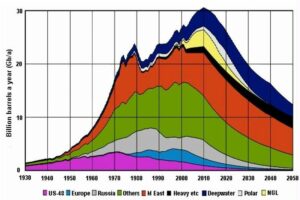
Preface. After seeing the film “The Power of Community: How Cuba survived Peak Oil” in 2006, I thought about how those lessons might apply to California, which grows about a third of U.S. food. Much of what follows in the post below is based on the excellent Oxfam analysis of the complexities involved in Cuba and its food production reforms.
After reading the Pulitzer prize winning “Cuba: An American History (2021),” I learned that the main way Cuba coped with the fall of the Soviet Union and consequent lack of oil was to open up Cuba’s economy to development. Europeans built many hotels and vacationed there. Tourism became an even bigger industry than sugar. And that Cubans are even more wonderful and the U.S. more evil and responsible for their condition that I had known before. You can visit despite all their problems, they are keeping the lights on in the tourist districts according to friends who were there in December 2024.
UPDATES
In 2026, the US is aggressively blocking oil and fuel shipments to cuba. U.S. Coast guard cutters intercept cargo and container ships, seizing any oil they find. Trump has threatened higher tariffs on foreign countries who supply oil. the Department of Homeland Security (DHS), Homeland Security Investigations (HSI), U.S. Customs and Border Protection (CBP), and the Commerce Department’s Bureau of Industry and Security actively target illicit export networks and entities trying to bypass U.S. export controls.
Food production has gone down 60% since tractors can no longer harvest crops. With the electric grid down much or all of the time, people are resorting to cooking with wood. Food is spoiling without refrigeration. Water systems no longer pump water.
Most nations are appalled. At the UN general assembly, 165 countries voted to end the embargo, while only 7 countries voted against it. UN Human Rights Experts: UN Special Rapporteurs and human rights experts issued a formal warning stating that the U.S. is subjecting Cuba to “energy starvation”. They note that depriving the island of fuel violates international law and directly impairs the rights to life, health, and food. Some observers have gone as far as comparing the resulting isolation and deprivation to a “silent Gaza”.
2025 Cuba’s Energy Crisis Deepens as Blackouts Grip the Nation. Cuba has been experiencing an energy crisis that has led residents to experience almost daily blackouts and gas cuts. Years of under investment in Cuba’s transmission network and power plants have led them to run below capacity, with the country’s energy supply falling far below its demand. In addition to localized power outages, in the last eight months, Cuba has experienced four nationwide blackouts.
The regular blackouts have led people across the country to invest in charcoal stoves, rechargeable batteries and fans, as well as other vital products to use during outages when confronted with soaring temperatures, which many can barely afford.
The crisis comes from years of under investment and mismanagement of Cuba’s energy infrastructure, which has placed a significant burden on the country’s existing electricity grid
Cuba has long relied on substandard fuel, which has strained the system. The Caribbean country depends heavily on domestic, poor-quality heavy crude oil, which is corrosive because of its high sulfur content, adding to the rapid ageing of the country’s power plants.
2024-12-11 Cuba’s Energy Crisis Sparks Unrest. Cuba’s energy crisis, characterized by frequent blackouts and fuel shortages, is causing significant economic hardship and social unrest. The crisis is attributed to aging infrastructure, lack of investment, and the US embargo, which hinders fuel imports and economic development. The government has blamed the 62-year-old trade embargo with the U.S., which makes it difficult to import fuel, for the energy shortages. Cuba is reported to have lost as much as $5 billion last year because of the U.S. embargo. Previously, Cuba’s allies Russia and Venezuela helped the Caribbean Island to manage its energy security, but both countries are now facing challenges of their own.
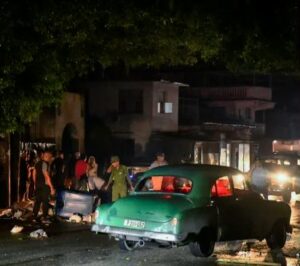
Cubans are now used to regular blackouts of a few hours at a time, but in October the power outage lasted several days. This forced people to look for firewood as fuel and use up any food they had before it went bad, as many are no longer receiving regular gas deliveries and charcoal seems impossible to find. In a country where much of the population is living in poverty, the energy crisis is exacerbating the poor standard of living.
In late October, Mexico sent a cargo of 400,000 barrels of crude to Cuba to help alleviate fuel shortages. Mexico is one of the few countries that continues to send oil to U.S.-sanctioned Caribbean state. Unless Cuba can get more fuel delivered, power plants will likely be forced to shut down again, plunging the country into darkness and further exacerbating the economic crisis already felt by many Cubans.
2024-10-26 The Guardian update: Sadly, this article reveals that Cuba has not survived peak oil now that Venezuela has collapsed and not sending them oil. Since all nations are headed that way as well, it is a good idea to keep an eye on Cuba to see how they cope, maybe we can learn something.
2012 update: Cuba’s agriculture experiments are not working out according to the New York Times. There are many reasons, but the main one is there aren’t enough trucks to distribute the food, and existing trucks are so old they often break down.
2017 update: Organic or starve: can Cuba’s new farming model provide food security? The Guardian, a few points from this article
- Cuba has never been able to feed itself. It currently imports 60-80% of the food it consumes, at a cost of about $2bn a year. Two-thirds of its corn is imported and a similar amount of its rice
- Officials are promoting small, local farms as perhaps the only way for the country to finally start feeding itself, and there has been a gradual shift o smaller, often organic farms — a radical change from the monocrop sugarcane economy that ruled Cuba for a century. Organic farming does not bring the large yields that will solve Cuba’s problems however. Farm yields are pathetically low, despite Cuba having possibly the richest soil of any tropical country in the world, said Pedro Sanchez, an agronomist at the University of Florida.
- In the wake of the Soviet collapse, Cuba lost 80% of its international trade in under three years. The result was severe food shortages. Castro dubbed it “the special period in peacetime,” a euphemism for what many Cubans describe as one of the worst traumas of their lives. It dragged on for five years, but its psychological effects lasted much longer.
- One woman I met remembered people fainting in the street from hunger. An artist remembered regular rations for children, but, for adults like himself, an endless diet of sugar water. Another stressed years of blackouts and boredom, relieved only by lots of marijuana. An agronomist described to me the death of hundreds of thousands of farm animals due to the loss of imported feed. “We came very close to starvation,” he said.
2019 update. Due to US Sanctions, declining Venezuela production and more”
- Cubans feeling the pinch of severe fuel shortage. Cuba is currently mired in an energy crisis, forcing some farmers to plow their fields with oxen. The current cutbacks have prompted comparisons to the Special Period — a euphemistic expression for the dire economic crisis that hit Cuba as a result of the disintegration of the Soviet Union in 1991, and the tightened US sanctions that followed. At the time, the country lacked vital necessities including food, medicine and everyday goods such as shoes, clothing and hygiene products. Workers worked shorter hours due to a lack of electricity that sometimes was out up to 16 hours a day.This time around, public transportation has again been reduced to a minimum. Police are stopping cars without passengers and forcing the drivers to transport people. On the sugar cane fields, where Cuba’s main export is cultivated, tractors have been replaced with oxen. According to state media, 4,000 teams of oxen are scheduled for use.
- Amid crippling sanctions, Cuba deploys oxen, wood-fired ovens to overcome fuel crisis. Cuba is deploying oxen to replace tractors, using wood instead of gas at many state bakeries and advising citizens to save electricity by making the most of daylight. The government is prioritizing what little fuel it has to sustain critical services such as hospitals and sectors such as tourism, which generate much-needed hard currency. Some cement factories have decreased production, and a large steel factory in Havana has stopped operating altogether. Public transit has been cut back so much that many workers are being told to stay home. Some state workplaces, universities and schools have simply cut hours to save electricity and provide some relief to public transport at peak commuting hours. Queues at gas stations in Havana snake for blocks, with some Cubans even sleeping in their cars overnight to have a chance of filling up. Irrigation equipment is being turned off at times of peak electricity usage to reduce the burden on the power grid.
- Cubans’ resilience sorely tested as US oil sanctions bite. Transport inspectors have been deployed to ensure that anyone driving a vehicle which belongs to a ministry or state enterprise gives fellow citizens a lift. At offices and factories throughout the island all machines and lights are switched off between 11am and 1pm.
2022 update: Cuba continues to be amazing and wins my vote for one of the best places to be postcarbon not just because of their climate, but especially their culture: A small island nation has cooked up not 1, not 2 but 5 COVID vaccines. It’s Cuba!
Related Posts
- North Korea collapse posts
- How different nations have coped with oil shortages
- Dmitry Orlov: How Russians survived the collapse of the Soviet Union
- A book review of “Russia’s Food Policies and Globalization”
- Lessons Learned from How Cuba Survived Peak Oil
- Venezuela collapse posts
Alice Friedemann www.energyskeptic.com Author of Life After Fossil Fuels: A Reality Check on Alternative Energy; When Trucks Stop Running: Energy and the Future of Transportation”, Barriers to Making Algal Biofuels, & “Crunch! Whole Grain Artisan Chips and Crackers”. Women in ecology Podcasts: WGBH, Jore, Planet: Critical, Crazy Town, Collapse Chronicles, Derrick Jensen, Practical Prepping, Kunstler 253 &278, Peak Prosperity, Index of best energyskeptic posts
***
Social Factors
Just as Robert Hirsch of SAIC advised the U.S. Dept. of Energy that we ought to prepare for peak oil at least a decade ahead of time, so too should social values and our economic structure be altered well ahead of peak.
Before 1959, the United States owned 40% of Cuba’s sugar production, 90% of the utilities, oil refineries and mines, and some of the banks.
The Cuban revolution powerfully motivated people to overcome United States domination and become self-sufficient. People were willing to make large personal sacrifices for the public good. The energy crisis took place within this social framework.
As times get harder in the United States on the down-slope of Hubbert’s curve, our Lotto-driven, “Who Wants to be a Millionaire?” society will need to be convinced to work for the greater good. Dmitri Orlov’s three-part “Post-Soviet lessons” describes the problems our American culture has that will make this difficult for us.
There’s some hope — 29% of Americans are volunteers. A campaign to get the other 71% volunteering would be a good start for preparing society for what lies ahead, plus keep people busy as their jobs disappear.
Economic structure
The disparity of wealth in America is likely to lead to a lot of social unrest as times get harder. Adjustment to peak oil would go more smoothly if wealth were more fairly distributed, but the only way this could possibly happen is to institute the reforms suggested in Joel Bakan’s book, The Corporation: The Pathological Pursuit of Profit and Power.
Land Reform
In Cuba before 1959, 8% of farmers owned 70% of the land. The revolution redistributed the land to the farmers.
California is, and always has been, a state with very large farms. It is unlikely the land will be redistributed here. California’s past and present is most likely its future: brutal exploitation of labor (read Richard Street “Beasts of the Field”).
Also, California has the largest and most elaborate water distribution and irrigation system in the world, and these large waterworks function best in a centralized and highly controlled manner, which also does not lend itself well to land redistribution. Or to being maintained properly at some time of energy descent, which combined with climate change reducing in rainfall and snow melt could turn regions of the state back into a desert.
Percent of population doing Agricultural work
As energy declines, we can allocate more and more scarce energy to agriculture, but at some point a proportional number of people and animals must go back to the land with their muscle power to make up for the declining diesel power – ultimately 80-90% of us.
Cuba was fortunate to already have at least 15% of their population living rurally (the CIA fact book says 21% are agricultural workers now). Although the Oxfam report and movie don’t say anything about this, I imagine that this meant a much larger percent of urban dwellers had some connection to the land and potential food aid from their relatives who worked on farms than the average Californian has.
In the U.S., less than 1% of our population are agricultural workers — 834,000 in 2006 according to www.bls.gov — and that number is expected to drop.
Cuban Agricultural Research and Extension
Cuba had already started sustainable agriculture programs and research many years before the crisis hit. This allowed them to quickly get information to farmers and city dwellers and train them to grow food organically. A campaign to breed oxen and train young farmers in how to use them was quickly put in place.
The United States started spending a large amount of money on agricultural research starting in the 1850’s, and the bills that started agricultural colleges and the department of agriculture state quite clearly that this money is to be used to aid the small farmer.
But that intention was corrupted almost from the first day by larger farmers quickly taking advantage of the research at nearby colleges. Nearly 100% of college and USDA funding now goes towards industrializing and mechanizing agriculture. (Jim Hightower, Hard Tomatoes, Hard Times).
Californians need to allocate far more resources to the University of California SAREP (Sustainable Agriculture Research and Education Program), which has a skeleton staff of ten people and almost no funding for research. They have a good statement of what sustainable agriculture is at www.sarep.ucdavis.edu.
Climate & Water
Cuba’s temperature ranges between 68 and 81 degrees F, and they get almost 50 inches of rain per year, over the entire year. That allows them to grow crops year round.
California is cursed with a Mediterranean climate, where there’s no rain during the height of the growing season. This is gotten around with elaborate irrigation systems, and in the warmest part of the state it’s possible to grow crops year round.
The USA devotes about seven percent of its energy to provide water services (www.iags.org). In California, the water table has dropped significantly, requiring energy to pump water beyond what windmills can provide. As energy declines, that will impact water availability and decrease crop production.
California is also likely to have severe water shortages in the future. There is already competition between agriculture and the 36 million residents of the state for water. Worse yet, all global warming models for California show significant water problems from drought, early snow melt and disappearing glaciers (reservoirs in the sky) and extreme flooding, which will greatly reduce the amount of food that can be grown here.
Urban Food and Agriculture
Our most fertile land, the peat soils in the delta region, can not be saved from hydrostatic forces, earthquakes, severe floods, and rising sea levels, no matter how much money is spent (Thad Bettner www.lib.berkeley.edu/ ). This is bad news for the Bay Area; our best hopes for food in an energy crisis would be to have food shipped from the Delta to the greater bay area.
In 2000 food purchases took up 66% of the average Cuban salary, because the food rations did not cover all of the food people needed. High prices were partly due to a shortage of trucks to haul produce from the country to the city – the few people who had trucks charged vendors and consumers a lot of money and paid the farmer very little. The Cubans got around this problem by donating trucks and fuel to the agricultural cooperatives to eliminate middlemen. We should plan ahead of time how to eliminate the middle man here as well.
Given our capitalistic system, and the current lion’s share of profit going to middlemen rather than farmers, I’m not confident this will happen.
Cuban urban dwellers can receive up to one-third of an acre for a personal lot in the periphery of the major cities. Doing the same for Bay Area residents would mean most of us would need to commute 30 to 100 miles to reach our little plot of land since we are so densely and massively urbanized.
I have other issues with growing food in the Oakland urban environment as well (Oakland Depletion Protocol)
Conclusion
Just as Cuba had a sudden energy crisis, so too are we likely to have many crises from energy shocks in the future from wars, hurricanes, terrorism, revolutions, and potential five to eight percent world-wide oil depletion rates. There will also be hiccups in global trade delivery of oil and LNG.
We can get more efficient and sacrifice resources to agriculture, water services, and the trucking industry, but as geological depletion relentlessly continues, as global warming and extreme weather greatly reduce agricultural production, and as the ten high plains states above the Ogallala reservoir run out of water or the energy to pump it up from hundreds of feet down, we will face a food crisis.
We would be better prepared for that if we started programs now to get large numbers of people to go back to the land. There is no way we can continue to have just one percent of the population providing half of the food for the other 99%. (we import the other half: Larry Rohter. Dec 12, 2004. South America Seeks to Fill the World’s Table. New York Times).
We should plan an orderly retreat. This would be done by relentlessly cutting back on our energy use more than the depletion rate so that we stay under the energy curve. Universities would shift from industrial and mechanical agricultural research to providing sustainable agriculture outreach to small farms and collectives. However unpleasant this sounds, the alternatives are chaos, starvation, Rwandan-style lowering of the population, the complete loss of Democracy to fascist leaders who will step in to try to regain stability, and the potential invasion of our country by other nations taking advantage of our weakness.
 Preface. This is a book review of Ramana’s “Nuclear is not the Solution: The Folly of Atomic Power in the Age of Climate Change.” A great overview that covers many topics, one of the best out there, and most recent. Also some of my kindle notes. But still, so much not covered, and this is such an important topic now that there are billions of dollars of Nuclear Cheerleaders convincing people that Nuclear Is The Answer. Before buying into the hoopla, read this book to be more informed about what is hype and what is realistic. Especially because most of the public, especially younger generations, have forgotten how dangerous they are. And if you’ve read my books, you know that electricity can’t replace diesel transportation, so all we are doing is creating toxic waste dumps for tens of thousands of future generations as oil declines to drips by 2100 or sooner.


 Source: (