The periodic table limits battery development

Preface. My book, When Trucks Stop Running, makes the case that civilization ends when trucks stop running.  The replacement for diesel fuel that everyone expects, especially because Elon Musk has told them it’s on the way, are battery electric trucks. But the Semi is years late, and not going to solve the problem, it’s only meant to run on smooth roads. What’s really needed are off-road electric tractors and harvesters, logging, mining, construction, and other essential trucks.

There are many other barriers besides a limited number of elements to choose from in the periodic table to building a battery for transportation (or utility scale energy storage). Vehicles use many finite platinum group elements, precious elements, and rare earth elements.  Plus there are dozens of challenges to improving batteries that must be overcome but can’t because of the laws of physics and thermodynamics. Nor are trucks going to be running on hydrogen: The dumbest & most impossible renewable.


Alice Friedemann  www.energyskeptic.com  Author of Life After Fossil Fuels: A Reality Check on Alternative Energy; When Trucks Stop Running: Energy and the Future of Transportation”, Barriers to Making Algal Biofuels, & “Crunch! Whole Grain Artisan Chips and Crackers”.  Women in ecology  Podcasts: WGBH, Jore, Planet: Critical, Crazy Town, Collapse Chronicles, Derrick Jensen, Practical Prepping, Kunstler 253 &278, Peak Prosperity,  Index of best energyskeptic posts

***

There hasn’t been much progress in batteries the past 200 years. Electric cars still cost about twice as much as gasoline cars. But who cares about cars?  Civilization depends on heavy-duty trucks, rail, and ships that are the basis of all supply chains, mining, agriculture, logging, construction industries, and infrastructure.

Batteries are simply not as energy dense as oil and never will be.  Pound for pound, oil is 500 times more energy dense than a lead-acid battery and about 120 times more than a lithium-ion battery. That makes them too heavy to move a heavy-duty truck or other large vehicle.

The periodic table limits any possibility of a major breakthrough, because there are only 118 possible elements, and most of them can be ruled out:

  • 39 are radioactive
  • 23 are far too scarce or expensive to scale up commercially such as rare earth and platinum group metals
  • 6 inert noble gases
  • 4+ toxic metals such as cadmium, cobalt,mercury, arsenic
  • too heavy
  • too scarce
  • too valuable (i.e. gold, platinum group metals)
  • too hard to recycle
  • too little reduction or oxidation potential

One of the main problems with batteries is that they’re too heavy, especially for the heavy-duty vehicles and equipment that civilization depends on.

We’ve already gained as much energy density as possible by switching to lighter and lighter elements — from lead to zinc to nickel to lithium. Consider that when you hear about yet another battery improvement.

There’s nowhere to go from here, lithium is the lightest element we can make batteries out of, with only hydrogen and helium being lighter. Lithium is much lighter than lead at 82, zinc at 30, and nickel at 28.

At the very best, scientists estimate that we could get double or triple lithium-ion performance due to the laws of physics.

Nor is there enough lithium in the world to switch from gas and diesel vehicles to electric vehicles running on lithium batteries (Vikström, H. et al. 2013). And especially not if batteries are built to store energy for when the wind and sun aren’t out. On average at least six weeks of energy storage would be needed for a 100% renewable grid. To store just one day of U.S. electricity generation, Li-ion batteries would cost $11.9 trillion dollars, take up 345 square miles, and weigh 74 million tons (DOE/EPRI 2013).  There are other battery types, but commercial development is focused on lithium almost entirely.

The very heavy, 4,647 pound Tesla Model S gets most of its mileage from aerodynamics, reduced rolling resistance, light-weight materials, and so on. The Tesla S goes further than other all-electric cars because it has more batteries.  Tesla S battery packs weigh 1,323 pounds (plus 350 lbs for the electric motor and inverter) versus 660 lbs for the Nissan Leaf (also pretty heavy at 3,340 lbs).

So let’s start over and design a high-energy battery from scratch. The first step is to look at the periodic table to choose the best elements.

Here is Aidan Stranger’s point of view (taken from a comment below): “Alkali metals (and indeed most other metals) have a greater reducing potential the further down the periodic table you go. So if reactivity were the deciding factor, caesium would be the best choice (francium’s not an option because it’s radioactive, extremely rare and very short lived). If cost is the deciding factor, sodium’s a better choice. But lithium is usually preferable for batteries because it’s lightweight; the higher specific energy more than makes up for the lower energy density.  But there are more factors to consider. Alkali metals only have one electron each. Something with more outer shell electrons could be more effective. Vanadium (with five) is often used in wet cells.  As for fluorine, forget it! Fluorine gas is far too dangerous to have in batteries, and oxygen fluorides are also dangerous and difficult to work with. I’m amazed that anyone’s even contemplated it. Unlike fluorine, cadmium can be contained fairly easily, so has been used for batteries despite its toxicity.”

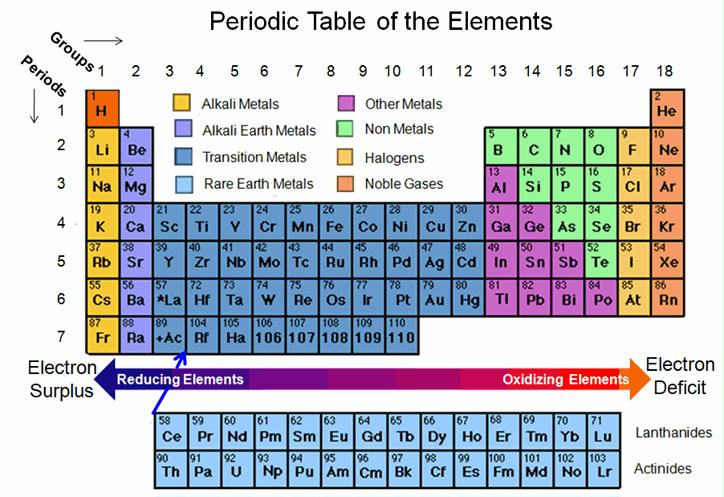
periodic table reducing and oxidizing elements


Another possibility is looking at what elements could produce the highest voltage from the most reducing and most oxidizing elements.  The highest potential is nearly 6 volts with a  lithium anode (the strongest reducing element) and a fluorine cathode (strongest oxidizing element)  of -3.04 & 2.87 respectively).  Battery researchers know this and have been trying to develop such a battery since the 1960s. Scrosati et al have an excellent history of Li-F battery research and where we stand on different battery types today if you want to know the technical details.

The material electrons swim through between the anode and cathode matters as well.  Cells with aqueous (containing water) electrolytes are limited to less than 2 volts because the oxygen and hydrogen dissociate above this voltage. This is a shame, because water is very inexpensive. Lithium batteries don’t use water but this prevents electrons from flowing as well (high internal impedance) so 2.7 to 3.7 volts are achieved, rather than the maximum 6 volt potential between lithium and fluorine

The laws of physics means that there is no possibility of making a battery that rivals the energy density of oil, ever.  So the question is, if a 6 volt lithium-fluorine battery could be built — and it probably can’t — but if it could, would it be energetically cheap and powerful enough to move heavy-duty class 7 & 8 all-electric tractors, harvesters, road construction, and mining trucks?

If so, then is there enough lithium on the planet, including recycling, to make enough batteries for all electric cars, trucks, and utility-scale energy storage and lithium-battery mining trucks to haul ore to refining plants, and so on?

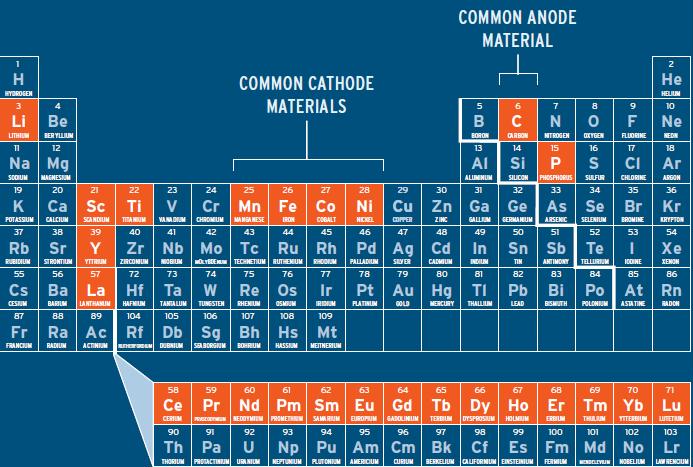
The main elements that lithium are dating are shown below. The rare earth elements aren’t in the battery, but are being used in the electric motor and generator, so even if lithium is recycled, the limits to EV may come from rare earth metals used other components of electric vehicles, which can NOT always be recycled:li-ion periodic table other elements in batteries


Related Posts: The electric grid will eventually fail without utility scale energy storage of at least a month of electricity to compensate for seasonal deficits (When Trucks Stop Running Chapter 17 The Electric Blues). Natural gas is the main energy storage now (and coal), and essential for balancing the sudden life and death of wind and solar power. But natural gas and coal are finite.  Yes, hydropower can also balance wind and solar, but mostly in the 10 lucky states that have 80% of it for just part of the year, and the few places that can afford multi-million-dollar batteries (though only for an hour or so).  The electric grid could crash from a weapon or solar flare electromagnetic pulse and be down for a year or more. Electric trucks are impossible. Without trucks, civilization fails. And it’s checkmate as well, because manufacturing uses over half of all fossil fuels, and depends on the high heat only fossils can provide to make cement, steel and other metals, glass, brick, ceramics, microchips and so on. Manufacturing can’t be run on electricity, hydrogen, or anything else, as explained in Chapter 9 of Life After Fossil Fuels. No transportation? No Manufacturing? Then no electricity generating contraptions like solar panels or wind turbines can be built. Checkmate.

References

DOE/EPRI. 2013. Electricity storage handbook in collaboration with NRECA. USA: Sandia National Laboratories and Electric Power Research Institute.

Scrosati, B., et al. 2013. Lithium batteries. Advanced technologies and applications. Wiley.

Vikström, H. et al. 2013. Lithium availability and future production outlooks. Applied Energy, 110(10): 252-266.

For a more in-depth look at battery chemistry see: Battery and Energy Technologies. Cell Chemistries – How batteries work. Electropaedia. mpoweruk.com

Posted in Electric & Hydrogen trucks impossible, Electric Vehicles, Lithium-ion | Tagged , , , , , , | 7 Comments

U.S. House drilling on federal versus non-federal land

Serial No. 112-170. August 2, 2012. The American energy initiative part 27: A focus on growing differences for energy development on federal versus non-federal lands. House of Representatives. 171 pages.

[ Who invites these “experts”?  Will Sullivan provide deniability to congressional members when the shale gas bubble pops?  I can imagine the evening news when congressmen say in shocked tones that we had no idea there wasn’t a century of oil and gas… This is yet another drill baby drill congressional session, I’ve posted it because I want to keep track of who says we’re energy independent since that’s affecting U.S. national security and energy policy.  Alice Friedemann www.energyskeptic.com]

Dan Sullivan, Commissioner Department of Natural Resources State of Alaska: Today, our nation has by some estimates a 100-year supply of gas and the federal government is now focused on the extent to which to allow gas exports. Oil production, at 6 million barrels a day, is back to levels not seen in almost 15 years, making the U.S. the world’s third-largest producer. And U.S. natural gas production is approaching record levels. These trends are likely to continue. PFC Energy predicts that by 2020, the U.S. will be the largest hydrocarbon producer in the world exceeding Saudi Arabia and Russia. This is a bold prediction, but federal agencies back that up, estimating that the United States has more than a trillion barrels of technically recoverable oil and more than 1,000 trillion cubic feet of natural gas, including both conventional and unconventional resources.

BOBBY L. RUSH, ILLINOIS. while Democrats under President Obama’s leadership have put forth a truly all-of-the-above energy agenda, it appears that my Republican colleagues are once again taking their cue from one of their most influential leaders, Sarah Palin, and reviving their simplistic ‘‘drill, baby, drill’’ energy agenda. Merely a few hours ago, after holding a partisan vote to do away with new projects under the DOE’s loan guarantee program in the full committee yesterday, which would have invested Federal dollars into different types of renewable and clean energy projects to compete with the Republican Party favorite fossil fuel industry, the majority is here today holding a hearing on drilling on Federal versus private lands.

Never mind the fact that the Energy Information Administration has confirmed that domestic oil production in the U.S. has increased every year since 2008, that we are importing less oil than any time in the past 13 years, and that American demand is actually lower now than it was a year ago. And, Mr. Chairman, it appears that my Republican colleagues will continue to ignore the fact that the U.S. has set more than 40,000 hot temperature records this year alone, and that the last 12 months have been the hottest ever recorded in our Nation’s history. Today, fully two-thirds of the country is experiencing drought, and 30 percent of the Nation’s corn crop is in poor or very poor condition, while at the same time, water levels in four of the five Great Lakes have actually plummeted down to unprecedented levels due to high evaporation rates and insufficient rainfall.

Just yesterday the Agriculture Department designated more than half of all U.S. counties as disaster areas in 2012. The main reason? Drought. And the Agriculture Secretary Vilsack signed a disaster designation for 218 counties in 12 States just yesterday morning, bringing the national percentages to 50.3 percent.

I remind you that today, more than 113 million Americans are living under extreme heat advisories, and yet, despite repeated requests from myself and Ranking Member Waxman to hold hearings on the science behind all of the extreme weather events associated with climate change that the Nation has been experiencing, we have yet to examine this vitally important issue just one time, just once this year, one time before this subcommittee. Even former climate change skeptics such as Richard Muller, who penned in a July 28 New York Times editorial entitled ‘‘The Conversion of a Climate Change Skeptic,’’ even Mr. Muller has now come out on the record and joined the overwhelming consensus of scientists and researchers who have stated that global warming is indeed occurring, and that human causes are indeed behind it. Yet as America burns, this committee fiddles. Even as Congress prepares to vote on a bill, drought relief bill for farmers this morning, farmers who are suffering from record drought in the Midwest and beyond, even when you and I and the other members of this subcommittee, we will be casting votes sometime this morning, this very subcommittee refuses to hold one hearing, just one hearing on the causes behind these droughts, or what can be done for our Nation, for this Federal Government, for this Congress to lessen the impact of the heat on the American people. I support a recent CRS study finds that 96% of the increase in domestic oil supply since 2007 has come from non-Federal lands.

HENRY A. WAXMAN. CALIFORNIA. Today the subcommittee holds a hearing to compare oil and gas production on Federal lands to production on private lands. We will hear once again, as we just heard, that the Obama administration is hostile to oil and gas production, and we will hear once again that oil and gas production should be pursued at the expense of renewable energy and other goals. Well, that is the rhetoric. Now here are the facts. Domestic oil and gas production has increased each year of the Obama administration, and it is the highest it has ever been in 8 years. America’s dependence on foreign oil has gone down every single year for the last 3 years, and oil production from Federal lands is higher today than it was under the last 3 years of the Bush administration.

It is true that oil production on private lands has increased more than it has on Federal lands.

Some Republicans have used this as evidence that the President must be disfavoring the oil industry, but the fact is that most of the increase in domestic oil production has occurred from developing shale formations. These formations happen to be on private lands. The Federal Government manages only a small portion of these areas. For instance, the Bakken shale has made North Dakota one of the country’s top States in oil production, but Federal lands make up a small percentage of it. Even offshore oil production remains strong. In spite of one of the world’s worst environmental disasters, oil production from the Outer Continental Shelf in 2011 was equal to or higher than any of the last 3 years of the Bush administration. The Obama administration has taken many steps to facilitate oil and gas production. The Bureau of Land Management has reformed its leasing process with a tracking system for applications that shortens wait times.

But we shouldn’t lose sight of the fact that public lands are not solely for oil and gas production. Our public lands are held in trust for the American people, not the oil companies. Public lands are used for conservation, outdoor recreation, watershed protection, timber, and grazing. They can also be used for renewable forms of energy. In fact, the Obama administration recently completed an assessment that will expedite permitting for solar installations on public lands in the Southwest. This has the potential to produce enough electricity to power 7 million homes. The administration’s job is to balance these competing demands.

When you are looking at, say, a resource boom—which is what North Dakota is all about—you have to ask whether a comparable resource boom is possible in a much more populous state, or the United States as a whole. One commentator declared that there is as much oil under California as there is under North Dakota; quite possibly. The question is, how big a deal would extracting that oil be in a state with 50 times North Dakota’s population; how much difference would it make to, say, the state unemployment rate? And the answer, of course, is virtually none. To have a North Dakota-type boom in California, you would have to find 50 times as much oil; to have it nationally, you’d have to find 500 times as much. Not likely.

ED WHITFIELD, KENTUCKY. North Dakota has an unemployment rate today of around 3 percent, and so it raises the question on the energy policy and economic policy, what is North Dakota doing that is different than other States?

Alaska, where output has been declining over the same span that North Dakota’s output has been increasing. Now, the main difference between Alaska and North Dakota is that Alaska has far more areas of federally owned and controlled lands, and this administration has substantially cut back on new energy leasing in these Federal lands and offshore areas, and while that may not be the only factor that has led to this difference of unemployment and economic growth, we hope this morning to find out how substantial a factor is it.

And it isn’t just Alaska. For example, this administration has cut back on new leasing in the federally controlled Gulf of Mexico and has also been slow to issue the necessary permits for previously leased areas, and the red tape facing energy companies operating on Federal lands throughout the intermountain west has kept the region below its potential for energy production and jobs.

In contrast, relatively little land in the energy-rich Bakken formation in North Dakota is federally owned. There the oil industry has been allowed to partner with private landowners to expand production. In the last decade alone, North Dakota has risen from the eighth largest producing State to the second largest. An estimated 35,000 new direct jobs and many more indirect ones are a big part of the reason why the State’s unemployment rate is around 3 percent. In effect, North Dakota gives us a glimpse of what would be possible in many other parts of the country if only we could change some policy in Washington, DC. And I might add that gasoline prices unfortunately seem to be creeping

Mr. Michael Nedd, Assistant Director of Minerals and Realty Management at the Bureau of Land Management. Thank you for the opportunity to discuss the role of the Bureau of Land Management in facilitating responsible development of oil and gas resources from our Nation’s public land. The BLM is responsible for protecting the resources and managing the use of our Nation’s public land on over 245 million surface acres, approximately 700 million acres of onshore subsurface mineral estate, and 56 million acres of Indian trust land. We work closely with State governments and other Federal agencies in the management of this subsurface mineral estate. The BLM manages public lands on very complex, multiple use mandate from Congress, and consider a wide variety of factors in land management decisions, including industry interests, conservation value, as well as other potential use of the public lands.

In addition to oil and gas production, the BLM’s unique multiple use management of public lands also includes activities such as livestock grazing, outdoor recreation, solid minerals development, and the conservation of natural, historical, cultural, and other important resources. Secretary Salazar has emphasized that the development and production of conventional energy resources from BLM-managed public and Indian lands, are an important component of the new energy frontier and play a critical role in meeting the Nation’s energy needs. In 2011, conventional energy development from public and Indian trust land produced 14% of the Nation’s natural gas, 6% of its domestically-produced oil. In fiscal year 2011, onshore Federal oil and gas production resulted in nearly $2.9 billion in royalties, approximately half of which was paid directly to the States in which the development occurred.

The geography of resource occurrence and the relative economic attractiveness of development are key factors impacting discoveries and production level on both Federal and non-Federal lands. Currently, there are more than 37 million acres of public lands that are leased for oil and gas development. Only about 12 million acres are under production. There are huge potential oil and natural gas plays in the Marcellus, Fayetteville, Barnett, Niobrara, and Bakken shale formation where there is an abundance of oil and gas. These geological formations exist largely on State and private minerals estate. The fact that only one-third of Federal leases are in production may be partly attributable to the abundance of oil and gas in these shale formations on the State and private land and to low natural gas prices relative to the price of oil.

The BLM currently manages nearly 37 million acres of onshore oil and gas leases. In FY 2011, over 117 million barrels of oil were produced from public and Indian lands. In addition, the nearly 3 trillion cubic feet of natural gas produced from public lands made 2011 the second-most productive year for natural gas production on record. Natural gas production on BLM lands increased by 6 percent during 2009-2011, compared with 2006-2008. In 2011, conventional energy development from public and Indian lands produced 14 percent of the Nation’s natural gas, and 6 percent of its domestically produced oil. In Fiscal Year (FY) 2011, onshore Federal oil and gas production resulted in nearly $2.9 billion in royalties, approximately half of which was paid directly to the states in which the development occurred. In addition to the multiple uses of the public lands, the BLM complies with a variety of statutes that are not necessarily applicable to state or private lands, such as the National Environmental Policy Act (NEPA) and the National Historic Preservation Act.

Given the checkerboard ownership patterns of many public lands in the West, as well as the significant portfolio of split estate ownership, the BLM also must coordinate with other landowners and land managers. Of the 700 million acres of mineral estate managed by the BLM, 57 million acres are under surface acres that belong to private entities, and a significant number of acres are under surface managed by other Federal agencies. It is important that the BLM provide not only the public an opportunity to engage on these issues, but also neighboring landowners.

The National Petroleum Reserve in Alaska (NPR-A) is a vast area of nearly 23 million acres on the North Slope of Alaska that has Federal production potential. In 2010, the U.S. Geological Survey estimated that 896 million barrels of conventional, undiscovered technically-recoverable oil and 53 trillion cubic feet of conventional, undiscovered technically-recoverable gas were within NPR-A and adjacent state waters.

Mary Wagner Associate Chief, U.S. Forest Service U.S. Department of Agriculture. Thank you for the opportunity to appear before you today to provide the agency’s perspective regarding oil and gas development on the National Forests and Grasslands. We would like to describe the role of the Forest Service in oil and gas leasing and operations and provide an overall scope of the oil and gas program on the National Forest System (NFS) lands. The Forest Service is committed to doing its part to foster and encourage private enterprise in meeting the nation’s energy needs, while at the same time protecting the landscapes and watersheds for present and future generations. Oil and gas development is one of a variety of renewable and non-renewable energy development activities authorized on the National Forests and Grasslands. NFS lands provide 25% of the nation’s coal production and 16,000 megawatts of hydropower generation capacity, enough to power twelve to sixteen million homes. The Forest Service authorizes uranium mining, geothermal development, and biomass removal for power generation. The Forest Service also authorizes a number of active mines which produce minerals needed for energy development and transmission (such as copper). The agency also authorizes thousands of miles of electric transmission and pipelines that distribute energy to market. Specific to oil and gas, we have authorized almost 20,000 active wells on NFS lands in 19 states. While all of these wells are located on surface managed by the Forest Service, their production may be from either federally-owned or privately-owned, sub-surface minerals. In 2009 and 2010, oil and gas production from federally-owned minerals on NFS lands generated an estimated $136 million and $186 million respectively in bonus and royalty payments to the U.S. Treasury. In 2010, this production had a market value of $1.2 billion,

A large portion of the royalty revenue is collected for and delivered to states and counties. Specifically 25 percent of the revenue from Acquired Lands, which includes the National Grasslands, as well as 50 percent of the revenue from Public Domain lands, is delivered to the states and counties. Almost three-fourths of the approximately 20,000 wells on NFS lands overlie subsurface mineral estate that is privately held. This “split estate” development predominately occurs on NFS land in the east. The majority of these wells are low volume producers with typical depths between 2,000 and 3,000 feet which require small areas of surface occupancy (pads) of an acre or less. National Forests in the east also have significant development potential for shale gas. We

Although most of the oil and gas wells on NFS lands are in the east, most of the oil and gas production is in the west; most notably in the Williston Basin with its Bakken Formation in North Dakota on the Dakota Prairie National Grassland, and the San Juan basin in northwestern New Mexico on the Carson National Forest. It is common practice in these areas to utilize larger pads (typically 3-5 acres) to drill multiple wells to minimize the surface “footprint” of development. On the Dakota Prairie National Grasslands, we approved 14 surface use plans of operation in 2008, 13 plans in 2009, 29 plans in 2010, and 36 plans in 20) I. One of the challenges in being responsive on the Dakota Prairie National Grasslands has been our ability to hire, provide housing and retain employees to work in the same geographic area which is experiencing the oil and gas boom. We are working diligently to address this challenge. There are a number of factors which influence where, when, and how oil and gas is developed on NFS lands. The level of interest from industry is largely a function of available supply as well as the economics of development, from prices to the cost of extraction. This cost is highly variable and depends upon the deposit, drilling technique to access the deposit, and transportation costs among many other factors.

ADAM SIEMINSKI, EIA. Federal offshore natural gas production has been on a downward trend for the last 9 years, falling by more than 50%, as commercial development moved from the gas-prone shallow shelf areas in the Gulf of Mexico to the richer oil-prone deep waters further out in the Gulf. Production from onshore Federal lands was generally growing over this period and actually exceeded the offshore production by 2008.

EIA estimates for the non-Federal oil production are based on monthly data from State agencies and purchased third-party data. The lag from when the data are first reported to the time that they stop changing significantly varies from State to State. A few States, like North Dakota and Alaska, report relatively complete data within 2 months of the close of the production month. Other States with large numbers of producers, like Texas and Oklahoma, can take a year or two to report complete data. For the Federal offshore area, EIA relies on the metered data from the Department of the Interior.

Unlike oil production, EIA collects data on natural gas production from about 240 operators each month. This EIA survey primarily covers five States and the Federal offshore Gulf of Mexico. Though more accurate than the oil production estimates, the current natural gas monthly production survey does not collect data on Federal lands or from some of the emerging shale States like Arkansas and Pennsylvania. In its Federal year, fiscal year 2013 budget, EIA has proposed a small increase in funding to improve the timeliness and accuracy of all of the oil and natural gas production data. This proposal would increase data quality as well as enable EIA to identify and report these trends affecting the Nation much sooner.

Dan Sullivan, Commissioner Department of Natural Resources State of Alaska. A few years ago, many believed our nation was running out of the natural resources needed to power our economy. Indeed, since the oil shocks of the 1970s, a sense of chronic energy scarcity and vulnerability has dominated American thinking. But recent innovations in unconventional oil and gas extraction have upended the conventional wisdom. Hardly a day goes by without fresh evidence of the United States regaining its status as a hydrocarbon superpower. A few years ago, we were preparing for large-scale natural gas imports due to diminishing supplies. Today, our nation has by some estimates a 100-year supply of gas and the federal government is now focused on the extent to which to allow gas exports. Oil production, at 6 million barrels a day, is back to levels not seen in almost 15 years, making the U.S. the world’s third-largest producer. And U.S. natural gas production is approaching record levels. These trends are likely to continue. PFC Energy predicts that by 2020, the U.S. will be the largest hydrocarbon producer in the world exceeding Saudi Arabia and Russia. This is a bold prediction, but federal agencies back that up, estimating that the United States has more than a trillion barrels of technically recoverable oil and more than 1,000 trillion cubic feet of natural gas, including both conventional and unconventional resources.

Posted in U.S. Congress Energy Independence | Tagged | Comments Off on U.S. House drilling on federal versus non-federal land

Former President Bill Clinton on Peak Oil, Peak Soil, and other depleting resources

Former President Bill Clinton. May 4, 2007. The Looming Crisis; Can We Act in Time? Harvard Kennedy School.

Excerpts from Keynote Address by Former President William Jefferson Clinton Kennedy School Spring Conference – Cambridge, MA

I think it is highly likely that before we see the worst consequences of climate change, we will reap the consequences of the combined impact of resource depletion and population explosion. It is projected that the world will grow from 6.5 to 9 billion by 2050 – with almost all the population growth coming in the countries least able to handle it.

Meanwhile, if you look around the world we have substantial loss of topsoil, substantial loss of forest cover, and certainly the biggest loss of plant and animal species in human history – for the last 150,000 years – and many people think for the last half million years. This is a combustible mix. It raises the prospect of places all over the world having a modern version of that old Mel Gibson – Tina Turner Road Warrior movie.

When you put climate change in that with agricultural production shifting, it’s a powerful mix. A small but increasing number of petroleum experts believe we only have 35 to 50 years of recoverable oil left. And the optimists say we’ve got 150 years left—but most of the other optimists say 100 years. Now let me remind you, the oldest city on Earth by carbon dating, that we know of, is Jericho in the Holy Land. It’s 10,000 years old so we’ve got 1% of civilization to figure out how to do without oil.

And there’s almost no discussion given to this in public circles today. It is, as far as I know, not part of the debate in the campaigns in either camp. We Democrats want to conserve, and the Republicans want to drill ANWR, and there’s a debate about what we should do with nuclear power. And nobody’s really looking at what we would do if we put anything like the money, time and effort into solar, wind, other clean technologies and a massive efficiency effort. So we’re trying to push that debate.

But nobody’s really talking about the resource depletion issue. And when you put it against population —- let’s just take farming. In the last decade, the United States, Canada, the breadbaskets of Europe, the major rice producers in Asia – they all held their own. But the only place on Earth that grain production increased significantly was Brazil and Argentina where they have 22 feet of topsoil. They still have the best topsoil on Earth. No place else was there a substantial increase in grain production.

Those places are impressive, but Brazil already is under stress and a big argument about tearing down the tropical rain forest, by the way which almost never yields good topsoil—-it’s normally a terrible mistake—-but the rest of the country has massive topsoil.

There’s no way in the world they can grow enough extra food to feed two and a half billion more people.

Unless you want to see sweeping epidemics of infant mortality rising again, children dying before they’re a year old. And I’m not even talking about AIDS, TB, malaria, infections related to dirty water, all the current disasters. I’m just saying this is coming. And I know there’s no great political constituency for it, but we can avert some of these things for not very much money if they can be put into the public debate and people understand clearly what’s going to happen. I think that’s quite important.

Posted in Energy Policy & Politicians, Peak Oil, Peak Topsoil | Tagged , , | Comments Off on Former President Bill Clinton on Peak Oil, Peak Soil, and other depleting resources

Congressional hearing on transportation – industry and agricultural perspectives

House 113-36. October 1, 2013. Perspectives from users of the nation’s freight system. U.S. House of Representatives.

The United States manufacturing sector employs over 12 million people and contributes almost $2 trillion in goods and services to the Nation’s economy annually. The Nation’s agriculture industry employs over 16 million people and contributes nearly 750 billion dollars to the Nation’s annual gross domestic product. Taken together, the manufacturing and agriculture industries represent almost one-fifth of the annual gross domestic product. Both of these industries rely intrinsically on a highly functioning, efficient, and safe freight transportation network. For manufacturing and agriculture businesses to be successful and remain competitive with international competitors, we must maintain and improve our infrastructure to keep pace with growth in these sectors.

Comparing the costs of transporting soybeans to China from the United States and to China from Brazil illustrates the critical role that the Nation’s freight system plays in the global competitiveness of American industry. Currently, it costs $85.19 to transport one metric ton of soybeans from Davenport, Iowa, to Shanghai, China. It costs $141.73 to transport the same amount of soybeans approximately the same distance to Shanghai from North Mato Grosso in Brazil. The United States currently enjoys a competitive advantage because the Nation’s freight system is more efficient and cost effective than Brazil’s system. However, Brazil is planning to invest $26 billion to modernize its freight facilities.

How the Manufacturing Industry Relies on the Freight System. The manufacturing industry relies on all modes of transportation in a variety of ways. Manufacturers rely on the freight system to deliver the raw materials and parts necessary to produce goods as well as to deliver the finished goods to market. Manufacturers often have unique freight transportation needs depending on the particularities of the goods being produced. Some manufacturers produce goods that must remain at a specific, constant temperature, some produce goods that are extremely heavy and oversized, some produce goods that are volatile or hazardous in nature, and some produce goods that must be consumed within a limited window of time.

How the Agriculture Industry Relies on the Freight System . The Nation’s agriculture industry depends on all modes of the freight transportation system to deliver goods and food products to urban centers, export facilities, and other consumer regions, most of which are a significant distance from the area where the food is grown and produced. Farmers require an efficient transportation network to deliver equipment, feed for livestock, seeds, and fertilizer so that they can produce the foodstuffs that will then enter the stream of commerce along the Nation’s roads, rail, and waterways. Raw agricultural products must also be transported to processing facilities before being repackaged and shipped to another destination. The agricultural sector is the largest single user of the Nation’s freight transportation system, accounting for approximately one-third of all ton-miles.

Aside from the general issues related to a supply and demand market for agricultural commodities, transportation costs are the most significant factor impacting the bottom line for farmers and other participants in the agriculture industry. Due to the time-sensitive nature of the harvest period, farmers rely on a high level of efficiency and capacity in the Nation’s freight system so that they can get their goods to market quickly.

The purpose of today’s hearing is to hear from those who are actually producing and growing the goods that are shipped on the Nation’s freight transportation system. The manufacturing and agriculture industries represent almost one-fifth of the Nation’s annual gross domestic product. Freight transportation measured by tonnage expected to increase by 88 percent by 2035. I hope the irony is not lost on my colleagues that these witnesses are testifying about the importance of the Federal Government in the middle of a Republican Government shutdown. These witnesses discuss the importance of the Army Corps of Engineers and the Service Transportation Board while those agencies are now shutting down because of the Republican leadership’s insistence on stopping the Affordable Care Act at the expense of everything else.


TOM KADIEN, SENIOR VP, CONSUMER PACKAGING, IP ASIA & IP INDIA, INTERNATIONAL PAPER

IP is the largest paper and packaging company in the world. We have 70,000 employees around the world, and here in the United States, we have 38,000 employees who work at over 300 facilities in 43 States.

I want to be clear that although I will not touch on rail issues today, International Paper is also a significant user of rail and moving our products by rail remains a critical part of our supply chain. International Paper is the rail industry’s largest U.S. box car customer, shipping more than 140,000 carloads by rail in 2012. We are also the third largest waterborne exporter of containers from U.S. ports by volume. In 2012, International Paper shipped more than 2 million tons in containers equating to 160,000 TEU’s – the standard maritime industry measurement for containers – as well as over 1 million tons of breakbulk cargo from U.S. ports. Trucking is also critical for International Paper. We sent products from our U.S. facilities to customers over more than 155,000,000 miles by truck in 2012.

While we are a significant player in all of these transportation modes, International Paper has identified an opportunity to increase trucking efficiency by 20% for 300,000 of our trucks trips each year while still maintaining safety standards. International Paper strongly supports the Safe and Efficient Transportation Act (SETA), HR 612, which allows each state to permit six-axle trucks loaded to weights of up to 97,000 pounds to operate on the state’s Interstate Highway system.

Our average rail shipment from our mills is over 800 miles, while our average truck shipment from the mills is approximately 400 miles.

International Paper ships 70% of our exports out of the Ports of Charleston, South Carolina and Savannah, Georgia. Both ports are working tirelessly to move forward on projects that will increase their harbor depths to handle the larger vessels, which will ensure their global competitiveness and improve the flow of American goods to global customers. If the Ports of Charleston and Savannah cannot handle the larger ships in 2015, International Paper we will be forced to redirect our exports to other U.S. ports that can accommodate the larger ships, or sharply reduce our exports. That would be counterproductive to current national efforts to grow U.S. exports and wreak havoc on our company’s business plans and logistical operations. If we are forced to identify new ports because Charleston or Savannah cannot receive the larger ships, International Paper would potentially have to export this tonnage out of Norfolk, Virginia or Miami, Florida. You can appreciate the additional miles that our products would have to travel by truck and rail to get to those ports. Every extra mile raises our costs, which hurts our global competitiveness, and adds to the strain on our nation’s infrastructure.

Implementation of both of these port projects is important not just for International Paper, but also critical for the health of the U.S. economy and the nation’s movement of goods. We understand that the total economic impact of Georgia’s deepwater ports is $67 billion, plus $4.5 billion in federal taxes. According to a South Carolina State Ports Authority Economic Impact Study report, the Port of Charleston facilitates over $44.8 billion in total economic output, annually, of which $11.8 billion is paid in wages to 260,800 employees in South Carolina. I urge the Freight Movement Panel to support the funding of these types of critical harbor deepening projects so that they can be turned into realities.

IP is a leader in—of major consumer of freight and logistics here in North America. We spend about $2 billion. We are the number one shipper of boxcars on the rail system. We export almost 4 million tons of product outside of North America. Two million tons goes out in containers and over a million goes out breakbulk.

Ports are very important to us. And we also ship products over 155 million miles around the North America system by truck. So we are here to ask for your help in addressing the freight transportation needs here in North America. I am going to cover two areas of competitiveness for truck and ports.

Paper is heavy. Our trucks typically weigh out before we cube out. And with 300,000 trucks going over the road, it does not make a lot of sense to us to ship trucks with 10 feet of empty space when there are safe alternatives to increased truck—truck weight here in the United States. So we are here to—I am here to talk about SETA, the Safe and Efficient Transportation Act, which would allow trucks with a sixth axle and braking system to increase the truck weight up to 97,000 pounds at the option of the States on interstate highways. That would enable us to take about 20 percent of our trucks off of the road as well as make us more competitive. If the Oklahoma DOT opted in, we could reduce our truck trips by over 5,000 trucks a year, reduce vehicle miles by 1.8 million miles,

So we are very much in favor of this. It is not a rail-versus-truck issue. Those are two different fact patterns. Trucks are for, in our case, under 400 miles; rail averages over 800 miles. So we simply want to make trucking more competitive.

We ship 70 percent of our exports out of the ports of Charleston and Savannah. And in 2015, the Panama Canal will be reopened and be able to handle wider ships. And both of these harbors have to be dredged to accommodate the draft of the larger ships, they have to pick up an extra 3 to 7 feet. Both are important to us, with over 2 million tons. If we cannot use these harbors, we are going to have to put product on rail and truck and ship further, either to Miami in the south or Norfolk in the north.

Harbor deepening is important to the health of the U.S. economy as well as the movement of goods. And it is important to industry who wants to export out of the United States. So we urge the panel to support the harbor dredging projects at those ports.

Mr. NADLER. Mr. Kadien, in your testimony, you advocate for dramatic increase in truck weights to 97,000 pounds. Now, we know that interstate bridges cannot withstand the stress that 97,000 pounds will cause, even with the addition of a sixth axle. These trucks will accelerate the depreciation of and further worsen the condition of our Nation’s bridges.

Your written testimony mentions a mill in Valliant, Oklahoma. I would like to recall comments made at a field hearing in 2011 by Oklahoma DOT Secretary Ridley and former Oklahoma Secretary McCaleb. They each made the point that we must proceed with caution in higher truck weights because the potential damage to bridges. To quote Secretary McCaleb, ‘‘No matter how many axles you put under that essential point, loading will increase the stress repetition and the rate of stress repetition and will reduce the life of the bridge. I am an advocate of heavier loads,’’ he said, ‘‘but you have to design for those heavier loads. You can’t just superimpose those heavier loads on a system that wasn’t designed for them.’’ According to the Federal Highway Administration, Oklahoma has 5,382 bridges that are structurally deficient. Do you dispute the fact that heavier trucks will cause accelerated damage to bridges?

Mr. KADIEN. Absolutely don’t dispute that. And that is why this is really a States rights issue. It is for the States to decide which roads and which bridges will handle the 97,000 pounds.

Mr. NADLER. I find it very difficult to accept that any of these questions are primarily States issues, given the fact the Federal Government paid 90 percent of the cost of the construction of the interstates and pays a very large proportion of the ongoing maintenance costs of the interstate. It is certainly a Federal as well as a State’s issue. So you think that the 97,000-pound truck should only be allowed on bridges specifically designed for 97,000-pound trucks?

Mr. KADIEN. Yes.

Mr. NADLER. What percent of the bridges in the United States were specifically designed for 97,000-pound trucks?

Mr. KADIEN. I don’t know the answer to that question

Mr. NADLER. It is rather small.

Mr. KADIEN. Fifteen States allow the heavyweight trucks right now.

Mr. NADLER. But the fact that a State follows a foolish policy doesn’t mean that we should. In the truck study in Vermont it was determined that a fully loaded 80,000-pound, 5-axle combination truck incurs 21.5 cents of pavement cost per mile on the interstate system and 32.9 cents per mile on other highways. A typical 99,000-pound, 6-axle vehicle requires pavement expenditures of 34.5 cents per mile of travel on the interstate system compared to 21.5 cents for 80,000 pounds, and about 53.6 cents per mile of travel on non-interstate roads.

This is 63% more per vehicle mile and 32% more per ton-mile than a fully loaded 5-axle vehicle. Do you think that the 97,000-pound truck should pay 63-percent more tax than an 80,000-pound vehicle? And if not, why not?

Mr. KADIEN.  I am not familiar with the study. But, no, I don’t think so.

Ms. BROWN. Mr. Kadien, what do you mean by States rights when the Federal Government pays 90% of building and maintaining the bridge and the State put up 10 percent? [On top of that], in 2012, 6,749 bridges were rated as structurally deficient.

Mr. KADIEN. What I mean by States rights is to allow the State to decide based on the traffic and the industry in that State, and the studies of their own departments of transportation is to choose which State highways that they would allow the 97,000-pound, six- axle truck to travel on.

Ms. BROWN. So you don’t think the Federal Government should play a part in deciding?

Mr. KADIEN. I think the States are in the best position to decide which roads and bridges should or should not be part of the program.


Mr. Edmond Johnston from DuPont

DuPont operates more than 70 manufacturing facilities in the United States, and employs thousands of Americans while purchasing $550 million in transportation services each year.

I would like to address three critical freight transportation issues. First, funding for infrastructure. Much of our transportation infrastructure is old. If America’s manufacturers are to continue to move goods safely and reliably over the country’s freight infrastructure, upgrades are sorely needed.


Mr. William Roberson from Nucor Steel

Nucor Corporation is the Nation’s largest steel manufacturer and recycler, operating 23 scrap-based steel mills. Nucor has the capacity to produce more than 27 million tons of steel annually. Last year, our company recycled more than 19 million tons of scrap steel.

The freight transportation system is vitally important to Nucor’s success. We rely on water, rail, and truck transportation to move millions of tons of scrap steel and other raw materials to our steel mills and finished products to market. For this reason, disruptions in the freight transportation system can have significant negative economic impacts on our business. Waterways play a particularly important role for a number of our Nucor divisions. We have several steel mills located on rivers, and some of these mills bring in more than 90 percent of their raw materials by river. Nucor scraps steel business, the David J. Joseph Company, transports approximately 3,500 barges per year of scrap steel. When assessing our waterways system, we believe that more frequent maintenance dredging is needed to maintain adequate drafts. Unfortunately, inadequate drafts levels are becoming an all too common occurrence. For every 1 inch decrease in draft, you lose 17 tons of cargo on a barge. This forces companies like ours to use more costly alternatives.

Barges are a safe, efficient, environmentally friendly, and cost-effective way to move goods. Each barge moves 15 to 1700 tons of cargo compared to 80 to 100 tons on railcars or 20 to 22 tons on trucks. Considering the importance of our waterways system, we are encouraged to see both Houses in Congress advance the Water Resources Development Act. Nucor supports this legislation, particularly dedicating more revenue in the Harbor Maintenance Trust Fund for the purpose of maintaining our Federal navigation channels.

We hope that Congress will also strengthen revenues for the Inland Waterways Trust Fund to make necessary investments in this critical component of our U.S. supply chain by advancing the industry-supported user fee increase. Like our waterways, our roads and bridges are in serious need of investment. The Interstate Highway System, built after World War II, is aging, and we need a new, long-term commitment to invest in our roads and bridges. The gas tax is not providing adequate revenue to further this goal. We need to look for new alternatives, including more public-private partnerships. Also enacting legislation giving States the option to increase the weight of six-axle trucks operating on select Federal interstates would allow more cargo to be moved safely and efficiently over our Nation’s railways.

In recent years, the rail industry has seen significant private investment. However, these investments are often passed on to the rail industry’s customer base, resulting in higher premiums and costs for our captive shippers who are still without the ability to choose which rail carrier we use.

We cannot pass these increased costs on to our customers. We have to absorb them because we compete in a steel market that is being flooded with illegally subsidized foreign products that are often already sold below cost. While it is true that we have the ability to use less costly modes of transportation, it is not always feasible logistically.

As the National Association of Manufacturers recently noted, manufacturing produces 12 percent of America’s GDP, but the U.S. is only investing about 1.7 percent of our GDP back in infrastructure. Many of the countries we compete against are investing between 5 to 10 percent of GDP in their infrastructure. In short, others are modernizing while we are struggling to maintain a failing system that is decades old.


Bill J. Reed Vice President, Public Affairs Riceland Foods, Inc.

Mid-South farmers plant about half of the nation’s rice crop on 1.5 million acres and produce around 240 million bushels, or 10.8 billion pounds, of rough rice with the hull intact.

Our farmers also produce soybeans, and many grow com and winter wheat which are marketed by the cooperative. In total, we market annually 100 to 125 million bushels of grain.

Besides our rice business, we crush soybeans grown by our farmer-members to produce high protein soybean meal for the region’s poultry and aquaculture industries. We refine crude vegetable oils to produce a line of frying and cooking oils for foodservice and ingredient customers. Soybeans in excess of our crush capacity generally are sold down the Mississippi River and into export markets. We do not process wheat or com, but sell them to feed mills or to the export market. Transportation is a key part of what we do every day as we move to market the products and grains our farmers produce. In our most recent fiscal year, completed July 31, our transportation team accounted for moving more than nine billion pounds of products, supplies and commodities. That does not include transportation of the seed, fertilizer, equipment and other inputs required for our farmers to grow their crops.

The largest share of our freight is transported on highways. Last year we accounted for nearly 140,000 truck and intermodal shipments in the domestic market for which we pay the freight or handle the logistics. We counted 6,300 rail shipments; well over a thousand export containers and break bulk loads; and more than 200 river barge loads of products. With the nation’s focus on a fresh, safe food supply and just-in-time manufacturing and shipping, it is imperative that products move within a narrow time frame. To accomplish this economically requires a reliable and efficient transportation system.

U.S. rice is produced in three primary areas: California; the Texas and Louisiana Gulf Coast; and the Midsouth, which includes parts of Arkansas, Missouri, Mississippi, and Louisiana.

Each fall, Riceland members harvest their crops and deliver them to local grain elevators, where the crops are dried and stored until transported to processing facilities for milling and packaging. Storage facilities are scattered throughout the region, as are our processing facilities,

Riceland is the largest rice miller and marketer. The co-op also markets soybeans, corn, and winter wheat that our farmers produce. Each year we handle 100 to 125 million bushels of grain.

Our rice products are sold across the country in retail and club stores and to food service establishments and food companies. Riceland is a direct exporter, selling rice to 50 foreign destinations. In our last fiscal year, we moved more than 9 billion pounds of products, commodities, and supplies. We did this with nearly 140,000 truck and intermodal shipments, 6,300 rail shipments, more than 1,000 export containers, and more than 200 river barge loads.

With the Nation’s focus on a fresh, safe, and abundant food supply, we must have a reliable and efficient transportation system.

In 2011, Arkansas voters supported a $575 million bond program for interstate improvements. And in 2012, they approved a half cent sales tax to fund $1.8 billion in additional highway improvements. Of course, these efforts aren’t enough. It was reported in September that 156 bridges in Arkansas had been found structurally deficient. Many are in east Arkansas where our Riceland farmers grow food. Railroads focus on long hauls now, and they are certainly important to us. We ship railcar loads of rice all over the country and unit trains of wheat to Mexico. River transportation is critical to our export business.

Our New Madrid, Missouri, facility, on a good day, can receive rice from our farmers, mill the rice, and convey it directly to a barge for shipping down the Mississippi River. In 2011, however, flood waters on the Mississippi made it impossible to load barges.

In fact, water was within a foot of entering the processing facility. In 2012, and again this year, it is a whole different story. With silt naturally flowing into the harbor and displacing water, we can load less rice into each barge.

The harbor now looks more like a mud puddle than a harbor. The New Madrid harbor is not scheduled to be dredged this year. We expect low water levels in the harbor next summer to eliminate practically all of the economic benefit of using the facility for bulk barge shipments.

As corn harvest was underway in early August last year, we had thirty 18-wheelers carrying corn scheduled to unload directly into barges at the Port of Yellow Bend, Arkansas. Then we learned that silt had filled the harbor, making it unusable. The dredge was heading from upriver at Rosedale, Mississippi, down to Lake Providence, Louisiana, without stopping at Yellow Bend, Arkansas. Building temporary corn storage and forfeiting sales contracts would have cost our Riceland farmers at least $1 million. As many as 200 farm families would have been impacted, 15 port employees would have lost their jobs, and the port would lose $500,000 in revenue. Thanks to Congressman Rick Crawford and Senators John Boozman and Mark Pryor of Arkansas, the Army Corps of Engineers redirected the dredge to Yellow Bend. In just a few days, the harbor was open and those corn barges were filled.

I share these examples to illustrate the importance of keeping all segments of our transportation system, highway, railroads, and rivers operating in efficient and effective manner. The U.S. transportation system is critical to U.S. competitive advantage in moving agricultural and food products across the country and around the world. It benefits every American.

We export a fourth to a third of our rice production every year at Riceland. For the U.S. industry as a whole, about half of the crop is exported each year to about 75 countries. Rice is a staple for at least half of the world’s population. They eat it every day if they have it. We have all seen the numbers of population growth. By 2050 we may expect about 9 billion people, which are a lot of mouths to feed, and rice does that very efficiently. So we have seen a period of several years here of good prices for agricultural commodities really across the board. We certainly hope that continues. But there is always competition from other countries. Asia, for instance, had been deficit of rice. Now, many of the Asian countries are exporting rice. In fact, when I started with the co-op we were the number one exporter, we as in the U.S. were the number one exporter of rice. Today that spot would be filled by India, and followed by Vietnam and Thailand and other southeast Asian countries which have picked that up. Many of those are moving rice around the world at heavily subsidized prices, which makes it very difficult to compete. And, again, our transportation infrastructure is one thing that keeps us in the hunt for some of that business, especially the higher valued business.

We are seeing rice from Asia moving into this hemisphere, into Central America, the Caribbean, even into the United States. And that is a concern because of their lower cost of production. We are also watching South America. If those fellows had the opportunity to have the type of delivery system that we have in the U.S., American agriculture would be in trouble. Production in Brazil is just amazing. Where we have the advantage is in our transportation system. But we are going to have to continually improve to stay competitive and keep our farmers in business

Much of the transportation system was built to move products to market. In fact, our facilities were located on rail lines, and at one time the crops were actually railed to processing facilities from the grain storage facilities out in the countryside. None of that is done today because of the emphasis on the long hauls. As far as our largest concern, we have learned to cope with trucking grain from the farm to our facilities. Our farmers are responsible for doing that. It is fast, and that is important for them during harvest when they are facing weather issues. We move products in all forms. But I would say our biggest concern is those harbor situations where we just cannot load barges to move rice into the export market. That is done by barge down the Mississippi River to New Orleans and then put on the large oceangoing freighters, but we have got to get the product out of the port. In the case of our New Madrid facility, which is the only processing facility we have on a river, we have no storage for a processed product.


Mr. DUNCAN. Just out of curiosity, you know, I meet with people all the time from every business, every industry. I met, I guess last week or a couple of weeks ago, with some car dealers from Tennessee, and they said that while they are doing good business right now, it all seems to be pent-up demand, that people are driving cars now 100,000, 200,000 miles, not trading as often, and that they went for several years during the downturn without trading in a car. In other words, they are saying they don’t think the economy is as strong as current sales might indicate. And I read all these business some articles saying that things are going pretty good. You can find many that say they are not going pretty good. Our unemployment is too high. Our underemployment is much, much higher. Mr. Kadien, what about International Paper? How are you doing? What do you see in the near term for your company and the overall economy?

Mr. KADIEN. We are in several lines of businesses that are pretty good barometers of economic activity. We are the largest producer of corrugated packaging that moves goods, consumables, durables around the country, and typically runs about half of the GDP rate of the country. And right now we would say that the economic activity is pretty underwhelming, that, you know, we are looking at 0.5 to 1% growth rates across the industry, and that is really not reaching our potential. I have got a consumer packaging business, and food processors are seeing flat to no growth. We are a big supplier to restaurants. They are seeing slow traffic compared to prior years. I would say, it feels like we are moving sideways right now instead of gaining any momentum.


Edmond Johnston, III Transportation Policy Leader DuPont

The industry ships a wide range of materials from plastic pellets to commodity chemicals that are used to produce more than 96% of all manufactured goods. ACC represents the nation’s leading companies in the business of chemistry, a $770 billion industry and one of America’s most significant manufacturing industries. It is one of the largest exporting sectors in the United States, accounting for 12% of U.S. exports.

The Nation depends on the chemical industry every day for the building blocks that are necessary for safe drinking water, life-saving medications and medical devices, and a safe and plentiful food supply.

Chemical producers are the second largest customer of the nation’s freight rail system and rely on railroads to deliver chemicals efficiently and safely to where they are needed – from water treatment plants to farms and factories. Infrastructure Funding American families enjoy the necessities and luxuries of life only to the extent that goods move safely and reliably over the Nation’s transportation infrastructure.

Much of our transportation infrastructure is old and requires attention. Highways, bridges, ports, locks and dams are in need of repair, improvement or replacement. This includes dredging to maintain the use of ports and navigable waterways to keep these vital routes open for business.

For example, the Mississippi River is a critical national transportation artery, on which hundreds of millions of tons of essential commodities are shipped, such as com, wheat, oilseeds, coal, petroleum and chemicals. The historic low-water levels of the Mississippi River last year jeopardized the shipment of these essential goods threatening to disrupt manufacturing industries and power generation and put thousands of jobs at risk. This potential crisis demonstrated the important role of the U.S. Army Corps of Engineers in keeping goods flowing through our waterways.


Rob Roberson Nucor Corporation

Waterways playa particularly important role for a number of Nucor Divisions. We have several steel mills located on rivers and some of these mills bring in more than 90 percent of their raw materials by river. Nucor’s scrap steel business – The David J. Joseph Company – transports approximately 3,500 scrap barges per year. When assessing our waterways system, we believe that more frequent maintenance dredging is needed to maintain adequate drafts. Unfortunately, inadequate draft levels are becoming an all too common occurrence. For every one inch decrease in draft, you lose 17 tons of cargo On a barge. This forces companies like ours to use more costly alternatives. Barges are a safe, efficient, environmentally friendly and cost-effective way to move goods. Each barge moves 1500 to 1700 net tons of cargo, compared to 80 to 100 tons for railcars and 20 to 22 tons for trucks.

Like our waterways, our roads and bridges are in serious need of investments. The interstate highway system built after World War II is aging and we need a new, longterm commitment to invest in our roads and bridges. The gas tax is not providing adequate revenue to further this goal. We need to look for new alternatives, including more public-private partnerships. Also, enacting legislation giving states the option to increase the weight of six-axle trucks operating on select federal interstates,

With regard to our nation’s rail system, the biggest challenge that we face is that we are served by a single major railroad. Several Nucor facilities are “captive” shippers in that they pay a premium to move their products because of the lack of rail competition. In recent years, the rail industry has seen significant private investment. However, these investments are often passed onto the rail industry’s customer base, resulting in higher premiums and costs for captive shippers who are still without the ability to choose which rail carrier they use. We cannot pass these increased costs onto our customers. We have to absorb them because we compete in a steel market that is being flooded with illegally subsidized foreign products that are often already sold below cost. While it is true that we have the ability to use less costly modes of transportation, it is not always feasible logistically. Given these circumstances, we support action to address the need for more competition for rail service in many parts of the country. The creation of this special panel acknowledges that our freight infrastructure works collectively as one system. We cannot look at each in isolation. Businesses across the country rely on all modes of transportation operating together to get products to market.


Edward R. Hamberger President and Chief Executive Officer, Association of American Railroads

“Agriculture and Railroads: Maintaining a Track Record of Success.” The study, which was commissioned by the Soy Transportation Coalition, stated: U.S. freight railroads are essential to the viability and profitability of the U.S. soybean industry. Most of the leading soybean producing states even those with river access – significantly depend on the rail industry to satisfy customer demands. As more soybean production occurs in western states and as export terminals at Pacific Northwest ports increasingly position themselves to address growing demand from Asia, the dependence on rail will likely become more pronounced.

Our nation’s freight railroads do a remarkable job in meeting the needs of an extremely diverse set of shippers. On any given day, hundreds of thousands of rail cars are moving to and from thousands of origins and destinations. The vast majority of these shipments arrive on time, in good condition, with reasonable levels of service, and at rates which shippers elsewhere in the world envy. Today, America has the safest, most efficient and cost-effective freight railroad industry in the world.

Toward this end, policymakers should retain the existing balanced regulatory structure at the Surface Transportation Board (STB) that protects rail shippers against anticompetitive railroad conduct and unreasonable railroad pricing while allowing railroads to determine the most efficient routes to use and what services to offer, and to set prices that reflect the marketplace.

Of related importance in maintaining a world class freight rail system, AAR believes that policymakers should fully consider the impacts and costs of operating heavier trucks on the nation’s highways and bridges before considering any changes to those limits. Premature congressional support for trucks weighing as much as 97,000 pounds holds the potential to exacerbate damage to our roads and bridges, while diverting freight cargo away from railroads and adding to highway congestion and pollution. Most importantly, increasing truck weights without a commensurate increase in highway user fees would place railroads, which are investing record levels of private capital into their networks, at a competitive disadvantage.

AAR Perspective on the Need for Balanced Regulation

Today’s balanced regulations work extremely well- for railroads, their customers, and the country at large. After decades of decline, attributable in large measure to overregulation for much of the 20th century, enactment of the Staggers Rail Act of 1980 ushered in a new era. By passing Staggers, Congress recognized that America’s freight railroads the vast majority of which are private companies that operate on infrastructure that they own, build, maintain, and pay for themselves face intense competition for most of their traffic, but excessive regulation had prevented them from competing effectively. To survive, railroads needed a common-sense regulatory system that would allow them to act like most other businesses in terms of managing their assets and pricing their services. The Staggers Rail Act has been a tremendous success. Since it passed into law, average rail rates have fallen 42%, railroads are far safer than ever before, rail traffic volume has nearly doubled, and railroads have reinvested $525 billion in private funds, not government money growing and modernizing this country’s rail network. That’s more than 40 cents out of every rail revenue dollar. Indeed, railroads have heeded President Obama’s call for U.S. companies to “get off the sidelines and invest.” In 2012 alone, the Class I railroads invested a record $25.5 billion back into a world class rail network that keeps our economy moving. Railroads are projecting similar investment levels in 2013. As America’s economy grows, the need to move more people and goods will grow too. Recent forecasts reported by the Federal Highway Administration found that total U.S. freight shipments will rise from an estimated 17.6 billion tons in 2011 to 28.5 billion tons in 2040 a 62% increase. Railroads are getting ready today to meet this challenge. They will continue to reinvest huge amounts back into their systems, but if the United States is to have the optimal amount of rail capacity for the nation’s economy, keeping reasonable regulations must be part of the mix.

At a time when the pressure to reduce government spending on just about everything including transportation infrastructure is enormous, it would make no sense to enact public policies that discourage private investment in rail infrastructure that boost our economy and enhance our competitiveness. Punitive regulatory changes at the STB would have the effect of reducing railroad earnings and cutting return on investment, leading to disinvestment in the railroads’ networks, reduced capacity and less reliable service. In the end, these changes would cause the rail sector to either shrink or to seek government subsidies.

The huge public benefits associated with moving more freight by rail are clear. Because railroads, on average, are four times more fuel efficient than trucks, less fuel is consumed. Reduced fuel consumption means less pollution. And because a single train can carry the freight of several hundred trucks, carrying freight by rail means less congestion on the nation’s highways and fewer public dollars needed to build and maintain those highways.


Preemptive Attack on Study of Impacts and Costs of Heavier Trucks

Notwithstanding the critical importance of a world class freight rail system to its business, one witness at the hearing testified in favor of preempting a congressionally required study of the impacts and costs of operating heavier trucks on the nation’s highways and bridges. In particular, Mr. Kadien called upon the Panel to include a recommendation raising truck weights to 97,000 pounds in its upcoming report to the full House Committee on Transportation and Infrastructure.

AAR Perspective on Truck Weight Issues

The International Paper proposal would increase maximum truck weights by more than 20 percent. Doing so would likely cause far more damage to our nation’s already overburdened roads and bridges. As it is, the fuel and other taxes and fees devoted to highway construction and maintenance that heavy trucks pay fail to cover the costs of the highway damage caused by trucks. Previous studies have found that trucks only pay for about 80 percent of the damage they cause to our highways. The shortfall estimated at $2 billion or more per year has to be covered by other taxpayers. Allowing heavier trucks on our highways would make this disparity even more egregious and force taxpayers to reach even deeper into their pockets. The massive economic toll of heavier trucks would likely extend to communities and commerce as well. Roads and bridges are built to sustain existing vehicle weights, and many are crumbling even under current circumstances. One in every four U.S. bridges is already structurally deficient or functionally obsolete, according to the Federal Highway Administration. Repairing these structures would cost nearly $200 billion, without accounting for the added extensive damage brought on by even heavier trucks. The additional cost of repairing bridge damage caused by raising truck weights to 97,000 pounds could be as much as $65 billion, according to the Department of Transportation. Raising truck weights to 97,000 pounds could also result in eight million additional truckloads on U.S. highways, academic studies show. Our roads key arteries of our national infrastructure cannot weather this sort of damage.

Another aspect that should not be overlooked is the potential for increased truck weight limits to financially cripple many of the over 500 short line freight railroads across our country. These smaller, Class III freight carriers provide a critical “first – mile, lastOctober 16, 2013 Page 5 mile” connectivity between many rural (and often agriculturally focused) areas of our country and the national rail freight network. It has been well demonstrated, both in actual practice in states that have increased truck weight limits on local highways and in rigorous modal diversion studies, that heavier trucks do indeed divert shipments off of short line railroads and onto our highway network. Loss of shipments and revenues to these smaller rail operators could financially cripple them, and lead to a loss of rail services to areas dependent upon these lines. For these reasons, we believe that at this time neither the Panel on 21st Century Freight Transportation nor individual Members of Congress should endorse longer or heavier trucks.

America’s freight railroads and their 140,000-mile network serve nearly every industrial, wholesale, retail, and resource-based sector of our economy. In fact, our railroads carry just about everything. Railroads carry more coal than any other single commodity. Historically, coal has generated much more electricity than any other fuel source, and most coal is delivered to power plants by rail. But railroads also carry enormous amounts of corn, wheat, and soybeans; fertilizers, plastic resins, and a vast array of other chemicals; cement, sand, and crushed stone to build our highways; lumber and drywall to build our homes; animal feed, canned goods, corn syrup, frozen chickens, beer, and countless other food products; steel and other metal products; crude oil, liquefied gases, and many other petroleum products; newsprint, recycled paper and other paper products; autos and auto parts; iron ore for steelmaking; wind turbines, airplane fuselages, machinery and other industrial equipment; and much more. Rail intermodal- the transport of shipping containers and truck trailers on railroad flatcars has grown tremendously over the past 25 years. Today, just about everything you find on a retailer’s shelves may have traveled on an intermodal train. Increasing amounts of industrial goods are transported by intermodal trains as well. Given the volume of rail freight (close to two billion tons and 30 million carloads in a typical year) and the long distances that freight moves by rail (nearly 1,000 miles, on average), it’s hard to overstate freight railroads’ role in our economy. The rail share of freight ton-miles is about 40 percent, more than any other transportation mode. But freight rail’s contribution to our nation extends far beyond that:

Thanks to competitive rail rates 44 percent lower, on average, in 2012 than in 19801 and the lowest among major industrialized countries freight railroads save consumers billions of dollars every year, making U.S. goods more competitive here and abroad and improving our standard of living. Railroads are, on average, four times more fuel efficient than trucks. Because a single train can carry the freight of several hundred trucks enough to replace a 12-mile long convoy of trucks on the highways railroads cut highway gridlock and reduce the high costs of highway construction and maintenance.

Freight Rail as a Complement to Trucks

No one, and certainly not railroads, disputes that motor carriers are absolutely indispensable to our economy and quality of life, and will remain so long into the future. That said, because of the enormous cost involved in building new highways, as well as environmental and land use concerns, it is highly unlikely that sufficient highway capacity can be built to handle expected future growth in freight transportation demand. As it is, over the past 30 years, highway traffic volume growth has far eclipsed growth in highway lane-miles (see nearby chart), and there is little reason to think that will change in the years ahead. The United States has the world’s most highly developed highway network, built and maintained at enormous public cost over the years. According to data from the FHW A, in 2011 alone, states disbursed $94 billion just on capital outlays and maintenance for highways (Federal Highway Administration, Highway Statistics 2011, Table SF-2, Association of American Railroads Page 4). Adding in other expenses such as administration and planning, law enforcement, interest, and grants to local governments brings total disbursements for highways to $150 billion in 2011. Even this huge level of spending, however, is widely considered inadequate to meet present-day, much less future, needs.

Fortunately, freight rail in general, and intermodal rail specifically, represents a viable and socially beneficial complement to highway freight movement. Today, rail intermodal takes millions of trucks off our highways each year, and its potential to play a much larger role in the future is enormous,

First-Mile and Last-Mile Connections

One of the main reasons why the United States has the world’s most efficient total freight transportation system is the willingness and ability of firms associated with various modes to work together in ways that benefit their customers and the economy. Policymakers can help this process by implementing programs that improve “first mile” and “last mile” connections where freight is handed off from one mode to another for example, at ports from ships to railroads or from ships to trucks, or from railroads to trucks at intermodal terminals. These connections are highly vulnerable to disruptions, and improving them would lead to especially large increases in efficiency and fluidity and forge a stronger, more effective total transportation package. Railroads are gratified that the current administration and legislators in both parties and in both houses of Congress have shown a strong commitment to multi-modalism. That’s evidenced, for example, in the evaluation and selection process for TIGER grants. To date, several dozen projects that have received TIGER grant funding have been associated in one way or another with freight railroads, and many of those projects are aimed at improving transportation performance by more effectively integrating different transportation modes. Some intermodal connection infrastructure projects that are of national and regional significance in terms of freight movement could be too costly for a local government or state to fund. Consequently, federal funding awarded through a competitive discretionary grant process, like the TIGER program, has been an appropriate approach for these needs.

Railroads have played a key role in this globalization. We estimate, for example, that railroads account for approximately one-third of U.S. exports, and that approximately half of U.S. rail intermodal traffic consists of exports or imports. There’s no doubt that globalization will continue, and railroads are working hard to ensure that they can continue to play a crucial role. The expansion of the Panama Canal is a case in point. As you probably know, the Panama Canal currently has two lock chambers, the dimensions of which limit the size of container ships that can traverse the canal. So-called “Panamax” ships, the largest ships that can currently use the canal, can carry a maximum of around 4,500 containers. However, a larger third lock chamber is under construction with completion likely in 2015 that will allow much larger ships to pass through. These larger “post-Panamax” ships will be able to carry up to approximately 12,500 containers, or nearly three times the maximum number carried by existing ships that use the canal. The big unknown is where ships carrying cargo that are bound for, or coming from, the eastern part of the United States will go. Today, a significant portion of the cargo from Asia destined for the eastern part of the United States is offloaded at West Coast ports (such as Los Angeles, Long Beach, Seattle, Tacoma, Vancouver, or Prince Rupert in British Columbia), and then transported inland on trucks, railroads, or, in some cases, rivers. Going the other way, cargo headed to Asia from the eastern part of the United States often travels via rail or truck to West Coast ports, where it is loaded onto ships heading west. It is not uncommon for existing Panamax (or smaller) ships coming from Asia with cargo bound for the eastern United States, as well as ships with cargo from the eastern United States heading to Asia, to go through the Panama Canal on an “all water” route, rather than use the land bridge (via truck or rail) across the country described in the previous paragraph. Some observers believe that the huge capital costs of the newer vessels and other factors will cause these ships to remain primarily on routes to the West Coast. Many others, though, think that a post-Panamax ship is just as likely to find it cost effective to use the “all-water” route to or from the eastern United States. Of course, if an all-water route is to be used, the eastern ports must be able to handle the post-Panamax vessels, which is the rationale for the efforts by a number of ports on the East Coast, the Southeast, and the Gulf of Mexico to dredge deeper channels, install new cranes, and/or build new dock capacity to accommodate post-Panamax ships. Meanwhile, ports on the West Coast are pursuing many of these same kinds of improvements to better position themselves as the preferred destination for ocean carriers even after the canal expansion is complete. Frankly, I don’t know which ports will be the “winners” and which will be the “losers” of this competitive battle. I do know, though, that from the point of view of our nation’s rail industry as a whole, it doesn’t really matter. The fact is, whether the freight is coming into or leaving from Long Beach or Savannah or Miami or Houston or Seattle or Norfolk or any other major port, our nation’s freight railroads are in a good position now, and are working diligently to be in an even better position in the future, to offer the safe, efficient, cost-effective service that their customers at ports and elsewhere want and need.

In a June 4, 2012 interview, in response to a question about the Panama Canal expansion, the CEO of Norfolk Southern said, “We are preparing and planning so that if the traffic comes in from the East and needs to move inland, we’ll be there to handle it. If the traffic comes in from the West and comes to a western gateway with one of the western carriers, we’ll be ready to handle it. He was speaking on behalf of his railroad, but his statement applies equally well to the rail industry as a whole


From 2008 to 2012, Class I railroads purchased 2,669 new state-of-the-art U.S. Freight Railroad Spending

locomotives and rebuilt another 845 locomotives to improve their capabilities. Over the same time period, railroads installed nearly 77 million new crossties, installed 2.9 million tons of new rail, and placed nearly 61 million cubic yards of ballast.

If the United States is to have the socially optimal amount of rail capacity, sound public policy is needed. First, policymakers should keep the current system of balanced rail regulation in place. The global superiority of U.S. freight railroads is a direct result of a regulatory system, embodied in the Staggers Rail Act of 1980, that relies on market-based competition to establish most rail rate and service standards. The Staggers Act did not eliminate government oversight. Government regulators today still can take action, including setting maximum-allowable rail rates. However, Staggers allowed railroads to act more like other businesses in terms of deciding for themselves how to utilize their assets and price their services. This balanced regulation has allowed railroads to improve their financial performance from anemic levels prior to Staggers to higher levels today, which in turn has allowed them to plow back hundreds of billions of dollars into improving the performance of their infrastructure and equipment to the immense benefit of their customers and our nation at large. Unfortunately, some special interests are calling for a return to the days of unbalanced and unreasonable regulation that would force railroads to artificially cut their rates to below market levels to certain favored shippers. A few shippers might benefit, but at the expense of all other shippers, rail employees, and the public at large.

Trucks, airlines, and barges operate over highways, airways, and waterways that the government largely pays for.

By contrast, America’s freight railroads pay nearly all of the costs of their tracks, bridges, and tunnels themselves.

To keep their networks in top condition and to build the new capacity that America will need in the years ahead, railroads must be able to earn enough to pay for it. Artificially cutting rail earnings would severely harm railroads’ ability to do this. It would mean less new rail capacity and less reliable rail service, negatively affecting the entire U.S. logistics chain. At a time when the pressure to reduce government spending on just about everything including transportation infrastructure is enormous, it makes no sense to enact public policies that would discourage private investments in rail infrastructure that would boost our economy and enhance our competitiveness. Second, where there is voluntary agreement between public and private sector stakeholders, policymakers should encourage and facilitate public-private partnerships for freight railroad infrastructure improvement projects where the fundamental purpose of the project is to provide public benefits or meet public needs. Public-private partnerships arrangements under which private freight railroads and government entities both contribute resources to a project offer a mutually beneficial way to solve critical transportation problems. When more people and freight move by rail, the public benefits tremendously through lower shipping costs, reduced highway gridlock, enhanced mobility, lower fuel consumption, lower greenhouse gas emissions, and improved safety. Such voluntary partnerships allow governments to expand the use of rail, paying only for the public benefits of a project. Meanwhile, host freight railroads pay for the benefits they receive. It’s a win-win for all involved. Many members of this panel recently saw firsthand one of the nation’s pre-eminent railroad public-private partnerships: the Alameda Corridor. That project combined public and private financing and ultimately facilitated enormous port growth and efficient rail operations while reducing the effects of freight movements on local communities and delivering significant environmental benefits. Without a partnership, many projects that promise substantial public benefits (such as reduced highway congestion by taking trucks off highways, or increased rail capacity for use by passenger trains) in addition to private benefits (such as enabling faster freight trains) are likely to be delayed or never started at all because neither side can justify the full investment needed to complete them. The benefits from these projects therefore remain essentially trapped until cooperation makes them feasible. With public-private partnerships, the public entity devotes public dollars to a project equivalent to the public benefits that will accrue. Private railroads contribute resources commensurate with the private gains expected to accrue. As a result, the universe of projects that can be undertaken to the benefit of all parties is significantly expanded.

Rail expansion projects often face vocal opposition from members of affected local communities or even larger, more sophisticated special interest groups from around the country. In many cases, railroads face a classic “not-in-my-backyard” problem, even for projects for which the benefits to a locality or region far outweigh the drawbacks. In the face of local opposition, railroads try to work with the local community to find a mutually satisfactory arrangement, and these efforts are usually successful. When agreement is not reached, however, projects can face lawsuits, seemingly interminable delays and sharply higher costs. A number of major rail intermodal terminal projects that yield tremendous gains for the overall logistical system, for example, have been and continue to be unduly delayed. Just one of the many examples involves an intermodal terminal BNSF Railway has been trying to build for years near the ports of Long Beach and Los Angeles. This facility would eliminate millions of truck miles annually from local freeways in Southern California, while utilizing state-of-the-art environmentally friendly technology such as all-electric cranes, ultra-low emissions switching locomotives, and low-emission yard equipment. It would be one of the “greenest” such facilities in the world, but the project continues to face court actions and other protests.

Most recently, the 11th Congress rejected proposals to increase maximum allowable truck weights to 97,000 pounds. Instead, MAP-21 directed the U.S. Department of Transportation to conduct a comprehensive two-year study to examine the impacts of trucks exceeding current federal size and weight limits. We urge policymakers to defer consideration of any truck size and weight legislation until the congressionally mandated study is completed.


Freight Transportation Modes Should Pay Their Own Way

The truck size and weight issue is related to a broader point: as a general rule, the various freight transportation modes should pay their own way. The traditional connection in which users of freight infrastructure pay for that infrastructure should not be broken.

America’s freight railroads pay virtually all of the costs of their tracks, bridges, and tunnels themselves.

Trucks pay only about 80% of the cost of the damage they cause to taxpayer-funded roads and bridges, while trucks weighing 80,000 to 100,000 pounds pay for only around half of the damage they cause. This huge underpayment, which totals several billion dollars per year, means that repairing much of the highway and bridge damage caused by heavy trucks is paid for by the general public, not by the trucking companies themselves.

As the Government Accountability Office (GAO) has pointed out, the existence of underpayments “distorts the competitive environment by making it appear that heavier trucks are a less expensive shipping method than they actually are and puts other modes, such as rail and maritime, at a disadvantage.” (U.S. Government Accountability Office, “Freight Transportation: National Policy and Strategies Can Help Improve Freight Mobility,” GAO-08-287, January 2008, p. 16.)

Moreover, under current projections, revenues to the Highway Trust Fund (HTF) will continue to decline relative to projected needs. Funding shortfalls in the HTF in recent years have caused the federal government to transfer some $55 billion in general fund revenues to meet contract obligations and authorized funding levels. Absent the addition of new revenue streams, general fund transfers are expected to be required in the future as well perhaps as high as $15 billion annually. These transfers directly benefit the railroad industry’s major competitor, which is trucking. Combined with the existing huge truck underpayments noted earlier, these transfers are an enormous competitive hurdle that railroads must overcome and they artificially distort the freight transportation marketplace.

Proponents of lifting the existing freeze on truck sizes and weights sometimes claim that they support higher taxes to pay for the additional damage heavier trucks would cause. However, the additional taxes these proponents are willing to pay are vastly lower than what is needed to make up for the huge underpayments.

Train Control

The term “positive train control” (PTC) describes technologies designed to automatically stop or slow a train before certain accidents caused by human error occur. The Rail Safety Improvement Act of2008 (RSIA) requires passenger railroads and U.S. Class I freight railroads to install PTC by the end of2015 on main lines used to transport passengers or toxic inhalation materials (TIH). Specifically, PTC as mandated by Congress must be designed to prevent train-to-train collisions; derailments caused by excessive speed; unauthorized incursions by trains onto sections of track where maintenance activities are taking place; and the movement of a train through a track switch left in the wrong position. Positive train control is an unprecedented technological challenge.

A properly functioning, fully interoperable PTC system must be able to determine the precise location, direction, and speed of trains; warn train operators of potential problems; and take immediate action if the operator does not respond to the warning provided by the PTC system. For example, if a train operator fails to begin stopping a train before a stop signal or slowing down for a speed-restricted area, the PTC system would apply the brakes automatically before the train passed the stop signal or entered the speed-restricted area.

Such a system requires highly complex technologies able to analyze and incorporate the huge number of variables that affect train operations. A simple example: the length of time it takes to stop a train depends on train speed, terrain, the weight and length of the train, the number and distribution of locomotives and loaded and empty freight cars on the train, and other factors. A PTC system must be able to take all of these factors into account automatically, reliably, and accurately to safely stop the train.


Freight railroads have enlisted massive resources to meet the PTC mandate. They’ve retained more than 2,200 additional signal system personnel to implement PTC, and to date have collectively spent approximately $3 billion of their own funds on PTC development and deployment. Class 1 freight railroads expect to spend an additional $5 billion before development and installation is complete. Currently, the estimated total cost to freight railroads for PTC development and deployment is around $8 billion, with hundreds of millions of additional dollars needed each year after that to maintain the system.


Despite railroads’ best efforts, due to PTC’s complexity and the enormity of the implementation task and the fact that much of the technology PTC requires simply did not exist when the PTC mandate was passed and has been required to be developed from scratch much technological work remains to be done.

Railroads also face non-technological barriers to timely PTC implementation. For example, railroads are involved in discussions with the Federal Communications Commission regarding ways to streamline the currently unworkable process by which thousands of PTe antenna structures must obtain regulatory approval prior to installation. Unless that process changes, the timeline for ultimate deployment of PTC will be delayed significantly. Moreover, current FRA regulations pertaining to PTe implementation impose operational restrictions so severe that the fluidity of the rail network would be drastically impaired. It is important to resolve these issues, and the AAR appreciates that the FRA is considering them in a current rule making proceeding.

In addition to the challenges presented by both the FCC and FRA issues, the key unresolved question is, does the system work. Railroads need adequate time to ensure that this is the case. In that regard, the current PTC implementation deadline mandated by the RSIA should be extended by at least three years from December 31,2015, to December 31,2018. Given the unprecedented nature ofPTC and the uncertainties both known and unknown flexibility beyond December of 20 18 should also be addressed, with the authority for that flexibility residing with the Secretary of the Department of Transportation. Additionally, we believe that, in order to ensure that railroads can operate safely and efficiently with the PTC system, the imposition of PTC-related operational requirements and associated penalties should be deferred until all PTC systems are fully integrated and testing has been completed.

America today is connected by the most efficient, affordable, and environmentally responsible freight rail system in the world. Whenever Americans grow something, eat something, export something, import something, make something, turn on a light, or get dressed, it’s likely that freight railroads were involved somewhere along the line. Looking ahead, America cannot prosper in an increasingly competitive global marketplace, and freight logistics will suffer accordingly, if we do not maintain our best-in-the-world freight rail system.

Posted in Congressional Record U.S., Transportation | Tagged , , , , | Comments Off on Congressional hearing on transportation – industry and agricultural perspectives

How logistics facilitate an efficient freight transportation system 2013. U.S. House

[ It is alarming that at a time we are about to rollercoaster down the other side of Hubbert’s peak, continued growth is expected. Chairman Duncan states: “With our Nation’s population expected to exceed 400 million by 2050, freight volume is expected to grow by 60% in the next three decades”. I have yet to see one government or corporate document that doesn’t assume endless growth like this, and fret over the thousands of (lane) miles of new roads, bridges, and so on required. Although this hearing talks about efficiency — which does save energy– there is no discussion of funding and encouraging the transportation modes that save the most energy: ships and rail, and how to diminish the most wasteful: airplanes and trucks.  I’m interested in Congressional Hearings to see what our government is doing about the most pressing problems we face. First and foremost, civilization depends on heavy-duty freight transportation that depends on diesel fuel. Everything else is secondary to that, since the electric grid, buildings, and other objects need their components delivered.

Also below are two other hearings:

  1. House 113-32. July 26, 2013. How freight transportation challenges in urban areas impact the nation. House of Representatives. 68 pages.
  2. House 113-21. May 30, 2013. How Southern California freight transportation challenges impact the nation. U.S. House of Representatives. 106 pages.

Alice Friedemann www.energyskeptic.com ]

House 113-27. June 26, 2013 How logistics facilitate an efficient freight transportation system. House of Representatives. 84 pages

Today’s hearing examines the relation between logistics and a productive, efficient, and safe freight system. The movement of goods across the country may not always grab headlines, but the efficiency of freight transportation has a major impact upon the lives of every American on a daily basis. From the clothes we wear to the cars we drive to the food we eat, the freight transportation system impacts all aspects of our everyday lives. The logistics industry is valuable to the Nation’s freight system because logistics improve the efficiency of the supply chain. The logistics industry adds value to the supply chain by improving the planning, implementation, and control of the flow of goods from point of origin to point of consumption.

The U.S. freight system moves nearly $19 trillion worth of goods each year. These products frequently move back and forth between ocean vessels, highways, railroads, air carriers, inland waterways, ports, pipelines, warehouses, and distribution centers.

The logistics industry adds value to the supply chain by improving planning, implementation, and control of the flow of goods from origin to destination. Every Fortune 100 and 80% of the Fortune 500 companies employ at least one freight forwarder, also known as third-party logistics (3PL) provider to improve their operations. In 2011, domestic spending in the logistics and transportation industry was nearly $1.3 trillion, about 8.5% of the Nations GDP.

DAVID ABNEY, CHIEF OPERATING OFFICER, UPS

Some statistics: UPS has 100,000commercial vehicles and 560 aircraft delivering 16.3 million packages a day to 8.8 million customers in 220 countries.

A typical package flow (this one takes 4 days)

  • Get the package from its origin and drive it to the nearest local pickup facility, Bay Center near Los Angles
  • Scan, sort, and load onto a trailer with other packages bound for the nearest UPS HUB, Olympic in downtown Los Angeles
  • Add on another trailer (double-trailer configuration) and drive to the Chicago area consolidation HUB (CACH)
  • Unload and sort packages, put this one in a rail trailer to a nearby rail yard in Chicago
  • Load the trailer onto a railcar for its journey to Little Ferry, New Jersey
  • Transfer trailer from the train to a truck chassis and drive to Island City HUB in Queens, NY
  • Sort and truck to destination facility in Brooklyn on Foster Ave
  • Put the parcel in a brown package delivery truck and deliver to recipient in Brooklyn
  • The manufacturer in Brooklyn assembles his product with the part and calls UPS to deliver it to a customer in Cologne, Germany via Next Day Air Express
  • UPS would truck the package from New York to the Philadelphia Airport for its airplane ride to Cologne Germany
  • And then several more processing steps in Germany before the customer receives the package

Over the decades, America’s transportation infrastructure has been built in silos. Highways connected to highways. Railroads connected with railroads. Congress has tried to link them together, but it is still a patchwork. And America needs a freight system that is built like a network.

For highways, the simplest improvement is increasing the length but not the weight of each trailer from 28.5 feet to 33 feet in twin trailer configurations. This would allow freight to move more efficiently, reduce the number of trucks on the road, and would provide environmental benefits without compromising highway safety. Because we are not increasing the weight limit, there is no risk of further damage to highways and bridges.

Tracy Rossers, senior vice president of transportation for Wal-Mart Stores, Inc.

Walmart opened its first distribution center in 1970, using a system designed to quickly and efficiently replenish our shelves. Walmart logistics employs 77,000 associates at 150 distribution centers and 87 transportation offices. We run 6,200 trucks, 55,000 trailers, and we have 7,500 drivers in our private fleet operations.

Our fleet drivers log approximately 700 million miles per year, with the average truck driver logging more than 100,000 miles a year. [ 700,000,000 / 6.5 miles per gallon = 107,700,000 gallons of diesel]

Our distribution center network typically serves from 90 to 100 distribution centers and caters to the needs of specific stores within a 200-mile radius of those distribution centers. They move hundreds of thousands of cases each day, and our import facilities provide efficient methods of handling international merchandise.

Walmart also has nine disaster distribution centers strategically located across the country stocked with relief supplies.

We have set sustainability goals that include doubling our fleet efficiency by 2015 with solutions like cross-dock consolidations networks, lean routing, reduction of empty miles, and optimizing how merchandise gets loaded in our trailers. In 2012, we delivered 297 million more cases, driving 11 million fewer miles than in 2011. We continue to work with the trucking industry on a variety of innovative technologies, including hybrid and other advanced power trains, alternative fuels, aerodynamics, and advanced tire technologies.

With over 4,000 stores in the U.S. and locations in every State, Walmart is a user of all modes of transportation, from our ports to our rail networks to our highway infrastructure.

We have used technology with loading techniques in managing our loading techniques to get more cases per trailer. For us, one additional case per trailer can save us and our network about $680,000 over the course of a year just getting that one extra case per trailer.

Edward R. Hamberger, president and CEO of the Association of American Railroads

We have been reinvesting more private capital than ever before, $25 billion this year alone, 40 cents of every revenue dollar back into the infrastructure, and $500 billion in the last 30 years.

We recommend the following:

  • Continue to focus programs to improve the first mile and last mile connections where freight is handed off from one mode to another, from truck to rail or rail to truck, at intermodal terminals. Improving these connections will lead to large increases in efficiency and fluidity throughout the network.
  • Encourage more voluntary—and I emphasize voluntary—public-private partnerships for freight rail infrastructure improvement projects.
  • Defer consideration of any truck size and weight legislation until the congressionally mandated study from MAP–21 is completed next year [my comment: because longer and heavier trucks would shift cargo from rail to trucks, and rail is 4 times more energy efficient than trucks are].
  • Ensure that various freight modes pay their own way. That is to say, the ‘‘user pay’’ concept has worked very well for developing and growing the infrastructure in the country. We believe that the ‘‘user pay’’ concept should continue into the future. [my comment: This is because trucks only pay 80% of the damage they do to roads and bridges with the rest picked up by citizens, while rail has to pay 100% of their maintenance and operations]

Mr. Scott Satterlee of C.H. Robinson, on behalf of the Transportation Intermediaries Association

C.H. Robinson facilitates the movement of over 11.5 million shipments a year and relies on all the Nation’s freight capacity to manage our customer shipments on a daily basis. We do not own equipment with wheels. So we are mode-neutral when moving shipments. We monitor and qualify over 45,000 U.S.-based motor carriers for proper authority, valid insurance, and other data points. 82% of the carriers operate three or fewer trucks, and 98% of the carriers operate 25 or fewer trucks. Many of these companies do not have their own dedicated sales force, so companies like C.H. Robinson enhance their sales capabilities. We also have access to all Class I railroads for intermodal freight. We operate a series of gateways and consolidation centers for air freight and ocean freight and perform customs clearances as a licensed customs broker. Some shippers only use our services a handful of times when they need assistance finding a truck while other customers have fully integrated our services and even our people into their transportation departments.

In theory, transportation should be pretty simple. If you have a load you need transported, you locate a truck, you assign the truck, and wait for the freight to deliver. Unfortunately, many variables make the matching of a load with an available truck much more complex than that. For example, weather and traffic delays, equipment failures, changing regulation, lane capacity imbalances, business seasonality, and economic conditions all add tremendous complexity to the system. In addition, systematic problems, such as short lead times and heavy reliance on expedited services, excessive loading and unloading time, poor visibility to inbound or outbound freight, and securing surge capacity during busy seasons combine to add inefficiency to the country’s transportation system.

Property freight brokers and 3PLs like C.H. Robinson mitigate these factors that contribute to inefficiency by matching the right load to the right piece of equipment at the right time.

We encourage our transportation system to have built-in modal flexibility. An example of modal flexibility would be an increase in rail ramps across the Nation or a viable shortsea shipping program. Also, make sure trucking remains a great opportunity for the small- and medium-sized entrepreneurs. They provide the flexibility and service to keep our entire transportation system in equilibrium. Barriers for small carriers include California’s environmental regulations, which are significantly different from the rest of the country.

Industry needs help in addressing the growing rise of sophisticated cargo theft. Regional cargo theft task forces are under increasing budgetary pressures from law enforcement agencies but provide industry and consumers valuable deterrent to a costly problem. We would also like it if consistency was ensured between food safety regulations and cargo claims regulations. It is now common for a shipper to request the destruction of hundreds of boxes of food without clearly establishing proof of actual damage. 3PLs are often caught in the middle of a tension between freight cargo claims responsibility and food safety fears.

Mr. Mark DeFabis, president and CEO of Integrated Distribution Services

I represent members of the International Warehouse Logistics Association. The IWLA is the only trade association for warehouse-based third-party logistics providers. These are companies like mine that offer warehouse-based supply chain management services to other businesses across North America. Independent warehouses are a vital part of the economy. We best serve our customers by identifying efficiencies that allow goods and materials to move with more velocity from creation to the end consumer while navigating the legislative and regulatory waters that affect goods movement. We do all of this while constantly looking for ways to achieve efficiencies within the overall supply chain. And our success is evidenced by the fact that logistics costs as a percentage of GDP have fallen almost in half from 16.2% of GDP in 1981 to 8.5% in 2012.

Our unique position in the supply chain allows us to understand just how goods move across the country and exactly where the system needs to focus to ensure smooth commerce in the future. Today’s commercial freight is multimodal. And the warehouse-based 3PL is the point at which modal interchange happens. This is one reason IWLA members’ facilities are located near every major airport, seaport, harbor, railyard, interstate interchange, and why adequate access to these locations is imperative.

Velocity and security and accuracy within the supply chain are mission critical outputs. This is the reason that warehouse-based 3PLs provide a growing number of value-added services. These warehouses, once only big boxes where goods were stored, now may label, package, sort, blend, test, and save customers on transportation costs to speed the process. These same warehouses may also support made-to-order operations and handle returns processing and refurbishing of returns.

Warehouse-based 3PLs also play a key role in another growing segment of the economy, Internet commerce. This increasing amount of e-commerce sales means more shipments are being delivered directly to the consumer. This fact demonstrates that commercial freight does not just move on interstate highways but extends all the way to the residential doorstep.

Members of the International Warehouse Logistics Association ask the committee to consider the following:

  • Develop new approaches to infrastructure financing for all commercial transit modes. These can come via traditional revenue sources and through new sources, such as user fees, mileage-based taxes, and greater use of private investment.
  • Implement policies to ensure that revenue designated for commercial freight projects cannot be diverted in the same way that Highway Trust Funds are today.
  • Guarantee that fees that are collected on imports at the ports through the U.S. Harbor Maintenance Trust Fund are used for their intended purpose, dredging and maintaining the Nation’s ports and waterways. Also, with expansion of the Panama Canal, many ports will need dredging to accommodate the larger ships transferring through the canal.

As e-commerce grows, there are a number of services offered by UPS, FedEx, and the U.S. Postal Service for last-mile delivery for some of the lighter weight packages, all the way to residential doorsteps, and we need to figure out ways to do that more efficiently now that freight isn’t just on the highways

Mr. DUNCAN. Let me ask you something else I am a little curious about. I think about a year after 9/11, the FedEx people told me that they had spent about $200 million on security measures that they wouldn’t have spent otherwise, and it just really boggles my mind how much we have spent on the Federal level, the State level, all the local governments, and then all that the private companies have spent on security, and now we have this huge industry related to security. Is that spending, has it leveled off? I guess what I am thinking about, is a few months after 9/11, the Wall Street Journal had an editorial, and they said they noticed that all the departments and agencies were sending up requests for additional money for security and they said, from now on, a wise legislative policy would be that anytime the word ‘‘security’’ was mentioned, a wise legislative policy would be to give it twice the weight and four times the scrutiny, yet we are not doing that. The Congress votes for anything that has the word ‘‘security’’ attached to it. Then I go to these ports and I go to all these places and I see all the trucks have to stop and go through the machines and all that kind of stuff, and it just seems to me we have gone ridiculously overboard on all that stuff. But are your companies, or your association, what do you say?

Mr. ABNEY. Yes, I could answer for UPS, and the answer is that it continues to grow, and I wouldn’t tie it to just 9/11. I would tie it to all the terrorism activity that has happened throughout, and one of the areas that we are really working on and working with the Federal Government on is to take a risk-based approach. So while we deliver almost 16.5 million packages a day, most of those packages, we would have no reason to suspect. So with the technology that we have that can put various parameters in and tying it into the Federal Government system, we can zero in on those areas that are—have the most risk of security, and that would be a better use of the dollars and it would allow you to target versus this shotgun approach.

Ms. HAHN. Should we look at doing something really bold like really start to talk about opening our ports for off-peak cargo movement? I know in 2002, when I traveled to Hong Kong and Singapore and saw those ports operating 24 hours a day 7 days a week, I came back to Los Angeles and spearheaded what has been sort of an incremental program. It’s called PierPASS and it has been pretty successful in moving cargo off peak. It is now 4 nights a week, and you know, maybe 1 day on the weekend, maybe not. Wondering how that would impact logistics for all of you if you weren’t always trying to meet gates that were only open certain hours, and is that something we should look at as a policy for all of our ports in the country? I would like to hear your responses on that.

Mr. ROSSER. Our customers shop our stores 24 hours a day. And what we try to do in every decision we make is we start with what does the customer want, what do they expect, and then we work to solve their need. And as a consequence of our customers wanting to shop 24 hours a day, most of our stores are open 24 hours a day. And our distribution centers operate 24 hours a day and our trucks are running 24 hours a day, trains are running 24 hours a day, …[the upshot of his rambling testimony is that of course it would be a good thing to have the port open 24 x 7]

Mr. DUNCAN. Are there places, the Panama Canal or other places in the country where we really need to expand the rail capacity or the lines coming in, anything like that? Are there any particular places where you see that we may have a problem in the years ahead?

Mr. HAMBERGER. Freight railroads fully maintain and develop their transportation infrastructure. As a result, the freight rail industry is among the most capital intensive of any of America’s industries, annually reinvesting about 17 percent of its revenue back into capital investments in the rail network. A significant percentage of these expenditures is used to expand capacity to handle more rail volume more expeditiously. Investments considered each year by the individual freight railroads include:

  • adding new track to existing right-of-way, such as a second main line
  • adding or extending new sidings on existing right-of-way
  • constructing new intermodal or transload facilities
  • new, technology-based expansion, such as signaling dark territory
  • new locomotives that increase the horsepower capacity of a railroad’s fleet

Railroads evaluate a wide variety of factors in making these investment decisions—including present and future traffic demands (as determined by railroads working closely with their customers at ports and elsewhere) and the expected return on their private invested capital. Our Nation’s freight railroads are in a good position now, and are working diligently to be in an even better position in the future, to offer the safe, efficient, cost-effective service that their customers need no matter where those customers are, no matter what the freight is, and no matter where the freight is going. America’s freight railroads have reinvested $525 billion (including maintenance expenditures) since 1980—including $25.5 billion in 2012—to create a freight rail network that is second to none in the world. If there is any area where railroads could use assistance in developing the infrastructure necessary to support the Nation’s growth, it would be in having the ability to have an expedited environmental permitting process particularly as we need to add intermodal and other terminal capacity.


House 113-32. July 26, 2013. How freight transportation challenges in urban areas impact the nation. House of Representatives. 68 pages

The purpose of the panel is to provide recommendations to the committee on ways to modernize the freight network and make the United States competitive in the 21st century.

House Rep JERROLD NADLER, NEW YORK. New York is unique in certain respects. New York and New Jersey never built a rail freight connection across the Hudson River, cutting off all of the population centers on the east side from the mainland rail transportation network. As a result, New York City, Long Island, Westchester, and southern Connecticut are completely dependent on trucks.

There is an often-cited statistic that about 43% of intercity freight moves by rail in the United States. In our region, east of the Hudson, that figure is less than 1%. That means about 99% of all goods coming into the city come by truck, almost all of that across the George Washington Bridge.

There is a small percentage of rail that travels by barge where we literally float the railcars across the harbor between New Jersey and Brooklyn. The rail barges provide a valuable service, but they really represent the latest and pinnacle of 19th-century technology. The barges are subject to the tides and the weather and are generally insufficient for moving large quantities of freight by rail.

Our region’s complete dependence on trucks exacerbates all of the normal urban challenges New York City faces such as pollution, a disproportionate impact on low-income and minority communities, and a loss or degradation of underutilized rail transportation assets. But it also creates adverse impacts for the rest of the country. This bottleneck between northern New Jersey and New York causes congestion all along the I–95 corridor. It increases the cost of doing business throughout the global supply chain, and it places an artificial lid on economic growth in one of the largest economic centers and consumer regions in the country.

The Port Authority, along with FHWA, is currently completing the environmental impact statement for the Cross-Harbor Freight Movement Project, which is looking at a number of alternatives for improving goods movement across New York Harbor. It is no secret that I believe the evidence will show that the preferred alternative will be to finally build a rail freight tunnel connecting Greenville Yard, New Jersey, which we visited this morning, to the Bay Ridge line in Brooklyn, a portal which we also visited this morning. The Port Authority was created in 1921 specifically for this purpose, so I look forward to Mr. Foye’s update on this centuries-old project. We are about 100 years behind schedule,

Perhaps the several hundred billion dollar question, is how do we pay for necessary freight improvements? While there are willing private partners, it will not be nearly enough to meet the immense needs all around the country. State and local governments cannot shoulder the burden alone, nor should they, when interstate commerce is inherently a Federal responsibility. We will have to commit Federal funding, or else we will continue to have plans and projects remain on the shelf while our economy sputters.

PATRICK J. FOYE, EXECUTIVE DIRECTOR, PORT AUTHORITY OF NEW YORK & NEW JERSEY

The Port Authority operates the Nation’s busiest metropolitan airport system. Last year, that system handled 109 million passengers, with 1.3 million tons of international air cargo, and 750,000 tons of domestic air freight. We are the largest maritime port on the east coast, handling over 5 million containers, which is more than a 60% share of the North Atlantic market. Our six international bridges and tunnels handled 14.8 million truck crossings last year, and nearly half of them used the George Washington Bridge, a critical link on the I–95 corridor.

Our port assets and associated freight rail movements are critical to the health of our region and the Nation. Freight passing through our port can reach 20% of the U.S. population or more than 62 million people in fewer than 8 hours, and more than 30%, or over 94 million people, in less than 48 hours.

All of our facilities play a distinct role in the delivery of goods within the region and beyond. For example, the Red Hook container terminal in Brooklyn, in Congressman Nadler’s district, is the only international maritime terminal with a direct land connection to Long Island and is uniquely positioned to receive and distribute international cargo to the approximately 11 million residents east of the Hudson River. We work every day to meet the needs of the Nation’s largest consumer market. Any slowdown of operations can result in an economic blow not just to the regional economy but that of the Nation. Studies indicate that a closure of our ports for only a day would cost the Nation $1 billion a day.

Over the last 10 years alone, the Port Authority and our private-sector partners have invested approximately $2.6 billion to promote efficient movement of freight. Over the last decade, we have also provided more than $688 million in local matching funds for the harbor deepening project which will deepen the main harbor channel to 50 feet to improve navigational safety and pave the way for larger cargo vessels. Earlier this year, we broke ground on a $1.3 billion project to raise the roadway of the Bayonne Bridge in Congressman Sires’ district to increase the navigational clearance above the main harbor channel to 215 feet to accommodate the new generation of larger and cleaner cargo vessels. We have committed $600 million to the development of our ExpressRail intermodal network at our port terminals to support expanded on-dock service by long-haul railroad serving inland markets. ExpressRail reaches up to 90 million customers within 24 hours in markets throughout the Midwest and eastern Canada. Through this service, it takes only 10 days to move cargo from Hamburg, Germany, to Chicago by vessel and rail combined.

Today we have the capacity to handle more than 1 million containers at our on-dock rail facilities, and by the end of the decade we will have increased our capacity to 1.5 million containers.

We are modernizing float bridges and barges that will speed the service, as well as providing new low-emission locomotives for use in both States. But we were interrupted by damage from Super Storm Sandy this last October. This operation continues to grow. Sixteen-hundred rail cars were carried in the first half of this year alone, equivalent to removing more than 6,500 trucks from the area’s roads. This represents the volume equal to all of last year.

In the coming months, the Port Authority will approve a 10-year capital program that will invest billions of dollars in our freight infrastructure. In addition to the capital investment we are undertaking to improve the efficient movement of freight, we are implementing measures to ensure that our investments benefit truckers who use Staten Island crossings to access the Howland Hook facility, thereby improving the movement of freight at this facility. The Port Authority will also invest in an expansion of ExpressRail in Staten Island to enhance that facility’s competitiveness. Since 2000, we have made $375 million in Howland Hook alone.

Mr. COYLE, VP of Environmental & Sustainable Operations, Evans Delivery Company, Inc.

Evans Delivery Company is a national provider of trucking and transportation services, handling or transporting about 500,000 containers, intermodal containers per year. The New York and New Jersey metropolitan area presents some unique challenges for both motor carriers and shippers. The New York-New Jersey metropolitan area has some of the worst traffic congestion in the Nation. Congestion in the region increases freight transportation costs by $2.5 billion and slows the movement and delivery of nearly half-a-trillion dollars’ worth of goods.

William G.M. Goetz, resident vice president for this area with CSX Transportation.

CSX is a common carrier freight railroad providing surface transportation solutions for our customers. Our 21,000-mile rail network is the largest in the eastern United States.

You have heard from other cities about freight rail’s ability to shoulder more of the burden that would otherwise be on the Nation’s interstates. You may have seen or heard that one train can carry as many as 280 trucks, while a railroad can carry 1 ton of freight nearly 450 miles on a single gallon of fuel.

As environmental considerations eliminate older methods of waste disposal in this area, such as dumping waste in the ocean or into one big hole on Staten Island, waste found itself in trucks using those limited crossings I just spoke of. Frankly, some of it still does, but much less so in recent years. Today, all of the waste collected by New York City sanitation on Staten Island is loaded into containers that leave the region by train rather than by truck. And rather than consume highway capacity on the heavily used Goethals Bridge, Staten Island’s waste leaves the island on a train using an adjacent railroad bridge that had been unused for many years. Similar solutions are serving the Bronx and portions of Brooklyn.

Today, vessels calling at New York-New Jersey marine terminals discharge cargo for numerous destinations in North America that are loaded on rail cars within the marine terminal complex and leave the port on a train. They never see a New Jersey public roadway.

Using freight rail as a transportation solution has another benefit that was tested in 2011 and again in 2012, resiliency. In the aftermath of Hurricane Sandy, containers destined for the New York-New Jersey Seaport were diverted to other ports and promptly became stranded in those ports, with over 7,000 containers in Virginia and smaller numbers in Baltimore and Philadelphia. Moving them back here became a monumental challenge. Evacuation using special CSX trains brought thousands of containers back into this market for distribution here.

House 113-21. May 30, 2013. How Southern California freight transportation challenges impact the nation. U.S. House of Representatives. 106 pages.

The freight system in this region is truly multimodal, incorporating marine ports, border crossings, interstate highways, multiple Class I railroads, numerous State highway routes, air cargo facilities, intermodal facilities, and distribution and warehouse clusters. More than 43% of the Nation’s containerized imports enter the country through southern California and go all over the place. We heard yesterday that coming into the Ports of Long Beach and Los Angeles, that 75% of those goods go out to all across the Nation. They make their way to every State, every congressional district, supporting billions of dollars of local economic activity, and millions of jobs. The southern California freight (1) network tangibly impacts the lives of customers all across this Nation.

Replacing the Gerald Desmond Bridge, which we are told carries 15% of all the freight in the country, with its crumbling concrete and low clearances, with a $1 billion new span is clearly important to the Port of Long Beach in southern California, but it is also critically important to goods movement in the entire country.

Making the highway rail grade crossing investments of the Alameda Corridor-East project is important to the San Gabriel Valley, but without this investment traffic delays at crossings could increase by 300%, and that is a grave concern not only for southern California but to the manufacturers awaiting parts in Kansas City and elsewhere. These projects, both of which received large congressionally directed Projects of National and Regional Significance funding in 2005, clearly illustrate the catalytic role that Federal investments can play in financing freight projects. Moreover, it is extremely difficult for individual States to dedicate a significant part of their limited infrastructure investment resources to one of these high-cost projects because freight does not vote. We have often said this country is governed by a one-person, one-vote rule, but not a one-container, one-vote rule, and freight, as a result, sometimes gets short shrift. The cost of these projects are extremely high, often in the billions of dollars, and the benefits are diffuse. Thus, States are often unwilling to expend their limited Federal and State resources on these big-ticket investments, especially when voters are much more interested in seeing ribbon cuttings that will benefit them directly for things like highways, mass transit, and commuter rail. However, the Federal Government can weigh the broader job creation, economic, environmental and trade export benefits of these projects. It is for these reasons that I strongly support providing guaranteed Federal funding and a robust program of guaranteed.

With the Los Angeles region having the sixth largest economy in the world, southern California’s freight transportation challenges are the Nation’s challenges. Fortunately, the Nation is exceptionally well served by the complex and continually improving southern California freight system. The region’s seaports, airports, ports of entry, railroads, roadways, and intermodal yards, as well as trans-loading facilities and warehouses not only support the freight mobility that serves approximately 40% of the Nation’s international container shipments, but it also clearly is the greenest and the cleanest of any part of the national system, if not on the planet. This unparalleled freight volume that we have coming through southern California does indeed present challenges to the region, but also impacts the Nation. The State of California and the southern California region have been very proactive in addressing many of those challenges, resulting in reduced regional impacts and sustained benefits to the Nation. There is also a need for a stronger Federal presence, we believe, and a need for a greater level of Federal fiscal involvement in addressing the southern California freight issues as a result. We believe a dedicated source of freight funding is needed that does not siphon funding from other transportation funds that are also very important. As the ninth largest economy in the world, California has long recognized the need to support the freight industry so that our economy will continue to be a global leader. In 2007, the State issued a comprehensive State freight plan known as the Goods Movement Action Plan.

In 2006, Prop 1–B bond program devoted $2 billion to the Trade Corridor Improvement Fund. The bond funds attracted a wide range of additional private, local, regional and Federal funds, resulting in a current program of about 69 freight projects valued at about $6.5 billion, with the majority of those projects in southern California. The Trade Corridor Improvement Funds project included seven seaport projects to the tune of $1.3 billion; six railroad projects, about half-a-billion of that; about 28 railroad grade crossing projects, about $2 billion of that; and about 15 highway projects, to the tune of about $1.4 billion.

Scott Moore, VP public affairs, Union Pacific Railroad

Union Pacific is 151 years old and operates in 23 States on 32,000 miles of track.

When we talk about investing in infrastructure, our railroad last year spent about $3.7 billion, this year will spend about $3.6 billion. To give you an idea of what that may buy, last year we installed 4.1 million new railroad ties across our system and replaced over 1,000 miles of track, all the while continuing to invest in terminal facilities, as well as in new locomotives.

Our business in California is varied, but certainly intermodal is key. In our intermodal franchise, there are really two parts to it. There is the international container traffic which passes through the west coast ports primarily in 20-, 40-, or 45-foot containers. The domestic business includes container and trailer traffic traveling primarily in 53-foot containers. Additionally, less than truckload and package carriers with time-sensitive business requirements are also an important part of that domestic shipment. Union Pacific overall in our system, 54% of that intermodal traffic is international, 46% is domestic.

Much of this intermodal traffic flows through, in and out of the L.A. Basin. In our network, we operate 10 intermodal facilities, four of which are here in the L.A. Basin. Two of those, our intermodal container transfer facility by the port and our East L.A. yard, are two of our top-producing intermodal yards. The four L.A. Basin facilities combined just do over 1 million lifts. This compares to 4 million across our system, and compares to a second one in Chicago with 1.4 million lifts.

While we have a number of routes into and out of the L.A. Basin, our main corridor is what we call our Sunset Corridor. This line runs across Arizona to New Mexico to El Paso. Once in Texas, that line branches out, where we have the ability to serve Chicago via Kansas City, Memphis via Dallas, and New Orleans via southern Texas. We have invested well over $1 billion in the last 10 years, double tracking this line, L.A. to El Paso, and at the end of last year we were 70% complete.

Even with the expansion of the Panama Canal, we expect traffic to continue to increase into and out of the L.A. Basin ports.

In 2005, we worked with the Alameda Corridor Transportation Authority to develop a pilot here in Colton. It ultimately did not work. There wasn’t a business model to make it work. More recently, Mr. Ikhrata and SCAG did a study on that as well, and once again the economics don’t work. That sort of movement, because of the additional lifts, additional labor, consuming rail capacity, it cannot be price competitive today with a truck move.

Mr. Michael K. FOX. CEO Fox Transportation.

In the Inland Empire, there is 1.7 billion square feet of warehouse and distribution space. It is massive and it is growing. Each day we truck 10,000 containers to the Inland Empire.

In 2006, when the Long Beach and Los Angeles Port reached record numbers, we did more with the same number of vehicles and trucks than we do today. In 2006, there were five night gates. Today we only have four night gates. In 2006, the terminals were open during lunch and breaks. Now they close for 2 hours on those four night gates. That creates congestion in the terminals and a lack of productivity. In 2006, most terminals had wheeled operations where the containers were on the wheels waiting for the drivers, and that is what drivers do: deliver. They shouldn’t be sitting in the port terminals, and that is what they do today. Today it is a grounded operation at all terminals. That means as the containers come off the ships, they are placed on chassis, they are stacked, and drivers now must enter a port terminal at all 13 terminals, get in line to find a chassis, get in line to have a container stacked onto a chassis, get in another line to out-gate, and this takes about 2 hours as an average today. This is not the best utilization of the drivers’ time, and it certainly affects the supply chain. The near-term solution to this is to implement five night gates, Sunday through Thursday night. Sunday is when there is the least amount of traffic on our local freeway system, so we can deliver a lot of freight on Sunday night. In 2013, we are starting to approach the 2006 record year that was set by both ports.

In 2006, one truck could deliver four to five loads to greater Los Angeles. It could deliver three loads here to the Inland Empire. Today, volumes are approaching 2006 levels. That is the good news. The bad news is that that same truck can only do two loads to L.A.; it used to do five. It can only do one or two to the Inland Empire; it used to do three. And again, that is all because of decisions made by terminal operators.

It is not about labor, because it is the same labor force we had in 2006. It is about terminal operators making decisions to have less labor, close down for lunch, put containers on a grounded operation rather than wheeled, and only have four nights. All three of those areas can be changed immediately, and we can be more efficient as these volumes grow for the next few years. We can handle the volumes with the 9,000 trucks that are servicing the ports today. We don’t even really need 9,000 trucks. We need 7,000 trucks for today’s volume. As it grows, we will need the 9,000. But 5 years from now, that will not be enough trucks. Sending another 3,000 or 4,000 or 5,000 trucks to the port creates more congestion not only in the port terminal but on the freeways.

I think there is money that is being spent State and federally on our highway system. As a trucker, I am saying let’s stop spending money on the highway system. Let’s get the UP or the BN involved and have a daily shuttle train and take 500 to 1,000 trucks off the road going between the port and the Inland Empire daily.

Something that the committee should really look at, and that is the establishment of an inland port here in the Inland Empire. With the massive distribution network that we have here in the Inland Empire, we need an inland port.

And the answer is not sending more trucks into the port. That is not the answer. I am a trucking guy who says don’t send more trucks to the port. The answer is put the containers on a train that is located within the port complex, rail those containers to the inland port here in the Inland Empire, reposition our trucks from our trucking community out here and do local trucking. We can do a lot more trucking and a lot more deliveries if we are not wasting time on public highways and sitting in lines at the port terminals. It also creates more space for the port terminals, which they desperately need. I know we are talking about adding lanes on other freeways throughout the southern California area. In fact, the 710, we are talking about adding two lanes at the cost of $6 billion. We probably need the lanes, but at $330 million per mile and the time it takes to build those lanes, I think this is a much better way to use the money, and that is let’s utilize the various modes of transportation, get trucks off the freeway, clean up the environment, and have better utilization of our vehicles.

Mr. RICHMOND. Former CEO Alameda Corridor-East Construction Authority

The area that I work for is San Gabriel Valley in Los Angeles County, but the three other counties surrounding it are also involved in the same work that we are doing. Mention has been made of policy. There is clearly a policy in southern California to shift the modes out of the ports more in the direction of rail and away from truck, and that is a strategy that involves congestion relief, air quality improvements, and a whole lot of other related activities. But for us involved in the communities out there along the rail lines, there are some other effects that are resulting from that. Currently on that network that you see there, there are about 100 trains a day operating, and when we say trains, we are talking about typically a mile to 2-mile-long trains. These are not minor train movements. They are major. That is projected to grow to upwards of 250 trains a day with the increase in traffic coming through the ports. There are 131 grade crossings in that area shown on the map. So there are 131 places where the train basically stops cross-traffic to get through.

Jerrold NADLER, NEW YORK. Everyone seems to agree that State and local funding sources are not sufficient to do the freight projects that are necessary. Everyone agrees the freight projects must be funded on a multimodal basis. Everybody agrees that we need a significant Federal source of funding to supplement State and local efforts. Everybody agrees that that funding source should be available for freight and separate from the Highway Trust. And I think I heard everybody agree that it should be done on a competitive basis and not on a State formula basis.

Mr. FOX. Well, sometimes the most critical things are the most obvious things. There are two issues, near-term and long-term. Look, the ports were never more efficient than they were in 2006 when business was good. So that is part of the obvious answer to this, is that there was more volume that justified more labor. It justified having wheeled operations. The terminals are getting away from providing chassis. It is a very complex issue, and I don’t mean to oversimplify it. It is a very complex issue, no doubt about it. The bottom line here is there are so many stakeholders involved, the steamship lines, the terminal operators. I don’t think labor is even part of the issue at all. I think it is the people paying the bills. And if we don’t get the people paying the bills to correct the situation, as volumes grow we are going to have more congestion and the Panama Canal is going to start looking a lot better.

Mr. HANNA, NEW YORK. So implicit in what you are saying is that there is enough money to go around to allow this inefficiency to continue, and there is nobody invested in stopping it?

Mr. FOX. The different stakeholders are so focused on their own budgets that they are not looking long term at the big picture.

The deep channel ‘‘depth’’ where the larger ships can come in, very unique for this country, is a competitive advantage for Long Beach and L.A. I think there are 50- and 53-foot depths, and that is where the steamship lines went. They went to larger cargo vessels with many more containers, up to 18,000 TEUs, with less sailings. That is cost competitive. That creates immediate congestion when you dump 18,000 containers into a terminal.

For the long term, yes, it is complicated for the UP or the BN to provide a shuttle train to an inland port. But let me also say that based on the trucking rates, where they are today versus when the studies were done 10 or 15 years ago, that gap has come down quite a bit. There is not a big gap between trucking a container from the Long Beach Port or L.A. Port to the Inland Empire versus putting 250 containers on a train and amortizing that cost over 250 containers. That gap is shrinking. It is much smaller.

Mr. IKHRATA, executive director of the Southern California Association of Governments. Just to tell you how complex this is, the inland port issue was looked at several times. But remember that 80% of the truck traffic is not port related. It is due to manufacturing that ends up on the highway but goes to the warehousing. So that makes the concept much more challenging. If every truck that we are talking about is coming from the port, going in one route and going to the warehousing, that is one thing. But a lot of it is related to manufacturing along the freight corridors, so that makes the concept harder.

Ms. PRIMMER, Executive Director, Mobility 21. The Federal Government needs to take the growth of Canadian and Mexican ports very seriously. They pose a competitive threat to the U.S. west coast ports and the millions of jobs they support. However, the most effective response to this competition is for the U.S. to develop a national freight strategy with clear alignment at the State, local, and Federal levels. A national strategy was developed in Canada, and that is a big part of the reason why they have been so effective.


Posted in Railroads, Trucks, U.S. Congress Transportation | Tagged , , , , | Comments Off on How logistics facilitate an efficient freight transportation system 2013. U.S. House

U.S. taxpayers lose billions from Powder River Basin bad lease deals and undervalued coal

According to the Center for American Progress:

For decades the Bureau of Land Management (BLM) has run a fundamentally noncompetitive leasing program, which has been a boon to industry. Since 1990, 96 of the 107 coal-lease sales held by the BLM have had only one bidder, despite a clear mandate under the Mineral Leasing Act of 1920 that federal coal leases be offered “competitively.” This means that almost 90% of all federal coal-lease sales over the past 25 years have been noncompetitive.

Powder River Basin (PRB) coal is significantly undervalued and sells at a fraction of the cost of coal produced in other regions of the United States. Coal produced in the Appalachian region, for example, sells for $63 per short ton, but PRB coal sells for a shockingly low $13 per short ton—$50 less per short ton.  Even accounting for the higher energy content of Appalachian coal, PRB coal is cheaper, just $0.74 per million British thermal units (BTU), versus $2.46 per million BTUs for Appalachian coal.

In 2013, the Government Accountability Office (GAO) and U.S. Department of the Interior issued separate reports in which they each found major deficiencies in the coal-leasing program and concluded that it lacks rigor and oversight. Both noted that the BLM employs a deeply flawed process to assess the fair market value of federal coal.  The artificially low market price of Powder River Basin coal costs U.S. taxpayers in several ways. Although the GAO and the Office of Inspector General refrained from assessing the full loss to taxpayers from the noncompetitive nature of BLM’s coal-leasing program, a third-party review estimated that over the past 30 years, the government’s undervaluation of coal may have cost taxpayers upward of $30 billion in lost revenue.

What’s more, taxpayers are missing out on royalty payments that would accrue if the coal were sold at a higher price on the market. A short ton of coal sold at $60 per short ton provides a 12.5% royalty payment of $7.50 per short ton for taxpayers, a short ton of coal sold at $13 per short ton returns a 12.5% royalty payment of just $1.63 per short ton. With hundreds of millions of tons of federal coal sold annually from the Powder River Basin, these losses to American taxpayers add up quickly (Thakar, N. 2014. Federal Coal Leasing in the Powder River Basin: A Bad Deal for Taxpayers. CAP)

Below is an excerpt of a House of Representatives oversight hearing on BLM leasing practices. A shorter summary is a 2014 Summary of GAO Report on Federal Coal Leasing Prepared for Sen. Edward J. Markey and Rep. Peter DeFazio  and the full GAO report is at December 2013 COAL LEASING. BLM Could Enhance Appraisal Process, More Explicitly Consider Coal Exports, and Provide More Public Information ].

July 9, 2013. Mining in America, Powder River Basin coal mining. The Benefits & Challenges. Oversight hearing, subcommittee on energy & mineral resources. House of Representatives .Serial No. 113–29. 56 pages.

DOUG LAMBORN, COLORADO. About 40% of the coal mined in the United States comes from the Powder River Basin. The region has tremendous potential. According to a recent U.S. Geological Survey assessment, the Powder River Basin of Wyoming and Montana contains about 162 billion short tons of recoverable coal from a total of 1.07 trillion short tons of in-place resources.

JARED HUFFMAN, CALIFORNIA. Forty percent of our Nation’s coal production occurs on public lands; and the vast majority of that, more than 80%, is produced in Wyoming. And yet, coal production from public lands in the Powder River Basin has largely escaped oversight in recent years. It has been nearly 20 years since the GAO has examined the Federal coal program. This is the first hearing that we have had on coal production in this region, in 2.5 years under the Majority. We have a responsibility in this Committee, I believe, to ensure that taxpayers are getting a proper return on this incredibly valuable public resource. Indeed, taxpayers have a history of getting short-changed when it comes to coal production in the Powder River Basin. In the early 1980s, at the request of Ranking Member Markey, the GAO undertook an investigation into the coal leasing program in that region. And the GAO found that the Reagan Administration had been leasing coal in the Basin for $100 million less than fair market value. As a result, Congress created a special commission to look at this issue, and enacted a moratorium on leasing until the problems could be addressed and taxpayers could be guaranteed a proper return.

There are troubling indications that taxpayers may once again be losing millions of dollars that they are rightfully owed from coal leases in the Powder River Basin. Last month the Interior Department Inspector General issued a report which concluded that taxpayers may have lost $2 million in recent lease sales and $60 million in potentially under-valued lease modifications.

Now, according to the inspector general, the vast majority of lease sales in the Powder River Basin are not, in reality, competitive. Over the past 20 years, more than 80% of the coal lease sales in the Basin received bids from a single company. This lack of industry competition means that if the Department is not correctly estimating the fair market value of the federally owned coal, then taxpayers could be losing millions of dollars.

And as coal companies are increasingly looking to export coal produced in the United States abroad, where it can be sold for higher prices, the inspector general report found that the Interior Department does not fully account for the possibility of exports in determining the value of coal below our public lands. In fact, the amount of coal being exported from the United States and the price of exported coal has doubled since 2007. Coal companies have told their investors they want to continue growing the amount of American coal sent overseas.

Leases in the Powder River Basin are issued for 20 years. Despite the claims of the Majority, the Obama Administration is leasing coal in the Powder River Basin. In fact, there were more successful coal lease sales in the region during President Obama’s first term than during President Bush’s first term. We have produced slightly more coal from Federal lands during the last 4 years under the Obama Administration than during the previous 4 years under the Bush administration. And I will say I take no joy in these facts, as somebody who happens to care about climate change, and happens to believe we should be transitioning away from coal. But the facts are the facts, and we should bear that in mind as we move forward with this hearing. We must now ensure that taxpayers are getting their fair share for that public resource.

I was disappointed to see that the Interior Department will not be able to testify at the hearing today. This Committee needs to hear from the Department directly on what it is doing to respond to the recommendations from the inspector general, and to ensure that taxpayers are being protected. I hope that the Majority would work with us on that, and I look forward to the testimony of our witnesses.

DAN COOLIDGE, CHAIRMAN, CAMPBELL COUNTY COMMISSIONERS. Wyoming is the largest producer of coal in the United States. The PRB has 13 surface mines and up to 100 foot thick coal seams. Nine of the Nation’s 10 largest coal mines operate in the PRB. Coal is mined at the rate of 12 tons per second in the PRB and over 80 coal trains per day leave the PRB loaded with coal to destinations outside of Wyoming. Since 2006, PRB coal production has averaged approximately 425 million tons per year. Most of the coal mined in the PRB is burned as ‘‘steam’’ coal used in power plants to produce steam for generating electricity.

The majority of PRB coal is exported out of State to power plants in 34 States. In 2011, Texas was the top consumer, followed by Illinois, Mississippi, Iowa, and Oklahoma, respectively. Of the 20 States that consume over 8 million tons, all but one have electrical rates below the national average.

Approximately 28% of the coal used for U.S. electricity generation in 2012 came from the PRB. This is equivalent to approximately 95 nuclear plants, 175 Hoover Dams or 200,000 wind turbines.

As an example, Wyoming’s North Antelope Rochelle and Black Thunder coal mines accounted for 20% of the United States’ coal production by tons in 2012. In 2012, Wyoming mines produced 401 million tons, with a total value of approximately $4 billion. By utilizing the coal resources that currently exist in Wyoming, our country can strive toward energy independence for North America. Coal provides electricity for hundreds of thousands of American homes, hospitals, roadways and schools. The U.S. Geological Survey estimates that PRB recoverable coal reserves amount to 127 billion tons in 2010.

MARY J. HUTZLER, DISTINGUISHED SENIOR FELLOW, INSTITUTE FOR ENERGY RESEARCH

Coal is the world’s most plentiful fossil fuel and is the most abundant fossil fuel produced in the United States. Over 90% of the coal consumed in the United States is used to generate electricity. Coal is also used as a basic industry source for making steel, cement and paper, and is used in other industries as well. As the first concentrated energy source to be used by man, coal fueled the Industrial Revolution and lifted the burden of labor from the backs of men and animals. The Industrial Revolution was begun in England, the first nation to employ its coal resources to increase human productivity, in turn becoming the first economic and political superpower of the energy age. For over a century, coal served as the chief transportation energy source and fed the world’s commerce with railroads and steamships. Its transformation from an abundant but useless rock into a valuable energy source created an explosion of intellectual creativity that changed the course of human events. Currently, coal is used to meet almost 20% of America’s total energy demand and generate about 40% of all its electricity.

In additional to its pivotal role as an affordable source of electricity, coal can also be converted into liquid fuels—gasoline, diesel, and jet fuel—as well as into an alternative to liquid natural gas (LNG) for use in synthetic and industrial gases. South Africa currently produces much of its liquid fuel from coal, using a process pioneered and used by Germany prior to World War II. Many nations are exploring methods by which coal can be utilized in cleaner forms. American coal production is currently the second highest in the world (behind China), delivering 1.01 billion short tons in 2012. China produces over 3.8 billion short tons a year and still needs to import coal. While coal use has slightly decreased over the last few years in the United States due to low cost natural gas and government policies against coal use, its share of world energy consumption has increased to 29.9% in 2012, the highest since 1970.

According to data from BP’s 2013 Statistical Review of World Energy, coal constituted almost 70% of China’s 2012 energy consumption.

In Germany, new coal-fired plants with a capacity of 5.3 gigawatts of electricity will come online this year to replace retiring nuclear plants and to back-up intermittent renewable technologies. In total, 10 new coal and lignite power plants are currently under construction in Germany.

To fuel these overseas plants, countries are importing U.S. coal. U.S. coal exports totaled 125.7 million short tons in 2012, 17% higher than in 2011, and the highest level in the history of the United States. About 75% of U.S. coal exports were shipped to Europe and Asia in 2012. Their desirability is continuing. The EIA reports that U.S. coal exports in March 2013 totaled 13.6 million short tons, almost 0.9 million short tons above the previous monthly export peak in June 2012. EIA is projecting a third straight year of more than 100 million short tons of coal exports in 2013. The top five destinations of exported coal (in descending order) during March were China, Netherlands (a large transshipment point), United Kingdom, South Korea, and Brazil. China imports U.S. metallurgical coal that has a high Btu content that the country uses for steelmaking and steam coal for electric generation.

Wyoming is the largest coal producing State, producing more coal than the next six largest coal producing States combined. Powder River Basin coal seams are thick, facilitating surface mining and making extraction easy and efficient. As a result, the price of Powder River Basin coal at the mine mouth tends to be less than that of coal produced elsewhere in the Nation.

According to a multi-agency Government study required by the Energy Policy Act of 2005, the Federal Government owns 957 billion short tons of coal in the lower 48 States, of which about 550 billion short tons are available in the Powder River Basin. The Bureau of Land Management has under lease or lease application about another 11.6 billion short tons of coal in the Basin. The report found that approximately 1.5% of the Federal mineral estate assessed in the Powder River Basin—or 82,000 out of 5.4 million acres—is available for coal mining under standard lease terms, which is about 27 billion tons of Federal coal. Nearly 88% of the Federal mineral estate in the basin is available for mining with varying degrees of access restrictions and about 11% is prohibited from being leased by statute or because of land-use planning decisions. Clearly, there is plenty of public land yet to be leased.

We evaluated the entire 957 billion short tons of federally owned lower 48 coal at an average price of $15 per ton for the subbituminous Powder River Basin coal and $35 per ton for the remainder of the Federal lower 48 coal, the worth of federally owned coal in the lower 48 States to the economy would be $22.5 trillion. Most of the coal resources in Alaska are deemed to be federally owned and are estimated to be 60% higher than those in the entire lower 48 States but are not included in these estimates. The United States, with the largest estimated coal resource base in the world, does not count Alaska’s coal in its resources, but Alaska has more coal in place than the entire lower 48 States.

Until recently, coal had been used to produce 50% of the Nation’s electricity, but is losing market share to natural gas and renewable energy as natural gas prices drop, renewable energy is mandated and subsidized, and new environmental regulations take effect. The Environmental Protection Agency (EPA) has produced regulations that essentially ban new coal plants and make its continued use in existing plants extremely costly. As a result, coal produced only 37% of our electricity in 2012.

Some have suggested that these closures are mainly due to the low price of natural gas made possible through shale gas discoveries. Regardless, it would be prudent for policy makers and analysts to consider the consequences of removing one of the major three sources of electrical generation from our fuel mix for electricity. Currently our electrical generation mix is largely coal, natural gas and nuclear power. While natural gas prices are currently low, gas-directed rig activity is also very low, which could have an impact on supplies in the out years. Further, the Wall Street Journal reported on January 29 that pressure is increasing to shutter nuclear power plants. If the United States decides that it can provide the vast majority of its electricity from natural gas, it must assure that those supplies will not be threatened by Government actions, including the federalization of hydraulic fracturing regulation or other attempts to require Federal permission to drill natural gas wells, as many have advocated.

MARY L. KENDALL, DEPUTY INSPECTOR GENERAL, OFFICE OF INSPECTOR GENERAL, U.S. DEPARTMENT OF THE INTERIOR

We conducted our evaluation to determine if the Department’s coal leasing process obtains a fair return on coal, produced from public and Indian lands, and assessed the effectiveness of the Department’s coal lease inspection and enforcement program. We found several areas in which BLM could improve its coal program. I will discuss a few of these. BLM is responsible for obtaining fair market value for coal production on public and Indian lands. Mineral valuation expertise is critical for setting fair market value. But BLM does not use the Department’s authority on valuation for minerals. We believe that BLM’s coal lease sales would be greatly enhanced if the Office of Valuation Services assumed the appraisal function. In addition, BLM does not fully account for export potential in developing fair market value. A reported 125 million tons of coal were exported in 2012, an amount that has almost doubled in 5 years. The price of exported coal has also more than doubled in only 4 years. This trend suggests that export potential should be considered in calculating fair market value. Accurately calculating fair market value is particularly important in coal leasing, because a competitive market does not generally exist for coal leases, making fair market value a substitute for competition.

BLM is required by law to reject bids that fail to meet or exceed fair market value. We found instances, however, in which BLM accepted bids below fair market value, resulting in over $2 million in lost revenue. We believe that any bid below fair market value should be rejected.

Prior to a lease sale, a mining company explores the site for the existence and extent of coal seams and considers the energy content and quality of the coal. The company must then furnish this information to BLM, which uses the information to develop fair market value. BLM does not, however, independently verify this information, and places itself at risk of receiving and relying upon incorrect data from mining companies.

We also found that BLM may not be getting a fair return for lease modifications. BLM typically approved a substantially lower price for modifications, averaging more than 80% lower than the price used in the regular lease sales. We estimated a potential $60 million in lost revenues because of this practice.

BLM does have an active inspection and enforcement program, but runs the risk of inconsistencies among its State offices due to its decentralized organization structure and outdated and never-finalized guidance. BLM also has an inspector certification initiative underway that covers all personnel who inspect solid minerals, including coal. This initiative should improve the quality and consistency of inspections and enforcement.

Coal management is a high-dollar program for the Department. In fiscal year 2012, the Department collected $876 million in coal royalties, and over $1.5 billion in bonuses from six lease sales. The budget for coal management is approximately $9.5 million.

BLM manages a total of 314 leases—306 leases on public lands and 8 on Indian lands. In fiscal year 2011, 473 tons of coal were produced from these mining operations. Seventy-one companies operate about 80 mines on public and Indian lands. Four companies account for over 90% of BLM’s sales volume. The largest coal producing State is Wyoming, primarily from the Powder River Basin. In fiscal year 2011, Wyoming accounted for 83% of the Department’s total coal production and 86% of its coal revenues.

We conducted our evaluation to determine if the Department’s coal leasing process obtains a fair return on coal produced from public and Indian lands. We also assessed the effectiveness of the Department’s coal lease inspection and enforcement program.

We found several areas in which BLM could improve the coal leasing process— in valuation, bid acceptance, internal controls, exploration integrity, modifications, and royalty rate reduction—and strengthen the inspection and enforcement program.

In addition, BLM does not fully account for export potential in developing FMV. The U.S. Energy Information Administration reported that 125 million tons of coal were exported in 2012, an amount that has more than doubled in 5 years. The price of exported coal has also more than doubled in only 4 years. This trend suggests that export potential should be considered in calculating FMV. Exported coal volumes from the Powder River Basin represent about 1.6% of production (6 million tons), but mining companies are actively exploring methods to transport the coal to western ports to export the coal overseas. Export volumes have stabilized in 2013 but are expected to rise in the long term.

Accurately calculating FMV is particularly important in coal leasing because a competitive market does not generally exist for coal leases, making FMV a substitute for competition. Over 80% of the sales for coal leases in Wyoming’s Powder River Basin had only one bid in the past 20 years. None had more than two bidders on a sale. The lack of competition is attributed to BLM’s decision in 1990 to discontinue large-scale regional lease sales and use smaller scale lease sales to continue or extend the life of existing mines.

We also found that BLM has internal control weaknesses regarding FMV data security and review and approval of FMV determinations. Procedures for safeguarding FMV data are inconsistent among BLM offices, and in one State office, a single individual computes FMV, increasing the possibility of undetected errors, a higher risk of fraud, and an inability to move sales forward if that person is absent.

We found that BLM may not be getting a fair return for lease modifications. In the lease modifications we reviewed, BLM typically approved a substantially lower price—averaging more than 80% lower—than the price used in the regular lease sales during the same period. We estimated a potential $60 million in lost revenues. While the modifications may have been justified, we could not validate BLM’s decision-making process with the documentation available to us.

Mining companies may apply for a royalty rate reduction for a number of reasons. When a royalty rate reduction is based on financial hardship, however, BLM program officials generally do not have the expertise to evaluate a company’s financial statements and other supporting documentation. We recommended that in such cases, BLM seek the assistance of the Office of Natural Resources Revenue (ONRR), which has accounting expertise in financial records analysis.

BLM has an active inspection and enforcement program. The Bureau runs the risk of inconsistencies among its State offices, however, due to its decentralized organizational structure and outdated and never-finalized guidance. The practice of BLM coal inspectors is to work informally with mining companies to resolve noncompliance. This is due, in part, to the ineffective tools they have for enforcement. The Notices of Noncompliance that BLM uses to cite companies for infractions do not have a financial penalty associated with them. BLM told us that it is limited by current statutory authority.

BLM has assigned inspectors to the same mines for many years, sometimes decades. This may result in over familiarity with mine operators and complacency in inspections and enforcement.

Mr. HUFFMAN. We have heard a $62 million figure that you offered up as the possible loss to the taxpayers. Whether you actually attempted to quantify the full extent that BLM may have failed to accurately reflect Federal coal before the leasing, and so, how you would characterize the $62 million estimate? Is it is a conservative estimate? What would you say about that?

Ms. KENDALL. It is hard for me to call it, really, anything. It is based on the sample of leases that we looked at. And the way we looked at it, we could not extrapolate out the entire body. It is just one approach to looking at a program. In this case it was a select sample. It was not the kind of sample where we could figure out what the whole universe was.

Mr. HUFFMAN. I realize I am asking you to speculate. But if you were asked to speculate, would you say the actual number is more likely to be higher or lower than that amount?

Ms. KENDALL. I would say higher.

Mr. DAINES.   According to the Government’s own stats, about 40% of Americans’ electricity comes from coal, about 30% from natural gas, about 20% nuclear, 7% hydro, 3% wind, and 0.1% solar.

I am not opposed to electric cars, but we ought to remind the American consumer that, based on these statistics, a sign on the back of that Tesla might read, ‘‘This car likely powered by coal.’’ That is what the statistics would show us.

When I toured Colstrip last week they told me they used to use 1,000 homes per megawatt as their ratio. Now it is 750 homes. Why is that? Americans are using more electricity. They like their flat-screen TVs, they like their mobile devices, they like their computers. We are using more electricity.

Posted in Coal, Congressional Record U.S., Corruption & Finance | Tagged , , , , | Comments Off on U.S. taxpayers lose billions from Powder River Basin bad lease deals and undervalued coal

13 fallacies of Steven Pinker’s “The Better Angels of Our Nature: Why Violence Has Declined”

It only took me half an hour to find significant criticism of Pinker’s work and write this up.  If I had more time I could find a lot more. Hopefully this will spare you many days of wasted time reading this 832 page book.

John Gray (2015) describes Pinker’s thesis as:

“For an influential group of advanced thinkers, violence is a type of backwardness. In the most modern parts of the world, these thinkers tell us, war has practically disappeared. The world’s great powers are neither internally divided nor inclined to go to war with one another, and with the spread of democracy, the increase of wealth and the diffusion of enlightened values these states preside over an era of improvement the like of which has never been known. For those who lived through it, the last century may have seemed peculiarly violent, but that, it is argued, is mere subjective experience and not much more than anecdote. Scientifically assessed, the number of those killed in violent conflicts was steadily dropping. The numbers are still falling, and there is reason to think they will fall further. A shift is under way, not strictly inevitable but enormously powerful. After millennia of slaughter, humankind is entering the Long Peace.It is now not uncommon to find it stated, as though it were a matter of fact, that human beings are becoming less violent and more altruistic. Ranging freely from human pre-history to the present day, Pinker presents his case with voluminous erudition. Part of his argument consists in showing that the past was more violent than we tend to imagine. Tribal peoples that have been praised by anthropologists for their peaceful ways, such as the Kalahari !Kung and the Arctic Inuit, in fact have rates of death by violence not unlike those of contemporary Detroit; while the risk of violent death in Europe is a fraction of what it was five centuries ago. Not only have violent deaths declined in number. Barbaric practices such as human sacrifice and execution by torture have been abolished, while cruelty towards women, children and animals is, Pinker claims, in steady decline. This “civilising process” – a term Pinker borrows from the sociologist Norbert Elias – has come about largely as a result of the increasing power of the state, which in the most advanced countries has secured a near-monopoly of force. Other causes of the decline in violence include the invention of printing, the empowerment of women, enhanced powers of reasoning and expanding capacities for empathy in modern populations, and the growing influence of Enlightenment ideals.”

This is not a new thesis. Gray discusses the many writers who preceded Pinker.

Fallacy #1: Lies, Damn Lies, and Statistics

Please read Nassim Nicholas Taleb’s The “Long Peace is a Statistical Illusion” at http://www.fooledbyrandomness.com/longpeace.pdf if you have a degree in statistics.

John Arquilla writes in Foreign Policy:

There are better ways to parse the problem of war’s prevalence and its patterns over time. One approach would be simply to look at the number of armed conflicts under way at any given time. The Human Security Report actually does this for the period 1946-2008, its compelling graphic showing a steady rise to over 50 wars per year in the early 1990s. The rest of that decade saw a drop of about 40 percent — to a great extent driven by the winding down of the Balkan and post-Soviet wars — and then a rising pattern once again post-9/11. Yes, the number of wars is down by over a third since the peak 20 years ago, but ongoing conflicts today are still more than double the totals seen in the years from the end of World War II until the mid-1950s, and are equal to the numbers of wars ongoing during the Vietnam era. It is hard to describe this as a world in which war is on the wane.

The argument that the world has become more peaceful is even harder to sustain if one focuses on the patterns of the most destructive wars of the past few centuries. In my own work, I chose to search for what I call “big-kill” wars, during which a million or more die — soldiers and civilians. From 1800-1850, only the Napoleonic Wars surpassed the million-death mark. In the latter half of the 19th century, there were two such wars: the Taiping Rebellion, during which 20 million or more Chinese died; and the Lopez War between Paraguay and its neighbors. The latter conflict resulted in “only” a million deaths, but Paraguay lost roughly 80 percent of military-age males during this war, which had a shattering societal effect.

Between 1900 and 1950, the number of big-kill wars doubled, if one is willing to accept the view of some that the Spanish Civil War (1936-1939) reached a million deaths. About the two world wars there is no doubt. The same is true of the civil war in China that ultimately brought Mao Zedong to power. And if one wants to consider the forced collectivization of farms that Stalin pursued as a form of internal war — which also saw the deaths of millions — then the total for this period would rise to five.

The troubling rise in big-kill wars in the first half of the 20th century was followed by an even more disturbing pattern in the second half: they doubled once again. There was nothing of the magnitude of World War II in sheer numbers of dead, but the million-mark in war deaths was steadily surmounted, mostly in societies in which such losses had staggering effects.

Six of these wars occurred in Africa. In rough chronological order they took place in Biafra, Sudan, Ethiopia, Mozambique, Rwanda, and Congo. Some debate whether the Rwandan genocide reached a million or fell slightly below, and the Human Security Project asserts that the International Red Cross’s estimate that five million people have died in the Congo war (an estimate echoed by many other reporting agencies) is a bit high — but both wars clearly fit the “big-kill” category in terms of percentages of the populations that have died from these wars and their societal effects. Besides, the more common historical pattern in the statistics of deadly quarrels has been to under-report deaths, so Rwanda and Congo should be kept in the count.

The other four big-kill wars occurred in Asia: Korea, Vietnam, Cambodia, and Afghanistan — the last just counting the Russian war there (1979-1989), not the civil strife of the ‘90s and the American intervention over the past decade. All four easily surpassed the million-mark in war deaths. There is debate about whether the Iran-Iraq War during the 1980s reached this level — though there is little doubt about the profound effect of the conflict on both countries.

The rising number of the deadliest conflicts over the past two centuries belies both the conclusions of the Human Security Report and those of Professor Pinker.

there is another alarming trend that has been getting under way alongside the big-kill wars: the rise of smaller conflicts that nevertheless cause the deaths of hundreds of thousands. The Balkan wars of the 1990s fit this pattern. As does the Chechen resistance to Russia, both before and since the millennium. The civil war in Burundi (1993-2005) and Somalia (ongoing) fit this bill as well. The same goes for the strife in Darfur, and Syria is on the edge of entering this category as well. Most of the conflicts that fall into this category will occur in failed or failing states — see this magazine’s Failed States Index as a guide to where the next disaster may occur. The “red zones” of critical concern are massive.

No, war is not on the wane. The second horseman of the Apocalypse remains with us. Indeed, it seems he may even have found a fresh mount. 

Fallacy #2: ignoring how many people a future nuclear war might kill

What keeps many politicians awake at night is the day when a terrorist group gets a small nuclear bomb and detonates it in a large city. Given the massive amount of oil money these groups receive this is bound to happen someday.

John Gray writes:

It’s a mistake to focus too heavily on declining fatalities on the battlefield. If these deaths have been falling, one reason is the balance of terror: nuclear weapons have so far prevented industrial-style warfare between great powers. Pinker dismisses the role of nuclear weapons on the grounds that the use of other weapons of mass destruction such as poison gas has not prevented war in the past; but nuclear bombs are incomparably more destructive. No serious military historian doubts that fear of their use has been a major factor in preventing conflict between great powers. Moreover deaths of non-combatants have been steadily rising. Around a million of the 10 million deaths due to the first world war were of non-combatants, whereas around half of the more than 50 million casualties of the second world war and over 90% of the millions who have perished in the violence that has wracked the Congo for decades belong in that category.”

Discussing the Cuban missile crisis of 1962 in which nuclear war was narrowly averted, Pinker dismisses the view that “the de-escalation was purely a stroke of uncanny good luck”. Instead, he explains the fact that nuclear war was avoided by reference to the superior judgment of Kennedy and Khrushchev, who had “an intuitive grasp of game theory” – an example of increasing rationality in history, Pinker believes. But a disastrous escalation in the crisis may in fact have been prevented only by a Soviet submariner, Vasili Arkhipov, who refused to obey orders from his captain to launch a nuclear torpedo. Had it not been for the accidental presence of a single courageous human being, a nuclear conflagration could have occurred causing fatalities on a vast scale.

Fallacy #3: Ignoring modern violence

John Gray writes in the Guardian:

Then again, the idea that violence is declining in the most highly developed countries is questionable. Judged by accepted standards, the United States is the most advanced society in the world. According to many estimates the US also has the highest rate of incarceration, some way ahead of China and Russia, for example. Around a quarter of all the world’s prisoners are held in American jails, many for exceptionally long periods. Black people are disproportionately represented, many prisoners are mentally ill and growing numbers are aged and infirm. Imprisonment in America involves continuous risk of assault by other prisoners. There is the threat of long periods spent in solitary confinement, sometimes (as in “supermax” facilities, where something like Bentham’s Panopticon has been constructed) for indefinite periods – a type of treatment that has been reasonably classified as torture. Cruel and unusual punishments involving flogging and mutilation may have been abolished in many countries, but, along with unprecedented levels of mass incarceration, the practice of torture seems to be integral to the functioning of the world’s most advanced state

There is something repellently absurd in the notion that war is a vice of “backward” peoples. Destroying some of the most refined civilizations that have ever existed, the wars that ravaged south-east Asia in the second world war and the decades that followed were the work of colonial powers. One of the causes of the genocide in Rwanda was the segregation of the population by German and Belgian imperialism. Unending war in the Congo has been fueled by western demand for the country’s natural resources. If violence has dwindled in advanced societies, one reason may be that they have exported it.

It may not be an accident that torture is often deployed in the special operations that have replaced more traditional types of warfare. The extension of counter-terrorism to include assassination by unaccountable mercenaries and remote-controlled killing by drones is part of this shift. A metamorphosis in the nature is war is under way, which is global in reach. With the state of Iraq in ruins as a result of US-led regime change, a third of the country is controlled by Isis, which is able to inflict genocidal attacks on Yazidis and wage a campaign of terror on Christians with near-impunity. In Nigeria, the Islamist militias of Boko Haram practise a type of warfare featuring mass killing of civilians, razing of towns and villages and sexual enslavement of women and children. In Europe, targeted killing of journalists, artists and Jews in Paris and Copenhagen embodies a type of warfare that refuses to recognise any distinction between combatants and civilians. Whether they accept the fact or not, advanced societies have become terrains of violent conflict. Rather than war declining, the difference between peace and war has been fatally blurred.

Deaths on the battlefield have fallen and may continue to fall. From one angle this can be seen as an advancing condition of peace. From another point of view that looks at the variety and intensity with which violence is being employed, the Long Peace can be described as a condition of perpetual conflict.

Fallacy 4: It has been less violent for a while, therefore it always will be

I am tired of the arguments that just because something hasn’t happened yet or for a while, such as limits to growth, or peak oil, it will never happen. Pinker makes this argument about violence, that nation’s (especially democracies) have had less violence for many decades, human society has evolved to the point that there will be less violence in the future than in the past.

Fallacy 5: ignoring the role fossil fuels and other abundant resources played in reducing violence temporarily

What if the reason there’s been less violence is that fossil fuels allowed humans to be the most wealthy at any point in the history of the planet, both past and future?  Each of us in the U.S. has hundreds of energy slaves working for us.  Even the poorest of the poor in the most remote highlands of Peru have energy slaves — trucks that take them and their goods to the nearest market.

The Haber-Bosch process of making fertilizer from natural gas or coal allowed the human population to grow by at least 4 billion people, and oil another 2.5 billion.  Fossil fuels make all resources available. There is no aquifer too deep for oil to pump up, no school of fish too distant to find, and no problem to make as much concrete, steel, aluminum, plastic, and trucks, ships, and other goods as you desire.

But oil masks the destruction of all our other resources. Industrial farming has eroded so much topsoil that when natural gas and/or oil run scarce, we will no longer be able to grow enough food to feed 7.5 billion people, and all the other thousands of actions made possible by oil, coal, and natural gas that allowed population to rise from 1 to 7 billion people. And then you have centuries to millenia of climate change as the coup de grace.

Fallacy 6: thinking that people will continue to behave well when times get hard after Peak Oil shrinks all resources

Look at America now, at a time when there is enough food for everyone, and health care for most.  Yet Donald Trump is the main Republican candidate, reminiscent of the Nazis in wanting to keep track of every Muslim and in other hate talk (not to mention Rush Limbaugh, Ann Coulter, and so on).

Does Pinker seriously think that on the downslope of oil decline, also known as Hubbert’s curve, when up to 6.5 billion people will die, that there will be no violence?  Does he believe that people will quietly starve to death? And that gangs won’t invade homes for food and other goods, that nation’s won’t attack one another for the remaining oil, agricultural land to feed their people, and other natural resources? What planet does he live on?

Fallacy 7: Cherry-picking data to suit his thesis that modern violence has gone down

John Gray writes:

If great powers have avoided direct armed conflict, they have fought one another in many proxy wars. Neocolonial warfare in south-east Asia, the Korean war and the Chinese invasion of Tibet, British counter-insurgency warfare in Malaya and Kenya, the abortive Franco-British invasion of Suez, the Angolan civil war, the Soviet invasions of Hungary, Czechoslovakia and Afghanistan, the Vietnam war, the Iran-Iraq war, the first Gulf war, covert intervention in the Balkans and the Caucasus, the invasion of Iraq, the use of airpower in Libya, military aid to insurgents in Syria, Russian cyber-attacks in the Baltic states and the proxy war between the US and Russia that is being waged in Ukraine – these are only some of the contexts in which great powers have been involved in continuous warfare against each other while avoiding direct military conflict.

While it is true that war has changed, it has not become less destructive. Rather than a contest between well-organised states that can at some point negotiate peace, it is now more often a many-sided conflict in fractured or collapsed states that no one has the power to end. The protagonists are armed irregulars, some of them killing and being killed for the sake of an idea or faith, others from fear or a desire for revenge and yet others from the world’s swelling armies of mercenaries, who fight for profit. For all of them, attacks on civilian populations have become normal. The ferocious conflict in Syria, in which methodical starvation and the systematic destruction of urban environments are deployed as strategies, is an example of this type of warfare. Advertisement

It may be true that the modern state’s monopoly of force has led, in some contexts, to declining rates of violent death. But it is also true that the power of the modern state has been used for purposes of mass killing, and one should not pass too quickly over victims of state terror. With increasing historical knowledge it has become clear that the “Holocaust-by-bullets” – the mass shootings of Jews, mostly in the Soviet Union, during the second world war – was perpetrated on an even larger scale than previously realised. Soviet agricultural collectivisation incurred millions of foreseeable deaths, mainly as a result of starvation, with deportation to uninhabitable regions, life-threatening conditions in the Gulag and military-style operations against recalcitrant villages also playing an important role. Peacetime deaths due to internal repression under the Mao regime have been estimated to be around 70 million. Along with fatalities caused by state terror were unnumbered millions whose lives were irreparably broken and shortened. How these casualties fit into the scheme of declining violence is unclear. Pinker goes so far as to suggest that the 20th-century Hemoclysm might have been a gigantic statistical fluke, and cautions that any history of the last century that represents it as having been especially violent may be “apt to exaggerate the narrative coherence of this history” (the italics are Pinker’s). However, there is an equal or greater risk in abandoning a coherent and truthful narrative of the violence of the last century for the sake of a spurious quantitative precision.

There are many kinds of lethal force that do not produce immediate death. Are those who die of hunger or disease during war or its aftermath counted among the casualties? Do refugees whose lives are cut short appear in the count? Where torture is used in war, will its victims figure in the calculus if they succumb years later from the physical and mental damage that has been inflicted on them? Do infants who are born to brief and painful lives as a result of exposure to Agent Orange or depleted uranium find a place in the roll call of the dead? If women who have been raped as part of a military strategy of sexual violence die before their time, will their passing feature in the statistical tables?

While the seeming exactitude of statistics may be compelling, much of the human cost of war is incalculable. Deaths by violence are not all equal. It is terrible to die as a conscript in the trenches or a civilian in an aerial bombing campaign, but to perish from overwork, beating or cold in a labour camp can be a greater evil. It is worse still to be killed as part of a systematic campaign of extermination as happened to those who were consigned to death camps such as Treblinka. Disregarding these distinctions, the statistics presented by those who celebrate the arrival of the Long Peace are morally dubious if not meaningless.

Herman & Peterson write:

How does Pinker get around the seemingly large numbers of wars and militarization process that bother so many ordinary people and specialist observers such as Chalmers Johnson, Andrew Bacevich, and Winslow Wheeler? One Pinker method is to confine his focus to post-1945 wars among the great democracies, which have not fought one another in this sixty-seven-year interim, and to ignore or downplay the numerous wars that the great democracies have fought in the Third World. He calls this the “Long Peace,” while the other wars have no name. Pinker contends not only that the “democracies avoid disputes with each other,” but that they “tend to stay out of disputes across the board,” an idea he refers to as the “Democratic Peace.” This will surely come as a surprise to the many victims of US assassinations, sanctions, subversions, bombings, and invasions since 1945. For Pinker, no attack on a lesser power by one or more of the great democracies counts as a real war or confutes the “Democratic Peace,” no matter how many people die.

“Among respectable countries,” Pinker writes, “conquest is no longer a thinkable option. A politician in a democracy today who suggested conquering another country would be met not with counterarguments but with puzzlement, embarrassment, or laughter.” This is an extremely silly assertion. Presumably, when George W. Bush and Tony Blair sent US and British forces to attack Iraq in 2003, ousted its government, and replaced it with a regime operating under laws drafted by the Coalition Provisional Authority, this did not count as “conquest,” as these leaders never stated that they launched the war to “conquer” Iraq, but rather “to disarm Iraq, to free its people and to defend the world from grave danger,” in Bush’s words. What conqueror has ever pronounced a goal other than self-defense and the protection of life and limb? It is on the basis of devices such as this that Pinker’s “Long Peace,” “New Peace,” and “Democratic Peace” rest.

It also rests on a patriotic rewriting of history and use of sources that will support this rewriting. A dramatic example is his treatment of the US-backed war in Vietnam. Pinker makes that war a case in which enemy fanaticism and the “life-is-cheap” mentality of the Vietnamese were responsible for the heavy casualties. He tells us that “the three deadliest postwar conflicts were fueled by Chinese, Korean, and Vietnamese communist regimes that had a fanatical dedication to outlasting their opponents.” It was thus the Vietnamese resistance and willingness to absorb the large casualties inflicted on them by the US invaders that fueled the war. There is not a word of criticism of the invaders who sent large forces across the Pacific Ocean to ravage a distant land; certainly no suggestion of “fanaticism,” no mention of the UN Charter, no word like “aggression” is applied to this attack. And there is no mention anywhere in the book that the United States had supported the French effort at recolonization, then supported a dictatorship of its own choosing; and that US officials recognized that those fanatical resisters had majority support as they killed vast numbers of Vietnamese to keep in power the minority government the United States had imposed. Claiming eight hundred thousand or more “civilian battle deaths” in the war, Pinker never explains how vast numbers of civilians could be killed in “battle” or whether these deaths might possibly represent a gross violation of the laws of war. Or how this could happen in an era of rising morality and humanistic feelings, carried out so ruthlessly by the dominant “civilized” power.

Nowhere does Pinker mention the massive US use of chemical warfare in Vietnam (1961–70), and the estimated “three million Vietnamese, including 500,000 children, . . . suffering from the effects of toxic chemicals” used during this ugly and very un-angelic form of warfare.2 What makes this suppression especially interesting is that Pinker cites the outlawing and non-use of chemical and biological weapons as evidence of the new evolving higher morality and decline of violence, so his dodging of the facts on the massive use of such weapons in Operation Ranch Hand and other US programs in Vietnam is remarkably dishonest.

Pinker’s Vietnam analysis relies heavily on Rudolf Rummel as a source for what Rummel calls “democide,” or the “intentional government killing of an unarmed person or people.” Rummel, a far-right analyst who believes that Barack Obama is an antiwar activist attempting a coup d’état in the United States, estimates that while the “communist” North deliberately killed 1.6 million of their fellow Vietnamese civilians, the United States deliberately killed only 5,500 Vietnamese civilians—or one-three-hundredth as many as were allegedly murdered by the “communists.” Rummel matches this kind of extreme apologetics for US violence in other areas as well, but for Pinker he is a preferred source.

In dealing with the US treatment of Iraq (1990–2010), Pinker’s bias is equally impressive. He ignores the “sanctions of mass destruction” imposed between 1990 and 2003, which according to John and Karl Mueller resulted in more deaths than “all so-called weapons of mass destruction throughout history.” Although Pinker cites John Mueller often in Better Angels, he never cites his (and Karl’s) 1999 article on this subject in Foreign Affairs or mentions this “violence” landmark. Pinker minimizes the US role in the Iraq invasion and occupation that began in March 2003 by distinguishing the invasion violence from the follow-up violence, allegedly strictly internal. He says that the initial stage of the war was “quick” and “low in battle deaths,” and the major deaths occurred during the “intercommunal violence in the anarchy that followed.” This ignores how all the violence flowed from the invasion/occupation, and the US involvement in that “intercommunal” violence never stopped.

Pinker’s analysis and use of sources on war-based deaths in Iraq is also compromised. The study of Iraqi casualties by the Johns Hopkins researchers published in the British medical journal the Lancet reported that 655,000 Iraqis had died during the roughly forty-month period from the March 20, 2003, invasion through July 2006, with some 601,000 of these deaths due to violence. This is unacceptable to Pinker, who prefers the much lower estimate of Iraq Body Count, which relies largely on news media reports of deaths, while the Johns Hopkins team used a standard retrospective survey method. Pinker objects to the “Main Street bias” of the Johns Hopkins sample, but he raises no questions about Rummel’s bizarre conclusions or the systematic low-ball estimates of “battle deaths” by an array of government- and foundation-supported organizations devoted to showing that modern wars have become more and more civilian-friendly since 1945. Elsewhere in Better Angels, Pinker reverses course and reports that there were “373,000 deaths from 2003 to 2008” in the Darfur states of the western Sudan, accepting a body count produced via the same retrospective survey method used by the Johns Hopkins teams for Iraq. This is the preferential method of research in action.

Fallacy 7: exaggerating violence in the distant past

This was written by Hugo at amazon.com:

Pinker’s records don’t reflect “man in a state of nature” at all. Instead of being a pacifier force, at first, the encroaching state wreaks havoc in the native population. Tribal groups have been affected by expanding states for at least 5,000 years, not only by Europeans but also by the Mayans, Aztecs, Toltecs, Chimu and Inca peoples in America; Ancient Egypt in North Africa and the Near East, and many more. There is convincing evidence that Ancient Egyptian imperialism affected local patterns of warfare (see “The Prehistory of Warfare in Europe and the Near East” by R. Brian Ferguson, from the book ”War, Peace and Human Nature”) but no assessment has been done about the impact of other civilisations on the patterns of warfare in nearby tribal peoples. Worse, Pinker’s data about deaths in warfare was taken during the 20th century, when almost all indigenous groups were being robbed of their lands and being victims of genocide: “Dispossetion often forced enemy groups into intense competition for greatly reduced resources and the availability of firearms made the resulting conflicts far more destructive than previous conflicts. These increased conflicts combined with other new disturbances in economic and social patterns often placed new stresses on tribal societies and weakened them often to the point that they willingly accepted outside control and welfare” (book “Victims of Progress”). So, instead of ‘pacifying’ the peoples, at first, the colonial powers robbed them of much of their land making them fight for increasingly scarce resources only to impose their iron fist when the damage was done. It is estimated that from 1780 to 1930, the world’s tribal populations were reduced by 30 to 50 million, not only by direct killing but also by disease, suicide, and lack of will to have children. In Australia, the aboriginal population was reduced from 500,000 to an all-time low of 65,000. Indeed, for the Ache and Hiwi peoples, the 1st and 3rd with the highest rates of warfare deaths, all the so-called war deaths involved frontiersmen killing the indigenous peoples. To say that this table represents the level of war deaths that existed prior to the Agricultural Revolution is not just preposterous: it is ridiculous. Jonathan Haas and Matthew Pisticelli summarize this perfectly:
“(…) in turning to the historic ethnographic record to support their claims of the ubiquity of warfare in the prehistoric past, [they] fail to consider how hunters and gatherers of the ‘ethnographic present’ may be profoundly different from hunters and gatherers of the more distant archaeological past. How many of these societies were surrounded and circumscribed by existing states; pushed by the rippling effects of other refugees; armed by traders; provoked, directly or indirectly, by missionaries; cut off from traditional lands? The short answer to this is that all of them, by the very fact of having been described and published by anthropologists, have been irrevocably impacted by historic and modern colonial nation states” (p. 173-174 of the chapter “The Prehistory of Warfare: Misled by Ethnography” part of the book “War, Peace and Human Nature”).

Fallacy #8: Confirmation Bias

Epstein (2011) argues in Scientific American that “There is, however, another psychological process—confirmation bias—that Pinker sometimes succumbs to in his book. People pay more attention to facts that match their beliefs than those that undermine them. Pinker wants peace, and he also believes in his hypothesis; it is no surprise that he focuses more on facts that support his views than on those that do not. The SIPRI arms data are problematic, and a reader can also cherry-pick facts from Pinker’s own book that are inconsistent with his position. He notes, for example, that during the 20th century homicide rates failed to decline in both the U.S. and England. He also describes in graphic and disturbing detail the savage way in which chimpanzees—our closest genetic relatives in the animal world—torture and kill their own kind. Of greater concern is the assumption on which Pinker’s entire case rests: that we look at relative numbers instead of absolute numbers in assessing human violence. But why should we be content with only a relative decrease? By this logic, when we reach a world population of nine billion in 2050, Pinker will conceivably be satisfied if a mere two million people are killed in war that year.”

Fallacy #9: making excuses for modern violence

Pinker wrote: “There is no indication that anyone but Hitler and a few fanatical henchmen thought it was a good idea for the Jews to be exterminated.” Recent research has found 42,500 institutions set up to perpetrate the Holocaust.

According to Goldhagen (1998) and also Geoffrey Megargee, “Many more people knew about it and took part in it … it was central to the entire Nazi system … many other countries had their own camp systems.”

Fallacy #10: Only counting battlefield deaths and ignoring the dramatically increasing numbers of civilians killed:

John Arquilla writes in Foreign Policy:

The problem with the conclusions reached in the studies Pinker cites is their reliance on “battle death” statistics. The pattern of the past century — one recurring in history — is that the deaths of noncombatants due to war has risen, steadily and very dramatically. In World War I, perhaps only 10 percent of the 10 million-plus who died were civilians. The number of noncombatant deaths jumped to as much as 50 percent of the 50 million-plus lives lost in World War II, and the sad toll has kept on rising ever since. Perhaps the worst, but hardly the only, terrible example of this trend can be seen in the Congo war — flaring up again right now — in which over 90 percent of the several million dead were noncombatants. As to Pinker’s battle-death ratios, they are somewhat skewed by the fact that overall populations have exploded since 1940; so even a very deadly war can be masked by a “per 100,000 of population” stat.

Fallacy #11: Exaggeration and misrepresentation of past violence 

Stephen Corry (2013) writes: “As proof of Middle Age depravity, Pinker cites a 1480 manuscript, which he calls “a depiction of daily life.” He reproduces drawings of people behaving grossly, entitled Saturn and Mars, but omits to tell us that they are intended to show the effects engendered by those planets, not “daily life” at all. Plenty of other drawings in the book show people going about their lives perfectly politely (busily undermining his theory).

This, of course, is the time of the extraordinarily original European cathedrals, of Thomas Aquinas, whose work has been called the philosophical foundation from which science originates, the age when Renaissance ideas started to be forged, when Francis of Assisi and Hildegard of Bingen promulgated revolutionary notions about humanity.

Fallacy #11: Ignoring inconvenient truths that don’t square with his “childish simplicity way of thinking”

Gray (2015) writes: “You would never know, from reading Pinker, that Nazi “scientific racism” was based in theories whose intellectual pedigree goes back to Enlightenment thinkers such as the prominent Victorian psychologist and eugenicist Francis Galton. Such links between Enlightenment thinking and 20th-century barbarism are, for Pinker, merely aberrations, distortions of a pristine teaching that is innocent of any crime: the atrocities that have been carried out in its name come from misinterpreting the true gospel, or its corruption by alien influences. The childish simplicity of this way of thinking is reminiscent of Christians who ask how a religion of love could possibly be involved in the Inquisition. In each case it is pointless to argue the point, since what is at stake is an article of faith.”

References

Arquilla, John. December 3, 2012. Rational Security The Big Kill. Sorry, Steven Pinker, the world isn’t getting less violent. Foreign Policy.
Corry, S. June 11, 2013. Why Steven Pinker, Like Jared Diamond, Is Wrong.  Truthout.

Epstein, R. October 7, 2011. The Better Angels of Our Nature: Why Violence Has Declined Rates of violent deaths have declined. But psychologist Robert Epstein argues in this review that it is too early to praise human nature’s “better angels.” Scientific American.

Goldhagen, D. J. 1997. Hitler’s Willing Executioners: Ordinary Germans & the Holocaust. Vintage.

Gray, J. March 13, 2015. Steven Pinker is wrong about violence and war. The Guardian.

Herman, E.S.; Peterson, D. 2013. Steven Pinker on the alleged decline of violence. ISR #86.


Posted in Violence, War Books | Tagged , , , , | Comments Off on 13 fallacies of Steven Pinker’s “The Better Angels of Our Nature: Why Violence Has Declined”

New Alaskan strip coal mine for China, there go the salmon

McGrath, M. 2015-11-25. The Alaska fishing village taking on ‘Godzilla’. BBC News

Cook inletImage copyright Pete Niesen

[See original article for details, what follows is reduced and most pictures removed]

Alaska is a vast wilderness of natural beauty. But it also holds more coal than all the other US states put together. As world leaders prepare to gather for a major climate change summit, plans to build an open coal mine that would cover 78 sq km (30 sq miles) surrounding a valued Alaskan river could be coming to a head.

Al Goozmer is about to take on Godzilla. One more time. We are standing on the sandy edge of the Chuitna River, and Al, the president of the Tyonek Native Village, is holding some small lumps of coal in his hand. This is the coal that the indigenous people in his small settlement have collected and used for generations as a fuel source, the coal that emerges on the beach from under the river, part of a huge mother lode that stretches about a dozen miles inland.

Godzilla is what Al calls the proposed development of an open cast, strip coal mine at that site, that would encompass over 5,000 acres. It would be the largest in Alaska. The ore would then travel along a permanent 18km transporting chute, over the river, out to waiting ships in the Cook Inlet.

Destination? Power stations in China.

Al and many in his community think the development will be a disaster for his village and their way of life. “I call it my cathedral, an open-air cathedral, I come here to meditate and pray,” Al says as we survey the beach littered with tree trunks and other river-borne natural debris.

Tyonek is a gated indigenous community of around 200 people by the edge of the sea, just 64km  across the Cook Inlet from Anchorage. In Tyonek there are no open roadways – you have to fly in or come by boat when the sea is calm. You also have to be invited. Tribal regulations permit visitors if someone vouches for them, and they stay less than 24 hours.

Map

The villagers are called the Tebughna – the Beach People. They speak an Athabascan dialect called Dena’ina and can trace their origins in the area back 1,000 years. Their first recorded encounter with Europeans came when tribe members met Captain James Cook in 1778.

Then as now, many natives of Tyonek subsist by hunting and fishing, with salmon from the rivers being a significant part of their diet.

Sitting in the tribal center building, surrounded by black-and-white pictures of the village down the years, Frank recalls how commercial fishing, oil and timber industries have all come to Tyonek to exploit natural resources.

It has always ended badly, he says. I personally have experience with timber and lumber. They came here in the 1970s and promised us jobs. We ended up being labourers, then they fired us.”

Al Goozmer believes it will be the same if the coal project goes ahead. “Those industries left our shores with their pockets full of money and left behind shattered lives and broken promises. Now we see coal as the Godzilla of development here on the west Cook Inlet.”

The Chuitna River is not the only place in Alaska that has considerable resources of coal. Alaska is said to have more reserves than the lower 48 states put together.

The US Geological Survey estimates there are more than 4 trillion metric tonnes of coal as a total resource in the state, though how much of this is recoverable is open to question.

Certainly the low sulfur, sub-bituminous coal that is in the Chuitna basin is attractive for export. It contains less carbon and mercury than other types of coal.

PacRim Coal didn’t respond to requests for an interview, but according to their website, the company expects to produce around 12 million tonnes of coal per year, making it more productive than the biggest mine in Russia.

Al Goozmer says they will discharge seven million gallons of waste water into the Chuitna River every day. He fears the toxic elements will disorient the salmon returning to spawn. When the salmon go, a vital source of protein and a key part of the village culture could be lost.

“We’ve been teaching our kids how to fish their whole lives,” says Gwen Chickalusion who is a cook at the school and looks after the bountiful community garden.

“If we don’t have the fish, the only option will be to go to Anchorage and go shopping – we can’t just jump in our trucks and go down the road. They say they could reclaim it and make it just like before, but how many years will it take? How many years will I go hungry for moose or fish, if they ever return again?”

Back on Tyonek, another small aircraft trundles to a halt on the shingle runway in the cold, spitting rain. As we watch, Al tells me he worries that if coal exports to China go ahead, they will rebound badly on Alaska.

“Alaska is the most sensitive area in the world for climate change and we see that every day. The river is named after my grandfather. One of my uncles was a historian and lay preacher here. He taught me all the old stories of who we are and what we are. I don’t believe that coal is a vital source of power for the world or anyone,” he says. “It’s good right where it is at. Leave it there.”

Posted in China | Tagged , | Comments Off on New Alaskan strip coal mine for China, there go the salmon

What if cash were made illegal so your money could be used to bail out too-big-to-fail banks after the next crash?


Ellen Brown. November 23, 2015. Hang Onto Your Wallets: Negative Interest, the War on Cash and the $10 Trillion Bail-InThe Web of Debt Blog (Excerpts)

By quietly eliminating the possibility of cash withdrawals, banks can make sure the deposits are there to be grabbed when disaster strikes.

Economist Martin Armstrong goes further and suggests that the goal is to gain totalitarian control over our money. In a cashless society, our savings can be taxed away by the banks; the threat of bank runs by worried savers can be eliminated; and the too-big-to-fail banks can be assured that ample deposits will be there when they need to confiscate them through bail-ins to stay afloat.

And that may be the real threat on the horizon: a major derivatives default that hits the largest banks, those that do the vast majority of derivatives trading. On November 10, 2015, the Wall Street Journal reported the results of a study requested by Senator Elizabeth Warren and Rep. Elijah Cummings, involving the cost to taxpayers of the rollback of the Dodd-Frank Act in the “cromnibus” spending bill last December. As Jessica Desvarieux put it on the Real News Network, “the rule reversal allows banks to keep $10 trillion in swaps trades on their books, which taxpayers could be on the hook for if the banks need another bailout.”

The promise of Dodd-Frank, however, was that there would be “no more taxpayer bailouts.” Instead, insolvent systemically-risky banks were supposed to “bail in” (confiscate) the money of their creditors, including their depositors (the largest class of creditor of any bank). That could explain the push to go cashless. By quietly eliminating the possibility of cash withdrawals, the central bank can

It is already happening

Four European central banks – the European Central Bank, the Swiss National Bank, Sweden’s Riksbank, and Denmark’s Nationalbank – have now imposed negative interest rates on the reserves they hold for commercial banks; and discussion has turned to whether it’s time to pass those costs on to consumers. The Bank of Japan and the Federal Reserve are still at ZIRP (Zero Interest Rate Policy), but several Fed officials have also begun calling for NIRP (negative rates).

The stated justification for this move is to stimulate “demand” by forcing consumers to withdraw their money and go shopping with it. When an economy is struggling, it is standard practice for a central bank to cut interest rates, making saving less attractive. This is supposed to boost spending and kick-start an economic recovery.

The scheme to impose negative interest and eliminate cash seems so unlikely to stimulate the economy that one wonders if that is the real motive. Stopping tax evaders and terrorists (real or presumed) are other proposed justifications for going cashless.

That is the theory, but central banks have already pushed the prime rate to zero, and still their economies are languishing. To the uninitiated observer, that means the theory is wrong and needs to be scrapped. But not to our intrepid central bankers, who are now experimenting with pushing rates below zero.

Locking the Door to Bank Runs: The Cashless Society

The problem with imposing negative interest on savers, as explained in the UK Telegraph, is that “there’s a limit, what economists called the ‘zero lower bound’. Cut rates too deeply, and savers would end up facing negative returns. In that case, this could encourage people to take their savings out of the bank and hoard them in cash. This could slow, rather than boost, the economy.”

Again, to the ordinary observer, this would seem to signal that negative interest rates won’t work and the approach needs to be abandoned. But not to our undaunted central bankers, who have chosen instead to plug this hole in their leaky theory by moving to eliminate cash as an option. If your only choice is to keep your money in a digital account in a bank and spend it with a bank card or credit card or checks, negative interest can be imposed with impunity. This is already happening in Sweden, and other countries are close behind. As reported on Wolfstreet.com:

The War on Cash is advancing on all fronts. One region that has hogged the headlines with its war against physical currency is Scandinavia. Sweden became the first country to enlist its own citizens as largely willing guinea pigs in a dystopian economic experiment: negative interest rates in a cashless society. As Credit Suisse reports, no matter where you go or what you want to purchase, you will find a small ubiquitous sign saying “Vi hanterar ej kontanter” (“We don’t accept cash”) . . . .

Today’s central bankers are proposing to tax existing money, diminishing spending power without first building it up. And the interest will go to private bankers, not to the local government.

Consumers today already have very little discretionary money. Imposing negative interest without first adding new money into the economy means they will have even less money to spend. This would be more likely to prompt them to save their scarce funds than to go on a shopping spree.

People are not keeping their money in the bank today for the interest (which is already nearly non-existent). It is for the convenience of writing checks, issuing bank cards, and storing their money in a “safe” place. They would no doubt be willing to pay a modest negative interest for that convenience; but if the fee got too high, they might pull their money out and save it elsewhere. The fee itself, however, would not drive them to buy things they did not otherwise need.

Posted in Banking, Money | Comments Off on What if cash were made illegal so your money could be used to bail out too-big-to-fail banks after the next crash?

Peak Aquifers: Very little Ground water is renewable, perhaps only 1.5%

Gleeson, Tom, et al. November 2015. The global volume and distribution of modern groundwater. Nature Geoscience.

The water in aquifers and wells billions of people depend upon is mostly a non-renewable resource that could run out.

Underground water is renewed very slowly. Only 5.8% is replenished within a human lifespan of 50 years, and is further reduced by climate change when this causes less rainfall.

The actual number may be closer to 1.5%, because 5.8% is likely to be an overestimate due to the types of rock in the areas where most of the measurements were taken.

In California and the Midwest (Ogallala aquifer), people are already using “non-renewable” water thousands of years old, water that produces about a third of America’s food.

Egypt is tapping into water last renewed a million years ago. Such old water isn’t just non-renewable — it’s usually saltier and more contaminated than younger groundwater.

In addition, overusing groundwater, either old or young, can lower subsurface water levels and dry up streams, which could have a huge effect on ecosystems on the surface

This water is near enough to the surface to be contaminated by pollution or evaporated by high temperatures

While many people may think groundwater is replenished by rain and melting snow the way lakes and rivers are, underground water is actually renewed much more slowly.

Over a third of the world’s population depends on groundwater for drinking, agriculture, and commercially.

Also see Emily Chung, Nov 16, 2015, Groundwater is mostly non-renewable, CBC News

Konikow, L.F., 2013, Groundwater depletion in the United States (1900-2008): U.S. Geological Survey Scientific Investigations Report 2013-5079

Posted in Groundwater, Peak Water | Tagged , , | Comments Off on Peak Aquifers: Very little Ground water is renewable, perhaps only 1.5%