How different nations have coped with oil shortages

Preface. In this article, Friedrichs shows how differently Cuba, North Korea, and Japan coped after a sudden loss of most of their oil.  I first became aware of how essential oil was for nations when I read Daniel Yergin’s 1991 “The Prize: The Epic Quest for Oil, Money & Power” which goes into how oil motivated both Japan and Germany to start wars to gain access to oil.  Here are a few more examples:

  • Albert Speer, German Minister for Armaments and War Production, in his post war interrogation: “The need for oil certainly was a prime motive” in the decision to invade Russia. Germany entered North Africa to secure N. African and Middle-eastern oil; and entered Russia after the Caspian / Baku oilfields.
  • Dick Cheney, 1990 .. before Gulf War I: “We’re there because the fact of the matter is that part of the world controls the world supply of oil, and whoever controls the supply of oil, especially if it were a man like Saddam Hussein, with a large army and sophisticated weapons, would have a stranglehold on the American economy and indeed on the world economy.”
  • WW II was won by oil as much as by any other factorDuring the war, the US produced 880 million tons of oil, Russia 100m tons .. Japan 5, and Germany 30 (20 by new coal-to-liquid technology).

Related Posts

Alice Friedemann  www.energyskeptic.com  Author of Life After Fossil Fuels: A Reality Check on Alternative Energy; When Trucks Stop Running: Energy and the Future of Transportation”, Barriers to Making Algal Biofuels, & “Crunch! Whole Grain Artisan Chips and Crackers”.  Women in ecology  Podcasts: WGBH, Jore, Planet: Critical, Crazy Town, Collapse Chronicles, Derrick Jensen, Practical Prepping, Kunstler 253 &278, Peak Prosperity,  Index of best energyskeptic posts

***

Jörg Friedrichs. 2010. Global energy crunch: how different parts of the world would react to a peak oil scenario. Energy Policy 38 (8): 4562-4569. 9 pages.

Excerpts:

Oil is a finite resource, so given the importance of oil, the precautionary principle mandates to take warnings of peak oil seriously and assess possible consequences.

While a global peak of oil production would by definition be a planetary event, reactions would differ in different parts of the world. Since globalization has been fuelled by cheap and abundant energy, traded as a commodity on a free market, increasing conflict over scarce energy would undermine the very foundations of the world-wide social, economic, and political normalization processes that have been observed over the past few centuries.

I focus on oil importing countries, which constitute the vast majority of states. Because an event comparable to peak oil has never happened at the global level, I study cases where oil supply disruptions in the order of 20% have occurred at the national level.

1) Japanese PREDATORY MILITARISM before and during the Pacific War. The specter of future resource shortages had played an important role in shaping Japan’s imperialist strategy ever since the end of World War I. When an American oil embargo became imminent, in 1941, Japan pre-emptively attacked the US Naval Base at Pearl Harbor and radicalized its war of conquest in order to gain access to the rich oil supplies of the East Indies.

2) TOTALITARIAN RETRENCHMENT in North Korea after the end of the Cold War. When subsidized deliveries of oil and other vital resources from the Soviet Union were disrupted, the ‘‘Hermit Kingdom’’ reacted in a shockingly reckless way. Elite privileges were preserved in the face of hundreds of thousands of North Koreans dying from hunger. While this may be morally repugnant, it clearly represents another possible reaction to a peak oil scenario.

3) Socioeconomic adaptation in Cuba. Cuba lost their subsidized deliveries from the Soviet Union. While this plunged Cuba into a deep crisis, there was no mass starvation comparable to North Korea. Instead, Cubans relied on social networks and non-industrial modes of production to cope with energy scarcity and the concomitant shortage of food. They were actively encouraged to do so by the regime in Havana.

We can easily imagine additional trajectories, such as the mobilization of national sentiment by populist regimes.

After the American War of Secession, the South of the United States was deprived of slaves as the backbone resource of its socioeconomic way of life. One would expect this to be the easiest case for a smooth energy transition. After the Civil War, Southerners only had to look to the North of their own country for investment and innovative technologies. Nevertheless, the modernization of ‘‘Dixieland’’ took at least a century. Since a similar ‘‘upgrade’’ does not seem to be available in the event of peak oil, one should not be overly optimistic about a smooth transition to a post-oil (or post-carbon) society.

Predatory militarism: Japan, 1918–1945.

In September 1945, Japan was so fuel-starved that it was difficult to find an ambulance with sufficient fuel to transport Premier Tojo to a hospital after his attempted suicide. Pine roots had been dug out from mountainsides all over the country in a desperate attempt to find a resinous substitute to fossil fuel. Much of the Japanese air force and navy had been sacrificed in kamikaze raids, at least in part because there was not sufficient petrol to refuel planes and ships to return from their sorties and keep fighting (Yergin, 1991: 362–367).

The main lesson the Japanese military had taken home from World War I was that a country cut off from raw materials was bound to lose in a military contest. In their view, Germany had lost because it did not muster the necessary industrial base or access to foreign markets to achieve wartime autarky. To be prepared for a total war, resource-poor Japan would therefore have to control access to strategic resources. Only a self-sufficient economic bloc in East Asia would sufficiently prop up Japanese industrial capacity to secure the desired status of a great power (Barnhart, 1987: 9–21; Beasley, 1987). It was precisely to prevent fuel starvation and dependency on other strategic resources that Japan embarked on aggressive military campaigns. After a liberal interlude in the 1920s, the next decade saw the invasion of Manchuria (1931) followed by the invasion of China (1937). The paramount goal was to achieve self-sufficiency in an economic bloc that was later, in 1940, to be proclaimed as the ‘‘Greater East Asia Co-prosperity Sphere’’.

Instead of becoming more self-sufficient, Japan grew even more dependent on the importation of critical commodities – especially from the United States. The situation was particularly dire for petroleum, which was completely indispensable as a military transportation fuel. Since the US was the dominant producer of petroleum at the time, Japan was heavily dependent on American oil deliveries. Japan imported 90% of its oil, of which 75–80% was shipped from California. For the critically important gasoline, the dependence was even higher (Miller, 2007: 156–157).

The only alternative to importing oil from the US was looting it from Borneo and Sumatra in the East Indies.

Totalitarian retrenchment: North Korea, 1990s.

While Japan in the 1930s and early 1940s went on conquest to assert its status as a great power and secure foreign supplies, the totalitarian regime of North Korea in the 1990s retrenched in order to preserve elite privileges after the demise of the Soviet Union. Between 1995 and 1998, a terrible famine led to the starvation of an estimated 600,000 to 1 million people, or 3–5% of the population (Goodkind and West, 2001: 234). This was in glaring contradiction to the country’s self-proclaimed national ideology of self-reliance (juche). In line with that ideology, up until the 1980s the regime had heavily invested in coalmines and hydropower to satisfy North Korea’s enormous energy needs.

Furthermore, Pyongyang had developed a toxic industrialized agriculture to feed the highly urbanized North Korean population. Farming in North Korea was based on irrigation, mechanization, electrification, and the prodigious use of chemicals. In 1990, estimated per capita energy use was twice as large in North Korea as in China and over half that of Japan (Williams et al., 2002: 112). All of this came to naught with the demise of the Soviet Union, when it turned out that oil was the Achilles heel of the North Korean economy. Since North Korea does not possess any proven reserves of petroleum, oil was mostly imported from the Soviet Union in exchange for political allegiance. In 1991, Russia stopped subsidized exports of oil and other inputs to North Korea. Two years later, Russian exports to North Korea were down by 90% ( Haggard and Noland, 2007: 27–32). This had dramatic effects. While the North Korean regime reserved most remaining fuel for the military, the rest agricultural production. Already in 1991, Pyongyang launched a ‘‘Let’s Eat Two Meals a Day’’ campaign.

After a series of decent harvests due to favorable weather conditions in the early 1990s, severe floods and droughts led to the North Korean Great Famine between 1995 and 1998 (Haggard and Noland, 2007: 73–76).

The Great Famine of Korea from 1995 to 1998 is a paradigm example of how the lack of a key resource such as oil can have momentous repercussions. Most obviously, North Korean land machines depended on oil. Without fuel, tractors and other machines were not running.

The next problem was transportation. Fuel was needed to bring fertilizer and other inputs to farms, and agricultural products to urban consumers. Fuel was also needed to ship coal from mines to fertilizer plants, where coal was converted into soil nutrients.4

Fuel was further needed to get coal to power stations for electricity generation. Thus, electricity was yet another problem. Without sufficient electricity, irrigation pumping and electrical railways became intermittent. This further affected transportation. Without reliable trains, it became even more difficult to bring coal to fertilizer plants or power stations, to transport fertilizer to farms, and to get agricultural products to urban consumers (Williams et al., 2002).

Thus, interlocking energy shortages combined with food shortages and a general decline of infrastructure to produce an almost hopeless situation.

The consequences were worst in agriculture where there was plummeting food production, considerable loss of arable land, and a rapid depletion of soil fertility. Restoring soil fertility would have required large amounts of lime, which however could not be transported without fuel. In a desperate attempt to replace land machines, draft oxen slowly became more numerous. But, unlike tractors, work animals compete with humans for food. The energy crisis also compelled many poor people to rely on biomass for cooking and heating. Unlike fossil fuel, however, the extraction of biomass reduces soil fertility, which in turn aggravated the agricultural crisis.

As a result of such interlocking vicious circles, the production of rice and maize fell by almost 50% between 1991 and 1998.

North Korea has even become a nuclear power, which sometimes enables Pyongyang to extort international concessions. While such brinkmanship may be morally repugnant, Korean-style totalitarian retrenchment is without doubt one possible response to a severe energy supply disruption.

Socioeconomic adaptation: Cuba, 1990s.

Cuba faced an energy supply disruption in the 1990s similar to the one experienced by North Korea. If anything, the Cuban supply shock was more severe, with the CIA estimating the decline of fuel imports between 1989 and 1993 at a whopping 71% (quoted in Dıaz Briquets and Perez Lopez, 2000: 250). Subsidized energy supplies from the Soviet Bloc ceased to 100%.

In 1990, Fidel Castro was forced to proclaim a national emergency called the ‘‘Special Period’’. The crisis devastated the entire Cuban economy. Machines lay idle in the absence of fuel and spare parts. Public and private transportation was in shambles. Workers had difficulties getting to their jobs. Factories and households all over the island were struck by unpredictable electrical power outages (Pe´rez-Lo´pez, 1995: 138–140). As in North Korea, the most painful effects were felt in the food sector. The nutritional intake of the average Cuban – especially protein and fat – fell considerably below the level of basic human needs (Alvarez, 2004: 154–169). Consumers resorted to chopped-up grapefruit peel as a surrogate for beef, and some people started breeding chicken in their flats or raising livestock on their balconies (Pe´rez-Lo´pez, 1995: 138). Nevertheless, people in Cuba were not dying from malnutrition and starvation; homeless people and gangs of street children, turned into scavengers, were not characteristic features of Cuban townscapes. Nor were violence, crime, desperation, and hopelessness characteristic features of Cuban neighbourhood life (Taylor, 2009). This is in remarkable contrast to North Korea.

To some extent, Cubans were helped in their efforts to cope with the crisis by a benign climate, revenue from tourism, remittances, foreign investment, and international aid. Also, the regime in Havana was more humane than its counterpart in Pyongyang. After some initial tinkering, it undertook cautious reforms. The country was opened for tourism, parts of the informal sector were legalized, and various forms of local self-help were encouraged (Pe´rez-Lo´pez, 1995). However the real miracle was done by the Cuban people. Against all odds, ordinary people managed to get along due to the remarkable cohesion of Cuban society at the community level. Although Cuba is highly urbanized, the typical barrio is an urban village.

Households are tightly embedded in neighborhood life. Most families have lived in the same home for generations. The typical Cuban household is shared by an extended family. Cuba’s multi-generational family households include aunts, uncles, and cousins. People cultivate close relationships with friends and relatives inside and outside the barrio (Taylor, 2009).

This local solidarity, or social capital, helped them to make ends meet during the ‘‘Special Period’’. As one inhabitant of a vulnerable neighborhood put it, the crisis brought people closer together because it forced them to rely on one another (quoted in Taylor, 2009: 140).

Traditional knowledge was also decisive in feeding the population. Although most land had been collectivized after the revolution of 1959, about 4% of Cuban farmers had kept their plots. Another 11% was organized in private cooperatives (Burchardt, 2000). The survival of traditional family farms alongside industrial agriculture turned out to be an important asset. Independent farms were more resilient to the crisis than state farms because they operated with less fuel and agrochemical inputs. Cuba’s remaining family farmers kept important traditional knowledge that could now be recovered. Other formerly independent farmers had moved to state farms or urban areas, where they provided valuable know-how for self-provisioning and urban agriculture. Urban agriculture was a local self-help movement, facilitated by the availability of traditional knowledge in combination with organic technologies and the Cuban-specific rustic ingenuity. Idle stretches of land between concrete blocks or in urban peripheries were turned into organic gardens. Vacant or abandoned plots in close vicinity to people’s homes were transformed into garden sites. People occupied these urban wastelands to grow vegetables and other foodstuffs. By the mid-1990s, there were hundreds of registered horticultural clubs in Havana alone.

The United States and China

Given their military capabilities, the United States and China would be the most obvious candidates for a ‘‘Japanese’’ strategy of predatory militarism. The US may be tempted to use its unrivaled power projection capacity to secure privileged access to oil. It has happened sometimes in the past, and may happen more often in the future, that US decision makers find military coercion more effective than trade. China is no match for the US, but it would be capable of using its military muscle to secure access to oil and gas in Central Asia.

The United States combines extreme dependency on foreign oil deliveries with an unrivaled capability to project military power.

When the oil market comes under pressure because of tightening supply, the US will continue to defend it for a while. But when soaring prices start crippling the national economy, US leaders may find that coercive diplomacy is more effective than free-trade rhetoric. The US is then likely to put the blame on foreigners and pursue a geopolitical strategy of ”energy security” to protect the American way of life (Klare, 2008). Why keep negotiating with recalcitrant leaders such as Chavez if there is a military option? This is not to say that the military option is easy, as the Iraq war has shown. However, military coercion is likely to gain ascendancy relative to free-market rhetoric as oil supplies become scarcer. The resource-rich neighbors of the US, Canada and Mexico, would become tied more closely to the American core.

In South America, mid-sized oil producing countries such as Venezuela and Ecuador might try to profiteer from soaring oil prices. If they engage in a strategy of brinkmanship and deny the US oil on favorable terms, their regimes may be toppled. This would further increase anti-American resentment in the region, but opportunistic elites might ultimately acquiesce to American hardball tactics. In the past, Latin American elites have often opportunistically colluded with the US. Eventually, resource-rich Brazil may be able to escape intervention due to its larger size and geographical distance from the US. If Brazil manages to offer sufficient benefits to neighboring countries, a regional state complex around Brazil may be possible. Otherwise, energy-poor Latin American states may enter a serious crisis. We may then see how much Cuban-style socioeconomic adaptation is possible in other Latin American societies.

The elites of oil producing countries such as Nigeria, Angola and Mozambique would keep selling their oil to the highest bidder, especially if the bid is backed by sufficient military clout and if there are no onerous obligations with regard to democratization and human rights. Unless the US insists on its dysfunctional democratization agenda, it will have better access to African resources than Europe, China, or Japan.

Europe

After peak oil, Western Europe would be in a difficult quandary. Although in principle Germany and France could easily arm, a credible military option is not available. Europeans have good historical reasons to dread predatory militarism, and the social consensus necessary for this strategy would not be forthcoming at the decisive initial stages of geopolitical positioning. In most of Western Europe, the path of totalitarian retrenchment does not seem to be available either. Concomitantly, Western European countries would be forced to strike opportunistic ”bargains” with Russia and the oil exporting countries of North Africa. Unfortunately, however, such deals are inherently fragile and subject to constant renegotiation. Investment in renewable energy and innovative technologies might somewhat mitigate the transition, but ultimately Europeans could hardly avoid a transition to a more community-based lifestyle. Despite the present affluence of Western European societies (or precisely because of it), this would be extremely painful

As a result, people would be forced to rely on local communities for their welfare if not their survival. However a regression to community-based values and a subsistence lifestyle would be difficult because the habits of industrial society are deeply rooted. Western Europe’s problems would be compounded by social segregation along immigrant groups and/or religious fault lines which, on the one hand, might enhance communal support for specific groups but, on the other, would conjure up severe conflict in Europe’s multiethnic societies. The situation of JAPAN would be similar to Western Europe. In both cases, the unavoidable transition to community-based values and a subsistence lifestyle would be very painful

Other Nations

A ‘‘North Korean’’ solution of totalitarian retrenchment that ‘‘screws’’ the population to preserve elite privileges is most likely in countries with a strong authoritarian tradition.

In consolidated democracies, totalitarian retrenchment is much harder to imagine.

Nevertheless, the history of 20th Century Europe shows that even democracies can and do sometimes degenerate into tyranny. It is difficult to predict to what point even in consolidated democracies political culture could deteriorate in a protracted and serious crisis.

For example, elites in the second-wave democracies of Latin America may have lesser qualms than their counterparts in Western Europe about ‘‘screwing’’ their own population to preserve elite privileges.

The paths of totalitarian retrenchment and socioeconomic adaptation are more easily available in EASTERN EUROPE and SOUTH EAST ASIA than in Western Europe and Japan.

Particularly but not exclusively in sub-Saharan Africa, state failure and conflict over scarce resources would become endemic. The inevitable end of the oil-based “green revolution” and the demise of international aid would wreak environmental havoc and human insecurity. The ecological situation would be aggravated by the soil being deprived of vital biomass as a combustible.

‘‘Cuban-style’’ socioeconomic adaptation is far more desirable

Many people in developing countries may be able to mitigate the effects of peak oil by reverting to community-based values and a subsistence lifestyle. Such a regression would be comparatively easy for people in societies where individualism, industrialism and mass consumerism have not yet struck deep roots. Socioeconomic adaptation would be more difficult for people in Western countries, where individualism, industrialism and mass consumerism have held sway for such a long time that a smooth regression is hard to imagine. And yet, survival in many presently industrial Western societies may ultimately depend on support from local communities and a subsistence-based lifestyle.

All of this can be formulated as three causal propositions, or ‘‘hypotheses’’.

Hypothesis 1. The greater a country’s military potential and the stronger the perception that force will be more effective than the free market to protect access to vital resources, the more likely there will be a strategy of predatory militarism.

Hypothesis 2. The shorter and the less a country or society has practiced humanism, pluralism and liberal democracy, the more likely its elites will be willing and able to impose a policy of totalitarian retrenchment on their population.

Hypothesis 3. The shorter and the less a country or society has been exposed to individualism, industrialism and mass consumerism, the more likely there will be an adaptive regression to community-based values and a subsistence lifestyle.

In the transition, large private Western companies such as Exxon and Shell would lose further ground to the state-controlled companies of oil exporting countries such as Saudi Arabia’s Aramco or Nigeria’s NNPC.

Hypothesis 4. In the event of peak oil, there will be winners and losers. It seems reasonable to expect a redistribution of power and wealth from oil importers to oil exporters, and from private to state-controlled companies.

It is far from my intentions to exclude the sudden appearance of a deus ex machina, such as the discovery of a new energy source or a revolutionary technological breakthrough. However, time is an issue. Exploration takes time, and the implementation of new technologies takes even more time. What takes most time of all, is the formation of the ”new consciousness” necessary for radical social change. This can be gleaned from yet another case study:

Dixieland. The socioeconomic backbone resource of the Old South was slaves. Precisely because the slave economy worked, white Southerners were willing to defend it in the bloody War of Secession of 1861-1865 (Fogel, 1989; Wright, 2006). The abolition of slavery after the War plunged the South into a deep crisis. The War was followed by the Reconstruction Era (1865- 1877), when the victorious North tried to enlist dissident elites and former slaves to impose its political and socio-economic institutions on a reluctant South. Despite the introduction of representation and suffrage for former slaves, reconstruction was mostly thwarted by the recalcitrance of traditionalist Southern elites. Developing energy technologies is never fast and easy, and even less so in times of crisis.

My conjectures rely on prior knowledge about historical and institutional path dependencies. While the long-term future is fundamentally open, in the short and medium term there are significant path-dependencies that make some trajectories far more likely than others. This applies to particular countries and regions. For example we roughly know which countries have large power projection capabilities, recent authoritarian traditions, and high levels of ”social capital”. We also know which regions possess significant reserves of energy resources, and how these resources have been managed in the past.

As a baseline, I need to make some assumptions about peak oil. I assume that, after a short plateau, oil production will fall by about 2-5% per year. I further assume that no adequate alternate resource and technology will be available to replace oil as the backbone resource of industrial society.

References

Akins, J.E.,1973. Theoilcrisis: this time the wolf is here. ForeignAffairs51(3),462–490.
Aleklett, K.,Hook, M.,Jakobsson,K.,Lardelli,M.,Snowden,S.,Soderbergh, B.,2010.
The peak of the oil age: analyzing the world oil production Reference Scenario
in World Energy Outlook2008.EnergyPolicy38(3),1398–1414.
Alvarez, J.,2004.Cuba’s AgriculturalSector.UniversityPressofFlorida,Gainesville.
Barnhart, M.A.,1987.Japan PreparesforTotalWar:TheSearchf or Economic Security. CornellUniversityPress,Ithaca,NY,pp.1919–1941.
Beasley,W.G.,1987.Japanese Imperialism.ClarendonPress,Oxford,pp.1894–1945.
Bentley, R.,Boyle,G.,2008.Global oilproduction:forecasts and methodologies.
Environment and Planning B:PlanningandDesign35(4),609–626.
Bradford, T.,2006.Solar Revolution:The Economic Transformation oftheGlobal
Energy Industry. MITPress,Cambridge,MA.
Brandt, A.R.,2007.Testing Hubbert.EnergyPolicy35(5),3074–3088.
Burchardt, H.J.(Ed.),2000.La ultima reforma agrariadelsiglo:La agricultura cubana entre el cambio y elestancamiento.Nueva Sociedad,Caracas.
Carrasco, A.,Acker,D.,Grieshop,J.,2003.Absorbing the shocks:the case of food security, extension and the agricultural knowledge and information system in Havana, Cuba.JournalofAgriculturalEducationandExtension9(3),93–102.
Cobb, J.C.,1984.Industrialization and Southern Society.University Press of Kentucky, Lexington,pp.1877–1984.
Cruz, M.C.,Sa´nchez Medina,R.,2003.Agriculture in the City: A Key to Sustainability in Havana,Cuba. Ian Randle,Kingston, Jamaica.
Dıaz Briquets,S.,Perez Lopez, J.,2000.Conquering Nature:The Environmental
Legacy o fSocialism in Cuba. University of Pittsburgh Press,Pittsburgh,PA.
FAO/WFP, 1999.Special Report:FAO/WFP Crop and Food Supply Assessment Mission to the Democratic People’s Republic of Korea,8November1999.
FAO/WFP, 2008.Specia lReport:FAO/WFPCrop and FoodSecurity Assessment Mission to the Democratic People’s Republicof Korea,8December2008.
Fitzgerald, M.W.,2007. Splendid Failure:Postwar Reconstruction inthe American South. Dee,Chicago.
Fogel, R.W.,1989.Without ConsentorContract:The Riseand Fall of American Slavery. Norton,NewYork.

Goodkind, D.,West,D.,2001.The North Korean famine and its demographic impact. Population and Development Review 27(2),219–238.
Greer, J.M.,2009.The Ecotechnic Future.New SocietyPublishers,GabriolaIsland.
Greer, J.M.,2008.TheLongDescent:AUser’sGuidetotheEndoftheIndustrial
Age. NewSocietyPublishers,GabriolaIsland.
Haggard, S.,Noland,M.,2007.FamineinNorthKorea:Markets,Aid,andReform.
Columbia UniversityPress,NewYork.
Heinberg, R.,2009.Blackout:Coal,ClimateandtheLastEnergyCrisis.NewSociety,
Gabriola Island.
Hirsch, R.L.,2008.Mitigationofmaximumworldoilproduction:shortage
scenarios. EnergyPolicy36(2),881–889.
Hirsch, R.L.,Bezdek,R.,Wendling,R.,2005.PeakingofWorldOilProduction:
Impacts, MitigationandRiskManagement.Availableonlineathttp://www.
netl.doe.gov/publications/others/pdf/Oil_Peaking_NETL.pdf. Downloaded31
March 2010.
Hook, M.,Aleklett,K.,2009.HistoricaltrendsinAmericancoalproductionand
a possiblefutureoutlook.InternationalJournalofCoalGeology78(3),
201–216.
Homer-Dixon, T.(Ed.),2009.Carbon Shift: How the Twin Crises of Oil Depletion
and Climate Change will Define the Future. Random House,NewYork.
Hubbert, M.K.,1969.Energy resources, Committee on Resources and Man(Ed.),
Resources and Man: A Study and Recommendations. Freeman, San Francisco, pp. 157–242.
Kershaw, I.,2007.Fateful Choices: Ten Decisions that Changed the World. Penguin, New York.
Klare, M.T.,2008. Rising Powers, Shrinking Planet: The New Geopolitics of Energy.
Metropolitan Books, New York.
Leder, F., Shapiro,J.N., 2008. This time it’s different: an inevitable decline in world petroleum production will keep oil product prices high, causing military conflicts and shifting wealth and power from democracies to authoritarian regimes. EnergyPolicy36(8),2850–2852.
Lin, B.Q,Liu,J.H.,2010.Estimating coal production peak and trends ofcoal imports in China. Energy Policy38(1), 512–519.
Miller, E.S.,2007.Bankrupting the Enemy: The US Financial Siege of Japan before Pearl Harbor. Naval Institute Press, Annapolis,MD.
Moriarty, P.,Honnery,D.,2009.What energy levels can the earth sustain? Energy Policy 37(7),2469–2474.
Natsios, A.,2001.The GreatNorthKoreanFamine. United States Institute of Peace Press, Washington,DC.
Perez-Lopez, J.F., 1995. Cuba’s Second Economy: From Behind the Scenes to Center
Stage.. Transaction Publishers ,New Brunswick.
Podobnik, B.,2006.Global Energy Shifts:Fostering Sustainability in a Turbulent
Age. Temple University Press,Philadelphia,PA.
Record, J.,2009. Japan’s Decision for War in 1941: Some Enduring Lessons. Strategic Studies Institute, Carlisle, PA.
Rosset, P., Benjamin,M.(Eds.),1994.The Greening of the Revolution: Cuba’s Experiment with Organic Agriculture. Ocean Press, Melbourne, Australia.
Rubin, J., 2009. Why Your World is About to Get a Whole Lot Smaller: Oil and the End of Globalization. Random House, New York.
Smil, V.,2008.Global Catastrophes and Trends:The Next Fifty Years. MITPress, Cambridge, MA.
Taylor, H.L.,2009.Inside el Barrio: A Bottom-up View of Neighbourhood Life in Castro’s Cuba. Kumarian Press, Sterling,VA.
The Economist, 2010. An unconventional glut: newly economic, widely distributed sources are shifting the balance of power in the world’s gas markets.The Economist, 11 March 2010.
Twain, M.,2006.Life on the Mississippi. Folio,London.
United States Government Accountability Office, 2007. Crude oil: uncertainty about future oil supply makes it important to develop a strategy for addressing a peak and decline in oil production. United States Government Accountability Office, Washington(GAO-07-283).
Vivoda, V.,2009.Resource nationalism, bargaining and International Oil Companies: challenges and change in the new millennium. New Political Economy 14(4),517–534.
Weiss, C.,Bonvillian,W.B.,2009.Structuring an Energy Technology Revolution. MIT Press,Cambridge,MA.
Williams, J.H.,Hippel,D.Von,NautilusTeam,2002.Fuel and famine: rural energy crisis in the DPRK. AsianPerspective26(1),111–140.
Wright, G.,2006.Slavery and American Economic Development.Louisiana State University Press,BatonRouge.
Wright, G.,1986.OldSouth:NewSouth: Revolutions in the Southern Economy Since theCivilWar.BasicBooks,NewYork.
Wright, J.,2009.SustainableAgricultureandFoodSecurityinanEraofOilScarcity:Lessons fromCuba.Earthscan,London.
Yergin, D.,1991.ThePrize:TheEpicQuestforOil,MoneyandPower.FreePress,New York

Posted in Cuba, North Korea, Oil shock collapse, Peak Oil | Tagged , , , , , , , , | Comments Off on How different nations have coped with oil shortages

Hydrocarbon liquids, drop-in fuels, oil refining, oil distribution, GTL, CTL

Notes from 41 page: National Petroleum Council. 2012. Chapter 11: Hydrocarbon Liquids. 

Figure 11-1. Energy Density

Figure 11-1. Energy Density


Hydrocarbon liquids have properties that make them high-quality transportation fuels and allow the supply chain to operate at large scale and efficiency, which reduces cost. A well-established distribution system ensures widespread availability.

The supply outlook for the United States and North America has improved in recent years. Oil production in the United States and Canada is expected to continue to increase with unconventional oil from tight oil, heavy oil, and oil sands playing an increasing role.

U.S. oil imports have decreased since 2005 and are forecast to continue to decline slowly to 2035. Key factors in reducing imports are recent reductions in demand, limiting future demand growth, and increasing U.S. oil and biofuels production.

Canada is the largest source of U.S. imports and is expected to become even more predominant in the future.

Long-term development of alternative hydrocarbon liquids (gas-to-liquids, coal-to-liquids, oil shale) will require higher prices than are currently forecast, unless capital costs are reduced significantly.

The refining industry should be able to manage changes in product demand over time.

Hydrocarbon liquids have unique properties that make them high-quality transportation fuels. One of the most significant properties is energy density, which is compared to other transportation energy sources in Figure 11-1. Other desirable characteristics include: Liquid form, easy to transport Adjustable combustion characteristics for use in a wide range of engines

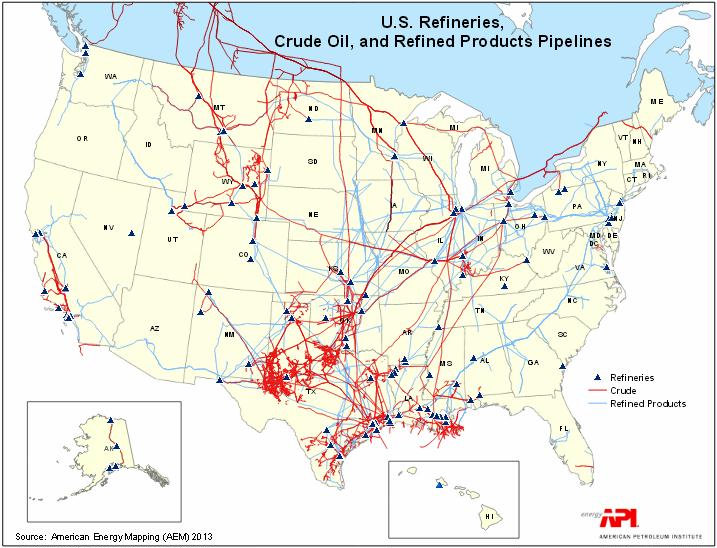
The scale of the supply chain is large and touches every corner of the country. For example, approximately 168,000 miles of pipeline combine to deliver crude oil from producing fields and import hubs to refineries and products from refineries to distribution terminals. This infrastructure combined with linkage to an even larger global supply chain provides efficiency and diversity. Due to ease of transport, hydrocarbon liquids can be shifted globally and regionally in response to market forces and disruptions.

U.S. transportation fuel demand is approximately 14 million barrels per day (MMB/D). According to the Energy Information Administration’s (EIA) Annual Energy Outlook 2010 (AEO2010), gasoline for light-duty vehicles is 61% of the total. Although biofuel volumes have grown, petroleum-based hydrocarbons represent more than 95% of current supply on an energy content basis.

Unconventional oils are petroleum liquids not historically available to the supply chain due to low quality or restricted flow. Unconventional oil sources were traditionally more expensive than conventional resources but due to increasing oil price and technology improvements are becoming more competitive. Development of new unconventional oil plays is having a large impact on the U.S. supply chain leading to increased supply and investment. Unlike conventional oil, unconventional resources are most heavily concentrated in North and South America. North American unconventional resources include Canadian oil sands, Canadian heavy oil, U.S. oil sands, Canadian and U.S. tight oil, and U.S. oil shale.

The Venezuela Orinoco Heavy Oil Belt the predominant unconventional resource in South America. Application of technology is improving the prospects for development of unconventional oil, and such resources are playing an increasing role in North American oil production. The reader is referred to the 2011 NPC report for a more complete analysis on unconventional hydrocarbon supply and demand.

The process energy efficiency in converting natural gas to liquid products is 58–65%. There are GTL plants operating in Malaysia, South Africa,

Natural gas can also be converted to other transportation fuels such as methanol, dimethyl ether (DME), or methanol-to-gasoline (MTG). Both methanol and DME require significant fueling and vehicle infrastructure investments, which makes them less attractive than other liquid fuels produced from natural gas.

Methanol can also be used as a high-level blend with gasoline, but requires more extensive vehicle upgrading for use in a flexible-fueled-vehicle than ethanol. Since U.S. gasoline fuels currently contain up to 10% ethanol, addition of methanol would result in excessive fuel oxygen content. Therefore methanol would likely displace ethanol in the gasoline blend.

DME has high cetane and can substitute for diesel in compression ignition engines but would require significant vehicle and distribution infrastructure addition due to high vapor pressure (similar to LPG) and use of pressurized tanks.

Alternative hydrocarbon liquids can also be derived from coal. There are two main technologies available for coal conversion: indirect and direct liquefaction. Indirect liquefaction is similar to GTL. Coal is transformed into synthesis gas and then converted to liquid hydrocarbon fuels using the processes described above (FT diesel, MTG, methanol, DME). The direct liquefaction process shown in Figure 11-10 involves addition of hydrogen to coal to increase the hydrogen-to-carbon ratio from ~0.8 in coal to ~1.8 typical of various petroleum products. The potential for CTL is contingent on a number of factors: coal and petroleum prices, risk threshold, capital cost, and return on capital requirements. Coal is generally the least expensive fossil fuel but capital costs for CTL are higher than GTL due to extra steps needed to convert solid coal to synthesis gas.

Combined coal- and biomass-to-Liquids (cbtL). In this process, mixtures of coal and biomass are converted into liquid transportation fuels. The plant operates like a CTL plant except that biomass is gasified in addition to the coal. Coal provides the necessary scale, which improves economics compared to stand-alone biomass-to-liquids processes. Consolidating and transporting biomass is expensive, so the biomass fraction is generally limited to 15% of total input.

Liquid hydrocarbon fuels must have known and consistent properties for specific types of combustion systems.

Note: During World War II, the then-War Department delineated PADDs to facilitate oil allocation. Source: U.S. Energy Information Administration, “Number and Capacity of Petroleum Refineries,” as of January 1, 2010. TOTAL U.S. BARRELS PER DAY: 17,583,790 Art Area is 42p x 35p6 Figure 11-23. Fuel Refining Capacity by Petroleum Administration for Defense District (Barrels per Day)

Note: During World War II, the then-War Department delineated PADDs to facilitate oil allocation.
Source: U.S. Energy Information Administration, “Number and Capacity of Petroleum Refineries,” as of January 1, 2010.
TOTAL U.S. BARRELS PER DAY: 17,583,790
 
Figure 11-23. Fuel Refining Capacity by Petroleum Administration for Defense District
(Barrels per Day)


The refining industry also plays a role in other industrial value chains: asphalt for road construction and roofing, lubricants for use in transportation and industry, high-quality petroleum coke for use in the metals industry, waxes, solvents, and other products.

Many of these specialty products are difficult to manufacture and highly specialized.

Refinery processes can be divided into six categories: Separation of Crude Oil. 1. Separates crude into Restructuring Hydrocarbon Molecules. 2. Restructuring processes change molecular size or structure in a variety of ways. Some processes break apart bigger molecules while others combine small gas molecules to make liquids, and others change molecular structure. Treating. Examples are listed in Table 11-1.3. Treating processes are used to remove contaminants such as sulfur, nitrogen, and heavy metals, which are present in crude oil, blending Hydrocarbon Products. from various streams.

Refinery units are carefully integrated to provide high product yield with minimum waste and energy consumption. While each refinery is unique, refineries can be classified into three broad groups based on processing complexity, which in turn determines ability to convert crude oil into lighter transportation fuels. Hydro-skimming refineries contain a crude oil distillation unit (CDU) and naphtha reformers, which increase gasoline octane and produce hydrogen that can be used in desulfurization units. Medium conversion, or cracking, refineries have the same elements plus fluid catalytic cracking (FCC) and alkylation units, which allows greater conversion of crude oil to transportation fuels. High conversion refineries also have cokers, hydrocrackers, and hydrogen plants, as shown in Figure 11-22. High conversion refineries are common in the United States and convert large proportions of crude oil feedstock to transportation fuels and have greater ability to upgrade heavy or sour crude oil. Integration and optimization becomes more important as the number of process streams increase. Modern refineries contain networks of sensors, logic devices, and computers to control and optimize the complex reactions and flows within and among process and for logistics and planning of crude oil inputs and product output. industry State Geographic Distribution.

Many streams are blended to make gasoline and other hydrocarbon products.

Figure 11-28. Typical Refined Products Pipeline Batch Sequencing

Figure 11-28. Typical Refined Products Pipeline Batch Sequencing

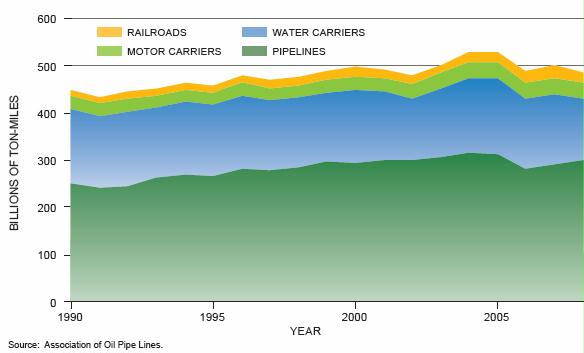
Approximately 75% of the existing pipeline infrastructure was constructed between 1940 and 1980. The average pipeline lifespan is 33 years (Humphreys).  Pipelines accounted for 71% of all petroleum transportation in 2008, up from approximately 54% in 1990.

Figure 11-30. Total Petroleum Product Movement

Figure 11-30. Total Petroleum Product Movement

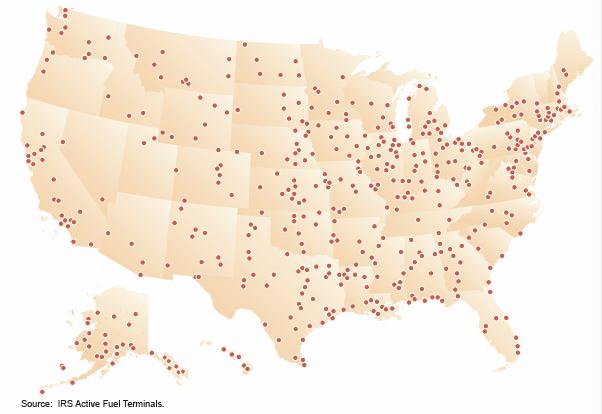
Figure 11-26. Major U.S. Product Terminals

Figure 11-26. Major U.S. Product Terminals


The Distribution of hydrocarbon liquid product terminals has grown to span the entire country, as shown in figure 11-26.

These terminals are located in demand centers and along pipeline routes to deliver hydrocarbon fuels and biofuels to the end customer. The legacy value of these terminals is significant, for a competing energy pathway to replicate this coverage and redundancy is a very large hurdle.

Depending upon the specifications of adjacent batches, it may be possible to downgrade the commingled product interface between two batches into a succeeding lower quality material (such as premium gasoline into regular gasoline). Downgrading from one batch to another cannot always occur. In those situations it becomes necessary to segregate the interface (called transmix) and arrange for it to be sent back to the refinery or other processing facility. Today, pipelines are controlled by the use of computers often referred to as programmable logic controllers (PLCs). The data from the PLCs are transferred by secured wide-area network to a centralized database. The data are then compiled and formatted in such a way that a control room operator can make decisions to start or stop the pipeline, adjust flow rates, raise or reduce the operating pressure, as well as open and close valves. The system of computers and the communications network is collectively referred to as a Supervisory Control and Data Acquisition (SCADA) system. The SCADA system can also feed various real time data into business computers to support pipeline scheduling, product accounting, and other business functions (Figure 11-29).

The volumes and the percentage of products transported within the Association of Oil Pipe Lines (AOPL) data do not include ethanol. Pipeline operators have been reluctant to ship ethanol, or gasoline-ethanol blends on a commercial scale due to ethanol’s corrosive properties and water solubility. Ethanol will clean the internal surfaces of a pipeline and can result in the pipeline becoming more susceptible to internal stress corrosion cracking, which is difficult to detect and manage. Likewise, ethanol has an affinity for moisture and is completely soluble in water. Water enters the pipeline system through terminal and refinery tank roofs and can be dissolved in fuels during the refining process. If the ethanol or gasoline-ethanol blend picks up water in the pipeline, it could “phase separate” resulting in off-specification product. An E10 gasoline-ethanol blend can typically contain up to 0.5 volume percent water at 60 F before phase separation occurs. Lesser amounts of water can induce separation at lower temperatures. Also, lower blend levels of ethanol such as 5.7% or 7.7% tolerate less water.

Trains, trucks, and water carriers are the primary means by which ethanol is transported from origin to market. The majority of the ethanol production is in the Midwest, with the heaviest demand along the East Coast, West Coast, and Southeast. In 2005, approximately 75% of ethanol produced was transported by rail. Implementation of the Renewable Fuel Standard calls for ethanol consumption to increase to 36 billion gallons (2.4 MMB/D) in 2022.

The ability to ship ethanol by pipeline or unit trains will be important to ensuring quick and affordable ethanol shipments. Unit trains are a more efficient mode of transportation than single manifest cars; however, the transportation of ethanol from trans-loading facilities to terminals by truck may become problematic in terms of highway congestion and air emissions. Technology improvements to address ethanol’s water affinity and corrosion issues could result in the wider use of pipelines to transport ethanol. The construction of new pipeline infrastructure or the expansion of existing pipeline infrastructure can be costly when considering right-of-way acquisition, intermediate tanks and terminals, as well as permits. Although this section of the report focuses on ethanol, the same issues are present when discussing the introduction, infrastructure, and logistics of other biofuels.

Conventional oil is increasingly located in remote areas or geographically concentrated in a few countries with large remaining resources. Access to these resources, technology development, and safe and environmentally sound operations are critical to meeting projected increases in demand. Unconventional resources are also important, with technology development to reduce cost and improve environmental Prudent Development performance an important challenge. The crude oil production profiles shown in Figure 11-19 foresee an increase in North American unconventional oil production. The crude oil slate shift will provide an incentive for upgrading of heavy crude oil in existing infrastructure. The most efficient disposition of this heavy crude oil production will likely be in existing high conversion refineries discussed previously in this chapter.

As the crude oil profiles change, so will the demand barrel as illustrated in the Reference and Alternative scenarios shown in Figure 11-31. The AEO2012 Early Release and the IEA outlooks show the potential pressure on refined gasoline from a volume and yield perspective due to light-duty fleet efficiency, increased biofuels, and growth in diesel for medium-/heavy-duty vehicles. The challenge for refining will be to make the product slates required by customer demands. Although the changes are substantial in some outlooks, they occur over a very long period, giving industry time to respond. The flexibility of the refinery fleet to manage this shift will be discussed in the next section.

Refinery Capability to Address Shape of Barrel Shifts

The U.S. refining industry has responded in the past to changing customer demand by shifting refinery yields.

Figure 11-31. Demand Shifts in Various Outlooks versus 2010

The result has been a higher overall yield of gasoline and diesel, with an increasing diesel fraction (see Figure 11-33).

The results of an EIA study show that U.S. refineries have the ability to increase annual average distillate yields on crude oil and unfinished oil inputs 3 to 5% with no or small investments for distillation improvements. There should be no near-term constraint in meeting slowly increasing distillate consumption, given the capability to adjust to market demands as evidenced in previous cycles and recent additions to capacity. In fact, distillate yield increases will likely enable U.S. refiners to increase distillate exports when economics are attractive.

According to the IEA’s 2010 World Energy Outlook, very large infrastructure investments will be needed globally to meet projected future oil demand, roughly $8 trillion over a 25-year period, as shown in Table 11-2. Most of the investment will occur outside OECD countries to find and develop new sources of oil production.

Spending in the United States is projected to be only 11% of the global total. The total cost of new infrastructure is roughly $10 per barrel produced and processed

Refinery capital investment will be required to: Upgrade capacity to meet increasing diesel demand Increase production of low sulfur distillate and marine fuel. Process heavy crudes over the 25-year outlook period.

Table 11-3. Key Variables for XTL Comparisons. CTL and BCTL cost over twice as much as GTL

Table 11-3. Key Variables for XTL Comparisons. CTL and BCTL cost over twice as much as GTL


Table 11-4. Alternative/Renewable Capital Infrastructure Requirements

Table 11-4. Alternative/Renewable Capital Infrastructure Requirements


Major service station components that may need to be upgraded include: fuel dispensers, pumps, piping, and storage tanks. A wide range of costs is possible, depending on service station design and how much equipment needs to be replaced. Replacing a single dispenser costs $17,000 to $40,000. To replace underground equipment involves permitting and higher costs. Costs for a single dispenser and storage tank range from $71,000 to $185,000. Costs would be higher to upgrade an entire station. A typical station has four or more dispensers and two or more storage tanks.

There were 161,000 service stations in the United States in 2008, equivalent to 0.65 fueling stations per 1,000 vehicles. A typical dispenser lifetime is 10 years, while a storage tank can last 30 years.

Fatty acid methyl ester (FAME) biodiesel are not currently blended in refineries or shipped in most pipelines. This increases transportation cost relative to gasoline and diesel.

To improve distribution economics, biofuels would require additional processing either in stand-alone units or potentially as a refinery feedstock. Use of biomass-derived feedstock in refineries raises a number of issues. First, such stocks contain significant amounts of oxygen that must be rejected as water that refineries are not designed to handle. Second, pyrolysis of biomass to produce bio-oil yields many unstable compounds that refineries are not designed to process or remove. Third, many bio-derived nitrogen and oxygen compounds are poisons to the catalysts employed in the refining process. In addition, removal of the nitrogen, oxygen, sulfur, and unstable compounds requires hydrogen, which will increase supply costs at a refinery.

These hurdles will limit the amount of biomass-derived feedstock existing refining infrastructure can handle.

Potential for Hydrocarbon Liquids Production from Coal and Gas Resources. The conditions under which a large domestic industry to convert gas, coal, and biomass to liquids (XTL) might develop were investigated. Because few such plants have been constructed worldwide, there is considerable long-term uncertainty in the economics of XTL relative to petroleum and the large potential resource.

There is a considerable range of estimates of capital costs for the GTL plants that have been built and for those still in construction or in the planning stage. This range is between about $35,000/daily barrel for the Sasol Oryx plant that was constructed over 5 years ago and about $200,000/daily barrel for the Escravos plant in Nigeria. The Escravos project is expected to cost $8.4 billion for 33,000 barrels per day of GTL liquids product, and is 70% complete (although it was originally expected to cost ~$3 billion). The large Shell Pearl GTL plant that has recently completed construction in Qatar will produce 140,000 barrels per day of FT fuels and about 120,000 barrels per day of natural gas liquids. This plant is expected to cost in the region of $18 billion. There are many reasons for this large range including plant size, location, timing, project scope, products, gas processing needed, financing assumptions, etc.

Figures 11-35 and 11-36 show estimates of the RSP of diesel fuel produced from CTL and CBTL plants sized to produce 50,000 barrels/day of diesel fuel and naphtha based on the capital costs Zeus Syngas Refining

Carbon capture and storage (CCS) is used to capture the carbon dioxide produced during the conversion process. Note that CCS has a moderate impact on plant costs representing about 10% of capital expense. The base CTL capital cost is assumed to be $150,000/daily barrel and the high Capex is $300,000/daily barrel. If the coal price is $1.50/million BTU (equivalent to about $35 per ton) the RSP on a crude oil equivalent basis would be $120/barrel for the base Capex. For the high Capex case it would be over $220/barrel. The base CBTL capital cost is assumed to be $157,000/ daily barrel and the red line shows the high Capex case ($314,000/daily barrel). If the coal price is $1.50/ million BTU (equivalent to about $35 per ton) the RSP on a crude oil equivalent basis would be about $130/barrel for the base Capex. For the high Capex case, it would be over $230/barrel. In all cases, the potential Supply curves for xtL biomass feedstock cost was assumed to be constant at $71/dry ton.

The assumptions regarding Capex have a large effect on the RSP and hence on the economic viability of CTL and CBTL. Note that coal provides the necessary scale, which improves economics compared to stand-alone BTL. Transporting biomass is expensive so a BTL plant would operate at much smaller scale and much higher $/barrel capital cost than the CBTL plant analyzed here.

Figure 11-37 shows estimates of the RSP of diesel fuel (crude oil equivalent basis) produced from a GTL plant sized to produce 34,000 barrels per day of diesel and naphtha from about 300 million standard cubic feet per day of natural gas. With natural gas at $5.00/million BTU, the cost for diesel from a GTL plant with a capital cost of $70,000/ daily barrel is estimated to be about $90/barrel. If natural gas prices escalate to $10/million BTU, then the RSP on a crude oil equivalent basis increases to about $130/barrel. Costs are much higher for the high Capex case.

Figure 11-38 shows two potential diesel fuel supply curves for XTL to 2050. The gold curve uses the low capital cost case, and red the high cost case. Both cases assume the AEO2010 Reference Case for oil, gas, and coal pricing. As discussed above, projected volumes are sensitive to capital costs and relative costs of petroleum, gas, and coal. In the low capital cost case, a sizeable XTL industry develops producing 2 MMB/D of diesel by 2050. This represents 65% of U.S. highway diesel in the Reference Case and 26% of all distillate and would have a significant impact on oil imports and refining. Using the AEO2010 price outlook, GTL is more economic than CTL or CBTL. Roughly 70% of the XTL is from GTL. However, under the high Capex case, no XTL is produced. As expected, forecast oil prices also impact projected volumes. With low oil prices, no XTL is produced under the low oil price case, while 3 MMB/D is produced under the high oil price scenario. Based on this analysis, XTL can be considered a backstop that could supplement petroleum under certain economic conditions.

Production of alternative and renewable fuels will require varying levels of capital investment to integrate into the existing hydrocarbon fuels distribution system. This investment is above and beyond that required for fuel production and will depend upon whether the product meets current fuel specifications when used in existing infrastructure at high concentrations (neat) or as a blend product. Such fuels are referred to as “drop in” fuels. Specific capital required to establish alternative and renewable fuel manufacture is described elsewhere in this report. A qualitative summary of the infrastructure integration capital required for each fuel pathway is shown in Table 11-4.

Considering the large lower-cost resource base, and the legacy investment in refineries, existing infrastructure, and plentiful dispensing network, hydrocarbon liquids can be expected to continue to provide the majority of transportation fuel for the outlook period.

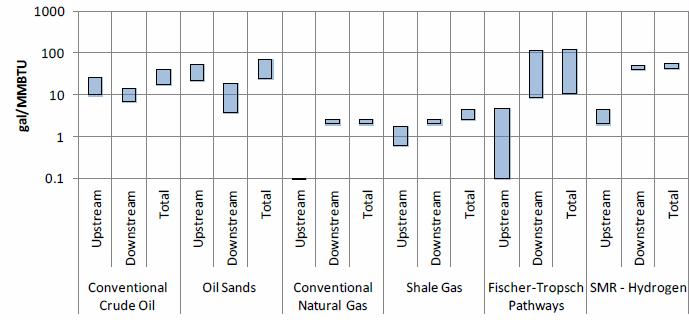
GHG emissions associated with use of hydrocarbon liquids are best analyzed on a well-to-wheel (WTW) basis, which includes emissions associated with production, refining, transportation, and use of hydrocarbon liquids. WTW GHG emissions for gasoline, as predicted by the GREET model, are shown in Figure 11-39. The petroleum life-cycle upstream of the vehicle is efficient and most of the energy content of petroleum is retained in the finished fuel such that over 80% of GHG emissions are associated with vehicle fuel use. Most of the remainder results from fuel production, which includes refining and product transportation. Feedstock production from crude oil production and transportation has the smallest emissions. As shown in Figure 11-39, improving vehicle efficiency can lower permile emissions significantly. Any reduction in demand reduces both vehicle and fuel-cycle emissions upstream of the vehicle.

References

Alberta Energy Research Institute. Life Cycle Emission Comparison of North American and Imported
Crudes. Prepared by Jacobs Consultancy and Lifecycle Associates, July 2009.

American Petroleum Institute. API RFS2 Comments, Attachment 4: E85 Retail Fueling Cost Study. 2009.

Association of Oil Pipe Lines and American Petroleum Institute. “In the Pipe” (newsletter). April 2006.

Association of Oil Pipe Lines. Liquid Pipeline Industry in the United States, Where It’s Been: Where It’s Going. April 2004.

Association of Oil Pipe Lines. Report on Shifts in Petroleum Transportation: 1990–2009. February
2012. http://www.aopl.org/pdf/AOPL_Shift_Report_Press_Release_Feb_7_20121.pdf.

Borensztein, Eduardo, and Carmen M. Reinhart. The Macroeconomic Determinants of Commodity Prices. University of Maryland. 1994.
BP. BP Statistical Review of World Energy. June 2011.

Clean Fuels Foundation and the Nebraska Ethanol Board. In cooperation with the U.S. Department of
Agriculture. E85 and Blender Pumps: A Resource Guide to Ethanol Refueling Infrastructure. 2011.

CME Group. The Role of WTI as a Crude Oil Benchmark. January 2010.

The Conference Board of Canada. “Getting the Balance Right: The Oil Sands, Exporting and Sustainability.” Briefing January 2010.

Congressional Research Service. Intermediate-Level Blends of Ethanol in Gasoline, and the Ethanol “Blend Wall.” October 2010.

Congressional Research Service. The U.S. Oil Refining Industry: Background in Changing Markets and
Fuel Policies. November 2010.

Europia. “White Paper on EU Refining.” 2011.

GREET Model: The Greenhouse Gases, Regulated Emissions, and Energy Use in Transportation
Model, Argonne National Laboratory. http://greet.es.anl.gov/.

Humphreys, S. June 2010. Economic Outlook Brightens For Pipeline Coating Developments. Pipeline and Gas Journal. Vol. 237 No. 6

Iandoli, Carmine L., and Signe Kjelstrup. “Exergy Analysis of a GTL Process Based on Low-Temperature Slurry F-T Reactor Technology with a Cobalt Catalyst,” Energy Fuels 21, no. 4 (2007):pages 2317-2324. http://www.chem.ntnu.no/nonequilibrium-thermodynamics/pub/176-Iandoli-EnergyFuels.pdf.

International Energy Agency. World Energy Outlook 2008.

International Energy Agency. World Energy Outlook 2010.

Japan Clean Air Program (JCAP). 4th JCAP Conference, June 1, 2005, Session 2 “3. CO2 Emissions
Study Workgroup Report.” http://www.pecj.or.jp/english/jcap/jcap2/jcap2_4th.html.

Japan Clean Air Program (JCAP). 5th JCAP Conference, February 22, 2007, Session 1, “2. Gasoline
Work Group Report.” http://www.pecj.or.jp/english/jcap/jcap2/jcap2_5th.html.

Jessen, Holly. “Riding the Rails.” Ethanol Producer Magazine. October 2006.

Kheshgi, Haroon S., Hans Thomann, Nazeer A. Bhore, Robert B. Hirsch, Michael E. Parker, and Gary
Teletzke. “Perspectives on CCS Cost and Economics,” SPE International Conference on CO2 Capture,
Storage, and Utilization, New Orleans, LA. November 2010.

Laboratory for Energy and Environment, MIT, Factor
of Two: Halving the Fuel Consumption of New US
Automobiles by 2035, 2007.

National Academy of Sciences, National Academy of Engineering, and National Research Council of
the National Academies, Liquid Transportation Fuels from Coal and Biomass: Technological Status,
Costs, and Environmental Impacts. 2009.

National Association of Convenience Stores. Challenges Remain Before E15 Usage is Widespread.
2011. http://www.nacsonline.com/NACS/Resources/campaigns/GasPrices_2011/Pages/
ChallengesRemainBeforeE15UsageIsWidespread.aspx.

National Energy Technology Laboratory and U.S. Department of Energy, Affordable, Low-Carbon
Diesel Fuel from Domestic Coal and Biomass, DOE/NETL 2009/1349. 2009.

National Petroleum Council. “Appendix C: History and Fundamentals of Refining Operations.” In U.S.
Petroleum Refining. June 2000.

National Petroleum Council. “Appendix D: The U.S. Petroleum Distribution System (A Tutorial).” In U.S. Petroleum Refining. June 2000.

National Petroleum Council. Hard Truths: Facing the Hard Truths about Energy. 2007.

National Petroleum Council. Prudent Development: Realizing the Potential for North America’s Abundant Natural Gas and Oil Resources. 2011.

National Petroleum Council. U.S. Petroleum Refining – Assuring the Adequacy and Affordability of Cleaner Fuels. 2000.

Petroleum Equipment Institute. Compatibility Assessment Survey. 2008.

Shell (website). “Pearl GTL: An Overview.” 2011. http://www.shell.com/home/content/aboutshell/
our_strategy/major_projects_2/pearl/overview/, and references in that website.

Solomon Associates, private communication.

U.S. Department of Energy, Alternative Fuels Data Center (website). “Propane.” http://www.afdc.
energy.gov/vehicles/propane.html.

U.S. Department of Energy, Oak Ridge National Laboratory, “Chapter 4” in Transportation Energy Data Book. http://cta.ornl.gov/data/chapter4.shtml.

U.S. Energy Information Administration. “Atlantic Basin Refining Dynamics from U.S. Perspective.”
Presentation by Joanne Shore and John Hackworth at Platts 4th Annual European Refining Markets
Conference, September 2010.

U.S. Energy Information Administration. Annual Energy Outlook 2010—With Projections to 2035.
April 2010.

U.S. Energy Information Administration. Annual Energy Outlook 2011—With Projections to 2035.
April 2011.

U.S. Energy Information Administration. Annual Energy Outlook 2012 Early Release. December 2011.

U.S. Environmental Protection Agency, and National Highway Traffic Safety Administration.
Draft Regulatory Impact Analysis, Proposed Rulemaking to Establish Greenhouse Gas Emissions
Standards and Fuel Efficiency Standards for Medium- and Heavy-Duty Engines and Vehicles,
October 2010. http://www.epa.gov/otaq/climate/regulations/420d10901.pdf.

U.S. Environmental Protection Agency, National Highway Traffic Safety Administration, and California
Air Resources Board. Interim Joint Technical Assessment Report: Light-Duty Vehicle Greenhouse
Gas Emission Standards and Corporate Average Fuel Economy Standards for Model years 2017-2025. September 2010. http://www.epa.gov/otaq/climate/regulations/ldv-ghg-tar.pdf.

U.S. Environmental Protection Agency, Office of Air Quality Planning and Standards. Available and
Emerging Technologies for Reducing Greenhouse Gas Emissions from the Petroleum Refining Industry. October 2010.

U.S. Environmental Protection Agency. Draft Regulatory Impact Analysis: Changes to Renewable Fuel
Standard Program, Section 4.2.1.1.6. May 2009.

Valero (website), Industry Fundamentals. “Basics of Refining and Coking.” January 2011.

Zeus Intelligence, Zeus Syngas Refining Report,
March 1, 2011. Similar estimates have been published.

Posted in Coal to Liquids (CTL), GTL Gas-To-Liquids, Oil | Tagged , , , , , | Comments Off on Hydrocarbon liquids, drop-in fuels, oil refining, oil distribution, GTL, CTL

Turlock AB 2514 California Energy Storage

Notes from 29 page: Turlock Irrigation district Energy Storage Study. 2014. Willie G. Manuel 9/17/2014

Recommendation. The analysis performed shows that the benefits of deploying various types of storage systems fall short of the capital cost of such systems. Furthermore, except for pumped storage systems, there is limited operational history on utility scale storage systems. Hence there is limited data on performance degradation, operation and maintenance expense, and the life of storage systems in utility applications. Given that the analysis show that storage systems are currently not cost effective and that there is limited operating history, staff recommends that the Board make a determination that it is not appropriate to adopt energy storage procurement targets at this time.

Li-on batteries typically have a life of 15-20 years and round trip efficiencies of about 83%.

This battery technology is currently the fastest growing segment for stationary storage

applications. They have been deployed in a wide range of utility energy-storage applications, ranging from a few kilowatt-hours in residential systems with rooftop photovoltaic arrays to multi-megawatt containerized batteries for the provision of grid ancillary services. Currently there are roughly 83 MW of Li-on based storage systems in operation in the United States.

Sodium sulfur batteries (“NAS”) use electrochemical reactions between sodium and molten sulfur to charge and discharge. They operate at fairly high temperature of about 300-350oC, are highly corrosive, have low power-to-energy ratios, life of 15 years, and round trip efficiencies of about 75%. There are currently 12 MW of NAS batteries that have been installed by U.S.utilities with about another 9 MW in-progress. Globally, there is 316 MW of NAS installed to date.

Flow batteries use a liquid electrolyte and an electrochemical cell to store/generate electricity. The liquid electrolyte is stored externally and pumped through the cell. This allows the energy capacity of the battery to be increased at a moderate cost making them suitable for long duration applications. These types of batteries are expected to last about 15 years and have round trip efficiencies of 70-80%. Relative to integrated battery technologies such as the Li-on and NAS, flow batteries tend to have a larger footprint due to the need for flow system components. Historically, flow batteries can experience irreversible capacity loss over time and thus have not been widely used.

The vanadium redox system is the more mature type of flow battery. In the United States, there is a total of 1 MW of flow battery based storage systems operational.

Some of the key advantages of flywheel energy storage are low maintenance, long life (some flywheels are capable of well over 100,000 full depth of discharge cycles and the newest configurations are capable of greater than 175,000 full depth of discharge cycles), and negligible environmental impact. They have high energy density and substantial durability whichallows them to be cycled frequently with no impact to performance. They also have very fast response and ramp rates. They generally can respond to regulation signals in milliseconds and can go from full discharge to full charge within a few seconds or less. Round trip efficiencies are between 70-80%. Flywheel energy storage systems (FESS) are well suited for high power, relatively low energy applications such as power quality maintenance and frequency response.

There are two flywheel installations operating in the United States for a combined total of 32 MW.

Compressed air energy storage (“CAES”) has been used since the 1870’s. However, the first utility scale deployment came online in the 1970’s. CAES stores energy by compressing and storing ambient air under pressure (typically at 1,015 psia) in an underground cavern or above ground pressure vessels or pipes. To generate electricity, the pressurized air is heated and expanded in a turbine that drives a generator.

There are currently only two operating utility sized CAES plants, the 321 MW plant in Huntorf, Germany (operating since December 1978) and the 110 MW plant in McIntosh, Alabama (with 18 years of operating history). These systems typically have round trip efficiencies of 42-55%.

Salt caverns in deep salt formations have traditionally been used. The use of natural aquifers and depleted natural gas fields are currently being studied. 3.4.

Thermal 3.4.1. Ice Thermal Ice storage supplements existing HVAC systems by creating ice during the off-peak periods which is then used during the on-peak periods to reduce the cooling load of the HVAC system.

There are currently 36 MW of ice storage systems online in the United States. These systems are designed to last 20-25 years.

Solar Thermal Solar thermal power plants store energy by heating a medium (typically oil or molten salt) to store thermal energy and later using such medium to generate steam that drives a turbine to produce electricity. In 2013 the 280 MW Solana Generation Station in Arizona came online. The project consists of a concentrated solar plant using parabolic trough coupled with six hours of storage capacity using molten salt. The 150 MW Rice Solar Energy Project to be located in Riverside County, CA also will consist of a concentrated solar plant coupled with molten salt thermal storage. The project is expected to be online in 2016.

Pumped Hydro Pumped hydro is one of the most established energy storage technologies and has been used since the 1920s. Energy storage is achieved by pumping water uphill (typically during the off-peak low energy cost periods) to an upper reservoir. When energy is needed the water pumped uphill is released and allowed to flow downhill through a hydro turbine. Pumped storage power plants are unlike traditional hydroelectric power plants in that they are a net consumer of electricity, due to hydraulic and electrical losses incurred in the cycle of pumping from lower to upper reservoirs. These plants typically have round-trip efficiencies of 76-85%.

Time-of-Day Arbitrage In this application, the storage device is charged during periods when electricity prices are lower (generally during the off-peak periods) and discharged during periods when electricity prices are higher (generally during the on-peak periods). This application also allows for efficient operations of baseload generation resources. Often baseload generation has to be operated at less efficient output levels during the off-peak periods. Installing a storage system may allow a baseload generation to generate at a higher output (more efficient) level during the off-peak periods resulting in fuel cost savings.

Peak Capacity. A storage system can be used to serve peak load and thus reducing the need for capacity from traditional generating resources. In this application, the storage system is charged in low load periods and discharged during the high load periods. This is somewhat similar to the previous application since generally low electricity prices occur during the low load (off-peak) periods and high electricity prices occur during the high load (on-peak) periods. This application also allows for efficient operations of baseload generation.

Ancillary Service. Western Electricity Coordinating Council (“WECC”) regulations require us to maintain minimum operating reserves that consist of regulating, spinning, and non-spinning reserves. Storage systems could be used to provide regulation, spinning, and non-spinning reserves and therefore freeing up capacity on existing generating resources for other uses such as power sales or reducing the need for additional generating capacity.

Load Following and Renewable Integration. In order to balance supply and demand, generator output is constantly varied to match demand. At TID, generally the output of Don Pedro or Walnut Energy Center (“WEC”) is varied up or down in order to balance the system. The constant movement of output puts additional wear and tear on the power plants particularly thermal units such as WEC.

Storage systems can be used to assist in balancing system supply and demand. The presence of intermittent resources (such as wind or solar) in a system presents additional challenges to balance supply and demand in an electric system. Storage systems can be located at or near intermittent resources to smooth the output from the intermittent resource prior to it entering the electric system thereby reducing system imbalance.

Voltage Support Storage systems could be used to assist in maintaining the electric grid’s voltage in lieu of traditional tools such as generators, capacitors, and voltage regulators.

Black Start. During catastrophic grid failures, a storage system can be used to energize the grid and provide station power so power plants can be brought back on-line. In this application, the storage system is charged and remains charged until a grid failure occurs.

Transmission and Distribution Upgrade Deferral. Transmission and distribution (“T&D”) facilities generally do not operate close to their capacity. In most cases the load on a T&D facility only approach capacity limits a few hours a year. Rather than increasing the capacity of the T&D facility that is reaching its limits, a storage device could be used to serve a portion of the load during the few peak hours in a year thereby delaying and possibly avoiding T&D upgrades. Hence, installing a storage system allows the T&D capacity to be optimized and could extend the life of the T&D facilities since the facility is not subjected to higher loading. Storage systems could also be designed to be mobile and therefore could be move around an electric utility system where it is needed. For example, a storage system could be installed to defer upgrades to a substation. Once that substation is eventually upgraded the storage system could then be moved to another substation.

Lithium-Ion Battery (without Regulation Reserve Sales) In this scenario we model a 30 MW Lithium Ion battery (“30 MW Li-on”) with 2 hour duration that can provide capacity, energy, regulation, spinning reserve, and non-spinning reserve. Sales of energy, spinning reserves, andnon-spinning reserves from TID’s generation resources and the storage system are permitted in this scenario. However, sales of regulation reserves are not permitted which reflects current operations. Below are the assumptions used for the 30 MW Lion: Technology Lithium Ion Capacity 30 MW Duration 2 Hours Capital Cost $1,800/kW ($900/kWh) Fixed O&M Cost $10/kW-yr Variable O&M Cost $0.3/MWh Project Life 20 years Battery Replacement Cost $244/kWh Battery Replacement Yr of Occurrence 11th year Roundtrip Efficiency 83% Debt Interest Rate (20 Yr Term) 4% Debt Interest Rate (10 Yr Term) 3% O&M Escalation Rate 2%/yr

As shown in Chart 1 below, adding a 30 MW Li-on into TID’s resource portfolio increases TID’s Net Purchase Power Cost (“NPP”) by $0.9-3.0 million per year. The 30 MW Li-on provided energy, capacity, regulation reserve, spinning reserve, and non-spinning reserve. However, the reduction in variable costs due to the addition of the 30 MW Li-on was less than the annual fixed cost of the 30 MW Lion (see Chart2 below).

Technology Lithium Ion Capacity 50 MW Duration 2 Hours Capital Cost $1,800/kW ($900/kWh) Fixed

O&M Cost $10/kW-yr Variable O&M Cost $0.3/MWh Project Life 20 years Battery Replacement Cost

$244/kWh Battery Replacement Yr of Occurrence 11th year Roundtrip Efficiency 83% Debt Interest

Rate (20 Yr Term) 4% Debt Interest Rate (10 Yr Term) 3% O&M Escalation Rate 2%/yr Adding the 50

MW Li-on into TID’s resource portfolio increased TID’s NPP by $2.0-5.2 million per year (see

Chart 1 above) again due to the fact that the savings in TID’S NPP is less than the annual fixed cost of the storage system (see Chart 3 below).

As can be seen from Chart 4, Chart 5, and Chart 6 below, permitting regulation reserve sales increase the value of the Li-on storage system because of higher value regulation reserve sales. However, despite allowing the higher value regulation reserve sales, adding the 30 MW Li-on and 50 MW Li-on into TID’s resource portfolio increases NPP by $0.6-2.6 million per year and by $1.2-4.4 million per year respectively. Chart 4

Flywheel As mentioned earlier, flywheel energy storage systems are well suited for high capacity low power quick response applications such as regulation. In this study we modeled a 30 MW flywheel with a 0.25 hour (“Flywheel”) that can provide capacity, energy, regulation, spinning reserve, and non-spinning reserve. Similar to the analysis done for the Li-on, the Flywheel was analyzed with and without regulation reserve sales. Below are the assumptions used for the Flywheel: Technology Flywheel Capacity 30 MW Duration 0.25 Hours Capital Cost $2,000/kW

($8,000/kWh) Fixed O&M Cost $5.8/kW-yr Variable O&M Cost $0.3/MWh Project Life 20 years

Roundtrip Efficiency 81% Debt Interest Rate (20 Yr Term) 4% Debt Interest Rate (10 Yr Term) 3%

O&M Escalation Rate 2%/yr Adding the Flywheel to TID’s resource portfolio increased TID’s NPP by $3.5 to 4.0 million per year without regulation sales modeled (see Chart 7 below), and by $3.3-4.0 million per year with regulation sales (see Chart 8 below). The

Flywheel provided energy, capacity, regulation reserve, spinning reserve, and non-spinning reserve. But, similar to the Li-on, the benefit (reduction in variable cost) provided by the Flywheel did not exceed the additional annual fixed cost of the Flywheel (see Chart 9).

Furthermore, the Flywheel provides minimal capacity value since it only had 0.25 hour duration.

Chart 7 Net Purchase Power Cost ($ Mil) $150.0

Thermal Storage. For this analysis, we assumed that 1,000 Ice Bear systems are deployed in the TID service area. The Ice Bear systems reduce afternoon cooling load by 6 MW combined for six hours. Below are the assumptions used for the Ice Bear systems: Technology Capacity Duration Capital Cost Fixed O&M Cost Variable O&M Cost Project Life Roundtrip Efficiency Debt

Interest Rate (20 Yr Term) Debt Interest Rate (10 Yr Term) Ice Thermal Storage 6 MW (combined)

  1. 00 Hours $1,700/kW ($284/kWh) $54/kW-yr NA 20 years 120% 4% 3% O&M Escalation Rate 2%/yr

As shown in Chart 10 and 11 below, deploying the Ice Bear systems resulted in an average increase in the NPP by $0.2 million per year. Similar to other energy storage technologies studied, the reduction in variable costs achieved due to the Ice Bear systems were less than the fixed costs of the Ice Bear systems deployed (see Chart 12 below).

5Transmission and Distribution Upgrade Deferral. When a substation approaches its limits generally a new transformer or new substation are added. Storage systems can be used to defersuch distribution system upgrades. For this analysis, we used the following assumptions:

Substation Size 25 Mva

New Substation Cost $6,000,000

New Transformer Cost $1,000,000

Substation Annual Load Growth 1.0% Technology Lithium Ion Capital Cost $1,800/kW ($900/kWh)

Fixed O&M Cost $10/kW-yr Variable O&M Cost $0.3/MWh Project Life 20 years Battery Replacement

Cost $244/kWh Battery Replacement Yr of Occurrence 11th year Roundtrip Efficiency 83% Debt

Interest Rate (20 Yr Term) 4% Debt Interest Rate (10 Yr Term) 3% O&M Escalation Rate 2%/yr

A review of historical substation loading shows that in order to effectively reduce the peak loading on a substation by 0.5 MW the storage system has to be able to discharge a minimum of 3 hours and to effectively reduce peak loading by 1.0 MW the storage system has to be able to discharge a minimum of 5 hours. Assuming an annual load growth of 1.0%, a 25 Mva substation’s load will grow 0.25 MW per year. Therefore, a 0.5 MW-3 hour duration storage system could defer a substation upgrade for 2 years and a 1.0 MW-5 hour duration storage system could defer a substation upgrade by 4 years. Deferring the installation of a 25 Mva substation results in an annual savings of $240,000/yr ($6,000,000 x 4%). The capital cost of a 0.5 MW-3 hour duration storage system is $1,350,000. Since the storage system can only defer the substation upgrade by

2 years the savings realized by deferring the substation upgrade is not sufficient to pay for the storage device. A 1 MW-5 hour duration storage system will have a capital cost of

$4,500,000. Since the storage system can only defer the distribution system upgrade by 4 years the savings realized by deferring the substation upgrade is not sufficient to pay for the storage device. Also, the savings calculated above assumed a new substation was installed. If a new transformer is added instead, the annual savings would be reduced from $240,000/yr to $40,000/yr ($1,000,000 x 4%) making the storage system an even less economic solution for the purpose of deferring the distribution upgrade. Some storage systems are designed such that theycan be moved to different locations to defer upgrades on several substations. But at current storage system cost, one would have to defer upgrades at more than a few substations to become cost effective. Even if a mobile storage system prove to be a cost-effective way to defer transmission and distribution upgrades there are currently no anticipated upgrades needed in TID’s transmission and distribution system that can be deferred by installing a storage system.

For example, TID has 22 distribution substations and only 2 experience peak loads that reach 80% of capacity.


Posted in Battery - Utility Scale | Comments Off on Turlock AB 2514 California Energy Storage

Carbon capture and storage (CCS) technology roadmap 2013 IEA

Notes from 63 page: IEA. 2013. Technology Roadmap Carbon capture and storage (CCS). International Energy Agency.

A total cumulative mass of approximately 120 Gt CO2 would need to be captured and stored between 2015 and 2050, across all regions of the globe.

Large-scale networks that transport billions of ton of CO2 annually between capture facilities and storage sites, within the same region and further afield, will need to be available to facilitate this rate of storage.

The total undiscounted investment in CCS technology from now until 2050 in the 2DS would amount to USD $3.6 trillion.

Demonstration is therefore an essential intermediate technical step with reduced risk exposure that facilitates learning-by-doing and culminates in a technology that can be sold in the marketplace with performance guarantees bankable for investors. Individual demonstration projects need be only at a scale that is sufficiently large to be representative of commercial operation. This provides the marketplace and the engineering community with new information on equipment performance,

Progress, although insufficient, has been made on a variety of fronts between 2009 and 2013 towards meeting some of the short-term milestones set in the IEA 2009 CCS roadmap,

Despite significant activity in some industrial areas, notably gas processing, CCS action in a number of key industrial sectors is almost totally absent (IEA/UNIDO, 2011). There is a dearth of projects in the iron and steel, cement, oil refining, biofuels and pulp and paper sectors. Only 2 possible demonstration projects at iron and steel plants, and one at coal-to-chemicals/liquids plants, are at advanced stages of planning (Global CCS Institute, 2013).

Save for use of CO2 in EOR, efforts in this area have not achieved meaningful results (Box 3). In addition to the challenge of achieving sufficient scale of CO2 use, quantifying any claimed reductions in net emissions – either through the long-term isolation of CO2 from the atmosphere or the displacement of additional fossil fuel use – is not always straightforward. This creates a substantial challenge to the business case for such applications. If it cannot be verified that the use of the captured CO2 permanently isolates it from the atmosphere, it is unlikely that the party capturing the CO2 would receive an economic benefit within a climate policy framework. The user of the CO2 would thus have to pay a price that covered the cost of capturing the CO2, and may furthermore need to agree to long-term contracts to provide sufficient certainty for the other party to invest in CO2 capture4.

In this same case, but when a carbon price is present and it is higher than the cost of CO2 capture and transport, the user of the CO2 would have to pay a price for the CO2 to cover the total penalty paid by the capturing facility, as the CO2 would be considered to be emitted. In another possible case, if a captured CO2 stream could be split between available geologic storage and utilization, the user may need to pay above the carbon price in order to make the sale of CO2 for utilization more attractive than its permanent storage.

Utilization of CO2has been proposed as a possible alternative or complement to geologic storage of CO2 that could enhance an economic value for captured CO2. Many uses of CO2 are known, although most of them remain at a small scale. Between 80 Mt and 120 Mt of CO2 are sold commercially each year for a wide variety of applications (Global CCS Institute, 2011; IPCC, 2005). These include use as chemical solvents, for decaffeination of coffee, carbonation of soft drinks and manufacture of fertilizer. Some of these applications, such as refrigerants and solvents, demand small quantities of much less than 1 MtCO2 per year (MtCO2/yr) while the beverage industry utilizes 8 Mt/yr. The largest single use is for enhanced oil recovery (EOR) which consumes upwards of 60 MtCO2/yr, mostly from natural sources (Box 5). Other emerging uses, such as plastics production or enhanced algae cultivation for chemicals and fuels, are still small scale or require years of development ahead before they reach technical maturity.

The main challenge is scale. Given today’s uses for CO2, the future potential of CO2 demand is immaterial when compared to the total potential of CO2 supply from large point sources (Global CCS Institute, 2011). Mineral carbonation and CO2 concrete curing have the potential to provide long-term storage in building materials. However, the mass of calcium carbonate that would result if the captured CO2 in the 2DS were used for carbonation would equate to nearly double the total projected world demand for cement between today and 2050.

Another challenge is what happens to the CO2 when it is used. In most existing commercial uses the CO2 is not permanently isolated from the atmosphere and does not assist climate change mitigation. Carbon used in urea fertilizers returns to the atmosphere during a plant’s lifecycle and fuels manufactured from CO2 release the carbon when combusted.

Status of capture, transport, storage and integrated projects today: CCS is ready for scale-up CCS involves the implementation of the following processes in an integrated manner: separation of CO2 from mixtures of gases e.g. the flue gases from a power station or a stream of CO2-rich natural gas) and compression of this CO2 to a liquid-like state; transport of the CO2 to a suitable storage site; and injection of the CO2 into a geologic formation where it is retained by a natural (or engineered) trapping mechanism and monitored as necessary

Capture technologies: well understood but expensive. The way in which CO2 can be captured depends fundamentally on the way that CO2 is produced at an industrial facility. In power generation and some other industrial processes (e.g. cement manufacture and fluid catalytic cracking in refining), CO2 is the product of combustion and is present in the mixture of flue gases leaving the plant. The separation of this CO2 requires modification of the traditional processes, often by adding an extra process step. In some other industrial processes, CO2separation is an integral part of the process. In both cases, additional steps will almost always need to be taken to remove some unwanted components from the separated CO2 (e.g. water) and to compress it for transport — all of which are commercially practiced today.

Beyond these general but very useful assessments, the current level of efforts around the world to identify specific storage sites will be insufficient for the rapid deployment of CCS (IEAGHG, 2011a). Exploring for suitable CO2 storage resources is an activity with an associated risk that a site will be found to be unsuitable (i.e. the risk of “drilling dry wells” in oil industry jargon). Today, the rewards for finding suitable pore space to store CO2 are small. There are no incentives for industry to carry out comprehensive and costly exploration works, and governments have generally not been proactive in commissioning such investigations. Yet the availability of specific storage sites that can accept CO2 injection at rates comparable to those of capture from large emission sources could limit CCS deployment.

Suitable geologic formation for CO2 storage must have sufficient capacity and injectivity to allow the desired quantity of CO2 to be injected at acceptable rates through a reasonable number of wells. It must also be able to prevent this CO2 (and any brine originally present in the formation) from reaching the atmosphere, sources of potable groundwater, or other sensitive regions in the subsurface (Bachu, 2008). In addition, the potential for interaction with other uses of the subsurface must be considered, such as other CO2 storage sites, oil and gas operations, or geothermal heat mining. One of the major technical challenges for CO2 storage is to ensure that geological formations can accept the injection of CO2 at a rate comparable to that of oil and gas extraction from the subsurface today.

Availability and characteristics of storage will have a strong influence on the cost and spatial patterns of deployment of capture and transport infrastructure (Middleton et al., 2012). It is expected that storage will be the part of the CCS value chain that will determine the pace of CCS deployment in some regions. Experience indicates that it typically takes five to ten years from the initial site identification to qualify a new saline formation for CO2 storage, and in some cases even longer. For projects using depleted oil and gas reservoirs or storing through EOR, this lead time may become shorter, but the storage capacities are usually more limited (CSLF, 2013). While the cost of storage is considered to be much lower than the capture cost, lessons from existing projects show that many years and often several hundred million dollars of at-risk funds must be made available for the development of a storage site (Chevron, 2012).

Assembling the parts still presents significant challenges. While many of the component technologies work at scale and are ready for deployment, there is limited experience in integrating the components into full-chain projects, as shown above. While technical challenges obviously remain in integrating the parts of the chain, the major impediment is the lack of policy and economic drivers. Lack of public support and poor understanding of the technology exacerbate the situation.

CO2 storage and EOR. Injection of CO2 to improve recovery of oil has been practiced commercially since the early 1970s in the United States. In 2010, there were nearly 140 projects under development or in operation globally. The majority of the projects operate in the United States, where they produce nearly 280,000 barrels of oil per day (Moritis, 2010). Projects in the Unites States inject over 60 MtCO2/yr, the majority of which should remain stored at the end of the project life. However, most of these projects use CO2 from natural geologic accumulations, and of those using anthropogenic CO2, few engage in sufficient monitoring, measurement and verification (MMV) to qualify as CCS.

Historically, CO2 is the largest expense associated with EOR projects, so most projects in operation today are designed to minimize the amount of CO2 used to recover a barrel of oil and, hence, the amount stored. While some CO2 storage projects can afford to purchase anthropogenic CO2, particularly from high purity sources (IEA/UNIDO, 2011), there are numerous commercial challenges and open questions surrounding storage in CO2-EOR projects (Dooley et al., 2010; MIT, 2010; IEA and OPEC, 2012). For example, as noted above, conventional CO2-EOR projects do not undertake MMV activities sufficient to assess whether storage is likely to be permanent; they also do not select and operate sites with the intent of permanent CO2 storage. Furthermore, because CO2-EOR consumes additional energy in the recycling of produced CO2 and results in production of additional oil that, when combusted, generates additional CO2 emissions, a CCS project involving CO2 -EOR (known as CCS-EOR) will deliver a smaller net emissions reduction than a comparable project storing CO2 in a saline aquifer (Jaramillo et al., 2009).

The lack of CO2 emissions constraints and financial incentives that could make CCS a competitive emissions reduction option is not the only barrier to private sector investment. As the previous chapter noted, the technical risks associated with installing or scaling up CO2 capture in some applications must be adeptly managed.

There are also significant commercial risks introduced by the storage component of the system, as not all storage reservoirs examined will be found to be suitable for storage. Some may be found to be unsuitable only after considerable sums have been spent on characterization, and some may perform more poorly than anticipated during operations (the case in the Snøhvit project in Norway). Furthermore, the involvement of many different parties in constructing and operating each part of the CCS chain will require that all these risks be managed through complex commercial arrangements.

Public attitudes towards CCS also play an important role. Some projects that envisaged onshore storage have faced prohibitive public opposition. Current research also indicates a varying degree of understanding and acceptance of CCS by the public in different countries and low awareness in general everywhere.

Identifying suitable storage capacity that can safely accept CO2 at desired injection rates and retain this injected CO2 is perhaps the largest challenge associated with CCS. This challenge is also exacerbated by the large amount of CO2 to be stored unless solutions are found to significantly reduce the amount of fossil fuels used globally in power generation and industrial processes.

References

Ashworth, P., Jeanneret, T., Stenner, K. & Hobman, E.V. (2012). International comparison of the large group process. Results from Canada, Netherlands, Scotland and Australia. CSIRO: Pullenvale

Bachu, S. (2008), “CO2 Storage in Geological Media: Role, Means, Status and Barriers to Deployment”, Progress in Energy and Combustion Science, Vol. 34, No. 2, pp. 254-273, Elsevier, Amsterdam.

Benson, S.M. and P. Cook (2005), “Underground Geological Storage”, in B. Metz, O. Davidson, H. de Coninck, M. Loos and L. Meyer (eds.), IPCC Special Report on Carbon Dioxide Capture and Storage, Cambridge University Press, Cambridge, UK.

Benson, S.M., R. Hepple, J.Apps, C.-F. Tsang and M. Lippmann (2002), Lessons Learned from Natural and Industrial Analogues for Storage of Carbon Dioxide in Deep Geological Formations, Lawrence Berkeley National Laboratory, Berkeley, CA.

Bhown, A. S. and B. C. Freeman (2011), “Analysis and Status of Post-Combustion Carbon Dioxide Capture Technologies,” Environmental Science &Technology, Vol. 45, No. 20, pp. 8624-8632.

Canadian Environmental Protection Act (1999), “Reduction of Carbon Dioxide Emissions from Coal-Fired Generation of Electricity Regulations”, Vol. 145, No. 35, August 27, 2011, www.gazette.gc.ca/rp-pr/p1/2011/2011-08-27/html/reg1-eng.html.

Carbon Storage Taskforce (2009), National Carbon Mapping and Infrastructure Plan – Australia, Department of Resources, Energy and Tourism, Canberra, Australia.

Centi, G., E. A. Quadrelli, S. Perathoner, (2013), Catalysis for CO2 conversion: a key technology for rapid introduction of renewable energy in the value chain of chemical industries. Energy & Environmental Science 2013 (6) 1711-1731

Chevron (2012), “Gorgon Carbon Dioxide Injection Project”, presentation by Chevron at the IEA CERT Committee Workshop, Sydney, Australia, 20-21 February.

Chiyoda Corporation (2011), Preliminary Feasibility Study on CO2 Carrier for Ship-Based CCS, a report for Global CCS Institute, Global Carbon Capture and Storage Institute (GCCSI), Canberra, Australia.


Cole, E. B. and A. B. Bocarsley,(2010) Photchemical, electgrochemical and photoelectrochemical reduction of carbon dioxide. In Ed: Aresta, M., Carbon dioxide as a chemical feedstock. John Wiley & Sons, New Jersey, US.

Council for Geoscience (2010), Atlas on Geological Storage of Carbon Dioxide in South Africa, Council for Geoscience, South Africa.

CSA (Canadian Standards Association) (2012), Geological Storage of Carbon Dioxide, CSA, Z741-12.

CSLF (Carbon Sequestration Leadership Forum) (2013), Carbon Sequestration Leadership Forum Technology Roadmap 2013, CSLF, Washington, DC, forthcoming.

Decarre, S., J. Berthiaud, N. Butin and J.-L. Guillaume-Combecave (2010), “CO2 Maritime Transportation” International Journal of Greenhouse Gas Control, Vol. 4, No. 5, pp. 857-864.

DNV (Det Norsk Veritas) (2009), “CO2QUALSTORE: Guideline for Selection and Qualification of Sites and Projects for Geological Storage of CO2”, DNV, Hovik, Norway.

DNV (2010), “Recommended Practice DNV-RP-J202: Design and Operation of CO2 Pipelines”, DNV, Hovik, Norway.

Doctor, R., A. Palmer, D. Coleman, J. Davison, C. Hendriks, O. Kaarstad and M. Ozaki (2005), “Transport of CO2”, in B. Metz, O. Davidson, H. de Coninck, M. Loos and L. Meyer (eds.), IPCC Special Report on Carbon Dioxide Capture and Storage, Cambridge University Press, Cambridge, UK.

Dooley, J.J., R.T. Dahowski and C.L. Davidson (2010), CO2-driven Enhanced Oil Recovery as a Stepping Stone to What?, US Department of Energy, Pacific Northwest National Laboratory, Richland, WA.

Edenhofer, O., B. Knopf, T. Barker, L. Baumstark, E. Bellevrat, B. Chateau, P. Criqui, M. Isaac, A. Kitous, S. Kypreos, M. Leimbach, K. Lessmann, B. Magne, S. Scrieciu, H. Turton and D. P. van Vuuren (2010), “The Economics of Low Stabilization: Model Comparison of Mitigation Strategies and Costs”, Energy Journal, Vol. 31, pp. 11-48.

Edmonds, J.A., J.J. Dooley, S.K. Kim, S.J. Friedman and M.A. Wise (2007), “Technology in an Integrated Assessment Model: The Potential Regional Deployment of Carbon Capture and Storage in the Context of Global CO2 Stabilization”, in M. Schlensinger, H. Kheshgi, J.B. Smith, F.C. de la Chesnaye, J.M Reilly, T. Wilson and C. Kolstad (eds.), Human-Induced Climate Change: An Interdisciplinary Assessment, Cambridge University Press.

Esposito, R.A., L.S. Monroe, and J.S. Friedman (2011), “Deployment Models for Commercialized Carbon Capture and Storage”, Environmental Science and Technology, Vol.45, No.1, pp. 139-146.

Global CCS Institute (2011) Accelerating the uptake of CCS: industrial use of captured carbon dioxide. Global CCS Institute, Canberra.

Global CCS Institute (2013), The Global Status of CCS, Global CCS Institute, Canberra.

Goulder, H.L. and I.W.H. Parry, “2008 Instrument Choice in Environmental Policy”, RFF Discussion Paper No. 08-07, Washington, DC.

IEA (International Energy Agency) (2009), Technology Roadmap: Carbon Capture and Storage, OECD/IEA, Paris.

IEA (2010), “Carbon Capture and Storage: Progress and Next Steps”, IEA/Carbon Sequestration Leadership Forum (CSLF) report to the Muskoka 2010 G8 Summit.

IEA (2011a), Cost and Performance of Carbon Dioxide Capture from Power Generation, IEA working paper prepared by Matthias Finkenrath, OECD/IEA, Paris.

IEA (2011b), Carbon Capture and Storage, Legal and Regulatory Review, 2nd Edition, OECD/IEA, Paris.

IEA (2011c), Combining Bioenergy with CCS: Reporting and Accounting for Negative Emissions under UNFCCC (United Nations Framework Convention on Climate Change) and the Kyoto Protocol, IEA working paper, OECD/IEA, Paris.

IEA (2012a), World Energy Outlook 2012, OECD/IEA, Paris.

IEA (2012b), Medium-Term Coal Market Report 2012, OECD/IEA, Paris.

IEA (2012c), Energy Technology Perspectives 2012, OECD/IEA, Paris.

IEA (2012d), Carbon Capture and Storage Legal and Regulatory Review 3rd Edition, OECD/IEA, Paris.

IEA (2012e), CCS Retrofit: Analysis of the Globally Installed Coal-Fired Power Plant Fleet, IEA Information Paper, OECD/IEA, Paris.

IEA (2012f), Technology Roadmap: High-Efficiency, Low-Emissions Coal-Fired Power Generation, OECD/IEA, Paris.

IEA (2012g), A Policy Strategy for Carbon Capture and Storage, Information Paper, OECD/IEA, Paris.

IEA (2012h), Facing China’s Coal Future: Prospects and Challenges for Carbon Capture and Storage, IEA working paper, OECD/IEA, Paris.

IEA (2013a), Tracking Clean Energy Progress 2013: IEA Input to the Clean Energy Ministerial, OECD/IEA, Paris.

IEA (2013b), “Global Action to Advance Carbon Capture and Storage: A Focus on Industrial Applications”, Annex to Tracking Clean Energy Progress 2013, OECD/IEA, Paris.

IEA (2013c), Methods to Assess Storage Capacity for CCS: Status and Recommendations, OECD/IEA, Paris, forthcoming.

IEA GHG (IEA Greenhouse Gas R&D Programme) (2007), CO2 Capture Ready Plants, Report 2007/4, IEA GHG, Cheltenham, UK.

IEA GHG (2011a), Global Storage Resources Gap Analysis for Policymakers, Report 2011/10, IEA GHG, Cheltenham, UK.

IEA GHG (2011b), Potential for Biomass and Carbon Dioxide Capture and Storage, Report 2011/06, IEA GHG, Cheltenham, UK.

IEA GHG (2011c), Retrofitting CO2 Capture to Existing Power Plants, Report 2011/02, IEA GHG, Cheltenham, UK.

IEA and OPEC (Organization of the Petroleum Exporting Countries) (2012), Joint IEA-OPEC Workshop on CO2-Enhanced Oil Recovery with CCS, report prepared by W. Heidug, OECD/IEA, Paris, www.iea.org/publications/freepublications/publication/HEIDUG_Workshop_Report_IEA_OPEC_FINAL.PDF.

IEA and UNIDO (United Nations Industrial Development Organization) (2011), Technology Roadmap: Carbon Capture and Storage in Industrial Applications, OECD/IEA, Paris.

IPCC (Intergovernmental Panel on Climate Change) (2005), Special Report on Carbon Capture and Storage, Cambridge University Press, Cambridge, UK.

IPCC (Intergovernmental Panel on Climate Change) (2007), Fourth Assessment Report of the IPCC, Working Group III, IPCC, Cambridge University Press, Cambridge, UK.

Jaramillo, P., W.M. Griffin and S.T. McCoy (2009), “Life Cycle Inventory of CO2 in an Enhanced Oil Recovery System”, Environmental Science and Technology, Vol. 43, No. 21, ACS, Washington, DC, pp. 8027-8032.

Jones, D.A., T.F. McVey and S.J. Friedmann (2012), Technoeconomic Evaluation of MEA versus Mixed Amines for CO2 Removal at Near-Commercial Scale at Duke Energy Gibson 3 Plant, report LLNL-TR-607574, Lawrence Livermore National Laboratory, https://e-reports ext.llnl.gov/pdf/700272.pdf.

Levina, E. and J. Lipponen (2012), “CCS in Carbon Markets”, GHGT 11 paper, Energy Procedia, Vol. 10, Elsevier, Amsterdam.

McDonald, A. and L. Schrattenholzer (2001), “Learning Rates for Energy Technologies”, Energy Policy, Vol. 29, No. 4, Elsevier, Amsterdam, pp. 255-261.

McGlashan, N.R. and A.J. Marquis (2007), “Availability Analysis of Post-Combustion Carbon Capture Systems: Minimum Work Input”, Proceedings of the Institution of Mechanical Engineers Part C, Journal of Mechanical Engineering Science, Vol. 221, No. 9, pp. 1057-1065.

Middleton, R.S., G.N. Keating, H.S. Viswanathan, P.H. Stauffer and R.J. Pawar (2012), “Effects of Geologic Reservoir Uncertainty on CO2 Transport and Storage Infrastructure”, International Journal of Greenhouse Gas Control, Vol. 8, pp. 132-142.

MIT (Massachusetts Institute of Technology) (2010), Role of Enhanced Oil Recovery in Accelerating the Deployment of Carbon Capture and Sequestration, MIT, Cambridge, MA.

Morgan, M.G., S.T. McCoy, J. Apt, M. Dworkin, P.S. Fishbeck, D. Gerard, K.A. Gregg, R.L. Gresham, C.R. Hagan, R.R. Nordhaus, E.R. Pitlick, M. Pollak, J.L. Reiss, E.S. Rubin, K.Twaite and E.J. Wilson (2012), Carbon Capture and Sequestration: Removing the Legal and Regulatory Barriers, RFF Press, New York.

Moritis, G. (2010), “CO2 Miscible, Steam Dominate Enhaced Oil”, Oil and Gas Journal, Vol. 108, No. 14, pp. 36-40.


NETL (National Energy Technology Laboratory) (2010), Carbon Sequestration Atlas of the United States and Canada, US DOE, Pittsburgh, PA.

Norwegian Petroleum Directorate (2012), “CO2 Storage Atlas Norwegian North Sea”, NPD, Stavanger, Norway.

Ogawa, T., S. Nakanishi, T. Shidahara, T. Okumura and E. Hayashi (201 1), “Saline-Aquifer CO2 Sequestration in Japan: Methodology of Storage Capacity Assessment”, International Journal of Greenhouse Gas Control, Vol. 5, No. 2, Elsevier, Amsterdam, pp. 318-326.

Oltra C., R.Sala, R.Sola, M. Di Masso, G.Rowe, (2010). Lay perception of carbon capture and storage

technology, International Journal of Greenhouse Gas Control, Volume 4 (4) 698-706, Elsevier

Peters, M., B. Köçhler, W. Kuckshinrichs, W. Leitner, P. Markewitz, T. E. Müller, (2011), Chemical Technologies for Exploiting and Recycling Carbon Dioxide into the Value Chain, ChemSusChem 2011, 4, 1216-1240.

Prangnell, M, (2013). Communications for Carbon Capture and Storage: Identifying the benefits, managing risk and maintaining the trust of stakeholders. Global CCS Institute. Canberra http://cdn.globalccsinstitute.com/sites/default/files/publications/92266/communications-carbon-capture-storage.pdf

Rubin, E.S., S. Yeh, M. Antes, M. Berkenpas and J. Davison ( 2007), “Use of Experience Curves to Estimate the Future Cost of Power Plants with CO2 Capture”, International Journal of Greenhouse Gas Control, Vol. 1, No. 2, Elsevier, Amsterdam, pp. 188-197.

UK DECC (UK Department of Energy and Climate Change) (2012), “CCS Roadmap, Building Networks: Transport and Storage Infrastructure”, URN 12D/016f, UK DECC, London, www.decc.gov.uk.

Vangkilde-Pedersen, T., K. Kirk, N. Smith, N. Maurand, A. Wojcicki, F. Neele, C. Hendriks, Y.-M. Le Nindre and K.L. Anthonsen (2009), GeoCapacity Final Report, Geological Survey of Denmark and Greenland, Copenhagen, Denmark.

Zhai, H., E.S. Rubin and P.L. Versteeg (2011), “Water Use at Pulverized Coal Power Plants with Postcombustion Carbon Capture and Storage”, Environmental Science & Technology, Vol. 45, No. 6, pp. 2479-2485.

Posted in Carbon Capture & Storage (CCS) | Tagged , , | Comments Off on Carbon capture and storage (CCS) technology roadmap 2013 IEA

Climate-water impacts on electricity sector capacity expansion NREL 2014

NREL. 2014. Modeling climate-water impacts on electricity sector capacity expansion. To be presented at the ASME 2014 Power Conference Baltimore, Maryland July 28–31, 2014. National Renewable Energy Laboratory. 12 pages.

Excerpts follow:

ABSTRACT Climate change has the potential to exacerbate water availability concerns for thermal power plant cooling, which is responsible for 41% of U.S. water withdrawals. This analysis describes an initial link between climate, water, and electricity systems using the National Renewable Energy Laboratory (NREL) Regional Energy Deployment System (ReEDS) electricity system capacity expansion model.

Average surface water projections from Coupled Model Intercomparison Project 3 (CMIP3) data are applied to surface water rights available to new generating capacity in ReEDS, and electric sector growth is compared with and without climate-influenced water rights.

Climate impacts are notable in southwestern states, which experience reduced water rights purchases and a greater share of rights acquired from wastewater and other higher-cost water resources.

Thermal power plants require water for operations. Water use includes both “withdrawal” and “consumption,” where withdrawal is the amount of water removed from the water source for use (but then returned to the source, often at a higher temperature), whereas consumption is the amount of water that is evaporated, transpired, incorporated into products, or otherwise removed from the immediate water environment [1]. Water withdrawals for thermal power plant cooling account for 41% of total U.S. water withdrawals, making electric sector withdrawals the largest of any sector [1]. The electric sector consumes a smaller portion (~3%), but this consumption can have important regional implications in areas of water stress [2]. Thermal power plants account for 80% of U.S. electricity, meaning any short- or long-term disturbance in water resources can impact the reliability of electricity supply

[3]. Already, this vulnerability has caused power plant shutdowns or output reductions on several occasions, primarily during heat waves and drought [4–6].

Climate change has the potential to exacerbate power plant water availability problems by altering spatial and temporal distributions of freshwater resources and their thermodynamic properties, most importantly temperature [7]. Temperature is especially important because higher cooling water inlet temperature leads to less efficient cooling and potentially higher outlet temperatures, which are limited by Environmental Protection Agency (EPA) regulation.

Less water available for thermal cooling could produce operational difficulties or instigate legal disputes over water rights. The expectation of lower water availability could impact decisions on what types of power plants to install, where to install new capacity, and regulatory decisions on water rights availability to proposed power plants. Thermal power plant lifetimes vary greatly, but they are generally expected to be 30–60 years; new power plant construction decisions can therefore have lasting impacts

All major generating technologies are represented in the model, including nuclear, coal, natural gas combined cycle (GasCC), natural gas combustion turbine (GasCT), hydro, wind, solar, geothermal, biopower, and storage. Technology types are differentiated by costs and operating characteristics, and renewable resources have region-specific quantities and costs that comprise regional supply curves. Variable renewable resources such as wind and solar are further described by statistically calculated capacity value at peak for supplying planning reserves, induced operating reserve requirements, and curtailments. Existing fossil and nuclear capacity is retired based on proposed and lifetime-based retirements from Ventyx, and renewable technologies with lifetimes within the study period are assumed to be automatically rebuilt when their expected project lifespans are reached [16].

Thermal power generating technologies (nuclear, coal, GasCC, CSP-concentrating solar power) are distinguished by the following cooling technology types: once-through, cooling pond, recirculating tower, and dry (air cooling). Geothermal technologies are currently assumed to use dry cooling, but later model versions will allow alternative cooling technologies. Each power-cooling technology combination has a specific capital and operating cost, water withdrawal and consumption rate, and heat rate.

Water withdrawal rates determine the quantity of water rights that must be purchased when new capacity is installed. Water rights must be purchased in the balancing area where capacity is built, and each balancing area has a water rights supply curve with quantity and cost of the following water rights types: unappropriated fresh surface water, appropriated fresh surface water, shallow groundwater, wastewater, and brackish groundwater.

Existing data have not yet been transformed to physical water availability data necessary to inform such a constraint, and doing so is the subject of ongoing work.

Technology 2010 capital cost ($/kW)
Coal 2,940
GasCC 970
GasCT 830
Nuclear 4,800
Solar photovoltaic 4,210
Onshore wind 1,770

Table 1: Capital cost projections for select technologies in $/kW for the initial ReEDS solve year, 20102.

Water withdrawal and consumption rates for select technologies are shown in Table 4. Once-through systems withdraw 1 to 2 orders of magnitude more water than recirculating cooling, though recirculating cooling consumes substantially more water through evaporation. Water withdrawal and consumption rates for dry cooling are negligible. Generally, systems that withdraw less water are more costly and less efficient.

Power technology Nuclear Coal GasCC Water withdrawal/costs. Figure 1 provides a sense of national water rights availability and cost. Available rights are primarily unappropriated surface water in regions outside the southwest, groundwater in the eastern half of the country, and groundwater between the Pacific Northwest and Rocky Mountains. Wastewater and brackish groundwater resources are substantially more expensive but are well distributed across the country. Appropriated water is defined only for the western half of the country and has intermediate costs and relatively low availability in western states except California, where there is no available appropriated water. One model limitation is the omission of saltwater resources for coastal regions; the SNL work does not include salt water resources, and no other salt water resource assessment exists, so water rights estimates for coastal regions are likely lower than actual.

Only in regions lacking unappropriated water, where climate effects are imposed on appropriated and retired surface water rights, would the modifications to water rights be expected to alter electric sector development.

States where the modeled impacts on water rights are important include California, Nevada, Arizona, and New Mexico, which have no unappropriated water, and Texas, where unappropriated water is limited or unavailable in the southern and western portions of the state. Figure 4 plots cumulative rights purchased over time in these states, subsequently referred to as the southwest, for the baseline scenario along with the 2050 total for all scenarios. Unappropriated rights make up a notable fraction of the total, but these are all in Texas. Groundwater resources are an important source of electric sector water in the southwest, representing nearly a quarter of all new water rights, split primarily between Texas, New Mexico, and Nevada. Retired rights are most often used for new capacity, but 97% of retired rights are purchased in Texas and California. Outside of Texas and California, groundwater dominates, with lesser contributions from retired rights and wastewater..

In a given balancing region, GasCC capacity in 2050 differs across scenarios by less than 1 GW, which is generally small compared to total generating capacity in a region. Though expected water availability falls in climate change scenarios, there remains sufficient water rights at low enough cost such that even water-stressed regions experience little change in capacity expansion. New GasCC capacity might resort to wastewater under modeled climate change scenarios, but the costs of these alternative water resources are still very small compared to total capital costs; hence, they are not large enough to drive major changes in capacity expansion decisions.

Assumptions made to simplify this preliminary analysis tend to underestimate changes in water availability, particularly in the western states.

References

[1] Kenny, J. F., N. L. Barber, S. S. Hutson, K. S. Linsey, J. K. Lovelace, and Maupin, M. A., 2009, “Estimated use of water in the United States in 2005,” US Geological Survey Circular1344.

[2] Solley, W. B., Pierce, B. R., and Perlman, H. A., 1998, “Estimated Use of Water in the United States in 1995,” US Geological Survey Circular 1200.

[3] USEIA, 2013, “Annual Energy Outlook 2013 with Projections to 2040,” DOE/EIA-0383(2013).

[4] Averyt, K.., Fisher, J., Huber-Lee, A., Lewis, A., Macknick, J., Madden, N., Rogers, J., and Tellinghuisen, S., 2011, “Freshwater use by U.S. power plants: Electricity’s thirst for a precious resource,” Union of Concerned Scientists: A report of the Energy and Water in a Warming World Initiative, Cambridge, MA.

[5] Rogers, J., Averyt, K., Clemmer, S., Davis, M., FloresLopez, F., Frumhoff, P., Kenney, D., Macknick, J., Madden, N., Meldrum, J., Overpeck, J., Sattler, S., Spanger-Siegfried, E., and Yates, D., 2013, “Water-smart power: Strengthening the U.S. electricity system in a warming world,” Union of Concerned Scientists, Cambridge, MA, 2013.

[6] Department of Energy (DOE), 2013, “U.S. Energy Sector Vulnerabilities to Climate Change and Extreme Weather,” DOE/PI-0013. [7] Karl, T., Melillo, J.,

[9] Tidball, R., Bluestein, J., Rodriguez, N., and Knoke, S., 2010,“Cost and Performance Assumptions for Modeling Electricity Generation Technologies,” NREL/SR-6A20-48595. National Renewable Energy Laboratory, Golden, Co.

[10] Chandel, M. K., Pratson, L. F., and Jackson, R. B., 2011, “The potential impacts of climate-change policy on freshwater use in thermoelectric power generation,” Energy Policy, 39, pp. 6234–6242.

[11] Macknick, J., Sattler, S., Averyt, K., Clemmer, S., and Rogers, J., 2012, “The water implications of generating electricity: Water use across the United States based on different electricity pathways through 2050,” Environmental Research Letters, 7(045803).

[12] Roy, S. B., Chen, L., Girvetz, E. H., Maurer, E. P., Mills, W. B., and Grieb, T. M., 2012, “Projecting Water Withdrawal and Supply for Future Decades in the U.S. under Climate Change Scenarios,” Environ. Sci. Technol, DOI:10.1021/ES2030774.

[13] Tidwell, V. C., Kobos, P. H., Malczynski, L. A., Klise, G., and Castillo, C. R., 2012, “Exploring the water-thermoelectric power nexus,” J. of Water Planning and Management. 138(5), pp. 491–501.

[14] Macknick, J., Cohen, S. M., Woldeyesus, T., Martinez, A., and Newmark, R., “Water constraints in an electric sector capacity expansion model,” In preparation.

[15] Short, W., Sullivan, P., Mai, T., Mowers, M., Uriarte, C., Blair, N., Heimiller, D., and Martinez, A., 2011, “Regional energy deployment system (ReEDS),” NREL/TP-6A20-46534. National Renewable Energy Laboratory, Golden, CO.

[16] Ventyx Energy Velocity Suite, 2013.

[17] Tidwell, V. C., Zemlick, K., and Klise, G., 2013, “Nationwide Water Availability Data for Energy-Water Modeling,” SAND2013-9968, Sandia National Laboratories, Albuquerque, NM.


Posted in Energy Production | Comments Off on Climate-water impacts on electricity sector capacity expansion NREL 2014

Capacity value of solar is low as penetration increases which could suppress investment

Notes from 33 page: NREL. 2014. Representation of Solar Capacity Value in the ReEDS Capacity Expansion. National Renewable Energy Laboratory. Technical Report NREL/TP-6A20-61182 March 2014

Comparison of Capacity Value at High Penetration.

Several researchers have conducted modeling efforts to quantify the operational value of solar and other VRRE generation at high (10%+) levels of penetration (Perez, Lew, Mills, Madaeni 2012b, Olson).

These studies find that the capacity credit assigned to solar generation declines significantly at high level of energy penetration. As penetration increases, the marginal economic value of PV drops considerably, primarily because of changes in capacity value, but also in energy value (Mills). Clearly, this decrease in value decreases the overall economics of future solar units (Olson) and could suppress additional investment.

An important emerging issue for electricity system operators is the estimation of renewables’ contributions to reliably meeting system demand, or their capacity value. While the capacity value of thermal generation can be estimated easily, assessment of wind and solar requires a more nuanced approach due to resource variability. Reliability-based methods, particularly assessment of the effective load-carrying capacity (ELCC), are considered to be the most robust and widely accepted techniques for addressing this resource variability. This report validates treatment of solar photovoltaic (PV) capacity value by the Regional Energy Deployment System (ReEDS) capacity expansion model by comparing model results against two sources. The first comparison is against values published by utilities or other entities for known electrical systems at existing solar penetration levels. The second comparison is against a time series ELCC simulation tool for high renewable penetration scenarios in the Western Interconnection. Results from the ReEDS model are found to compare well with both comparisons–despite not being resolved at an hourly scale.


The results are relevant for other capacity-based models that do not use hourly calculations to model solar capacity value. First, solar capacity value should not be parameterized as a static value but must decay with increasing penetration. This is because, for an afternoon-peaking system, as solar penetration increases the system’s peak net load shifts to later in the day– when solar output is lower. Second, long-term planning models should determine how system adequacy requirements differ between time periods in order to approximate loss of load probability (LOLP) calculations. Within the ReEDS model we resolve these issues by using a capacity value estimate that varies by time-slice. Within each time-slice the net load and shadow price on ReEDS’s planning reserve constraint signals the relative importance of additional firm capacity.


An important emerging issue for electricity system operators is the estimation of renewables’ contribution to system adequacy. As supply of electricity must constantly be balanced with demand, system operators typically procure a 10%– 20% capacity reserve margin to meet unplanned outages of existing capacity and unexpected increases in demand (NERC 2013). A generator’s ability to help reliably serve load is measured by its capacity value or effective load carrying capacity (ELCC)—the firm capacity that a generating unit is able to provide during reliability-critical periods. The possibility of outages, whether planned or otherwise, therefore necessitates an accurate and dependable method of assessing each unit’s firm capacity contribution to planning reserves to avoid loss of load. The provision of variable resource renewable energy (VRRE) sources such as wind and solar presents a challenge in the assessment of their contributions to planning reserves.  to. Previous studies have estimated the capacity value of photovoltaic (PV) solar (Duignan et al. 2012; Madaeni et al. 2013; Perez et al. 2006), concentrating solar power (CSP) (Madaeni et al. 2012a), and wind (NERC 2013; Keane et al. 2011; Ensslin 2008), finding a wide range of potential capacity values that depend on technology, resource quality, and correlation of generation and demand, among many factors. Numerous techniques can be used to

estimate the capacity value of renewable and conventional generators, though reliability-based methods are considered to be the most robust and widely accepted methods (Madaeni et al. 2013). Reliability-based techniques assess how the addition of a generator affects the overall reliability of the system, specifically, the likelihood of adequately serving load within a planning year. Within this framework, the capacity value of a VRRE source is defined as the maximum additional load that the electrical system could serve while maintaining the same level of reliability or loss of load expectation (LOLE). The amount of additional load that can be served with the addition of the variable generator is its ELCC and is equivalent to its capacity value. A drawback of this method, however, is that it requires extensive data, including time series spanning several years of load and conventional and renewable generation, as well as an inventory of units within a planning area and their respective maintenance schedules and forced outage rates. ELCC-based methods have emerged as an industry-preferred means for assessing the capacity value of generating sources (Milligan and Porter 2008a; NERC 2011; Perez et al. 2008), and a common practice is to maintain an LOLE of 1 day in 10 years or less.


In contrast to reliability-based methods, approximation methods exist that require more modest amounts of system data or that can be performed on generalized systems. Availability of data can particularly be a concern for capacity expansion or capacity planning exercises, which typically are not resolved at the unit or hourly level, but nevertheless require an estimation of VRRE capacity value. One credible method, employed by the Regional Energy Deployment System (ReEDS) model in this report, is the Z-method (Dragoon and Dvortsov 2006), which approximates LOLE through the distribution of a system’s surplus capacity. We supplement the Z-method with a time-period-based method that weighs the relative risk of loss of load within each time period. Utilities and other load-serving entities have historically used a variety of methods to evaluate firm solar capacity. These range from detailed LOLP-based reliability evaluations, to time period-based estimates of solar capacity factors during top-load periods, and even rules of thumb based on engineering judgment (Mills and Wiser 2012). Many utilities do not publically disclose their valuation methodology. There is also uncertainty in characterizing changes in solar capacity value as a function of energy penetration, as there are very few electricity systems with high levels of solar energy penetration to act as case studies. Whatever their method, the assignment of capacity credits to VRRE sources is a part of recognizing and evaluating their economic value (Borenstein 2008)—and therefore becomes increasingly important for justifying their expanded use.


Report Outline. The purpose of this report is two-fold: first, to compare solar capacity values modeled by the ReEDS model to other values published in literature, both at low and high levels of penetration. Second, to understand how such factors as resource quality, energy penetration, and coincidence of generation and load profile determine the modeled capacity value of utility- scale solar. Because contributions to system adequacy increase the value of PV capacity to system operators and power producers, a predictive understanding of how capacity value evolves is an important prerequisite to understanding PV value.


Sensitivity of Capacity Value to Resource Quality. While system operators maintain additional firm capacity beyond expected peak load to hedge against unexpected demand or system contingencies, in reality, there are only a few hours of the year when system adequacy is a truly pressing concern. The capacity value of a generator is assessed based on its ability to serve load during these times, when the LOLP is greatest. Most electrical systems in the United States are summer-peaking, due to cooling loads. As a result, these ‘reliability-critical’ periods typically occur during summer afternoons, though there are also electrical systems that experience peak demand in the winter, when electrical demand is driven by heating loads.


Physical location of a solar unit affects the capacity value of a PV unit at a very basic level. Namely, there is geographic variation in the annual quantity of solar irradiance as well as the diurnal and annual variability in irradiance. Within the ReEDS model, national solar resource is represented at the 134 areas that also serve as load balancing areas (BA). These balancing areas do not necessarily reflect the actual territories of real-world BAs, or specific reliability rules for individual balancing areas.


Nevertheless, this level of geographic detail enables the model to account for geospatial differences in resource quality (Figure 1)—particularly statistical availability during reliability-critical periods. Figure 1: Mean


Correlation of Load and Solar Generation. As a subtler point, geography influences the cooling and heating loads within a balancing area (BA), which thereby influences the timing of high LOLP hours. The key issue is to understand the degree of correlation between a solar unit’s availability and periods of high LOLP. In general, the correlation of load and solar generation varies enough between BA to warrant detailed investigation.


Solar Energy Penetration. Solar PV capacity value is also known to be highly sensitive to increasing levels of PV deployment within the planning region (Perez et al. 2006; Lew et al 2010; Mills & Wiser 2012; Madaeni et al. 2012b; Olson & Jones 2012). PV capacity value is mainly driven by its generation level during the most critical hours of the year, when load is most likely to be dropped due to outages or available capacity. Typically, these periods of time are found during the early evenings of a few weeks of the year, especially for summer-peaking systems. When deployment of PV is at low levels of energy penetration, the additional PV generation does not significantly affect timing of reliability-critical hours. However, since the profile of solar generation is largely coincident with a summer-peaking utility’s load profile, increasing levels of solar generation shifts the critical hours to later hours, when solar irradiance is lower as the sun is setting, decreasing PV capacity value. At high levels of penetration, when net load has been shifted 2 – 3 hours, the capacity factor reaches near-zero levels—as irradiance during the evening is negligible. The most critical hours are typically those with highest levels of net load, i.e., load minus variable generation.


To better illustrate the sensitivity of solar capacity value to energy penetration, the capacity factor is modeled for a representative solar unit in the ReEDS ‘p28’ BA, which overlaps with territory served by the Arizona Public Service utility in central Arizona. Demand in this BA is summer-peaking and the top load hours typically occur during late August afternoons.


As levels of annual solar energy penetration increase from 0% to 20%, the peak load in the diurnal load profile is reduced and shifted to later in the day (Figures 2 and 3). The capacity factor at the point of peak net load erodes following an exponential form and, as predicted, becomes negligible at high levels of annual energy penetration.


In particular, the model uses a high level of spatial resolution—where wind and CSP resources are defined at 356 resource regions and solar PV at the 134 regions that also serve as load BAs. Each resource is regionally characterized by a set of supply curves—constructed from NREL resource assessments (Lopez et al. 2012)—that distinguish resource quality and the cost of accessing the local transmission network. This level of geographic detail enables the model to account for geospatial differences in resource quality, transmission needs, electrical (grid-related) boundaries, political and jurisdictional boundaries, and demographic distributions.


The 134 load regions are connected by an aggregated transmission network that gives ReEDS the ability to discern the relative value of development sites across regions.


For new investments, ReEDS can choose from a broad portfolio of conventional generation, renewable generation, storage, and demand-side technologies. Plants provide power to meet load, capacity toward adequacy requirements, and operating (spinning or non-spinning) reserves. Conventional generators contribute their nameplate capacity toward adequacy requirements and supply operating reserves while variable renewables contribute their calculated capacity value and require additional operating reserves.


Three solar PV system types are modeled—utility-scale (UPV), distributed utility-scale (DUPV), and distributed rooftop. UPV and DUPV are interconnected to the grid at the transmission level and are assumed to be utility controlled, whereas distributed rooftop is connected at the distribution network level, behind the meter. Rooftop PV projections are developed outside of ReEDS, in NREL’s SolarDS model (Denholm et al. 2009) because decisions on rooftop installations are assumed to be made on a different basis (i.e., by individuals) than centralized utility or power-producer decisions. The differences in ReEDS between UPV and DUPV are primarily about size and siting freedom: DUPV systems are smaller and are assumed to be close to load, while UPV systems are wide-ranging. This report exclusively applies to UPV and does not analyze capacity value for DUPV and rooftop PV systems.


UPV represents single-axis tracking PV systems with a unit size of 100 MW.


The ReEDS transmission network is a 134-node system connected by roughly 300 transmission corridors representing the collection of real transmission lines that cross BA boundaries and are characterized by the carrying capacity of those lines.


Capacity Value Calculations. ReEDS uses a measure of a VRRE generator’s ELCC to determine its contributions to planning reserves in each of the 17 time periods. That is, adequacy/reliability is defined in terms of the likelihood that the system (BA, transmission zone, service territory) will have insufficient available generating capacity to meet load during a given period.


The Z-method is used by ReEDS to estimate capacity value because it permits the approximation of capacity value without conducting an hourly time-series analysis, which is infeasible given ReEDS’s temporal resolution. However, the Z-method assumption of a Gaussian form can be violated under high-renewable scenarios if the real time-slice probability distribution of VRRE output does not follow a Gaussian distribution.


ReEDS Scenario Parameters. ReEDS calculations of solar capacity value were compared to the studies in Table 1 in order to benchmark performance of the model. To facilitate an equitable comparison, scenarios were constructed to match each utility region’s geographic location, existing generation fleet, and PV deployment levels as closely as possible. By default, ReEDS uses historic capacity expansion from 2010 to 2013 and business-as-usual assumptions for capacity expansion projections thereafter.


Figure 6. Comparison of solar capacity values in reliability-critical time periods to published values


Unfortunately, there are very few actual electrical systems operating at high levels of solar penetration, and so there is scarce available literature on the capacity value of solar on real electrical systems.


Figure 7. State-based solar PV capacity values for reliability-critical time periods for WWSIS-2 scenarios in 2020


Notice, also, that there is some erosion of capacity value within a time-slice as penetration increases. This is consistent with the hypothesis that within any set region adding more PV increases its self-correlation. As does a system operator, ReEDS has the capability to diversify its resource base somewhat, but not fully, and the intra-time-slice erosion represents the limit of that ability.


We suggest that capacity value erosion within a time period is explained through increased self-correlation of energy production, as well as decreases in available high-quality resource sites within the region.


Conclusion.


ReEDS was designed to represent characteristics that drive variation in investment and operation costs of renewable energy technologies, including geospatial resource assessment and integration of variable resources into a reliable electricity grid. Because these characteristics give the model accurate information about the economic value of, for instance, an additional unit of solar capacity, ReEDS is able to make well-informed investment decisions. Capacity value, as discussed here, is one of the economic components ReEDS includes in its decision making—one that can change dramatically with system configuration and is important to model dynamically.


To accurately reflect solar capacity value in capacity expansion decisions, ReEDS models a number of factors that determine its ELCC. These include representation of the statistical availability of a solar unit, a high level of geographic resolution in resource quality and grid conditions, and correlation of residual load and solar generation. Additionally, ReEDS simultaneously considers adequacy issues in all time-slices. Because the value of capacity services is highest during reliability-critical periods, and increased solar generation shifts those periods away from peak solar output, this accounts for the diminishing capacity value of solar at high levels of penetration. We find that capacity value outcomes from the ReEDS model compare favorably with results from hourly resolution ELCC-based analyses for a range of real and modeled levels of solar energy penetration.


References

Amelin, M. (May 2009). “Comparison of Capacity Credit Calculation Methods for Conventional Power Plants and Wind Power.” IEEE Transactions on Power Systems (24:2); pp. 685–691.

Borenstein, S. (January 2008). “The Market Value and Cost of Solar Photovoltaic Electricity Production.” UC Berkeley: Center for the Study of Energy Markets. Berkeley, CA: UC Berkeley

Bialek, J. (1996). “Tracing the Flow of Electricity in Generation, Transmission and Distribution.” IEEE Proceedings (143: 4); pp. 313-320).

Billinton, R.; Allan, R.N. (1996). Reliability Evaluation of Power Systems. New York, NY: Plenum Press.

Denholm, P.; Drury, E.; Margolis, R. (September 2009). The Solar Deployment System (SolarDS) Model: Documentation and Sample Results. NREL/TP-6A2-45832. Golden, CO: National Renewable Energy Laboratory, 52 pp.

Dragoon, K.; Dvortsov, V. (2006). “Z-Method for Power System Resource Adequacy Applications.” IEEE Transactions on Power Systems (21:2); pp. 982-988.

Duignan, R.; Dent, C.; Mills, A.; Samaan, N.; Milligan, M.; Keane, A.; O’Malley, M. (2012). “Capacity Value of Solar Power.” Power and Energy Society, IEEE General Meeting; 6 pp.

EIA. (2013). Annual Energy Outlook 2013. DOE/EIA-0383. Washington, DC: EIA.

Ibanez, E.; Milligan, M. (September 2012). “A Probabilistic Approach to Quantifying the Contribution of Variable Generation and Transmission to System Reliability.” NREL/CP-5500-56219. Golden, CO: National Renewable Energy Laboratory.

Integration of Variable Generation Task Force. (2011). “Methods to Model and Calculate Capacity Contributions of Variable Generation for Resource Adequacy Planning.” Princeton, NJ: North American Electric Reliability Corporation. Accessed January 27, 2014: http://www.nerc.com/docs/pc/ivgtf/IVGTF1-2.pdf.

Keane, A.; Milligan, M; Dent, C; Hasche, B.; D’Annunzio, C; Dragoon, K.; Holttinen, H.; Samaan, N.; S¨oder, L.; O’Malley, M. (May 2011). “Capacity Value of Wind Power.” IEEE Transactions on Power Systems (26:2); pp. 564–572.

Lew, D.; Brinkman, G.; Ibanez, E.; Florita, A.; Heaney, M.; Hodge, B.; Hummon, M.; Stark, G.; King, J.; Lefton, S.; Kumar, N.; Agan, D.; Jordan, G.; Venkataraman, S. (2013). Western Wind and Solar Integration Study: Phase 2. TP-5500-55588. Golden, CO: National Renewable Energy Laboratory, 244 pp. Accessed January 27, 2014: http://www.nrel.gov/docs/fy13osti/55588.pdf.

Lopez, A.; Roberts, B.; Heimiller, D.; Blair, N.; Porro, G. (2012). U.S. Renewable Energy Technical Potentials: A GIS-Based Analysis. TP-6A20-51946. Golden, CO: National Renewable Energy Laboratory, 40 pp. Accessed January 27, 2014: http://www.nrel.gov/docs/fy12osti/51946.pdf.

Lu, S.; Diao, R.; Samaan, N.; Etinov, P. (2012). “Capacity Value of PV and Wind Generation in the NV Energy System.” PNNL-22117. Richland, WA: Pacific Northwest National Laboratory, 35 pp.

Madaeni, S.H.; Sioshansi, R.; Denholm, P. (July 2012a) “The Capacity Value of Solar Generation in the Western United States.” Power and Energy Society General Meeting. IEEE, pp.1-8, 22-26 July 2012. doi: 10.1109/PESGM.2012.6345521.

Madaeni, S.H.; Sioshansi, R.; Denholm, P. (May 2012b). “Estimating the Capacity Value of Concentrating Solar Power Plants: A Case Study of the Southwestern United States.” IEEE Transactions on Power Systems (27:2); pp. 1116–1124.

Madaeni, S. H.; Sioshansi, R.; Denholm, P. (2013). “Comparison of Capacity Value Estimation Techniques for Photovoltaic Solar Power.” IEEE Journal of Photovoltaics (3:1); pp. 407-415.

Milligan, M.; Porter, K. (2008a) “Determining the Capacity Value of Wind: An Updated Survey of Methods and Implementation”. NREL/CP-500-43433. Golden, CO: National Renewable Energy Laboratory, June 2008. http://www.nrel.gov/docs/fy08osti/43433.pdf.

Milligan, M.; Porter, K. (2008b). “Wind Capacity Credit in the United States.” In Proc. IEEE Power and Energy Society Gral. Meeting, pp. 1-5.

Milligan, M. (2002). “A Chronological Reliability Model Incorporating Wind Forecasts to Assess Wind Plant Reserve Allocation.” Golden, CO: National Renewable Energy Laboratory. Accessed January 27, 2014: http://www.nrel.gov/docs/fy02osti/32210.pdf.

Mills, A.; Wiser, R. (2012). “An Evaluation of Solar Valuation Methods Used in Utility Planning and Procurement Processes.” LBNL-5933E. Berkeley, CA: Lawrence Berkeley National Laboratory.

NERC. (December 2013). “2013 Long-Tern Reliability Assessment.” Princeton, NJ: North American Electric Reliability Corp.

NERC. (March 2011). “Methods to Model and Calculate Capacity Contributions of Variable Generation for Resource Adequacy Planning.” Princeton, NJ: North American Electric Reliability Corp.

National Renewable Energy Laboratory (NREL). (2010a). “System Advisor Model (SAM) Version 2010.4.12.” Accessed April 12, 2010: https://www.nrel.gov/analysis/sam/.

(NREL). (2012). Renewable Electricity Futures Study. Hand, M.M.; Baldwin, S.; DeMeo, E.; Reilly, J.M.; Mai, T.; Arent, D.; Porro, G.; Meshek, M.; Sandor, D. eds. 4 vols. NREL/TP-6A20-52409. Golden, CO: National Renewable Energy Laboratory.

National Solar Radiation Database. (2010). “National Solar Radiation Data Base 1991 – 2010 Update.” Accessed November 11, 2013: http://rredc.nrel.gov/solar/old_data/nsrdb/1991-2010/.

Orwig, K.; Hummon, M.; Hodge, B.-M.; Lew, D. (2011). “Solar Data Inputs for Integration and Transmission Planning Studies.” Proc. 1st Int. Workshop on Integration of Solar Power into Power Systems, Aarhu, Denmark, October 2011.

Perez, R.; Taylor, M.; Hoff, T.; Ross, J.P. (2008). “Reaching Consensus in the Definition of Photovoltaics Capacity Credit in the USA: A Practical Application of Satellite-Derived Solar Resource Data.” IEEE Journal of Selected Topics in Applied Earth Observations and Remote Sensing (1:1); pp 28–33.

Perez, R.; Hoff, T.E. (2008). “Energy and Capacity Valuation of Photovoltaic Power Generation in New York.” Solar Alliance and the New York Solar Energy Industry Association, March 2008. Accessed January 27, 2014: http://asrc.albany.edu/people/faculty/perez/publications/Utility%20Peak%20Shaving%20and%20Capacity%20Credit/Papers%20on%20PV%20Load%20Matching%20and%20Economic%20Evaluation/Energy%20Capacity%20Valuation-08.pdf.

Perez, R; Margolis, R.; Kmiecik, M; Schwab, M.; Perez, M. (June 2006). Update: Effective Load-Carrying Capability of Photovoltaics in the United States. NREL/CP-620-40068. Golden, CO: National Renewable Energy Laboratory.

Public Service Company of New Mexico. (July 2011). “Electric Integrated Resource Plan: 2011-2030.” Accessed January 27, 2014: http://www.pnm.com/regulatory/pdf_electricity/irp_2011-2030.pdf.

Renewable Electricity Futures Study. (2012). Golden, CO: National Renewable Energy Laboratory; NREL Report No. TP-6A20-52409.

R.W. Beck, Inc. (January 2009). “Distributed Renewable Energy Operating Impacts and Valuation Study: Prepare for Arizona Public Service.” 424 pp.

Saha, A. (12 April 2013). “Review of Coal Plant Retirements.” M.J. Bradley & Associates.

SAIC Energy, Environment, & Infrastructure LLC. (May 2013). “2013 Updated Solar PV Value Report.” Arizona Public Service. Accessed January 27, 2014: http://www.solarfuturearizona.com/2013SolarValueStudy.pdf.

Short, W.; Sullivan, P.; Mai, T.; Mowers, M.; Uriate, C.; Blair, N.; Heimiller, D.; Martinez, A. (2011). “Regional Energy Deployment System (ReEDS).” TP-6A20-46534. Golden, CO: National Renewable Energy Laboratory, 94 pp.

Stott, B.; Jardim, J.; Alsac, O. (August 2009). “DC Power Flow Revisited.” IEEE Transactions on Power Systems (24:3). Accessed January 27, 2014: http://ieeexplore.ieee.org/stamp/stamp.jsp?tp=&arnumber=4956966&tag=1. EERE. (February 2012). SunShot Vision Study. Energy Efficiency & Renewable Energy (EERE), BK-5200-47927; DOE/GO-102012-3037. 320 pp.; 3TIER. (2010). “Development of Regional Wind Resource and Wind Plant Output Datasets.” NREL/SR-550-47676. Golden, CO: National Renewable Energy Laboratory. Accessed January 27, 2014: http://www.nrel.gov/docs/fy10osti/47676.pdf.

Tri-State Generation and Transmission Association, Inc. (November 2010). “Integrated Resource Plan/ Electric Resource Plan for Tri-State Generation and Transmission Association Inc.” Accessed January 27, 2014: http://www.tristategt.org/ResourcePlanning/documents/Tri-State_IRP-ERP_Final.pdf.

Ventyx. (2010). “Energy Market Data.” Accessed January 27, 2014: http://www.ventyx.com/velocity/energy-market-data.asp.

Western Electricity Coordinating Council. (2009). “Transmission Expansion Planning Policy Committee 2009 Study Program Results Report.” Accessed January 27, 2014: www.wecc.biz/committees/ BOD/TEPPC/Shared Documents/TEPPC Annual Reports.

Wilcox, S; Anderberg, M; George, R; Marion, W; Myers, D; Renne, D; Lott, N; Whitehurst, T; Beckman, W; Gueymard, C; Perez, R; Stackhouse, P.; Vignola, F. (July 2007). “Completing Production of the Updated National Solar Radiation Database for the United States.” CP‐581‐41511. Golden, CO: National Renewable Energy Laboratory.

Xcel Energy Services, Inc. (May 2013). “Costs and Benefits of Distributed Solar Generation on the Public Service Company of Colorado System.”

Posted in Renewable Integration, Solar | Comments Off on Capacity value of solar is low as penetration increases which could suppress investment

The potential role of concentrating solar power

Preface. The word “water” appears nowhere in this document, even though that’s a major limiting factor for CSP with thermal storage. Dry cooling is possible, but it lowers the EROI and raises the already way-too-high capital cost. An electric grid that’s mainly renewable can not exist without energy storage, but the low EROI, seasonality, extremely high capital cost, small class 5 region far from transmission, limited water in the Southwest, and lack of a national grid will limit CSP as a solution.

Alice Friedemann www.energyskeptic.com  author of “When Trucks Stop Running: Energy and the Future of Transportation”, 2015, Springer, Barriers to Making Algal Biofuels, and “Crunch! Whole Grain Artisan Chips and Crackers”. Podcasts: Derrick Jensen, Practical Prepping, KunstlerCast 253, KunstlerCast278, Peak Prosperity , XX2 report

***

Notes from 2 National Renewable Energy Laboratory studies:

The Potential Role of Concentrating Solar Power in Enabling High Renewables Scenarios in the United States 2012

AND

Operation of Concentrating Solar Power Plants in the Western Wind and Solar Integration Phase 2 Study 2014

Concentrating solar power (CSP), when deployed with thermal energy storage, provides a dispatchable source of renewable energy.

Large-scale deployment of CSP faces a number of challenges—areas with the best direct normal solar resources are often in remote locations, and CSP faces increasing competition from solar photovoltaics (PV), which has fewer siting restrictions and is currently projected to have a lower overall levelized cost of electricity.

The results show that large-scale deployment of CSP (=10 GW) is dependent on some combination of substantially reduced costs and the use of its ability to provide grid flexibility.

The need for new transmission and the remote locations of CSP resources are key challenges for large-scale deployment of CSP. One important issue is the limited demand for electricity in states with good DNI resources. While states like California are large, the overall demand in the 6 states with excellent DNI resources (with at least some class 3 and above) is only about 12% of total U.S. demand in 2010 (EIA 2011). This requires increasing the use of CSP in regions with lower-quality resources or building long-distance transmission to send CSP generation to surrounding regions. This will likely require building greater connection between the Western and Eastern Interconnections as the Western Interconnection as a whole represents only about 18% of total U.S. demand. Furthermore, within the Western Interconnection, CSP obviously competes with high-quality PV resources, but it also competes with good-quality wind resources, the nation’s highest-quality geothermal resources, and existing hydro.

Two studies sponsored by the U.S. Department of Energy that were completed in 2012 evaluated the potential mix of renewable energy technologies that could serve a large fraction of the U.S. electricity demand and the associated evolution of the U.S. grid to 2050. The SunShot Vision Study evaluated the impact of low-cost solar technologies, while the Renewable Electricity Futures Study analyzed the grid benefits and impacts of providing up to 90% of the nation’s electricity from renewables.

Overall, the studies found a very large range of CSP deployment scenarios, ranging from essentially no new deployment in cases with no cost improvements, to over 100 GW in scenarios with aggressive cost reductions. While some of the scenarios evaluated CSP without storage, the analysis found very limited opportunities for this technology, especially considering projected decreases in PV costs.

But with thermal energy storage, combined with appropriate valuation of its grid flexibility benefits, there could be significant deployment opportunities. These opportunities are dependent on at least 3 factors: decreased cost, ability to deploy new transmission, and appropriate valuation of CSP flexibility.

This deployment will depend on new transmission to connect CSP into the existing grid to supply energy to the southwestern United States and California.

Very high penetration will require longer-distance transmission to supply a greater fraction of the Western Interconnection and exploit CSP resources that exist in western Texas and on the far western edge of the Eastern Interconnection.

In all scenarios, most of the development in the East is actually on the far western part of the interconnection. Constrained transmission disincentivizes CSP in the Western Interconnection because the cost of new transmission is tripled, eliminating the possibility of exports from the highest quality CSP resource regions. 

Finally, large-scale deployment depends on recognition and valuation of CSP’s flexibility and capacity during the system planning process. This valuation is especially important in scenarios where the system becomes highly dependent on variable renewable sources, such as solar PV and wind, and the system requires generators capable of ramping rapidly over a large range of operation. An additional important consideration is the appropriate timing of investment in flexible generation resources, so they are available when less flexible sources of energy are introduced to the grid. Including the value of grid flexibility can produce an overall least-cost energy mix, as opposed to a mix of the lowest-cost energy sources that does not consider the interaction between multiple generation technologies

Overall the studies found a range of opportunities for CSP deployment, largely dependent on reduced technology costs, the ability to construct new transmission, and appropriate valuation of CSP capacity and flexibility, especially in scenarios where the system becomes highly dependent on variable renewable sources such as solar photovoltaics (PV) and wind.

The SunShot Vision study was designed to examine the impacts and benefits of achieving significant cost reductions in solar technologies. The SunShot Vision study used the National Renewable Energy Laboratory’s (NREL) Regional Energy Deployment System (ReEDS) (Short et al. 2011) and Solar Deployment System (SolarDS) (Denholm et al. 2009) models to develop and evaluate a reference scenario, assuming moderate solar energy price reductions, and the SunShot scenario, where the cost of solar energy is reduced by about 75% from 2010 to 2020,

For the SunShot scenario, solar technology installed system prices were assumed to reach the SunShot Initiative’s targets by 2020: $1.00/W for utility-scale PV systems, $1.25/W for commercial rooftop PV, $1.50/W for residential rooftop PV, and $3.60/W for CSP systems with up to 14 hours of thermal energy storage (TES) capacity.2

As with the SunShot Vision study, RE Futures used the ReEDS and SolarDS models to develop a set of reference and high renewable energy scenarios. The biggest single difference between the studies was the basis on which they deployed renewable energy. The SunShot Vision study developed generation mixes solely on an economic least-cost basis, though with an aggressive cost-reduction target for solar technologies. RE Futures set targets for renewable penetrations for the year 2050 (from 30% to 90% of all demand) and evaluated the resulting least-cost geographical deployment of all conventional and renewable generating technologies. Renewable sources essentially competed against each other for market share within this overall renewable requirement.

RE Futures explored a similar set of topics as the SunShot Vision study, such as resource availability, impact on system costs, environmental impacts and benefits, and basic grid operation. ReEDS represents the contiguous United States using 356 CSP/wind resource regions and 134 power control areas. This level of geographic detail enables the model to account for geospatial differences in resource quality, transmission needs, electrical (grid-related) boundaries, and political boundaries. ReEDS dispatches generation within 17 different time slices, including 4 time slices for each season representing morning, afternoon, evening, and nighttime, with an additional summer-peak time slice. This level of temporal detail—though not as sophisticated as an hourly chronological dispatch model—enables ReEDS to consider seasonal and diurnal changes in demand and resource availability. Because there are still significant demand and resource variations that can occur within each of these time slices, ReEDS utilizes statistical calculations derived from hourly data to estimate the capacity value and curtailment of variable wind and solar resources.

Implementation of Concentrating Solar Power CSP uses mirrors or lenses to concentrate sunlight and produce intense heat, which is used to produce electricity via a thermal energy conversion process similar to those used in conventional power plants. ReEDS models CSP plants both with and without TES.

CSP in USA

Figure 1. CSP resource in the United States (U.S. DOE 2012) Note: A small amount of class 1 resource in Florida is not shown. The resource data is translated into a typical DNI year (TDY) hourly resource dataset for representative sites of each CSP/wind resource region.

Because the goals of the CSP SunShot program are focused on dispatchable CSP, CSP without TES was not modeled in the SunShot scenario.

In addition to performance characteristics and costs, available land area (and corresponding capacity) was also established for each resource class. Figure 2 provides the availability of CSP at each CSP/wind resource region4 in the western United States (with a small amount of class 1 CSP available in southern Florida). This resource availability considers land unavailable for 5development based on a large set of exclusions, such as slope and environmental restrictions. After removing this excluded land, remaining area for each CSP resource class is converted into gigawatts of available capacity assuming a plant density of 31 MW/km2 for a system with a solar multiple of 2.6

Overall, the resource base in the United States for CSP is very large—after exclusions, about 7,500 GW, producing about 17,500 TWh of annual CSP electricity generation (more than four times the current U.S. annual demand) could be sited in seven southwestern states (NREL 2012).

CSP by class for solar multiples of 2

Figure 2. CSP available resource by class (for solar multiples of 2) (U.S. DOE 2012

CSP plants must be interconnected to the grid, often requiring new transmission. Based on the CSP resource data, a supply curve representing the cost of connecting individual CSP sites to the existing grid as well as to local demand centers was developed based on a geographic information system database of the resource, existing grid,7 and loads. Additional transmission may be built by ReEDS to enable CSP to provide energy over long distances, even across interconnections, when it is cost competitive compared to other options to provide energy, capacity, and flexibility. In addition to the transmission costs associated with the supply curves, a $120/kW fee for connection to the grid is applied to new CSP plants in ReEDS.

For conventional and non-solar renewable energy technologies, the SunShot scenario and the RE Futures RE-ITI scenario both assume price reductions as projected by Black & Veatch (2012). In the RE Futures RE-ETI scenario, greater renewable technology price reductions are assumed, while the RE-NTI scenario assumes no renewable technology price reductions.

RE Futures assumed substantial adoption of electric and plug-in hybrid-electric vehicles, with some flexibility of when charging occurs.

The primary driver behind the limited near-term growth is the relatively high delivered cost of energy from CSP, as well as limited value of its flexibility at low penetrations of variable generation.

At low penetrations of wind and PV, both sources are incorporated into the existing grid mix with limited additional need for system flexibility—the existing mix of generators is largely able to accommodate the additional variability and uncertainty. At low penetration, the energy value of wind and PV is relatively high, replacing higher-cost fuels with limited curtailment (Mills and Wiser 2012; Denholm et al. 2008). PV also has relatively high capacity value given its coincidence with demand patterns. Under these conditions, the firm capacity and dispatchability of CSP is less valuable, and it must compete essentially on a pure cost-of-energy basis.

As penetration of wind and solar PV increases, grid flexibility requirements also increase. Wind and PV begin to displace less valuable energy sources, and curtailment of these sources may increase (Denholm and Margolis 2007). Capacity value falls, particularly for PV where the demand peak is shifted to the early evening. Under these conditions, the dispatchability of CSP becomes more important, as the grid needs generation sources that can meet demand during the late afternoon and evening (Denholm and Mehos 2011). In both SunShot Vision and RE Futures, this occurs beyond the 2020 timeframe and coincides with projected decreasing costs of CSP technologies. The combination of flexibility requirements and lower-cost CSP corresponds to the significant increase in growth beginning in about 2025 for SunShot, and somewhat later in various RE Futures scenarios. A previous analysis of CSP deployment using the ReEDS model found similar results (Blair 2007).

In the Sunshot scenario, about 83 GW of CSP is installed by 2050, contributing about 8% of total U.S. electric demand.

The results show that large-scale deployment of CSP (=10 GW) is dependent on some combination of substantially reduced costs and the use of its ability to provide grid flexibility. In cases where CSP shows little performance improvement and the grid uses small amounts of variable generation, CSP faces a challenging economic environment, and ReEDS shows relatively little deployment. Overall, the fraction of generation contributed by CSP with storage varies greatly with the different scenarios and actually has the greatest range of contribution of all the technologies evaluated in the RE Futures study. This reflects the sensitivity of CSP to multiple factors

As a result of limitations of deploying CSP exclusively in the West, the highest CSP deployment cases developed substantial CSP resources outside the Western Interconnection, as illustrated in Table 2.

Table 2. Distribution of CSP Capacity in 2050 2050 Capacity (GW) Scenario West ERCOTa

Development occurs in the small part of New Mexico in the Eastern Interconnection, the Texas panhandle, Florida, and Oklahoma.

Figure 7 provides an example system dispatch in the Western Interconnection demonstrating the mix of generation sources used to meet load, as well as the significant net exports that occur even during periods of high demand. It also shows significant curtailment of renewable resources— largely solar generation in the middle of the day; this means that additional non-dispatchable solar (PV or CSP without storage) will largely be curtailed, particularly in high- solar/low demand periods in the spring.

350 300 Curtailment 250 Wind PV 200 CSP Hydropower 150 Gas CT Gas CC 100 Coal Other Nuclear50 Load

The dispatch results from GridView demonstrate three important aspects of CSP with TES. First, by shifting mid-day solar to later in the day, TES reduces renewable curtailment and increases the use of renewable energy, compared to cases without TES or other forms of electricity storage. Second, the dispatchability of CSP and its ability to rapidly ramp addresses the increase in variability created by PV and wind. Finally, CSP provides firm system capacity during the evening when the net load (load minus wind and PV generation) peaks.

Figure 8 illustrates the first two of these benefits during a four-day period in the spring. During these four days, the supply of renewable energy significantly exceeds demand during the middle of the day. Very large amounts of PV create an extremely low net load in the middle of the day, resulting in significant renewable curtailment. About 18% of potential renewable energy generation is curtailed in these four days, and this would be much higher if CSP generation were not able to shift a significant fraction of its generation to later in the day. The large mid-day generation from PV also creates a large upramp in evening demand, which is largely met by CSP, along with other dispatchable renewable and conventional generation sources.

Figure 10 provides a case in the Western Interconnection where wind provides about 31% of annual demand. This four-day period shows a more irregular net- load pattern due to the combined variability of both wind and PV. CSP provides a significant fraction of the net system flexibility to respond to the net demand.

Conclusions

Solar and wind represent the largest renewable resource base in the United States with the technical potential of either technology greatly exceeding the total demand for electricity. However, the variability and uncertainty of these resources requires an increasingly flexible grid at higher penetrations. Recent studies of high penetration renewable scenarios demonstrate the opportunity for the large-scale deployment of CSP with TES to provide a flexible and dispatchable source of energy. These studies find economic opportunities for CSP to provide a significant share of the nation’s generation mix. This deployment will likely depend on reduction in the cost of CSP compared to current costs. In all scenarios evaluated, limited CSP deployment is likely to occur at current costs on a pure economic basis. Achieving even partially the goals of the SunShot Initiative can potentially result in significant deployment. This will depend on two other factors. The first is significant new transmission development. This includes transmission development to connect CSP into the existing grid to supply energy to the southwestern United States and California. Very high penetration will require longer-distance transmission to supply larger areas of the Western Interconnection.

Transformational change, where CSP provides 10% or more of the nation’s electricity, will likely require expanded capacity between the Western Interconnection and Eastern Interconnection. The second factor is recognition and valuation of CSP’s flexibility and capacity value and consideration of this value during the system planning process. This includes appropriate timing of investment of CSP so its flexibility is available when less-flexible sources of energy are introduced to the grid. Including the value of grid flexibility can produce an overall least-cost energy mix, as opposed to a mix of the lowest-cost energy sources that does not consider the interaction between multiple generation technologies.

References
ABB, Inc. (2008). GridView User’s Manual, Version 6.0.
Black & Veatch. (2012). Cost and Performance Data for Power Generation Technologies. Overland Park, KS: Black & Veatch.
Blair, N. (2007). Concentrating Solar Deployment Systems (CSDS) – A New Model for Estimating U.S. Concentrating Solar Power Market Potential. NREL Report No. CP-640-41415. Golden, CO: NREL, 2 pp.
Brinkman, G.; Denholm, P.; Drury, E.; Ela, E.; Mai, T.; Margolis, R.; Mowers, M. (2012). Grid Modeling for the SunShot Vision Study. NREL Report No. TP-6A20-53310. Golden, CO: NREL, 38 pp.
Denholm, P.; Margolis, R. M. (2007). “Evaluating the Limits of Solar Photovoltaics (PV) in Traditional Electric Power Systems.” Energy Policy (35:5); pp. 2852–2861.
Denholm, P.; Margolis, R. M.; Milford, J. M. (2008). “Quantifying Avoided Fuel Use and Emissions from Solar Photovoltaic Generation in the Western United States.” Environmental Science and Technology (43:1); pp. 226–232.
Denholm, P.; Drury, E.; Margolis, R. (2009). Solar Deployment System Model (SolarDS): Documentation and Base Case Results. NREL/TP-6A2-45832. Golden, CO: NREL.
Denholm, P.; Mehos, M. (2011). Enabling Greater Penetration of Solar Power via the Use of Thermal Energy Storage. NREL Report No. TP-6A20-52978. Golden, CO: NREL.
EIA. (November 2011). Electric Power Annual 2010. Washington, DC: U.S. Energy Information Administration. Accessed September 18, 2012: http://www.eia.gov/electricity/annual/.
EIA. (2010). Annual Energy Outlook 2010: With Projections to 2035. DOE/EIA-0383(2010). Washington, DC: U.S. Energy Information Administration. Accessed September 18, 2012: http://www.eia.gov/oiaf/aeo/pdf/0383%282010%29.pdf.
Madaeni, S.M.; Sioshansi, R.; Denholm, P. (2011). Capacity Value of Concentrating Solar Power Plants. NREL/TP-6A20-51253. Golden, CO: NREL. Accessed September 18, 2012: http://www.nrel.gov/docs/fy11osti/51253.pdf.
Mills, A.; Wiser, R. (June 2012). Changes in the Economic Value of Variable Generation at High Penetration Levels: A Pilot Case Study of California. LBNL-5445E. Berkeley, CA: LBNL.
National Renewable Energy Laboratory. (2012). Renewable Electricity Futures Study. Hand, M.M.; Baldwin, S.; DeMeo, E.; Reilly, J.M.; Mai, T.; Arent, D.; Porro, G.; Meshek, M.; Sandor, D. eds. 4 vols. NREL/TP-6A20-52409. Golden, CO: National Renewable Energy Laboratory.
NREL. (2010). “System Advisor Model (SAM) Version 2010.4.12.” Accessed September 18, 2012: https://www.nrel.gov/analysis/sam/.

Short, W.; Sullivan, P.; Mai, T.; Mowers, M.; Uriarte, C.; Blair, N.; Heimiller, D.; Martinez, A. (2011). Regional Energy Deployment System (ReEDS). NREL/TP-6A20-46534. Golden, CO: NREL. Accessed September 18, 2012: http://www.nrel.gov/docs/fy12osti/46534.pdf.
U.S. Department of Energy (DOE). (2012). SunShot Vision Study. NREL Report No. BK-5200-47927; DOE/GO-102012-3037. Washington DC: U.S. Department of Energy.

Notes from 33 page: NREL. May 2014. Operation of Concentrating Solar Power Plants in the Western Wind and Solar Integration Phase 2 Study. National Energy Renewable Lab. Technical Report NREL/TP-6A20-61782 May 2014

The Western Wind and Solar Integration Study (WWSIS) explores various aspects of the challenges and impacts of integrating large amounts of wind and solar energy into the electric power system of the West.

The phase 2 study (WWSIS-2) is one of the first to include dispatchable concentrating solar power (CSP) with thermal energy storage (TES) in multiple scenarios of renewable penetration and mix. As a result, WWSIS-2 provides unique insights into CSP plant operation, grid benefits, and how CSP operation and configuration might need to change under scenarios of increased renewable penetration. Examination of the WWSIS-2 results indicates that in all scenarios CSP plants with TES provide firm system capacity, reducing the net demand and the need for conventional thermal capacity. The plants also reduced demand during periods of short-duration, high-ramping requirements that often require use of lower efficiency peaking units. Changes in CSP operation are driven largely by the presence of other solar generation, particularly photovoltaics (PV).

Use of storage by the CSP plants increases in the higher solar scenarios, with operation of the plant often shifted to later in the day. CSP operation also becomes more variable, including more frequent starts. Finally, CSP output is often very low during the day in scenarios with significant PV, which helps decrease overall renewable curtailment (overgeneration). However, the CSP plant configuration studied was not designed to minimize curtailment, implying further analysis of configuration is needed to understand the role of CSP in enabling high renewable scenarios in the western United States.

CSP with TES is a dispatchable source of renewable energy and can provide valuable grid flexibility services, including the ability to shift energy in time, rapidly change output, and provide firm capacity. The ability to store energy for later use can be particularly valuable in high renewable scenarios during periods when there is limited correlation between the natural supply of solar or wind energy and electricity demand.

Use of storage by the CSP plants increases in the higher solar scenarios, meaning a greater fraction of solar energy is stored for use later in the day. CSP operation becomes more variable, including more frequent starts. • In all scenarios, CSP plants generate at nearly full output during periods of peak net demand, providing high capacity value. • CSP plants are often ramped during periods of high variability of wind and solar, thereby reducing the ramping requirements of conventional thermal and hydroelectric generators. Combined with the high capacity value, this implies these plants provide a potentially significant source of grid flexibility. • CSP output is often very low during the day in the High Solar Scenario. This helps decrease overall renewable curtailment (overgeneration). However, the configuration studied may not be optimal for the High Solar Scenario, implying further analysis of CSP plant configuration is needed to understand its role in enabling high renewable scenarios in the western United States.1

WWSIS-1, released in May 2010, examined the viability, benefits, and challenges of integrating high penetrations of wind and solar power into the western grid. WWSIS-1 found it to be technically feasible if certain operational changes could be made, but it raised questions regarding the impact of cycling on wear-and-tear costs and emissions.

WWSIS-2 modeled four renewable scenarios in the U.S. portion of the Western Interconnection, including the TEPPC 2020 “base” scenario and three 33% renewable scenarios:

  • TEPPC Scenario (9.4% wind, 3.6% solar)
  • High Wind Scenario (25% wind, 8% solar)
  • High Solar Scenario (8% wind, 25% solar)
  • High Mix Scenario (16.5% wind, 16.5% solar).

Two unit-commitment cycles were simulated: a day-ahead (DA) “market” and 4-hour ahead (4HA) “market.” The DA market is used to commit units with long start times or high start costs (coal, nuclear, and biomass generators), using a 48- hour optimization horizon. The extra 24 hours in the unit commitment horizon (for a full 48-hour window) also helps properly schedule storage (including CSP with thermal storage).

Operation of CSP Plants to Provide Peak Capacity. One of the most significant benefits of CSP with TES is to provide firm system capacity by shifting energy to periods of peak demand.

It shows that the natural inflow of solar energy is not entirely coincident with demand, with an offset of about 4 hours. However, the use of storage enables the CSP plants to shift output to periods of highest net demand.

As greater amounts of wind and solar are added to the system, the timing of peak demand can shift, potentially increasing the importance of energy storage in CSP plants.

CSP Operation to Reduce Ramping Requirements. In addition to providing firm capacity, CSP can also replace the need for conventional generators to vary output during periods of high net load variability. This benefit occurs during all seasons, including periods with some of the highest instantaneous net load ramp rates (MW/minute) that occur near sunset on winter days. These ramp requirements are often associated with short duration peak periods. These winter peaks are much lower in magnitude than summer peaks, so typically do not drive peak capacity requirements. However, they often require the use of lower efficiency combustion turbines because the duration of the demand is not long enough to warrant starting a more efficient combined-cycle unit (exacerbated by the need for high ramp rates).

The increased ramp rates demonstrated in Figure 9 and Figure 10 must be met by dispatchable resources. In both the High Wind and High Solar Scenarios, CSP plants are often dispatched to meet demand during the period of highest net load, avoiding the use of other thermal generators, including lower efficiency combustion turbines. Figure 11 shows the CSP generation during the two-week periods that correspond to Figure 9 . It shows a very different mode of operation in response to system demand compared to the summer operation observed in Section 3.2. The overall availability of solar energy is lower, and the plants tend to operate in a fairly narrow window, primarily generating at nearly full output during the peak period. However, the plants also often carry over energy to the following day to meet the morning load peak. During the overnight hours the CSP plants either operate at minimum generation levels or shut down completely. Overall, unlike operation during the summer, CSP plants in the winter generate in a pattern anti-correlated with solar availability.

CSP Operation to Reduce Renewable Curtailment and Overgeneration, The WWSIS-2 scenarios demonstrate that spring presents the most difficult challenges in terms of potential curtailment. Curtailment is driven by a number of factors, including the coincidence of renewable supply with demand patterns as well as grid flexibility. Grid flexibility is driven by factors such as transmission capacity and generation mix, including the ability of conventional generators to ramp over a large range and at a high rate (NERC 2010). During the spring both wind and solar output can be relatively high, but mild weather produces some of the lowest load periods of the year.

Figure 12 shows the net load profiles for the week with the lowest net load of the year, which occurs at about 2 am on March 18 in the High Wind Scenario and at about noon on March 29 in the High Solar Scenario.

The net load drops rapidly and to low levels in the middle of the day, followed by a significant up-ramp as solar production drops. In these cases, the net load drops below what the grid can reliably meet with the installed generation mix. Wind or solar energy must be curtailed so that the conventional generation fleet can maintain generation at some minimal level. The actual generation from PV and wind allowed by the grid in the simulations is shown in Figure 13, which shows significant curtailment.

During periods of lowest net load, nearly all online thermal generation is generating at minimum stable levels around noon each day when PV output is the greatest but before load has peaked.

Significant solar energy is curtailed during the day as shown by the dotted line. This energy is curtailed partly because the start costs of coal generators do not justify turning them off in the morning and back on for the evening load peak.

In the High Solar Scenario, CSP plants in the spring tend to start up in the morning, using as much solar energy as is possible before the large amount of PV generation exceeds what the grid can accommodate due to system flexibility limits. At this point significant curtailment of solar energy begins to occur. CSP plants reduce output or even shut down during the middle of the afternoon and the CSP plant stores as much as possible. It should be noted that this operation is based on a plant utilizing direct storage, capable of sending all energy from the solar field to storage, even during times of high solar field output.

Figure 16 provides the average dispatch profile during the spring season in Arizona for the High Wind and High Solar Scenarios. It shows the CSP plant shifting as much energy as possible to the evening hours in an attempt to avoid curtailment. However, the ability of CSP to avoid curtailment is limited by the configuration of the CSP plant modeled in the study. In all scenarios, the CSP plant configurations are the same—a solar multiple of 2.0 with 6 hours of TES capacity. In this configuration only 3 hours of incident solar energy (at reference conditions) can be stored by the plant. While reference conditions typically do not occur for several hours, this limited storage capacity has a clear impact on the ability of CSP to shift energy during periods of low net demand. Because the modeled CSP plants cannot store a greater fraction of the incident solar energy, this leads to some production during periods of low demand (further reducing the net load) but also resulting in curtailment of CSP generation. (This explains why the area under the High Solar curve is lower than the High Wind curve.) This also introduces more frequent starts, with the average plant (of all plants in the study) increasing starts from about 1.4 times per day to about twice per day during this period.

Overall, these results indicate that CSP is a potentially important tool to avoid “over generation” events where renewable energy supply exceeds demand, considering grid flexibility limits. However, this will require further examination of different CSP plant configuration, as well as their associated costs and benefits. In the High Solar Scenario, a large fraction of CSP generation is curtailed in this spring period due to the limited thermal storage capacity and high solar multiple.

Increased storage capacity needs to be compared to its cost, particularly when this capacity might only be needed for a few weeks or months when the most significant mismatch between solar energy supply and demand patterns occur.

Variation in CSP plant operation is driven mostly by the increases in solar penetration. In the lower penetration of solar, optimal CSP operation is observed to be similar to previous analysis. This includes a “block” dispatch in the summer and a diurnal peaking dispatch in the winter.

In the higher penetration of solar cases, operation of CSP begins to shift to later in the day with greater use of energy storage, more frequent starts, and lower generation in the middle of the day. • In all scenarios evaluated, CSP plants are able to reduce the net peak demand, demonstrating high capacity credit and the potential ability to replace conventional capacity. • CSP plants with rapid ramping capability reduce the need for operation of peaking units during all seasons, including winter when short-term peaks are often observed. • CSP plants with TES can avoid curtailment of mid-day solar, which becomes more important with increased PV penetration. • The optimal configuration of a CSP plant can vary depending on the mix of renewable generators and grid flexibility requirements. In particular, as solar penetration increases and the net load becomes “peakier,” lower solar multiples might be needed to maximize the flexibility of CSP to effectively respond to system variability. This optimal configuration must be balanced against the increased cost of delivered energy due to lower utilization of the plant. This “net-benefit” will be addressed in future studies.

Overall, this study observed a number of quantifiable benefits of CSP with TES. However, several aspects of CSP’s ability to help integrate renewables (including both PV and wind) need further analysis to understand the potential contribution of CSP to overall system flexibility. In particular, the role of CSP in lowering minimum generation constraints and provision of fast ramping capability and other ancillary services will need further analysis in scenarios comparing CSP to other grid flexibility options.

References

Denholm, P.; Wan, Y.; Hummon, M.; Mehos, M. (2013). Analysis of Concentrating Solar Power with Thermal Energy Storage in a California 33% Renewable Scenario. P-6A20-58186. Golden, CO: National Renewable Energy Laboratory.

Denholm, P.; Hummon, M. (2012). Simulating the Value of Concentrating Solar Power with Thermal Energy Storage in a Production Cost Model. TP-6A20-56731. Golden, CO: National Renewable Energy Laboratory.

Denholm, P.; Mehos, M. (2011) Enabling Greater Penetration of Solar Power via the Use of Thermal Energy Storage. TP-6A20-52978. Golden, CO: National Renewable Energy Laboratory.

Lew, D.; Brinkman, G.; Ibanez, E.; Hodge, B.-M.; Hummon, M.; Florita, A.; Heaney, M.; Stark, G.; King, J.; Kumar, N.; Lefton, S.; Agan, D.; Jordan, G.; Venkataraman, S. (2013). The Western Wind and Solar Integration Study Phase 2. NREL/TP-5500-55588. Golden, CO: National Renewable Energy Laboratory.

GE Energy. (2010). Western Wind and Solar Integration Study. NREL/SR-5500-47434. Work performed by GE Energy, Schenectady, NY. Golden, CO: National Renewable Energy Laboratory. Accessed September 2013: www.nrel.gov/docs/fy10osti/47434.pdf.

Jorgenson, J.; Denholm, P.; Mehos, M.; Turchi, C. (2013). Estimating the Performance and Economic Value of Multiple Concentrating Solar Power Technologies in a Production Cost Model. TP-6A20-58645. Golden, CO: National Renewable Energy Laboratory.

Jorgenson, J.; Denholm, P.; Mehos, M.; (2014). Estimating the Value of Utility-Scale Solar Technologies in California Under a 40% Renewable Portfolio Standard. TP-6A20-61685. Golden, CO: National Renewable Energy Laboratory.

Madaeni, S.; Sioshansi, R.; Denholm, P. (2012). “How Thermal Energy Storage Enhances the Economic Viability of Concentrating Solar Power.” Proceedings of the IEEE (100:2); pp. 335–347.

Madaeni, S. H.; Sioshansi, R.; Denholm, P. (2012). “Estimating the Capacity Value of Concentrating Solar Power Plants: A Case Study of the Southwestern United States.” IEEE Transactions on Power Systems (27:2); pp. 1116–1124.

NERC (North American Electric Reliability Corporation). (2010). “Flexibility Requirements and Metrics for Variable Generation: Implications for System Planning Studies.” Princeton, NJ.

Sioshansi, R.; Denholm, P. (2010). “The Value of Concentrating Solar Power and Thermal Energy Storage.” IEEE Transactions on Sustainable Energy (1:3); pp. 173–183.

Short, W.; Sullivan, P.; Mai, T.; Mowers, M.; Uriarte, C.; Blair, N.; Heimiller, D.; Martinez, A. (2011). Regional Energy Deployment Systems (ReEDS). NREL/TP-6A20-46534. Golden, CO: National Renewable Energy Laboratory.

Posted in Concentrated Solar Power, Renewable Integration | Tagged , , , | Comments Off on The potential role of concentrating solar power

Vernon VG&E AB 2514 Energy storage report

STAFF REPORT: VERNON GAS & ELECTRIC DEPARTMENT   September 2, 2014

[some of the 25-page report is shown below as I attempted to get up to speed on energy storage. Since California is the first state to mandate this, and energy storage is MANDATORY for being able to integrate solar and wind into the electric grid, it will be interesting to see how this unfolds in the future.  Alice Friedemann]

A 10 MW, 40 MWh Lithium Ion battery storage system participating in CAISO wholesale market from 2017 to 2031 has a Net Negative Present Value of $57 million. Results indicate that the installation of a Lithium Ion battery storage system for arbitrage is not cost-effective. The 15 year annual revenues and costs for the Lithium Ion battery storage system are graphed in Figure 1. The large capital expenditure is derived from the construction and installation of the storage device. Annual loan payments are then made to pay down the remaining principal on the loan at the fixed charge rate of 11% over the 15 year life. Operating and maintenance (O&M) costs and imbalance energy costs represent the other costs incurred by the storage device. Every 15 years, the entire battery stack is replaced because of the annual reduction in energy capacity due to cycle life degradation.

Chart of 15 Year Revenues for Lithium Ion Battery

Figure 2: Chart of 15 Year Revenues for Flow Battery

The purpose of energy storage systems is to absorb energy, store it for a period of time with minimal loss, and then release it when appropriate. When deployed in the electric power system, energy storage provides flexibility that facilitates the real-time balance between electric supply and demand. Maintaining this balance becomes more challenging as the contribution of electricity supplied by intermittent renewable resources expands. Typically the balance between supply and demand is achieved by keeping some generating capacity in reserve to ensure sufficient supply at all times and by adjusting the output of fast-responding resources such as hydropower. Energy storage systems, however, have the potential to perform this role more efficiently. Rechargeable batteries are the most familiar form of energy storage technology.

Large battery energy storage systems can be connected to the transmission grid to absorb excess wind or solar power when demand for electricity is low and, in turn, release the power when demand is high.

Pumped hydroelectric energy storage is a mature, commercial utility-scale technology that is currently in operation at many locations throughout the country. Pumped hydro draws off-peak electricity to pump water from a lower reservoir to a reservoir located at a higher elevation.

When demand for electricity is high, water is released from the upper reservoir, run through a hydroelectric turbine and deposited once again in the lower reservoir in order to generate electricity. This application has the highest capacity of the energy storage technologies that were studied. The output is only limited by the volume of the upper reservoir. Projects can be sized up to 4000 MW and operate at approximately 76%–85% efficiency. Pumped hydro plants can have a service life of 50 years, yielding rapid response times that warrant participation in voltage and frequency regulation, spinning and non-spinning reserve markets, arbitrage and system capacity support. While the siting, permitting, and associated environmental impact processes can take many years, there is growing interest in re-examining opportunities in pumped hydro. CAES uses off-peak electricity to compress air and store it in an underground reservoir or in above ground pipes. When demand for electricity is high, the compressed air is heated, expanded, and directed through a conventional turbine-generator to produce electricity. Underground CAES storage systems are most cost-effective with storage capacities up to 400 MW and discharge times of between 8 and 26 hours. Siting CAES plants requires locating and verifying the air storage integrity of an appropriate geologic formation within a service territory of a given utility. CAES plants employing above ground air storage would typically be smaller capacity plants on the order of 3 to 15 MW with discharge times of between 2 and 4 hours. Aboveground CAES plants are easier to site but more expensive to build.

Lead-acid is the most commercially mature rechargeable battery technology in the world. Valve regulated lead-acid (VRLA) batteries are used in a variety of applications, including automotive, marine, telecommunications, and UPS systems. Transmission and distribution applications are rare for these batteries due to their relatively heavy weight, large bulk, cycle-life limitations and maintenance requirements. Serviceable life can vary greatly depending on the application, discharge rate, and the number of deep discharge cycles. Battery price can be influenced by the cost of lead, which is a commodity. Finally, very limited data is available regarding the operation and maintenance costs of lead-acid based storage systems for grid support.

Flow Battery. Vanadium redox batteries are the most mature type of flow battery systems available. In flow batteries, energy is stored as charged ions in two separate tanks of electrolytes, one of which stores electrolyte for positive electrode reaction while the other stores electrolyte for negative electrode reaction. Vanadium redox systems are unique in that they can be repeatedly discharged and recharged. Like other flow batteries, many variations of power capacity and energy storage are possible depending on the size of the electrolyte tanks. Vanadium redox systems can be designed to provide energy for 2 to 8 hours depending on the application. The lifespan of flow-type batteries is not significantly impacted by cycling. Suppliers of vanadium redox systems estimate the lifespan of cell stacks to be 15 or more years.

Lithium-Ion (Li-ion). Rechargeable Li-ion batteries are commonly found in consumer electronic products, which make up most of the worldwide production volume of 10 to 12 GWh per year. A mature technology for consumer electronic applications, Li-ion is positioned as the leading platform for plug-in hybrid electric vehicle (PHEV) and electric vehicles (EV). Given their attractive cycle life and compact nature, in addition to high efficiency ranging from 85%-90%, Li-ion batteries are being considered for utility grid-support applications such as distributed energy storage, transportable systems for grid-support, commercial end-user energy management, home back-up energy management systems, frequency regulation, and wind and photovoltaic smoothing.

Flywheels are shorter energy duration systems that are not generally attractive for large-scale grid support applications that require many kilowatt-hours or megawatt-hours of energy storage. They operate by storing kinetic energy in a spinning rotor made of advanced highstrength materials, charged and discharged through a generator. Flywheels charge by drawing off-peak electricity from the grid to increase rotational speed, and discharge when demand is high by generating electricity as the wheel rotation slows. Flywheels enjoy a very fast response time of 4 milliseconds or less, can be sized between 100 kW and 1650 kW and may be used for short durations of up to 1 hour. Flywheels possess very high efficiencies of about 93% with a lifetime estimated at 20 years. Because flywheel systems are quick to respond and very efficient, they are being positioned to provide frequency regulation services.

Benefits are realized by analyzing energy storage in the three fundamental categories of load leveling, grid operational support and grid stabilization. Within these categories, each application of energy storage can lead to different economic, reliability, and environmental benefits.

Cost and performance data including installed cost, operation and maintenance costs, round trip efficiency and cycle life

The tool itself has gone through extensive review and usage. Sandia National Labs and the US Department of Energy (DOE) have both conducted formal peer reviews of the framework. The DOE has adopted this framework for use by the 16 recipients of the Smart Grid Demonstration program to quantify the costs and benefits of energy storage demonstration projects.

Load Leveling in general terms refers to the practice of generating power off peak when prices and demand are low and using or dispatching this power on peak when prices and demand are high.

Four basic areas of Load Leveling are as follows: 1) Renewable Energy Shifting – The process of capturing electricity generated from renewable sources during periods of over-generation or low demand then, in turn, dispatching the stored electricity to the grid in times of high demand.

2) Wholesale Arbitrage – This method takes advantage of a price difference between markets by capitalizing and profiting from the imbalance between them. 3) Retail Market Sales – The practice of capturing electricity off peak in order to sell to the retail market at on peak pricing for profit. 4) Asset Management – Energy Storage technologies can be used to store and dispatch certain amounts of electricity so that generating units may be run at the most efficient output level. This practice can save wear and tear on the generating units by allowing them to run in an optimal state.

Grid Operational Support can be defined as ancillary services utilized to effectively match supply to demand. These services are typically performed by an Independent System Operator to maintain the reliability of the electric grid. Five different areas were examined with respect to grid operation support applications: 1) Load Following – an ancillary service concerned with maintaining grid balance by adjusting power as demand for electricity fluctuates throughout the day. 2) Operating Reserves – an ancillary service charged with maintaining extra capacity that can be called upon when some portion of the normal electric supply resources suddenly become unavailable. 3) Frequency Regulation – an ancillary service tasked with managing energy flows to reconcile momentary differences between supply and demand. 4) Renewable Energy Capacity Firming – an application using energy storage to produce more consistent power output when renewable resources temporarily drop. 5) Black Start – an ancillary service responsible for providing power to a conventional generator in order to restart after a partial or full shutdown.

Grid Stabilization involves improving reliability. Grid Stabilization can be divided into four components as follows: 1) Renewable Energy Ramping – Using energy storage to mitigate volatility from low wind conditions and high wind cutout. Cut out speed, typically between 45 and 80MPH, causes a turbine to shut down, ceasing power generation. 2) Renewable Energy

Smoothing – Solar and wind resources are intermittent on a second to second basis. Energy storage can assist in smoothing the output volatility of these resources, thus, improving power quality. 3) Backup Power – Energy Storage may be used to ensure highly reliable electric service. In the event of a system disruption, energy storage can be used to ride through the outage. 4) Power Quality – Energy Storage technologies have the potential to function as capacitors and transformer tap changers by providing voltage support for localized reactive power issues.

Calling upon an energy storage device to keep services up during a distribution outage carries with it a host of issues. The energy storage device could not be brought online seamlessly to mitigate customers being impacted by the outage due to safety and technical reasons. The energy storage device, if brought online in this scenario could contribute to a fault causing more profound damage. VG&E customers that might benefit from this type of system are either on an interruptible contract or have redundant power feeds to their facilities.

Deferral of Distribution System Upgrades. Seeing that VG&E does not own or operate significant generation or transmission resources, the focus of this feasibility study centered on the VG&E distribution system. Energy Storage systems can defer the need for distribution system upgrades. Typically, as systems evolve and grow, upgrades are made to serve loading requirements and meet the needs of customers. Installing Energy Storage systems on impacted feeders that are near full-load capacity can defer or eliminate the need for large capital investments to upgrade the system in that specific region. Assuming that the storage system reduces loading on existing equipment, the energy storage system could improve or increase the life of the existing distribution equipment, including transformers and cables.

In their most recent study, R.W. Beck recommended that system upgrades be implemented when the City peak load reached 400 MW. As the national economy has struggled since the mid 2000’s, the VG&E load has remained flat and peak load is currently 193 MW. The VG&E resource planning group, in performing a ten year forecast does not see any appreciable load growth, and therefore, deferral of distribution system upgrades was not an application staff considered

Since 2007, VG&E experiences on average, 32 electrical system outages per year. Outages in the City of Vernon are typically caused by events that are beyond control such as metallic balloons, vehicles striking utility poles, birds and weather related circumstances.

Electricity storage can reduce electricity peak demand and thereby reduce feeder losses. This process translates into a reduction in emissions if peak generation is produced by fossil-based electricity generators. However, since electricity storage has an inherent inefficiency associated with it, electricity storage could increase overall emissions if fossil fuel generators are used for charging.

Inherent Risk. There are some true challenges when assessing the feasibility of energy storage systems that cannot necessarily be accounted for in using the Energy Storage Assessment tool.

First and foremost, energy storage technologies at the grid level are not mature and do not

have a long track history that can be analyzed. Attempting to calculate the cost of emerging technologies is problematic in that many of the technologies still find themselves in the research, testing and development stage rather than in an actual production or in-service environment.

Limited safety data is available when considering emerging technologies that are still in the development stage. Last, with newer technologies and relatively short life expectancy, accurate replacement costs are simply not available.

When attempting to perform a rigorous cost-benefit analysis, valuating the replacement cost of various energy storage technologies is speculative at best.


Posted in Battery - Utility Scale | Comments Off on Vernon VG&E AB 2514 Energy storage report

Stop wasting food

[Clearly at the point when food rationing begins due to limited amounts of transportation oil, not wasting food will be important, and composting can expected to be the main way of disposal since garbage trucks will run less frequently. Below are excerpts from 2 articles about food waste. Alice Friedemann]

Bringezu, S. 2014. Assessing Global Land Use.  United Nations Environment Program.

The UN stated that if we don’t stop wasting food, we’ll lose the equivalent of an area of land the size of Brazil to agriculture to make up the gap by 2050. A third of food is wasted due to not enough control of pests, inadequate warehouses, and wasteful food processing and consumption. Over 19 million square miles of land are used in global agriculture, 33% crops and 67% pasture. Cities are covering both, reducing biodiversity. The result is by 2050 with 2 billion more people to feed another 3.3 million square miles of land will be needed, which is the size of Brazil.  We need to restore eroded land, cut meat consumption, and stop cities from expanding.

Griffin, M., et al. 2009. An analysis of a community food waste stream. Agric Hum Values (2009) 26:67–81

Food waste comprises a significant portion of the waste stream in industrialized countries, contributing to ecological damages and nutritional losses. Guided by a systems approach, this study quantified food waste in one U.S. County in 1998–1999.

Approximately 10,205 tons of food waste was generated annually in this community food system. Of all food waste, production waste comprised 20%, processing 1%, distribution 19%, and 60% of food waste was generated by consumers. Less than one-third (28%) of total food waste was recovered via composting (25%) and food donations (3%), and over 7,000 tons (72%) were landfilled. More than 8.8 billion kilocalories of food were wasted, enough to feed county residents for 1.5 months.

The trend toward more processed, packaged, and convenience foods, particularly in industrialized nations, has further increased concern about wastes associated with eating (Munro 1995), since this waste increases the volume of the organic waste stream.

As concern about food waste intensifies (Smil 2003), studies that quantify or estimate food waste have emerged

In 1997, Kantor et al. published a quantitative estimate of food waste across the entire U.S. food system. The study revealed that one-quarter of food produced in the U.S. (96 billion pounds) is wasted yearly.

The analysis reported here is a case study of food waste of one community food system in the U.S. It examined and quantified food waste of a whole food system at a local level.

Food waste occurs during the food system stages of production, processing, distribution, acquisition, preparation, and consumption (Sobal 1999, 2004). Production wastes occur from natural disasters, insect or predator destruction (Kantor et al. 1997), government programs that encourage farmers to overproduce certain foods (Kling 1943; Poppendieck 1986), failure of harvesters to retrieve all food in a field (United States Department of Agriculture 1997a, b), selective harvesting by farmers (Kling 1943), or failure to harvest at all owing to low market prices or poor yields (United States Department of Agriculture 1997a, b). Food waste at the farm level also occurs during storage from spoilage and pest destruction (Kantor et al. 1997). Inefficient processing methods that remove edible as well as inedible portions of food (Kantor et al. 1997) and spillage contribute to food processing wastes (Kling 1943). In Western nations, much processing waste is comprised of what consumers in these countries consider to be inedible portions of food—peels, bones, blood, skins, and eyes— and ‘‘substandard’’ items (edible but blemished or small products). Distribution food waste incurs from improper food handling, packaging, and transportation (Kantor et al. 1997), spoilage (Kling 1943; Marquis 2001), failure of new food items to sell (Senauer et al. 1991), overstocking, and insufficient stock rotation (Kantor et al. 1997). Significant food service waste comes from plate scraps, which in some countries are not salvaged because of food safety considerations, and increased portion sizes

Consumer food waste occurs during food acquisition, preparation, and consumption.

Improper or prolonged storage are a key cause of consumer food waste. During preparation, consumers may remove inedible or blemished portions of foods as well as edible portions such as skins to obtain desired sensory or nutritional qualities. Leftover foods may be fed to pets, decreasing the amount of discarded food but also decreasing availability of foods for humans (Wenlock et al. 1980). The availability of cheap food, particularly in industrialized nations, encourages overbuying and hoarding behaviors that result in waste.

Significant energy losses occur when food is discarded, including the energy used to produce and distribute the food, to process the wasted food, as well as the energy captured in the food itself. Wasted food threatens environmental and community health through destruction of the biophysical environment, air pollution from decaying food, water pollution from runoff or leaching, and rapidly growing landfills. Contrary to popular belief, Rathje and others (1975, 1991) have shown that organic wastes do not decay or evaporate in landfills, owing to the anaerobic environment in which the waste is buried. From an ecological standpoint, minimizing food waste promotes environmental sustainability by conserving energy resources, reducing environmental costs of burning fossil fuels, protecting microhabitats, and preserving water and air quality. From a nutritional standpoint, reducing food waste increases the availability of nutrients to individuals, improving community health (American Dietetic Association 2001) and community food security.

This food waste analysis was conducted for one U.S. County (population 97,000) in Upstate New York State. This county provided a case study of a whole food system that contained an agricultural base (447 farms that occupied one-third of the county’s land area) plus several light industries, as well as a small centrally located city (population 29,000), a university of approximately 19,000 students, and a smaller college of about 5,900 students.

Only within-county farm waste was included because, as with any community embedded in the global food system, it was impossible to identify all of the farms across the state, nation, and world that supplied at least some food to the county.

The largest food waste in the producer subsystem was from grains and milk. This can be attributed to the high volume of these foods produced in the county. Milk is also perishable and freshness is highly valued, which leads to greater waste than among more durable commodities.

Table 1 Production food waste Commodity Planted Harvested Wasted Yield/acre Generated

Whether unharvested crops are left in the fields or later picked and discarded has different impacts on the environment. Food left in the field has a less negative environmental impact than food transported to a landfill because the energy for transporting the unharvested goods is conserved and the decaying crops add nutrients back into the soil. Producers interviewed for this study stated that they typically left unharvested foods in the field to be recycled into the soil. Thus, although the unharvested foods from the producer subsystem were classified as food waste since they were unavailable for human consumption, almost none of the 2,000 tons of unharvested foods from county farms entered the landfill. The only exception was milk, which was not used as fertilizer or animal feed in this county and thus was discarded, sending 99 tons into the waste stream annually.

Much of the waste from processors was also recycled into the soil, either as fertilizer or compost. All four wineries returned some processing wastes to the soil, diverting 5,000 pounds of solid waste and 7,300 gallons of liquid waste from the waste stream. Two bakeries (Bakery 1, Bakery 4) gave away the majority of their waste for animal feed, diverting over 18 tons (36,270 pounds) from the landfill. Four bakeries (Bakeries 1-4) also distributed dayold products to their employees or to local food pantries and soup kitchens, removing over 89.5 tons (179,058 pounds) from the waste stream.

Table 2 Processing food waste Processor Generated waste/year Recovered waste/yeara

Significant food waste was generated from fast food restaurants, full service restaurants, and hotels with restaurants. These sources were the highest because restaurants must discard not only the wastes from meal preparation but also plate waste not eaten by consumers. Substantial waste was generated by supermarkets, since quality standards and consumer demands for fresh produce, dairy, and bakery items result in many edible but imperfect foods being discarded. However, supermarkets were extensively involved with local food distribution programs. All but one of the supermarkets gave out-of-date food items to local food pantries and soup kitchens. Meat waste from two supermarkets was given to rendering companies located outside of the county.

Table 3 Distribution food waste Distributor Number in county

Consumption An estimated 6,146 tons of food waste was generated at the consumer level (Table 4), more than any other stage in the county food system. In the county, composting awareness was high

Cooperative Extension estimates suggested that about 10% of the 34,500 county households (3,446 households) composted

Table 4 Consumption food waste Unit Waste loss factor

Over 8.8 billion kilocalories were lost through food waste each year in the county. which means that these energy losses are enough to feed all of the county’s 96,659 residents for 45 days,

This investigation was a case study of food waste across the whole spectrum of a community food system. It showed that a considerable amount of food waste occurred at the consumer stage of the system and to a lesser extent at food production, processing, and distribution stages. In this community food system, most food waste was sent to the landfill (72%), although a portion was composted (25%) and some was diverted to emergency food programs (3%).

Policy changes at the corporate level could include incentives for food service companies, stores, or institutions to donate leftover foods to emergency food organizations, such as bonuses for food service managers or reimbursement for the cost of the food. In the United States, vendors who choose to donate unused foods are protected from liability in foodborne illness cases by the Good Samaritan Law mandatory composting within communities.

In both businesses and households, it is possible that significant savings in money and energy could occur, since less solid waste would be hauled to landfills.

Posted in Waste | Tagged , , , | Comments Off on Stop wasting food

Expanding rail infrastructure to accommodate growth in agriculture and other sectors

Excerpts from 103 page: Keith, K. Jan 2013. Maintaining a track record of success. Expanding rail infrastructure to accommodate growth in agriculture and other sectors. TRC Consulting.

[I’m working on a book about the distribution of food when declining oil supplies force rationing, so what follows are bits and pieces from the book, not in any order or organized to give them meaning. It seems to me after reading this that we’ll wish we had a lot more short-line rail to haul food to cities. Much of our class 1 rail is designed to get short haul agricultural products to export via port cities. Alice Friedemann]

  • Soybean acres 75 million acres to possibly 78 million acres, based upon mostly growth in export demand.
  • Wheat acres remain in 55-58 million acre range, depending on global food needs.
  • Corn acres remain in the 90 to 92 mil acre range and ethanol-from-corn production stays at about 13 to 15 billion gallons annually.
  • Total planted crops in the U.S. moves from 250 mil acres to 254 mil acres as CRP declines gradually.

ROADS – annual federal and state investment gap $194 billion/year page 38

page 39 estimated gap in highway investments

The rail sector for many years had excess capacity, although some rail yards were known bottlenecks for switching as necessary traffic exchanges took place. cycle times of cars and dwell times in switching yards began to increase and peaked in 2006.

New shuttle train facilities require investment costs of $20 million+, so there is considerable investment risk.

Barges utilizing waterways tend to be very fuel efficient and the most cost-efficient per ton-mile of movement, but waterways by their nature are not available everywhere, and so accessibility can be limited. Railroads also are more fuel efficient and cost efficient than trucks. On a ton-mile basis, trucks are the most expensive freight mode, but trucks can originate and deliver freight to almost any location.

From a cost standpoint, trucks are not favored for long-distance moves, but rail access can be problematic, sometimes pushing freight onto trucks, even though it is more costly. Short-line railroads provide rail access for about 40% of the grain and oilseed volume moved by rail (either at origin or at destination),

TRUCKS TOO page 25 domestically truck 80% rail 20% (DDG)

trucks page 26, 27 soybeans

Corn transport movements shown in Figure 8 are trending toward heavier use of rail in the export market, but much heavier use of trucks in the domestic market. It is difficult to conceive the enormous impact that the growth in the ethanol use of corn has had on this market. The ethanol industry has expanded by about 7-fold in the last 8 years and now consumes roughly 5 billion bushels of corn, virtually of all of which is delivered directly to ethanol plants by truck (the exceptions are a few ethanol plants in Arizona, California and West Texas). So, more than 1/3 of the U.S. corn crop— about 25% of U.S. grains and oilseeds volume— moves by truck to ethanol manufacturers. With this change in corn utilization patterns, railroads have picked up additional shipment volume in ethanol, as the majority of ethanol movements are railed; and DDG movements, of which railroads ship 20-30%. This new development in industrial agriculture seems to be leveling off, but not likely to decrease much in size, unless dramatic policy shifts were to occur or energy economics change substantially. But this episode in agriculture does demonstrate one important fact—how rapidly transportation infrastructure changes can take place. Hundreds of new facilities were built in just a few years, including new infrastructure, upgraded infrastructure for rail bridges and heavier track, to accommodate the new ethanol-related growth—-to handle a shift of 25% of the total output of grain/oilseeds-base agriculture. From the USDA data, the modal share for trucked corn seems to be the major beneficiary of this structural change, but the associated changes in product and by-product markets have created other transportation challenges of great significance to U.S. agriculture and the rail and barge industries.

SHORTLINE RAIL

Given that over 40% of food/ag products shipped by rail are either originally shipped or ultimately received on a short line, this provision remains very important to maintaining a fluid agricultural rail system in the U.S. Short lines don’t represent a huge part of the ton-miles of rail carriage (about 1%), but for agriculture, they frequently provide the critical link to actually provide access to the ultimate origin or destination.

Average           Miles of

# Carloads       Tonnage          Length             Track, road, or

2010            in tons             of haul            navigable water

Class 1 Rail                 29,200,000      1,851,000,000    914                    95,700

Class II & III Rail       7,800,000         600,000,000     32                    43,000

Truck                                                   8,778,000,000                         4,016,000

Inland water                                           532,000,000                              25,320


The U.S. Bureau of Census and U.S. Department of Transportation 2007:

Tons                            Ton Miles

Total Movements        12,543,000,000           3,345,000,000,000


Single Mode Movements

Truck                           8,779,000,000             1,342,000,000,000

Rail                              1,861,000,000             1,344,000,000,000

Waterway                       404,000,000                157,000,000,000


Multi-mode movements

Truck/Rail                      226,000,000                197,000,000,000

Truck/Water                   145,000,000                  98,000,000,000

Rail/Water                        55,000,000                  47,000,000,000

Unknown                    1,097,000,000                160,000,000,000


Agriculture-related Shipments—volumes, All modes of transport:

Cereal Grains (02)                   514,000,000 tons for 203,000,000,000 ton/miles

Ag Products (03)                    212,000,000 tons for   88,000,000,000 ton/miles

Animal Feeds/Proteins (04)    246,000,000 tons for   76,000,000,000 ton/miles

Milled Grain Products (06)     120,000,000 tons for   51,000,000,000 ton/miles

Other Foodstuffs/Oils (07)     468,000,000 tons for   171,000,000,000 ton/miles


Non-agricultural products, all modes of transport by volume

Coal 25%, Chemicals/plastics/rubber 10%, Sand/gravel 7%, Metals/machines 6%, Petroleum/products 5%, wood products 3%, Fertilizer 2%

Barges utilizing waterways tend to be very fuel efficient and the most cost-efficient per ton-mile of movement, but waterways by their physical nature are not available everywhere. Railroads also are more fuel efficient and cost effective than trucks where available, but accessibility can be an issue. Trucks are the most universally accessible mode, providing door-to-door service, but trucking is also the most expensive form of bulk transportation, and least fuel-efficient.

an assessment is made of the potential impacts of government programs that could expand the rail sector’s capacity to alleviate highway congestion and create a more efficient transportation platform for the national economy.

Train Speed and Carloads Plus Intermodal Units50

New shuttle train facilities require investment costs of $20 million+, so there is considerable investment risk.

analyzes the financial investment incentives of the following government programs:

Railroad Rehabilitation and Improvement Financing (Federal Railroad Administration)

Investment Tax Credit of 25% and Accelerated Depreciation

Accelerated Depreciation and “Bonus” Depreciation of 50%

General Business Tax Rate Reduction of corporate rates from 35% to 25% The conclusion is that the investment tax credit of 25% and accelerated depreciation yielded the most incentive for investment, generating a 21% decline in present value of the after-tax investment cost. It was assumed that this incentive would be adequate to close the gap in rail infrastructure funding and increase the rate of investment by the soybean marketing

Economically, rail rates for long distance moves in agricultural commodities cost about 3.2 cents per ton-mile. This compares to 1.5 to 3 cents per ton-mile for barge movements, depending on season and river market conditions, but the commercial waterways are not able to compete geographically for all agricultural markets. And shipments by rail can move from the Midwest to Pacific Rim nations in as little as 18 days compared to 50 days by barge and ocean-going vessel. Comparatively, truck moves of grain currently cost about 15 cents per ton-mile for the first 25 miles, then 6 to 7 cents per ton-mile thereafter. From a cost standpoint, trucks are not favored for long-distance moves, but rail access can be problematic, sometimes pushing freight onto trucks, even though it is more costly. Short-line railroads provide rail access for about 40% of the grain and oilseed volume moved by rail (either at origin or at destination), and increasingly efficient rail loading points like unit train and shuttle shippers provide closer access to long-distance markets for producers trucking soybeans from their farming operation. As the preferred hauler of heavy cargo like grain, soybeans, fertilizer and coal, rail moves almost 50% of the ton-mile freight in the U.S. at a much lower cost than truck movements. Across all types of freight, truck costs average over 16 cents per ton-mile compared to less than 4 cents per ton-mile for rail.

The question now is whether private sector investment incentives will be adequate to meet both private company and broad societal goals. If the rail industry cannot justify building and maintaining transport capacity

The fundamental economics of rail—movement of heavy tonnage at ¼ to ½ the cost available through truck transport—is compelling. Census transport flow data of 2007 show that rail transportation was used in 47% of the rail ton-miles of all commodities shipped in the U.S. The market is using rail because of its lower cost and logistics of long-distance and heavy load moves. If there are ways to expand the amount of additional tonnage moved at lower cost by rail, there are benefits achievable throughout the rest of the economy.

With the intense competition between the U.S. and South America as principal oilseed suppliers to global markets, U.S. soybean exports have become increasingly seasonal, with over 75% of total movements shipped in the first six months of the marketing year. Will rail capacity continue to be adequate to service this intense seasonal need for soybeans?

The significance of trucking within local markets has taken on new importance for agriculture as biofuels have become a major source of demand. The growing strength of the movement of soybeans out the Pacific Northwest rail corridor has underscored the market links that rail provides. Yet, food and agriculture is but one of a large array of industries—coal, petroleum, autos, chemicals, consumer and many others—that share the rail capacity to move products and resources, and some of these sectors are in rapid transition today. The energy sector, in particular, is being altered fundamentally by the oil and gas fracking industry which will change overall rail movement volumes and the direction of transportation flows.

capacity utilization for the different freight modes. Both Class I and Class II (regional railroads) plus Class III (short line railroads) are broken out in Table 1.

The average Class I haul distance, at a length of 914 miles, is quite different from a typical short line haul of 32 miles. Regional railroads average about 180 miles per movement; and short lines average 25 miles. The total inventory of highway miles is 4.0 million miles with roughly 1 million miles in urban settings and 3 million miles classified as rural. There are 25,320 miles of navigable rivers in the U.S. available to barge traffic. Comparing the most recent data available, total annual rail tonnage hauled (including the short line industry) is 2.4 billion tons; trucks haul about 8.8 billion tons and waterways haul 0.523 billion tons.

The Texas Transportation Institute estimates that highway congestion added $100.9 billion to the cost of the national economy in 2010 and caused 1.94 billion gallons of fuel to be wasted.2

Truck mileage is only 10% of total vehicle miles traveled on highways, but is probably responsible for 25 to 30% of congestion volume, based upon recent analytical work.

Table 3. This table demonstrates that to the extent that freight transportation movements can be shifted from truck to either rail or barge, there are economic benefits, highway congestion benefits, fuel efficiency savings and environmental benefits from lower greenhouse gas emissions. Freight train and barge movements can assist in reducing highway traffic, reduce national fuel consumption, and contribute fewer fuel-related emissions in freight transport. Barge and rail movements will never be able to match the convenience of door-to-door trucking, but more efficient freight transfers between modes through intermodal and other transfer facilities that will permit a maximum of tonnage to be hauled by rail and barge can have substantial economic and other societal benefits. Table 3. Comparison of Modal Efficiencies and Performance Truck Rail Barge Cost per ton-mile

Table 4. Total Flows of Commodity and Goods, U.S., 2002 and 2007, U.S. Bureau of Census Total Movements Single Mode Movements Truck

Agriculture-Related Shipments – Volumes, All Modes, (mil tons) Cereal Grains (02) 561 514 264 203 Ag Products (03) (incl. soybeans) 259 212 109 88 Animal Feeds/Proteins (04) 228 246 51 76 Milled Grain Products (06) 109 120 49 51 Other Foodstuffs/Oils (07) 449 468 162 171 Total Agriculture Related Rail 1,606 1,560 635 589 Shipment Volumes (14%) (12%) (20%) (18%)

Other Non-Ag Products, All Modes, in Order of Volume, 2007 Coal (25%) Chem/plastics/rubber (10%) Sand/gravel (7%) Metals/machines (6%) Petroleum/products (5%) Wood products (3%) Fertilizer (2%) Source: U.S. Bureau of Census and Dept. of Transportation. In the middle section of Table 4 are shown the total shipment tons and ton-miles for five census categories that comprise agricultural and food-related products. Soybean movements are contained in the “Ag Products” (03) category, listed separately from “Cereal Grains.” Soybeans make-up 40-50% of this category. For major soybean producing states, the percentage of soybeans is much higher. Overall, ag and food related product movements comprise 12-14% of U.S. tonnage moved and 18-20% of transportation ton-miles on a national basis.

Figure 5. Modal Share Data, All Commodities, 2007, Census and DOT FAF Data U.S. Census Data

Figure 6 shows modal share for Cereal Grains and Ag Products. Census data reflect a stronger modal share percentage for both rail and water than does FAF. Census data suggest 51% of total ton miles are moving by rail and 24% by barge. The DOT FAF data are remarkably different from Census numbers, but do reflect the additional counting of farm truck movements to farm bins (if harvested commodities are first stored on the farm), then the additional truck movements to the first point of sale in the commercial marketing channels.

Figure 7 shows U.S. wheat domestic market and export market modal shares. The wheat export market has traditionally been dominated by rail as Midwestern wheat is railed to Texas ports and northern tier states rail much of export wheat out of the Pacific Northwest ports. But even domestic wheat movements by rail are growing in proportion to other modes as wheat is being shipped longer distances to domestic milling locations that tend to be higher volume flour millers. Figure 8 shows modal shares for corn, and domestic movements of trucked corn have expanded from roughly 65% to 80% in 12 years. Virtually all this growth is due to the rapid expansion of ethanol capacity in locations where trucking corn is the least-cost option. The rail portion of corn exports have also grown from about 27% to 40% during the same period. Corn transport movements shown in Figure 8 are trending toward heavier use of rail in the export market, but much heavier use of trucks in the domestic market. It is difficult to conceive the enormous impact that the growth in the ethanol use of corn has had on this market. The ethanol industry has expanded by about 7-fold in the last 8 years and now consumes roughly 5 billion bushels of corn, virtually of all of which is delivered directly to ethanol plants by truck (the exceptions are a few ethanol plants in Arizona, California and West Texas). So, more than 1/3 of the U.S. corn crop— about 25% of U.S. grains and oilseeds volume— moves by truck to ethanol manufacturers. With this change in corn utilization patterns, railroads have picked up additional shipment volume in ethanol, as the majority of ethanol movements are railed; and DDG movements, of which railroads ship 20-30%.

Figure 7. U.S. Wheat Market: Modal Shares of Domestic and Export Movements

Figure 8. U.S. Corn Market: Modal Shares of Domestic and Export Movements

Figure 9. U.S. Soybean Market: Modal Shares of Domestic and Export Movements

Figure 10. U.S. Soybean Meal Produced and Railed to Domestic and Export Locations

Figure 11. Eastern and Western Railroad Grain/Oilseed Shipments, 2001 – 2011

Figure 13. Train Speed and Carloads Plus Intermodal Units

How do you measure U.S. rail capacity? Rail capacity is determined by a number of factors: 1) locomotive availability; 2) car availability; 3) number of trained employees; 4) infrastructure capacity; 5) logistics systems operational efficiencies; and 6) external factors, such as weather, strikes, congestion at ports.

The major railroads all have a target number of “optimal” cars on line for a given amount of infrastructure (track, rail yards, interchanges, etc.) and operational technology/ capacity.

The table below shows the recent pattern in federal and state government revenues and expenditures on roads and highways. More recent data than 2006 are available, but are preliminary. Recent rates of expenditures for roads and highways are about $257 billion. Revenues raised from gas taxes, tolls and other sources are not keeping pace with expenditures, so unless substantial changes can be made in the gas tax rate, or appropriate more general funds, the gap in highway funding will continue to widen, forcing governments to look for other solutions to traffic growth. Table 7. Federal and State Highway Expenditures and Revenues Generated for Roads, DOT Federal and State Highway Expenditures and Revenues Generated for Roads (billions of dollars) Year 2001 2002 2003 2004 2005 2006 Fed Expenditures 69 78 85 82 85 81 State Expenditures 142 146 153 156 158 176 Total Expenditures 211 224 238 238 243 257 Total Road Revenue 125 131 132 136 147 155 Expenditures less Revenue 86 93 106 102 96 102

The number of sand cars being shipped into fracking areas has increased an estimated 250,000 per year, or about 1.7% of normal total rail car volumes.

Figure 26. U.S. Rail Intermodal Traffic

U.S. agricultural markets have gone through some rapid transformations in the last decade. Corn used for ethanol production and DDG production has expanded to about 40% of the corn market. Soybean markets have benefited from expanded biofuels through biodiesel production. Export markets for both soybeans and wheat have strengthened with global income growth. Pacific Rim country exports have grown rapidly, causing increased demand for U.S. West Coast originations for export moves.

Soybean acres move up from 75 million acres to possibly 78 million acres, based upon mostly growth in export demand. Wheat acres remain in 55-58 million acre range, depending on global food needs. Corn acres remain in the 90 to 92 mil acre range and ethanol-from-corn production stays at about 13 to 15 billion gallons annually. Total planted crops in the U.S. moves from 250 mil acres to 254 mil acres as CRP declines gradually.

Exports tend to be more dependent on both rail and barge for shipment to port locations. This will tend to expand the rail modal share, a trend that is already visible (see Table 14). Table 14. Modal Share Summary: 2010 and 5-year average Modal Share Summary: 2010 and 5-year average, percent Corn Wheat Soybeans All Grains

The positive train control technology was mandated by safety legislation passed in 2008, and the Federal Railroad Administration has estimated that the total cost to the Class I carriers will be $5.8 billion.

Rail infrastructure to serve the U.S. soybean sector, other sectors of agriculture, and all other parts of the national economy that depend on rail can be divided into two parts. First is the general infrastructure—the mainline track, the rail yards, the switching terminals, and bridges— that are utilized by every rail-served sector, as well as some passenger trains. Secondly, the rail infrastructure at origins or destinations that serve the soybean and other commodity sectors that come from private investments by elevators, processors, port receivers, livestock and poultry operations, food companies or other business linked to the agriculture/food/biofuel system.

Over 40% of food/ag products shipped by rail are either originally shipped or ultimately received on a short line, which don’t represent a huge part of the ton-miles of rail carriage (about 1%), but for agriculture, they frequently provide the critical link to actually provide access to the ultimate origin or destination.

  • Upgrades to Class I mainline tracks and signal control systems
  • Improvements to significant rail bridges and tunnels
  • Upgrades to secondary mainlines and branch lines to meet 286,000 pound standards Expansion of terminals, intermodal yards, international gateways
  • Port facilities
  • Class I rail service and support such as fueling stations, maintenance facilities

What both the Cambridge-AAR Study and the AASHTO 2010 Report indicate is that to attain a continuing share of total freight with possible increases in ton-miles shifted from highways to rail will require investments both in mainline tracks and major interchange points that go well beyond current investment strategies of carriers. Where do railroads invest money in infrastructure today? Where do railroads spend todays’ CapEx dollars (Capital Expenditures)? Table 17 tracks average CapEx spending by Class I’s over the last 5 years. Over 50% of total CapEx is in steel rails, ties, grading and ballast—basics of maintaining and expanding a railroad. Locomotives and freight train cars add another 20%.

Table 17. Average Capital Expenditures of Class I Railroads, 5-year Average, 2007-2011

It is of some interest to note that roughly 75% of railroads’ CapEx spending—the spending on road infrastructure—is a cost not paid by trucks directly, but rather through fuel taxes, tolls and heavy vehicle use tax (maximum of $550 per year). According to DOT data, trucks represent about 10% of vehicle miles traveled on U.S. roads and highways in 2010. With federal and state spending on roads and highways at $257 billion (2006 data), potentially a sizeable portion of this expense could be attributable to truck traffic.

In a study by COBANK, Change on the Rural Horizon: Managing the Expansion of Grain Storage in the Corn Belt, it is noted that total on-farm and off-farm grain storage capacity increased by 17 percent from 2005 to 2011, and commercial capacity grew 24% during this same period. This market response to structural shifts in agriculture has allowed a rapid modernization of the commercial sector to place storage in more optimal locations, to position receiving/loading operations at points that better locate commodities for market accessibility, and utilize faster/newer technology. It has also contributed to a more rapid upgrade of transportation infrastructure than would have otherwise occurred.

Total soybean and corn planted area has increased 20 million acres (7% of U.S. tillable land base) in less than a decade, and has caused a rapid modernization of the commercial marketing and processing sector at the same time.

The soybean sector’s challenges in becoming more efficient on rail movements include:

  • The natural growing season will always produce relative surpluses near harvest that will cause soybeans to seek a “home.” Markets can resolve dislocations caused by excess surplus (caused by good crops), but at a price.
  • U.S. soybeans have an especially intense seasonality component, as 75% to 80% of export soybeans must be moved in the September through February period to optimize North American export opportunities, prior to South American harvest and shipping season.
  • Seasonality issues, plus the intensity of harvest to put soybeans/grain in storage as quickly as possible to maintain high quality means that elevators and processors need high capacity dumping. Many facilities have truck dumping capacity to handle 30 to 50 trucks per hour. And the entire marketing system has had to build considerable excess capacity to ensure timely harvest service.

For the physical marketing sector, surplus capacity costs money, but with railroads, surplus car/power capacity is particularly expensive. With grain car leasing costs at $500-$600 per car, it is expensive to leave such equipment idle for extended periods. Seasonality of rail car usage is a fundamental problem with reducing cost in the soybean and other bulk agricultural sectors. To meet the challenge of efficient utilization of equipment and to encourage soybean and grain shipments throughout the year, not just during the rush of harvest, shuttle programs have been developed by the Class I carriers to obtain commitments from shippers to utilize dedicated locomotives and cars throughout the year. Railroad shuttle programs vary by carrier, but many have the following features: Railroad Shuttle Programs 1) Dedicated power (locomotives) and equipment (cars, which may be rail-owned or private) 2) Specified shuttle origins and destinations that can handle allowable train sizes (75s, 90s, 100s or 110s) 3) Restricted time to load and unload (generally 15 hours) 4) Destinations for western railroads include export locations, domestic feeders and a number of facilities in Mexico 5) Adequate track at shipper and receiver location to load a train as a single unit (110 car train requires about 7,400 feet of track) 6) Commitment by shipper (or receiver) to load/receive a specified number of trains per month for an identified period (generally for 1-year, but it could be for 6-months or 2-years) 7) In some programs, if shuttle capacity is not needed by a shipper, the shipping capacity can be sold to other shuttle loaders on the railroad’s system through auction systems Advantages/Disadvantages of Shuttle Programs 1) Railroads provide supply source and destination flexibility by continuing to add to origins and destinations capable of handling shuttle-sized capacity 2) Shuttle programs are market responsive; if loading capacity is surplus it can be traded and repositioned to other locations 3) The commitment to utilize equipment throughout the year helps the railroad manage assets and reduce costs 4) The shipper/receiver and farmer benefit from lower rates (a 20 to 35-cent/bushel difference in single car rates compared to shuttles is common in the western U.S); in the eastern U.S., 15 to 25-cent/bushel differences are typical, but will vary depending on distance to market; in some markets, pricing differences are handled through contracts with the receiver

7) To participate in shuttle programs, the shipper or receiver must make sizeable investments in track and equipment (to meet the 15-hour window for loading). The track investment alone for industrial track and grading can be $2-3 million

Investment Cost of Shuttle Loading Facilities

The attractive economics of shuttle loading has driven investments and the number of locations has increased rapidly, more than doubling since 2000. But the investment costs are sizeable. Many of these facilities are located outside existing townships (so-called “greenfield” locations) to permit handling areas for large trains and associated storage/handling operations. Recent shuttle facilities are costing investors in the range of $18 million to $25 million in investment costs. A recent facility in South Dakota was built at an announced cost of $35 million. Where is this money being invested? Some recent typical cost ranges are shown in Table 18.

Table 18. Current Investment Costs for Rail Shuttle Facility Investment Item

Shuttle Loader: Alton Grain Terminal, Alton, North Dakota This shuttle facility, located in eastern North Dakota, equi-distant between Fargo and Grand Forks, was originally built in 2001 with about 2 million bushels storage and 14,000 feet of rail track to be able to load shuttle trains going both north and south. It can load up to a 130-car train. The plant originally cost $9 million to build. In 2004 an additional 2 million bushels capacity of storage was added, as was a fertilizer rail receiving, storage and truck load out facility. The fertilizer portion is owned by Alton Agronomy LLC,

Fertilizer capacity was expanded in 2008 to 40,000 tons of storage. This facility is located on the BNSF Railway, and was one of the first in the area. It ships corn, wheat and soybeans. In past years, corn was the highest volume commodity, but since an ethanol plant was located in Casselton (50 miles to the south), soybean shipments have come to dominate movements. Annual volumes are running about 27 million bushels with 60-70% of that amount comprised of soybeans. Alton Grain Terminal is owned by Halstad (Minn.) Cooperative and 7 other nearby cooperatives that ship part of their grain and oilseeds through the Alton plant. This terminal does business sourcing with approximately 50 elevator locations in eastern North Dakota and Western Minnesota, and the typical elevator shipment to the shuttle facility is 30-35 miles. Direct producer deliveries are about 50% of the elevator’s volume, and farmers deliver direct from as far as 50 miles away or more. Profile of Facility Facility: Alton Grain Terminal, Alton, North Dakota shuttle loader, BNSF Railway connection Location: Eastern North Dakota, 50 miles north of Fargo, at the crossing point of Interstate 29 and highway 200, just west of the Minnesota border. Receives: All truck receipts, 50% from farmers, 50% from elevators; receives soybeans, corn and wheat. Currently 60-70% of volume is soybeans. Every truck receives and official grade from North Dakota Grain Inspection prior to dumping. This is a little unusual as probably only 10% or fewer of U.S. shuttle operations officially grade every load. Official grades are used for consistency of inbound and outbound movements. Dumping capacity is 45 trucks per hour. Draw Area: Generally within a 75-mile radius.

Fertilizer Receiving: Facility is owned by Alton Agronomy LLC and leased to Agrium and Mosaic; receives 30-50 car units from Agrium; and 85-car units from Mosaic. It is associated with a buying group and handles and loads for movement to surrounding area cooperatives and farmers. Alton Terminal runs the logistics of the operation for the owner, Alton Agronomy. New Infrastructure Considerations: While the facility has plenty of track for loading soybean and grain trains, management for the operation is considering putting in a rail spur to handle cars related to the fertilizer operation. Generally there is adequate capacity, but in some cases, an additional rail spur would alleviate a problem of where to locate fertilizer cars during busy soy or grain train loading periods.

Minnesota is the fourth largest soybean crushing state in the U.S. by total volume. Ranked in order of total volumes crushed, the top five states are: Iowa, Illinois, Indiana, Minnesota, and Missouri. The table below offers a comparison of the U.S. and Minnesota on production, crush, exports and export customers (counting net importing states as “importers” of Minnesota-produced meal). Minnesota and U.S. Soybean and Soymeal Production

Building capacity to dump 60 to 80 trucks per hour in some cases. Obviously, this kind of capacity is built solely to serve the harvest-time capacity needs, but increasingly such capacity is needed to serve customers that are attempting to harvest in a short time period to maintain crop quality and quantity. The benefits to the farmer are quick truck turnaround at harvest and the ability to manage harvest flows of equipment and soybeans with greater precision and predictability. Keeping trucks on the road rather than waiting in line to dump is worth money at harvest. Both the soybean farmer and the processor benefit by improving soybean harvest quantity and quality. Shipping Soybean Meal: While 25% to 30% of the typical Minnesota soy processor’s meal output is trucked to local or regional feeding operations, the biggest changes in meal markets are coming in the rail markets. Minnesota is participating in a wide range of rail meal markets—-exports out of the U.S., California and Washington feed markets, Canada, South Central U.S. and even the Northeastern U.S. As rail markets for whole soybeans and other grains have transitioned in the last 10 years toward 100-car unit trains and shuttle trains, so have meal markets, but somewhat more slowly. Some meal shippers, and some domestic receivers, are building capacity to handle up to 100-car trains. Sometimes receivers of such trains break the trains apart or load out some of the meal onto trucks at destination for subsequent delivery to other users.

State-by-State Supply-Demand Deficits. With a $20 million price tag for a new shuttle-loading operation, and a cost for a new soybean processor in the range of several hundred million dollars, positioning new plants is done very carefully by commercial businesses. Every state has a very different and distinctive profile of supply and utilization for soybeans, corn, wheat and other grains.

On the next three pages are estimated net state export (or import) data for major oilseed producing and consuming states. The gray circles indicate a surplus that is available for export. The white circles indicate a deficit that has to be filled by bringing the commodity into the state.

Figure 32. Estimated Net Corn Exports for the 2012 Crop Year, by State and Export Port

Soybean and corn net exports for 2012 will be constrained in both Iowa and Illinois by the drought conditions. With an estimated 332 million bushels of soybeans being shipped out of the Pacific Northwest and 844 million bushels out of the center gulf, soybean exports will be down from 2011, but still a pretty healthy export volume is expected.

To look at net export data without the variability that one-year’s weather (like 2012) can have on exportable supplies from individual states, we calculated 5-year average net exports for 17 states that are being reviewed as part of this study. These data are presented in the table below for both individual commodities, soybeans, corn and wheat, and a combined total, labeled “all commodities.”

Table 19. 17-State Net Exports of Soybeans, Corn and Wheat, 5-yr Average, 2008-2012 17-State Net Exports of Soybeans, Corn and Wheat, 5-year Avg., 2008-2012*,

Figure 34. 17-State Net Exports of Corn, Wheat, and Soybeans, 5-yr

Table 20. Grains (excluding Soybeans) State

Table 21. Soybeans State and Regional Modal Movement Patterns, DOT Freight Analysis Framework (FAF) Data, 2007

Truck Tons Truck Rail Water Production Divided by Production (ratio)

The FAF data provide a much truer sense (in particular for grains shown in Table 20) of the transport movements near the farm level, and how important truck movements are in delivering soybeans and grain to market. Most truck moves are within a 50-mile radius of the destination, although some moves go well beyond this range to reach processors or shuttle-train loading elevators. But even though the moves are generally short, they are none-the-less necessary to reach markets. The USDA modal share data provide the best reflection of the final modal move to the destination, although some of the movements by truck are at destination where shuttle trains are sometimes unloaded into trucks for further distribution.

Table 27. Comparison of Truck, Rail, and Barge Movements for “Typical” Grain Movements Comparison of Truck, Rail, and Barge Movements for “Typical” Grain Movements $4.17/mile for first 25 miles (applies to truck only) $2.33/mile for first 100 miles Marginal per mile cost over 100 mi. (applies to truck only)

Table 27 is intended to provide some general guidelines on current market rates for transportation. Truck transportation generally applies to shipments of 200 miles or less, but movements can sometimes go further. The fixed cost of loading and unloading the truck vehicle makes shorter distance trips more expensive on an average rate per ton-mile basis. Going beyond 25-miles in a truck raises the marginal cost for additional ton-miles by $0.063. This rate is based upon an approximate $3.75 per gallon diesel fuel price. About 40% of the variable cost in truck miles is the price of fuel. (This compares with railroads for which fuel costs represent about 20% of the variable operating cost.) So, a 10% rise in the price of diesel will cause an increase of about 4% in the truck rate. Truck rates can also increase during periods of heavy truck demand. The rail rate in Table 27 is an industry average published by AAR for 2011, but is confirmed as realistic by some current rail rates. USDA reports a Nov 2012 unit train rate plus fuel surcharge of $3,823 per car for soybeans from Minneapolis to New Orleans. This rate is equivalent to $.028 per ton (Current $ per ton-mile) Truck* Rail* Barge* Avg. Cost Avg. Cost Avg. Cost Per Ton-Mile Per Ton-Mile Per Ton-Mile $0.153 $0.087 $0.032 $0.020 (Range: 0.02-0.045) (Range: 0.015-0.03) $0.063 mile. The Nov 2012 rate plus surcharge for a corn shuttle train from Des Moines to Galveston is $.031 per ton-mile. The Nov 2012 rate for a soybean shuttle from Fargo to Seattle is $.037 per ton-mile. Rail rates will vary by season, by size of shipment, by distance to market, by type of commodity, fuel pricing and other market factors.

The fundamental cost-efficiencies offered by rail are through savings in fuel, labor and other variable operating costs spread over a higher quantity of bushels than for trucks. The cost of accessing rail, including cost of loading, unloading, scheduling, and providing product at a rail loading point are the primary barriers in shifting from truck to rail movement. Beyond the economics of fuel efficiency and variable cost savings provided by rail over truck movements, railroads can gain significant further efficiencies by increasing unit shipment sizes and incentivizing shippers/receivers to load and unload quickly to accelerate cycle times. In the western U.S. typical shuttle trains make 3 or more cycles per month between the Midwest and destination markets on the west coast. Single car shipments as part of a merchandise train may require almost a month for the same round trip. In the eastern U.S., unit train and shuttle-type shipments can save 7-9 days from the normal cycle time of trains.

Some short-lines or regional railroads compete directly with truck traffic, which generally requires that the short line have both agricultural and non-agricultural customers to build adequate volumes to be competitive. Other short-lines function as economic linkages to a mainline railroad move, and provide the benefit that the elevator shipper or receiver can have direct access to rail that avoids a physical transfer of product.

Road Damage and Repair Issues: It is widely acknowledged and well-documented that heavier trucks cause a great proportion of the highway and road damage that leads to more frequent repair, maintenance and need for replacement . The Congressional Budget Office, Economic and Budget Issue Brief: Spending and Funding for Highways (January, 2011), found that pavement damage by trucks ranged from about 5 to 55 cents per mile, depending on truck weight, the number of axles and its operating range (urban vs. rural, and interstates vs. paved roads). A recent study that has particular applicability to data available for the national highway system is: Feasibility of Containerized Transport in Rural Areas and its Effect on Roadways and Environment: A Case Study, Agribusiness, Food, and Consumer Economics Research Center, Report number CP-03-11, by F. Fraire, S. Fuller, et al, 2011. From data contained in this report and from Dept of Transportation data from 2012 National Transportation Statistics, Bureau of Transportation Statistics, the analysis in Table 30 was constructed. Table 30. Pavement Costs of Truck Travel Above the Level Compensated by Fuel Taxes* Type of Road Truck Miles, 2010 Interstate Principal Arterial Minor Aterial Collector Road TOTAL ANNUAL COST 68.8 bil miles 137.6 bil miles 40.1 bil miles 40.1 bil miles Uncompensated Marginal Pavement Costs Per Loaded Truck-Mile $0.047 per mile $0.204 per mile $0.283 per mile $0.686 per mile Annual Cost Pavement $3.23 billion $28.1 billion $11.3 billion $27.5 billion $70.1 billion

The Fraire-Fuller study estimated truck road damage impacts being reduced by approximately 20% to account for 38% of trucks on highways being on average substantially smaller than 80,000-pound vehicles.

Based upon the Federal Highway Administration’s Cost Allocation Study, revised in 2000, it is estimated that trucks add an additional 20.06 cents in congestion costs per mile traveled.

Additional reading:

AAR. 2007. National Rail Freight Infrastructure capacity and investment study.

FRA. 2010. National Rail Plan – Moving forward.

NSTP. 2007. National surface transportation NST policy and revenue study commission. 260 pages.

2009 NST Paying our way, a new framework for transportation finance

Posted in Railroads | Tagged , , | Comments Off on Expanding rail infrastructure to accommodate growth in agriculture and other sectors